Cambridge A Level Travel and Tourism 9395 — 2019 Oct/Nov Paper 3 · Variant 2
9395/32/O/N/19 · 50 marks · ≈56 min
The question paper and its mark scheme, free to read here and free to download. This is Cambridge’s own paper, exactly as it was sat.
Question paper12 pages






Mark scheme8 pages
Answers below. Sit the paper first if you are practising.
Paper as text
Question paper, page 1
This document consists of 9 printed pages, 3 blank pages and 1 Insert. DC (NH) 171380 © UCLES 2019 [Turn over * 3 1 2 4 6 2 9 5 1 2 * TRAVEL AND TOURISM 9395/32 Paper 3 Destination Marketing October/November 2019 1 hour 30 minutes Candidates answer on the Question Paper. No Additional Materials are required. READ THESE INSTRUCTIONS FIRST Write your centre number, candidate number and name on all the work you hand in. Write in dark blue or black pen. You may use an HB pencil for any diagrams or graphs. Do not use staples, paper clips, glue or correction fluid. DO NOT WRITE IN ANY BARCODES. Answer all questions. All the Figures referred to in the questions are contained in the Insert. The number of marks is given in brackets [ ] at the end of each question or part question. Cambridge Assessment International Education Cambridge International Advanced Subsidiary and Advanced Level
Question paper, page 2
2 9395/32/O/N/19 © UCLES 2019 1 Refer to Fig. 1.1 (Insert), information about Morocco’s Vision 2020 and Brand Morocco, the country’s national brand building strategy. Morocco is a country in Africa. (a) Explain two aspects of visitor profiling that might influence Brand Morocco. 1 … … … … 2 … … … … [4] (b) Discuss the interdependence of key stakeholder groups involved in creating and upholding Brand Morocco. … … … … … … … … … … … … … … … …
Question paper, page 3
3 9395/32/O/N/19 © UCLES 2019 [Turn over … … … … … … … … … … … … … … … … … … … … … … … … … … … … [9]
Question paper, page 4
4 9395/32/O/N/19 © UCLES 2019 (c) Evaluate job creation within the tourism sector as a key performance indicator (KPI) in monitoring the success of Vision 2020 and Brand Morocco. … … … … … … … … … … … … … … … … … … … … … … … … … … …
Question paper, page 5
5 9395/32/O/N/19 © UCLES 2019 [Turn over … … … … … … … … … … … … … … … … … … … … … … … … … … … [12] [Total: 25]
Question paper, page 6
6 9395/32/O/N/19 © UCLES 2019 2 Refer to Fig. 2.1 (Insert), information about Iran’s destination marketing. Iran is a country in the Middle East. (a) Explain how each of the following aspects of product positioning might affect visitor numbers to Iran: visitor perceptions … … … … the importance of a unique selling point (USP) … … … … [4] (b) Carry out an analysis of the strengths, weaknesses, opportunities and threats (SWOT analysis) of Iran’s tourism. … … … … … … … … … … … … … … …
Question paper, page 7
7 9395/32/O/N/19 © UCLES 2019 [Turn over … … … … … … … … … … … … … … … … … … … … … … … … … … … … [9]
Question paper, page 8
8 9395/32/O/N/19 © UCLES 2019 (c) Discuss how Iran might establish its destination identity through a range of marketing activities. … … … … … … … … … … … … … … … … … … … … … … … … … … …
Question paper, page 9
9 9395/32/O/N/19 © UCLES 2019 … … … … … … … … … … … … … … … … … … … … … … … … … … … [12] [Total: 25]
Question paper, page 10
10 9395/32/O/N/19 © UCLES 2019 BLANK PAGE
Question paper, page 11
11 9395/32/O/N/19 © UCLES 2019 BLANK PAGE
Question paper, page 12
12 9395/32/O/N/19 © UCLES 2019 Permission to reproduce items where third-party owned material protected by copyright is included has been sought and cleared where possible. Every reasonable effort has been made by the publisher (UCLES) to trace copyright holders, but if any items requiring clearance have unwittingly been included, the publisher will be pleased to make amends at the earliest possible opportunity. To avoid the issue of disclosure of answer-related information to candidates, all copyright acknowledgements are reproduced online in the Cambridge Assessment International Education Copyright Acknowledgements Booklet. This is produced for each series of examinations and is freely available to download at www.cambridgeinternational.org after the live examination series. Cambridge Assessment International Education is part of the Cambridge Assessment Group. Cambridge Assessment is the brand name of the University of Cambridge Local Examinations Syndicate (UCLES), which itself is a department of the University of Cambridge. BLANK PAGE
Mark scheme, page 1
This document consists of 8 printed pages. © UCLES 2019 [Turn over Cambridge Assessment International Education Cambridge International Advanced Subsidiary and Advanced Level TRAVEL AND TOURISM 9395/32 Paper 3 Destination Marketing October/November 2019 MARK SCHEME Maximum Mark: 50 Published This mark scheme is published as an aid to teachers and candidates, to indicate the requirements of the examination. It shows the basis on which Examiners were instructed to award marks. It does not indicate the details of the discussions that took place at an Examiners’ meeting before marking began, which would have considered the acceptability of alternative answers. Mark schemes should be read in conjunction with the question paper and the Principal Examiner Report for Teachers. Cambridge International will not enter into discussions about these mark schemes. Cambridge International is publishing the mark schemes for the October/November 2019 series for most Cambridge IGCSE™, Cambridge International A and AS Level components and some Cambridge O Level components.
Mark scheme, page 2
9395/32 Cambridge International AS/A Level – Mark Scheme PUBLISHED October/November 2019 © UCLES 2019 Page 2 of 8 Generic Marking Principles These general marking principles must be applied by all examiners when marking candidate answers. They should be applied alongside the specific content of the mark scheme or generic level descriptors for a question. Each question paper and mark scheme will also comply with these marking principles. GENERIC MARKING PRINCIPLE 1: Marks must be awarded in line with: • the specific content of the mark scheme or the generic level descriptors for the question • the specific skills defined in the mark scheme or in the generic level descriptors for the question • the standard of response required by a candidate as exemplified by the standardisation scripts. GENERIC MARKING PRINCIPLE 2: Marks awarded are always whole marks (not half marks, or other fractions). GENERIC MARKING PRINCIPLE 3: Marks must be awarded positively: • marks are awarded for correct/valid answers, as defined in the mark scheme. However, credit is given for valid answers which go beyond the scope of the syllabus and mark scheme, referring to your Team Leader as appropriate • marks are awarded when candidates clearly demonstrate what they know and can do • marks are not deducted for errors • marks are not deducted for omissions • answers should only be judged on the quality of spelling, punctuation and grammar when these features are specifically assessed by the question as indicated by the mark scheme. The meaning, however, should be unambiguous. GENERIC MARKING PRINCIPLE 4: Rules must be applied consistently e.g. in situations where candidates have not followed instructions or in the application of generic level descriptors. GENERIC MARKING PRINCIPLE 5: Marks should be awarded using the full range of marks defined in the mark scheme for the question (however; the use of the full mark range may be limited according to the quality of the candidate responses seen). GENERIC MARKING PRINCIPLE 6: Marks awarded are based solely on the requirements as defined in the mark scheme. Marks should not be awarded with grade thresholds or grade descriptors in mind.
Mark scheme, page 3
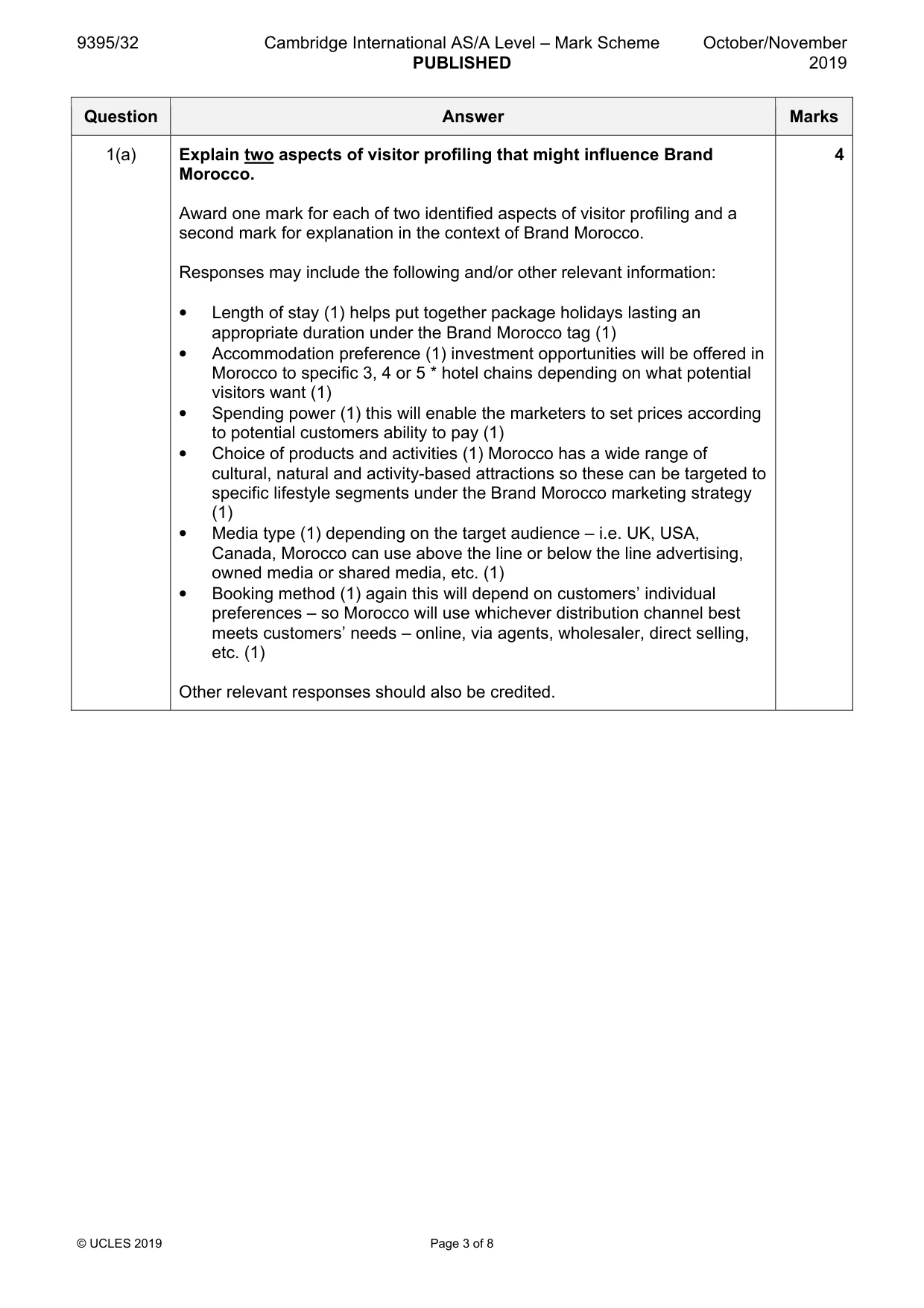
9395/32 Cambridge International AS/A Level – Mark Scheme PUBLISHED October/November 2019 © UCLES 2019 Page 3 of 8 Question Answer Marks 1(a) Explain two aspects of visitor profiling that might influence Brand Morocco. Award one mark for each of two identified aspects of visitor profiling and a second mark for explanation in the context of Brand Morocco. Responses may include the following and/or other relevant information: • Length of stay (1) helps put together package holidays lasting an appropriate duration under the Brand Morocco tag (1) • Accommodation preference (1) investment opportunities will be offered in Morocco to specific 3, 4 or 5 * hotel chains depending on what potential visitors want (1) • Spending power (1) this will enable the marketers to set prices according to potential customers ability to pay (1) • Choice of products and activities (1) Morocco has a wide range of cultural, natural and activity-based attractions so these can be targeted to specific lifestyle segments under the Brand Morocco marketing strategy (1) • Media type (1) depending on the target audience – i.e. UK, USA, Canada, Morocco can use above the line or below the line advertising, owned media or shared media, etc. (1) • Booking method (1) again this will depend on customers’ individual preferences – so Morocco will use whichever distribution channel best meets customers’ needs – online, via agents, wholesaler, direct selling, etc. (1) Other relevant responses should also be credited. 4
Mark scheme, page 4
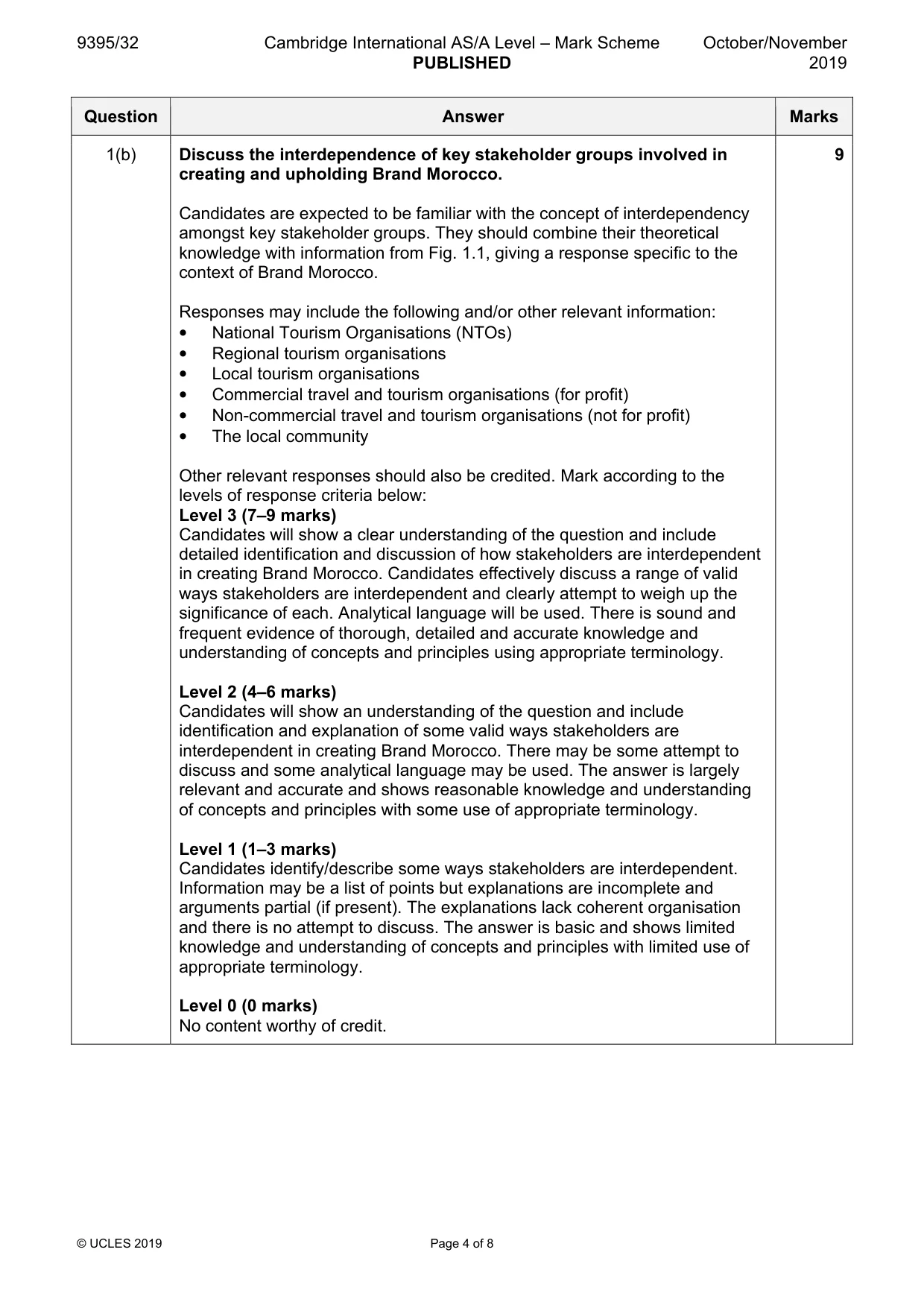
9395/32 Cambridge International AS/A Level – Mark Scheme PUBLISHED October/November 2019 © UCLES 2019 Page 4 of 8 Question Answer Marks 1(b) Discuss the interdependence of key stakeholder groups involved in creating and upholding Brand Morocco. Candidates are expected to be familiar with the concept of interdependency amongst key stakeholder groups. They should combine their theoretical knowledge with information from Fig. 1.1, giving a response specific to the context of Brand Morocco. Responses may include the following and/or other relevant information: • National Tourism Organisations (NTOs) • Regional tourism organisations • Local tourism organisations • Commercial travel and tourism organisations (for profit) • Non-commercial travel and tourism organisations (not for profit) • The local community Other relevant responses should also be credited. Mark according to the levels of response criteria below: Level 3 (7–9 marks) Candidates will show a clear understanding of the question and include detailed identification and discussion of how stakeholders are interdependent in creating Brand Morocco. Candidates effectively discuss a range of valid ways stakeholders are interdependent and clearly attempt to weigh up the significance of each. Analytical language will be used. There is sound and frequent evidence of thorough, detailed and accurate knowledge and understanding of concepts and principles using appropriate terminology. Level 2 (4–6 marks) Candidates will show an understanding of the question and include identification and explanation of some valid ways stakeholders are interdependent in creating Brand Morocco. There may be some attempt to discuss and some analytical language may be used. The answer is largely relevant and accurate and shows reasonable knowledge and understanding of concepts and principles with some use of appropriate terminology. Level 1 (1–3 marks) Candidates identify/describe some ways stakeholders are interdependent. Information may be a list of points but explanations are incomplete and arguments partial (if present). The explanations lack coherent organisation and there is no attempt to discuss. The answer is basic and shows limited knowledge and understanding of concepts and principles with limited use of appropriate terminology. Level 0 (0 marks) No content worthy of credit. 9
Mark scheme, page 5
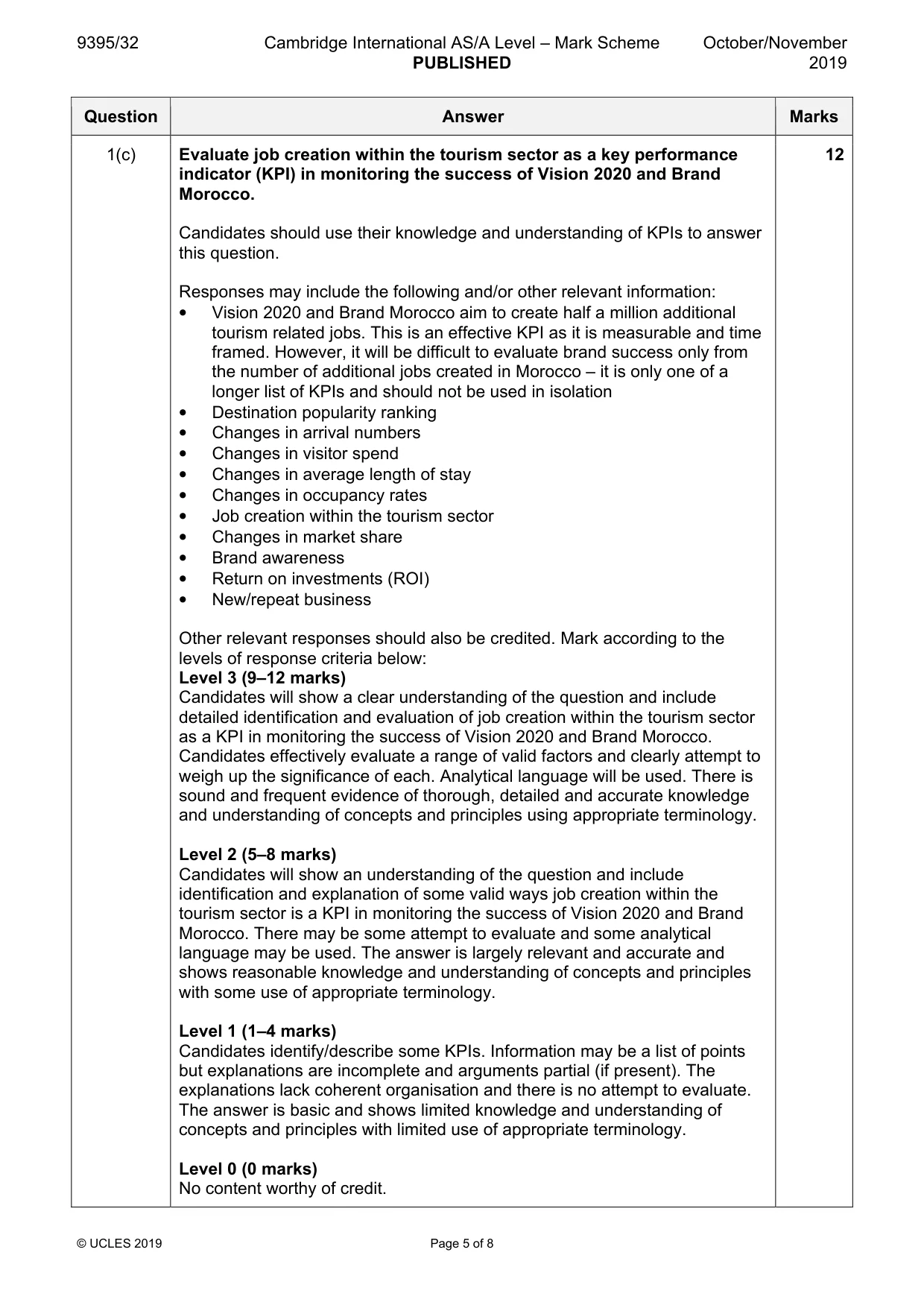
9395/32 Cambridge International AS/A Level – Mark Scheme PUBLISHED October/November 2019 © UCLES 2019 Page 5 of 8 Question Answer Marks 1(c) Evaluate job creation within the tourism sector as a key performance indicator (KPI) in monitoring the success of Vision 2020 and Brand Morocco. Candidates should use their knowledge and understanding of KPIs to answer this question. Responses may include the following and/or other relevant information: • Vision 2020 and Brand Morocco aim to create half a million additional tourism related jobs. This is an effective KPI as it is measurable and time framed. However, it will be difficult to evaluate brand success only from the number of additional jobs created in Morocco – it is only one of a longer list of KPIs and should not be used in isolation • Destination popularity ranking • Changes in arrival numbers • Changes in visitor spend • Changes in average length of stay • Changes in occupancy rates • Job creation within the tourism sector • Changes in market share • Brand awareness • Return on investments (ROI) • New/repeat business Other relevant responses should also be credited. Mark according to the levels of response criteria below: Level 3 (9–12 marks) Candidates will show a clear understanding of the question and include detailed identification and evaluation of job creation within the tourism sector as a KPI in monitoring the success of Vision 2020 and Brand Morocco. Candidates effectively evaluate a range of valid factors and clearly attempt to weigh up the significance of each. Analytical language will be used. There is sound and frequent evidence of thorough, detailed and accurate knowledge and understanding of concepts and principles using appropriate terminology. Level 2 (5–8 marks) Candidates will show an understanding of the question and include identification and explanation of some valid ways job creation within the tourism sector is a KPI in monitoring the success of Vision 2020 and Brand Morocco. There may be some attempt to evaluate and some analytical language may be used. The answer is largely relevant and accurate and shows reasonable knowledge and understanding of concepts and principles with some use of appropriate terminology. Level 1 (1–4 marks) Candidates identify/describe some KPIs. Information may be a list of points but explanations are incomplete and arguments partial (if present). The explanations lack coherent organisation and there is no attempt to evaluate. The answer is basic and shows limited knowledge and understanding of concepts and principles with limited use of appropriate terminology. Level 0 (0 marks) No content worthy of credit. 12
Mark scheme, page 6
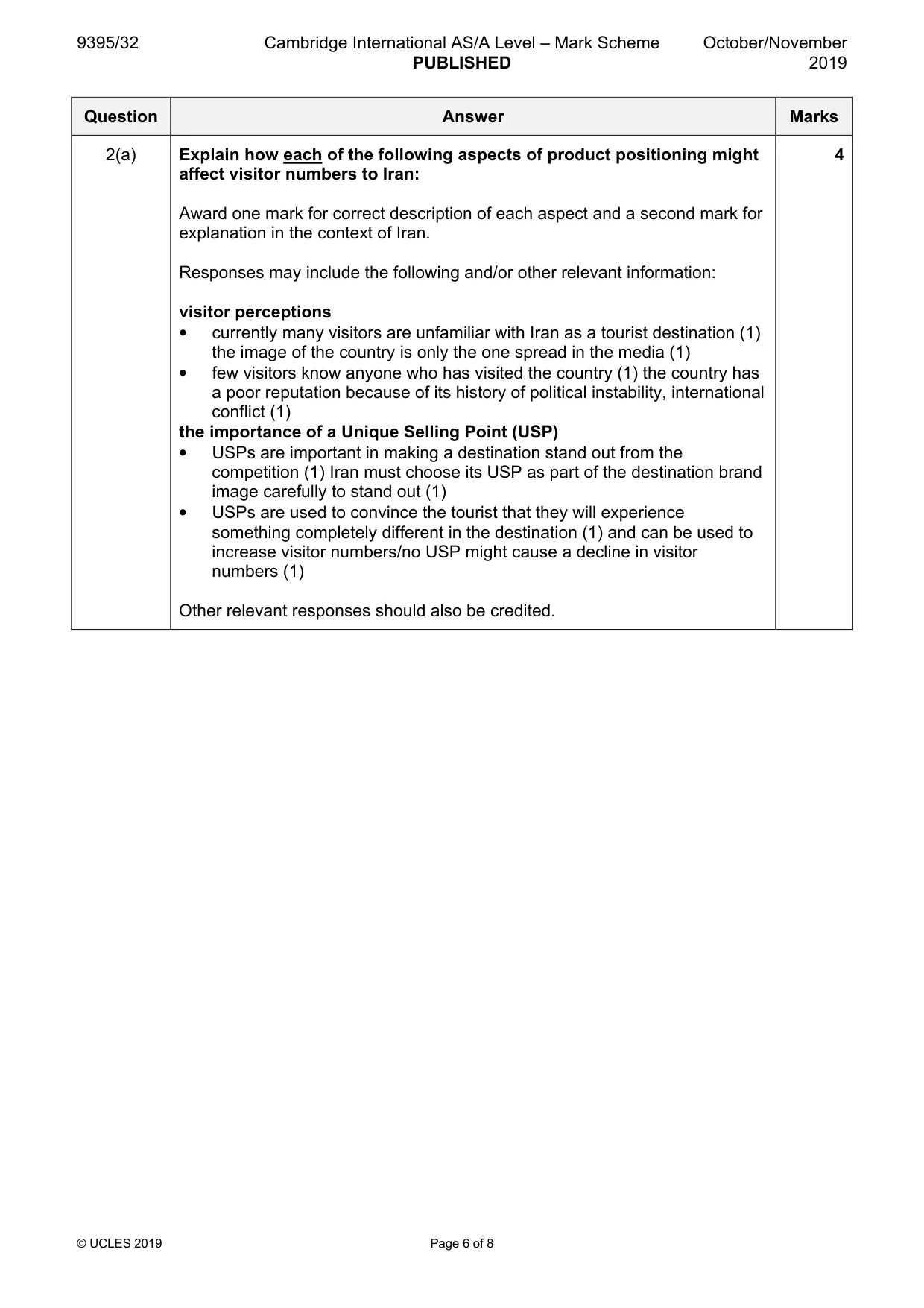
9395/32 Cambridge International AS/A Level – Mark Scheme PUBLISHED October/November 2019 © UCLES 2019 Page 6 of 8 Question Answer Marks 2(a) Explain how each of the following aspects of product positioning might affect visitor numbers to Iran: Award one mark for correct description of each aspect and a second mark for explanation in the context of Iran. Responses may include the following and/or other relevant information: visitor perceptions • currently many visitors are unfamiliar with Iran as a tourist destination (1) the image of the country is only the one spread in the media (1) • few visitors know anyone who has visited the country (1) the country has a poor reputation because of its history of political instability, international conflict (1) the importance of a Unique Selling Point (USP) • USPs are important in making a destination stand out from the competition (1) Iran must choose its USP as part of the destination brand image carefully to stand out (1) • USPs are used to convince the tourist that they will experience something completely different in the destination (1) and can be used to increase visitor numbers/no USP might cause a decline in visitor numbers (1) Other relevant responses should also be credited. 4
Mark scheme, page 7
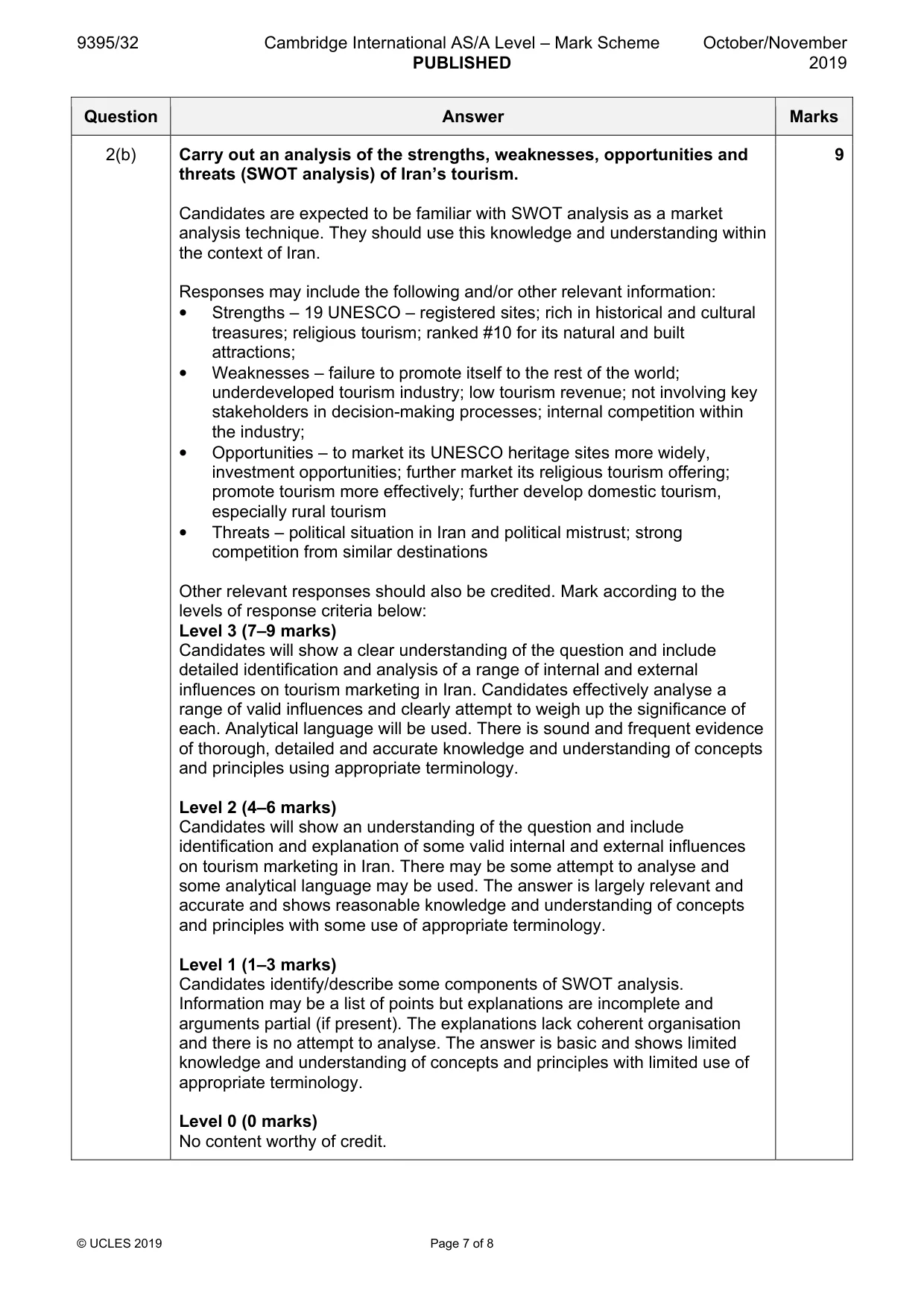
9395/32 Cambridge International AS/A Level – Mark Scheme PUBLISHED October/November 2019 © UCLES 2019 Page 7 of 8 Question Answer Marks 2(b) Carry out an analysis of the strengths, weaknesses, opportunities and threats (SWOT analysis) of Iran’s tourism. Candidates are expected to be familiar with SWOT analysis as a market analysis technique. They should use this knowledge and understanding within the context of Iran. Responses may include the following and/or other relevant information: • Strengths – 19 UNESCO – registered sites; rich in historical and cultural treasures; religious tourism; ranked #10 for its natural and built attractions; • Weaknesses – failure to promote itself to the rest of the world; underdeveloped tourism industry; low tourism revenue; not involving key stakeholders in decision-making processes; internal competition within the industry; • Opportunities – to market its UNESCO heritage sites more widely, investment opportunities; further market its religious tourism offering; promote tourism more effectively; further develop domestic tourism, especially rural tourism • Threats – political situation in Iran and political mistrust; strong competition from similar destinations Other relevant responses should also be credited. Mark according to the levels of response criteria below: Level 3 (7–9 marks) Candidates will show a clear understanding of the question and include detailed identification and analysis of a range of internal and external influences on tourism marketing in Iran. Candidates effectively analyse a range of valid influences and clearly attempt to weigh up the significance of each. Analytical language will be used. There is sound and frequent evidence of thorough, detailed and accurate knowledge and understanding of concepts and principles using appropriate terminology. Level 2 (4–6 marks) Candidates will show an understanding of the question and include identification and explanation of some valid internal and external influences on tourism marketing in Iran. There may be some attempt to analyse and some analytical language may be used. The answer is largely relevant and accurate and shows reasonable knowledge and understanding of concepts and principles with some use of appropriate terminology. Level 1 (1–3 marks) Candidates identify/describe some components of SWOT analysis. Information may be a list of points but explanations are incomplete and arguments partial (if present). The explanations lack coherent organisation and there is no attempt to analyse. The answer is basic and shows limited knowledge and understanding of concepts and principles with limited use of appropriate terminology. Level 0 (0 marks) No content worthy of credit. 9
Mark scheme, page 8
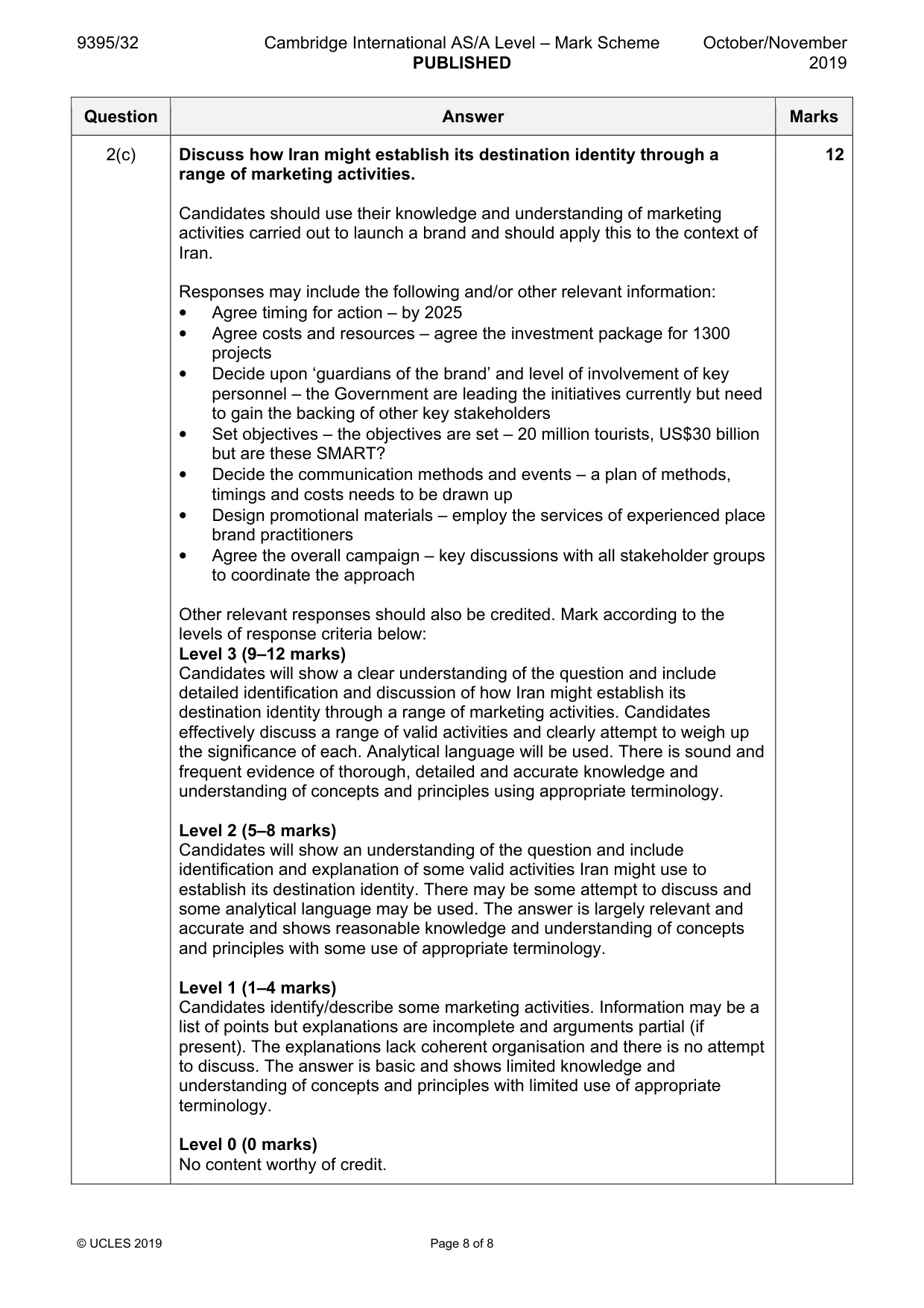
9395/32 Cambridge International AS/A Level – Mark Scheme PUBLISHED October/November 2019 © UCLES 2019 Page 8 of 8 Question Answer Marks 2(c) Discuss how Iran might establish its destination identity through a range of marketing activities. Candidates should use their knowledge and understanding of marketing activities carried out to launch a brand and should apply this to the context of Iran. Responses may include the following and/or other relevant information: • Agree timing for action – by 2025 • Agree costs and resources – agree the investment package for 1300 projects • Decide upon ‘guardians of the brand’ and level of involvement of key personnel – the Government are leading the initiatives currently but need to gain the backing of other key stakeholders • Set objectives – the objectives are set – 20 million tourists, US$30 billion but are these SMART? • Decide the communication methods and events – a plan of methods, timings and costs needs to be drawn up • Design promotional materials – employ the services of experienced place brand practitioners • Agree the overall campaign – key discussions with all stakeholder groups to coordinate the approach Other relevant responses should also be credited. Mark according to the levels of response criteria below: Level 3 (9–12 marks) Candidates will show a clear understanding of the question and include detailed identification and discussion of how Iran might establish its destination identity through a range of marketing activities. Candidates effectively discuss a range of valid activities and clearly attempt to weigh up the significance of each. Analytical language will be used. There is sound and frequent evidence of thorough, detailed and accurate knowledge and understanding of concepts and principles using appropriate terminology. Level 2 (5–8 marks) Candidates will show an understanding of the question and include identification and explanation of some valid activities Iran might use to establish its destination identity. There may be some attempt to discuss and some analytical language may be used. The answer is largely relevant and accurate and shows reasonable knowledge and understanding of concepts and principles with some use of appropriate terminology. Level 1 (1–4 marks) Candidates identify/describe some marketing activities. Information may be a list of points but explanations are incomplete and arguments partial (if present). The explanations lack coherent organisation and there is no attempt to discuss. The answer is basic and shows limited knowledge and understanding of concepts and principles with limited use of appropriate terminology. Level 0 (0 marks) No content worthy of credit. 12
What you needed in this session
Cambridge’s own grade thresholds for 2019 Oct/Nov, Paper 3 · Variant 2. A higher threshold means an easier paper — the bar moves with how the cohort did.