Cambridge A Level Travel and Tourism 9395 — 2019 Oct/Nov Paper 1 · Variant 2
9395/12/O/N/19 · 100 marks · ≈113 min
The question paper and its mark scheme, free to read here and free to download. This is Cambridge’s own paper, exactly as it was sat.
Question paper16 pages



Mark scheme11 pages
Answers below. Sit the paper first if you are practising.
Paper as text
Question paper, page 1
This document consists of 13 printed pages, 3 blank pages and 1 Insert. DC (LK) 171251/1 © UCLES 2019 [Turn over * 1 8 6 1 0 2 4 7 8 8 * TRAVEL AND TOURISM 9395/12 Paper 1 The Industry October/November 2019 2 hours and 30 minutes Candidates answer on the Question Paper. No Additional Materials are required. READ THESE INSTRUCTIONS FIRST Write your centre number, candidate number and name on all the work you hand in. Write in dark blue or black pen. You may use an HB pencil for any diagrams or graphs. Do not use staples, paper clips, glue or correction fluid. DO NOT WRITE IN ANY BARCODES. Answer all questions. All the Figures referred to in the questions are contained in the Insert. The number of marks is given in brackets [ ] at the end of each question or part question. Cambridge Assessment International Education Cambridge International Advanced Subsidiary and Advanced Level
Question paper, page 2
2 9395/12/O/N/19 © UCLES 2019 1 (a) State one way a Tourist Information Centre (TIC) can assist the following types of customer: foreign visitors … … people with mobility difficulties … … educational groups … … families … … [4] (b) Explain three likely impacts of poor customer service from the TIC on a destination. 1 … … … … 2 … … … … 3 … … … … [6]
Question paper, page 3
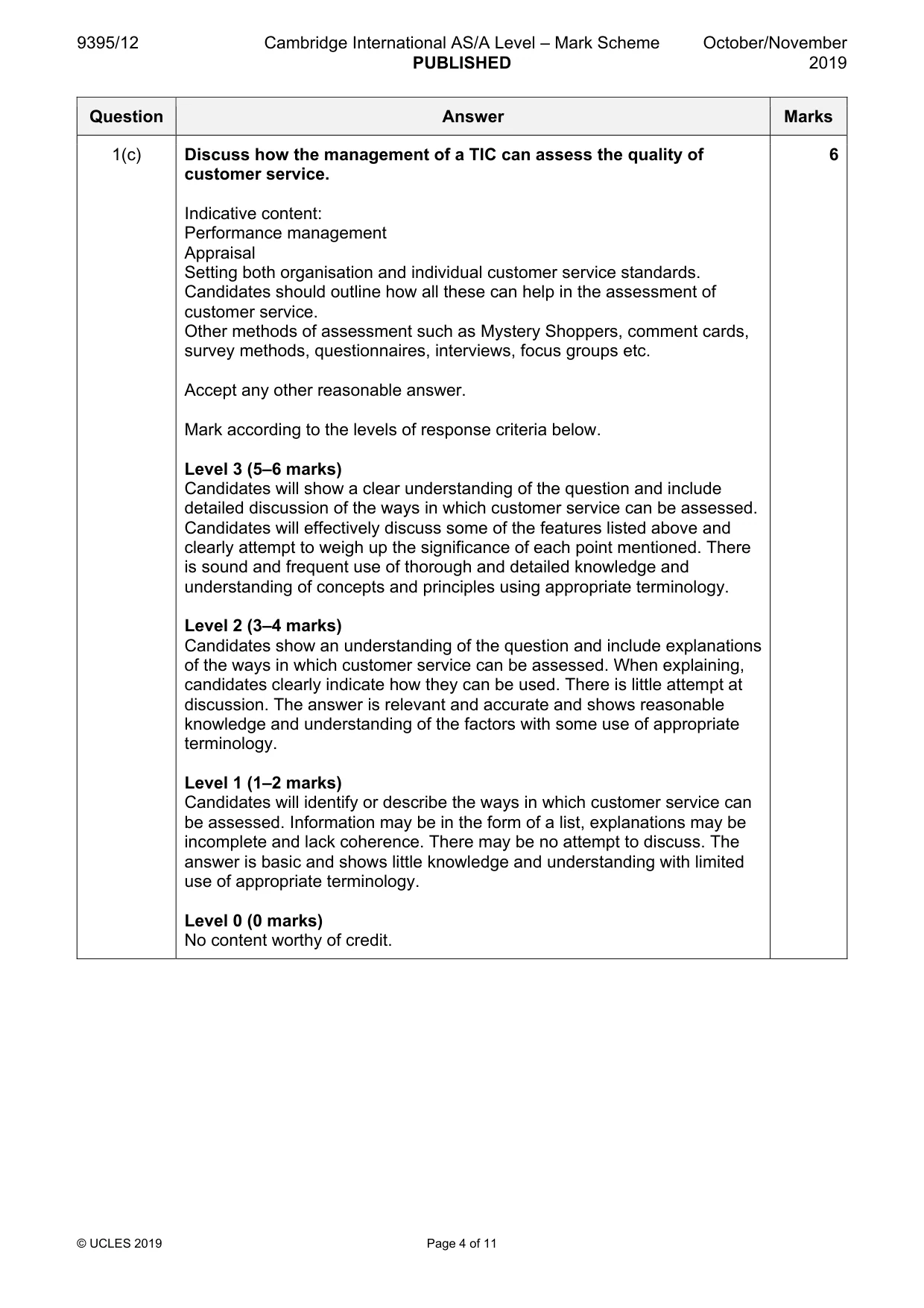
3 9395/12/O/N/19 © UCLES 2019 [Turn over (c) Discuss how the management of a TIC can assess the quality of customer service. … … … … … … … … … … … … [6]
Question paper, page 4
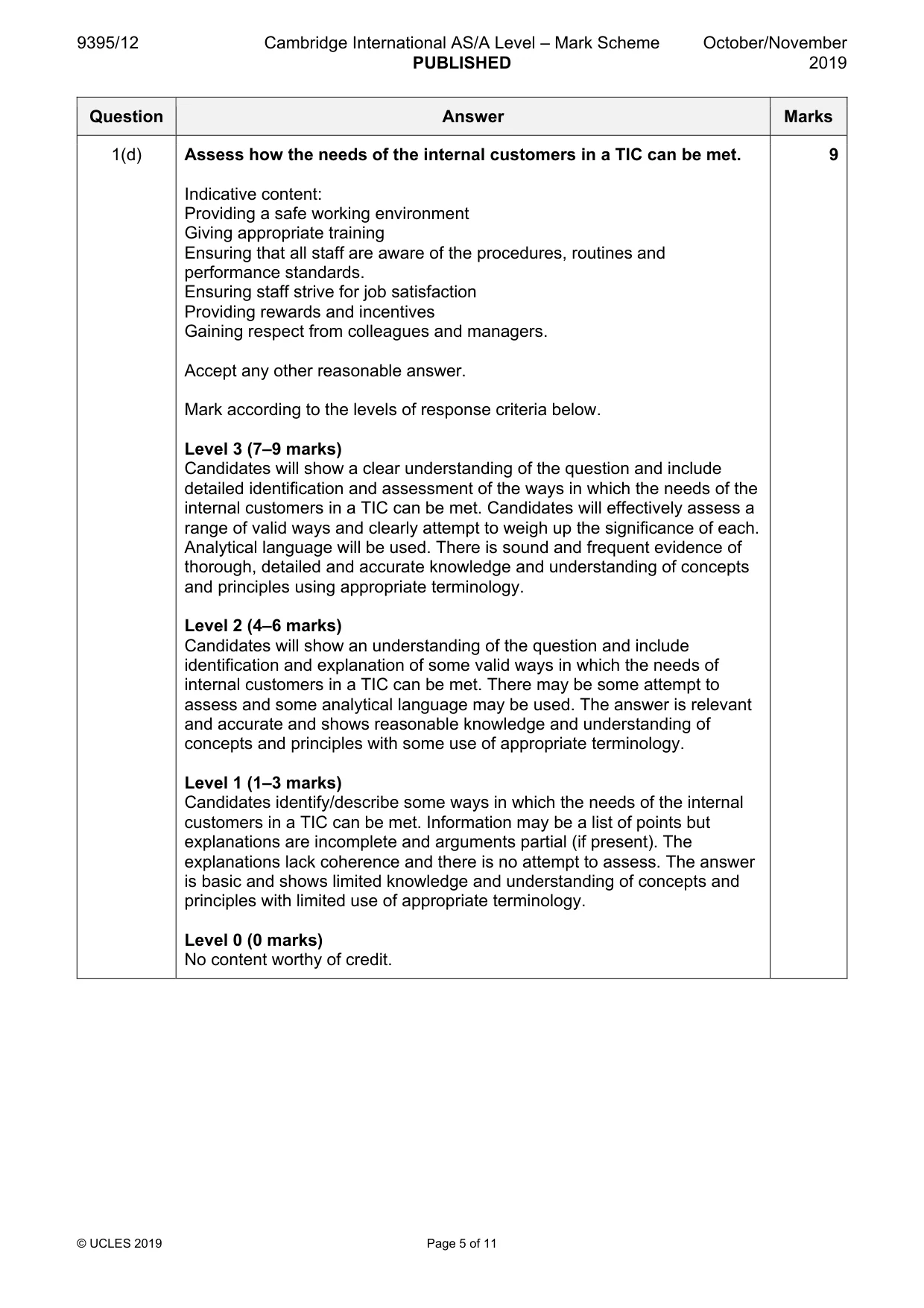
4 9395/12/O/N/19 © UCLES 2019 (d) Assess how the needs of internal customers in a TIC can be met. … … … … … … … … … … … … … … … … … … [9] [Total: 25]
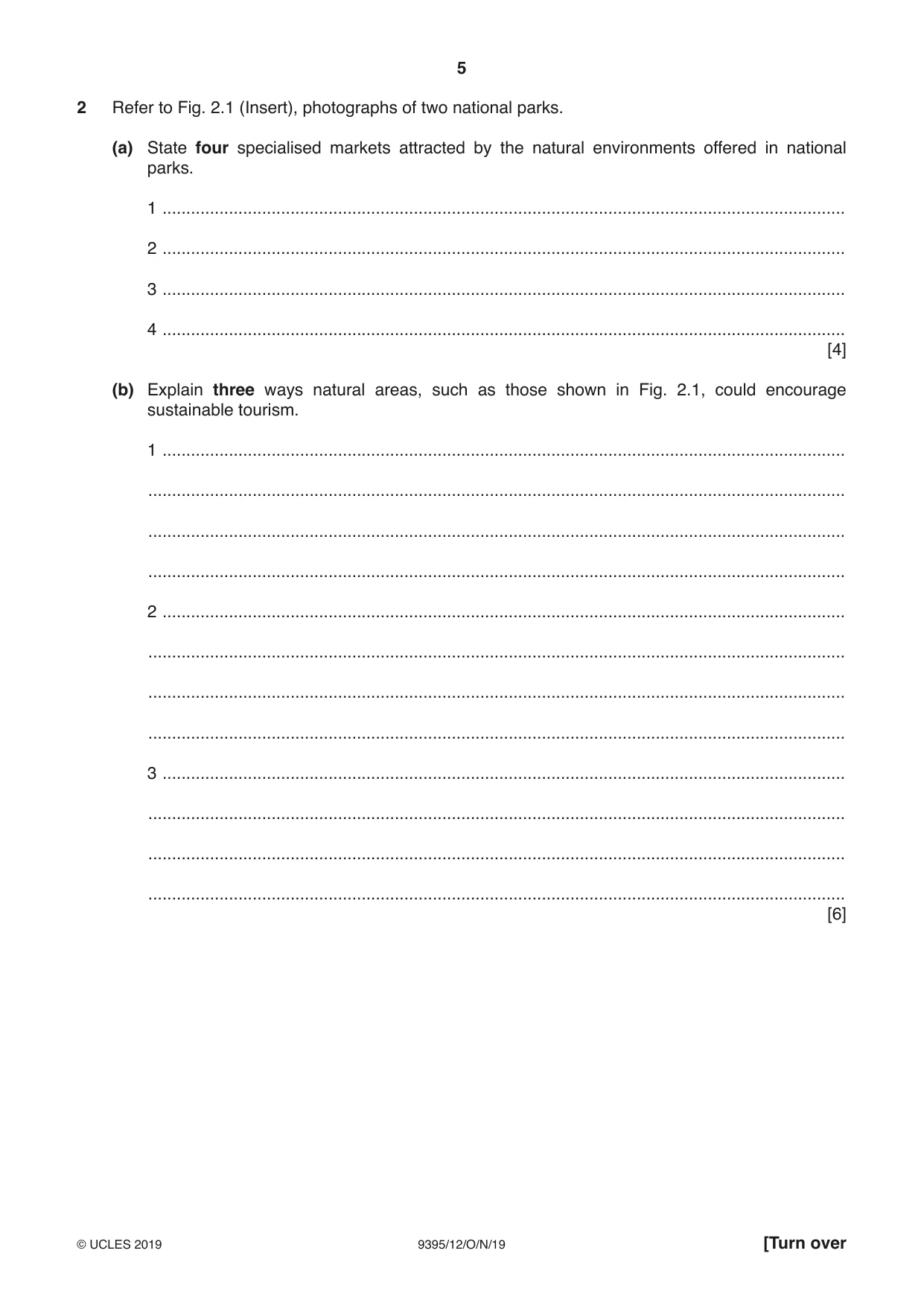
Question paper, page 5
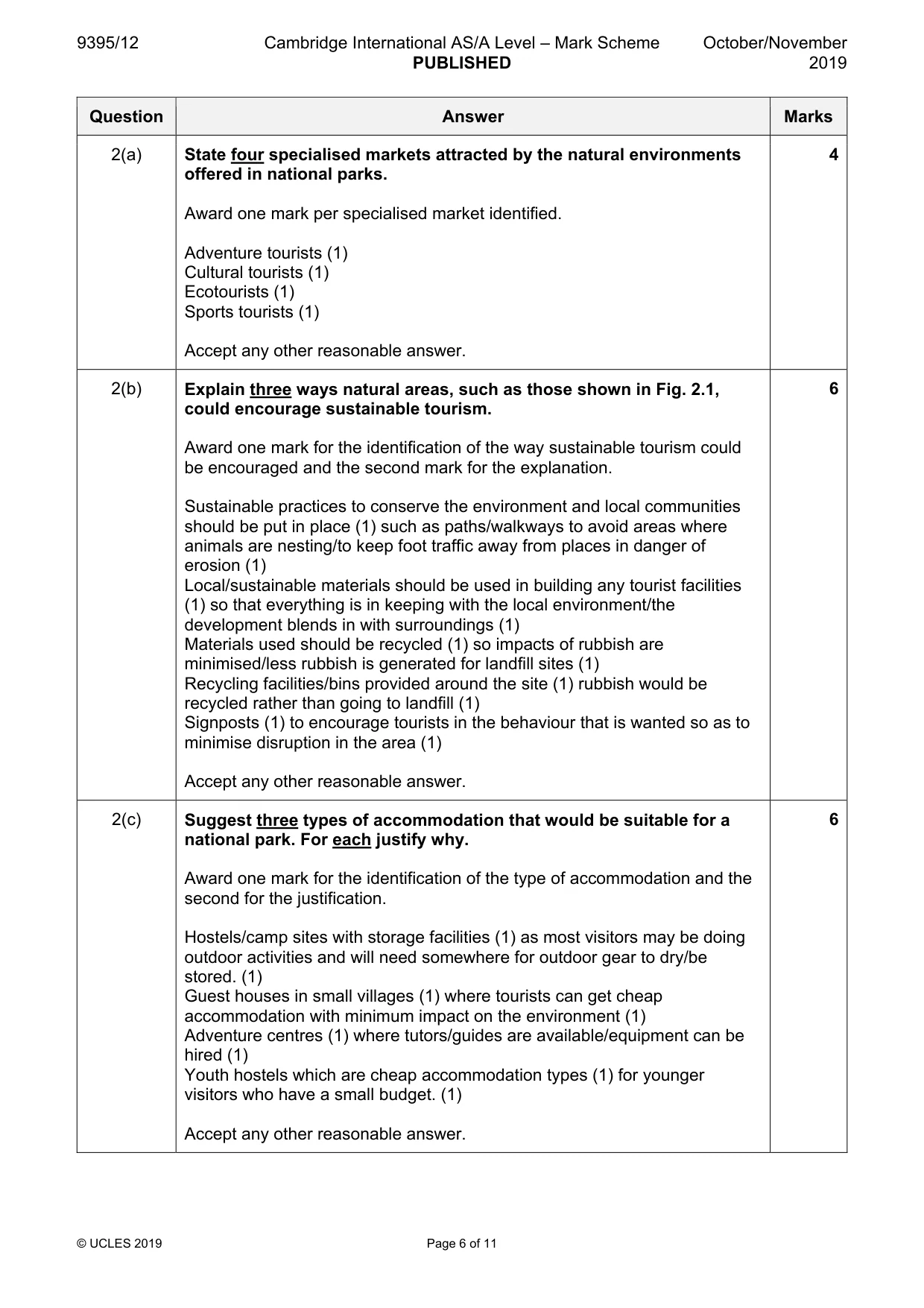
5 9395/12/O/N/19 © UCLES 2019 [Turn over 2 Refer to Fig. 2.1 (Insert), photographs of two national parks. (a) State four specialised markets attracted by the natural environments offered in national parks. 1 … 2 … 3 … 4 … [4] (b) Explain three ways natural areas, such as those shown in Fig. 2.1, could encourage sustainable tourism. 1 … … … … 2 … … … … 3 … … … … [6]
Question paper, page 6
6 9395/12/O/N/19 © UCLES 2019 (c) Suggest three types of accommodation that would be suitable for a National Park. For each justify why. Accommodation … Why suitable … … Accommodation … Why suitable … … Accommodation … Why suitable … … [6]
Question paper, page 7
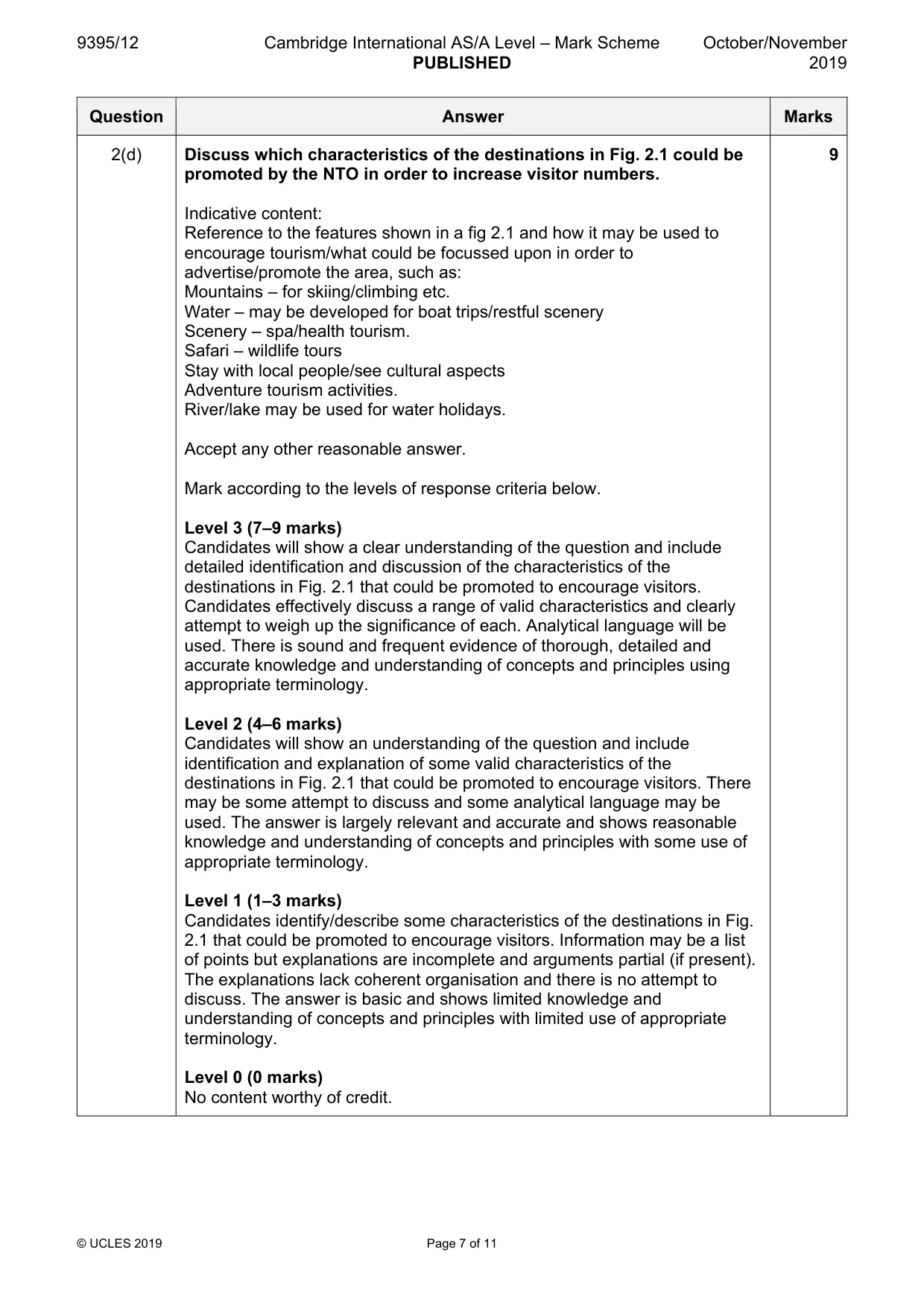
7 9395/12/O/N/19 © UCLES 2019 [Turn over (d) Discuss which characteristics of the destinations in Fig. 2.1 could be promoted by the NTO in order to increase visitor numbers. … … … … … … … … … … … … … … … … … … [9] [Total: 25]
Question paper, page 8
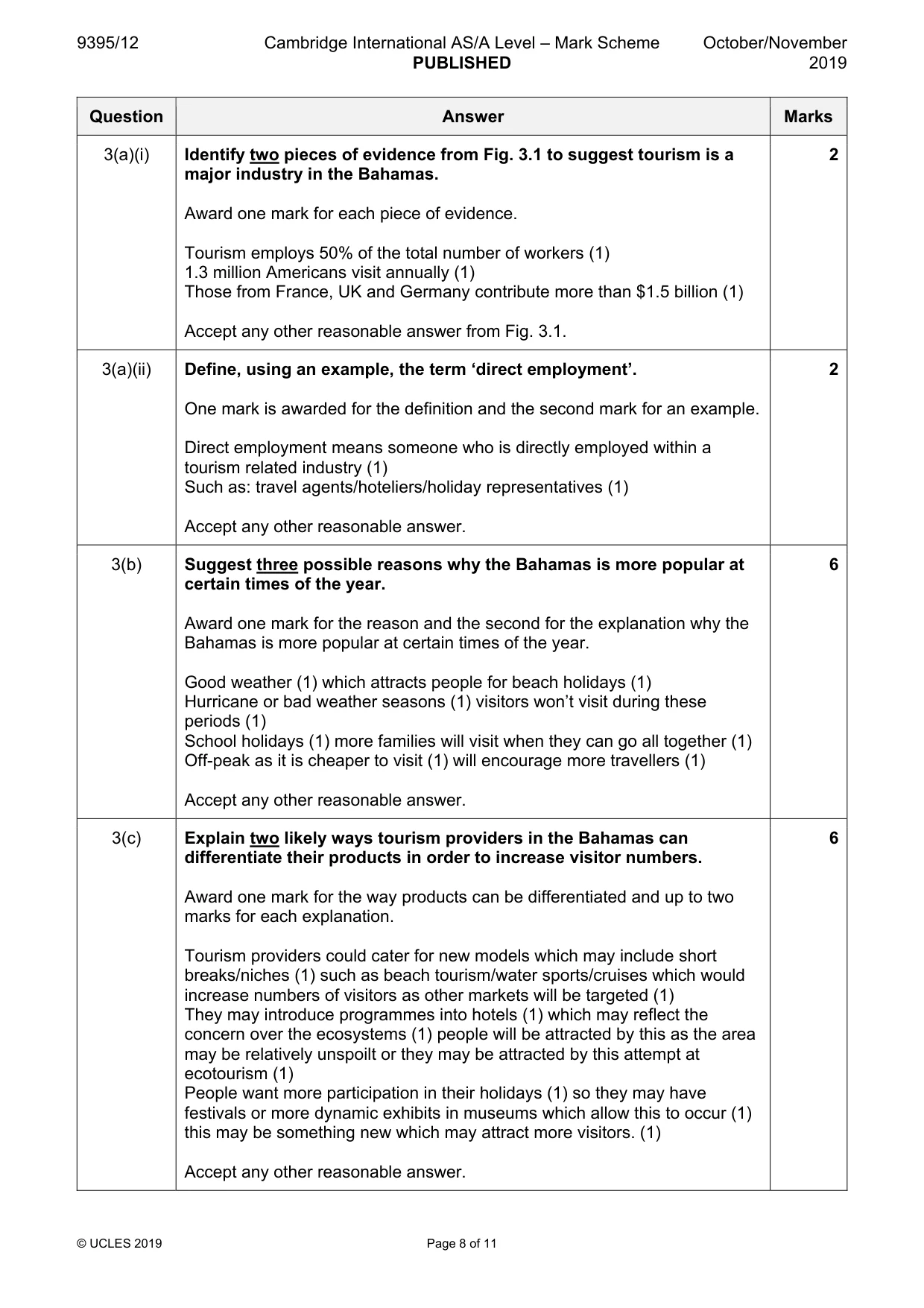
8 9395/12/O/N/19 © UCLES 2019 3 Refer to Fig. 3.1 (Insert), information about tourism in the Bahamas. (a) (i) Identify two pieces of evidence from Fig. 3.1 to suggest tourism is a major industry in the Bahamas. 1 … … 2 … … [2] (ii) Define, using an example, the term ‘direct employment’. … … … … [2] (b) Explain three possible reasons why the Bahamas is more popular at certain times of the year. 1 … … … … 2 … … … … 3 … … … … [6]
Question paper, page 9
9 9395/12/O/N/19 © UCLES 2019 [Turn over (c) Explain two likely ways tourism providers in the Bahamas can differentiate their products to increase visitor numbers. 1 … … … … … … 2 … … … … … … [6]
Question paper, page 10
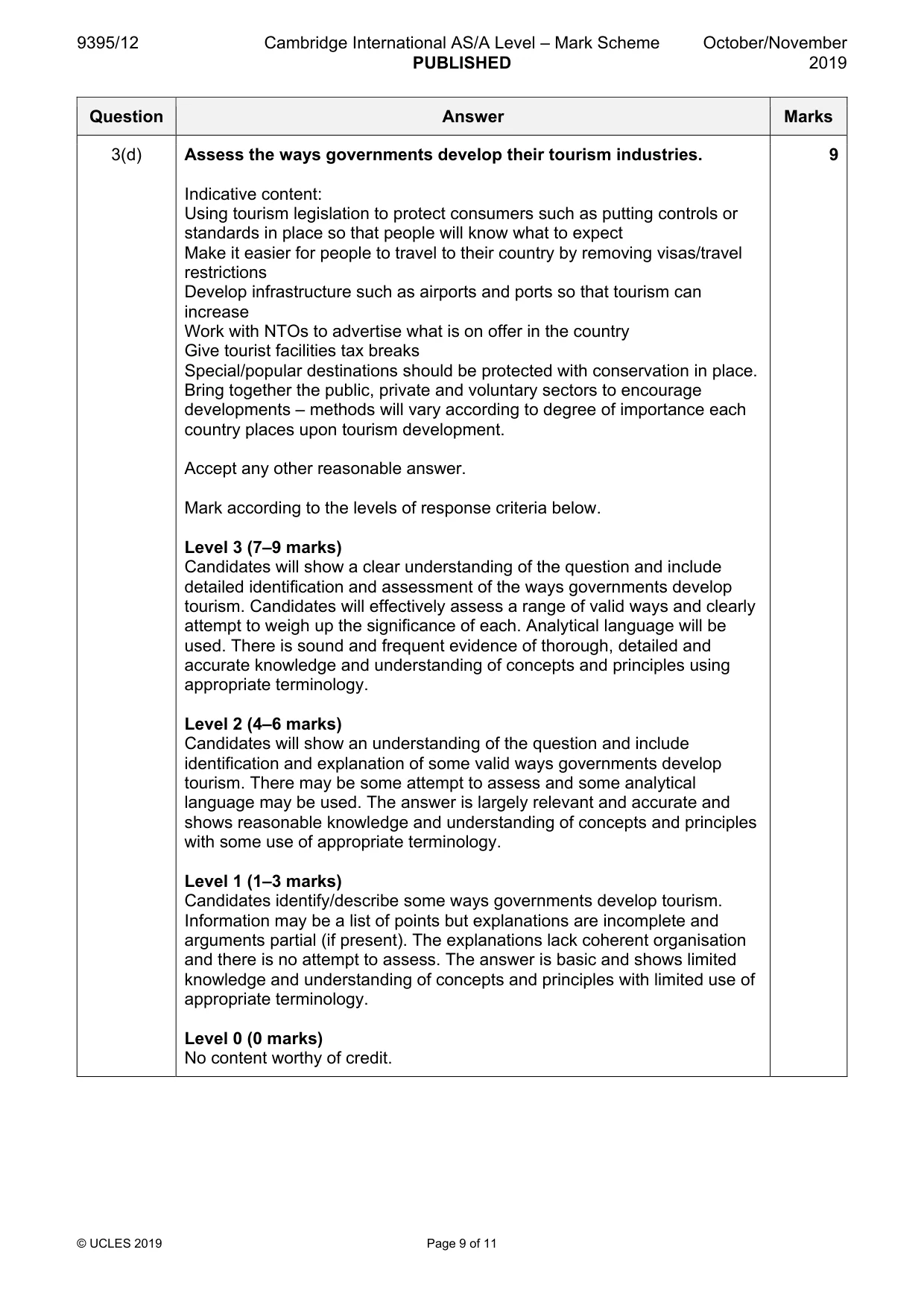
10 9395/12/O/N/19 © UCLES 2019 (d) Assess the ways governments develop their tourism industries. … … … … … … … … … … … … … … … … … … [9] [Total: 25]
Question paper, page 11
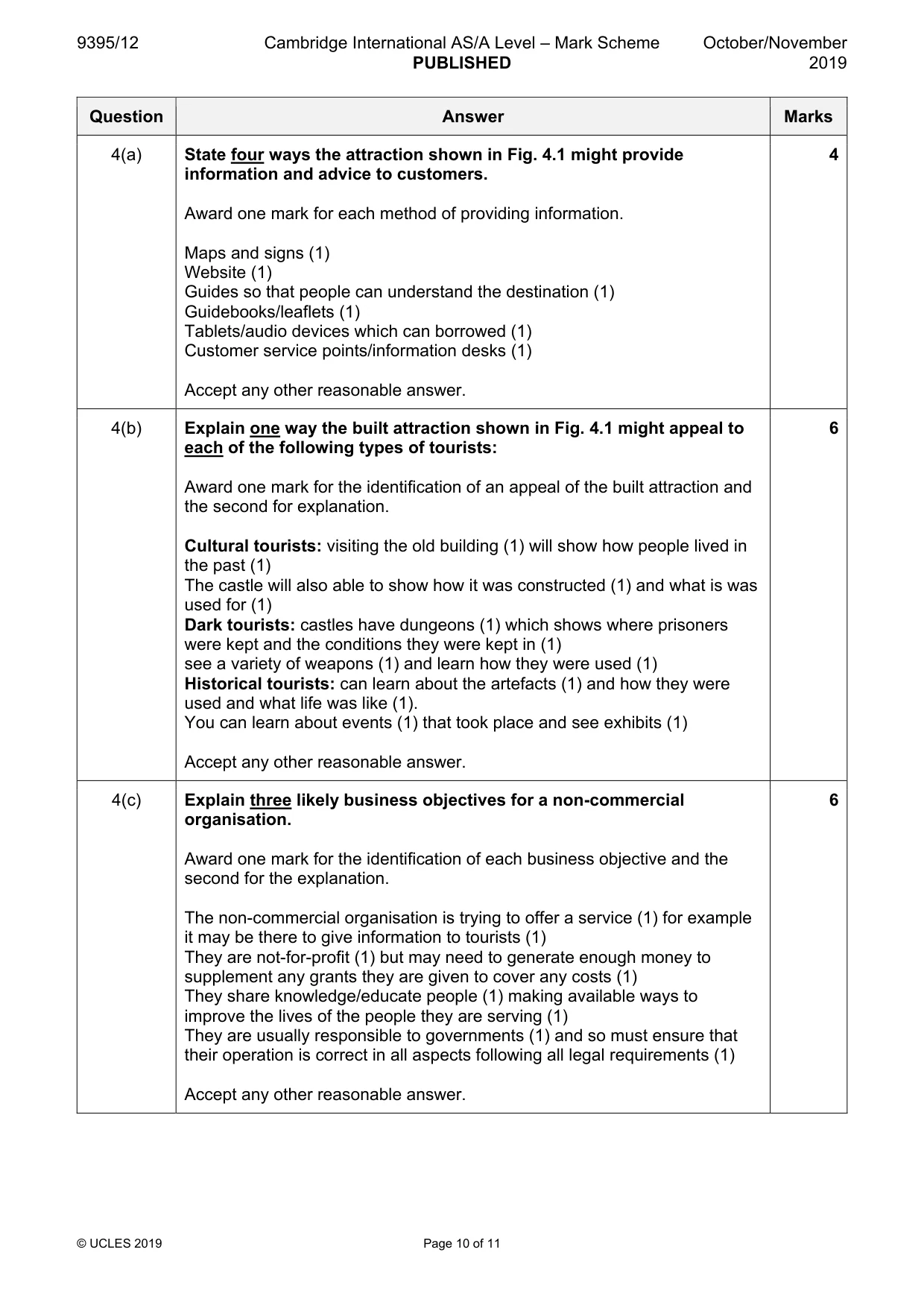
11 9395/12/O/N/19 © UCLES 2019 [Turn over 4 Refer to Fig. 4.1 (Insert), photographs of Edinburgh Castle in Scotland. (a) State four ways the attraction shown in Fig. 4.1 might provide information and advice to customers. 1 … … 2 … … 3 … … 4 … … [4] (b) Explain one way the built attraction shown in Fig. 4.1 might appeal to each of the following types of tourists: cultural tourists … … … … dark tourists … … … … historical tourists … … … … [6]
Question paper, page 12
12 9395/12/O/N/19 © UCLES 2019 (c) The organisation in Fig. 4.1 is non-commercial. Explain three likely business objectives for a non-commercial organisation. 1 … … … … 2 … … … … 3 … … … … [6]
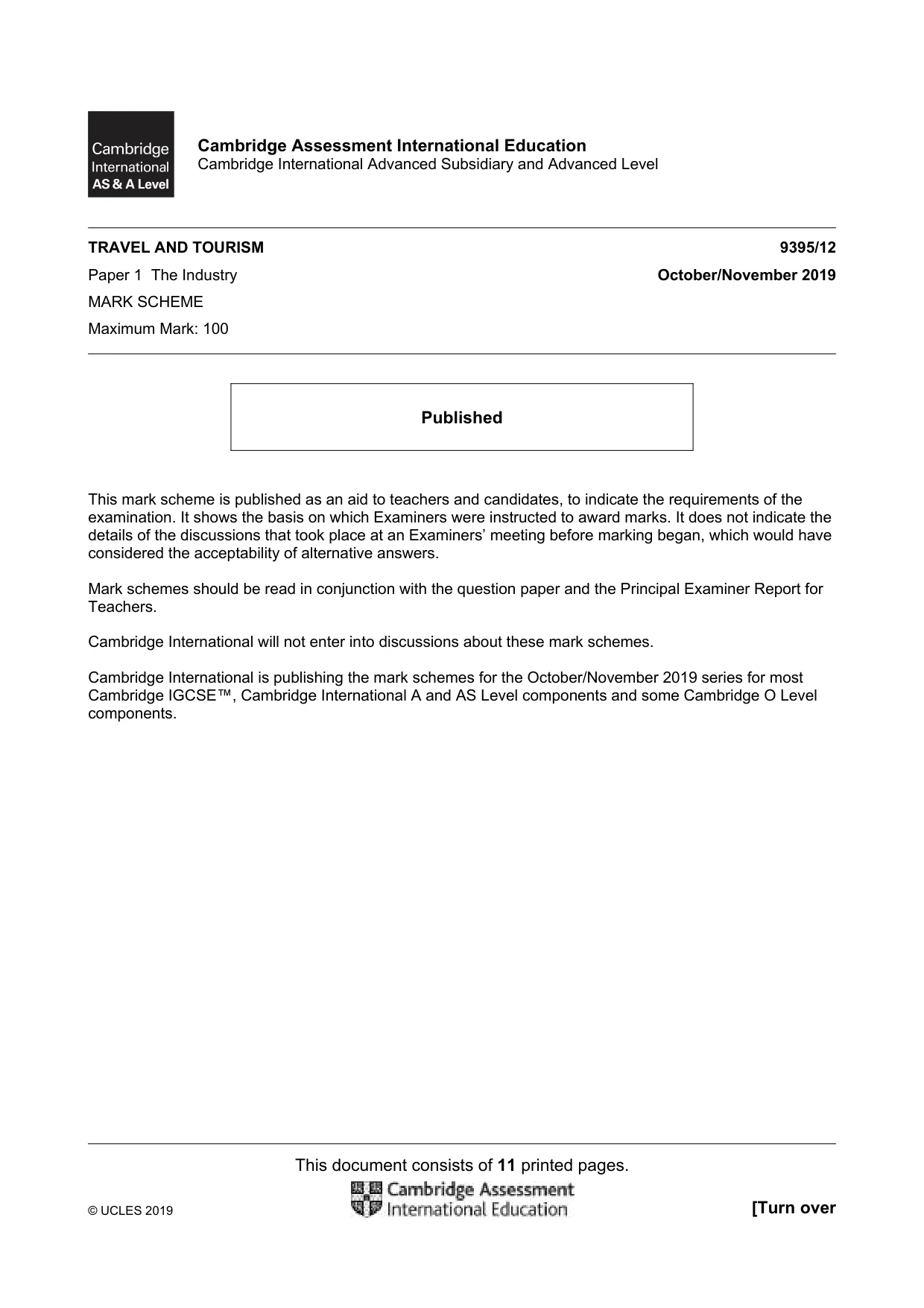
Question paper, page 13
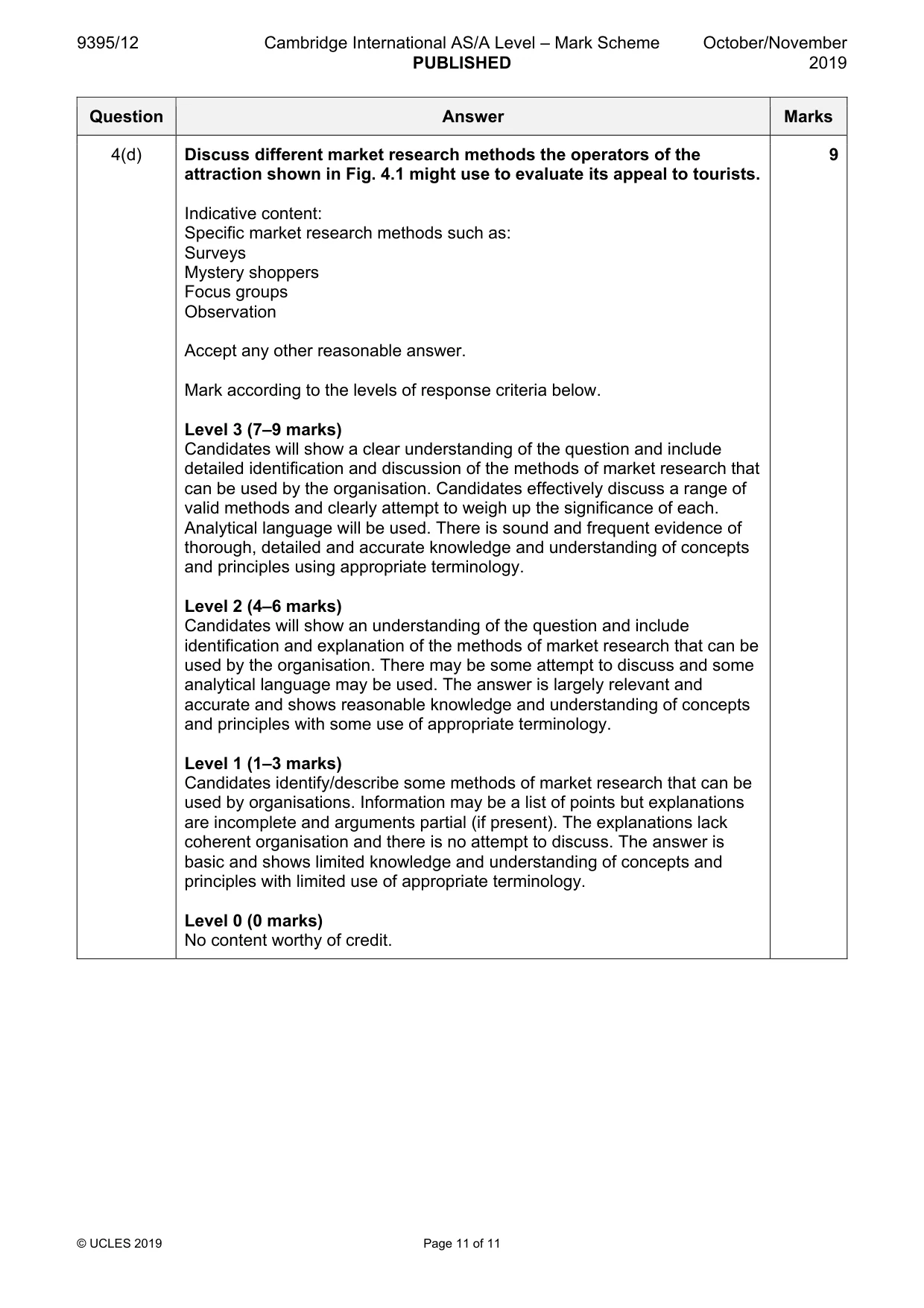
13 9395/12/O/N/19 © UCLES 2019 (d) Discuss different market research methods the operators of the attraction shown in Fig. 4.1 might use to evaluate its appeal to tourists. … … … … … … … … … … … … … … … … … … [9] [Total: 25]
Question paper, page 14
14 9395/12/O/N/19 © UCLES 2019 BLANK PAGE
Question paper, page 15
15 9395/12/O/N/19 © UCLES 2019 BLANK PAGE
Question paper, page 16
16 9395/12/O/N/19 © UCLES 2019 Permission to reproduce items where third-party owned material protected by copyright is included has been sought and cleared where possible. Every reasonable effort has been made by the publisher (UCLES) to trace copyright holders, but if any items requiring clearance have unwittingly been included, the publisher will be pleased to make amends at the earliest possible opportunity. To avoid the issue of disclosure of answer-related information to candidates, all copyright acknowledgements are reproduced online in the Cambridge Assessment International Education Copyright Acknowledgements Booklet. This is produced for each series of examinations and is freely available to download at www.cambridgeinternational.org after the live examination series. Cambridge Assessment International Education is part of the Cambridge Assessment Group. Cambridge Assessment is the brand name of the University of Cambridge Local Examinations Syndicate (UCLES), which itself is a department of the University of Cambridge. BLANK PAGE
Mark scheme, page 1
This document consists of 11 printed pages. © UCLES 2019 [Turn over Cambridge Assessment International Education Cambridge International Advanced Subsidiary and Advanced Level TRAVEL AND TOURISM 9395/12 Paper 1 The Industry October/November 2019 MARK SCHEME Maximum Mark: 100 Published This mark scheme is published as an aid to teachers and candidates, to indicate the requirements of the examination. It shows the basis on which Examiners were instructed to award marks. It does not indicate the details of the discussions that took place at an Examiners’ meeting before marking began, which would have considered the acceptability of alternative answers. Mark schemes should be read in conjunction with the question paper and the Principal Examiner Report for Teachers. Cambridge International will not enter into discussions about these mark schemes. Cambridge International is publishing the mark schemes for the October/November 2019 series for most Cambridge IGCSE™, Cambridge International A and AS Level components and some Cambridge O Level components.
Mark scheme, page 2
9395/12 Cambridge International AS/A Level – Mark Scheme PUBLISHED October/November 2019 © UCLES 2019 Page 2 of 11 Generic Marking Principles These general marking principles must be applied by all examiners when marking candidate answers. They should be applied alongside the specific content of the mark scheme or generic level descriptors for a question. Each question paper and mark scheme will also comply with these marking principles. GENERIC MARKING PRINCIPLE 1: Marks must be awarded in line with: • the specific content of the mark scheme or the generic level descriptors for the question • the specific skills defined in the mark scheme or in the generic level descriptors for the question • the standard of response required by a candidate as exemplified by the standardisation scripts. GENERIC MARKING PRINCIPLE 2: Marks awarded are always whole marks (not half marks, or other fractions). GENERIC MARKING PRINCIPLE 3: Marks must be awarded positively: • marks are awarded for correct/valid answers, as defined in the mark scheme. However, credit is given for valid answers which go beyond the scope of the syllabus and mark scheme, referring to your Team Leader as appropriate • marks are awarded when candidates clearly demonstrate what they know and can do • marks are not deducted for errors • marks are not deducted for omissions • answers should only be judged on the quality of spelling, punctuation and grammar when these features are specifically assessed by the question as indicated by the mark scheme. The meaning, however, should be unambiguous. GENERIC MARKING PRINCIPLE 4: Rules must be applied consistently e.g. in situations where candidates have not followed instructions or in the application of generic level descriptors. GENERIC MARKING PRINCIPLE 5: Marks should be awarded using the full range of marks defined in the mark scheme for the question (however; the use of the full mark range may be limited according to the quality of the candidate responses seen). GENERIC MARKING PRINCIPLE 6: Marks awarded are based solely on the requirements as defined in the mark scheme. Marks should not be awarded with grade thresholds or grade descriptors in mind.
Mark scheme, page 3
9395/12 Cambridge International AS/A Level – Mark Scheme PUBLISHED October/November 2019 © UCLES 2019 Page 3 of 11 Question Answer Marks 1(a) State one way a Tourist Information Centre (TIC) can assist the following types of customer: Award one mark for each way. Foreign visitors – information is given in a language/way that they can understand/information can be given pictorially (1) People with mobility difficulties – advice on places that would be suitable for them to visit/help with accommodation/transport/provide wheelchairs/ ramps (1) Educational groups – make group bookings/provide guides (1) Families – book tickets for attractions/hotels/transport/provide maps/ vouchers (1) Accept any other reasonable answer. 4 1(b) Explain three likely impacts of poor customer service from the TIC on a destination. Award one mark for the identification of the impact and one mark for the explanation of the likely impact. Visitors may get a poor impression (1) and then numbers may reduce because it will not provide a good experience (1) Visitors may not receive all the information available about a place (1) they will therefore not visit attractions as they have not been informed properly (1) If the TIC provides poor customer service tourists will stop using the TIC (1) the TIC is then likely to close/employees may become concerned about their jobs/skilled employees may move out of the area/the destination may become less known as people will stop visiting (1) Accept any other reasonable answer. 6
Mark scheme, page 4
9395/12 Cambridge International AS/A Level – Mark Scheme PUBLISHED October/November 2019 © UCLES 2019 Page 4 of 11 Question Answer Marks 1(c) Discuss how the management of a TIC can assess the quality of customer service. Indicative content: Performance management Appraisal Setting both organisation and individual customer service standards. Candidates should outline how all these can help in the assessment of customer service. Other methods of assessment such as Mystery Shoppers, comment cards, survey methods, questionnaires, interviews, focus groups etc. Accept any other reasonable answer. Mark according to the levels of response criteria below. Level 3 (5–6 marks) Candidates will show a clear understanding of the question and include detailed discussion of the ways in which customer service can be assessed. Candidates will effectively discuss some of the features listed above and clearly attempt to weigh up the significance of each point mentioned. There is sound and frequent use of thorough and detailed knowledge and understanding of concepts and principles using appropriate terminology. Level 2 (3–4 marks) Candidates show an understanding of the question and include explanations of the ways in which customer service can be assessed. When explaining, candidates clearly indicate how they can be used. There is little attempt at discussion. The answer is relevant and accurate and shows reasonable knowledge and understanding of the factors with some use of appropriate terminology. Level 1 (1–2 marks) Candidates will identify or describe the ways in which customer service can be assessed. Information may be in the form of a list, explanations may be incomplete and lack coherence. There may be no attempt to discuss. The answer is basic and shows little knowledge and understanding with limited use of appropriate terminology. Level 0 (0 marks) No content worthy of credit. 6
Mark scheme, page 5
9395/12 Cambridge International AS/A Level – Mark Scheme PUBLISHED October/November 2019 © UCLES 2019 Page 5 of 11 Question Answer Marks 1(d) Assess how the needs of the internal customers in a TIC can be met. Indicative content: Providing a safe working environment Giving appropriate training Ensuring that all staff are aware of the procedures, routines and performance standards. Ensuring staff strive for job satisfaction Providing rewards and incentives Gaining respect from colleagues and managers. Accept any other reasonable answer. Mark according to the levels of response criteria below. Level 3 (7–9 marks) Candidates will show a clear understanding of the question and include detailed identification and assessment of the ways in which the needs of the internal customers in a TIC can be met. Candidates will effectively assess a range of valid ways and clearly attempt to weigh up the significance of each. Analytical language will be used. There is sound and frequent evidence of thorough, detailed and accurate knowledge and understanding of concepts and principles using appropriate terminology. Level 2 (4–6 marks) Candidates will show an understanding of the question and include identification and explanation of some valid ways in which the needs of internal customers in a TIC can be met. There may be some attempt to assess and some analytical language may be used. The answer is relevant and accurate and shows reasonable knowledge and understanding of concepts and principles with some use of appropriate terminology. Level 1 (1–3 marks) Candidates identify/describe some ways in which the needs of the internal customers in a TIC can be met. Information may be a list of points but explanations are incomplete and arguments partial (if present). The explanations lack coherence and there is no attempt to assess. The answer is basic and shows limited knowledge and understanding of concepts and principles with limited use of appropriate terminology. Level 0 (0 marks) No content worthy of credit. 9
Mark scheme, page 6
9395/12 Cambridge International AS/A Level – Mark Scheme PUBLISHED October/November 2019 © UCLES 2019 Page 6 of 11 Question Answer Marks 2(a) State four specialised markets attracted by the natural environments offered in national parks. Award one mark per specialised market identified. Adventure tourists (1) Cultural tourists (1) Ecotourists (1) Sports tourists (1) Accept any other reasonable answer. 4 2(b) Explain three ways natural areas, such as those shown in Fig. 2.1, could encourage sustainable tourism. Award one mark for the identification of the way sustainable tourism could be encouraged and the second mark for the explanation. Sustainable practices to conserve the environment and local communities should be put in place (1) such as paths/walkways to avoid areas where animals are nesting/to keep foot traffic away from places in danger of erosion (1) Local/sustainable materials should be used in building any tourist facilities (1) so that everything is in keeping with the local environment/the development blends in with surroundings (1) Materials used should be recycled (1) so impacts of rubbish are minimised/less rubbish is generated for landfill sites (1) Recycling facilities/bins provided around the site (1) rubbish would be recycled rather than going to landfill (1) Signposts (1) to encourage tourists in the behaviour that is wanted so as to minimise disruption in the area (1) Accept any other reasonable answer. 6 2(c) Suggest three types of accommodation that would be suitable for a national park. For each justify why. Award one mark for the identification of the type of accommodation and the second for the justification. Hostels/camp sites with storage facilities (1) as most visitors may be doing outdoor activities and will need somewhere for outdoor gear to dry/be stored. (1) Guest houses in small villages (1) where tourists can get cheap accommodation with minimum impact on the environment (1) Adventure centres (1) where tutors/guides are available/equipment can be hired (1) Youth hostels which are cheap accommodation types (1) for younger visitors who have a small budget. (1) Accept any other reasonable answer. 6
Mark scheme, page 7
9395/12 Cambridge International AS/A Level – Mark Scheme PUBLISHED October/November 2019 © UCLES 2019 Page 7 of 11 Question Answer Marks 2(d) Discuss which characteristics of the destinations in Fig. 2.1 could be promoted by the NTO in order to increase visitor numbers. Indicative content: Reference to the features shown in a fig 2.1 and how it may be used to encourage tourism/what could be focussed upon in order to advertise/promote the area, such as: Mountains – for skiing/climbing etc. Water – may be developed for boat trips/restful scenery Scenery – spa/health tourism. Safari – wildlife tours Stay with local people/see cultural aspects Adventure tourism activities. River/lake may be used for water holidays. Accept any other reasonable answer. Mark according to the levels of response criteria below. Level 3 (7–9 marks) Candidates will show a clear understanding of the question and include detailed identification and discussion of the characteristics of the destinations in Fig. 2.1 that could be promoted to encourage visitors. Candidates effectively discuss a range of valid characteristics and clearly attempt to weigh up the significance of each. Analytical language will be used. There is sound and frequent evidence of thorough, detailed and accurate knowledge and understanding of concepts and principles using appropriate terminology. Level 2 (4–6 marks) Candidates will show an understanding of the question and include identification and explanation of some valid characteristics of the destinations in Fig. 2.1 that could be promoted to encourage visitors. There may be some attempt to discuss and some analytical language may be used. The answer is largely relevant and accurate and shows reasonable knowledge and understanding of concepts and principles with some use of appropriate terminology. Level 1 (1–3 marks) Candidates identify/describe some characteristics of the destinations in Fig. 2.1 that could be promoted to encourage visitors. Information may be a list of points but explanations are incomplete and arguments partial (if present). The explanations lack coherent organisation and there is no attempt to discuss. The answer is basic and shows limited knowledge and understanding of concepts and principles with limited use of appropriate terminology. Level 0 (0 marks) No content worthy of credit. 9
Mark scheme, page 8
9395/12 Cambridge International AS/A Level – Mark Scheme PUBLISHED October/November 2019 © UCLES 2019 Page 8 of 11 Question Answer Marks 3(a)(i) Identify two pieces of evidence from Fig. 3.1 to suggest tourism is a major industry in the Bahamas. Award one mark for each piece of evidence. Tourism employs 50% of the total number of workers (1) 1.3 million Americans visit annually (1) Those from France, UK and Germany contribute more than $1.5 billion (1) Accept any other reasonable answer from Fig. 3.1. 2 3(a)(ii) Define, using an example, the term ‘direct employment’. One mark is awarded for the definition and the second mark for an example. Direct employment means someone who is directly employed within a tourism related industry (1) Such as: travel agents/hoteliers/holiday representatives (1) Accept any other reasonable answer. 2 3(b) Suggest three possible reasons why the Bahamas is more popular at certain times of the year. Award one mark for the reason and the second for the explanation why the Bahamas is more popular at certain times of the year. Good weather (1) which attracts people for beach holidays (1) Hurricane or bad weather seasons (1) visitors won’t visit during these periods (1) School holidays (1) more families will visit when they can go all together (1) Off-peak as it is cheaper to visit (1) will encourage more travellers (1) Accept any other reasonable answer. 6 3(c) Explain two likely ways tourism providers in the Bahamas can differentiate their products in order to increase visitor numbers. Award one mark for the way products can be differentiated and up to two marks for each explanation. Tourism providers could cater for new models which may include short breaks/niches (1) such as beach tourism/water sports/cruises which would increase numbers of visitors as other markets will be targeted (1) They may introduce programmes into hotels (1) which may reflect the concern over the ecosystems (1) people will be attracted by this as the area may be relatively unspoilt or they may be attracted by this attempt at ecotourism (1) People want more participation in their holidays (1) so they may have festivals or more dynamic exhibits in museums which allow this to occur (1) this may be something new which may attract more visitors. (1) Accept any other reasonable answer. 6
Mark scheme, page 9
9395/12 Cambridge International AS/A Level – Mark Scheme PUBLISHED October/November 2019 © UCLES 2019 Page 9 of 11 Question Answer Marks 3(d) Assess the ways governments develop their tourism industries. Indicative content: Using tourism legislation to protect consumers such as putting controls or standards in place so that people will know what to expect Make it easier for people to travel to their country by removing visas/travel restrictions Develop infrastructure such as airports and ports so that tourism can increase Work with NTOs to advertise what is on offer in the country Give tourist facilities tax breaks Special/popular destinations should be protected with conservation in place. Bring together the public, private and voluntary sectors to encourage developments – methods will vary according to degree of importance each country places upon tourism development. Accept any other reasonable answer. Mark according to the levels of response criteria below. Level 3 (7–9 marks) Candidates will show a clear understanding of the question and include detailed identification and assessment of the ways governments develop tourism. Candidates will effectively assess a range of valid ways and clearly attempt to weigh up the significance of each. Analytical language will be used. There is sound and frequent evidence of thorough, detailed and accurate knowledge and understanding of concepts and principles using appropriate terminology. Level 2 (4–6 marks) Candidates will show an understanding of the question and include identification and explanation of some valid ways governments develop tourism. There may be some attempt to assess and some analytical language may be used. The answer is largely relevant and accurate and shows reasonable knowledge and understanding of concepts and principles with some use of appropriate terminology. Level 1 (1–3 marks) Candidates identify/describe some ways governments develop tourism. Information may be a list of points but explanations are incomplete and arguments partial (if present). The explanations lack coherent organisation and there is no attempt to assess. The answer is basic and shows limited knowledge and understanding of concepts and principles with limited use of appropriate terminology. Level 0 (0 marks) No content worthy of credit. 9
Mark scheme, page 10
9395/12 Cambridge International AS/A Level – Mark Scheme PUBLISHED October/November 2019 © UCLES 2019 Page 10 of 11 Question Answer Marks 4(a) State four ways the attraction shown in Fig. 4.1 might provide information and advice to customers. Award one mark for each method of providing information. Maps and signs (1) Website (1) Guides so that people can understand the destination (1) Guidebooks/leaflets (1) Tablets/audio devices which can borrowed (1) Customer service points/information desks (1) Accept any other reasonable answer. 4 4(b) Explain one way the built attraction shown in Fig. 4.1 might appeal to each of the following types of tourists: Award one mark for the identification of an appeal of the built attraction and the second for explanation. Cultural tourists: visiting the old building (1) will show how people lived in the past (1) The castle will also able to show how it was constructed (1) and what is was used for (1) Dark tourists: castles have dungeons (1) which shows where prisoners were kept and the conditions they were kept in (1) see a variety of weapons (1) and learn how they were used (1) Historical tourists: can learn about the artefacts (1) and how they were used and what life was like (1). You can learn about events (1) that took place and see exhibits (1) Accept any other reasonable answer. 6 4(c) Explain three likely business objectives for a non-commercial organisation. Award one mark for the identification of each business objective and the second for the explanation. The non-commercial organisation is trying to offer a service (1) for example it may be there to give information to tourists (1) They are not-for-profit (1) but may need to generate enough money to supplement any grants they are given to cover any costs (1) They share knowledge/educate people (1) making available ways to improve the lives of the people they are serving (1) They are usually responsible to governments (1) and so must ensure that their operation is correct in all aspects following all legal requirements (1) Accept any other reasonable answer. 6
Mark scheme, page 11
9395/12 Cambridge International AS/A Level – Mark Scheme PUBLISHED October/November 2019 © UCLES 2019 Page 11 of 11 Question Answer Marks 4(d) Discuss different market research methods the operators of the attraction shown in Fig. 4.1 might use to evaluate its appeal to tourists. Indicative content: Specific market research methods such as: Surveys Mystery shoppers Focus groups Observation Accept any other reasonable answer. Mark according to the levels of response criteria below. Level 3 (7–9 marks) Candidates will show a clear understanding of the question and include detailed identification and discussion of the methods of market research that can be used by the organisation. Candidates effectively discuss a range of valid methods and clearly attempt to weigh up the significance of each. Analytical language will be used. There is sound and frequent evidence of thorough, detailed and accurate knowledge and understanding of concepts and principles using appropriate terminology. Level 2 (4–6 marks) Candidates will show an understanding of the question and include identification and explanation of the methods of market research that can be used by the organisation. There may be some attempt to discuss and some analytical language may be used. The answer is largely relevant and accurate and shows reasonable knowledge and understanding of concepts and principles with some use of appropriate terminology. Level 1 (1–3 marks) Candidates identify/describe some methods of market research that can be used by organisations. Information may be a list of points but explanations are incomplete and arguments partial (if present). The explanations lack coherent organisation and there is no attempt to discuss. The answer is basic and shows limited knowledge and understanding of concepts and principles with limited use of appropriate terminology. Level 0 (0 marks) No content worthy of credit. 9
What you needed in this session
Cambridge’s own grade thresholds for 2019 Oct/Nov, Paper 1 · Variant 2. A higher threshold means an easier paper — the bar moves with how the cohort did.