Cambridge A Level Travel and Tourism 9395 — 2019 Oct/Nov Paper 1 · Variant 1
9395/11/O/N/19 · 100 marks · ≈113 min
The question paper and its mark scheme, free to read here and free to download. This is Cambridge’s own paper, exactly as it was sat.
Question paper16 pages





Mark scheme14 pages
Answers below. Sit the paper first if you are practising.
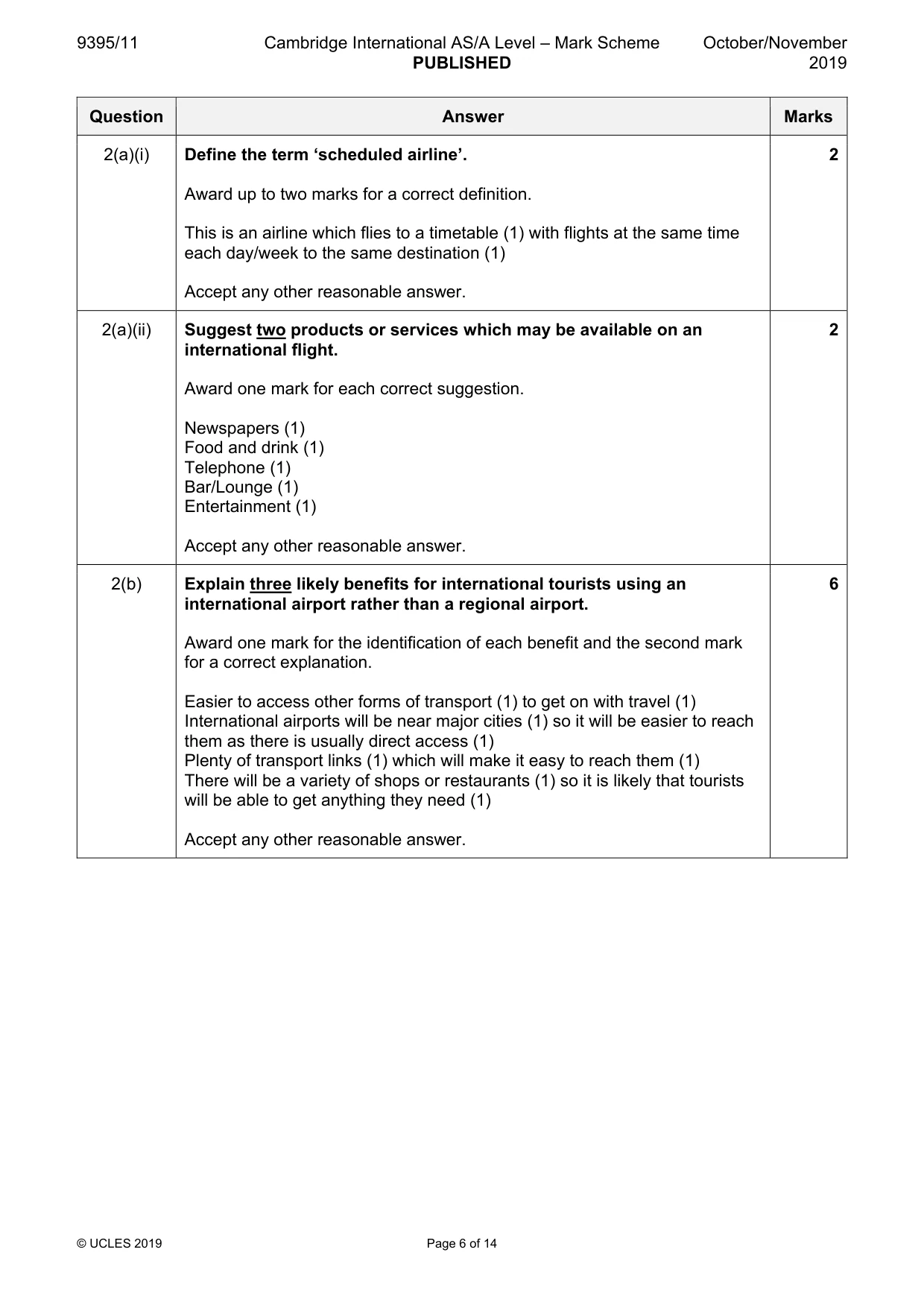
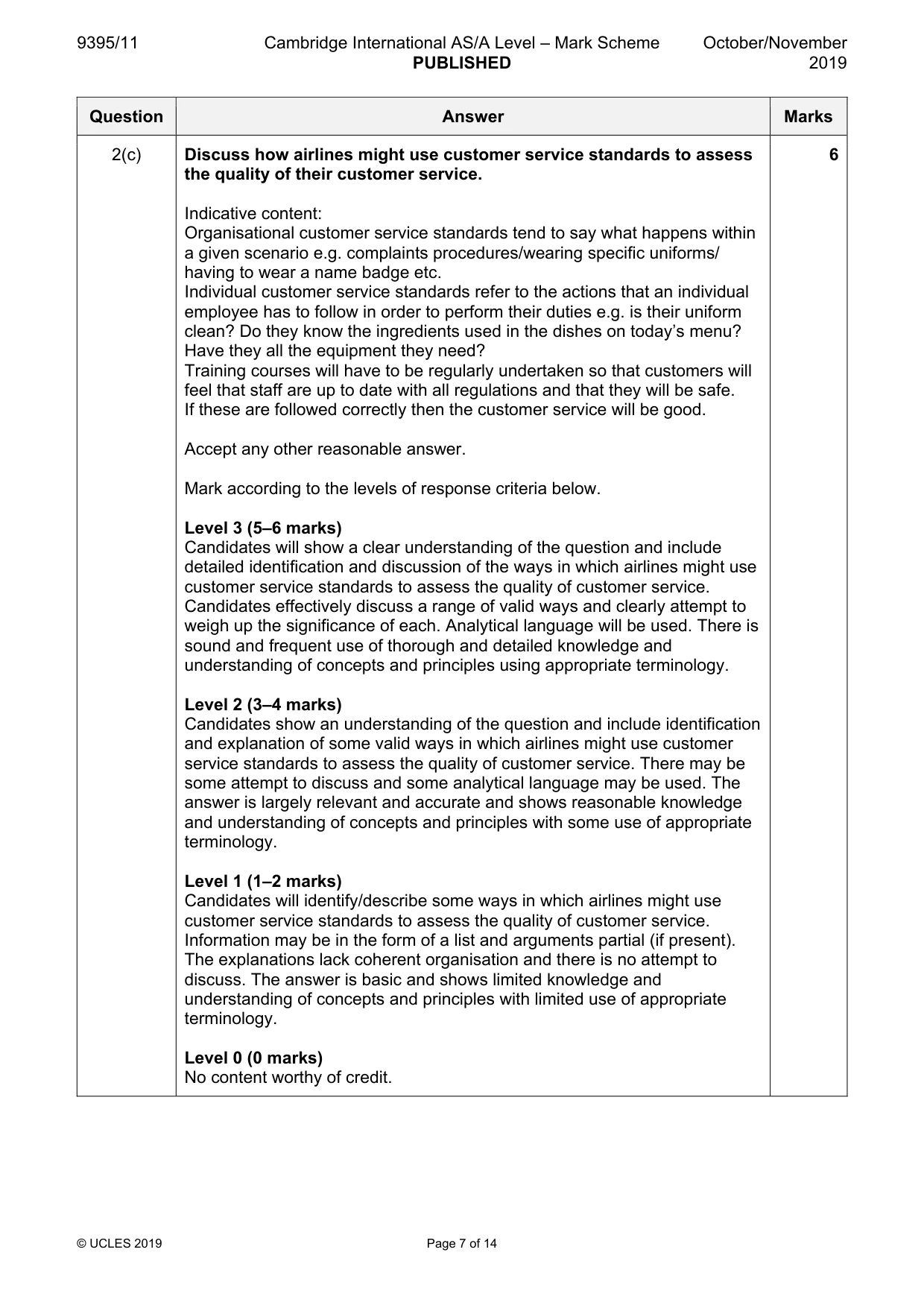
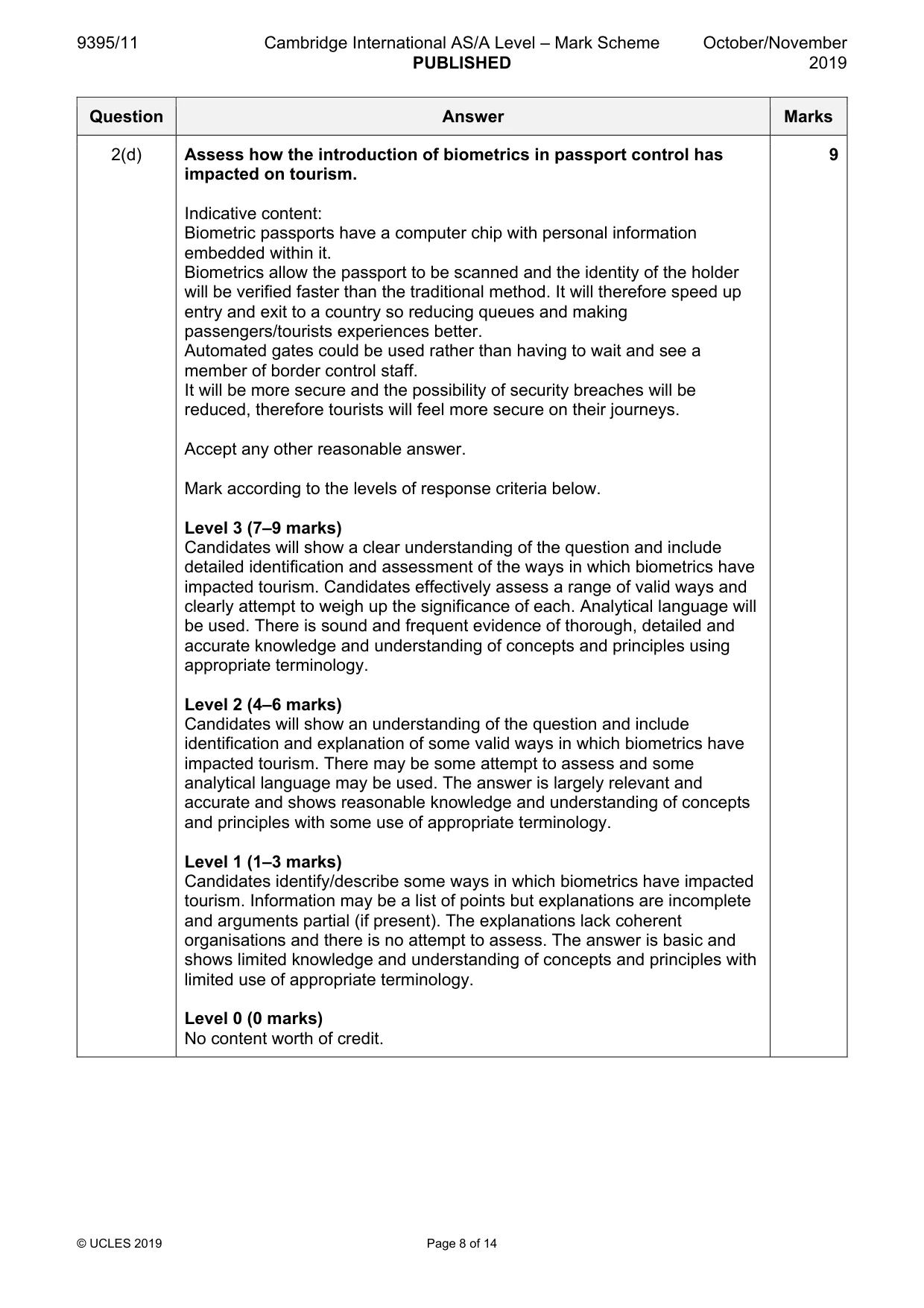
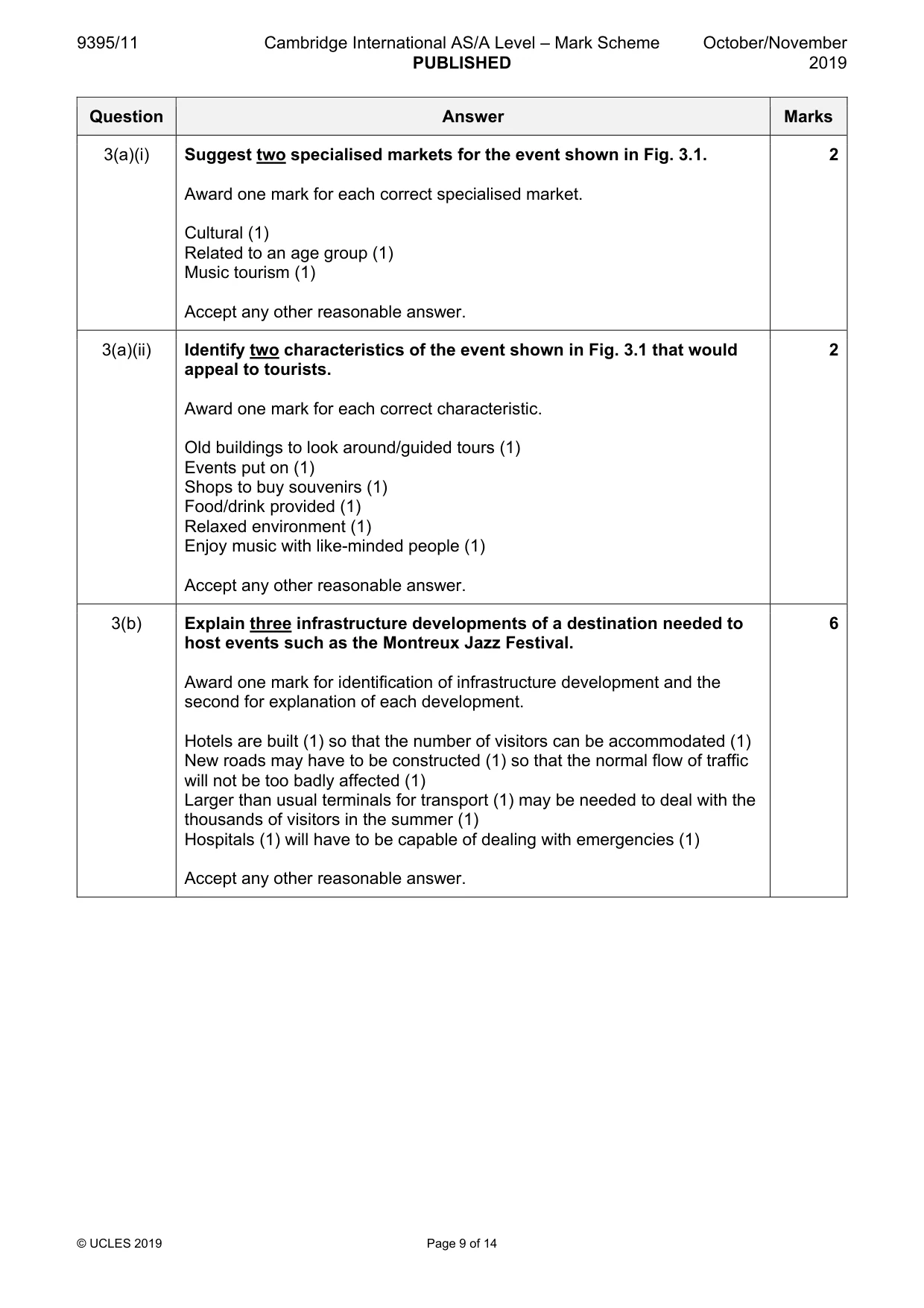
Paper as text
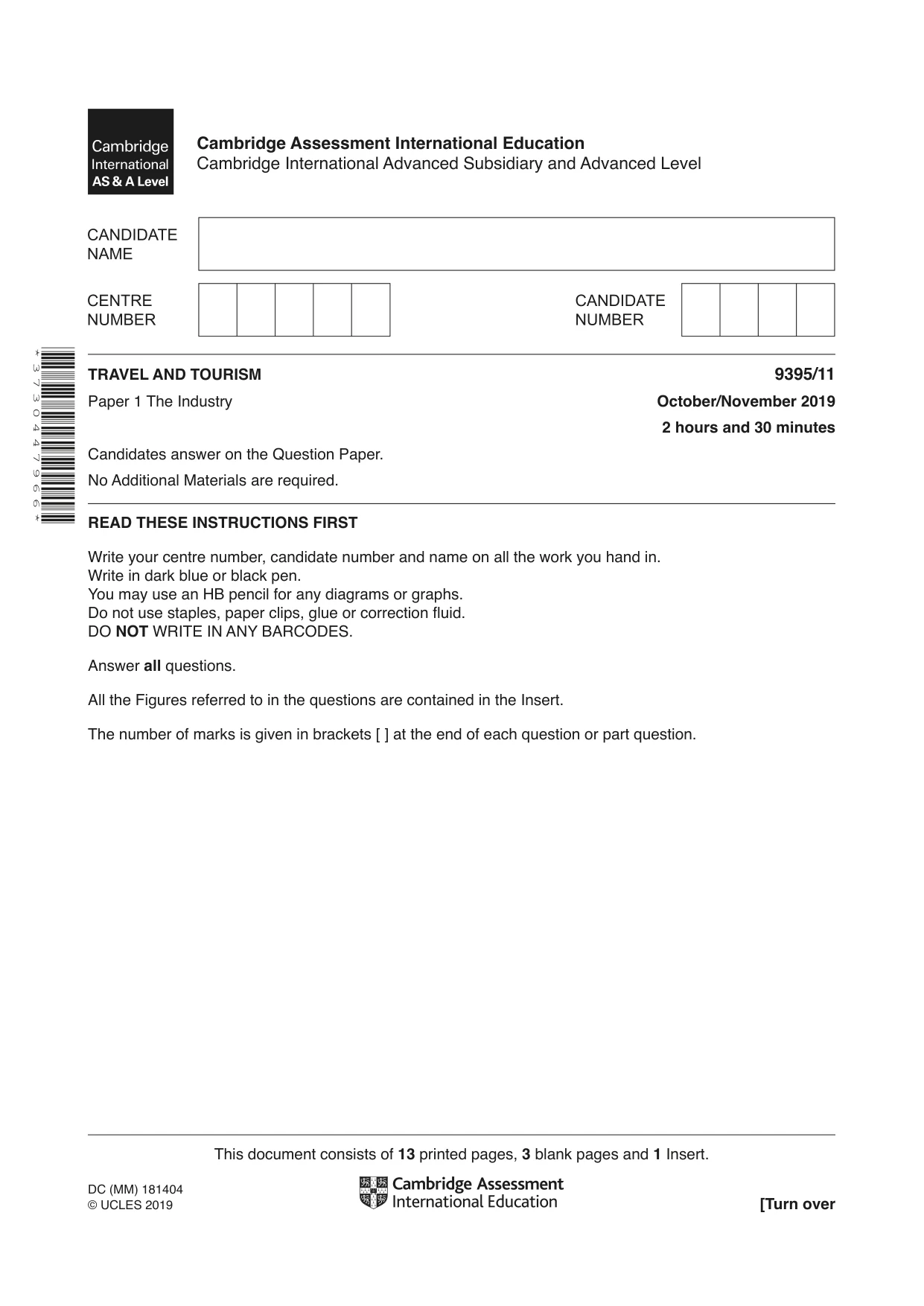
Question paper, page 1
This document consists of 13 printed pages, 3 blank pages and 1 Insert. DC (MM) 181404 © UCLES 2019 [Turn over * 3 7 3 0 4 4 7 9 6 6 * TRAVEL AND TOURISM 9395/11 Paper 1 The Industry October/November 2019 2 hours and 30 minutes Candidates answer on the Question Paper. No Additional Materials are required. READ THESE INSTRUCTIONS FIRST Write your centre number, candidate number and name on all the work you hand in. Write in dark blue or black pen. You may use an HB pencil for any diagrams or graphs. Do not use staples, paper clips, glue or correction fluid. DO NOT WRITE IN ANY BARCODES. Answer all questions. All the Figures referred to in the questions are contained in the Insert. The number of marks is given in brackets [ ] at the end of each question or part question. Cambridge Assessment International Education Cambridge International Advanced Subsidiary and Advanced Level
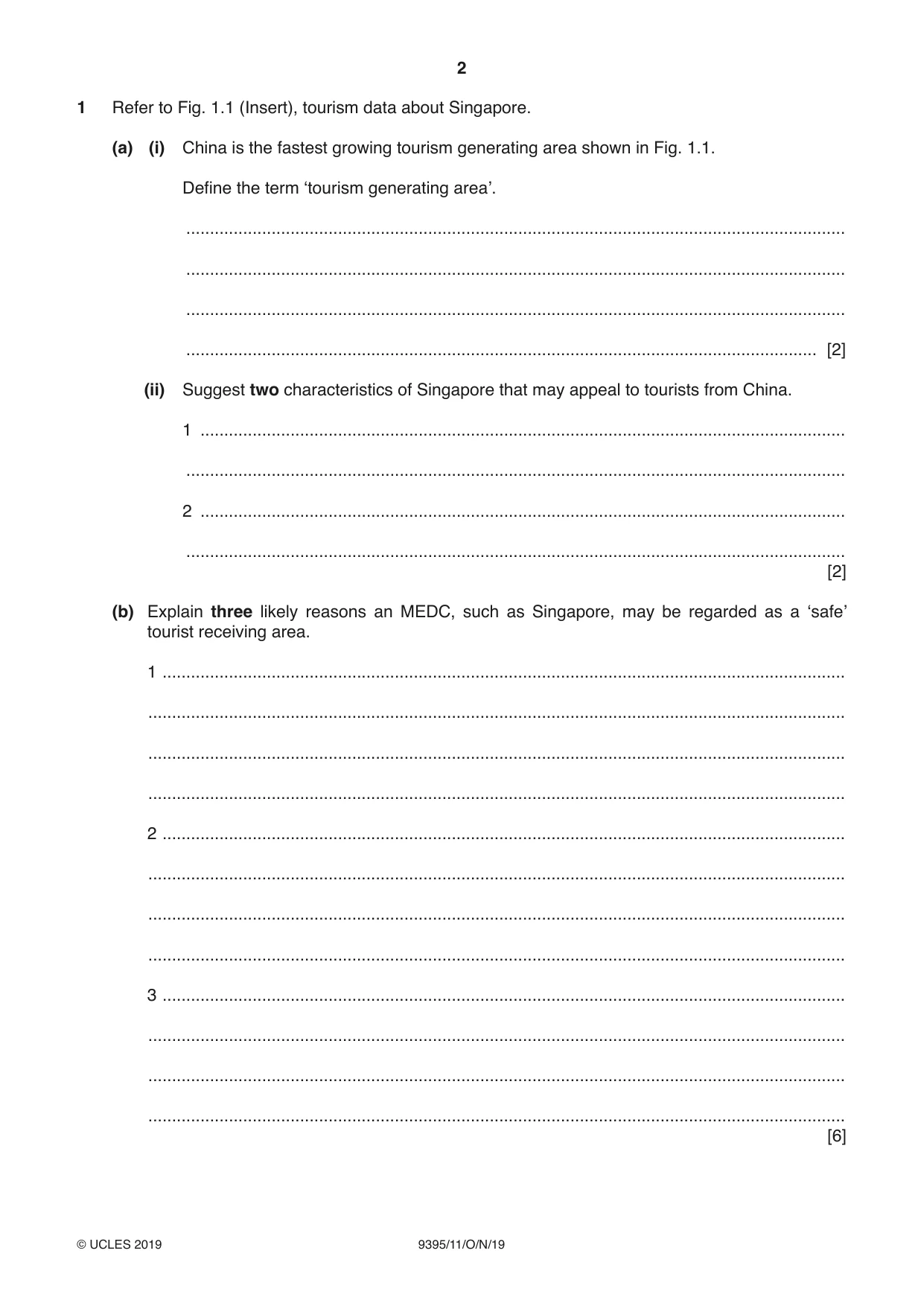
Question paper, page 2
2 9395/11/O/N/19 © UCLES 2019 1 Refer to Fig. 1.1 (Insert), tourism data about Singapore. (a) (i) China is the fastest growing tourism generating area shown in Fig. 1.1. Define the term ‘tourism generating area’. … … … … [2] (ii) Suggest two characteristics of Singapore that may appeal to tourists from China. 1 … … 2 … … [2] (b) Explain three likely reasons an MEDC, such as Singapore, may be regarded as a ‘safe’ tourist receiving area. 1 … … … … 2 … … … … 3 … … … … [6]
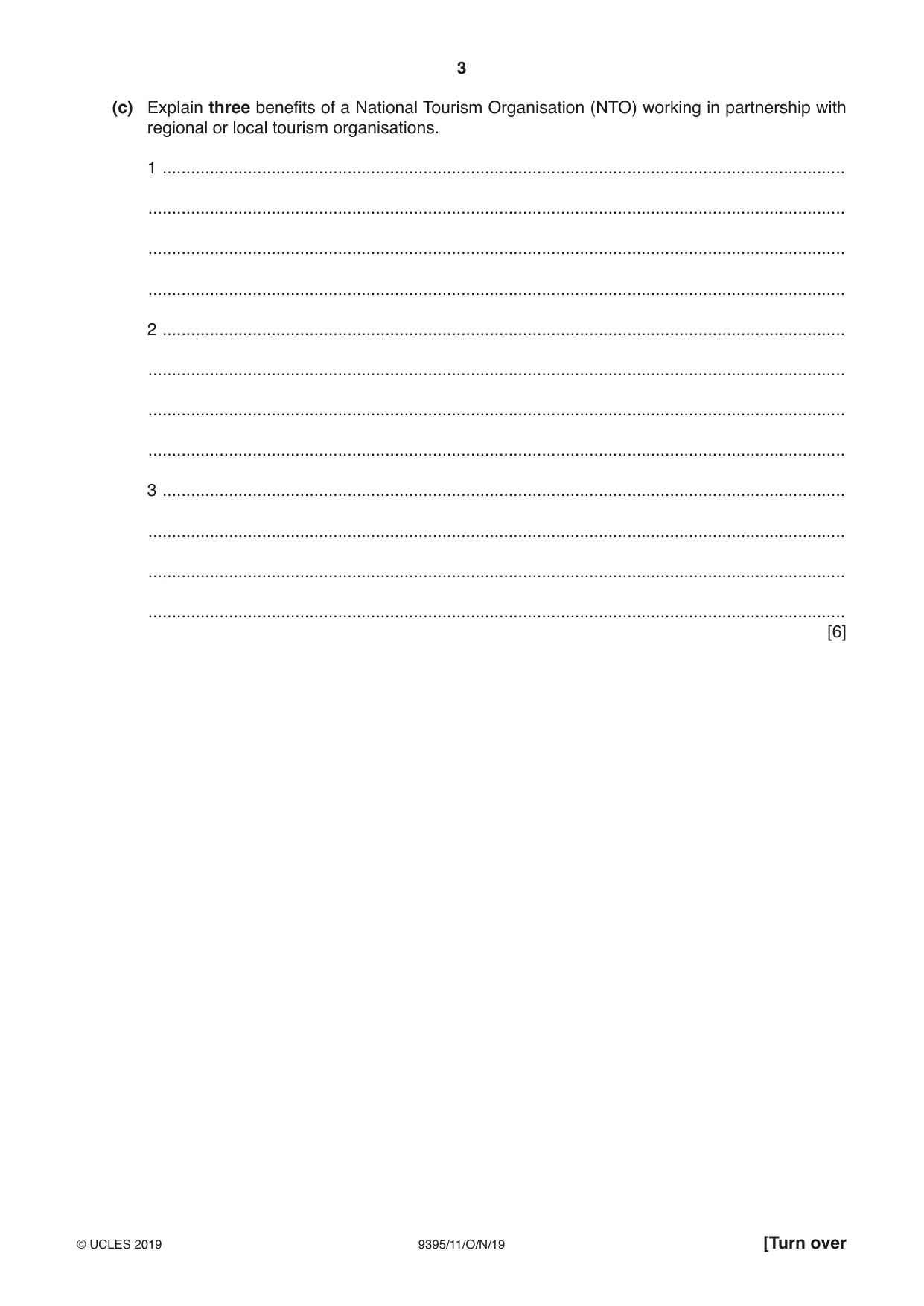
Question paper, page 3
3 9395/11/O/N/19 © UCLES 2019 [Turn over (c) Explain three benefits of a National Tourism Organisation (NTO) working in partnership with regional or local tourism organisations. 1 … … … … 2 … … … … 3 … … … … [6]
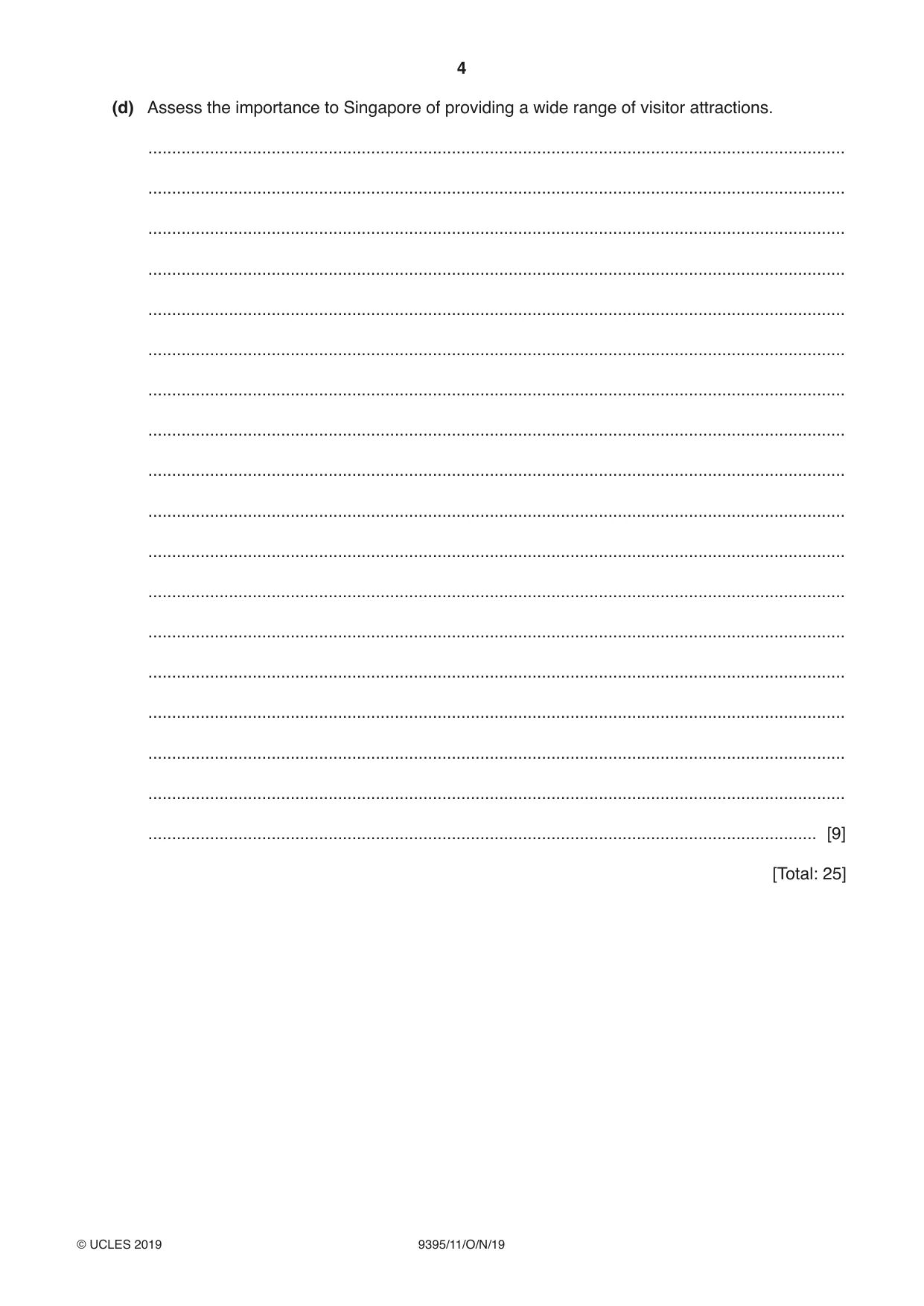
Question paper, page 4
4 9395/11/O/N/19 © UCLES 2019 (d) Assess the importance to Singapore of providing a wide range of visitor attractions. … … … … … … … … … … … … … … … … … … [9] [Total: 25]
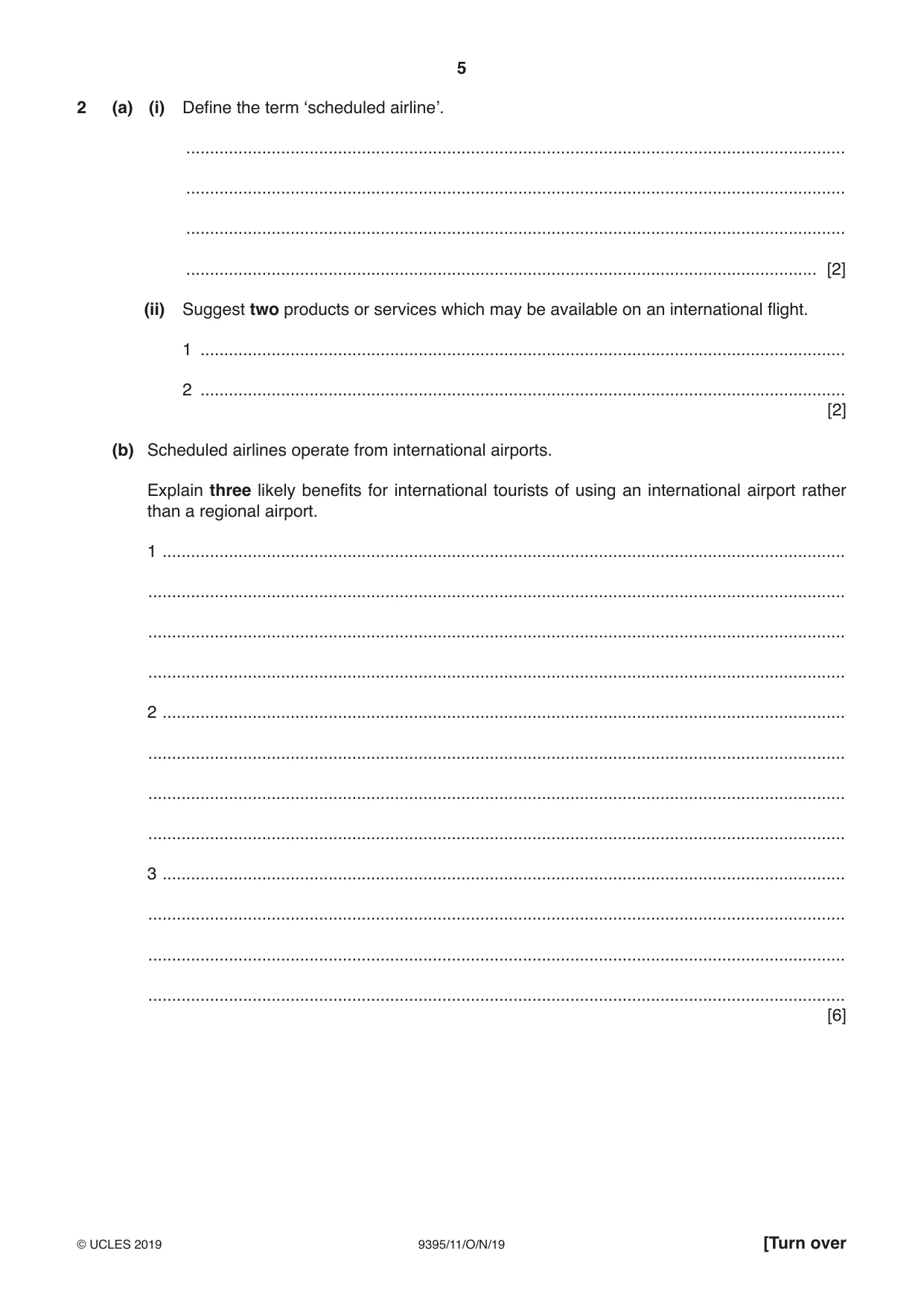
Question paper, page 5
5 9395/11/O/N/19 © UCLES 2019 [Turn over 2 (a) (i) Define the term ‘scheduled airline’. … … … … [2] (ii) Suggest two products or services which may be available on an international flight. 1 … 2 … [2] (b) Scheduled airlines operate from international airports. Explain three likely benefits for international tourists of using an international airport rather than a regional airport. 1 … … … … 2 … … … … 3 … … … … [6]
Question paper, page 6
6 9395/11/O/N/19 © UCLES 2019 (c) Discuss how airlines might use customer service standards to assess the quality of their customer service. … … … … … … … … … … … …[6]
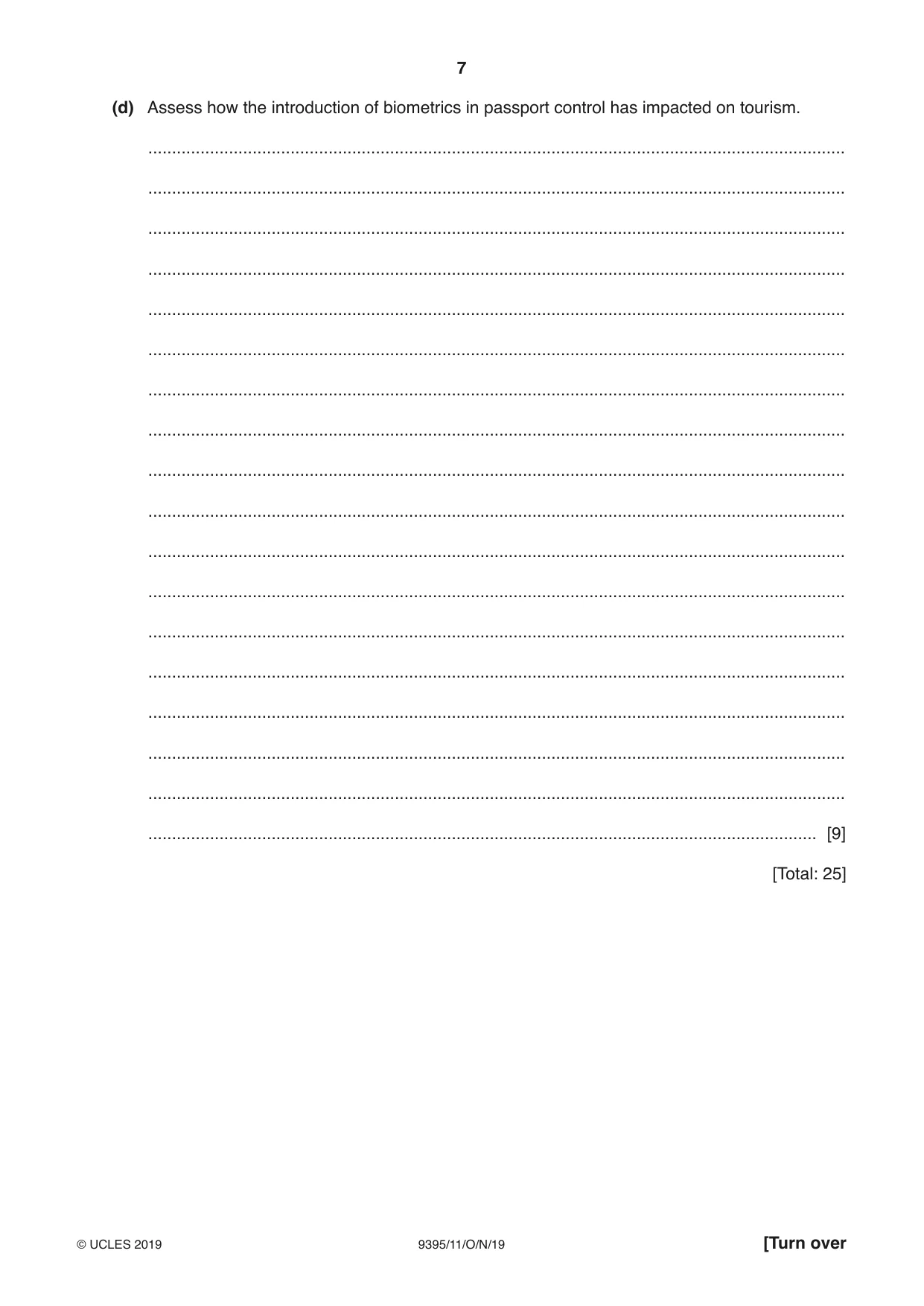
Question paper, page 7
7 9395/11/O/N/19 © UCLES 2019 [Turn over (d) Assess how the introduction of biometrics in passport control has impacted on tourism. … … … … … … … … … … … … … … … … … … [9] [Total: 25]
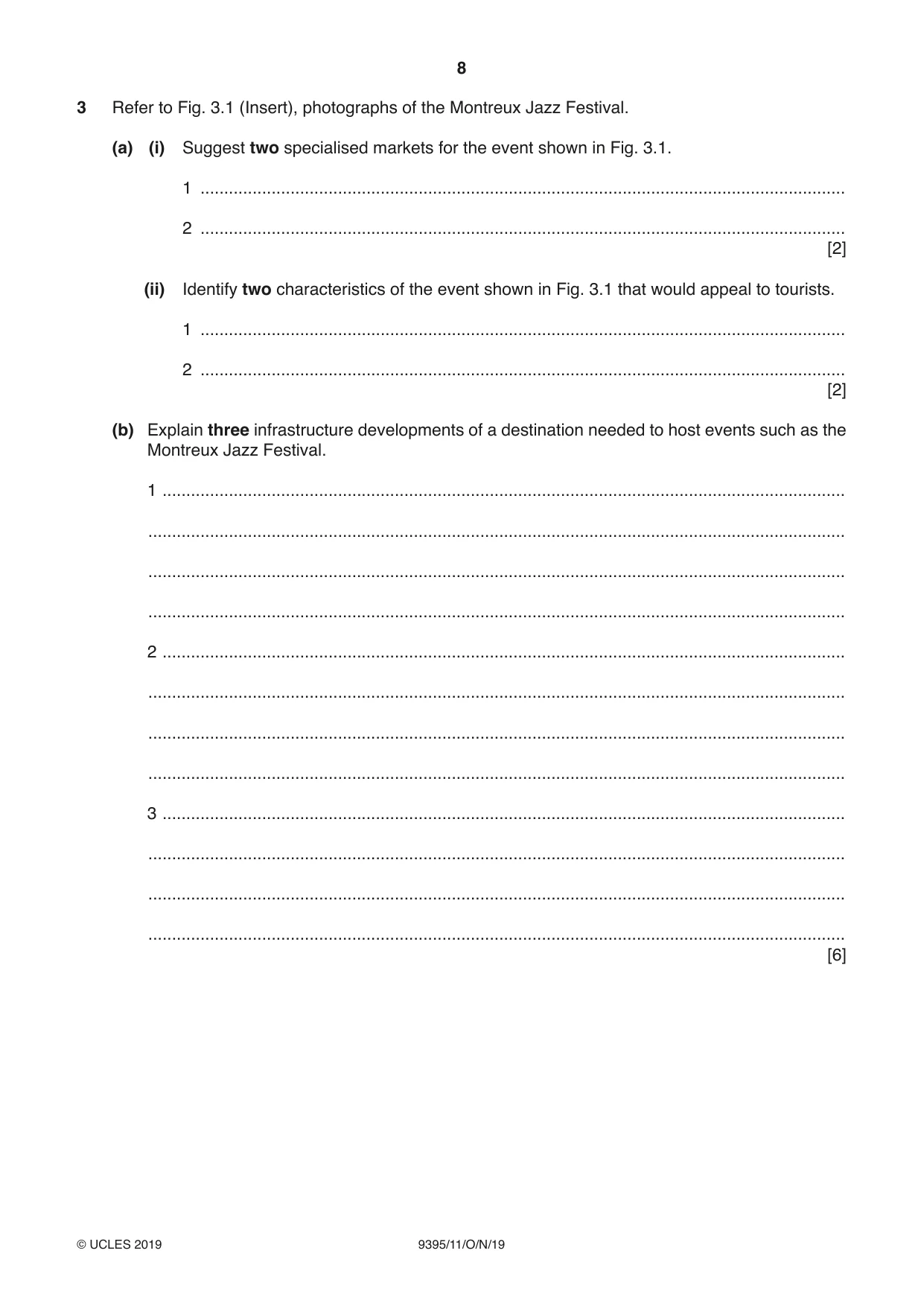
Question paper, page 8
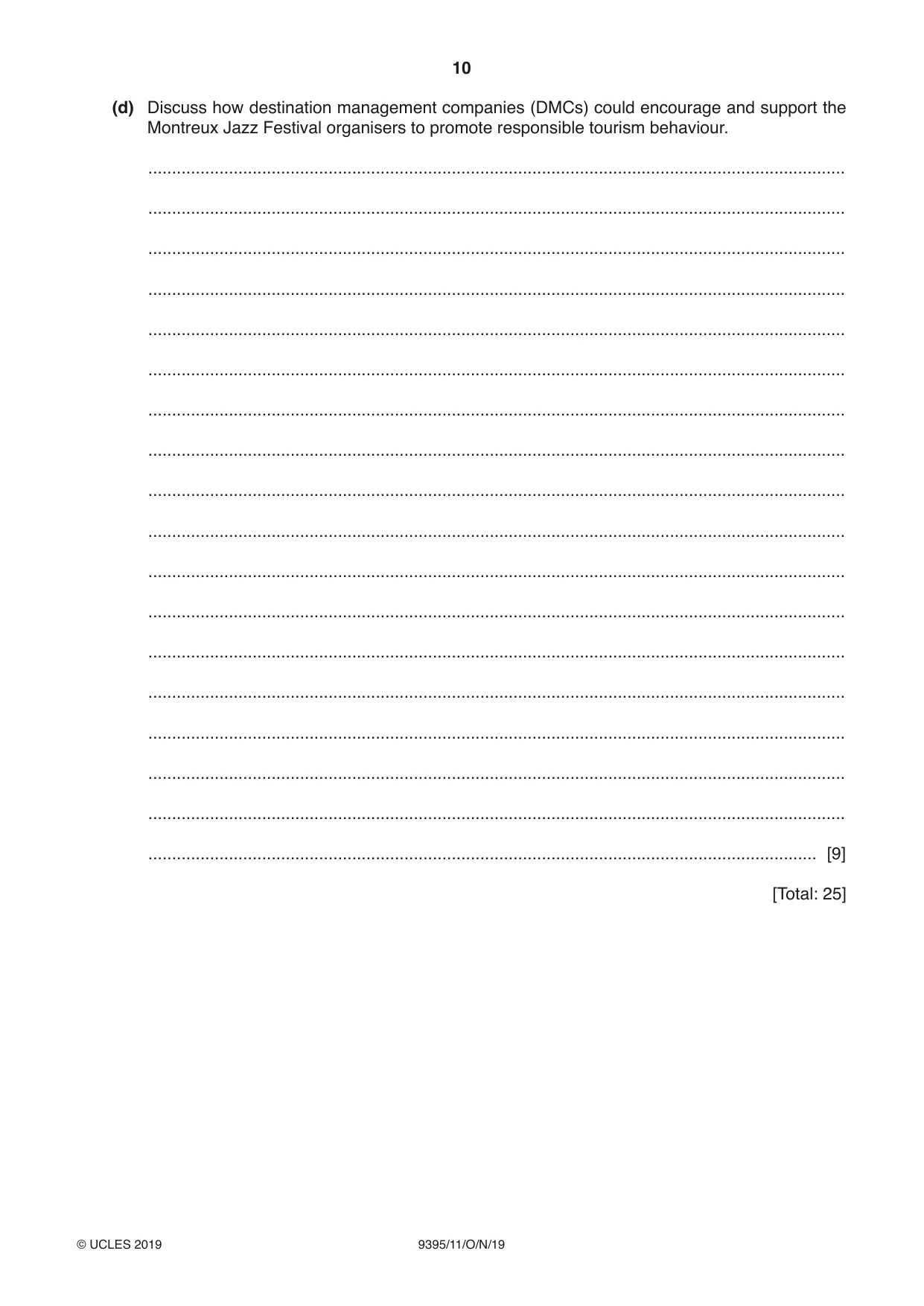
8 9395/11/O/N/19 © UCLES 2019 3 Refer to Fig. 3.1 (Insert), photographs of the Montreux Jazz Festival. (a) (i) Suggest two specialised markets for the event shown in Fig. 3.1. 1 … 2 … [2] (ii) Identify two characteristics of the event shown in Fig. 3.1 that would appeal to tourists. 1 … 2 … [2] (b) Explain three infrastructure developments of a destination needed to host events such as the Montreux Jazz Festival. 1 … … … … 2 … … … … 3 … … … … [6]
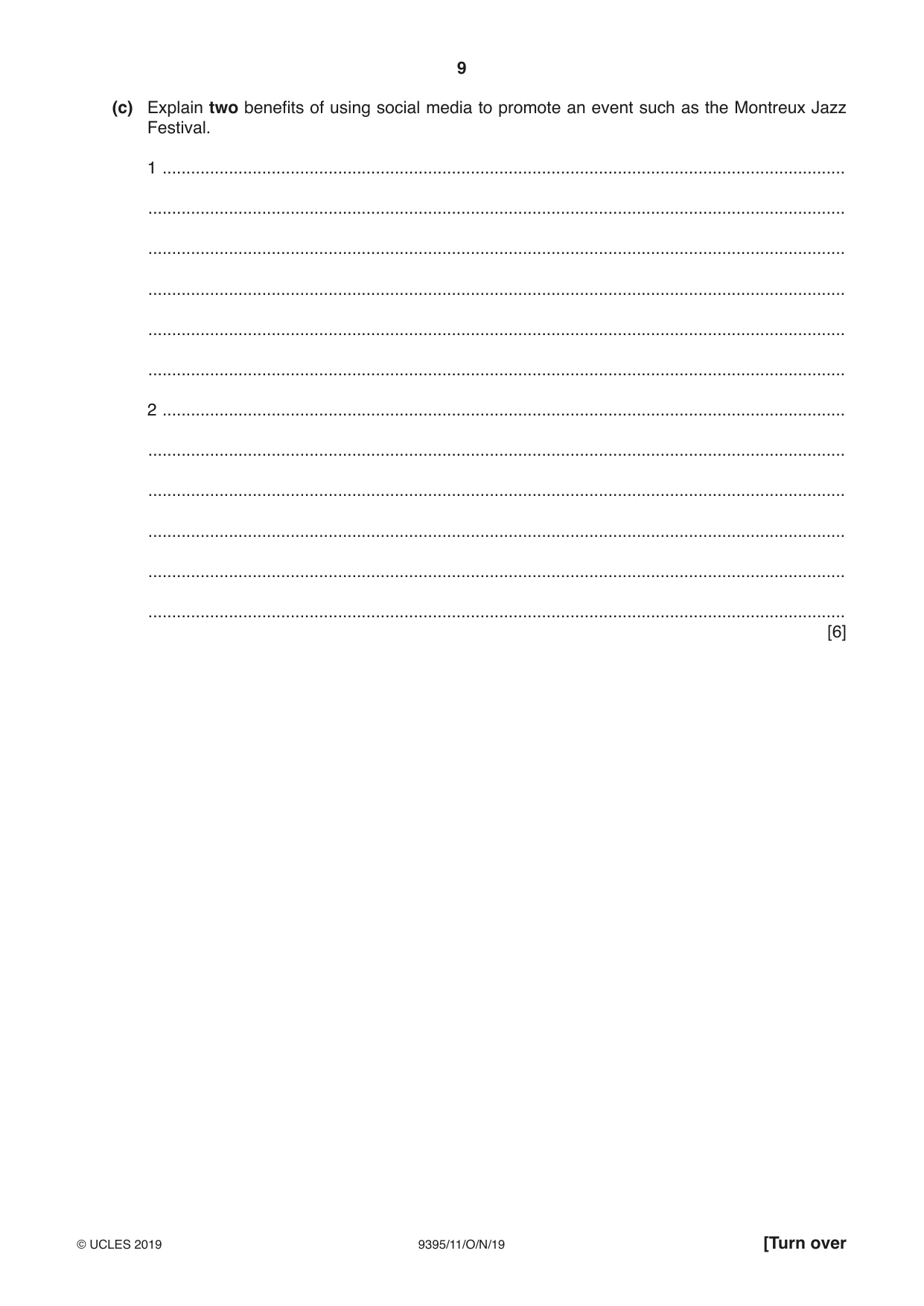
Question paper, page 9
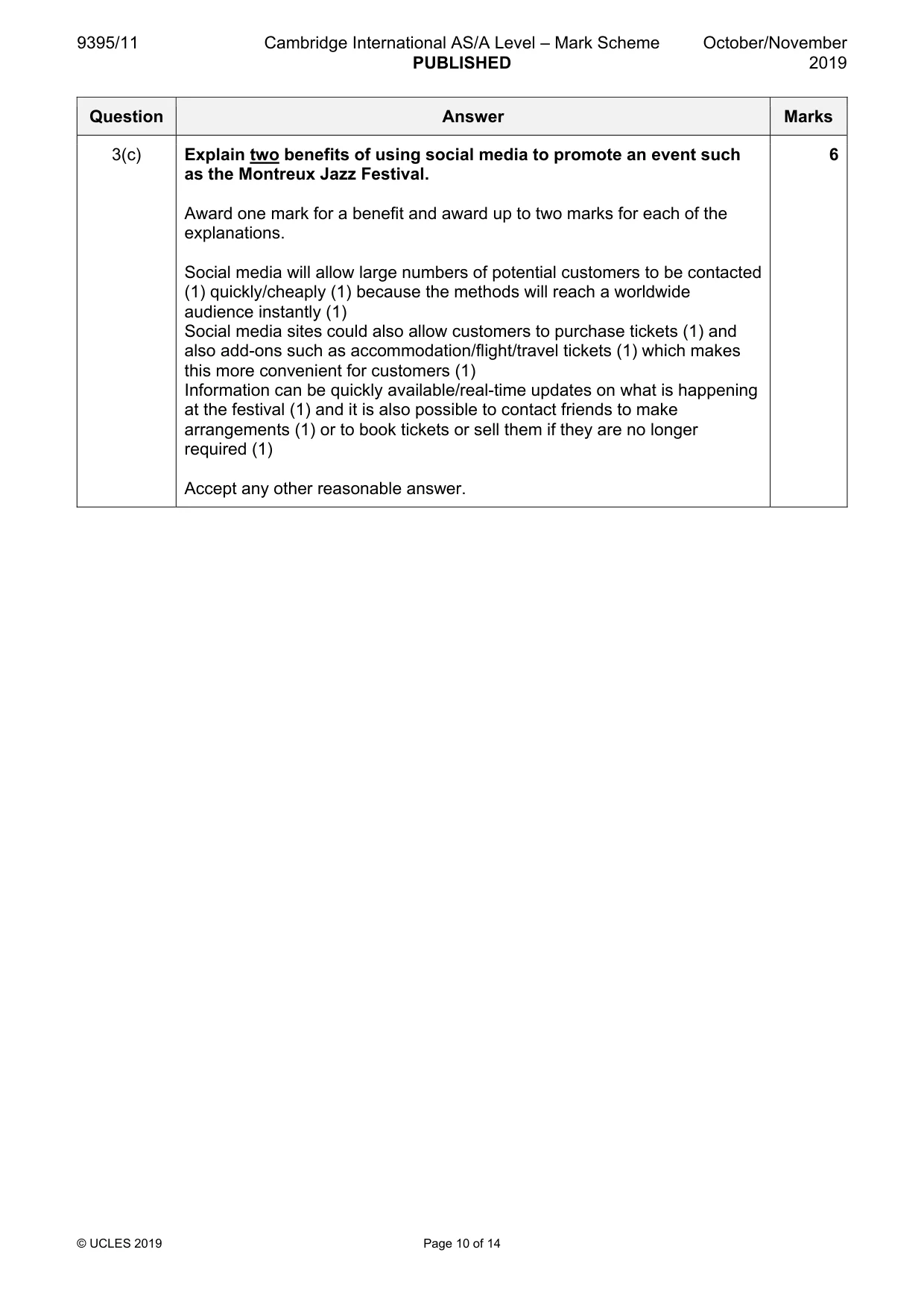
9 9395/11/O/N/19 © UCLES 2019 [Turn over (c) Explain two benefits of using social media to promote an event such as the Montreux Jazz Festival. 1 … … … … … … 2 … … … … … … [6]
Question paper, page 10
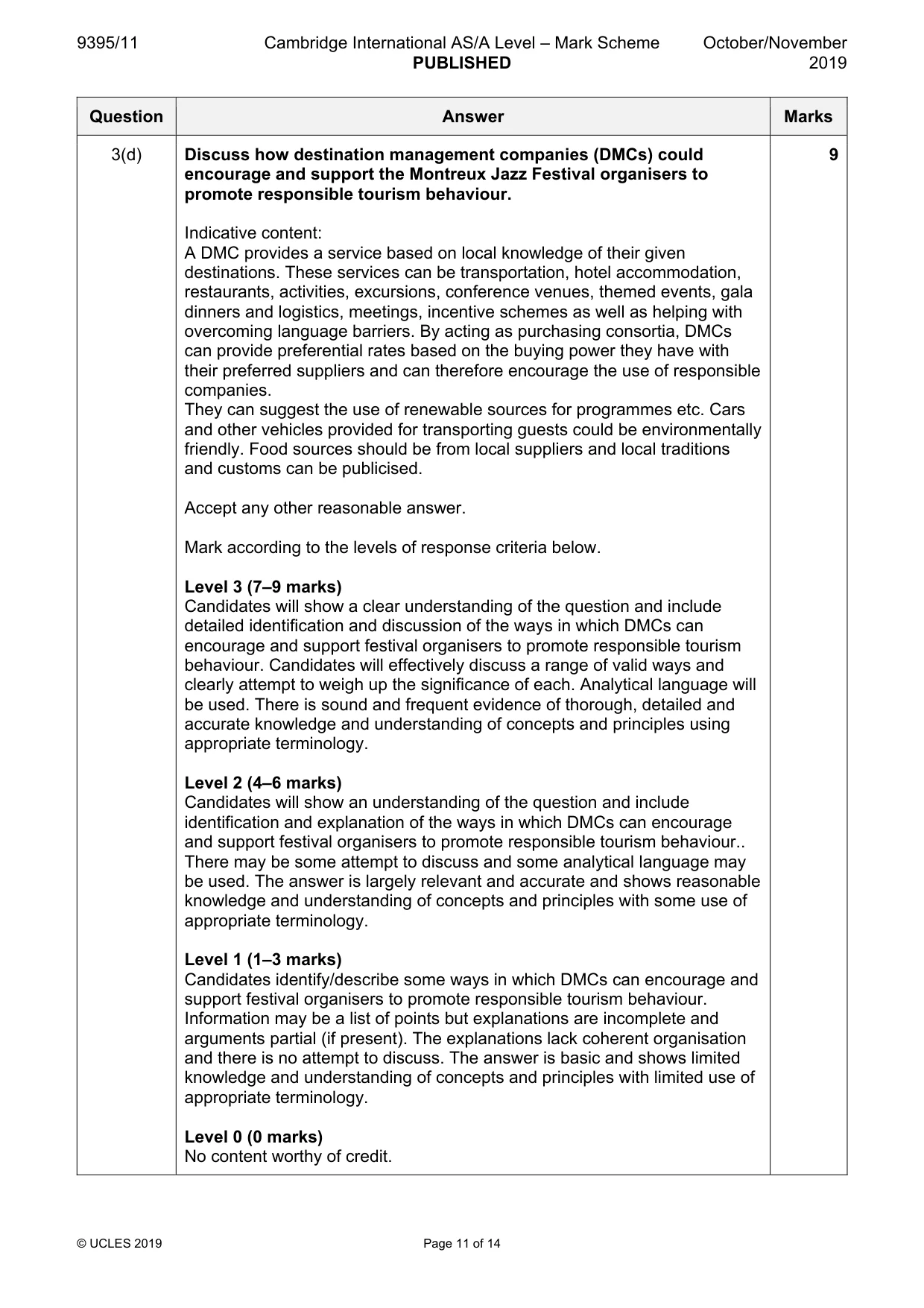
10 9395/11/O/N/19 © UCLES 2019 (d) Discuss how destination management companies (DMCs) could encourage and support the Montreux Jazz Festival organisers to promote responsible tourism behaviour. … … … … … … … … … … … … … … … … … … [9] [Total: 25]
Question paper, page 11
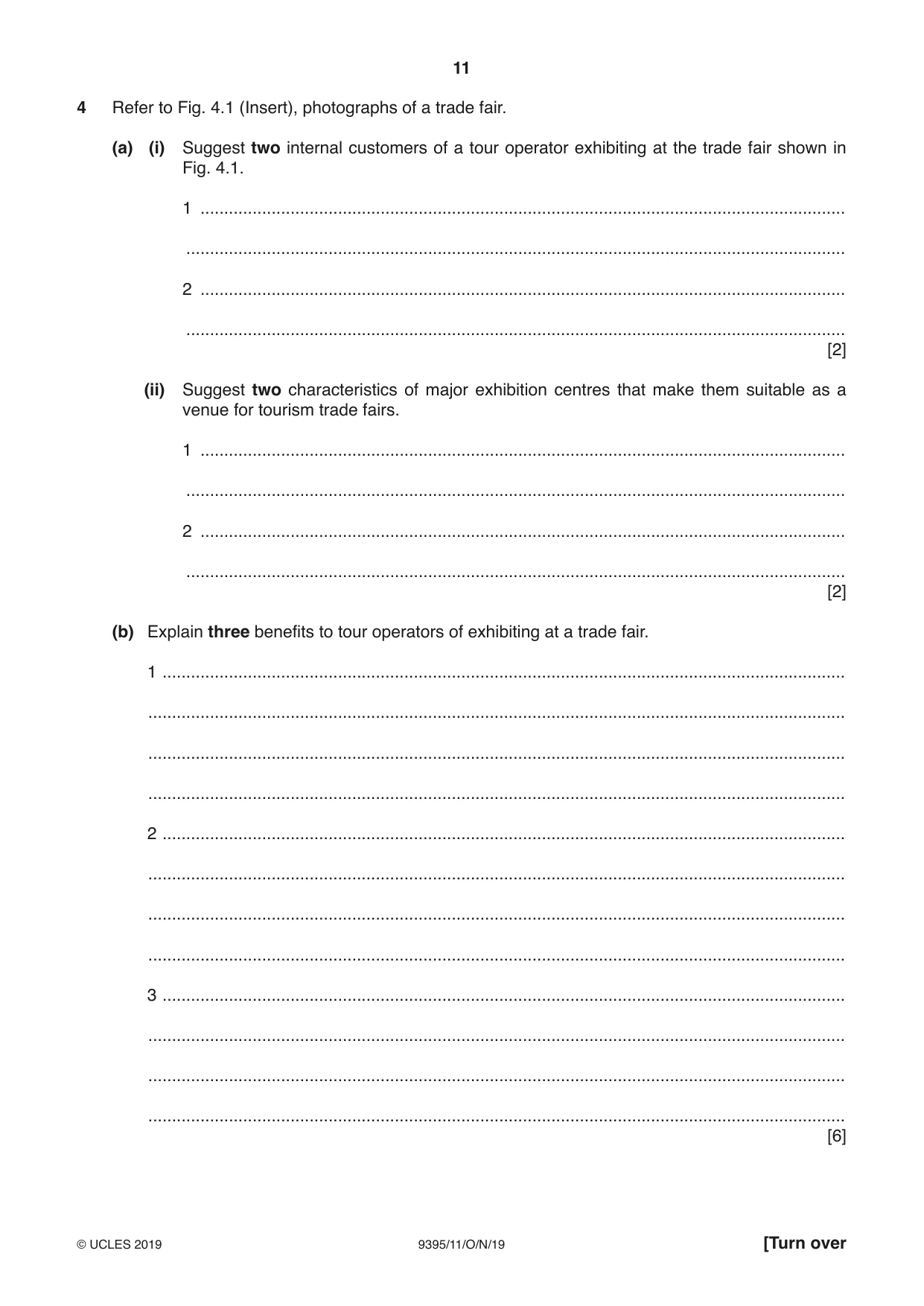
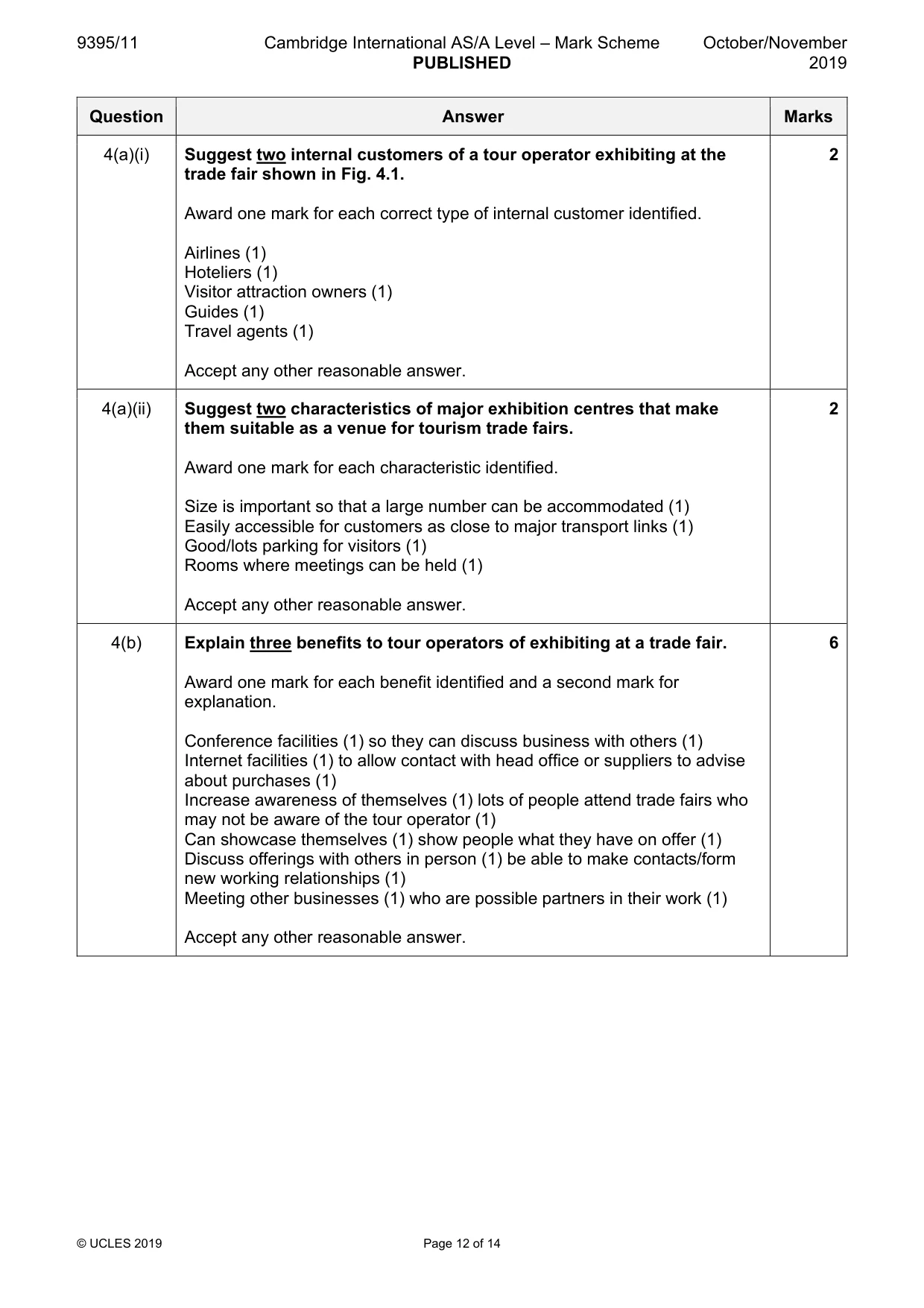
11 9395/11/O/N/19 © UCLES 2019 [Turn over 4 Refer to Fig. 4.1 (Insert), photographs of a trade fair. (a) (i) Suggest two internal customers of a tour operator exhibiting at the trade fair shown in Fig. 4.1. 1 … … 2 … … [2] (ii) Suggest two characteristics of major exhibition centres that make them suitable as a venue for tourism trade fairs. 1 … … 2 … … [2] (b) Explain three benefits to tour operators of exhibiting at a trade fair. 1 … … … … 2 … … … … 3 … … … … [6]
Question paper, page 12
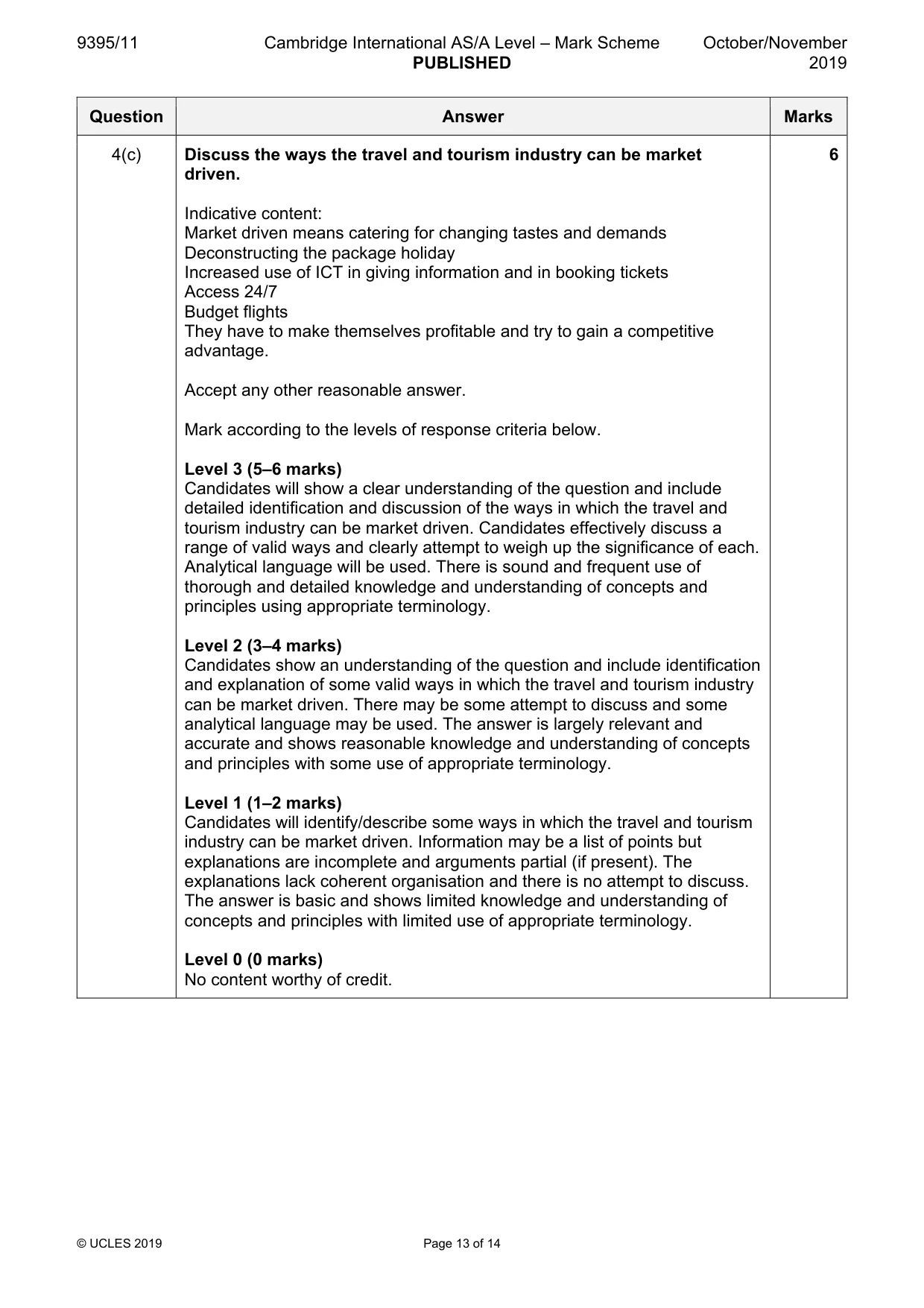
12 9395/11/O/N/19 © UCLES 2019 (c) Discuss the ways the travel and tourism industry can be market driven. … … … … … … … … … … … … [6]
Question paper, page 13
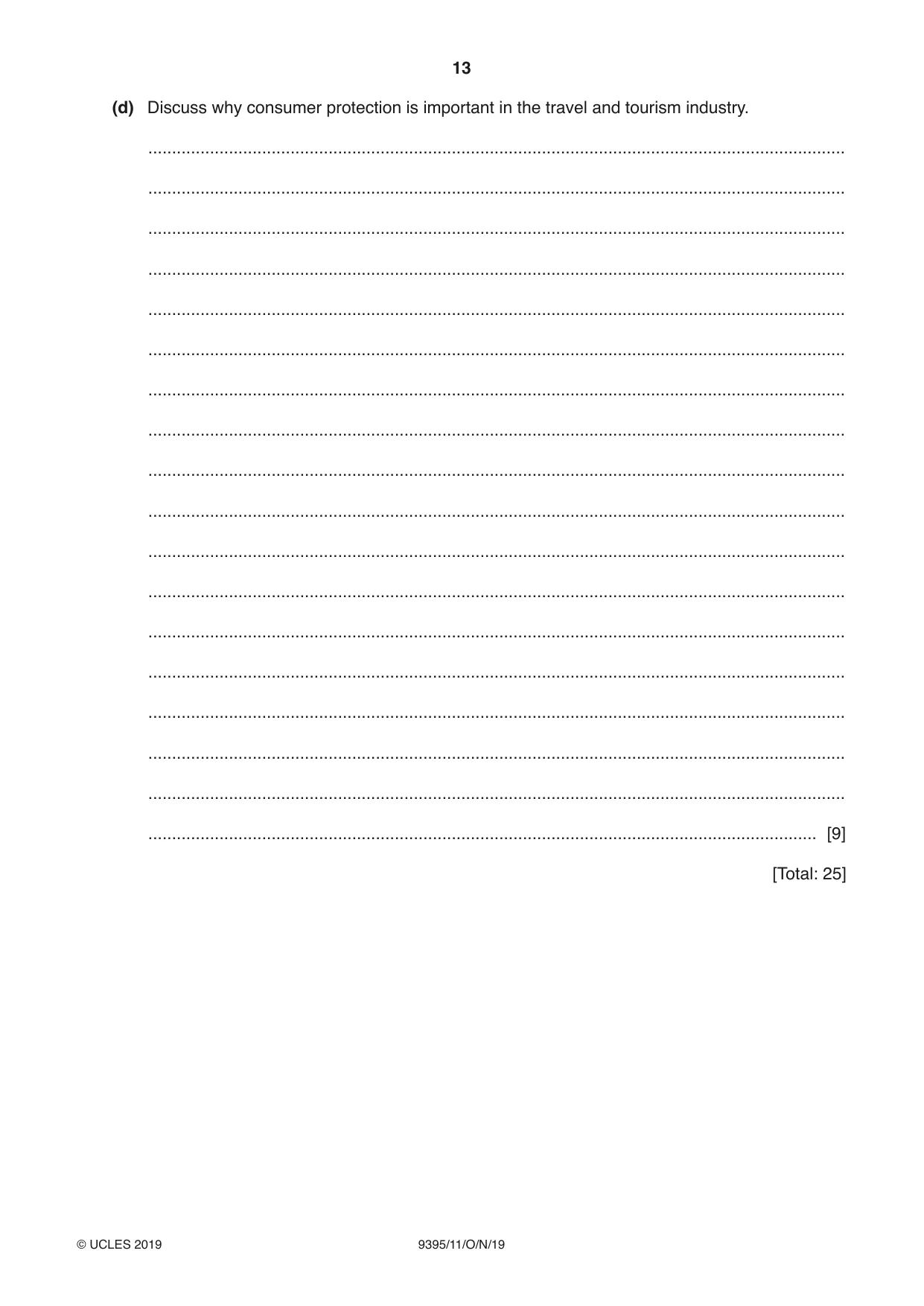
13 9395/11/O/N/19 © UCLES 2019 (d) Discuss why consumer protection is important in the travel and tourism industry. … … … … … … … … … … … … … … … … … … [9] [Total: 25]
Question paper, page 14
14 9395/11/O/N/19 © UCLES 2019 BLANK PAGE
Question paper, page 15
15 9395/11/O/N/19 © UCLES 2019 BLANK PAGE
Question paper, page 16
16 9395/11/O/N/19 © UCLES 2019 Permission to reproduce items where third-party owned material protected by copyright is included has been sought and cleared where possible. Every reasonable effort has been made by the publisher (UCLES) to trace copyright holders, but if any items requiring clearance have unwittingly been included, the publisher will be pleased to make amends at the earliest possible opportunity. To avoid the issue of disclosure of answer-related information to candidates, all copyright acknowledgements are reproduced online in the Cambridge Assessment International Education Copyright Acknowledgements Booklet. This is produced for each series of examinations and is freely available to download at www.cambridgeinternational.org after the live examination series. Cambridge Assessment International Education is part of the Cambridge Assessment Group. Cambridge Assessment is the brand name of the University of Cambridge Local Examinations Syndicate (UCLES), which itself is a department of the University of Cambridge. BLANK PAGE
Mark scheme, page 1
This document consists of 14 printed pages. © UCLES 2019 [Turn over Cambridge Assessment International Education Cambridge International Advanced Subsidiary and Advanced Level TRAVEL AND TOURISM 9395/11 Paper 1 The Industry October/November 2019 MARK SCHEME Maximum Mark: 100 Published This mark scheme is published as an aid to teachers and candidates, to indicate the requirements of the examination. It shows the basis on which Examiners were instructed to award marks. It does not indicate the details of the discussions that took place at an Examiners’ meeting before marking began, which would have considered the acceptability of alternative answers. Mark schemes should be read in conjunction with the question paper and the Principal Examiner Report for Teachers. Cambridge International will not enter into discussions about these mark schemes. Cambridge International is publishing the mark schemes for the October/November 2019 series for most Cambridge IGCSE™, Cambridge International A and AS Level components and some Cambridge O Level components.
Mark scheme, page 2
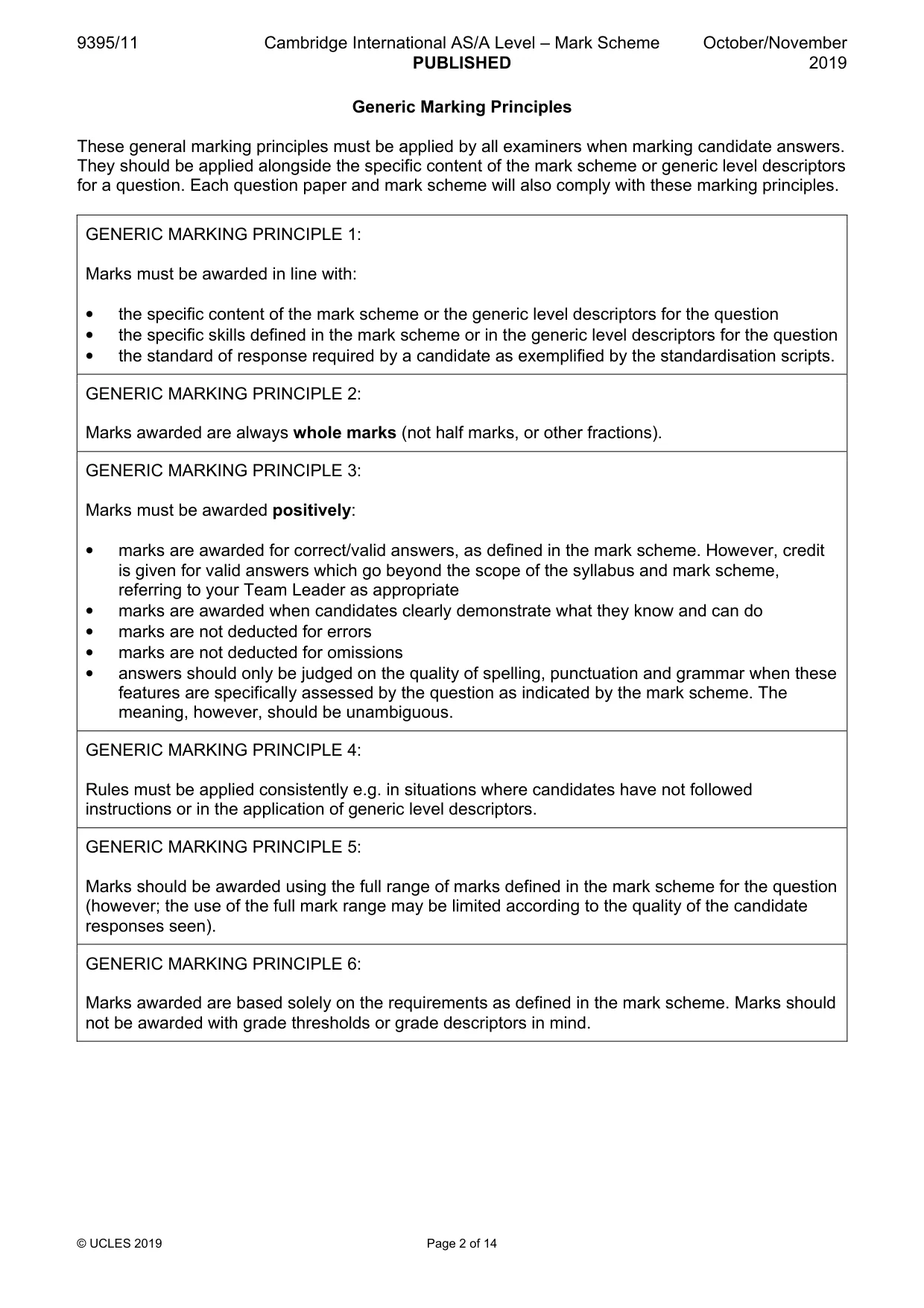
9395/11 Cambridge International AS/A Level – Mark Scheme PUBLISHED October/November 2019 © UCLES 2019 Page 2 of 14 Generic Marking Principles These general marking principles must be applied by all examiners when marking candidate answers. They should be applied alongside the specific content of the mark scheme or generic level descriptors for a question. Each question paper and mark scheme will also comply with these marking principles. GENERIC MARKING PRINCIPLE 1: Marks must be awarded in line with: • the specific content of the mark scheme or the generic level descriptors for the question • the specific skills defined in the mark scheme or in the generic level descriptors for the question • the standard of response required by a candidate as exemplified by the standardisation scripts. GENERIC MARKING PRINCIPLE 2: Marks awarded are always whole marks (not half marks, or other fractions). GENERIC MARKING PRINCIPLE 3: Marks must be awarded positively: • marks are awarded for correct/valid answers, as defined in the mark scheme. However, credit is given for valid answers which go beyond the scope of the syllabus and mark scheme, referring to your Team Leader as appropriate • marks are awarded when candidates clearly demonstrate what they know and can do • marks are not deducted for errors • marks are not deducted for omissions • answers should only be judged on the quality of spelling, punctuation and grammar when these features are specifically assessed by the question as indicated by the mark scheme. The meaning, however, should be unambiguous. GENERIC MARKING PRINCIPLE 4: Rules must be applied consistently e.g. in situations where candidates have not followed instructions or in the application of generic level descriptors. GENERIC MARKING PRINCIPLE 5: Marks should be awarded using the full range of marks defined in the mark scheme for the question (however; the use of the full mark range may be limited according to the quality of the candidate responses seen). GENERIC MARKING PRINCIPLE 6: Marks awarded are based solely on the requirements as defined in the mark scheme. Marks should not be awarded with grade thresholds or grade descriptors in mind.
Mark scheme, page 3
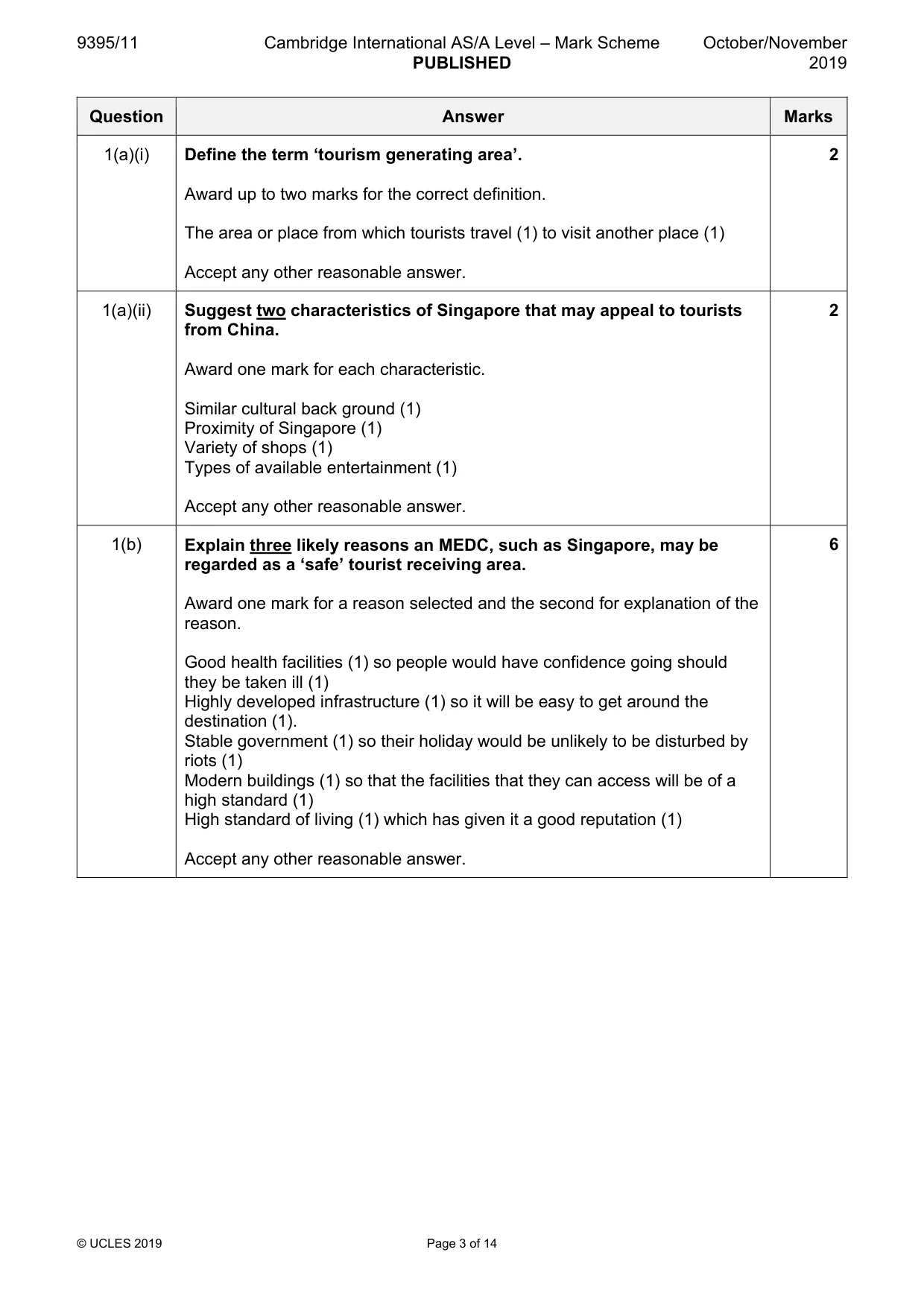
9395/11 Cambridge International AS/A Level – Mark Scheme PUBLISHED October/November 2019 © UCLES 2019 Page 3 of 14 Question Answer Marks 1(a)(i) Define the term ‘tourism generating area’. Award up to two marks for the correct definition. The area or place from which tourists travel (1) to visit another place (1) Accept any other reasonable answer. 2 1(a)(ii) Suggest two characteristics of Singapore that may appeal to tourists from China. Award one mark for each characteristic. Similar cultural back ground (1) Proximity of Singapore (1) Variety of shops (1) Types of available entertainment (1) Accept any other reasonable answer. 2 1(b) Explain three likely reasons an MEDC, such as Singapore, may be regarded as a ‘safe’ tourist receiving area. Award one mark for a reason selected and the second for explanation of the reason. Good health facilities (1) so people would have confidence going should they be taken ill (1) Highly developed infrastructure (1) so it will be easy to get around the destination (1). Stable government (1) so their holiday would be unlikely to be disturbed by riots (1) Modern buildings (1) so that the facilities that they can access will be of a high standard (1) High standard of living (1) which has given it a good reputation (1) Accept any other reasonable answer. 6
Mark scheme, page 4
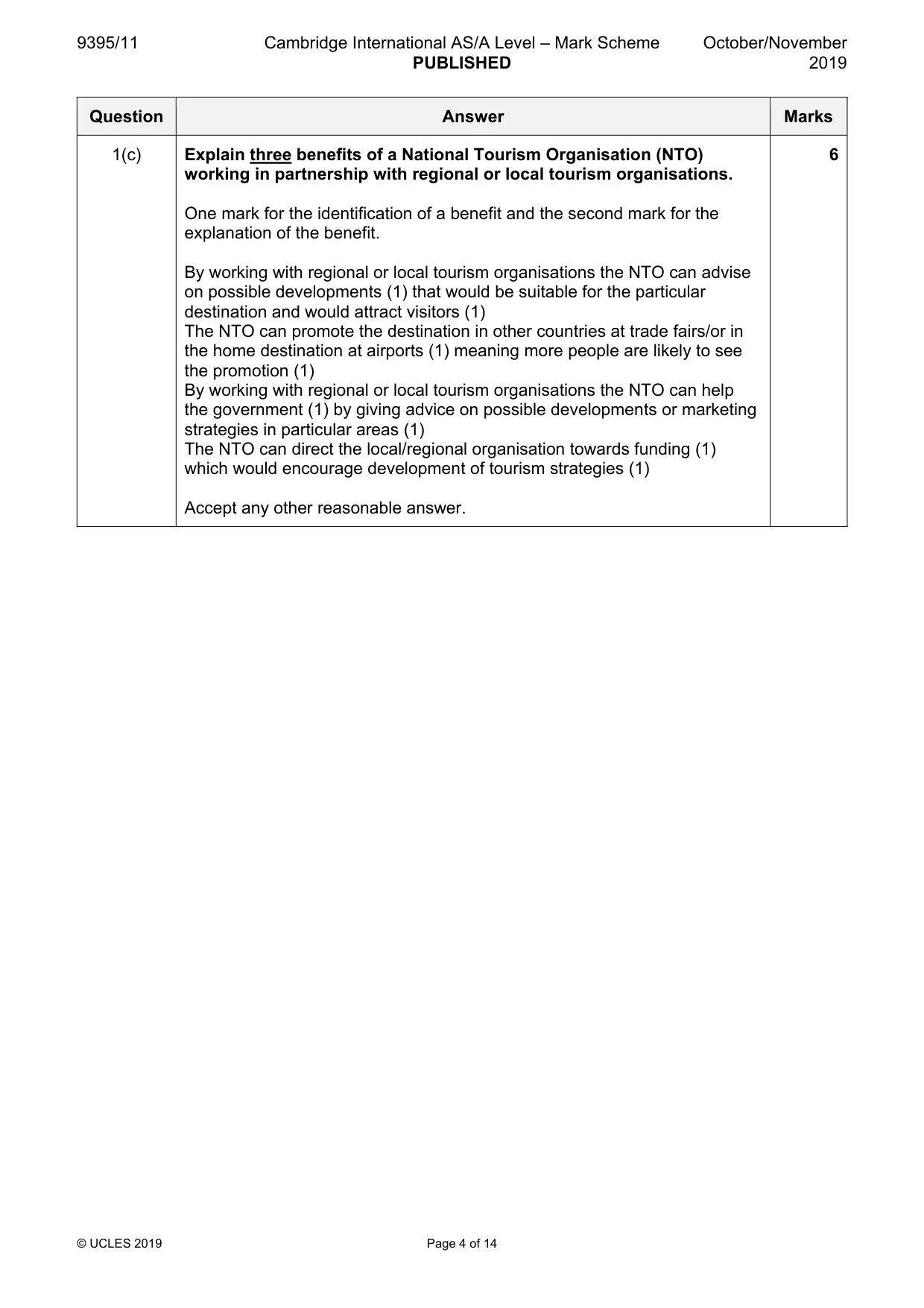
9395/11 Cambridge International AS/A Level – Mark Scheme PUBLISHED October/November 2019 © UCLES 2019 Page 4 of 14 Question Answer Marks 1(c) Explain three benefits of a National Tourism Organisation (NTO) working in partnership with regional or local tourism organisations. One mark for the identification of a benefit and the second mark for the explanation of the benefit. By working with regional or local tourism organisations the NTO can advise on possible developments (1) that would be suitable for the particular destination and would attract visitors (1) The NTO can promote the destination in other countries at trade fairs/or in the home destination at airports (1) meaning more people are likely to see the promotion (1) By working with regional or local tourism organisations the NTO can help the government (1) by giving advice on possible developments or marketing strategies in particular areas (1) The NTO can direct the local/regional organisation towards funding (1) which would encourage development of tourism strategies (1) Accept any other reasonable answer. 6
Mark scheme, page 5
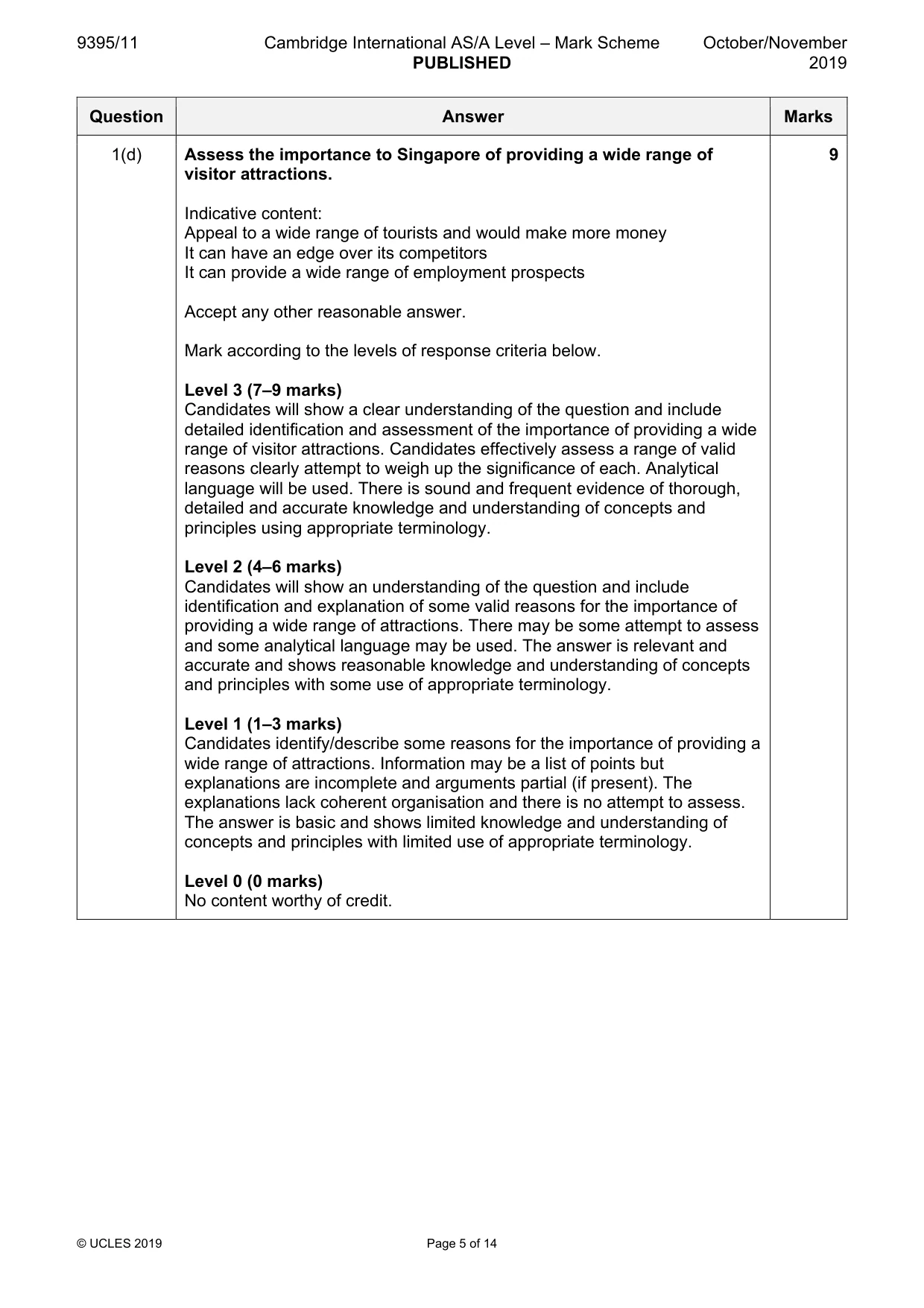
9395/11 Cambridge International AS/A Level – Mark Scheme PUBLISHED October/November 2019 © UCLES 2019 Page 5 of 14 Question Answer Marks 1(d) Assess the importance to Singapore of providing a wide range of visitor attractions. Indicative content: Appeal to a wide range of tourists and would make more money It can have an edge over its competitors It can provide a wide range of employment prospects Accept any other reasonable answer. Mark according to the levels of response criteria below. Level 3 (7–9 marks) Candidates will show a clear understanding of the question and include detailed identification and assessment of the importance of providing a wide range of visitor attractions. Candidates effectively assess a range of valid reasons clearly attempt to weigh up the significance of each. Analytical language will be used. There is sound and frequent evidence of thorough, detailed and accurate knowledge and understanding of concepts and principles using appropriate terminology. Level 2 (4–6 marks) Candidates will show an understanding of the question and include identification and explanation of some valid reasons for the importance of providing a wide range of attractions. There may be some attempt to assess and some analytical language may be used. The answer is relevant and accurate and shows reasonable knowledge and understanding of concepts and principles with some use of appropriate terminology. Level 1 (1–3 marks) Candidates identify/describe some reasons for the importance of providing a wide range of attractions. Information may be a list of points but explanations are incomplete and arguments partial (if present). The explanations lack coherent organisation and there is no attempt to assess. The answer is basic and shows limited knowledge and understanding of concepts and principles with limited use of appropriate terminology. Level 0 (0 marks) No content worthy of credit. 9
Mark scheme, page 6
9395/11 Cambridge International AS/A Level – Mark Scheme PUBLISHED October/November 2019 © UCLES 2019 Page 6 of 14 Question Answer Marks 2(a)(i) Define the term ‘scheduled airline’. Award up to two marks for a correct definition. This is an airline which flies to a timetable (1) with flights at the same time each day/week to the same destination (1) Accept any other reasonable answer. 2 2(a)(ii) Suggest two products or services which may be available on an international flight. Award one mark for each correct suggestion. Newspapers (1) Food and drink (1) Telephone (1) Bar/Lounge (1) Entertainment (1) Accept any other reasonable answer. 2 2(b) Explain three likely benefits for international tourists using an international airport rather than a regional airport. Award one mark for the identification of each benefit and the second mark for a correct explanation. Easier to access other forms of transport (1) to get on with travel (1) International airports will be near major cities (1) so it will be easier to reach them as there is usually direct access (1) Plenty of transport links (1) which will make it easy to reach them (1) There will be a variety of shops or restaurants (1) so it is likely that tourists will be able to get anything they need (1) Accept any other reasonable answer. 6
Mark scheme, page 7
9395/11 Cambridge International AS/A Level – Mark Scheme PUBLISHED October/November 2019 © UCLES 2019 Page 7 of 14 Question Answer Marks 2(c) Discuss how airlines might use customer service standards to assess the quality of their customer service. Indicative content: Organisational customer service standards tend to say what happens within a given scenario e.g. complaints procedures/wearing specific uniforms/ having to wear a name badge etc. Individual customer service standards refer to the actions that an individual employee has to follow in order to perform their duties e.g. is their uniform clean? Do they know the ingredients used in the dishes on today’s menu? Have they all the equipment they need? Training courses will have to be regularly undertaken so that customers will feel that staff are up to date with all regulations and that they will be safe. If these are followed correctly then the customer service will be good. Accept any other reasonable answer. Mark according to the levels of response criteria below. Level 3 (5–6 marks) Candidates will show a clear understanding of the question and include detailed identification and discussion of the ways in which airlines might use customer service standards to assess the quality of customer service. Candidates effectively discuss a range of valid ways and clearly attempt to weigh up the significance of each. Analytical language will be used. There is sound and frequent use of thorough and detailed knowledge and understanding of concepts and principles using appropriate terminology. Level 2 (3–4 marks) Candidates show an understanding of the question and include identification and explanation of some valid ways in which airlines might use customer service standards to assess the quality of customer service. There may be some attempt to discuss and some analytical language may be used. The answer is largely relevant and accurate and shows reasonable knowledge and understanding of concepts and principles with some use of appropriate terminology. Level 1 (1–2 marks) Candidates will identify/describe some ways in which airlines might use customer service standards to assess the quality of customer service. Information may be in the form of a list and arguments partial (if present). The explanations lack coherent organisation and there is no attempt to discuss. The answer is basic and shows limited knowledge and understanding of concepts and principles with limited use of appropriate terminology. Level 0 (0 marks) No content worthy of credit. 6
Mark scheme, page 8
9395/11 Cambridge International AS/A Level – Mark Scheme PUBLISHED October/November 2019 © UCLES 2019 Page 8 of 14 Question Answer Marks 2(d) Assess how the introduction of biometrics in passport control has impacted on tourism. Indicative content: Biometric passports have a computer chip with personal information embedded within it. Biometrics allow the passport to be scanned and the identity of the holder will be verified faster than the traditional method. It will therefore speed up entry and exit to a country so reducing queues and making passengers/tourists experiences better. Automated gates could be used rather than having to wait and see a member of border control staff. It will be more secure and the possibility of security breaches will be reduced, therefore tourists will feel more secure on their journeys. Accept any other reasonable answer. Mark according to the levels of response criteria below. Level 3 (7–9 marks) Candidates will show a clear understanding of the question and include detailed identification and assessment of the ways in which biometrics have impacted tourism. Candidates effectively assess a range of valid ways and clearly attempt to weigh up the significance of each. Analytical language will be used. There is sound and frequent evidence of thorough, detailed and accurate knowledge and understanding of concepts and principles using appropriate terminology. Level 2 (4–6 marks) Candidates will show an understanding of the question and include identification and explanation of some valid ways in which biometrics have impacted tourism. There may be some attempt to assess and some analytical language may be used. The answer is largely relevant and accurate and shows reasonable knowledge and understanding of concepts and principles with some use of appropriate terminology. Level 1 (1–3 marks) Candidates identify/describe some ways in which biometrics have impacted tourism. Information may be a list of points but explanations are incomplete and arguments partial (if present). The explanations lack coherent organisations and there is no attempt to assess. The answer is basic and shows limited knowledge and understanding of concepts and principles with limited use of appropriate terminology. Level 0 (0 marks) No content worth of credit. 9
Mark scheme, page 9
9395/11 Cambridge International AS/A Level – Mark Scheme PUBLISHED October/November 2019 © UCLES 2019 Page 9 of 14 Question Answer Marks 3(a)(i) Suggest two specialised markets for the event shown in Fig. 3.1. Award one mark for each correct specialised market. Cultural (1) Related to an age group (1) Music tourism (1) Accept any other reasonable answer. 2 3(a)(ii) Identify two characteristics of the event shown in Fig. 3.1 that would appeal to tourists. Award one mark for each correct characteristic. Old buildings to look around/guided tours (1) Events put on (1) Shops to buy souvenirs (1) Food/drink provided (1) Relaxed environment (1) Enjoy music with like-minded people (1) Accept any other reasonable answer. 2 3(b) Explain three infrastructure developments of a destination needed to host events such as the Montreux Jazz Festival. Award one mark for identification of infrastructure development and the second for explanation of each development. Hotels are built (1) so that the number of visitors can be accommodated (1) New roads may have to be constructed (1) so that the normal flow of traffic will not be too badly affected (1) Larger than usual terminals for transport (1) may be needed to deal with the thousands of visitors in the summer (1) Hospitals (1) will have to be capable of dealing with emergencies (1) Accept any other reasonable answer. 6
Mark scheme, page 10
9395/11 Cambridge International AS/A Level – Mark Scheme PUBLISHED October/November 2019 © UCLES 2019 Page 10 of 14 Question Answer Marks 3(c) Explain two benefits of using social media to promote an event such as the Montreux Jazz Festival. Award one mark for a benefit and award up to two marks for each of the explanations. Social media will allow large numbers of potential customers to be contacted (1) quickly/cheaply (1) because the methods will reach a worldwide audience instantly (1) Social media sites could also allow customers to purchase tickets (1) and also add-ons such as accommodation/flight/travel tickets (1) which makes this more convenient for customers (1) Information can be quickly available/real-time updates on what is happening at the festival (1) and it is also possible to contact friends to make arrangements (1) or to book tickets or sell them if they are no longer required (1) Accept any other reasonable answer. 6
Mark scheme, page 11
9395/11 Cambridge International AS/A Level – Mark Scheme PUBLISHED October/November 2019 © UCLES 2019 Page 11 of 14 Question Answer Marks 3(d) Discuss how destination management companies (DMCs) could encourage and support the Montreux Jazz Festival organisers to promote responsible tourism behaviour. Indicative content: A DMC provides a service based on local knowledge of their given destinations. These services can be transportation, hotel accommodation, restaurants, activities, excursions, conference venues, themed events, gala dinners and logistics, meetings, incentive schemes as well as helping with overcoming language barriers. By acting as purchasing consortia, DMCs can provide preferential rates based on the buying power they have with their preferred suppliers and can therefore encourage the use of responsible companies. They can suggest the use of renewable sources for programmes etc. Cars and other vehicles provided for transporting guests could be environmentally friendly. Food sources should be from local suppliers and local traditions and customs can be publicised. Accept any other reasonable answer. Mark according to the levels of response criteria below. Level 3 (7–9 marks) Candidates will show a clear understanding of the question and include detailed identification and discussion of the ways in which DMCs can encourage and support festival organisers to promote responsible tourism behaviour. Candidates will effectively discuss a range of valid ways and clearly attempt to weigh up the significance of each. Analytical language will be used. There is sound and frequent evidence of thorough, detailed and accurate knowledge and understanding of concepts and principles using appropriate terminology. Level 2 (4–6 marks) Candidates will show an understanding of the question and include identification and explanation of the ways in which DMCs can encourage and support festival organisers to promote responsible tourism behaviour.. There may be some attempt to discuss and some analytical language may be used. The answer is largely relevant and accurate and shows reasonable knowledge and understanding of concepts and principles with some use of appropriate terminology. Level 1 (1–3 marks) Candidates identify/describe some ways in which DMCs can encourage and support festival organisers to promote responsible tourism behaviour. Information may be a list of points but explanations are incomplete and arguments partial (if present). The explanations lack coherent organisation and there is no attempt to discuss. The answer is basic and shows limited knowledge and understanding of concepts and principles with limited use of appropriate terminology. Level 0 (0 marks) No content worthy of credit. 9
Mark scheme, page 12
9395/11 Cambridge International AS/A Level – Mark Scheme PUBLISHED October/November 2019 © UCLES 2019 Page 12 of 14 Question Answer Marks 4(a)(i) Suggest two internal customers of a tour operator exhibiting at the trade fair shown in Fig. 4.1. Award one mark for each correct type of internal customer identified. Airlines (1) Hoteliers (1) Visitor attraction owners (1) Guides (1) Travel agents (1) Accept any other reasonable answer. 2 4(a)(ii) Suggest two characteristics of major exhibition centres that make them suitable as a venue for tourism trade fairs. Award one mark for each characteristic identified. Size is important so that a large number can be accommodated (1) Easily accessible for customers as close to major transport links (1) Good/lots parking for visitors (1) Rooms where meetings can be held (1) Accept any other reasonable answer. 2 4(b) Explain three benefits to tour operators of exhibiting at a trade fair. Award one mark for each benefit identified and a second mark for explanation. Conference facilities (1) so they can discuss business with others (1) Internet facilities (1) to allow contact with head office or suppliers to advise about purchases (1) Increase awareness of themselves (1) lots of people attend trade fairs who may not be aware of the tour operator (1) Can showcase themselves (1) show people what they have on offer (1) Discuss offerings with others in person (1) be able to make contacts/form new working relationships (1) Meeting other businesses (1) who are possible partners in their work (1) Accept any other reasonable answer. 6
Mark scheme, page 13
9395/11 Cambridge International AS/A Level – Mark Scheme PUBLISHED October/November 2019 © UCLES 2019 Page 13 of 14 Question Answer Marks 4(c) Discuss the ways the travel and tourism industry can be market driven. Indicative content: Market driven means catering for changing tastes and demands Deconstructing the package holiday Increased use of ICT in giving information and in booking tickets Access 24/7 Budget flights They have to make themselves profitable and try to gain a competitive advantage. Accept any other reasonable answer. Mark according to the levels of response criteria below. Level 3 (5–6 marks) Candidates will show a clear understanding of the question and include detailed identification and discussion of the ways in which the travel and tourism industry can be market driven. Candidates effectively discuss a range of valid ways and clearly attempt to weigh up the significance of each. Analytical language will be used. There is sound and frequent use of thorough and detailed knowledge and understanding of concepts and principles using appropriate terminology. Level 2 (3–4 marks) Candidates show an understanding of the question and include identification and explanation of some valid ways in which the travel and tourism industry can be market driven. There may be some attempt to discuss and some analytical language may be used. The answer is largely relevant and accurate and shows reasonable knowledge and understanding of concepts and principles with some use of appropriate terminology. Level 1 (1–2 marks) Candidates will identify/describe some ways in which the travel and tourism industry can be market driven. Information may be a list of points but explanations are incomplete and arguments partial (if present). The explanations lack coherent organisation and there is no attempt to discuss. The answer is basic and shows limited knowledge and understanding of concepts and principles with limited use of appropriate terminology. Level 0 (0 marks) No content worthy of credit. 6
Mark scheme, page 14
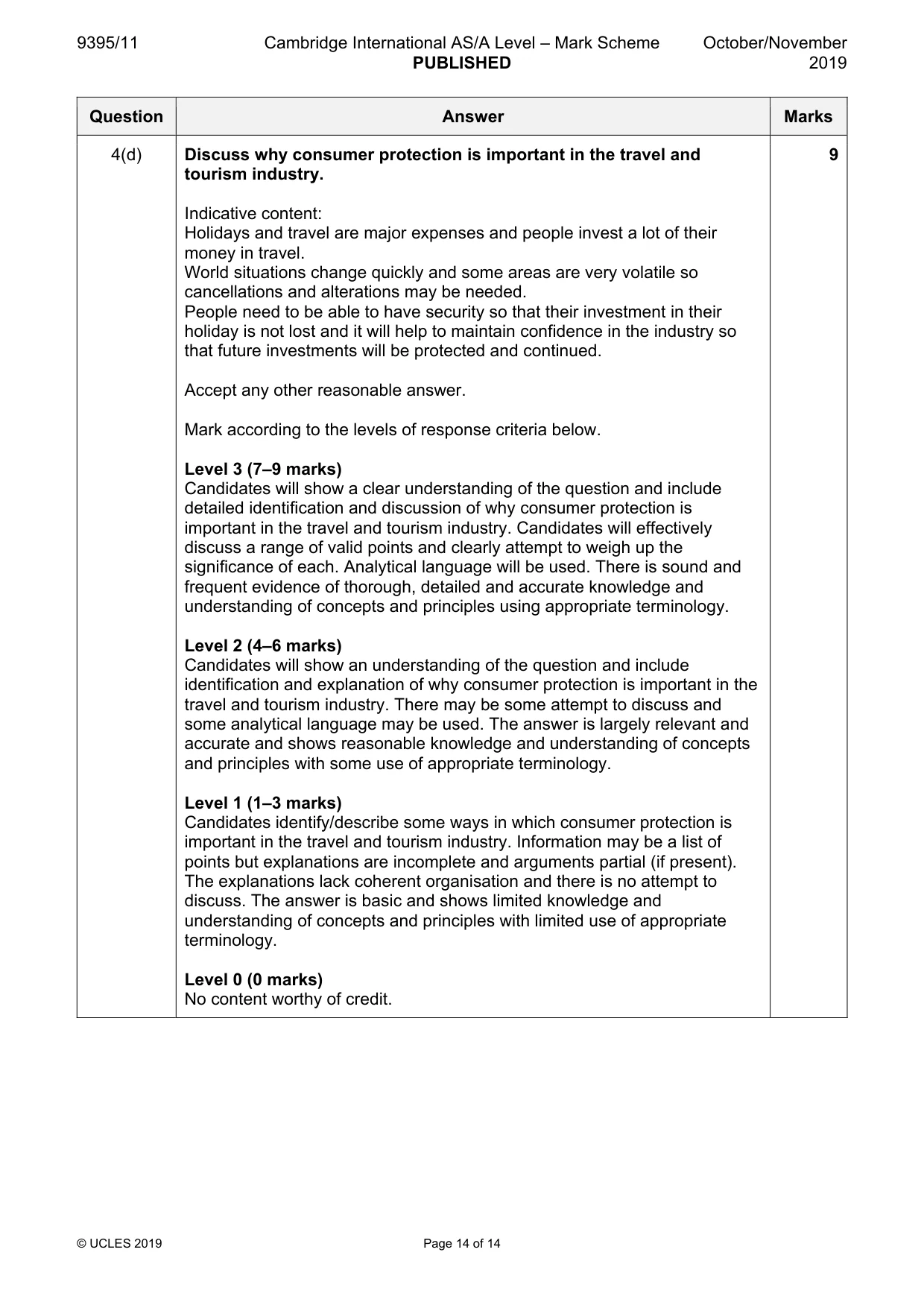
9395/11 Cambridge International AS/A Level – Mark Scheme PUBLISHED October/November 2019 © UCLES 2019 Page 14 of 14 Question Answer Marks 4(d) Discuss why consumer protection is important in the travel and tourism industry. Indicative content: Holidays and travel are major expenses and people invest a lot of their money in travel. World situations change quickly and some areas are very volatile so cancellations and alterations may be needed. People need to be able to have security so that their investment in their holiday is not lost and it will help to maintain confidence in the industry so that future investments will be protected and continued. Accept any other reasonable answer. Mark according to the levels of response criteria below. Level 3 (7–9 marks) Candidates will show a clear understanding of the question and include detailed identification and discussion of why consumer protection is important in the travel and tourism industry. Candidates will effectively discuss a range of valid points and clearly attempt to weigh up the significance of each. Analytical language will be used. There is sound and frequent evidence of thorough, detailed and accurate knowledge and understanding of concepts and principles using appropriate terminology. Level 2 (4–6 marks) Candidates will show an understanding of the question and include identification and explanation of why consumer protection is important in the travel and tourism industry. There may be some attempt to discuss and some analytical language may be used. The answer is largely relevant and accurate and shows reasonable knowledge and understanding of concepts and principles with some use of appropriate terminology. Level 1 (1–3 marks) Candidates identify/describe some ways in which consumer protection is important in the travel and tourism industry. Information may be a list of points but explanations are incomplete and arguments partial (if present). The explanations lack coherent organisation and there is no attempt to discuss. The answer is basic and shows limited knowledge and understanding of concepts and principles with limited use of appropriate terminology. Level 0 (0 marks) No content worthy of credit. 9
What you needed in this session
Cambridge’s own grade thresholds for 2019 Oct/Nov, Paper 1 · Variant 1. A higher threshold means an easier paper — the bar moves with how the cohort did.