Cambridge A Level Travel and Tourism 9395 — 2018 Oct/Nov Paper 1 · Variant 2
9395/12/O/N/18 · 100 marks · ≈113 min
The question paper and its mark scheme, free to read here and free to download. This is Cambridge’s own paper, exactly as it was sat.
Question paper16 pages


Mark scheme14 pages
Answers below. Sit the paper first if you are practising.
Paper as text
Question paper, page 1
* 9 1 8 0 6 8 5 2 9 0 * This document consists of 14 printed pages, 2 blank pages and 1 Insert. DC (ST) 153996/1 © UCLES 2018 [Turn over Cambridge International Examinations Cambridge International Advanced Subsidiary and Advanced Level TRAVEL AND TOURISM 9395/12 Paper 1 The Industry October/November 2018 2 hours and 30 minutes Candidates answer on the Question Paper. No Additional Materials are required. READ THESE INSTRUCTIONS FIRST Write your Centre number, candidate number and name on all the work you hand in. Write in dark blue or black pen. You may use an HB pencil for any diagrams or graphs. Do not use staples, paper clips, glue or correction fluid. DO NOT WRITE IN ANY BARCODES. Answer all questions. All the Figures referred to in the questions are contained in the Insert. The number of marks is given in brackets [ ] at the end of each question or part question.
Question paper, page 2
2 9395/12/O/N/18 © UCLES 2018 Question 1 Refer to Fig. 1 (Insert), information about China’s outbound tourists. (a) (i) Define the term ‘outbound tourist’. … …[1] (ii) State three reasons that may explain why increasing numbers of tourists from China now visit foreign countries. 1 … … 2 … … 3 … … [3] (b) Describe three consular services available to tourists from China when visiting foreign countries. 1 … … … … 2 … … … … 3 … … … … [6]
Question paper, page 3
3 9395/12/O/N/18 © UCLES 2018 [Turn over (c) Assess the possible reasons for the popularity of European destinations with tourists from China. … … … … … … … … … … … …[6]
Question paper, page 4
4 9395/12/O/N/18 © UCLES 2018 (d) Evaluate how developments in transport technology have affected tourism. … … … … … … … … … … … … … … … … … …[9] [Total: 25]
Question paper, page 5
5 9395/12/O/N/18 © UCLES 2018 [Turn over Question 2 Refer to Fig. 2 (Insert), photographs taken in Granada, Spain, a cultural destination. (a) Identify the four characteristics from Fig. 2 that would appeal to a cultural tourist. 1 … … 2 … … 3 … … 4 … … [4] (b) Describe three ways local tourism organisations can work with the local population. 1 … … … … 2 … … … … 3 … … … … [6]
Question paper, page 6
6 9395/12/O/N/18 © UCLES 2018 (c) Discuss how responsible tourism might lead to the preservation of culture. … … … … … … … … … … … …[6]
Question paper, page 7
7 9395/12/O/N/18 © UCLES 2018 [Turn over (d) Discuss how traditions and customs might encourage the growth of cultural tourism. … … … … … … … … … … … … … … … … … …[9] [Total: 25]
Question paper, page 8
8 9395/12/O/N/18 © UCLES 2018 Question 3 Refer to Fig. 3 (Insert), photographs of a car ferry. (a) Describe two customer service standards a car ferry company might set to ensure the quality of its customer service. 1 … … … … 2 … … … … [4]
Question paper, page 9
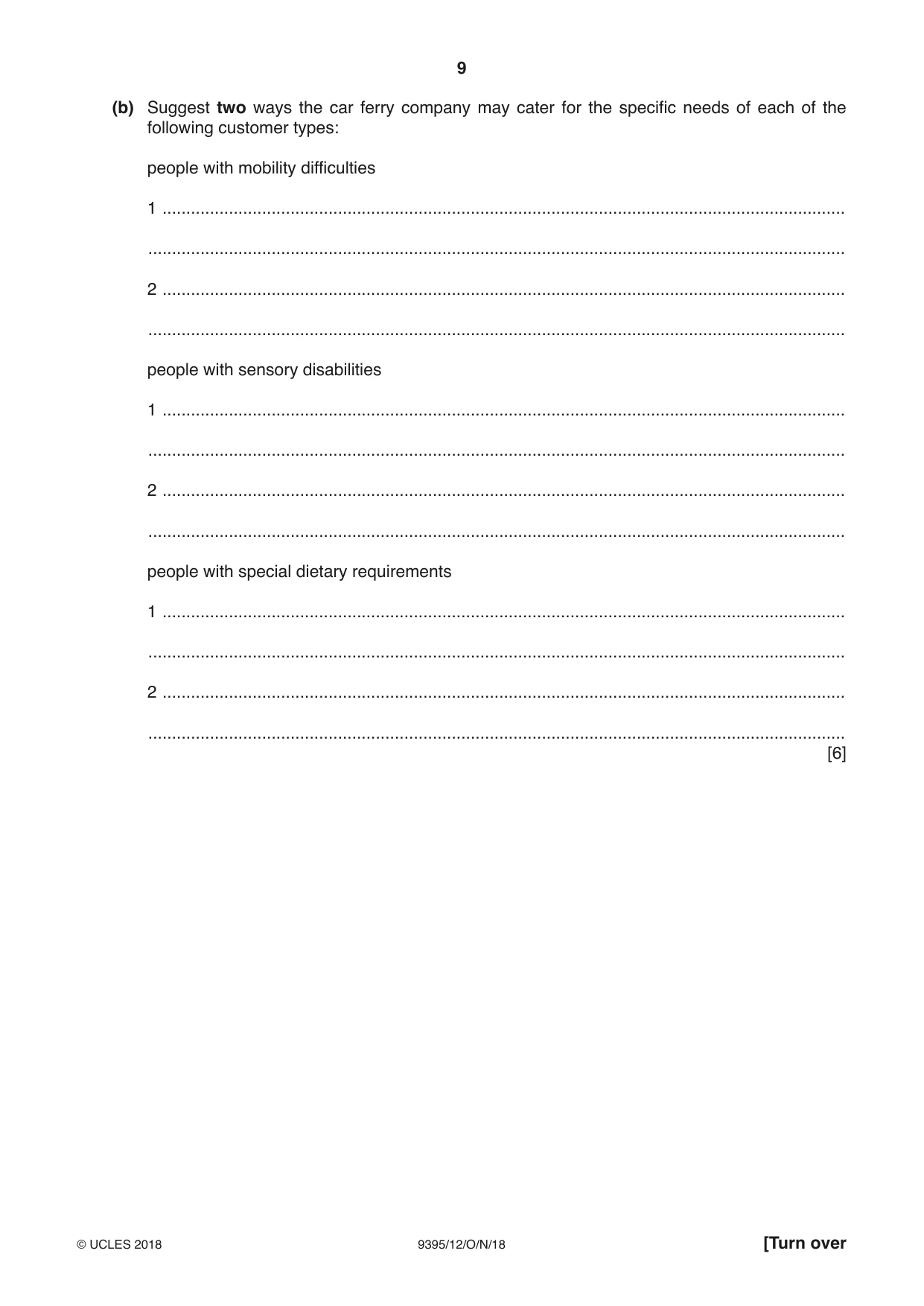
9 9395/12/O/N/18 © UCLES 2018 [Turn over (b) Suggest two ways the car ferry company may cater for the specific needs of each of the following customer types: people with mobility difficulties 1 … … 2 … … people with sensory disabilities 1 … … 2 … … people with special dietary requirements 1 … … 2 … … [6]
Question paper, page 10
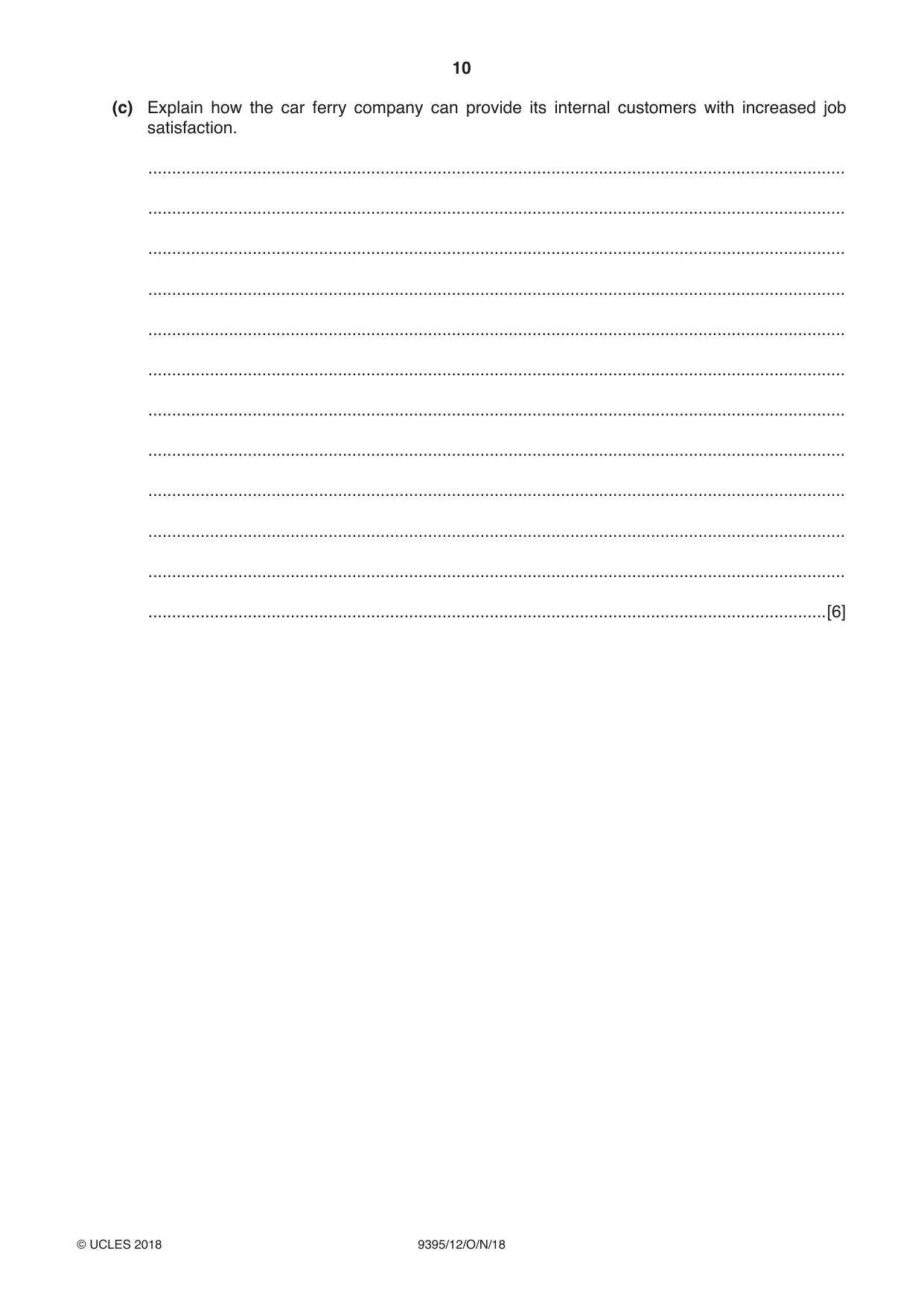
10 9395/12/O/N/18 © UCLES 2018 (c) Explain how the car ferry company can provide its internal customers with increased job satisfaction. … … … … … … … … … … … …[6]
Question paper, page 11
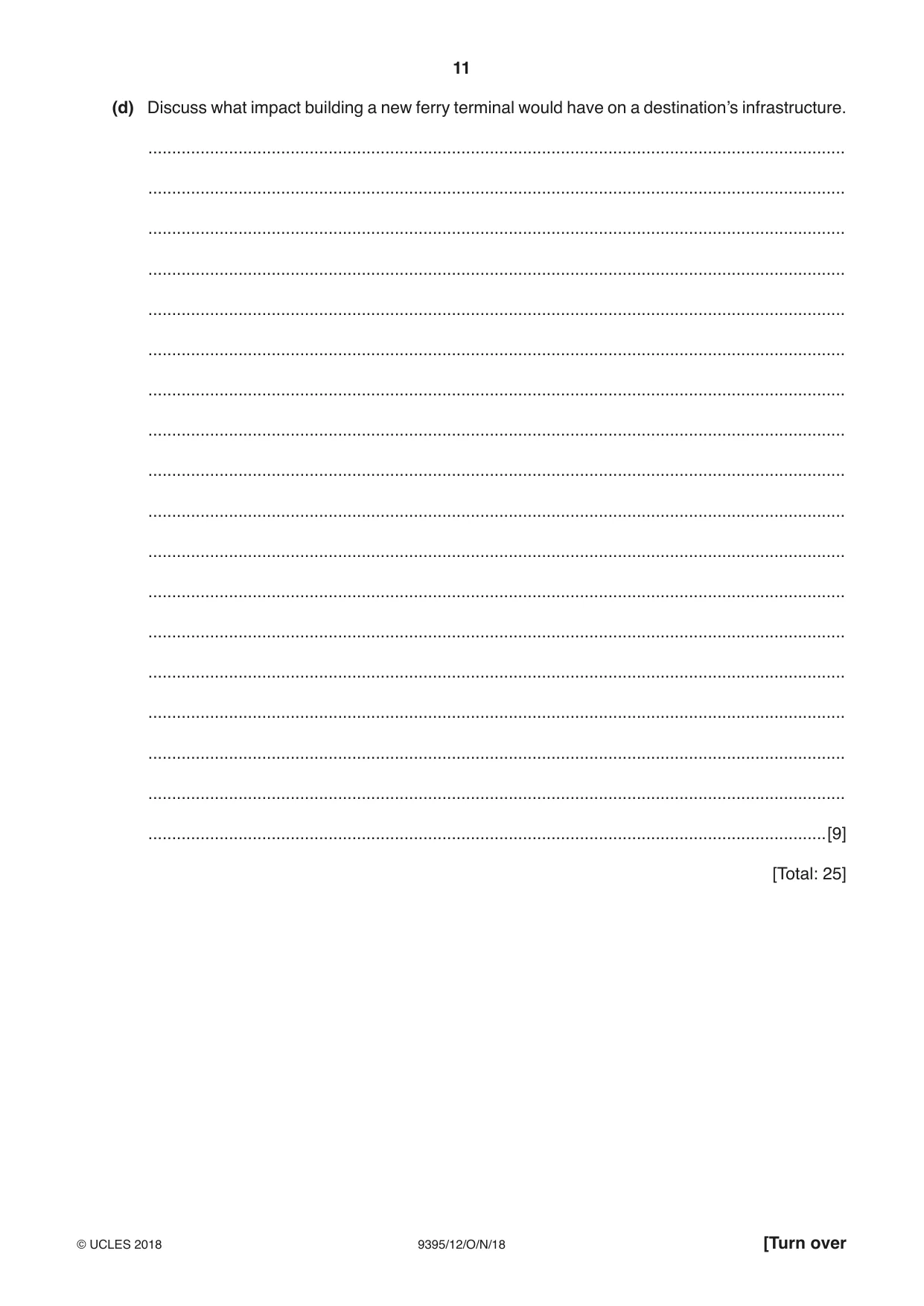
11 9395/12/O/N/18 © UCLES 2018 [Turn over (d) Discuss what impact building a new ferry terminal would have on a destination’s infrastructure. … … … … … … … … … … … … … … … … … …[9] [Total: 25]
Question paper, page 12
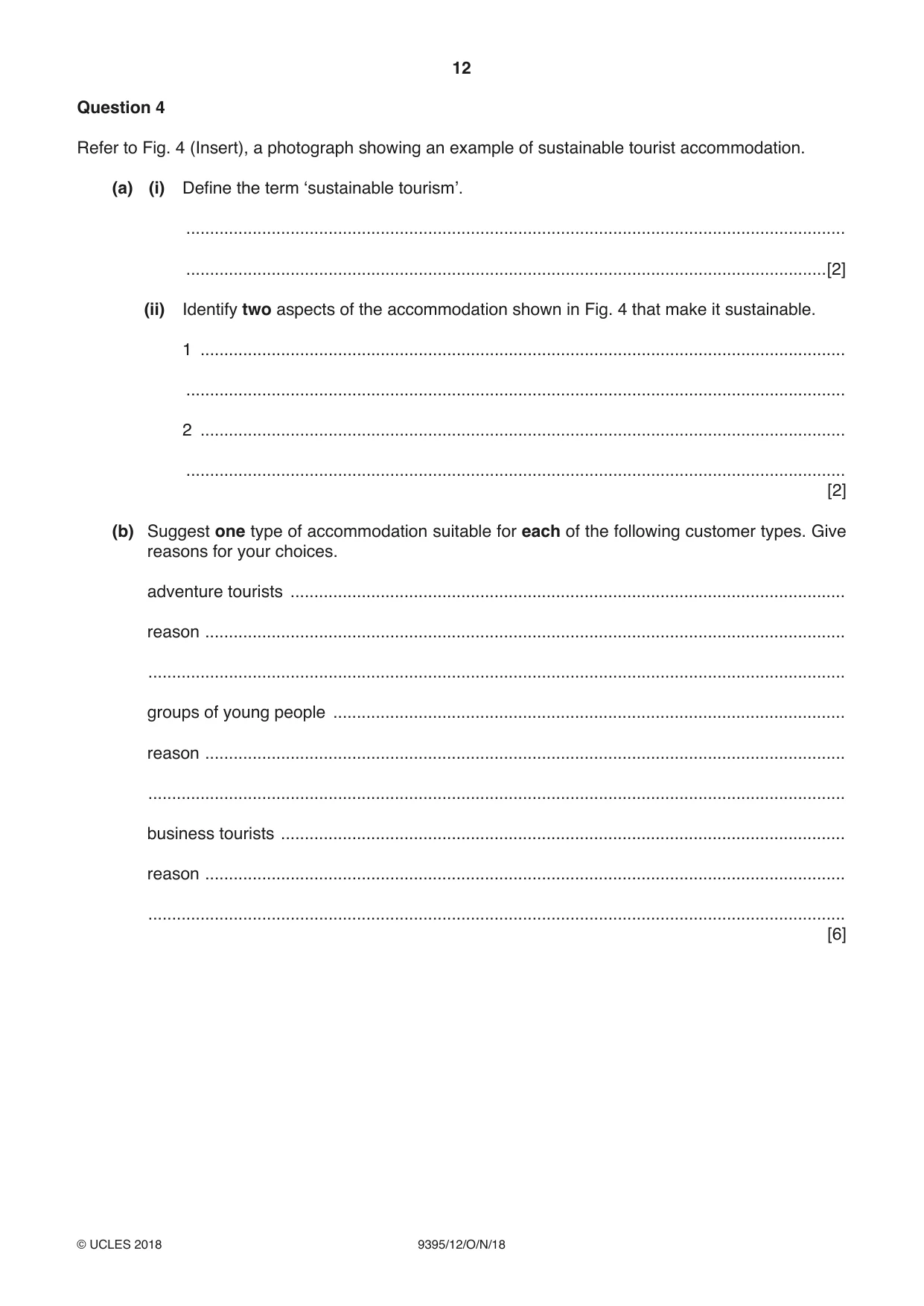
12 9395/12/O/N/18 © UCLES 2018 Question 4 Refer to Fig. 4 (Insert), a photograph showing an example of sustainable tourist accommodation. (a) (i) Define the term ‘sustainable tourism’. … …[2] (ii) Identify two aspects of the accommodation shown in Fig. 4 that make it sustainable. 1 … … 2 … … [2] (b) Suggest one type of accommodation suitable for each of the following customer types. Give reasons for your choices. adventure tourists … reason … … groups of young people … reason … … business tourists … reason … … [6]
Question paper, page 13
13 9395/12/O/N/18 © UCLES 2018 [Turn over (c) The accommodation shown in Fig. 4 is owned by a commercial organisation. Discuss how commercial organisations generate income. … … … … … … … … … … … …[6]
Question paper, page 14
14 9395/12/O/N/18 © UCLES 2018 (d) Analyse how product differentiation impacts the accommodation sector. … … … … … … … … … … … … … … … … … …[9] [Total: 25]
Question paper, page 15
15 9395/12/O/N/18 © UCLES 2018 BLANK PAGE
Question paper, page 16
16 9395/12/O/N/18 © UCLES 2018 Permission to reproduce items where third-party owned material protected by copyright is included has been sought and cleared where possible. Every reasonable effort has been made by the publisher (UCLES) to trace copyright holders, but if any items requiring clearance have unwittingly been included, the publisher will be pleased to make amends at the earliest possible opportunity. To avoid the issue of disclosure of answer-related information to candidates, all copyright acknowledgements are reproduced online in the Cambridge International Examinations Copyright Acknowledgements Booklet. This is produced for each series of examinations and is freely available to download at www.cie.org.uk after the live examination series. Cambridge International Examinations is part of the Cambridge Assessment Group. Cambridge Assessment is the brand name of University of Cambridge Local Examinations Syndicate (UCLES), which is itself a department of the University of Cambridge. BLANK PAGE
Mark scheme, page 1
This document consists of 14 printed pages. © UCLES 2018 [Turn over Cambridge Assessment International Education Cambridge International Advanced Subsidiary and Advanced Level TRAVEL AND TOURISM 9395/12 Paper 1 The Industry October/November 2018 MARK SCHEME Maximum Mark: 100 Published This mark scheme is published as an aid to teachers and candidates, to indicate the requirements of the examination. It shows the basis on which Examiners were instructed to award marks. It does not indicate the details of the discussions that took place at an Examiners’ meeting before marking began, which would have considered the acceptability of alternative answers. Mark schemes should be read in conjunction with the question paper and the Principal Examiner Report for Teachers. Cambridge International will not enter into discussions about these mark schemes. Cambridge International is publishing the mark schemes for the October/November 2018 series for most Cambridge IGCSE™, Cambridge International A and AS Level components and some Cambridge O Level components.
Mark scheme, page 2
9395/12 Cambridge International AS/A Level – Mark Scheme PUBLISHED October/November 2018 © UCLES 2018 Page 2 of 14 Generic Marking Principles These general marking principles must be applied by all examiners when marking candidate answers. They should be applied alongside the specific content of the mark scheme or generic level descriptors for a question. Each question paper and mark scheme will also comply with these marking principles. GENERIC MARKING PRINCIPLE 1: Marks must be awarded in line with: • the specific content of the mark scheme or the generic level descriptors for the question • the specific skills defined in the mark scheme or in the generic level descriptors for the question • the standard of response required by a candidate as exemplified by the standardisation scripts. GENERIC MARKING PRINCIPLE 2: Marks awarded are always whole marks (not half marks, or other fractions). GENERIC MARKING PRINCIPLE 3: Marks must be awarded positively: • marks are awarded for correct/valid answers, as defined in the mark scheme. However, credit is given for valid answers which go beyond the scope of the syllabus and mark scheme, referring to your Team Leader as appropriate • marks are awarded when candidates clearly demonstrate what they know and can do • marks are not deducted for errors • marks are not deducted for omissions • answers should only be judged on the quality of spelling, punctuation and grammar when these features are specifically assessed by the question as indicated by the mark scheme. The meaning, however, should be unambiguous. GENERIC MARKING PRINCIPLE 4: Rules must be applied consistently e.g. in situations where candidates have not followed instructions or in the application of generic level descriptors. GENERIC MARKING PRINCIPLE 5: Marks should be awarded using the full range of marks defined in the mark scheme for the question (however; the use of the full mark range may be limited according to the quality of the candidate responses seen). GENERIC MARKING PRINCIPLE 6: Marks awarded are based solely on the requirements as defined in the mark scheme. Marks should not be awarded with grade thresholds or grade descriptors in mind.
Mark scheme, page 3
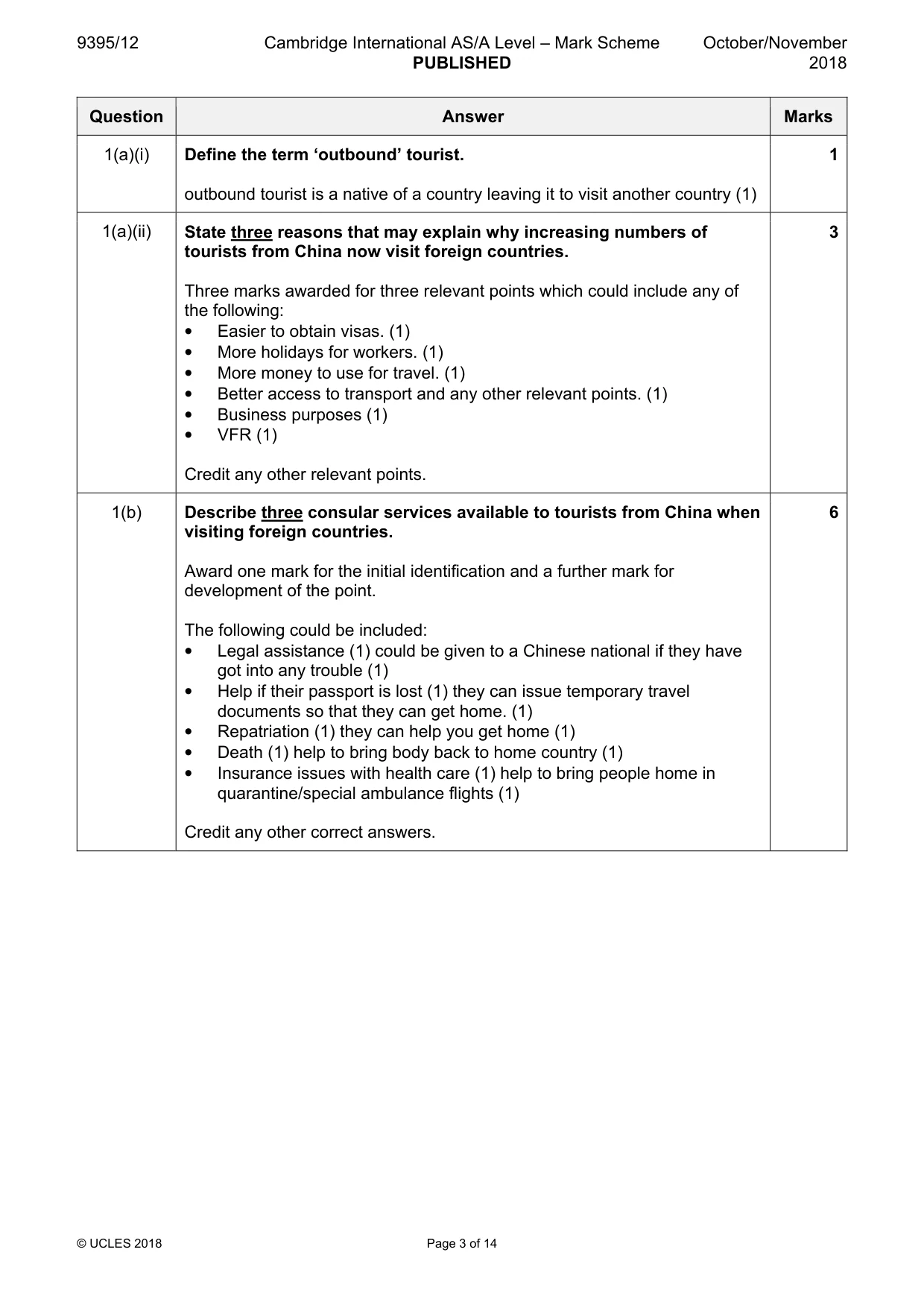
9395/12 Cambridge International AS/A Level – Mark Scheme PUBLISHED October/November 2018 © UCLES 2018 Page 3 of 14 Question Answer Marks 1(a)(i) Define the term ‘outbound’ tourist. outbound tourist is a native of a country leaving it to visit another country (1) 1 1(a)(ii) State three reasons that may explain why increasing numbers of tourists from China now visit foreign countries. Three marks awarded for three relevant points which could include any of the following: • Easier to obtain visas. (1) • More holidays for workers. (1) • More money to use for travel. (1) • Better access to transport and any other relevant points. (1) • Business purposes (1) • VFR (1) Credit any other relevant points. 3 1(b) Describe three consular services available to tourists from China when visiting foreign countries. Award one mark for the initial identification and a further mark for development of the point. The following could be included: • Legal assistance (1) could be given to a Chinese national if they have got into any trouble (1) • Help if their passport is lost (1) they can issue temporary travel documents so that they can get home. (1) • Repatriation (1) they can help you get home (1) • Death (1) help to bring body back to home country (1) • Insurance issues with health care (1) help to bring people home in quarantine/special ambulance flights (1) Credit any other correct answers. 6
Mark scheme, page 4
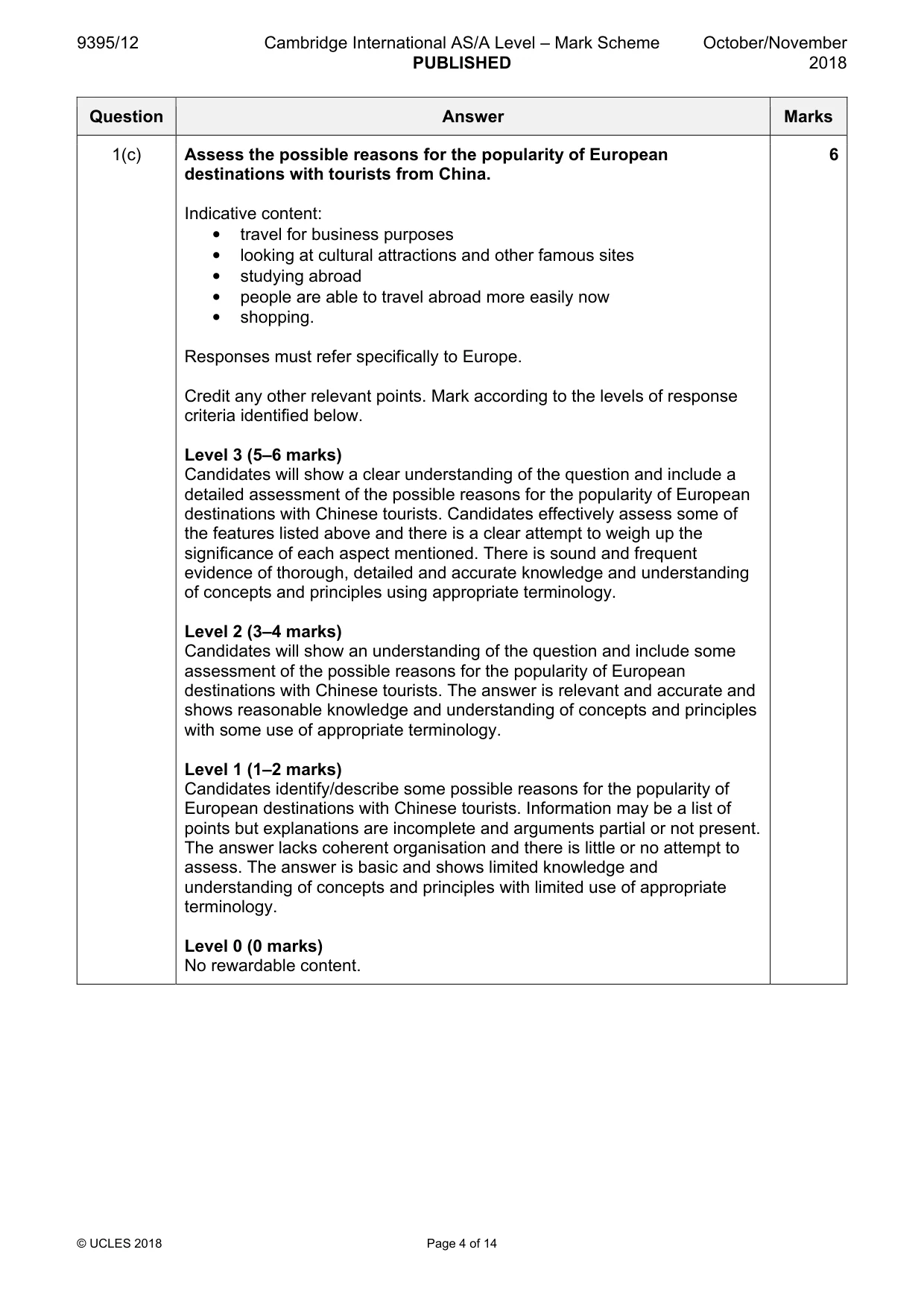
9395/12 Cambridge International AS/A Level – Mark Scheme PUBLISHED October/November 2018 © UCLES 2018 Page 4 of 14 Question Answer Marks 1(c) Assess the possible reasons for the popularity of European destinations with tourists from China. Indicative content: • travel for business purposes • looking at cultural attractions and other famous sites • studying abroad • people are able to travel abroad more easily now • shopping. Responses must refer specifically to Europe. Credit any other relevant points. Mark according to the levels of response criteria identified below. Level 3 (5–6 marks) Candidates will show a clear understanding of the question and include a detailed assessment of the possible reasons for the popularity of European destinations with Chinese tourists. Candidates effectively assess some of the features listed above and there is a clear attempt to weigh up the significance of each aspect mentioned. There is sound and frequent evidence of thorough, detailed and accurate knowledge and understanding of concepts and principles using appropriate terminology. Level 2 (3–4 marks) Candidates will show an understanding of the question and include some assessment of the possible reasons for the popularity of European destinations with Chinese tourists. The answer is relevant and accurate and shows reasonable knowledge and understanding of concepts and principles with some use of appropriate terminology. Level 1 (1–2 marks) Candidates identify/describe some possible reasons for the popularity of European destinations with Chinese tourists. Information may be a list of points but explanations are incomplete and arguments partial or not present. The answer lacks coherent organisation and there is little or no attempt to assess. The answer is basic and shows limited knowledge and understanding of concepts and principles with limited use of appropriate terminology. Level 0 (0 marks) No rewardable content. 6
Mark scheme, page 5
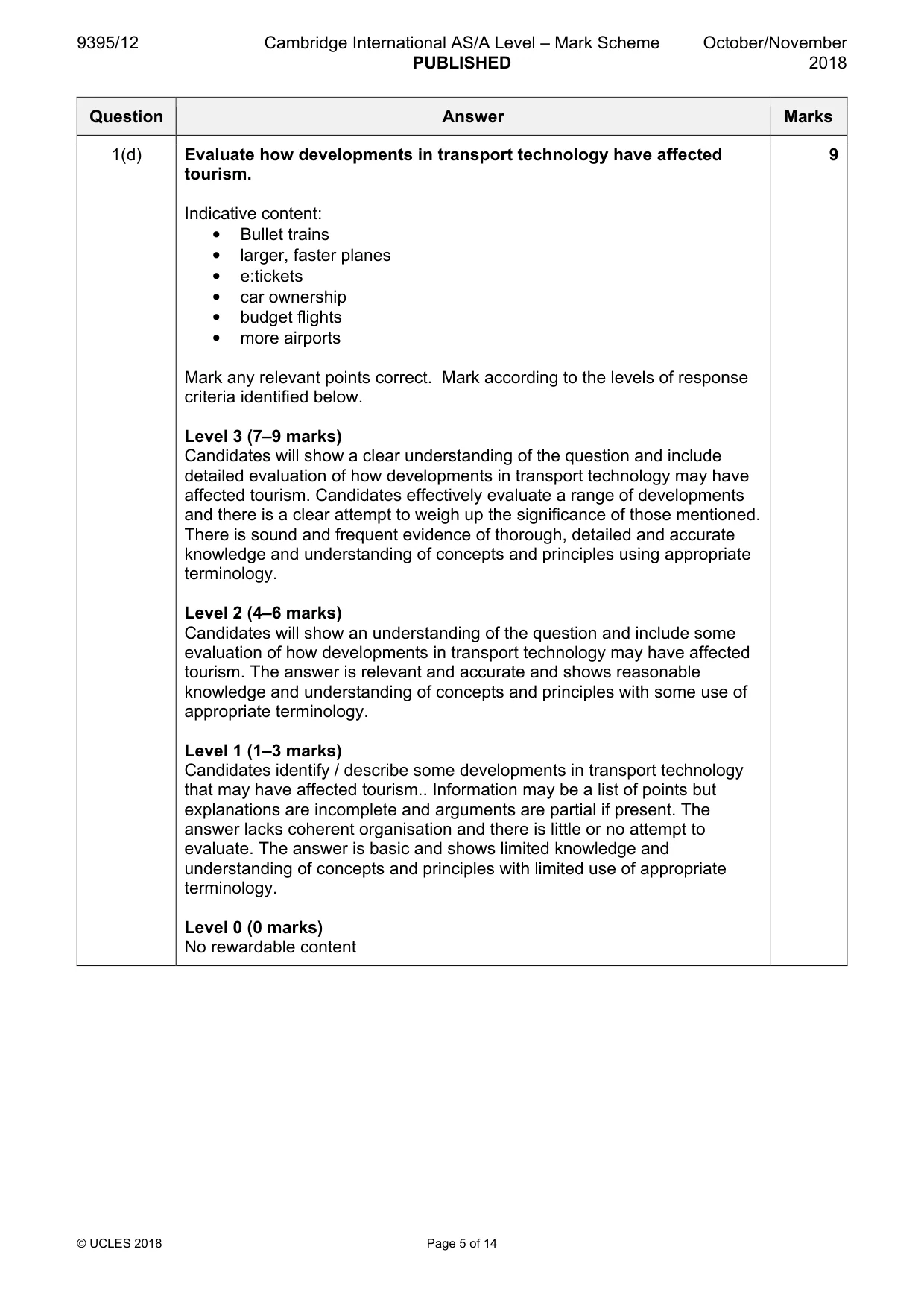
9395/12 Cambridge International AS/A Level – Mark Scheme PUBLISHED October/November 2018 © UCLES 2018 Page 5 of 14 Question Answer Marks 1(d) Evaluate how developments in transport technology have affected tourism. Indicative content: • Bullet trains • larger, faster planes • e:tickets • car ownership • budget flights • more airports Mark any relevant points correct. Mark according to the levels of response criteria identified below. Level 3 (7–9 marks) Candidates will show a clear understanding of the question and include detailed evaluation of how developments in transport technology may have affected tourism. Candidates effectively evaluate a range of developments and there is a clear attempt to weigh up the significance of those mentioned. There is sound and frequent evidence of thorough, detailed and accurate knowledge and understanding of concepts and principles using appropriate terminology. Level 2 (4–6 marks) Candidates will show an understanding of the question and include some evaluation of how developments in transport technology may have affected tourism. The answer is relevant and accurate and shows reasonable knowledge and understanding of concepts and principles with some use of appropriate terminology. Level 1 (1–3 marks) Candidates identify / describe some developments in transport technology that may have affected tourism.. Information may be a list of points but explanations are incomplete and arguments are partial if present. The answer lacks coherent organisation and there is little or no attempt to evaluate. The answer is basic and shows limited knowledge and understanding of concepts and principles with limited use of appropriate terminology. Level 0 (0 marks) No rewardable content 9
Mark scheme, page 6
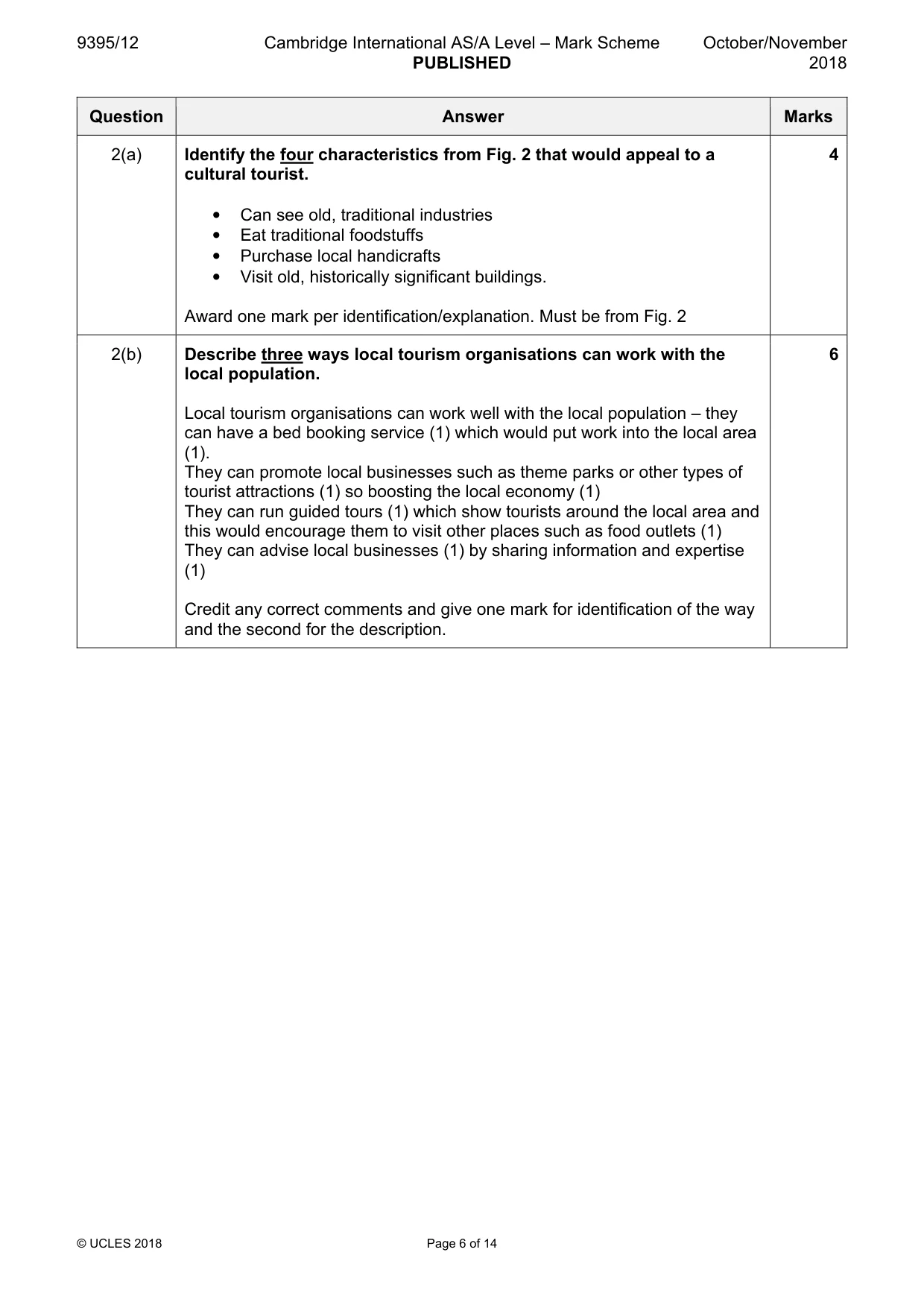
9395/12 Cambridge International AS/A Level – Mark Scheme PUBLISHED October/November 2018 © UCLES 2018 Page 6 of 14 Question Answer Marks 2(a) Identify the four characteristics from Fig. 2 that would appeal to a cultural tourist. • Can see old, traditional industries • Eat traditional foodstuffs • Purchase local handicrafts • Visit old, historically significant buildings. Award one mark per identification/explanation. Must be from Fig. 2 4 2(b) Describe three ways local tourism organisations can work with the local population. Local tourism organisations can work well with the local population – they can have a bed booking service (1) which would put work into the local area (1). They can promote local businesses such as theme parks or other types of tourist attractions (1) so boosting the local economy (1) They can run guided tours (1) which show tourists around the local area and this would encourage them to visit other places such as food outlets (1) They can advise local businesses (1) by sharing information and expertise (1) Credit any correct comments and give one mark for identification of the way and the second for the description. 6
Mark scheme, page 7
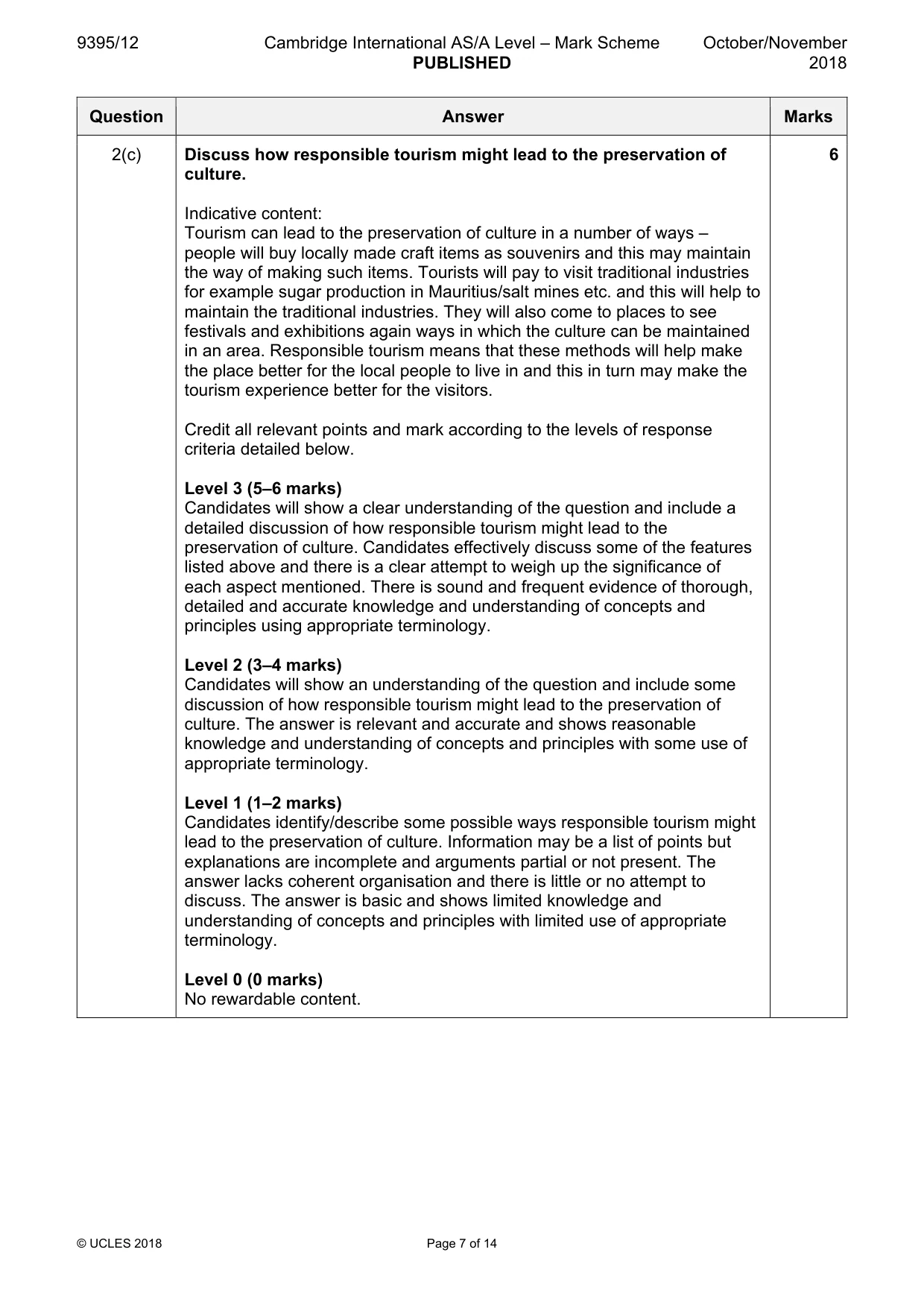
9395/12 Cambridge International AS/A Level – Mark Scheme PUBLISHED October/November 2018 © UCLES 2018 Page 7 of 14 Question Answer Marks 2(c) Discuss how responsible tourism might lead to the preservation of culture. Indicative content: Tourism can lead to the preservation of culture in a number of ways – people will buy locally made craft items as souvenirs and this may maintain the way of making such items. Tourists will pay to visit traditional industries for example sugar production in Mauritius/salt mines etc. and this will help to maintain the traditional industries. They will also come to places to see festivals and exhibitions again ways in which the culture can be maintained in an area. Responsible tourism means that these methods will help make the place better for the local people to live in and this in turn may make the tourism experience better for the visitors. Credit all relevant points and mark according to the levels of response criteria detailed below. Level 3 (5–6 marks) Candidates will show a clear understanding of the question and include a detailed discussion of how responsible tourism might lead to the preservation of culture. Candidates effectively discuss some of the features listed above and there is a clear attempt to weigh up the significance of each aspect mentioned. There is sound and frequent evidence of thorough, detailed and accurate knowledge and understanding of concepts and principles using appropriate terminology. Level 2 (3–4 marks) Candidates will show an understanding of the question and include some discussion of how responsible tourism might lead to the preservation of culture. The answer is relevant and accurate and shows reasonable knowledge and understanding of concepts and principles with some use of appropriate terminology. Level 1 (1–2 marks) Candidates identify/describe some possible ways responsible tourism might lead to the preservation of culture. Information may be a list of points but explanations are incomplete and arguments partial or not present. The answer lacks coherent organisation and there is little or no attempt to discuss. The answer is basic and shows limited knowledge and understanding of concepts and principles with limited use of appropriate terminology. Level 0 (0 marks) No rewardable content. 6
Mark scheme, page 8
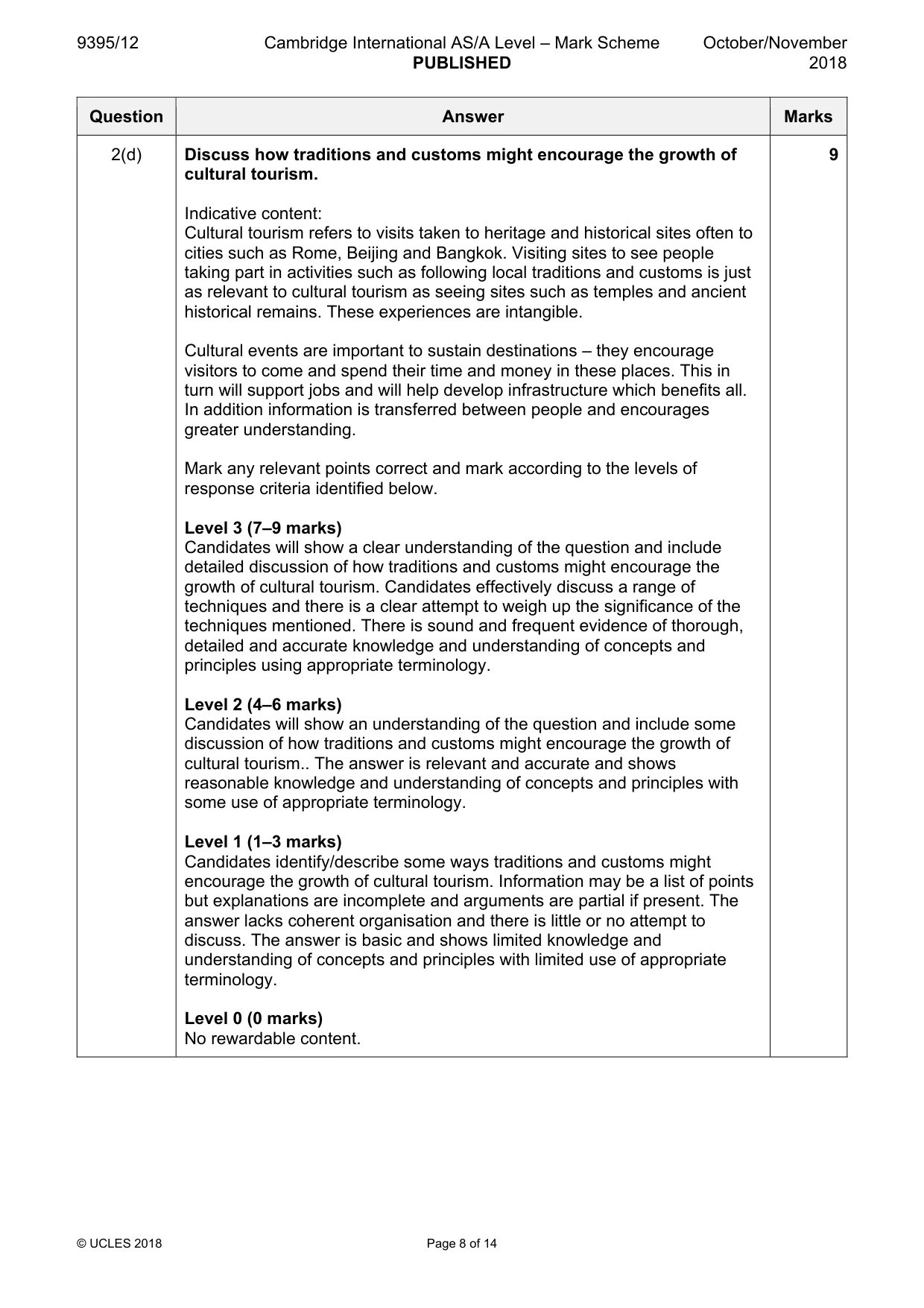
9395/12 Cambridge International AS/A Level – Mark Scheme PUBLISHED October/November 2018 © UCLES 2018 Page 8 of 14 Question Answer Marks 2(d) Discuss how traditions and customs might encourage the growth of cultural tourism. Indicative content: Cultural tourism refers to visits taken to heritage and historical sites often to cities such as Rome, Beijing and Bangkok. Visiting sites to see people taking part in activities such as following local traditions and customs is just as relevant to cultural tourism as seeing sites such as temples and ancient historical remains. These experiences are intangible. Cultural events are important to sustain destinations – they encourage visitors to come and spend their time and money in these places. This in turn will support jobs and will help develop infrastructure which benefits all. In addition information is transferred between people and encourages greater understanding. Mark any relevant points correct and mark according to the levels of response criteria identified below. Level 3 (7–9 marks) Candidates will show a clear understanding of the question and include detailed discussion of how traditions and customs might encourage the growth of cultural tourism. Candidates effectively discuss a range of techniques and there is a clear attempt to weigh up the significance of the techniques mentioned. There is sound and frequent evidence of thorough, detailed and accurate knowledge and understanding of concepts and principles using appropriate terminology. Level 2 (4–6 marks) Candidates will show an understanding of the question and include some discussion of how traditions and customs might encourage the growth of cultural tourism.. The answer is relevant and accurate and shows reasonable knowledge and understanding of concepts and principles with some use of appropriate terminology. Level 1 (1–3 marks) Candidates identify/describe some ways traditions and customs might encourage the growth of cultural tourism. Information may be a list of points but explanations are incomplete and arguments are partial if present. The answer lacks coherent organisation and there is little or no attempt to discuss. The answer is basic and shows limited knowledge and understanding of concepts and principles with limited use of appropriate terminology. Level 0 (0 marks) No rewardable content. 9
Mark scheme, page 9
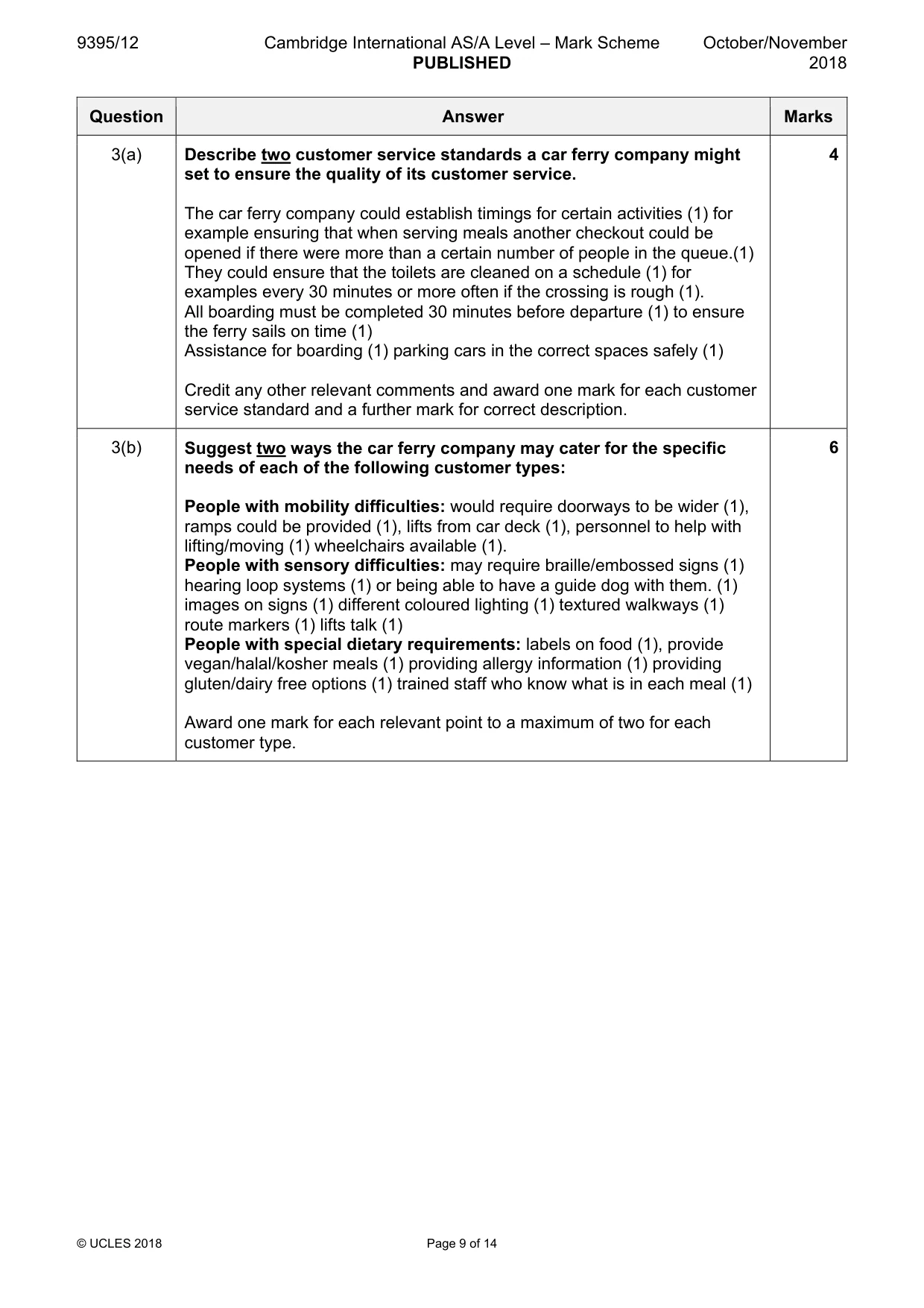
9395/12 Cambridge International AS/A Level – Mark Scheme PUBLISHED October/November 2018 © UCLES 2018 Page 9 of 14 Question Answer Marks 3(a) Describe two customer service standards a car ferry company might set to ensure the quality of its customer service. The car ferry company could establish timings for certain activities (1) for example ensuring that when serving meals another checkout could be opened if there were more than a certain number of people in the queue.(1) They could ensure that the toilets are cleaned on a schedule (1) for examples every 30 minutes or more often if the crossing is rough (1). All boarding must be completed 30 minutes before departure (1) to ensure the ferry sails on time (1) Assistance for boarding (1) parking cars in the correct spaces safely (1) Credit any other relevant comments and award one mark for each customer service standard and a further mark for correct description. 4 3(b) Suggest two ways the car ferry company may cater for the specific needs of each of the following customer types: People with mobility difficulties: would require doorways to be wider (1), ramps could be provided (1), lifts from car deck (1), personnel to help with lifting/moving (1) wheelchairs available (1). People with sensory difficulties: may require braille/embossed signs (1) hearing loop systems (1) or being able to have a guide dog with them. (1) images on signs (1) different coloured lighting (1) textured walkways (1) route markers (1) lifts talk (1) People with special dietary requirements: labels on food (1), provide vegan/halal/kosher meals (1) providing allergy information (1) providing gluten/dairy free options (1) trained staff who know what is in each meal (1) Award one mark for each relevant point to a maximum of two for each customer type. 6
Mark scheme, page 10
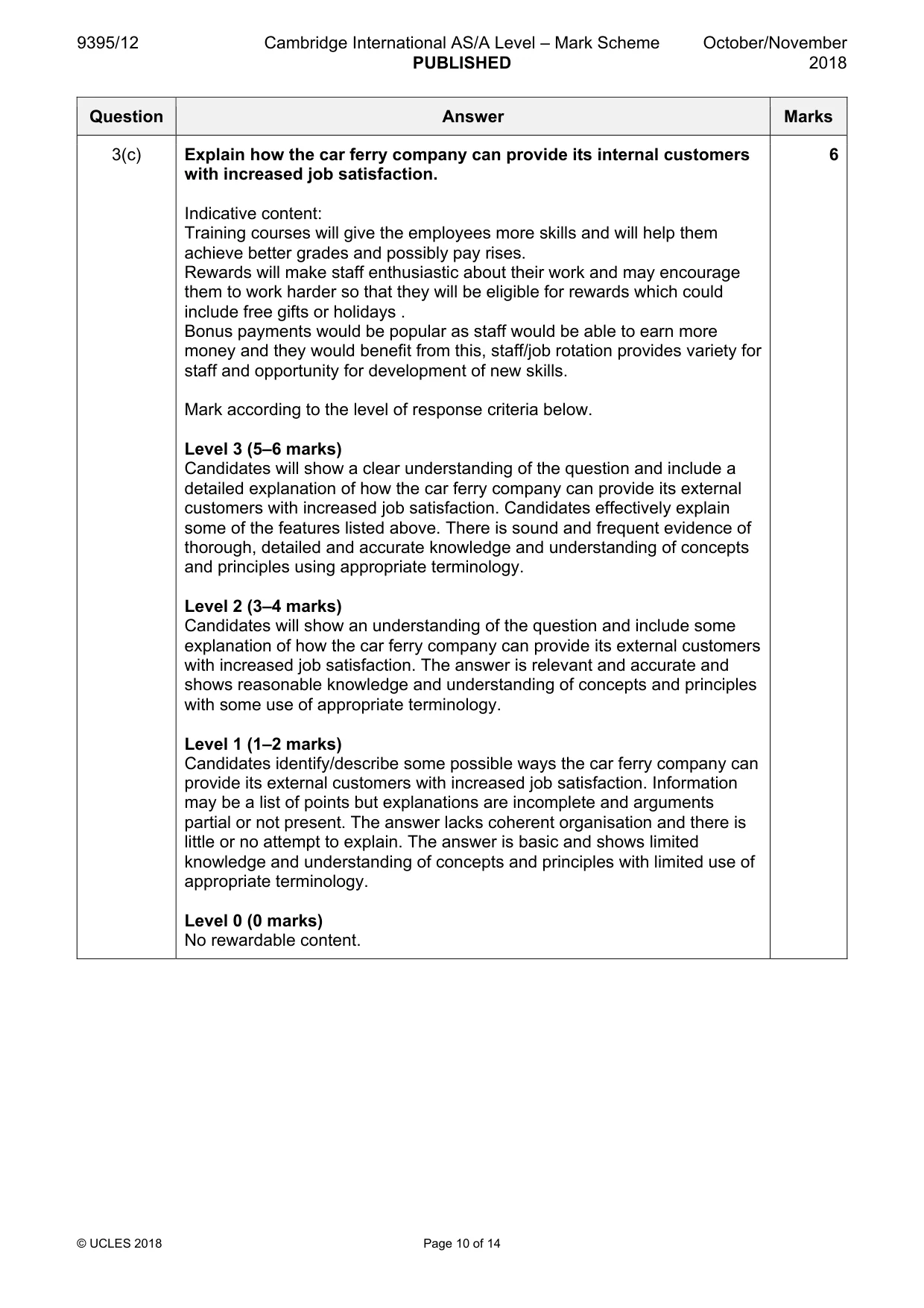
9395/12 Cambridge International AS/A Level – Mark Scheme PUBLISHED October/November 2018 © UCLES 2018 Page 10 of 14 Question Answer Marks 3(c) Explain how the car ferry company can provide its internal customers with increased job satisfaction. Indicative content: Training courses will give the employees more skills and will help them achieve better grades and possibly pay rises. Rewards will make staff enthusiastic about their work and may encourage them to work harder so that they will be eligible for rewards which could include free gifts or holidays . Bonus payments would be popular as staff would be able to earn more money and they would benefit from this, staff/job rotation provides variety for staff and opportunity for development of new skills. Mark according to the level of response criteria below. Level 3 (5–6 marks) Candidates will show a clear understanding of the question and include a detailed explanation of how the car ferry company can provide its external customers with increased job satisfaction. Candidates effectively explain some of the features listed above. There is sound and frequent evidence of thorough, detailed and accurate knowledge and understanding of concepts and principles using appropriate terminology. Level 2 (3–4 marks) Candidates will show an understanding of the question and include some explanation of how the car ferry company can provide its external customers with increased job satisfaction. The answer is relevant and accurate and shows reasonable knowledge and understanding of concepts and principles with some use of appropriate terminology. Level 1 (1–2 marks) Candidates identify/describe some possible ways the car ferry company can provide its external customers with increased job satisfaction. Information may be a list of points but explanations are incomplete and arguments partial or not present. The answer lacks coherent organisation and there is little or no attempt to explain. The answer is basic and shows limited knowledge and understanding of concepts and principles with limited use of appropriate terminology. Level 0 (0 marks) No rewardable content. 6
Mark scheme, page 11
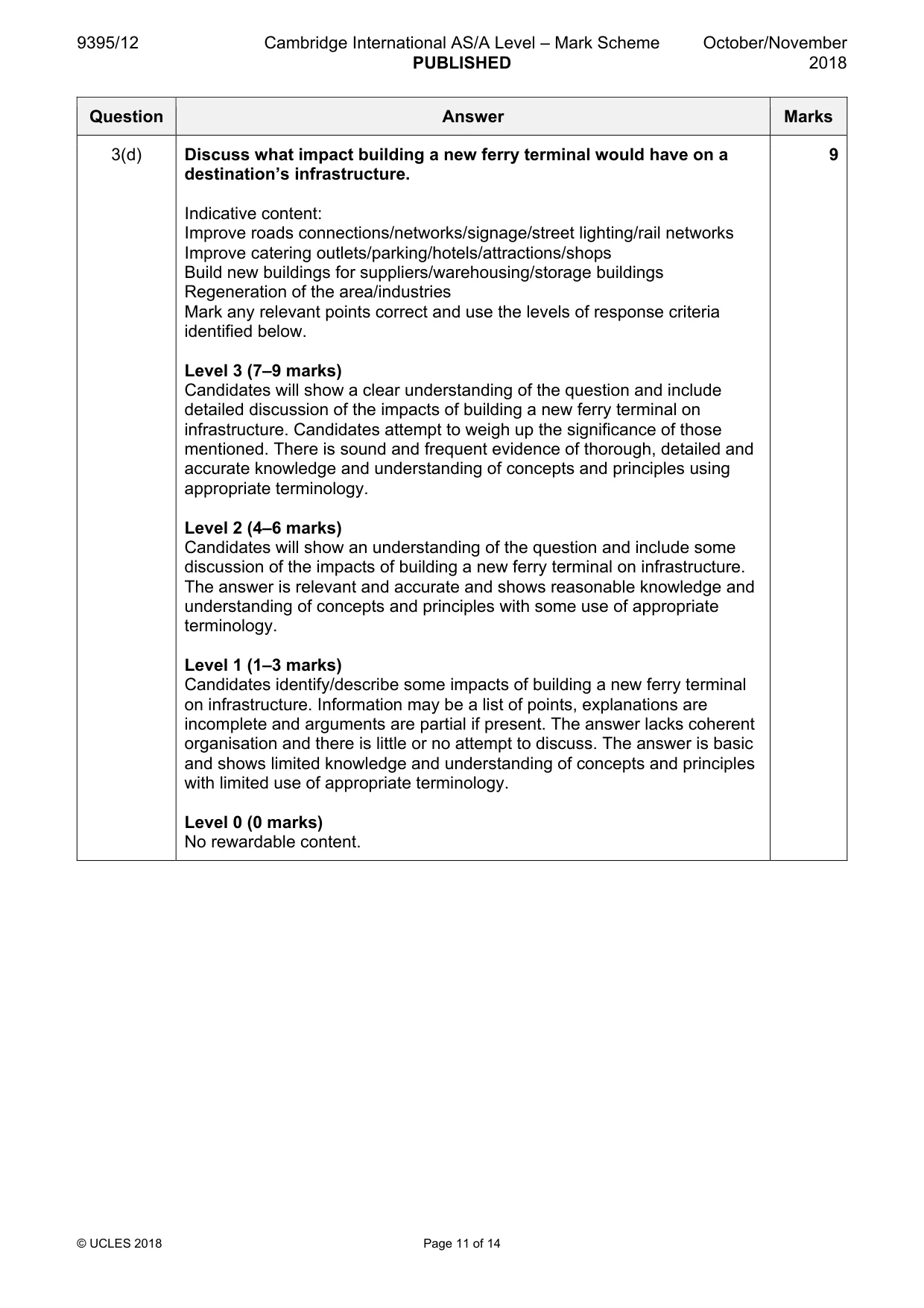
9395/12 Cambridge International AS/A Level – Mark Scheme PUBLISHED October/November 2018 © UCLES 2018 Page 11 of 14 Question Answer Marks 3(d) Discuss what impact building a new ferry terminal would have on a destination’s infrastructure. Indicative content: Improve roads connections/networks/signage/street lighting/rail networks Improve catering outlets/parking/hotels/attractions/shops Build new buildings for suppliers/warehousing/storage buildings Regeneration of the area/industries Mark any relevant points correct and use the levels of response criteria identified below. Level 3 (7–9 marks) Candidates will show a clear understanding of the question and include detailed discussion of the impacts of building a new ferry terminal on infrastructure. Candidates attempt to weigh up the significance of those mentioned. There is sound and frequent evidence of thorough, detailed and accurate knowledge and understanding of concepts and principles using appropriate terminology. Level 2 (4–6 marks) Candidates will show an understanding of the question and include some discussion of the impacts of building a new ferry terminal on infrastructure. The answer is relevant and accurate and shows reasonable knowledge and understanding of concepts and principles with some use of appropriate terminology. Level 1 (1–3 marks) Candidates identify/describe some impacts of building a new ferry terminal on infrastructure. Information may be a list of points, explanations are incomplete and arguments are partial if present. The answer lacks coherent organisation and there is little or no attempt to discuss. The answer is basic and shows limited knowledge and understanding of concepts and principles with limited use of appropriate terminology. Level 0 (0 marks) No rewardable content. 9
Mark scheme, page 12
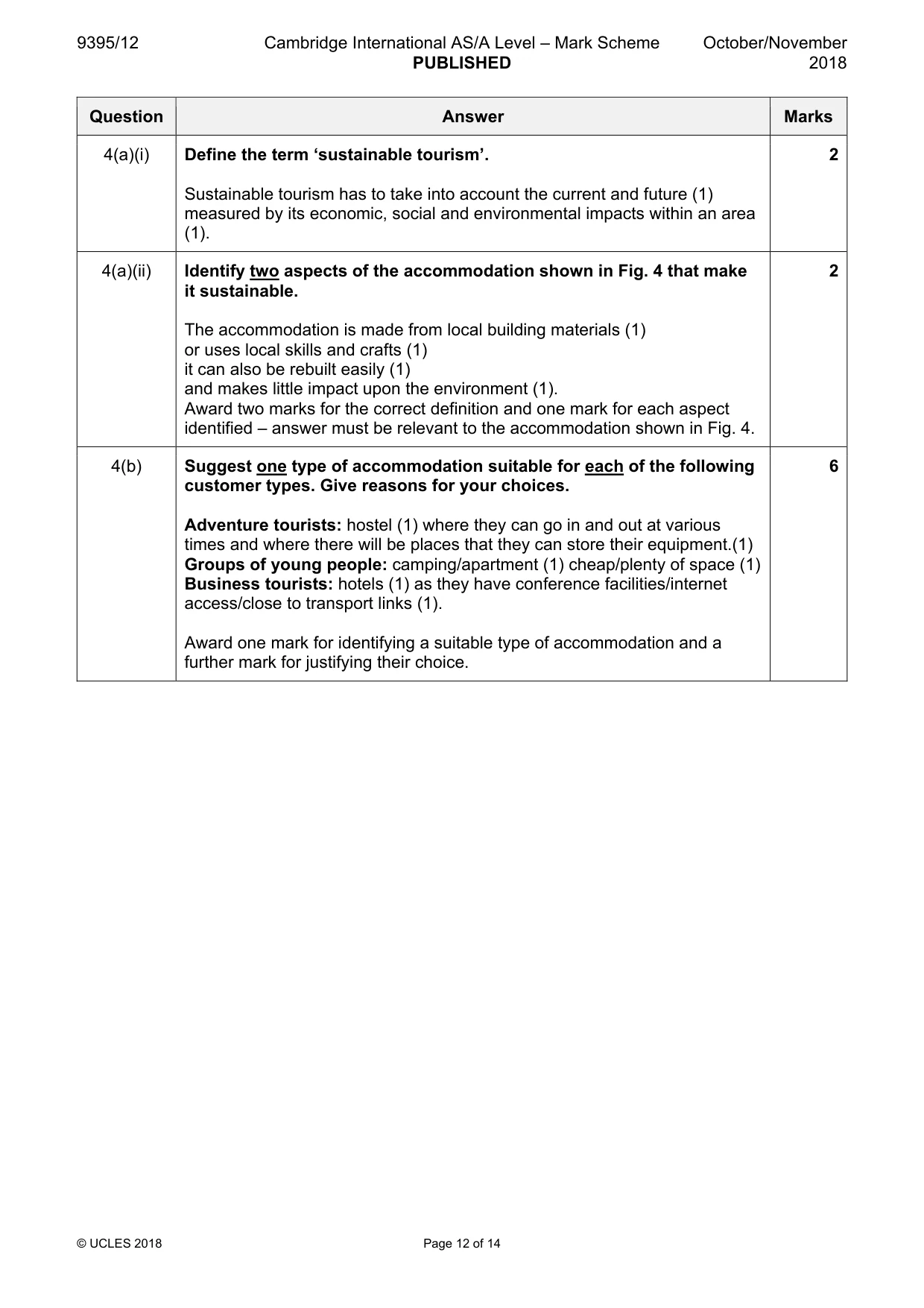
9395/12 Cambridge International AS/A Level – Mark Scheme PUBLISHED October/November 2018 © UCLES 2018 Page 12 of 14 Question Answer Marks 4(a)(i) Define the term ‘sustainable tourism’. Sustainable tourism has to take into account the current and future (1) measured by its economic, social and environmental impacts within an area (1). 2 4(a)(ii) Identify two aspects of the accommodation shown in Fig. 4 that make it sustainable. The accommodation is made from local building materials (1) or uses local skills and crafts (1) it can also be rebuilt easily (1) and makes little impact upon the environment (1). Award two marks for the correct definition and one mark for each aspect identified – answer must be relevant to the accommodation shown in Fig. 4. 2 4(b) Suggest one type of accommodation suitable for each of the following customer types. Give reasons for your choices. Adventure tourists: hostel (1) where they can go in and out at various times and where there will be places that they can store their equipment.(1) Groups of young people: camping/apartment (1) cheap/plenty of space (1) Business tourists: hotels (1) as they have conference facilities/internet access/close to transport links (1). Award one mark for identifying a suitable type of accommodation and a further mark for justifying their choice. 6
Mark scheme, page 13
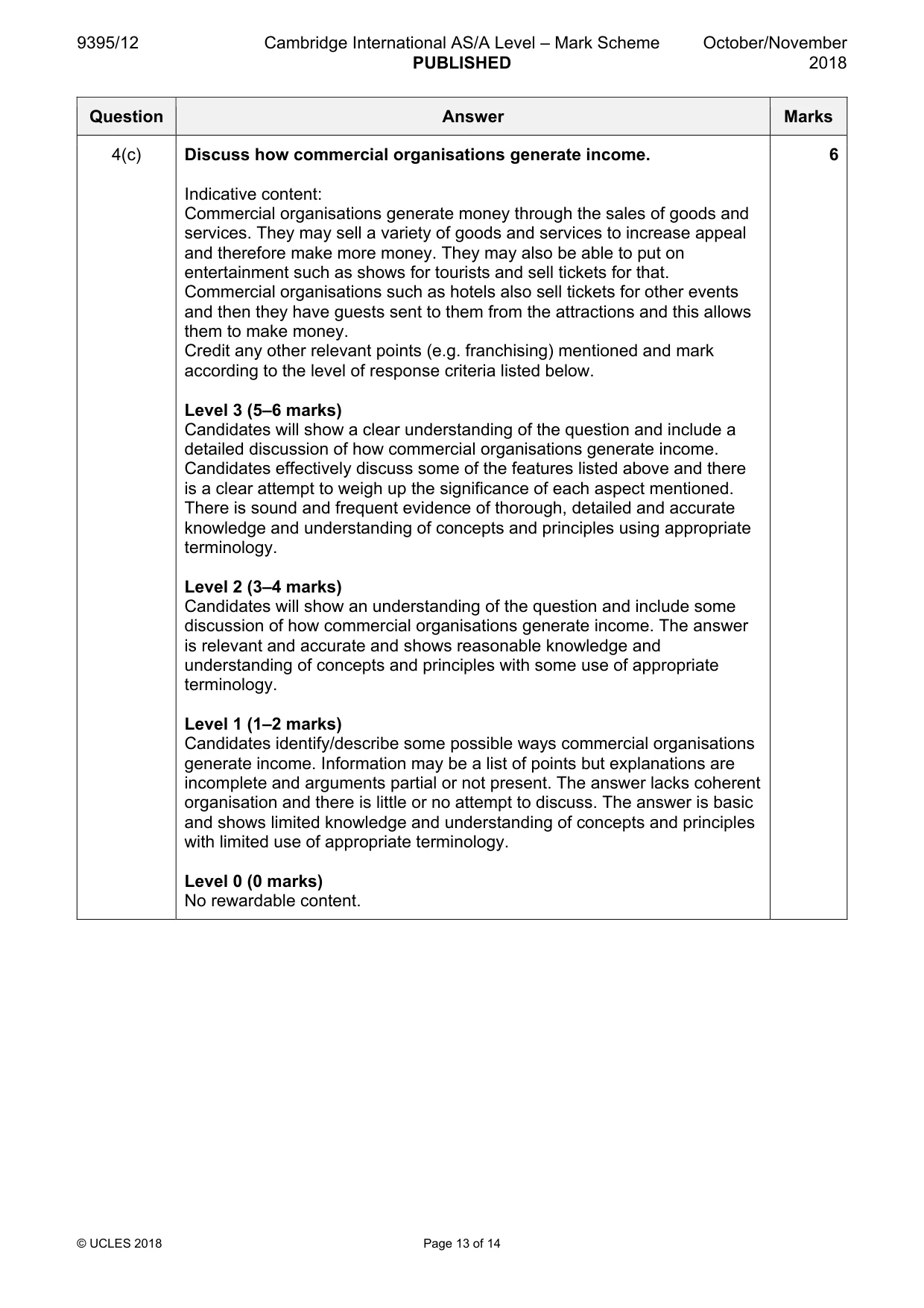
9395/12 Cambridge International AS/A Level – Mark Scheme PUBLISHED October/November 2018 © UCLES 2018 Page 13 of 14 Question Answer Marks 4(c) Discuss how commercial organisations generate income. Indicative content: Commercial organisations generate money through the sales of goods and services. They may sell a variety of goods and services to increase appeal and therefore make more money. They may also be able to put on entertainment such as shows for tourists and sell tickets for that. Commercial organisations such as hotels also sell tickets for other events and then they have guests sent to them from the attractions and this allows them to make money. Credit any other relevant points (e.g. franchising) mentioned and mark according to the level of response criteria listed below. Level 3 (5–6 marks) Candidates will show a clear understanding of the question and include a detailed discussion of how commercial organisations generate income. Candidates effectively discuss some of the features listed above and there is a clear attempt to weigh up the significance of each aspect mentioned. There is sound and frequent evidence of thorough, detailed and accurate knowledge and understanding of concepts and principles using appropriate terminology. Level 2 (3–4 marks) Candidates will show an understanding of the question and include some discussion of how commercial organisations generate income. The answer is relevant and accurate and shows reasonable knowledge and understanding of concepts and principles with some use of appropriate terminology. Level 1 (1–2 marks) Candidates identify/describe some possible ways commercial organisations generate income. Information may be a list of points but explanations are incomplete and arguments partial or not present. The answer lacks coherent organisation and there is little or no attempt to discuss. The answer is basic and shows limited knowledge and understanding of concepts and principles with limited use of appropriate terminology. Level 0 (0 marks) No rewardable content. 6
Mark scheme, page 14
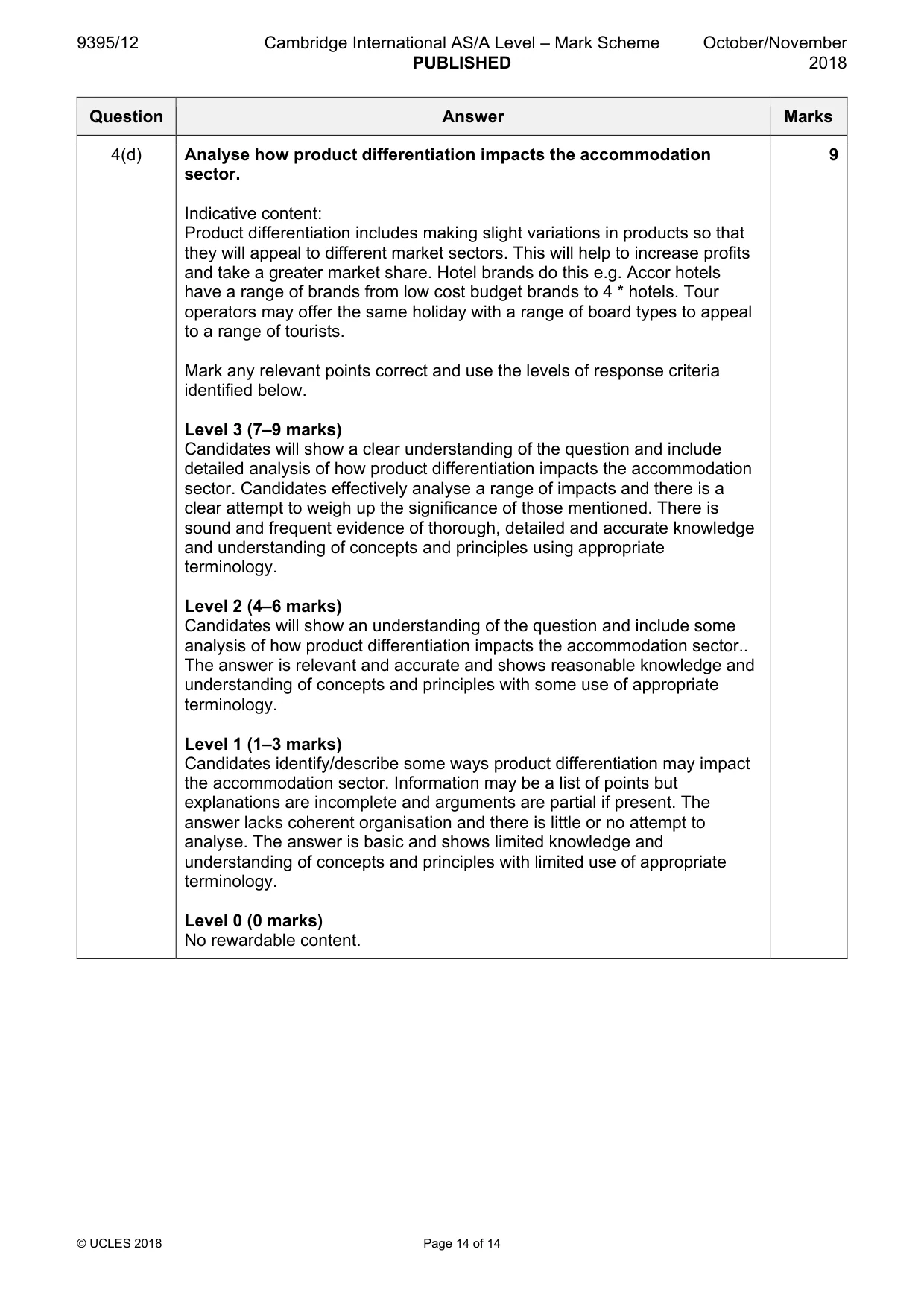
9395/12 Cambridge International AS/A Level – Mark Scheme PUBLISHED October/November 2018 © UCLES 2018 Page 14 of 14 Question Answer Marks 4(d) Analyse how product differentiation impacts the accommodation sector. Indicative content: Product differentiation includes making slight variations in products so that they will appeal to different market sectors. This will help to increase profits and take a greater market share. Hotel brands do this e.g. Accor hotels have a range of brands from low cost budget brands to 4 * hotels. Tour operators may offer the same holiday with a range of board types to appeal to a range of tourists. Mark any relevant points correct and use the levels of response criteria identified below. Level 3 (7–9 marks) Candidates will show a clear understanding of the question and include detailed analysis of how product differentiation impacts the accommodation sector. Candidates effectively analyse a range of impacts and there is a clear attempt to weigh up the significance of those mentioned. There is sound and frequent evidence of thorough, detailed and accurate knowledge and understanding of concepts and principles using appropriate terminology. Level 2 (4–6 marks) Candidates will show an understanding of the question and include some analysis of how product differentiation impacts the accommodation sector.. The answer is relevant and accurate and shows reasonable knowledge and understanding of concepts and principles with some use of appropriate terminology. Level 1 (1–3 marks) Candidates identify/describe some ways product differentiation may impact the accommodation sector. Information may be a list of points but explanations are incomplete and arguments are partial if present. The answer lacks coherent organisation and there is little or no attempt to analyse. The answer is basic and shows limited knowledge and understanding of concepts and principles with limited use of appropriate terminology. Level 0 (0 marks) No rewardable content. 9
What you needed in this session
Cambridge’s own grade thresholds for 2018 Oct/Nov, Paper 1 · Variant 2. A higher threshold means an easier paper — the bar moves with how the cohort did.