Cambridge A Level Travel and Tourism 9395 — 2018 Oct/Nov Paper 1 · Variant 1
9395/11/O/N/18 · 100 marks · ≈113 min
The question paper and its mark scheme, free to read here and free to download. This is Cambridge’s own paper, exactly as it was sat.
Question paper16 pages



Mark scheme12 pages
Answers below. Sit the paper first if you are practising.
Paper as text
Question paper, page 1
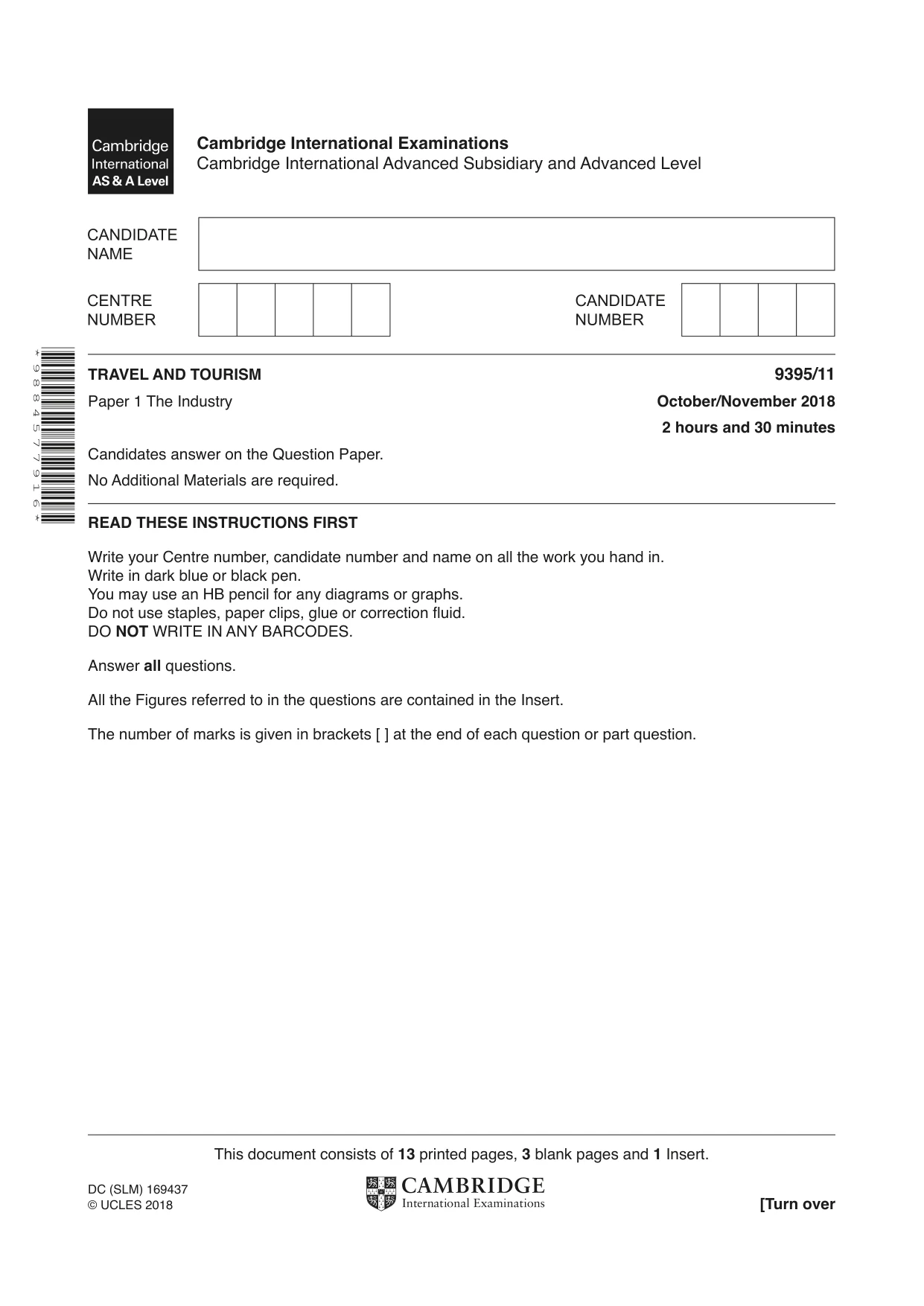
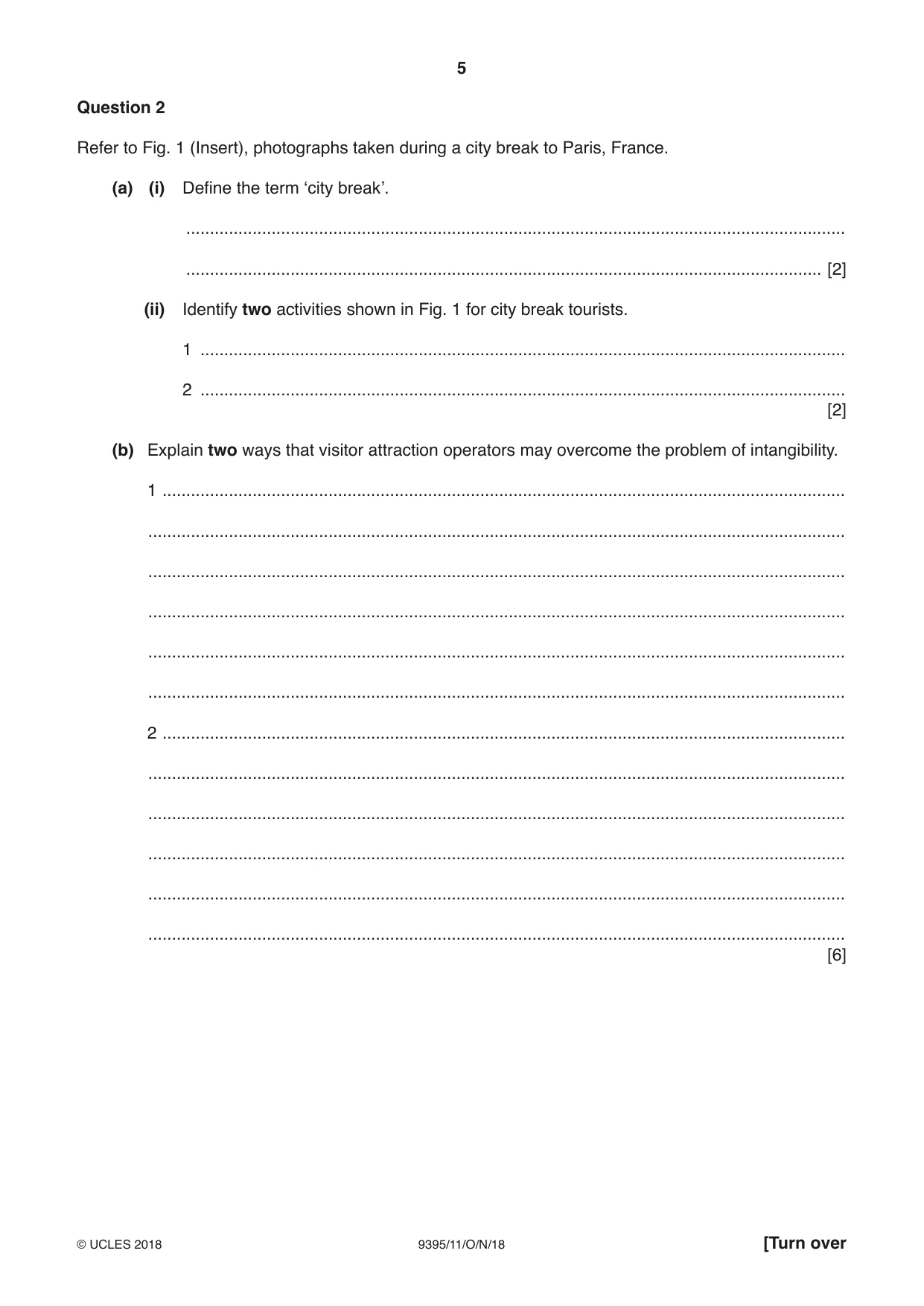
* 9 8 8 4 5 7 7 9 1 6 * This document consists of 13 printed pages, 3 blank pages and 1 Insert. DC (SLM) 169437 © UCLES 2018 [Turn over Cambridge International Examinations Cambridge International Advanced Subsidiary and Advanced Level TRAVEL AND TOURISM 9395/11 Paper 1 The Industry October/November 2018 2 hours and 30 minutes Candidates answer on the Question Paper. No Additional Materials are required. READ THESE INSTRUCTIONS FIRST Write your Centre number, candidate number and name on all the work you hand in. Write in dark blue or black pen. You may use an HB pencil for any diagrams or graphs. Do not use staples, paper clips, glue or correction fluid. DO NOT WRITE IN ANY BARCODES. Answer all questions. All the Figures referred to in the questions are contained in the Insert. The number of marks is given in brackets [ ] at the end of each question or part question.
Question paper, page 2
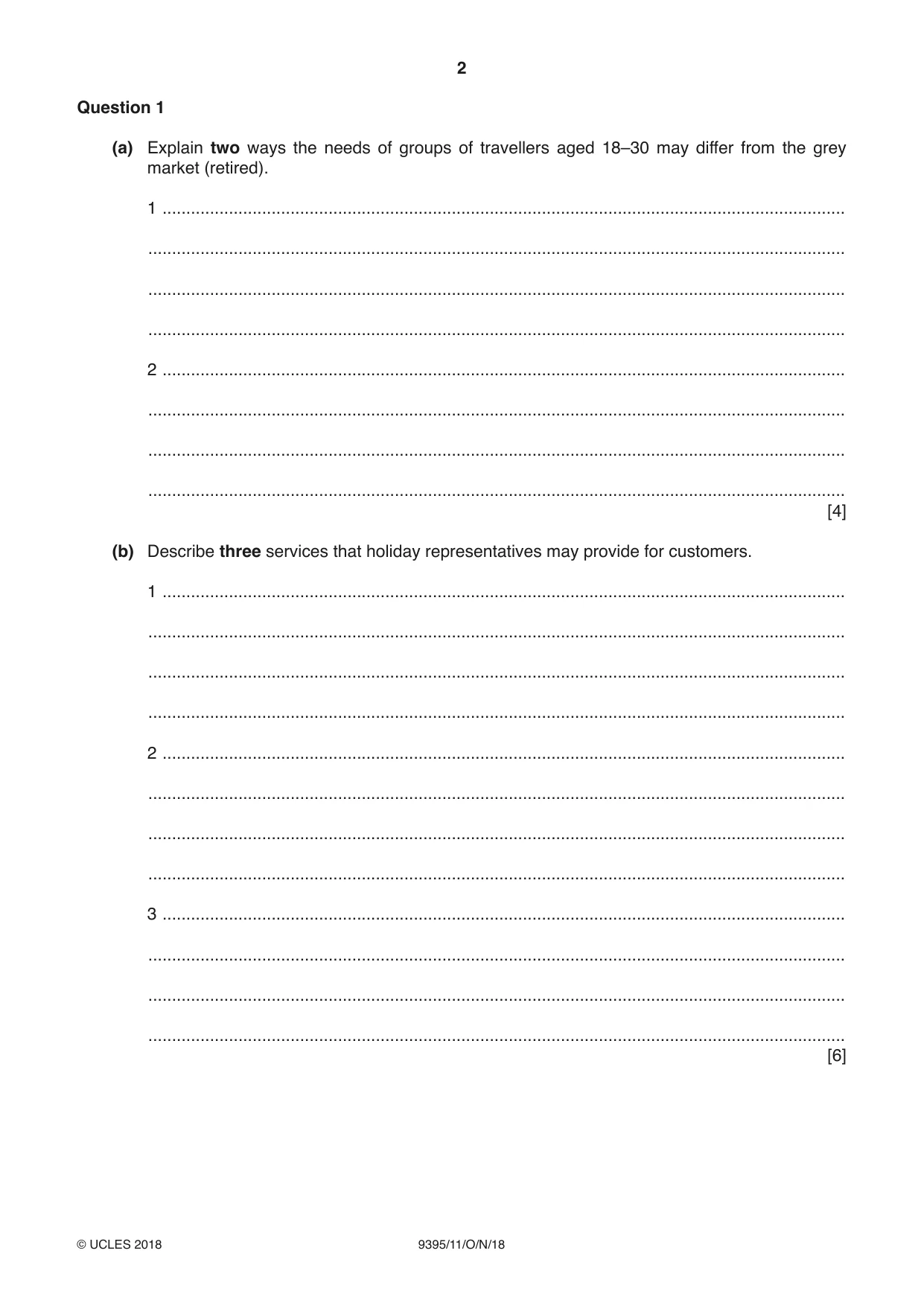
2 9395/11/O/N/18 © UCLES 2018 Question 1 (a) Explain two ways the needs of groups of travellers aged 18–30 may differ from the grey market (retired). 1 … … … … 2 … … … … [4] (b) Describe three services that holiday representatives may provide for customers. 1 … … … … 2 … … … … 3 … … … … [6]
Question paper, page 3
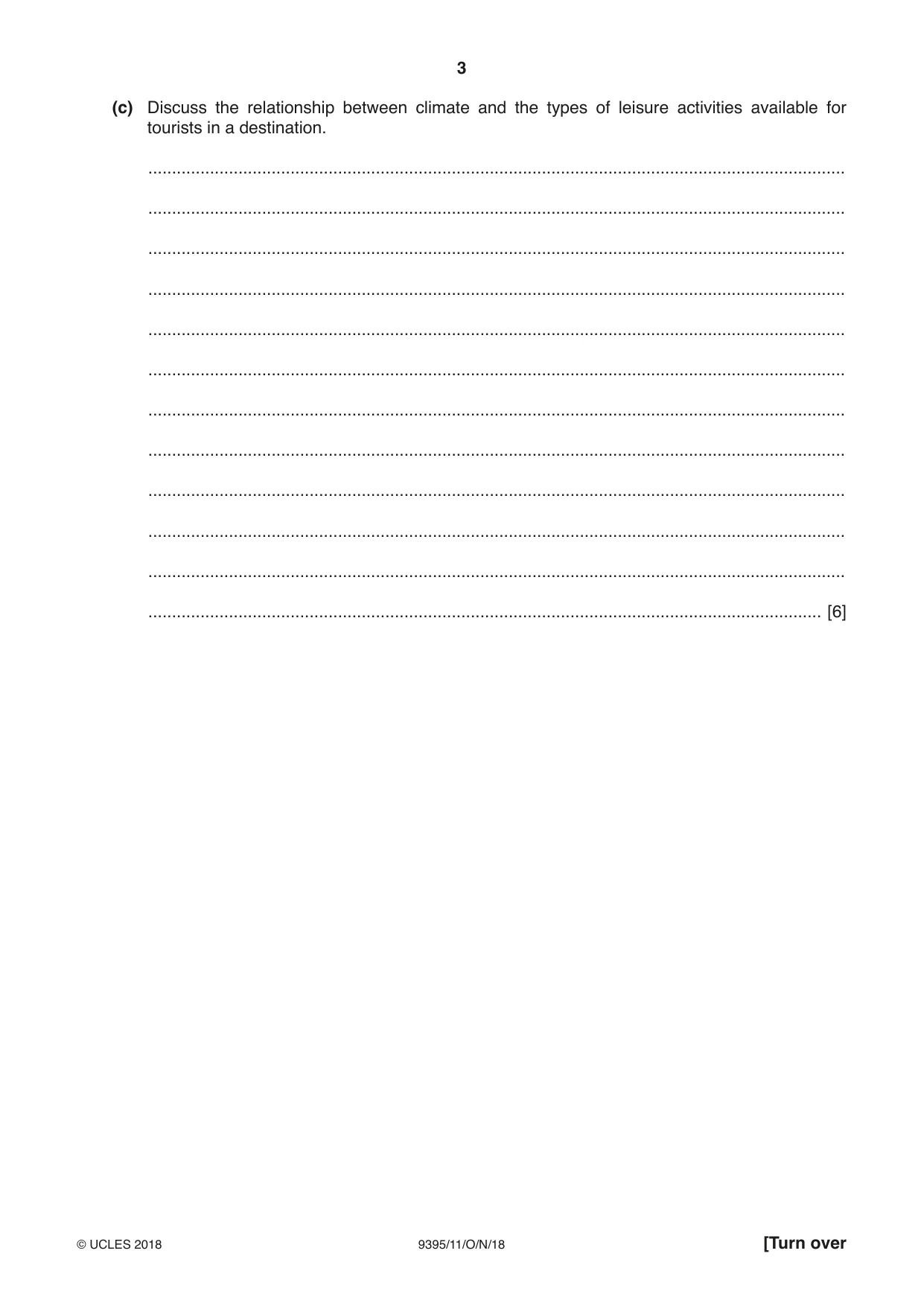
3 9395/11/O/N/18 © UCLES 2018 [Turn over (c) Discuss the relationship between climate and the types of leisure activities available for tourists in a destination. … … … … … … … … … … … … [6]
Question paper, page 4
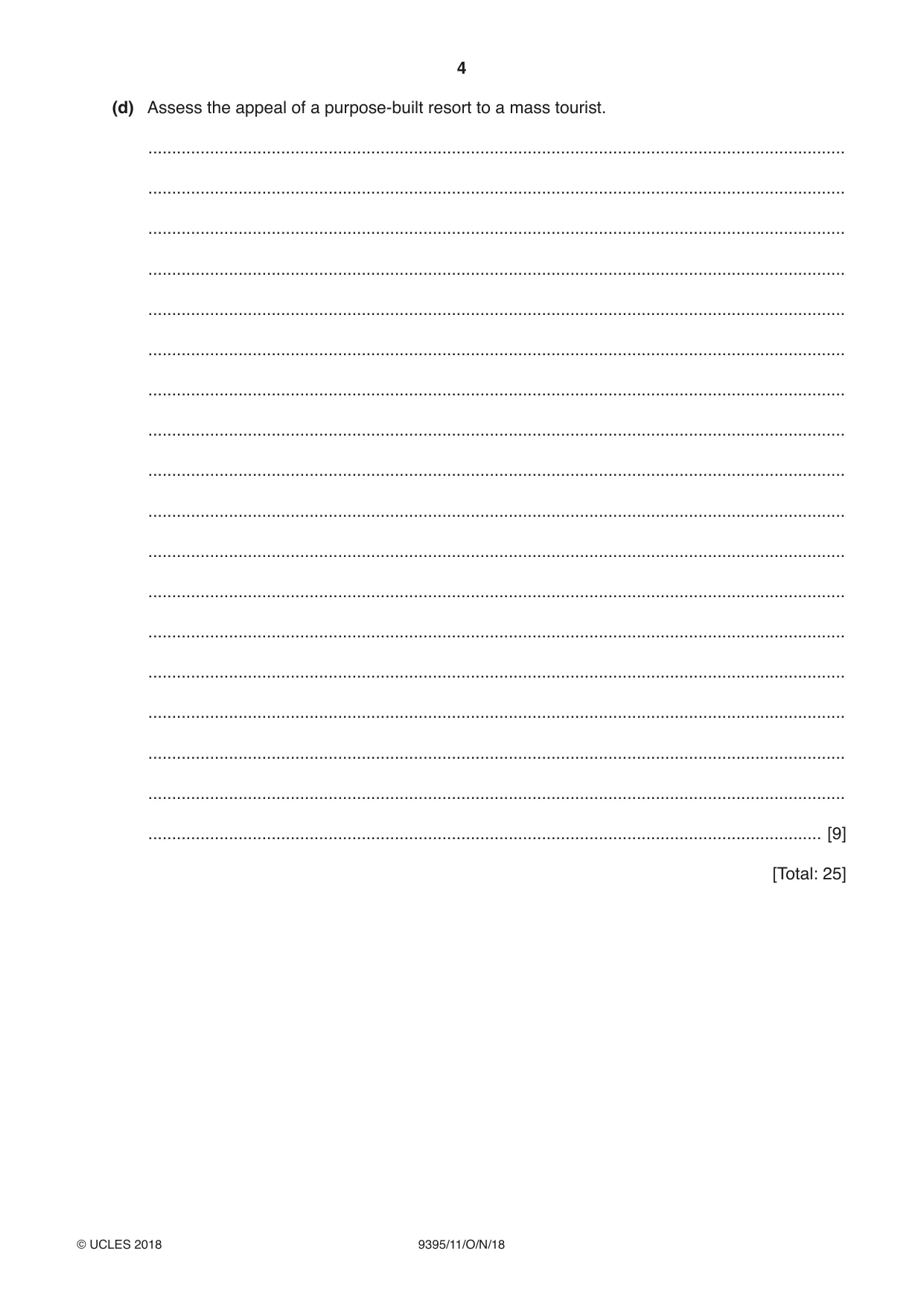
4 9395/11/O/N/18 © UCLES 2018 (d) Assess the appeal of a purpose-built resort to a mass tourist. … … … … … … … … … … … … … … … … … … [9] [Total: 25]
Question paper, page 5
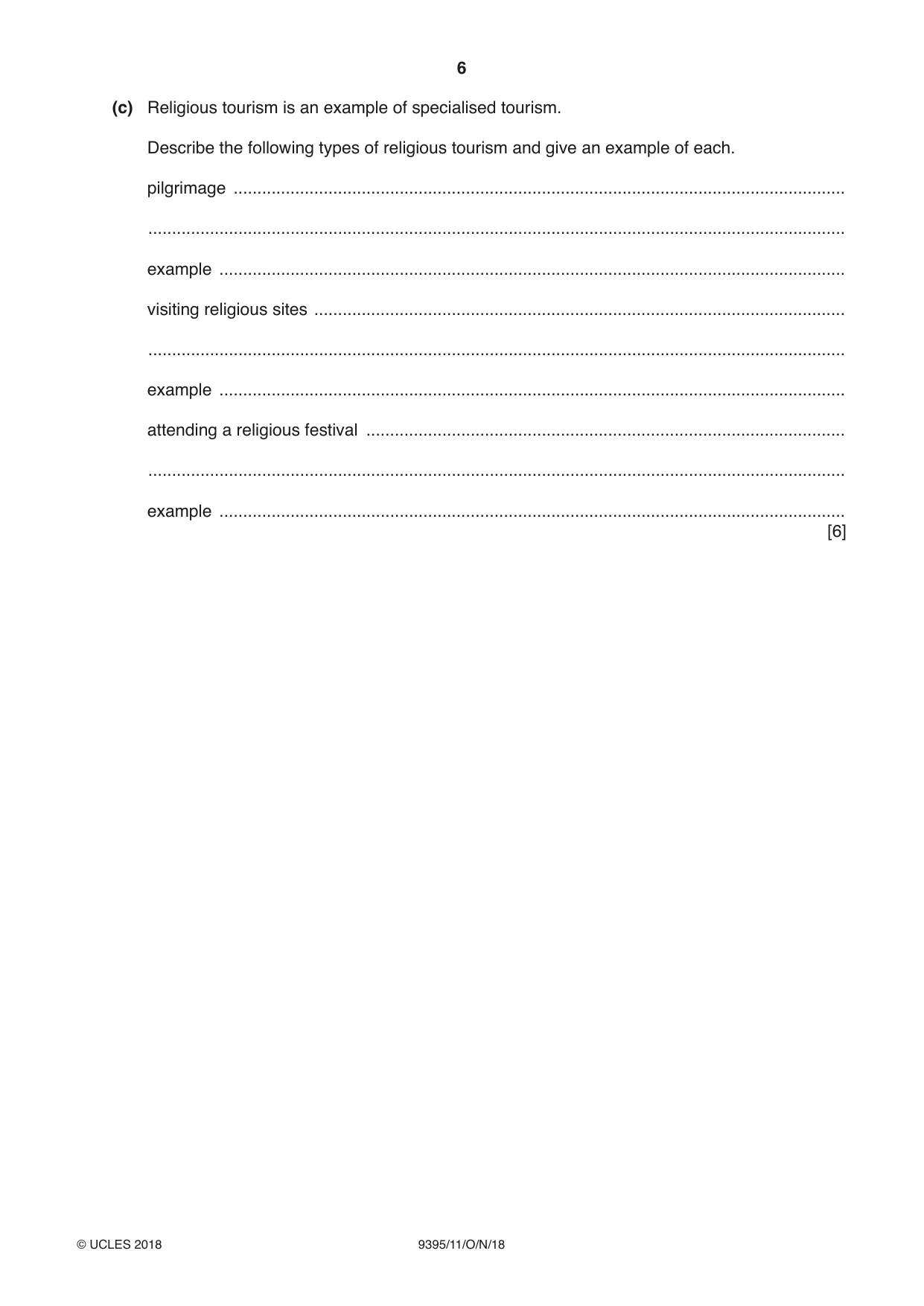
5 9395/11/O/N/18 © UCLES 2018 [Turn over Question 2 Refer to Fig. 1 (Insert), photographs taken during a city break to Paris, France. (a) (i) Define the term ‘city break’. … … [2] (ii) Identify two activities shown in Fig. 1 for city break tourists. 1 … 2 … [2] (b) Explain two ways that visitor attraction operators may overcome the problem of intangibility. 1 … … … … … … 2 … … … … … … [6]
Question paper, page 6
6 9395/11/O/N/18 © UCLES 2018 (c) Religious tourism is an example of specialised tourism. Describe the following types of religious tourism and give an example of each. pilgrimage … … example … visiting religious sites … … example … attending a religious festival … … example … [6]
Question paper, page 7
7 9395/11/O/N/18 © UCLES 2018 [Turn over (d) Analyse how changing consumer needs and expectations have encouraged the growth of specialised tourism markets. … … … … … … … … … … … … … … … … … … [9] [Total: 25]
Question paper, page 8
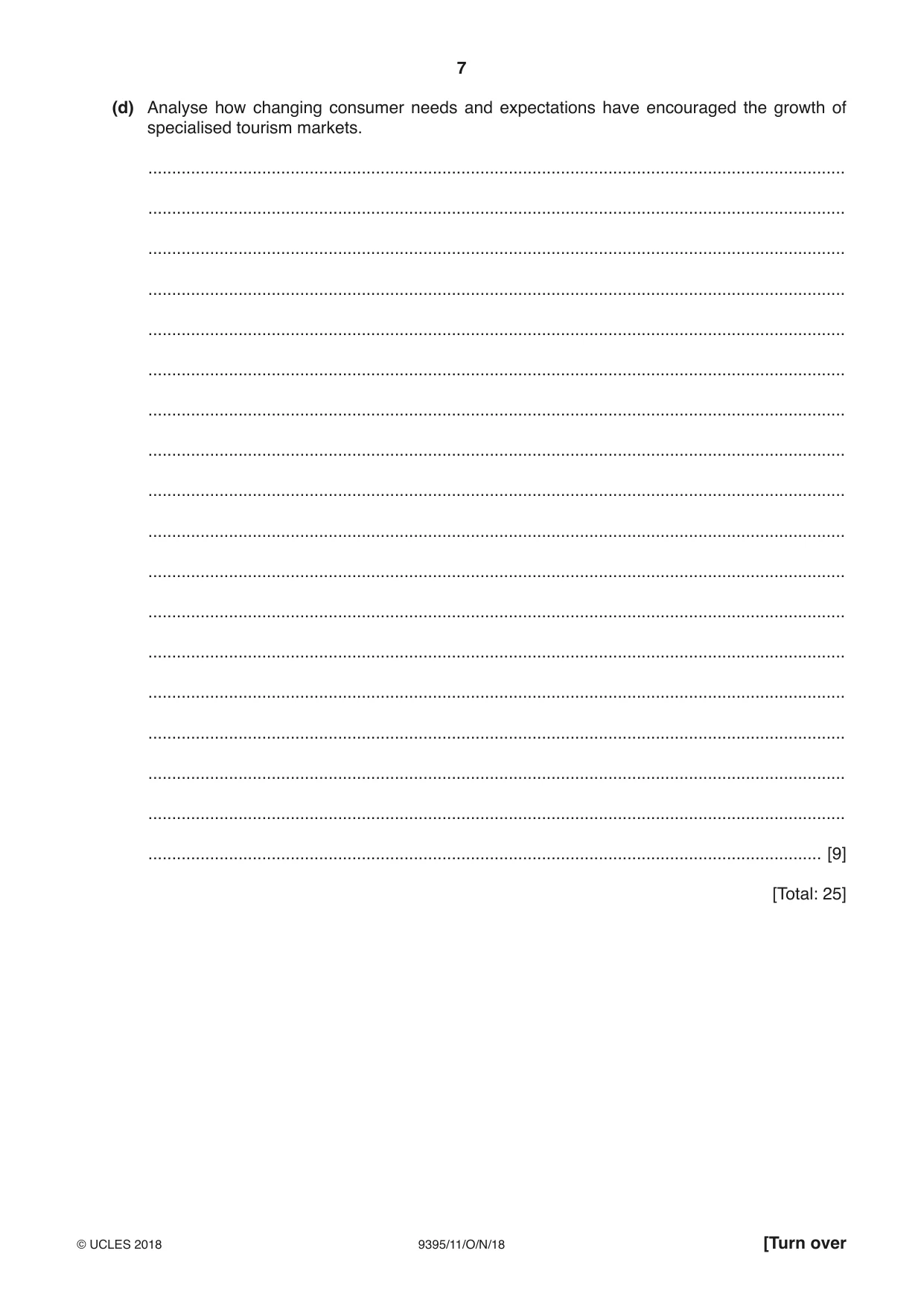
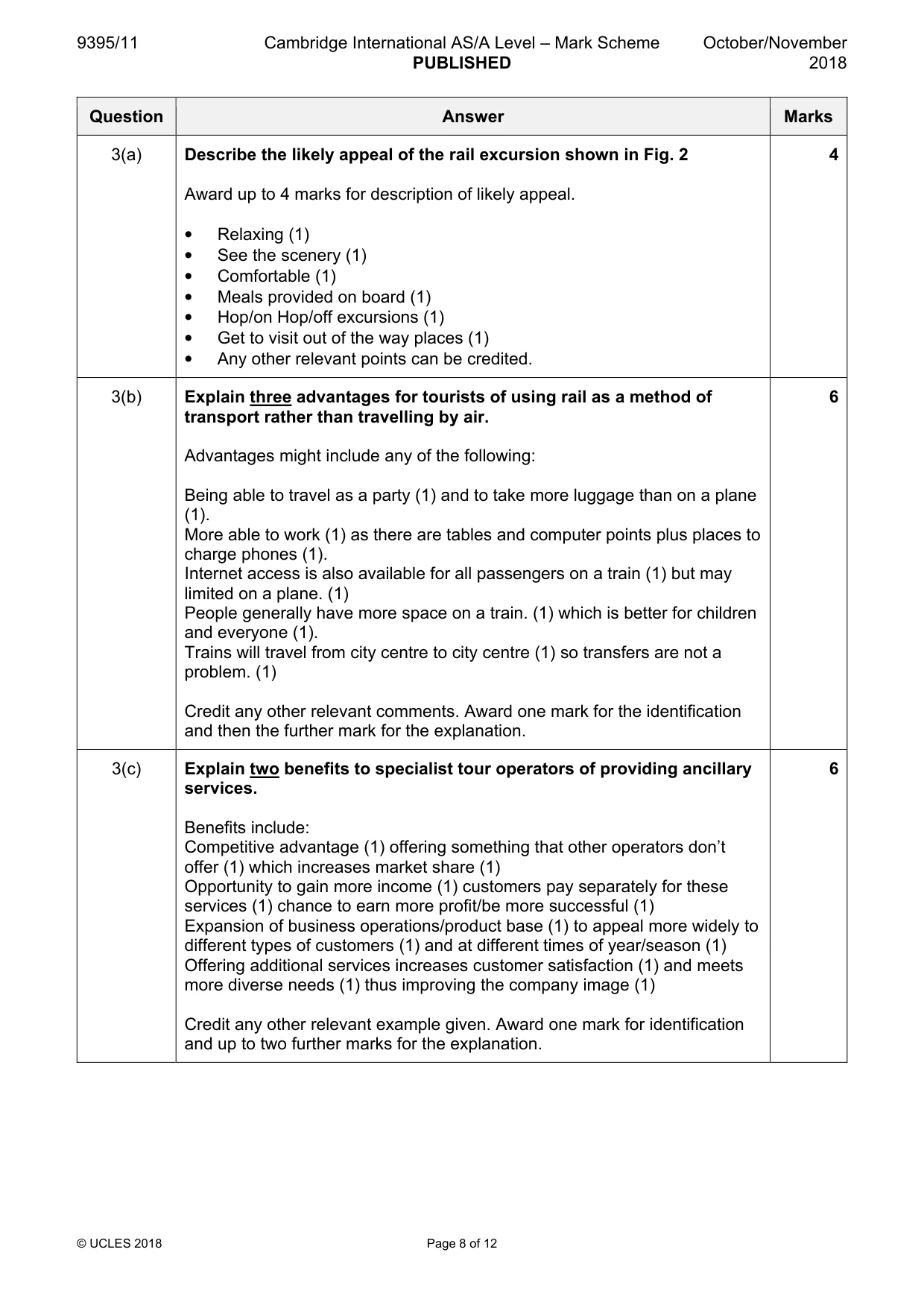
8 9395/11/O/N/18 © UCLES 2018 Question 3 Refer to Fig. 2 (Insert), a photograph of a train used for rail excursions. (a) Describe the likely appeal of the rail excursion shown in Fig. 2. … … … … … … … … [4] (b) Explain three advantages for tourists of using rail as a method of transport rather than travelling by air. 1 … … … … 2 … … … … 3 … … … … [6]
Question paper, page 9
9 9395/11/O/N/18 © UCLES 2018 [Turn over (c) Many holidays are provided by specialist tour operators. Explain two benefits to specialist tour operators of providing ancillary services. 1 … … … … … … 2 … … … … … … [6]
Question paper, page 10
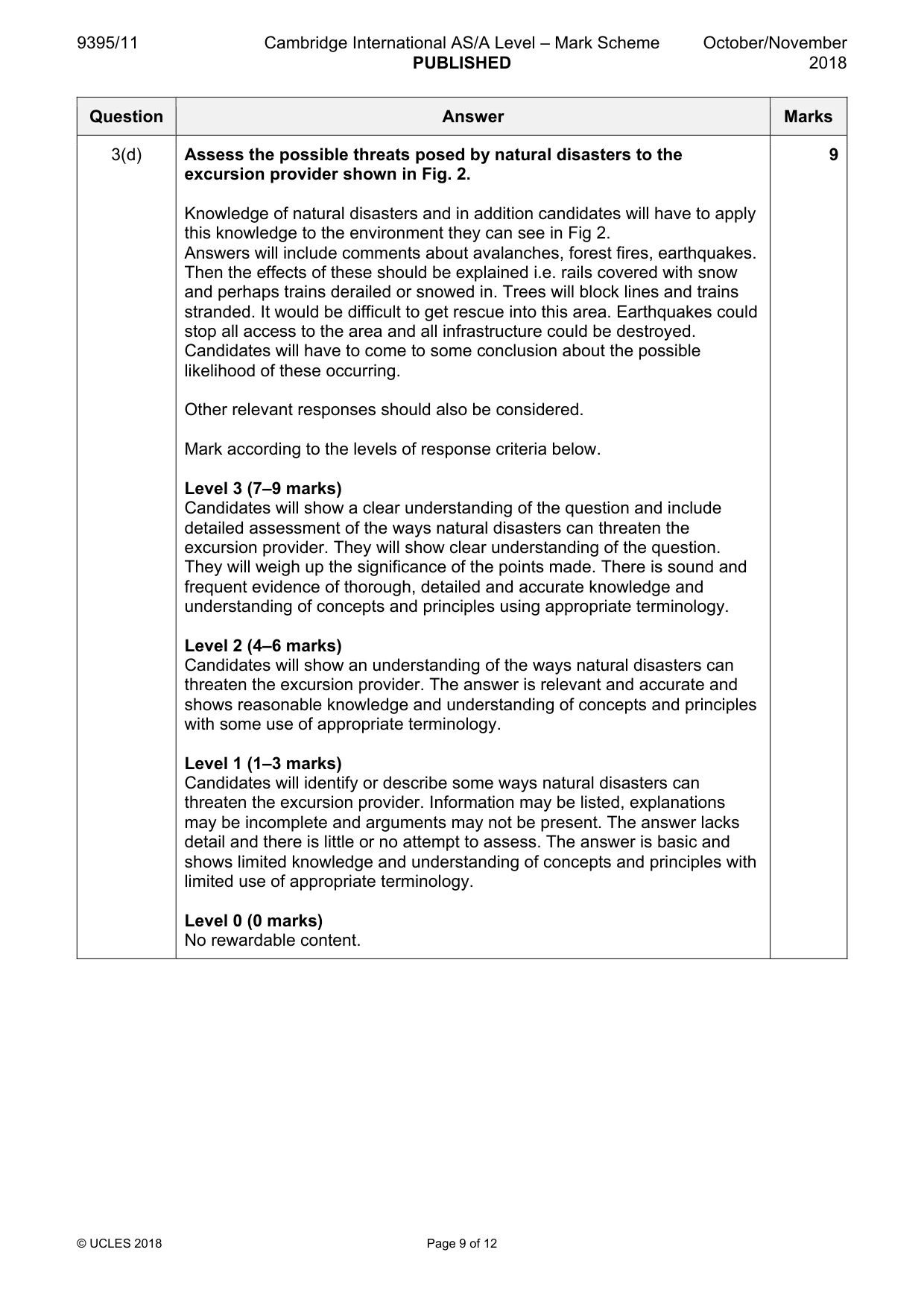
10 9395/11/O/N/18 © UCLES 2018 (d) Assess the possible threats posed by natural disasters to the excursion provider shown in Fig. 2. … … … … … … … … … … … … … … … … … … [9] [Total: 25]
Question paper, page 11
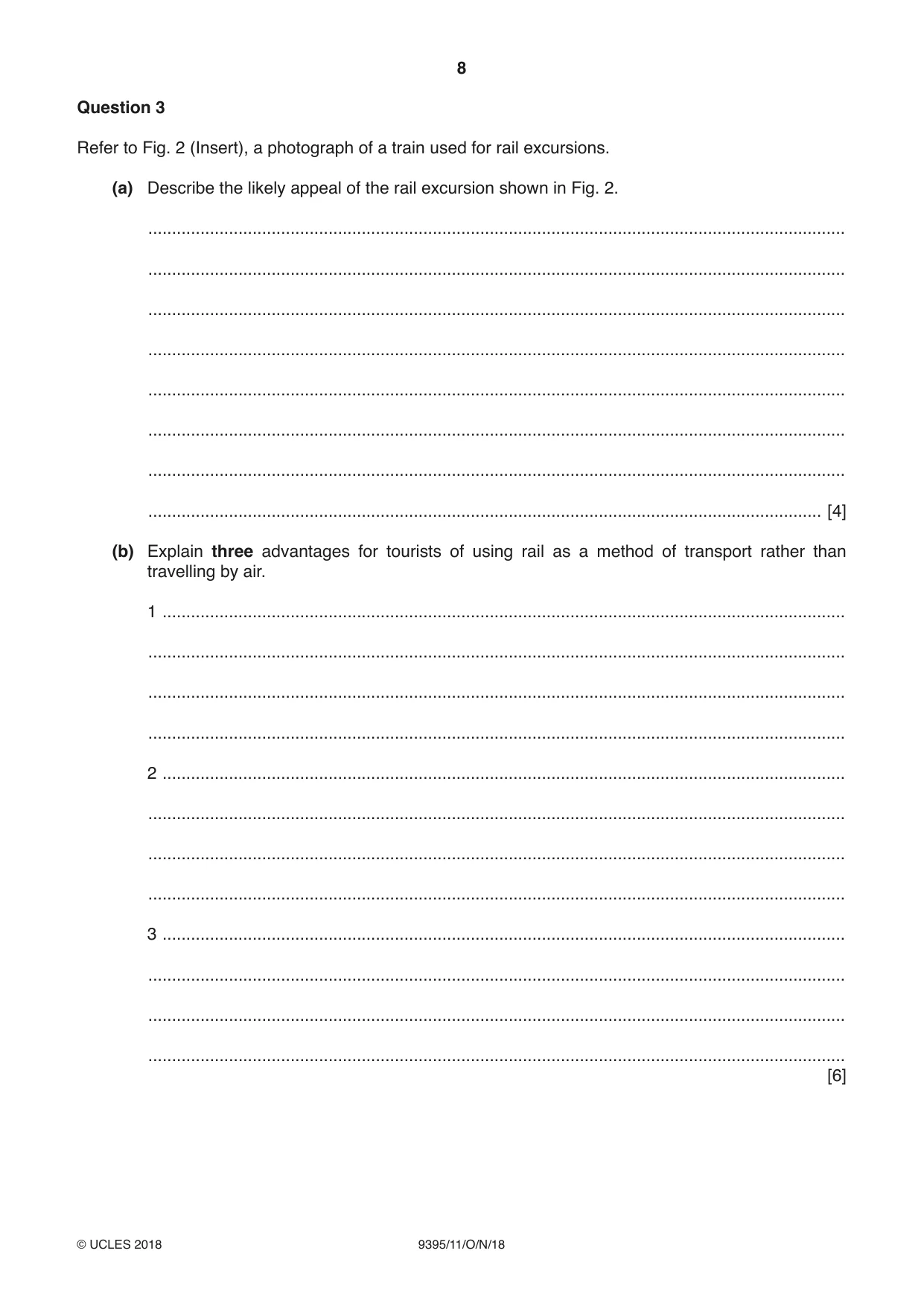
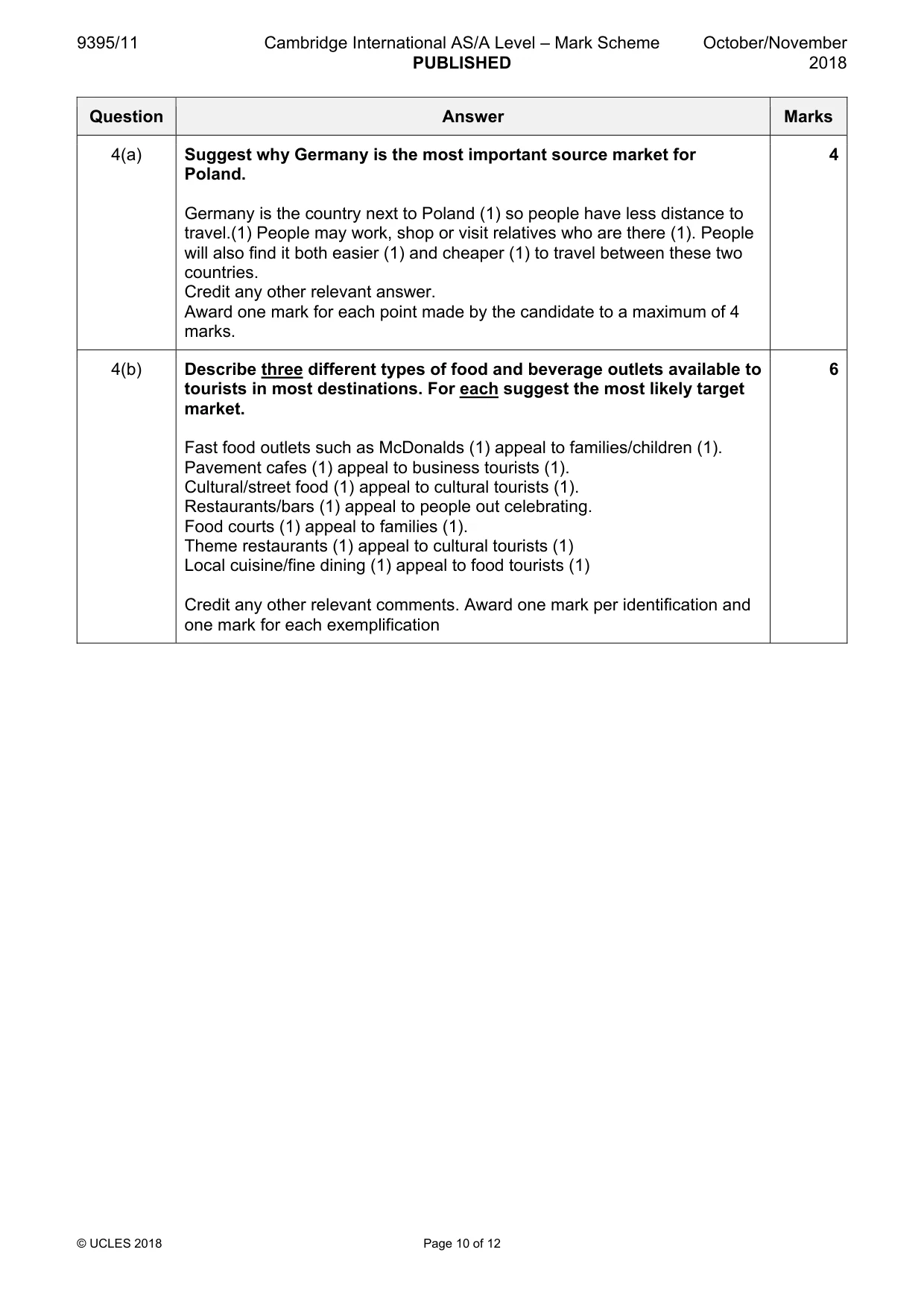
11 9395/11/O/N/18 © UCLES 2018 [Turn over Question 4 Refer to Fig. 3 (Insert), tourist information about visitors to Poland. (a) Suggest why Germany is the most important source market for Poland. … … … … … … … … [4] (b) Describe three different types of food and beverage outlets available to tourists in most destinations. For each suggest the most likely target market. outlet type … target market … outlet type … target market … outlet type … target market … [6]
Question paper, page 12
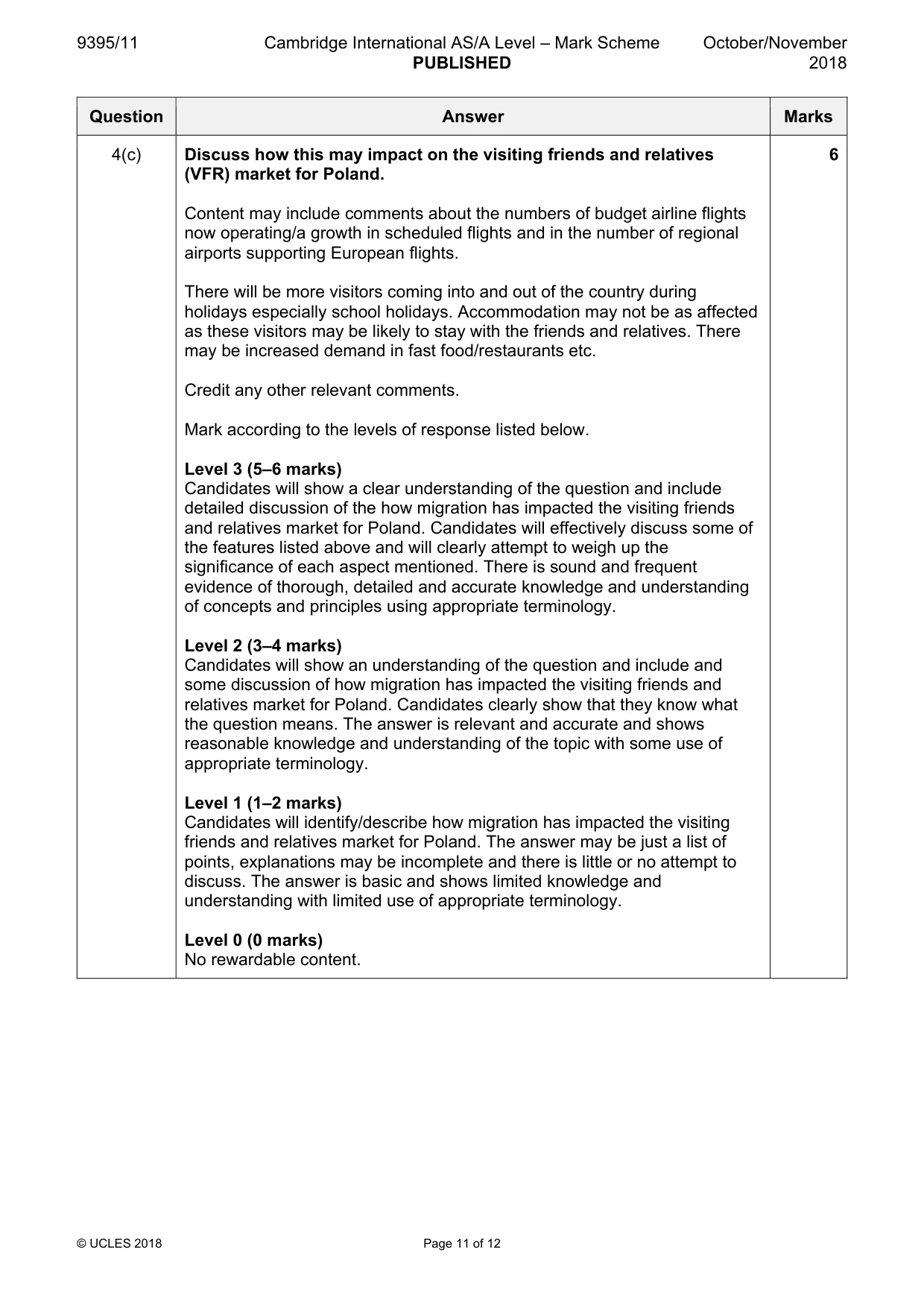
12 9395/11/O/N/18 © UCLES 2018 (c) Many people have migrated from Poland to other European countries. Discuss how this may impact on the visiting friends and relatives (VFR) market for Poland. … … … … … … … … … … … … [6]
Question paper, page 13
13 9395/11/O/N/18 © UCLES 2018 (d) Evaluate how changes in currency exchange rates might affect visitor numbers to Poland. … … … … … … … … … … … … … … … … … … [9] [Total: 25]
Question paper, page 14
14 9395/11/O/N/18 © UCLES 2018 BLANK PAGE
Question paper, page 15
15 9395/11/O/N/18 © UCLES 2018 BLANK PAGE
Question paper, page 16
16 9395/11/O/N/18 © UCLES 2018 Permission to reproduce items where third-party owned material protected by copyright is included has been sought and cleared where possible. Every reasonable effort has been made by the publisher (UCLES) to trace copyright holders, but if any items requiring clearance have unwittingly been included, the publisher will be pleased to make amends at the earliest possible opportunity. To avoid the issue of disclosure of answer-related information to candidates, all copyright acknowledgements are reproduced online in the Cambridge International Examinations Copyright Acknowledgements Booklet. This is produced for each series of examinations and is freely available to download at www.cie.org.uk after the live examination series. Cambridge International Examinations is part of the Cambridge Assessment Group. Cambridge Assessment is the brand name of University of Cambridge Local Examinations Syndicate (UCLES), which is itself a department of the University of Cambridge. BLANK PAGE
Mark scheme, page 1
This document consists of 12 printed pages. © UCLES 2018 [Turn over Cambridge Assessment International Education Cambridge International Advanced Subsidiary and Advanced Level TRAVEL AND TOURISM 9395/11 Paper 1 The Industry October/November 2018 MARK SCHEME Maximum Mark: 100 Published This mark scheme is published as an aid to teachers and candidates, to indicate the requirements of the examination. It shows the basis on which Examiners were instructed to award marks. It does not indicate the details of the discussions that took place at an Examiners’ meeting before marking began, which would have considered the acceptability of alternative answers. Mark schemes should be read in conjunction with the question paper and the Principal Examiner Report for Teachers. Cambridge International will not enter into discussions about these mark schemes. Cambridge International is publishing the mark schemes for the October/November 2018 series for most Cambridge IGCSE™, Cambridge International A and AS Level components and some Cambridge O Level components.
Mark scheme, page 2
9395/11 Cambridge International AS/A Level – Mark Scheme PUBLISHED October/November 2018 © UCLES 2018 Page 2 of 12 Generic Marking Principles These general marking principles must be applied by all examiners when marking candidate answers. They should be applied alongside the specific content of the mark scheme or generic level descriptors for a question. Each question paper and mark scheme will also comply with these marking principles. GENERIC MARKING PRINCIPLE 1: Marks must be awarded in line with: • the specific content of the mark scheme or the generic level descriptors for the question • the specific skills defined in the mark scheme or in the generic level descriptors for the question • the standard of response required by a candidate as exemplified by the standardisation scripts. GENERIC MARKING PRINCIPLE 2: Marks awarded are always whole marks (not half marks, or other fractions). GENERIC MARKING PRINCIPLE 3: Marks must be awarded positively: • marks are awarded for correct/valid answers, as defined in the mark scheme. However, credit is given for valid answers which go beyond the scope of the syllabus and mark scheme, referring to your Team Leader as appropriate • marks are awarded when candidates clearly demonstrate what they know and can do • marks are not deducted for errors • marks are not deducted for omissions • answers should only be judged on the quality of spelling, punctuation and grammar when these features are specifically assessed by the question as indicated by the mark scheme. The meaning, however, should be unambiguous. GENERIC MARKING PRINCIPLE 4: Rules must be applied consistently e.g. in situations where candidates have not followed instructions or in the application of generic level descriptors. GENERIC MARKING PRINCIPLE 5: Marks should be awarded using the full range of marks defined in the mark scheme for the question (however; the use of the full mark range may be limited according to the quality of the candidate responses seen). GENERIC MARKING PRINCIPLE 6: Marks awarded are based solely on the requirements as defined in the mark scheme. Marks should not be awarded with grade thresholds or grade descriptors in mind.
Mark scheme, page 3
9395/11 Cambridge International AS/A Level – Mark Scheme PUBLISHED October/November 2018 © UCLES 2018 Page 3 of 12 Question Answer Marks 1(a) Explain two ways the needs of groups of travellers aged 18–30 may differ from the grey market (retired). Award one mark for valid identifications and the second mark for development. 18–30 want cheaper transport and accommodation than the grey market (1) because the grey market are likely to have more disposable income (1). 18–30 may want just basic accommodation whereas the grey market may want more luxury (1) this is because the grey market are likely to want more services for example lifts/access (1) The grey market are more likely to use guiding services (1) whereas 18–30 may be more independent travellers (1). Include any other relevant points 4 1(b) Describe three services that holiday representatives may provide for customers. Award one mark for the initial point in the description and the second mark for the detail in the description. This can include booking excursions and car hire for travellers (1), they offer advice on visits and excursions (1). They also put on entertainment (1) such as parties for their customers to supplement their income (1). They provide advice and assistance (1) to their customers if they get into difficulties i.e. get robbed or lose passports (1). Meet and greet at airports (1) they accompany tourists on transfers (1). Candidates should be credited for any other relevant points made. 6
Mark scheme, page 4
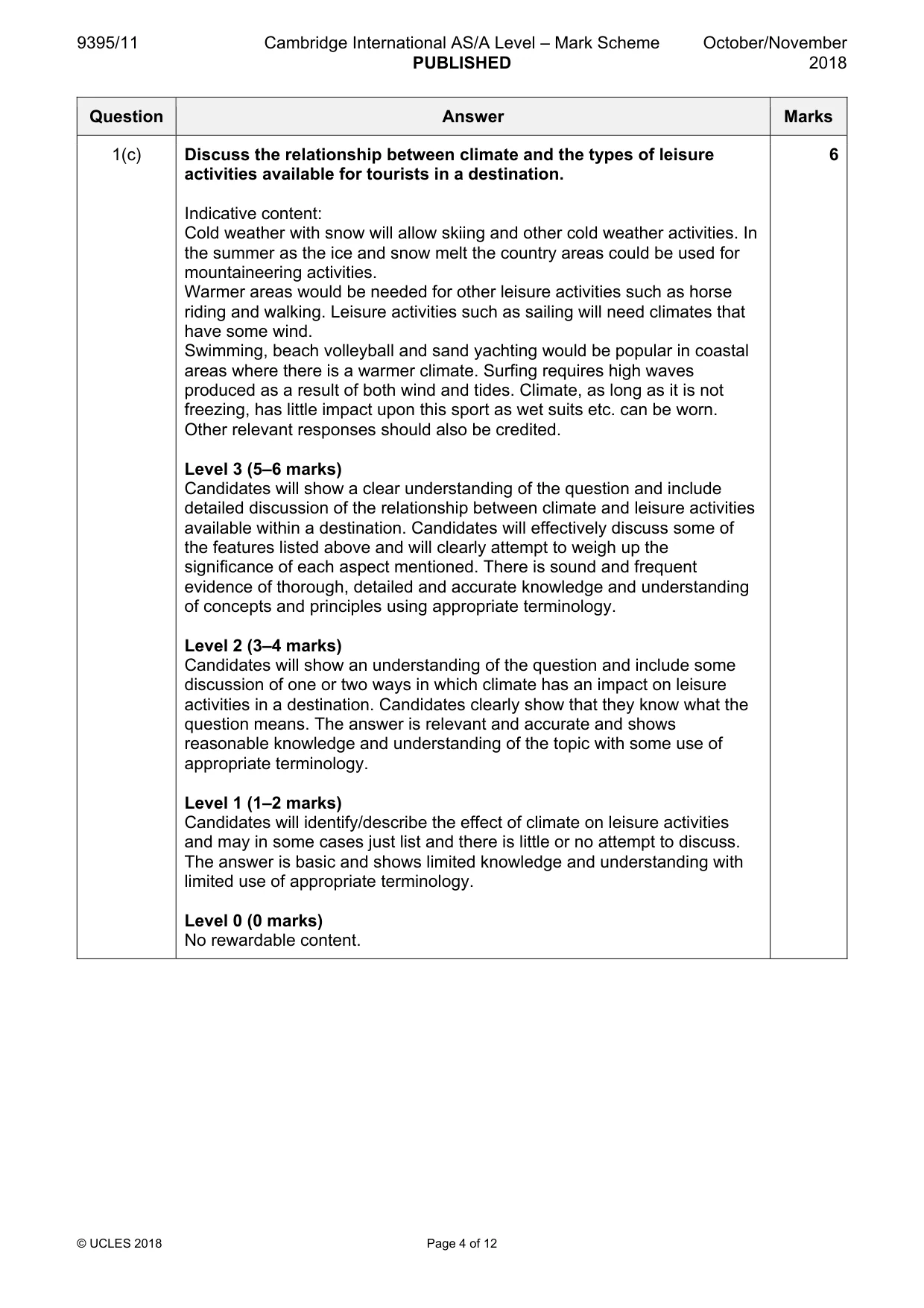
9395/11 Cambridge International AS/A Level – Mark Scheme PUBLISHED October/November 2018 © UCLES 2018 Page 4 of 12 Question Answer Marks 1(c) Discuss the relationship between climate and the types of leisure activities available for tourists in a destination. Indicative content: Cold weather with snow will allow skiing and other cold weather activities. In the summer as the ice and snow melt the country areas could be used for mountaineering activities. Warmer areas would be needed for other leisure activities such as horse riding and walking. Leisure activities such as sailing will need climates that have some wind. Swimming, beach volleyball and sand yachting would be popular in coastal areas where there is a warmer climate. Surfing requires high waves produced as a result of both wind and tides. Climate, as long as it is not freezing, has little impact upon this sport as wet suits etc. can be worn. Other relevant responses should also be credited. Level 3 (5–6 marks) Candidates will show a clear understanding of the question and include detailed discussion of the relationship between climate and leisure activities available within a destination. Candidates will effectively discuss some of the features listed above and will clearly attempt to weigh up the significance of each aspect mentioned. There is sound and frequent evidence of thorough, detailed and accurate knowledge and understanding of concepts and principles using appropriate terminology. Level 2 (3–4 marks) Candidates will show an understanding of the question and include some discussion of one or two ways in which climate has an impact on leisure activities in a destination. Candidates clearly show that they know what the question means. The answer is relevant and accurate and shows reasonable knowledge and understanding of the topic with some use of appropriate terminology. Level 1 (1–2 marks) Candidates will identify/describe the effect of climate on leisure activities and may in some cases just list and there is little or no attempt to discuss. The answer is basic and shows limited knowledge and understanding with limited use of appropriate terminology. Level 0 (0 marks) No rewardable content. 6
Mark scheme, page 5
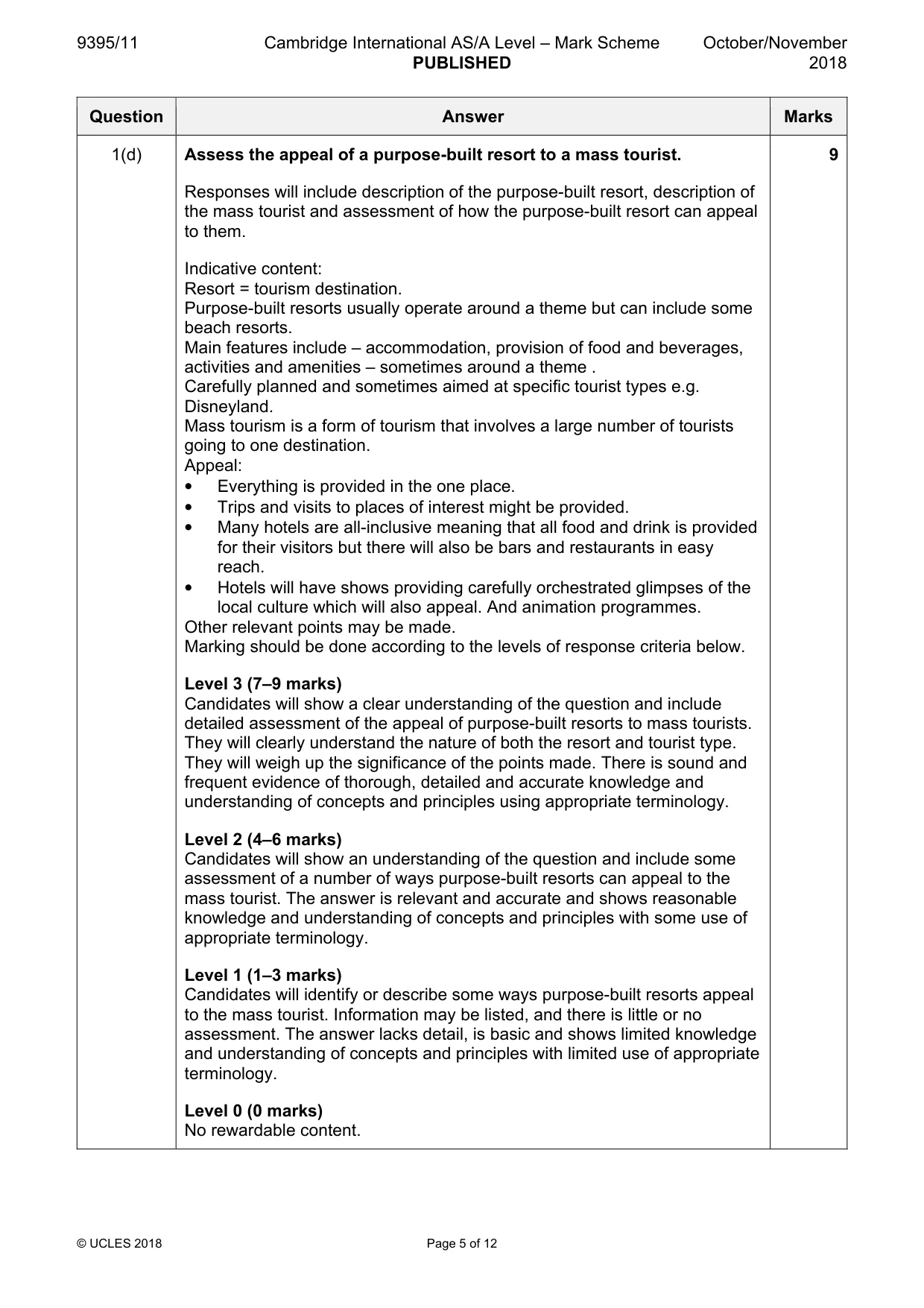
9395/11 Cambridge International AS/A Level – Mark Scheme PUBLISHED October/November 2018 © UCLES 2018 Page 5 of 12 Question Answer Marks 1(d) Assess the appeal of a purpose-built resort to a mass tourist. Responses will include description of the purpose-built resort, description of the mass tourist and assessment of how the purpose-built resort can appeal to them. Indicative content: Resort = tourism destination. Purpose-built resorts usually operate around a theme but can include some beach resorts. Main features include – accommodation, provision of food and beverages, activities and amenities – sometimes around a theme . Carefully planned and sometimes aimed at specific tourist types e.g. Disneyland. Mass tourism is a form of tourism that involves a large number of tourists going to one destination. Appeal: • Everything is provided in the one place. • Trips and visits to places of interest might be provided. • Many hotels are all-inclusive meaning that all food and drink is provided for their visitors but there will also be bars and restaurants in easy reach. • Hotels will have shows providing carefully orchestrated glimpses of the local culture which will also appeal. And animation programmes. Other relevant points may be made. Marking should be done according to the levels of response criteria below. Level 3 (7–9 marks) Candidates will show a clear understanding of the question and include detailed assessment of the appeal of purpose-built resorts to mass tourists. They will clearly understand the nature of both the resort and tourist type. They will weigh up the significance of the points made. There is sound and frequent evidence of thorough, detailed and accurate knowledge and understanding of concepts and principles using appropriate terminology. Level 2 (4–6 marks) Candidates will show an understanding of the question and include some assessment of a number of ways purpose-built resorts can appeal to the mass tourist. The answer is relevant and accurate and shows reasonable knowledge and understanding of concepts and principles with some use of appropriate terminology. Level 1 (1–3 marks) Candidates will identify or describe some ways purpose-built resorts appeal to the mass tourist. Information may be listed, and there is little or no assessment. The answer lacks detail, is basic and shows limited knowledge and understanding of concepts and principles with limited use of appropriate terminology. Level 0 (0 marks) No rewardable content. 9
Mark scheme, page 6
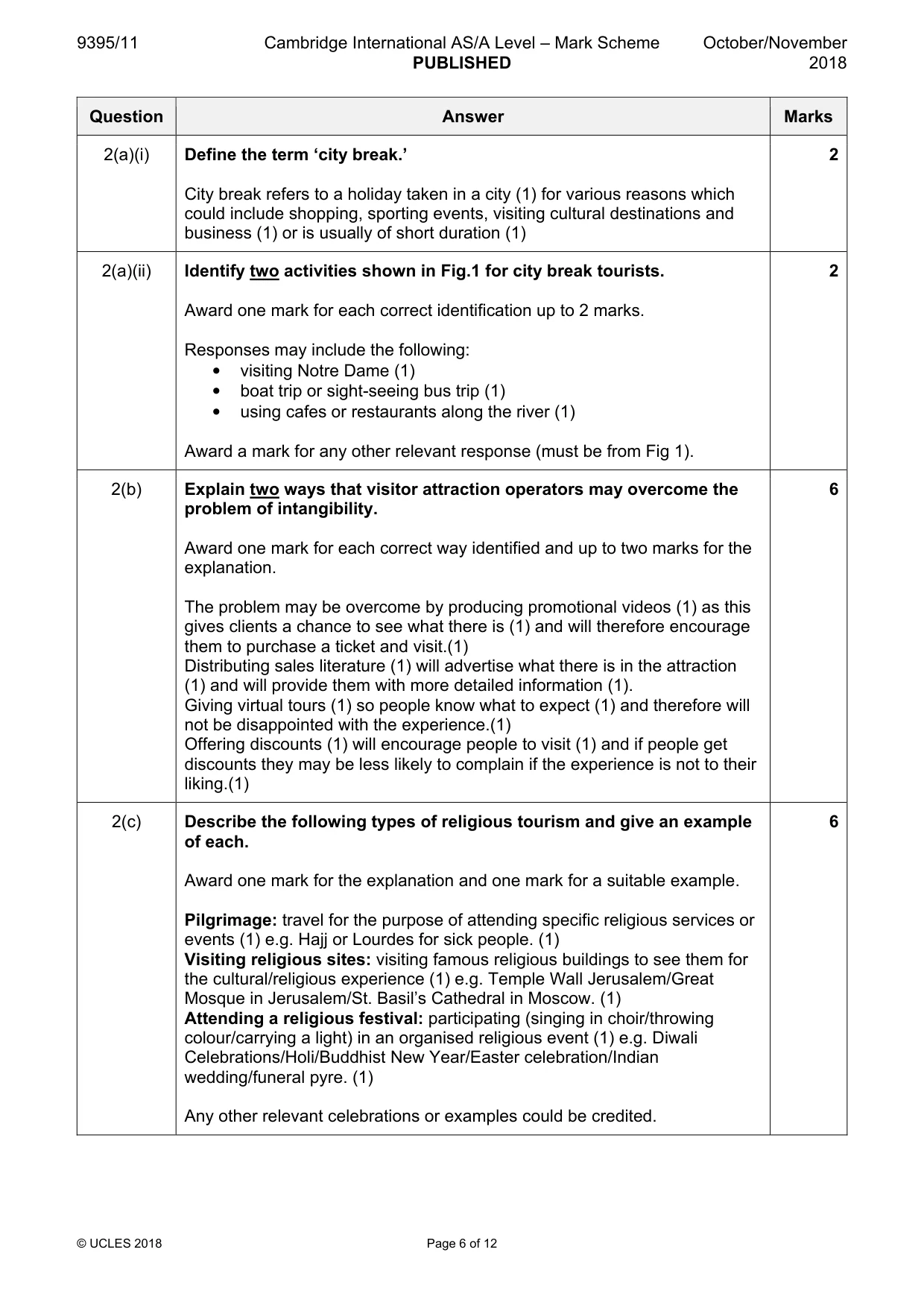
9395/11 Cambridge International AS/A Level – Mark Scheme PUBLISHED October/November 2018 © UCLES 2018 Page 6 of 12 Question Answer Marks 2(a)(i) Define the term ‘city break.’ City break refers to a holiday taken in a city (1) for various reasons which could include shopping, sporting events, visiting cultural destinations and business (1) or is usually of short duration (1) 2 2(a)(ii) Identify two activities shown in Fig.1 for city break tourists. Award one mark for each correct identification up to 2 marks. Responses may include the following: • visiting Notre Dame (1) • boat trip or sight-seeing bus trip (1) • using cafes or restaurants along the river (1) Award a mark for any other relevant response (must be from Fig 1). 2 2(b) Explain two ways that visitor attraction operators may overcome the problem of intangibility. Award one mark for each correct way identified and up to two marks for the explanation. The problem may be overcome by producing promotional videos (1) as this gives clients a chance to see what there is (1) and will therefore encourage them to purchase a ticket and visit.(1) Distributing sales literature (1) will advertise what there is in the attraction (1) and will provide them with more detailed information (1). Giving virtual tours (1) so people know what to expect (1) and therefore will not be disappointed with the experience.(1) Offering discounts (1) will encourage people to visit (1) and if people get discounts they may be less likely to complain if the experience is not to their liking.(1) 6 2(c) Describe the following types of religious tourism and give an example of each. Award one mark for the explanation and one mark for a suitable example. Pilgrimage: travel for the purpose of attending specific religious services or events (1) e.g. Hajj or Lourdes for sick people. (1) Visiting religious sites: visiting famous religious buildings to see them for the cultural/religious experience (1) e.g. Temple Wall Jerusalem/Great Mosque in Jerusalem/St. Basil’s Cathedral in Moscow. (1) Attending a religious festival: participating (singing in choir/throwing colour/carrying a light) in an organised religious event (1) e.g. Diwali Celebrations/Holi/Buddhist New Year/Easter celebration/Indian wedding/funeral pyre. (1) Any other relevant celebrations or examples could be credited. 6
Mark scheme, page 7
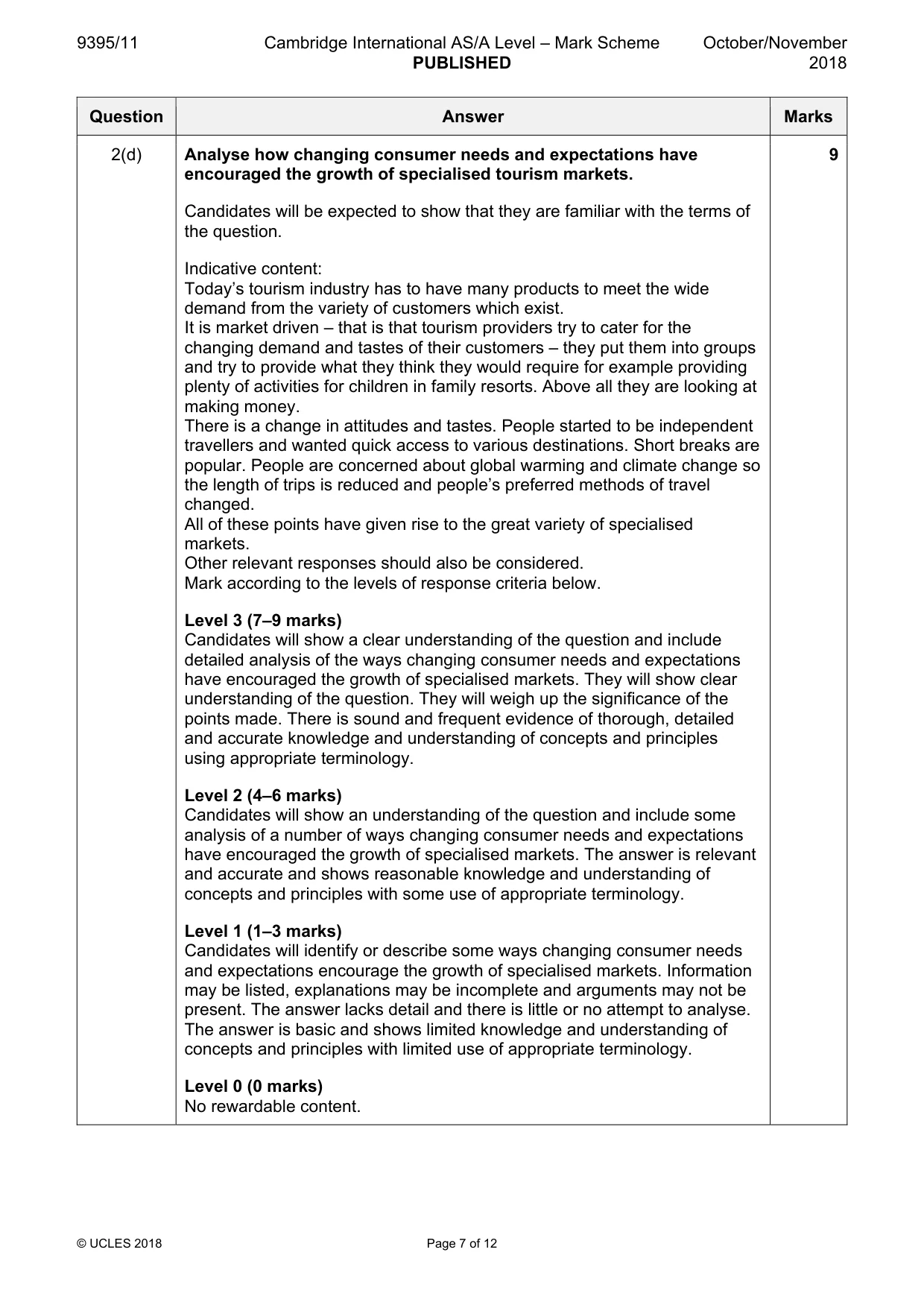
9395/11 Cambridge International AS/A Level – Mark Scheme PUBLISHED October/November 2018 © UCLES 2018 Page 7 of 12 Question Answer Marks 2(d) Analyse how changing consumer needs and expectations have encouraged the growth of specialised tourism markets. Candidates will be expected to show that they are familiar with the terms of the question. Indicative content: Today’s tourism industry has to have many products to meet the wide demand from the variety of customers which exist. It is market driven – that is that tourism providers try to cater for the changing demand and tastes of their customers – they put them into groups and try to provide what they think they would require for example providing plenty of activities for children in family resorts. Above all they are looking at making money. There is a change in attitudes and tastes. People started to be independent travellers and wanted quick access to various destinations. Short breaks are popular. People are concerned about global warming and climate change so the length of trips is reduced and people’s preferred methods of travel changed. All of these points have given rise to the great variety of specialised markets. Other relevant responses should also be considered. Mark according to the levels of response criteria below. Level 3 (7–9 marks) Candidates will show a clear understanding of the question and include detailed analysis of the ways changing consumer needs and expectations have encouraged the growth of specialised markets. They will show clear understanding of the question. They will weigh up the significance of the points made. There is sound and frequent evidence of thorough, detailed and accurate knowledge and understanding of concepts and principles using appropriate terminology. Level 2 (4–6 marks) Candidates will show an understanding of the question and include some analysis of a number of ways changing consumer needs and expectations have encouraged the growth of specialised markets. The answer is relevant and accurate and shows reasonable knowledge and understanding of concepts and principles with some use of appropriate terminology. Level 1 (1–3 marks) Candidates will identify or describe some ways changing consumer needs and expectations encourage the growth of specialised markets. Information may be listed, explanations may be incomplete and arguments may not be present. The answer lacks detail and there is little or no attempt to analyse. The answer is basic and shows limited knowledge and understanding of concepts and principles with limited use of appropriate terminology. Level 0 (0 marks) No rewardable content. 9
Mark scheme, page 8
9395/11 Cambridge International AS/A Level – Mark Scheme PUBLISHED October/November 2018 © UCLES 2018 Page 8 of 12 Question Answer Marks 3(a) Describe the likely appeal of the rail excursion shown in Fig. 2 Award up to 4 marks for description of likely appeal. • Relaxing (1) • See the scenery (1) • Comfortable (1) • Meals provided on board (1) • Hop/on Hop/off excursions (1) • Get to visit out of the way places (1) • Any other relevant points can be credited. 4 3(b) Explain three advantages for tourists of using rail as a method of transport rather than travelling by air. Advantages might include any of the following: Being able to travel as a party (1) and to take more luggage than on a plane (1). More able to work (1) as there are tables and computer points plus places to charge phones (1). Internet access is also available for all passengers on a train (1) but may limited on a plane. (1) People generally have more space on a train. (1) which is better for children and everyone (1). Trains will travel from city centre to city centre (1) so transfers are not a problem. (1) Credit any other relevant comments. Award one mark for the identification and then the further mark for the explanation. 6 3(c) Explain two benefits to specialist tour operators of providing ancillary services. Benefits include: Competitive advantage (1) offering something that other operators don’t offer (1) which increases market share (1) Opportunity to gain more income (1) customers pay separately for these services (1) chance to earn more profit/be more successful (1) Expansion of business operations/product base (1) to appeal more widely to different types of customers (1) and at different times of year/season (1) Offering additional services increases customer satisfaction (1) and meets more diverse needs (1) thus improving the company image (1) Credit any other relevant example given. Award one mark for identification and up to two further marks for the explanation. 6
Mark scheme, page 9
9395/11 Cambridge International AS/A Level – Mark Scheme PUBLISHED October/November 2018 © UCLES 2018 Page 9 of 12 Question Answer Marks 3(d) Assess the possible threats posed by natural disasters to the excursion provider shown in Fig. 2. Knowledge of natural disasters and in addition candidates will have to apply this knowledge to the environment they can see in Fig 2. Answers will include comments about avalanches, forest fires, earthquakes. Then the effects of these should be explained i.e. rails covered with snow and perhaps trains derailed or snowed in. Trees will block lines and trains stranded. It would be difficult to get rescue into this area. Earthquakes could stop all access to the area and all infrastructure could be destroyed. Candidates will have to come to some conclusion about the possible likelihood of these occurring. Other relevant responses should also be considered. Mark according to the levels of response criteria below. Level 3 (7–9 marks) Candidates will show a clear understanding of the question and include detailed assessment of the ways natural disasters can threaten the excursion provider. They will show clear understanding of the question. They will weigh up the significance of the points made. There is sound and frequent evidence of thorough, detailed and accurate knowledge and understanding of concepts and principles using appropriate terminology. Level 2 (4–6 marks) Candidates will show an understanding of the ways natural disasters can threaten the excursion provider. The answer is relevant and accurate and shows reasonable knowledge and understanding of concepts and principles with some use of appropriate terminology. Level 1 (1–3 marks) Candidates will identify or describe some ways natural disasters can threaten the excursion provider. Information may be listed, explanations may be incomplete and arguments may not be present. The answer lacks detail and there is little or no attempt to assess. The answer is basic and shows limited knowledge and understanding of concepts and principles with limited use of appropriate terminology. Level 0 (0 marks) No rewardable content. 9
Mark scheme, page 10
9395/11 Cambridge International AS/A Level – Mark Scheme PUBLISHED October/November 2018 © UCLES 2018 Page 10 of 12 Question Answer Marks 4(a) Suggest why Germany is the most important source market for Poland. Germany is the country next to Poland (1) so people have less distance to travel.(1) People may work, shop or visit relatives who are there (1). People will also find it both easier (1) and cheaper (1) to travel between these two countries. Credit any other relevant answer. Award one mark for each point made by the candidate to a maximum of 4 marks. 4 4(b) Describe three different types of food and beverage outlets available to tourists in most destinations. For each suggest the most likely target market. Fast food outlets such as McDonalds (1) appeal to families/children (1). Pavement cafes (1) appeal to business tourists (1). Cultural/street food (1) appeal to cultural tourists (1). Restaurants/bars (1) appeal to people out celebrating. Food courts (1) appeal to families (1). Theme restaurants (1) appeal to cultural tourists (1) Local cuisine/fine dining (1) appeal to food tourists (1) Credit any other relevant comments. Award one mark per identification and one mark for each exemplification 6
Mark scheme, page 11
9395/11 Cambridge International AS/A Level – Mark Scheme PUBLISHED October/November 2018 © UCLES 2018 Page 11 of 12 Question Answer Marks 4(c) Discuss how this may impact on the visiting friends and relatives (VFR) market for Poland. Content may include comments about the numbers of budget airline flights now operating/a growth in scheduled flights and in the number of regional airports supporting European flights. There will be more visitors coming into and out of the country during holidays especially school holidays. Accommodation may not be as affected as these visitors may be likely to stay with the friends and relatives. There may be increased demand in fast food/restaurants etc. Credit any other relevant comments. Mark according to the levels of response listed below. Level 3 (5–6 marks) Candidates will show a clear understanding of the question and include detailed discussion of the how migration has impacted the visiting friends and relatives market for Poland. Candidates will effectively discuss some of the features listed above and will clearly attempt to weigh up the significance of each aspect mentioned. There is sound and frequent evidence of thorough, detailed and accurate knowledge and understanding of concepts and principles using appropriate terminology. Level 2 (3–4 marks) Candidates will show an understanding of the question and include and some discussion of how migration has impacted the visiting friends and relatives market for Poland. Candidates clearly show that they know what the question means. The answer is relevant and accurate and shows reasonable knowledge and understanding of the topic with some use of appropriate terminology. Level 1 (1–2 marks) Candidates will identify/describe how migration has impacted the visiting friends and relatives market for Poland. The answer may be just a list of points, explanations may be incomplete and there is little or no attempt to discuss. The answer is basic and shows limited knowledge and understanding with limited use of appropriate terminology. Level 0 (0 marks) No rewardable content. 6
Mark scheme, page 12
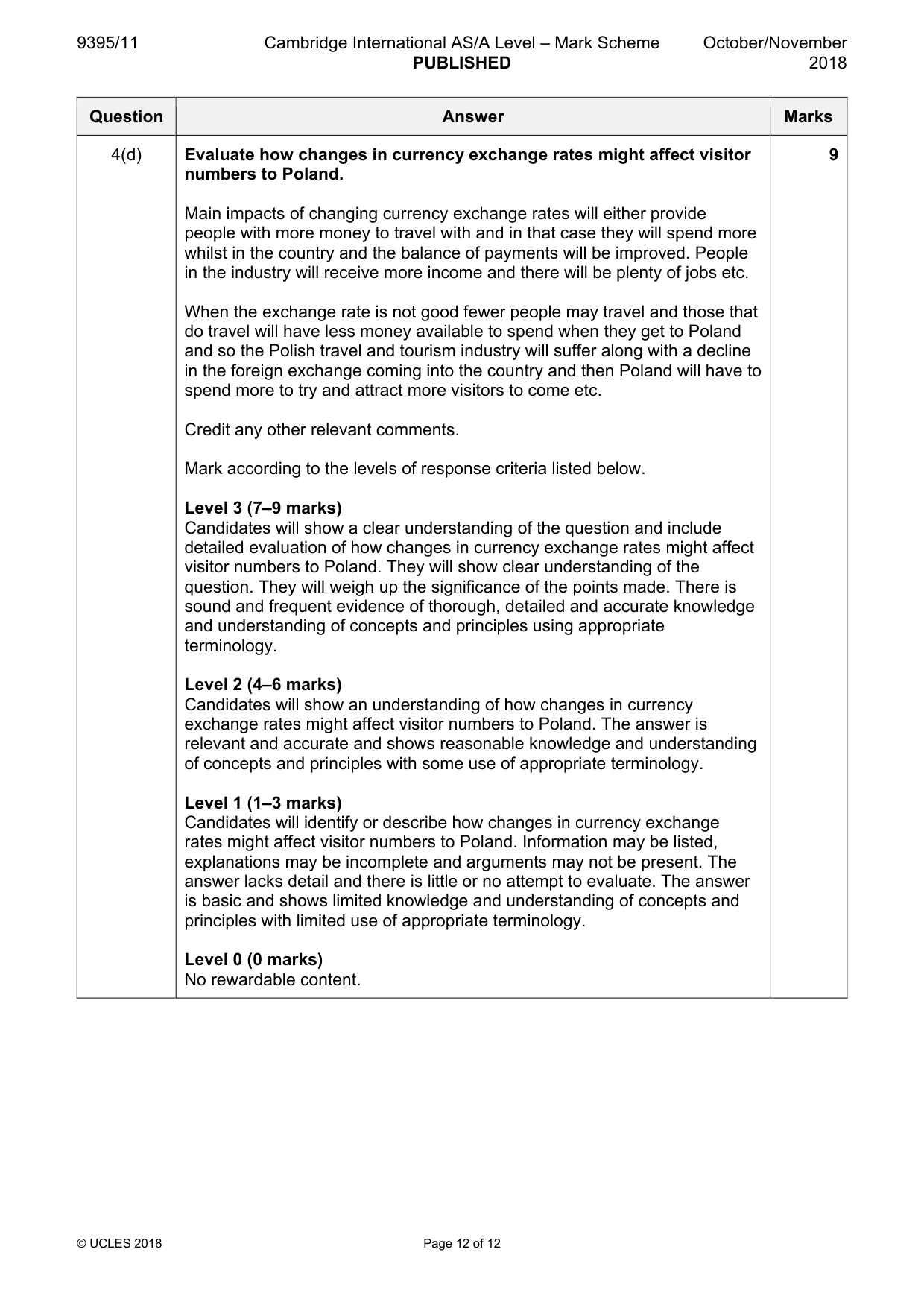
9395/11 Cambridge International AS/A Level – Mark Scheme PUBLISHED October/November 2018 © UCLES 2018 Page 12 of 12 Question Answer Marks 4(d) Evaluate how changes in currency exchange rates might affect visitor numbers to Poland. Main impacts of changing currency exchange rates will either provide people with more money to travel with and in that case they will spend more whilst in the country and the balance of payments will be improved. People in the industry will receive more income and there will be plenty of jobs etc. When the exchange rate is not good fewer people may travel and those that do travel will have less money available to spend when they get to Poland and so the Polish travel and tourism industry will suffer along with a decline in the foreign exchange coming into the country and then Poland will have to spend more to try and attract more visitors to come etc. Credit any other relevant comments. Mark according to the levels of response criteria listed below. Level 3 (7–9 marks) Candidates will show a clear understanding of the question and include detailed evaluation of how changes in currency exchange rates might affect visitor numbers to Poland. They will show clear understanding of the question. They will weigh up the significance of the points made. There is sound and frequent evidence of thorough, detailed and accurate knowledge and understanding of concepts and principles using appropriate terminology. Level 2 (4–6 marks) Candidates will show an understanding of how changes in currency exchange rates might affect visitor numbers to Poland. The answer is relevant and accurate and shows reasonable knowledge and understanding of concepts and principles with some use of appropriate terminology. Level 1 (1–3 marks) Candidates will identify or describe how changes in currency exchange rates might affect visitor numbers to Poland. Information may be listed, explanations may be incomplete and arguments may not be present. The answer lacks detail and there is little or no attempt to evaluate. The answer is basic and shows limited knowledge and understanding of concepts and principles with limited use of appropriate terminology. Level 0 (0 marks) No rewardable content. 9
What you needed in this session
Cambridge’s own grade thresholds for 2018 Oct/Nov, Paper 1 · Variant 1. A higher threshold means an easier paper — the bar moves with how the cohort did.