Cambridge A Level Travel and Tourism 9395 — 2017 May/June Paper 1 · Variant 2
9395/12/M/J/17 · 100 marks · ≈113 min
The question paper and its mark scheme, free to read here and free to download. This is Cambridge’s own paper, exactly as it was sat.
Question paper16 pages



Mark scheme13 pages
Answers below. Sit the paper first if you are practising.
Paper as text
Question paper, page 1
* 3 2 5 9 2 0 3 1 5 9 * This document consists of 13 printed pages, 3 blank pages and 1 Insert. DC (CW) 135085/1 © UCLES 2017 [Turn over Cambridge International Examinations Cambridge International Advanced Subsidiary and Advanced Level TRAVEL AND TOURISM 9395/12 Paper 1 The Industry May/June 2017 2 hours and 30 minutes Candidates answer on the Question Paper. No Additional Materials are required. READ THESE INSTRUCTIONS FIRST Write your Centre number, candidate number and name on all the work you hand in. Write in dark blue or black pen. You may use an HB pencil for any diagrams or graphs. Do not use staples, paper clips, glue or correction fluid. DO NOT WRITE IN ANY BARCODES. Answer all questions. All the Figures referred to in the questions are contained in the Insert. The number of marks is given in brackets [ ] at the end of each question or part question.
Question paper, page 2
2 9395/12/M/J/17 © UCLES 2017 Question 1 (a) Airlines deal with a variety of customers. Describe two ways airline staff may meet the needs of disabled travellers. 1 … … … … 2 … … … … [4] (b) Describe three techniques that an airline can use to assess the delivery of customer service to its external customers. 1 … … … … 2 … … … … 3 … … … … [6]
Question paper, page 3
3 9395/12/M/J/17 © UCLES 2017 [Turn over (c) A customer has made a complaint about luggage being lost. Explain the procedure that airline staff should follow to deal with this complaint. … … … … … … … … … … … …[6]
Question paper, page 4
4 9395/12/M/J/17 © UCLES 2017 (d) Discuss how an airline can meet the needs of its employees for job satisfaction. … … … … … … … … … … … … … … … … … …[9] [Total: 25]
Question paper, page 5
5 9395/12/M/J/17 © UCLES 2017 [Turn over Question 2 Refer to Fig. 1 (Insert), information about tourist arrivals in India in 2013 and 2014. (a) Identify four changes in the source markets for visitors to India between 2013 and 2014. 1 … … 2 … … 3 … … 4 … … [4] (b) Explain three reasons why most tourism income in India is generated by domestic tourists. 1 … … … … 2 … … … … 3 … … … … [6]
Question paper, page 6
6 9395/12/M/J/17 © UCLES 2017 (c) India is trying to increase the number of international tourists. Explain three ways that National Tourist Organisations (NTO’s) might attract more international tourists. 1 … … … … 2 … … … … 3 … … … … [6]
Question paper, page 7
7 9395/12/M/J/17 © UCLES 2017 [Turn over (d) Medical tourism is an important market for India. Discuss the benefits for both tourism and tourism providers of a medical tourism package to India. … … … … … … … … … … … … … … … … … …[9] [Total: 25]
Question paper, page 8
8 9395/12/M/J/17 © UCLES 2017 Question 3 Refer to Fig. 2 (Insert), information about Safari Tours, an ecotourism resort in Kenya. (a) Describe four characteristics of this ecotourism resort. 1 … … 2 … … 3 … … 4 … … [4] (b) Explain three reasons why Safari Tours might protect the environment. 1 … … … … 2 … … … … 3 … … … … [6]
Question paper, page 9
9 9395/12/M/J/17 © UCLES 2017 [Turn over (c) Safari Tours is a community based tourism initiative which works with commercial and non‑commercial organisations. Describe the differences between commercial and non‑commercial organisations. … … … … … … … … … … … …[6]
Question paper, page 10
10 9395/12/M/J/17 © UCLES 2017 (d) Ecotourism resorts attract different types of tourists. Justify how a tour operator might change the cost/quality ratio of a holiday package to an ecotourism resort in order to appeal to different tourists. … … … … … … … … … … … … … … … … … …[9] [Total: 25]
Question paper, page 11
11 9395/12/M/J/17 © UCLES 2017 [Turn over Question 4 Refer to Fig. 3 (Insert), information about a budget airline. (a) (i) Describe what is meant by the term ‘budget airline’. … …[1] (ii) Explain why budget airlines might be popular with travellers. … … … … … …[3] (b) Explain three reasons why budget airlines offer ancillary services to their passengers. 1 … … … … 2 … … … … 3 … … … … [6]
Question paper, page 12
12 9395/12/M/J/17 © UCLES 2017 (c) Budget airlines are more likely to operate from regional airports than main international gateways. Discuss why this is an advantage to both the airline and the customers. … … … … … … … … … … … …[6]
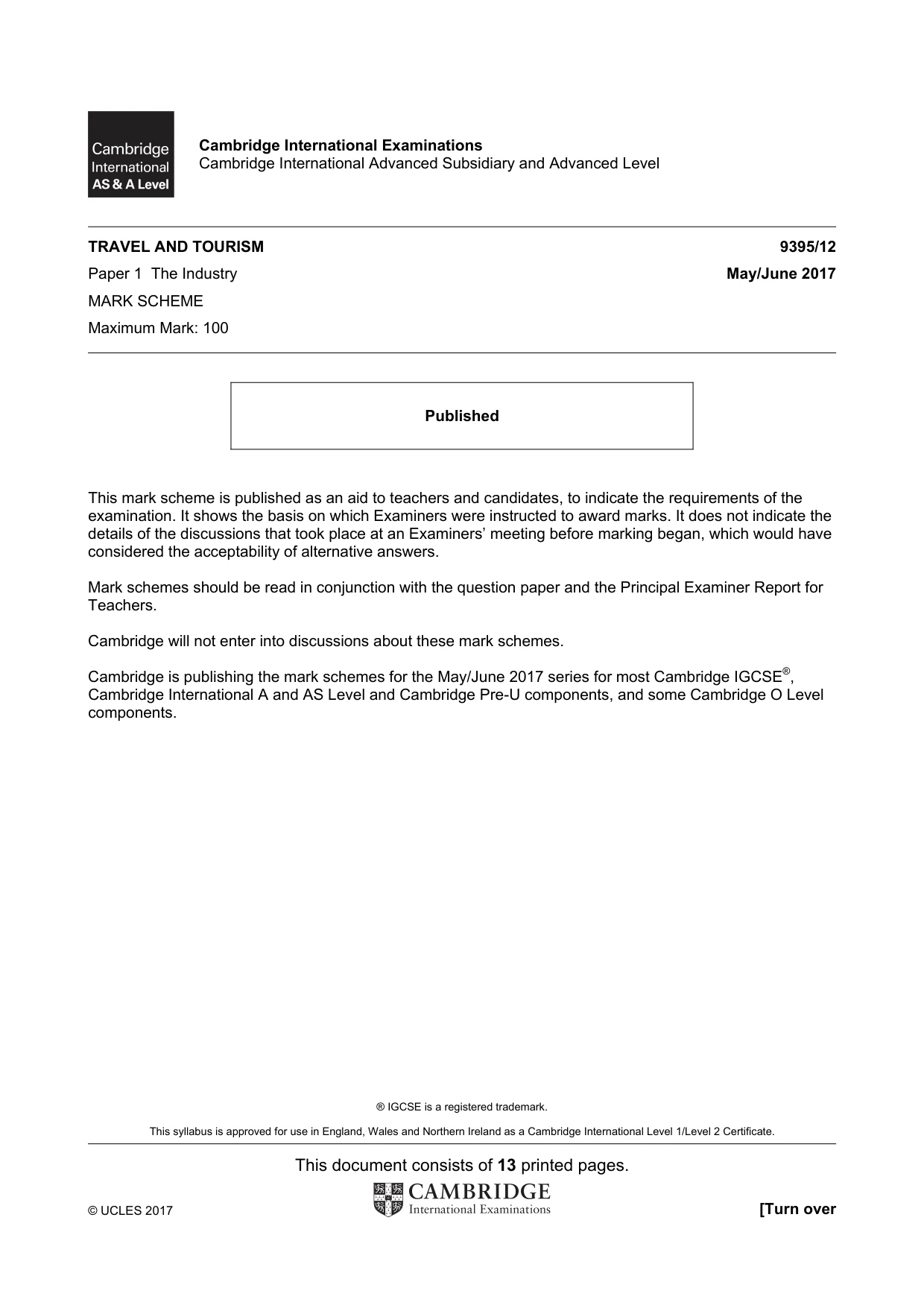
Question paper, page 13
13 9395/12/M/J/17 © UCLES 2017 (d) Discuss the transport options available for travellers in different destinations. … … … … … … … … … … … … … … … … … …[9] [Total: 25]
Question paper, page 14
14 9395/12/M/J/17 © UCLES 2017 BLANK PAGE
Question paper, page 15
15 9395/12/M/J/17 © UCLES 2017 BLANK PAGE
Question paper, page 16
16 9395/12/M/J/17 © UCLES 2017 Permission to reproduce items where third‑party owned material protected by copyright is included has been sought and cleared where possible. Every reasonable effort has been made by the publisher (UCLES) to trace copyright holders, but if any items requiring clearance have unwittingly been included, the publisher will be pleased to make amends at the earliest possible opportunity. To avoid the issue of disclosure of answer‑related information to candidates, all copyright acknowledgements are reproduced online in the Cambridge International Examinations Copyright Acknowledgements Booklet. This is produced for each series of examinations and is freely available to download at www.cie.org.uk after the live examination series. Cambridge International Examinations is part of the Cambridge Assessment Group. Cambridge Assessment is the brand name of University of Cambridge Local Examinations Syndicate (UCLES), which is itself a department of the University of Cambridge. BLANK PAGE
Mark scheme, page 1
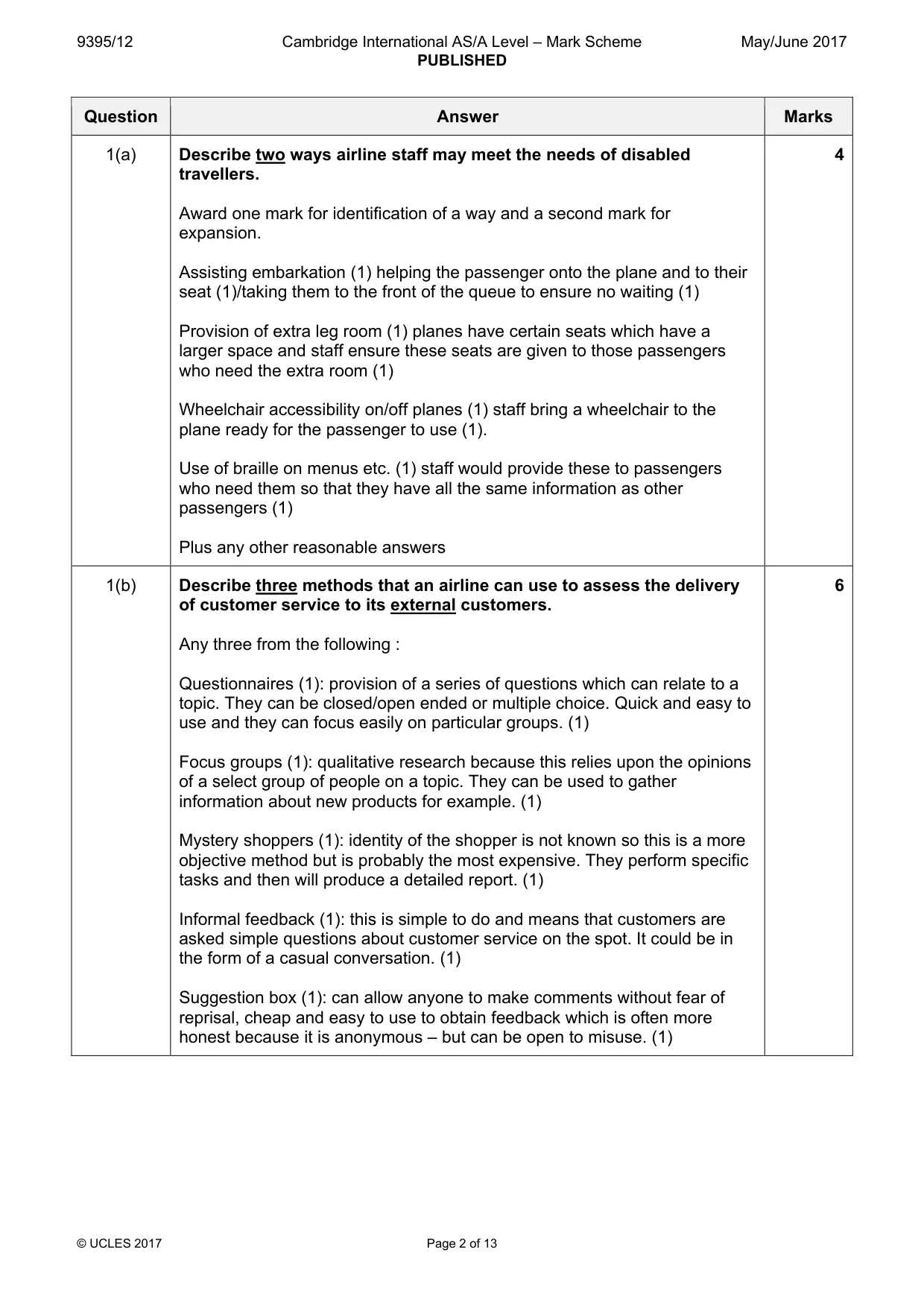
® IGCSE is a registered trademark. This syllabus is approved for use in England, Wales and Northern Ireland as a Cambridge International Level 1/Level 2 Certificate. This document consists of 13 printed pages. © UCLES 2017 [Turn over Cambridge International Examinations Cambridge International Advanced Subsidiary and Advanced Level TRAVEL AND TOURISM 9395/12 Paper 1 The Industry May/June 2017 MARK SCHEME Maximum Mark: 100 Published This mark scheme is published as an aid to teachers and candidates, to indicate the requirements of the examination. It shows the basis on which Examiners were instructed to award marks. It does not indicate the details of the discussions that took place at an Examiners’ meeting before marking began, which would have considered the acceptability of alternative answers. Mark schemes should be read in conjunction with the question paper and the Principal Examiner Report for Teachers. Cambridge will not enter into discussions about these mark schemes. Cambridge is publishing the mark schemes for the May/June 2017 series for most Cambridge IGCSE®, Cambridge International A and AS Level and Cambridge Pre-U components, and some Cambridge O Level components.
Mark scheme, page 2
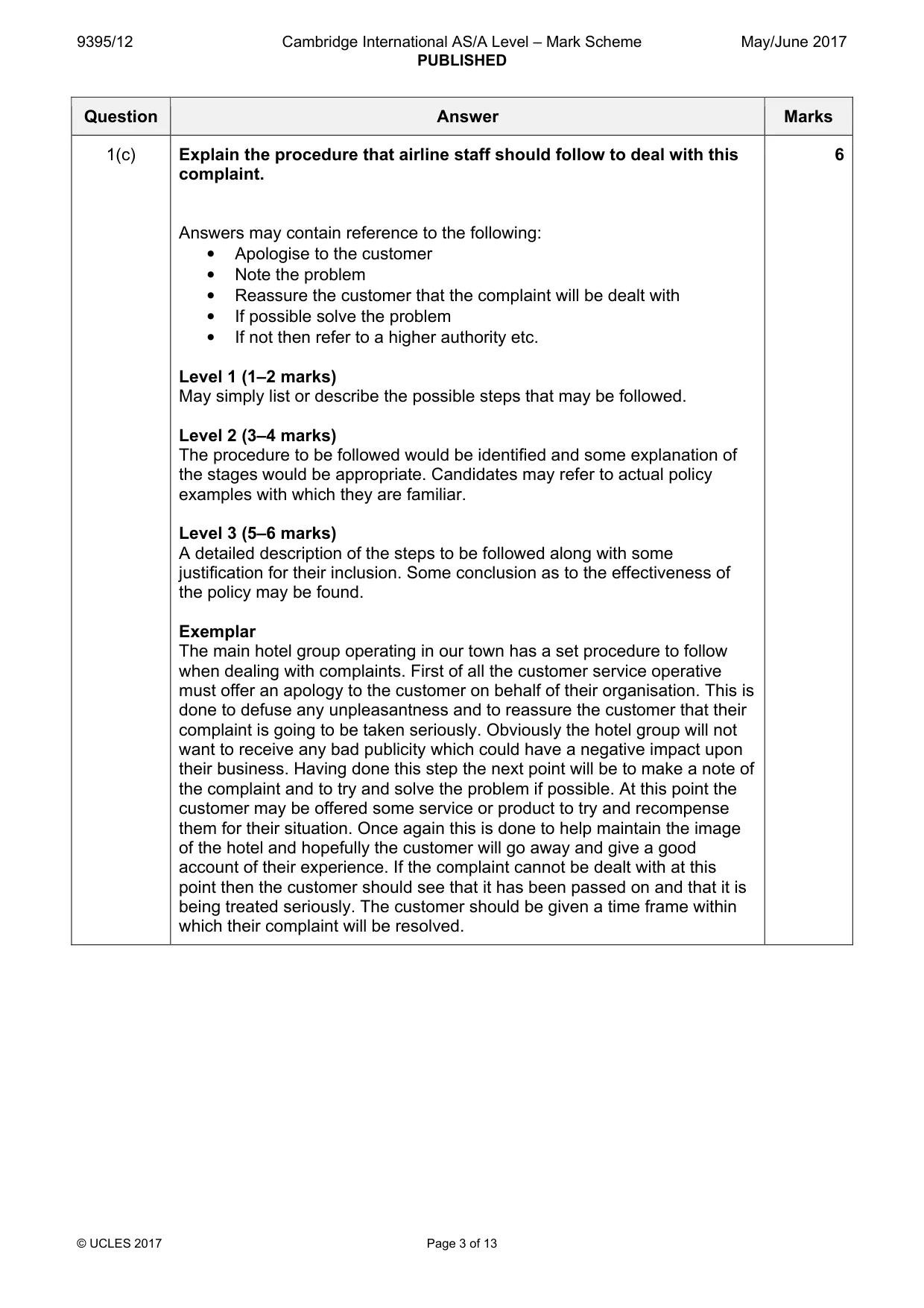
9395/12 Cambridge International AS/A Level – Mark Scheme PUBLISHED May/June 2017 © UCLES 2017 Page 2 of 13 Question Answer Marks 1(a) Describe two ways airline staff may meet the needs of disabled travellers. Award one mark for identification of a way and a second mark for expansion. Assisting embarkation (1) helping the passenger onto the plane and to their seat (1)/taking them to the front of the queue to ensure no waiting (1) Provision of extra leg room (1) planes have certain seats which have a larger space and staff ensure these seats are given to those passengers who need the extra room (1) Wheelchair accessibility on/off planes (1) staff bring a wheelchair to the plane ready for the passenger to use (1). Use of braille on menus etc. (1) staff would provide these to passengers who need them so that they have all the same information as other passengers (1) Plus any other reasonable answers 4 1(b) Describe three methods that an airline can use to assess the delivery of customer service to its external customers. Any three from the following : Questionnaires (1): provision of a series of questions which can relate to a topic. They can be closed/open ended or multiple choice. Quick and easy to use and they can focus easily on particular groups. (1) Focus groups (1): qualitative research because this relies upon the opinions of a select group of people on a topic. They can be used to gather information about new products for example. (1) Mystery shoppers (1): identity of the shopper is not known so this is a more objective method but is probably the most expensive. They perform specific tasks and then will produce a detailed report. (1) Informal feedback (1): this is simple to do and means that customers are asked simple questions about customer service on the spot. It could be in the form of a casual conversation. (1) Suggestion box (1): can allow anyone to make comments without fear of reprisal, cheap and easy to use to obtain feedback which is often more honest because it is anonymous – but can be open to misuse. (1) 6
Mark scheme, page 3
9395/12 Cambridge International AS/A Level – Mark Scheme PUBLISHED May/June 2017 © UCLES 2017 Page 3 of 13 Question Answer Marks 1(c) Explain the procedure that airline staff should follow to deal with this complaint. Answers may contain reference to the following: • Apologise to the customer • Note the problem • Reassure the customer that the complaint will be dealt with • If possible solve the problem • If not then refer to a higher authority etc. Level 1 (1–2 marks) May simply list or describe the possible steps that may be followed. Level 2 (3–4 marks) The procedure to be followed would be identified and some explanation of the stages would be appropriate. Candidates may refer to actual policy examples with which they are familiar. Level 3 (5–6 marks) A detailed description of the steps to be followed along with some justification for their inclusion. Some conclusion as to the effectiveness of the policy may be found. Exemplar The main hotel group operating in our town has a set procedure to follow when dealing with complaints. First of all the customer service operative must offer an apology to the customer on behalf of their organisation. This is done to defuse any unpleasantness and to reassure the customer that their complaint is going to be taken seriously. Obviously the hotel group will not want to receive any bad publicity which could have a negative impact upon their business. Having done this step the next point will be to make a note of the complaint and to try and solve the problem if possible. At this point the customer may be offered some service or product to try and recompense them for their situation. Once again this is done to help maintain the image of the hotel and hopefully the customer will go away and give a good account of their experience. If the complaint cannot be dealt with at this point then the customer should see that it has been passed on and that it is being treated seriously. The customer should be given a time frame within which their complaint will be resolved. 6
Mark scheme, page 4
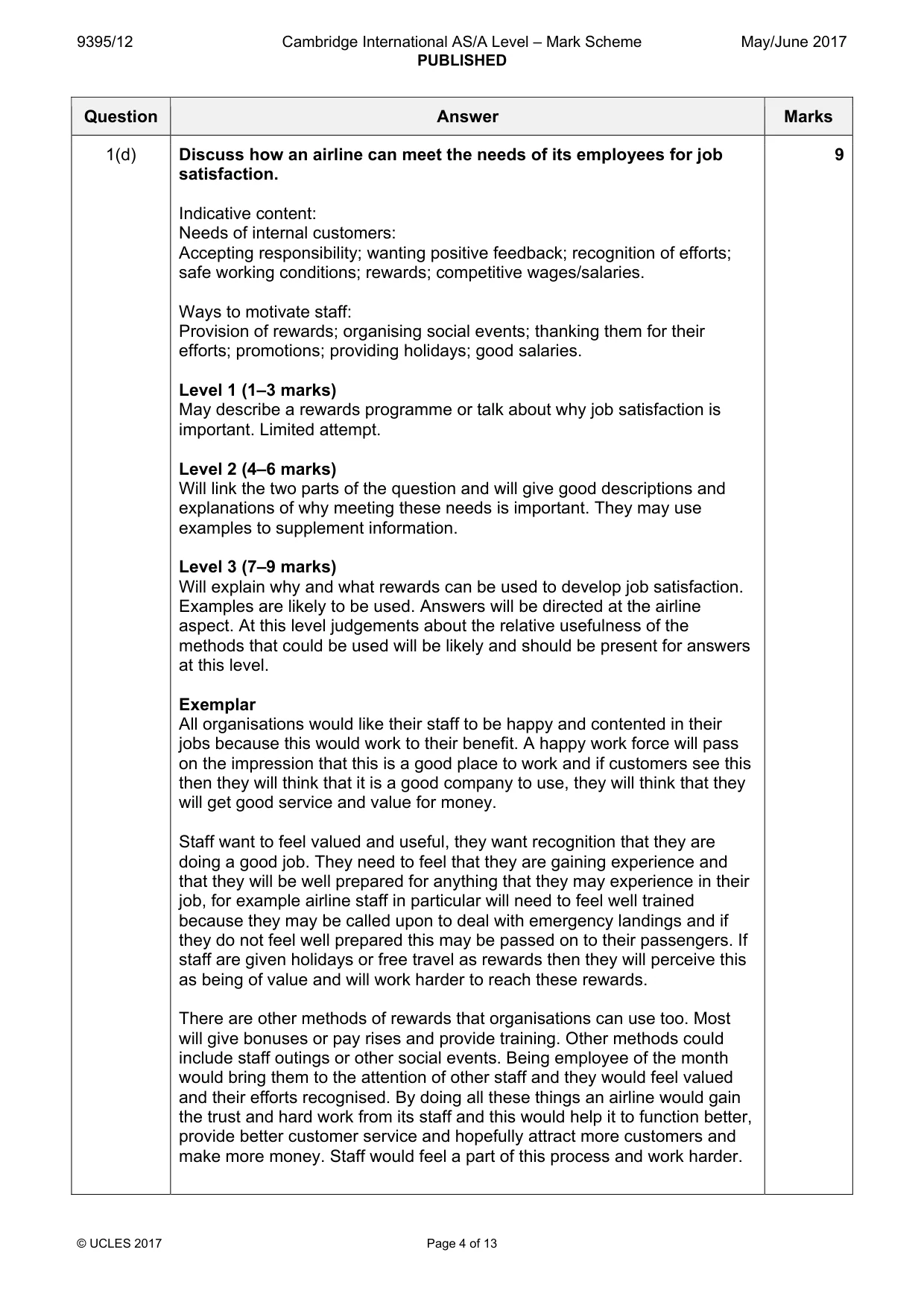
9395/12 Cambridge International AS/A Level – Mark Scheme PUBLISHED May/June 2017 © UCLES 2017 Page 4 of 13 Question Answer Marks 1(d) Discuss how an airline can meet the needs of its employees for job satisfaction. Indicative content: Needs of internal customers: Accepting responsibility; wanting positive feedback; recognition of efforts; safe working conditions; rewards; competitive wages/salaries. Ways to motivate staff: Provision of rewards; organising social events; thanking them for their efforts; promotions; providing holidays; good salaries. Level 1 (1–3 marks) May describe a rewards programme or talk about why job satisfaction is important. Limited attempt. Level 2 (4–6 marks) Will link the two parts of the question and will give good descriptions and explanations of why meeting these needs is important. They may use examples to supplement information. Level 3 (7–9 marks) Will explain why and what rewards can be used to develop job satisfaction. Examples are likely to be used. Answers will be directed at the airline aspect. At this level judgements about the relative usefulness of the methods that could be used will be likely and should be present for answers at this level. Exemplar All organisations would like their staff to be happy and contented in their jobs because this would work to their benefit. A happy work force will pass on the impression that this is a good place to work and if customers see this then they will think that it is a good company to use, they will think that they will get good service and value for money. Staff want to feel valued and useful, they want recognition that they are doing a good job. They need to feel that they are gaining experience and that they will be well prepared for anything that they may experience in their job, for example airline staff in particular will need to feel well trained because they may be called upon to deal with emergency landings and if they do not feel well prepared this may be passed on to their passengers. If staff are given holidays or free travel as rewards then they will perceive this as being of value and will work harder to reach these rewards. There are other methods of rewards that organisations can use too. Most will give bonuses or pay rises and provide training. Other methods could include staff outings or other social events. Being employee of the month would bring them to the attention of other staff and they would feel valued and their efforts recognised. By doing all these things an airline would gain the trust and hard work from its staff and this would help it to function better, provide better customer service and hopefully attract more customers and make more money. Staff would feel a part of this process and work harder. 9
Mark scheme, page 5
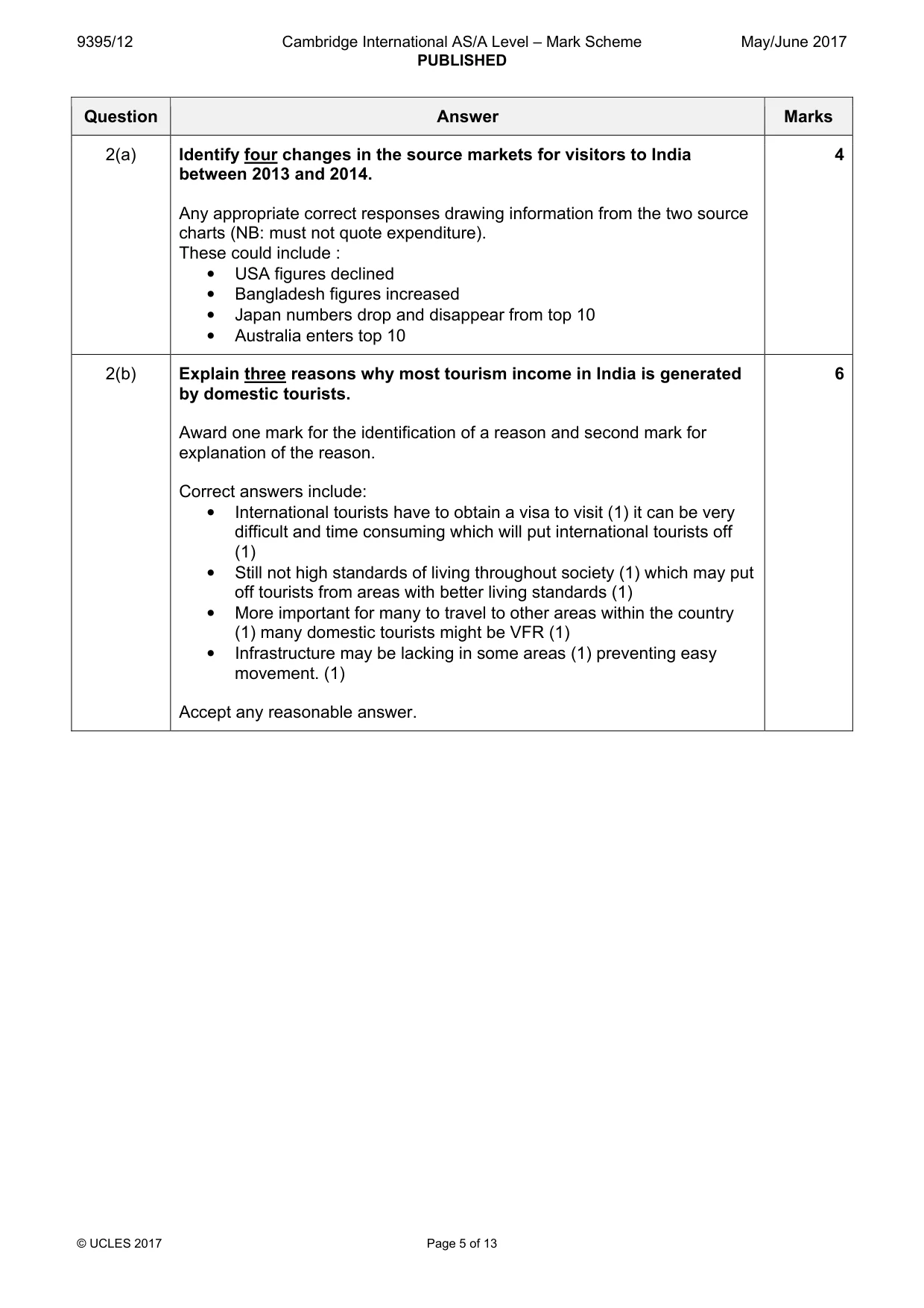
9395/12 Cambridge International AS/A Level – Mark Scheme PUBLISHED May/June 2017 © UCLES 2017 Page 5 of 13 Question Answer Marks 2(a) Identify four changes in the source markets for visitors to India between 2013 and 2014. Any appropriate correct responses drawing information from the two source charts (NB: must not quote expenditure). These could include : • USA figures declined • Bangladesh figures increased • Japan numbers drop and disappear from top 10 • Australia enters top 10 4 2(b) Explain three reasons why most tourism income in India is generated by domestic tourists. Award one mark for the identification of a reason and second mark for explanation of the reason. Correct answers include: • International tourists have to obtain a visa to visit (1) it can be very difficult and time consuming which will put international tourists off (1) • Still not high standards of living throughout society (1) which may put off tourists from areas with better living standards (1) • More important for many to travel to other areas within the country (1) many domestic tourists might be VFR (1) • Infrastructure may be lacking in some areas (1) preventing easy movement. (1) Accept any reasonable answer. 6
Mark scheme, page 6
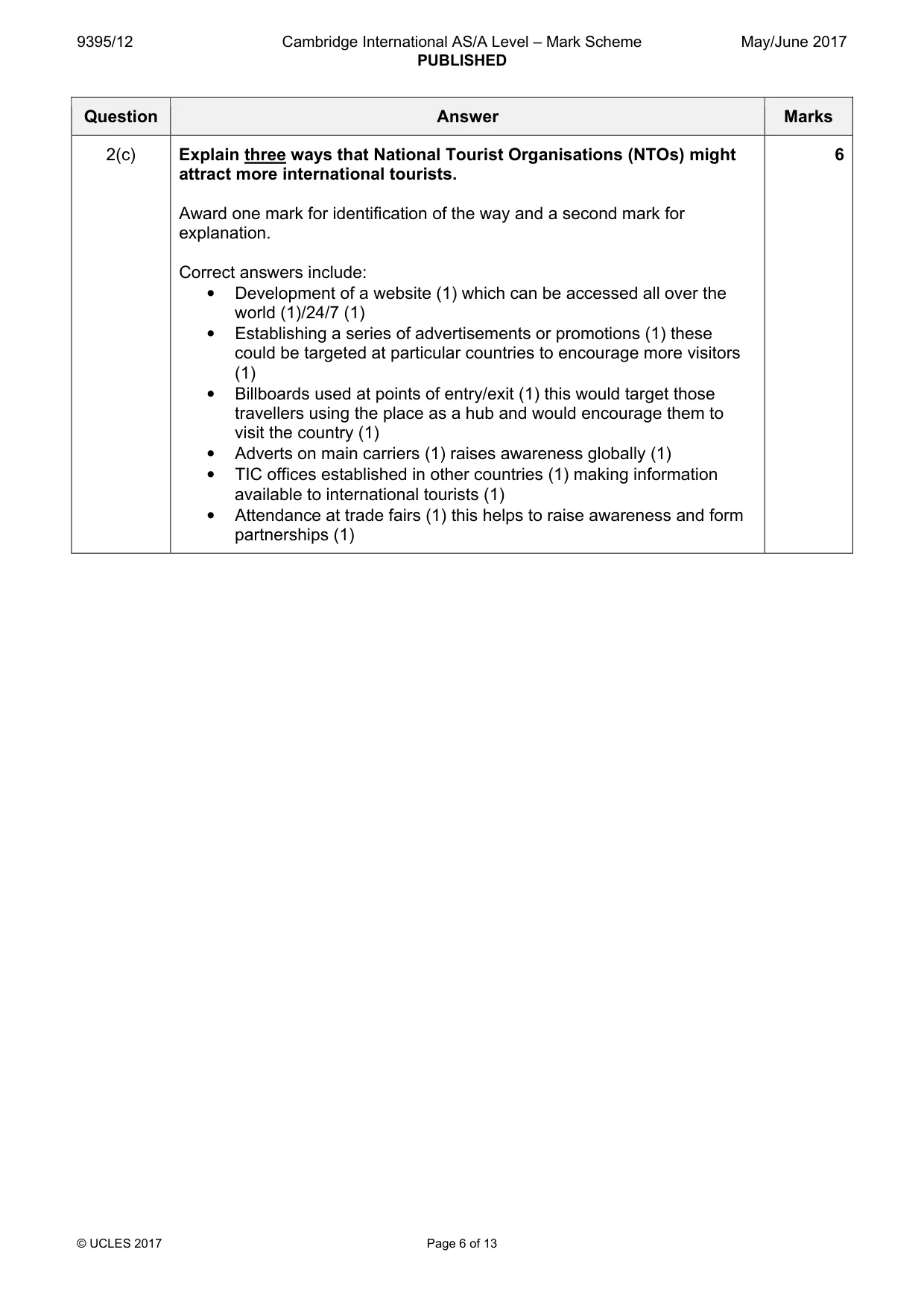
9395/12 Cambridge International AS/A Level – Mark Scheme PUBLISHED May/June 2017 © UCLES 2017 Page 6 of 13 Question Answer Marks 2(c) Explain three ways that National Tourist Organisations (NTOs) might attract more international tourists. Award one mark for identification of the way and a second mark for explanation. Correct answers include: • Development of a website (1) which can be accessed all over the world (1)/24/7 (1) • Establishing a series of advertisements or promotions (1) these could be targeted at particular countries to encourage more visitors (1) • Billboards used at points of entry/exit (1) this would target those travellers using the place as a hub and would encourage them to visit the country (1) • Adverts on main carriers (1) raises awareness globally (1) • TIC offices established in other countries (1) making information available to international tourists (1) • Attendance at trade fairs (1) this helps to raise awareness and form partnerships (1) 6
Mark scheme, page 7
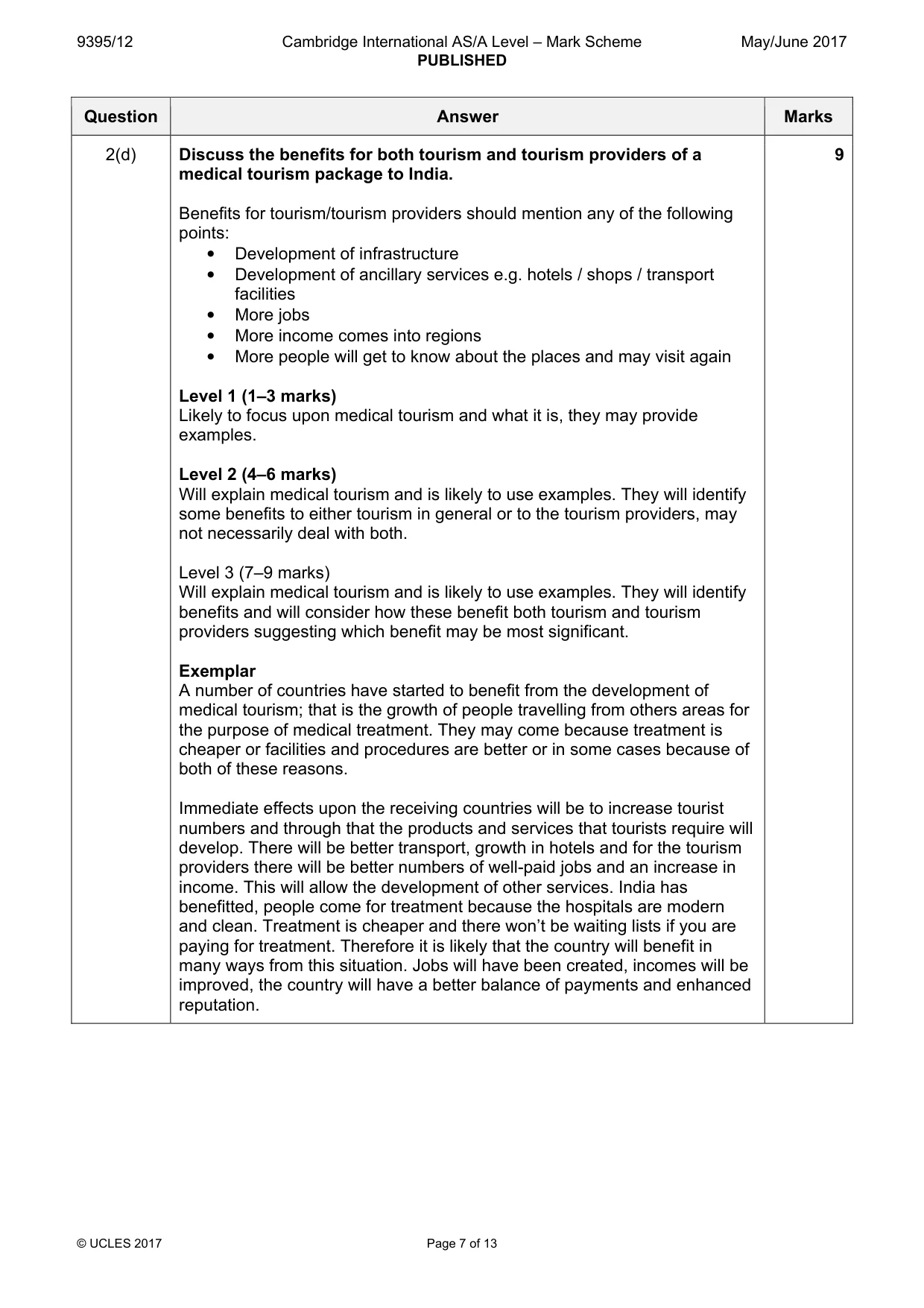
9395/12 Cambridge International AS/A Level – Mark Scheme PUBLISHED May/June 2017 © UCLES 2017 Page 7 of 13 Question Answer Marks 2(d) Discuss the benefits for both tourism and tourism providers of a medical tourism package to India. Benefits for tourism/tourism providers should mention any of the following points: • Development of infrastructure • Development of ancillary services e.g. hotels / shops / transport facilities • More jobs • More income comes into regions • More people will get to know about the places and may visit again Level 1 (1–3 marks) Likely to focus upon medical tourism and what it is, they may provide examples. Level 2 (4–6 marks) Will explain medical tourism and is likely to use examples. They will identify some benefits to either tourism in general or to the tourism providers, may not necessarily deal with both. Level 3 (7–9 marks) Will explain medical tourism and is likely to use examples. They will identify benefits and will consider how these benefit both tourism and tourism providers suggesting which benefit may be most significant. Exemplar A number of countries have started to benefit from the development of medical tourism; that is the growth of people travelling from others areas for the purpose of medical treatment. They may come because treatment is cheaper or facilities and procedures are better or in some cases because of both of these reasons. Immediate effects upon the receiving countries will be to increase tourist numbers and through that the products and services that tourists require will develop. There will be better transport, growth in hotels and for the tourism providers there will be better numbers of well-paid jobs and an increase in income. This will allow the development of other services. India has benefitted, people come for treatment because the hospitals are modern and clean. Treatment is cheaper and there won’t be waiting lists if you are paying for treatment. Therefore it is likely that the country will benefit in many ways from this situation. Jobs will have been created, incomes will be improved, the country will have a better balance of payments and enhanced reputation. 9
Mark scheme, page 8
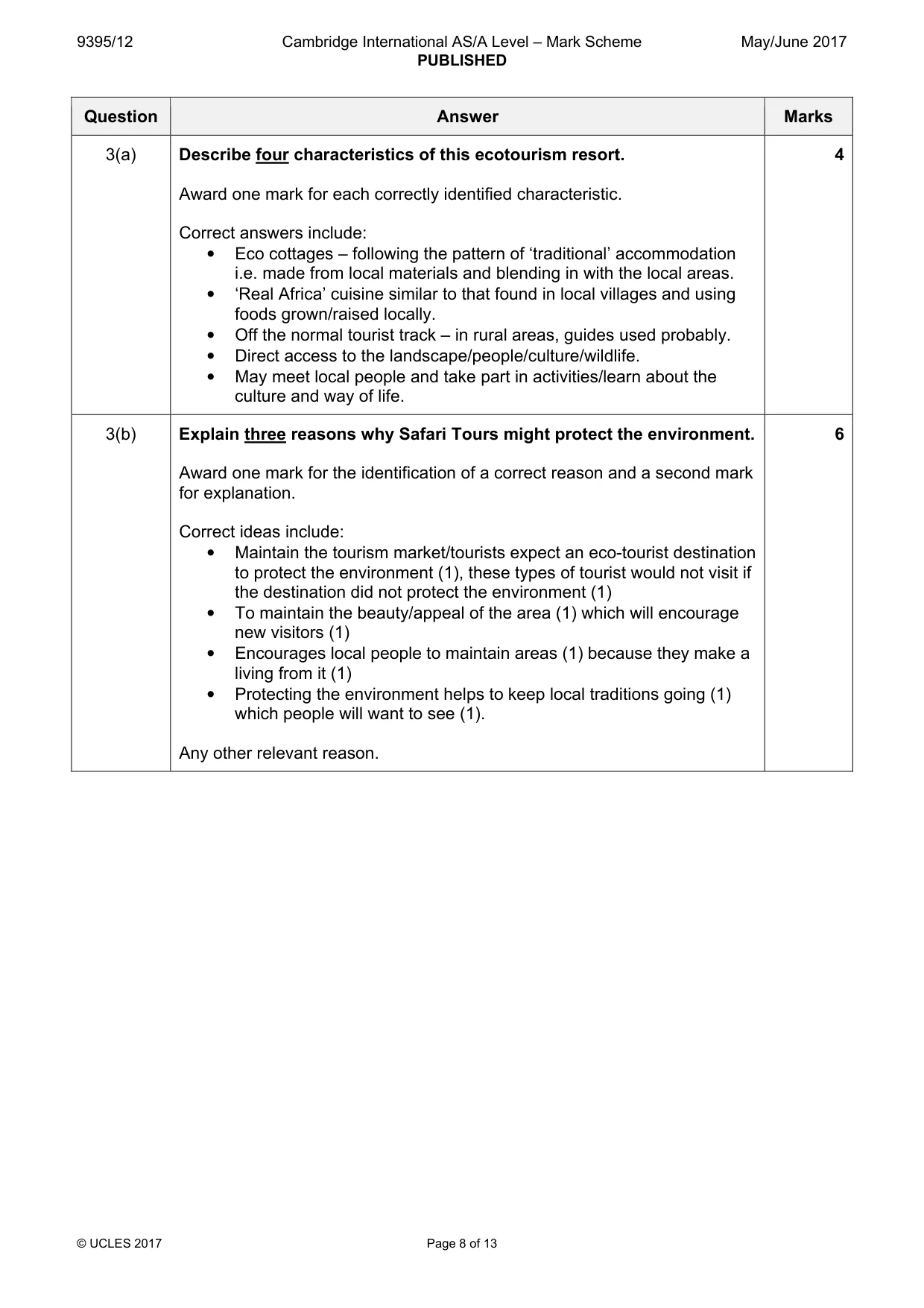
9395/12 Cambridge International AS/A Level – Mark Scheme PUBLISHED May/June 2017 © UCLES 2017 Page 8 of 13 Question Answer Marks 3(a) Describe four characteristics of this ecotourism resort. Award one mark for each correctly identified characteristic. Correct answers include: • Eco cottages – following the pattern of ‘traditional’ accommodation i.e. made from local materials and blending in with the local areas. • ‘Real Africa’ cuisine similar to that found in local villages and using foods grown/raised locally. • Off the normal tourist track – in rural areas, guides used probably. • Direct access to the landscape/people/culture/wildlife. • May meet local people and take part in activities/learn about the culture and way of life. 4 3(b) Explain three reasons why Safari Tours might protect the environment. Award one mark for the identification of a correct reason and a second mark for explanation. Correct ideas include: • Maintain the tourism market/tourists expect an eco-tourist destination to protect the environment (1), these types of tourist would not visit if the destination did not protect the environment (1) • To maintain the beauty/appeal of the area (1) which will encourage new visitors (1) • Encourages local people to maintain areas (1) because they make a living from it (1) • Protecting the environment helps to keep local traditions going (1) which people will want to see (1). Any other relevant reason. 6
Mark scheme, page 9
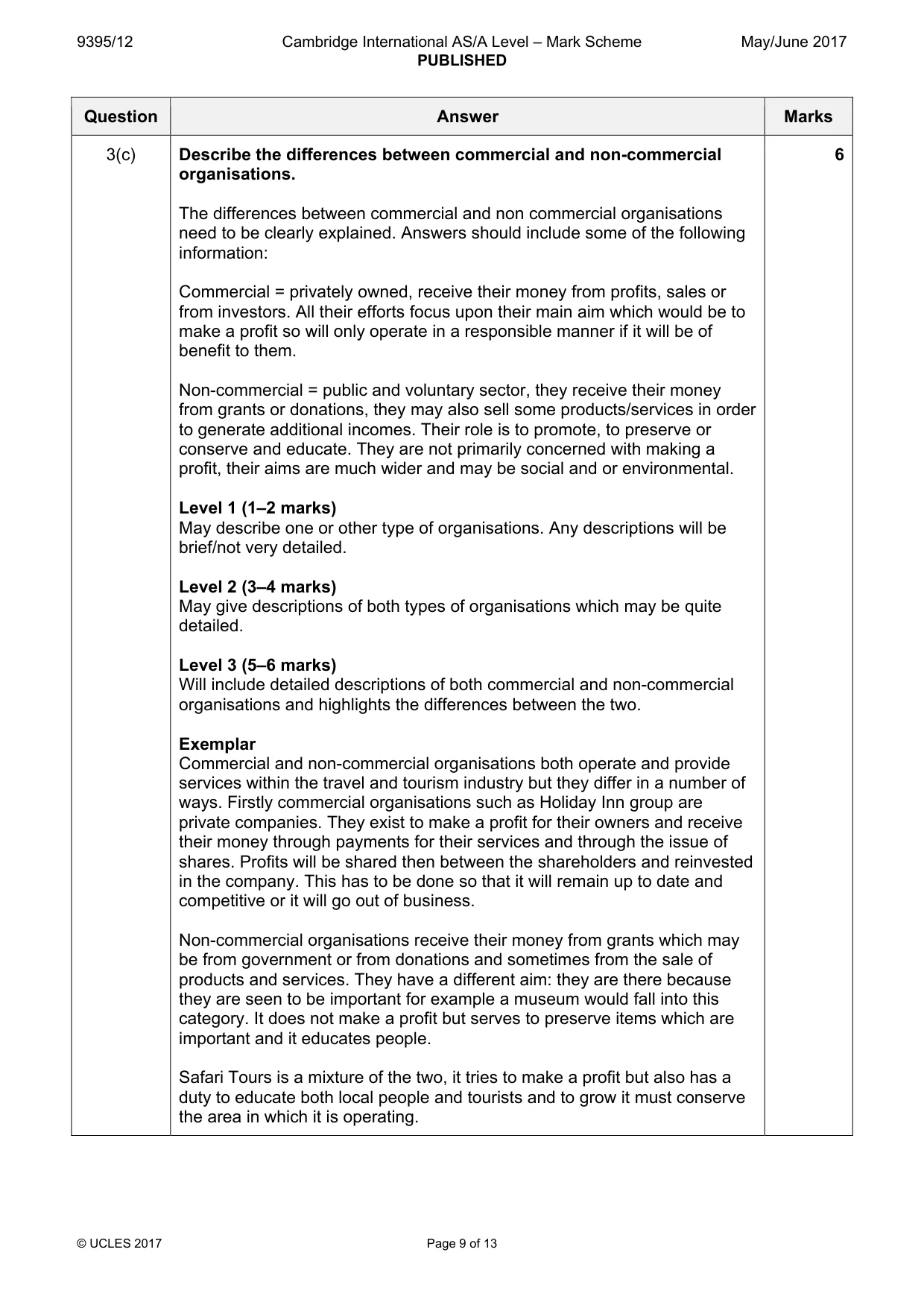
9395/12 Cambridge International AS/A Level – Mark Scheme PUBLISHED May/June 2017 © UCLES 2017 Page 9 of 13 Question Answer Marks 3(c) Describe the differences between commercial and non-commercial organisations. The differences between commercial and non commercial organisations need to be clearly explained. Answers should include some of the following information: Commercial = privately owned, receive their money from profits, sales or from investors. All their efforts focus upon their main aim which would be to make a profit so will only operate in a responsible manner if it will be of benefit to them. Non-commercial = public and voluntary sector, they receive their money from grants or donations, they may also sell some products/services in order to generate additional incomes. Their role is to promote, to preserve or conserve and educate. They are not primarily concerned with making a profit, their aims are much wider and may be social and or environmental. Level 1 (1–2 marks) May describe one or other type of organisations. Any descriptions will be brief/not very detailed. Level 2 (3–4 marks) May give descriptions of both types of organisations which may be quite detailed. Level 3 (5–6 marks) Will include detailed descriptions of both commercial and non-commercial organisations and highlights the differences between the two. Exemplar Commercial and non-commercial organisations both operate and provide services within the travel and tourism industry but they differ in a number of ways. Firstly commercial organisations such as Holiday Inn group are private companies. They exist to make a profit for their owners and receive their money through payments for their services and through the issue of shares. Profits will be shared then between the shareholders and reinvested in the company. This has to be done so that it will remain up to date and competitive or it will go out of business. Non-commercial organisations receive their money from grants which may be from government or from donations and sometimes from the sale of products and services. They have a different aim: they are there because they are seen to be important for example a museum would fall into this category. It does not make a profit but serves to preserve items which are important and it educates people. Safari Tours is a mixture of the two, it tries to make a profit but also has a duty to educate both local people and tourists and to grow it must conserve the area in which it is operating. 6
Mark scheme, page 10
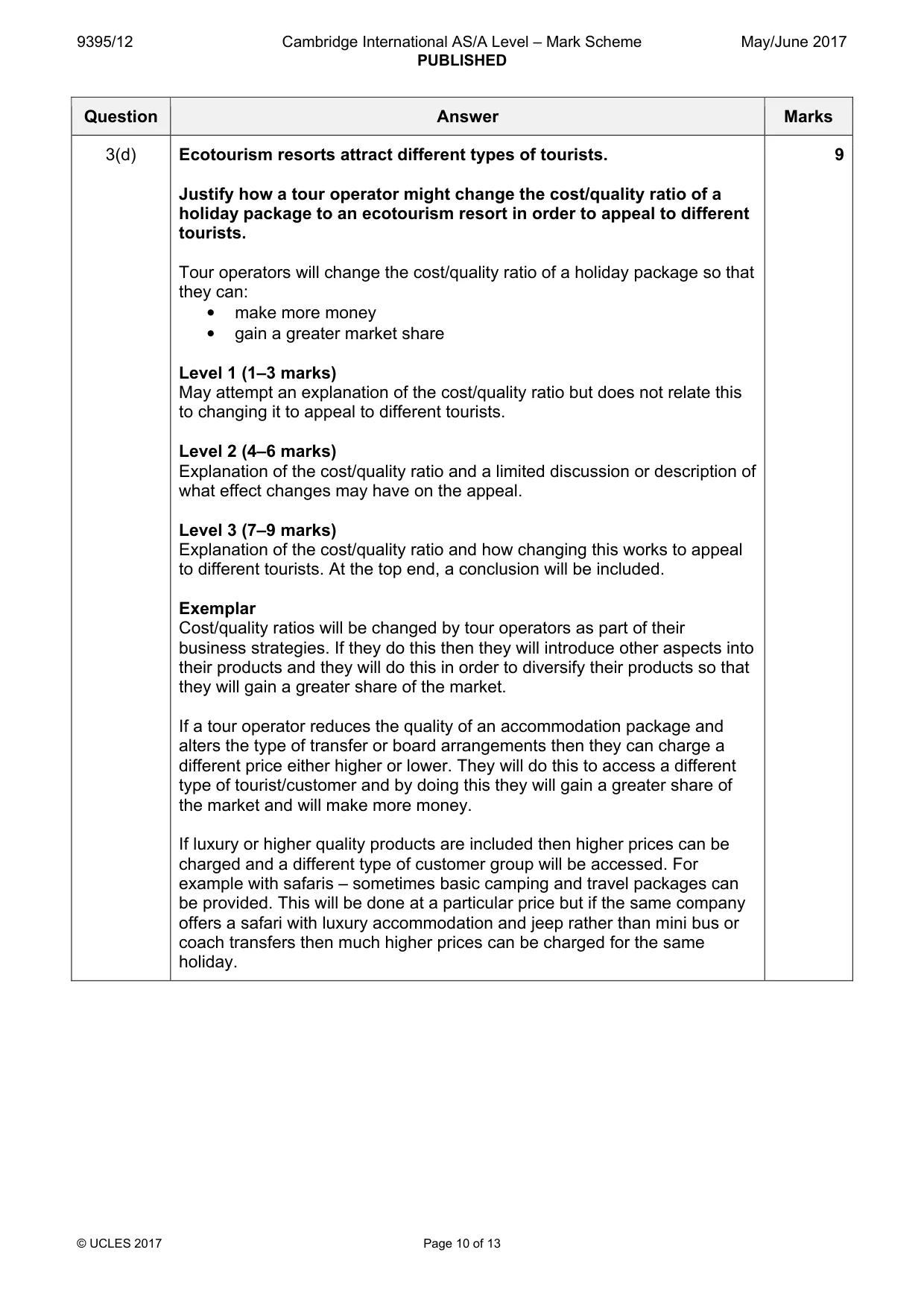
9395/12 Cambridge International AS/A Level – Mark Scheme PUBLISHED May/June 2017 © UCLES 2017 Page 10 of 13 Question Answer Marks 3(d) Ecotourism resorts attract different types of tourists. Justify how a tour operator might change the cost/quality ratio of a holiday package to an ecotourism resort in order to appeal to different tourists. Tour operators will change the cost/quality ratio of a holiday package so that they can: • make more money • gain a greater market share Level 1 (1–3 marks) May attempt an explanation of the cost/quality ratio but does not relate this to changing it to appeal to different tourists. Level 2 (4–6 marks) Explanation of the cost/quality ratio and a limited discussion or description of what effect changes may have on the appeal. Level 3 (7–9 marks) Explanation of the cost/quality ratio and how changing this works to appeal to different tourists. At the top end, a conclusion will be included. Exemplar Cost/quality ratios will be changed by tour operators as part of their business strategies. If they do this then they will introduce other aspects into their products and they will do this in order to diversify their products so that they will gain a greater share of the market. If a tour operator reduces the quality of an accommodation package and alters the type of transfer or board arrangements then they can charge a different price either higher or lower. They will do this to access a different type of tourist/customer and by doing this they will gain a greater share of the market and will make more money. If luxury or higher quality products are included then higher prices can be charged and a different type of customer group will be accessed. For example with safaris – sometimes basic camping and travel packages can be provided. This will be done at a particular price but if the same company offers a safari with luxury accommodation and jeep rather than mini bus or coach transfers then much higher prices can be charged for the same holiday. 9
Mark scheme, page 11
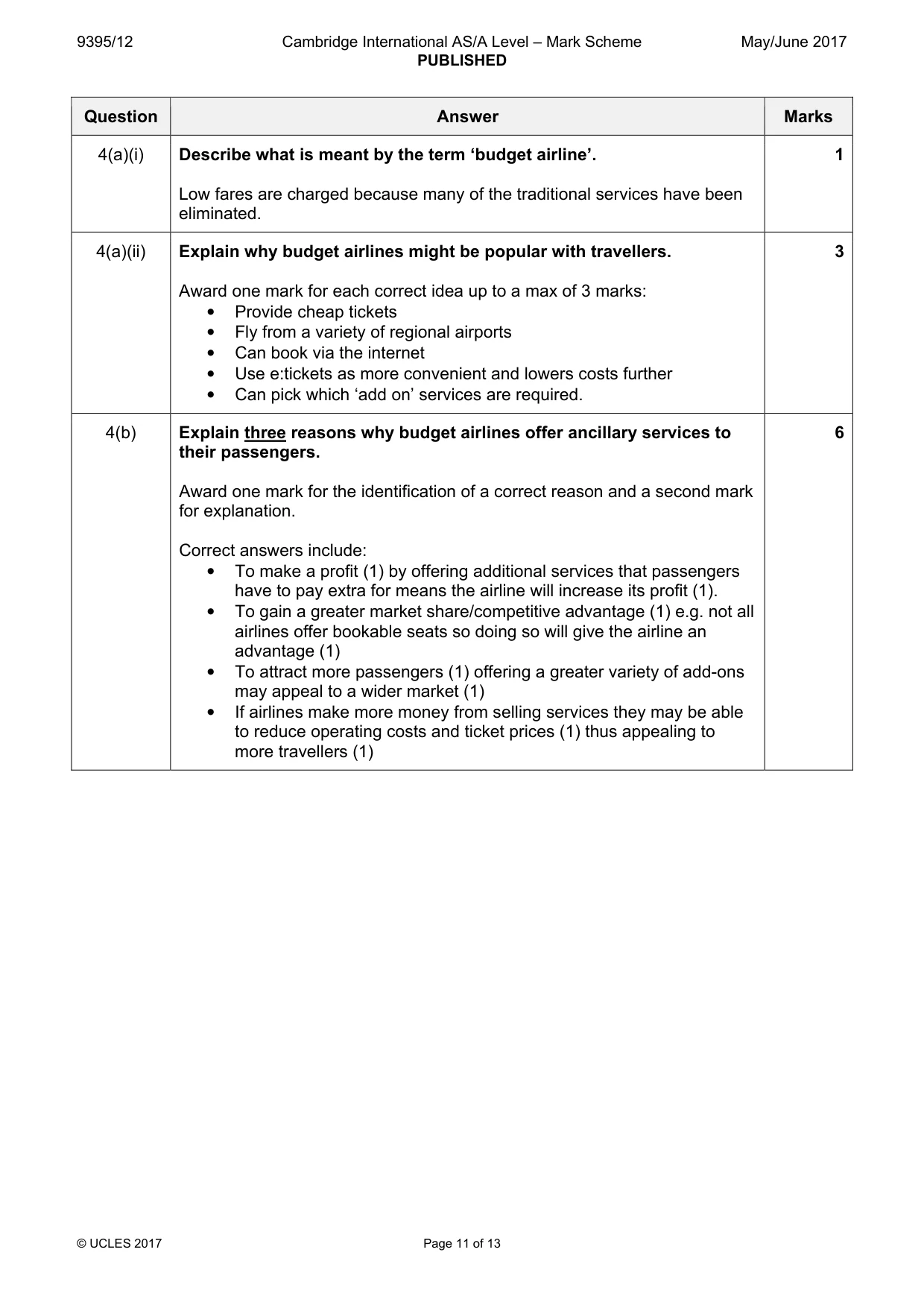
9395/12 Cambridge International AS/A Level – Mark Scheme PUBLISHED May/June 2017 © UCLES 2017 Page 11 of 13 Question Answer Marks 4(a)(i) Describe what is meant by the term ‘budget airline’. Low fares are charged because many of the traditional services have been eliminated. 1 4(a)(ii) Explain why budget airlines might be popular with travellers. Award one mark for each correct idea up to a max of 3 marks: • Provide cheap tickets • Fly from a variety of regional airports • Can book via the internet • Use e:tickets as more convenient and lowers costs further • Can pick which ‘add on’ services are required. 3 4(b) Explain three reasons why budget airlines offer ancillary services to their passengers. Award one mark for the identification of a correct reason and a second mark for explanation. Correct answers include: • To make a profit (1) by offering additional services that passengers have to pay extra for means the airline will increase its profit (1). • To gain a greater market share/competitive advantage (1) e.g. not all airlines offer bookable seats so doing so will give the airline an advantage (1) • To attract more passengers (1) offering a greater variety of add-ons may appeal to a wider market (1) • If airlines make more money from selling services they may be able to reduce operating costs and ticket prices (1) thus appealing to more travellers (1) 6
Mark scheme, page 12
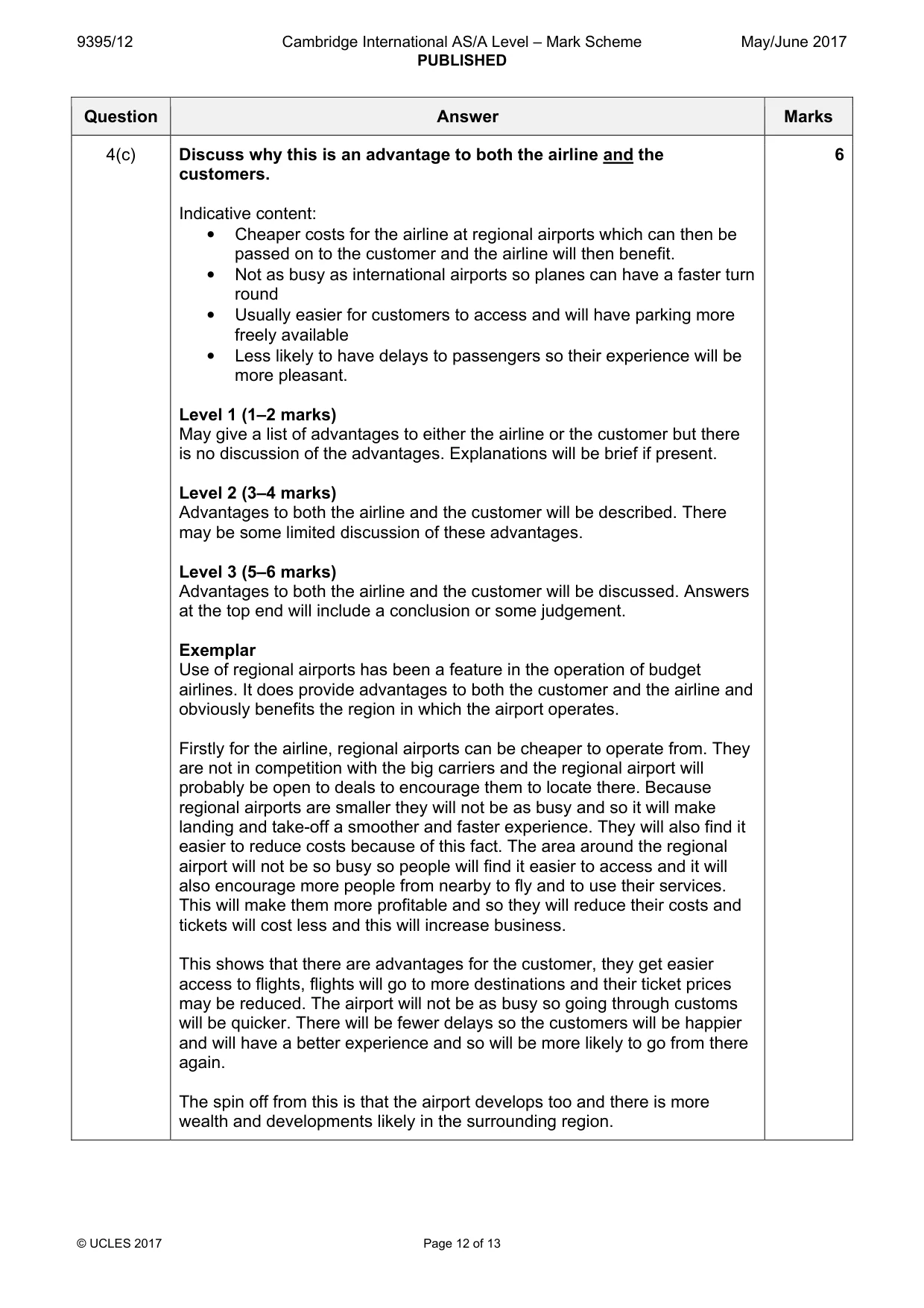
9395/12 Cambridge International AS/A Level – Mark Scheme PUBLISHED May/June 2017 © UCLES 2017 Page 12 of 13 Question Answer Marks 4(c) Discuss why this is an advantage to both the airline and the customers. Indicative content: • Cheaper costs for the airline at regional airports which can then be passed on to the customer and the airline will then benefit. • Not as busy as international airports so planes can have a faster turn round • Usually easier for customers to access and will have parking more freely available • Less likely to have delays to passengers so their experience will be more pleasant. Level 1 (1–2 marks) May give a list of advantages to either the airline or the customer but there is no discussion of the advantages. Explanations will be brief if present. Level 2 (3–4 marks) Advantages to both the airline and the customer will be described. There may be some limited discussion of these advantages. Level 3 (5–6 marks) Advantages to both the airline and the customer will be discussed. Answers at the top end will include a conclusion or some judgement. Exemplar Use of regional airports has been a feature in the operation of budget airlines. It does provide advantages to both the customer and the airline and obviously benefits the region in which the airport operates. Firstly for the airline, regional airports can be cheaper to operate from. They are not in competition with the big carriers and the regional airport will probably be open to deals to encourage them to locate there. Because regional airports are smaller they will not be as busy and so it will make landing and take-off a smoother and faster experience. They will also find it easier to reduce costs because of this fact. The area around the regional airport will not be so busy so people will find it easier to access and it will also encourage more people from nearby to fly and to use their services. This will make them more profitable and so they will reduce their costs and tickets will cost less and this will increase business. This shows that there are advantages for the customer, they get easier access to flights, flights will go to more destinations and their ticket prices may be reduced. The airport will not be as busy so going through customs will be quicker. There will be fewer delays so the customers will be happier and will have a better experience and so will be more likely to go from there again. The spin off from this is that the airport develops too and there is more wealth and developments likely in the surrounding region. 6
Mark scheme, page 13
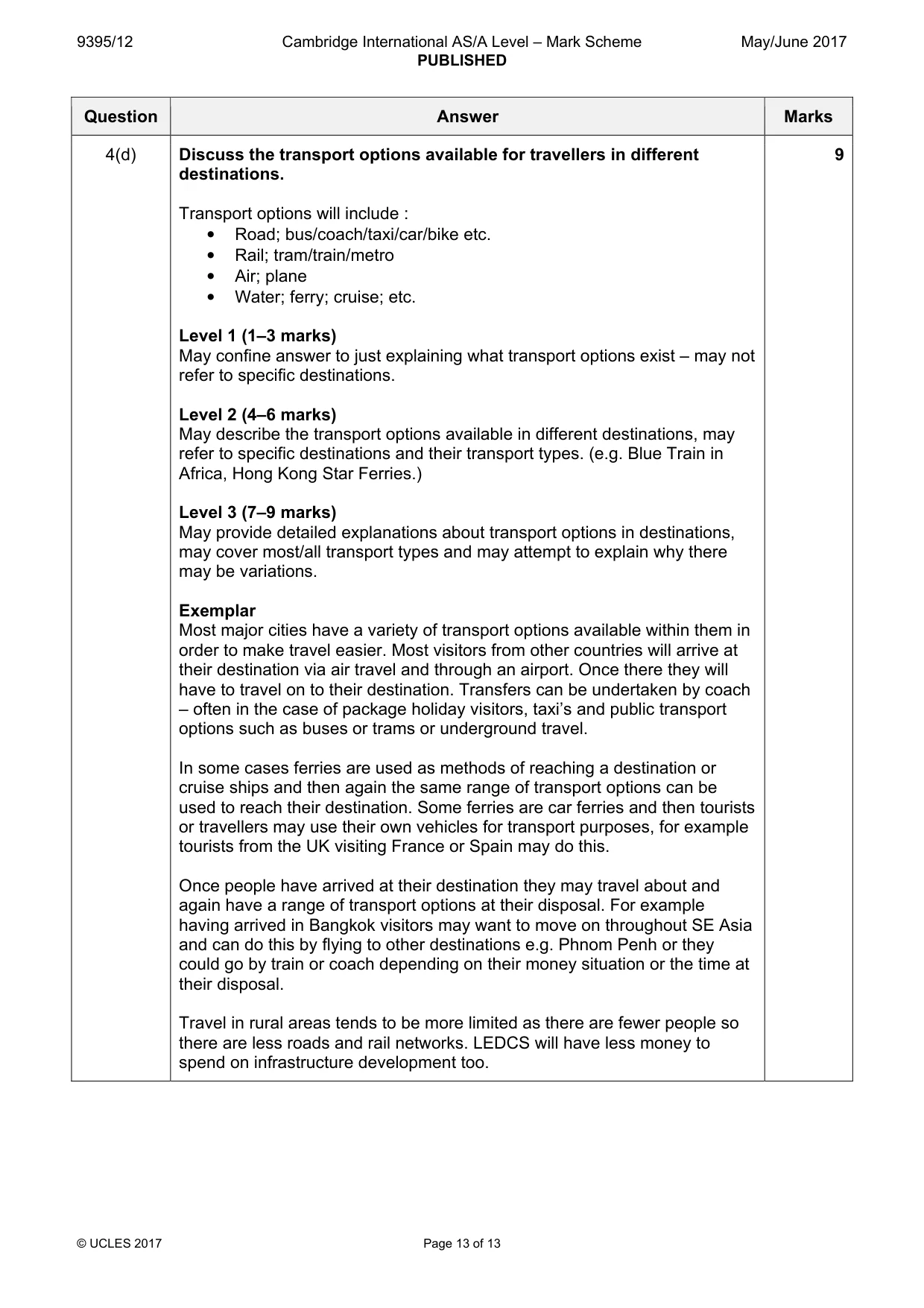
9395/12 Cambridge International AS/A Level – Mark Scheme PUBLISHED May/June 2017 © UCLES 2017 Page 13 of 13 Question Answer Marks 4(d) Discuss the transport options available for travellers in different destinations. Transport options will include : • Road; bus/coach/taxi/car/bike etc. • Rail; tram/train/metro • Air; plane • Water; ferry; cruise; etc. Level 1 (1–3 marks) May confine answer to just explaining what transport options exist – may not refer to specific destinations. Level 2 (4–6 marks) May describe the transport options available in different destinations, may refer to specific destinations and their transport types. (e.g. Blue Train in Africa, Hong Kong Star Ferries.) Level 3 (7–9 marks) May provide detailed explanations about transport options in destinations, may cover most/all transport types and may attempt to explain why there may be variations. Exemplar Most major cities have a variety of transport options available within them in order to make travel easier. Most visitors from other countries will arrive at their destination via air travel and through an airport. Once there they will have to travel on to their destination. Transfers can be undertaken by coach – often in the case of package holiday visitors, taxi’s and public transport options such as buses or trams or underground travel. In some cases ferries are used as methods of reaching a destination or cruise ships and then again the same range of transport options can be used to reach their destination. Some ferries are car ferries and then tourists or travellers may use their own vehicles for transport purposes, for example tourists from the UK visiting France or Spain may do this. Once people have arrived at their destination they may travel about and again have a range of transport options at their disposal. For example having arrived in Bangkok visitors may want to move on throughout SE Asia and can do this by flying to other destinations e.g. Phnom Penh or they could go by train or coach depending on their money situation or the time at their disposal. Travel in rural areas tends to be more limited as there are fewer people so there are less roads and rail networks. LEDCS will have less money to spend on infrastructure development too. 9
What you needed in this session
Cambridge’s own grade thresholds for 2017 May/June, Paper 1 · Variant 2. A higher threshold means an easier paper — the bar moves with how the cohort did.