Cambridge A Level Travel and Tourism 9395 — 2017 May/June Paper 1 · Variant 1
9395/11/M/J/17 · 100 marks · ≈113 min
The question paper and its mark scheme, free to read here and free to download. This is Cambridge’s own paper, exactly as it was sat.
Question paper16 pages



Mark scheme14 pages
Answers below. Sit the paper first if you are practising.
Paper as text
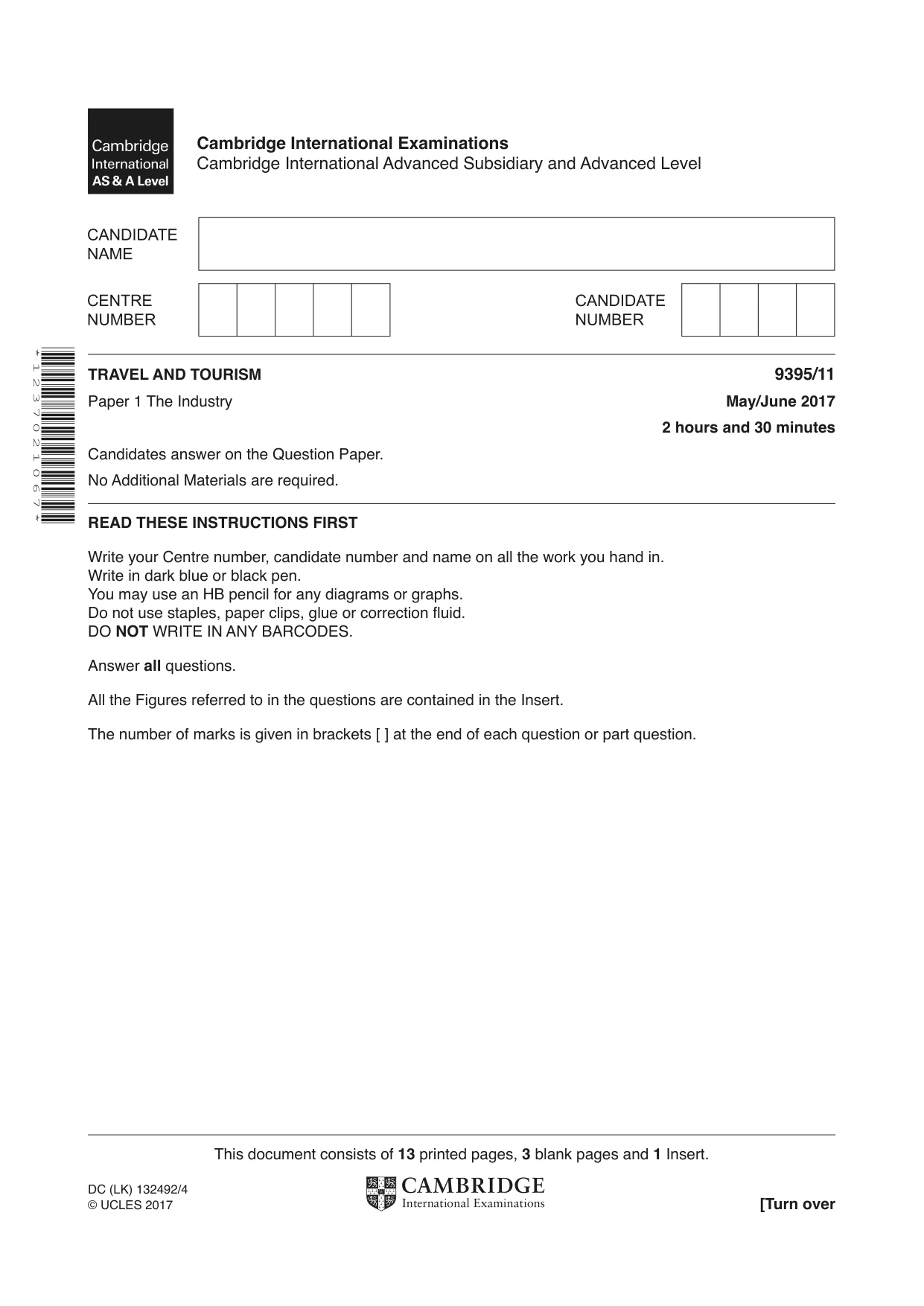
Question paper, page 1
This document consists of 13 printed pages, 3 blank pages and 1 Insert. DC (LK) 132492/4 © UCLES 2017 [Turn over Cambridge International Examinations Cambridge International Advanced Subsidiary and Advanced Level * 1 2 3 7 0 2 1 0 6 7 * TRAVEL AND TOURISM 9395/11 Paper 1 The Industry May/June 2017 2 hours and 30 minutes Candidates answer on the Question Paper. No Additional Materials are required. READ THESE INSTRUCTIONS FIRST Write your Centre number, candidate number and name on all the work you hand in. Write in dark blue or black pen. You may use an HB pencil for any diagrams or graphs. Do not use staples, paper clips, glue or correction fluid. DO NOT WRITE IN ANY BARCODES. Answer all questions. All the Figures referred to in the questions are contained in the Insert. The number of marks is given in brackets [ ] at the end of each question or part question.
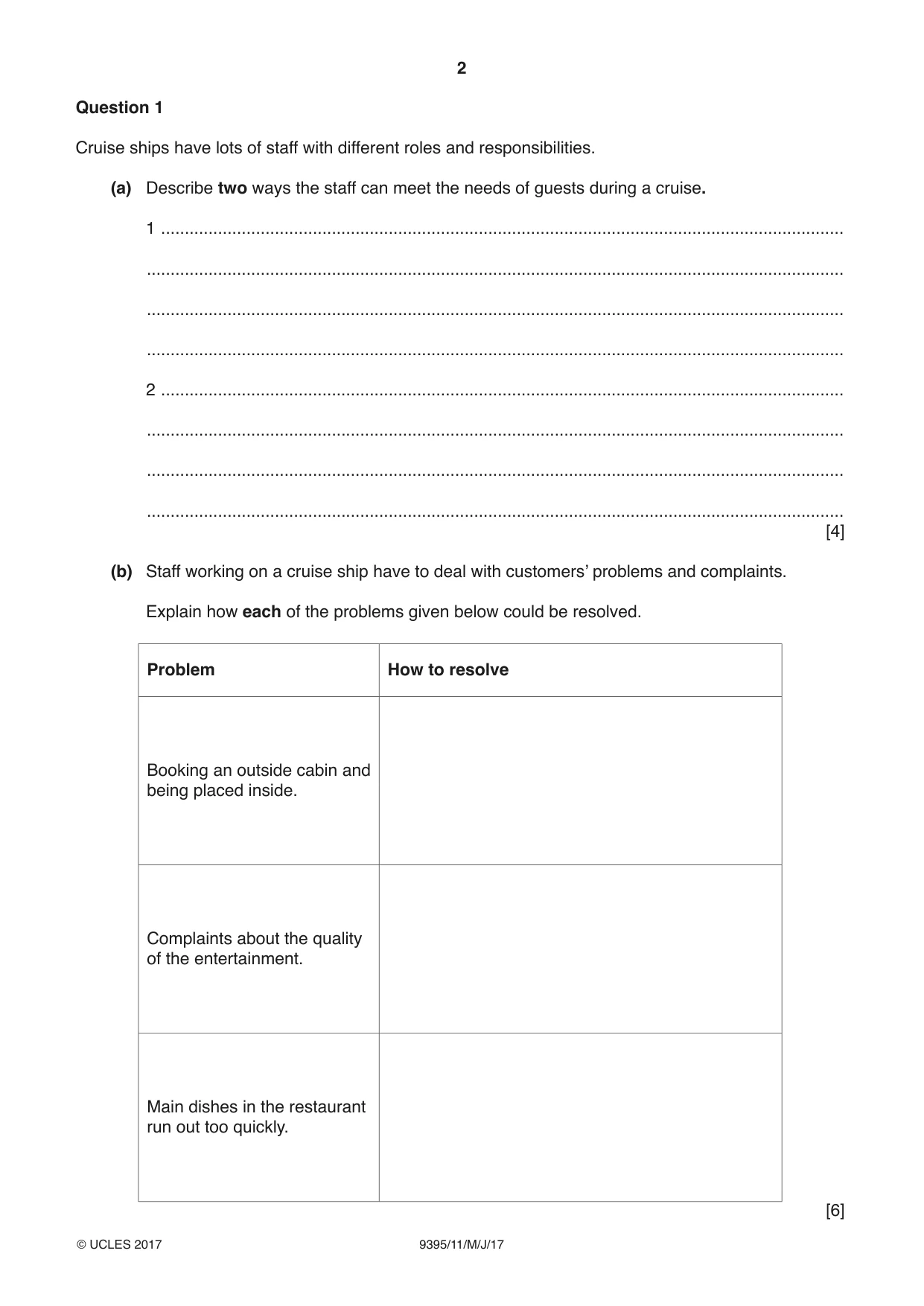
Question paper, page 2
2 9395/11/M/J/17 © UCLES 2017 Question 1 Cruise ships have lots of staff with different roles and responsibilities. (a) Describe two ways the staff can meet the needs of guests during a cruise. 1 … … … … 2 … … … … [4] (b) Staff working on a cruise ship have to deal with customers’ problems and complaints. Explain how each of the problems given below could be resolved. Problem How to resolve Booking an outside cabin and being placed inside. Complaints about the quality of the entertainment. Main dishes in the restaurant run out too quickly. [6]
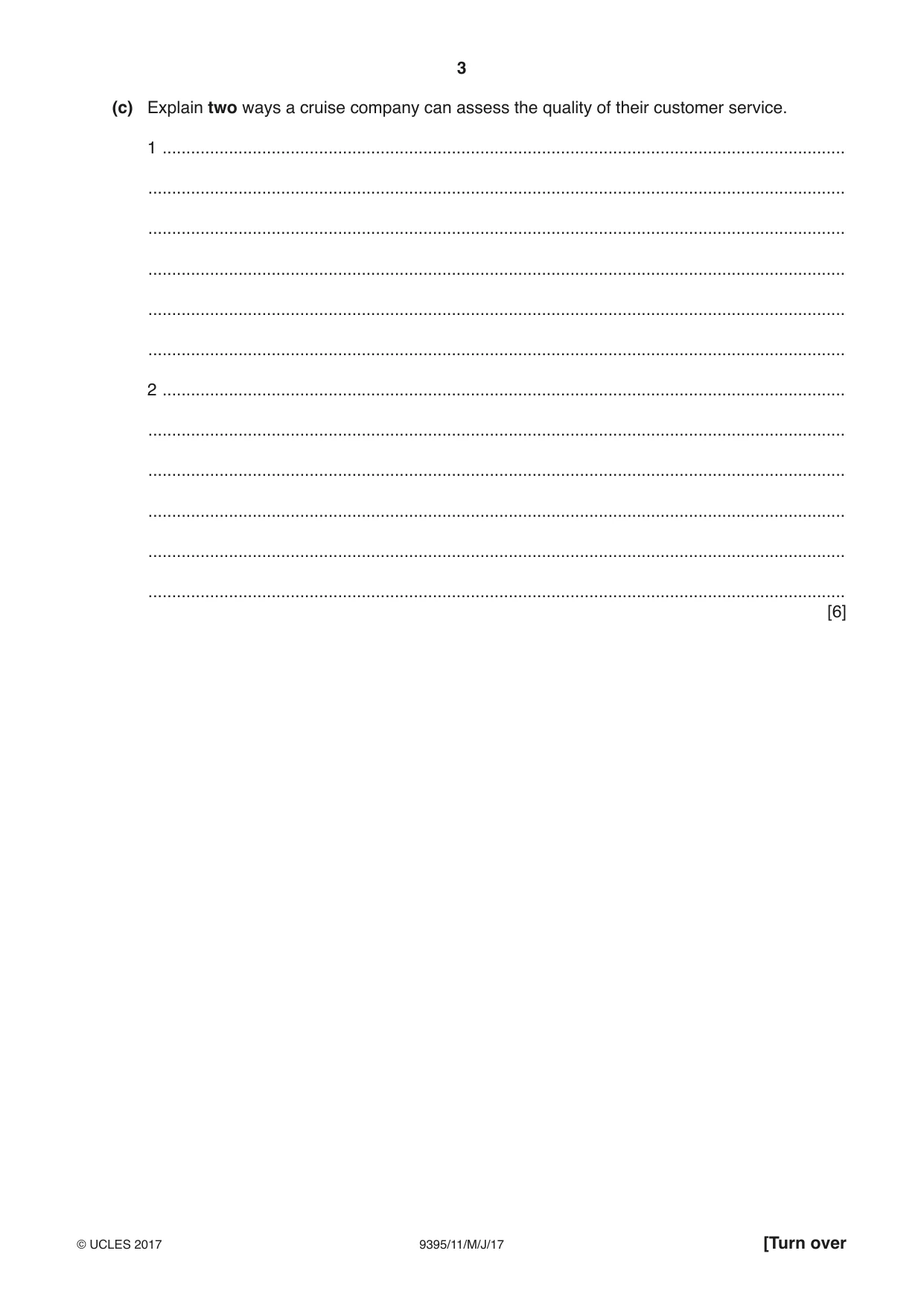
Question paper, page 3
3 9395/11/M/J/17 © UCLES 2017 [Turn over (c) Explain two ways a cruise company can assess the quality of their customer service. 1 … … … … … … 2 … … … … … … [6]
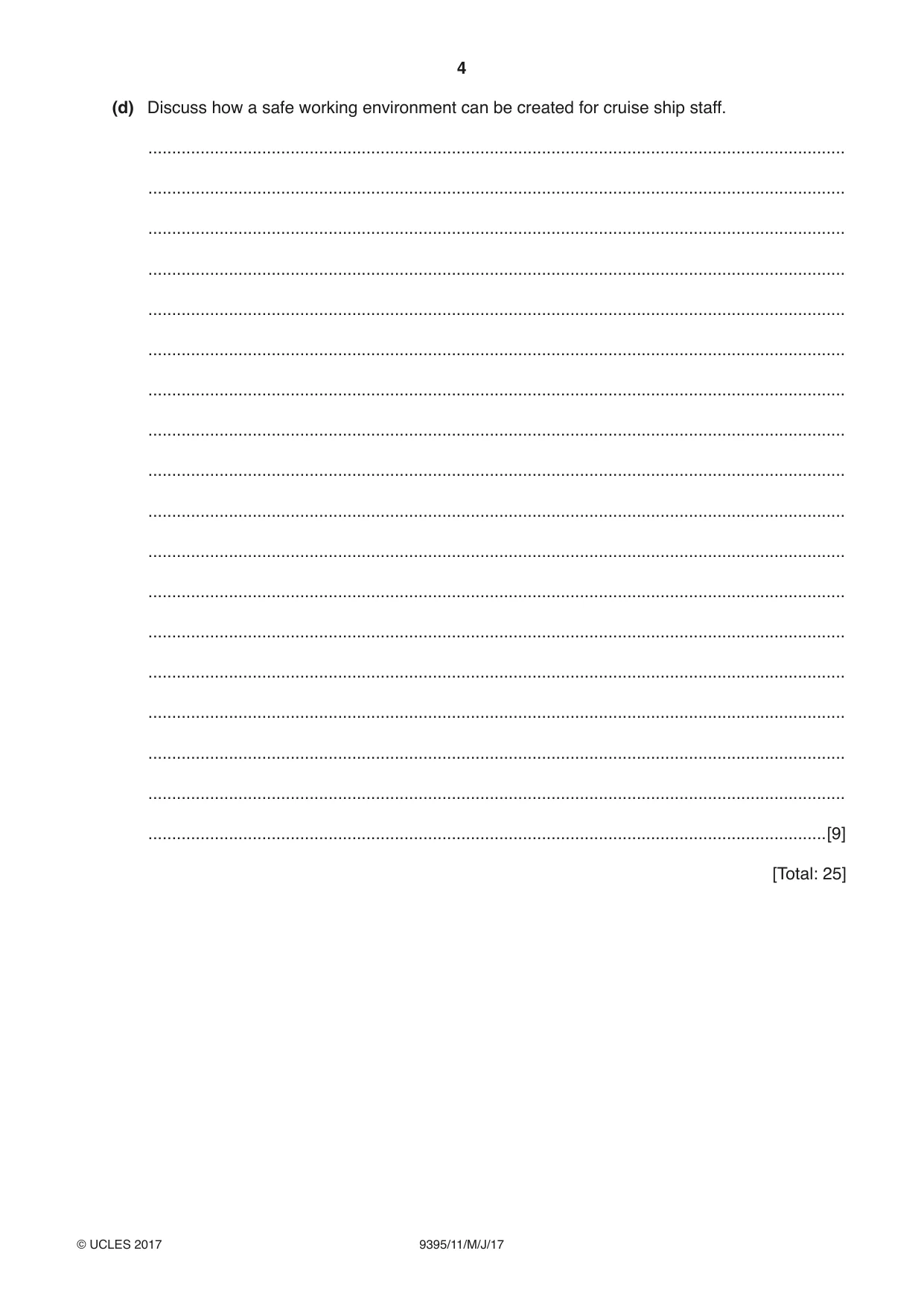
Question paper, page 4
4 9395/11/M/J/17 © UCLES 2017 (d) Discuss how a safe working environment can be created for cruise ship staff. … … … … … … … … … … … … … … … … … …[9] [Total: 25]
Question paper, page 5
5 9395/11/M/J/17 © UCLES 2017 [Turn over Question 2 Refer to Fig. 1 (Insert), information about the number of tourist arrivals to Cambodia. (a) Identify the smallest source market for Cambodia and suggest reasons for this. … … … … … … … …[4] (b) Visitors require information and often use online sources to access it. Describe how three different online sources of information meet the needs of visitors to Cambodia. 1 … … … … 2 … … … … 3 … … … … [6]
Question paper, page 6
6 9395/11/M/J/17 © UCLES 2017 (c) Explain why some visitors may prefer to use a travel agent to book a holiday rather than booking independently. … … … … … … … … … … … …[6]
Question paper, page 7
7 9395/11/M/J/17 © UCLES 2017 [Turn over (d) Assess the impact of political factors on the travel and tourism industry. Use examples to support your answer. … … … … … … … … … … … … … … … … … …[9] [Total: 25]
Question paper, page 8
8 9395/11/M/J/17 © UCLES 2017 Question 3 Refer to Fig. 2 (Insert), a map of a purpose built resort in Singapore. (a) (i) Define the term ‘purpose built resort’. … … … …[2] (ii) State two different purpose built resorts. 1 … 2 … [2] (b) Explain the advantages of a purpose built resort to a family with two children, aged 5 and 12. … … … … … … … … … … … …[6]
Question paper, page 9
9 9395/11/M/J/17 © UCLES 2017 [Turn over (c) Explain the disadvantages of purpose built resorts. … … … … … … … … … … … …[6]
Question paper, page 10
10 9395/11/M/J/17 © UCLES 2017 (d) Seasonality may cause problems for purpose built resorts. Explain how the issue of seasonality may be overcome. … … … … … … … … … … … … … … … … … …[9] [Total: 25]
Question paper, page 11
11 9395/11/M/J/17 © UCLES 2017 [Turn over Question 4 Refer to Fig. 3 (Insert), information about abc Tours, a tour operator. (a) (i) Identify two ancillary products or services offered by abc Tours. 1 … 2 … [2] (ii) Identify two different holiday types offered by abc Tours. 1 … 2 … [2] (b) Explain three reasons why tour operators offer ancillary products and services. 1 … … … … 2 … … … … 3 … … … … [6]
Question paper, page 12
12 9395/11/M/J/17 © UCLES 2017 (c) abc Tours offer a variety of specialised holidays. Explain how specialised tourism differs from mass tourism. … … … … … … … … … … … …[6]
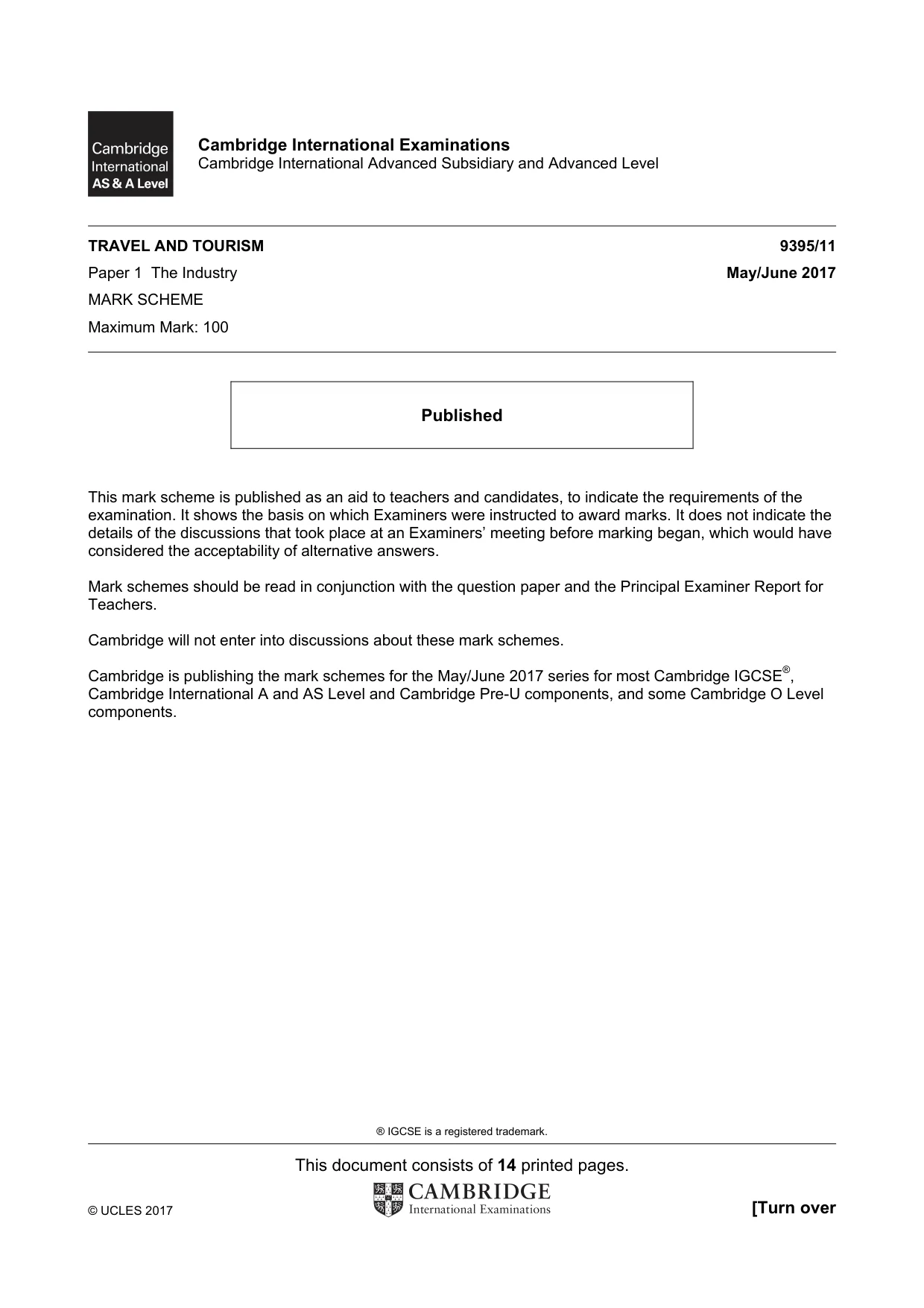
Question paper, page 13
13 9395/11/M/J/17 © UCLES 2017 (d) Assess the impact of technological change on tour operators. … … … … … … … … … … … … … … … … … …[9] [Total: 25]
Question paper, page 14
14 9395/11/M/J/17 © UCLES 2017 BLANK PAGE
Question paper, page 15
15 9395/11/M/J/17 © UCLES 2017 BLANK PAGE
Question paper, page 16
16 9395/11/M/J/17 © UCLES 2017 Permission to reproduce items where third-party owned material protected by copyright is included has been sought and cleared where possible. Every reasonable effort has been made by the publisher (UCLES) to trace copyright holders, but if any items requiring clearance have unwittingly been included, the publisher will be pleased to make amends at the earliest possible opportunity. To avoid the issue of disclosure of answer-related information to candidates, all copyright acknowledgements are reproduced online in the Cambridge International Examinations Copyright Acknowledgements Booklet. This is produced for each series of examinations and is freely available to download at www.cie.org.uk after the live examination series. Cambridge International Examinations is part of the Cambridge Assessment Group. Cambridge Assessment is the brand name of University of Cambridge Local Examinations Syndicate (UCLES), which is itself a department of the University of Cambridge. BLANK PAGE
Mark scheme, page 1
® IGCSE is a registered trademark. This document consists of 14 printed pages. © UCLES 2017 [Turn over Cambridge International Examinations Cambridge International Advanced Subsidiary and Advanced Level TRAVEL AND TOURISM 9395/11 Paper 1 The Industry May/June 2017 MARK SCHEME Maximum Mark: 100 Published This mark scheme is published as an aid to teachers and candidates, to indicate the requirements of the examination. It shows the basis on which Examiners were instructed to award marks. It does not indicate the details of the discussions that took place at an Examiners’ meeting before marking began, which would have considered the acceptability of alternative answers. Mark schemes should be read in conjunction with the question paper and the Principal Examiner Report for Teachers. Cambridge will not enter into discussions about these mark schemes. Cambridge is publishing the mark schemes for the May/June 2017 series for most Cambridge IGCSE®, Cambridge International A and AS Level and Cambridge Pre-U components, and some Cambridge O Level components.
Mark scheme, page 2
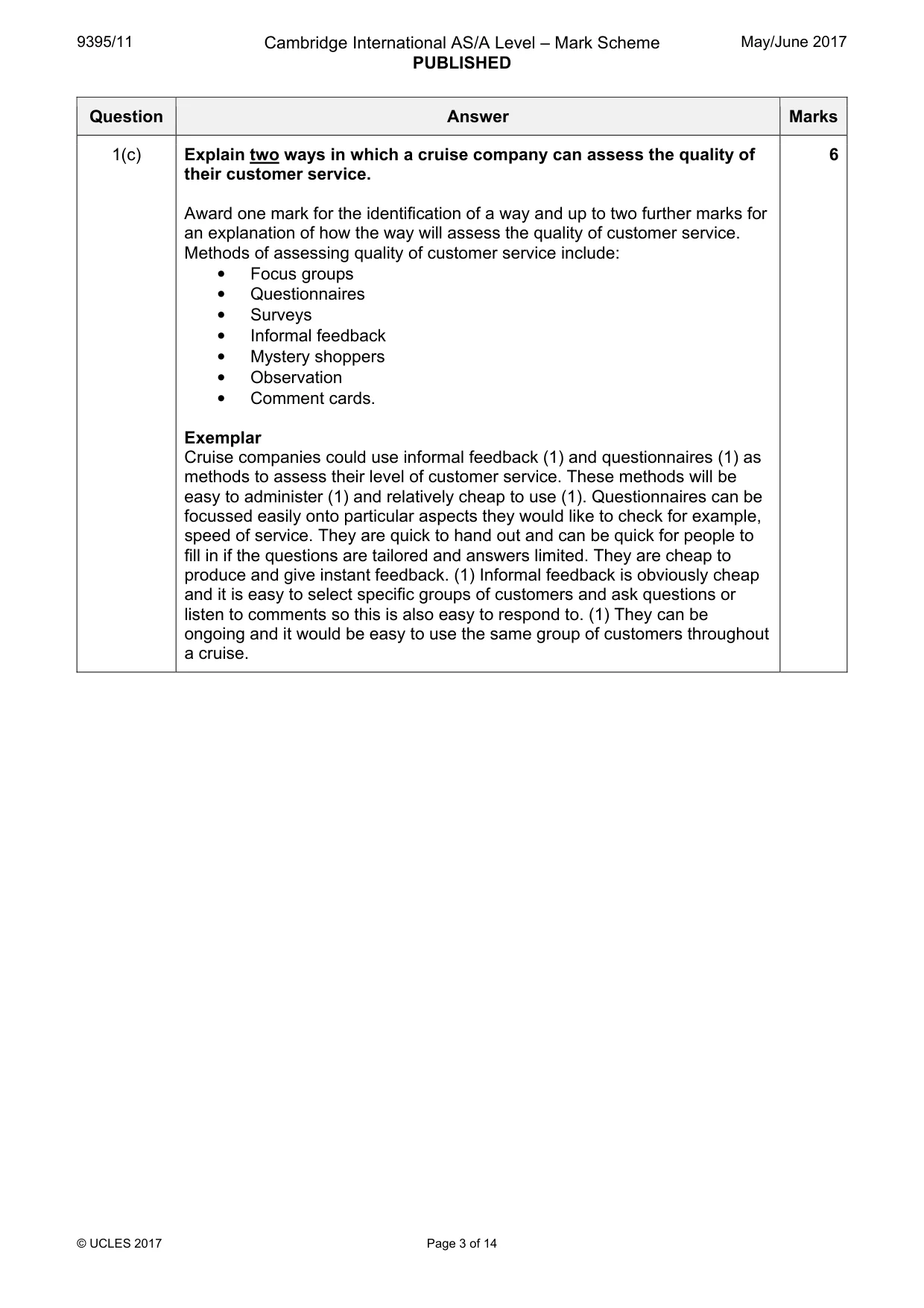
9395/11 Cambridge International AS/A Level – Mark Scheme PUBLISHED May/June 2017 © UCLES 2017 Page 2 of 14 Question Answer Marks 1(a) Describe two ways the staff can meet the needs of guests during a cruise. Award one mark for identification of the way and a second for expansion explaining how this meets a need. Any two relevant ways including any from: • Animation teams (1) providing entertainment for children (1) • Restaurant advice (1) giving guests advice on ingredients/menus (1) • Advice given on health and safety issues (1) such as putting up signage or giving briefings to ensure passenger safety (1) 4 1(b) Explain how each of the problems given below could be resolved. Award up to two marks for each method of resolution. Accept any reasonable response. Problem How to Resolve Booking an outside cabin and being placed inside. Staff could offer the customers money off vouchers for a future cruise or a free excursion. Offers may depend upon the severity of the problem for example a simple error may result in a Captain’s table meal. Complaints about the quality of the entertainment. The staff would have to reassure customers about entertainment and ensure that the customer would be aware that they would pass on complaints. For the more simple issues they could offer better seats for performances. Main dishes in the restaurant run out too quickly. Kitchen staff could use a variety of techniques such as altering menus, passing on information to the kitchen and suggesting that a larger variety of food be produced. 6
Mark scheme, page 3
9395/11 Cambridge International AS/A Level – Mark Scheme PUBLISHED May/June 2017 © UCLES 2017 Page 3 of 14 Question Answer Marks 1(c) Explain two ways in which a cruise company can assess the quality of their customer service. Award one mark for the identification of a way and up to two further marks for an explanation of how the way will assess the quality of customer service. Methods of assessing quality of customer service include: • Focus groups • Questionnaires • Surveys • Informal feedback • Mystery shoppers • Observation • Comment cards. Exemplar Cruise companies could use informal feedback (1) and questionnaires (1) as methods to assess their level of customer service. These methods will be easy to administer (1) and relatively cheap to use (1). Questionnaires can be focussed easily onto particular aspects they would like to check for example, speed of service. They are quick to hand out and can be quick for people to fill in if the questions are tailored and answers limited. They are cheap to produce and give instant feedback. (1) Informal feedback is obviously cheap and it is easy to select specific groups of customers and ask questions or listen to comments so this is also easy to respond to. (1) They can be ongoing and it would be easy to use the same group of customers throughout a cruise. 6
Mark scheme, page 4
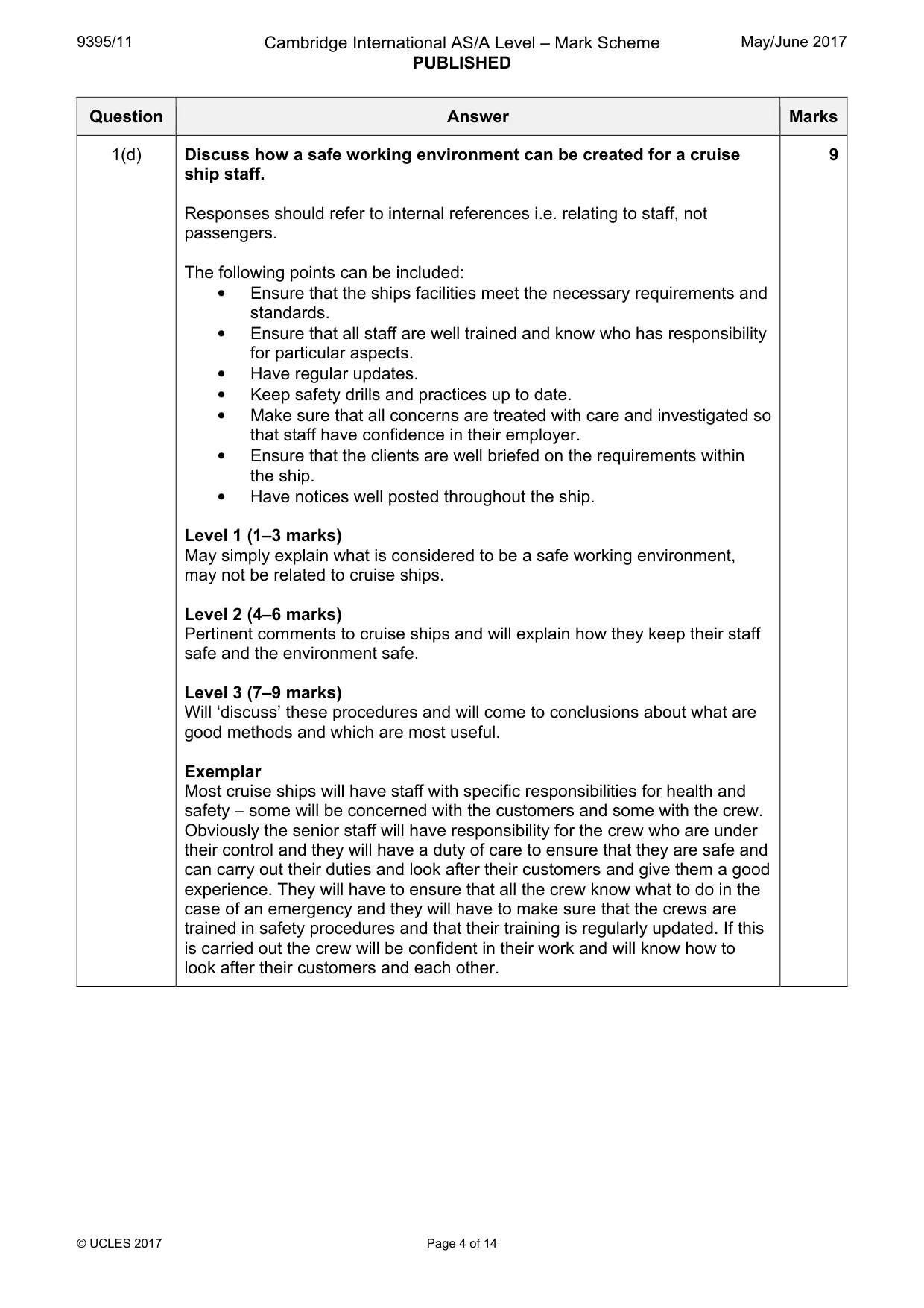
9395/11 Cambridge International AS/A Level – Mark Scheme PUBLISHED May/June 2017 © UCLES 2017 Page 4 of 14 Question Answer Marks 1(d) Discuss how a safe working environment can be created for a cruise ship staff. Responses should refer to internal references i.e. relating to staff, not passengers. The following points can be included: • Ensure that the ships facilities meet the necessary requirements and standards. • Ensure that all staff are well trained and know who has responsibility for particular aspects. • Have regular updates. • Keep safety drills and practices up to date. • Make sure that all concerns are treated with care and investigated so that staff have confidence in their employer. • Ensure that the clients are well briefed on the requirements within the ship. • Have notices well posted throughout the ship. Level 1 (1–3 marks) May simply explain what is considered to be a safe working environment, may not be related to cruise ships. Level 2 (4–6 marks) Pertinent comments to cruise ships and will explain how they keep their staff safe and the environment safe. Level 3 (7–9 marks) Will ‘discuss’ these procedures and will come to conclusions about what are good methods and which are most useful. Exemplar Most cruise ships will have staff with specific responsibilities for health and safety – some will be concerned with the customers and some with the crew. Obviously the senior staff will have responsibility for the crew who are under their control and they will have a duty of care to ensure that they are safe and can carry out their duties and look after their customers and give them a good experience. They will have to ensure that all the crew know what to do in the case of an emergency and they will have to make sure that the crews are trained in safety procedures and that their training is regularly updated. If this is carried out the crew will be confident in their work and will know how to look after their customers and each other. 9
Mark scheme, page 5
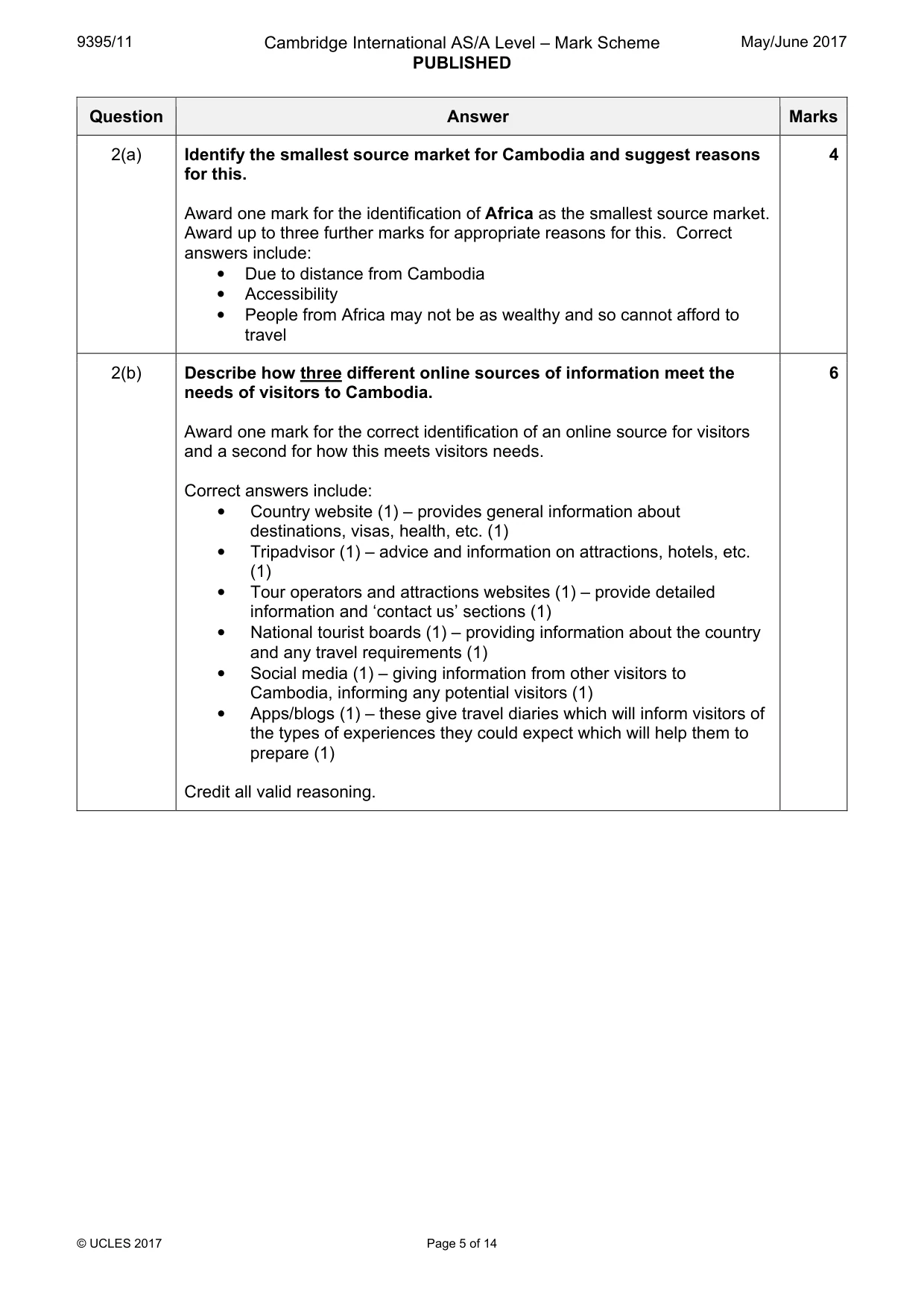
9395/11 Cambridge International AS/A Level – Mark Scheme PUBLISHED May/June 2017 © UCLES 2017 Page 5 of 14 Question Answer Marks 2(a) Identify the smallest source market for Cambodia and suggest reasons for this. Award one mark for the identification of Africa as the smallest source market. Award up to three further marks for appropriate reasons for this. Correct answers include: • Due to distance from Cambodia • Accessibility • People from Africa may not be as wealthy and so cannot afford to travel 4 2(b) Describe how three different online sources of information meet the needs of visitors to Cambodia. Award one mark for the correct identification of an online source for visitors and a second for how this meets visitors needs. Correct answers include: • Country website (1) – provides general information about destinations, visas, health, etc. (1) • Tripadvisor (1) – advice and information on attractions, hotels, etc. (1) • Tour operators and attractions websites (1) – provide detailed information and ‘contact us’ sections (1) • National tourist boards (1) – providing information about the country and any travel requirements (1) • Social media (1) – giving information from other visitors to Cambodia, informing any potential visitors (1) • Apps/blogs (1) – these give travel diaries which will inform visitors of the types of experiences they could expect which will help them to prepare (1) Credit all valid reasoning. 6
Mark scheme, page 6
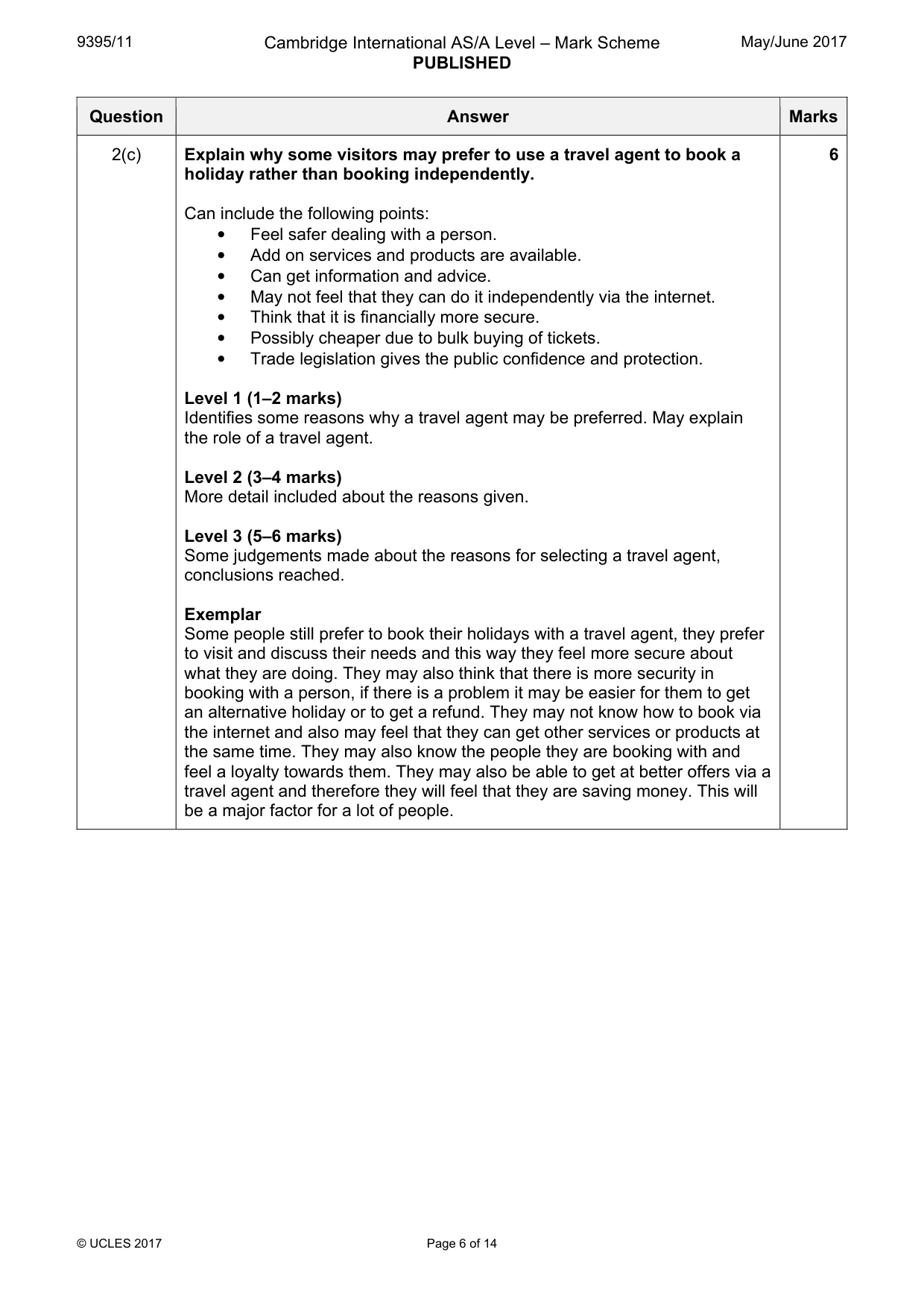
9395/11 Cambridge International AS/A Level – Mark Scheme PUBLISHED May/June 2017 © UCLES 2017 Page 6 of 14 Question Answer Marks 2(c) Explain why some visitors may prefer to use a travel agent to book a holiday rather than booking independently. Can include the following points: • Feel safer dealing with a person. • Add on services and products are available. • Can get information and advice. • May not feel that they can do it independently via the internet. • Think that it is financially more secure. • Possibly cheaper due to bulk buying of tickets. • Trade legislation gives the public confidence and protection. Level 1 (1–2 marks) Identifies some reasons why a travel agent may be preferred. May explain the role of a travel agent. Level 2 (3–4 marks) More detail included about the reasons given. Level 3 (5–6 marks) Some judgements made about the reasons for selecting a travel agent, conclusions reached. Exemplar Some people still prefer to book their holidays with a travel agent, they prefer to visit and discuss their needs and this way they feel more secure about what they are doing. They may also think that there is more security in booking with a person, if there is a problem it may be easier for them to get an alternative holiday or to get a refund. They may not know how to book via the internet and also may feel that they can get other services or products at the same time. They may also know the people they are booking with and feel a loyalty towards them. They may also be able to get at better offers via a travel agent and therefore they will feel that they are saving money. This will be a major factor for a lot of people. 6
Mark scheme, page 7
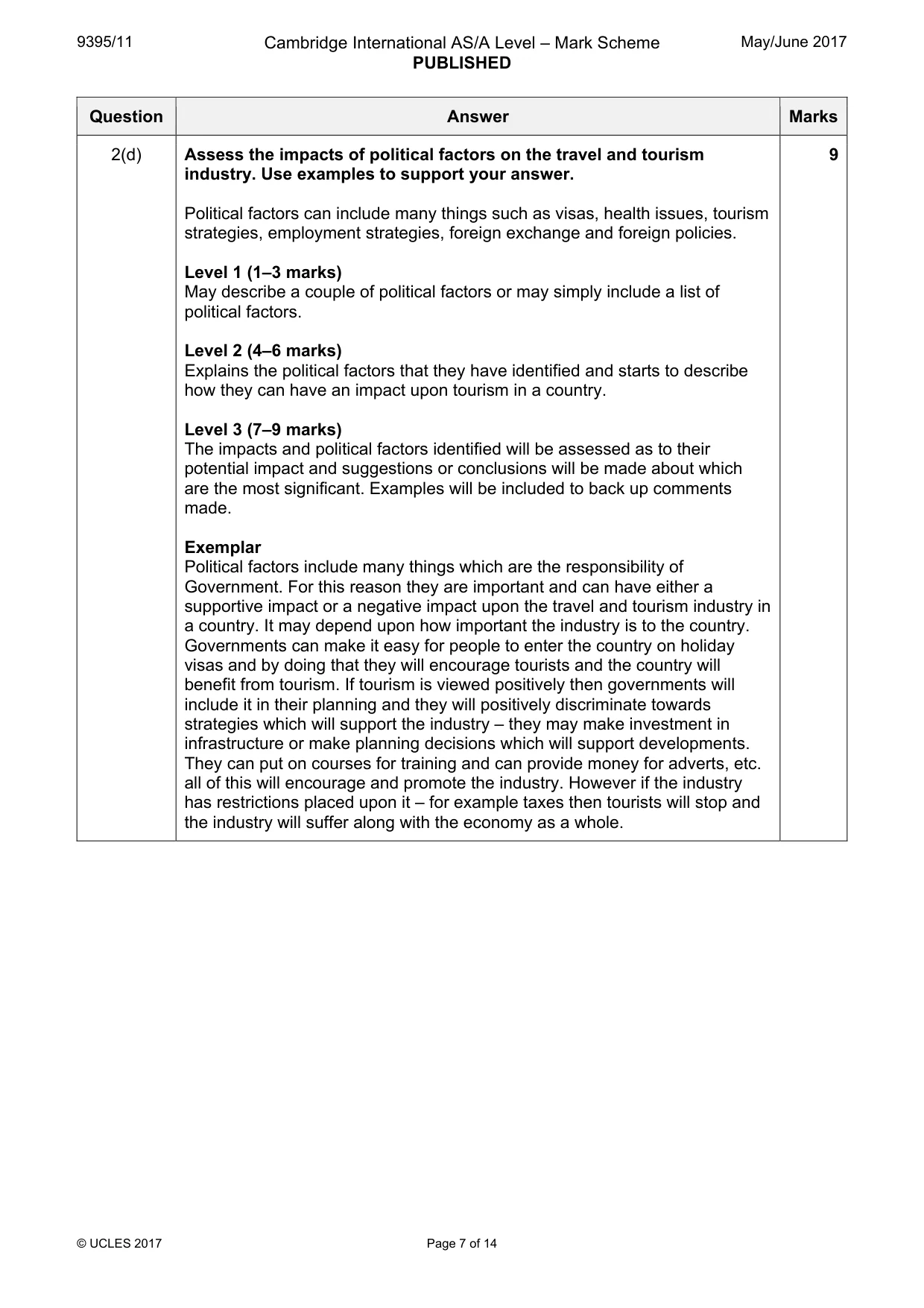
9395/11 Cambridge International AS/A Level – Mark Scheme PUBLISHED May/June 2017 © UCLES 2017 Page 7 of 14 Question Answer Marks 2(d) Assess the impacts of political factors on the travel and tourism industry. Use examples to support your answer. Political factors can include many things such as visas, health issues, tourism strategies, employment strategies, foreign exchange and foreign policies. Level 1 (1–3 marks) May describe a couple of political factors or may simply include a list of political factors. Level 2 (4–6 marks) Explains the political factors that they have identified and starts to describe how they can have an impact upon tourism in a country. Level 3 (7–9 marks) The impacts and political factors identified will be assessed as to their potential impact and suggestions or conclusions will be made about which are the most significant. Examples will be included to back up comments made. Exemplar Political factors include many things which are the responsibility of Government. For this reason they are important and can have either a supportive impact or a negative impact upon the travel and tourism industry in a country. It may depend upon how important the industry is to the country. Governments can make it easy for people to enter the country on holiday visas and by doing that they will encourage tourists and the country will benefit from tourism. If tourism is viewed positively then governments will include it in their planning and they will positively discriminate towards strategies which will support the industry – they may make investment in infrastructure or make planning decisions which will support developments. They can put on courses for training and can provide money for adverts, etc. all of this will encourage and promote the industry. However if the industry has restrictions placed upon it – for example taxes then tourists will stop and the industry will suffer along with the economy as a whole. 9
Mark scheme, page 8
9395/11 Cambridge International AS/A Level – Mark Scheme PUBLISHED May/June 2017 © UCLES 2017 Page 8 of 14 Question Answer Marks 3(a)(i) Define the term ‘purpose built resort’. Attractions which have been purposely built to attract tourists into the area e.g. Disneyland, Universal Studios, etc. 2 3(a)(ii) State two different purpose built resorts. Correct answers include: Universal Studios Disneyland Harry Potter World 2 3(b) Explain the advantages of a purpose built resort to a family with two children aged 5 and 12. 5 yr old attractions are in one area so ease of access e.g. aquariums, Universal Studios and also the hotels are near there so not far to walk. 12 yr old attractions are located there too so both sets of children can be entertained easily in one place for one price. Level 1 (1–2 marks) Basic description of the advantages. Level 2 (3–4 marks) Explanation of advantages with possible comments about them. Mention of 5 and 12 year olds for higher marks. Level 3 (5–6 marks) Good explanation of the advantages includes reference to the different ages of children. May include a conclusion. 6
Mark scheme, page 9
9395/11 Cambridge International AS/A Level – Mark Scheme PUBLISHED May/June 2017 © UCLES 2017 Page 9 of 14 Question Answer Marks 3(c) Explain the disadvantages of purpose built resorts. Can include: • Expense of entry especially for a family or group at peak times. • It is a large area and would be impossible to see all of it in one day. • Queues are likely to be long at peak times and children don’t like waiting. • Large numbers of people will be about. • Accept responses which may refer to host community (e.g. environment, traffic problems). Likewise, disadvantages to the organisation. • Once in there you see what the organisation wants you to see – the experience is not necessarily authentic. Level 1 (1–2 marks) Disadvantages may be listed, no explanations of these are given. Level 2 (3–4 marks) Some attempt at explanations of the disadvantages but these are not detailed. Level 3 (5–6 marks) Detailed explanations of the disadvantages will be made. Good understanding of the disadvantages will be evident. Exemplar Purpose built resorts can have a number of disadvantages especially for families – first of all it can be every expensive to take a family into one during the peak times. There is the expense of the initial ticket and also the food and drink or souvenirs to be bought once in there. They can be very busy in peak times and a lot of time can be spent in queues rather than using the facilities. This is because lots of people will go to them. They are usually very large areas too and again a lot of time can be spent travelling around rather than using the facilities. Once you are in there you see what the park wants you to see so you may not see the true area you are in and therefore the experience is a false one as you will not experience the local culture. 6
Mark scheme, page 10
9395/11 Cambridge International AS/A Level – Mark Scheme PUBLISHED May/June 2017 © UCLES 2017 Page 10 of 14 Question Answer Marks 3(d) Explain how the issue of seasonality may be overcome. There should be some mention of what type of problems seasonality can cause along with an explanation of ‘seasonality’. Note, this does not relate to seasons as weather based seasons. For example: at peak times destinations will be busy and during cold seasons or other times of the year they will not be busy – for example during school terms or in winter or monsoon season. These issues mean that income is not regular and problems can be caused. Problems to focus on in order to overcome the issue of seasonality include staffing i.e. how many staff and when to have them work, how many hours to stay open, etc. how many temporary staff to employ? Then there should be an attempt to explain how these issues can be overcome – the use of special offers, themed events and special attractions at selected times of the year which can be well publicised – attempts made to get at different groups throughout the year. Level 1 (1–3 marks) May just offer a list of problems or brief descriptions. Level 2 (4–6 marks) Likely to identify problems and suggest an explanation plus some solutions. Level 3 (7–9 marks) May explain better methods to deal with identified problems and may support their answers with examples, some conclusions may be likely at this level. Exemplar Seasonality refers to the change in demand for tourism products and services throughout the year. It doesn’t matter where you are in the world demand will always vary throughout the year. It may be due to climatic influences for example wet or cold weather will change demand for coastal resorts or it may be due to other influences such as school term dates. Seasonality causes problems for the suppliers of tourism products as their products and services cannot be stored for use at a later date e.g. seats on an aircraft flight. Suppliers will not know what to supply and how many customers to expect so will have problems determining staff levels too. Suppliers will try to minimise the impacts by trying to influence demand by offering special prices or packages and events to attract customers throughout the year. They may reduce prices at the ‘shoulder’ months to try and attract a different range of customer and they can put on special offers during school term time to attract school groups. By doing this it allows them to plan and to have an idea as to the viability of their business and whether investments are worthwhile. 9
Mark scheme, page 11
9395/11 Cambridge International AS/A Level – Mark Scheme PUBLISHED May/June 2017 © UCLES 2017 Page 11 of 14 Question Answer Marks 4(a)(i) Identify two ancillary products or services offered by ABC Tours. Any two from: insurance; foreign exchange; excursions, car hire. 2 4(a)(ii) Identify two different holiday types offered by ABC Tours. Any two from: cruises; tours; fly drive, skiing, hotels. 2 4(b) Explain three reasons why tour operators offer ancillary products and services. Award one mark for identification of the reason and a second mark for expansion. Correct answers include: • Tour operators will offer ancillary services because it will add to their income (1) because people see that they are on offer when they book their flight or holiday and will book as it is easier for them. (1) • If they have these services on offer they may attract new customers or repeat customers the next time they book (1) because they were satisfied that they got a good deal. (1) • If they can offer a wide variety of services to their customers at reasonable prices then people will buy them (1) and this will increase their market share (1). • Customers see that they can purchase all they need for their holiday (1) which shows that this is a good marketing tool because they will buy them alongside their flight or holiday. (1) 6
Mark scheme, page 12
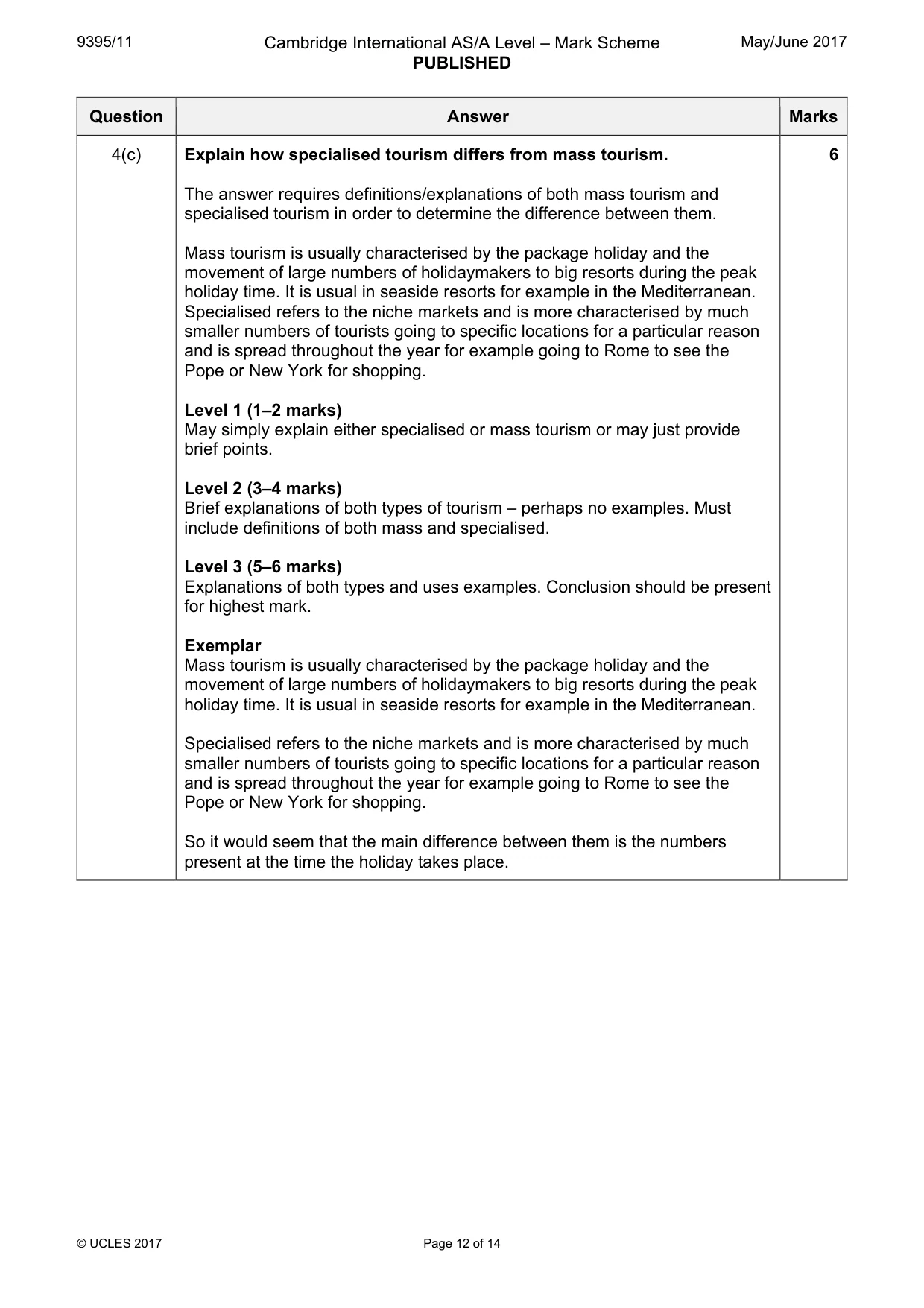
9395/11 Cambridge International AS/A Level – Mark Scheme PUBLISHED May/June 2017 © UCLES 2017 Page 12 of 14 Question Answer Marks 4(c) Explain how specialised tourism differs from mass tourism. The answer requires definitions/explanations of both mass tourism and specialised tourism in order to determine the difference between them. Mass tourism is usually characterised by the package holiday and the movement of large numbers of holidaymakers to big resorts during the peak holiday time. It is usual in seaside resorts for example in the Mediterranean. Specialised refers to the niche markets and is more characterised by much smaller numbers of tourists going to specific locations for a particular reason and is spread throughout the year for example going to Rome to see the Pope or New York for shopping. Level 1 (1–2 marks) May simply explain either specialised or mass tourism or may just provide brief points. Level 2 (3–4 marks) Brief explanations of both types of tourism – perhaps no examples. Must include definitions of both mass and specialised. Level 3 (5–6 marks) Explanations of both types and uses examples. Conclusion should be present for highest mark. Exemplar Mass tourism is usually characterised by the package holiday and the movement of large numbers of holidaymakers to big resorts during the peak holiday time. It is usual in seaside resorts for example in the Mediterranean. Specialised refers to the niche markets and is more characterised by much smaller numbers of tourists going to specific locations for a particular reason and is spread throughout the year for example going to Rome to see the Pope or New York for shopping. So it would seem that the main difference between them is the numbers present at the time the holiday takes place. 6
Mark scheme, page 13
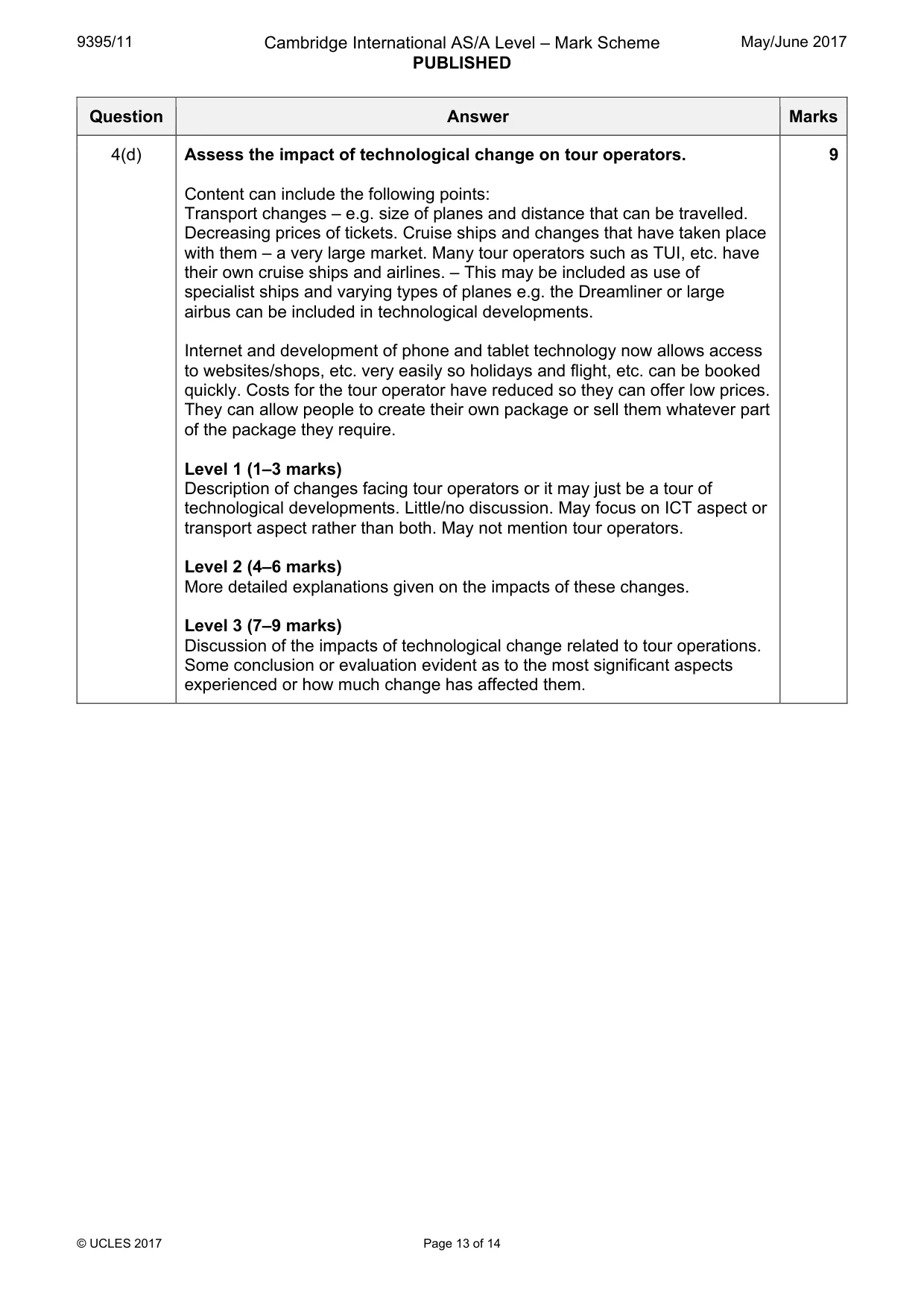
9395/11 Cambridge International AS/A Level – Mark Scheme PUBLISHED May/June 2017 © UCLES 2017 Page 13 of 14 Question Answer Marks 4(d) Assess the impact of technological change on tour operators. Content can include the following points: Transport changes – e.g. size of planes and distance that can be travelled. Decreasing prices of tickets. Cruise ships and changes that have taken place with them – a very large market. Many tour operators such as TUI, etc. have their own cruise ships and airlines. – This may be included as use of specialist ships and varying types of planes e.g. the Dreamliner or large airbus can be included in technological developments. Internet and development of phone and tablet technology now allows access to websites/shops, etc. very easily so holidays and flight, etc. can be booked quickly. Costs for the tour operator have reduced so they can offer low prices. They can allow people to create their own package or sell them whatever part of the package they require. Level 1 (1–3 marks) Description of changes facing tour operators or it may just be a tour of technological developments. Little/no discussion. May focus on ICT aspect or transport aspect rather than both. May not mention tour operators. Level 2 (4–6 marks) More detailed explanations given on the impacts of these changes. Level 3 (7–9 marks) Discussion of the impacts of technological change related to tour operations. Some conclusion or evaluation evident as to the most significant aspects experienced or how much change has affected them. 9
Mark scheme, page 14
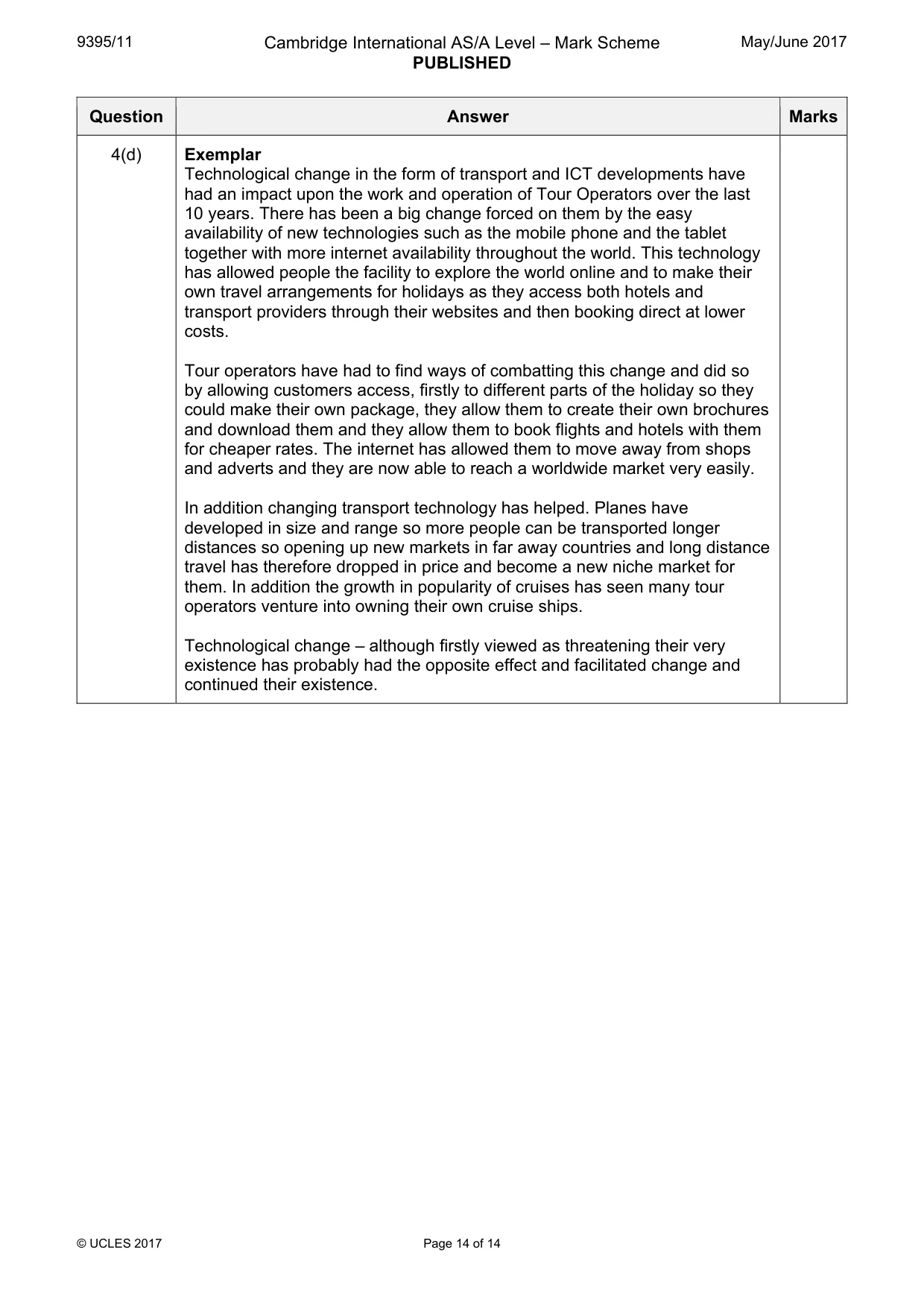
9395/11 Cambridge International AS/A Level – Mark Scheme PUBLISHED May/June 2017 © UCLES 2017 Page 14 of 14 Question Answer Marks 4(d) Exemplar Technological change in the form of transport and ICT developments have had an impact upon the work and operation of Tour Operators over the last 10 years. There has been a big change forced on them by the easy availability of new technologies such as the mobile phone and the tablet together with more internet availability throughout the world. This technology has allowed people the facility to explore the world online and to make their own travel arrangements for holidays as they access both hotels and transport providers through their websites and then booking direct at lower costs. Tour operators have had to find ways of combatting this change and did so by allowing customers access, firstly to different parts of the holiday so they could make their own package, they allow them to create their own brochures and download them and they allow them to book flights and hotels with them for cheaper rates. The internet has allowed them to move away from shops and adverts and they are now able to reach a worldwide market very easily. In addition changing transport technology has helped. Planes have developed in size and range so more people can be transported longer distances so opening up new markets in far away countries and long distance travel has therefore dropped in price and become a new niche market for them. In addition the growth in popularity of cruises has seen many tour operators venture into owning their own cruise ships. Technological change – although firstly viewed as threatening their very existence has probably had the opposite effect and facilitated change and continued their existence.
What you needed in this session
Cambridge’s own grade thresholds for 2017 May/June, Paper 1 · Variant 1. A higher threshold means an easier paper — the bar moves with how the cohort did.