Cambridge A Level Travel and Tourism 9395 — 2016 Oct/Nov Paper 1 · Variant 2
9395/12/O/N/16
The question paper and its mark scheme, free to read here and free to download. This is Cambridge’s own paper, exactly as it was sat.
Question paper16 pages



Mark scheme9 pages
Answers below. Sit the paper first if you are practising.
Paper as text
Question paper, page 1
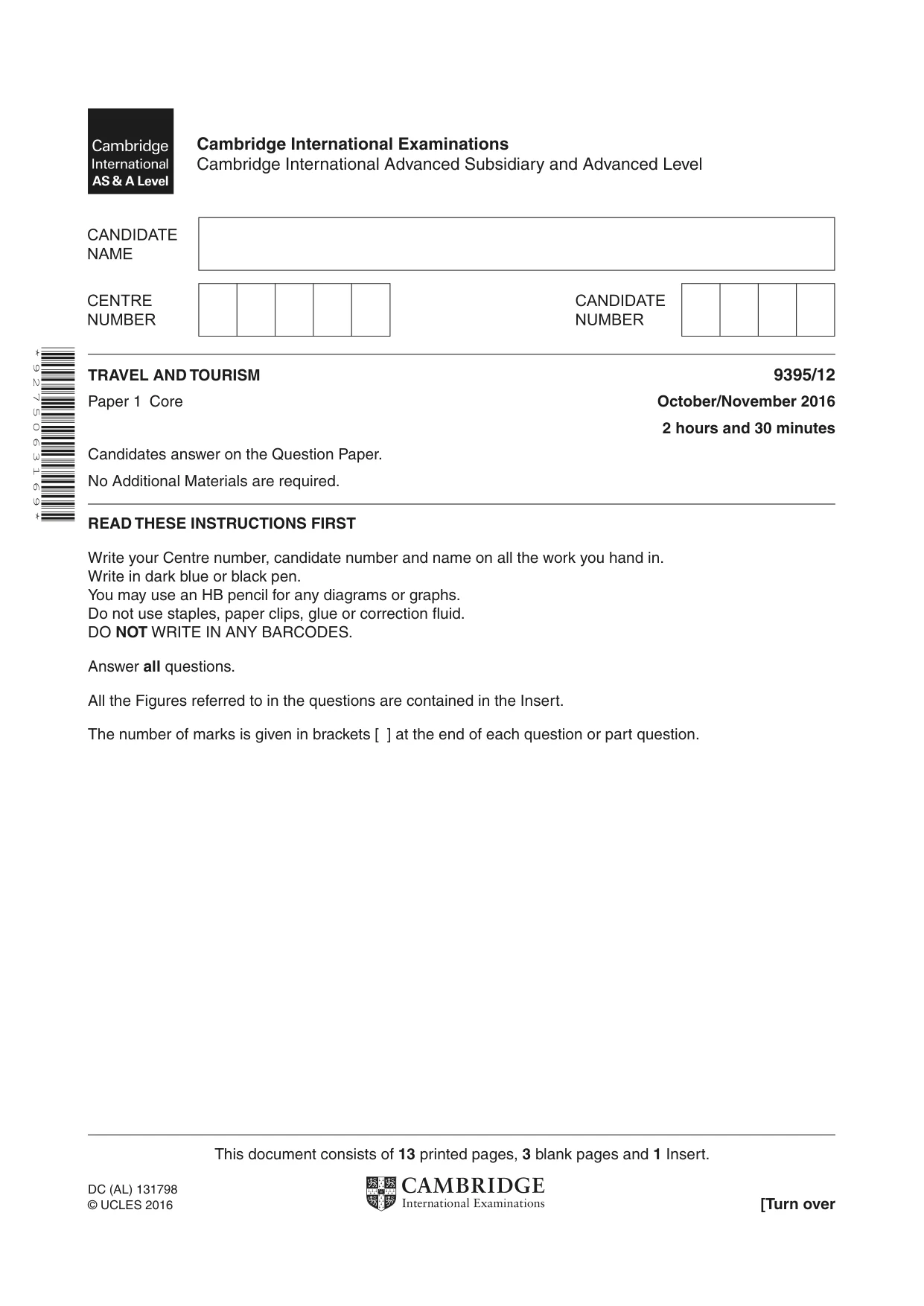
This document consists of 13 printed pages, 3 blank pages and 1 Insert. DC (AL) 131798 © UCLES 2016 [Turn over Cambridge International Examinations Cambridge International Advanced Subsidiary and Advanced Level * 9 2 7 5 0 6 3 1 6 9 * TRAVEL AND TOURISM 9395/12 Paper 1 Core October/November 2016 2 hours and 30 minutes Candidates answer on the Question Paper. No Additional Materials are required. READ THESE INSTRUCTIONS FIRST Write your Centre number, candidate number and name on all the work you hand in. Write in dark blue or black pen. You may use an HB pencil for any diagrams or graphs. Do not use staples, paper clips, glue or correction fluid. DO NOT WRITE IN ANY BARCODES. Answer all questions. All the Figures referred to in the questions are contained in the Insert. The number of marks is given in brackets [ ] at the end of each question or part question.
Question paper, page 2
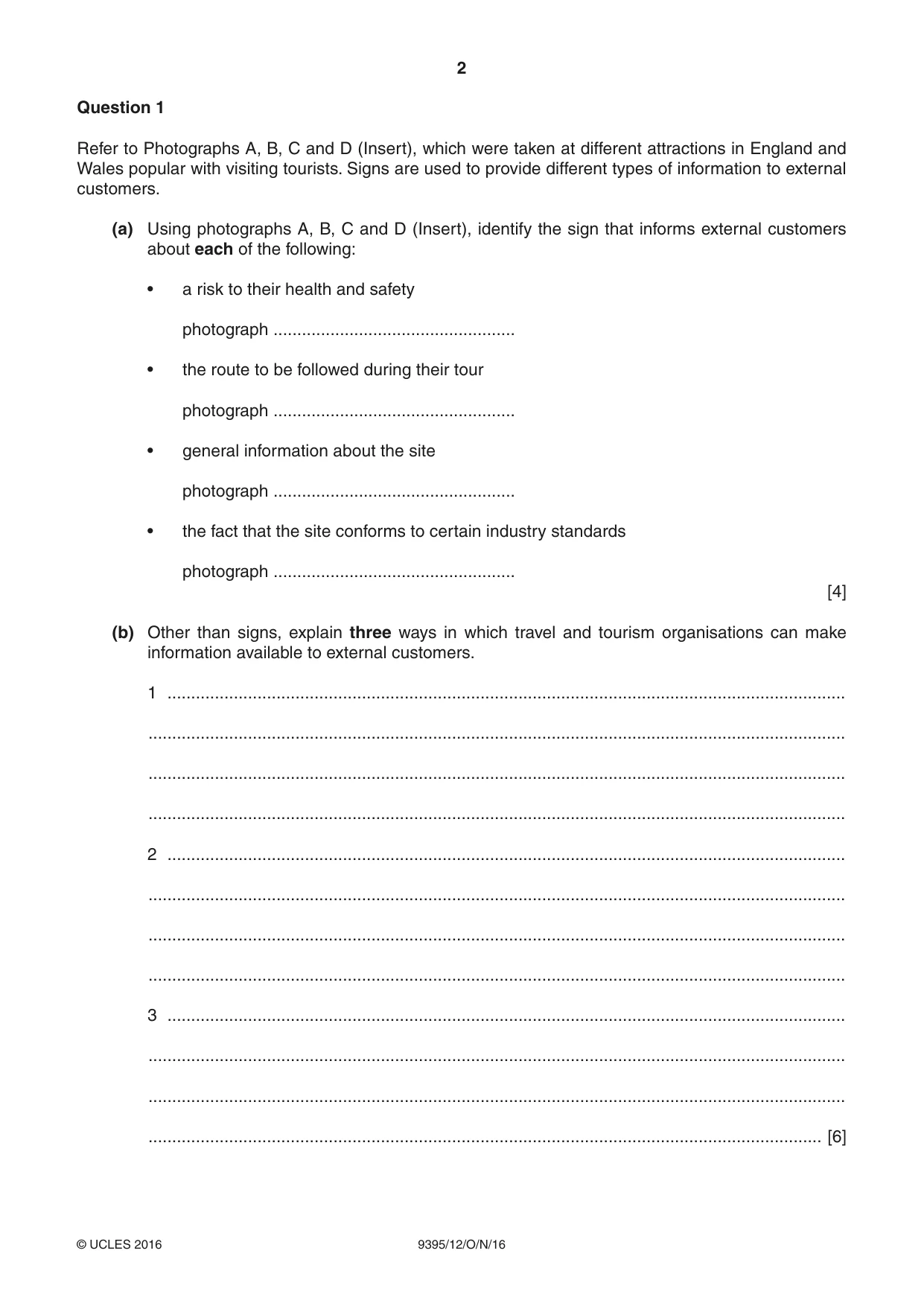
2 9395/12/O/N/16 © UCLES 2016 Question 1 Refer to Photographs A, B, C and D (Insert), which were taken at different attractions in England and Wales popular with visiting tourists. Signs are used to provide different types of information to external customers. (a) Using photographs A, B, C and D (Insert), identify the sign that informs external customers about each of the following: • a risk to their health and safety photograph … • the route to be followed during their tour photograph … • general information about the site photograph … • the fact that the site conforms to certain industry standards photograph … [4] (b) Other than signs, explain three ways in which travel and tourism organisations can make information available to external customers. 1 … … … … 2 … … … … 3 … … … … [6]
Question paper, page 3
3 9395/12/O/N/16 © UCLES 2016 [Turn over (c) Choose one job role within a travel and tourism organisation and discuss the training which is made available to improve employee performance. Organisation … Job role … … … … … … … … … … … … … [6]
Question paper, page 4
4 9395/12/O/N/16 © UCLES 2016 (d) Evaluate the ways in which one named travel and tourism organisation gathers feedback from its external customers. Name of organisation … … … … … … … … … … … … … … … … … … … … … … … … … … [9] [Total: 25]
Question paper, page 5
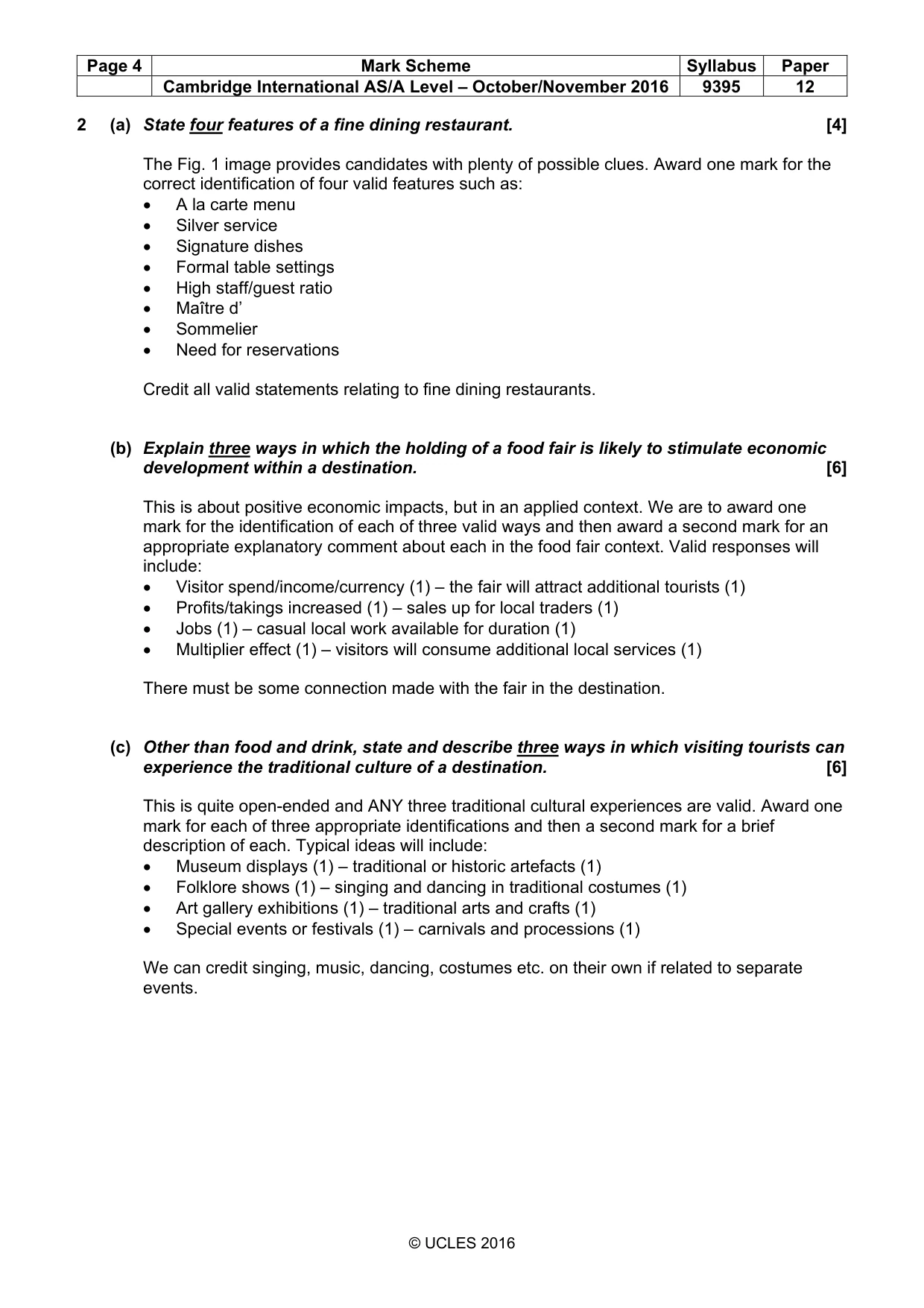
5 9395/12/O/N/16 © UCLES 2016 [Turn over Question 2 Refer to Fig. 1 (Insert), information about a recent innovation to help serve the European food tourism market. (a) State four features of a fine dining restaurant. 1 … 2 … 3 … 4 … [4] (b) Explain three ways in which the holding of a food fair is likely to stimulate economic development within a destination. 1 … … … … 2 … … … … 3 … … … … [6]
Question paper, page 6
6 9395/12/O/N/16 © UCLES 2016 (c) Other than food and drink, state and describe three ways in which visiting tourists can experience the traditional culture of a destination. 1 … Description … … … 2 … Description … … … 3 … Description … … … [6]
Question paper, page 7
7 9395/12/O/N/16 © UCLES 2016 [Turn over (d) Discuss the reasons why tourism destination managers should use web-based technologies to post information about events. … … … … … … … … … … … … … … … … … … … … … … … … … … [9] [Total: 25]
Question paper, page 8
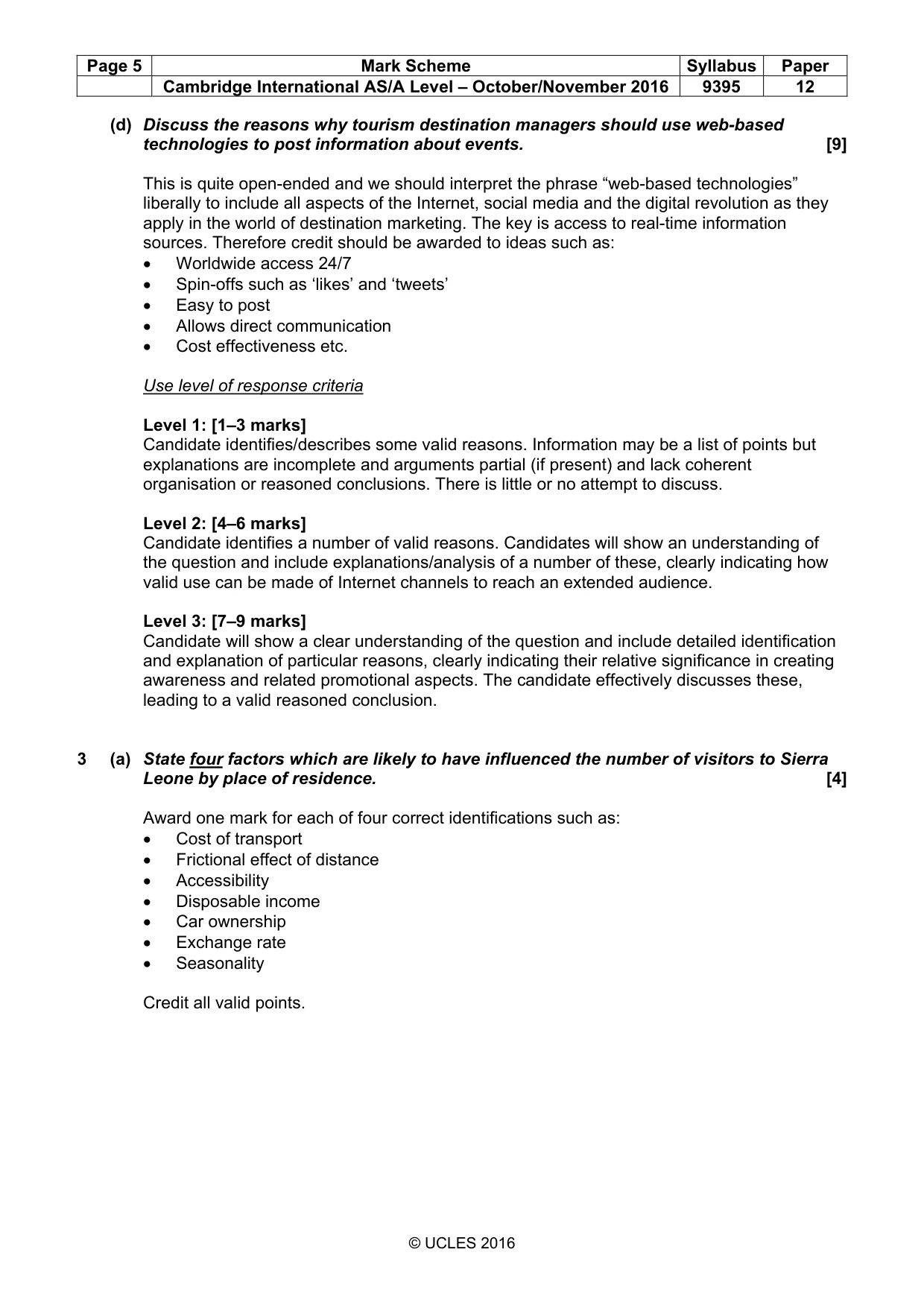
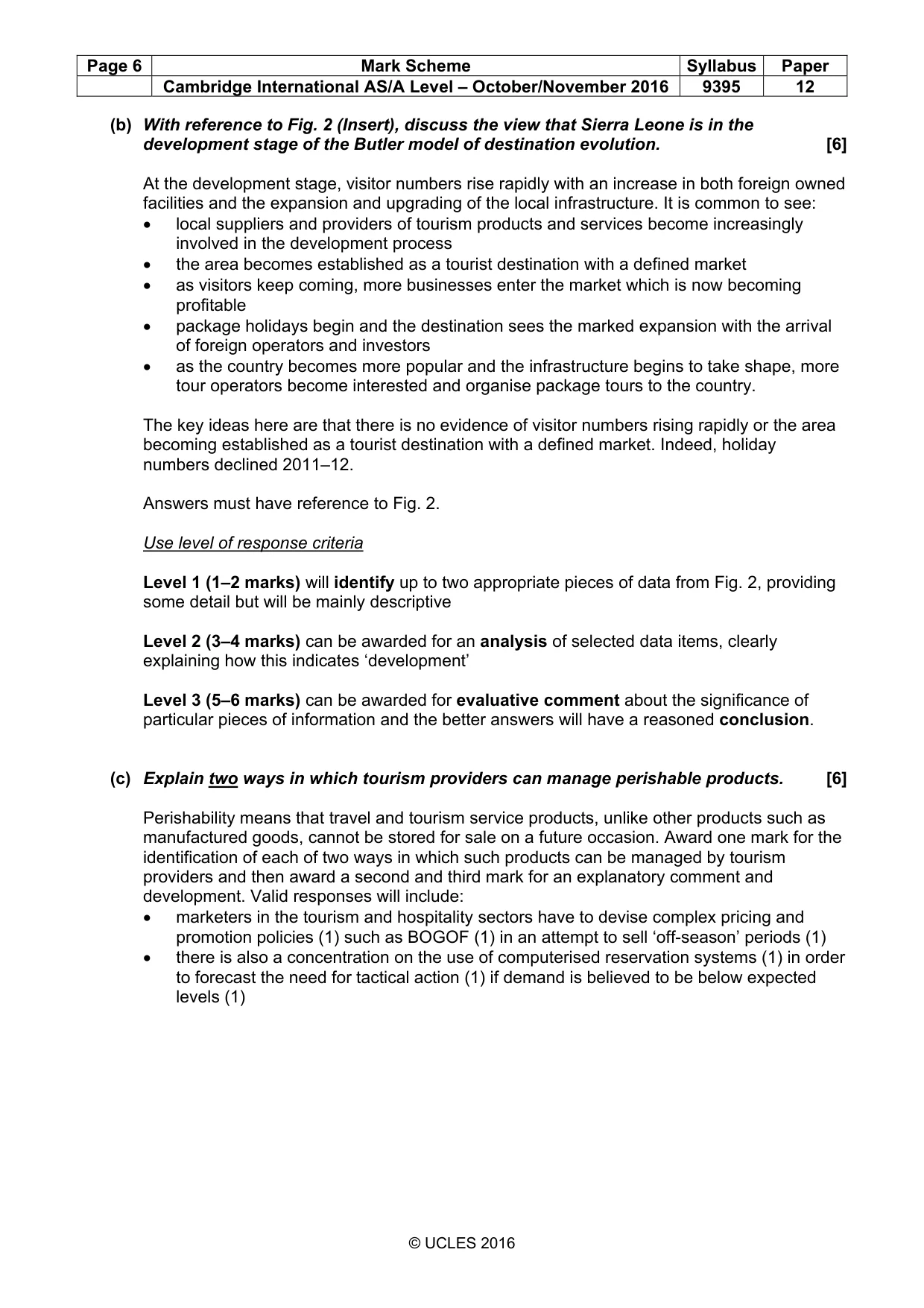
8 9395/12/O/N/16 © UCLES 2016 Question 3 Refer to Fig. 2 (Insert), tourism data for Sierra Leone in West Africa between 2011 and 2012. (a) State four factors which are likely to have influenced the number of visitors to Sierra Leone by place of residence. 1 … 2 … 3 … 4 … [4] (b) With reference to Fig. 2 (Insert), discuss the view that Sierra Leone is in the development stage of the Butler model of destination evolution. … … … … … … … … … … … … [6]
Question paper, page 9
9 9395/12/O/N/16 © UCLES 2016 [Turn over (c) Most tourism products are perishable. Explain two ways in which tourism providers can manage perishable products. 1 … … … … … … 2 … … … … … … [6]
Question paper, page 10
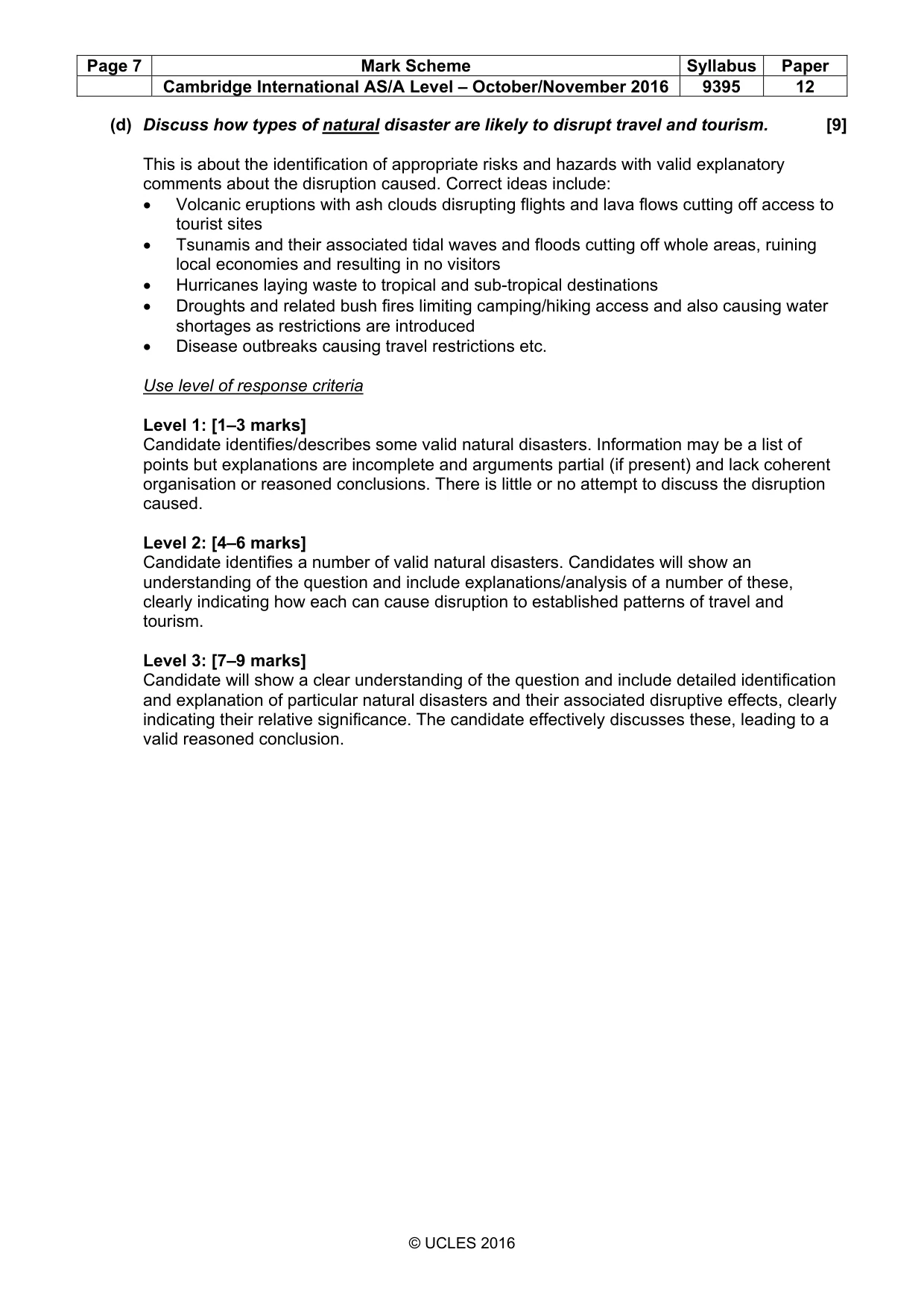
10 9395/12/O/N/16 © UCLES 2016 (d) In the summer of 2014 West African countries, including Sierra Leone, were affected by an outbreak of the deadly Ebola virus. This had a large negative impact on travel to the region. Discuss how types of natural disaster are likely to disrupt travel and tourism. … … … … … … … … … … … … … … … … … … … … … … … … … [9] [Total: 25]
Question paper, page 11
11 9395/12/O/N/16 © UCLES 2016 [Turn over Question 4 Refer to Fig. 3 (Insert), a news item about the ‘Go Eco Phuket’ event in Thailand. (a) The ‘Go Eco Phuket’ clean up is an example of sustainable destination management. Define each of the following: • public sector tourism organisation … … … … • private sector tourism organisation … … … … [4] (b) The principles of sustainable destination management can be stated as follows: It is about managing the visitor impact on a local destination’s economy, population and physical environment in a way which benefits everybody both now and in the future. Assess the extent to which the ‘Go Eco Phuket’ clean-up events fit in with this definition. … … … … … … … … … … … … [6]
Question paper, page 12
12 9395/12/O/N/16 © UCLES 2016 (c) The popularity of many tourist destinations such as Phuket is at risk from a variety of negative influences. Explain how each of the following may affect the popularity of a destination: • over-commercialisation … … … … • terrorism … … … … • crime and social problems … … … … [6]
Question paper, page 13
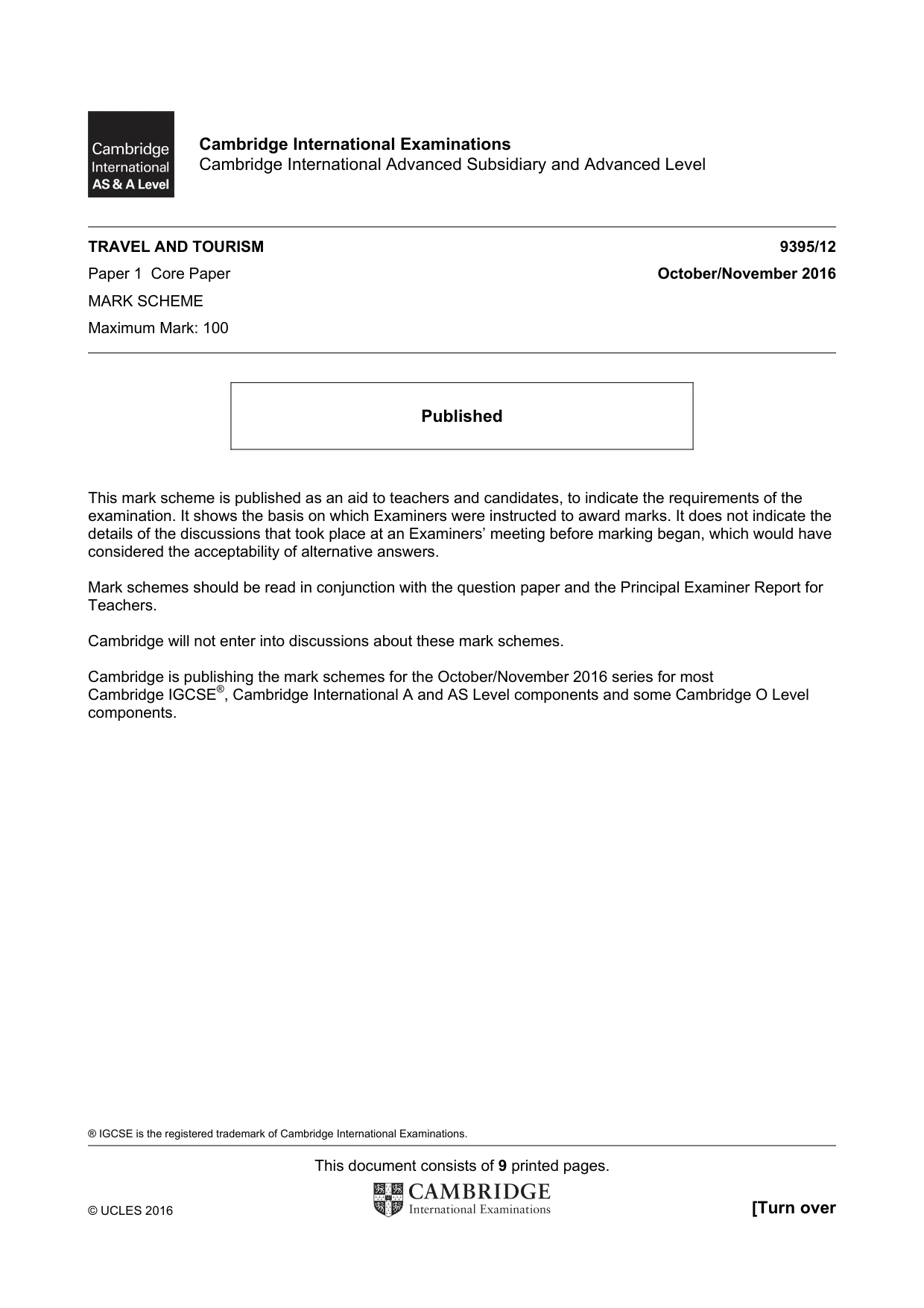
13 9395/12/O/N/16 © UCLES 2016 (d) Evaluate the appeal of one named visitor attraction to different types of tourist. Name of attraction … … … … … … … … … … … … … … … … … … … … … … … … … … [9] [Total: 25]
Question paper, page 14
14 9395/12/O/N/16 © UCLES 2016 BLANK PAGE
Question paper, page 15
15 9395/12/O/N/16 © UCLES 2016 BLANK PAGE
Question paper, page 16
16 9395/12/O/N/16 © UCLES 2016 Permission to reproduce items where third-party owned material protected by copyright is included has been sought and cleared where possible. Every reasonable effort has been made by the publisher (UCLES) to trace copyright holders, but if any items requiring clearance have unwittingly been included, the publisher will be pleased to make amends at the earliest possible opportunity. To avoid the issue of disclosure of answer-related information to candidates, all copyright acknowledgements are reproduced online in the Cambridge International Examinations Copyright Acknowledgements Booklet. This is produced for each series of examinations and is freely available to download at www.cie.org.uk after the live examination series. Cambridge International Examinations is part of the Cambridge Assessment Group. Cambridge Assessment is the brand name of University of Cambridge Local Examinations Syndicate (UCLES), which is itself a department of the University of Cambridge. BLANK PAGE
Mark scheme, page 1
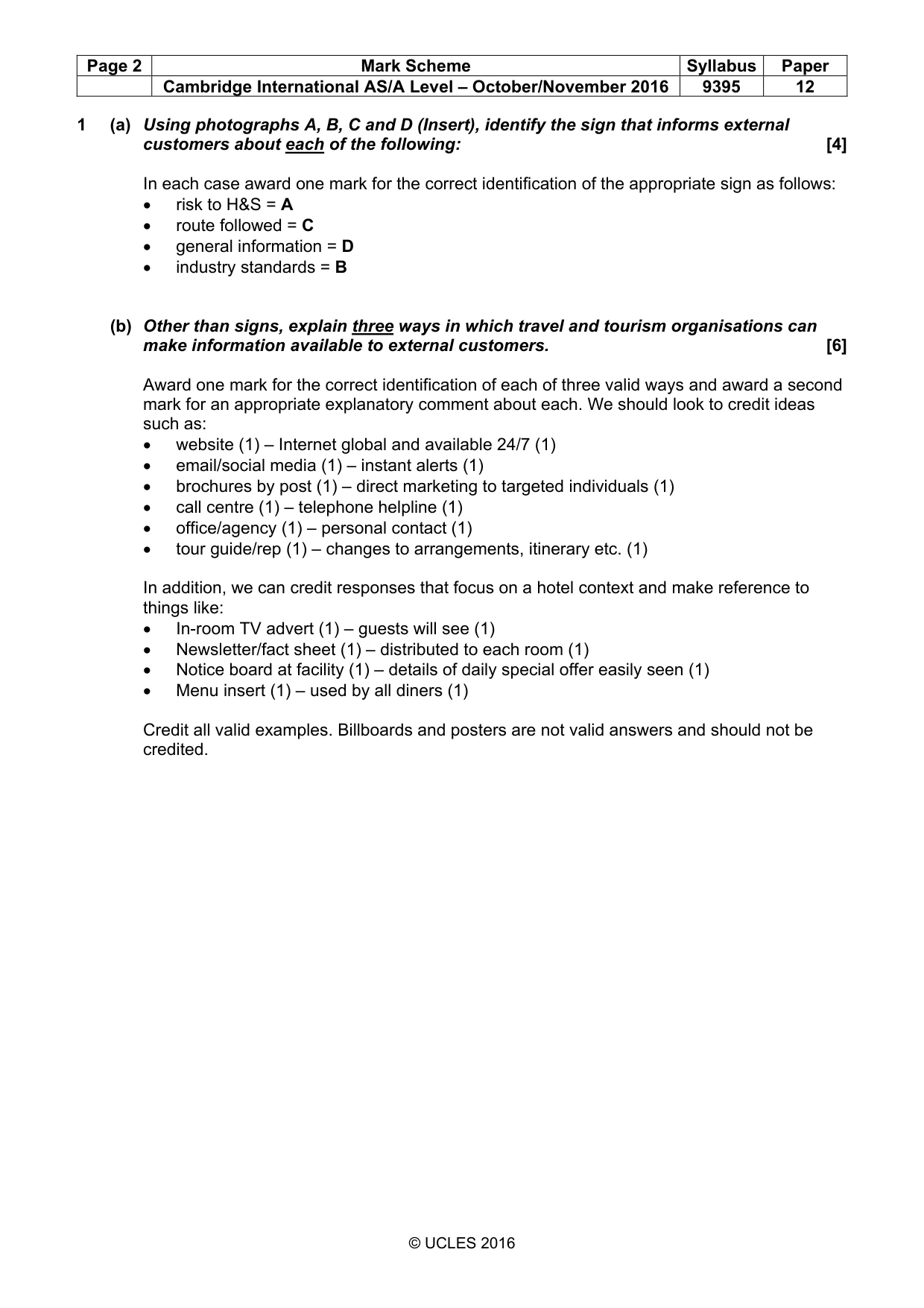
® IGCSE is the registered trademark of Cambridge International Examinations. This document consists of 9 printed pages. © UCLES 2016 [Turn over Cambridge International Examinations Cambridge International Advanced Subsidiary and Advanced Level TRAVEL AND TOURISM 9395/12 Paper 1 Core Paper October/November 2016 MARK SCHEME Maximum Mark: 100 Published This mark scheme is published as an aid to teachers and candidates, to indicate the requirements of the examination. It shows the basis on which Examiners were instructed to award marks. It does not indicate the details of the discussions that took place at an Examiners’ meeting before marking began, which would have considered the acceptability of alternative answers. Mark schemes should be read in conjunction with the question paper and the Principal Examiner Report for Teachers. Cambridge will not enter into discussions about these mark schemes. Cambridge is publishing the mark schemes for the October/November 2016 series for most Cambridge IGCSE®, Cambridge International A and AS Level components and some Cambridge O Level components.
Mark scheme, page 2
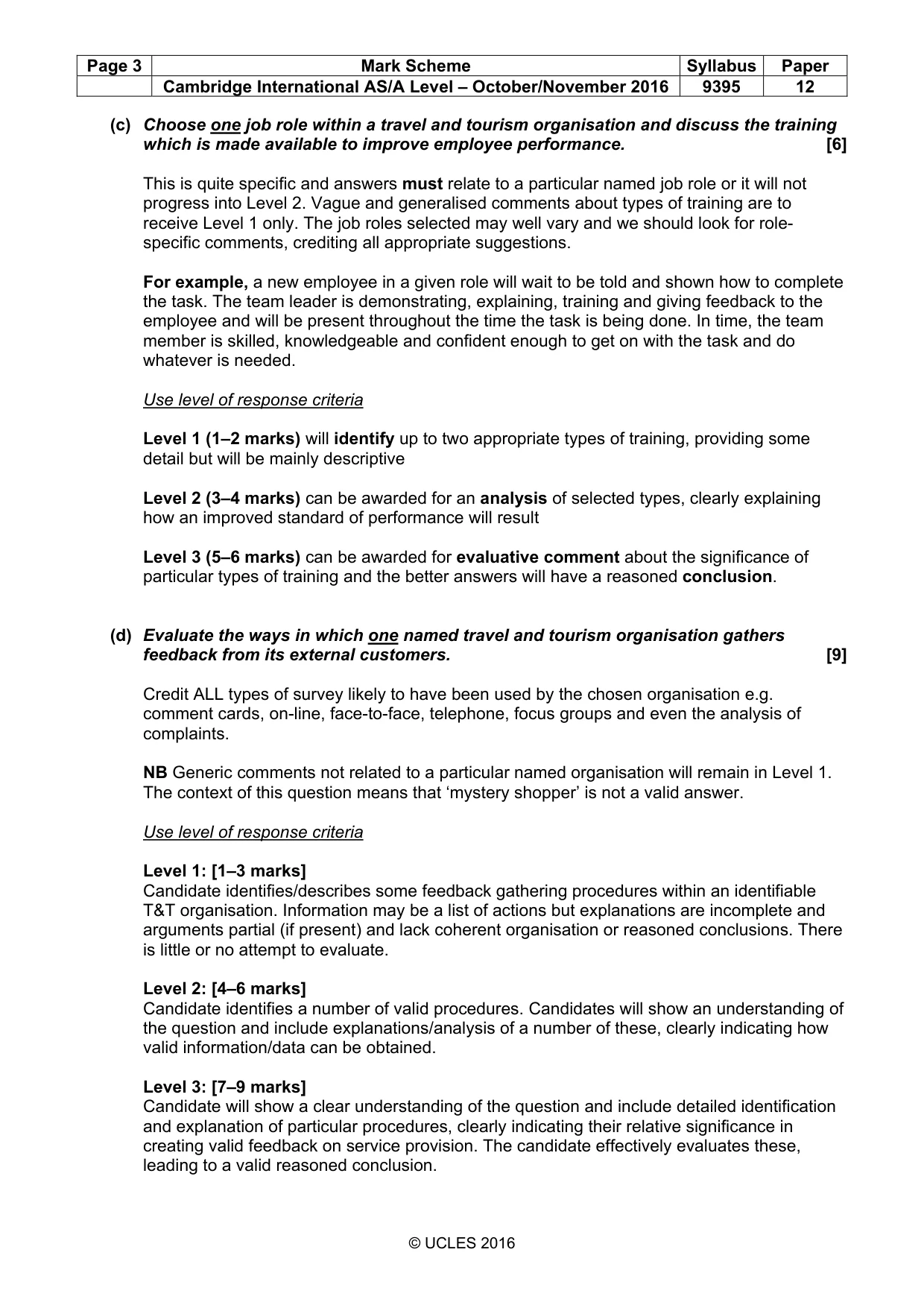
Page 2 Mark Scheme Syllabus Paper Cambridge International AS/A Level – October/November 2016 9395 12 © UCLES 2016 1 (a) Using photographs A, B, C and D (Insert), identify the sign that informs external customers about each of the following: [4] In each case award one mark for the correct identification of the appropriate sign as follows: • risk to H&S = A • route followed = C • general information = D • industry standards = B (b) Other than signs, explain three ways in which travel and tourism organisations can make information available to external customers. [6] Award one mark for the correct identification of each of three valid ways and award a second mark for an appropriate explanatory comment about each. We should look to credit ideas such as: • website (1) – Internet global and available 24/7 (1) • email/social media (1) – instant alerts (1) • brochures by post (1) – direct marketing to targeted individuals (1) • call centre (1) – telephone helpline (1) • office/agency (1) – personal contact (1) • tour guide/rep (1) – changes to arrangements, itinerary etc. (1) In addition, we can credit responses that focus on a hotel context and make reference to things like: • In-room TV advert (1) – guests will see (1) • Newsletter/fact sheet (1) – distributed to each room (1) • Notice board at facility (1) – details of daily special offer easily seen (1) • Menu insert (1) – used by all diners (1) Credit all valid examples. Billboards and posters are not valid answers and should not be credited.
Mark scheme, page 3
Page 3 Mark Scheme Syllabus Paper Cambridge International AS/A Level – October/November 2016 9395 12 © UCLES 2016 (c) Choose one job role within a travel and tourism organisation and discuss the training which is made available to improve employee performance. [6] This is quite specific and answers must relate to a particular named job role or it will not progress into Level 2. Vague and generalised comments about types of training are to receive Level 1 only. The job roles selected may well vary and we should look for role- specific comments, crediting all appropriate suggestions. For example, a new employee in a given role will wait to be told and shown how to complete the task. The team leader is demonstrating, explaining, training and giving feedback to the employee and will be present throughout the time the task is being done. In time, the team member is skilled, knowledgeable and confident enough to get on with the task and do whatever is needed. Use level of response criteria Level 1 (1–2 marks) will identify up to two appropriate types of training, providing some detail but will be mainly descriptive Level 2 (3–4 marks) can be awarded for an analysis of selected types, clearly explaining how an improved standard of performance will result Level 3 (5–6 marks) can be awarded for evaluative comment about the significance of particular types of training and the better answers will have a reasoned conclusion. (d) Evaluate the ways in which one named travel and tourism organisation gathers feedback from its external customers. [9] Credit ALL types of survey likely to have been used by the chosen organisation e.g. comment cards, on-line, face-to-face, telephone, focus groups and even the analysis of complaints. NB Generic comments not related to a particular named organisation will remain in Level 1. The context of this question means that ‘mystery shopper’ is not a valid answer. Use level of response criteria Level 1: [1–3 marks] Candidate identifies/describes some feedback gathering procedures within an identifiable T&T organisation. Information may be a list of actions but explanations are incomplete and arguments partial (if present) and lack coherent organisation or reasoned conclusions. There is little or no attempt to evaluate. Level 2: [4–6 marks] Candidate identifies a number of valid procedures. Candidates will show an understanding of the question and include explanations/analysis of a number of these, clearly indicating how valid information/data can be obtained. Level 3: [7–9 marks] Candidate will show a clear understanding of the question and include detailed identification and explanation of particular procedures, clearly indicating their relative significance in creating valid feedback on service provision. The candidate effectively evaluates these, leading to a valid reasoned conclusion.
Mark scheme, page 4
Page 4 Mark Scheme Syllabus Paper Cambridge International AS/A Level – October/November 2016 9395 12 © UCLES 2016 2 (a) State four features of a fine dining restaurant. [4] The Fig. 1 image provides candidates with plenty of possible clues. Award one mark for the correct identification of four valid features such as: • A la carte menu • Silver service • Signature dishes • Formal table settings • High staff/guest ratio • Maître d’ • Sommelier • Need for reservations Credit all valid statements relating to fine dining restaurants. (b) Explain three ways in which the holding of a food fair is likely to stimulate economic development within a destination. [6] This is about positive economic impacts, but in an applied context. We are to award one mark for the identification of each of three valid ways and then award a second mark for an appropriate explanatory comment about each in the food fair context. Valid responses will include: • Visitor spend/income/currency (1) – the fair will attract additional tourists (1) • Profits/takings increased (1) – sales up for local traders (1) • Jobs (1) – casual local work available for duration (1) • Multiplier effect (1) – visitors will consume additional local services (1) There must be some connection made with the fair in the destination. (c) Other than food and drink, state and describe three ways in which visiting tourists can experience the traditional culture of a destination. [6] This is quite open-ended and ANY three traditional cultural experiences are valid. Award one mark for each of three appropriate identifications and then a second mark for a brief description of each. Typical ideas will include: • Museum displays (1) – traditional or historic artefacts (1) • Folklore shows (1) – singing and dancing in traditional costumes (1) • Art gallery exhibitions (1) – traditional arts and crafts (1) • Special events or festivals (1) – carnivals and processions (1) We can credit singing, music, dancing, costumes etc. on their own if related to separate events.
Mark scheme, page 5
Page 5 Mark Scheme Syllabus Paper Cambridge International AS/A Level – October/November 2016 9395 12 © UCLES 2016 (d) Discuss the reasons why tourism destination managers should use web-based technologies to post information about events. [9] This is quite open-ended and we should interpret the phrase “web-based technologies” liberally to include all aspects of the Internet, social media and the digital revolution as they apply in the world of destination marketing. The key is access to real-time information sources. Therefore credit should be awarded to ideas such as: • Worldwide access 24/7 • Spin-offs such as ‘likes’ and ‘tweets’ • Easy to post • Allows direct communication • Cost effectiveness etc. Use level of response criteria Level 1: [1–3 marks] Candidate identifies/describes some valid reasons. Information may be a list of points but explanations are incomplete and arguments partial (if present) and lack coherent organisation or reasoned conclusions. There is little or no attempt to discuss. Level 2: [4–6 marks] Candidate identifies a number of valid reasons. Candidates will show an understanding of the question and include explanations/analysis of a number of these, clearly indicating how valid use can be made of Internet channels to reach an extended audience. Level 3: [7–9 marks] Candidate will show a clear understanding of the question and include detailed identification and explanation of particular reasons, clearly indicating their relative significance in creating awareness and related promotional aspects. The candidate effectively discusses these, leading to a valid reasoned conclusion. 3 (a) State four factors which are likely to have influenced the number of visitors to Sierra Leone by place of residence. [4] Award one mark for each of four correct identifications such as: • Cost of transport • Frictional effect of distance • Accessibility • Disposable income • Car ownership • Exchange rate • Seasonality Credit all valid points.
Mark scheme, page 6
Page 6 Mark Scheme Syllabus Paper Cambridge International AS/A Level – October/November 2016 9395 12 © UCLES 2016 (b) With reference to Fig. 2 (Insert), discuss the view that Sierra Leone is in the development stage of the Butler model of destination evolution. [6] At the development stage, visitor numbers rise rapidly with an increase in both foreign owned facilities and the expansion and upgrading of the local infrastructure. It is common to see: • local suppliers and providers of tourism products and services become increasingly involved in the development process • the area becomes established as a tourist destination with a defined market • as visitors keep coming, more businesses enter the market which is now becoming profitable • package holidays begin and the destination sees the marked expansion with the arrival of foreign operators and investors • as the country becomes more popular and the infrastructure begins to take shape, more tour operators become interested and organise package tours to the country. The key ideas here are that there is no evidence of visitor numbers rising rapidly or the area becoming established as a tourist destination with a defined market. Indeed, holiday numbers declined 2011–12. Answers must have reference to Fig. 2. Use level of response criteria Level 1 (1–2 marks) will identify up to two appropriate pieces of data from Fig. 2, providing some detail but will be mainly descriptive Level 2 (3–4 marks) can be awarded for an analysis of selected data items, clearly explaining how this indicates ‘development’ Level 3 (5–6 marks) can be awarded for evaluative comment about the significance of particular pieces of information and the better answers will have a reasoned conclusion. (c) Explain two ways in which tourism providers can manage perishable products. [6] Perishability means that travel and tourism service products, unlike other products such as manufactured goods, cannot be stored for sale on a future occasion. Award one mark for the identification of each of two ways in which such products can be managed by tourism providers and then award a second and third mark for an explanatory comment and development. Valid responses will include: • marketers in the tourism and hospitality sectors have to devise complex pricing and promotion policies (1) such as BOGOF (1) in an attempt to sell ‘off-season’ periods (1) • there is also a concentration on the use of computerised reservation systems (1) in order to forecast the need for tactical action (1) if demand is believed to be below expected levels (1)
Mark scheme, page 7
Page 7 Mark Scheme Syllabus Paper Cambridge International AS/A Level – October/November 2016 9395 12 © UCLES 2016 (d) Discuss how types of natural disaster are likely to disrupt travel and tourism. [9] This is about the identification of appropriate risks and hazards with valid explanatory comments about the disruption caused. Correct ideas include: • Volcanic eruptions with ash clouds disrupting flights and lava flows cutting off access to tourist sites • Tsunamis and their associated tidal waves and floods cutting off whole areas, ruining local economies and resulting in no visitors • Hurricanes laying waste to tropical and sub-tropical destinations • Droughts and related bush fires limiting camping/hiking access and also causing water shortages as restrictions are introduced • Disease outbreaks causing travel restrictions etc. Use level of response criteria Level 1: [1–3 marks] Candidate identifies/describes some valid natural disasters. Information may be a list of points but explanations are incomplete and arguments partial (if present) and lack coherent organisation or reasoned conclusions. There is little or no attempt to discuss the disruption caused. Level 2: [4–6 marks] Candidate identifies a number of valid natural disasters. Candidates will show an understanding of the question and include explanations/analysis of a number of these, clearly indicating how each can cause disruption to established patterns of travel and tourism. Level 3: [7–9 marks] Candidate will show a clear understanding of the question and include detailed identification and explanation of particular natural disasters and their associated disruptive effects, clearly indicating their relative significance. The candidate effectively discusses these, leading to a valid reasoned conclusion.
Mark scheme, page 8
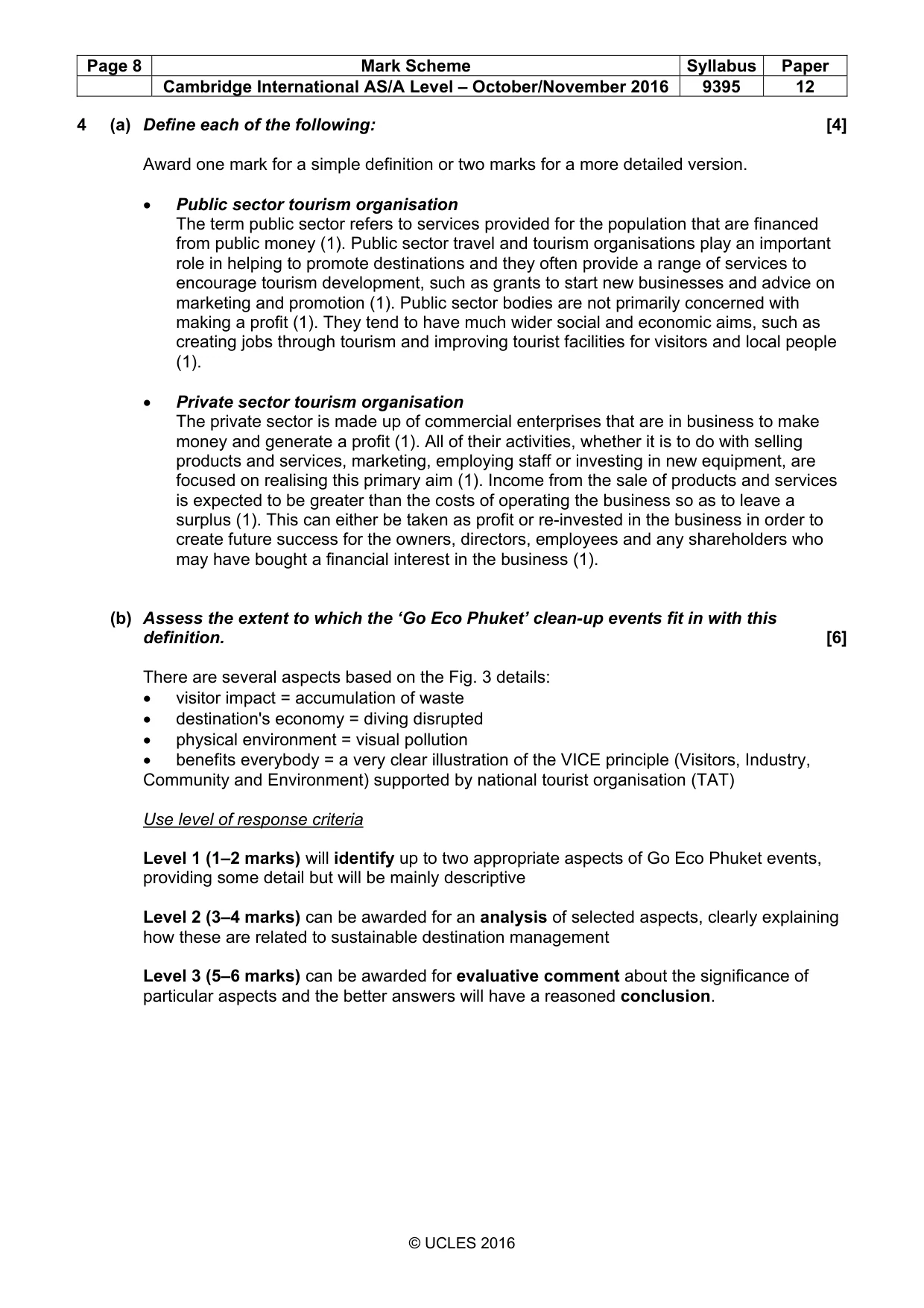
Page 8 Mark Scheme Syllabus Paper Cambridge International AS/A Level – October/November 2016 9395 12 © UCLES 2016 4 (a) Define each of the following: [4] Award one mark for a simple definition or two marks for a more detailed version. • Public sector tourism organisation The term public sector refers to services provided for the population that are financed from public money (1). Public sector travel and tourism organisations play an important role in helping to promote destinations and they often provide a range of services to encourage tourism development, such as grants to start new businesses and advice on marketing and promotion (1). Public sector bodies are not primarily concerned with making a profit (1). They tend to have much wider social and economic aims, such as creating jobs through tourism and improving tourist facilities for visitors and local people (1). • Private sector tourism organisation The private sector is made up of commercial enterprises that are in business to make money and generate a profit (1). All of their activities, whether it is to do with selling products and services, marketing, employing staff or investing in new equipment, are focused on realising this primary aim (1). Income from the sale of products and services is expected to be greater than the costs of operating the business so as to leave a surplus (1). This can either be taken as profit or re-invested in the business in order to create future success for the owners, directors, employees and any shareholders who may have bought a financial interest in the business (1). (b) Assess the extent to which the ‘Go Eco Phuket’ clean-up events fit in with this definition. [6] There are several aspects based on the Fig. 3 details: • visitor impact = accumulation of waste • destination's economy = diving disrupted • physical environment = visual pollution • benefits everybody = a very clear illustration of the VICE principle (Visitors, Industry, Community and Environment) supported by national tourist organisation (TAT) Use level of response criteria Level 1 (1–2 marks) will identify up to two appropriate aspects of Go Eco Phuket events, providing some detail but will be mainly descriptive Level 2 (3–4 marks) can be awarded for an analysis of selected aspects, clearly explaining how these are related to sustainable destination management Level 3 (5–6 marks) can be awarded for evaluative comment about the significance of particular aspects and the better answers will have a reasoned conclusion.
Mark scheme, page 9
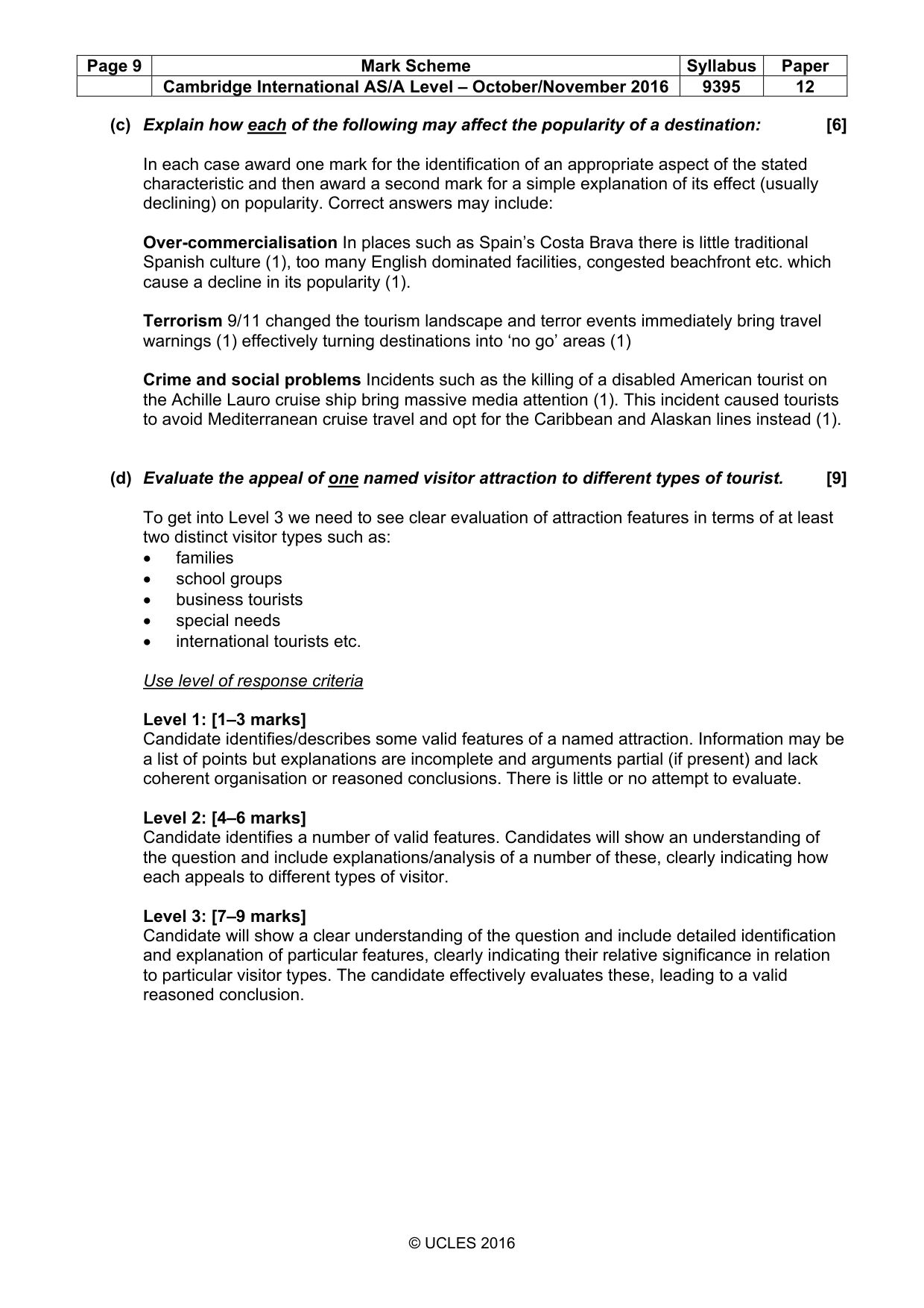
Page 9 Mark Scheme Syllabus Paper Cambridge International AS/A Level – October/November 2016 9395 12 © UCLES 2016 (c) Explain how each of the following may affect the popularity of a destination: [6] In each case award one mark for the identification of an appropriate aspect of the stated characteristic and then award a second mark for a simple explanation of its effect (usually declining) on popularity. Correct answers may include: Over-commercialisation In places such as Spain’s Costa Brava there is little traditional Spanish culture (1), too many English dominated facilities, congested beachfront etc. which cause a decline in its popularity (1). Terrorism 9/11 changed the tourism landscape and terror events immediately bring travel warnings (1) effectively turning destinations into ‘no go’ areas (1) Crime and social problems Incidents such as the killing of a disabled American tourist on the Achille Lauro cruise ship bring massive media attention (1). This incident caused tourists to avoid Mediterranean cruise travel and opt for the Caribbean and Alaskan lines instead (1). (d) Evaluate the appeal of one named visitor attraction to different types of tourist. [9] To get into Level 3 we need to see clear evaluation of attraction features in terms of at least two distinct visitor types such as: • families • school groups • business tourists • special needs • international tourists etc. Use level of response criteria Level 1: [1–3 marks] Candidate identifies/describes some valid features of a named attraction. Information may be a list of points but explanations are incomplete and arguments partial (if present) and lack coherent organisation or reasoned conclusions. There is little or no attempt to evaluate. Level 2: [4–6 marks] Candidate identifies a number of valid features. Candidates will show an understanding of the question and include explanations/analysis of a number of these, clearly indicating how each appeals to different types of visitor. Level 3: [7–9 marks] Candidate will show a clear understanding of the question and include detailed identification and explanation of particular features, clearly indicating their relative significance in relation to particular visitor types. The candidate effectively evaluates these, leading to a valid reasoned conclusion.