Cambridge A Level Travel and Tourism 9395 — 2016 Oct/Nov Paper 1 · Variant 3
9395/13/O/N/16
The question paper and its mark scheme, free to read here and free to download. This is Cambridge’s own paper, exactly as it was sat.
Question paper16 pages







Mark scheme9 pages
Answers below. Sit the paper first if you are practising.
Paper as text
Question paper, page 1
This document consists of 13 printed pages, 3 blank pages and 1 Insert. DC (NF) 113341/1 © UCLES 2016 [Turn over Cambridge International Examinations Cambridge International Advanced Subsidiary and Advanced Level * 8 3 6 3 1 5 4 7 3 2 * TRAVEL AND TOURISM 9395/13 Paper 1 Core October/November 2016 2 hours and 30 minutes Candidates answer on the Question Paper. No Additional Materials are required. READ THESE INSTRUCTIONS FIRST Write your Centre number, candidate number and name on all the work you hand in. Write in dark blue or black pen. Do not use staples, paper clips, glue or correction fluid. You may use an HB pencil for any diagrams or graphs. DO NOT WRITE IN ANY BARCODES. Answer all questions. All the Figures referred to in the questions are contained in the Insert. The number of marks is given in brackets [ ] at the end of each question or part question.
Question paper, page 2
2 9395/13/O/N/16 © UCLES 2016 Question 1 Refer to Photograph A (Insert), a resort hotel. (a) With reference to Photograph A (Insert), state four likely reasons for the appeal of the resort hotel shown. 1 … 2 … 3 … 4 … [4] (b) Discuss the ways in which accommodation providers meet different customer needs. … … … … … … … … … … … … [6]
Question paper, page 3
3 9395/13/O/N/16 © UCLES 2016 [Turn over (c) Most accommodation has been awarded a quality grading or rating. Explain three advantages to customers of the use of accommodation grading systems. 1 … … … … 2 … … … … 3 … … … … [6]
Question paper, page 4
4 9395/13/O/N/16 © UCLES 2016 (d) Some Europeans now own a holiday home abroad. Discuss the likely reasons for the increase in holiday home ownership. … … … … … … … … … … … … … … … … … … … … … … … … … [9] [Total: 25]
Question paper, page 5
5 9395/13/O/N/16 © UCLES 2016 [Turn over Question 2 Refer to Fig. 1 (Insert), the results of a survey into the personal qualities and skills needed for employment in the travel and tourism industry. (a) Identify from Fig. 1 (Insert), the four most important attributes that employers look for as being fully developed in employees. 1 … 2 … 3 … 4 … [4] (b) For each of three job roles within a named travel and tourism organisation, state one vocational job-specific skill and describe how the employee makes use of it in the workplace. Name of organisation … Job role 1 … Job-specific skill … How used … … … Job role 2 … Job-specific skill … How used … … … Job role 3 … Job-specific skill … How used … … … [6]
Question paper, page 6
6 9395/13/O/N/16 © UCLES 2016 (c) The majority of travel and tourism employees, including those identified in part (b), are likely to have a line manager. Explain three ways in which the line manager will monitor the employee’s overall progress and performance. 1 … … … … 2 … … … … 3 … … … … [6]
Question paper, page 7
7 9395/13/O/N/16 © UCLES 2016 [Turn over (d) Discuss the likely role of a mystery shopper in the benchmarking process for a travel and tourism organisation. … … … … … … … … … … … … … … … … … … … … … … … … … … [9] [Total: 25]
Question paper, page 8
8 9395/13/O/N/16 © UCLES 2016 Question 3 Refer to Fig. 2 (Insert), information for local tourism providers about working in partnership with i-SITE New Zealand. (a) Tourism New Zealand is a public sector organisation. Describe two objectives of public sector organisations, such as Tourism New Zealand. 1 … … … … 2 … … … … [4] (b) With reference to Fig. 2 (Insert), identify and explain three advantages to tourism providers of working in partnership with their local i-SITE Centre. 1 … … … … 2 … … … … 3 … … … … [6]
Question paper, page 9
9 9395/13/O/N/16 © UCLES 2016 [Turn over (c) New Zealand’s natural landscape attracts many international visitors interested in outdoor recreational activities. State three different outdoor recreational activities and explain how each activity may create a negative environmental impact. Activity 1 … Impact explanation … … … Activity 2 … Impact explanation … … … Activity 3 … Impact explanation … … … [6]
Question paper, page 10
10 9395/13/O/N/16 © UCLES 2016 (d) Choose one destination and evaluate the ways in which it has been made accessible to domestic tourists. Chosen destination … … … … … … … … … … … … … … … … … … … … … … … … … … [9] [Total: 25]
Question paper, page 11
11 9395/13/O/N/16 © UCLES 2016 [Turn over Question 4 Refer to Fig. 3 (Insert), information about tourism in the Andalucía region of Spain. (a) With reference to Fig. 3 (Insert), describe the variations in international arrivals to Andalucía since 2001. … … … … … … … … [4] (b) Approximately 20% of spending by Andalucía’s international tourists is on excursions. State three ways in which an excursion can be booked and for each suggest a reason why it is used by international tourists. 1 … … … … 2 … … … … 3 … … … … [6]
Question paper, page 12
12 9395/13/O/N/16 © UCLES 2016 (c) With reference to Fig. 3 (Insert), discuss the disadvantages to international tourists of making their journey to Andalucía by coach. … … … … … … … … … … … … [6]
Question paper, page 13
13 9395/13/O/N/16 © UCLES 2016 (d) Some destinations in Spain are in decline. Discuss the ways in which declining destinations can be rejuvenated. Use examples to support your answer. … … … … … … … … … … … … … … … … … … … … … … … … … [9] [Total: 25]
Question paper, page 14
14 9395/13/O/N/16 © UCLES 2016 BLANK PAGE
Question paper, page 15
15 9395/13/O/N/16 © UCLES 2016 BLANK PAGE
Question paper, page 16
16 9395/13/O/N/16 © UCLES 2016 Permission to reproduce items where third-party owned material protected by copyright is included has been sought and cleared where possible. Every reasonable effort has been made by the publisher (UCLES) to trace copyright holders, but if any items requiring clearance have unwittingly been included, the publisher will be pleased to make amends at the earliest possible opportunity. To avoid the issue of disclosure of answer-related information to candidates, all copyright acknowledgements are reproduced online in the Cambridge International Examinations Copyright Acknowledgements Booklet. This is produced for each series of examinations and is freely available to download at www.cie.org.uk after the live examination series. Cambridge International Examinations is part of the Cambridge Assessment Group. Cambridge Assessment is the brand name of University of Cambridge Local Examinations Syndicate (UCLES), which is itself a department of the University of Cambridge. BLANK PAGE
Mark scheme, page 1
® IGCSE is the registered trademark of Cambridge International Examinations. This document consists of 9 printed pages. © UCLES 2016 [Turn over Cambridge International Examinations Cambridge International Advanced Subsidiary and Advanced Level TRAVEL AND TOURISM 9395/13 Paper 1 Core Paper October/November 2016 MARK SCHEME Maximum Mark: 100 Published This mark scheme is published as an aid to teachers and candidates, to indicate the requirements of the examination. It shows the basis on which Examiners were instructed to award marks. It does not indicate the details of the discussions that took place at an Examiners’ meeting before marking began, which would have considered the acceptability of alternative answers. Mark schemes should be read in conjunction with the question paper and the Principal Examiner Report for Teachers. Cambridge will not enter into discussions about these mark schemes. Cambridge is publishing the mark schemes for the October/November 2016 series for most Cambridge IGCSE®, Cambridge International A and AS Level components and some Cambridge O Level components.
Mark scheme, page 2
Page 2 Mark Scheme Syllabus Paper Cambridge International AS/A Level – October/November 2016 9395 13 © UCLES 2016 1 (a) With reference to Photograph A (Insert), state four likely reasons for the appeal of the resort hotel shown. [4] Credit is to be awarded to valid identifications based on Photo A. Award one mark for each of four reasons such as the following: • On the coast/sea side • Swimming pool • Grassed sun lounger area • Surrounded by woods/forest/trees • Car park • Sea-view rooms (b) Discuss the ways in which accommodation providers meet different customer needs.[6] Credit business and event ideas such as: • Function room (for receptions) • Grounds (for events and photographs etc.) • Business centre • Disability guest access • Overnight stay options (honeymoon suite etc.) Use level of response criteria Level 1 (1–2 marks) will identify up to two appropriate services/facilities, providing some detail but will be mainly descriptive Level 2 (3–4 marks) can be awarded for an analysis of selected features, clearly explaining how these are meeting different customer needs Level 3 (5–6 marks) can be awarded for evaluative comment about the significance of particular aspects and the better answers will have a reasoned conclusion. (c) Explain three advantages to customers of the use of accommodation grading systems. [6] Award one mark for the correct identification of each of three valid advantages and award a second mark for an appropriate explanatory development about each one. Correct answers include: • Quality assurance (1) – higher rating means better quality and more services (1) • Allows them to make broad comparisons between rival providers (1) – to see who offers value for money (1) • Grades awarded independently (1) – so can have confidence in broad accuracy of results (1) • Encourages consistency within the marketplace (1) – providers can only improve their grading by providing more (1) • Easy system to understand (1) – recognised by number of stars etc. (1) Credit all valid reasoning.
Mark scheme, page 3
Page 3 Mark Scheme Syllabus Paper Cambridge International AS/A Level – October/November 2016 9395 13 © UCLES 2016 (d) Discuss the likely reasons for the increase in holiday home ownership. [9] A wide variety of reasons are possible. Correct answers include: • Wealth and standard of living • Currency exchange and interest rates • Increased leisure time • Retirement and pensions • Rental income potential • Cheap flight access • Timeshare options Use level of response criteria Level 1: [1–3 marks] Candidate identifies/describes some valid factors. Information may be a list of points but explanations are incomplete and arguments partial (if present) and lack coherent organisation or reasoned conclusions. There is little or no attempt to discuss. Level 2: [4–6 marks] Candidate identifies a number of valid factors. Candidate will show an understanding of the question and include explanations/analysis of a number of these, clearly indicating how each plays a part in influencing the decision to buy abroad. Level 3: [7–9 marks] Candidate will show a clear understanding of the question and include detailed identification and explanation of particular factors, indicating their relative significance in relation to purchases. The candidate effectively discusses these, leading to a valid reasoned conclusion.
Mark scheme, page 4
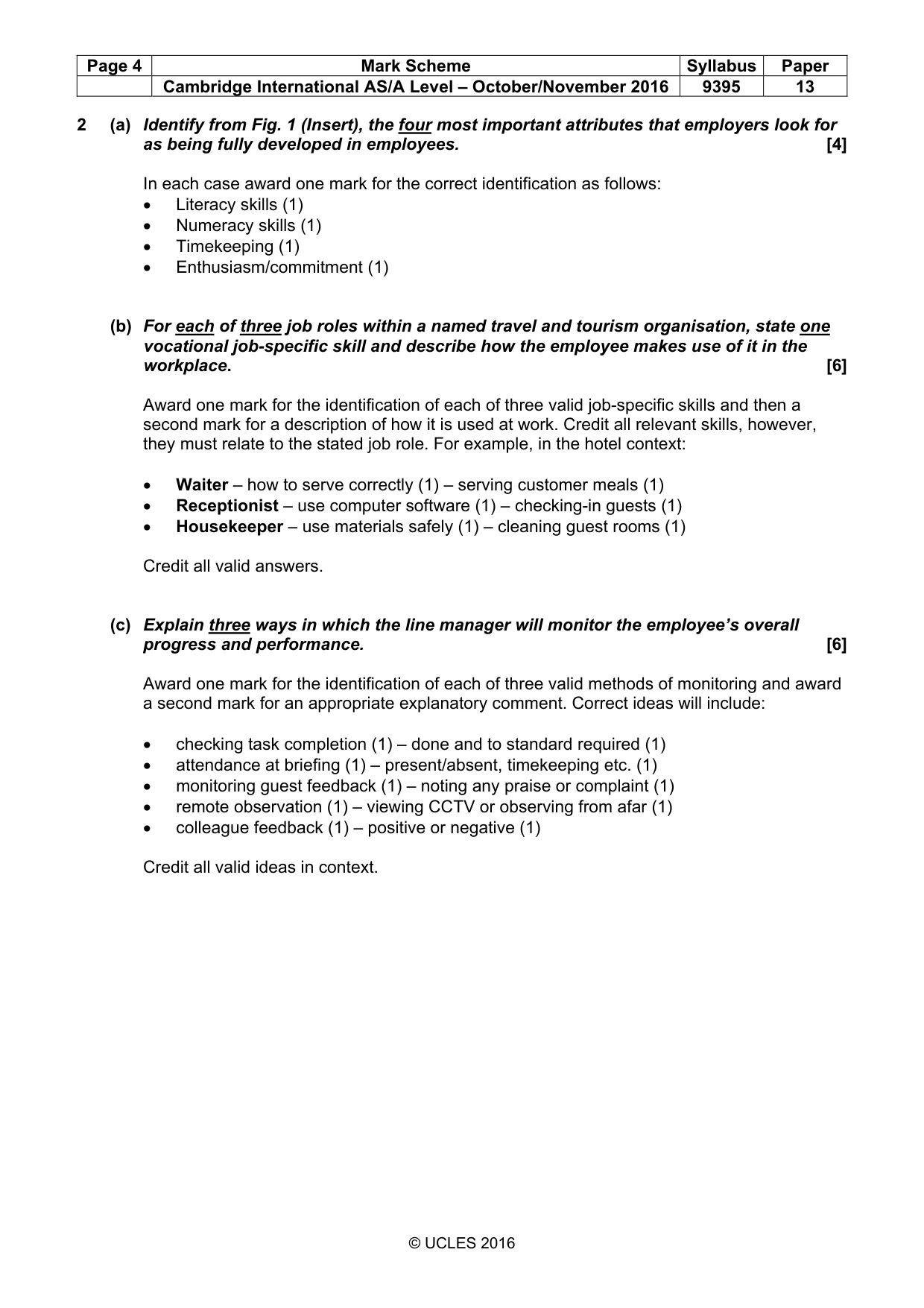
Page 4 Mark Scheme Syllabus Paper Cambridge International AS/A Level – October/November 2016 9395 13 © UCLES 2016 2 (a) Identify from Fig. 1 (Insert), the four most important attributes that employers look for as being fully developed in employees. [4] In each case award one mark for the correct identification as follows: • Literacy skills (1) • Numeracy skills (1) • Timekeeping (1) • Enthusiasm/commitment (1) (b) For each of three job roles within a named travel and tourism organisation, state one vocational job-specific skill and describe how the employee makes use of it in the workplace. [6] Award one mark for the identification of each of three valid job-specific skills and then a second mark for a description of how it is used at work. Credit all relevant skills, however, they must relate to the stated job role. For example, in the hotel context: • Waiter – how to serve correctly (1) – serving customer meals (1) • Receptionist – use computer software (1) – checking-in guests (1) • Housekeeper – use materials safely (1) – cleaning guest rooms (1) Credit all valid answers. (c) Explain three ways in which the line manager will monitor the employee’s overall progress and performance. [6] Award one mark for the identification of each of three valid methods of monitoring and award a second mark for an appropriate explanatory comment. Correct ideas will include: • checking task completion (1) – done and to standard required (1) • attendance at briefing (1) – present/absent, timekeeping etc. (1) • monitoring guest feedback (1) – noting any praise or complaint (1) • remote observation (1) – viewing CCTV or observing from afar (1) • colleague feedback (1) – positive or negative (1) Credit all valid ideas in context.
Mark scheme, page 5
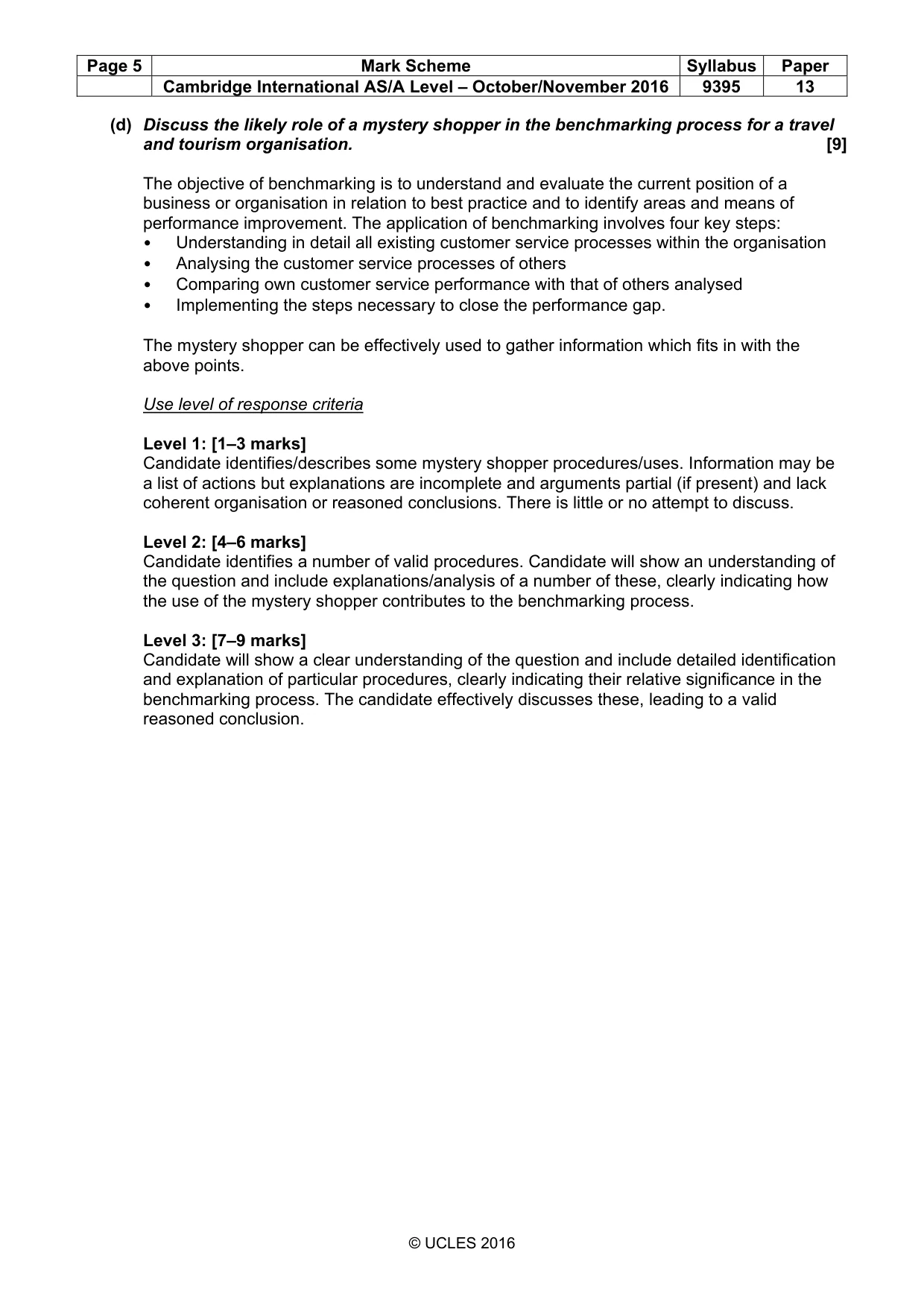
Page 5 Mark Scheme Syllabus Paper Cambridge International AS/A Level – October/November 2016 9395 13 © UCLES 2016 (d) Discuss the likely role of a mystery shopper in the benchmarking process for a travel and tourism organisation. [9] The objective of benchmarking is to understand and evaluate the current position of a business or organisation in relation to best practice and to identify areas and means of performance improvement. The application of benchmarking involves four key steps: • Understanding in detail all existing customer service processes within the organisation • Analysing the customer service processes of others • Comparing own customer service performance with that of others analysed • Implementing the steps necessary to close the performance gap. The mystery shopper can be effectively used to gather information which fits in with the above points. Use level of response criteria Level 1: [1–3 marks] Candidate identifies/describes some mystery shopper procedures/uses. Information may be a list of actions but explanations are incomplete and arguments partial (if present) and lack coherent organisation or reasoned conclusions. There is little or no attempt to discuss. Level 2: [4–6 marks] Candidate identifies a number of valid procedures. Candidate will show an understanding of the question and include explanations/analysis of a number of these, clearly indicating how the use of the mystery shopper contributes to the benchmarking process. Level 3: [7–9 marks] Candidate will show a clear understanding of the question and include detailed identification and explanation of particular procedures, clearly indicating their relative significance in the benchmarking process. The candidate effectively discusses these, leading to a valid reasoned conclusion.
Mark scheme, page 6
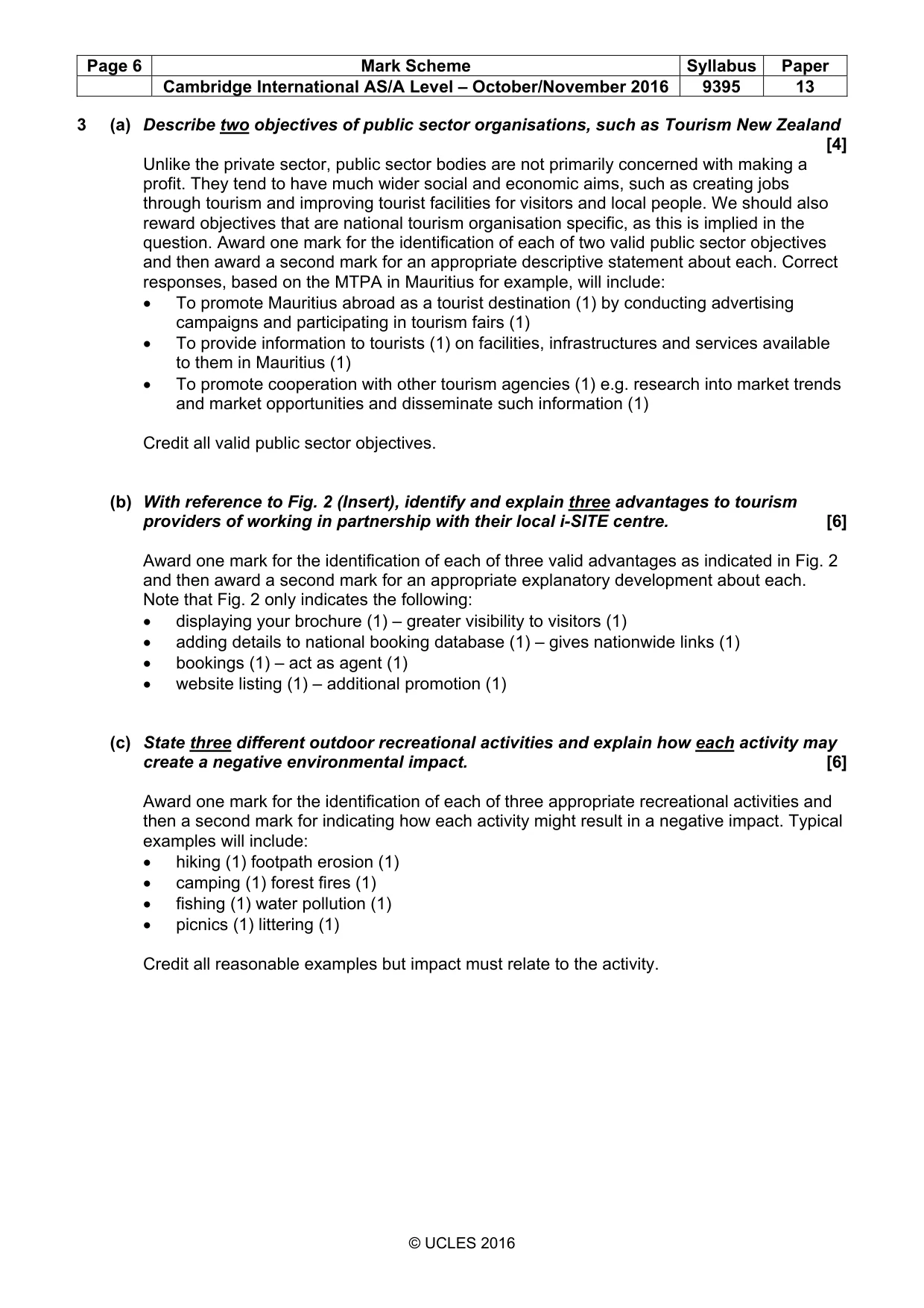
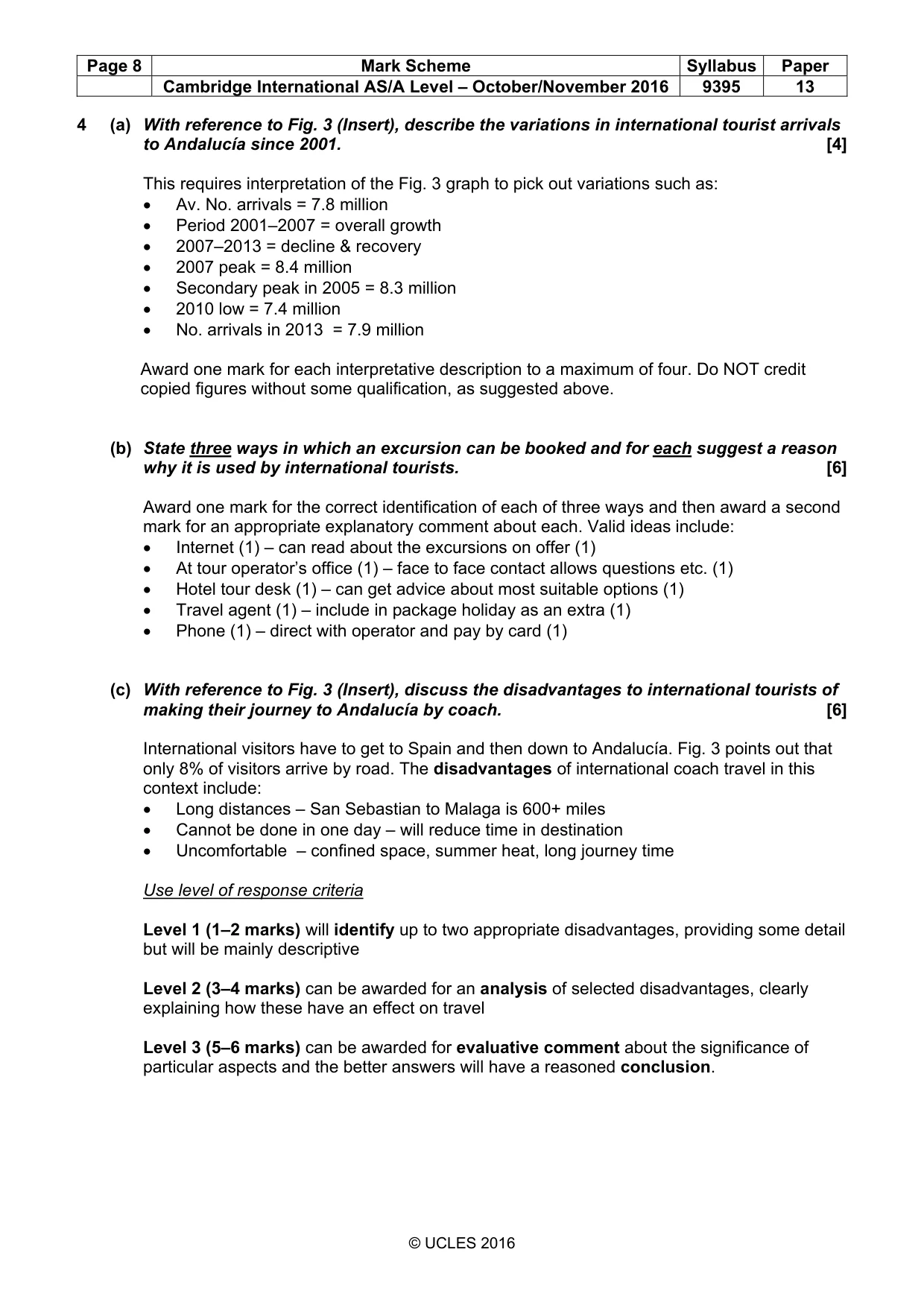
Page 6 Mark Scheme Syllabus Paper Cambridge International AS/A Level – October/November 2016 9395 13 © UCLES 2016 3 (a) Describe two objectives of public sector organisations, such as Tourism New Zealand [4] Unlike the private sector, public sector bodies are not primarily concerned with making a profit. They tend to have much wider social and economic aims, such as creating jobs through tourism and improving tourist facilities for visitors and local people. We should also reward objectives that are national tourism organisation specific, as this is implied in the question. Award one mark for the identification of each of two valid public sector objectives and then award a second mark for an appropriate descriptive statement about each. Correct responses, based on the MTPA in Mauritius for example, will include: • To promote Mauritius abroad as a tourist destination (1) by conducting advertising campaigns and participating in tourism fairs (1) • To provide information to tourists (1) on facilities, infrastructures and services available to them in Mauritius (1) • To promote cooperation with other tourism agencies (1) e.g. research into market trends and market opportunities and disseminate such information (1) Credit all valid public sector objectives. (b) With reference to Fig. 2 (Insert), identify and explain three advantages to tourism providers of working in partnership with their local i-SITE centre. [6] Award one mark for the identification of each of three valid advantages as indicated in Fig. 2 and then award a second mark for an appropriate explanatory development about each. Note that Fig. 2 only indicates the following: • displaying your brochure (1) – greater visibility to visitors (1) • adding details to national booking database (1) – gives nationwide links (1) • bookings (1) – act as agent (1) • website listing (1) – additional promotion (1) (c) State three different outdoor recreational activities and explain how each activity may create a negative environmental impact. [6] Award one mark for the identification of each of three appropriate recreational activities and then a second mark for indicating how each activity might result in a negative impact. Typical examples will include: • hiking (1) footpath erosion (1) • camping (1) forest fires (1) • fishing (1) water pollution (1) • picnics (1) littering (1) Credit all reasonable examples but impact must relate to the activity.
Mark scheme, page 7
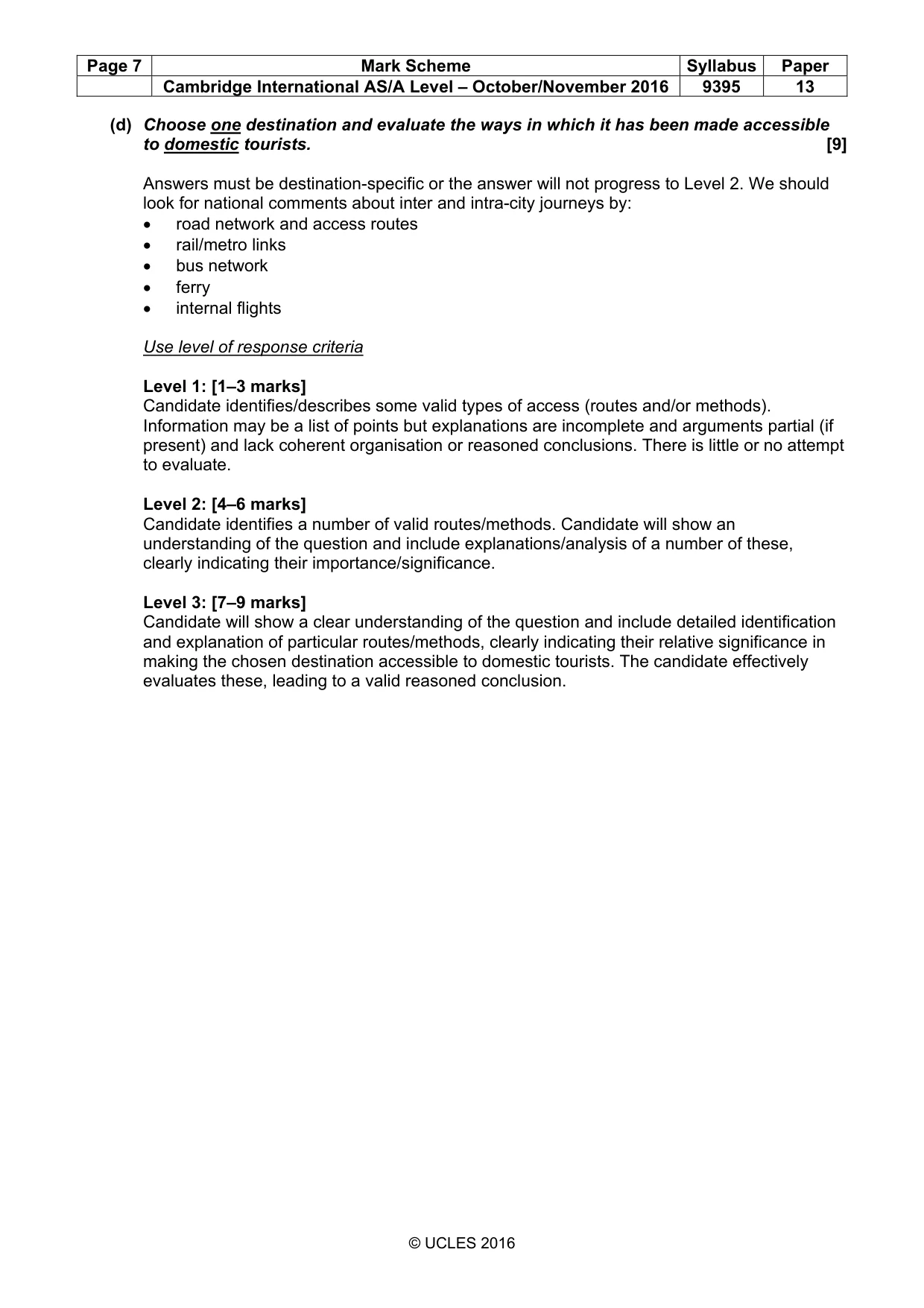
Page 7 Mark Scheme Syllabus Paper Cambridge International AS/A Level – October/November 2016 9395 13 © UCLES 2016 (d) Choose one destination and evaluate the ways in which it has been made accessible to domestic tourists. [9] Answers must be destination-specific or the answer will not progress to Level 2. We should look for national comments about inter and intra-city journeys by: • road network and access routes • rail/metro links • bus network • ferry • internal flights Use level of response criteria Level 1: [1–3 marks] Candidate identifies/describes some valid types of access (routes and/or methods). Information may be a list of points but explanations are incomplete and arguments partial (if present) and lack coherent organisation or reasoned conclusions. There is little or no attempt to evaluate. Level 2: [4–6 marks] Candidate identifies a number of valid routes/methods. Candidate will show an understanding of the question and include explanations/analysis of a number of these, clearly indicating their importance/significance. Level 3: [7–9 marks] Candidate will show a clear understanding of the question and include detailed identification and explanation of particular routes/methods, clearly indicating their relative significance in making the chosen destination accessible to domestic tourists. The candidate effectively evaluates these, leading to a valid reasoned conclusion.
Mark scheme, page 8
Page 8 Mark Scheme Syllabus Paper Cambridge International AS/A Level – October/November 2016 9395 13 © UCLES 2016 4 (a) With reference to Fig. 3 (Insert), describe the variations in international tourist arrivals to Andalucía since 2001. [4] This requires interpretation of the Fig. 3 graph to pick out variations such as: • Av. No. arrivals = 7.8 million • Period 2001–2007 = overall growth • 2007–2013 = decline & recovery • 2007 peak = 8.4 million • Secondary peak in 2005 = 8.3 million • 2010 low = 7.4 million • No. arrivals in 2013 = 7.9 million Award one mark for each interpretative description to a maximum of four. Do NOT credit copied figures without some qualification, as suggested above. (b) State three ways in which an excursion can be booked and for each suggest a reason why it is used by international tourists. [6] Award one mark for the correct identification of each of three ways and then award a second mark for an appropriate explanatory comment about each. Valid ideas include: • Internet (1) – can read about the excursions on offer (1) • At tour operator’s office (1) – face to face contact allows questions etc. (1) • Hotel tour desk (1) – can get advice about most suitable options (1) • Travel agent (1) – include in package holiday as an extra (1) • Phone (1) – direct with operator and pay by card (1) (c) With reference to Fig. 3 (Insert), discuss the disadvantages to international tourists of making their journey to Andalucía by coach. [6] International visitors have to get to Spain and then down to Andalucía. Fig. 3 points out that only 8% of visitors arrive by road. The disadvantages of international coach travel in this context include: • Long distances – San Sebastian to Malaga is 600+ miles • Cannot be done in one day – will reduce time in destination • Uncomfortable – confined space, summer heat, long journey time Use level of response criteria Level 1 (1–2 marks) will identify up to two appropriate disadvantages, providing some detail but will be mainly descriptive Level 2 (3–4 marks) can be awarded for an analysis of selected disadvantages, clearly explaining how these have an effect on travel Level 3 (5–6 marks) can be awarded for evaluative comment about the significance of particular aspects and the better answers will have a reasoned conclusion.
Mark scheme, page 9
Page 9 Mark Scheme Syllabus Paper Cambridge International AS/A Level – October/November 2016 9395 13 © UCLES 2016 (d) Discuss the ways in which declining destinations can be rejuvenated. Use examples to support your answer. [9] If major changes are made such as improving the environment and tourism infrastructure, better marketing or the addition of more attractions for example, then a previously declining destination may experience a period of rejuvenation. This is a period of further growth and development brought about by innovation and renewed diversification. In effect, the destination re-invents itself and extends its appeal to different market segments. We can accept any named examples of the above without restriction. However, an answer containing less than two valid named exemplifications cannot score more than 5 marks. Use level of response criteria Level 1: [1–3 marks] Candidate identifies/describes some valid ways. Information may be a list of points but explanations are incomplete and arguments partial (if present) and lack coherent organisation or reasoned conclusions. There is little or no attempt to discuss. Level 2: [4–6 marks] Candidate identifies a number of valid ways, related to particular destinations. Candidate will show an understanding of the question and include explanations/analysis of a number of these, clearly indicating how each plays a part in rejuvenating a previously declining destination. Level 3: [7–9 marks] Candidate will show a clear understanding of the question and include detailed identification and explanation of particular ways, clearly indicating their relative significance in relation to the rejuvenation process. The candidate effectively discusses these, leading to a valid reasoned conclusion.