Cambridge A Level Travel and Tourism 9395 — 2015 Oct/Nov Paper 4 · Variant 1
9395/41/O/N/15 · 50 marks · ≈56 min
The question paper and its mark scheme, free to read here and free to download. This is Cambridge’s own paper, exactly as it was sat.
Question paper8 pages
Mark scheme5 pages
Answers below. Sit the paper first if you are practising.
Paper as text
Question paper, page 1
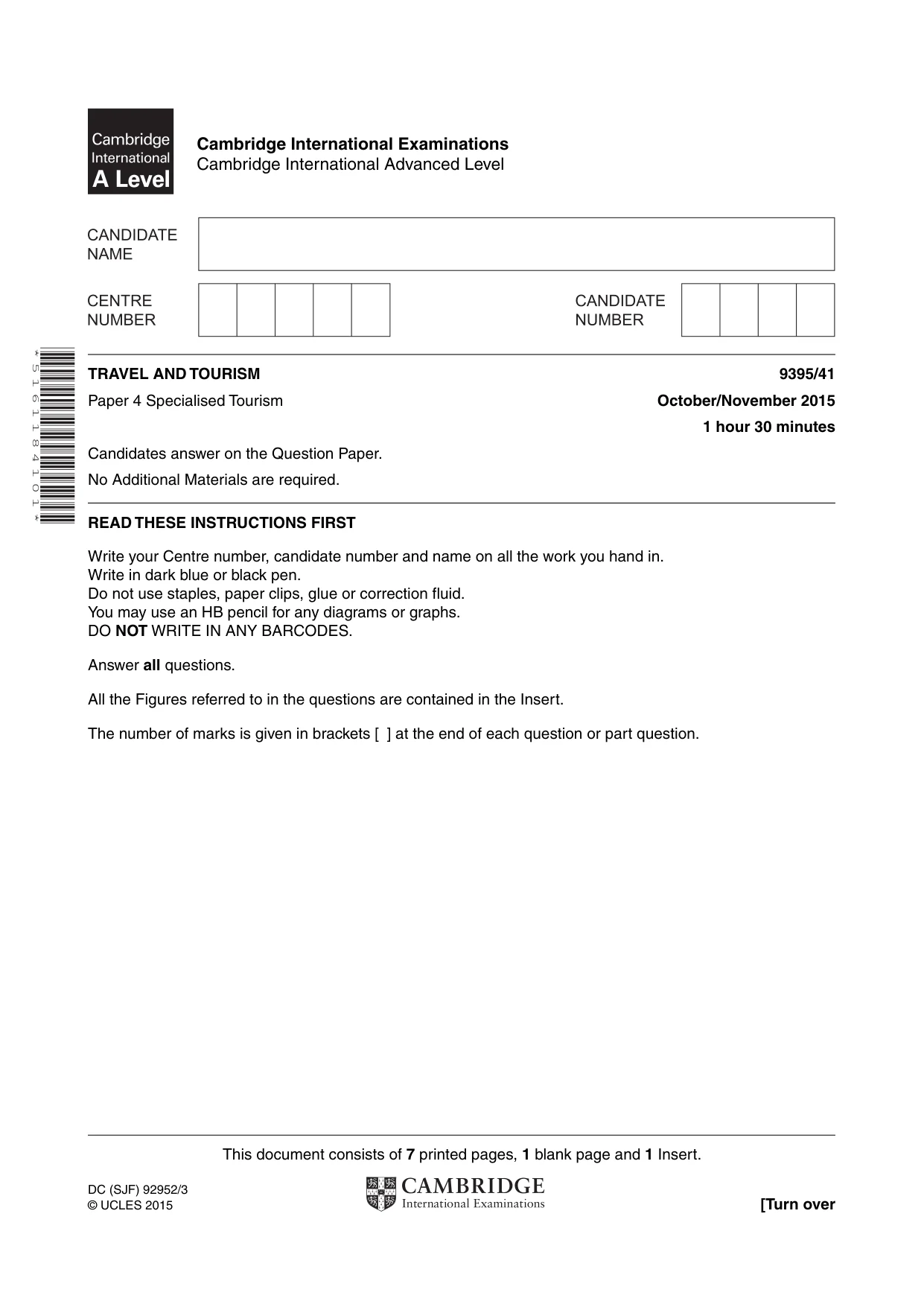
This document consists of 7 printed pages, 1 blank page and 1 Insert. DC (SJF) 92952/3 © UCLES 2015 [Turn over Cambridge International Examinations Cambridge International Advanced Level * 5 1 6 1 1 8 4 1 0 1 * TRAVEL AND TOURISM 9395/41 Paper 4 Specialised Tourism October/November 2015 1 hour 30 minutes Candidates answer on the Question Paper. No Additional Materials are required. READ THESE INSTRUCTIONS FIRST Write your Centre number, candidate number and name on all the work you hand in. Write in dark blue or black pen. Do not use staples, paper clips, glue or correction fluid. You may use an HB pencil for any diagrams or graphs. DO NOT WRITE IN ANY BARCODES. Answer all questions. All the Figures referred to in the questions are contained in the Insert. The number of marks is given in brackets [ ] at the end of each question or part question.
Question paper, page 2
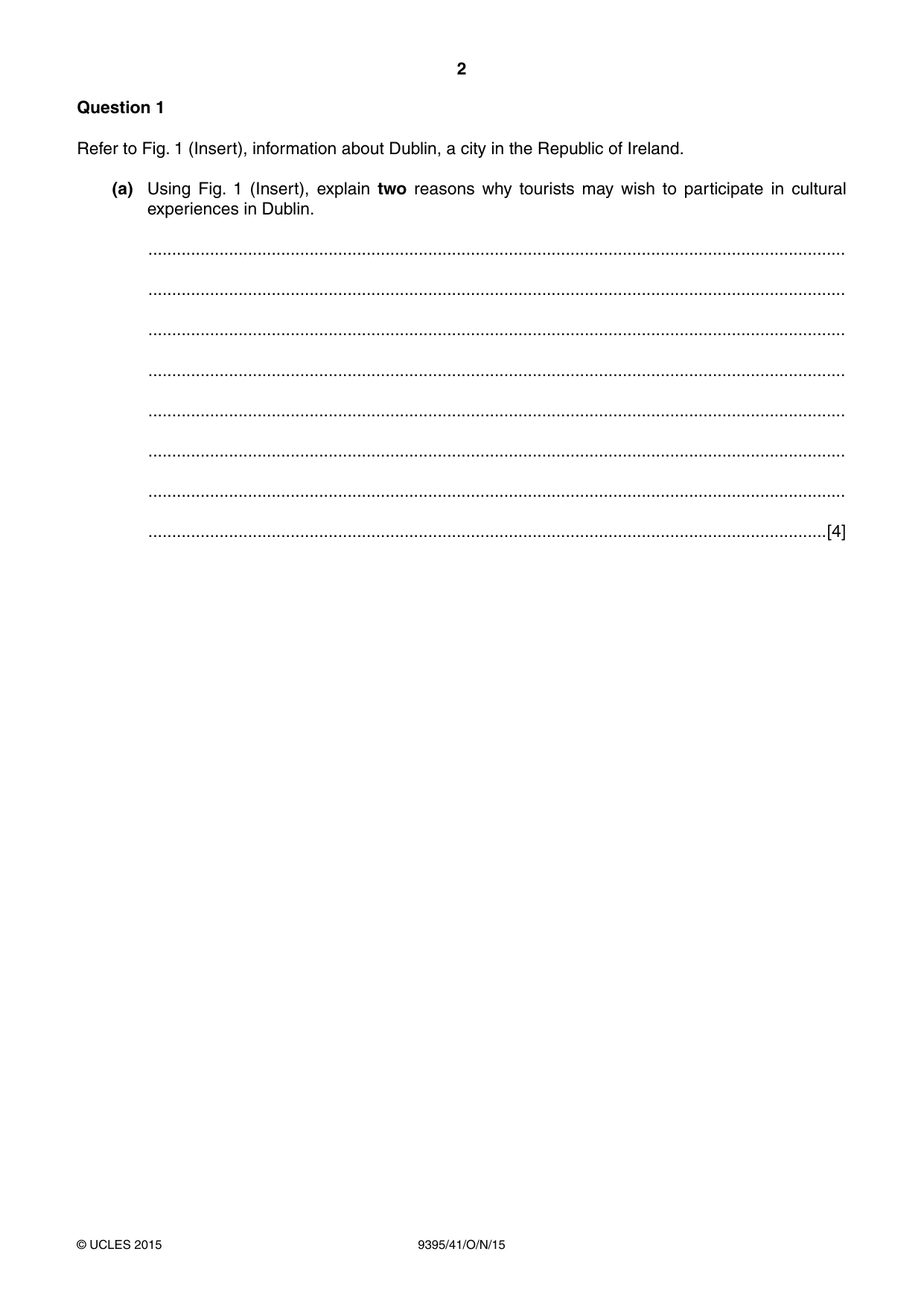
2 9395/41/O/N/15 © UCLES 2015 Question 1 Refer to Fig. 1 (Insert), information about Dublin, a city in the Republic of Ireland. (a) Using Fig. 1 (Insert), explain two reasons why tourists may wish to participate in cultural experiences in Dublin. … … … … … … … …[4]
Question paper, page 3
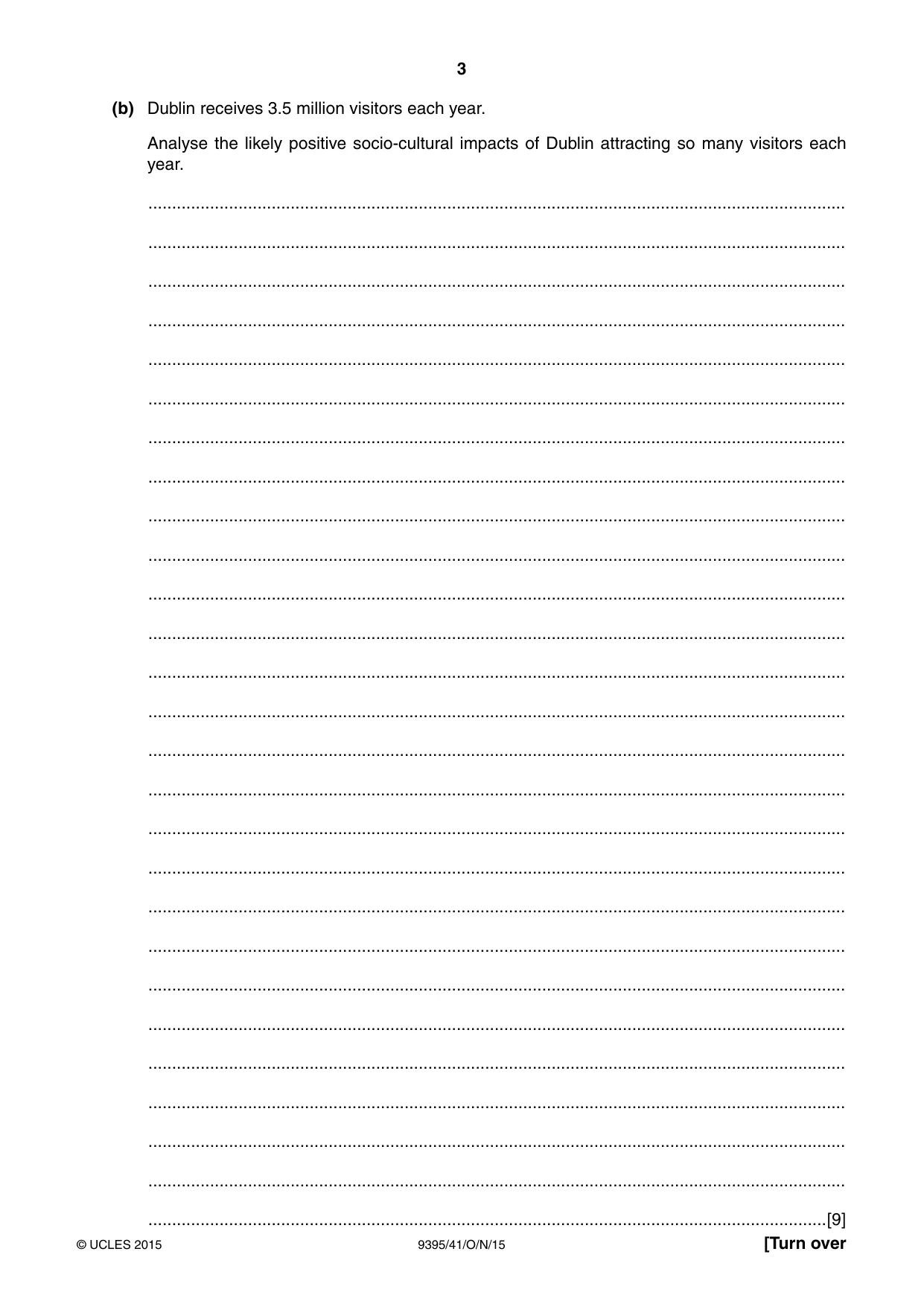
3 9395/41/O/N/15 © UCLES 2015 [Turn over (b) Dublin receives 3.5 million visitors each year. Analyse the likely positive socio-cultural impacts of Dublin attracting so many visitors each year. … … … … … … … … … … … … … … … … … … … … … … … … … … …[9]
Question paper, page 4
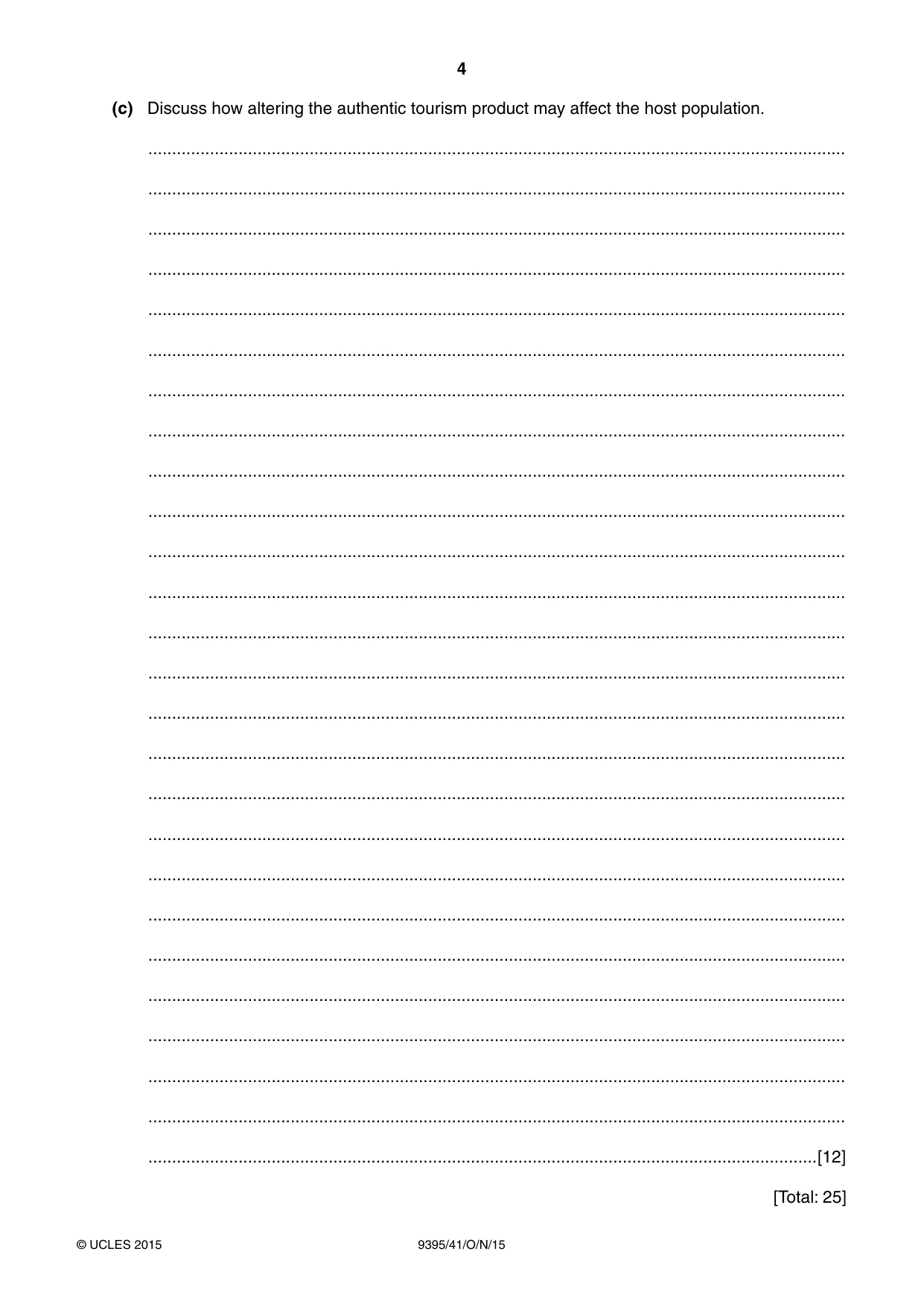
4 9395/41/O/N/15 © UCLES 2015 (c) Discuss how altering the authentic tourism product may affect the host population. … … … … … … … … … … … … … … … … … … … … … … … … … …[12] [Total: 25]
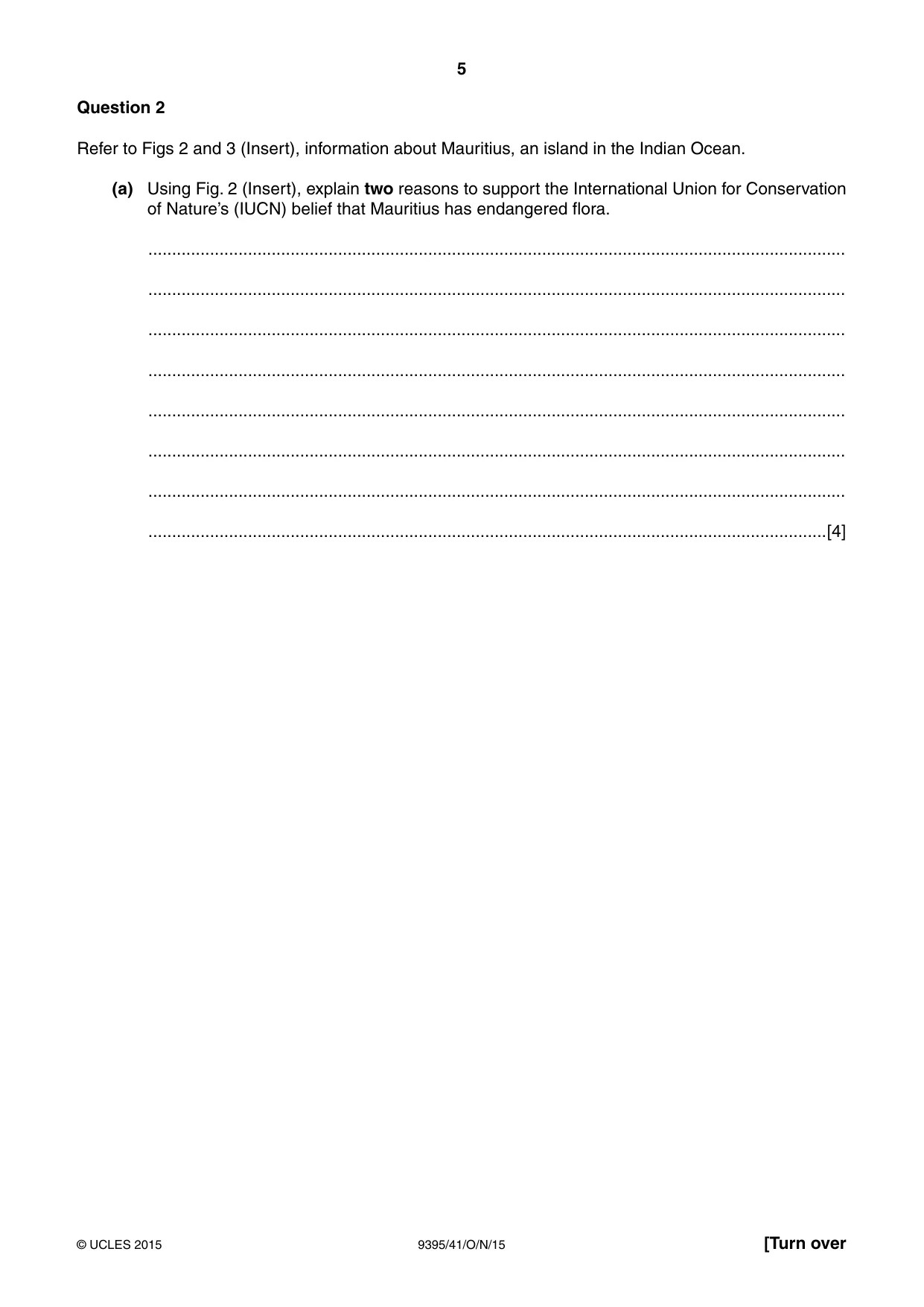
Question paper, page 5
5 9395/41/O/N/15 © UCLES 2015 [Turn over Question 2 Refer to Figs 2 and 3 (Insert), information about Mauritius, an island in the Indian Ocean. (a) Using Fig. 2 (Insert), explain two reasons to support the International Union for Conservation of Nature’s (IUCN) belief that Mauritius has endangered flora. … … … … … … … …[4]
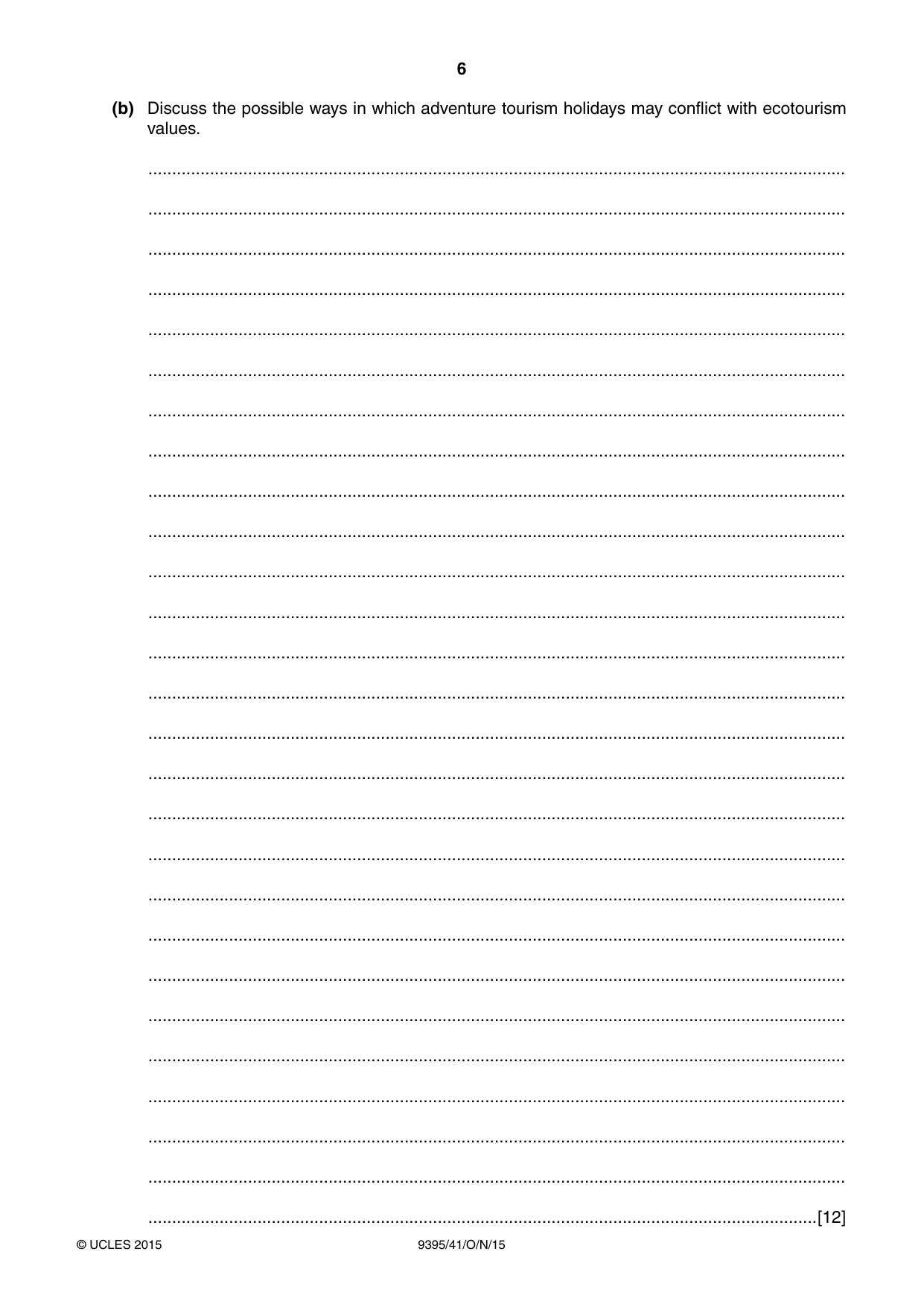
Question paper, page 6
6 9395/41/O/N/15 © UCLES 2015 (b) Discuss the possible ways in which adventure tourism holidays may conflict with ecotourism values. … … … … … … … … … … … … … … … … … … … … … … … … … … …[12]
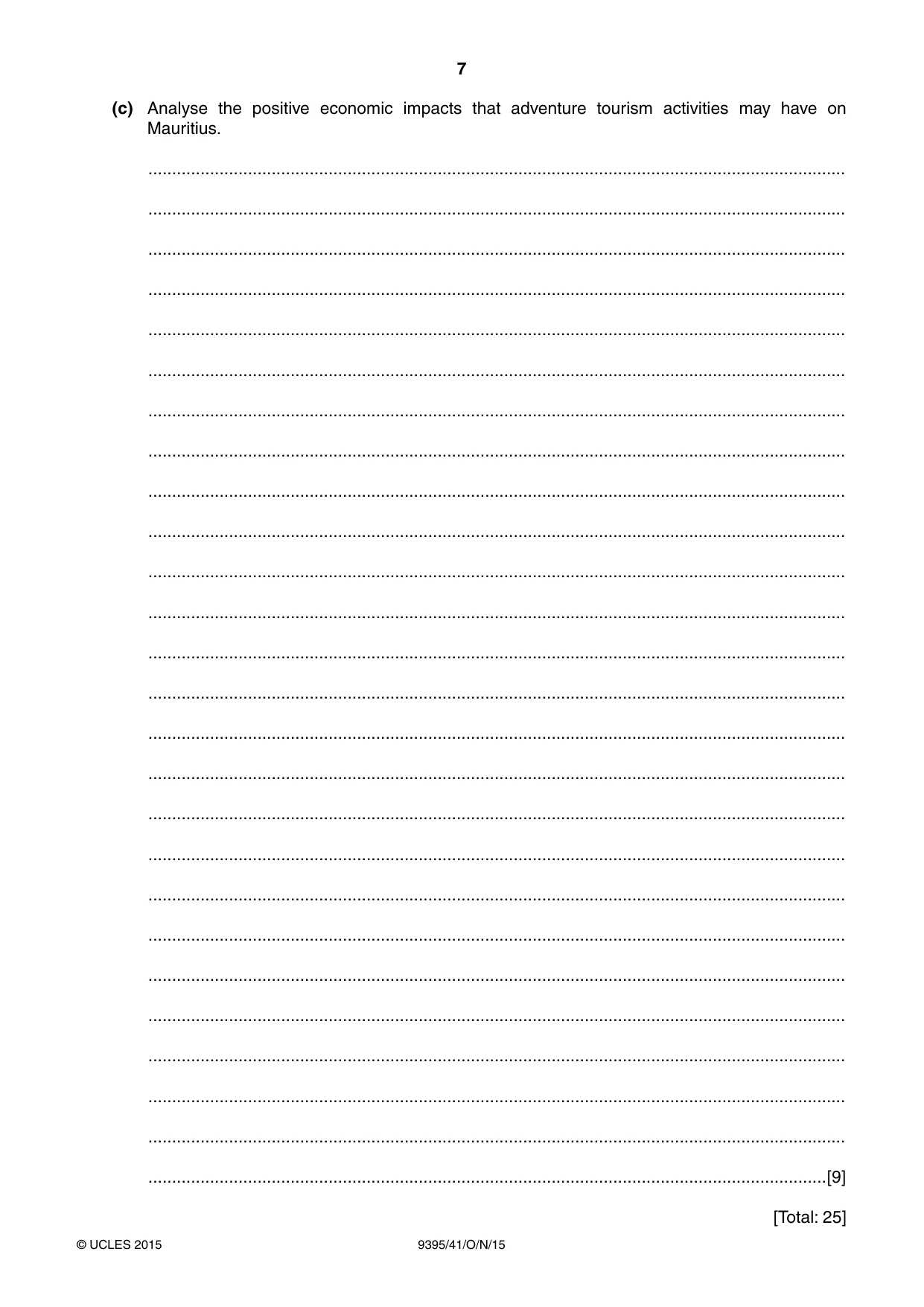
Question paper, page 7
7 9395/41/O/N/15 © UCLES 2015 (c) Analyse the positive economic impacts that adventure tourism activities may have on Mauritius. … … … … … … … … … … … … … … … … … … … … … … … … … …[9] [Total: 25]
Question paper, page 8
8 9395/41/O/N/15 © UCLES 2015 Permission to reproduce items where third-party owned material protected by copyright is included has been sought and cleared where possible. Every reasonable effort has been made by the publisher (UCLES) to trace copyright holders, but if any items requiring clearance have unwittingly been included, the publisher will be pleased to make amends at the earliest possible opportunity. To avoid the issue of disclosure of answer-related information to candidates, all copyright acknowledgements are reproduced online in the Cambridge International Examinations Copyright Acknowledgements Booklet. This is produced for each series of examinations and is freely available to download at www.cie.org.uk after the live examination series. Cambridge International Examinations is part of the Cambridge Assessment Group. Cambridge Assessment is the brand name of University of Cambridge Local Examinations Syndicate (UCLES), which is itself a department of the University of Cambridge. BLANK PAGE
Mark scheme, page 1
® IGCSE is the registered trademark of Cambridge International Examinations. CAMBRIDGE INTERNATIONAL EXAMINATIONS Cambridge International Advanced Subsidiary and Advanced Level MARK SCHEME for the October/November 2015 series 9395 TRAVEL AND TOURISM 9395/41 Paper 4 (Specialised Tourism), maximum raw mark 50 This mark scheme is published as an aid to teachers and candidates, to indicate the requirements of the examination. It shows the basis on which Examiners were instructed to award marks. It does not indicate the details of the discussions that took place at an Examiners’ meeting before marking began, which would have considered the acceptability of alternative answers. Mark schemes should be read in conjunction with the question paper and the Principal Examiner Report for Teachers. Cambridge will not enter into discussions about these mark schemes. Cambridge is publishing the mark schemes for the October/November 2015 series for most Cambridge IGCSE®, Cambridge International A and AS Level components and some Cambridge O Level components.
Mark scheme, page 2
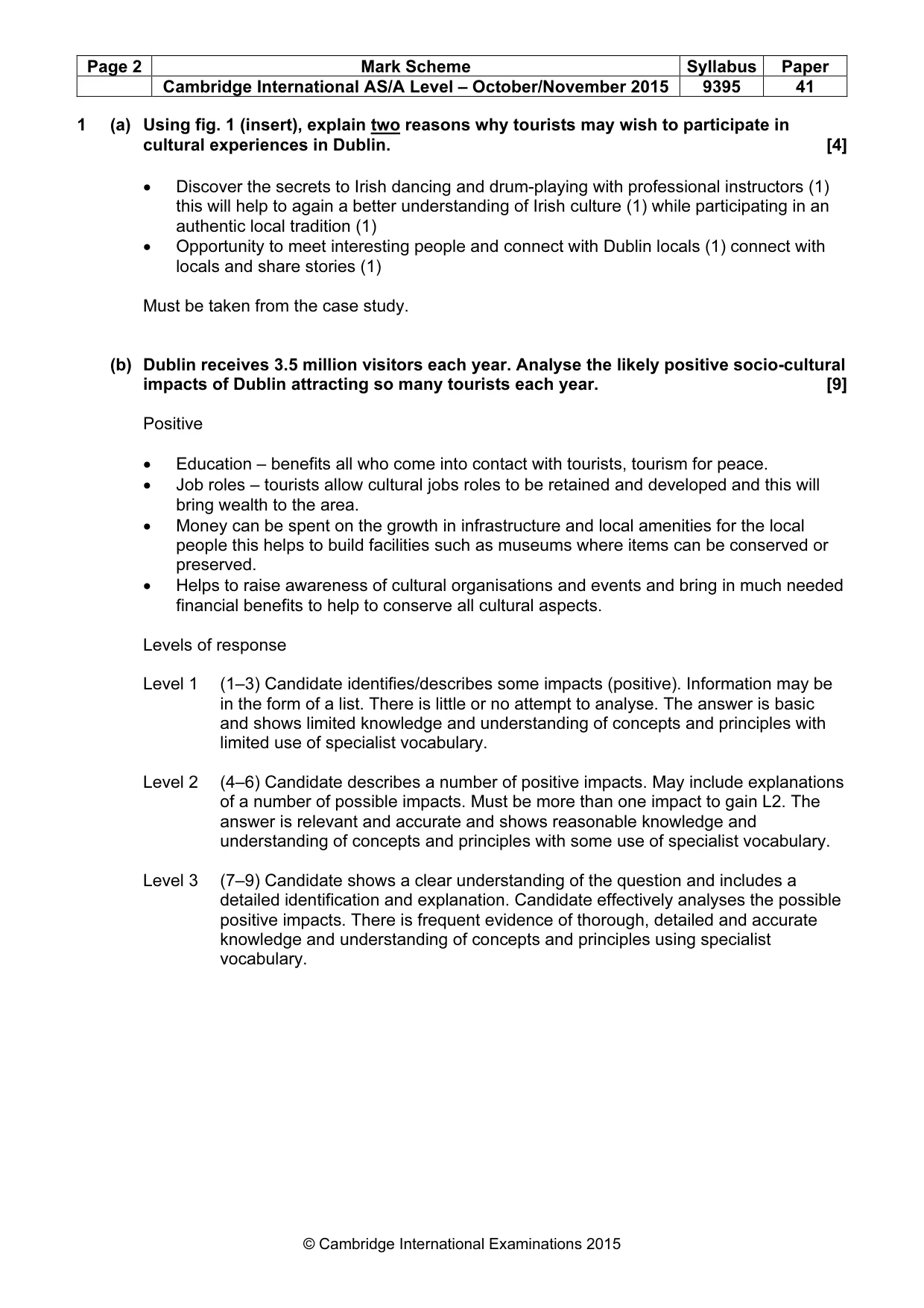
Page 2 Mark Scheme Syllabus Paper Cambridge International AS/A Level – October/November 2015 9395 41 © Cambridge International Examinations 2015 1 (a) Using fig. 1 (insert), explain two reasons why tourists may wish to participate in cultural experiences in Dublin. [4] • Discover the secrets to Irish dancing and drum-playing with professional instructors (1) this will help to again a better understanding of Irish culture (1) while participating in an authentic local tradition (1) • Opportunity to meet interesting people and connect with Dublin locals (1) connect with locals and share stories (1) Must be taken from the case study. (b) Dublin receives 3.5 million visitors each year. Analyse the likely positive socio-cultural impacts of Dublin attracting so many tourists each year. [9] Positive • Education – benefits all who come into contact with tourists, tourism for peace. • Job roles – tourists allow cultural jobs roles to be retained and developed and this will bring wealth to the area. • Money can be spent on the growth in infrastructure and local amenities for the local people this helps to build facilities such as museums where items can be conserved or preserved. • Helps to raise awareness of cultural organisations and events and bring in much needed financial benefits to help to conserve all cultural aspects. Levels of response Level 1 (1–3) Candidate identifies/describes some impacts (positive). Information may be in the form of a list. There is little or no attempt to analyse. The answer is basic and shows limited knowledge and understanding of concepts and principles with limited use of specialist vocabulary. Level 2 (4–6) Candidate describes a number of positive impacts. May include explanations of a number of possible impacts. Must be more than one impact to gain L2. The answer is relevant and accurate and shows reasonable knowledge and understanding of concepts and principles with some use of specialist vocabulary. Level 3 (7–9) Candidate shows a clear understanding of the question and includes a detailed identification and explanation. Candidate effectively analyses the possible positive impacts. There is frequent evidence of thorough, detailed and accurate knowledge and understanding of concepts and principles using specialist vocabulary.
Mark scheme, page 3
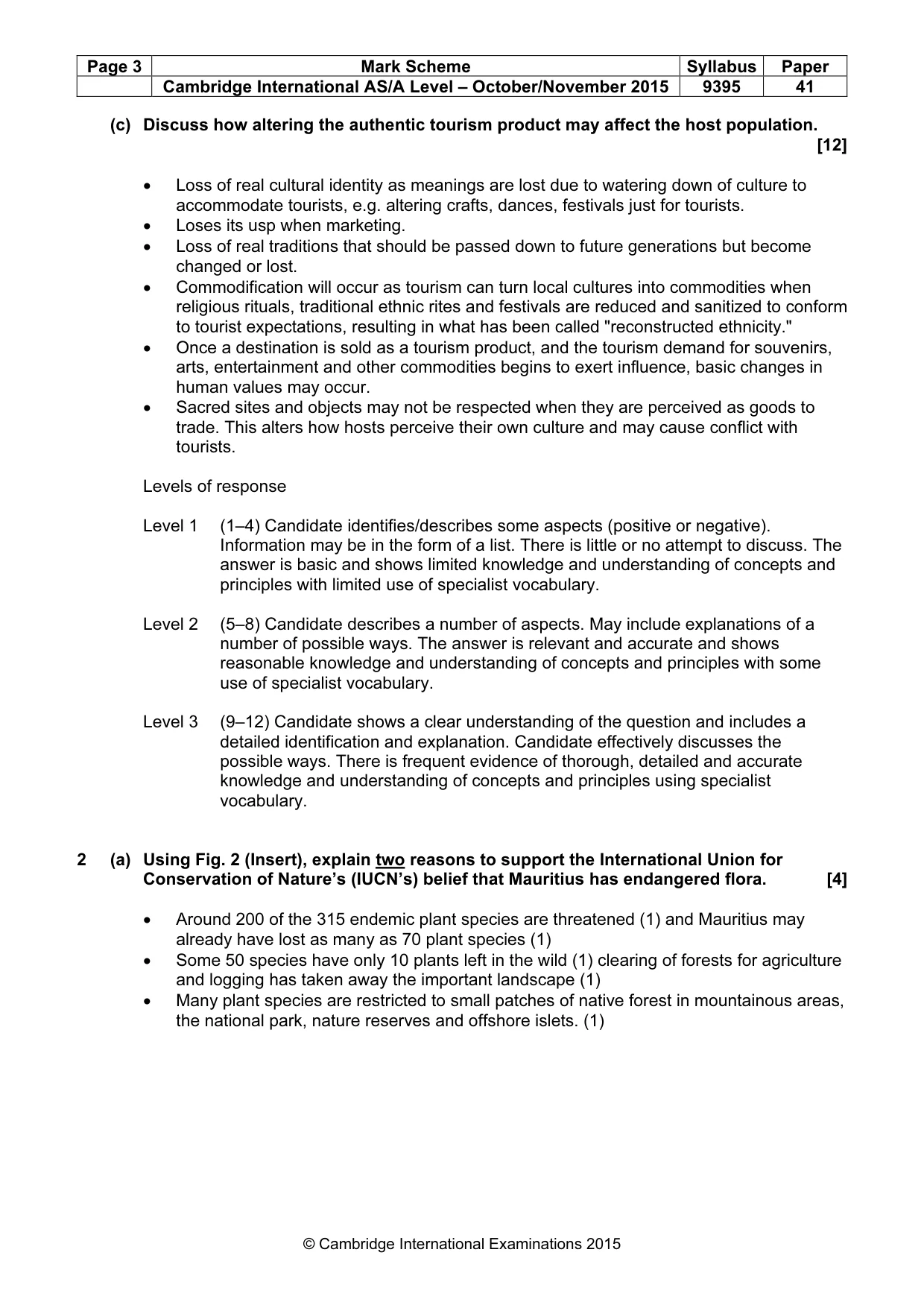
Page 3 Mark Scheme Syllabus Paper Cambridge International AS/A Level – October/November 2015 9395 41 © Cambridge International Examinations 2015 (c) Discuss how altering the authentic tourism product may affect the host population. [12] • Loss of real cultural identity as meanings are lost due to watering down of culture to accommodate tourists, e.g. altering crafts, dances, festivals just for tourists. • Loses its usp when marketing. • Loss of real traditions that should be passed down to future generations but become changed or lost. • Commodification will occur as tourism can turn local cultures into commodities when religious rituals, traditional ethnic rites and festivals are reduced and sanitized to conform to tourist expectations, resulting in what has been called "reconstructed ethnicity." • Once a destination is sold as a tourism product, and the tourism demand for souvenirs, arts, entertainment and other commodities begins to exert influence, basic changes in human values may occur. • Sacred sites and objects may not be respected when they are perceived as goods to trade. This alters how hosts perceive their own culture and may cause conflict with tourists. Levels of response Level 1 (1–4) Candidate identifies/describes some aspects (positive or negative). Information may be in the form of a list. There is little or no attempt to discuss. The answer is basic and shows limited knowledge and understanding of concepts and principles with limited use of specialist vocabulary. Level 2 (5–8) Candidate describes a number of aspects. May include explanations of a number of possible ways. The answer is relevant and accurate and shows reasonable knowledge and understanding of concepts and principles with some use of specialist vocabulary. Level 3 (9–12) Candidate shows a clear understanding of the question and includes a detailed identification and explanation. Candidate effectively discusses the possible ways. There is frequent evidence of thorough, detailed and accurate knowledge and understanding of concepts and principles using specialist vocabulary. 2 (a) Using Fig. 2 (Insert), explain two reasons to support the International Union for Conservation of Nature’s (IUCN’s) belief that Mauritius has endangered flora. [4] • Around 200 of the 315 endemic plant species are threatened (1) and Mauritius may already have lost as many as 70 plant species (1) • Some 50 species have only 10 plants left in the wild (1) clearing of forests for agriculture and logging has taken away the important landscape (1) • Many plant species are restricted to small patches of native forest in mountainous areas, the national park, nature reserves and offshore islets. (1)
Mark scheme, page 4
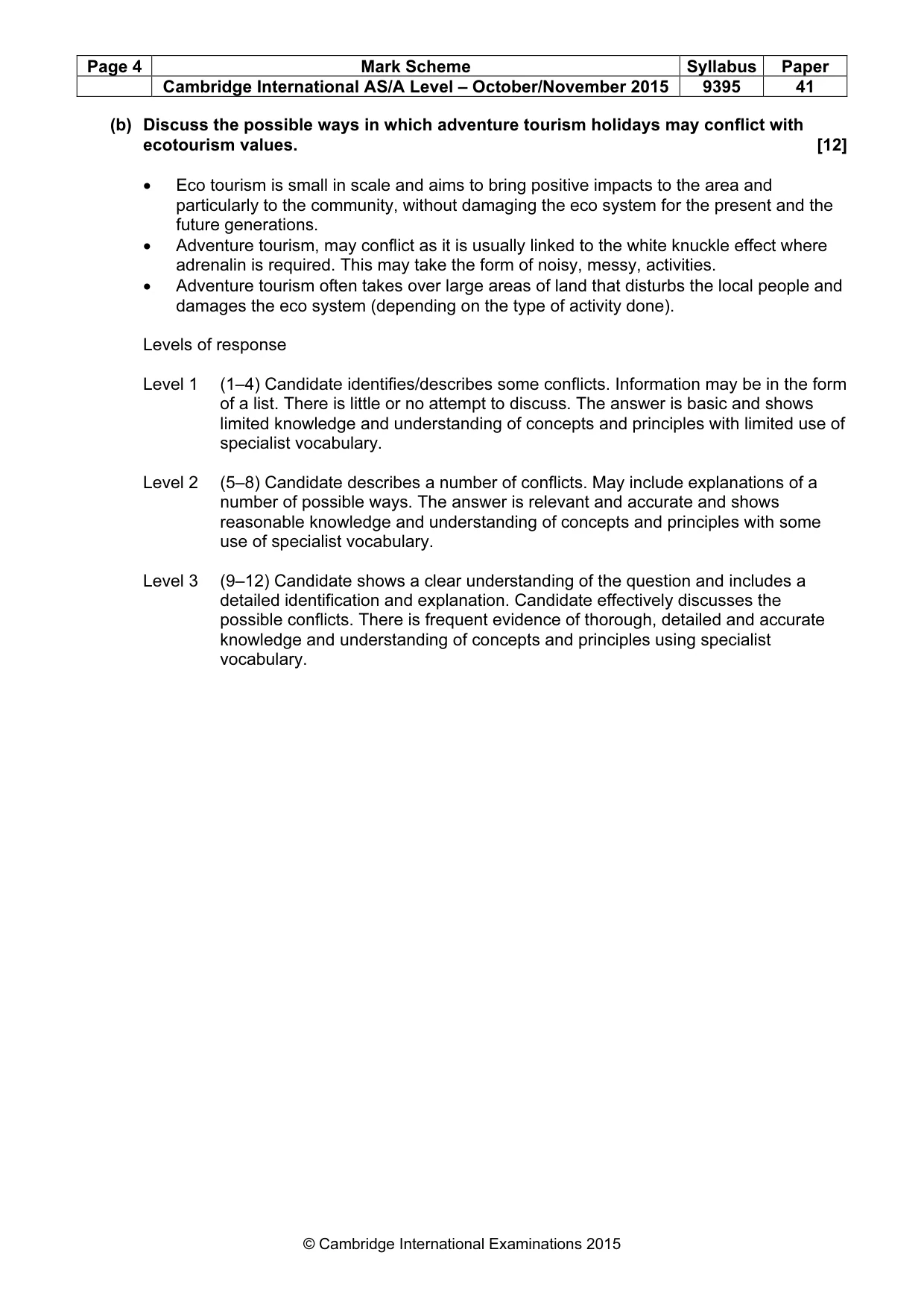
Page 4 Mark Scheme Syllabus Paper Cambridge International AS/A Level – October/November 2015 9395 41 © Cambridge International Examinations 2015 (b) Discuss the possible ways in which adventure tourism holidays may conflict with ecotourism values. [12] • Eco tourism is small in scale and aims to bring positive impacts to the area and particularly to the community, without damaging the eco system for the present and the future generations. • Adventure tourism, may conflict as it is usually linked to the white knuckle effect where adrenalin is required. This may take the form of noisy, messy, activities. • Adventure tourism often takes over large areas of land that disturbs the local people and damages the eco system (depending on the type of activity done). Levels of response Level 1 (1–4) Candidate identifies/describes some conflicts. Information may be in the form of a list. There is little or no attempt to discuss. The answer is basic and shows limited knowledge and understanding of concepts and principles with limited use of specialist vocabulary. Level 2 (5–8) Candidate describes a number of conflicts. May include explanations of a number of possible ways. The answer is relevant and accurate and shows reasonable knowledge and understanding of concepts and principles with some use of specialist vocabulary. Level 3 (9–12) Candidate shows a clear understanding of the question and includes a detailed identification and explanation. Candidate effectively discusses the possible conflicts. There is frequent evidence of thorough, detailed and accurate knowledge and understanding of concepts and principles using specialist vocabulary.
Mark scheme, page 5
Page 5 Mark Scheme Syllabus Paper Cambridge International AS/A Level – October/November 2015 9395 41 © Cambridge International Examinations 2015 (c) Analyse the positive economic impacts that adventure tourism activities may have on Mauritius. [9] • Wealth creation. • Jobs (although may be seasonal, and low paid). • Sustains skills and training for job roles (roles may be basic). • Brings in foreign exchange and therefore increase GDP (depends on fluctuation). • Stimulates the economy which will benefit the local area and help to develop the area. Such as development programmes (projects may be started and then stopped when funds dry up). Levels of response Level 1 (1–3) Candidate identifies/describes some impacts. Information may be in the form of a list. There is little or no attempt to analyse. The answer is basic and shows limited knowledge and understanding of concepts and principles with limited use of specialist vocabulary. Level 2 (4–6) Candidate describes a number of impacts. May include explanations of a number of possible impacts. The answer is relevant and accurate and shows reasonable knowledge and understanding of concepts and principles with some use of specialist vocabulary. Level 3 (7–9) Candidate shows a clear understanding of the question and includes a detailed identification and explanation of the impacts. Candidate effectively analyses the possible impacts. There is frequent evidence of thorough, detailed and accurate knowledge and understanding of concepts and principles using specialist vocabulary
What you needed in this session
Cambridge’s own grade thresholds for 2015 Oct/Nov, Paper 4 · Variant 1. A higher threshold means an easier paper — the bar moves with how the cohort did.