Cambridge A Level Travel and Tourism 9395 — 2015 Oct/Nov Paper 4 · Variant 3
9395/43/O/N/15 · 50 marks · ≈56 min
The question paper and its mark scheme, free to read here and free to download. This is Cambridge’s own paper, exactly as it was sat.
Question paper8 pages

Mark scheme5 pages
Answers below. Sit the paper first if you are practising.
Paper as text
Question paper, page 1
This document consists of 7 printed pages, 1 blank page and 1 Insert. DC (RW) 92949/1 © UCLES 2015 [Turn over Cambridge International Examinations Cambridge International Advanced Level * 2 0 7 6 1 7 3 1 2 4 * TRAVEL AND TOURISM 9395/43 Paper 4 Specialised Tourism October/November 2015 1 hour 30 minutes Candidates answer on the Question Paper. No Additional Materials are required. READ THESE INSTRUCTIONS FIRST Write your Centre number, candidate number and name on all the work you hand in. Write in dark blue or black pen. You may use an HB pencil for any diagrams or graphs. Do not use staples, paper clips, glue or correction fluid. DO NOT WRITE IN ANY BARCODES. Answer all questions. All the Figures referred to in the questions are contained in the Insert. The number of marks is given in brackets [ ] at the end of each question or part question.
Question paper, page 2
2 9395/43/O/N/15 © UCLES 2015 Question 1 Refer to Fig. 1 (Insert), information about tourism awards in Asia. (a) Using Fig. 1 (Insert), explain two ways in which the Wild Asia Responsible Tourism Awards encourage tourism providers to ‘make a difference’. … … … … … … … …[4]
Question paper, page 3
3 9395/43/O/N/15 © UCLES 2015 [Turn over (b) Discuss the possible ways in which tourism can help to alleviate poverty in places such as Sri Lanka. … … … … … … … … … … … … … … … … … … … … … … … … … … …[9]
Question paper, page 4
4 9395/43/O/N/15 © UCLES 2015 Refer to Fig. 2 (Insert), information about the Heritance Kandalama Hotel in Sri Lanka. (c) Analyse how hotels such as the Heritance Kandalama attempt to reduce negative environmental impacts. … … … … … … … … … … … … … … … … … … … … … … … … …[12] [Total: 25]
Question paper, page 5
5 9395/43/O/N/15 © UCLES 2015 [Turn over Question 2 Refer to Fig. 3 (Insert), information about Fat Tire Bike Tours in Berlin, Germany. (a) Using Fig. 3 (Insert), explain two ways in which Fat Tire Bike Tours support the local community in Berlin. … … … … … … … …[4]
Question paper, page 6
6 9395/43/O/N/15 © UCLES 2015 (b) Analyse the likely positive cultural impacts of tours in historical cities such as Berlin. … … … … … … … … … … … … … … … … … … … … … … … … … … …[9]
Question paper, page 7
7 9395/43/O/N/15 © UCLES 2015 (c) Discuss the measures that cities such as Berlin might use to manage large numbers of tourists taking cycle tours. … … … … … … … … … … … … … … … … … … … … … … … … … …[12] [Total: 25]
Question paper, page 8
8 9395/43/O/N/15 © UCLES 2015 Permission to reproduce items where third-party owned material protected by copyright is included has been sought and cleared where possible. Every reasonable effort has been made by the publisher (UCLES) to trace copyright holders, but if any items requiring clearance have unwittingly been included, the publisher will be pleased to make amends at the earliest possible opportunity. To avoid the issue of disclosure of answer-related information to candidates, all copyright acknowledgements are reproduced online in the Cambridge International Examinations Copyright Acknowledgements Booklet. This is produced for each series of examinations and is freely available to download at www.cie.org.uk after the live examination series. Cambridge International Examinations is part of the Cambridge Assessment Group. Cambridge Assessment is the brand name of University of Cambridge Local Examinations Syndicate (UCLES), which is itself a department of the University of Cambridge. BLANK PAGE
Mark scheme, page 1
® IGCSE is the registered trademark of Cambridge International Examinations. CAMBRIDGE INTERNATIONAL EXAMINATIONS Cambridge International Advanced Subsidiary and Advanced Level MARK SCHEME for the October/November 2015 series 9395 TRAVEL AND TOURISM 9395/43 Paper 4 (Specialised Tourism), maximum raw mark 43 This mark scheme is published as an aid to teachers and candidates, to indicate the requirements of the examination. It shows the basis on which Examiners were instructed to award marks. It does not indicate the details of the discussions that took place at an Examiners’ meeting before marking began, which would have considered the acceptability of alternative answers. Mark schemes should be read in conjunction with the question paper and the Principal Examiner Report for Teachers. Cambridge will not enter into discussions about these mark schemes. Cambridge is publishing the mark schemes for the October/November 2015 series for most Cambridge IGCSE®, Cambridge International A and AS Level components and some Cambridge O Level components.
Mark scheme, page 2
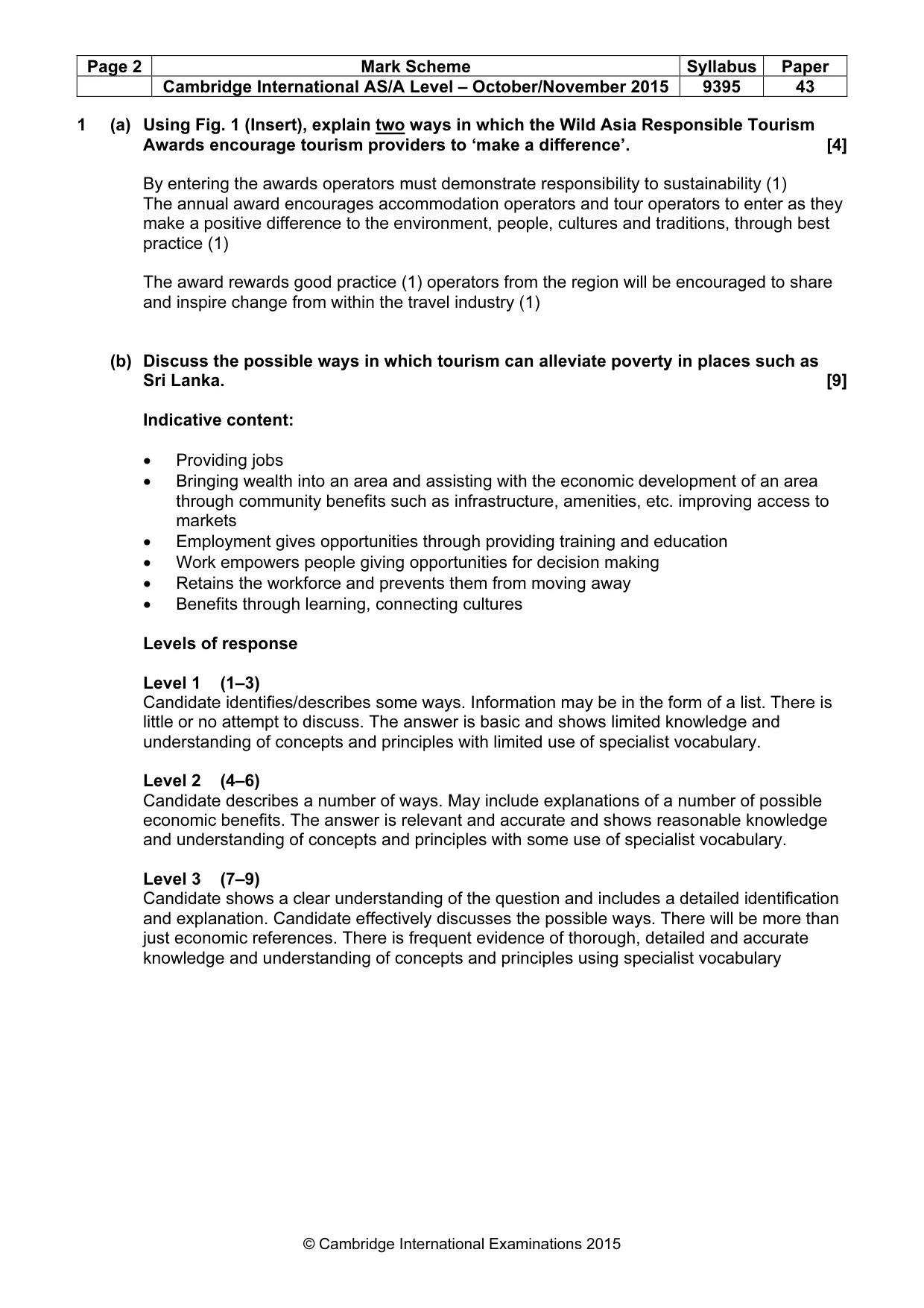
Page 2 Mark Scheme Syllabus Paper Cambridge International AS/A Level – October/November 2015 9395 43 © Cambridge International Examinations 2015 1 (a) Using Fig. 1 (Insert), explain two ways in which the Wild Asia Responsible Tourism Awards encourage tourism providers to ‘make a difference’. [4] By entering the awards operators must demonstrate responsibility to sustainability (1) The annual award encourages accommodation operators and tour operators to enter as they make a positive difference to the environment, people, cultures and traditions, through best practice (1) The award rewards good practice (1) operators from the region will be encouraged to share and inspire change from within the travel industry (1) (b) Discuss the possible ways in which tourism can alleviate poverty in places such as Sri Lanka. [9] Indicative content: • Providing jobs • Bringing wealth into an area and assisting with the economic development of an area through community benefits such as infrastructure, amenities, etc. improving access to markets • Employment gives opportunities through providing training and education • Work empowers people giving opportunities for decision making • Retains the workforce and prevents them from moving away • Benefits through learning, connecting cultures Levels of response Level 1 (1–3) Candidate identifies/describes some ways. Information may be in the form of a list. There is little or no attempt to discuss. The answer is basic and shows limited knowledge and understanding of concepts and principles with limited use of specialist vocabulary. Level 2 (4–6) Candidate describes a number of ways. May include explanations of a number of possible economic benefits. The answer is relevant and accurate and shows reasonable knowledge and understanding of concepts and principles with some use of specialist vocabulary. Level 3 (7–9) Candidate shows a clear understanding of the question and includes a detailed identification and explanation. Candidate effectively discusses the possible ways. There will be more than just economic references. There is frequent evidence of thorough, detailed and accurate knowledge and understanding of concepts and principles using specialist vocabulary
Mark scheme, page 3
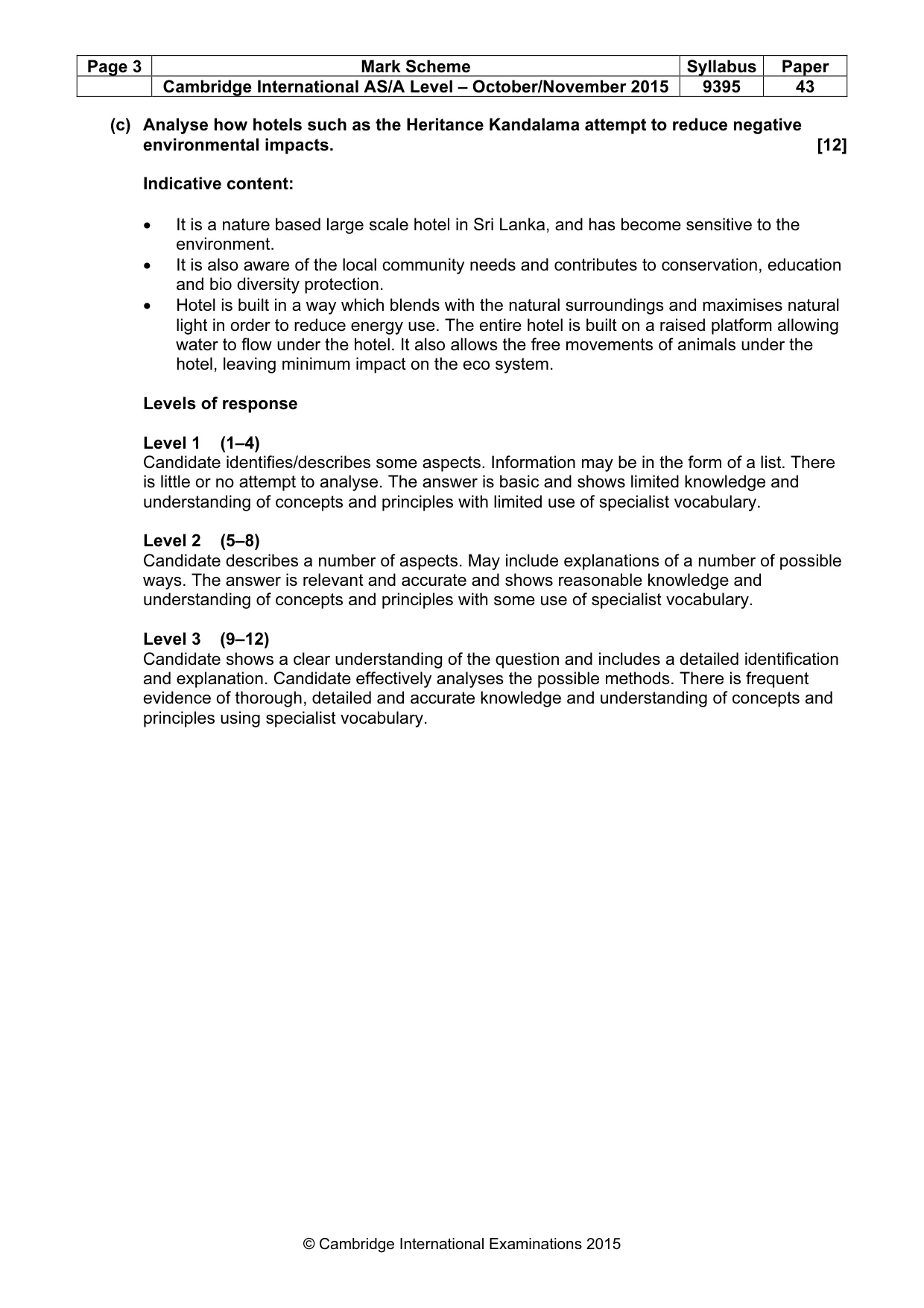
Page 3 Mark Scheme Syllabus Paper Cambridge International AS/A Level – October/November 2015 9395 43 © Cambridge International Examinations 2015 (c) Analyse how hotels such as the Heritance Kandalama attempt to reduce negative environmental impacts. [12] Indicative content: • It is a nature based large scale hotel in Sri Lanka, and has become sensitive to the environment. • It is also aware of the local community needs and contributes to conservation, education and bio diversity protection. • Hotel is built in a way which blends with the natural surroundings and maximises natural light in order to reduce energy use. The entire hotel is built on a raised platform allowing water to flow under the hotel. It also allows the free movements of animals under the hotel, leaving minimum impact on the eco system. Levels of response Level 1 (1–4) Candidate identifies/describes some aspects. Information may be in the form of a list. There is little or no attempt to analyse. The answer is basic and shows limited knowledge and understanding of concepts and principles with limited use of specialist vocabulary. Level 2 (5–8) Candidate describes a number of aspects. May include explanations of a number of possible ways. The answer is relevant and accurate and shows reasonable knowledge and understanding of concepts and principles with some use of specialist vocabulary. Level 3 (9–12) Candidate shows a clear understanding of the question and includes a detailed identification and explanation. Candidate effectively analyses the possible methods. There is frequent evidence of thorough, detailed and accurate knowledge and understanding of concepts and principles using specialist vocabulary.
Mark scheme, page 4
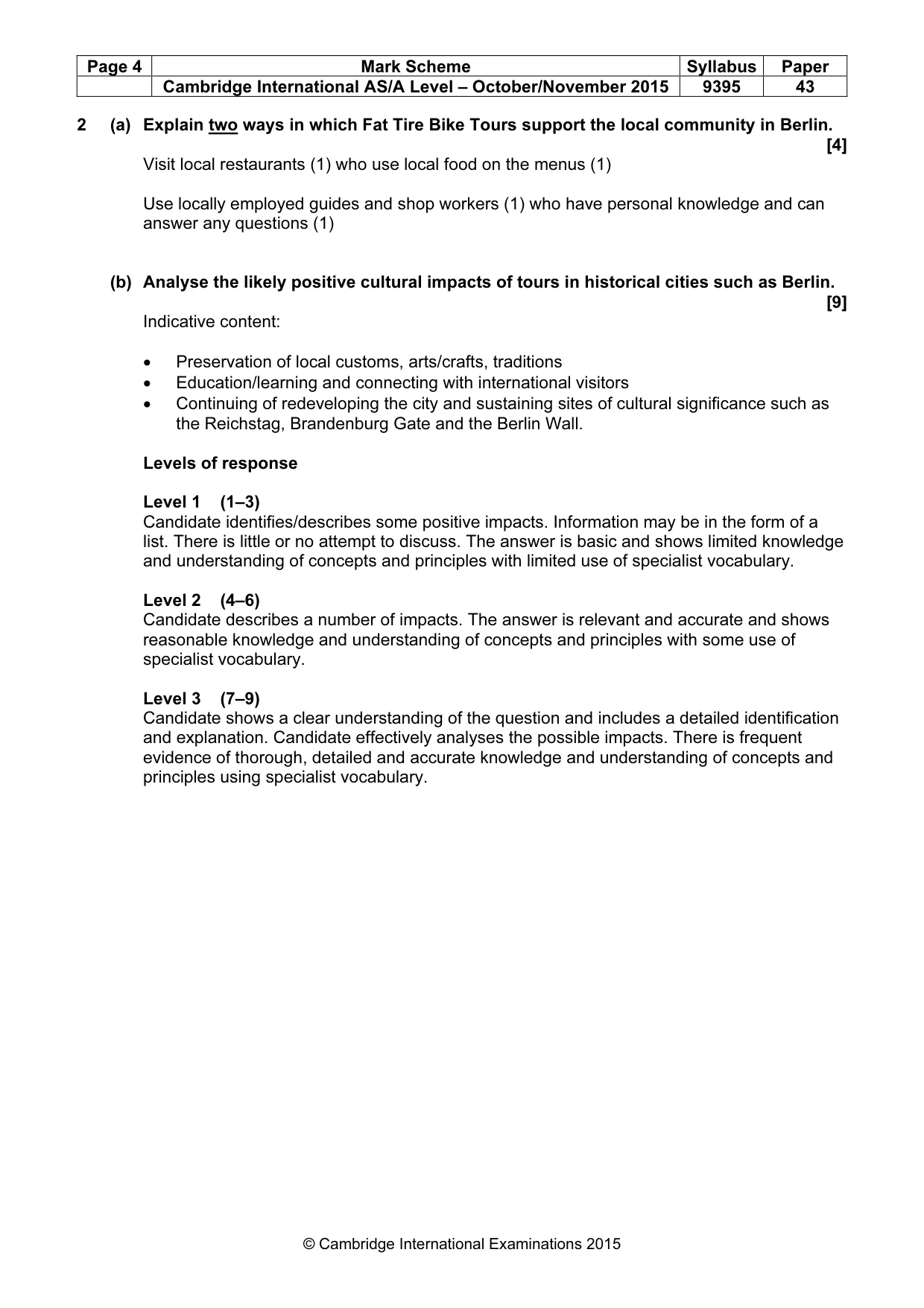
Page 4 Mark Scheme Syllabus Paper Cambridge International AS/A Level – October/November 2015 9395 43 © Cambridge International Examinations 2015 2 (a) Explain two ways in which Fat Tire Bike Tours support the local community in Berlin. [4] Visit local restaurants (1) who use local food on the menus (1) Use locally employed guides and shop workers (1) who have personal knowledge and can answer any questions (1) (b) Analyse the likely positive cultural impacts of tours in historical cities such as Berlin. [9] Indicative content: • Preservation of local customs, arts/crafts, traditions • Education/learning and connecting with international visitors • Continuing of redeveloping the city and sustaining sites of cultural significance such as the Reichstag, Brandenburg Gate and the Berlin Wall. Levels of response Level 1 (1–3) Candidate identifies/describes some positive impacts. Information may be in the form of a list. There is little or no attempt to discuss. The answer is basic and shows limited knowledge and understanding of concepts and principles with limited use of specialist vocabulary. Level 2 (4–6) Candidate describes a number of impacts. The answer is relevant and accurate and shows reasonable knowledge and understanding of concepts and principles with some use of specialist vocabulary. Level 3 (7–9) Candidate shows a clear understanding of the question and includes a detailed identification and explanation. Candidate effectively analyses the possible impacts. There is frequent evidence of thorough, detailed and accurate knowledge and understanding of concepts and principles using specialist vocabulary.
Mark scheme, page 5
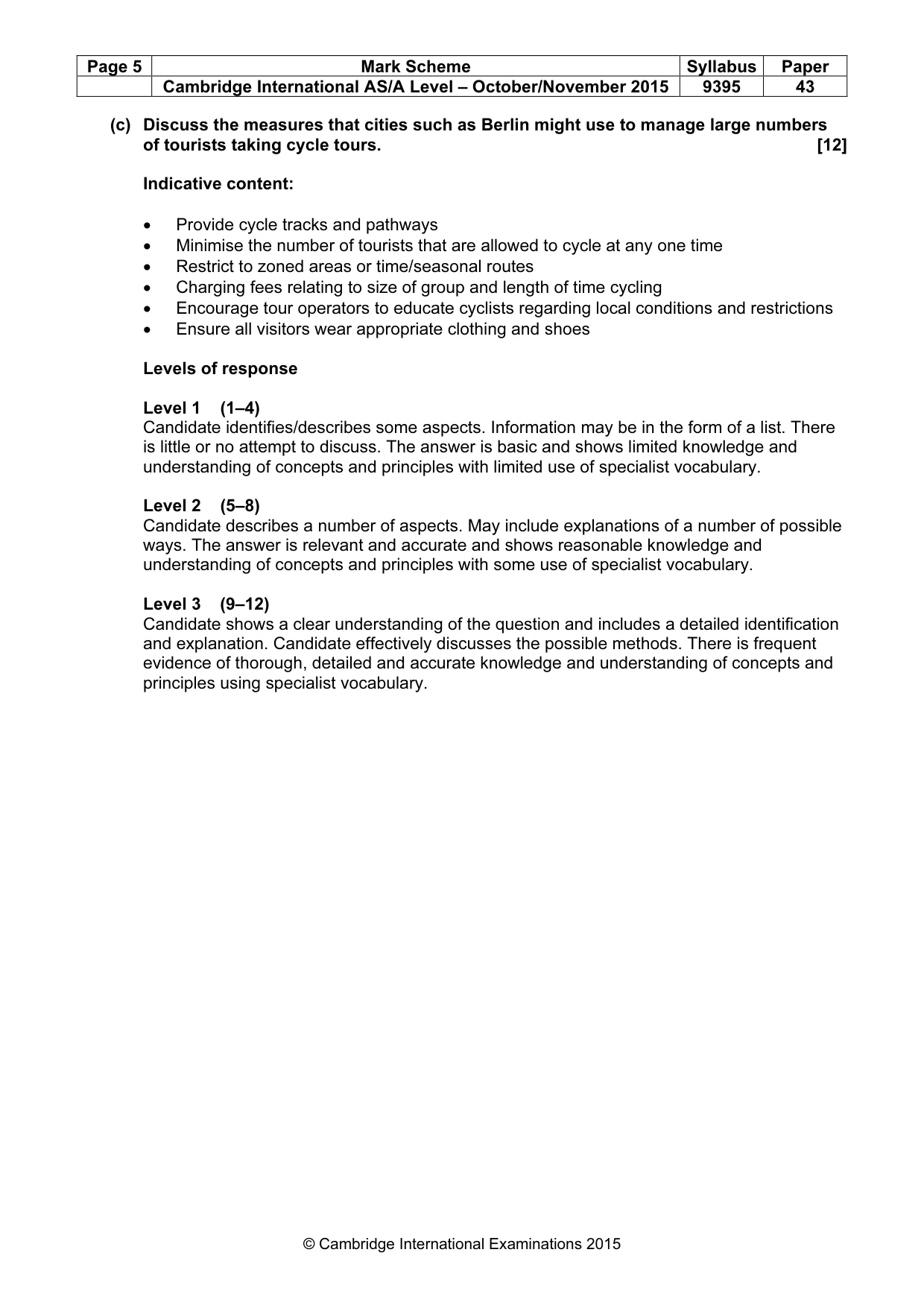
Page 5 Mark Scheme Syllabus Paper Cambridge International AS/A Level – October/November 2015 9395 43 © Cambridge International Examinations 2015 (c) Discuss the measures that cities such as Berlin might use to manage large numbers of tourists taking cycle tours. [12] Indicative content: • Provide cycle tracks and pathways • Minimise the number of tourists that are allowed to cycle at any one time • Restrict to zoned areas or time/seasonal routes • Charging fees relating to size of group and length of time cycling • Encourage tour operators to educate cyclists regarding local conditions and restrictions • Ensure all visitors wear appropriate clothing and shoes Levels of response Level 1 (1–4) Candidate identifies/describes some aspects. Information may be in the form of a list. There is little or no attempt to discuss. The answer is basic and shows limited knowledge and understanding of concepts and principles with limited use of specialist vocabulary. Level 2 (5–8) Candidate describes a number of aspects. May include explanations of a number of possible ways. The answer is relevant and accurate and shows reasonable knowledge and understanding of concepts and principles with some use of specialist vocabulary. Level 3 (9–12) Candidate shows a clear understanding of the question and includes a detailed identification and explanation. Candidate effectively discusses the possible methods. There is frequent evidence of thorough, detailed and accurate knowledge and understanding of concepts and principles using specialist vocabulary.
What you needed in this session
Cambridge’s own grade thresholds for 2015 Oct/Nov, Paper 4 · Variant 3. A higher threshold means an easier paper — the bar moves with how the cohort did.