Cambridge A Level Travel and Tourism 9395 — 2015 Oct/Nov Paper 3 · Variant 2
9395/32/O/N/15 · 100 marks · ≈113 min
The question paper and its mark scheme, free to read here and free to download. This is Cambridge’s own paper, exactly as it was sat.
Question paper16 pages



Mark scheme8 pages
Answers below. Sit the paper first if you are practising.
Paper as text
Question paper, page 1
This document consists of 13 printed pages, 3 blank pages and 1 Insert. DC (NF) 105963/1 © UCLES 2015 [Turn over Cambridge International Examinations Cambridge International Advanced Level * 8 5 2 5 0 1 5 9 7 1 * TRAVEL AND TOURISM 9395/32 Paper 3 International Business & Leisure Travel Services October/November 2015 1 hour 30 minutes Candidates answer on the Question Paper. No Additional Materials are required. READ THESE INSTRUCTIONS FIRST Write your Centre number, candidate number and name on all the work you hand in. Write in dark blue or black pen. You may use an HB pencil for any diagrams or graphs. Do not use staples, paper clips, glue or correction fluid. DO NOT WRITE IN ANY BARCODES. Answer all questions. All the Figures referred to in the questions are contained in the Insert. The number of marks is given in brackets [ ] at the end of each question or part question.
Question paper, page 2
2 9395/32/O/N/15 © UCLES 2015 Question 1 Refer to Fig. 1 (Insert), information about business tourism in South Africa along with the business tourism facilities offered by the Pepperclub Hotel and Spa in Cape Town. (a) (i) Identify two international convention venues in South Africa. 1 … 2 …[2] (ii) Define, using an example, the term large-scale event. … … …[2] (b) Explain briefly three reasons for the likely appeal of South Africa as a business tourism destination. 1 … … … … 2 … … … … 3 … … … …[6]
Question paper, page 3
3 9395/32/O/N/15 © UCLES 2015 [Turn over (c) Explain fully two functions of the South African National Convention Bureau (SANCB). … … … … … … … … … … … …[6]
Question paper, page 4
4 9395/32/O/N/15 © UCLES 2015 (d) Evaluate the extent to which Cape Town’s Pepperclub Hotel and Spa caters to the needs of business tourists. … … … … … … … … … … … … … … … … … … … … … … … … … …[9] [Total: 25]
Question paper, page 5
5 9395/32/O/N/15 © UCLES 2015 [Turn over Question 2 Refer to Fig. 2 (Insert), information about KiwiRail Scenic Journeys, a scenic rail travel provider in New Zealand. (a) (i) Explain the term hop on, hop off. … …[2] (ii) Identify two ways in which customers can reserve their place on a KiwiRail Scenic Journeys trip. 1 … 2 …[2] (b) Explain briefly three reasons why travel organisations offer ancillary products and services, such as Scenic Escape travel packages. 1 … … … … 2 … … … … 3 … … … …[6]
Question paper, page 6
6 9395/32/O/N/15 © UCLES 2015 (c) Explain fully two reasons for the appeal of the KiwiRail Scenic Journeys travel product for overseas leisure travellers. … … … … … … … … … … … …[6]
Question paper, page 7
7 9395/32/O/N/15 © UCLES 2015 [Turn over (d) Recommend ways in which travel service providers, such as KiwiRail Scenic Journeys, can manage the seasonal variation in demand. Give reasons for your recommendations. … … … … … … … … … … … … … … … … … … … … … … … … … …[9] [Total: 25]
Question paper, page 8
8 9395/32/O/N/15 © UCLES 2015 Question 3 Refer to Fig. 3 (Insert), an article about medical tourism in Turkey, a country in south east Europe. (a) (i) Define, using an example, the term medical tourist. … … … …[2] (ii) Identify two source markets for medical tourists to Turkey. 1 … 2 …[2] (b) Explain briefly three reasons why Turkey is an attractive medical tourism destination. 1 … … … … 2 … … … … 3 … … … …[6]
Question paper, page 9
9 9395/32/O/N/15 © UCLES 2015 [Turn over (c) Medical tourism packages are often sold by specialist tour operators and online. Explain fully why such packages are sold in each of these ways. Specialist tour operators … … … … … … … … Online … … … … … … … …[6]
Question paper, page 10
10 9395/32/O/N/15 © UCLES 2015 (d) Evaluate the importance of developing diversified tourism markets, including medical tourism, for countries such as Turkey. … … … … … … … … … … … … … … … … … … … … … … … … … …[9] [Total: 25]
Question paper, page 11
11 9395/32/O/N/15 © UCLES 2015 [Turn over Question 4 Refer to Fig. 4 (Insert), information about Norwegian Air Shuttle (Norwegian), a low-cost airline. (a) (i) Identify two features of the Norwegian travel product. 1 … 2 …[2] (ii) Explain, using an example, the term customer with special needs. … … … …[2] (b) Explain briefly three likely roles of the Norwegian Civil Aviation Authority. 1 … … … … 2 … … … … 3 … … … …[6]
Question paper, page 12
12 9395/32/O/N/15 © UCLES 2015 (c) Explain fully two benefits to travel organisations of winning awards, such as ‘Europe’s Best Low-Cost Airline’. … … … … … … … … … … … …[6]
Question paper, page 13
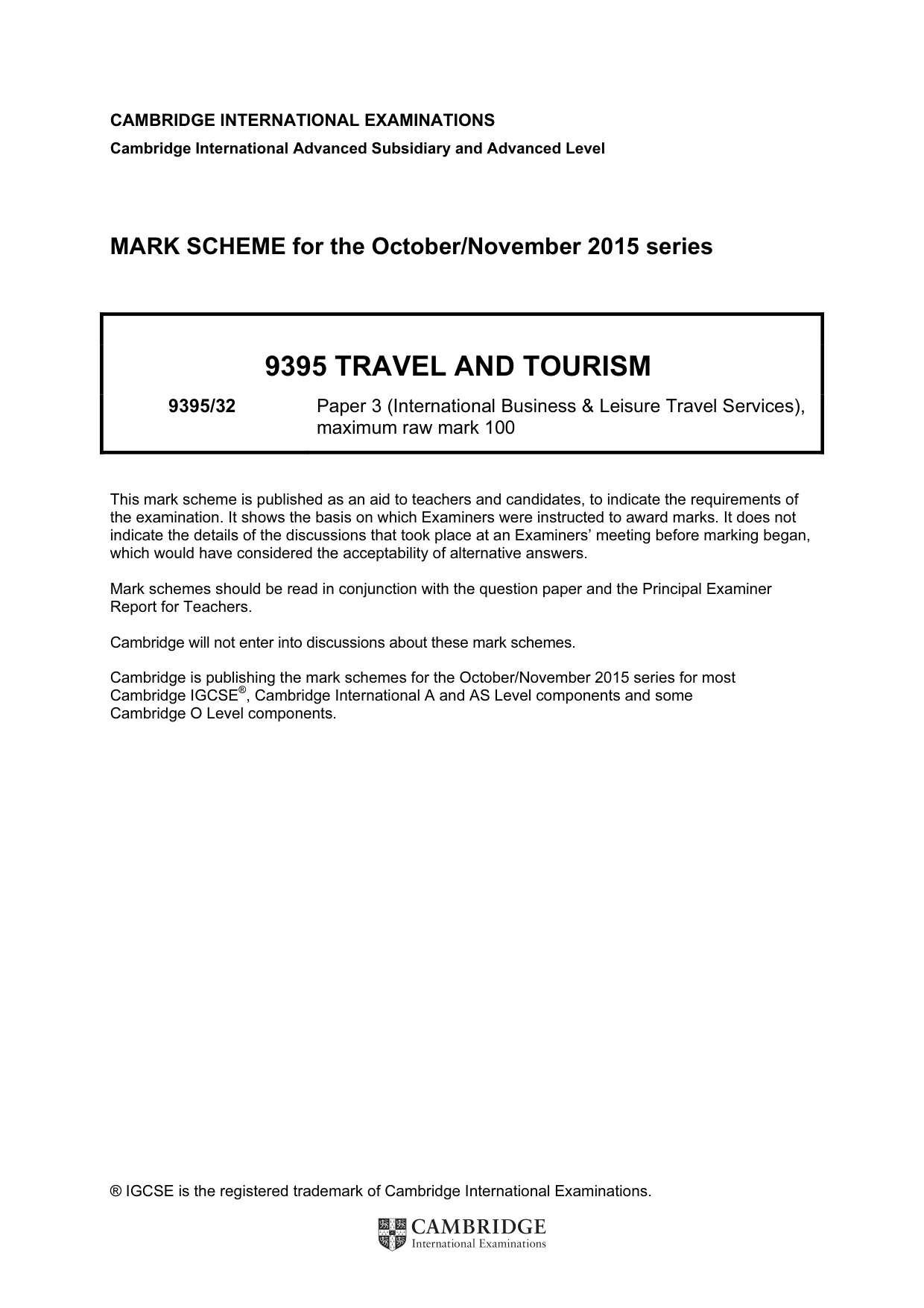
13 9395/32/O/N/15 © UCLES 2015 (d) Evaluate the importance of providing excellent customer service for airlines, such as Norwegian, operating in the low-cost market. … … … … … … … … … … … … … … … … … … … … … … … … … …[9] [Total: 25]
Question paper, page 14
14 9395/32/O/N/15 © UCLES 2015 BLANK PAGE
Question paper, page 15
15 9395/32/O/N/15 © UCLES 2015 BLANK PAGE
Question paper, page 16
16 9395/32/O/N/15 © UCLES 2015 BLANK PAGE Permission to reproduce items where third-party owned material protected by copyright is included has been sought and cleared where possible. Every reasonable effort has been made by the publisher (UCLES) to trace copyright holders, but if any items requiring clearance have unwittingly been included, the publisher will be pleased to make amends at the earliest possible opportunity. To avoid the issue of disclosure of answer-related information to candidates, all copyright acknowledgements are reproduced online in the Cambridge International Examinations Copyright Acknowledgements Booklet. This is produced for each series of examinations and is freely available to download at www.cie.org.uk after the live examination series. Cambridge International Examinations is part of the Cambridge Assessment Group. Cambridge Assessment is the brand name of University of Cambridge Local Examinations Syndicate (UCLES), which is itself a department of the University of Cambridge.
Mark scheme, page 1
® IGCSE is the registered trademark of Cambridge International Examinations. CAMBRIDGE INTERNATIONAL EXAMINATIONS Cambridge International Advanced Subsidiary and Advanced Level MARK SCHEME for the October/November 2015 series 9395 TRAVEL AND TOURISM 9395/32 Paper 3 (International Business & Leisure Travel Services), maximum raw mark 100 This mark scheme is published as an aid to teachers and candidates, to indicate the requirements of the examination. It shows the basis on which Examiners were instructed to award marks. It does not indicate the details of the discussions that took place at an Examiners’ meeting before marking began, which would have considered the acceptability of alternative answers. Mark schemes should be read in conjunction with the question paper and the Principal Examiner Report for Teachers. Cambridge will not enter into discussions about these mark schemes. Cambridge is publishing the mark schemes for the October/November 2015 series for most Cambridge IGCSE®, Cambridge International A and AS Level components and some Cambridge O Level components.
Mark scheme, page 2
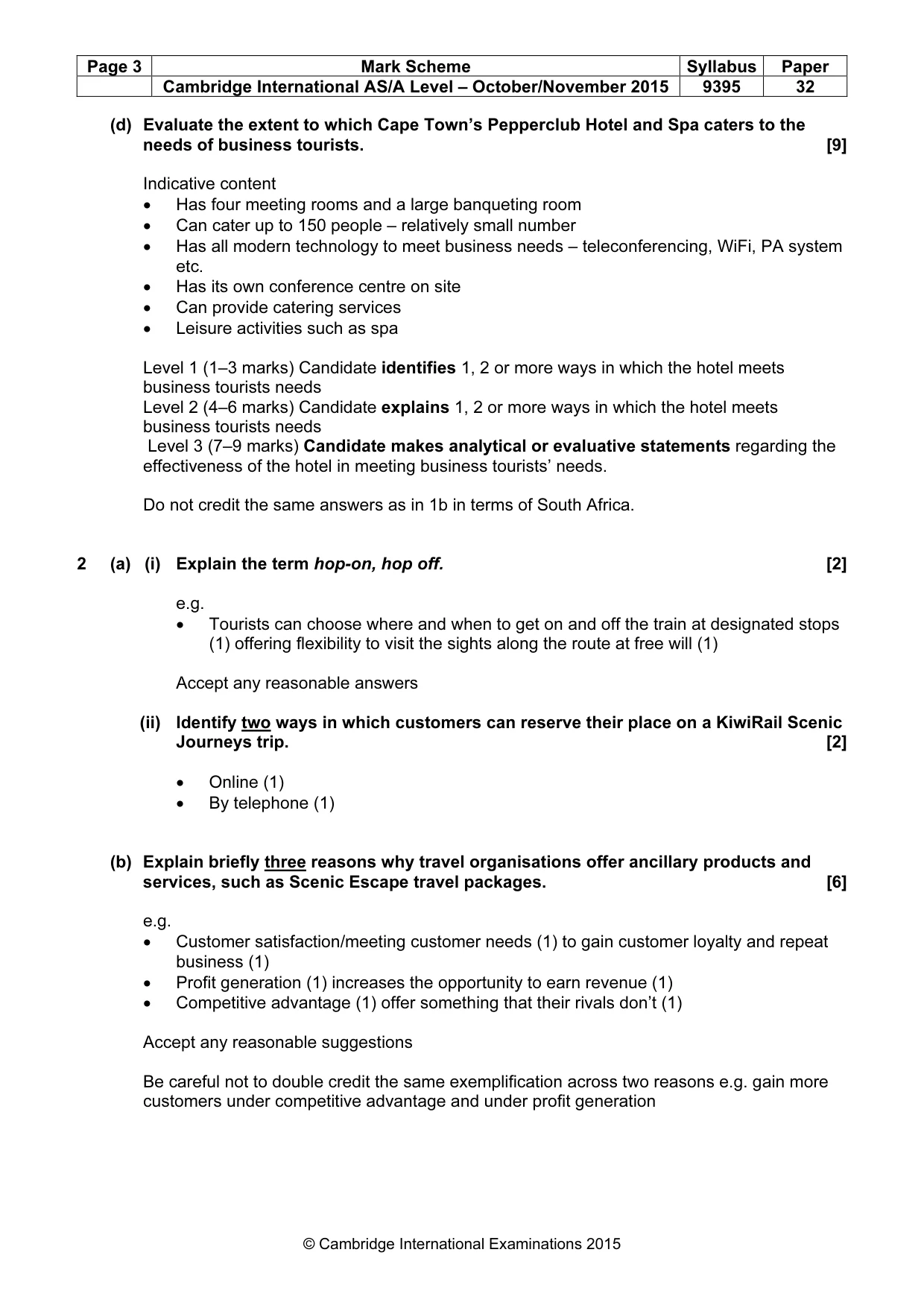
Page 2 Mark Scheme Syllabus Paper Cambridge International AS/A Level – October/November 2015 9395 32 © Cambridge International Examinations 2015 1 (a) (i) Identify two international convention venues in South Africa. [2] e.g. • Durban International Convention Centre (1) • Port Elizabeth’s Boardwalk Convention Centre (1) • Cape Town International Convention Centre (1) (ii) Define, using an example, the term large-scale event. [2] A large-scale event (any event e.g. sporting, leisure, beauty, exhibition) is one attracting a large number of people (1) more than 200 attendees (1) e.g. World Travel Market (1) (b) Explain briefly three reasons for the likely appeal of South Africa as a business tourism destination. [6] e.g. • Location (1) convenient in terms of accessibility (1) • Adjacent facilities (1) delegates will also take part in leisure activities in the destination (1) • Affordability (1) favourable exchange rates against the Rand (1) • Diverse cultural appeal (1) visit traditional arts and craft businesses (1) • Construction of new conference venues (new facilities) (1) e.g. CTICC (1) • Availability of SANCB (1) offering support for business tourism planners (1) Accept any reasonable answers Do not accept specific facilities offered in the hotels e.g. projector (c) Explain fully two functions of the South Africa National Convention Bureau (SANCB). [6] e.g. • Securing bids and events for South Africa (1) giving official sporting and other major events the chance to use South Africa as a host nation (1) to raise the profile and the income generation of the country (1) • Marketing of South Africa as a business tourism destination (1) to encourage all types of business to consider hosting a meeting or event in the country (1) to enhance the reputation of South Africa as a meeting destination (1) raising awareness (1), increase number of tourists (1) Accept any reasonable suggestions including generic references to support services for business tourism. Do not accept reference to security under securing bids.
Mark scheme, page 3
Page 3 Mark Scheme Syllabus Paper Cambridge International AS/A Level – October/November 2015 9395 32 © Cambridge International Examinations 2015 (d) Evaluate the extent to which Cape Town’s Pepperclub Hotel and Spa caters to the needs of business tourists. [9] Indicative content • Has four meeting rooms and a large banqueting room • Can cater up to 150 people – relatively small number • Has all modern technology to meet business needs – teleconferencing, WiFi, PA system etc. • Has its own conference centre on site • Can provide catering services • Leisure activities such as spa Level 1 (1–3 marks) Candidate identifies 1, 2 or more ways in which the hotel meets business tourists needs Level 2 (4–6 marks) Candidate explains 1, 2 or more ways in which the hotel meets business tourists needs Level 3 (7–9 marks) Candidate makes analytical or evaluative statements regarding the effectiveness of the hotel in meeting business tourists’ needs. Do not credit the same answers as in 1b in terms of South Africa. 2 (a) (i) Explain the term hop-on, hop off. [2] e.g. • Tourists can choose where and when to get on and off the train at designated stops (1) offering flexibility to visit the sights along the route at free will (1) Accept any reasonable answers (ii) Identify two ways in which customers can reserve their place on a KiwiRail Scenic Journeys trip. [2] • Online (1) • By telephone (1) (b) Explain briefly three reasons why travel organisations offer ancillary products and services, such as Scenic Escape travel packages. [6] e.g. • Customer satisfaction/meeting customer needs (1) to gain customer loyalty and repeat business (1) • Profit generation (1) increases the opportunity to earn revenue (1) • Competitive advantage (1) offer something that their rivals don’t (1) Accept any reasonable suggestions Be careful not to double credit the same exemplification across two reasons e.g. gain more customers under competitive advantage and under profit generation
Mark scheme, page 4
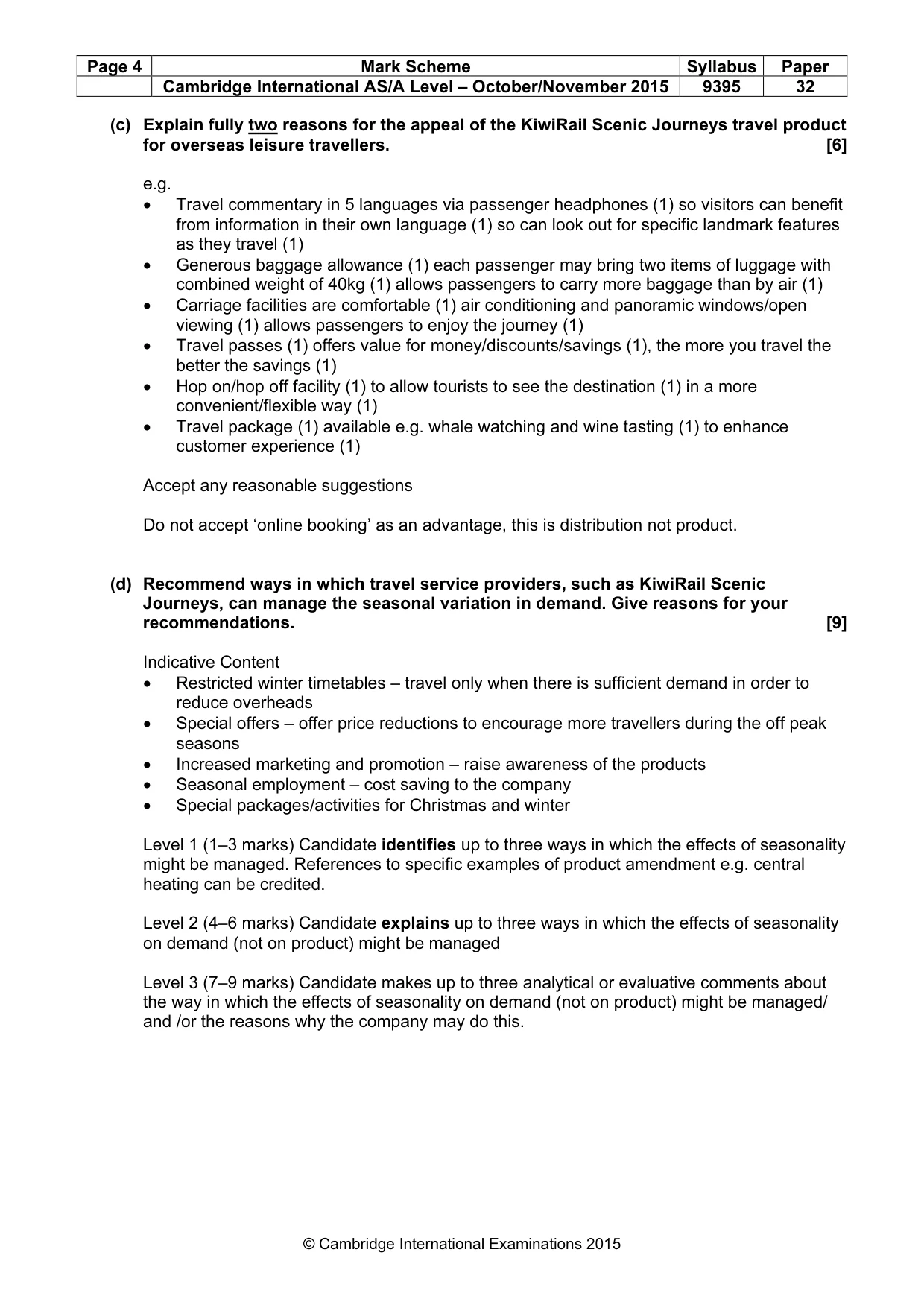
Page 4 Mark Scheme Syllabus Paper Cambridge International AS/A Level – October/November 2015 9395 32 © Cambridge International Examinations 2015 (c) Explain fully two reasons for the appeal of the KiwiRail Scenic Journeys travel product for overseas leisure travellers. [6] e.g. • Travel commentary in 5 languages via passenger headphones (1) so visitors can benefit from information in their own language (1) so can look out for specific landmark features as they travel (1) • Generous baggage allowance (1) each passenger may bring two items of luggage with combined weight of 40kg (1) allows passengers to carry more baggage than by air (1) • Carriage facilities are comfortable (1) air conditioning and panoramic windows/open viewing (1) allows passengers to enjoy the journey (1) • Travel passes (1) offers value for money/discounts/savings (1), the more you travel the better the savings (1) • Hop on/hop off facility (1) to allow tourists to see the destination (1) in a more convenient/flexible way (1) • Travel package (1) available e.g. whale watching and wine tasting (1) to enhance customer experience (1) Accept any reasonable suggestions Do not accept ‘online booking’ as an advantage, this is distribution not product. (d) Recommend ways in which travel service providers, such as KiwiRail Scenic Journeys, can manage the seasonal variation in demand. Give reasons for your recommendations. [9] Indicative Content • Restricted winter timetables – travel only when there is sufficient demand in order to reduce overheads • Special offers – offer price reductions to encourage more travellers during the off peak seasons • Increased marketing and promotion – raise awareness of the products • Seasonal employment – cost saving to the company • Special packages/activities for Christmas and winter Level 1 (1–3 marks) Candidate identifies up to three ways in which the effects of seasonality might be managed. References to specific examples of product amendment e.g. central heating can be credited. Level 2 (4–6 marks) Candidate explains up to three ways in which the effects of seasonality on demand (not on product) might be managed Level 3 (7–9 marks) Candidate makes up to three analytical or evaluative comments about the way in which the effects of seasonality on demand (not on product) might be managed/ and /or the reasons why the company may do this.
Mark scheme, page 5
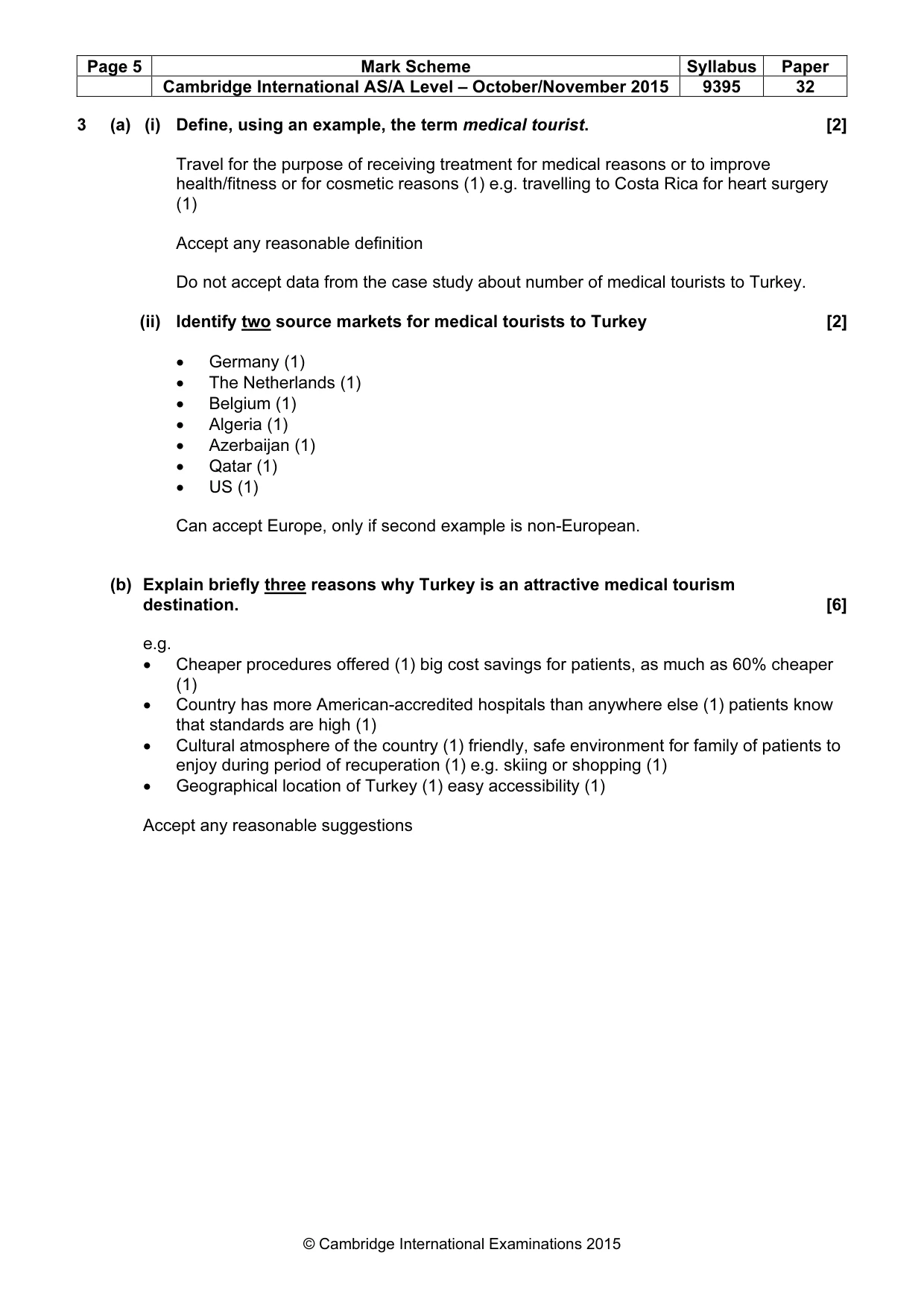
Page 5 Mark Scheme Syllabus Paper Cambridge International AS/A Level – October/November 2015 9395 32 © Cambridge International Examinations 2015 3 (a) (i) Define, using an example, the term medical tourist. [2] Travel for the purpose of receiving treatment for medical reasons or to improve health/fitness or for cosmetic reasons (1) e.g. travelling to Costa Rica for heart surgery (1) Accept any reasonable definition Do not accept data from the case study about number of medical tourists to Turkey. (ii) Identify two source markets for medical tourists to Turkey [2] • Germany (1) • The Netherlands (1) • Belgium (1) • Algeria (1) • Azerbaijan (1) • Qatar (1) • US (1) Can accept Europe, only if second example is non-European. (b) Explain briefly three reasons why Turkey is an attractive medical tourism destination. [6] e.g. • Cheaper procedures offered (1) big cost savings for patients, as much as 60% cheaper (1) • Country has more American-accredited hospitals than anywhere else (1) patients know that standards are high (1) • Cultural atmosphere of the country (1) friendly, safe environment for family of patients to enjoy during period of recuperation (1) e.g. skiing or shopping (1) • Geographical location of Turkey (1) easy accessibility (1) Accept any reasonable suggestions
Mark scheme, page 6
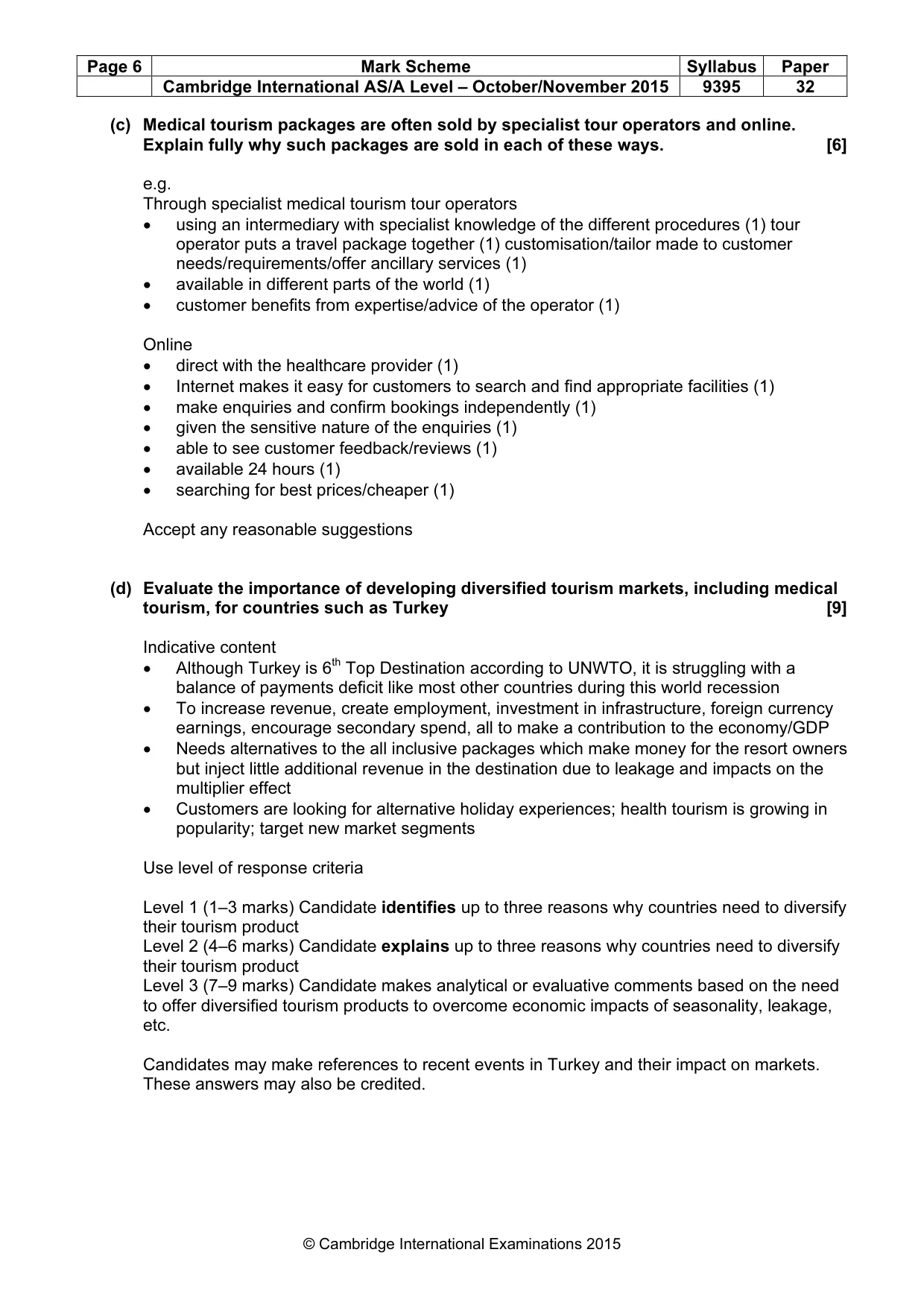
Page 6 Mark Scheme Syllabus Paper Cambridge International AS/A Level – October/November 2015 9395 32 © Cambridge International Examinations 2015 (c) Medical tourism packages are often sold by specialist tour operators and online. Explain fully why such packages are sold in each of these ways. [6] e.g. Through specialist medical tourism tour operators • using an intermediary with specialist knowledge of the different procedures (1) tour operator puts a travel package together (1) customisation/tailor made to customer needs/requirements/offer ancillary services (1) • available in different parts of the world (1) • customer benefits from expertise/advice of the operator (1) Online • direct with the healthcare provider (1) • Internet makes it easy for customers to search and find appropriate facilities (1) • make enquiries and confirm bookings independently (1) • given the sensitive nature of the enquiries (1) • able to see customer feedback/reviews (1) • available 24 hours (1) • searching for best prices/cheaper (1) Accept any reasonable suggestions (d) Evaluate the importance of developing diversified tourism markets, including medical tourism, for countries such as Turkey [9] Indicative content • Although Turkey is 6th Top Destination according to UNWTO, it is struggling with a balance of payments deficit like most other countries during this world recession • To increase revenue, create employment, investment in infrastructure, foreign currency earnings, encourage secondary spend, all to make a contribution to the economy/GDP • Needs alternatives to the all inclusive packages which make money for the resort owners but inject little additional revenue in the destination due to leakage and impacts on the multiplier effect • Customers are looking for alternative holiday experiences; health tourism is growing in popularity; target new market segments Use level of response criteria Level 1 (1–3 marks) Candidate identifies up to three reasons why countries need to diversify their tourism product Level 2 (4–6 marks) Candidate explains up to three reasons why countries need to diversify their tourism product Level 3 (7–9 marks) Candidate makes analytical or evaluative comments based on the need to offer diversified tourism products to overcome economic impacts of seasonality, leakage, etc. Candidates may make references to recent events in Turkey and their impact on markets. These answers may also be credited.
Mark scheme, page 7
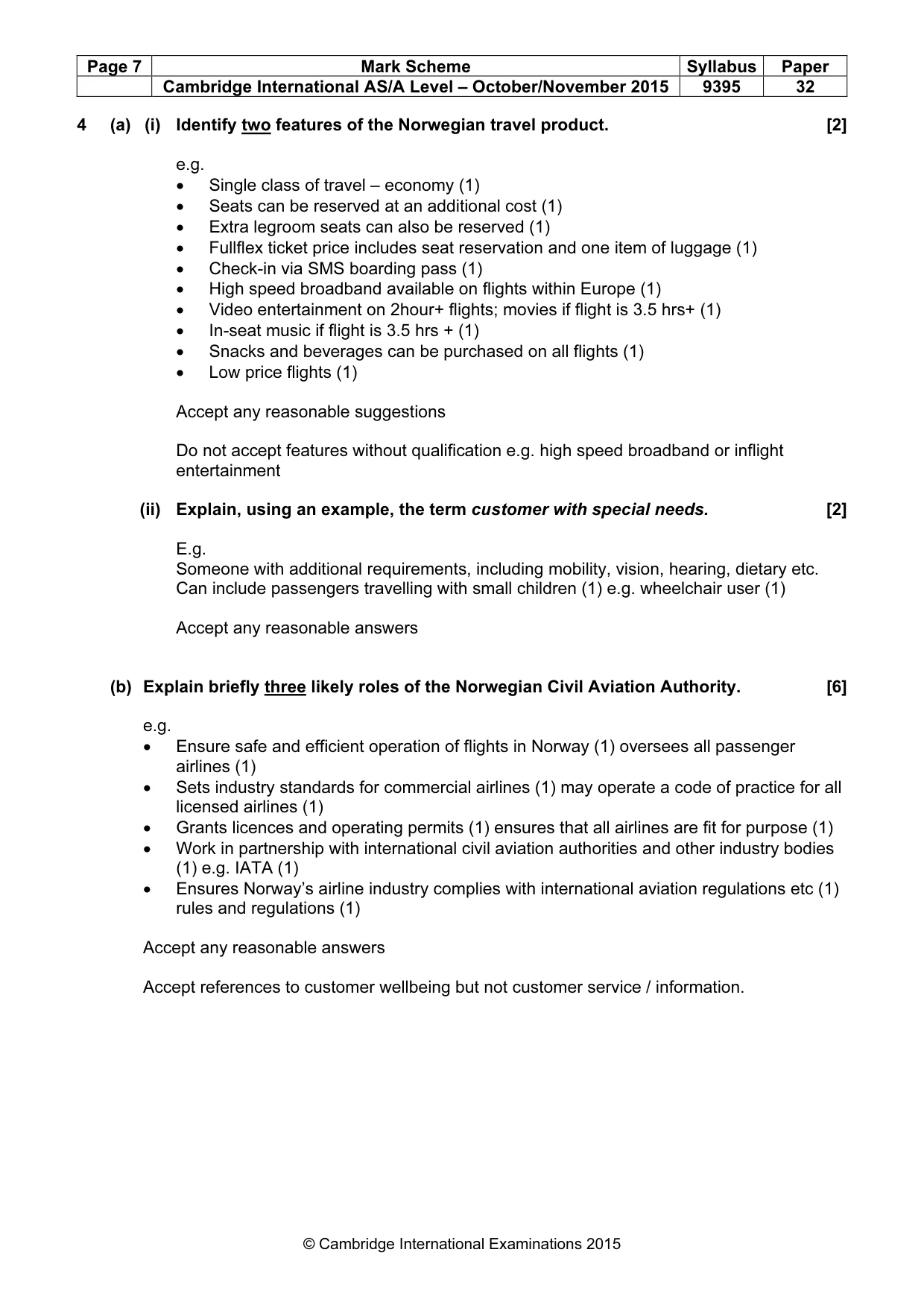
Page 7 Mark Scheme Syllabus Paper Cambridge International AS/A Level – October/November 2015 9395 32 © Cambridge International Examinations 2015 4 (a) (i) Identify two features of the Norwegian travel product. [2] e.g. • Single class of travel – economy (1) • Seats can be reserved at an additional cost (1) • Extra legroom seats can also be reserved (1) • Fullflex ticket price includes seat reservation and one item of luggage (1) • Check-in via SMS boarding pass (1) • High speed broadband available on flights within Europe (1) • Video entertainment on 2hour+ flights; movies if flight is 3.5 hrs+ (1) • In-seat music if flight is 3.5 hrs + (1) • Snacks and beverages can be purchased on all flights (1) • Low price flights (1) Accept any reasonable suggestions Do not accept features without qualification e.g. high speed broadband or inflight entertainment (ii) Explain, using an example, the term customer with special needs. [2] E.g. Someone with additional requirements, including mobility, vision, hearing, dietary etc. Can include passengers travelling with small children (1) e.g. wheelchair user (1) Accept any reasonable answers (b) Explain briefly three likely roles of the Norwegian Civil Aviation Authority. [6] e.g. • Ensure safe and efficient operation of flights in Norway (1) oversees all passenger airlines (1) • Sets industry standards for commercial airlines (1) may operate a code of practice for all licensed airlines (1) • Grants licences and operating permits (1) ensures that all airlines are fit for purpose (1) • Work in partnership with international civil aviation authorities and other industry bodies (1) e.g. IATA (1) • Ensures Norway’s airline industry complies with international aviation regulations etc (1) rules and regulations (1) Accept any reasonable answers Accept references to customer wellbeing but not customer service / information.
Mark scheme, page 8
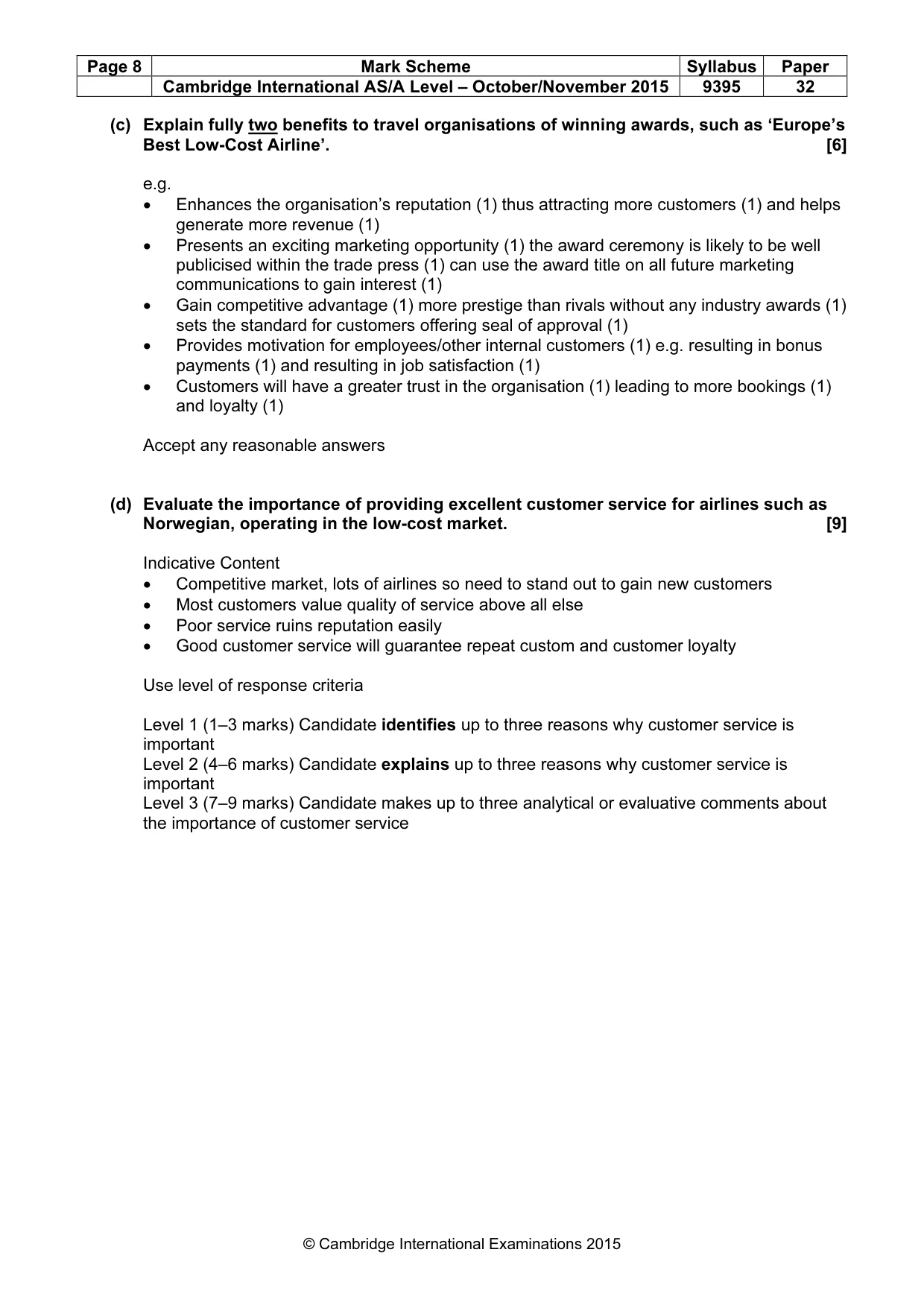
Page 8 Mark Scheme Syllabus Paper Cambridge International AS/A Level – October/November 2015 9395 32 © Cambridge International Examinations 2015 (c) Explain fully two benefits to travel organisations of winning awards, such as ‘Europe’s Best Low-Cost Airline’. [6] e.g. • Enhances the organisation’s reputation (1) thus attracting more customers (1) and helps generate more revenue (1) • Presents an exciting marketing opportunity (1) the award ceremony is likely to be well publicised within the trade press (1) can use the award title on all future marketing communications to gain interest (1) • Gain competitive advantage (1) more prestige than rivals without any industry awards (1) sets the standard for customers offering seal of approval (1) • Provides motivation for employees/other internal customers (1) e.g. resulting in bonus payments (1) and resulting in job satisfaction (1) • Customers will have a greater trust in the organisation (1) leading to more bookings (1) and loyalty (1) Accept any reasonable answers (d) Evaluate the importance of providing excellent customer service for airlines such as Norwegian, operating in the low-cost market. [9] Indicative Content • Competitive market, lots of airlines so need to stand out to gain new customers • Most customers value quality of service above all else • Poor service ruins reputation easily • Good customer service will guarantee repeat custom and customer loyalty Use level of response criteria Level 1 (1–3 marks) Candidate identifies up to three reasons why customer service is important Level 2 (4–6 marks) Candidate explains up to three reasons why customer service is important Level 3 (7–9 marks) Candidate makes up to three analytical or evaluative comments about the importance of customer service
What you needed in this session
Cambridge’s own grade thresholds for 2015 Oct/Nov, Paper 3 · Variant 2. A higher threshold means an easier paper — the bar moves with how the cohort did.