Cambridge A Level Travel and Tourism 9395 — 2015 Oct/Nov Paper 1 · Variant 2
9395/12/O/N/15 · 100 marks · ≈113 min
The question paper and its mark scheme, free to read here and free to download. This is Cambridge’s own paper, exactly as it was sat.
Question paper16 pages


Mark scheme8 pages
Answers below. Sit the paper first if you are practising.
Paper as text
Question paper, page 1
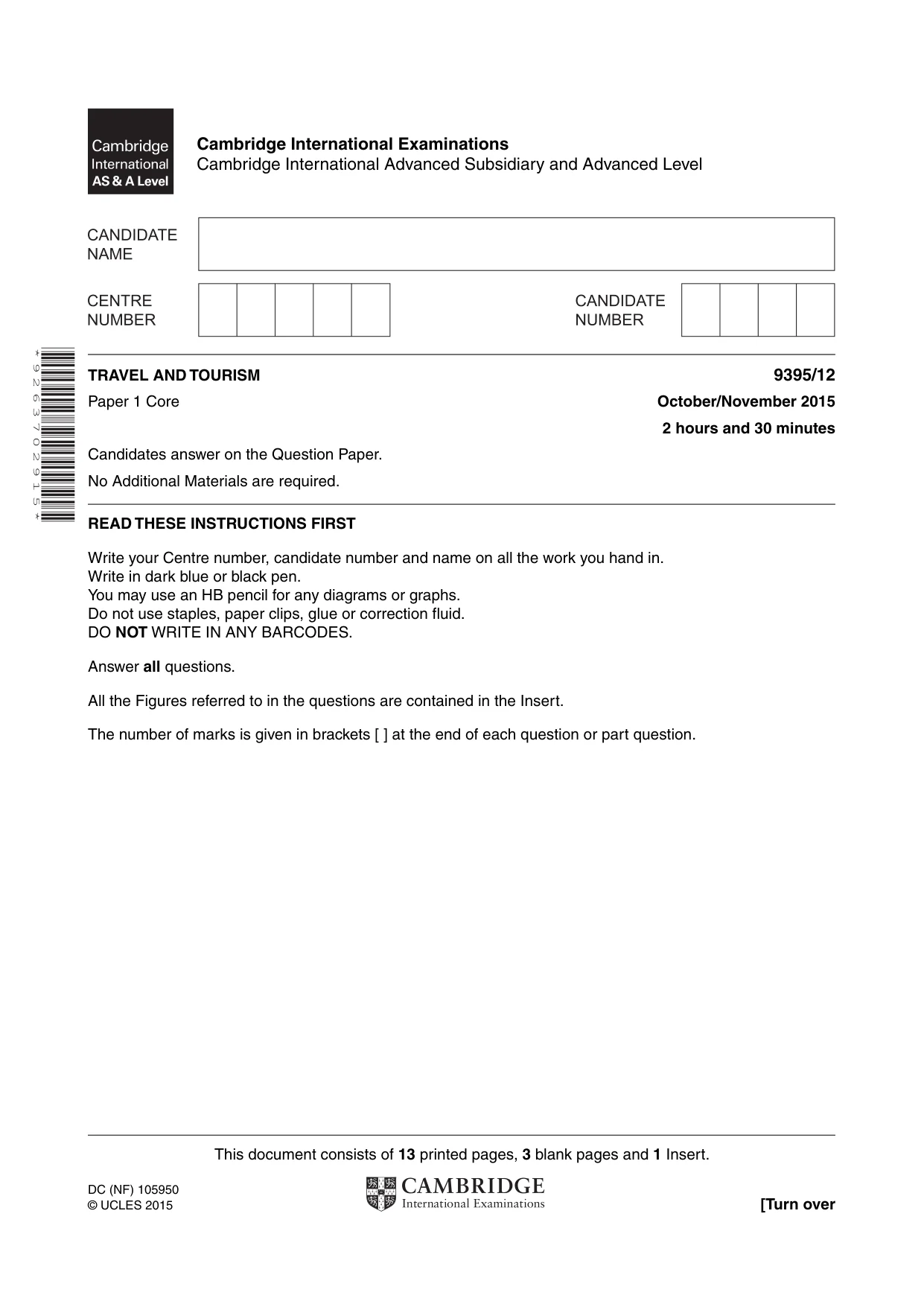
This document consists of 13 printed pages, 3 blank pages and 1 Insert. DC (NF) 105950 © UCLES 2015 [Turn over Cambridge International Examinations Cambridge International Advanced Subsidiary and Advanced Level * 9 2 6 3 7 0 2 9 1 5 * TRAVEL AND TOURISM 9395/12 Paper 1 Core October/November 2015 2 hours and 30 minutes Candidates answer on the Question Paper. No Additional Materials are required. READ THESE INSTRUCTIONS FIRST Write your Centre number, candidate number and name on all the work you hand in. Write in dark blue or black pen. You may use an HB pencil for any diagrams or graphs. Do not use staples, paper clips, glue or correction fluid. DO NOT WRITE IN ANY BARCODES. Answer all questions. All the Figures referred to in the questions are contained in the Insert. The number of marks is given in brackets [ ] at the end of each question or part question.
Question paper, page 2
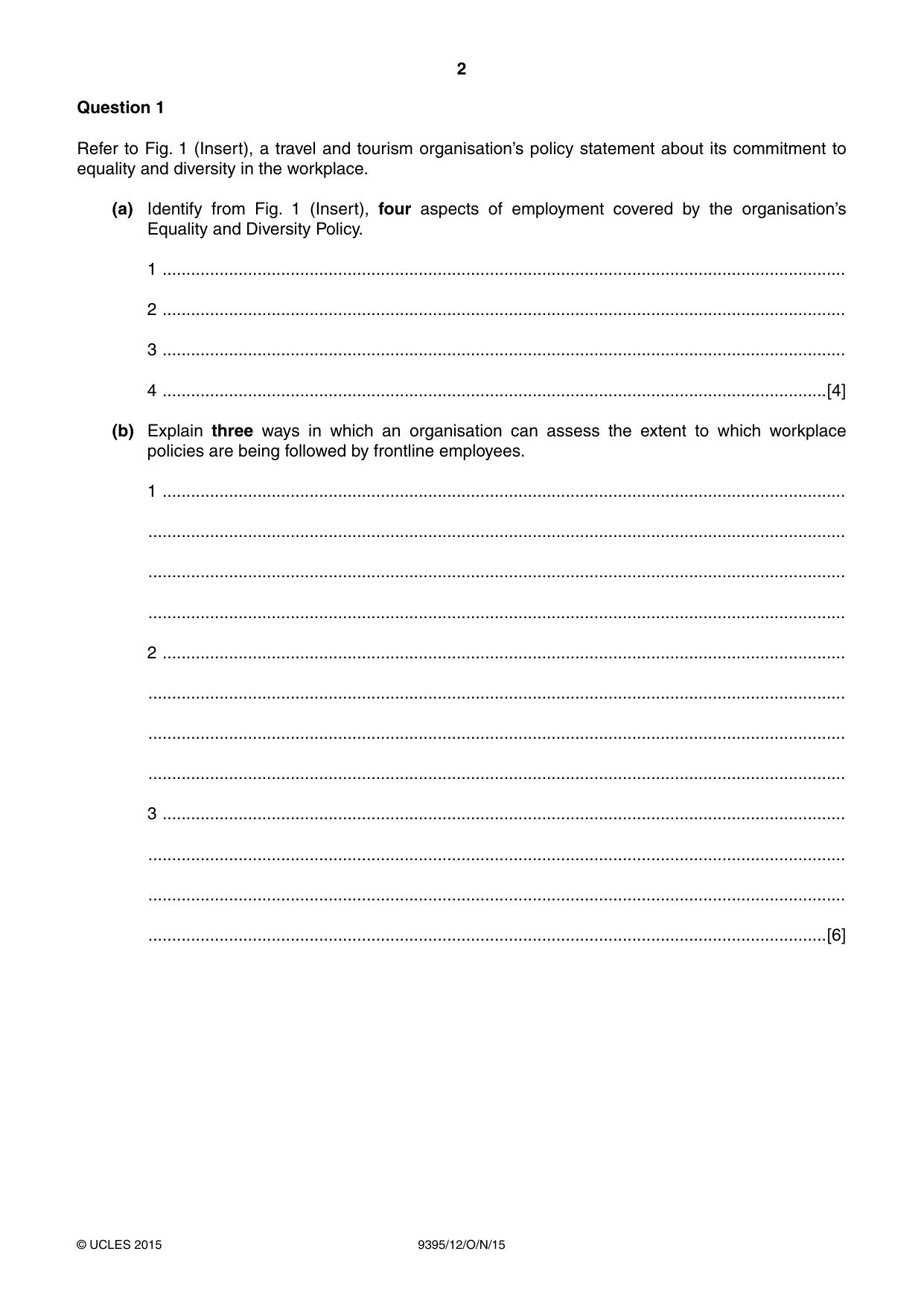
2 9395/12/O/N/15 © UCLES 2015 Question 1 Refer to Fig. 1 (Insert), a travel and tourism organisation’s policy statement about its commitment to equality and diversity in the workplace. (a) Identify from Fig. 1 (Insert), four aspects of employment covered by the organisation’s Equality and Diversity Policy. 1 … 2 … 3 … 4 …[4] (b) Explain three ways in which an organisation can assess the extent to which workplace policies are being followed by frontline employees. 1 … … … … 2 … … … … 3 … … … …[6]
Question paper, page 3
3 9395/12/O/N/15 © UCLES 2015 [Turn over (c) Discuss the view that smaller visitor attractions are able to provide very high levels of customer service. … … … … … … … … … … … …[6]
Question paper, page 4
4 9395/12/O/N/15 © UCLES 2015 (d) For one job role within a travel and tourism organisation with which you are familiar, assess the ways in which employees deal with external customer complaints. Chosen job role/organisation … … … … … … … … … … … … … … … … … … … … … … … … …[9] [Total: 25]
Question paper, page 5
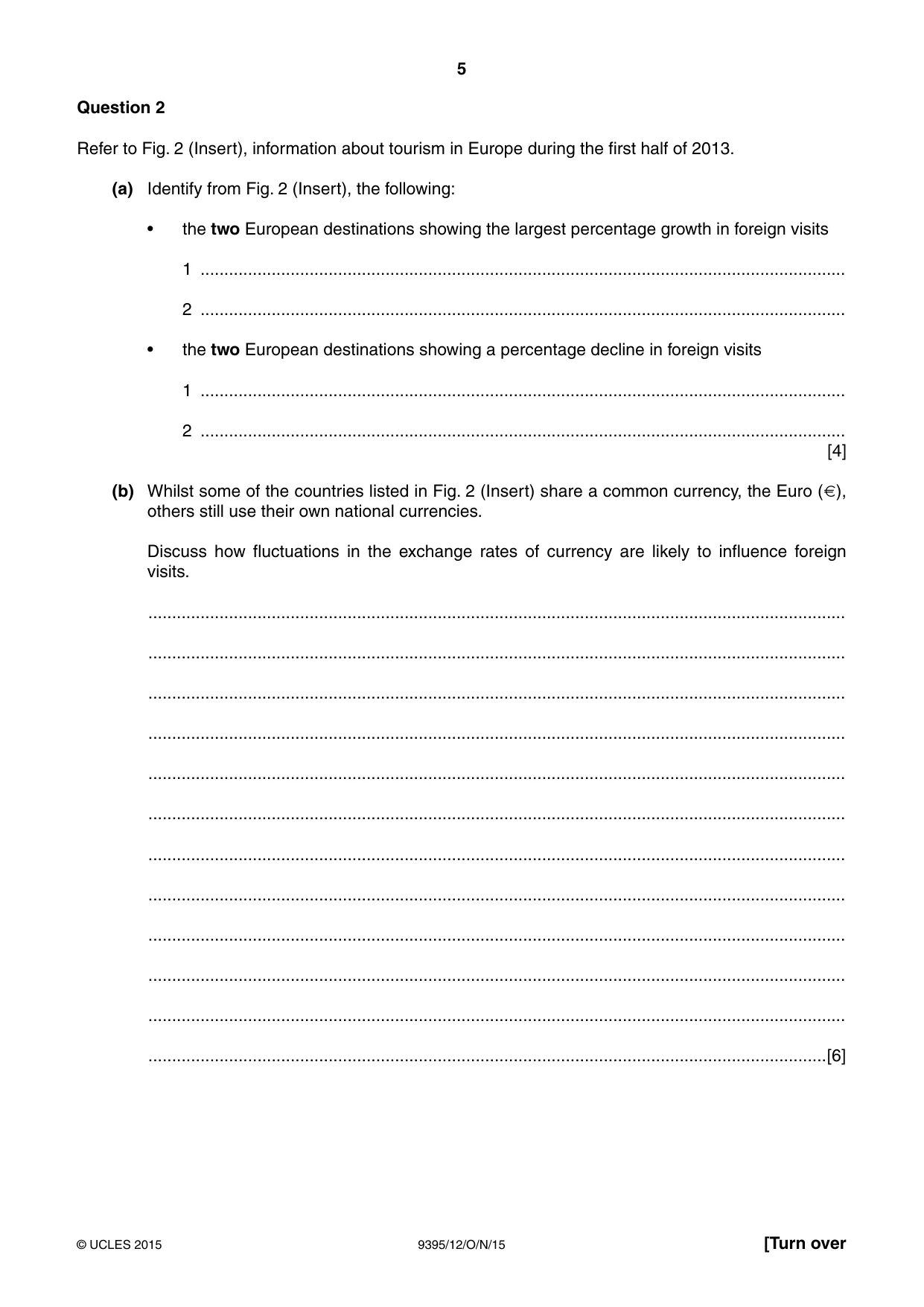
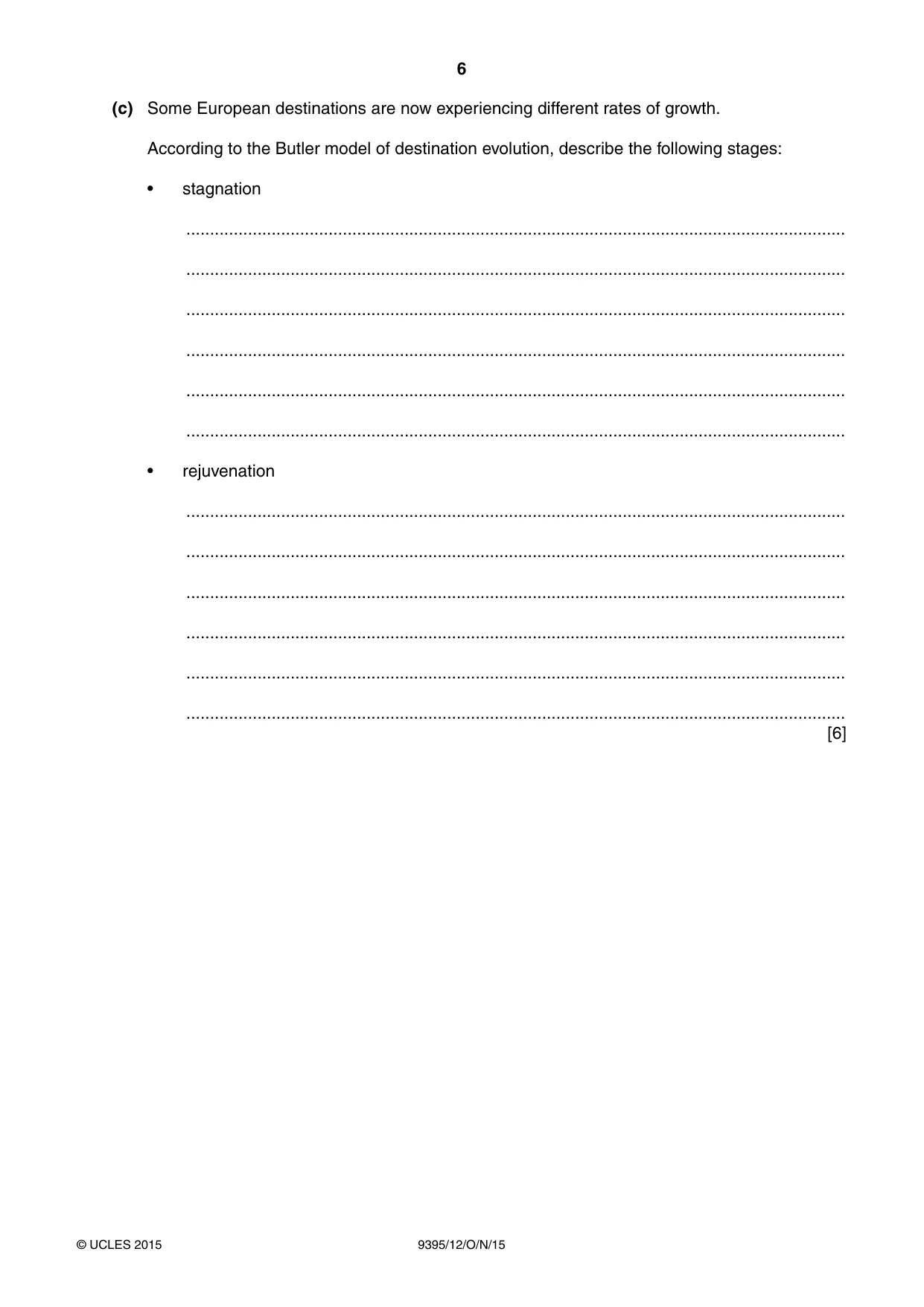
5 9395/12/O/N/15 © UCLES 2015 [Turn over Question 2 Refer to Fig. 2 (Insert), information about tourism in Europe during the first half of 2013. (a) Identify from Fig. 2 (Insert), the following: • the two European destinations showing the largest percentage growth in foreign visits 1 … 2 … • the two European destinations showing a percentage decline in foreign visits 1 … 2 … [4] (b) Whilst some of the countries listed in Fig. 2 (Insert) share a common currency, the Euro (€), others still use their own national currencies. Discuss how fluctuations in the exchange rates of currency are likely to influence foreign visits. … … … … … … … … … … … …[6]
Question paper, page 6
6 9395/12/O/N/15 © UCLES 2015 (c) Some European destinations are now experiencing different rates of growth. According to the Butler model of destination evolution, describe the following stages: • stagnation … … … … … … • rejuvenation … … … … … … [6]
Question paper, page 7
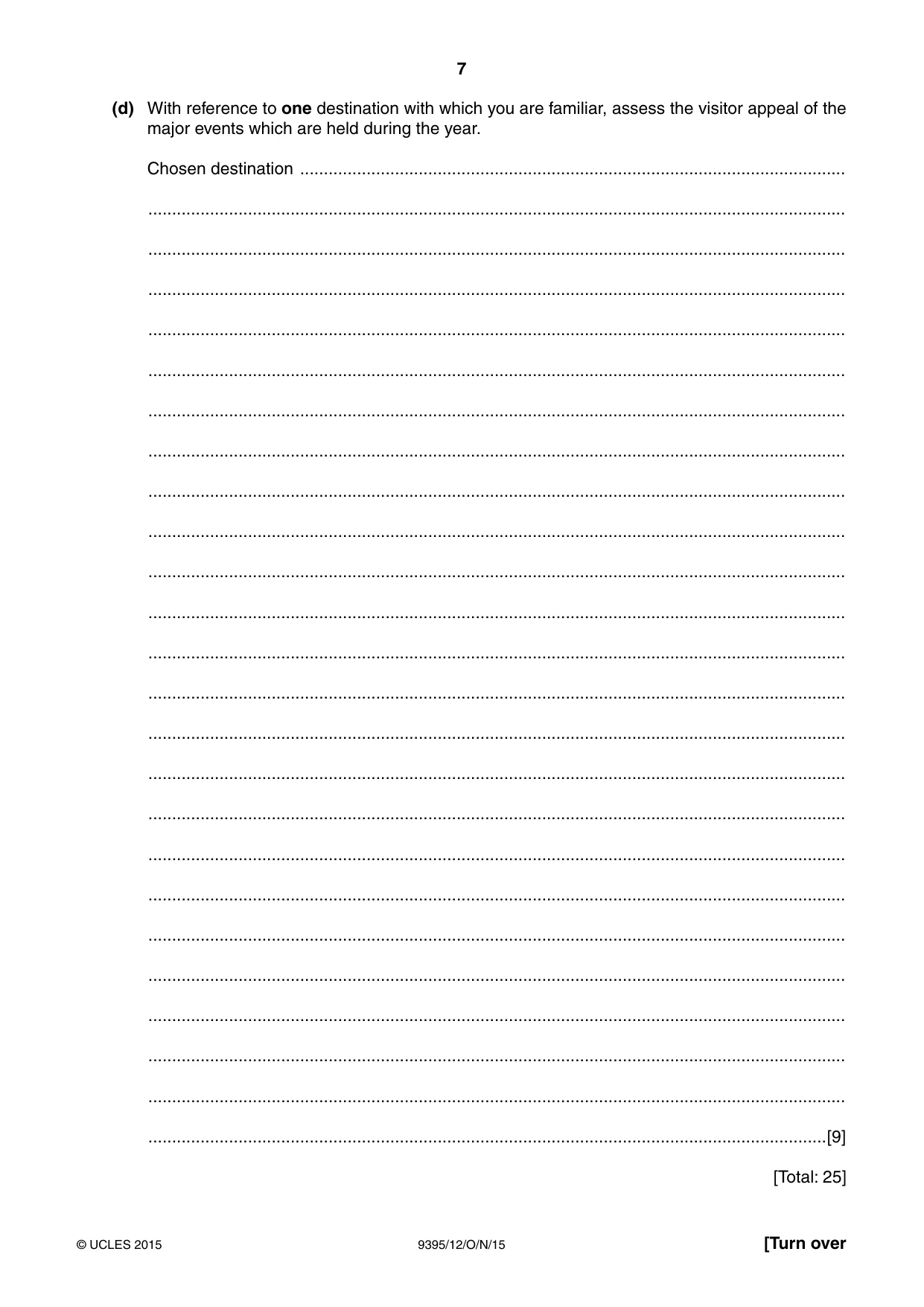
7 9395/12/O/N/15 © UCLES 2015 [Turn over (d) With reference to one destination with which you are familiar, assess the visitor appeal of the major events which are held during the year. Chosen destination … … … … … … … … … … … … … … … … … … … … … … … … …[9] [Total: 25]
Question paper, page 8
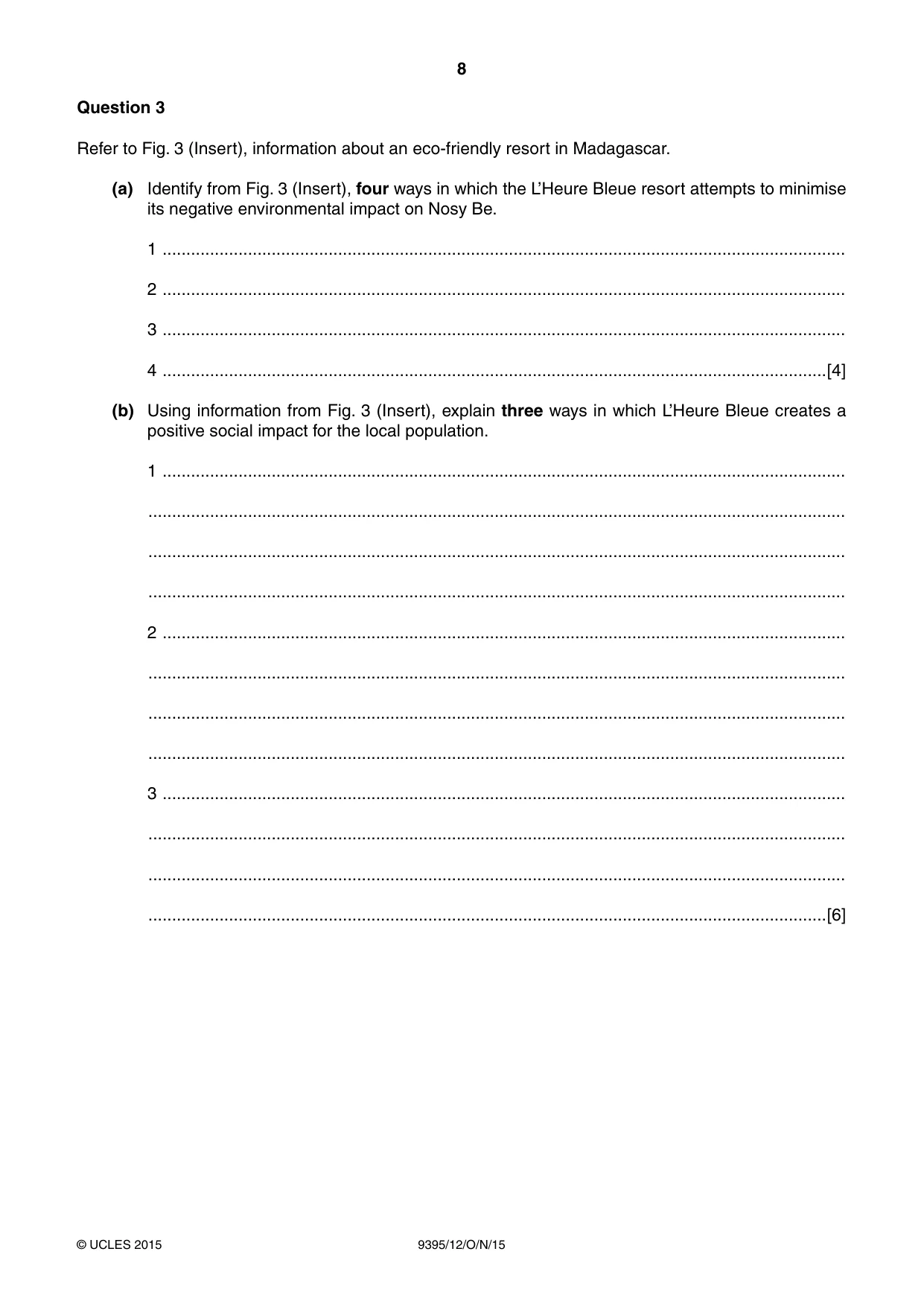
8 9395/12/O/N/15 © UCLES 2015 Question 3 Refer to Fig. 3 (Insert), information about an eco-friendly resort in Madagascar. (a) Identify from Fig. 3 (Insert), four ways in which the L’Heure Bleue resort attempts to minimise its negative environmental impact on Nosy Be. 1 … 2 … 3 … 4 …[4] (b) Using information from Fig. 3 (Insert), explain three ways in which L’Heure Bleue creates a positive social impact for the local population. 1 … … … … 2 … … … … 3 … … … …[6]
Question paper, page 9
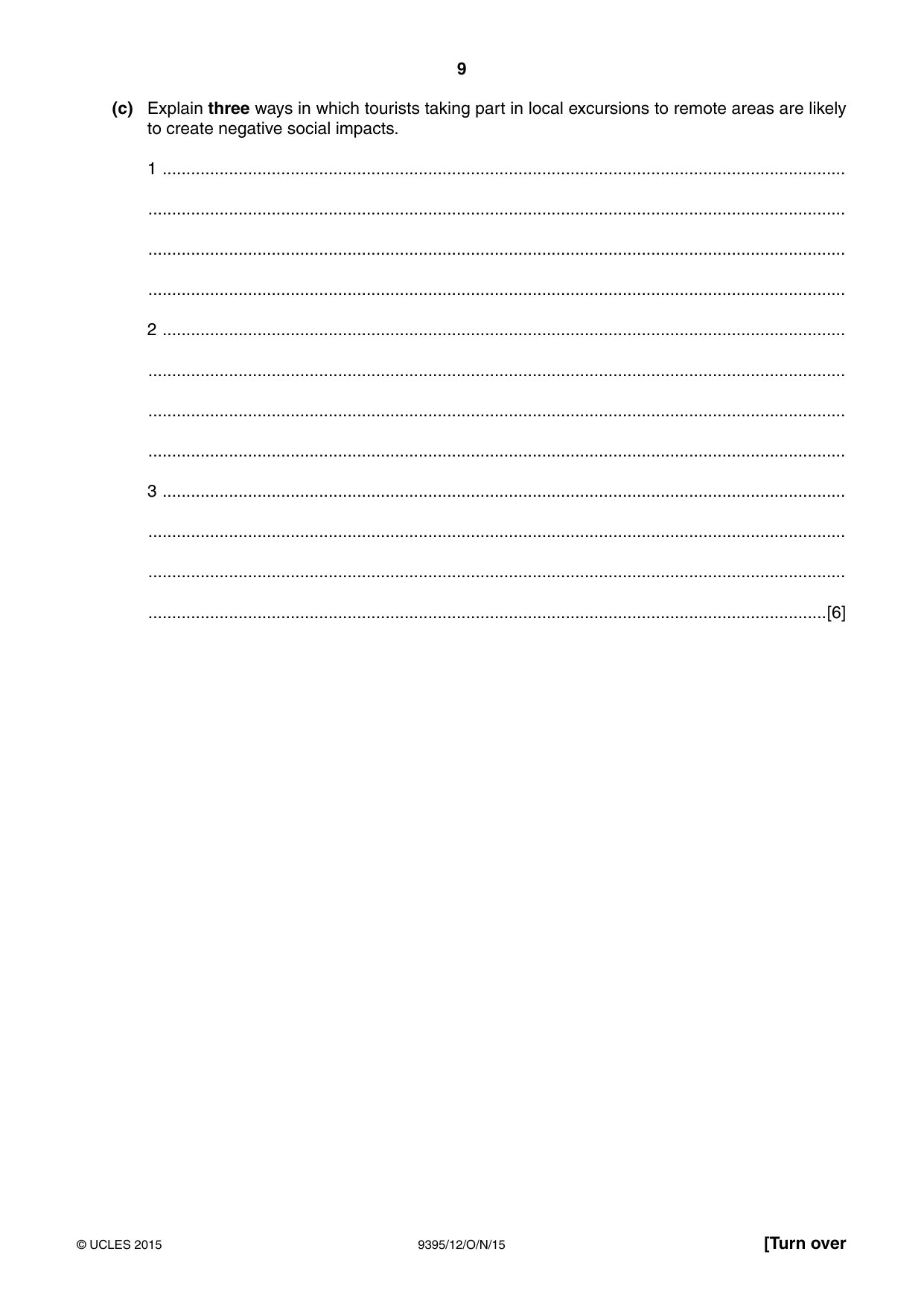
9 9395/12/O/N/15 © UCLES 2015 [Turn over (c) Explain three ways in which tourists taking part in local excursions to remote areas are likely to create negative social impacts. 1 … … … … 2 … … … … 3 … … … …[6]
Question paper, page 10
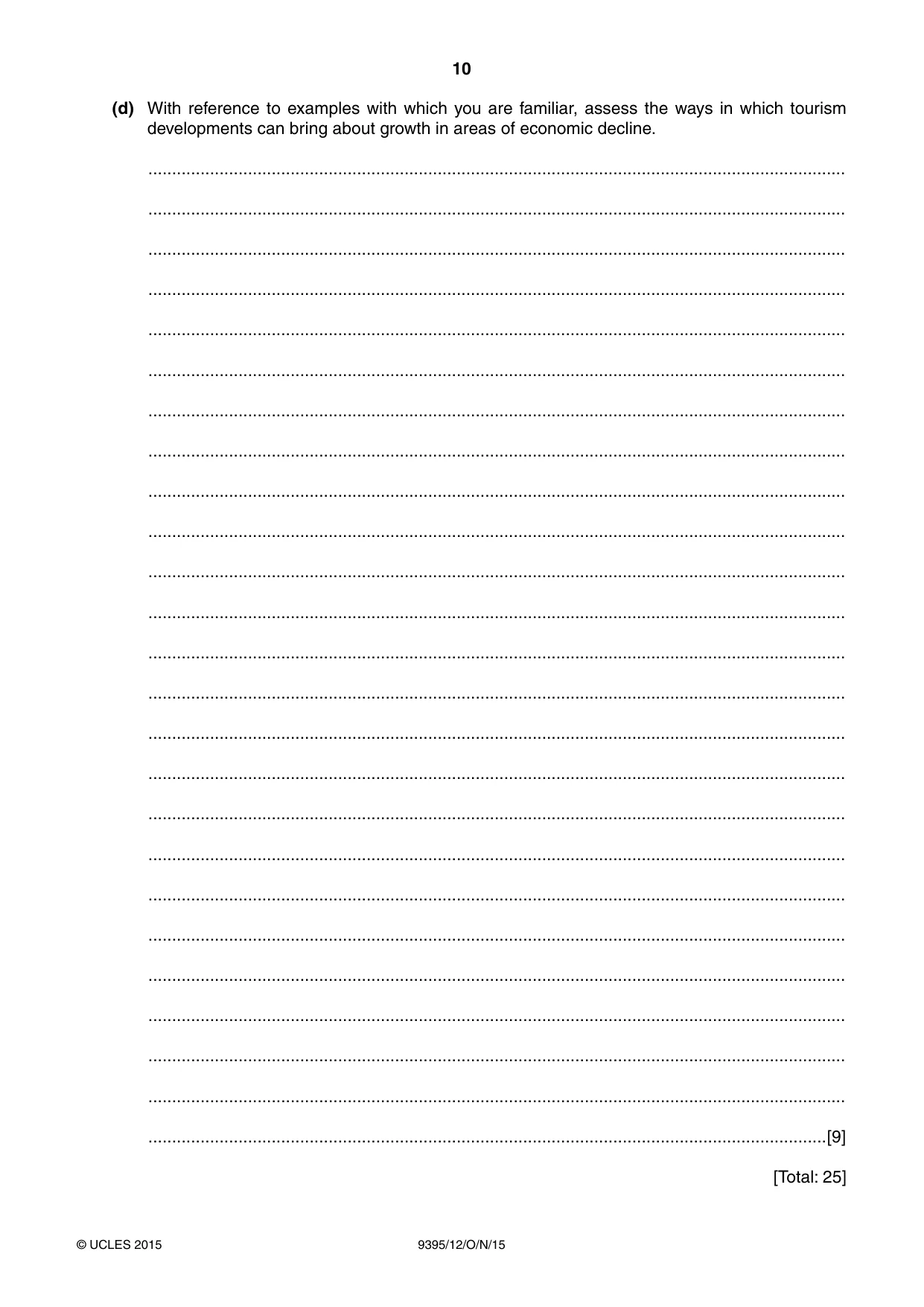
10 9395/12/O/N/15 © UCLES 2015 (d) With reference to examples with which you are familiar, assess the ways in which tourism developments can bring about growth in areas of economic decline. … … … … … … … … … … … … … … … … … … … … … … … … …[9] [Total: 25]
Question paper, page 11
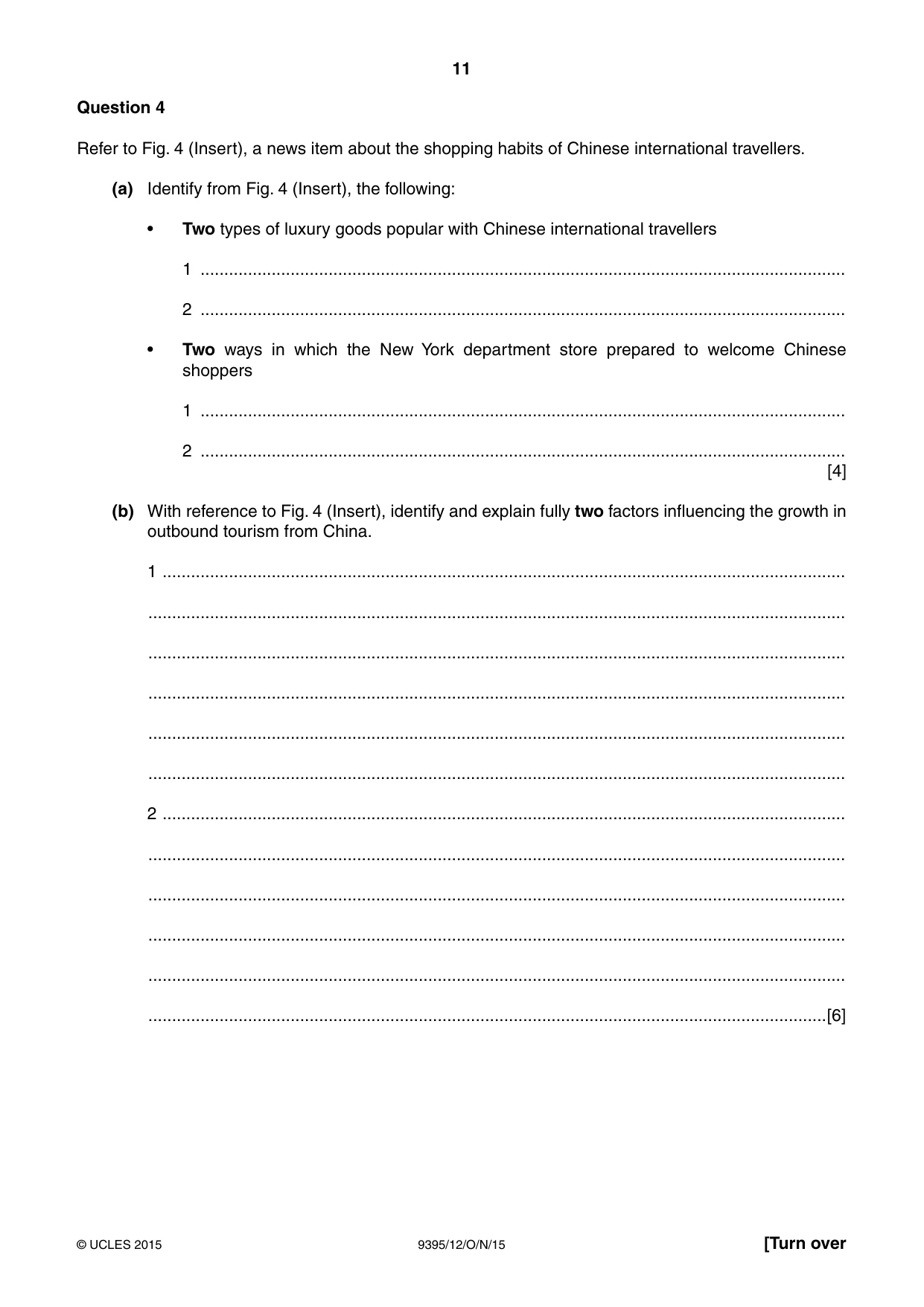
11 9395/12/O/N/15 © UCLES 2015 [Turn over Question 4 Refer to Fig. 4 (Insert), a news item about the shopping habits of Chinese international travellers. (a) Identify from Fig. 4 (Insert), the following: • Two types of luxury goods popular with Chinese international travellers 1 … 2 … • Two ways in which the New York department store prepared to welcome Chinese shoppers 1 … 2 … [4] (b) With reference to Fig. 4 (Insert), identify and explain fully two factors influencing the growth in outbound tourism from China. 1 … … … … … … 2 … … … … … …[6]
Question paper, page 12
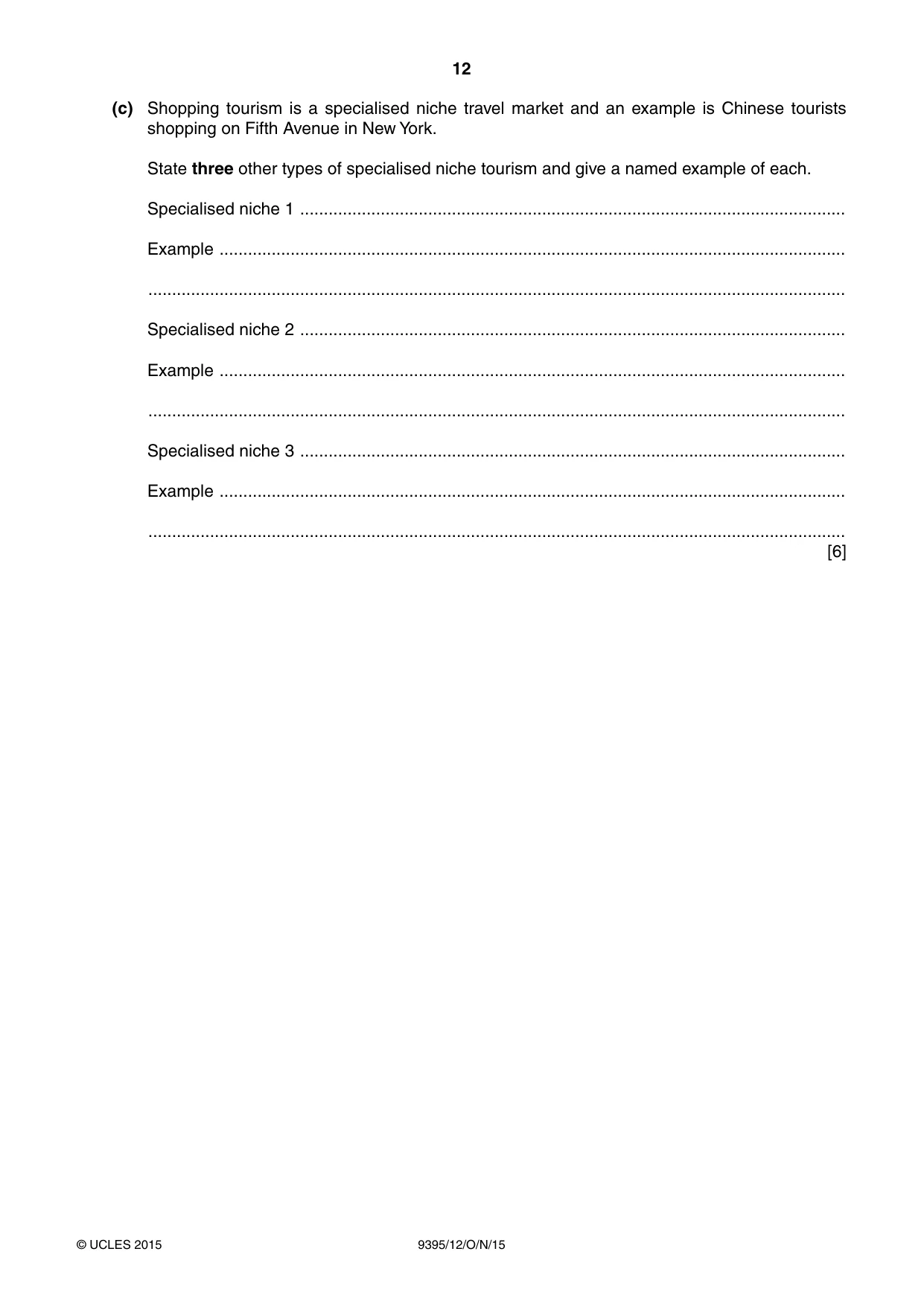
12 9395/12/O/N/15 © UCLES 2015 (c) Shopping tourism is a specialised niche travel market and an example is Chinese tourists shopping on Fifth Avenue in New York. State three other types of specialised niche tourism and give a named example of each. Specialised niche 1 … Example … … Specialised niche 2 … Example … … Specialised niche 3 … Example … … [6]
Question paper, page 13
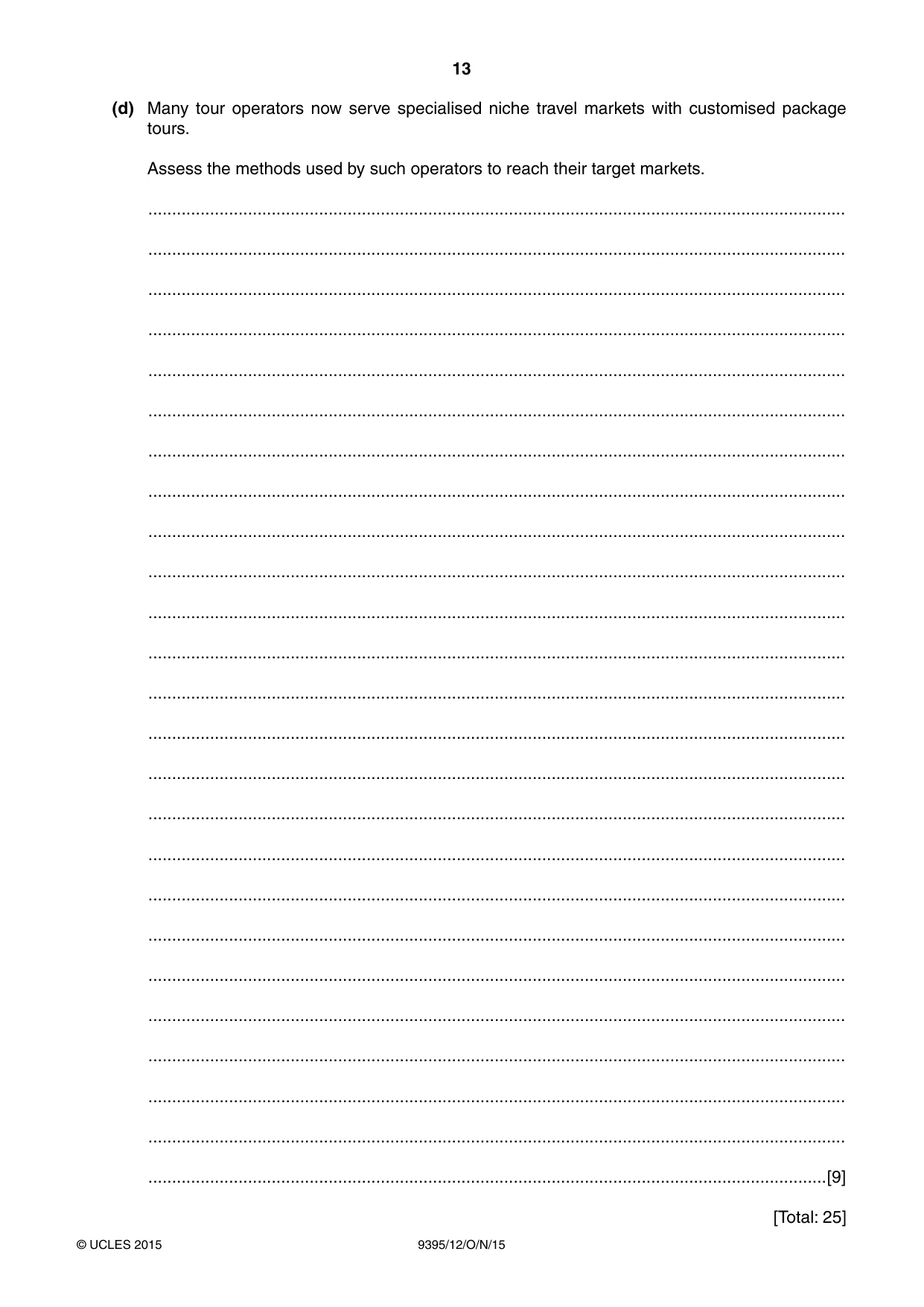
13 9395/12/O/N/15 © UCLES 2015 (d) Many tour operators now serve specialised niche travel markets with customised package tours. Assess the methods used by such operators to reach their target markets. … … … … … … … … … … … … … … … … … … … … … … … … …[9] [Total: 25]
Question paper, page 14
14 9395/12/O/N/15 © UCLES 2015 BLANK PAGE
Question paper, page 15
15 9395/12/O/N/15 © UCLES 2015 BLANK PAGE
Question paper, page 16
16 9395/12/O/N/15 © UCLES 2015 Permission to reproduce items where third-party owned material protected by copyright is included has been sought and cleared where possible. Every reasonable effort has been made by the publisher (UCLES) to trace copyright holders, but if any items requiring clearance have unwittingly been included, the publisher will be pleased to make amends at the earliest possible opportunity. To avoid the issue of disclosure of answer-related information to candidates, all copyright acknowledgements are reproduced online in the Cambridge International Examinations Copyright Acknowledgements Booklet. This is produced for each series of examinations and is freely available to download at www.cie.org.uk after the live examination series. Cambridge International Examinations is part of the Cambridge Assessment Group. Cambridge Assessment is the brand name of University of Cambridge Local Examinations Syndicate (UCLES), which is itself a department of the University of Cambridge. BLANK PAGE
Mark scheme, page 1
® IGCSE is the registered trademark of Cambridge International Examinations. CAMBRIDGE INTERNATIONAL EXAMINATIONS Cambridge International Advanced Subsidiary and Advanced Level MARK SCHEME for the October/November 2015 series 9395 TRAVEL AND TOURISM 9395/12 Paper 1 (Core Paper), maximum raw mark 100 This mark scheme is published as an aid to teachers and candidates, to indicate the requirements of the examination. It shows the basis on which Examiners were instructed to award marks. It does not indicate the details of the discussions that took place at an Examiners’ meeting before marking began, which would have considered the acceptability of alternative answers. Mark schemes should be read in conjunction with the question paper and the Principal Examiner Report for Teachers. Cambridge will not enter into discussions about these mark schemes. Cambridge is publishing the mark schemes for the October/November 2015 series for most Cambridge IGCSE®, Cambridge International A and AS Level components and some Cambridge O Level components.
Mark scheme, page 2
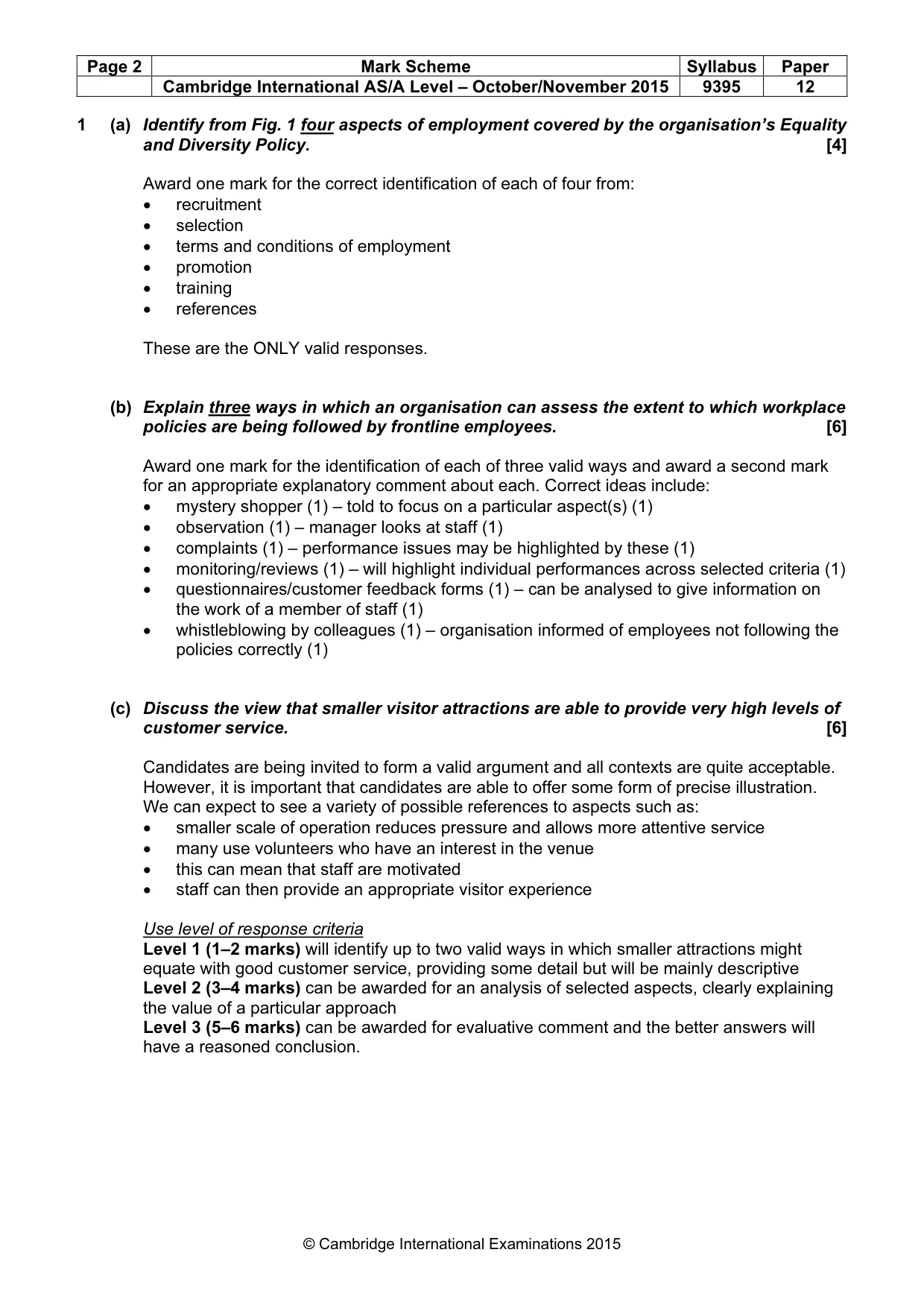
Page 2 Mark Scheme Syllabus Paper Cambridge International AS/A Level – October/November 2015 9395 12 © Cambridge International Examinations 2015 1 (a) Identify from Fig. 1 four aspects of employment covered by the organisation’s Equality and Diversity Policy. [4] Award one mark for the correct identification of each of four from: • recruitment • selection • terms and conditions of employment • promotion • training • references These are the ONLY valid responses. (b) Explain three ways in which an organisation can assess the extent to which workplace policies are being followed by frontline employees. [6] Award one mark for the identification of each of three valid ways and award a second mark for an appropriate explanatory comment about each. Correct ideas include: • mystery shopper (1) – told to focus on a particular aspect(s) (1) • observation (1) – manager looks at staff (1) • complaints (1) – performance issues may be highlighted by these (1) • monitoring/reviews (1) – will highlight individual performances across selected criteria (1) • questionnaires/customer feedback forms (1) – can be analysed to give information on the work of a member of staff (1) • whistleblowing by colleagues (1) – organisation informed of employees not following the policies correctly (1) (c) Discuss the view that smaller visitor attractions are able to provide very high levels of customer service. [6] Candidates are being invited to form a valid argument and all contexts are quite acceptable. However, it is important that candidates are able to offer some form of precise illustration. We can expect to see a variety of possible references to aspects such as: • smaller scale of operation reduces pressure and allows more attentive service • many use volunteers who have an interest in the venue • this can mean that staff are motivated • staff can then provide an appropriate visitor experience Use level of response criteria Level 1 (1–2 marks) will identify up to two valid ways in which smaller attractions might equate with good customer service, providing some detail but will be mainly descriptive Level 2 (3–4 marks) can be awarded for an analysis of selected aspects, clearly explaining the value of a particular approach Level 3 (5–6 marks) can be awarded for evaluative comment and the better answers will have a reasoned conclusion.
Mark scheme, page 3
Page 3 Mark Scheme Syllabus Paper Cambridge International AS/A Level – October/November 2015 9395 12 © Cambridge International Examinations 2015 (d) For one job role within a travel and tourism organisation with which you are familiar, assess the ways in which employees deal external customer complaints. [9] Points MUST relate to the chosen job – what is done when the customer complains? When dealing with complaints there are a number of factors to take into account and all employees will be expected to observe guidelines such as: • listen carefully • apologise in general terms • never argue • agree the solution with the customer. Complaints can come in a variety of forms such as face to face, by telephone or by post. The complaint may not be directed specifically at the person who answers the complaint but as a representative of the business, that person may have to deal with it. This is all about the context and candidates making generic statements about a non-specific job role cannot move into Level 2. If more than one job role considered credit to be given to the best/most appropriate illustration only Use level of response criteria Level 1: [1–3 marks] Candidate identifies/describes some job-related workplace issues within an identifiable T&T organisation. Information may be a list of issues but explanations are incomplete and arguments partial (if present) and lack coherent organisation or reasoned conclusions. There is little or no attempt to assess. Level 2: [4–6 marks] Candidate identifies a number of valid issues and ways of dealing with them. Candidates will show an understanding of the question and include explanations/analysis of a number of these, clearly indicating how effective customer service can be delivered by the employee acting in an appropriate manner. Level 3: [7–9 marks] Candidates will show a clear understanding of the question and include detailed identification and explanation of particular complaint responses, clearly indicating their relative significance in maintaining service standards. The candidate effectively assesses these, leading to a valid reasoned conclusion. 2 (a) Identify from Fig. 2 (Insert) the following: [4] In both cases award one mark for the correct identification of each as follows: Largest % growth: • Iceland • Slovakia % decline: • Italy • Cyprus
Mark scheme, page 4
Page 4 Mark Scheme Syllabus Paper Cambridge International AS/A Level – October/November 2015 9395 12 © Cambridge International Examinations 2015 (b) Whilst some of the countries listed in Fig. 2 (Insert) share a common currency, the Euro (€), others still use their own national currencies. Discuss how fluctuations in the exchange rates of currency are likely to influence foreign visits. [6] Candidates may concentrate on Europe or argue in more general terms. Currency exchange rate changes have a significant effect on the decisions made by both international tourists and the suppliers of tourism products and services. If the price or value of a foreign currency decreases then overall travel costs for visiting international tourists will become cheaper. This means that more people will travel to the destination and so tourism demand increases. Fluctuations in currency therefore have direct effects on both outbound tourists and the suppliers of travel services in particular destinations. Use level of response criteria Level 1 (1–2 marks) will identify up to two ways in which international visits will be affected, providing some detail but will be mainly descriptive Level 2 (3–4 marks) can be awarded for an analysis of selected ways, clearly explaining how international visits will vary Level 3 (5–6 marks) can be awarded for evaluative comment about the significance of particular fluctuations and the better answers will have a reasoned conclusion. (c) Some European destinations are now experiencing different rates of growth. According to the Butler model of destination evolution, describe the following stages: [6] In each case, award one mark for each of three valid descriptive statements relating to destination conditions, such as: • Stagnation Peak numbers of visitors will have been reached (1). There is a growing awareness of negative environmental, social, cultural and economic tourism impacts (1). Sales go down as the country goes out of fashion (1) and there is evidence that the original cultural and natural attractiveness of the destination has been lost (1). Profits are low and businesses may leave the market or diversify to other types of product (1). • Rejuvenation This is a period of further growth and development brought about by innovation and renewed diversification (1). Major changes are made such as improving the environment and tourism infrastructure (1), better marketing or the addition of more attractions (1). In effect, the destination re-invents itself and extends its appeal to different market segments (1).
Mark scheme, page 5
Page 5 Mark Scheme Syllabus Paper Cambridge International AS/A Level – October/November 2015 9395 12 © Cambridge International Examinations 2015 (d) With reference to one destination with which you are familiar, assess the visitor appeal of the major events which are held during the year. [9] Candidates may examine any destination, what matters is the quality of the assessment and not the scale and variety of events. However, this MUST be specific to a particular destination or it remains in Level 1. Key aspects will include: • What happens and when? • Who is attracted? • Why? Use level of response criteria Level 1: [1–3 marks] Candidate identifies/describes some valid types of event within an identifiable destination. Information may be a list of types but explanations are incomplete and arguments partial (if present) and lack coherent organisation or reasoned conclusions. There is little or no attempt to assess. Level 2: [4–6 marks] Candidate identifies a number of valid events. Candidates will show an understanding of the question and include explanations/analysis of a number of these, clearly indicating what is available and why particular types of tourist are attracted. Level 3: [7–9 marks] Candidates will show a clear understanding of the question and include detailed identification and explanation of particular events, clearly indicating their relative importance and significance to the different visitors. The candidate effectively assesses a range of aspects leading to a valid conclusion. 3 (a) Identify from Fig. 3 (Insert) four ways in which the L’Heure Bleue resort attempts to minimise its negative environmental impact on Nosy Be. [4] Award one mark for the correct identification of each of four ways from: • solar power installation • water supply comes from the surrounding hills • wastewater is collected and processed • filters made of coconut and dead coral • waste water feeds the garden • compost made of food waste • comprehensive recycling system is in place. These are the ONLY valid responses. (b) Using information from Fig. 3 (Insert), explain three ways in which L’Heure Bleue creates a positive social impact for the local population. [6] Award one mark for the correct identification of each of three valid ways and award a second mark for an appropriate explanatory development. Correct ideas from Fig. 3 include: • The special ‘Environment Club’ created for local schoolchildren (1) – improves the educational experience (1) • The resort recruits local staff (1) – contributing to social balance (1) • salaries are 30% above average (1) – improves social wellbeing (1) • a health and solidarity fund for staff and their families (1) – improved health care and minimises hardship (1)
Mark scheme, page 6
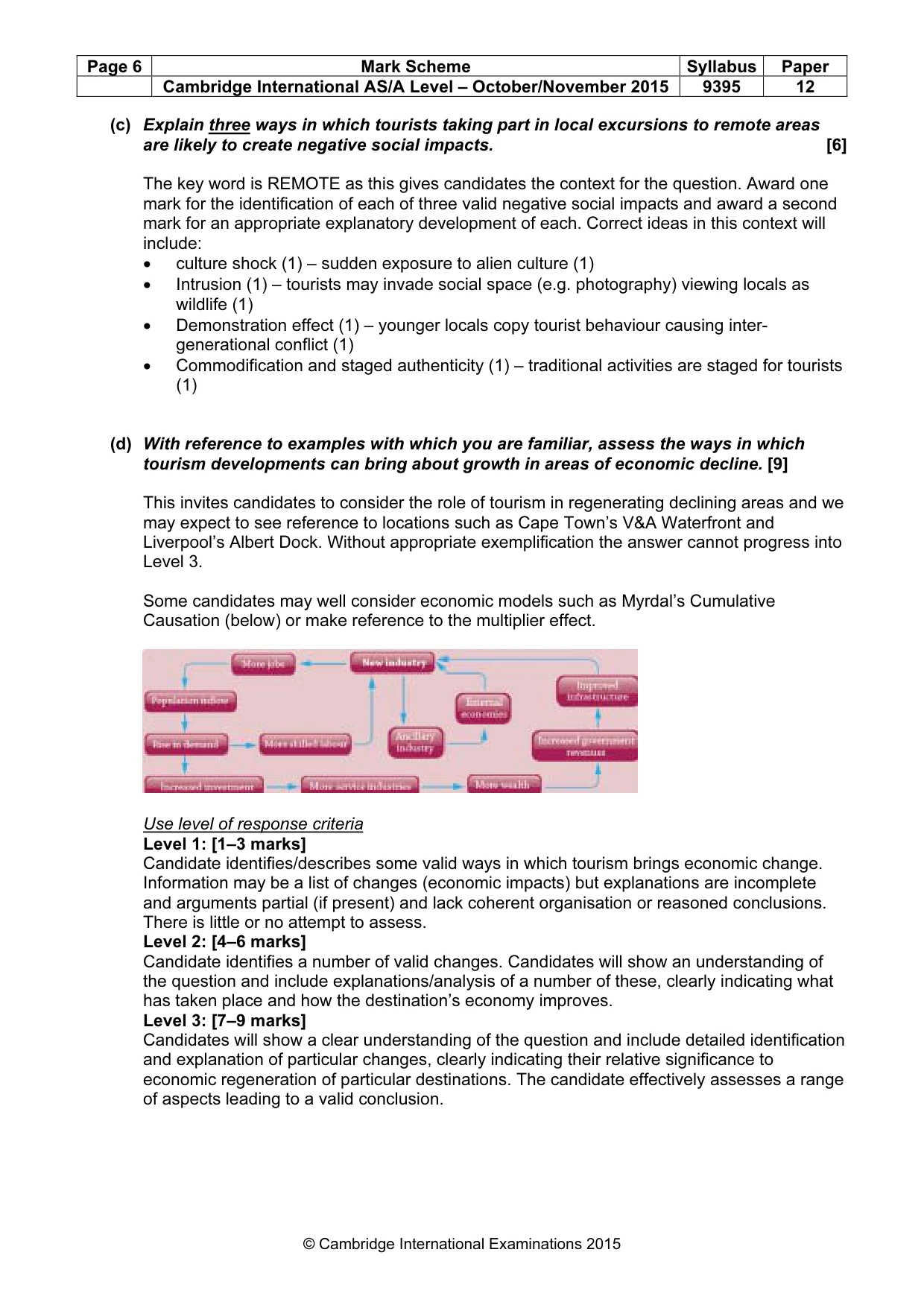
Page 6 Mark Scheme Syllabus Paper Cambridge International AS/A Level – October/November 2015 9395 12 © Cambridge International Examinations 2015 (c) Explain three ways in which tourists taking part in local excursions to remote areas are likely to create negative social impacts. [6] The key word is REMOTE as this gives candidates the context for the question. Award one mark for the identification of each of three valid negative social impacts and award a second mark for an appropriate explanatory development of each. Correct ideas in this context will include: • culture shock (1) – sudden exposure to alien culture (1) • Intrusion (1) – tourists may invade social space (e.g. photography) viewing locals as wildlife (1) • Demonstration effect (1) – younger locals copy tourist behaviour causing inter- generational conflict (1) • Commodification and staged authenticity (1) – traditional activities are staged for tourists (1) (d) With reference to examples with which you are familiar, assess the ways in which tourism developments can bring about growth in areas of economic decline. [9] This invites candidates to consider the role of tourism in regenerating declining areas and we may expect to see reference to locations such as Cape Town’s V&A Waterfront and Liverpool’s Albert Dock. Without appropriate exemplification the answer cannot progress into Level 3. Some candidates may well consider economic models such as Myrdal’s Cumulative Causation (below) or make reference to the multiplier effect. Use level of response criteria Level 1: [1–3 marks] Candidate identifies/describes some valid ways in which tourism brings economic change. Information may be a list of changes (economic impacts) but explanations are incomplete and arguments partial (if present) and lack coherent organisation or reasoned conclusions. There is little or no attempt to assess. Level 2: [4–6 marks] Candidate identifies a number of valid changes. Candidates will show an understanding of the question and include explanations/analysis of a number of these, clearly indicating what has taken place and how the destination’s economy improves. Level 3: [7–9 marks] Candidates will show a clear understanding of the question and include detailed identification and explanation of particular changes, clearly indicating their relative significance to economic regeneration of particular destinations. The candidate effectively assesses a range of aspects leading to a valid conclusion.
Mark scheme, page 7
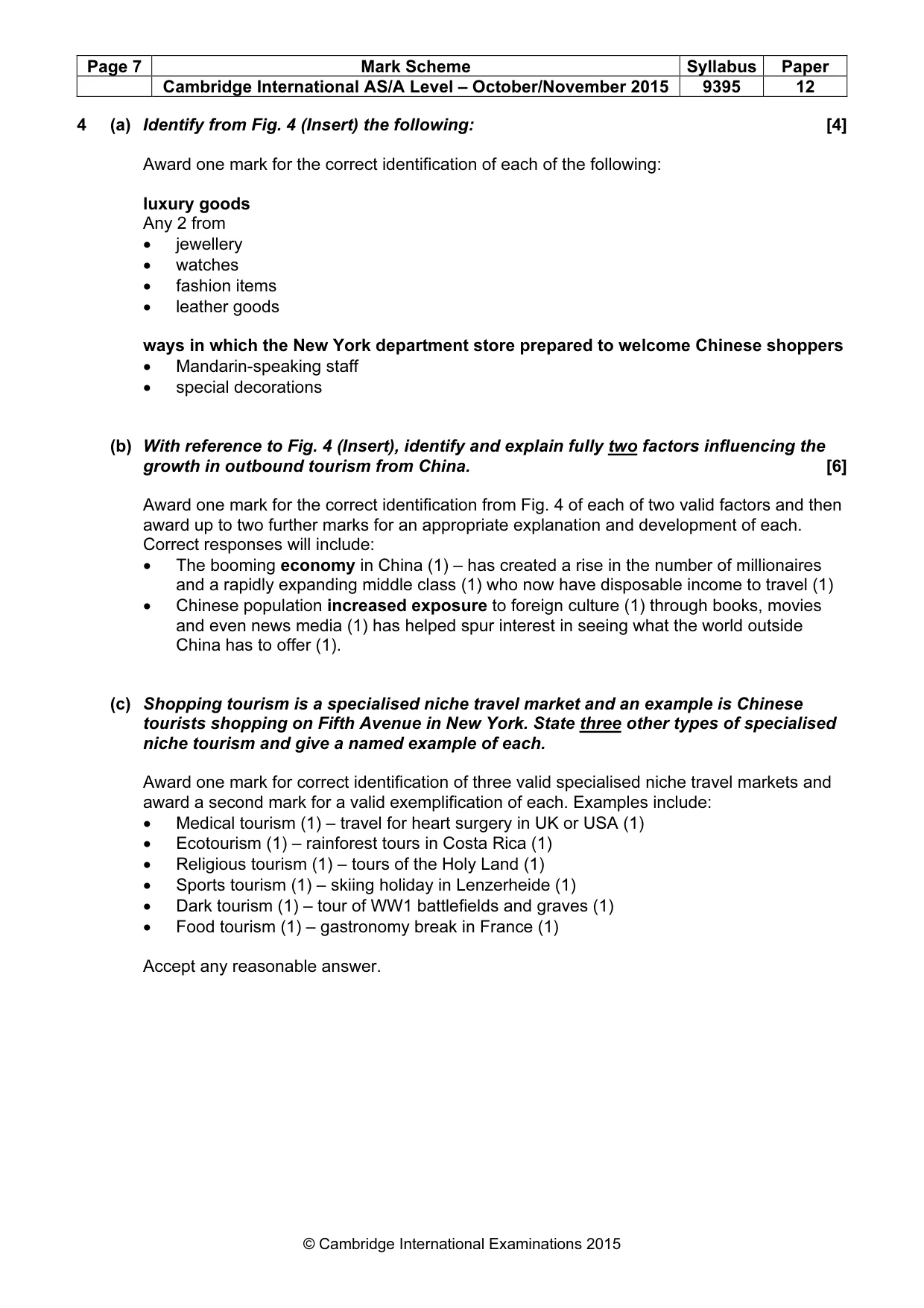
Page 7 Mark Scheme Syllabus Paper Cambridge International AS/A Level – October/November 2015 9395 12 © Cambridge International Examinations 2015 4 (a) Identify from Fig. 4 (Insert) the following: [4] Award one mark for the correct identification of each of the following: luxury goods Any 2 from • jewellery • watches • fashion items • leather goods ways in which the New York department store prepared to welcome Chinese shoppers • Mandarin-speaking staff • special decorations (b) With reference to Fig. 4 (Insert), identify and explain fully two factors influencing the growth in outbound tourism from China. [6] Award one mark for the correct identification from Fig. 4 of each of two valid factors and then award up to two further marks for an appropriate explanation and development of each. Correct responses will include: • The booming economy in China (1) – has created a rise in the number of millionaires and a rapidly expanding middle class (1) who now have disposable income to travel (1) • Chinese population increased exposure to foreign culture (1) through books, movies and even news media (1) has helped spur interest in seeing what the world outside China has to offer (1). (c) Shopping tourism is a specialised niche travel market and an example is Chinese tourists shopping on Fifth Avenue in New York. State three other types of specialised niche tourism and give a named example of each. Award one mark for correct identification of three valid specialised niche travel markets and award a second mark for a valid exemplification of each. Examples include: • Medical tourism (1) – travel for heart surgery in UK or USA (1) • Ecotourism (1) – rainforest tours in Costa Rica (1) • Religious tourism (1) – tours of the Holy Land (1) • Sports tourism (1) – skiing holiday in Lenzerheide (1) • Dark tourism (1) – tour of WW1 battlefields and graves (1) • Food tourism (1) – gastronomy break in France (1) Accept any reasonable answer.
Mark scheme, page 8
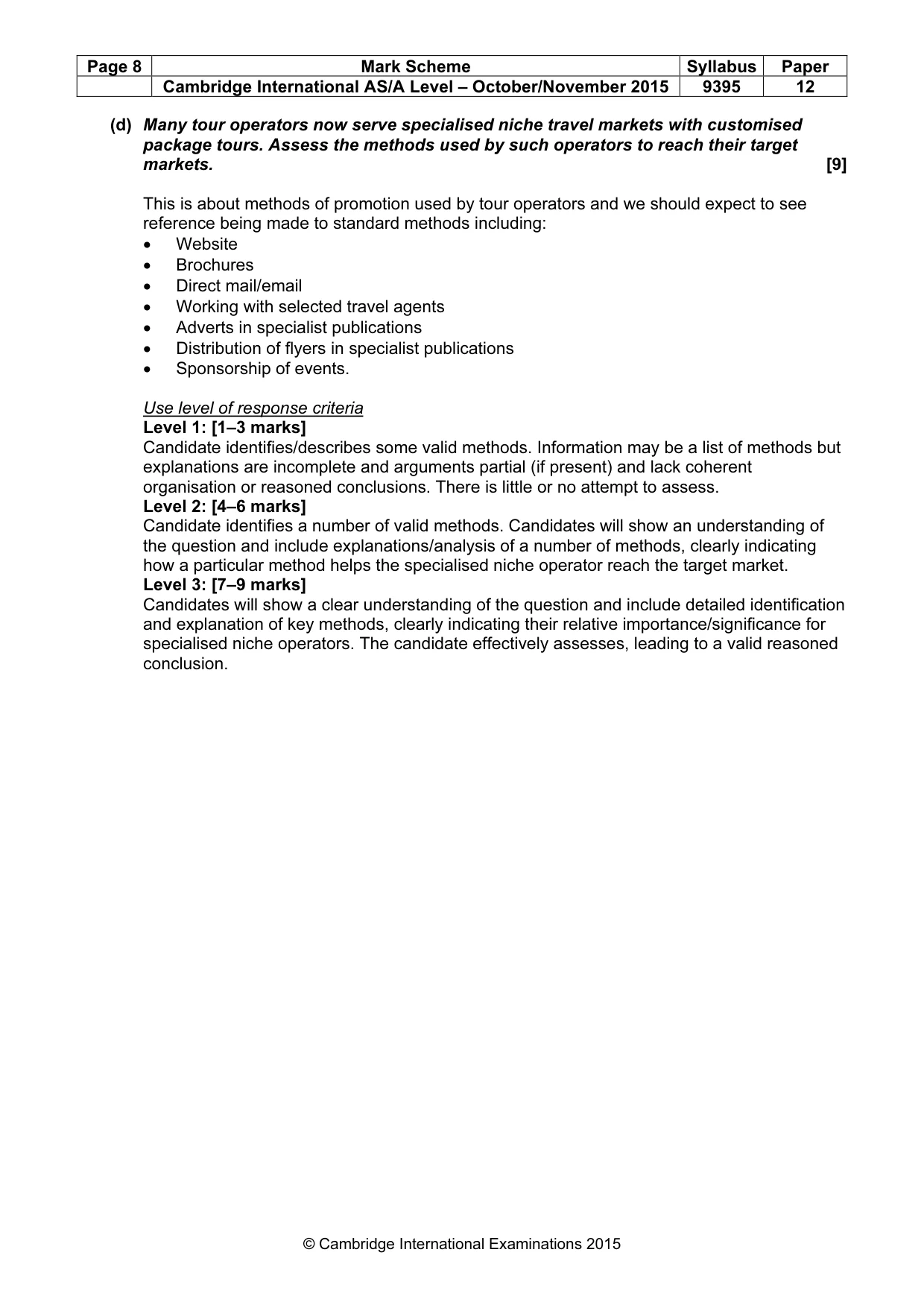
Page 8 Mark Scheme Syllabus Paper Cambridge International AS/A Level – October/November 2015 9395 12 © Cambridge International Examinations 2015 (d) Many tour operators now serve specialised niche travel markets with customised package tours. Assess the methods used by such operators to reach their target markets. [9] This is about methods of promotion used by tour operators and we should expect to see reference being made to standard methods including: • Website • Brochures • Direct mail/email • Working with selected travel agents • Adverts in specialist publications • Distribution of flyers in specialist publications • Sponsorship of events. Use level of response criteria Level 1: [1–3 marks] Candidate identifies/describes some valid methods. Information may be a list of methods but explanations are incomplete and arguments partial (if present) and lack coherent organisation or reasoned conclusions. There is little or no attempt to assess. Level 2: [4–6 marks] Candidate identifies a number of valid methods. Candidates will show an understanding of the question and include explanations/analysis of a number of methods, clearly indicating how a particular method helps the specialised niche operator reach the target market. Level 3: [7–9 marks] Candidates will show a clear understanding of the question and include detailed identification and explanation of key methods, clearly indicating their relative importance/significance for specialised niche operators. The candidate effectively assesses, leading to a valid reasoned conclusion.
What you needed in this session
Cambridge’s own grade thresholds for 2015 Oct/Nov, Paper 1 · Variant 2. A higher threshold means an easier paper — the bar moves with how the cohort did.