Cambridge A Level Travel and Tourism 9395 — 2015 Oct/Nov Paper 1 · Variant 3
9395/13/O/N/15 · 100 marks · ≈113 min
The question paper and its mark scheme, free to read here and free to download. This is Cambridge’s own paper, exactly as it was sat.
Question paper16 pages



Mark scheme9 pages
Answers below. Sit the paper first if you are practising.
Paper as text
Question paper, page 1
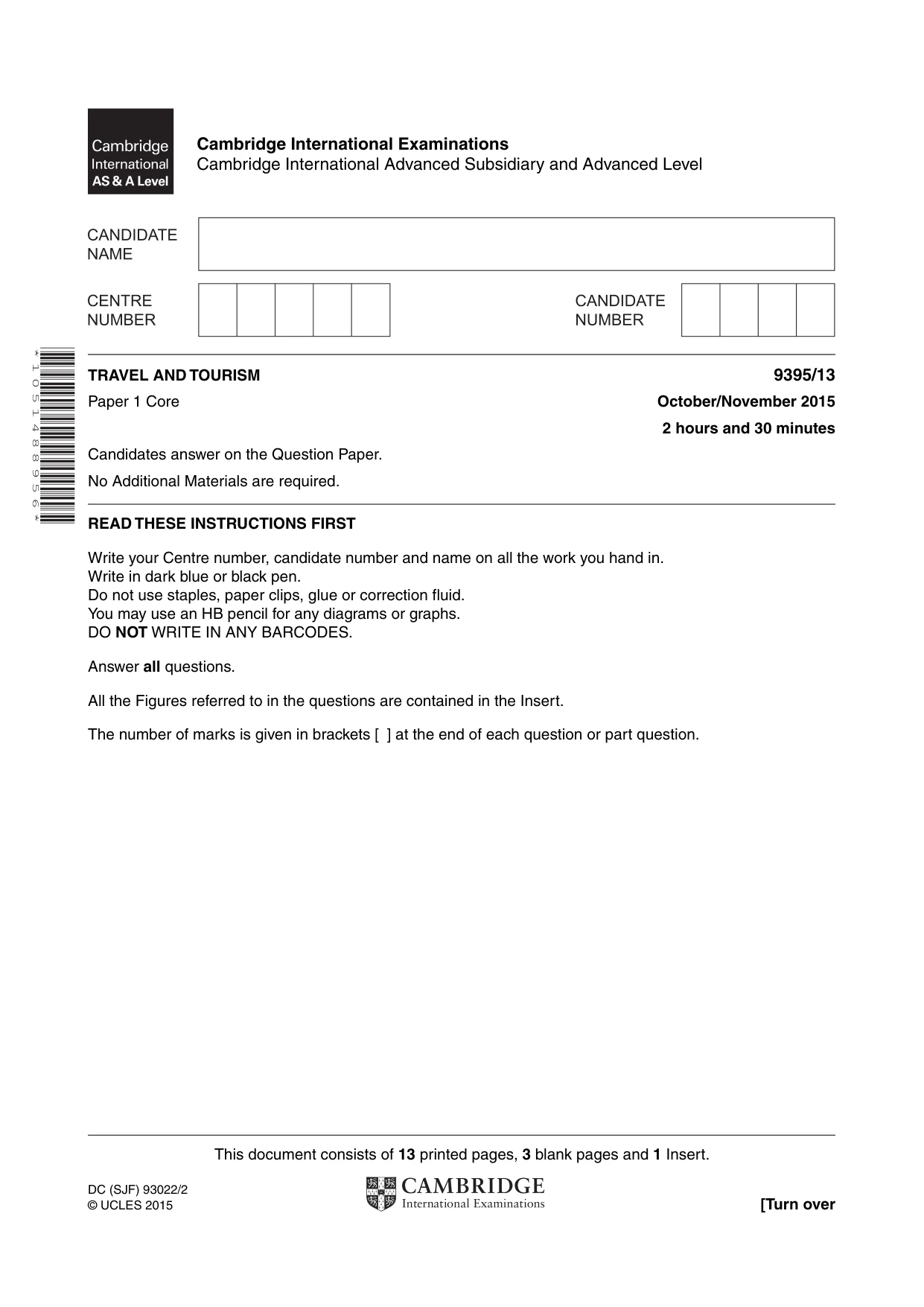
This document consists of 13 printed pages, 3 blank pages and 1 Insert. DC (SJF) 93022/2 © UCLES 2015 [Turn over Cambridge International Examinations Cambridge International Advanced Subsidiary and Advanced Level * 1 0 5 1 4 8 8 9 5 6 * TRAVEL AND TOURISM 9395/13 Paper 1 Core October/November 2015 2 hours and 30 minutes Candidates answer on the Question Paper. No Additional Materials are required. READ THESE INSTRUCTIONS FIRST Write your Centre number, candidate number and name on all the work you hand in. Write in dark blue or black pen. Do not use staples, paper clips, glue or correction fluid. You may use an HB pencil for any diagrams or graphs. DO NOT WRITE IN ANY BARCODES. Answer all questions. All the Figures referred to in the questions are contained in the Insert. The number of marks is given in brackets [ ] at the end of each question or part question.
Question paper, page 2
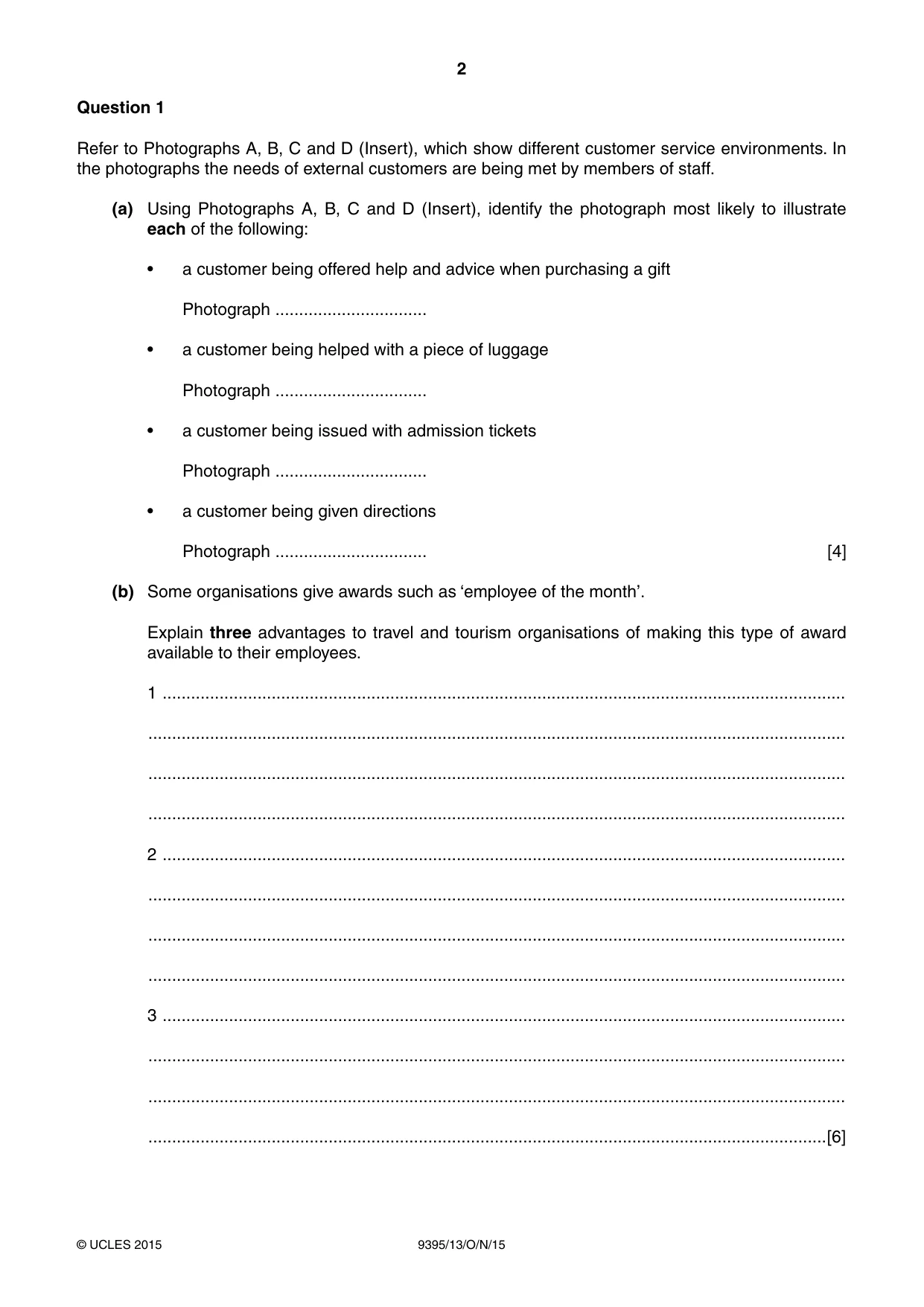
2 9395/13/O/N/15 © UCLES 2015 Question 1 Refer to Photographs A, B, C and D (Insert), which show different customer service environments. In the photographs the needs of external customers are being met by members of staff. (a) Using Photographs A, B, C and D (Insert), identify the photograph most likely to illustrate each of the following: • a customer being offered help and advice when purchasing a gift Photograph … • a customer being helped with a piece of luggage Photograph … • a customer being issued with admission tickets Photograph … • a customer being given directions Photograph … [4] (b) Some organisations give awards such as ‘employee of the month’. Explain three advantages to travel and tourism organisations of making this type of award available to their employees. 1 … … … … 2 … … … … 3 … … … …[6]
Question paper, page 3
3 9395/13/O/N/15 © UCLES 2015 [Turn over (c) Identify three job roles within a travel and tourism organisation with which you are familiar. For each job role, describe a customer service situation in which the employee could receive informal feedback from customers. Name of travel and tourism organisation … Job role 1 … Description … … … Job role 2 … Description … … … Job role 3 … Description … … …[6]
Question paper, page 4
4 9395/13/O/N/15 © UCLES 2015 (d) Choose one job role within a travel and tourism organisation with which you are familiar. Evaluate the standards of performance expected of an employee carrying out this role. Chosen job role and organisation … … … … … … … … … … … … … … … … … … … … … … … … …[9] [Total: 25]
Question paper, page 5
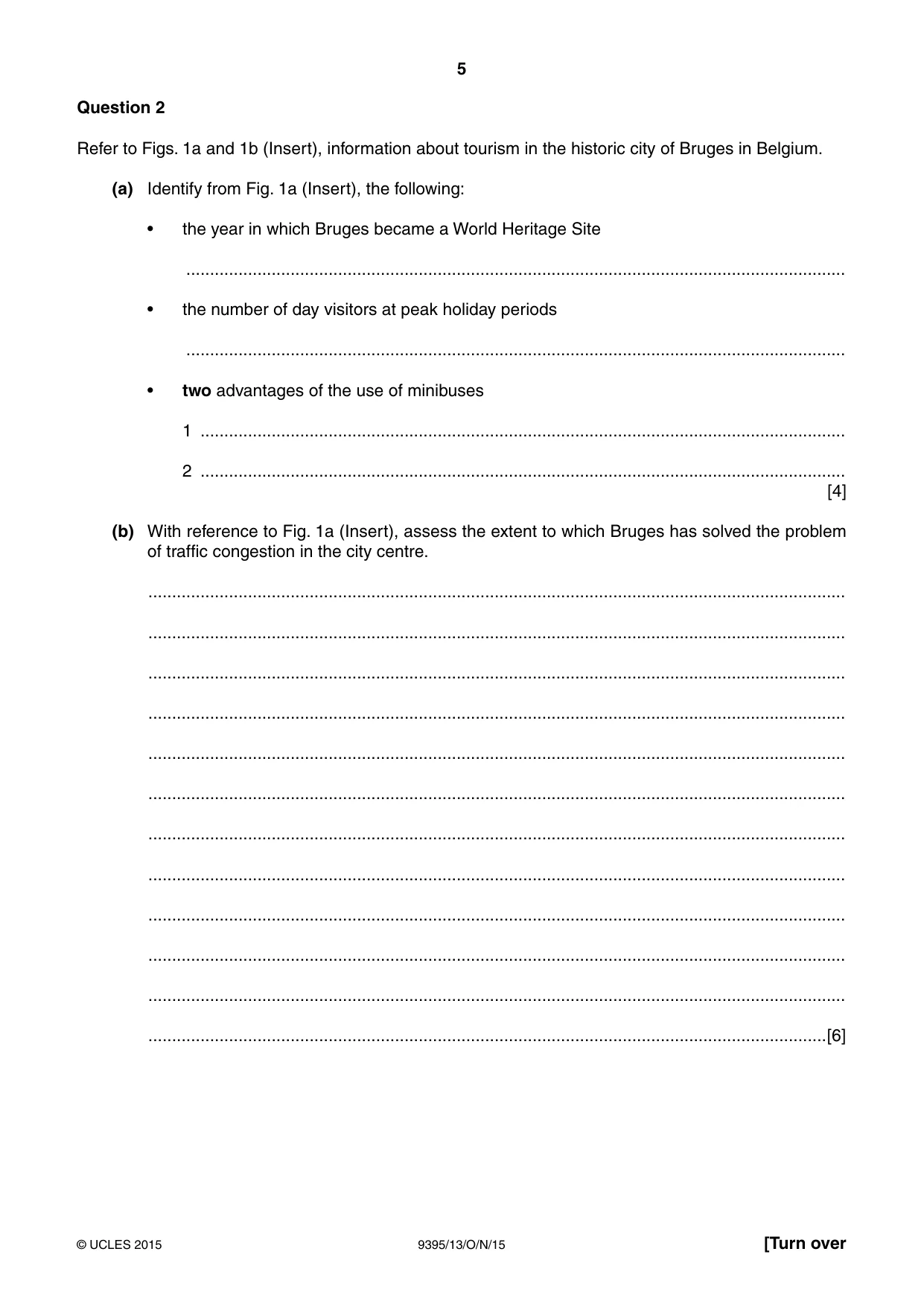
5 9395/13/O/N/15 © UCLES 2015 [Turn over Question 2 Refer to Figs. 1a and 1b (Insert), information about tourism in the historic city of Bruges in Belgium. (a) Identify from Fig. 1a (Insert), the following: • the year in which Bruges became a World Heritage Site … • the number of day visitors at peak holiday periods … • two advantages of the use of minibuses 1 … 2 … [4] (b) With reference to Fig. 1a (Insert), assess the extent to which Bruges has solved the problem of traffic congestion in the city centre. … … … … … … … … … … … …[6]
Question paper, page 6
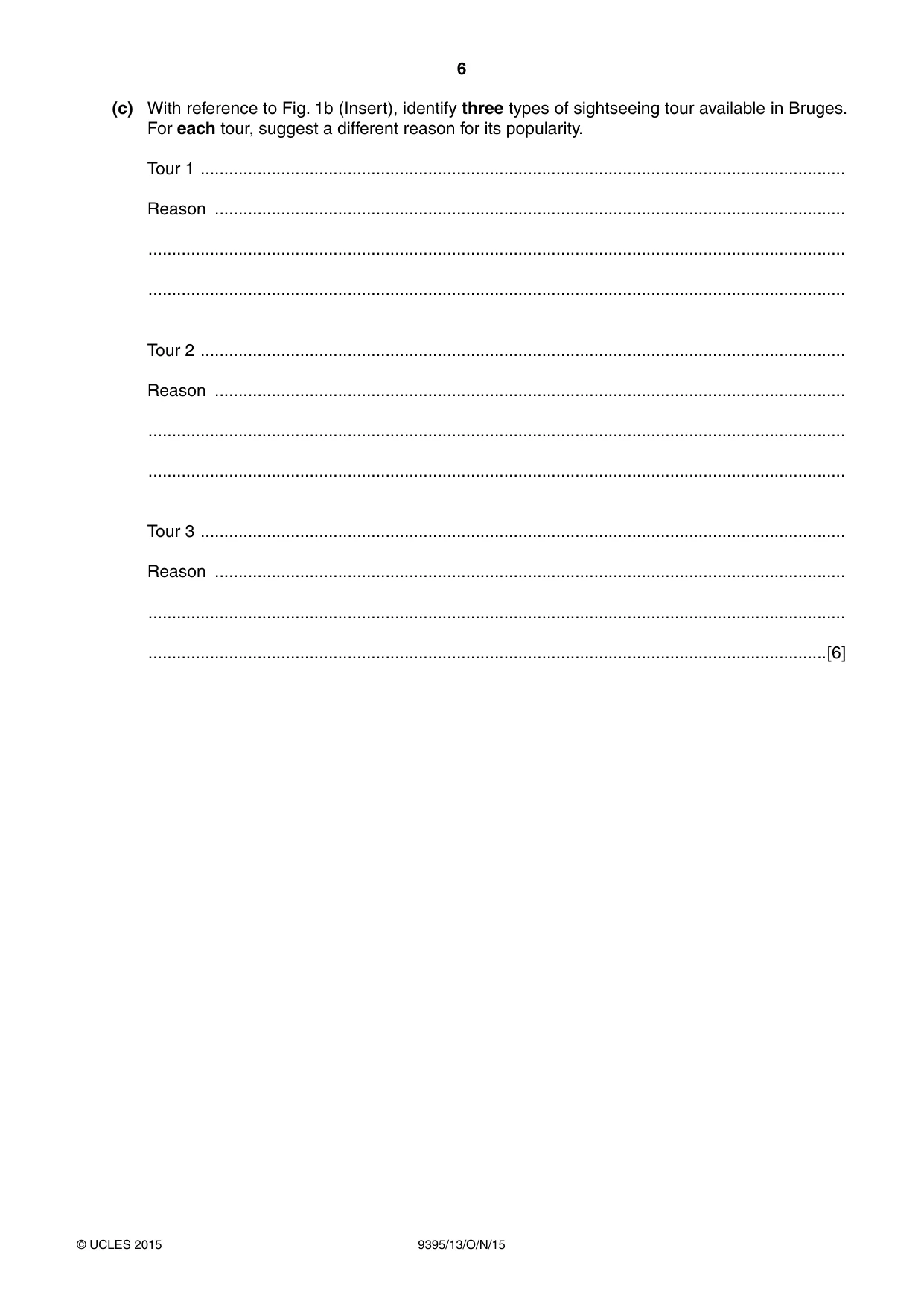
6 9395/13/O/N/15 © UCLES 2015 (c) With reference to Fig. 1b (Insert), identify three types of sightseeing tour available in Bruges. For each tour, suggest a different reason for its popularity. Tour 1 … Reason … … … Tour 2 … Reason … … … Tour 3 … Reason … … …[6]
Question paper, page 7
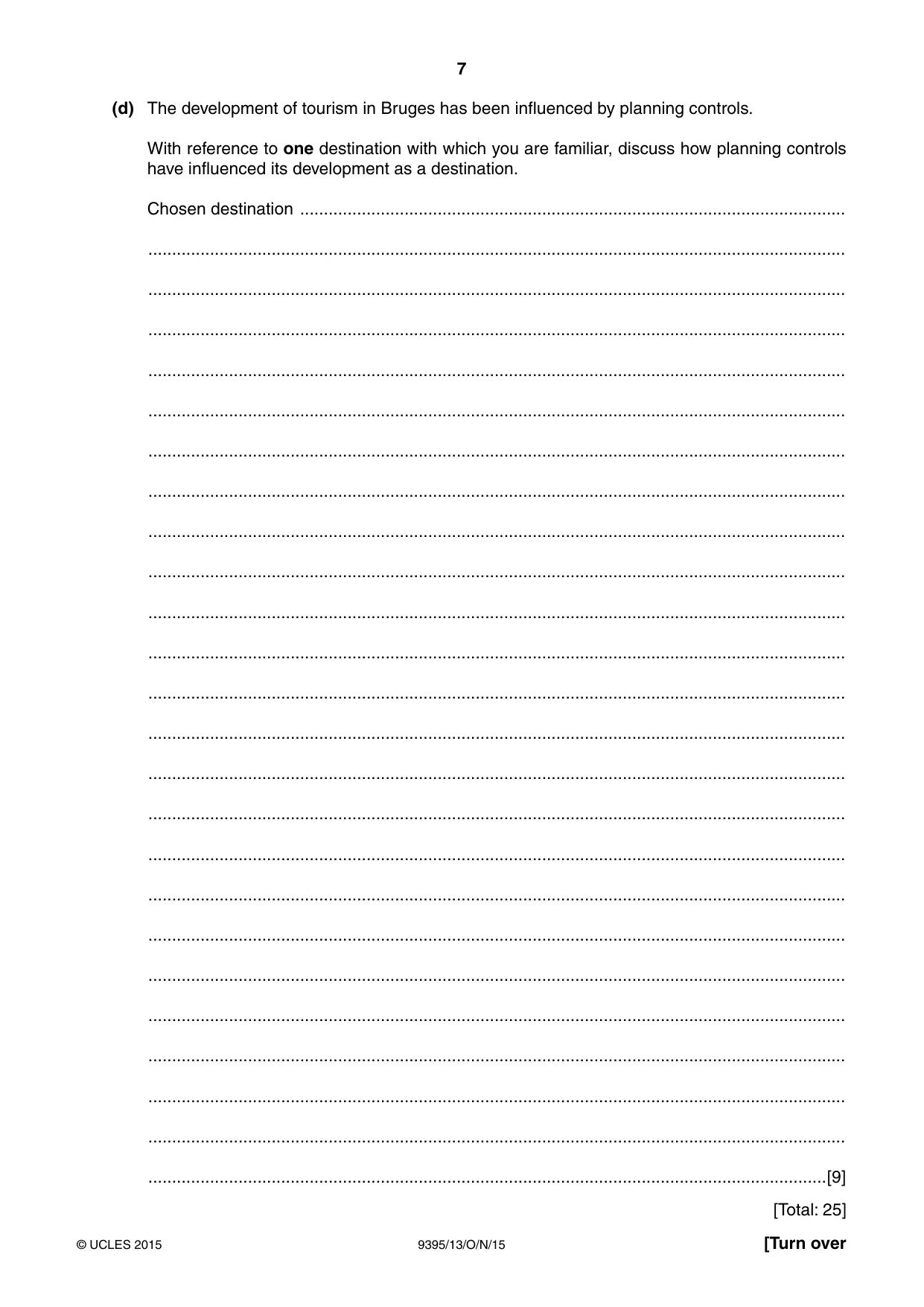
7 9395/13/O/N/15 © UCLES 2015 [Turn over (d) The development of tourism in Bruges has been influenced by planning controls. With reference to one destination with which you are familiar, discuss how planning controls have influenced its development as a destination. Chosen destination … … … … … … … … … … … … … … … … … … … … … … … … …[9] [Total: 25]
Question paper, page 8
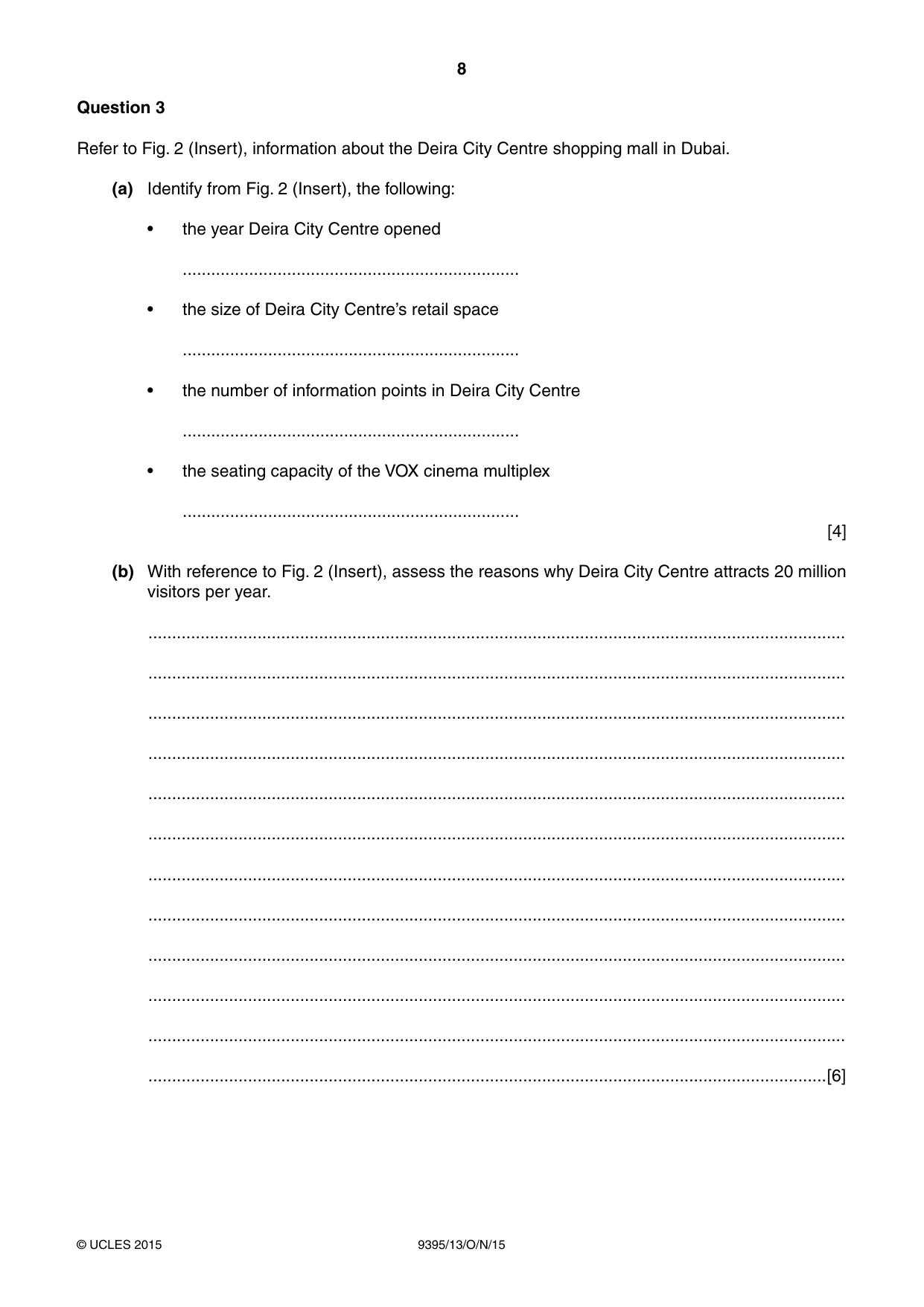
8 9395/13/O/N/15 © UCLES 2015 Question 3 Refer to Fig. 2 (Insert), information about the Deira City Centre shopping mall in Dubai. (a) Identify from Fig. 2 (Insert), the following: • the year Deira City Centre opened … • the size of Deira City Centre’s retail space … • the number of information points in Deira City Centre … • the seating capacity of the VOX cinema multiplex … [4] (b) With reference to Fig. 2 (Insert), assess the reasons why Deira City Centre attracts 20 million visitors per year. … … … … … … … … … … … …[6]
Question paper, page 9
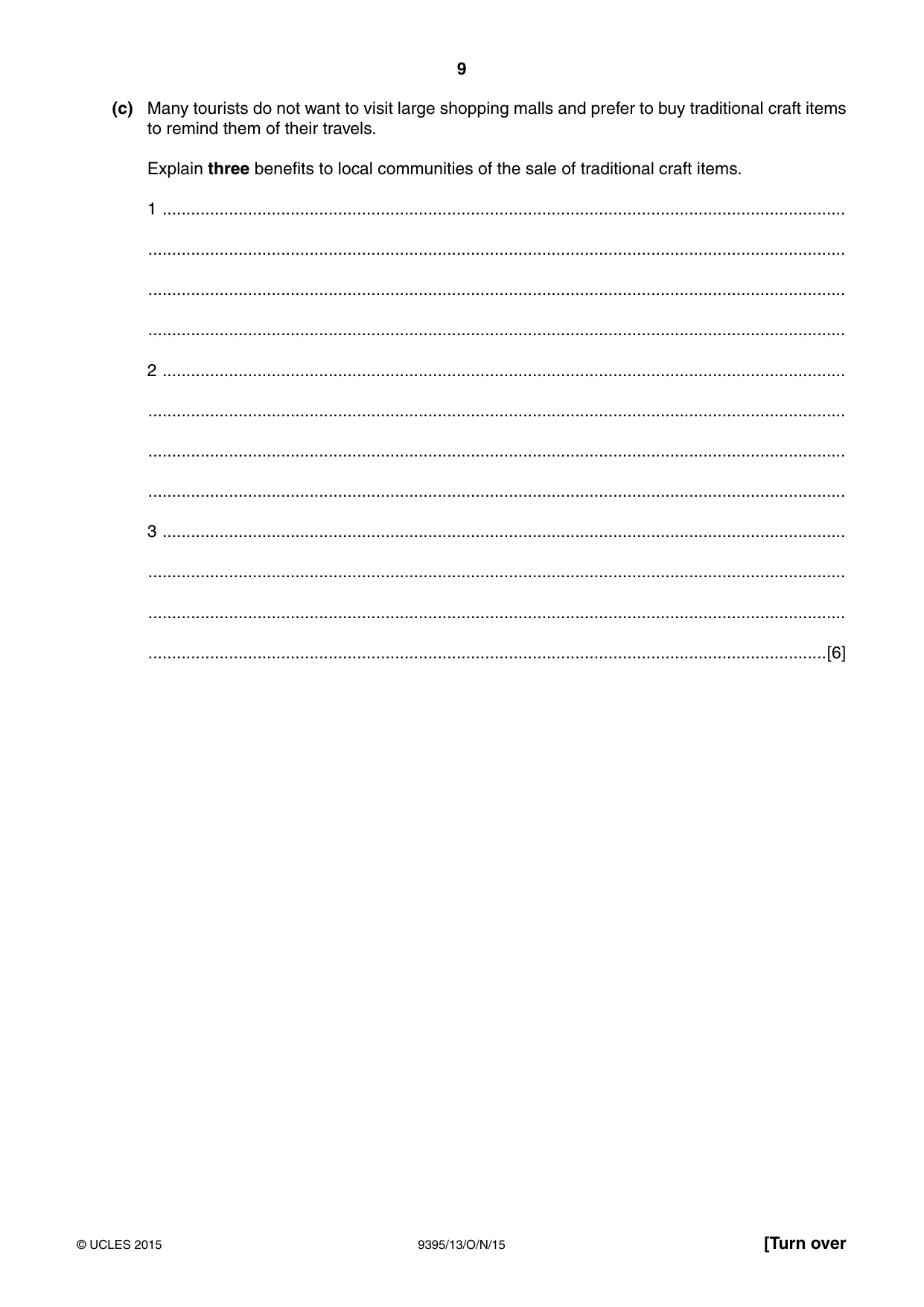
9 9395/13/O/N/15 © UCLES 2015 [Turn over (c) Many tourists do not want to visit large shopping malls and prefer to buy traditional craft items to remind them of their travels. Explain three benefits to local communities of the sale of traditional craft items. 1 … … … … 2 … … … … 3 … … … …[6]
Question paper, page 10
10 9395/13/O/N/15 © UCLES 2015 (d) Evaluate the factors which influence the amount of money tourists spend when visiting a destination. … … … … … … … … … … … … … … … … … … … … … … … … … …[9] [Total: 25]
Question paper, page 11
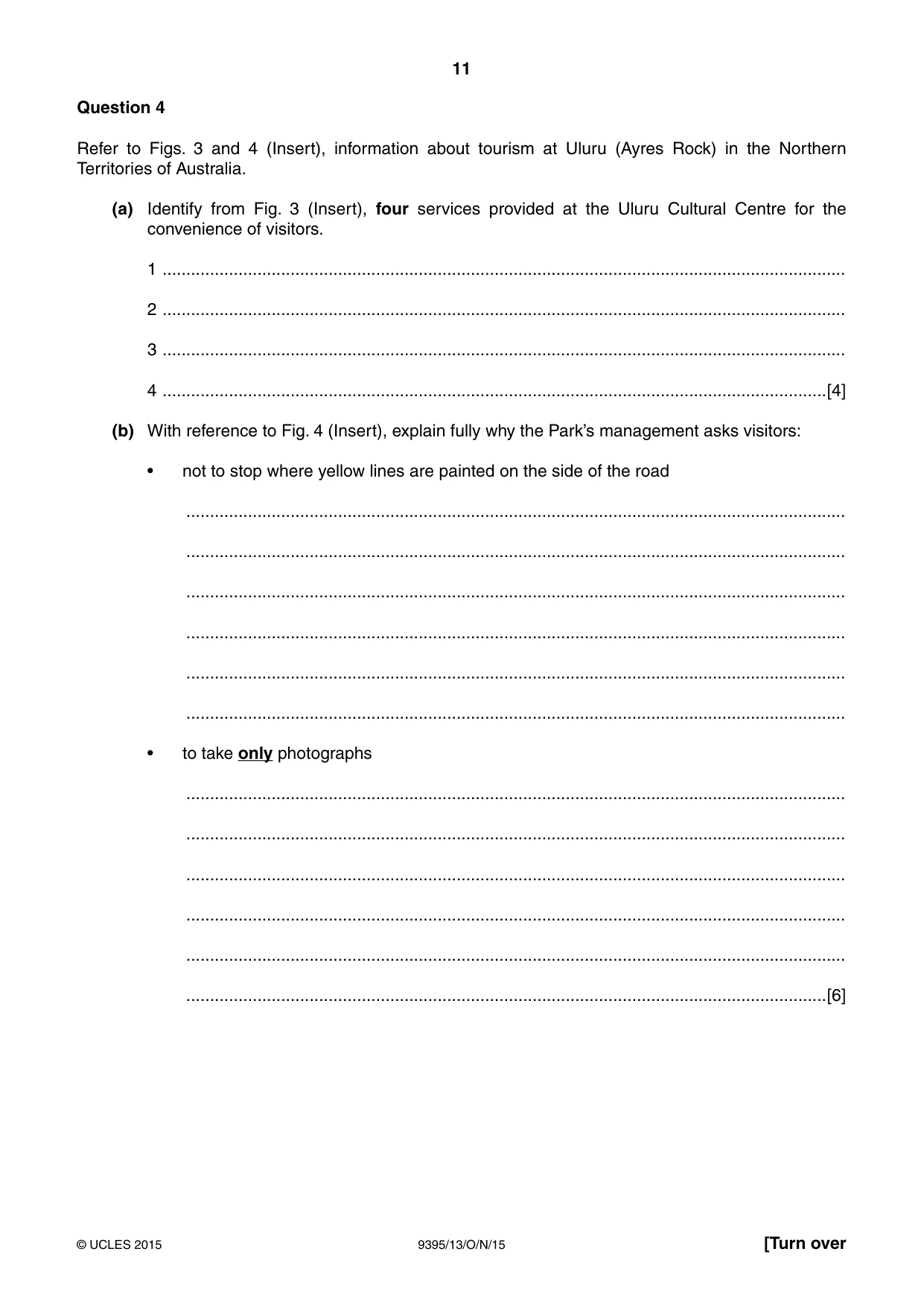
11 9395/13/O/N/15 © UCLES 2015 [Turn over Question 4 Refer to Figs. 3 and 4 (Insert), information about tourism at Uluru (Ayres Rock) in the Northern Territories of Australia. (a) Identify from Fig. 3 (Insert), four services provided at the Uluru Cultural Centre for the convenience of visitors. 1 … 2 … 3 … 4 …[4] (b) With reference to Fig. 4 (Insert), explain fully why the Park’s management asks visitors: • not to stop where yellow lines are painted on the side of the road … … … … … … • to take only photographs … … … … … …[6]
Question paper, page 12
12 9395/13/O/N/15 © UCLES 2015 (c) Some members of the local Anangu tribe are employed as park rangers in the Uluru-Kata Tjuta National Park. Describe three ways in which this is likely to help the destination to be managed successfully. 1 … … … … 2 … … … … 3 … … … …[6]
Question paper, page 13
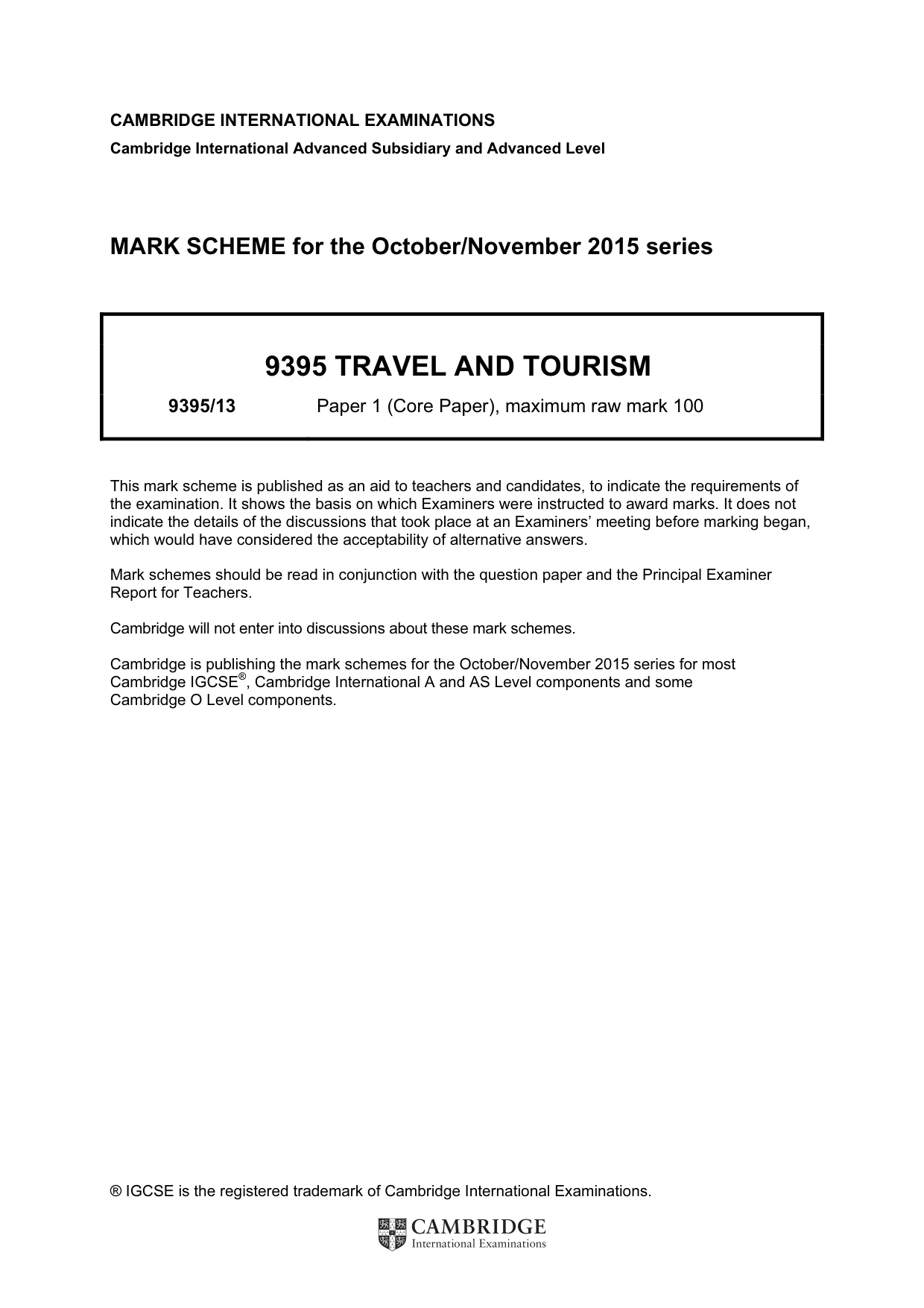
13 9395/13/O/N/15 © UCLES 2015 (d) Voluntary organisations often play a significant role in the development of tourism. With reference to one voluntary organisation with which you are familiar, assess the extent to which it has been able to meet its tourism-related objectives. Chosen voluntary organisation … … … … … … … … … … … … … … … … … … … … … … … … …[9] [Total: 25]
Question paper, page 14
14 9395/13/O/N/15 © UCLES 2015 BLANK PAGE
Question paper, page 15
15 9395/13/O/N/15 © UCLES 2015 BLANK PAGE
Question paper, page 16
16 9395/13/O/N/15 © UCLES 2015 Permission to reproduce items where third-party owned material protected by copyright is included has been sought and cleared where possible. Every reasonable effort has been made by the publisher (UCLES) to trace copyright holders, but if any items requiring clearance have unwittingly been included, the publisher will be pleased to make amends at the earliest possible opportunity. To avoid the issue of disclosure of answer-related information to candidates, all copyright acknowledgements are reproduced online in the Cambridge International Examinations Copyright Acknowledgements Booklet. This is produced for each series of examinations and is freely available to download at www.cie.org.uk after the live examination series. Cambridge International Examinations is part of the Cambridge Assessment Group. Cambridge Assessment is the brand name of University of Cambridge Local Examinations Syndicate (UCLES), which is itself a department of the University of Cambridge. BLANK PAGE
Mark scheme, page 1
® IGCSE is the registered trademark of Cambridge International Examinations. CAMBRIDGE INTERNATIONAL EXAMINATIONS Cambridge International Advanced Subsidiary and Advanced Level MARK SCHEME for the October/November 2015 series 9395 TRAVEL AND TOURISM 9395/13 Paper 1 (Core Paper), maximum raw mark 100 This mark scheme is published as an aid to teachers and candidates, to indicate the requirements of the examination. It shows the basis on which Examiners were instructed to award marks. It does not indicate the details of the discussions that took place at an Examiners’ meeting before marking began, which would have considered the acceptability of alternative answers. Mark schemes should be read in conjunction with the question paper and the Principal Examiner Report for Teachers. Cambridge will not enter into discussions about these mark schemes. Cambridge is publishing the mark schemes for the October/November 2015 series for most Cambridge IGCSE®, Cambridge International A and AS Level components and some Cambridge O Level components.
Mark scheme, page 2
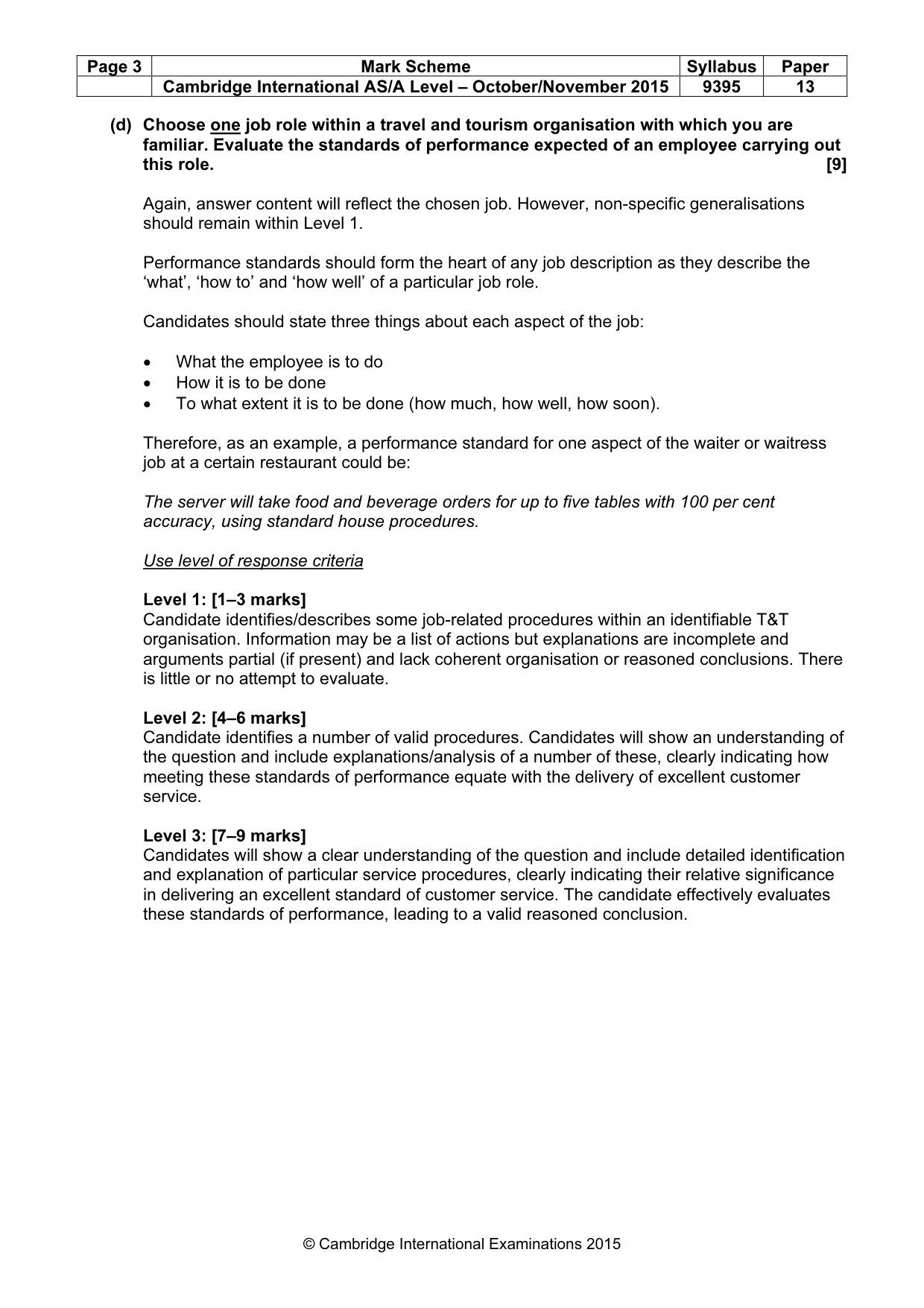
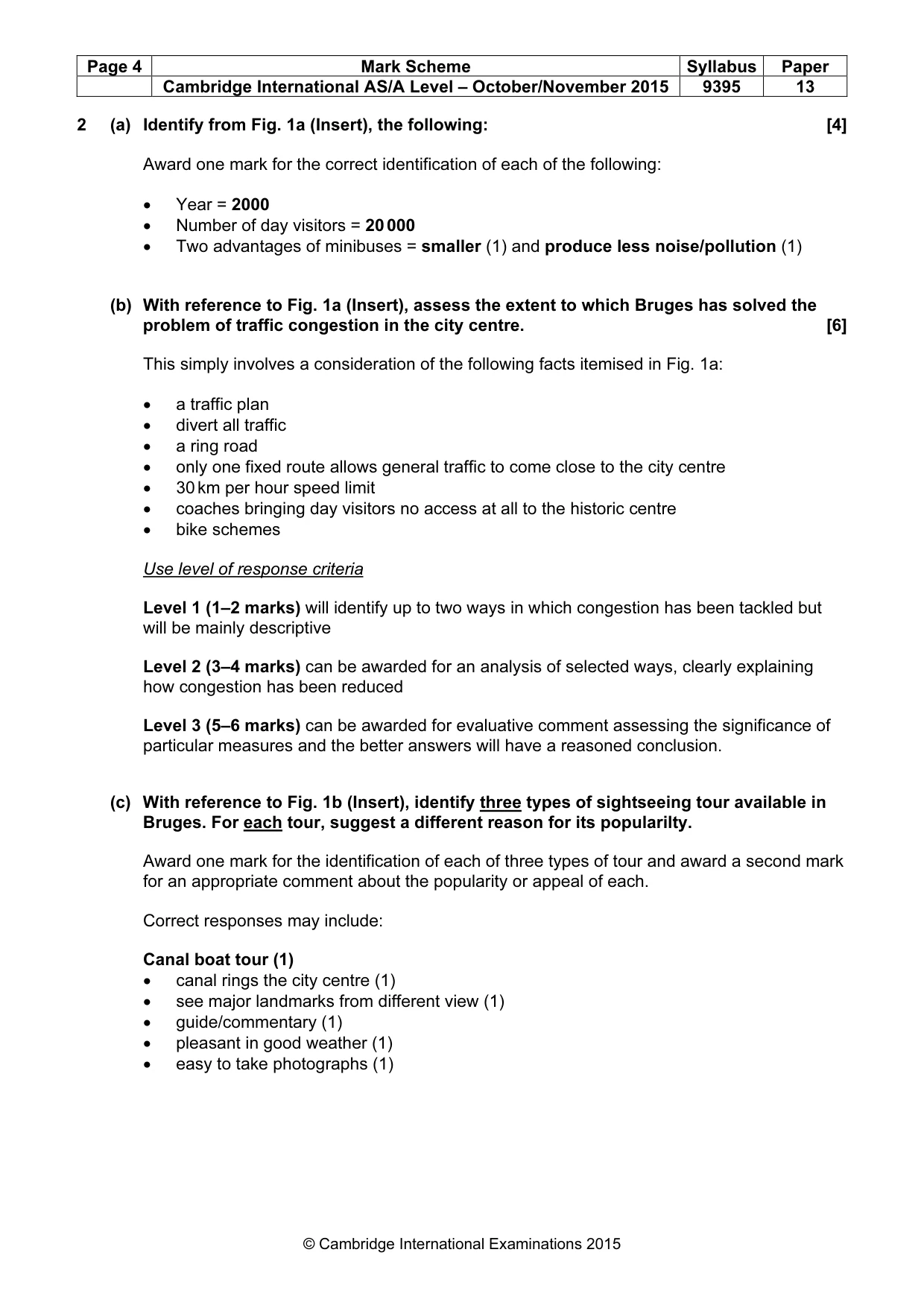
Page 2 Mark Scheme Syllabus Paper Cambridge International AS/A Level – October/November 2015 9395 13 © Cambridge International Examinations 2015 1 (a) Using photographs A, B, C and D (Insert), identify the photograph most likely to illustrate each of the following: [4] Award one mark for the correct identification of each as follows: • purchasing gift = Photo C • helped with luggage = Photo A • issued with tickets = Photo D • given directions = Photo B (b) Some organisations give awards such as ‘employee of the month’. Explain three advantages to travel and tourism organisations of making this type of award available to their employees. [6] Award one mark for the correct identification of each of three valid advantages and award a second mark for an appropriate explanatory comment about each. Correct responses will include: • increased motivation (1) – employees have a desire to win (1) • happier and more efficient workforce (1) – striving to meet goals/targets (1) • clearer benchmarking (1) – performance standards highlighted for all to see (1) • improved communication (1) – all departments involved (1) • improved self-esteem (1) – employees feel valued (1) (c) Identify three job roles within a travel and tourism organisation with which you are familiar. For each job role, describe a customer service situation in which the employee could receive informal feedback from customers. [6] Details will vary with the job roles selected but in each case we should look for the identification of a particular ‘moment of truth’. Award one mark for a descriptive comment about what is done and a second mark for the identification of an aspect generating a customer comment. Examples might include: • waiter serving meal (1) and asking is everything to customer’s satisfaction (1) • receptionist acknowledging a guest (1) asking how can I help you (1) • room attendant servicing room (1) and guest points out problem/issue/request (1)
Mark scheme, page 3
Page 3 Mark Scheme Syllabus Paper Cambridge International AS/A Level – October/November 2015 9395 13 © Cambridge International Examinations 2015 (d) Choose one job role within a travel and tourism organisation with which you are familiar. Evaluate the standards of performance expected of an employee carrying out this role. [9] Again, answer content will reflect the chosen job. However, non-specific generalisations should remain within Level 1. Performance standards should form the heart of any job description as they describe the ‘what’, ‘how to’ and ‘how well’ of a particular job role. Candidates should state three things about each aspect of the job: • What the employee is to do • How it is to be done • To what extent it is to be done (how much, how well, how soon). Therefore, as an example, a performance standard for one aspect of the waiter or waitress job at a certain restaurant could be: The server will take food and beverage orders for up to five tables with 100 per cent accuracy, using standard house procedures. Use level of response criteria Level 1: [1–3 marks] Candidate identifies/describes some job-related procedures within an identifiable T&T organisation. Information may be a list of actions but explanations are incomplete and arguments partial (if present) and lack coherent organisation or reasoned conclusions. There is little or no attempt to evaluate. Level 2: [4–6 marks] Candidate identifies a number of valid procedures. Candidates will show an understanding of the question and include explanations/analysis of a number of these, clearly indicating how meeting these standards of performance equate with the delivery of excellent customer service. Level 3: [7–9 marks] Candidates will show a clear understanding of the question and include detailed identification and explanation of particular service procedures, clearly indicating their relative significance in delivering an excellent standard of customer service. The candidate effectively evaluates these standards of performance, leading to a valid reasoned conclusion.
Mark scheme, page 4
Page 4 Mark Scheme Syllabus Paper Cambridge International AS/A Level – October/November 2015 9395 13 © Cambridge International Examinations 2015 2 (a) Identify from Fig. 1a (Insert), the following: [4] Award one mark for the correct identification of each of the following: • Year = 2000 • Number of day visitors = 20 000 • Two advantages of minibuses = smaller (1) and produce less noise/pollution (1) (b) With reference to Fig. 1a (Insert), assess the extent to which Bruges has solved the problem of traffic congestion in the city centre. [6] This simply involves a consideration of the following facts itemised in Fig. 1a: • a traffic plan • divert all traffic • a ring road • only one fixed route allows general traffic to come close to the city centre • 30 km per hour speed limit • coaches bringing day visitors no access at all to the historic centre • bike schemes Use level of response criteria Level 1 (1–2 marks) will identify up to two ways in which congestion has been tackled but will be mainly descriptive Level 2 (3–4 marks) can be awarded for an analysis of selected ways, clearly explaining how congestion has been reduced Level 3 (5–6 marks) can be awarded for evaluative comment assessing the significance of particular measures and the better answers will have a reasoned conclusion. (c) With reference to Fig. 1b (Insert), identify three types of sightseeing tour available in Bruges. For each tour, suggest a different reason for its popularilty. Award one mark for the identification of each of three types of tour and award a second mark for an appropriate comment about the popularity or appeal of each. Correct responses may include: Canal boat tour (1) • canal rings the city centre (1) • see major landmarks from different view (1) • guide/commentary (1) • pleasant in good weather (1) • easy to take photographs (1)
Mark scheme, page 5
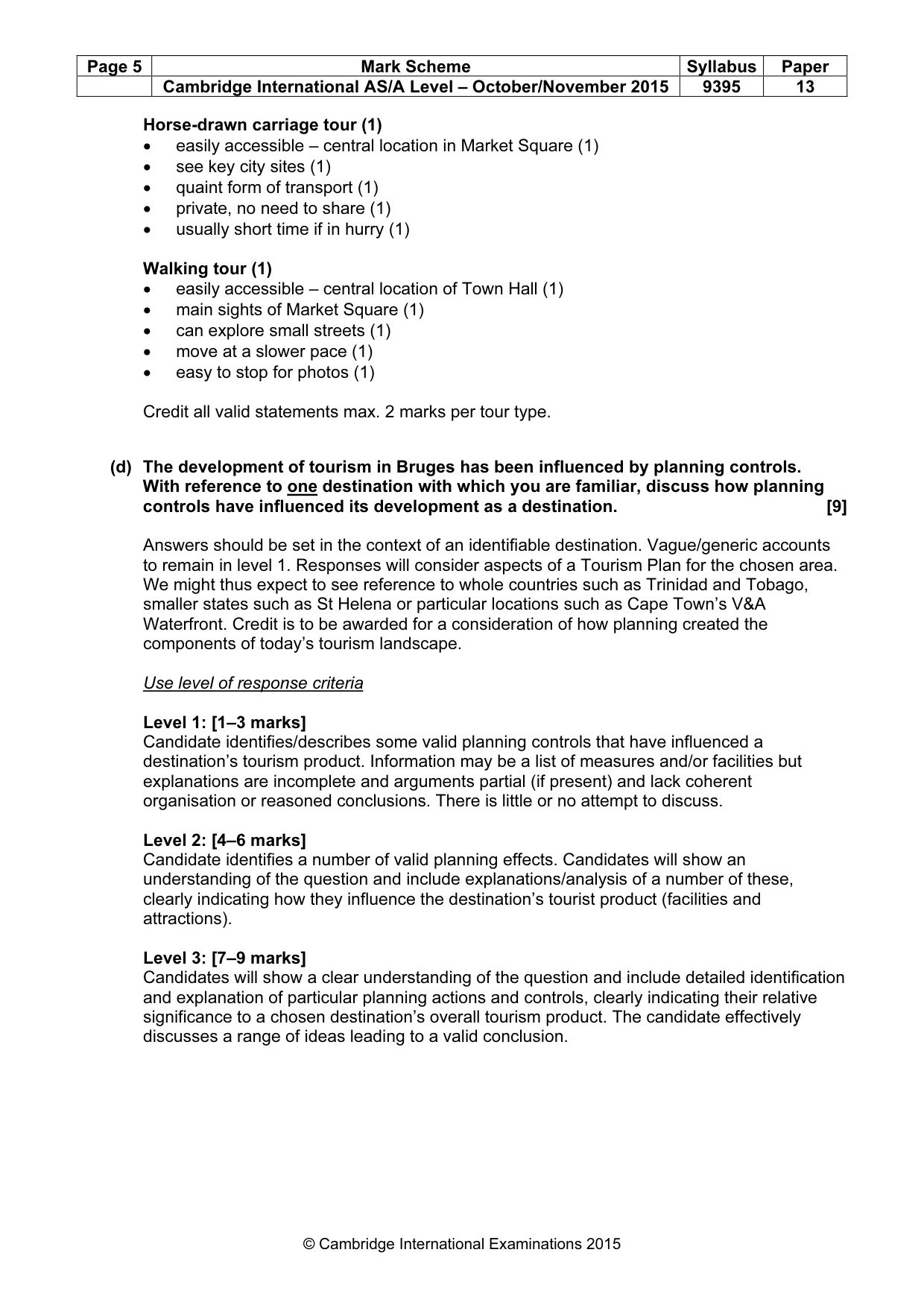
Page 5 Mark Scheme Syllabus Paper Cambridge International AS/A Level – October/November 2015 9395 13 © Cambridge International Examinations 2015 Horse-drawn carriage tour (1) • easily accessible – central location in Market Square (1) • see key city sites (1) • quaint form of transport (1) • private, no need to share (1) • usually short time if in hurry (1) Walking tour (1) • easily accessible – central location of Town Hall (1) • main sights of Market Square (1) • can explore small streets (1) • move at a slower pace (1) • easy to stop for photos (1) Credit all valid statements max. 2 marks per tour type. (d) The development of tourism in Bruges has been influenced by planning controls. With reference to one destination with which you are familiar, discuss how planning controls have influenced its development as a destination. [9] Answers should be set in the context of an identifiable destination. Vague/generic accounts to remain in level 1. Responses will consider aspects of a Tourism Plan for the chosen area. We might thus expect to see reference to whole countries such as Trinidad and Tobago, smaller states such as St Helena or particular locations such as Cape Town’s V&A Waterfront. Credit is to be awarded for a consideration of how planning created the components of today’s tourism landscape. Use level of response criteria Level 1: [1–3 marks] Candidate identifies/describes some valid planning controls that have influenced a destination’s tourism product. Information may be a list of measures and/or facilities but explanations are incomplete and arguments partial (if present) and lack coherent organisation or reasoned conclusions. There is little or no attempt to discuss. Level 2: [4–6 marks] Candidate identifies a number of valid planning effects. Candidates will show an understanding of the question and include explanations/analysis of a number of these, clearly indicating how they influence the destination’s tourist product (facilities and attractions). Level 3: [7–9 marks] Candidates will show a clear understanding of the question and include detailed identification and explanation of particular planning actions and controls, clearly indicating their relative significance to a chosen destination’s overall tourism product. The candidate effectively discusses a range of ideas leading to a valid conclusion.
Mark scheme, page 6
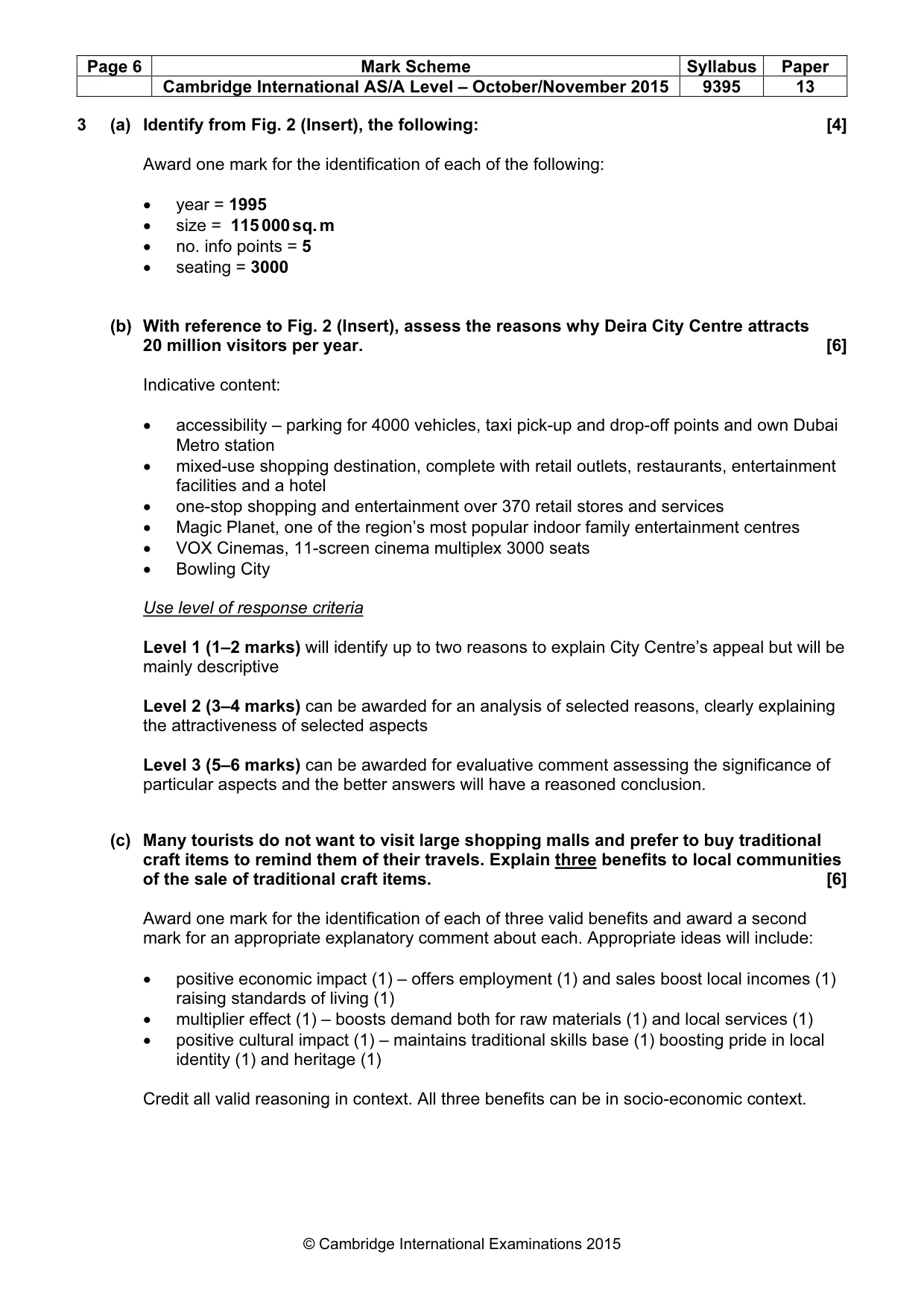
Page 6 Mark Scheme Syllabus Paper Cambridge International AS/A Level – October/November 2015 9395 13 © Cambridge International Examinations 2015 3 (a) Identify from Fig. 2 (Insert), the following: [4] Award one mark for the identification of each of the following: • year = 1995 • size = 115 000 sq. m • no. info points = 5 • seating = 3000 (b) With reference to Fig. 2 (Insert), assess the reasons why Deira City Centre attracts 20 million visitors per year. [6] Indicative content: • accessibility – parking for 4000 vehicles, taxi pick-up and drop-off points and own Dubai Metro station • mixed-use shopping destination, complete with retail outlets, restaurants, entertainment facilities and a hotel • one-stop shopping and entertainment over 370 retail stores and services • Magic Planet, one of the region’s most popular indoor family entertainment centres • VOX Cinemas, 11-screen cinema multiplex 3000 seats • Bowling City Use level of response criteria Level 1 (1–2 marks) will identify up to two reasons to explain City Centre’s appeal but will be mainly descriptive Level 2 (3–4 marks) can be awarded for an analysis of selected reasons, clearly explaining the attractiveness of selected aspects Level 3 (5–6 marks) can be awarded for evaluative comment assessing the significance of particular aspects and the better answers will have a reasoned conclusion. (c) Many tourists do not want to visit large shopping malls and prefer to buy traditional craft items to remind them of their travels. Explain three benefits to local communities of the sale of traditional craft items. [6] Award one mark for the identification of each of three valid benefits and award a second mark for an appropriate explanatory comment about each. Appropriate ideas will include: • positive economic impact (1) – offers employment (1) and sales boost local incomes (1) raising standards of living (1) • multiplier effect (1) – boosts demand both for raw materials (1) and local services (1) • positive cultural impact (1) – maintains traditional skills base (1) boosting pride in local identity (1) and heritage (1) Credit all valid reasoning in context. All three benefits can be in socio-economic context.
Mark scheme, page 7
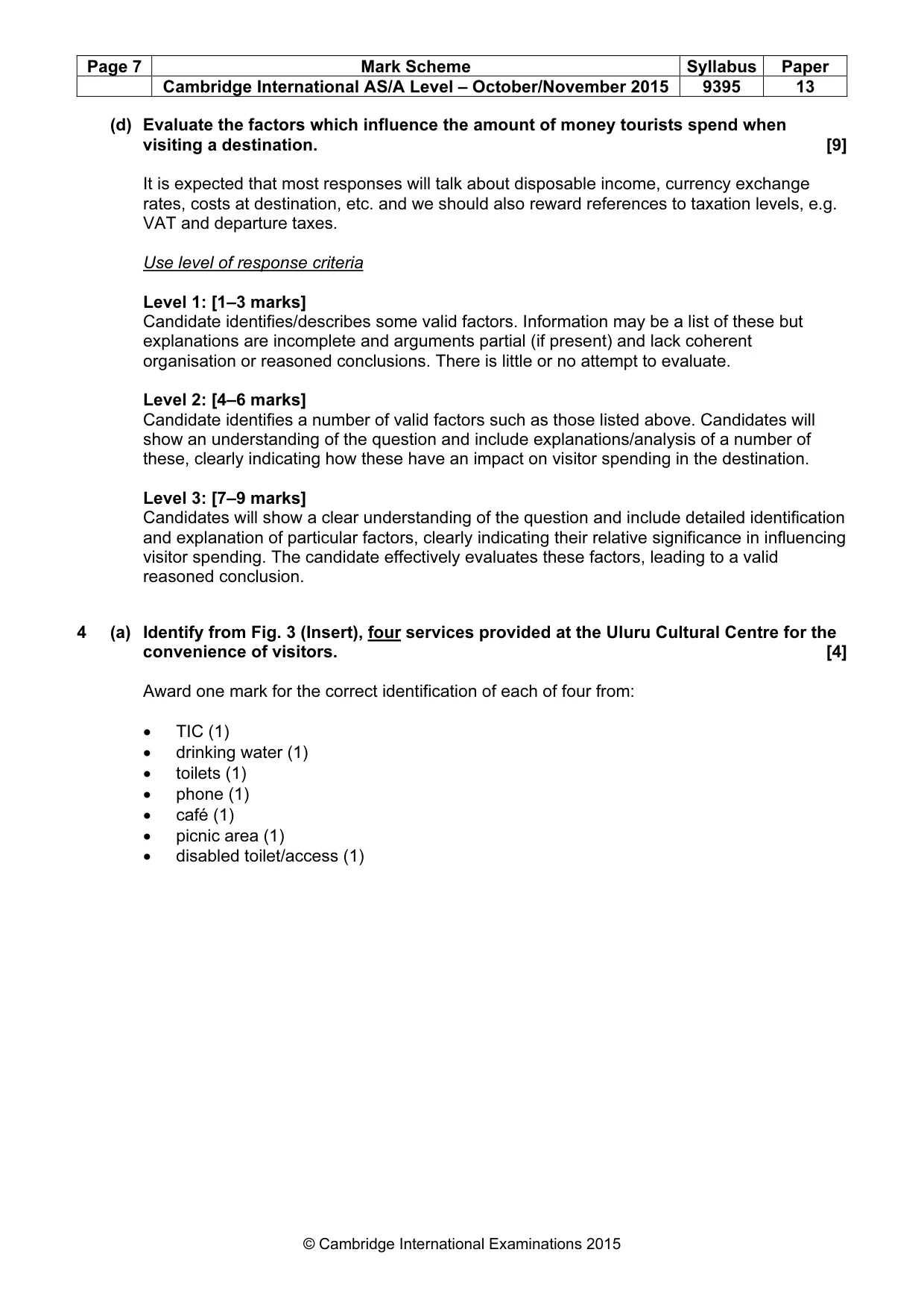
Page 7 Mark Scheme Syllabus Paper Cambridge International AS/A Level – October/November 2015 9395 13 © Cambridge International Examinations 2015 (d) Evaluate the factors which influence the amount of money tourists spend when visiting a destination. [9] It is expected that most responses will talk about disposable income, currency exchange rates, costs at destination, etc. and we should also reward references to taxation levels, e.g. VAT and departure taxes. Use level of response criteria Level 1: [1–3 marks] Candidate identifies/describes some valid factors. Information may be a list of these but explanations are incomplete and arguments partial (if present) and lack coherent organisation or reasoned conclusions. There is little or no attempt to evaluate. Level 2: [4–6 marks] Candidate identifies a number of valid factors such as those listed above. Candidates will show an understanding of the question and include explanations/analysis of a number of these, clearly indicating how these have an impact on visitor spending in the destination. Level 3: [7–9 marks] Candidates will show a clear understanding of the question and include detailed identification and explanation of particular factors, clearly indicating their relative significance in influencing visitor spending. The candidate effectively evaluates these factors, leading to a valid reasoned conclusion. 4 (a) Identify from Fig. 3 (Insert), four services provided at the Uluru Cultural Centre for the convenience of visitors. [4] Award one mark for the correct identification of each of four from: • TIC (1) • drinking water (1) • toilets (1) • phone (1) • café (1) • picnic area (1) • disabled toilet/access (1)
Mark scheme, page 8
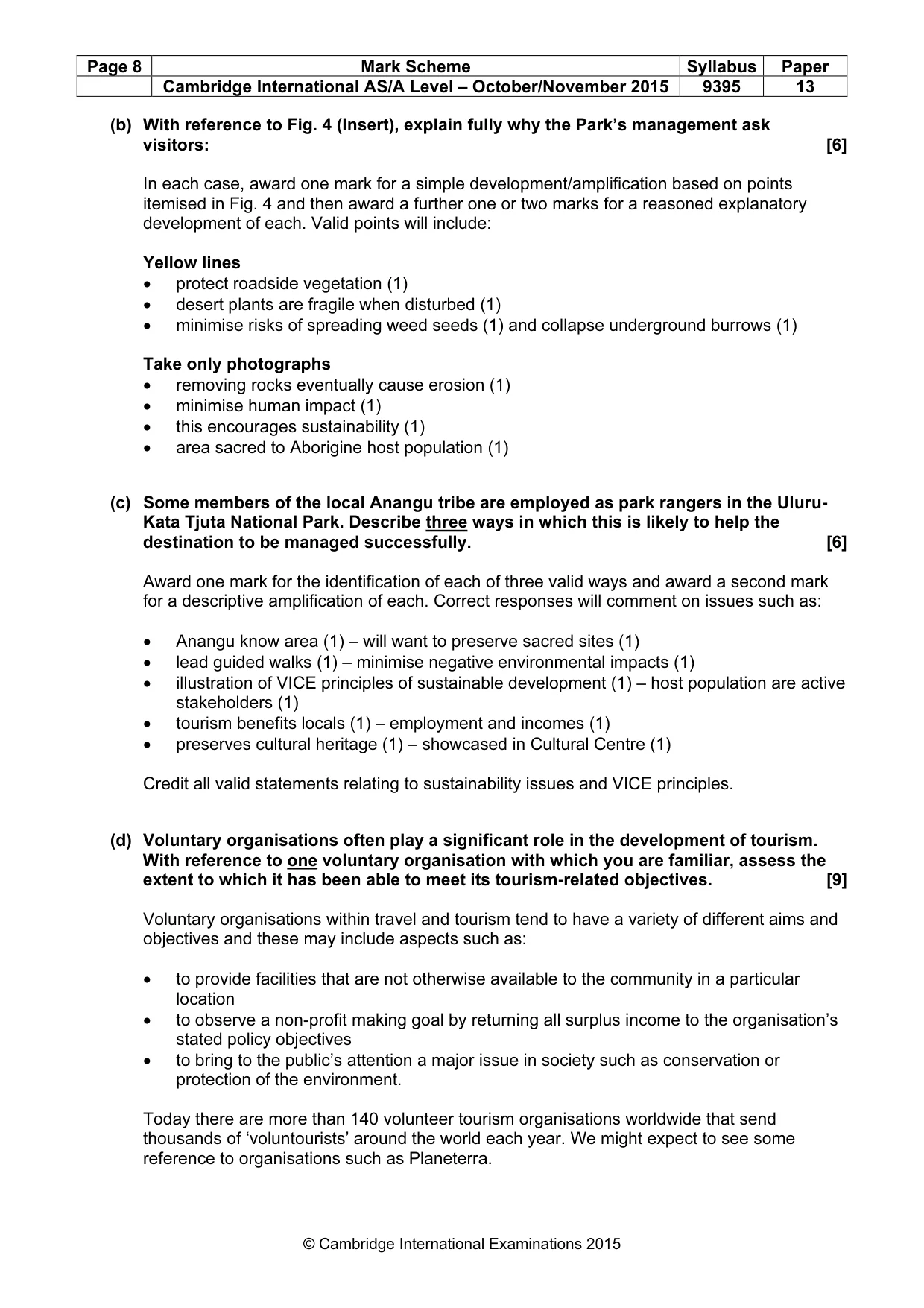
Page 8 Mark Scheme Syllabus Paper Cambridge International AS/A Level – October/November 2015 9395 13 © Cambridge International Examinations 2015 (b) With reference to Fig. 4 (Insert), explain fully why the Park’s management ask visitors: [6] In each case, award one mark for a simple development/amplification based on points itemised in Fig. 4 and then award a further one or two marks for a reasoned explanatory development of each. Valid points will include: Yellow lines • protect roadside vegetation (1) • desert plants are fragile when disturbed (1) • minimise risks of spreading weed seeds (1) and collapse underground burrows (1) Take only photographs • removing rocks eventually cause erosion (1) • minimise human impact (1) • this encourages sustainability (1) • area sacred to Aborigine host population (1) (c) Some members of the local Anangu tribe are employed as park rangers in the Uluru- Kata Tjuta National Park. Describe three ways in which this is likely to help the destination to be managed successfully. [6] Award one mark for the identification of each of three valid ways and award a second mark for a descriptive amplification of each. Correct responses will comment on issues such as: • Anangu know area (1) – will want to preserve sacred sites (1) • lead guided walks (1) – minimise negative environmental impacts (1) • illustration of VICE principles of sustainable development (1) – host population are active stakeholders (1) • tourism benefits locals (1) – employment and incomes (1) • preserves cultural heritage (1) – showcased in Cultural Centre (1) Credit all valid statements relating to sustainability issues and VICE principles. (d) Voluntary organisations often play a significant role in the development of tourism. With reference to one voluntary organisation with which you are familiar, assess the extent to which it has been able to meet its tourism-related objectives. [9] Voluntary organisations within travel and tourism tend to have a variety of different aims and objectives and these may include aspects such as: • to provide facilities that are not otherwise available to the community in a particular location • to observe a non-profit making goal by returning all surplus income to the organisation’s stated policy objectives • to bring to the public’s attention a major issue in society such as conservation or protection of the environment. Today there are more than 140 volunteer tourism organisations worldwide that send thousands of ‘voluntourists’ around the world each year. We might expect to see some reference to organisations such as Planeterra.
Mark scheme, page 9
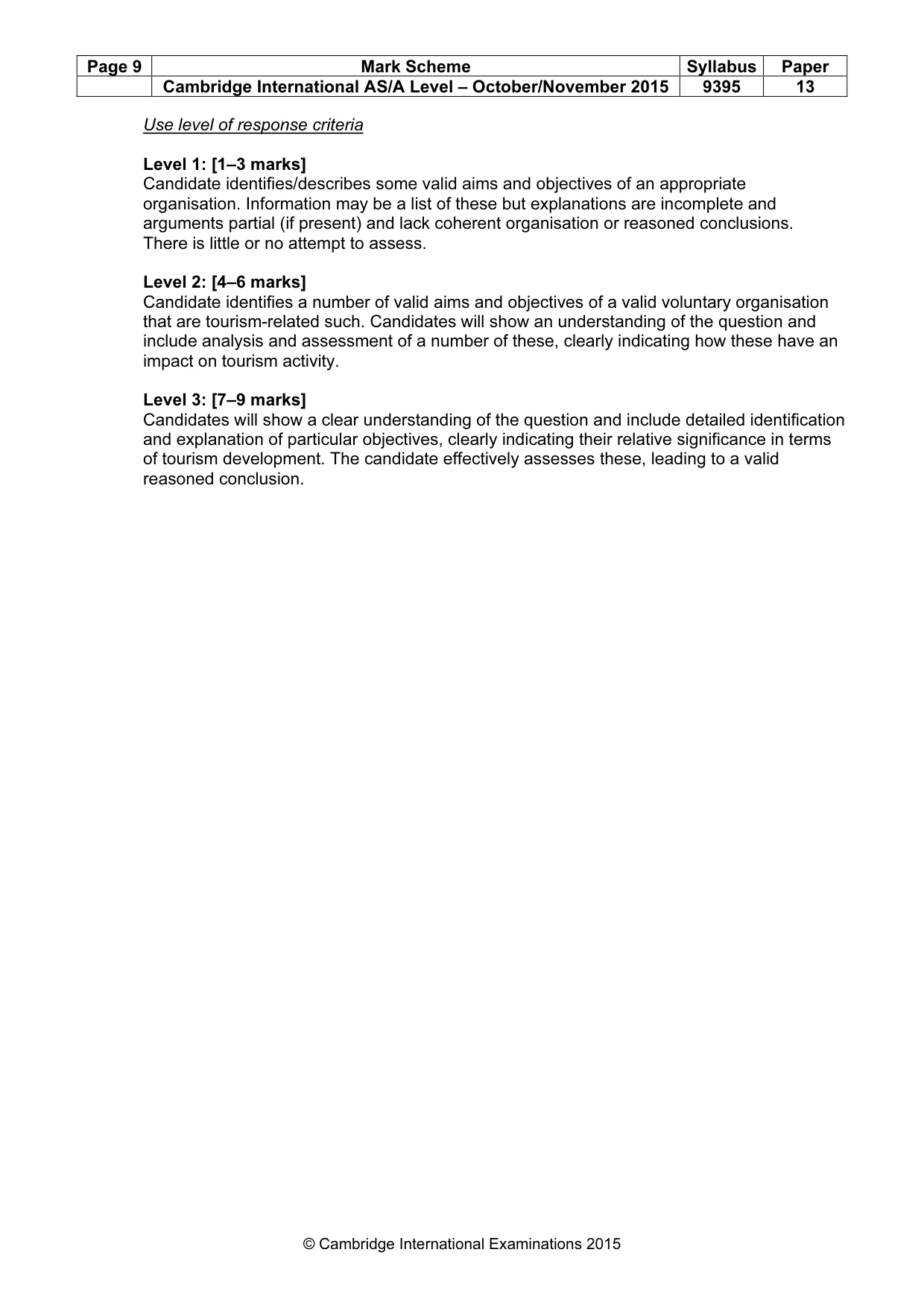
Page 9 Mark Scheme Syllabus Paper Cambridge International AS/A Level – October/November 2015 9395 13 © Cambridge International Examinations 2015 Use level of response criteria Level 1: [1–3 marks] Candidate identifies/describes some valid aims and objectives of an appropriate organisation. Information may be a list of these but explanations are incomplete and arguments partial (if present) and lack coherent organisation or reasoned conclusions. There is little or no attempt to assess. Level 2: [4–6 marks] Candidate identifies a number of valid aims and objectives of a valid voluntary organisation that are tourism-related such. Candidates will show an understanding of the question and include analysis and assessment of a number of these, clearly indicating how these have an impact on tourism activity. Level 3: [7–9 marks] Candidates will show a clear understanding of the question and include detailed identification and explanation of particular objectives, clearly indicating their relative significance in terms of tourism development. The candidate effectively assesses these, leading to a valid reasoned conclusion.
What you needed in this session
Cambridge’s own grade thresholds for 2015 Oct/Nov, Paper 1 · Variant 3. A higher threshold means an easier paper — the bar moves with how the cohort did.