Cambridge A Level Travel and Tourism 9395 — 2014 Oct/Nov Paper 1 · Variant 2
9395/12/O/N/14 · 100 marks · ≈113 min
The question paper and its mark scheme, free to read here and free to download. This is Cambridge’s own paper, exactly as it was sat.
Question paper16 pages



Mark scheme9 pages
Answers below. Sit the paper first if you are practising.
Paper as text
Question paper, page 1
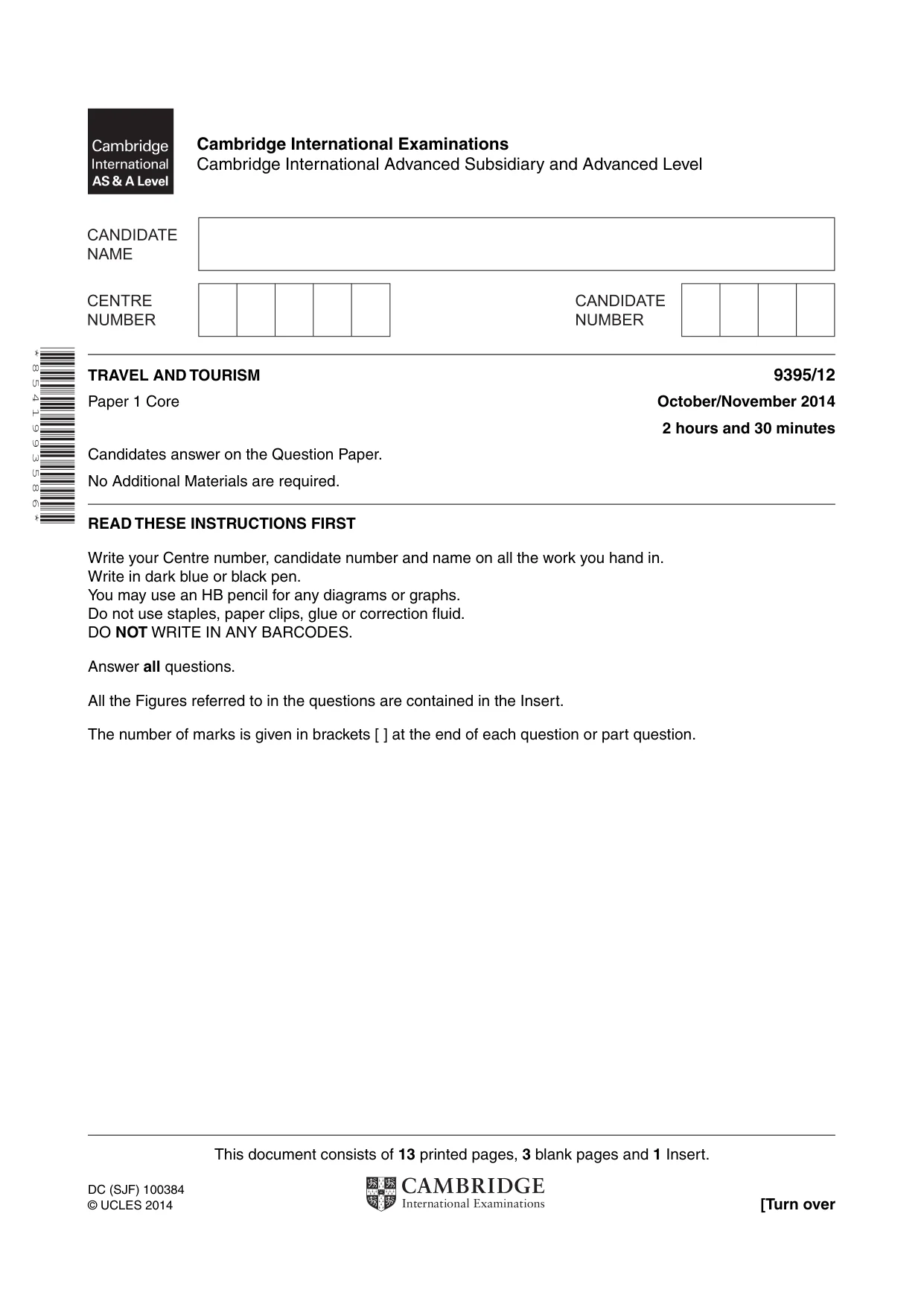
This document consists of 13 printed pages, 3 blank pages and 1 Insert. DC (SJF) 100384 © UCLES 2014 [Turn over Cambridge International Examinations Cambridge International Advanced Subsidiary and Advanced Level * 8 5 4 1 9 9 3 5 8 6 * TRAVEL AND TOURISM 9395/12 Paper 1 Core October/November 2014 2 hours and 30 minutes Candidates answer on the Question Paper. No Additional Materials are required. READ THESE INSTRUCTIONS FIRST Write your Centre number, candidate number and name on all the work you hand in. Write in dark blue or black pen. You may use an HB pencil for any diagrams or graphs. Do not use staples, paper clips, glue or correction fluid. DO NOT WRITE IN ANY BARCODES. Answer all questions. All the Figures referred to in the questions are contained in the Insert. The number of marks is given in brackets [ ] at the end of each question or part question.
Question paper, page 2
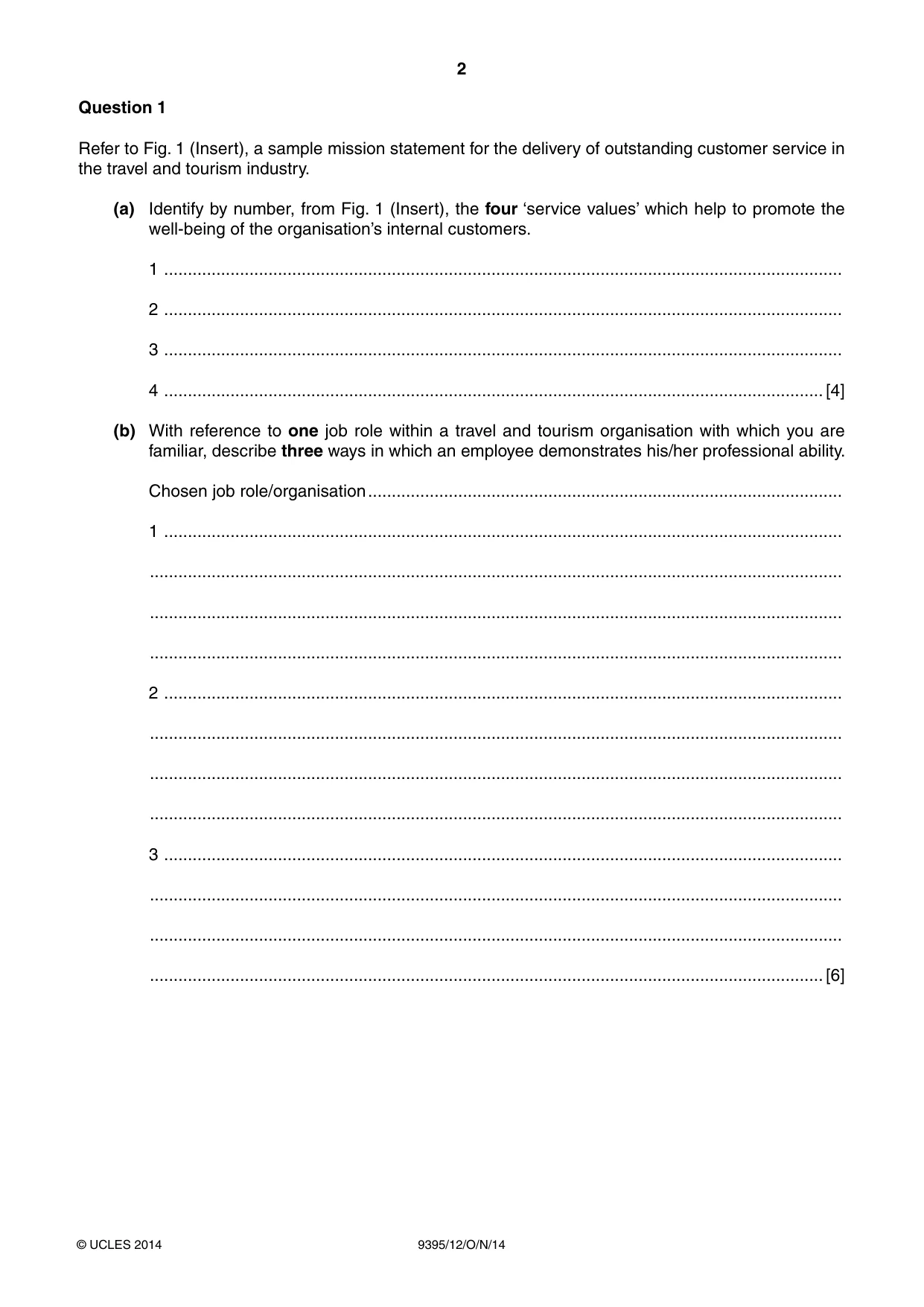
2 9395/12/O/N/14 © UCLES 2014 Question 1 Refer to Fig. 1 (Insert), a sample mission statement for the delivery of outstanding customer service in the travel and tourism industry. (a) Identify by number, from Fig. 1 (Insert), the four ‘service values’ which help to promote the well-being of the organisation’s internal customers. 1 … 2 … 3 … 4 … [4] (b) With reference to one job role within a travel and tourism organisation with which you are familiar, describe three ways in which an employee demonstrates his/her professional ability. Chosen job role/organisation … 1 … … … … 2 … … … … 3 … … … … [6]
Question paper, page 3
3 9395/12/O/N/14 © UCLES 2014 [Turn over (c) Discuss the usefulness of a mystery shopper to an organisation when assessing the extent to which employees are ‘always responsive to the needs of guests’. … … … … … … … … … … … …[6]
Question paper, page 4
4 9395/12/O/N/14 © UCLES 2014 (d) With reference to one travel and tourism organisation with which you are familiar, evaluate the ways in which standards of customer service are maintained during periods of high demand. Chosen organisation … … … … … … … … … … … … … … … … … … … … … … … … …[9] [Total: 25]
Question paper, page 5
5 9395/12/O/N/14 © UCLES 2014 [Turn over Question 2 Refer to Fig. 2 (Insert), a news item about Expedia’s 2012 Vacation Deprivation survey. (a) Identify from Fig. 2 (Insert), the following: • the number of employees taking part in the survey … • the amount of holiday entitlement for an average Japanese worker … • the amount of holiday entitlement for workers in Sweden … • the employees with the shortest working week … [4] (b) Assess the factors that have allowed Europeans to enjoy an increase in leisure time. … … … … … … … … … … … …[6]
Question paper, page 6
6 9395/12/O/N/14 © UCLES 2014 (c) The following terms describe the characteristics of different types of traveller. Explain the choice of holiday products likely to be popular with each traveller type. • Someone who is ‘money rich and time poor’. … … … … … … • Someone who is ‘money poor and time rich’. … … … … … … [6]
Question paper, page 7
7 9395/12/O/N/14 © UCLES 2014 [Turn over (d) Discuss the ways in which one tourist attraction with which you are familiar appeals to different types of visitor. Chosen tourist attraction … … … … … … … … … … … … … … … … … … … … … … … … …[9] [Total: 25]
Question paper, page 8
8 9395/12/O/N/14 © UCLES 2014 Question 3 Refer to Fig. 3 (Insert), a photograph taken outside the entrance to a traditional English country inn, offering serviced accommodation and a restaurant. (a) State four other types of accommodation often found in tourist destinations. 1 … 2 … 3 … 4 …[4] (b) Discuss the reasons why many accommodation providers, such as the one shown in Fig. 3 (Insert), display awards outside their premises. … … … … … … … … … … … …[6]
Question paper, page 9
9 9395/12/O/N/14 © UCLES 2014 [Turn over (c) Explain three advantages to customers of looking at Internet review sites, such as TripAdvisor, before making their accommodation bookings. 1 … … … … 2 … … … … 3 … … … …[6]
Question paper, page 10
10 9395/12/O/N/14 © UCLES 2014 (d) Evaluate the extent to which the type and number of accommodation providers change as a destination passes through the different stages of the Butler model of destination evolution. … … … … … … … … … … … … … … … … … … … … … … … … …[9] [Total: 25]
Question paper, page 11
11 9395/12/O/N/14 © UCLES 2014 [Turn over Question 4 Refer to Fig. 4 (Insert), information about Watercooled, an activity provider in Dubai. (a) Identify from Fig. 4 (Insert), the following: • two facilities provided on-site by Watercooled for the convenience of customers 1 … 2 … • the two activities offered to customers which require special arrangements to be made 1 … 2 … [4] (b) Using Fig. 4 (Insert), explain three negative environmental impacts which are likely to result from visitor recreational activities in this area. 1 … … … … 2 … … … … 3 … … … …[6]
Question paper, page 12
12 9395/12/O/N/14 © UCLES 2014 (c) Explain three different ways in which conflict can arise between the local community and developers when a new tourist development, such as the one shown in Fig. 4 (Insert), is built in a previously undeveloped coastal location. 1 … … … … 2 … … … … 3 … … … …[6]
Question paper, page 13
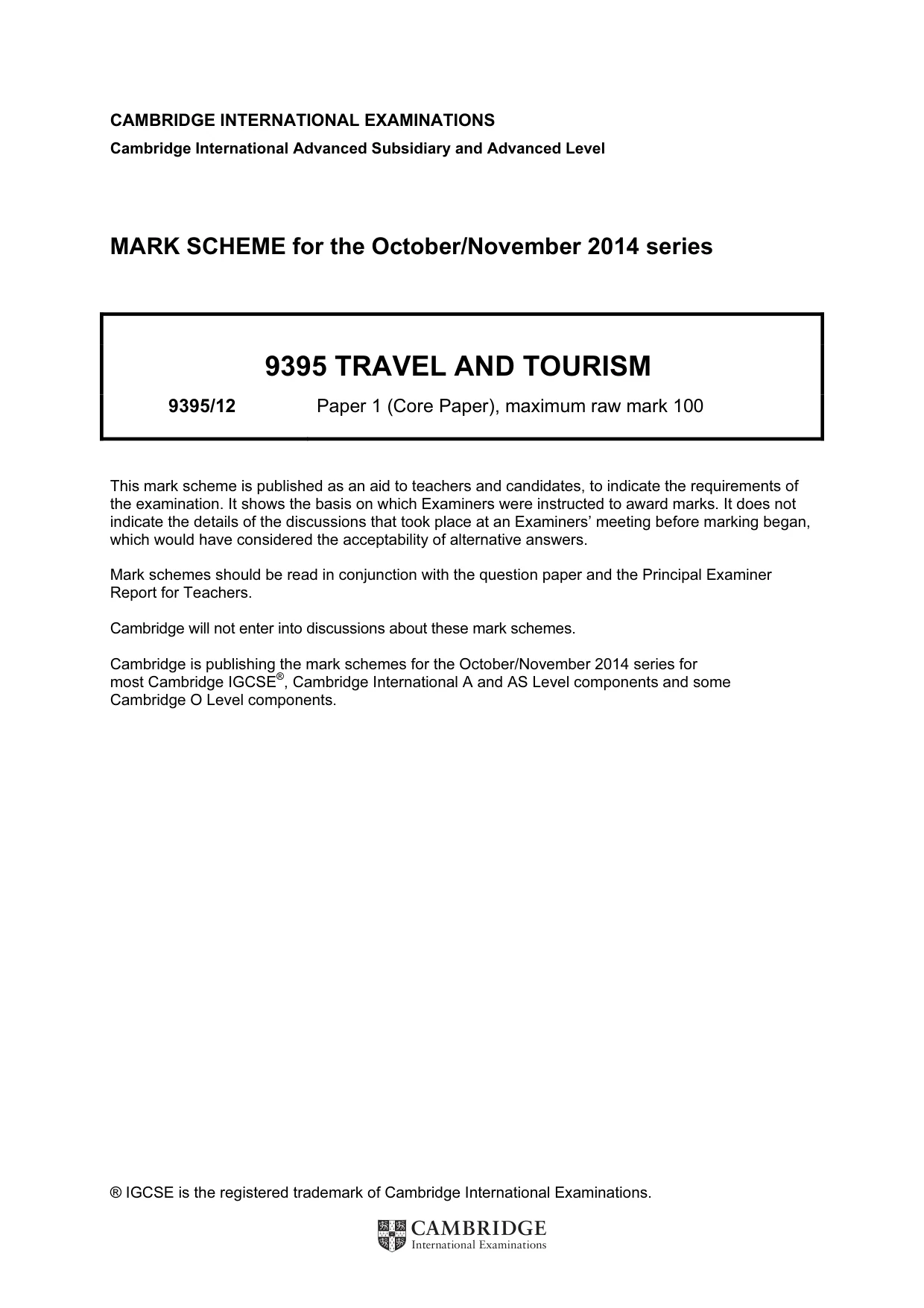
13 9395/12/O/N/14 © UCLES 2014 (d) Discuss the ways in which climate change might affect the development of tourism. Support your answer with examples. … … … … … … … … … … … … … … … … … … … … … … … … …[9] [Total: 25]
Question paper, page 14
14 9395/12/O/N/14 © UCLES 2014 BLANK PAGE
Question paper, page 15
15 9395/12/O/N/14 © UCLES 2014 BLANK PAGE
Question paper, page 16
16 9395/12/O/N/14 © UCLES 2014 Permission to reproduce items where third-party owned material protected by copyright is included has been sought and cleared where possible. Every reasonable effort has been made by the publisher (UCLES) to trace copyright holders, but if any items requiring clearance have unwittingly been included, the publisher will be pleased to make amends at the earliest possible opportunity. Cambridge International Examinations is part of the Cambridge Assessment Group. Cambridge Assessment is the brand name of University of Cambridge Local Examinations Syndicate (UCLES), which is itself a department of the University of Cambridge. BLANK PAGE
Mark scheme, page 1
® IGCSE is the registered trademark of Cambridge International Examinations. CAMBRIDGE INTERNATIONAL EXAMINATIONS Cambridge International Advanced Subsidiary and Advanced Level MARK SCHEME for the October/November 2014 series 9395 TRAVEL AND TOURISM 9395/12 Paper 1 (Core Paper), maximum raw mark 100 This mark scheme is published as an aid to teachers and candidates, to indicate the requirements of the examination. It shows the basis on which Examiners were instructed to award marks. It does not indicate the details of the discussions that took place at an Examiners’ meeting before marking began, which would have considered the acceptability of alternative answers. Mark schemes should be read in conjunction with the question paper and the Principal Examiner Report for Teachers. Cambridge will not enter into discussions about these mark schemes. Cambridge is publishing the mark schemes for the October/November 2014 series for most Cambridge IGCSE®, Cambridge International A and AS Level components and some Cambridge O Level components.
Mark scheme, page 2
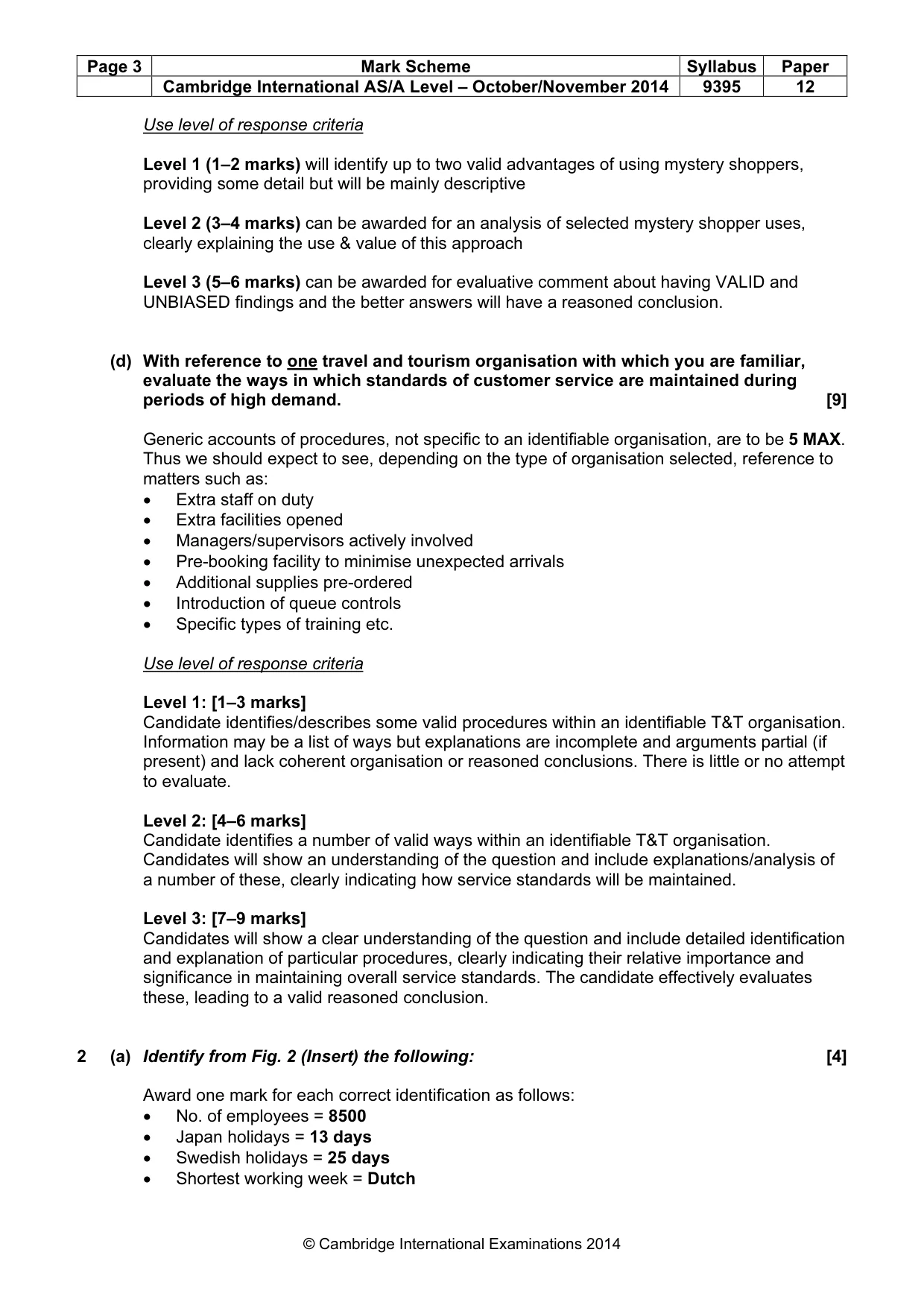
Page 2 Mark Scheme Syllabus Paper Cambridge International AS/A Level – October/November 2014 9395 12 © Cambridge International Examinations 2014 1 (a) Identify by number from Fig. 1 (Insert) the four ‘service values’ which help to promote the wellbeing of the organisation’s internal customers. [4] Award one mark for each of four correct identifications as follows: • #6 • #7 • #8 • #10 (b) With reference to one job role within a travel and tourism organisation with which you are familiar, describe three ways in which an employee demonstrates his/her professional ability. [6] This requires specific reference to three particular job aspects or service functions. The syllabus clearly requires that candidates be fully familiar with three job roles and it is expected that they will be able to write about one of them in some appropriate detail. Award one mark for the identification of each of three valid service functions (i.e. they MUST pertain to the chosen job role) and then award a second mark for a description of the professional way in which that function is executed. For example, the case of: Restaurant waiting staff • Greeting the guest (1) – smile, make eye contact, say good evening sir/madam (1) • Place settings adjusted (1) appropriate to items ordered (soup, fish, steak etc.) (1) • Serving (1) from left, clearing from right (1) • Pouring/opening drinks (1) – serve/pour from right (1) • Clearing table after main course (1) – remove surplus items, de-crumb & re-position appropriate cutlery (1) This is the level of detail expected and tasks not directly related to the chosen job are NOT to receive any credit. (c) Discuss the usefulness of a mystery shopper to an organisation when assessing the extent to which employees are ‘always responsive to the needs of guests’. [6] This invites candidates to show off their knowledge and understanding and valid points about usefulness will include: • The mystery consumer is a tool used externally by market research companies or internally by companies themselves to measure quality of service. • The mystery consumer's specific identity is generally not known by the establishment being evaluated. • Mystery shoppers perform specific tasks such as purchasing a product, asking questions, registering complaints or behaving in a certain way, and then provide detailed reports or feedback about their experiences. • Mystery shoppers are often given instructions or procedures to make the transaction atypical to make the test of the knowledge and service skills of the employees more stringent or specific to a particular service issue. • After the visit the mystery shopper submits the data collected for review and analysis.
Mark scheme, page 3
Page 3 Mark Scheme Syllabus Paper Cambridge International AS/A Level – October/November 2014 9395 12 © Cambridge International Examinations 2014 Use level of response criteria Level 1 (1–2 marks) will identify up to two valid advantages of using mystery shoppers, providing some detail but will be mainly descriptive Level 2 (3–4 marks) can be awarded for an analysis of selected mystery shopper uses, clearly explaining the use & value of this approach Level 3 (5–6 marks) can be awarded for evaluative comment about having VALID and UNBIASED findings and the better answers will have a reasoned conclusion. (d) With reference to one travel and tourism organisation with which you are familiar, evaluate the ways in which standards of customer service are maintained during periods of high demand. [9] Generic accounts of procedures, not specific to an identifiable organisation, are to be 5 MAX. Thus we should expect to see, depending on the type of organisation selected, reference to matters such as: • Extra staff on duty • Extra facilities opened • Managers/supervisors actively involved • Pre-booking facility to minimise unexpected arrivals • Additional supplies pre-ordered • Introduction of queue controls • Specific types of training etc. Use level of response criteria Level 1: [1–3 marks] Candidate identifies/describes some valid procedures within an identifiable T&T organisation. Information may be a list of ways but explanations are incomplete and arguments partial (if present) and lack coherent organisation or reasoned conclusions. There is little or no attempt to evaluate. Level 2: [4–6 marks] Candidate identifies a number of valid ways within an identifiable T&T organisation. Candidates will show an understanding of the question and include explanations/analysis of a number of these, clearly indicating how service standards will be maintained. Level 3: [7–9 marks] Candidates will show a clear understanding of the question and include detailed identification and explanation of particular procedures, clearly indicating their relative importance and significance in maintaining overall service standards. The candidate effectively evaluates these, leading to a valid reasoned conclusion. 2 (a) Identify from Fig. 2 (Insert) the following: [4] Award one mark for each correct identification as follows: • No. of employees = 8500 • Japan holidays = 13 days • Swedish holidays = 25 days • Shortest working week = Dutch
Mark scheme, page 4
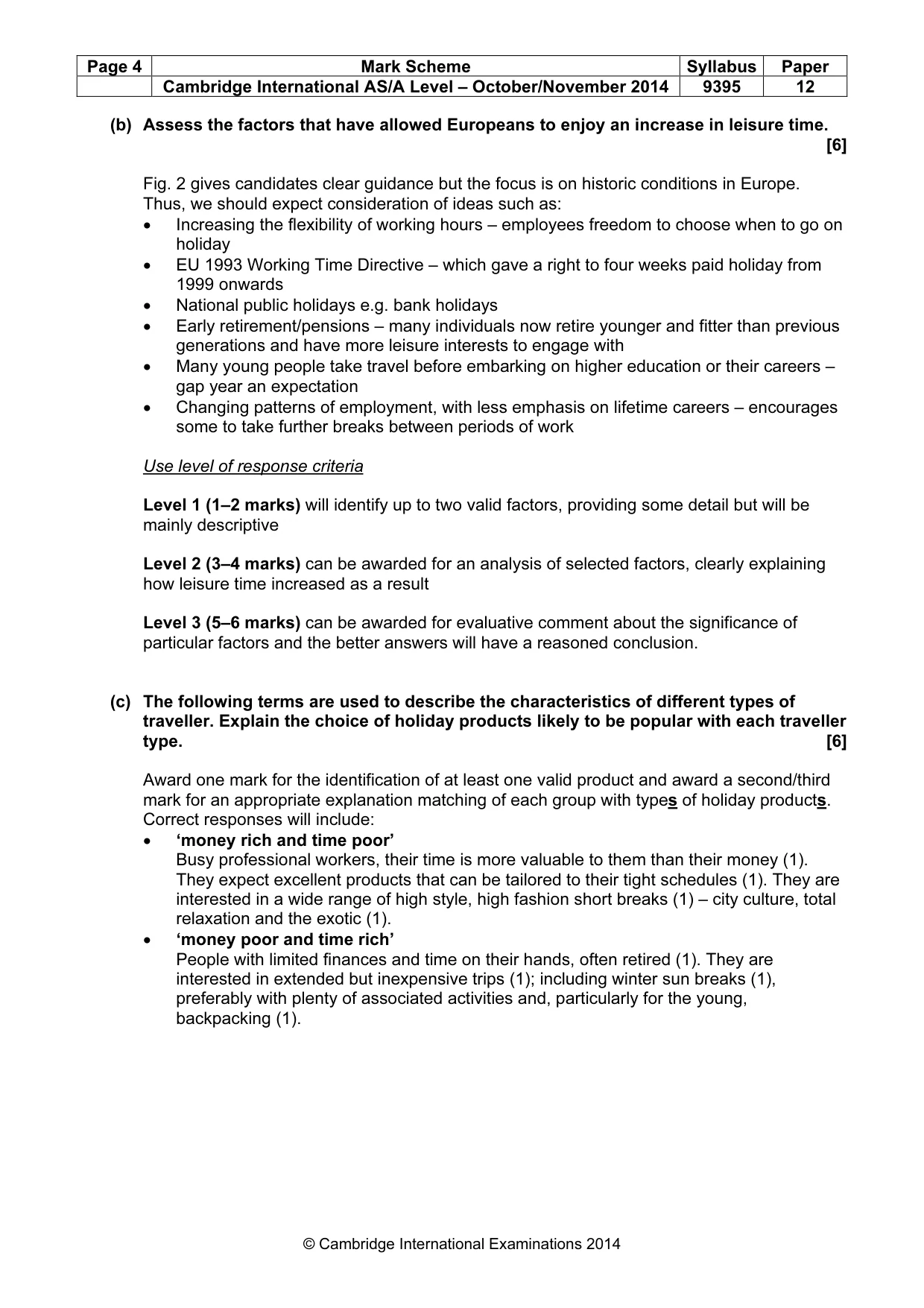
Page 4 Mark Scheme Syllabus Paper Cambridge International AS/A Level – October/November 2014 9395 12 © Cambridge International Examinations 2014 (b) Assess the factors that have allowed Europeans to enjoy an increase in leisure time. [6] Fig. 2 gives candidates clear guidance but the focus is on historic conditions in Europe. Thus, we should expect consideration of ideas such as: • Increasing the flexibility of working hours – employees freedom to choose when to go on holiday • EU 1993 Working Time Directive – which gave a right to four weeks paid holiday from 1999 onwards • National public holidays e.g. bank holidays • Early retirement/pensions – many individuals now retire younger and fitter than previous generations and have more leisure interests to engage with • Many young people take travel before embarking on higher education or their careers – gap year an expectation • Changing patterns of employment, with less emphasis on lifetime careers – encourages some to take further breaks between periods of work Use level of response criteria Level 1 (1–2 marks) will identify up to two valid factors, providing some detail but will be mainly descriptive Level 2 (3–4 marks) can be awarded for an analysis of selected factors, clearly explaining how leisure time increased as a result Level 3 (5–6 marks) can be awarded for evaluative comment about the significance of particular factors and the better answers will have a reasoned conclusion. (c) The following terms are used to describe the characteristics of different types of traveller. Explain the choice of holiday products likely to be popular with each traveller type. [6] Award one mark for the identification of at least one valid product and award a second/third mark for an appropriate explanation matching of each group with types of holiday products. Correct responses will include: • ‘money rich and time poor’ Busy professional workers, their time is more valuable to them than their money (1). They expect excellent products that can be tailored to their tight schedules (1). They are interested in a wide range of high style, high fashion short breaks (1) – city culture, total relaxation and the exotic (1). • ‘money poor and time rich’ People with limited finances and time on their hands, often retired (1). They are interested in extended but inexpensive trips (1); including winter sun breaks (1), preferably with plenty of associated activities and, particularly for the young, backpacking (1).
Mark scheme, page 5
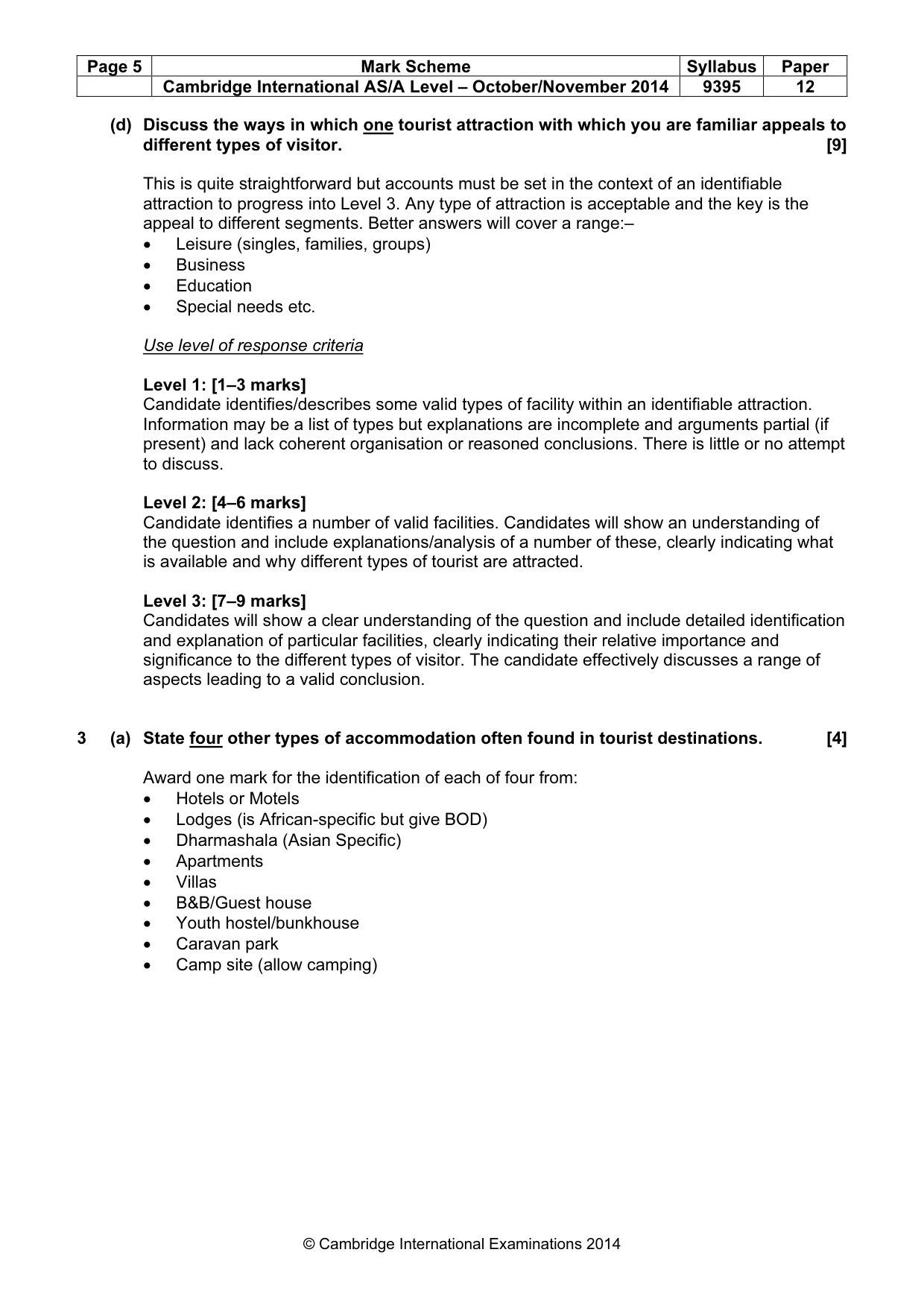
Page 5 Mark Scheme Syllabus Paper Cambridge International AS/A Level – October/November 2014 9395 12 © Cambridge International Examinations 2014 (d) Discuss the ways in which one tourist attraction with which you are familiar appeals to different types of visitor. [9] This is quite straightforward but accounts must be set in the context of an identifiable attraction to progress into Level 3. Any type of attraction is acceptable and the key is the appeal to different segments. Better answers will cover a range:– • Leisure (singles, families, groups) • Business • Education • Special needs etc. Use level of response criteria Level 1: [1–3 marks] Candidate identifies/describes some valid types of facility within an identifiable attraction. Information may be a list of types but explanations are incomplete and arguments partial (if present) and lack coherent organisation or reasoned conclusions. There is little or no attempt to discuss. Level 2: [4–6 marks] Candidate identifies a number of valid facilities. Candidates will show an understanding of the question and include explanations/analysis of a number of these, clearly indicating what is available and why different types of tourist are attracted. Level 3: [7–9 marks] Candidates will show a clear understanding of the question and include detailed identification and explanation of particular facilities, clearly indicating their relative importance and significance to the different types of visitor. The candidate effectively discusses a range of aspects leading to a valid conclusion. 3 (a) State four other types of accommodation often found in tourist destinations. [4] Award one mark for the identification of each of four from: • Hotels or Motels • Lodges (is African-specific but give BOD) • Dharmashala (Asian Specific) • Apartments • Villas • B&B/Guest house • Youth hostel/bunkhouse • Caravan park • Camp site (allow camping)
Mark scheme, page 6
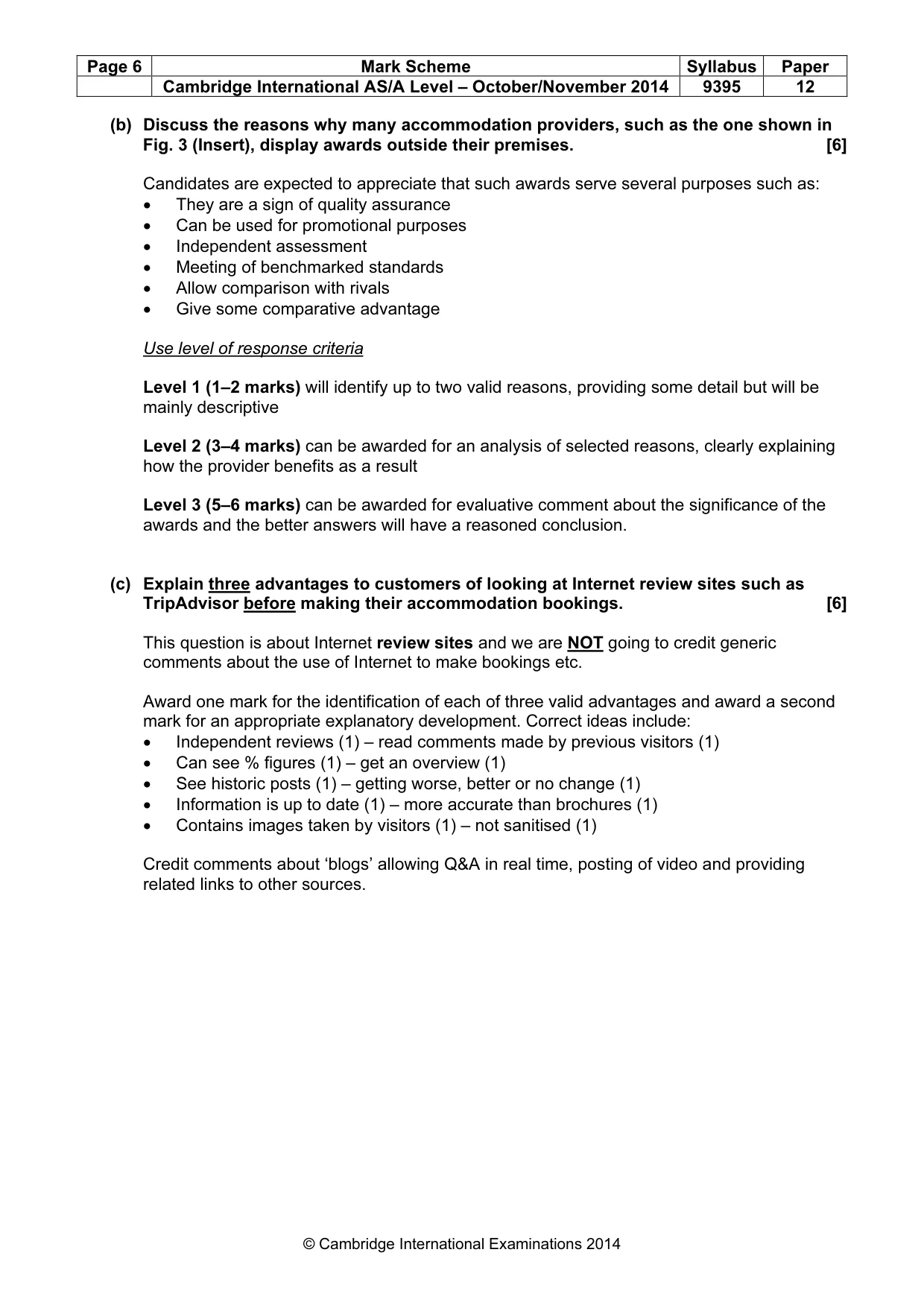
Page 6 Mark Scheme Syllabus Paper Cambridge International AS/A Level – October/November 2014 9395 12 © Cambridge International Examinations 2014 (b) Discuss the reasons why many accommodation providers, such as the one shown in Fig. 3 (Insert), display awards outside their premises. [6] Candidates are expected to appreciate that such awards serve several purposes such as: • They are a sign of quality assurance • Can be used for promotional purposes • Independent assessment • Meeting of benchmarked standards • Allow comparison with rivals • Give some comparative advantage Use level of response criteria Level 1 (1–2 marks) will identify up to two valid reasons, providing some detail but will be mainly descriptive Level 2 (3–4 marks) can be awarded for an analysis of selected reasons, clearly explaining how the provider benefits as a result Level 3 (5–6 marks) can be awarded for evaluative comment about the significance of the awards and the better answers will have a reasoned conclusion. (c) Explain three advantages to customers of looking at Internet review sites such as TripAdvisor before making their accommodation bookings. [6] This question is about Internet review sites and we are NOT going to credit generic comments about the use of Internet to make bookings etc. Award one mark for the identification of each of three valid advantages and award a second mark for an appropriate explanatory development. Correct ideas include: • Independent reviews (1) – read comments made by previous visitors (1) • Can see % figures (1) – get an overview (1) • See historic posts (1) – getting worse, better or no change (1) • Information is up to date (1) – more accurate than brochures (1) • Contains images taken by visitors (1) – not sanitised (1) Credit comments about ‘blogs’ allowing Q&A in real time, posting of video and providing related links to other sources.
Mark scheme, page 7
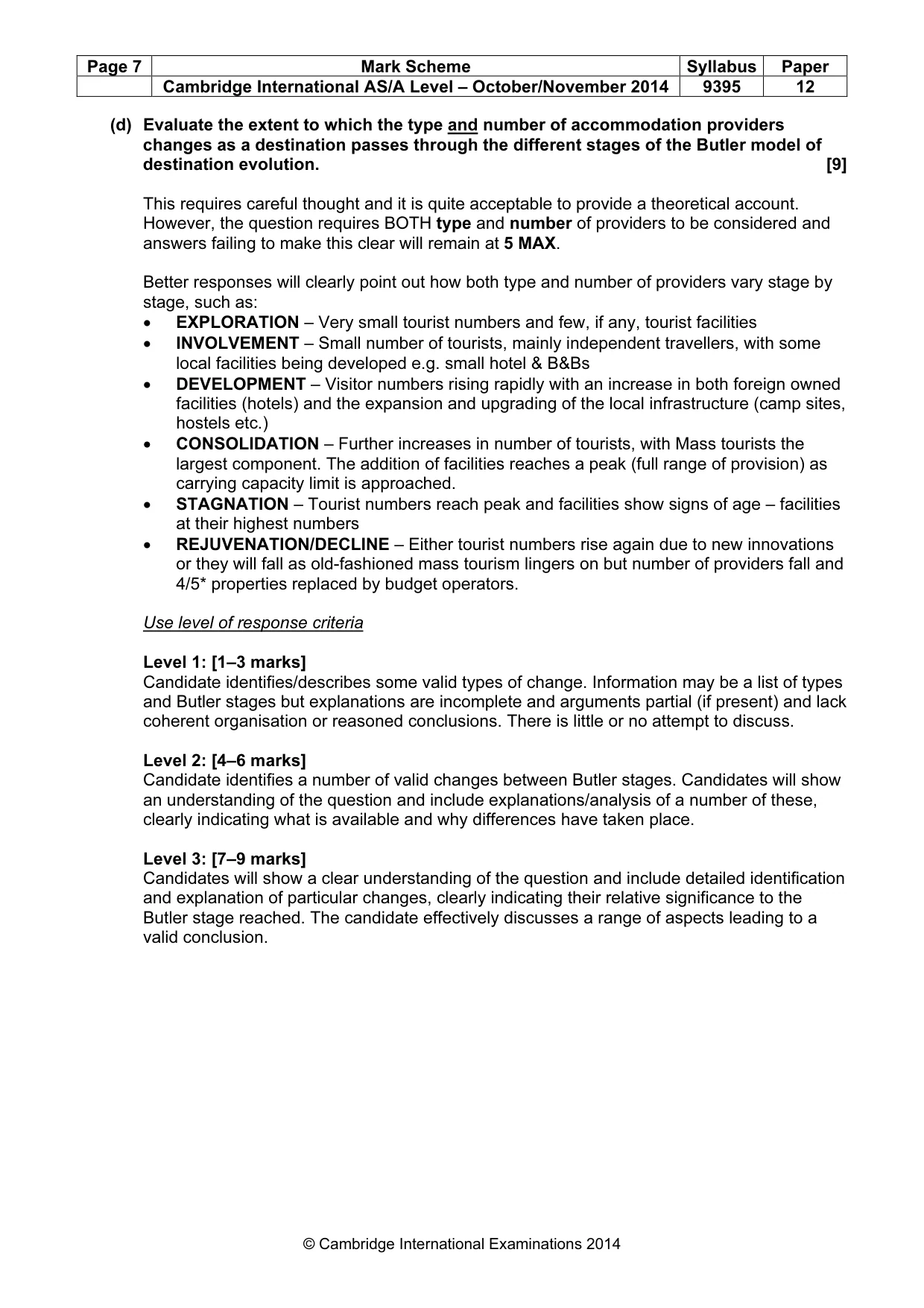
Page 7 Mark Scheme Syllabus Paper Cambridge International AS/A Level – October/November 2014 9395 12 © Cambridge International Examinations 2014 (d) Evaluate the extent to which the type and number of accommodation providers changes as a destination passes through the different stages of the Butler model of destination evolution. [9] This requires careful thought and it is quite acceptable to provide a theoretical account. However, the question requires BOTH type and number of providers to be considered and answers failing to make this clear will remain at 5 MAX. Better responses will clearly point out how both type and number of providers vary stage by stage, such as: • EXPLORATION – Very small tourist numbers and few, if any, tourist facilities • INVOLVEMENT – Small number of tourists, mainly independent travellers, with some local facilities being developed e.g. small hotel & B&Bs • DEVELOPMENT – Visitor numbers rising rapidly with an increase in both foreign owned facilities (hotels) and the expansion and upgrading of the local infrastructure (camp sites, hostels etc.) • CONSOLIDATION – Further increases in number of tourists, with Mass tourists the largest component. The addition of facilities reaches a peak (full range of provision) as carrying capacity limit is approached. • STAGNATION – Tourist numbers reach peak and facilities show signs of age – facilities at their highest numbers • REJUVENATION/DECLINE – Either tourist numbers rise again due to new innovations or they will fall as old-fashioned mass tourism lingers on but number of providers fall and 4/5* properties replaced by budget operators. Use level of response criteria Level 1: [1–3 marks] Candidate identifies/describes some valid types of change. Information may be a list of types and Butler stages but explanations are incomplete and arguments partial (if present) and lack coherent organisation or reasoned conclusions. There is little or no attempt to discuss. Level 2: [4–6 marks] Candidate identifies a number of valid changes between Butler stages. Candidates will show an understanding of the question and include explanations/analysis of a number of these, clearly indicating what is available and why differences have taken place. Level 3: [7–9 marks] Candidates will show a clear understanding of the question and include detailed identification and explanation of particular changes, clearly indicating their relative significance to the Butler stage reached. The candidate effectively discusses a range of aspects leading to a valid conclusion.
Mark scheme, page 8
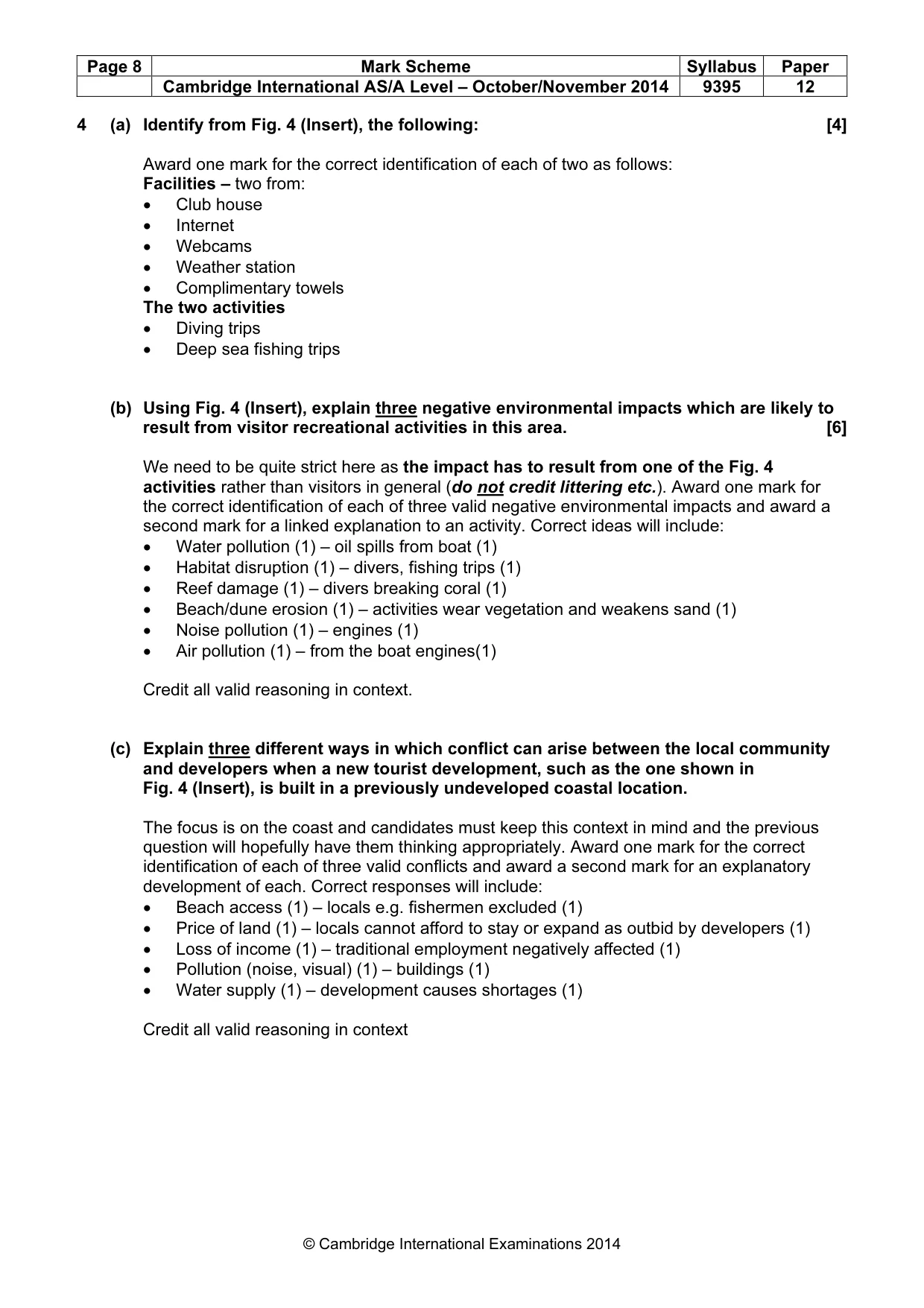
Page 8 Mark Scheme Syllabus Paper Cambridge International AS/A Level – October/November 2014 9395 12 © Cambridge International Examinations 2014 4 (a) Identify from Fig. 4 (Insert), the following: [4] Award one mark for the correct identification of each of two as follows: Facilities – two from: • Club house • Internet • Webcams • Weather station • Complimentary towels The two activities • Diving trips • Deep sea fishing trips (b) Using Fig. 4 (Insert), explain three negative environmental impacts which are likely to result from visitor recreational activities in this area. [6] We need to be quite strict here as the impact has to result from one of the Fig. 4 activities rather than visitors in general (do not credit littering etc.). Award one mark for the correct identification of each of three valid negative environmental impacts and award a second mark for a linked explanation to an activity. Correct ideas will include: • Water pollution (1) – oil spills from boat (1) • Habitat disruption (1) – divers, fishing trips (1) • Reef damage (1) – divers breaking coral (1) • Beach/dune erosion (1) – activities wear vegetation and weakens sand (1) • Noise pollution (1) – engines (1) • Air pollution (1) – from the boat engines(1) Credit all valid reasoning in context. (c) Explain three different ways in which conflict can arise between the local community and developers when a new tourist development, such as the one shown in Fig. 4 (Insert), is built in a previously undeveloped coastal location. The focus is on the coast and candidates must keep this context in mind and the previous question will hopefully have them thinking appropriately. Award one mark for the correct identification of each of three valid conflicts and award a second mark for an explanatory development of each. Correct responses will include: • Beach access (1) – locals e.g. fishermen excluded (1) • Price of land (1) – locals cannot afford to stay or expand as outbid by developers (1) • Loss of income (1) – traditional employment negatively affected (1) • Pollution (noise, visual) (1) – buildings (1) • Water supply (1) – development causes shortages (1) Credit all valid reasoning in context
Mark scheme, page 9
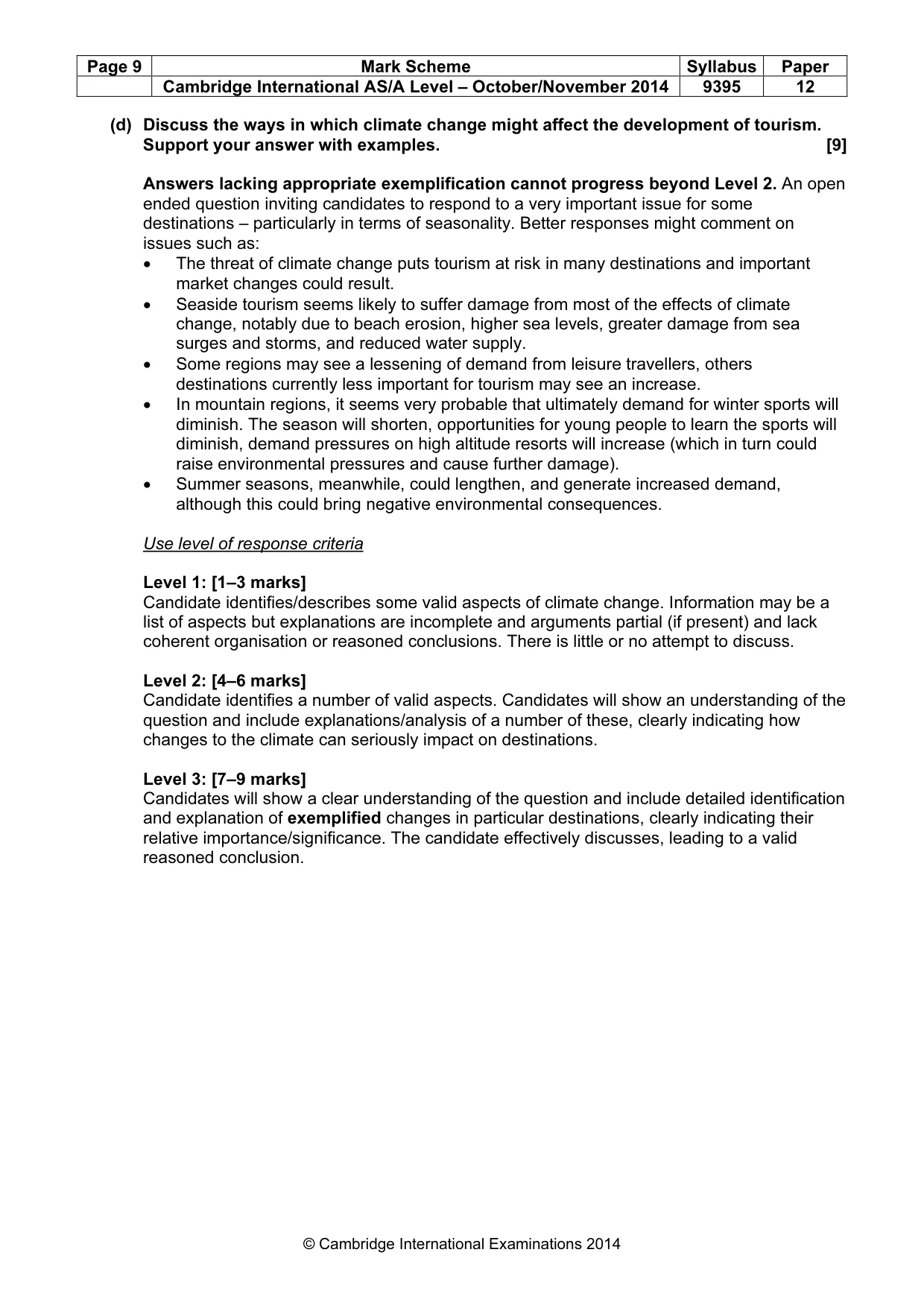
Page 9 Mark Scheme Syllabus Paper Cambridge International AS/A Level – October/November 2014 9395 12 © Cambridge International Examinations 2014 (d) Discuss the ways in which climate change might affect the development of tourism. Support your answer with examples. [9] Answers lacking appropriate exemplification cannot progress beyond Level 2. An open ended question inviting candidates to respond to a very important issue for some destinations – particularly in terms of seasonality. Better responses might comment on issues such as: • The threat of climate change puts tourism at risk in many destinations and important market changes could result. • Seaside tourism seems likely to suffer damage from most of the effects of climate change, notably due to beach erosion, higher sea levels, greater damage from sea surges and storms, and reduced water supply. • Some regions may see a lessening of demand from leisure travellers, others destinations currently less important for tourism may see an increase. • In mountain regions, it seems very probable that ultimately demand for winter sports will diminish. The season will shorten, opportunities for young people to learn the sports will diminish, demand pressures on high altitude resorts will increase (which in turn could raise environmental pressures and cause further damage). • Summer seasons, meanwhile, could lengthen, and generate increased demand, although this could bring negative environmental consequences. Use level of response criteria Level 1: [1–3 marks] Candidate identifies/describes some valid aspects of climate change. Information may be a list of aspects but explanations are incomplete and arguments partial (if present) and lack coherent organisation or reasoned conclusions. There is little or no attempt to discuss. Level 2: [4–6 marks] Candidate identifies a number of valid aspects. Candidates will show an understanding of the question and include explanations/analysis of a number of these, clearly indicating how changes to the climate can seriously impact on destinations. Level 3: [7–9 marks] Candidates will show a clear understanding of the question and include detailed identification and explanation of exemplified changes in particular destinations, clearly indicating their relative importance/significance. The candidate effectively discusses, leading to a valid reasoned conclusion.
What you needed in this session
Cambridge’s own grade thresholds for 2014 Oct/Nov, Paper 1 · Variant 2. A higher threshold means an easier paper — the bar moves with how the cohort did.