Cambridge A Level Travel and Tourism 9395 — 2014 Oct/Nov Paper 1 · Variant 3
9395/13/O/N/14 · 100 marks · ≈113 min
The question paper and its mark scheme, free to read here and free to download. This is Cambridge’s own paper, exactly as it was sat.
Question paper16 pages




Mark scheme9 pages
Answers below. Sit the paper first if you are practising.
Paper as text
Question paper, page 1
This document consists of 13 printed pages, 3 blank pages and 1 Insert. DC (AC) 85459/4 © UCLES 2014 [Turn over Cambridge International Examinations Cambridge International Advanced Subsidiary and Advanced Level * 0 2 7 1 3 8 4 9 0 6 * TRAVEL AND TOURISM 9395/13 Paper 1 Core October/November 2014 2 hours and 30 minutes Candidates answer on the Question Paper. No Additional Materials are required. READ THESE INSTRUCTIONS FIRST Write your Centre number, candidate number and name on all the work you hand in. Write in dark blue or black pen. You may use an HB pencil for any diagrams or graphs. Do not use staples, paper clips, glue or correction fluid. DO NOT WRITE IN ANY BARCODES. Answer all questions. All the Figures referred to in the questions are contained in the Insert. The number of marks is given in brackets [ ] at the end of each question or part question.
Question paper, page 2
2 9395/13/O/N/14 © UCLES 2014 Question 1 Refer to Fig. 1 (Insert), a photograph showing the terrace area of a resort hotel. The terrace is used for buffet-style meals. (a) Using Fig. 1 (Insert), describe two advantages to the hotel of using the terrace for the service of buffet-style meals. 1 … … … … 2 … … … …[4] (b) Sometimes the hotel will hold a themed event such as ‘Mexican Night’. State three methods the hotel is likely to use to inform resident guests of such an event and briefly explain why each method is used. 1 … … … … 2 … … … … 3 … … … …[6]
Question paper, page 3
3 9395/13/O/N/14 © UCLES 2014 [Turn over (c) The themed events are popular and attract local residents as well as hotel guests. Explain three ways in which the hotel is likely to monitor levels of customer satisfaction. 1 … … … … 2 … … … … 3 … … … …[6]
Question paper, page 4
4 9395/13/O/N/14 © UCLES 2014 (d) During high season the hotel, like many other travel and tourism organisations, will recruit additional staff. With reference to one travel and tourism organisation with which you are familiar, evaluate the types of training offered to such employees. Name of chosen organisation … … … … … … … … … … … … … … … … … … … … … … … … [9] [Total: 25]
Question paper, page 5
5 9395/13/O/N/14 © UCLES 2014 [Turn over Question 2 Refer to Fig. 2 (Insert), statistics about visitor arrivals to the Philippines in 2009 and 2011. (a) Identify from Fig. 2 (Insert) four markets that showed an increase in the percentage of visitors between 2009 and 2011. 1 … 2 … 3 … 4 … [4] (b) Discuss the likely reasons why only a small percentage of visitors to the Philippines are European. … … … … … … … … … … … … [6]
Question paper, page 6
6 9395/13/O/N/14 © UCLES 2014 (c) Five of the top 12 markets for visitors to the Philippines are nations with emerging economies and rising levels of GDP. Explain three reasons why a rise in GDP increases rates of participation in tourism. 1 … … … … 2 … … … … 3 … … … …[6]
Question paper, page 7
7 9395/13/O/N/14 © UCLES 2014 [Turn over (d) The Philippines was in the development stage of the Butler model of destination evolution between 2009 and 2011. Discuss the characteristics of a destination’s tourism industry when it is at the development stage. … … … … … … … … … … … … … … … … … … … … … … … … … [9] [Total: 25]
Question paper, page 8
8 9395/13/O/N/14 © UCLES 2014 Question 3 Refer to Photographs A, B, C and D (Insert), which were taken by different types of leisure tourist. (a) Complete the following table by identifying the photograph most likely to have been taken by each type of leisure tourist. Type of leisure tourist Photograph Religious tourist Adventure tourist Sports tourist Ecotourist [4] (b) Explain three ways in which large international resort hotels are likely to meet the leisure needs of individual guests. 1 … … … … 2 … … … … 3 … … … …[6]
Question paper, page 9
9 9395/13/O/N/14 © UCLES 2014 [Turn over (c) Some international travellers do not want to stay in a resort hotel. Explain the choice of accommodation used by the following types of tourist: • a young person backpacking around a country using a hostel … … … … • a small group of mountaineers wanting to climb the slopes in a National Park using a campsite … … … … • a business traveller attending an exhibition using a 4* hotel … … … … [6]
Question paper, page 10
10 9395/13/O/N/14 © UCLES 2014 (d) Discuss the view that a cruise holiday on board a modern vessel is similar to staying at an all-inclusive resort hotel. … … … … … … … … … … … … … … … … … … … … … … … … … … [9] [Total: 25]
Question paper, page 11
11 9395/13/O/N/14 © UCLES 2014 [Turn over Question 4 Refer to Fig. 3 (Insert), information about a Cambodian organisation supporting responsible tourism. (a) Identify from Fig. 3 (Insert) the following: • two cultural attractions located in Siem Reap province 1 … 2 … • the number of tourists attracted to the province each year … • whether ConCERT is a commercial or non-commercial organisation … [4] (b) Explain three ways in which tourists following ConCERT’s advice will help to generate positive economic impacts in Siem Reap. 1 … … … … 2 … … … … 3 … … … …[6]
Question paper, page 12
12 9395/13/O/N/14 © UCLES 2014 (c) Using Fig. 3 (Insert), discuss how responsible tourism can minimise negative socio-cultural impacts within destinations. … … … … … … … … … … … … [6]
Question paper, page 13
13 9395/13/O/N/14 © UCLES 2014 (d) With reference to one destination with which you are familiar, discuss how the negative environmental problems associated with the development of tourism are being managed. Name of chosen destination … … … … … … … … … … … … … … … … … … … … … … … … … [9] [Total: 25]
Question paper, page 14
14 9395/13/O/N/14 © UCLES 2014 BLANK PAGE
Question paper, page 15
15 9395/13/O/N/14 © UCLES 2014 BLANK PAGE
Question paper, page 16
16 9395/13/O/N/14 © UCLES 2014 Permission to reproduce items where third-party owned material protected by copyright is included has been sought and cleared where possible. Every reasonable effort has been made by the publisher (UCLES) to trace copyright holders, but if any items requiring clearance have unwittingly been included, the publisher will be pleased to make amends at the earliest possible opportunity. Cambridge International Examinations is part of the Cambridge Assessment Group. Cambridge Assessment is the brand name of University of Cambridge Local Examinations Syndicate (UCLES), which is itself a department of the University of Cambridge. BLANK PAGE
Mark scheme, page 1
® IGCSE is the registered trademark of Cambridge International Examinations. CAMBRIDGE INTERNATIONAL EXAMINATIONS Cambridge International Advanced Subsidiary and Advanced Level MARK SCHEME for the October/November 2014 series 9395 TRAVEL AND TOURISM 9395/13 Paper 1 (Core Paper), maximum raw mark 100 This mark scheme is published as an aid to teachers and candidates, to indicate the requirements of the examination. It shows the basis on which Examiners were instructed to award marks. It does not indicate the details of the discussions that took place at an Examiners’ meeting before marking began, which would have considered the acceptability of alternative answers. Mark schemes should be read in conjunction with the question paper and the Principal Examiner Report for Teachers. Cambridge will not enter into discussions about these mark schemes. Cambridge is publishing the mark schemes for the October/November 2014 series for most Cambridge IGCSE®, Cambridge International A and AS Level components and some Cambridge O Level components.
Mark scheme, page 2
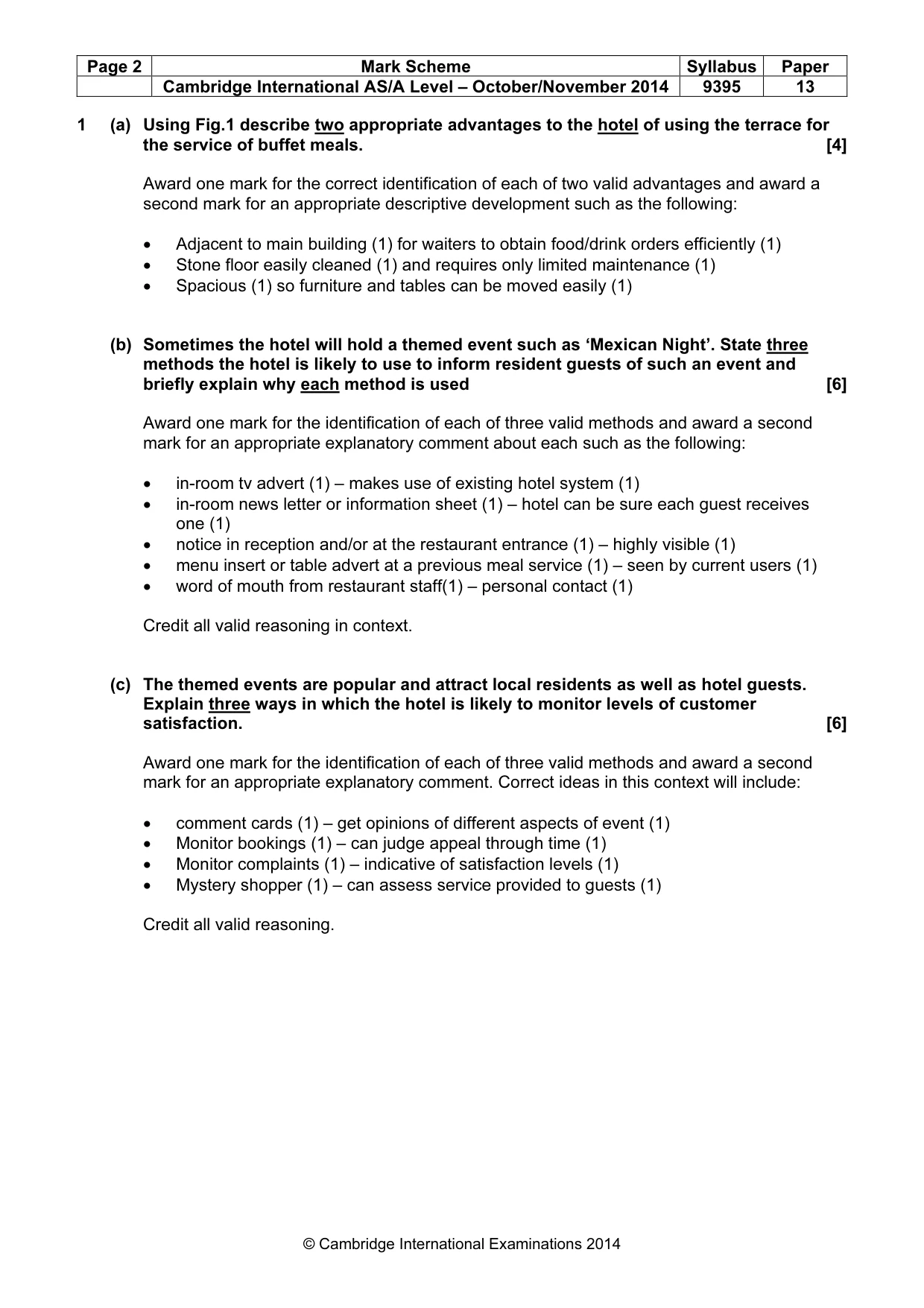
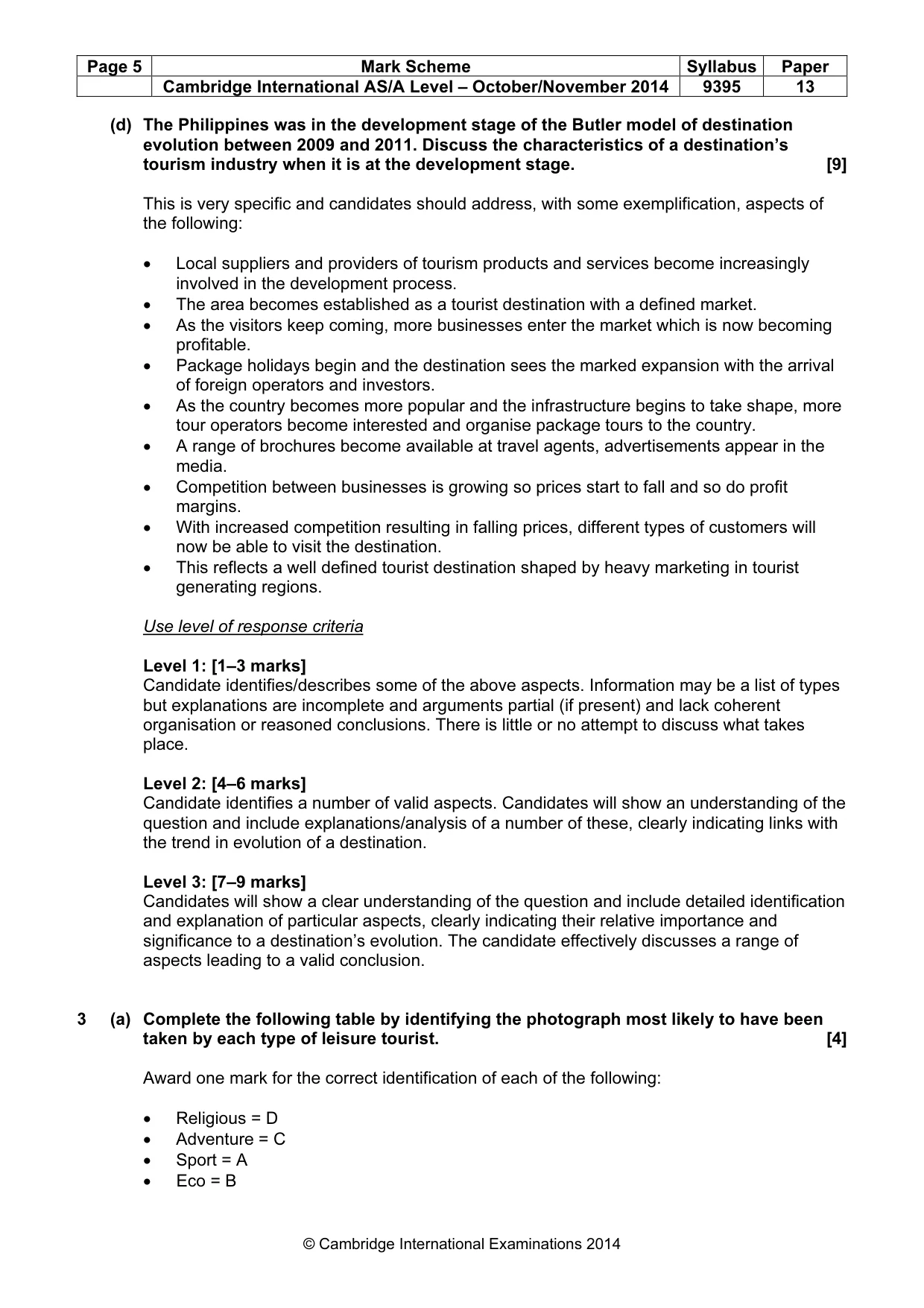
Page 2 Mark Scheme Syllabus Paper Cambridge International AS/A Level – October/November 2014 9395 13 © Cambridge International Examinations 2014 1 (a) Using Fig.1 describe two appropriate advantages to the hotel of using the terrace for the service of buffet meals. [4] Award one mark for the correct identification of each of two valid advantages and award a second mark for an appropriate descriptive development such as the following: • Adjacent to main building (1) for waiters to obtain food/drink orders efficiently (1) • Stone floor easily cleaned (1) and requires only limited maintenance (1) • Spacious (1) so furniture and tables can be moved easily (1) (b) Sometimes the hotel will hold a themed event such as ‘Mexican Night’. State three methods the hotel is likely to use to inform resident guests of such an event and briefly explain why each method is used [6] Award one mark for the identification of each of three valid methods and award a second mark for an appropriate explanatory comment about each such as the following: • in-room tv advert (1) – makes use of existing hotel system (1) • in-room news letter or information sheet (1) – hotel can be sure each guest receives one (1) • notice in reception and/or at the restaurant entrance (1) – highly visible (1) • menu insert or table advert at a previous meal service (1) – seen by current users (1) • word of mouth from restaurant staff(1) – personal contact (1) Credit all valid reasoning in context. (c) The themed events are popular and attract local residents as well as hotel guests. Explain three ways in which the hotel is likely to monitor levels of customer satisfaction. [6] Award one mark for the identification of each of three valid methods and award a second mark for an appropriate explanatory comment. Correct ideas in this context will include: • comment cards (1) – get opinions of different aspects of event (1) • Monitor bookings (1) – can judge appeal through time (1) • Monitor complaints (1) – indicative of satisfaction levels (1) • Mystery shopper (1) – can assess service provided to guests (1) Credit all valid reasoning.
Mark scheme, page 3
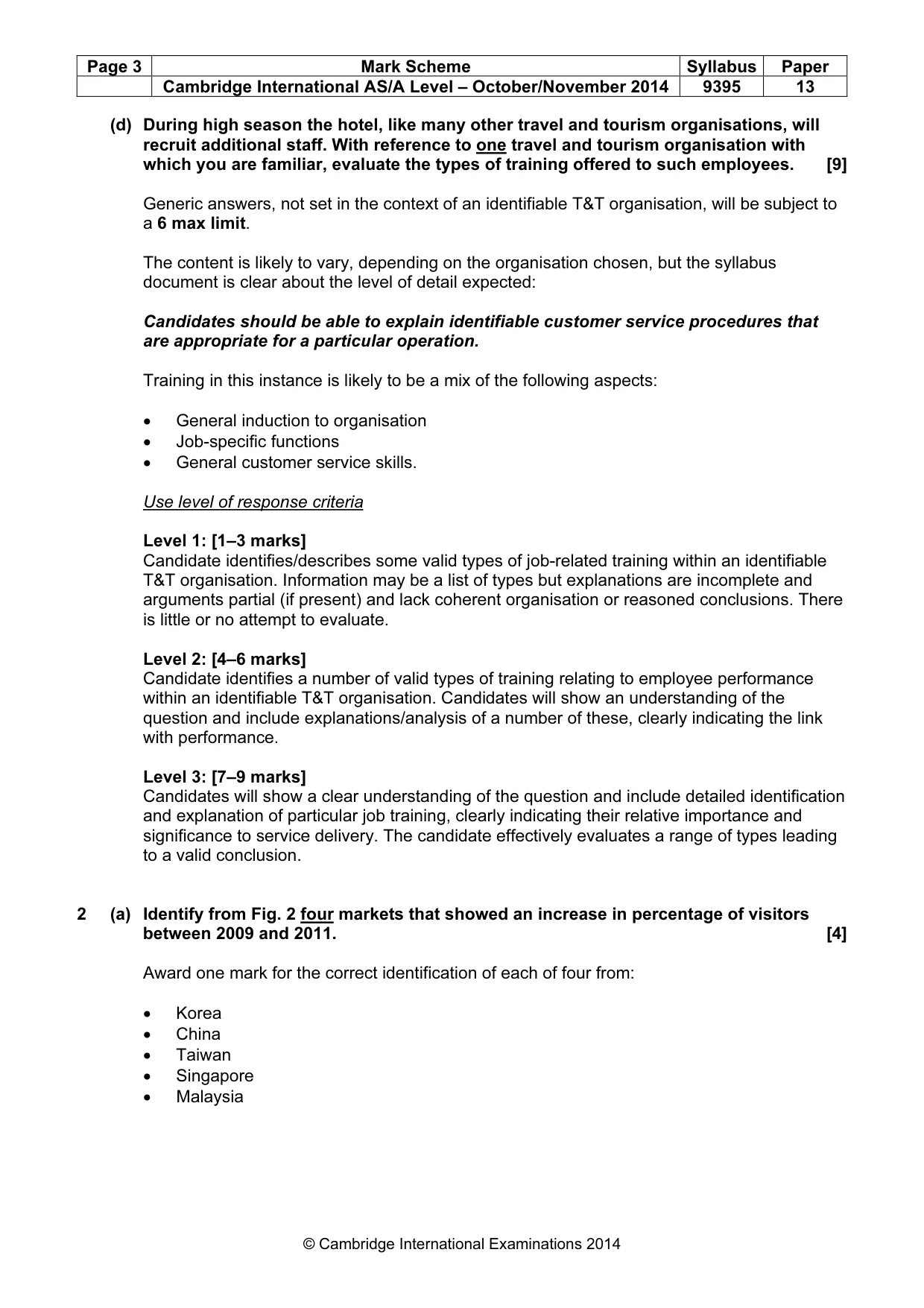
Page 3 Mark Scheme Syllabus Paper Cambridge International AS/A Level – October/November 2014 9395 13 © Cambridge International Examinations 2014 (d) During high season the hotel, like many other travel and tourism organisations, will recruit additional staff. With reference to one travel and tourism organisation with which you are familiar, evaluate the types of training offered to such employees. [9] Generic answers, not set in the context of an identifiable T&T organisation, will be subject to a 6 max limit. The content is likely to vary, depending on the organisation chosen, but the syllabus document is clear about the level of detail expected: Candidates should be able to explain identifiable customer service procedures that are appropriate for a particular operation. Training in this instance is likely to be a mix of the following aspects: • General induction to organisation • Job-specific functions • General customer service skills. Use level of response criteria Level 1: [1–3 marks] Candidate identifies/describes some valid types of job-related training within an identifiable T&T organisation. Information may be a list of types but explanations are incomplete and arguments partial (if present) and lack coherent organisation or reasoned conclusions. There is little or no attempt to evaluate. Level 2: [4–6 marks] Candidate identifies a number of valid types of training relating to employee performance within an identifiable T&T organisation. Candidates will show an understanding of the question and include explanations/analysis of a number of these, clearly indicating the link with performance. Level 3: [7–9 marks] Candidates will show a clear understanding of the question and include detailed identification and explanation of particular job training, clearly indicating their relative importance and significance to service delivery. The candidate effectively evaluates a range of types leading to a valid conclusion. 2 (a) Identify from Fig. 2 four markets that showed an increase in percentage of visitors between 2009 and 2011. [4] Award one mark for the correct identification of each of four from: • Korea • China • Taiwan • Singapore • Malaysia
Mark scheme, page 4
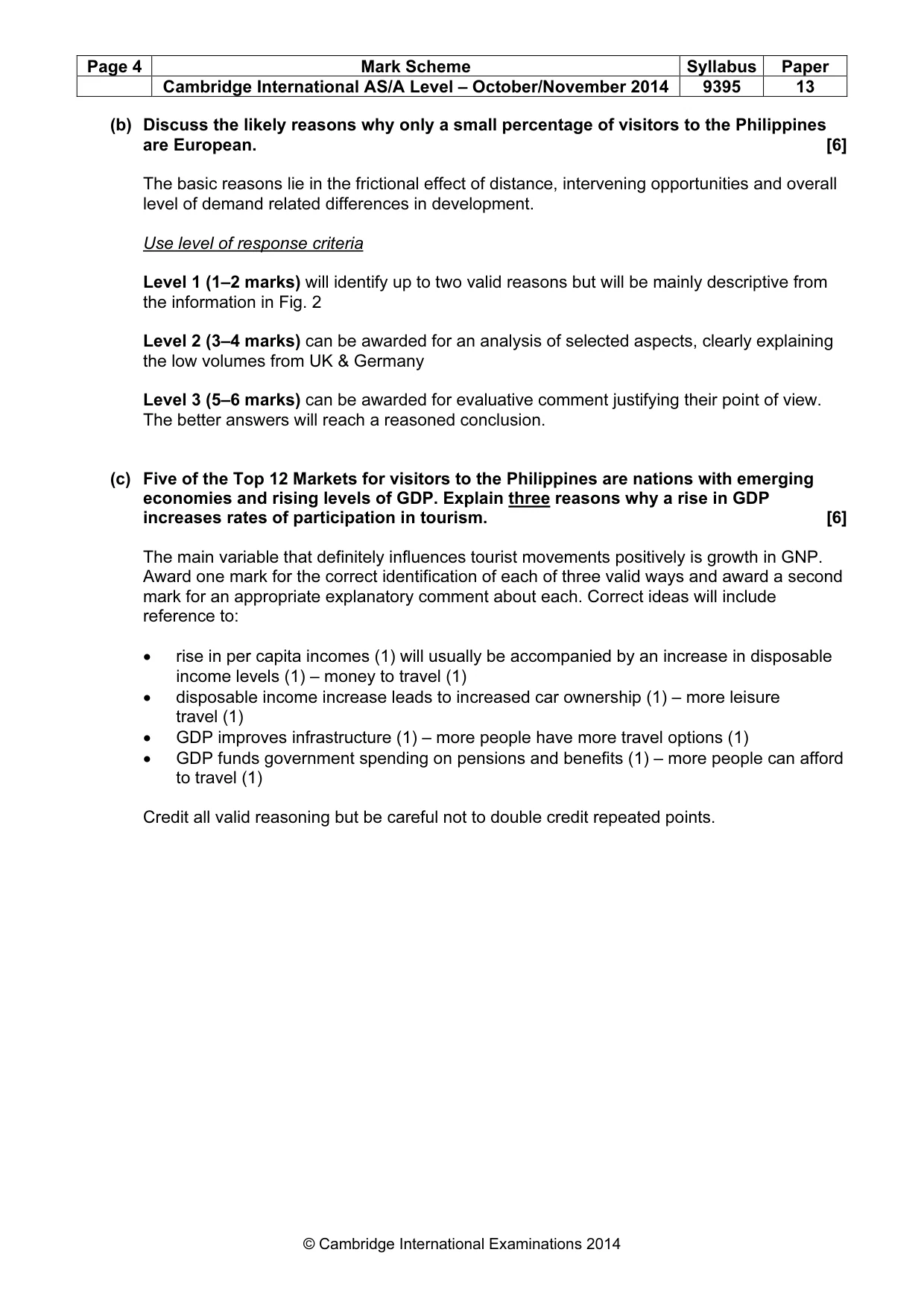
Page 4 Mark Scheme Syllabus Paper Cambridge International AS/A Level – October/November 2014 9395 13 © Cambridge International Examinations 2014 (b) Discuss the likely reasons why only a small percentage of visitors to the Philippines are European. [6] The basic reasons lie in the frictional effect of distance, intervening opportunities and overall level of demand related differences in development. Use level of response criteria Level 1 (1–2 marks) will identify up to two valid reasons but will be mainly descriptive from the information in Fig. 2 Level 2 (3–4 marks) can be awarded for an analysis of selected aspects, clearly explaining the low volumes from UK & Germany Level 3 (5–6 marks) can be awarded for evaluative comment justifying their point of view. The better answers will reach a reasoned conclusion. (c) Five of the Top 12 Markets for visitors to the Philippines are nations with emerging economies and rising levels of GDP. Explain three reasons why a rise in GDP increases rates of participation in tourism. [6] The main variable that definitely influences tourist movements positively is growth in GNP. Award one mark for the correct identification of each of three valid ways and award a second mark for an appropriate explanatory comment about each. Correct ideas will include reference to: • rise in per capita incomes (1) will usually be accompanied by an increase in disposable income levels (1) – money to travel (1) • disposable income increase leads to increased car ownership (1) – more leisure travel (1) • GDP improves infrastructure (1) – more people have more travel options (1) • GDP funds government spending on pensions and benefits (1) – more people can afford to travel (1) Credit all valid reasoning but be careful not to double credit repeated points.
Mark scheme, page 5
Page 5 Mark Scheme Syllabus Paper Cambridge International AS/A Level – October/November 2014 9395 13 © Cambridge International Examinations 2014 (d) The Philippines was in the development stage of the Butler model of destination evolution between 2009 and 2011. Discuss the characteristics of a destination’s tourism industry when it is at the development stage. [9] This is very specific and candidates should address, with some exemplification, aspects of the following: • Local suppliers and providers of tourism products and services become increasingly involved in the development process. • The area becomes established as a tourist destination with a defined market. • As the visitors keep coming, more businesses enter the market which is now becoming profitable. • Package holidays begin and the destination sees the marked expansion with the arrival of foreign operators and investors. • As the country becomes more popular and the infrastructure begins to take shape, more tour operators become interested and organise package tours to the country. • A range of brochures become available at travel agents, advertisements appear in the media. • Competition between businesses is growing so prices start to fall and so do profit margins. • With increased competition resulting in falling prices, different types of customers will now be able to visit the destination. • This reflects a well defined tourist destination shaped by heavy marketing in tourist generating regions. Use level of response criteria Level 1: [1–3 marks] Candidate identifies/describes some of the above aspects. Information may be a list of types but explanations are incomplete and arguments partial (if present) and lack coherent organisation or reasoned conclusions. There is little or no attempt to discuss what takes place. Level 2: [4–6 marks] Candidate identifies a number of valid aspects. Candidates will show an understanding of the question and include explanations/analysis of a number of these, clearly indicating links with the trend in evolution of a destination. Level 3: [7–9 marks] Candidates will show a clear understanding of the question and include detailed identification and explanation of particular aspects, clearly indicating their relative importance and significance to a destination’s evolution. The candidate effectively discusses a range of aspects leading to a valid conclusion. 3 (a) Complete the following table by identifying the photograph most likely to have been taken by each type of leisure tourist. [4] Award one mark for the correct identification of each of the following: • Religious = D • Adventure = C • Sport = A • Eco = B
Mark scheme, page 6
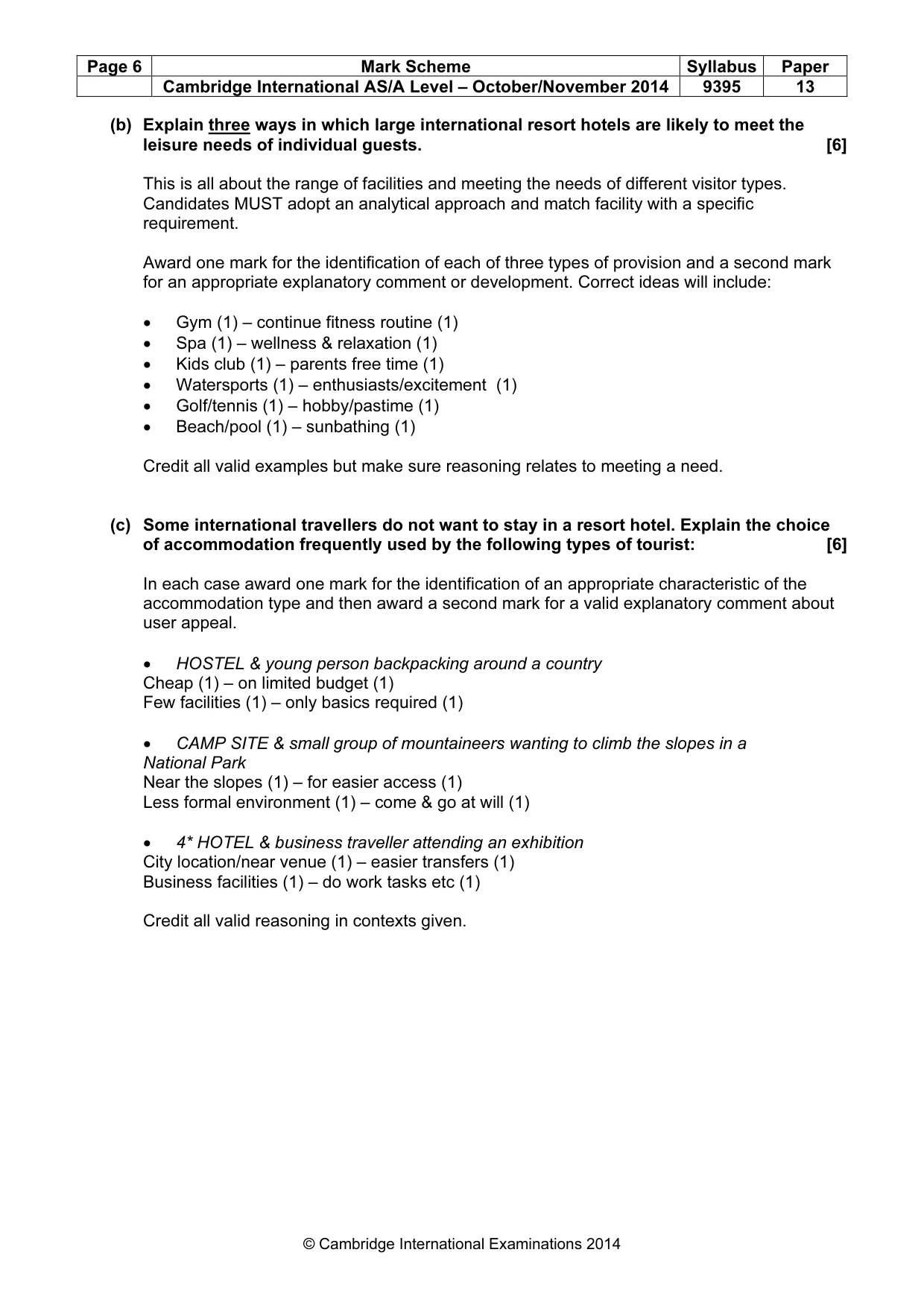
Page 6 Mark Scheme Syllabus Paper Cambridge International AS/A Level – October/November 2014 9395 13 © Cambridge International Examinations 2014 (b) Explain three ways in which large international resort hotels are likely to meet the leisure needs of individual guests. [6] This is all about the range of facilities and meeting the needs of different visitor types. Candidates MUST adopt an analytical approach and match facility with a specific requirement. Award one mark for the identification of each of three types of provision and a second mark for an appropriate explanatory comment or development. Correct ideas will include: • Gym (1) – continue fitness routine (1) • Spa (1) – wellness & relaxation (1) • Kids club (1) – parents free time (1) • Watersports (1) – enthusiasts/excitement (1) • Golf/tennis (1) – hobby/pastime (1) • Beach/pool (1) – sunbathing (1) Credit all valid examples but make sure reasoning relates to meeting a need. (c) Some international travellers do not want to stay in a resort hotel. Explain the choice of accommodation frequently used by the following types of tourist: [6] In each case award one mark for the identification of an appropriate characteristic of the accommodation type and then award a second mark for a valid explanatory comment about user appeal. • HOSTEL & young person backpacking around a country Cheap (1) – on limited budget (1) Few facilities (1) – only basics required (1) • CAMP SITE & small group of mountaineers wanting to climb the slopes in a National Park Near the slopes (1) – for easier access (1) Less formal environment (1) – come & go at will (1) • 4* HOTEL & business traveller attending an exhibition City location/near venue (1) – easier transfers (1) Business facilities (1) – do work tasks etc (1) Credit all valid reasoning in contexts given.
Mark scheme, page 7
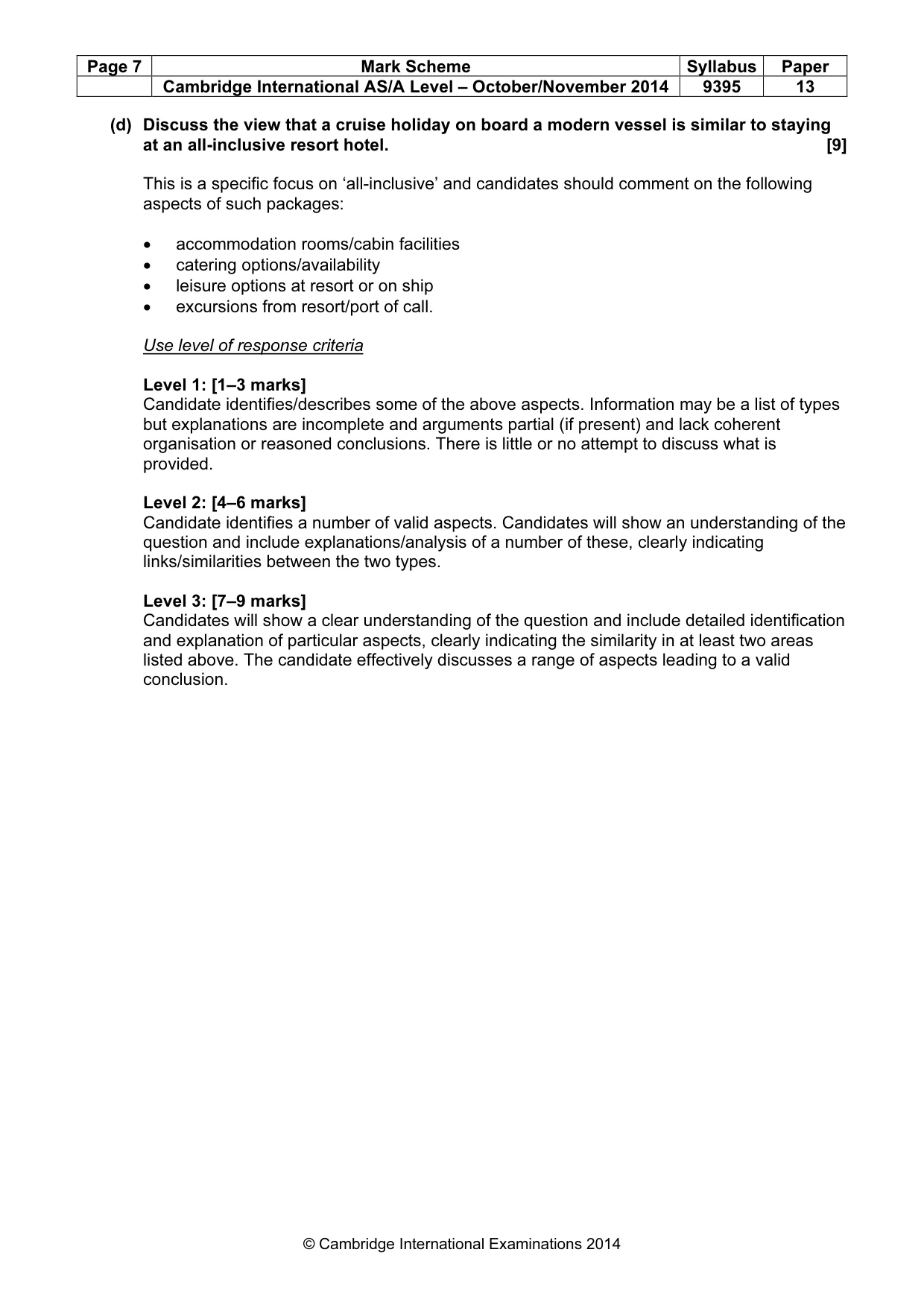
Page 7 Mark Scheme Syllabus Paper Cambridge International AS/A Level – October/November 2014 9395 13 © Cambridge International Examinations 2014 (d) Discuss the view that a cruise holiday on board a modern vessel is similar to staying at an all-inclusive resort hotel. [9] This is a specific focus on ‘all-inclusive’ and candidates should comment on the following aspects of such packages: • accommodation rooms/cabin facilities • catering options/availability • leisure options at resort or on ship • excursions from resort/port of call. Use level of response criteria Level 1: [1–3 marks] Candidate identifies/describes some of the above aspects. Information may be a list of types but explanations are incomplete and arguments partial (if present) and lack coherent organisation or reasoned conclusions. There is little or no attempt to discuss what is provided. Level 2: [4–6 marks] Candidate identifies a number of valid aspects. Candidates will show an understanding of the question and include explanations/analysis of a number of these, clearly indicating links/similarities between the two types. Level 3: [7–9 marks] Candidates will show a clear understanding of the question and include detailed identification and explanation of particular aspects, clearly indicating the similarity in at least two areas listed above. The candidate effectively discusses a range of aspects leading to a valid conclusion.
Mark scheme, page 8
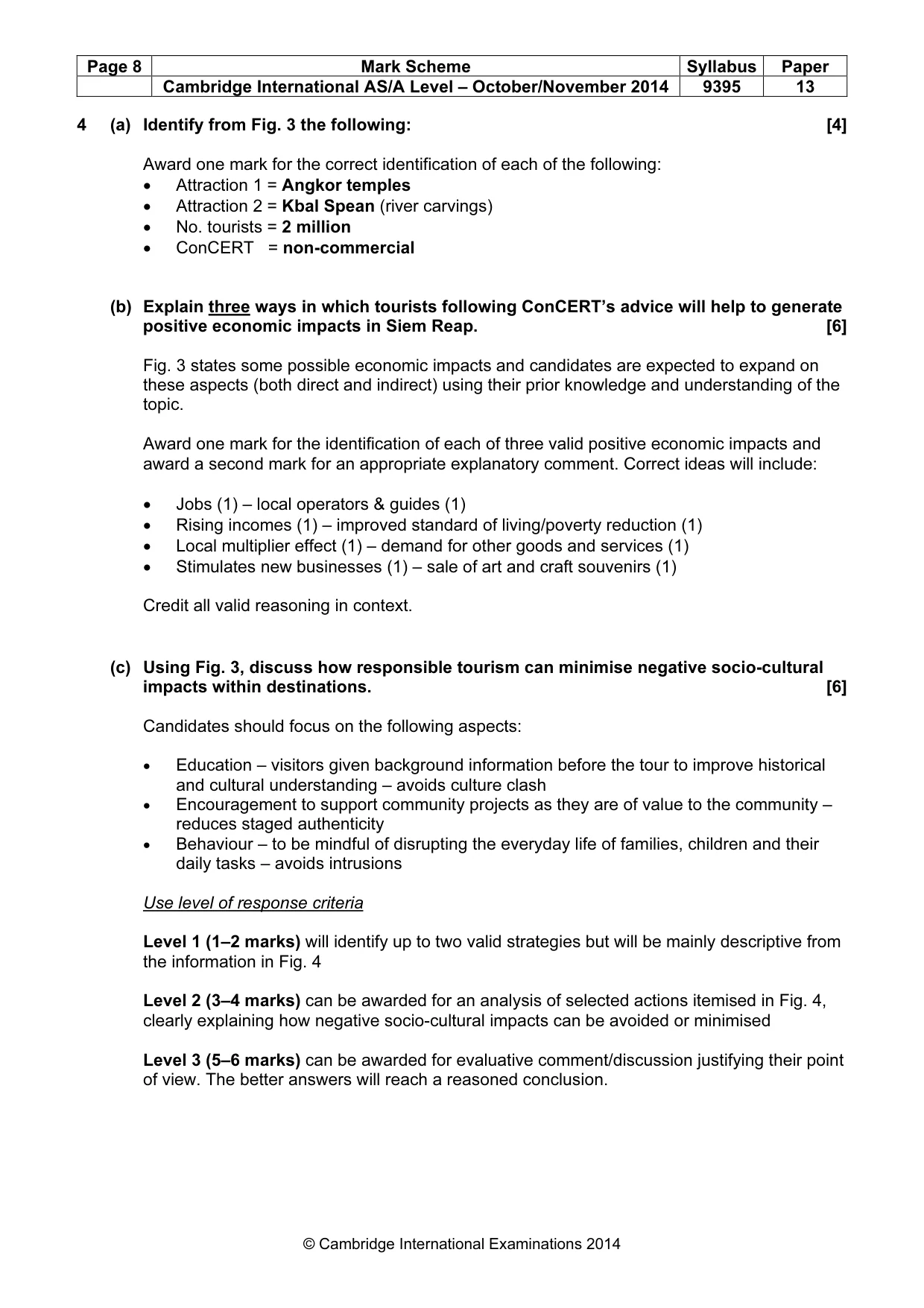
Page 8 Mark Scheme Syllabus Paper Cambridge International AS/A Level – October/November 2014 9395 13 © Cambridge International Examinations 2014 4 (a) Identify from Fig. 3 the following: [4] Award one mark for the correct identification of each of the following: • Attraction 1 = Angkor temples • Attraction 2 = Kbal Spean (river carvings) • No. tourists = 2 million • ConCERT = non-commercial (b) Explain three ways in which tourists following ConCERT’s advice will help to generate positive economic impacts in Siem Reap. [6] Fig. 3 states some possible economic impacts and candidates are expected to expand on these aspects (both direct and indirect) using their prior knowledge and understanding of the topic. Award one mark for the identification of each of three valid positive economic impacts and award a second mark for an appropriate explanatory comment. Correct ideas will include: • Jobs (1) – local operators & guides (1) • Rising incomes (1) – improved standard of living/poverty reduction (1) • Local multiplier effect (1) – demand for other goods and services (1) • Stimulates new businesses (1) – sale of art and craft souvenirs (1) Credit all valid reasoning in context. (c) Using Fig. 3, discuss how responsible tourism can minimise negative socio-cultural impacts within destinations. [6] Candidates should focus on the following aspects: • Education – visitors given background information before the tour to improve historical and cultural understanding – avoids culture clash • Encouragement to support community projects as they are of value to the community – reduces staged authenticity • Behaviour – to be mindful of disrupting the everyday life of families, children and their daily tasks – avoids intrusions Use level of response criteria Level 1 (1–2 marks) will identify up to two valid strategies but will be mainly descriptive from the information in Fig. 4 Level 2 (3–4 marks) can be awarded for an analysis of selected actions itemised in Fig. 4, clearly explaining how negative socio-cultural impacts can be avoided or minimised Level 3 (5–6 marks) can be awarded for evaluative comment/discussion justifying their point of view. The better answers will reach a reasoned conclusion.
Mark scheme, page 9
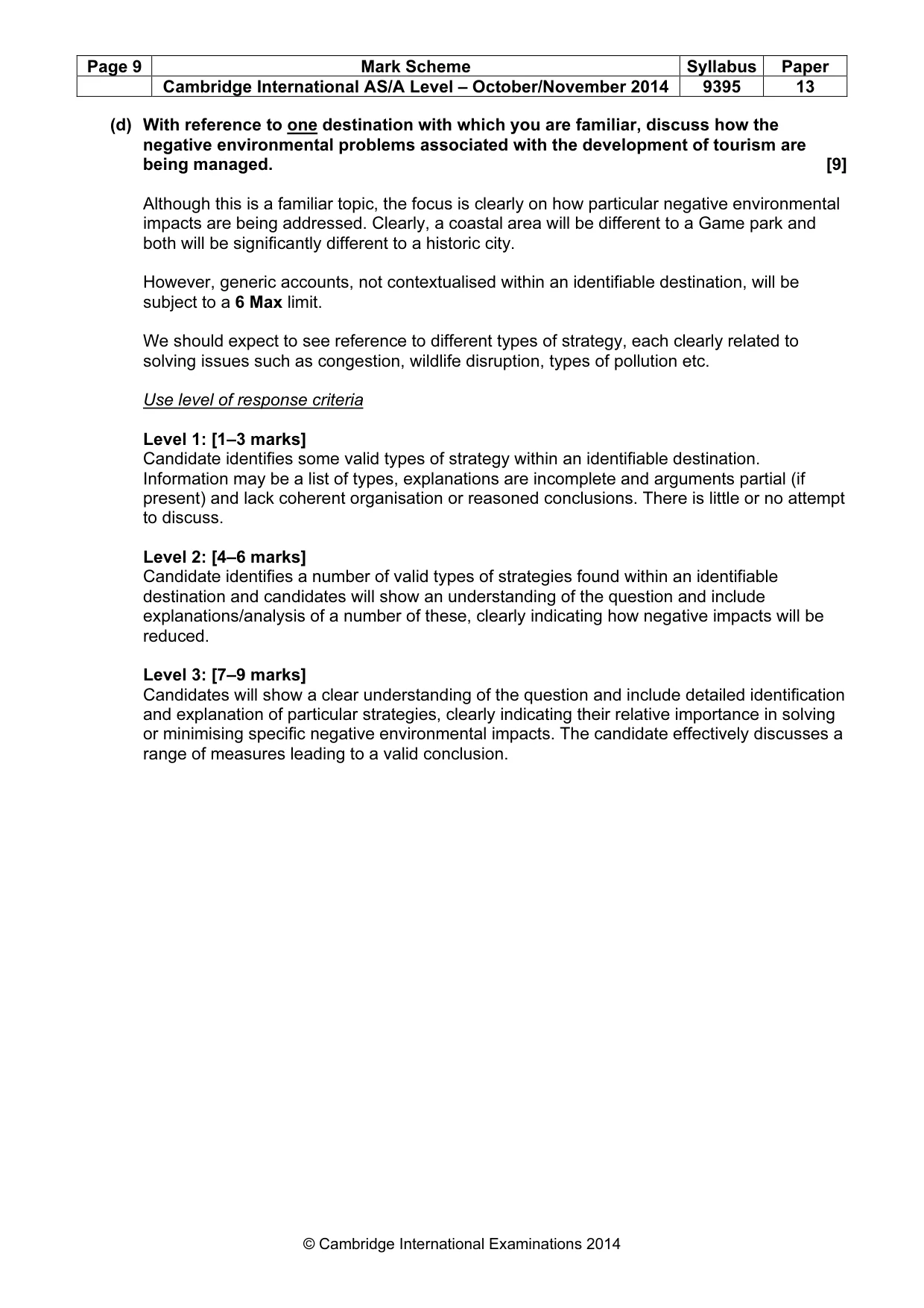
Page 9 Mark Scheme Syllabus Paper Cambridge International AS/A Level – October/November 2014 9395 13 © Cambridge International Examinations 2014 (d) With reference to one destination with which you are familiar, discuss how the negative environmental problems associated with the development of tourism are being managed. [9] Although this is a familiar topic, the focus is clearly on how particular negative environmental impacts are being addressed. Clearly, a coastal area will be different to a Game park and both will be significantly different to a historic city. However, generic accounts, not contextualised within an identifiable destination, will be subject to a 6 Max limit. We should expect to see reference to different types of strategy, each clearly related to solving issues such as congestion, wildlife disruption, types of pollution etc. Use level of response criteria Level 1: [1–3 marks] Candidate identifies some valid types of strategy within an identifiable destination. Information may be a list of types, explanations are incomplete and arguments partial (if present) and lack coherent organisation or reasoned conclusions. There is little or no attempt to discuss. Level 2: [4–6 marks] Candidate identifies a number of valid types of strategies found within an identifiable destination and candidates will show an understanding of the question and include explanations/analysis of a number of these, clearly indicating how negative impacts will be reduced. Level 3: [7–9 marks] Candidates will show a clear understanding of the question and include detailed identification and explanation of particular strategies, clearly indicating their relative importance in solving or minimising specific negative environmental impacts. The candidate effectively discusses a range of measures leading to a valid conclusion.
What you needed in this session
Cambridge’s own grade thresholds for 2014 Oct/Nov, Paper 1 · Variant 3. A higher threshold means an easier paper — the bar moves with how the cohort did.