Cambridge A Level Travel and Tourism 9395 — 2013 May/June Paper 3 · Variant 2
9395/32/M/J/13 · 100 marks · ≈113 min
The question paper and its mark scheme, free to read here and free to download. This is Cambridge’s own paper, exactly as it was sat.
Question paper16 pages





Mark scheme10 pages
Answers below. Sit the paper first if you are practising.
Paper as text
Question paper, page 1
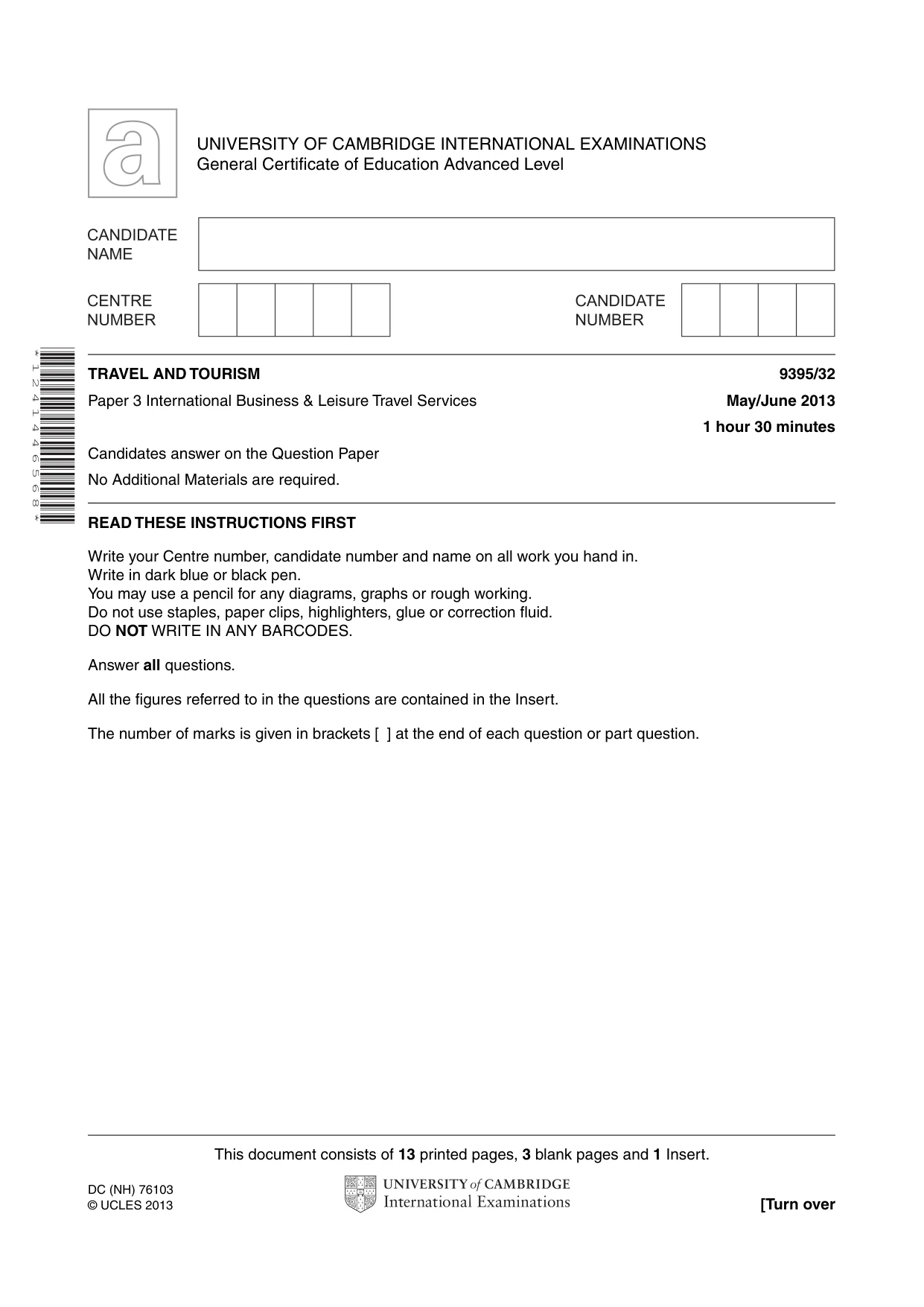
This document consists of 13 printed pages, 3 blank pages and 1 Insert. DC (NH) 76103 © UCLES 2013 [Turn over UNIVERSITY OF CAMBRIDGE INTERNATIONAL EXAMINATIONS General Certificate of Education Advanced Level * 1 2 4 1 4 4 6 5 6 8 * TRAVEL AND TOURISM 9395/32 Paper 3 International Business & Leisure Travel Services May/June 2013 1 hour 30 minutes Candidates answer on the Question Paper No Additional Materials are required. READ THESE INSTRUCTIONS FIRST Write your Centre number, candidate number and name on all work you hand in. Write in dark blue or black pen. You may use a pencil for any diagrams, graphs or rough working. Do not use staples, paper clips, highlighters, glue or correction fluid. DO NOT WRITE IN ANY BARCODES. Answer all questions. All the figures referred to in the questions are contained in the Insert. The number of marks is given in brackets [ ] at the end of each question or part question.
Question paper, page 2
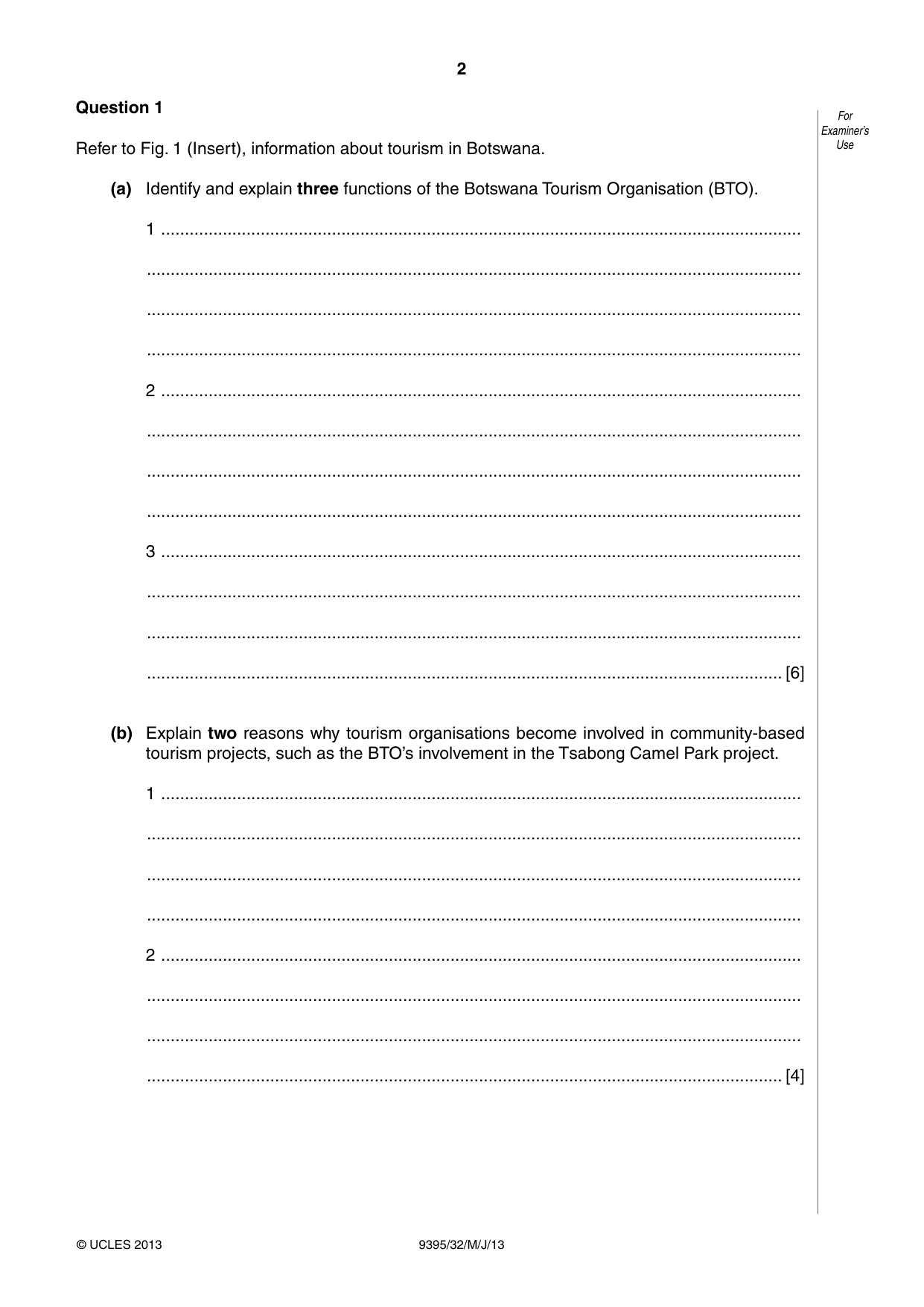
2 9395/32/M/J/13 © UCLES 2013 For Examiner’s Use Question 1 Refer to Fig. 1 (Insert), information about tourism in Botswana. (a) Identify and explain three functions of the Botswana Tourism Organisation (BTO). 1 … … … … 2 … … … … 3 … … … … [6] (b) Explain two reasons why tourism organisations become involved in community-based tourism projects, such as the BTO’s involvement in the Tsabong Camel Park project. 1 … … … … 2 … … … … [4]
Question paper, page 3
3 9395/32/M/J/13 © UCLES 2013 [Turn over For Examiner’s Use (c) Explain three reasons why accommodation classification schemes, such as the one implemented in Botswana, are important to overseas visitors. 1 … … … … 2 … … … … 3 … … … …[6]
Question paper, page 4
4 9395/32/M/J/13 © UCLES 2013 For Examiner’s Use (d) Evaluate ways in which the BTO might broaden the appeal of the existing product mix in Botswana, in order to attract a wider range of visitors. … … … … … … … … … … … … … … … … … … … … … … … … … …[9] [Total: 25]
Question paper, page 5
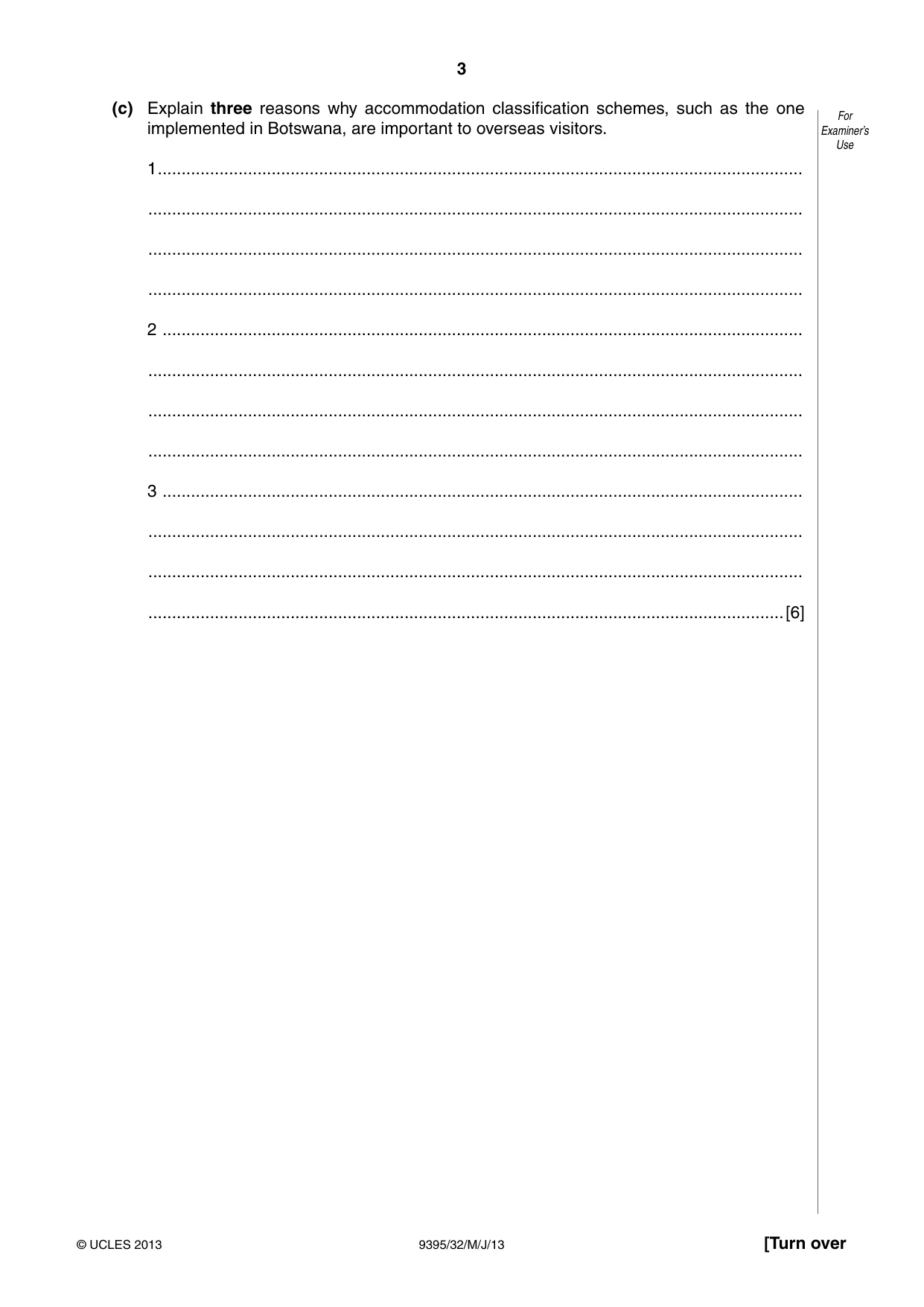
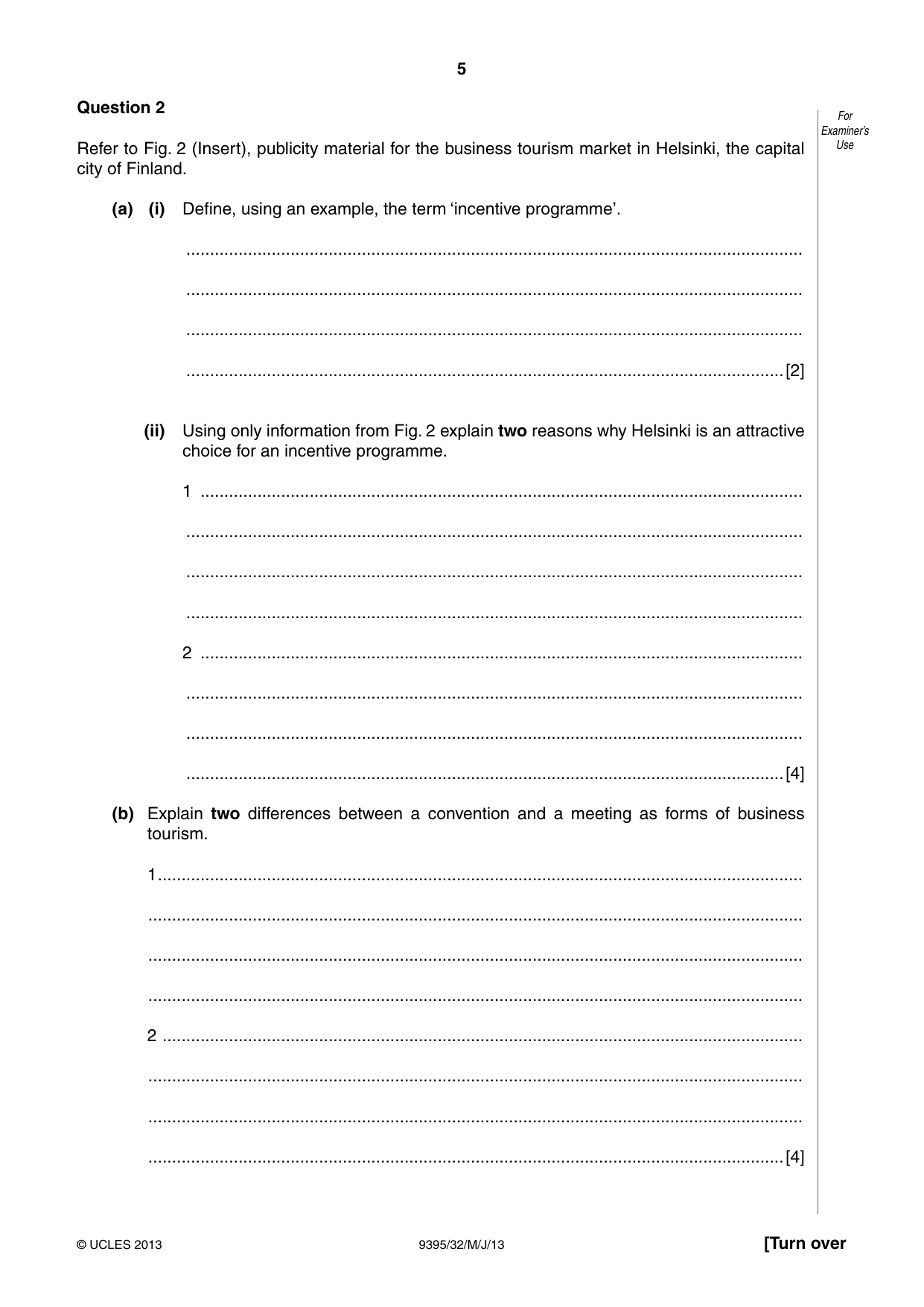
5 9395/32/M/J/13 © UCLES 2013 [Turn over For Examiner’s Use Question 2 Refer to Fig. 2 (Insert), publicity material for the business tourism market in Helsinki, the capital city of Finland. (a) (i) Define, using an example, the term ‘incentive programme’. … … … …[2] (ii) Using only information from Fig. 2 explain two reasons why Helsinki is an attractive choice for an incentive programme. 1 … … … … 2 … … … …[4] (b) Explain two differences between a convention and a meeting as forms of business tourism. 1 … … … … 2 … … … …[4]
Question paper, page 6
6 9395/32/M/J/13 © UCLES 2013 For Examiner’s Use (c) Explain three ways in which the Helsinki City Tourist and Convention Bureau (HCTCB) can assist a conference organiser. 1 … … … … 2 … … … … 3 … … … …[6]
Question paper, page 7
7 9395/32/M/J/13 © UCLES 2013 [Turn over For Examiner’s Use (d) Evaluate the advantages to business tourism planners of the HCTCB being a member of trade organisations such as the International Convention and Congress Association (ICCA). … … … … … … … … … … … … … … … … … … … … … … … … …[9] [Total: 25]
Question paper, page 8
8 9395/32/M/J/13 © UCLES 2013 For Examiner’s Use Question 3 Refer to Fig. 3 (Insert), information about the Shanghai Ferry Company, which operates services between Shanghai in China and Osaka in Japan. (a) Explain two benefits to passengers of travelling with the Shanghai Ferry Company on this route rather than travelling by plane. 1 … … … … 2 … … … …[4] (b) Explain three ways in which the fare structure of the Shanghai Ferry Company is likely to appeal to a variety of travellers. 1 … … … … 2 … … … … 3 … … … …[6]
Question paper, page 9
9 9395/32/M/J/13 © UCLES 2013 [Turn over For Examiner’s Use (c) (i) Use an example to explain what is meant by the term ‘fuel surcharge’. … … … …[2] (ii) Explain two reasons why transport providers, such as the Shanghai Ferry Company, impose fuel surcharges. 1 … … … … 2 … … … …[4]
Question paper, page 10
10 9395/32/M/J/13 © UCLES 2013 For Examiner’s Use (d) Evaluate the benefits to the travel provider and to the customer of using travel agents for booking Shanghai Ferry Company tickets. … … … … … … … … … … … … … … … … … … … … … … … … … …[9] [Total: 25]
Question paper, page 11
11 9395/32/M/J/13 © UCLES 2013 [Turn over For Examiner’s Use Question 4 Refer to Fig. 4 (Insert), information about products offered for different market segments in Caribbean destinations such as Dominica. (a) Explain two reasons why tourism organisations, such as the Caribbean Tourism Organisation (CTO), carry out market research. 1 … … … … 2 … … … …[4] (b) (i) Explain, using an example, what is meant by the term ‘niche market’. … … … …[2] (ii) Explain two ways in which developing different niche markets can be important for island destinations. 1 … … … … 2 … … … …[4]
Question paper, page 12
12 9395/32/M/J/13 © UCLES 2013 For Examiner’s Use (c) Select two of the niche markets from the list given in Fig. 4. For each niche market, suggest how tourism providers in the Caribbean might develop their products for future tourism growth. 1 … … … … … … 2 … … … … … …[6]
Question paper, page 13
13 9395/32/M/J/13 © UCLES 2013 For Examiner’s Use (d) Evaluate the likely appeal to leisure tourists of the diversification programme in Dominica. … … … … … … … … … … … … … … … … … … … … … … … … … …[9] [Total: 25]
Question paper, page 14
14 9395/32/M/J/13 © UCLES 2013 BLANK PAGE
Question paper, page 15
15 9395/32/M/J/13 © UCLES 2013 BLANK PAGE
Question paper, page 16
16 9395/32/M/J/13 © UCLES 2013 Permission to reproduce items where third-party owned material protected by copyright is included has been sought and cleared where possible. Every reasonable effort has been made by the publisher (UCLES) to trace copyright holders, but if any items requiring clearance have unwittingly been included, the publisher will be pleased to make amends at the earliest possible opportunity. University of Cambridge International Examinations is part of the Cambridge Assessment Group. Cambridge Assessment is the brand name of University of Cambridge Local Examinations Syndicate (UCLES), which is itself a department of the University of Cambridge. BLANK PAGE
Mark scheme, page 1
CAMBRIDGE INTERNATIONAL EXAMINATIONS GCE Advanced Subsidiary Level and GCE Advanced Level MARK SCHEME for the May/June 2013 series 9395 TRAVEL AND TOURISM 9395/32 Paper 3 (International Business & Leisure Travel Services), maximum raw mark 100 This mark scheme is published as an aid to teachers and candidates, to indicate the requirements of the examination. It shows the basis on which Examiners were instructed to award marks. It does not indicate the details of the discussions that took place at an Examiners’ meeting before marking began, which would have considered the acceptability of alternative answers. Mark schemes should be read in conjunction with the question paper and the Principal Examiner Report for Teachers. Cambridge will not enter into discussions about these mark schemes. Cambridge is publishing the mark schemes for the May/June 2013 series for most IGCSE, GCE Advanced Level and Advanced Subsidiary Level components and some Ordinary Level components.
Mark scheme, page 2
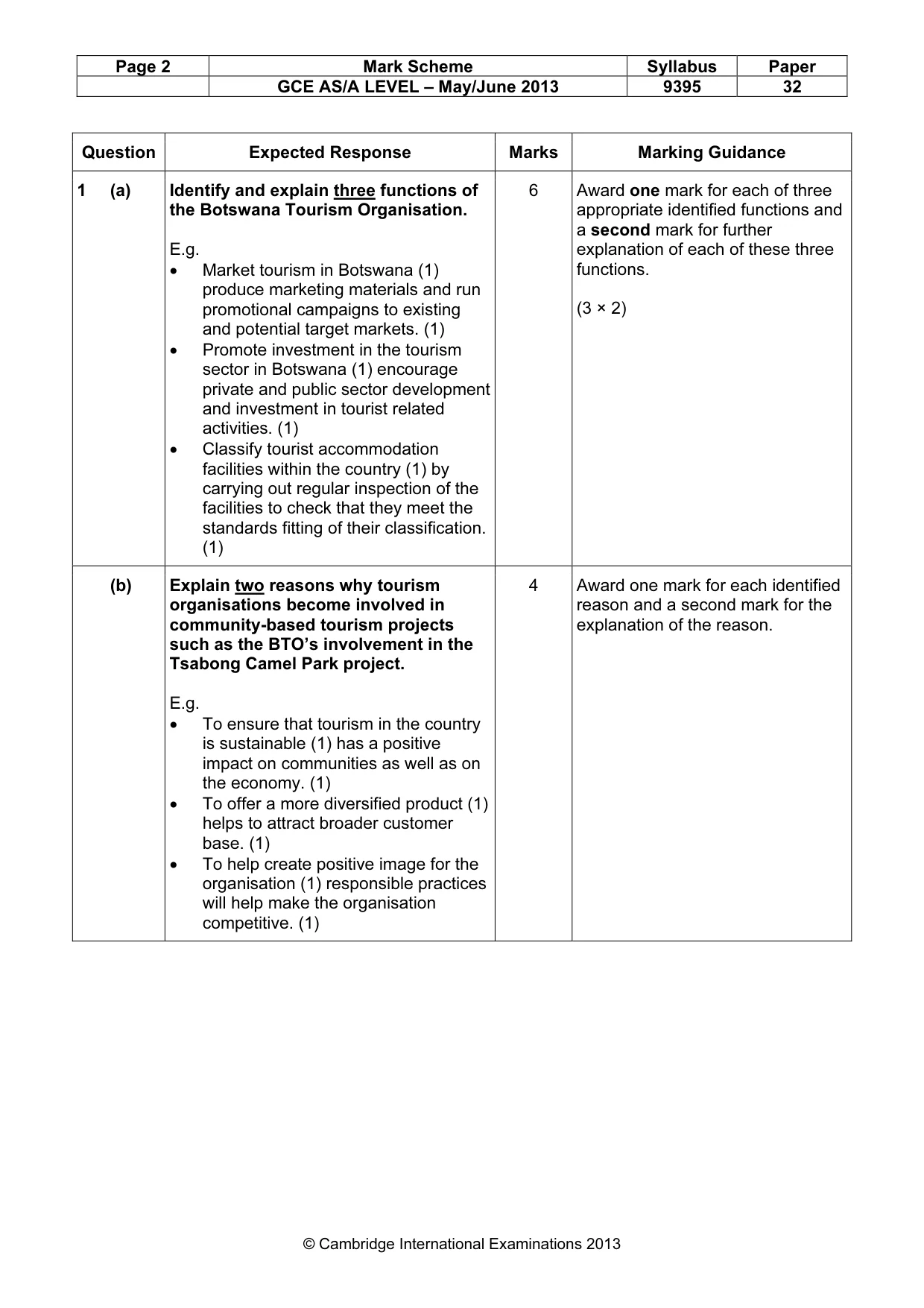
Page 2 Mark Scheme Syllabus Paper GCE AS/A LEVEL – May/June 2013 9395 32 © Cambridge International Examinations 2013 Question Expected Response Marks Marking Guidance 1 (a) Identify and explain three functions of the Botswana Tourism Organisation. E.g. • Market tourism in Botswana (1) produce marketing materials and run promotional campaigns to existing and potential target markets. (1) • Promote investment in the tourism sector in Botswana (1) encourage private and public sector development and investment in tourist related activities. (1) • Classify tourist accommodation facilities within the country (1) by carrying out regular inspection of the facilities to check that they meet the standards fitting of their classification. (1) 6 Award one mark for each of three appropriate identified functions and a second mark for further explanation of each of these three functions. (3 × 2) (b) Explain two reasons why tourism organisations become involved in community-based tourism projects such as the BTO’s involvement in the Tsabong Camel Park project. E.g. • To ensure that tourism in the country is sustainable (1) has a positive impact on communities as well as on the economy. (1) • To offer a more diversified product (1) helps to attract broader customer base. (1) • To help create positive image for the organisation (1) responsible practices will help make the organisation competitive. (1) 4 Award one mark for each identified reason and a second mark for the explanation of the reason.
Mark scheme, page 3
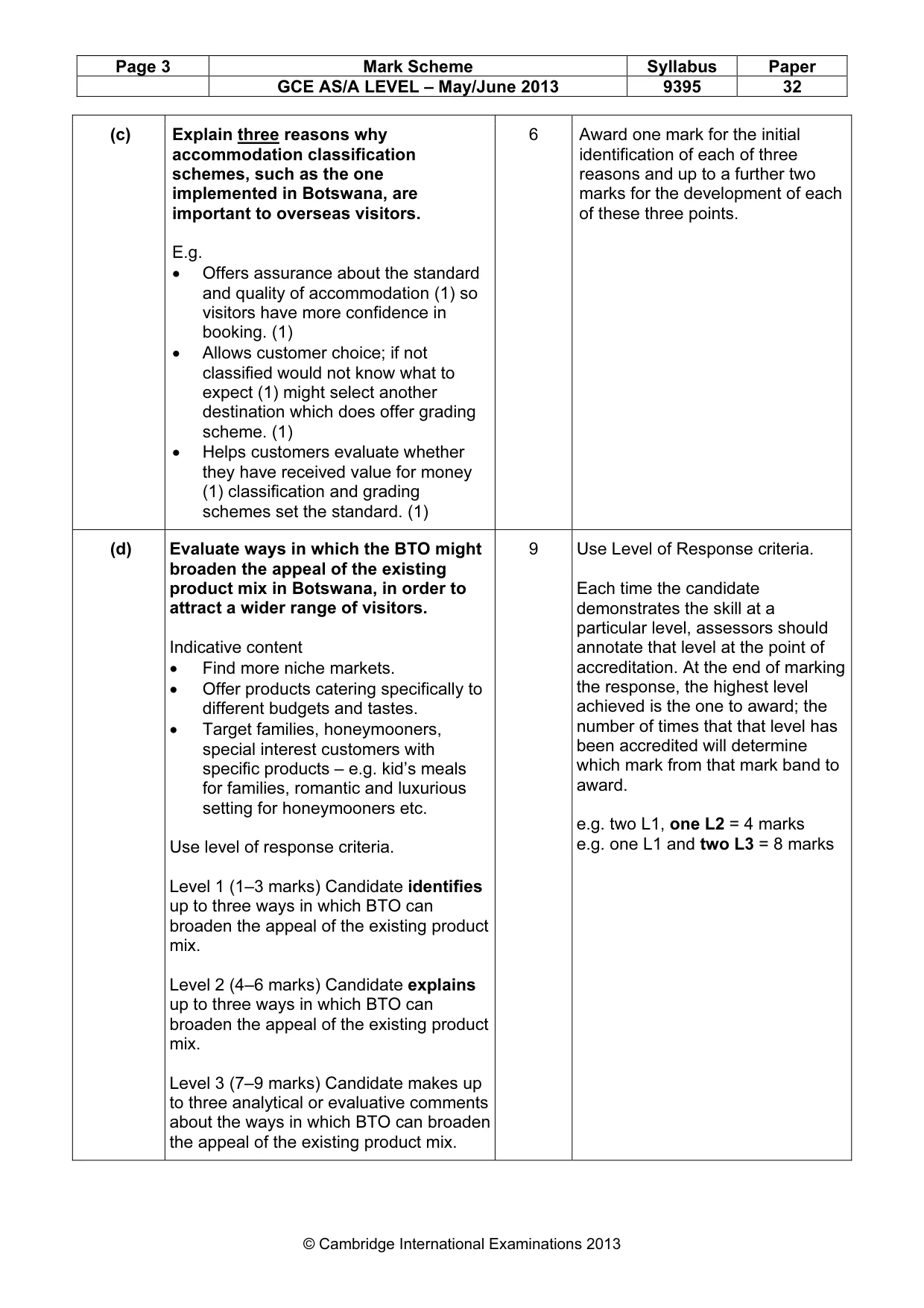
Page 3 Mark Scheme Syllabus Paper GCE AS/A LEVEL – May/June 2013 9395 32 © Cambridge International Examinations 2013 (c) Explain three reasons why accommodation classification schemes, such as the one implemented in Botswana, are important to overseas visitors. E.g. • Offers assurance about the standard and quality of accommodation (1) so visitors have more confidence in booking. (1) • Allows customer choice; if not classified would not know what to expect (1) might select another destination which does offer grading scheme. (1) • Helps customers evaluate whether they have received value for money (1) classification and grading schemes set the standard. (1) 6 Award one mark for the initial identification of each of three reasons and up to a further two marks for the development of each of these three points. (d) Evaluate ways in which the BTO might broaden the appeal of the existing product mix in Botswana, in order to attract a wider range of visitors. Indicative content • Find more niche markets. • Offer products catering specifically to different budgets and tastes. • Target families, honeymooners, special interest customers with specific products – e.g. kid’s meals for families, romantic and luxurious setting for honeymooners etc. Use level of response criteria. Level 1 (1–3 marks) Candidate identifies up to three ways in which BTO can broaden the appeal of the existing product mix. Level 2 (4–6 marks) Candidate explains up to three ways in which BTO can broaden the appeal of the existing product mix. Level 3 (7–9 marks) Candidate makes up to three analytical or evaluative comments about the ways in which BTO can broaden the appeal of the existing product mix. 9 Use Level of Response criteria. Each time the candidate demonstrates the skill at a particular level, assessors should annotate that level at the point of accreditation. At the end of marking the response, the highest level achieved is the one to award; the number of times that that level has been accredited will determine which mark from that mark band to award. e.g. two L1, one L2 = 4 marks e.g. one L1 and two L3 = 8 marks
Mark scheme, page 4
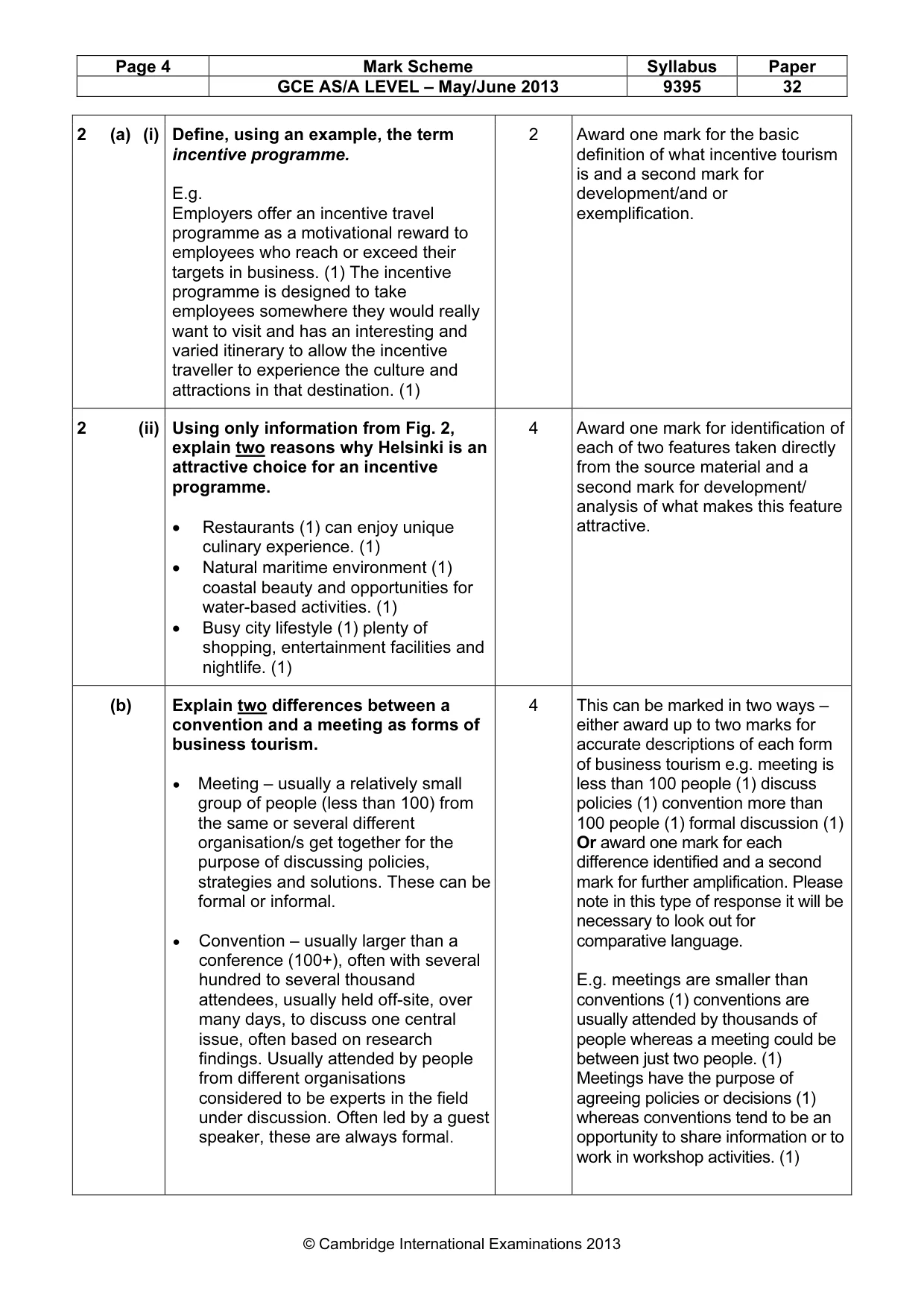
Page 4 Mark Scheme Syllabus Paper GCE AS/A LEVEL – May/June 2013 9395 32 © Cambridge International Examinations 2013 2 (a) (i) Define, using an example, the term incentive programme. E.g. Employers offer an incentive travel programme as a motivational reward to employees who reach or exceed their targets in business. (1) The incentive programme is designed to take employees somewhere they would really want to visit and has an interesting and varied itinerary to allow the incentive traveller to experience the culture and attractions in that destination. (1) 2 Award one mark for the basic definition of what incentive tourism is and a second mark for development/and or exemplification. 2 (ii) Using only information from Fig. 2, explain two reasons why Helsinki is an attractive choice for an incentive programme. • Restaurants (1) can enjoy unique culinary experience. (1) • Natural maritime environment (1) coastal beauty and opportunities for water-based activities. (1) • Busy city lifestyle (1) plenty of shopping, entertainment facilities and nightlife. (1) 4 Award one mark for identification of each of two features taken directly from the source material and a second mark for development/ analysis of what makes this feature attractive. (b) Explain two differences between a convention and a meeting as forms of business tourism. • Meeting – usually a relatively small group of people (less than 100) from the same or several different organisation/s get together for the purpose of discussing policies, strategies and solutions. These can be formal or informal. • Convention – usually larger than a conference (100+), often with several hundred to several thousand attendees, usually held off-site, over many days, to discuss one central issue, often based on research findings. Usually attended by people from different organisations considered to be experts in the field under discussion. Often led by a guest speaker, these are always formal. 4 This can be marked in two ways – either award up to two marks for accurate descriptions of each form of business tourism e.g. meeting is less than 100 people (1) discuss policies (1) convention more than 100 people (1) formal discussion (1) Or award one mark for each difference identified and a second mark for further amplification. Please note in this type of response it will be necessary to look out for comparative language. E.g. meetings are smaller than conventions (1) conventions are usually attended by thousands of people whereas a meeting could be between just two people. (1) Meetings have the purpose of agreeing policies or decisions (1) whereas conventions tend to be an opportunity to share information or to work in workshop activities. (1)
Mark scheme, page 5
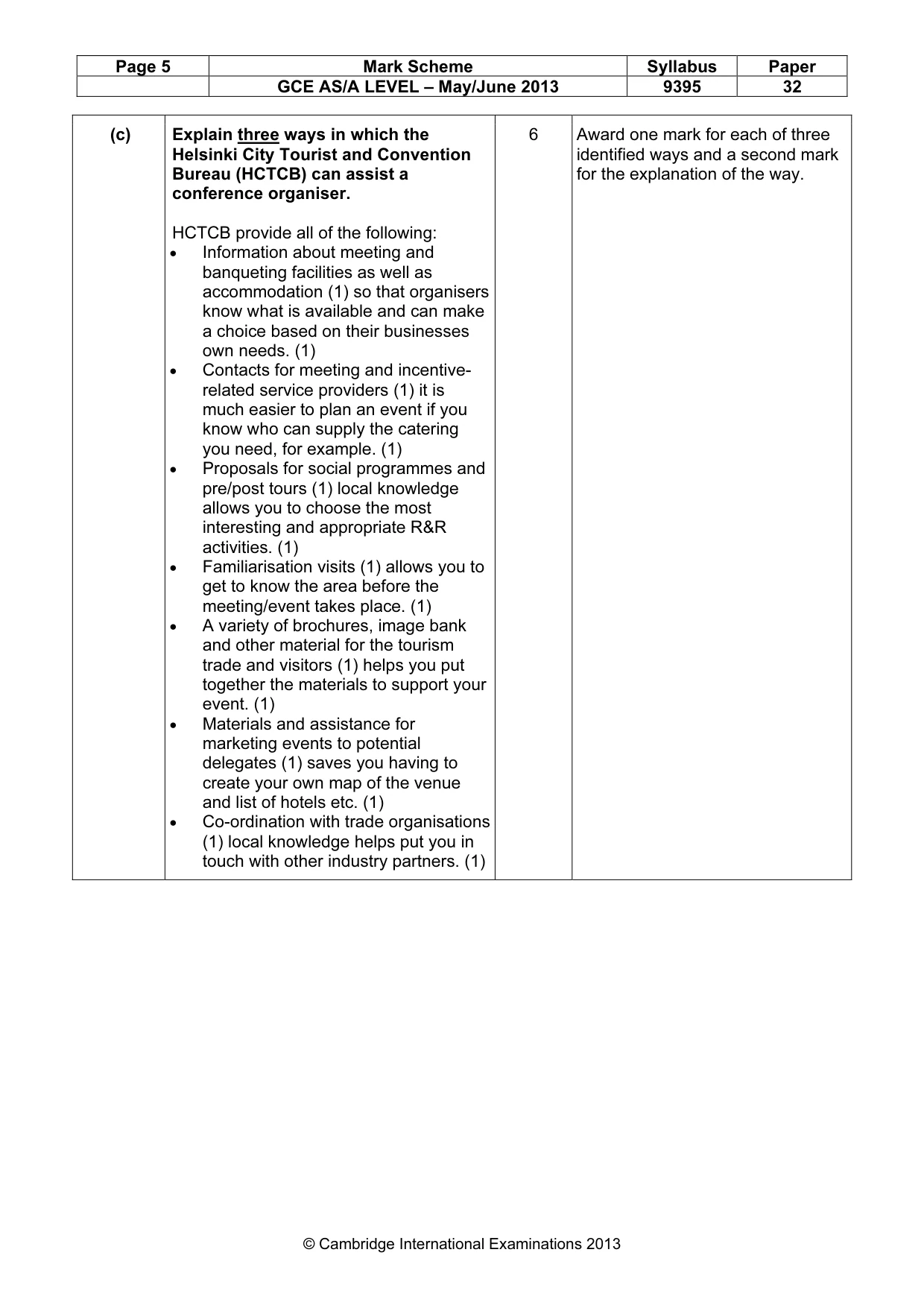
Page 5 Mark Scheme Syllabus Paper GCE AS/A LEVEL – May/June 2013 9395 32 © Cambridge International Examinations 2013 (c) Explain three ways in which the Helsinki City Tourist and Convention Bureau (HCTCB) can assist a conference organiser. HCTCB provide all of the following: • Information about meeting and banqueting facilities as well as accommodation (1) so that organisers know what is available and can make a choice based on their businesses own needs. (1) • Contacts for meeting and incentive- related service providers (1) it is much easier to plan an event if you know who can supply the catering you need, for example. (1) • Proposals for social programmes and pre/post tours (1) local knowledge allows you to choose the most interesting and appropriate R&R activities. (1) • Familiarisation visits (1) allows you to get to know the area before the meeting/event takes place. (1) • A variety of brochures, image bank and other material for the tourism trade and visitors (1) helps you put together the materials to support your event. (1) • Materials and assistance for marketing events to potential delegates (1) saves you having to create your own map of the venue and list of hotels etc. (1) • Co-ordination with trade organisations (1) local knowledge helps put you in touch with other industry partners. (1) 6 Award one mark for each of three identified ways and a second mark for the explanation of the way.
Mark scheme, page 6
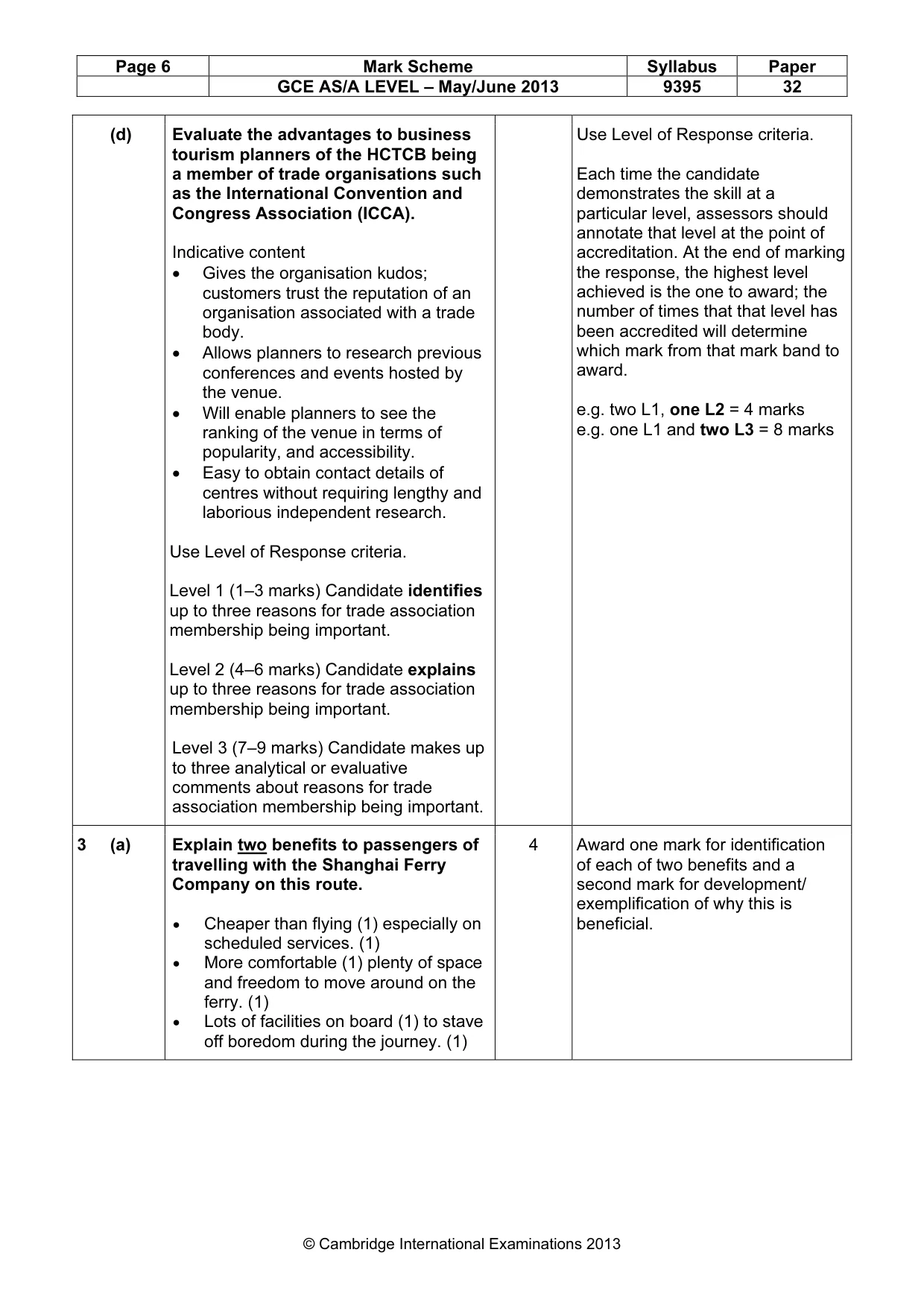
Page 6 Mark Scheme Syllabus Paper GCE AS/A LEVEL – May/June 2013 9395 32 © Cambridge International Examinations 2013 (d) Evaluate the advantages to business tourism planners of the HCTCB being a member of trade organisations such as the International Convention and Congress Association (ICCA). Indicative content • Gives the organisation kudos; customers trust the reputation of an organisation associated with a trade body. • Allows planners to research previous conferences and events hosted by the venue. • Will enable planners to see the ranking of the venue in terms of popularity, and accessibility. • Easy to obtain contact details of centres without requiring lengthy and laborious independent research. Use Level of Response criteria. Level 1 (1–3 marks) Candidate identifies up to three reasons for trade association membership being important. Level 2 (4–6 marks) Candidate explains up to three reasons for trade association membership being important. Level 3 (7–9 marks) Candidate makes up to three analytical or evaluative comments about reasons for trade association membership being important. Use Level of Response criteria. Each time the candidate demonstrates the skill at a particular level, assessors should annotate that level at the point of accreditation. At the end of marking the response, the highest level achieved is the one to award; the number of times that that level has been accredited will determine which mark from that mark band to award. e.g. two L1, one L2 = 4 marks e.g. one L1 and two L3 = 8 marks 3 (a) Explain two benefits to passengers of travelling with the Shanghai Ferry Company on this route. • Cheaper than flying (1) especially on scheduled services. (1) • More comfortable (1) plenty of space and freedom to move around on the ferry. (1) • Lots of facilities on board (1) to stave off boredom during the journey. (1) 4 Award one mark for identification of each of two benefits and a second mark for development/ exemplification of why this is beneficial.
Mark scheme, page 7
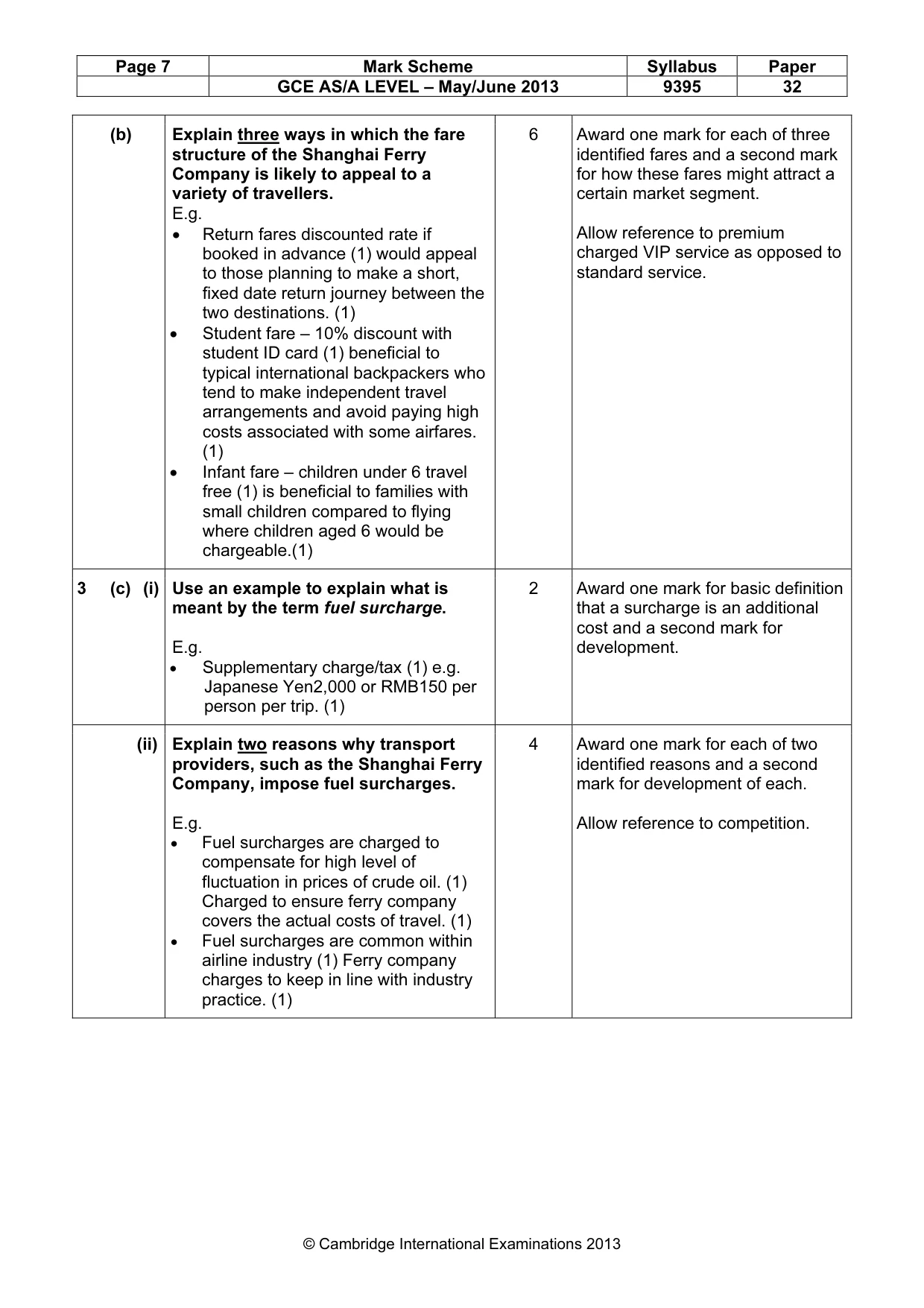
Page 7 Mark Scheme Syllabus Paper GCE AS/A LEVEL – May/June 2013 9395 32 © Cambridge International Examinations 2013 (b) Explain three ways in which the fare structure of the Shanghai Ferry Company is likely to appeal to a variety of travellers. E.g. • Return fares discounted rate if booked in advance (1) would appeal to those planning to make a short, fixed date return journey between the two destinations. (1) • Student fare – 10% discount with student ID card (1) beneficial to typical international backpackers who tend to make independent travel arrangements and avoid paying high costs associated with some airfares. (1) • Infant fare – children under 6 travel free (1) is beneficial to families with small children compared to flying where children aged 6 would be chargeable.(1) 6 Award one mark for each of three identified fares and a second mark for how these fares might attract a certain market segment. Allow reference to premium charged VIP service as opposed to standard service. 3 (c) (i) Use an example to explain what is meant by the term fuel surcharge. E.g. • Supplementary charge/tax (1) e.g. Japanese Yen2,000 or RMB150 per person per trip. (1) 2 Award one mark for basic definition that a surcharge is an additional cost and a second mark for development. (ii) Explain two reasons why transport providers, such as the Shanghai Ferry Company, impose fuel surcharges. E.g. • Fuel surcharges are charged to compensate for high level of fluctuation in prices of crude oil. (1) Charged to ensure ferry company covers the actual costs of travel. (1) • Fuel surcharges are common within airline industry (1) Ferry company charges to keep in line with industry practice. (1) 4 Award one mark for each of two identified reasons and a second mark for development of each. Allow reference to competition.
Mark scheme, page 8
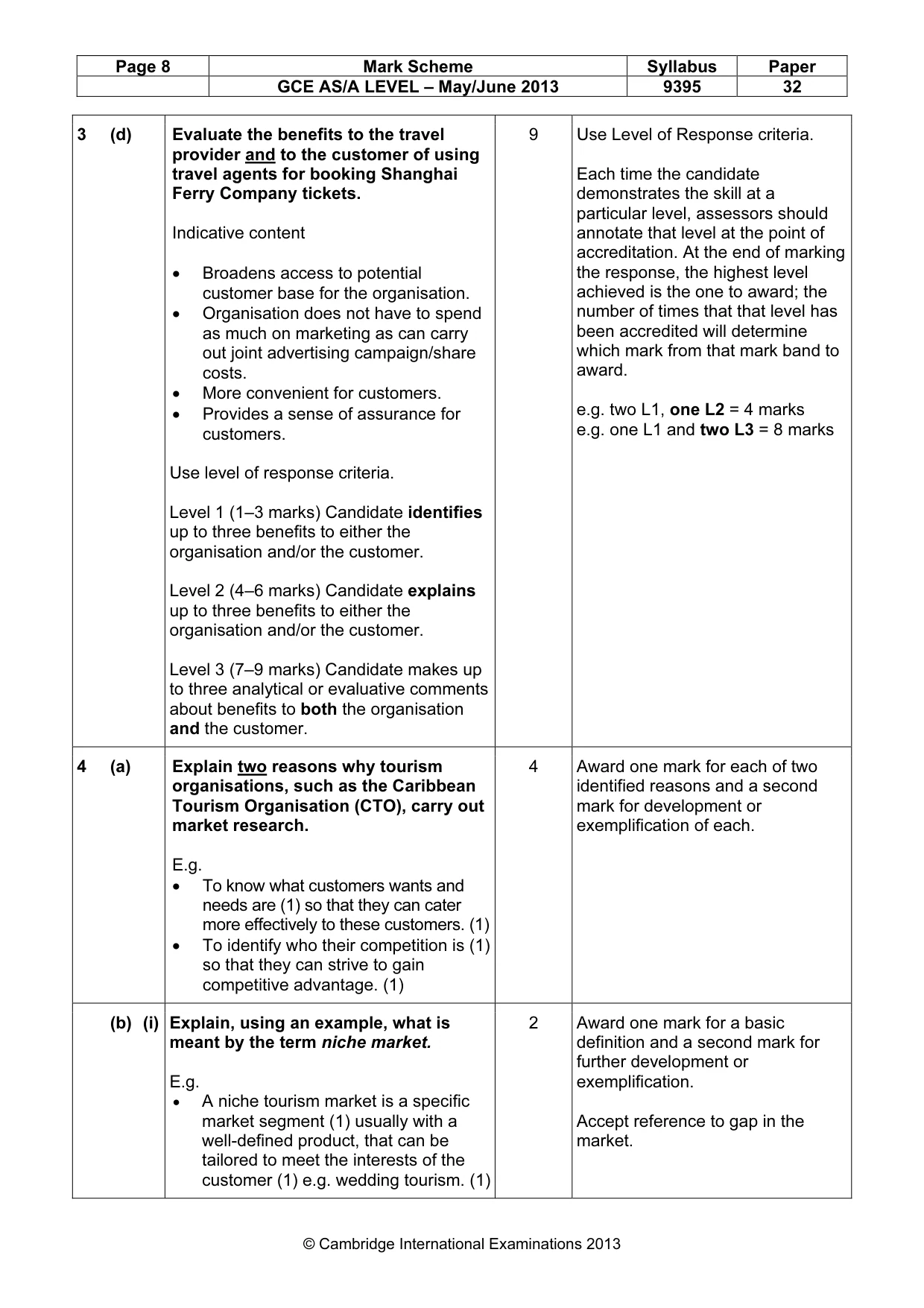
Page 8 Mark Scheme Syllabus Paper GCE AS/A LEVEL – May/June 2013 9395 32 © Cambridge International Examinations 2013 3 (d) Evaluate the benefits to the travel provider and to the customer of using travel agents for booking Shanghai Ferry Company tickets. Indicative content • Broadens access to potential customer base for the organisation. • Organisation does not have to spend as much on marketing as can carry out joint advertising campaign/share costs. • More convenient for customers. • Provides a sense of assurance for customers. Use level of response criteria. Level 1 (1–3 marks) Candidate identifies up to three benefits to either the organisation and/or the customer. Level 2 (4–6 marks) Candidate explains up to three benefits to either the organisation and/or the customer. Level 3 (7–9 marks) Candidate makes up to three analytical or evaluative comments about benefits to both the organisation and the customer. 9 Use Level of Response criteria. Each time the candidate demonstrates the skill at a particular level, assessors should annotate that level at the point of accreditation. At the end of marking the response, the highest level achieved is the one to award; the number of times that that level has been accredited will determine which mark from that mark band to award. e.g. two L1, one L2 = 4 marks e.g. one L1 and two L3 = 8 marks 4 (a) Explain two reasons why tourism organisations, such as the Caribbean Tourism Organisation (CTO), carry out market research. E.g. • To know what customers wants and needs are (1) so that they can cater more effectively to these customers. (1) • To identify who their competition is (1) so that they can strive to gain competitive advantage. (1) 4 Award one mark for each of two identified reasons and a second mark for development or exemplification of each. (b) (i) Explain, using an example, what is meant by the term niche market. E.g. • A niche tourism market is a specific market segment (1) usually with a well-defined product, that can be tailored to meet the interests of the customer (1) e.g. wedding tourism. (1) 2 Award one mark for a basic definition and a second mark for further development or exemplification. Accept reference to gap in the market.
Mark scheme, page 9
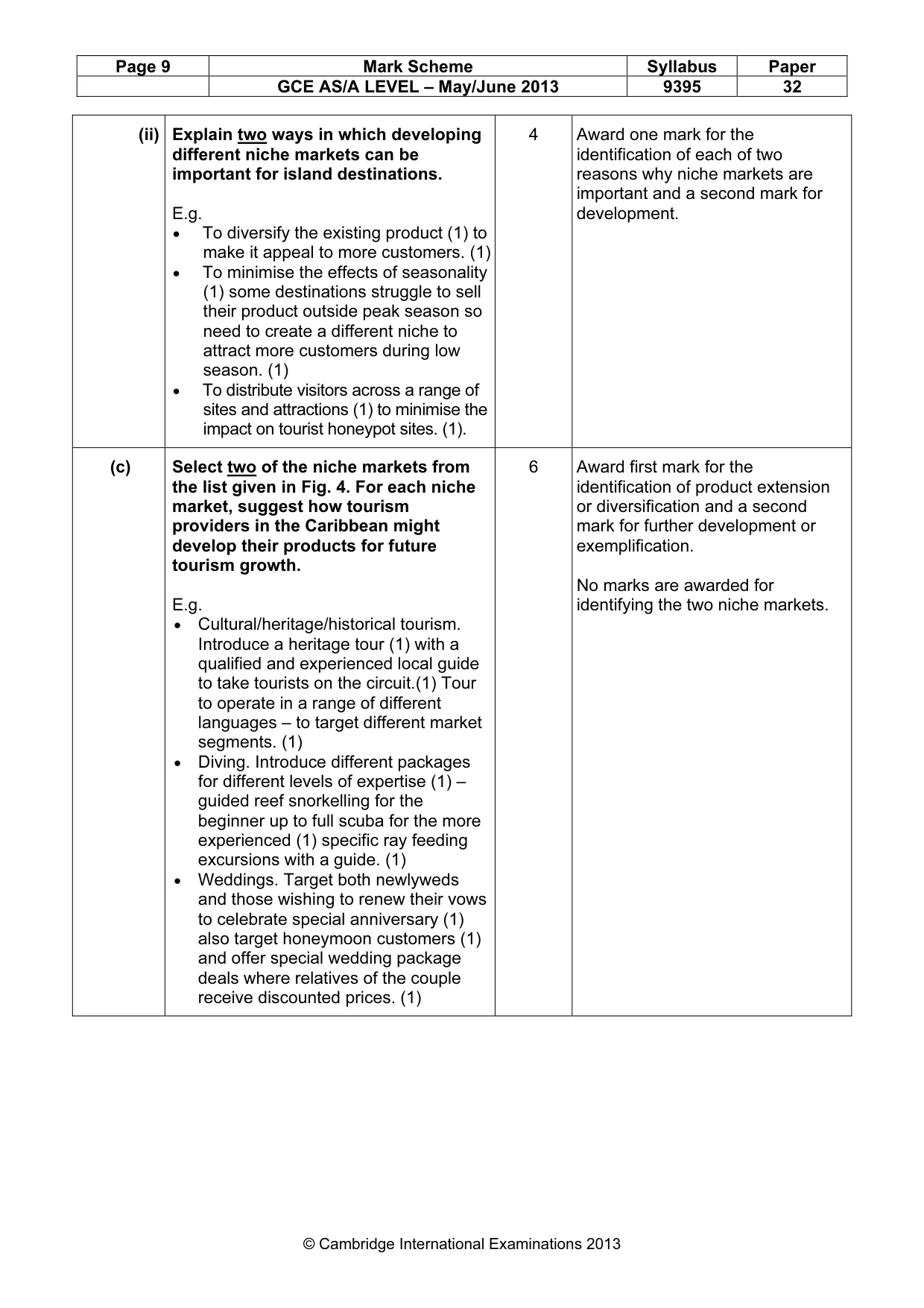
Page 9 Mark Scheme Syllabus Paper GCE AS/A LEVEL – May/June 2013 9395 32 © Cambridge International Examinations 2013 (ii) Explain two ways in which developing different niche markets can be important for island destinations. E.g. • To diversify the existing product (1) to make it appeal to more customers. (1) • To minimise the effects of seasonality (1) some destinations struggle to sell their product outside peak season so need to create a different niche to attract more customers during low season. (1) • To distribute visitors across a range of sites and attractions (1) to minimise the impact on tourist honeypot sites. (1). 4 Award one mark for the identification of each of two reasons why niche markets are important and a second mark for development. (c) Select two of the niche markets from the list given in Fig. 4. For each niche market, suggest how tourism providers in the Caribbean might develop their products for future tourism growth. E.g. • Cultural/heritage/historical tourism. Introduce a heritage tour (1) with a qualified and experienced local guide to take tourists on the circuit.(1) Tour to operate in a range of different languages – to target different market segments. (1) • Diving. Introduce different packages for different levels of expertise (1) – guided reef snorkelling for the beginner up to full scuba for the more experienced (1) specific ray feeding excursions with a guide. (1) • Weddings. Target both newlyweds and those wishing to renew their vows to celebrate special anniversary (1) also target honeymoon customers (1) and offer special wedding package deals where relatives of the couple receive discounted prices. (1) 6 Award first mark for the identification of product extension or diversification and a second mark for further development or exemplification. No marks are awarded for identifying the two niche markets.
Mark scheme, page 10
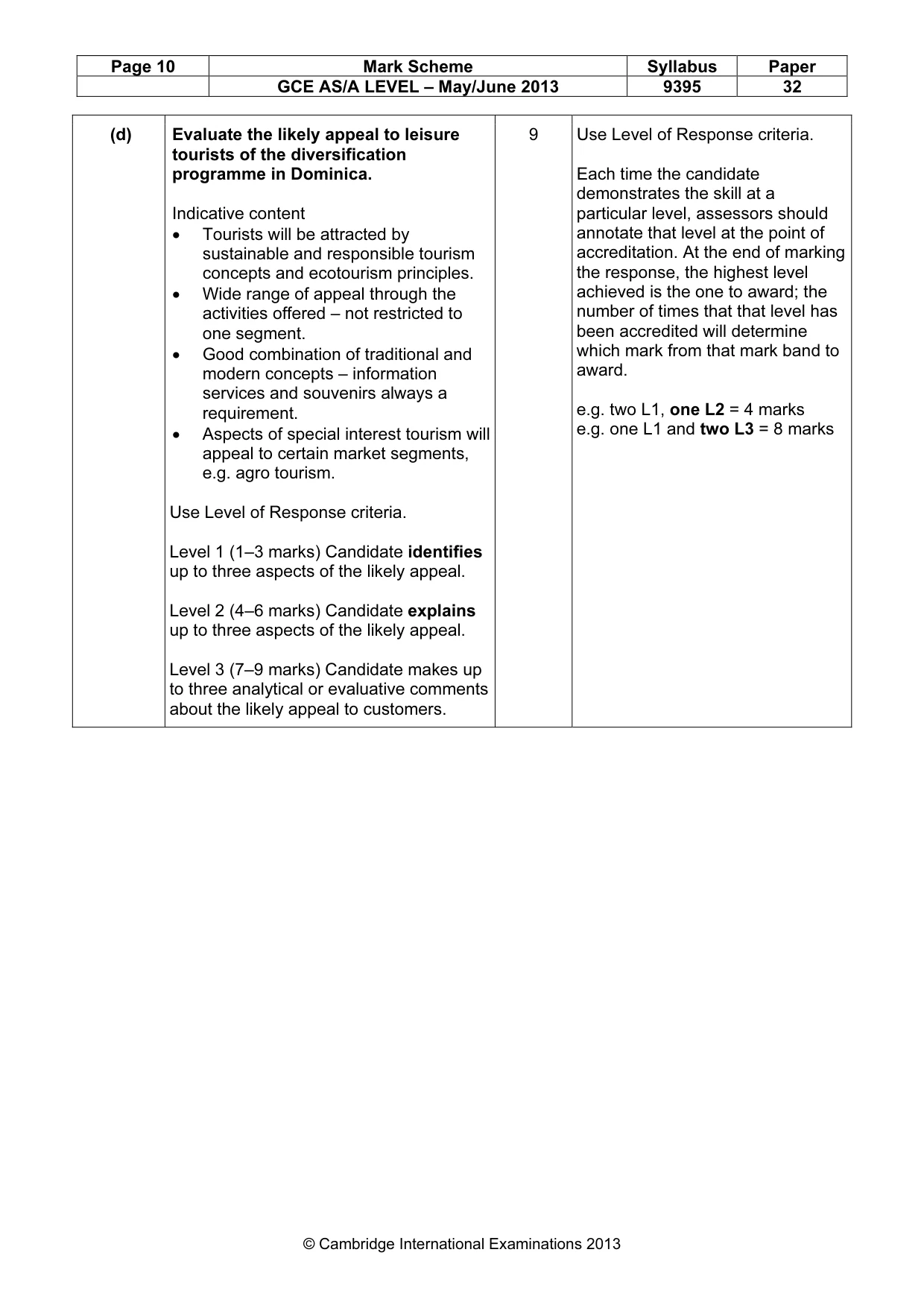
Page 10 Mark Scheme Syllabus Paper GCE AS/A LEVEL – May/June 2013 9395 32 © Cambridge International Examinations 2013 (d) Evaluate the likely appeal to leisure tourists of the diversification programme in Dominica. Indicative content • Tourists will be attracted by sustainable and responsible tourism concepts and ecotourism principles. • Wide range of appeal through the activities offered – not restricted to one segment. • Good combination of traditional and modern concepts – information services and souvenirs always a requirement. • Aspects of special interest tourism will appeal to certain market segments, e.g. agro tourism. Use Level of Response criteria. Level 1 (1–3 marks) Candidate identifies up to three aspects of the likely appeal. Level 2 (4–6 marks) Candidate explains up to three aspects of the likely appeal. Level 3 (7–9 marks) Candidate makes up to three analytical or evaluative comments about the likely appeal to customers. 9 Use Level of Response criteria. Each time the candidate demonstrates the skill at a particular level, assessors should annotate that level at the point of accreditation. At the end of marking the response, the highest level achieved is the one to award; the number of times that that level has been accredited will determine which mark from that mark band to award. e.g. two L1, one L2 = 4 marks e.g. one L1 and two L3 = 8 marks
What you needed in this session
Cambridge’s own grade thresholds for 2013 May/June, Paper 3 · Variant 2. A higher threshold means an easier paper — the bar moves with how the cohort did.