Cambridge A Level Travel and Tourism 9395 — 2013 May/June Paper 1 · Variant 2
9395/12/M/J/13 · 100 marks · ≈113 min
The question paper and its mark scheme, free to read here and free to download. This is Cambridge’s own paper, exactly as it was sat.
Question paper16 pages



Mark scheme8 pages
Answers below. Sit the paper first if you are practising.
Paper as text
Question paper, page 1
This document consists of 13 printed pages, 3 blank pages and 1 Insert. DC (AC) 62202/3 © UCLES 2013 [Turn over UNIVERSITY OF CAMBRIDGE INTERNATIONAL EXAMINATIONS General Certificate of Education Advanced Subsidiary and Advanced Level * 4 5 5 9 6 5 4 0 0 5 * TRAVEL AND TOURISM 9395/12 Paper 1 Core May/June 2013 2 hours 30 minutes Candidates answer on the Question Paper. No Additional Materials are required. READ THESE INSTRUCTIONS FIRST Write your Centre number, candidate number and name on all the work you hand in. Write in dark blue or black pen. Do not use staples, paper clips, highlighters, glue or correction fluid. You may use a pencil for any diagrams, graphs or rough working. DO NOT WRITE IN ANY BARCODES. Answer all questions. All the Figures referred to in the questions are contained in the Insert. The number of marks is given in brackets [ ] at the end of each question or part question.
Question paper, page 2
2 9395/12/M/J/13 © UCLES 2013 For Examiner’s Use Question 1 Refer to Fig. 1 (Insert), a news item about an airline merger. (a) Identify four types of external customer served by the merged airline. 1 … 2 … 3 … 4 …[4] (b) Identify and explain three ways in which employees may benefit from the ‘Working Together’ culture. 1 … … … … 2 … … … … 3 … … … …[6]
Question paper, page 3
3 9395/12/M/J/13 © UCLES 2013 [Turn over For Examiner’s Use (c) Explain three ways in which the company is likely to receive employee feedback on the new operating procedures. 1 … … … … 2 … … … … 3 … … … …[6]
Question paper, page 4
4 9395/12/M/J/13 © UCLES 2013 For Examiner’s Use (d) For one job role within a travel and tourism organisation with which you are familiar, evaluate the customer service procedures employees are expected to follow. Name of chosen role … … … … … … … … … … … … … … … … … … … … … … … … … …[9] [Total: 25]
Question paper, page 5
5 9395/12/M/J/13 © UCLES 2013 [Turn over For Examiner’s Use Question 2 Refer to Fig. 2 (Insert), information about sustainable development. (a) Identify the four elements of the model of sustainable destination management. 1 … 2 … 3 … 4 … [4] (b) Explain three ways in which it is possible for destinations to attract additional visitor spending. 1 … … … … 2 … … … … 3 … … … … [6]
Question paper, page 6
6 9395/12/M/J/13 © UCLES 2013 For Examiner’s Use (c) Explain three negative economic impacts that can result from the rapid increase of wealthy foreign tourists visiting Less Economically Developed Countries (LEDCs). 1 … … … … 2 … … … … 3 … … … …[6]
Question paper, page 7
7 9395/12/M/J/13 © UCLES 2013 [Turn over For Examiner’s Use (d) Assess the methods frequently used by tourist boards to promote a destination in key overseas target markets. … … … … … … … … … … … … … … … … … … … … … … … … … …[9] [Total: 25]
Question paper, page 8
8 9395/12/M/J/13 © UCLES 2013 For Examiner’s Use Question 3 Refer to Fig. 3 (Insert), a news item about the American city of New Orleans. (a) Identify the following: • the number of visitors to New Orleans in 2009 … • the average leisure visitor daily spend in 2010 … • the percentage increase in visitor spending between 2009 and 2010 … • the percentage of New Orleans visitors in 2010 that were business tourists … [4] (b) Describe what is meant by each of the following: • convention … … … … • trade show … … … … • corporate meeting … … … … [6]
Question paper, page 9
9 9395/12/M/J/13 © UCLES 2013 [Turn over For Examiner’s Use (c) Discuss the likely reasons for New Orleans wanting to attract 25 to 34 year old visitors. … … … … … … … … … … … …[6]
Question paper, page 10
10 9395/12/M/J/13 © UCLES 2013 For Examiner’s Use (d) New Orleans attracts a lot of domestic visitors. With reference to one destination with which you are familiar, assess the range of self-catering accommodation that is available. Name of chosen destination … … … … … … … … … … … … … … … … … … … … … … … … … …[9] [Total: 25]
Question paper, page 11
11 9395/12/M/J/13 © UCLES 2013 [Turn over For Examiner’s Use Question 4 Refer to Fig. 4 (Insert), a news item about tourism in the Indian state of Goa. (a) Identify four threats to Goa’s reputation as ‘a relaxed, safe tropical beach paradise’. 1 … 2 … 3 … 4 …[4] (b) Explain three ways in which tourists might disturb places of worship. 1 … … … … 2 … … … … 3 … … … …[6]
Question paper, page 12
12 9395/12/M/J/13 © UCLES 2013 For Examiner’s Use (c) Explain three ways in which historic cultural attractions can generate funding for maintenance and renovation. 1 … … … … 2 … … … … 3 … … … …[6]
Question paper, page 13
13 9395/12/M/J/13 © UCLES 2013 For Examiner’s Use (d) Discuss the ways in which the development of tourism can spread economic benefits throughout a destination. … … … … … … … … … … … … … … … … … … … … … … … … … …[9] [Total: 25]
Question paper, page 14
14 9395/12/M/J/13 © UCLES 2013 BLANK PAGE
Question paper, page 15
15 9395/12/M/J/13 © UCLES 2013 BLANK PAGE
Question paper, page 16
16 9395/12/M/J/13 © UCLES 2013 Permission to reproduce items where third-party owned material protected by copyright is included has been sought and cleared where possible. Every reasonable effort has been made by the publisher (UCLES) to trace copyright holders, but if any items requiring clearance have unwittingly been included, the publisher will be pleased to make amends at the earliest possible opportunity. University of Cambridge International Examinations is part of the Cambridge Assessment Group. Cambridge Assessment is the brand name of University of Cambridge Local Examinations Syndicate (UCLES), which is itself a department of the University of Cambridge. BLANK PAGE
Mark scheme, page 1
CAMBRIDGE INTERNATIONAL EXAMINATIONS GCE Advanced Subsidiary Level and GCE Advanced Level MARK SCHEME for the May/June 2013 series 9395 TRAVEL AND TOURISM 9395/12 Paper 1 (Core Paper), maximum raw mark 100 This mark scheme is published as an aid to teachers and candidates, to indicate the requirements of the examination. It shows the basis on which Examiners were instructed to award marks. It does not indicate the details of the discussions that took place at an Examiners’ meeting before marking began, which would have considered the acceptability of alternative answers. Mark schemes should be read in conjunction with the question paper and the Principal Examiner Report for Teachers. Cambridge will not enter into discussions about these mark schemes. Cambridge is publishing the mark schemes for the May/June 2013 series for most IGCSE, GCE Advanced Level and Advanced Subsidiary Level components and some Ordinary Level components.
Mark scheme, page 2
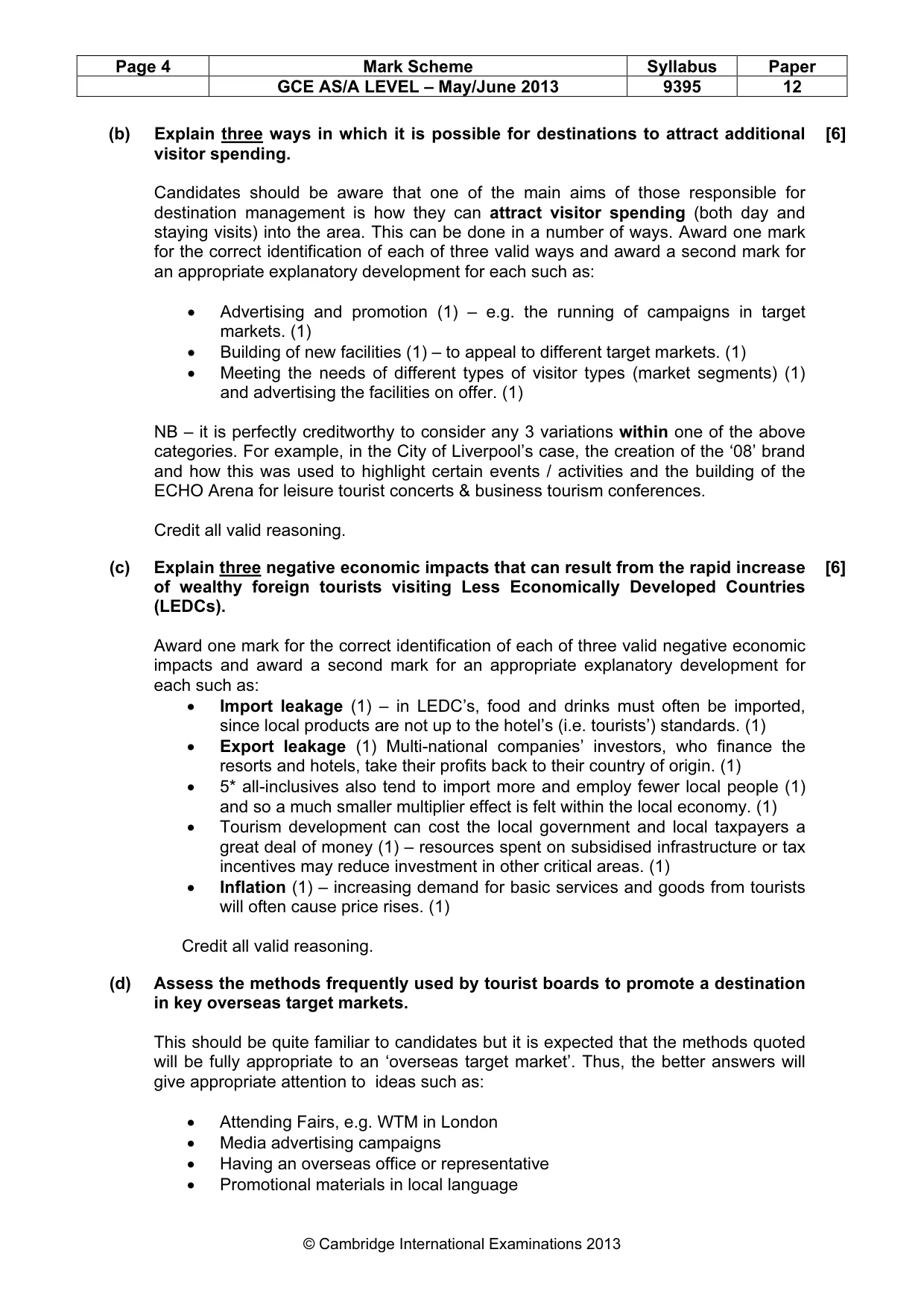
Page 2 Mark Scheme Syllabus Paper GCE AS/A LEVEL – May/June 2013 9395 12 © Cambridge International Examinations 2013 1 (a) Identify four types of external customer served by the merged airline. Award one mark for the correct identification of four types from: • uniformed military personnel • First • Business /Business First customers • elite-level frequent flyers • families (with children under the age of four) • unescorted minors. [4] (b) Identify and explain three ways in which employees may benefit from the ‘Working Together’ culture. Award one mark for the correct identification of each of three valid ways as indicated on Fig. 1 and award a second mark for an appropriate explanatory development for each such as: • on-time incentive (1) – employees will receive a benefit/reward for being punctual (1) • perfect attendance (1) – employees will receive a benefit/reward for not having any absence from work (1) • profit-sharing (1) – employees receive a bonus related to company profitability (1) and • pass-travel programmes (1) – employees receive travel perks (1) [6] (c) Explain three ways in which the company is likely to receive employee feedback on the new operating procedures. Award one mark for the correct identification of each of three valid ways and award a second mark for an appropriate explanatory development for each such as: • Staff focus groups (1) – meetings held to consider procedures (1) • Staff meetings (1) – briefing session have opportunities for Q&A (1) • Staff suggestion boxes (1) – allows individuals to raise concerns (1) • Complaints to supervisors (1) – reporting operational difficulties (1) • Trade Union disputes (1) – official notification of issues (1) Credit all valid reasoning in HR context. [6]
Mark scheme, page 3
Page 3 Mark Scheme Syllabus Paper GCE AS/A LEVEL – May/June 2013 9395 12 © Cambridge International Examinations 2013 (d) For one job role within a travel and tourism organisation with which you are familiar, evaluate the customer service procedures employees are expected to follow. Answer MUST be set in the context of a particular job within an identifiable T&T organisation or a 6 MAX limit will apply. The content is likely to vary, depending on the job role chosen, but the syllabus document is clear about the level of detail expected: Candidates should be able to explain identifiable customer service procedures that are appropriate for a particular operation. For example, staff duties in a hospitality environment would involve the ‘meeting and greeting’ functions of the face-to-face encounter such as: • always acknowledge guests upon arrival and departure • always walk guests at a comfortable pace • assist the guest as much as possible • always keep guests fully informed, e.g. about delays • always smile and show enthusiasm • never leave the table before everyone has sat down • never leave the host stand unattended • never argue with a guest • always present a positive image of the organisation and its products • never chew gum, eat, drink, swear or smoke while working. Use level of response criteria Level 1: [1–3 marks] Candidate identifies/describes some valid types of customer service procedures within an identifiable T&T organisation. Information may be a list of actions but explanations are incomplete and arguments partial (if present) and lack coherent organisation or reasoned conclusions. There is little or no attempt to evaluate. Level 2: [4–6 marks] Candidate identifies a number of valid types of customer service procedures to be followed by an employee within an identifiable T&T organisation. Candidates will show an understanding of the question and include explanations/analysis of a number of these, clearly indicating why tasks/actions are done in a particular way. Level 3: [7–9 marks] Candidates will show a clear understanding of the question and include detailed identification and explanation of particular types of procedure, clearly indicating their relative importance and significance to service delivery. The candidate effectively evaluates a range of procedures leading to a valid conclusion. [9] 2 (a) Identify the four elements of the model of sustainable destination management. Award one mark for the correct identification of each of the following: • Visitors • Industry • Community • Environment [4]
Mark scheme, page 4
Page 4 Mark Scheme Syllabus Paper GCE AS/A LEVEL – May/June 2013 9395 12 © Cambridge International Examinations 2013 (b) Explain three ways in which it is possible for destinations to attract additional visitor spending. Candidates should be aware that one of the main aims of those responsible for destination management is how they can attract visitor spending (both day and staying visits) into the area. This can be done in a number of ways. Award one mark for the correct identification of each of three valid ways and award a second mark for an appropriate explanatory development for each such as: • Advertising and promotion (1) – e.g. the running of campaigns in target markets. (1) • Building of new facilities (1) – to appeal to different target markets. (1) • Meeting the needs of different types of visitor types (market segments) (1) and advertising the facilities on offer. (1) NB – it is perfectly creditworthy to consider any 3 variations within one of the above categories. For example, in the City of Liverpool’s case, the creation of the ‘08’ brand and how this was used to highlight certain events / activities and the building of the ECHO Arena for leisure tourist concerts & business tourism conferences. Credit all valid reasoning. [6] (c) Explain three negative economic impacts that can result from the rapid increase of wealthy foreign tourists visiting Less Economically Developed Countries (LEDCs). Award one mark for the correct identification of each of three valid negative economic impacts and award a second mark for an appropriate explanatory development for each such as: • Import leakage (1) – in LEDC’s, food and drinks must often be imported, since local products are not up to the hotel’s (i.e. tourists’) standards. (1) • Export leakage (1) Multi-national companies’ investors, who finance the resorts and hotels, take their profits back to their country of origin. (1) • 5* all-inclusives also tend to import more and employ fewer local people (1) and so a much smaller multiplier effect is felt within the local economy. (1) • Tourism development can cost the local government and local taxpayers a great deal of money (1) – resources spent on subsidised infrastructure or tax incentives may reduce investment in other critical areas. (1) • Inflation (1) – increasing demand for basic services and goods from tourists will often cause price rises. (1) Credit all valid reasoning. [6] (d) Assess the methods frequently used by tourist boards to promote a destination in key overseas target markets. This should be quite familiar to candidates but it is expected that the methods quoted will be fully appropriate to an ‘overseas target market’. Thus, the better answers will give appropriate attention to ideas such as: • Attending Fairs, e.g. WTM in London • Media advertising campaigns • Having an overseas office or representative • Promotional materials in local language
Mark scheme, page 5
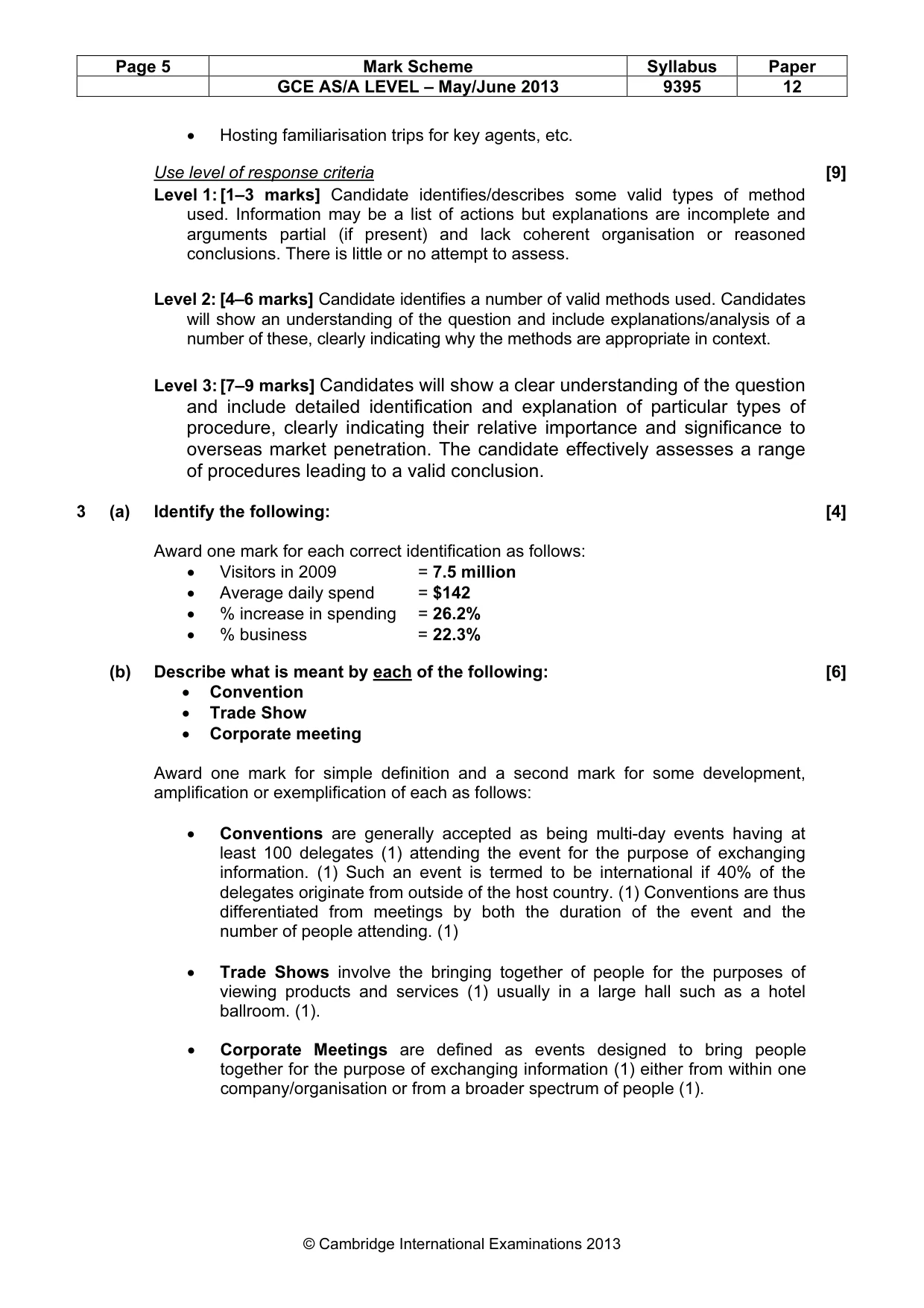
Page 5 Mark Scheme Syllabus Paper GCE AS/A LEVEL – May/June 2013 9395 12 © Cambridge International Examinations 2013 • Hosting familiarisation trips for key agents, etc. Use level of response criteria Level 1: [1–3 marks] Candidate identifies/describes some valid types of method used. Information may be a list of actions but explanations are incomplete and arguments partial (if present) and lack coherent organisation or reasoned conclusions. There is little or no attempt to assess. Level 2: [4–6 marks] Candidate identifies a number of valid methods used. Candidates will show an understanding of the question and include explanations/analysis of a number of these, clearly indicating why the methods are appropriate in context. Level 3: [7–9 marks] Candidates will show a clear understanding of the question and include detailed identification and explanation of particular types of procedure, clearly indicating their relative importance and significance to overseas market penetration. The candidate effectively assesses a range of procedures leading to a valid conclusion. [9] 3 (a) Identify the following: Award one mark for each correct identification as follows: • Visitors in 2009 = 7.5 million • Average daily spend = $142 • % increase in spending = 26.2% • % business = 22.3% [4] (b) Describe what is meant by each of the following: • Convention • Trade Show • Corporate meeting Award one mark for simple definition and a second mark for some development, amplification or exemplification of each as follows: • Conventions are generally accepted as being multi-day events having at least 100 delegates (1) attending the event for the purpose of exchanging information. (1) Such an event is termed to be international if 40% of the delegates originate from outside of the host country. (1) Conventions are thus differentiated from meetings by both the duration of the event and the number of people attending. (1) • Trade Shows involve the bringing together of people for the purposes of viewing products and services (1) usually in a large hall such as a hotel ballroom. (1). [6] • Corporate Meetings are defined as events designed to bring people together for the purpose of exchanging information (1) either from within one company/organisation or from a broader spectrum of people (1).
Mark scheme, page 6
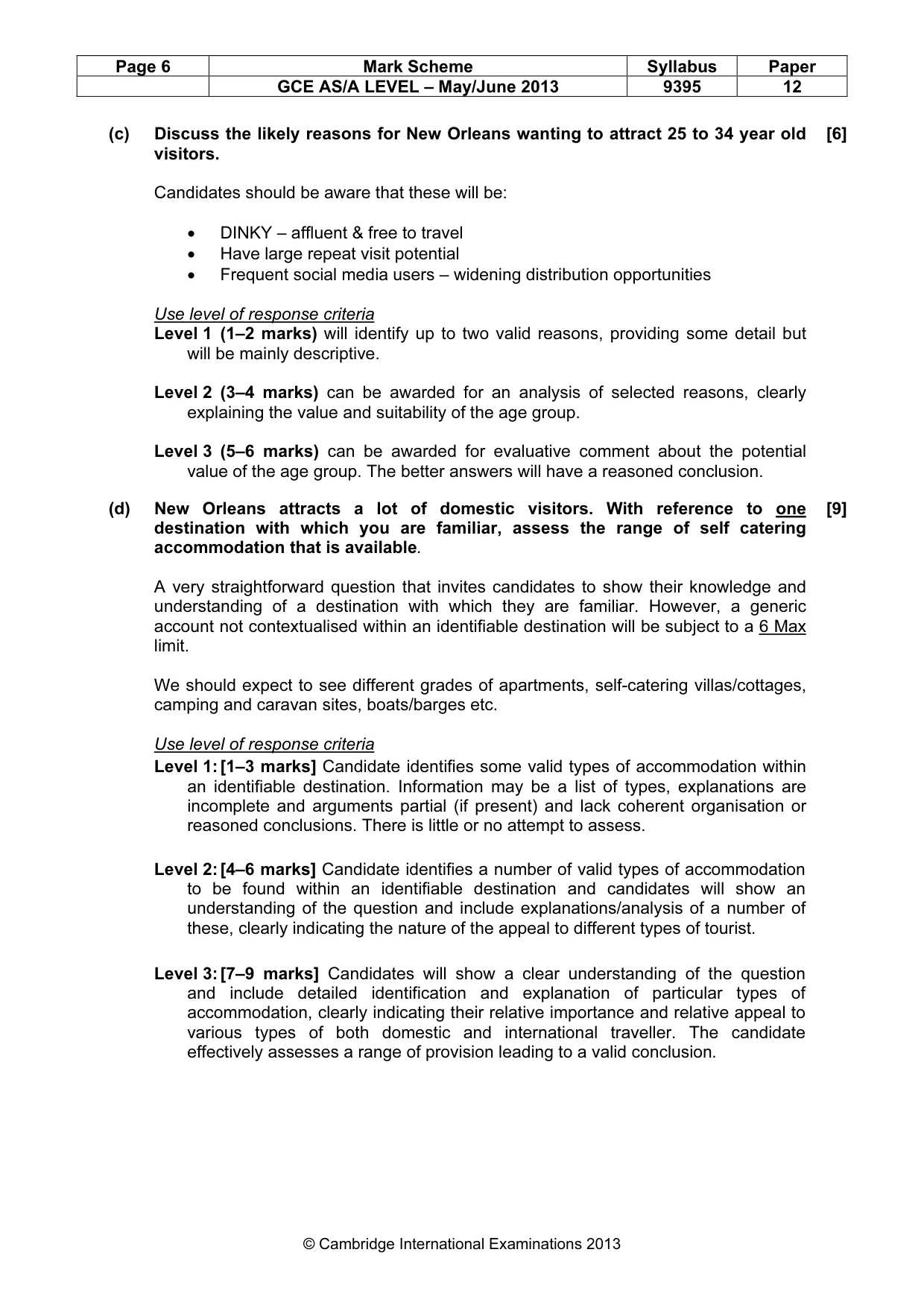
Page 6 Mark Scheme Syllabus Paper GCE AS/A LEVEL – May/June 2013 9395 12 © Cambridge International Examinations 2013 (c) Discuss the likely reasons for New Orleans wanting to attract 25 to 34 year old visitors. Candidates should be aware that these will be: • DINKY – affluent & free to travel • Have large repeat visit potential • Frequent social media users – widening distribution opportunities Use level of response criteria Level 1 (1–2 marks) will identify up to two valid reasons, providing some detail but will be mainly descriptive. Level 2 (3–4 marks) can be awarded for an analysis of selected reasons, clearly explaining the value and suitability of the age group. Level 3 (5–6 marks) can be awarded for evaluative comment about the potential value of the age group. The better answers will have a reasoned conclusion. [6] (d) New Orleans attracts a lot of domestic visitors. With reference to one destination with which you are familiar, assess the range of self catering accommodation that is available. A very straightforward question that invites candidates to show their knowledge and understanding of a destination with which they are familiar. However, a generic account not contextualised within an identifiable destination will be subject to a 6 Max limit. We should expect to see different grades of apartments, self-catering villas/cottages, camping and caravan sites, boats/barges etc. Use level of response criteria Level 1: [1–3 marks] Candidate identifies some valid types of accommodation within an identifiable destination. Information may be a list of types, explanations are incomplete and arguments partial (if present) and lack coherent organisation or reasoned conclusions. There is little or no attempt to assess. [9] Level 2: [4–6 marks] Candidate identifies a number of valid types of accommodation to be found within an identifiable destination and candidates will show an understanding of the question and include explanations/analysis of a number of these, clearly indicating the nature of the appeal to different types of tourist. Level 3: [7–9 marks] Candidates will show a clear understanding of the question and include detailed identification and explanation of particular types of accommodation, clearly indicating their relative importance and relative appeal to various types of both domestic and international traveller. The candidate effectively assesses a range of provision leading to a valid conclusion.
Mark scheme, page 7
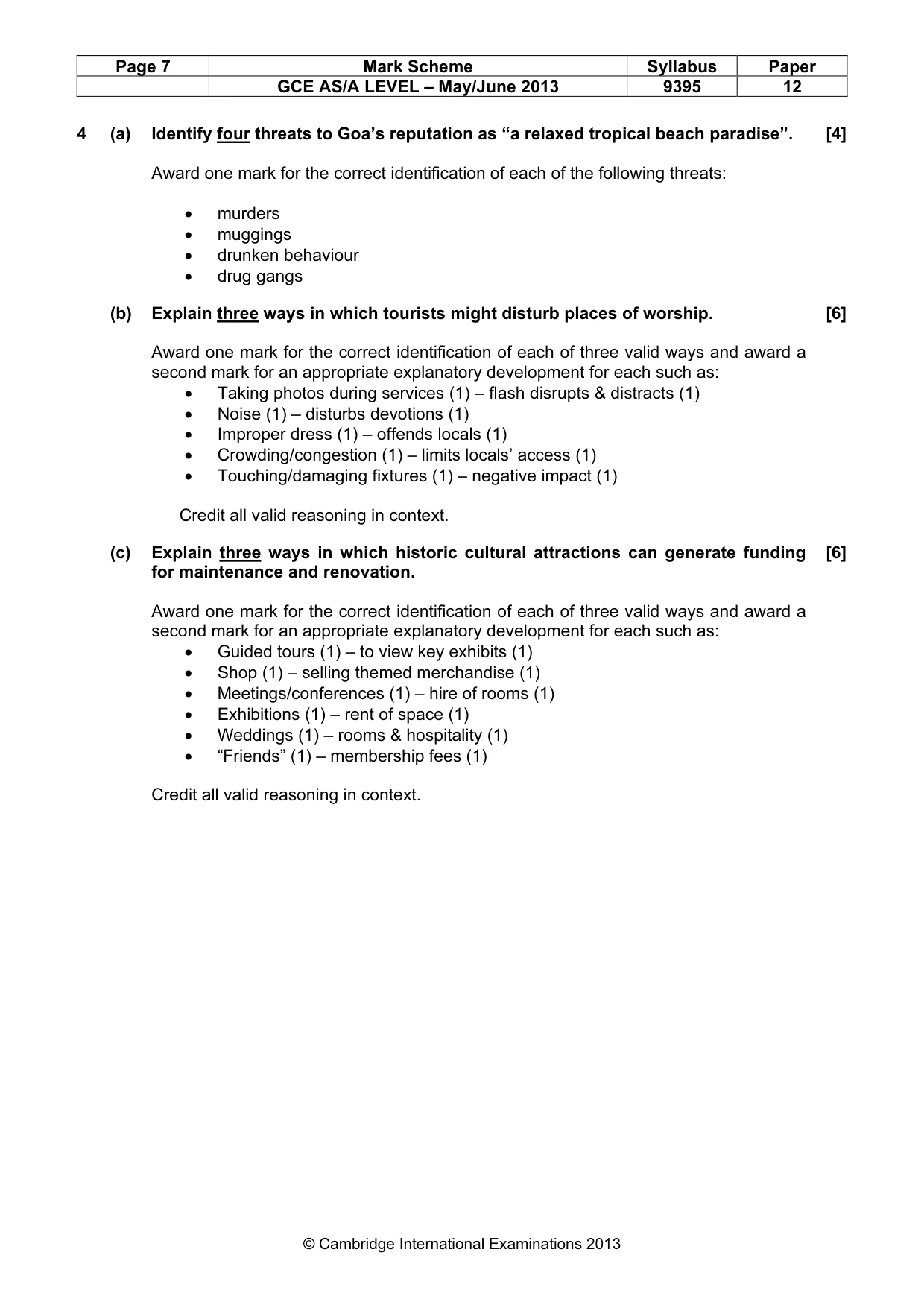
Page 7 Mark Scheme Syllabus Paper GCE AS/A LEVEL – May/June 2013 9395 12 © Cambridge International Examinations 2013 4 (a) Identify four threats to Goa’s reputation as “a relaxed tropical beach paradise”. Award one mark for the correct identification of each of the following threats: • murders • muggings • drunken behaviour • drug gangs [4] (b) Explain three ways in which tourists might disturb places of worship. Award one mark for the correct identification of each of three valid ways and award a second mark for an appropriate explanatory development for each such as: • Taking photos during services (1) – flash disrupts & distracts (1) • Noise (1) – disturbs devotions (1) • Improper dress (1) – offends locals (1) • Crowding/congestion (1) – limits locals’ access (1) • Touching/damaging fixtures (1) – negative impact (1) Credit all valid reasoning in context. [6] (c) Explain three ways in which historic cultural attractions can generate funding for maintenance and renovation. Award one mark for the correct identification of each of three valid ways and award a second mark for an appropriate explanatory development for each such as: • Guided tours (1) – to view key exhibits (1) • Shop (1) – selling themed merchandise (1) • Meetings/conferences (1) – hire of rooms (1) • Exhibitions (1) – rent of space (1) • Weddings (1) – rooms & hospitality (1) • “Friends” (1) – membership fees (1) Credit all valid reasoning in context. [6]
Mark scheme, page 8
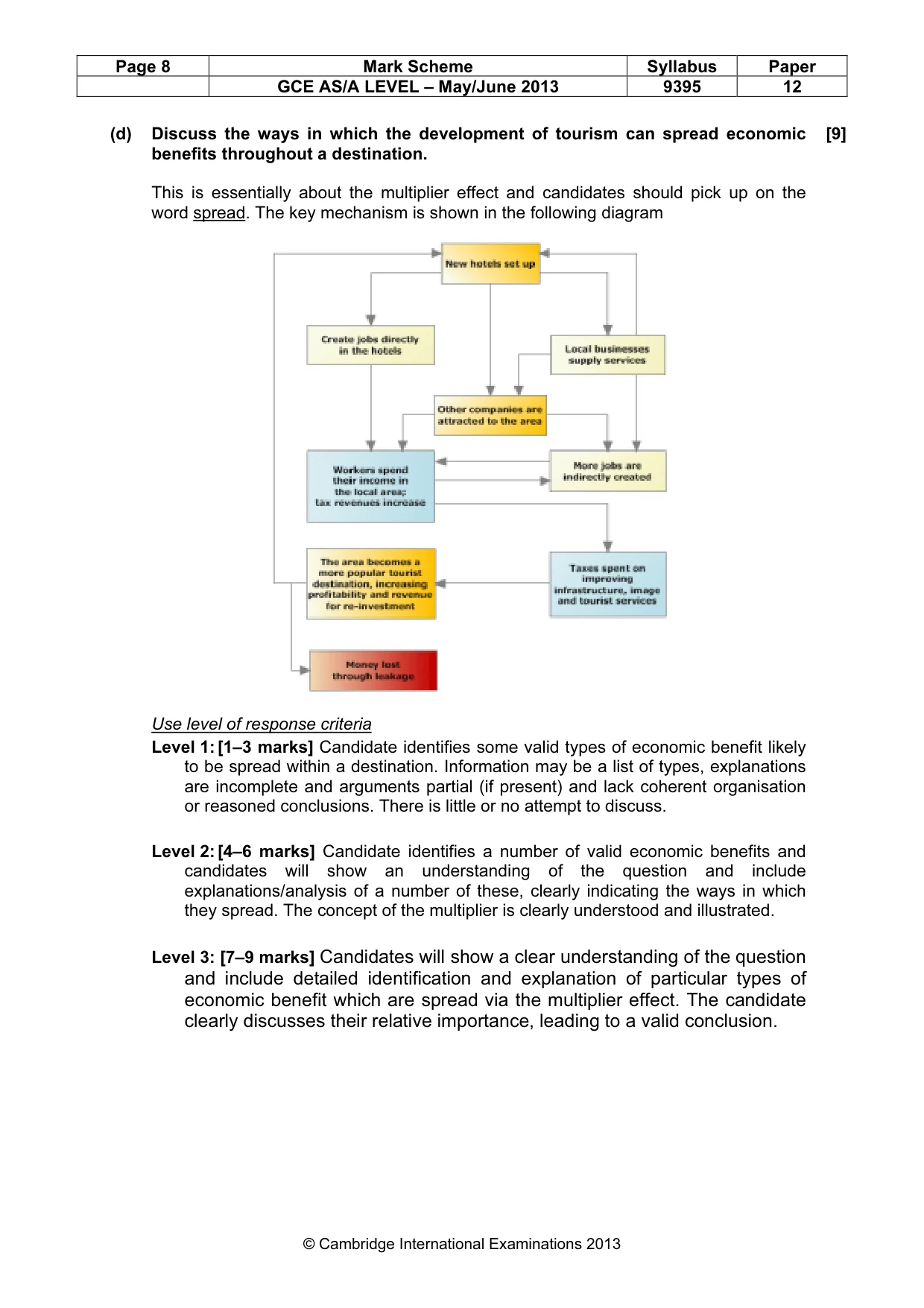
Page 8 Mark Scheme Syllabus Paper GCE AS/A LEVEL – May/June 2013 9395 12 © Cambridge International Examinations 2013 (d) Discuss the ways in which the development of tourism can spread economic benefits throughout a destination. This is essentially about the multiplier effect and candidates should pick up on the word spread. The key mechanism is shown in the following diagram Use level of response criteria Level 1: [1–3 marks] Candidate identifies some valid types of economic benefit likely to be spread within a destination. Information may be a list of types, explanations are incomplete and arguments partial (if present) and lack coherent organisation or reasoned conclusions. There is little or no attempt to discuss. Level 2: [4–6 marks] Candidate identifies a number of valid economic benefits and candidates will show an understanding of the question and include explanations/analysis of a number of these, clearly indicating the ways in which they spread. The concept of the multiplier is clearly understood and illustrated. Level 3: [7–9 marks] Candidates will show a clear understanding of the question and include detailed identification and explanation of particular types of economic benefit which are spread via the multiplier effect. The candidate clearly discusses their relative importance, leading to a valid conclusion. [9]
What you needed in this session
Cambridge’s own grade thresholds for 2013 May/June, Paper 1 · Variant 2. A higher threshold means an easier paper — the bar moves with how the cohort did.