Cambridge A Level Travel and Tourism 9395 — 2013 May/June Paper 1 · Variant 1
9395/11/M/J/13 · 100 marks · ≈113 min
The question paper and its mark scheme, free to read here and free to download. This is Cambridge’s own paper, exactly as it was sat.
Question paper16 pages




Mark scheme9 pages
Answers below. Sit the paper first if you are practising.
Paper as text
Question paper, page 1
This document consists of 13 printed pages, 3 blank pages and 1 Insert. DC (AC) 62204/3 © UCLES 2013 [Turn over UNIVERSITY OF CAMBRIDGE INTERNATIONAL EXAMINATIONS General Certificate of Education Advanced Subsidiary Level and Advanced Level * 4 6 0 9 4 0 4 5 7 2 * TRAVEL AND TOURISM 9395/11 Paper 1 Core May/June 2013 2 hours 30 minutes Candidates answer on the Question Paper. No Additional Materials required. READ THESE INSTRUCTIONS FIRST Write your Centre number, candidate number and name on all the work you hand in. Write in dark blue or black pen. Do not use staples, paper clips, highlighters, glue or correction fluid. You may use a pencil for any diagrams, graphs or rough working. DO NOT WRITE IN ANY BARCODES. Answer all questions. All the Figures referred to in the questions are contained in the Insert. The number of marks is given in brackets [ ] at the end of each question or part question.
Question paper, page 2
2 9395/11/M/J/13 © UCLES 2013 For Examiner’s Use Question 1 Refer to Fig. 1 (Insert), a notice for the attention of employees working in a travel and tourism organisation. (a) Describe how following two of ‘The Golden Rules’ will allow employees to exceed customer expectations. Golden Rule … … … … … Golden Rule … … … … …[4]
Question paper, page 3
3 9395/11/M/J/13 © UCLES 2013 [Turn over For Examiner’s Use (b) Many travel and tourism organisations arrange in-house customer service training for their employees. Describe three ways in which in-house training is likely to be delivered. 1 … … … … 2 … … … … 3 … … … …[6] (c) For one job role within a travel and tourism organisation with which you are familiar, assess the ways in which employee performance is monitored. Organisation … Job role … … … … … … … … … … … … … [6]
Question paper, page 4
4 9395/11/M/J/13 © UCLES 2013 For Examiner’s Use (d) Discuss the ways in which it is possible for travel and tourism organisations to increase staff motivation. … … … … … … … … … … … … … … … … … … … … … … … … … …[9] [Total: 25]
Question paper, page 5
5 9395/11/M/J/13 © UCLES 2013 [Turn over For Examiner’s Use Question 2 Refer to Fig. 2 (Insert), a diagram about the Multiplier Effect. (a) With reference to Fig. 2, describe how the Multiplier Effect can create positive economic impacts within a destination. … … … … … … … …[4] (b) Identify and explain two ways in which leakage from tourism projects usually occurs. 1 … … … … … … 2 … … … … … …[6]
Question paper, page 6
6 9395/11/M/J/13 © UCLES 2013 For Examiner’s Use (c) All-inclusive resort properties are examples of new tourism projects that have been established in many destinations in Less Economically Developed Countries (LEDCs). Explain three negative sociocultural impacts that can result from their operation. 1 … … … … 2 … … … … 3 … … … …[6]
Question paper, page 7
7 9395/11/M/J/13 © UCLES 2013 [Turn over For Examiner’s Use (d) Discuss the view that business tourism destinations experience a stronger Multiplier Effect than leisure destinations. Support your answer with reference to examples with which you are familiar. … … … … … … … … … … … … … … … … … … … … … … … … … [9] Total: 25]
Question paper, page 8
8 9395/11/M/J/13 © UCLES 2013 For Examiner’s Use Question 3 Refer to Fig. 3 (Insert), the results of a survey about visiting friends and relatives (VFR) tourism in a destination. (a) With reference to Fig. 3, identify the four components of a destination’s travel and tourism industry that are likely to benefit from VFR tourism. 1 … 2 … 3 … 4 …[4] (b) Explain three factors that have caused many destinations to experience a recent increase in the volume of international VFR tourism. 1 … … … … 2 … … … … 3 … … … …[6]
Question paper, page 9
9 9395/11/M/J/13 © UCLES 2013 [Turn over For Examiner’s Use (c) Explain three advantages to VFR tourists of using private cars for the purpose of sightseeing trips. 1 … … … … 2 … … … … 3 … … … …[6]
Question paper, page 10
10 9395/11/M/J/13 © UCLES 2013 For Examiner’s Use (d) Evaluate the different sources of tourist information that can be used when planning a day trip with visiting friends or relatives. … … … … … … … … … … … … … … … … … … … … … … … … … …[9] [Total: 25]
Question paper, page 11
11 9395/11/M/J/13 © UCLES 2013 [Turn over For Examiner’s Use Question 4 Refer to Fig. 4 (Insert), a news item about Machu Picchu in Peru. (a) Identify each of the following: • the name of the mountain range in which Machu Picchu is located … • the name of the river flowing through the Machu Picchu reserve … • the town nearest to Machu Picchu … • the name of the 500-year-old route through the area …[4] (b) With reference to Fig. 4, explain three likely negative environmental impacts that have resulted from the large numbers of visitors to Machu Picchu. 1 … … … … 2 … … … … 3 … … … …[6]
Question paper, page 12
12 9395/11/M/J/13 © UCLES 2013 For Examiner’s Use (c) Peru’s National Institute of Culture (INC) is a government organisation. Explain two reasons why such organisations involve both the community and the private sector in tourism development. 1 … … … … … … 2 … … … … … …[6]
Question paper, page 13
13 9395/11/M/J/13 © UCLES 2013 For Examiner’s Use (d) Discuss how the carrying capacity of a tourist destination is likely to change as the area passes through the stages of the Butler model of destination evolution. Support your answer with examples with which you are familiar. … … … … … … … … … … … … … … … … … … … … … … … … …[9] [Total: 25]
Question paper, page 14
14 9395/11/M/J/13 © UCLES 2013 BLANK PAGE
Question paper, page 15
15 9395/11/M/J/13 © UCLES 2013 BLANK PAGE
Question paper, page 16
16 9395/11/M/J/13 © UCLES 2013 Permission to reproduce items where third-party owned material protected by copyright is included has been sought and cleared where possible. Every reasonable effort has been made by the publisher (UCLES) to trace copyright holders, but if any items requiring clearance have unwittingly been included, the publisher will be pleased to make amends at the earliest possible opportunity. University of Cambridge International Examinations is part of the Cambridge Assessment Group. Cambridge Assessment is the brand name of University of Cambridge Local Examinations Syndicate (UCLES), which is itself a department of the University of Cambridge. BLANK PAGE
Mark scheme, page 1
CAMBRIDGE INTERNATIONAL EXAMINATIONS GCE Advanced Subsidiary Level and GCE Advanced Level MARK SCHEME for the May/June 2013 series 9395 TRAVEL AND TOURISM 9395/11 Paper 1 (Core Paper), maximum raw mark 100 This mark scheme is published as an aid to teachers and candidates, to indicate the requirements of the examination. It shows the basis on which Examiners were instructed to award marks. It does not indicate the details of the discussions that took place at an Examiners’ meeting before marking began, which would have considered the acceptability of alternative answers. Mark schemes should be read in conjunction with the question paper and the Principal Examiner Report for Teachers. Cambridge will not enter into discussions about these mark schemes. Cambridge is publishing the mark schemes for the May/June 2013 series for most IGCSE, GCE Advanced Level and Advanced Subsidiary Level components and some Ordinary Level components.
Mark scheme, page 2
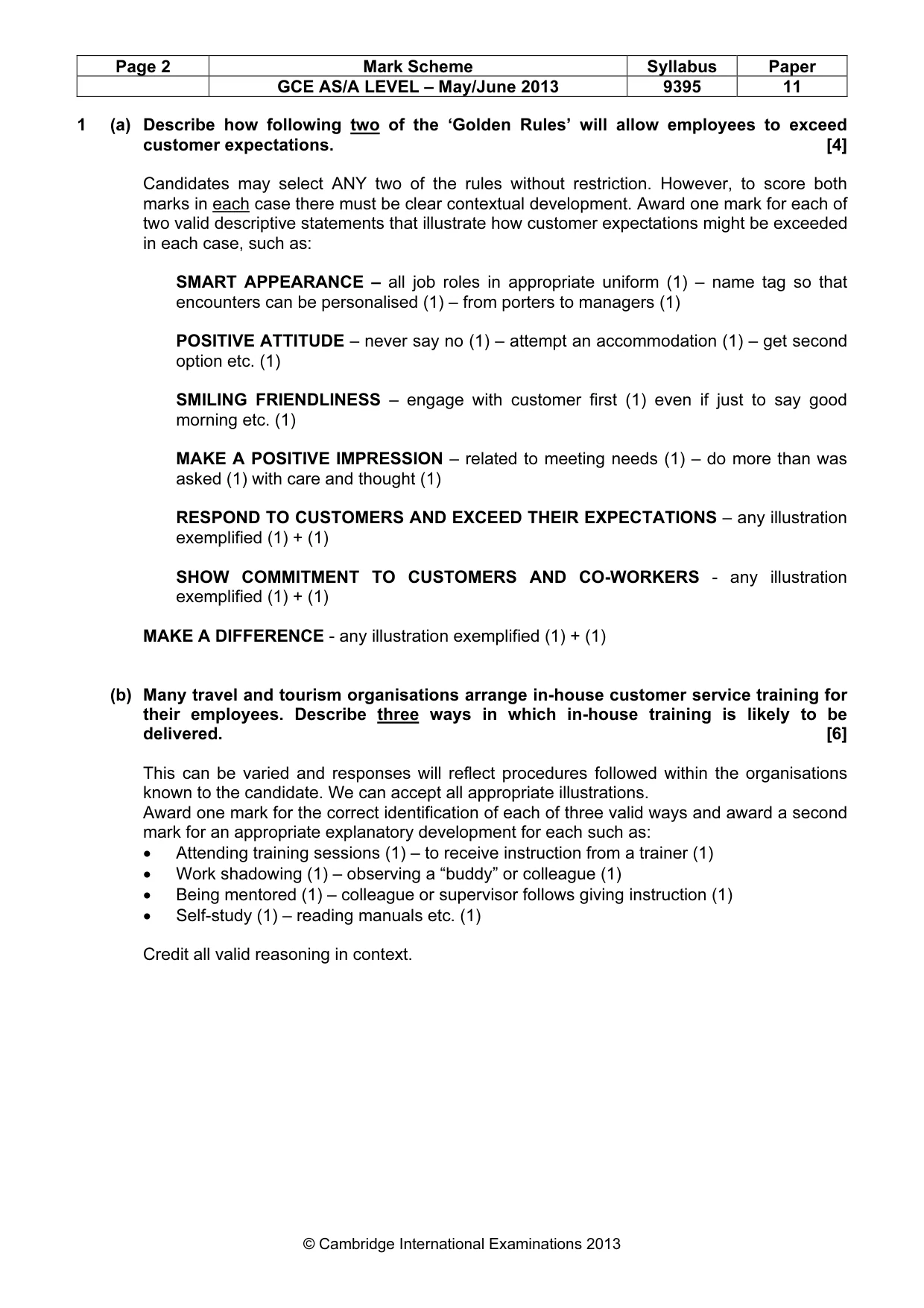
Page 2 Mark Scheme Syllabus Paper GCE AS/A LEVEL – May/June 2013 9395 11 © Cambridge International Examinations 2013 1 (a) Describe how following two of the ‘Golden Rules’ will allow employees to exceed customer expectations. [4] Candidates may select ANY two of the rules without restriction. However, to score both marks in each case there must be clear contextual development. Award one mark for each of two valid descriptive statements that illustrate how customer expectations might be exceeded in each case, such as: SMART APPEARANCE – all job roles in appropriate uniform (1) – name tag so that encounters can be personalised (1) – from porters to managers (1) POSITIVE ATTITUDE – never say no (1) – attempt an accommodation (1) – get second option etc. (1) SMILING FRIENDLINESS – engage with customer first (1) even if just to say good morning etc. (1) MAKE A POSITIVE IMPRESSION – related to meeting needs (1) – do more than was asked (1) with care and thought (1) RESPOND TO CUSTOMERS AND EXCEED THEIR EXPECTATIONS – any illustration exemplified (1) + (1) SHOW COMMITMENT TO CUSTOMERS AND CO-WORKERS - any illustration exemplified (1) + (1) MAKE A DIFFERENCE - any illustration exemplified (1) + (1) (b) Many travel and tourism organisations arrange in-house customer service training for their employees. Describe three ways in which in-house training is likely to be delivered. [6] This can be varied and responses will reflect procedures followed within the organisations known to the candidate. We can accept all appropriate illustrations. Award one mark for the correct identification of each of three valid ways and award a second mark for an appropriate explanatory development for each such as: • Attending training sessions (1) – to receive instruction from a trainer (1) • Work shadowing (1) – observing a “buddy” or colleague (1) • Being mentored (1) – colleague or supervisor follows giving instruction (1) • Self-study (1) – reading manuals etc. (1) Credit all valid reasoning in context.
Mark scheme, page 3
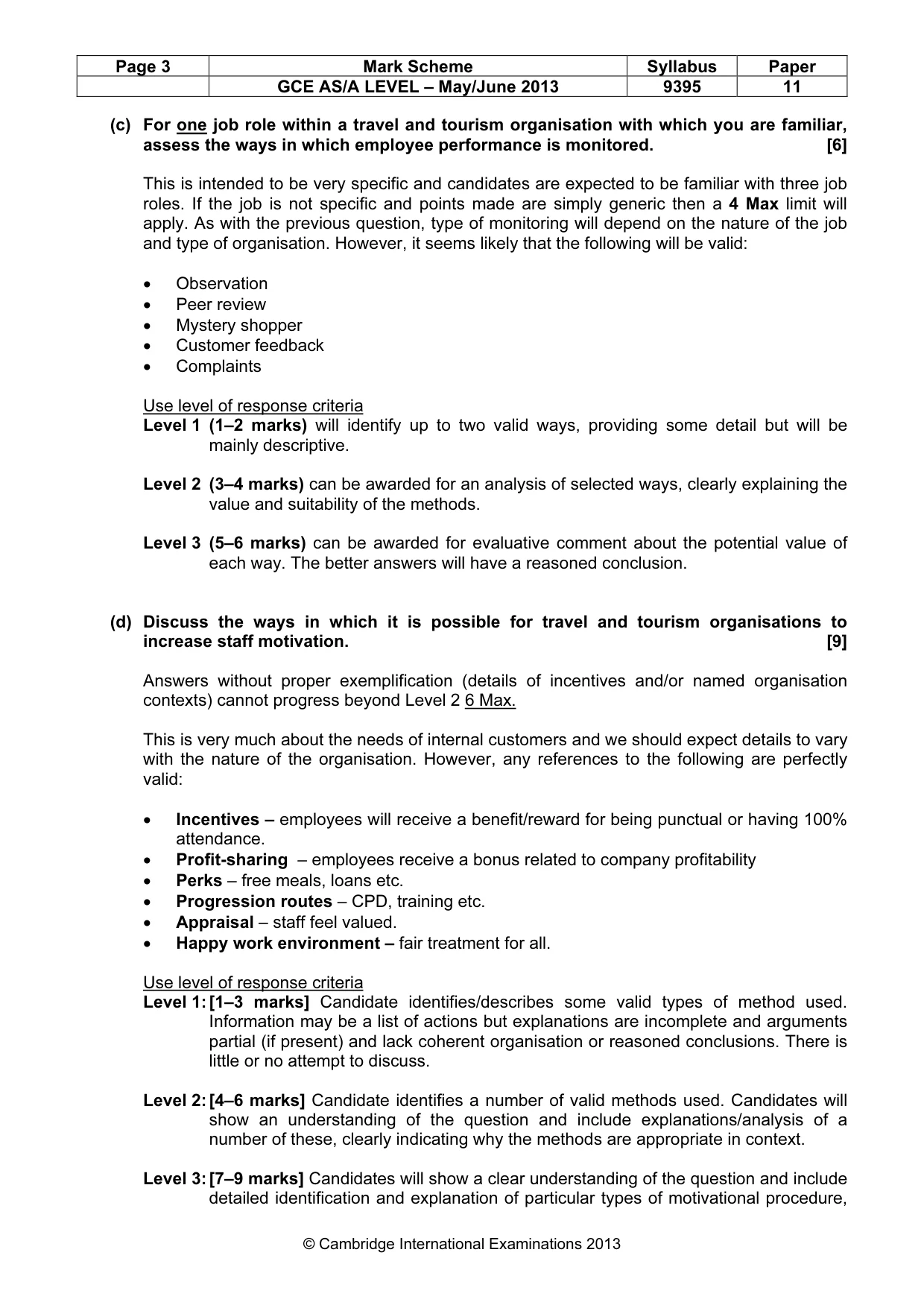
Page 3 Mark Scheme Syllabus Paper GCE AS/A LEVEL – May/June 2013 9395 11 © Cambridge International Examinations 2013 (c) For one job role within a travel and tourism organisation with which you are familiar, assess the ways in which employee performance is monitored. [6] This is intended to be very specific and candidates are expected to be familiar with three job roles. If the job is not specific and points made are simply generic then a 4 Max limit will apply. As with the previous question, type of monitoring will depend on the nature of the job and type of organisation. However, it seems likely that the following will be valid: • Observation • Peer review • Mystery shopper • Customer feedback • Complaints Use level of response criteria Level 1 (1–2 marks) will identify up to two valid ways, providing some detail but will be mainly descriptive. Level 2 (3–4 marks) can be awarded for an analysis of selected ways, clearly explaining the value and suitability of the methods. Level 3 (5–6 marks) can be awarded for evaluative comment about the potential value of each way. The better answers will have a reasoned conclusion. (d) Discuss the ways in which it is possible for travel and tourism organisations to increase staff motivation. [9] Answers without proper exemplification (details of incentives and/or named organisation contexts) cannot progress beyond Level 2 6 Max. This is very much about the needs of internal customers and we should expect details to vary with the nature of the organisation. However, any references to the following are perfectly valid: • Incentives – employees will receive a benefit/reward for being punctual or having 100% attendance. • Profit-sharing – employees receive a bonus related to company profitability • Perks – free meals, loans etc. • Progression routes – CPD, training etc. • Appraisal – staff feel valued. • Happy work environment – fair treatment for all. Use level of response criteria Level 1: [1–3 marks] Candidate identifies/describes some valid types of method used. Information may be a list of actions but explanations are incomplete and arguments partial (if present) and lack coherent organisation or reasoned conclusions. There is little or no attempt to discuss. Level 2: [4–6 marks] Candidate identifies a number of valid methods used. Candidates will show an understanding of the question and include explanations/analysis of a number of these, clearly indicating why the methods are appropriate in context. Level 3: [7–9 marks] Candidates will show a clear understanding of the question and include detailed identification and explanation of particular types of motivational procedure,
Mark scheme, page 4
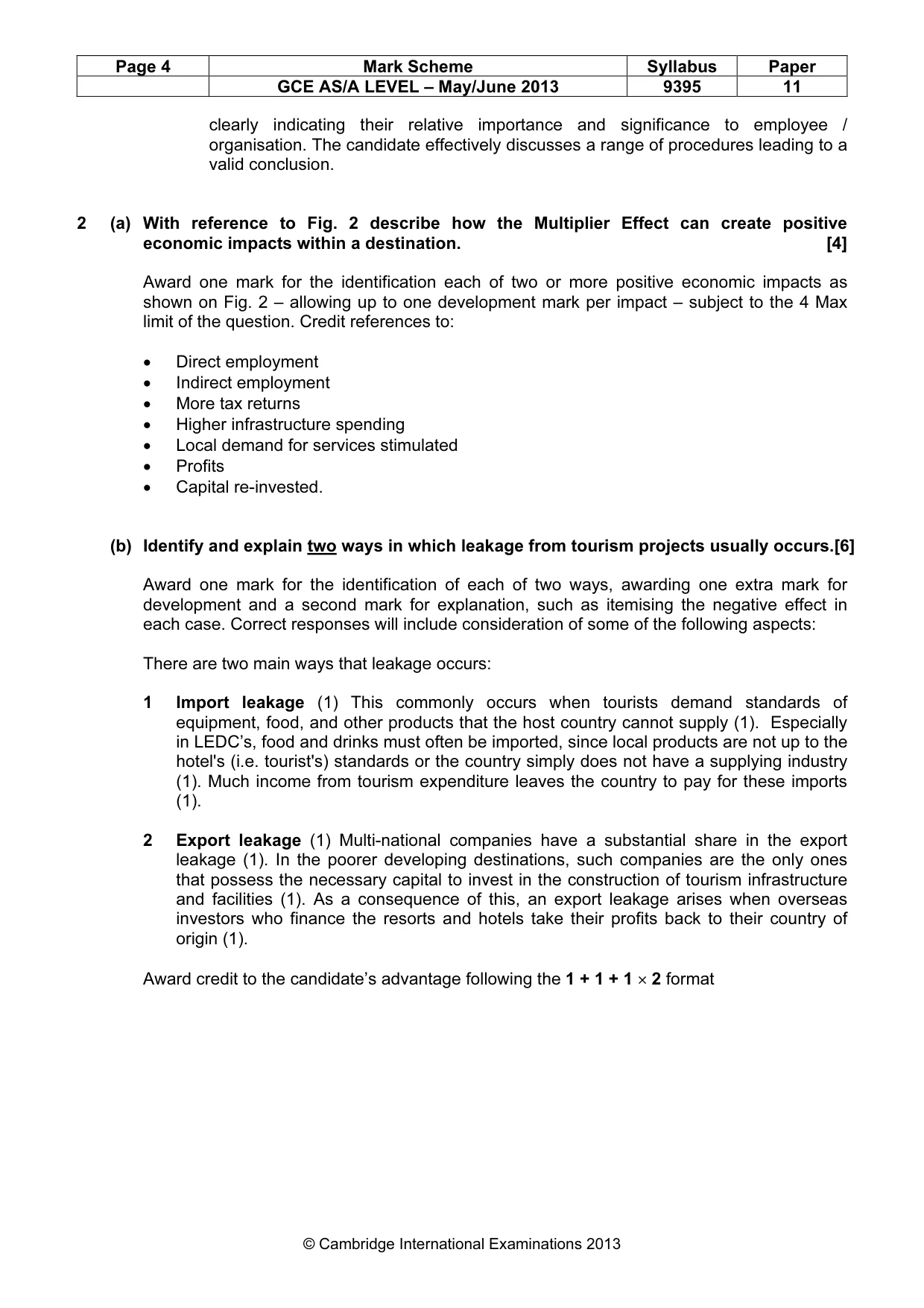
Page 4 Mark Scheme Syllabus Paper GCE AS/A LEVEL – May/June 2013 9395 11 © Cambridge International Examinations 2013 clearly indicating their relative importance and significance to employee / organisation. The candidate effectively discusses a range of procedures leading to a valid conclusion. 2 (a) With reference to Fig. 2 describe how the Multiplier Effect can create positive economic impacts within a destination. [4] Award one mark for the identification each of two or more positive economic impacts as shown on Fig. 2 – allowing up to one development mark per impact – subject to the 4 Max limit of the question. Credit references to: • Direct employment • Indirect employment • More tax returns • Higher infrastructure spending • Local demand for services stimulated • Profits • Capital re-invested. (b) Identify and explain two ways in which leakage from tourism projects usually occurs.[6] Award one mark for the identification of each of two ways, awarding one extra mark for development and a second mark for explanation, such as itemising the negative effect in each case. Correct responses will include consideration of some of the following aspects: There are two main ways that leakage occurs: 1 Import leakage (1) This commonly occurs when tourists demand standards of equipment, food, and other products that the host country cannot supply (1). Especially in LEDC’s, food and drinks must often be imported, since local products are not up to the hotel's (i.e. tourist's) standards or the country simply does not have a supplying industry (1). Much income from tourism expenditure leaves the country to pay for these imports (1). 2 Export leakage (1) Multi-national companies have a substantial share in the export leakage (1). In the poorer developing destinations, such companies are the only ones that possess the necessary capital to invest in the construction of tourism infrastructure and facilities (1). As a consequence of this, an export leakage arises when overseas investors who finance the resorts and hotels take their profits back to their country of origin (1). Award credit to the candidate’s advantage following the 1 + 1 + 1 × 2 format
Mark scheme, page 5
Page 5 Mark Scheme Syllabus Paper GCE AS/A LEVEL – May/June 2013 9395 11 © Cambridge International Examinations 2013 (c) All-inclusive resort properties are examples of new tourism projects that have been established in many destinations in Less Economically Developed Countries (LEDCs). Explain three negative socio-cultural impacts that can result from their operation. [6] Award one mark for the correct identification of each of three valid negative socio-cultural impacts and award a second mark for an appropriate explanatory development for each such as: • The Demonstration Effect (1) can lead to the erosion of traditional culture and values as the local population adopts visitor behaviour and this is often a major cause of tension within sections of local society (1) • Loss of authenticity and staged authenticity (1) is adapting cultural activities or performing shows for tourists as if they were real life (1) • Conflicts over beach access (1) hotel versus local fishermen (1) • Hotel security excludes locals (1) – feeling of isolation/segregation (1) • Population displacement (1) – hotel buys up land for construction & expansion (1) • Crime increases (1) – rich tourists a target (1) Credit all valid reasoning in context. (d) Discuss the view that business tourism destinations experience a stronger Multiplier Effect than leisure destinations. Support your answer with reference to examples with which you are familiar. [9] This represents a new style of question and requires the candidate to form an opinion backed up by specific examples of particular destinations and/or named tourist facilities. Answers without any exemplification cannot proceed beyond Level 2 6 Max. Ideas worthy of consideration include: • Conferences, exhibitions and trade fairs are important components of the tourism economy of many international destinations. • Business tourism is growing at a faster rate than leisure tourism. • More significantly, the average conference delegate spends some 2.5 times more than the average holiday visitor. • Many business tourists use a destination’s leisure facilities and some will return as leisure tourists with their families. • It is to be expected that many destinations will try and maximise their business tourism receipts by providing a range of facilities and services, thus stimulating the multiplier. Use level of response criteria Level 1: [1–3 marks] Candidate identifies/describes some valid types of business-generated multiplier effect. Information may be a list of actions but explanations are incomplete and arguments partial (if present) and lack coherent organisation or reasoned conclusions. There is little or no attempt to discuss. Level 2: [4–6 marks] Candidate identifies a number of valid business tourism characteristics. Candidates will show an understanding of the question and include explanations/analysis of a number of these, clearly indicating what the multiplier effects are, set in an appropriate context. Level 3: [7–9 marks] Candidates will show a clear understanding of the question and include detailed identification and explanation of particular types of business tourism multiplier, clearly indicating the relative importance and significance to a given destination. The candidate effectively discusses a range of features leading to a valid conclusion.
Mark scheme, page 6
Page 6 Mark Scheme Syllabus Paper GCE AS/A LEVEL – May/June 2013 9395 11 © Cambridge International Examinations 2013 3 (a) With reference to Fig.3, identify the four components of a destination’s travel and tourism industry that are likely to benefit from VFR tourism. [4] Award one mark for the correct identification of each of the following: • Events • Attractions • Restaurants • Accommodation (b) Explain three factors that have caused many destinations to experience a recent increase in the volume of international VFR tourism. [6] Award one mark for the correct identification of each of three valid factors and award a second mark for an appropriate explanatory development for each such as: • Changes in sending country’s GDP (1) – increased purchasing power (1) • Consumer expenditure (1) – higher levels of disposable income (1) • Changes in the supply of air services (1) – lower fare levels and better route networks(1) • Accessibility has increased (1) road & rail connectivity improved (1) • Increase in migration (1) – more people now have a friend or relative in locations • Second-home ownership increased (1) – more family visits (1) Credit all valid reasoning. (c) Explain three advantages to VFR tourists of using private cars for the purpose of sight-seeing trips. [6] Award one mark for the correct identification of each of three valid advantages and award a second mark for an appropriate explanatory development for each such as: • Convenience (1) – go when, where and along any route (1) • Cost effective for families/groups (1) – cheaper than public transport (1) • Door-to-door journeys (1) - no transfers (1) • Luggage/belongings easily carried (1) – fit extra on roof rack (1) • Ability to stop/sightsee at will (1) – no timetable to follow (1) Credit all valid reasoning.
Mark scheme, page 7
Page 7 Mark Scheme Syllabus Paper GCE AS/A LEVEL – May/June 2013 9395 11 © Cambridge International Examinations 2013 (d) Evaluate the different sources of tourist information that can be used when planning a day trip with visiting friends or relatives. [9] This is quite straightforward but sources used should be appropriate to the question’s context. Evaluate means that answers should focus on a particular source’s usefulness. We should expect references to some of: • Maps – route for self-drivers • Timetables – to plan journey • Leaflets – give full details of all products and services to be found at destination • Guide books – allows self-guided tours • TIC staff – can answer questions/give advice • Internet screen display – images/data in convenient format, no need to visit to book etc. Use level of response criteria Level 1: [1–3 marks] Candidate identifies/describes some valid sources of tourist information. Information may be a list of sources but analysis/explanations are incomplete and arguments partial (if present) and lack coherent organisation or reasoned conclusions. There is little or no attempt to evaluate. Level 2: [4–6 marks] Candidate identifies a number of valid sources of tourist information. Candidates will show an understanding of the question and include explanations/analysis of a number of these, clearly indicating their usefulness. Level 3: [7–9 marks] Candidates will show a clear understanding of the question and include detailed identification and explanation of particular types of information source, clearly indicating their relative importance and significance. The candidate effectively evaluates a range of sources leading to a valid conclusion. 4 (a) Identify each of the following: [4] Award one mark for each of four correct identifications as follows: • Mountain range = Andes • River = Urubamba • Nearest town = Aguas Calientes • 500 year old route = The Inca Trail (b) With reference to Fig. 4, explain three likely negative environmental impacts that have resulted from the large numbers of visitors to Machu Picchu. [6] Award one mark for the correct identification of each of three valid negative environmental impacts and award a second mark for an appropriate explanatory development for each such as suggested in Fig. 4: • Footpath erosion along Inca Trail (1) - tourists using the same trail over and over again trample the vegetation and soil (1) • Water pollution (1) - leaving rubbish along the banks of the Urubamba River and the untreated sewage within it (1) • Habitat loss (1) - rare species of orchids and the endangered spectacled bear (1)
Mark scheme, page 8
Page 8 Mark Scheme Syllabus Paper GCE AS/A LEVEL – May/June 2013 9395 11 © Cambridge International Examinations 2013 (c) The National Institute of Culture of Peru (INC) is a government organisation. Explain two reasons why such organisations involve both the community and the private sector in tourism development. [6] This is quite demanding but it is clearly set in the context of destination management, sustainability and the idea of partnership between the sectors. Award one mark for the identification of each of two valid reasons and award a second/third mark for explanatory amplification of each, such as: • To achieve sustainable tourism (1) – The aim of sustainable tourism is to ensure that development brings a positive experience for local people and tourism companies (1) all three are stakeholders in the process (1) • The INC is trying to act responsibly (1) – responsible tourism means that everyone involved in tourism is responsible for achieving the goals of responsible tourism (1) • Putting VICE into operation (1) – Destination management needs to think in terms of a ‘quadruple bottom line’ approach, creating a balance (1) between the competing needs and demands of the visitor, industry, community and environment in order to achieve sustainability (1). Credit all valid reasoning and mark to candidate’s advantage following 1+1+1 x 2 format
Mark scheme, page 9
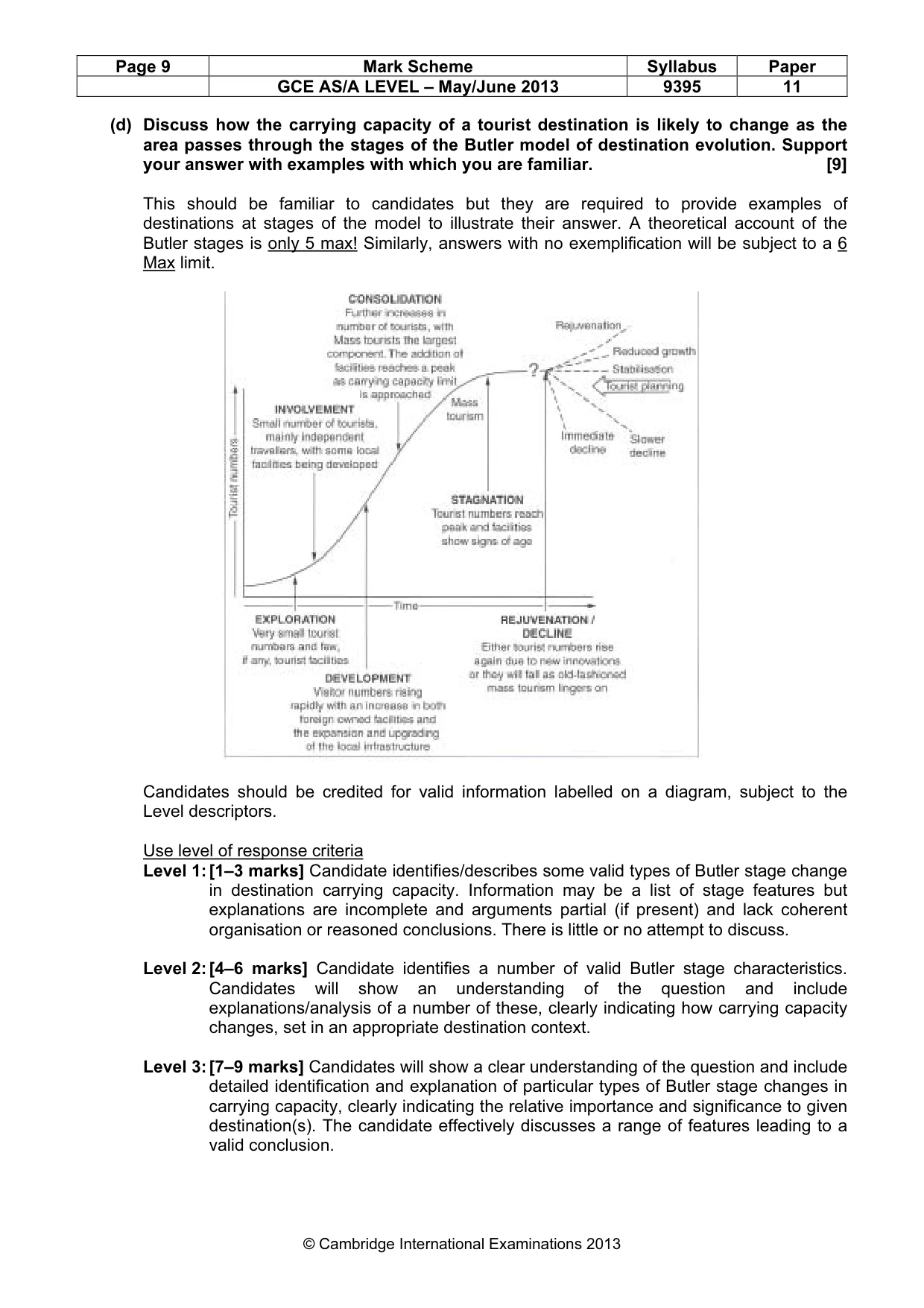
Page 9 Mark Scheme Syllabus Paper GCE AS/A LEVEL – May/June 2013 9395 11 © Cambridge International Examinations 2013 (d) Discuss how the carrying capacity of a tourist destination is likely to change as the area passes through the stages of the Butler model of destination evolution. Support your answer with examples with which you are familiar. [9] This should be familiar to candidates but they are required to provide examples of destinations at stages of the model to illustrate their answer. A theoretical account of the Butler stages is only 5 max! Similarly, answers with no exemplification will be subject to a 6 Max limit. Candidates should be credited for valid information labelled on a diagram, subject to the Level descriptors. Use level of response criteria Level 1: [1–3 marks] Candidate identifies/describes some valid types of Butler stage change in destination carrying capacity. Information may be a list of stage features but explanations are incomplete and arguments partial (if present) and lack coherent organisation or reasoned conclusions. There is little or no attempt to discuss. Level 2: [4–6 marks] Candidate identifies a number of valid Butler stage characteristics. Candidates will show an understanding of the question and include explanations/analysis of a number of these, clearly indicating how carrying capacity changes, set in an appropriate destination context. Level 3: [7–9 marks] Candidates will show a clear understanding of the question and include detailed identification and explanation of particular types of Butler stage changes in carrying capacity, clearly indicating the relative importance and significance to given destination(s). The candidate effectively discusses a range of features leading to a valid conclusion.
What you needed in this session
Cambridge’s own grade thresholds for 2013 May/June, Paper 1 · Variant 1. A higher threshold means an easier paper — the bar moves with how the cohort did.