Cambridge A Level Travel and Tourism 9395 — 2012 May/June Paper 3 · Variant 1
9395/31/M/J/12 · 100 marks · ≈113 min
The question paper and its mark scheme, free to read here and free to download. This is Cambridge’s own paper, exactly as it was sat.
Question paper16 pages



Mark scheme9 pages
Answers below. Sit the paper first if you are practising.
Paper as text
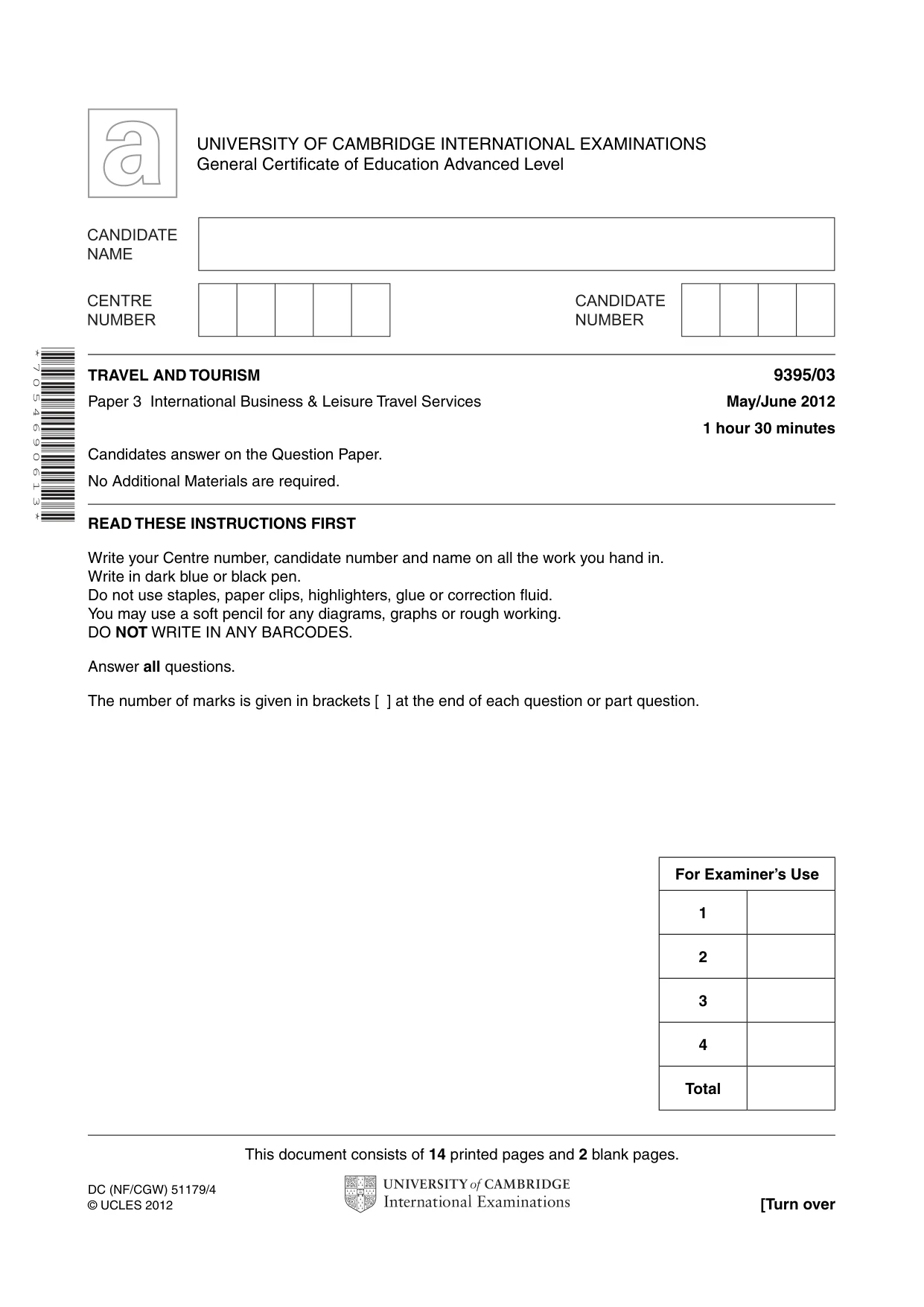
Question paper, page 1
This document consists of 14 printed pages and 2 blank pages. DC (NF/CGW) 51179/4 © UCLES 2012 [Turn over UNIVERSITY OF CAMBRIDGE INTERNATIONAL EXAMINATIONS General Certificate of Education Advanced Level * 7 0 5 4 6 9 0 6 1 3 * TRAVEL AND TOURISM 9395/03 Paper 3 International Business & Leisure Travel Services May/June 2012 1 hour 30 minutes Candidates answer on the Question Paper. No Additional Materials are required. READ THESE INSTRUCTIONS FIRST Write your Centre number, candidate number and name on all the work you hand in. Write in dark blue or black pen. Do not use staples, paper clips, highlighters, glue or correction fluid. You may use a soft pencil for any diagrams, graphs or rough working. DO NOT WRITE IN ANY BARCODES. Answer all questions. The number of marks is given in brackets [ ] at the end of each question or part question. For Examiner’s Use 1 2 3 4 Total
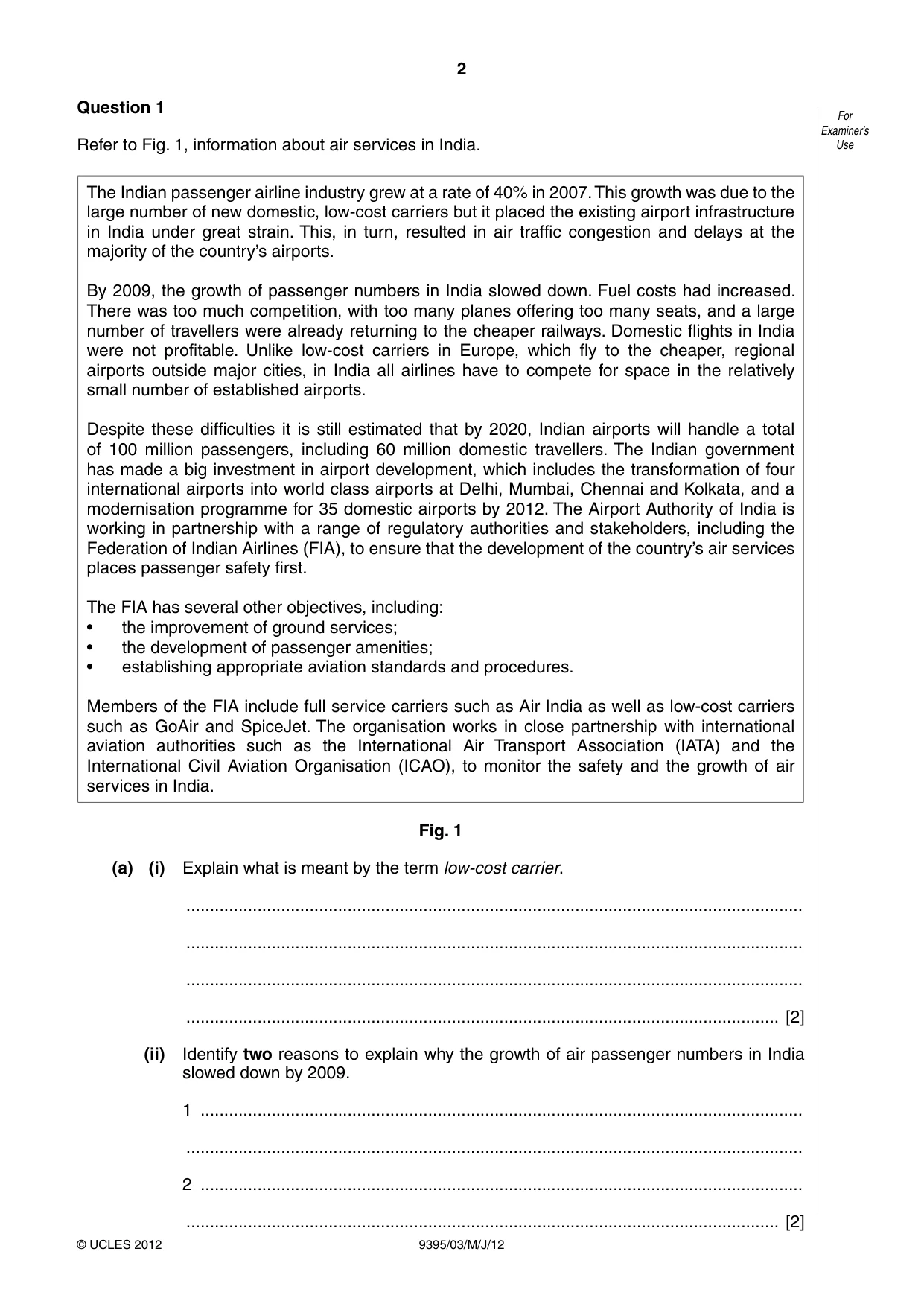
Question paper, page 2
2 9395/03/M/J/12 © UCLES 2012 For Examiner’s Use Question 1 Refer to Fig. 1, information about air services in India. The Indian passenger airline industry grew at a rate of 40% in 2007. This growth was due to the large number of new domestic, low-cost carriers but it placed the existing airport infrastructure in India under great strain. This, in turn, resulted in air traffic congestion and delays at the majority of the country’s airports. By 2009, the growth of passenger numbers in India slowed down. Fuel costs had increased. There was too much competition, with too many planes offering too many seats, and a large number of travellers were already returning to the cheaper railways. Domestic flights in India were not profitable. Unlike low-cost carriers in Europe, which fly to the cheaper, regional airports outside major cities, in India all airlines have to compete for space in the relatively small number of established airports. Despite these difficulties it is still estimated that by 2020, Indian airports will handle a total of 100 million passengers, including 60 million domestic travellers. The Indian government has made a big investment in airport development, which includes the transformation of four international airports into world class airports at Delhi, Mumbai, Chennai and Kolkata, and a modernisation programme for 35 domestic airports by 2012. The Airport Authority of India is working in partnership with a range of regulatory authorities and stakeholders, including the Federation of Indian Airlines (FIA), to ensure that the development of the country’s air services places passenger safety first. The FIA has several other objectives, including: • the improvement of ground services; • the development of passenger amenities; • establishing appropriate aviation standards and procedures. Members of the FIA include full service carriers such as Air India as well as low-cost carriers such as GoAir and SpiceJet. The organisation works in close partnership with international aviation authorities such as the International Air Transport Association (IATA) and the International Civil Aviation Organisation (ICAO), to monitor the safety and the growth of air services in India. Fig. 1 (a) (i) Explain what is meant by the term low-cost carrier. … … … … [2] (ii) Identify two reasons to explain why the growth of air passenger numbers in India slowed down by 2009. 1 … … 2 … … [2]
Question paper, page 3
3 9395/03/M/J/12 © UCLES 2012 [Turn over For Examiner’s Use (b) Explain two reasons why the government in India has invested in airport development over recent years. 1 … … … … … … 2 … … … … … … [6] (c) (i) Explain two objectives of the Federation of Indian Airlines (FIA). 1 … … … … … … 2 … … … … … … [6]
Question paper, page 4
4 9395/03/M/J/12 © UCLES 2012 For Examiner’s Use (ii) Evaluate how full service carriers, such as Air India, meet the needs of travellers with young children. … … … … … … … … … … … … … … … … … … … … … … … … … … [9] [Total: 25]
Question paper, page 5
5 9395/03/M/J/12 © UCLES 2012 [Turn over BLANK PAGE
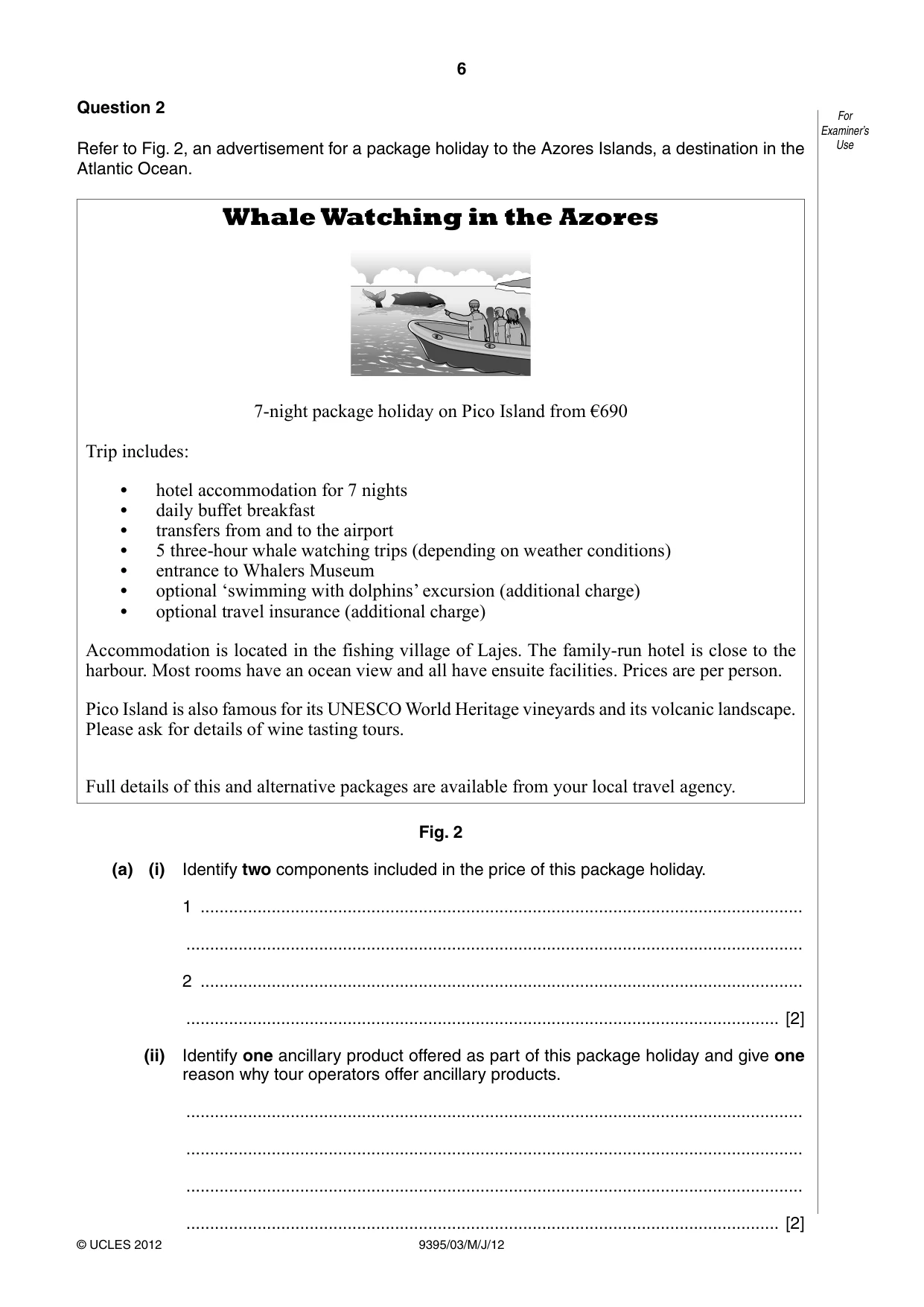
Question paper, page 6
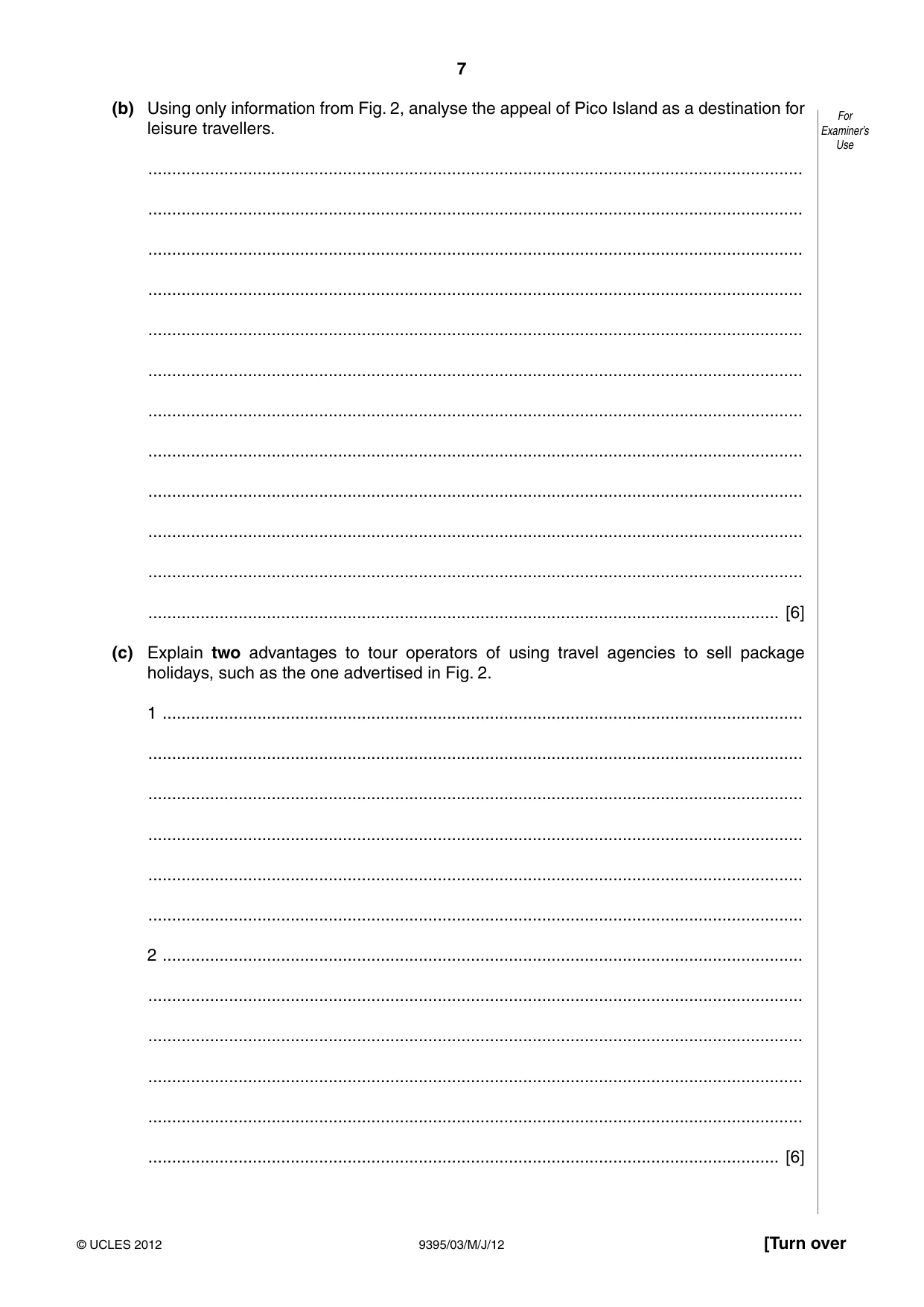
6 9395/03/M/J/12 © UCLES 2012 For Examiner’s Use Question 2 Refer to Fig. 2, an advertisement for a package holiday to the Azores Islands, a destination in the Atlantic Ocean. Whale Watching in the Azores 7-night package holiday on Pico Island from €690 Trip includes: • hotel accommodation for 7 nights • daily buffet breakfast • transfers from and to the airport • 5 three-hour whale watching trips (depending on weather conditions) • entrance to Whalers Museum • optional ‘swimming with dolphins’ excursion (additional charge) • optional travel insurance (additional charge) Accommodation is located in the fishing village of Lajes. The family-run hotel is close to the harbour. Most rooms have an ocean view and all have ensuite facilities. Prices are per person. Pico Island is also famous for its UNESCO World Heritage vineyards and its volcanic landscape. Please ask for details of wine tasting tours. Full details of this and alternative packages are available from your local travel agency. Fig. 2 (a) (i) Identify two components included in the price of this package holiday. 1 … … 2 … … [2] (ii) Identify one ancillary product offered as part of this package holiday and give one reason why tour operators offer ancillary products. … … … … [2]
Question paper, page 7
7 9395/03/M/J/12 © UCLES 2012 [Turn over For Examiner’s Use (b) Using only information from Fig. 2, analyse the appeal of Pico Island as a destination for leisure travellers. … … … … … … … … … … … … [6] (c) Explain two advantages to tour operators of using travel agencies to sell package holidays, such as the one advertised in Fig. 2. 1 … … … … … … 2 … … … … … … [6]
Question paper, page 8
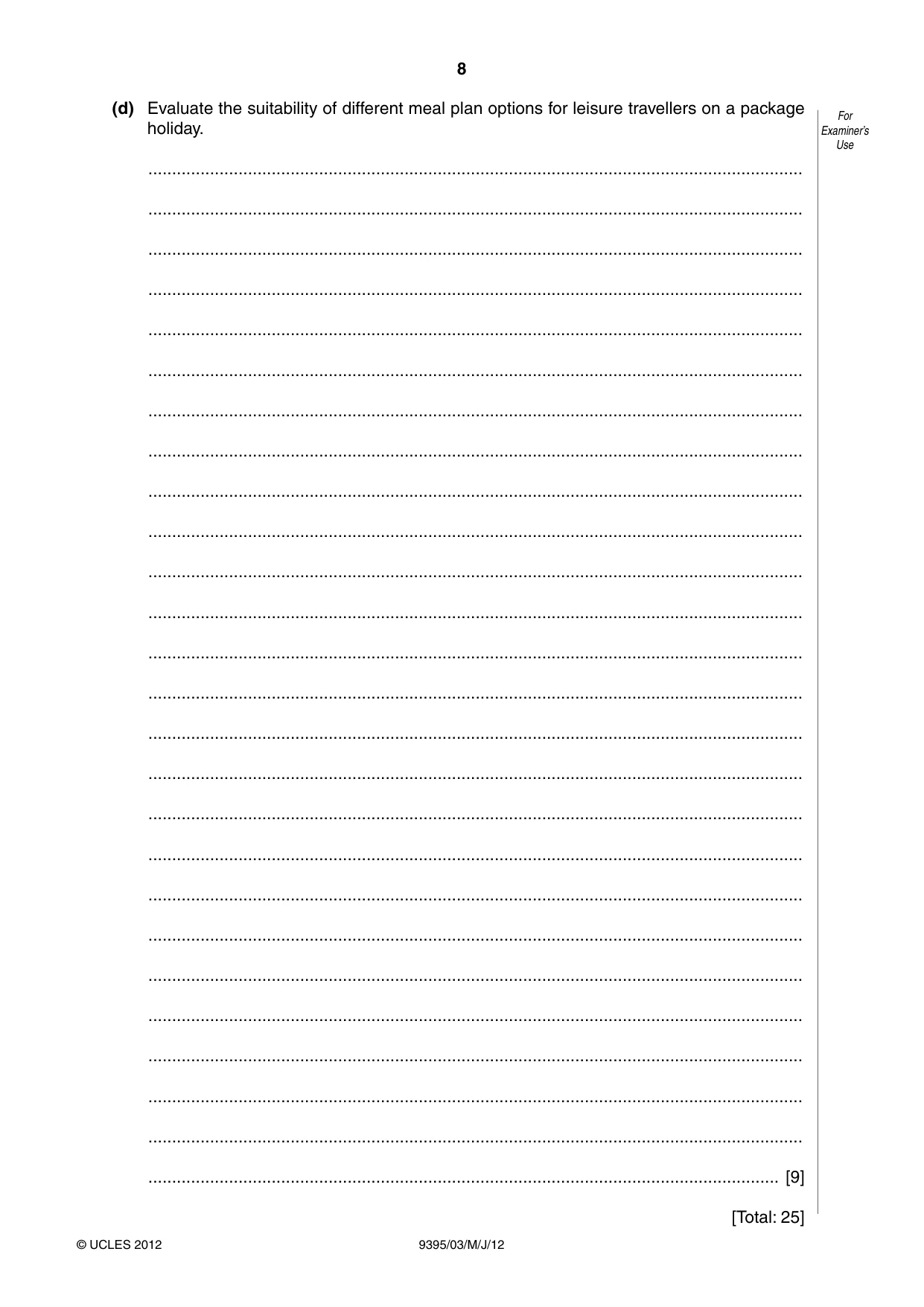
8 9395/03/M/J/12 © UCLES 2012 For Examiner’s Use (d) Evaluate the suitability of different meal plan options for leisure travellers on a package holiday. … … … … … … … … … … … … … … … … … … … … … … … … … … [9] [Total: 25]
Question paper, page 9
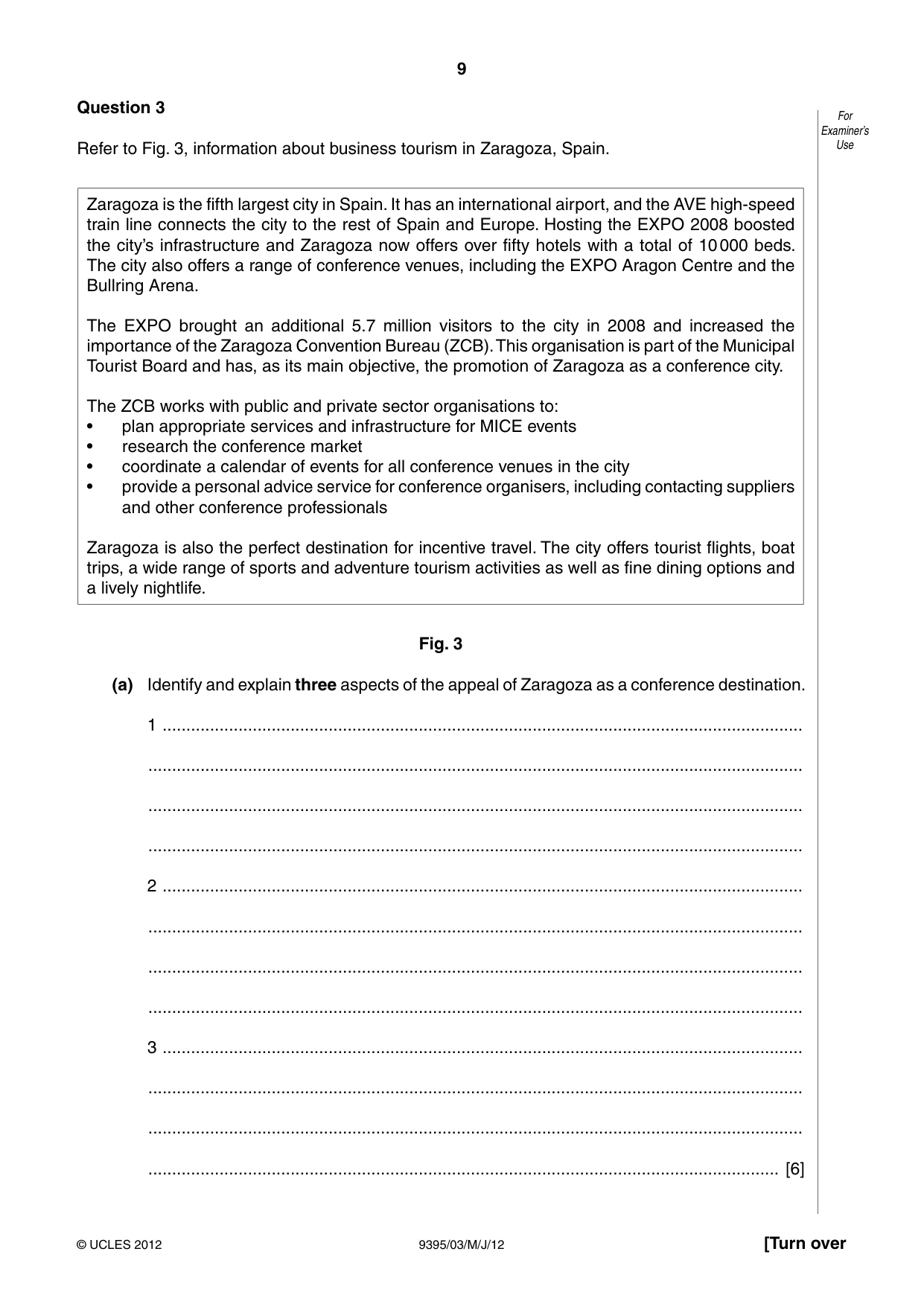
9 9395/03/M/J/12 © UCLES 2012 [Turn over For Examiner’s Use Question 3 Refer to Fig. 3, information about business tourism in Zaragoza, Spain. Zaragoza is the fifth largest city in Spain. It has an international airport, and the AVE high-speed train line connects the city to the rest of Spain and Europe. Hosting the EXPO 2008 boosted the city’s infrastructure and Zaragoza now offers over fifty hotels with a total of 10 000 beds. The city also offers a range of conference venues, including the EXPO Aragon Centre and the Bullring Arena. The EXPO brought an additional 5.7 million visitors to the city in 2008 and increased the importance of the Zaragoza Convention Bureau (ZCB). This organisation is part of the Municipal Tourist Board and has, as its main objective, the promotion of Zaragoza as a conference city. The ZCB works with public and private sector organisations to: • plan appropriate services and infrastructure for MICE events • research the conference market • coordinate a calendar of events for all conference venues in the city • provide a personal advice service for conference organisers, including contacting suppliers and other conference professionals Zaragoza is also the perfect destination for incentive travel. The city offers tourist flights, boat trips, a wide range of sports and adventure tourism activities as well as fine dining options and a lively nightlife. Fig. 3 (a) Identify and explain three aspects of the appeal of Zaragoza as a conference destination. 1 … … … … 2 … … … … 3 … … … … [6]
Question paper, page 10
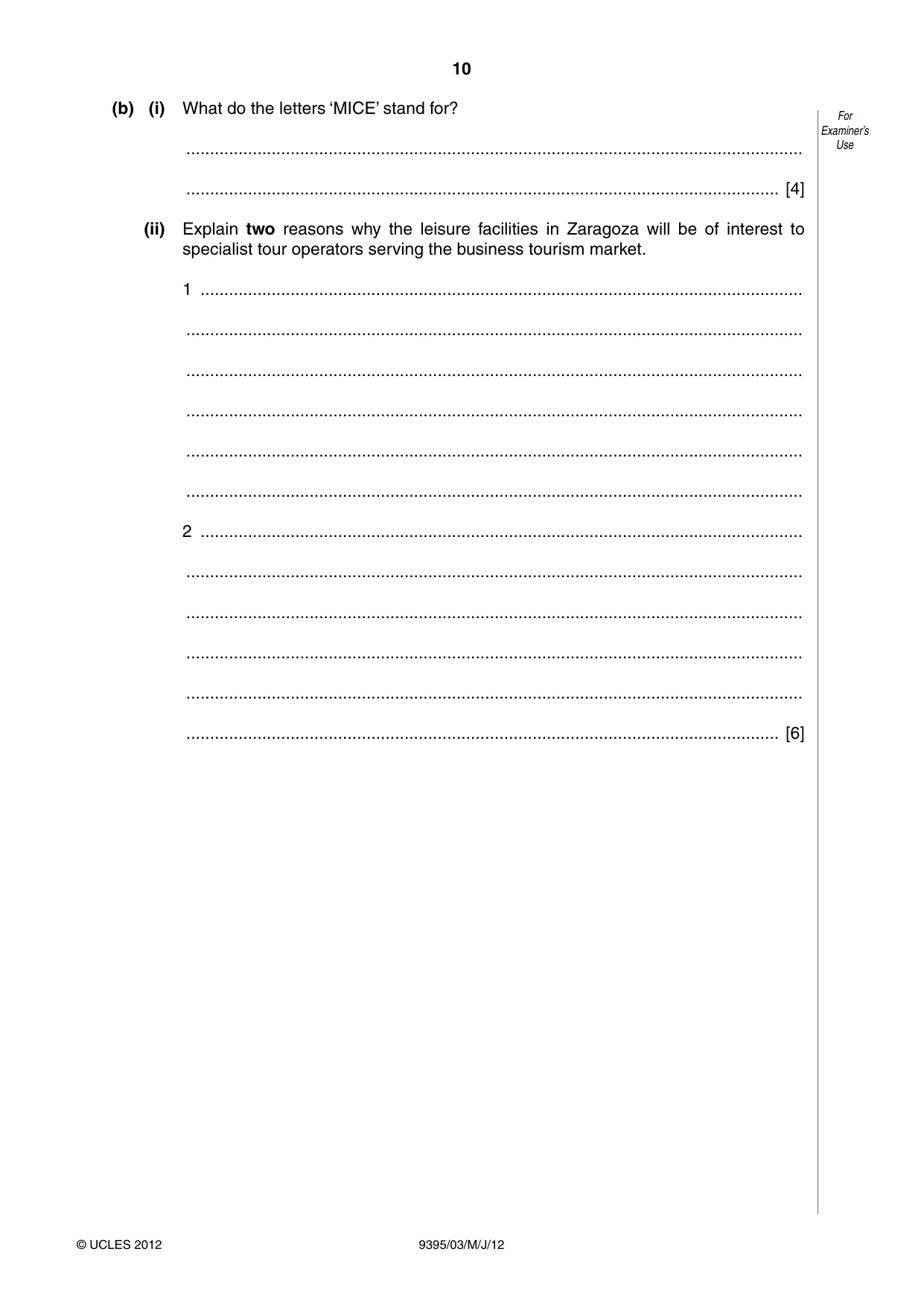
10 9395/03/M/J/12 © UCLES 2012 For Examiner’s Use (b) (i) What do the letters ‘MICE’ stand for? … … [4] (ii) Explain two reasons why the leisure facilities in Zaragoza will be of interest to specialist tour operators serving the business tourism market. 1 … … … … … … 2 … … … … … … [6]
Question paper, page 11
11 9395/03/M/J/12 © UCLES 2012 [Turn over For Examiner’s Use (c) Evaluate the role played by organisations, such as the Zaragoza Convention Bureau, in supporting the planning of an international business tourism event. … … … … … … … … … … … … … … … … … … … … … … … … … … [9] [Total: 25]
Question paper, page 12
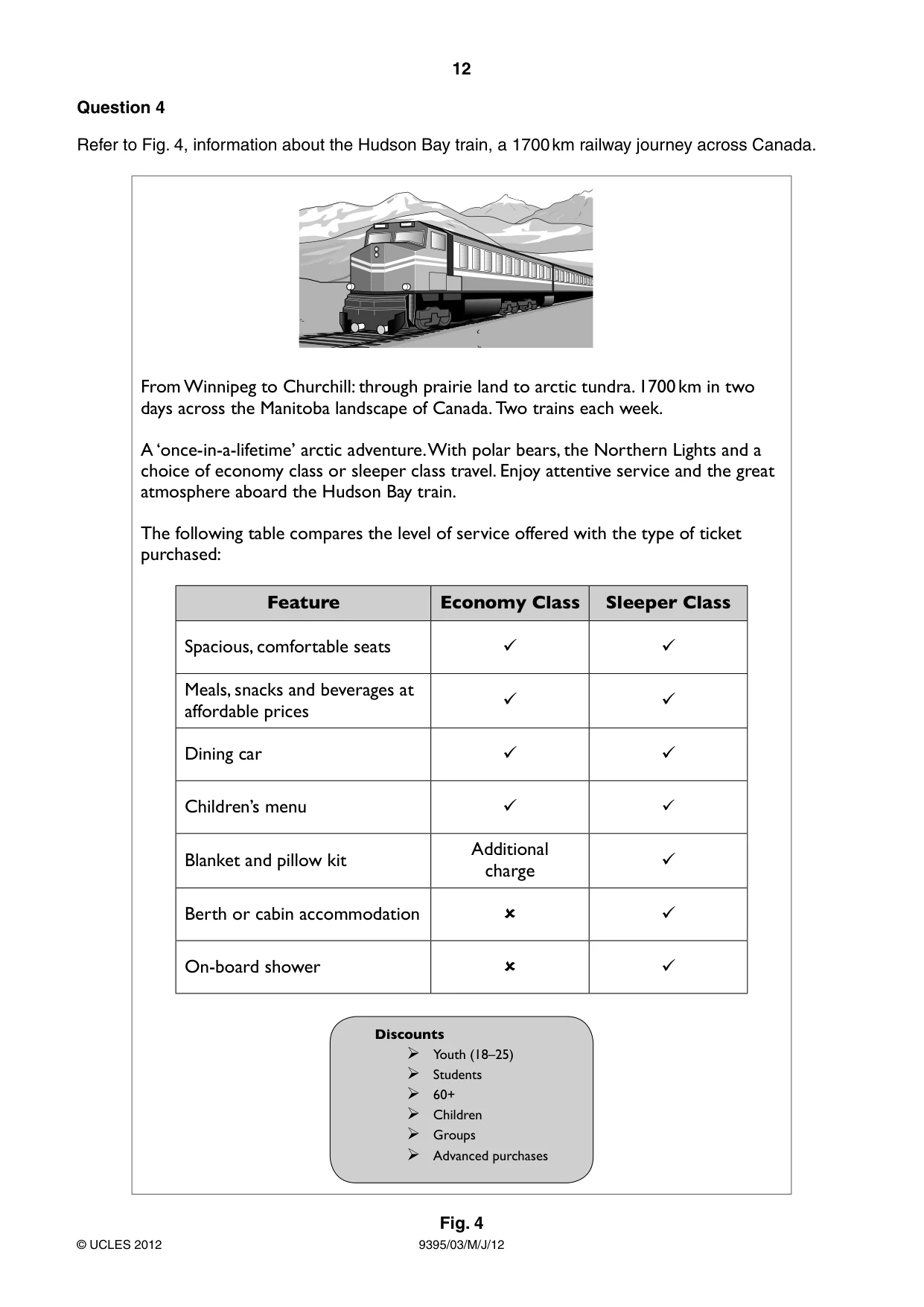
12 9395/03/M/J/12 © UCLES 2012 Question 4 Refer to Fig. 4, information about the Hudson Bay train, a 1700 km railway journey across Canada. From Winnipeg to Churchill: through prairie land to arctic tundra. 1700 km in two days across the Manitoba landscape of Canada. Two trains each week. A ‘once-in-a-lifetime’ arctic adventure. With polar bears, the Northern Lights and a choice of economy class or sleeper class travel. Enjoy attentive service and the great atmosphere aboard the Hudson Bay train. The following table compares the level of service offered with the type of ticket purchased: Feature Economy Class Sleeper Class Spacious, comfortable seats 9 9 Meals, snacks and beverages at affordable prices 9 9 Dining car 9 9 Children’s menu 9 9 Blanket and pillow kit Additional charge 9 Berth or cabin accommodation 8 9 On-board shower 8 9 Discounts ¾ Youth (18–25) ¾ Students ¾ 60+ ¾ Children ¾ Groups ¾ Advanced purchases Fig. 4
Question paper, page 13
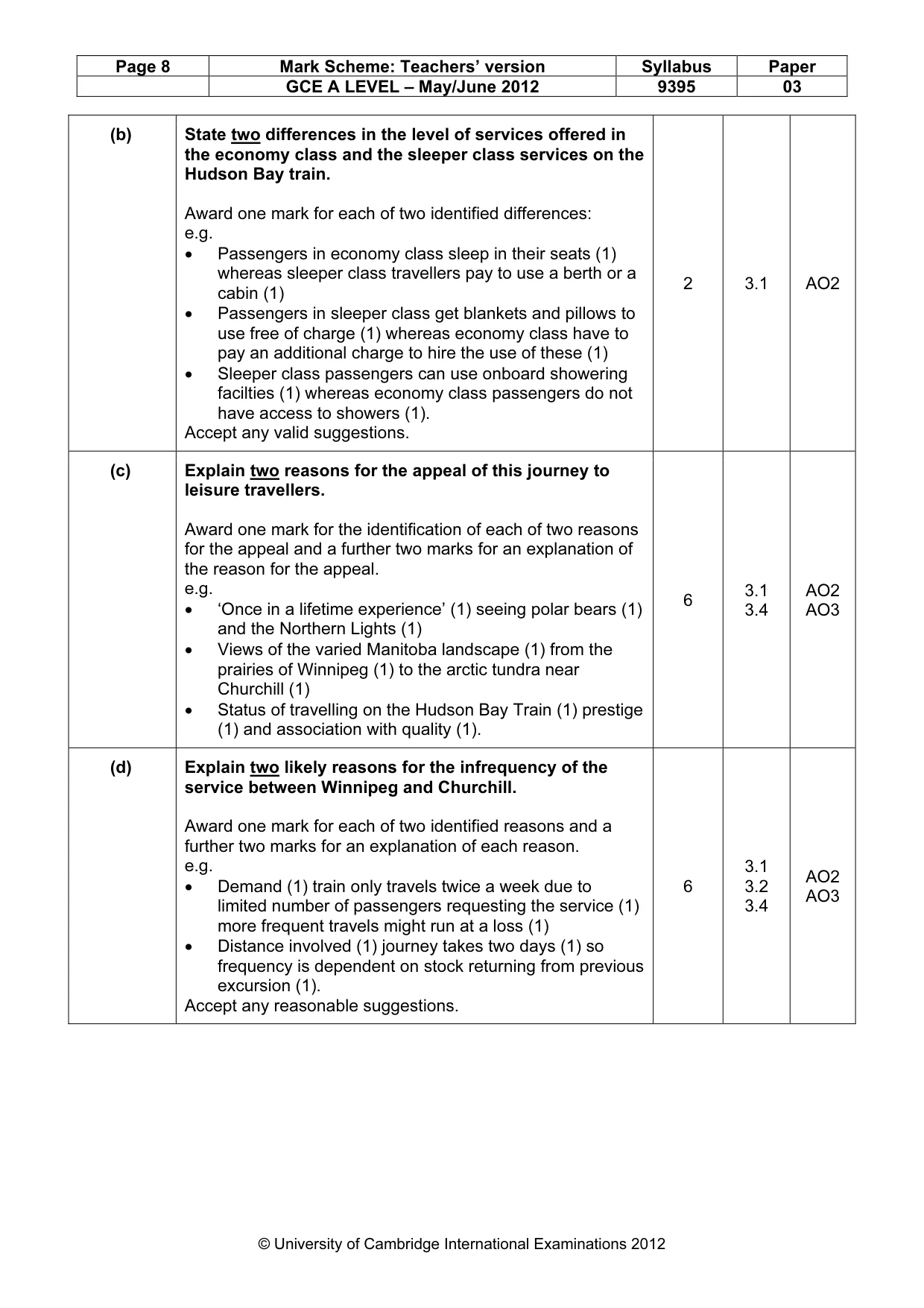
13 9395/03/M/J/12 © UCLES 2012 [Turn over For Examiner’s Use (a) Identify two features of the travel product offered by the Hudson Bay train in Canada. 1 … … 2 … … [2] (b) State two differences between the level of service offered in the economy and the sleeper class services on the Hudson Bay train. 1 … … 2 … … [2] (c) Explain two reasons for the appeal of this journey to leisure travellers. 1 … … … … … … 2 … … … … … … [6]
Question paper, page 14
14 9395/03/M/J/12 © UCLES 2012 For Examiner’s Use (d) Explain two likely reasons for the infrequency of the service between Winnipeg and Churchill. 1 … … … … … … 2 … … … … … … [6]
Question paper, page 15
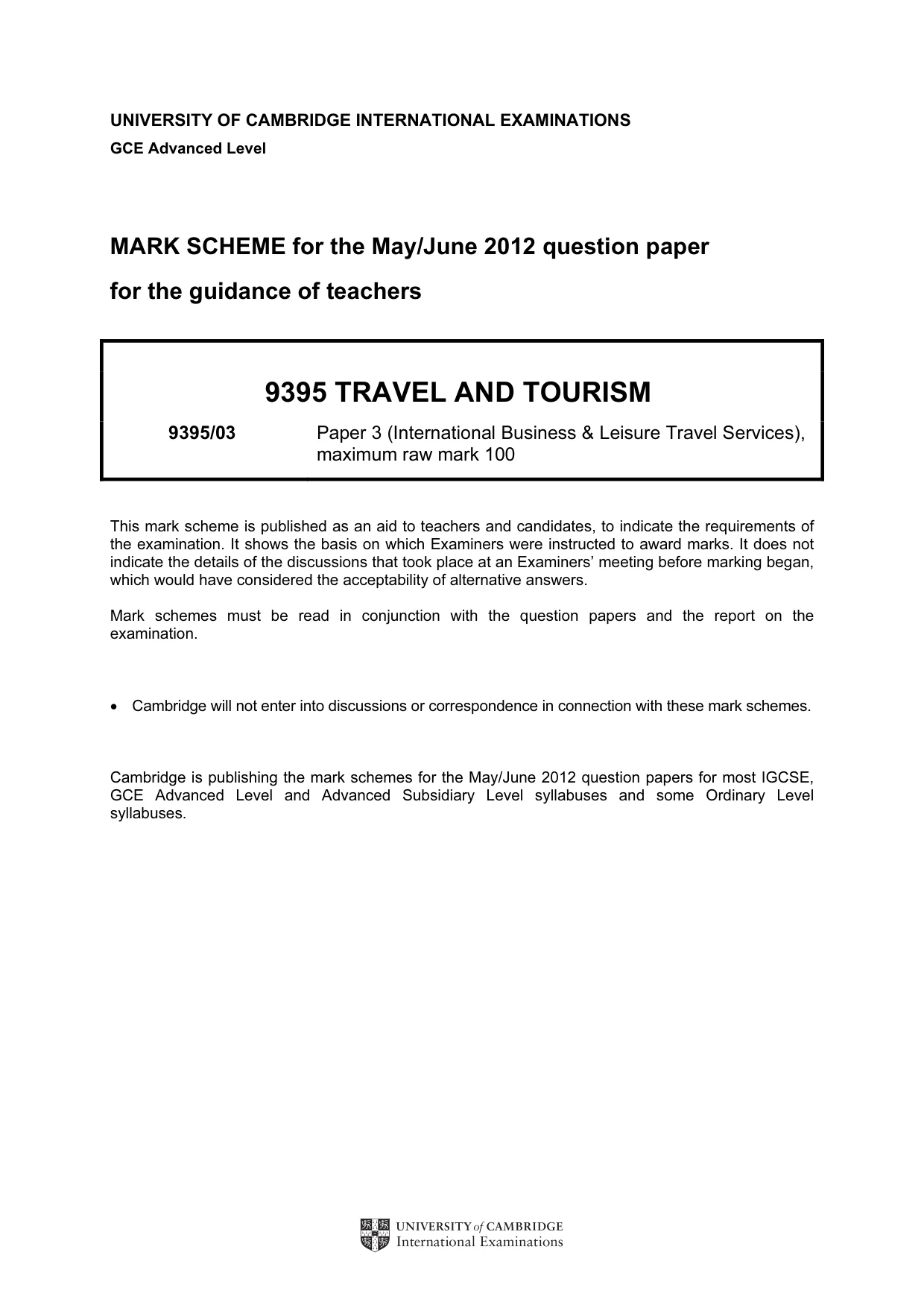
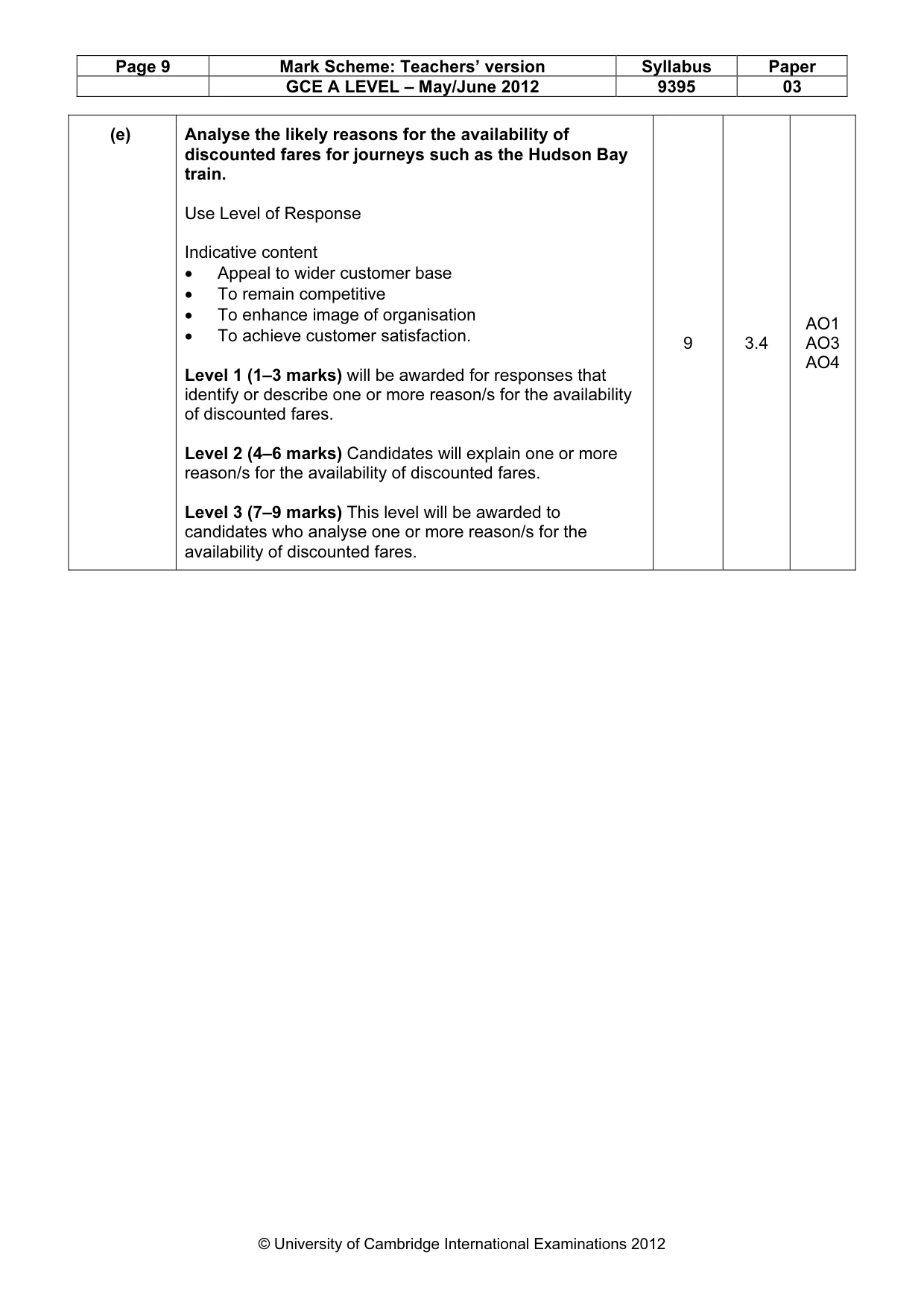
15 9395/03/M/J/12 © UCLES 2012 For Examiner’s Use (e) Analyse the likely reasons for the availability of discounted fares for journeys, such as the Hudson Bay train. … … … … … … … … … … … … … … … … … … … … … … … … … … [9] [Total: 25]
Question paper, page 16
16 9395/03/M/J/12 © UCLES 2012 BLANK PAGE Copyright Acknowledgements: Question 1 Figure 1 © ADAPTED: http://www.fiainda.in/about.htm. Question 3 Figure 3 © ADAPTED: http://www.zaragoza.es/ciudad/turismo/en/zcb/presentacion.htm. Question 4 Figure 4 © ADAPTED: http://www.viarail.ca/en/stations/priaries-and-northern-manitoba/winnipeg and www.viarail.ca/an/fares. Permission to reproduce items where third-party owned material protected by copyright is included has been sought and cleared where possible. Every reasonable effort has been made by the publisher (UCLES) to trace copyright holders, but if any items requiring clearance have unwittingly been included, the publisher will be pleased to make amends at the earliest possible opportunity. University of Cambridge International Examinations is part of the Cambridge Assessment Group. Cambridge Assessment is the brand name of University of Cambridge Local Examinations Syndicate (UCLES), which is itself a department of the University of Cambridge.
Mark scheme, page 1
UNIVERSITY OF CAMBRIDGE INTERNATIONAL EXAMINATIONS GCE Advanced Level MARK SCHEME for the May/June 2012 question paper for the guidance of teachers 9395 TRAVEL AND TOURISM 9395/03 Paper 3 (International Business & Leisure Travel Services), maximum raw mark 100 This mark scheme is published as an aid to teachers and candidates, to indicate the requirements of the examination. It shows the basis on which Examiners were instructed to award marks. It does not indicate the details of the discussions that took place at an Examiners’ meeting before marking began, which would have considered the acceptability of alternative answers. Mark schemes must be read in conjunction with the question papers and the report on the examination. • Cambridge will not enter into discussions or correspondence in connection with these mark schemes. Cambridge is publishing the mark schemes for the May/June 2012 question papers for most IGCSE, GCE Advanced Level and Advanced Subsidiary Level syllabuses and some Ordinary Level syllabuses.
Mark scheme, page 2
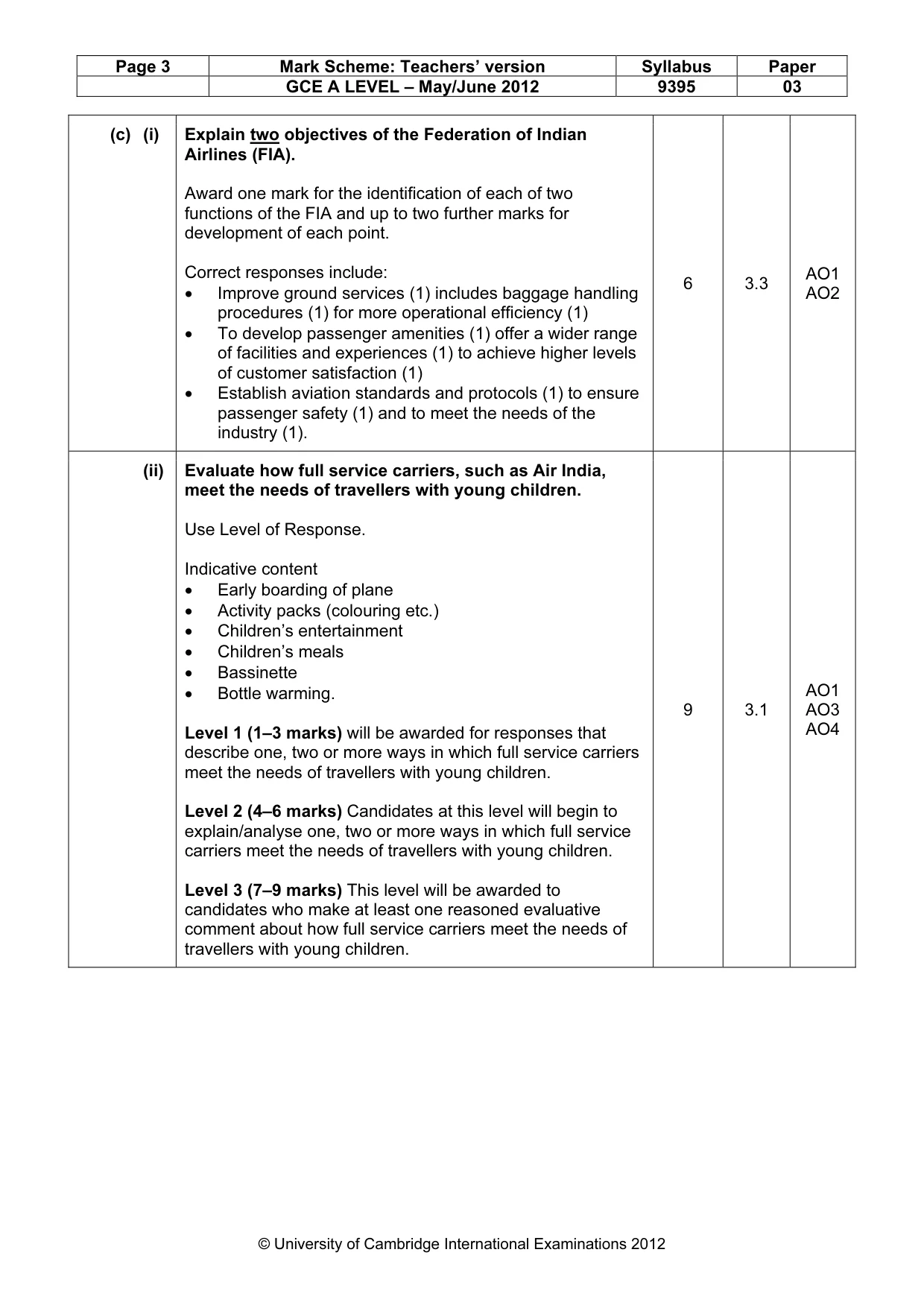
Page 2 Mark Scheme: Teachers’ version Syllabus Paper GCE A LEVEL – May/June 2012 9395 03 © University of Cambridge International Examinations 2012 Question Expected response Marks Focus AO 1 (a) (i) Explain what is meant by the term low cost carrier. Award one mark for basic identification and second mark for further development. e.g. A ‘low cost carrier’ is a type of airline company offering cheap airfares (1). They usually offer a ‘no frills’ service (1). 2 3.1 AO1 (ii) Identify two reasons to explain why the growth in air passenger numbers in India slowed down by 2009. Award one mark for each of two identifications Correct answers include: • Competition from railways (1) • Prices not affordable (1) • Delays and congestion at airports put customers off (1). Accept any reasonable ideas. 2 3.4 AO2 (b) Explain two reasons why the government in India has invested in airport development over recent years. Award one mark for the identification of each of two reasons and a further two marks for an explanation of each of these reasons. Correct answers include: • To improve infrastructure (1) to be better able to cope with the demands of increased passenger numbers (1) to avoid traffic congestion and delays (1) • To remain competitive (1) improved facilities will attract customers (1) and gain customer loyalty (1) • To improve passenger safety (1) by meeting international aviation standards and protocols (1) comply with regulatory authorities such as IATA and ICAO (1). Accept any reasonable suggestions. 6 3.1 3.4 AO2 AO3
Mark scheme, page 3
Page 3 Mark Scheme: Teachers’ version Syllabus Paper GCE A LEVEL – May/June 2012 9395 03 © University of Cambridge International Examinations 2012 (c) (i) Explain two objectives of the Federation of Indian Airlines (FIA). Award one mark for the identification of each of two functions of the FIA and up to two further marks for development of each point. Correct responses include: • Improve ground services (1) includes baggage handling procedures (1) for more operational efficiency (1) • To develop passenger amenities (1) offer a wider range of facilities and experiences (1) to achieve higher levels of customer satisfaction (1) • Establish aviation standards and protocols (1) to ensure passenger safety (1) and to meet the needs of the industry (1). 6 3.3 AO1 AO2 (ii) Evaluate how full service carriers, such as Air India, meet the needs of travellers with young children. Use Level of Response. Indicative content • Early boarding of plane • Activity packs (colouring etc.) • Children’s entertainment • Children’s meals • Bassinette • Bottle warming. Level 1 (1–3 marks) will be awarded for responses that describe one, two or more ways in which full service carriers meet the needs of travellers with young children. Level 2 (4–6 marks) Candidates at this level will begin to explain/analyse one, two or more ways in which full service carriers meet the needs of travellers with young children. Level 3 (7–9 marks) This level will be awarded to candidates who make at least one reasoned evaluative comment about how full service carriers meet the needs of travellers with young children. 9 3.1 AO1 AO3 AO4
Mark scheme, page 4
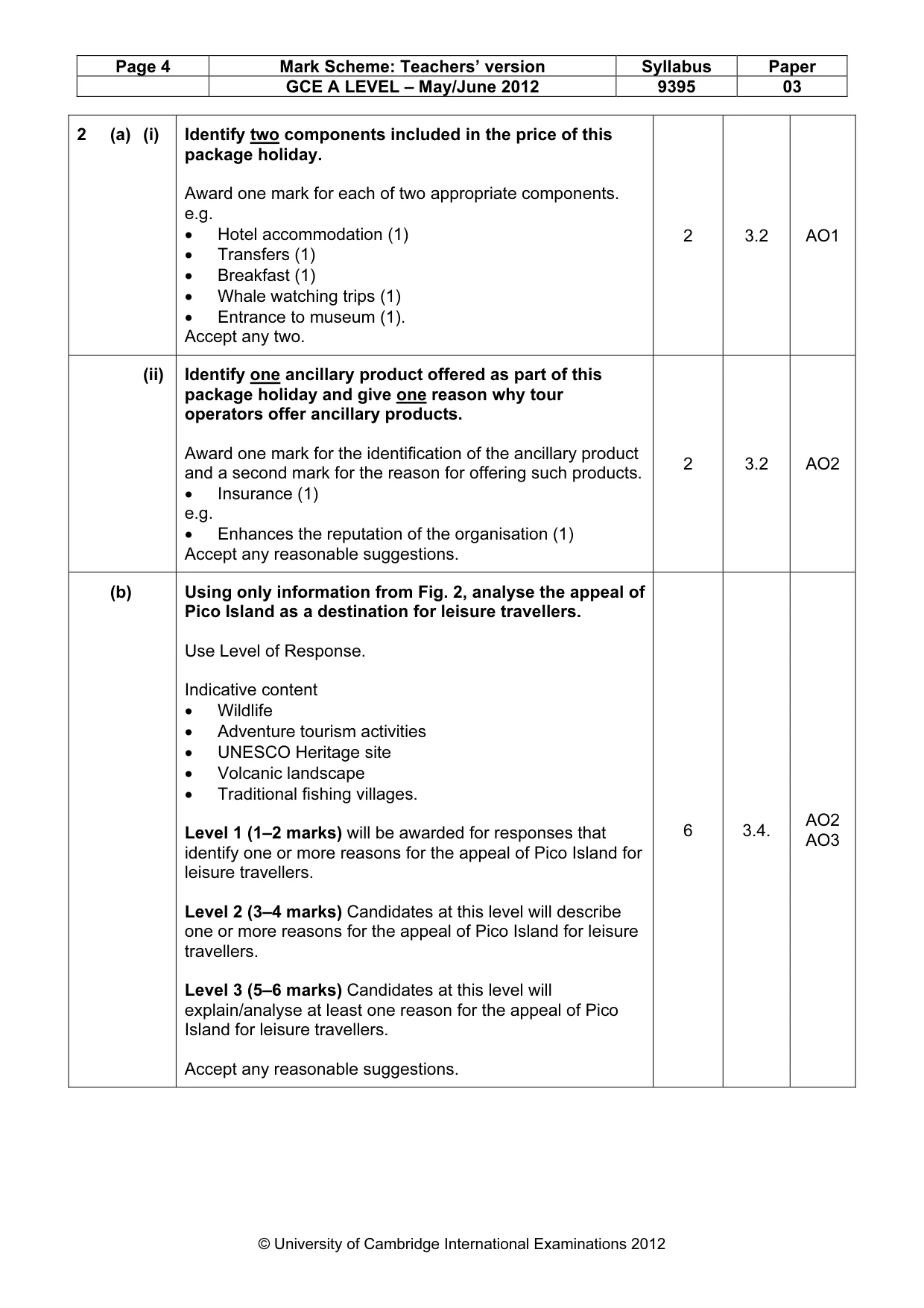
Page 4 Mark Scheme: Teachers’ version Syllabus Paper GCE A LEVEL – May/June 2012 9395 03 © University of Cambridge International Examinations 2012 2 (a) (i) Identify two components included in the price of this package holiday. Award one mark for each of two appropriate components. e.g. • Hotel accommodation (1) • Transfers (1) • Breakfast (1) • Whale watching trips (1) • Entrance to museum (1). Accept any two. 2 3.2 AO1 (ii) Identify one ancillary product offered as part of this package holiday and give one reason why tour operators offer ancillary products. Award one mark for the identification of the ancillary product and a second mark for the reason for offering such products. • Insurance (1) e.g. • Enhances the reputation of the organisation (1) Accept any reasonable suggestions. 2 3.2 AO2 (b) Using only information from Fig. 2, analyse the appeal of Pico Island as a destination for leisure travellers. Use Level of Response. Indicative content • Wildlife • Adventure tourism activities • UNESCO Heritage site • Volcanic landscape • Traditional fishing villages. Level 1 (1–2 marks) will be awarded for responses that identify one or more reasons for the appeal of Pico Island for leisure travellers. Level 2 (3–4 marks) Candidates at this level will describe one or more reasons for the appeal of Pico Island for leisure travellers. Level 3 (5–6 marks) Candidates at this level will explain/analyse at least one reason for the appeal of Pico Island for leisure travellers. Accept any reasonable suggestions. 6 3.4. AO2 AO3
Mark scheme, page 5
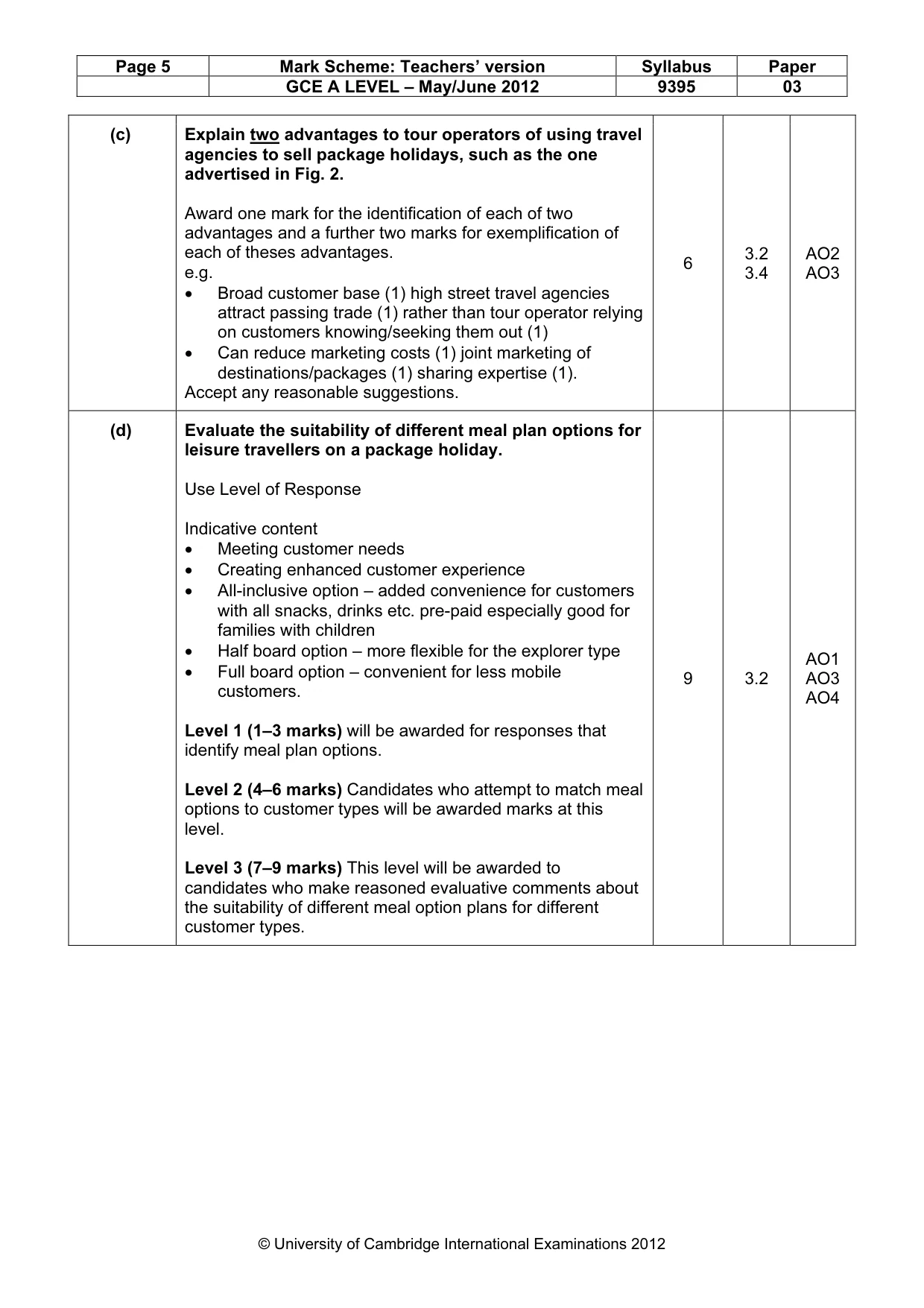
Page 5 Mark Scheme: Teachers’ version Syllabus Paper GCE A LEVEL – May/June 2012 9395 03 © University of Cambridge International Examinations 2012 (c) Explain two advantages to tour operators of using travel agencies to sell package holidays, such as the one advertised in Fig. 2. Award one mark for the identification of each of two advantages and a further two marks for exemplification of each of theses advantages. e.g. • Broad customer base (1) high street travel agencies attract passing trade (1) rather than tour operator relying on customers knowing/seeking them out (1) • Can reduce marketing costs (1) joint marketing of destinations/packages (1) sharing expertise (1). Accept any reasonable suggestions. 6 3.2 3.4 AO2 AO3 (d) Evaluate the suitability of different meal plan options for leisure travellers on a package holiday. Use Level of Response Indicative content • Meeting customer needs • Creating enhanced customer experience • All-inclusive option – added convenience for customers with all snacks, drinks etc. pre-paid especially good for families with children • Half board option – more flexible for the explorer type • Full board option – convenient for less mobile customers. Level 1 (1–3 marks) will be awarded for responses that identify meal plan options. Level 2 (4–6 marks) Candidates who attempt to match meal options to customer types will be awarded marks at this level. Level 3 (7–9 marks) This level will be awarded to candidates who make reasoned evaluative comments about the suitability of different meal option plans for different customer types. 9 3.2 AO1 AO3 AO4
Mark scheme, page 6
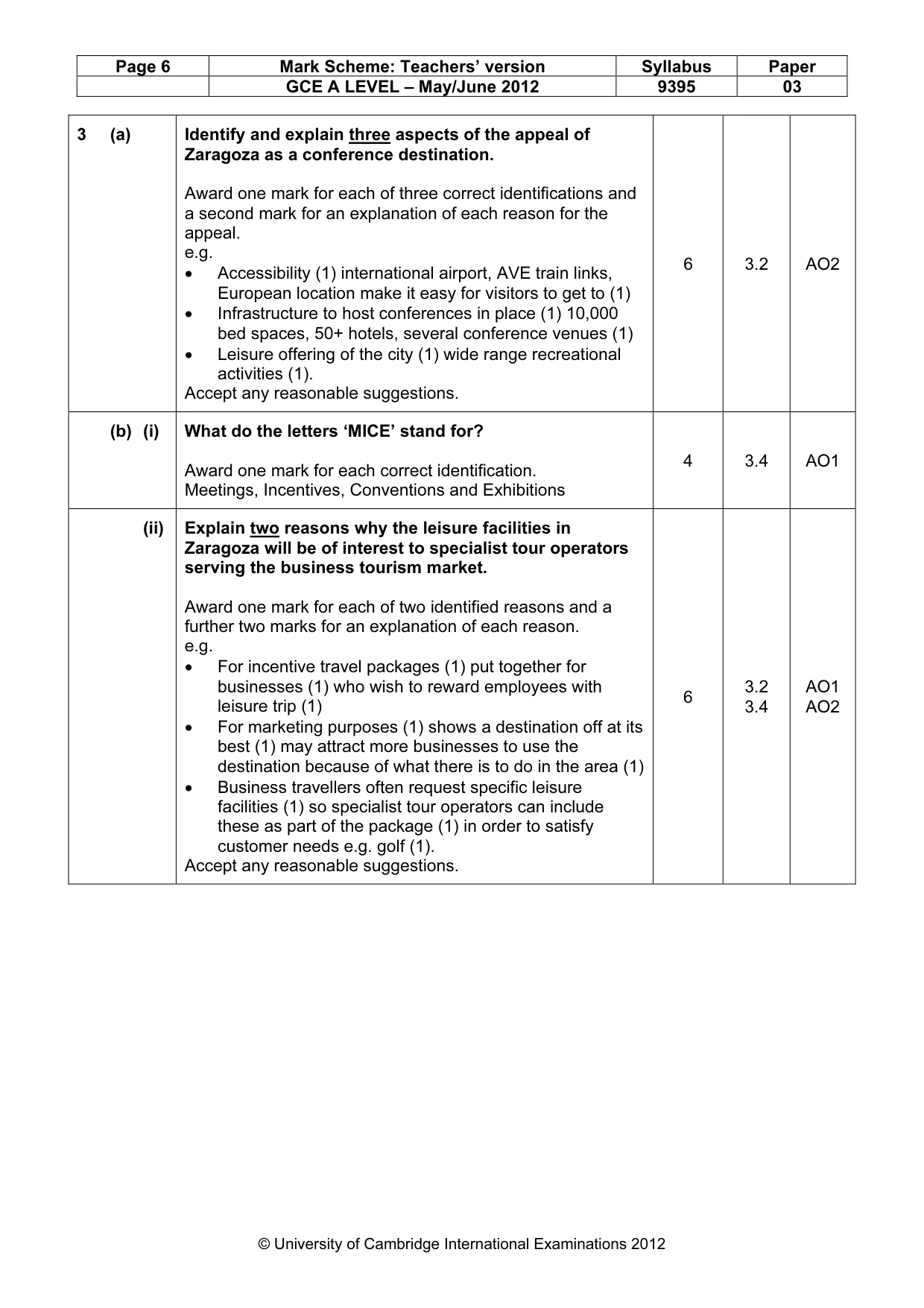
Page 6 Mark Scheme: Teachers’ version Syllabus Paper GCE A LEVEL – May/June 2012 9395 03 © University of Cambridge International Examinations 2012 3 (a) Identify and explain three aspects of the appeal of Zaragoza as a conference destination. Award one mark for each of three correct identifications and a second mark for an explanation of each reason for the appeal. e.g. • Accessibility (1) international airport, AVE train links, European location make it easy for visitors to get to (1) • Infrastructure to host conferences in place (1) 10,000 bed spaces, 50+ hotels, several conference venues (1) • Leisure offering of the city (1) wide range recreational activities (1). Accept any reasonable suggestions. 6 3.2 AO2 (b) (i) What do the letters ‘MICE’ stand for? Award one mark for each correct identification. Meetings, Incentives, Conventions and Exhibitions 4 3.4 AO1 (ii) Explain two reasons why the leisure facilities in Zaragoza will be of interest to specialist tour operators serving the business tourism market. Award one mark for each of two identified reasons and a further two marks for an explanation of each reason. e.g. • For incentive travel packages (1) put together for businesses (1) who wish to reward employees with leisure trip (1) • For marketing purposes (1) shows a destination off at its best (1) may attract more businesses to use the destination because of what there is to do in the area (1) • Business travellers often request specific leisure facilities (1) so specialist tour operators can include these as part of the package (1) in order to satisfy customer needs e.g. golf (1). Accept any reasonable suggestions. 6 3.2 3.4 AO1 AO2
Mark scheme, page 7
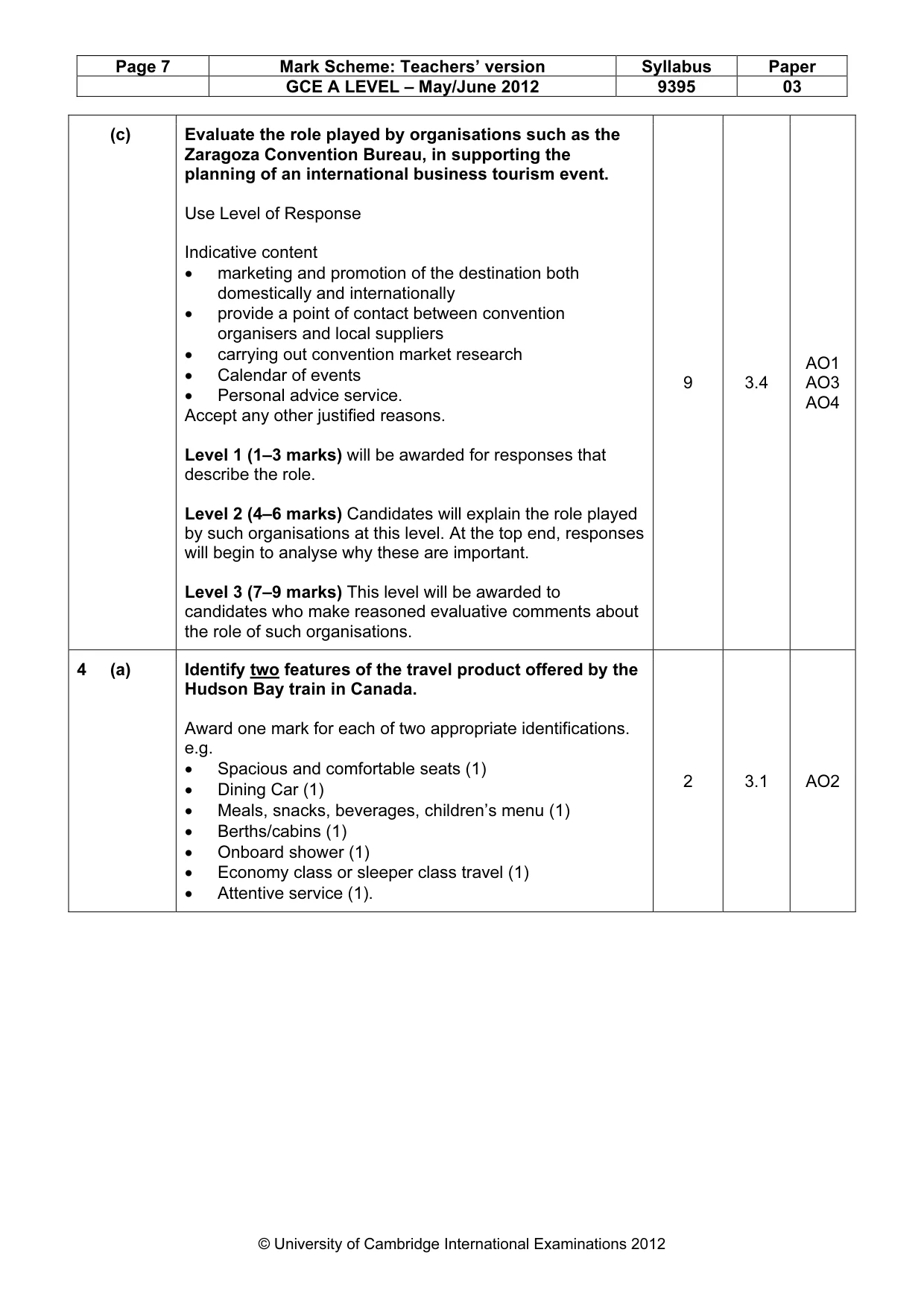
Page 7 Mark Scheme: Teachers’ version Syllabus Paper GCE A LEVEL – May/June 2012 9395 03 © University of Cambridge International Examinations 2012 (c) Evaluate the role played by organisations such as the Zaragoza Convention Bureau, in supporting the planning of an international business tourism event. Use Level of Response Indicative content • marketing and promotion of the destination both domestically and internationally • provide a point of contact between convention organisers and local suppliers • carrying out convention market research • Calendar of events • Personal advice service. Accept any other justified reasons. Level 1 (1–3 marks) will be awarded for responses that describe the role. Level 2 (4–6 marks) Candidates will explain the role played by such organisations at this level. At the top end, responses will begin to analyse why these are important. Level 3 (7–9 marks) This level will be awarded to candidates who make reasoned evaluative comments about the role of such organisations. 9 3.4 AO1 AO3 AO4 4 (a) Identify two features of the travel product offered by the Hudson Bay train in Canada. Award one mark for each of two appropriate identifications. e.g. • Spacious and comfortable seats (1) • Dining Car (1) • Meals, snacks, beverages, children’s menu (1) • Berths/cabins (1) • Onboard shower (1) • Economy class or sleeper class travel (1) • Attentive service (1). 2 3.1 AO2
Mark scheme, page 8
Page 8 Mark Scheme: Teachers’ version Syllabus Paper GCE A LEVEL – May/June 2012 9395 03 © University of Cambridge International Examinations 2012 (b) State two differences in the level of services offered in the economy class and the sleeper class services on the Hudson Bay train. Award one mark for each of two identified differences: e.g. • Passengers in economy class sleep in their seats (1) whereas sleeper class travellers pay to use a berth or a cabin (1) • Passengers in sleeper class get blankets and pillows to use free of charge (1) whereas economy class have to pay an additional charge to hire the use of these (1) • Sleeper class passengers can use onboard showering facilties (1) whereas economy class passengers do not have access to showers (1). Accept any valid suggestions. 2 3.1 AO2 (c) Explain two reasons for the appeal of this journey to leisure travellers. Award one mark for the identification of each of two reasons for the appeal and a further two marks for an explanation of the reason for the appeal. e.g. • ‘Once in a lifetime experience’ (1) seeing polar bears (1) and the Northern Lights (1) • Views of the varied Manitoba landscape (1) from the prairies of Winnipeg (1) to the arctic tundra near Churchill (1) • Status of travelling on the Hudson Bay Train (1) prestige (1) and association with quality (1). 6 3.1 3.4 AO2 AO3 (d) Explain two likely reasons for the infrequency of the service between Winnipeg and Churchill. Award one mark for each of two identified reasons and a further two marks for an explanation of each reason. e.g. • Demand (1) train only travels twice a week due to limited number of passengers requesting the service (1) more frequent travels might run at a loss (1) • Distance involved (1) journey takes two days (1) so frequency is dependent on stock returning from previous excursion (1). Accept any reasonable suggestions. 6 3.1 3.2 3.4 AO2 AO3
Mark scheme, page 9
Page 9 Mark Scheme: Teachers’ version Syllabus Paper GCE A LEVEL – May/June 2012 9395 03 © University of Cambridge International Examinations 2012 (e) Analyse the likely reasons for the availability of discounted fares for journeys such as the Hudson Bay train. Use Level of Response Indicative content • Appeal to wider customer base • To remain competitive • To enhance image of organisation • To achieve customer satisfaction. Level 1 (1–3 marks) will be awarded for responses that identify or describe one or more reason/s for the availability of discounted fares. Level 2 (4–6 marks) Candidates will explain one or more reason/s for the availability of discounted fares. Level 3 (7–9 marks) This level will be awarded to candidates who analyse one or more reason/s for the availability of discounted fares. 9 3.4 AO1 AO3 AO4
What you needed in this session
Cambridge’s own grade thresholds for 2012 May/June, Paper 3 · Variant 1. A higher threshold means an easier paper — the bar moves with how the cohort did.