Cambridge A Level Travel and Tourism 9395 — 2011 May/June Paper 3 · Variant 1
9395/31/M/J/11 · 100 marks · ≈113 min
The question paper and its mark scheme, free to read here and free to download. This is Cambridge’s own paper, exactly as it was sat.
Question paper16 pages
Mark scheme10 pages
Answers below. Sit the paper first if you are practising.
Paper as text
Question paper, page 1
This document consists of 16 printed pages. DC (LEO/DJ) 35745/2 © UCLES 2011 [Turn over UNIVERSITY OF CAMBRIDGE INTERNATIONAL EXAMINATIONS General Certificate of Education Advanced Level * 5 3 0 4 4 8 8 1 0 2 * TRAVEL AND TOURISM 9395/03 Paper 3 International Business & Leisure Travel Services May/June 2011 1 hour 30 minutes Candidates answer on the Question Paper READ THESE INSTRUCTIONS FIRST Write your centre number, candidate number and name on all work you hand in. Write in dark blue or black pen. Do not use staples, paper clips, highlighters, glue or correction fluid. You may use a pencil for any diagrams, graphs or rough working. DO NOT WRITE IN ANY BARCODES. Answer all questions. The number of marks is given in brackets [ ] at the end of each question or part question. For Examiner’s Use 1 2 3 4 Total
Question paper, page 2
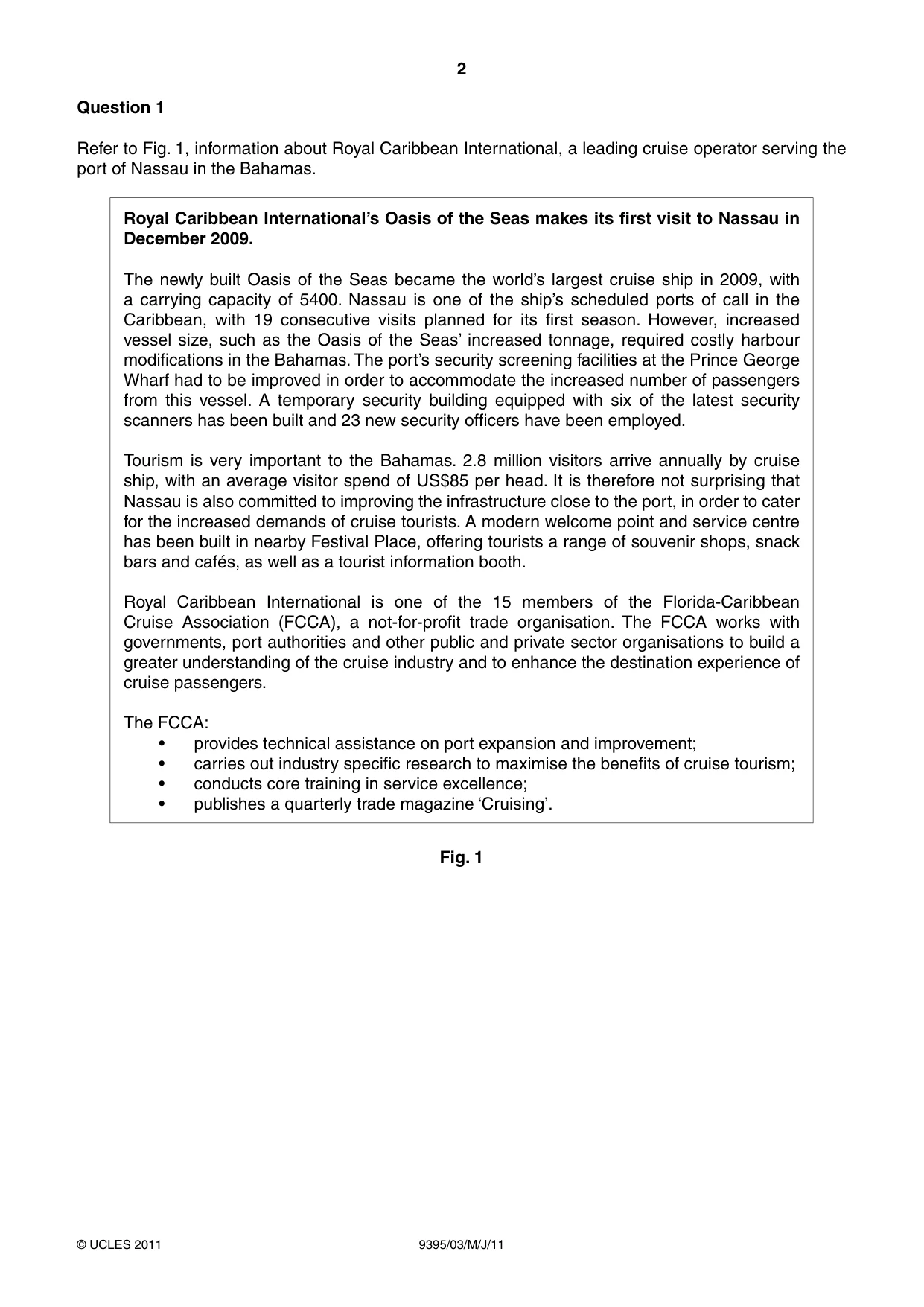
2 9395/03/M/J/11 © UCLES 2011 Question 1 Refer to Fig. 1, information about Royal Caribbean International, a leading cruise operator serving the port of Nassau in the Bahamas. Royal Caribbean International’s Oasis of the Seas makes its first visit to Nassau in December 2009. The newly built Oasis of the Seas became the world’s largest cruise ship in 2009, with a carrying capacity of 5400. Nassau is one of the ship’s scheduled ports of call in the Caribbean, with 19 consecutive visits planned for its first season. However, increased vessel size, such as the Oasis of the Seas’ increased tonnage, required costly harbour modifications in the Bahamas. The port’s security screening facilities at the Prince George Wharf had to be improved in order to accommodate the increased number of passengers from this vessel. A temporary security building equipped with six of the latest security scanners has been built and 23 new security officers have been employed. Tourism is very important to the Bahamas. 2.8 million visitors arrive annually by cruise ship, with an average visitor spend of US$85 per head. It is therefore not surprising that Nassau is also committed to improving the infrastructure close to the port, in order to cater for the increased demands of cruise tourists. A modern welcome point and service centre has been built in nearby Festival Place, offering tourists a range of souvenir shops, snack bars and cafés, as well as a tourist information booth. Royal Caribbean International is one of the 15 members of the Florida-Caribbean Cruise Association (FCCA), a not-for-profit trade organisation. The FCCA works with governments, port authorities and other public and private sector organisations to build a greater understanding of the cruise industry and to enhance the destination experience of cruise passengers. The FCCA: • provides technical assistance on port expansion and improvement; • carries out industry specific research to maximise the benefits of cruise tourism; • conducts core training in service excellence; • publishes a quarterly trade magazine ‘Cruising’. Fig. 1
Question paper, page 3
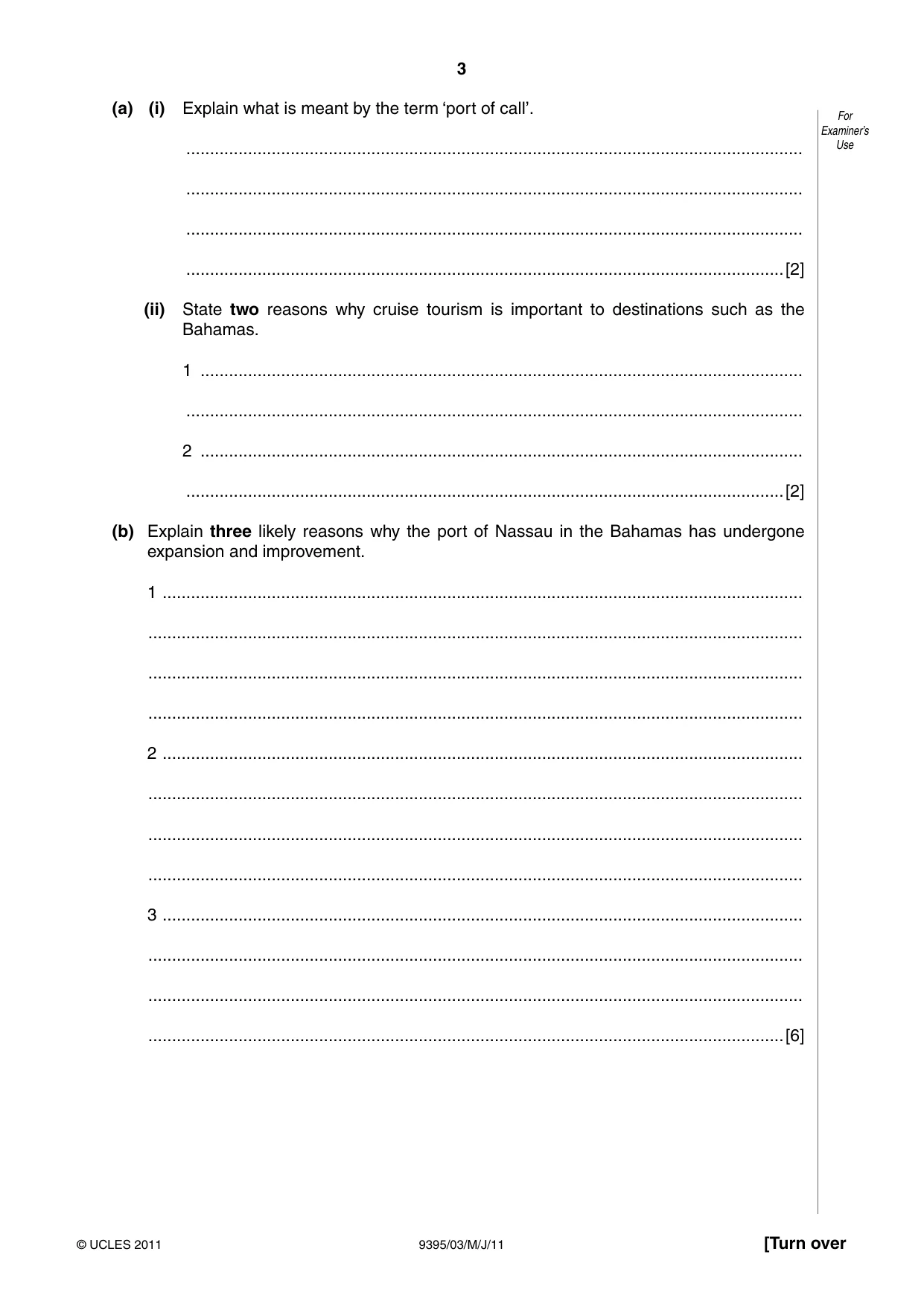
3 9395/03/M/J/11 © UCLES 2011 [Turn over For Examiner’s Use (a) (i) Explain what is meant by the term ‘port of call’. … … … …[2] (ii) State two reasons why cruise tourism is important to destinations such as the Bahamas. 1 … … 2 … …[2] (b) Explain three likely reasons why the port of Nassau in the Bahamas has undergone expansion and improvement. 1 … … … … 2 … … … … 3 … … … …[6]
Question paper, page 4
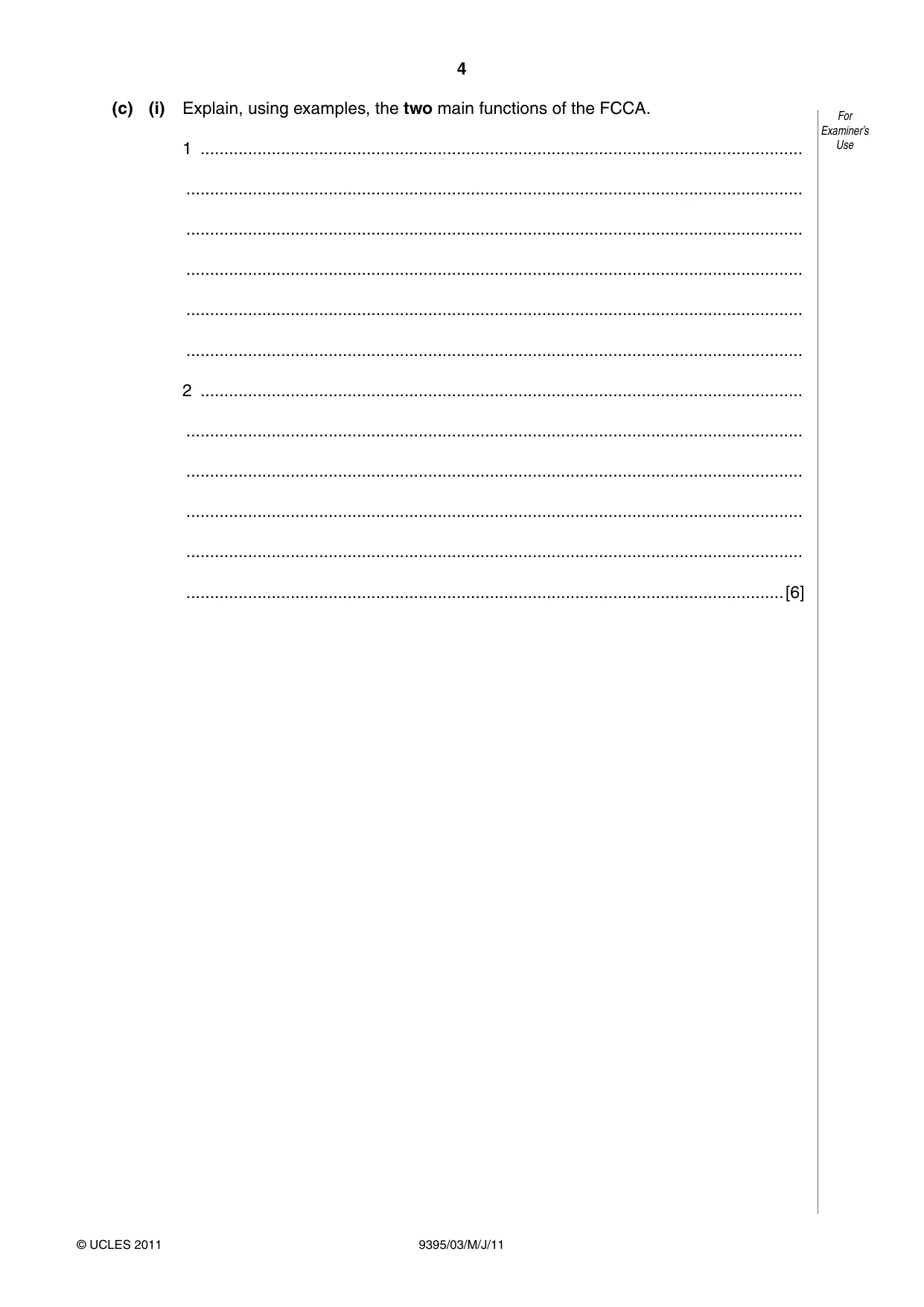
4 9395/03/M/J/11 © UCLES 2011 For Examiner’s Use (c) (i) Explain, using examples, the two main functions of the FCCA. 1 … … … … … … 2 … … … … … …[6]
Question paper, page 5
5 9395/03/M/J/11 © UCLES 2011 [Turn over For Examiner’s Use (ii) Evaluate how cruise operators, such as Royal Caribbean International, meet the needs of their leisure passengers. … … … … … … … … … … … … … … … … … … … … … … … … …[9] [Total: 25]
Question paper, page 6
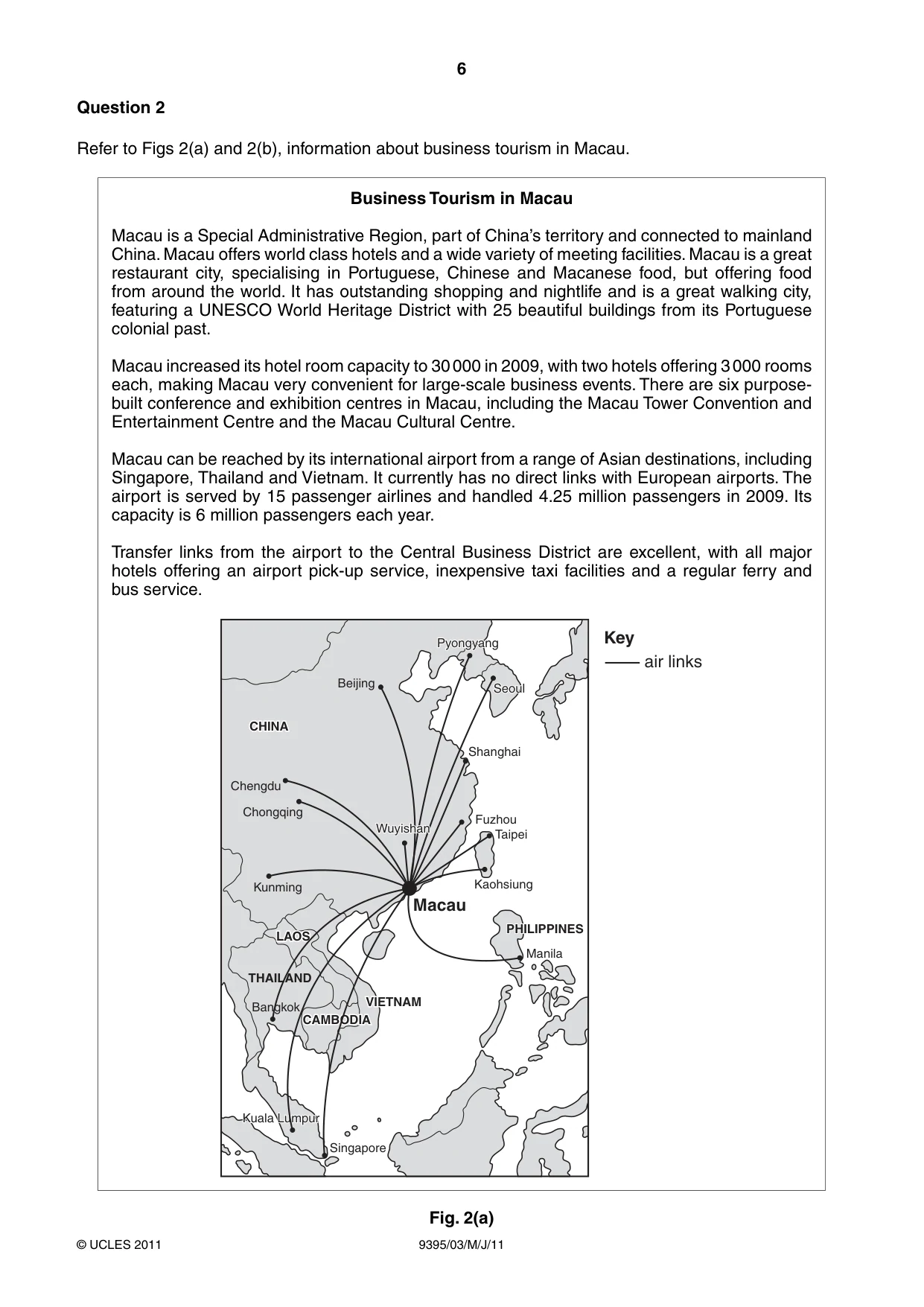
6 9395/03/M/J/11 © UCLES 2011 Question 2 Refer to Figs 2(a) and 2(b), information about business tourism in Macau. Business Tourism in Macau Macau is a Special Administrative Region, part of China’s territory and connected to mainland China. Macau offers world class hotels and a wide variety of meeting facilities. Macau is a great restaurant city, specialising in Portuguese, Chinese and Macanese food, but offering food from around the world. It has outstanding shopping and nightlife and is a great walking city, featuring a UNESCO World Heritage District with 25 beautiful buildings from its Portuguese colonial past. Macau increased its hotel room capacity to 30 000 in 2009, with two hotels offering 3 000 rooms each, making Macau very convenient for large-scale business events. There are six purpose- built conference and exhibition centres in Macau, including the Macau Tower Convention and Entertainment Centre and the Macau Cultural Centre. Macau can be reached by its international airport from a range of Asian destinations, including Singapore, Thailand and Vietnam. It currently has no direct links with European airports. The airport is served by 15 passenger airlines and handled 4.25 million passengers in 2009. Its capacity is 6 million passengers each year. Transfer links from the airport to the Central Business District are excellent, with all major hotels offering an airport pick-up service, inexpensive taxi facilities and a regular ferry and bus service. CHINA CHINA CHINA THAILAND LAOS LAOS LAOS VIETNAM VIETNAM PHILIPPINES PHILIPPINES Seoul Seoul Pyongyang Pyongyang VIETNAM PHILIPPINES CAMBODIA CAMBODIA CAMBODIA Chengdu Chongqing Kunming Bangkok Kuala Lumpur Kuala Lumpur Kuala Lumpur Singapore Macau Beijing Seoul Shanghai Fuzhou Taipei Kaohsiung Manila Key air links Pyongyang Wuyishan Wuyishan Wuyishan Fig. 2(a)
Question paper, page 7
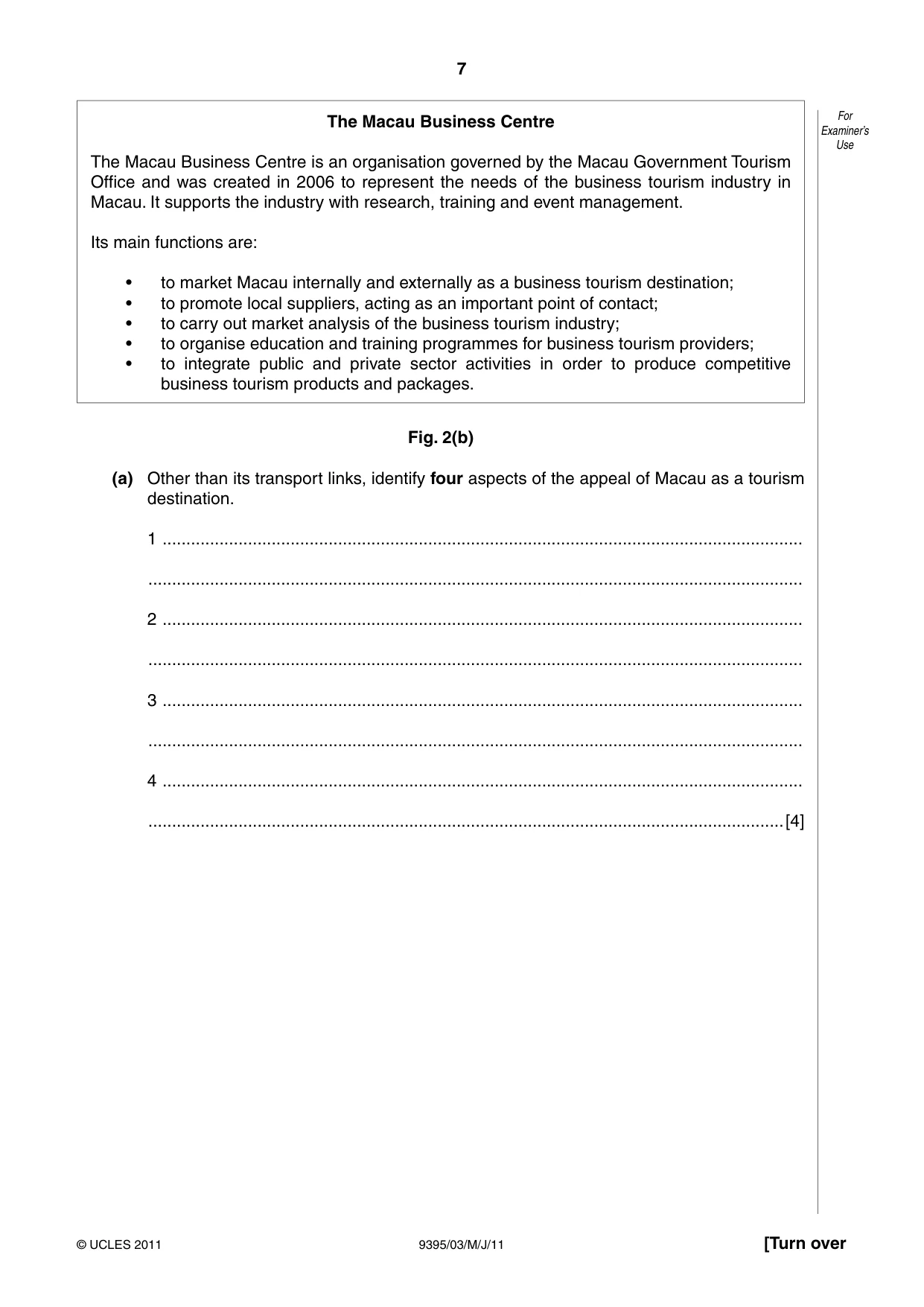
7 9395/03/M/J/11 © UCLES 2011 [Turn over For Examiner’s Use The Macau Business Centre The Macau Business Centre is an organisation governed by the Macau Government Tourism Office and was created in 2006 to represent the needs of the business tourism industry in Macau. It supports the industry with research, training and event management. Its main functions are: • to market Macau internally and externally as a business tourism destination; • to promote local suppliers, acting as an important point of contact; • to carry out market analysis of the business tourism industry; • to organise education and training programmes for business tourism providers; • to integrate public and private sector activities in order to produce competitive business tourism products and packages. Fig. 2(b) (a) Other than its transport links, identify four aspects of the appeal of Macau as a tourism destination. 1 … … 2 … … 3 … … 4 … …[4]
Question paper, page 8
8 9395/03/M/J/11 © UCLES 2011 For Examiner’s Use (b) The Macau Cultural Centre hosts a number of events, such as the annual Arts Festival. Explain three reasons why cultural events such as the Arts Festival are important for destinations such as Macau. 1 … … … … 2 … … … … 3 … … … …[6] (c) With reference to Fig. 2(a), analyse the accessibility of Macau for business tourism purposes. … … … … … … … … … … … …[6]
Question paper, page 9
9 9395/03/M/J/11 © UCLES 2011 [Turn over For Examiner’s Use (d) Evaluate the role played by organisations such as the Macau Business Centre, in supporting the development of international business tourism. … … … … … … … … … … … … … … … … … … … … … … … … …[9] [Total: 25]
Question paper, page 10
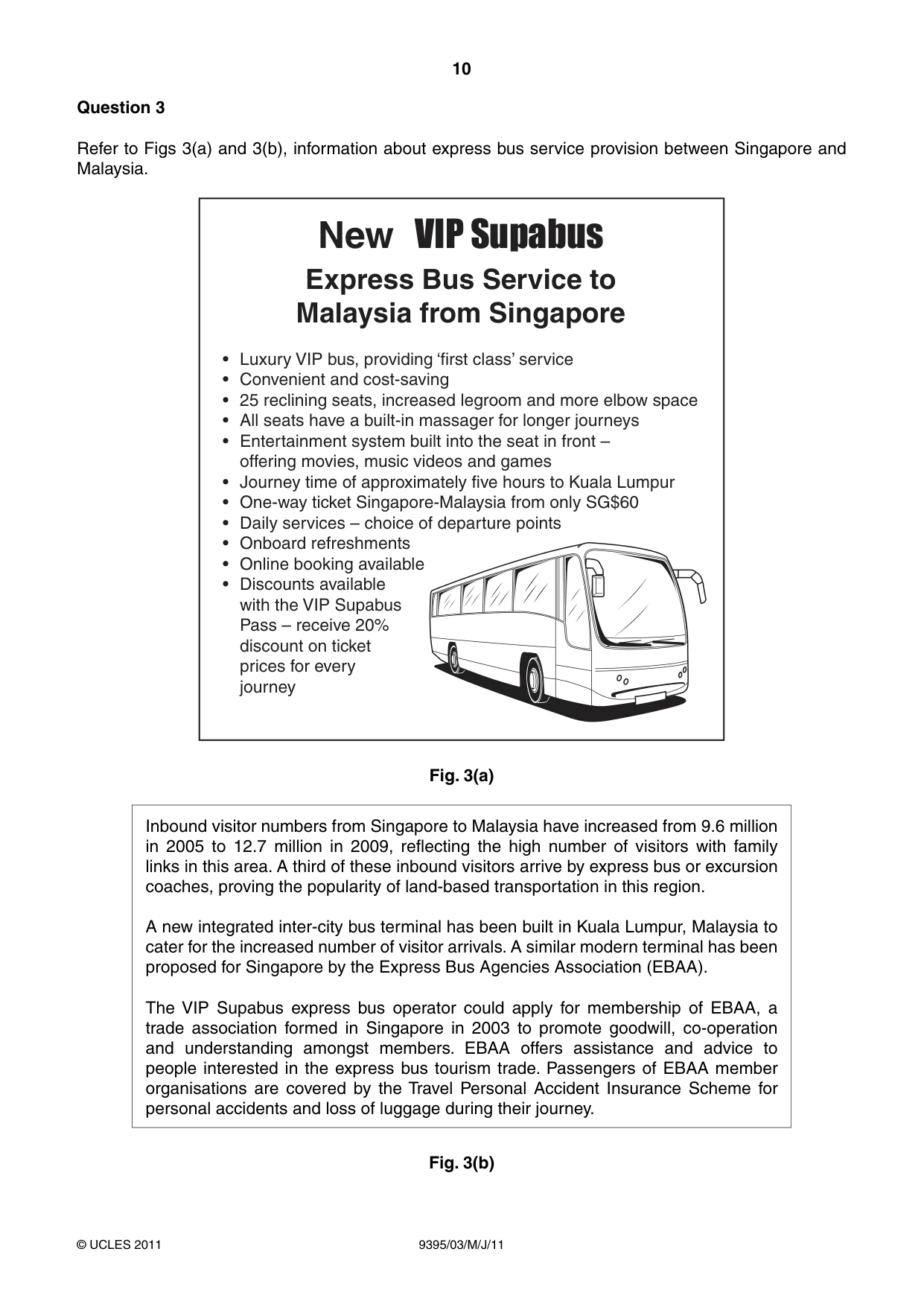
10 9395/03/M/J/11 © UCLES 2011 Question 3 Refer to Figs 3(a) and 3(b), information about express bus service provision between Singapore and Malaysia. Express Bus Service to Malaysia from Singapore New VIP Supabus • Luxury VIP bus, providing ‘first class’ service • Convenient and cost-saving • 25 reclining seats, increased legroom and more elbow space • All seats have a built-in massager for longer journeys • Entertainment system built into the seat in front – offering movies, music videos and games • Journey time of approximately five hours to Kuala Lumpur • One-way ticket Singapore-Malaysia from only SG$60 • Daily services – choice of departure points • Onboard refreshments • Online booking available • Discounts available with the VIP Supabus Pass – receive 20% discount on ticket prices for every journey Fig. 3(a) Inbound visitor numbers from Singapore to Malaysia have increased from 9.6 million in 2005 to 12.7 million in 2009, reflecting the high number of visitors with family links in this area. A third of these inbound visitors arrive by express bus or excursion coaches, proving the popularity of land-based transportation in this region. A new integrated inter-city bus terminal has been built in Kuala Lumpur, Malaysia to cater for the increased number of visitor arrivals. A similar modern terminal has been proposed for Singapore by the Express Bus Agencies Association (EBAA). The VIP Supabus express bus operator could apply for membership of EBAA, a trade association formed in Singapore in 2003 to promote goodwill, co-operation and understanding amongst members. EBAA offers assistance and advice to people interested in the express bus tourism trade. Passengers of EBAA member organisations are covered by the Travel Personal Accident Insurance Scheme for personal accidents and loss of luggage during their journey. Fig. 3(b)
Question paper, page 11
11 9395/03/M/J/11 © UCLES 2011 [Turn over For Examiner’s Use (a) (i) Suggest one likely target market for the ‘VIP Supabus’ organisation. …[1] (ii) Identify three features of the ‘VIP Supabus’ product. 1 … … 2 … … 3 … …[3] (b) Suggest and explain two reasons why organisations, such as EBAA, may offer travel insurance schemes for their members. 1 … … … … … … 2 … … … … … …[6]
Question paper, page 12
12 9395/03/M/J/11 © UCLES 2011 For Examiner’s Use (c) Analyse the benefits to passengers of city destinations, such as Kuala Lumpur, providing an integrated inter-city bus terminal. … … … … … … … … … … … …[6]
Question paper, page 13
13 9395/03/M/J/11 © UCLES 2011 [Turn over For Examiner’s Use (d) Passengers can travel by air or by bus between Singapore and Kuala Lumpur. Evaluate the benefits to passengers of using the VIP Supabus for this journey. … … … … … … … … … … … … … … … … … … … … … … … … …[9] [Total: 25]
Question paper, page 14
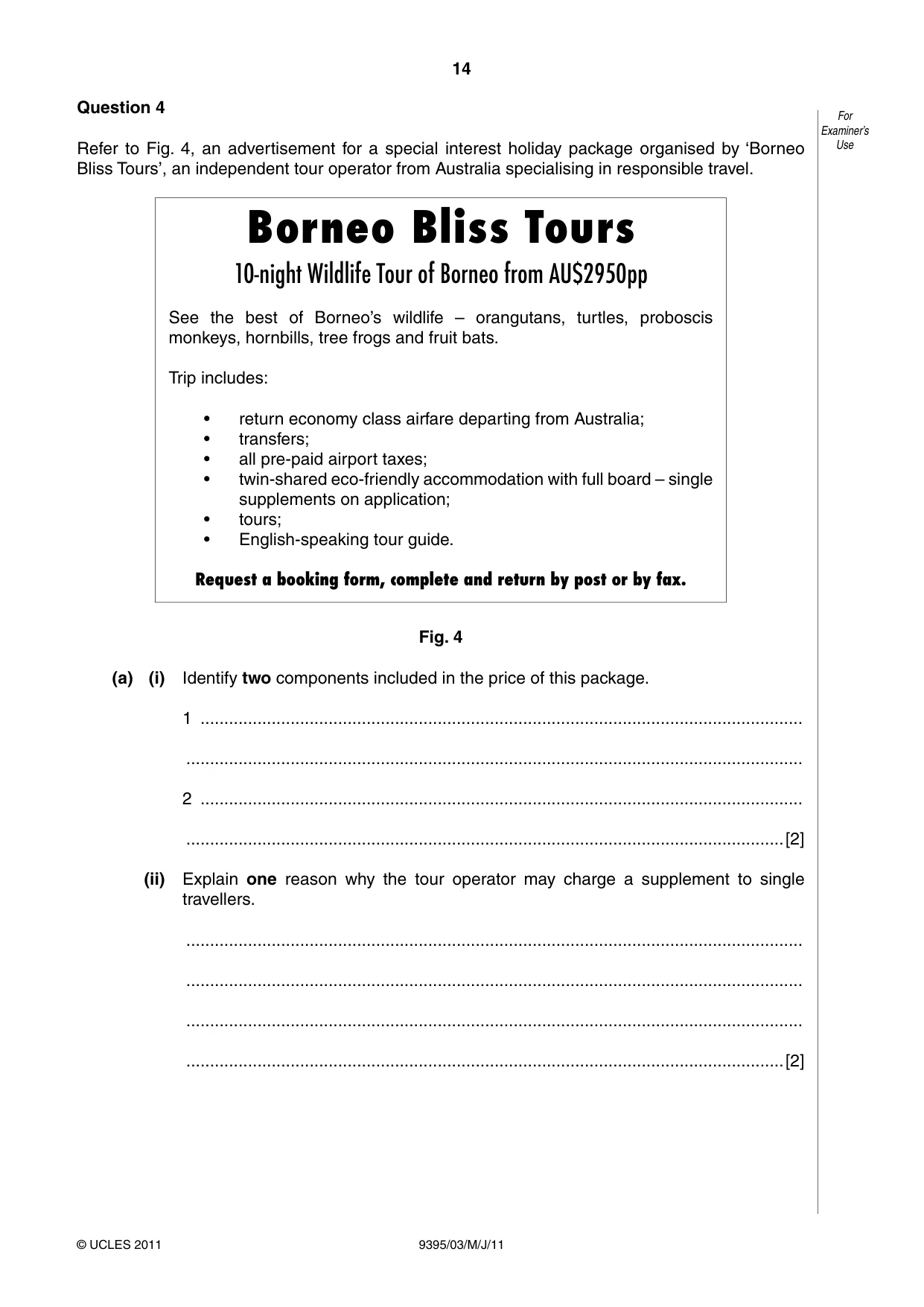
14 9395/03/M/J/11 © UCLES 2011 For Examiner’s Use Question 4 Refer to Fig. 4, an advertisement for a special interest holiday package organised by ‘Borneo Bliss Tours’, an independent tour operator from Australia specialising in responsible travel. Borneo Bliss Tours 10-night Wildlife Tour of Borneo from AU$2950pp See the best of Borneo’s wildlife – orangutans, turtles, proboscis monkeys, hornbills, tree frogs and fruit bats. Trip includes: • return economy class airfare departing from Australia; • transfers; • all pre-paid airport taxes; • twin-shared eco-friendly accommodation with full board – single supplements on application; • tours; • English-speaking tour guide. Request a booking form, complete and return by post or by fax. Fig. 4 (a) (i) Identify two components included in the price of this package. 1 … … 2 … …[2] (ii) Explain one reason why the tour operator may charge a supplement to single travellers. … … … …[2]
Question paper, page 15
15 9395/03/M/J/11 © UCLES 2011 [Turn over For Examiner’s Use (b) Explain two reasons why this tour operator requests bookings to be made by post or by fax. 1 … … … … … … 2 … … … … … …[6] (c) Assess the appeal of this special interest holiday package to leisure travellers. … … … … … … … … … … … …[6]
Question paper, page 16
16 9395/03/M/J/11 © UCLES 2011 For Examiner’s Use Copyright Acknowledgements: Question 1 © Royal Caribbean International. Question 1 © Florida Caribbean Cruise Association. Question 3 © Express Bus Agencies Association. Permission to reproduce items where third-party owned material protected by copyright is included has been sought and cleared where possible. Every reasonable effort has been made by the publisher (UCLES) to trace copyright holders, but if any items requiring clearance have unwittingly been included, the publisher will be pleased to make amends at the earliest possible opportunity. University of Cambridge International Examinations is part of the Cambridge Assessment Group. Cambridge Assessment is the brand name of University of Cambridge Local Examinations Syndicate (UCLES), which is itself a department of the University of Cambridge. (d) Discuss the likely reasons why tour operators provide a tour guide as part of packages such as the Borneo Bliss Wildlife Tour. … … … … … … … … … … … … … … … … … … … … … … … … …[9] [Total: 25]
Mark scheme, page 1
UNIVERSITY OF CAMBRIDGE INTERNATIONAL EXAMINATIONS GCE Advanced Subsidiary Level and GCE Advanced Level MARK SCHEME for the May/June 2011 question paper for the guidance of teachers 9395 TRAVEL AND TOURISM 9395/03 Paper 3 (International Business & Leisure Travel Services), maximum raw mark 100 This mark scheme is published as an aid to teachers and candidates, to indicate the requirements of the examination. It shows the basis on which Examiners were instructed to award marks. It does not indicate the details of the discussions that took place at an Examiners’ meeting before marking began, which would have considered the acceptability of alternative answers. Mark schemes must be read in conjunction with the question papers and the report on the examination. • Cambridge will not enter into discussions or correspondence in connection with these mark schemes. Cambridge is publishing the mark schemes for the May/June 2011 question papers for most IGCSE, GCE Advanced Level and Advanced Subsidiary Level syllabuses and some Ordinary Level syllabuses.
Mark scheme, page 2
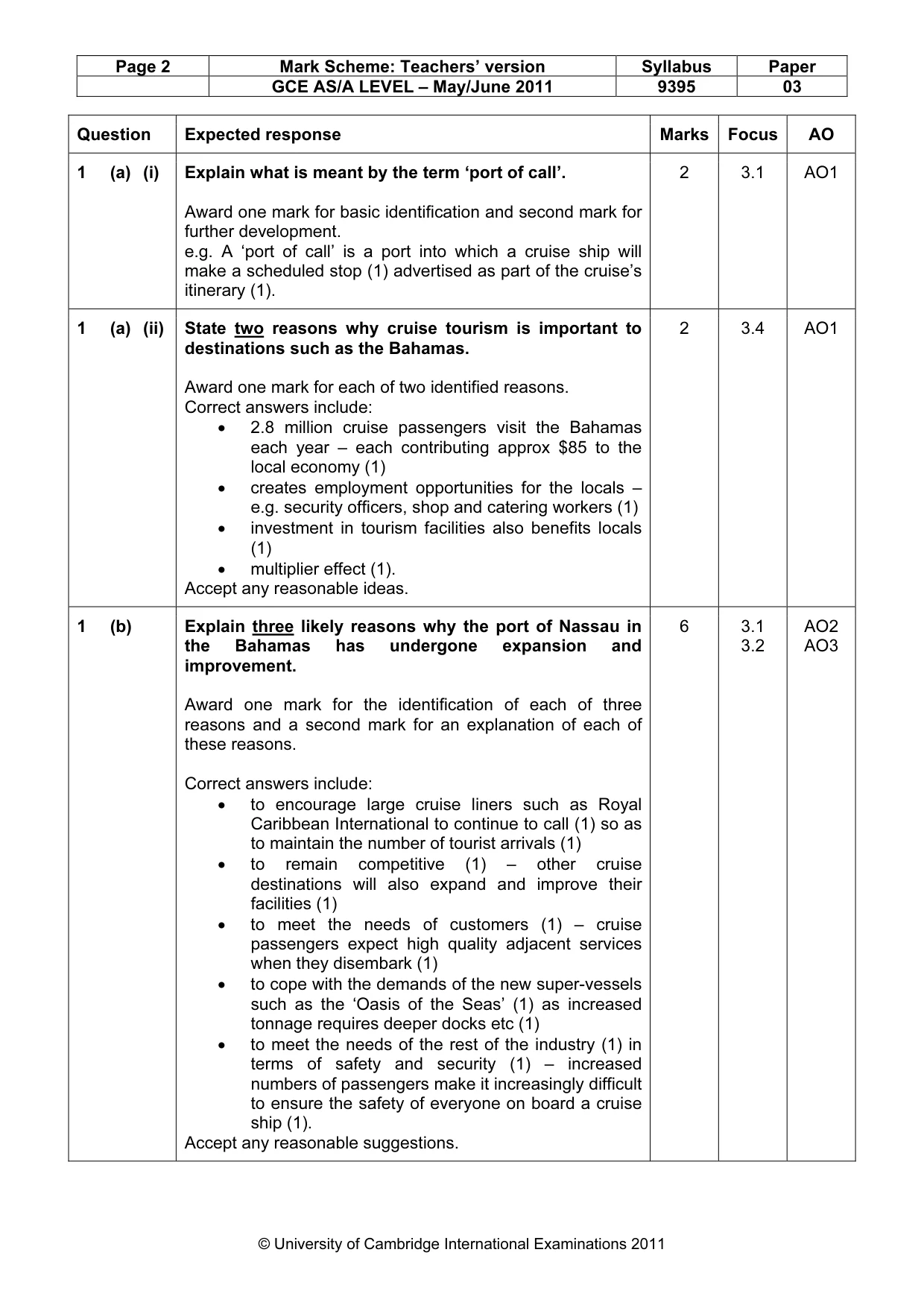
Page 2 Mark Scheme: Teachers’ version Syllabus Paper GCE AS/A LEVEL – May/June 2011 9395 03 © University of Cambridge International Examinations 2011 Question Expected response Marks Focus AO 1 (a) (i) Explain what is meant by the term ‘port of call’. Award one mark for basic identification and second mark for further development. e.g. A ‘port of call’ is a port into which a cruise ship will make a scheduled stop (1) advertised as part of the cruise’s itinerary (1). 2 3.1 AO1 1 (a) (ii) State two reasons why cruise tourism is important to destinations such as the Bahamas. Award one mark for each of two identified reasons. Correct answers include: • 2.8 million cruise passengers visit the Bahamas each year – each contributing approx $85 to the local economy (1) • creates employment opportunities for the locals – e.g. security officers, shop and catering workers (1) • investment in tourism facilities also benefits locals (1) • multiplier effect (1). Accept any reasonable ideas. 2 3.4 AO1 1 (b) Explain three likely reasons why the port of Nassau in the Bahamas has undergone expansion and improvement. Award one mark for the identification of each of three reasons and a second mark for an explanation of each of these reasons. Correct answers include: • to encourage large cruise liners such as Royal Caribbean International to continue to call (1) so as to maintain the number of tourist arrivals (1) • to remain competitive (1) – other cruise destinations will also expand and improve their facilities (1) • to meet the needs of customers (1) – cruise passengers expect high quality adjacent services when they disembark (1) • to cope with the demands of the new super-vessels such as the ‘Oasis of the Seas’ (1) as increased tonnage requires deeper docks etc (1) • to meet the needs of the rest of the industry (1) in terms of safety and security (1) – increased numbers of passengers make it increasingly difficult to ensure the safety of everyone on board a cruise ship (1). Accept any reasonable suggestions. 6 3.1 3.2 AO2 AO3
Mark scheme, page 3
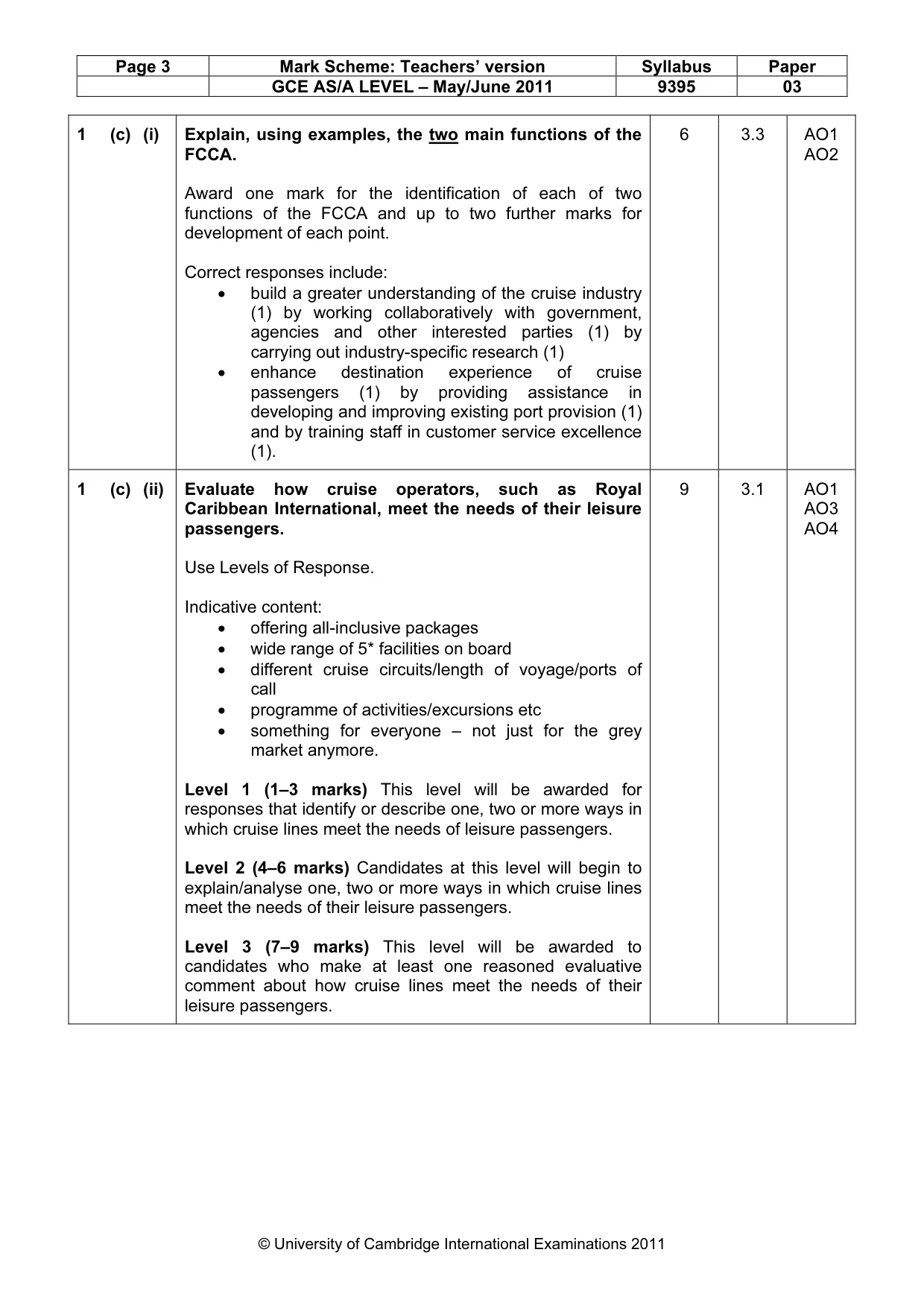
Page 3 Mark Scheme: Teachers’ version Syllabus Paper GCE AS/A LEVEL – May/June 2011 9395 03 © University of Cambridge International Examinations 2011 1 (c) (i) Explain, using examples, the two main functions of the FCCA. Award one mark for the identification of each of two functions of the FCCA and up to two further marks for development of each point. Correct responses include: • build a greater understanding of the cruise industry (1) by working collaboratively with government, agencies and other interested parties (1) by carrying out industry-specific research (1) • enhance destination experience of cruise passengers (1) by providing assistance in developing and improving existing port provision (1) and by training staff in customer service excellence (1). 6 3.3 AO1 AO2 1 (c) (ii) Evaluate how cruise operators, such as Royal Caribbean International, meet the needs of their leisure passengers. Use Levels of Response. Indicative content: • offering all-inclusive packages • wide range of 5* facilities on board • different cruise circuits/length of voyage/ports of call • programme of activities/excursions etc • something for everyone – not just for the grey market anymore. Level 1 (1–3 marks) This level will be awarded for responses that identify or describe one, two or more ways in which cruise lines meet the needs of leisure passengers. Level 2 (4–6 marks) Candidates at this level will begin to explain/analyse one, two or more ways in which cruise lines meet the needs of their leisure passengers. Level 3 (7–9 marks) This level will be awarded to candidates who make at least one reasoned evaluative comment about how cruise lines meet the needs of their leisure passengers. 9 3.1 AO1 AO3 AO4
Mark scheme, page 4
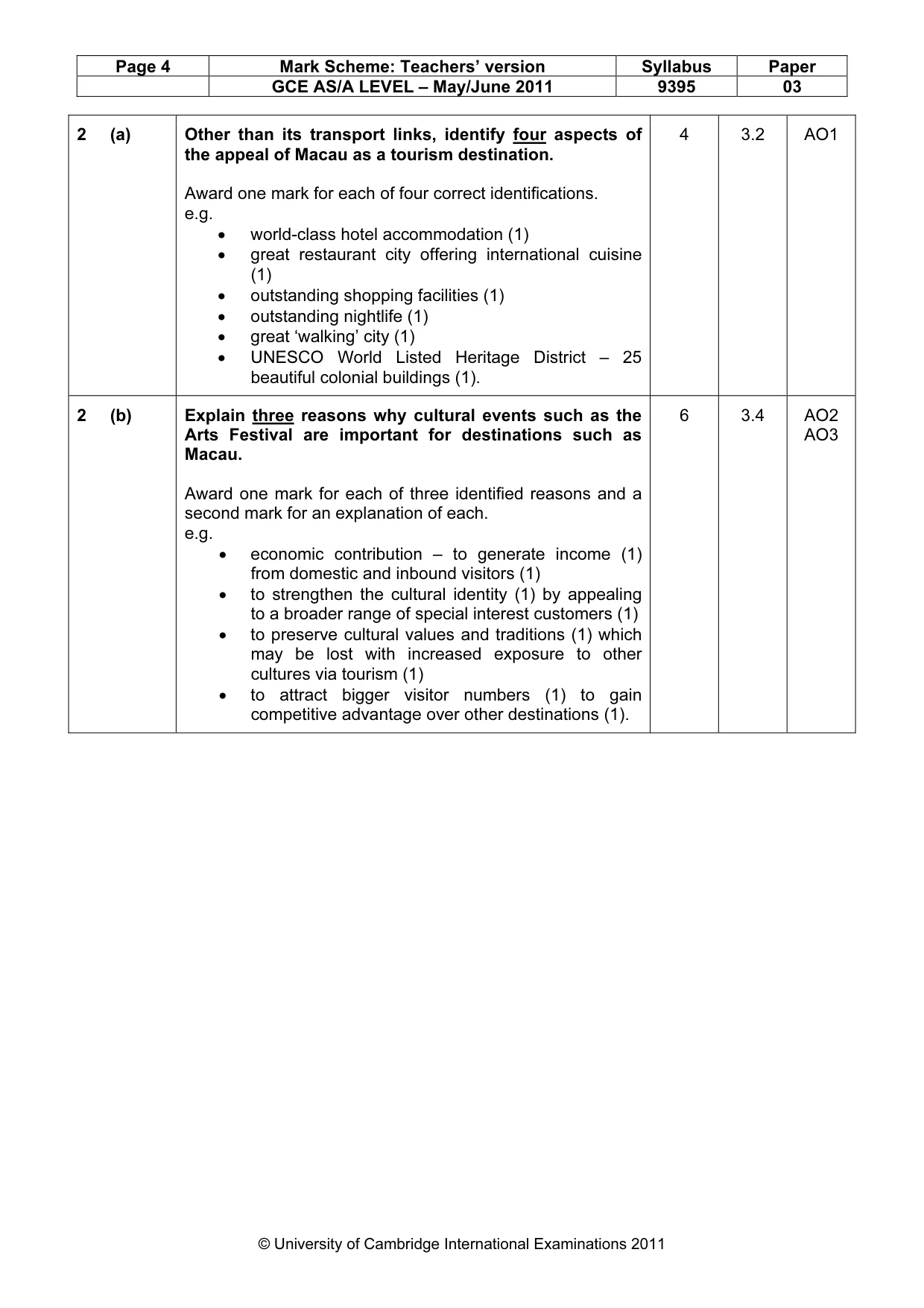
Page 4 Mark Scheme: Teachers’ version Syllabus Paper GCE AS/A LEVEL – May/June 2011 9395 03 © University of Cambridge International Examinations 2011 2 (a) Other than its transport links, identify four aspects of the appeal of Macau as a tourism destination. Award one mark for each of four correct identifications. e.g. • world-class hotel accommodation (1) • great restaurant city offering international cuisine (1) • outstanding shopping facilities (1) • outstanding nightlife (1) • great ‘walking’ city (1) • UNESCO World Listed Heritage District – 25 beautiful colonial buildings (1). 4 3.2 AO1 2 (b) Explain three reasons why cultural events such as the Arts Festival are important for destinations such as Macau. Award one mark for each of three identified reasons and a second mark for an explanation of each. e.g. • economic contribution – to generate income (1) from domestic and inbound visitors (1) • to strengthen the cultural identity (1) by appealing to a broader range of special interest customers (1) • to preserve cultural values and traditions (1) which may be lost with increased exposure to other cultures via tourism (1) • to attract bigger visitor numbers (1) to gain competitive advantage over other destinations (1). 6 3.4 AO2 AO3
Mark scheme, page 5
Page 5 Mark Scheme: Teachers’ version Syllabus Paper GCE AS/A LEVEL – May/June 2011 9395 03 © University of Cambridge International Examinations 2011 2 (c) With reference to Fig. 2(a), analyse the accessibility of Macau for business tourism purposes. Use Levels of Response. Indicative content: • very accessible for Asian delegates but limited flight options from rest of world – no direct flights • small number of airlines using the airport – only 15 • airport not yet reached passenger carrying capacity so could introduce wider range of flight connections to improve the accessibility from non-Asian destinations • excellent transfer links to CBD from airport – wide choice, inexpensive alternatives etc • supporting infrastructure is good – choice of conference venues etc. Level 1 (1–2 marks) This level will be awarded for responses that identify or describe one or more accessibility factors. Level 2 (3–4 marks) Candidates at this level will begin to explain one or more accessibility factors. Level 3 (5–6 marks) This level will be awarded to candidates who make at least one analytical comment about how accessible Macau is for business tourism. 6 3.2 3.4 AO1 AO2 AO3
Mark scheme, page 6
Page 6 Mark Scheme: Teachers’ version Syllabus Paper GCE AS/A LEVEL – May/June 2011 9395 03 © University of Cambridge International Examinations 2011 2 (d) Evaluate the role played by organisations such as the Macau Business Centre, in supporting the development of international business tourism. Use Levels of Response. Indicative content: • marketing and promotion of the destination both domestically and internationally • provide a point of contact between conference organisers and local suppliers • carrying out industry-specific research to inform policy decisions • ensure business tourism providers are trained and educated to a professional level so as to remain competitive with other business tourism destinations. Accept any other justified reasons. Level 1 (1–3 marks) This level will be awarded for responses that identify or describe the role. Level 2 (4–6 marks) Candidates will explain the role played by such organisations at this level. At the top end, responses will begin to analyse why this is important. Level 3 (7–9 marks) This level will be awarded to candidates who make reasoned evaluative comments about the role of such organisations. 9 3.3 3.4 AO1 AO3 AO4 3 (a) (i) Suggest one likely target market for the ‘VIP Supabus’ organisation. Award one mark for an appropriate suggestion. e.g. • tourists visiting friends and family (1) • leisure travellers (1) – can accept students (1), backpackers (1), independent travellers (1) etc. 1 3.1 AO2 3 (a) (ii) Identify three features of the ‘VIP Supabus’ product. Award one mark for each correct identification. e.g. • luxury coach (1) • 25 reclining seats (1) • built-in seat massager (1) • entertainment systems (1) • onboard refreshments (1). Accept any three valid suggestions. 3 3.1 AO1
Mark scheme, page 7
Page 7 Mark Scheme: Teachers’ version Syllabus Paper GCE AS/A LEVEL – May/June 2011 9395 03 © University of Cambridge International Examinations 2011 3 (b) Suggest and explain two reasons why organisations, such as EBAA, may offer travel insurance schemes for their members. Award one mark for the identification of appropriate reasons and up to two further marks for development. e.g. • legal requirement (1) to provide public indemnity against accidents (1) to protect its members’ financial security (1) • to gain competitive advantage (1) as lots of similar express bus service operators within the market (1) who might not afford to cover their passengers in the same way (1) • to enhance the image of the organisation (1), to gain more members (1), to strengthen its voice in the passenger transport industry (1). 6 3.1 3.3 3.4 AO2 AO3 3 (c) Analyse the benefits to passengers of city destinations, such as Kuala Lumpur, providing an integrated inter- city bus terminal. Use Levels of Response. Indicative content: • convenience – integrated terminal will have connecting services to other transport providers and will co-ordinate departure times • central location – easier to find • saves time and money – no need to travel to pick up connecting services. Level 1 (1–2 marks) This level will be awarded for responses that identify or describe one or more benefits. Level 2 (3–4 marks) Candidates at this level will begin to explain one or more benefits. Level 3 (5–6 marks) This level will be awarded to candidates who make at least one analytical comment about the benefits for passengers. 6 3.1 3.2 3.4 AO2 AO3
Mark scheme, page 8
Page 8 Mark Scheme: Teachers’ version Syllabus Paper GCE AS/A LEVEL – May/June 2011 9395 03 © University of Cambridge International Examinations 2011 3 (d) Evaluate the benefits to passengers of using the ‘VIP Supabus’ for this journey. Use Levels of Response. Indicative content: • cost – very competitive prices • convenience – city centre location – unlike airport which is often located on outskirts – so no need for transfers • speed – no lengthy check-in, immigration procedures etc • facilities – similar luxury experience as travelling first class by plane. Level 1 (1–3 marks) This level will be awarded for responses that identify or describe one or more benefits. Level 2 (4–6 marks) Candidates will explain one or more benefits. Level 3 (7–9 marks) This level will be awarded to candidates who make reasoned evaluative comments about the benefits of express coach travel over flying. 9 3.4 AO1 AO3 AO4 4 (a) (i) Identify two components included in the price of this package. Award one mark for each of two appropriate components. e.g. • transportation (1) • transfers (1) • accommodation (1) • full board meal plan (1) • tours (1) • services of the tour guide (1). Accept any two. 2 3.2 AO1 4 (a) (ii) Explain one reason why the tour operator may charge a supplement to single travellers. Award one mark for the identification of the reason and up to two further marks for development. e.g. • accommodation is in twin rooms (1) so loss of potential revenue to company if only one person is occupying a twin room (1) • way of attracting increased revenue (1) as tour operator will have to pay for twin occupancy to accommodation provider (1). Accept any reasonable suggestions. 2 3.2 AO2
Mark scheme, page 9
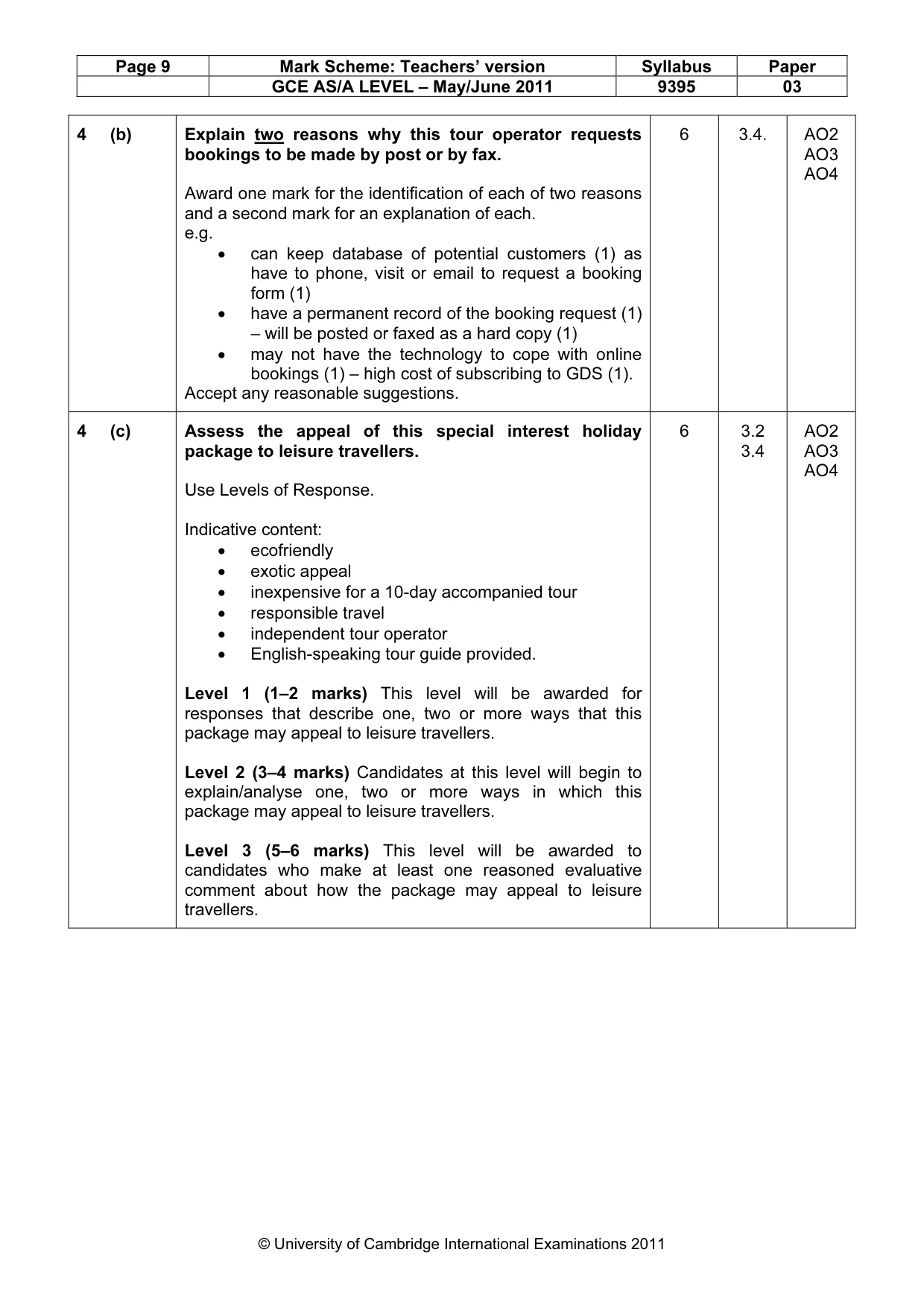
Page 9 Mark Scheme: Teachers’ version Syllabus Paper GCE AS/A LEVEL – May/June 2011 9395 03 © University of Cambridge International Examinations 2011 4 (b) Explain two reasons why this tour operator requests bookings to be made by post or by fax. Award one mark for the identification of each of two reasons and a second mark for an explanation of each. e.g. • can keep database of potential customers (1) as have to phone, visit or email to request a booking form (1) • have a permanent record of the booking request (1) – will be posted or faxed as a hard copy (1) • may not have the technology to cope with online bookings (1) – high cost of subscribing to GDS (1). Accept any reasonable suggestions. 6 3.4. AO2 AO3 AO4 4 (c) Assess the appeal of this special interest holiday package to leisure travellers. Use Levels of Response. Indicative content: • ecofriendly • exotic appeal • inexpensive for a 10-day accompanied tour • responsible travel • independent tour operator • English-speaking tour guide provided. Level 1 (1–2 marks) This level will be awarded for responses that describe one, two or more ways that this package may appeal to leisure travellers. Level 2 (3–4 marks) Candidates at this level will begin to explain/analyse one, two or more ways in which this package may appeal to leisure travellers. Level 3 (5–6 marks) This level will be awarded to candidates who make at least one reasoned evaluative comment about how the package may appeal to leisure travellers. 6 3.2 3.4 AO2 AO3 AO4
Mark scheme, page 10
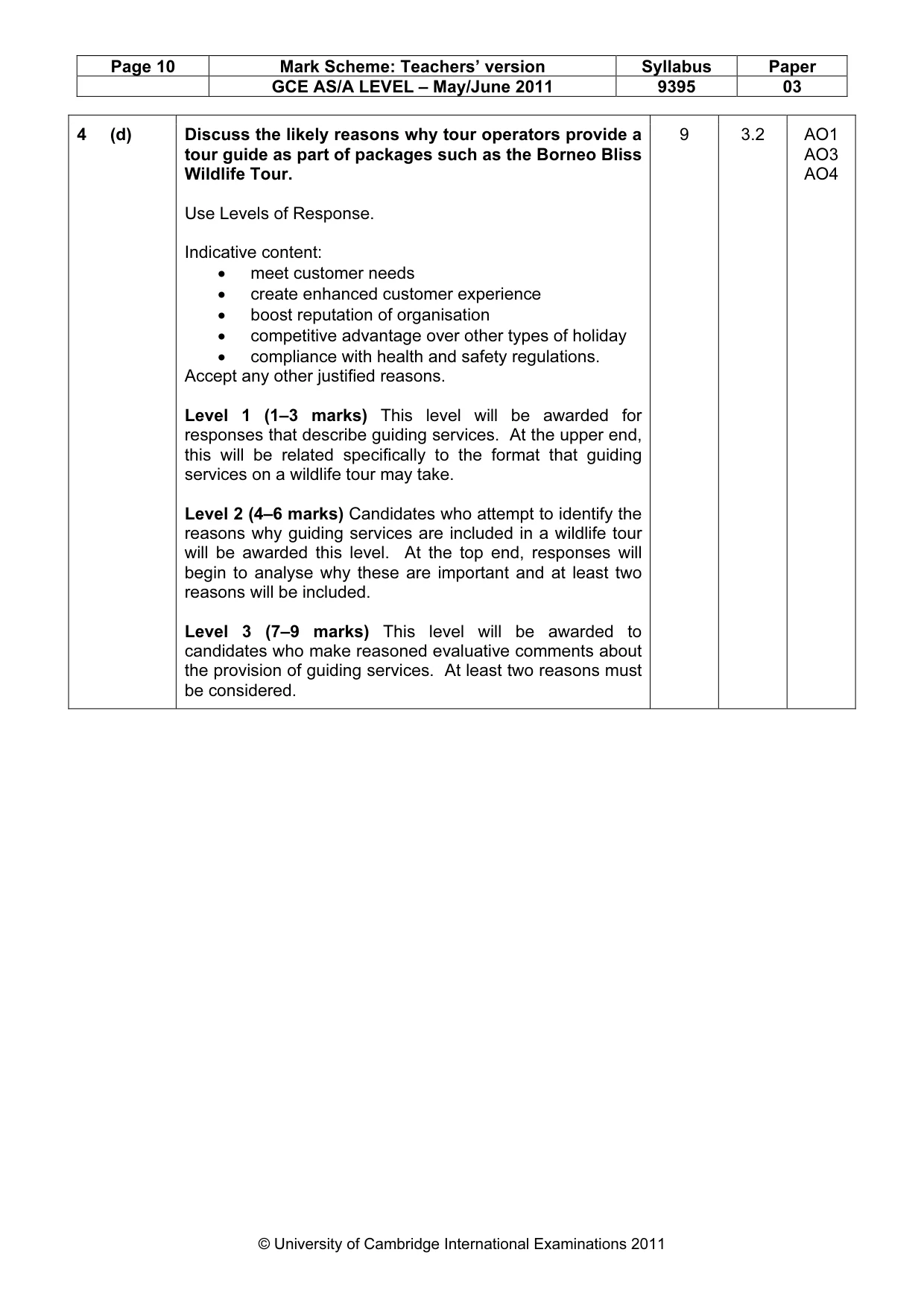
Page 10 Mark Scheme: Teachers’ version Syllabus Paper GCE AS/A LEVEL – May/June 2011 9395 03 © University of Cambridge International Examinations 2011 4 (d) Discuss the likely reasons why tour operators provide a tour guide as part of packages such as the Borneo Bliss Wildlife Tour. Use Levels of Response. Indicative content: • meet customer needs • create enhanced customer experience • boost reputation of organisation • competitive advantage over other types of holiday • compliance with health and safety regulations. Accept any other justified reasons. Level 1 (1–3 marks) This level will be awarded for responses that describe guiding services. At the upper end, this will be related specifically to the format that guiding services on a wildlife tour may take. Level 2 (4–6 marks) Candidates who attempt to identify the reasons why guiding services are included in a wildlife tour will be awarded this level. At the top end, responses will begin to analyse why these are important and at least two reasons will be included. Level 3 (7–9 marks) This level will be awarded to candidates who make reasoned evaluative comments about the provision of guiding services. At least two reasons must be considered. 9 3.2 AO1 AO3 AO4
What you needed in this session
Cambridge’s own grade thresholds for 2011 May/June, Paper 3 · Variant 1. A higher threshold means an easier paper — the bar moves with how the cohort did.