Cambridge A Level Travel and Tourism 9395 — 2010 Oct/Nov Paper 3 · Variant 1
9395/31/O/N/10 · 100 marks · ≈113 min
The question paper and its mark scheme, free to read here and free to download. This is Cambridge’s own paper, exactly as it was sat.
Question paper20 pages



Mark scheme9 pages
Answers below. Sit the paper first if you are practising.
Paper as text
Question paper, page 1
This document consists of 17 printed pages and 3 blank pages. IB10 11_9395_03/4RP © UCLES 2010 [Turn over *1446499492* For Examiner's Use 1 2 3 4 Total UNIVERSITY OF CAMBRIDGE INTERNATIONAL EXAMINATIONS General Certificate of Education Advanced Level TRAVEL AND TOURISM 9395/03 Paper 3 International Business & Leisure Travel Services October/November 2010 1 hour and 30 minutes Candidates answer on the Question Paper READ THESE INSTRUCTIONS FIRST Write your Centre number, candidate number and name on all the work you hand in. Write in dark blue or black pen. Do not use staples, paper clips, highlighters, glue or correction fluid. You may use a pencil for any diagrams, graphs or rough working. DO NOT WRITE IN ANY BARCODES. Answer all questions. The number of marks is given in brackets [ ] at the end of each question or part question.
Question paper, page 2
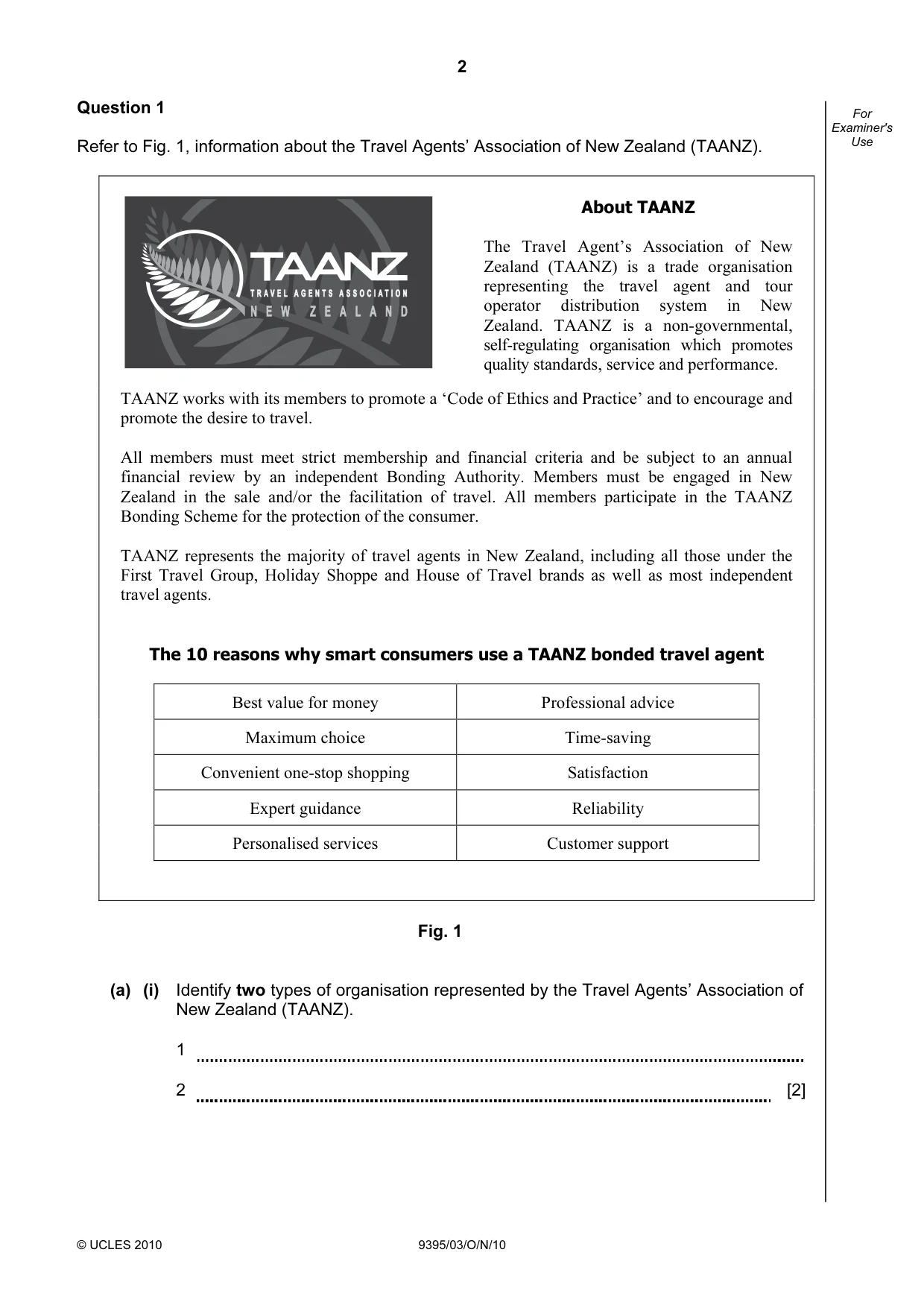
2 © UCLES 2010 9395/03/O/N/10 For Examiner's Use Question 1 Refer to Fig. 1, information about the Travel Agents’ Association of New Zealand (TAANZ). About TAANZ The Travel Agent’s Association of New Zealand (TAANZ) is a trade organisation representing the travel agent and tour operator distribution system in New Zealand. TAANZ is a non-governmental, self-regulating organisation which promotes quality standards, service and performance. TAANZ works with its members to promote a ‘Code of Ethics and Practice’ and to encourage and promote the desire to travel. All members must meet strict membership and financial criteria and be subject to an annual financial review by an independent Bonding Authority. Members must be engaged in New Zealand in the sale and/or the facilitation of travel. All members participate in the TAANZ Bonding Scheme for the protection of the consumer. TAANZ represents the majority of travel agents in New Zealand, including all those under the First Travel Group, Holiday Shoppe and House of Travel brands as well as most independent travel agents. The 10 reasons why smart consumers use a TAANZ bonded travel agent Best value for money Professional advice Maximum choice Time-saving Convenient one-stop shopping Satisfaction Expert guidance Reliability Personalised services Customer support Fig. 1 (a) (i) Identify two types of organisation represented by the Travel Agents’ Association of New Zealand (TAANZ). 1 2 [2]
Question paper, page 3
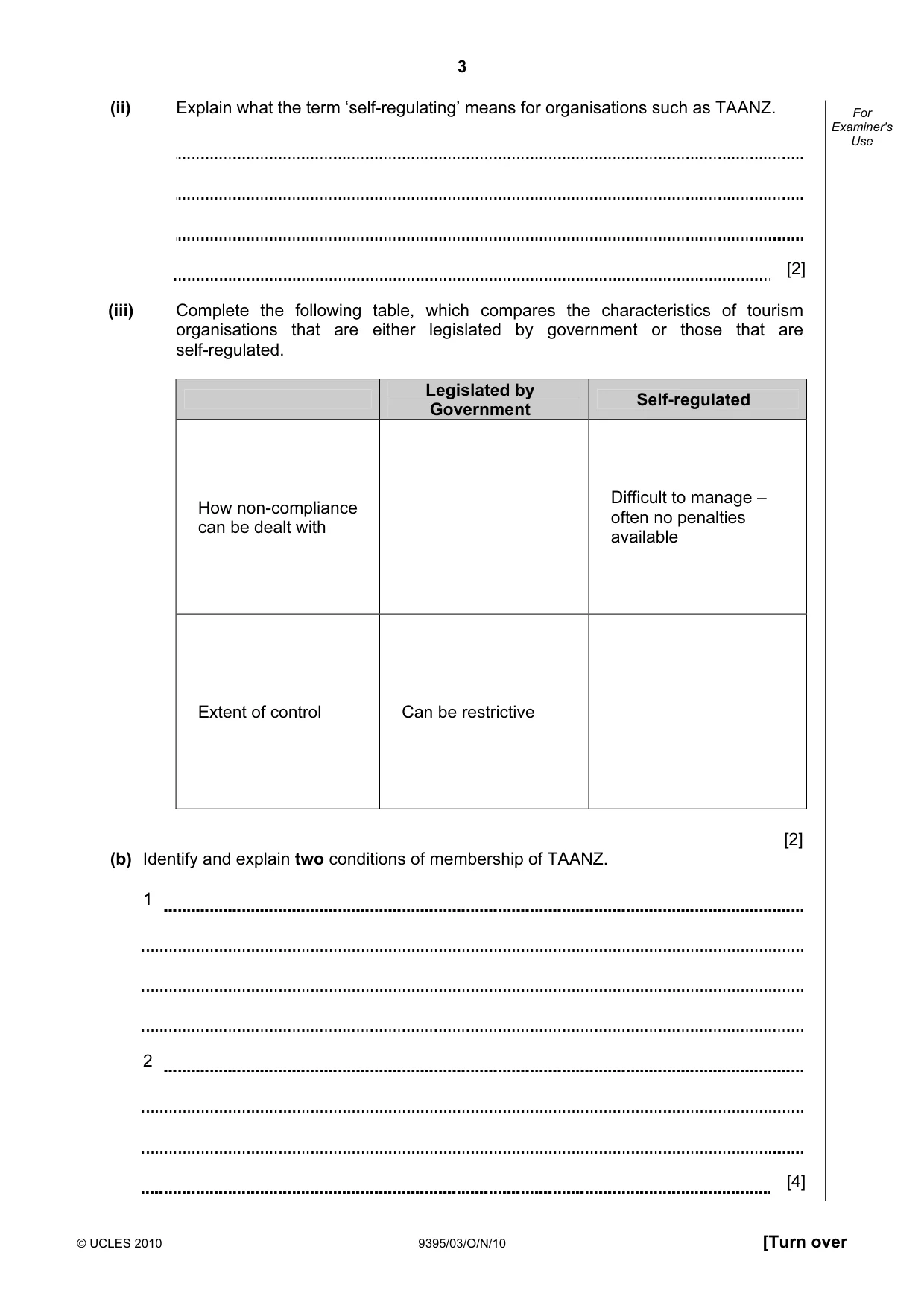
3 © UCLES 2010 9395/03/O/N/10 [Turn over For Examiner's Use (ii) Explain what the term ‘self-regulating’ means for organisations such as TAANZ. [2] (iii) Complete the following table, which compares the characteristics of tourism organisations that are either legislated by government or those that are self-regulated. Legislated by Government Self-regulated How non-compliance can be dealt with Difficult to manage – often no penalties available Extent of control Can be restrictive [2] (b) Identify and explain two conditions of membership of TAANZ. 1 2 [4]
Question paper, page 4
4 © UCLES 2010 9395/03/O/N/10 For Examiner's Use (c) Analyse the importance to members, of trade associations such as TAANZ adhering to a code of practice. [6]
Question paper, page 5
5 © UCLES 2010 9395/03/O/N/10 [Turn over For Examiner's Use (d) Evaluate the benefits to customers of using a TAANZ bonded agent when making travel arrangements in New Zealand. [9] [Total: 25]
Question paper, page 6
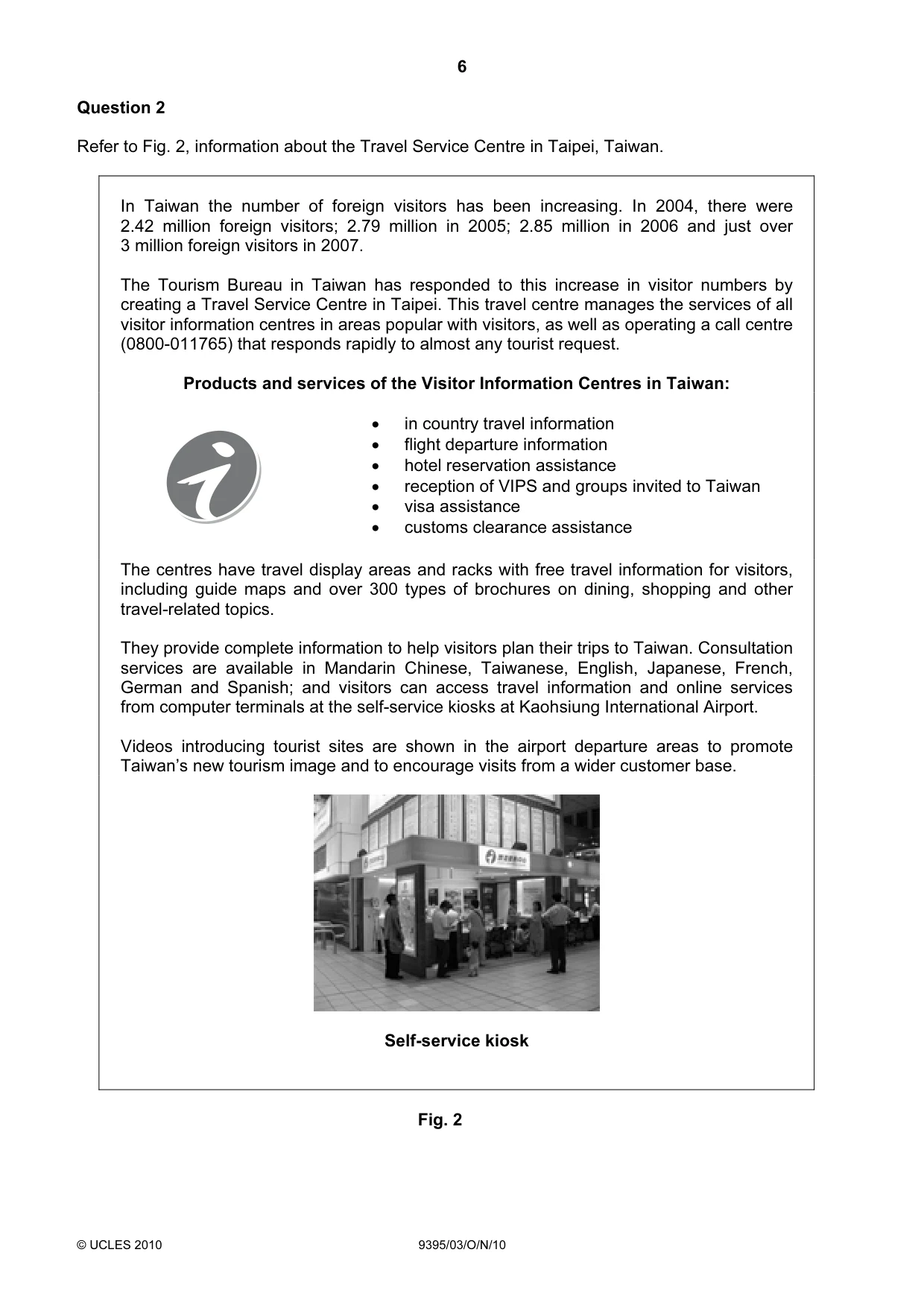
6 © UCLES 2010 9395/03/O/N/10 Question 2 Refer to Fig. 2, information about the Travel Service Centre in Taipei, Taiwan. In Taiwan the number of foreign visitors has been increasing. In 2004, there were 2.42 million foreign visitors; 2.79 million in 2005; 2.85 million in 2006 and just over 3 million foreign visitors in 2007. The Tourism Bureau in Taiwan has responded to this increase in visitor numbers by creating a Travel Service Centre in Taipei. This travel centre manages the services of all visitor information centres in areas popular with visitors, as well as operating a call centre (0800-011765) that responds rapidly to almost any tourist request. Products and services of the Visitor Information Centres in Taiwan: • in country travel information • flight departure information • hotel reservation assistance • reception of VIPS and groups invited to Taiwan • visa assistance • customs clearance assistance The centres have travel display areas and racks with free travel information for visitors, including guide maps and over 300 types of brochures on dining, shopping and other travel-related topics. They provide complete information to help visitors plan their trips to Taiwan. Consultation services are available in Mandarin Chinese, Taiwanese, English, Japanese, French, German and Spanish; and visitors can access travel information and online services from computer terminals at the self-service kiosks at Kaohsiung International Airport. Videos introducing tourist sites are shown in the airport departure areas to promote Taiwan’s new tourism image and to encourage visits from a wider customer base. Self-service kiosk Fig. 2
Question paper, page 7
7 © UCLES 2010 9395/03/O/N/10 [Turn over For Examiner's Use (a) (i) Identify two services offered by Visitor Information Centres such as those in Taiwan. 1 2 [2] (ii) Explain two ways in which the Travel Service Centre in Taipei caters for the needs of different types of customers. 1 2 [4] (b) Explain three ways in which new technology may be used in providing visitor information services. 1 2 3 [6]
Question paper, page 8
8 © UCLES 2010 9395/03/O/N/10 For Examiner's Use (c) Suggest two ancillary products or services, other than those mentioned in Fig. 2, that the Travel Service Centre in Taipei could offer visitors. Give one reason why you think each of your chosen products/services should be offered. 1 Reason 2 Reason [4]
Question paper, page 9
9 © UCLES 2010 9395/03/O/N/10 [Turn over For Examiner's Use (d) Discuss ways in which the Travel Service Centre in Taipei could target its services specifically to the business tourism market. [9] [Total: 25]
Question paper, page 10
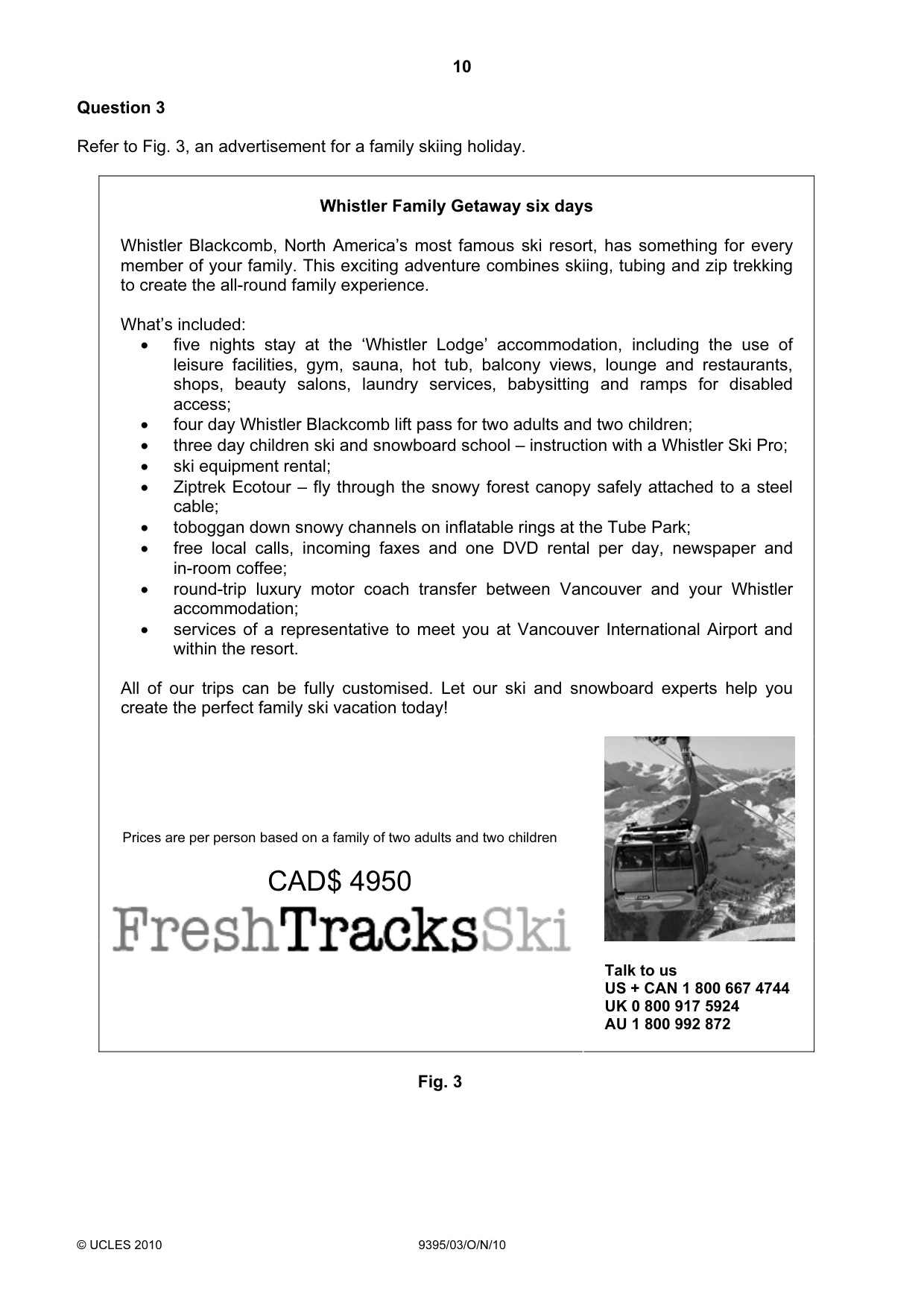
10 © UCLES 2010 9395/03/O/N/10 Question 3 Refer to Fig. 3, an advertisement for a family skiing holiday. Whistler Family Getaway six days Whistler Blackcomb, North America’s most famous ski resort, has something for every member of your family. This exciting adventure combines skiing, tubing and zip trekking to create the all-round family experience. What’s included: • five nights stay at the ‘Whistler Lodge’ accommodation, including the use of leisure facilities, gym, sauna, hot tub, balcony views, lounge and restaurants, shops, beauty salons, laundry services, babysitting and ramps for disabled access; • four day Whistler Blackcomb lift pass for two adults and two children; • three day children ski and snowboard school – instruction with a Whistler Ski Pro; • ski equipment rental; • Ziptrek Ecotour – fly through the snowy forest canopy safely attached to a steel cable; • toboggan down snowy channels on inflatable rings at the Tube Park; • free local calls, incoming faxes and one DVD rental per day, newspaper and in-room coffee; • round-trip luxury motor coach transfer between Vancouver and your Whistler accommodation; • services of a representative to meet you at Vancouver International Airport and within the resort. All of our trips can be fully customised. Let our ski and snowboard experts help you create the perfect family ski vacation today! Prices are per person based on a family of two adults and two children CAD$ 4950 Talk to us US + CAN 1 800 667 4744 UK 0 800 917 5924 AU 1 800 992 872 Fig. 3
Question paper, page 11
11 © UCLES 2010 9395/03/O/N/10 [Turn over For Examiner's Use (a) (i) Identify two components of this package holiday. 1 2 [2] (ii) State two items not included in the price of this holiday. 1 2 [2] (b) Explain two likely reasons why the Whistler Blackcomb resort is a popular destination for family holidays. 1 2 [4]
Question paper, page 12
12 © UCLES 2010 9395/03/O/N/10 For Examiner's Use (c) The tour operator ‘Fresh Tracks Ski’ offers the option of customising any of the trips from their range. Evaluate the benefits to the tour operator of offering customised packages. [9]
Question paper, page 13
13 © UCLES 2010 9395/03/O/N/10 [Turn over For Examiner's Use (d) Discuss the range of products and services offered by accommodation providers in ski resorts such as Whistler Blackcomb. [8] [Total: 25]
Question paper, page 14
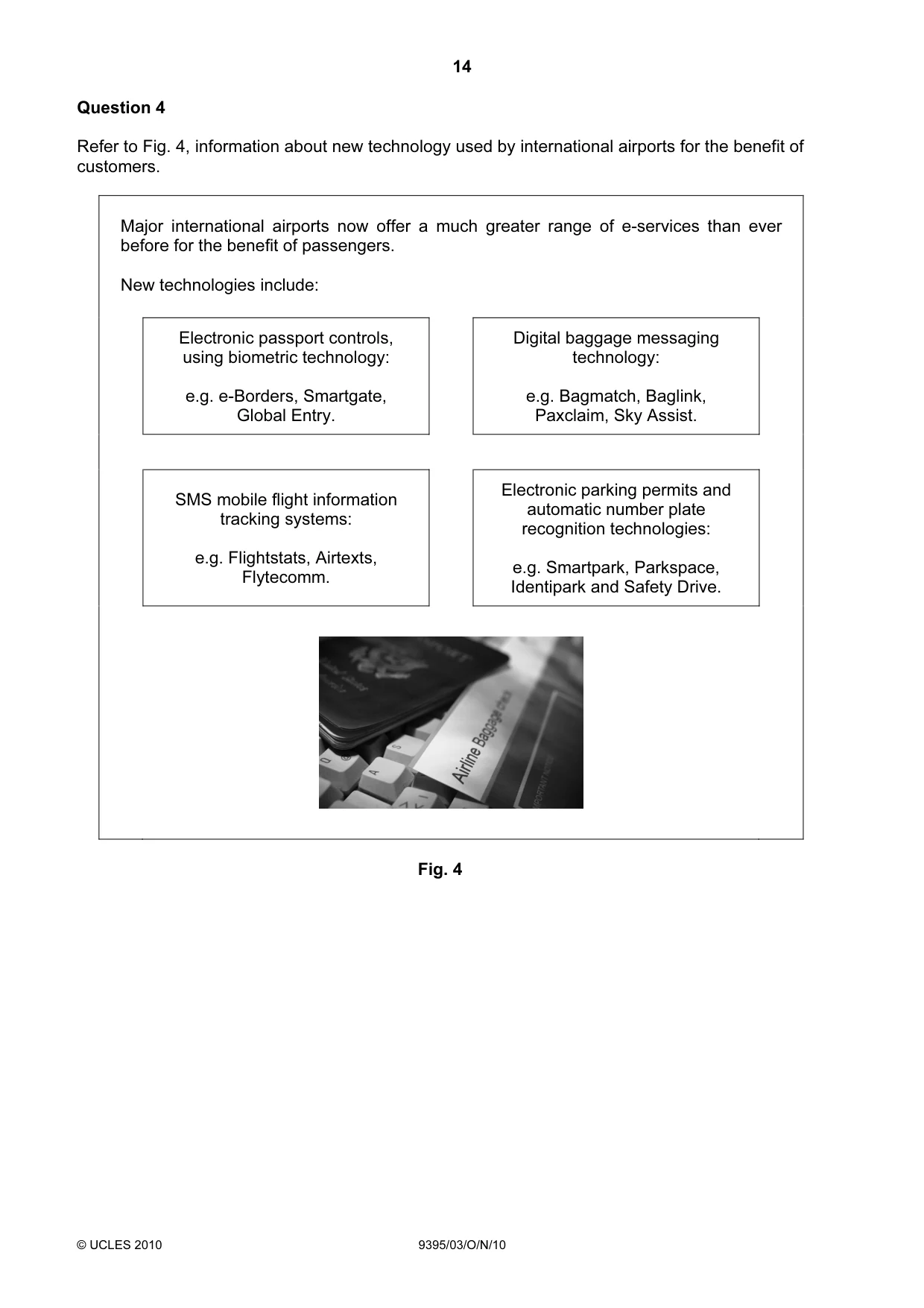
14 © UCLES 2010 9395/03/O/N/10 Question 4 Refer to Fig. 4, information about new technology used by international airports for the benefit of customers. Major international airports now offer a much greater range of e-services than ever before for the benefit of passengers. New technologies include: Electronic passport controls, using biometric technology: e.g. e-Borders, Smartgate, Global Entry. Digital baggage messaging technology: e.g. Bagmatch, Baglink, Paxclaim, Sky Assist. SMS mobile flight information tracking systems: e.g. Flightstats, Airtexts, Flytecomm. Electronic parking permits and automatic number plate recognition technologies: e.g. Smartpark, Parkspace, Identipark and Safety Drive. Fig. 4
Question paper, page 15
15 © UCLES 2010 9395/03/O/N/10 [Turn over For Examiner's Use (a) (i) Identify one airport e-service that would enable business travellers to do each of the following: • find out real-time flight information; • track missing luggage; • use fingerprinting or iris-scanning technology for passport control. [3] (ii) Explain one reason why it is important for international airports to offer a range of these available technologies. [2] (b) Chartered and scheduled airlines operate from international airports. Explain two differences in how chartered and scheduled flights operate. 1 2 [4]
Question paper, page 16
16 © UCLES 2010 9395/03/O/N/10 For Examiner's Use (c) All fare-paying air passengers are allowed to carry a certain amount of baggage. Discuss the different systems that airlines use to determine the amount of luggage each passenger can take. [8]
Question paper, page 17
17 © UCLES 2010 9395/03/O/N/10 For Examiner's Use (d) Evaluate the range of services that airports offer customers with special needs. [8] [Total: 25]
Question paper, page 18
18 © UCLES 2010 9395/03/O/N/10 BLANK PAGE
Question paper, page 19
19 © UCLES 2010 9395/03/O/N/10 BLANK PAGE
Question paper, page 20
20 Copyright Acknowledgements: Question 1 Figure 1 Question 3 Figure 3 Question 4 Figure 4 © http://www.taanz.org.nz. © http://www.freshtracksski.com. © Thomas Eye Design; iStockphoto. Permission to reproduce items where third-party owned material protected by copyright is included has been sought and cleared where possible. Every reasonable effort has been made by the publisher (UCLES) to trace copyright holders, but if any items requiring clearance have unwittingly been included, the publisher will be pleased to make amends at the earliest possible opportunity. University of Cambridge International Examinations is part of the Cambridge Assessment Group. Cambridge Assessment is the brand name of University of Cambridge Local Examinations Syndicate (UCLES), which is itself a department of the University of Cambridge. © UCLES 2010 9395/03/O/N/10 BLANK PAGE
Mark scheme, page 1
UNIVERSITY OF CAMBRIDGE INTERNATIONAL EXAMINATIONS GCE Advanced Subsidiary Level and GCE Advanced Level MARK SCHEME for the October/November 2010 question paper for the guidance of teachers 9395 TRAVEL AND TOURISM 9395/03 Paper 3 (International Business and Leisure Travel Services), maximum raw mark 100 This mark scheme is published as an aid to teachers and candidates, to indicate the requirements of the examination. It shows the basis on which Examiners were instructed to award marks. It does not indicate the details of the discussions that took place at an Examiners’ meeting before marking began, which would have considered the acceptability of alternative answers. Mark schemes must be read in conjunction with the question papers and the report on the examination. • CIE will not enter into discussions or correspondence in connection with these mark schemes. CIE is publishing the mark schemes for the October/November 2010 question papers for most IGCSE, GCE Advanced Level and Advanced Subsidiary Level syllabuses and some Ordinary Level syllabuses.
Mark scheme, page 2
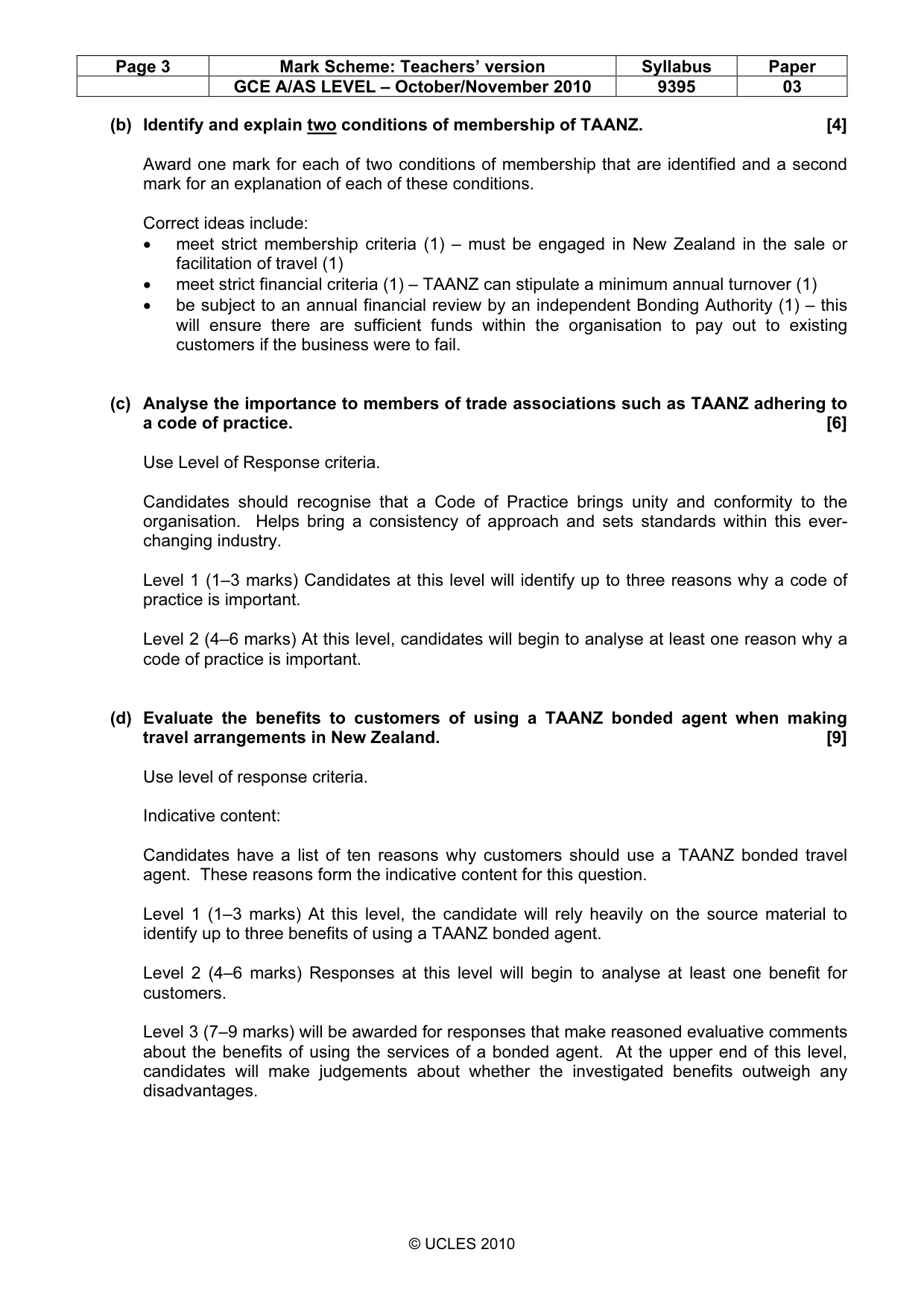
Page 2 Mark Scheme: Teachers’ version Syllabus Paper GCE A/AS LEVEL – October/November 2010 9395 03 © UCLES 2010 1 (a) (i) Identify two types of organisation represented by the Travel Agents’ Association of New Zealand (TAANZ). [2] Award one mark for each of two different types of organisation. Correct responses area: • travel agents • tour operators • New Zealand-based organisations engaged in the sale and/or facilitation of travel Also accept independent travel agents and named examples of these agency chains, e.g. Holiday Shoppe. (ii) Explain what the term ‘self-regulating’ means for organisations such as TAANZ. [2] Award one mark for basic definition of the term and a second mark for further amplification. Correct ideas include: • Describes an organisation or other legal body that establishes standards for itself (1) rather than having them imposed by government (1). • Occurs where trade associations try to exert some control over the practices of member organisations (1) for the protection of other industry professionals and the general public (1). (iii) Complete the following table, which compares the characteristics of tourism organisations that are either legislated by government or those that are self- regulated. [2] Legislated by Government Self-regulated How non-compliance can be dealt with Penalties are often imposed by government for any non-compliance Extent of control Allows greater flexibility Award one mark for a description of how non-compliance is dealt with in government- legislated organisations and a second mark for the extent of control that exists for self- regulated organisations. See table above for examples of correct responses. Accept any reasonable suggestions.
Mark scheme, page 3
Page 3 Mark Scheme: Teachers’ version Syllabus Paper GCE A/AS LEVEL – October/November 2010 9395 03 © UCLES 2010 (b) Identify and explain two conditions of membership of TAANZ. [4] Award one mark for each of two conditions of membership that are identified and a second mark for an explanation of each of these conditions. Correct ideas include: • meet strict membership criteria (1) – must be engaged in New Zealand in the sale or facilitation of travel (1) • meet strict financial criteria (1) – TAANZ can stipulate a minimum annual turnover (1) • be subject to an annual financial review by an independent Bonding Authority (1) – this will ensure there are sufficient funds within the organisation to pay out to existing customers if the business were to fail. (c) Analyse the importance to members of trade associations such as TAANZ adhering to a code of practice. [6] Use Level of Response criteria. Candidates should recognise that a Code of Practice brings unity and conformity to the organisation. Helps bring a consistency of approach and sets standards within this ever- changing industry. Level 1 (1–3 marks) Candidates at this level will identify up to three reasons why a code of practice is important. Level 2 (4–6 marks) At this level, candidates will begin to analyse at least one reason why a code of practice is important. (d) Evaluate the benefits to customers of using a TAANZ bonded agent when making travel arrangements in New Zealand. [9] Use level of response criteria. Indicative content: Candidates have a list of ten reasons why customers should use a TAANZ bonded travel agent. These reasons form the indicative content for this question. Level 1 (1–3 marks) At this level, the candidate will rely heavily on the source material to identify up to three benefits of using a TAANZ bonded agent. Level 2 (4–6 marks) Responses at this level will begin to analyse at least one benefit for customers. Level 3 (7–9 marks) will be awarded for responses that make reasoned evaluative comments about the benefits of using the services of a bonded agent. At the upper end of this level, candidates will make judgements about whether the investigated benefits outweigh any disadvantages.
Mark scheme, page 4
Page 4 Mark Scheme: Teachers’ version Syllabus Paper GCE A/AS LEVEL – October/November 2010 9395 03 © UCLES 2010 2 (a) (i) Identify two services offered by Visitor Information Centres such as those in Taiwan. [2] Award one mark for each correctly identified service, up to a maximum of two services. • provision of travel information • flight departure information • hotel reservation assistance • reception of VIPs and groups invited to Taiwan • visa assistance • customs clearance assistance (ii) Explain two ways in which the Travel Service Centre in Taipei caters for the needs of different types of customers. [4] Award one mark for an identification of two ways that the travel centre meets the needs of customers and a second mark for an amplification of the visitor type or the way that this need is met. Avoid crediting the same responses as in previous question for basic identification of services offered. • Counter services and/or telephone call centre (1) – allows people to visit face to face when requiring information (1) or telephone in advance when planning a trip (1). • Consultation service offered in wide choice of languages (1) – to assist visitors from a variety of different countries (1). • Computerised travel service feature at international airport (1) – for those who prefer to research online (1). (b) Explain three ways in which new technology may be used in providing visitor information services. [6] Award one mark for the correct identification of technology being used and a second mark for an explanation of how it may be used. Indicative content: • MP3 and podcast files (1) to send tour guides and video footage of accommodation etc. (1). • SMS, EMS and MMS (1) to use mobile phone technology to provide information about the events calendar, for example (1). • Online visitor information sites or the Internet (1) so that customers can check Visitor Information prior to departure (1). • Touch-screen displays (1) so that visitors can check their location on a city map, for example (1). • Online booking (1) so that customers can book a bed or a tour using the Internet (1).
Mark scheme, page 5
Page 5 Mark Scheme: Teachers’ version Syllabus Paper GCE A/AS LEVEL – October/November 2010 9395 03 © UCLES 2010 (c) Suggest two ancillary products or services, other than those mentioned in Fig. 2, that the Travel Service Centre in Taipei could offer visitors. Give one reason why you think each of your chosen products/services should be offered. [4] Award one mark for each of two appropriate products or services and a second mark for one reason for offering each product/service. Correct responses could include: • Foreign exchange (1) because foreign visitors need somewhere to convert currency (1). • Excursions (1) because foreign visitors like to sightsee during a visit (1). • Car hire (1) because people like the flexibility offered by using a rental car rather than being reliant upon public transport during a visit (1). • Tickets to attractions (such as the City Zoo or the children’s recreation centre) (1) tourists like to make visits to these types of attractions for entertainment during a leisure visit (1). Do not accept airport transfers or travel insurance. (d) Discuss ways in which the Travel Service Centre in Taipei could target its services specifically to the business tourism market. [9] Use Level of Response criteria. Indicative content: Candidates must consider the specific travel needs of business tourists and then target their products/services to reach these types of tourists. e.g. Product/services should include car rental or executive taxi services; could provide detailed information about conference venues in the country; offer specific business tourism packages etc. Marketing and promotion of the products and services should be targeted specifically at business customers etc. attending travel shows, targeting corporate travel organisations, familiarisation trips etc. Level 1 (1–3 marks) Candidates at this level will identify up to three ways in which the Travel Centre could target business tourism. Level 2 (4–6 marks) Candidates will attempt to evaluate the effectiveness of at least one way of targeting the business tourism market. Level 3 (7–9 marks) At this level, candidates will offer evaluative discussion of a range of ways that the Travel Services Centre could target the business tourism market. At the upper end, there could be some recommendations about the most appropriate products and services or the best means of promoting these.
Mark scheme, page 6
Page 6 Mark Scheme: Teachers’ version Syllabus Paper GCE A/AS LEVEL – October/November 2010 9395 03 © UCLES 2010 3 (a) (i) Identify two components of this package holiday. [2] Award one mark for each of two components Acceptable responses include: • accommodation • airport transfer • activities/excursions – allow one named example, e.g. ski instruction (ii) State two items not included in the price of this holiday. [2] Award one mark for each of two correctly identified components not included in the price. • meals • flights Can accept travel insurance here. (b) Explain two likely reasons why the Whistler Blackcomb resort is a popular destination for family holidays. [4] Award one mark for the identification of each of two valid reasons and then award a further one mark for an appropriate amplification of each. Correct ideas include: • The resort has something for everyone (1), e.g. snowboarding, skiing, zip trekking, tubing – plenty to keep children actively entertained (1). • The resort offers babysitting (1) parents have peace of mind but can also enjoy themselves (1). • The price is inclusive of a family of 4’s lift passes (1) cost effective (1). • Package price at this resort is inclusive of free ski or snowboard school lessons for 3 days (1) good value (1). • Resort offers free DVD rental each day (1) so there is something new for your children to watch (1). Credit all valid reasoning.
Mark scheme, page 7
Page 7 Mark Scheme: Teachers’ version Syllabus Paper GCE A/AS LEVEL – October/November 2010 9395 03 © UCLES 2010 (c) Evaluate the benefits to the tour operator of offering customised packages. [9] Use Level of Response criteria. Correct ideas include: • increased opportunity to generate revenue • offer customer satisfaction • broaden the customer base – will appeal to more people who do not like ‘package’ Level 1 (1–3 marks) At this level, candidates will identify at least one benefit to the tour operator of offering customised holidays. Level 2 (4–6 marks) Candidates will begin to analyse benefits of customised tours for the tour operator. Level 3 (7–9 marks) will be awarded for responses that make reasoned evaluative comments about the benefits for tour operators. (d) Discuss the range of products and services offered by accommodation providers in ski resorts such as Whistler Blackcomb. [8] Use Level of Response Criteria. Indicative content: • Leisure and spa facilities – allows for relaxation; restaurants, coffee shops for convenience; babysitting, high chairs, children’s menu for families; ramps, hearing loops etc. for disabled visitors. Level 1 (1–3 marks) At this level, candidates will identify up to three different products and services offered by accommodation providers in ski resorts. Level 2 (4–6 marks) Candidates will explain at least one product or service offered by accommodation providers at ski resorts. Level 3 (7–8 marks) will be awarded for responses that make reasoned judgements about the types of products and services that are offered by accommodation providers in ski resorts, with an attempt made to justify these products and services according to the types of customer that use them.
Mark scheme, page 8
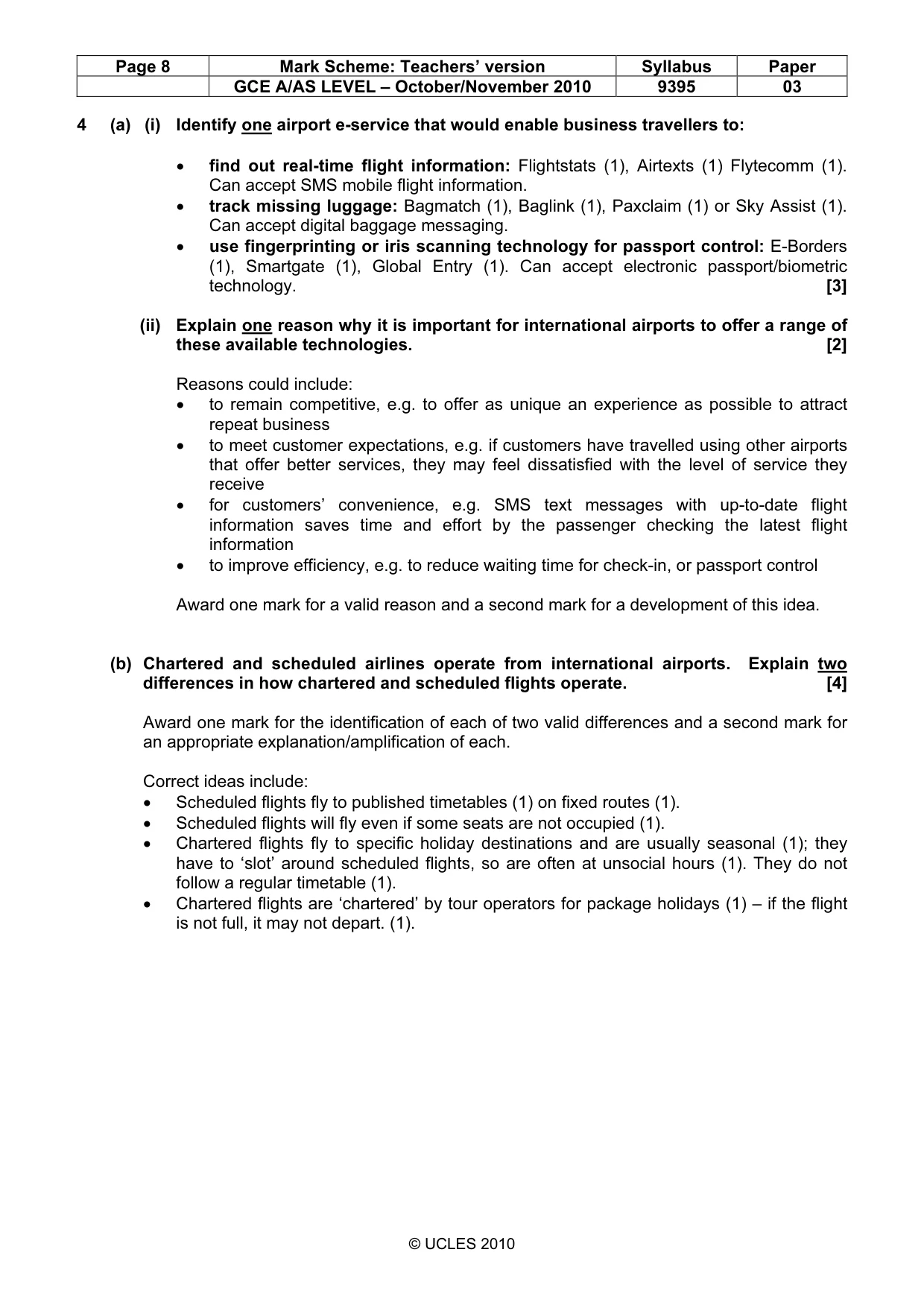
Page 8 Mark Scheme: Teachers’ version Syllabus Paper GCE A/AS LEVEL – October/November 2010 9395 03 © UCLES 2010 4 (a) (i) Identify one airport e-service that would enable business travellers to: • find out real-time flight information: Flightstats (1), Airtexts (1) Flytecomm (1). Can accept SMS mobile flight information. • track missing luggage: Bagmatch (1), Baglink (1), Paxclaim (1) or Sky Assist (1). Can accept digital baggage messaging. • use fingerprinting or iris scanning technology for passport control: E-Borders (1), Smartgate (1), Global Entry (1). Can accept electronic passport/biometric technology. [3] (ii) Explain one reason why it is important for international airports to offer a range of these available technologies. [2] Reasons could include: • to remain competitive, e.g. to offer as unique an experience as possible to attract repeat business • to meet customer expectations, e.g. if customers have travelled using other airports that offer better services, they may feel dissatisfied with the level of service they receive • for customers’ convenience, e.g. SMS text messages with up-to-date flight information saves time and effort by the passenger checking the latest flight information • to improve efficiency, e.g. to reduce waiting time for check-in, or passport control Award one mark for a valid reason and a second mark for a development of this idea. (b) Chartered and scheduled airlines operate from international airports. Explain two differences in how chartered and scheduled flights operate. [4] Award one mark for the identification of each of two valid differences and a second mark for an appropriate explanation/amplification of each. Correct ideas include: • Scheduled flights fly to published timetables (1) on fixed routes (1). • Scheduled flights will fly even if some seats are not occupied (1). • Chartered flights fly to specific holiday destinations and are usually seasonal (1); they have to ‘slot’ around scheduled flights, so are often at unsocial hours (1). They do not follow a regular timetable (1). • Chartered flights are ‘chartered’ by tour operators for package holidays (1) – if the flight is not full, it may not depart. (1).
Mark scheme, page 9
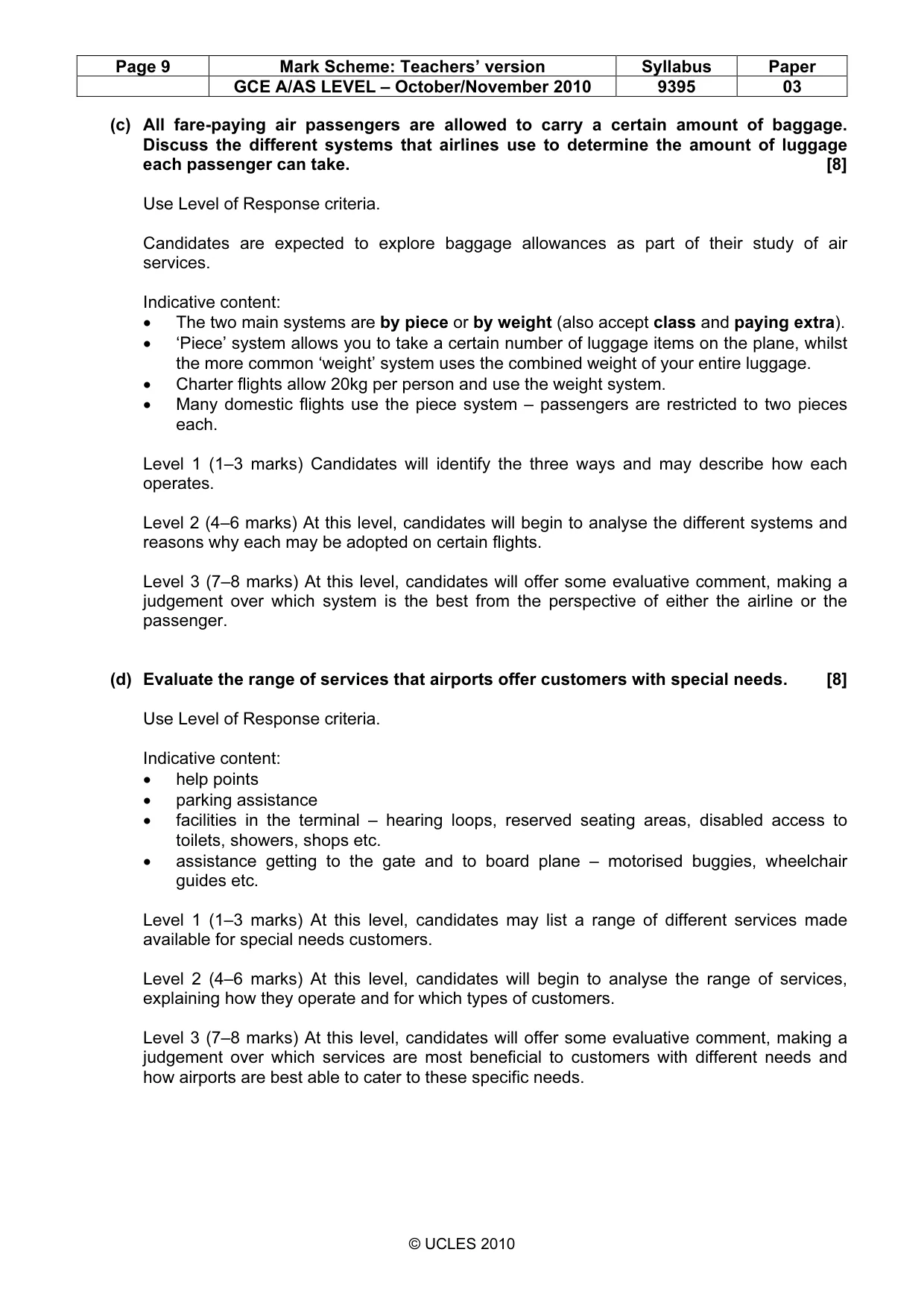
Page 9 Mark Scheme: Teachers’ version Syllabus Paper GCE A/AS LEVEL – October/November 2010 9395 03 © UCLES 2010 (c) All fare-paying air passengers are allowed to carry a certain amount of baggage. Discuss the different systems that airlines use to determine the amount of luggage each passenger can take. [8] Use Level of Response criteria. Candidates are expected to explore baggage allowances as part of their study of air services. Indicative content: • The two main systems are by piece or by weight (also accept class and paying extra). • ‘Piece’ system allows you to take a certain number of luggage items on the plane, whilst the more common ‘weight’ system uses the combined weight of your entire luggage. • Charter flights allow 20kg per person and use the weight system. • Many domestic flights use the piece system – passengers are restricted to two pieces each. Level 1 (1–3 marks) Candidates will identify the three ways and may describe how each operates. Level 2 (4–6 marks) At this level, candidates will begin to analyse the different systems and reasons why each may be adopted on certain flights. Level 3 (7–8 marks) At this level, candidates will offer some evaluative comment, making a judgement over which system is the best from the perspective of either the airline or the passenger. (d) Evaluate the range of services that airports offer customers with special needs. [8] Use Level of Response criteria. Indicative content: • help points • parking assistance • facilities in the terminal – hearing loops, reserved seating areas, disabled access to toilets, showers, shops etc. • assistance getting to the gate and to board plane – motorised buggies, wheelchair guides etc. Level 1 (1–3 marks) At this level, candidates may list a range of different services made available for special needs customers. Level 2 (4–6 marks) At this level, candidates will begin to analyse the range of services, explaining how they operate and for which types of customers. Level 3 (7–8 marks) At this level, candidates will offer some evaluative comment, making a judgement over which services are most beneficial to customers with different needs and how airports are best able to cater to these specific needs.
What you needed in this session
Cambridge’s own grade thresholds for 2010 Oct/Nov, Paper 3 · Variant 1. A higher threshold means an easier paper — the bar moves with how the cohort did.