Cambridge A Level Travel and Tourism 9395 — 2009 May/June Paper 3 · Variant 1
9395/31/M/J/09 · 100 marks · ≈113 min
The question paper and its mark scheme, free to read here and free to download. This is Cambridge’s own paper, exactly as it was sat.
Question paper20 pages



Mark scheme11 pages
Answers below. Sit the paper first if you are practising.
Paper as text
Question paper, page 1
This document consists of 16 printed pages and 4 blank pages. IB09 06_9395_03/6RP © UCLES 2009 [Turn over *9920367302* For Examiner's Use 1 2 3 4 Total UNIVERSITY OF CAMBRIDGE INTERNATIONAL EXAMINATIONS General Certificate of Education Advanced Level TRAVEL AND TOURISM 9395/03 Paper 3 International Business & Leisure Travel Services June 2009 1 hour and 30 minutes Candidates answer on the Question Paper READ THESE INSTRUCTIONS FIRST Write your Centre number, candidate number and name on all the work you hand in. Write in dark blue or black pen. Do not use staples, paper clips, highlighters, glue or correction fluid. You may use a pencil for any diagrams, graphs or rough working. DO NOT WRITE IN ANY BARCODES Answer all questions. The number of marks is given in brackets [ ] at the end of each question or part question.
Question paper, page 2
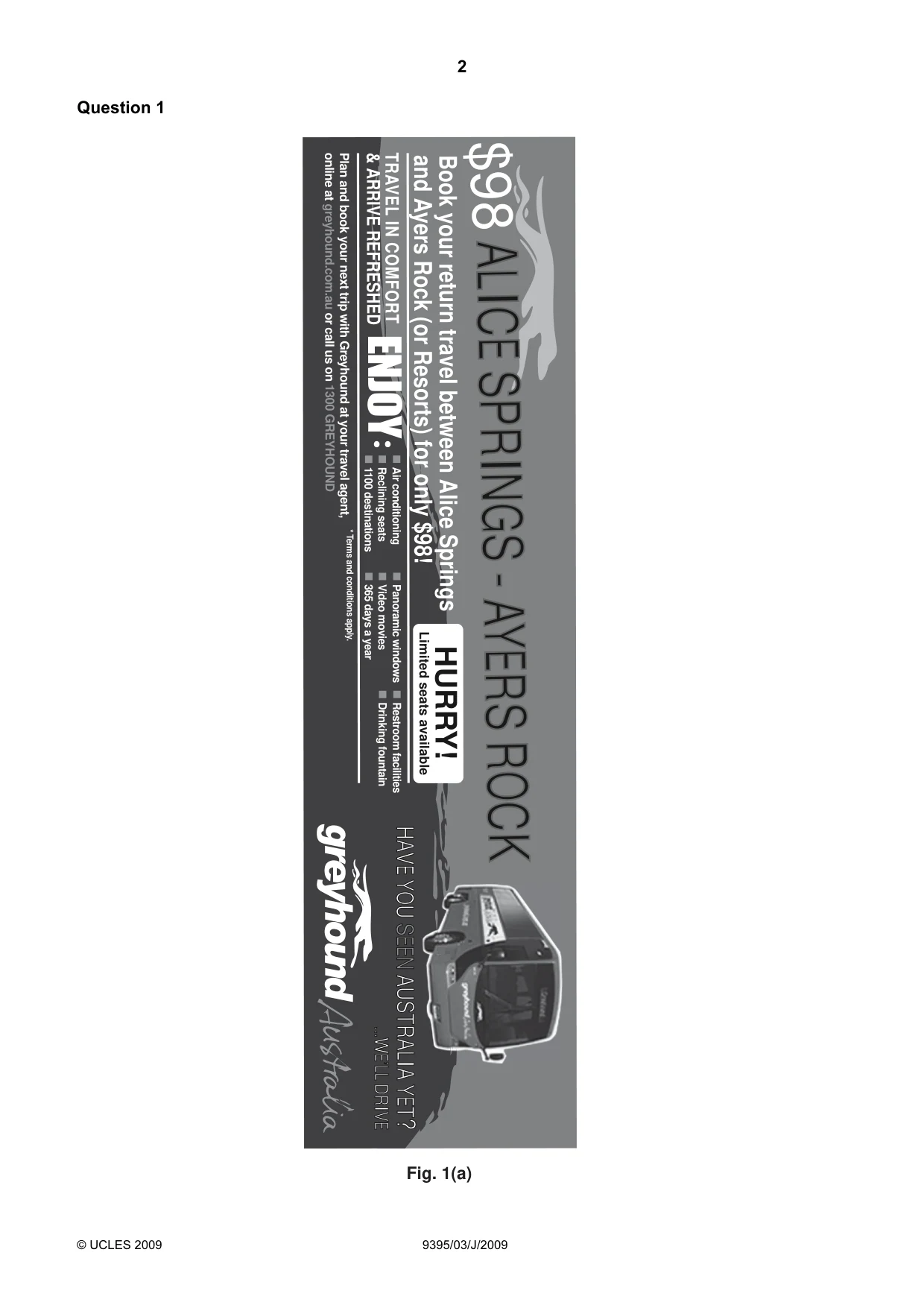
2 © UCLES 2009 9395/03/J/2009 Question 1 ALICE SPRINGS - AYERS ROCK ALICE SPRINGS - AYERS ROCK $98 HAVE YOU HAVE YOU SEEN SEEN AUSTRALIA YET AUSTRALIA YET? ...WE’LL DRIVE ...WE’LL DRIVE HURRY! Limited seats available Book your return travel between Alice Springs and Ayers Rock (or Resorts) for only $98! TRAVEL IN COMFORT & ARRIVE REFRESHED Plan and book your next trip with Greyhound at your travel agent, online at greyhound.com.au or call us on 1300 GREYHOUND * Terms and conditions apply. Air conditioning Reclining seats Panoramic windows Video movies Restroom facilities Drinking fountain 1100 destinations 365 days a year Fig. 1(a)
Question paper, page 3
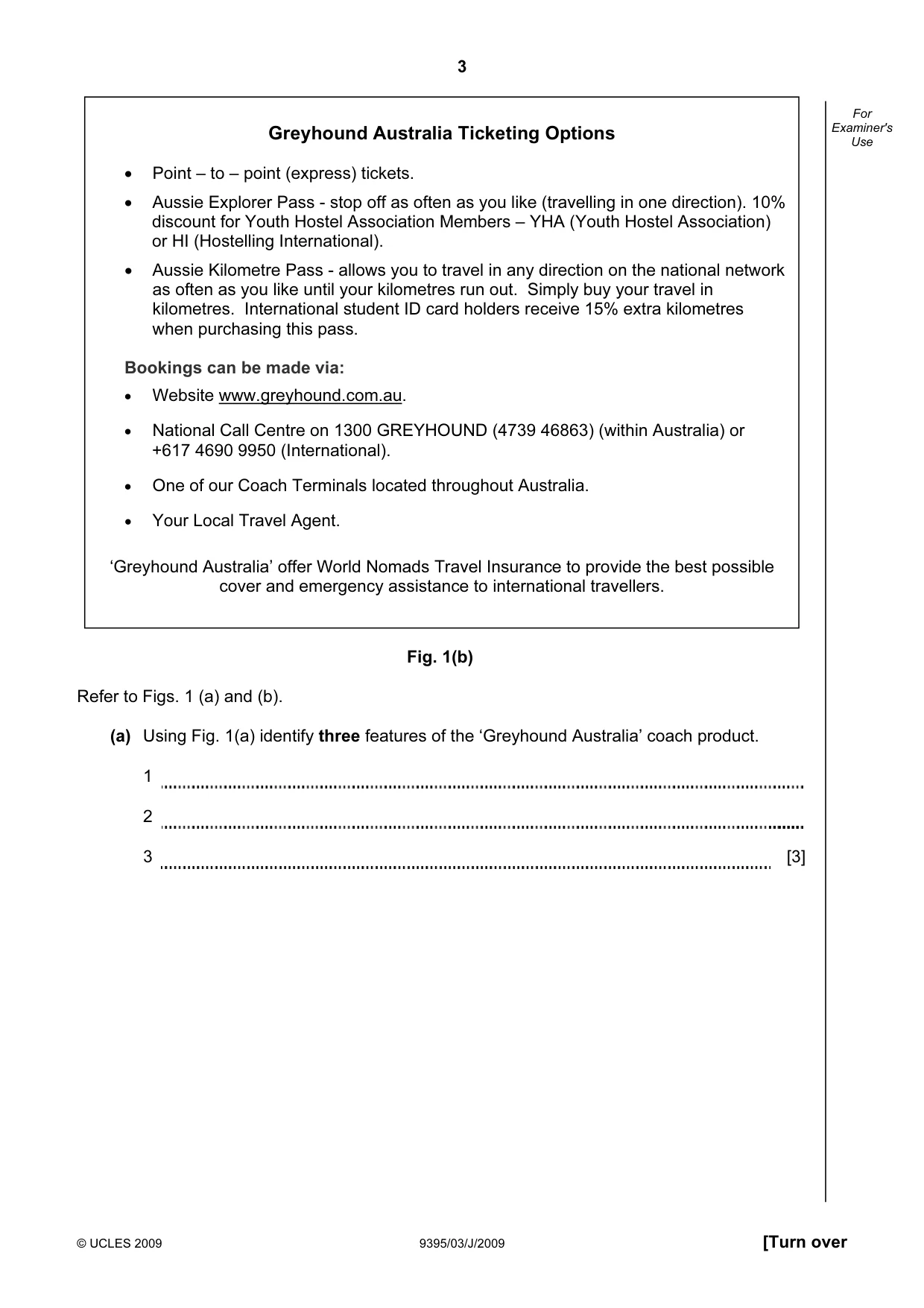
3 © UCLES 2009 9395/03/J/2009 [Turn over For Examiner's Use Fig. 1(b) Refer to Figs. 1 (a) and (b). (a) Using Fig. 1(a) identify three features of the ‘Greyhound Australia’ coach product. 1 2 3 [3] Greyhound Australia Ticketing Options • Point – to – point (express) tickets. • Aussie Explorer Pass - stop off as often as you like (travelling in one direction). 10% discount for Youth Hostel Association Members – YHA (Youth Hostel Association) or HI (Hostelling International). • Aussie Kilometre Pass - allows you to travel in any direction on the national network as often as you like until your kilometres run out. Simply buy your travel in kilometres. International student ID card holders receive 15% extra kilometres when purchasing this pass. Bookings can be made via: • Website www.greyhound.com.au. • National Call Centre on 1300 GREYHOUND (4739 46863) (within Australia) or +617 4690 9950 (International). • One of our Coach Terminals located throughout Australia. • Your Local Travel Agent. ‘Greyhound Australia’ offer World Nomads Travel Insurance to provide the best possible cover and emergency assistance to international travellers.
Question paper, page 4
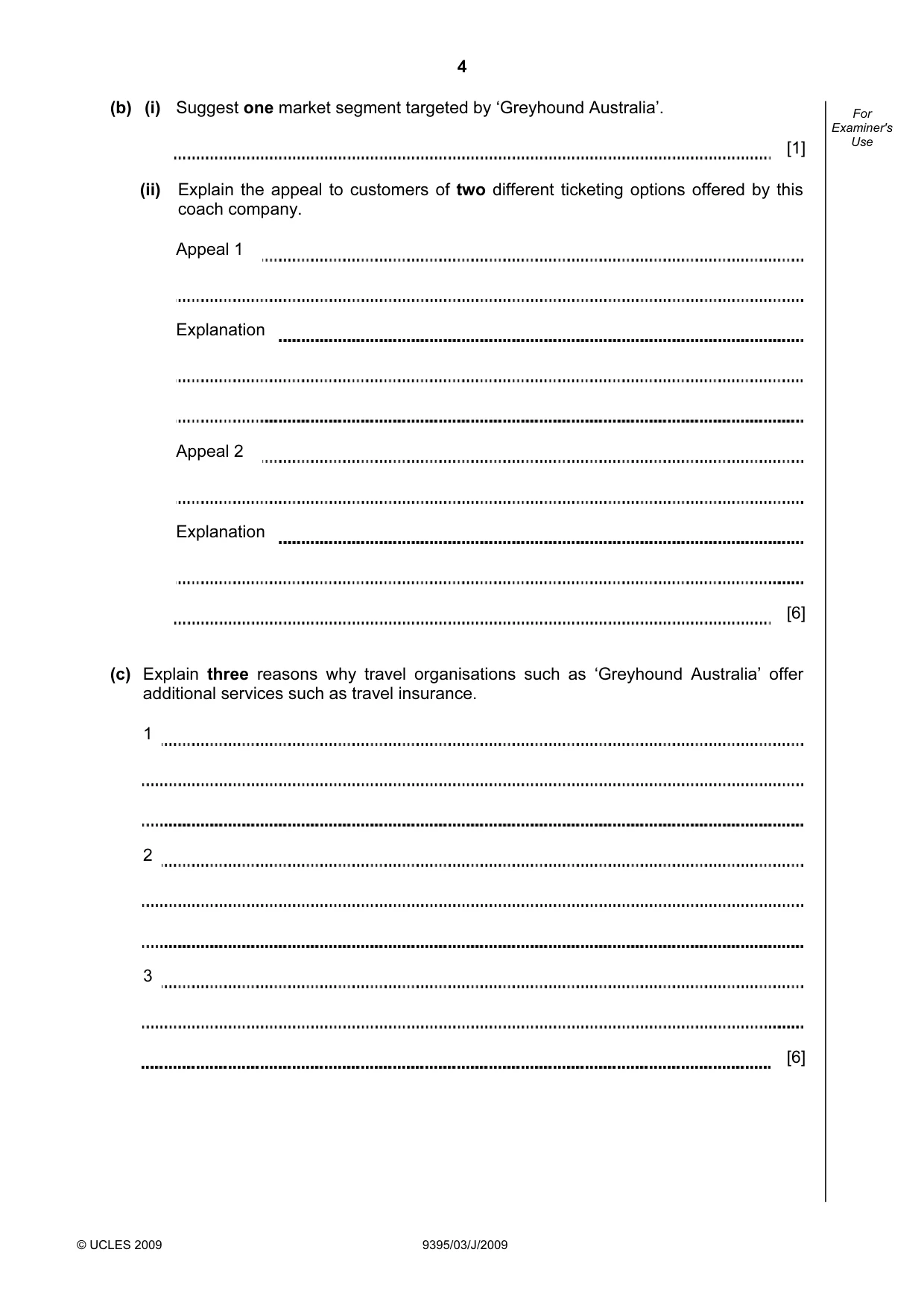
4 © UCLES 2009 9395/03/J/2009 For Examiner's Use (b) (i) Suggest one market segment targeted by ‘Greyhound Australia’. [1] (ii) Explain the appeal to customers of two different ticketing options offered by this coach company. Appeal 1 Explanation Appeal 2 Explanation [6] (c) Explain three reasons why travel organisations such as ‘Greyhound Australia’ offer additional services such as travel insurance. 1 2 3 [6]
Question paper, page 5
5 © UCLES 2009 9395/03/J/2009 [Turn over For Examiner's Use (d) Evaluate the different booking methods ‘Greyhound Australia’ provides for customers’ convenience. [9] [Total:25]
Question paper, page 6
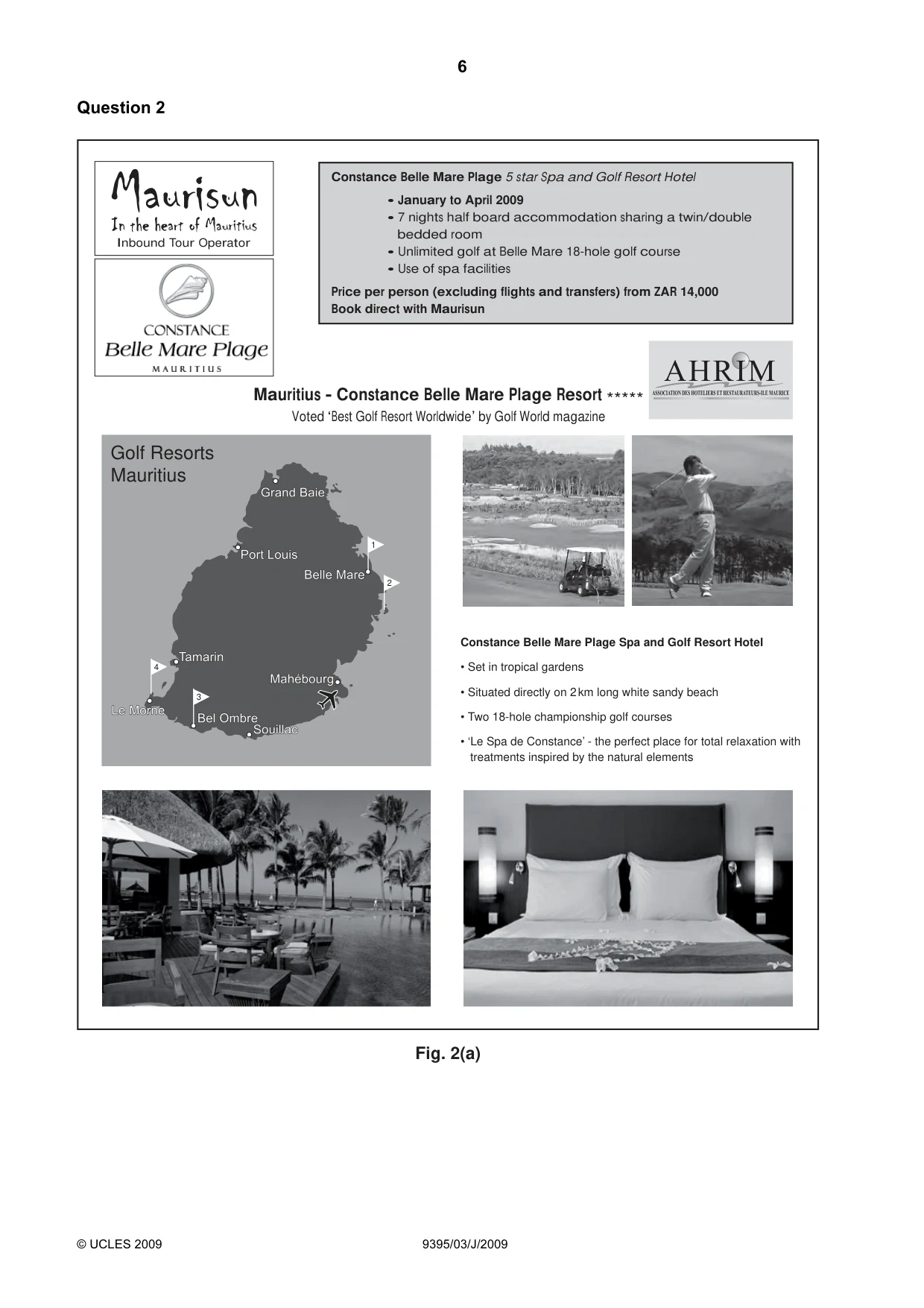
6 © UCLES 2009 9395/03/J/2009 Question 2 4 3 1 2 Mauritius - Constance Belle Mare Plage Resort ***** Voted ‘Best Golf Resort Worldwide’ by Golf World magazine Constance Belle Mare Plage 5 star Spa and Golf Resort Hotel • January to April 2009 • 7 nights half board accommodation sharing a twin/double bedded room • Unlimited golf at Belle Mare 18-hole golf course • Use of spa facilities Price per person (excluding flights and transfers) from ZAR 14,000 Book direct with Maurisun Fig. 2(a) Golf Resorts Mauritius Constance Belle Mare Plage Spa and Golf Resort Hotel • Set in tropical gardens • Situated directly on 2 km long white sandy beach • Two 18-hole championship golf courses • ‘Le Spa de Constance’ - the perfect place for total relaxation with treatments inspired by the natural elements Inbound Tour Operator
Question paper, page 7
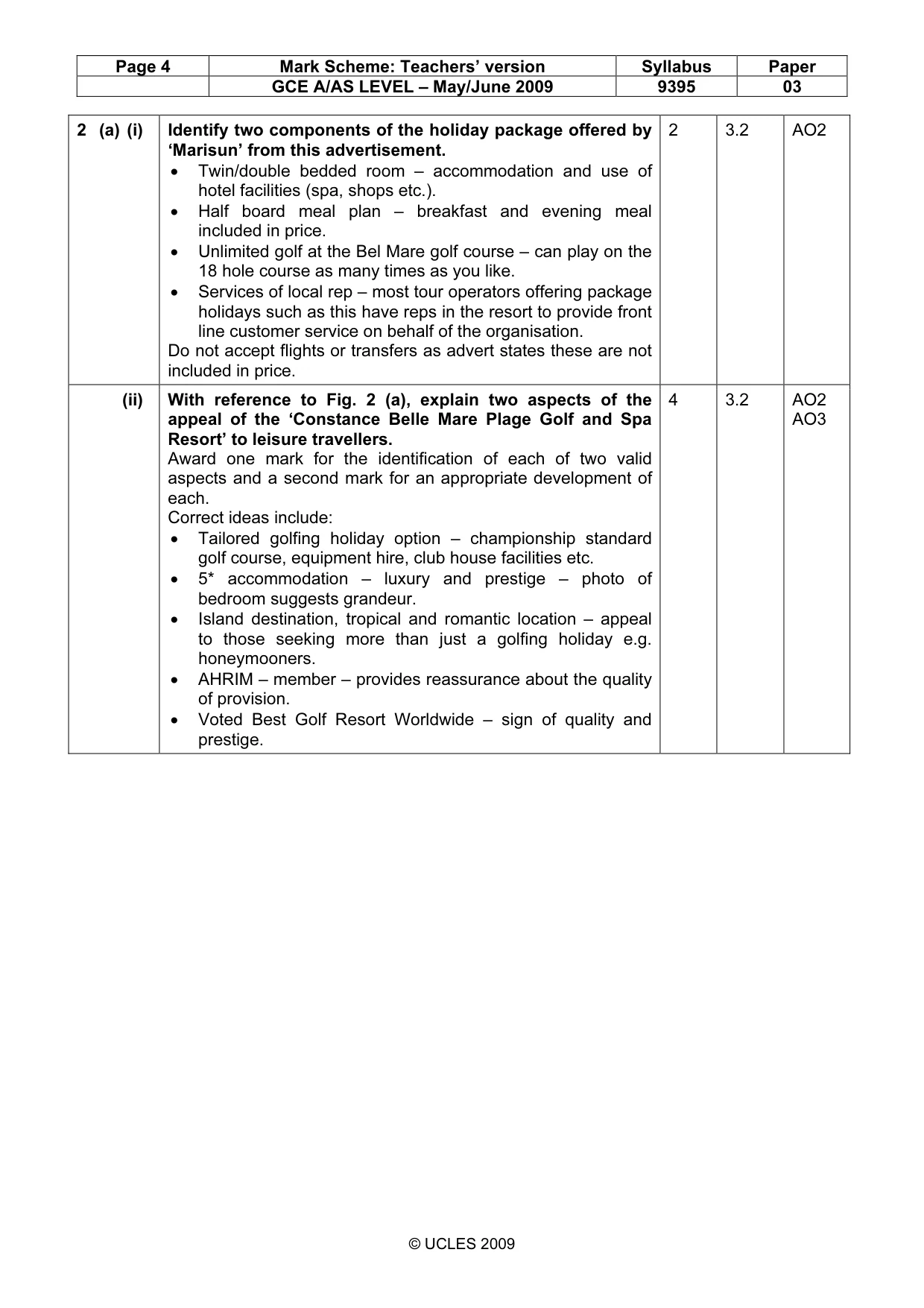
7 © UCLES 2009 9395/03/J/2009 [Turn over For Examiner's Use Refer to Fig. 2 (a), an advertisement for a spa and golfing holiday to Mauritius, organised by the tour operator ‘Maurisun’. (a) The ‘Constance Belle Mare Plage’ resort offers 5* accommodation. (i) Identify two components of the holiday package offered by ‘Maurisun’ from this advertisement. 1 2 [2] (ii) With reference to Fig. 2 (a), explain two aspects of the appeal of the ‘Constance Belle Mare Plage’ resort to leisure travellers. 1 2 [4]
Question paper, page 8
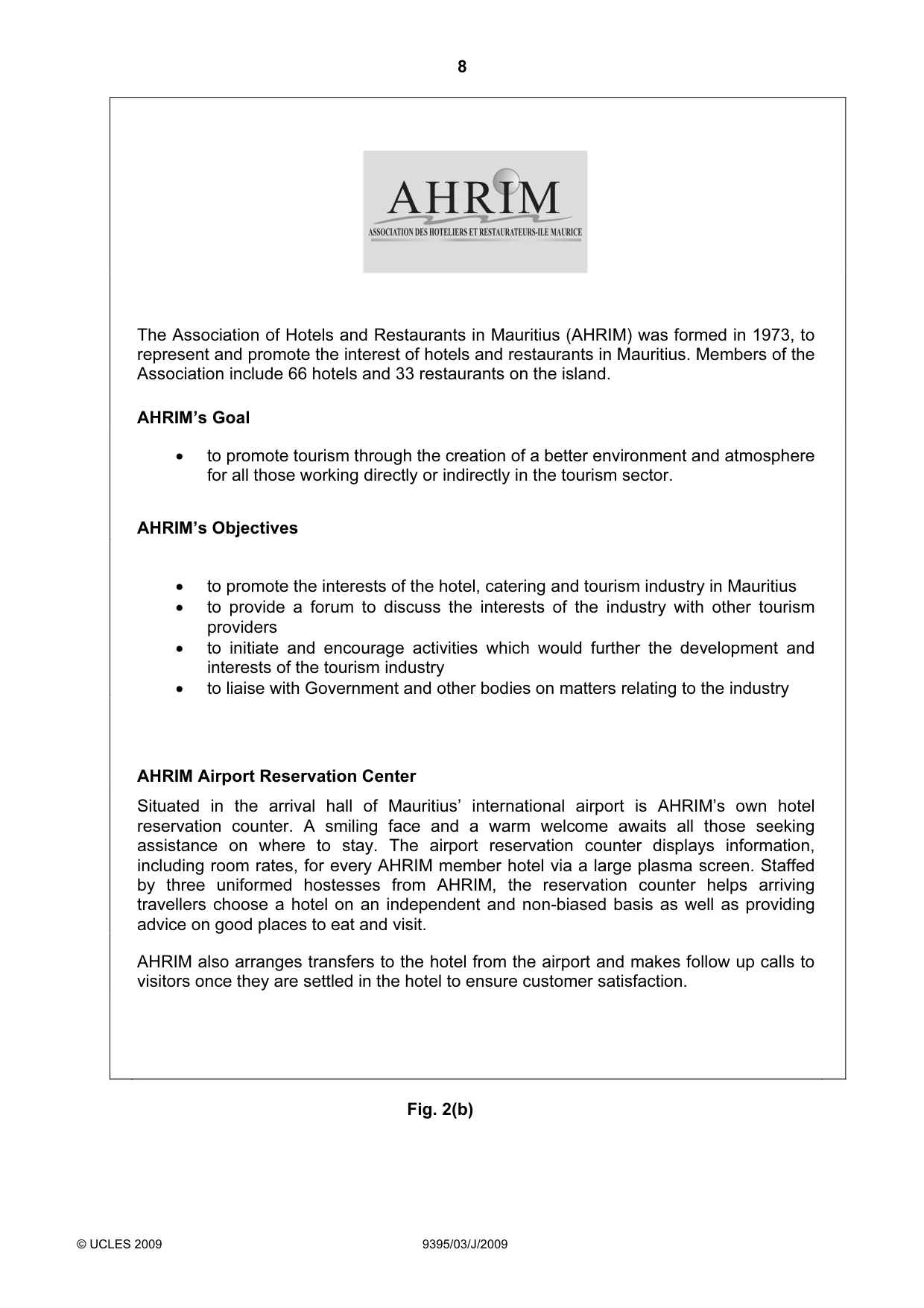
8 © UCLES 2009 9395/03/J/2009 The Association of Hotels and Restaurants in Mauritius (AHRIM) was formed in 1973, to represent and promote the interest of hotels and restaurants in Mauritius. Members of the Association include 66 hotels and 33 restaurants on the island. AHRIM’s Goal • to promote tourism through the creation of a better environment and atmosphere for all those working directly or indirectly in the tourism sector. AHRIM’s Objectives • to promote the interests of the hotel, catering and tourism industry in Mauritius • to provide a forum to discuss the interests of the industry with other tourism providers • to initiate and encourage activities which would further the development and interests of the tourism industry • to liaise with Government and other bodies on matters relating to the industry AHRIM Airport Reservation Center Situated in the arrival hall of Mauritius’ international airport is AHRIM’s own hotel reservation counter. A smiling face and a warm welcome awaits all those seeking assistance on where to stay. The airport reservation counter displays information, including room rates, for every AHRIM member hotel via a large plasma screen. Staffed by three uniformed hostesses from AHRIM, the reservation counter helps arriving travellers choose a hotel on an independent and non-biased basis as well as providing advice on good places to eat and visit. AHRIM also arranges transfers to the hotel from the airport and makes follow up calls to visitors once they are settled in the hotel to ensure customer satisfaction. Fig. 2(b)
Question paper, page 9
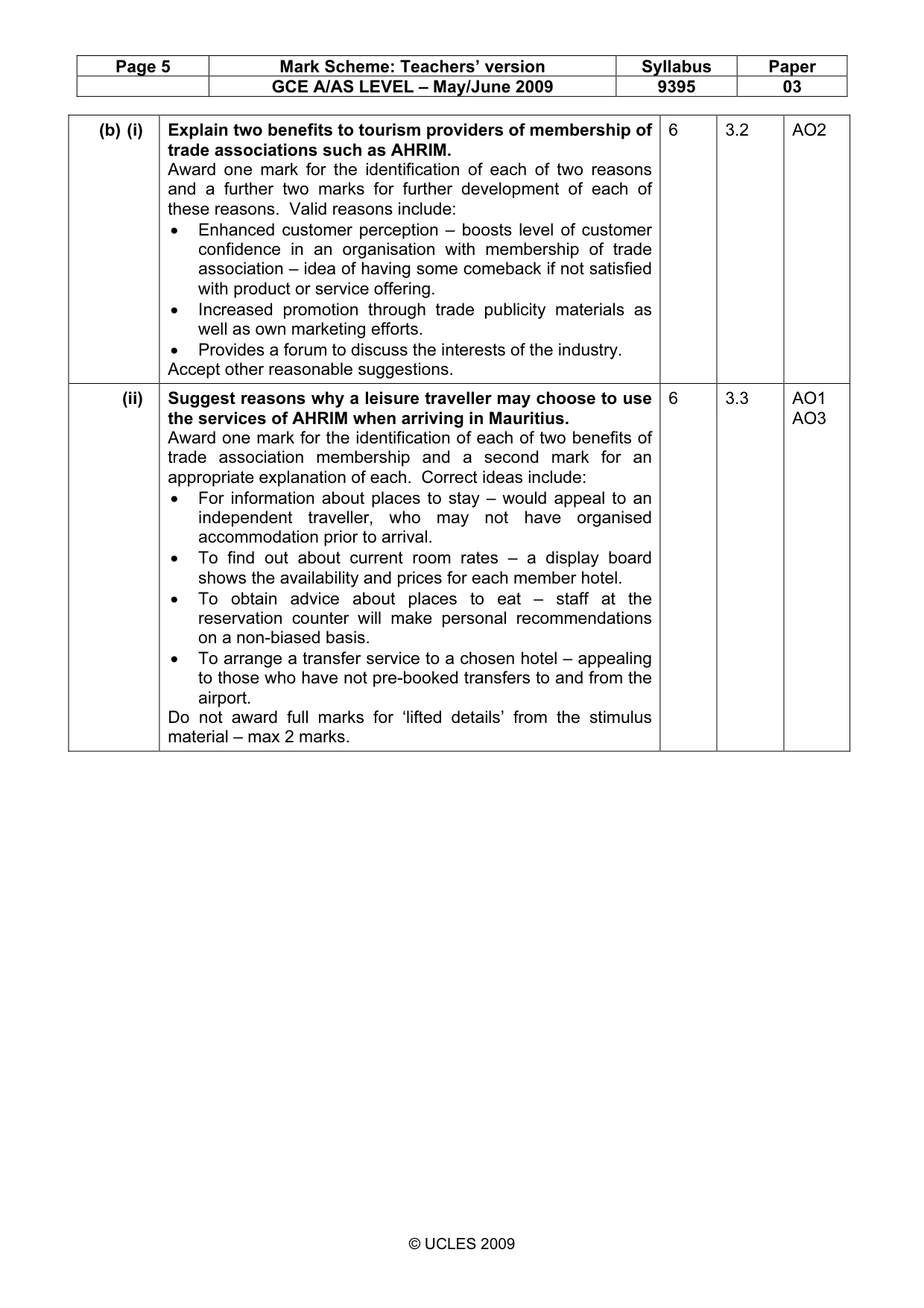
9 © UCLES 2009 9395/03/J/2009 [Turn over For Examiner's Use (b) Refer to Fig. 2(b), information about the Association of Hotels and Restaurants in Mauritius (AHRIM). The ‘Constance Belle Mare Plage’ resort hotel is a member of AHRIM. (i) Explain two benefits to tourism providers of membership of trade associations such as AHRIM. 1 2 [6] (ii) Suggest reasons why a leisure traveller may choose to use the services of AHRIM when arriving in Mauritius. [4]
Question paper, page 10
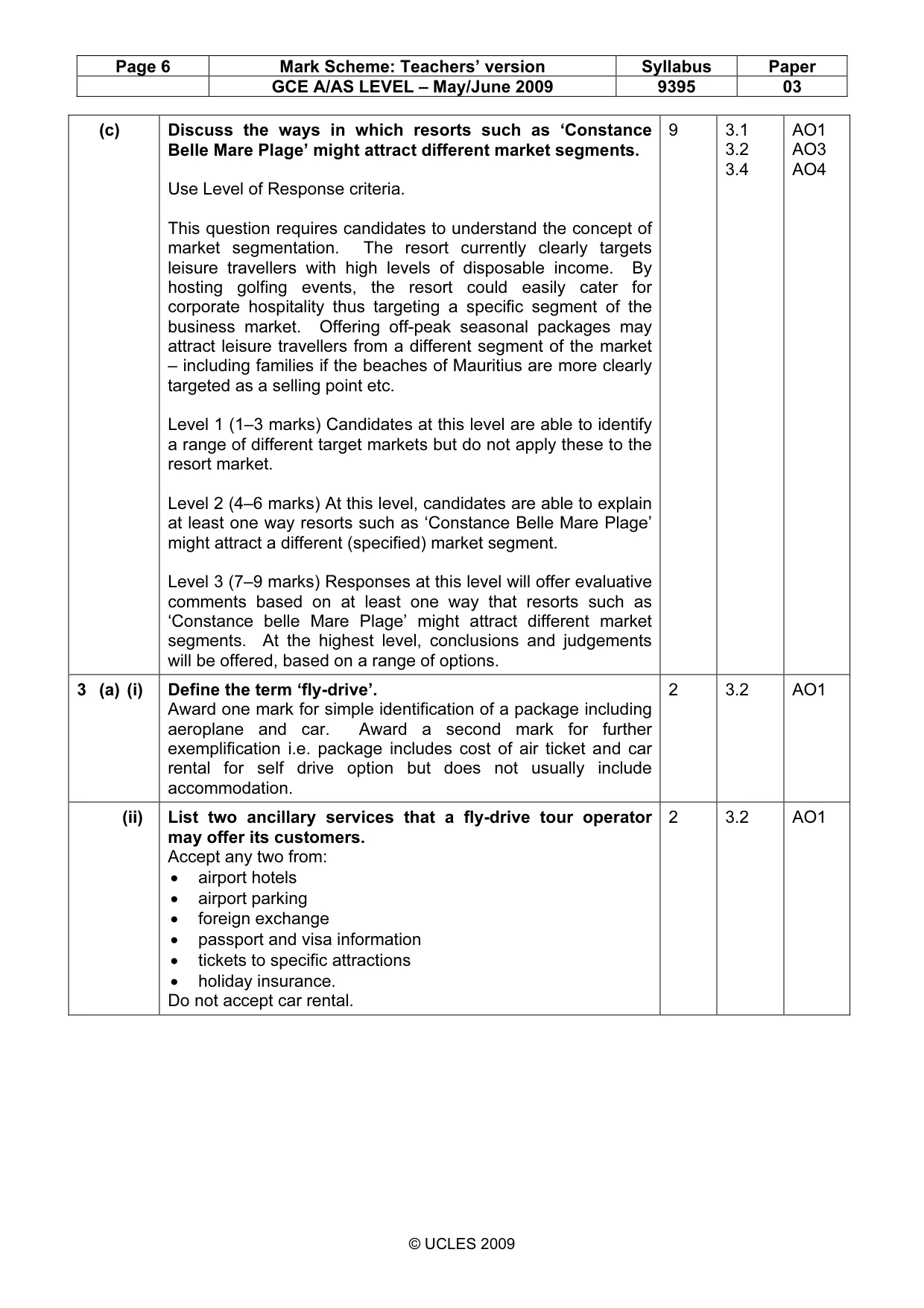
10 © UCLES 2009 9395/03/J/2009 For Examiner's Use (c) Discuss ways in which resorts such as ‘Constance Belle Mare Plage’ might attract different market segments. [9] [Total: 25]
Question paper, page 12
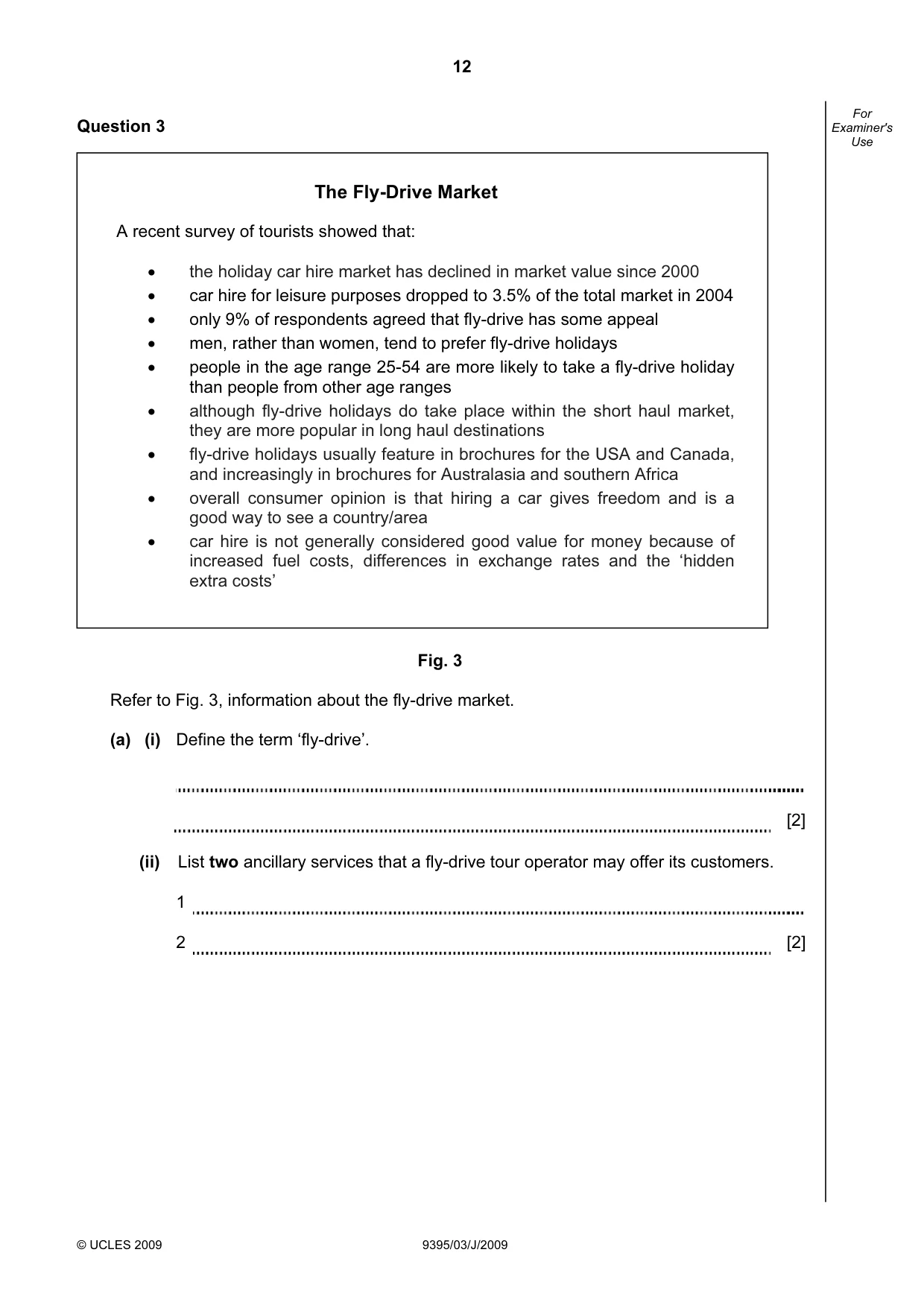
12 © UCLES 2009 9395/03/J/2009 For Examiner's Use Question 3 Fig. 3 Refer to Fig. 3, information about the fly-drive market. (a) (i) Define the term ‘fly-drive’. [2] (ii) List two ancillary services that a fly-drive tour operator may offer its customers. 1 2 [2] The Fly-Drive Market A recent survey of tourists showed that: • the holiday car hire market has declined in market value since 2000 • car hire for leisure purposes dropped to 3.5% of the total market in 2004 • only 9% of respondents agreed that fly-drive has some appeal • men, rather than women, tend to prefer fly-drive holidays • people in the age range 25-54 are more likely to take a fly-drive holiday than people from other age ranges • although fly-drive holidays do take place within the short haul market, they are more popular in long haul destinations • fly-drive holidays usually feature in brochures for the USA and Canada, and increasingly in brochures for Australasia and southern Africa • overall consumer opinion is that hiring a car gives freedom and is a good way to see a country/area • car hire is not generally considered good value for money because of increased fuel costs, differences in exchange rates and the ‘hidden extra costs’
Question paper, page 13
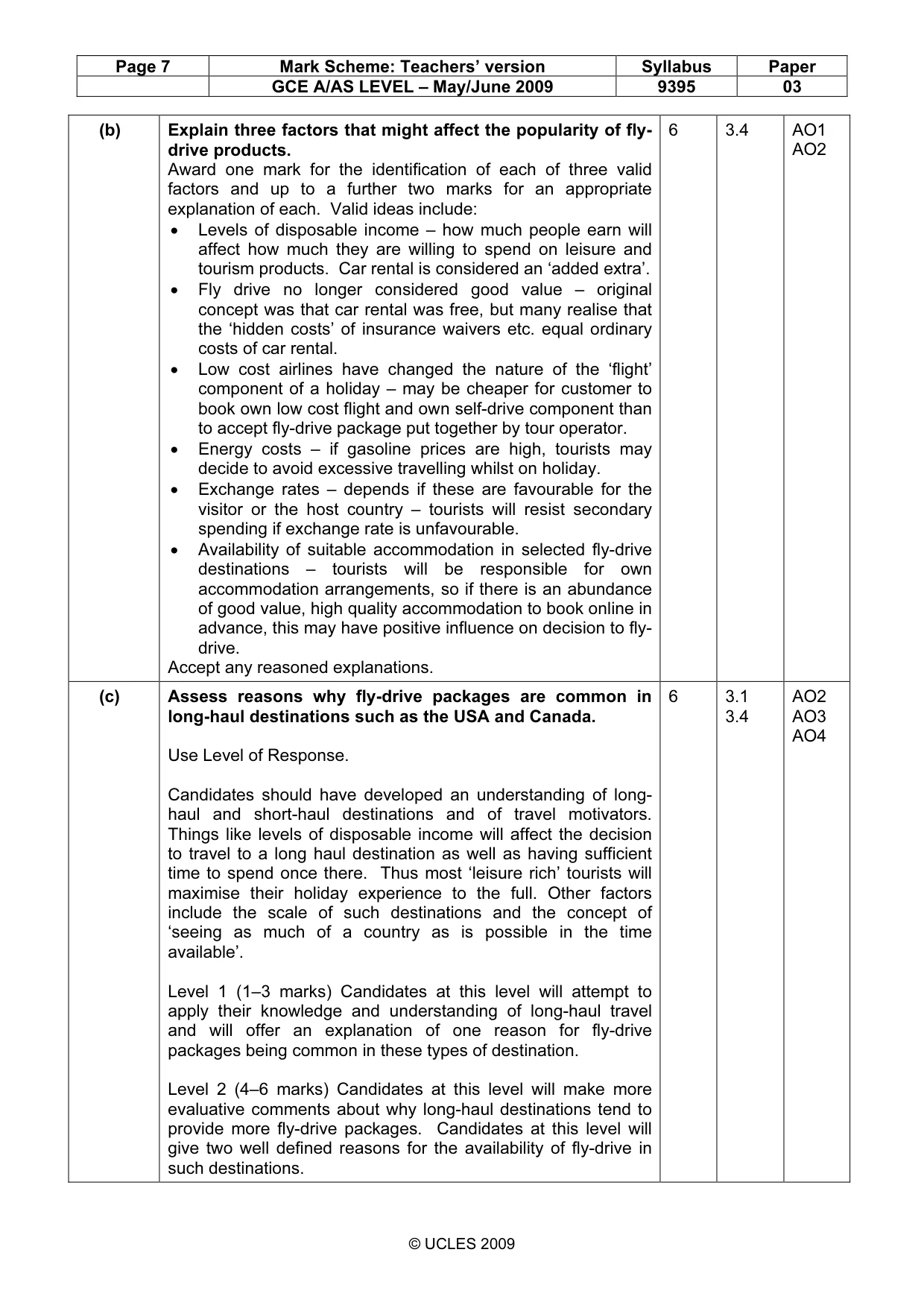
13 © UCLES 2009 9395/03/J/2009 [Turn over For Examiner's Use (b) Explain three factors that may affect the popularity of fly-drive products. 1 2 3 [6] (c) Assess reasons why fly-drive packages are common in long haul destinations such as the USA and Canada. [6]
Question paper, page 14
14 © UCLES 2009 9395/03/J/2009 For Examiner's Use (d) As part of fly-drive products offered by tour operators, compare and contrast the benefits to leisure travellers of: • pre-planned itineraries • tailor-made itineraries. [9] [Total:25]
Question paper, page 16
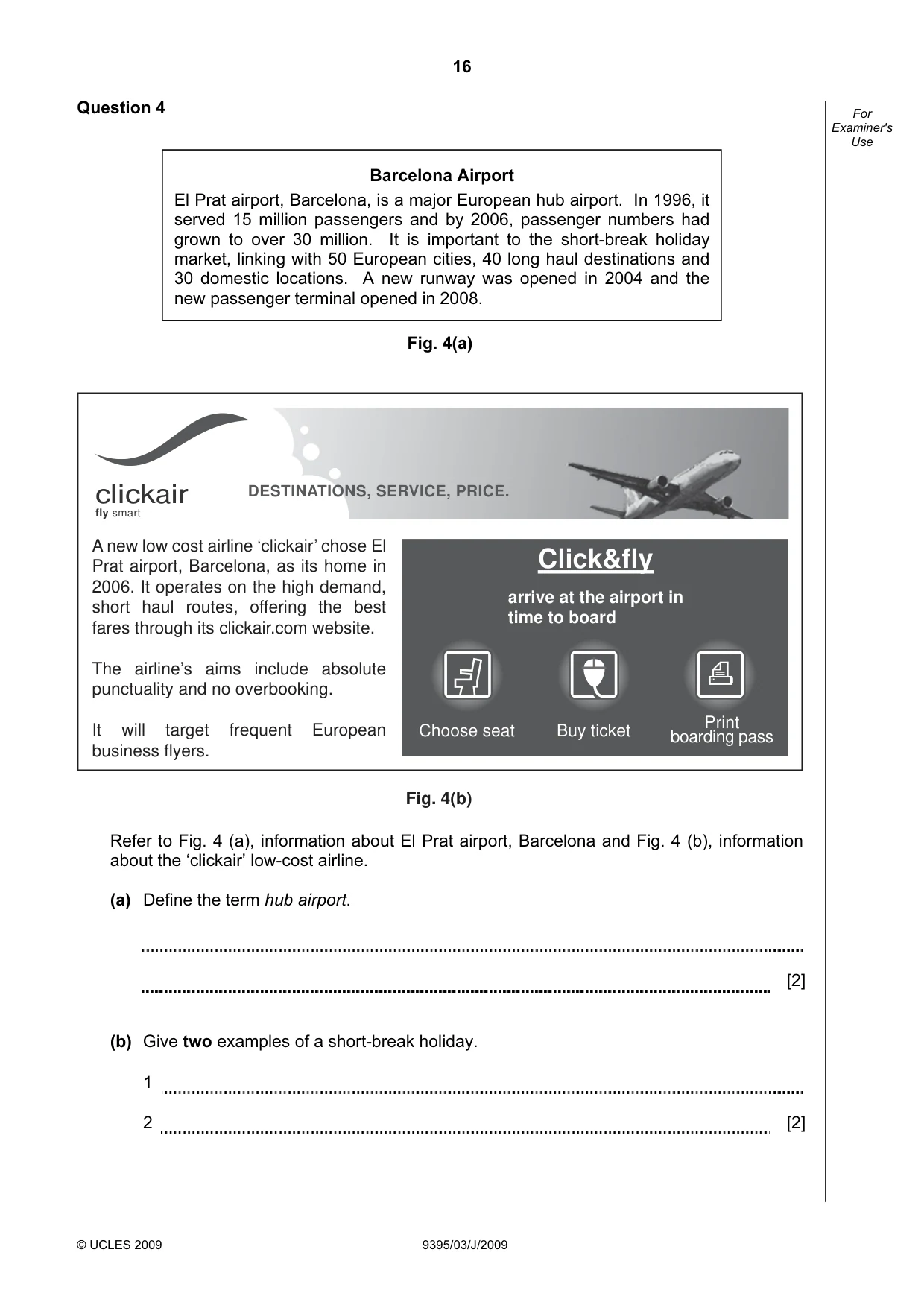
16 © UCLES 2009 9395/03/J/2009 For Examiner's Use Question 4 Fig. 4(a) clickair fly smart DESTINATIONS, SERVICE, PRICE. A new low cost airline ‘clickair’ chose El Prat airport, Barcelona, as its home in 2006. It operates on the high demand, short haul routes, offering the best fares through its clickair.com website. The airline’s aims include absolute punctuality and no overbooking. It will target frequent European business flyers. Click&fly arrive at the airport in time to board Choose seat Buy ticket Print boarding pass Fig. 4(b) Refer to Fig. 4 (a), information about El Prat airport, Barcelona and Fig. 4 (b), information about the ‘clickair’ low-cost airline. (a) Define the term hub airport. [2] (b) Give two examples of a short-break holiday. 1 2 [2] Barcelona Airport El Prat airport, Barcelona, is a major European hub airport. In 1996, it served 15 million passengers and by 2006, passenger numbers had grown to over 30 million. It is important to the short-break holiday market, linking with 50 European cities, 40 long haul destinations and 30 domestic locations. A new runway was opened in 2004 and the new passenger terminal opened in 2008.
Question paper, page 17
17 © UCLES 2009 9395/03/J/2009 [Turn over For Examiner's Use (c) Explain three ways that ‘clickair’ might meet the needs of its business customers. 1 2 3 [6] (d) Discuss how the stated aims of ‘clickair’ can help secure its position in the market. [6]
Question paper, page 18
18 © UCLES 2009 9395/03/J/2009 For Examiner's Use (e) Evaluate the impacts of new technology on airline customers. [9] [Total: 25]
Question paper, page 20
20 Copyright Acknowledgements: Figure 1a Figure 2a Figure 2a Figure 4b © www.greyhound.com.au/documents/gha_aspayn_special.pdf Special Offer Flyer © www.par4thecourse.co.uk © mauritius-offer.html (amended) © mauritius-map.html © www.letelfair.com © www.clickair.com view/default.aspx?lang=2clicknfly.aspx?lang=2 Permission to reproduce items where third-party owned material protected by copyright is included has been sought and cleared where possible. Every reasonable effort has been made by the publisher (UCLES) to trace copyright holders, but if any items requiring clearance have unwittingly been included, the publisher will be pleased to make amends at the earliest possible opportunity. University of Cambridge International Examinations is part of the Cambridge Assessment Group. Cambridge Assessment is the brand name of University of Cambridge Local Examinations Syndicate (UCLES), which is itself a department of the University of Cambridge. © UCLES 2009 9395/03/J/2009 BLANK PAGE
Mark scheme, page 1
UNIVERSITY OF CAMBRIDGE INTERNATIONAL EXAMINATIONS GCE Advanced Subsidiary Level and GCE Advanced Level MARK SCHEME for the May/June 2009 question paper for the guidance of teachers 9395 TRAVEL AND TOURISM 9395/03 Paper 3 (International Business & Leisure Travel Services), maximum raw mark 100 This mark scheme is published as an aid to teachers and candidates, to indicate the requirements of the examination. It shows the basis on which Examiners were instructed to award marks. It does not indicate the details of the discussions that took place at an Examiners’ meeting before marking began, which would have considered the acceptability of alternative answers. Mark schemes must be read in conjunction with the question papers and the report on the examination. • CIE will not enter into discussions or correspondence in connection with these mark schemes. CIE is publishing the mark schemes for the May/June 2009 question papers for most IGCSE, GCE Advanced Level and Advanced Subsidiary Level syllabuses and some Ordinary Level syllabuses.
Mark scheme, page 2
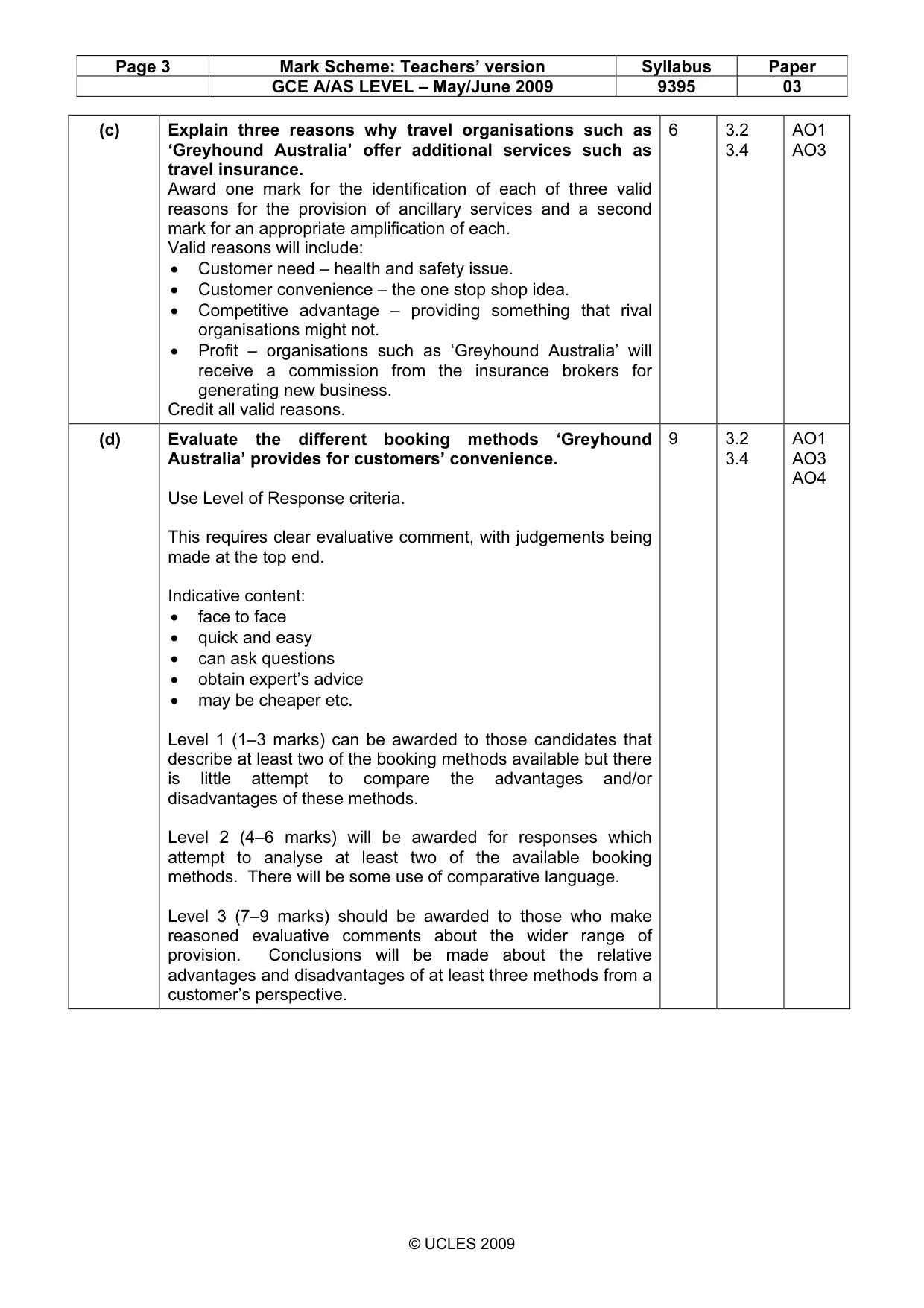
Page 2 Mark Scheme: Teachers’ version Syllabus Paper GCE A/AS LEVEL – May/June 2009 9395 03 © UCLES 2009 Question Expected Response Mark Focus AO 1 (a) Using Fig 1 (a), identify three features of the ‘Greyhound Australia.’ coach product. Award one mark each to a maximum of three from: • Travels between 1100 destinations. • Operates 365 days a year. • Air conditioned coaches. • Reclining seats in coaches. • Panoramic windows in coaches. • Video movies shown during journey. • Restroom facilities onboard. • Drinking fountain onboard. Credit any valid suggestions. 3 3.1 AO2 (b) (i) Suggest one market segment targeted by ‘Greyhound Australia’. Accept students or backpackers, young people, youth market. Do not accept grey market or international travellers. 1 3.4 AO1 (ii) Explain the appeal to customers of two different ticketing options offered by this coach company. Award one mark for the identification of each of two valid ticketing options from the list and up to a further two marks for an appropriate explanation/amplification of the factors contributing to the appeal of the ticket type. This could include a suggestion of the market segment targeted by each type of ticket. Correct ideas will include: • Express tickets – specifically for those intending to travel directly between two destinations. • Explorer Pass – allows you to break your journey as many times as you like between two points. Appeals to backpacker types on a specific route – incentive of discount if using youth hostel accommodation. • Kilometre Pass – allows you to travel anywhere provided you have purchased ‘enough’ kilometres. Particularly designed to appeal to students, as additional kilometres earned if they possess an international student ID card. Flexible, allows you to change plans. • Point to point – allows you to travel directly between two destinations. Do not accept $98 Alice Springs ticket. 6 3.1 AO2 AO3
Mark scheme, page 3
Page 3 Mark Scheme: Teachers’ version Syllabus Paper GCE A/AS LEVEL – May/June 2009 9395 03 © UCLES 2009 (c) Explain three reasons why travel organisations such as ‘Greyhound Australia’ offer additional services such as travel insurance. Award one mark for the identification of each of three valid reasons for the provision of ancillary services and a second mark for an appropriate amplification of each. Valid reasons will include: • Customer need – health and safety issue. • Customer convenience – the one stop shop idea. • Competitive advantage – providing something that rival organisations might not. • Profit – organisations such as ‘Greyhound Australia’ will receive a commission from the insurance brokers for generating new business. Credit all valid reasons. 6 3.2 3.4 AO1 AO3 (d) Evaluate the different booking methods ‘Greyhound Australia’ provides for customers’ convenience. Use Level of Response criteria. This requires clear evaluative comment, with judgements being made at the top end. Indicative content: • face to face • quick and easy • can ask questions • obtain expert’s advice • may be cheaper etc. Level 1 (1–3 marks) can be awarded to those candidates that describe at least two of the booking methods available but there is little attempt to compare the advantages and/or disadvantages of these methods. Level 2 (4–6 marks) will be awarded for responses which attempt to analyse at least two of the available booking methods. There will be some use of comparative language. Level 3 (7–9 marks) should be awarded to those who make reasoned evaluative comments about the wider range of provision. Conclusions will be made about the relative advantages and disadvantages of at least three methods from a customer’s perspective. 9 3.2 3.4 AO1 AO3 AO4
Mark scheme, page 4
Page 4 Mark Scheme: Teachers’ version Syllabus Paper GCE A/AS LEVEL – May/June 2009 9395 03 © UCLES 2009 2 (a) (i) Identify two components of the holiday package offered by ‘Marisun’ from this advertisement. • Twin/double bedded room – accommodation and use of hotel facilities (spa, shops etc.). • Half board meal plan – breakfast and evening meal included in price. • Unlimited golf at the Bel Mare golf course – can play on the 18 hole course as many times as you like. • Services of local rep – most tour operators offering package holidays such as this have reps in the resort to provide front line customer service on behalf of the organisation. Do not accept flights or transfers as advert states these are not included in price. 2 3.2 AO2 (ii) With reference to Fig. 2 (a), explain two aspects of the appeal of the ‘Constance Belle Mare Plage Golf and Spa Resort’ to leisure travellers. Award one mark for the identification of each of two valid aspects and a second mark for an appropriate development of each. Correct ideas include: • Tailored golfing holiday option – championship standard golf course, equipment hire, club house facilities etc. • 5* accommodation – luxury and prestige – photo of bedroom suggests grandeur. • Island destination, tropical and romantic location – appeal to those seeking more than just a golfing holiday e.g. honeymooners. • AHRIM – member – provides reassurance about the quality of provision. • Voted Best Golf Resort Worldwide – sign of quality and prestige. 4 3.2 AO2 AO3
Mark scheme, page 5
Page 5 Mark Scheme: Teachers’ version Syllabus Paper GCE A/AS LEVEL – May/June 2009 9395 03 © UCLES 2009 (b) (i) Explain two benefits to tourism providers of membership of trade associations such as AHRIM. Award one mark for the identification of each of two reasons and a further two marks for further development of each of these reasons. Valid reasons include: • Enhanced customer perception – boosts level of customer confidence in an organisation with membership of trade association – idea of having some comeback if not satisfied with product or service offering. • Increased promotion through trade publicity materials as well as own marketing efforts. • Provides a forum to discuss the interests of the industry. Accept other reasonable suggestions. 6 3.2 AO2 (ii) Suggest reasons why a leisure traveller may choose to use the services of AHRIM when arriving in Mauritius. Award one mark for the identification of each of two benefits of trade association membership and a second mark for an appropriate explanation of each. Correct ideas include: • For information about places to stay – would appeal to an independent traveller, who may not have organised accommodation prior to arrival. • To find out about current room rates – a display board shows the availability and prices for each member hotel. • To obtain advice about places to eat – staff at the reservation counter will make personal recommendations on a non-biased basis. • To arrange a transfer service to a chosen hotel – appealing to those who have not pre-booked transfers to and from the airport. Do not award full marks for ‘lifted details’ from the stimulus material – max 2 marks. 6 3.3 AO1 AO3
Mark scheme, page 6
Page 6 Mark Scheme: Teachers’ version Syllabus Paper GCE A/AS LEVEL – May/June 2009 9395 03 © UCLES 2009 (c) Discuss the ways in which resorts such as ‘Constance Belle Mare Plage’ might attract different market segments. Use Level of Response criteria. This question requires candidates to understand the concept of market segmentation. The resort currently clearly targets leisure travellers with high levels of disposable income. By hosting golfing events, the resort could easily cater for corporate hospitality thus targeting a specific segment of the business market. Offering off-peak seasonal packages may attract leisure travellers from a different segment of the market – including families if the beaches of Mauritius are more clearly targeted as a selling point etc. Level 1 (1–3 marks) Candidates at this level are able to identify a range of different target markets but do not apply these to the resort market. Level 2 (4–6 marks) At this level, candidates are able to explain at least one way resorts such as ‘Constance Belle Mare Plage’ might attract a different (specified) market segment. Level 3 (7–9 marks) Responses at this level will offer evaluative comments based on at least one way that resorts such as ‘Constance belle Mare Plage’ might attract different market segments. At the highest level, conclusions and judgements will be offered, based on a range of options. 9 3.1 3.2 3.4 AO1 AO3 AO4 3 (a) (i) Define the term ‘fly-drive’. Award one mark for simple identification of a package including aeroplane and car. Award a second mark for further exemplification i.e. package includes cost of air ticket and car rental for self drive option but does not usually include accommodation. 2 3.2 AO1 (ii) List two ancillary services that a fly-drive tour operator may offer its customers. Accept any two from: • airport hotels • airport parking • foreign exchange • passport and visa information • tickets to specific attractions • holiday insurance. Do not accept car rental. 2 3.2 AO1
Mark scheme, page 7
Page 7 Mark Scheme: Teachers’ version Syllabus Paper GCE A/AS LEVEL – May/June 2009 9395 03 © UCLES 2009 (b) Explain three factors that might affect the popularity of fly- drive products. Award one mark for the identification of each of three valid factors and up to a further two marks for an appropriate explanation of each. Valid ideas include: • Levels of disposable income – how much people earn will affect how much they are willing to spend on leisure and tourism products. Car rental is considered an ‘added extra’. • Fly drive no longer considered good value – original concept was that car rental was free, but many realise that the ‘hidden costs’ of insurance waivers etc. equal ordinary costs of car rental. • Low cost airlines have changed the nature of the ‘flight’ component of a holiday – may be cheaper for customer to book own low cost flight and own self-drive component than to accept fly-drive package put together by tour operator. • Energy costs – if gasoline prices are high, tourists may decide to avoid excessive travelling whilst on holiday. • Exchange rates – depends if these are favourable for the visitor or the host country – tourists will resist secondary spending if exchange rate is unfavourable. • Availability of suitable accommodation in selected fly-drive destinations – tourists will be responsible for own accommodation arrangements, so if there is an abundance of good value, high quality accommodation to book online in advance, this may have positive influence on decision to fly- drive. Accept any reasoned explanations. 6 3.4 AO1 AO2 (c) Assess reasons why fly-drive packages are common in long-haul destinations such as the USA and Canada. Use Level of Response. Candidates should have developed an understanding of long- haul and short-haul destinations and of travel motivators. Things like levels of disposable income will affect the decision to travel to a long haul destination as well as having sufficient time to spend once there. Thus most ‘leisure rich’ tourists will maximise their holiday experience to the full. Other factors include the scale of such destinations and the concept of ‘seeing as much of a country as is possible in the time available’. Level 1 (1–3 marks) Candidates at this level will attempt to apply their knowledge and understanding of long-haul travel and will offer an explanation of one reason for fly-drive packages being common in these types of destination. Level 2 (4–6 marks) Candidates at this level will make more evaluative comments about why long-haul destinations tend to provide more fly-drive packages. Candidates at this level will give two well defined reasons for the availability of fly-drive in such destinations. 6 3.1 3.4 AO2 AO3 AO4
Mark scheme, page 8
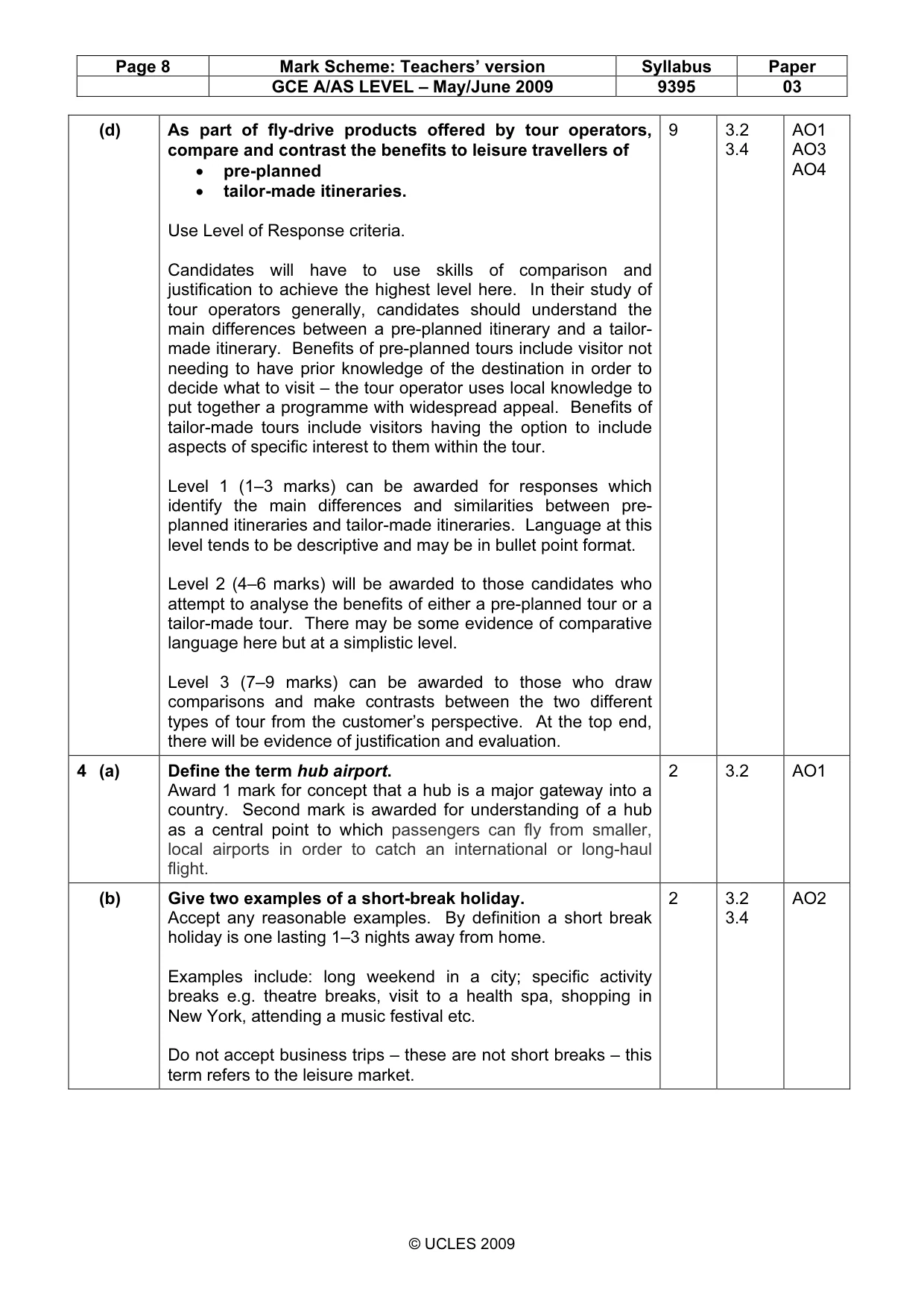
Page 8 Mark Scheme: Teachers’ version Syllabus Paper GCE A/AS LEVEL – May/June 2009 9395 03 © UCLES 2009 (d) As part of fly-drive products offered by tour operators, compare and contrast the benefits to leisure travellers of • pre-planned • tailor-made itineraries. Use Level of Response criteria. Candidates will have to use skills of comparison and justification to achieve the highest level here. In their study of tour operators generally, candidates should understand the main differences between a pre-planned itinerary and a tailor- made itinerary. Benefits of pre-planned tours include visitor not needing to have prior knowledge of the destination in order to decide what to visit – the tour operator uses local knowledge to put together a programme with widespread appeal. Benefits of tailor-made tours include visitors having the option to include aspects of specific interest to them within the tour. Level 1 (1–3 marks) can be awarded for responses which identify the main differences and similarities between pre- planned itineraries and tailor-made itineraries. Language at this level tends to be descriptive and may be in bullet point format. Level 2 (4–6 marks) will be awarded to those candidates who attempt to analyse the benefits of either a pre-planned tour or a tailor-made tour. There may be some evidence of comparative language here but at a simplistic level. Level 3 (7–9 marks) can be awarded to those who draw comparisons and make contrasts between the two different types of tour from the customer’s perspective. At the top end, there will be evidence of justification and evaluation. 9 3.2 3.4 AO1 AO3 AO4 4 (a) Define the term hub airport. Award 1 mark for concept that a hub is a major gateway into a country. Second mark is awarded for understanding of a hub as a central point to which passengers can fly from smaller, local airports in order to catch an international or long-haul flight. 2 3.2 AO1 (b) Give two examples of a short-break holiday. Accept any reasonable examples. By definition a short break holiday is one lasting 1–3 nights away from home. Examples include: long weekend in a city; specific activity breaks e.g. theatre breaks, visit to a health spa, shopping in New York, attending a music festival etc. Do not accept business trips – these are not short breaks – this term refers to the leisure market. 2 3.2 3.4 AO2
Mark scheme, page 9
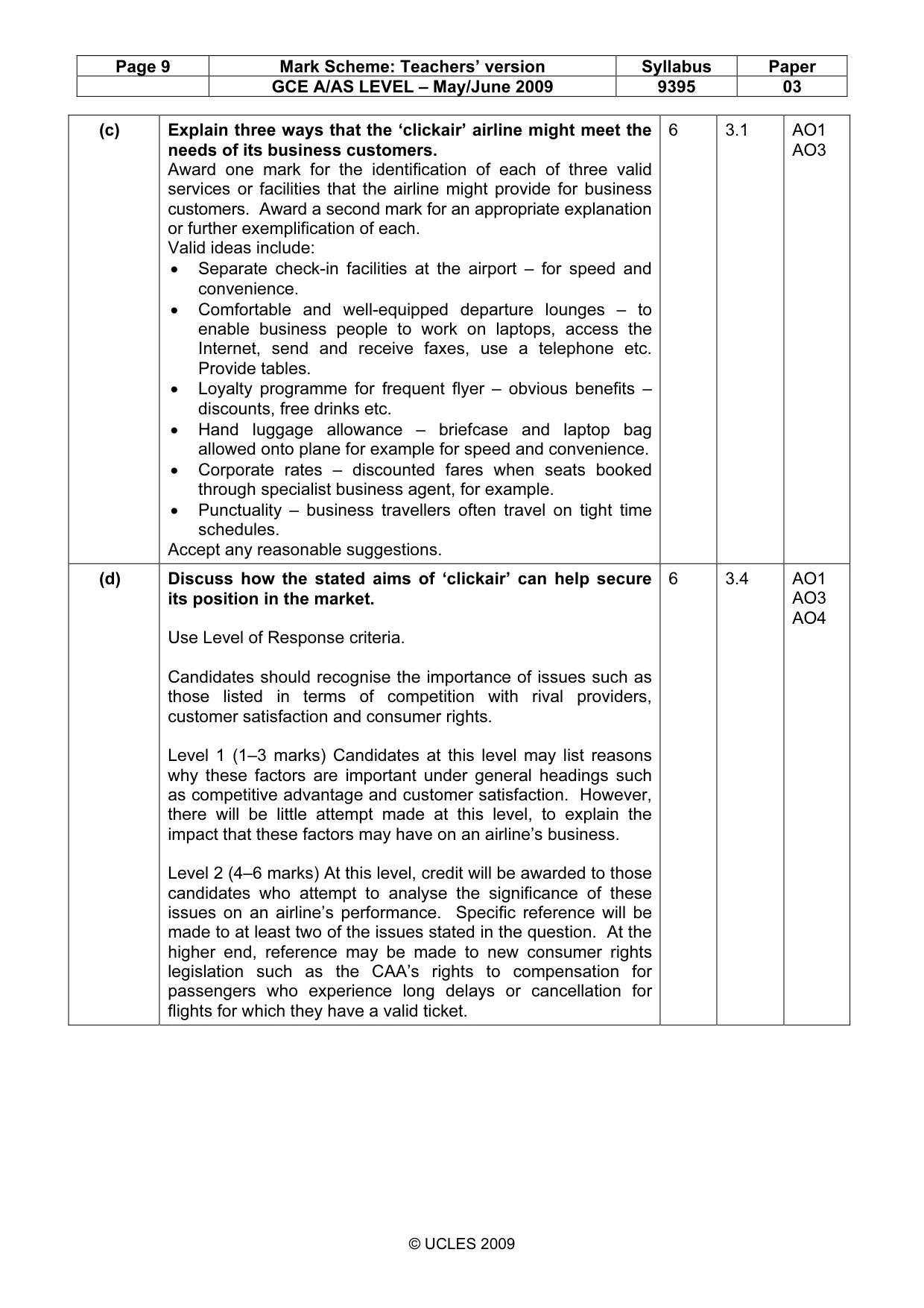
Page 9 Mark Scheme: Teachers’ version Syllabus Paper GCE A/AS LEVEL – May/June 2009 9395 03 © UCLES 2009 (c) Explain three ways that the ‘clickair’ airline might meet the needs of its business customers. Award one mark for the identification of each of three valid services or facilities that the airline might provide for business customers. Award a second mark for an appropriate explanation or further exemplification of each. Valid ideas include: • Separate check-in facilities at the airport – for speed and convenience. • Comfortable and well-equipped departure lounges – to enable business people to work on laptops, access the Internet, send and receive faxes, use a telephone etc. Provide tables. • Loyalty programme for frequent flyer – obvious benefits – discounts, free drinks etc. • Hand luggage allowance – briefcase and laptop bag allowed onto plane for example for speed and convenience. • Corporate rates – discounted fares when seats booked through specialist business agent, for example. • Punctuality – business travellers often travel on tight time schedules. Accept any reasonable suggestions. 6 3.1 AO1 AO3 (d) Discuss how the stated aims of ‘clickair’ can help secure its position in the market. Use Level of Response criteria. Candidates should recognise the importance of issues such as those listed in terms of competition with rival providers, customer satisfaction and consumer rights. Level 1 (1–3 marks) Candidates at this level may list reasons why these factors are important under general headings such as competitive advantage and customer satisfaction. However, there will be little attempt made at this level, to explain the impact that these factors may have on an airline’s business. Level 2 (4–6 marks) At this level, credit will be awarded to those candidates who attempt to analyse the significance of these issues on an airline’s performance. Specific reference will be made to at least two of the issues stated in the question. At the higher end, reference may be made to new consumer rights legislation such as the CAA’s rights to compensation for passengers who experience long delays or cancellation for flights for which they have a valid ticket. 6 3.4 AO1 AO3 AO4
Mark scheme, page 10
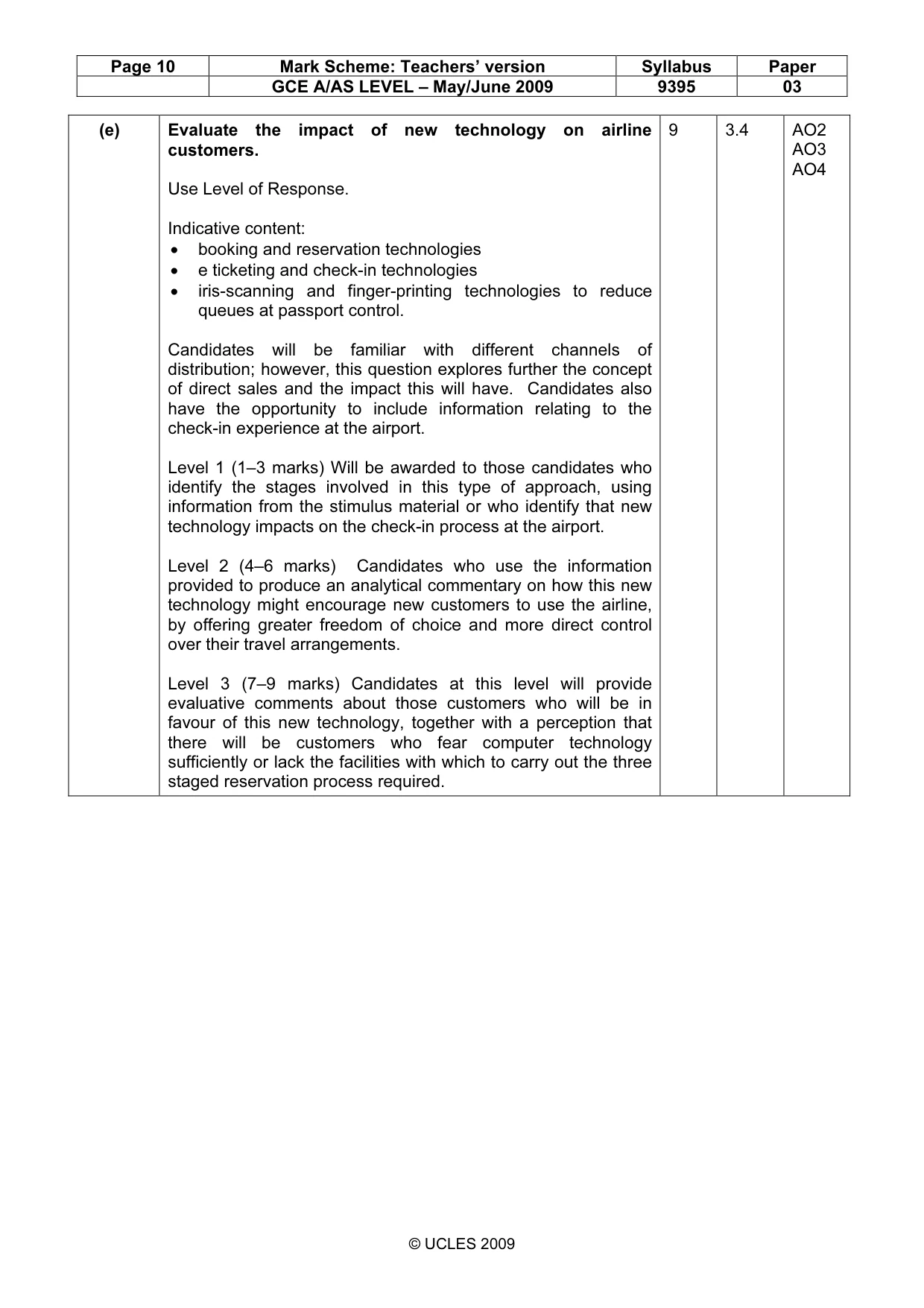
Page 10 Mark Scheme: Teachers’ version Syllabus Paper GCE A/AS LEVEL – May/June 2009 9395 03 © UCLES 2009 (e) Evaluate the impact of new technology on airline customers. Use Level of Response. Indicative content: • booking and reservation technologies • e ticketing and check-in technologies • iris-scanning and finger-printing technologies to reduce queues at passport control. Candidates will be familiar with different channels of distribution; however, this question explores further the concept of direct sales and the impact this will have. Candidates also have the opportunity to include information relating to the check-in experience at the airport. Level 1 (1–3 marks) Will be awarded to those candidates who identify the stages involved in this type of approach, using information from the stimulus material or who identify that new technology impacts on the check-in process at the airport. Level 2 (4–6 marks) Candidates who use the information provided to produce an analytical commentary on how this new technology might encourage new customers to use the airline, by offering greater freedom of choice and more direct control over their travel arrangements. Level 3 (7–9 marks) Candidates at this level will provide evaluative comments about those customers who will be in favour of this new technology, together with a perception that there will be customers who fear computer technology sufficiently or lack the facilities with which to carry out the three staged reservation process required. 9 3.4 AO2 AO3 AO4
Mark scheme, page 11
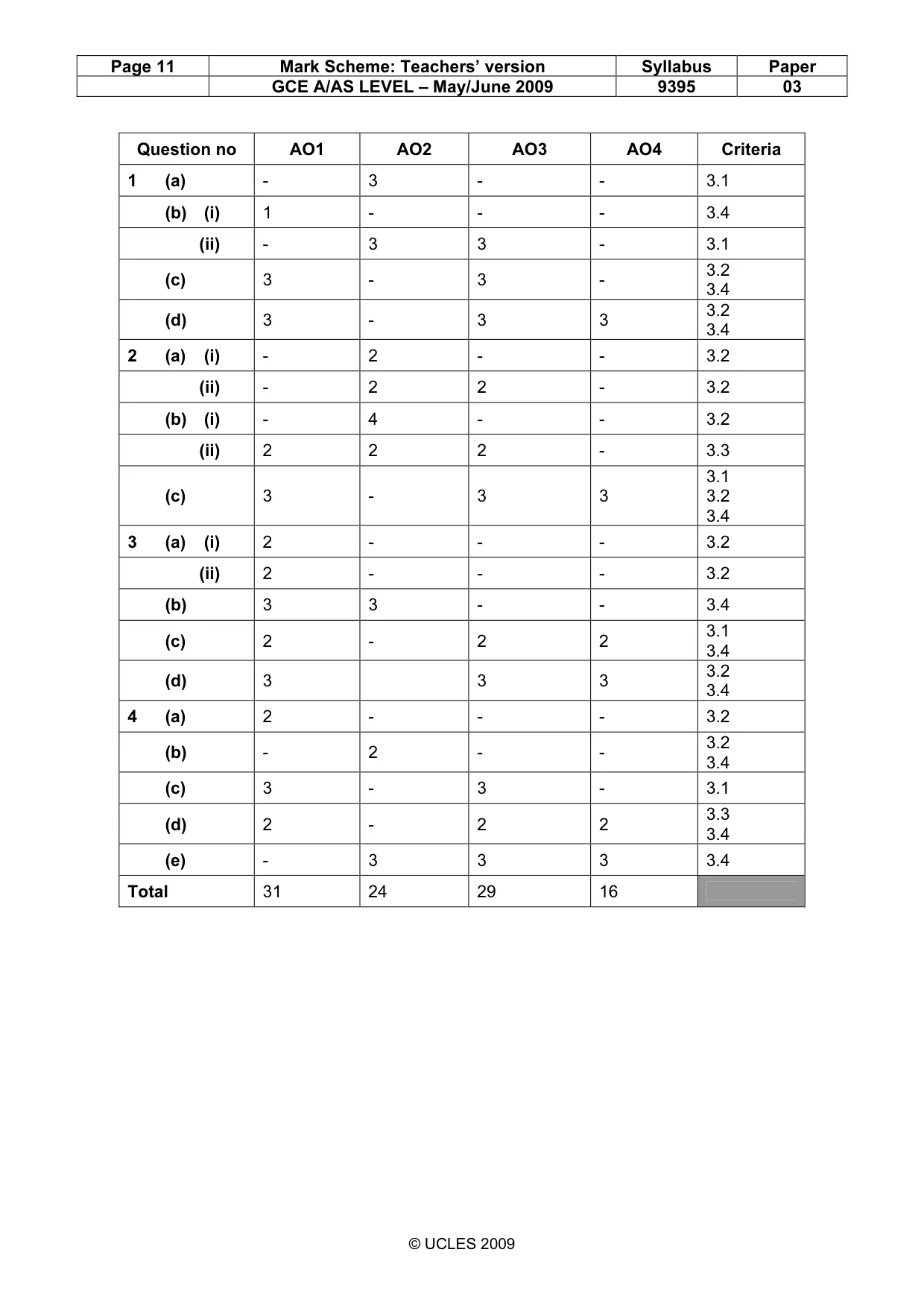
Page 11 Mark Scheme: Teachers’ version Syllabus Paper GCE A/AS LEVEL – May/June 2009 9395 03 © UCLES 2009 Question no AO1 AO2 AO3 AO4 Criteria 1 (a) - 3 - - 3.1 (b) (i) 1 - - - 3.4 (ii) - 3 3 - 3.1 (c) 3 - 3 - 3.2 3.4 (d) 3 - 3 3 3.2 3.4 2 (a) (i) - 2 - - 3.2 (ii) - 2 2 - 3.2 (b) (i) - 4 - - 3.2 (ii) 2 2 2 - 3.3 (c) 3 - 3 3 3.1 3.2 3.4 3 (a) (i) 2 - - - 3.2 (ii) 2 - - - 3.2 (b) 3 3 - - 3.4 (c) 2 - 2 2 3.1 3.4 (d) 3 3 3 3.2 3.4 4 (a) 2 - - - 3.2 (b) - 2 - - 3.2 3.4 (c) 3 - 3 - 3.1 (d) 2 - 2 2 3.3 3.4 (e) - 3 3 3 3.4 Total 31 24 29 16
What you needed in this session
Cambridge’s own grade thresholds for 2009 May/June, Paper 3 · Variant 1. A higher threshold means an easier paper — the bar moves with how the cohort did.