Cambridge A Level Thinking Skills 9694 — 2020 Oct/Nov Paper 3 · Variant 2
9694/32/O/N/20 · 4 questions · 50 marks · ≈56 min
The question paper and its mark scheme, free to read here and free to download. This is Cambridge’s own paper, exactly as it was sat.
Question paper8 pages


Mark scheme7 pages
Answers below. Sit the paper first if you are practising.
Questions as text
Q1 · In a country where too much food is grown it was decided to pay farmers to leave 10% of…
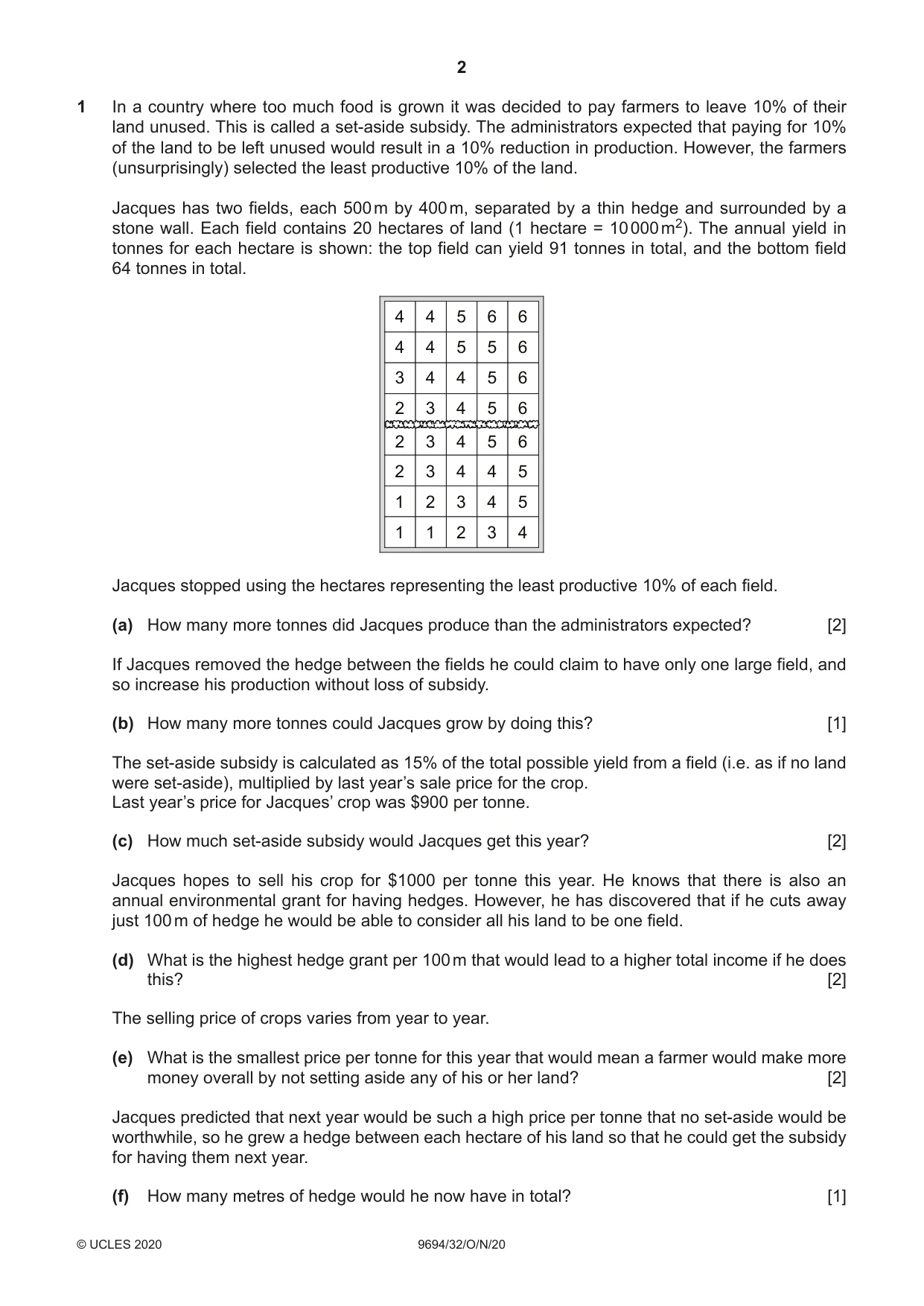
1 In a country where too much food is grown it was decided to pay farmers to leave 10% of their land unused. This is called a set-aside subsidy. The administrators expected that paying for 10% of the land to be left unused would result in a 10% reduction in production. However, the farmers (unsurprisingly) selected the least productive 10% of the land. Jacques has two fields, each 500 m by 400 m, separated by a thin hedge and surrounded by a stone wall. Each field contains 20 hectares of land (1 hectare = 10 000 m2). The annual yield in tonnes for each hectare is shown: the top field can yield 91 tonnes in total, and the bottom field 64 tonnes in total. 4 4 5 6 6 4 4 5 5 6 3 4 4 5 6 2 3 4 5 6 2 3 4 5 6 2 3 4 4 5 1 2 3 4 5 1 1 2 3 4 Jacques stopped using the hectares representing the least productive 10% of each field. (a) How many more tonnes did Jacques produce than the administrators expected? [2] If Jacques removed the hedge between the fields he could claim to have only one large field, and so increase his production without loss of subsidy. (b) How many more tonnes could Jacques grow by doing this? [1] The set-aside subsidy is calculated as 15% of the total possible yield from a field (i.e. as if no land were set-aside), multiplied by last year’s sale price for the crop. Last year’s price for Jacques’ crop was $900 per tonne. (c) How much set-aside subsidy would Jacques get this year? [2] Jacques hopes to sell his crop for $1000 per tonne this year. He knows that there is also an annual environmental grant for having hedges. However, he has discovered that if he cuts away just 100 m of hedge he would be able to consider all his land to be one field. (d) What is the highest hedge grant per 100 m that would lead to a higher total income if he does this? [2] The selling price of crops varies from year to year. (e) What is the smallest price per tonne for this year that would mean a farmer would make more money overall by not setting aside any of his or her land? [2] Jacques predicted that next year would be such a high price per tonne that no set-aside would be worthwhile, so he grew a hedge between each hectare of his land so that he could get the subsidy for having them next year. (f) How many metres of hedge would he now have in total? [1] [Question 2 begins on the next page]
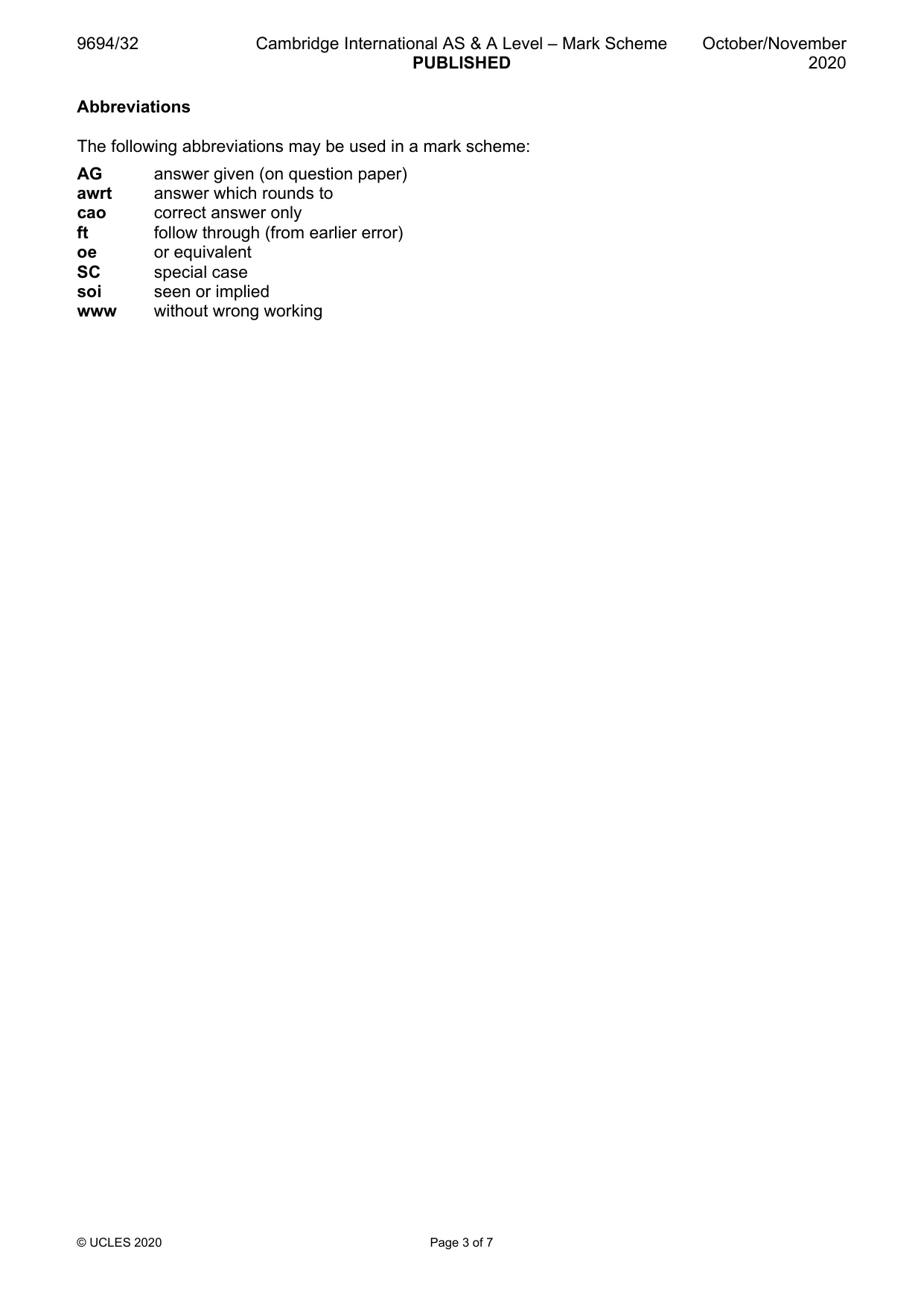
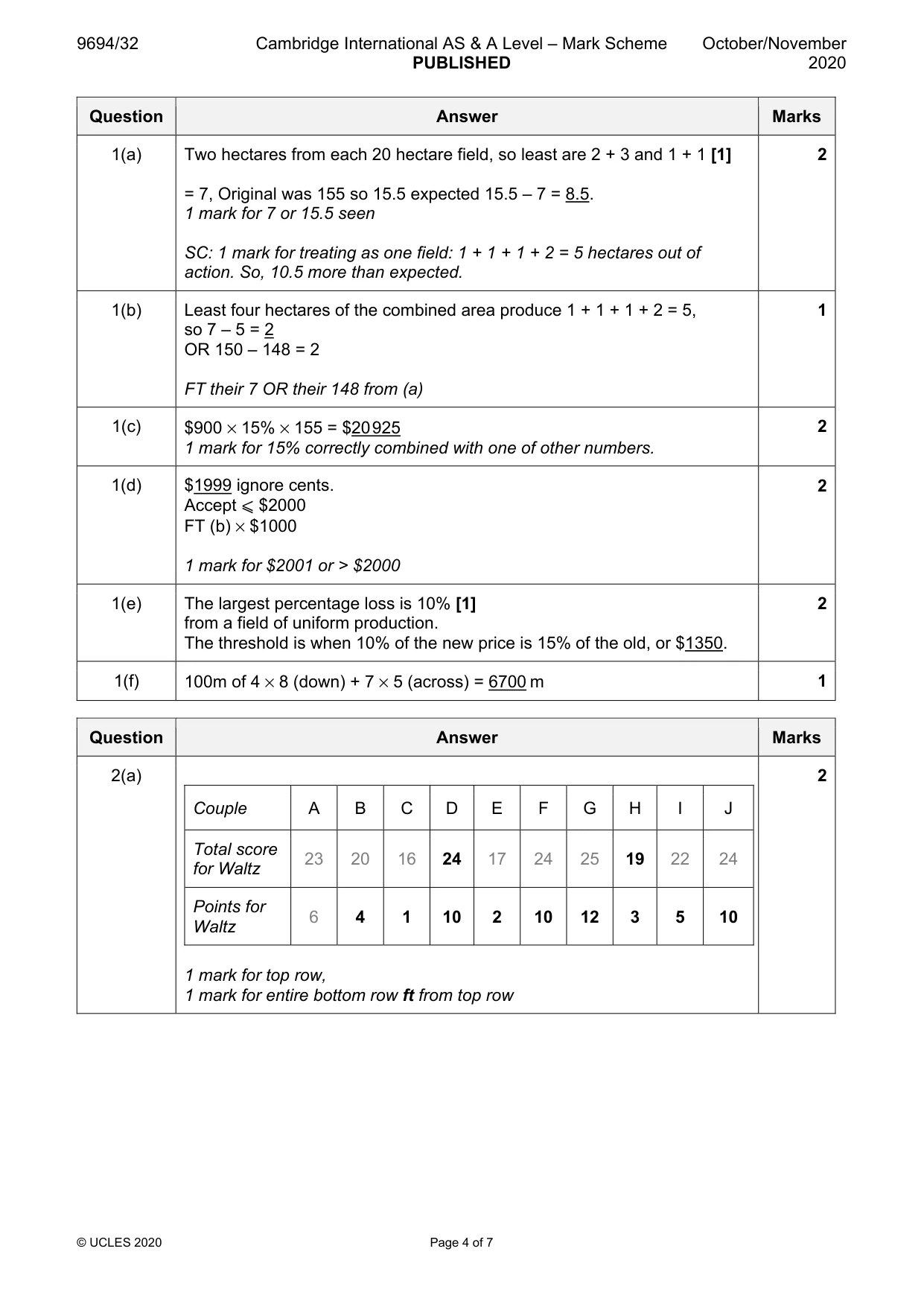
Mark scheme: Question Answer Marks 1(a) Two hectares from each 20 hectare field, so least are 2 + 3 and 1 + 1 [1] 2 = 7, Original was 155 so 15.5 expected 15.5 – 7 = 8.5. 1 mark for 7 or 15.5 seen SC: 1 mark for treating as one field: 1 + 1 + 1 + 2 = 5 hectares out of action. So, 10.5 more than expected. 1(b) Least four hectares of the combined area produce 1 + 1 + 1 + 2 = 5, 1 so 7 – 5 = 2 OR 150 – 148 = 2 FT their 7 OR their 148 from (a) 1(c) $900 × 15% × 155 = $20 925 2 1 mark for 15% correctly combined with one of other numbers. 1(d) $1999 ignore cents. 2 Accept ⩽ $2000 FT (b) × $1000 1 mark for $2001 or > $2000 1(e) The largest percentage loss is 10% [1] 2 from a field of uniform production. The threshold is when 10% of the new price is 15% of the old, or $1350. 1(f) 100m of 4 × 8 (down) + 7 × 5 (across) = 6700 m 1
Q2 · The Goodlen Dancing Society holds a dancing competition every Saturday
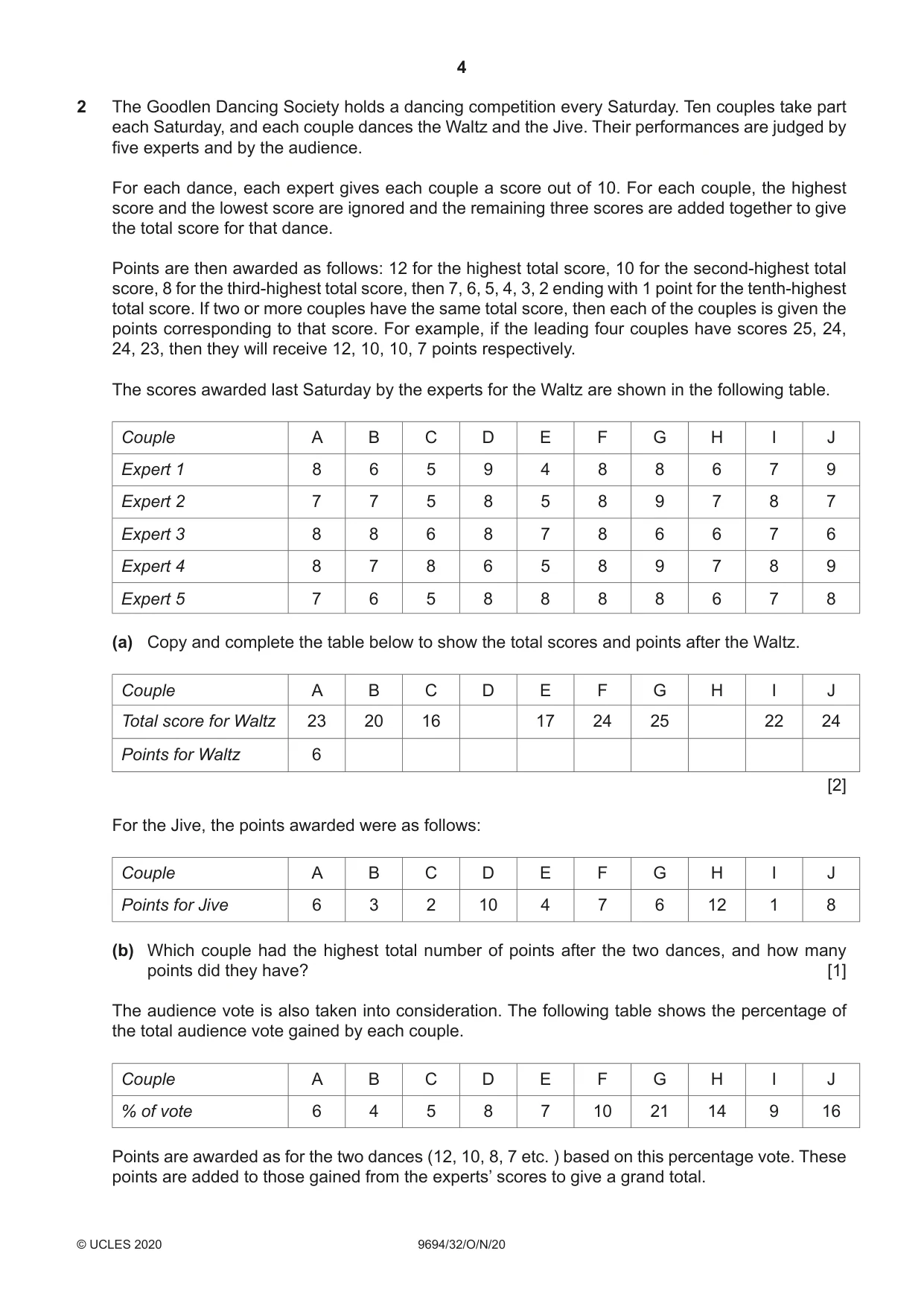
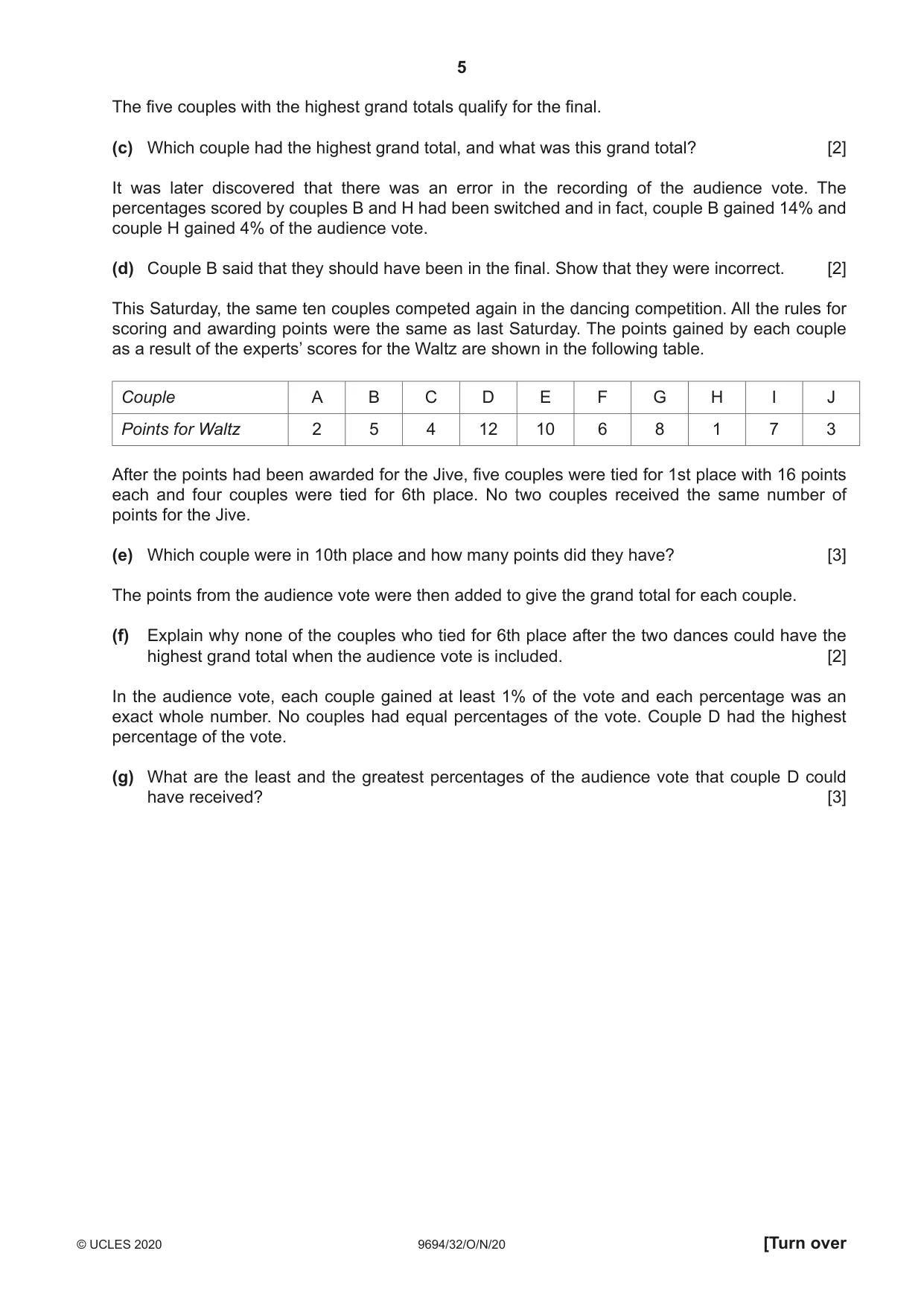
2 The Goodlen Dancing Society holds a dancing competition every Saturday. Ten couples take part each Saturday, and each couple dances the Waltz and the Jive. Their performances are judged by five experts and by the audience. For each dance, each expert gives each couple a score out of 10. For each couple, the highest score and the lowest score are ignored and the remaining three scores are added together to give the total score for that dance. Points are then awarded as follows: 12 for the highest total score, 10 for the second-highest total score, 8 for the third-highest total score, then 7, 6, 5, 4, 3, 2 ending with 1 point for the tenth-highest total score. If two or more couples have the same total score, then each of the couples is given the points corresponding to that score. For example, if the leading four couples have scores 25, 24, 24, 23, then they will receive 12, 10, 10, 7 points respectively. The scores awarded last Saturday by the experts for the Waltz are shown in the following table. Couple A B C D E F G H I J Expert 1 8 6 5 9 4 8 8 6 7 9 Expert 2 7 7 5 8 5 8 9 7 8 7 Expert 3 8 8 6 8 7 8 6 6 7 6 Expert 4 8 7 8 6 5 8 9 7 8 9 Expert 5 7 6 5 8 8 8 8 6 7 8 (a) Copy and complete the table below to show the total scores and points after the Waltz. Couple A B C D E F G H I J Total score for Waltz 23 20 16 17 24 25 22 24 Points for Waltz 6 [2] For the Jive, the points awarded were as follows: Couple A B C D E F G H I J Points for Jive 6 3 2 10 4 7 6 12 1 8 (b) Which couple had the highest total number of points after the two dances, and how many points did they have? [1] The audience vote is also taken into consideration. The following table shows the percentage of the total audience vote gained by each couple. Couple A B C D E F G H I J % of vote 6 4 5 8 7 10 21 14 9 16 Points are awarded as for the two dances (12, 10, 8, 7 etc. ) based on this percentage vote. These points are added to those gained from the experts’ scores to give a grand total. The five couples with the highest grand totals qualify for the final. (c) Which couple had the highest grand total, and what was this grand total? [2] It was later discovered that there was an error in the recording of the audience vote. The percentages scored by couples B and H had been switched and in fact, couple B gained 14% and couple H gained 4% of the audience vote. (d) Couple B said that they should have been in the final. Show that they were incorrect. [2] This Saturday, the same ten couples competed again in the dancing competition. All the rules for scoring and awarding points were the same as last Saturday. The points gained by each couple as a result of the experts’ scores for the Waltz are shown in the following table. Couple A B C D E F G H I J Points for Waltz 2 5 4 12 10 6 8 1 7 3 After the points had been awarded for the Jive, five couples were tied for 1st place with 16 points each and four couples were tied for 6th place. No two couples received the same number of points for the Jive. (e) Which couple were in 10th place and how many points did they have? [3] The points from the audience vote were then added to give the grand total for each couple. (f) Explain why none of the couples who tied for 6th place after the two dances could have the highest grand total when the audience vote is included. [2] In the audience vote, each couple gained at least 1% of the vote and each percentage was an exact whole number. No couples had equal percentages of the vote. Couple D had the highest percentage of the vote. (g) What are the least and the greatest percentages of the audience vote that couple D could have received? [3]
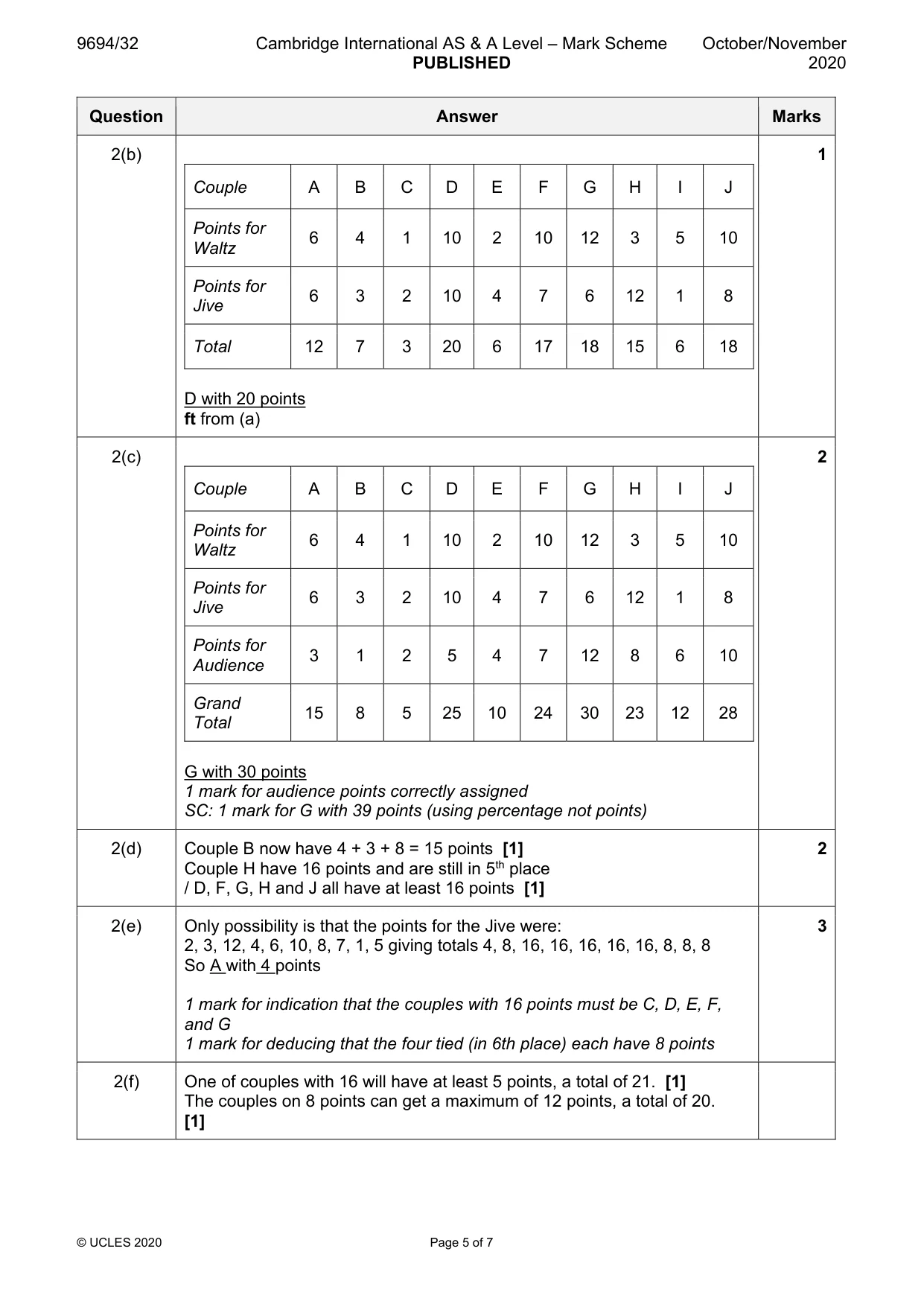
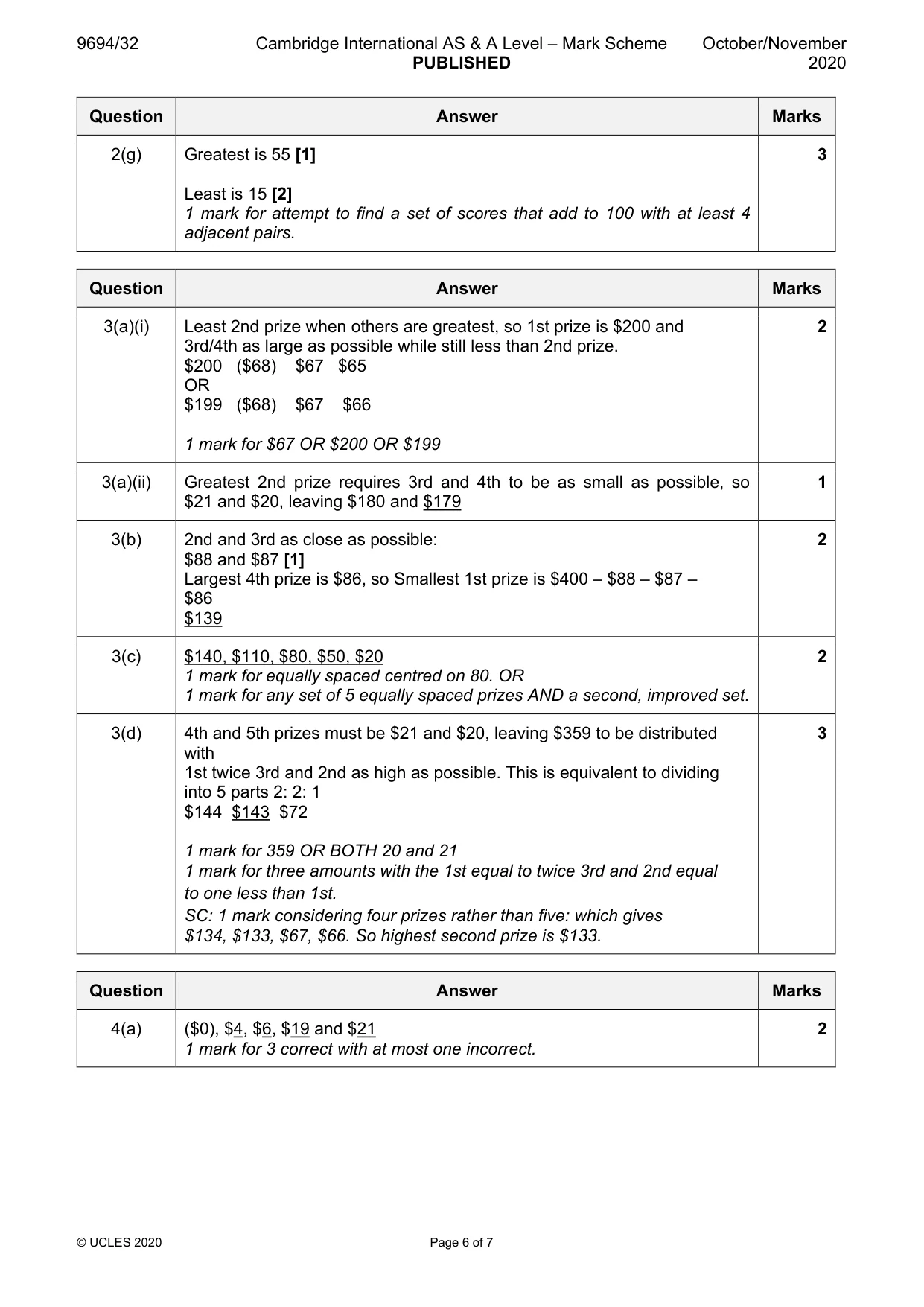
Mark scheme: 2(a) 2 Couple A B C D E F G H I J Total score 23 20 16 24 17 24 25 19 22 24 for Waltz Points for 6 4 1 10 2 10 12 3 5 10 Waltz 1 mark for top row, 1 mark for entire bottom row ft from top row 2(b) 1 Couple A B C D E F G H I J Points for 6 4 1 10 2 10 12 3 5 10 Waltz Points for 6 3 2 10 4 7 6 12 1 8 Jive Total 12 7 3 20 6 17 18 15 6 18 D with 20 points ft from (a) 2(c) 2 Couple A B C D E F G H I J Points for 6 4 1 10 2 10 12 3 5 10 Waltz Points for 6 3 2 10 4 7 6 12 1 8 Jive Points for 3 1 2 5 4 7 12 8 6 10 Audience Grand 15 8 5 25 10 24 30 23 12 28 Total G with 30 points 1 mark for audience points correctly assigned SC: 1 mark for G with 39 points (using percentage not points) 2(d) Couple B now have 4 + 3 + 8 = 15 points [1] 2 Couple H have 16 points and are still in 5th place / D, F, G, H and J all have at least 16 points [1] 2(e) Only possibility is that the points for the Jive were: 3 2, 3, 12, 4, 6, 10, 8, 7, 1, 5 giving totals 4, 8, 16, 16, 16, 16, 16, 8, 8, 8 So A with 4 points 1 mark for indication that the couples with 16 points must be C, D, E, F, and G 1 mark for deducing that the four tied (in 6th place) each have 8 points 2(f) One of couples with 16 will have at least 5 points, a total of 21. [1] The couples on 8 points can get a maximum of 12 points, a total of 20. [1] 2(g) Greatest is 55 [1] 3 Least is 15 [2] 1 mark for attempt to find a set of scores that add to 100 with at least 4 adjacent pairs.
More questions on Perform appropriate operations with information
Q3 · The Bolandian Photographic Society (BPS) organises an annual competition to encourage…
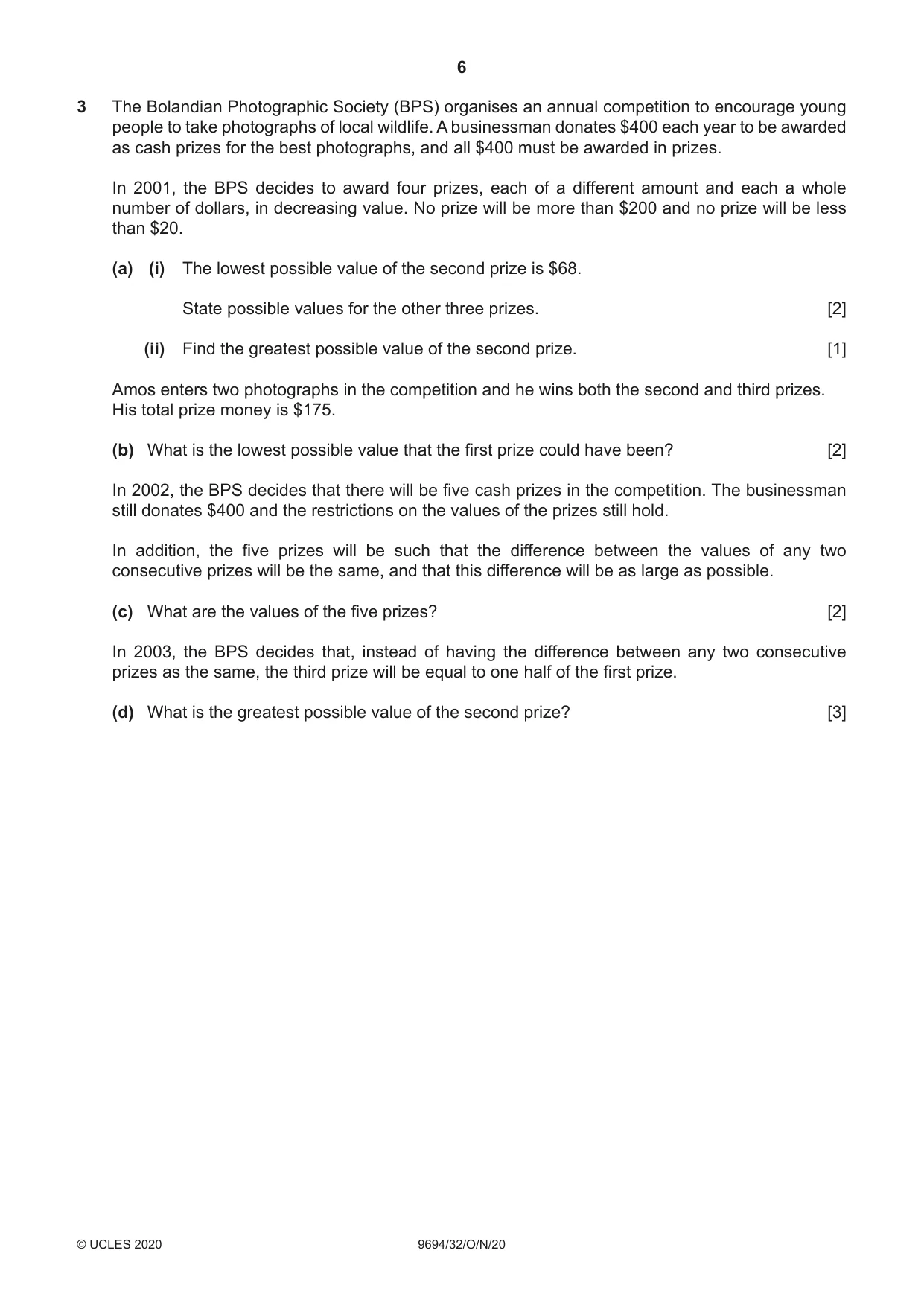
3 The Bolandian Photographic Society (BPS) organises an annual competition to encourage young people to take photographs of local wildlife. A businessman donates $400 each year to be awarded as cash prizes for the best photographs, and all $400 must be awarded in prizes. In 2001, the BPS decides to award four prizes, each of a different amount and each a whole number of dollars, in decreasing value. No prize will be more than $200 and no prize will be less than $20. (a) (i) The lowest possible value of the second prize is $68. State possible values for the other three prizes. [2] (ii) Find the greatest possible value of the second prize. [1] Amos enters two photographs in the competition and he wins both the second and third prizes. His total prize money is $175. (b) What is the lowest possible value that the first prize could have been? [2] In 2002, the BPS decides that there will be five cash prizes in the competition. The businessman still donates $400 and the restrictions on the values of the prizes still hold. In addition, the five prizes will be such that the difference between the values of any two consecutive prizes will be the same, and that this difference will be as large as possible. (c) What are the values of the five prizes? [2] In 2003, the BPS decides that, instead of having the difference between any two consecutive prizes as the same, the third prize will be equal to one half of the first prize. (d) What is the greatest possible value of the second prize? [3]
Mark scheme: 3(a)(i) Least 2nd prize when others are greatest, so 1st prize is $200 and 2 3rd/4th as large as possible while still less than 2nd prize. $200 ($68) $67 $65 OR $199 ($68) $67 $66 1 mark for $67 OR $200 OR $199 3(a)(ii) Greatest 2nd prize requires 3rd and 4th to be as small as possible, so 1 $21 and $20, leaving $180 and $179 3(b) 2nd and 3rd as close as possible: 2 $88 and $87 [1] Largest 4th prize is $86, so Smallest 1st prize is $400 – $88 – $87 – $86 $139 3(c) $140, $110, $80, $50, $20 2 1 mark for equally spaced centred on 80. OR 1 mark for any set of 5 equally spaced prizes AND a second, improved set. 3(d) 4th and 5th prizes must be $21 and $20, leaving $359 to be distributed 3 with 1st twice 3rd and 2nd as high as possible. This is equivalent to dividing into 5 parts 2: 2: 1 $144 $143 $72 1 mark for 359 OR BOTH 20 and 21 1 mark for three amounts with the 1st equal to twice 3rd and 2nd equal to one less than 1st. SC: 1 mark considering four prizes rather than five: which gives $134, $133, $67, $66. So highest second prize is $133.
More questions on Identify cases that satisfy given criteria
Q4 · John is a ferryman – he takes people across the River Butley near where he lives
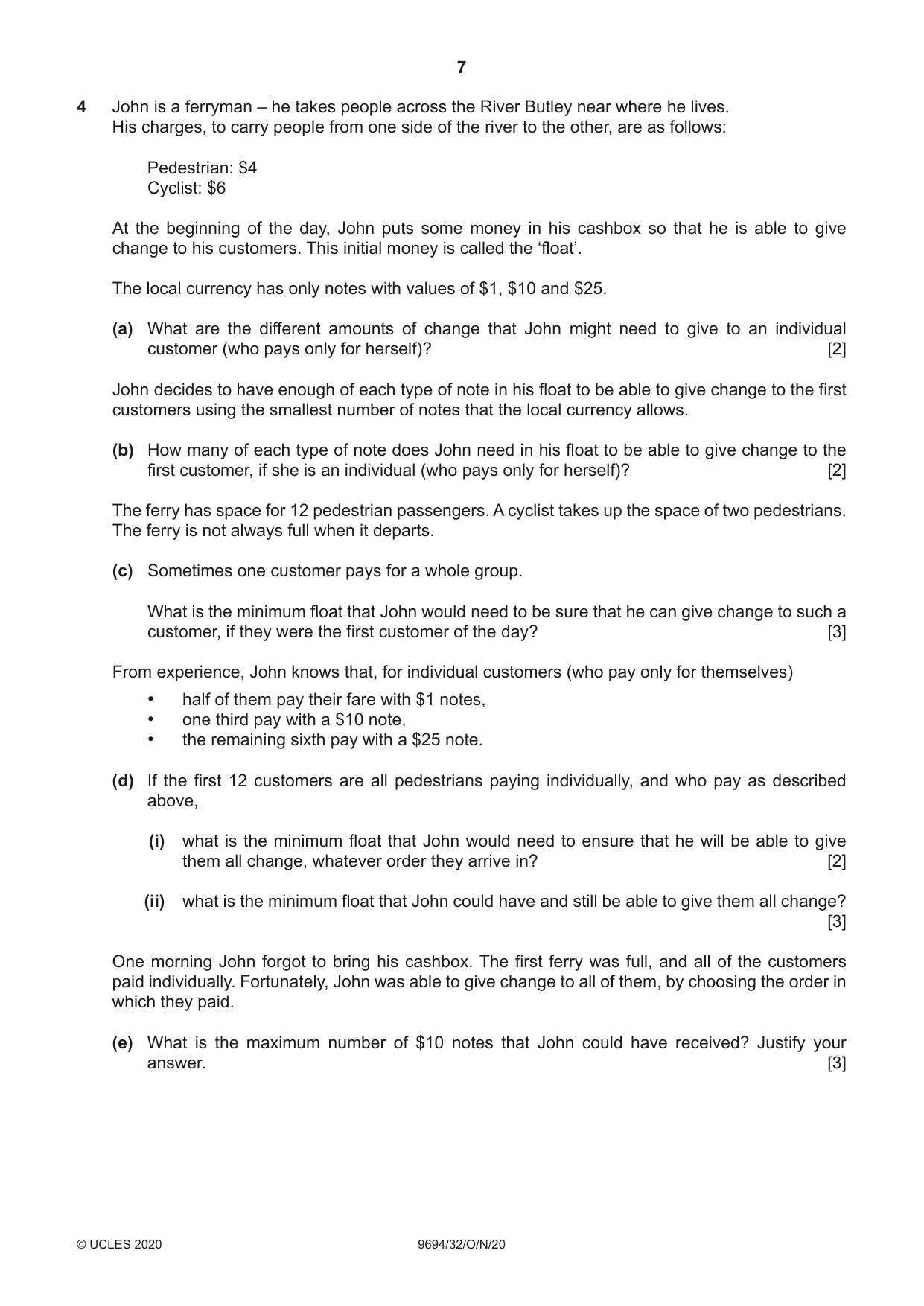
4 John is a ferryman – he takes people across the River Butley near where he lives. His charges, to carry people from one side of the river to the other, are as follows: Pedestrian: $4 Cyclist: $6 At the beginning of the day, John puts some money in his cashbox so that he is able to give change to his customers. This initial money is called the ‘float’. The local currency has only notes with values of $1, $10 and $25. (a) What are the different amounts of change that John might need to give to an individual customer (who pays only for herself)? [2] John decides to have enough of each type of note in his float to be able to give change to the first customers using the smallest number of notes that the local currency allows. (b) How many of each type of note does John need in his float to be able to give change to the first customer, if she is an individual (who pays only for herself)? [2] The ferry has space for 12 pedestrian passengers. A cyclist takes up the space of two pedestrians. The ferry is not always full when it departs. (c) Sometimes one customer pays for a whole group. What is the minimum float that John would need to be sure that he can give change to such a customer, if they were the first customer of the day? [3] From experience, John knows that, for individual customers (who pay only for themselves) • half of them pay their fare with $1 notes, • one third pay with a $10 note, • the remaining sixth pay with a $25 note. (d) If the first 12 customers are all pedestrians paying individually, and who pay as described above, (i) what is the minimum float that John would need to ensure that he will be able to give them all change, whatever order they arrive in? [2] (ii) what is the minimum float that John could have and still be able to give them all change? [3] One morning John forgot to bring his cashbox. The first ferry was full, and all of the customers paid individually. Fortunately, John was able to give change to all of them, by choosing the order in which they paid. (e) What is the maximum number of $10 notes that John could have received? Justify your answer. [3]
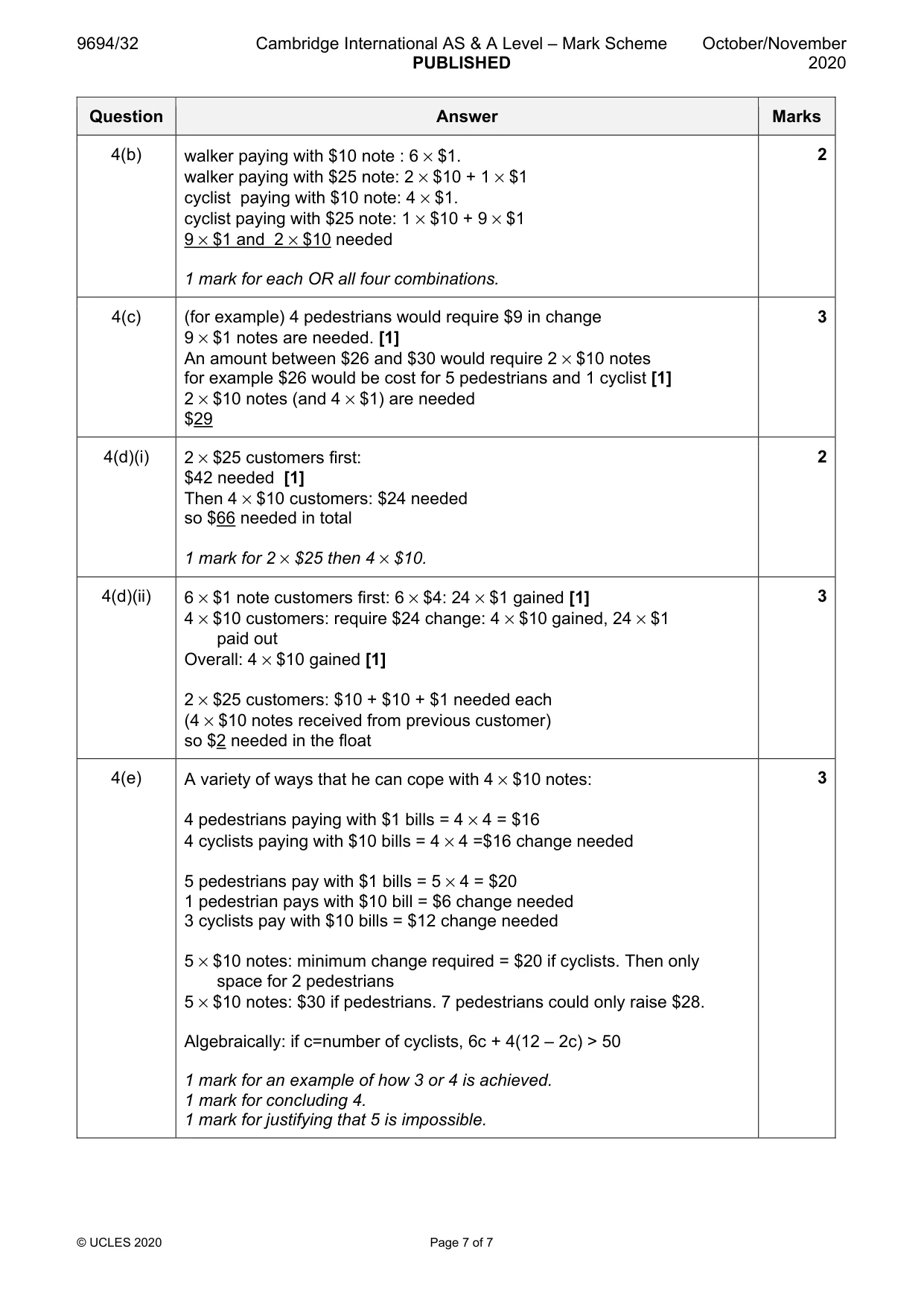
Mark scheme: 4(a) ($0), $4, $6, $19 and $21 2 1 mark for 3 correct with at most one incorrect. 4(b) walker paying with $10 note : 6 × $1. 2 walker paying with $25 note: 2 × $10 + 1 × $1 cyclist paying with $10 note: 4 × $1. cyclist paying with $25 note: 1 × $10 + 9 × $1 9 × $1 and 2 × $10 needed 1 mark for each OR all four combinations. 4(c) (for example) 4 pedestrians would require $9 in change 3 9 × $1 notes are needed. [1] An amount between $26 and $30 would require 2 × $10 notes for example $26 would be cost for 5 pedestrians and 1 cyclist [1] 2 × $10 notes (and 4 × $1) are needed $29 4(d)(i) 2 × $25 customers first: 2 $42 needed [1] Then 4 × $10 customers: $24 needed so $66 needed in total 1 mark for 2 × $25 then 4 × $10. 4(d)(ii) 6 × $1 note customers first: 6 × $4: 24 × $1 gained [1] 3 4 × $10 customers: require $24 change: 4 × $10 gained, 24 × $1 paid out Overall: 4 × $10 gained [1] 2 × $25 customers: $10 + $10 + $1 needed each (4 × $10 notes received from previous customer) so $2 needed in the float 4(e) A variety of ways that he can cope with 4 × $10 notes: 3 4 pedestrians paying with $1 bills = 4 × 4 = $16 4 cyclists paying with $10 bills = 4 × 4 =$16 change needed 5 pedestrians pay with $1 bills = 5 × 4 = $20 1 pedestrian pays with $10 bill = $6 change needed 3 cyclists pay with $10 bills = $12 change needed 5 × $10 notes: minimum change required = $20 if cyclists. Then only space for 2 pedestrians 5 × $10 notes: $30 if pedestrians. 7 pedestrians could only raise $28. Algebraically: if c=number of cyclists, 6c + 4(12 – 2c) > 50 1 mark for an example of how 3 or 4 is achieved. 1 mark for concluding 4. 1 mark for justifying that 5 is impossible.
What was in this paper
The subtopics covered by these 4 questions, and how many questions each got. Open one in a new tab to see every Cambridge question on it.
What you needed in this session
Cambridge’s own grade thresholds for 2020 Oct/Nov, Paper 3 · Variant 2. A higher threshold means an easier paper — the bar moves with how the cohort did.