Cambridge A Level Thinking Skills 9694 — 2023 May/June Paper 1 · Variant 3
9694/13/M/J/23 · 50 marks · ≈56 min
The question paper and its mark scheme, free to read here and free to download. This is Cambridge’s own paper, exactly as it was sat.
Question paper16 pages

Mark scheme9 pages
Answers below. Sit the paper first if you are practising.
Paper as text
Question paper, page 1
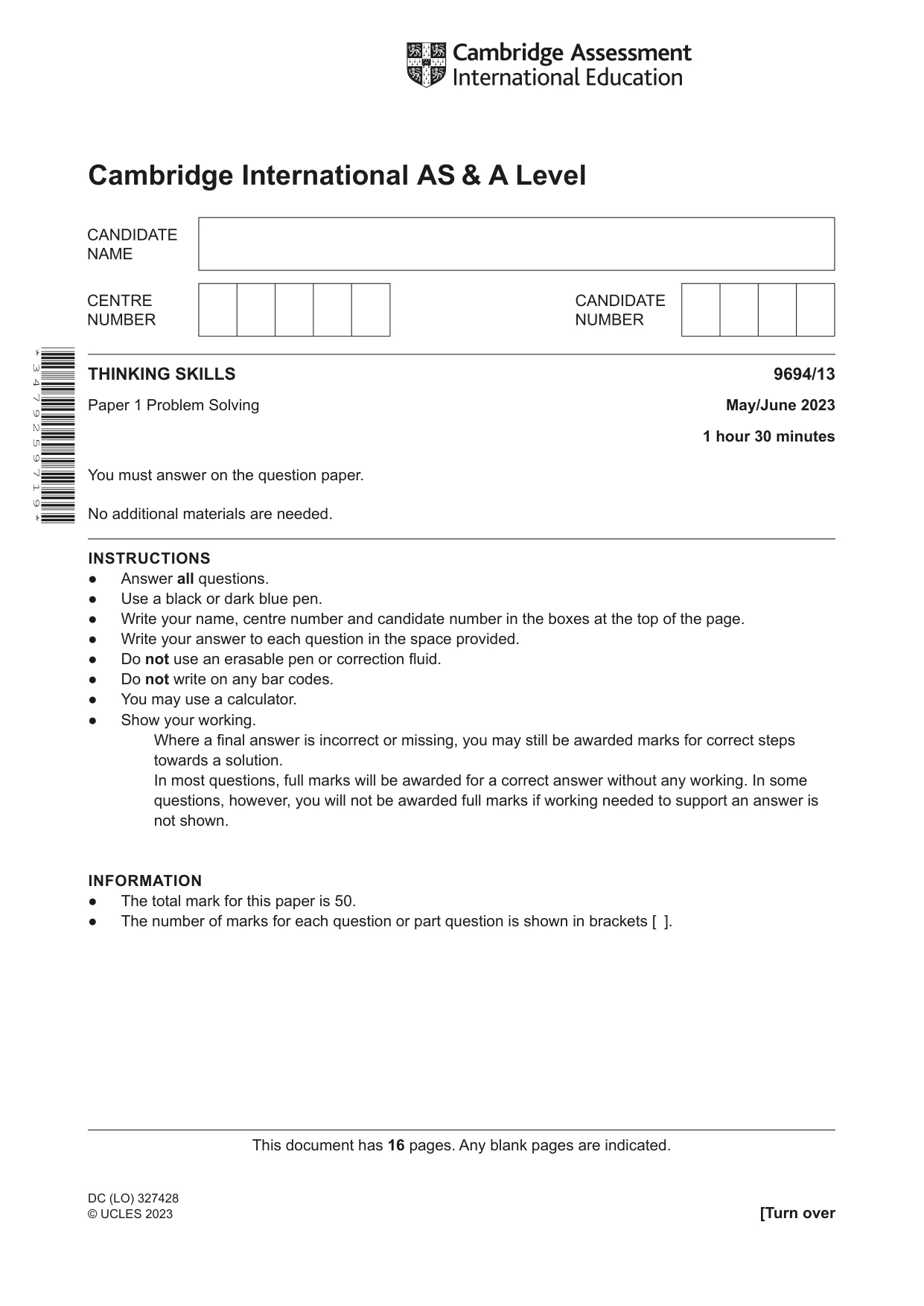
This document has 16 pages. Any blank pages are indicated. [Turn over Cambridge International AS & A Level DC (LO) 327428 © UCLES 2023 THINKING SKILLS 9694/13 Paper 1 Problem Solving May/June 2023 1 hour 30 minutes You must answer on the question paper. No additional materials are needed. INSTRUCTIONS ● Answer all questions. ● Use a black or dark blue pen. ● Write your name, centre number and candidate number in the boxes at the top of the page. ● Write your answer to each question in the space provided. ● Do not use an erasable pen or correction fluid. ● Do not write on any bar codes. ● You may use a calculator. ● Show your working. Where a final answer is incorrect or missing, you may still be awarded marks for correct steps towards a solution. In most questions, full marks will be awarded for a correct answer without any working. In some questions, however, you will not be awarded full marks if working needed to support an answer is not shown. INFORMATION ● The total mark for this paper is 50. ● The number of marks for each question or part question is shown in brackets [ ]. * 3 4 7 9 2 5 9 7 1 9 *
Question paper, page 2
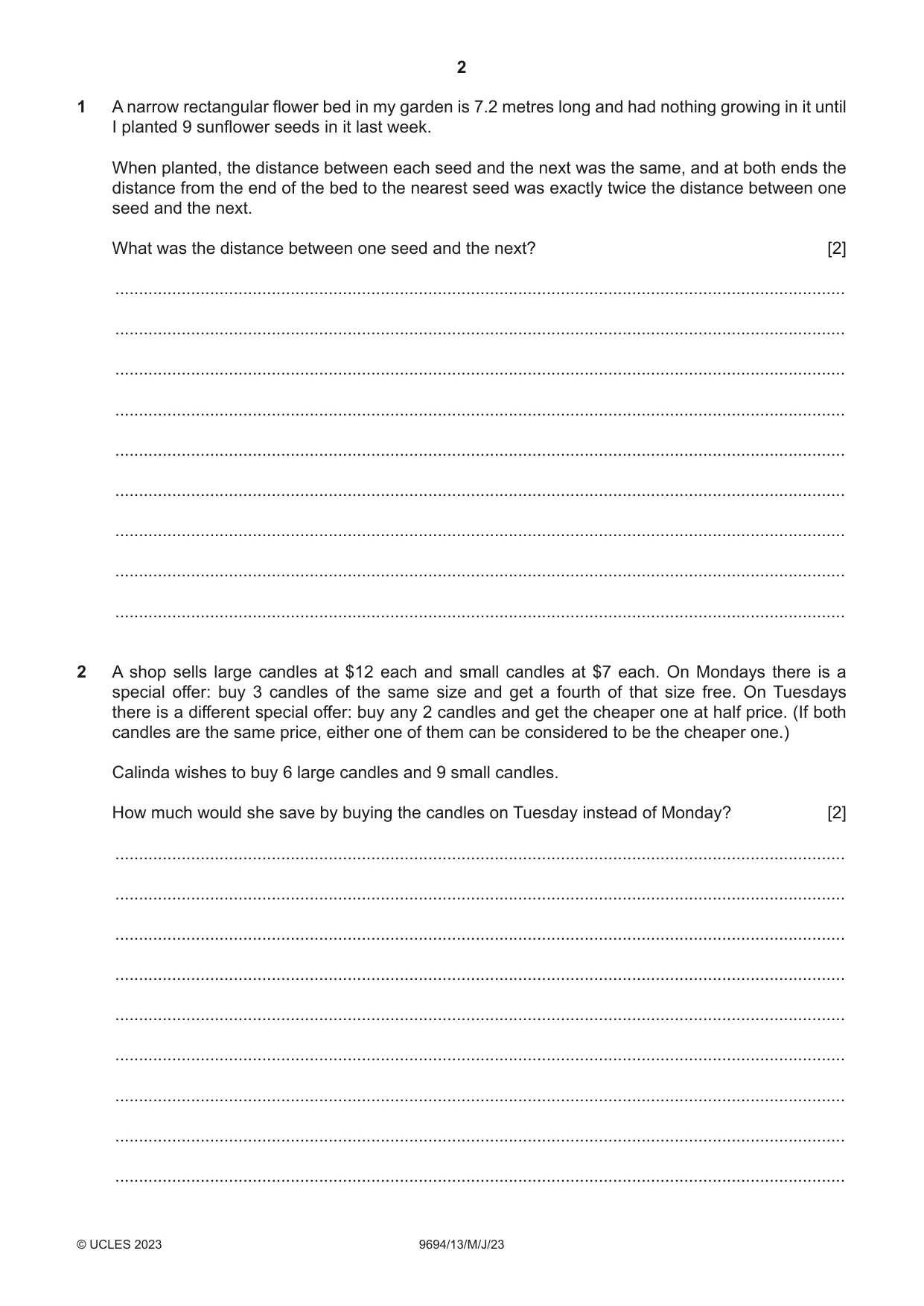
2 9694/13/M/J/23 © UCLES 2023 1 A narrow rectangular flower bed in my garden is 7.2 metres long and had nothing growing in it until I planted 9 sunflower seeds in it last week. When planted, the distance between each seed and the next was the same, and at both ends the distance from the end of the bed to the nearest seed was exactly twice the distance between one seed and the next. What was the distance between one seed and the next? [2] … … … … … … … … … 2 A shop sells large candles at $12 each and small candles at $7 each. On Mondays there is a special offer: buy 3 candles of the same size and get a fourth of that size free. On Tuesdays there is a different special offer: buy any 2 candles and get the cheaper one at half price. (If both candles are the same price, either one of them can be considered to be the cheaper one.) Calinda wishes to buy 6 large candles and 9 small candles. How much would she save by buying the candles on Tuesday instead of Monday? [2] … … … … … … … … …
Question paper, page 3
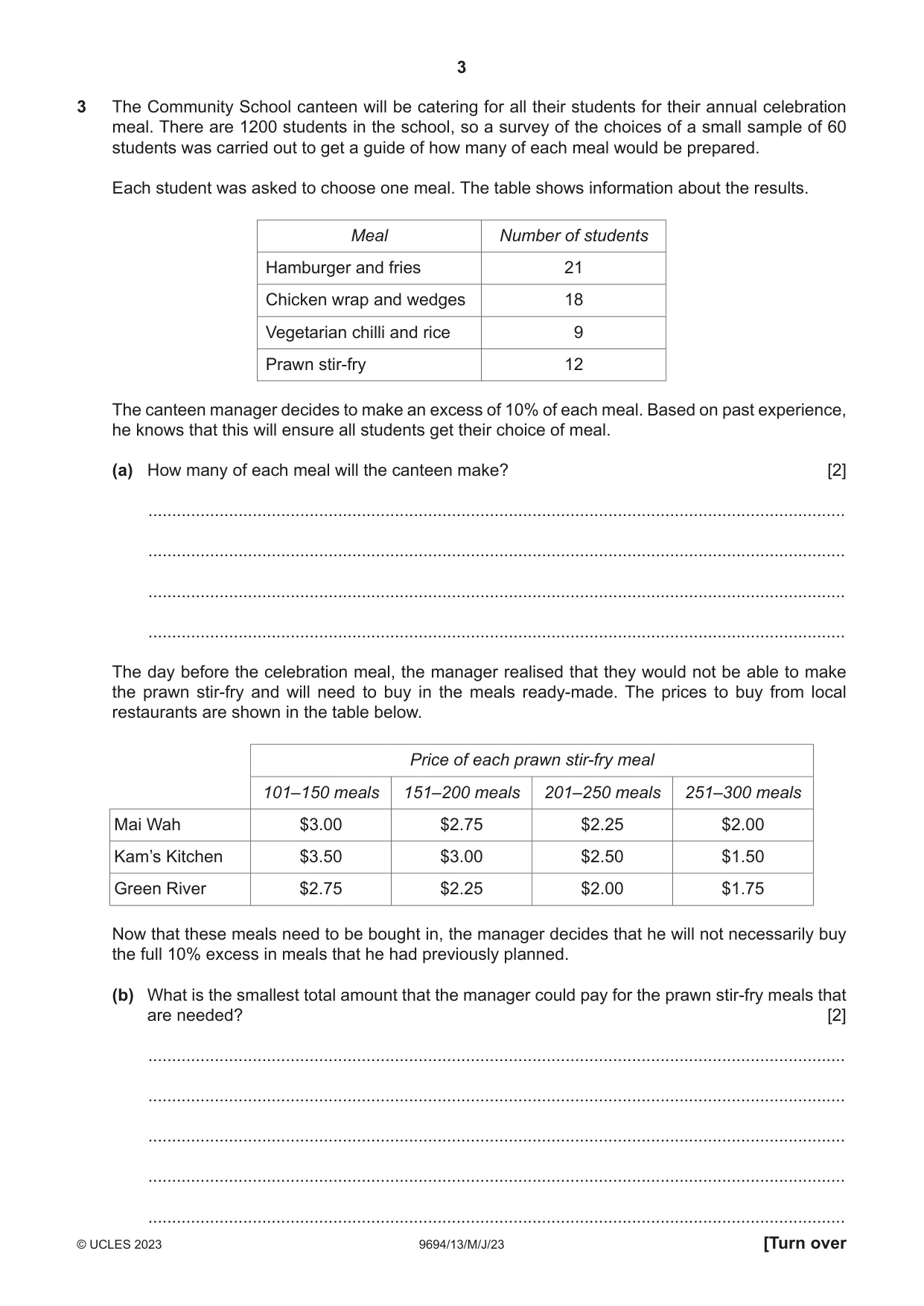
3 9694/13/M/J/23 © UCLES 2023 [Turn over 3 The Community School canteen will be catering for all their students for their annual celebration meal. There are 1200 students in the school, so a survey of the choices of a small sample of 60 students was carried out to get a guide of how many of each meal would be prepared. Each student was asked to choose one meal. The table shows information about the results. Meal Number of students Hamburger and fries 21 Chicken wrap and wedges 18 Vegetarian chilli and rice 9 Prawn stir-fry 12 The canteen manager decides to make an excess of 10% of each meal. Based on past experience, he knows that this will ensure all students get their choice of meal. (a) How many of each meal will the canteen make? [2] … … … … The day before the celebration meal, the manager realised that they would not be able to make the prawn stir-fry and will need to buy in the meals ready-made. The prices to buy from local restaurants are shown in the table below. Price of each prawn stir-fry meal 101–150 meals 151–200 meals 201–250 meals 251–300 meals Mai Wah $3.00 $2.75 $2.25 $2.00 Kam’s Kitchen $3.50 $3.00 $2.50 $1.50 Green River $2.75 $2.25 $2.00 $1.75 Now that these meals need to be bought in, the manager decides that he will not necessarily buy the full 10% excess in meals that he had previously planned. (b) What is the smallest total amount that the manager could pay for the prawn stir-fry meals that are needed? [2] … … … … …
Question paper, page 4
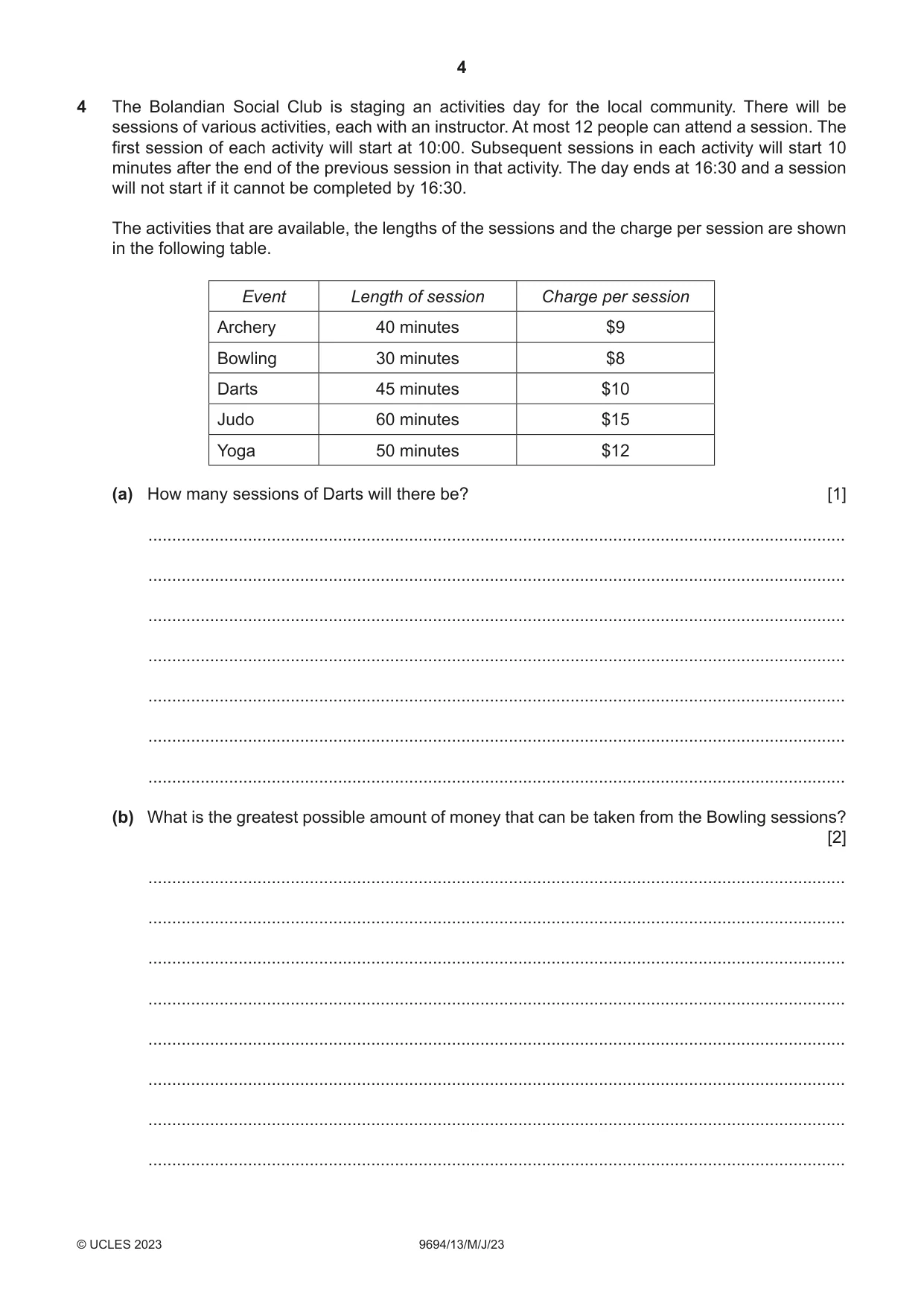
4 9694/13/M/J/23 © UCLES 2023 4 The Bolandian Social Club is staging an activities day for the local community. There will be sessions of various activities, each with an instructor. At most 12 people can attend a session. The first session of each activity will start at 10:00. Subsequent sessions in each activity will start 10 minutes after the end of the previous session in that activity. The day ends at 16:30 and a session will not start if it cannot be completed by 16:30. The activities that are available, the lengths of the sessions and the charge per session are shown in the following table. Event Length of session Charge per session Archery 40 minutes $9 Bowling 30 minutes $8 Darts 45 minutes $10 Judo 60 minutes $15 Yoga 50 minutes $12 (a) How many sessions of Darts will there be? [1] … … … … … … … (b) What is the greatest possible amount of money that can be taken from the Bowling sessions? [2] … … … … … … … …
Question paper, page 5
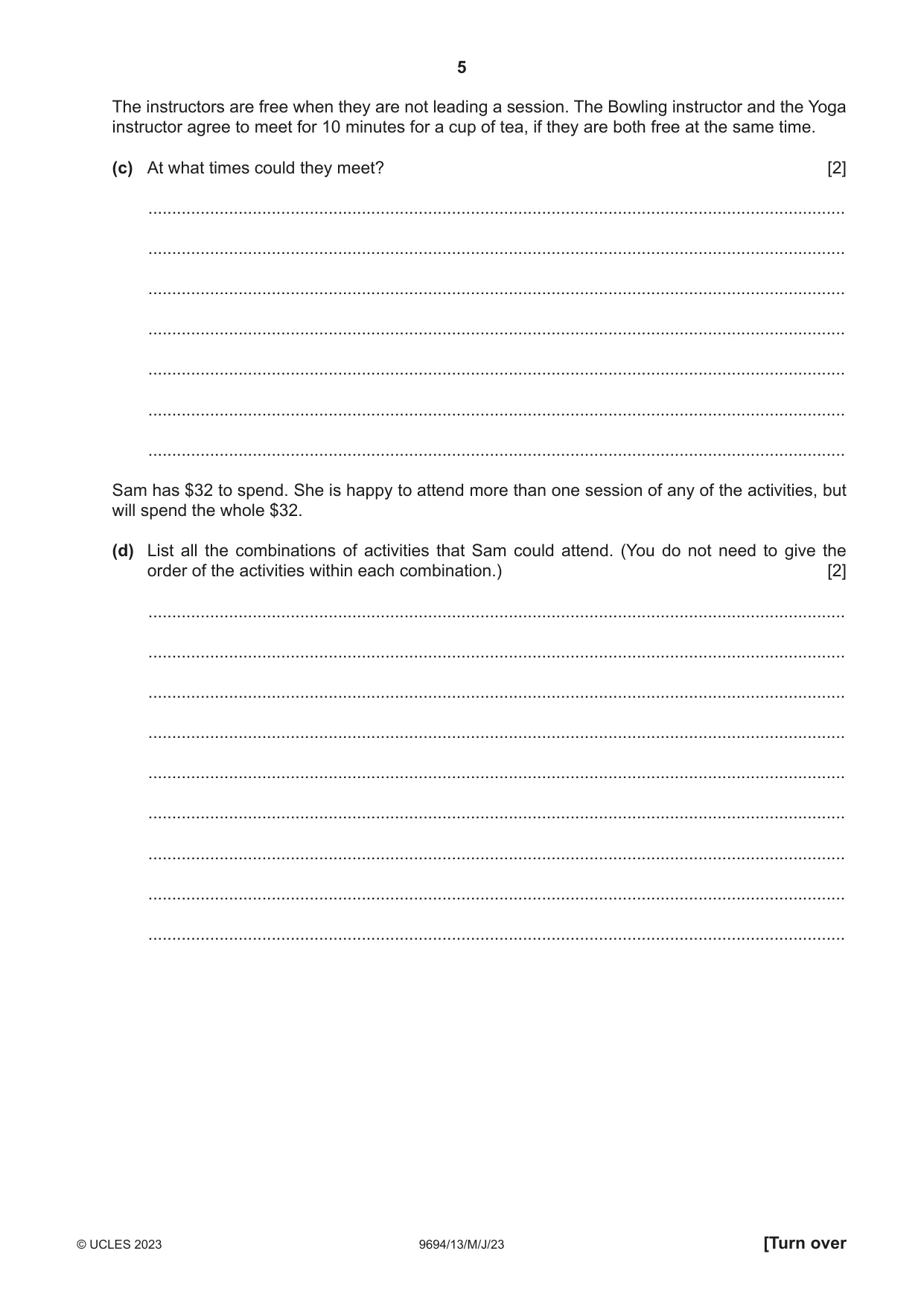
5 9694/13/M/J/23 © UCLES 2023 [Turn over The instructors are free when they are not leading a session. The Bowling instructor and the Yoga instructor agree to meet for 10 minutes for a cup of tea, if they are both free at the same time. (c) At what times could they meet? [2] … … … … … … … Sam has $32 to spend. She is happy to attend more than one session of any of the activities, but will spend the whole $32. (d) List all the combinations of activities that Sam could attend. (You do not need to give the order of the activities within each combination.) [2] … … … … … … … … …
Question paper, page 6
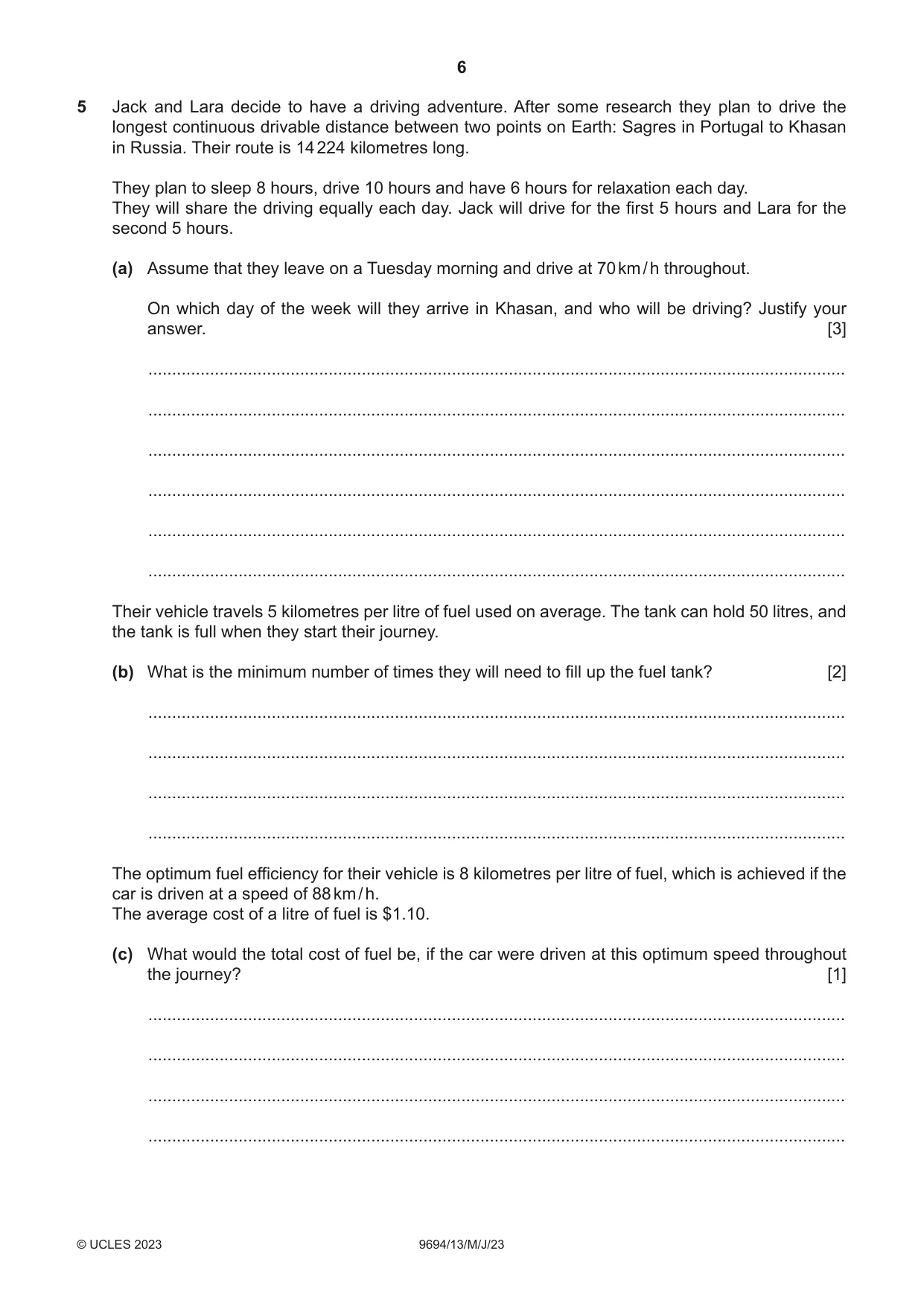
6 9694/13/M/J/23 © UCLES 2023 5 Jack and Lara decide to have a driving adventure. After some research they plan to drive the longest continuous drivable distance between two points on Earth: Sagres in Portugal to Khasan in Russia. Their route is 14 224 kilometres long. They plan to sleep 8 hours, drive 10 hours and have 6 hours for relaxation each day. They will share the driving equally each day. Jack will drive for the first 5 hours and Lara for the second 5 hours. (a) Assume that they leave on a Tuesday morning and drive at 70 km / h throughout. On which day of the week will they arrive in Khasan, and who will be driving? Justify your answer. [3] … … … … … … Their vehicle travels 5 kilometres per litre of fuel used on average. The tank can hold 50 litres, and the tank is full when they start their journey. (b) What is the minimum number of times they will need to fill up the fuel tank? [2] … … … … The optimum fuel efficiency for their vehicle is 8 kilometres per litre of fuel, which is achieved if the car is driven at a speed of 88 km / h. The average cost of a litre of fuel is $1.10. (c) What would the total cost of fuel be, if the car were driven at this optimum speed throughout the journey? [1] … … … …
Question paper, page 7
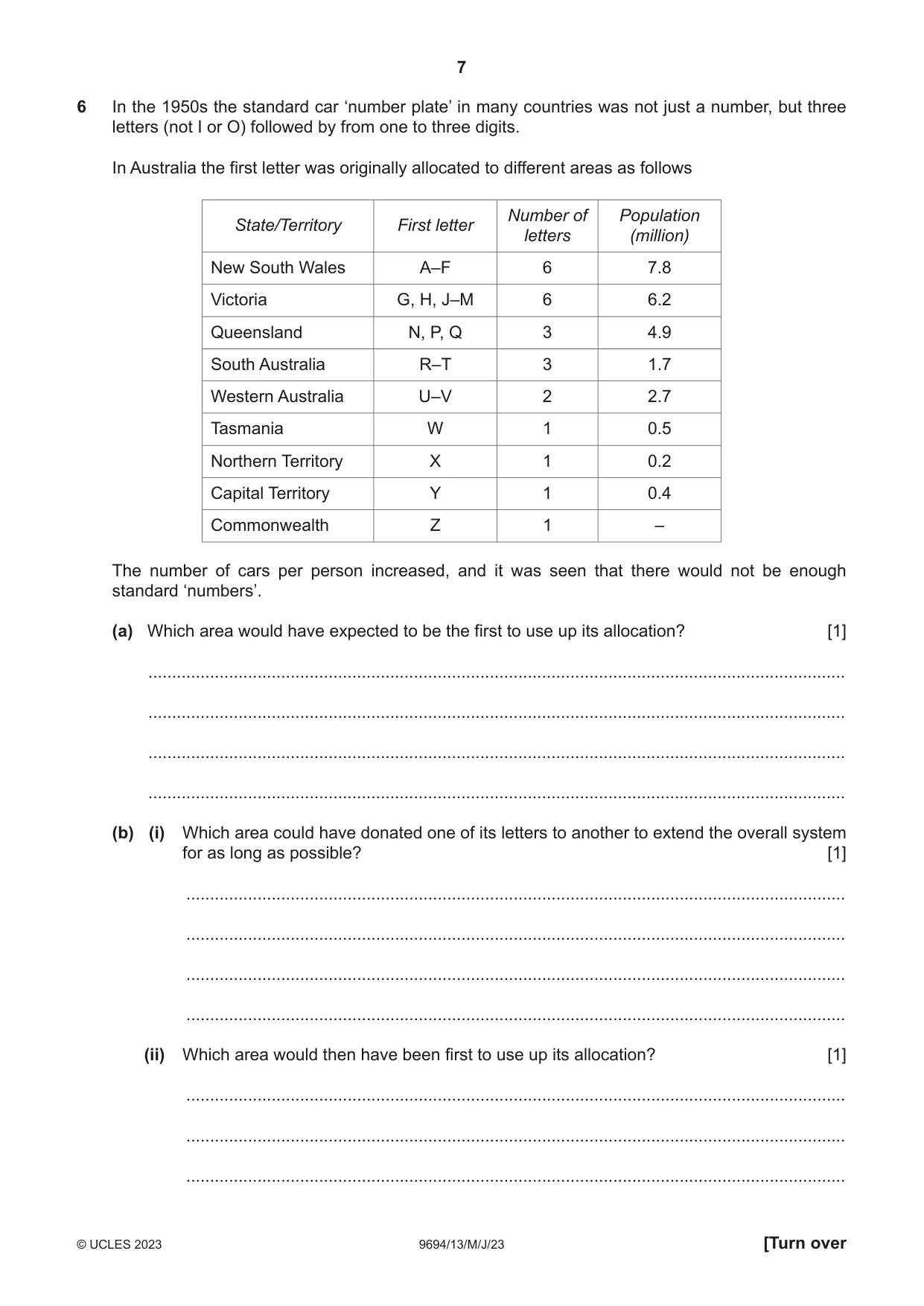
7 9694/13/M/J/23 © UCLES 2023 [Turn over 6 In the 1950s the standard car ‘number plate’ in many countries was not just a number, but three letters (not I or O) followed by from one to three digits. In Australia the first letter was originally allocated to different areas as follows State/Territory First letter Number of letters Population (million) New South Wales A–F 6 7.8 Victoria G, H, J–M 6 6.2 Queensland N, P, Q 3 4.9 South Australia R–T 3 1.7 Western Australia U–V 2 2.7 Tasmania W 1 0.5 Northern Territory X 1 0.2 Capital Territory Y 1 0.4 Commonwealth Z 1 – The number of cars per person increased, and it was seen that there would not be enough standard ‘numbers’. (a) Which area would have expected to be the first to use up its allocation? [1] … … … … (b) (i) Which area could have donated one of its letters to another to extend the overall system for as long as possible? [1] … … … … (ii) Which area would then have been first to use up its allocation? [1] … … …
Question paper, page 8
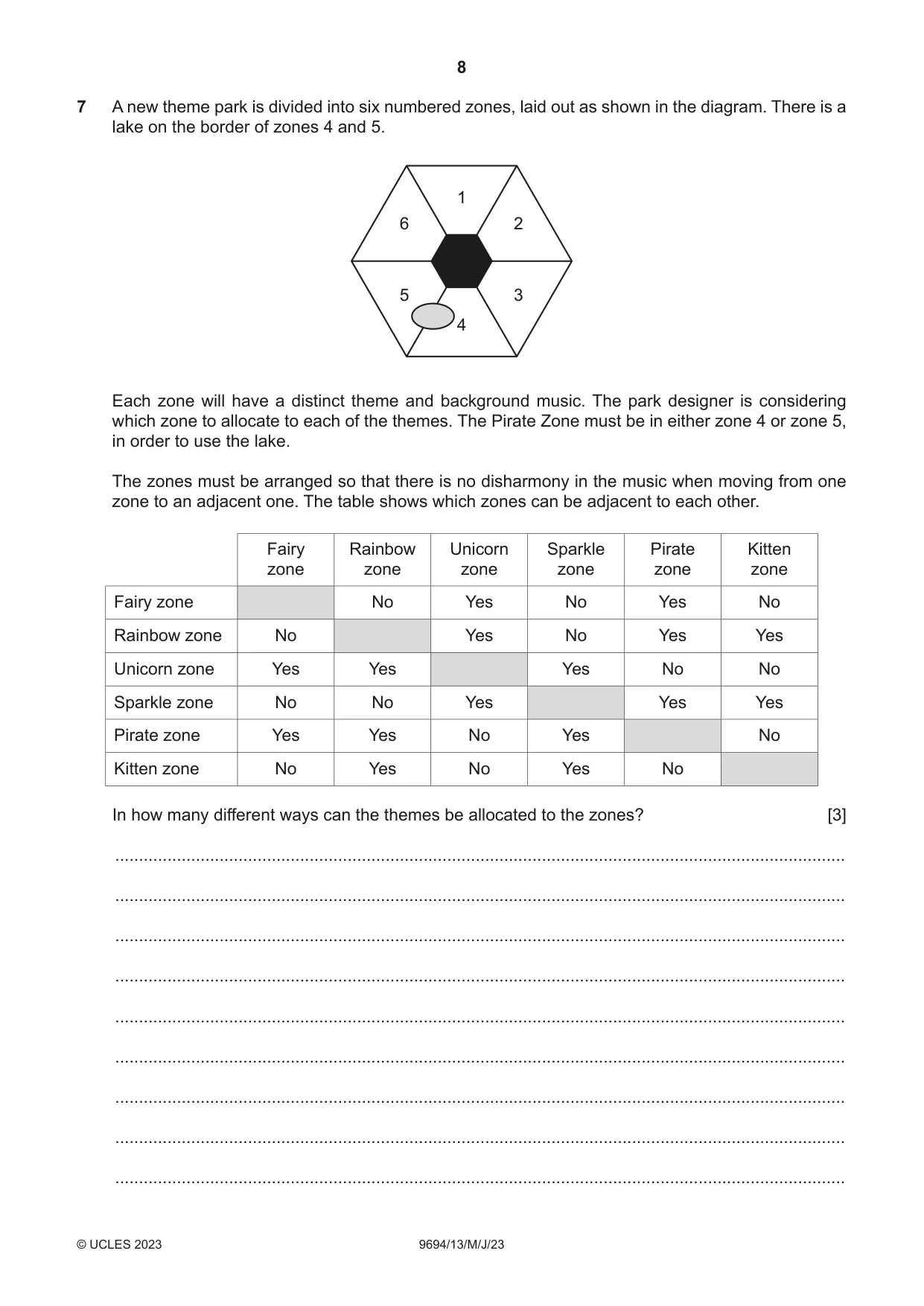
8 9694/13/M/J/23 © UCLES 2023 7 A new theme park is divided into six numbered zones, laid out as shown in the diagram. There is a lake on the border of zones 4 and 5. 1 6 5 2 3 4 Each zone will have a distinct theme and background music. The park designer is considering which zone to allocate to each of the themes. The Pirate Zone must be in either zone 4 or zone 5, in order to use the lake. The zones must be arranged so that there is no disharmony in the music when moving from one zone to an adjacent one. The table shows which zones can be adjacent to each other. Fairy zone Rainbow zone Unicorn zone Sparkle zone Pirate zone Kitten zone Fairy zone No Yes No Yes No Rainbow zone No Yes No Yes Yes Unicorn zone Yes Yes Yes No No Sparkle zone No No Yes Yes Yes Pirate zone Yes Yes No Yes No Kitten zone No Yes No Yes No In how many different ways can the themes be allocated to the zones? [3] … … … … … … … … …
Question paper, page 9
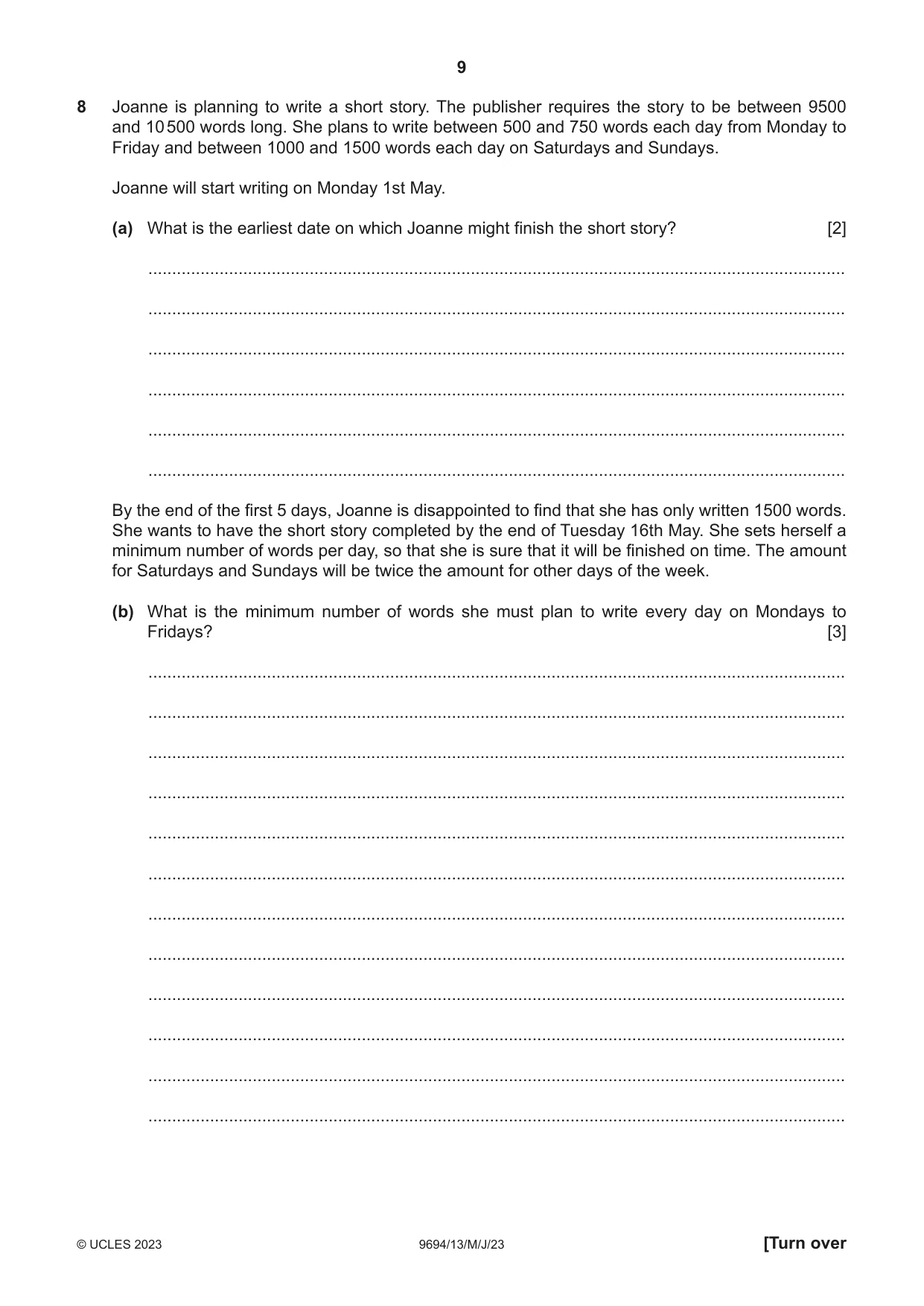
9 9694/13/M/J/23 © UCLES 2023 [Turn over 8 Joanne is planning to write a short story. The publisher requires the story to be between 9500 and 10 500 words long. She plans to write between 500 and 750 words each day from Monday to Friday and between 1000 and 1500 words each day on Saturdays and Sundays. Joanne will start writing on Monday 1st May. (a) What is the earliest date on which Joanne might finish the short story? [2] … … … … … … By the end of the first 5 days, Joanne is disappointed to find that she has only written 1500 words. She wants to have the short story completed by the end of Tuesday 16th May. She sets herself a minimum number of words per day, so that she is sure that it will be finished on time. The amount for Saturdays and Sundays will be twice the amount for other days of the week. (b) What is the minimum number of words she must plan to write every day on Mondays to Fridays? [3] … … … … … … … … … … … …
Question paper, page 10
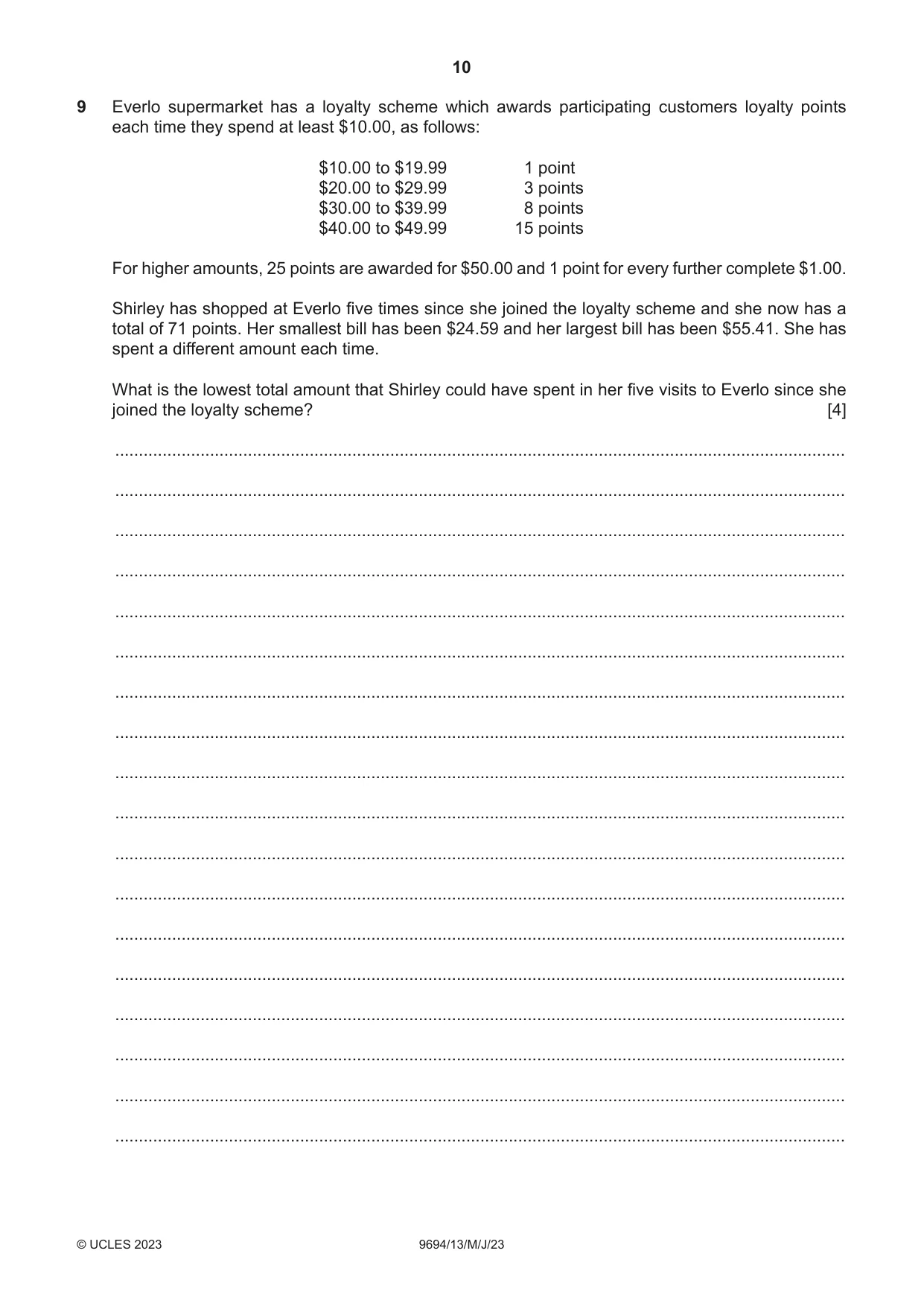
10 9694/13/M/J/23 © UCLES 2023 9 Everlo supermarket has a loyalty scheme which awards participating customers loyalty points each time they spend at least $10.00, as follows: $10.00 to $19.99 1 point $20.00 to $29.99 3 points $30.00 to $39.99 8 points $40.00 to $49.99 15 points For higher amounts, 25 points are awarded for $50.00 and 1 point for every further complete $1.00. Shirley has shopped at Everlo five times since she joined the loyalty scheme and she now has a total of 71 points. Her smallest bill has been $24.59 and her largest bill has been $55.41. She has spent a different amount each time. What is the lowest total amount that Shirley could have spent in her five visits to Everlo since she joined the loyalty scheme? [4] … … … … … … … … … … … … … … … … … …
Question paper, page 11
11 9694/13/M/J/23 © UCLES 2023 [Turn over [Turn over for Question 10]
Question paper, page 12
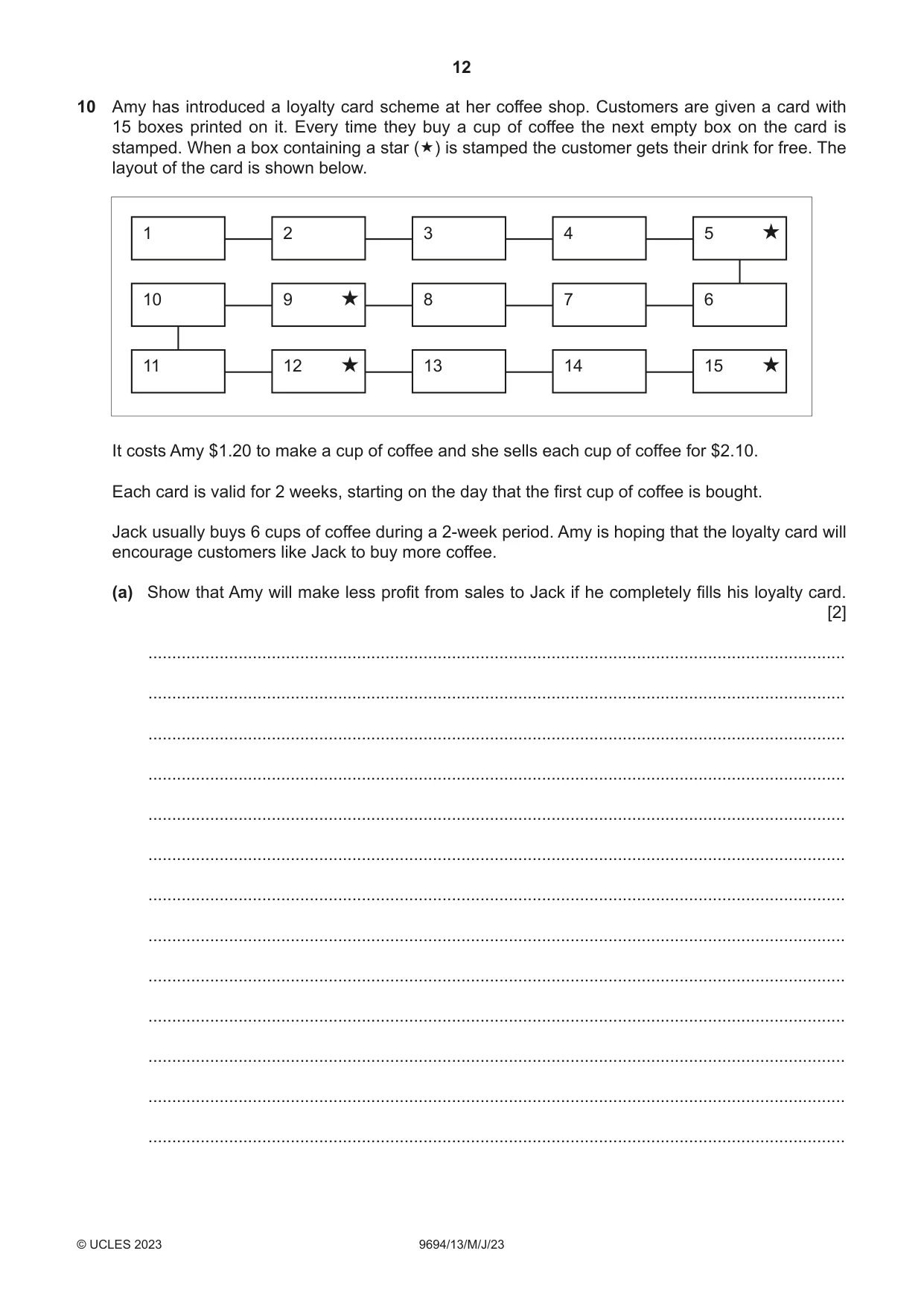
12 9694/13/M/J/23 © UCLES 2023 10 Amy has introduced a loyalty card scheme at her coffee shop. Customers are given a card with 15 boxes printed on it. Every time they buy a cup of coffee the next empty box on the card is stamped. When a box containing a star («) is stamped the customer gets their drink for free. The layout of the card is shown below. 1 2 3 4 5 10 9 8 7 6 11 12 13 14 15 It costs Amy $1.20 to make a cup of coffee and she sells each cup of coffee for $2.10. Each card is valid for 2 weeks, starting on the day that the first cup of coffee is bought. Jack usually buys 6 cups of coffee during a 2-week period. Amy is hoping that the loyalty card will encourage customers like Jack to buy more coffee. (a) Show that Amy will make less profit from sales to Jack if he completely fills his loyalty card. [2] … … … … … … … … … … … … …
Question paper, page 13
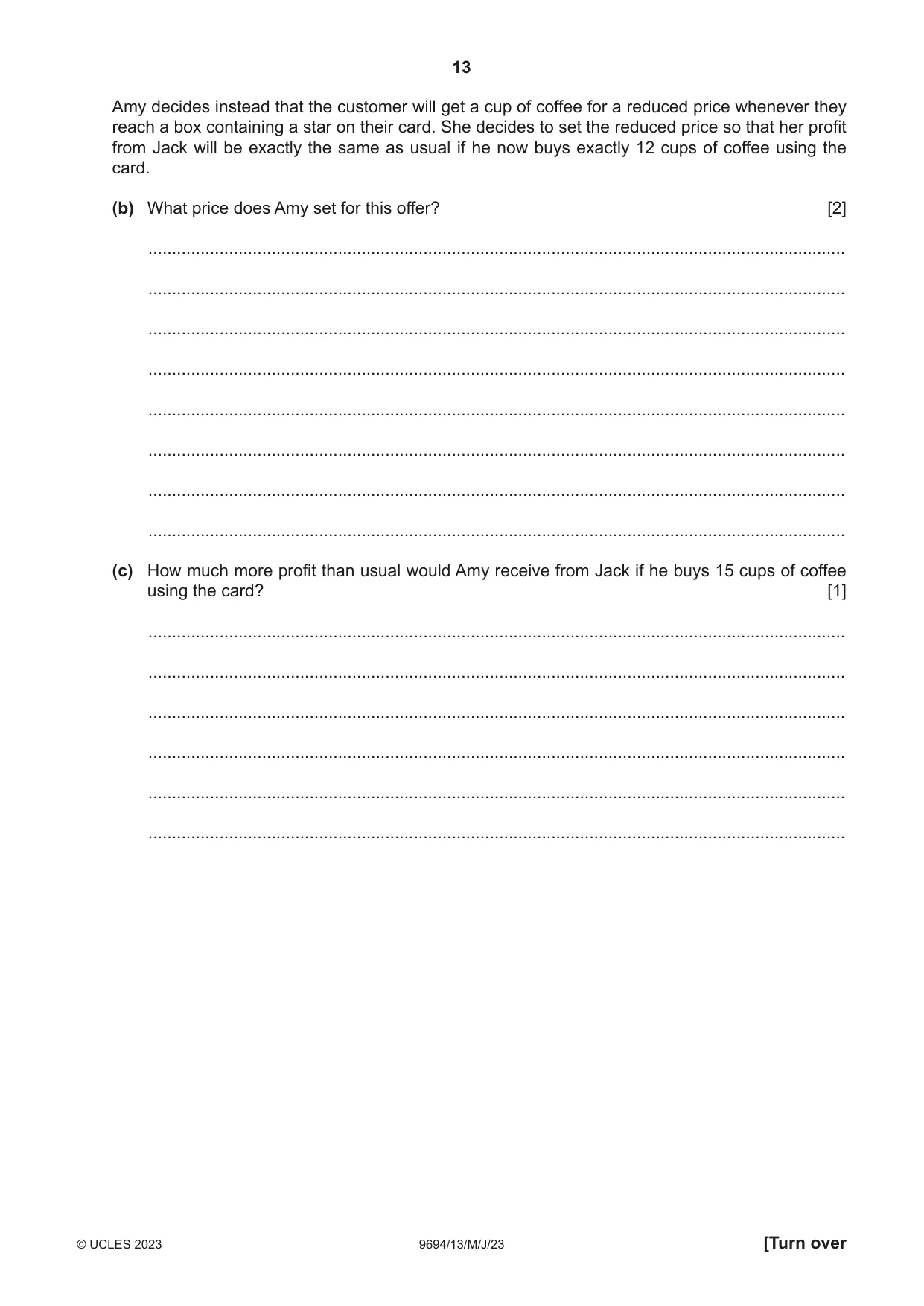
13 9694/13/M/J/23 © UCLES 2023 [Turn over Amy decides instead that the customer will get a cup of coffee for a reduced price whenever they reach a box containing a star on their card. She decides to set the reduced price so that her profit from Jack will be exactly the same as usual if he now buys exactly 12 cups of coffee using the card. (b) What price does Amy set for this offer? [2] … … … … … … … … (c) How much more profit than usual would Amy receive from Jack if he buys 15 cups of coffee using the card? [1] … … … … … …
Question paper, page 14
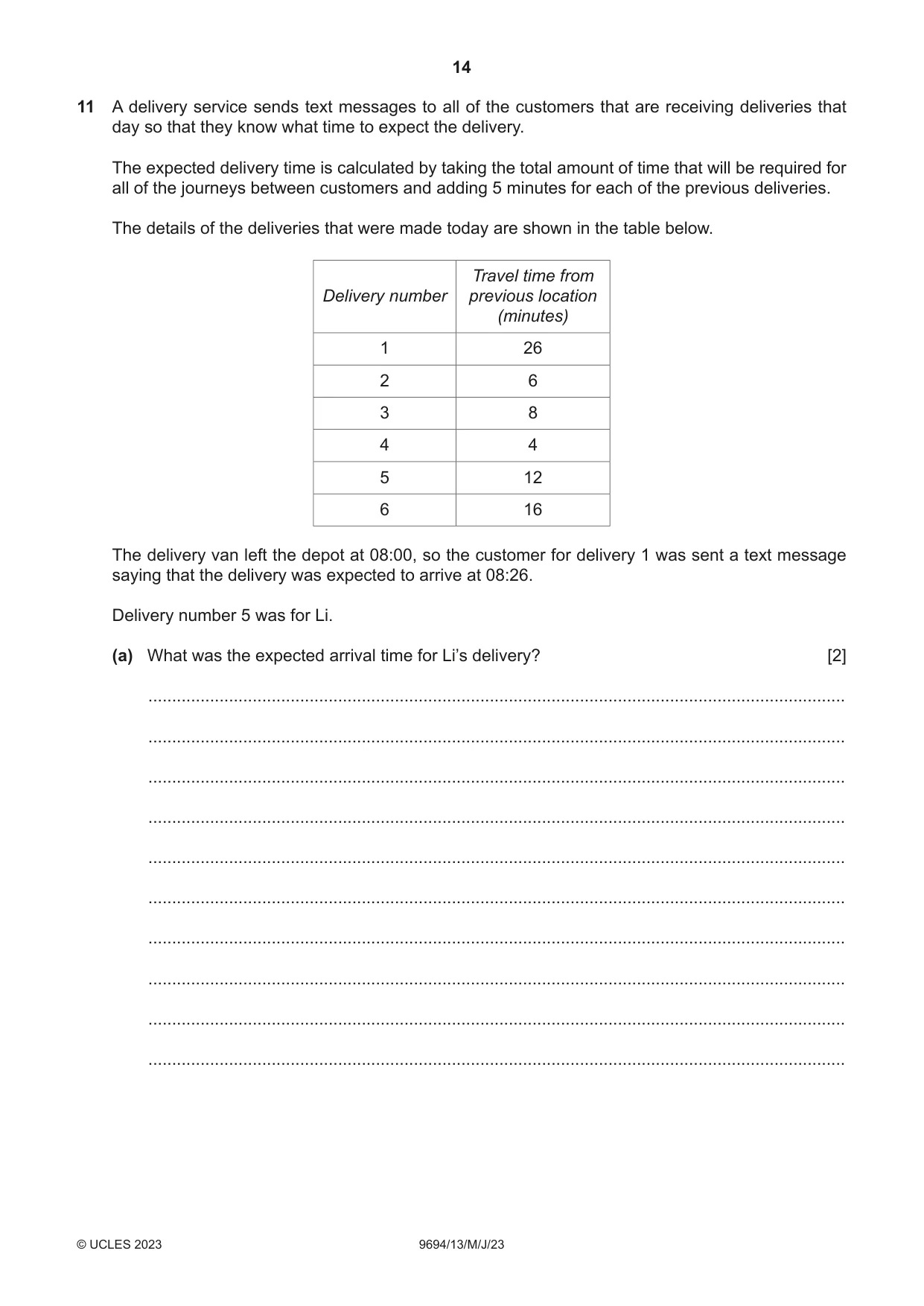
14 9694/13/M/J/23 © UCLES 2023 11 A delivery service sends text messages to all of the customers that are receiving deliveries that day so that they know what time to expect the delivery. The expected delivery time is calculated by taking the total amount of time that will be required for all of the journeys between customers and adding 5 minutes for each of the previous deliveries. The details of the deliveries that were made today are shown in the table below. Delivery number Travel time from previous location (minutes) 1 26 2 6 3 8 4 4 5 12 6 16 The delivery van left the depot at 08:00, so the customer for delivery 1 was sent a text message saying that the delivery was expected to arrive at 08:26. Delivery number 5 was for Li. (a) What was the expected arrival time for Li’s delivery? [2] … … … … … … … … … …
Question paper, page 15
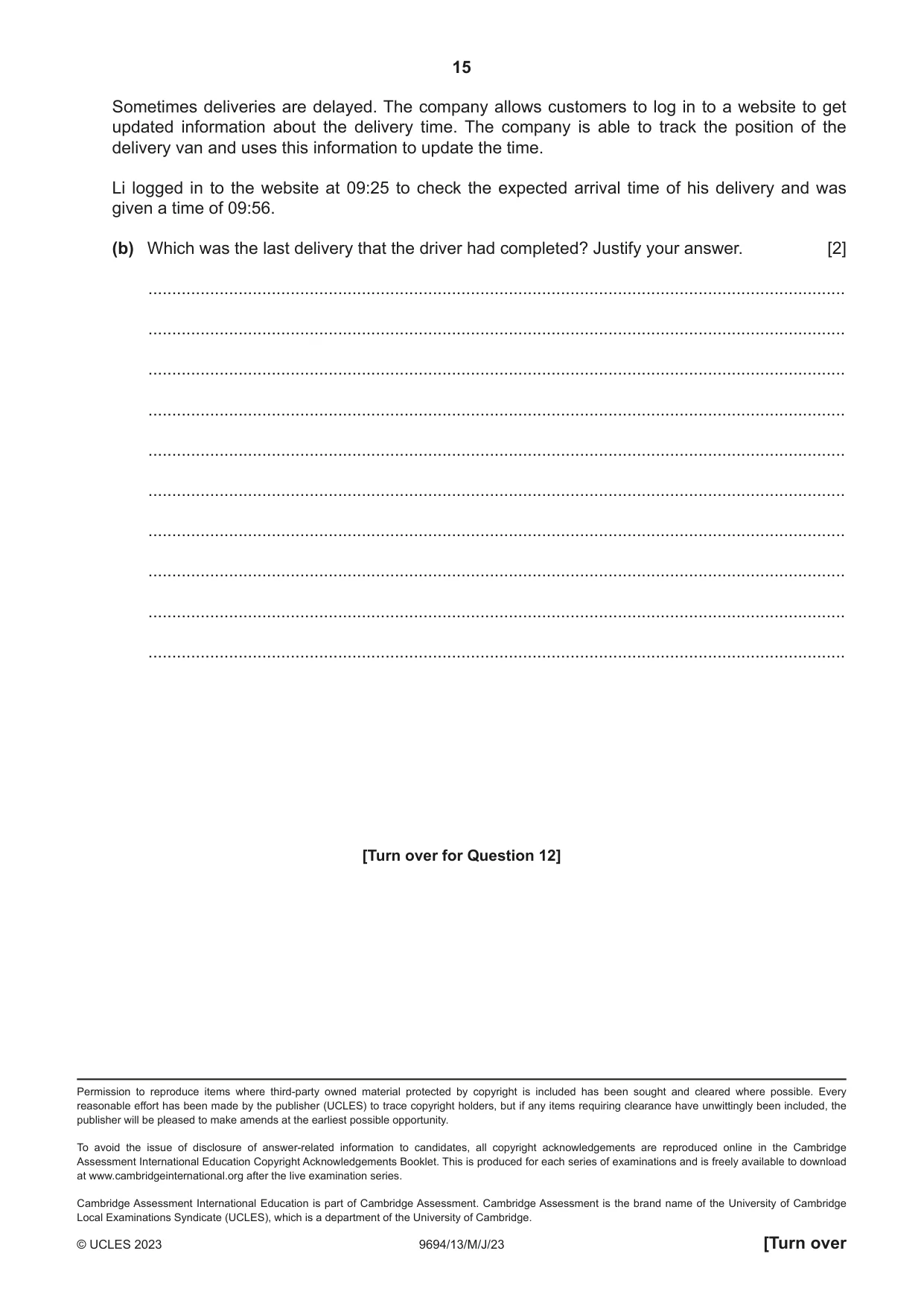
15 9694/13/M/J/23 © UCLES 2023 [Turn over Sometimes deliveries are delayed. The company allows customers to log in to a website to get updated information about the delivery time. The company is able to track the position of the delivery van and uses this information to update the time. Li logged in to the website at 09:25 to check the expected arrival time of his delivery and was given a time of 09:56. (b) Which was the last delivery that the driver had completed? Justify your answer. [2] … … … … … … … … … … [Turn over for Question 12] Permission to reproduce items where third-party owned material protected by copyright is included has been sought and cleared where possible. Every reasonable effort has been made by the publisher (UCLES) to trace copyright holders, but if any items requiring clearance have unwittingly been included, the publisher will be pleased to make amends at the earliest possible opportunity. To avoid the issue of disclosure of answer-related information to candidates, all copyright acknowledgements are reproduced online in the Cambridge Assessment International Education Copyright Acknowledgements Booklet. This is produced for each series of examinations and is freely available to download at www.cambridgeinternational.org after the live examination series. Cambridge Assessment International Education is part of Cambridge Assessment. Cambridge Assessment is the brand name of the University of Cambridge Local Examinations Syndicate (UCLES), which is a department of the University of Cambridge.
Question paper, page 16
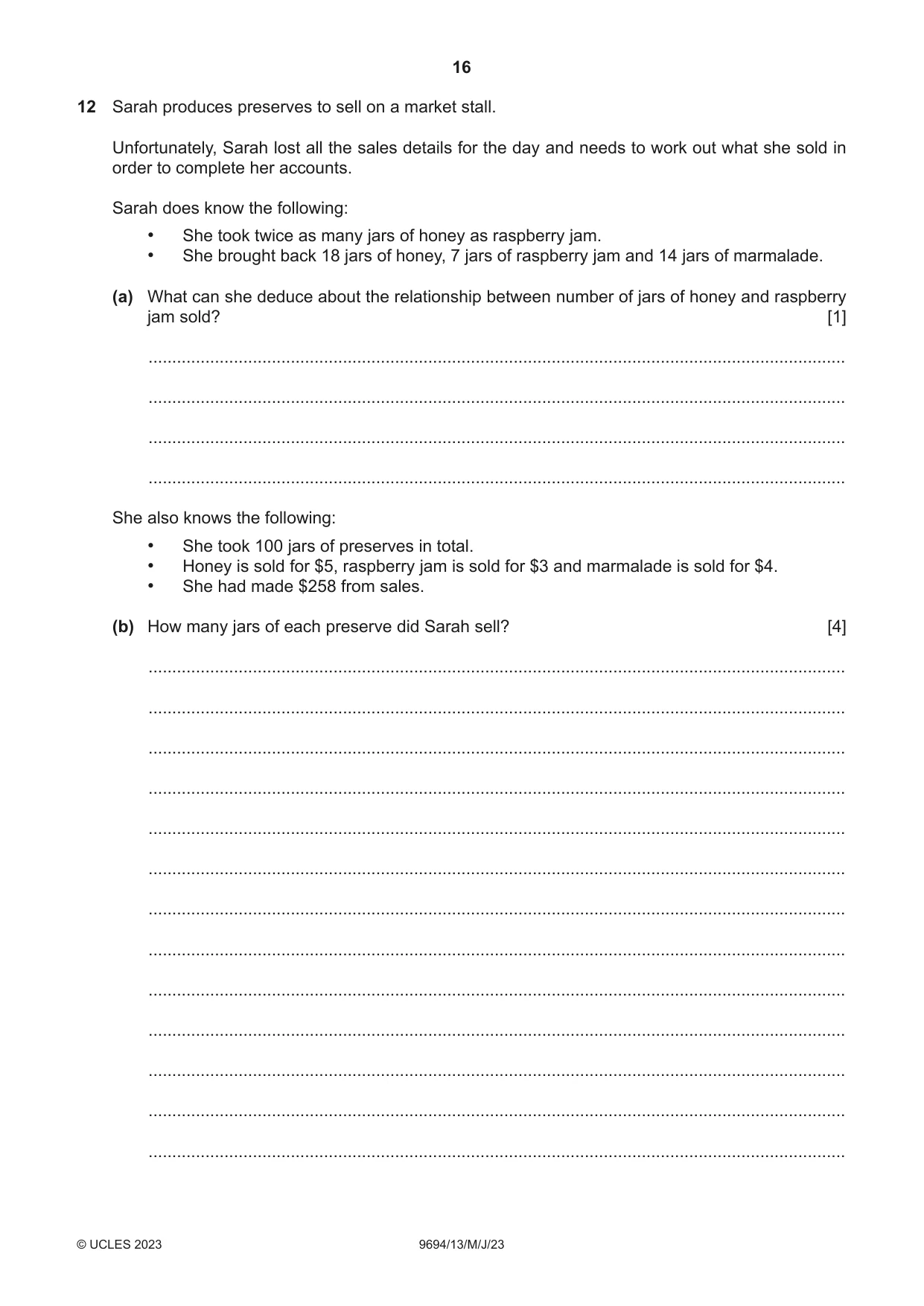
16 9694/13/M/J/23 © UCLES 2023 12 Sarah produces preserves to sell on a market stall. Unfortunately, Sarah lost all the sales details for the day and needs to work out what she sold in order to complete her accounts. Sarah does know the following: • She took twice as many jars of honey as raspberry jam. • She brought back 18 jars of honey, 7 jars of raspberry jam and 14 jars of marmalade. (a) What can she deduce about the relationship between number of jars of honey and raspberry jam sold? [1] … … … … She also knows the following: • She took 100 jars of preserves in total. • Honey is sold for $5, raspberry jam is sold for $3 and marmalade is sold for $4. • She had made $258 from sales. (b) How many jars of each preserve did Sarah sell? [4] … … … … … … … … … … … … …
Mark scheme, page 1
This document consists of 9 printed pages. © UCLES 2023 [Turn over Cambridge International AS & A Level THINKING SKILLS 9694/13 Paper 1 Problem Solving May/June 2023 MARK SCHEME Maximum Mark: 50 Published This mark scheme is published as an aid to teachers and candidates, to indicate the requirements of the examination. It shows the basis on which Examiners were instructed to award marks. It does not indicate the details of the discussions that took place at an Examiners’ meeting before marking began, which would have considered the acceptability of alternative answers. Mark schemes should be read in conjunction with the question paper and the Principal Examiner Report for Teachers. Cambridge International will not enter into discussions about these mark schemes. Cambridge International is publishing the mark schemes for the May/June 2023 series for most Cambridge IGCSE, Cambridge International A and AS Level and Cambridge Pre-U components, and some Cambridge O Level components.
Mark scheme, page 2
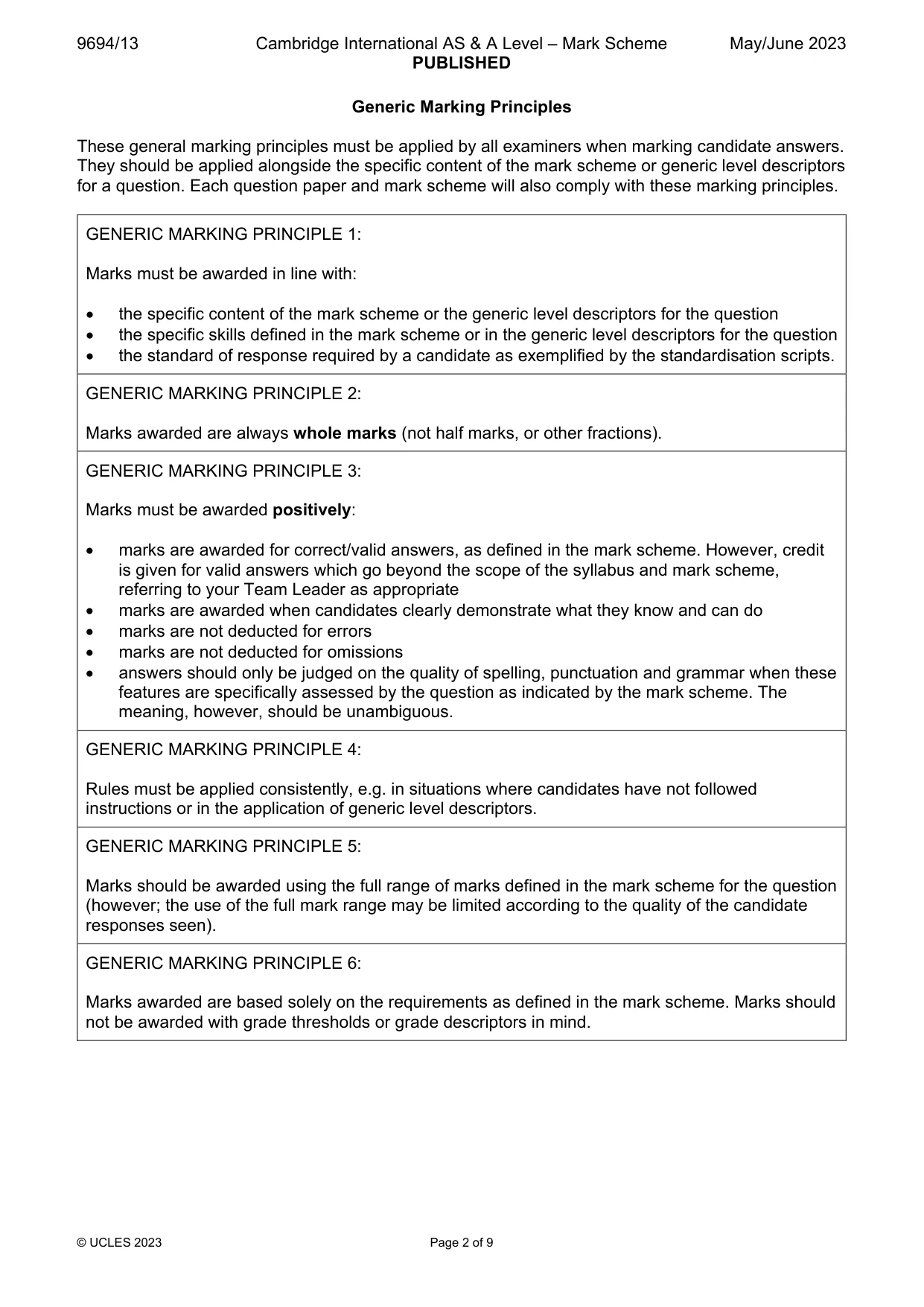
9694/13 Cambridge International AS & A Level – Mark Scheme PUBLISHED May/June 2023 © UCLES 2023 Page 2 of 9 Generic Marking Principles These general marking principles must be applied by all examiners when marking candidate answers. They should be applied alongside the specific content of the mark scheme or generic level descriptors for a question. Each question paper and mark scheme will also comply with these marking principles. GENERIC MARKING PRINCIPLE 1: Marks must be awarded in line with: the specific content of the mark scheme or the generic level descriptors for the question the specific skills defined in the mark scheme or in the generic level descriptors for the question the standard of response required by a candidate as exemplified by the standardisation scripts. GENERIC MARKING PRINCIPLE 2: Marks awarded are always whole marks (not half marks, or other fractions). GENERIC MARKING PRINCIPLE 3: Marks must be awarded positively: marks are awarded for correct/valid answers, as defined in the mark scheme. However, credit is given for valid answers which go beyond the scope of the syllabus and mark scheme, referring to your Team Leader as appropriate marks are awarded when candidates clearly demonstrate what they know and can do marks are not deducted for errors marks are not deducted for omissions answers should only be judged on the quality of spelling, punctuation and grammar when these features are specifically assessed by the question as indicated by the mark scheme. The meaning, however, should be unambiguous. GENERIC MARKING PRINCIPLE 4: Rules must be applied consistently, e.g. in situations where candidates have not followed instructions or in the application of generic level descriptors. GENERIC MARKING PRINCIPLE 5: Marks should be awarded using the full range of marks defined in the mark scheme for the question (however; the use of the full mark range may be limited according to the quality of the candidate responses seen). GENERIC MARKING PRINCIPLE 6: Marks awarded are based solely on the requirements as defined in the mark scheme. Marks should not be awarded with grade thresholds or grade descriptors in mind.
Mark scheme, page 3
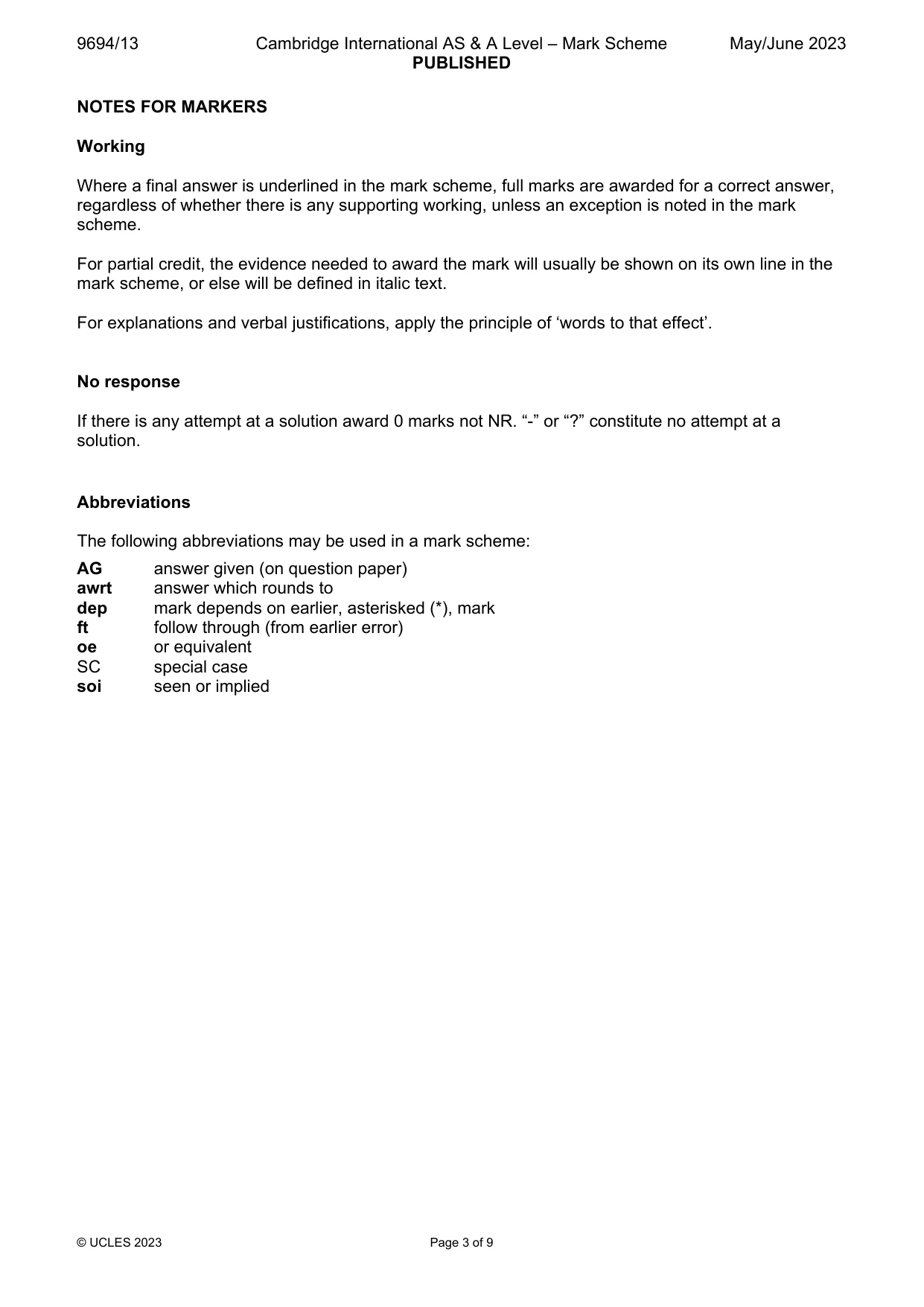
9694/13 Cambridge International AS & A Level – Mark Scheme PUBLISHED May/June 2023 © UCLES 2023 Page 3 of 9 NOTES FOR MARKERS Working Where a final answer is underlined in the mark scheme, full marks are awarded for a correct answer, regardless of whether there is any supporting working, unless an exception is noted in the mark scheme. For partial credit, the evidence needed to award the mark will usually be shown on its own line in the mark scheme, or else will be defined in italic text. For explanations and verbal justifications, apply the principle of ‘words to that effect’. No response If there is any attempt at a solution award 0 marks not NR. “-” or “?” constitute no attempt at a solution. Abbreviations The following abbreviations may be used in a mark scheme: AG answer given (on question paper) awrt answer which rounds to dep mark depends on earlier, asterisked (*), mark ft follow through (from earlier error) oe or equivalent SC special case soi seen or implied
Mark scheme, page 4
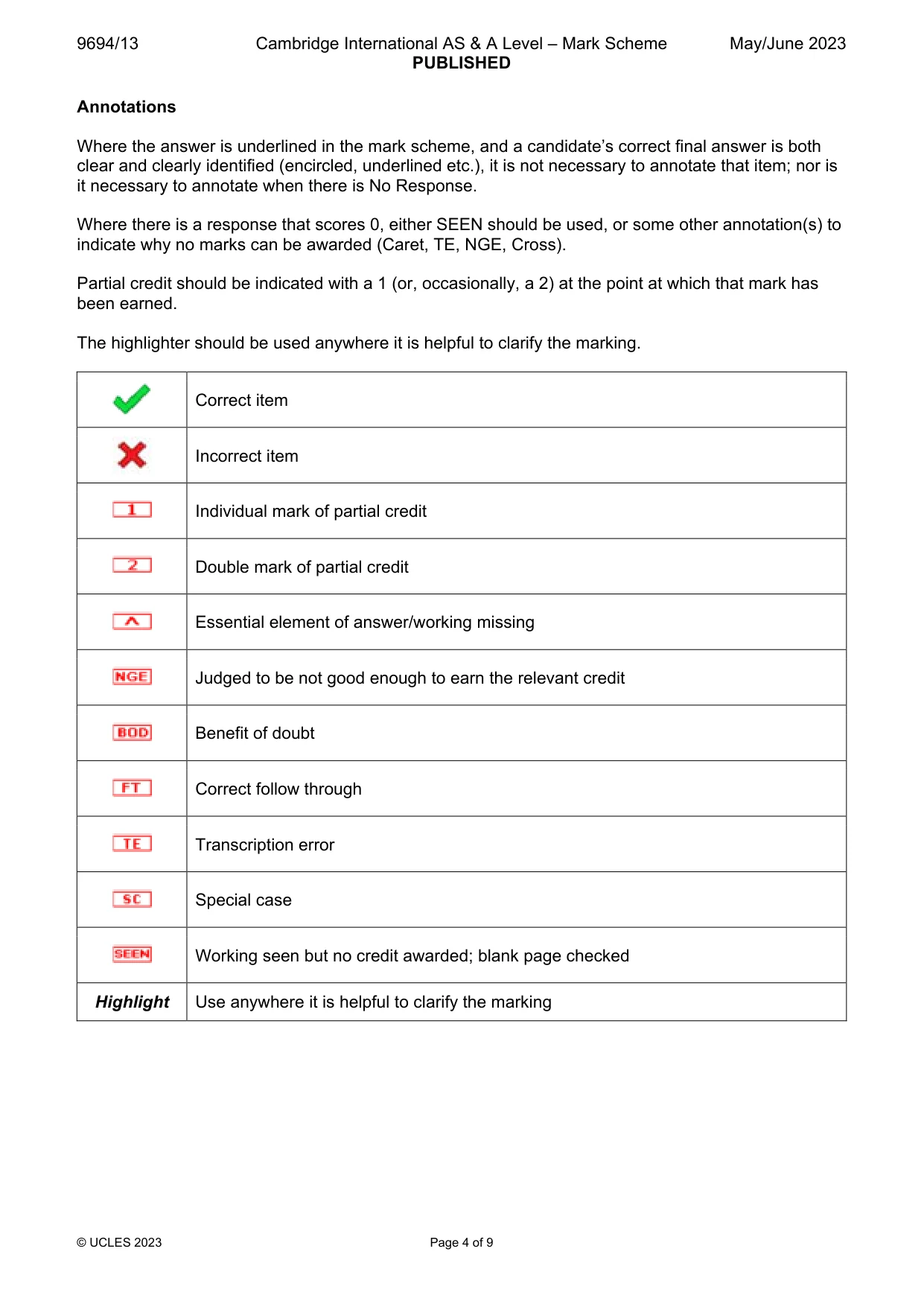
9694/13 Cambridge International AS & A Level – Mark Scheme PUBLISHED May/June 2023 © UCLES 2023 Page 4 of 9 Annotations Where the answer is underlined in the mark scheme, and a candidate’s correct final answer is both clear and clearly identified (encircled, underlined etc.), it is not necessary to annotate that item; nor is it necessary to annotate when there is No Response. Where there is a response that scores 0, either SEEN should be used, or some other annotation(s) to indicate why no marks can be awarded (Caret, TE, NGE, Cross). Partial credit should be indicated with a 1 (or, occasionally, a 2) at the point at which that mark has been earned. The highlighter should be used anywhere it is helpful to clarify the marking. Correct item Incorrect item Individual mark of partial credit Double mark of partial credit Essential element of answer/working missing Judged to be not good enough to earn the relevant credit Benefit of doubt Correct follow through Transcription error Special case Working seen but no credit awarded; blank page checked Highlight Use anywhere it is helpful to clarify the marking
Mark scheme, page 5
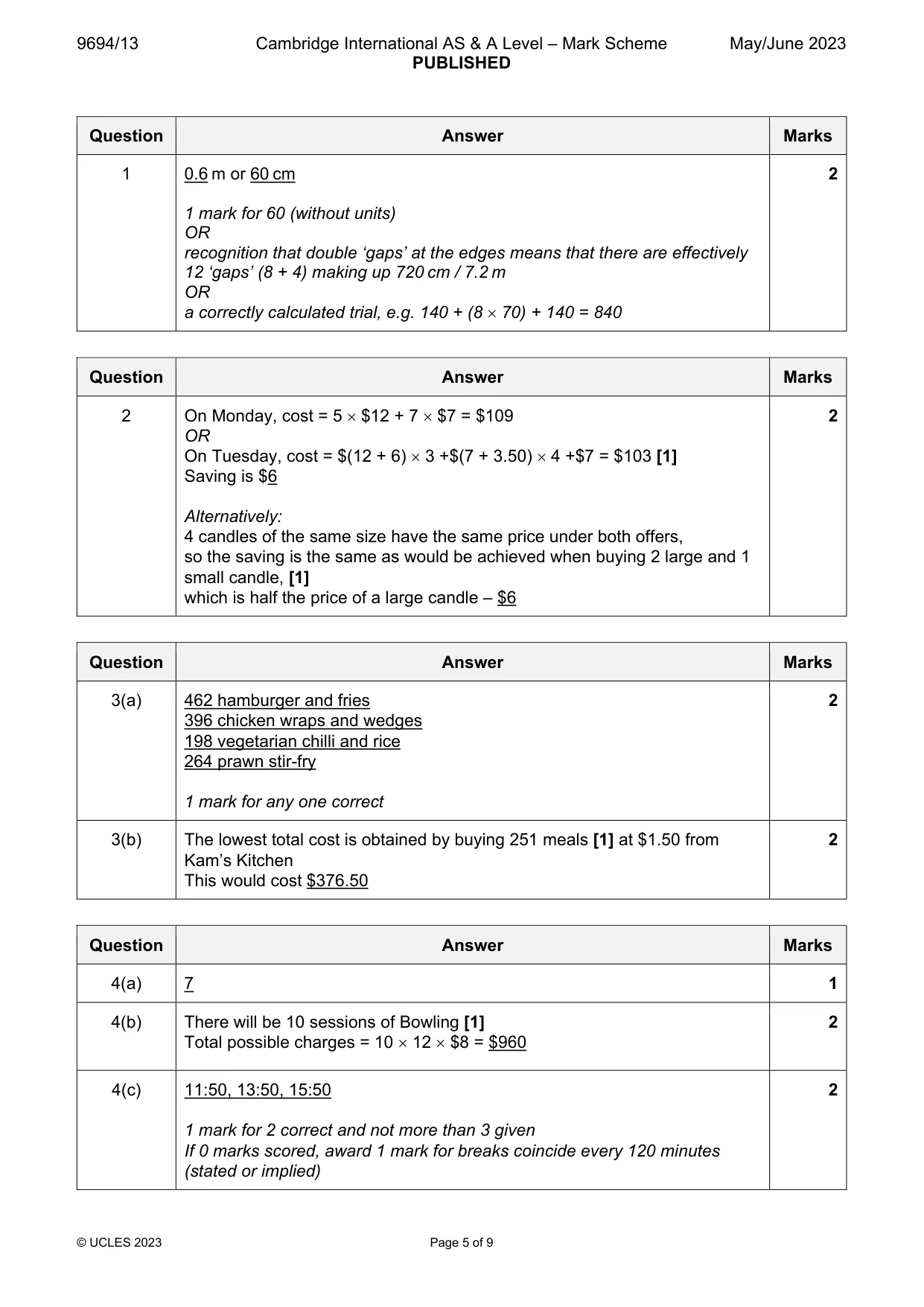
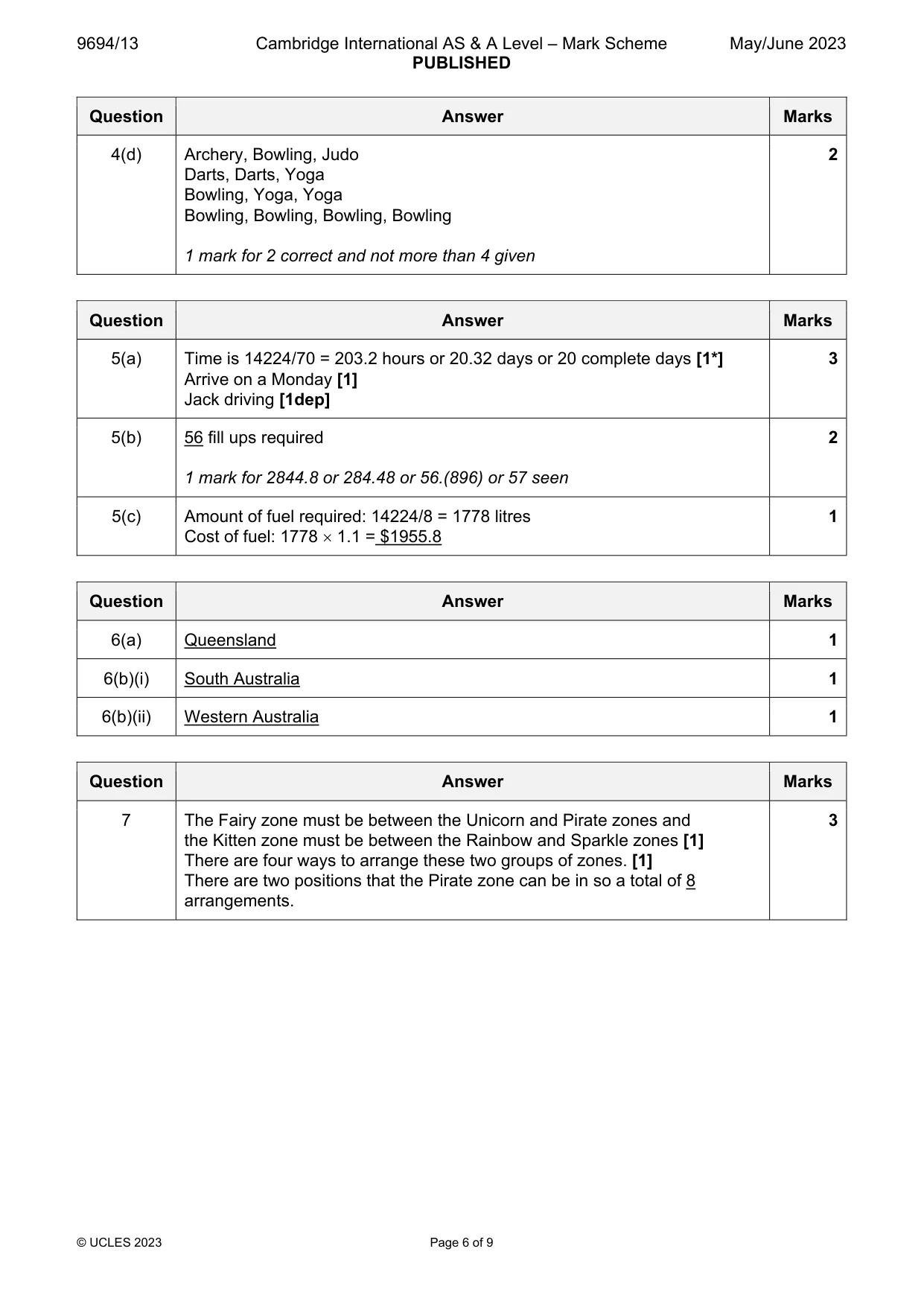
9694/13 Cambridge International AS & A Level – Mark Scheme PUBLISHED May/June 2023 © UCLES 2023 Page 5 of 9 Question Answer Marks 1 0.6 m or 60 cm 1 mark for 60 (without units) OR recognition that double ‘gaps’ at the edges means that there are effectively 12 ‘gaps’ (8 + 4) making up 720 cm / 7.2 m OR a correctly calculated trial, e.g. 140 + (8 70) + 140 = 840 2 Question Answer Marks 2 On Monday, cost = 5 $12 + 7 $7 = $109 OR On Tuesday, cost = $(12 + 6) 3 +$(7 + 3.50) 4 +$7 = $103 [1] Saving is $6 Alternatively: 4 candles of the same size have the same price under both offers, so the saving is the same as would be achieved when buying 2 large and 1 small candle, [1] which is half the price of a large candle – $6 2 Question Answer Marks 3(a) 462 hamburger and fries 396 chicken wraps and wedges 198 vegetarian chilli and rice 264 prawn stir-fry 1 mark for any one correct 2 3(b) The lowest total cost is obtained by buying 251 meals [1] at $1.50 from Kam’s Kitchen This would cost $376.50 2 Question Answer Marks 4(a) 7 1 4(b) There will be 10 sessions of Bowling [1] Total possible charges = 10 12 $8 = $960 2 4(c) 11:50, 13:50, 15:50 1 mark for 2 correct and not more than 3 given If 0 marks scored, award 1 mark for breaks coincide every 120 minutes (stated or implied) 2
Mark scheme, page 6
9694/13 Cambridge International AS & A Level – Mark Scheme PUBLISHED May/June 2023 © UCLES 2023 Page 6 of 9 Question Answer Marks 4(d) Archery, Bowling, Judo Darts, Darts, Yoga Bowling, Yoga, Yoga Bowling, Bowling, Bowling, Bowling 1 mark for 2 correct and not more than 4 given 2 Question Answer Marks 5(a) Time is 14224/70 = 203.2 hours or 20.32 days or 20 complete days [1*] Arrive on a Monday [1] Jack driving [1dep] 3 5(b) 56 fill ups required 1 mark for 2844.8 or 284.48 or 56.(896) or 57 seen 2 5(c) Amount of fuel required: 14224/8 = 1778 litres Cost of fuel: 1778 1.1 = $1955.8 1 Question Answer Marks 6(a) Queensland 1 6(b)(i) South Australia 1 6(b)(ii) Western Australia 1 Question Answer Marks 7 The Fairy zone must be between the Unicorn and Pirate zones and the Kitten zone must be between the Rainbow and Sparkle zones [1] There are four ways to arrange these two groups of zones. [1] There are two positions that the Pirate zone can be in so a total of 8 arrangements. 3
Mark scheme, page 7
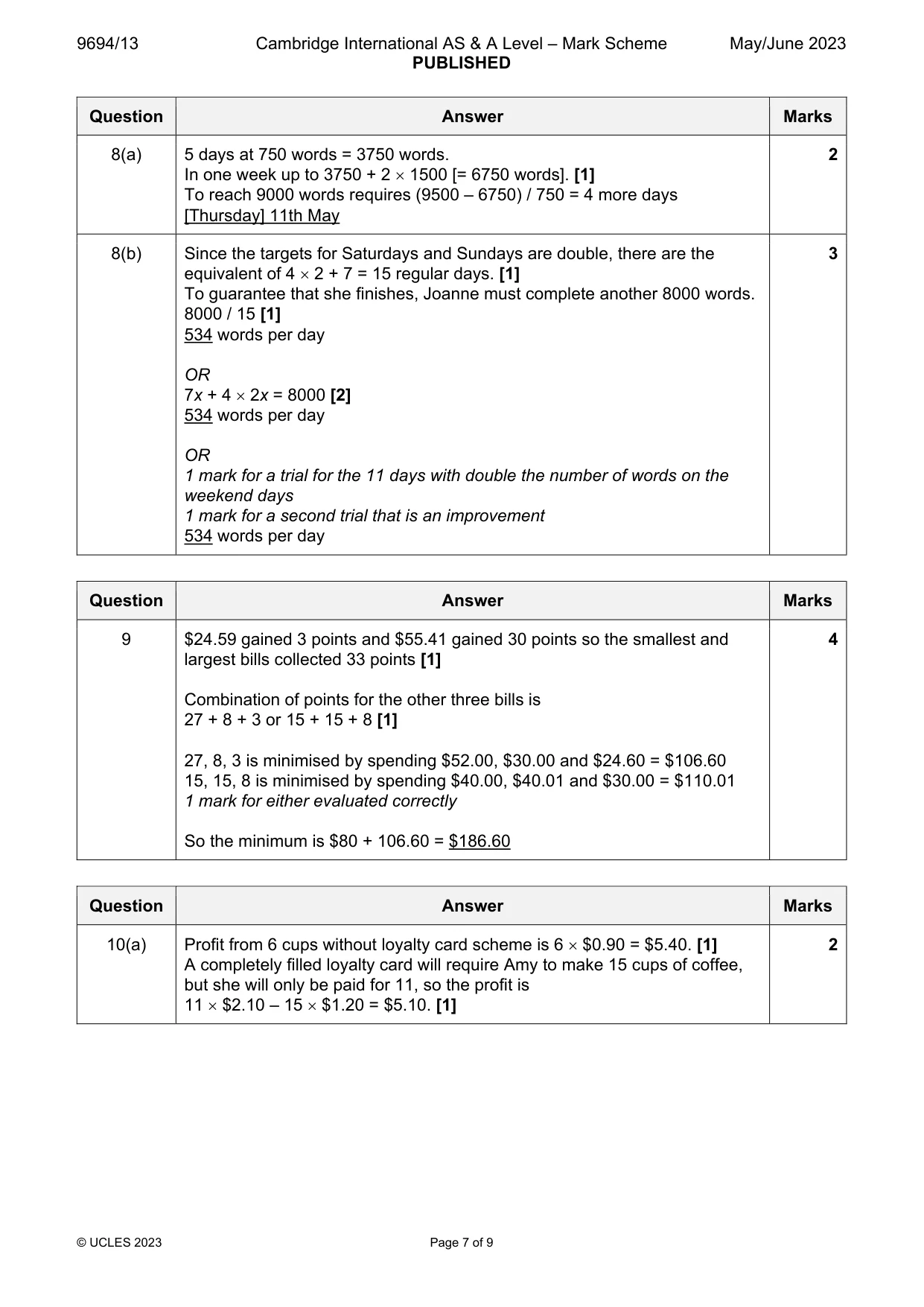
9694/13 Cambridge International AS & A Level – Mark Scheme PUBLISHED May/June 2023 © UCLES 2023 Page 7 of 9 Question Answer Marks 8(a) 5 days at 750 words = 3750 words. In one week up to 3750 + 2 1500 [= 6750 words]. [1] To reach 9000 words requires (9500 – 6750) / 750 = 4 more days [Thursday] 11th May 2 8(b) Since the targets for Saturdays and Sundays are double, there are the equivalent of 4 2 + 7 = 15 regular days. [1] To guarantee that she finishes, Joanne must complete another 8000 words. 8000 / 15 [1] 534 words per day OR 7x + 4 2x = 8000 [2] 534 words per day OR 1 mark for a trial for the 11 days with double the number of words on the weekend days 1 mark for a second trial that is an improvement 534 words per day 3 Question Answer Marks 9 $24.59 gained 3 points and $55.41 gained 30 points so the smallest and largest bills collected 33 points [1] Combination of points for the other three bills is 27 + 8 + 3 or 15 + 15 + 8 [1] 27, 8, 3 is minimised by spending $52.00, $30.00 and $24.60 = $106.60 15, 15, 8 is minimised by spending $40.00, $40.01 and $30.00 = $110.01 1 mark for either evaluated correctly So the minimum is $80 + 106.60 = $186.60 4 Question Answer Marks 10(a) Profit from 6 cups without loyalty card scheme is 6 $0.90 = $5.40. [1] A completely filled loyalty card will require Amy to make 15 cups of coffee, but she will only be paid for 11, so the profit is 11 $2.10 – 15 $1.20 = $5.10. [1] 2
Mark scheme, page 8
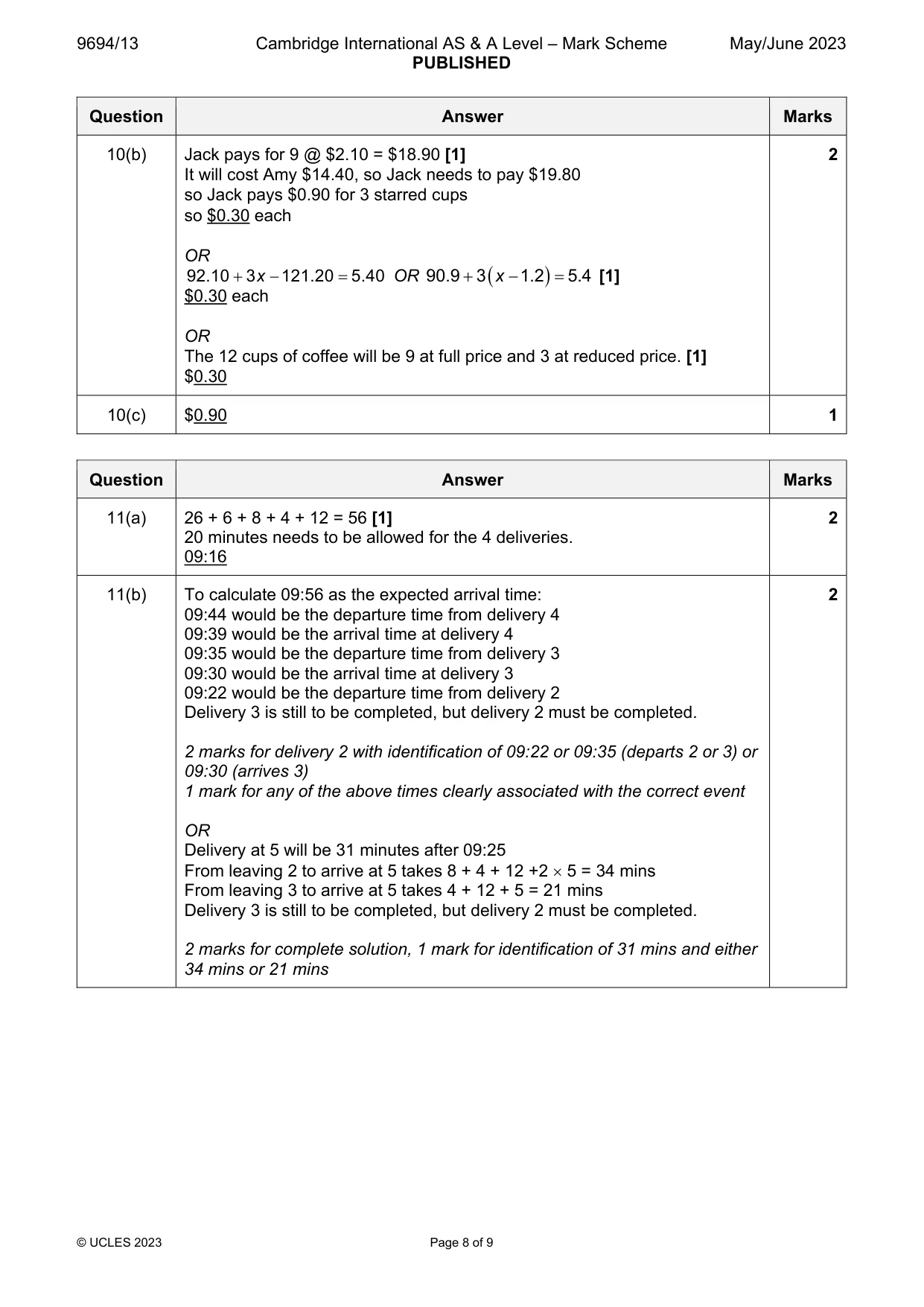
9694/13 Cambridge International AS & A Level – Mark Scheme PUBLISHED May/June 2023 © UCLES 2023 Page 8 of 9 Question Answer Marks 10(b) Jack pays for 9 @ $2.10 = $18.90 [1] It will cost Amy $14.40, so Jack needs to pay $19.80 so Jack pays $0.90 for 3 starred cups so $0.30 each OR 92.10 3 121.20 5.40 x OR 90.9 3 1.2 5.4 x [1] $0.30 each OR The 12 cups of coffee will be 9 at full price and 3 at reduced price. [1] $0.30 2 10(c) $0.90 1 Question Answer Marks 11(a) 26 + 6 + 8 + 4 + 12 = 56 [1] 20 minutes needs to be allowed for the 4 deliveries. 09:16 2 11(b) To calculate 09:56 as the expected arrival time: 09:44 would be the departure time from delivery 4 09:39 would be the arrival time at delivery 4 09:35 would be the departure time from delivery 3 09:30 would be the arrival time at delivery 3 09:22 would be the departure time from delivery 2 Delivery 3 is still to be completed, but delivery 2 must be completed. 2 marks for delivery 2 with identification of 09:22 or 09:35 (departs 2 or 3) or 09:30 (arrives 3) 1 mark for any of the above times clearly associated with the correct event OR Delivery at 5 will be 31 minutes after 09:25 From leaving 2 to arrive at 5 takes 8 + 4 + 12 +2 5 = 34 mins From leaving 3 to arrive at 5 takes 4 + 12 + 5 = 21 mins Delivery 3 is still to be completed, but delivery 2 must be completed. 2 marks for complete solution, 1 mark for identification of 31 mins and either 34 mins or 21 mins 2
Mark scheme, page 9
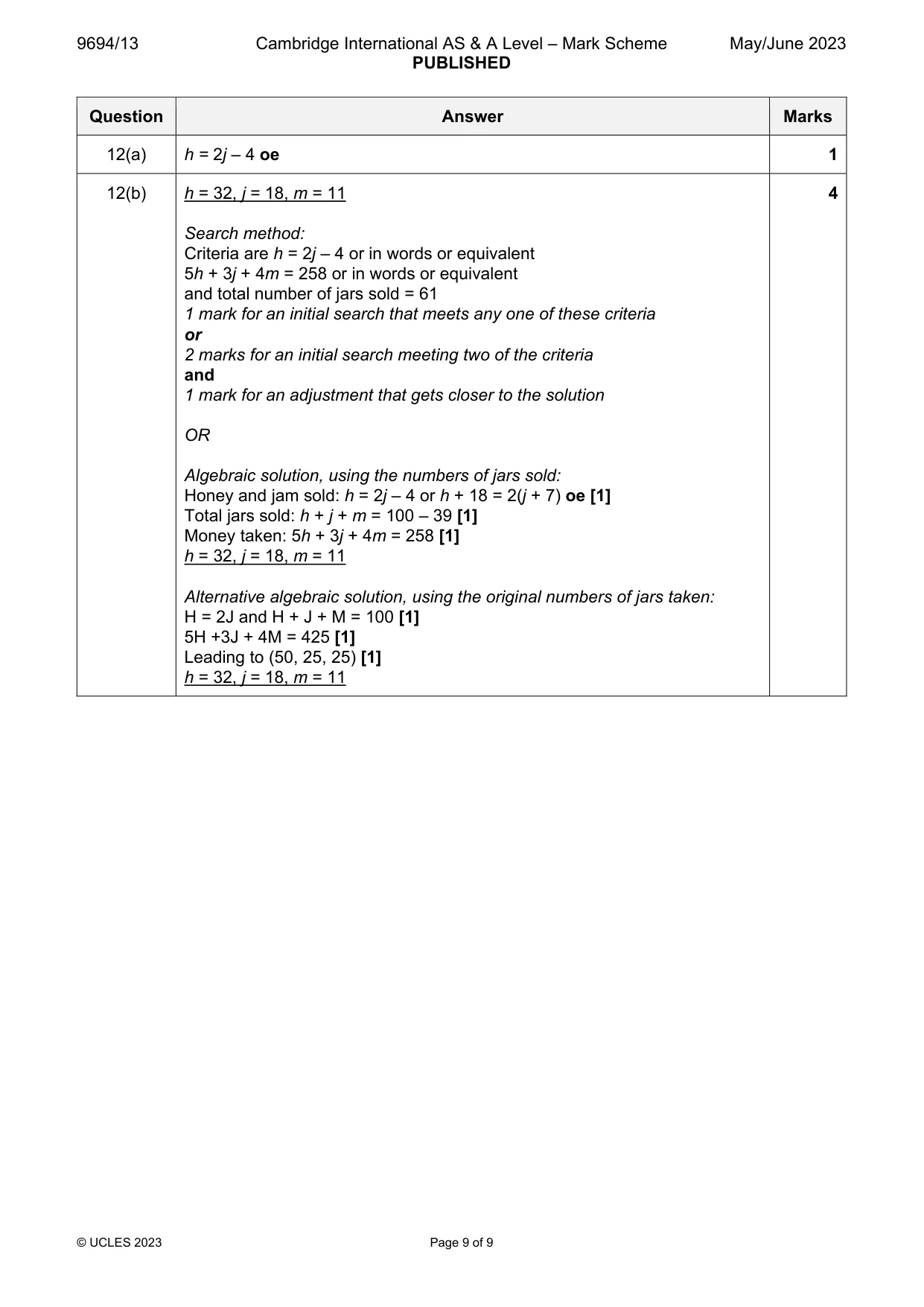
9694/13 Cambridge International AS & A Level – Mark Scheme PUBLISHED May/June 2023 © UCLES 2023 Page 9 of 9 Question Answer Marks 12(a) h = 2j – 4 oe 1 12(b) h = 32, j = 18, m = 11 Search method: Criteria are h = 2j – 4 or in words or equivalent 5h + 3j + 4m = 258 or in words or equivalent and total number of jars sold = 61 1 mark for an initial search that meets any one of these criteria or 2 marks for an initial search meeting two of the criteria and 1 mark for an adjustment that gets closer to the solution OR Algebraic solution, using the numbers of jars sold: Honey and jam sold: h = 2j – 4 or h + 18 = 2(j + 7) oe [1] Total jars sold: h + j + m = 100 – 39 [1] Money taken: 5h + 3j + 4m = 258 [1] h = 32, j = 18, m = 11 Alternative algebraic solution, using the original numbers of jars taken: H = 2J and H + J + M = 100 [1] 5H +3J + 4M = 425 [1] Leading to (50, 25, 25) [1] h = 32, j = 18, m = 11 4
What you needed in this session
Cambridge’s own grade thresholds for 2023 May/June, Paper 1 · Variant 3. A higher threshold means an easier paper — the bar moves with how the cohort did.