Cambridge A Level Thinking Skills 9694 — 2020 May/June Paper 1 · Variant 3
9694/13/M/J/20
The question paper and its mark scheme, free to read here and free to download. This is Cambridge’s own paper, exactly as it was sat.
Question paper16 pages
Mark scheme8 pages
Answers below. Sit the paper first if you are practising.
Paper as text
Question paper, page 1
Cambridge International AS & A Level This document has 16 pages. Blank pages are indicated. THINKING SKILLS 9694/13 Paper 1 Problem Solving May/June 2020 1 hour 30 minutes You must answer on the question paper. No additional materials are needed. INSTRUCTIONS ● Answer all questions. ● Use a black or dark blue pen. ● Write your name, centre number and candidate number in the boxes at the top of the page. ● Write your answer to each question in the space provided. ● Do not use an erasable pen or correction fluid. ● Do not write on any bar codes. ● You may use a calculator. ● Show your working. Where a final answer is incorrect or missing, you may still be awarded marks for correct steps towards a solution. In most questions, full marks will be awarded for a correct answer without any working. In some questions, however, you will not be awarded full marks if working needed to support an answer is not shown. INFORMATION ● The total mark for this paper is 50. ● The number of marks for each question or part question is shown in brackets [ ]. * 8 6 0 5 2 5 8 0 6 6 * DC (CJ/SW) 188504/2 © UCLES 2020 [Turn over
Question paper, page 2
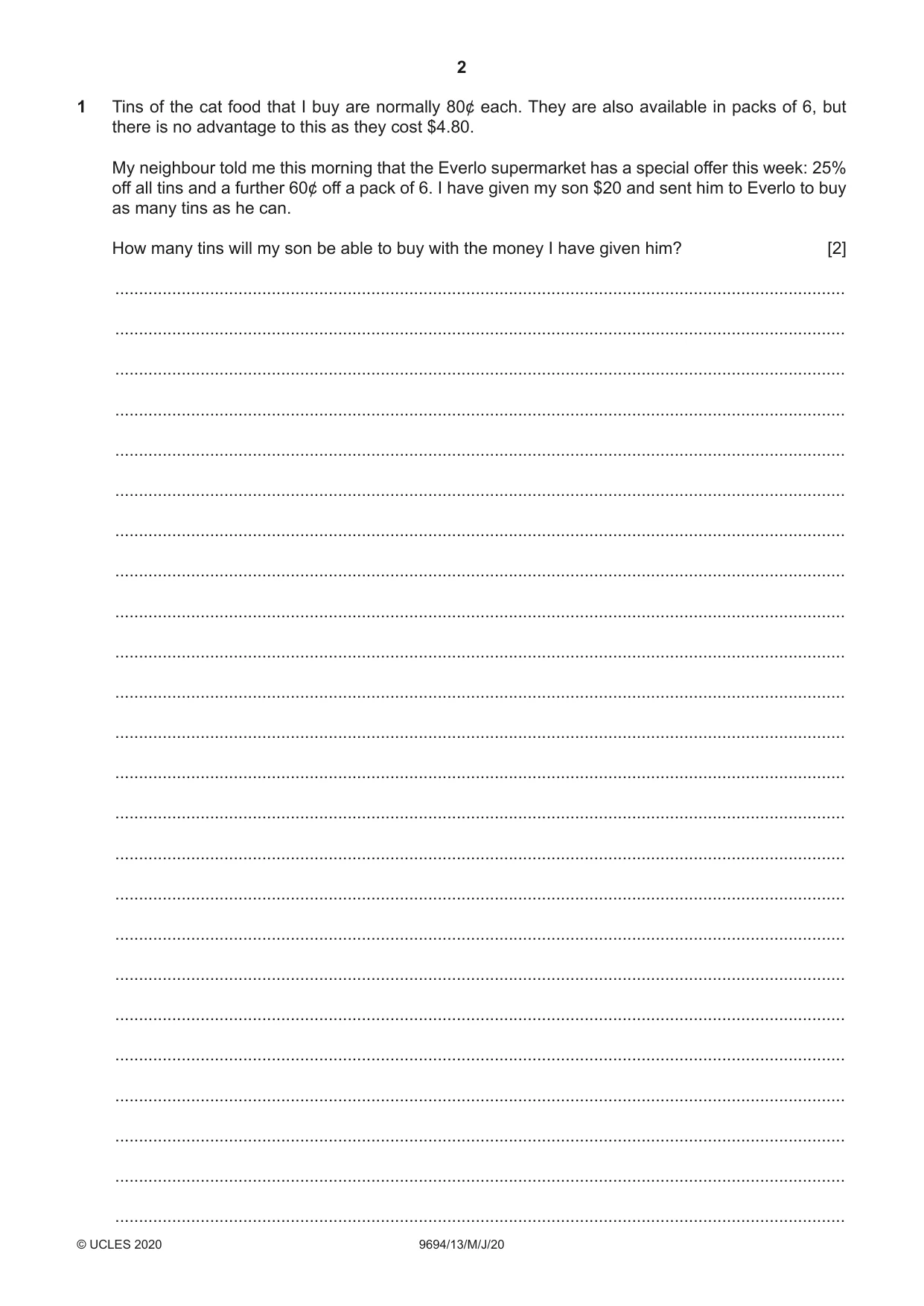
2 9694/13/M/J/20 © UCLES 2020 1 Tins of the cat food that I buy are normally 80¢ each. They are also available in packs of 6, but there is no advantage to this as they cost $4.80. My neighbour told me this morning that the Everlo supermarket has a special offer this week: 25% off all tins and a further 60¢ off a pack of 6. I have given my son $20 and sent him to Everlo to buy as many tins as he can. How many tins will my son be able to buy with the money I have given him? [2] … … … … … … … … … … … … … … … … … … … … … … … …
Question paper, page 3
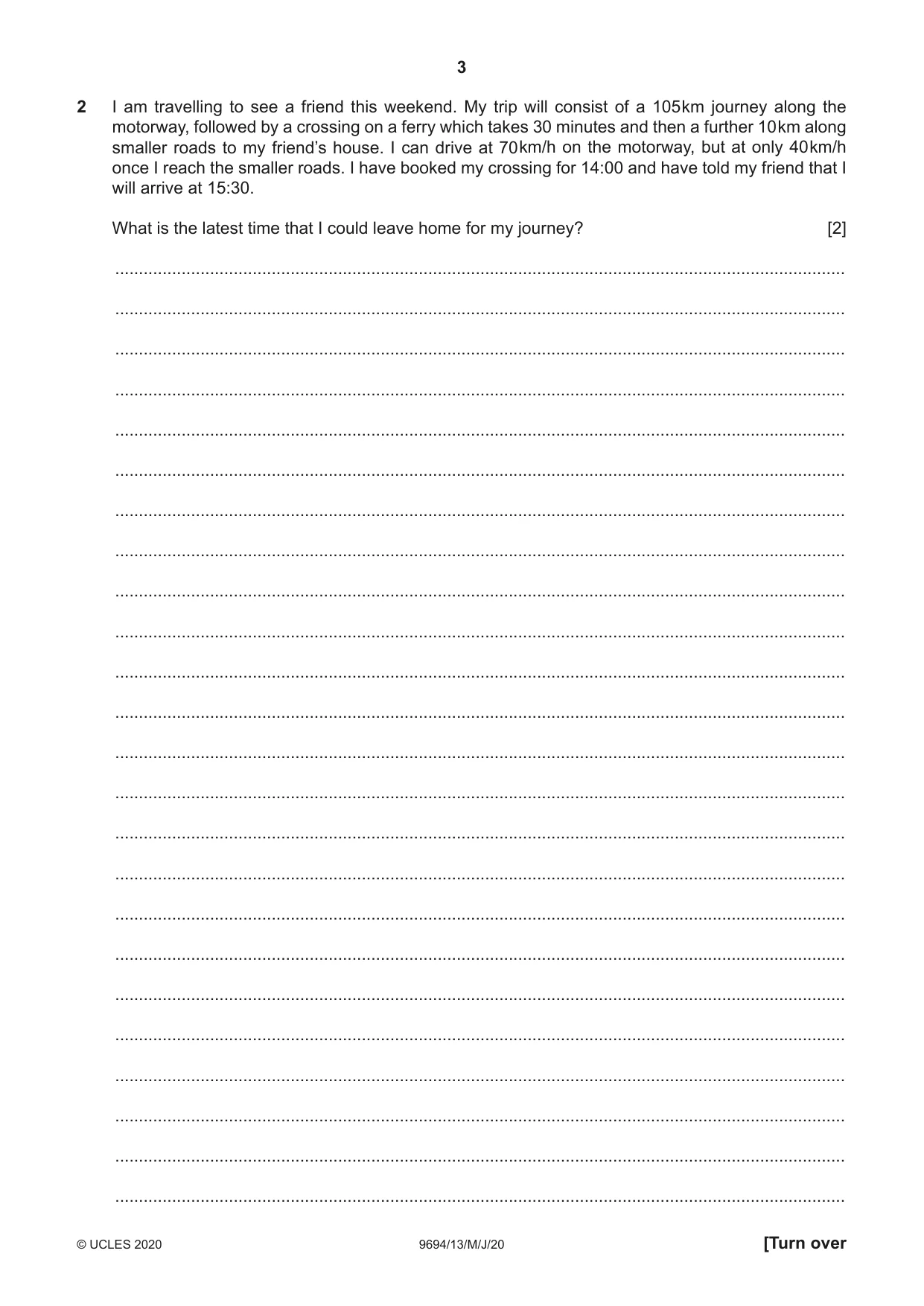
3 9694/13/M/J/20 © UCLES 2020 [Turn over 2 I am travelling to see a friend this weekend. My trip will consist of a 105 km journey along the motorway, followed by a crossing on a ferry which takes 30 minutes and then a further 10 km along smaller roads to my friend’s house. I can drive at 70 km/h on the motorway, but at only 40 km/h once I reach the smaller roads. I have booked my crossing for 14:00 and have told my friend that I will arrive at 15:30. What is the latest time that I could leave home for my journey? [2] … … … … … … … … … … … … … … … … … … … … … … … …
Question paper, page 4
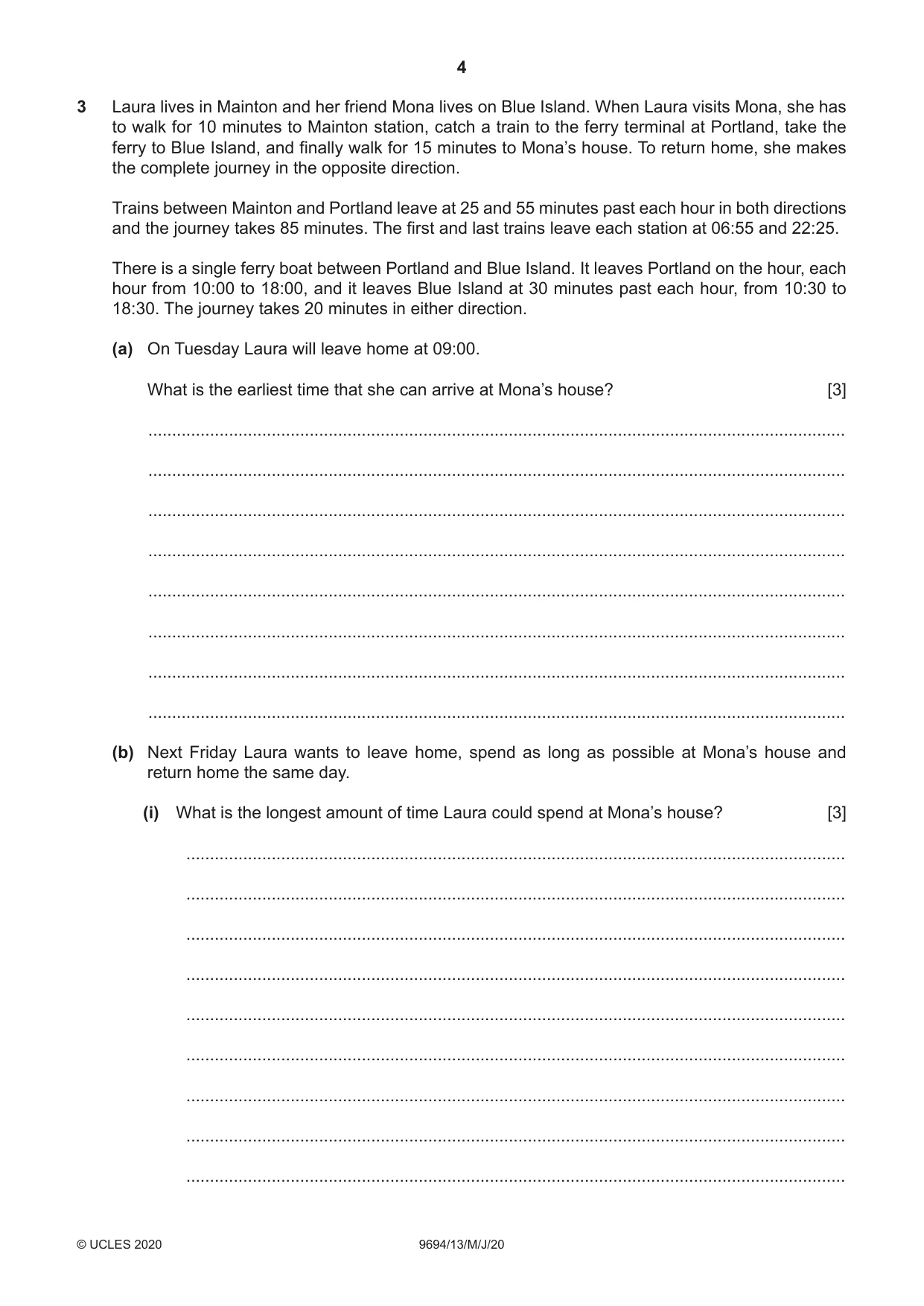
4 9694/13/M/J/20 © UCLES 2020 3 Laura lives in Mainton and her friend Mona lives on Blue Island. When Laura visits Mona, she has to walk for 10 minutes to Mainton station, catch a train to the ferry terminal at Portland, take the ferry to Blue Island, and finally walk for 15 minutes to Mona’s house. To return home, she makes the complete journey in the opposite direction. Trains between Mainton and Portland leave at 25 and 55 minutes past each hour in both directions and the journey takes 85 minutes. The first and last trains leave each station at 06:55 and 22:25. There is a single ferry boat between Portland and Blue Island. It leaves Portland on the hour, each hour from 10:00 to 18:00, and it leaves Blue Island at 30 minutes past each hour, from 10:30 to 18:30. The journey takes 20 minutes in either direction. (a) On Tuesday Laura will leave home at 09:00. What is the earliest time that she can arrive at Mona’s house? [3] … … … … … … … … (b) Next Friday Laura wants to leave home, spend as long as possible at Mona’s house and return home the same day. (i) What is the longest amount of time Laura could spend at Mona’s house? [3] … … … … … … … … …
Question paper, page 5
5 9694/13/M/J/20 © UCLES 2020 [Turn over (ii) For how long in total will Laura be away from home? [2] … … … … … … … … … …
Question paper, page 6
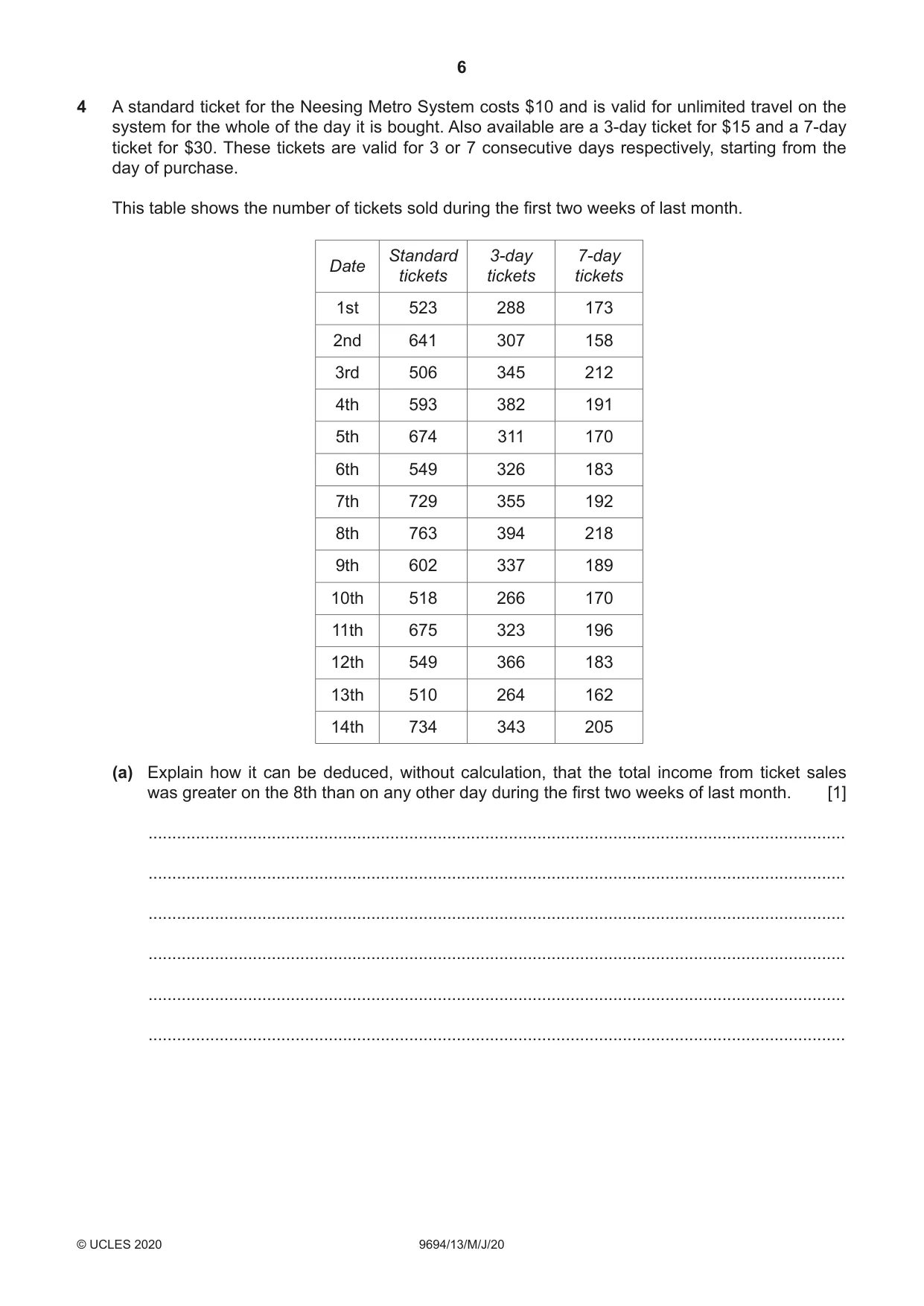
6 9694/13/M/J/20 © UCLES 2020 4 A standard ticket for the Neesing Metro System costs $10 and is valid for unlimited travel on the system for the whole of the day it is bought. Also available are a 3-day ticket for $15 and a 7-day ticket for $30. These tickets are valid for 3 or 7 consecutive days respectively, starting from the day of purchase. This table shows the number of tickets sold during the first two weeks of last month. Date Standard tickets 3-day tickets 7-day tickets 1st 523 288 173 2nd 641 307 158 3rd 506 345 212 4th 593 382 191 5th 674 311 170 6th 549 326 183 7th 729 355 192 8th 763 394 218 9th 602 337 189 10th 518 266 170 11th 675 323 196 12th 549 366 183 13th 510 264 162 14th 734 343 205 (a) Explain how it can be deduced, without calculation, that the total income from ticket sales was greater on the 8th than on any other day during the first two weeks of last month. [1] … … … … … …
Question paper, page 7
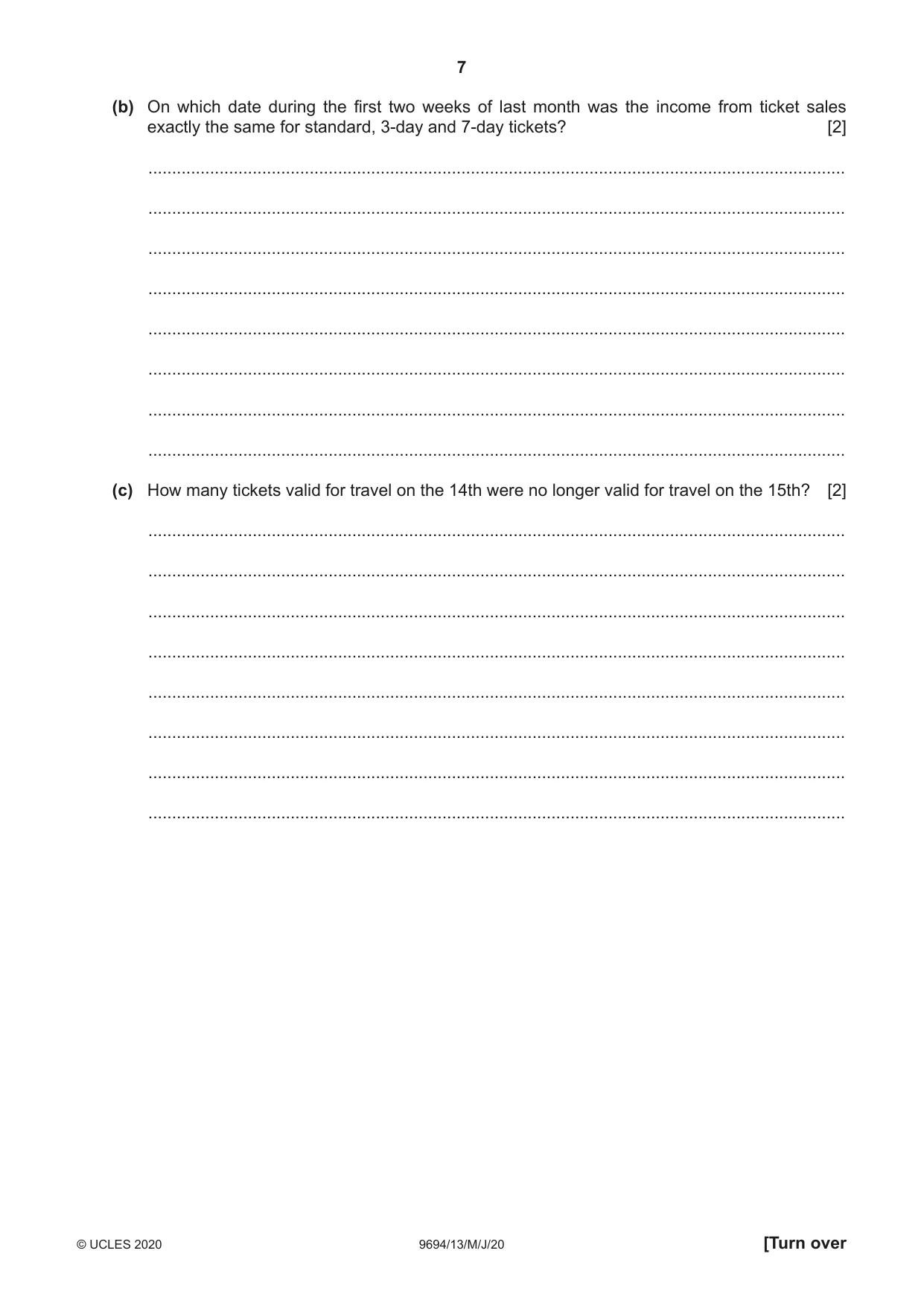
7 9694/13/M/J/20 © UCLES 2020 [Turn over (b) On which date during the first two weeks of last month was the income from ticket sales exactly the same for standard, 3-day and 7-day tickets? [2] … … … … … … … … (c) How many tickets valid for travel on the 14th were no longer valid for travel on the 15th? [2] … … … … … … … …
Question paper, page 8
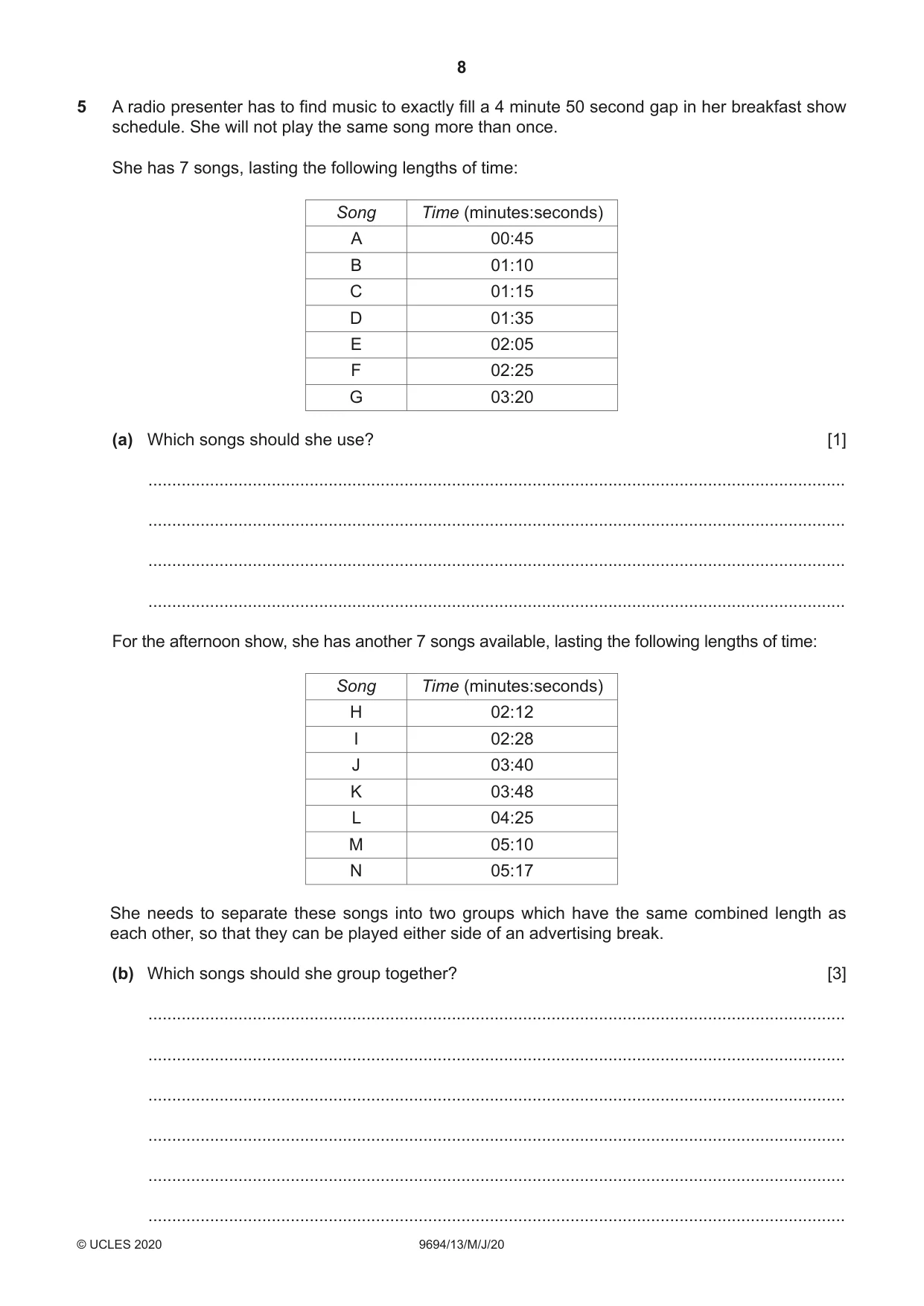
8 9694/13/M/J/20 © UCLES 2020 5 A radio presenter has to find music to exactly fill a 4 minute 50 second gap in her breakfast show schedule. She will not play the same song more than once. She has 7 songs, lasting the following lengths of time: Song Time (minutes:seconds) A 00:45 B 01:10 C 01:15 D 01:35 E 02:05 F 02:25 G 03:20 (a) Which songs should she use? [1] … … … … For the afternoon show, she has another 7 songs available, lasting the following lengths of time: Song Time (minutes:seconds) H 02:12 I 02:28 J 03:40 K 03:48 L 04:25 M 05:10 N 05:17 She needs to separate these songs into two groups which have the same combined length as each other, so that they can be played either side of an advertising break. (b) Which songs should she group together? [3] … … … … … …
Question paper, page 9
9 9694/13/M/J/20 © UCLES 2020 [Turn over 6 The only values of coins that are available to Harold are 1¢, 5¢, 10¢, 25¢ and 50¢. Using the coins in his pocket he is able to make various totals, including 47¢ and 63¢, exactly. (a) What is the smallest number of coins that Harold could have? [2] … … … … … … … … … (b) How many different sets of this number of coins are possible? [1] … … … … …
Question paper, page 10
10 9694/13/M/J/20 © UCLES 2020 7 A special type of timber can be bought in 3 lengths. The lengths that can be bought and the price of each plank are shown in the table below. Length of plank in metres 2.5 3.5 4.5 Price $2.50 $3.50 $4.50 Sophie needs to buy enough of this type of timber so that by sawing the planks she will have 10 pieces of length 1.50 m, 10 pieces of length 2.00 m and 10 pieces of length 3.00 m. (a) What is the least that Sophie can pay for the timber that she needs? [2] … … … … … … … … Sophie’s project was successful and she decided to repeat it. Unfortunately, when she went back to the timber merchant the prices had changed. The new prices are in the following table. Length of plank in metres 2.5 3.5 4.5 Price $2.50 $4.50 $6.00 (b) What is the least she could now pay to get enough timber for her needs? [3] … … … … … … … … … …
Question paper, page 11
11 9694/13/M/J/20 © UCLES 2020 [Turn over 8 Eric drove to his grandmother’s house yesterday to visit her. He left his home at 08:45 and arrived back at 20:25. Due to heavy traffic, the journey home took 40 minutes longer than the outward journey. Travelling occupied 60% of the time he was away from home. At what time yesterday did Eric leave his grandmother’s house to drive home? [3] … … … … … … … … … … … … … … … … … … … … … … … … …
Question paper, page 12
12 9694/13/M/J/20 © UCLES 2020 9 Werkitt Gym Club has two categories of membership: under-25 and 25+. 40% of the members are under 25. Although 63% of the total membership is female, 55% of the under-25 members are male. What percentage of the 25+ membership is male? [3] … … … … … … … … … … … … … … … … … … … … … … … … …
Question paper, page 13
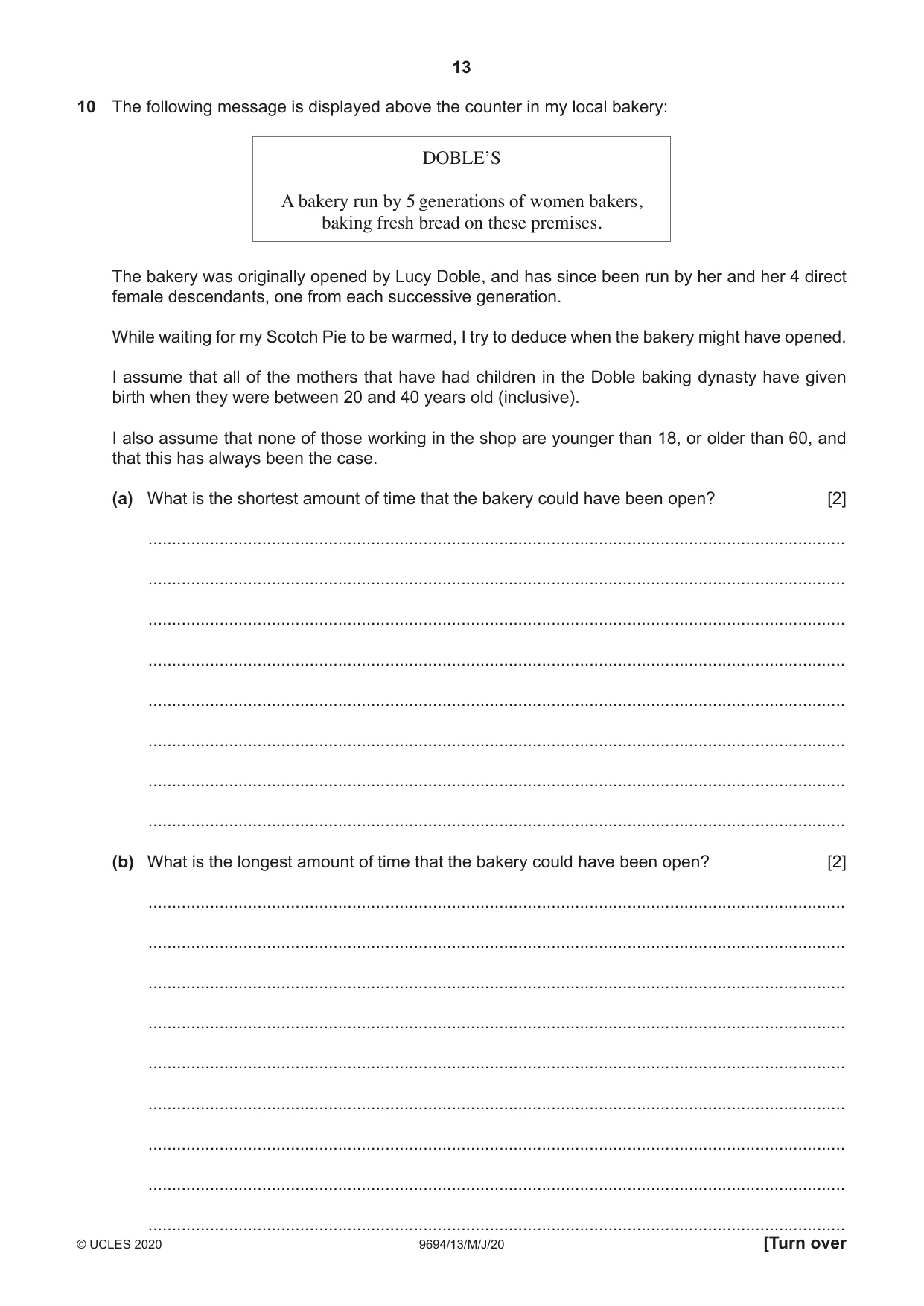
13 9694/13/M/J/20 © UCLES 2020 [Turn over 10 The following message is displayed above the counter in my local bakery: DOBLE’S A bakery run by 5 generations of women bakers, baking fresh bread on these premises. The bakery was originally opened by Lucy Doble, and has since been run by her and her 4 direct female descendants, one from each successive generation. While waiting for my Scotch Pie to be warmed, I try to deduce when the bakery might have opened. I assume that all of the mothers that have had children in the Doble baking dynasty have given birth when they were between 20 and 40 years old (inclusive). I also assume that none of those working in the shop are younger than 18, or older than 60, and that this has always been the case. (a) What is the shortest amount of time that the bakery could have been open? [2] … … … … … … … … (b) What is the longest amount of time that the bakery could have been open? [2] … … … … … … … … …
Question paper, page 14
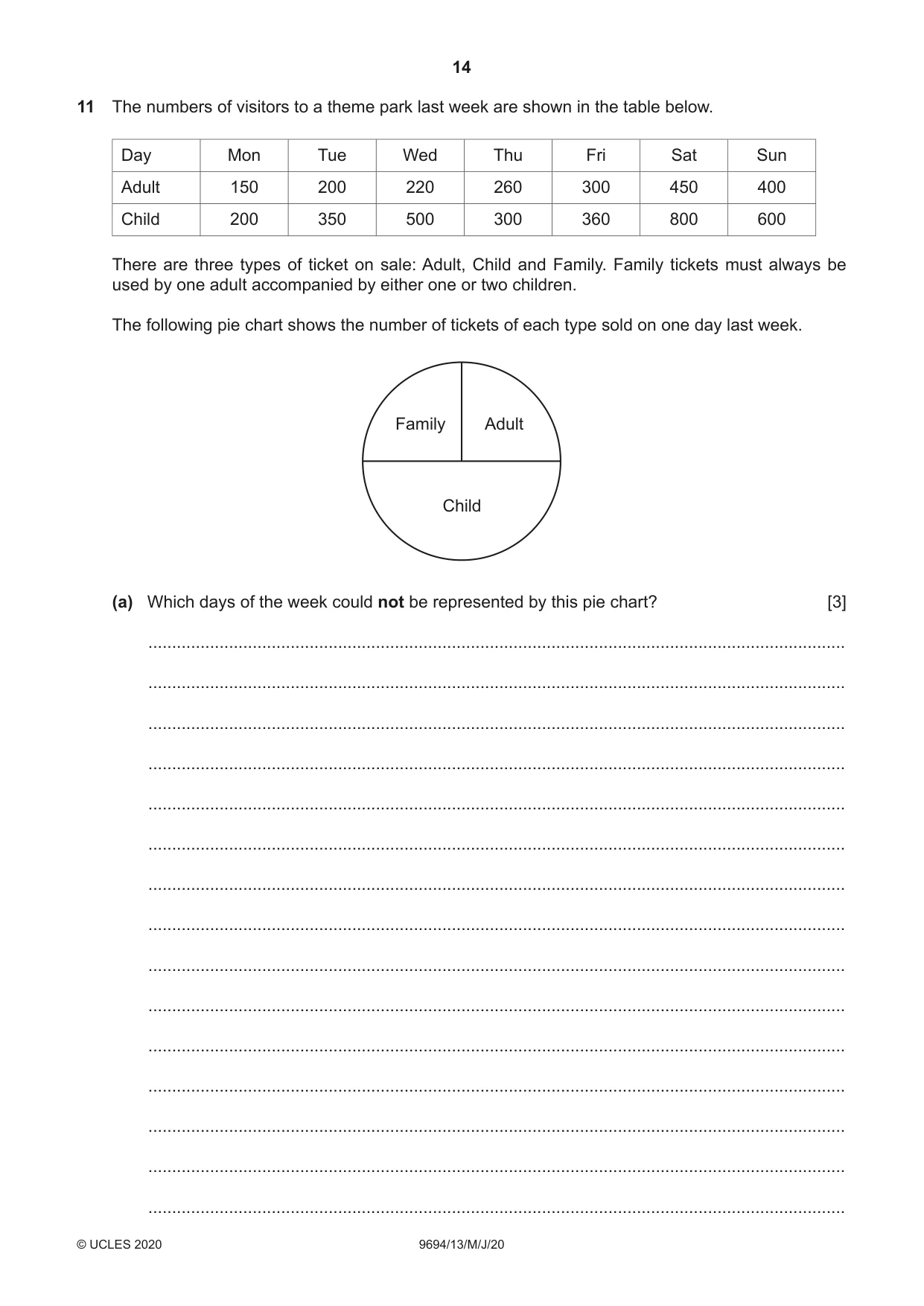
14 9694/13/M/J/20 © UCLES 2020 11 The numbers of visitors to a theme park last week are shown in the table below. Day Mon Tue Wed Thu Fri Sat Sun Adult 150 200 220 260 300 450 400 Child 200 350 500 300 360 800 600 There are three types of ticket on sale: Adult, Child and Family. Family tickets must always be used by one adult accompanied by either one or two children. The following pie chart shows the number of tickets of each type sold on one day last week. Adult Family Child (a) Which days of the week could not be represented by this pie chart? [3] … … … … … … … … … … … … … … …
Question paper, page 15
15 9694/13/M/J/20 © UCLES 2020 [Turn over In fact the pie chart relates to ticket sales for Saturday. (b) How many of the family tickets sold on Saturday were used for two children to enter the theme park? [3] … … … … … … … … … … … … [Turn over for Question 12] Permission to reproduce items where third-party owned material protected by copyright is included has been sought and cleared where possible. Every reasonable effort has been made by the publisher (UCLES) to trace copyright holders, but if any items requiring clearance have unwittingly been included, the publisher will be pleased to make amends at the earliest possible opportunity. To avoid the issue of disclosure of answer-related information to candidates, all copyright acknowledgements are reproduced online in the Cambridge Assessment International Education Copyright Acknowledgements Booklet. This is produced for each series of examinations and is freely available to download at www.cambridgeinternational.org after the live examination series. Cambridge Assessment International Education is part of the Cambridge Assessment Group. Cambridge Assessment is the brand name of the University of Cambridge Local Examinations Syndicate (UCLES), which itself is a department of the University of Cambridge.
Question paper, page 16
16 9694/13/M/J/20 © UCLES 2020 12 Vera, from Axia, is planning a holiday in neighbouring Baxia. She plans not to change any currency in Baxia. She will buy 100 Baxian pounds (£) in Axia before she goes, and this will be enough for her needs. She expects to spend £60 in Baxia and will convert any pounds she has left back into Axian dollars ($) on her return. She has a choice of two currency exchanges that she can use in Axia: Smartex will charge her $4.60 for every Baxian pound she buys, but will give her only $4.40 for every pound she returns at the end of the holiday. Realex will charge her $4.65 for each Baxian pound, but will also give her $4.65 for every one she returns. (a) Supposing she does spend £60 in Baxia, would the holiday be cheaper by using Realex or Smartex, and by how many Axian dollars? [2] … … … … … … … … (b) What spending by Vera in Baxia would mean that the cost of the holiday would be the same whether she used Realex or Smartex? [3] … … … … … … … … … … … …
Mark scheme, page 1
This document consists of 8 printed pages. © UCLES 2020 [Turn over Cambridge International AS & A Level THINKING SKILLS 9694/13 Paper 1 Problem Solving May/June 2020 MARK SCHEME Maximum Mark: 50 Published Students did not sit exam papers in the June 2020 series due to the Covid-19 global pandemic. This mark scheme is published to support teachers and students and should be read together with the question paper. It shows the requirements of the exam. The answer column of the mark scheme shows the proposed basis on which Examiners would award marks for this exam. Where appropriate, this column also provides the most likely acceptable alternative responses expected from students. Examiners usually review the mark scheme after they have seen student responses and update the mark scheme if appropriate. In the June series, Examiners were unable to consider the acceptability of alternative responses, as there were no student responses to consider. Mark schemes should usually be read together with the Principal Examiner Report for Teachers. However, because students did not sit exam papers, there is no Principal Examiner Report for Teachers for the June 2020 series. Cambridge International will not enter into discussions about these mark schemes. Cambridge International is publishing the mark schemes for the June 2020 series for most Cambridge IGCSE™ and Cambridge International A & AS Level components, and some Cambridge O Level components.
Mark scheme, page 2
9694/13 Cambridge International AS & A Level – Mark Scheme PUBLISHED May/June 2020 © UCLES 2020 Page 2 of 8 Generic Marking Principles These general marking principles must be applied by all examiners when marking candidate answers. They should be applied alongside the specific content of the mark scheme or generic level descriptors for a question. Each question paper and mark scheme will also comply with these marking principles. GENERIC MARKING PRINCIPLE 1: Marks must be awarded in line with: • the specific content of the mark scheme or the generic level descriptors for the question • the specific skills defined in the mark scheme or in the generic level descriptors for the question • the standard of response required by a candidate as exemplified by the standardisation scripts. GENERIC MARKING PRINCIPLE 2: Marks awarded are always whole marks (not half marks, or other fractions). GENERIC MARKING PRINCIPLE 3: Marks must be awarded positively: • marks are awarded for correct/valid answers, as defined in the mark scheme. However, credit is given for valid answers which go beyond the scope of the syllabus and mark scheme, referring to your Team Leader as appropriate • marks are awarded when candidates clearly demonstrate what they know and can do • marks are not deducted for errors • marks are not deducted for omissions • answers should only be judged on the quality of spelling, punctuation and grammar when these features are specifically assessed by the question as indicated by the mark scheme. The meaning, however, should be unambiguous. GENERIC MARKING PRINCIPLE 4: Rules must be applied consistently e.g. in situations where candidates have not followed instructions or in the application of generic level descriptors. GENERIC MARKING PRINCIPLE 5: Marks should be awarded using the full range of marks defined in the mark scheme for the question (however; the use of the full mark range may be limited according to the quality of the candidate responses seen). GENERIC MARKING PRINCIPLE 6: Marks awarded are based solely on the requirements as defined in the mark scheme. Marks should not be awarded with grade thresholds or grade descriptors in mind.
Mark scheme, page 3
9694/13 Cambridge International AS & A Level – Mark Scheme PUBLISHED May/June 2020 © UCLES 2020 Page 3 of 8 NOTES FOR MARKERS Working Where a final answer is underlined in the mark scheme, full marks are awarded for a correct answer, regardless of whether there is any supporting working, unless an exception is noted in the mark scheme. For partial credit, the evidence needed to award the mark will usually be shown on its own line in the mark scheme, or else will be defined in italic text. For explanations and verbal justifications, apply the principle of ‘words to that effect’. No response If there is any attempt at a solution award 0 marks not NR. “-” or “?” constitute no attempt at a solution. Abbreviations The following abbreviations may be used in a mark scheme: AG answer given (on question paper) awrt answer which rounds to FT follow through (from earlier error) oe or equivalent SC special case soi seen or implied
Mark scheme, page 4
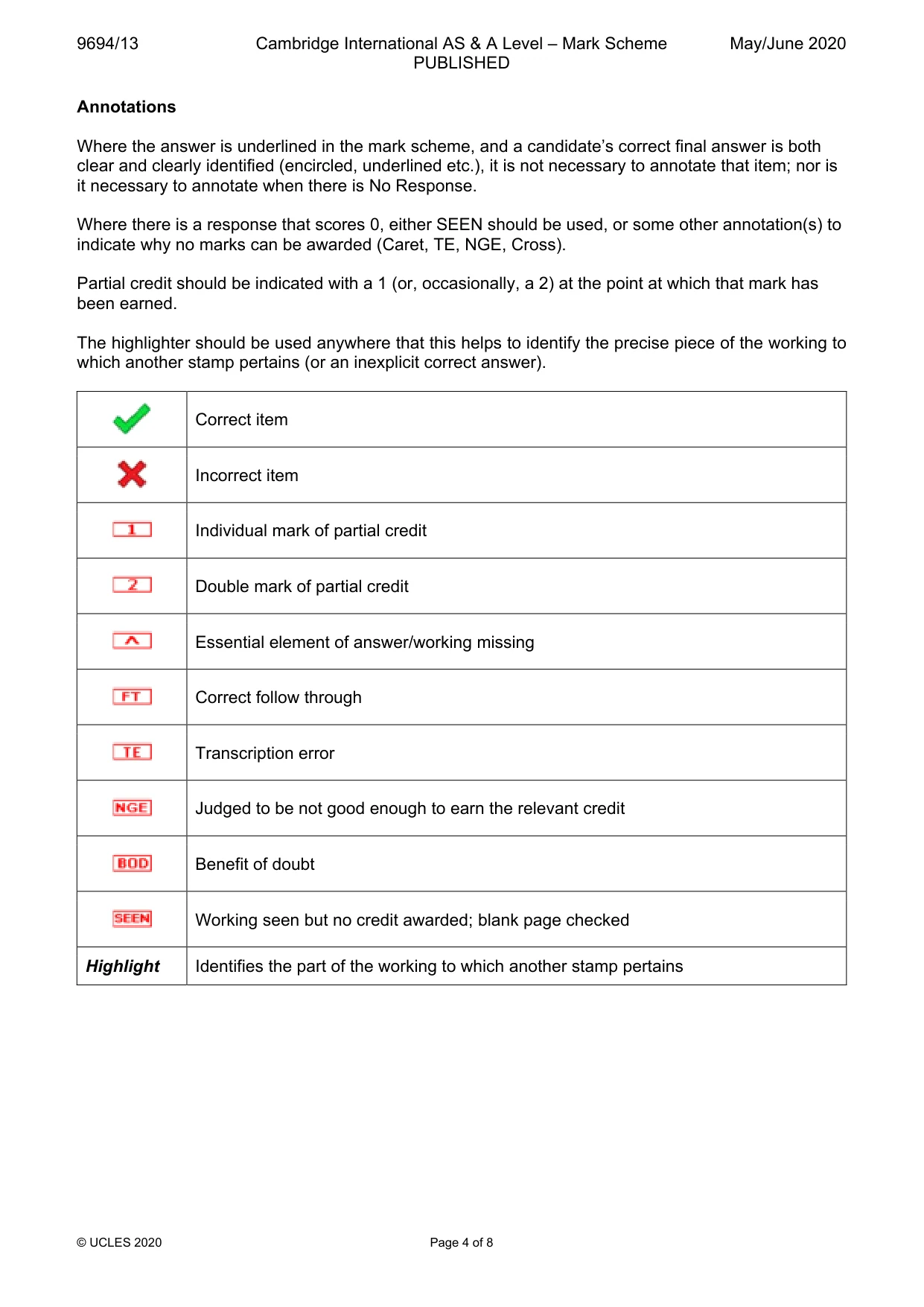
9694/13 Cambridge International AS & A Level – Mark Scheme PUBLISHED May/June 2020 © UCLES 2020 Page 4 of 8 Annotations Where the answer is underlined in the mark scheme, and a candidate’s correct final answer is both clear and clearly identified (encircled, underlined etc.), it is not necessary to annotate that item; nor is it necessary to annotate when there is No Response. Where there is a response that scores 0, either SEEN should be used, or some other annotation(s) to indicate why no marks can be awarded (Caret, TE, NGE, Cross). Partial credit should be indicated with a 1 (or, occasionally, a 2) at the point at which that mark has been earned. The highlighter should be used anywhere that this helps to identify the precise piece of the working to which another stamp pertains (or an inexplicit correct answer). Correct item Incorrect item Individual mark of partial credit Double mark of partial credit Essential element of answer/working missing Correct follow through Transcription error Judged to be not good enough to earn the relevant credit Benefit of doubt Working seen but no credit awarded; blank page checked Highlight Identifies the part of the working to which another stamp pertains
Mark scheme, page 5
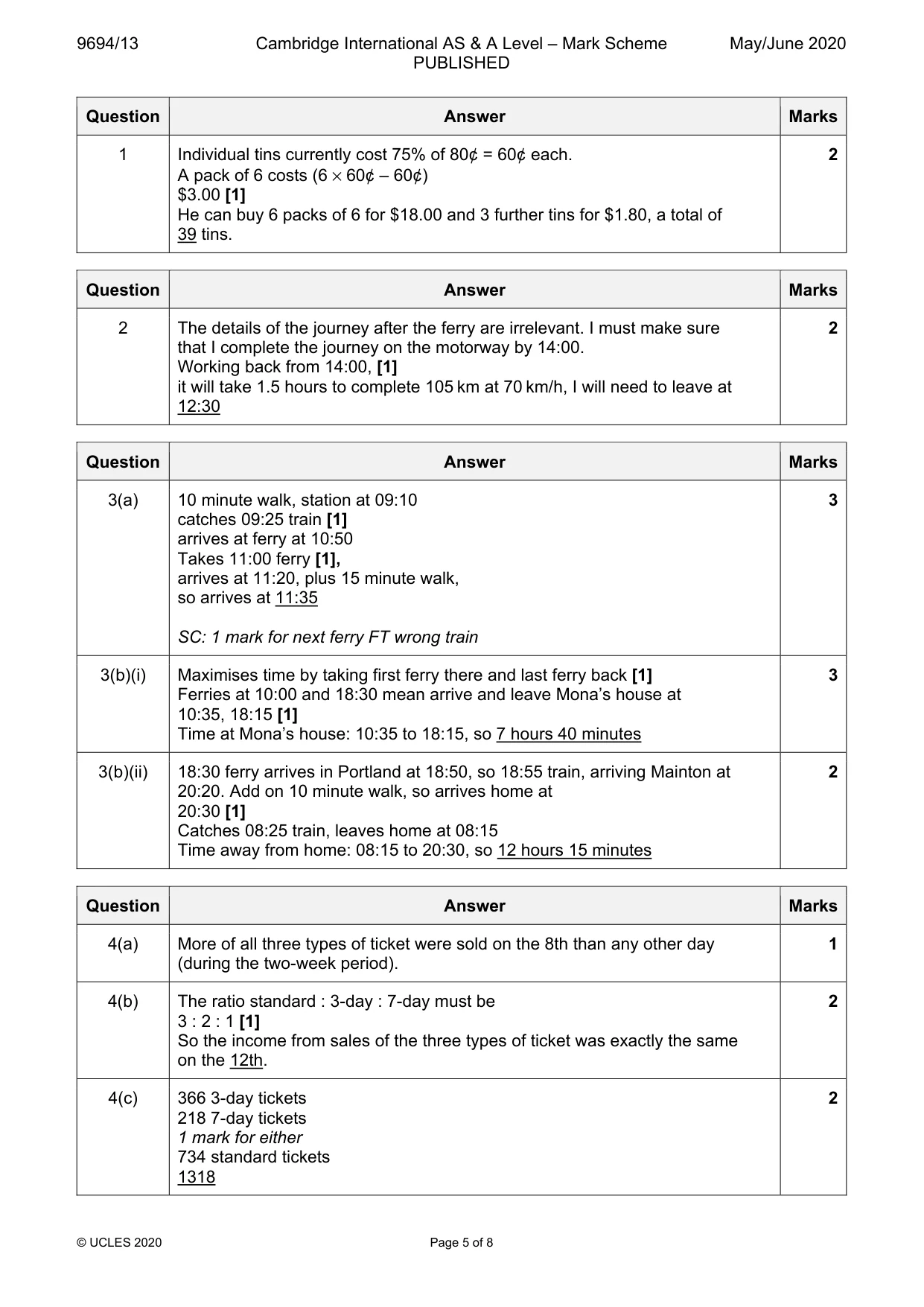
9694/13 Cambridge International AS & A Level – Mark Scheme PUBLISHED May/June 2020 © UCLES 2020 Page 5 of 8 Question Answer Marks 1 Individual tins currently cost 75% of 80¢ = 60¢ each. A pack of 6 costs (6 × 60¢ – 60¢) $3.00 [1] He can buy 6 packs of 6 for $18.00 and 3 further tins for $1.80, a total of 39 tins. 2 Question Answer Marks 2 The details of the journey after the ferry are irrelevant. I must make sure that I complete the journey on the motorway by 14:00. Working back from 14:00, [1] it will take 1.5 hours to complete 105 km at 70 km/h, I will need to leave at 12:30 2 Question Answer Marks 3(a) 10 minute walk, station at 09:10 catches 09:25 train [1] arrives at ferry at 10:50 Takes 11:00 ferry [1], arrives at 11:20, plus 15 minute walk, so arrives at 11:35 SC: 1 mark for next ferry FT wrong train 3 3(b)(i) Maximises time by taking first ferry there and last ferry back [1] Ferries at 10:00 and 18:30 mean arrive and leave Mona’s house at 10:35, 18:15 [1] Time at Mona’s house: 10:35 to 18:15, so 7 hours 40 minutes 3 3(b)(ii) 18:30 ferry arrives in Portland at 18:50, so 18:55 train, arriving Mainton at 20:20. Add on 10 minute walk, so arrives home at 20:30 [1] Catches 08:25 train, leaves home at 08:15 Time away from home: 08:15 to 20:30, so 12 hours 15 minutes 2 Question Answer Marks 4(a) More of all three types of ticket were sold on the 8th than any other day (during the two-week period). 1 4(b) The ratio standard : 3-day : 7-day must be 3 : 2 : 1 [1] So the income from sales of the three types of ticket was exactly the same on the 12th. 2 4(c) 366 3-day tickets 218 7-day tickets 1 mark for either 734 standard tickets 1318 2
Mark scheme, page 6
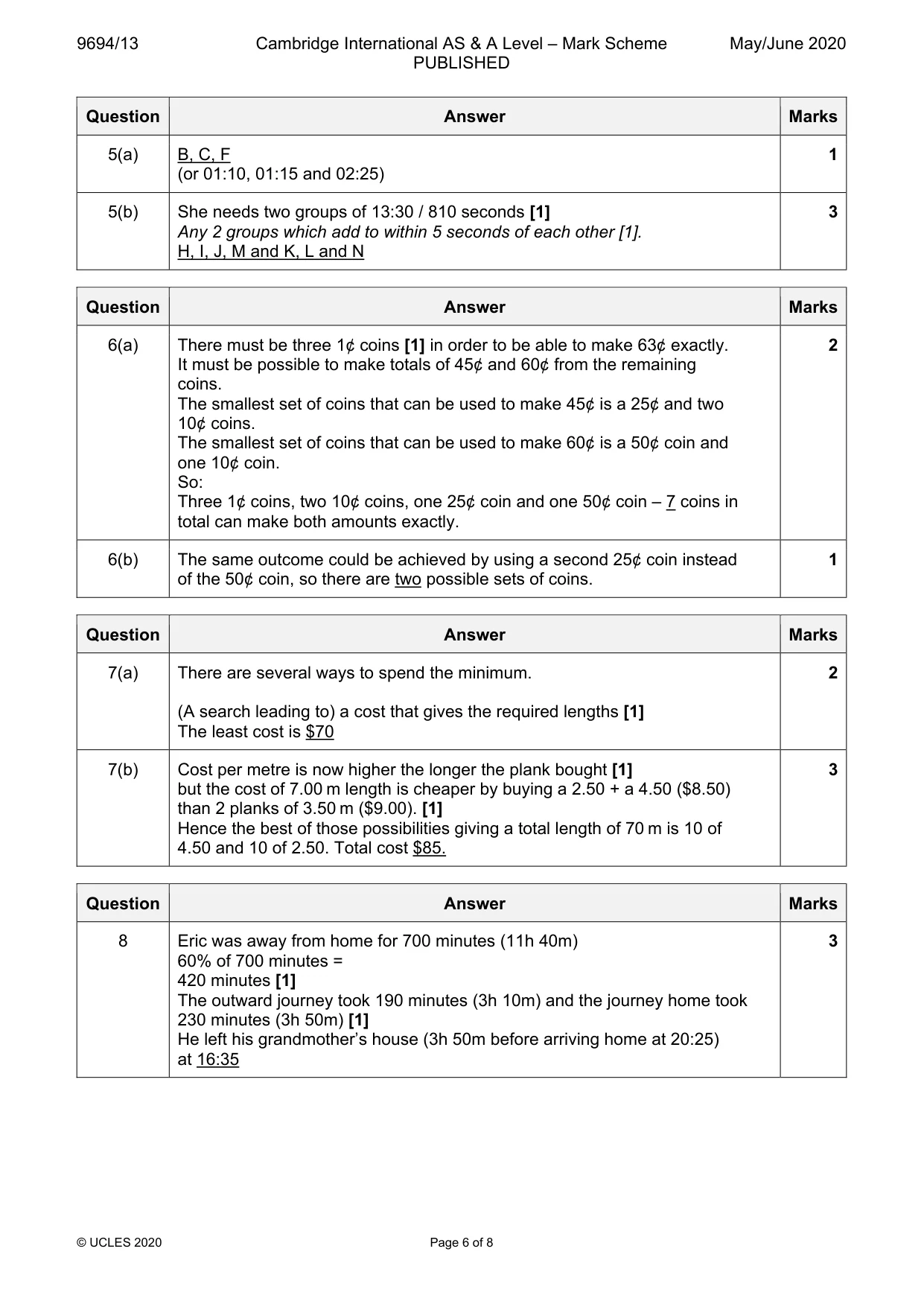
9694/13 Cambridge International AS & A Level – Mark Scheme PUBLISHED May/June 2020 © UCLES 2020 Page 6 of 8 Question Answer Marks 5(a) B, C, F (or 01:10, 01:15 and 02:25) 1 5(b) She needs two groups of 13:30 / 810 seconds [1] Any 2 groups which add to within 5 seconds of each other [1]. H, I, J, M and K, L and N 3 Question Answer Marks 6(a) There must be three 1¢ coins [1] in order to be able to make 63¢ exactly. It must be possible to make totals of 45¢ and 60¢ from the remaining coins. The smallest set of coins that can be used to make 45¢ is a 25¢ and two 10¢ coins. The smallest set of coins that can be used to make 60¢ is a 50¢ coin and one 10¢ coin. So: Three 1¢ coins, two 10¢ coins, one 25¢ coin and one 50¢ coin – 7 coins in total can make both amounts exactly. 2 6(b) The same outcome could be achieved by using a second 25¢ coin instead of the 50¢ coin, so there are two possible sets of coins. 1 Question Answer Marks 7(a) There are several ways to spend the minimum. (A search leading to) a cost that gives the required lengths [1] The least cost is $70 2 7(b) Cost per metre is now higher the longer the plank bought [1] but the cost of 7.00 m length is cheaper by buying a 2.50 + a 4.50 ($8.50) than 2 planks of 3.50 m ($9.00). [1] Hence the best of those possibilities giving a total length of 70 m is 10 of 4.50 and 10 of 2.50. Total cost $85. 3 Question Answer Marks 8 Eric was away from home for 700 minutes (11h 40m) 60% of 700 minutes = 420 minutes [1] The outward journey took 190 minutes (3h 10m) and the journey home took 230 minutes (3h 50m) [1] He left his grandmother’s house (3h 50m before arriving home at 20:25) at 16:35 3
Mark scheme, page 7
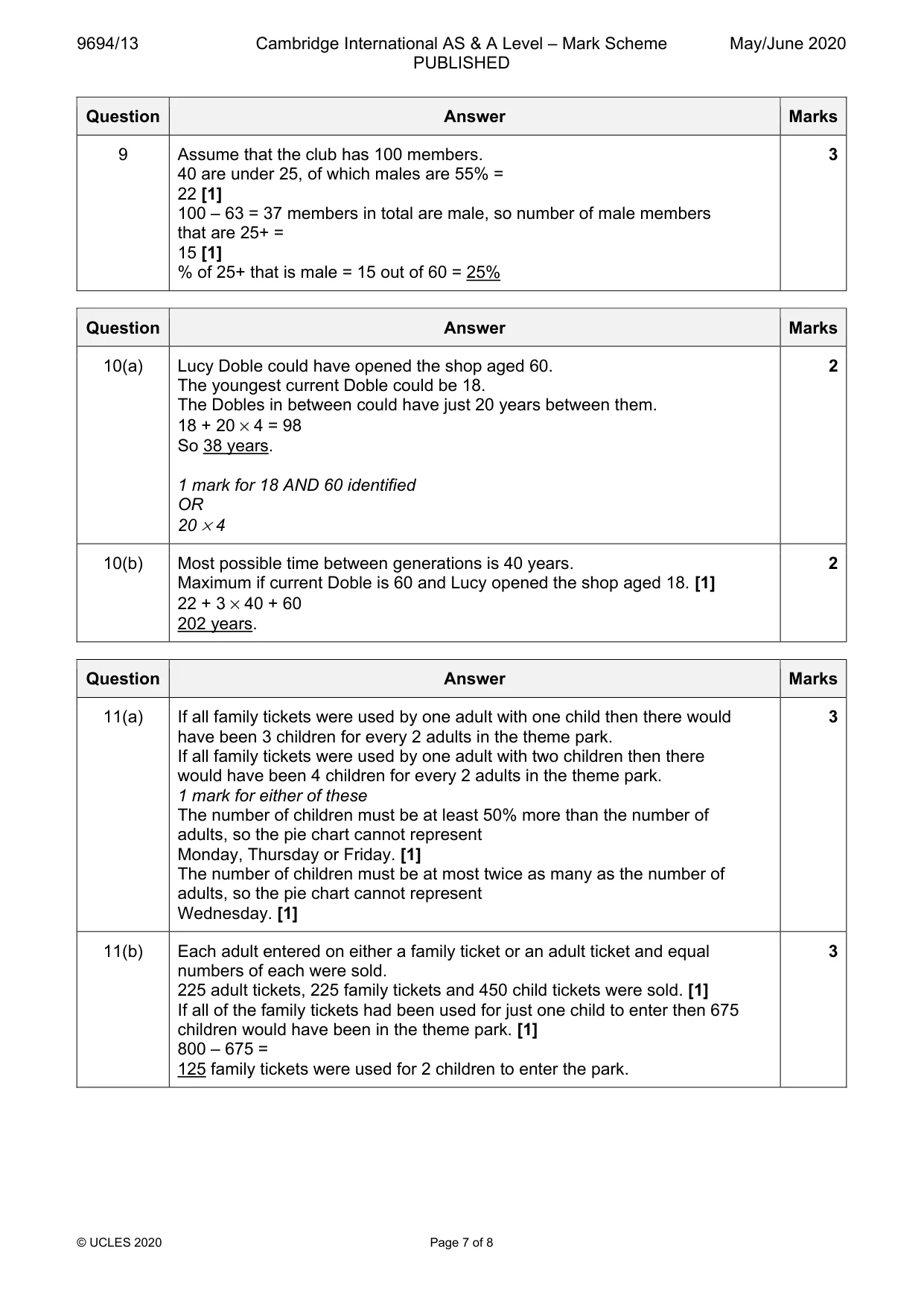
9694/13 Cambridge International AS & A Level – Mark Scheme PUBLISHED May/June 2020 © UCLES 2020 Page 7 of 8 Question Answer Marks 9 Assume that the club has 100 members. 40 are under 25, of which males are 55% = 22 [1] 100 – 63 = 37 members in total are male, so number of male members that are 25+ = 15 [1] % of 25+ that is male = 15 out of 60 = 25% 3 Question Answer Marks 10(a) Lucy Doble could have opened the shop aged 60. The youngest current Doble could be 18. The Dobles in between could have just 20 years between them. 18 + 20 × 4 = 98 So 38 years. 1 mark for 18 AND 60 identified OR 20 × 4 2 10(b) Most possible time between generations is 40 years. Maximum if current Doble is 60 and Lucy opened the shop aged 18. [1] 22 + 3 × 40 + 60 202 years. 2 Question Answer Marks 11(a) If all family tickets were used by one adult with one child then there would have been 3 children for every 2 adults in the theme park. If all family tickets were used by one adult with two children then there would have been 4 children for every 2 adults in the theme park. 1 mark for either of these The number of children must be at least 50% more than the number of adults, so the pie chart cannot represent Monday, Thursday or Friday. [1] The number of children must be at most twice as many as the number of adults, so the pie chart cannot represent Wednesday. [1] 3 11(b) Each adult entered on either a family ticket or an adult ticket and equal numbers of each were sold. 225 adult tickets, 225 family tickets and 450 child tickets were sold. [1] If all of the family tickets had been used for just one child to enter then 675 children would have been in the theme park. [1] 800 – 675 = 125 family tickets were used for 2 children to enter the park. 3
Mark scheme, page 8
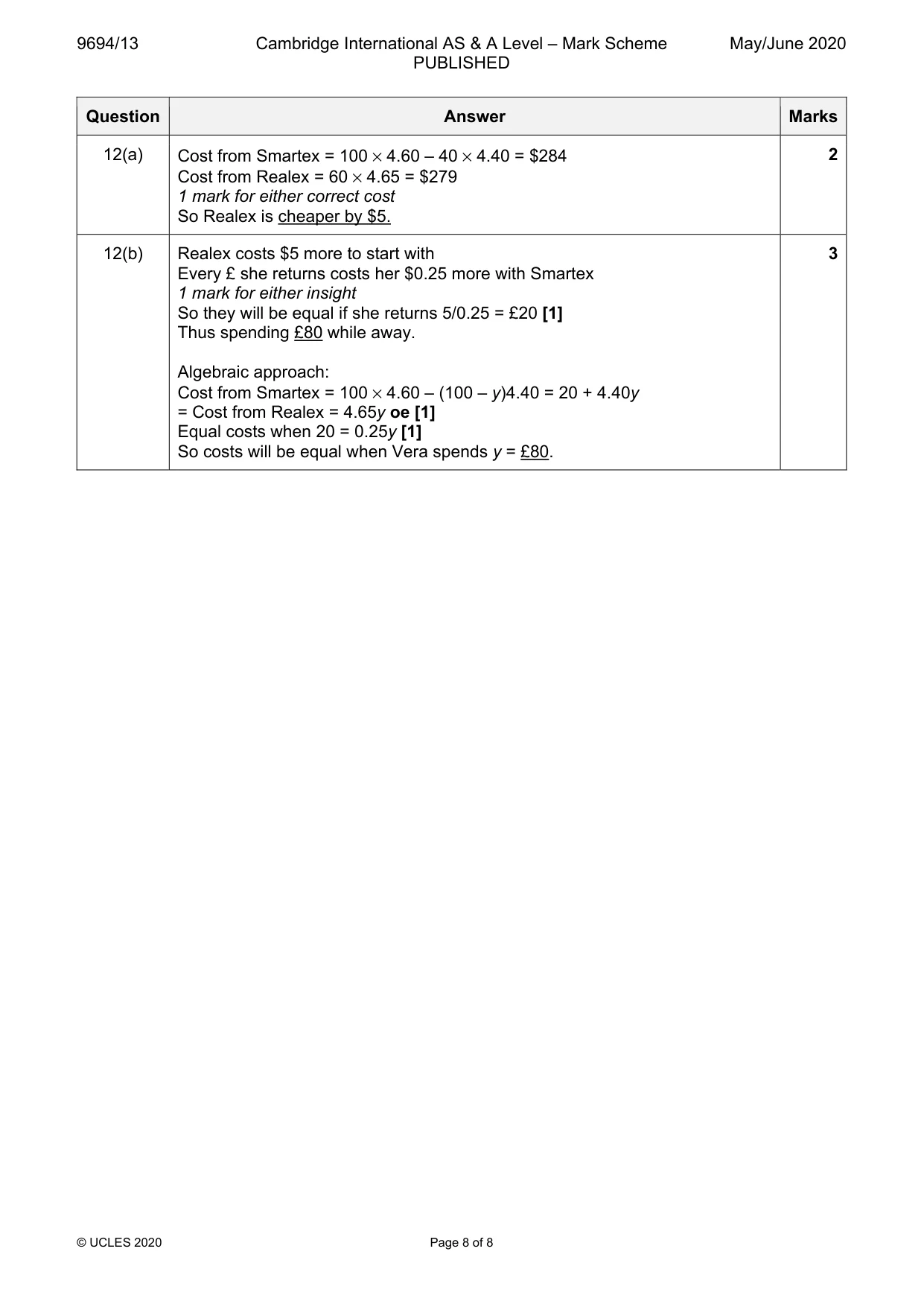
9694/13 Cambridge International AS & A Level – Mark Scheme PUBLISHED May/June 2020 © UCLES 2020 Page 8 of 8 Question Answer Marks 12(a) Cost from Smartex = 100 × 4.60 – 40 × 4.40 = $284 Cost from Realex = 60 × 4.65 = $279 1 mark for either correct cost So Realex is cheaper by $5. 2 12(b) Realex costs $5 more to start with Every £ she returns costs her $0.25 more with Smartex 1 mark for either insight So they will be equal if she returns 5/0.25 = £20 [1] Thus spending £80 while away. Algebraic approach: Cost from Smartex = 100 × 4.60 – (100 – y)4.40 = 20 + 4.40y = Cost from Realex = 4.65y oe [1] Equal costs when 20 = 0.25y [1] So costs will be equal when Vera spends y = £80. 3