Cambridge A Level Thinking Skills 9694 — 2020 May/June Paper 1 · Variant 2
9694/12/M/J/20
The question paper and its mark scheme, free to read here and free to download. This is Cambridge’s own paper, exactly as it was sat.
Question paper16 pages
Mark scheme8 pages
Answers below. Sit the paper first if you are practising.
Paper as text
Question paper, page 1
Cambridge International AS & A Level This document has 16 pages. Blank pages are indicated. DC (LK/CB) 188495/2 © UCLES 2020 [Turn over THINKING SKILLS 9694/12 Paper 1 Problem Solving May/June 2020 1 hour 30 minutes You must answer on the question paper. No additional materials are needed. INSTRUCTIONS ● Answer all questions. ● Use a black or dark blue pen. ● Write your name, centre number and candidate number in the boxes at the top of the page. ● Write your answer to each question in the space provided. ● Do not use an erasable pen or correction fluid. ● Do not write on any bar codes. ● You may use a calculator. ● Show your working. Where a final answer is incorrect or missing, you may still be awarded marks for correct steps towards a solution. In most questions, full marks will be awarded for a correct answer without any working. In some questions, however, you will not be awarded full marks if working needed to support an answer is not shown. INFORMATION ● The total mark for this paper is 50. ● The number of marks for each question or part question is shown in brackets [ ]. * 2 2 3 6 2 0 3 3 8 5 *
Question paper, page 2
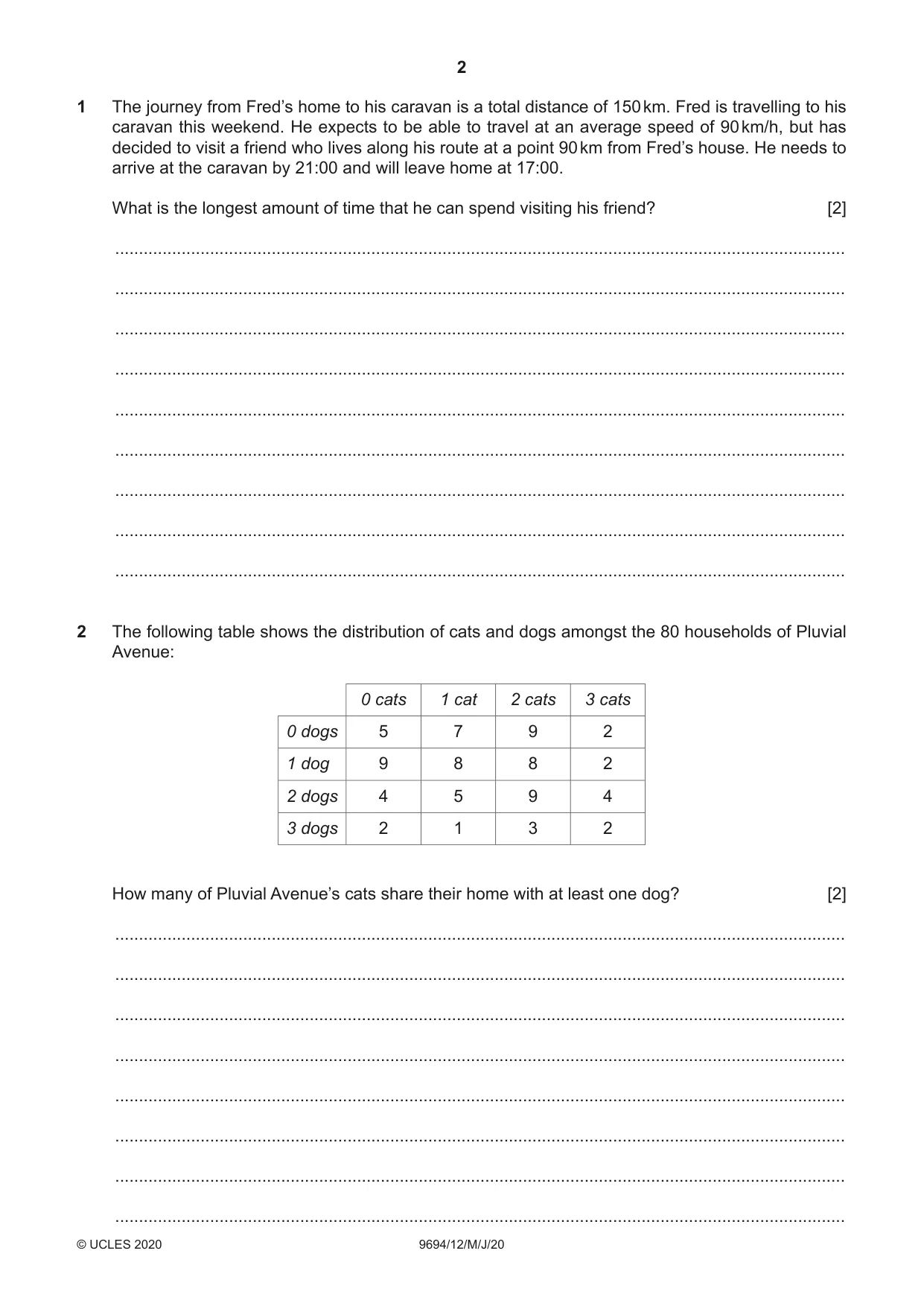
2 9694/12/M/J/20 © UCLES 2020 1 The journey from Fred’s home to his caravan is a total distance of 150 km. Fred is travelling to his caravan this weekend. He expects to be able to travel at an average speed of 90 km/h, but has decided to visit a friend who lives along his route at a point 90 km from Fred’s house. He needs to arrive at the caravan by 21:00 and will leave home at 17:00. What is the longest amount of time that he can spend visiting his friend? [2] … … … … … … … … … 2 The following table shows the distribution of cats and dogs amongst the 80 households of Pluvial Avenue: 0 cats 1 cat 2 cats 3 cats 0 dogs 5 7 9 2 1 dog 9 8 8 2 2 dogs 4 5 9 4 3 dogs 2 1 3 2 How many of Pluvial Avenue’s cats share their home with at least one dog? [2] … … … … … … … …
Question paper, page 3
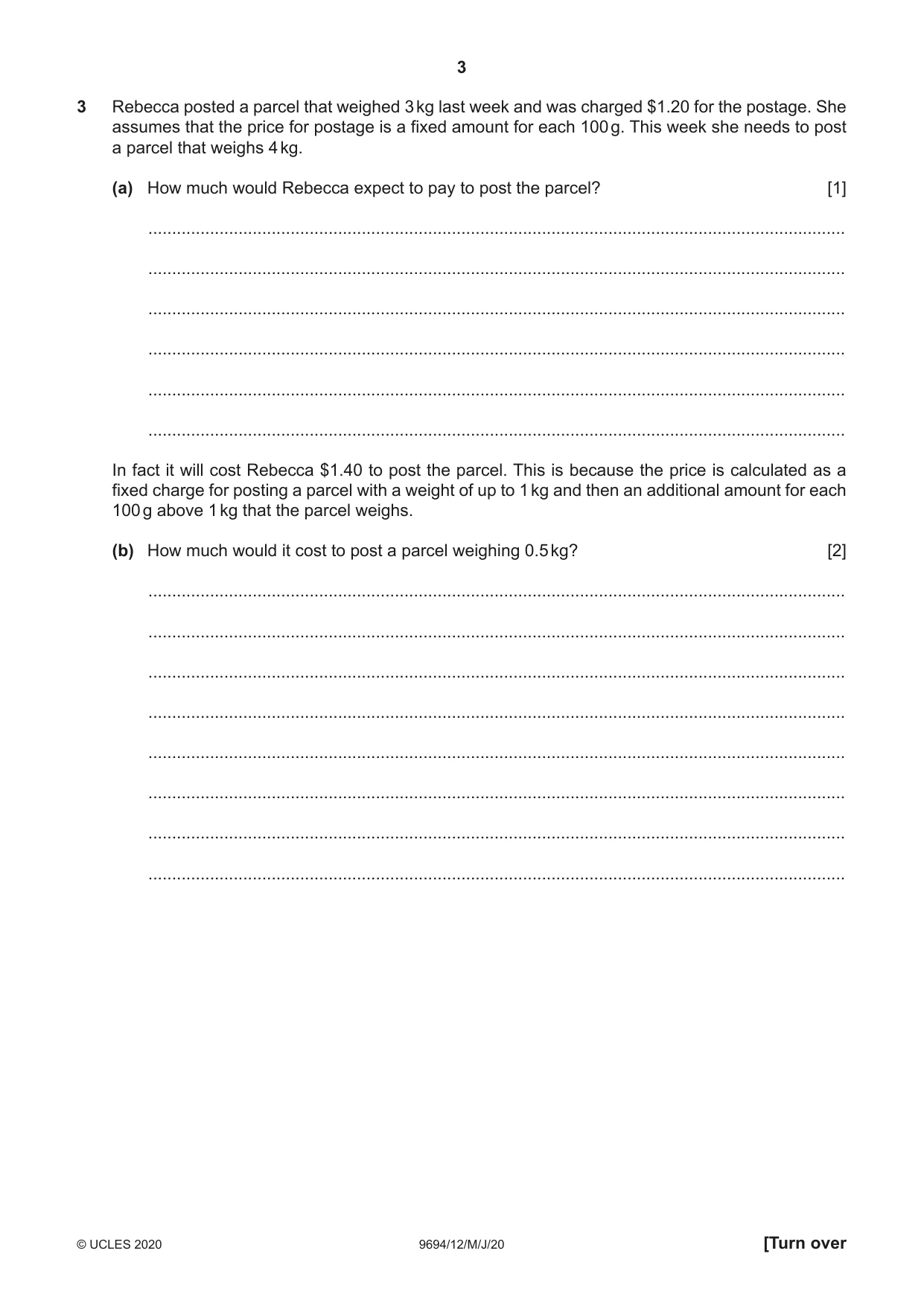
3 9694/12/M/J/20 © UCLES 2020 [Turn over 3 Rebecca posted a parcel that weighed 3 kg last week and was charged $1.20 for the postage. She assumes that the price for postage is a fixed amount for each 100 g. This week she needs to post a parcel that weighs 4 kg. (a) How much would Rebecca expect to pay to post the parcel? [1] … … … … … … In fact it will cost Rebecca $1.40 to post the parcel. This is because the price is calculated as a fixed charge for posting a parcel with a weight of up to 1 kg and then an additional amount for each 100 g above 1 kg that the parcel weighs. (b) How much would it cost to post a parcel weighing 0.5 kg? [2] … … … … … … … …
Question paper, page 4
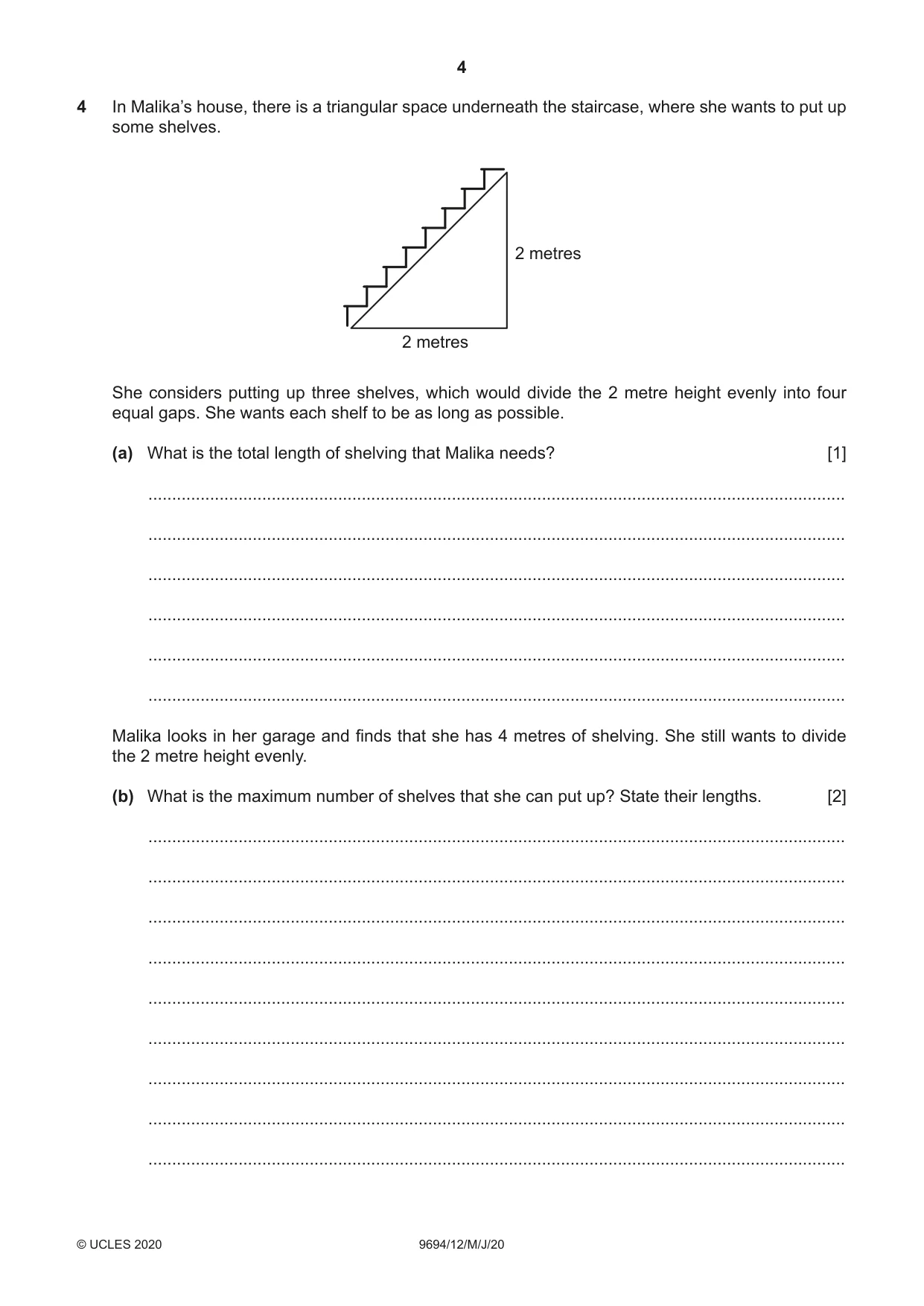
4 9694/12/M/J/20 © UCLES 2020 4 In Malika’s house, there is a triangular space underneath the staircase, where she wants to put up some shelves. 2 metres 2 metres She considers putting up three shelves, which would divide the 2 metre height evenly into four equal gaps. She wants each shelf to be as long as possible. (a) What is the total length of shelving that Malika needs? [1] … … … … … … Malika looks in her garage and finds that she has 4 metres of shelving. She still wants to divide the 2 metre height evenly. (b) What is the maximum number of shelves that she can put up? State their lengths. [2] … … … … … … … … …
Question paper, page 5
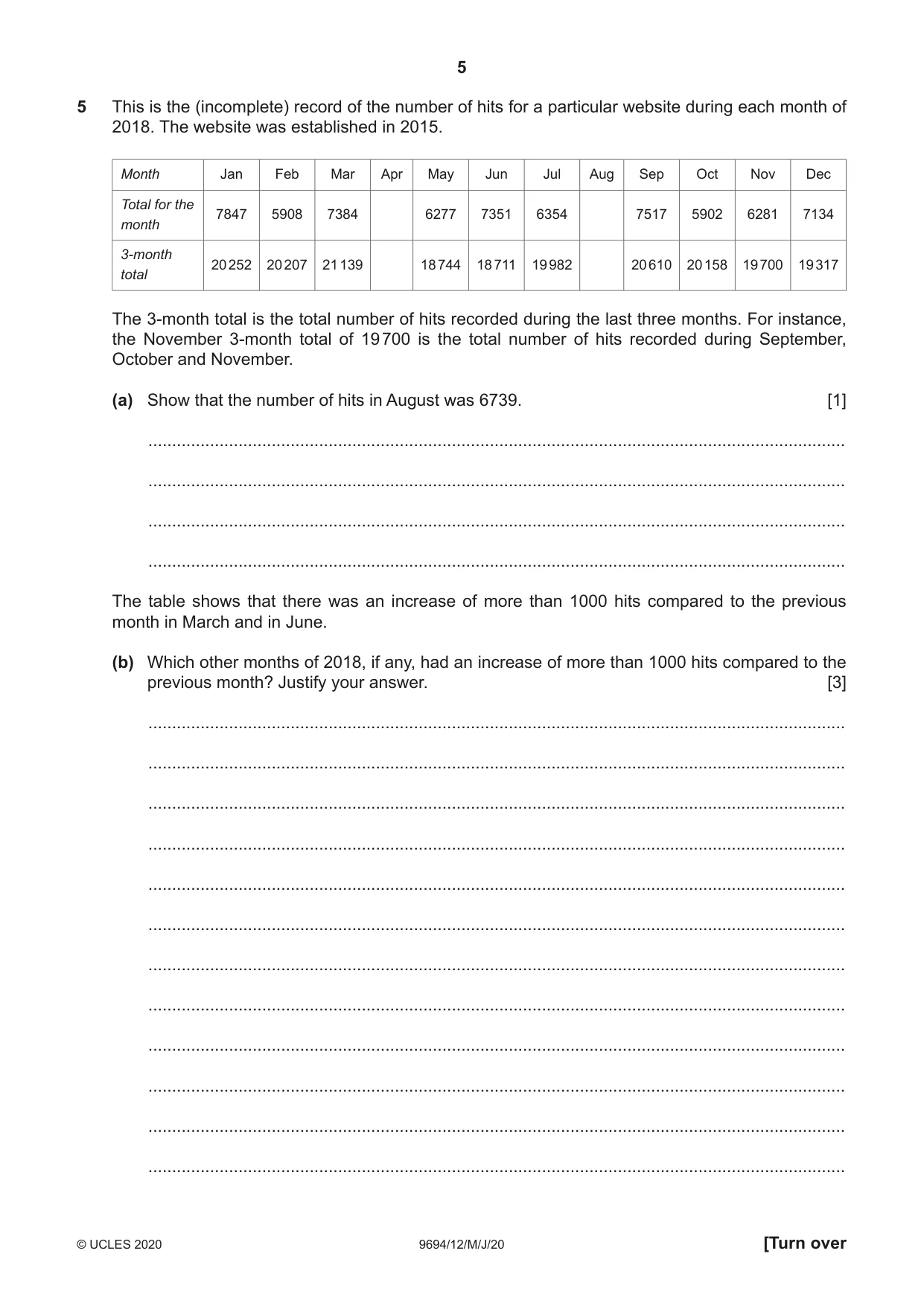
5 9694/12/M/J/20 © UCLES 2020 [Turn over 5 This is the (incomplete) record of the number of hits for a particular website during each month of 2018. The website was established in 2015. Month Jan Feb Mar Apr May Jun Jul Aug Sep Oct Nov Dec Total for the month 7847 5908 7384 6277 7351 6354 7517 5902 6281 7134 3-month total 20 252 20 207 21 139 18 744 18 711 19 982 20 610 20 158 19 700 19 317 The 3-month total is the total number of hits recorded during the last three months. For instance, the November 3-month total of 19 700 is the total number of hits recorded during September, October and November. (a) Show that the number of hits in August was 6739. [1] … … … … The table shows that there was an increase of more than 1000 hits compared to the previous month in March and in June. (b) Which other months of 2018, if any, had an increase of more than 1000 hits compared to the previous month? Justify your answer. [3] … … … … … … … … … … … …
Question paper, page 6
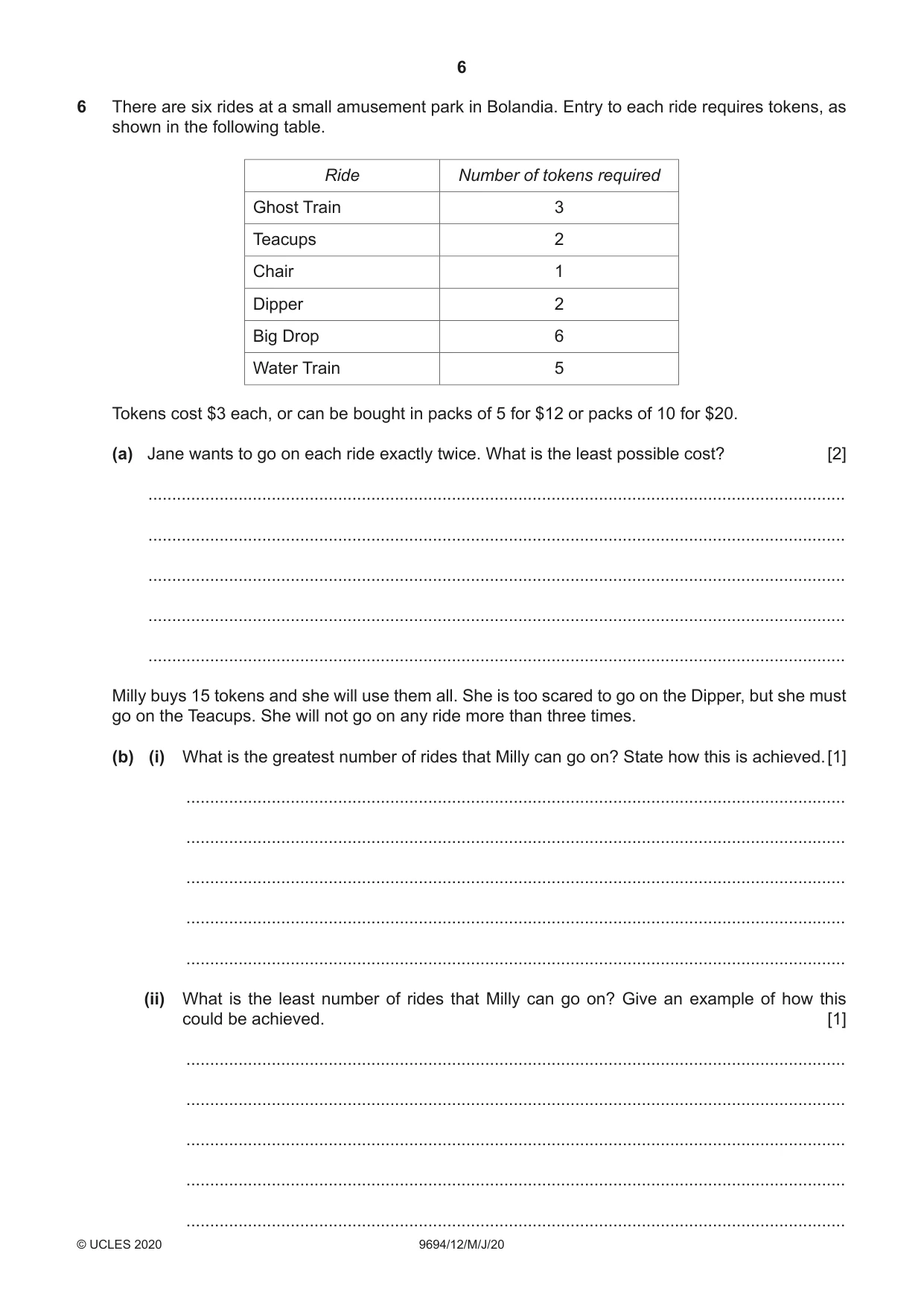
6 9694/12/M/J/20 © UCLES 2020 6 There are six rides at a small amusement park in Bolandia. Entry to each ride requires tokens, as shown in the following table. Ride Number of tokens required Ghost Train 3 Teacups 2 Chair 1 Dipper 2 Big Drop 6 Water Train 5 Tokens cost $3 each, or can be bought in packs of 5 for $12 or packs of 10 for $20. (a) Jane wants to go on each ride exactly twice. What is the least possible cost? [2] … … … … … Milly buys 15 tokens and she will use them all. She is too scared to go on the Dipper, but she must go on the Teacups. She will not go on any ride more than three times. (b) (i) What is the greatest number of rides that Milly can go on? State how this is achieved. [1] … … … … … (ii) What is the least number of rides that Milly can go on? Give an example of how this could be achieved. [1] … … … … …
Question paper, page 7
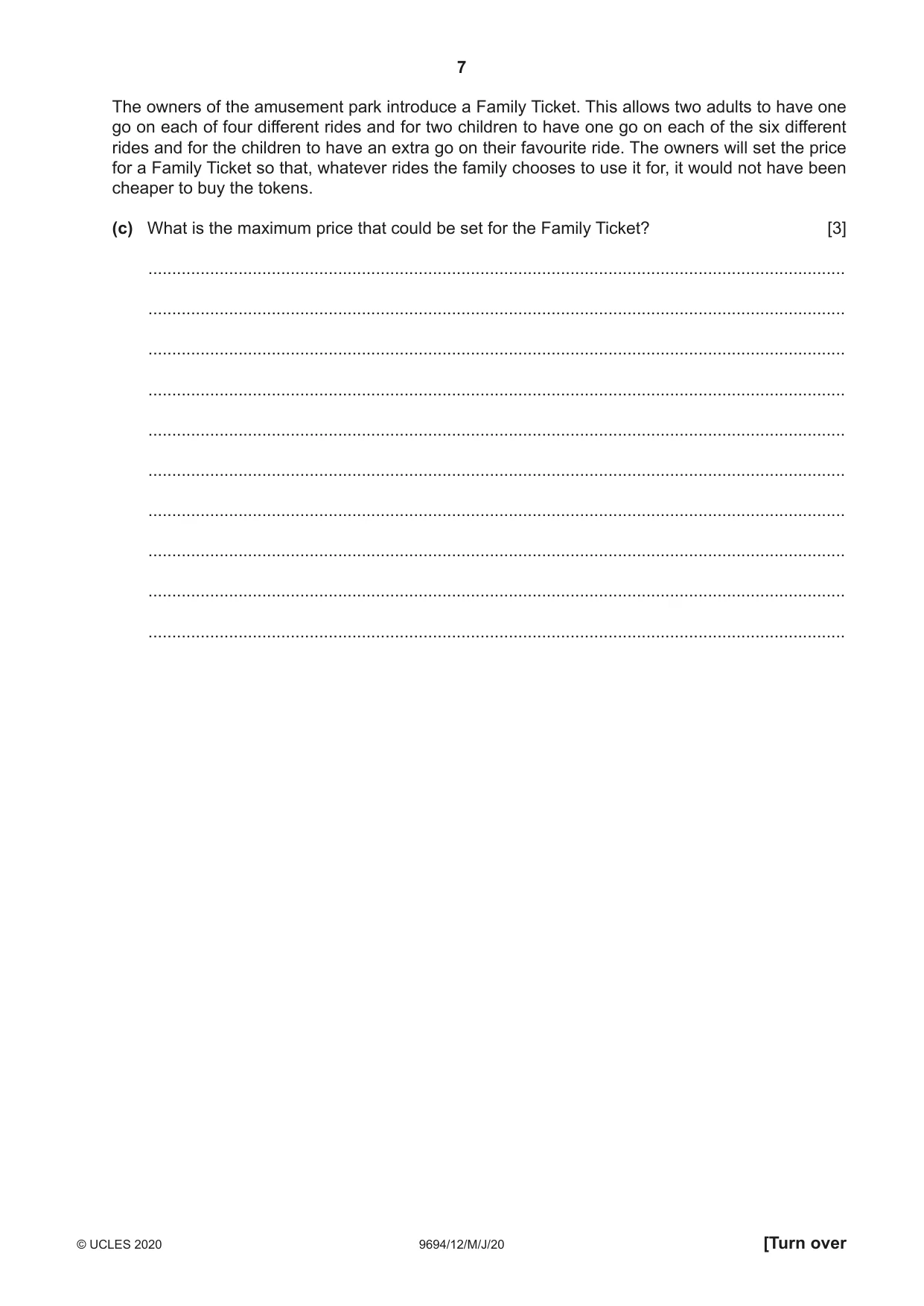
7 9694/12/M/J/20 © UCLES 2020 [Turn over The owners of the amusement park introduce a Family Ticket. This allows two adults to have one go on each of four different rides and for two children to have one go on each of the six different rides and for the children to have an extra go on their favourite ride. The owners will set the price for a Family Ticket so that, whatever rides the family chooses to use it for, it would not have been cheaper to buy the tokens. (c) What is the maximum price that could be set for the Family Ticket? [3] … … … … … … … … … …
Question paper, page 8
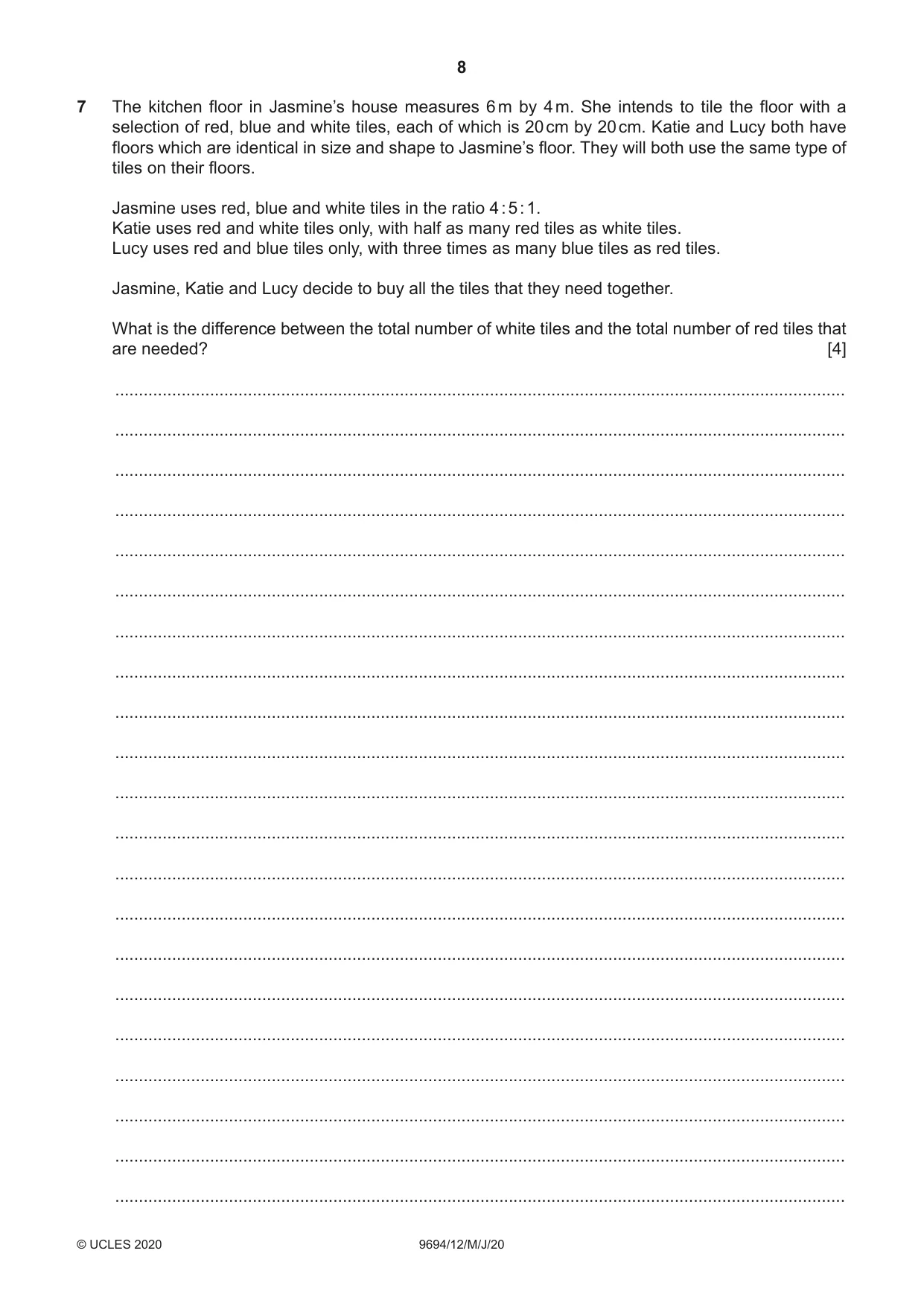
8 9694/12/M/J/20 © UCLES 2020 7 The kitchen floor in Jasmine’s house measures 6 m by 4 m. She intends to tile the floor with a selection of red, blue and white tiles, each of which is 20 cm by 20 cm. Katie and Lucy both have floors which are identical in size and shape to Jasmine’s floor. They will both use the same type of tiles on their floors. Jasmine uses red, blue and white tiles in the ratio 4 : 5 : 1. Katie uses red and white tiles only, with half as many red tiles as white tiles. Lucy uses red and blue tiles only, with three times as many blue tiles as red tiles. Jasmine, Katie and Lucy decide to buy all the tiles that they need together. What is the difference between the total number of white tiles and the total number of red tiles that are needed? [4] … … … … … … … … … … … … … … … … … … … … …
Question paper, page 9
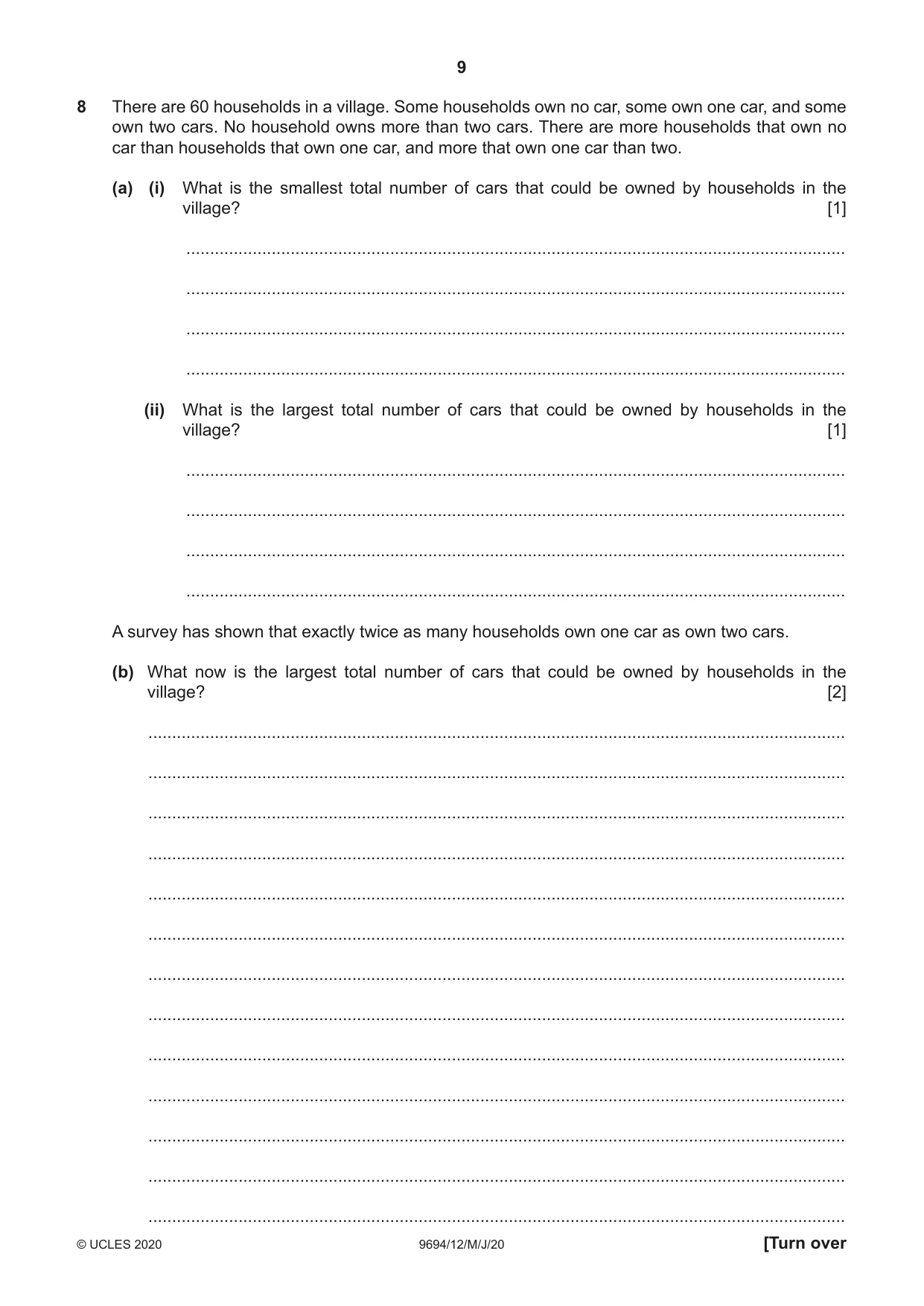
9 9694/12/M/J/20 © UCLES 2020 [Turn over 8 There are 60 households in a village. Some households own no car, some own one car, and some own two cars. No household owns more than two cars. There are more households that own no car than households that own one car, and more that own one car than two. (a) (i) What is the smallest total number of cars that could be owned by households in the village? [1] … … … … (ii) What is the largest total number of cars that could be owned by households in the village? [1] … … … … A survey has shown that exactly twice as many households own one car as own two cars. (b) What now is the largest total number of cars that could be owned by households in the village? [2] … … … … … … … … … … … … …
Question paper, page 10
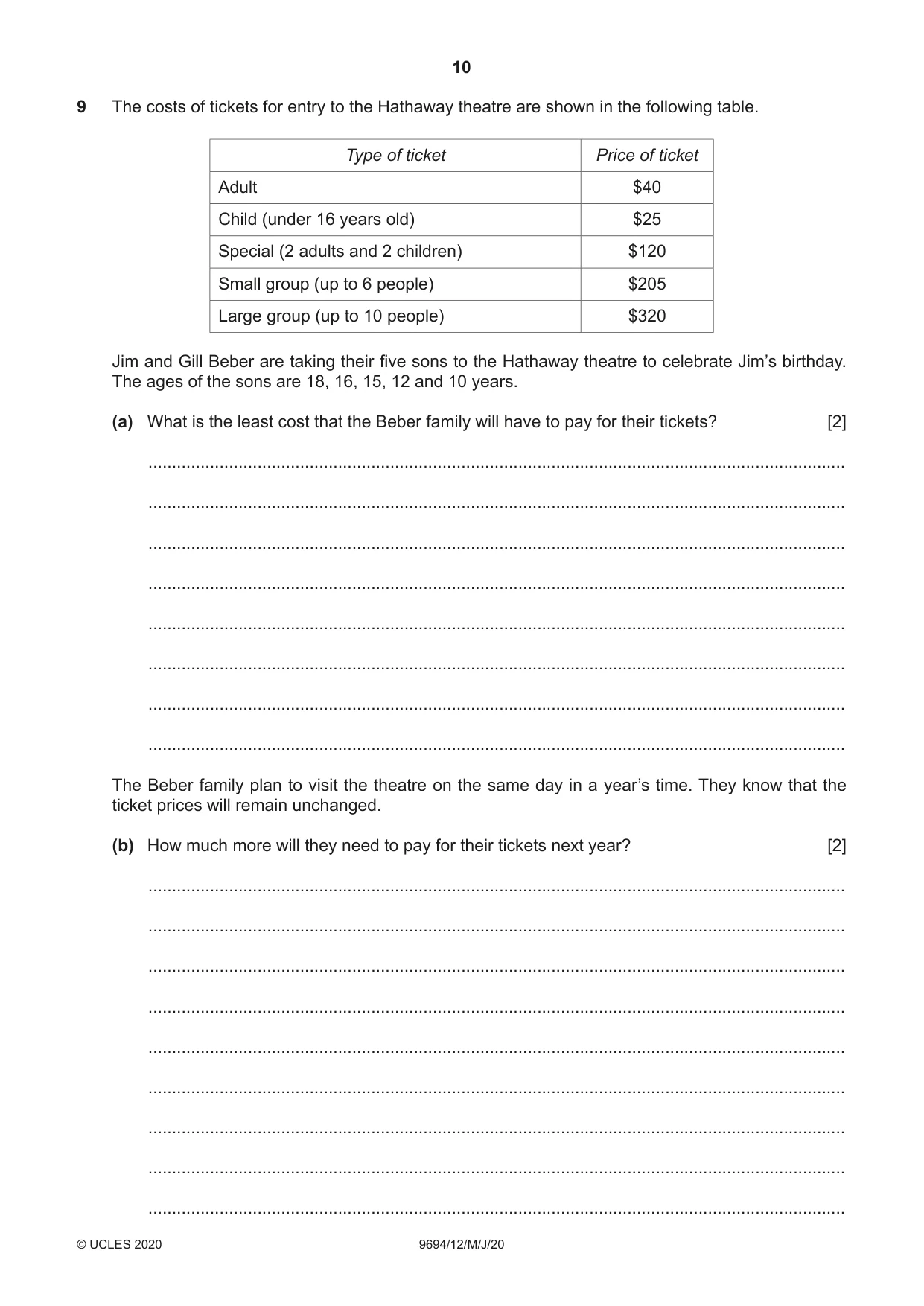
10 9694/12/M/J/20 © UCLES 2020 9 The costs of tickets for entry to the Hathaway theatre are shown in the following table. Type of ticket Price of ticket Adult $40 Child (under 16 years old) $25 Special (2 adults and 2 children) $120 Small group (up to 6 people) $205 Large group (up to 10 people) $320 Jim and Gill Beber are taking their five sons to the Hathaway theatre to celebrate Jim’s birthday. The ages of the sons are 18, 16, 15, 12 and 10 years. (a) What is the least cost that the Beber family will have to pay for their tickets? [2] … … … … … … … … The Beber family plan to visit the theatre on the same day in a year’s time. They know that the ticket prices will remain unchanged. (b) How much more will they need to pay for their tickets next year? [2] … … … … … … … … …
Question paper, page 11
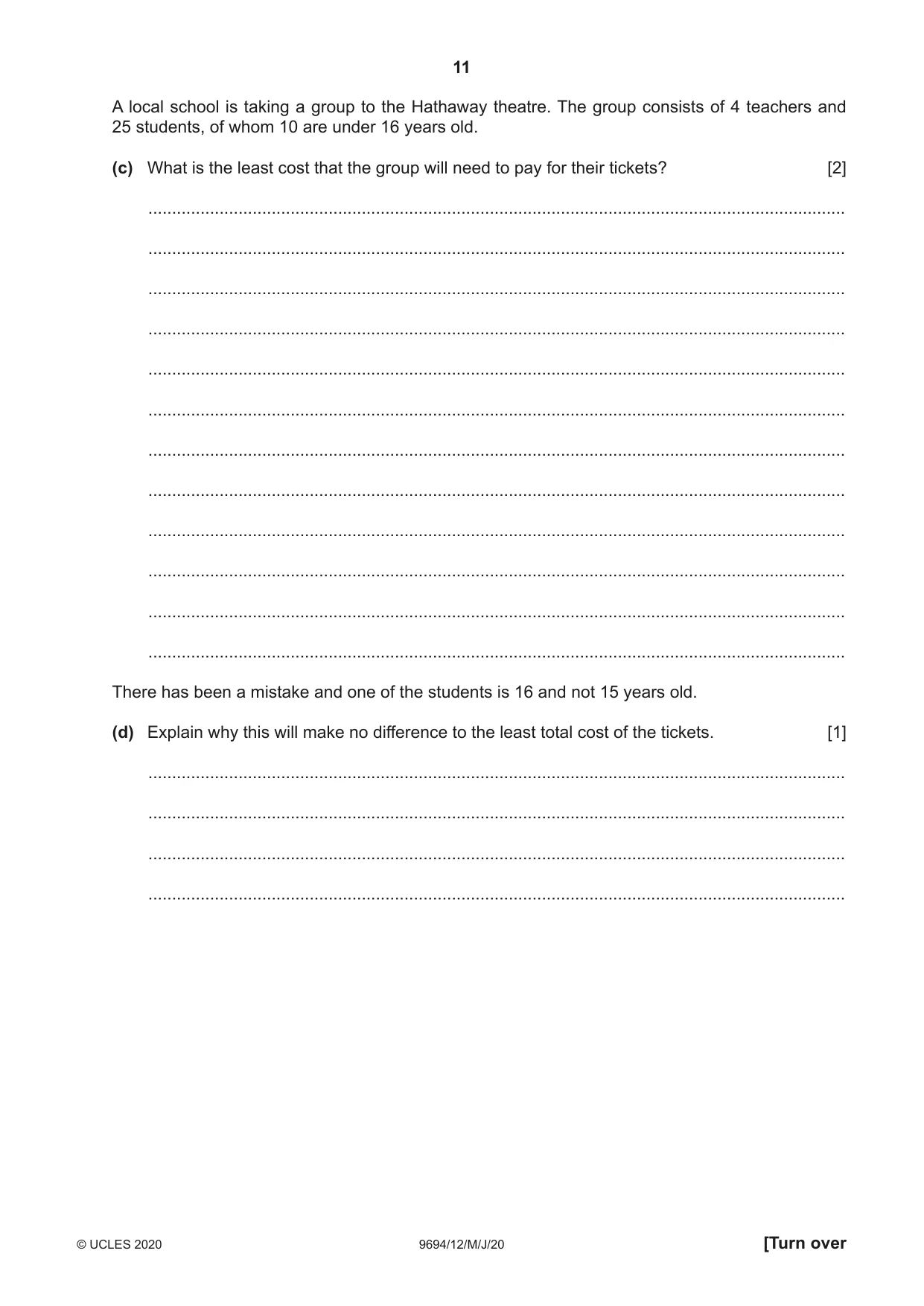
11 9694/12/M/J/20 © UCLES 2020 [Turn over A local school is taking a group to the Hathaway theatre. The group consists of 4 teachers and 25 students, of whom 10 are under 16 years old. (c) What is the least cost that the group will need to pay for their tickets? [2] … … … … … … … … … … … … There has been a mistake and one of the students is 16 and not 15 years old. (d) Explain why this will make no difference to the least total cost of the tickets. [1] … … … …
Question paper, page 12
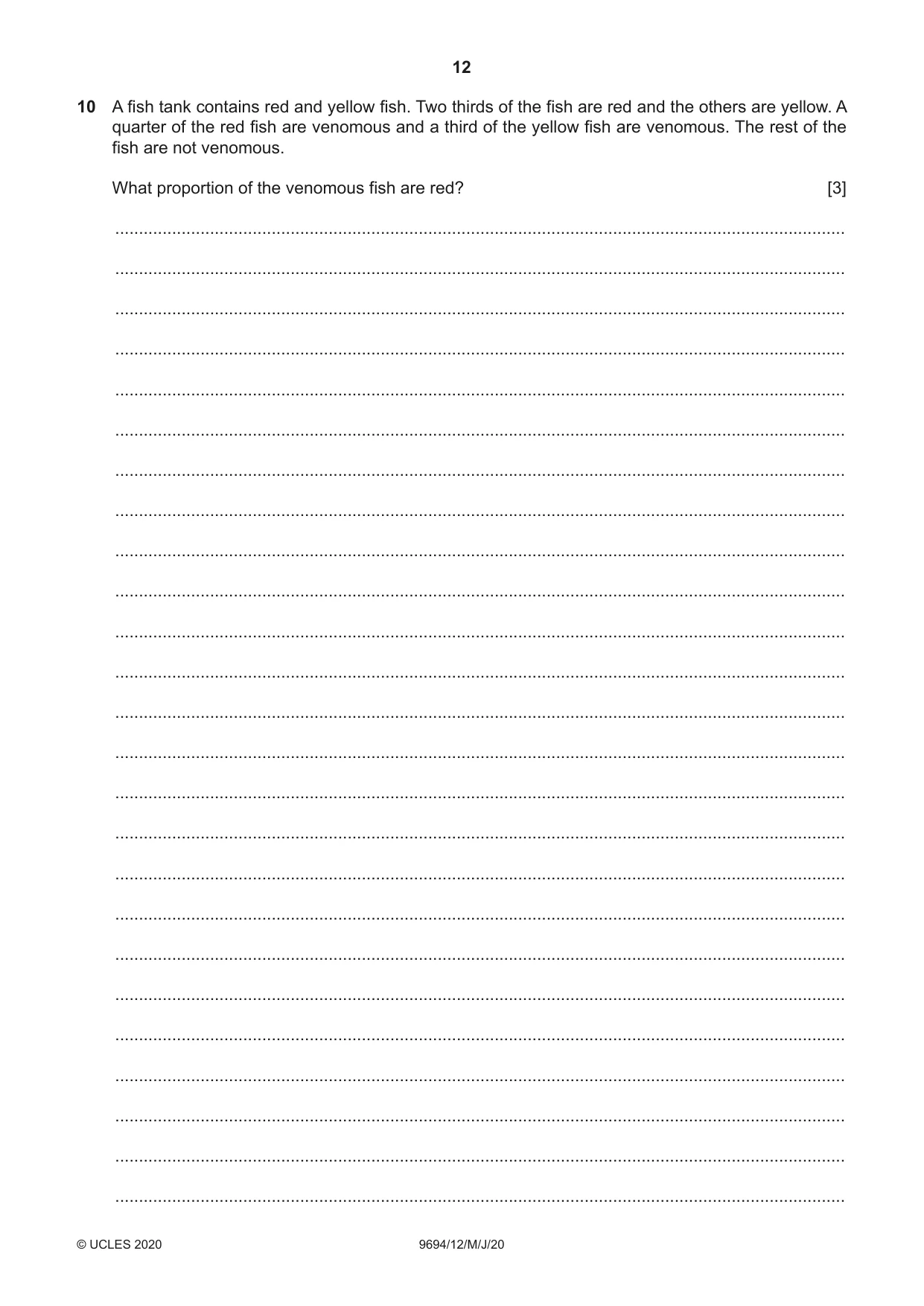
12 9694/12/M/J/20 © UCLES 2020 10 A fish tank contains red and yellow fish. Two thirds of the fish are red and the others are yellow. A quarter of the red fish are venomous and a third of the yellow fish are venomous. The rest of the fish are not venomous. What proportion of the venomous fish are red? [3] … … … … … … … … … … … … … … … … … … … … … … … … …
Question paper, page 13
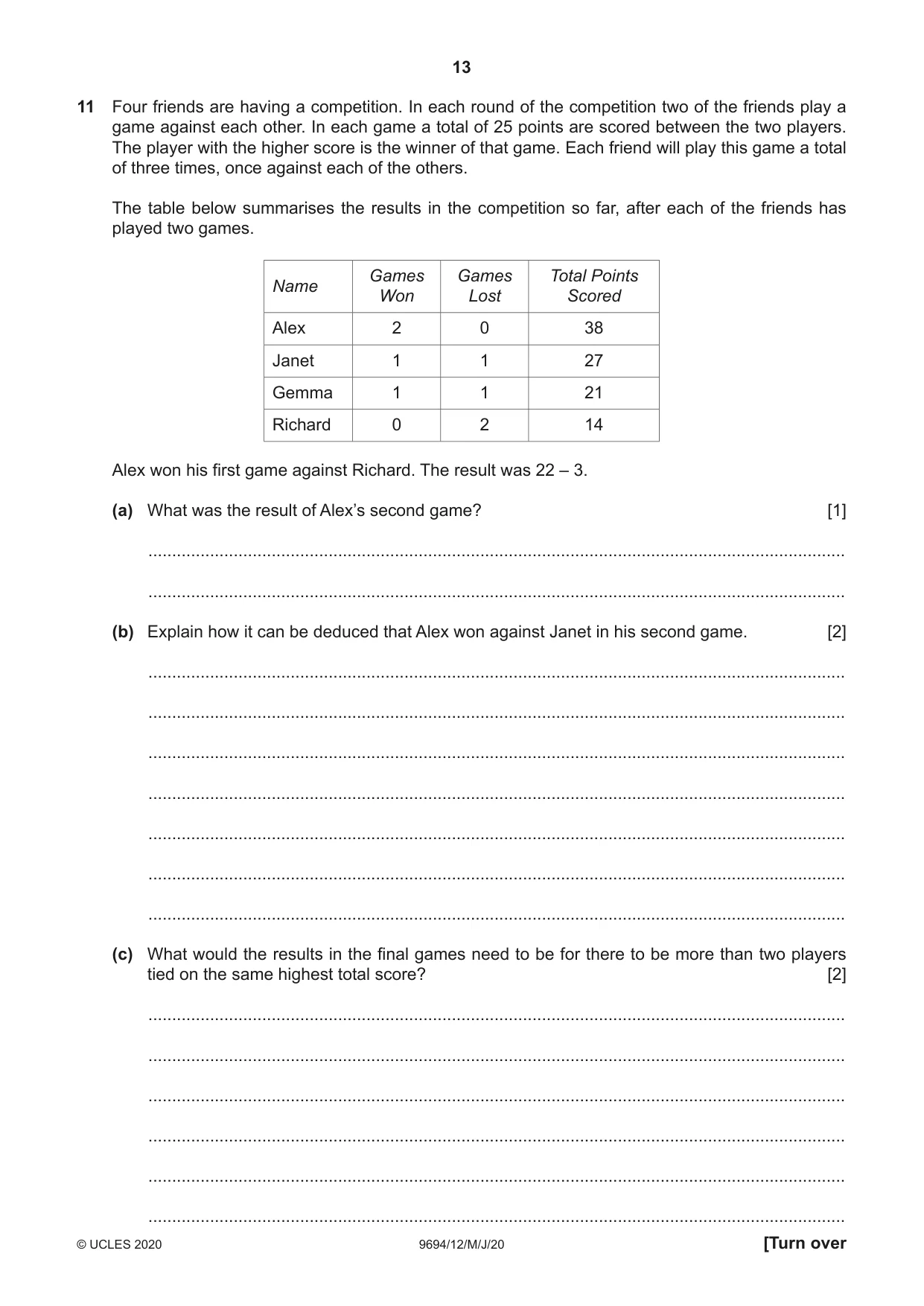
13 9694/12/M/J/20 © UCLES 2020 [Turn over 11 Four friends are having a competition. In each round of the competition two of the friends play a game against each other. In each game a total of 25 points are scored between the two players. The player with the higher score is the winner of that game. Each friend will play this game a total of three times, once against each of the others. The table below summarises the results in the competition so far, after each of the friends has played two games. Name Games Won Games Lost Total Points Scored Alex 2 0 38 Janet 1 1 27 Gemma 1 1 21 Richard 0 2 14 Alex won his first game against Richard. The result was 22 – 3. (a) What was the result of Alex’s second game? [1] … … (b) Explain how it can be deduced that Alex won against Janet in his second game. [2] … … … … … … … (c) What would the results in the final games need to be for there to be more than two players tied on the same highest total score? [2] … … … … … …
Question paper, page 14
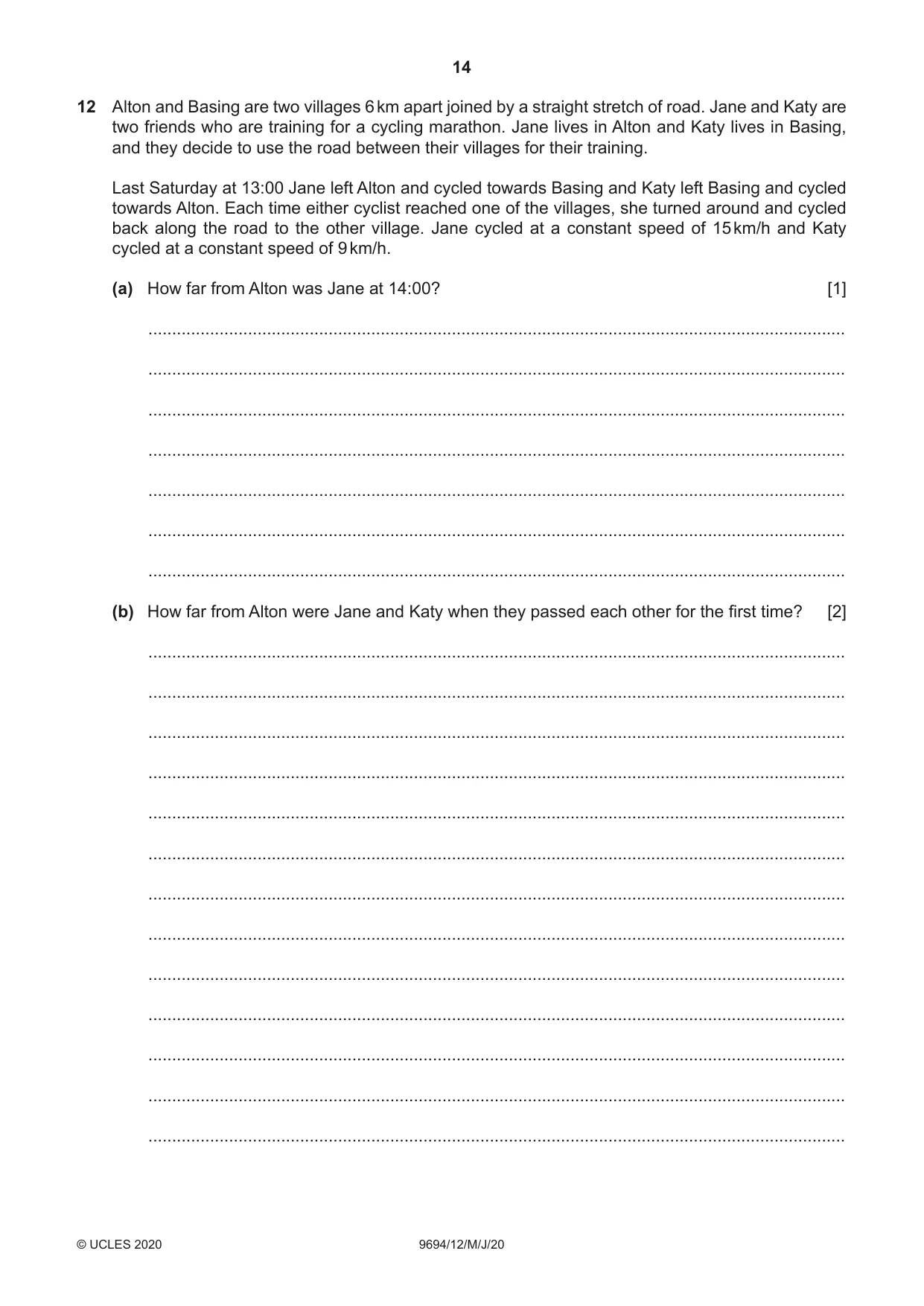
14 9694/12/M/J/20 © UCLES 2020 12 Alton and Basing are two villages 6 km apart joined by a straight stretch of road. Jane and Katy are two friends who are training for a cycling marathon. Jane lives in Alton and Katy lives in Basing, and they decide to use the road between their villages for their training. Last Saturday at 13:00 Jane left Alton and cycled towards Basing and Katy left Basing and cycled towards Alton. Each time either cyclist reached one of the villages, she turned around and cycled back along the road to the other village. Jane cycled at a constant speed of 15 km/h and Katy cycled at a constant speed of 9 km/h. (a) How far from Alton was Jane at 14:00? [1] … … … … … … … (b) How far from Alton were Jane and Katy when they passed each other for the first time? [2] … … … … … … … … … … … … …
Question paper, page 15
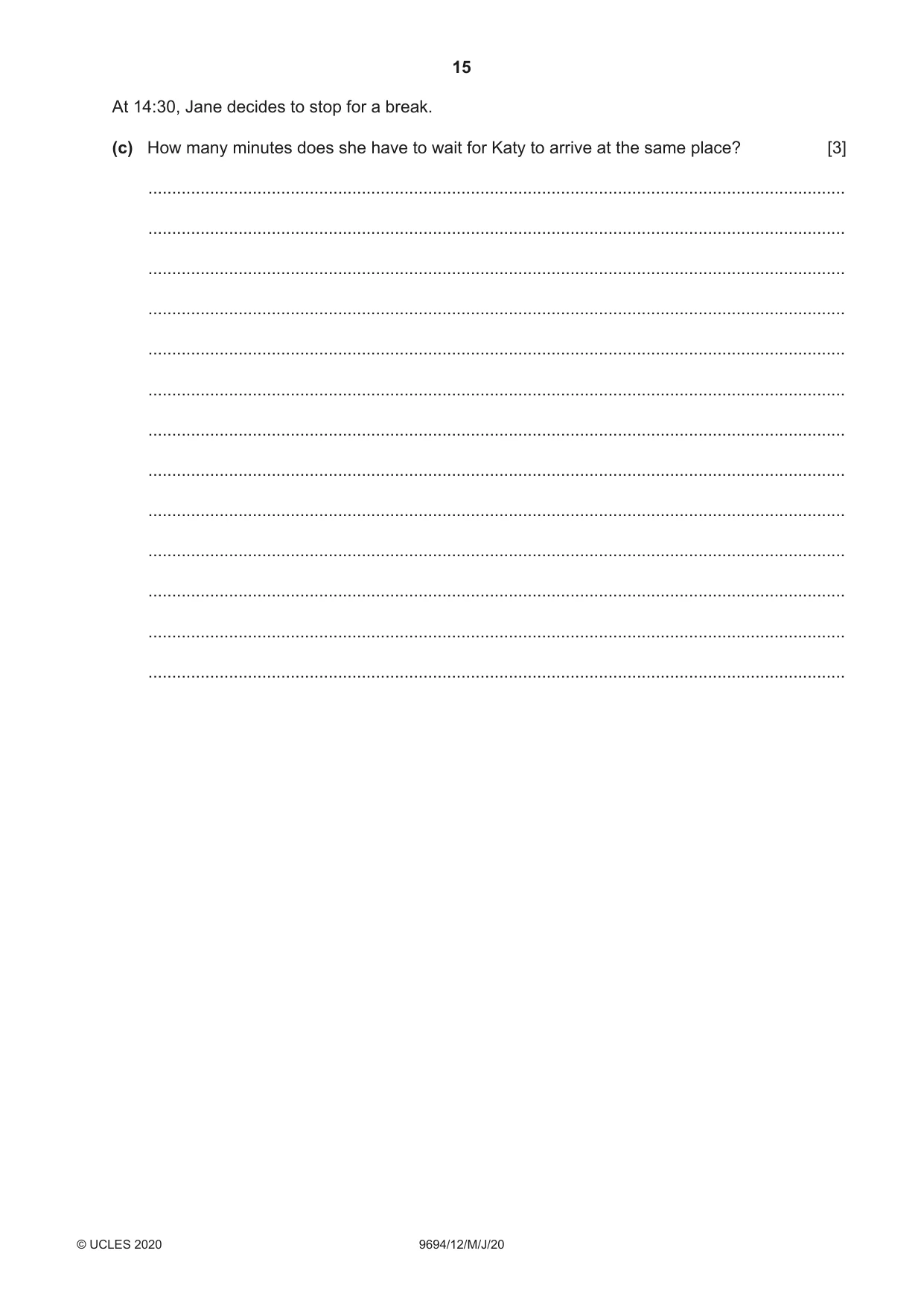
15 9694/12/M/J/20 © UCLES 2020 At 14:30, Jane decides to stop for a break. (c) How many minutes does she have to wait for Katy to arrive at the same place? [3] … … … … … … … … … … … … …
Question paper, page 16
16 9694/12/M/J/20 © UCLES 2020 Permission to reproduce items where third-party owned material protected by copyright is included has been sought and cleared where possible. Every reasonable effort has been made by the publisher (UCLES) to trace copyright holders, but if any items requiring clearance have unwittingly been included, the publisher will be pleased to make amends at the earliest possible opportunity. To avoid the issue of disclosure of answer-related information to candidates, all copyright acknowledgements are reproduced online in the Cambridge Assessment International Education Copyright Acknowledgements Booklet. This is produced for each series of examinations and is freely available to download at www.cambridgeinternational.org after the live examination series. Cambridge Assessment International Education is part of the Cambridge Assessment Group. Cambridge Assessment is the brand name of the University of Cambridge Local Examinations Syndicate (UCLES), which itself is a department of the University of Cambridge. BLANK PAGE
Mark scheme, page 1
This document consists of 8 printed pages. © UCLES 2020 [Turn over Cambridge International AS & A Level THINKING SKILLS 9694/12 Paper 1 Problem Solving May/June 2020 MARK SCHEME Maximum Mark: 50 Published Students did not sit exam papers in the June 2020 series due to the Covid-19 global pandemic. This mark scheme is published to support teachers and students and should be read together with the question paper. It shows the requirements of the exam. The answer column of the mark scheme shows the proposed basis on which Examiners would award marks for this exam. Where appropriate, this column also provides the most likely acceptable alternative responses expected from students. Examiners usually review the mark scheme after they have seen student responses and update the mark scheme if appropriate. In the June series, Examiners were unable to consider the acceptability of alternative responses, as there were no student responses to consider. Mark schemes should usually be read together with the Principal Examiner Report for Teachers. However, because students did not sit exam papers, there is no Principal Examiner Report for Teachers for the June 2020 series. Cambridge International will not enter into discussions about these mark schemes. Cambridge International is publishing the mark schemes for the June 2020 series for most Cambridge IGCSE™ and Cambridge International A & AS Level components, and some Cambridge O Level components.
Mark scheme, page 2
9694/12 Cambridge International AS & A Level – Mark Scheme PUBLISHED May/June 2020 © UCLES 2020 Page 2 of 8 Generic Marking Principles These general marking principles must be applied by all examiners when marking candidate answers. They should be applied alongside the specific content of the mark scheme or generic level descriptors for a question. Each question paper and mark scheme will also comply with these marking principles. GENERIC MARKING PRINCIPLE 1: Marks must be awarded in line with: • the specific content of the mark scheme or the generic level descriptors for the question • the specific skills defined in the mark scheme or in the generic level descriptors for the question • the standard of response required by a candidate as exemplified by the standardisation scripts. GENERIC MARKING PRINCIPLE 2: Marks awarded are always whole marks (not half marks, or other fractions). GENERIC MARKING PRINCIPLE 3: Marks must be awarded positively: • marks are awarded for correct/valid answers, as defined in the mark scheme. However, credit is given for valid answers which go beyond the scope of the syllabus and mark scheme, referring to your Team Leader as appropriate • marks are awarded when candidates clearly demonstrate what they know and can do • marks are not deducted for errors • marks are not deducted for omissions • answers should only be judged on the quality of spelling, punctuation and grammar when these features are specifically assessed by the question as indicated by the mark scheme. The meaning, however, should be unambiguous. GENERIC MARKING PRINCIPLE 4: Rules must be applied consistently e.g. in situations where candidates have not followed instructions or in the application of generic level descriptors. GENERIC MARKING PRINCIPLE 5: Marks should be awarded using the full range of marks defined in the mark scheme for the question (however; the use of the full mark range may be limited according to the quality of the candidate responses seen). GENERIC MARKING PRINCIPLE 6: Marks awarded are based solely on the requirements as defined in the mark scheme. Marks should not be awarded with grade thresholds or grade descriptors in mind.
Mark scheme, page 3
9694/12 Cambridge International AS & A Level – Mark Scheme PUBLISHED May/June 2020 © UCLES 2020 Page 3 of 8 NOTES FOR MARKERS Working Where a final answer is underlined in the mark scheme, full marks are awarded for a correct answer, regardless of whether there is any supporting working, unless an exception is noted in the mark scheme. For partial credit, the evidence needed to award the mark will usually be shown on its own line in the mark scheme, or else will be defined in italic text. For explanations and verbal justifications, apply the principle of ‘words to that effect’. No response If there is any attempt at a solution award 0 marks not NR. “-” or “?” constitute no attempt at a solution. Abbreviations The following abbreviations may be used in a mark scheme: AG answer given (on question paper) awrt answer which rounds to FT follow through (from earlier error) oe or equivalent SC special case soi seen or implied
Mark scheme, page 4
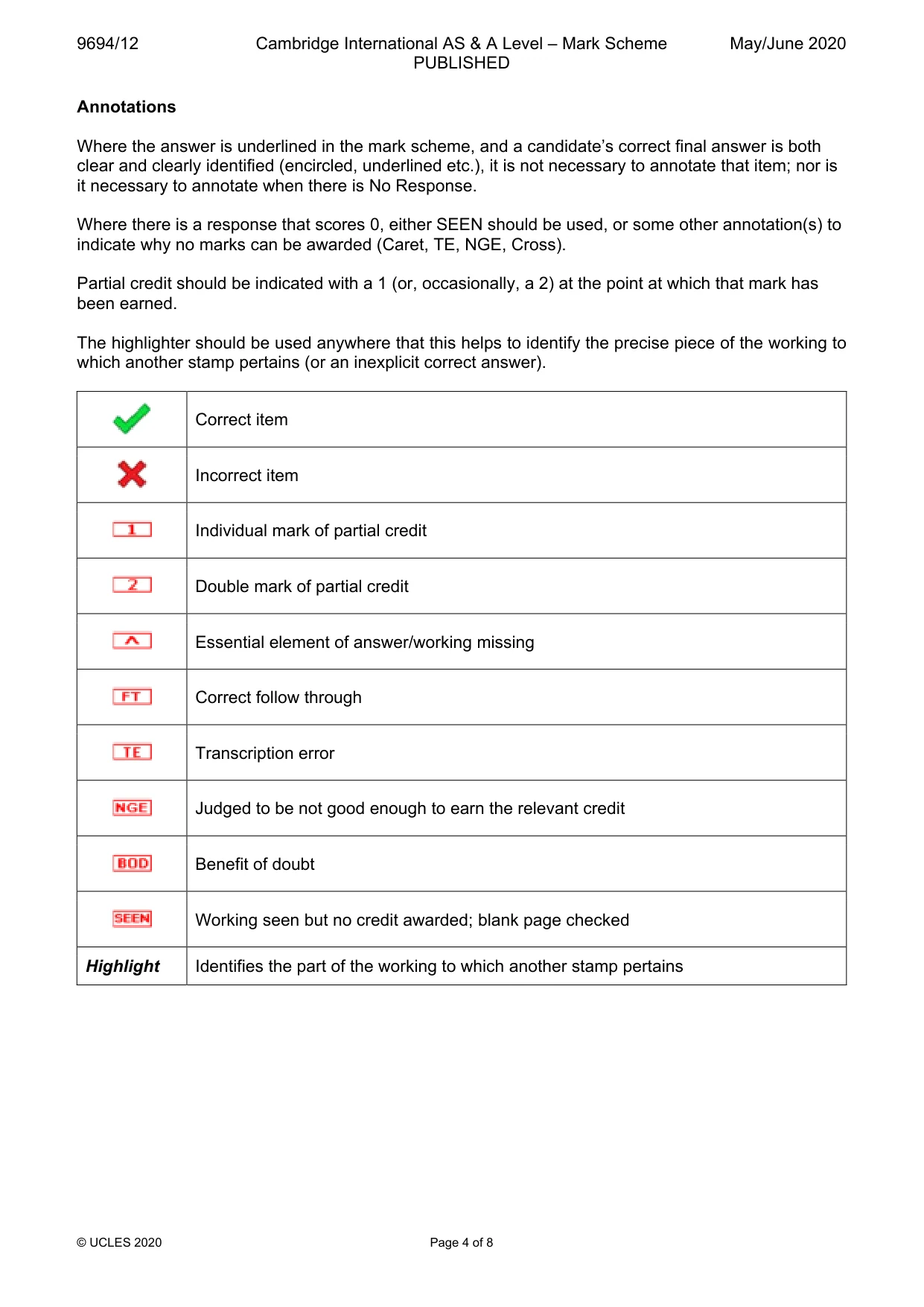
9694/12 Cambridge International AS & A Level – Mark Scheme PUBLISHED May/June 2020 © UCLES 2020 Page 4 of 8 Annotations Where the answer is underlined in the mark scheme, and a candidate’s correct final answer is both clear and clearly identified (encircled, underlined etc.), it is not necessary to annotate that item; nor is it necessary to annotate when there is No Response. Where there is a response that scores 0, either SEEN should be used, or some other annotation(s) to indicate why no marks can be awarded (Caret, TE, NGE, Cross). Partial credit should be indicated with a 1 (or, occasionally, a 2) at the point at which that mark has been earned. The highlighter should be used anywhere that this helps to identify the precise piece of the working to which another stamp pertains (or an inexplicit correct answer). Correct item Incorrect item Individual mark of partial credit Double mark of partial credit Essential element of answer/working missing Correct follow through Transcription error Judged to be not good enough to earn the relevant credit Benefit of doubt Working seen but no credit awarded; blank page checked Highlight Identifies the part of the working to which another stamp pertains
Mark scheme, page 5
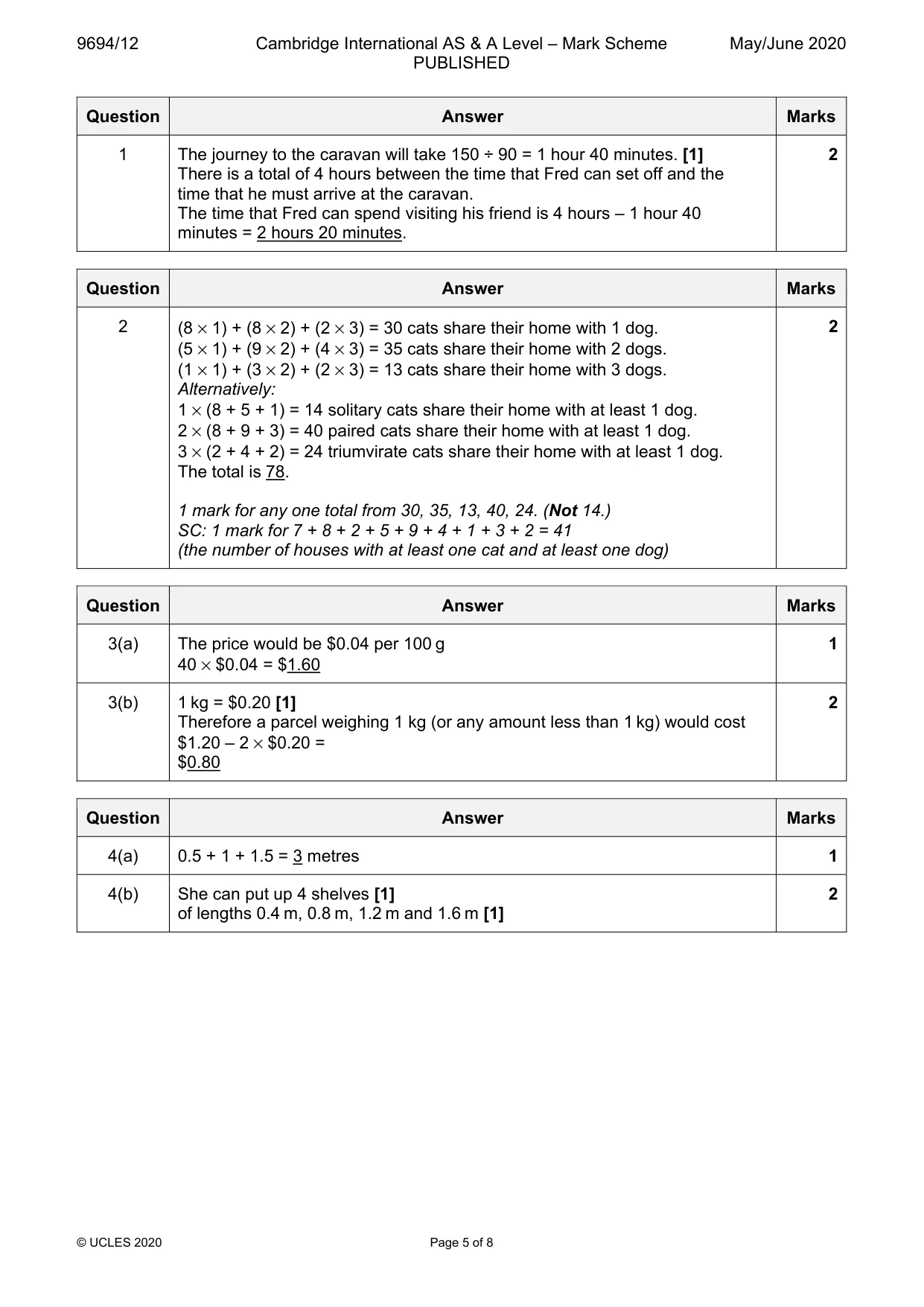
9694/12 Cambridge International AS & A Level – Mark Scheme PUBLISHED May/June 2020 © UCLES 2020 Page 5 of 8 Question Answer Marks 1 The journey to the caravan will take 150 ÷ 90 = 1 hour 40 minutes. [1] There is a total of 4 hours between the time that Fred can set off and the time that he must arrive at the caravan. The time that Fred can spend visiting his friend is 4 hours – 1 hour 40 minutes = 2 hours 20 minutes. 2 Question Answer Marks 2 (8 × 1) + (8 × 2) + (2 × 3) = 30 cats share their home with 1 dog. (5 × 1) + (9 × 2) + (4 × 3) = 35 cats share their home with 2 dogs. (1 × 1) + (3 × 2) + (2 × 3) = 13 cats share their home with 3 dogs. Alternatively: 1 × (8 + 5 + 1) = 14 solitary cats share their home with at least 1 dog. 2 × (8 + 9 + 3) = 40 paired cats share their home with at least 1 dog. 3 × (2 + 4 + 2) = 24 triumvirate cats share their home with at least 1 dog. The total is 78. 1 mark for any one total from 30, 35, 13, 40, 24. (Not 14.) SC: 1 mark for 7 + 8 + 2 + 5 + 9 + 4 + 1 + 3 + 2 = 41 (the number of houses with at least one cat and at least one dog) 2 Question Answer Marks 3(a) The price would be $0.04 per 100 g 40 × $0.04 = $1.60 1 3(b) 1 kg = $0.20 [1] Therefore a parcel weighing 1 kg (or any amount less than 1 kg) would cost $1.20 – 2 × $0.20 = $0.80 2 Question Answer Marks 4(a) 0.5 + 1 + 1.5 = 3 metres 1 4(b) She can put up 4 shelves [1] of lengths 0.4 m, 0.8 m, 1.2 m and 1.6 m [1] 2
Mark scheme, page 6
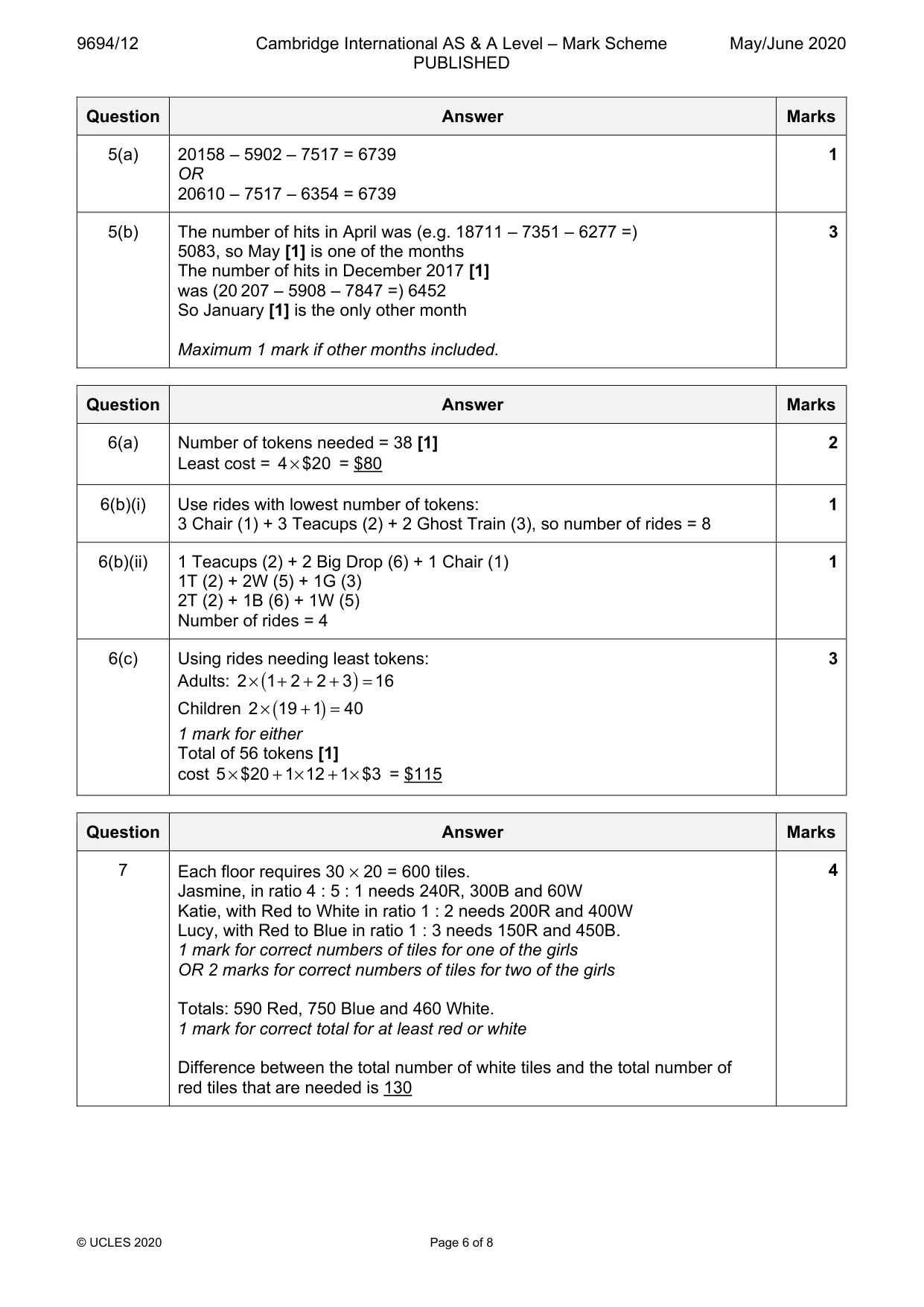
9694/12 Cambridge International AS & A Level – Mark Scheme PUBLISHED May/June 2020 © UCLES 2020 Page 6 of 8 Question Answer Marks 5(a) 20158 – 5902 – 7517 = 6739 OR 20610 – 7517 – 6354 = 6739 1 5(b) The number of hits in April was (e.g. 18711 – 7351 – 6277 =) 5083, so May [1] is one of the months The number of hits in December 2017 [1] was (20 207 – 5908 – 7847 =) 6452 So January [1] is the only other month Maximum 1 mark if other months included. 3 Question Answer Marks 6(a) Number of tokens needed = 38 [1] Least cost = 4 $20 × = $80 2 6(b)(i) Use rides with lowest number of tokens: 3 Chair (1) + 3 Teacups (2) + 2 Ghost Train (3), so number of rides = 8 1 6(b)(ii) 1 Teacups (2) + 2 Big Drop (6) + 1 Chair (1) 1T (2) + 2W (5) + 1G (3) 2T (2) + 1B (6) + 1W (5) Number of rides = 4 1 6(c) Using rides needing least tokens: Adults: ( ) 2 1 2 2 3 16 × + + + = Children ( ) 2 19 1 40 × + = 1 mark for either Total of 56 tokens [1] cost 5 $20 1 12 1 $3 × + × + × = $115 3 Question Answer Marks 7 Each floor requires 30 × 20 = 600 tiles. Jasmine, in ratio 4 : 5 : 1 needs 240R, 300B and 60W Katie, with Red to White in ratio 1 : 2 needs 200R and 400W Lucy, with Red to Blue in ratio 1 : 3 needs 150R and 450B. 1 mark for correct numbers of tiles for one of the girls OR 2 marks for correct numbers of tiles for two of the girls Totals: 590 Red, 750 Blue and 460 White. 1 mark for correct total for at least red or white Difference between the total number of white tiles and the total number of red tiles that are needed is 130 4
Mark scheme, page 7
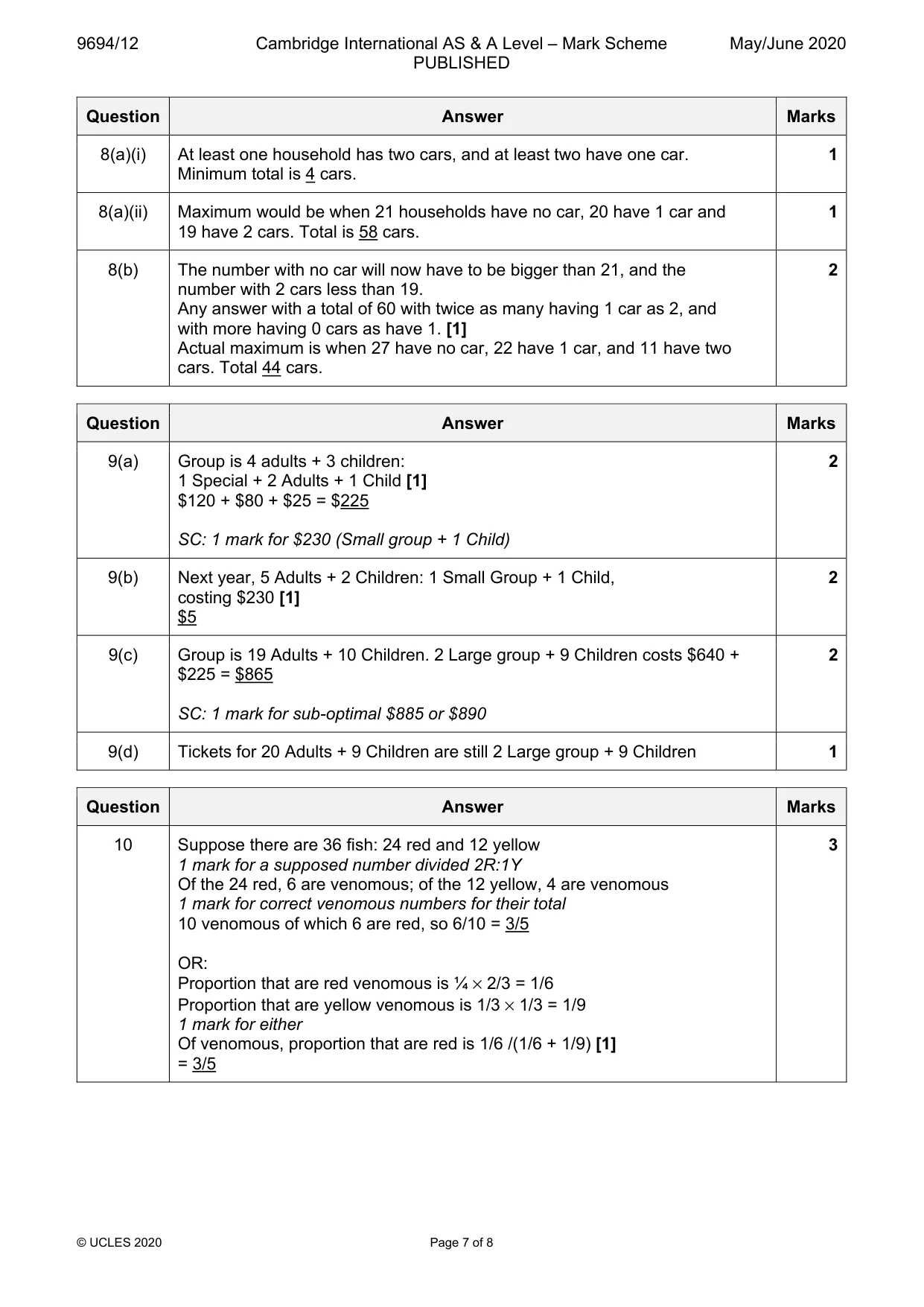
9694/12 Cambridge International AS & A Level – Mark Scheme PUBLISHED May/June 2020 © UCLES 2020 Page 7 of 8 Question Answer Marks 8(a)(i) At least one household has two cars, and at least two have one car. Minimum total is 4 cars. 1 8(a)(ii) Maximum would be when 21 households have no car, 20 have 1 car and 19 have 2 cars. Total is 58 cars. 1 8(b) The number with no car will now have to be bigger than 21, and the number with 2 cars less than 19. Any answer with a total of 60 with twice as many having 1 car as 2, and with more having 0 cars as have 1. [1] Actual maximum is when 27 have no car, 22 have 1 car, and 11 have two cars. Total 44 cars. 2 Question Answer Marks 9(a) Group is 4 adults + 3 children: 1 Special + 2 Adults + 1 Child [1] $120 + $80 + $25 = $225 SC: 1 mark for $230 (Small group + 1 Child) 2 9(b) Next year, 5 Adults + 2 Children: 1 Small Group + 1 Child, costing $230 [1] $5 2 9(c) Group is 19 Adults + 10 Children. 2 Large group + 9 Children costs $640 + $225 = $865 SC: 1 mark for sub-optimal $885 or $890 2 9(d) Tickets for 20 Adults + 9 Children are still 2 Large group + 9 Children 1 Question Answer Marks 10 Suppose there are 36 fish: 24 red and 12 yellow 1 mark for a supposed number divided 2R:1Y Of the 24 red, 6 are venomous; of the 12 yellow, 4 are venomous 1 mark for correct venomous numbers for their total 10 venomous of which 6 are red, so 6/10 = 3/5 OR: Proportion that are red venomous is ¼ × 2/3 = 1/6 Proportion that are yellow venomous is 1/3 × 1/3 = 1/9 1 mark for either Of venomous, proportion that are red is 1/6 /(1/6 + 1/9) [1] = 3/5 3
Mark scheme, page 8
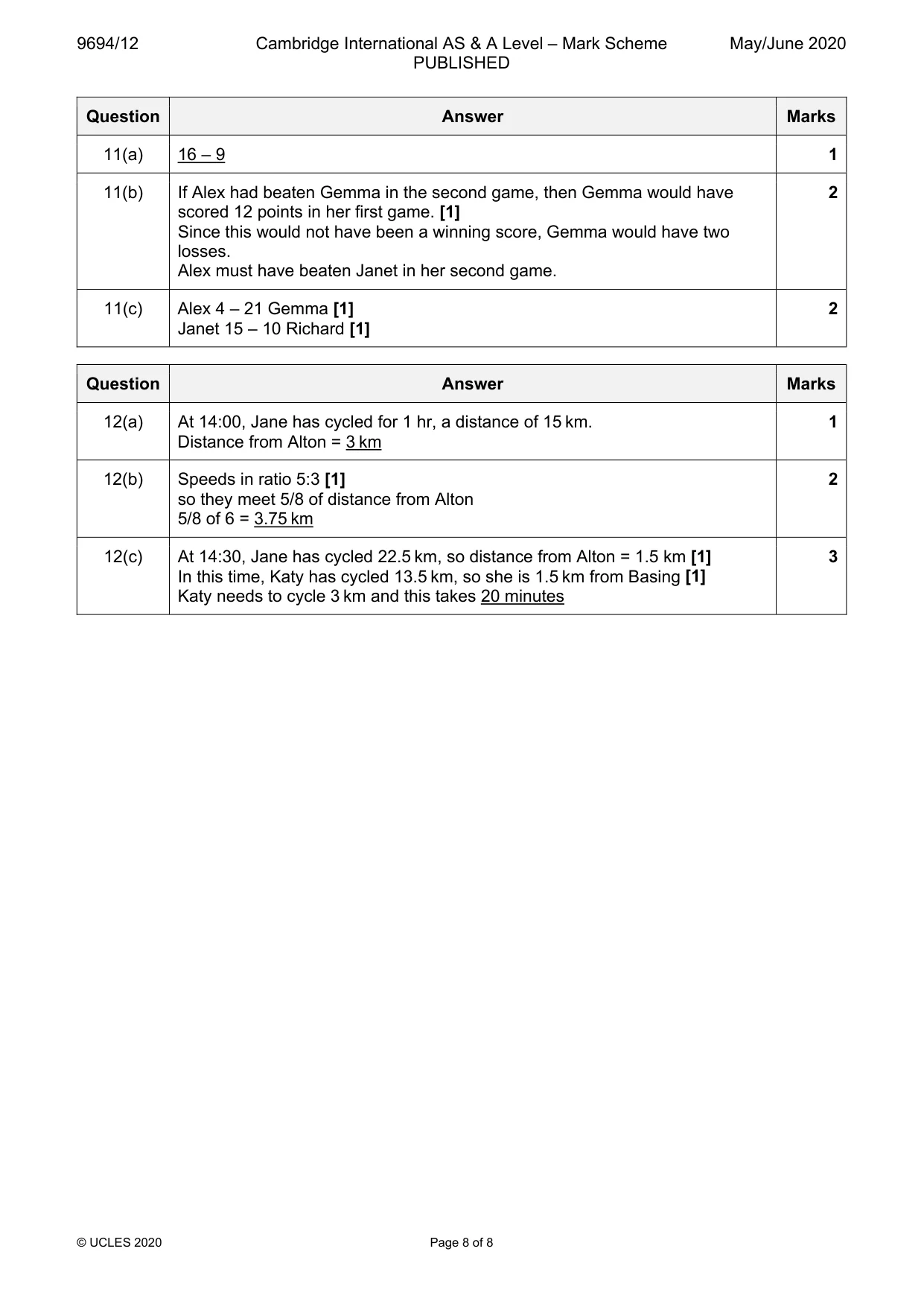
9694/12 Cambridge International AS & A Level – Mark Scheme PUBLISHED May/June 2020 © UCLES 2020 Page 8 of 8 Question Answer Marks 11(a) 16 – 9 1 11(b) If Alex had beaten Gemma in the second game, then Gemma would have scored 12 points in her first game. [1] Since this would not have been a winning score, Gemma would have two losses. Alex must have beaten Janet in her second game. 2 11(c) Alex 4 – 21 Gemma [1] Janet 15 – 10 Richard [1] 2 Question Answer Marks 12(a) At 14:00, Jane has cycled for 1 hr, a distance of 15 km. Distance from Alton = 3 km 1 12(b) Speeds in ratio 5:3 [1] so they meet 5/8 of distance from Alton 5/8 of 6 = 3.75 km 2 12(c) At 14:30, Jane has cycled 22.5 km, so distance from Alton = 1.5 km [1] In this time, Katy has cycled 13.5 km, so she is 1.5 km from Basing [1] Katy needs to cycle 3 km and this takes 20 minutes 3