Cambridge A Level Thinking Skills 9694 — 2017 May/June Paper 2 · Variant 3
9694/23/M/J/17 · 45 marks · ≈51 min
The question paper and its mark scheme, free to read here and free to download. This is Cambridge’s own paper, exactly as it was sat.
Question paper8 pages


Mark scheme9 pages
Answers below. Sit the paper first if you are practising.
Paper as text
Question paper, page 1
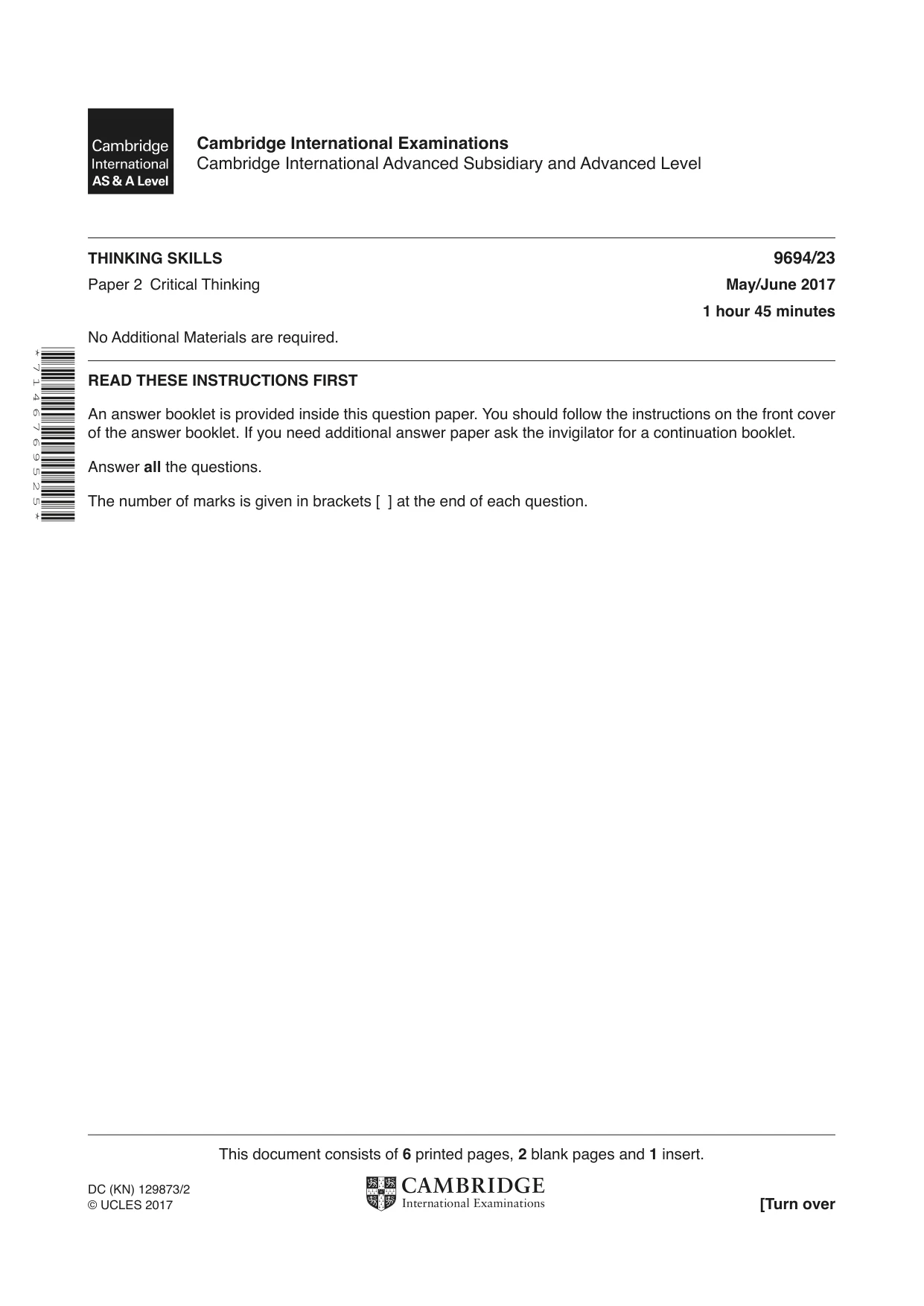
This document consists of 6 printed pages, 2 blank pages and 1 insert. DC (KN) 129873/2 © UCLES 2017 [Turn over Cambridge International Examinations Cambridge International Advanced Subsidiary and Advanced Level * 7 1 4 6 7 6 9 5 2 5 * THINKING SKILLS 9694/23 Paper 2 Critical Thinking May/June 2017 1 hour 45 minutes No Additional Materials are required. READ THESE INSTRUCTIONS FIRST An answer booklet is provided inside this question paper. You should follow the instructions on the front cover of the answer booklet. If you need additional answer paper ask the invigilator for a continuation booklet. Answer all the questions. The number of marks is given in brackets [ ] at the end of each question.
Question paper, page 2
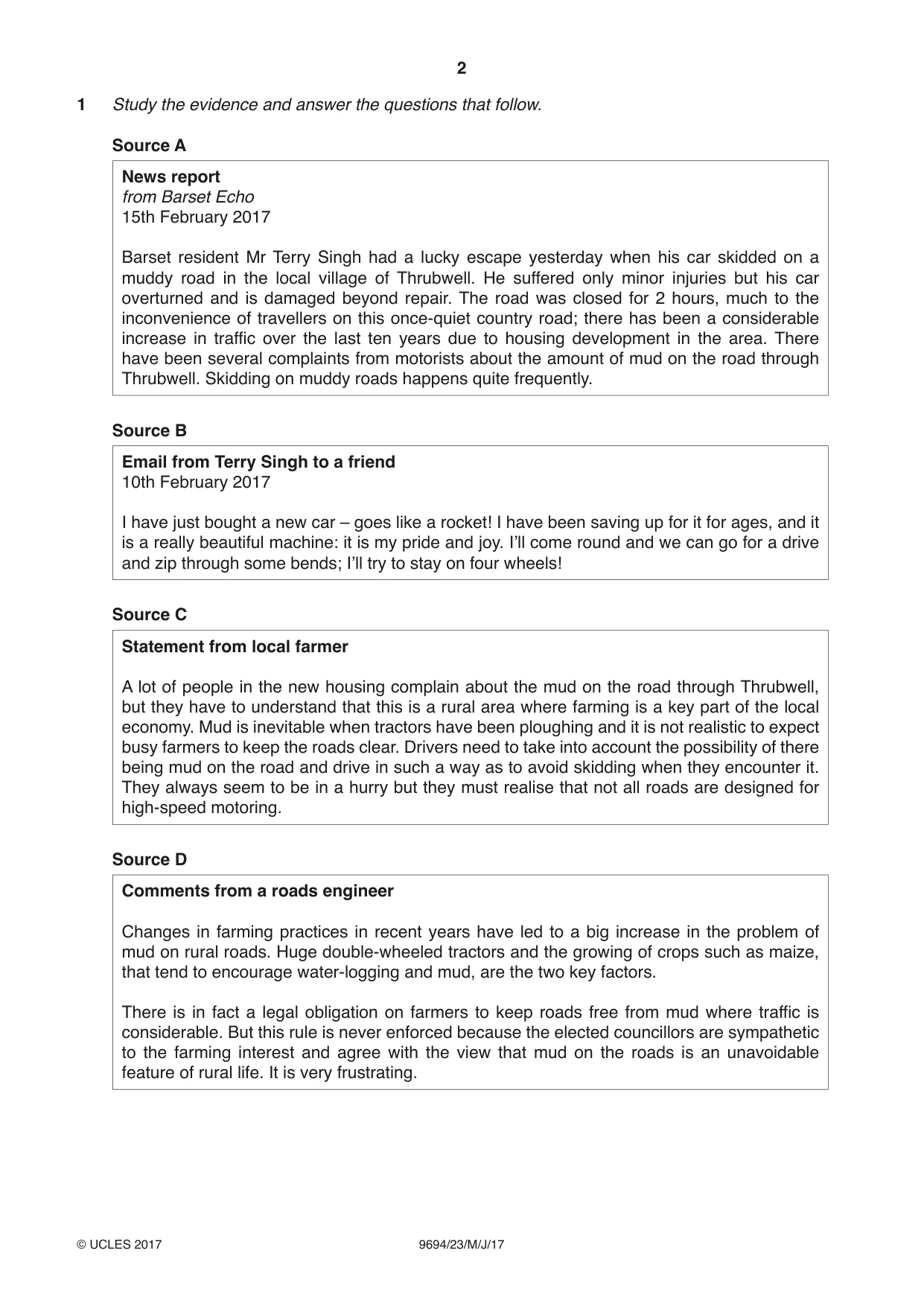
2 9694/23/M/J/17 © UCLES 2017 1 Study the evidence and answer the questions that follow. Source A News report from Barset Echo 15th February 2017 Barset resident Mr Terry Singh had a lucky escape yesterday when his car skidded on a muddy road in the local village of Thrubwell. He suffered only minor injuries but his car overturned and is damaged beyond repair. The road was closed for 2 hours, much to the inconvenience of travellers on this once-quiet country road; there has been a considerable increase in traffic over the last ten years due to housing development in the area. There have been several complaints from motorists about the amount of mud on the road through Thrubwell. Skidding on muddy roads happens quite frequently. Source B Email from Terry Singh to a friend 10th February 2017 I have just bought a new car – goes like a rocket! I have been saving up for it for ages, and it is a really beautiful machine: it is my pride and joy. I’ll come round and we can go for a drive and zip through some bends; I’ll try to stay on four wheels! Source C Statement from local farmer A lot of people in the new housing complain about the mud on the road through Thrubwell, but they have to understand that this is a rural area where farming is a key part of the local economy. Mud is inevitable when tractors have been ploughing and it is not realistic to expect busy farmers to keep the roads clear. Drivers need to take into account the possibility of there being mud on the road and drive in such a way as to avoid skidding when they encounter it. They always seem to be in a hurry but they must realise that not all roads are designed for high-speed motoring. Source D Comments from a roads engineer Changes in farming practices in recent years have led to a big increase in the problem of mud on rural roads. Huge double-wheeled tractors and the growing of crops such as maize, that tend to encourage water-logging and mud, are the two key factors. There is in fact a legal obligation on farmers to keep roads free from mud where traffic is considerable. But this rule is never enforced because the elected councillors are sympathetic to the farming interest and agree with the view that mud on the roads is an unavoidable feature of rural life. It is very frustrating.
Question paper, page 3
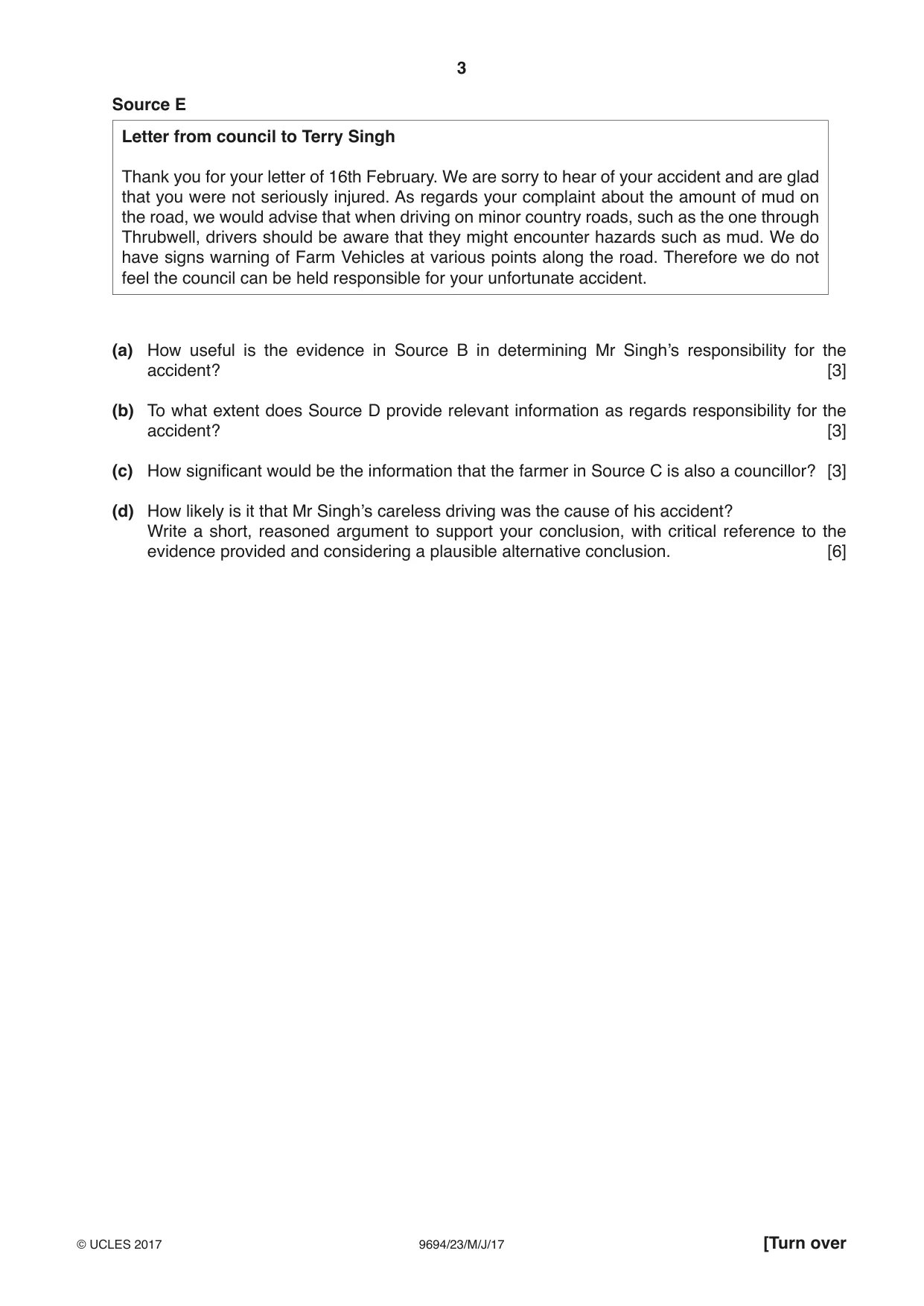
3 9694/23/M/J/17 © UCLES 2017 [Turn over Source E Letter from council to Terry Singh Thank you for your letter of 16th February. We are sorry to hear of your accident and are glad that you were not seriously injured. As regards your complaint about the amount of mud on the road, we would advise that when driving on minor country roads, such as the one through Thrubwell, drivers should be aware that they might encounter hazards such as mud. We do have signs warning of Farm Vehicles at various points along the road. Therefore we do not feel the council can be held responsible for your unfortunate accident. (a) How useful is the evidence in Source B in determining Mr Singh’s responsibility for the accident? [3] (b) To what extent does Source D provide relevant information as regards responsibility for the accident? [3] (c) How significant would be the information that the farmer in Source C is also a councillor? [3] (d) How likely is it that Mr Singh’s careless driving was the cause of his accident? Write a short, reasoned argument to support your conclusion, with critical reference to the evidence provided and considering a plausible alternative conclusion. [6]
Question paper, page 4
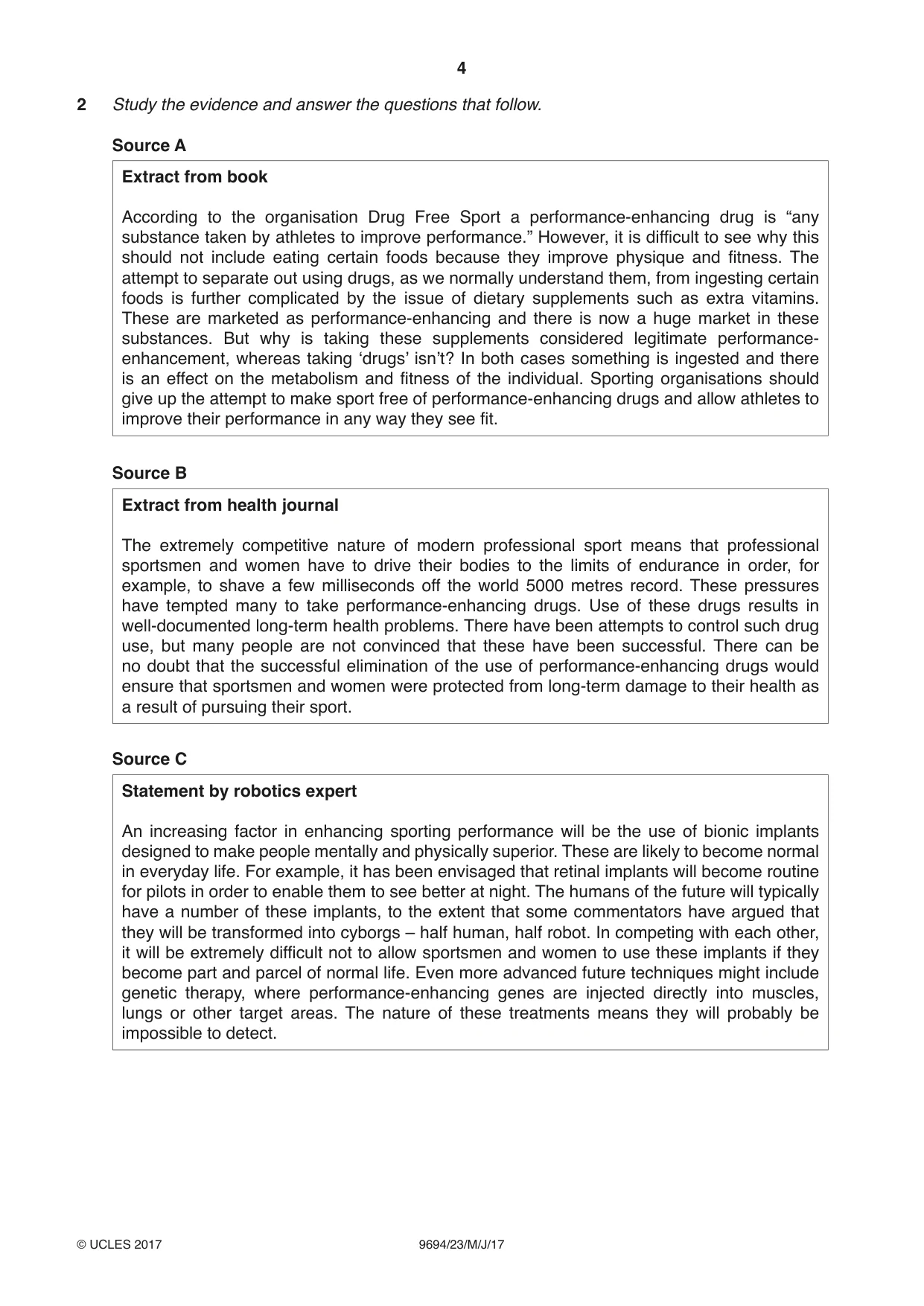
4 9694/23/M/J/17 © UCLES 2017 2 Study the evidence and answer the questions that follow. Source A Extract from book According to the organisation Drug Free Sport a performance-enhancing drug is “any substance taken by athletes to improve performance.” However, it is difficult to see why this should not include eating certain foods because they improve physique and fitness. The attempt to separate out using drugs, as we normally understand them, from ingesting certain foods is further complicated by the issue of dietary supplements such as extra vitamins. These are marketed as performance-enhancing and there is now a huge market in these substances. But why is taking these supplements considered legitimate performance- enhancement, whereas taking ‘drugs’ isn’t? In both cases something is ingested and there is an effect on the metabolism and fitness of the individual. Sporting organisations should give up the attempt to make sport free of performance-enhancing drugs and allow athletes to improve their performance in any way they see fit. Source B Extract from health journal The extremely competitive nature of modern professional sport means that professional sportsmen and women have to drive their bodies to the limits of endurance in order, for example, to shave a few milliseconds off the world 5000 metres record. These pressures have tempted many to take performance-enhancing drugs. Use of these drugs results in well-documented long-term health problems. There have been attempts to control such drug use, but many people are not convinced that these have been successful. There can be no doubt that the successful elimination of the use of performance-enhancing drugs would ensure that sportsmen and women were protected from long-term damage to their health as a result of pursuing their sport. Source C Statement by robotics expert An increasing factor in enhancing sporting performance will be the use of bionic implants designed to make people mentally and physically superior. These are likely to become normal in everyday life. For example, it has been envisaged that retinal implants will become routine for pilots in order to enable them to see better at night. The humans of the future will typically have a number of these implants, to the extent that some commentators have argued that they will be transformed into cyborgs – half human, half robot. In competing with each other, it will be extremely difficult not to allow sportsmen and women to use these implants if they become part and parcel of normal life. Even more advanced future techniques might include genetic therapy, where performance-enhancing genes are injected directly into muscles, lungs or other target areas. The nature of these treatments means they will probably be impossible to detect.
Question paper, page 5
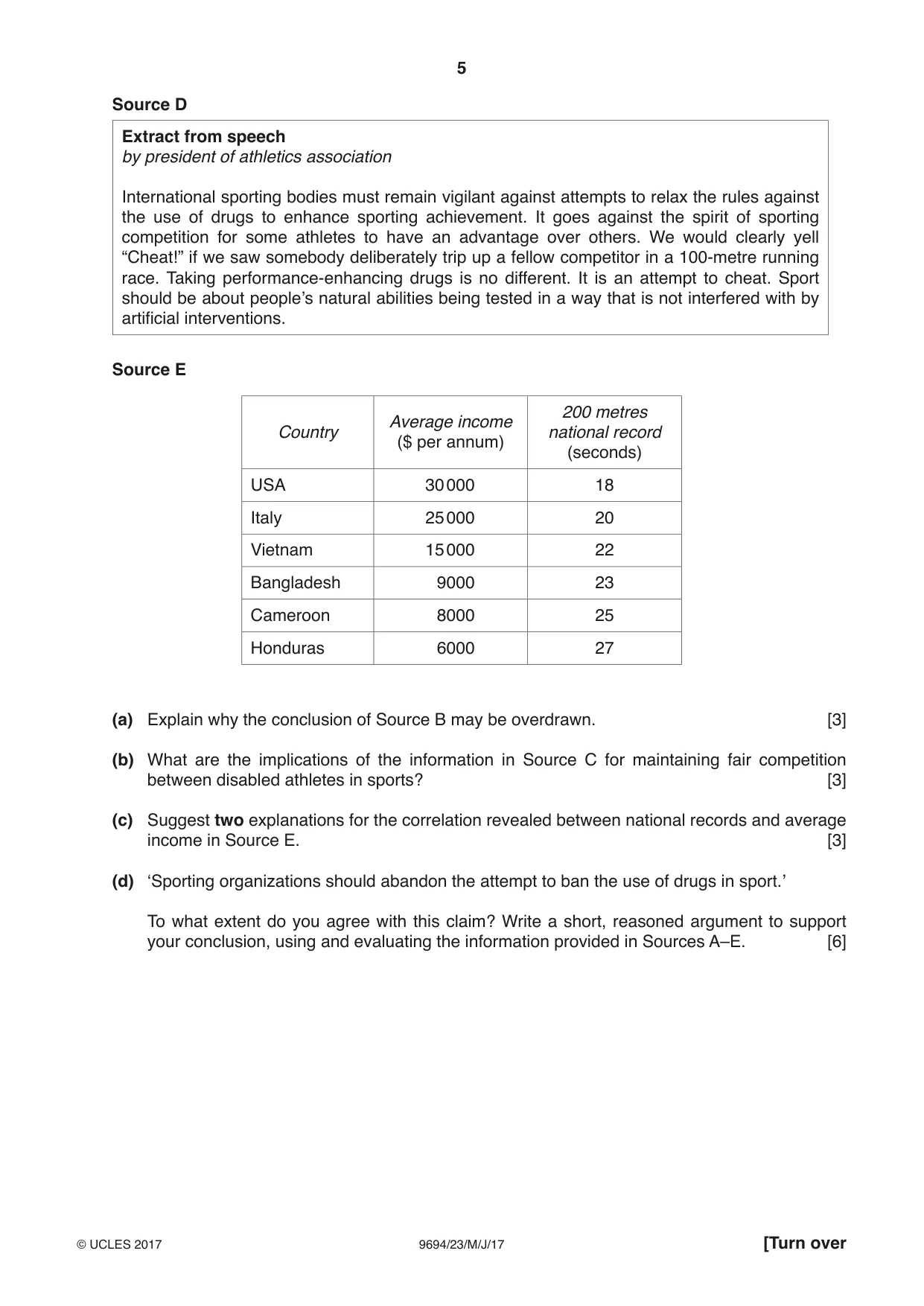
5 9694/23/M/J/17 © UCLES 2017 [Turn over Source D Extract from speech by president of athletics association International sporting bodies must remain vigilant against attempts to relax the rules against the use of drugs to enhance sporting achievement. It goes against the spirit of sporting competition for some athletes to have an advantage over others. We would clearly yell “Cheat!” if we saw somebody deliberately trip up a fellow competitor in a 100-metre running race. Taking performance-enhancing drugs is no different. It is an attempt to cheat. Sport should be about people’s natural abilities being tested in a way that is not interfered with by artificial interventions. Source E Country Average income ($ per annum) 200 metres national record (seconds) USA 30 000 18 Italy 25 000 20 Vietnam 15 000 22 Bangladesh 9000 23 Cameroon 8000 25 Honduras 6000 27 (a) Explain why the conclusion of Source B may be overdrawn. [3] (b) What are the implications of the information in Source C for maintaining fair competition between disabled athletes in sports? [3] (c) Suggest two explanations for the correlation revealed between national records and average income in Source E. [3] (d) ‘Sporting organizations should abandon the attempt to ban the use of drugs in sport.’ To what extent do you agree with this claim? Write a short, reasoned argument to support your conclusion, using and evaluating the information provided in Sources A–E. [6]
Question paper, page 6
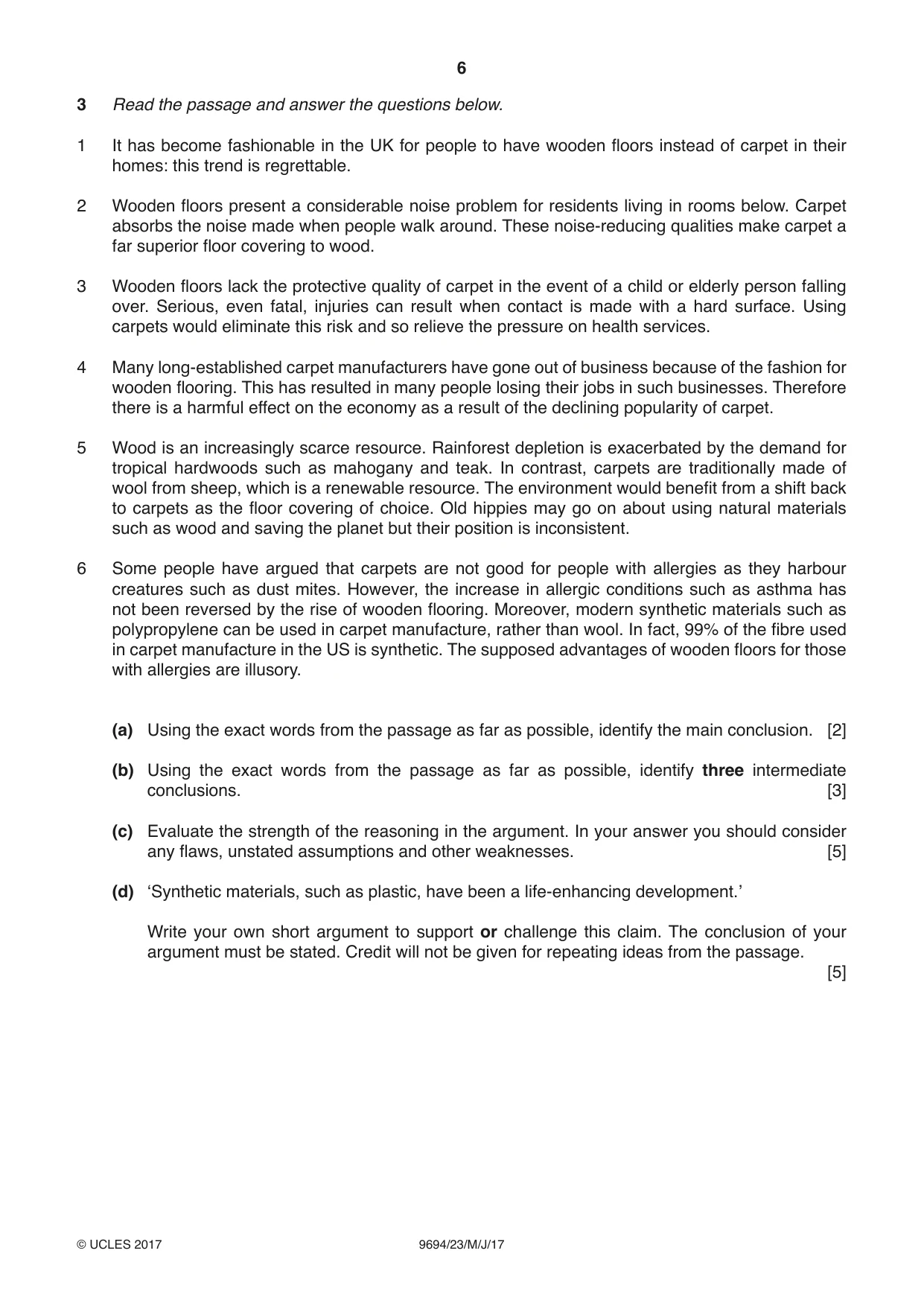
6 9694/23/M/J/17 © UCLES 2017 3 Read the passage and answer the questions below. 1 It has become fashionable in the UK for people to have wooden floors instead of carpet in their homes: this trend is regrettable. 2 Wooden floors present a considerable noise problem for residents living in rooms below. Carpet absorbs the noise made when people walk around. These noise-reducing qualities make carpet a far superior floor covering to wood. 3 Wooden floors lack the protective quality of carpet in the event of a child or elderly person falling over. Serious, even fatal, injuries can result when contact is made with a hard surface. Using carpets would eliminate this risk and so relieve the pressure on health services. 4 Many long-established carpet manufacturers have gone out of business because of the fashion for wooden flooring. This has resulted in many people losing their jobs in such businesses. Therefore there is a harmful effect on the economy as a result of the declining popularity of carpet. 5 Wood is an increasingly scarce resource. Rainforest depletion is exacerbated by the demand for tropical hardwoods such as mahogany and teak. In contrast, carpets are traditionally made of wool from sheep, which is a renewable resource. The environment would benefit from a shift back to carpets as the floor covering of choice. Old hippies may go on about using natural materials such as wood and saving the planet but their position is inconsistent. 6 Some people have argued that carpets are not good for people with allergies as they harbour creatures such as dust mites. However, the increase in allergic conditions such as asthma has not been reversed by the rise of wooden flooring. Moreover, modern synthetic materials such as polypropylene can be used in carpet manufacture, rather than wool. In fact, 99% of the fibre used in carpet manufacture in the US is synthetic. The supposed advantages of wooden floors for those with allergies are illusory. (a) Using the exact words from the passage as far as possible, identify the main conclusion. [2] (b) Using the exact words from the passage as far as possible, identify three intermediate conclusions. [3] (c) Evaluate the strength of the reasoning in the argument. In your answer you should consider any flaws, unstated assumptions and other weaknesses. [5] (d) ‘Synthetic materials, such as plastic, have been a life-enhancing development.’ Write your own short argument to support or challenge this claim. The conclusion of your argument must be stated. Credit will not be given for repeating ideas from the passage. [5]
Question paper, page 7
7 9694/23/M/J/17 © UCLES 2017 BLANK PAGE
Question paper, page 8
8 9694/23/M/J/17 © UCLES 2017 Permission to reproduce items where third-party owned material protected by copyright is included has been sought and cleared where possible. Every reasonable effort has been made by the publisher (UCLES) to trace copyright holders, but if any items requiring clearance have unwittingly been included, the publisher will be pleased to make amends at the earliest possible opportunity. To avoid the issue of disclosure of answer-related information to candidates, all copyright acknowledgements are reproduced online in the Cambridge International Examinations Copyright Acknowledgements Booklet. This is produced for each series of examinations and is freely available to download at www.cie.org.uk after the live examination series. Cambridge International Examinations is part of the Cambridge Assessment Group. Cambridge Assessment is the brand name of University of Cambridge Local Examinations Syndicate (UCLES), which is itself a department of the University of Cambridge. BLANK PAGE
Mark scheme, page 1
® IGCSE is a registered trademark. This document consists of 9 printed pages. © UCLES 2017 [Turn over Cambridge International Examinations Cambridge International Advanced Subsidiary and Advanced Level CRITICAL THINKING 9694/23 Paper 2 Critical Thinking May/June 2017 MARK SCHEME Maximum Mark: 45 Published This mark scheme is published as an aid to teachers and candidates, to indicate the requirements of the examination. It shows the basis on which Examiners were instructed to award marks. It does not indicate the details of the discussions that took place at an Examiners’ meeting before marking began, which would have considered the acceptability of alternative answers. Mark schemes should be read in conjunction with the question paper and the Principal Examiner Report for Teachers. Cambridge will not enter into discussions about these mark schemes. Cambridge is publishing the mark schemes for the May/June 2017 series for most Cambridge IGCSE®, Cambridge International A and AS Level and Cambridge Pre-U components, and some Cambridge O Level components.
Mark scheme, page 2
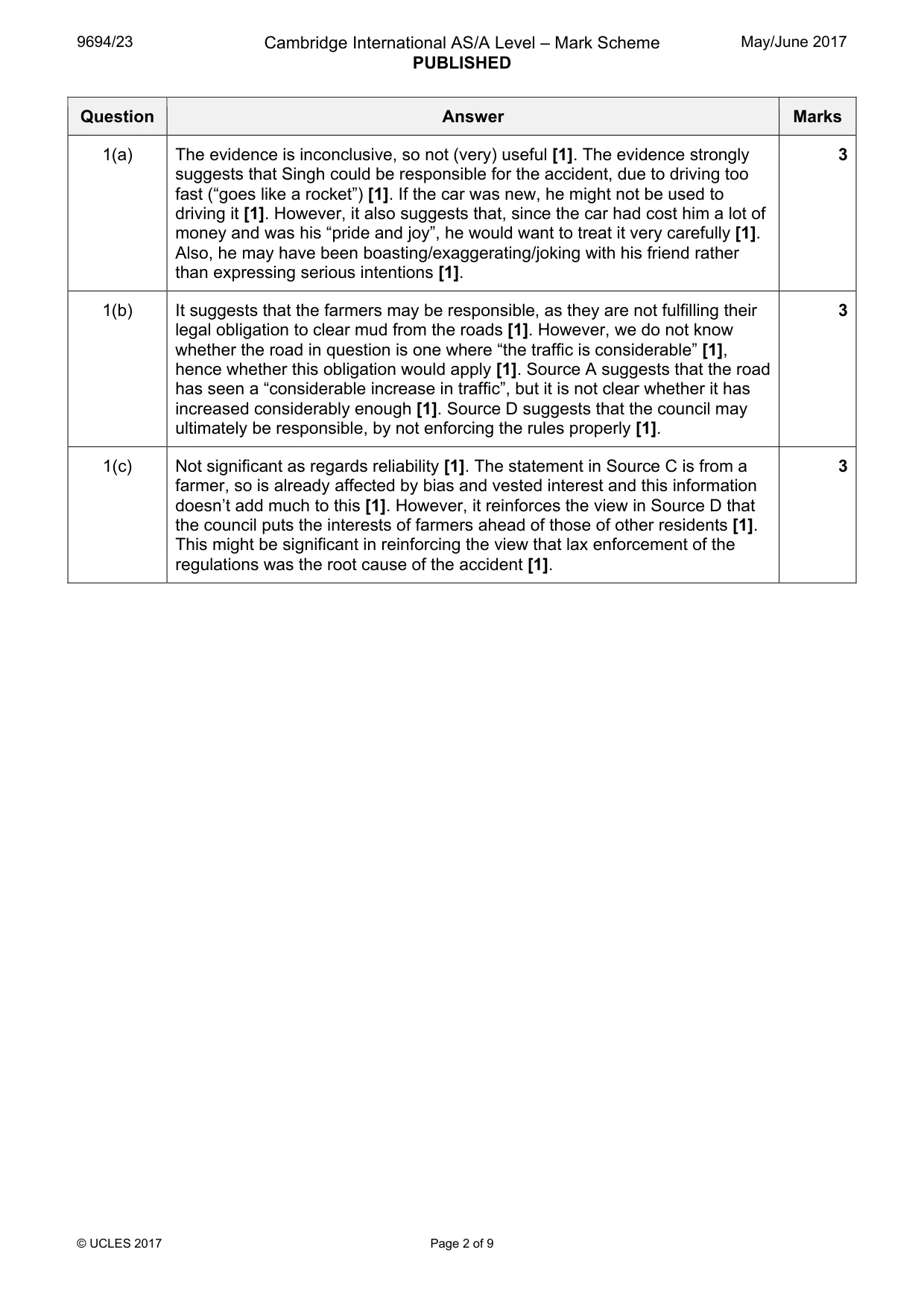
9694/23 Cambridge International AS/A Level – Mark Scheme PUBLISHED May/June 2017 © UCLES 2017 Page 2 of 9 Question Answer Marks 1(a) The evidence is inconclusive, so not (very) useful [1]. The evidence strongly suggests that Singh could be responsible for the accident, due to driving too fast (“goes like a rocket”) [1]. If the car was new, he might not be used to driving it [1]. However, it also suggests that, since the car had cost him a lot of money and was his “pride and joy”, he would want to treat it very carefully [1]. Also, he may have been boasting/exaggerating/joking with his friend rather than expressing serious intentions [1]. 3 1(b) It suggests that the farmers may be responsible, as they are not fulfilling their legal obligation to clear mud from the roads [1]. However, we do not know whether the road in question is one where “the traffic is considerable” [1], hence whether this obligation would apply [1]. Source A suggests that the road has seen a “considerable increase in traffic”, but it is not clear whether it has increased considerably enough [1]. Source D suggests that the council may ultimately be responsible, by not enforcing the rules properly [1]. 3 1(c) Not significant as regards reliability [1]. The statement in Source C is from a farmer, so is already affected by bias and vested interest and this information doesn’t add much to this [1]. However, it reinforces the view in Source D that the council puts the interests of farmers ahead of those of other residents [1]. This might be significant in reinforcing the view that lax enforcement of the regulations was the root cause of the accident [1]. 3
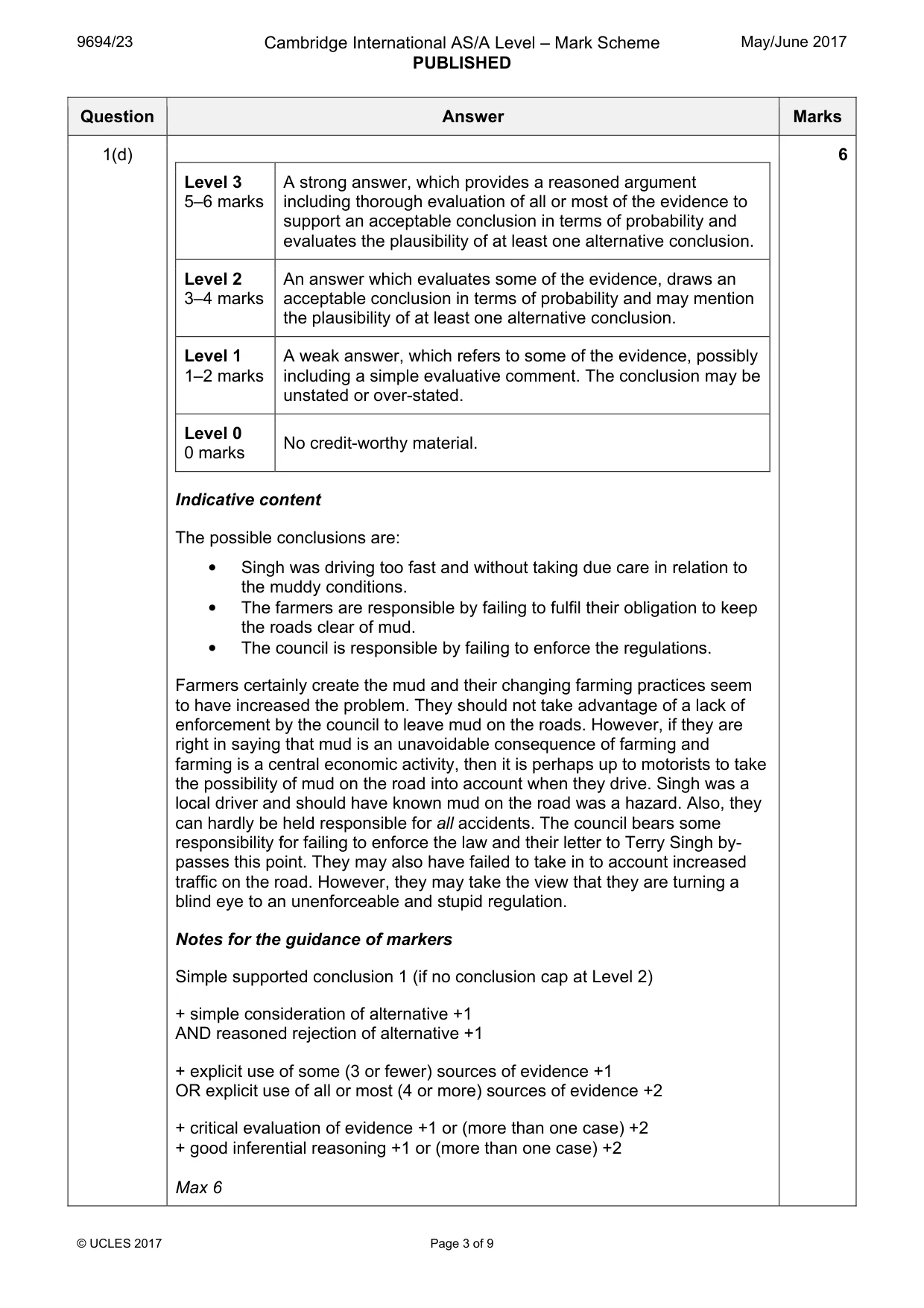
Mark scheme, page 3
9694/23 Cambridge International AS/A Level – Mark Scheme PUBLISHED May/June 2017 © UCLES 2017 Page 3 of 9 Question Answer Marks 1(d) Level 3 5–6 marks A strong answer, which provides a reasoned argument including thorough evaluation of all or most of the evidence to support an acceptable conclusion in terms of probability and evaluates the plausibility of at least one alternative conclusion. Level 2 3–4 marks An answer which evaluates some of the evidence, draws an acceptable conclusion in terms of probability and may mention the plausibility of at least one alternative conclusion. Level 1 1–2 marks A weak answer, which refers to some of the evidence, possibly including a simple evaluative comment. The conclusion may be unstated or over-stated. Level 0 0 marks No credit-worthy material. Indicative content The possible conclusions are: • Singh was driving too fast and without taking due care in relation to the muddy conditions. • The farmers are responsible by failing to fulfil their obligation to keep the roads clear of mud. • The council is responsible by failing to enforce the regulations. Farmers certainly create the mud and their changing farming practices seem to have increased the problem. They should not take advantage of a lack of enforcement by the council to leave mud on the roads. However, if they are right in saying that mud is an unavoidable consequence of farming and farming is a central economic activity, then it is perhaps up to motorists to take the possibility of mud on the road into account when they drive. Singh was a local driver and should have known mud on the road was a hazard. Also, they can hardly be held responsible for all accidents. The council bears some responsibility for failing to enforce the law and their letter to Terry Singh by- passes this point. They may also have failed to take in to account increased traffic on the road. However, they may take the view that they are turning a blind eye to an unenforceable and stupid regulation. Notes for the guidance of markers Simple supported conclusion 1 (if no conclusion cap at Level 2) + simple consideration of alternative +1 AND reasoned rejection of alternative +1 + explicit use of some (3 or fewer) sources of evidence +1 OR explicit use of all or most (4 or more) sources of evidence +2 + critical evaluation of evidence +1 or (more than one case) +2 + good inferential reasoning +1 or (more than one case) +2 Max 6 6
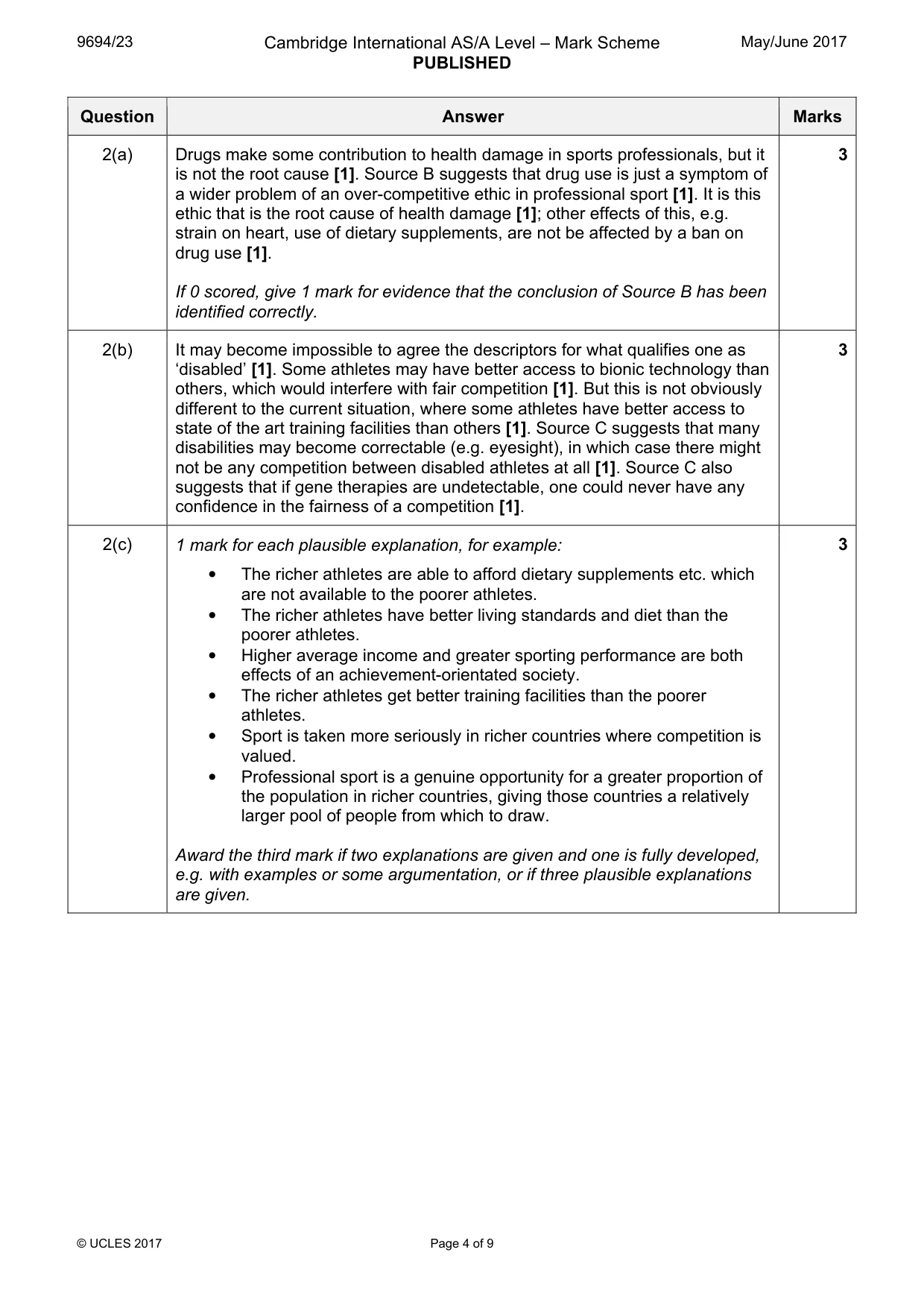
Mark scheme, page 4
9694/23 Cambridge International AS/A Level – Mark Scheme PUBLISHED May/June 2017 © UCLES 2017 Page 4 of 9 Question Answer Marks 2(a) Drugs make some contribution to health damage in sports professionals, but it is not the root cause [1]. Source B suggests that drug use is just a symptom of a wider problem of an over-competitive ethic in professional sport [1]. It is this ethic that is the root cause of health damage [1]; other effects of this, e.g. strain on heart, use of dietary supplements, are not be affected by a ban on drug use [1]. If 0 scored, give 1 mark for evidence that the conclusion of Source B has been identified correctly. 3 2(b) It may become impossible to agree the descriptors for what qualifies one as ‘disabled’ [1]. Some athletes may have better access to bionic technology than others, which would interfere with fair competition [1]. But this is not obviously different to the current situation, where some athletes have better access to state of the art training facilities than others [1]. Source C suggests that many disabilities may become correctable (e.g. eyesight), in which case there might not be any competition between disabled athletes at all [1]. Source C also suggests that if gene therapies are undetectable, one could never have any confidence in the fairness of a competition [1]. 3 2(c) 1 mark for each plausible explanation, for example: • The richer athletes are able to afford dietary supplements etc. which are not available to the poorer athletes. • The richer athletes have better living standards and diet than the poorer athletes. • Higher average income and greater sporting performance are both effects of an achievement-orientated society. • The richer athletes get better training facilities than the poorer athletes. • Sport is taken more seriously in richer countries where competition is valued. • Professional sport is a genuine opportunity for a greater proportion of the population in richer countries, giving those countries a relatively larger pool of people from which to draw. Award the third mark if two explanations are given and one is fully developed, e.g. with examples or some argumentation, or if three plausible explanations are given. 3
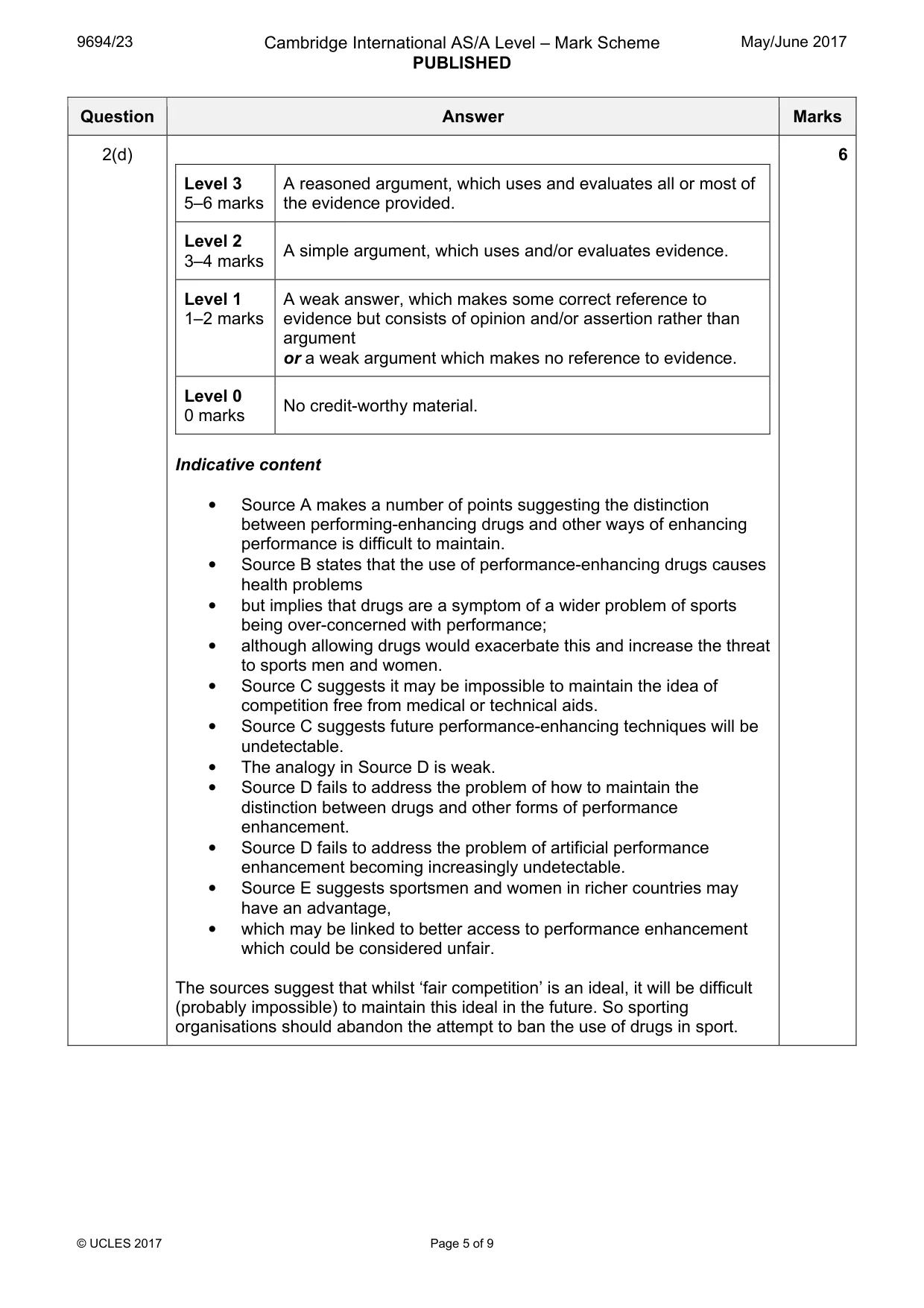
Mark scheme, page 5
9694/23 Cambridge International AS/A Level – Mark Scheme PUBLISHED May/June 2017 © UCLES 2017 Page 5 of 9 Question Answer Marks 2(d) Level 3 5–6 marks A reasoned argument, which uses and evaluates all or most of the evidence provided. Level 2 3–4 marks A simple argument, which uses and/or evaluates evidence. Level 1 1–2 marks A weak answer, which makes some correct reference to evidence but consists of opinion and/or assertion rather than argument or a weak argument which makes no reference to evidence. Level 0 0 marks No credit-worthy material. Indicative content • Source A makes a number of points suggesting the distinction between performing-enhancing drugs and other ways of enhancing performance is difficult to maintain. • Source B states that the use of performance-enhancing drugs causes health problems • but implies that drugs are a symptom of a wider problem of sports being over-concerned with performance; • although allowing drugs would exacerbate this and increase the threat to sports men and women. • Source C suggests it may be impossible to maintain the idea of competition free from medical or technical aids. • Source C suggests future performance-enhancing techniques will be undetectable. • The analogy in Source D is weak. • Source D fails to address the problem of how to maintain the distinction between drugs and other forms of performance enhancement. • Source D fails to address the problem of artificial performance enhancement becoming increasingly undetectable. • Source E suggests sportsmen and women in richer countries may have an advantage, • which may be linked to better access to performance enhancement which could be considered unfair. The sources suggest that whilst ‘fair competition’ is an ideal, it will be difficult (probably impossible) to maintain this ideal in the future. So sporting organisations should abandon the attempt to ban the use of drugs in sport. 6
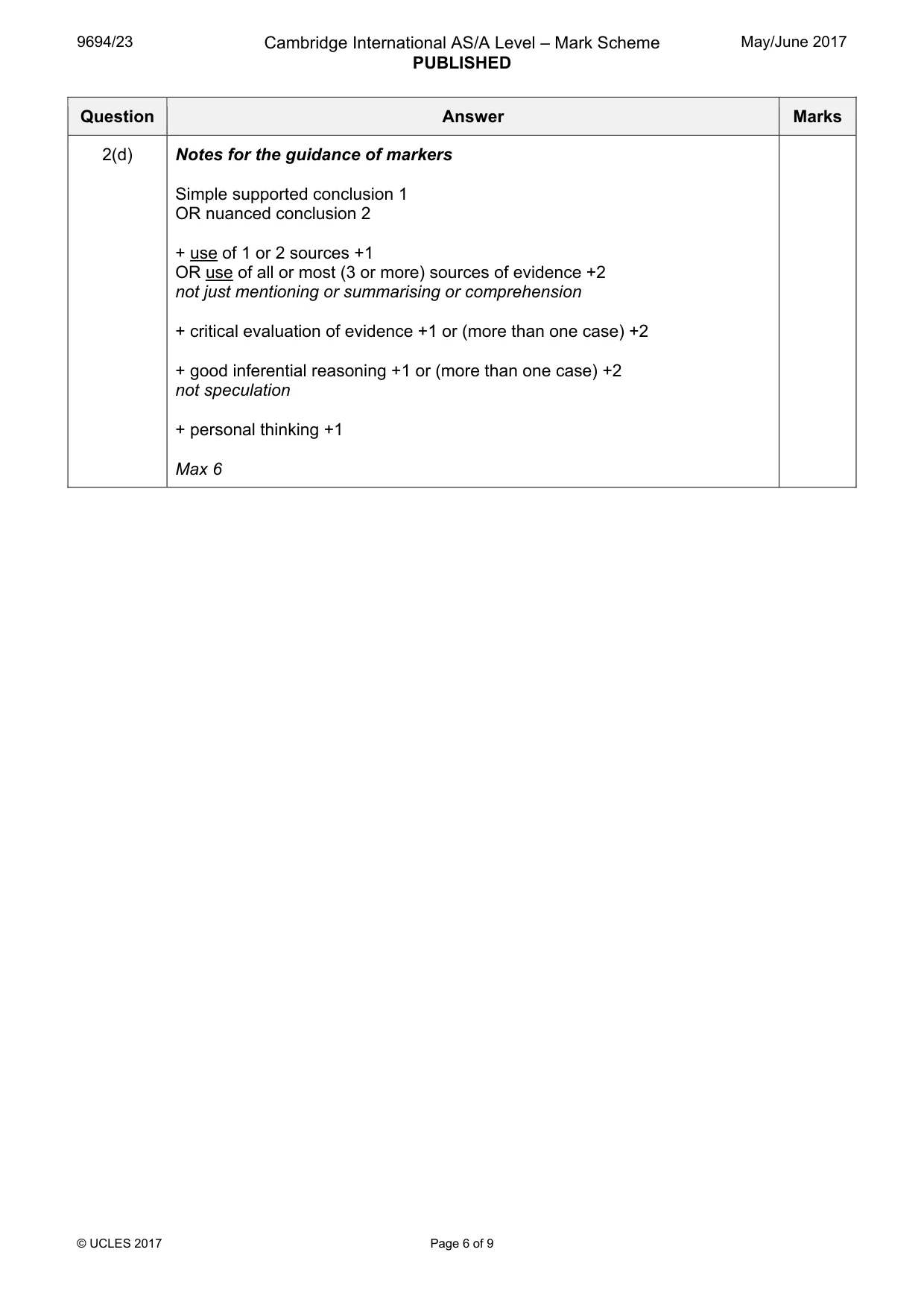
Mark scheme, page 6
9694/23 Cambridge International AS/A Level – Mark Scheme PUBLISHED May/June 2017 © UCLES 2017 Page 6 of 9 Question Answer Marks 2(d) Notes for the guidance of markers Simple supported conclusion 1 OR nuanced conclusion 2 + use of 1 or 2 sources +1 OR use of all or most (3 or more) sources of evidence +2 not just mentioning or summarising or comprehension + critical evaluation of evidence +1 or (more than one case) +2 + good inferential reasoning +1 or (more than one case) +2 not speculation + personal thinking +1 Max 6
Mark scheme, page 7
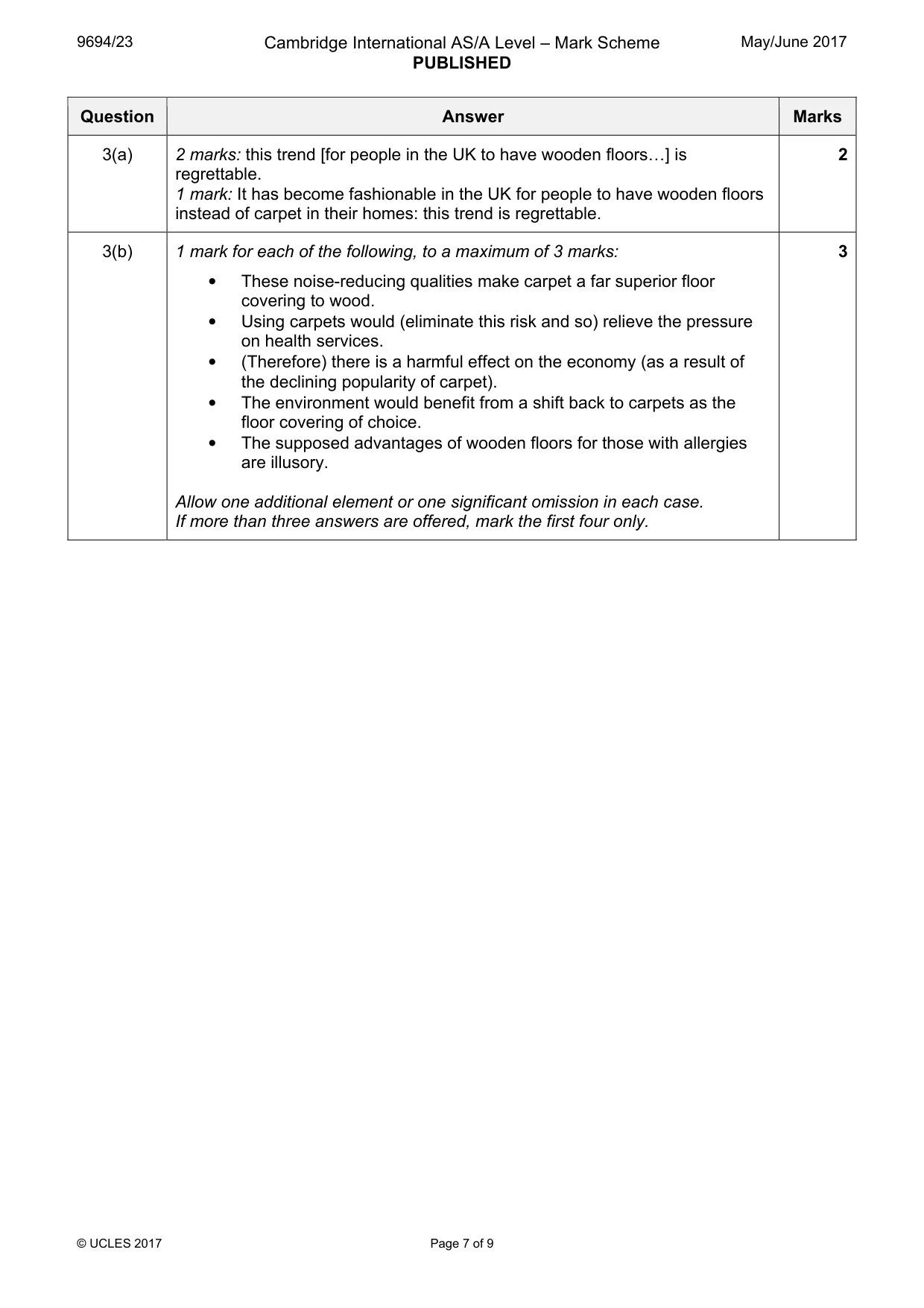
9694/23 Cambridge International AS/A Level – Mark Scheme PUBLISHED May/June 2017 © UCLES 2017 Page 7 of 9 Question Answer Marks 3(a) 2 marks: this trend [for people in the UK to have wooden floors«] is regrettable. 1 mark: It has become fashionable in the UK for people to have wooden floors instead of carpet in their homes: this trend is regrettable. 2 3(b) 1 mark for each of the following, to a maximum of 3 marks: • These noise-reducing qualities make carpet a far superior floor covering to wood. • Using carpets would (eliminate this risk and so) relieve the pressure on health services. • (Therefore) there is a harmful effect on the economy (as a result of the declining popularity of carpet). • The environment would benefit from a shift back to carpets as the floor covering of choice. • The supposed advantages of wooden floors for those with allergies are illusory. Allow one additional element or one significant omission in each case. If more than three answers are offered, mark the first four only. 3
Mark scheme, page 8
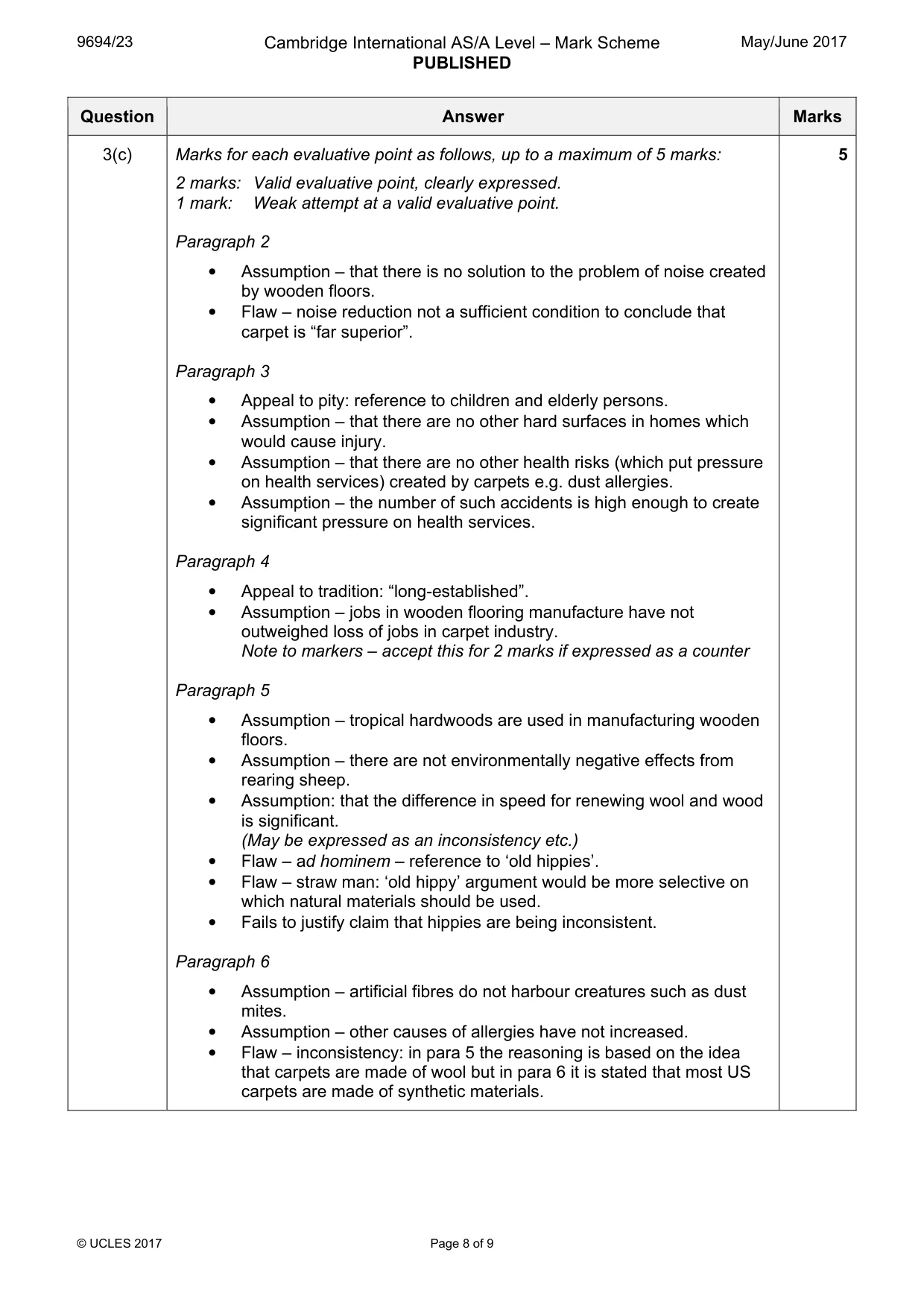
9694/23 Cambridge International AS/A Level – Mark Scheme PUBLISHED May/June 2017 © UCLES 2017 Page 8 of 9 Question Answer Marks 3(c) Marks for each evaluative point as follows, up to a maximum of 5 marks: 2 marks: Valid evaluative point, clearly expressed. 1 mark: Weak attempt at a valid evaluative point. Paragraph 2 • Assumption – that there is no solution to the problem of noise created by wooden floors. • Flaw – noise reduction not a sufficient condition to conclude that carpet is “far superior”. Paragraph 3 • Appeal to pity: reference to children and elderly persons. • Assumption – that there are no other hard surfaces in homes which would cause injury. • Assumption – that there are no other health risks (which put pressure on health services) created by carpets e.g. dust allergies. • Assumption – the number of such accidents is high enough to create significant pressure on health services. Paragraph 4 • Appeal to tradition: “long-established”. • Assumption – jobs in wooden flooring manufacture have not outweighed loss of jobs in carpet industry. Note to markers – accept this for 2 marks if expressed as a counter Paragraph 5 • Assumption – tropical hardwoods are used in manufacturing wooden floors. • Assumption – there are not environmentally negative effects from rearing sheep. • Assumption: that the difference in speed for renewing wool and wood is significant. (May be expressed as an inconsistency etc.) • Flaw – ad hominem – reference to ‘old hippies’. • Flaw – straw man: ‘old hippy’ argument would be more selective on which natural materials should be used. • Fails to justify claim that hippies are being inconsistent. Paragraph 6 • Assumption – artificial fibres do not harbour creatures such as dust mites. • Assumption – other causes of allergies have not increased. • Flaw – inconsistency: in para 5 the reasoning is based on the idea that carpets are made of wool but in para 6 it is stated that most US carpets are made of synthetic materials. 5
Mark scheme, page 9
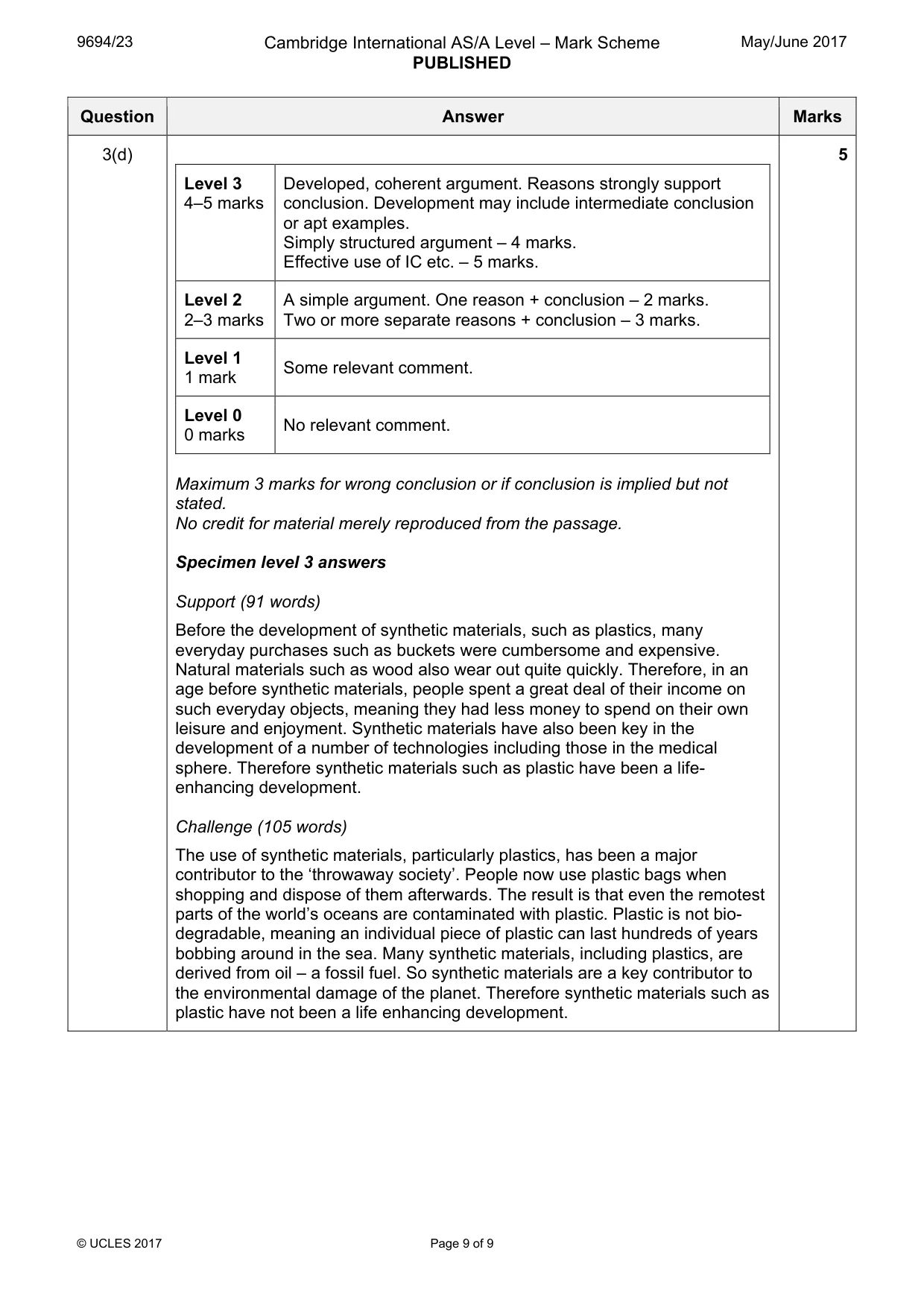
9694/23 Cambridge International AS/A Level – Mark Scheme PUBLISHED May/June 2017 © UCLES 2017 Page 9 of 9 Question Answer Marks 3(d) Level 3 4–5 marks Developed, coherent argument. Reasons strongly support conclusion. Development may include intermediate conclusion or apt examples. Simply structured argument – 4 marks. Effective use of IC etc. – 5 marks. Level 2 2–3 marks A simple argument. One reason + conclusion – 2 marks. Two or more separate reasons + conclusion – 3 marks. Level 1 1 mark Some relevant comment. Level 0 0 marks No relevant comment. Maximum 3 marks for wrong conclusion or if conclusion is implied but not stated. No credit for material merely reproduced from the passage. Specimen level 3 answers Support (91 words) Before the development of synthetic materials, such as plastics, many everyday purchases such as buckets were cumbersome and expensive. Natural materials such as wood also wear out quite quickly. Therefore, in an age before synthetic materials, people spent a great deal of their income on such everyday objects, meaning they had less money to spend on their own leisure and enjoyment. Synthetic materials have also been key in the development of a number of technologies including those in the medical sphere. Therefore synthetic materials such as plastic have been a life- enhancing development. Challenge (105 words) The use of synthetic materials, particularly plastics, has been a major contributor to the ‘throwaway society’. People now use plastic bags when shopping and dispose of them afterwards. The result is that even the remotest parts of the world’s oceans are contaminated with plastic. Plastic is not bio- degradable, meaning an individual piece of plastic can last hundreds of years bobbing around in the sea. Many synthetic materials, including plastics, are derived from oil – a fossil fuel. So synthetic materials are a key contributor to the environmental damage of the planet. Therefore synthetic materials such as plastic have not been a life enhancing development. 5
What you needed in this session
Cambridge’s own grade thresholds for 2017 May/June, Paper 2 · Variant 3. A higher threshold means an easier paper — the bar moves with how the cohort did.