Cambridge A Level Thinking Skills 9694 — 2016 May/June Paper 3 · Variant 3
9694/33/M/J/16 · 50 marks · ≈56 min
The question paper and its mark scheme, free to read here and free to download. This is Cambridge’s own paper, exactly as it was sat.
Question paper8 pages
Mark scheme7 pages
Answers below. Sit the paper first if you are practising.
Paper as text
Question paper, page 1
This document consists of 7 printed pages, 1 blank page and 1 insert. IB16 06_9694_33/FP © UCLES 2016 [Turn over *8713555556* Cambridge International Examinations Cambridge International Advanced Level THINKING SKILLS 9694/33 Paper 3 Problem Analysis and Solution May/June 2016 2 hours Additional Materials: Electronic Calculator READ THESE INSTRUCTIONS FIRST An answer booklet is provided inside this question paper. You should follow the instructions on the front cover of the answer booklet. If you need additional answer paper ask the invigilator for a continuation booklet. Answer all the questions. Show your working. Marks may be awarded for correct steps towards a solution, even if the final answer is not correct. Marks may be lost if working needed to support an answer is not shown. Calculators should be used where appropriate. The number of marks is given in brackets [ ] at the end of each question or part question.
Question paper, page 2
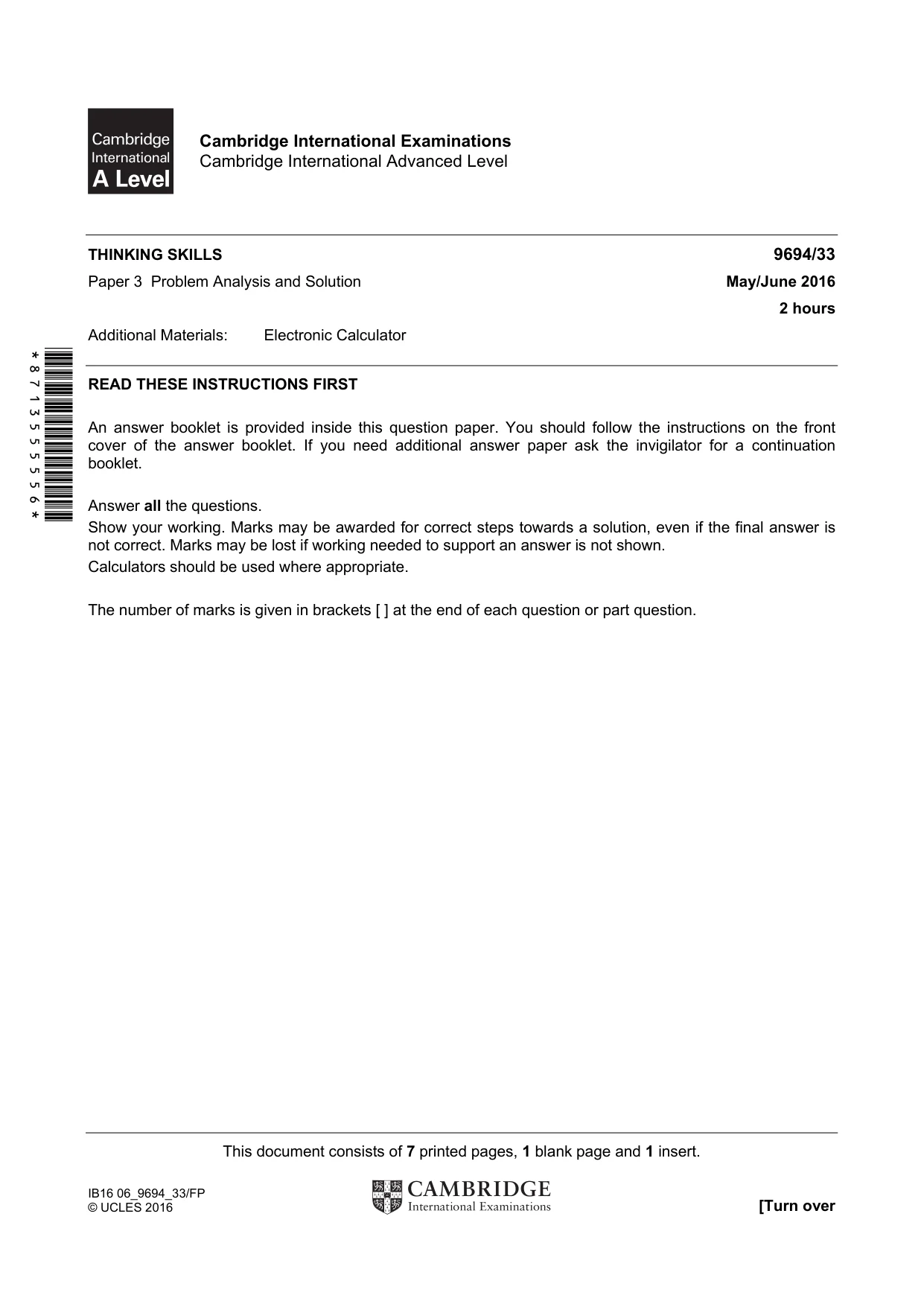
2 © UCLES 2016 9694/33/M/J/16 1 Bill owns three stores which sell models. Every Monday, Bill sends supplies to the stores from his warehouse. All of the supplies are packaged into boxes of the same size and 20 of these boxes can be loaded onto the van for each delivery. The distances, in kilometres, between Bill’s warehouse and the three stores are shown below. Bill’s Warehouse 5 Model Solutions 7 8 Model Emporium 8 6 10 Model Market Bill sometimes needs to make more than one trip when delivering the boxes. He wants to know the total distance that he needs to travel for any of the trips that deliver to just two of the stores before returning to the warehouse. The three trips are: Warehouse → Model Solutions → Model Emporium → Warehouse Warehouse → Model Solutions → Model Market → Warehouse Warehouse → Model Emporium → Model Market → Warehouse Bill has already worked out that he needs to travel a total distance of 20 km if he makes the first trip. (a) What are the total distances that Bill needs to travel to make each of the other trips? [2] This morning, Bill needs to deliver 12 boxes to Model Solutions, 8 boxes to Model Emporium and 9 boxes to Model Market. He cannot load all of the boxes onto the van, so Bill has decided to deliver to one of the stores first and then return to the warehouse where he will load all the boxes for the other two stores. When he has completed the deliveries he will return the van to the warehouse. (b) Which store should Bill deliver to first in order to make the total distance travelled as short as possible? What is this shortest distance? [3] Bill hires the van at a cost of $6 per km travelled. It is also possible for him to hire a larger van, which would hold 25 boxes, but this would cost $7 per km travelled. Bill already knows that he will need to deliver 13 boxes to Model Solutions and 12 boxes to Model Market next week, but does not yet know how many boxes will need to be delivered to Model Emporium. (c) (i) If Model Emporium does not require any boxes delivered next week, how much would Bill save by hiring the larger van rather than the smaller one? [2] (ii) If Model Emporium does require some boxes delivered next week, what is the smallest number of boxes that could be needed at Model Emporium to make it cheaper for Bill to hire the larger van? [3]
Question paper, page 3
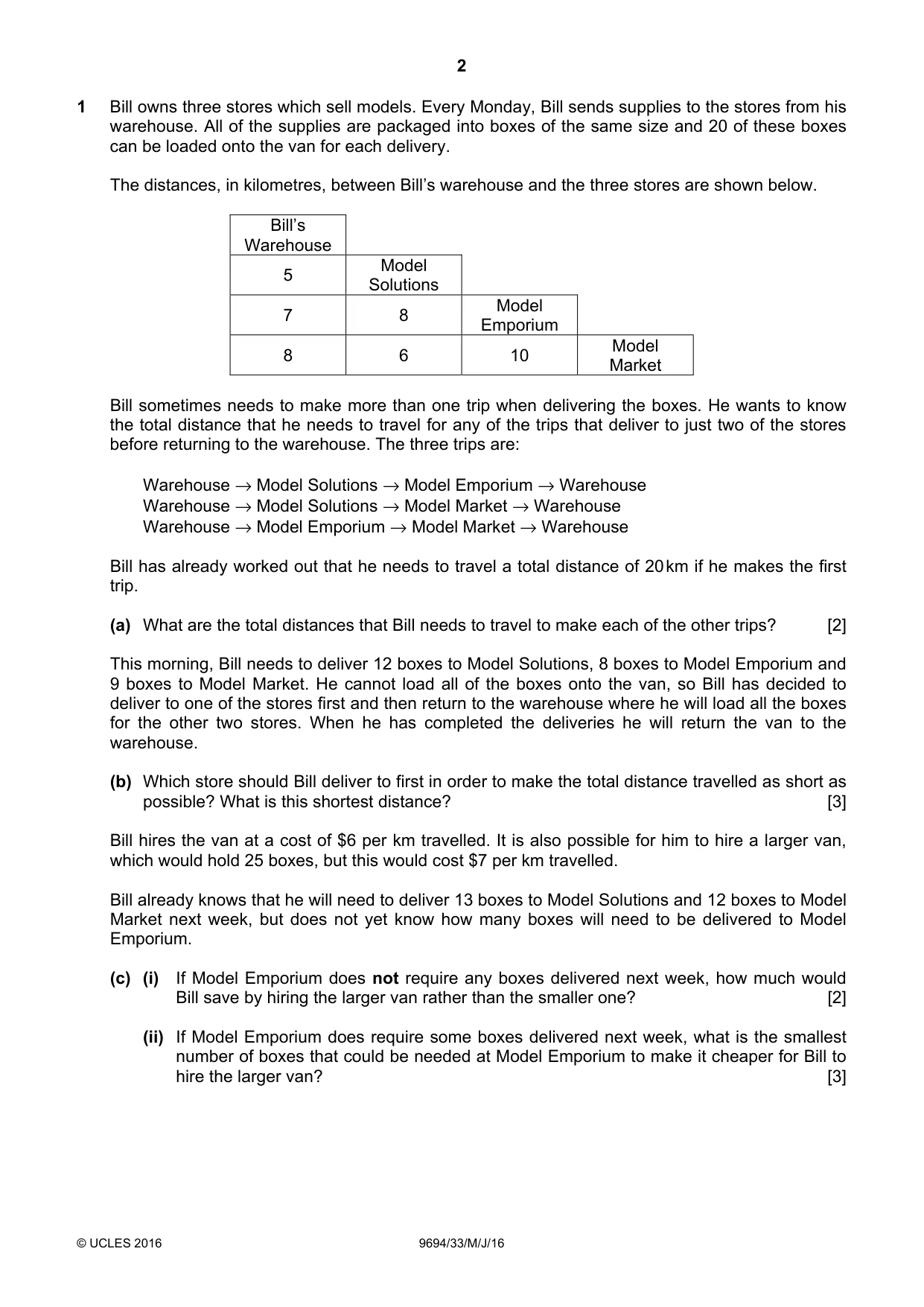
3 © UCLES 2016 9694/33/M/J/16 [Turn over 2 Gwen runs a company called Lance-a-lock and wishes to reassure her customers about the security of the locks she sells. The most basic type of lock is defined by a 5-digit code. The digits of the code represent the shape of the key that matches the lock by describing it as the lengths of 5 columns of squares, each of which can be up to 4 units long. An example is shown below. 1 0 4 2 2 The columns of the key can be any integer length from 0 to 4 – except that the extreme case of 0 0 0 0 0 is not permissible because it would not turn any lock. (a) How many different keys of this sort can be made? [2] The Guild of Locksmiths places restrictions on what locks and keys are permitted. One is that no lock should have a ‘low security code’ – one which could be opened by a key with a code that does not match the lock, by partially inserting the key. An example of a lock with a low security code is 0 2 0 0 0. This could be opened by the key with code 2 0 0 0 0, partially inserted so that the 2 lines up with the appropriate part of the lock. You should assume that the key cannot be inserted further into the lock than intended – so the key with code 0 2 0 0 0 cannot open the lock with code 2 0 0 0 0. (b) Which five locks could be opened by the key 3 0 0 0 0? [1] (c) Give an example of a key, with a code containing no more than two 0s, that could open more than one lock. List all the locks that this key could open. [2] The Guild of Locksmiths has a rule which prevents low security locks being made, but does not exclude any others. This rule places a constraint on one of the digits in the code for the lock. (d) (i) What is this constraint? [1] (ii) How many locks are permissible, given this rule? [1] For some locks (such as door locks) the key can be inserted from either side. In these cases the shape of the key needs to match the shape of the lock whichever side it is put in. (e) How many locks, including low security locks, are permissible given this restriction? [1] Considering also the restriction on low security locks, Gwen concludes that there are only 100 locks available using this kind of key, and thinks that this may worry some of her customers. She therefore considers using locks with 7-digit codes. (f) Subject to all the restrictions, how many locks with 7-digit codes are permissible? [2]
Question paper, page 4
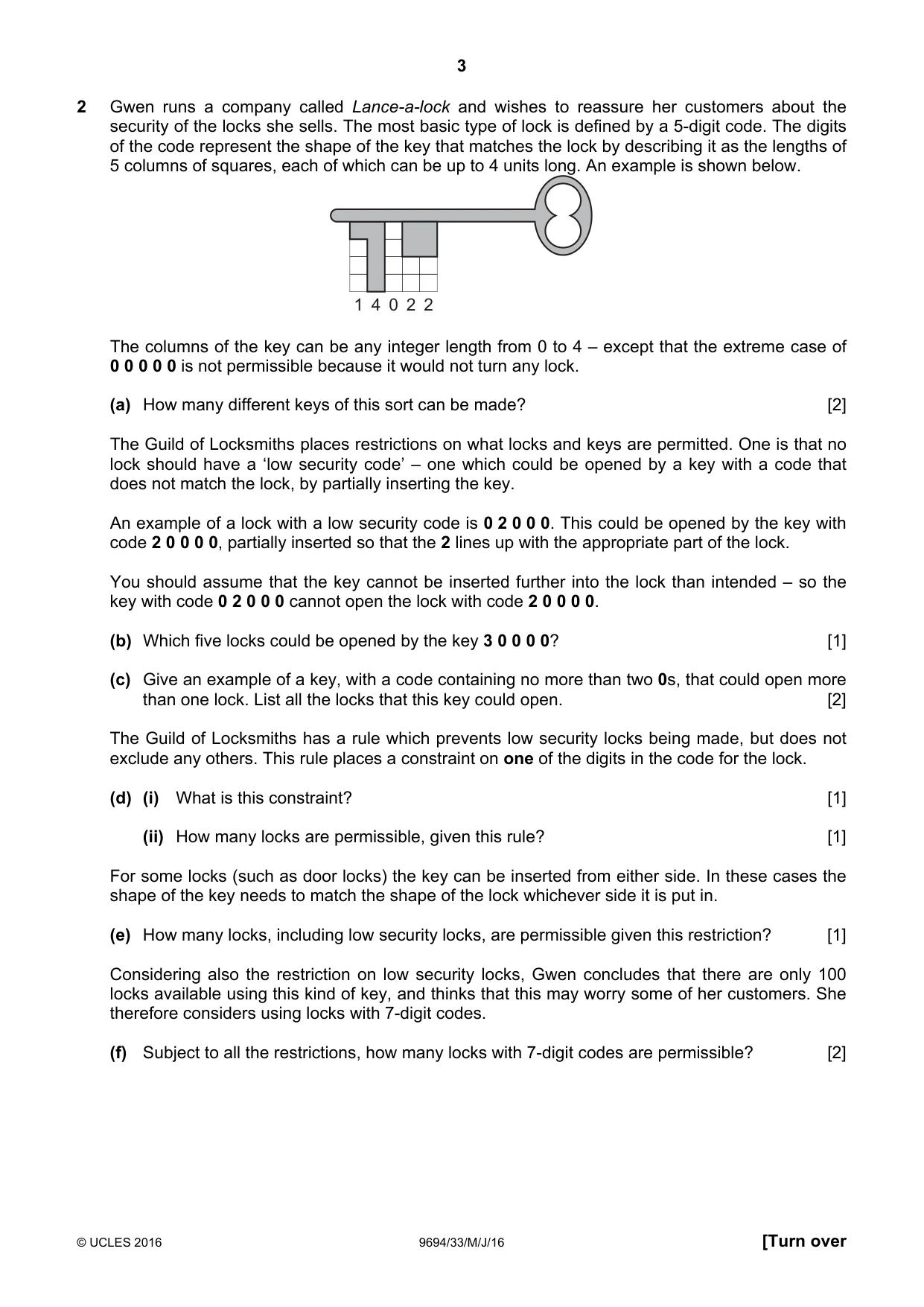
4 © UCLES 2016 9694/33/M/J/16 3 An archaeologist has found some coins from a Bronze Age village, and is trying to establish what values they could have had. There are three sizes of coin: Small (S), Medium (M) and Large (L). He has also found some records of the prices of goods sold, given as numbers of these coins. He makes the following assumptions: • The larger the coin, the more it is worth. • The three coin sizes he has found were the smallest three types used. • When writing a price, the bigger coins are always used where possible. So an item with a price of 5 Smalls (for example) would be evidence that a Medium could not be worth 5 Smalls or less. • No price ever requires more than 9 of any type of coin. • The Small coin had a value of 1. (a) If the Medium coin had a value of 5 and the Large coin had a value of 19, how would the price of an item with a value of 30 be written, in terms of L, M and S? [1] (b) If a price of 2L, 0M, 1S can be paid for precisely with 1 Large, 3 Medium and 4 Small coins, give one example of possible values for the Medium and Large coins. [2] (c) The first price found was for a jug priced 3M, 6S. What are the only four possible values for this jug? [2] (d) Some time later, a necklace priced 1L, 6M, 7S was found. (i) What is the largest possible value for this necklace? [1] (ii) What is the smallest possible value for this necklace? [2] (iii) Initially, the archaeologist believes the necklace has a value of 118. Deduce what the values of the Medium and Large coins would be if this were the case. [2] (iv) What is the smallest possible value for the necklace which would not allow the values of the Medium and Large coins to be deduced? [3] (v) What value for the necklace could still be explained by three different values of the Large coin? [2]
Question paper, page 5
5 © UCLES 2016 9694/33/M/J/16 [Turn over [Question 4 begins on the next page]
Question paper, page 6
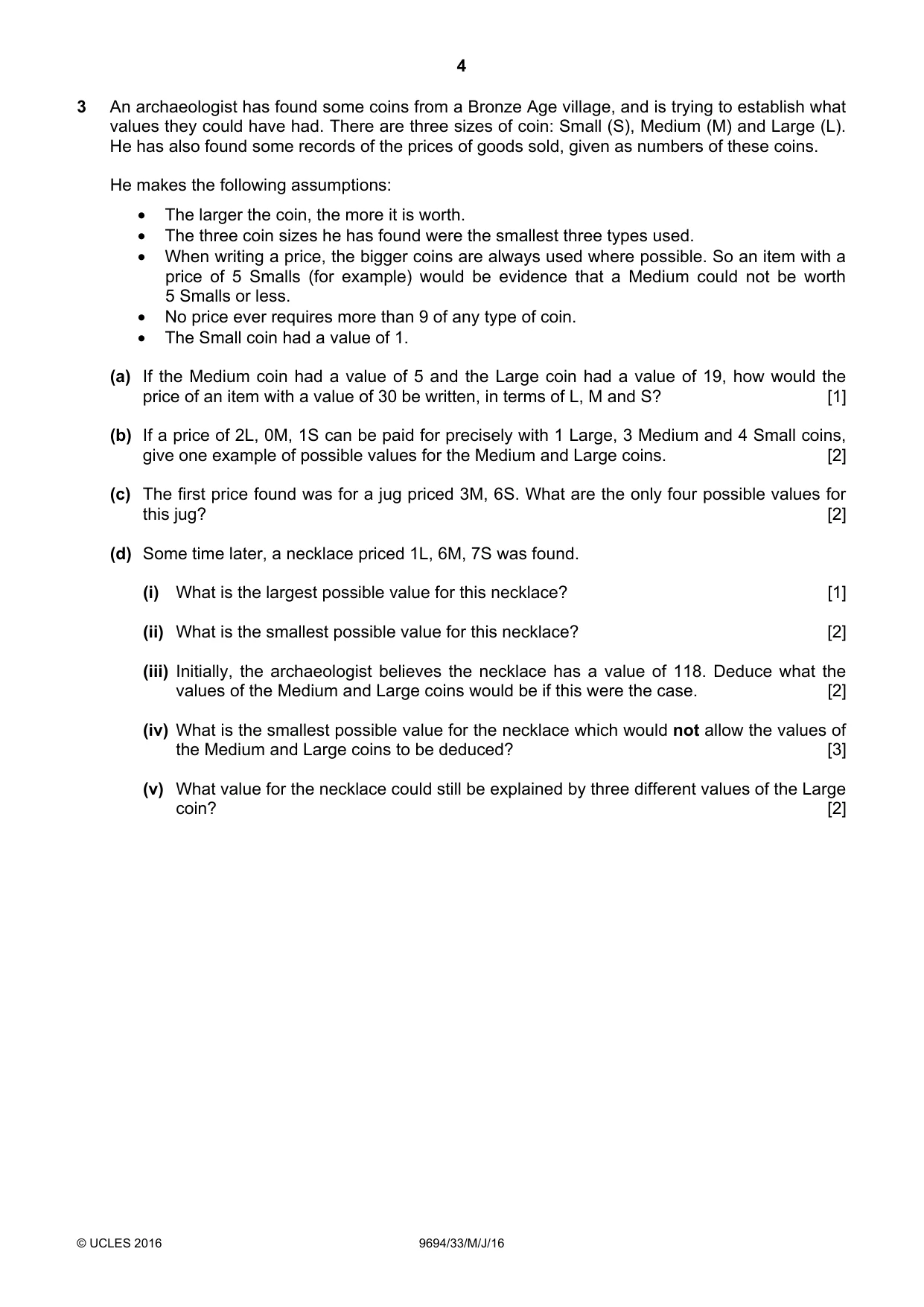
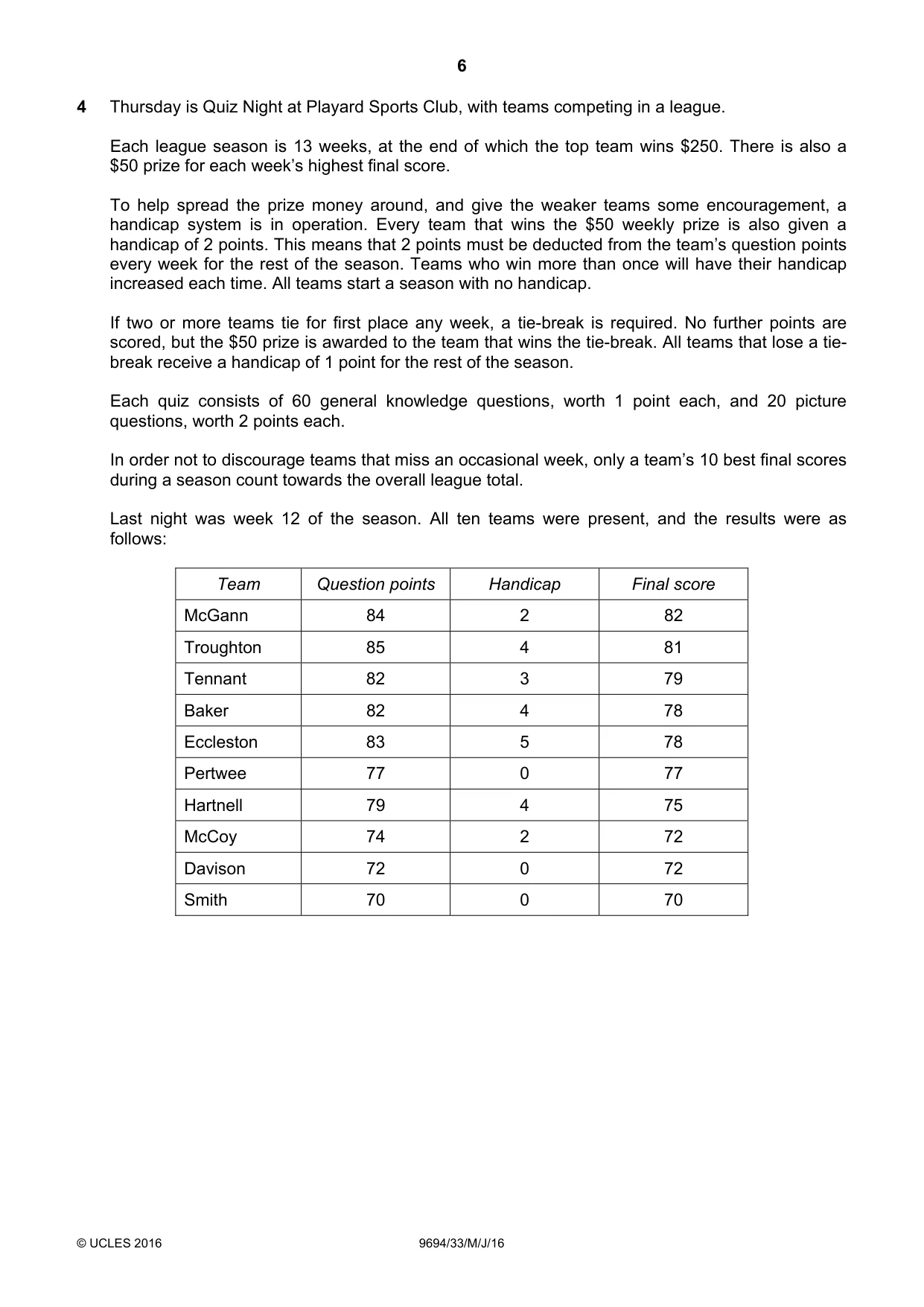
6 © UCLES 2016 9694/33/M/J/16 4 Thursday is Quiz Night at Playard Sports Club, with teams competing in a league. Each league season is 13 weeks, at the end of which the top team wins $250. There is also a $50 prize for each week’s highest final score. To help spread the prize money around, and give the weaker teams some encouragement, a handicap system is in operation. Every team that wins the $50 weekly prize is also given a handicap of 2 points. This means that 2 points must be deducted from the team’s question points every week for the rest of the season. Teams who win more than once will have their handicap increased each time. All teams start a season with no handicap. If two or more teams tie for first place any week, a tie-break is required. No further points are scored, but the $50 prize is awarded to the team that wins the tie-break. All teams that lose a tie- break receive a handicap of 1 point for the rest of the season. Each quiz consists of 60 general knowledge questions, worth 1 point each, and 20 picture questions, worth 2 points each. In order not to discourage teams that miss an occasional week, only a team’s 10 best final scores during a season count towards the overall league total. Last night was week 12 of the season. All ten teams were present, and the results were as follows: Team Question points Handicap Final score McGann 84 2 82 Troughton 85 4 81 Tennant 82 3 79 Baker 82 4 78 Eccleston 83 5 78 Pertwee 77 0 77 Hartnell 79 4 75 McCoy 74 2 72 Davison 72 0 72 Smith 70 0 70
Question paper, page 7
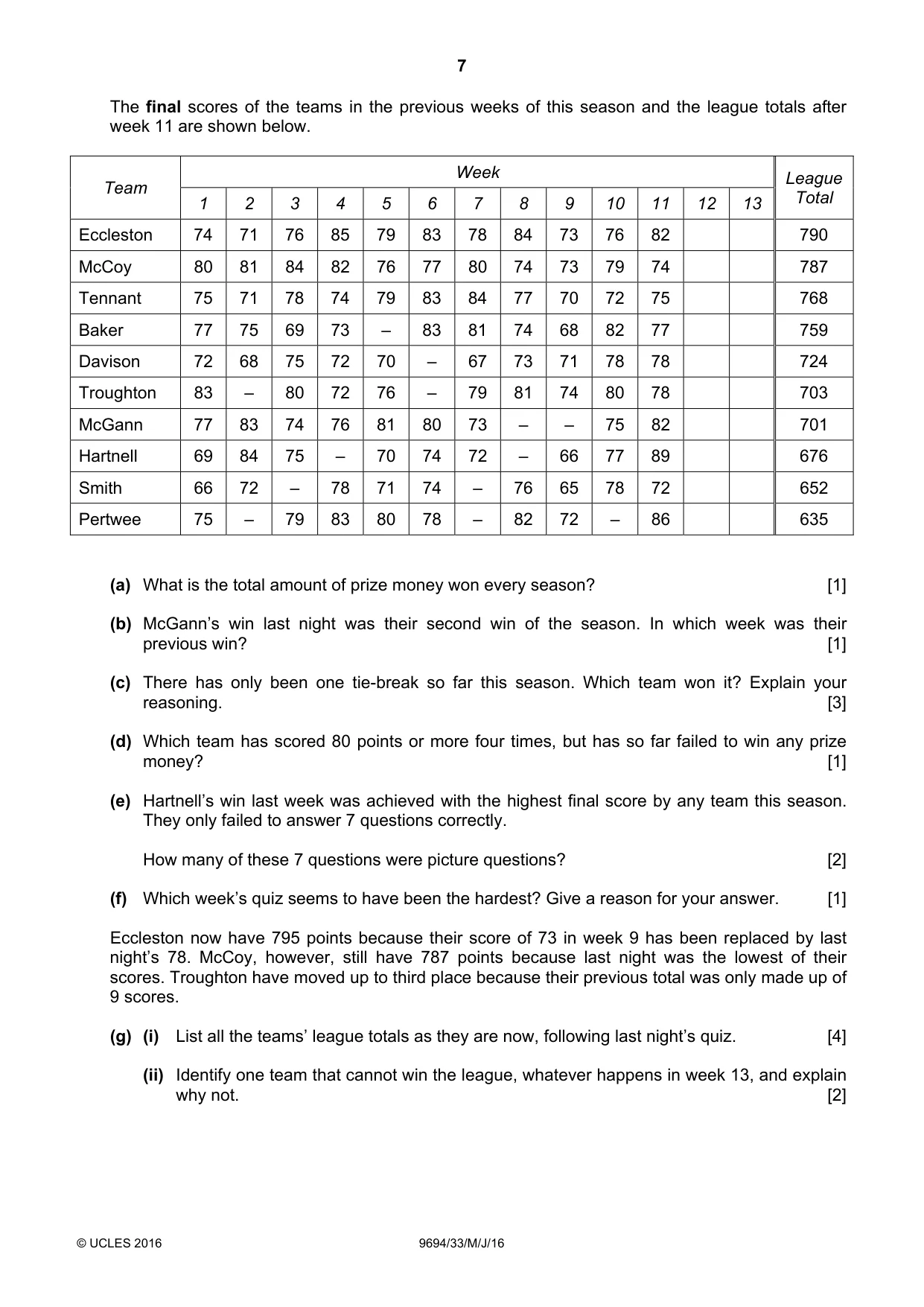
7 © UCLES 2016 9694/33/M/J/16 The final scores of the teams in the previous weeks of this season and the league totals after week 11 are shown below. Team Week League Total 1 2 3 4 5 6 7 8 9 10 11 12 13 Eccleston 74 71 76 85 79 83 78 84 73 76 82 790 McCoy 80 81 84 82 76 77 80 74 73 79 74 787 Tennant 75 71 78 74 79 83 84 77 70 72 75 768 Baker 77 75 69 73 – 83 81 74 68 82 77 759 Davison 72 68 75 72 70 – 67 73 71 78 78 724 Troughton 83 – 80 72 76 – 79 81 74 80 78 703 McGann 77 83 74 76 81 80 73 – – 75 82 701 Hartnell 69 84 75 – 70 74 72 – 66 77 89 676 Smith 66 72 – 78 71 74 – 76 65 78 72 652 Pertwee 75 – 79 83 80 78 – 82 72 – 86 635 (a) What is the total amount of prize money won every season? [1] (b) McGann’s win last night was their second win of the season. In which week was their previous win? [1] (c) There has only been one tie-break so far this season. Which team won it? Explain your reasoning. [3] (d) Which team has scored 80 points or more four times, but has so far failed to win any prize money? [1] (e) Hartnell’s win last week was achieved with the highest final score by any team this season. They only failed to answer 7 questions correctly. How many of these 7 questions were picture questions? [2] (f) Which week’s quiz seems to have been the hardest? Give a reason for your answer. [1] Eccleston now have 795 points because their score of 73 in week 9 has been replaced by last night’s 78. McCoy, however, still have 787 points because last night was the lowest of their scores. Troughton have moved up to third place because their previous total was only made up of 9 scores. (g) (i) List all the teams’ league totals as they are now, following last night’s quiz. [4] (ii) Identify one team that cannot win the league, whatever happens in week 13, and explain why not. [2]
Question paper, page 8
8 Permission to reproduce items where third-party owned material protected by copyright is included has been sought and cleared where possible. Every reasonable effort has been made by the publisher (UCLES) to trace copyright holders, but if any items requiring clearance have unwittingly been included, the publisher will be pleased to make amends at the earliest possible opportunity. To avoid the issue of disclosure of answer-related information to candidates, all copyright acknowledgements are reproduced online in the Cambridge International Examinations Copyright Acknowledgements Booklet. This is produced for each series of examinations and is freely available to download at www.cie.org.uk after the live examination series. Cambridge International Examinations is part of the Cambridge Assessment Group. Cambridge Assessment is the brand name of University of Cambridge Local Examinations Syndicate (UCLES), which is itself a department of the University of Cambridge. © UCLES 2016 9694/33/M/J/16 BLANK PAGE
Mark scheme, page 1
® IGCSE is the registered trademark of Cambridge International Examinations. This document consists of 7 printed pages. © UCLES 2016 [Turn over Cambridge International Examinations Cambridge International Advanced Level THINKING SKILLS 9694/33 Paper 3 Problem Analysis and Solution May/June 2016 MARK SCHEME Maximum Mark: 50 Published This mark scheme is published as an aid to teachers and candidates, to indicate the requirements of the examination. It shows the basis on which Examiners were instructed to award marks. It does not indicate the details of the discussions that took place at an Examiners’ meeting before marking began, which would have considered the acceptability of alternative answers. Mark schemes should be read in conjunction with the question paper and the Principal Examiner Report for Teachers. Cambridge will not enter into discussions about these mark schemes. Cambridge is publishing the mark schemes for the May/June 2016 series for most Cambridge IGCSE®, Cambridge International A and AS Level components and some Cambridge O Level components.
Mark scheme, page 2
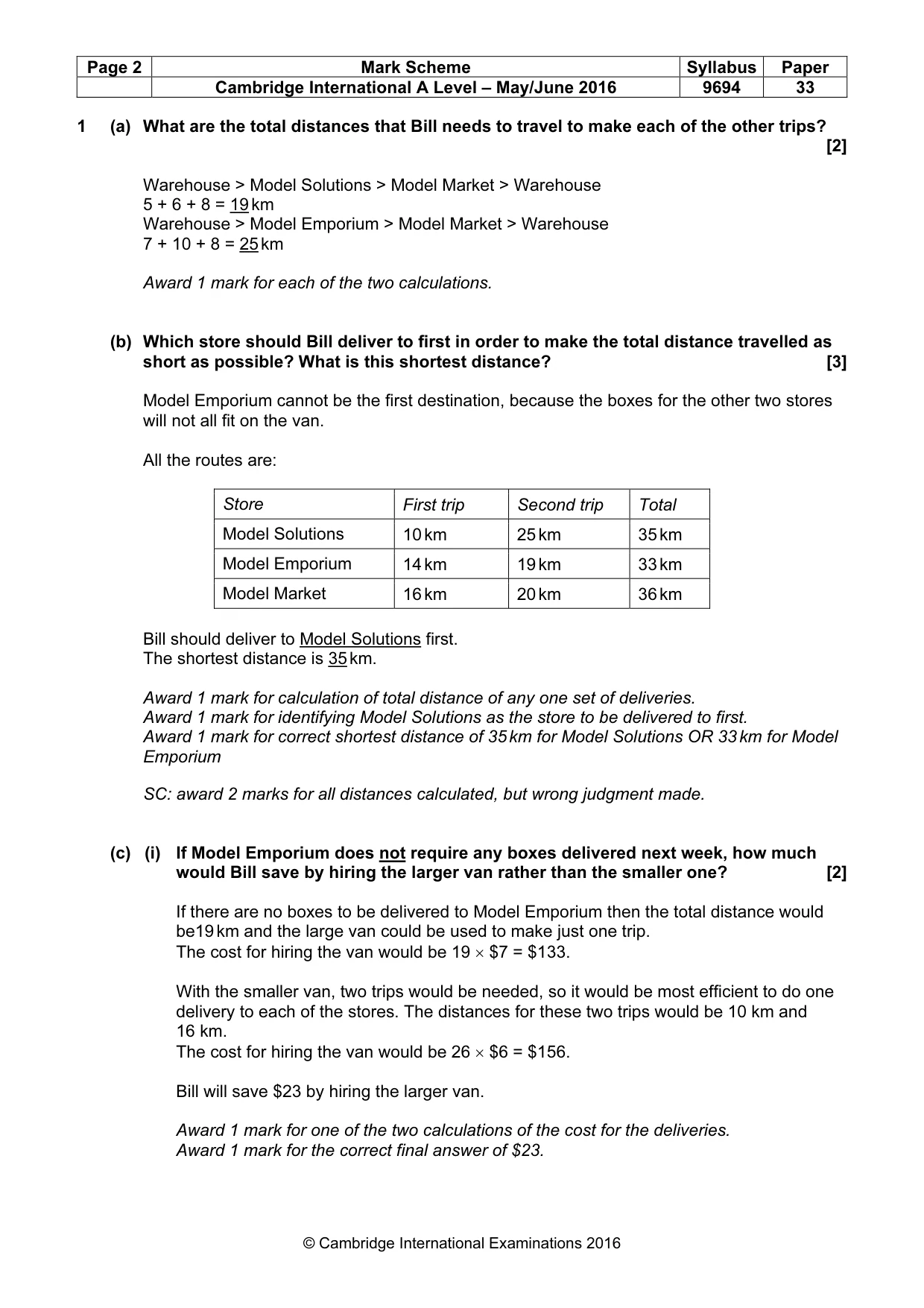
Page 2 Mark Scheme Syllabus Paper Cambridge International A Level – May/June 2016 9694 33 © Cambridge International Examinations 2016 1 (a) What are the total distances that Bill needs to travel to make each of the other trips? [2] Warehouse > Model Solutions > Model Market > Warehouse 5 + 6 + 8 = 19 km Warehouse > Model Emporium > Model Market > Warehouse 7 + 10 + 8 = 25 km Award 1 mark for each of the two calculations. (b) Which store should Bill deliver to first in order to make the total distance travelled as short as possible? What is this shortest distance? [3] Model Emporium cannot be the first destination, because the boxes for the other two stores will not all fit on the van. All the routes are: Store First trip Second trip Total Model Solutions 10 km 25 km 35 km Model Emporium 14 km 19 km 33 km Model Market 16 km 20 km 36 km Bill should deliver to Model Solutions first. The shortest distance is 35 km. Award 1 mark for calculation of total distance of any one set of deliveries. Award 1 mark for identifying Model Solutions as the store to be delivered to first. Award 1 mark for correct shortest distance of 35 km for Model Solutions OR 33 km for Model Emporium SC: award 2 marks for all distances calculated, but wrong judgment made. (c) (i) If Model Emporium does not require any boxes delivered next week, how much would Bill save by hiring the larger van rather than the smaller one? [2] If there are no boxes to be delivered to Model Emporium then the total distance would be19 km and the large van could be used to make just one trip. The cost for hiring the van would be 19 × $7 = $133. With the smaller van, two trips would be needed, so it would be most efficient to do one delivery to each of the stores. The distances for these two trips would be 10 km and 16 km. The cost for hiring the van would be 26 × $6 = $156. Bill will save $23 by hiring the larger van. Award 1 mark for one of the two calculations of the cost for the deliveries. Award 1 mark for the correct final answer of $23.
Mark scheme, page 3
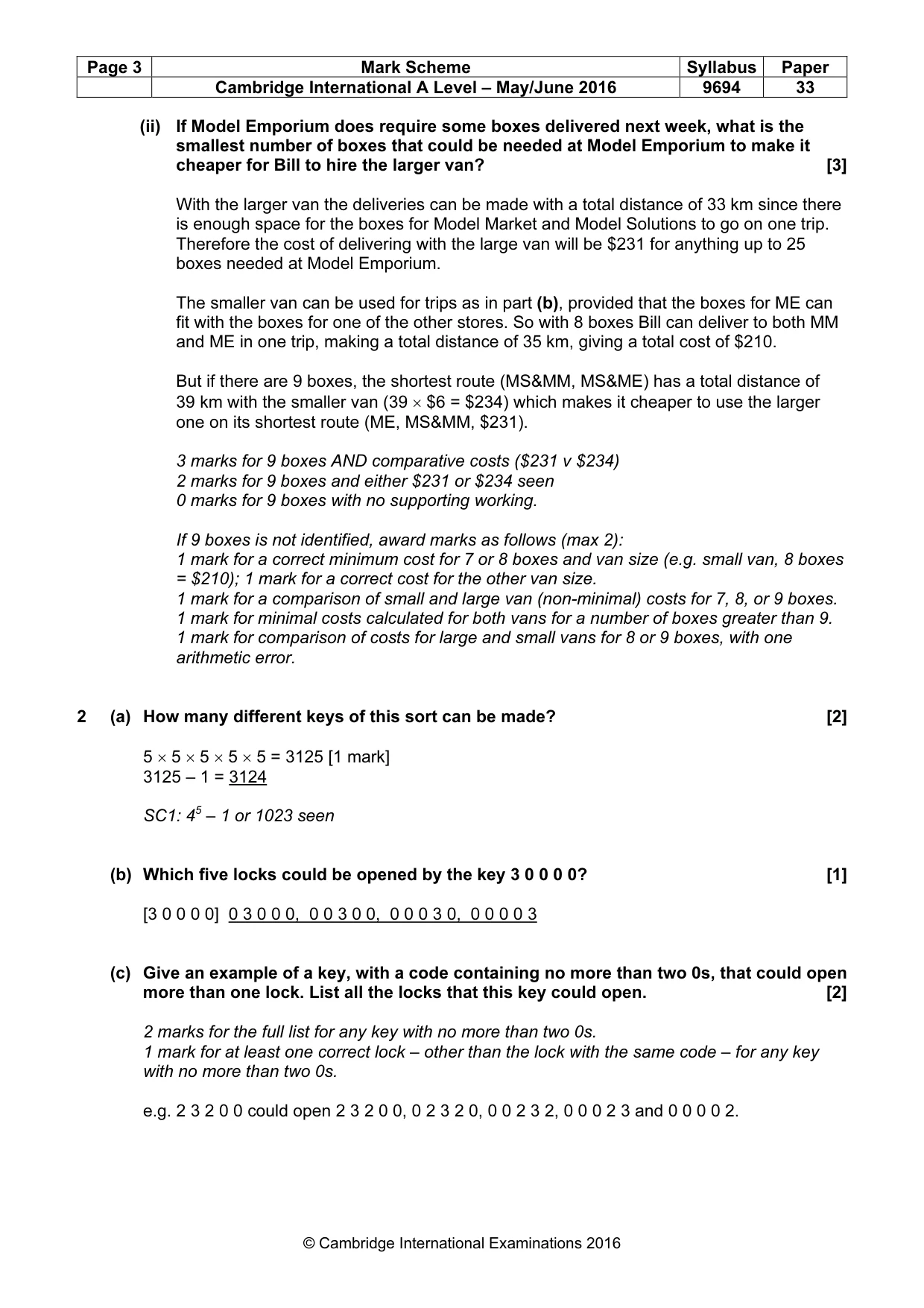
Page 3 Mark Scheme Syllabus Paper Cambridge International A Level – May/June 2016 9694 33 © Cambridge International Examinations 2016 (ii) If Model Emporium does require some boxes delivered next week, what is the smallest number of boxes that could be needed at Model Emporium to make it cheaper for Bill to hire the larger van? [3] With the larger van the deliveries can be made with a total distance of 33 km since there is enough space for the boxes for Model Market and Model Solutions to go on one trip. Therefore the cost of delivering with the large van will be $231 for anything up to 25 boxes needed at Model Emporium. The smaller van can be used for trips as in part (b), provided that the boxes for ME can fit with the boxes for one of the other stores. So with 8 boxes Bill can deliver to both MM and ME in one trip, making a total distance of 35 km, giving a total cost of $210. But if there are 9 boxes, the shortest route (MS&MM, MS&ME) has a total distance of 39 km with the smaller van (39 × $6 = $234) which makes it cheaper to use the larger one on its shortest route (ME, MS&MM, $231). 3 marks for 9 boxes AND comparative costs ($231 v $234) 2 marks for 9 boxes and either $231 or $234 seen 0 marks for 9 boxes with no supporting working. If 9 boxes is not identified, award marks as follows (max 2): 1 mark for a correct minimum cost for 7 or 8 boxes and van size (e.g. small van, 8 boxes = $210); 1 mark for a correct cost for the other van size. 1 mark for a comparison of small and large van (non-minimal) costs for 7, 8, or 9 boxes. 1 mark for minimal costs calculated for both vans for a number of boxes greater than 9. 1 mark for comparison of costs for large and small vans for 8 or 9 boxes, with one arithmetic error. 2 (a) How many different keys of this sort can be made? [2] 5 × 5 × 5 × 5 × 5 = 3125 [1 mark] 3125 – 1 = 3124 SC1: 45 – 1 or 1023 seen (b) Which five locks could be opened by the key 3 0 0 0 0? [1] [3 0 0 0 0] 0 3 0 0 0, 0 0 3 0 0, 0 0 0 3 0, 0 0 0 0 3 (c) Give an example of a key, with a code containing no more than two 0s, that could open more than one lock. List all the locks that this key could open. [2] 2 marks for the full list for any key with no more than two 0s. 1 mark for at least one correct lock – other than the lock with the same code – for any key with no more than two 0s. e.g. 2 3 2 0 0 could open 2 3 2 0 0, 0 2 3 2 0, 0 0 2 3 2, 0 0 0 2 3 and 0 0 0 0 2.
Mark scheme, page 4
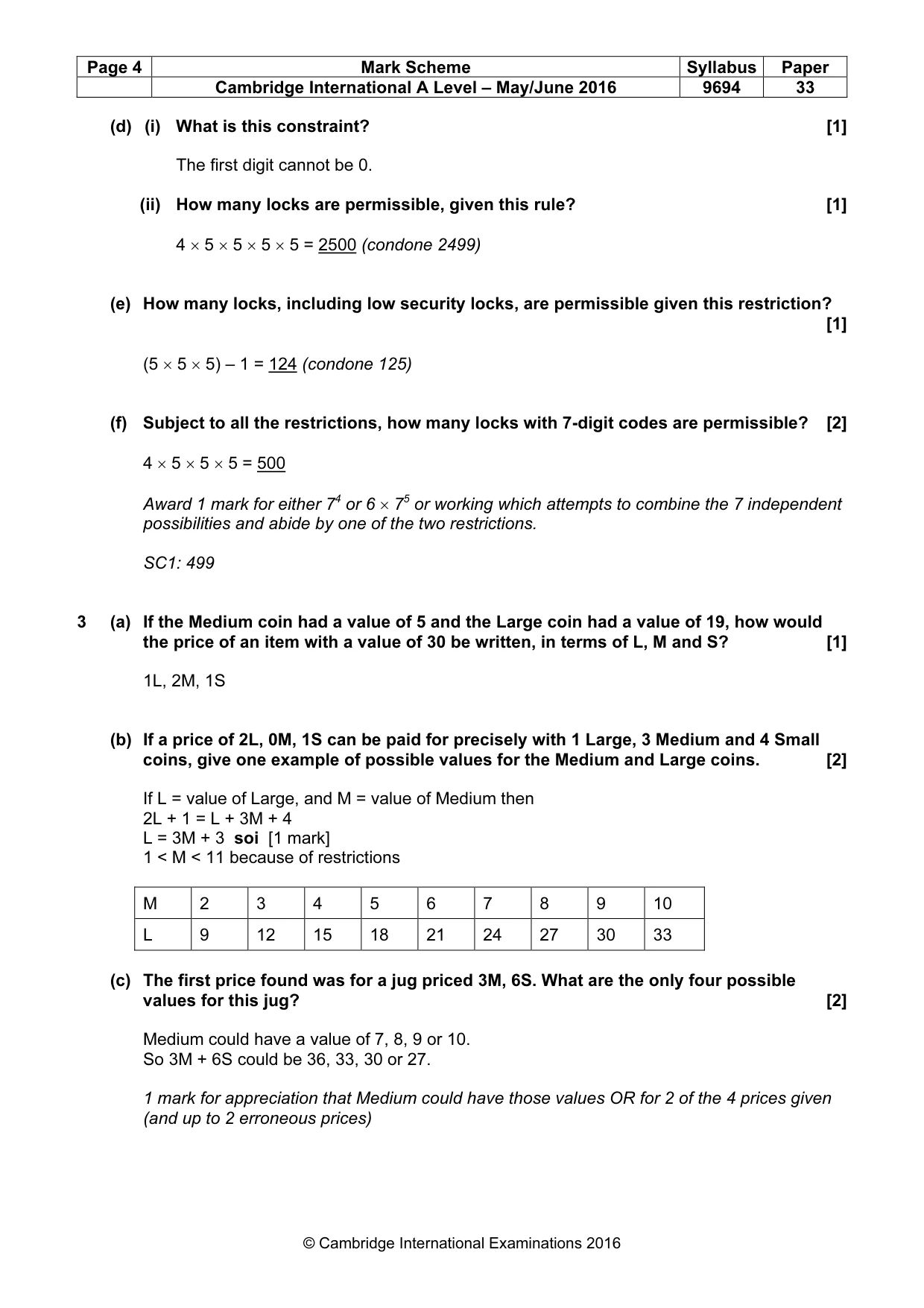
Page 4 Mark Scheme Syllabus Paper Cambridge International A Level – May/June 2016 9694 33 © Cambridge International Examinations 2016 (d) (i) What is this constraint? [1] The first digit cannot be 0. (ii) How many locks are permissible, given this rule? [1] 4 × 5 × 5 × 5 × 5 = 2500 (condone 2499) (e) How many locks, including low security locks, are permissible given this restriction? [1] (5 × 5 × 5) – 1 = 124 (condone 125) (f) Subject to all the restrictions, how many locks with 7-digit codes are permissible? [2] 4 × 5 × 5 × 5 = 500 Award 1 mark for either 74 or 6 × 75 or working which attempts to combine the 7 independent possibilities and abide by one of the two restrictions. SC1: 499 3 (a) If the Medium coin had a value of 5 and the Large coin had a value of 19, how would the price of an item with a value of 30 be written, in terms of L, M and S? [1] 1L, 2M, 1S (b) If a price of 2L, 0M, 1S can be paid for precisely with 1 Large, 3 Medium and 4 Small coins, give one example of possible values for the Medium and Large coins. [2] If L = value of Large, and M = value of Medium then 2L + 1 = L + 3M + 4 L = 3M + 3 soi [1 mark] 1 < M < 11 because of restrictions M 2 3 4 5 6 7 8 9 10 L 9 12 15 18 21 24 27 30 33 (c) The first price found was for a jug priced 3M, 6S. What are the only four possible values for this jug? [2] Medium could have a value of 7, 8, 9 or 10. So 3M + 6S could be 36, 33, 30 or 27. 1 mark for appreciation that Medium could have those values OR for 2 of the 4 prices given (and up to 2 erroneous prices)
Mark scheme, page 5
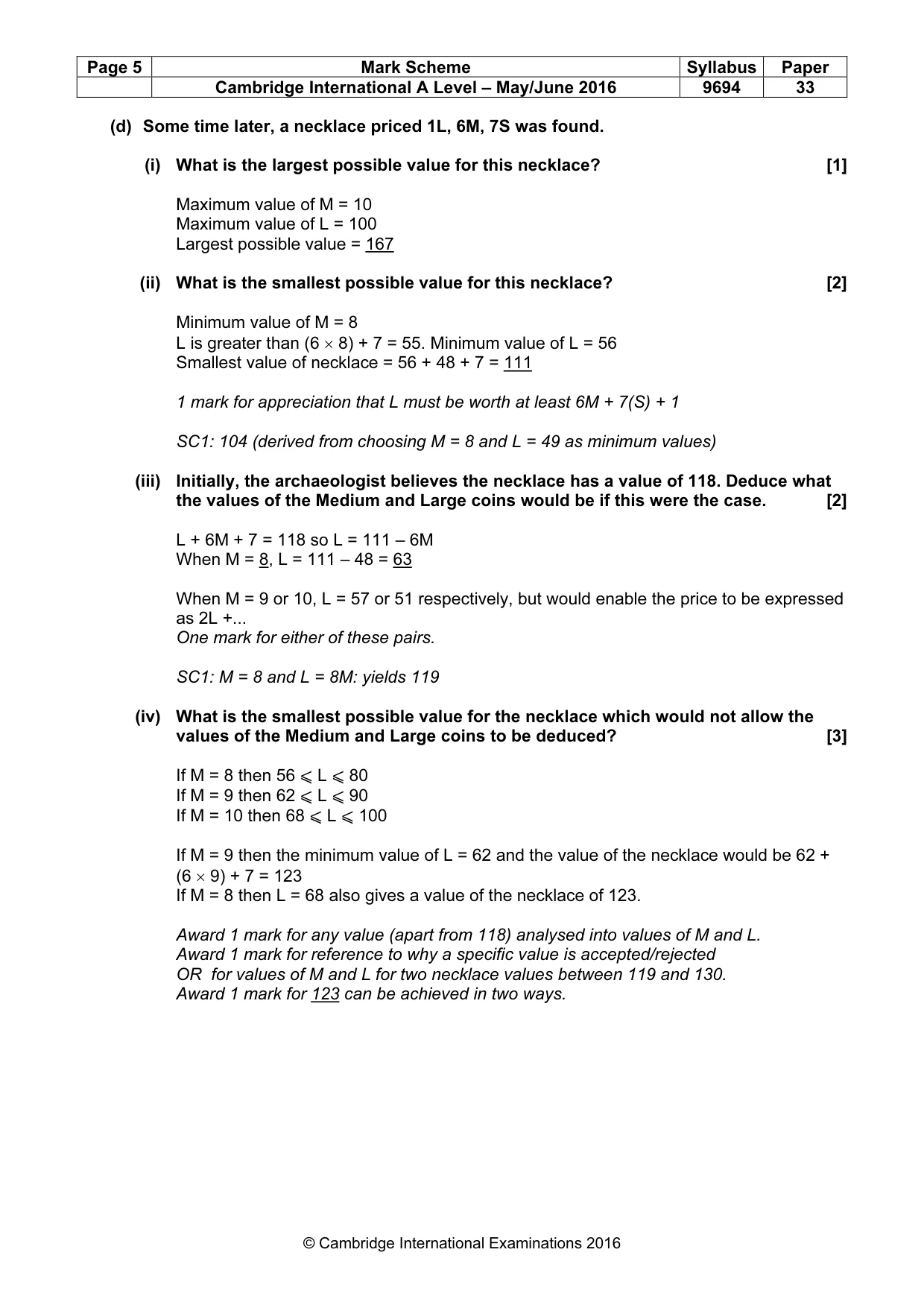
Page 5 Mark Scheme Syllabus Paper Cambridge International A Level – May/June 2016 9694 33 © Cambridge International Examinations 2016 (d) Some time later, a necklace priced 1L, 6M, 7S was found. (i) What is the largest possible value for this necklace? [1] Maximum value of M = 10 Maximum value of L = 100 Largest possible value = 167 (ii) What is the smallest possible value for this necklace? [2] Minimum value of M = 8 L is greater than (6 × 8) + 7 = 55. Minimum value of L = 56 Smallest value of necklace = 56 + 48 + 7 = 111 1 mark for appreciation that L must be worth at least 6M + 7(S) + 1 SC1: 104 (derived from choosing M = 8 and L = 49 as minimum values) (iii) Initially, the archaeologist believes the necklace has a value of 118. Deduce what the values of the Medium and Large coins would be if this were the case. [2] L + 6M + 7 = 118 so L = 111 – 6M When M = 8, L = 111 – 48 = 63 When M = 9 or 10, L = 57 or 51 respectively, but would enable the price to be expressed as 2L +... One mark for either of these pairs. SC1: M = 8 and L = 8M: yields 119 (iv) What is the smallest possible value for the necklace which would not allow the values of the Medium and Large coins to be deduced? [3] If M = 8 then 56 ⩽ L ⩽ 80 If M = 9 then 62 ⩽ L ⩽ 90 If M = 10 then 68 ⩽ L ⩽ 100 If M = 9 then the minimum value of L = 62 and the value of the necklace would be 62 + (6 × 9) + 7 = 123 If M = 8 then L = 68 also gives a value of the necklace of 123. Award 1 mark for any value (apart from 118) analysed into values of M and L. Award 1 mark for reference to why a specific value is accepted/rejected OR for values of M and L for two necklace values between 119 and 130. Award 1 mark for 123 can be achieved in two ways.
Mark scheme, page 6
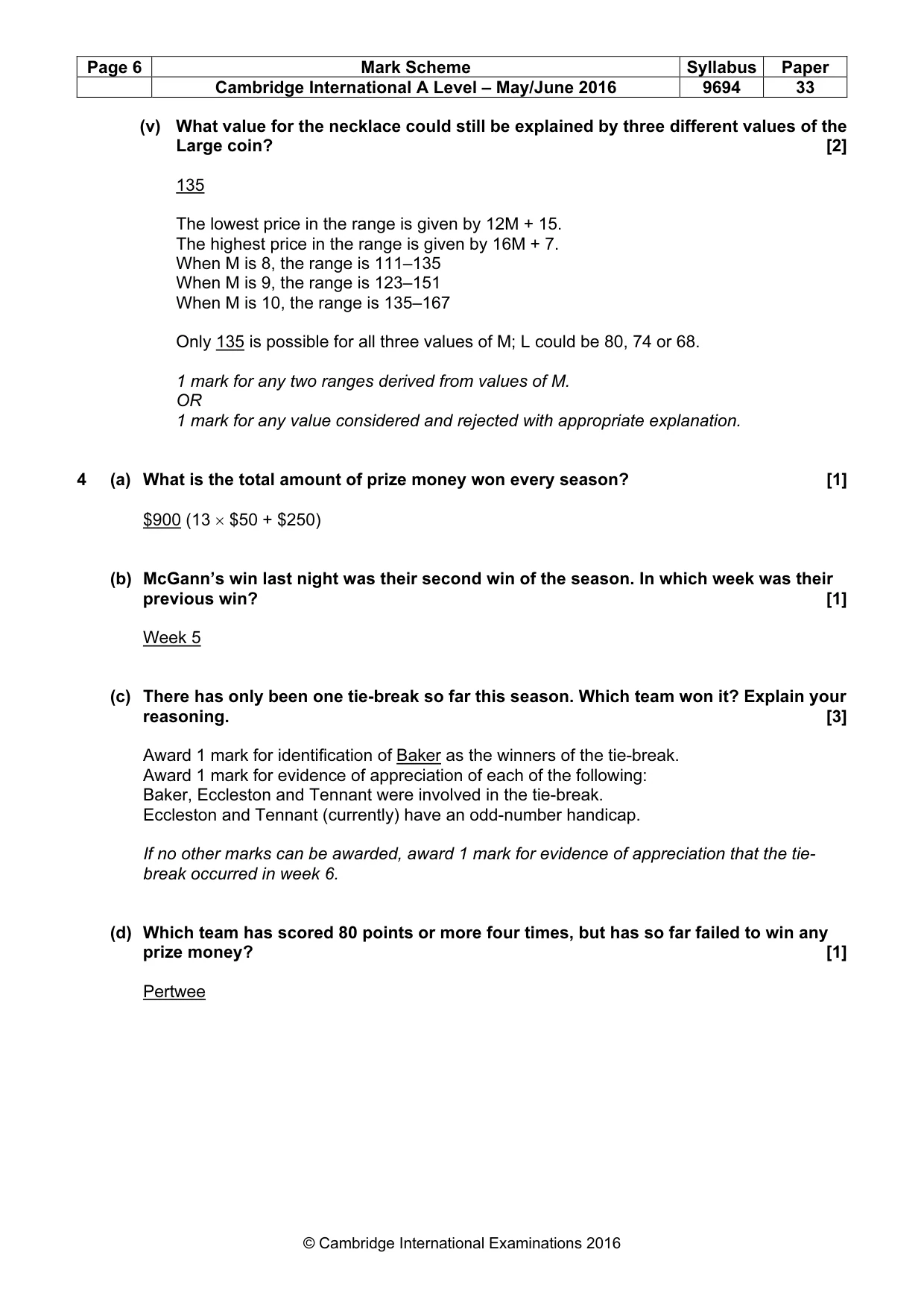
Page 6 Mark Scheme Syllabus Paper Cambridge International A Level – May/June 2016 9694 33 © Cambridge International Examinations 2016 (v) What value for the necklace could still be explained by three different values of the Large coin? [2] 135 The lowest price in the range is given by 12M + 15. The highest price in the range is given by 16M + 7. When M is 8, the range is 111–135 When M is 9, the range is 123–151 When M is 10, the range is 135–167 Only 135 is possible for all three values of M; L could be 80, 74 or 68. 1 mark for any two ranges derived from values of M. OR 1 mark for any value considered and rejected with appropriate explanation. 4 (a) What is the total amount of prize money won every season? [1] $900 (13 × $50 + $250) (b) McGann’s win last night was their second win of the season. In which week was their previous win? [1] Week 5 (c) There has only been one tie-break so far this season. Which team won it? Explain your reasoning. [3] Award 1 mark for identification of Baker as the winners of the tie-break. Award 1 mark for evidence of appreciation of each of the following: Baker, Eccleston and Tennant were involved in the tie-break. Eccleston and Tennant (currently) have an odd-number handicap. If no other marks can be awarded, award 1 mark for evidence of appreciation that the tie- break occurred in week 6. (d) Which team has scored 80 points or more four times, but has so far failed to win any prize money? [1] Pertwee
Mark scheme, page 7
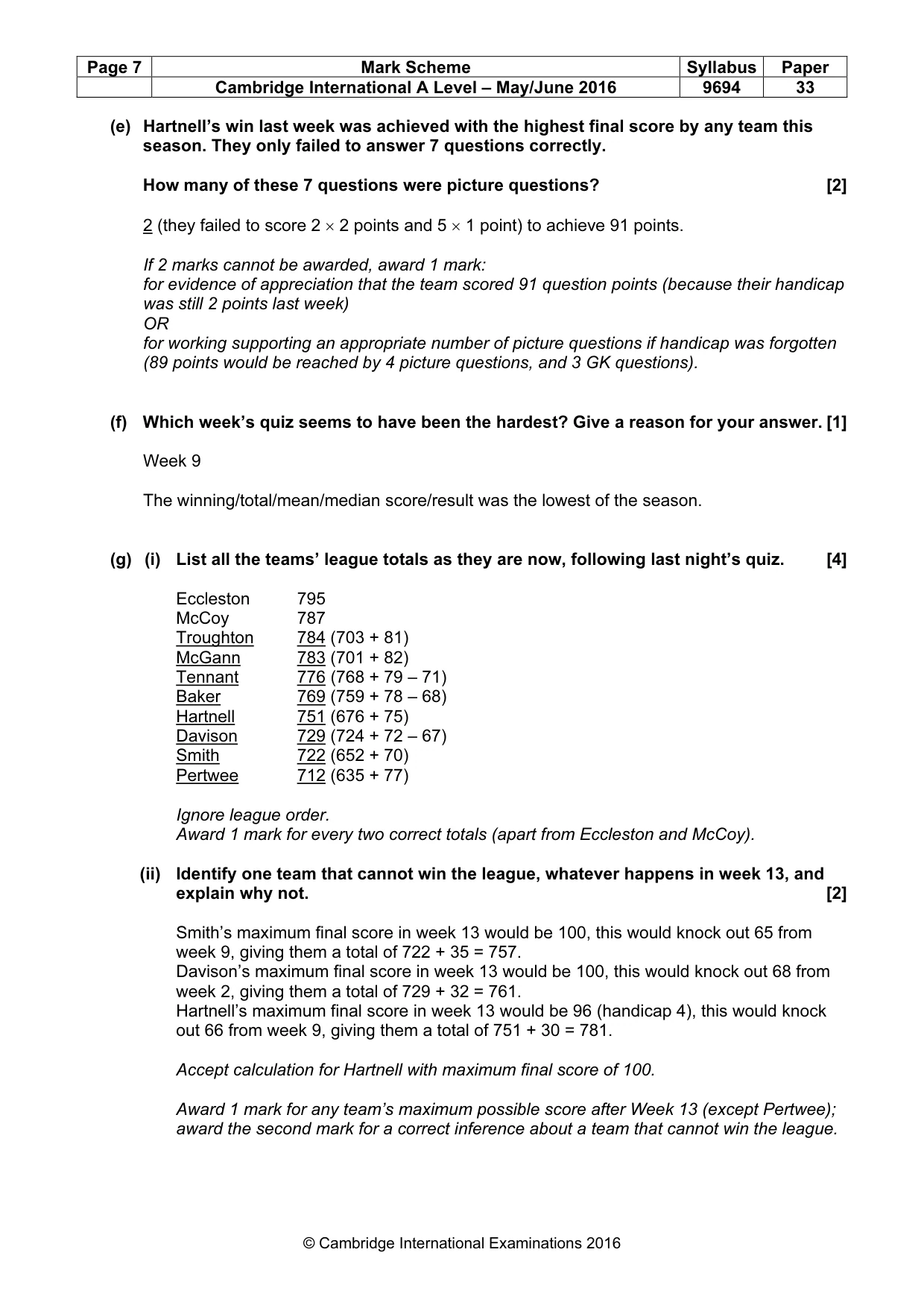
Page 7 Mark Scheme Syllabus Paper Cambridge International A Level – May/June 2016 9694 33 © Cambridge International Examinations 2016 (e) Hartnell’s win last week was achieved with the highest final score by any team this season. They only failed to answer 7 questions correctly. How many of these 7 questions were picture questions? [2] 2 (they failed to score 2 × 2 points and 5 × 1 point) to achieve 91 points. If 2 marks cannot be awarded, award 1 mark: for evidence of appreciation that the team scored 91 question points (because their handicap was still 2 points last week) OR for working supporting an appropriate number of picture questions if handicap was forgotten (89 points would be reached by 4 picture questions, and 3 GK questions). (f) Which week’s quiz seems to have been the hardest? Give a reason for your answer. [1] Week 9 The winning/total/mean/median score/result was the lowest of the season. (g) (i) List all the teams’ league totals as they are now, following last night’s quiz. [4] Eccleston 795 McCoy 787 Troughton 784 (703 + 81) McGann 783 (701 + 82) Tennant 776 (768 + 79 – 71) Baker 769 (759 + 78 – 68) Hartnell 751 (676 + 75) Davison 729 (724 + 72 – 67) Smith 722 (652 + 70) Pertwee 712 (635 + 77) Ignore league order. Award 1 mark for every two correct totals (apart from Eccleston and McCoy). (ii) Identify one team that cannot win the league, whatever happens in week 13, and explain why not. [2] Smith’s maximum final score in week 13 would be 100, this would knock out 65 from week 9, giving them a total of 722 + 35 = 757. Davison’s maximum final score in week 13 would be 100, this would knock out 68 from week 2, giving them a total of 729 + 32 = 761. Hartnell’s maximum final score in week 13 would be 96 (handicap 4), this would knock out 66 from week 9, giving them a total of 751 + 30 = 781. Accept calculation for Hartnell with maximum final score of 100. Award 1 mark for any team’s maximum possible score after Week 13 (except Pertwee); award the second mark for a correct inference about a team that cannot win the league.
What you needed in this session
Cambridge’s own grade thresholds for 2016 May/June, Paper 3 · Variant 3. A higher threshold means an easier paper — the bar moves with how the cohort did.