Cambridge A Level Thinking Skills 9694 — 2016 May/June Paper 2 · Variant 3
9694/23/M/J/16 · 45 marks · ≈51 min
The question paper and its mark scheme, free to read here and free to download. This is Cambridge’s own paper, exactly as it was sat.
Question paper8 pages


Mark scheme8 pages
Answers below. Sit the paper first if you are practising.
Paper as text
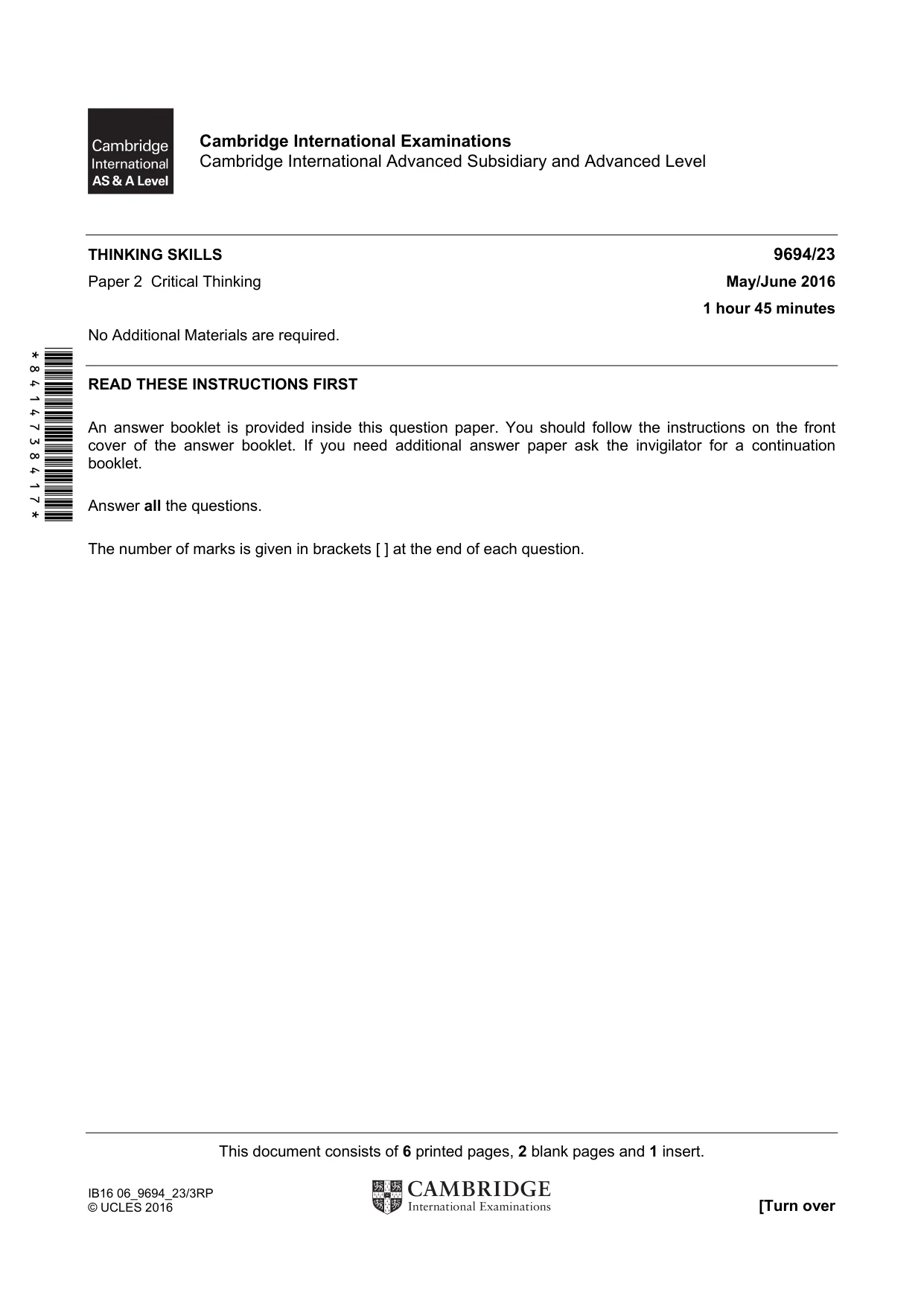
Question paper, page 1
This document consists of 6 printed pages, 2 blank pages and 1 insert. IB16 06_9694_23/3RP © UCLES 2016 [Turn over *8414738417* Cambridge International Examinations Cambridge International Advanced Subsidiary and Advanced Level THINKING SKILLS 9694/23 Paper 2 Critical Thinking May/June 2016 1 hour 45 minutes No Additional Materials are required. READ THESE INSTRUCTIONS FIRST An answer booklet is provided inside this question paper. You should follow the instructions on the front cover of the answer booklet. If you need additional answer paper ask the invigilator for a continuation booklet. Answer all the questions. The number of marks is given in brackets [ ] at the end of each question.
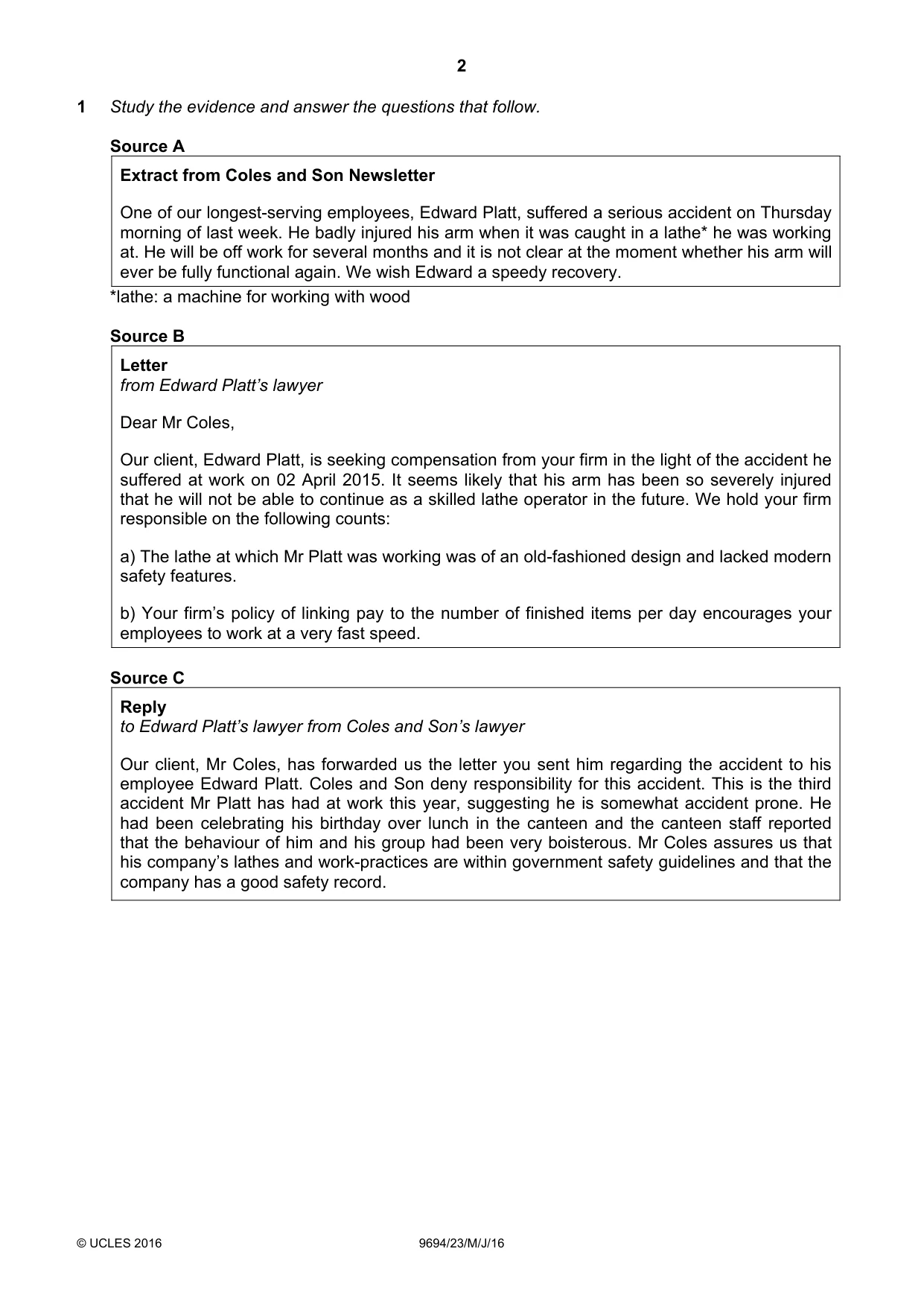
Question paper, page 2
2 © UCLES 2016 9694/23/M/J/16 1 Study the evidence and answer the questions that follow. Source A Extract from Coles and Son Newsletter One of our longest-serving employees, Edward Platt, suffered a serious accident on Thursday morning of last week. He badly injured his arm when it was caught in a lathe* he was working at. He will be off work for several months and it is not clear at the moment whether his arm will ever be fully functional again. We wish Edward a speedy recovery. *lathe: a machine for working with wood Source B Letter from Edward Platt’s lawyer Dear Mr Coles, Our client, Edward Platt, is seeking compensation from your firm in the light of the accident he suffered at work on 02 April 2015. It seems likely that his arm has been so severely injured that he will not be able to continue as a skilled lathe operator in the future. We hold your firm responsible on the following counts: a) The lathe at which Mr Platt was working was of an old-fashioned design and lacked modern safety features. b) Your firm’s policy of linking pay to the number of finished items per day encourages your employees to work at a very fast speed. Source C Reply to Edward Platt’s lawyer from Coles and Son’s lawyer Our client, Mr Coles, has forwarded us the letter you sent him regarding the accident to his employee Edward Platt. Coles and Son deny responsibility for this accident. This is the third accident Mr Platt has had at work this year, suggesting he is somewhat accident prone. He had been celebrating his birthday over lunch in the canteen and the canteen staff reported that the behaviour of him and his group had been very boisterous. Mr Coles assures us that his company’s lathes and work-practices are within government safety guidelines and that the company has a good safety record.
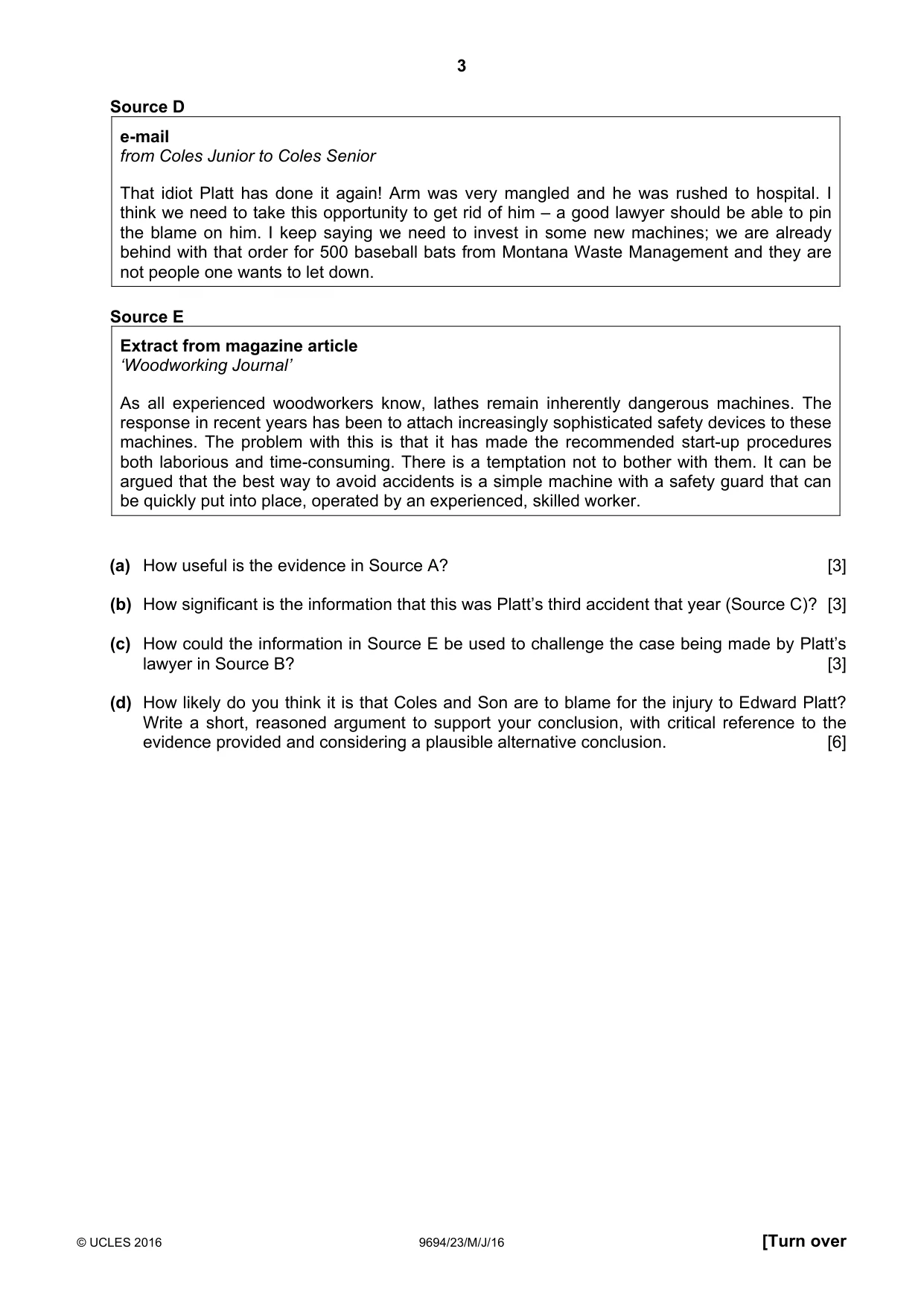
Question paper, page 3
3 © UCLES 2016 9694/23/M/J/16 [Turn over Source D e-mail from Coles Junior to Coles Senior That idiot Platt has done it again! Arm was very mangled and he was rushed to hospital. I think we need to take this opportunity to get rid of him – a good lawyer should be able to pin the blame on him. I keep saying we need to invest in some new machines; we are already behind with that order for 500 baseball bats from Montana Waste Management and they are not people one wants to let down. Source E Extract from magazine article ‘Woodworking Journal’ As all experienced woodworkers know, lathes remain inherently dangerous machines. The response in recent years has been to attach increasingly sophisticated safety devices to these machines. The problem with this is that it has made the recommended start-up procedures both laborious and time-consuming. There is a temptation not to bother with them. It can be argued that the best way to avoid accidents is a simple machine with a safety guard that can be quickly put into place, operated by an experienced, skilled worker. (a) How useful is the evidence in Source A? [3] (b) How significant is the information that this was Platt’s third accident that year (Source C)? [3] (c) How could the information in Source E be used to challenge the case being made by Platt’s lawyer in Source B? [3] (d) How likely do you think it is that Coles and Son are to blame for the injury to Edward Platt? Write a short, reasoned argument to support your conclusion, with critical reference to the evidence provided and considering a plausible alternative conclusion. [6]
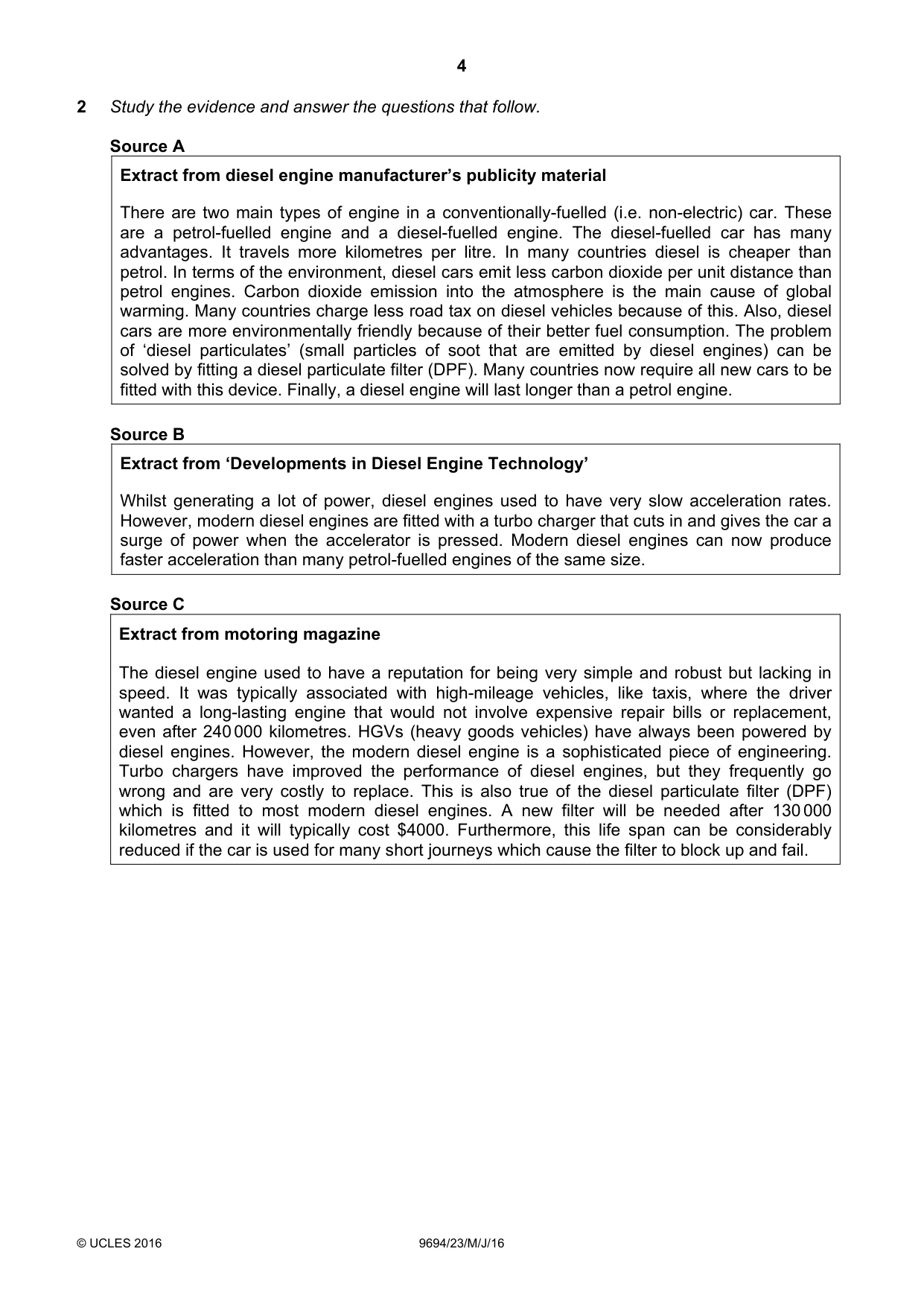
Question paper, page 4
4 © UCLES 2016 9694/23/M/J/16 2 Study the evidence and answer the questions that follow. Source A Extract from diesel engine manufacturer’s publicity material There are two main types of engine in a conventionally-fuelled (i.e. non-electric) car. These are a petrol-fuelled engine and a diesel-fuelled engine. The diesel-fuelled car has many advantages. It travels more kilometres per litre. In many countries diesel is cheaper than petrol. In terms of the environment, diesel cars emit less carbon dioxide per unit distance than petrol engines. Carbon dioxide emission into the atmosphere is the main cause of global warming. Many countries charge less road tax on diesel vehicles because of this. Also, diesel cars are more environmentally friendly because of their better fuel consumption. The problem of ‘diesel particulates’ (small particles of soot that are emitted by diesel engines) can be solved by fitting a diesel particulate filter (DPF). Many countries now require all new cars to be fitted with this device. Finally, a diesel engine will last longer than a petrol engine. Source B Extract from ‘Developments in Diesel Engine Technology’ Whilst generating a lot of power, diesel engines used to have very slow acceleration rates. However, modern diesel engines are fitted with a turbo charger that cuts in and gives the car a surge of power when the accelerator is pressed. Modern diesel engines can now produce faster acceleration than many petrol-fuelled engines of the same size. Source C Extract from motoring magazine The diesel engine used to have a reputation for being very simple and robust but lacking in speed. It was typically associated with high-mileage vehicles, like taxis, where the driver wanted a long-lasting engine that would not involve expensive repair bills or replacement, even after 240 000 kilometres. HGVs (heavy goods vehicles) have always been powered by diesel engines. However, the modern diesel engine is a sophisticated piece of engineering. Turbo chargers have improved the performance of diesel engines, but they frequently go wrong and are very costly to replace. This is also true of the diesel particulate filter (DPF) which is fitted to most modern diesel engines. A new filter will be needed after 130 000 kilometres and it will typically cost $4000. Furthermore, this life span can be considerably reduced if the car is used for many short journeys which cause the filter to block up and fail.
Question paper, page 5
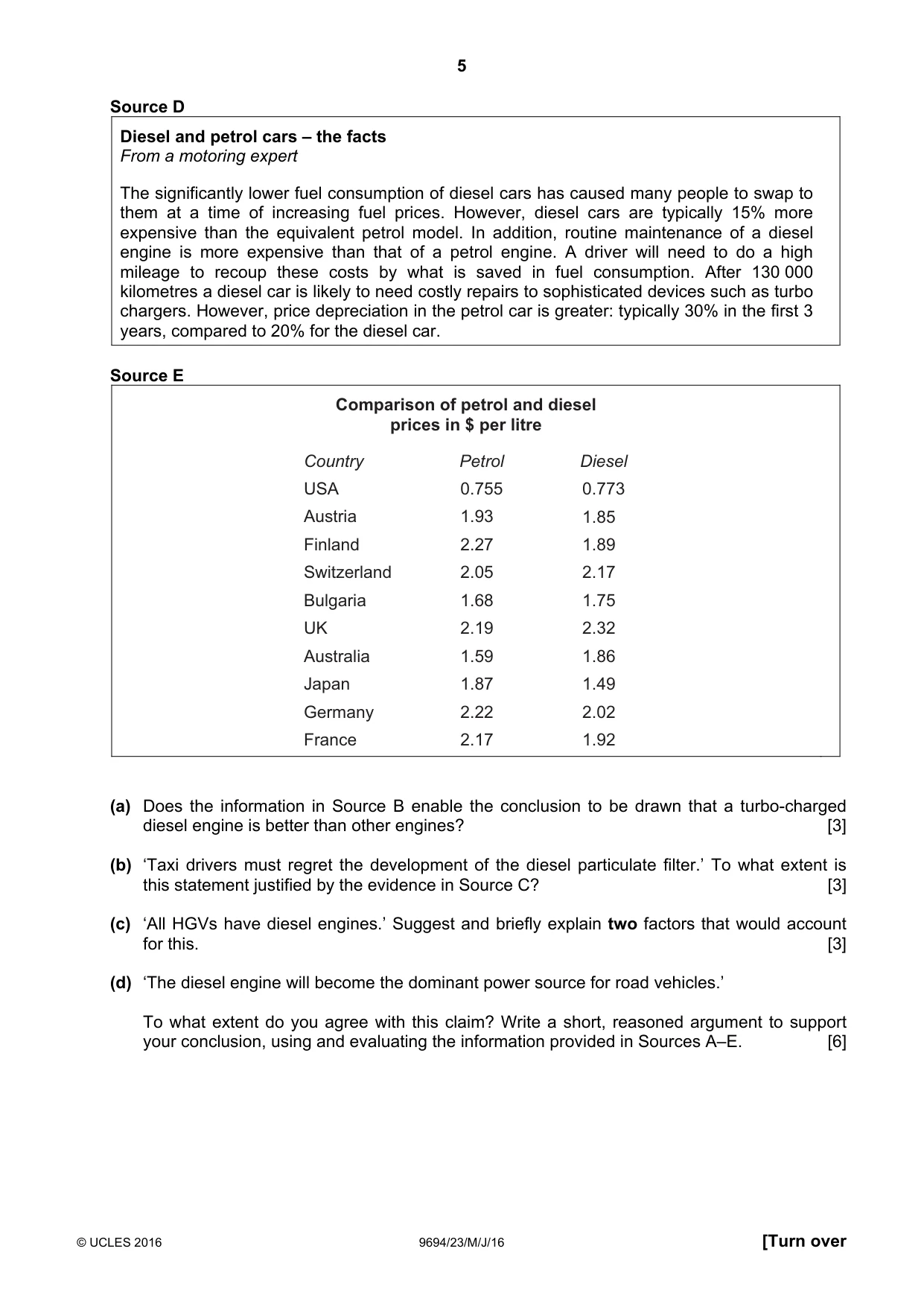
5 © UCLES 2016 9694/23/M/J/16 [Turn over Source D Diesel and petrol cars – the facts From a motoring expert The significantly lower fuel consumption of diesel cars has caused many people to swap to them at a time of increasing fuel prices. However, diesel cars are typically 15% more expensive than the equivalent petrol model. In addition, routine maintenance of a diesel engine is more expensive than that of a petrol engine. A driver will need to do a high mileage to recoup these costs by what is saved in fuel consumption. After 130 000 kilometres a diesel car is likely to need costly repairs to sophisticated devices such as turbo chargers. However, price depreciation in the petrol car is greater: typically 30% in the first 3 years, compared to 20% for the diesel car. Source E Country USA Austria Finland Switzerland Bulgaria UK Australia Japan Germany France Petrol 0.755 1.93 2.27 2.05 1.68 2.19 1.59 1.87 2.22 2.17 Diesel 0.773 1.85 1.89 2.17 1.75 2.32 1.86 1.49 2.02 1.92 Comparison of petrol and diesel prices in $ per litre (a) Does the information in Source B enable the conclusion to be drawn that a turbo-charged diesel engine is better than other engines? [3] (b) ‘Taxi drivers must regret the development of the diesel particulate filter.’ To what extent is this statement justified by the evidence in Source C? [3] (c) ‘All HGVs have diesel engines.’ Suggest and briefly explain two factors that would account for this. [3] (d) ‘The diesel engine will become the dominant power source for road vehicles.’ To what extent do you agree with this claim? Write a short, reasoned argument to support your conclusion, using and evaluating the information provided in Sources A–E. [6]
Question paper, page 6
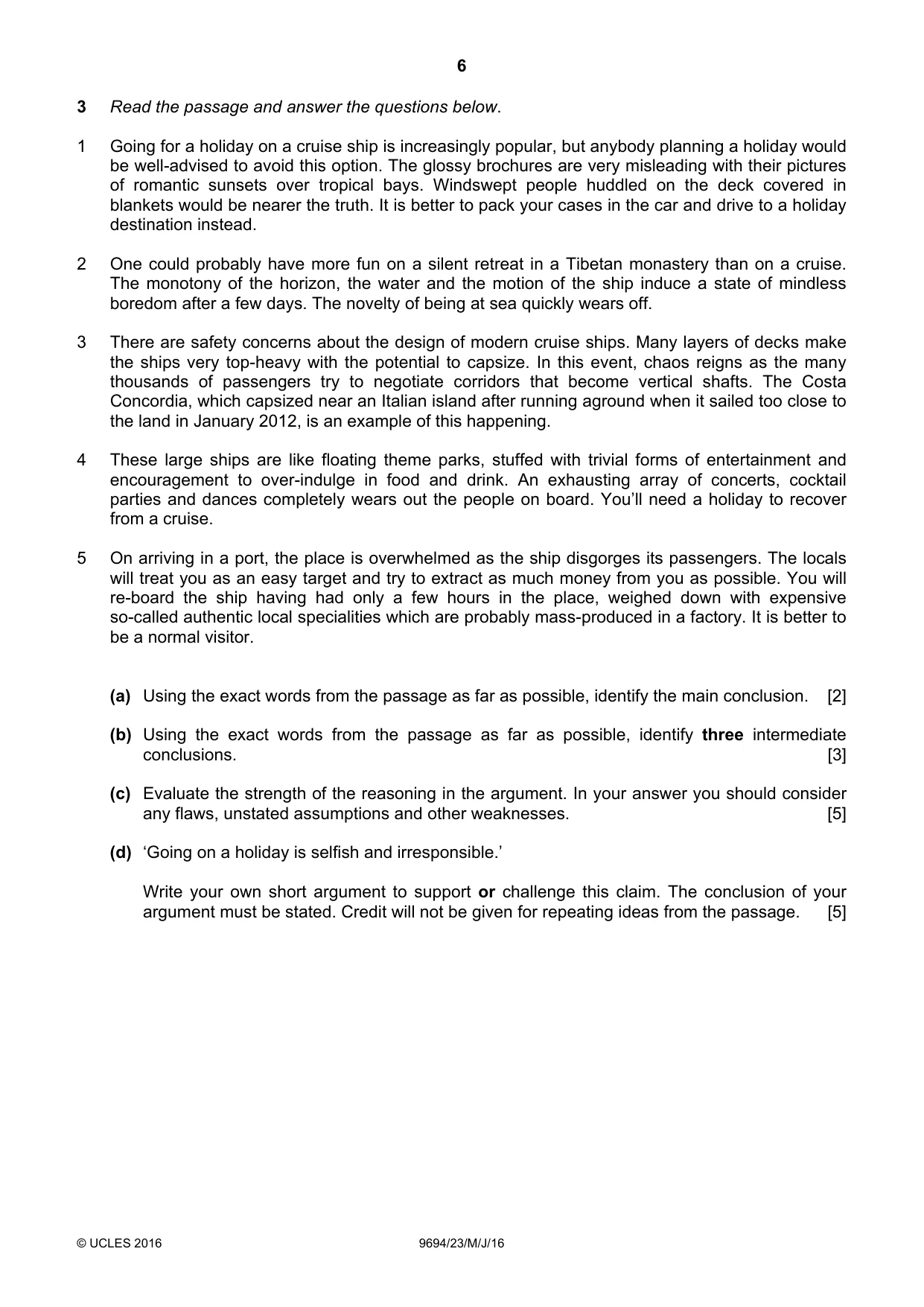
6 © UCLES 2016 9694/23/M/J/16 3 Read the passage and answer the questions below. 1 Going for a holiday on a cruise ship is increasingly popular, but anybody planning a holiday would be well-advised to avoid this option. The glossy brochures are very misleading with their pictures of romantic sunsets over tropical bays. Windswept people huddled on the deck covered in blankets would be nearer the truth. It is better to pack your cases in the car and drive to a holiday destination instead. 2 One could probably have more fun on a silent retreat in a Tibetan monastery than on a cruise. The monotony of the horizon, the water and the motion of the ship induce a state of mindless boredom after a few days. The novelty of being at sea quickly wears off. 3 There are safety concerns about the design of modern cruise ships. Many layers of decks make the ships very top-heavy with the potential to capsize. In this event, chaos reigns as the many thousands of passengers try to negotiate corridors that become vertical shafts. The Costa Concordia, which capsized near an Italian island after running aground when it sailed too close to the land in January 2012, is an example of this happening. 4 These large ships are like floating theme parks, stuffed with trivial forms of entertainment and encouragement to over-indulge in food and drink. An exhausting array of concerts, cocktail parties and dances completely wears out the people on board. You’ll need a holiday to recover from a cruise. 5 On arriving in a port, the place is overwhelmed as the ship disgorges its passengers. The locals will treat you as an easy target and try to extract as much money from you as possible. You will re-board the ship having had only a few hours in the place, weighed down with expensive so-called authentic local specialities which are probably mass-produced in a factory. It is better to be a normal visitor. (a) Using the exact words from the passage as far as possible, identify the main conclusion. [2] (b) Using the exact words from the passage as far as possible, identify three intermediate conclusions. [3] (c) Evaluate the strength of the reasoning in the argument. In your answer you should consider any flaws, unstated assumptions and other weaknesses. [5] (d) ‘Going on a holiday is selfish and irresponsible.’ Write your own short argument to support or challenge this claim. The conclusion of your argument must be stated. Credit will not be given for repeating ideas from the passage. [5]
Question paper, page 7
7 © UCLES 2016 9694/23/M/J/16 BLANK PAGE
Question paper, page 8
8 Permission to reproduce items where third-party owned material protected by copyright is included has been sought and cleared where possible. Every reasonable effort has been made by the publisher (UCLES) to trace copyright holders, but if any items requiring clearance have unwittingly been included, the publisher will be pleased to make amends at the earliest possible opportunity. To avoid the issue of disclosure of answer-related information to candidates, all copyright acknowledgements are reproduced online in the Cambridge International Examinations Copyright Acknowledgements Booklet. This is produced for each series of examinations and is freely available to download at www.cie.org.uk after the live examination series. Cambridge International Examinations is part of the Cambridge Assessment Group. Cambridge Assessment is the brand name of University of Cambridge Local Examinations Syndicate (UCLES), which is itself a department of the University of Cambridge. © UCLES 2016 9694/23/M/J/16 BLANK PAGE
Mark scheme, page 1
© Cambridge International Examinations 2016 Cambridge International Examinations Cambridge International Advanced Subsidiary and Advanced Level THINKING SKILLS 9694/23 Paper 2 Critical Thinking May/June 2016 MARK SCHEME Maximum Mark: 45 Published This mark scheme is published as an aid to teachers and candidates, to indicate the requirements of the examination. It shows the basis on which Examiners were instructed to award marks. It does not indicate the details of the discussions that took place at an Examiners’ meeting before marking began, which would have considered the acceptability of alternative answers. Mark schemes should be read in conjunction with the question paper and the Principal Examiner Report for Teachers. Cambridge will not enter into discussions about these mark schemes. Cambridge is publishing the mark schemes for the May/June 2016 series for most Cambridge IGCSE®, Cambridge International A and AS Level components and some Cambridge O Level components.
Mark scheme, page 2
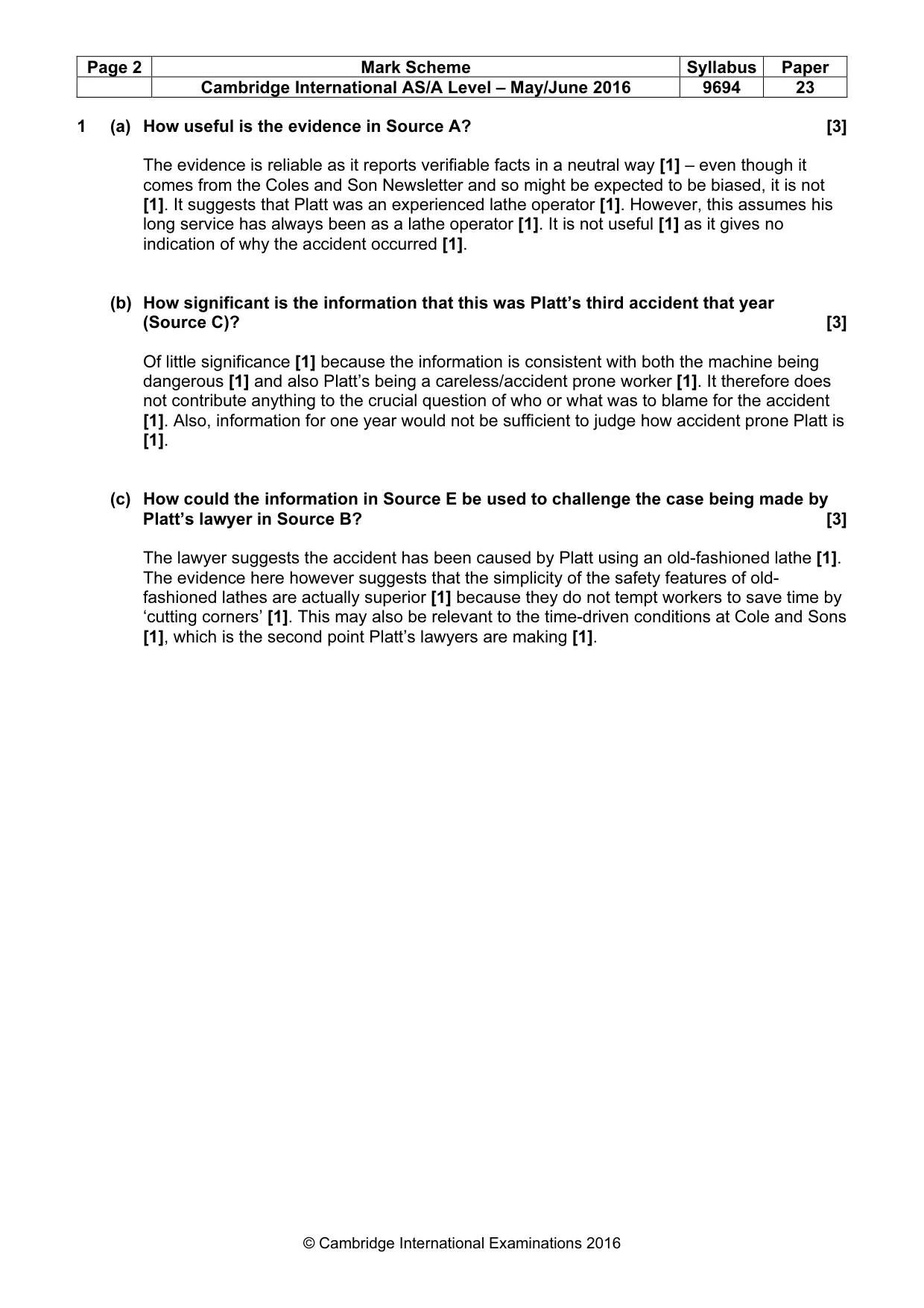
Page 2 Mark Scheme Syllabus Paper Cambridge International AS/A Level – May/June 2016 9694 23 © Cambridge International Examinations 2016 1 (a) How useful is the evidence in Source A? [3] The evidence is reliable as it reports verifiable facts in a neutral way [1] – even though it comes from the Coles and Son Newsletter and so might be expected to be biased, it is not [1]. It suggests that Platt was an experienced lathe operator [1]. However, this assumes his long service has always been as a lathe operator [1]. It is not useful [1] as it gives no indication of why the accident occurred [1]. (b) How significant is the information that this was Platt’s third accident that year (Source C)? [3] Of little significance [1] because the information is consistent with both the machine being dangerous [1] and also Platt’s being a careless/accident prone worker [1]. It therefore does not contribute anything to the crucial question of who or what was to blame for the accident [1]. Also, information for one year would not be sufficient to judge how accident prone Platt is [1]. (c) How could the information in Source E be used to challenge the case being made by Platt’s lawyer in Source B? [3] The lawyer suggests the accident has been caused by Platt using an old-fashioned lathe [1]. The evidence here however suggests that the simplicity of the safety features of old- fashioned lathes are actually superior [1] because they do not tempt workers to save time by ‘cutting corners’ [1]. This may also be relevant to the time-driven conditions at Cole and Sons [1], which is the second point Platt’s lawyers are making [1].
Mark scheme, page 3
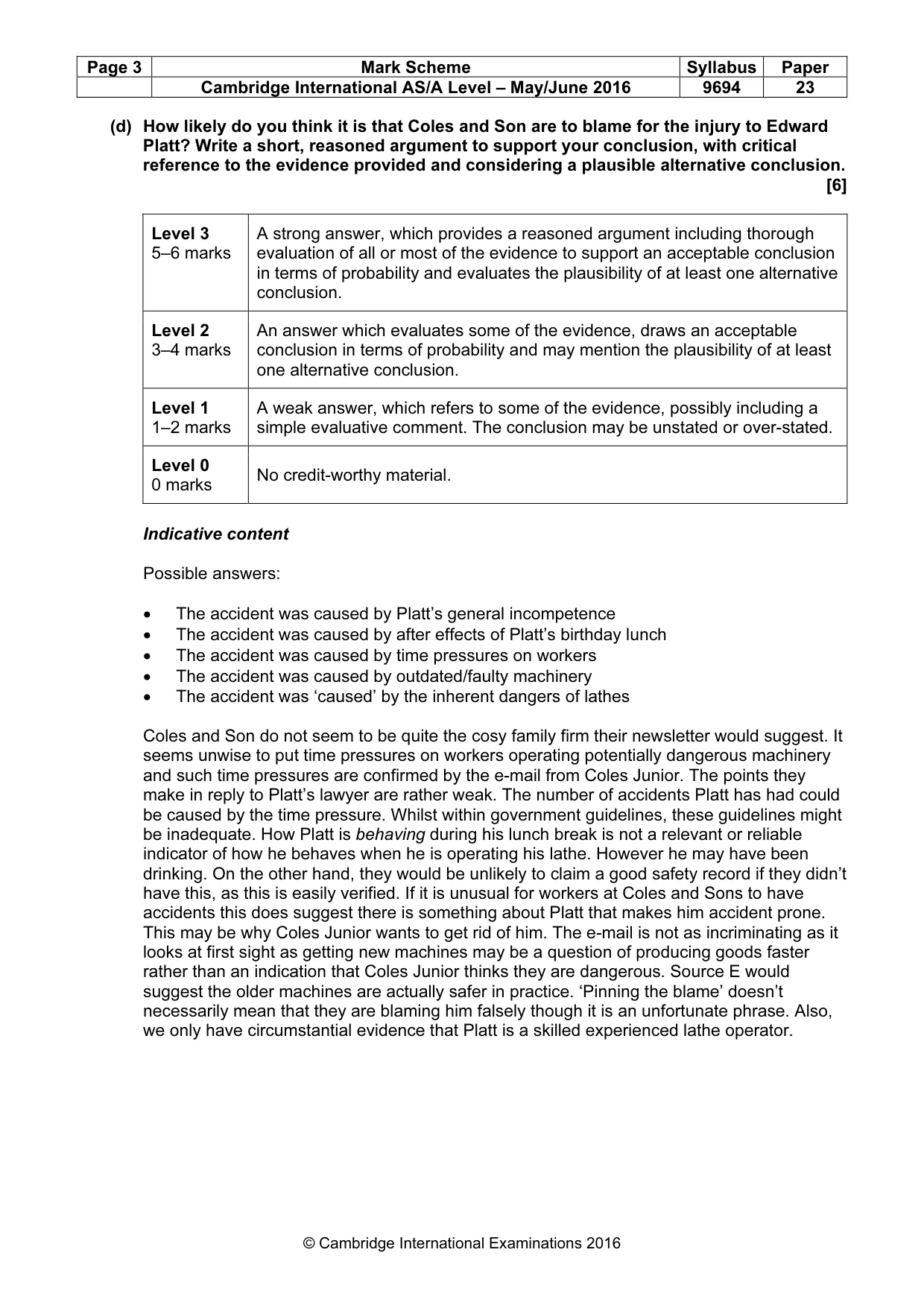
Page 3 Mark Scheme Syllabus Paper Cambridge International AS/A Level – May/June 2016 9694 23 © Cambridge International Examinations 2016 (d) How likely do you think it is that Coles and Son are to blame for the injury to Edward Platt? Write a short, reasoned argument to support your conclusion, with critical reference to the evidence provided and considering a plausible alternative conclusion. [6] Level 3 5–6 marks A strong answer, which provides a reasoned argument including thorough evaluation of all or most of the evidence to support an acceptable conclusion in terms of probability and evaluates the plausibility of at least one alternative conclusion. Level 2 3–4 marks An answer which evaluates some of the evidence, draws an acceptable conclusion in terms of probability and may mention the plausibility of at least one alternative conclusion. Level 1 1–2 marks A weak answer, which refers to some of the evidence, possibly including a simple evaluative comment. The conclusion may be unstated or over-stated. Level 0 0 marks No credit-worthy material. Indicative content Possible answers: • The accident was caused by Platt’s general incompetence • The accident was caused by after effects of Platt’s birthday lunch • The accident was caused by time pressures on workers • The accident was caused by outdated/faulty machinery • The accident was ‘caused’ by the inherent dangers of lathes Coles and Son do not seem to be quite the cosy family firm their newsletter would suggest. It seems unwise to put time pressures on workers operating potentially dangerous machinery and such time pressures are confirmed by the e-mail from Coles Junior. The points they make in reply to Platt’s lawyer are rather weak. The number of accidents Platt has had could be caused by the time pressure. Whilst within government guidelines, these guidelines might be inadequate. How Platt is behaving during his lunch break is not a relevant or reliable indicator of how he behaves when he is operating his lathe. However he may have been drinking. On the other hand, they would be unlikely to claim a good safety record if they didn’t have this, as this is easily verified. If it is unusual for workers at Coles and Sons to have accidents this does suggest there is something about Platt that makes him accident prone. This may be why Coles Junior wants to get rid of him. The e-mail is not as incriminating as it looks at first sight as getting new machines may be a question of producing goods faster rather than an indication that Coles Junior thinks they are dangerous. Source E would suggest the older machines are actually safer in practice. ‘Pinning the blame’ doesn’t necessarily mean that they are blaming him falsely though it is an unfortunate phrase. Also, we only have circumstantial evidence that Platt is a skilled experienced lathe operator.
Mark scheme, page 4
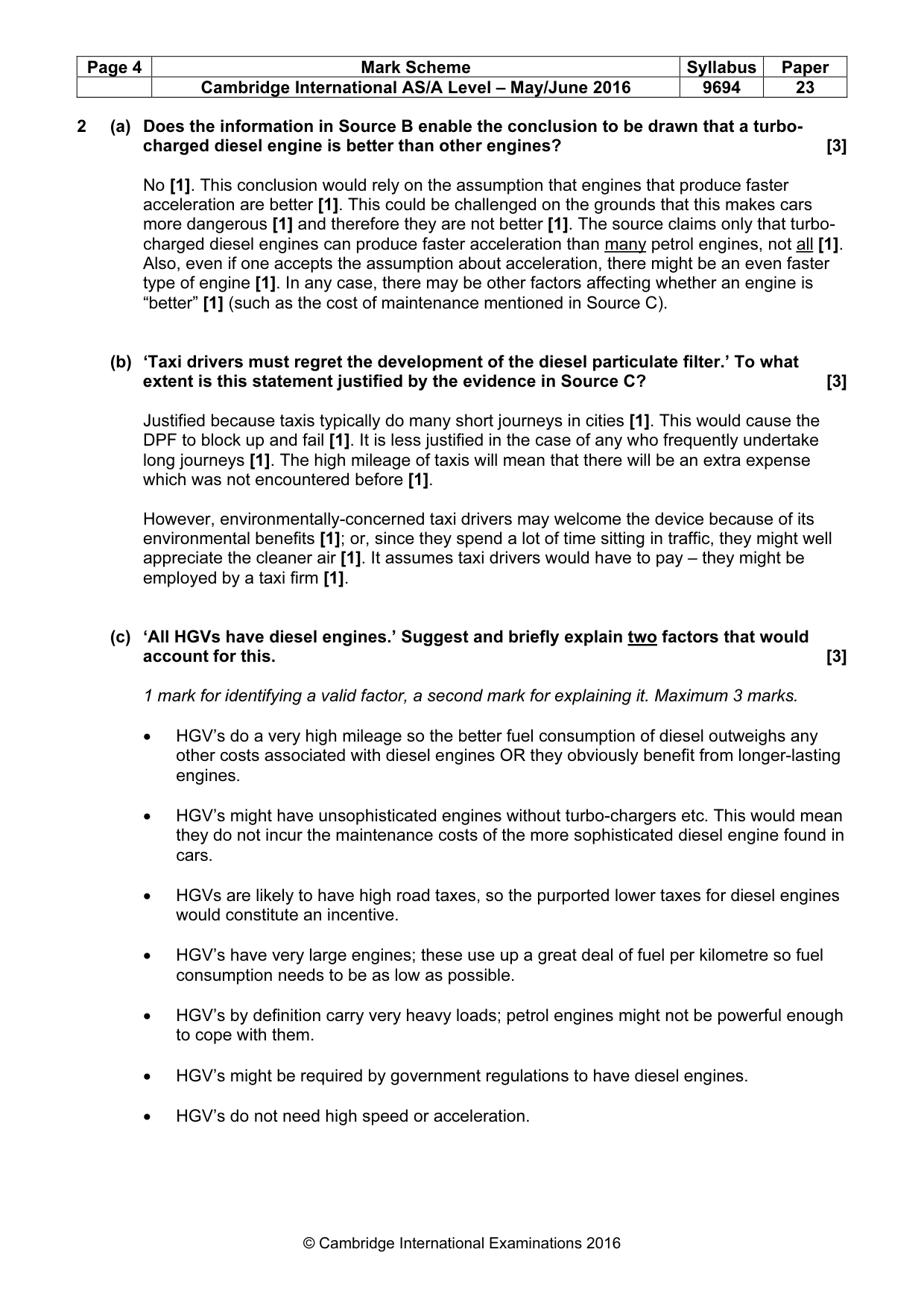
Page 4 Mark Scheme Syllabus Paper Cambridge International AS/A Level – May/June 2016 9694 23 © Cambridge International Examinations 2016 2 (a) Does the information in Source B enable the conclusion to be drawn that a turbo- charged diesel engine is better than other engines? [3] No [1]. This conclusion would rely on the assumption that engines that produce faster acceleration are better [1]. This could be challenged on the grounds that this makes cars more dangerous [1] and therefore they are not better [1]. The source claims only that turbo- charged diesel engines can produce faster acceleration than many petrol engines, not all [1]. Also, even if one accepts the assumption about acceleration, there might be an even faster type of engine [1]. In any case, there may be other factors affecting whether an engine is “better” [1] (such as the cost of maintenance mentioned in Source C). (b) ‘Taxi drivers must regret the development of the diesel particulate filter.’ To what extent is this statement justified by the evidence in Source C? [3] Justified because taxis typically do many short journeys in cities [1]. This would cause the DPF to block up and fail [1]. It is less justified in the case of any who frequently undertake long journeys [1]. The high mileage of taxis will mean that there will be an extra expense which was not encountered before [1]. However, environmentally-concerned taxi drivers may welcome the device because of its environmental benefits [1]; or, since they spend a lot of time sitting in traffic, they might well appreciate the cleaner air [1]. It assumes taxi drivers would have to pay – they might be employed by a taxi firm [1]. (c) ‘All HGVs have diesel engines.’ Suggest and briefly explain two factors that would account for this. [3] 1 mark for identifying a valid factor, a second mark for explaining it. Maximum 3 marks. • HGV’s do a very high mileage so the better fuel consumption of diesel outweighs any other costs associated with diesel engines OR they obviously benefit from longer-lasting engines. • HGV’s might have unsophisticated engines without turbo-chargers etc. This would mean they do not incur the maintenance costs of the more sophisticated diesel engine found in cars. • HGVs are likely to have high road taxes, so the purported lower taxes for diesel engines would constitute an incentive. • HGV’s have very large engines; these use up a great deal of fuel per kilometre so fuel consumption needs to be as low as possible. • HGV’s by definition carry very heavy loads; petrol engines might not be powerful enough to cope with them. • HGV’s might be required by government regulations to have diesel engines. • HGV’s do not need high speed or acceleration.
Mark scheme, page 5
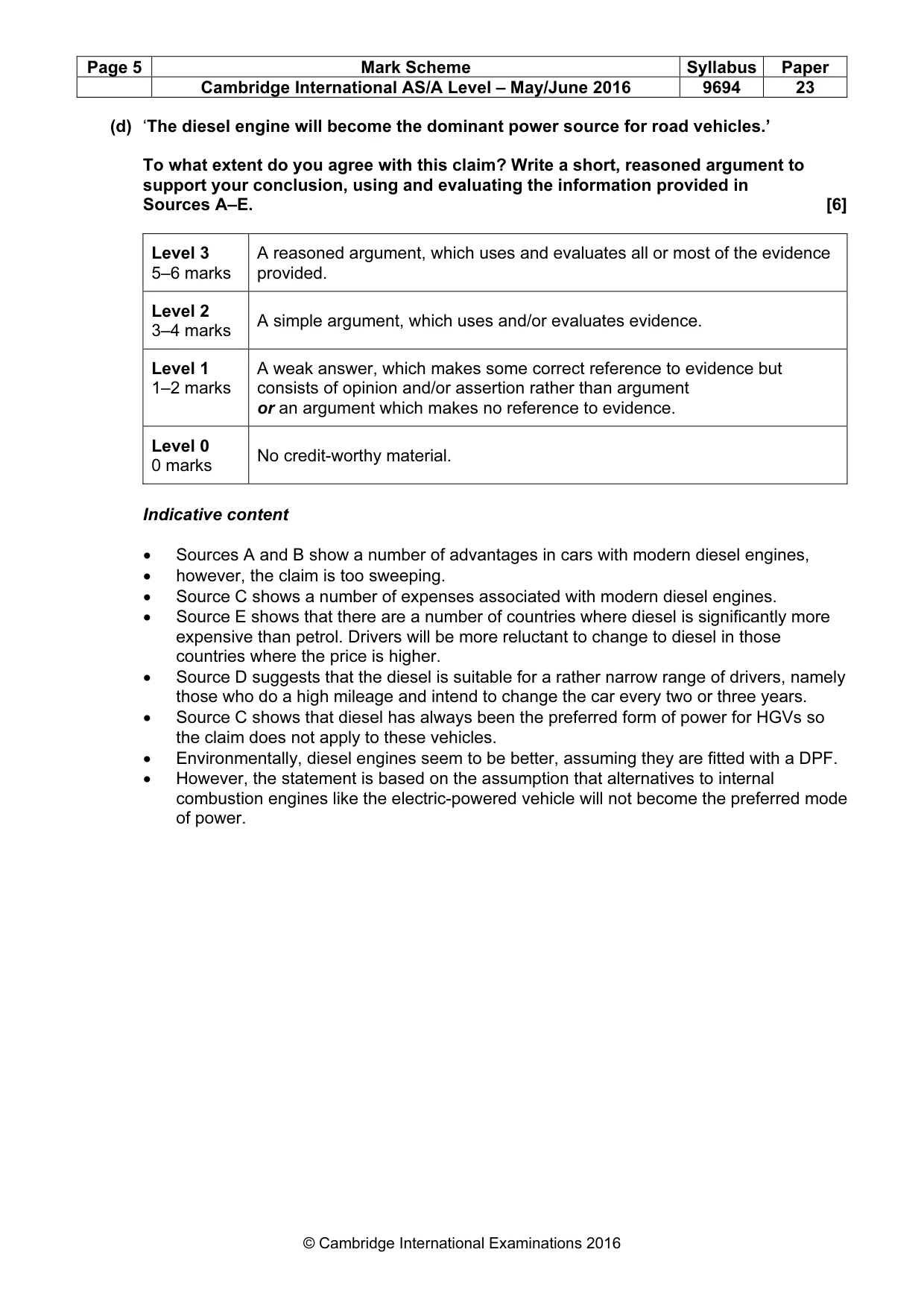
Page 5 Mark Scheme Syllabus Paper Cambridge International AS/A Level – May/June 2016 9694 23 © Cambridge International Examinations 2016 (d) ‘The diesel engine will become the dominant power source for road vehicles.’ To what extent do you agree with this claim? Write a short, reasoned argument to support your conclusion, using and evaluating the information provided in Sources A–E. [6] Level 3 5–6 marks A reasoned argument, which uses and evaluates all or most of the evidence provided. Level 2 3–4 marks A simple argument, which uses and/or evaluates evidence. Level 1 1–2 marks A weak answer, which makes some correct reference to evidence but consists of opinion and/or assertion rather than argument or an argument which makes no reference to evidence. Level 0 0 marks No credit-worthy material. Indicative content • Sources A and B show a number of advantages in cars with modern diesel engines, • however, the claim is too sweeping. • Source C shows a number of expenses associated with modern diesel engines. • Source E shows that there are a number of countries where diesel is significantly more expensive than petrol. Drivers will be more reluctant to change to diesel in those countries where the price is higher. • Source D suggests that the diesel is suitable for a rather narrow range of drivers, namely those who do a high mileage and intend to change the car every two or three years. • Source C shows that diesel has always been the preferred form of power for HGVs so the claim does not apply to these vehicles. • Environmentally, diesel engines seem to be better, assuming they are fitted with a DPF. • However, the statement is based on the assumption that alternatives to internal combustion engines like the electric-powered vehicle will not become the preferred mode of power.
Mark scheme, page 6
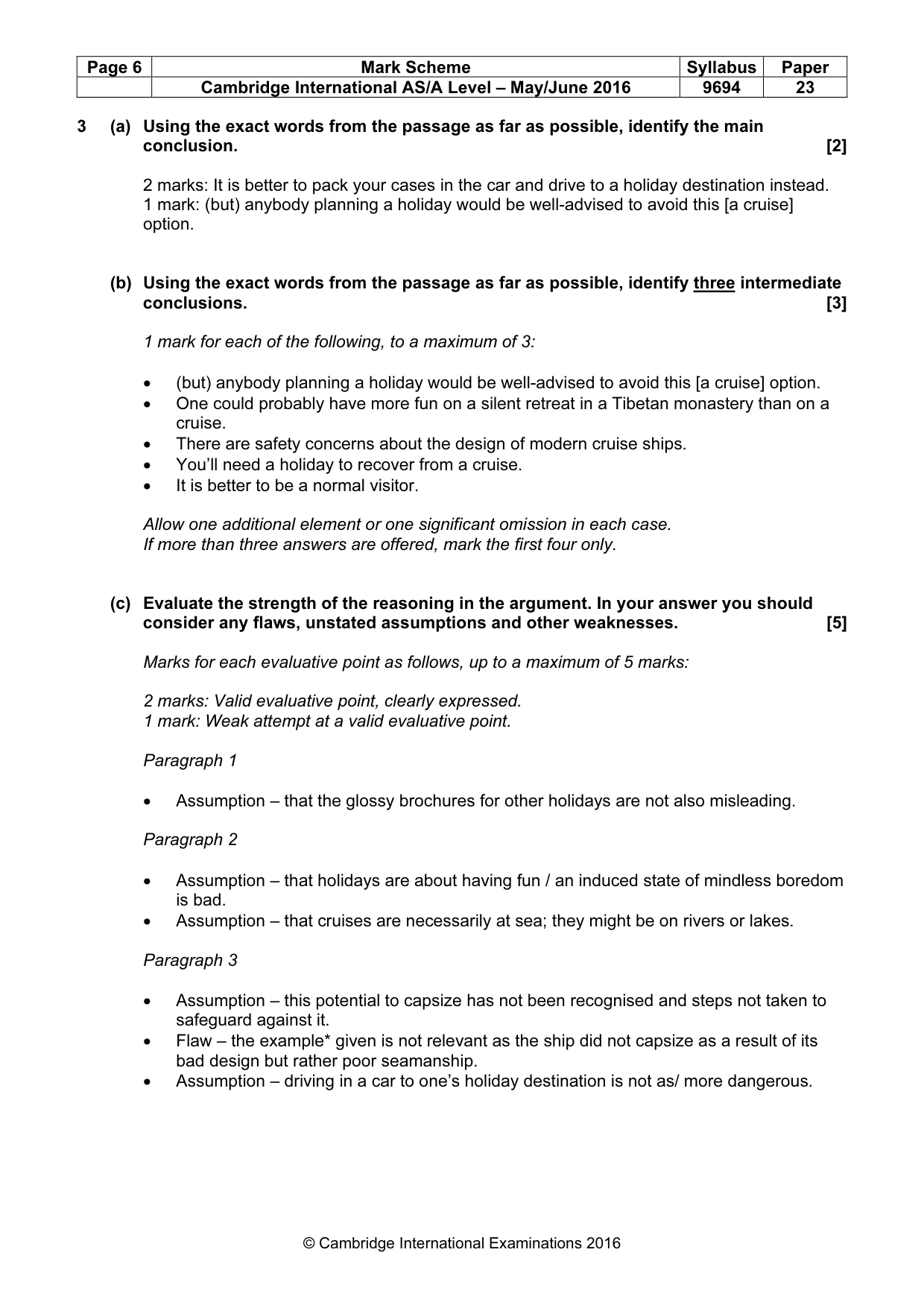
Page 6 Mark Scheme Syllabus Paper Cambridge International AS/A Level – May/June 2016 9694 23 © Cambridge International Examinations 2016 3 (a) Using the exact words from the passage as far as possible, identify the main conclusion. [2] 2 marks: It is better to pack your cases in the car and drive to a holiday destination instead. 1 mark: (but) anybody planning a holiday would be well-advised to avoid this [a cruise] option. (b) Using the exact words from the passage as far as possible, identify three intermediate conclusions. [3] 1 mark for each of the following, to a maximum of 3: • (but) anybody planning a holiday would be well-advised to avoid this [a cruise] option. • One could probably have more fun on a silent retreat in a Tibetan monastery than on a cruise. • There are safety concerns about the design of modern cruise ships. • You’ll need a holiday to recover from a cruise. • It is better to be a normal visitor. Allow one additional element or one significant omission in each case. If more than three answers are offered, mark the first four only. (c) Evaluate the strength of the reasoning in the argument. In your answer you should consider any flaws, unstated assumptions and other weaknesses. [5] Marks for each evaluative point as follows, up to a maximum of 5 marks: 2 marks: Valid evaluative point, clearly expressed. 1 mark: Weak attempt at a valid evaluative point. Paragraph 1 • Assumption – that the glossy brochures for other holidays are not also misleading. Paragraph 2 • Assumption – that holidays are about having fun / an induced state of mindless boredom is bad. • Assumption – that cruises are necessarily at sea; they might be on rivers or lakes. Paragraph 3 • Assumption – this potential to capsize has not been recognised and steps not taken to safeguard against it. • Flaw – the example* given is not relevant as the ship did not capsize as a result of its bad design but rather poor seamanship. • Assumption – driving in a car to one’s holiday destination is not as/ more dangerous.
Mark scheme, page 7
Page 7 Mark Scheme Syllabus Paper Cambridge International AS/A Level – May/June 2016 9694 23 © Cambridge International Examinations 2016 Paragraph 4 • Assumption – holidays are about having a rest. • Inconsistency – having described monotony and boredom in Paragraph 2, the author now talks of there being too much to do. • Assumption – that people are required to engage in more of these exhausting activities than they want to. Paragraph 5 • Assumption – a few hours is insufficient time to visit a place. • Assumption – being mass-produced is inconsistent with being authentic and local. • Flaw – problem of meaning surrounding expression ‘normal visitor’. Difficult to see why cruise ship visitors are seen as any different from any other tourist e.g. ones arriving by car. General • The conclusion that you are better to go on holiday by car is not supported by any of the reasoning, which deals only with the negatives of cruises.
Mark scheme, page 8
Page 8 Mark Scheme Syllabus Paper Cambridge International AS/A Level – May/June 2016 9694 23 © Cambridge International Examinations 2016 (d) ‘Going on a holiday is selfish and irresponsible.’ Write your own short argument to support or challenge this claim. The conclusion of your argument must be stated. Credit will not be given for repeating ideas from the passage. [5] Level 3 4–5 marks Developed, coherent argument. Reasons strongly support conclusion. Development may include intermediate conclusion or apt examples. Simply structured argument – 4 marks. Effective use of IC etc. – 5 marks. Level 2 2–3 marks A simple argument. One reason + conclusion – 2 marks. Two or more separate reasons + conclusion – 3 marks. Level 1 1 mark Some relevant comment. Level 0 0 marks No relevant comment. Maximum 3 marks for wrong conclusion or if conclusion is implied but not stated. No credit for material merely reproduced from the passage. Specimen level 3 answers Support (89 words) A holiday involves travel often by plane. This unnecessary travel is a major contributor to global warming. The natural environment is often destroyed through the building of hotels to accommodate holiday makers. Holidaying is typically an activity done by the rich often to poorer countries where low-paid staff are exploited for the benefit of the rich. So environmentally it is irresponsible and, politically, it is a classic example of wealth being used for self-gratification rather than for the benefit of others. So, going on holiday is selfish and irresponsible. Challenge (122 words) The principle that lies behind this statement is basically a recipe for a joyless world in which the individual is not allowed to have any fun. Anything done purely for one’s own personal happiness could be described in this way. So going on holiday is no different from any other personal indulgence like going for a meal in a restaurant. However, it is not purely selfish as people need a break from their daily routine so that they return refreshed and better able to tackle work. Workers who abide by this principle and never take a holiday are probably being irresponsible in not recognizing when they need a break in order to avoid becoming exhausted and inefficient in what they do. So going on holiday is not selfish and irresponsible.
What you needed in this session
Cambridge’s own grade thresholds for 2016 May/June, Paper 2 · Variant 3. A higher threshold means an easier paper — the bar moves with how the cohort did.