Cambridge A Level Thinking Skills 9694 — 2014 May/June Paper 3 · Variant 3
9694/33/M/J/14 · 50 marks · ≈56 min
The question paper and its mark scheme, free to read here and free to download. This is Cambridge’s own paper, exactly as it was sat.
Question paper8 pages
Mark scheme8 pages
Answers below. Sit the paper first if you are practising.
Paper as text
Question paper, page 1
This document consists of 7 printed pages, 1 blank page and 1 insert. IB14 06_9694_33/FP © UCLES 2014 [Turn over *7937194666* Cambridge International Examinations Cambridge International Advanced Level THINKING SKILLS 9694/33 Paper 3 Problem Analysis and Solution May/June 2014 1 hour 30 minutes Additional Materials: Electronic Calculator READ THESE INSTRUCTIONS FIRST An answer booklet is provided inside this question paper. You should follow the instructions on the front cover of the answer booklet. If you need additional answer paper ask the invigilator for a continuation booklet. Answer all the questions. Calculators should be used where appropriate. The number of marks is given in brackets [ ] at the end of each question or part question.
Question paper, page 2
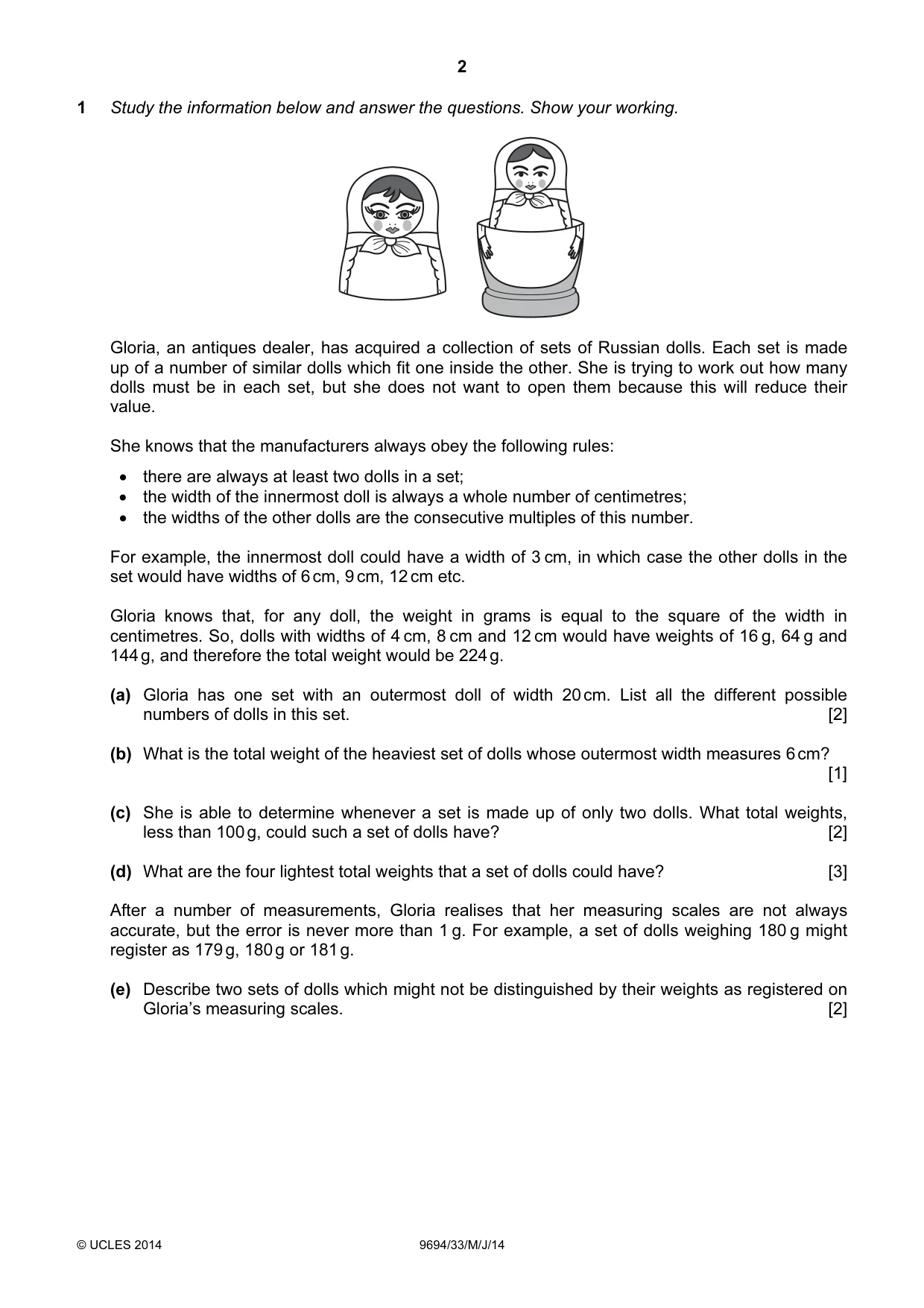
2 © UCLES 2014 9694/33/M/J/14 1 Study the information below and answer the questions. Show your working. Gloria, an antiques dealer, has acquired a collection of sets of Russian dolls. Each set is made up of a number of similar dolls which fit one inside the other. She is trying to work out how many dolls must be in each set, but she does not want to open them because this will reduce their value. She knows that the manufacturers always obey the following rules: • there are always at least two dolls in a set; • the width of the innermost doll is always a whole number of centimetres; • the widths of the other dolls are the consecutive multiples of this number. For example, the innermost doll could have a width of 3 cm, in which case the other dolls in the set would have widths of 6 cm, 9 cm, 12 cm etc. Gloria knows that, for any doll, the weight in grams is equal to the square of the width in centimetres. So, dolls with widths of 4 cm, 8 cm and 12 cm would have weights of 16 g, 64 g and 144 g, and therefore the total weight would be 224 g. (a) Gloria has one set with an outermost doll of width 20 cm. List all the different possible numbers of dolls in this set. [2] (b) What is the total weight of the heaviest set of dolls whose outermost width measures 6 cm? [1] (c) She is able to determine whenever a set is made up of only two dolls. What total weights, less than 100 g, could such a set of dolls have? [2] (d) What are the four lightest total weights that a set of dolls could have? [3] After a number of measurements, Gloria realises that her measuring scales are not always accurate, but the error is never more than 1 g. For example, a set of dolls weighing 180 g might register as 179 g, 180 g or 181 g. (e) Describe two sets of dolls which might not be distinguished by their weights as registered on Gloria’s measuring scales. [2]
Question paper, page 3
3 © UCLES 2014 9694/33/M/J/14 [Turn over 2 Study the information below and answer the questions. Show your working. Elections in France always take place on Sundays, and people are often called upon to vote on two consecutive Sundays. Voting is voluntary. On each Sunday people may only vote for one candidate in that round. In the first round, a candidate who gets more than half of the votes cast is elected, so long as these were the votes of at least a quarter of the electorate. (The electorate consists of all the people entitled to vote.) Otherwise, there is a second vote, restricted to the two candidates from the first round with the two highest numbers of votes, and any other candidate who had a first-round vote of at least an eighth of the electorate. The candidate with the most votes in the second round is elected. A candidate may withdraw after the first round, and the second round only happens if there are still at least two candidates. The threshold of an eighth used to be a tenth. The people in Cambronne-sur-Pierre had to vote on the second Sunday. They were annoyed to find that there were exactly the same three candidates as on the first Sunday. (a) Give an example of percentages of the electorate voting for each of the three candidates on the first Sunday that could have led to this situation. [1] Assume for the rest of this question that no two candidates in a round get exactly the same number of votes, and that the electorate contains at least 30 000 people. (b) (i) What is the theoretical maximum possible number of candidates in the second round? [1] (ii) What was the theoretical maximum possible number of candidates in the second round before the threshold was changed? [1] The first round votes in an election several years ago, when the threshold was still a tenth, were: Alain Bernard Clothard David Emile 4273 53 5370 10 502 651 David was not elected on the first Sunday, and a second round was held. (c) (i) Which rule stopped David from being elected on the first Sunday? [1] (ii) What does this indicate about the number of people entitled to vote who did not vote? [2] (iii) Alain qualified for the second round. What does this indicate about the size of the electorate? [2] There were, in fact, 42 070 people entitled to vote. If Bernard had not been a candidate, 22 of his voters would have voted for David, and the rest for Alain. (d) What difference, if any, would that have made? Explain your answer briefly. [2]
Question paper, page 4
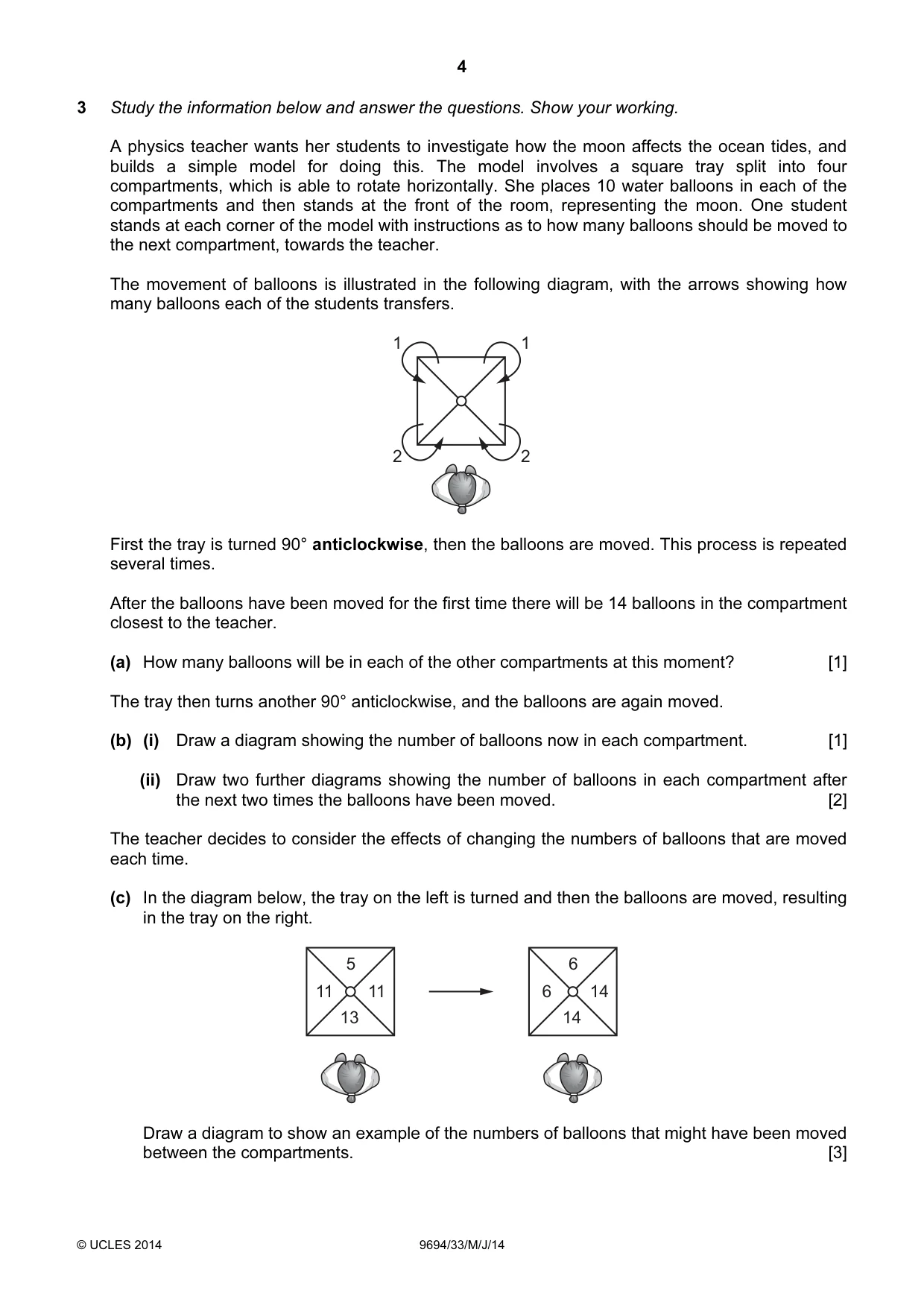
4 © UCLES 2014 9694/33/M/J/14 3 Study the information below and answer the questions. Show your working. A physics teacher wants her students to investigate how the moon affects the ocean tides, and builds a simple model for doing this. The model involves a square tray split into four compartments, which is able to rotate horizontally. She places 10 water balloons in each of the compartments and then stands at the front of the room, representing the moon. One student stands at each corner of the model with instructions as to how many balloons should be moved to the next compartment, towards the teacher. The movement of balloons is illustrated in the following diagram, with the arrows showing how many balloons each of the students transfers. 1 1 2 2 First the tray is turned 90° anticlockwise, then the balloons are moved. This process is repeated several times. After the balloons have been moved for the first time there will be 14 balloons in the compartment closest to the teacher. (a) How many balloons will be in each of the other compartments at this moment? [1] The tray then turns another 90° anticlockwise, and the balloons are again moved. (b) (i) Draw a diagram showing the number of balloons now in each compartment. [1] (ii) Draw two further diagrams showing the number of balloons in each compartment after the next two times the balloons have been moved. [2] The teacher decides to consider the effects of changing the numbers of balloons that are moved each time. (c) In the diagram below, the tray on the left is turned and then the balloons are moved, resulting in the tray on the right. 5 13 11 11 6 14 6 14 Draw a diagram to show an example of the numbers of balloons that might have been moved between the compartments. [3]
Question paper, page 5
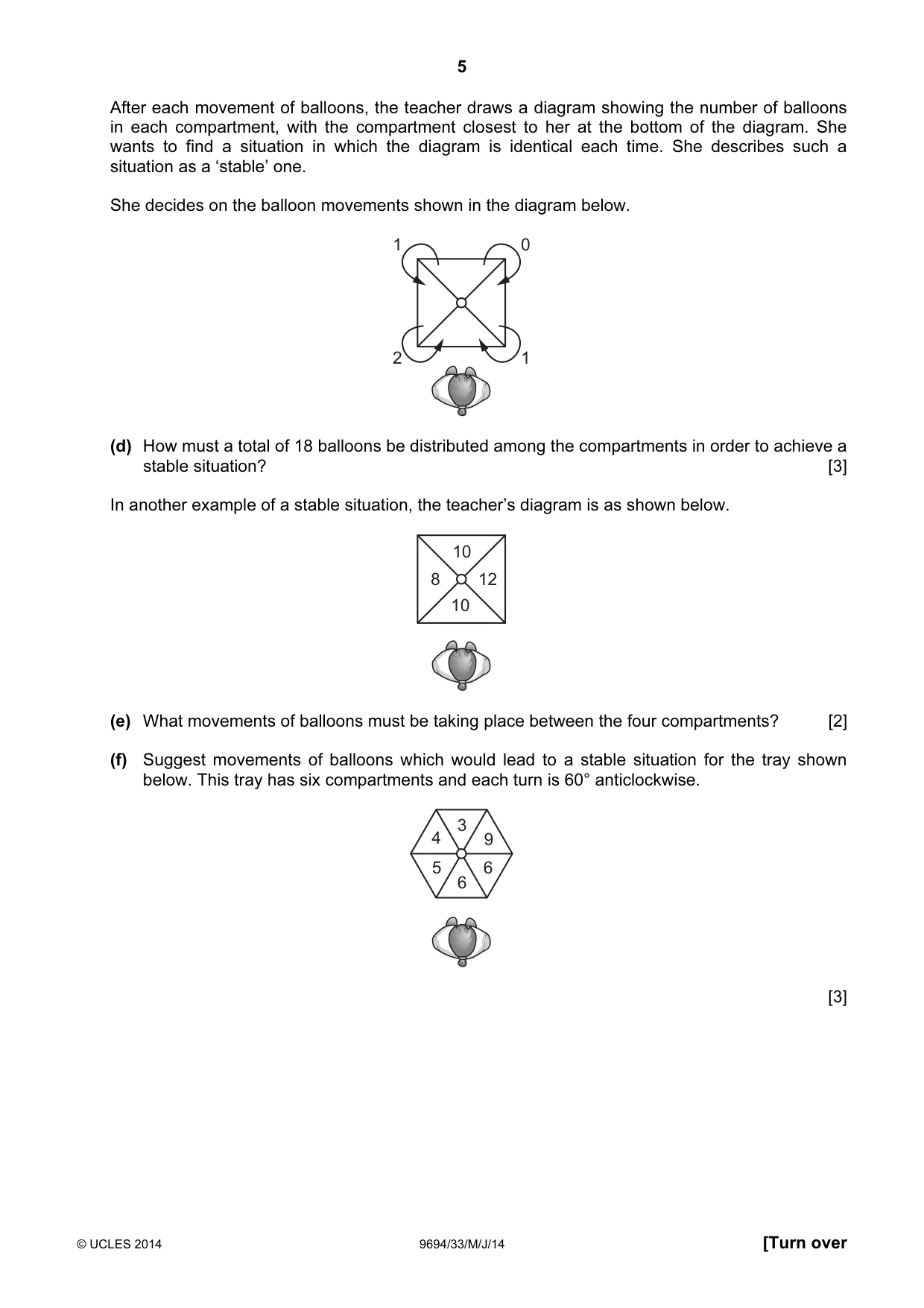
5 © UCLES 2014 9694/33/M/J/14 [Turn over After each movement of balloons, the teacher draws a diagram showing the number of balloons in each compartment, with the compartment closest to her at the bottom of the diagram. She wants to find a situation in which the diagram is identical each time. She describes such a situation as a ‘stable’ one. She decides on the balloon movements shown in the diagram below. 1 0 2 1 (d) How must a total of 18 balloons be distributed among the compartments in order to achieve a stable situation? [3] In another example of a stable situation, the teacher’s diagram is as shown below. 10 10 8 12 (e) What movements of balloons must be taking place between the four compartments? [2] (f) Suggest movements of balloons which would lead to a stable situation for the tray shown below. This tray has six compartments and each turn is 60° anticlockwise. 3 6 5 4 9 6 [3]
Question paper, page 6
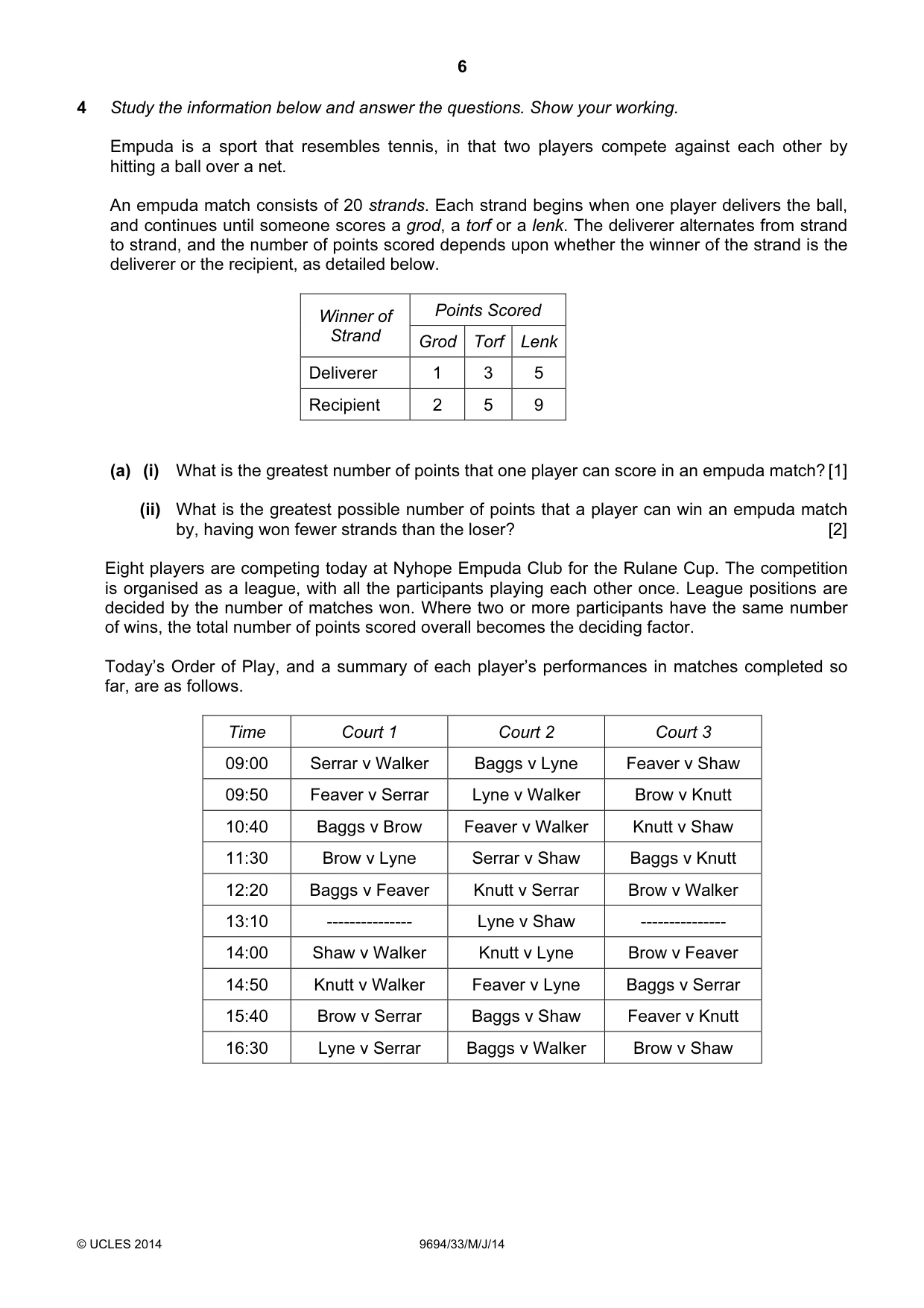
6 © UCLES 2014 9694/33/M/J/14 4 Study the information below and answer the questions. Show your working. Empuda is a sport that resembles tennis, in that two players compete against each other by hitting a ball over a net. An empuda match consists of 20 strands. Each strand begins when one player delivers the ball, and continues until someone scores a grod, a torf or a lenk. The deliverer alternates from strand to strand, and the number of points scored depends upon whether the winner of the strand is the deliverer or the recipient, as detailed below. Winner of Strand Points Scored Grod Torf Lenk Deliverer 1 3 5 Recipient 2 5 9 (a) (i) What is the greatest number of points that one player can score in an empuda match? [1] (ii) What is the greatest possible number of points that a player can win an empuda match by, having won fewer strands than the loser? [2] Eight players are competing today at Nyhope Empuda Club for the Rulane Cup. The competition is organised as a league, with all the participants playing each other once. League positions are decided by the number of matches won. Where two or more participants have the same number of wins, the total number of points scored overall becomes the deciding factor. Today’s Order of Play, and a summary of each player’s performances in matches completed so far, are as follows. Time Court 1 Court 2 Court 3 09:00 Serrar v Walker Baggs v Lyne Feaver v Shaw 09:50 Feaver v Serrar Lyne v Walker Brow v Knutt 10:40 Baggs v Brow Feaver v Walker Knutt v Shaw 11:30 Brow v Lyne Serrar v Shaw Baggs v Knutt 12:20 Baggs v Feaver Knutt v Serrar Brow v Walker 13:10 --------------- Lyne v Shaw --------------- 14:00 Shaw v Walker Knutt v Lyne Brow v Feaver 14:50 Knutt v Walker Feaver v Lyne Baggs v Serrar 15:40 Brow v Serrar Baggs v Shaw Feaver v Knutt 16:30 Lyne v Serrar Baggs v Walker Brow v Shaw
Question paper, page 7
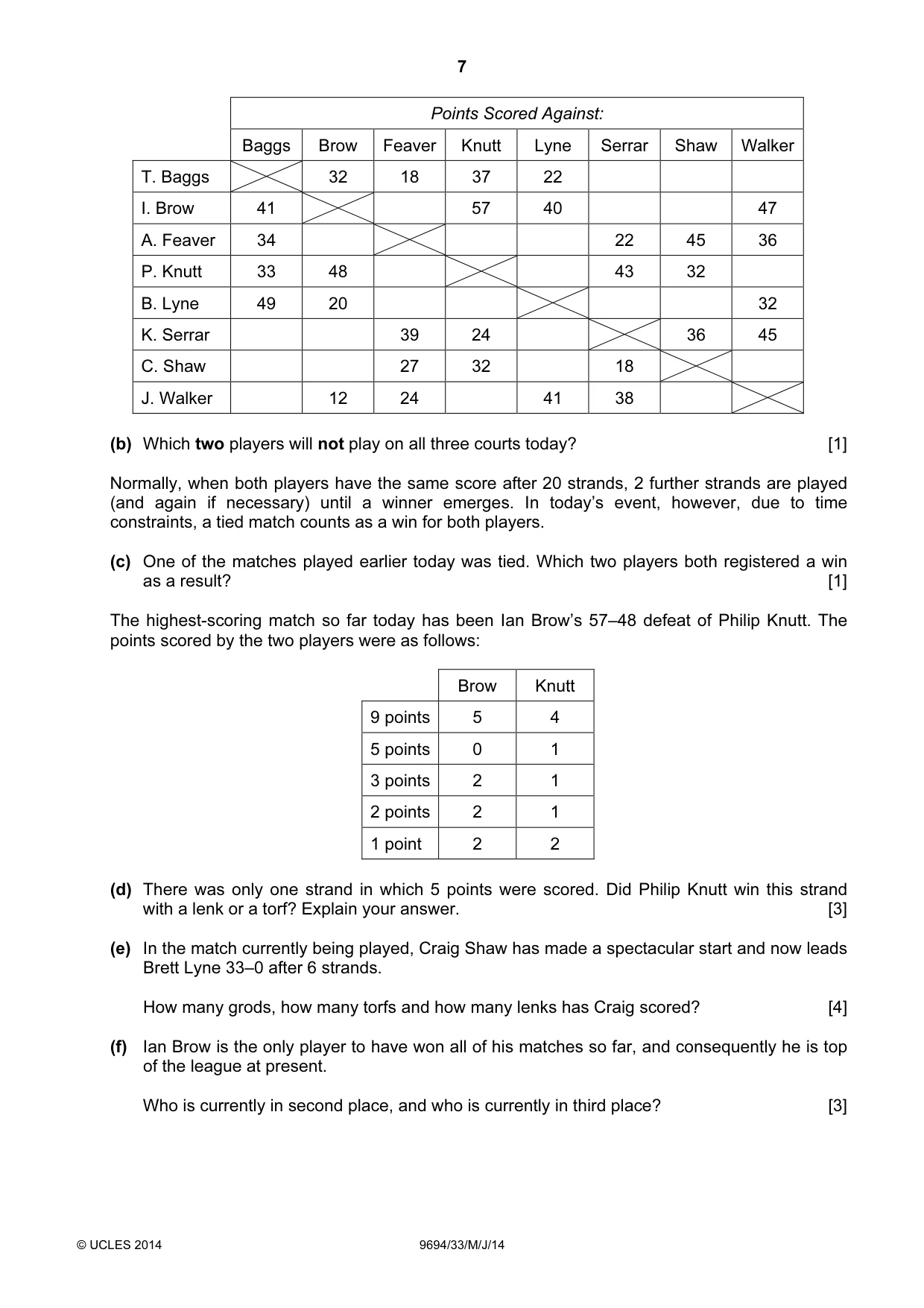
7 © UCLES 2014 9694/33/M/J/14 Points Scored Against: Baggs Brow Feaver Knutt Lyne Serrar Shaw Walker T. Baggs 32 18 37 22 I. Brow 41 57 40 47 A. Feaver 34 22 45 36 P. Knutt 33 48 43 32 B. Lyne 49 20 32 K. Serrar 39 24 36 45 C. Shaw 27 32 18 J. Walker 12 24 41 38 (b) Which two players will not play on all three courts today? [1] Normally, when both players have the same score after 20 strands, 2 further strands are played (and again if necessary) until a winner emerges. In today’s event, however, due to time constraints, a tied match counts as a win for both players. (c) One of the matches played earlier today was tied. Which two players both registered a win as a result? [1] The highest-scoring match so far today has been Ian Brow’s 57–48 defeat of Philip Knutt. The points scored by the two players were as follows: Brow Knutt 9 points 5 4 5 points 0 1 3 points 2 1 2 points 2 1 1 point 2 2 (d) There was only one strand in which 5 points were scored. Did Philip Knutt win this strand with a lenk or a torf? Explain your answer. [3] (e) In the match currently being played, Craig Shaw has made a spectacular start and now leads Brett Lyne 33–0 after 6 strands. How many grods, how many torfs and how many lenks has Craig scored? [4] (f) Ian Brow is the only player to have won all of his matches so far, and consequently he is top of the league at present. Who is currently in second place, and who is currently in third place? [3]
Question paper, page 8
8 Permission to reproduce items where third-party owned material protected by copyright is included has been sought and cleared where possible. Every reasonable effort has been made by the publisher (UCLES) to trace copyright holders, but if any items requiring clearance have unwittingly been included, the publisher will be pleased to make amends at the earliest possible opportunity. Cambridge International Examinations is part of the Cambridge Assessment Group. Cambridge Assessment is the brand name of University of Cambridge Local Examinations Syndicate (UCLES), which is itself a department of the University of Cambridge. © UCLES 2014 9694/33/M/J/14 BLANK PAGE
Mark scheme, page 1
CAMBRIDGE INTERNATIONAL EXAMINATIONS GCE Advanced Level MARK SCHEME for the May/June 2014 series 9694 THINKING SKILLS 9694/33 Paper 3 (Problem Analysis and Solution), maximum raw mark 50) This mark scheme is published as an aid to teachers and candidates, to indicate the requirements of the examination. It shows the basis on which Examiners were instructed to award marks. It does not indicate the details of the discussions that took place at an Examiners’ meeting before marking began, which would have considered the acceptability of alternative answers. Mark schemes should be read in conjunction with the question paper and the Principal Examiner Report for Teachers. Cambridge will not enter into discussions about these mark schemes. Cambridge is publishing the mark schemes for the May/June 2014 series for most IGCSE, GCE Advanced Level and Advanced Subsidiary Level components and some Ordinary Level components.
Mark scheme, page 2
Page 2 Mark Scheme Syllabus Paper GCE A LEVEL – May/June 2014 9694 33 © Cambridge International Examinations 2014 1 (a) Gloria has one set with an outermost doll of width 20 cm. List all the different possible numbers of dolls in this set. [2] 2, 4, 5, 10, 20 2 [20, 10] or 4 [20, 15, 10, 5] or 5 [20, 16, 12, 8, 4] or 10 [20, 18, 16, 14, 12, 10, 8, 6, 4, 2] or 20 [20, 19, 18]. Award 2 marks for a correct set of numbers. Award 1 mark for a list with up to 2 incorrect inclusions/omissions. (b) What is the total weight of the heaviest set of dolls whose outermost width measures 6 cm? [1] 91 g [1, 2, 3, 4, 5, 6] (c) She is able to determine whenever a set is made up of only two dolls. What total weights, less than 100 g, could such a set of dolls have? [2] 5 g [1, 2] or 20 g [2, 4] or 45 g [3, 6] or 80 g [4, 8] Award 1 mark for two or three correct answers with no extras, or 4 correct answers with one extra. (d) What are the four lightest total weights that a set of dolls could have? [3] 5 g, 14 g, 20 g, 30 g Award 2 marks for one additional inclusion/omission/arithmetic error in working. Award 1 mark for two additional inclusions/omissions/arithmetic errors in working. (e) Describe two sets of dolls which might not be distinguished by their weights as registered on Gloria’s measuring scales. [2] The most likely suggestions are: [1, 2, 3, 4, 5] weighs 55 g and [2, 4, 6] weighs 56 g [5, 10] weighs 125 g and [3, 6, 9] weighs 126 g Award 1 mark if the weights are given (e.g. just 55 g & 56 g), but the sets of dolls are not described.
Mark scheme, page 3
Page 3 Mark Scheme Syllabus Paper GCE A LEVEL – May/June 2014 9694 33 © Cambridge International Examinations 2014 2 (a) Give an example of percentages of the electorate voting for each of the three candidates on the first Sunday that could have led to this situation. [1] Any three numbers, all between 12.5 and 50 that add up to not more than 100, with the largest less than the sum of the other two. (b) (i) What is the theoretical maximum possible number of candidates in the second round? [1] Assumption requires different numbers, so cannot all have exactly 12.5%, hence only 7. (ii) What was the theoretical maximum possible number of candidates in the second round before the threshold was changed? [1] 9 (c) (i) Which rule stopped David from being elected on the first Sunday? [1] 10 502 is more than 50% of votes cast (4273 + 53 + 5370 + 651 = 10 347), so failure must be because it doesn’t include a quarter (25%) of the electorate. (ii) What does this indicate about the number of people entitled to vote who did not vote? [2] Electorate must be at least 10 502 × 4 + 1 = 42009, of whom 20 849 voted. So at least 21 160 did not. Award 1 mark if 42 009 or 42 008 or 21 159 seen. (iii) Alain qualified for the second round. What does this indicate about the size of the electorate? [2] 42 730 or fewer. Award 1 mark for sight of 42 730 or 42 371 or 34 184 (derived from the new threshold). (d) What difference, if any, would that have made? Explain your answer briefly. [2] David would have won on the first round by having 10 524 > 42 070/4 (as well as more than 50% of the votes cast). Award 2 marks if a correct judgment and a precise comparison of votes is given. Award 1 mark if appropriate working is shown, but an incorrect judgment is given OR a correct judgment is given with a correct qualitative justification (e.g. “David would have won because he had more than a quarter of the electorate’s vote”.) Award 0 marks for a judgment with no correct justification.
Mark scheme, page 4
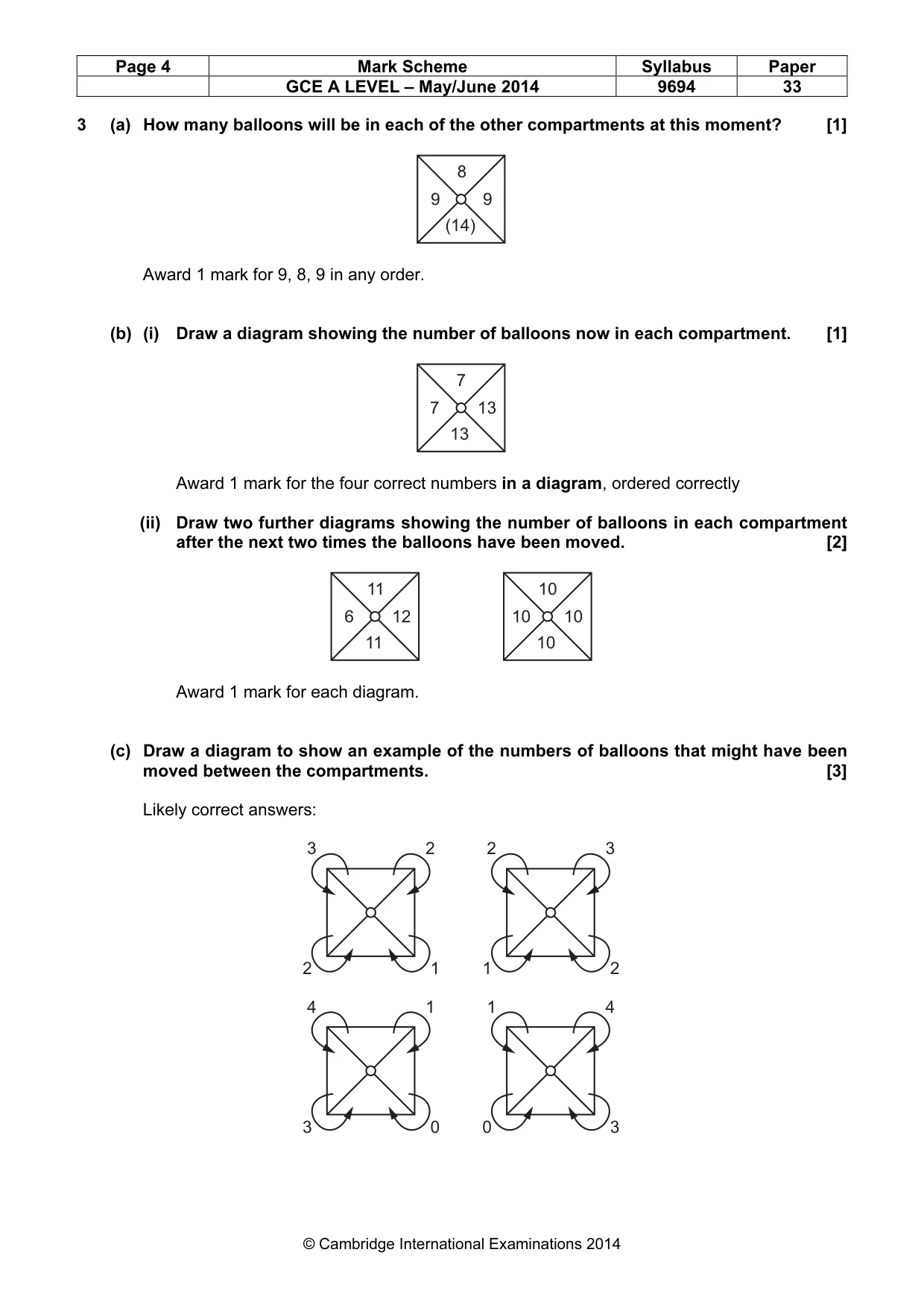
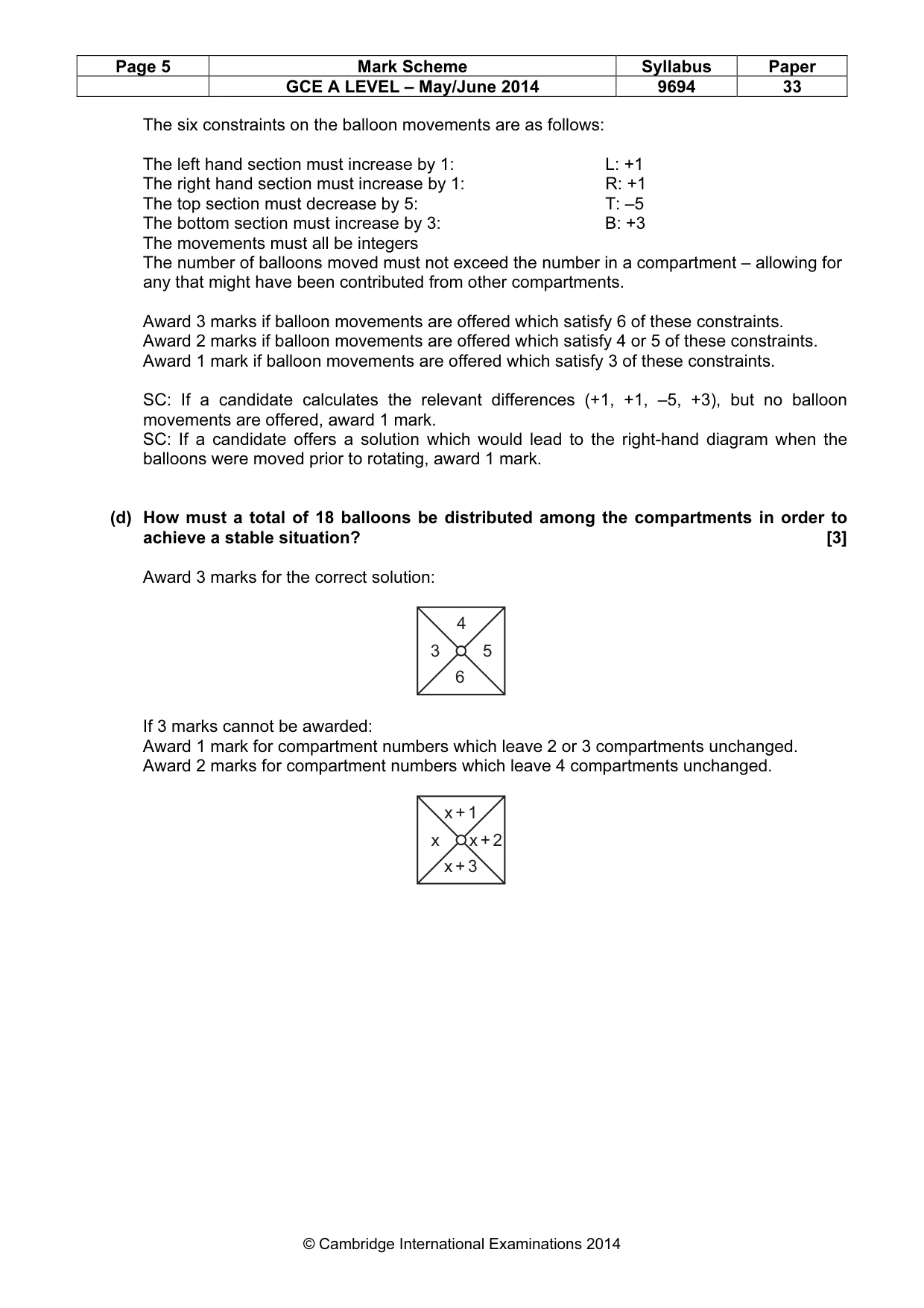
Page 4 Mark Scheme Syllabus Paper GCE A LEVEL – May/June 2014 9694 33 © Cambridge International Examinations 2014 3 (a) How many balloons will be in each of the other compartments at this moment? [1] Award 1 mark for 9, 8, 9 in any order. (b) (i) Draw a diagram showing the number of balloons now in each compartment. [1] Award 1 mark for the four correct numbers in a diagram, ordered correctly (ii) Draw two further diagrams showing the number of balloons in each compartment after the next two times the balloons have been moved. [2] Award 1 mark for each diagram. (c) Draw a diagram to show an example of the numbers of balloons that might have been moved between the compartments. [3] Likely correct answers: 8 (14) 9 9 7 13 7 13 11 11 6 12 10 10 10 10 3 2 2 1 2 3 1 2 4 1 3 0 1 4 0 3
Mark scheme, page 5
Page 5 Mark Scheme Syllabus Paper GCE A LEVEL – May/June 2014 9694 33 © Cambridge International Examinations 2014 The six constraints on the balloon movements are as follows: The left hand section must increase by 1: L: +1 The right hand section must increase by 1: R: +1 The top section must decrease by 5: T: –5 The bottom section must increase by 3: B: +3 The movements must all be integers The number of balloons moved must not exceed the number in a compartment – allowing for any that might have been contributed from other compartments. Award 3 marks if balloon movements are offered which satisfy 6 of these constraints. Award 2 marks if balloon movements are offered which satisfy 4 or 5 of these constraints. Award 1 mark if balloon movements are offered which satisfy 3 of these constraints. SC: If a candidate calculates the relevant differences (+1, +1, –5, +3), but no balloon movements are offered, award 1 mark. SC: If a candidate offers a solution which would lead to the right-hand diagram when the balloons were moved prior to rotating, award 1 mark. (d) How must a total of 18 balloons be distributed among the compartments in order to achieve a stable situation? [3] Award 3 marks for the correct solution: If 3 marks cannot be awarded: Award 1 mark for compartment numbers which leave 2 or 3 compartments unchanged. Award 2 marks for compartment numbers which leave 4 compartments unchanged. 4 6 3 5 x + 1 x + 3 x x + 2
Mark scheme, page 6
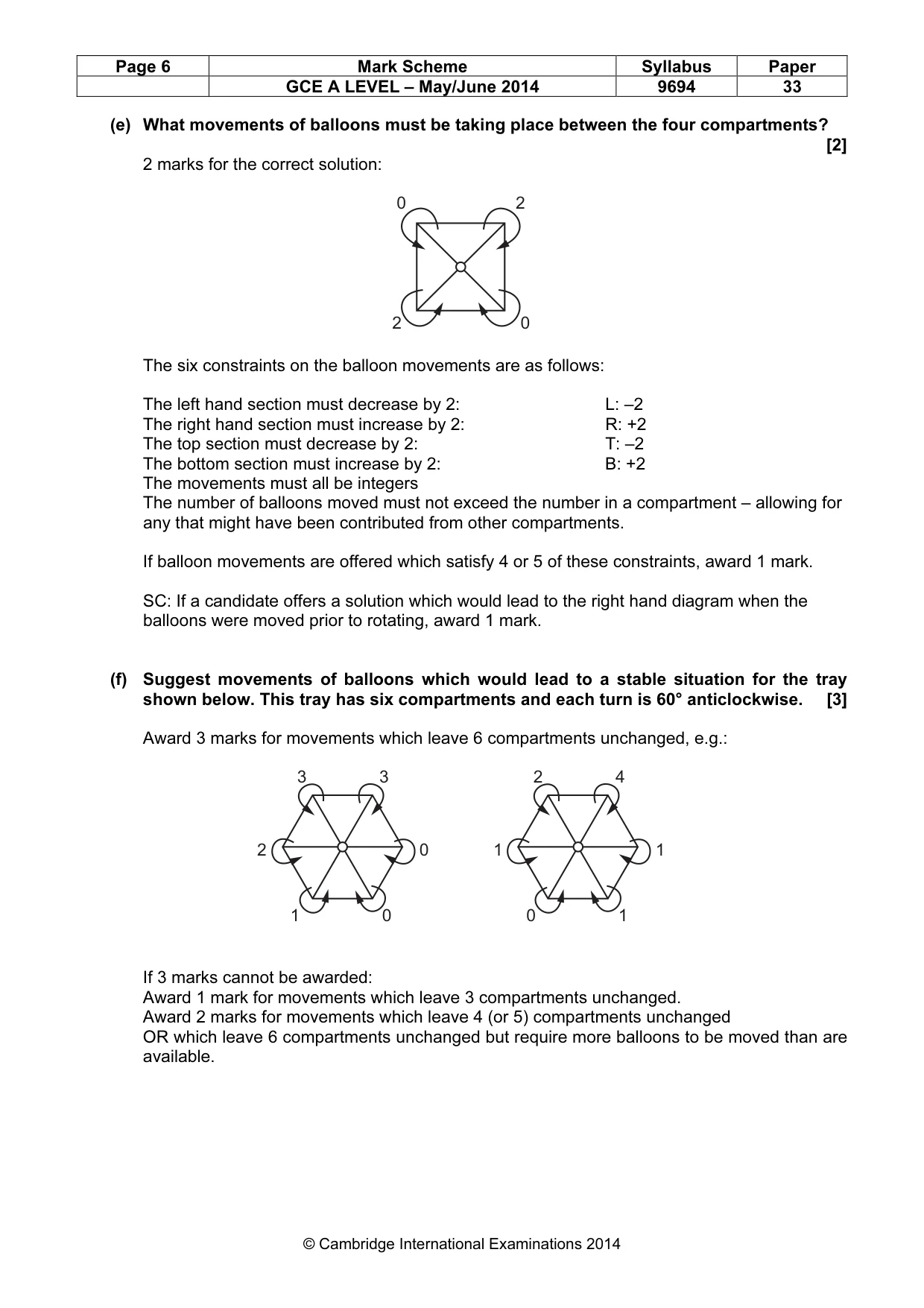
Page 6 Mark Scheme Syllabus Paper GCE A LEVEL – May/June 2014 9694 33 © Cambridge International Examinations 2014 (e) What movements of balloons must be taking place between the four compartments? [2] 2 marks for the correct solution: The six constraints on the balloon movements are as follows: The left hand section must decrease by 2: L: –2 The right hand section must increase by 2: R: +2 The top section must decrease by 2: T: –2 The bottom section must increase by 2: B: +2 The movements must all be integers The number of balloons moved must not exceed the number in a compartment – allowing for any that might have been contributed from other compartments. If balloon movements are offered which satisfy 4 or 5 of these constraints, award 1 mark. SC: If a candidate offers a solution which would lead to the right hand diagram when the balloons were moved prior to rotating, award 1 mark. (f) Suggest movements of balloons which would lead to a stable situation for the tray shown below. This tray has six compartments and each turn is 60° anticlockwise. [3] Award 3 marks for movements which leave 6 compartments unchanged, e.g.: If 3 marks cannot be awarded: Award 1 mark for movements which leave 3 compartments unchanged. Award 2 marks for movements which leave 4 (or 5) compartments unchanged OR which leave 6 compartments unchanged but require more balloons to be moved than are available. 0 2 2 0 0 2 3 3 0 1 1 1 4 2 1 0
Mark scheme, page 7
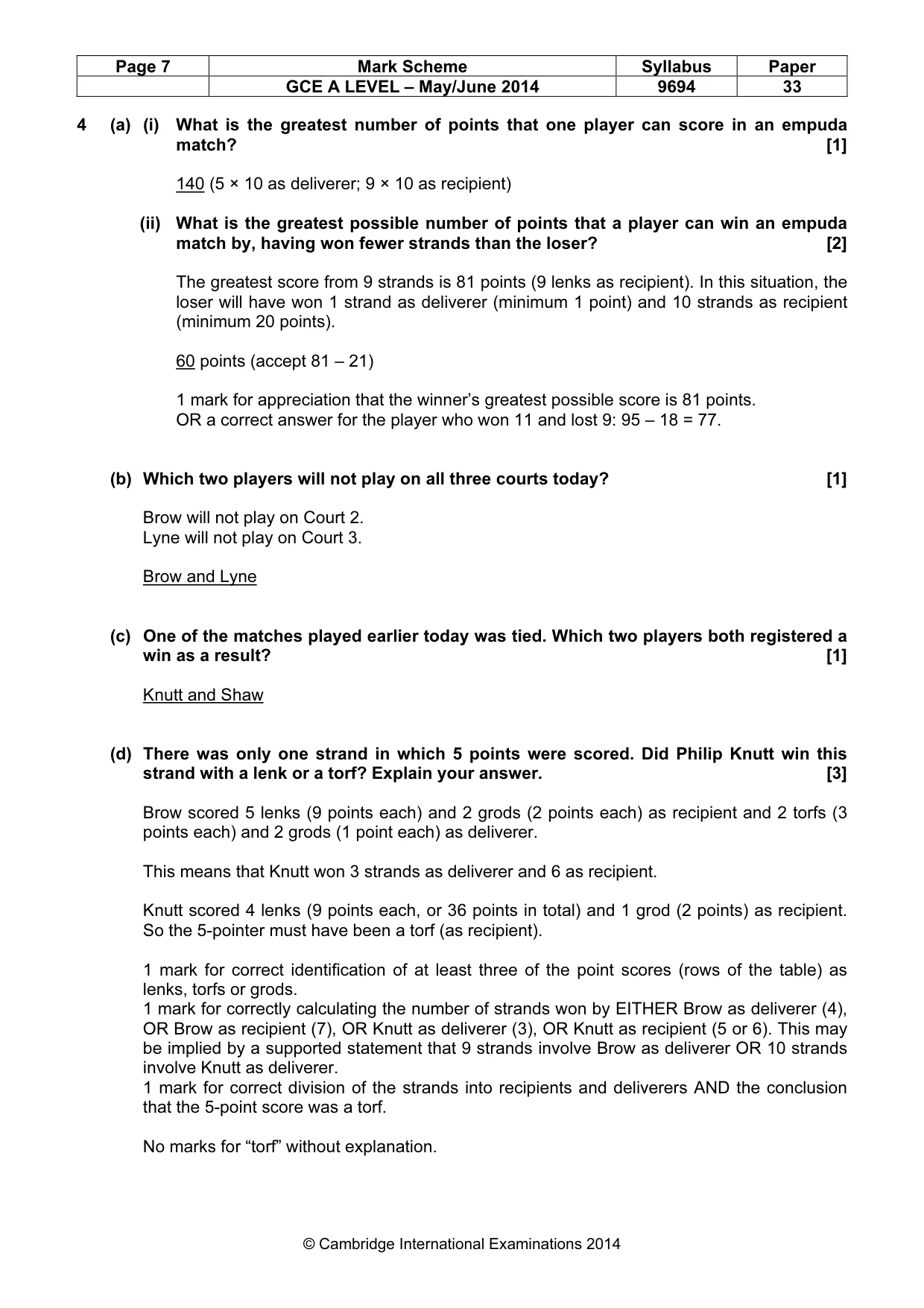
Page 7 Mark Scheme Syllabus Paper GCE A LEVEL – May/June 2014 9694 33 © Cambridge International Examinations 2014 4 (a) (i) What is the greatest number of points that one player can score in an empuda match? [1] 140 (5 × 10 as deliverer; 9 × 10 as recipient) (ii) What is the greatest possible number of points that a player can win an empuda match by, having won fewer strands than the loser? [2] The greatest score from 9 strands is 81 points (9 lenks as recipient). In this situation, the loser will have won 1 strand as deliverer (minimum 1 point) and 10 strands as recipient (minimum 20 points). 60 points (accept 81 – 21) 1 mark for appreciation that the winner’s greatest possible score is 81 points. OR a correct answer for the player who won 11 and lost 9: 95 – 18 = 77. (b) Which two players will not play on all three courts today? [1] Brow will not play on Court 2. Lyne will not play on Court 3. Brow and Lyne (c) One of the matches played earlier today was tied. Which two players both registered a win as a result? [1] Knutt and Shaw (d) There was only one strand in which 5 points were scored. Did Philip Knutt win this strand with a lenk or a torf? Explain your answer. [3] Brow scored 5 lenks (9 points each) and 2 grods (2 points each) as recipient and 2 torfs (3 points each) and 2 grods (1 point each) as deliverer. This means that Knutt won 3 strands as deliverer and 6 as recipient. Knutt scored 4 lenks (9 points each, or 36 points in total) and 1 grod (2 points) as recipient. So the 5-pointer must have been a torf (as recipient). 1 mark for correct identification of at least three of the point scores (rows of the table) as lenks, torfs or grods. 1 mark for correctly calculating the number of strands won by EITHER Brow as deliverer (4), OR Brow as recipient (7), OR Knutt as deliverer (3), OR Knutt as recipient (5 or 6). This may be implied by a supported statement that 9 strands involve Brow as deliverer OR 10 strands involve Knutt as deliverer. 1 mark for correct division of the strands into recipients and deliverers AND the conclusion that the 5-point score was a torf. No marks for “torf” without explanation.
Mark scheme, page 8
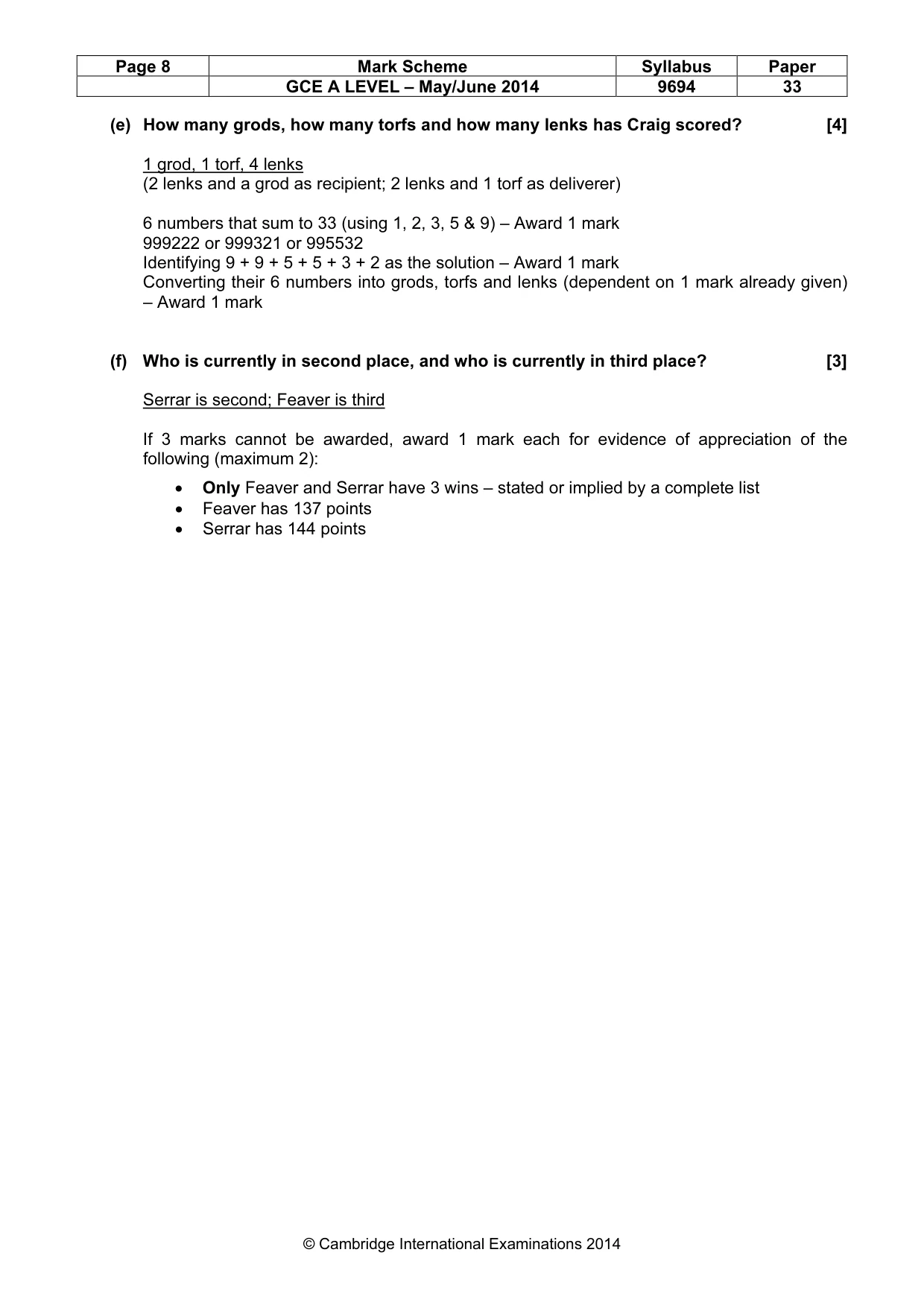
Page 8 Mark Scheme Syllabus Paper GCE A LEVEL – May/June 2014 9694 33 © Cambridge International Examinations 2014 (e) How many grods, how many torfs and how many lenks has Craig scored? [4] 1 grod, 1 torf, 4 lenks (2 lenks and a grod as recipient; 2 lenks and 1 torf as deliverer) 6 numbers that sum to 33 (using 1, 2, 3, 5 & 9) – Award 1 mark 999222 or 999321 or 995532 Identifying 9 + 9 + 5 + 5 + 3 + 2 as the solution – Award 1 mark Converting their 6 numbers into grods, torfs and lenks (dependent on 1 mark already given) – Award 1 mark (f) Who is currently in second place, and who is currently in third place? [3] Serrar is second; Feaver is third If 3 marks cannot be awarded, award 1 mark each for evidence of appreciation of the following (maximum 2): • Only Feaver and Serrar have 3 wins – stated or implied by a complete list • Feaver has 137 points • Serrar has 144 points
What you needed in this session
Cambridge’s own grade thresholds for 2014 May/June, Paper 3 · Variant 3. A higher threshold means an easier paper — the bar moves with how the cohort did.