Cambridge A Level Thinking Skills 9694 — 2012 Oct/Nov Paper 3 · Variant 2
9694/32/O/N/12 · 50 marks · ≈56 min
The question paper and its mark scheme, free to read here and free to download. This is Cambridge’s own paper, exactly as it was sat.
Question paper8 pages
Mark scheme8 pages
Answers below. Sit the paper first if you are practising.
Paper as text
Question paper, page 1
This document consists of 7 printed pages and 1 blank page. IB12 11_9694_32/FP © UCLES 2012 [Turn over *5213716818* UNIVERSITY OF CAMBRIDGE INTERNATIONAL EXAMINATIONS General Certificate of Education Advanced Level THINKING SKILLS 9694/32 Paper 3 Problem Analysis and Solution October/November 2012 1 hour 30 minutes Additional Materials: Answer Booklet/Paper Electronic Calculator READ THESE INSTRUCTIONS FIRST If you have been given an Answer Booklet, follow the instructions on the front cover of the booklet. Write your Centre number, candidate number and name on all the work you hand in. Write in dark blue or black pen. Do not use staples, paper clips, highlighters, glue or correction fluid. DO NOT WRITE ON ANY BARCODES. Calculators should be used where appropriate. Answer all the questions. Start each question on a new answer sheet. At the end of the examination, fasten all your work securely together. The number of marks is given in brackets [ ] at the end of each question or part question.
Question paper, page 2
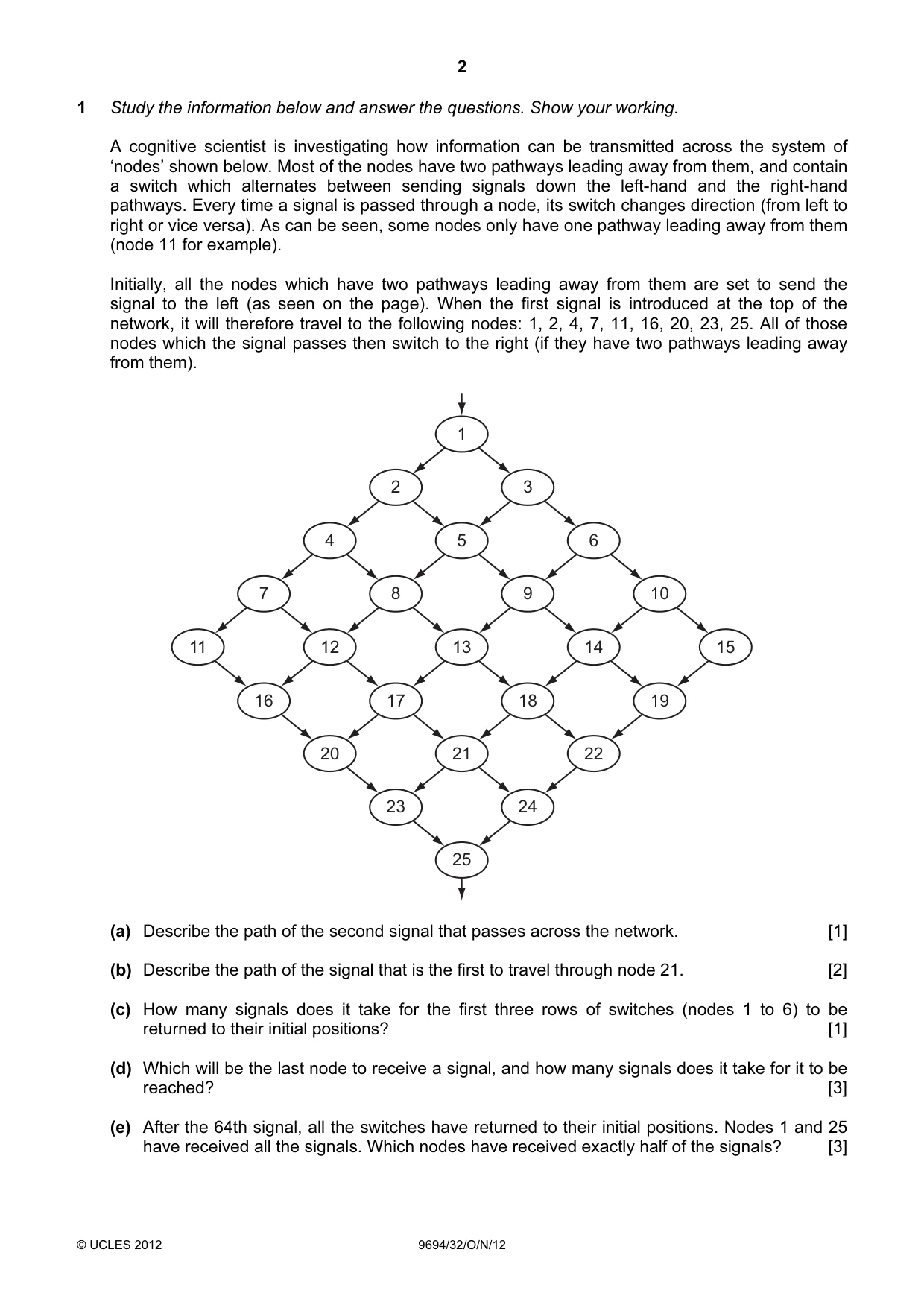
2 © UCLES 2012 9694/32/O/N/12 1 Study the information below and answer the questions. Show your working. A cognitive scientist is investigating how information can be transmitted across the system of ‘nodes’ shown below. Most of the nodes have two pathways leading away from them, and contain a switch which alternates between sending signals down the left-hand and the right-hand pathways. Every time a signal is passed through a node, its switch changes direction (from left to right or vice versa). As can be seen, some nodes only have one pathway leading away from them (node 11 for example). Initially, all the nodes which have two pathways leading away from them are set to send the signal to the left (as seen on the page). When the first signal is introduced at the top of the network, it will therefore travel to the following nodes: 1, 2, 4, 7, 11, 16, 20, 23, 25. All of those nodes which the signal passes then switch to the right (if they have two pathways leading away from them). 15 14 13 12 11 10 9 8 7 6 5 4 3 2 1 19 18 17 16 22 21 20 24 23 25 (a) Describe the path of the second signal that passes across the network. [1] (b) Describe the path of the signal that is the first to travel through node 21. [2] (c) How many signals does it take for the first three rows of switches (nodes 1 to 6) to be returned to their initial positions? [1] (d) Which will be the last node to receive a signal, and how many signals does it take for it to be reached? [3] (e) After the 64th signal, all the switches have returned to their initial positions. Nodes 1 and 25 have received all the signals. Which nodes have received exactly half of the signals? [3]
Question paper, page 3
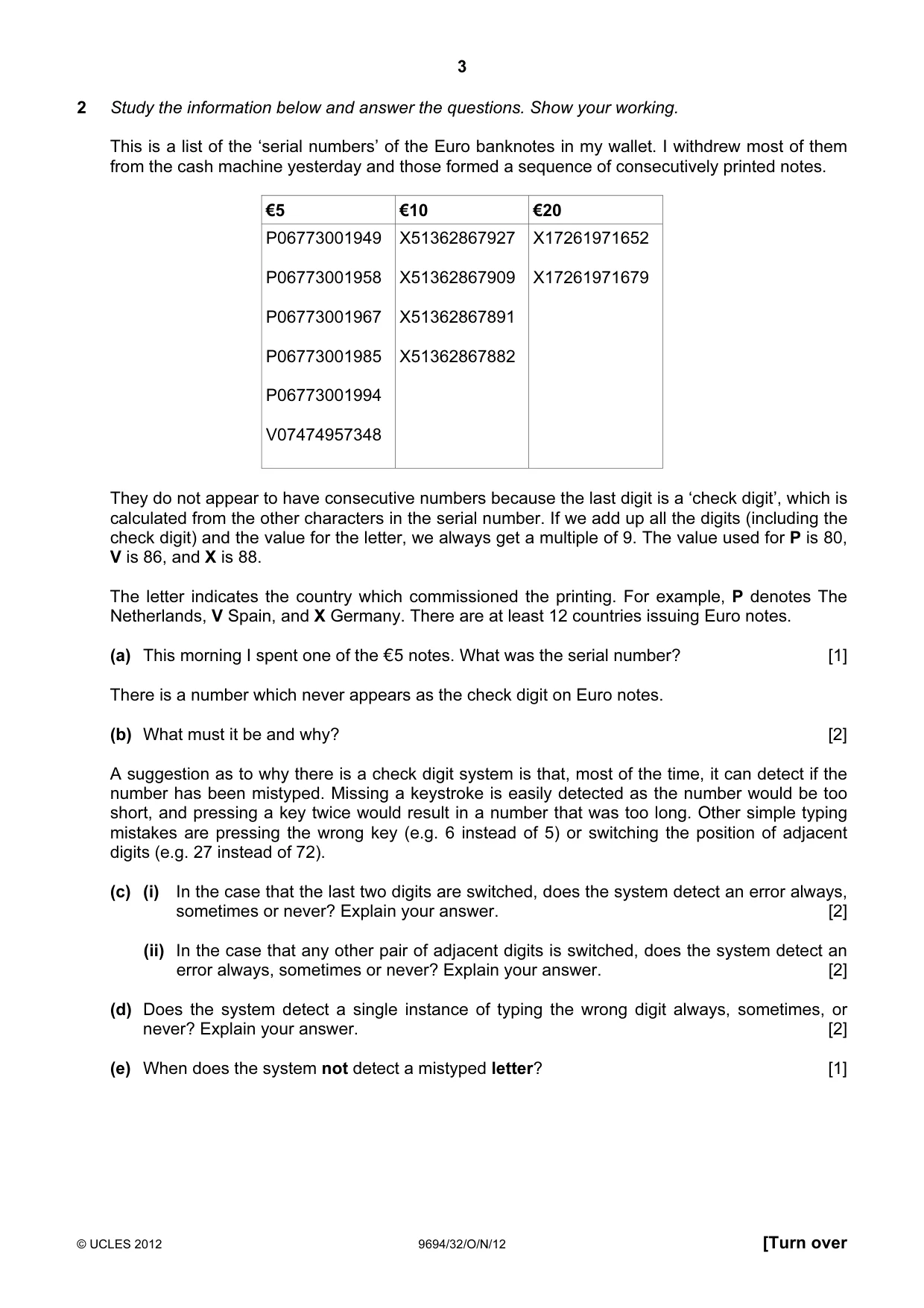
3 © UCLES 2012 9694/32/O/N/12 [Turn over 2 Study the information below and answer the questions. Show your working. This is a list of the ‘serial numbers’ of the Euro banknotes in my wallet. I withdrew most of them from the cash machine yesterday and those formed a sequence of consecutively printed notes. €5 €10 €20 P06773001949 P06773001958 P06773001967 P06773001985 P06773001994 V07474957348 X51362867927 X51362867909 X51362867891 X51362867882 X17261971652 X17261971679 They do not appear to have consecutive numbers because the last digit is a ‘check digit’, which is calculated from the other characters in the serial number. If we add up all the digits (including the check digit) and the value for the letter, we always get a multiple of 9. The value used for P is 80, V is 86, and X is 88. The letter indicates the country which commissioned the printing. For example, P denotes The Netherlands, V Spain, and X Germany. There are at least 12 countries issuing Euro notes. (a) This morning I spent one of the €5 notes. What was the serial number? [1] There is a number which never appears as the check digit on Euro notes. (b) What must it be and why? [2] A suggestion as to why there is a check digit system is that, most of the time, it can detect if the number has been mistyped. Missing a keystroke is easily detected as the number would be too short, and pressing a key twice would result in a number that was too long. Other simple typing mistakes are pressing the wrong key (e.g. 6 instead of 5) or switching the position of adjacent digits (e.g. 27 instead of 72). (c) (i) In the case that the last two digits are switched, does the system detect an error always, sometimes or never? Explain your answer. [2] (ii) In the case that any other pair of adjacent digits is switched, does the system detect an error always, sometimes or never? Explain your answer. [2] (d) Does the system detect a single instance of typing the wrong digit always, sometimes, or never? Explain your answer. [2] (e) When does the system not detect a mistyped letter? [1]
Question paper, page 4
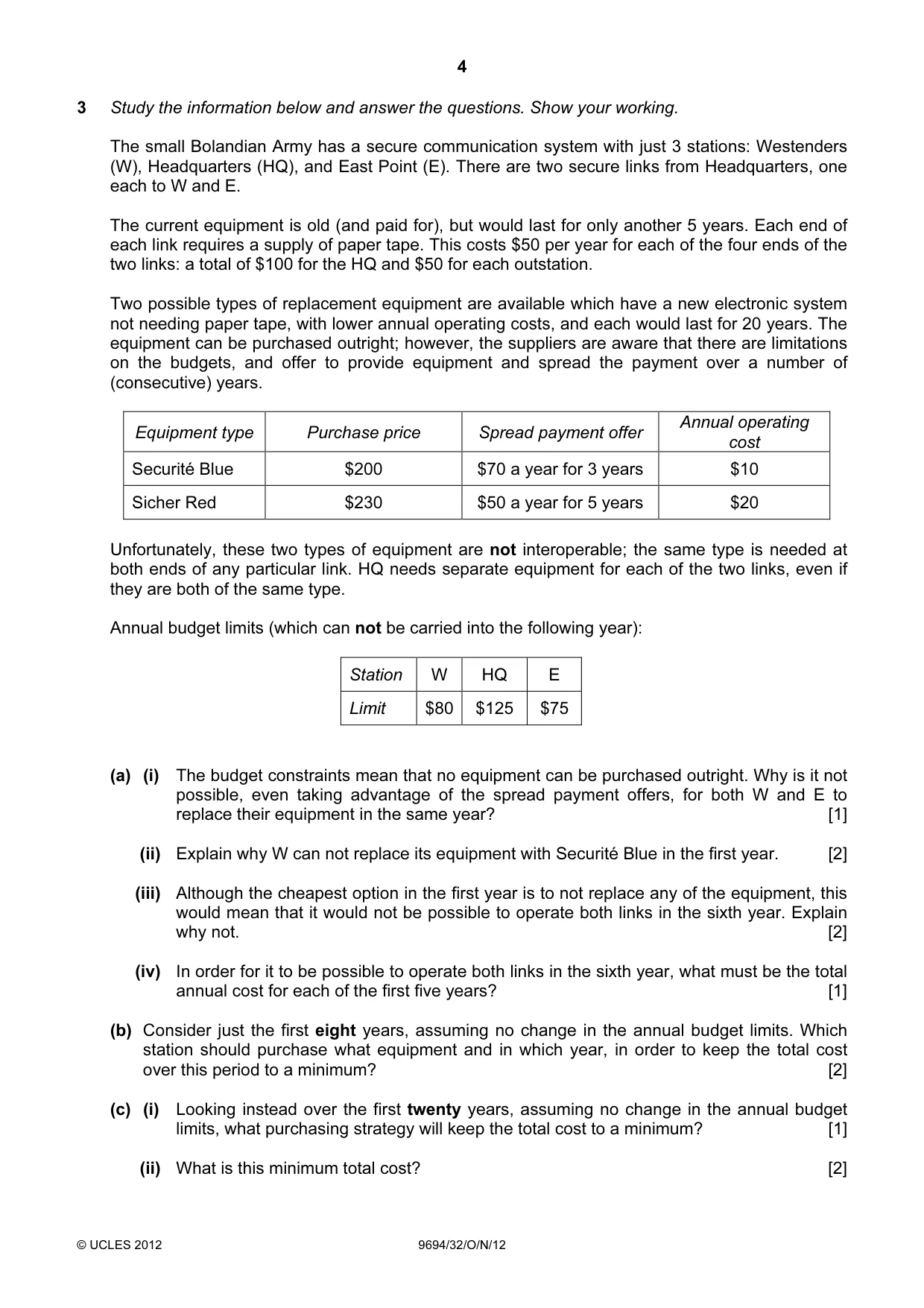
4 © UCLES 2012 9694/32/O/N/12 3 Study the information below and answer the questions. Show your working. The small Bolandian Army has a secure communication system with just 3 stations: Westenders (W), Headquarters (HQ), and East Point (E). There are two secure links from Headquarters, one each to W and E. The current equipment is old (and paid for), but would last for only another 5 years. Each end of each link requires a supply of paper tape. This costs $50 per year for each of the four ends of the two links: a total of $100 for the HQ and $50 for each outstation. Two possible types of replacement equipment are available which have a new electronic system not needing paper tape, with lower annual operating costs, and each would last for 20 years. The equipment can be purchased outright; however, the suppliers are aware that there are limitations on the budgets, and offer to provide equipment and spread the payment over a number of (consecutive) years. Equipment type Purchase price Spread payment offer Annual operating cost Securité Blue $200 $70 a year for 3 years $10 Sicher Red $230 $50 a year for 5 years $20 Unfortunately, these two types of equipment are not interoperable; the same type is needed at both ends of any particular link. HQ needs separate equipment for each of the two links, even if they are both of the same type. Annual budget limits (which can not be carried into the following year): Station W HQ E Limit $80 $125 $75 (a) (i) The budget constraints mean that no equipment can be purchased outright. Why is it not possible, even taking advantage of the spread payment offers, for both W and E to replace their equipment in the same year? [1] (ii) Explain why W can not replace its equipment with Securité Blue in the first year. [2] (iii) Although the cheapest option in the first year is to not replace any of the equipment, this would mean that it would not be possible to operate both links in the sixth year. Explain why not. [2] (iv) In order for it to be possible to operate both links in the sixth year, what must be the total annual cost for each of the first five years? [1] (b) Consider just the first eight years, assuming no change in the annual budget limits. Which station should purchase what equipment and in which year, in order to keep the total cost over this period to a minimum? [2] (c) (i) Looking instead over the first twenty years, assuming no change in the annual budget limits, what purchasing strategy will keep the total cost to a minimum? [1] (ii) What is this minimum total cost? [2]
Question paper, page 5
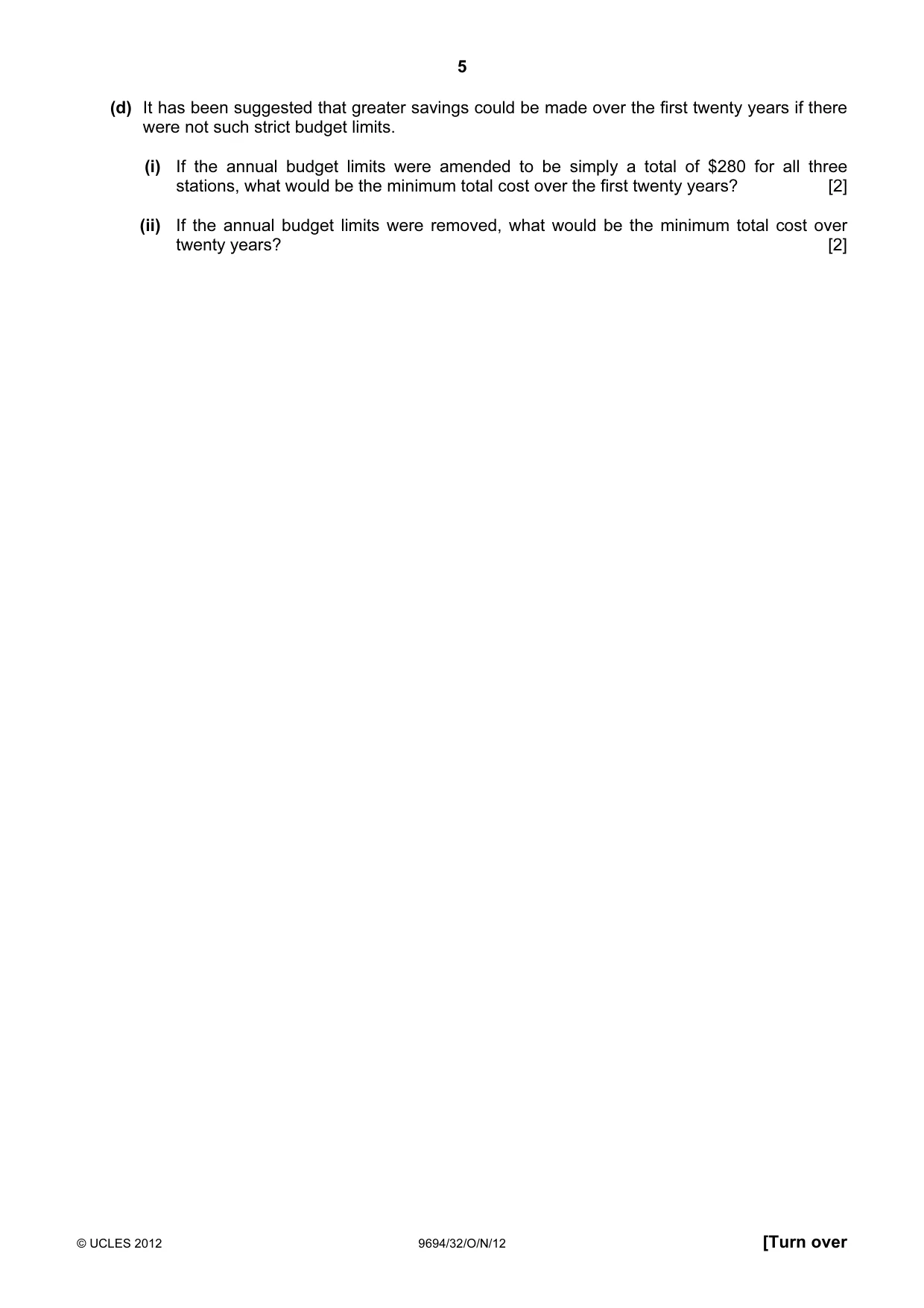
5 © UCLES 2012 9694/32/O/N/12 [Turn over (d) It has been suggested that greater savings could be made over the first twenty years if there were not such strict budget limits. (i) If the annual budget limits were amended to be simply a total of $280 for all three stations, what would be the minimum total cost over the first twenty years? [2] (ii) If the annual budget limits were removed, what would be the minimum total cost over twenty years? [2]
Question paper, page 6
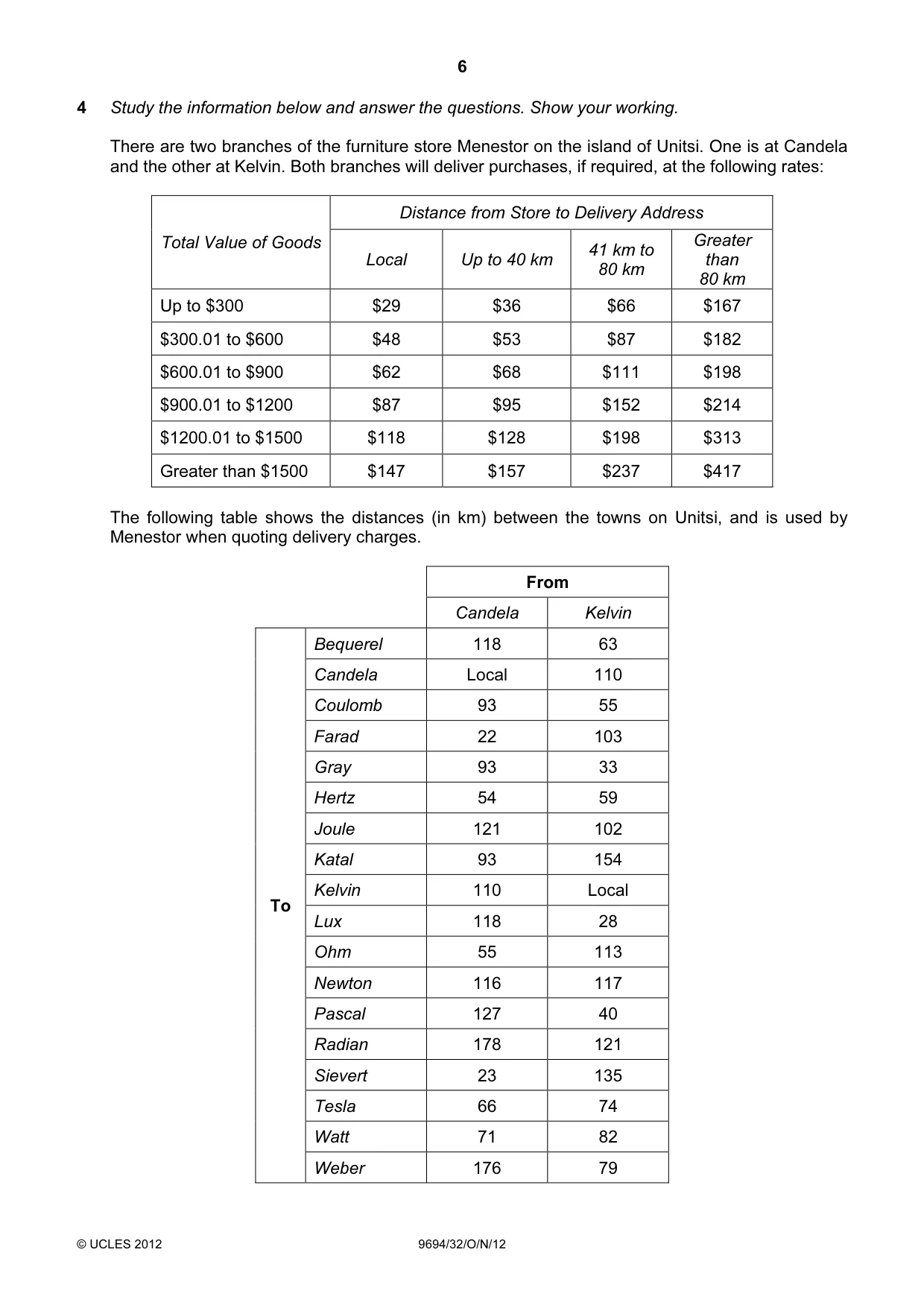
6 © UCLES 2012 9694/32/O/N/12 4 Study the information below and answer the questions. Show your working. There are two branches of the furniture store Menestor on the island of Unitsi. One is at Candela and the other at Kelvin. Both branches will deliver purchases, if required, at the following rates: Distance from Store to Delivery Address Total Value of Goods Local Up to 40 km 41 km to 80 km Greater than 80 km Up to $300 $29 $36 $66 $167 $300.01 to $600 $48 $53 $87 $182 $600.01 to $900 $62 $68 $111 $198 $900.01 to $1200 $87 $95 $152 $214 $1200.01 to $1500 $118 $128 $198 $313 Greater than $1500 $147 $157 $237 $417 The following table shows the distances (in km) between the towns on Unitsi, and is used by Menestor when quoting delivery charges. From Candela Kelvin Bequerel 118 63 Candela Local 110 Coulomb 93 55 Farad 22 103 Gray 93 33 Hertz 54 59 Joule 121 102 Katal 93 154 Kelvin 110 Local Lux 118 28 Ohm 55 113 Newton 116 117 Pascal 127 40 Radian 178 121 Sievert 23 135 Tesla 66 74 Watt 71 82 To Weber 176 79
Question paper, page 7
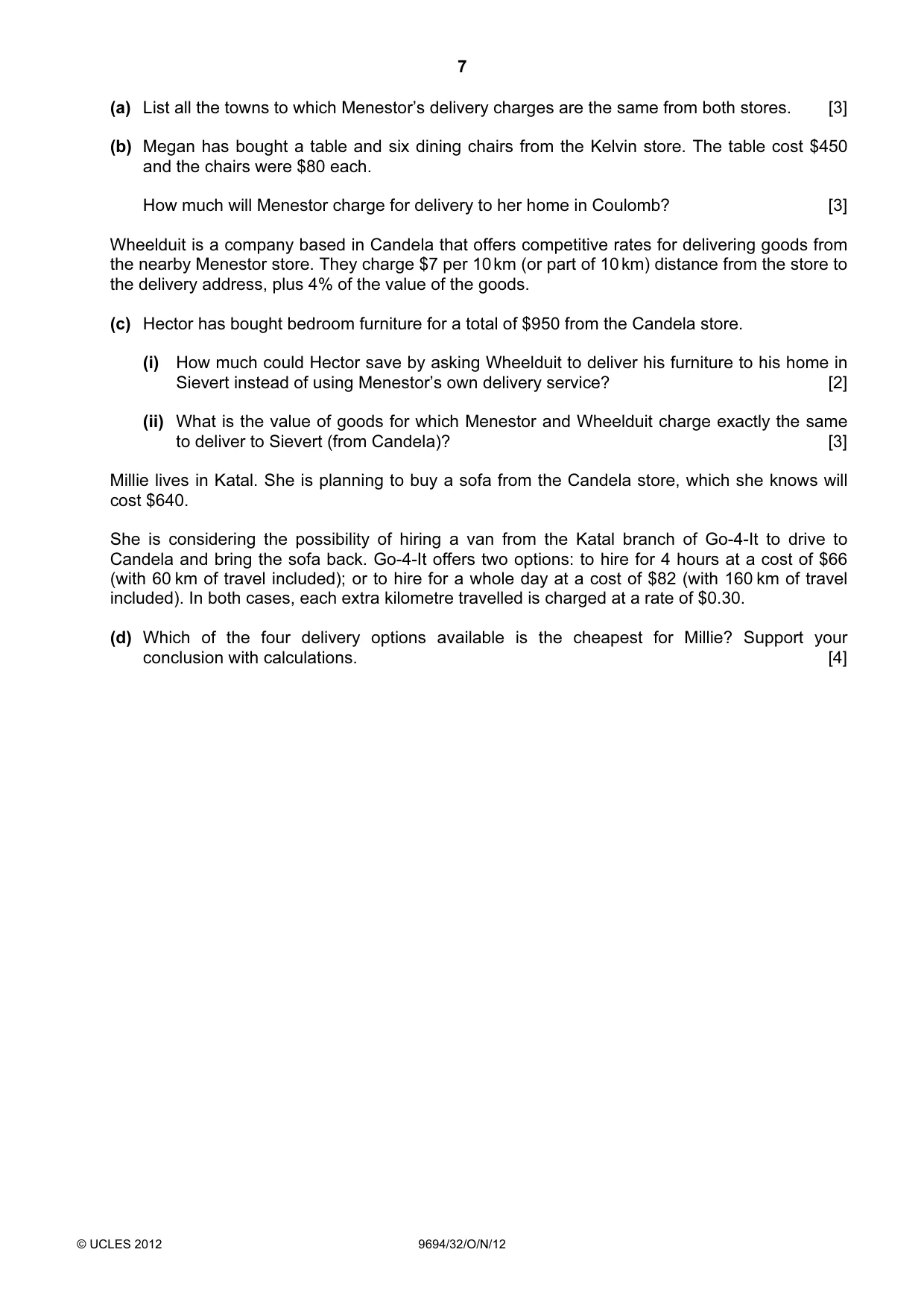
7 © UCLES 2012 9694/32/O/N/12 (a) List all the towns to which Menestor’s delivery charges are the same from both stores. [3] (b) Megan has bought a table and six dining chairs from the Kelvin store. The table cost $450 and the chairs were $80 each. How much will Menestor charge for delivery to her home in Coulomb? [3] Wheelduit is a company based in Candela that offers competitive rates for delivering goods from the nearby Menestor store. They charge $7 per 10 km (or part of 10 km) distance from the store to the delivery address, plus 4% of the value of the goods. (c) Hector has bought bedroom furniture for a total of $950 from the Candela store. (i) How much could Hector save by asking Wheelduit to deliver his furniture to his home in Sievert instead of using Menestor’s own delivery service? [2] (ii) What is the value of goods for which Menestor and Wheelduit charge exactly the same to deliver to Sievert (from Candela)? [3] Millie lives in Katal. She is planning to buy a sofa from the Candela store, which she knows will cost $640. She is considering the possibility of hiring a van from the Katal branch of Go-4-It to drive to Candela and bring the sofa back. Go-4-It offers two options: to hire for 4 hours at a cost of $66 (with 60 km of travel included); or to hire for a whole day at a cost of $82 (with 160 km of travel included). In both cases, each extra kilometre travelled is charged at a rate of $0.30. (d) Which of the four delivery options available is the cheapest for Millie? Support your conclusion with calculations. [4]
Question paper, page 8
8 Permission to reproduce items where third-party owned material protected by copyright is included has been sought and cleared where possible. Every reasonable effort has been made by the publisher (UCLES) to trace copyright holders, but if any items requiring clearance have unwittingly been included, the publisher will be pleased to make amends at the earliest possible opportunity. University of Cambridge International Examinations is part of the Cambridge Assessment Group. Cambridge Assessment is the brand name of University of Cambridge Local Examinations Syndicate (UCLES), which is itself a department of the University of Cambridge. © UCLES 2012 9694/32/O/N/12 BLANK PAGE
Mark scheme, page 1
CAMBRIDGE INTERNATIONAL EXAMINATIONS GCE Advanced Level MARK SCHEME for the October/November 2012 series 9694 THINKING SKILLS 9694/32 Paper 3 (Problem Analysis and Solution), maximum raw mark 50 This mark scheme is published as an aid to teachers and candidates, to indicate the requirements of the examination. It shows the basis on which Examiners were instructed to award marks. It does not indicate the details of the discussions that took place at an Examiners’ meeting before marking began, which would have considered the acceptability of alternative answers. Mark schemes should be read in conjunction with the question paper and the Principal Examiner Report for Teachers. Cambridge will not enter into discussions about these mark schemes. Cambridge is publishing the mark schemes for the October/November 2012 series for most IGCSE, GCE Advanced Level and Advanced Subsidiary Level components and some Ordinary Level components.
Mark scheme, page 2
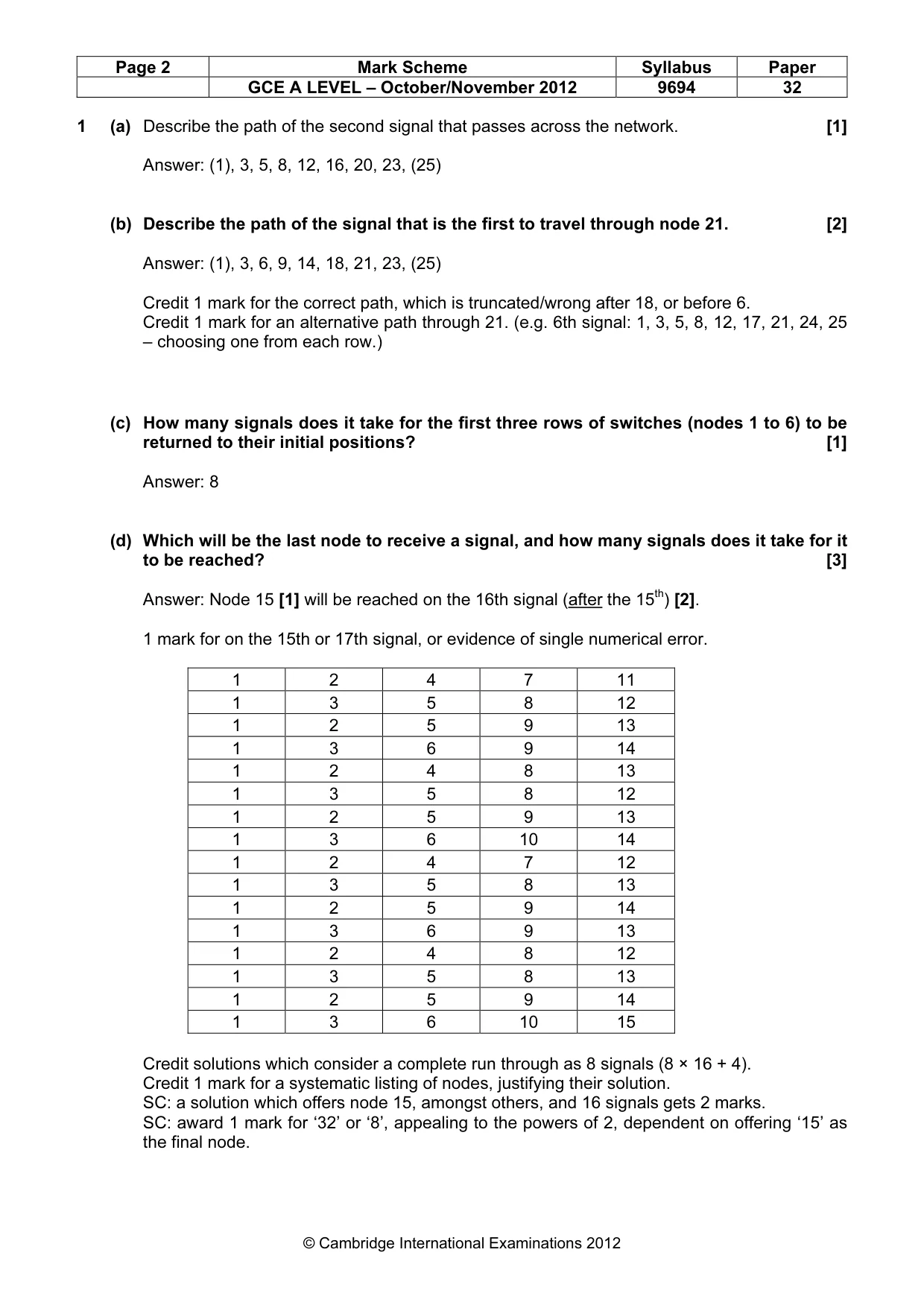
Page 2 Mark Scheme Syllabus Paper GCE A LEVEL – October/November 2012 9694 32 © Cambridge International Examinations 2012 1 (a) Describe the path of the second signal that passes across the network. [1] Answer: (1), 3, 5, 8, 12, 16, 20, 23, (25) (b) Describe the path of the signal that is the first to travel through node 21. [2] Answer: (1), 3, 6, 9, 14, 18, 21, 23, (25) Credit 1 mark for the correct path, which is truncated/wrong after 18, or before 6. Credit 1 mark for an alternative path through 21. (e.g. 6th signal: 1, 3, 5, 8, 12, 17, 21, 24, 25 – choosing one from each row.) (c) How many signals does it take for the first three rows of switches (nodes 1 to 6) to be returned to their initial positions? [1] Answer: 8 (d) Which will be the last node to receive a signal, and how many signals does it take for it to be reached? [3] Answer: Node 15 [1] will be reached on the 16th signal (after the 15th) [2]. 1 mark for on the 15th or 17th signal, or evidence of single numerical error. 1 2 4 7 11 1 3 5 8 12 1 2 5 9 13 1 3 6 9 14 1 2 4 8 13 1 3 5 8 12 1 2 5 9 13 1 3 6 10 14 1 2 4 7 12 1 3 5 8 13 1 2 5 9 14 1 3 6 9 13 1 2 4 8 12 1 3 5 8 13 1 2 5 9 14 1 3 6 10 15 Credit solutions which consider a complete run through as 8 signals (8 × 16 + 4). Credit 1 mark for a systematic listing of nodes, justifying their solution. SC: a solution which offers node 15, amongst others, and 16 signals gets 2 marks. SC: award 1 mark for ‘32’ or ‘8’, appealing to the powers of 2, dependent on offering ‘15’ as the final node.
Mark scheme, page 3
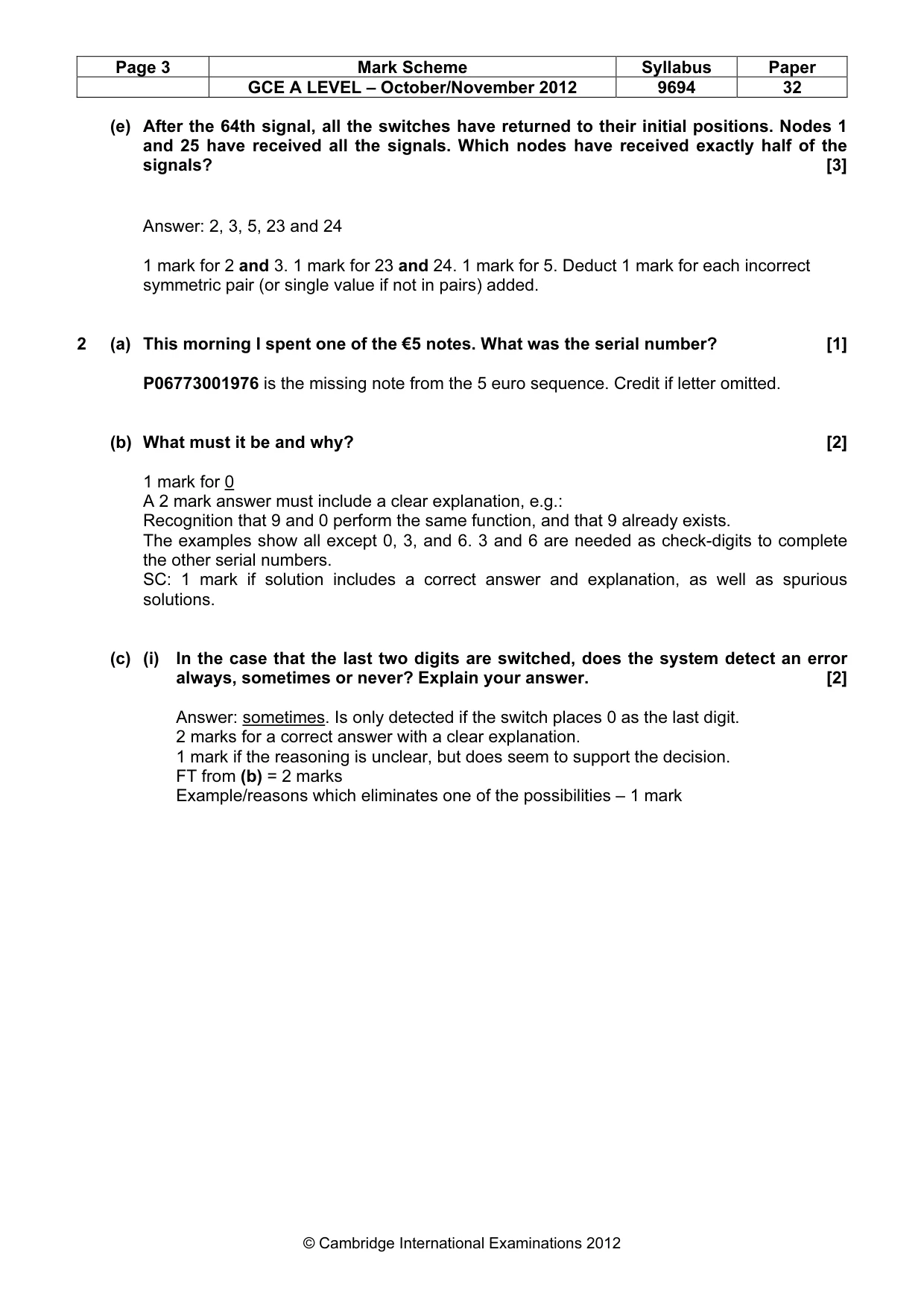
Page 3 Mark Scheme Syllabus Paper GCE A LEVEL – October/November 2012 9694 32 © Cambridge International Examinations 2012 (e) After the 64th signal, all the switches have returned to their initial positions. Nodes 1 and 25 have received all the signals. Which nodes have received exactly half of the signals? [3] Answer: 2, 3, 5, 23 and 24 1 mark for 2 and 3. 1 mark for 23 and 24. 1 mark for 5. Deduct 1 mark for each incorrect symmetric pair (or single value if not in pairs) added. 2 (a) This morning I spent one of the €5 notes. What was the serial number? [1] P06773001976 is the missing note from the 5 euro sequence. Credit if letter omitted. (b) What must it be and why? [2] 1 mark for 0 A 2 mark answer must include a clear explanation, e.g.: Recognition that 9 and 0 perform the same function, and that 9 already exists. The examples show all except 0, 3, and 6. 3 and 6 are needed as check-digits to complete the other serial numbers. SC: 1 mark if solution includes a correct answer and explanation, as well as spurious solutions. (c) (i) In the case that the last two digits are switched, does the system detect an error always, sometimes or never? Explain your answer. [2] Answer: sometimes. Is only detected if the switch places 0 as the last digit. 2 marks for a correct answer with a clear explanation. 1 mark if the reasoning is unclear, but does seem to support the decision. FT from (b) = 2 marks Example/reasons which eliminates one of the possibilities – 1 mark
Mark scheme, page 4
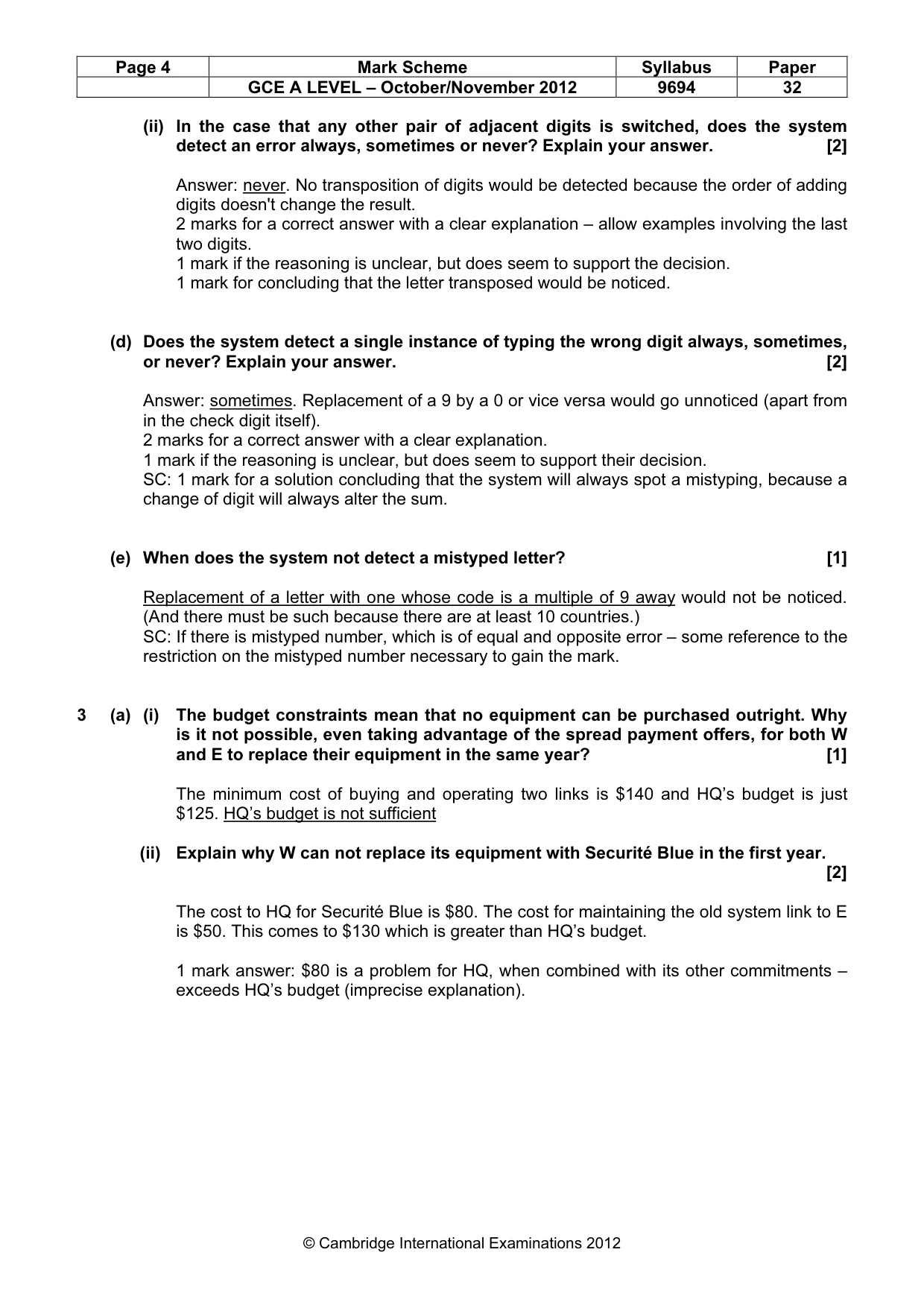
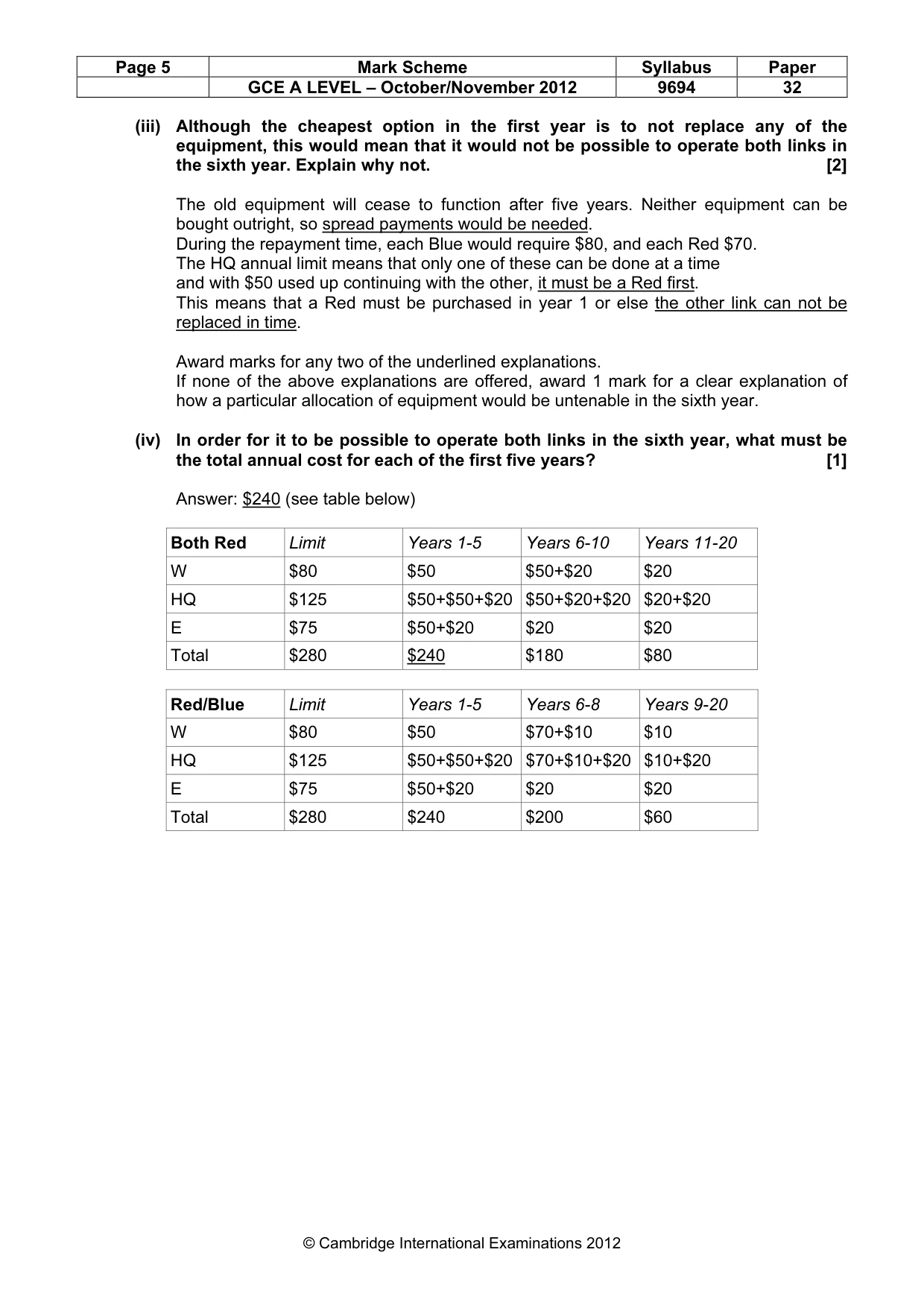
Page 4 Mark Scheme Syllabus Paper GCE A LEVEL – October/November 2012 9694 32 © Cambridge International Examinations 2012 (ii) In the case that any other pair of adjacent digits is switched, does the system detect an error always, sometimes or never? Explain your answer. [2] Answer: never. No transposition of digits would be detected because the order of adding digits doesn't change the result. 2 marks for a correct answer with a clear explanation – allow examples involving the last two digits. 1 mark if the reasoning is unclear, but does seem to support the decision. 1 mark for concluding that the letter transposed would be noticed. (d) Does the system detect a single instance of typing the wrong digit always, sometimes, or never? Explain your answer. [2] Answer: sometimes. Replacement of a 9 by a 0 or vice versa would go unnoticed (apart from in the check digit itself). 2 marks for a correct answer with a clear explanation. 1 mark if the reasoning is unclear, but does seem to support their decision. SC: 1 mark for a solution concluding that the system will always spot a mistyping, because a change of digit will always alter the sum. (e) When does the system not detect a mistyped letter? [1] Replacement of a letter with one whose code is a multiple of 9 away would not be noticed. (And there must be such because there are at least 10 countries.) SC: If there is mistyped number, which is of equal and opposite error – some reference to the restriction on the mistyped number necessary to gain the mark. 3 (a) (i) The budget constraints mean that no equipment can be purchased outright. Why is it not possible, even taking advantage of the spread payment offers, for both W and E to replace their equipment in the same year? [1] The minimum cost of buying and operating two links is $140 and HQ’s budget is just $125. HQ’s budget is not sufficient (ii) Explain why W can not replace its equipment with Securité Blue in the first year. [2] The cost to HQ for Securité Blue is $80. The cost for maintaining the old system link to E is $50. This comes to $130 which is greater than HQ’s budget. 1 mark answer: $80 is a problem for HQ, when combined with its other commitments – exceeds HQ’s budget (imprecise explanation).
Mark scheme, page 5
Page 5 Mark Scheme Syllabus Paper GCE A LEVEL – October/November 2012 9694 32 © Cambridge International Examinations 2012 (iii) Although the cheapest option in the first year is to not replace any of the equipment, this would mean that it would not be possible to operate both links in the sixth year. Explain why not. [2] The old equipment will cease to function after five years. Neither equipment can be bought outright, so spread payments would be needed. During the repayment time, each Blue would require $80, and each Red $70. The HQ annual limit means that only one of these can be done at a time and with $50 used up continuing with the other, it must be a Red first. This means that a Red must be purchased in year 1 or else the other link can not be replaced in time. Award marks for any two of the underlined explanations. If none of the above explanations are offered, award 1 mark for a clear explanation of how a particular allocation of equipment would be untenable in the sixth year. (iv) In order for it to be possible to operate both links in the sixth year, what must be the total annual cost for each of the first five years? [1] Answer: $240 (see table below) Both Red Limit Years 1-5 Years 6-10 Years 11-20 W $80 $50 $50+$20 $20 HQ $125 $50+$50+$20 $50+$20+$20 $20+$20 E $75 $50+$20 $20 $20 Total $280 $240 $180 $80 Red/Blue Limit Years 1-5 Years 6-8 Years 9-20 W $80 $50 $70+$10 $10 HQ $125 $50+$50+$20 $70+$10+$20 $10+$20 E $75 $50+$20 $20 $20 Total $280 $240 $200 $60
Mark scheme, page 6
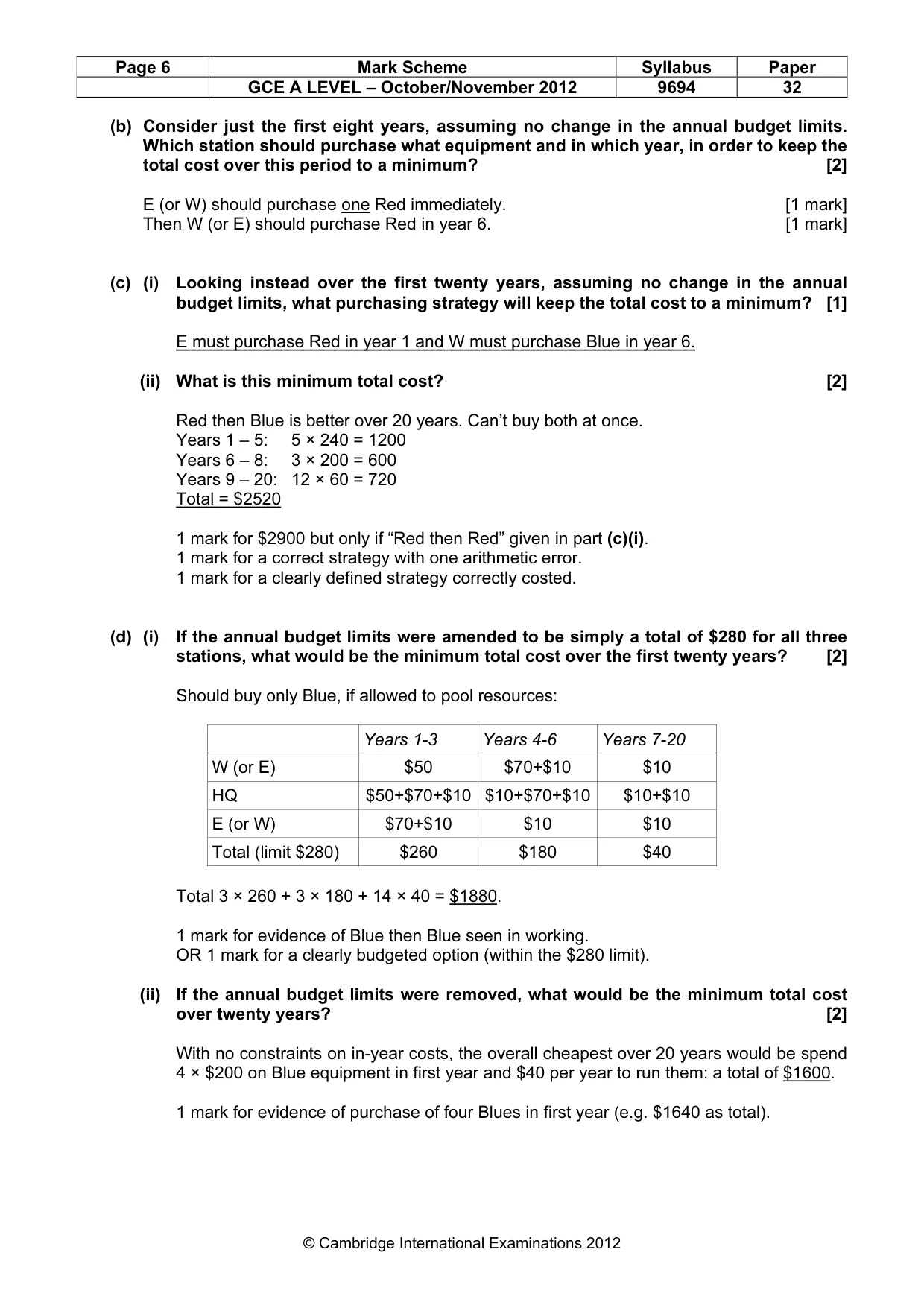
Page 6 Mark Scheme Syllabus Paper GCE A LEVEL – October/November 2012 9694 32 © Cambridge International Examinations 2012 (b) Consider just the first eight years, assuming no change in the annual budget limits. Which station should purchase what equipment and in which year, in order to keep the total cost over this period to a minimum? [2] E (or W) should purchase one Red immediately. [1 mark] Then W (or E) should purchase Red in year 6. [1 mark] (c) (i) Looking instead over the first twenty years, assuming no change in the annual budget limits, what purchasing strategy will keep the total cost to a minimum? [1] E must purchase Red in year 1 and W must purchase Blue in year 6. (ii) What is this minimum total cost? [2] Red then Blue is better over 20 years. Can’t buy both at once. Years 1 – 5: 5 × 240 = 1200 Years 6 – 8: 3 × 200 = 600 Years 9 – 20: 12 × 60 = 720 Total = $2520 1 mark for $2900 but only if “Red then Red” given in part (c)(i). 1 mark for a correct strategy with one arithmetic error. 1 mark for a clearly defined strategy correctly costed. (d) (i) If the annual budget limits were amended to be simply a total of $280 for all three stations, what would be the minimum total cost over the first twenty years? [2] Should buy only Blue, if allowed to pool resources: Years 1-3 Years 4-6 Years 7-20 W (or E) $50 $70+$10 $10 HQ $50+$70+$10 $10+$70+$10 $10+$10 E (or W) $70+$10 $10 $10 Total (limit $280) $260 $180 $40 Total 3 × 260 + 3 × 180 + 14 × 40 = $1880. 1 mark for evidence of Blue then Blue seen in working. OR 1 mark for a clearly budgeted option (within the $280 limit). (ii) If the annual budget limits were removed, what would be the minimum total cost over twenty years? [2] With no constraints on in-year costs, the overall cheapest over 20 years would be spend 4 × $200 on Blue equipment in first year and $40 per year to run them: a total of $1600. 1 mark for evidence of purchase of four Blues in first year (e.g. $1640 as total).
Mark scheme, page 7
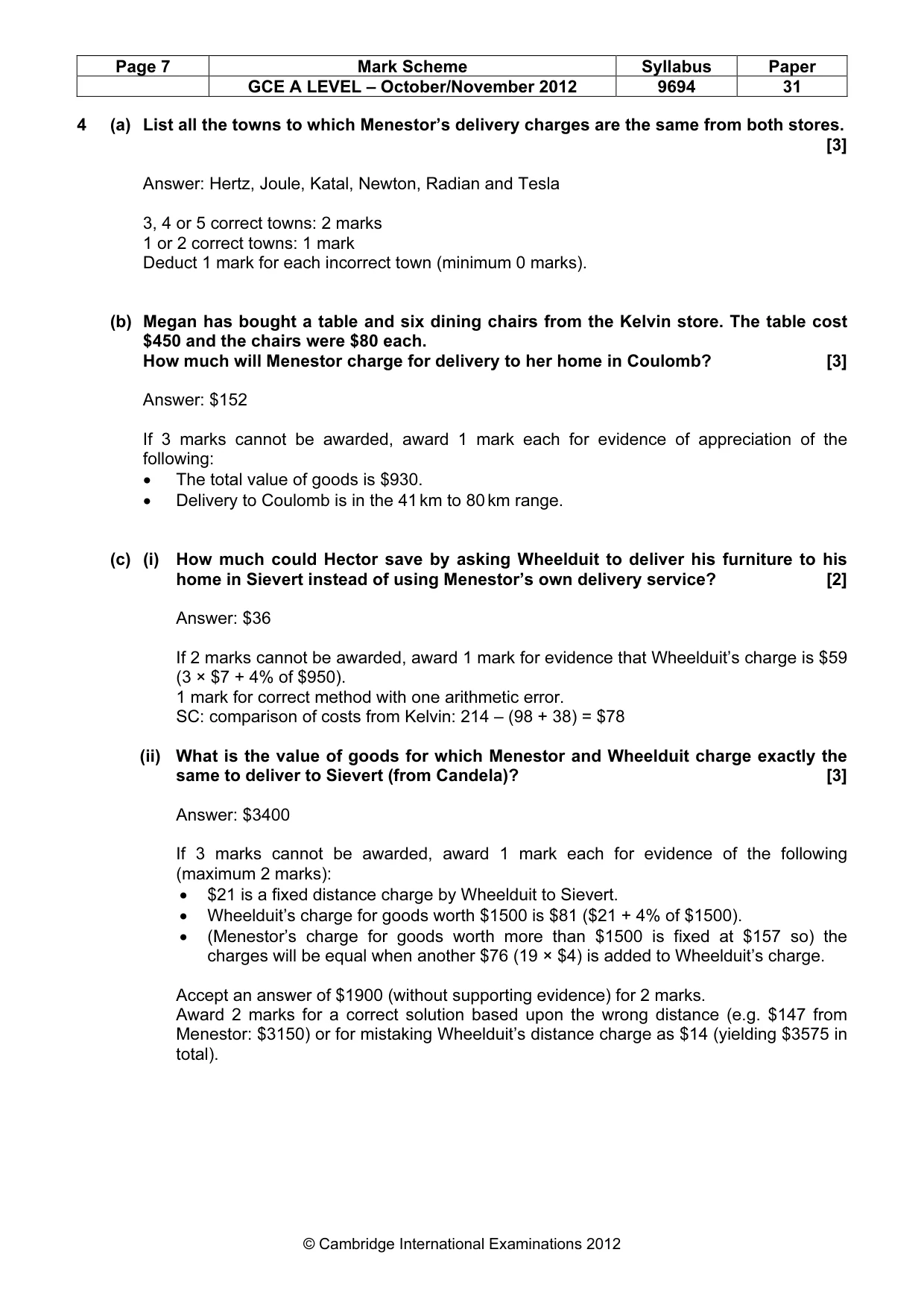
Page 7 Mark Scheme Syllabus Paper GCE A LEVEL – October/November 2012 9694 31 © Cambridge International Examinations 2012 4 (a) List all the towns to which Menestor’s delivery charges are the same from both stores. [3] Answer: Hertz, Joule, Katal, Newton, Radian and Tesla 3, 4 or 5 correct towns: 2 marks 1 or 2 correct towns: 1 mark Deduct 1 mark for each incorrect town (minimum 0 marks). (b) Megan has bought a table and six dining chairs from the Kelvin store. The table cost $450 and the chairs were $80 each. How much will Menestor charge for delivery to her home in Coulomb? [3] Answer: $152 If 3 marks cannot be awarded, award 1 mark each for evidence of appreciation of the following: • The total value of goods is $930. • Delivery to Coulomb is in the 41 km to 80 km range. (c) (i) How much could Hector save by asking Wheelduit to deliver his furniture to his home in Sievert instead of using Menestor’s own delivery service? [2] Answer: $36 If 2 marks cannot be awarded, award 1 mark for evidence that Wheelduit’s charge is $59 (3 × $7 + 4% of $950). 1 mark for correct method with one arithmetic error. SC: comparison of costs from Kelvin: 214 – (98 + 38) = $78 (ii) What is the value of goods for which Menestor and Wheelduit charge exactly the same to deliver to Sievert (from Candela)? [3] Answer: $3400 If 3 marks cannot be awarded, award 1 mark each for evidence of the following (maximum 2 marks): • $21 is a fixed distance charge by Wheelduit to Sievert. • Wheelduit’s charge for goods worth $1500 is $81 ($21 + 4% of $1500). • (Menestor’s charge for goods worth more than $1500 is fixed at $157 so) the charges will be equal when another $76 (19 × $4) is added to Wheelduit’s charge. Accept an answer of $1900 (without supporting evidence) for 2 marks. Award 2 marks for a correct solution based upon the wrong distance (e.g. $147 from Menestor: $3150) or for mistaking Wheelduit’s distance charge as $14 (yielding $3575 in total).
Mark scheme, page 8
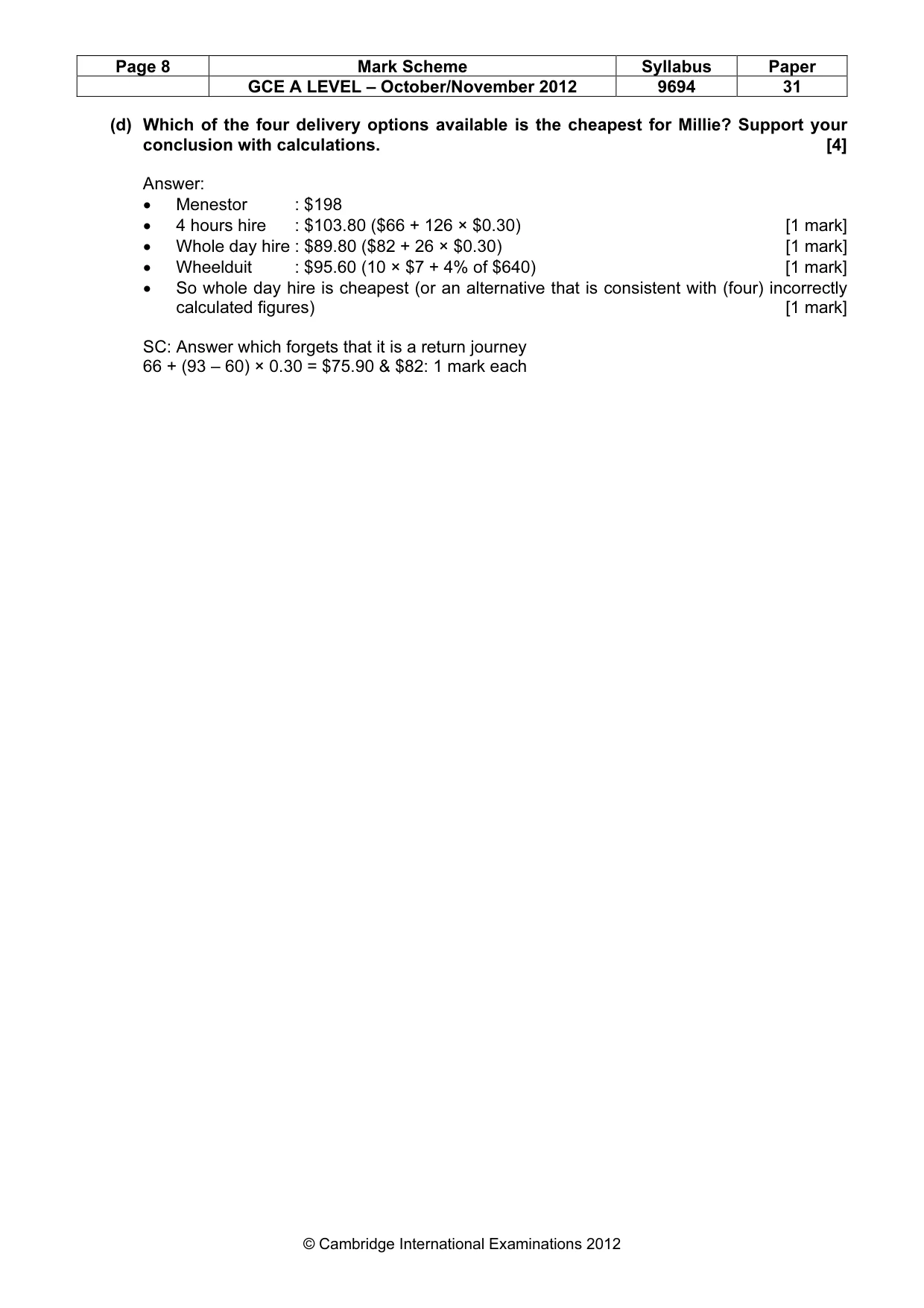
Page 8 Mark Scheme Syllabus Paper GCE A LEVEL – October/November 2012 9694 31 © Cambridge International Examinations 2012 (d) Which of the four delivery options available is the cheapest for Millie? Support your conclusion with calculations. [4] Answer: • Menestor : $198 • 4 hours hire : $103.80 ($66 + 126 × $0.30) [1 mark] • Whole day hire : $89.80 ($82 + 26 × $0.30) [1 mark] • Wheelduit : $95.60 (10 × $7 + 4% of $640) [1 mark] • So whole day hire is cheapest (or an alternative that is consistent with (four) incorrectly calculated figures) [1 mark] SC: Answer which forgets that it is a return journey 66 + (93 – 60) × 0.30 = $75.90 & $82: 1 mark each
What you needed in this session
Cambridge’s own grade thresholds for 2012 Oct/Nov, Paper 3 · Variant 2. A higher threshold means an easier paper — the bar moves with how the cohort did.