Cambridge A Level Spanish - Language (AS Level only) 8685 — 2014 Oct/Nov Paper 2 · Variant 3
8685/23/O/N/14 · 70 marks · ≈79 min
The question paper and its mark scheme, free to read here and free to download. This is Cambridge’s own paper, exactly as it was sat.
Question paper8 pages



Mark scheme11 pages
Answers below. Sit the paper first if you are practising.
Paper as text
Question paper, page 1
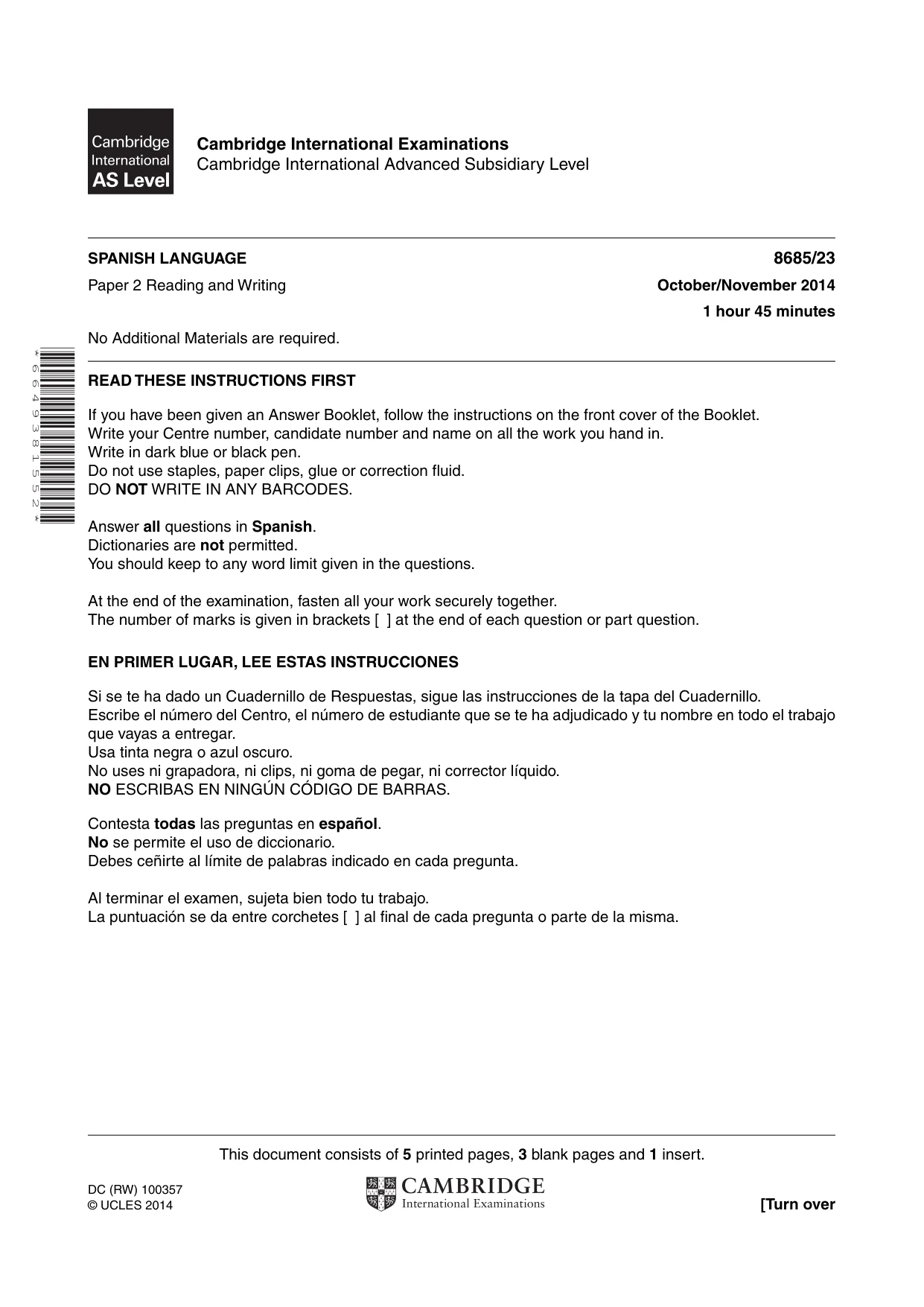
This document consists of 5 printed pages, 3 blank pages and 1 insert. DC (RW) 100357 © UCLES 2014 [Turn over Cambridge International Examinations Cambridge International Advanced Subsidiary Level * 6 6 4 9 3 8 1 5 5 2 * SPANISH LANGUAGE 8685/23 Paper 2 Reading and Writing October/November 2014 1 hour 45 minutes No Additional Materials are required. READ THESE INSTRUCTIONS FIRST If you have been given an Answer Booklet, follow the instructions on the front cover of the Booklet. Write your Centre number, candidate number and name on all the work you hand in. Write in dark blue or black pen. Do not use staples, paper clips, glue or correction fluid. DO NOT WRITE IN ANY BARCODES. Answer all questions in Spanish. Dictionaries are not permitted. You should keep to any word limit given in the questions. At the end of the examination, fasten all your work securely together. The number of marks is given in brackets [ ] at the end of each question or part question. EN PRIMER LUGAR, LEE ESTAS INSTRUCCIONES Si se te ha dado un Cuadernillo de Respuestas, sigue las instrucciones de la tapa del Cuadernillo. Escribe el número del Centro, el número de estudiante que se te ha adjudicado y tu nombre en todo el trabajo que vayas a entregar. Usa tinta negra o azul oscuro. No uses ni grapadora, ni clips, ni goma de pegar, ni corrector líquido. NO ESCRIBAS EN NINGÚN CÓDIGO DE BARRAS. Contesta todas las preguntas en español. No se permite el uso de diccionario. Debes ceñirte al límite de palabras indicado en cada pregunta. Al terminar el examen, sujeta bien todo tu trabajo. La puntuación se da entre corchetes [ ] al final de cada pregunta o parte de la misma.
Question paper, page 2
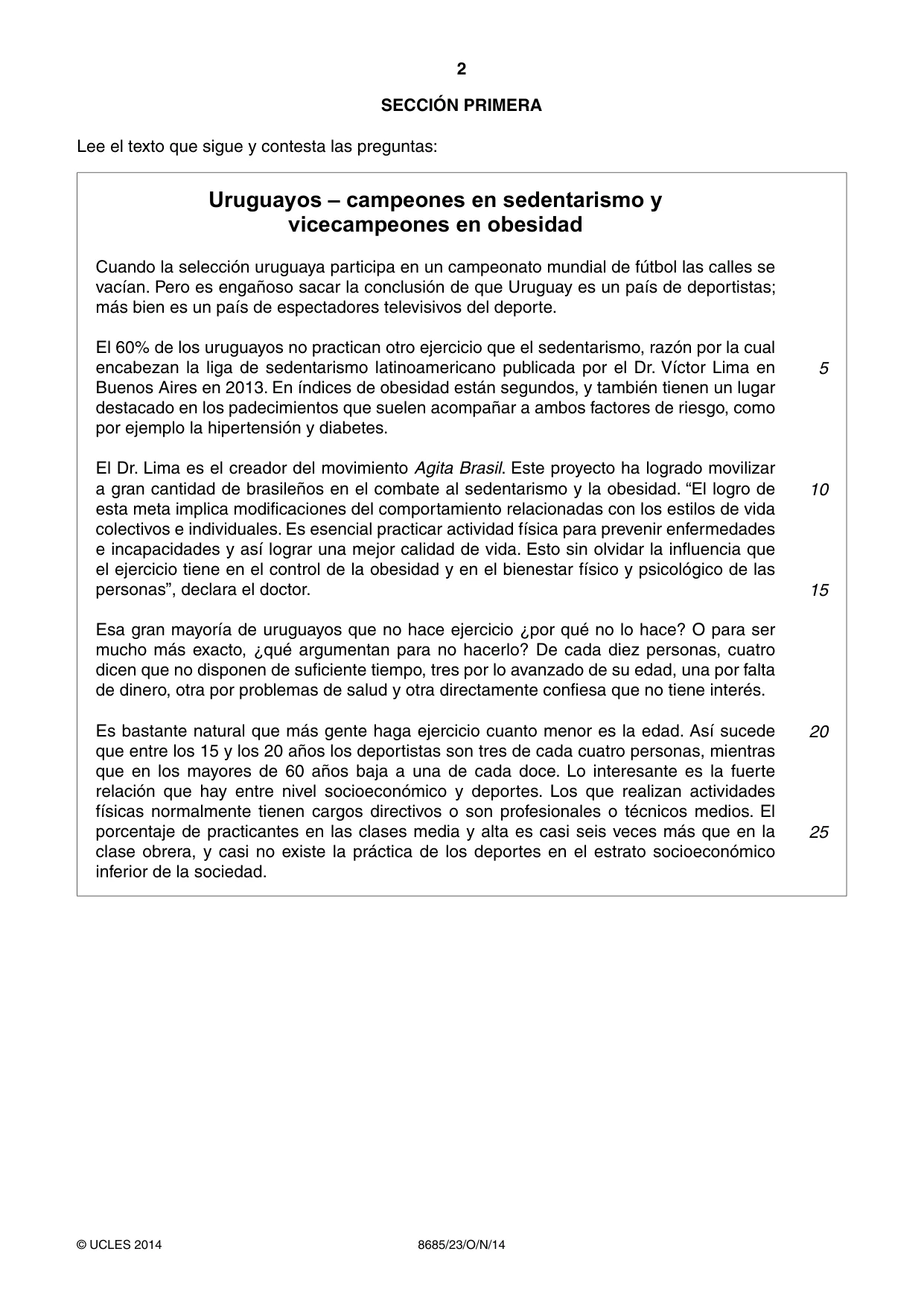
2 8685/23/O/N/14 © UCLES 2014 SECCIÓN PRIMERA Lee el texto que sigue y contesta las preguntas: Uruguayos – campeones en sedentarismo y vicecampeones en obesidad Cuando la selección uruguaya participa en un campeonato mundial de fútbol las calles se vacían. Pero es engañoso sacar la conclusión de que Uruguay es un país de deportistas; más bien es un país de espectadores televisivos del deporte. El 60% de los uruguayos no practican otro ejercicio que el sedentarismo, razón por la cual encabezan la liga de sedentarismo latinoamericano publicada por el Dr. Víctor Lima en Buenos Aires en 2013. En índices de obesidad están segundos, y también tienen un lugar destacado en los padecimientos que suelen acompañar a ambos factores de riesgo, como por ejemplo la hipertensión y diabetes. El Dr. Lima es el creador del movimiento Agita Brasil. Este proyecto ha logrado movilizar a gran cantidad de brasileños en el combate al sedentarismo y la obesidad. “El logro de esta meta implica modificaciones del comportamiento relacionadas con los estilos de vida colectivos e individuales. Es esencial practicar actividad física para prevenir enfermedades e incapacidades y así lograr una mejor calidad de vida. Esto sin olvidar la influencia que el ejercicio tiene en el control de la obesidad y en el bienestar físico y psicológico de las personas”, declara el doctor. Esa gran mayoría de uruguayos que no hace ejercicio ¿por qué no lo hace? O para ser mucho más exacto, ¿qué argumentan para no hacerlo? De cada diez personas, cuatro dicen que no disponen de suficiente tiempo, tres por lo avanzado de su edad, una por falta de dinero, otra por problemas de salud y otra directamente confiesa que no tiene interés. Es bastante natural que más gente haga ejercicio cuanto menor es la edad. Así sucede que entre los 15 y los 20 años los deportistas son tres de cada cuatro personas, mientras que en los mayores de 60 años baja a una de cada doce. Lo interesante es la fuerte relación que hay entre nivel socioeconómico y deportes. Los que realizan actividades físicas normalmente tienen cargos directivos o son profesionales o técnicos medios. El porcentaje de practicantes en las clases media y alta es casi seis veces más que en la clase obrera, y casi no existe la práctica de los deportes en el estrato socioeconómico inferior de la sociedad. 5 10 15 20 25
Question paper, page 3
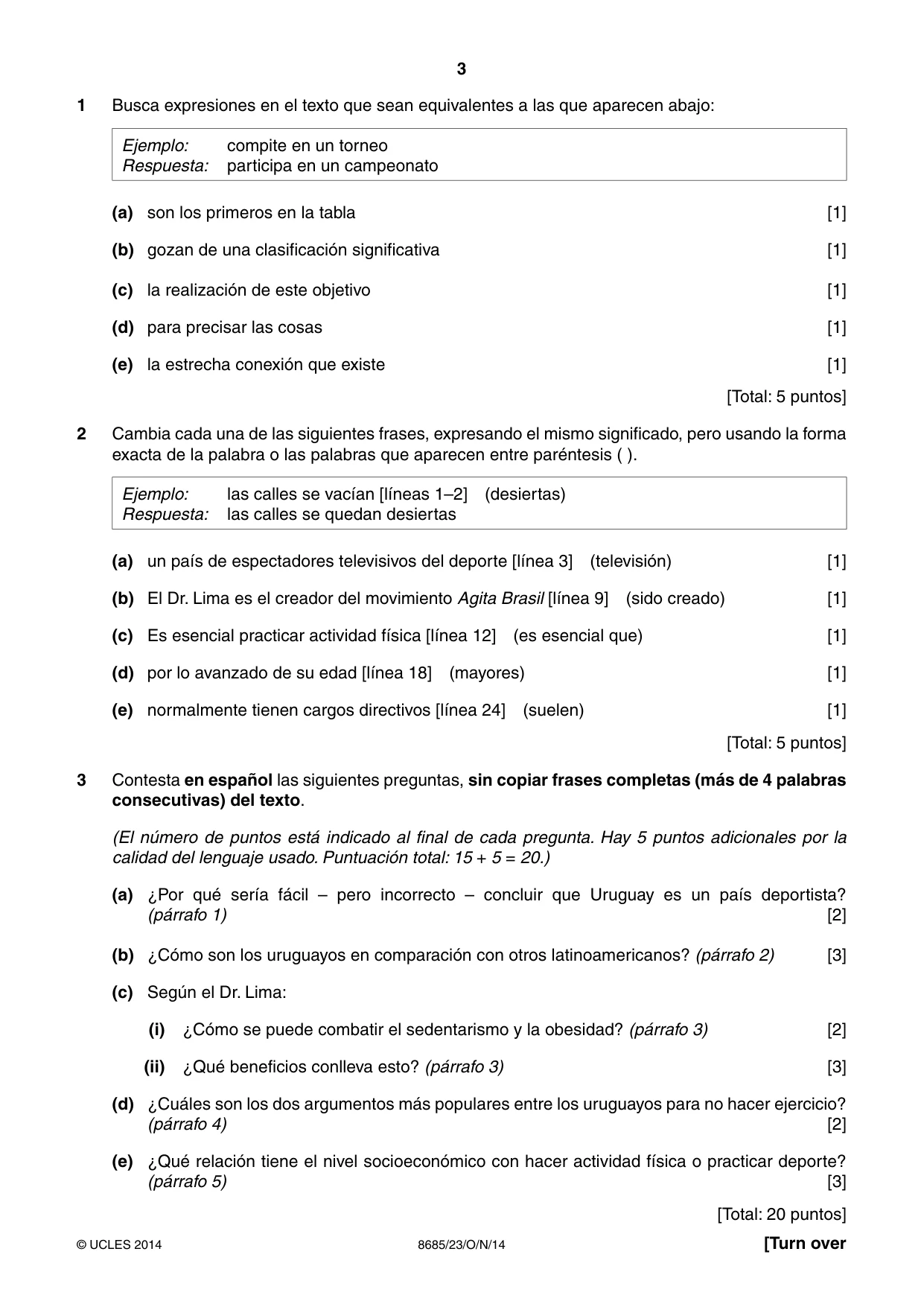
3 8685/23/O/N/14 © UCLES 2014 [Turn over 1 Busca expresiones en el texto que sean equivalentes a las que aparecen abajo: Ejemplo: compite en un torneo Respuesta: participa en un campeonato (a) son los primeros en la tabla [1] (b) gozan de una clasificación significativa [1] (c) la realización de este objetivo [1] (d) para precisar las cosas [1] (e) la estrecha conexión que existe [1] [Total: 5 puntos] 2 Cambia cada una de las siguientes frases, expresando el mismo significado, pero usando la forma exacta de la palabra o las palabras que aparecen entre paréntesis ( ). Ejemplo: las calles se vacían [líneas 1–2] (desiertas) Respuesta: las calles se quedan desiertas (a) un país de espectadores televisivos del deporte [línea 3] (televisión) [1] (b) El Dr. Lima es el creador del movimiento Agita Brasil [línea 9] (sido creado) [1] (c) Es esencial practicar actividad física [línea 12] (es esencial que) [1] (d) por lo avanzado de su edad [línea 18] (mayores) [1] (e) normalmente tienen cargos directivos [línea 24] (suelen) [1] [Total: 5 puntos] 3 Contesta en español las siguientes preguntas, sin copiar frases completas (más de 4 palabras consecutivas) del texto. (El número de puntos está indicado al final de cada pregunta. Hay 5 puntos adicionales por la calidad del lenguaje usado. Puntuación total: 15 + 5 = 20.) (a) ¿Por qué sería fácil – pero incorrecto – concluir que Uruguay es un país deportista? (párrafo 1) [2] (b) ¿Cómo son los uruguayos en comparación con otros latinoamericanos? (párrafo 2) [3] (c) Según el Dr. Lima: (i) ¿Cómo se puede combatir el sedentarismo y la obesidad? (párrafo 3) [2] (ii) ¿Qué beneficios conlleva esto? (párrafo 3) [3] (d) ¿Cuáles son los dos argumentos más populares entre los uruguayos para no hacer ejercicio? (párrafo 4) [2] (e) ¿Qué relación tiene el nivel socioeconómico con hacer actividad física o practicar deporte? (párrafo 5) [3] [Total: 20 puntos]
Question paper, page 4
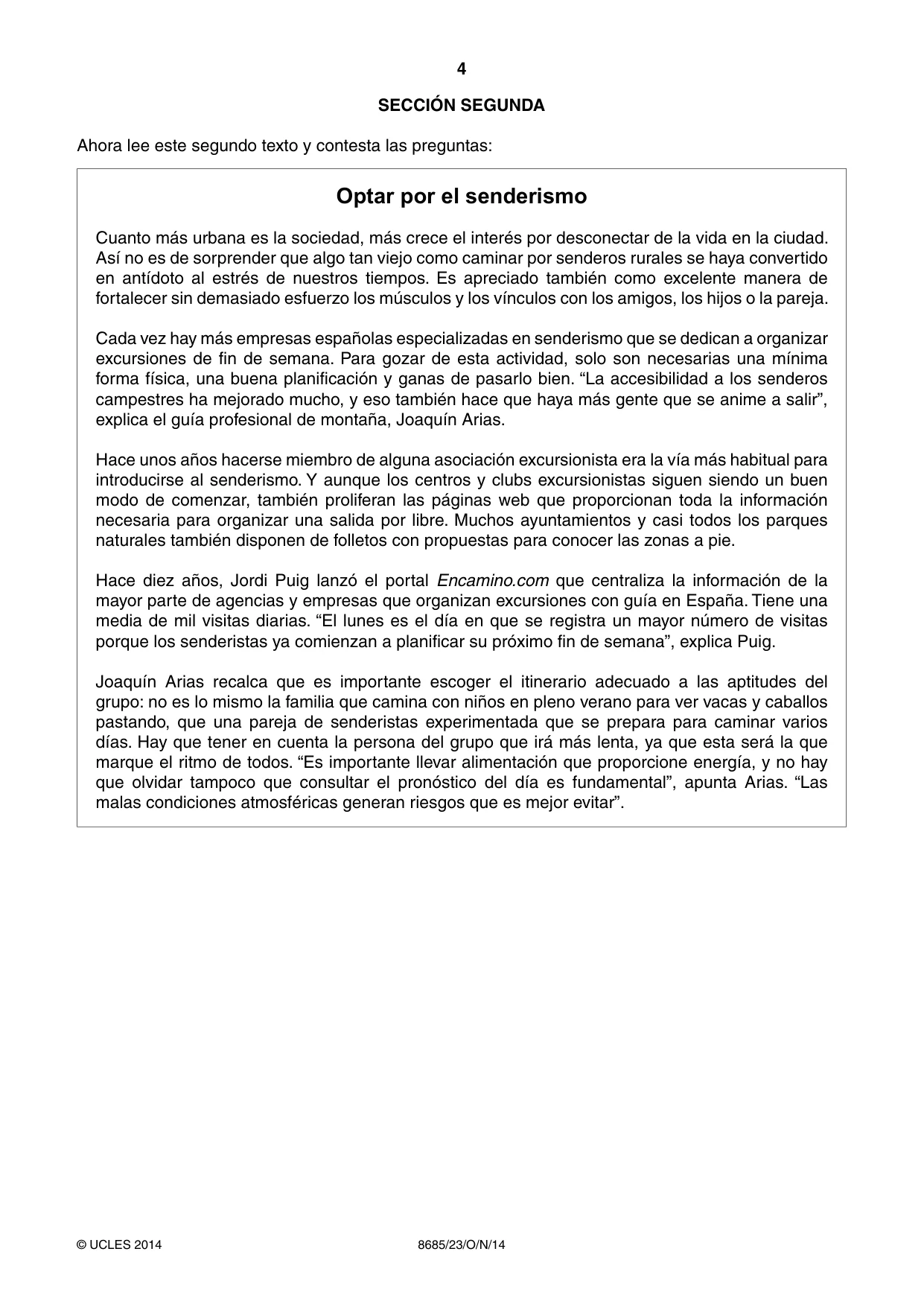
4 8685/23/O/N/14 © UCLES 2014 SECCIÓN SEGUNDA Ahora lee este segundo texto y contesta las preguntas: Optar por el senderismo Cuanto más urbana es la sociedad, más crece el interés por desconectar de la vida en la ciudad. Así no es de sorprender que algo tan viejo como caminar por senderos rurales se haya convertido en antídoto al estrés de nuestros tiempos. Es apreciado también como excelente manera de fortalecer sin demasiado esfuerzo los músculos y los vínculos con los amigos, los hijos o la pareja. Cada vez hay más empresas españolas especializadas en senderismo que se dedican a organizar excursiones de fin de semana. Para gozar de esta actividad, solo son necesarias una mínima forma física, una buena planificación y ganas de pasarlo bien. “La accesibilidad a los senderos campestres ha mejorado mucho, y eso también hace que haya más gente que se anime a salir”, explica el guía profesional de montaña, Joaquín Arias. Hace unos años hacerse miembro de alguna asociación excursionista era la vía más habitual para introducirse al senderismo. Y aunque los centros y clubs excursionistas siguen siendo un buen modo de comenzar, también proliferan las páginas web que proporcionan toda la información necesaria para organizar una salida por libre. Muchos ayuntamientos y casi todos los parques naturales también disponen de folletos con propuestas para conocer las zonas a pie. Hace diez años, Jordi Puig lanzó el portal Encamino.com que centraliza la información de la mayor parte de agencias y empresas que organizan excursiones con guía en España. Tiene una media de mil visitas diarias. “El lunes es el día en que se registra un mayor número de visitas porque los senderistas ya comienzan a planificar su próximo fin de semana”, explica Puig. Joaquín Arias recalca que es importante escoger el itinerario adecuado a las aptitudes del grupo: no es lo mismo la familia que camina con niños en pleno verano para ver vacas y caballos pastando, que una pareja de senderistas experimentada que se prepara para caminar varios días. Hay que tener en cuenta la persona del grupo que irá más lenta, ya que esta será la que marque el ritmo de todos. “Es importante llevar alimentación que proporcione energía, y no hay que olvidar tampoco que consultar el pronóstico del día es fundamental”, apunta Arias. “Las malas condiciones atmosféricas generan riesgos que es mejor evitar”.
Question paper, page 5
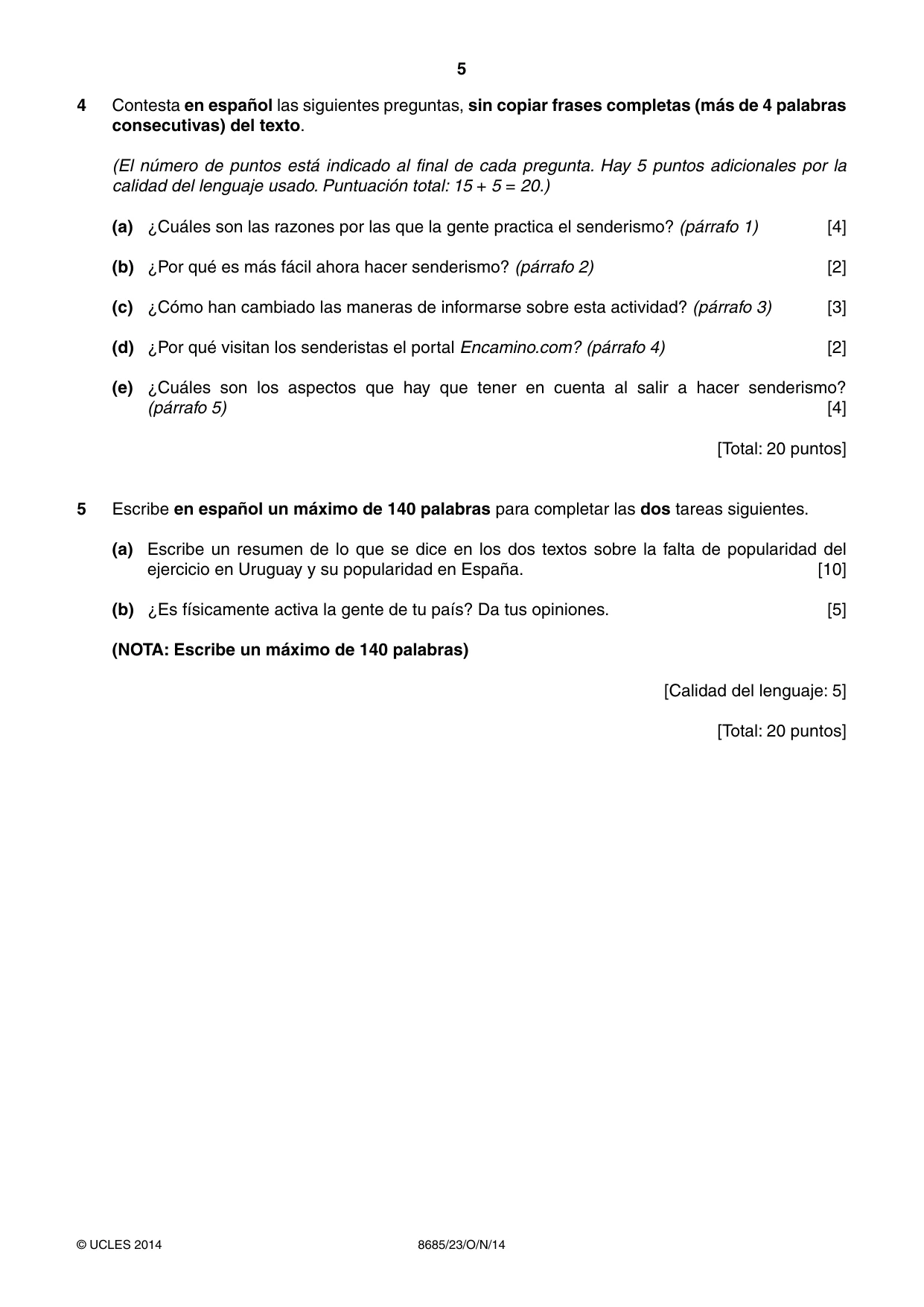
5 8685/23/O/N/14 © UCLES 2014 4 Contesta en español las siguientes preguntas, sin copiar frases completas (más de 4 palabras consecutivas) del texto. (El número de puntos está indicado al final de cada pregunta. Hay 5 puntos adicionales por la calidad del lenguaje usado. Puntuación total: 15 + 5 = 20.) (a) ¿Cuáles son las razones por las que la gente practica el senderismo? (párrafo 1) [4] (b) ¿Por qué es más fácil ahora hacer senderismo? (párrafo 2) [2] (c) ¿Cómo han cambiado las maneras de informarse sobre esta actividad? (párrafo 3) [3] (d) ¿Por qué visitan los senderistas el portal Encamino.com? (párrafo 4) [2] (e) ¿Cuáles son los aspectos que hay que tener en cuenta al salir a hacer senderismo? (párrafo 5) [4] [Total: 20 puntos] 5 Escribe en español un máximo de 140 palabras para completar las dos tareas siguientes. (a) Escribe un resumen de lo que se dice en los dos textos sobre la falta de popularidad del ejercicio en Uruguay y su popularidad en España. [10] (b) ¿Es físicamente activa la gente de tu país? Da tus opiniones. [5] (NOTA: Escribe un máximo de 140 palabras) [Calidad del lenguaje: 5] [Total: 20 puntos]
Question paper, page 6
6 8685/23/O/N/14 © UCLES 2014 BLANK PAGE
Question paper, page 7
7 8685/23/O/N/14 © UCLES 2014 BLANK PAGE
Question paper, page 8
8 8685/23/O/N/14 © UCLES 2014 Copyright acknowledgements: Section 1 © http://historico.elpais.com.uy/ProDig/TuPais/tupais_371349.asp; 29 March 2012. Section 2 © http://www2.factum.edu.uy/encuesoc/finsem/2001/efs01035a.html; 8 September 2001. © http://www.lavanguardia.com/estilos-de-vida/20120706/54320865919/apostar-por-el-trekking.html; 6 July 2012. Permission to reproduce items where third-party owned material protected by copyright is included has been sought and cleared where possible. Every reasonable effort has been made by the publisher (UCLES) to trace copyright holders, but if any items requiring clearance have unwittingly been included, the publisher will be pleased to make amends at the earliest possible opportunity. Cambridge International Examinations is part of the Cambridge Assessment Group. Cambridge Assessment is the brand name of University of Cambridge Local Examinations Syndicate (UCLES), which is itself a department of the University of Cambridge. BLANK PAGE
Mark scheme, page 1
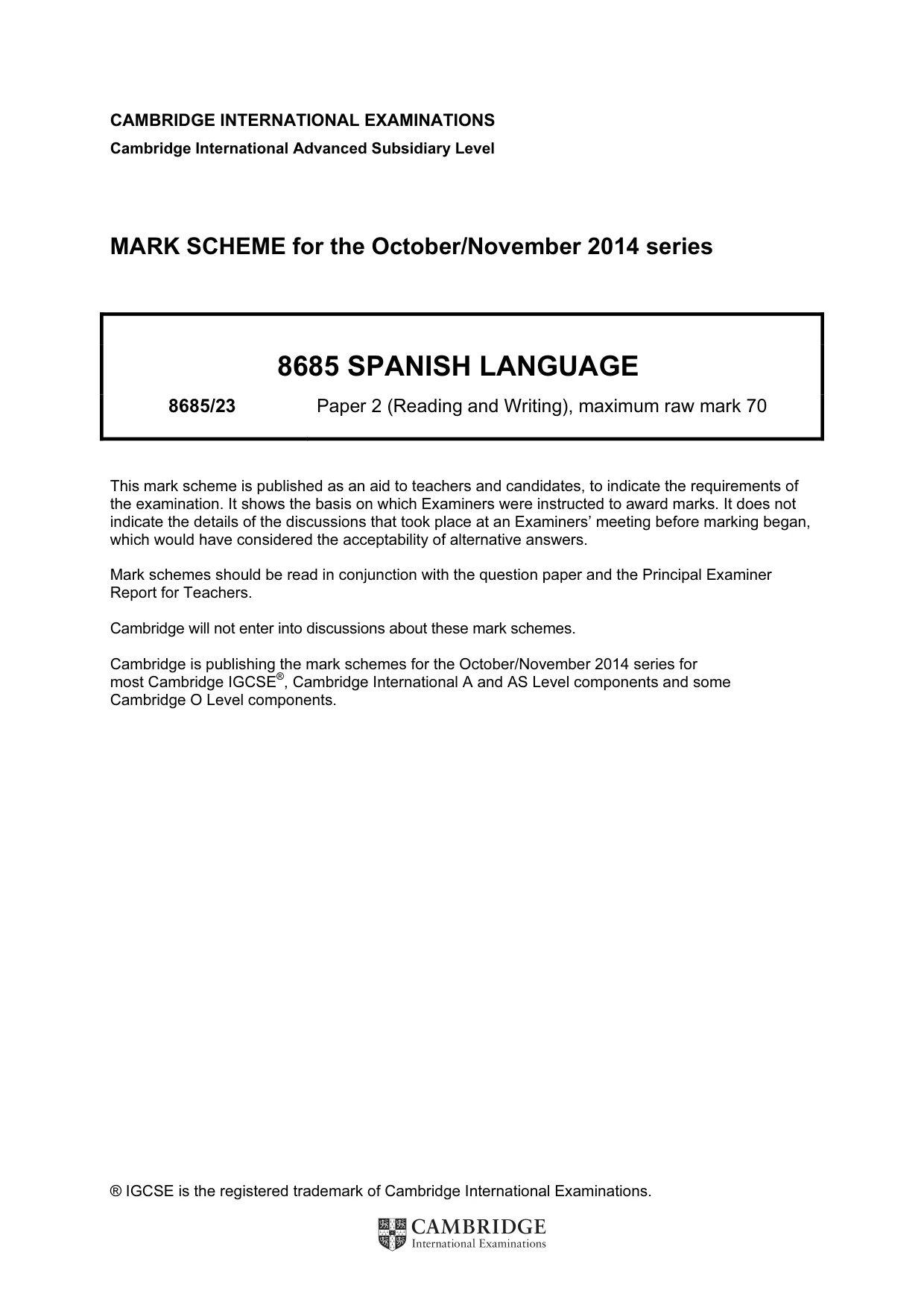
® IGCSE is the registered trademark of Cambridge International Examinations. CAMBRIDGE INTERNATIONAL EXAMINATIONS Cambridge International Advanced Subsidiary Level MARK SCHEME for the October/November 2014 series 8685 SPANISH LANGUAGE 8685/23 Paper 2 (Reading and Writing), maximum raw mark 70 This mark scheme is published as an aid to teachers and candidates, to indicate the requirements of the examination. It shows the basis on which Examiners were instructed to award marks. It does not indicate the details of the discussions that took place at an Examiners’ meeting before marking began, which would have considered the acceptability of alternative answers. Mark schemes should be read in conjunction with the question paper and the Principal Examiner Report for Teachers. Cambridge will not enter into discussions about these mark schemes. Cambridge is publishing the mark schemes for the October/November 2014 series for most Cambridge IGCSE®, Cambridge International A and AS Level components and some Cambridge O Level components.
Mark scheme, page 2
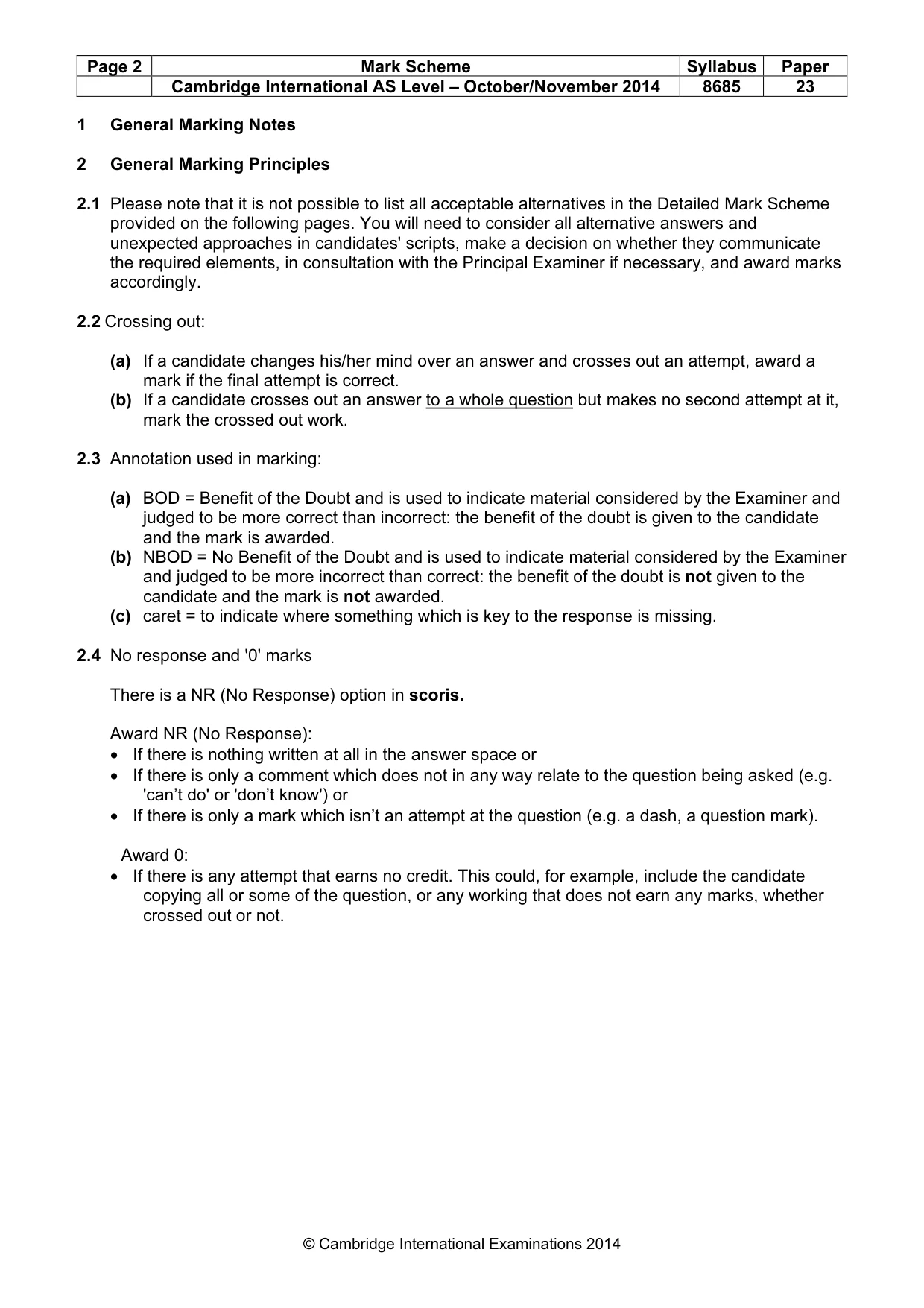
Page 2 Mark Scheme Syllabus Paper Cambridge International AS Level – October/November 2014 8685 23 © Cambridge International Examinations 2014 1 General Marking Notes 2 General Marking Principles 2.1 Please note that it is not possible to list all acceptable alternatives in the Detailed Mark Scheme provided on the following pages. You will need to consider all alternative answers and unexpected approaches in candidates' scripts, make a decision on whether they communicate the required elements, in consultation with the Principal Examiner if necessary, and award marks accordingly. 2.2 Crossing out: (a) If a candidate changes his/her mind over an answer and crosses out an attempt, award a mark if the final attempt is correct. (b) If a candidate crosses out an answer to a whole question but makes no second attempt at it, mark the crossed out work. 2.3 Annotation used in marking: (a) BOD = Benefit of the Doubt and is used to indicate material considered by the Examiner and judged to be more correct than incorrect: the benefit of the doubt is given to the candidate and the mark is awarded. (b) NBOD = No Benefit of the Doubt and is used to indicate material considered by the Examiner and judged to be more incorrect than correct: the benefit of the doubt is not given to the candidate and the mark is not awarded. (c) caret = to indicate where something which is key to the response is missing. 2.4 No response and '0' marks There is a NR (No Response) option in scoris. Award NR (No Response): • If there is nothing written at all in the answer space or • If there is only a comment which does not in any way relate to the question being asked (e.g. 'can’t do' or 'don’t know') or • If there is only a mark which isn’t an attempt at the question (e.g. a dash, a question mark). Award 0: • If there is any attempt that earns no credit. This could, for example, include the candidate copying all or some of the question, or any working that does not earn any marks, whether crossed out or not.
Mark scheme, page 3
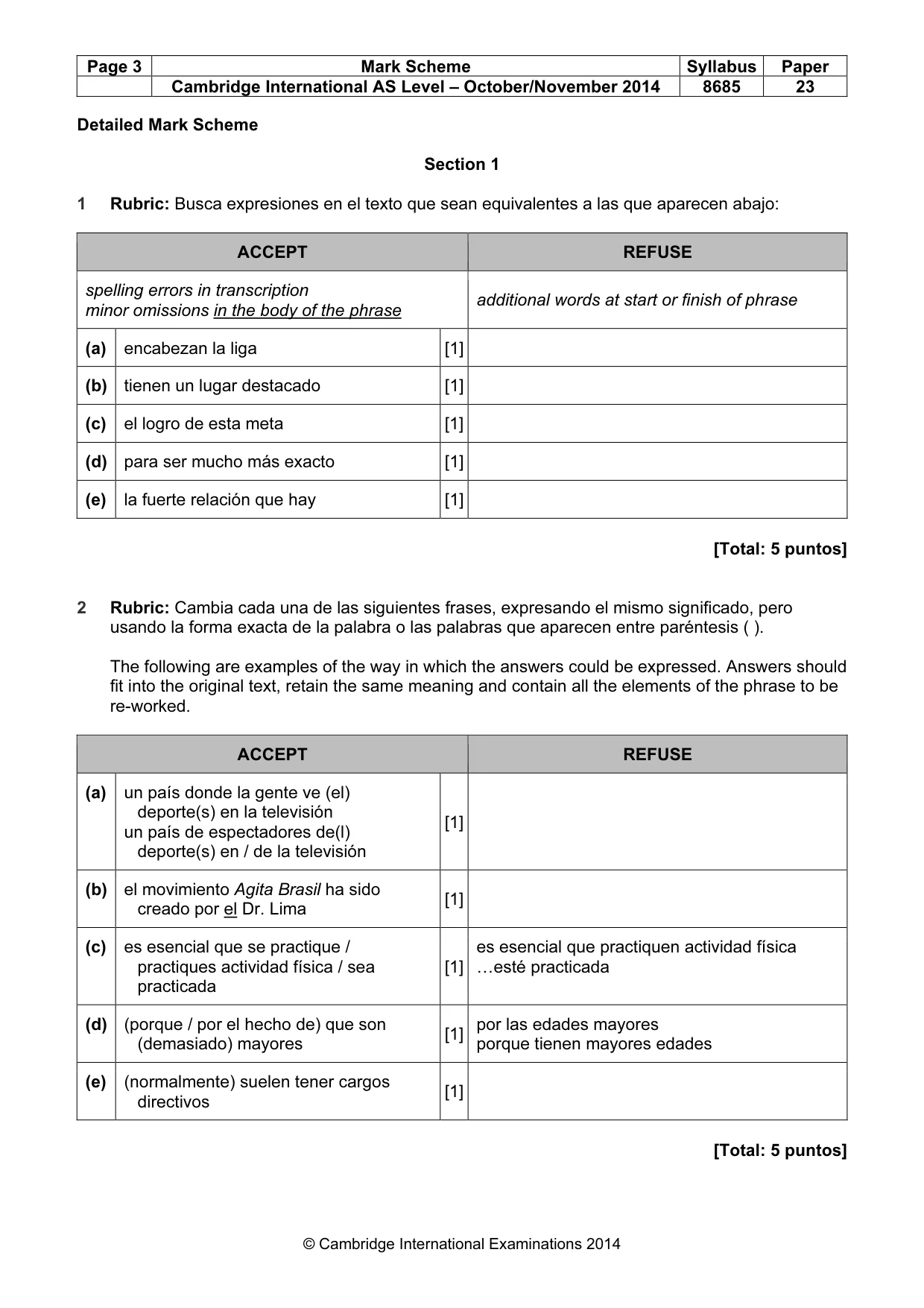
Page 3 Mark Scheme Syllabus Paper Cambridge International AS Level – October/November 2014 8685 23 © Cambridge International Examinations 2014 Detailed Mark Scheme Section 1 1 Rubric: Busca expresiones en el texto que sean equivalentes a las que aparecen abajo: ACCEPT REFUSE spelling errors in transcription minor omissions in the body of the phrase additional words at start or finish of phrase (a) encabezan la liga [1] (b) tienen un lugar destacado [1] (c) el logro de esta meta [1] (d) para ser mucho más exacto [1] (e) la fuerte relación que hay [1] [Total: 5 puntos] 2 Rubric: Cambia cada una de las siguientes frases, expresando el mismo significado, pero usando la forma exacta de la palabra o las palabras que aparecen entre paréntesis ( ). The following are examples of the way in which the answers could be expressed. Answers should fit into the original text, retain the same meaning and contain all the elements of the phrase to be re-worked. ACCEPT REFUSE (a) un país donde la gente ve (el) deporte(s) en la televisión un país de espectadores de(l) deporte(s) en / de la televisión [1] (b) el movimiento Agita Brasil ha sido creado por el Dr. Lima [1] (c) es esencial que se practique / practiques actividad física / sea practicada [1] es esencial que practiquen actividad física …esté practicada (d) (porque / por el hecho de) que son (demasiado) mayores [1] por las edades mayores porque tienen mayores edades (e) (normalmente) suelen tener cargos directivos [1] [Total: 5 puntos]
Mark scheme, page 4
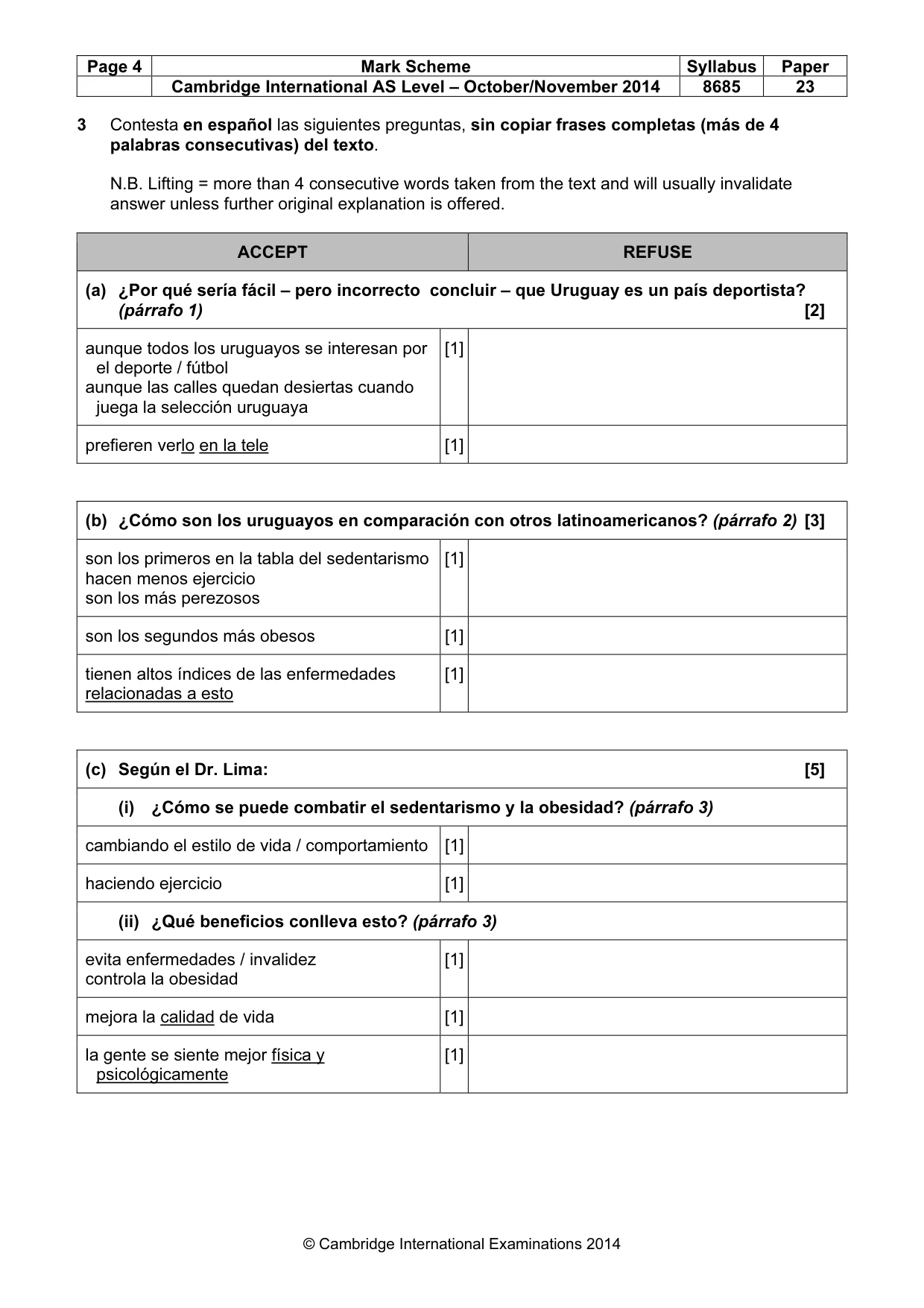
Page 4 Mark Scheme Syllabus Paper Cambridge International AS Level – October/November 2014 8685 23 © Cambridge International Examinations 2014 3 Contesta en español las siguientes preguntas, sin copiar frases completas (más de 4 palabras consecutivas) del texto. N.B. Lifting = more than 4 consecutive words taken from the text and will usually invalidate answer unless further original explanation is offered. ACCEPT REFUSE (a) ¿Por qué sería fácil – pero incorrecto concluir – que Uruguay es un país deportista? (párrafo 1) [2] aunque todos los uruguayos se interesan por el deporte / fútbol aunque las calles quedan desiertas cuando juega la selección uruguaya [1] prefieren verlo en la tele [1] (b) ¿Cómo son los uruguayos en comparación con otros latinoamericanos? (párrafo 2) [3] son los primeros en la tabla del sedentarismo hacen menos ejercicio son los más perezosos [1] son los segundos más obesos [1] tienen altos índices de las enfermedades relacionadas a esto [1] (c) Según el Dr. Lima: [5] (i) ¿Cómo se puede combatir el sedentarismo y la obesidad? (párrafo 3) cambiando el estilo de vida / comportamiento [1] haciendo ejercicio [1] (ii) ¿Qué beneficios conlleva esto? (párrafo 3) evita enfermedades / invalidez controla la obesidad [1] mejora la calidad de vida [1] la gente se siente mejor física y psicológicamente [1]
Mark scheme, page 5
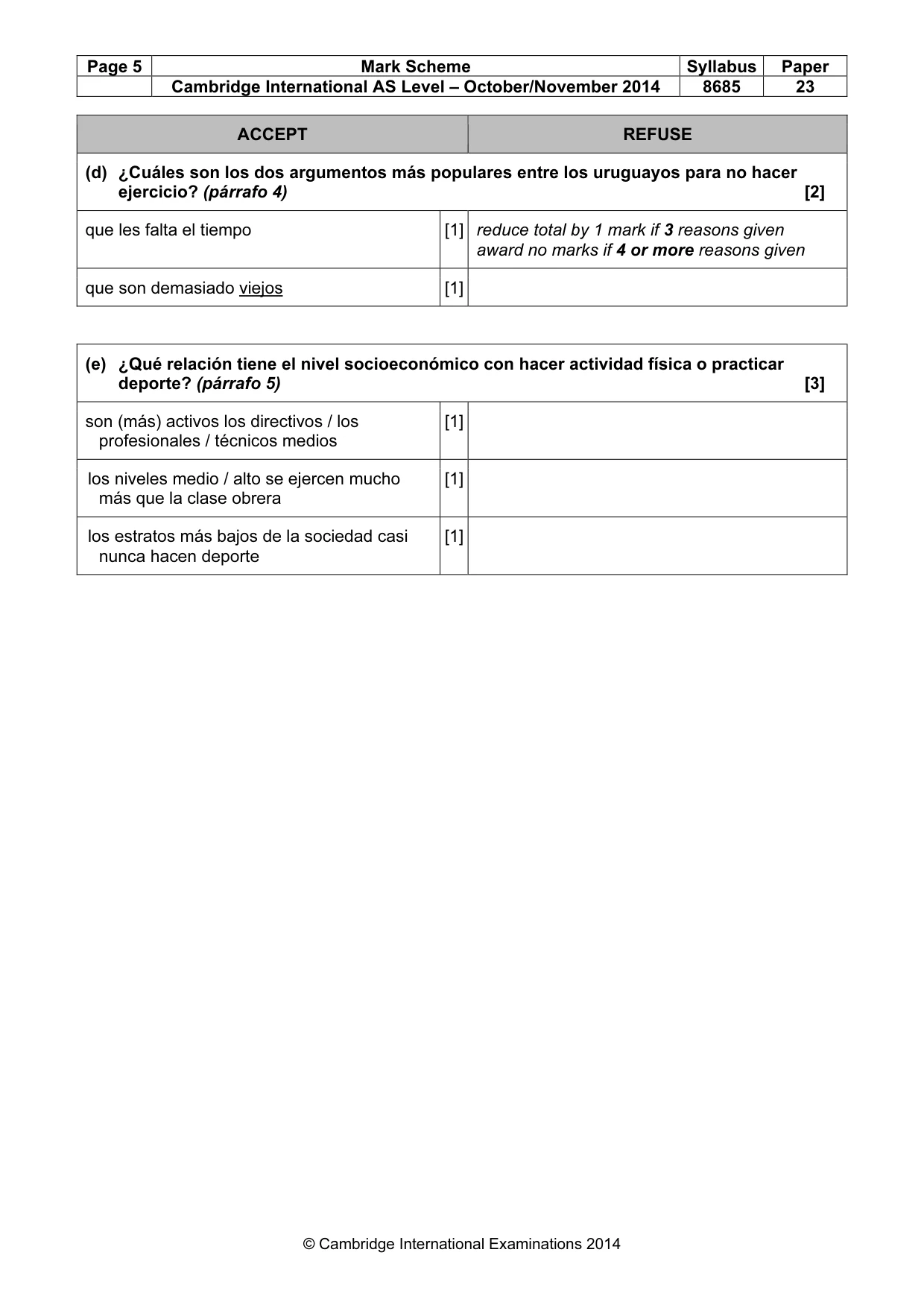
Page 5 Mark Scheme Syllabus Paper Cambridge International AS Level – October/November 2014 8685 23 © Cambridge International Examinations 2014 ACCEPT REFUSE (d) ¿Cuáles son los dos argumentos más populares entre los uruguayos para no hacer ejercicio? (párrafo 4) [2] que les falta el tiempo [1] reduce total by 1 mark if 3 reasons given award no marks if 4 or more reasons given que son demasiado viejos [1] (e) ¿Qué relación tiene el nivel socioeconómico con hacer actividad física o practicar deporte? (párrafo 5) [3] son (más) activos los directivos / los profesionales / técnicos medios [1] los niveles medio / alto se ejercen mucho más que la clase obrera [1] los estratos más bajos de la sociedad casi nunca hacen deporte [1]
Mark scheme, page 6
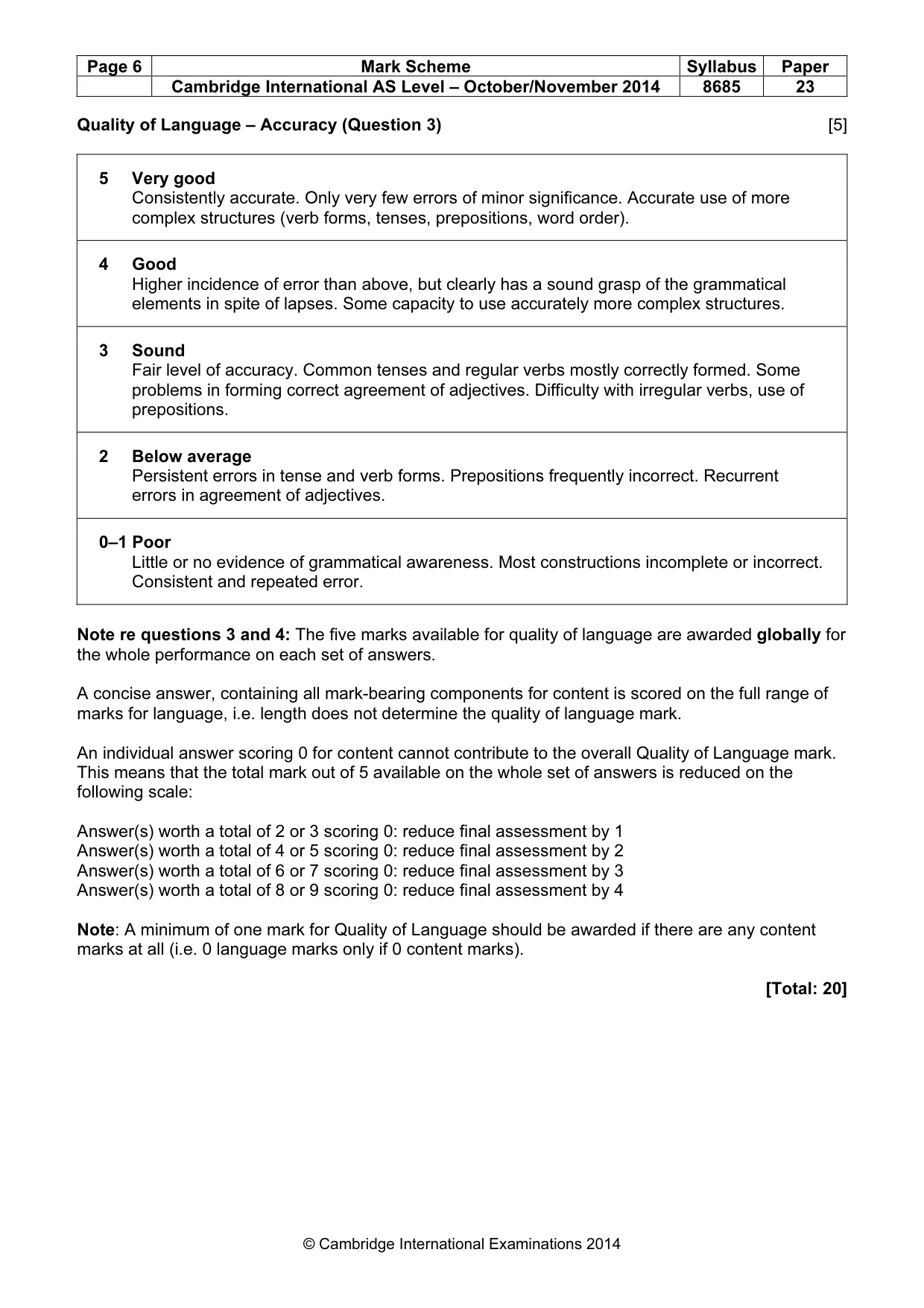
Page 6 Mark Scheme Syllabus Paper Cambridge International AS Level – October/November 2014 8685 23 © Cambridge International Examinations 2014 Quality of Language – Accuracy (Question 3) [5] 5 Very good Consistently accurate. Only very few errors of minor significance. Accurate use of more complex structures (verb forms, tenses, prepositions, word order). 4 Good Higher incidence of error than above, but clearly has a sound grasp of the grammatical elements in spite of lapses. Some capacity to use accurately more complex structures. 3 Sound Fair level of accuracy. Common tenses and regular verbs mostly correctly formed. Some problems in forming correct agreement of adjectives. Difficulty with irregular verbs, use of prepositions. 2 Below average Persistent errors in tense and verb forms. Prepositions frequently incorrect. Recurrent errors in agreement of adjectives. 0–1 Poor Little or no evidence of grammatical awareness. Most constructions incomplete or incorrect. Consistent and repeated error. Note re questions 3 and 4: The five marks available for quality of language are awarded globally for the whole performance on each set of answers. A concise answer, containing all mark-bearing components for content is scored on the full range of marks for language, i.e. length does not determine the quality of language mark. An individual answer scoring 0 for content cannot contribute to the overall Quality of Language mark. This means that the total mark out of 5 available on the whole set of answers is reduced on the following scale: Answer(s) worth a total of 2 or 3 scoring 0: reduce final assessment by 1 Answer(s) worth a total of 4 or 5 scoring 0: reduce final assessment by 2 Answer(s) worth a total of 6 or 7 scoring 0: reduce final assessment by 3 Answer(s) worth a total of 8 or 9 scoring 0: reduce final assessment by 4 Note: A minimum of one mark for Quality of Language should be awarded if there are any content marks at all (i.e. 0 language marks only if 0 content marks). [Total: 20]
Mark scheme, page 7
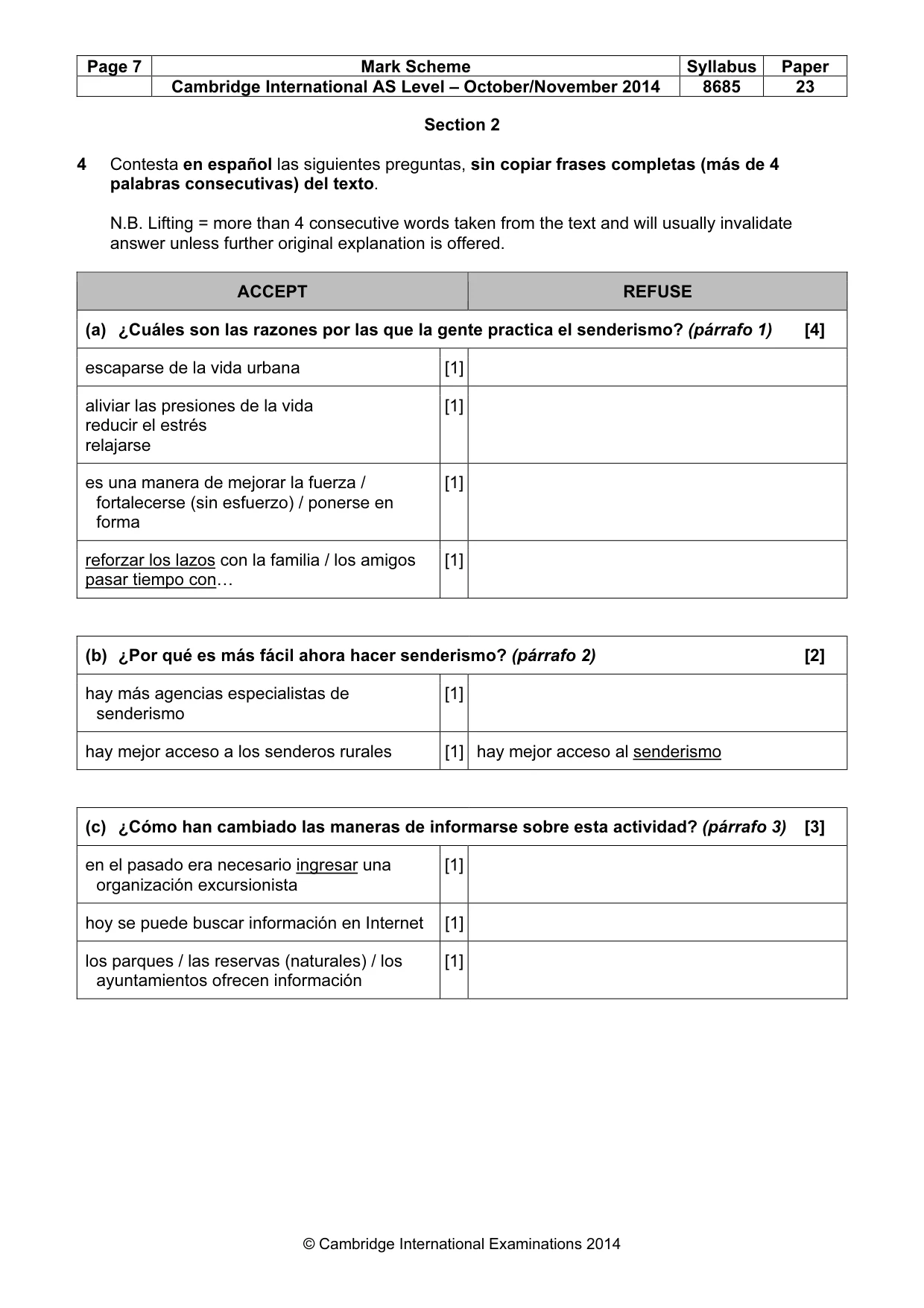
Page 7 Mark Scheme Syllabus Paper Cambridge International AS Level – October/November 2014 8685 23 © Cambridge International Examinations 2014 Section 2 4 Contesta en español las siguientes preguntas, sin copiar frases completas (más de 4 palabras consecutivas) del texto. N.B. Lifting = more than 4 consecutive words taken from the text and will usually invalidate answer unless further original explanation is offered. ACCEPT REFUSE (a) ¿Cuáles son las razones por las que la gente practica el senderismo? (párrafo 1) [4] escaparse de la vida urbana [1] aliviar las presiones de la vida reducir el estrés relajarse [1] es una manera de mejorar la fuerza / fortalecerse (sin esfuerzo) / ponerse en forma [1] reforzar los lazos con la familia / los amigos pasar tiempo con… [1] (b) ¿Por qué es más fácil ahora hacer senderismo? (párrafo 2) [2] hay más agencias especialistas de senderismo [1] hay mejor acceso a los senderos rurales [1] hay mejor acceso al senderismo (c) ¿Cómo han cambiado las maneras de informarse sobre esta actividad? (párrafo 3) [3] en el pasado era necesario ingresar una organización excursionista [1] hoy se puede buscar información en Internet [1] los parques / las reservas (naturales) / los ayuntamientos ofrecen información [1]
Mark scheme, page 8
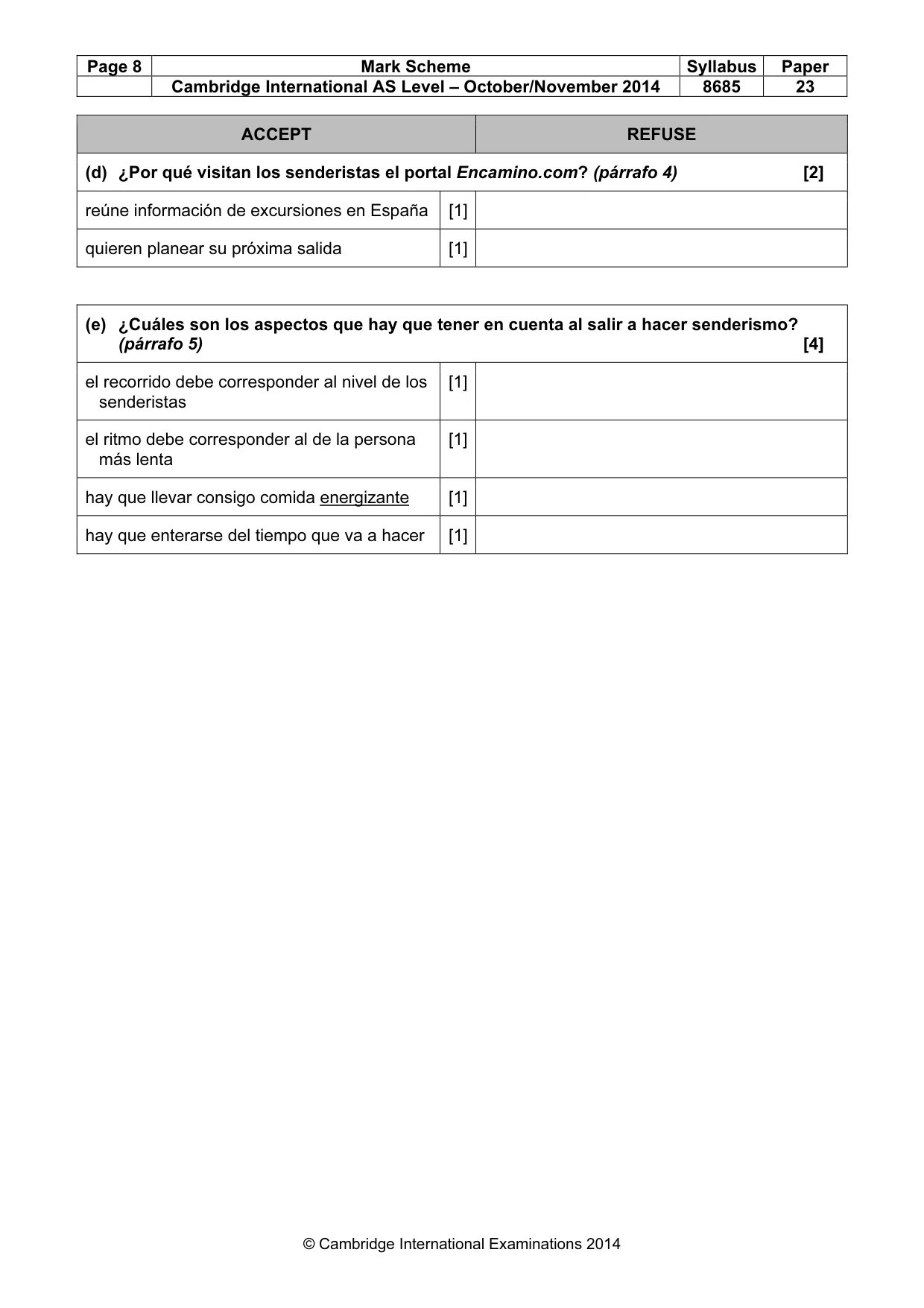
Page 8 Mark Scheme Syllabus Paper Cambridge International AS Level – October/November 2014 8685 23 © Cambridge International Examinations 2014 ACCEPT REFUSE (d) ¿Por qué visitan los senderistas el portal Encamino.com? (párrafo 4) [2] reúne información de excursiones en España [1] quieren planear su próxima salida [1] (e) ¿Cuáles son los aspectos que hay que tener en cuenta al salir a hacer senderismo? (párrafo 5) [4] el recorrido debe corresponder al nivel de los senderistas [1] el ritmo debe corresponder al de la persona más lenta [1] hay que llevar consigo comida energizante [1] hay que enterarse del tiempo que va a hacer [1]
Mark scheme, page 9
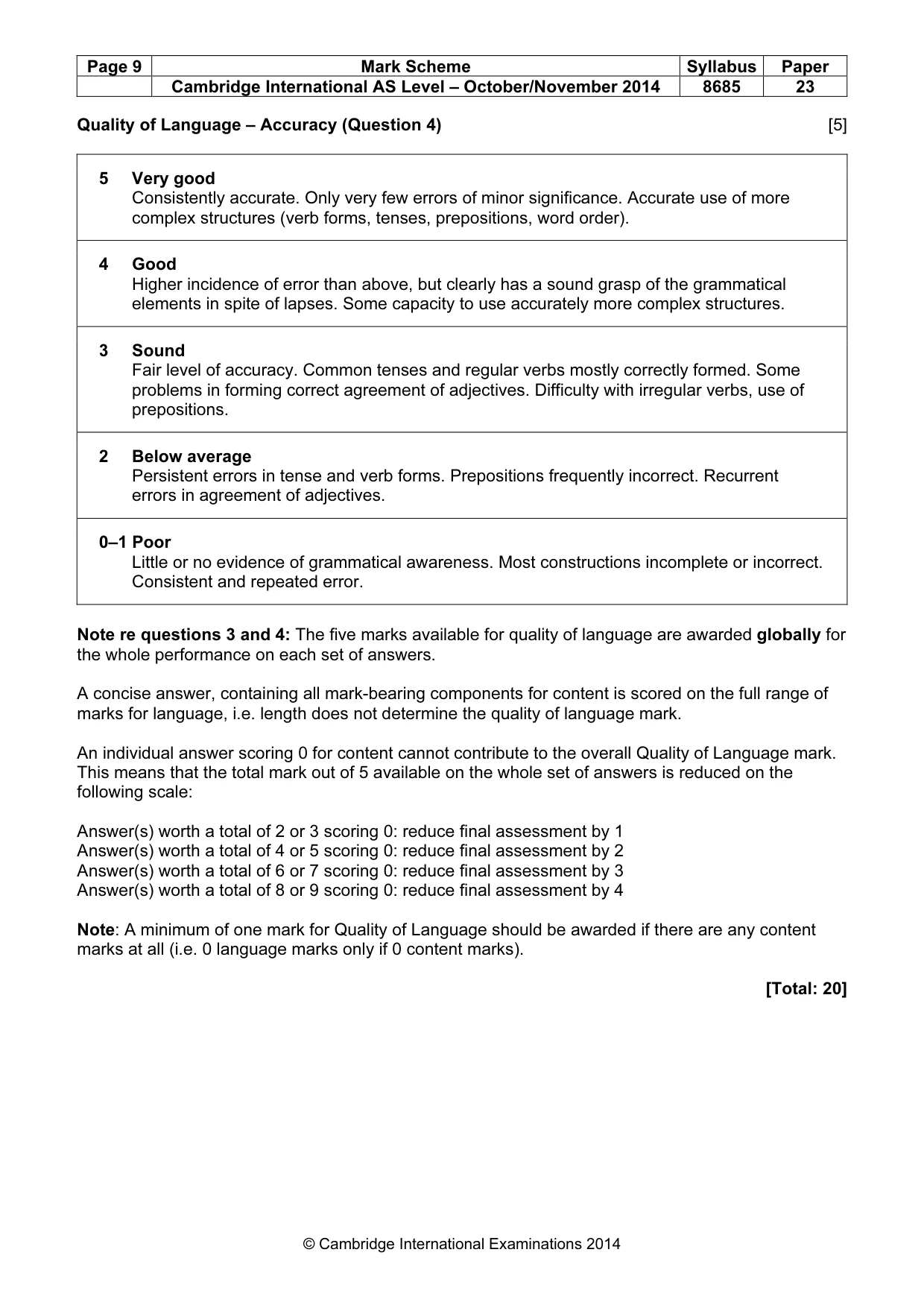
Page 9 Mark Scheme Syllabus Paper Cambridge International AS Level – October/November 2014 8685 23 © Cambridge International Examinations 2014 Quality of Language – Accuracy (Question 4) [5] 5 Very good Consistently accurate. Only very few errors of minor significance. Accurate use of more complex structures (verb forms, tenses, prepositions, word order). 4 Good Higher incidence of error than above, but clearly has a sound grasp of the grammatical elements in spite of lapses. Some capacity to use accurately more complex structures. 3 Sound Fair level of accuracy. Common tenses and regular verbs mostly correctly formed. Some problems in forming correct agreement of adjectives. Difficulty with irregular verbs, use of prepositions. 2 Below average Persistent errors in tense and verb forms. Prepositions frequently incorrect. Recurrent errors in agreement of adjectives. 0–1 Poor Little or no evidence of grammatical awareness. Most constructions incomplete or incorrect. Consistent and repeated error. Note re questions 3 and 4: The five marks available for quality of language are awarded globally for the whole performance on each set of answers. A concise answer, containing all mark-bearing components for content is scored on the full range of marks for language, i.e. length does not determine the quality of language mark. An individual answer scoring 0 for content cannot contribute to the overall Quality of Language mark. This means that the total mark out of 5 available on the whole set of answers is reduced on the following scale: Answer(s) worth a total of 2 or 3 scoring 0: reduce final assessment by 1 Answer(s) worth a total of 4 or 5 scoring 0: reduce final assessment by 2 Answer(s) worth a total of 6 or 7 scoring 0: reduce final assessment by 3 Answer(s) worth a total of 8 or 9 scoring 0: reduce final assessment by 4 Note: A minimum of one mark for Quality of Language should be awarded if there are any content marks at all (i.e. 0 language marks only if 0 content marks). [Total: 20]
Mark scheme, page 10
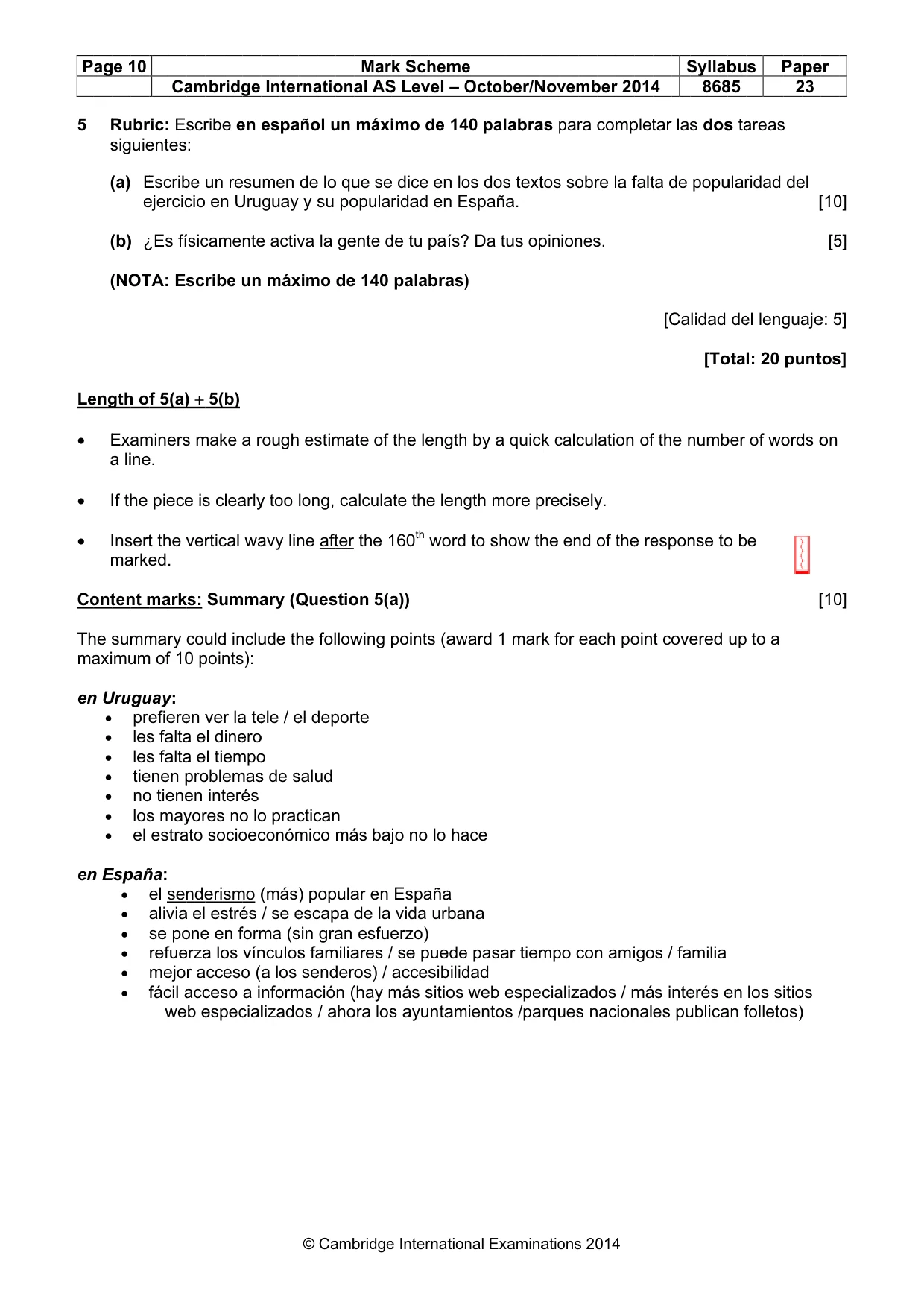
P 5 Le • • • Co Th ma en en ag R s ( ( ( eng E a I I m ont he s axi n U • • • • • • • n E ge 1 Ru sig (a) (b) (NO gth Exa a li If th Ins ma ten sum mu Uru Esp • • • • • • 10 ubr guie E e ) ¿ OT h of am ine he sert arke nt m mm um ugu pre les les tie no los el pañ f ric: ent Esc ejer ¿Es TA: f 5 mine e. pie t th ed ma ma m of uay efie s fa s fa ene o tie s m es ña: el s aliv se ref me fác w Ca : Es tes crib rcic s fí : Es 5(a) ers ece he v . ark ry f 10 y: ere alta alta en p ene may stra sen via po fue ejo cil a we am scr : be cio ísic sc ) + s m e is ver ks: cou 0 p en v a e a e pro en yor ato nde a el one erza r a acc b e mbr ribe un en cam rib 5( mak s c rtic Su uld poin ve el d el tie oble int res so eris es e e a lo cce ces esp ridg e e re n U me be u b) ke a lea cal um d in nts r la ine em em teré s no ocio sm stré n f os eso so pec ge en esu Uru nte un a r arly wa mma nclu s): a te ero mpo mas és o lo oec mo ( és form vín o ( a i cial In es me gu e a m rou y to avy ary ude ele o o s de o p con (m / s ma ncu a lo nfo liza ter pa en ay ctiv máx gh oo y lin y (Q e th / e e s prac nóm ás e e a (s ulos os orm ado rna © año de y va xim es lon ne Qu he el d salu ctic mic ) p esc sin s fa se mac os atio Ca ol u e lo su la mo stim ng, aft ues fol dep ud can co op cap gra am end ció / a ona amb un o qu po ge de ma ca ter stio low por n má pula pa d an milia dero n ( aho M al A brid má ue opu ente e 14 te alcu th on win rte ás b ar e de es are os) (ha ora Mar AS dge áxi se ular e d 40 of ula e 1 5(a ng p baj en la sfue es / ) / ay m los k S S L e In imo e di rida de t pa the ate 160 a)) poi jo n Es vid erz / se acc má s a Sch Lev nter o d ce ad tu p alab e le the 0th ints no spa da zo) e p ces ás s ayu hem vel rnat de en en paí bra eng e le wo s (a lo aña ur ue sib sitio nta me – O tion 14 n lo n E ís? as) gth eng ord aw ha a ba ede bilid os am e Oc nal 40 p os d Esp ? D ) by gth to ward ace na e pa dad we mien ctob Ex pa dos pañ Da t y a h m sh d 1 e asa d eb nto be xam lab s te ña. tus a qu more how m ar t es os / r/N mina bra ext s op uic e p w th mar tiem pe /pa Nov atio as p tos pin k c pre he rk f mp cia arqu vem ons par s so ion calc cis en or po c aliz ues mb s 20 ra obr nes cul sely nd o ea con zad s n ber 014 com re l s. ati y. of t ach n a dos nac r 20 4 mp la f on the po ami s / m cion 014 plet falt of e re oin igo má nal 4 tar ta d [C f th esp t co os / ás i es S r las de Ca e n pon ove / fa nte pu Syl 8 s d po lida [ num nse ere ami eré ubli llab 868 dos opu ad [To mb e to ed lia és e ica bu 85 s ta ular de ota ber o b up en an f s are rida el le l: 2 of be to los foll P eas ad eng 20 wo o a s si eto Pa 2 s de gua pu ord itio os) pe 23 el [ aje unt ds o [ os ) er [10 [5 e: 5 tos on [10 0] 5] 5] s] 0]
Mark scheme, page 11
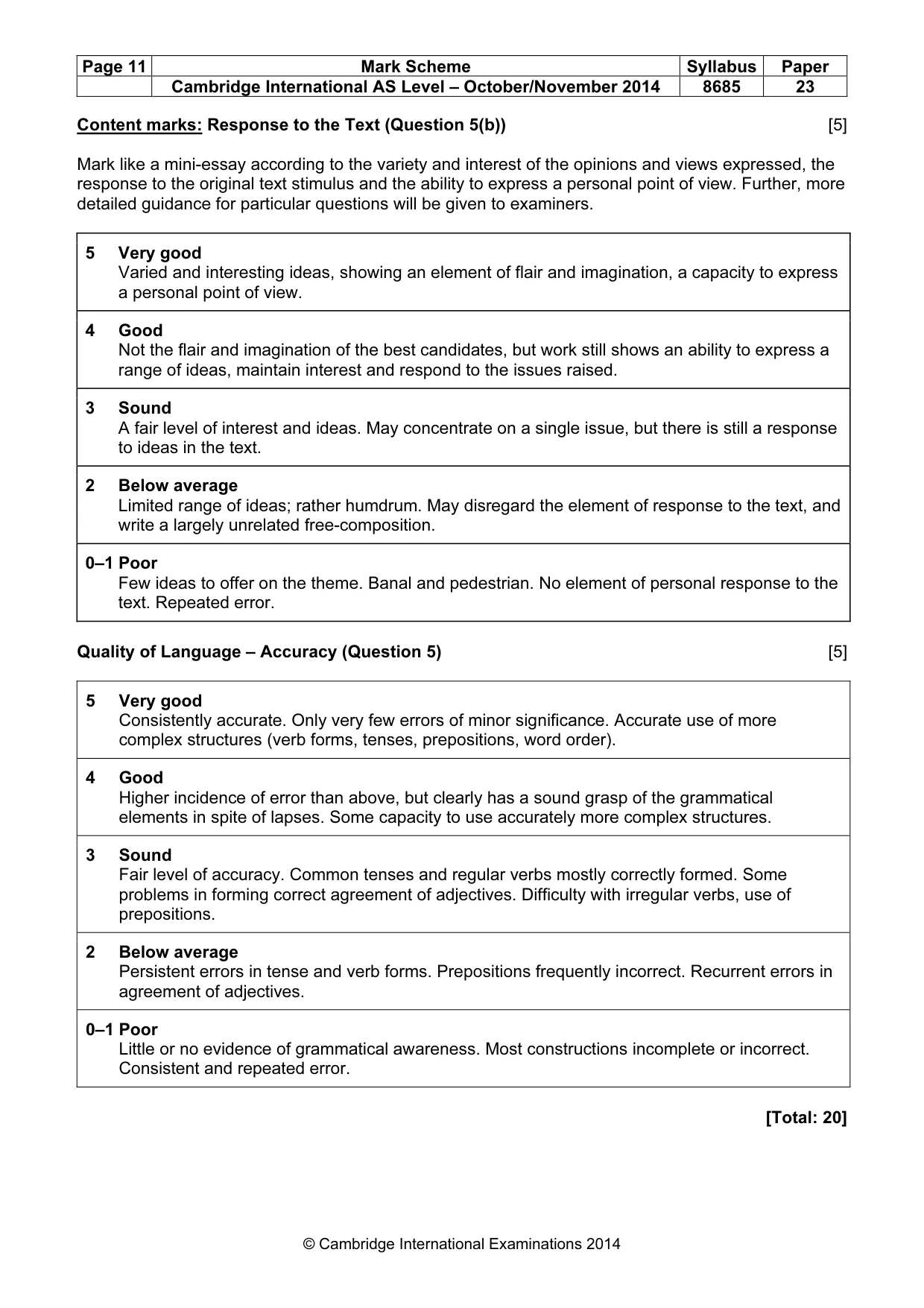
Page 11 Mark Scheme Syllabus Paper Cambridge International AS Level – October/November 2014 8685 23 © Cambridge International Examinations 2014 Content marks: Response to the Text (Question 5(b)) [5] Mark like a mini-essay according to the variety and interest of the opinions and views expressed, the response to the original text stimulus and the ability to express a personal point of view. Further, more detailed guidance for particular questions will be given to examiners. 5 Very good Varied and interesting ideas, showing an element of flair and imagination, a capacity to express a personal point of view. 4 Good Not the flair and imagination of the best candidates, but work still shows an ability to express a range of ideas, maintain interest and respond to the issues raised. 3 Sound A fair level of interest and ideas. May concentrate on a single issue, but there is still a response to ideas in the text. 2 Below average Limited range of ideas; rather humdrum. May disregard the element of response to the text, and write a largely unrelated free-composition. 0–1 Poor Few ideas to offer on the theme. Banal and pedestrian. No element of personal response to the text. Repeated error. Quality of Language – Accuracy (Question 5) [5] 5 Very good Consistently accurate. Only very few errors of minor significance. Accurate use of more complex structures (verb forms, tenses, prepositions, word order). 4 Good Higher incidence of error than above, but clearly has a sound grasp of the grammatical elements in spite of lapses. Some capacity to use accurately more complex structures. 3 Sound Fair level of accuracy. Common tenses and regular verbs mostly correctly formed. Some problems in forming correct agreement of adjectives. Difficulty with irregular verbs, use of prepositions. 2 Below average Persistent errors in tense and verb forms. Prepositions frequently incorrect. Recurrent errors in agreement of adjectives. 0–1 Poor Little or no evidence of grammatical awareness. Most constructions incomplete or incorrect. Consistent and repeated error. [Total: 20]
What you needed in this session
Cambridge’s own grade thresholds for 2014 Oct/Nov, Paper 2 · Variant 3. A higher threshold means an easier paper — the bar moves with how the cohort did.