Cambridge A Level Spanish (A Level only) 9719 — 2017 May/June Paper 4 · Variant 3
9719/43/M/J/17 · 75 marks · ≈84 min
The question paper and its mark scheme, free to read here and free to download. This is Cambridge’s own paper, exactly as it was sat.
Question paper8 pages


Mark scheme3 pages
Answers below. Sit the paper first if you are practising.
Paper as text
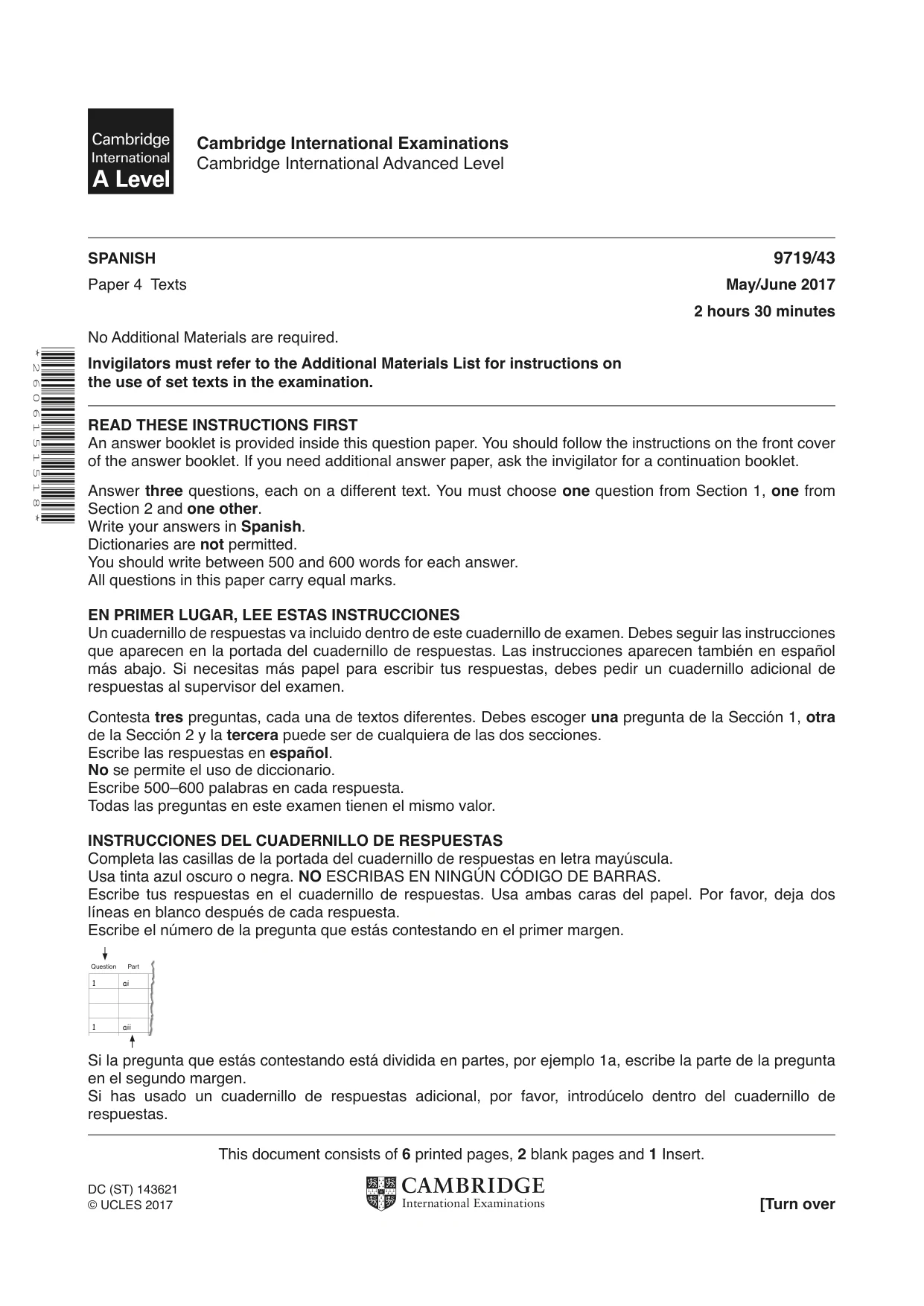
Question paper, page 1
This document consists of 6 printed pages, 2 blank pages and 1 Insert. DC (ST) 143621 © UCLES 2017 [Turn over Cambridge International Examinations Cambridge International Advanced Level * 2 6 0 6 1 5 1 5 1 8 * SPANISH 9719/43 Paper 4 Texts May/June 2017 2 hours 30 minutes No Additional Materials are required. Invigilators must refer to the Additional Materials List for instructions on the use of set texts in the examination. READ THESE INSTRUCTIONS FIRST An answer booklet is provided inside this question paper. You should follow the instructions on the front cover of the answer booklet. If you need additional answer paper, ask the invigilator for a continuation booklet. Answer three questions, each on a different text. You must choose one question from Section 1, one from Section 2 and one other. Write your answers in Spanish. Dictionaries are not permitted. You should write between 500 and 600 words for each answer. All questions in this paper carry equal marks. EN PRIMER LUGAR, LEE ESTAS INSTRUCCIONES Un cuadernillo de respuestas va incluido dentro de este cuadernillo de examen. Debes seguir las instrucciones que aparecen en la portada del cuadernillo de respuestas. Las instrucciones aparecen también en español más abajo. Si necesitas más papel para escribir tus respuestas, debes pedir un cuadernillo adicional de respuestas al supervisor del examen. Contesta tres preguntas, cada una de textos diferentes. Debes escoger una pregunta de la Sección 1, otra de la Sección 2 y la tercera puede ser de cualquiera de las dos secciones. Escribe las respuestas en español. No se permite el uso de diccionario. Escribe 500–600 palabras en cada respuesta. Todas las preguntas en este examen tienen el mismo valor. INSTRUCCIONES DEL CUADERNILLO DE RESPUESTAS Completa las casillas de la portada del cuadernillo de respuestas en letra mayúscula. Usa tinta azul oscuro o negra. NO ESCRIBAS EN NINGÚN CÓDIGO DE BARRAS. Escribe tus respuestas en el cuadernillo de respuestas. Usa ambas caras del papel. Por favor, deja dos líneas en blanco después de cada respuesta. Escribe el número de la pregunta que estás contestando en el primer margen. Question Part 1 1 ai aii Si la pregunta que estás contestando está dividida en partes, por ejemplo 1a, escribe la parte de la pregunta en el segundo margen. Si has usado un cuadernillo de respuestas adicional, por favor, introdúcelo dentro del cuadernillo de respuestas.
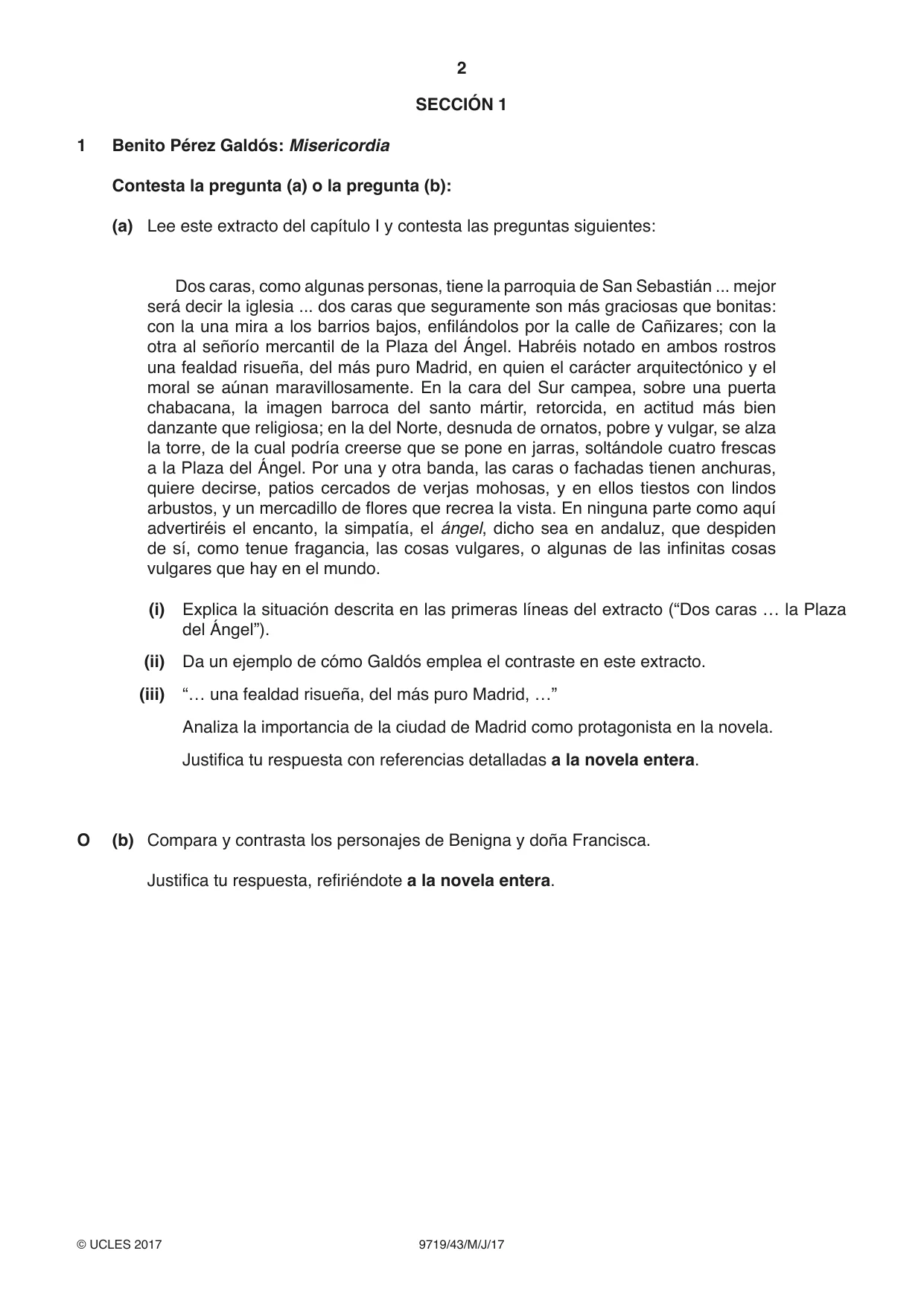
Question paper, page 2
2 9719/43/M/J/17 © UCLES 2017 SECCIÓN 1 1 Benito Pérez Galdós: Misericordia Contesta la pregunta (a) o la pregunta (b): (a) Lee este extracto del capítulo I y contesta las preguntas siguientes: Dos caras, como algunas personas, tiene la parroquia de San Sebastián ... mejor será decir la iglesia ... dos caras que seguramente son más graciosas que bonitas: con la una mira a los barrios bajos, enfilándolos por la calle de Cañizares; con la otra al señorío mercantil de la Plaza del Ángel. Habréis notado en ambos rostros una fealdad risueña, del más puro Madrid, en quien el carácter arquitectónico y el moral se aúnan maravillosamente. En la cara del Sur campea, sobre una puerta chabacana, la imagen barroca del santo mártir, retorcida, en actitud más bien danzante que religiosa; en la del Norte, desnuda de ornatos, pobre y vulgar, se alza la torre, de la cual podría creerse que se pone en jarras, soltándole cuatro frescas a la Plaza del Ángel. Por una y otra banda, las caras o fachadas tienen anchuras, quiere decirse, patios cercados de verjas mohosas, y en ellos tiestos con lindos arbustos, y un mercadillo de flores que recrea la vista. En ninguna parte como aquí advertiréis el encanto, la simpatía, el ángel, dicho sea en andaluz, que despiden de sí, como tenue fragancia, las cosas vulgares, o algunas de las infinitas cosas vulgares que hay en el mundo. (i) Explica la situación descrita en las primeras líneas del extracto (“Dos caras … la Plaza del Ángel”). (ii) Da un ejemplo de cómo Galdós emplea el contraste en este extracto. (iii) “… una fealdad risueña, del más puro Madrid, …” Analiza la importancia de la ciudad de Madrid como protagonista en la novela. Justifica tu respuesta con referencias detalladas a la novela entera. O (b) Compara y contrasta los personajes de Benigna y doña Francisca. Justifica tu respuesta, refiriéndote a la novela entera.
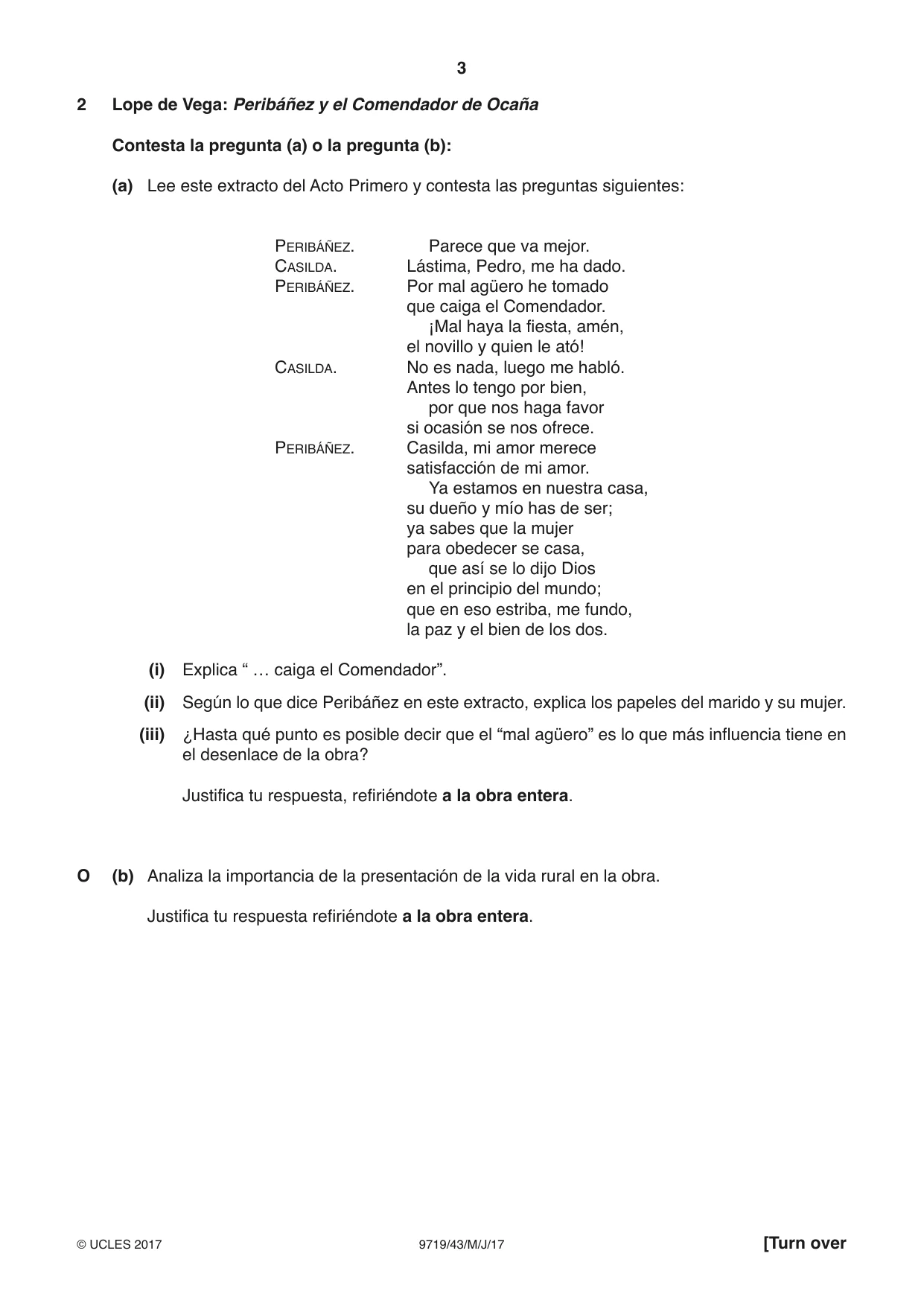
Question paper, page 3
3 9719/43/M/J/17 © UCLES 2017 [Turn over 2 Lope de Vega: Peribáñez y el Comendador de Ocaña Contesta la pregunta (a) o la pregunta (b): (a) Lee este extracto del Acto Primero y contesta las preguntas siguientes: Peribáñez. Parece que va mejor. Casilda. Lástima, Pedro, me ha dado. Peribáñez. Por mal agüero he tomado que caiga el Comendador. ¡Mal haya la fiesta, amén, el novillo y quien le ató! Casilda. No es nada, luego me habló. Antes lo tengo por bien, por que nos haga favor si ocasión se nos ofrece. Peribáñez. Casilda, mi amor merece satisfacción de mi amor. Ya estamos en nuestra casa, su dueño y mío has de ser; ya sabes que la mujer para obedecer se casa, que así se lo dijo Dios en el principio del mundo; que en eso estriba, me fundo, la paz y el bien de los dos. (i) Explica “ … caiga el Comendador”. (ii) Según lo que dice Peribáñez en este extracto, explica los papeles del marido y su mujer. (iii) ¿Hasta qué punto es posible decir que el “mal agüero” es lo que más influencia tiene en el desenlace de la obra? Justifica tu respuesta, refiriéndote a la obra entera. O (b) Analiza la importancia de la presentación de la vida rural en la obra. Justifica tu respuesta refiriéndote a la obra entera.
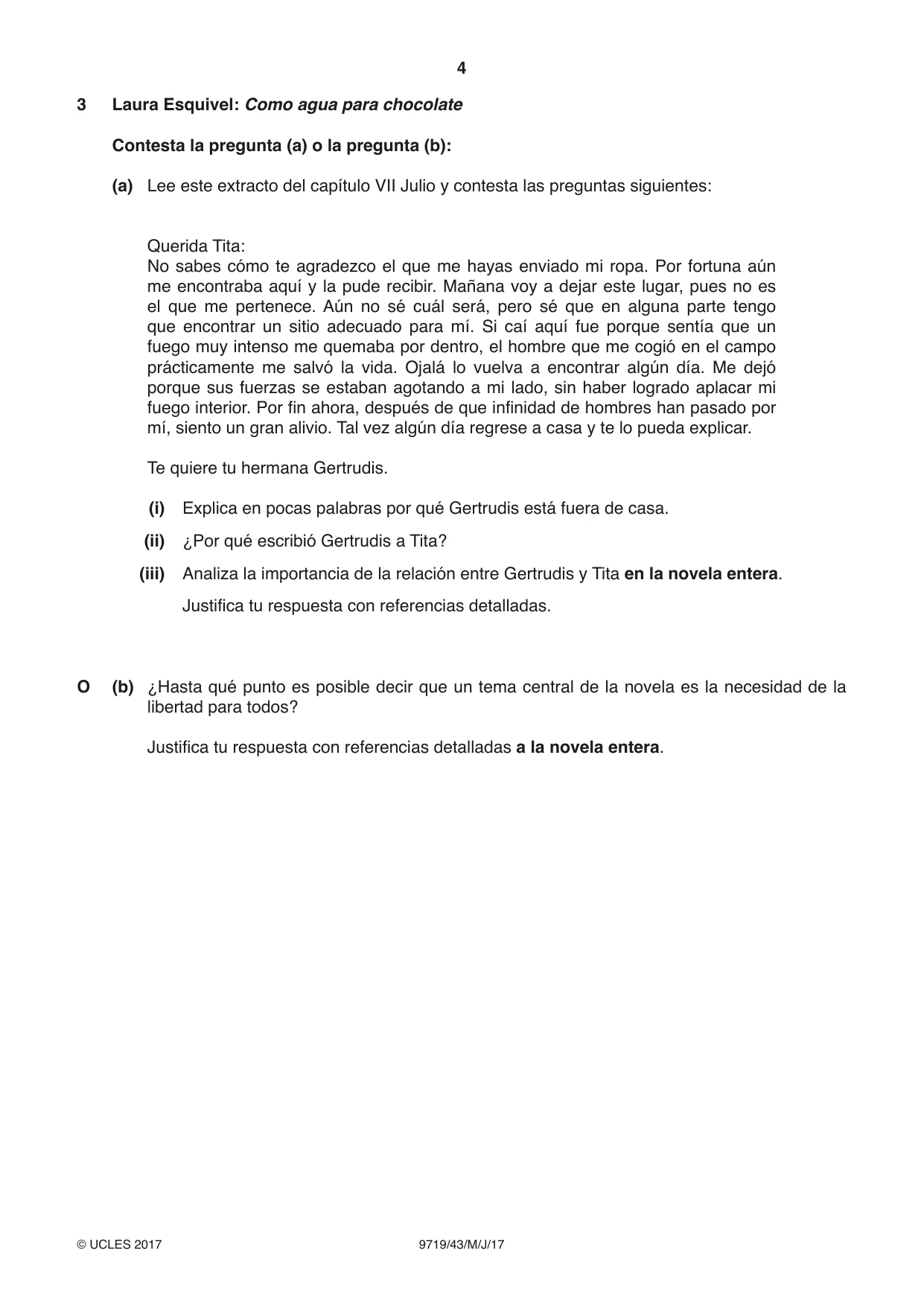
Question paper, page 4
4 9719/43/M/J/17 © UCLES 2017 3 Laura Esquivel: Como agua para chocolate Contesta la pregunta (a) o la pregunta (b): (a) Lee este extracto del capítulo VII Julio y contesta las preguntas siguientes: Querida Tita: No sabes cómo te agradezco el que me hayas enviado mi ropa. Por fortuna aún me encontraba aquí y la pude recibir. Mañana voy a dejar este lugar, pues no es el que me pertenece. Aún no sé cuál será, pero sé que en alguna parte tengo que encontrar un sitio adecuado para mí. Si caí aquí fue porque sentía que un fuego muy intenso me quemaba por dentro, el hombre que me cogió en el campo prácticamente me salvó la vida. Ojalá lo vuelva a encontrar algún día. Me dejó porque sus fuerzas se estaban agotando a mi lado, sin haber logrado aplacar mi fuego interior. Por fin ahora, después de que infinidad de hombres han pasado por mí, siento un gran alivio. Tal vez algún día regrese a casa y te lo pueda explicar. Te quiere tu hermana Gertrudis. (i) Explica en pocas palabras por qué Gertrudis está fuera de casa. (ii) ¿Por qué escribió Gertrudis a Tita? (iii) Analiza la importancia de la relación entre Gertrudis y Tita en la novela entera. Justifica tu respuesta con referencias detalladas. O (b) ¿Hasta qué punto es posible decir que un tema central de la novela es la necesidad de la libertad para todos? Justifica tu respuesta con referencias detalladas a la novela entera.
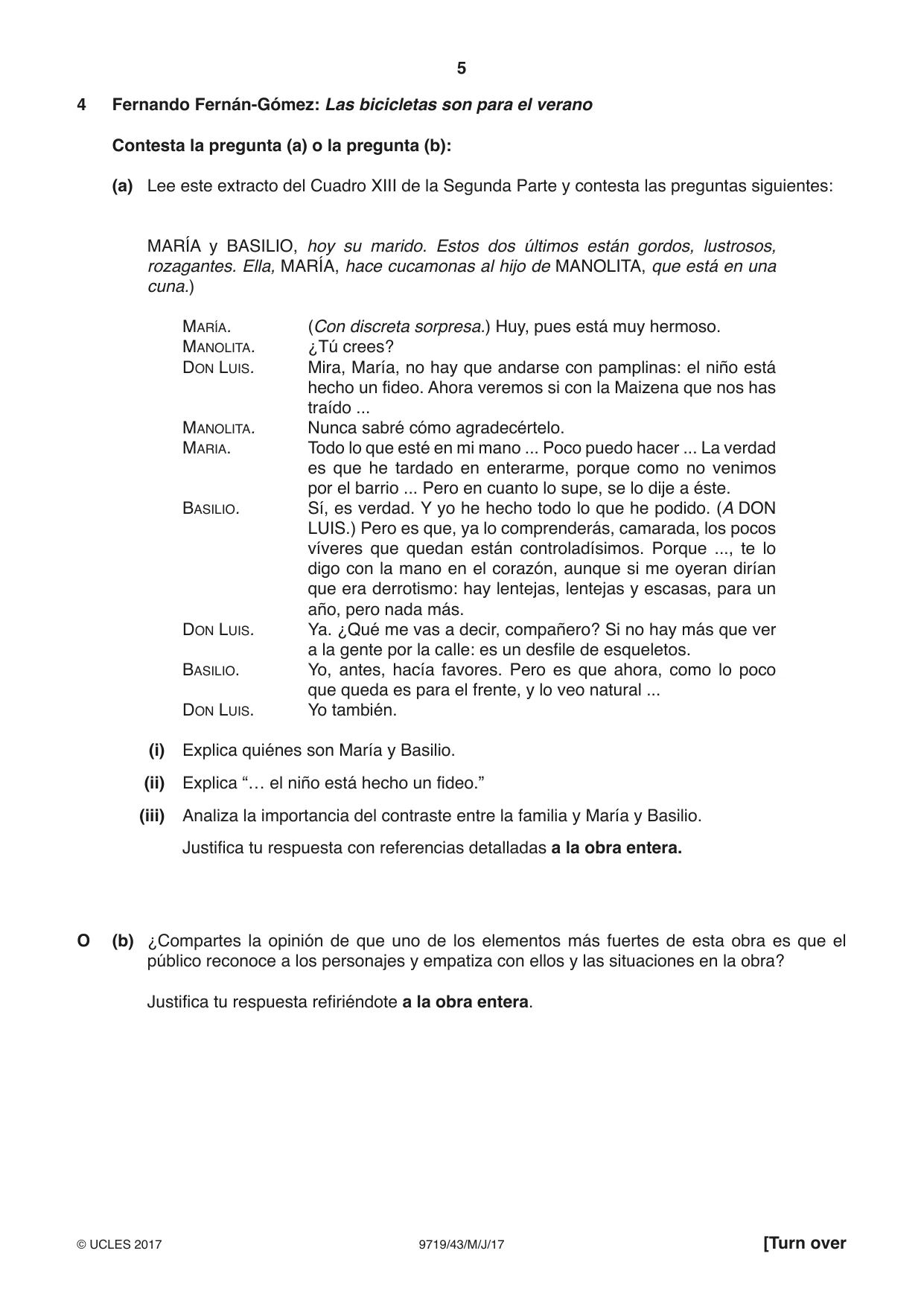
Question paper, page 5
5 9719/43/M/J/17 © UCLES 2017 [Turn over 4 Fernando Fernán-Gómez: Las bicicletas son para el verano Contesta la pregunta (a) o la pregunta (b): (a) Lee este extracto del Cuadro XIII de la Segunda Parte y contesta las preguntas siguientes: MARÍA y BASILIO, hoy su marido. Estos dos últimos están gordos, lustrosos, rozagantes. Ella, MARÍA, hace cucamonas al hijo de MANOLITA, que está en una cuna.) María. (Con discreta sorpresa.) Huy, pues está muy hermoso. Manolita. ¿Tú crees? don luis. Mira, María, no hay que andarse con pamplinas: el niño está hecho un fideo. Ahora veremos si con la Maizena que nos has traído ... Manolita. Nunca sabré cómo agradecértelo. Maria. Todo lo que esté en mi mano ... Poco puedo hacer ... La verdad es que he tardado en enterarme, porque como no venimos por el barrio ... Pero en cuanto lo supe, se lo dije a éste. basilio. Sí, es verdad. Y yo he hecho todo lo que he podido. (A DON LUIS.) Pero es que, ya lo comprenderás, camarada, los pocos víveres que quedan están controladísimos. Porque ..., te lo digo con la mano en el corazón, aunque si me oyeran dirían que era derrotismo: hay lentejas, lentejas y escasas, para un año, pero nada más. don luis. Ya. ¿Qué me vas a decir, compañero? Si no hay más que ver a la gente por la calle: es un desfile de esqueletos. basilio. Yo, antes, hacía favores. Pero es que ahora, como lo poco que queda es para el frente, y lo veo natural ... don luis. Yo también. (i) Explica quiénes son María y Basilio. (ii) Explica “… el niño está hecho un fideo.” (iii) Analiza la importancia del contraste entre la familia y María y Basilio. Justifica tu respuesta con referencias detalladas a la obra entera. O (b) ¿Compartes la opinión de que uno de los elementos más fuertes de esta obra es que el público reconoce a los personajes y empatiza con ellos y las situaciones en la obra? Justifica tu respuesta refiriéndote a la obra entera.
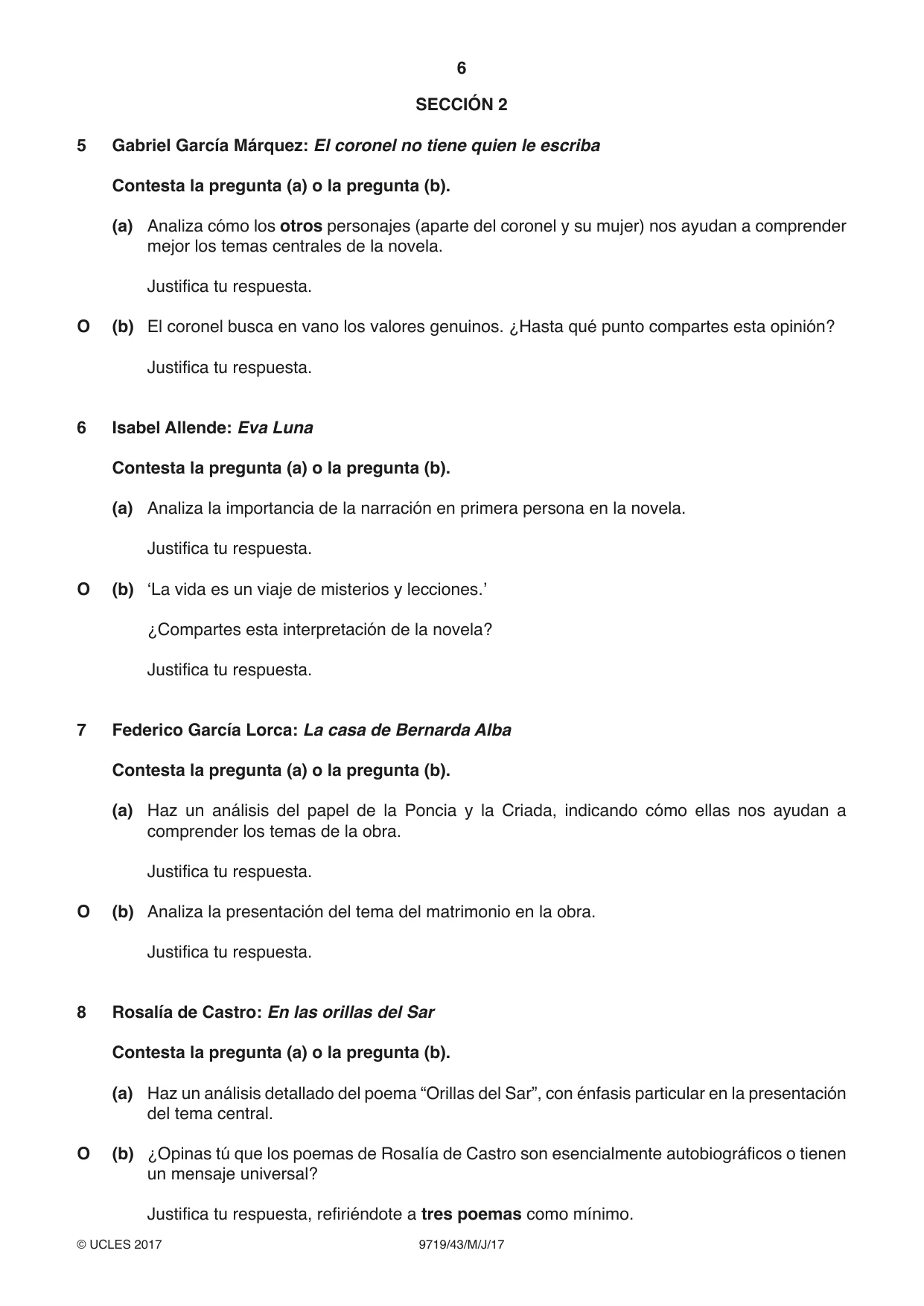
Question paper, page 6
6 9719/43/M/J/17 © UCLES 2017 SECCIÓN 2 5 Gabriel García Márquez: El coronel no tiene quien le escriba Contesta la pregunta (a) o la pregunta (b). (a) Analiza cómo los otros personajes (aparte del coronel y su mujer) nos ayudan a comprender mejor los temas centrales de la novela. Justifica tu respuesta. O (b) El coronel busca en vano los valores genuinos. ¿Hasta qué punto compartes esta opinión? Justifica tu respuesta. 6 Isabel Allende: Eva Luna Contesta la pregunta (a) o la pregunta (b). (a) Analiza la importancia de la narración en primera persona en la novela. Justifica tu respuesta. O (b) ‘La vida es un viaje de misterios y lecciones.’ ¿Compartes esta interpretación de la novela? Justifica tu respuesta. 7 Federico García Lorca: La casa de Bernarda Alba Contesta la pregunta (a) o la pregunta (b). (a) Haz un análisis del papel de la Poncia y la Criada, indicando cómo ellas nos ayudan a comprender los temas de la obra. Justifica tu respuesta. O (b) Analiza la presentación del tema del matrimonio en la obra. Justifica tu respuesta. 8 Rosalía de Castro: En las orillas del Sar Contesta la pregunta (a) o la pregunta (b). (a) Haz un análisis detallado del poema “Orillas del Sar”, con énfasis particular en la presentación del tema central. O (b) ¿Opinas tú que los poemas de Rosalía de Castro son esencialmente autobiográficos o tienen un mensaje universal? Justifica tu respuesta, refiriéndote a tres poemas como mínimo.
Question paper, page 7
7 9719/43/M/J/17 © UCLES 2017 BLANK PAGE
Question paper, page 8
8 9719/43/M/J/17 © UCLES 2017 Permission to reproduce items where third-party owned material protected by copyright is included has been sought and cleared where possible. Every reasonable effort has been made by the publisher (UCLES) to trace copyright holders, but if any items requiring clearance have unwittingly been included, the publisher will be pleased to make amends at the earliest possible opportunity. To avoid the issue of disclosure of answer-related information to candidates, all copyright acknowledgements are reproduced online in the Cambridge International Examinations Copyright Acknowledgements Booklet. This is produced for each series of examinations and is freely available to download at www.cie.org.uk after the live examination series. Cambridge International Examinations is part of the Cambridge Assessment Group. Cambridge Assessment is the brand name of University of Cambridge Local Examinations Syndicate (UCLES), which is itself a department of the University of Cambridge. BLANK PAGE
Mark scheme, page 1
® IGCSE is a registered trademark. This document consists of 3 printed pages. © UCLES 2017 [Turn over Cambridge International Examinations Cambridge International Advanced Level SPANISH 9719/43 Paper 4 Texts May/June 2017 MARK SCHEME Maximum Mark: 75 Published This mark scheme is published as an aid to teachers and candidates, to indicate the requirements of the examination. It shows the basis on which Examiners were instructed to award marks. It does not indicate the details of the discussions that took place at an Examiners’ meeting before marking began, which would have considered the acceptability of alternative answers. Mark schemes should be read in conjunction with the question paper and the Principal Examiner Report for Teachers. Cambridge will not enter into discussions about these mark schemes. Cambridge is publishing the mark schemes for the May/June 2017 series for most Cambridge IGCSE®, Cambridge International A and AS Level and Cambridge Pre-U components, and some Cambridge O Level components.
Mark scheme, page 2
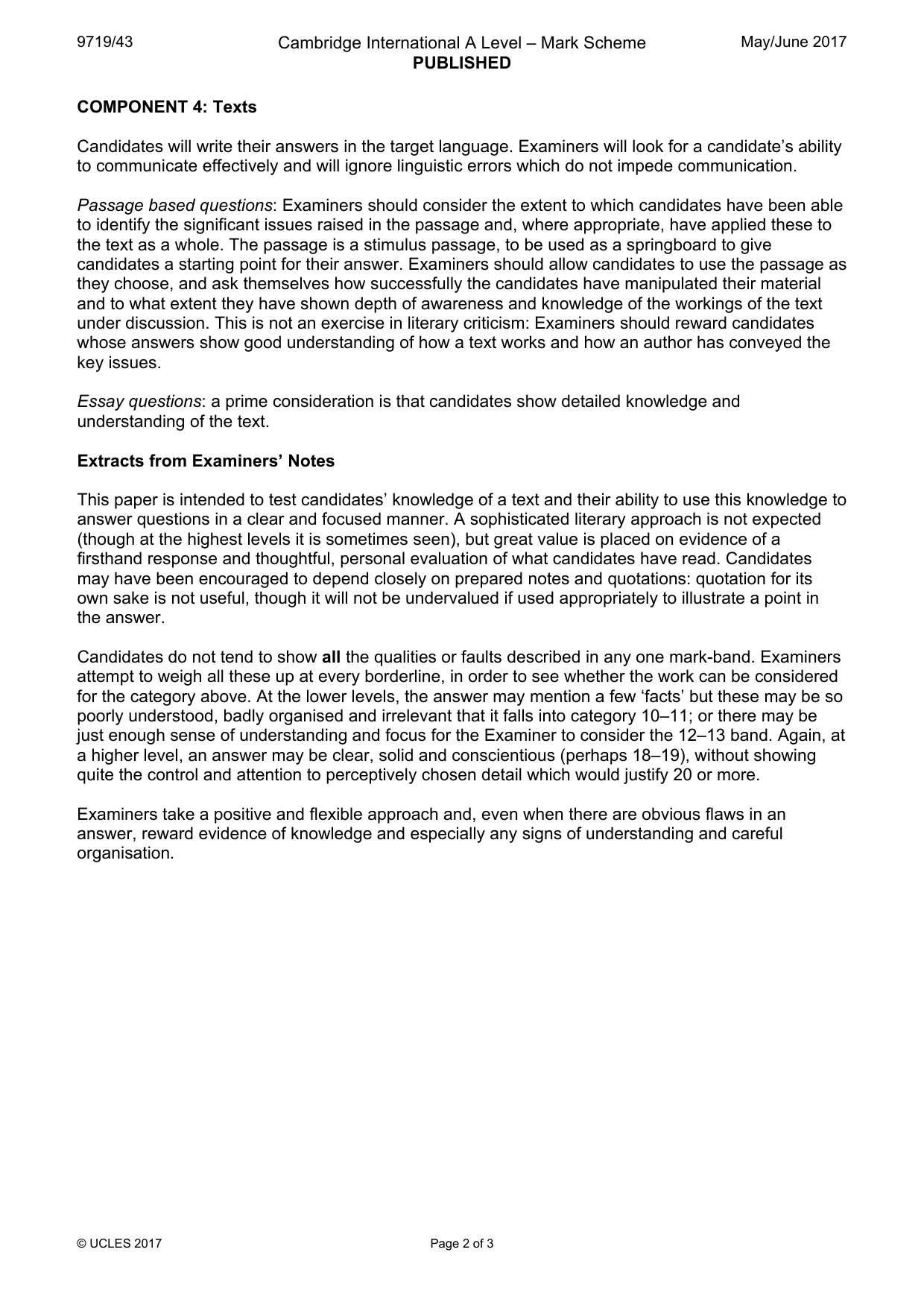
9719/43 Cambridge International A Level – Mark Scheme PUBLISHED May/June 2017 © UCLES 2017 Page 2 of 3 COMPONENT 4: Texts Candidates will write their answers in the target language. Examiners will look for a candidate’s ability to communicate effectively and will ignore linguistic errors which do not impede communication. Passage based questions: Examiners should consider the extent to which candidates have been able to identify the significant issues raised in the passage and, where appropriate, have applied these to the text as a whole. The passage is a stimulus passage, to be used as a springboard to give candidates a starting point for their answer. Examiners should allow candidates to use the passage as they choose, and ask themselves how successfully the candidates have manipulated their material and to what extent they have shown depth of awareness and knowledge of the workings of the text under discussion. This is not an exercise in literary criticism: Examiners should reward candidates whose answers show good understanding of how a text works and how an author has conveyed the key issues. Essay questions: a prime consideration is that candidates show detailed knowledge and understanding of the text. Extracts from Examiners’ Notes This paper is intended to test candidates’ knowledge of a text and their ability to use this knowledge to answer questions in a clear and focused manner. A sophisticated literary approach is not expected (though at the highest levels it is sometimes seen), but great value is placed on evidence of a firsthand response and thoughtful, personal evaluation of what candidates have read. Candidates may have been encouraged to depend closely on prepared notes and quotations: quotation for its own sake is not useful, though it will not be undervalued if used appropriately to illustrate a point in the answer. Candidates do not tend to show all the qualities or faults described in any one mark-band. Examiners attempt to weigh all these up at every borderline, in order to see whether the work can be considered for the category above. At the lower levels, the answer may mention a few ‘facts’ but these may be so poorly understood, badly organised and irrelevant that it falls into category 10–11; or there may be just enough sense of understanding and focus for the Examiner to consider the 12–13 band. Again, at a higher level, an answer may be clear, solid and conscientious (perhaps 18–19), without showing quite the control and attention to perceptively chosen detail which would justify 20 or more. Examiners take a positive and flexible approach and, even when there are obvious flaws in an answer, reward evidence of knowledge and especially any signs of understanding and careful organisation.
Mark scheme, page 3
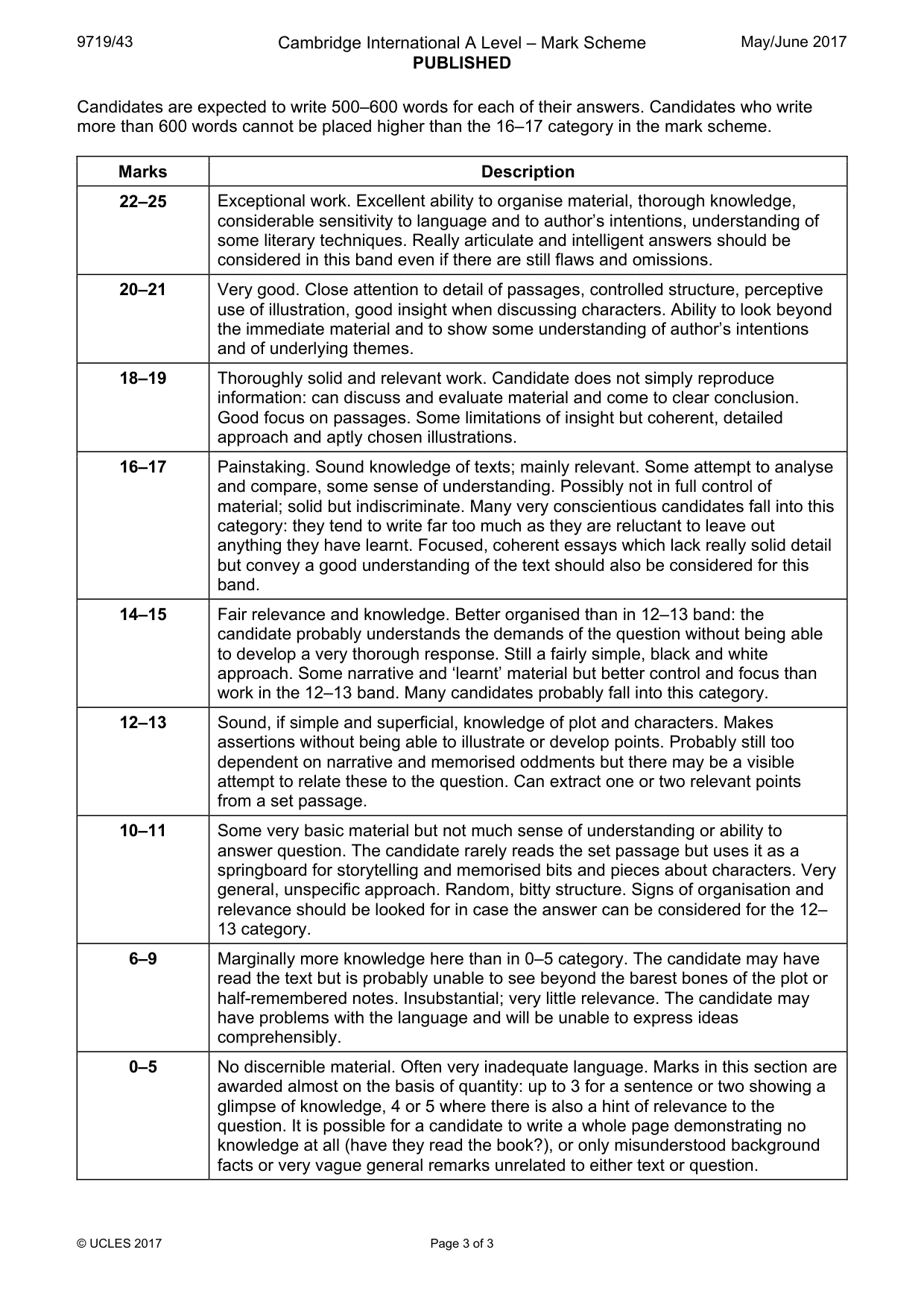
9719/43 Cambridge International A Level – Mark Scheme PUBLISHED May/June 2017 © UCLES 2017 Page 3 of 3 Candidates are expected to write 500–600 words for each of their answers. Candidates who write more than 600 words cannot be placed higher than the 16–17 category in the mark scheme. Marks Description 22–25 Exceptional work. Excellent ability to organise material, thorough knowledge, considerable sensitivity to language and to author’s intentions, understanding of some literary techniques. Really articulate and intelligent answers should be considered in this band even if there are still flaws and omissions. 20–21 Very good. Close attention to detail of passages, controlled structure, perceptive use of illustration, good insight when discussing characters. Ability to look beyond the immediate material and to show some understanding of author’s intentions and of underlying themes. 18–19 Thoroughly solid and relevant work. Candidate does not simply reproduce information: can discuss and evaluate material and come to clear conclusion. Good focus on passages. Some limitations of insight but coherent, detailed approach and aptly chosen illustrations. 16–17 Painstaking. Sound knowledge of texts; mainly relevant. Some attempt to analyse and compare, some sense of understanding. Possibly not in full control of material; solid but indiscriminate. Many very conscientious candidates fall into this category: they tend to write far too much as they are reluctant to leave out anything they have learnt. Focused, coherent essays which lack really solid detail but convey a good understanding of the text should also be considered for this band. 14–15 Fair relevance and knowledge. Better organised than in 12–13 band: the candidate probably understands the demands of the question without being able to develop a very thorough response. Still a fairly simple, black and white approach. Some narrative and ‘learnt’ material but better control and focus than work in the 12–13 band. Many candidates probably fall into this category. 12–13 Sound, if simple and superficial, knowledge of plot and characters. Makes assertions without being able to illustrate or develop points. Probably still too dependent on narrative and memorised oddments but there may be a visible attempt to relate these to the question. Can extract one or two relevant points from a set passage. 10–11 Some very basic material but not much sense of understanding or ability to answer question. The candidate rarely reads the set passage but uses it as a springboard for storytelling and memorised bits and pieces about characters. Very general, unspecific approach. Random, bitty structure. Signs of organisation and relevance should be looked for in case the answer can be considered for the 12– 13 category. 6–9 Marginally more knowledge here than in 0–5 category. The candidate may have read the text but is probably unable to see beyond the barest bones of the plot or half-remembered notes. Insubstantial; very little relevance. The candidate may have problems with the language and will be unable to express ideas comprehensibly. 0–5 No discernible material. Often very inadequate language. Marks in this section are awarded almost on the basis of quantity: up to 3 for a sentence or two showing a glimpse of knowledge, 4 or 5 where there is also a hint of relevance to the question. It is possible for a candidate to write a whole page demonstrating no knowledge at all (have they read the book?), or only misunderstood background facts or very vague general remarks unrelated to either text or question.
What you needed in this session
Cambridge’s own grade thresholds for 2017 May/June, Paper 4 · Variant 3. A higher threshold means an easier paper — the bar moves with how the cohort did.