Cambridge A Level Spanish (A Level only) 9719 — 2021 May/June Paper 4 · Variant 3
9719/43/M/J/21 · 75 marks · ≈84 min
The question paper and its mark scheme, free to read here and free to download. This is Cambridge’s own paper, exactly as it was sat.
Question paper8 pages

Mark scheme4 pages
Answers below. Sit the paper first if you are practising.
Paper as text
Question paper, page 1
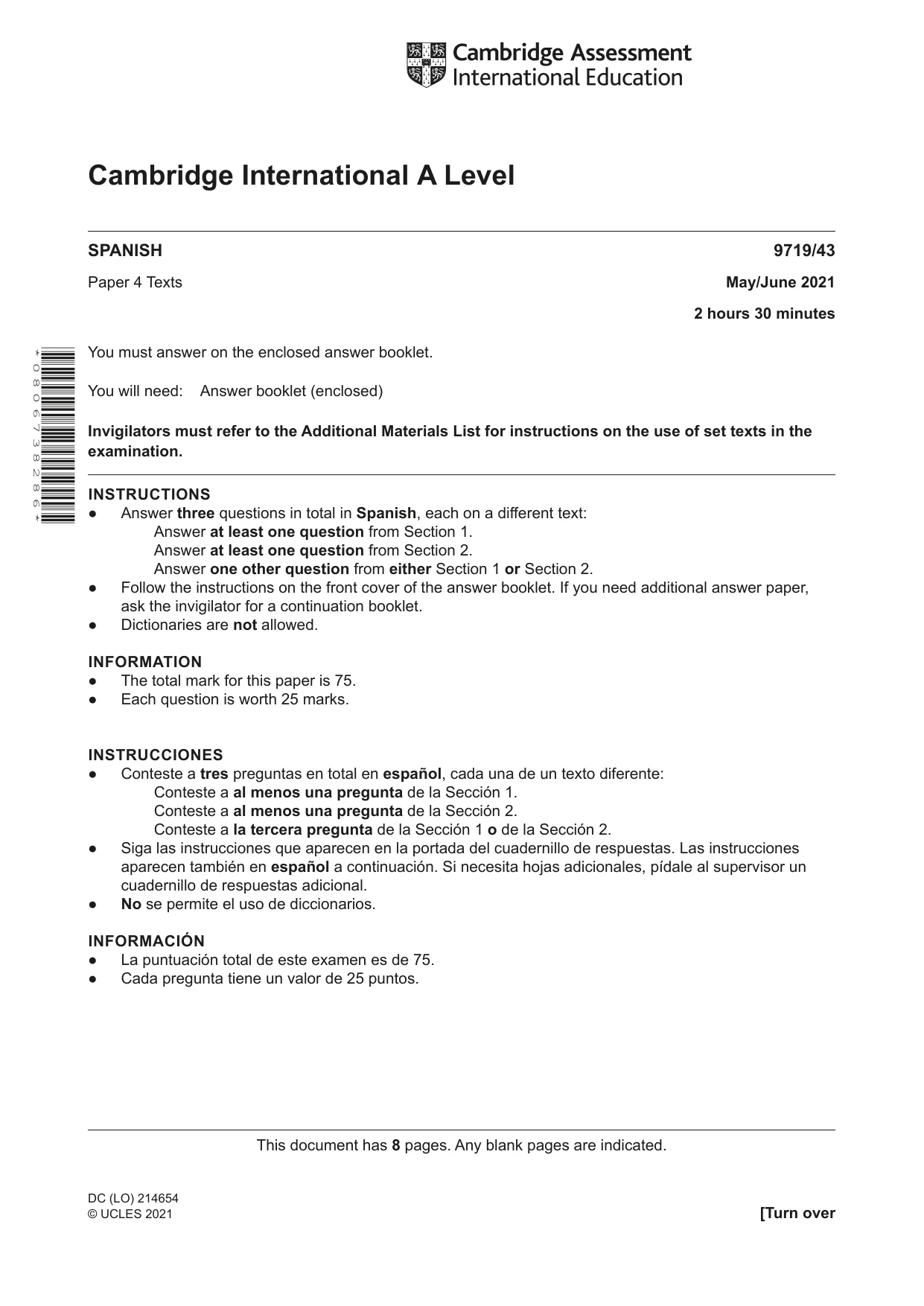
This document has 8 pages. Any blank pages are indicated. Cambridge International A Level SPANISH 9719/43 Paper 4 Texts May/June 2021 2 hours 30 minutes You must answer on the enclosed answer booklet. You will need: Answer booklet (enclosed) Invigilators must refer to the Additional Materials List for instructions on the use of set texts in the examination. INSTRUCTIONS ● Answer three questions in total in Spanish, each on a different text: Answer at least one question from Section 1. Answer at least one question from Section 2. Answer one other question from either Section 1 or Section 2. ● Follow the instructions on the front cover of the answer booklet. If you need additional answer paper, ask the invigilator for a continuation booklet. ● Dictionaries are not allowed. INFORMATION ● The total mark for this paper is 75. ● Each question is worth 25 marks. INSTRUCCIONES ● Conteste a tres preguntas en total en español, cada una de un texto diferente: Conteste a al menos una pregunta de la Sección 1. Conteste a al menos una pregunta de la Sección 2. Conteste a la tercera pregunta de la Sección 1 o de la Sección 2. ● Siga las instrucciones que aparecen en la portada del cuadernillo de respuestas. Las instrucciones aparecen también en español a continuación. Si necesita hojas adicionales, pídale al supervisor un cuadernillo de respuestas adicional. ● No se permite el uso de diccionarios. INFORMACIÓN ● La puntuación total de este examen es de 75. ● Cada pregunta tiene un valor de 25 puntos. * 0 8 0 6 7 3 8 2 8 6 * DC (LO) 214654 © UCLES 2021 [Turn over
Question paper, page 2
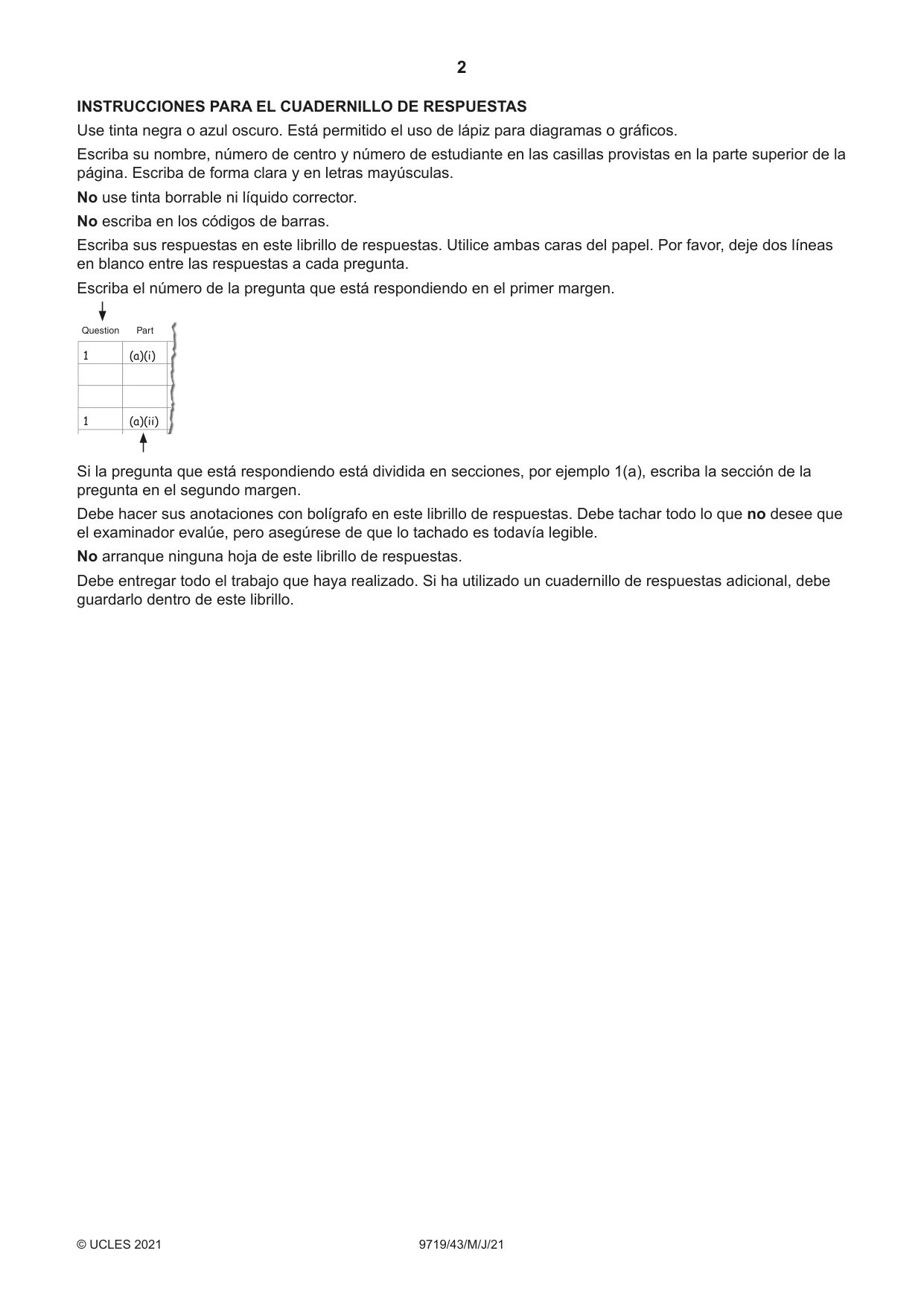
2 9719/43/ M / J /21 © UCLES 2021 INSTRUCCIONES PARA EL CUADERNILLO DE RESPUESTAS Use tinta negra o azul oscuro. Está permitido el uso de lápiz para diagramas o gráficos. Escriba su nombre, número de centro y número de estudiante en las casillas provistas en la parte superior de la página. Escriba de forma clara y en letras mayúsculas. No use tinta borrable ni líquido corrector. No escriba en los códigos de barras. Escriba sus respuestas en este librillo de respuestas. Utilice ambas caras del papel. Por favor, deje dos líneas en blanco entre las respuestas a cada pregunta. Escriba el número de la pregunta que está respondiendo en el primer margen. Question Part 1 1 (a)(i) (a)(ii) Si la pregunta que está respondiendo está dividida en secciones, por ejemplo 1(a), escriba la sección de la pregunta en el segundo margen. Debe hacer sus anotaciones con bolígrafo en este librillo de respuestas. Debe tachar todo lo que no desee que el examinador evalúe, pero asegúrese de que lo tachado es todavía legible. No arranque ninguna hoja de este librillo de respuestas. Debe entregar todo el trabajo que haya realizado. Si ha utilizado un cuadernillo de respuestas adicional, debe guardarlo dentro de este librillo.
Question paper, page 3
3 9719/43/M/J/21 © UCLES 2021 [Turn over BLANK PAGE
Question paper, page 4
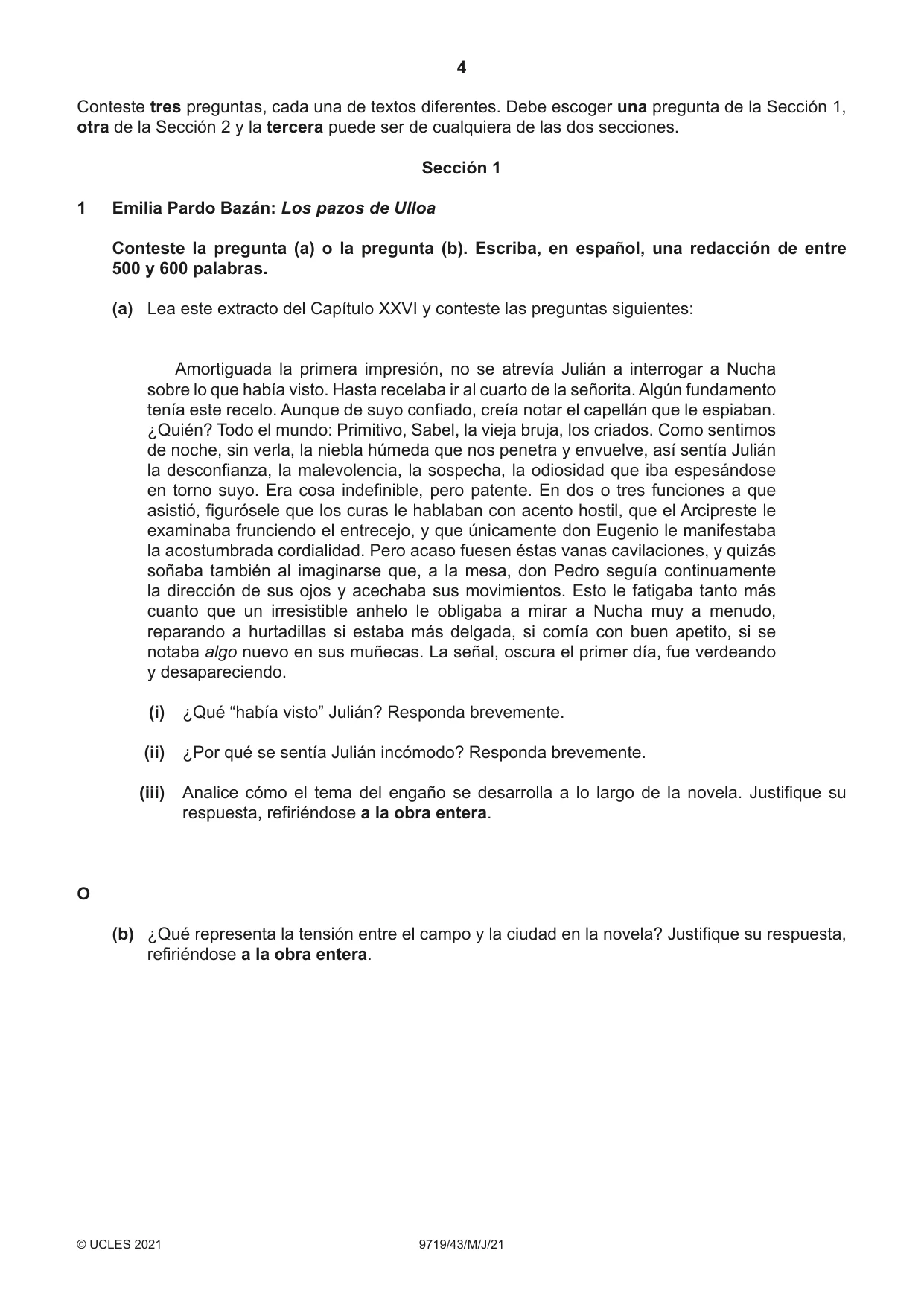
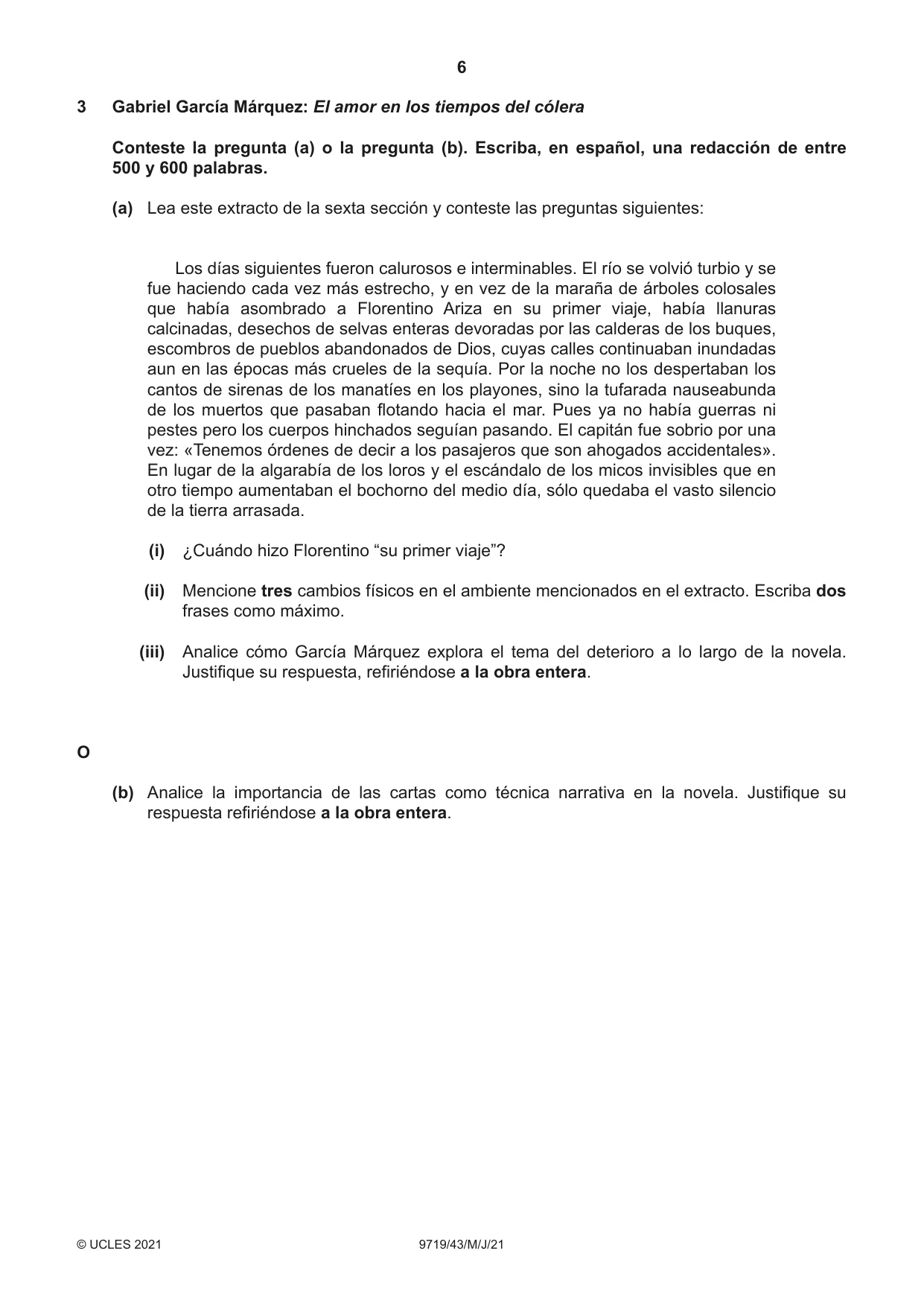
4 9719/43/M/J/21 © UCLES 2021 Conteste tres preguntas, cada una de textos diferentes. Debe escoger una pregunta de la Sección 1, otra de la Sección 2 y la tercera puede ser de cualquiera de las dos secciones. Sección 1 1 Emilia Pardo Bazán: Los pazos de Ulloa Conteste la pregunta (a) o la pregunta (b). Escriba, en español, una redacción de entre 500 y 600 palabras. (a) Lea este extracto del Capítulo XXVI y conteste las preguntas siguientes: Amortiguada la primera impresión, no se atrevía Julián a interrogar a Nucha sobre lo que había visto. Hasta recelaba ir al cuarto de la señorita. Algún fundamento tenía este recelo. Aunque de suyo confiado, creía notar el capellán que le espiaban. ¿Quién? Todo el mundo: Primitivo, Sabel, la vieja bruja, los criados. Como sentimos de noche, sin verla, la niebla húmeda que nos penetra y envuelve, así sentía Julián la desconfianza, la malevolencia, la sospecha, la odiosidad que iba espesándose en torno suyo. Era cosa indefinible, pero patente. En dos o tres funciones a que asistió, figurósele que los curas le hablaban con acento hostil, que el Arcipreste le examinaba frunciendo el entrecejo, y que únicamente don Eugenio le manifestaba la acostumbrada cordialidad. Pero acaso fuesen éstas vanas cavilaciones, y quizás soñaba también al imaginarse que, a la mesa, don Pedro seguía continuamente la dirección de sus ojos y acechaba sus movimientos. Esto le fatigaba tanto más cuanto que un irresistible anhelo le obligaba a mirar a Nucha muy a menudo, reparando a hurtadillas si estaba más delgada, si comía con buen apetito, si se notaba algo nuevo en sus muñecas. La señal, oscura el primer día, fue verdeando y desapareciendo. (i) ¿Qué “había visto” Julián? Responda brevemente. (ii) ¿Por qué se sentía Julián incómodo? Responda brevemente. (iii) Analice cómo el tema del engaño se desarrolla a lo largo de la novela. Justifique su respuesta, refiriéndose a la obra entera. O (b) ¿Qué representa la tensión entre el campo y la ciudad en la novela? Justifique su respuesta, refiriéndose a la obra entera.
Question paper, page 5
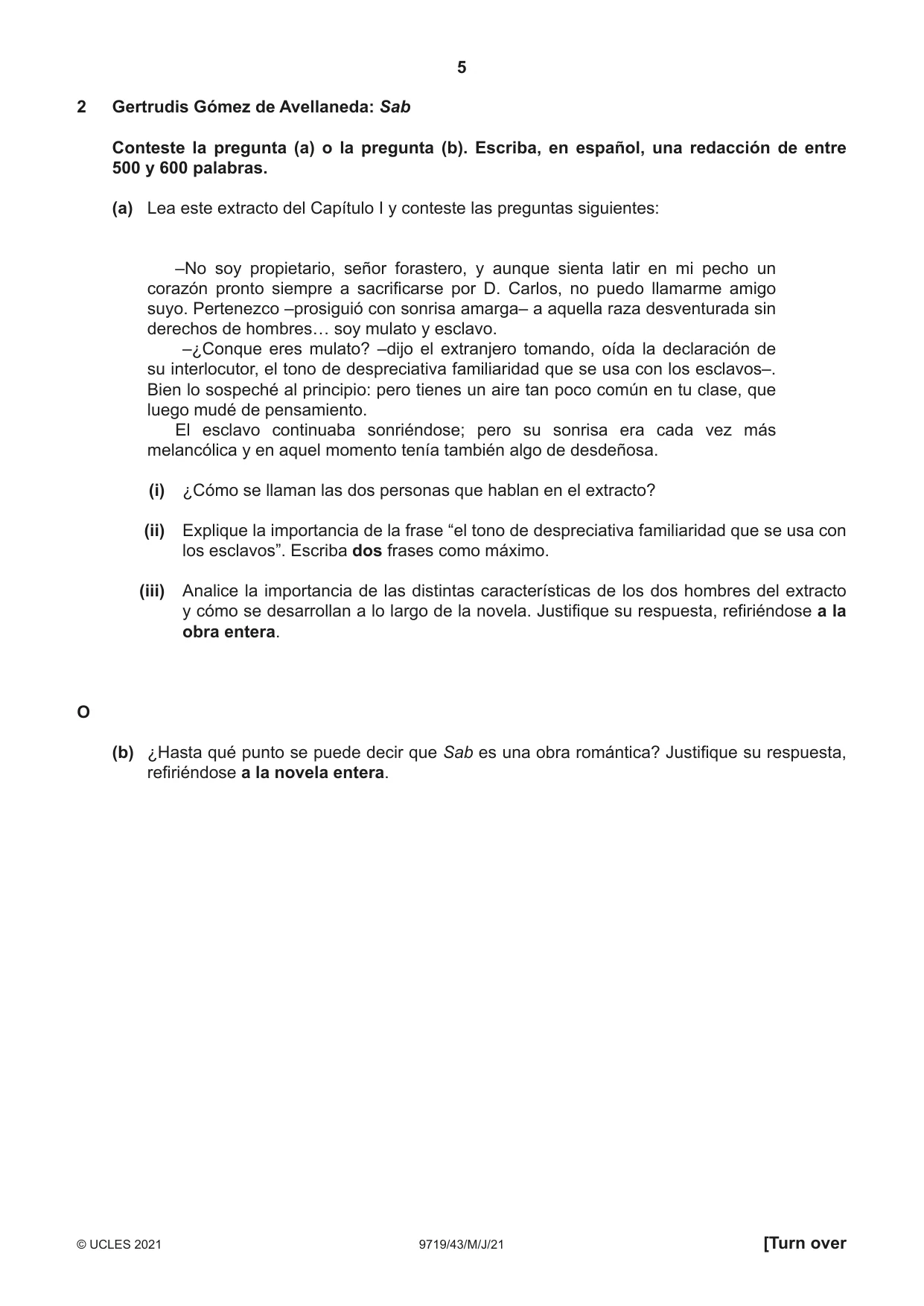
5 9719/43/M/J/21 © UCLES 2021 [Turn over 2 Gertrudis Gómez de Avellaneda: Sab Conteste la pregunta (a) o la pregunta (b). Escriba, en español, una redacción de entre 500 y 600 palabras. (a) Lea este extracto del Capítulo I y conteste las preguntas siguientes: –No soy propietario, señor forastero, y aunque sienta latir en mi pecho un corazón pronto siempre a sacrificarse por D. Carlos, no puedo llamarme amigo suyo. Pertenezco –prosiguió con sonrisa amarga– a aquella raza desventurada sin derechos de hombres… soy mulato y esclavo. –¿Conque eres mulato? –dijo el extranjero tomando, oída la declaración de su interlocutor, el tono de despreciativa familiaridad que se usa con los esclavos–. Bien lo sospeché al principio: pero tienes un aire tan poco común en tu clase, que luego mudé de pensamiento. El esclavo continuaba sonriéndose; pero su sonrisa era cada vez más melancólica y en aquel momento tenía también algo de desdeñosa. (i) ¿Cómo se llaman las dos personas que hablan en el extracto? (ii) Explique la importancia de la frase “el tono de despreciativa familiaridad que se usa con los esclavos”. Escriba dos frases como máximo. (iii) Analice la importancia de las distintas características de los dos hombres del extracto y cómo se desarrollan a lo largo de la novela. Justifique su respuesta, refiriéndose a la obra entera. O (b) ¿Hasta qué punto se puede decir que Sab es una obra romántica? Justifique su respuesta, refiriéndose a la novela entera.
Question paper, page 6
6 9719/43/M/J/21 © UCLES 2021 3 Gabriel García Márquez: El amor en los tiempos del cólera Conteste la pregunta (a) o la pregunta (b). Escriba, en español, una redacción de entre 500 y 600 palabras. (a) Lea este extracto de la sexta sección y conteste las preguntas siguientes: Los días siguientes fueron calurosos e interminables. El río se volvió turbio y se fue haciendo cada vez más estrecho, y en vez de la maraña de árboles colosales que había asombrado a Florentino Ariza en su primer viaje, había llanuras calcinadas, desechos de selvas enteras devoradas por las calderas de los buques, escombros de pueblos abandonados de Dios, cuyas calles continuaban inundadas aun en las épocas más crueles de la sequía. Por la noche no los despertaban los cantos de sirenas de los manatíes en los playones, sino la tufarada nauseabunda de los muertos que pasaban flotando hacia el mar. Pues ya no había guerras ni pestes pero los cuerpos hinchados seguían pasando. El capitán fue sobrio por una vez: «Tenemos órdenes de decir a los pasajeros que son ahogados accidentales». En lugar de la algarabía de los loros y el escándalo de los micos invisibles que en otro tiempo aumentaban el bochorno del medio día, sólo quedaba el vasto silencio de la tierra arrasada. (i) ¿Cuándo hizo Florentino “su primer viaje”? (ii) Mencione tres cambios físicos en el ambiente mencionados en el extracto. Escriba dos frases como máximo. (iii) Analice cómo García Márquez explora el tema del deterioro a lo largo de la novela. Justifique su respuesta, refiriéndose a la obra entera. O (b) Analice la importancia de las cartas como técnica narrativa en la novela. Justifique su respuesta refiriéndose a la obra entera.
Question paper, page 7
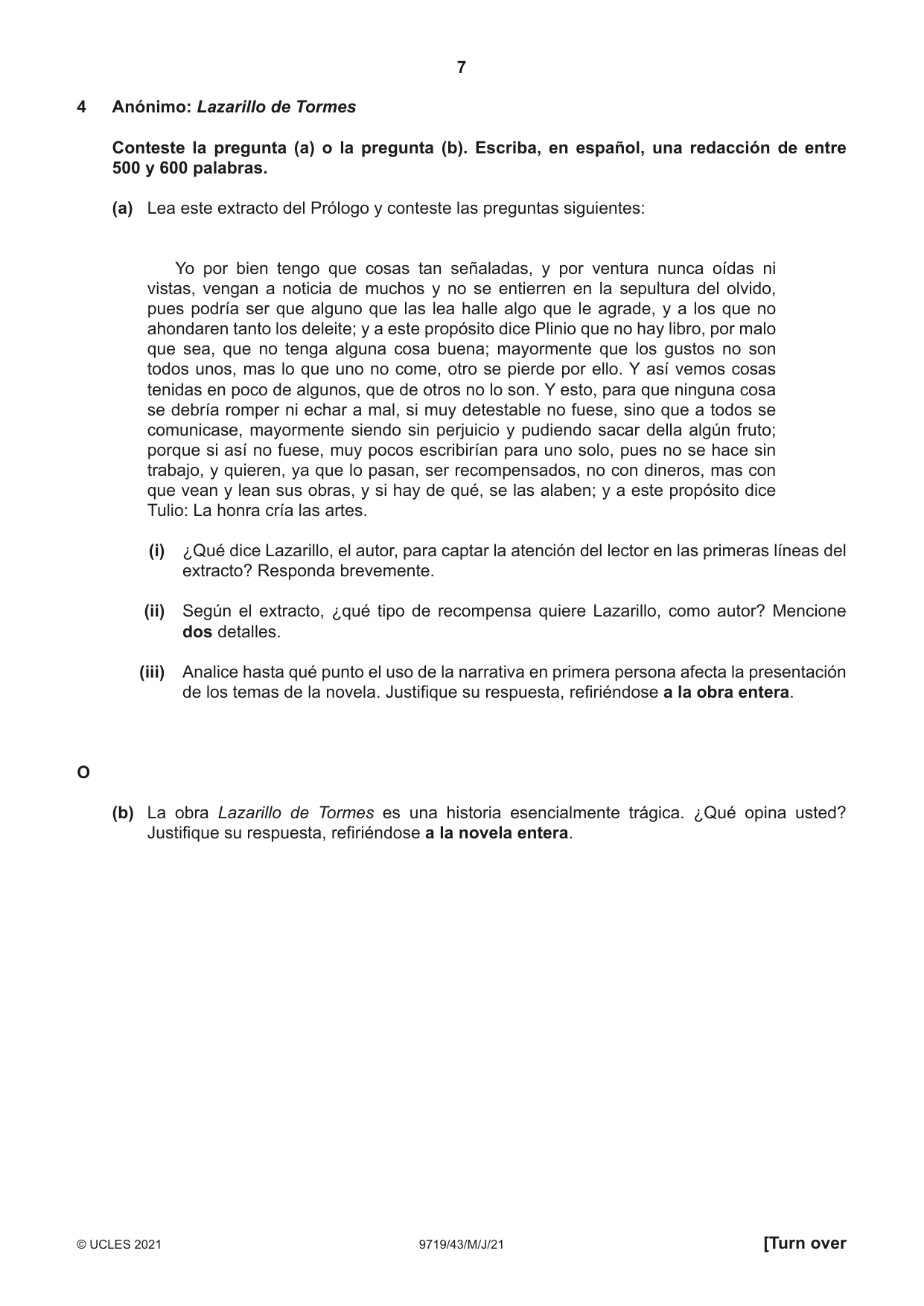
7 9719/43/M/J/21 © UCLES 2021 [Turn over 4 Anónimo: Lazarillo de Tormes Conteste la pregunta (a) o la pregunta (b). Escriba, en español, una redacción de entre 500 y 600 palabras. (a) Lea este extracto del Prólogo y conteste las preguntas siguientes: Yo por bien tengo que cosas tan señaladas, y por ventura nunca oídas ni vistas, vengan a noticia de muchos y no se entierren en la sepultura del olvido, pues podría ser que alguno que las lea halle algo que le agrade, y a los que no ahondaren tanto los deleite; y a este propósito dice Plinio que no hay libro, por malo que sea, que no tenga alguna cosa buena; mayormente que los gustos no son todos unos, mas lo que uno no come, otro se pierde por ello. Y así vemos cosas tenidas en poco de algunos, que de otros no lo son. Y esto, para que ninguna cosa se debría romper ni echar a mal, si muy detestable no fuese, sino que a todos se comunicase, mayormente siendo sin perjuicio y pudiendo sacar della algún fruto; porque si así no fuese, muy pocos escribirían para uno solo, pues no se hace sin trabajo, y quieren, ya que lo pasan, ser recompensados, no con dineros, mas con que vean y lean sus obras, y si hay de qué, se las alaben; y a este propósito dice Tulio: La honra cría las artes. (i) ¿Qué dice Lazarillo, el autor, para captar la atención del lector en las primeras líneas del extracto? Responda brevemente. (ii) Según el extracto, ¿qué tipo de recompensa quiere Lazarillo, como autor? Mencione dos detalles. (iii) Analice hasta qué punto el uso de la narrativa en primera persona afecta la presentación de los temas de la novela. Justifique su respuesta, refiriéndose a la obra entera. O (b) La obra Lazarillo de Tormes es una historia esencialmente trágica. ¿Qué opina usted? Justifique su respuesta, refiriéndose a la novela entera.
Question paper, page 8
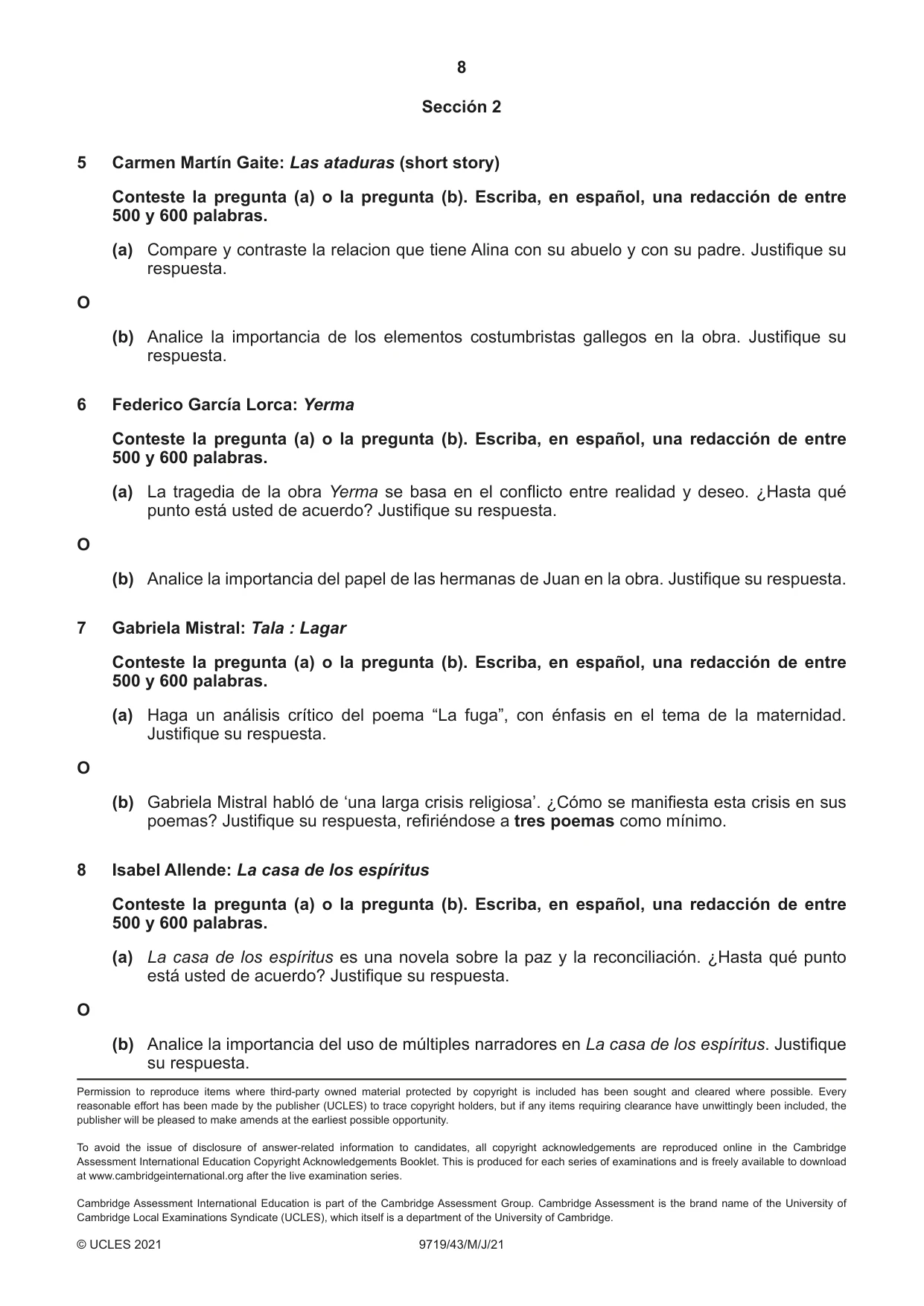
8 9719/43/M/J/21 © UCLES 2021 Permission to reproduce items where third-party owned material protected by copyright is included has been sought and cleared where possible. Every reasonable effort has been made by the publisher (UCLES) to trace copyright holders, but if any items requiring clearance have unwittingly been included, the publisher will be pleased to make amends at the earliest possible opportunity. To avoid the issue of disclosure of answer-related information to candidates, all copyright acknowledgements are reproduced online in the Cambridge Assessment International Education Copyright Acknowledgements Booklet. This is produced for each series of examinations and is freely available to download at www.cambridgeinternational.org after the live examination series. Cambridge Assessment International Education is part of the Cambridge Assessment Group. Cambridge Assessment is the brand name of the University of Cambridge Local Examinations Syndicate (UCLES), which itself is a department of the University of Cambridge. Sección 2 5 Carmen Martín Gaite: Las ataduras (short story) Conteste la pregunta (a) o la pregunta (b). Escriba, en español, una redacción de entre 500 y 600 palabras. (a) Compare y contraste la relacion que tiene Alina con su abuelo y con su padre. Justifique su respuesta. O (b) Analice la importancia de los elementos costumbristas gallegos en la obra. Justifique su respuesta. 6 Federico García Lorca: Yerma Conteste la pregunta (a) o la pregunta (b). Escriba, en español, una redacción de entre 500 y 600 palabras. (a) La tragedia de la obra Yerma se basa en el conflicto entre realidad y deseo. ¿Hasta qué punto está usted de acuerdo? Justifique su respuesta. O (b) Analice la importancia del papel de las hermanas de Juan en la obra. Justifique su respuesta. 7 Gabriela Mistral: Tala : Lagar Conteste la pregunta (a) o la pregunta (b). Escriba, en español, una redacción de entre 500 y 600 palabras. (a) Haga un análisis crítico del poema “La fuga”, con énfasis en el tema de la maternidad. Justifique su respuesta. O (b) Gabriela Mistral habló de ‘una larga crisis religiosa’. ¿Cómo se manifiesta esta crisis en sus poemas? Justifique su respuesta, refiriéndose a tres poemas como mínimo. 8 Isabel Allende: La casa de los espíritus Conteste la pregunta (a) o la pregunta (b). Escriba, en español, una redacción de entre 500 y 600 palabras. (a) La casa de los espíritus es una novela sobre la paz y la reconciliación. ¿Hasta qué punto está usted de acuerdo? Justifique su respuesta. O (b) Analice la importancia del uso de múltiples narradores en La casa de los espíritus. Justifique su respuesta.
Mark scheme, page 1
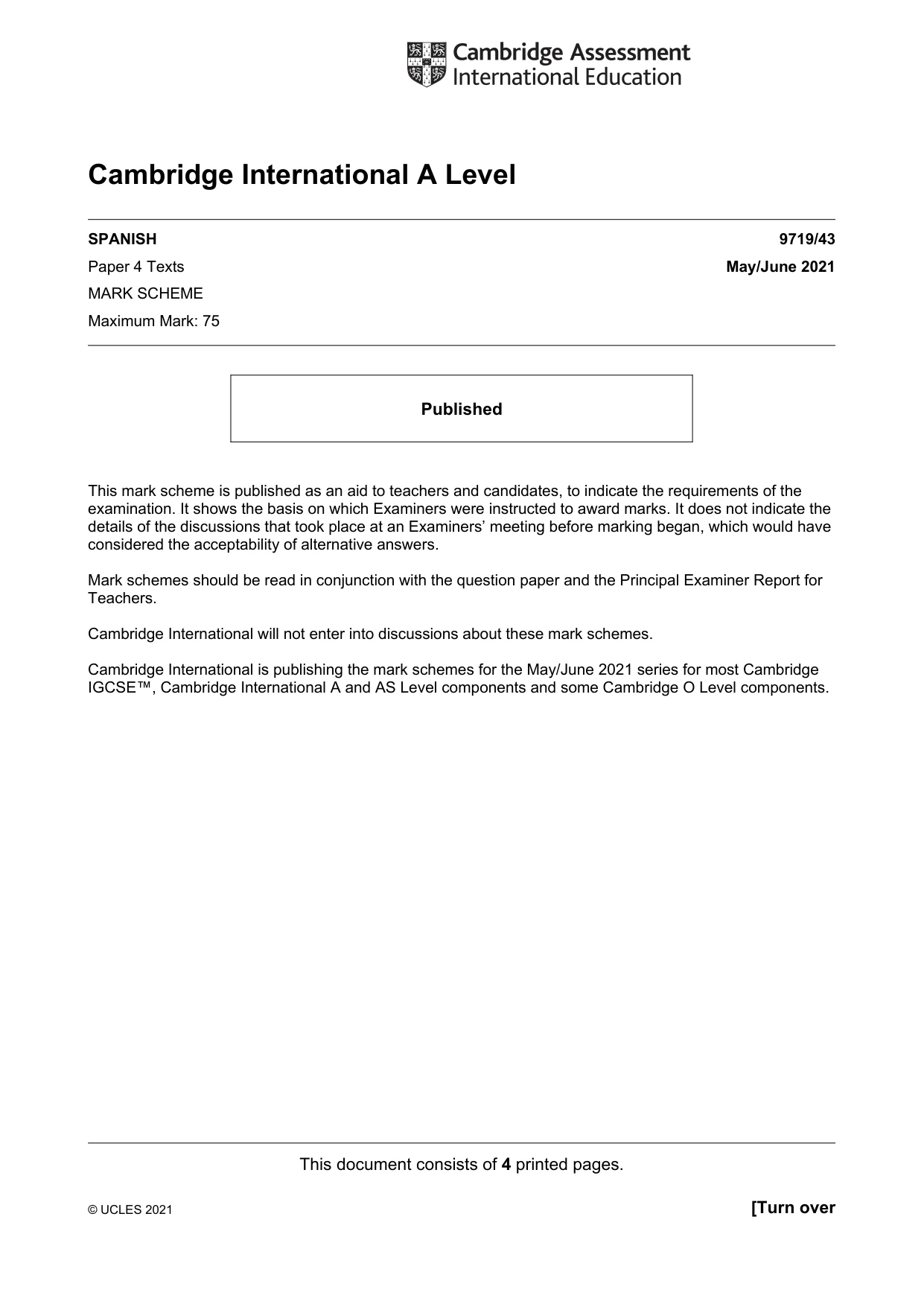
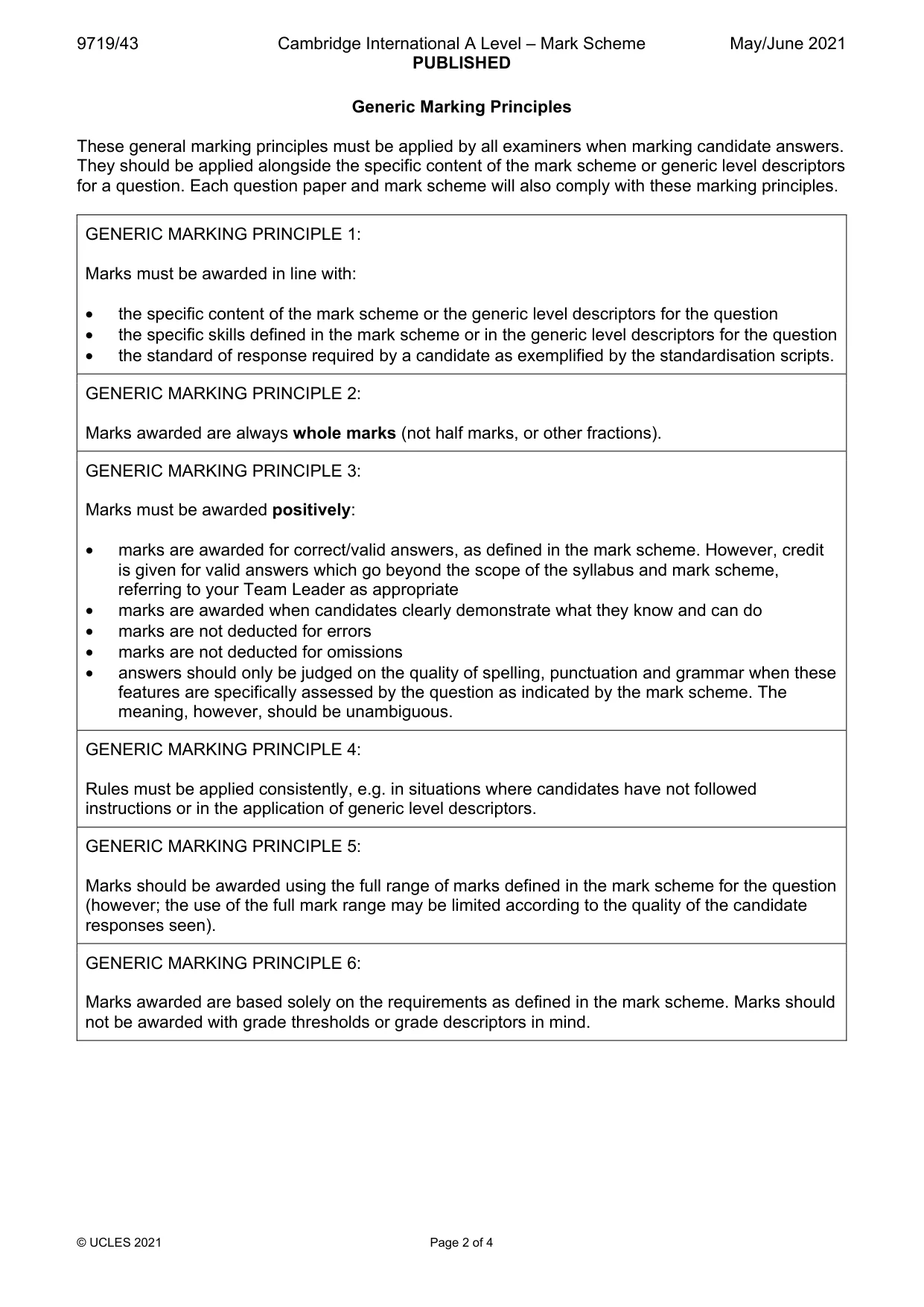
This document consists of 4 printed pages. © UCLES 2021 [Turn over Cambridge International A Level SPANISH 9719/43 Paper 4 Texts May/June 2021 MARK SCHEME Maximum Mark: 75 Published This mark scheme is published as an aid to teachers and candidates, to indicate the requirements of the examination. It shows the basis on which Examiners were instructed to award marks. It does not indicate the details of the discussions that took place at an Examiners’ meeting before marking began, which would have considered the acceptability of alternative answers. Mark schemes should be read in conjunction with the question paper and the Principal Examiner Report for Teachers. Cambridge International will not enter into discussions about these mark schemes. Cambridge International is publishing the mark schemes for the May/June 2021 series for most Cambridge IGCSE™, Cambridge International A and AS Level components and some Cambridge O Level components.
Mark scheme, page 2
9719/43 Cambridge International A Level – Mark Scheme PUBLISHED May/June 2021 © UCLES 2021 Page 2 of 4 Generic Marking Principles These general marking principles must be applied by all examiners when marking candidate answers. They should be applied alongside the specific content of the mark scheme or generic level descriptors for a question. Each question paper and mark scheme will also comply with these marking principles. GENERIC MARKING PRINCIPLE 1: Marks must be awarded in line with: • the specific content of the mark scheme or the generic level descriptors for the question • the specific skills defined in the mark scheme or in the generic level descriptors for the question • the standard of response required by a candidate as exemplified by the standardisation scripts. GENERIC MARKING PRINCIPLE 2: Marks awarded are always whole marks (not half marks, or other fractions). GENERIC MARKING PRINCIPLE 3: Marks must be awarded positively: • marks are awarded for correct/valid answers, as defined in the mark scheme. However, credit is given for valid answers which go beyond the scope of the syllabus and mark scheme, referring to your Team Leader as appropriate • marks are awarded when candidates clearly demonstrate what they know and can do • marks are not deducted for errors • marks are not deducted for omissions • answers should only be judged on the quality of spelling, punctuation and grammar when these features are specifically assessed by the question as indicated by the mark scheme. The meaning, however, should be unambiguous. GENERIC MARKING PRINCIPLE 4: Rules must be applied consistently, e.g. in situations where candidates have not followed instructions or in the application of generic level descriptors. GENERIC MARKING PRINCIPLE 5: Marks should be awarded using the full range of marks defined in the mark scheme for the question (however; the use of the full mark range may be limited according to the quality of the candidate responses seen). GENERIC MARKING PRINCIPLE 6: Marks awarded are based solely on the requirements as defined in the mark scheme. Marks should not be awarded with grade thresholds or grade descriptors in mind.
Mark scheme, page 3
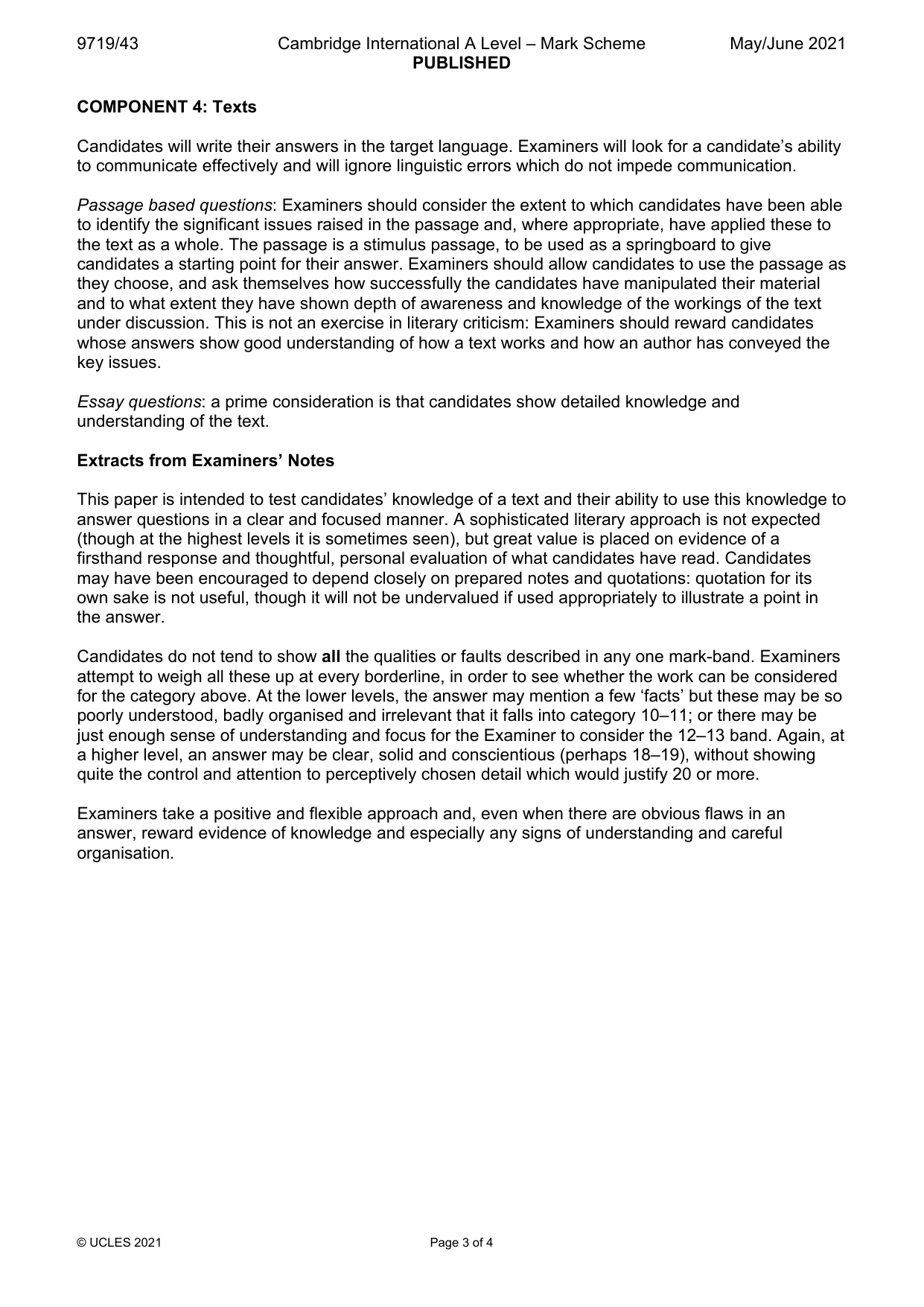
9719/43 Cambridge International A Level – Mark Scheme PUBLISHED May/June 2021 © UCLES 2021 Page 3 of 4 COMPONENT 4: Texts Candidates will write their answers in the target language. Examiners will look for a candidate’s ability to communicate effectively and will ignore linguistic errors which do not impede communication. Passage based questions: Examiners should consider the extent to which candidates have been able to identify the significant issues raised in the passage and, where appropriate, have applied these to the text as a whole. The passage is a stimulus passage, to be used as a springboard to give candidates a starting point for their answer. Examiners should allow candidates to use the passage as they choose, and ask themselves how successfully the candidates have manipulated their material and to what extent they have shown depth of awareness and knowledge of the workings of the text under discussion. This is not an exercise in literary criticism: Examiners should reward candidates whose answers show good understanding of how a text works and how an author has conveyed the key issues. Essay questions: a prime consideration is that candidates show detailed knowledge and understanding of the text. Extracts from Examiners’ Notes This paper is intended to test candidates’ knowledge of a text and their ability to use this knowledge to answer questions in a clear and focused manner. A sophisticated literary approach is not expected (though at the highest levels it is sometimes seen), but great value is placed on evidence of a firsthand response and thoughtful, personal evaluation of what candidates have read. Candidates may have been encouraged to depend closely on prepared notes and quotations: quotation for its own sake is not useful, though it will not be undervalued if used appropriately to illustrate a point in the answer. Candidates do not tend to show all the qualities or faults described in any one mark-band. Examiners attempt to weigh all these up at every borderline, in order to see whether the work can be considered for the category above. At the lower levels, the answer may mention a few ‘facts’ but these may be so poorly understood, badly organised and irrelevant that it falls into category 10–11; or there may be just enough sense of understanding and focus for the Examiner to consider the 12–13 band. Again, at a higher level, an answer may be clear, solid and conscientious (perhaps 18–19), without showing quite the control and attention to perceptively chosen detail which would justify 20 or more. Examiners take a positive and flexible approach and, even when there are obvious flaws in an answer, reward evidence of knowledge and especially any signs of understanding and careful organisation.
Mark scheme, page 4
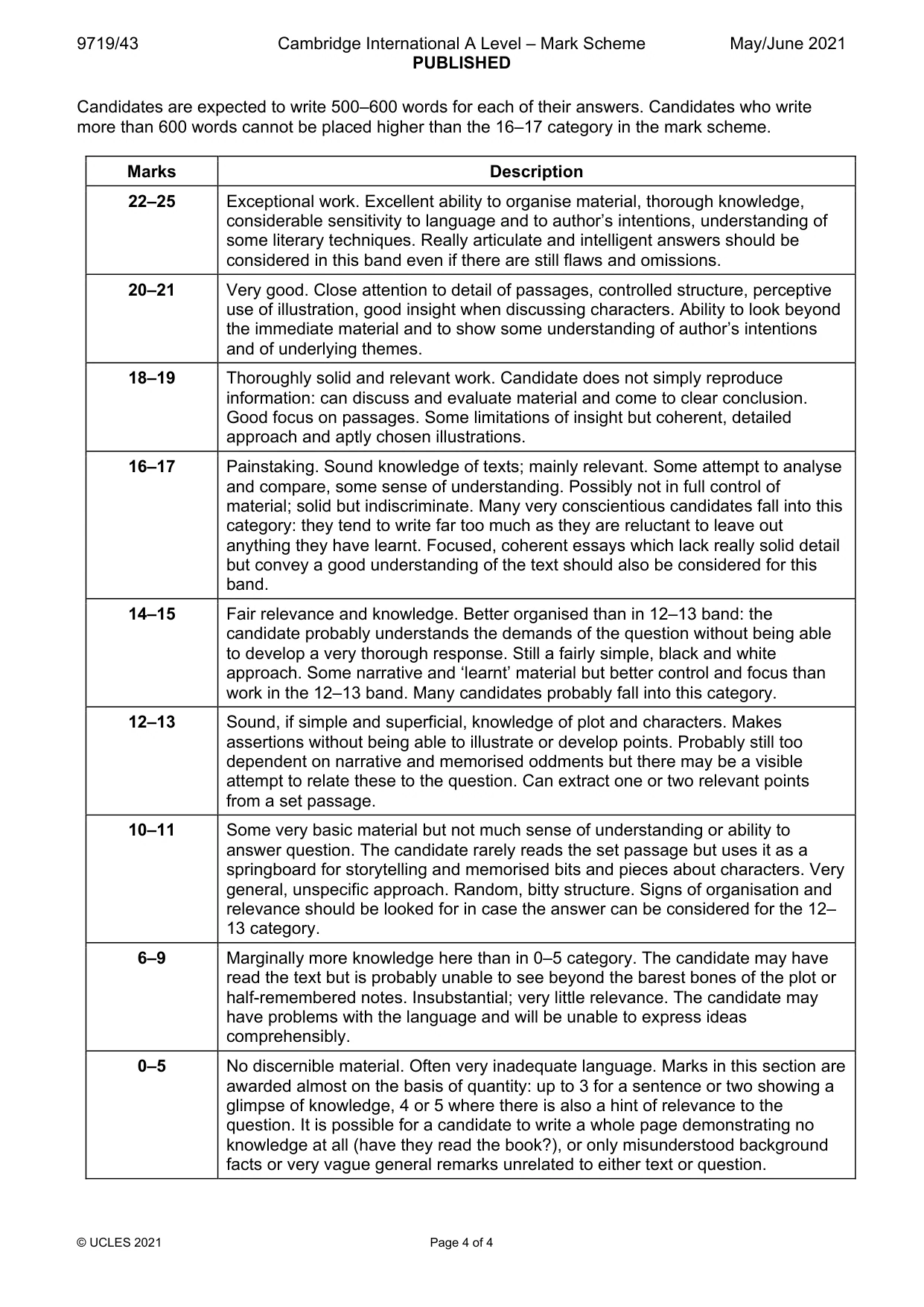
9719/43 Cambridge International A Level – Mark Scheme PUBLISHED May/June 2021 © UCLES 2021 Page 4 of 4 Candidates are expected to write 500–600 words for each of their answers. Candidates who write more than 600 words cannot be placed higher than the 16–17 category in the mark scheme. Marks Description 22–25 Exceptional work. Excellent ability to organise material, thorough knowledge, considerable sensitivity to language and to author’s intentions, understanding of some literary techniques. Really articulate and intelligent answers should be considered in this band even if there are still flaws and omissions. 20–21 Very good. Close attention to detail of passages, controlled structure, perceptive use of illustration, good insight when discussing characters. Ability to look beyond the immediate material and to show some understanding of author’s intentions and of underlying themes. 18–19 Thoroughly solid and relevant work. Candidate does not simply reproduce information: can discuss and evaluate material and come to clear conclusion. Good focus on passages. Some limitations of insight but coherent, detailed approach and aptly chosen illustrations. 16–17 Painstaking. Sound knowledge of texts; mainly relevant. Some attempt to analyse and compare, some sense of understanding. Possibly not in full control of material; solid but indiscriminate. Many very conscientious candidates fall into this category: they tend to write far too much as they are reluctant to leave out anything they have learnt. Focused, coherent essays which lack really solid detail but convey a good understanding of the text should also be considered for this band. 14–15 Fair relevance and knowledge. Better organised than in 12–13 band: the candidate probably understands the demands of the question without being able to develop a very thorough response. Still a fairly simple, black and white approach. Some narrative and ‘learnt’ material but better control and focus than work in the 12–13 band. Many candidates probably fall into this category. 12–13 Sound, if simple and superficial, knowledge of plot and characters. Makes assertions without being able to illustrate or develop points. Probably still too dependent on narrative and memorised oddments but there may be a visible attempt to relate these to the question. Can extract one or two relevant points from a set passage. 10–11 Some very basic material but not much sense of understanding or ability to answer question. The candidate rarely reads the set passage but uses it as a springboard for storytelling and memorised bits and pieces about characters. Very general, unspecific approach. Random, bitty structure. Signs of organisation and relevance should be looked for in case the answer can be considered for the 12– 13 category. 6–9 Marginally more knowledge here than in 0–5 category. The candidate may have read the text but is probably unable to see beyond the barest bones of the plot or half-remembered notes. Insubstantial; very little relevance. The candidate may have problems with the language and will be unable to express ideas comprehensibly. 0–5 No discernible material. Often very inadequate language. Marks in this section are awarded almost on the basis of quantity: up to 3 for a sentence or two showing a glimpse of knowledge, 4 or 5 where there is also a hint of relevance to the question. It is possible for a candidate to write a whole page demonstrating no knowledge at all (have they read the book?), or only misunderstood background facts or very vague general remarks unrelated to either text or question.
What you needed in this session
Cambridge’s own grade thresholds for 2021 May/June, Paper 4 · Variant 3. A higher threshold means an easier paper — the bar moves with how the cohort did.