Cambridge A Level Spanish (A Level only) 9719 — 2017 May/June Paper 4 · Variant 2
9719/42/M/J/17 · 75 marks · ≈84 min
The question paper and its mark scheme, free to read here and free to download. This is Cambridge’s own paper, exactly as it was sat.
Question paper8 pages


Mark scheme3 pages
Answers below. Sit the paper first if you are practising.
Paper as text
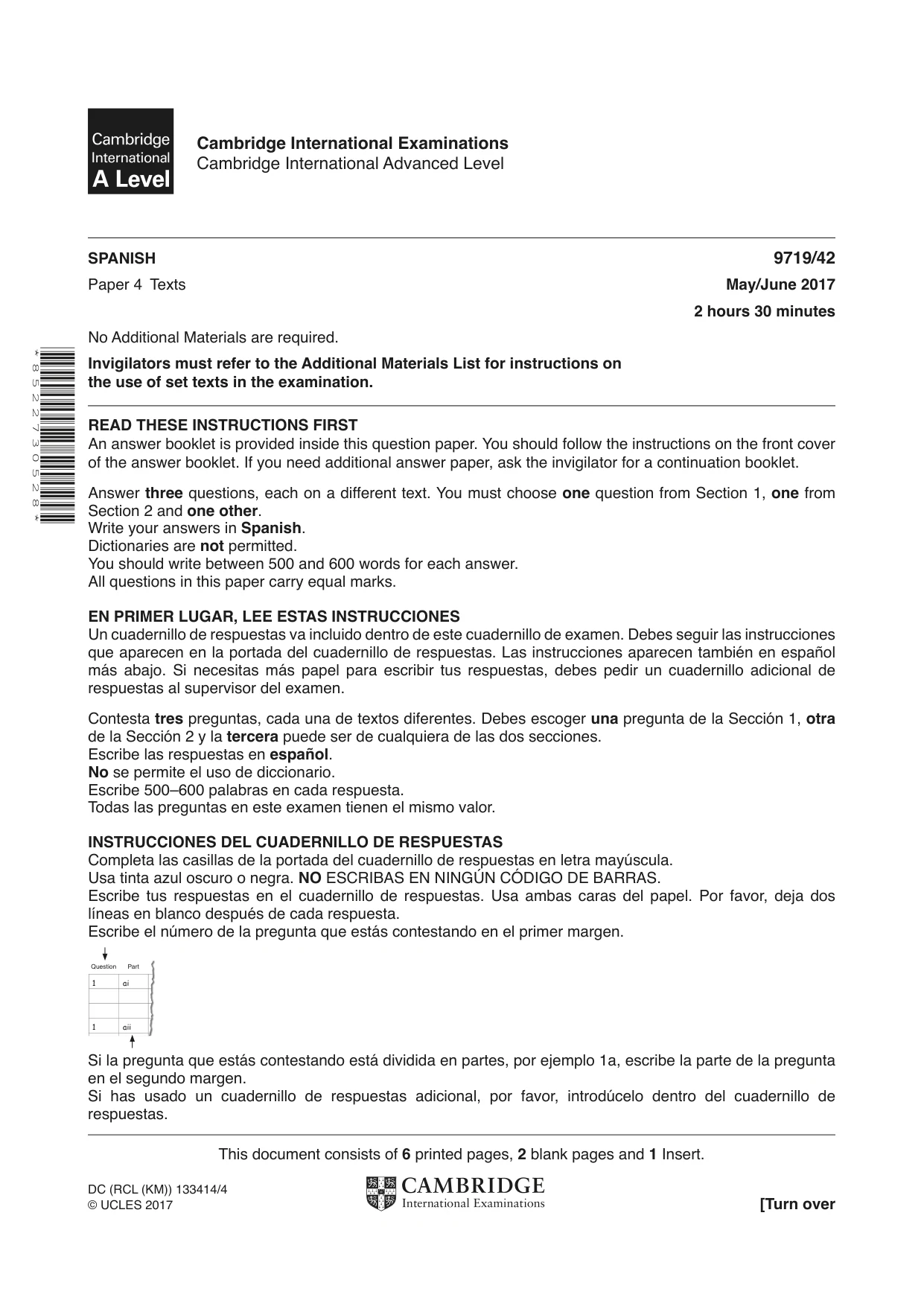
Question paper, page 1
This document consists of 6 printed pages, 2 blank pages and 1 Insert. DC (RCL (KM)) 133414/4 © UCLES 2017 [Turn over Cambridge International Examinations Cambridge International Advanced Level * 8 5 2 2 7 3 0 5 2 8 * SPANISH 9719/42 Paper 4 Texts May/June 2017 2 hours 30 minutes No Additional Materials are required. Invigilators must refer to the Additional Materials List for instructions on the use of set texts in the examination. READ THESE INSTRUCTIONS FIRST An answer booklet is provided inside this question paper. You should follow the instructions on the front cover of the answer booklet. If you need additional answer paper, ask the invigilator for a continuation booklet. Answer three questions, each on a different text. You must choose one question from Section 1, one from Section 2 and one other. Write your answers in Spanish. Dictionaries are not permitted. You should write between 500 and 600 words for each answer. All questions in this paper carry equal marks. EN PRIMER LUGAR, LEE ESTAS INSTRUCCIONES Un cuadernillo de respuestas va incluido dentro de este cuadernillo de examen. Debes seguir las instrucciones que aparecen en la portada del cuadernillo de respuestas. Las instrucciones aparecen también en español más abajo. Si necesitas más papel para escribir tus respuestas, debes pedir un cuadernillo adicional de respuestas al supervisor del examen. Contesta tres preguntas, cada una de textos diferentes. Debes escoger una pregunta de la Sección 1, otra de la Sección 2 y la tercera puede ser de cualquiera de las dos secciones. Escribe las respuestas en español. No se permite el uso de diccionario. Escribe 500–600 palabras en cada respuesta. Todas las preguntas en este examen tienen el mismo valor. INSTRUCCIONES DEL CUADERNILLO DE RESPUESTAS Completa las casillas de la portada del cuadernillo de respuestas en letra mayúscula. Usa tinta azul oscuro o negra. NO ESCRIBAS EN NINGÚN CÓDIGO DE BARRAS. Escribe tus respuestas en el cuadernillo de respuestas. Usa ambas caras del papel. Por favor, deja dos líneas en blanco después de cada respuesta. Escribe el número de la pregunta que estás contestando en el primer margen. Question Part 1 1 ai aii Si la pregunta que estás contestando está dividida en partes, por ejemplo 1a, escribe la parte de la pregunta en el segundo margen. Si has usado un cuadernillo de respuestas adicional, por favor, introdúcelo dentro del cuadernillo de respuestas.
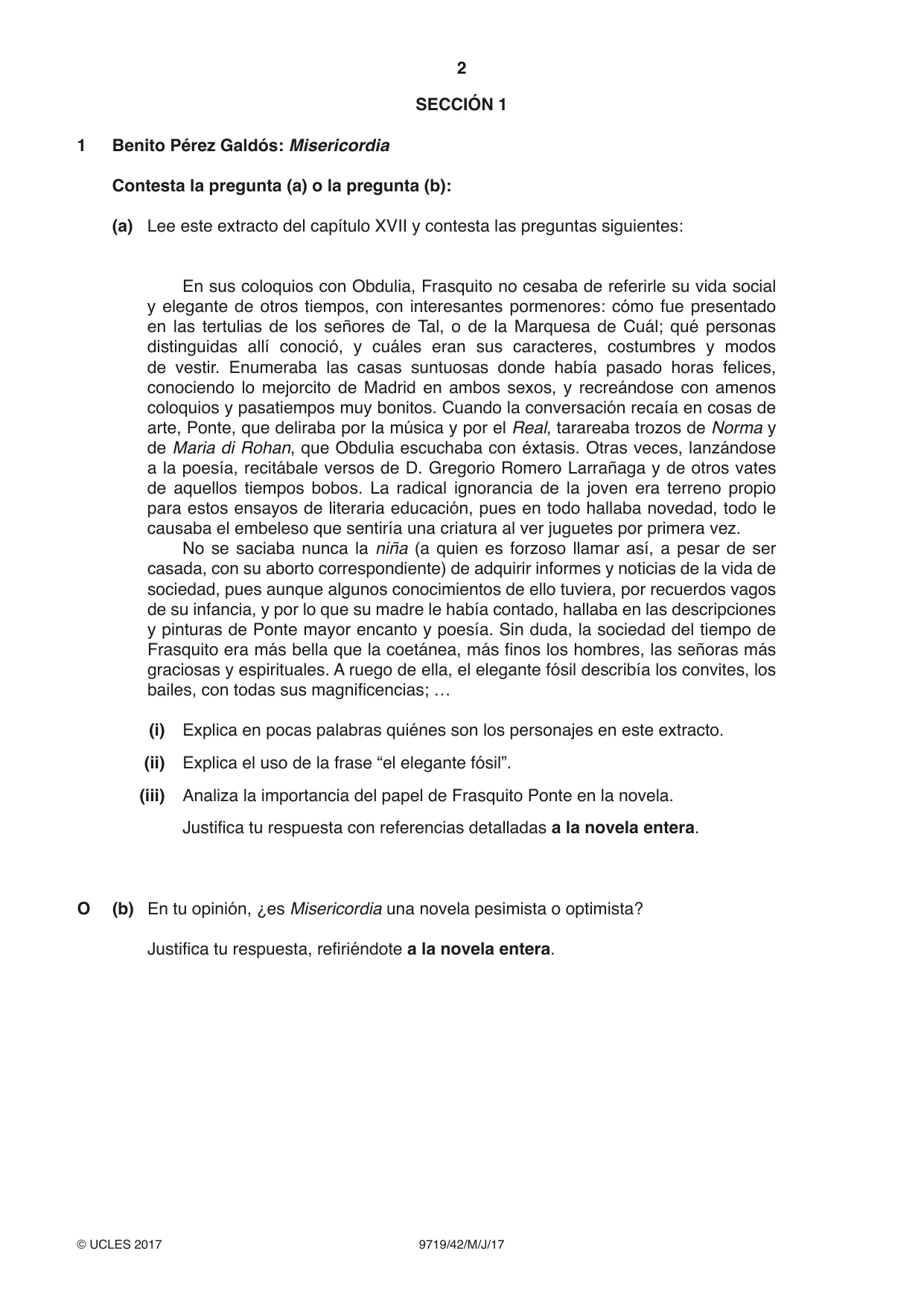
Question paper, page 2
2 9719/42/M/J/17 © UCLES 2017 SECCIÓN 1 1 Benito Pérez Galdós: Misericordia Contesta la pregunta (a) o la pregunta (b): (a) Lee este extracto del capítulo XVII y contesta las preguntas siguientes: En sus coloquios con Obdulia, Frasquito no cesaba de referirle su vida social y elegante de otros tiempos, con interesantes pormenores: cómo fue presentado en las tertulias de los señores de Tal, o de la Marquesa de Cuál; qué personas distinguidas allí conoció, y cuáles eran sus caracteres, costumbres y modos de vestir. Enumeraba las casas suntuosas donde había pasado horas felices, conociendo lo mejorcito de Madrid en ambos sexos, y recreándose con amenos coloquios y pasatiempos muy bonitos. Cuando la conversación recaía en cosas de arte, Ponte, que deliraba por la música y por el Real, tarareaba trozos de Norma y de Maria di Rohan, que Obdulia escuchaba con éxtasis. Otras veces, lanzándose a la poesía, recitábale versos de D. Gregorio Romero Larrañaga y de otros vates de aquellos tiempos bobos. La radical ignorancia de la joven era terreno propio para estos ensayos de literaria educación, pues en todo hallaba novedad, todo le causaba el embeleso que sentiría una criatura al ver juguetes por primera vez. No se saciaba nunca la niña (a quien es forzoso llamar así, a pesar de ser casada, con su aborto correspondiente) de adquirir informes y noticias de la vida de sociedad, pues aunque algunos conocimientos de ello tuviera, por recuerdos vagos de su infancia, y por lo que su madre le había contado, hallaba en las descripciones y pinturas de Ponte mayor encanto y poesía. Sin duda, la sociedad del tiempo de Frasquito era más bella que la coetánea, más finos los hombres, las señoras más graciosas y espirituales. A ruego de ella, el elegante fósil describía los convites, los bailes, con todas sus magnificencias; … (i) Explica en pocas palabras quiénes son los personajes en este extracto. (ii) Explica el uso de la frase “el elegante fósil”. (iii) Analiza la importancia del papel de Frasquito Ponte en la novela. Justifica tu respuesta con referencias detalladas a la novela entera. O (b) En tu opinión, ¿es Misericordia una novela pesimista o optimista? Justifica tu respuesta, refiriéndote a la novela entera.
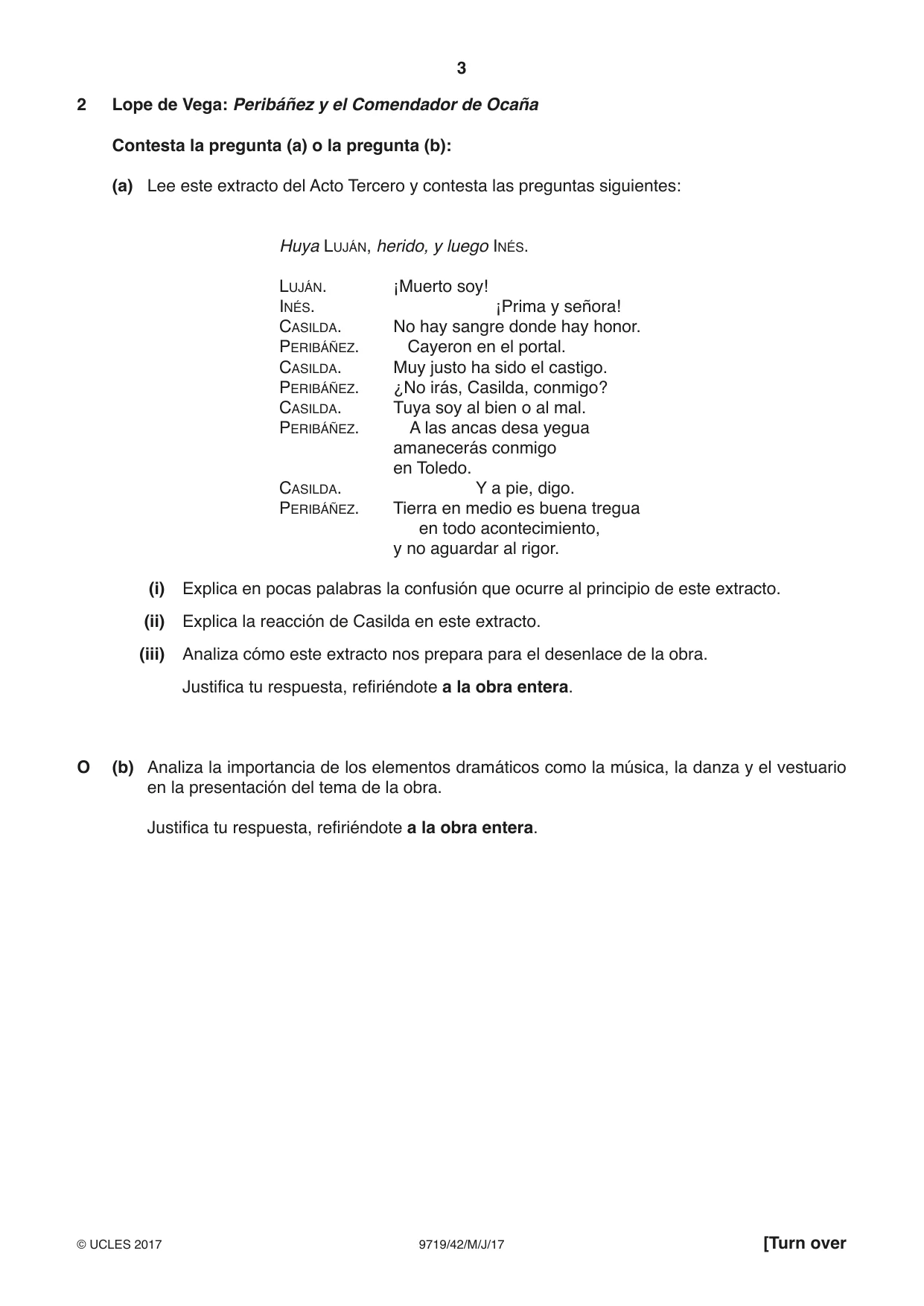
Question paper, page 3
3 9719/42/M/J/17 © UCLES 2017 [Turn over 2 Lope de Vega: Peribáñez y el Comendador de Ocaña Contesta la pregunta (a) o la pregunta (b): (a) Lee este extracto del Acto Tercero y contesta las preguntas siguientes: Huya Luján, herido, y luego Inés. Luján. ¡Muerto soy! Inés. ¡Prima y señora! Casilda. No hay sangre donde hay honor. Peribáñez. Cayeron en el portal. Casilda. Muy justo ha sido el castigo. Peribáñez. ¿No irás, Casilda, conmigo? Casilda. Tuya soy al bien o al mal. Peribáñez. A las ancas desa yegua amanecerás conmigo en Toledo. Casilda. Y a pie, digo. Peribáñez. Tierra en medio es buena tregua en todo acontecimiento, y no aguardar al rigor. (i) Explica en pocas palabras la confusión que ocurre al principio de este extracto. (ii) Explica la reacción de Casilda en este extracto. (iii) Analiza cómo este extracto nos prepara para el desenlace de la obra. Justifica tu respuesta, refiriéndote a la obra entera. O (b) Analiza la importancia de los elementos dramáticos como la música, la danza y el vestuario en la presentación del tema de la obra. Justifica tu respuesta, refiriéndote a la obra entera.
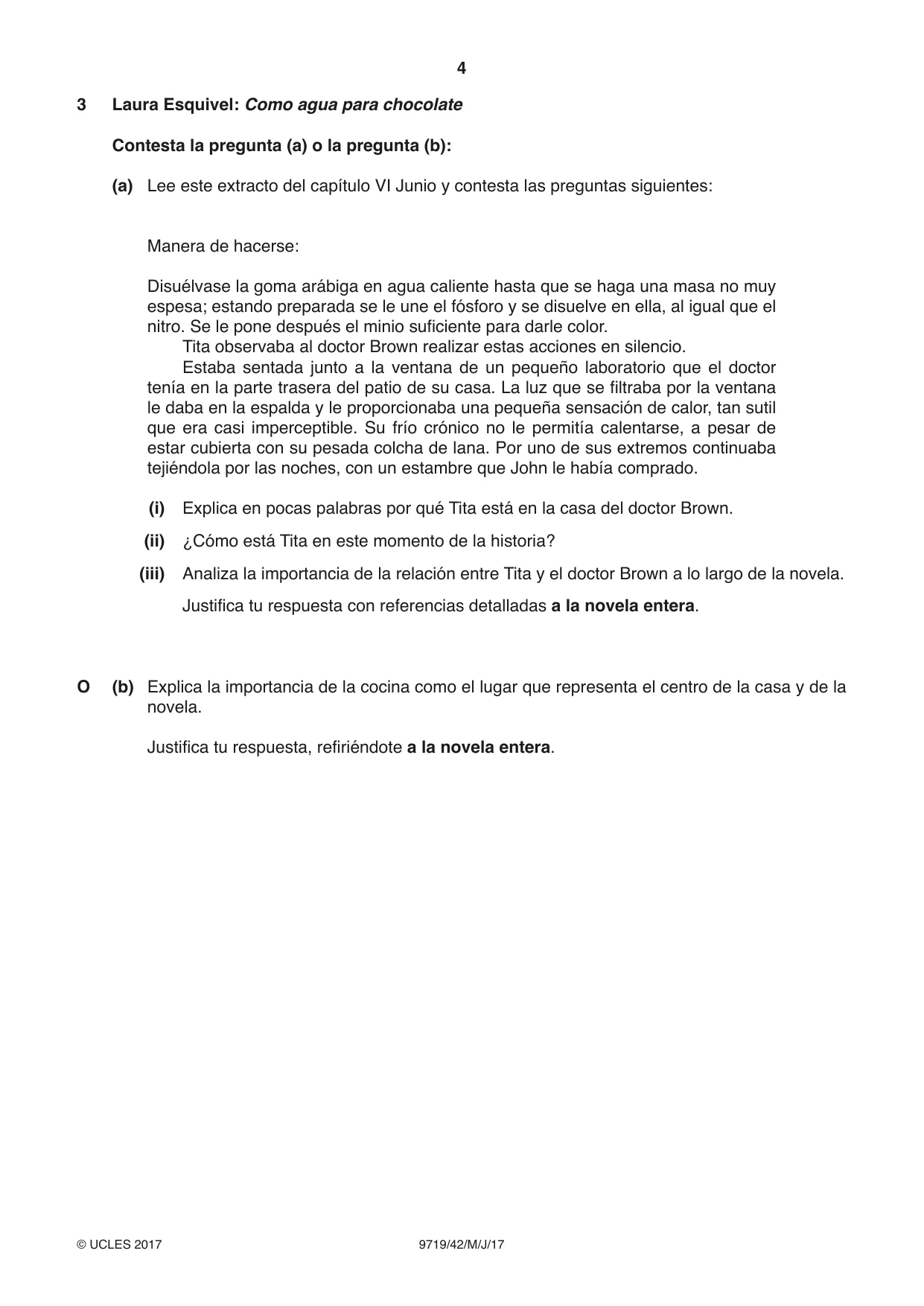
Question paper, page 4
4 9719/42/M/J/17 © UCLES 2017 3 Laura Esquivel: Como agua para chocolate Contesta la pregunta (a) o la pregunta (b): (a) Lee este extracto del capítulo VI Junio y contesta las preguntas siguientes: Manera de hacerse: Disuélvase la goma arábiga en agua caliente hasta que se haga una masa no muy espesa; estando preparada se le une el fósforo y se disuelve en ella, al igual que el nitro. Se le pone después el minio suficiente para darle color. Tita observaba al doctor Brown realizar estas acciones en silencio. Estaba sentada junto a la ventana de un pequeño laboratorio que el doctor tenía en la parte trasera del patio de su casa. La luz que se filtraba por la ventana le daba en la espalda y le proporcionaba una pequeña sensación de calor, tan sutil que era casi imperceptible. Su frío crónico no le permitía calentarse, a pesar de estar cubierta con su pesada colcha de lana. Por uno de sus extremos continuaba tejiéndola por las noches, con un estambre que John le había comprado. (i) Explica en pocas palabras por qué Tita está en la casa del doctor Brown. (ii) ¿Cómo está Tita en este momento de la historia? (iii) Analiza la importancia de la relación entre Tita y el doctor Brown a lo largo de la novela. Justifica tu respuesta con referencias detalladas a la novela entera. O (b) Explica la importancia de la cocina como el lugar que representa el centro de la casa y de la novela. Justifica tu respuesta, refiriéndote a la novela entera.
Question paper, page 5
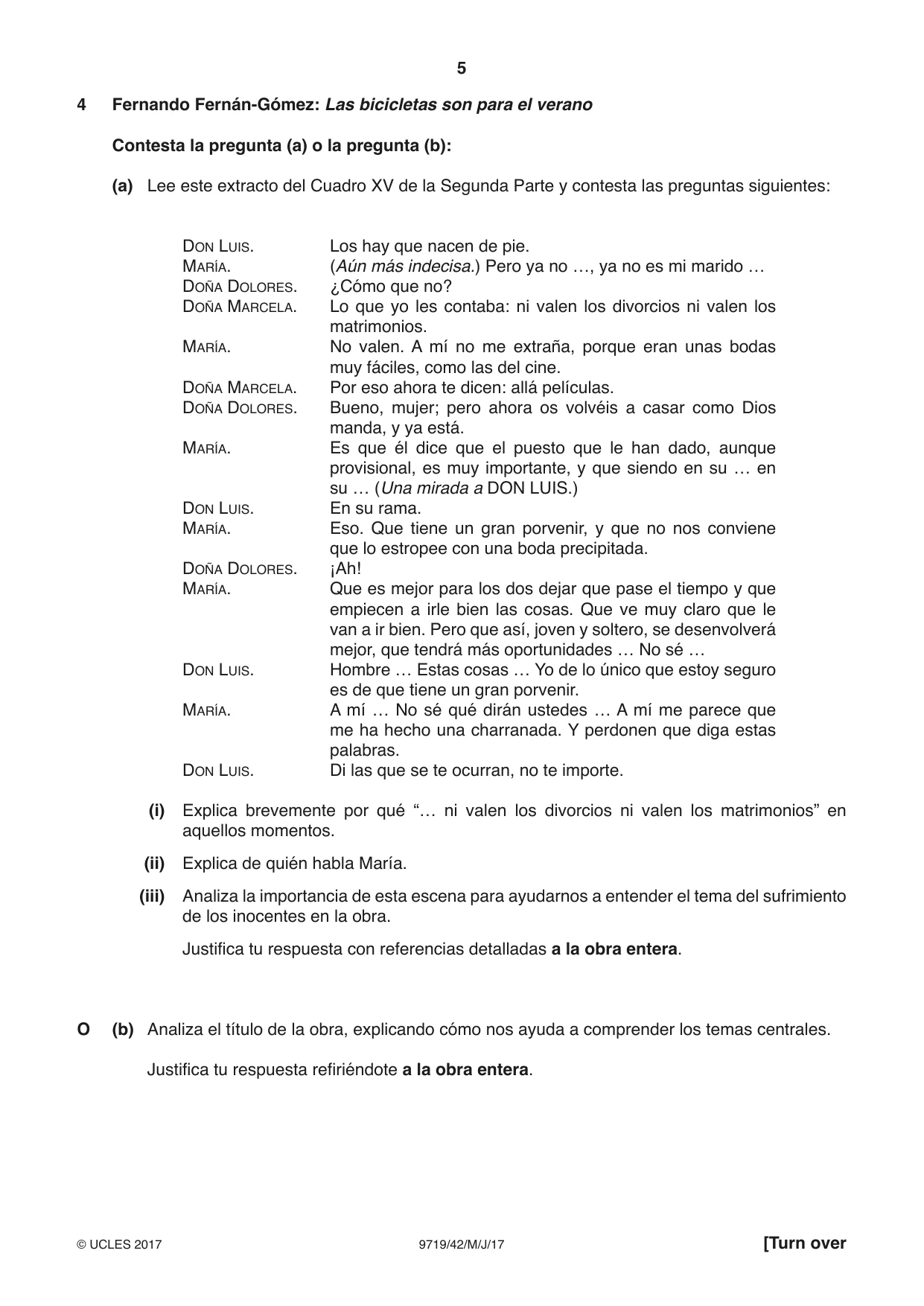
5 9719/42/M/J/17 © UCLES 2017 [Turn over 4 Fernando Fernán-Gómez: Las bicicletas son para el verano Contesta la pregunta (a) o la pregunta (b): (a) Lee este extracto del Cuadro XV de la Segunda Parte y contesta las preguntas siguientes: don luis. los hay que nacen de pie. María. (Aún más indecisa.) Pero ya no …, ya no es mi marido … doña dolores. ¿Cómo que no? doña Marcela. lo que yo les contaba: ni valen los divorcios ni valen los matrimonios. María. No valen. A mí no me extraña, porque eran unas bodas muy fáciles, como las del cine. doña Marcela. Por eso ahora te dicen: allá películas. doña dolores. Bueno, mujer; pero ahora os volvéis a casar como Dios manda, y ya está. María. Es que él dice que el puesto que le han dado, aunque provisional, es muy importante, y que siendo en su … en su … (Una mirada a don luis.) don luis. En su rama. María. Eso. Que tiene un gran porvenir, y que no nos conviene que lo estropee con una boda precipitada. doña dolores. ¡Ah! María. Que es mejor para los dos dejar que pase el tiempo y que empiecen a irle bien las cosas. Que ve muy claro que le van a ir bien. Pero que así, joven y soltero, se desenvolverá mejor, que tendrá más oportunidades … No sé … don luis. Hombre … Estas cosas … Yo de lo único que estoy seguro es de que tiene un gran porvenir. María. A mí … No sé qué dirán ustedes … A mí me parece que me ha hecho una charranada. Y perdonen que diga estas palabras. don luis. Di las que se te ocurran, no te importe. (i) Explica brevemente por qué “… ni valen los divorcios ni valen los matrimonios” en aquellos momentos. (ii) Explica de quién habla María. (iii) Analiza la importancia de esta escena para ayudarnos a entender el tema del sufrimiento de los inocentes en la obra. Justifica tu respuesta con referencias detalladas a la obra entera. O (b) Analiza el título de la obra, explicando cómo nos ayuda a comprender los temas centrales. Justifica tu respuesta refiriéndote a la obra entera.
Question paper, page 6
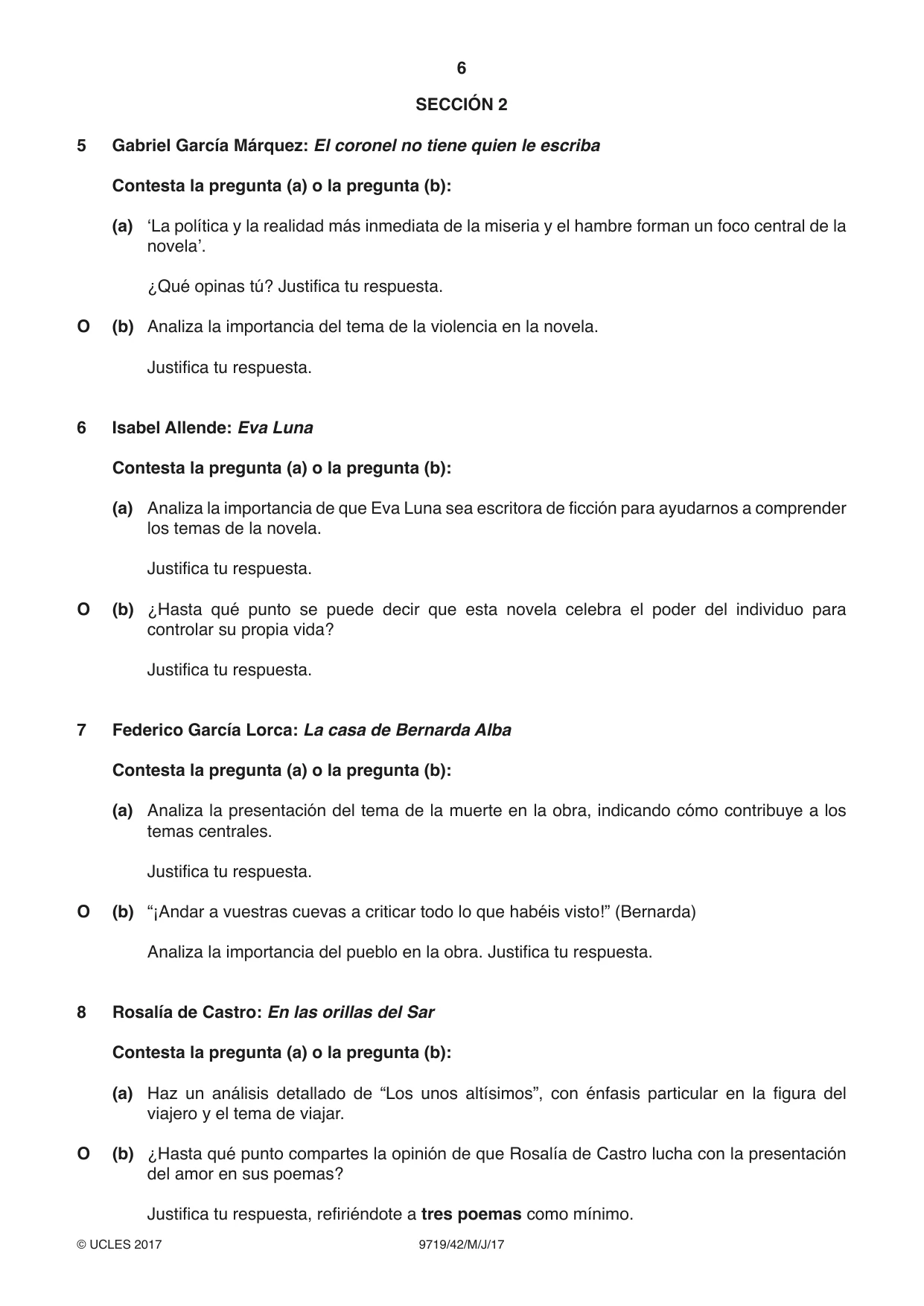
6 9719/42/M/J/17 © UCLES 2017 SECCIÓN 2 5 Gabriel García Márquez: El coronel no tiene quien le escriba Contesta la pregunta (a) o la pregunta (b): (a) ‘La política y la realidad más inmediata de la miseria y el hambre forman un foco central de la novela’. ¿Qué opinas tú? Justifica tu respuesta. O (b) Analiza la importancia del tema de la violencia en la novela. Justifica tu respuesta. 6 Isabel Allende: Eva Luna Contesta la pregunta (a) o la pregunta (b): (a) Analiza la importancia de que Eva Luna sea escritora de ficción para ayudarnos a comprender los temas de la novela. Justifica tu respuesta. O (b) ¿Hasta qué punto se puede decir que esta novela celebra el poder del individuo para controlar su propia vida? Justifica tu respuesta. 7 Federico García Lorca: La casa de Bernarda Alba Contesta la pregunta (a) o la pregunta (b): (a) Analiza la presentación del tema de la muerte en la obra, indicando cómo contribuye a los temas centrales. Justifica tu respuesta. O (b) “¡Andar a vuestras cuevas a criticar todo lo que habéis visto!” (Bernarda) Analiza la importancia del pueblo en la obra. Justifica tu respuesta. 8 Rosalía de Castro: En las orillas del Sar Contesta la pregunta (a) o la pregunta (b): (a) Haz un análisis detallado de “Los unos altísimos”, con énfasis particular en la figura del viajero y el tema de viajar. O (b) ¿Hasta qué punto compartes la opinión de que Rosalía de Castro lucha con la presentación del amor en sus poemas? Justifica tu respuesta, refiriéndote a tres poemas como mínimo.
Question paper, page 7
7 9719/42/M/J/17 © UCLES 2017 BLANK PAGE
Question paper, page 8
8 9719/42/M/J/17 © UCLES 2017 BLANK PAGE Permission to reproduce items where third-party owned material protected by copyright is included has been sought and cleared where possible. Every reasonable effort has been made by the publisher (UCLES) to trace copyright holders, but if any items requiring clearance have unwittingly been included, the publisher will be pleased to make amends at the earliest possible opportunity. To avoid the issue of disclosure of answer-related information to candidates, all copyright acknowledgements are reproduced online in the Cambridge International Examinations Copyright Acknowledgements Booklet. This is produced for each series of examinations and is freely available to download at www.cie.org.uk after the live examination series. Cambridge International Examinations is part of the Cambridge Assessment Group. Cambridge Assessment is the brand name of University of Cambridge Local Examinations Syndicate (UCLES), which is itself a department of the University of Cambridge.
Mark scheme, page 1
® IGCSE is a registered trademark. This document consists of 3 printed pages. © UCLES 2017 [Turn over Cambridge International Examinations Cambridge International Advanced Level SPANISH 9719/42 Paper 4 Texts May/June 2017 MARK SCHEME Maximum Mark: 75 Published This mark scheme is published as an aid to teachers and candidates, to indicate the requirements of the examination. It shows the basis on which Examiners were instructed to award marks. It does not indicate the details of the discussions that took place at an Examiners’ meeting before marking began, which would have considered the acceptability of alternative answers. Mark schemes should be read in conjunction with the question paper and the Principal Examiner Report for Teachers. Cambridge will not enter into discussions about these mark schemes. Cambridge is publishing the mark schemes for the May/June 2017 series for most Cambridge IGCSE®, Cambridge International A and AS Level and Cambridge Pre-U components, and some Cambridge O Level components.
Mark scheme, page 2
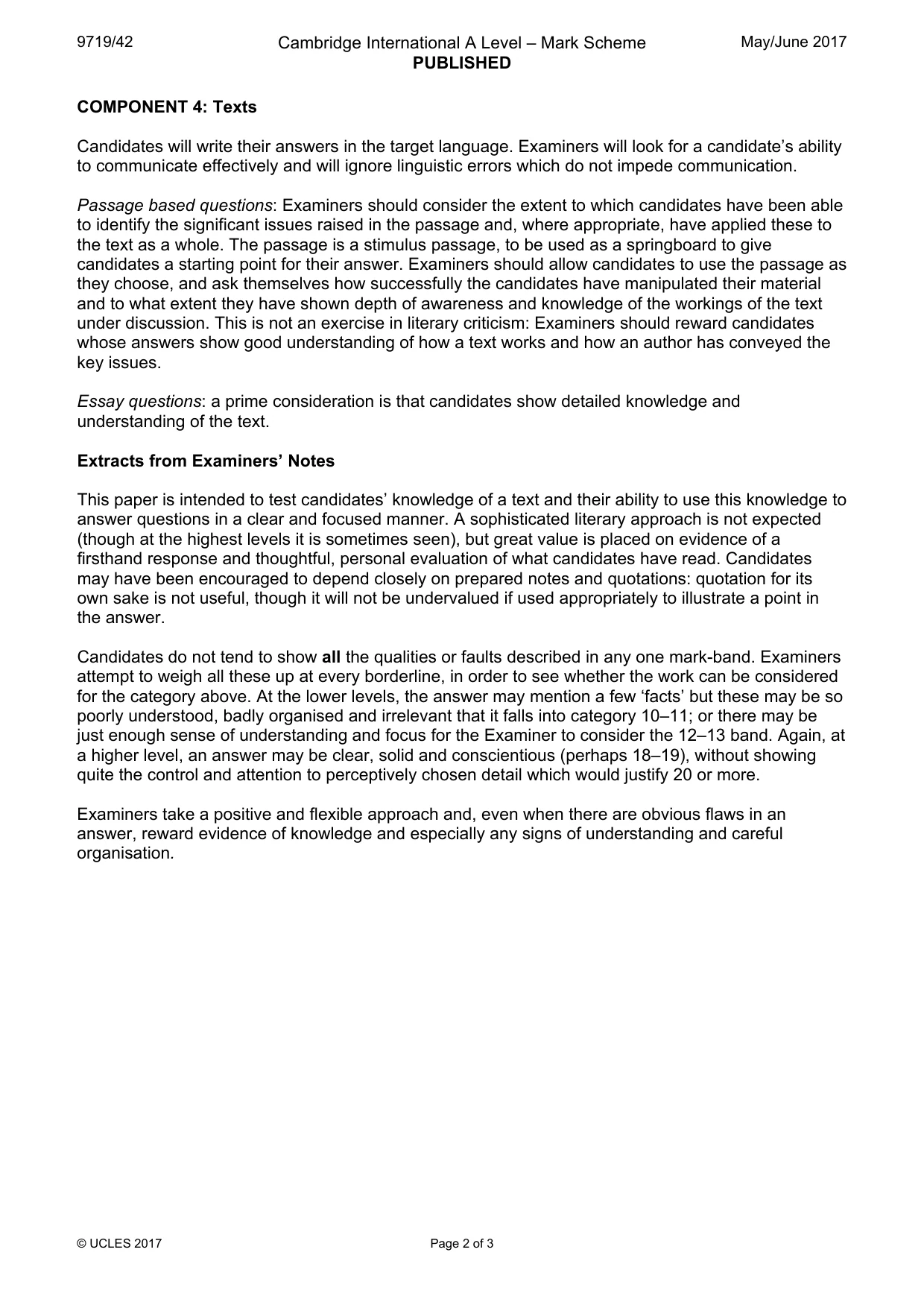
9719/42 Cambridge International A Level – Mark Scheme PUBLISHED May/June 2017 © UCLES 2017 Page 2 of 3 COMPONENT 4: Texts Candidates will write their answers in the target language. Examiners will look for a candidate’s ability to communicate effectively and will ignore linguistic errors which do not impede communication. Passage based questions: Examiners should consider the extent to which candidates have been able to identify the significant issues raised in the passage and, where appropriate, have applied these to the text as a whole. The passage is a stimulus passage, to be used as a springboard to give candidates a starting point for their answer. Examiners should allow candidates to use the passage as they choose, and ask themselves how successfully the candidates have manipulated their material and to what extent they have shown depth of awareness and knowledge of the workings of the text under discussion. This is not an exercise in literary criticism: Examiners should reward candidates whose answers show good understanding of how a text works and how an author has conveyed the key issues. Essay questions: a prime consideration is that candidates show detailed knowledge and understanding of the text. Extracts from Examiners’ Notes This paper is intended to test candidates’ knowledge of a text and their ability to use this knowledge to answer questions in a clear and focused manner. A sophisticated literary approach is not expected (though at the highest levels it is sometimes seen), but great value is placed on evidence of a firsthand response and thoughtful, personal evaluation of what candidates have read. Candidates may have been encouraged to depend closely on prepared notes and quotations: quotation for its own sake is not useful, though it will not be undervalued if used appropriately to illustrate a point in the answer. Candidates do not tend to show all the qualities or faults described in any one mark-band. Examiners attempt to weigh all these up at every borderline, in order to see whether the work can be considered for the category above. At the lower levels, the answer may mention a few ‘facts’ but these may be so poorly understood, badly organised and irrelevant that it falls into category 10–11; or there may be just enough sense of understanding and focus for the Examiner to consider the 12–13 band. Again, at a higher level, an answer may be clear, solid and conscientious (perhaps 18–19), without showing quite the control and attention to perceptively chosen detail which would justify 20 or more. Examiners take a positive and flexible approach and, even when there are obvious flaws in an answer, reward evidence of knowledge and especially any signs of understanding and careful organisation.
Mark scheme, page 3
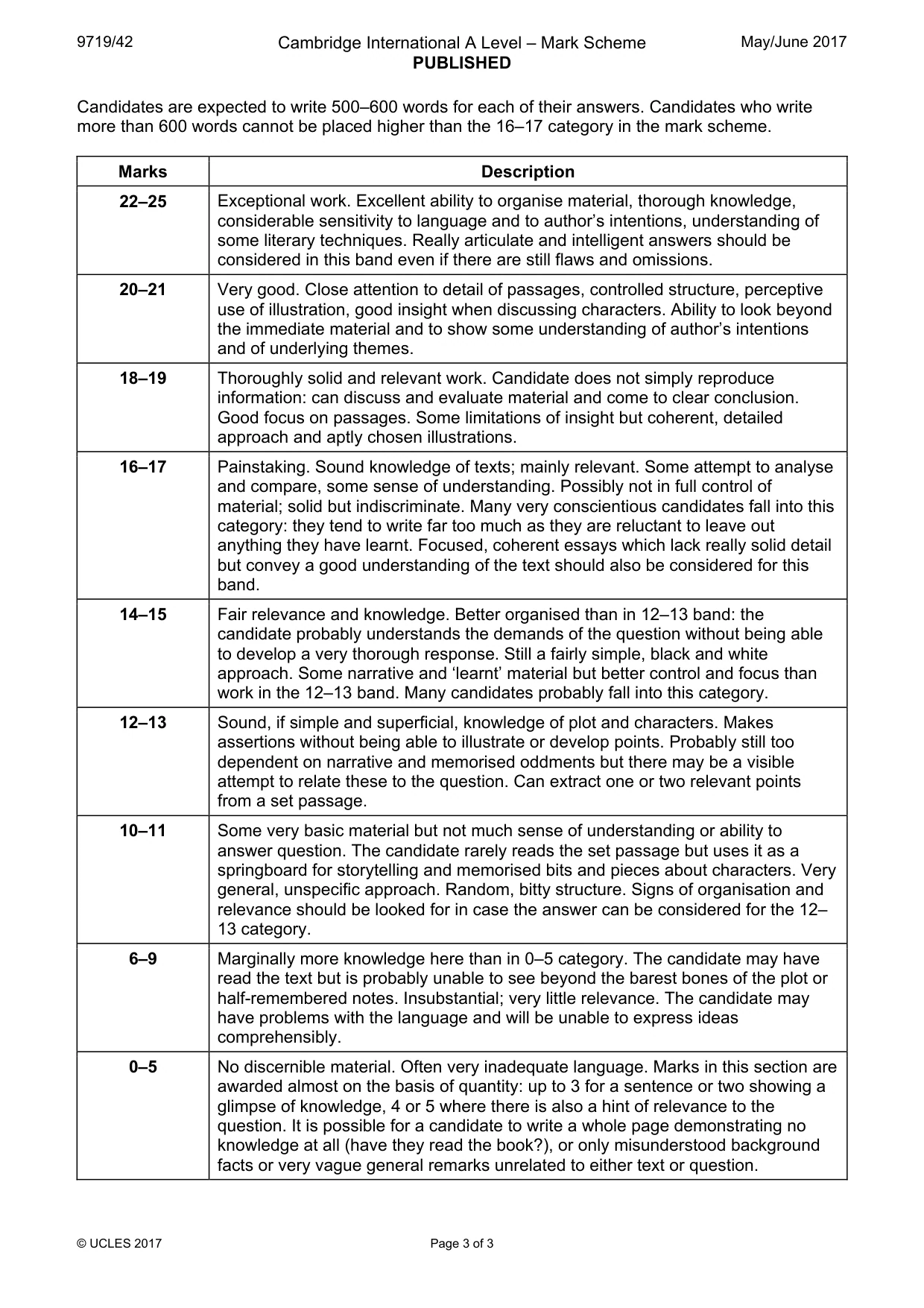
9719/42 Cambridge International A Level – Mark Scheme PUBLISHED May/June 2017 © UCLES 2017 Page 3 of 3 Candidates are expected to write 500–600 words for each of their answers. Candidates who write more than 600 words cannot be placed higher than the 16–17 category in the mark scheme. Marks Description 22–25 Exceptional work. Excellent ability to organise material, thorough knowledge, considerable sensitivity to language and to author’s intentions, understanding of some literary techniques. Really articulate and intelligent answers should be considered in this band even if there are still flaws and omissions. 20–21 Very good. Close attention to detail of passages, controlled structure, perceptive use of illustration, good insight when discussing characters. Ability to look beyond the immediate material and to show some understanding of author’s intentions and of underlying themes. 18–19 Thoroughly solid and relevant work. Candidate does not simply reproduce information: can discuss and evaluate material and come to clear conclusion. Good focus on passages. Some limitations of insight but coherent, detailed approach and aptly chosen illustrations. 16–17 Painstaking. Sound knowledge of texts; mainly relevant. Some attempt to analyse and compare, some sense of understanding. Possibly not in full control of material; solid but indiscriminate. Many very conscientious candidates fall into this category: they tend to write far too much as they are reluctant to leave out anything they have learnt. Focused, coherent essays which lack really solid detail but convey a good understanding of the text should also be considered for this band. 14–15 Fair relevance and knowledge. Better organised than in 12–13 band: the candidate probably understands the demands of the question without being able to develop a very thorough response. Still a fairly simple, black and white approach. Some narrative and ‘learnt’ material but better control and focus than work in the 12–13 band. Many candidates probably fall into this category. 12–13 Sound, if simple and superficial, knowledge of plot and characters. Makes assertions without being able to illustrate or develop points. Probably still too dependent on narrative and memorised oddments but there may be a visible attempt to relate these to the question. Can extract one or two relevant points from a set passage. 10–11 Some very basic material but not much sense of understanding or ability to answer question. The candidate rarely reads the set passage but uses it as a springboard for storytelling and memorised bits and pieces about characters. Very general, unspecific approach. Random, bitty structure. Signs of organisation and relevance should be looked for in case the answer can be considered for the 12– 13 category. 6–9 Marginally more knowledge here than in 0–5 category. The candidate may have read the text but is probably unable to see beyond the barest bones of the plot or half-remembered notes. Insubstantial; very little relevance. The candidate may have problems with the language and will be unable to express ideas comprehensibly. 0–5 No discernible material. Often very inadequate language. Marks in this section are awarded almost on the basis of quantity: up to 3 for a sentence or two showing a glimpse of knowledge, 4 or 5 where there is also a hint of relevance to the question. It is possible for a candidate to write a whole page demonstrating no knowledge at all (have they read the book?), or only misunderstood background facts or very vague general remarks unrelated to either text or question.
What you needed in this session
Cambridge’s own grade thresholds for 2017 May/June, Paper 4 · Variant 2. A higher threshold means an easier paper — the bar moves with how the cohort did.