Cambridge A Level Sociology 9699 — 2022 Oct/Nov Paper 2 · Variant 2
9699/22/O/N/22 · 60 marks · ≈68 min
The question paper and its mark scheme, free to read here and free to download. This is Cambridge’s own paper, exactly as it was sat.
Question paper4 pages

Mark scheme20 pages
Answers below. Sit the paper first if you are practising.
Paper as text
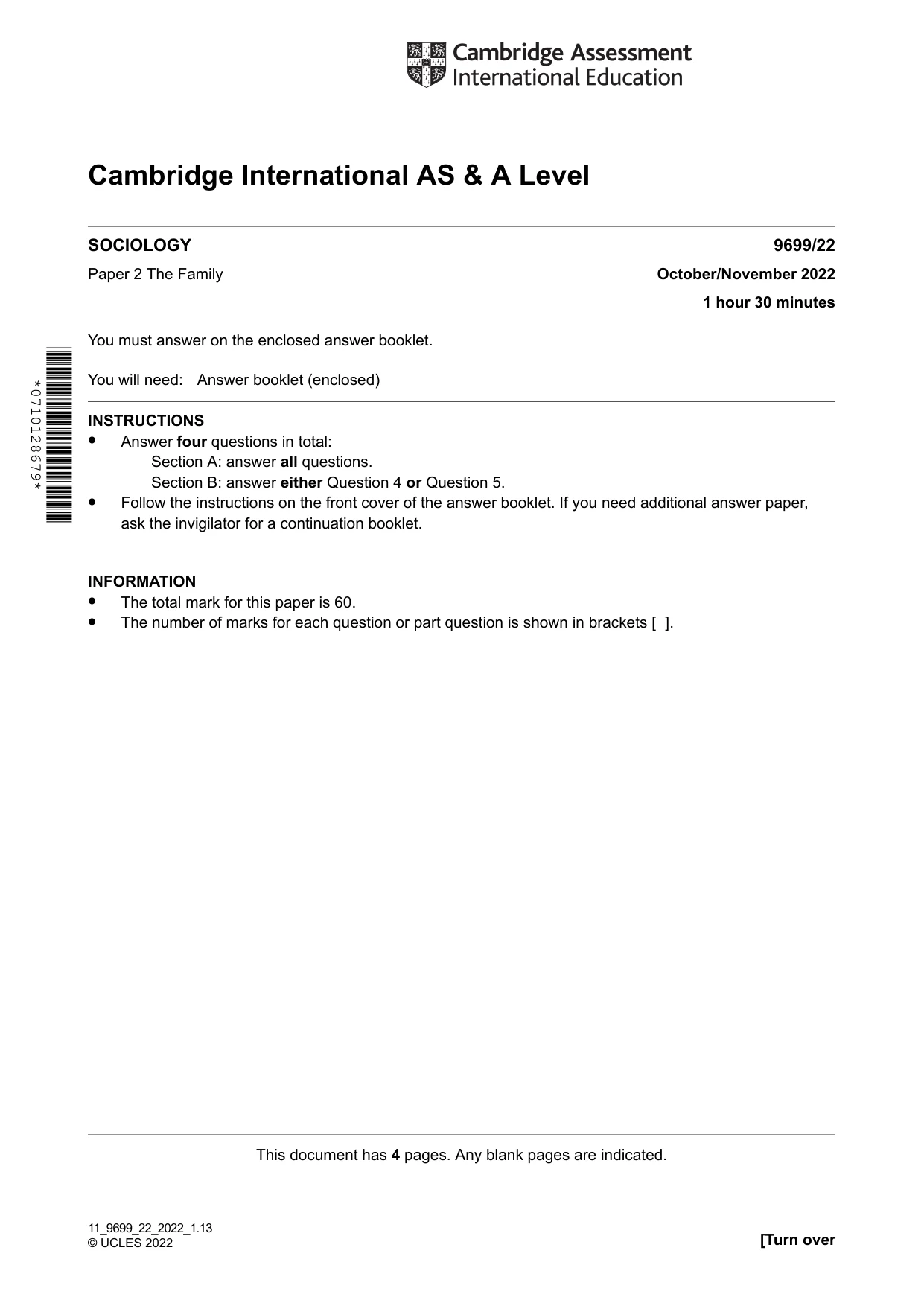
Question paper, page 1
Cambridge International AS & A Level 9699/22 October/November 2022 1 hour 30 minutes SOCIOLOGY Paper 2 The Family You must answer on the enclosed answer booklet. You will need: Answer booklet (enclosed) INSTRUCTIONS • Answer four questions in total: Section A: answer all questions. Section B: answer either Question 4 or Question 5. • Follow the instructions on the front cover of the answer booklet. If you need additional answer paper, ask the invigilator for a continuation booklet. INFORMATION • The total mark for this paper is 60. • The number of marks for each question or part question is shown in brackets [ ]. This document has 4 pages. Any blank pages are indicated. [Turn over 11_9699_22_2022_1.13 © UCLES 2022 *0710128679*
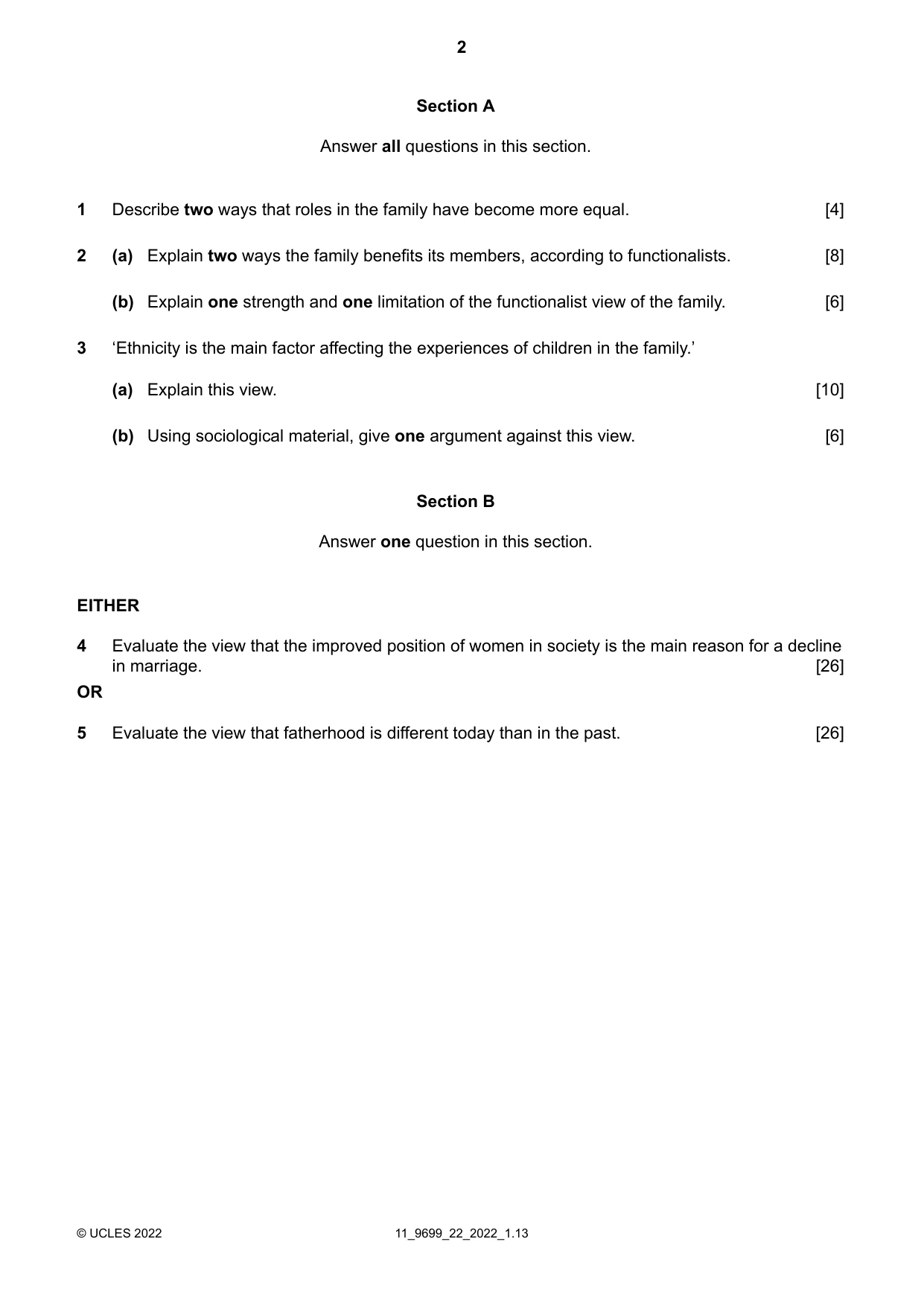
Question paper, page 2
Section A Answer all questions in this section. Describe two ways that roles in the family have become more equal. [4] 1 Explain two ways the family benefits its members, according to functionalists. [8] (a) 2 Explain one strength and one limitation of the functionalist view of the family. [6] (b) ‘Ethnicity is the main factor affecting the experiences of children in the family.’ 3 Explain this view. [10] (a) Using sociological material, give one argument against this view. [6] (b) Section B Answer one question in this section. EITHER Evaluate the view that the improved position of women in society is the main reason for a decline in marriage. [26] 4 OR Evaluate the view that fatherhood is different today than in the past. [26] 5 11_9699_22_2022_1.13 © UCLES 2022 2
Question paper, page 3
BLANK PAGE 11_9699_22_2022_1.13 © UCLES 2022 3
Question paper, page 4
BLANK PAGE Permission to reproduce items where third-party owned material protected by copyright is included has been sought and cleared where possible. Every reasonable effort has been made by the publisher (UCLES) to trace copyright holders, but if any items requiring clearance have unwittingly been included, the publisher will be pleased to make amends at the earliest possible opportunity. To avoid the issue of disclosure of answer-related information to candidates, all copyright acknowledgements are reproduced online in the Cambridge Assessment International Education Copyright Acknowledgements Booklet. This is produced for each series of examinations and is freely available to download at www.cambridgeinternational.org after the live examination series. Cambridge Assessment International Education is part of Cambridge Assessment. Cambridge Assessment is the brand name of the University of Cambridge Local Examinations Syndicate (UCLES), which is a department of the University of Cambridge. 11_9699_22_2022_1.13 © UCLES 2022 4
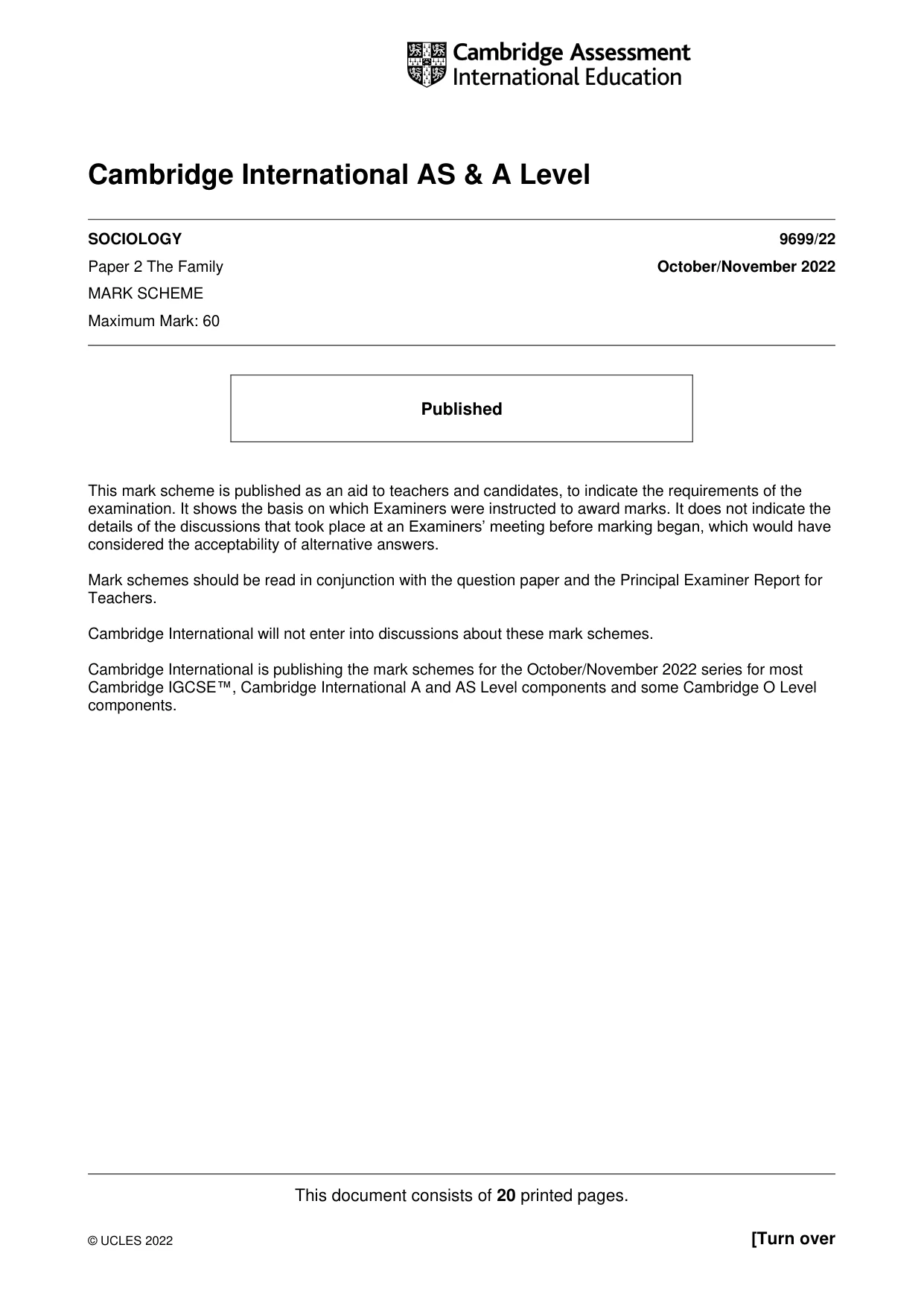
Mark scheme, page 1
This document consists of 20 printed pages. © UCLES 2022 [Turn over Cambridge International AS & A Level SOCIOLOGY 9699/22 Paper 2 The Family October/November 2022 MARK SCHEME Maximum Mark: 60 Published This mark scheme is published as an aid to teachers and candidates, to indicate the requirements of the examination. It shows the basis on which Examiners were instructed to award marks. It does not indicate the details of the discussions that took place at an Examiners’ meeting before marking began, which would have considered the acceptability of alternative answers. Mark schemes should be read in conjunction with the question paper and the Principal Examiner Report for Teachers. Cambridge International will not enter into discussions about these mark schemes. Cambridge International is publishing the mark schemes for the October/November 2022 series for most Cambridge IGCSE™, Cambridge International A and AS Level components and some Cambridge O Level components.
Mark scheme, page 2
9699/22 Cambridge International AS & A Level – Mark Scheme PUBLISHED October/November 2022 © UCLES 2022 Page 2 of 20 Generic Marking Principles These general marking principles must be applied by all examiners when marking candidate answers. They should be applied alongside the specific content of the mark scheme or generic level descriptors for a question. Each question paper and mark scheme will also comply with these marking principles. GENERIC MARKING PRINCIPLE 1: Marks must be awarded in line with: • the specific content of the mark scheme or the generic level descriptors for the question • the specific skills defined in the mark scheme or in the generic level descriptors for the question • the standard of response required by a candidate as exemplified by the standardisation scripts. GENERIC MARKING PRINCIPLE 2: Marks awarded are always whole marks (not half marks, or other fractions). GENERIC MARKING PRINCIPLE 3: Marks must be awarded positively: • marks are awarded for correct/valid answers, as defined in the mark scheme. However, credit is given for valid answers which go beyond the scope of the syllabus and mark scheme, referring to your Team Leader as appropriate • marks are awarded when candidates clearly demonstrate what they know and can do • marks are not deducted for errors • marks are not deducted for omissions • answers should only be judged on the quality of spelling, punctuation and grammar when these features are specifically assessed by the question as indicated by the mark scheme. The meaning, however, should be unambiguous. GENERIC MARKING PRINCIPLE 4: Rules must be applied consistently, e.g. in situations where candidates have not followed instructions or in the application of generic level descriptors. GENERIC MARKING PRINCIPLE 5: Marks should be awarded using the full range of marks defined in the mark scheme for the question (however; the use of the full mark range may be limited according to the quality of the candidate responses seen). GENERIC MARKING PRINCIPLE 6: Marks awarded are based solely on the requirements as defined in the mark scheme. Marks should not be awarded with grade thresholds or grade descriptors in mind.
Mark scheme, page 3
9699/22 Cambridge International AS & A Level – Mark Scheme PUBLISHED October/November 2022 © UCLES 2022 Page 3 of 20 Social Science–Specific Marking Principles (for point-based marking) 1 Components using point-based marking: • Point marking is often used to reward knowledge, understanding and application of skills. We give credit where the candidate’s answer shows relevant knowledge, understanding and application of skills in answering the question. We do not give credit where the answer shows confusion. From this it follows that we: a DO credit answers which are worded differently from the mark scheme if they clearly convey the same meaning (unless the mark scheme requires a specific term) b DO credit alternative answers/examples which are not written in the mark scheme if they are correct c DO credit answers where candidates give more than one correct answer in one prompt/numbered/scaffolded space where extended writing is required rather than list-type answers. For example, questions that require n reasons (e.g. State two reasons …). d DO NOT credit answers simply for using a ‘key term’ unless that is all that is required. (Check for evidence it is understood and not used wrongly.) e DO NOT credit answers which are obviously self-contradicting or trying to cover all possibilities f DO NOT give further credit for what is effectively repetition of a correct point already credited unless the language itself is being tested. This applies equally to ‘mirror statements’ (i.e. polluted/not polluted). 2 Presentation of mark scheme: • Slashes (/) or the word ‘or’ separate alternative ways of making the same point. • Semi colons (;) bullet points (•) or figures in brackets (1) separate different points. • Content in the answer column in brackets is for examiner information/context to clarify the marking but is not required to earn the mark (except Accounting syllabuses where they indicate negative numbers). Using the mark scheme Some of the questions are marked using a point-based system, awarding marks for specific points and accumulating a total mark by adding points. Some of the questions are marked using level of response. For these, the level description represents performance at the top of the level. For levels of response marking you should: • award a mark at the top of the level if all criteria in the level are met • consider the level descriptions across the full range, bearing in mind that it is not necessary for a candidate to give a faultless performance for maximum marks to be awarded within any single category • award marks on a ‘best-fit’ basis; thus, compensation between higher and lower achievement for different criteria is acceptable. For Question 4 and Question 5, award a mark for each assessment objective separately, using the level descriptions at the end of the mark scheme. In some cases, candidates may provide a response which the mark scheme has not predicted. These answers should nevertheless be credited according to their quality
Mark scheme, page 4
9699/22 Cambridge International AS & A Level – Mark Scheme PUBLISHED October/November 2022 © UCLES 2022 Page 4 of 20 Question Answer Marks 1 Describe two ways that roles in the family have become more equal. Indicative content • Men taking on a greater share of housework/growth of ‘New Man’ – women no longer burdened with doing most/all of the housework • Men have a more active role in childcare/growth in ‘new dads’ – responsibility for childcare is now less likely to fall solely on the woman/mother • Females taking a more active role in decision making – has reduced the influence of patriarchy on the family • Increasingly women are becoming breadwinners alongside the men – has given women more power/greater decision making in the relationship • Children and parents have a more egalitarian relationship – children are less likely to considered as powerless/children have a greater role in decision making • Increase in joint conjugal roles/symmetrical families – men and women are sharing traditional instrumental/expressive roles more equally • Growth in dual income families – men and women are both breadwinners for the family • Any other appropriate way Reward a maximum of two ways. For each, up to 2 marks are available: 1 mark for identifying a way that roles have become more equal. 1 mark for describing how the way has led to greater equality. (2 2 marks) 4
Mark scheme, page 5
9699/22 Cambridge International AS & A Level – Mark Scheme PUBLISHED October/November 2022 © UCLES 2022 Page 5 of 20 Question Answer Marks 2(a) Explain two ways the family benefits its members, according to functionalists. Indicative content • Comforts the breadwinner/acts as a warm bath/safety valve – ensure they are destressed and fit for work/promotes emotional well-being of its members by helping them release stresses/tension • stabilises adult personalities – family provides an outlet for adults to express their childish whims • Socialisation of children – ensure they become functional members in society • Satisfaction/regulation of sex drive – ensuring sexual desires are satisfied • Fulfils basic/economic needs – ensure survival of family members • Family acts as a bridge – connects the individual from the micro world of the family to the macro world of a wider economic society (Horwitz) • Carrying out of instrumental and expressive roles – ensures the family functions effectively for its members • Any other appropriate way For this question, use of sociological material is likely to be demonstrated through references to functionalist sociologists e.g. Murdock, Parsons and concepts such as warm bath, primary socialisation etc. Reward a maximum of two ways. Up to 4 marks are available for each way. 1 mark for making a point/giving a way (e.g. the family provides comfort). 1 mark for explaining that point (e.g. the family acts to relieve the pressures of work, to soothe and relax the breadwinner). 1 mark for selecting relevant sociological material (e.g. Parsons’ warm bath theory). 1 mark for explaining how the material supports the point (e.g. men can immerse themselves into family life, relieving the pressures and strains of work). (2 4 marks) 8
Mark scheme, page 6
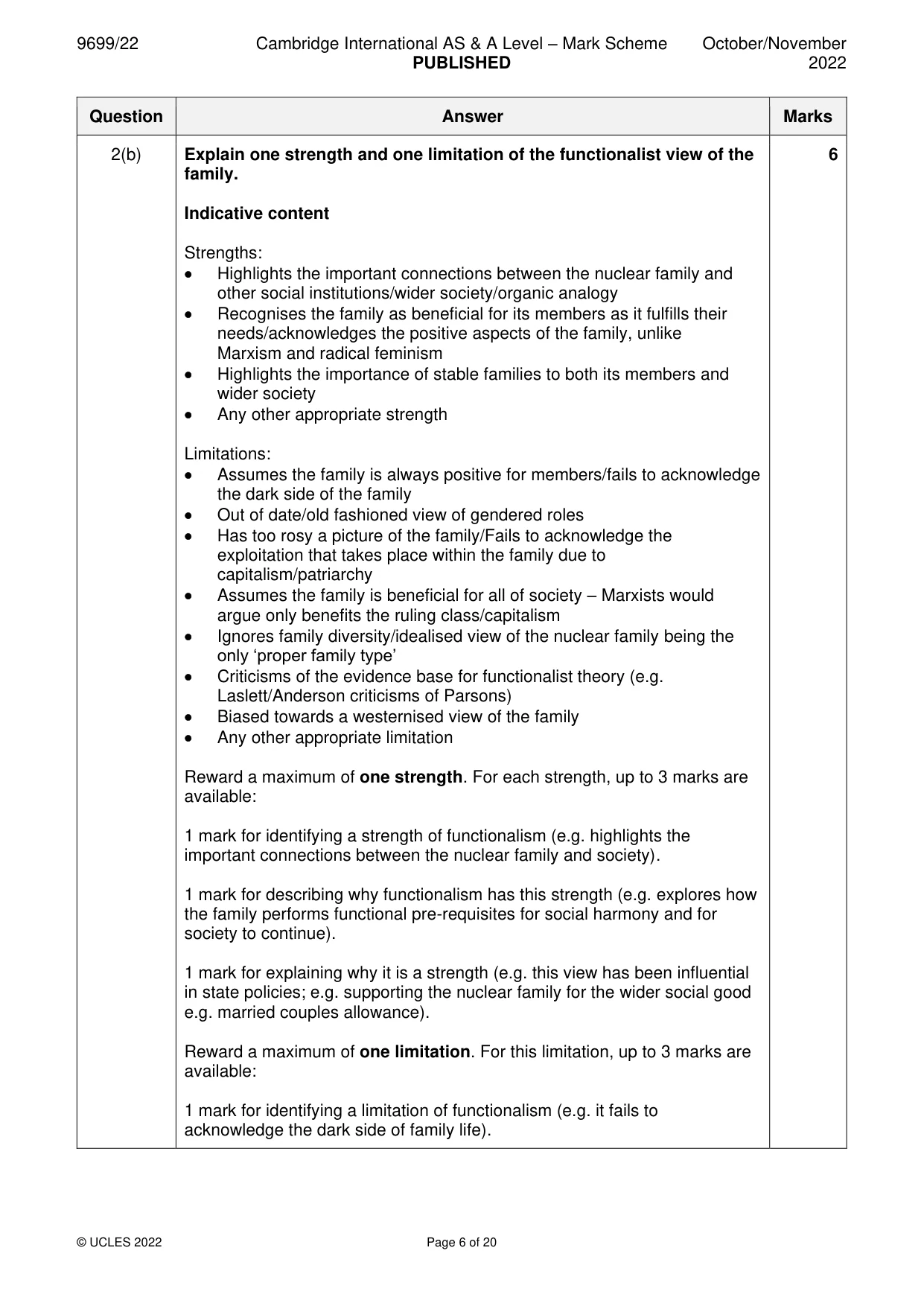
9699/22 Cambridge International AS & A Level – Mark Scheme PUBLISHED October/November 2022 © UCLES 2022 Page 6 of 20 Question Answer Marks 2(b) Explain one strength and one limitation of the functionalist view of the family. Indicative content Strengths: • Highlights the important connections between the nuclear family and other social institutions/wider society/organic analogy • Recognises the family as beneficial for its members as it fulfills their needs/acknowledges the positive aspects of the family, unlike Marxism and radical feminism • Highlights the importance of stable families to both its members and wider society • Any other appropriate strength Limitations: • Assumes the family is always positive for members/fails to acknowledge the dark side of the family • Out of date/old fashioned view of gendered roles • Has too rosy a picture of the family/Fails to acknowledge the exploitation that takes place within the family due to capitalism/patriarchy • Assumes the family is beneficial for all of society – Marxists would argue only benefits the ruling class/capitalism • Ignores family diversity/idealised view of the nuclear family being the only ‘proper family type’ • Criticisms of the evidence base for functionalist theory (e.g. Laslett/Anderson criticisms of Parsons) • Biased towards a westernised view of the family • Any other appropriate limitation Reward a maximum of one strength. For each strength, up to 3 marks are available: 1 mark for identifying a strength of functionalism (e.g. highlights the important connections between the nuclear family and society). 1 mark for describing why functionalism has this strength (e.g. explores how the family performs functional pre-requisites for social harmony and for society to continue). 1 mark for explaining why it is a strength (e.g. this view has been influential in state policies; e.g. supporting the nuclear family for the wider social good e.g. married couples allowance). Reward a maximum of one limitation. For this limitation, up to 3 marks are available: 1 mark for identifying a limitation of functionalism (e.g. it fails to acknowledge the dark side of family life). 6
Mark scheme, page 7
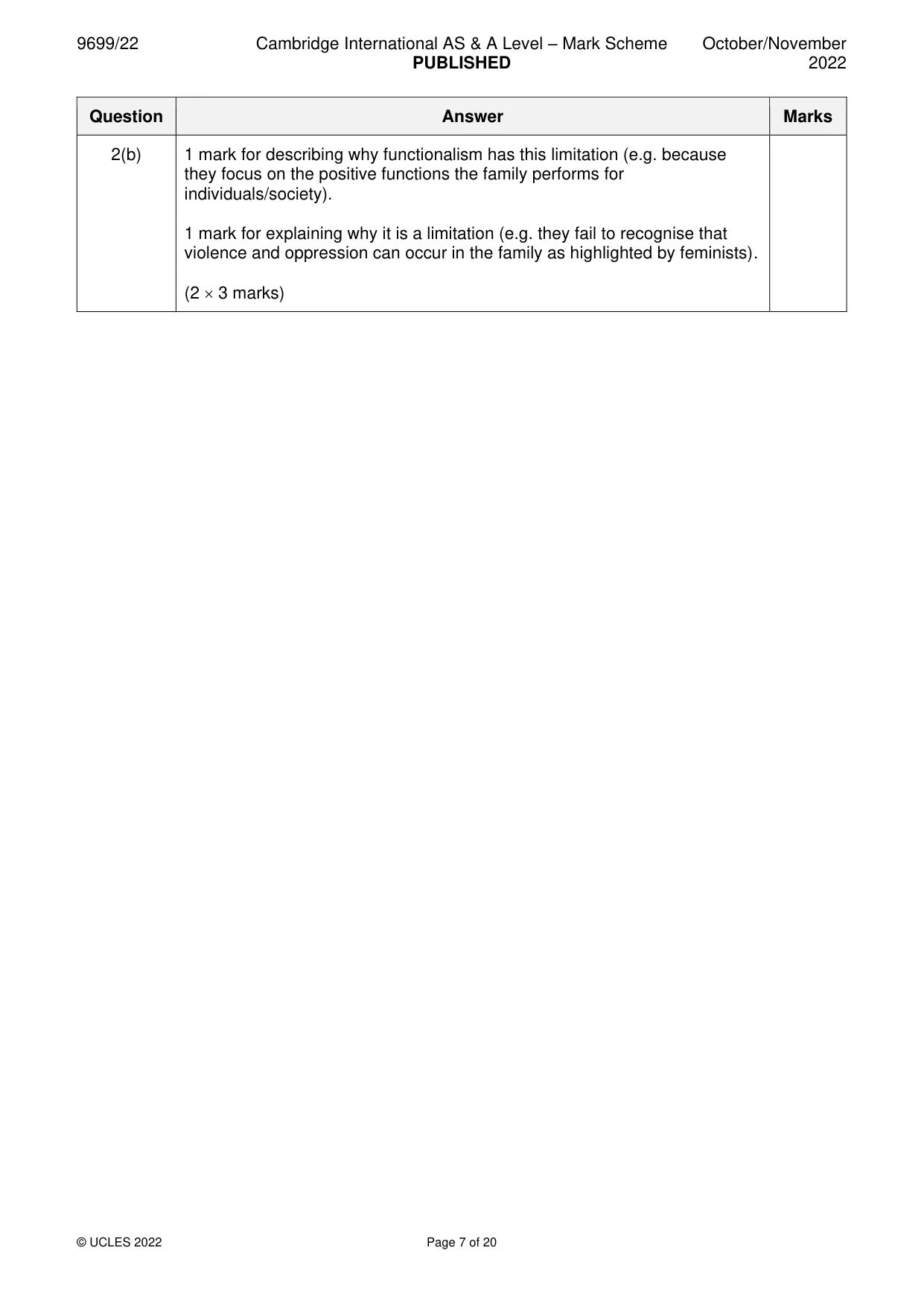
9699/22 Cambridge International AS & A Level – Mark Scheme PUBLISHED October/November 2022 © UCLES 2022 Page 7 of 20 Question Answer Marks 2(b) 1 mark for describing why functionalism has this limitation (e.g. because they focus on the positive functions the family performs for individuals/society). 1 mark for explaining why it is a limitation (e.g. they fail to recognise that violence and oppression can occur in the family as highlighted by feminists). (2 3 marks)
Mark scheme, page 8
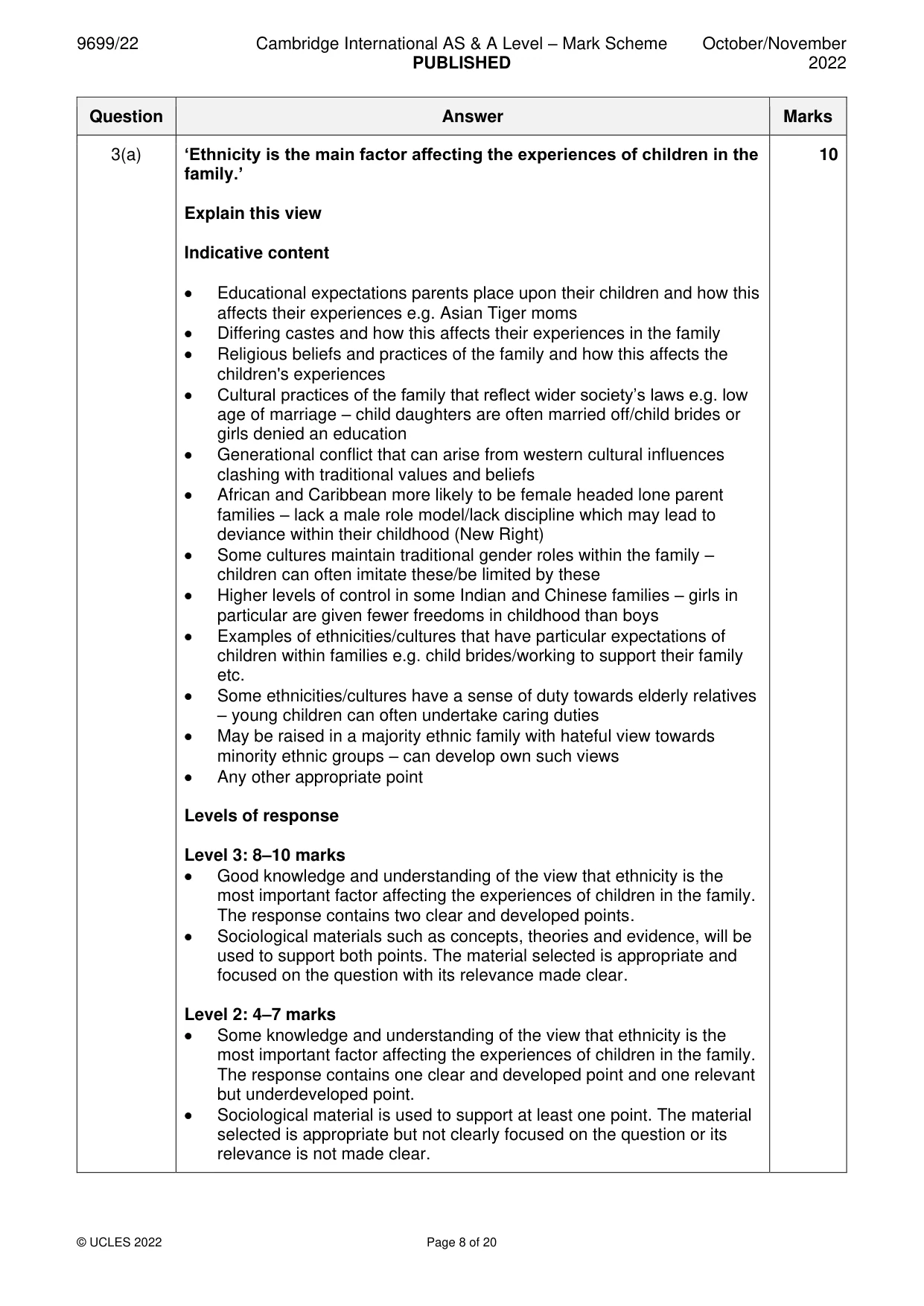
9699/22 Cambridge International AS & A Level – Mark Scheme PUBLISHED October/November 2022 © UCLES 2022 Page 8 of 20 Question Answer Marks 3(a) ‘Ethnicity is the main factor affecting the experiences of children in the family.’ Explain this view Indicative content • Educational expectations parents place upon their children and how this affects their experiences e.g. Asian Tiger moms • Differing castes and how this affects their experiences in the family • Religious beliefs and practices of the family and how this affects the children's experiences • Cultural practices of the family that reflect wider society’s laws e.g. low age of marriage – child daughters are often married off/child brides or girls denied an education • Generational conflict that can arise from western cultural influences clashing with traditional values and beliefs • African and Caribbean more likely to be female headed lone parent families – lack a male role model/lack discipline which may lead to deviance within their childhood (New Right) • Some cultures maintain traditional gender roles within the family – children can often imitate these/be limited by these • Higher levels of control in some Indian and Chinese families – girls in particular are given fewer freedoms in childhood than boys • Examples of ethnicities/cultures that have particular expectations of children within families e.g. child brides/working to support their family etc. • Some ethnicities/cultures have a sense of duty towards elderly relatives – young children can often undertake caring duties • May be raised in a majority ethnic family with hateful view towards minority ethnic groups – can develop own such views • Any other appropriate point Levels of response Level 3: 8–10 marks • Good knowledge and understanding of the view that ethnicity is the most important factor affecting the experiences of children in the family. The response contains two clear and developed points. • Sociological materials such as concepts, theories and evidence, will be used to support both points. The material selected is appropriate and focused on the question with its relevance made clear. Level 2: 4–7 marks • Some knowledge and understanding of the view that ethnicity is the most important factor affecting the experiences of children in the family. The response contains one clear and developed point and one relevant but underdeveloped point. • Sociological material is used to support at least one point. The material selected is appropriate but not clearly focused on the question or its relevance is not made clear. 10
Mark scheme, page 9
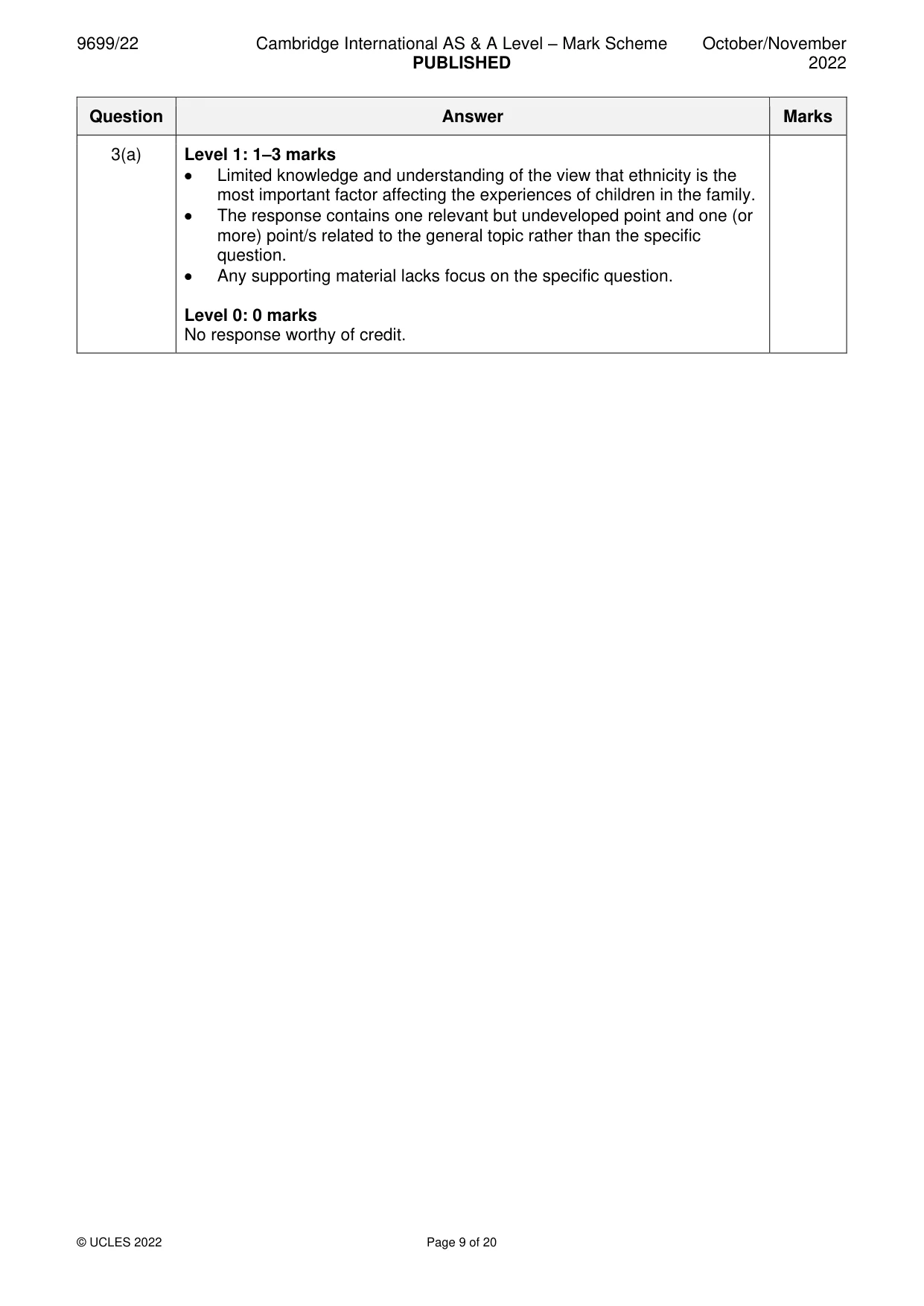
9699/22 Cambridge International AS & A Level – Mark Scheme PUBLISHED October/November 2022 © UCLES 2022 Page 9 of 20 Question Answer Marks 3(a) Level 1: 1–3 marks • Limited knowledge and understanding of the view that ethnicity is the most important factor affecting the experiences of children in the family. • The response contains one relevant but undeveloped point and one (or more) point/s related to the general topic rather than the specific question. • Any supporting material lacks focus on the specific question. Level 0: 0 marks No response worthy of credit.
Mark scheme, page 10
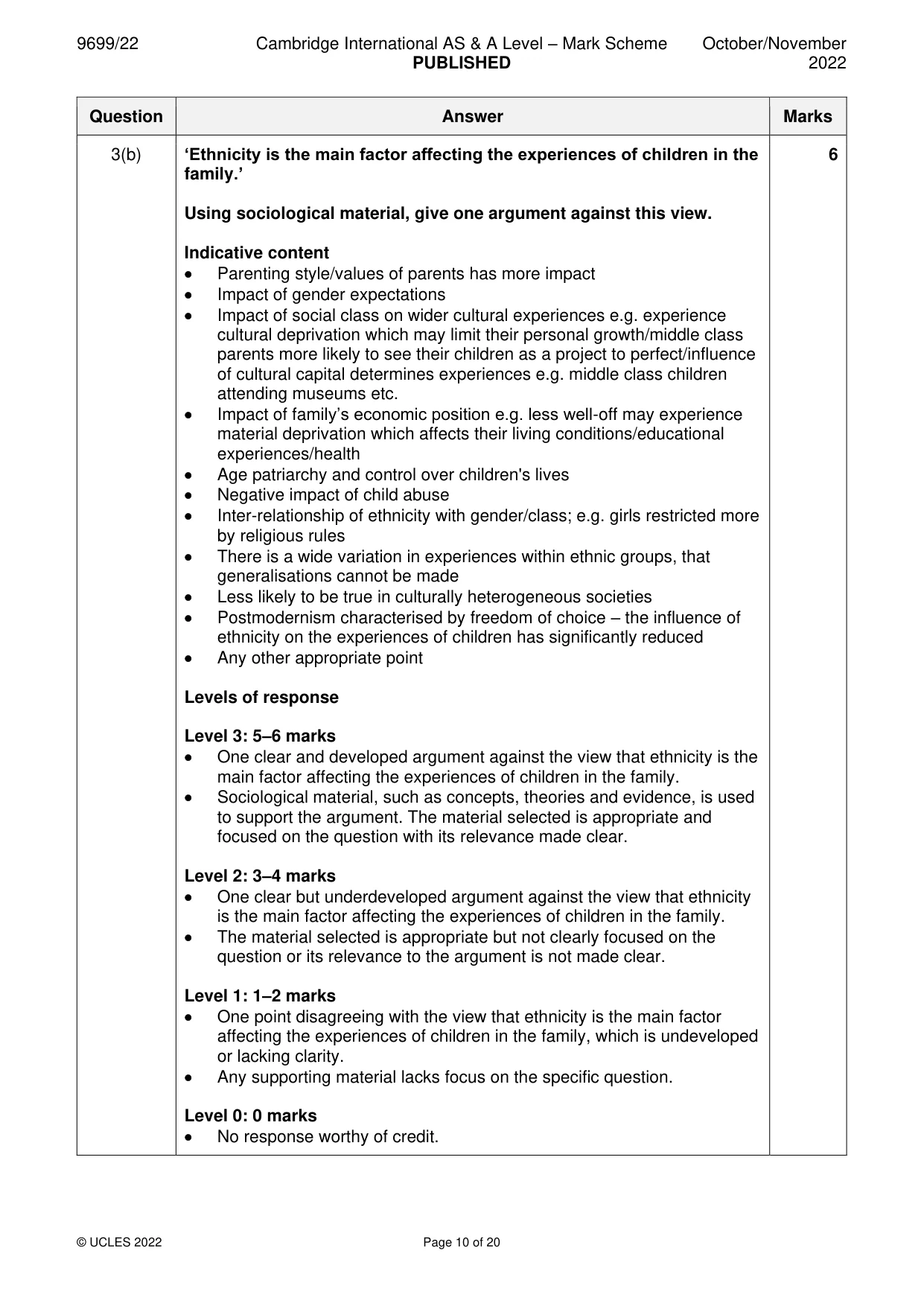
9699/22 Cambridge International AS & A Level – Mark Scheme PUBLISHED October/November 2022 © UCLES 2022 Page 10 of 20 Question Answer Marks 3(b) ‘Ethnicity is the main factor affecting the experiences of children in the family.’ Using sociological material, give one argument against this view. Indicative content • Parenting style/values of parents has more impact • Impact of gender expectations • Impact of social class on wider cultural experiences e.g. experience cultural deprivation which may limit their personal growth/middle class parents more likely to see their children as a project to perfect/influence of cultural capital determines experiences e.g. middle class children attending museums etc. • Impact of family’s economic position e.g. less well-off may experience material deprivation which affects their living conditions/educational experiences/health • Age patriarchy and control over children's lives • Negative impact of child abuse • Inter-relationship of ethnicity with gender/class; e.g. girls restricted more by religious rules • There is a wide variation in experiences within ethnic groups, that generalisations cannot be made • Less likely to be true in culturally heterogeneous societies • Postmodernism characterised by freedom of choice – the influence of ethnicity on the experiences of children has significantly reduced • Any other appropriate point Levels of response Level 3: 5–6 marks • One clear and developed argument against the view that ethnicity is the main factor affecting the experiences of children in the family. • Sociological material, such as concepts, theories and evidence, is used to support the argument. The material selected is appropriate and focused on the question with its relevance made clear. Level 2: 3–4 marks • One clear but underdeveloped argument against the view that ethnicity is the main factor affecting the experiences of children in the family. • The material selected is appropriate but not clearly focused on the question or its relevance to the argument is not made clear. Level 1: 1–2 marks • One point disagreeing with the view that ethnicity is the main factor affecting the experiences of children in the family, which is undeveloped or lacking clarity. • Any supporting material lacks focus on the specific question. Level 0: 0 marks • No response worthy of credit. 6
Mark scheme, page 11
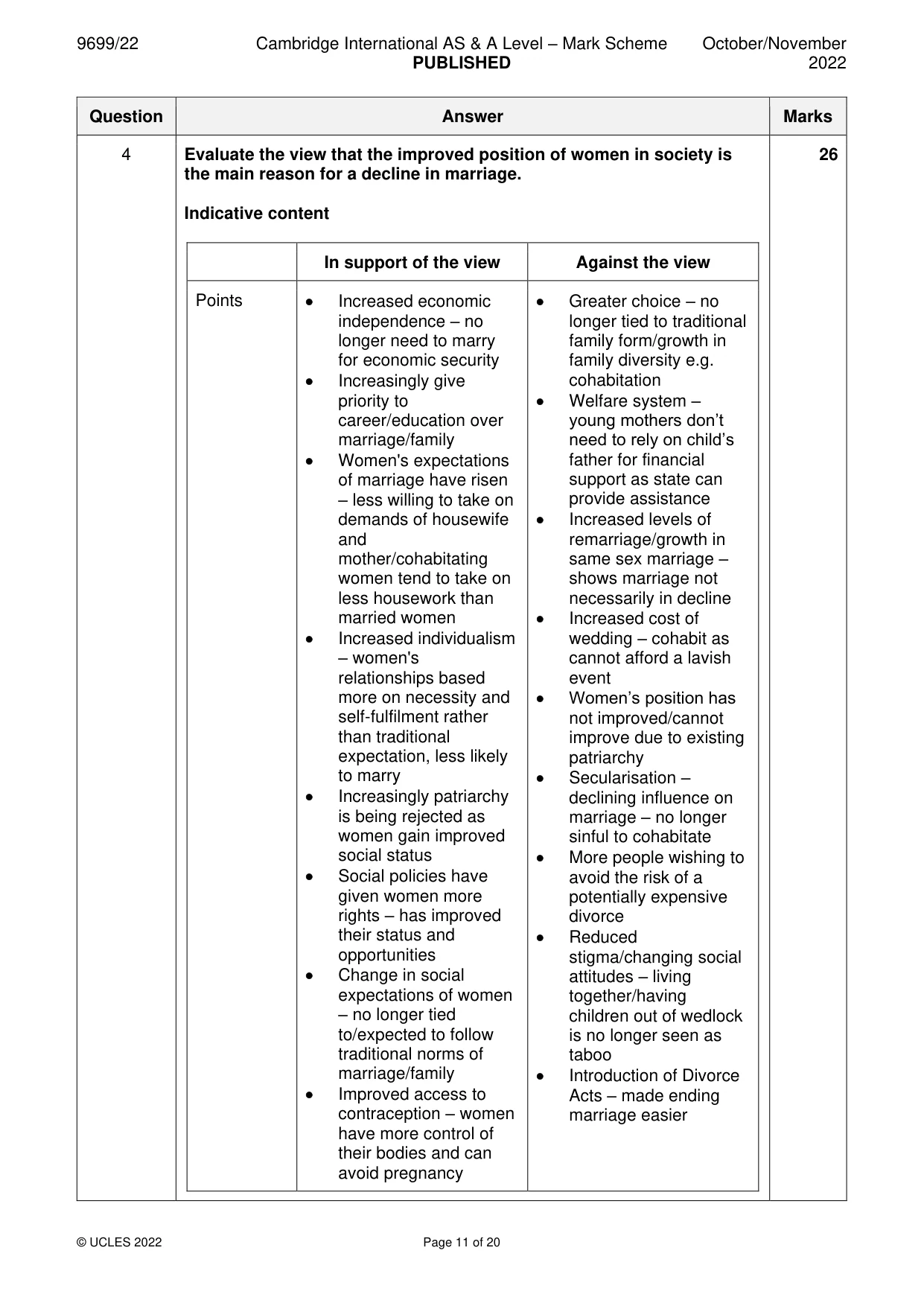
9699/22 Cambridge International AS & A Level – Mark Scheme PUBLISHED October/November 2022 © UCLES 2022 Page 11 of 20 Question Answer Marks 4 Evaluate the view that the improved position of women in society is the main reason for a decline in marriage. Indicative content In support of the view Against the view Points • Increased economic independence – no longer need to marry for economic security • Increasingly give priority to career/education over marriage/family • Women's expectations of marriage have risen – less willing to take on demands of housewife and mother/cohabitating women tend to take on less housework than married women • Increased individualism – women's relationships based more on necessity and self-fulfilment rather than traditional expectation, less likely to marry • Increasingly patriarchy is being rejected as women gain improved social status • Social policies have given women more rights – has improved their status and opportunities • Change in social expectations of women – no longer tied to/expected to follow traditional norms of marriage/family • Improved access to contraception – women have more control of their bodies and can avoid pregnancy • Greater choice – no longer tied to traditional family form/growth in family diversity e.g. cohabitation • Welfare system – young mothers don’t need to rely on child’s father for financial support as state can provide assistance • Increased levels of remarriage/growth in same sex marriage – shows marriage not necessarily in decline • Increased cost of wedding – cohabit as cannot afford a lavish event • Women’s position has not improved/cannot improve due to existing patriarchy • Secularisation – declining influence on marriage – no longer sinful to cohabitate • More people wishing to avoid the risk of a potentially expensive divorce • Reduced stigma/changing social attitudes – living together/having children out of wedlock is no longer seen as taboo • Introduction of Divorce Acts – made ending marriage easier 26
Mark scheme, page 12
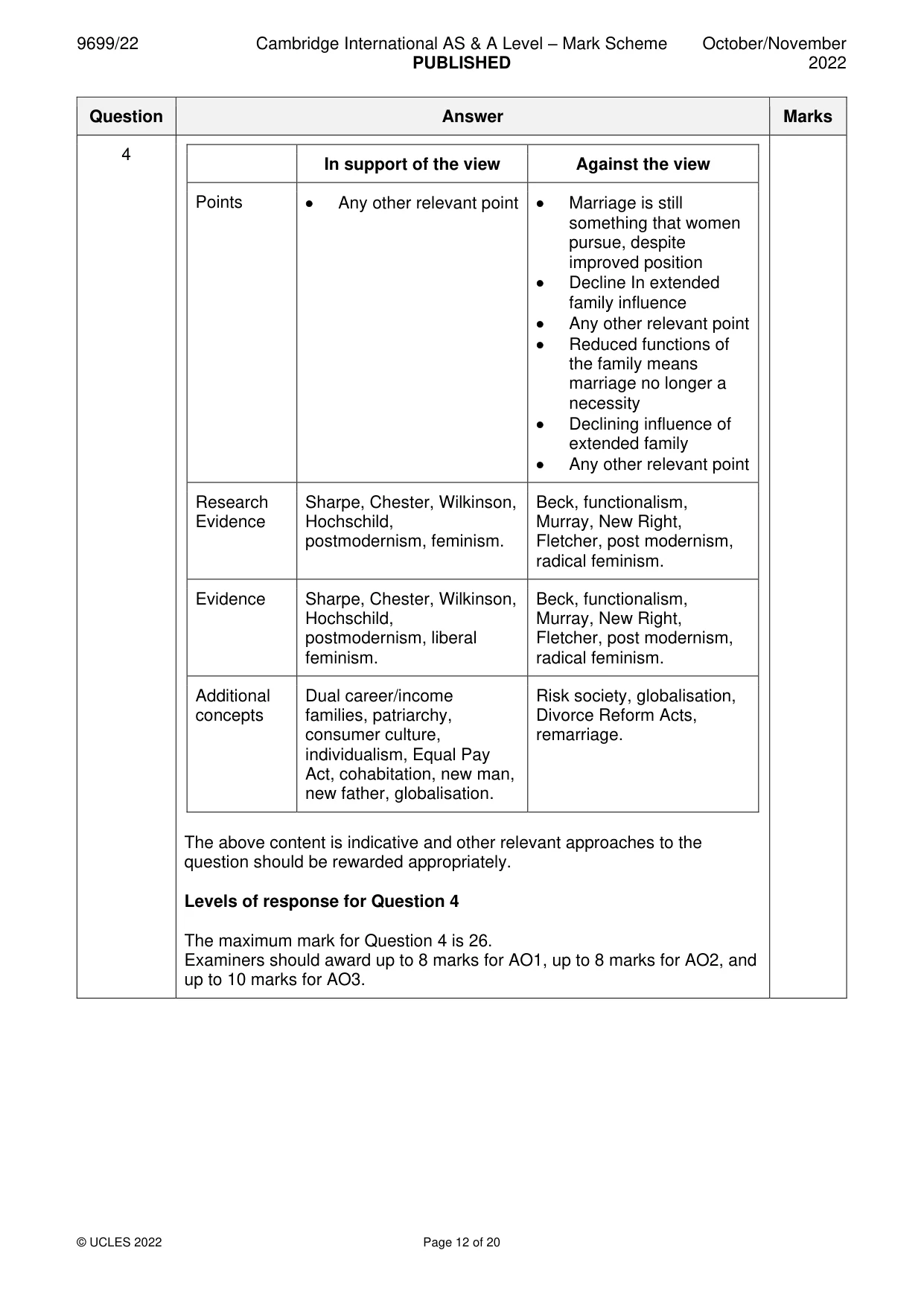
9699/22 Cambridge International AS & A Level – Mark Scheme PUBLISHED October/November 2022 © UCLES 2022 Page 12 of 20 Question Answer Marks 4 In support of the view Against the view Points • Any other relevant point • Marriage is still something that women pursue, despite improved position • Decline In extended family influence • Any other relevant point • Reduced functions of the family means marriage no longer a necessity • Declining influence of extended family • Any other relevant point Research Evidence Sharpe, Chester, Wilkinson, Hochschild, postmodernism, feminism. Beck, functionalism, Murray, New Right, Fletcher, post modernism, radical feminism. Evidence Sharpe, Chester, Wilkinson, Hochschild, postmodernism, liberal feminism. Beck, functionalism, Murray, New Right, Fletcher, post modernism, radical feminism. Additional concepts Dual career/income families, patriarchy, consumer culture, individualism, Equal Pay Act, cohabitation, new man, new father, globalisation. Risk society, globalisation, Divorce Reform Acts, remarriage. The above content is indicative and other relevant approaches to the question should be rewarded appropriately. Levels of response for Question 4 The maximum mark for Question 4 is 26. Examiners should award up to 8 marks for AO1, up to 8 marks for AO2, and up to 10 marks for AO3.
Mark scheme, page 13
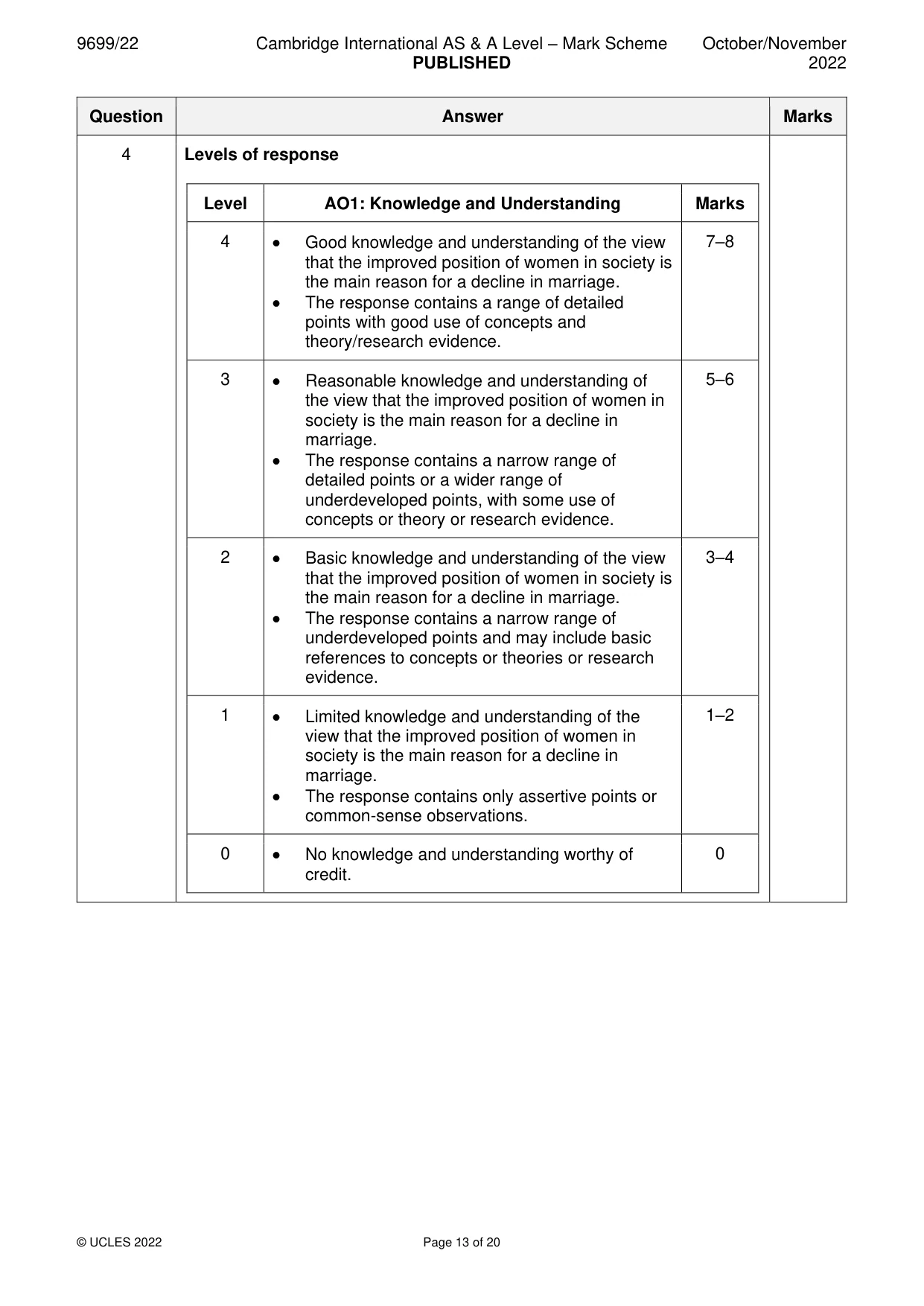
9699/22 Cambridge International AS & A Level – Mark Scheme PUBLISHED October/November 2022 © UCLES 2022 Page 13 of 20 Question Answer Marks 4 Levels of response Level AO1: Knowledge and Understanding Marks 4 • Good knowledge and understanding of the view that the improved position of women in society is the main reason for a decline in marriage. • The response contains a range of detailed points with good use of concepts and theory/research evidence. 7–8 3 • Reasonable knowledge and understanding of the view that the improved position of women in society is the main reason for a decline in marriage. • The response contains a narrow range of detailed points or a wider range of underdeveloped points, with some use of concepts or theory or research evidence. 5–6 2 • Basic knowledge and understanding of the view that the improved position of women in society is the main reason for a decline in marriage. • The response contains a narrow range of underdeveloped points and may include basic references to concepts or theories or research evidence. 3–4 1 • Limited knowledge and understanding of the view that the improved position of women in society is the main reason for a decline in marriage. • The response contains only assertive points or common-sense observations. 1–2 0 • No knowledge and understanding worthy of credit. 0
Mark scheme, page 14
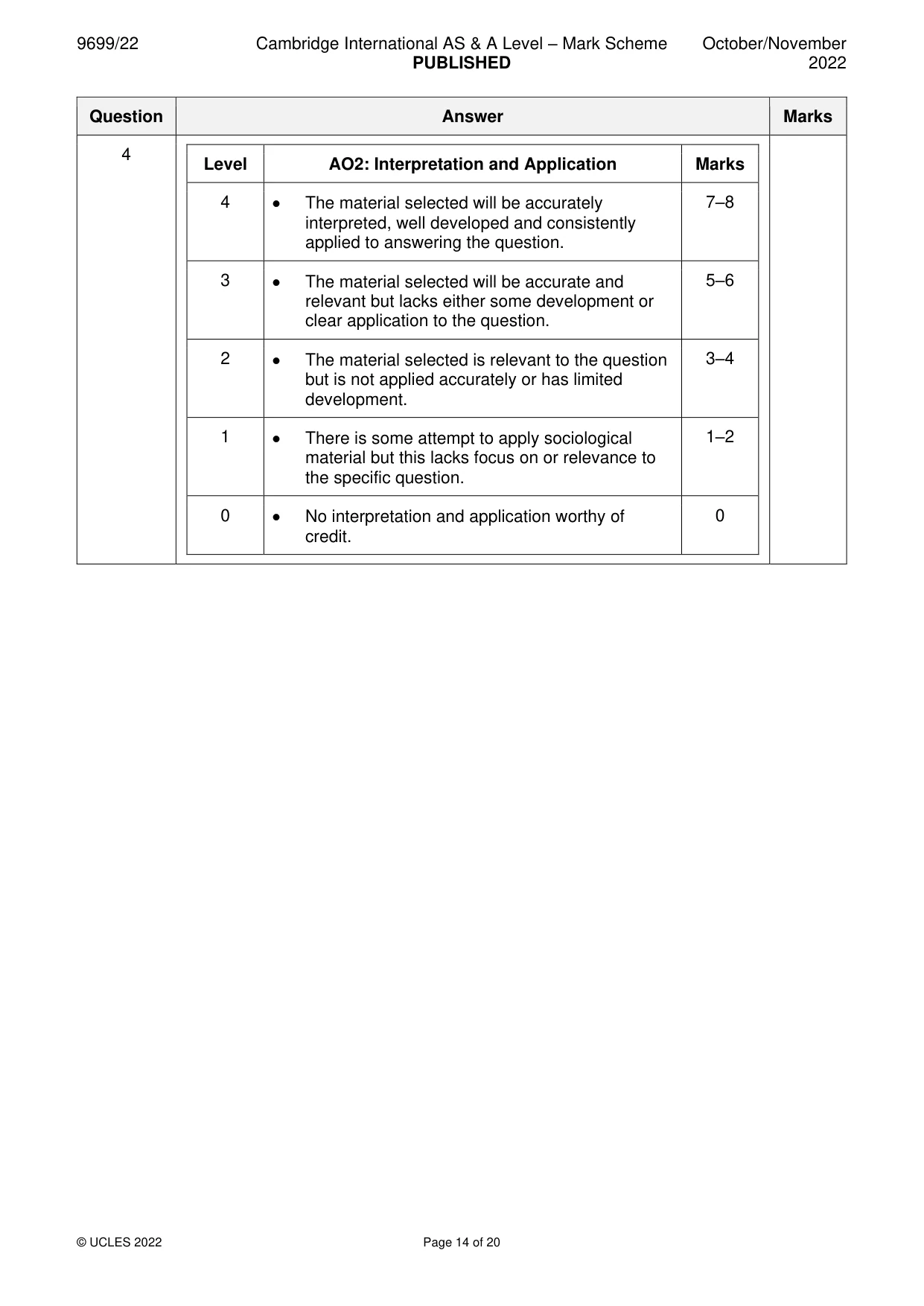
9699/22 Cambridge International AS & A Level – Mark Scheme PUBLISHED October/November 2022 © UCLES 2022 Page 14 of 20 Question Answer Marks 4 Level AO2: Interpretation and Application Marks 4 • The material selected will be accurately interpreted, well developed and consistently applied to answering the question. 7–8 3 • The material selected will be accurate and relevant but lacks either some development or clear application to the question. 5–6 2 • The material selected is relevant to the question but is not applied accurately or has limited development. 3–4 1 • There is some attempt to apply sociological material but this lacks focus on or relevance to the specific question. 1–2 0 • No interpretation and application worthy of credit. 0
Mark scheme, page 15
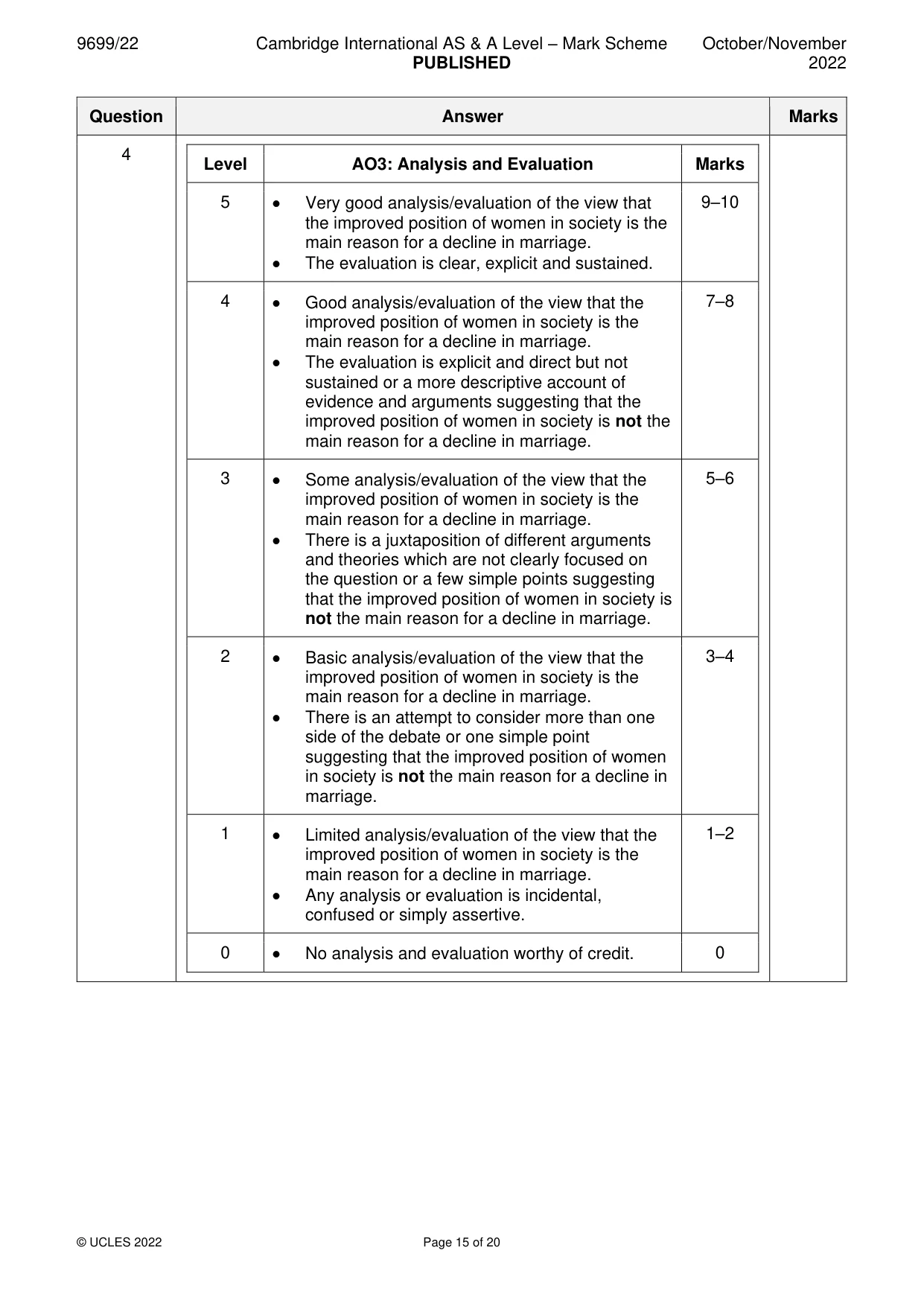
9699/22 Cambridge International AS & A Level – Mark Scheme PUBLISHED October/November 2022 © UCLES 2022 Page 15 of 20 Question Answer Marks 4 Level AO3: Analysis and Evaluation Marks 5 • Very good analysis/evaluation of the view that the improved position of women in society is the main reason for a decline in marriage. • The evaluation is clear, explicit and sustained. 9–10 4 • Good analysis/evaluation of the view that the improved position of women in society is the main reason for a decline in marriage. • The evaluation is explicit and direct but not sustained or a more descriptive account of evidence and arguments suggesting that the improved position of women in society is not the main reason for a decline in marriage. 7–8 3 • Some analysis/evaluation of the view that the improved position of women in society is the main reason for a decline in marriage. • There is a juxtaposition of different arguments and theories which are not clearly focused on the question or a few simple points suggesting that the improved position of women in society is not the main reason for a decline in marriage. 5–6 2 • Basic analysis/evaluation of the view that the improved position of women in society is the main reason for a decline in marriage. • There is an attempt to consider more than one side of the debate or one simple point suggesting that the improved position of women in society is not the main reason for a decline in marriage. 3–4 1 • Limited analysis/evaluation of the view that the improved position of women in society is the main reason for a decline in marriage. • Any analysis or evaluation is incidental, confused or simply assertive. 1–2 0 • No analysis and evaluation worthy of credit. 0
Mark scheme, page 16
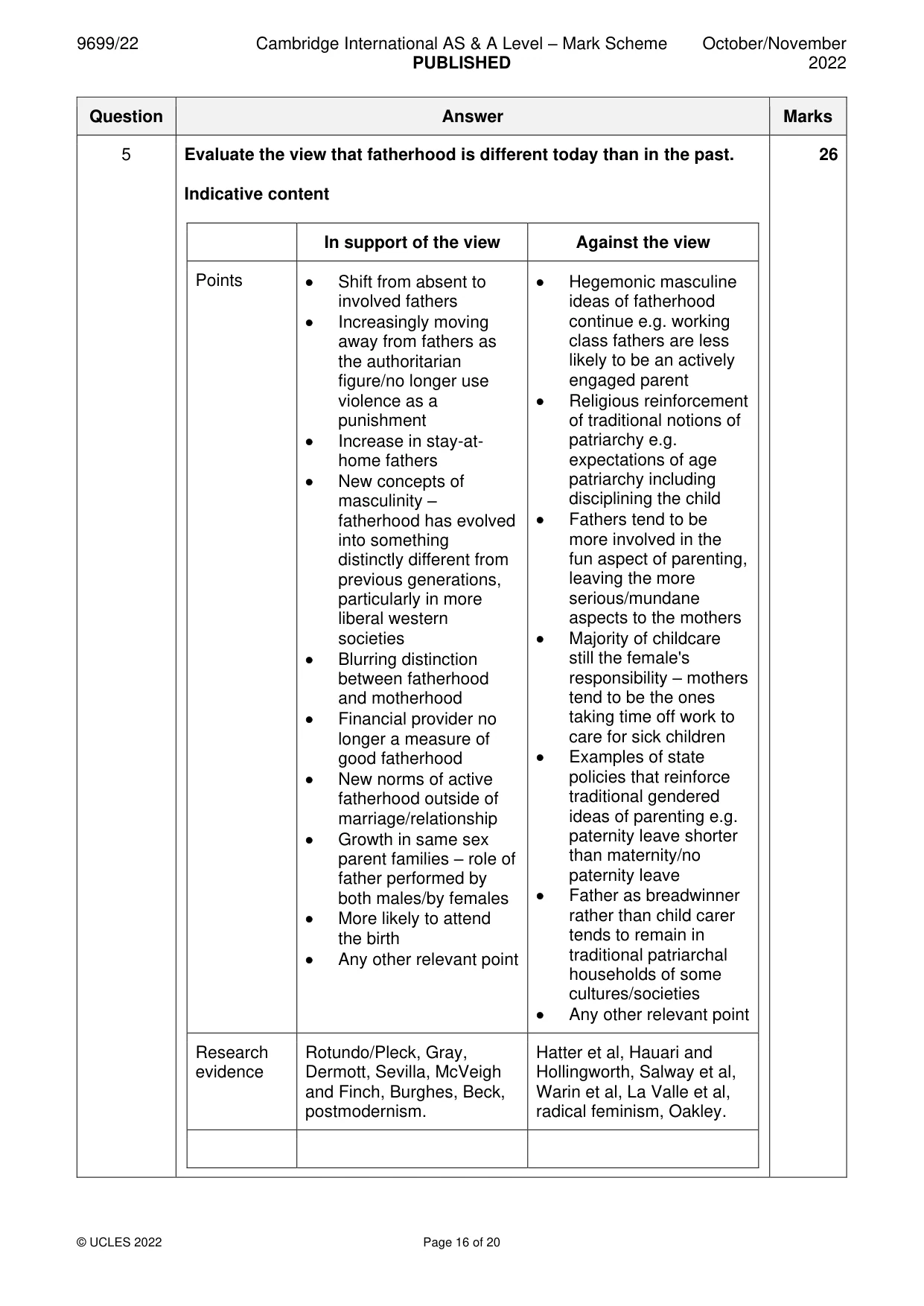
9699/22 Cambridge International AS & A Level – Mark Scheme PUBLISHED October/November 2022 © UCLES 2022 Page 16 of 20 Question Answer Marks 5 Evaluate the view that fatherhood is different today than in the past. Indicative content In support of the view Against the view Points • Shift from absent to involved fathers • Increasingly moving away from fathers as the authoritarian figure/no longer use violence as a punishment • Increase in stay-at- home fathers • New concepts of masculinity – fatherhood has evolved into something distinctly different from previous generations, particularly in more liberal western societies • Blurring distinction between fatherhood and motherhood • Financial provider no longer a measure of good fatherhood • New norms of active fatherhood outside of marriage/relationship • Growth in same sex parent families – role of father performed by both males/by females • More likely to attend the birth • Any other relevant point • Hegemonic masculine ideas of fatherhood continue e.g. working class fathers are less likely to be an actively engaged parent • Religious reinforcement of traditional notions of patriarchy e.g. expectations of age patriarchy including disciplining the child • Fathers tend to be more involved in the fun aspect of parenting, leaving the more serious/mundane aspects to the mothers • Majority of childcare still the female's responsibility – mothers tend to be the ones taking time off work to care for sick children • Examples of state policies that reinforce traditional gendered ideas of parenting e.g. paternity leave shorter than maternity/no paternity leave • Father as breadwinner rather than child carer tends to remain in traditional patriarchal households of some cultures/societies • Any other relevant point Research evidence Rotundo/Pleck, Gray, Dermott, Sevilla, McVeigh and Finch, Burghes, Beck, postmodernism. Hatter et al, Hauari and Hollingworth, Salway et al, Warin et al, La Valle et al, radical feminism, Oakley. 26
Mark scheme, page 17
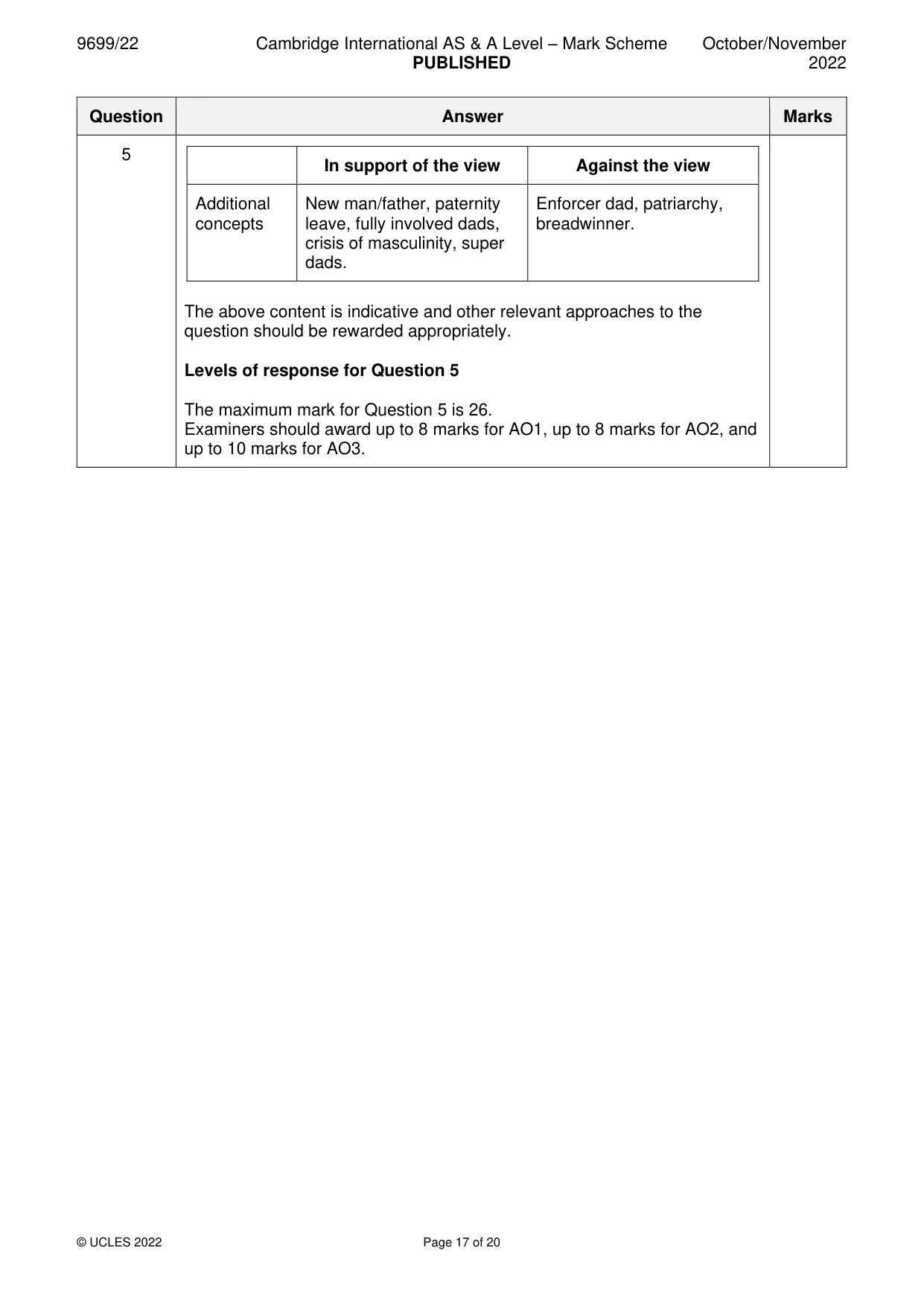
9699/22 Cambridge International AS & A Level – Mark Scheme PUBLISHED October/November 2022 © UCLES 2022 Page 17 of 20 Question Answer Marks 5 In support of the view Against the view Additional concepts New man/father, paternity leave, fully involved dads, crisis of masculinity, super dads. Enforcer dad, patriarchy, breadwinner. The above content is indicative and other relevant approaches to the question should be rewarded appropriately. Levels of response for Question 5 The maximum mark for Question 5 is 26. Examiners should award up to 8 marks for AO1, up to 8 marks for AO2, and up to 10 marks for AO3.
Mark scheme, page 18
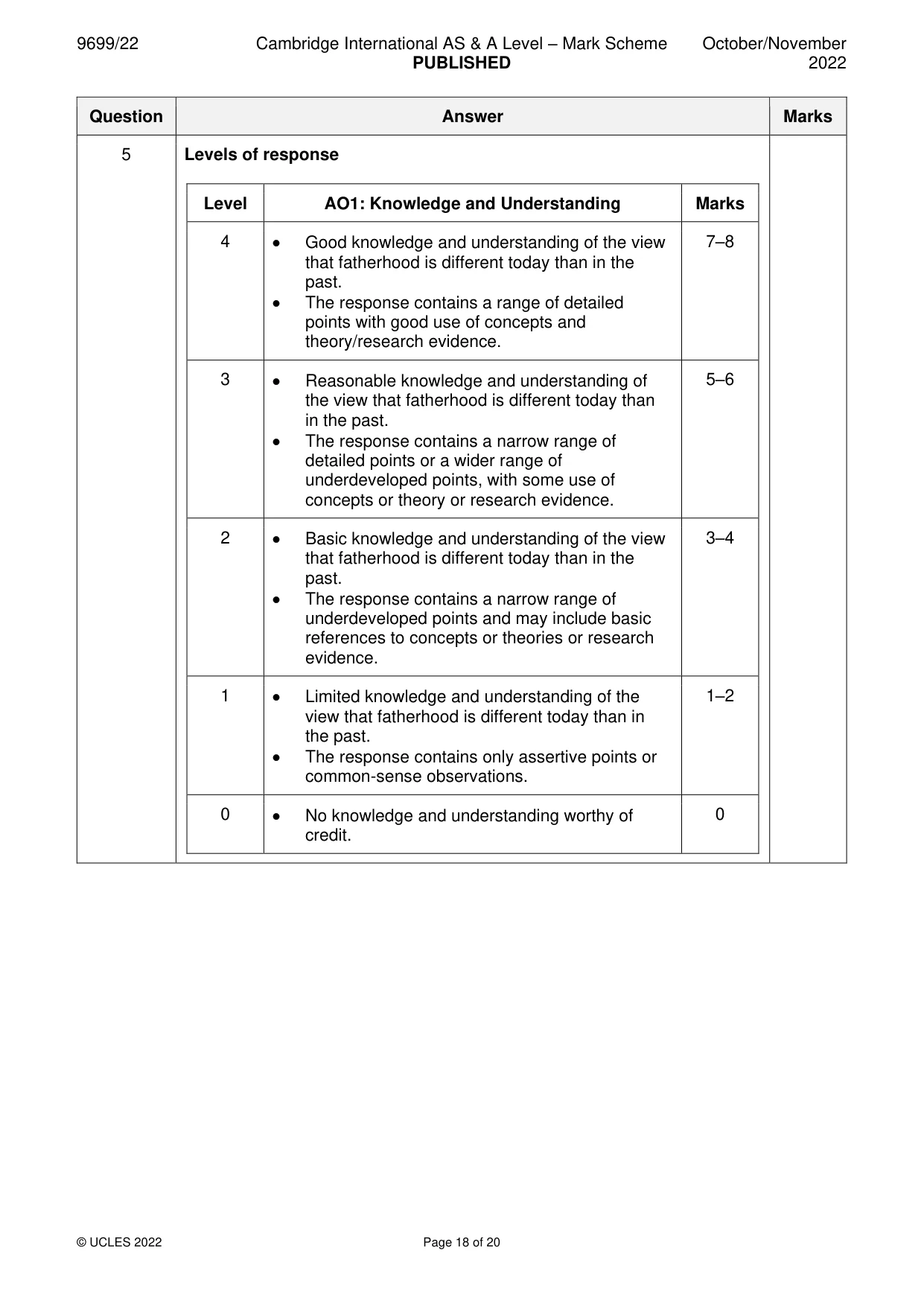
9699/22 Cambridge International AS & A Level – Mark Scheme PUBLISHED October/November 2022 © UCLES 2022 Page 18 of 20 Question Answer Marks 5 Levels of response Level AO1: Knowledge and Understanding Marks 4 • Good knowledge and understanding of the view that fatherhood is different today than in the past. • The response contains a range of detailed points with good use of concepts and theory/research evidence. 7–8 3 • Reasonable knowledge and understanding of the view that fatherhood is different today than in the past. • The response contains a narrow range of detailed points or a wider range of underdeveloped points, with some use of concepts or theory or research evidence. 5–6 2 • Basic knowledge and understanding of the view that fatherhood is different today than in the past. • The response contains a narrow range of underdeveloped points and may include basic references to concepts or theories or research evidence. 3–4 1 • Limited knowledge and understanding of the view that fatherhood is different today than in the past. • The response contains only assertive points or common-sense observations. 1–2 0 • No knowledge and understanding worthy of credit. 0
Mark scheme, page 19
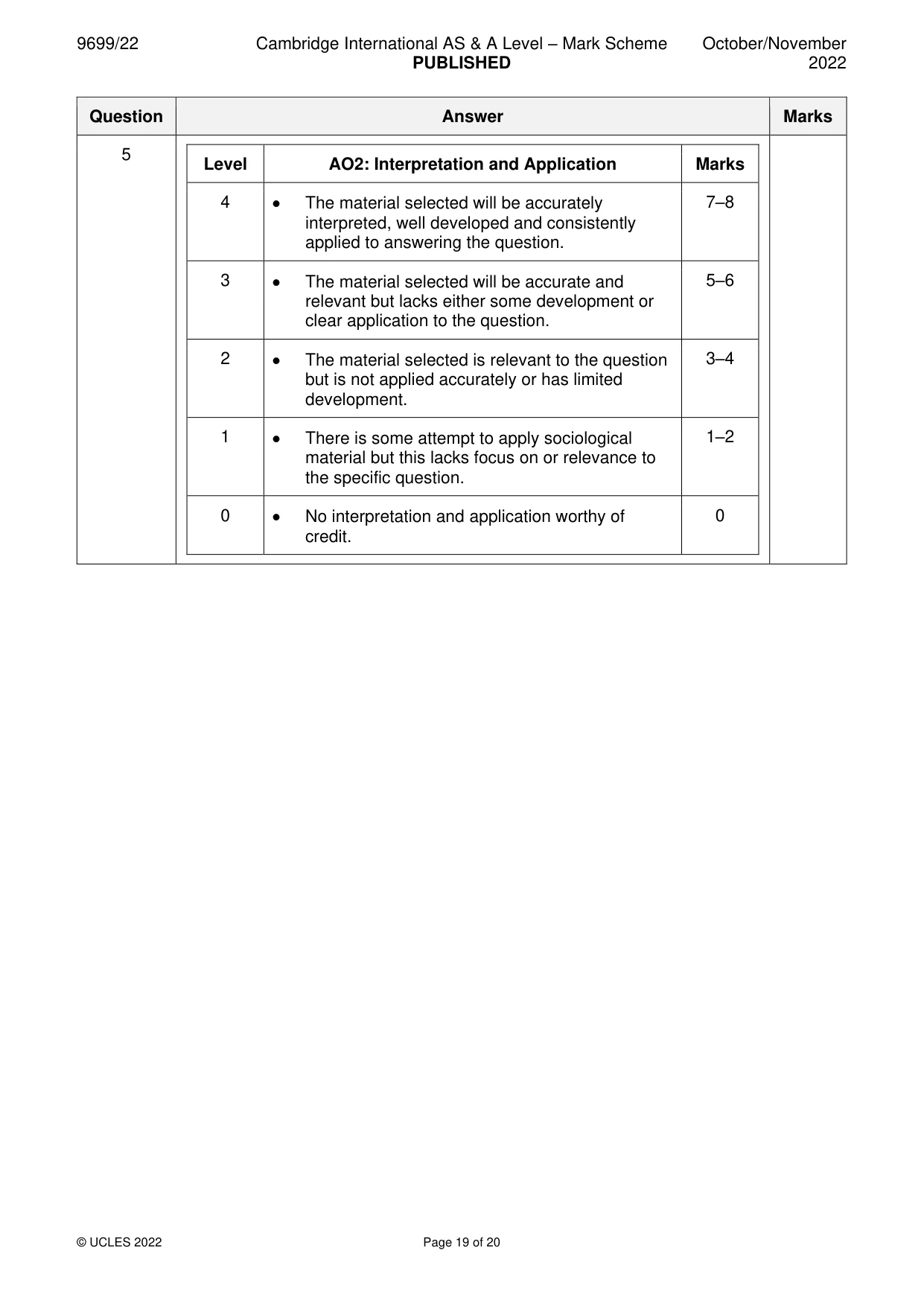
9699/22 Cambridge International AS & A Level – Mark Scheme PUBLISHED October/November 2022 © UCLES 2022 Page 19 of 20 Question Answer Marks 5 Level AO2: Interpretation and Application Marks 4 • The material selected will be accurately interpreted, well developed and consistently applied to answering the question. 7–8 3 • The material selected will be accurate and relevant but lacks either some development or clear application to the question. 5–6 2 • The material selected is relevant to the question but is not applied accurately or has limited development. 3–4 1 • There is some attempt to apply sociological material but this lacks focus on or relevance to the specific question. 1–2 0 • No interpretation and application worthy of credit. 0
Mark scheme, page 20
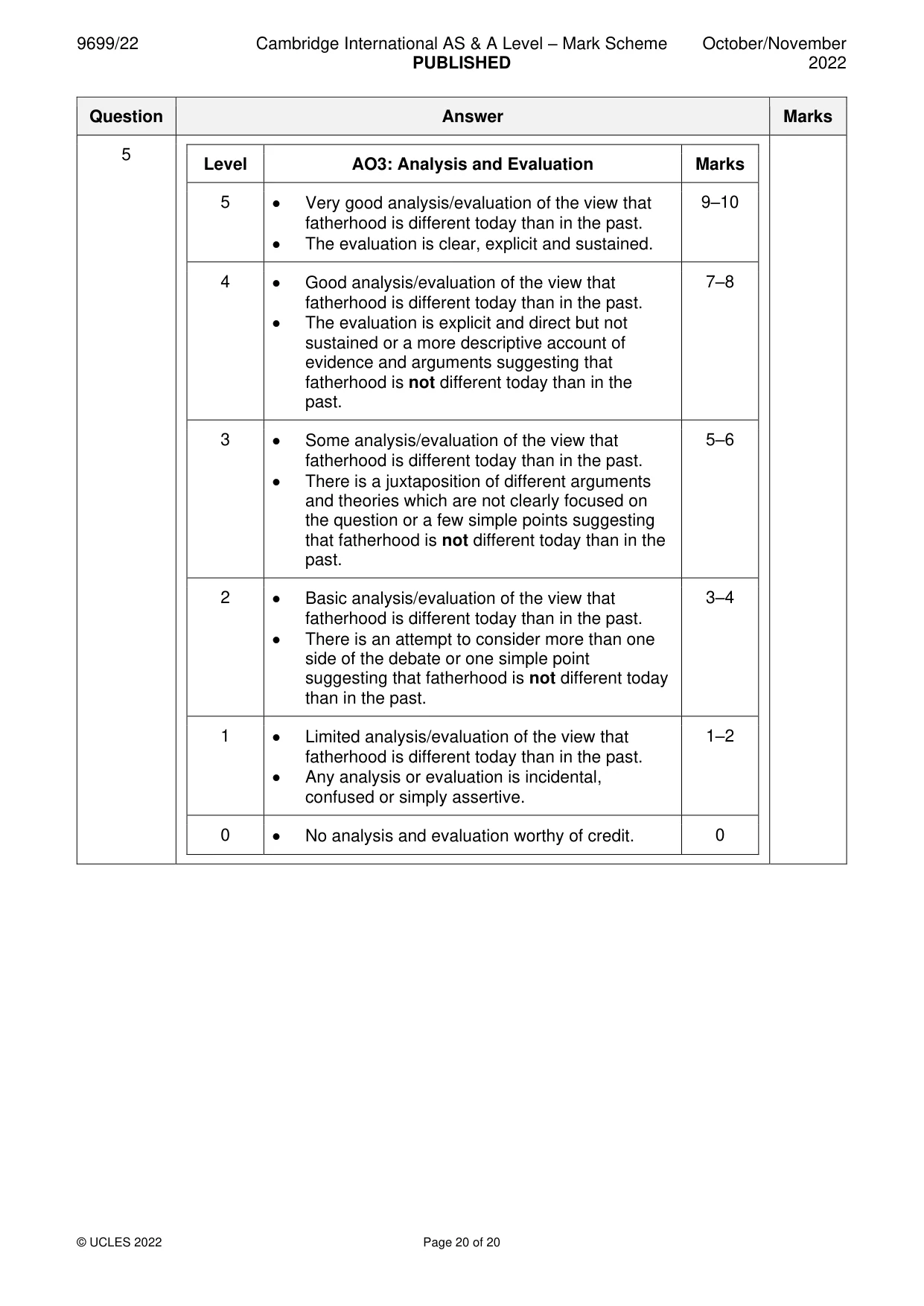
9699/22 Cambridge International AS & A Level – Mark Scheme PUBLISHED October/November 2022 © UCLES 2022 Page 20 of 20 Question Answer Marks 5 Level AO3: Analysis and Evaluation Marks 5 • Very good analysis/evaluation of the view that fatherhood is different today than in the past. • The evaluation is clear, explicit and sustained. 9–10 4 • Good analysis/evaluation of the view that fatherhood is different today than in the past. • The evaluation is explicit and direct but not sustained or a more descriptive account of evidence and arguments suggesting that fatherhood is not different today than in the past. 7–8 3 • Some analysis/evaluation of the view that fatherhood is different today than in the past. • There is a juxtaposition of different arguments and theories which are not clearly focused on the question or a few simple points suggesting that fatherhood is not different today than in the past. 5–6 2 • Basic analysis/evaluation of the view that fatherhood is different today than in the past. • There is an attempt to consider more than one side of the debate or one simple point suggesting that fatherhood is not different today than in the past. 3–4 1 • Limited analysis/evaluation of the view that fatherhood is different today than in the past. • Any analysis or evaluation is incidental, confused or simply assertive. 1–2 0 • No analysis and evaluation worthy of credit. 0
What you needed in this session
Cambridge’s own grade thresholds for 2022 Oct/Nov, Paper 2 · Variant 2. A higher threshold means an easier paper — the bar moves with how the cohort did.