Cambridge A Level Sociology 9699 — 2023 Feb/March Paper 2 · Variant 2
9699/22/F/M/23 · 60 marks · ≈68 min
The question paper and its mark scheme, free to read here and free to download. This is Cambridge’s own paper, exactly as it was sat.
Question paper4 pages

Mark scheme19 pages
Answers below. Sit the paper first if you are practising.
Paper as text
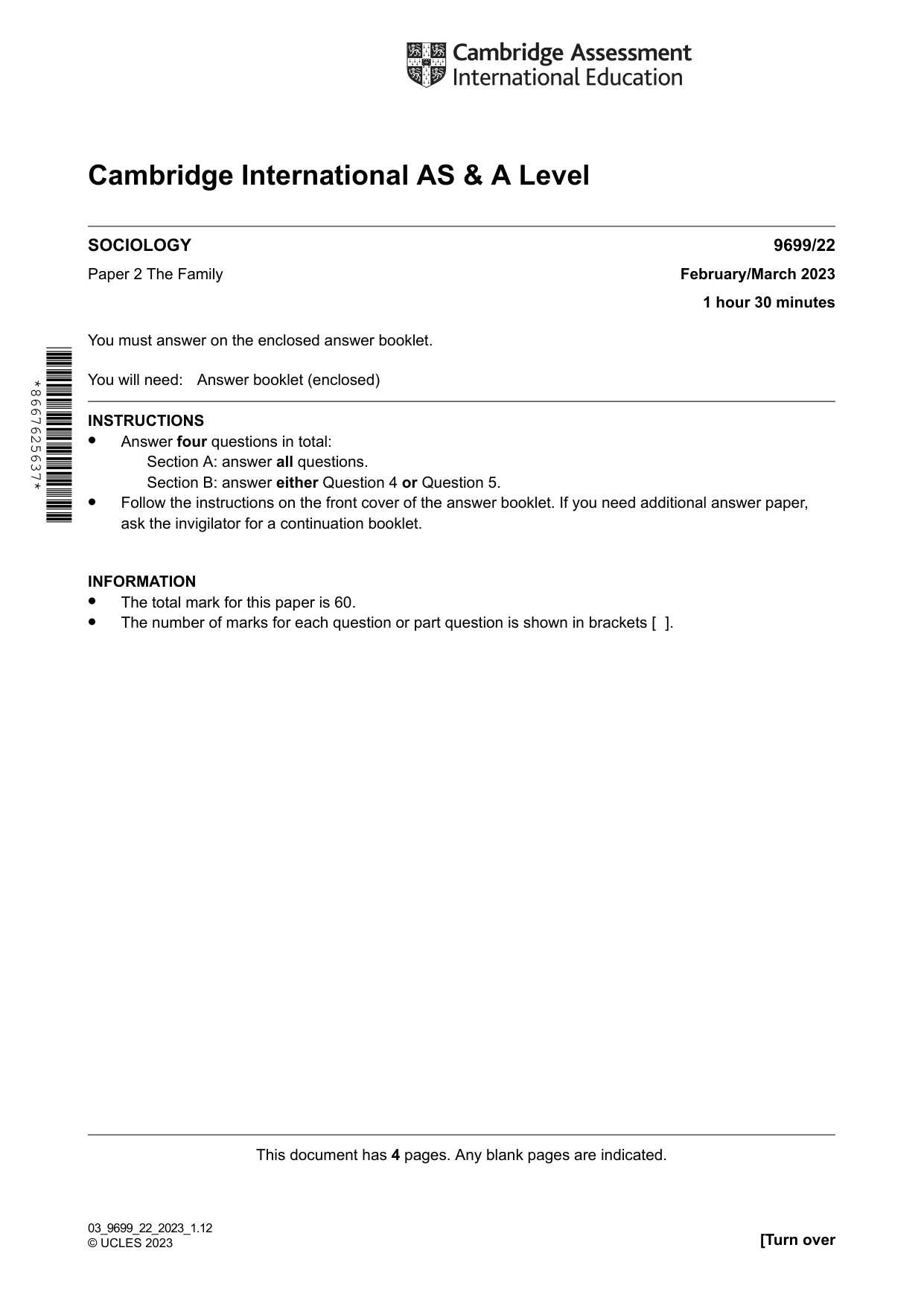
Question paper, page 1
Cambridge International AS & A Level 9699/22 February/March 2023 1 hour 30 minutes SOCIOLOGY Paper 2 The Family You must answer on the enclosed answer booklet. You will need: Answer booklet (enclosed) INSTRUCTIONS • Answer four questions in total: Section A: answer all questions. Section B: answer either Question 4 or Question 5. • Follow the instructions on the front cover of the answer booklet. If you need additional answer paper, ask the invigilator for a continuation booklet. INFORMATION • The total mark for this paper is 60. • The number of marks for each question or part question is shown in brackets [ ]. This document has 4 pages. Any blank pages are indicated. [Turn over 03_9699_22_2023_1.12 © UCLES 2023 *8667625637*
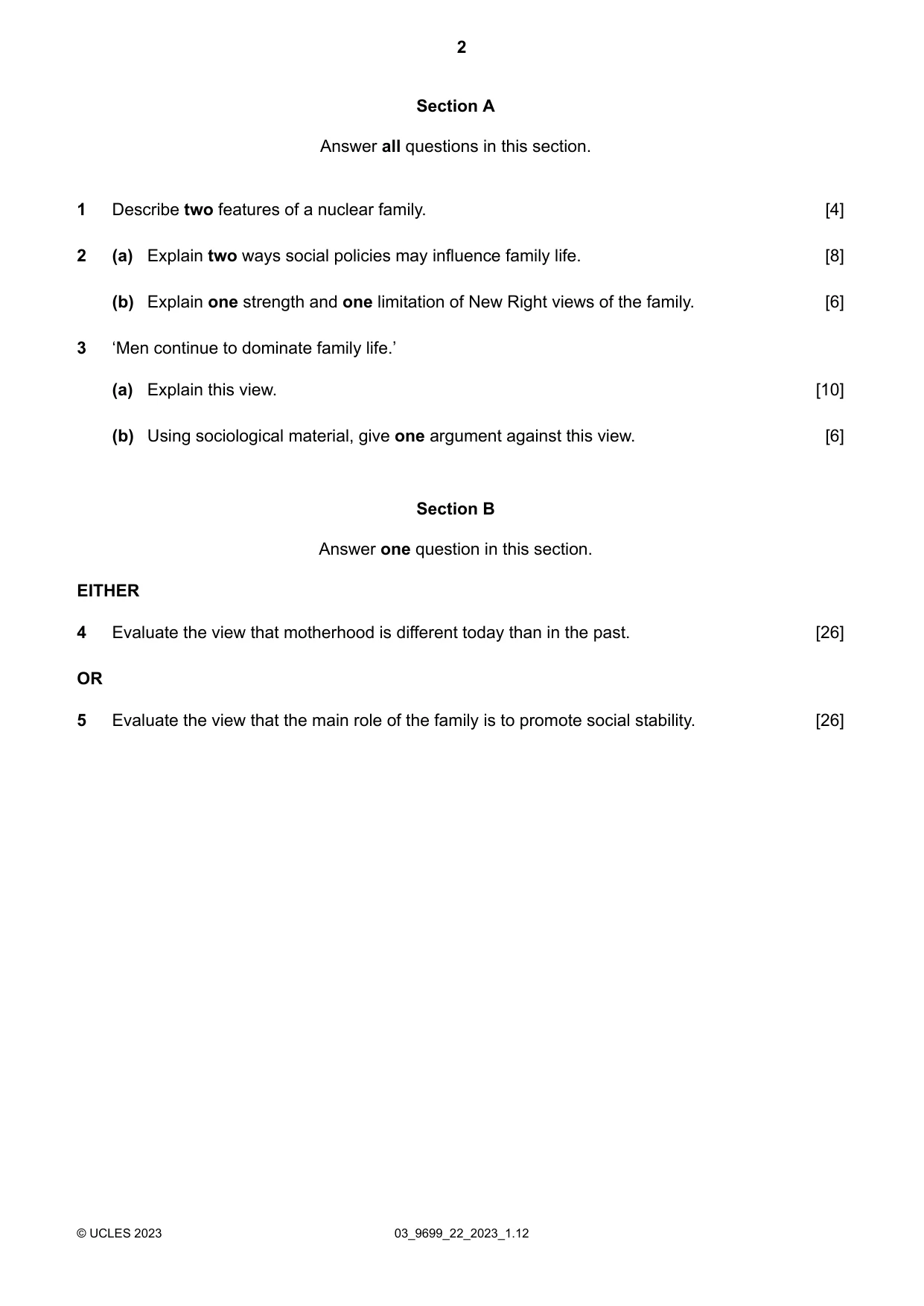
Question paper, page 2
Section A Answer all questions in this section. Describe two features of a nuclear family. [4] 1 Explain two ways social policies may influence family life. [8] (a) 2 Explain one strength and one limitation of New Right views of the family. [6] (b) ‘Men continue to dominate family life.’ 3 Explain this view. [10] (a) Using sociological material, give one argument against this view. [6] (b) Section B Answer one question in this section. EITHER Evaluate the view that motherhood is different today than in the past. [26] 4 OR Evaluate the view that the main role of the family is to promote social stability. [26] 5 03_9699_22_2023_1.12 © UCLES 2023 2
Question paper, page 3
BLANK PAGE 03_9699_22_2023_1.12 © UCLES 2023 3
Question paper, page 4
BLANK PAGE Permission to reproduce items where third-party owned material protected by copyright is included has been sought and cleared where possible. Every reasonable effort has been made by the publisher (UCLES) to trace copyright holders, but if any items requiring clearance have unwittingly been included, the publisher will be pleased to make amends at the earliest possible opportunity. To avoid the issue of disclosure of answer-related information to candidates, all copyright acknowledgements are reproduced online in the Cambridge Assessment International Education Copyright Acknowledgements Booklet. This is produced for each series of examinations and is freely available to download at www.cambridgeinternational.org after the live examination series. Cambridge Assessment International Education is part of Cambridge Assessment. Cambridge Assessment is the brand name of the University of Cambridge Local Examinations Syndicate (UCLES), which is a department of the University of Cambridge. 03_9699_22_2023_1.12 © UCLES 2023 4
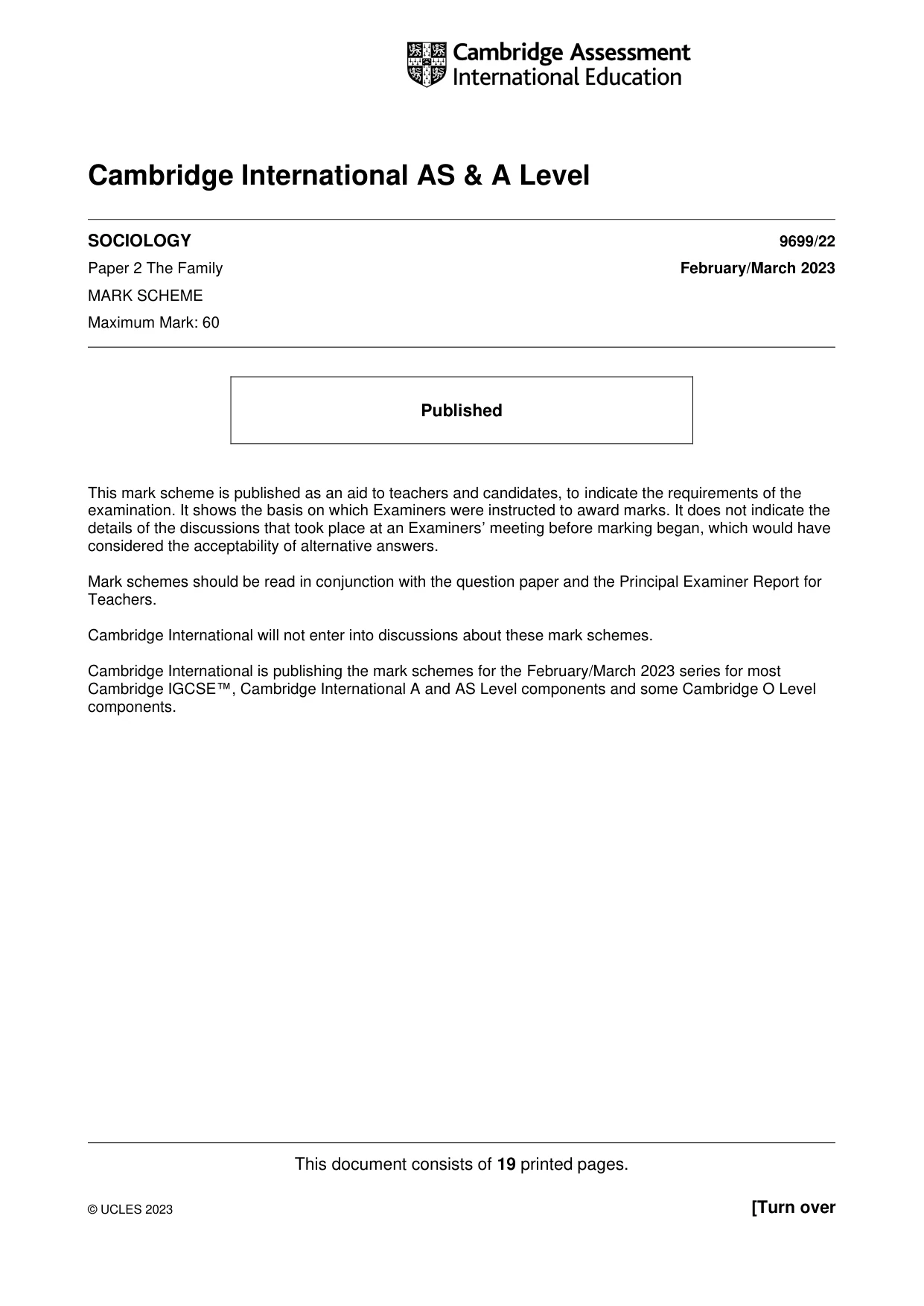
Mark scheme, page 1
This document consists of 19 printed pages. © UCLES 2023 [Turn over Cambridge International AS & A Level SOCIOLOGY 9699/22 Paper 2 The Family February/March 2023 MARK SCHEME Maximum Mark: 60 Published This mark scheme is published as an aid to teachers and candidates, to indicate the requirements of the examination. It shows the basis on which Examiners were instructed to award marks. It does not indicate the details of the discussions that took place at an Examiners’ meeting before marking began, which would have considered the acceptability of alternative answers. Mark schemes should be read in conjunction with the question paper and the Principal Examiner Report for Teachers. Cambridge International will not enter into discussions about these mark schemes. Cambridge International is publishing the mark schemes for the February/March 2023 series for most Cambridge IGCSE™, Cambridge International A and AS Level components and some Cambridge O Level components.
Mark scheme, page 2
9699/22 Cambridge International AS & A Level – Mark Scheme PUBLISHED February/March 2023 © UCLES 2023 Page 2 of 19 Generic Marking Principles These general marking principles must be applied by all examiners when marking candidate answers. They should be applied alongside the specific content of the mark scheme or generic level descriptors for a question. Each question paper and mark scheme will also comply with these marking principles. GENERIC MARKING PRINCIPLE 1: Marks must be awarded in line with: • the specific content of the mark scheme or the generic level descriptors for the question • the specific skills defined in the mark scheme or in the generic level descriptors for the question • the standard of response required by a candidate as exemplified by the standardisation scripts. GENERIC MARKING PRINCIPLE 2: Marks awarded are always whole marks (not half marks, or other fractions). GENERIC MARKING PRINCIPLE 3: Marks must be awarded positively: • marks are awarded for correct/valid answers, as defined in the mark scheme. However, credit is given for valid answers which go beyond the scope of the syllabus and mark scheme, referring to your Team Leader as appropriate • marks are awarded when candidates clearly demonstrate what they know and can do • marks are not deducted for errors • marks are not deducted for omissions • answers should only be judged on the quality of spelling, punctuation and grammar when these features are specifically assessed by the question as indicated by the mark scheme. The meaning, however, should be unambiguous. GENERIC MARKING PRINCIPLE 4: Rules must be applied consistently, e.g. in situations where candidates have not followed instructions or in the application of generic level descriptors. GENERIC MARKING PRINCIPLE 5: Marks should be awarded using the full range of marks defined in the mark scheme for the question (however; the use of the full mark range may be limited according to the quality of the candidate responses seen). GENERIC MARKING PRINCIPLE 6: Marks awarded are based solely on the requirements as defined in the mark scheme. Marks should not be awarded with grade thresholds or grade descriptors in mind.
Mark scheme, page 3
9699/22 Cambridge International AS & A Level – Mark Scheme PUBLISHED February/March 2023 © UCLES 2023 Page 3 of 19 Social Science-Specific Marking Principles (for point-based marking) 1 Components using point-based marking: • Point marking is often used to reward knowledge, understanding and application of skills. We give credit where the candidate’s answer shows relevant knowledge, understanding and application of skills in answering the question. We do not give credit where the answer shows confusion. From this it follows that we: a DO credit answers which are worded differently from the mark scheme if they clearly convey the same meaning (unless the mark scheme requires a specific term) b DO credit alternative answers/examples which are not written in the mark scheme if they are correct c DO credit answers where candidates give more than one correct answer in one prompt/numbered/scaffolded space where extended writing is required rather than list-type answers. For example, questions that require n reasons (e.g. State two reasons …). d DO NOT credit answers simply for using a ‘key term’ unless that is all that is required. (Check for evidence it is understood and not used wrongly.) e DO NOT credit answers which are obviously self-contradicting or trying to cover all possibilities f DO NOT give further credit for what is effectively repetition of a correct point already credited unless the language itself is being tested. This applies equally to ‘mirror statements’ (i.e. polluted/not polluted). g DO NOT require spellings to be correct, unless this is part of the test. However spellings of syllabus terms must allow for clear and unambiguous separation from other syllabus terms with which they may be confused (e.g. Corrasion/Corrosion) 2 Presentation of mark scheme: • Slashes (/) or the word ‘or’ separate alternative ways of making the same point. • Semi colons (;) bullet points (•) or figures in brackets (1) separate different points. • Content in the answer column in brackets is for examiner information/context to clarify the marking but is not required to earn the mark (except Accounting syllabuses where they indicate negative numbers). 3 Calculation questions: • The mark scheme will show the steps in the most likely correct method(s), the mark for each step, the correct answer(s) and the mark for each answer • If working/explanation is considered essential for full credit, this will be indicated in the question paper and in the mark scheme. In all other instances, the correct answer to a calculation should be given full credit, even if no supporting working is shown. • Where the candidate uses a valid method which is not covered by the mark scheme, award equivalent marks for reaching equivalent stages. • Where an answer makes use of a candidate’s own incorrect figure from previous working, the ‘own figure rule’ applies: full marks will be given if a correct and complete method is used. Further guidance will be included in the mark scheme where necessary and any exceptions to this general principle will be noted.
Mark scheme, page 4
9699/22 Cambridge International AS & A Level – Mark Scheme PUBLISHED February/March 2023 © UCLES 2023 Page 4 of 19 4 Annotation: • For point marking, ticks can be used to indicate correct answers and crosses can be used to indicate wrong answers. There is no direct relationship between ticks and marks. Ticks have no defined meaning for levels of response marking. • For levels of response marking, the level awarded should be annotated on the script. • Other annotations will be used by examiners as agreed during standardisation, and the meaning will be understood by all examiners who marked that paper.
Mark scheme, page 5
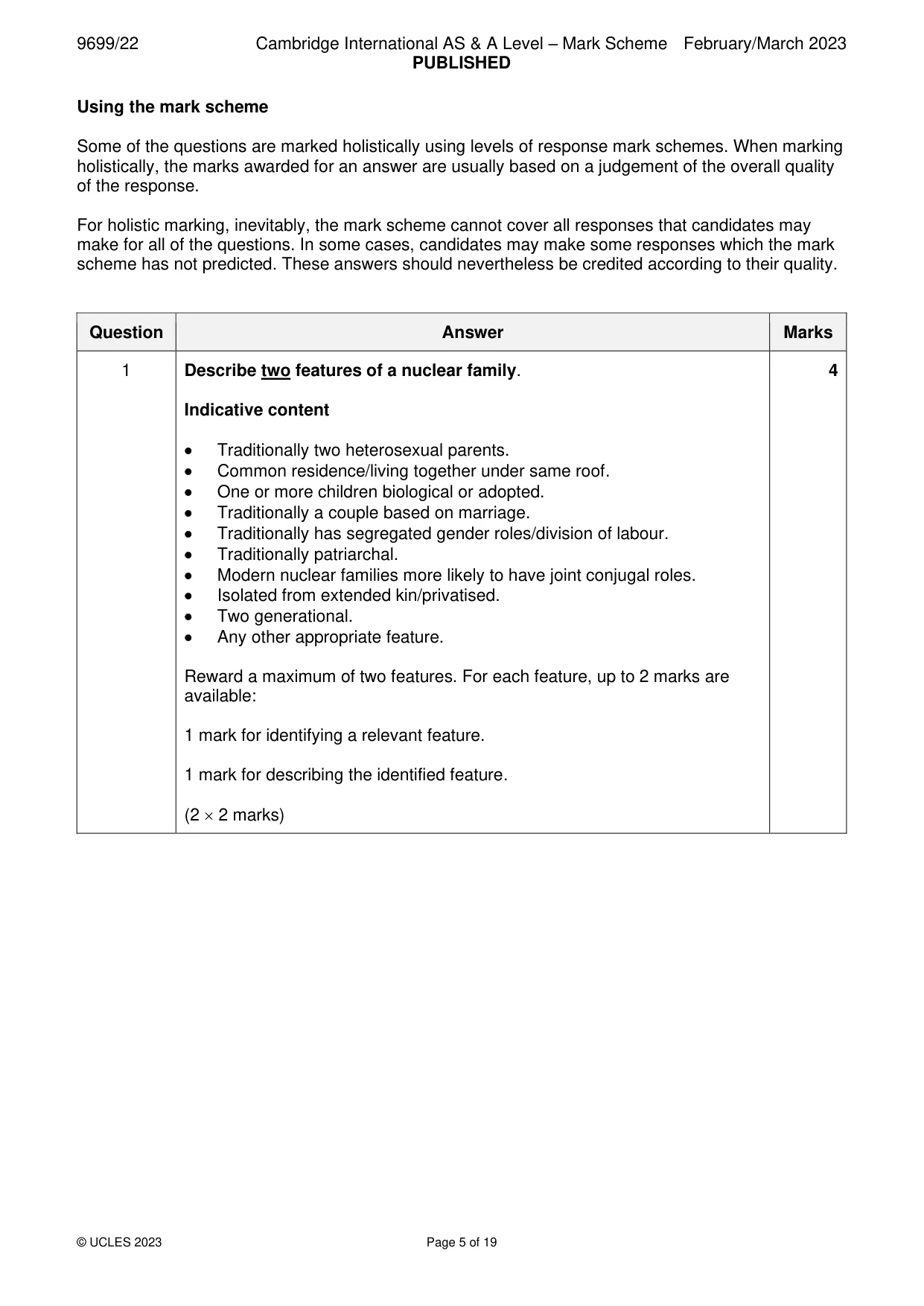
9699/22 Cambridge International AS & A Level – Mark Scheme PUBLISHED February/March 2023 © UCLES 2023 Page 5 of 19 Using the mark scheme Some of the questions are marked holistically using levels of response mark schemes. When marking holistically, the marks awarded for an answer are usually based on a judgement of the overall quality of the response. For holistic marking, inevitably, the mark scheme cannot cover all responses that candidates may make for all of the questions. In some cases, candidates may make some responses which the mark scheme has not predicted. These answers should nevertheless be credited according to their quality. Question Answer Marks 1 Describe two features of a nuclear family. Indicative content • Traditionally two heterosexual parents. • Common residence/living together under same roof. • One or more children biological or adopted. • Traditionally a couple based on marriage. • Traditionally has segregated gender roles/division of labour. • Traditionally patriarchal. • Modern nuclear families more likely to have joint conjugal roles. • Isolated from extended kin/privatised. • Two generational. • Any other appropriate feature. Reward a maximum of two features. For each feature, up to 2 marks are available: 1 mark for identifying a relevant feature. 1 mark for describing the identified feature. (2 2 marks) 4
Mark scheme, page 6
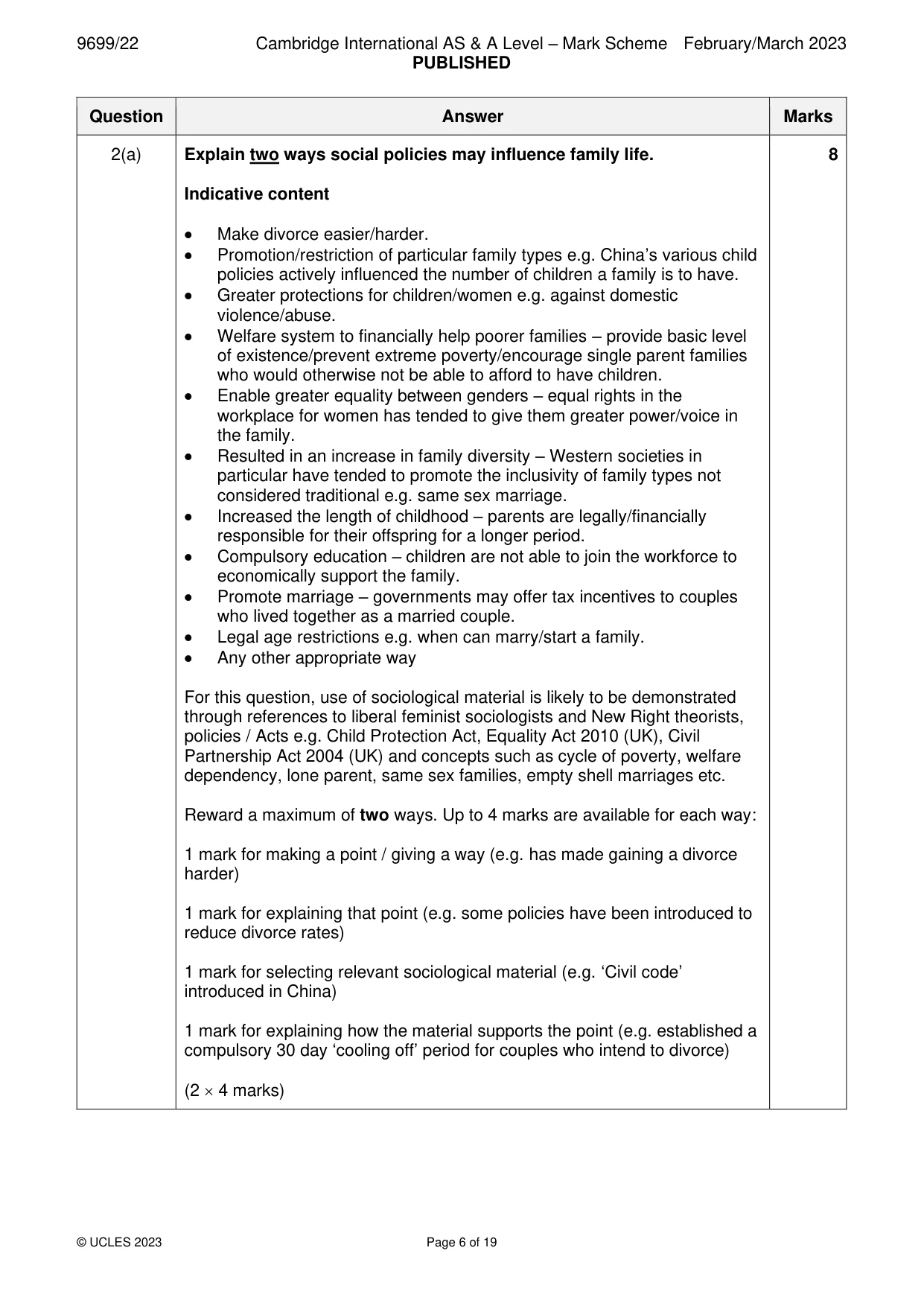
9699/22 Cambridge International AS & A Level – Mark Scheme PUBLISHED February/March 2023 © UCLES 2023 Page 6 of 19 Question Answer Marks 2(a) Explain two ways social policies may influence family life. Indicative content • Make divorce easier/harder. • Promotion/restriction of particular family types e.g. China’s various child policies actively influenced the number of children a family is to have. • Greater protections for children/women e.g. against domestic violence/abuse. • Welfare system to financially help poorer families – provide basic level of existence/prevent extreme poverty/encourage single parent families who would otherwise not be able to afford to have children. • Enable greater equality between genders – equal rights in the workplace for women has tended to give them greater power/voice in the family. • Resulted in an increase in family diversity – Western societies in particular have tended to promote the inclusivity of family types not considered traditional e.g. same sex marriage. • Increased the length of childhood – parents are legally/financially responsible for their offspring for a longer period. • Compulsory education – children are not able to join the workforce to economically support the family. • Promote marriage – governments may offer tax incentives to couples who lived together as a married couple. • Legal age restrictions e.g. when can marry/start a family. • Any other appropriate way For this question, use of sociological material is likely to be demonstrated through references to liberal feminist sociologists and New Right theorists, policies / Acts e.g. Child Protection Act, Equality Act 2010 (UK), Civil Partnership Act 2004 (UK) and concepts such as cycle of poverty, welfare dependency, lone parent, same sex families, empty shell marriages etc. Reward a maximum of two ways. Up to 4 marks are available for each way: 1 mark for making a point / giving a way (e.g. has made gaining a divorce harder) 1 mark for explaining that point (e.g. some policies have been introduced to reduce divorce rates) 1 mark for selecting relevant sociological material (e.g. ‘Civil code’ introduced in China) 1 mark for explaining how the material supports the point (e.g. established a compulsory 30 day ‘cooling off’ period for couples who intend to divorce) (2 4 marks) 8
Mark scheme, page 7
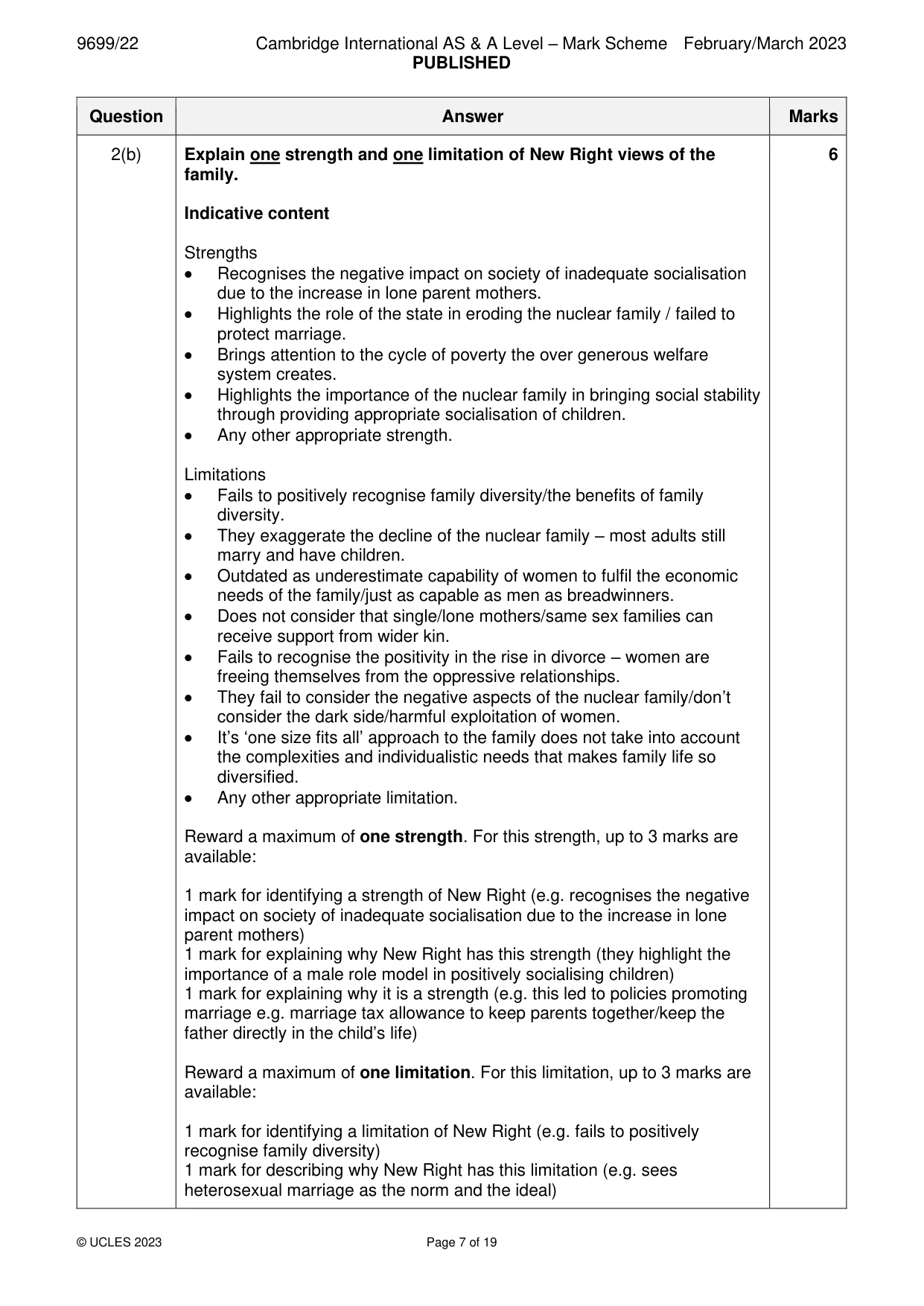
9699/22 Cambridge International AS & A Level – Mark Scheme PUBLISHED February/March 2023 © UCLES 2023 Page 7 of 19 Question Answer Marks 2(b) Explain one strength and one limitation of New Right views of the family. Indicative content Strengths • Recognises the negative impact on society of inadequate socialisation due to the increase in lone parent mothers. • Highlights the role of the state in eroding the nuclear family / failed to protect marriage. • Brings attention to the cycle of poverty the over generous welfare system creates. • Highlights the importance of the nuclear family in bringing social stability through providing appropriate socialisation of children. • Any other appropriate strength. Limitations • Fails to positively recognise family diversity/the benefits of family diversity. • They exaggerate the decline of the nuclear family – most adults still marry and have children. • Outdated as underestimate capability of women to fulfil the economic needs of the family/just as capable as men as breadwinners. • Does not consider that single/lone mothers/same sex families can receive support from wider kin. • Fails to recognise the positivity in the rise in divorce – women are freeing themselves from the oppressive relationships. • They fail to consider the negative aspects of the nuclear family/don’t consider the dark side/harmful exploitation of women. • It’s ‘one size fits all’ approach to the family does not take into account the complexities and individualistic needs that makes family life so diversified. • Any other appropriate limitation. Reward a maximum of one strength. For this strength, up to 3 marks are available: 1 mark for identifying a strength of New Right (e.g. recognises the negative impact on society of inadequate socialisation due to the increase in lone parent mothers) 1 mark for explaining why New Right has this strength (they highlight the importance of a male role model in positively socialising children) 1 mark for explaining why it is a strength (e.g. this led to policies promoting marriage e.g. marriage tax allowance to keep parents together/keep the father directly in the child’s life) Reward a maximum of one limitation. For this limitation, up to 3 marks are available: 1 mark for identifying a limitation of New Right (e.g. fails to positively recognise family diversity) 1 mark for describing why New Right has this limitation (e.g. sees heterosexual marriage as the norm and the ideal) 6
Mark scheme, page 8
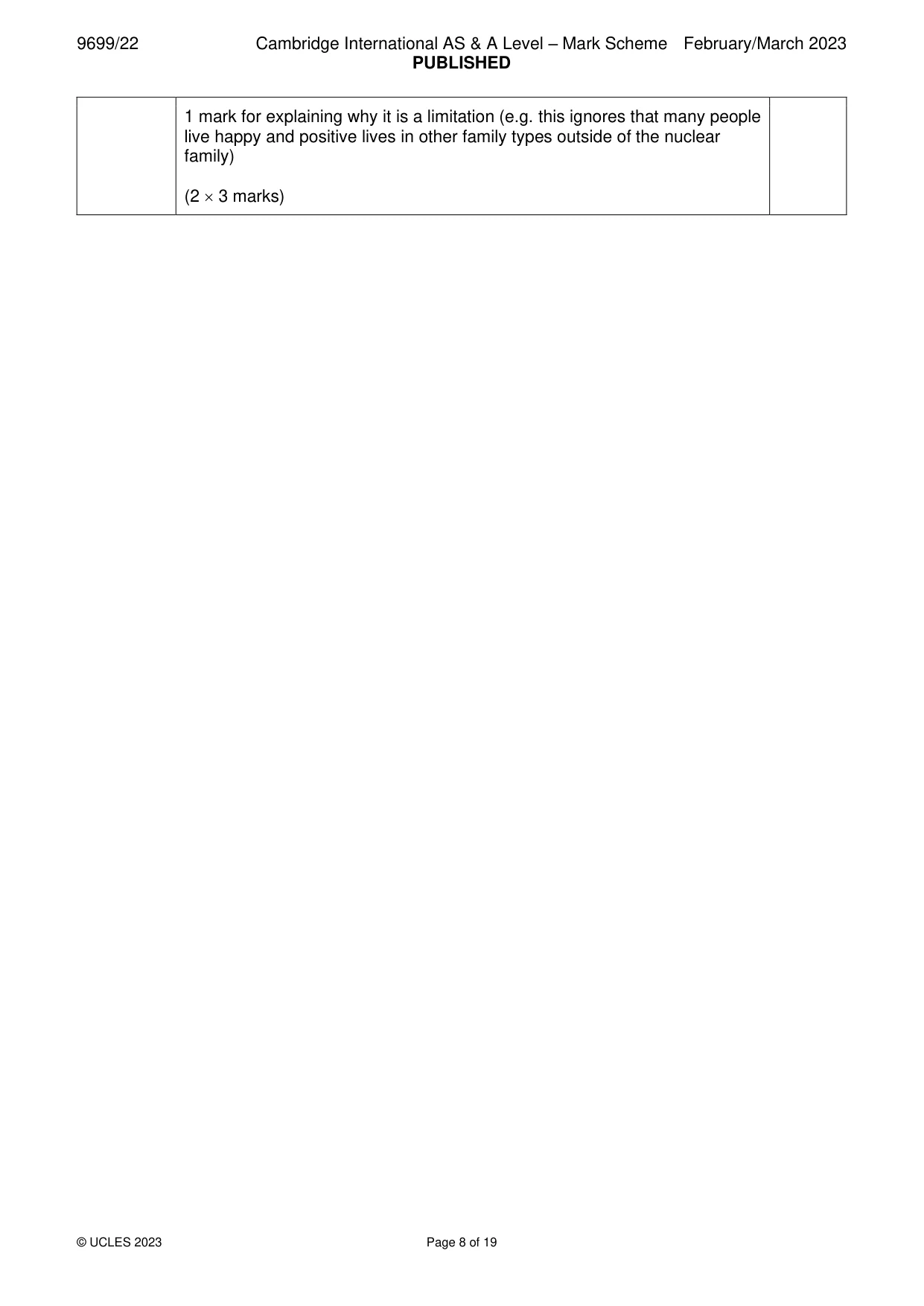
9699/22 Cambridge International AS & A Level – Mark Scheme PUBLISHED February/March 2023 © UCLES 2023 Page 8 of 19 1 mark for explaining why it is a limitation (e.g. this ignores that many people live happy and positive lives in other family types outside of the nuclear family) (2 3 marks)
Mark scheme, page 9
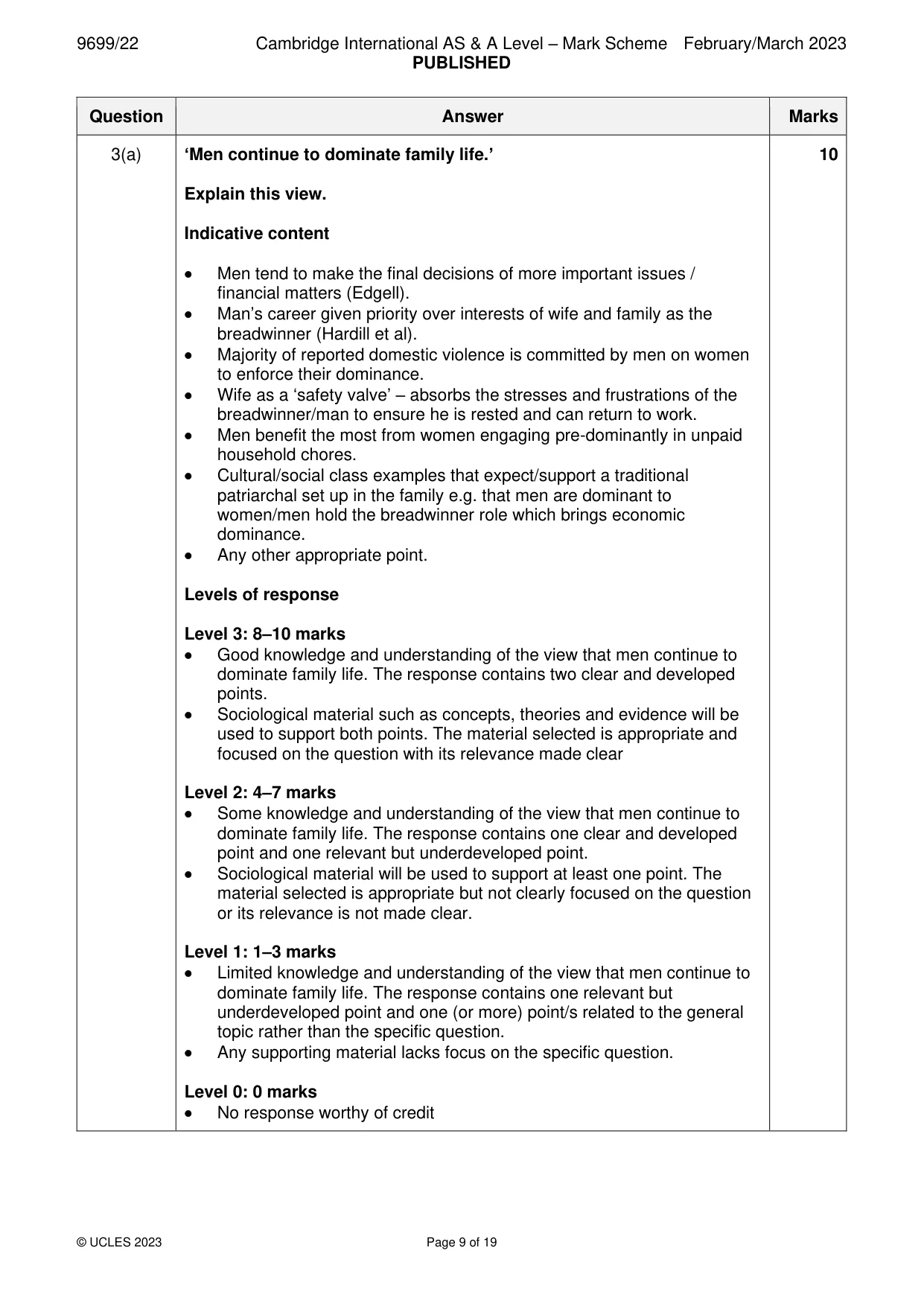
9699/22 Cambridge International AS & A Level – Mark Scheme PUBLISHED February/March 2023 © UCLES 2023 Page 9 of 19 Question Answer Marks 3(a) ‘Men continue to dominate family life.’ Explain this view. Indicative content • Men tend to make the final decisions of more important issues / financial matters (Edgell). • Man’s career given priority over interests of wife and family as the breadwinner (Hardill et al). • Majority of reported domestic violence is committed by men on women to enforce their dominance. • Wife as a ‘safety valve’ – absorbs the stresses and frustrations of the breadwinner/man to ensure he is rested and can return to work. • Men benefit the most from women engaging pre-dominantly in unpaid household chores. • Cultural/social class examples that expect/support a traditional patriarchal set up in the family e.g. that men are dominant to women/men hold the breadwinner role which brings economic dominance. • Any other appropriate point. Levels of response Level 3: 8–10 marks • Good knowledge and understanding of the view that men continue to dominate family life. The response contains two clear and developed points. • Sociological material such as concepts, theories and evidence will be used to support both points. The material selected is appropriate and focused on the question with its relevance made clear Level 2: 4–7 marks • Some knowledge and understanding of the view that men continue to dominate family life. The response contains one clear and developed point and one relevant but underdeveloped point. • Sociological material will be used to support at least one point. The material selected is appropriate but not clearly focused on the question or its relevance is not made clear. Level 1: 1–3 marks • Limited knowledge and understanding of the view that men continue to dominate family life. The response contains one relevant but underdeveloped point and one (or more) point/s related to the general topic rather than the specific question. • Any supporting material lacks focus on the specific question. Level 0: 0 marks • No response worthy of credit 10
Mark scheme, page 10
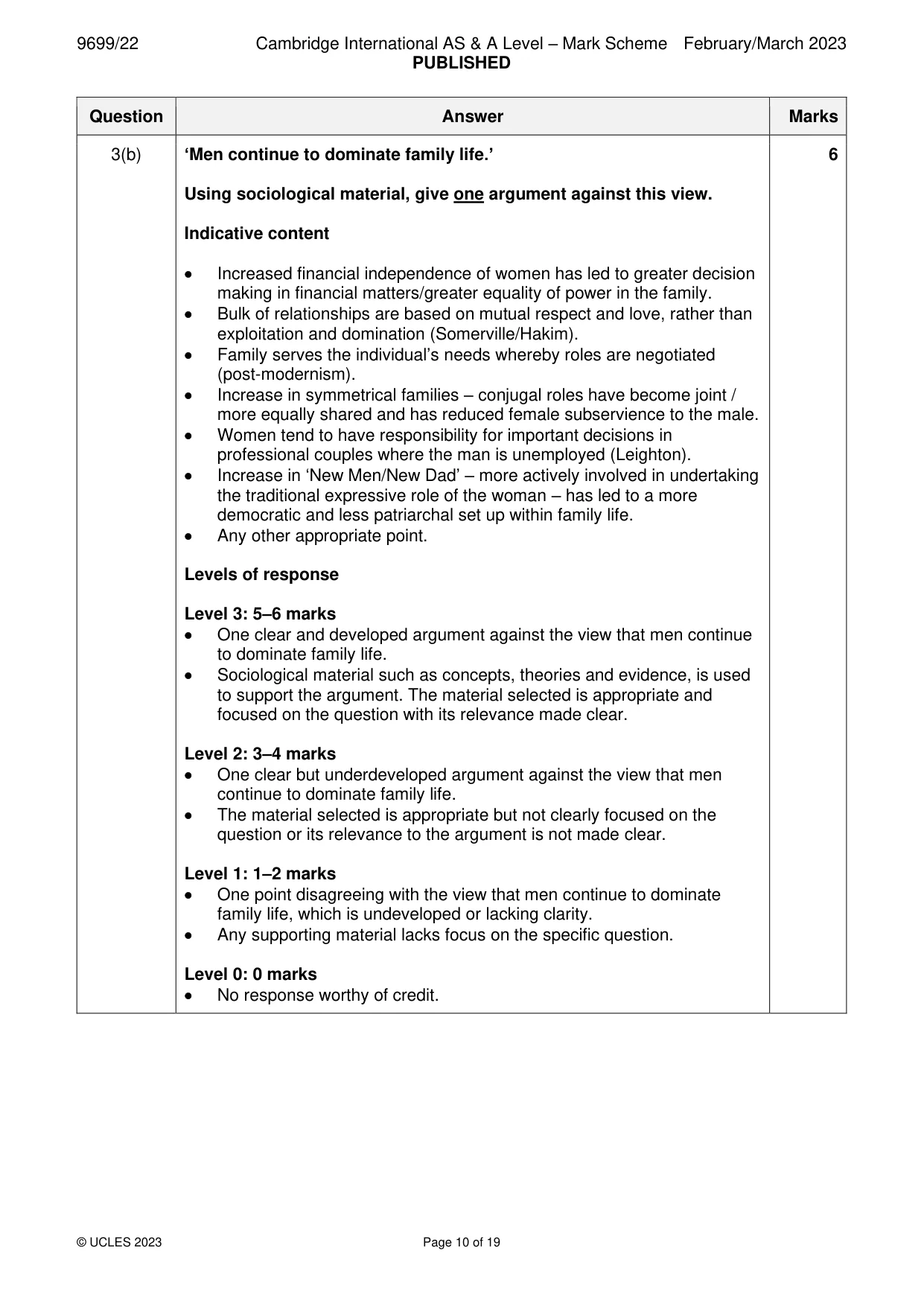
9699/22 Cambridge International AS & A Level – Mark Scheme PUBLISHED February/March 2023 © UCLES 2023 Page 10 of 19 Question Answer Marks 3(b) ‘Men continue to dominate family life.’ Using sociological material, give one argument against this view. Indicative content • Increased financial independence of women has led to greater decision making in financial matters/greater equality of power in the family. • Bulk of relationships are based on mutual respect and love, rather than exploitation and domination (Somerville/Hakim). • Family serves the individual’s needs whereby roles are negotiated (post-modernism). • Increase in symmetrical families – conjugal roles have become joint / more equally shared and has reduced female subservience to the male. • Women tend to have responsibility for important decisions in professional couples where the man is unemployed (Leighton). • Increase in ‘New Men/New Dad’ – more actively involved in undertaking the traditional expressive role of the woman – has led to a more democratic and less patriarchal set up within family life. • Any other appropriate point. Levels of response Level 3: 5–6 marks • One clear and developed argument against the view that men continue to dominate family life. • Sociological material such as concepts, theories and evidence, is used to support the argument. The material selected is appropriate and focused on the question with its relevance made clear. Level 2: 3–4 marks • One clear but underdeveloped argument against the view that men continue to dominate family life. • The material selected is appropriate but not clearly focused on the question or its relevance to the argument is not made clear. Level 1: 1–2 marks • One point disagreeing with the view that men continue to dominate family life, which is undeveloped or lacking clarity. • Any supporting material lacks focus on the specific question. Level 0: 0 marks • No response worthy of credit. 6
Mark scheme, page 11
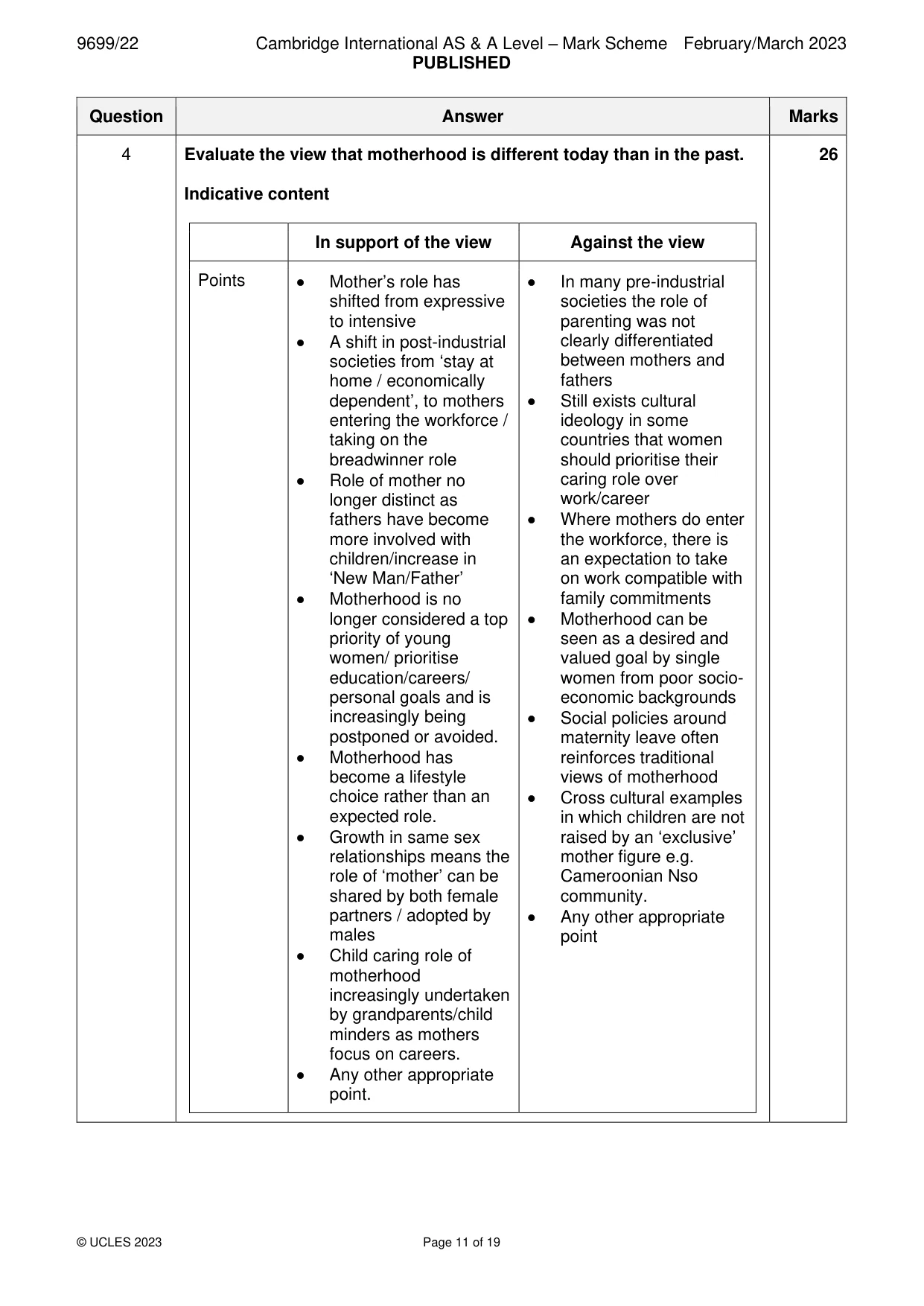
9699/22 Cambridge International AS & A Level – Mark Scheme PUBLISHED February/March 2023 © UCLES 2023 Page 11 of 19 Question Answer Marks 4 Evaluate the view that motherhood is different today than in the past. Indicative content In support of the view Against the view Points • Mother’s role has shifted from expressive to intensive • A shift in post-industrial societies from ‘stay at home / economically dependent’, to mothers entering the workforce / taking on the breadwinner role • Role of mother no longer distinct as fathers have become more involved with children/increase in ‘New Man/Father’ • Motherhood is no longer considered a top priority of young women/ prioritise education/careers/ personal goals and is increasingly being postponed or avoided. • Motherhood has become a lifestyle choice rather than an expected role. • Growth in same sex relationships means the role of ‘mother’ can be shared by both female partners / adopted by males • Child caring role of motherhood increasingly undertaken by grandparents/child minders as mothers focus on careers. • Any other appropriate point. • In many pre-industrial societies the role of parenting was not clearly differentiated between mothers and fathers • Still exists cultural ideology in some countries that women should prioritise their caring role over work/career • Where mothers do enter the workforce, there is an expectation to take on work compatible with family commitments • Motherhood can be seen as a desired and valued goal by single women from poor socio- economic backgrounds • Social policies around maternity leave often reinforces traditional views of motherhood • Cross cultural examples in which children are not raised by an ‘exclusive’ mother figure e.g. Cameroonian Nso community. • Any other appropriate point 26
Mark scheme, page 12
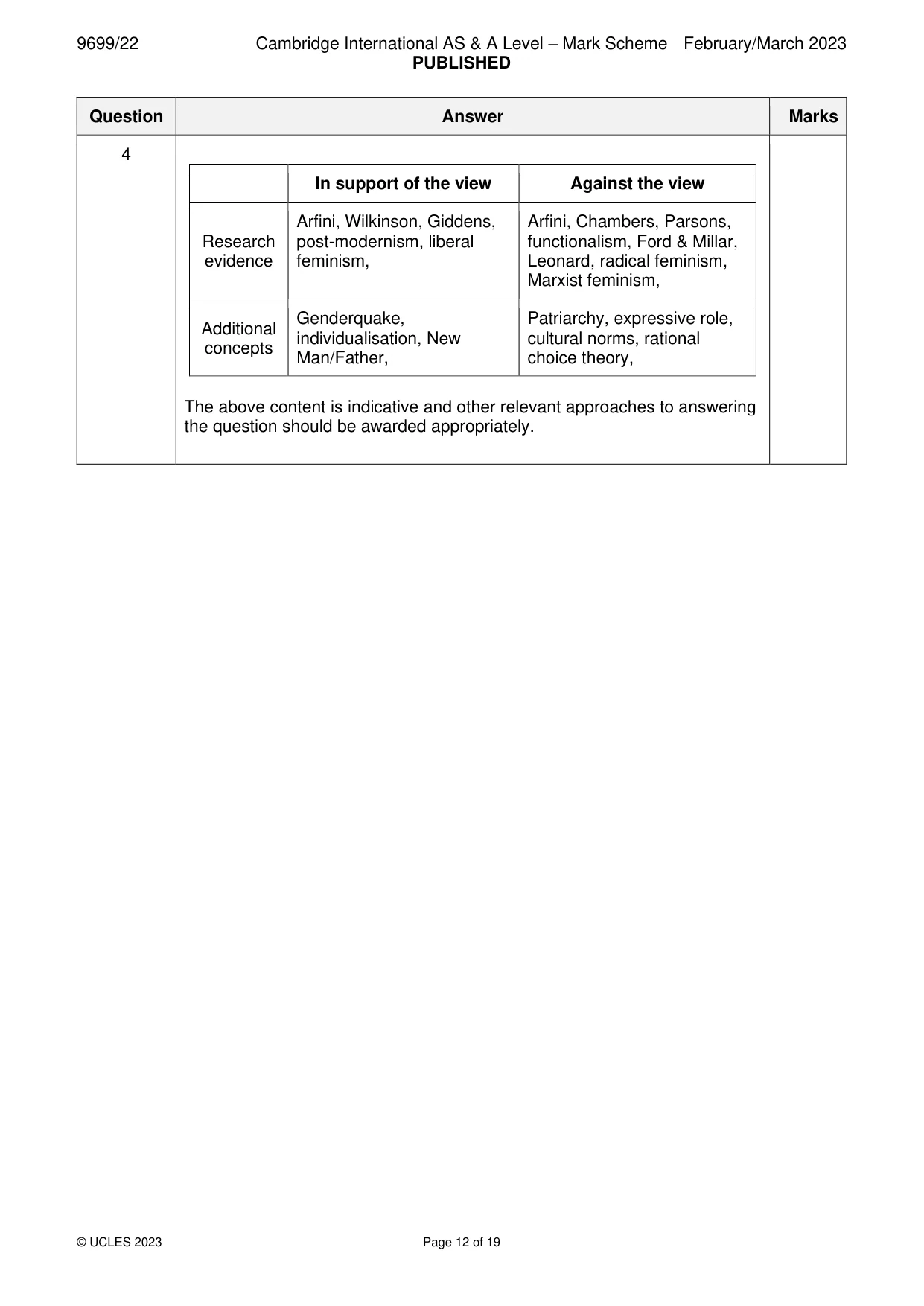
9699/22 Cambridge International AS & A Level – Mark Scheme PUBLISHED February/March 2023 © UCLES 2023 Page 12 of 19 Question Answer Marks 4 In support of the view Against the view Research evidence Arfini, Wilkinson, Giddens, post-modernism, liberal feminism, Arfini, Chambers, Parsons, functionalism, Ford & Millar, Leonard, radical feminism, Marxist feminism, Additional concepts Genderquake, individualisation, New Man/Father, Patriarchy, expressive role, cultural norms, rational choice theory, The above content is indicative and other relevant approaches to answering the question should be awarded appropriately.
Mark scheme, page 13
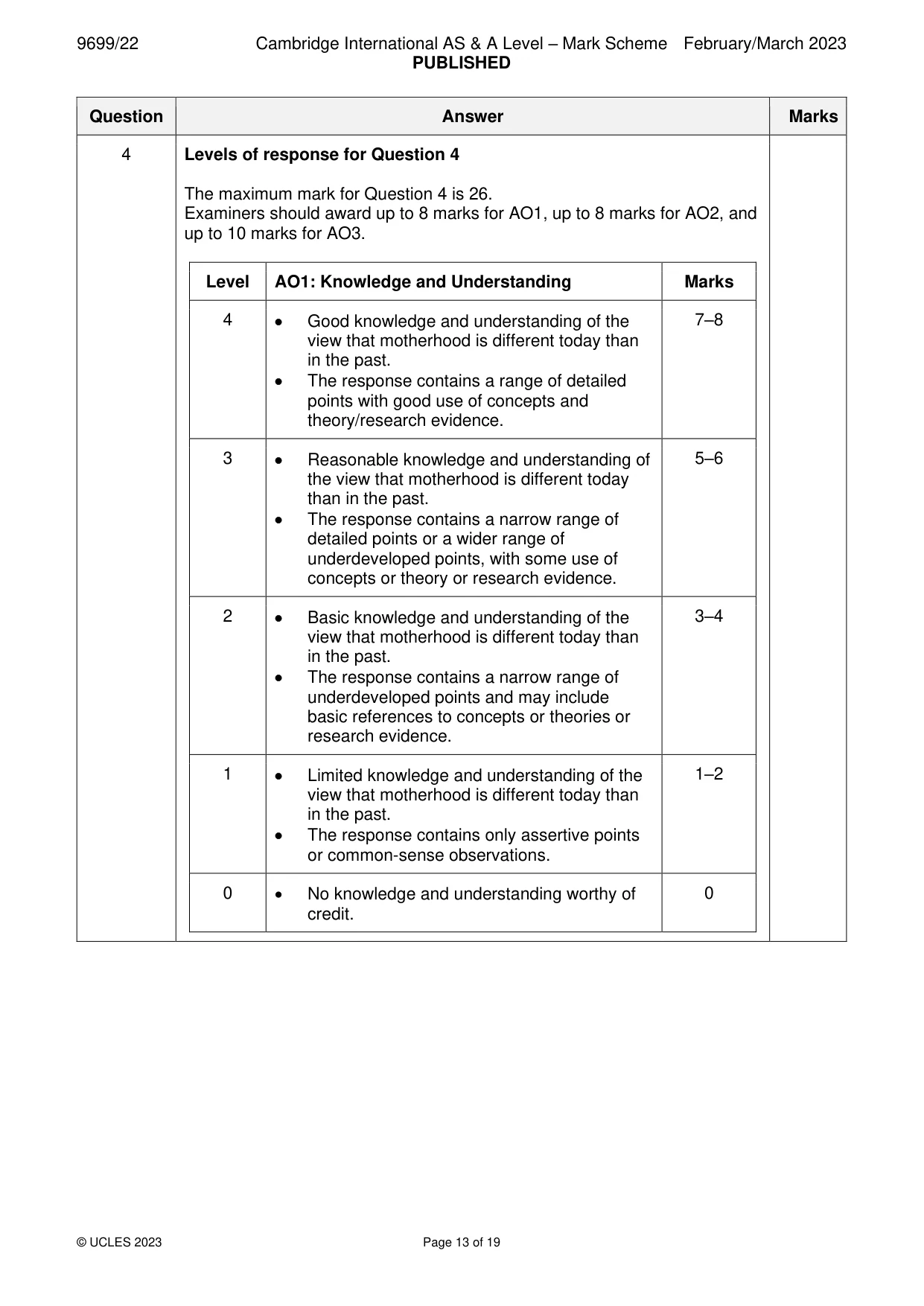
9699/22 Cambridge International AS & A Level – Mark Scheme PUBLISHED February/March 2023 © UCLES 2023 Page 13 of 19 Question Answer Marks 4 Levels of response for Question 4 The maximum mark for Question 4 is 26. Examiners should award up to 8 marks for AO1, up to 8 marks for AO2, and up to 10 marks for AO3. Level AO1: Knowledge and Understanding Marks 4 • Good knowledge and understanding of the view that motherhood is different today than in the past. • The response contains a range of detailed points with good use of concepts and theory/research evidence. 7–8 3 • Reasonable knowledge and understanding of the view that motherhood is different today than in the past. • The response contains a narrow range of detailed points or a wider range of underdeveloped points, with some use of concepts or theory or research evidence. 5–6 2 • Basic knowledge and understanding of the view that motherhood is different today than in the past. • The response contains a narrow range of underdeveloped points and may include basic references to concepts or theories or research evidence. 3–4 1 • Limited knowledge and understanding of the view that motherhood is different today than in the past. • The response contains only assertive points or common-sense observations. 1–2 0 • No knowledge and understanding worthy of credit. 0
Mark scheme, page 14
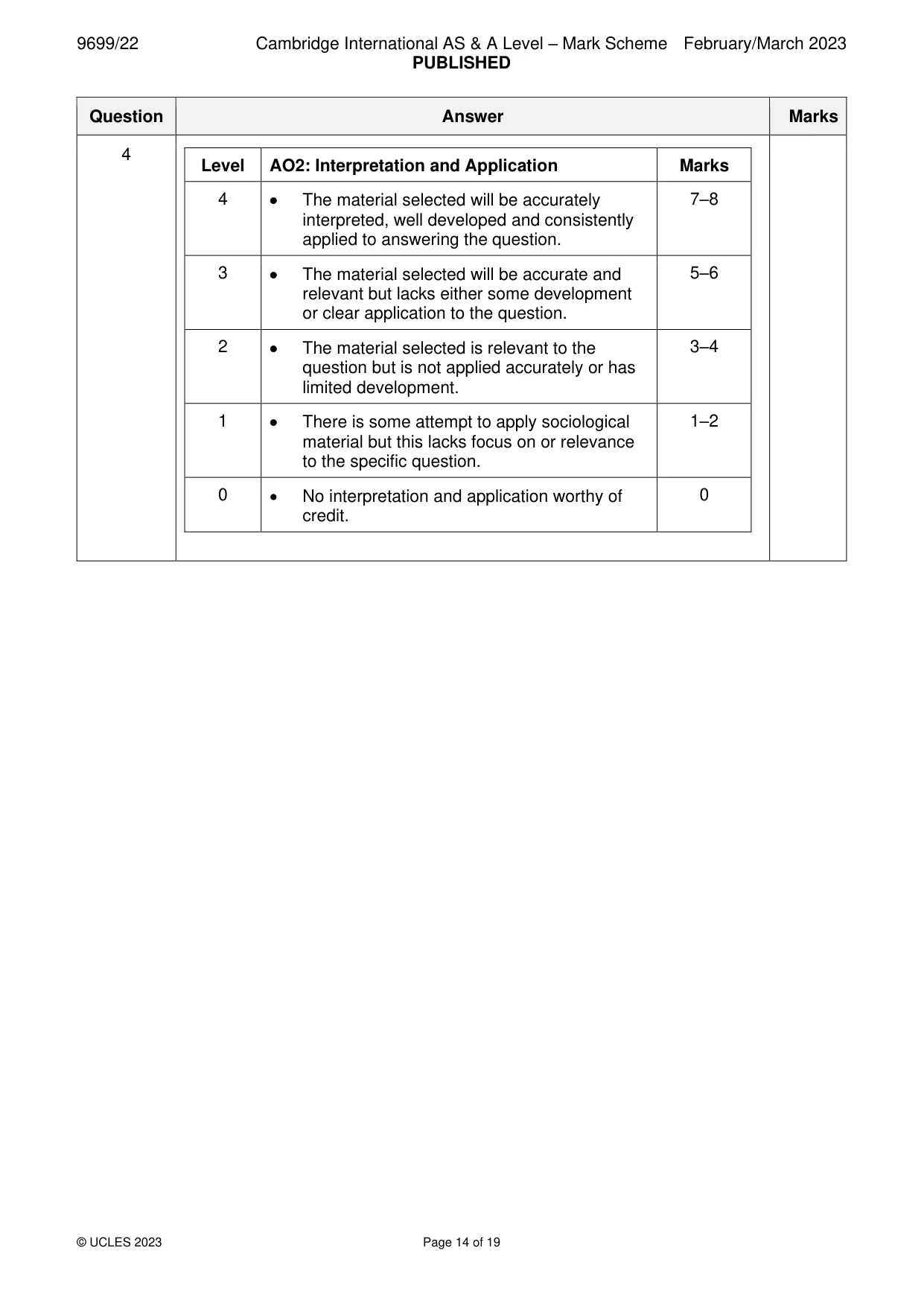
9699/22 Cambridge International AS & A Level – Mark Scheme PUBLISHED February/March 2023 © UCLES 2023 Page 14 of 19 Question Answer Marks 4 Level AO2: Interpretation and Application Marks 4 • The material selected will be accurately interpreted, well developed and consistently applied to answering the question. 7–8 3 • The material selected will be accurate and relevant but lacks either some development or clear application to the question. 5–6 2 • The material selected is relevant to the question but is not applied accurately or has limited development. 3–4 1 • There is some attempt to apply sociological material but this lacks focus on or relevance to the specific question. 1–2 0 • No interpretation and application worthy of credit. 0
Mark scheme, page 15
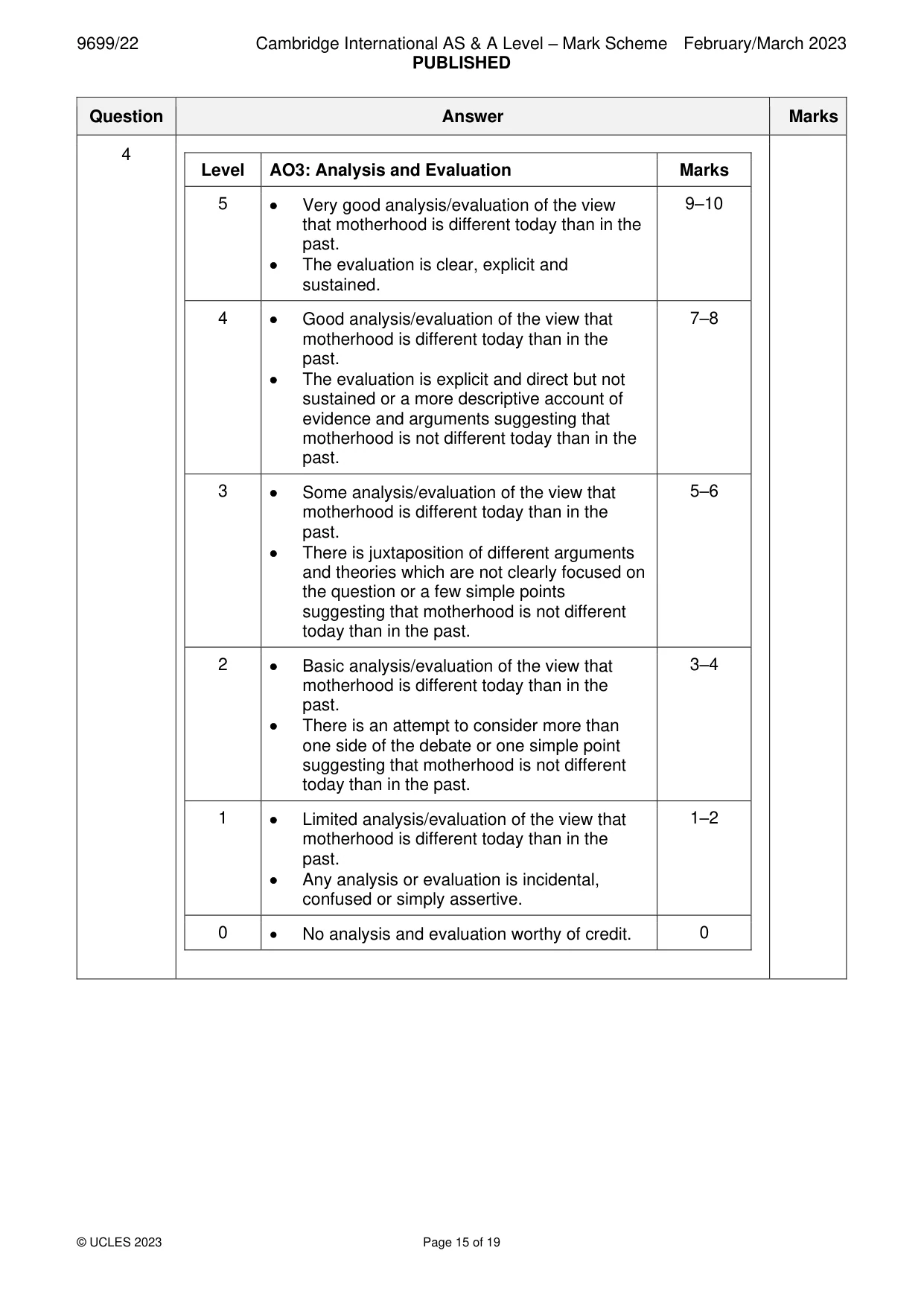
9699/22 Cambridge International AS & A Level – Mark Scheme PUBLISHED February/March 2023 © UCLES 2023 Page 15 of 19 Question Answer Marks 4 Level AO3: Analysis and Evaluation Marks 5 • Very good analysis/evaluation of the view that motherhood is different today than in the past. • The evaluation is clear, explicit and sustained. 9–10 4 • Good analysis/evaluation of the view that motherhood is different today than in the past. • The evaluation is explicit and direct but not sustained or a more descriptive account of evidence and arguments suggesting that motherhood is not different today than in the past. 7–8 3 • Some analysis/evaluation of the view that motherhood is different today than in the past. • There is juxtaposition of different arguments and theories which are not clearly focused on the question or a few simple points suggesting that motherhood is not different today than in the past. 5–6 2 • Basic analysis/evaluation of the view that motherhood is different today than in the past. • There is an attempt to consider more than one side of the debate or one simple point suggesting that motherhood is not different today than in the past. 3–4 1 • Limited analysis/evaluation of the view that motherhood is different today than in the past. • Any analysis or evaluation is incidental, confused or simply assertive. 1–2 0 • No analysis and evaluation worthy of credit. 0
Mark scheme, page 16
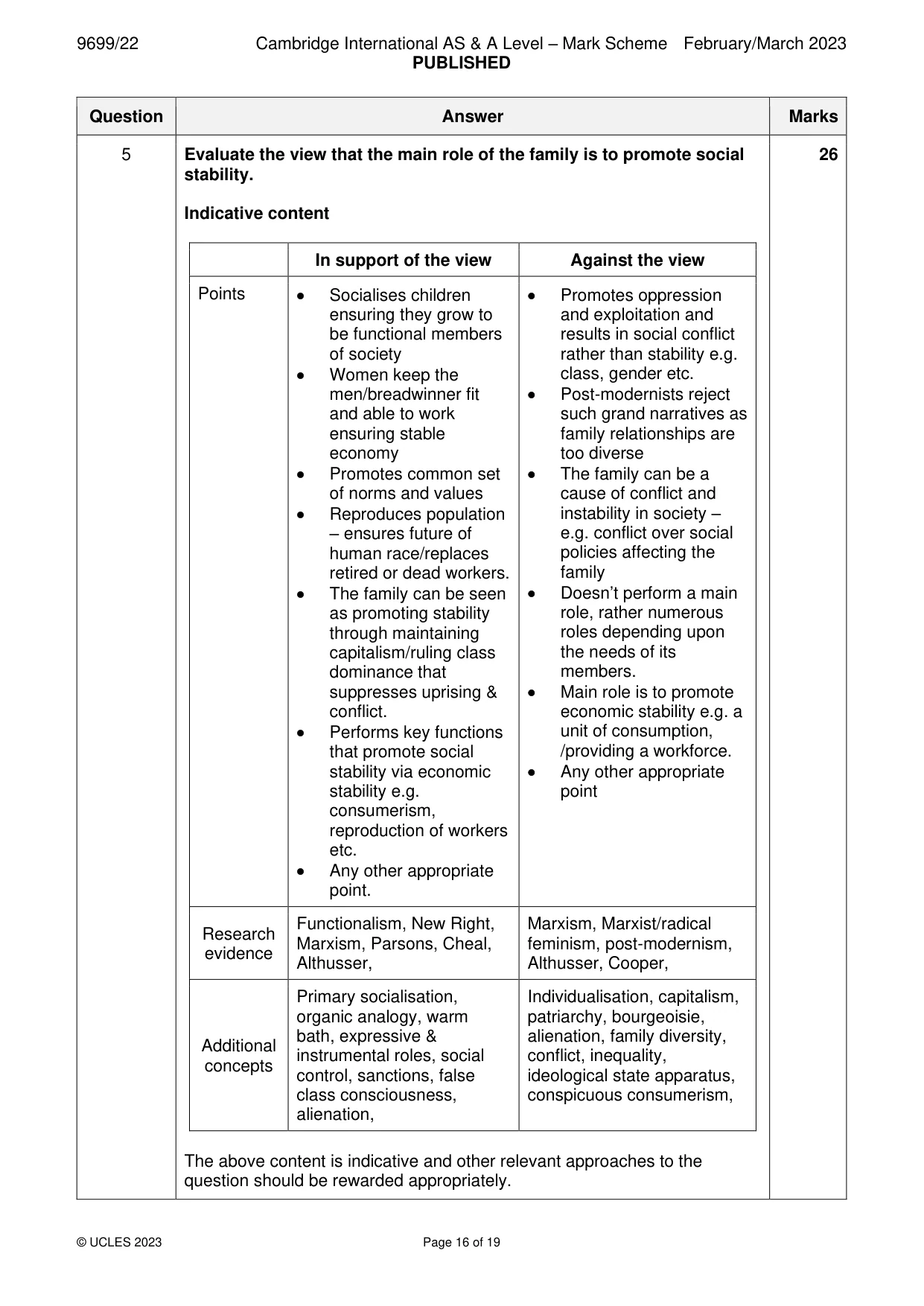
9699/22 Cambridge International AS & A Level – Mark Scheme PUBLISHED February/March 2023 © UCLES 2023 Page 16 of 19 Question Answer Marks 5 Evaluate the view that the main role of the family is to promote social stability. Indicative content In support of the view Against the view Points • Socialises children ensuring they grow to be functional members of society • Women keep the men/breadwinner fit and able to work ensuring stable economy • Promotes common set of norms and values • Reproduces population – ensures future of human race/replaces retired or dead workers. • The family can be seen as promoting stability through maintaining capitalism/ruling class dominance that suppresses uprising & conflict. • Performs key functions that promote social stability via economic stability e.g. consumerism, reproduction of workers etc. • Any other appropriate point. • Promotes oppression and exploitation and results in social conflict rather than stability e.g. class, gender etc. • Post-modernists reject such grand narratives as family relationships are too diverse • The family can be a cause of conflict and instability in society – e.g. conflict over social policies affecting the family • Doesn’t perform a main role, rather numerous roles depending upon the needs of its members. • Main role is to promote economic stability e.g. a unit of consumption, /providing a workforce. • Any other appropriate point Research evidence Functionalism, New Right, Marxism, Parsons, Cheal, Althusser, Marxism, Marxist/radical feminism, post-modernism, Althusser, Cooper, Additional concepts Primary socialisation, organic analogy, warm bath, expressive & instrumental roles, social control, sanctions, false class consciousness, alienation, Individualisation, capitalism, patriarchy, bourgeoisie, alienation, family diversity, conflict, inequality, ideological state apparatus, conspicuous consumerism, The above content is indicative and other relevant approaches to the question should be rewarded appropriately. 26
Mark scheme, page 17
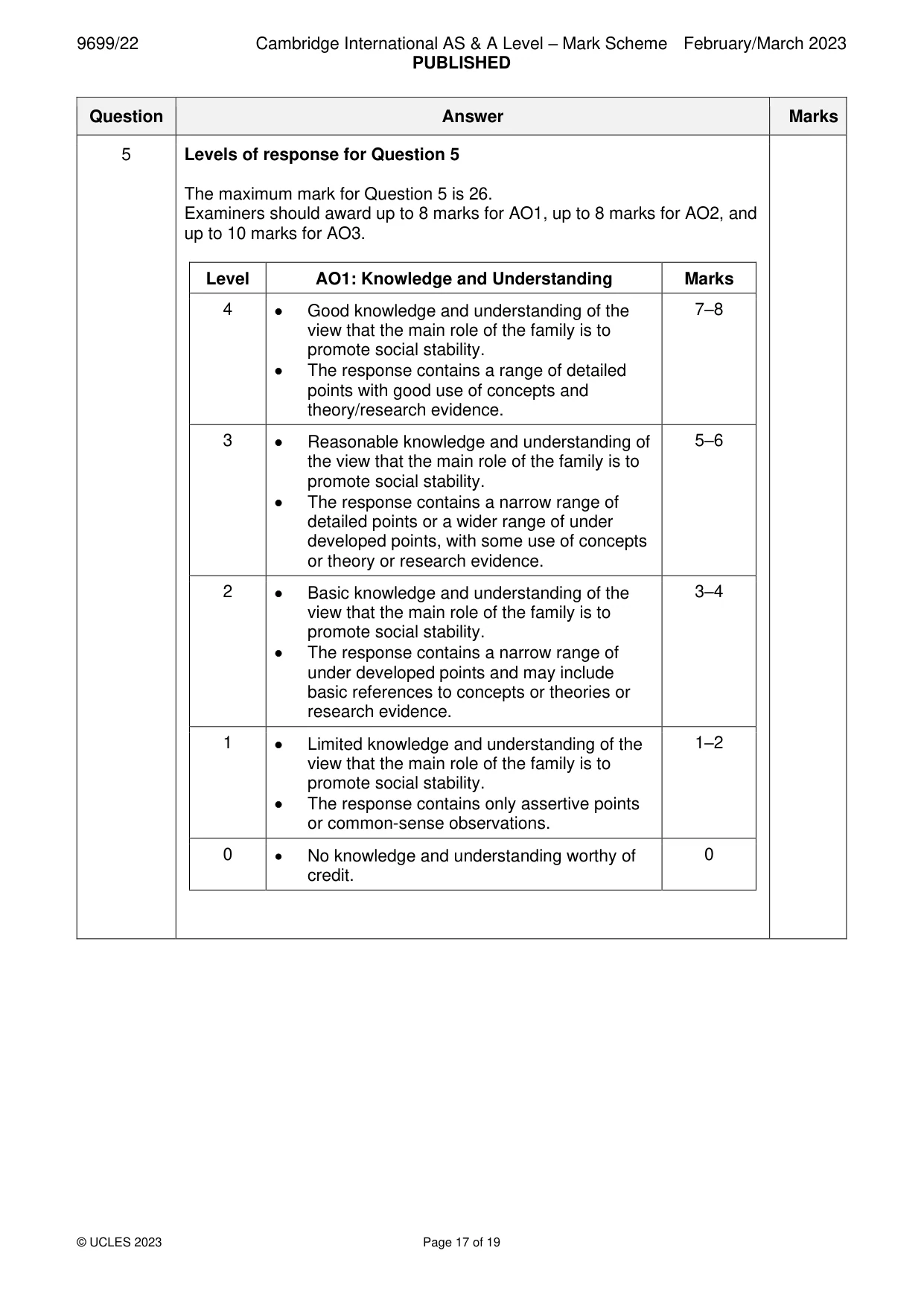
9699/22 Cambridge International AS & A Level – Mark Scheme PUBLISHED February/March 2023 © UCLES 2023 Page 17 of 19 Question Answer Marks 5 Levels of response for Question 5 The maximum mark for Question 5 is 26. Examiners should award up to 8 marks for AO1, up to 8 marks for AO2, and up to 10 marks for AO3. Level AO1: Knowledge and Understanding Marks 4 • Good knowledge and understanding of the view that the main role of the family is to promote social stability. • The response contains a range of detailed points with good use of concepts and theory/research evidence. 7–8 3 • Reasonable knowledge and understanding of the view that the main role of the family is to promote social stability. • The response contains a narrow range of detailed points or a wider range of under developed points, with some use of concepts or theory or research evidence. 5–6 2 • Basic knowledge and understanding of the view that the main role of the family is to promote social stability. • The response contains a narrow range of under developed points and may include basic references to concepts or theories or research evidence. 3–4 1 • Limited knowledge and understanding of the view that the main role of the family is to promote social stability. • The response contains only assertive points or common-sense observations. 1–2 0 • No knowledge and understanding worthy of credit. 0
Mark scheme, page 18
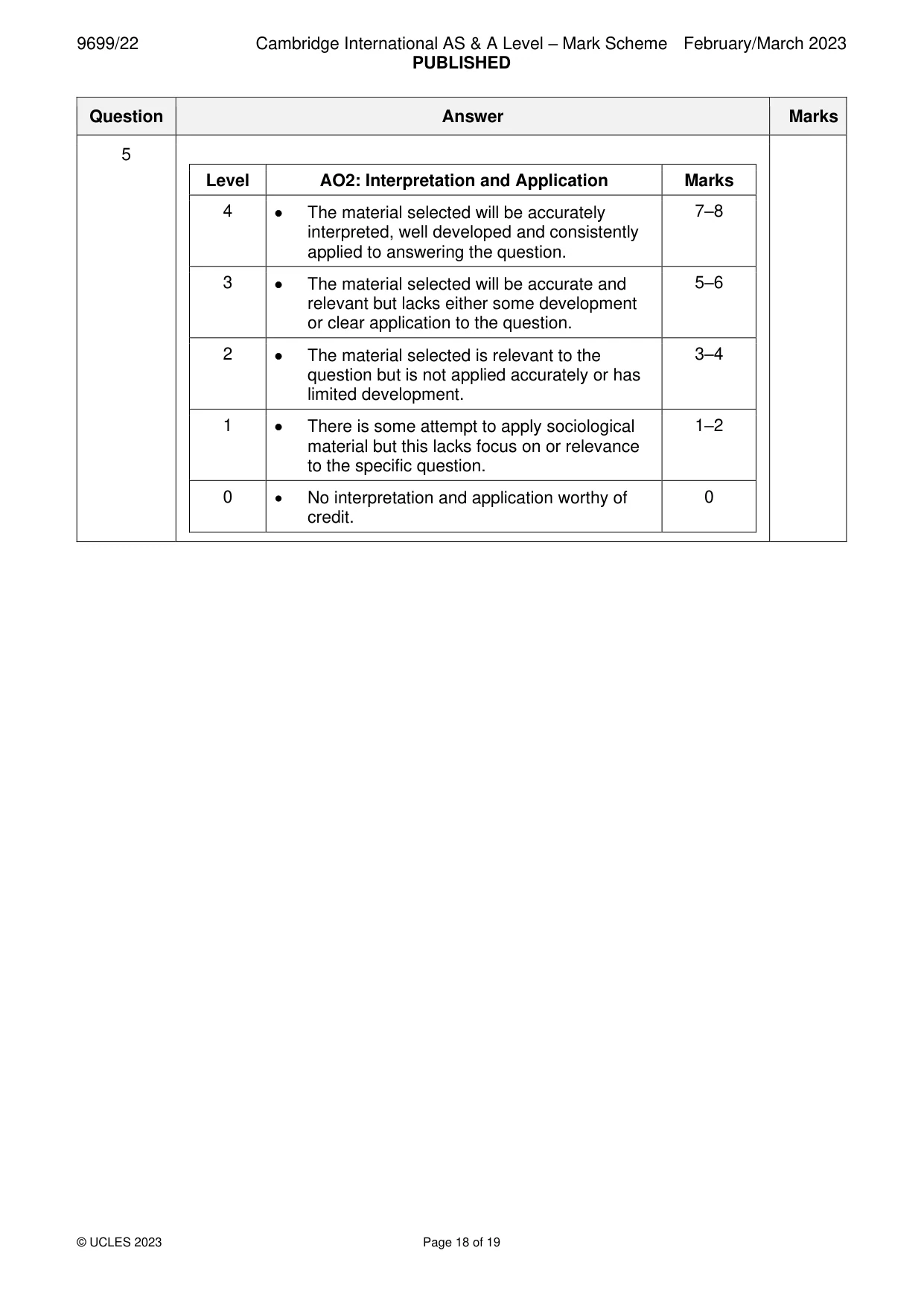
9699/22 Cambridge International AS & A Level – Mark Scheme PUBLISHED February/March 2023 © UCLES 2023 Page 18 of 19 Question Answer Marks 5 Level AO2: Interpretation and Application Marks 4 • The material selected will be accurately interpreted, well developed and consistently applied to answering the question. 7–8 3 • The material selected will be accurate and relevant but lacks either some development or clear application to the question. 5–6 2 • The material selected is relevant to the question but is not applied accurately or has limited development. 3–4 1 • There is some attempt to apply sociological material but this lacks focus on or relevance to the specific question. 1–2 0 • No interpretation and application worthy of credit. 0
Mark scheme, page 19
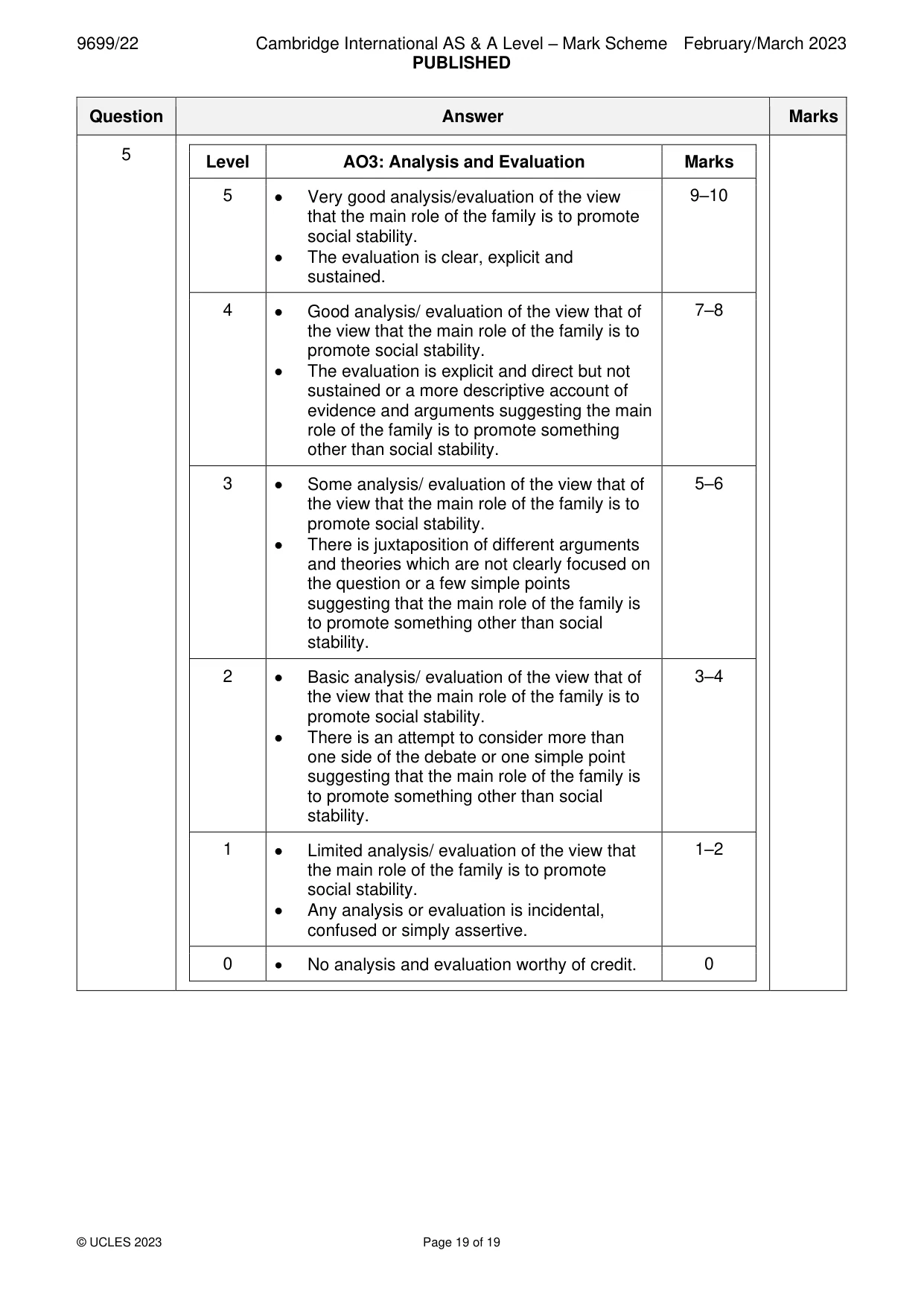
9699/22 Cambridge International AS & A Level – Mark Scheme PUBLISHED February/March 2023 © UCLES 2023 Page 19 of 19 Question Answer Marks 5 Level AO3: Analysis and Evaluation Marks 5 • Very good analysis/evaluation of the view that the main role of the family is to promote social stability. • The evaluation is clear, explicit and sustained. 9–10 4 • Good analysis/ evaluation of the view that of the view that the main role of the family is to promote social stability. • The evaluation is explicit and direct but not sustained or a more descriptive account of evidence and arguments suggesting the main role of the family is to promote something other than social stability. 7–8 3 • Some analysis/ evaluation of the view that of the view that the main role of the family is to promote social stability. • There is juxtaposition of different arguments and theories which are not clearly focused on the question or a few simple points suggesting that the main role of the family is to promote something other than social stability. 5–6 2 • Basic analysis/ evaluation of the view that of the view that the main role of the family is to promote social stability. • There is an attempt to consider more than one side of the debate or one simple point suggesting that the main role of the family is to promote something other than social stability. 3–4 1 • Limited analysis/ evaluation of the view that the main role of the family is to promote social stability. • Any analysis or evaluation is incidental, confused or simply assertive. 1–2 0 • No analysis and evaluation worthy of credit. 0
What you needed in this session
Cambridge’s own grade thresholds for 2023 Feb/March, Paper 2 · Variant 2. A higher threshold means an easier paper — the bar moves with how the cohort did.