Cambridge A Level Sociology 9699 — 2022 Oct/Nov Paper 2 · Variant 1
9699/21/O/N/22 · 60 marks · ≈68 min
The question paper and its mark scheme, free to read here and free to download. This is Cambridge’s own paper, exactly as it was sat.
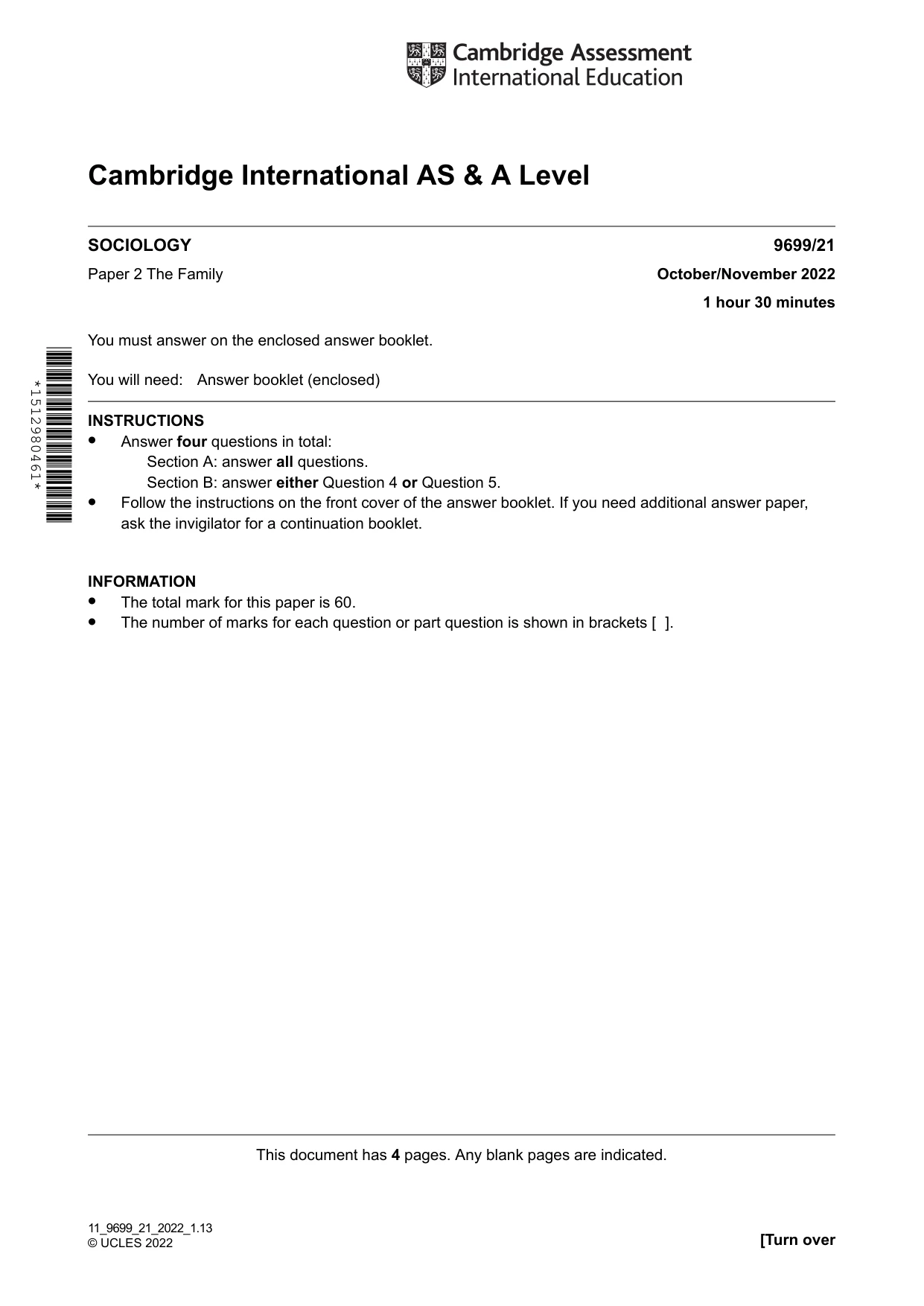
Question paper4 pages
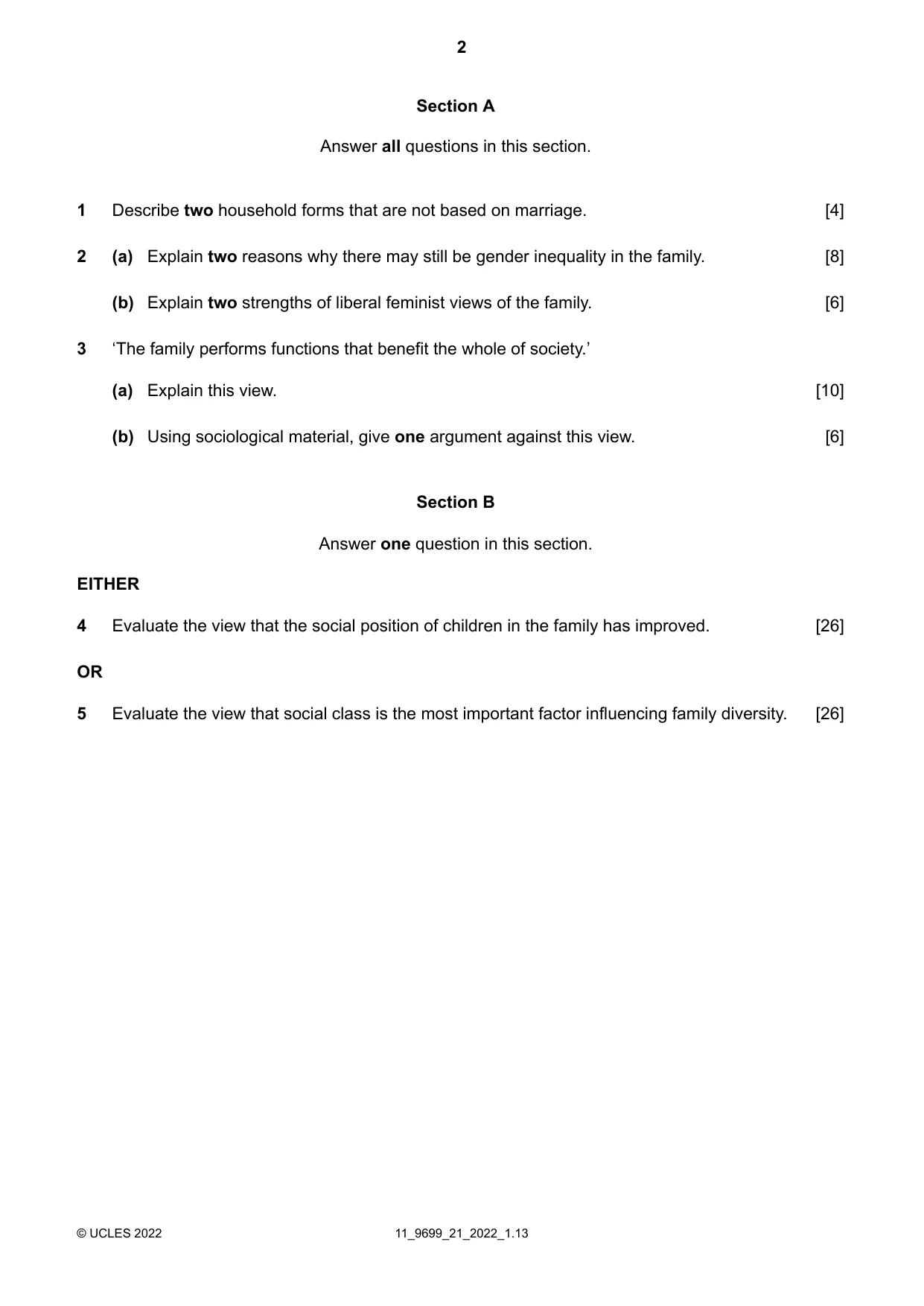


Mark scheme17 pages
Answers below. Sit the paper first if you are practising.
Paper as text
Question paper, page 1
Cambridge International AS & A Level 9699/21 October/November 2022 1 hour 30 minutes SOCIOLOGY Paper 2 The Family You must answer on the enclosed answer booklet. You will need: Answer booklet (enclosed) INSTRUCTIONS • Answer four questions in total: Section A: answer all questions. Section B: answer either Question 4 or Question 5. • Follow the instructions on the front cover of the answer booklet. If you need additional answer paper, ask the invigilator for a continuation booklet. INFORMATION • The total mark for this paper is 60. • The number of marks for each question or part question is shown in brackets [ ]. This document has 4 pages. Any blank pages are indicated. [Turn over 11_9699_21_2022_1.13 © UCLES 2022 *1512980461*
Question paper, page 2
Section A Answer all questions in this section. Describe two household forms that are not based on marriage. [4] 1 Explain two reasons why there may still be gender inequality in the family. [8] (a) 2 Explain two strengths of liberal feminist views of the family. [6] (b) ‘The family performs functions that benefit the whole of society.’ 3 Explain this view. [10] (a) Using sociological material, give one argument against this view. [6] (b) Section B Answer one question in this section. EITHER Evaluate the view that the social position of children in the family has improved. [26] 4 OR Evaluate the view that social class is the most important factor influencing family diversity. [26] 5 11_9699_21_2022_1.13 © UCLES 2022 2
Question paper, page 3
BLANK PAGE 11_9699_21_2022_1.13 © UCLES 2022 3
Question paper, page 4
BLANK PAGE Permission to reproduce items where third-party owned material protected by copyright is included has been sought and cleared where possible. Every reasonable effort has been made by the publisher (UCLES) to trace copyright holders, but if any items requiring clearance have unwittingly been included, the publisher will be pleased to make amends at the earliest possible opportunity. To avoid the issue of disclosure of answer-related information to candidates, all copyright acknowledgements are reproduced online in the Cambridge Assessment International Education Copyright Acknowledgements Booklet. This is produced for each series of examinations and is freely available to download at www.cambridgeinternational.org after the live examination series. Cambridge Assessment International Education is part of Cambridge Assessment. Cambridge Assessment is the brand name of the University of Cambridge Local Examinations Syndicate (UCLES), which is a department of the University of Cambridge. 11_9699_21_2022_1.13 © UCLES 2022 4
Mark scheme, page 1
This document consists of 17 printed pages. © UCLES 2022 [Turn over Cambridge International AS & A Level SOCIOLOGY 9699/21 Paper 2 The Family October/November 2022 MARK SCHEME Maximum Mark: 60 Published This mark scheme is published as an aid to teachers and candidates, to indicate the requirements of the examination. It shows the basis on which Examiners were instructed to award marks. It does not indicate the details of the discussions that took place at an Examiners’ meeting before marking began, which would have considered the acceptability of alternative answers. Mark schemes should be read in conjunction with the question paper and the Principal Examiner Report for Teachers. Cambridge International will not enter into discussions about these mark schemes. Cambridge International is publishing the mark schemes for the October/November 2022 series for most Cambridge IGCSE™, Cambridge International A and AS Level components and some Cambridge O Level components.
Mark scheme, page 2
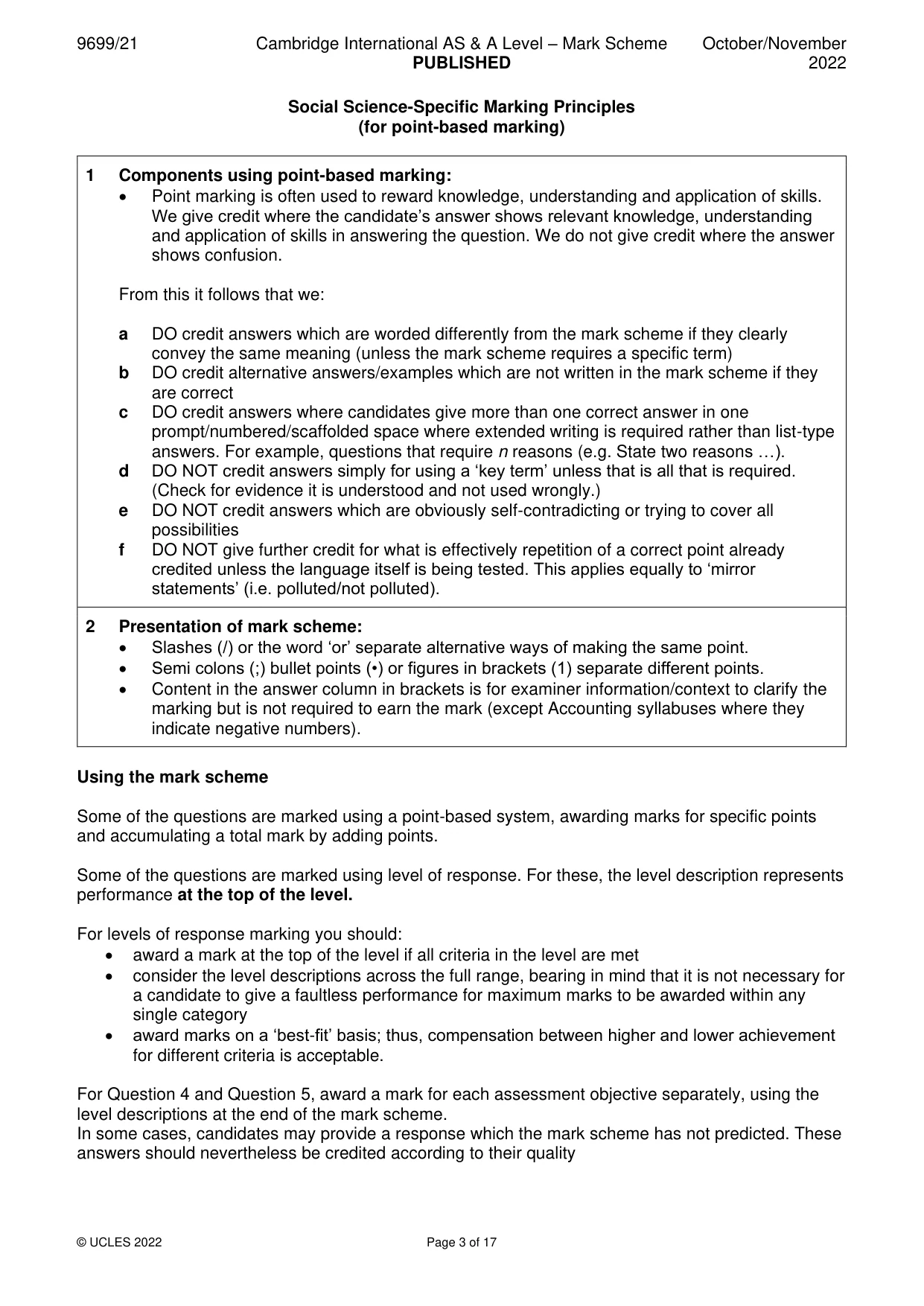
9699/21 Cambridge International AS & A Level – Mark Scheme PUBLISHED October/November 2022 © UCLES 2022 Page 2 of 17 Generic Marking Principles These general marking principles must be applied by all examiners when marking candidate answers. They should be applied alongside the specific content of the mark scheme or generic level descriptors for a question. Each question paper and mark scheme will also comply with these marking principles. GENERIC MARKING PRINCIPLE 1: Marks must be awarded in line with: • the specific content of the mark scheme or the generic level descriptors for the question • the specific skills defined in the mark scheme or in the generic level descriptors for the question • the standard of response required by a candidate as exemplified by the standardisation scripts. GENERIC MARKING PRINCIPLE 2: Marks awarded are always whole marks (not half marks, or other fractions). GENERIC MARKING PRINCIPLE 3: Marks must be awarded positively: • marks are awarded for correct/valid answers, as defined in the mark scheme. However, credit is given for valid answers which go beyond the scope of the syllabus and mark scheme, referring to your Team Leader as appropriate • marks are awarded when candidates clearly demonstrate what they know and can do • marks are not deducted for errors • marks are not deducted for omissions • answers should only be judged on the quality of spelling, punctuation and grammar when these features are specifically assessed by the question as indicated by the mark scheme. The meaning, however, should be unambiguous. GENERIC MARKING PRINCIPLE 4: Rules must be applied consistently, e.g. in situations where candidates have not followed instructions or in the application of generic level descriptors. GENERIC MARKING PRINCIPLE 5: Marks should be awarded using the full range of marks defined in the mark scheme for the question (however; the use of the full mark range may be limited according to the quality of the candidate responses seen). GENERIC MARKING PRINCIPLE 6: Marks awarded are based solely on the requirements as defined in the mark scheme. Marks should not be awarded with grade thresholds or grade descriptors in mind.
Mark scheme, page 3
9699/21 Cambridge International AS & A Level – Mark Scheme PUBLISHED October/November 2022 © UCLES 2022 Page 3 of 17 Social Science-Specific Marking Principles (for point-based marking) 1 Components using point-based marking: • Point marking is often used to reward knowledge, understanding and application of skills. We give credit where the candidate’s answer shows relevant knowledge, understanding and application of skills in answering the question. We do not give credit where the answer shows confusion. From this it follows that we: a DO credit answers which are worded differently from the mark scheme if they clearly convey the same meaning (unless the mark scheme requires a specific term) b DO credit alternative answers/examples which are not written in the mark scheme if they are correct c DO credit answers where candidates give more than one correct answer in one prompt/numbered/scaffolded space where extended writing is required rather than list-type answers. For example, questions that require n reasons (e.g. State two reasons …). d DO NOT credit answers simply for using a ‘key term’ unless that is all that is required. (Check for evidence it is understood and not used wrongly.) e DO NOT credit answers which are obviously self-contradicting or trying to cover all possibilities f DO NOT give further credit for what is effectively repetition of a correct point already credited unless the language itself is being tested. This applies equally to ‘mirror statements’ (i.e. polluted/not polluted). 2 Presentation of mark scheme: • Slashes (/) or the word ‘or’ separate alternative ways of making the same point. • Semi colons (;) bullet points (•) or figures in brackets (1) separate different points. • Content in the answer column in brackets is for examiner information/context to clarify the marking but is not required to earn the mark (except Accounting syllabuses where they indicate negative numbers). Using the mark scheme Some of the questions are marked using a point-based system, awarding marks for specific points and accumulating a total mark by adding points. Some of the questions are marked using level of response. For these, the level description represents performance at the top of the level. For levels of response marking you should: • award a mark at the top of the level if all criteria in the level are met • consider the level descriptions across the full range, bearing in mind that it is not necessary for a candidate to give a faultless performance for maximum marks to be awarded within any single category • award marks on a ‘best-fit’ basis; thus, compensation between higher and lower achievement for different criteria is acceptable. For Question 4 and Question 5, award a mark for each assessment objective separately, using the level descriptions at the end of the mark scheme. In some cases, candidates may provide a response which the mark scheme has not predicted. These answers should nevertheless be credited according to their quality
Mark scheme, page 4
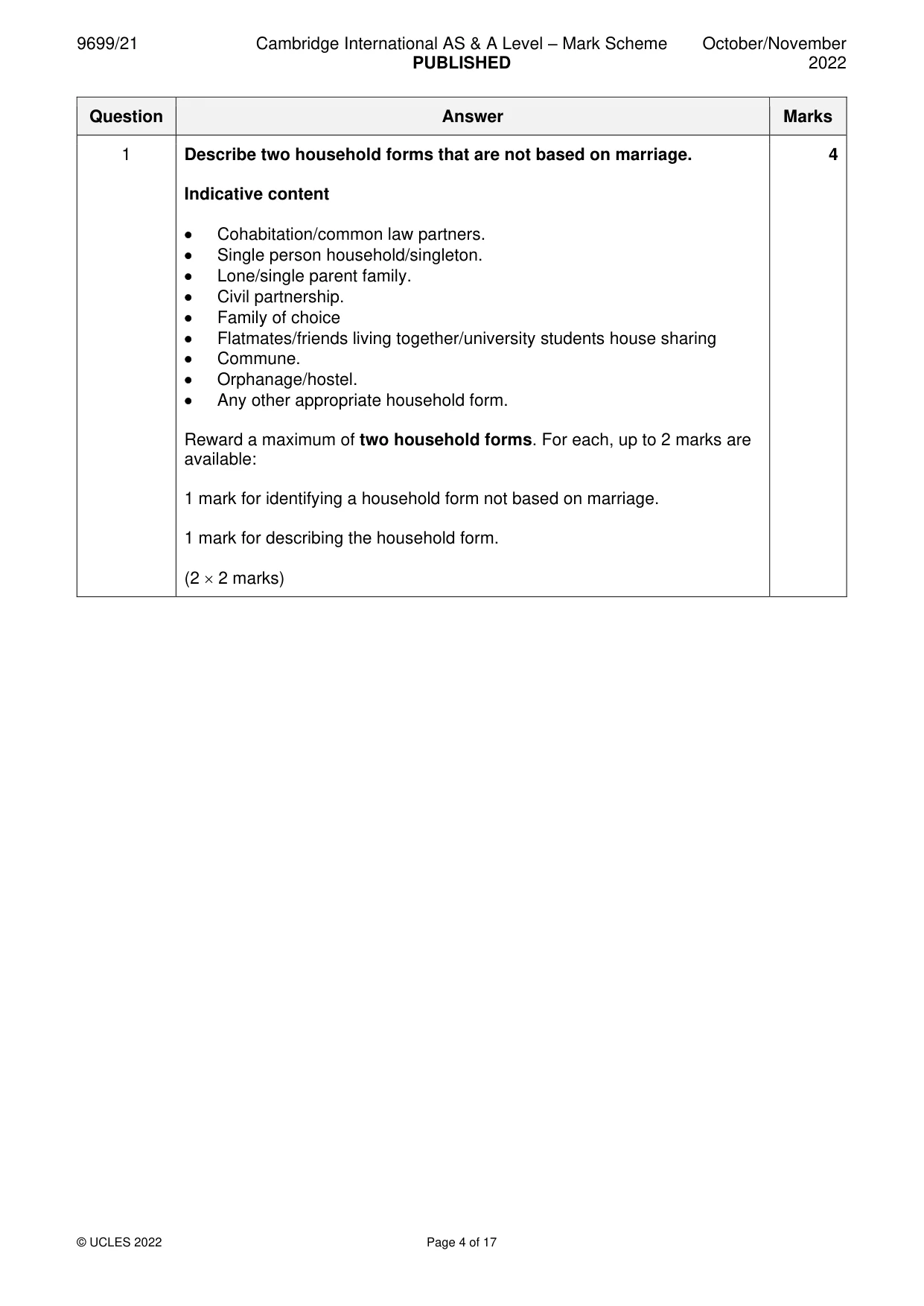
9699/21 Cambridge International AS & A Level – Mark Scheme PUBLISHED October/November 2022 © UCLES 2022 Page 4 of 17 Question Answer Marks 1 Describe two household forms that are not based on marriage. Indicative content • Cohabitation/common law partners. • Single person household/singleton. • Lone/single parent family. • Civil partnership. • Family of choice • Flatmates/friends living together/university students house sharing • Commune. • Orphanage/hostel. • Any other appropriate household form. Reward a maximum of two household forms. For each, up to 2 marks are available: 1 mark for identifying a household form not based on marriage. 1 mark for describing the household form. (2 2 marks) 4
Mark scheme, page 5
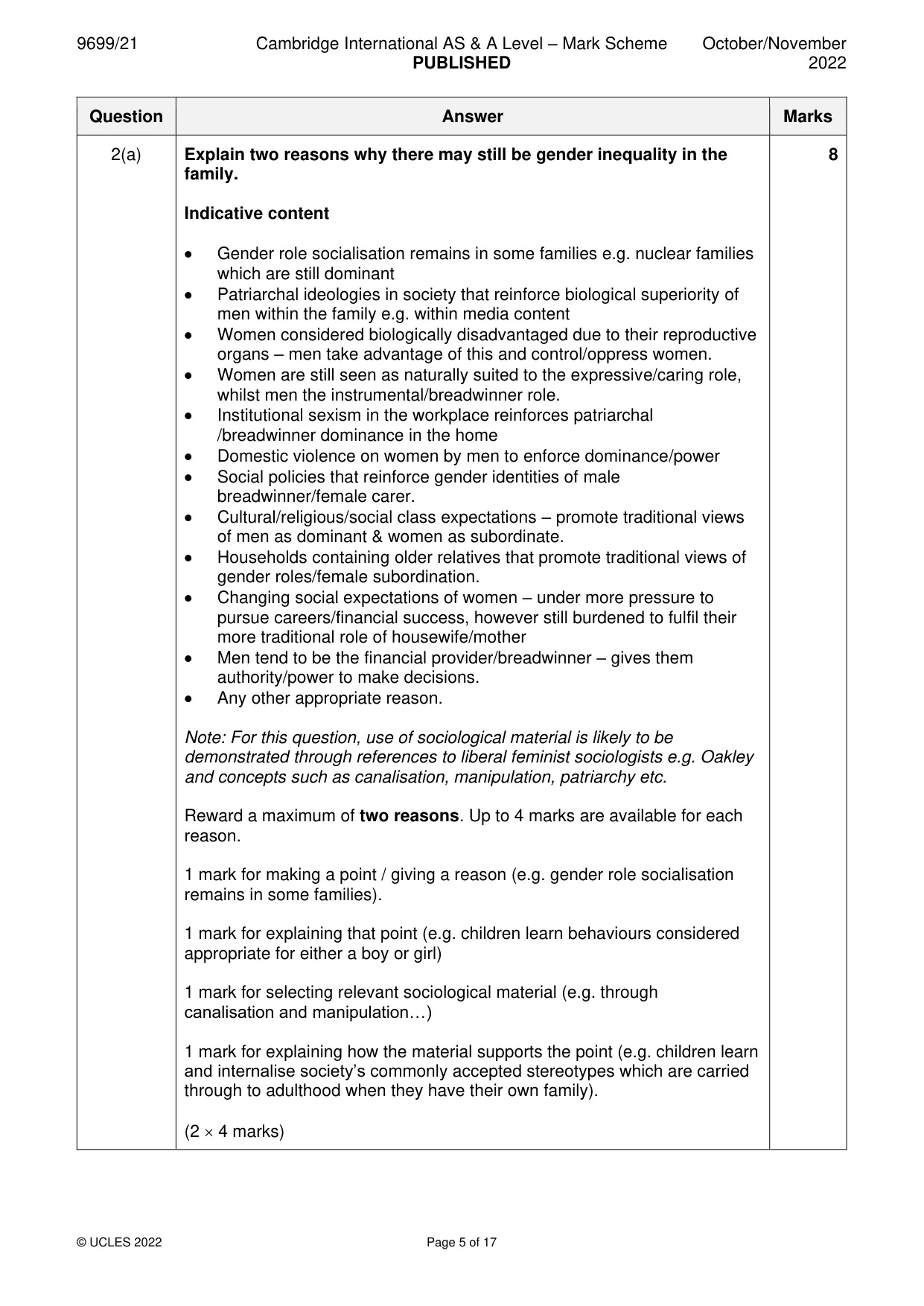
9699/21 Cambridge International AS & A Level – Mark Scheme PUBLISHED October/November 2022 © UCLES 2022 Page 5 of 17 Question Answer Marks 2(a) Explain two reasons why there may still be gender inequality in the family. Indicative content • Gender role socialisation remains in some families e.g. nuclear families which are still dominant • Patriarchal ideologies in society that reinforce biological superiority of men within the family e.g. within media content • Women considered biologically disadvantaged due to their reproductive organs – men take advantage of this and control/oppress women. • Women are still seen as naturally suited to the expressive/caring role, whilst men the instrumental/breadwinner role. • Institutional sexism in the workplace reinforces patriarchal /breadwinner dominance in the home • Domestic violence on women by men to enforce dominance/power • Social policies that reinforce gender identities of male breadwinner/female carer. • Cultural/religious/social class expectations – promote traditional views of men as dominant & women as subordinate. • Households containing older relatives that promote traditional views of gender roles/female subordination. • Changing social expectations of women – under more pressure to pursue careers/financial success, however still burdened to fulfil their more traditional role of housewife/mother • Men tend to be the financial provider/breadwinner – gives them authority/power to make decisions. • Any other appropriate reason. Note: For this question, use of sociological material is likely to be demonstrated through references to liberal feminist sociologists e.g. Oakley and concepts such as canalisation, manipulation, patriarchy etc. Reward a maximum of two reasons. Up to 4 marks are available for each reason. 1 mark for making a point / giving a reason (e.g. gender role socialisation remains in some families). 1 mark for explaining that point (e.g. children learn behaviours considered appropriate for either a boy or girl) 1 mark for selecting relevant sociological material (e.g. through canalisation and manipulation…) 1 mark for explaining how the material supports the point (e.g. children learn and internalise society’s commonly accepted stereotypes which are carried through to adulthood when they have their own family). (2 4 marks) 8
Mark scheme, page 6
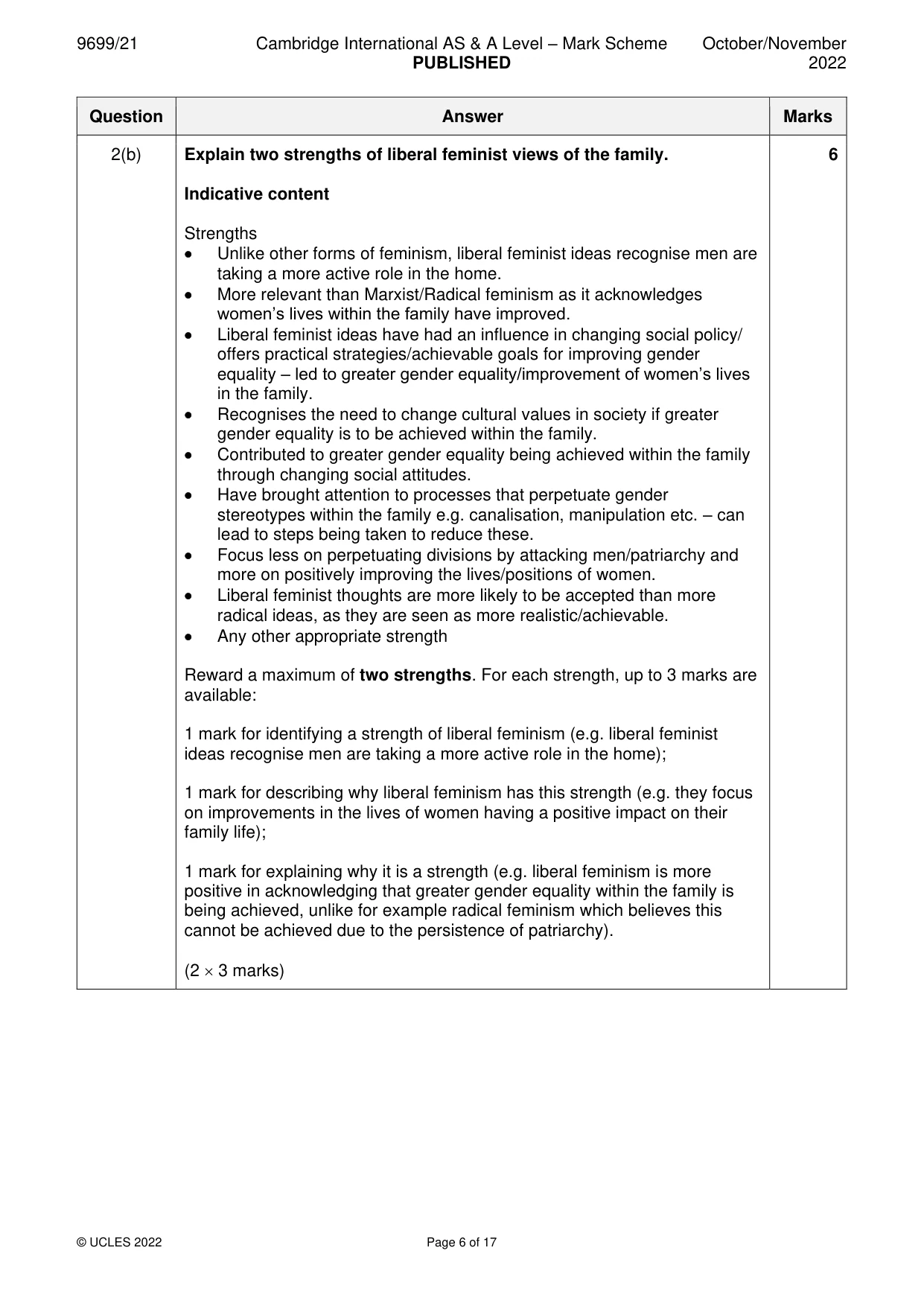
9699/21 Cambridge International AS & A Level – Mark Scheme PUBLISHED October/November 2022 © UCLES 2022 Page 6 of 17 Question Answer Marks 2(b) Explain two strengths of liberal feminist views of the family. Indicative content Strengths • Unlike other forms of feminism, liberal feminist ideas recognise men are taking a more active role in the home. • More relevant than Marxist/Radical feminism as it acknowledges women’s lives within the family have improved. • Liberal feminist ideas have had an influence in changing social policy/ offers practical strategies/achievable goals for improving gender equality – led to greater gender equality/improvement of women’s lives in the family. • Recognises the need to change cultural values in society if greater gender equality is to be achieved within the family. • Contributed to greater gender equality being achieved within the family through changing social attitudes. • Have brought attention to processes that perpetuate gender stereotypes within the family e.g. canalisation, manipulation etc. – can lead to steps being taken to reduce these. • Focus less on perpetuating divisions by attacking men/patriarchy and more on positively improving the lives/positions of women. • Liberal feminist thoughts are more likely to be accepted than more radical ideas, as they are seen as more realistic/achievable. • Any other appropriate strength Reward a maximum of two strengths. For each strength, up to 3 marks are available: 1 mark for identifying a strength of liberal feminism (e.g. liberal feminist ideas recognise men are taking a more active role in the home); 1 mark for describing why liberal feminism has this strength (e.g. they focus on improvements in the lives of women having a positive impact on their family life); 1 mark for explaining why it is a strength (e.g. liberal feminism is more positive in acknowledging that greater gender equality within the family is being achieved, unlike for example radical feminism which believes this cannot be achieved due to the persistence of patriarchy). (2 3 marks) 6
Mark scheme, page 7
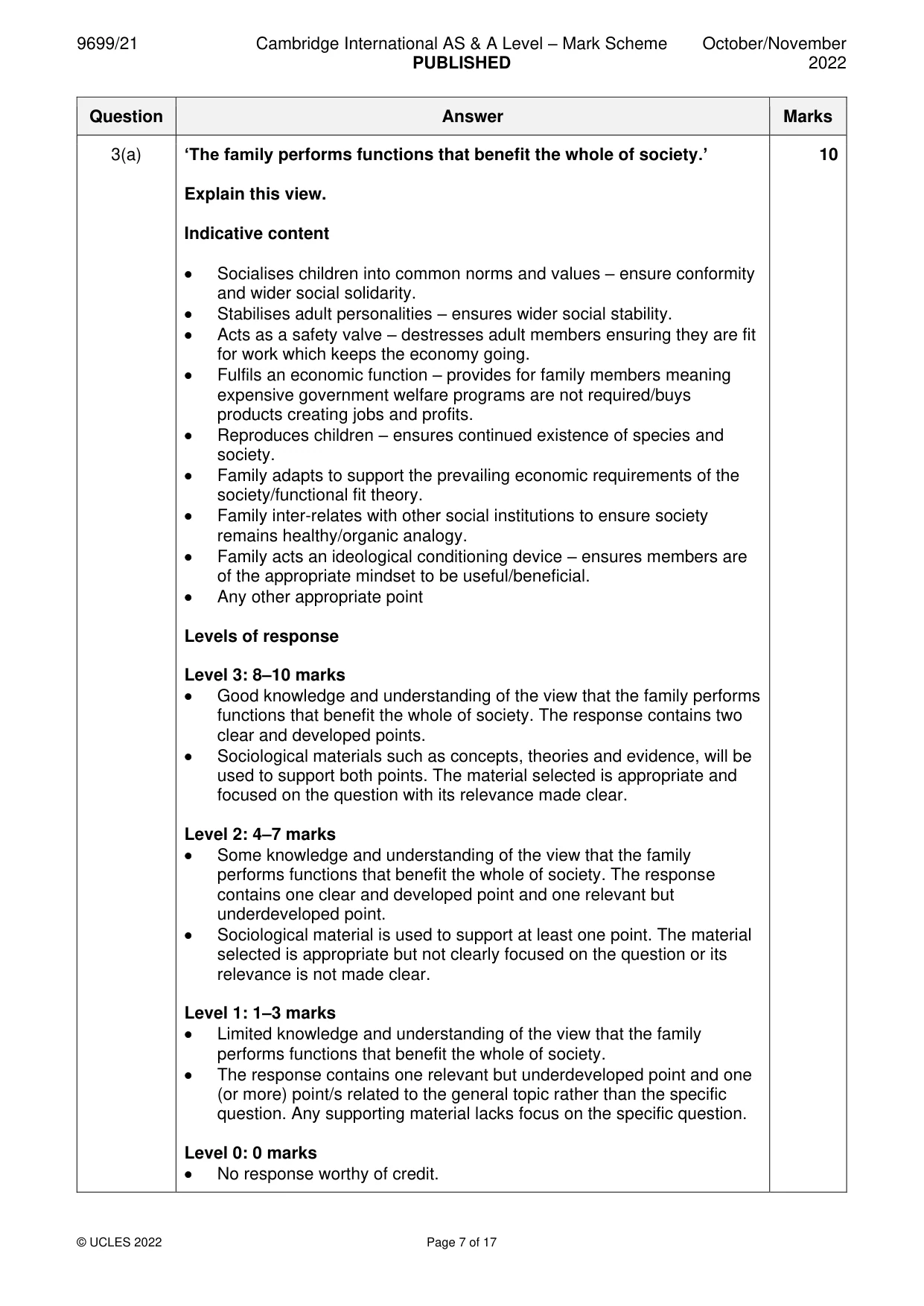
9699/21 Cambridge International AS & A Level – Mark Scheme PUBLISHED October/November 2022 © UCLES 2022 Page 7 of 17 Question Answer Marks 3(a) ‘The family performs functions that benefit the whole of society.’ Explain this view. Indicative content • Socialises children into common norms and values – ensure conformity and wider social solidarity. • Stabilises adult personalities – ensures wider social stability. • Acts as a safety valve – destresses adult members ensuring they are fit for work which keeps the economy going. • Fulfils an economic function – provides for family members meaning expensive government welfare programs are not required/buys products creating jobs and profits. • Reproduces children – ensures continued existence of species and society. • Family adapts to support the prevailing economic requirements of the society/functional fit theory. • Family inter-relates with other social institutions to ensure society remains healthy/organic analogy. • Family acts an ideological conditioning device – ensures members are of the appropriate mindset to be useful/beneficial. • Any other appropriate point Levels of response Level 3: 8–10 marks • Good knowledge and understanding of the view that the family performs functions that benefit the whole of society. The response contains two clear and developed points. • Sociological materials such as concepts, theories and evidence, will be used to support both points. The material selected is appropriate and focused on the question with its relevance made clear. Level 2: 4–7 marks • Some knowledge and understanding of the view that the family performs functions that benefit the whole of society. The response contains one clear and developed point and one relevant but underdeveloped point. • Sociological material is used to support at least one point. The material selected is appropriate but not clearly focused on the question or its relevance is not made clear. Level 1: 1–3 marks • Limited knowledge and understanding of the view that the family performs functions that benefit the whole of society. • The response contains one relevant but underdeveloped point and one (or more) point/s related to the general topic rather than the specific question. Any supporting material lacks focus on the specific question. Level 0: 0 marks • No response worthy of credit. 10
Mark scheme, page 8
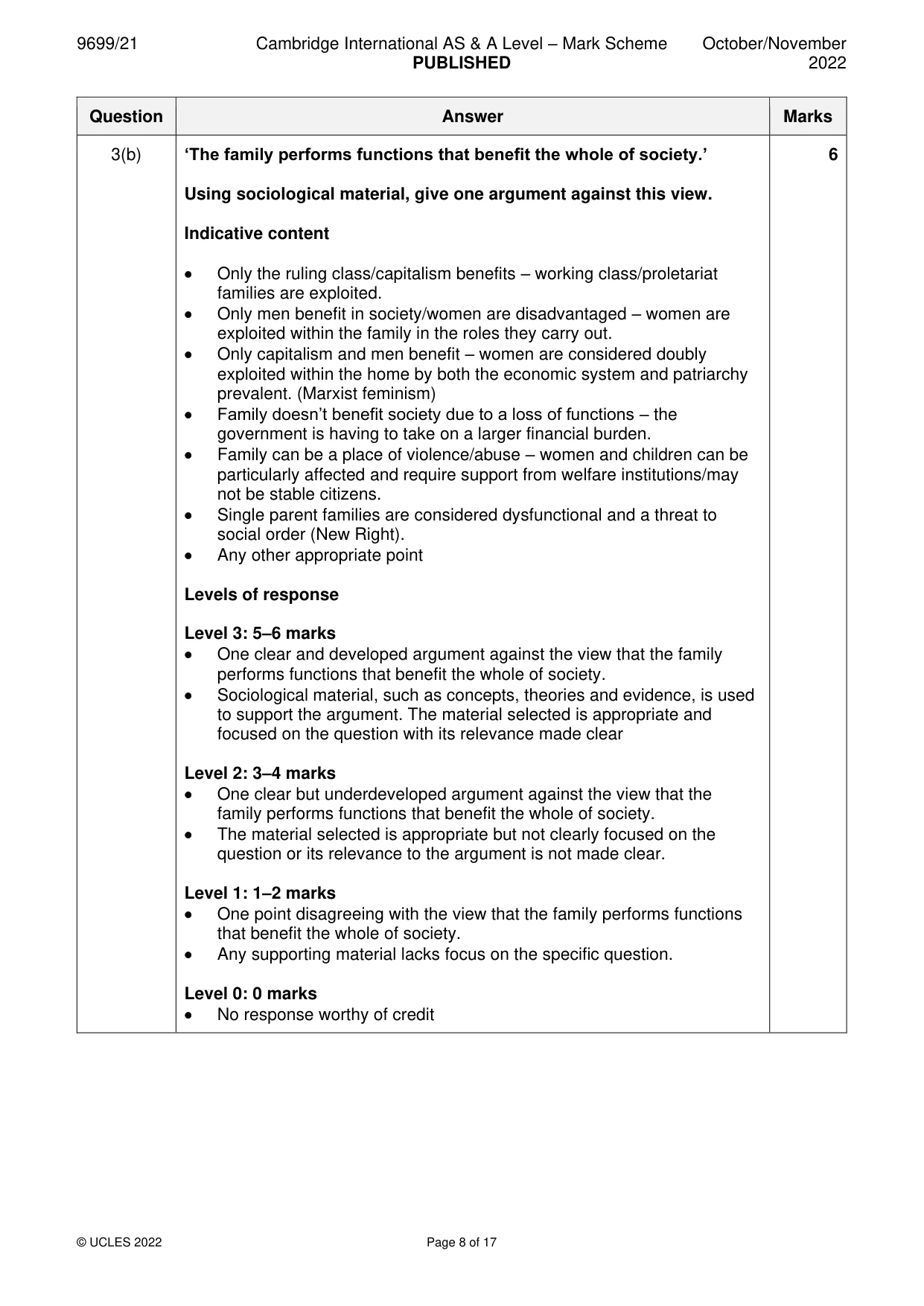
9699/21 Cambridge International AS & A Level – Mark Scheme PUBLISHED October/November 2022 © UCLES 2022 Page 8 of 17 Question Answer Marks 3(b) ‘The family performs functions that benefit the whole of society.’ Using sociological material, give one argument against this view. Indicative content • Only the ruling class/capitalism benefits – working class/proletariat families are exploited. • Only men benefit in society/women are disadvantaged – women are exploited within the family in the roles they carry out. • Only capitalism and men benefit – women are considered doubly exploited within the home by both the economic system and patriarchy prevalent. (Marxist feminism) • Family doesn’t benefit society due to a loss of functions – the government is having to take on a larger financial burden. • Family can be a place of violence/abuse – women and children can be particularly affected and require support from welfare institutions/may not be stable citizens. • Single parent families are considered dysfunctional and a threat to social order (New Right). • Any other appropriate point Levels of response Level 3: 5–6 marks • One clear and developed argument against the view that the family performs functions that benefit the whole of society. • Sociological material, such as concepts, theories and evidence, is used to support the argument. The material selected is appropriate and focused on the question with its relevance made clear Level 2: 3–4 marks • One clear but underdeveloped argument against the view that the family performs functions that benefit the whole of society. • The material selected is appropriate but not clearly focused on the question or its relevance to the argument is not made clear. Level 1: 1–2 marks • One point disagreeing with the view that the family performs functions that benefit the whole of society. • Any supporting material lacks focus on the specific question. Level 0: 0 marks • No response worthy of credit 6
Mark scheme, page 9
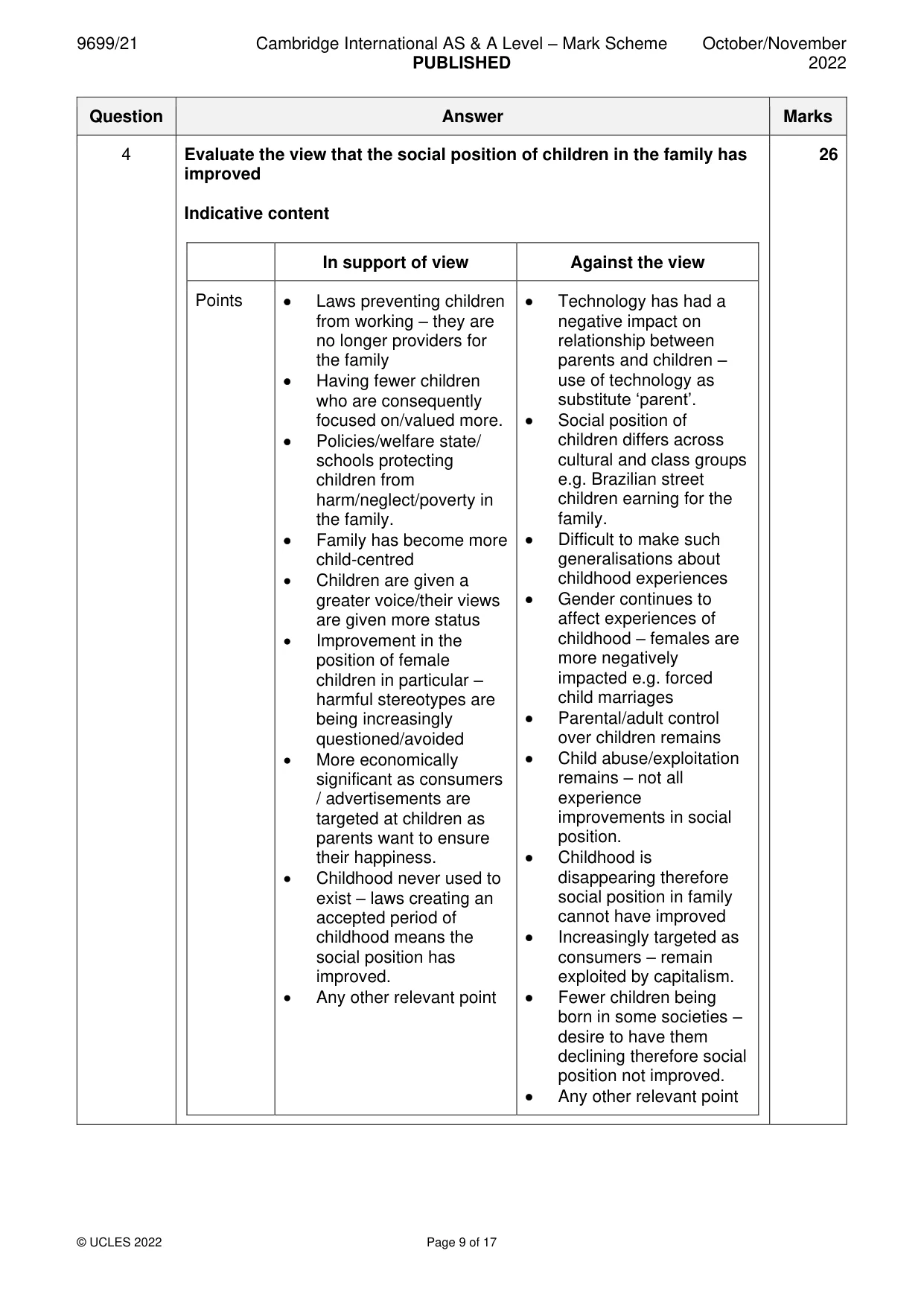
9699/21 Cambridge International AS & A Level – Mark Scheme PUBLISHED October/November 2022 © UCLES 2022 Page 9 of 17 Question Answer Marks 4 Evaluate the view that the social position of children in the family has improved Indicative content In support of view Against the view Points • Laws preventing children from working – they are no longer providers for the family • Having fewer children who are consequently focused on/valued more. • Policies/welfare state/ schools protecting children from harm/neglect/poverty in the family. • Family has become more child-centred • Children are given a greater voice/their views are given more status • Improvement in the position of female children in particular – harmful stereotypes are being increasingly questioned/avoided • More economically significant as consumers / advertisements are targeted at children as parents want to ensure their happiness. • Childhood never used to exist – laws creating an accepted period of childhood means the social position has improved. • Any other relevant point • Technology has had a negative impact on relationship between parents and children – use of technology as substitute ‘parent’. • Social position of children differs across cultural and class groups e.g. Brazilian street children earning for the family. • Difficult to make such generalisations about childhood experiences • Gender continues to affect experiences of childhood – females are more negatively impacted e.g. forced child marriages • Parental/adult control over children remains • Child abuse/exploitation remains – not all experience improvements in social position. • Childhood is disappearing therefore social position in family cannot have improved • Increasingly targeted as consumers – remain exploited by capitalism. • Fewer children being born in some societies – desire to have them declining therefore social position not improved. • Any other relevant point 26
Mark scheme, page 10
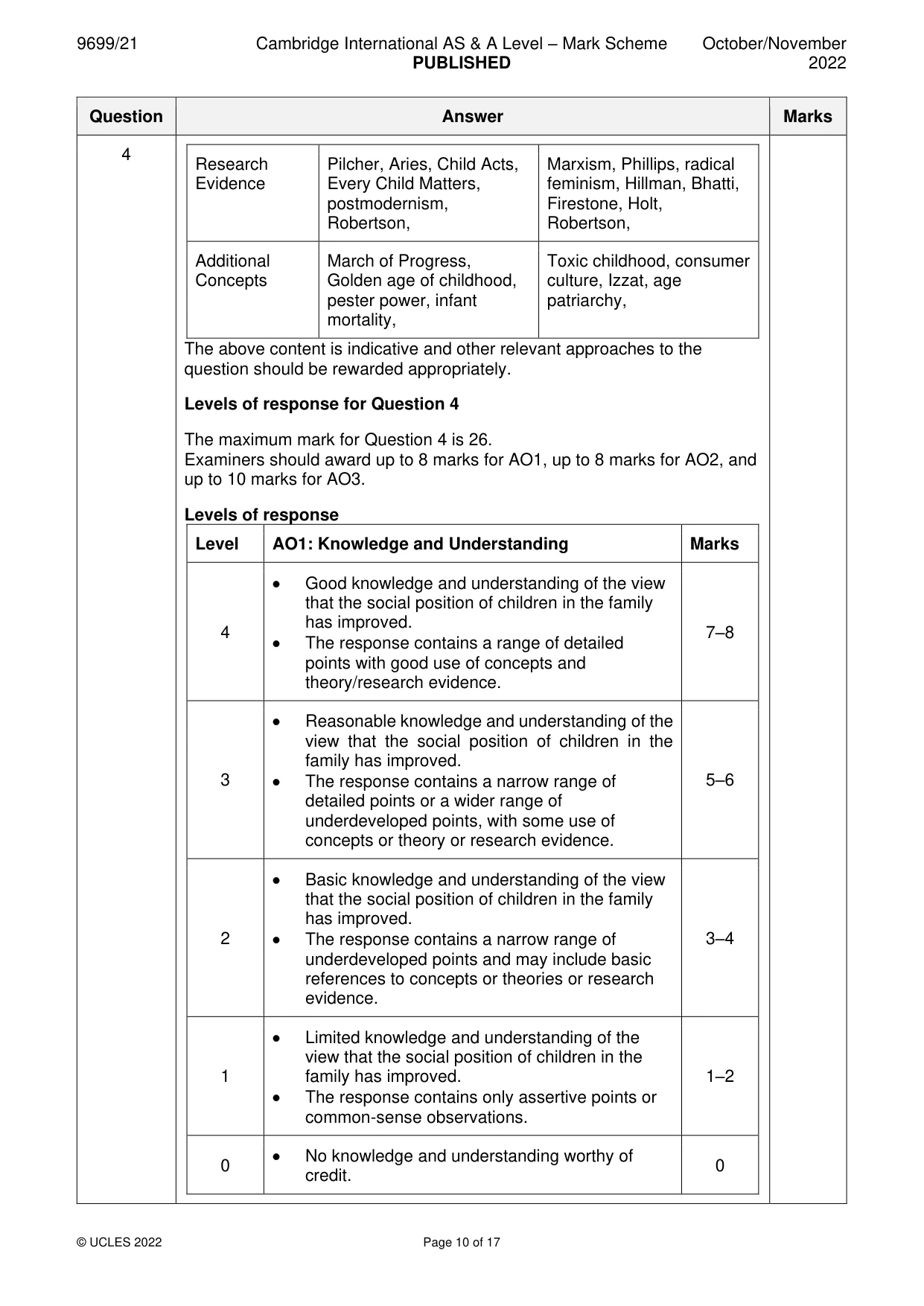
9699/21 Cambridge International AS & A Level – Mark Scheme PUBLISHED October/November 2022 © UCLES 2022 Page 10 of 17 Question Answer Marks 4 Research Evidence Pilcher, Aries, Child Acts, Every Child Matters, postmodernism, Robertson, Marxism, Phillips, radical feminism, Hillman, Bhatti, Firestone, Holt, Robertson, Additional Concepts March of Progress, Golden age of childhood, pester power, infant mortality, Toxic childhood, consumer culture, Izzat, age patriarchy, The above content is indicative and other relevant approaches to the question should be rewarded appropriately. Levels of response for Question 4 The maximum mark for Question 4 is 26. Examiners should award up to 8 marks for AO1, up to 8 marks for AO2, and up to 10 marks for AO3. Levels of response Level AO1: Knowledge and Understanding Marks 4 • Good knowledge and understanding of the view that the social position of children in the family has improved. • The response contains a range of detailed points with good use of concepts and theory/research evidence. 7–8 3 • Reasonable knowledge and understanding of the view that the social position of children in the family has improved. • The response contains a narrow range of detailed points or a wider range of underdeveloped points, with some use of concepts or theory or research evidence. 5–6 2 • Basic knowledge and understanding of the view that the social position of children in the family has improved. • The response contains a narrow range of underdeveloped points and may include basic references to concepts or theories or research evidence. 3–4 1 • Limited knowledge and understanding of the view that the social position of children in the family has improved. • The response contains only assertive points or common-sense observations. 1–2 0 • No knowledge and understanding worthy of credit. 0
Mark scheme, page 11
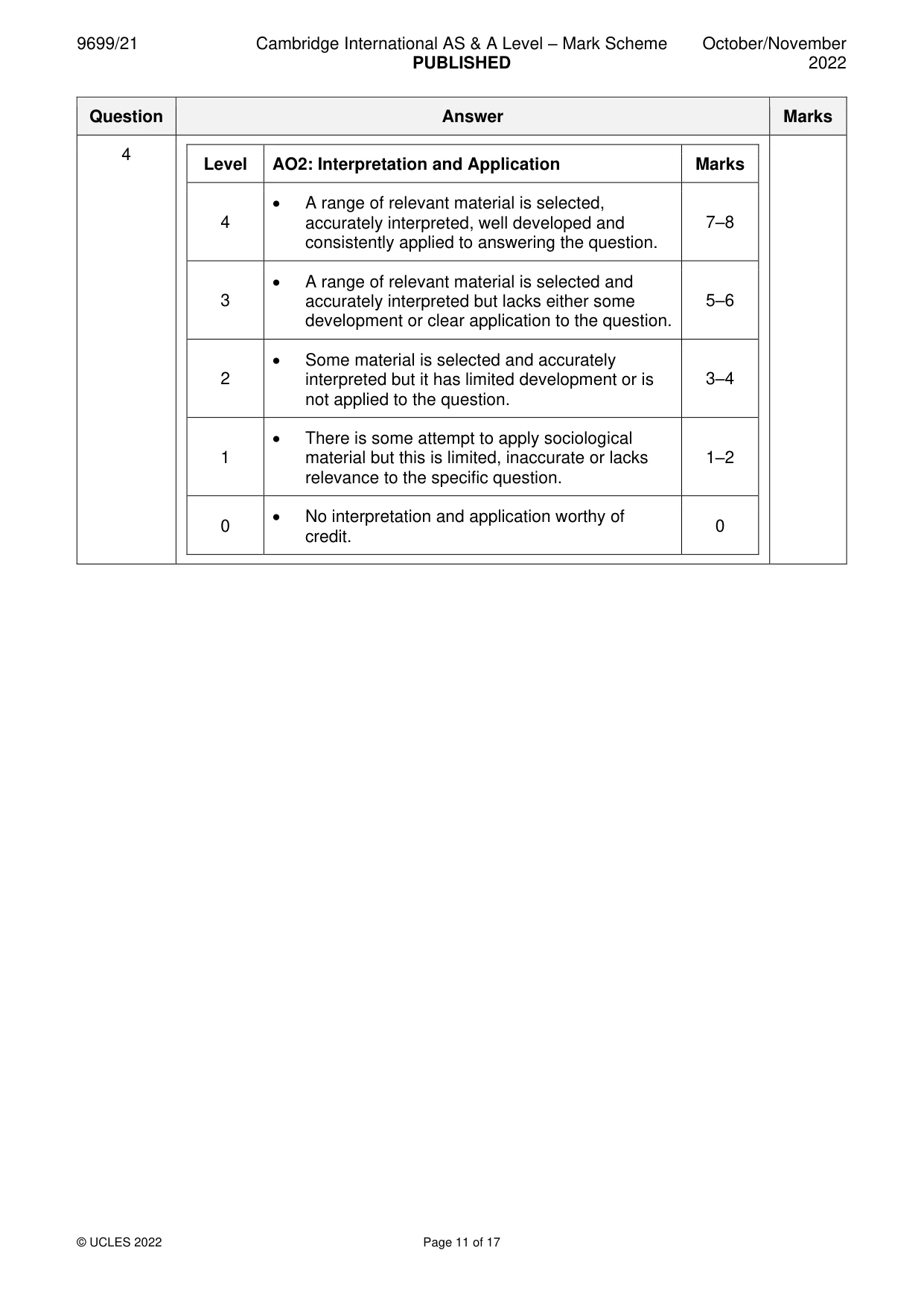
9699/21 Cambridge International AS & A Level – Mark Scheme PUBLISHED October/November 2022 © UCLES 2022 Page 11 of 17 Question Answer Marks 4 Level AO2: Interpretation and Application Marks 4 • A range of relevant material is selected, accurately interpreted, well developed and consistently applied to answering the question. 7–8 3 • A range of relevant material is selected and accurately interpreted but lacks either some development or clear application to the question. 5–6 2 • Some material is selected and accurately interpreted but it has limited development or is not applied to the question. 3–4 1 • There is some attempt to apply sociological material but this is limited, inaccurate or lacks relevance to the specific question. 1–2 0 • No interpretation and application worthy of credit. 0
Mark scheme, page 12
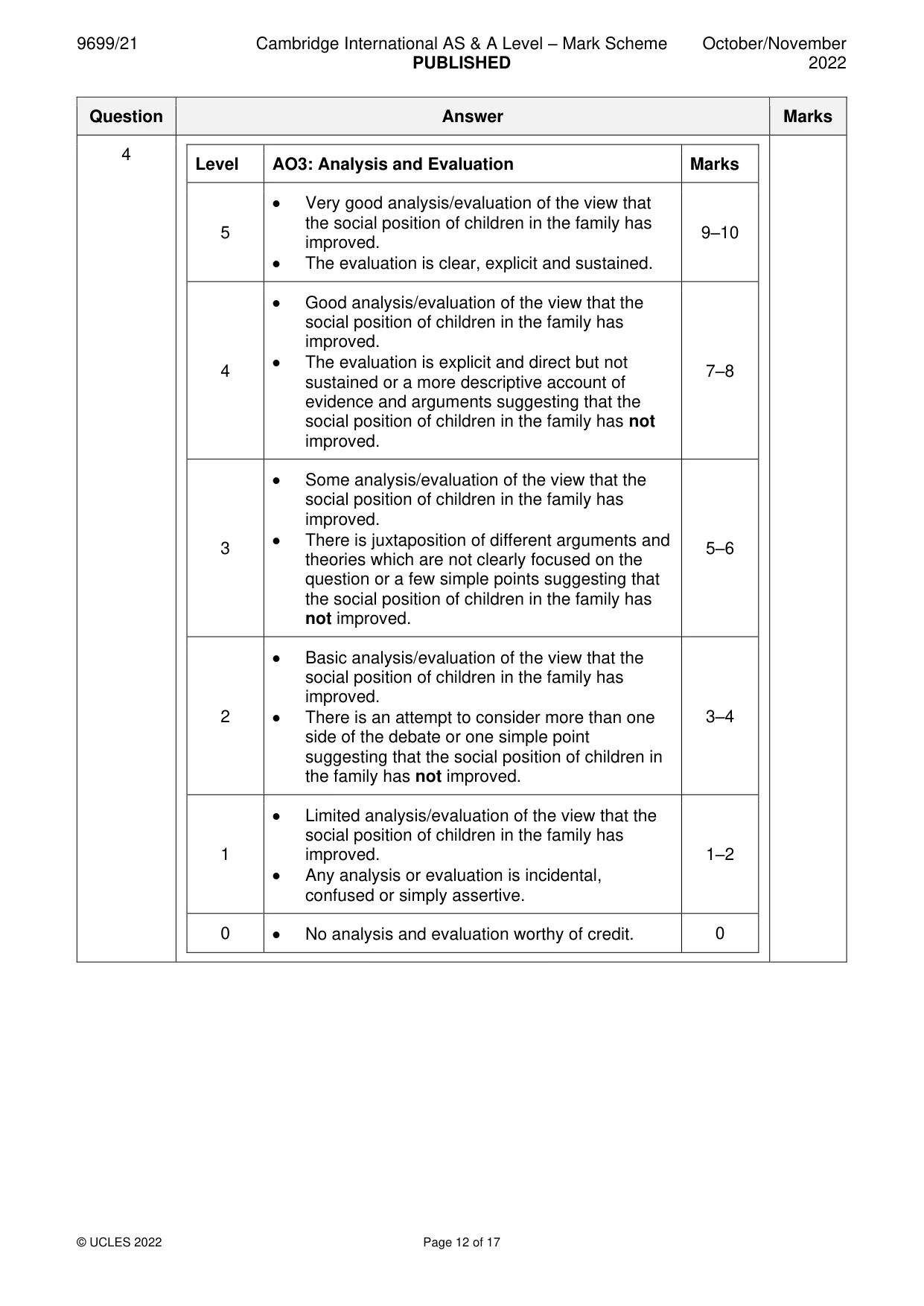
9699/21 Cambridge International AS & A Level – Mark Scheme PUBLISHED October/November 2022 © UCLES 2022 Page 12 of 17 Question Answer Marks 4 Level AO3: Analysis and Evaluation Marks 5 • Very good analysis/evaluation of the view that the social position of children in the family has improved. • The evaluation is clear, explicit and sustained. 9–10 4 • Good analysis/evaluation of the view that the social position of children in the family has improved. • The evaluation is explicit and direct but not sustained or a more descriptive account of evidence and arguments suggesting that the social position of children in the family has not improved. 7–8 3 • Some analysis/evaluation of the view that the social position of children in the family has improved. • There is juxtaposition of different arguments and theories which are not clearly focused on the question or a few simple points suggesting that the social position of children in the family has not improved. 5–6 2 • Basic analysis/evaluation of the view that the social position of children in the family has improved. • There is an attempt to consider more than one side of the debate or one simple point suggesting that the social position of children in the family has not improved. 3–4 1 • Limited analysis/evaluation of the view that the social position of children in the family has improved. • Any analysis or evaluation is incidental, confused or simply assertive. 1–2 0 • No analysis and evaluation worthy of credit. 0
Mark scheme, page 13
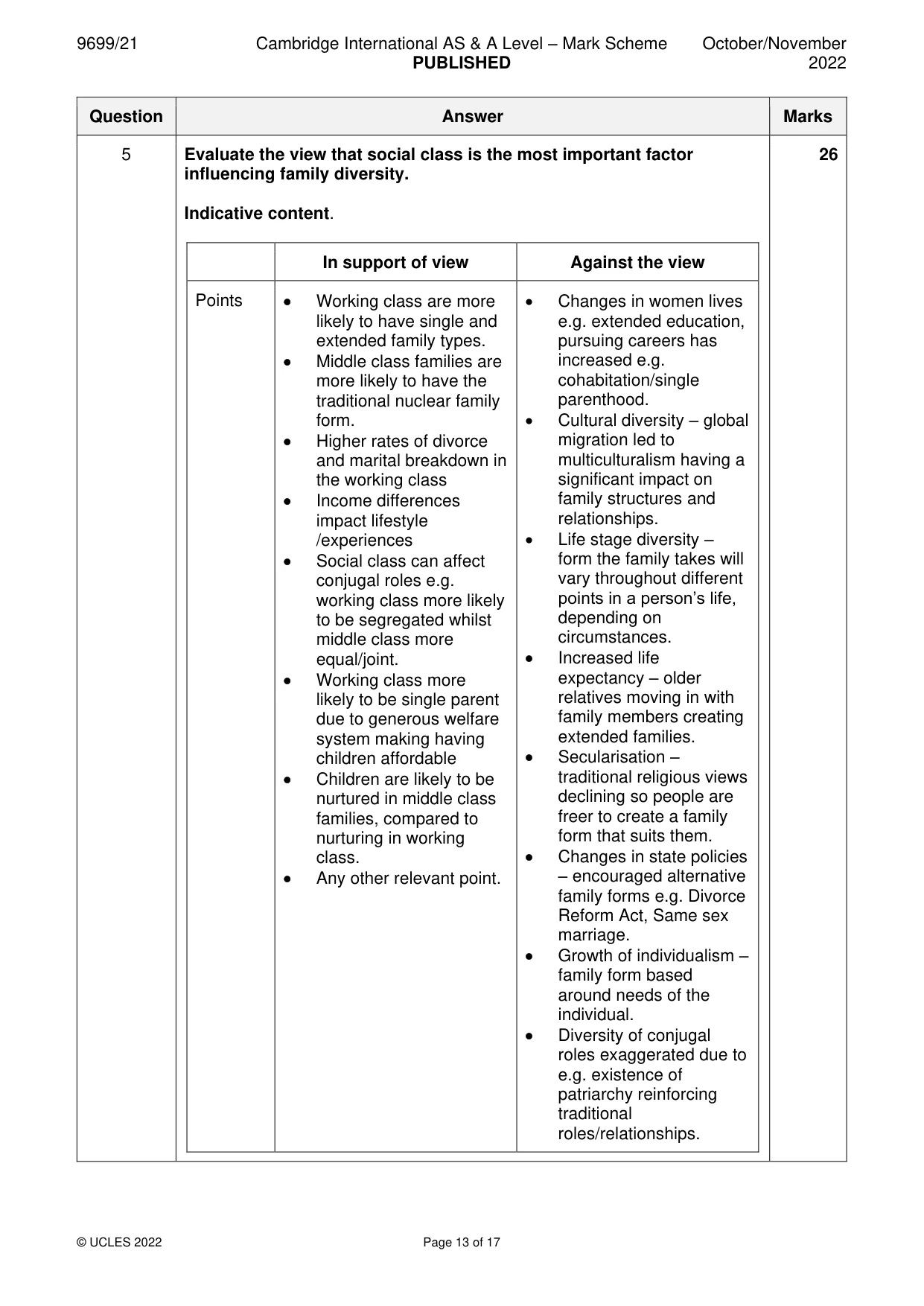
9699/21 Cambridge International AS & A Level – Mark Scheme PUBLISHED October/November 2022 © UCLES 2022 Page 13 of 17 Question Answer Marks 5 Evaluate the view that social class is the most important factor influencing family diversity. Indicative content. In support of view Against the view Points • Working class are more likely to have single and extended family types. • Middle class families are more likely to have the traditional nuclear family form. • Higher rates of divorce and marital breakdown in the working class • Income differences impact lifestyle /experiences • Social class can affect conjugal roles e.g. working class more likely to be segregated whilst middle class more equal/joint. • Working class more likely to be single parent due to generous welfare system making having children affordable • Children are likely to be nurtured in middle class families, compared to nurturing in working class. • Any other relevant point. • Changes in women lives e.g. extended education, pursuing careers has increased e.g. cohabitation/single parenthood. • Cultural diversity – global migration led to multiculturalism having a significant impact on family structures and relationships. • Life stage diversity – form the family takes will vary throughout different points in a person’s life, depending on circumstances. • Increased life expectancy – older relatives moving in with family members creating extended families. • Secularisation – traditional religious views declining so people are freer to create a family form that suits them. • Changes in state policies – encouraged alternative family forms e.g. Divorce Reform Act, Same sex marriage. • Growth of individualism – family form based around needs of the individual. • Diversity of conjugal roles exaggerated due to e.g. existence of patriarchy reinforcing traditional roles/relationships. 26
Mark scheme, page 14
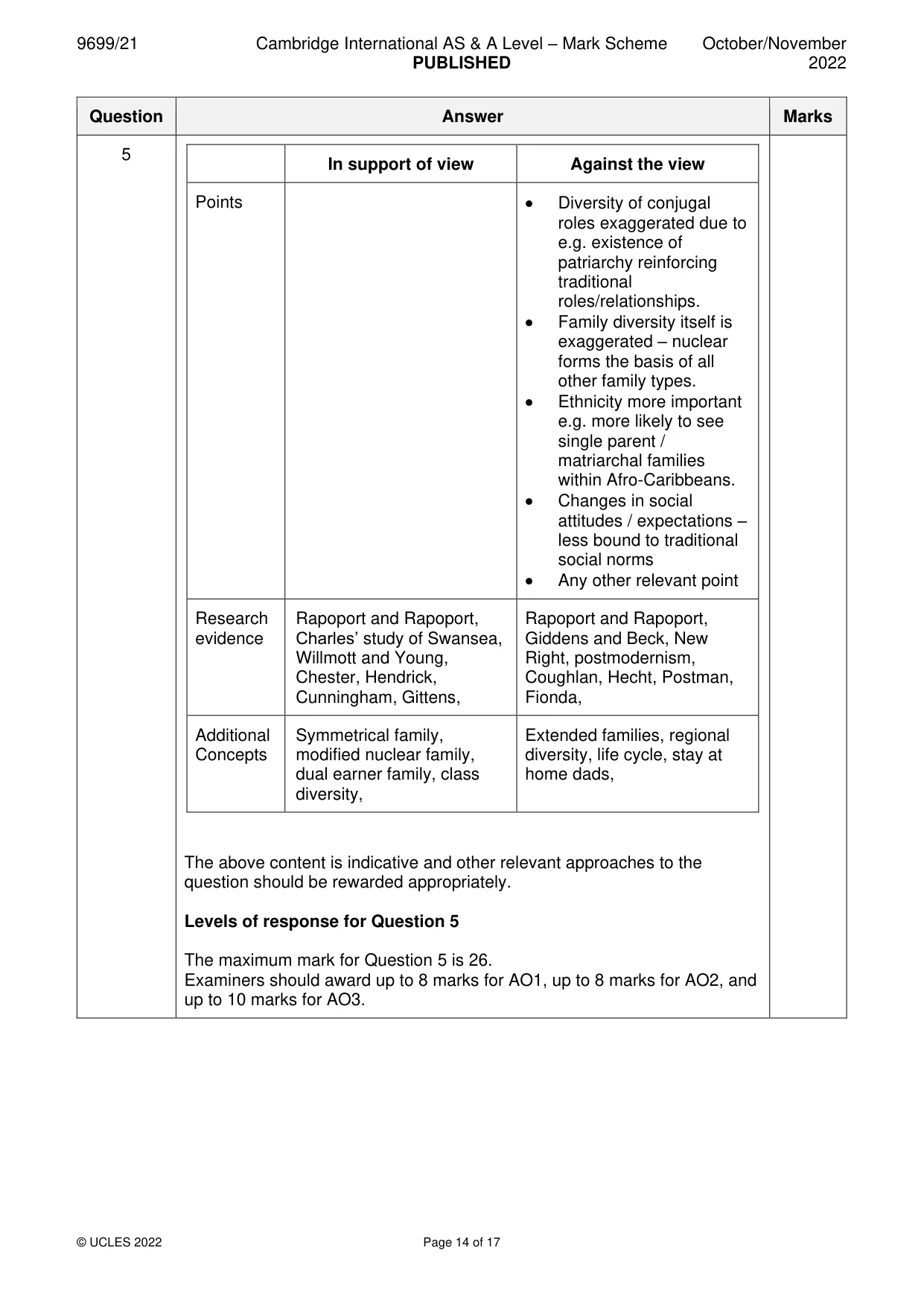
9699/21 Cambridge International AS & A Level – Mark Scheme PUBLISHED October/November 2022 © UCLES 2022 Page 14 of 17 Question Answer Marks 5 In support of view Against the view Points • Diversity of conjugal roles exaggerated due to e.g. existence of patriarchy reinforcing traditional roles/relationships. • Family diversity itself is exaggerated – nuclear forms the basis of all other family types. • Ethnicity more important e.g. more likely to see single parent / matriarchal families within Afro-Caribbeans. • Changes in social attitudes / expectations – less bound to traditional social norms • Any other relevant point Research evidence Rapoport and Rapoport, Charles’ study of Swansea, Willmott and Young, Chester, Hendrick, Cunningham, Gittens, Rapoport and Rapoport, Giddens and Beck, New Right, postmodernism, Coughlan, Hecht, Postman, Fionda, Additional Concepts Symmetrical family, modified nuclear family, dual earner family, class diversity, Extended families, regional diversity, life cycle, stay at home dads, The above content is indicative and other relevant approaches to the question should be rewarded appropriately. Levels of response for Question 5 The maximum mark for Question 5 is 26. Examiners should award up to 8 marks for AO1, up to 8 marks for AO2, and up to 10 marks for AO3.
Mark scheme, page 15
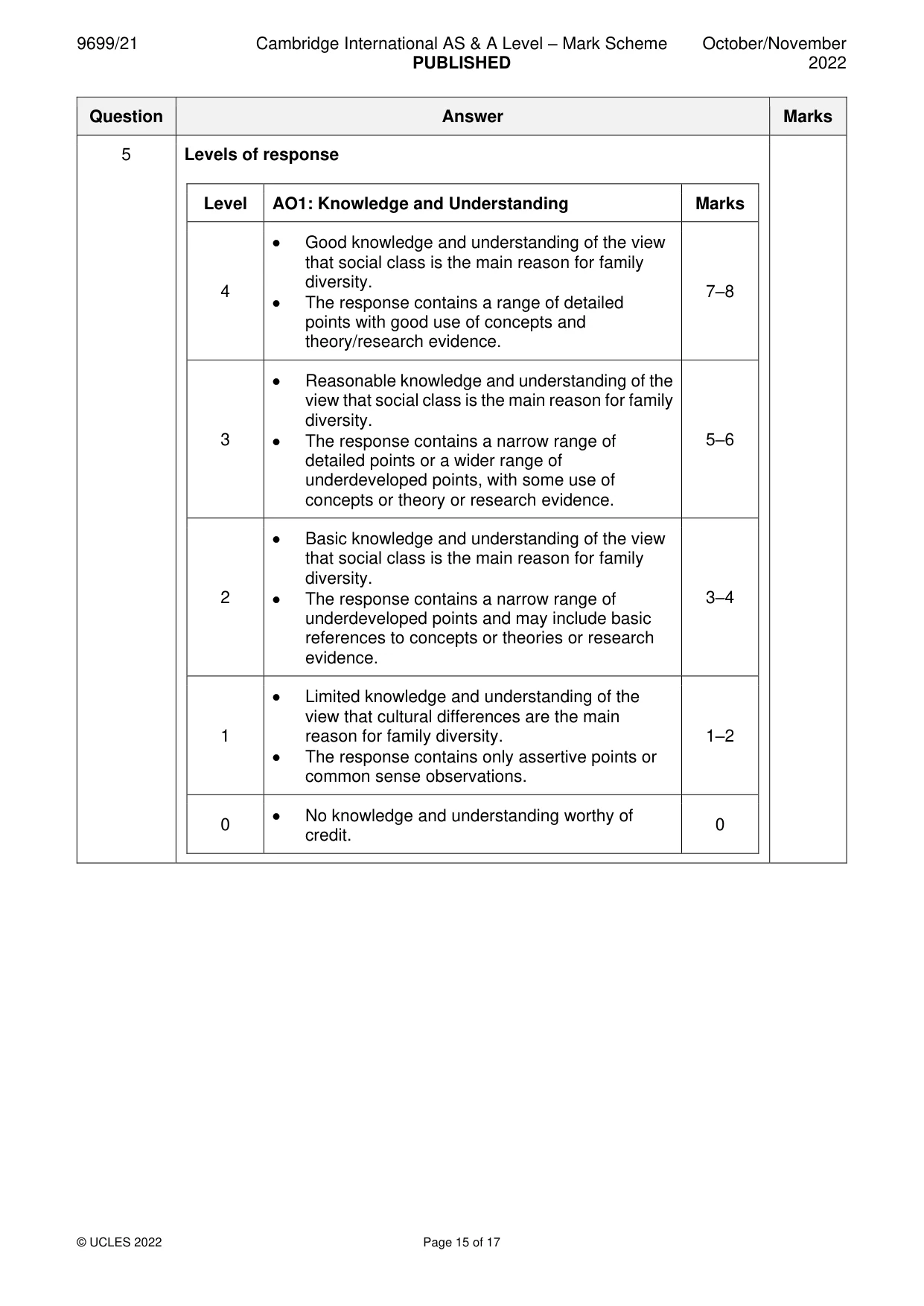
9699/21 Cambridge International AS & A Level – Mark Scheme PUBLISHED October/November 2022 © UCLES 2022 Page 15 of 17 Question Answer Marks 5 Levels of response Level AO1: Knowledge and Understanding Marks 4 • Good knowledge and understanding of the view that social class is the main reason for family diversity. • The response contains a range of detailed points with good use of concepts and theory/research evidence. 7–8 3 • Reasonable knowledge and understanding of the view that social class is the main reason for family diversity. • The response contains a narrow range of detailed points or a wider range of underdeveloped points, with some use of concepts or theory or research evidence. 5–6 2 • Basic knowledge and understanding of the view that social class is the main reason for family diversity. • The response contains a narrow range of underdeveloped points and may include basic references to concepts or theories or research evidence. 3–4 1 • Limited knowledge and understanding of the view that cultural differences are the main reason for family diversity. • The response contains only assertive points or common sense observations. 1–2 0 • No knowledge and understanding worthy of credit. 0
Mark scheme, page 16
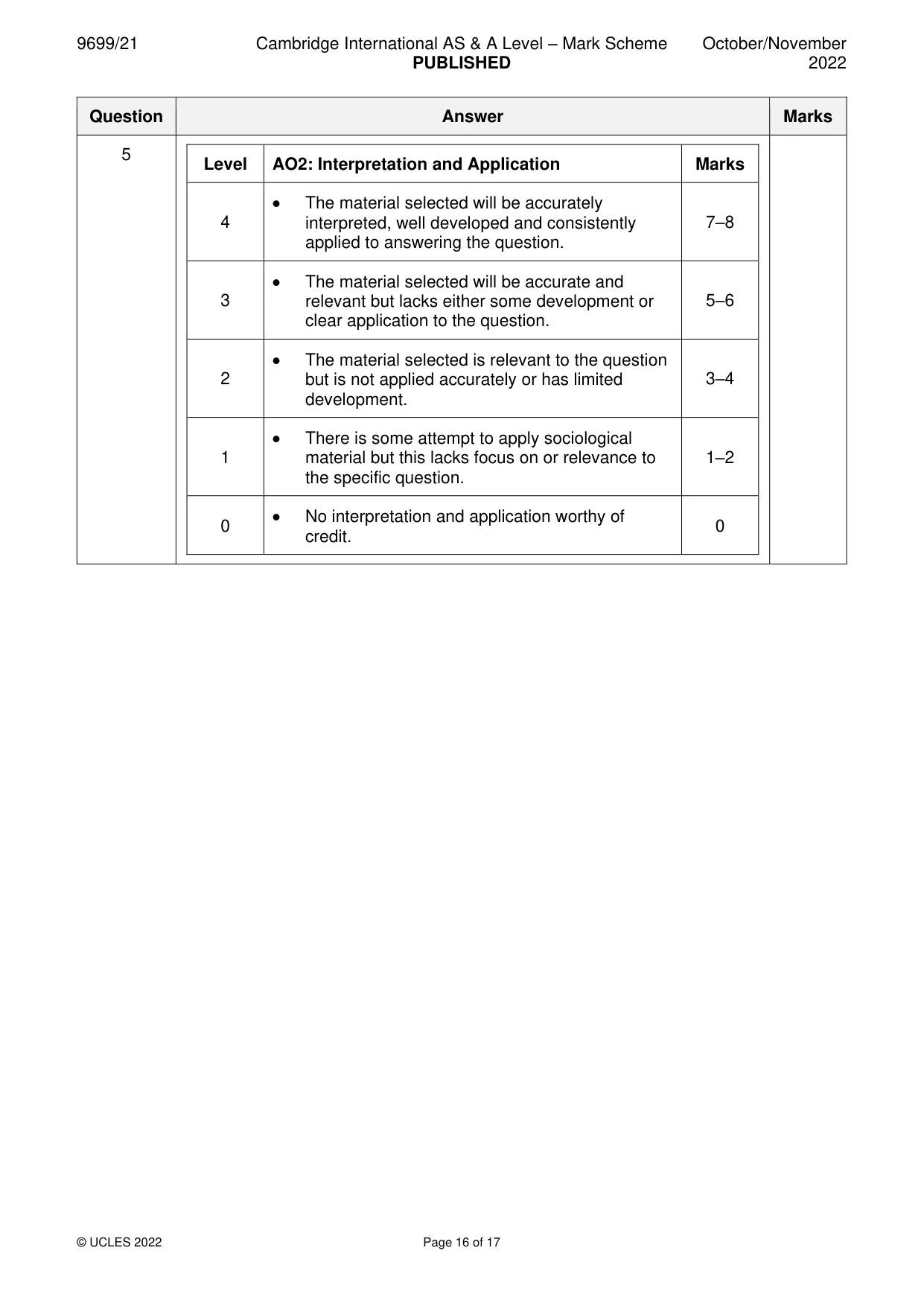
9699/21 Cambridge International AS & A Level – Mark Scheme PUBLISHED October/November 2022 © UCLES 2022 Page 16 of 17 Question Answer Marks 5 Level AO2: Interpretation and Application Marks 4 • The material selected will be accurately interpreted, well developed and consistently applied to answering the question. 7–8 3 • The material selected will be accurate and relevant but lacks either some development or clear application to the question. 5–6 2 • The material selected is relevant to the question but is not applied accurately or has limited development. 3–4 1 • There is some attempt to apply sociological material but this lacks focus on or relevance to the specific question. 1–2 0 • No interpretation and application worthy of credit. 0
Mark scheme, page 17
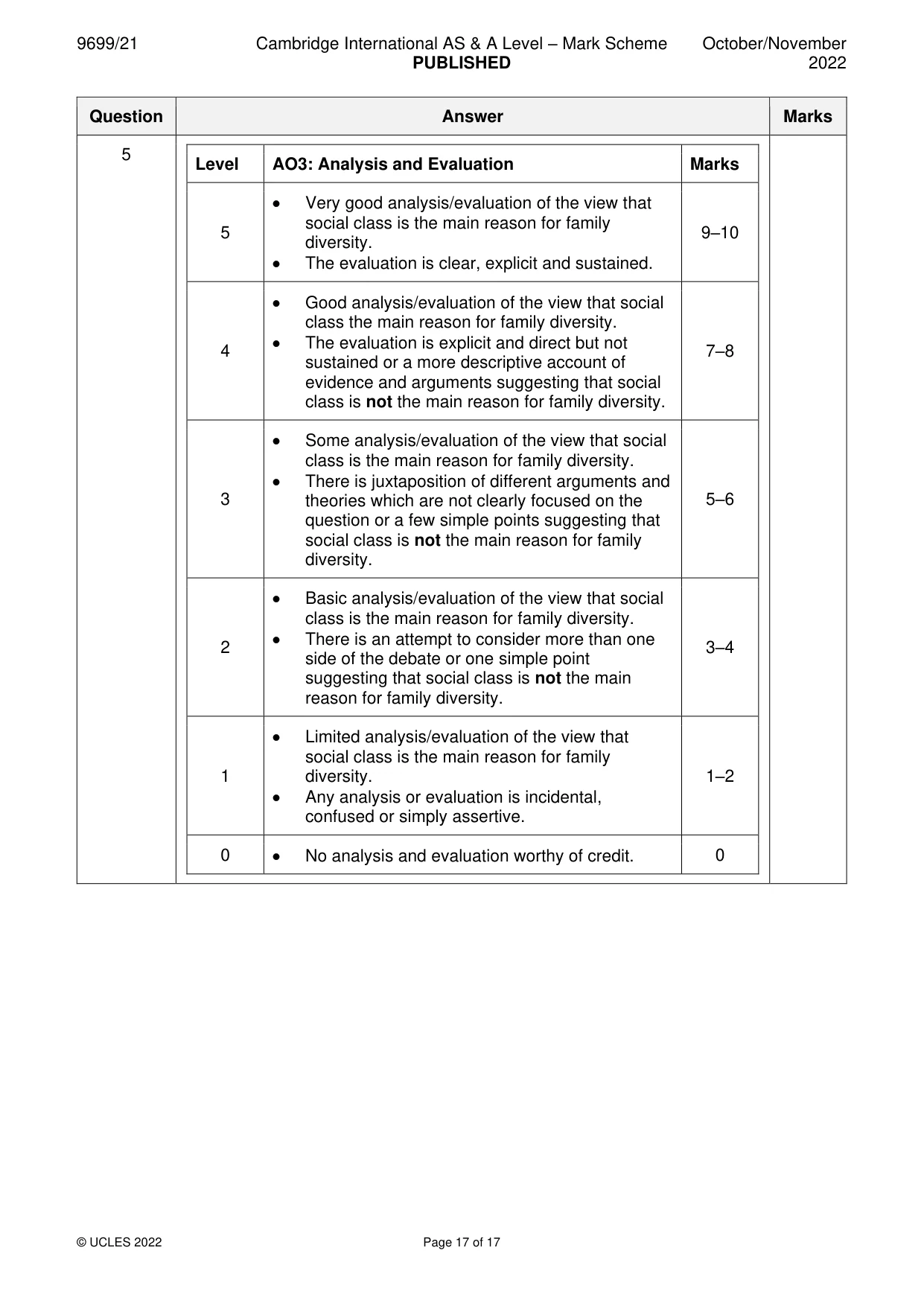
9699/21 Cambridge International AS & A Level – Mark Scheme PUBLISHED October/November 2022 © UCLES 2022 Page 17 of 17 Question Answer Marks 5 Level AO3: Analysis and Evaluation Marks 5 • Very good analysis/evaluation of the view that social class is the main reason for family diversity. • The evaluation is clear, explicit and sustained. 9–10 4 • Good analysis/evaluation of the view that social class the main reason for family diversity. • The evaluation is explicit and direct but not sustained or a more descriptive account of evidence and arguments suggesting that social class is not the main reason for family diversity. 7–8 3 • Some analysis/evaluation of the view that social class is the main reason for family diversity. • There is juxtaposition of different arguments and theories which are not clearly focused on the question or a few simple points suggesting that social class is not the main reason for family diversity. 5–6 2 • Basic analysis/evaluation of the view that social class is the main reason for family diversity. • There is an attempt to consider more than one side of the debate or one simple point suggesting that social class is not the main reason for family diversity. 3–4 1 • Limited analysis/evaluation of the view that social class is the main reason for family diversity. • Any analysis or evaluation is incidental, confused or simply assertive. 1–2 0 • No analysis and evaluation worthy of credit. 0
What you needed in this session
Cambridge’s own grade thresholds for 2022 Oct/Nov, Paper 2 · Variant 1. A higher threshold means an easier paper — the bar moves with how the cohort did.