Cambridge A Level Sociology 9699 — 2021 Oct/Nov Paper 4 · Variant 2
9699/42/O/N/21 · 70 marks · ≈79 min
The question paper and its mark scheme, free to read here and free to download. This is Cambridge’s own paper, exactly as it was sat.
Question paper4 pages


Mark scheme14 pages
Answers below. Sit the paper first if you are practising.
Paper as text
Question paper, page 1
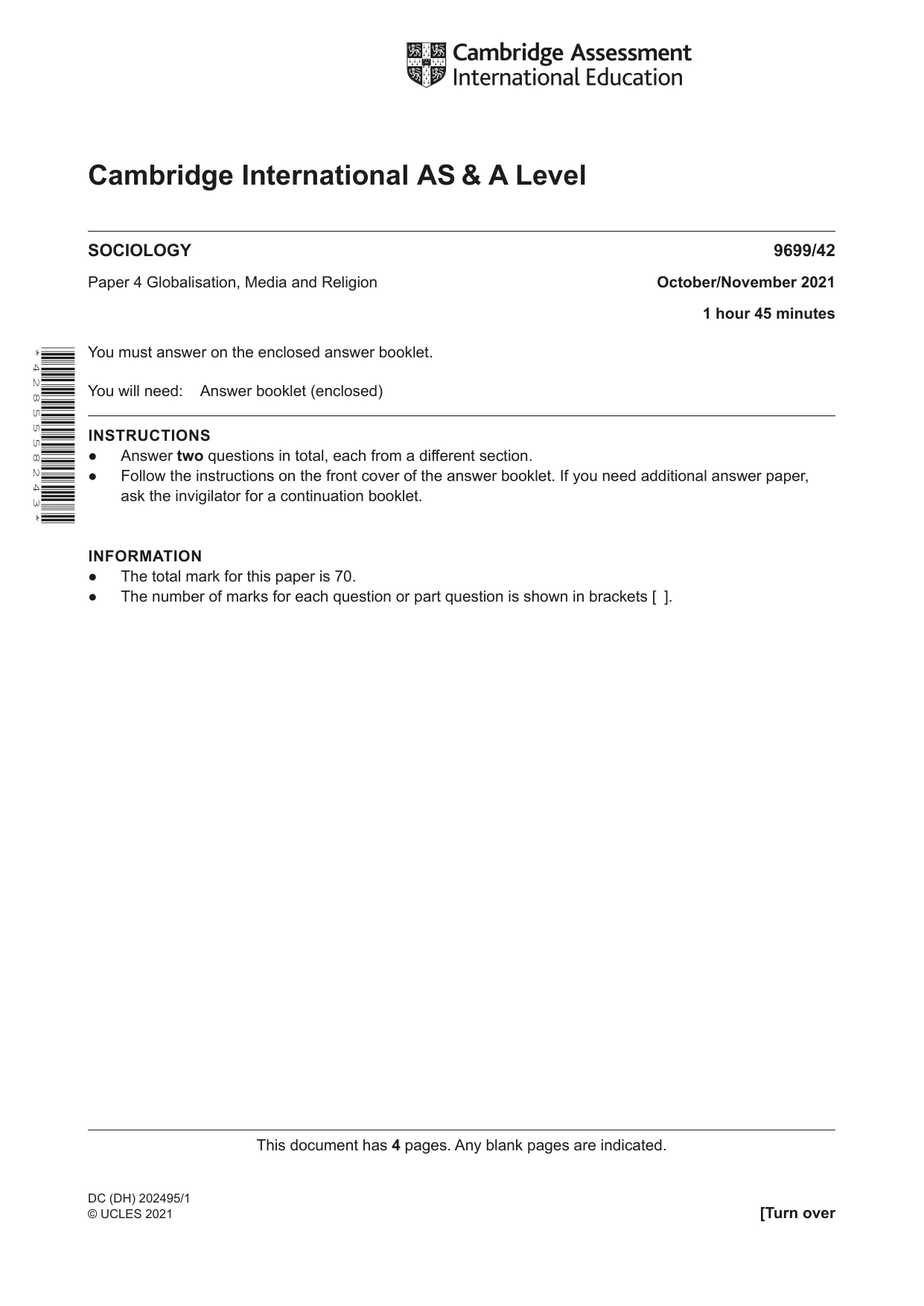
This document has 4 pages. Any blank pages are indicated. Cambridge International AS & A Level DC (DH) 202495/1 © UCLES 2021 [Turn over * 4 2 8 5 5 5 8 2 4 3 * SOCIOLOGY 9699/42 Paper 4 Globalisation, Media and Religion October/November 2021 1 hour 45 minutes You must answer on the enclosed answer booklet. You will need: Answer booklet (enclosed) INSTRUCTIONS ● Answer two questions in total, each from a different section. ● Follow the instructions on the front cover of the answer booklet. If you need additional answer paper, ask the invigilator for a continuation booklet. INFORMATION ● The total mark for this paper is 70. ● The number of marks for each question or part question is shown in brackets [ ].
Question paper, page 2
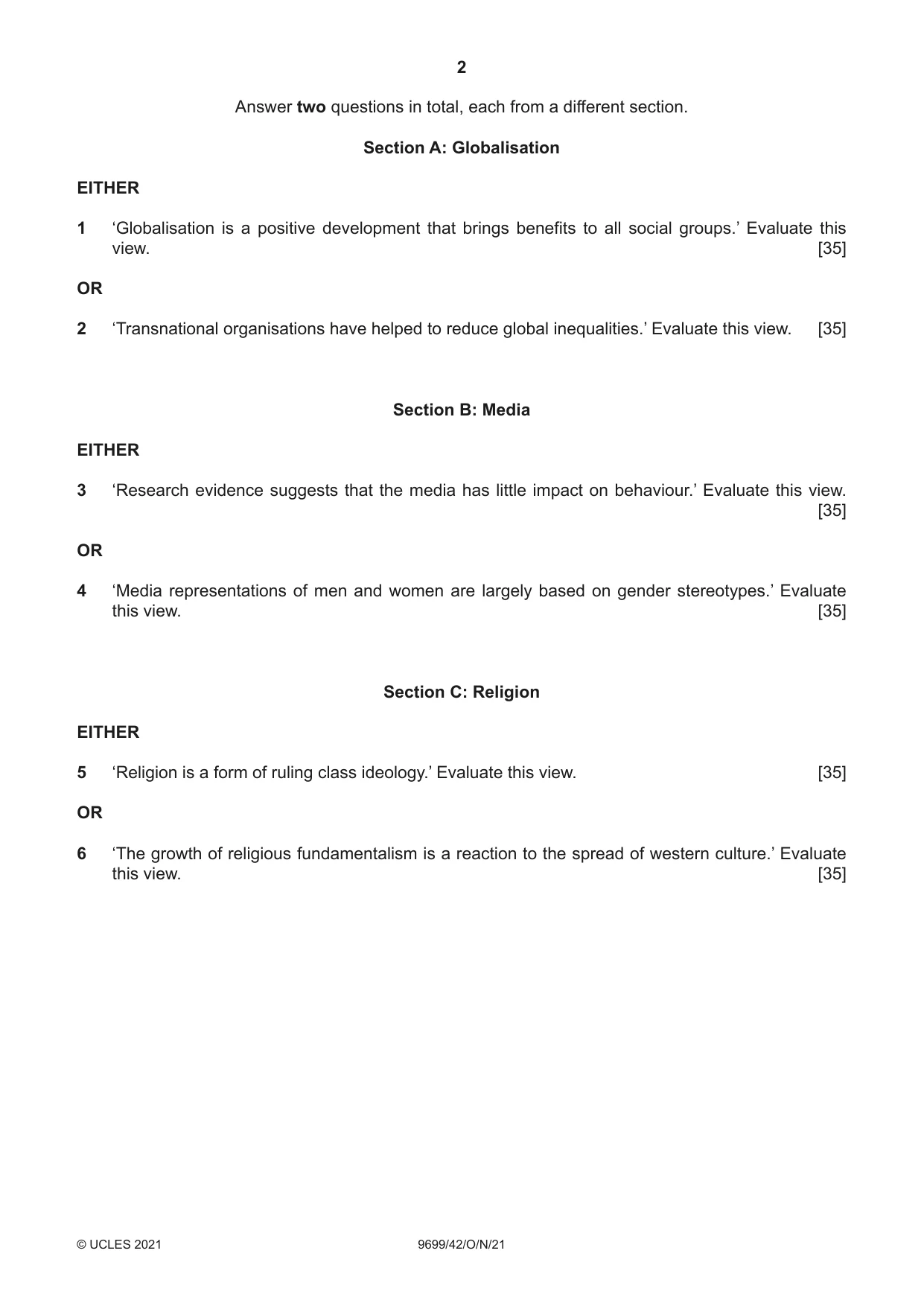
2 9699/42/O/N/21 © UCLES 2021 Answer two questions in total, each from a different section. Section A: Globalisation EITHER 1 ‘Globalisation is a positive development that brings benefits to all social groups.’ Evaluate this view. [35] OR 2 ‘Transnational organisations have helped to reduce global inequalities.’ Evaluate this view. [35] Section B: Media EITHER 3 ‘Research evidence suggests that the media has little impact on behaviour.’ Evaluate this view. [35] OR 4 ‘Media representations of men and women are largely based on gender stereotypes.’ Evaluate this view. [35] Section C: Religion EITHER 5 ‘Religion is a form of ruling class ideology.’ Evaluate this view. [35] OR 6 ‘The growth of religious fundamentalism is a reaction to the spread of western culture.’ Evaluate this view. [35]
Question paper, page 3
3 9699/42/O/N/21 © UCLES 2021 BLANK PAGE
Question paper, page 4
4 9699/42/O/N/21 © UCLES 2021 Permission to reproduce items where third-party owned material protected by copyright is included has been sought and cleared where possible. Every reasonable effort has been made by the publisher (UCLES) to trace copyright holders, but if any items requiring clearance have unwittingly been included, the publisher will be pleased to make amends at the earliest possible opportunity. To avoid the issue of disclosure of answer-related information to candidates, all copyright acknowledgements are reproduced online in the Cambridge Assessment International Education Copyright Acknowledgements Booklet. This is produced for each series of examinations and is freely available to download at www.cambridgeinternational.org after the live examination series. Cambridge Assessment International Education is part of the Cambridge Assessment Group. Cambridge Assessment is the brand name of the University of Cambridge Local Examinations Syndicate (UCLES), which itself is a department of the University of Cambridge. BLANK PAGE
Mark scheme, page 1
This document consists of 14 printed pages. © UCLES 2021 [Turn over Cambridge International AS & A Level SOCIOLOGY 9699/42 Paper 4 October/November 2021 MARK SCHEME Maximum Mark: 70 Published This mark scheme is published as an aid to teachers and candidates, to indicate the requirements of the examination. It shows the basis on which Examiners were instructed to award marks. It does not indicate the details of the discussions that took place at an Examiners’ meeting before marking began, which would have considered the acceptability of alternative answers. Mark schemes should be read in conjunction with the question paper and the Principal Examiner Report for Teachers. Cambridge International will not enter into discussions about these mark schemes. Cambridge International is publishing the mark schemes for the October/November 2021 series for most Cambridge IGCSE™, Cambridge International A and AS Level components and some Cambridge O Level components.
Mark scheme, page 2
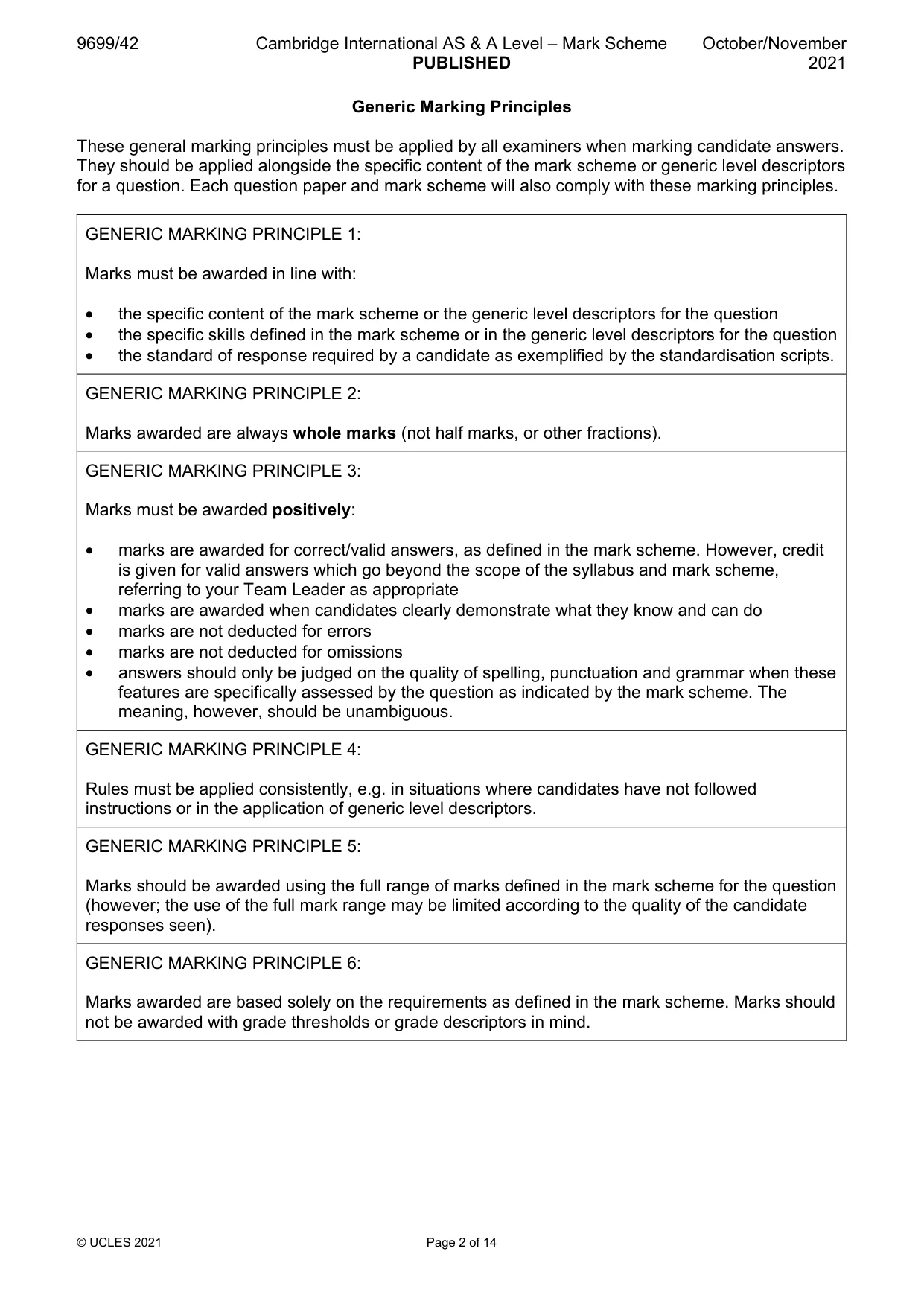
9699/42 Cambridge International AS & A Level – Mark Scheme PUBLISHED October/November 2021 © UCLES 2021 Page 2 of 14 Generic Marking Principles These general marking principles must be applied by all examiners when marking candidate answers. They should be applied alongside the specific content of the mark scheme or generic level descriptors for a question. Each question paper and mark scheme will also comply with these marking principles. GENERIC MARKING PRINCIPLE 1: Marks must be awarded in line with: • the specific content of the mark scheme or the generic level descriptors for the question • the specific skills defined in the mark scheme or in the generic level descriptors for the question • the standard of response required by a candidate as exemplified by the standardisation scripts. GENERIC MARKING PRINCIPLE 2: Marks awarded are always whole marks (not half marks, or other fractions). GENERIC MARKING PRINCIPLE 3: Marks must be awarded positively: • marks are awarded for correct/valid answers, as defined in the mark scheme. However, credit is given for valid answers which go beyond the scope of the syllabus and mark scheme, referring to your Team Leader as appropriate • marks are awarded when candidates clearly demonstrate what they know and can do • marks are not deducted for errors • marks are not deducted for omissions • answers should only be judged on the quality of spelling, punctuation and grammar when these features are specifically assessed by the question as indicated by the mark scheme. The meaning, however, should be unambiguous. GENERIC MARKING PRINCIPLE 4: Rules must be applied consistently, e.g. in situations where candidates have not followed instructions or in the application of generic level descriptors. GENERIC MARKING PRINCIPLE 5: Marks should be awarded using the full range of marks defined in the mark scheme for the question (however; the use of the full mark range may be limited according to the quality of the candidate responses seen). GENERIC MARKING PRINCIPLE 6: Marks awarded are based solely on the requirements as defined in the mark scheme. Marks should not be awarded with grade thresholds or grade descriptors in mind.
Mark scheme, page 3
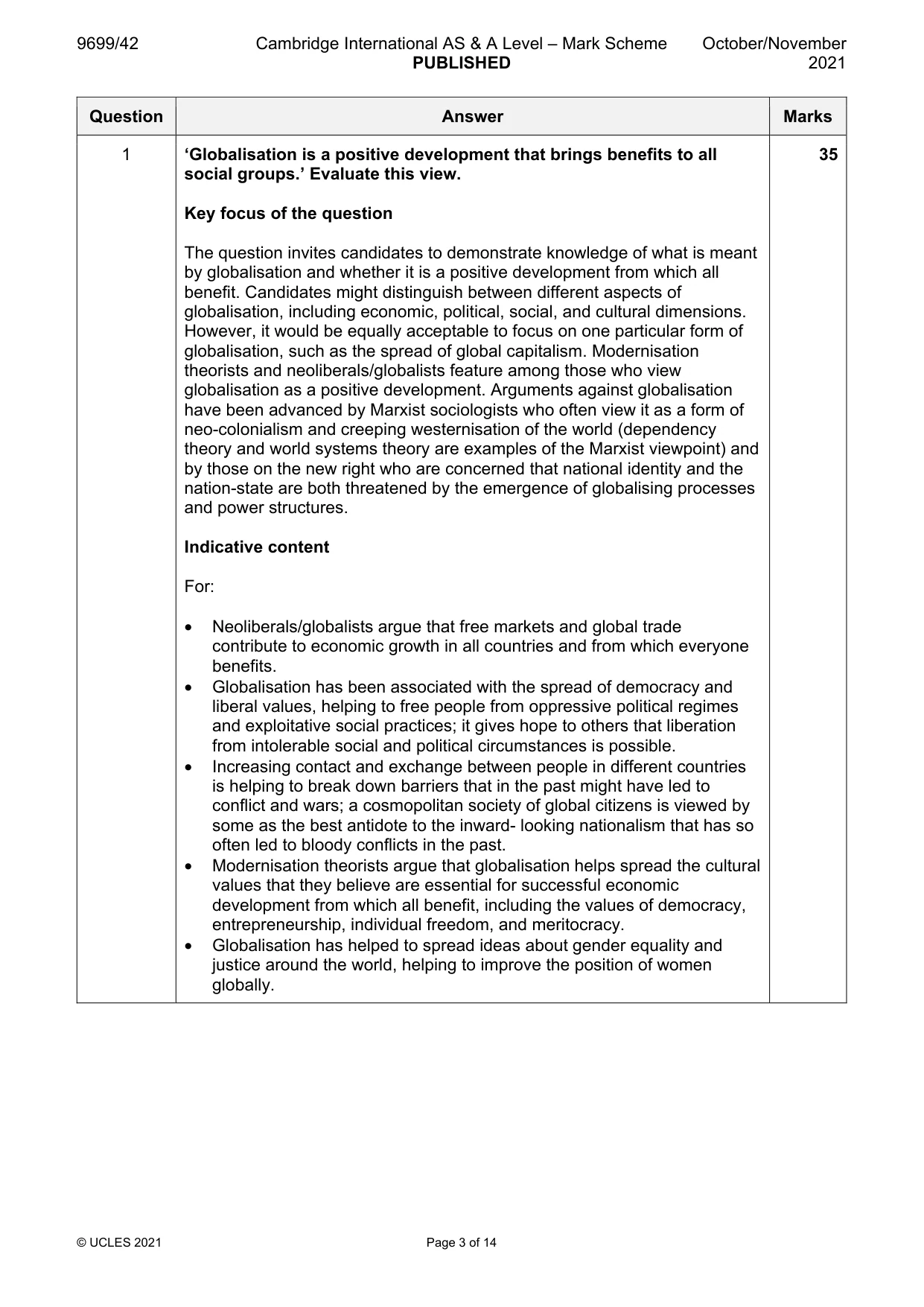
9699/42 Cambridge International AS & A Level – Mark Scheme PUBLISHED October/November 2021 © UCLES 2021 Page 3 of 14 Question Answer Marks 1 ‘Globalisation is a positive development that brings benefits to all social groups.’ Evaluate this view. Key focus of the question The question invites candidates to demonstrate knowledge of what is meant by globalisation and whether it is a positive development from which all benefit. Candidates might distinguish between different aspects of globalisation, including economic, political, social, and cultural dimensions. However, it would be equally acceptable to focus on one particular form of globalisation, such as the spread of global capitalism. Modernisation theorists and neoliberals/globalists feature among those who view globalisation as a positive development. Arguments against globalisation have been advanced by Marxist sociologists who often view it as a form of neo-colonialism and creeping westernisation of the world (dependency theory and world systems theory are examples of the Marxist viewpoint) and by those on the new right who are concerned that national identity and the nation-state are both threatened by the emergence of globalising processes and power structures. Indicative content For: • Neoliberals/globalists argue that free markets and global trade contribute to economic growth in all countries and from which everyone benefits. • Globalisation has been associated with the spread of democracy and liberal values, helping to free people from oppressive political regimes and exploitative social practices; it gives hope to others that liberation from intolerable social and political circumstances is possible. • Increasing contact and exchange between people in different countries is helping to break down barriers that in the past might have led to conflict and wars; a cosmopolitan society of global citizens is viewed by some as the best antidote to the inward- looking nationalism that has so often led to bloody conflicts in the past. • Modernisation theorists argue that globalisation helps spread the cultural values that they believe are essential for successful economic development from which all benefit, including the values of democracy, entrepreneurship, individual freedom, and meritocracy. • Globalisation has helped to spread ideas about gender equality and justice around the world, helping to improve the position of women globally. 35
Mark scheme, page 4
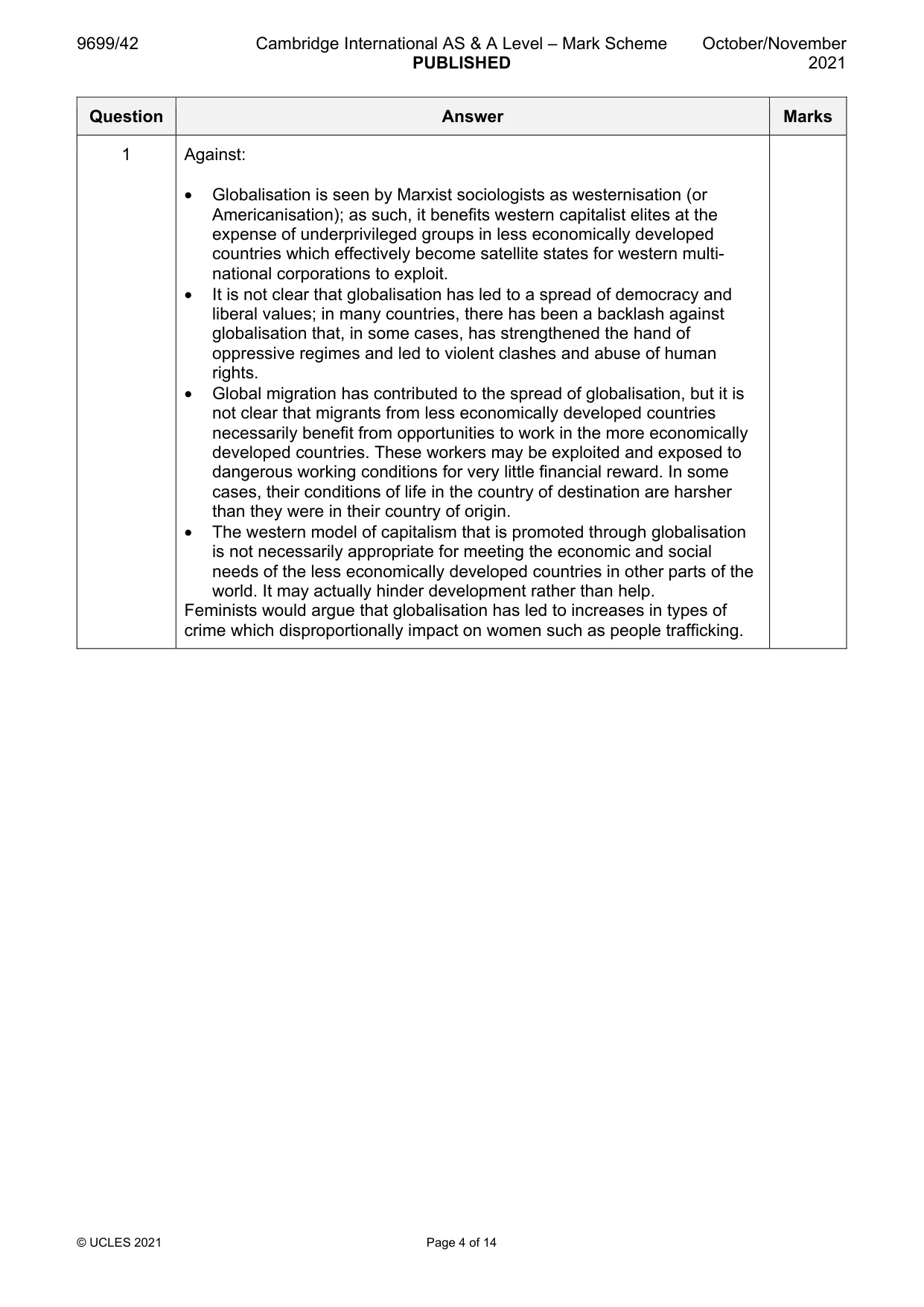
9699/42 Cambridge International AS & A Level – Mark Scheme PUBLISHED October/November 2021 © UCLES 2021 Page 4 of 14 Question Answer Marks 1 Against: • Globalisation is seen by Marxist sociologists as westernisation (or Americanisation); as such, it benefits western capitalist elites at the expense of underprivileged groups in less economically developed countries which effectively become satellite states for western multi- national corporations to exploit. • It is not clear that globalisation has led to a spread of democracy and liberal values; in many countries, there has been a backlash against globalisation that, in some cases, has strengthened the hand of oppressive regimes and led to violent clashes and abuse of human rights. • Global migration has contributed to the spread of globalisation, but it is not clear that migrants from less economically developed countries necessarily benefit from opportunities to work in the more economically developed countries. These workers may be exploited and exposed to dangerous working conditions for very little financial reward. In some cases, their conditions of life in the country of destination are harsher than they were in their country of origin. • The western model of capitalism that is promoted through globalisation is not necessarily appropriate for meeting the economic and social needs of the less economically developed countries in other parts of the world. It may actually hinder development rather than help. Feminists would argue that globalisation has led to increases in types of crime which disproportionally impact on women such as people trafficking.
Mark scheme, page 5
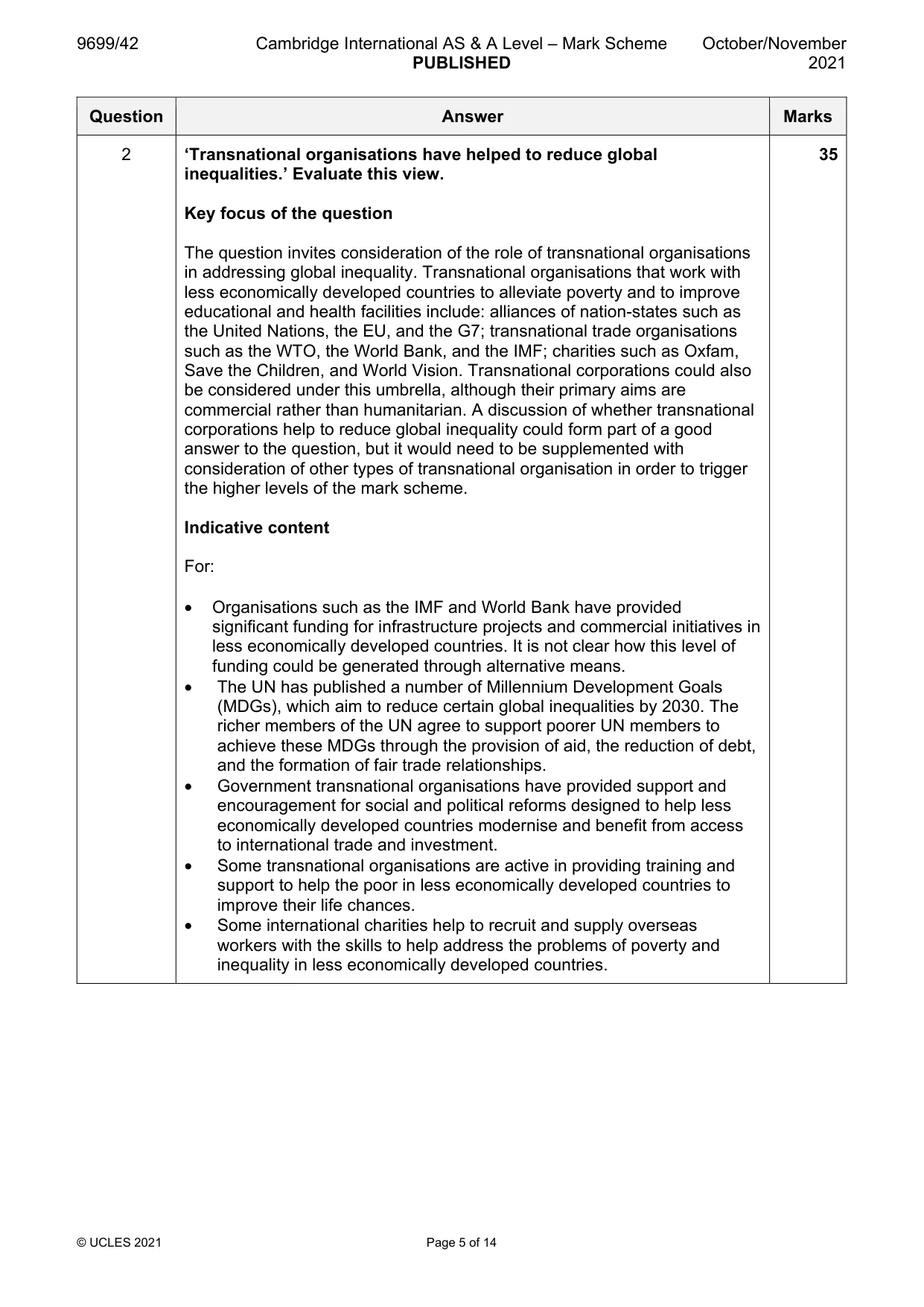
9699/42 Cambridge International AS & A Level – Mark Scheme PUBLISHED October/November 2021 © UCLES 2021 Page 5 of 14 Question Answer Marks 2 ‘Transnational organisations have helped to reduce global inequalities.’ Evaluate this view. Key focus of the question The question invites consideration of the role of transnational organisations in addressing global inequality. Transnational organisations that work with less economically developed countries to alleviate poverty and to improve educational and health facilities include: alliances of nation-states such as the United Nations, the EU, and the G7; transnational trade organisations such as the WTO, the World Bank, and the IMF; charities such as Oxfam, Save the Children, and World Vision. Transnational corporations could also be considered under this umbrella, although their primary aims are commercial rather than humanitarian. A discussion of whether transnational corporations help to reduce global inequality could form part of a good answer to the question, but it would need to be supplemented with consideration of other types of transnational organisation in order to trigger the higher levels of the mark scheme. Indicative content For: • Organisations such as the IMF and World Bank have provided significant funding for infrastructure projects and commercial initiatives in less economically developed countries. It is not clear how this level of funding could be generated through alternative means. • The UN has published a number of Millennium Development Goals (MDGs), which aim to reduce certain global inequalities by 2030. The richer members of the UN agree to support poorer UN members to achieve these MDGs through the provision of aid, the reduction of debt, and the formation of fair trade relationships. • Government transnational organisations have provided support and encouragement for social and political reforms designed to help less economically developed countries modernise and benefit from access to international trade and investment. • Some transnational organisations are active in providing training and support to help the poor in less economically developed countries to improve their life chances. • Some international charities help to recruit and supply overseas workers with the skills to help address the problems of poverty and inequality in less economically developed countries. 35
Mark scheme, page 6
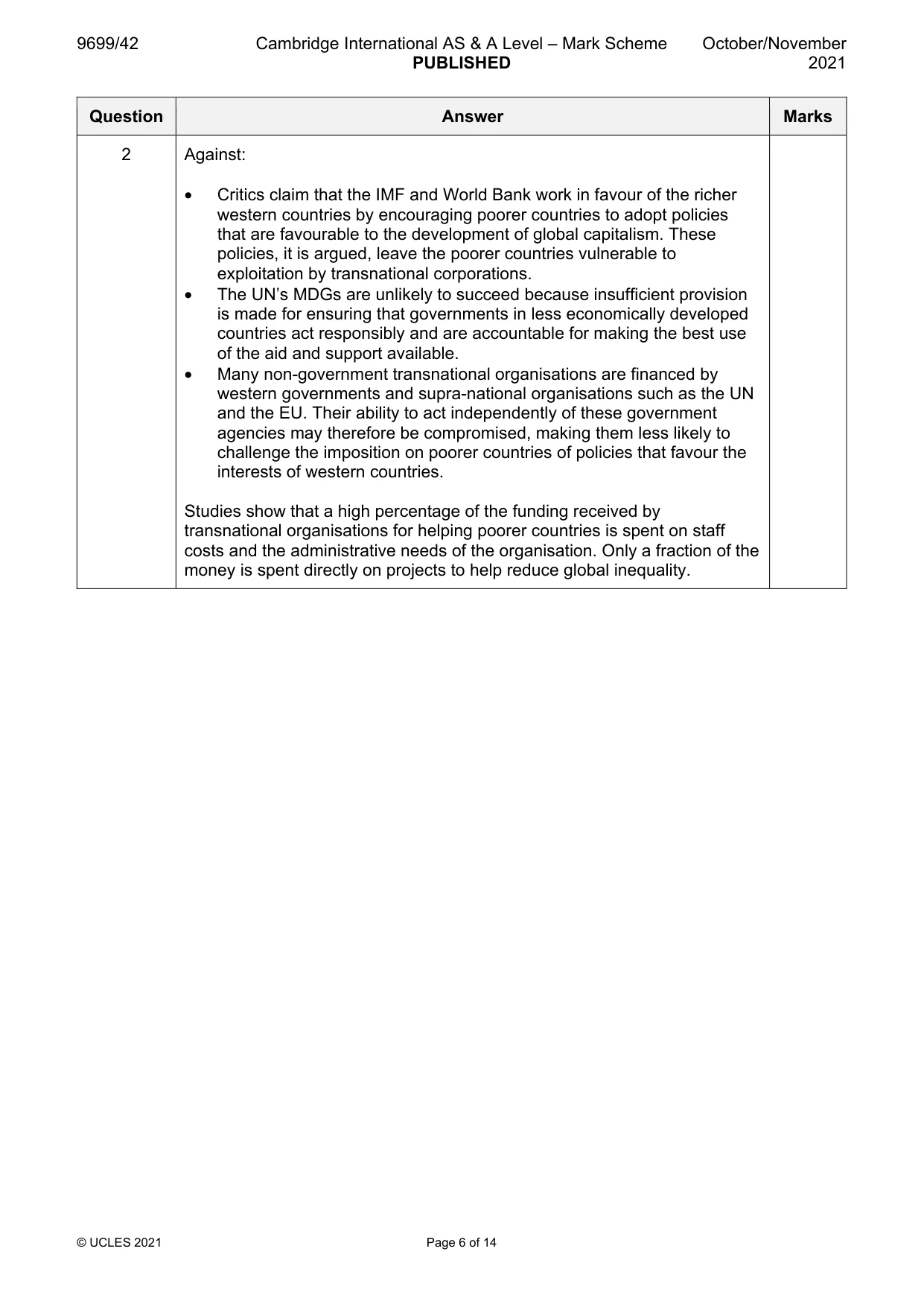
9699/42 Cambridge International AS & A Level – Mark Scheme PUBLISHED October/November 2021 © UCLES 2021 Page 6 of 14 Question Answer Marks 2 Against: • Critics claim that the IMF and World Bank work in favour of the richer western countries by encouraging poorer countries to adopt policies that are favourable to the development of global capitalism. These policies, it is argued, leave the poorer countries vulnerable to exploitation by transnational corporations. • The UN’s MDGs are unlikely to succeed because insufficient provision is made for ensuring that governments in less economically developed countries act responsibly and are accountable for making the best use of the aid and support available. • Many non-government transnational organisations are financed by western governments and supra-national organisations such as the UN and the EU. Their ability to act independently of these government agencies may therefore be compromised, making them less likely to challenge the imposition on poorer countries of policies that favour the interests of western countries. Studies show that a high percentage of the funding received by transnational organisations for helping poorer countries is spent on staff costs and the administrative needs of the organisation. Only a fraction of the money is spent directly on projects to help reduce global inequality.
Mark scheme, page 7
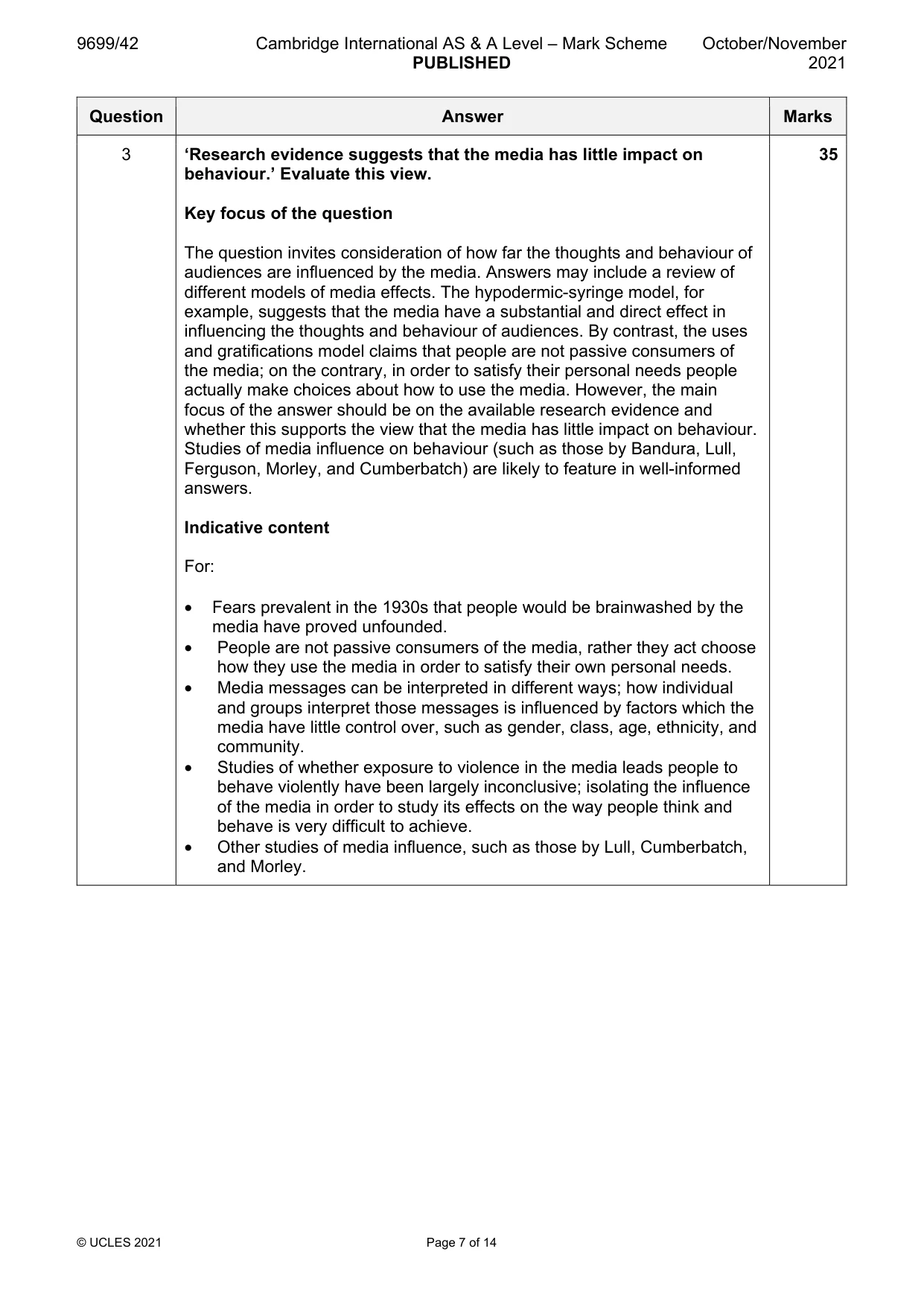
9699/42 Cambridge International AS & A Level – Mark Scheme PUBLISHED October/November 2021 © UCLES 2021 Page 7 of 14 Question Answer Marks 3 ‘Research evidence suggests that the media has little impact on behaviour.’ Evaluate this view. Key focus of the question The question invites consideration of how far the thoughts and behaviour of audiences are influenced by the media. Answers may include a review of different models of media effects. The hypodermic-syringe model, for example, suggests that the media have a substantial and direct effect in influencing the thoughts and behaviour of audiences. By contrast, the uses and gratifications model claims that people are not passive consumers of the media; on the contrary, in order to satisfy their personal needs people actually make choices about how to use the media. However, the main focus of the answer should be on the available research evidence and whether this supports the view that the media has little impact on behaviour. Studies of media influence on behaviour (such as those by Bandura, Lull, Ferguson, Morley, and Cumberbatch) are likely to feature in well-informed answers. Indicative content For: • Fears prevalent in the 1930s that people would be brainwashed by the media have proved unfounded. • People are not passive consumers of the media, rather they act choose how they use the media in order to satisfy their own personal needs. • Media messages can be interpreted in different ways; how individual and groups interpret those messages is influenced by factors which the media have little control over, such as gender, class, age, ethnicity, and community. • Studies of whether exposure to violence in the media leads people to behave violently have been largely inconclusive; isolating the influence of the media in order to study its effects on the way people think and behave is very difficult to achieve. • Other studies of media influence, such as those by Lull, Cumberbatch, and Morley. 35
Mark scheme, page 8
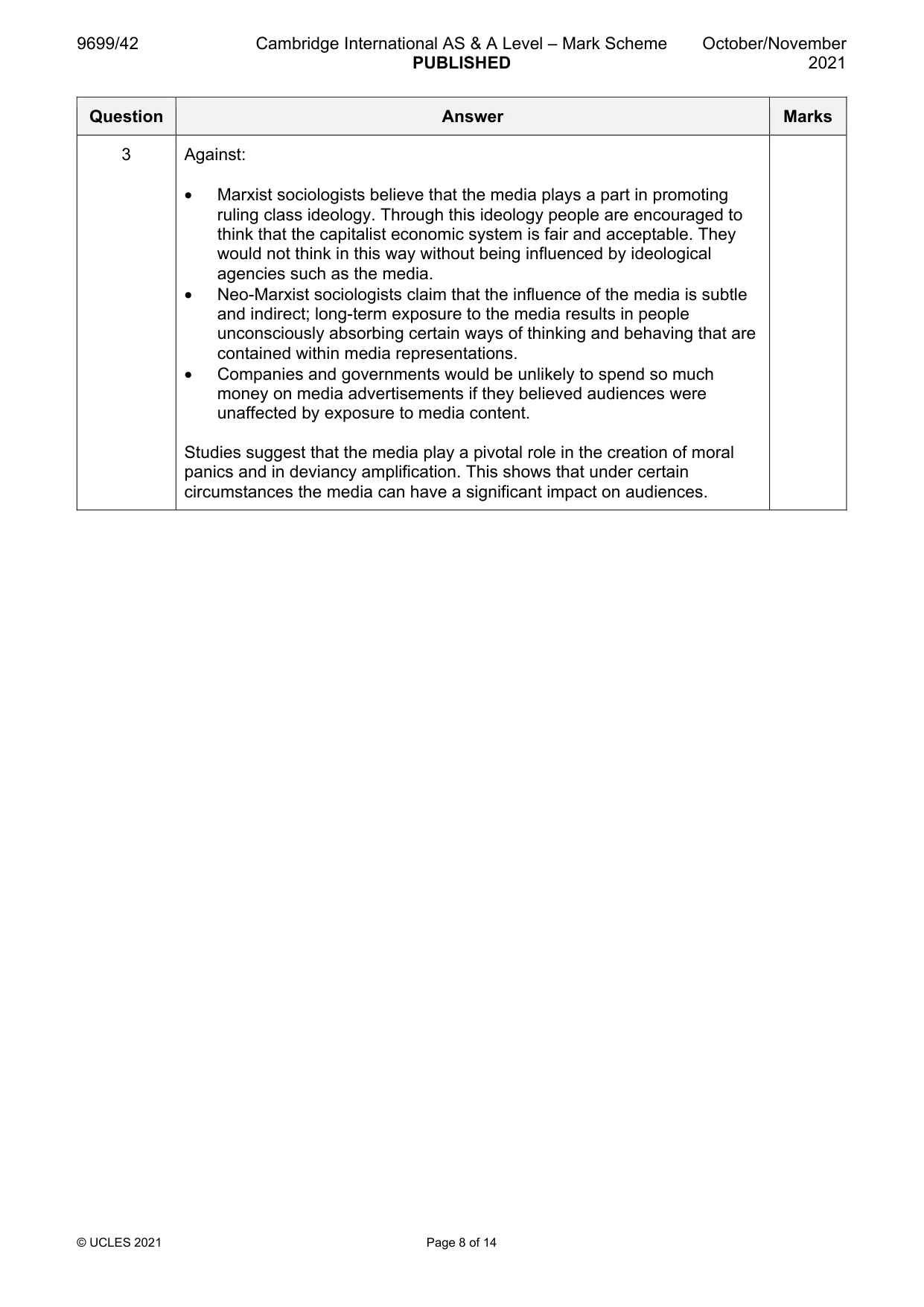
9699/42 Cambridge International AS & A Level – Mark Scheme PUBLISHED October/November 2021 © UCLES 2021 Page 8 of 14 Question Answer Marks 3 Against: • Marxist sociologists believe that the media plays a part in promoting ruling class ideology. Through this ideology people are encouraged to think that the capitalist economic system is fair and acceptable. They would not think in this way without being influenced by ideological agencies such as the media. • Neo-Marxist sociologists claim that the influence of the media is subtle and indirect; long-term exposure to the media results in people unconsciously absorbing certain ways of thinking and behaving that are contained within media representations. • Companies and governments would be unlikely to spend so much money on media advertisements if they believed audiences were unaffected by exposure to media content. Studies suggest that the media play a pivotal role in the creation of moral panics and in deviancy amplification. This shows that under certain circumstances the media can have a significant impact on audiences.
Mark scheme, page 9
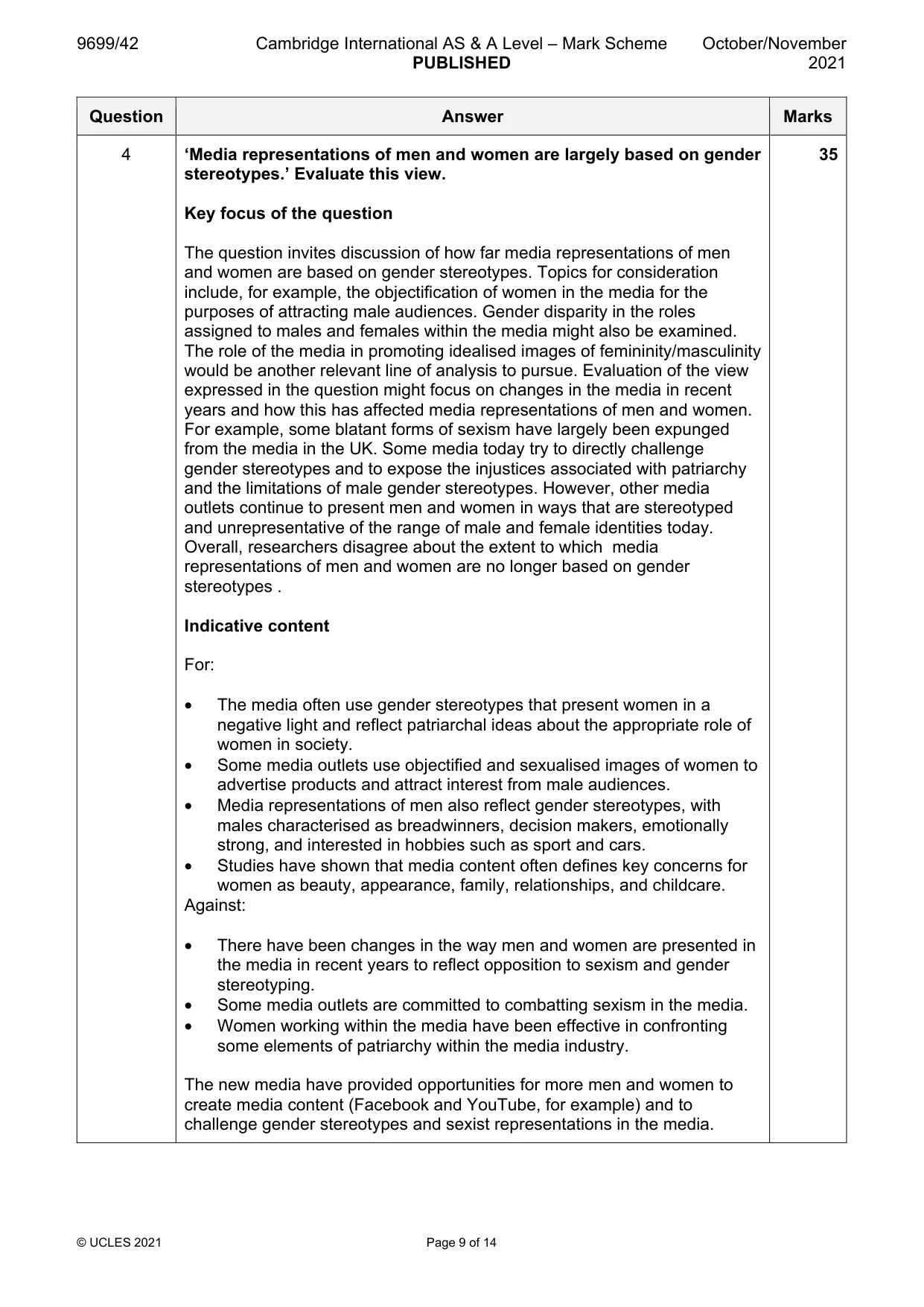
9699/42 Cambridge International AS & A Level – Mark Scheme PUBLISHED October/November 2021 © UCLES 2021 Page 9 of 14 Question Answer Marks 4 ‘Media representations of men and women are largely based on gender stereotypes.’ Evaluate this view. Key focus of the question The question invites discussion of how far media representations of men and women are based on gender stereotypes. Topics for consideration include, for example, the objectification of women in the media for the purposes of attracting male audiences. Gender disparity in the roles assigned to males and females within the media might also be examined. The role of the media in promoting idealised images of femininity/masculinity would be another relevant line of analysis to pursue. Evaluation of the view expressed in the question might focus on changes in the media in recent years and how this has affected media representations of men and women. For example, some blatant forms of sexism have largely been expunged from the media in the UK. Some media today try to directly challenge gender stereotypes and to expose the injustices associated with patriarchy and the limitations of male gender stereotypes. However, other media outlets continue to present men and women in ways that are stereotyped and unrepresentative of the range of male and female identities today. Overall, researchers disagree about the extent to which media representations of men and women are no longer based on gender stereotypes . Indicative content For: • The media often use gender stereotypes that present women in a negative light and reflect patriarchal ideas about the appropriate role of women in society. • Some media outlets use objectified and sexualised images of women to advertise products and attract interest from male audiences. • Media representations of men also reflect gender stereotypes, with males characterised as breadwinners, decision makers, emotionally strong, and interested in hobbies such as sport and cars. • Studies have shown that media content often defines key concerns for women as beauty, appearance, family, relationships, and childcare. Against: • There have been changes in the way men and women are presented in the media in recent years to reflect opposition to sexism and gender stereotyping. • Some media outlets are committed to combatting sexism in the media. • Women working within the media have been effective in confronting some elements of patriarchy within the media industry. The new media have provided opportunities for more men and women to create media content (Facebook and YouTube, for example) and to challenge gender stereotypes and sexist representations in the media. 35
Mark scheme, page 10
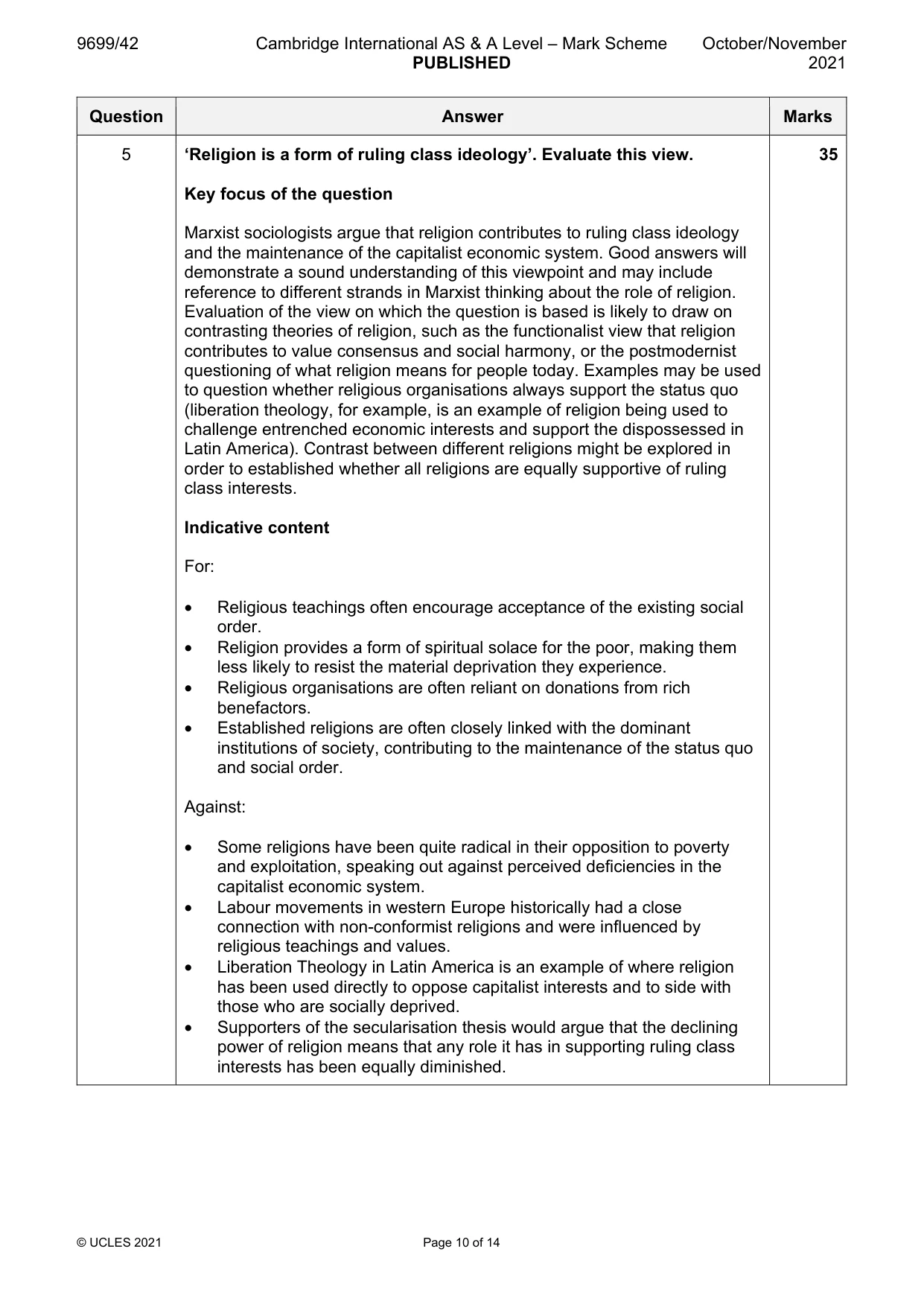
9699/42 Cambridge International AS & A Level – Mark Scheme PUBLISHED October/November 2021 © UCLES 2021 Page 10 of 14 Question Answer Marks 5 ‘Religion is a form of ruling class ideology’. Evaluate this view. Key focus of the question Marxist sociologists argue that religion contributes to ruling class ideology and the maintenance of the capitalist economic system. Good answers will demonstrate a sound understanding of this viewpoint and may include reference to different strands in Marxist thinking about the role of religion. Evaluation of the view on which the question is based is likely to draw on contrasting theories of religion, such as the functionalist view that religion contributes to value consensus and social harmony, or the postmodernist questioning of what religion means for people today. Examples may be used to question whether religious organisations always support the status quo (liberation theology, for example, is an example of religion being used to challenge entrenched economic interests and support the dispossessed in Latin America). Contrast between different religions might be explored in order to established whether all religions are equally supportive of ruling class interests. Indicative content For: • Religious teachings often encourage acceptance of the existing social order. • Religion provides a form of spiritual solace for the poor, making them less likely to resist the material deprivation they experience. • Religious organisations are often reliant on donations from rich benefactors. • Established religions are often closely linked with the dominant institutions of society, contributing to the maintenance of the status quo and social order. Against: • Some religions have been quite radical in their opposition to poverty and exploitation, speaking out against perceived deficiencies in the capitalist economic system. • Labour movements in western Europe historically had a close connection with non-conformist religions and were influenced by religious teachings and values. • Liberation Theology in Latin America is an example of where religion has been used directly to oppose capitalist interests and to side with those who are socially deprived. • Supporters of the secularisation thesis would argue that the declining power of religion means that any role it has in supporting ruling class interests has been equally diminished. 35
Mark scheme, page 11
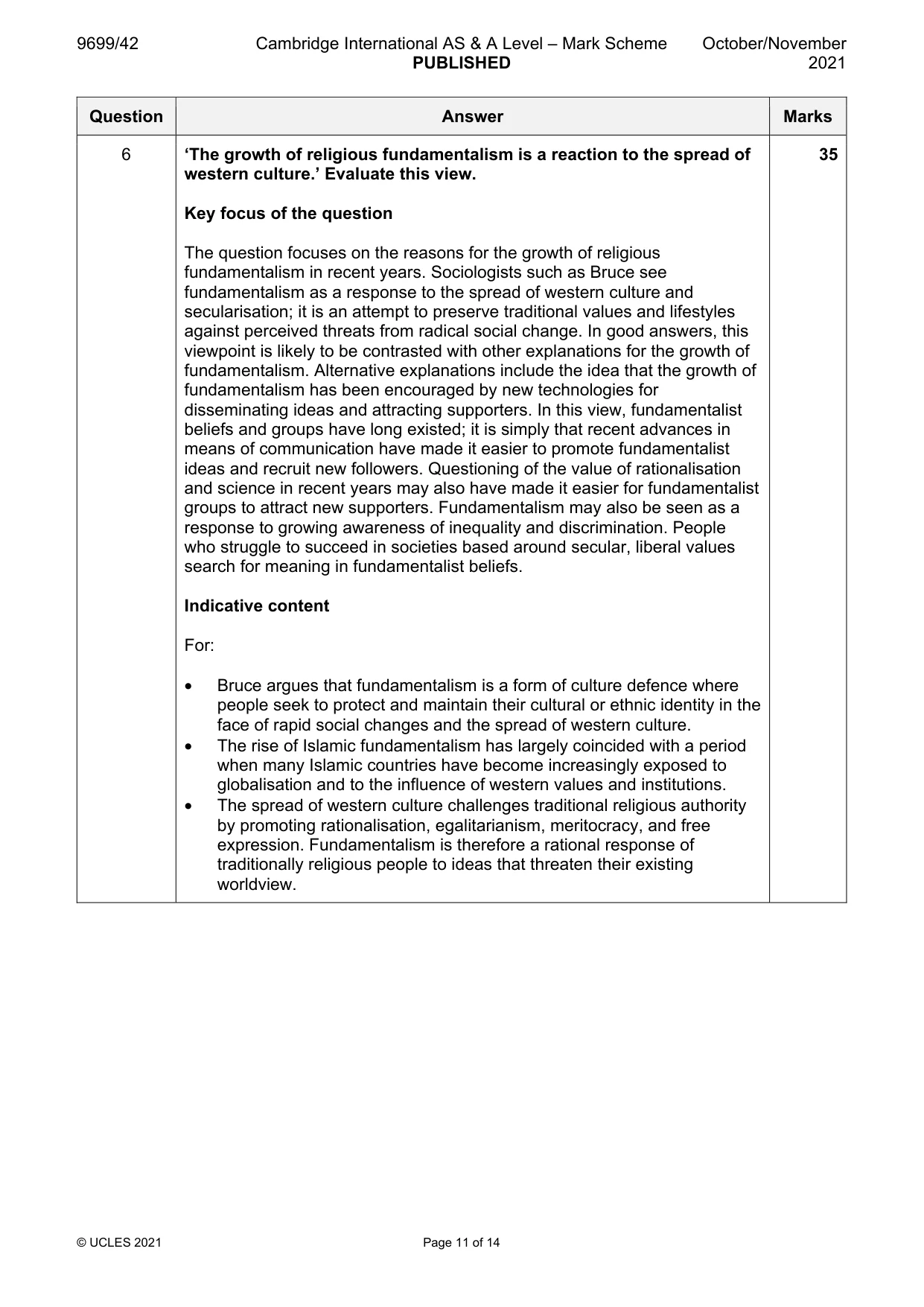
9699/42 Cambridge International AS & A Level – Mark Scheme PUBLISHED October/November 2021 © UCLES 2021 Page 11 of 14 Question Answer Marks 6 ‘The growth of religious fundamentalism is a reaction to the spread of western culture.’ Evaluate this view. Key focus of the question The question focuses on the reasons for the growth of religious fundamentalism in recent years. Sociologists such as Bruce see fundamentalism as a response to the spread of western culture and secularisation; it is an attempt to preserve traditional values and lifestyles against perceived threats from radical social change. In good answers, this viewpoint is likely to be contrasted with other explanations for the growth of fundamentalism. Alternative explanations include the idea that the growth of fundamentalism has been encouraged by new technologies for disseminating ideas and attracting supporters. In this view, fundamentalist beliefs and groups have long existed; it is simply that recent advances in means of communication have made it easier to promote fundamentalist ideas and recruit new followers. Questioning of the value of rationalisation and science in recent years may also have made it easier for fundamentalist groups to attract new supporters. Fundamentalism may also be seen as a response to growing awareness of inequality and discrimination. People who struggle to succeed in societies based around secular, liberal values search for meaning in fundamentalist beliefs. Indicative content For: • Bruce argues that fundamentalism is a form of culture defence where people seek to protect and maintain their cultural or ethnic identity in the face of rapid social changes and the spread of western culture. • The rise of Islamic fundamentalism has largely coincided with a period when many Islamic countries have become increasingly exposed to globalisation and to the influence of western values and institutions. • The spread of western culture challenges traditional religious authority by promoting rationalisation, egalitarianism, meritocracy, and free expression. Fundamentalism is therefore a rational response of traditionally religious people to ideas that threaten their existing worldview. 35
Mark scheme, page 12
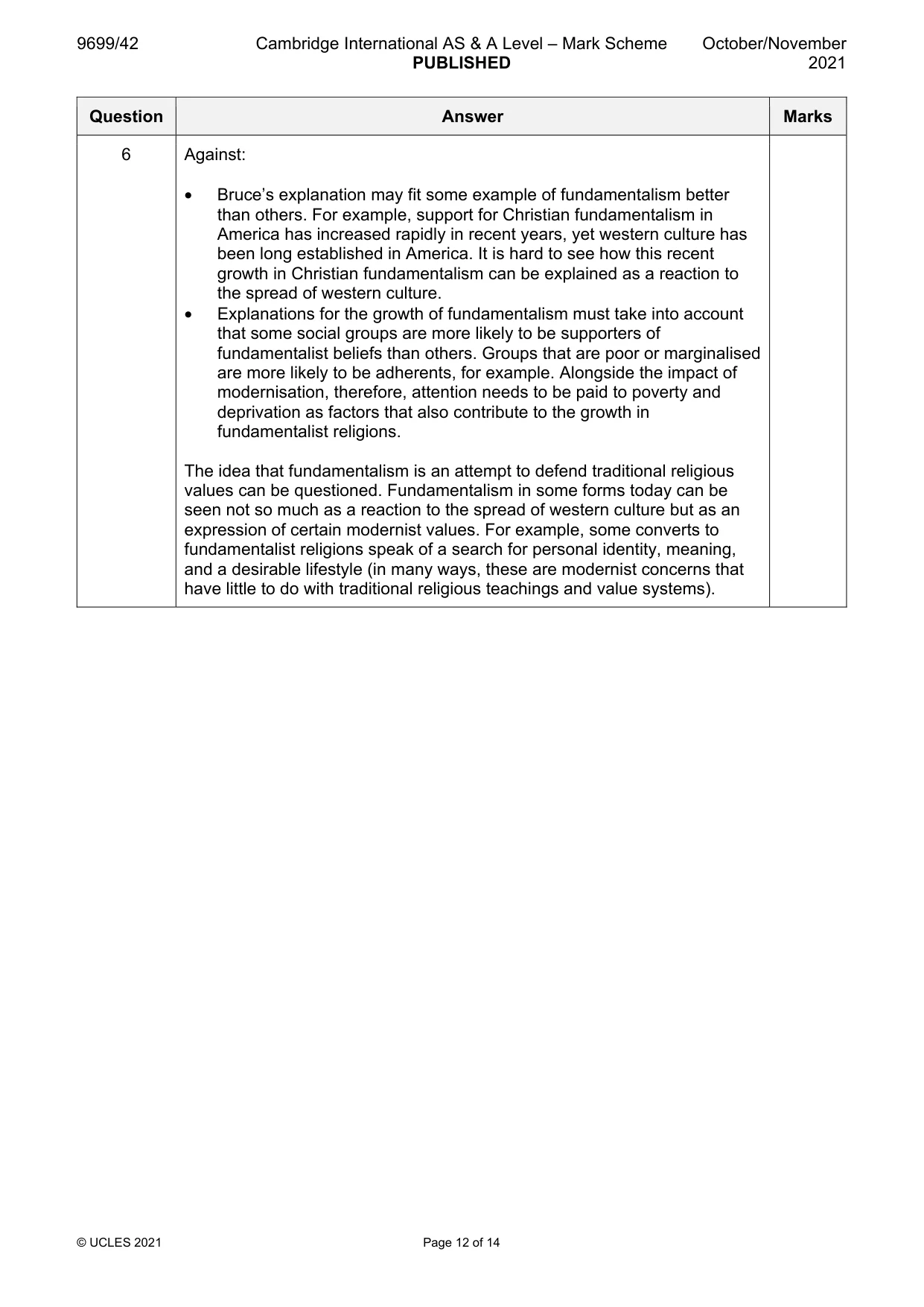
9699/42 Cambridge International AS & A Level – Mark Scheme PUBLISHED October/November 2021 © UCLES 2021 Page 12 of 14 Question Answer Marks 6 Against: • Bruce’s explanation may fit some example of fundamentalism better than others. For example, support for Christian fundamentalism in America has increased rapidly in recent years, yet western culture has been long established in America. It is hard to see how this recent growth in Christian fundamentalism can be explained as a reaction to the spread of western culture. • Explanations for the growth of fundamentalism must take into account that some social groups are more likely to be supporters of fundamentalist beliefs than others. Groups that are poor or marginalised are more likely to be adherents, for example. Alongside the impact of modernisation, therefore, attention needs to be paid to poverty and deprivation as factors that also contribute to the growth in fundamentalist religions. The idea that fundamentalism is an attempt to defend traditional religious values can be questioned. Fundamentalism in some forms today can be seen not so much as a reaction to the spread of western culture but as an expression of certain modernist values. For example, some converts to fundamentalist religions speak of a search for personal identity, meaning, and a desirable lifestyle (in many ways, these are modernist concerns that have little to do with traditional religious teachings and value systems).
Mark scheme, page 13
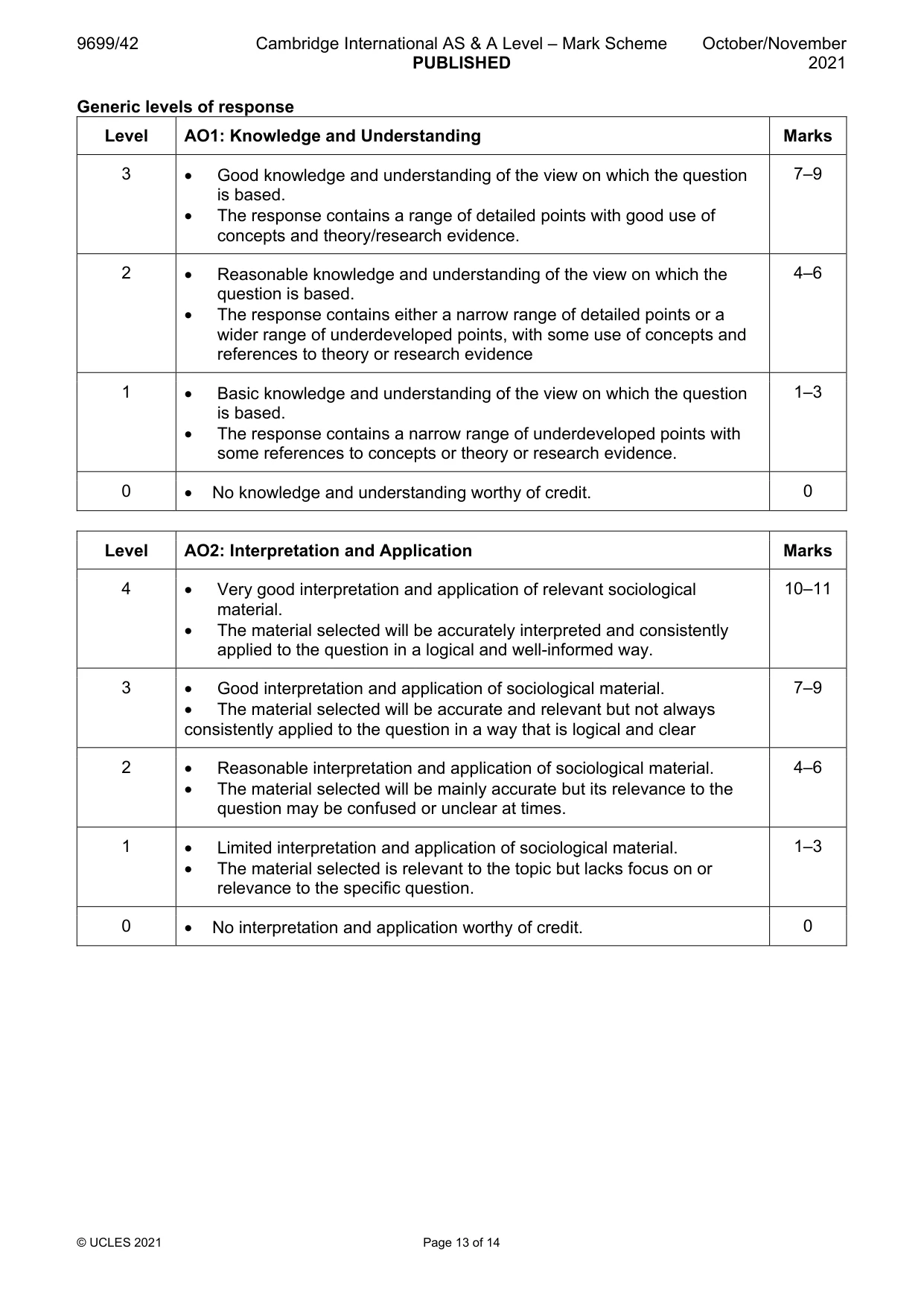
9699/42 Cambridge International AS & A Level – Mark Scheme PUBLISHED October/November 2021 © UCLES 2021 Page 13 of 14 Generic levels of response Level AO1: Knowledge and Understanding Marks 3 • Good knowledge and understanding of the view on which the question is based. • The response contains a range of detailed points with good use of concepts and theory/research evidence. 7–9 2 • Reasonable knowledge and understanding of the view on which the question is based. • The response contains either a narrow range of detailed points or a wider range of underdeveloped points, with some use of concepts and references to theory or research evidence 4–6 1 • Basic knowledge and understanding of the view on which the question is based. • The response contains a narrow range of underdeveloped points with some references to concepts or theory or research evidence. 1–3 0 • No knowledge and understanding worthy of credit. 0 Level AO2: Interpretation and Application Marks 4 • Very good interpretation and application of relevant sociological material. • The material selected will be accurately interpreted and consistently applied to the question in a logical and well-informed way. 10–11 3 • Good interpretation and application of sociological material. • The material selected will be accurate and relevant but not always consistently applied to the question in a way that is logical and clear 7–9 2 • Reasonable interpretation and application of sociological material. • The material selected will be mainly accurate but its relevance to the question may be confused or unclear at times. 4–6 1 • Limited interpretation and application of sociological material. • The material selected is relevant to the topic but lacks focus on or relevance to the specific question. 1–3 0 • No interpretation and application worthy of credit. 0
Mark scheme, page 14
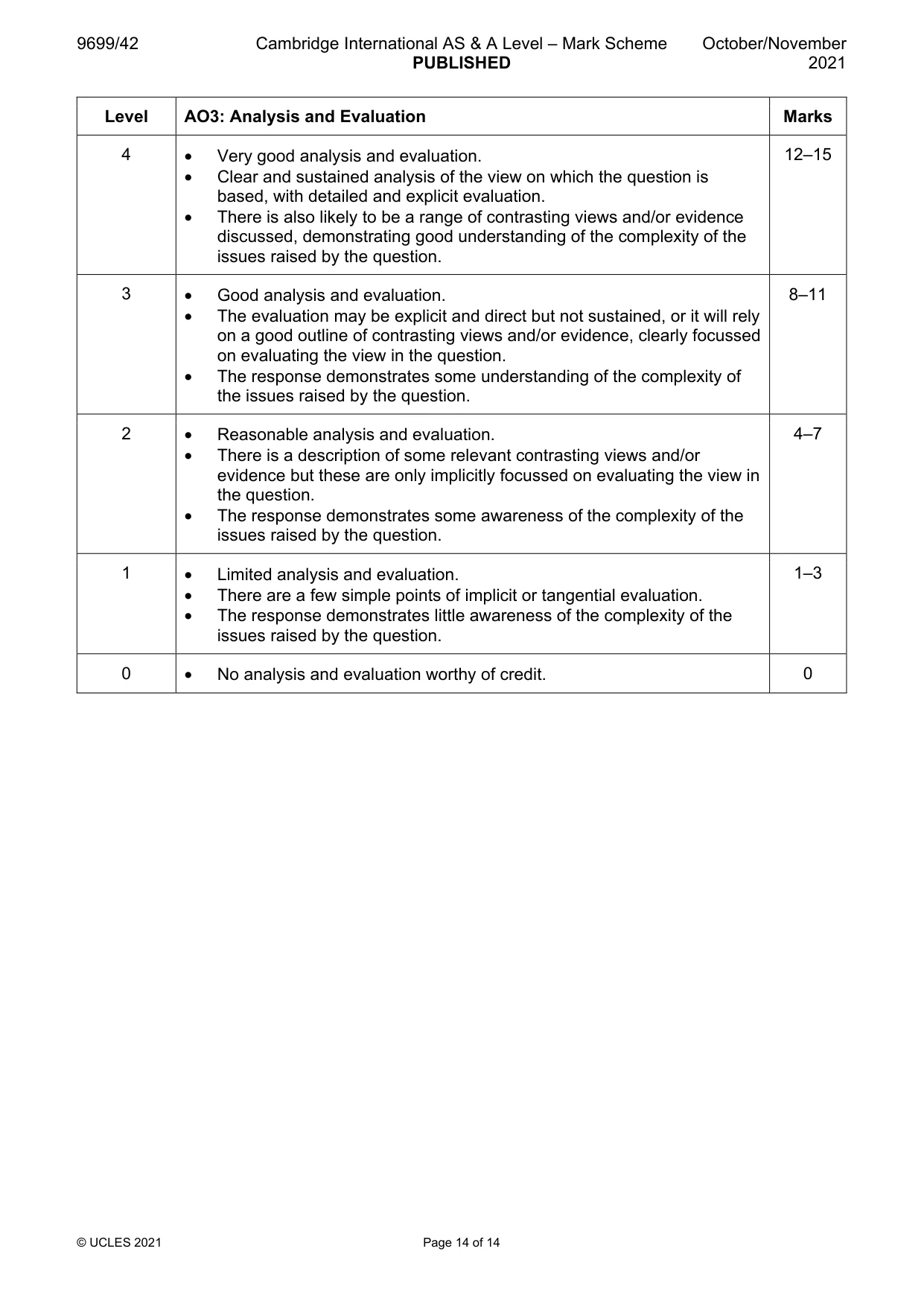
9699/42 Cambridge International AS & A Level – Mark Scheme PUBLISHED October/November 2021 © UCLES 2021 Page 14 of 14 Level AO3: Analysis and Evaluation Marks 4 • Very good analysis and evaluation. • Clear and sustained analysis of the view on which the question is based, with detailed and explicit evaluation. • There is also likely to be a range of contrasting views and/or evidence discussed, demonstrating good understanding of the complexity of the issues raised by the question. 12–15 3 • Good analysis and evaluation. • The evaluation may be explicit and direct but not sustained, or it will rely on a good outline of contrasting views and/or evidence, clearly focussed on evaluating the view in the question. • The response demonstrates some understanding of the complexity of the issues raised by the question. 8–11 2 • Reasonable analysis and evaluation. • There is a description of some relevant contrasting views and/or evidence but these are only implicitly focussed on evaluating the view in the question. • The response demonstrates some awareness of the complexity of the issues raised by the question. 4–7 1 • Limited analysis and evaluation. • There are a few simple points of implicit or tangential evaluation. • The response demonstrates little awareness of the complexity of the issues raised by the question. 1–3 0 • No analysis and evaluation worthy of credit. 0
What you needed in this session
Cambridge’s own grade thresholds for 2021 Oct/Nov, Paper 4 · Variant 2. A higher threshold means an easier paper — the bar moves with how the cohort did.