Cambridge A Level Sociology 9699 — 2025 May/June Paper 4 · Variant 2
9699/42/M/J/25 · 70 marks · 105 min
The question paper and its mark scheme, free to read here and free to download. This is Cambridge’s own paper, exactly as it was sat.
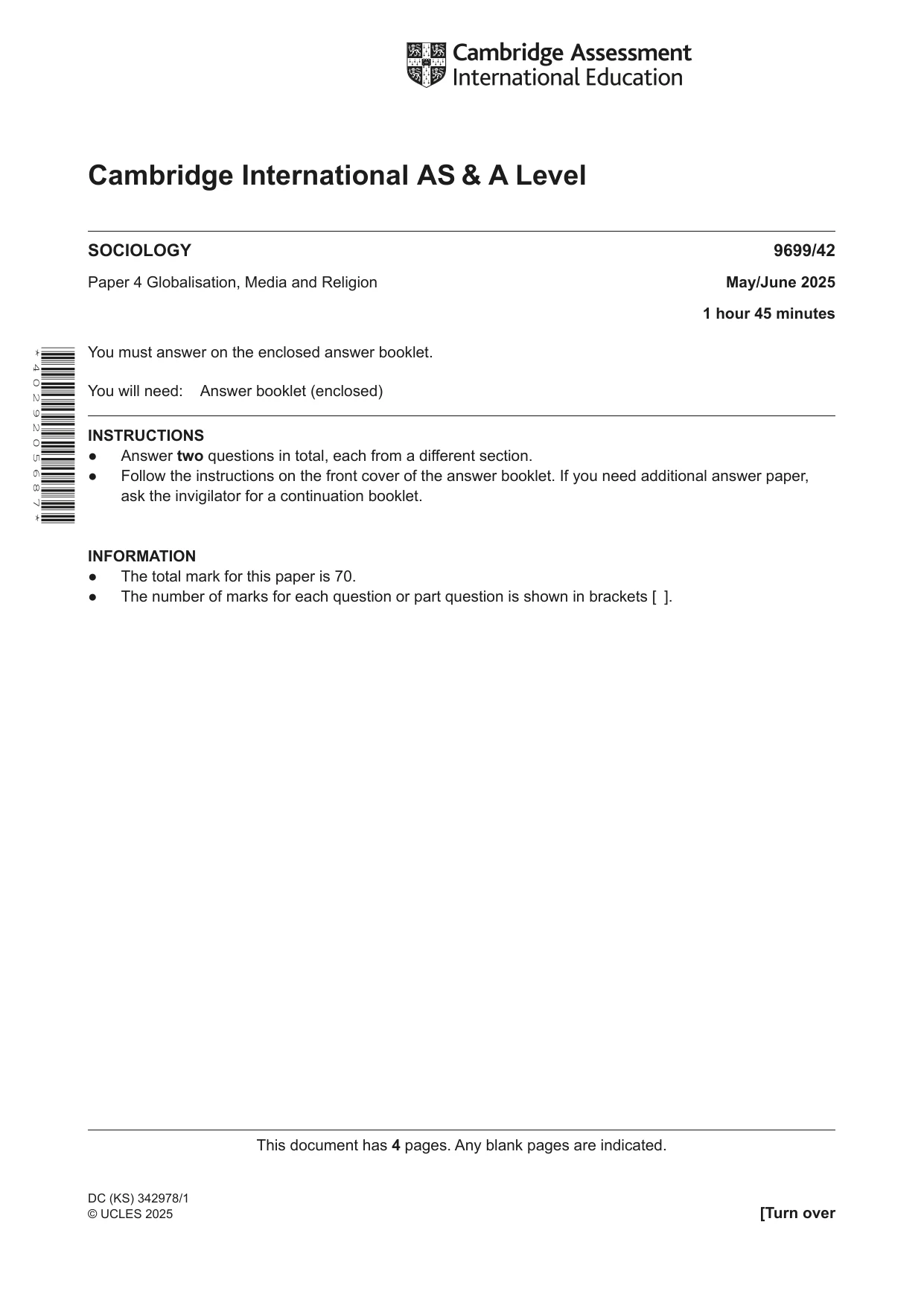
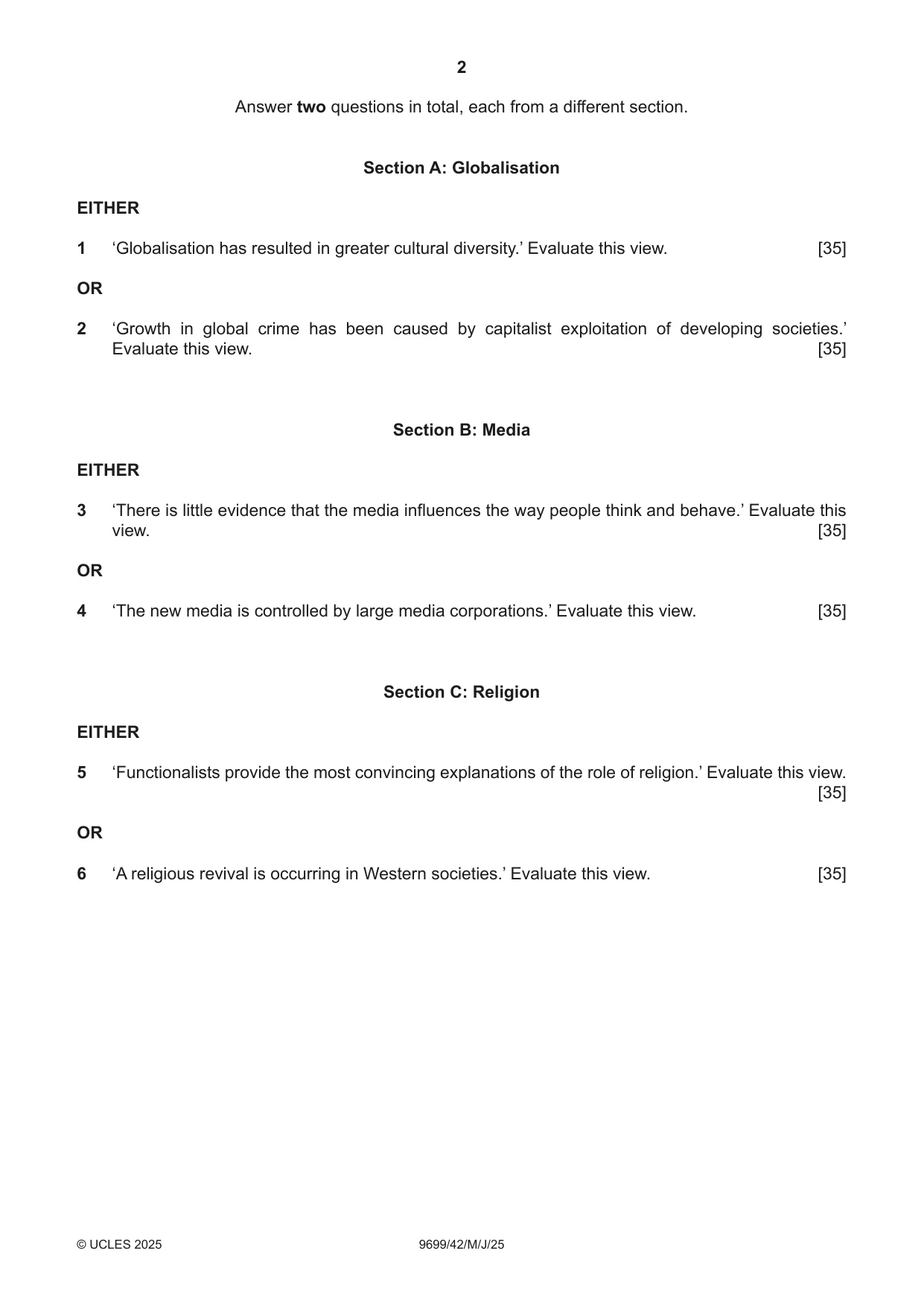
Question paper4 pages


Mark scheme19 pages
Answers below. Sit the paper first if you are practising.

Paper as text
Question paper, page 1
This document has 4 pages. Any blank pages are indicated. [Turn over Cambridge International AS & A Level SOCIOLOGY 9699/42 Paper 4 Globalisation, Media and Religion May/June 2025 1 hour 45 minutes You must answer on the enclosed answer booklet. You will need: Answer booklet (enclosed) INSTRUCTIONS ● Answer two questions in total, each from a different section. ● Follow the instructions on the front cover of the answer booklet. If you need additional answer paper, ask the invigilator for a continuation booklet. INFORMATION ● The total mark for this paper is 70. ● The number of marks for each question or part question is shown in brackets [ ]. * 4 0 2 9 2 0 5 6 8 7 * DC (KS) 342978/1 © UCLES 2025
Question paper, page 2
2 9699/42/M/J/25 © UCLES 2025 Answer two questions in total, each from a different section. Section A: Globalisation EITHER 1 ‘Globalisation has resulted in greater cultural diversity.’ Evaluate this view. [35] OR 2 ‘Growth in global crime has been caused by capitalist exploitation of developing societies.’ Evaluate this view. [35] Section B: Media EITHER 3 ‘There is little evidence that the media influences the way people think and behave.’ Evaluate this view. [35] OR 4 ‘The new media is controlled by large media corporations.’ Evaluate this view. [35] Section C: Religion EITHER 5 ‘Functionalists provide the most convincing explanations of the role of religion.’ Evaluate this view. [35] OR 6 ‘A religious revival is occurring in Western societies.’ Evaluate this view. [35]
Question paper, page 3
3 9699/42/M/J/25 © UCLES 2025 BLANK PAGE
Question paper, page 4
4 9699/42/M/J/25 © UCLES 2025 Permission to reproduce items where third-party owned material protected by copyright is included has been sought and cleared where possible. Every reasonable effort has been made by the publisher (UCLES) to trace copyright holders, but if any items requiring clearance have unwittingly been included, the publisher will be pleased to make amends at the earliest possible opportunity. To avoid the issue of disclosure of answer-related information to candidates, all copyright acknowledgements are reproduced online in the Cambridge Assessment International Education Copyright Acknowledgements Booklet. This is produced for each series of examinations and is freely available to download at www.cambridgeinternational.org after the live examination series. Cambridge Assessment International Education is part of Cambridge Assessment. Cambridge Assessment is the brand name of the University of Cambridge Local Examinations Syndicate (UCLES), which is a department of the University of Cambridge. BLANK PAGE
Mark scheme, page 1
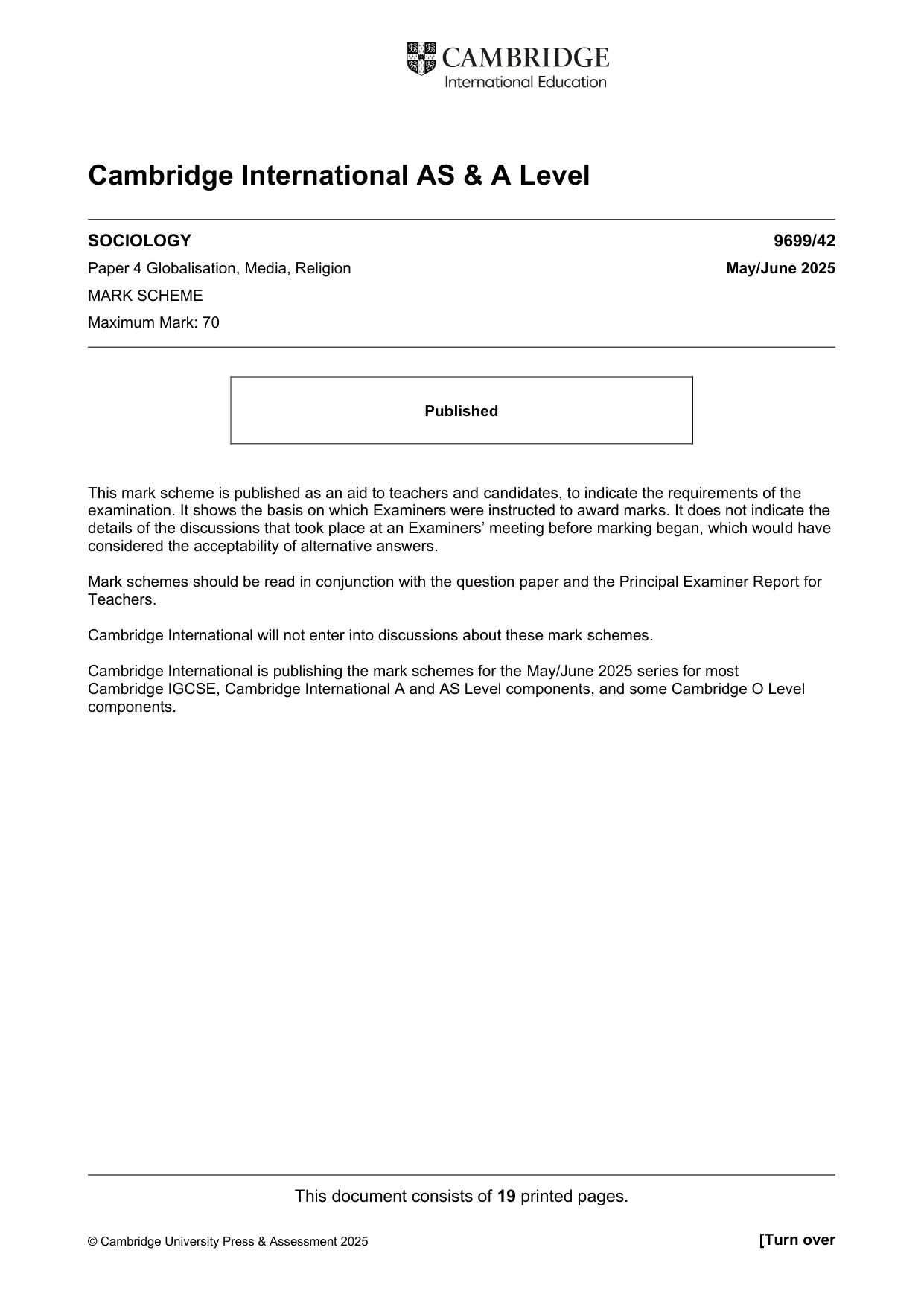
This document consists of 19 printed pages. © Cambridge University Press & Assessment 2025 [Turn over Cambridge International AS & A Level SOCIOLOGY 9699/42 Paper 4 Globalisation, Media, Religion May/June 2025 MARK SCHEME Maximum Mark: 70 Published This mark scheme is published as an aid to teachers and candidates, to indicate the requirements of the examination. It shows the basis on which Examiners were instructed to award marks. It does not indicate the details of the discussions that took place at an Examiners’ meeting before marking began, which would have considered the acceptability of alternative answers. Mark schemes should be read in conjunction with the question paper and the Principal Examiner Report for Teachers. Cambridge International will not enter into discussions about these mark schemes. Cambridge International is publishing the mark schemes for the May/June 2025 series for most Cambridge IGCSE, Cambridge International A and AS Level components, and some Cambridge O Level components.
Mark scheme, page 2
9699/42 Cambridge International AS & A Level – Mark Scheme PUBLISHED May/June 2025 © Cambridge University Press & Assessment 2025 Page 2 of 19 Generic Marking Principles These general marking principles must be applied by all examiners when marking candidate answers. They should be applied alongside the specific content of the mark scheme or generic level descriptions for a question. Each question paper and mark scheme will also comply with these marking principles. GENERIC MARKING PRINCIPLE 1: Marks must be awarded in line with: • the specific content of the mark scheme or the generic level descriptors for the question • the specific skills defined in the mark scheme or in the generic level descriptors for the question • the standard of response required by a candidate as exemplified by the standardisation scripts. GENERIC MARKING PRINCIPLE 2: Marks awarded are always whole marks (not half marks, or other fractions). GENERIC MARKING PRINCIPLE 3: Marks must be awarded positively: • marks are awarded for correct/valid answers, as defined in the mark scheme. However, credit is given for valid answers which go beyond the scope of the syllabus and mark scheme, referring to your Team Leader as appropriate • marks are awarded when candidates clearly demonstrate what they know and can do • marks are not deducted for errors • marks are not deducted for omissions • answers should only be judged on the quality of spelling, punctuation and grammar when these features are specifically assessed by the question as indicated by the mark scheme. The meaning, however, should be unambiguous. GENERIC MARKING PRINCIPLE 4: Rules must be applied consistently, e.g. in situations where candidates have not followed instructions or in the application of generic level descriptors. GENERIC MARKING PRINCIPLE 5: Marks should be awarded using the full range of marks defined in the mark scheme for the question (however; the use of the full mark range may be limited according to the quality of the candidate responses seen). GENERIC MARKING PRINCIPLE 6: Marks awarded are based solely on the requirements as defined in the mark scheme. Marks should not be awarded with grade thresholds or grade descriptors in mind.
Mark scheme, page 3
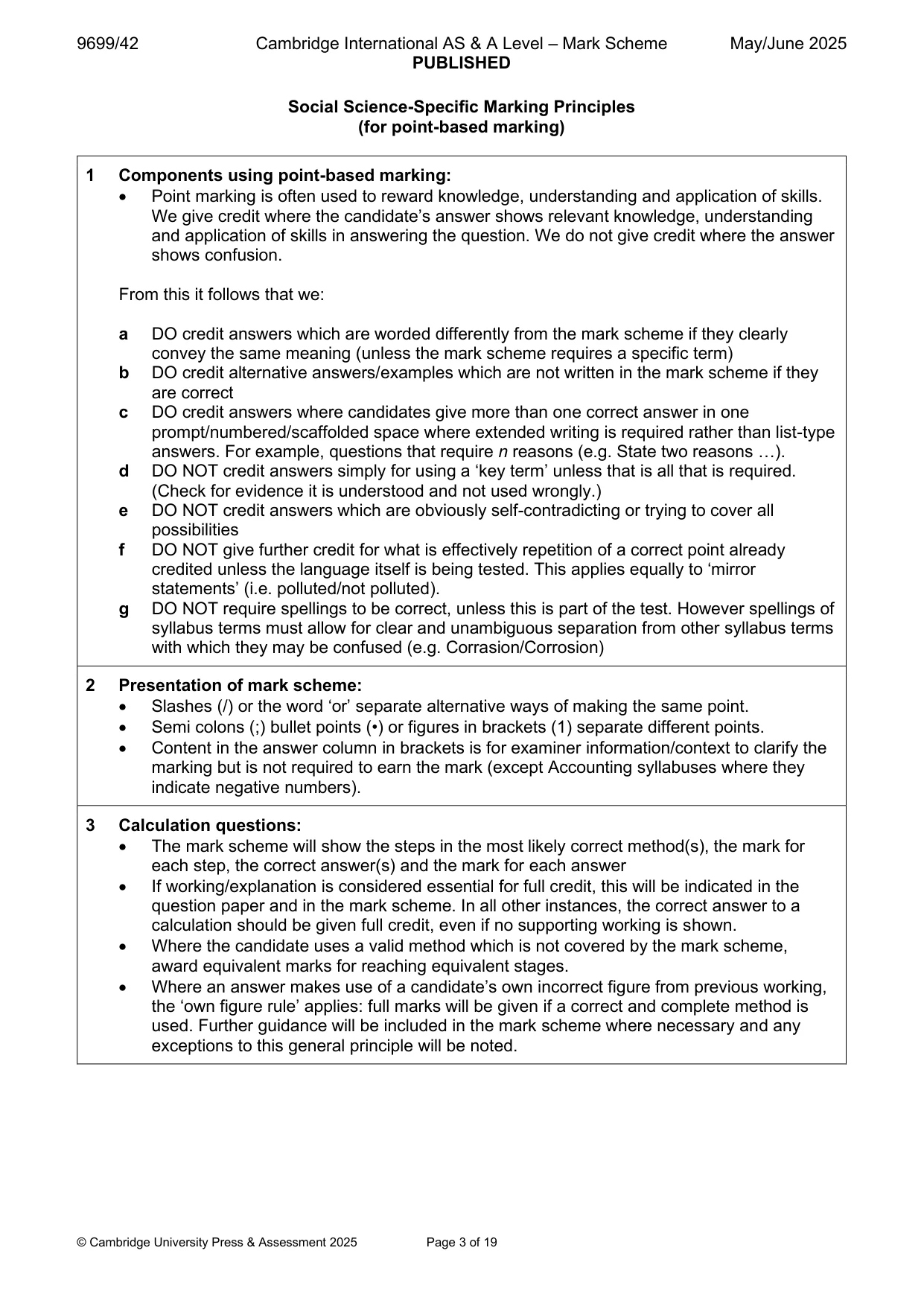
9699/42 Cambridge International AS & A Level – Mark Scheme PUBLISHED May/June 2025 © Cambridge University Press & Assessment 2025 Page 3 of 19 Social Science-Specific Marking Principles (for point-based marking) 1 Components using point-based marking: • Point marking is often used to reward knowledge, understanding and application of skills. We give credit where the candidate’s answer shows relevant knowledge, understanding and application of skills in answering the question. We do not give credit where the answer shows confusion. From this it follows that we: a DO credit answers which are worded differently from the mark scheme if they clearly convey the same meaning (unless the mark scheme requires a specific term) b DO credit alternative answers/examples which are not written in the mark scheme if they are correct c DO credit answers where candidates give more than one correct answer in one prompt/numbered/scaffolded space where extended writing is required rather than list-type answers. For example, questions that require n reasons (e.g. State two reasons …). d DO NOT credit answers simply for using a ‘key term’ unless that is all that is required. (Check for evidence it is understood and not used wrongly.) e DO NOT credit answers which are obviously self-contradicting or trying to cover all possibilities f DO NOT give further credit for what is effectively repetition of a correct point already credited unless the language itself is being tested. This applies equally to ‘mirror statements’ (i.e. polluted/not polluted). g DO NOT require spellings to be correct, unless this is part of the test. However spellings of syllabus terms must allow for clear and unambiguous separation from other syllabus terms with which they may be confused (e.g. Corrasion/Corrosion) 2 Presentation of mark scheme: • Slashes (/) or the word ‘or’ separate alternative ways of making the same point. • Semi colons (;) bullet points (•) or figures in brackets (1) separate different points. • Content in the answer column in brackets is for examiner information/context to clarify the marking but is not required to earn the mark (except Accounting syllabuses where they indicate negative numbers). 3 Calculation questions: • The mark scheme will show the steps in the most likely correct method(s), the mark for each step, the correct answer(s) and the mark for each answer • If working/explanation is considered essential for full credit, this will be indicated in the question paper and in the mark scheme. In all other instances, the correct answer to a calculation should be given full credit, even if no supporting working is shown. • Where the candidate uses a valid method which is not covered by the mark scheme, award equivalent marks for reaching equivalent stages. • Where an answer makes use of a candidate’s own incorrect figure from previous working, the ‘own figure rule’ applies: full marks will be given if a correct and complete method is used. Further guidance will be included in the mark scheme where necessary and any exceptions to this general principle will be noted.
Mark scheme, page 4
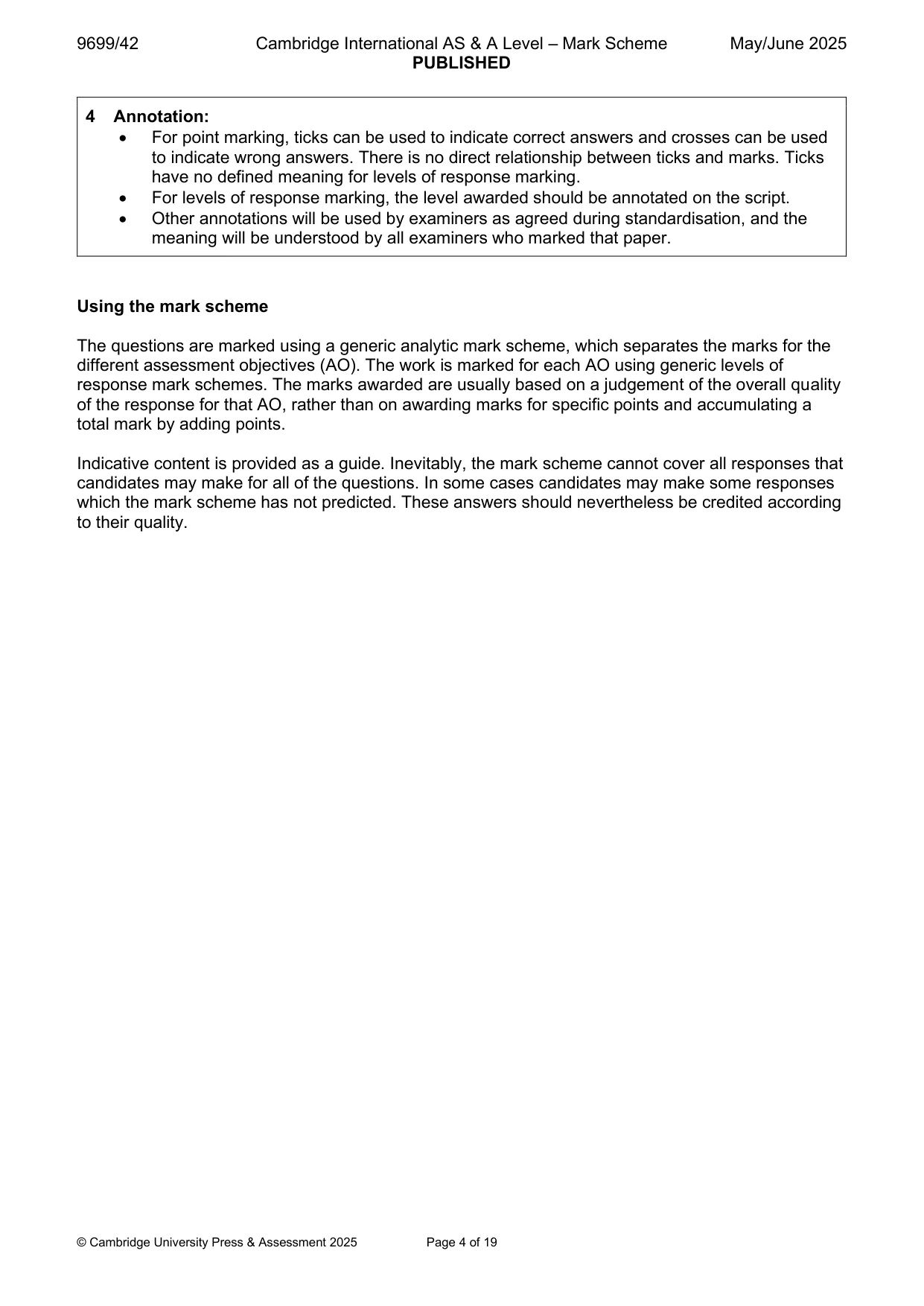
9699/42 Cambridge International AS & A Level – Mark Scheme PUBLISHED May/June 2025 © Cambridge University Press & Assessment 2025 Page 4 of 19 4 Annotation: • For point marking, ticks can be used to indicate correct answers and crosses can be used to indicate wrong answers. There is no direct relationship between ticks and marks. Ticks have no defined meaning for levels of response marking. • For levels of response marking, the level awarded should be annotated on the script. • Other annotations will be used by examiners as agreed during standardisation, and the meaning will be understood by all examiners who marked that paper. Using the mark scheme The questions are marked using a generic analytic mark scheme, which separates the marks for the different assessment objectives (AO). The work is marked for each AO using generic levels of response mark schemes. The marks awarded are usually based on a judgement of the overall quality of the response for that AO, rather than on awarding marks for specific points and accumulating a total mark by adding points. Indicative content is provided as a guide. Inevitably, the mark scheme cannot cover all responses that candidates may make for all of the questions. In some cases candidates may make some responses which the mark scheme has not predicted. These answers should nevertheless be credited according to their quality.
Mark scheme, page 5
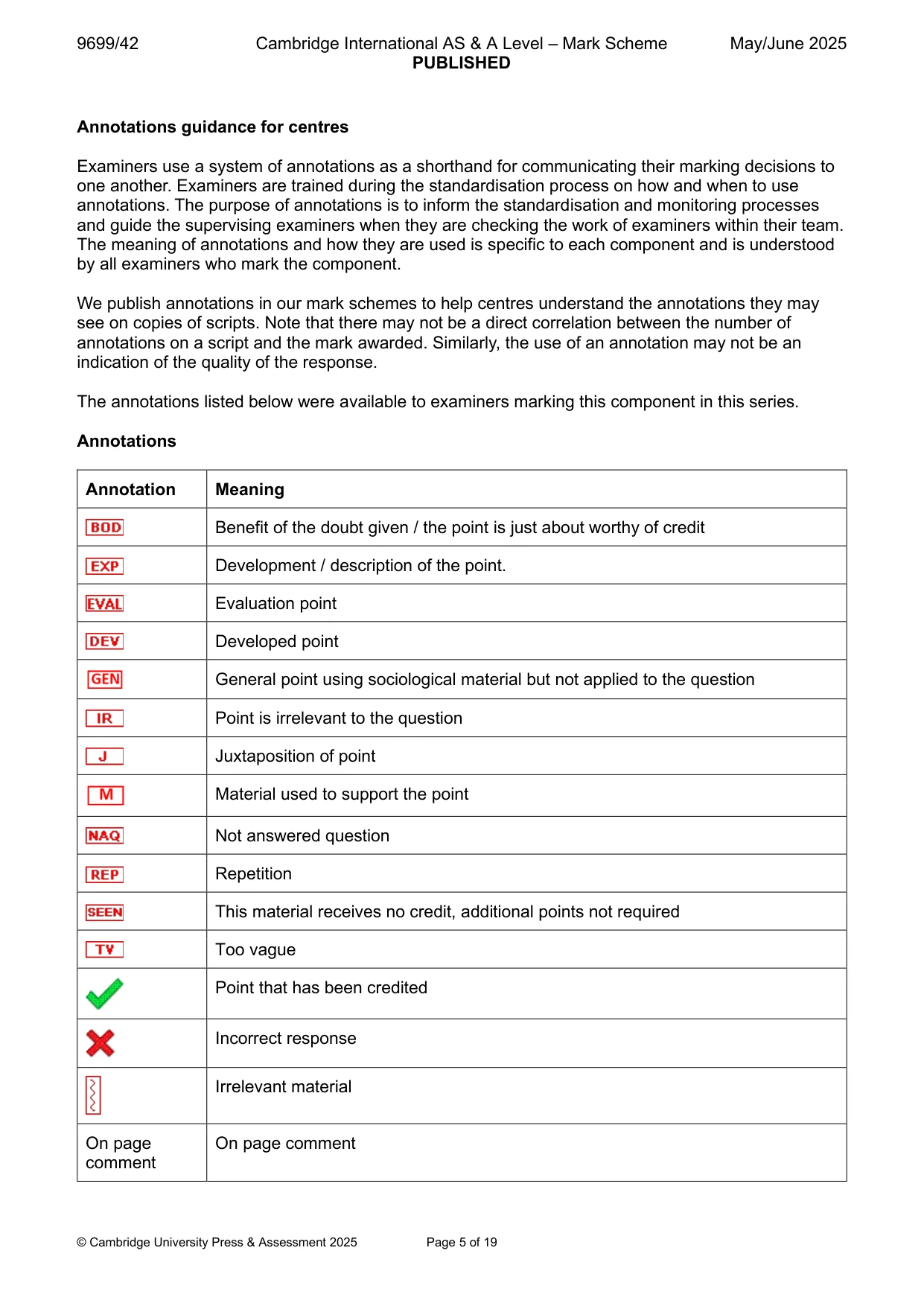
9699/42 Cambridge International AS & A Level – Mark Scheme PUBLISHED May/June 2025 © Cambridge University Press & Assessment 2025 Page 5 of 19 Annotations guidance for centres Examiners use a system of annotations as a shorthand for communicating their marking decisions to one another. Examiners are trained during the standardisation process on how and when to use annotations. The purpose of annotations is to inform the standardisation and monitoring processes and guide the supervising examiners when they are checking the work of examiners within their team. The meaning of annotations and how they are used is specific to each component and is understood by all examiners who mark the component. We publish annotations in our mark schemes to help centres understand the annotations they may see on copies of scripts. Note that there may not be a direct correlation between the number of annotations on a script and the mark awarded. Similarly, the use of an annotation may not be an indication of the quality of the response. The annotations listed below were available to examiners marking this component in this series. Annotations Annotation Meaning Benefit of the doubt given / the point is just about worthy of credit Development / description of the point. Evaluation point Developed point General point using sociological material but not applied to the question Point is irrelevant to the question Juxtaposition of point Material used to support the point Not answered question Repetition This material receives no credit, additional points not required Too vague Point that has been credited Incorrect response Irrelevant material On page comment On page comment
Mark scheme, page 6
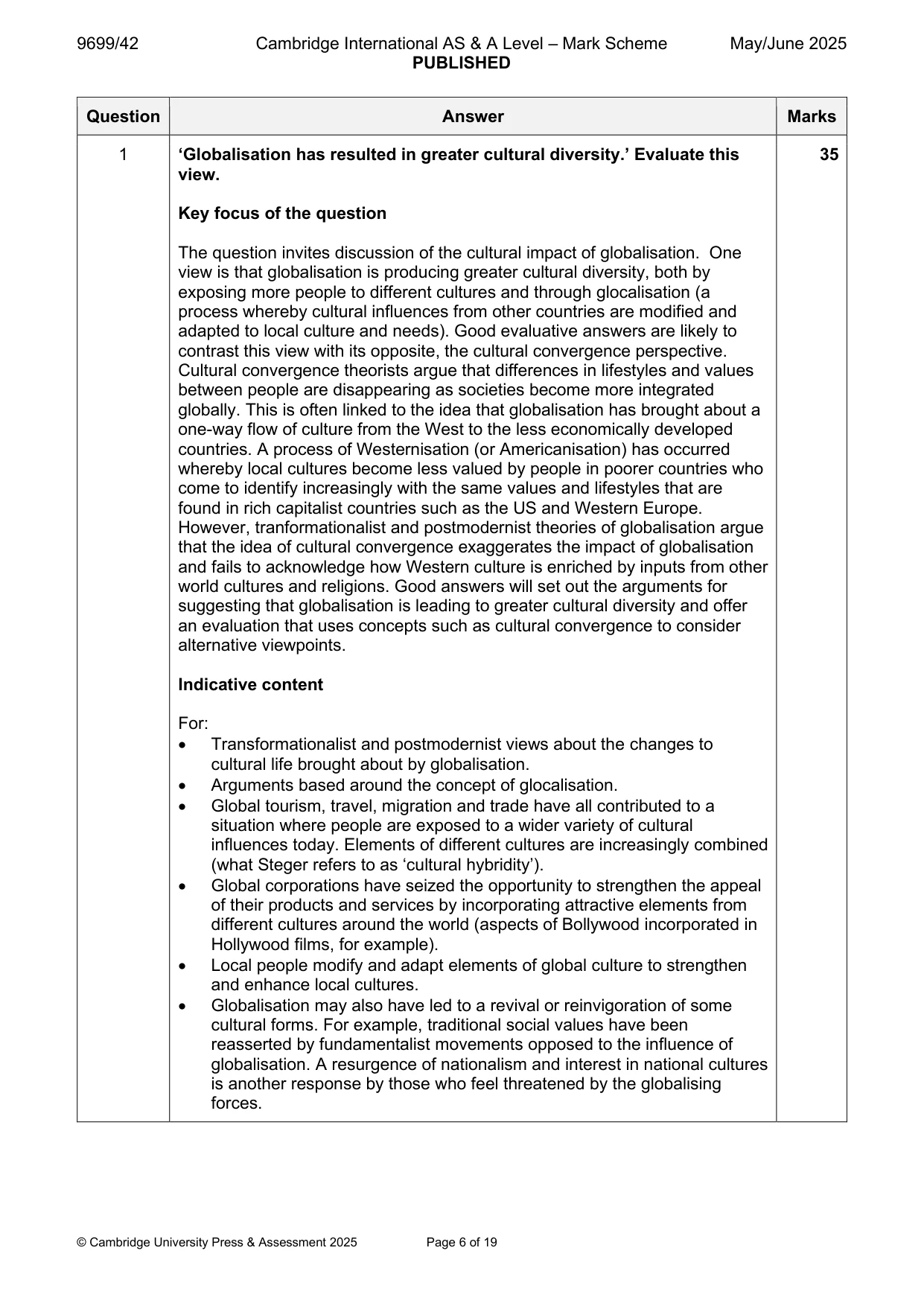
9699/42 Cambridge International AS & A Level – Mark Scheme PUBLISHED May/June 2025 © Cambridge University Press & Assessment 2025 Page 6 of 19 Question Answer Marks 1 ‘Globalisation has resulted in greater cultural diversity.’ Evaluate this view. Key focus of the question The question invites discussion of the cultural impact of globalisation. One view is that globalisation is producing greater cultural diversity, both by exposing more people to different cultures and through glocalisation (a process whereby cultural influences from other countries are modified and adapted to local culture and needs). Good evaluative answers are likely to contrast this view with its opposite, the cultural convergence perspective. Cultural convergence theorists argue that differences in lifestyles and values between people are disappearing as societies become more integrated globally. This is often linked to the idea that globalisation has brought about a one-way flow of culture from the West to the less economically developed countries. A process of Westernisation (or Americanisation) has occurred whereby local cultures become less valued by people in poorer countries who come to identify increasingly with the same values and lifestyles that are found in rich capitalist countries such as the US and Western Europe. However, tranformationalist and postmodernist theories of globalisation argue that the idea of cultural convergence exaggerates the impact of globalisation and fails to acknowledge how Western culture is enriched by inputs from other world cultures and religions. Good answers will set out the arguments for suggesting that globalisation is leading to greater cultural diversity and offer an evaluation that uses concepts such as cultural convergence to consider alternative viewpoints. Indicative content For: • Transformationalist and postmodernist views about the changes to cultural life brought about by globalisation. • Arguments based around the concept of glocalisation. • Global tourism, travel, migration and trade have all contributed to a situation where people are exposed to a wider variety of cultural influences today. Elements of different cultures are increasingly combined (what Steger refers to as ‘cultural hybridity’). • Global corporations have seized the opportunity to strengthen the appeal of their products and services by incorporating attractive elements from different cultures around the world (aspects of Bollywood incorporated in Hollywood films, for example). • Local people modify and adapt elements of global culture to strengthen and enhance local cultures. • Globalisation may also have led to a revival or reinvigoration of some cultural forms. For example, traditional social values have been reasserted by fundamentalist movements opposed to the influence of globalisation. A resurgence of nationalism and interest in national cultures is another response by those who feel threatened by the globalising forces. 35
Mark scheme, page 7
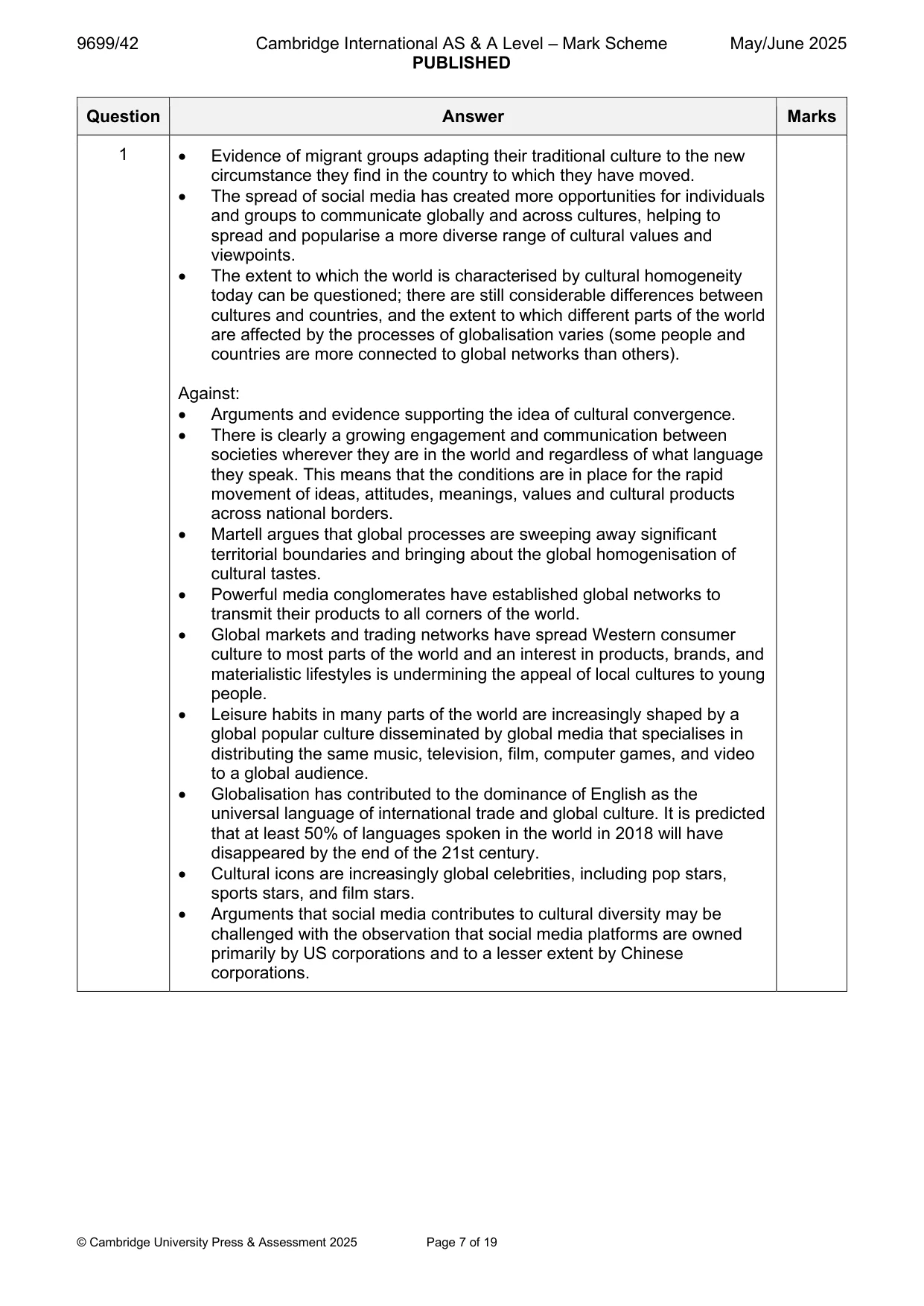
9699/42 Cambridge International AS & A Level – Mark Scheme PUBLISHED May/June 2025 © Cambridge University Press & Assessment 2025 Page 7 of 19 Question Answer Marks 1 • Evidence of migrant groups adapting their traditional culture to the new circumstance they find in the country to which they have moved. • The spread of social media has created more opportunities for individuals and groups to communicate globally and across cultures, helping to spread and popularise a more diverse range of cultural values and viewpoints. • The extent to which the world is characterised by cultural homogeneity today can be questioned; there are still considerable differences between cultures and countries, and the extent to which different parts of the world are affected by the processes of globalisation varies (some people and countries are more connected to global networks than others). Against: • Arguments and evidence supporting the idea of cultural convergence. • There is clearly a growing engagement and communication between societies wherever they are in the world and regardless of what language they speak. This means that the conditions are in place for the rapid movement of ideas, attitudes, meanings, values and cultural products across national borders. • Martell argues that global processes are sweeping away significant territorial boundaries and bringing about the global homogenisation of cultural tastes. • Powerful media conglomerates have established global networks to transmit their products to all corners of the world. • Global markets and trading networks have spread Western consumer culture to most parts of the world and an interest in products, brands, and materialistic lifestyles is undermining the appeal of local cultures to young people. • Leisure habits in many parts of the world are increasingly shaped by a global popular culture disseminated by global media that specialises in distributing the same music, television, film, computer games, and video to a global audience. • Globalisation has contributed to the dominance of English as the universal language of international trade and global culture. It is predicted that at least 50% of languages spoken in the world in 2018 will have disappeared by the end of the 21st century. • Cultural icons are increasingly global celebrities, including pop stars, sports stars, and film stars. • Arguments that social media contributes to cultural diversity may be challenged with the observation that social media platforms are owned primarily by US corporations and to a lesser extent by Chinese corporations.
Mark scheme, page 8
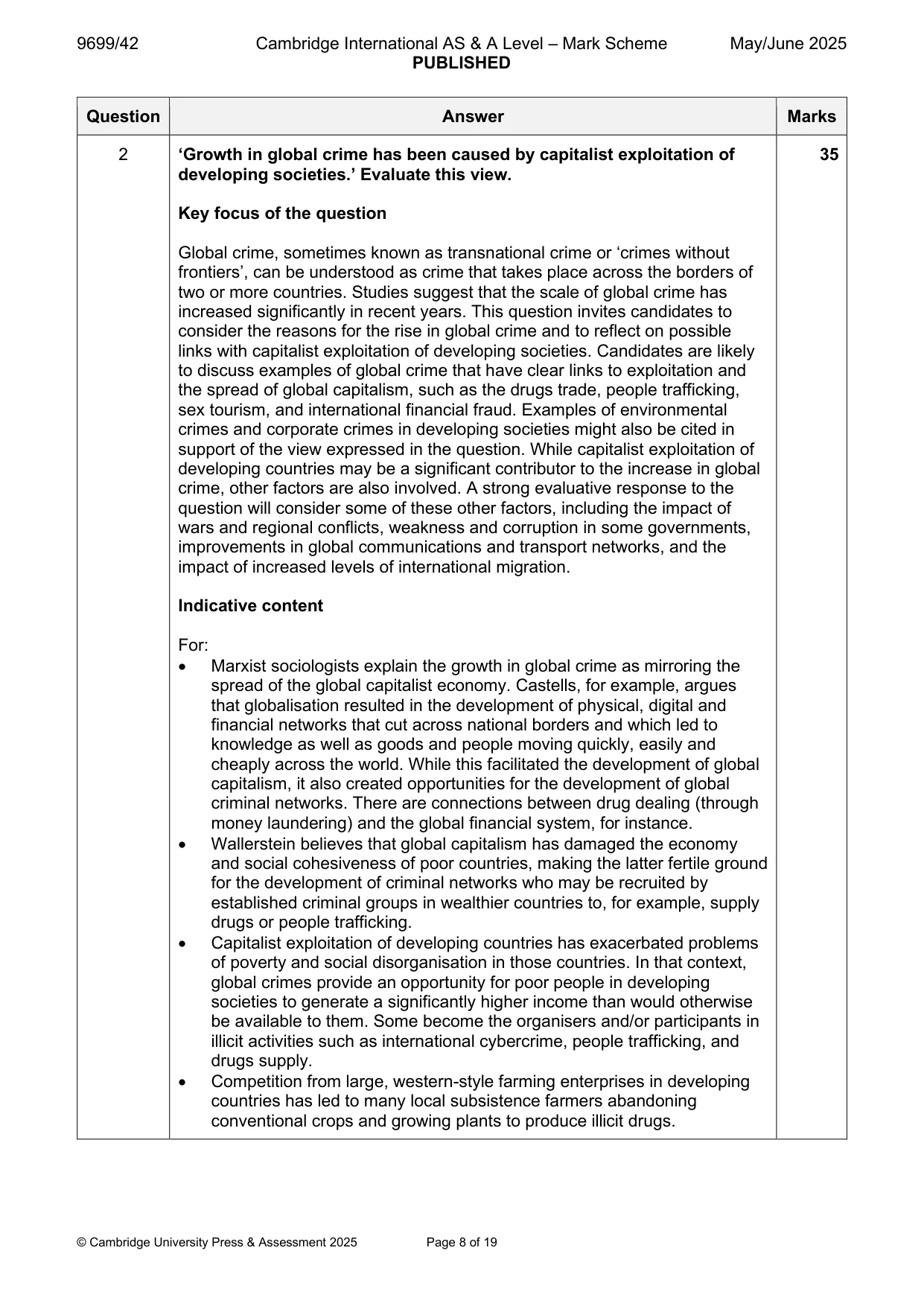
9699/42 Cambridge International AS & A Level – Mark Scheme PUBLISHED May/June 2025 © Cambridge University Press & Assessment 2025 Page 8 of 19 Question Answer Marks 2 ‘Growth in global crime has been caused by capitalist exploitation of developing societies.’ Evaluate this view. Key focus of the question Global crime, sometimes known as transnational crime or ‘crimes without frontiers’, can be understood as crime that takes place across the borders of two or more countries. Studies suggest that the scale of global crime has increased significantly in recent years. This question invites candidates to consider the reasons for the rise in global crime and to reflect on possible links with capitalist exploitation of developing societies. Candidates are likely to discuss examples of global crime that have clear links to exploitation and the spread of global capitalism, such as the drugs trade, people trafficking, sex tourism, and international financial fraud. Examples of environmental crimes and corporate crimes in developing societies might also be cited in support of the view expressed in the question. While capitalist exploitation of developing countries may be a significant contributor to the increase in global crime, other factors are also involved. A strong evaluative response to the question will consider some of these other factors, including the impact of wars and regional conflicts, weakness and corruption in some governments, improvements in global communications and transport networks, and the impact of increased levels of international migration. Indicative content For: • Marxist sociologists explain the growth in global crime as mirroring the spread of the global capitalist economy. Castells, for example, argues that globalisation resulted in the development of physical, digital and financial networks that cut across national borders and which led to knowledge as well as goods and people moving quickly, easily and cheaply across the world. While this facilitated the development of global capitalism, it also created opportunities for the development of global criminal networks. There are connections between drug dealing (through money laundering) and the global financial system, for instance. • Wallerstein believes that global capitalism has damaged the economy and social cohesiveness of poor countries, making the latter fertile ground for the development of criminal networks who may be recruited by established criminal groups in wealthier countries to, for example, supply drugs or people trafficking. • Capitalist exploitation of developing countries has exacerbated problems of poverty and social disorganisation in those countries. In that context, global crimes provide an opportunity for poor people in developing societies to generate a significantly higher income than would otherwise be available to them. Some become the organisers and/or participants in illicit activities such as international cybercrime, people trafficking, and drugs supply. • Competition from large, western-style farming enterprises in developing countries has led to many local subsistence farmers abandoning conventional crops and growing plants to produce illicit drugs. 35
Mark scheme, page 9
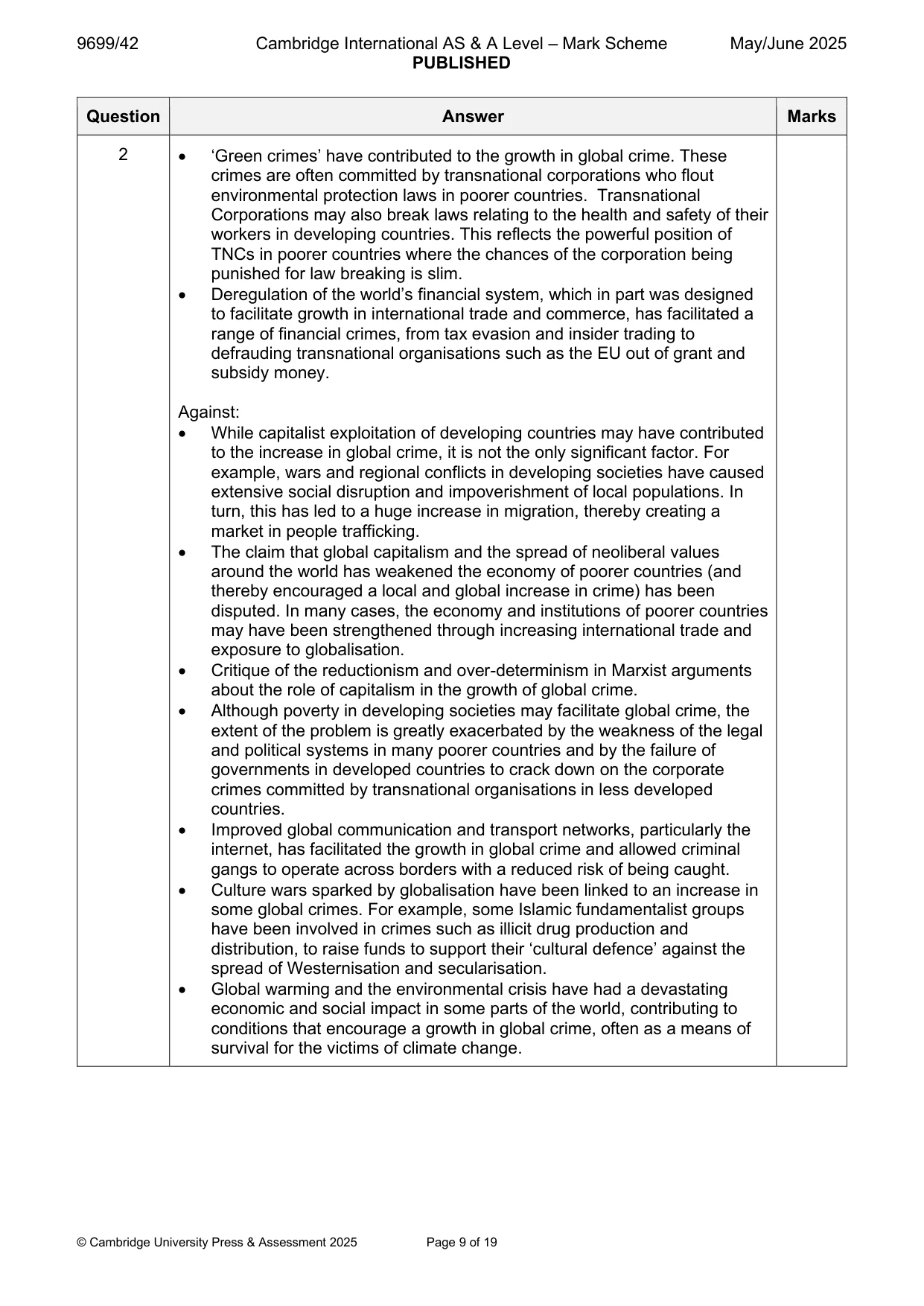
9699/42 Cambridge International AS & A Level – Mark Scheme PUBLISHED May/June 2025 © Cambridge University Press & Assessment 2025 Page 9 of 19 Question Answer Marks 2 • ‘Green crimes’ have contributed to the growth in global crime. These crimes are often committed by transnational corporations who flout environmental protection laws in poorer countries. Transnational Corporations may also break laws relating to the health and safety of their workers in developing countries. This reflects the powerful position of TNCs in poorer countries where the chances of the corporation being punished for law breaking is slim. • Deregulation of the world’s financial system, which in part was designed to facilitate growth in international trade and commerce, has facilitated a range of financial crimes, from tax evasion and insider trading to defrauding transnational organisations such as the EU out of grant and subsidy money. Against: • While capitalist exploitation of developing countries may have contributed to the increase in global crime, it is not the only significant factor. For example, wars and regional conflicts in developing societies have caused extensive social disruption and impoverishment of local populations. In turn, this has led to a huge increase in migration, thereby creating a market in people trafficking. • The claim that global capitalism and the spread of neoliberal values around the world has weakened the economy of poorer countries (and thereby encouraged a local and global increase in crime) has been disputed. In many cases, the economy and institutions of poorer countries may have been strengthened through increasing international trade and exposure to globalisation. • Critique of the reductionism and over-determinism in Marxist arguments about the role of capitalism in the growth of global crime. • Although poverty in developing societies may facilitate global crime, the extent of the problem is greatly exacerbated by the weakness of the legal and political systems in many poorer countries and by the failure of governments in developed countries to crack down on the corporate crimes committed by transnational organisations in less developed countries. • Improved global communication and transport networks, particularly the internet, has facilitated the growth in global crime and allowed criminal gangs to operate across borders with a reduced risk of being caught. • Culture wars sparked by globalisation have been linked to an increase in some global crimes. For example, some Islamic fundamentalist groups have been involved in crimes such as illicit drug production and distribution, to raise funds to support their ‘cultural defence’ against the spread of Westernisation and secularisation. • Global warming and the environmental crisis have had a devastating economic and social impact in some parts of the world, contributing to conditions that encourage a growth in global crime, often as a means of survival for the victims of climate change.
Mark scheme, page 10
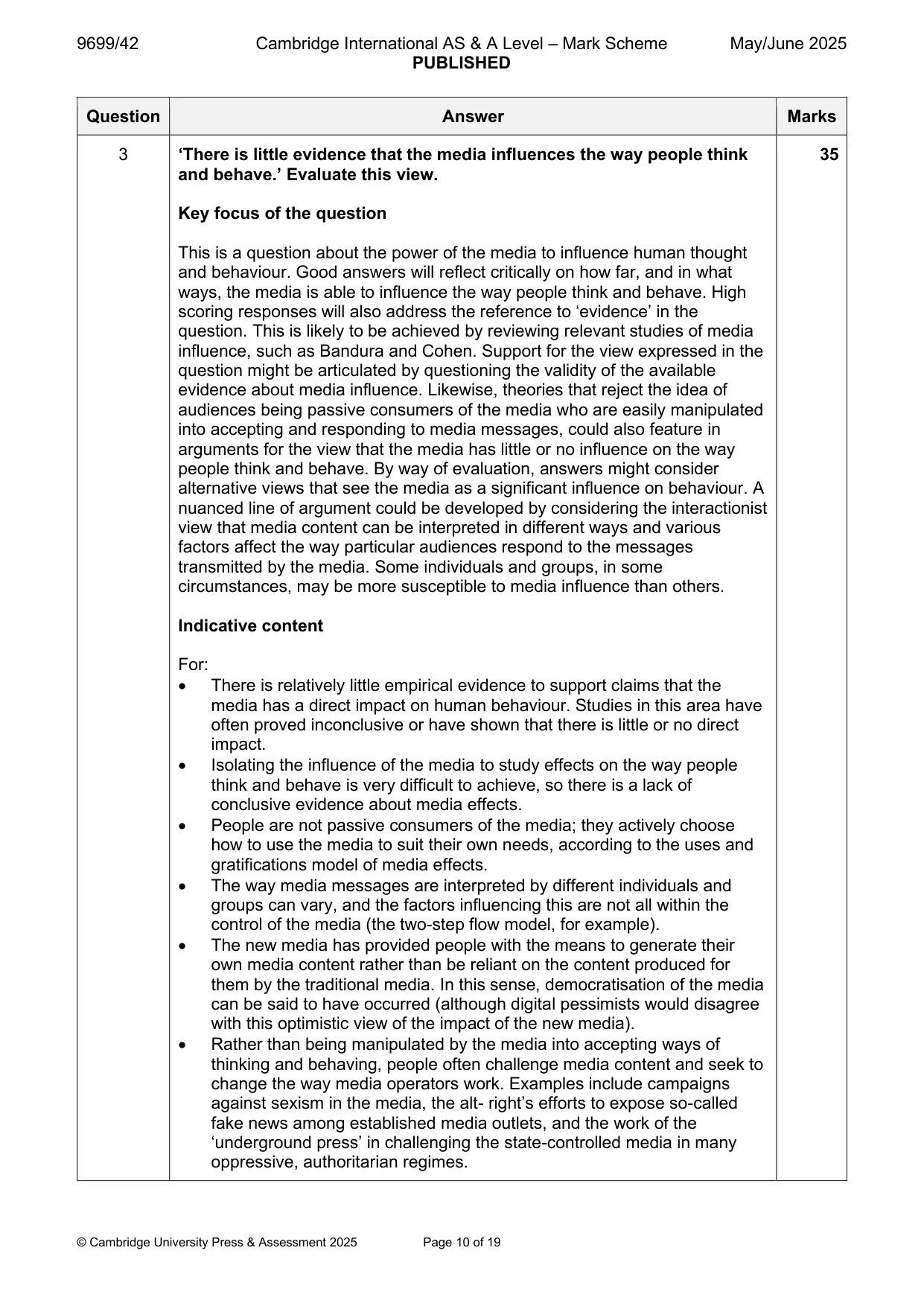
9699/42 Cambridge International AS & A Level – Mark Scheme PUBLISHED May/June 2025 © Cambridge University Press & Assessment 2025 Page 10 of 19 Question Answer Marks 3 ‘There is little evidence that the media influences the way people think and behave.’ Evaluate this view. Key focus of the question This is a question about the power of the media to influence human thought and behaviour. Good answers will reflect critically on how far, and in what ways, the media is able to influence the way people think and behave. High scoring responses will also address the reference to ‘evidence’ in the question. This is likely to be achieved by reviewing relevant studies of media influence, such as Bandura and Cohen. Support for the view expressed in the question might be articulated by questioning the validity of the available evidence about media influence. Likewise, theories that reject the idea of audiences being passive consumers of the media who are easily manipulated into accepting and responding to media messages, could also feature in arguments for the view that the media has little or no influence on the way people think and behave. By way of evaluation, answers might consider alternative views that see the media as a significant influence on behaviour. A nuanced line of argument could be developed by considering the interactionist view that media content can be interpreted in different ways and various factors affect the way particular audiences respond to the messages transmitted by the media. Some individuals and groups, in some circumstances, may be more susceptible to media influence than others. Indicative content For: • There is relatively little empirical evidence to support claims that the media has a direct impact on human behaviour. Studies in this area have often proved inconclusive or have shown that there is little or no direct impact. • Isolating the influence of the media to study effects on the way people think and behave is very difficult to achieve, so there is a lack of conclusive evidence about media effects. • People are not passive consumers of the media; they actively choose how to use the media to suit their own needs, according to the uses and gratifications model of media effects. • The way media messages are interpreted by different individuals and groups can vary, and the factors influencing this are not all within the control of the media (the two-step flow model, for example). • The new media has provided people with the means to generate their own media content rather than be reliant on the content produced for them by the traditional media. In this sense, democratisation of the media can be said to have occurred (although digital pessimists would disagree with this optimistic view of the impact of the new media). • Rather than being manipulated by the media into accepting ways of thinking and behaving, people often challenge media content and seek to change the way media operators work. Examples include campaigns against sexism in the media, the alt- right’s efforts to expose so-called fake news among established media outlets, and the work of the ‘underground press’ in challenging the state-controlled media in many oppressive, authoritarian regimes. 35
Mark scheme, page 11
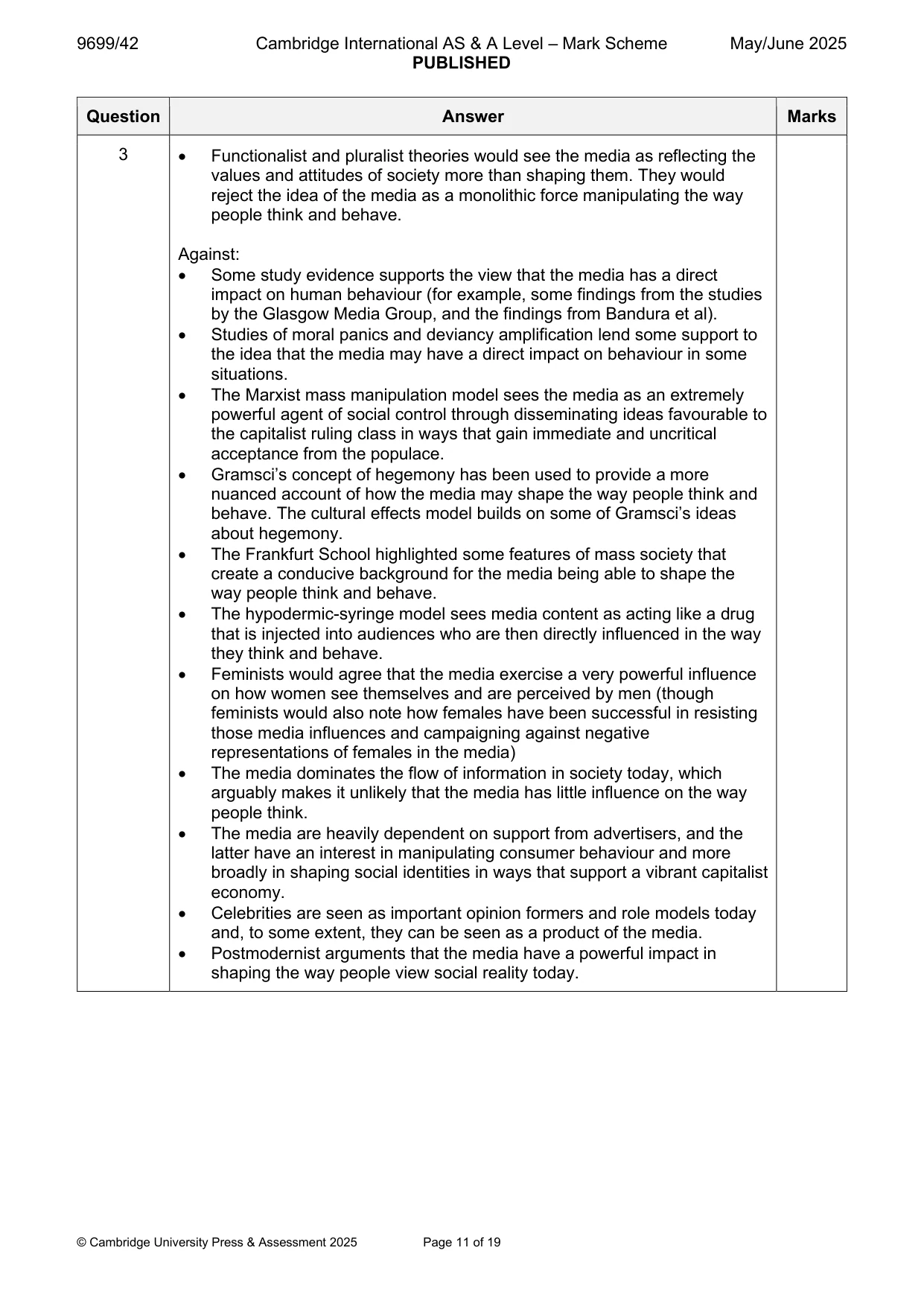
9699/42 Cambridge International AS & A Level – Mark Scheme PUBLISHED May/June 2025 © Cambridge University Press & Assessment 2025 Page 11 of 19 Question Answer Marks 3 • Functionalist and pluralist theories would see the media as reflecting the values and attitudes of society more than shaping them. They would reject the idea of the media as a monolithic force manipulating the way people think and behave. Against: • Some study evidence supports the view that the media has a direct impact on human behaviour (for example, some findings from the studies by the Glasgow Media Group, and the findings from Bandura et al). • Studies of moral panics and deviancy amplification lend some support to the idea that the media may have a direct impact on behaviour in some situations. • The Marxist mass manipulation model sees the media as an extremely powerful agent of social control through disseminating ideas favourable to the capitalist ruling class in ways that gain immediate and uncritical acceptance from the populace. • Gramsci’s concept of hegemony has been used to provide a more nuanced account of how the media may shape the way people think and behave. The cultural effects model builds on some of Gramsci’s ideas about hegemony. • The Frankfurt School highlighted some features of mass society that create a conducive background for the media being able to shape the way people think and behave. • The hypodermic-syringe model sees media content as acting like a drug that is injected into audiences who are then directly influenced in the way they think and behave. • Feminists would agree that the media exercise a very powerful influence on how women see themselves and are perceived by men (though feminists would also note how females have been successful in resisting those media influences and campaigning against negative representations of females in the media) • The media dominates the flow of information in society today, which arguably makes it unlikely that the media has little influence on the way people think. • The media are heavily dependent on support from advertisers, and the latter have an interest in manipulating consumer behaviour and more broadly in shaping social identities in ways that support a vibrant capitalist economy. • Celebrities are seen as important opinion formers and role models today and, to some extent, they can be seen as a product of the media. • Postmodernist arguments that the media have a powerful impact in shaping the way people view social reality today.
Mark scheme, page 12
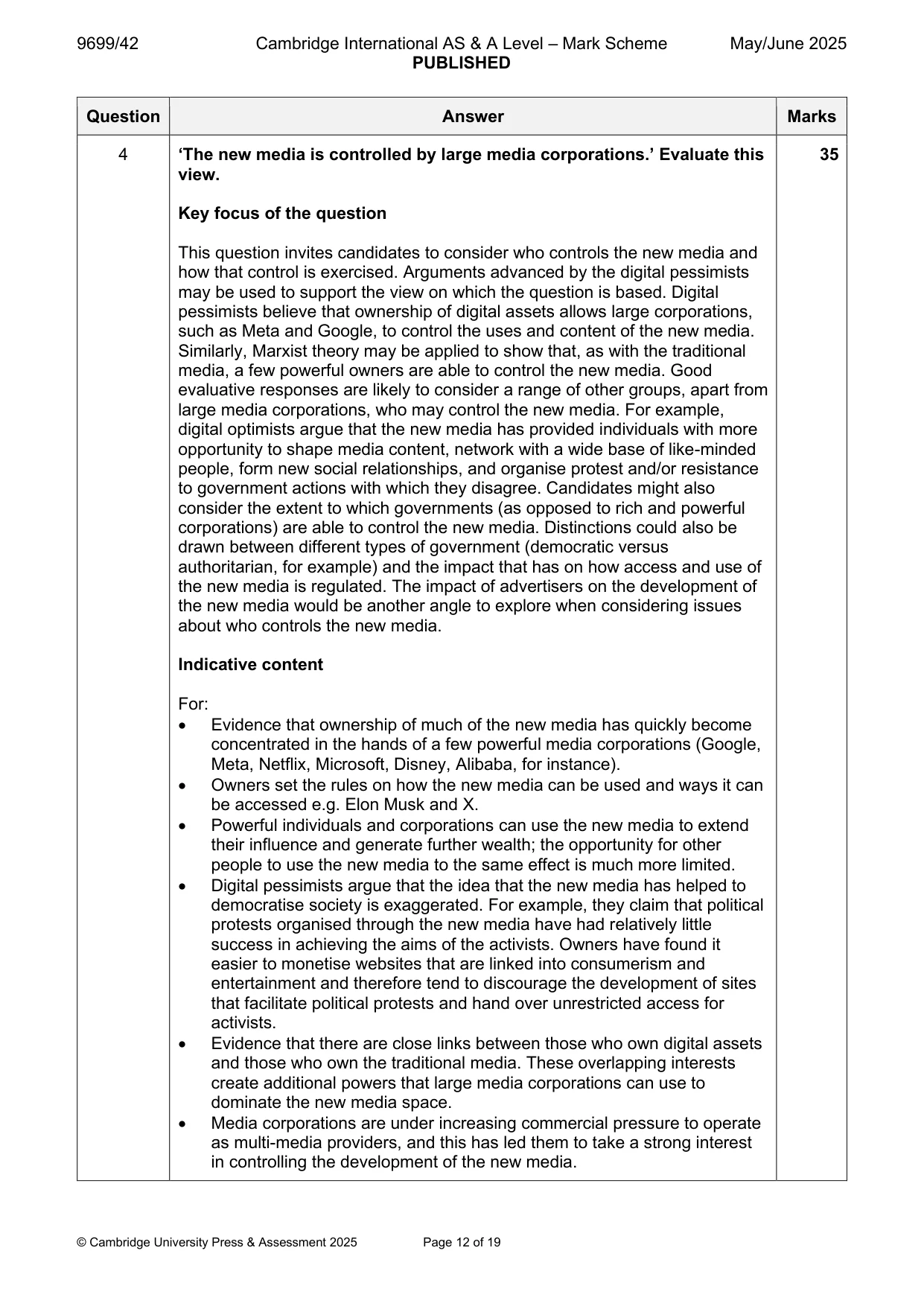
9699/42 Cambridge International AS & A Level – Mark Scheme PUBLISHED May/June 2025 © Cambridge University Press & Assessment 2025 Page 12 of 19 Question Answer Marks 4 ‘The new media is controlled by large media corporations.’ Evaluate this view. Key focus of the question This question invites candidates to consider who controls the new media and how that control is exercised. Arguments advanced by the digital pessimists may be used to support the view on which the question is based. Digital pessimists believe that ownership of digital assets allows large corporations, such as Meta and Google, to control the uses and content of the new media. Similarly, Marxist theory may be applied to show that, as with the traditional media, a few powerful owners are able to control the new media. Good evaluative responses are likely to consider a range of other groups, apart from large media corporations, who may control the new media. For example, digital optimists argue that the new media has provided individuals with more opportunity to shape media content, network with a wide base of like-minded people, form new social relationships, and organise protest and/or resistance to government actions with which they disagree. Candidates might also consider the extent to which governments (as opposed to rich and powerful corporations) are able to control the new media. Distinctions could also be drawn between different types of government (democratic versus authoritarian, for example) and the impact that has on how access and use of the new media is regulated. The impact of advertisers on the development of the new media would be another angle to explore when considering issues about who controls the new media. Indicative content For: • Evidence that ownership of much of the new media has quickly become concentrated in the hands of a few powerful media corporations (Google, Meta, Netflix, Microsoft, Disney, Alibaba, for instance). • Owners set the rules on how the new media can be used and ways it can be accessed e.g. Elon Musk and X. • Powerful individuals and corporations can use the new media to extend their influence and generate further wealth; the opportunity for other people to use the new media to the same effect is much more limited. • Digital pessimists argue that the idea that the new media has helped to democratise society is exaggerated. For example, they claim that political protests organised through the new media have had relatively little success in achieving the aims of the activists. Owners have found it easier to monetise websites that are linked into consumerism and entertainment and therefore tend to discourage the development of sites that facilitate political protests and hand over unrestricted access for activists. • Evidence that there are close links between those who own digital assets and those who own the traditional media. These overlapping interests create additional powers that large media corporations can use to dominate the new media space. • Media corporations are under increasing commercial pressure to operate as multi-media providers, and this has led them to take a strong interest in controlling the development of the new media. 35
Mark scheme, page 13
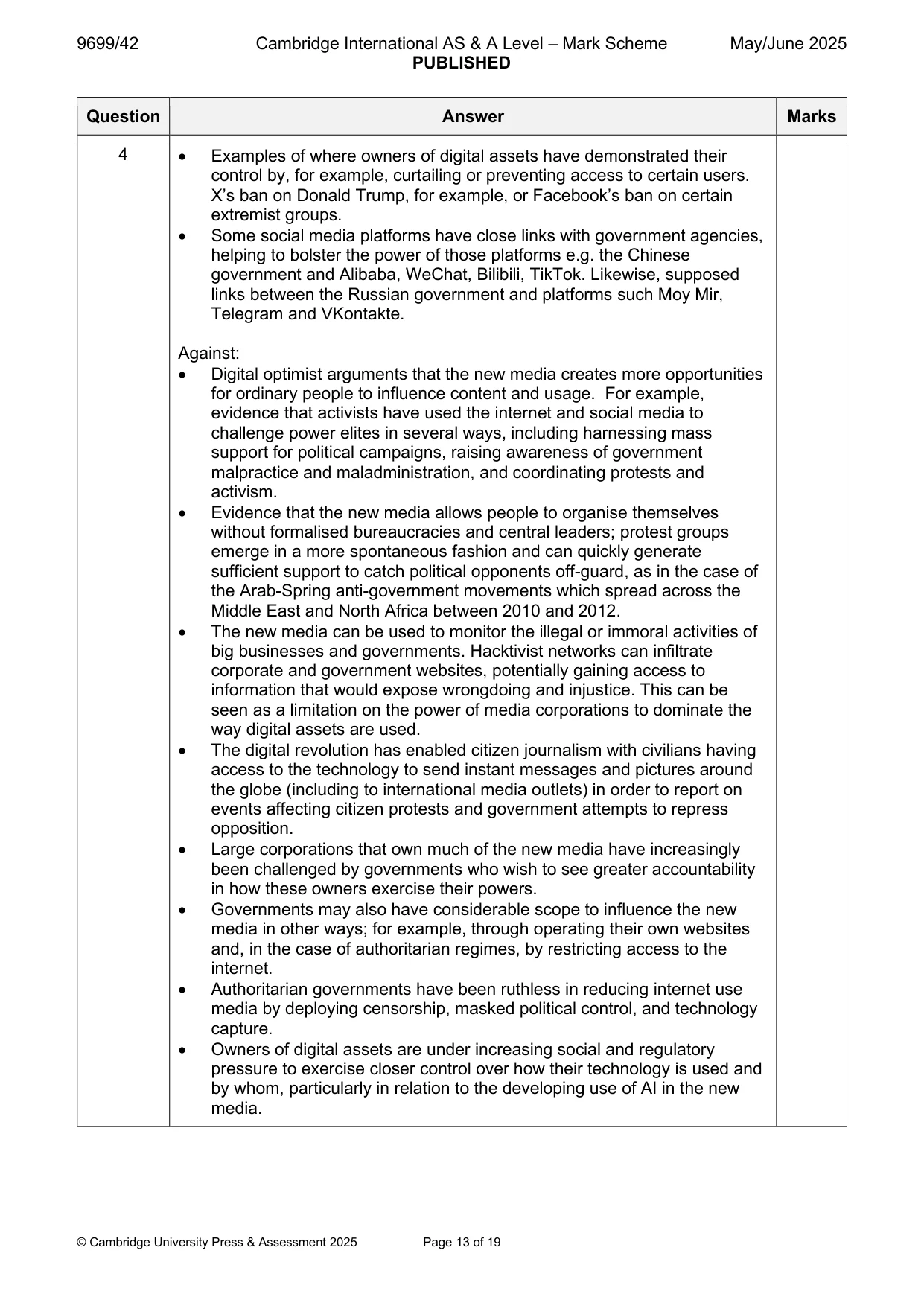
9699/42 Cambridge International AS & A Level – Mark Scheme PUBLISHED May/June 2025 © Cambridge University Press & Assessment 2025 Page 13 of 19 Question Answer Marks 4 • Examples of where owners of digital assets have demonstrated their control by, for example, curtailing or preventing access to certain users. X’s ban on Donald Trump, for example, or Facebook’s ban on certain extremist groups. • Some social media platforms have close links with government agencies, helping to bolster the power of those platforms e.g. the Chinese government and Alibaba, WeChat, Bilibili, TikTok. Likewise, supposed links between the Russian government and platforms such Moy Mir, Telegram and VKontakte. Against: • Digital optimist arguments that the new media creates more opportunities for ordinary people to influence content and usage. For example, evidence that activists have used the internet and social media to challenge power elites in several ways, including harnessing mass support for political campaigns, raising awareness of government malpractice and maladministration, and coordinating protests and activism. • Evidence that the new media allows people to organise themselves without formalised bureaucracies and central leaders; protest groups emerge in a more spontaneous fashion and can quickly generate sufficient support to catch political opponents off-guard, as in the case of the Arab-Spring anti-government movements which spread across the Middle East and North Africa between 2010 and 2012. • The new media can be used to monitor the illegal or immoral activities of big businesses and governments. Hacktivist networks can infiltrate corporate and government websites, potentially gaining access to information that would expose wrongdoing and injustice. This can be seen as a limitation on the power of media corporations to dominate the way digital assets are used. • The digital revolution has enabled citizen journalism with civilians having access to the technology to send instant messages and pictures around the globe (including to international media outlets) in order to report on events affecting citizen protests and government attempts to repress opposition. • Large corporations that own much of the new media have increasingly been challenged by governments who wish to see greater accountability in how these owners exercise their powers. • Governments may also have considerable scope to influence the new media in other ways; for example, through operating their own websites and, in the case of authoritarian regimes, by restricting access to the internet. • Authoritarian governments have been ruthless in reducing internet use media by deploying censorship, masked political control, and technology capture. • Owners of digital assets are under increasing social and regulatory pressure to exercise closer control over how their technology is used and by whom, particularly in relation to the developing use of AI in the new media.
Mark scheme, page 14
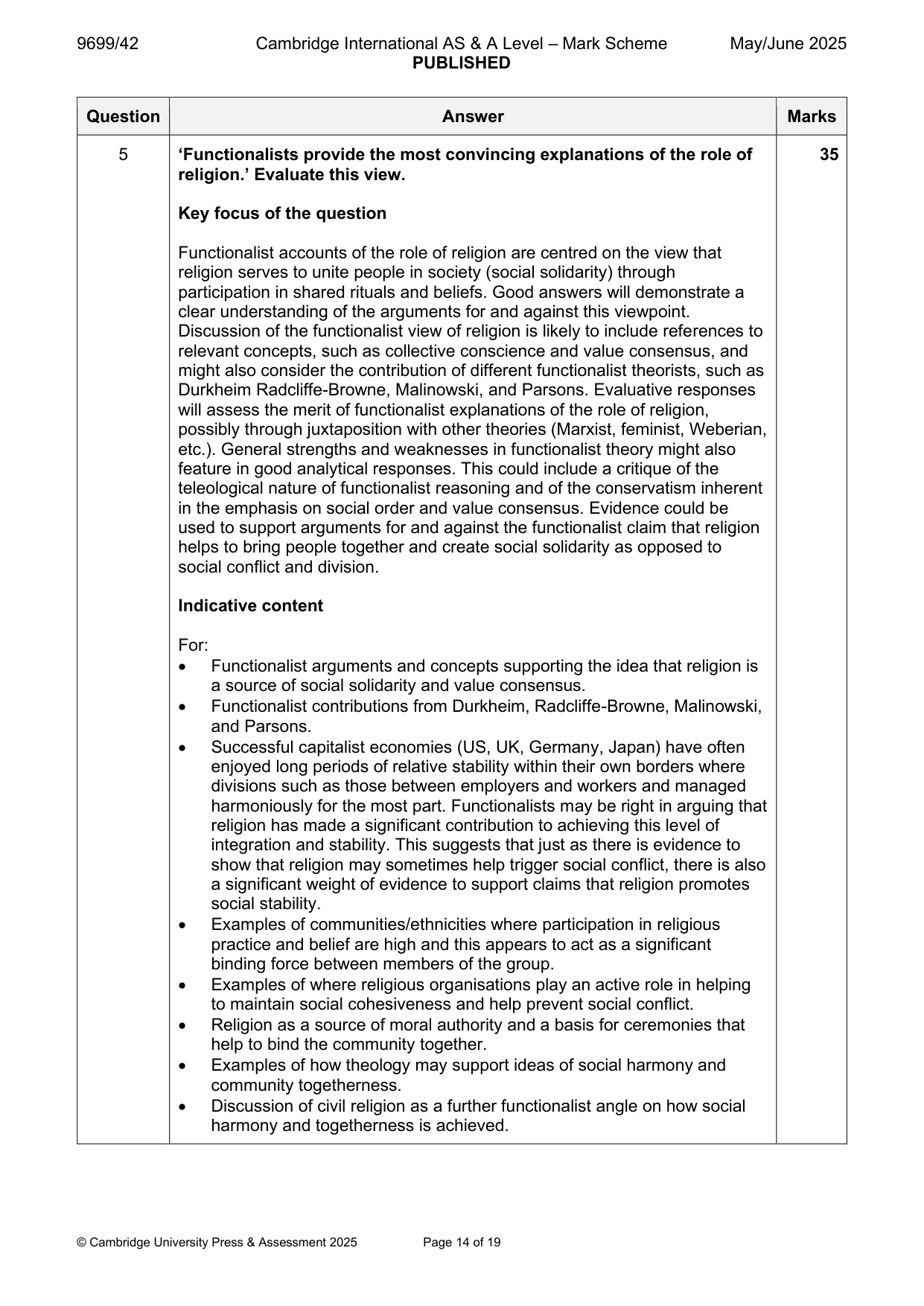
9699/42 Cambridge International AS & A Level – Mark Scheme PUBLISHED May/June 2025 © Cambridge University Press & Assessment 2025 Page 14 of 19 Question Answer Marks 5 ‘Functionalists provide the most convincing explanations of the role of religion.’ Evaluate this view. Key focus of the question Functionalist accounts of the role of religion are centred on the view that religion serves to unite people in society (social solidarity) through participation in shared rituals and beliefs. Good answers will demonstrate a clear understanding of the arguments for and against this viewpoint. Discussion of the functionalist view of religion is likely to include references to relevant concepts, such as collective conscience and value consensus, and might also consider the contribution of different functionalist theorists, such as Durkheim Radcliffe-Browne, Malinowski, and Parsons. Evaluative responses will assess the merit of functionalist explanations of the role of religion, possibly through juxtaposition with other theories (Marxist, feminist, Weberian, etc.). General strengths and weaknesses in functionalist theory might also feature in good analytical responses. This could include a critique of the teleological nature of functionalist reasoning and of the conservatism inherent in the emphasis on social order and value consensus. Evidence could be used to support arguments for and against the functionalist claim that religion helps to bring people together and create social solidarity as opposed to social conflict and division. Indicative content For: • Functionalist arguments and concepts supporting the idea that religion is a source of social solidarity and value consensus. • Functionalist contributions from Durkheim, Radcliffe-Browne, Malinowski, and Parsons. • Successful capitalist economies (US, UK, Germany, Japan) have often enjoyed long periods of relative stability within their own borders where divisions such as those between employers and workers and managed harmoniously for the most part. Functionalists may be right in arguing that religion has made a significant contribution to achieving this level of integration and stability. This suggests that just as there is evidence to show that religion may sometimes help trigger social conflict, there is also a significant weight of evidence to support claims that religion promotes social stability. • Examples of communities/ethnicities where participation in religious practice and belief are high and this appears to act as a significant binding force between members of the group. • Examples of where religious organisations play an active role in helping to maintain social cohesiveness and help prevent social conflict. • Religion as a source of moral authority and a basis for ceremonies that help to bind the community together. • Examples of how theology may support ideas of social harmony and community togetherness. • Discussion of civil religion as a further functionalist angle on how social harmony and togetherness is achieved. 35
Mark scheme, page 15
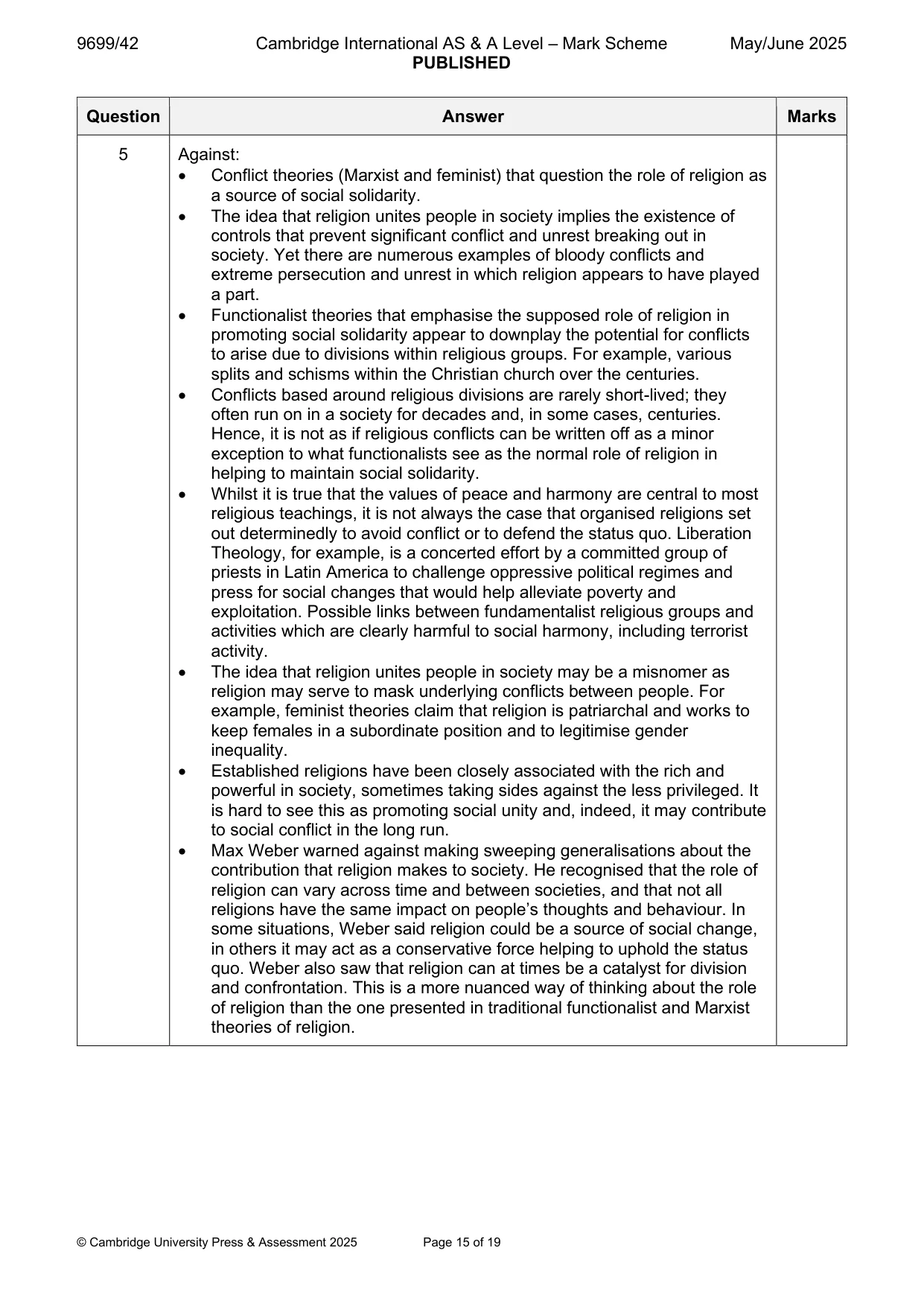
9699/42 Cambridge International AS & A Level – Mark Scheme PUBLISHED May/June 2025 © Cambridge University Press & Assessment 2025 Page 15 of 19 Question Answer Marks 5 Against: • Conflict theories (Marxist and feminist) that question the role of religion as a source of social solidarity. • The idea that religion unites people in society implies the existence of controls that prevent significant conflict and unrest breaking out in society. Yet there are numerous examples of bloody conflicts and extreme persecution and unrest in which religion appears to have played a part. • Functionalist theories that emphasise the supposed role of religion in promoting social solidarity appear to downplay the potential for conflicts to arise due to divisions within religious groups. For example, various splits and schisms within the Christian church over the centuries. • Conflicts based around religious divisions are rarely short-lived; they often run on in a society for decades and, in some cases, centuries. Hence, it is not as if religious conflicts can be written off as a minor exception to what functionalists see as the normal role of religion in helping to maintain social solidarity. • Whilst it is true that the values of peace and harmony are central to most religious teachings, it is not always the case that organised religions set out determinedly to avoid conflict or to defend the status quo. Liberation Theology, for example, is a concerted effort by a committed group of priests in Latin America to challenge oppressive political regimes and press for social changes that would help alleviate poverty and exploitation. Possible links between fundamentalist religious groups and activities which are clearly harmful to social harmony, including terrorist activity. • The idea that religion unites people in society may be a misnomer as religion may serve to mask underlying conflicts between people. For example, feminist theories claim that religion is patriarchal and works to keep females in a subordinate position and to legitimise gender inequality. • Established religions have been closely associated with the rich and powerful in society, sometimes taking sides against the less privileged. It is hard to see this as promoting social unity and, indeed, it may contribute to social conflict in the long run. • Max Weber warned against making sweeping generalisations about the contribution that religion makes to society. He recognised that the role of religion can vary across time and between societies, and that not all religions have the same impact on people’s thoughts and behaviour. In some situations, Weber said religion could be a source of social change, in others it may act as a conservative force helping to uphold the status quo. Weber also saw that religion can at times be a catalyst for division and confrontation. This is a more nuanced way of thinking about the role of religion than the one presented in traditional functionalist and Marxist theories of religion.
Mark scheme, page 16
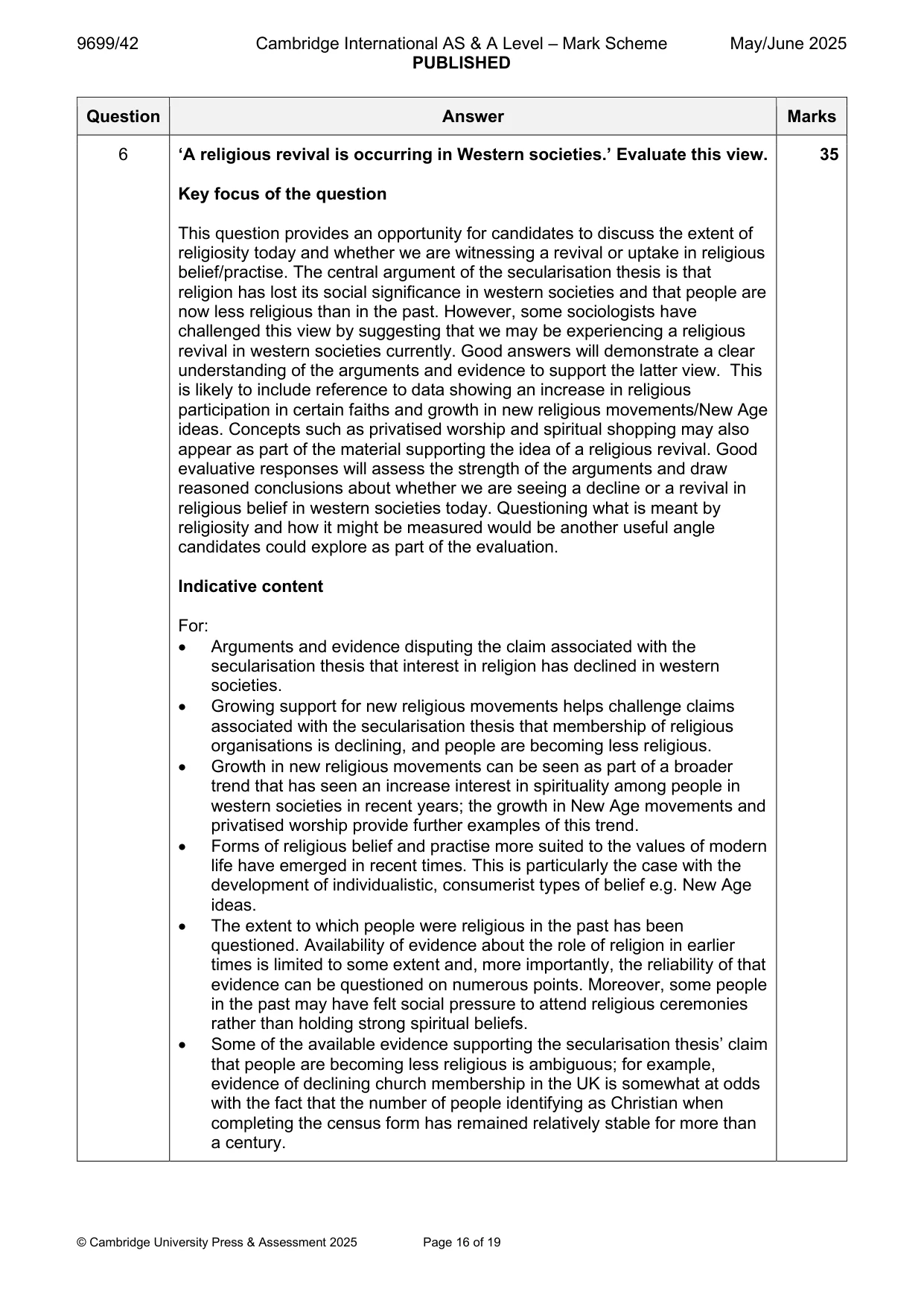
9699/42 Cambridge International AS & A Level – Mark Scheme PUBLISHED May/June 2025 © Cambridge University Press & Assessment 2025 Page 16 of 19 Question Answer Marks 6 ‘A religious revival is occurring in Western societies.’ Evaluate this view. Key focus of the question This question provides an opportunity for candidates to discuss the extent of religiosity today and whether we are witnessing a revival or uptake in religious belief/practise. The central argument of the secularisation thesis is that religion has lost its social significance in western societies and that people are now less religious than in the past. However, some sociologists have challenged this view by suggesting that we may be experiencing a religious revival in western societies currently. Good answers will demonstrate a clear understanding of the arguments and evidence to support the latter view. This is likely to include reference to data showing an increase in religious participation in certain faiths and growth in new religious movements/New Age ideas. Concepts such as privatised worship and spiritual shopping may also appear as part of the material supporting the idea of a religious revival. Good evaluative responses will assess the strength of the arguments and draw reasoned conclusions about whether we are seeing a decline or a revival in religious belief in western societies today. Questioning what is meant by religiosity and how it might be measured would be another useful angle candidates could explore as part of the evaluation. Indicative content For: • Arguments and evidence disputing the claim associated with the secularisation thesis that interest in religion has declined in western societies. • Growing support for new religious movements helps challenge claims associated with the secularisation thesis that membership of religious organisations is declining, and people are becoming less religious. • Growth in new religious movements can be seen as part of a broader trend that has seen an increase interest in spirituality among people in western societies in recent years; the growth in New Age movements and privatised worship provide further examples of this trend. • Forms of religious belief and practise more suited to the values of modern life have emerged in recent times. This is particularly the case with the development of individualistic, consumerist types of belief e.g. New Age ideas. • The extent to which people were religious in the past has been questioned. Availability of evidence about the role of religion in earlier times is limited to some extent and, more importantly, the reliability of that evidence can be questioned on numerous points. Moreover, some people in the past may have felt social pressure to attend religious ceremonies rather than holding strong spiritual beliefs. • Some of the available evidence supporting the secularisation thesis’ claim that people are becoming less religious is ambiguous; for example, evidence of declining church membership in the UK is somewhat at odds with the fact that the number of people identifying as Christian when completing the census form has remained relatively stable for more than a century. 35
Mark scheme, page 17
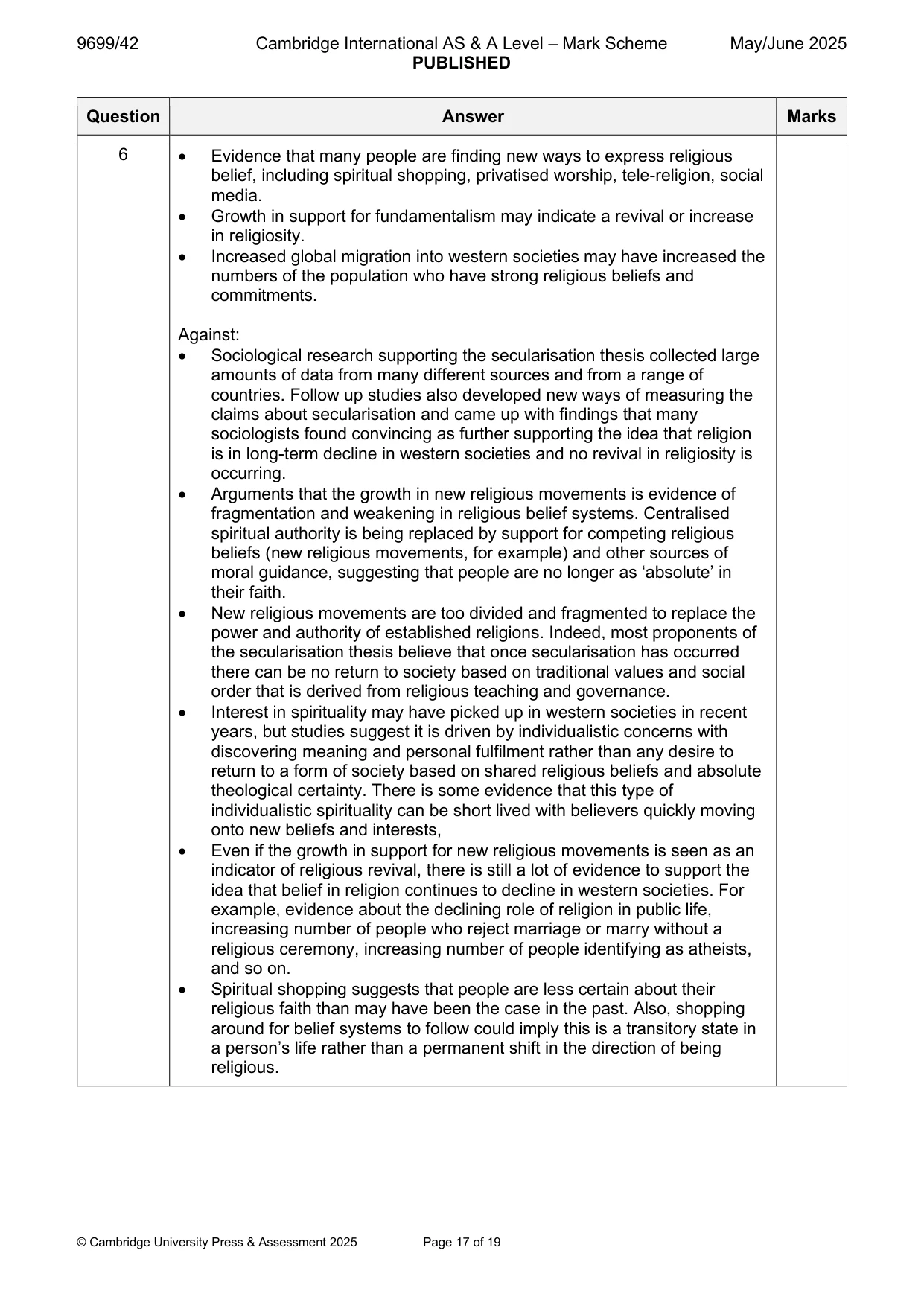
9699/42 Cambridge International AS & A Level – Mark Scheme PUBLISHED May/June 2025 © Cambridge University Press & Assessment 2025 Page 17 of 19 Question Answer Marks 6 • Evidence that many people are finding new ways to express religious belief, including spiritual shopping, privatised worship, tele-religion, social media. • Growth in support for fundamentalism may indicate a revival or increase in religiosity. • Increased global migration into western societies may have increased the numbers of the population who have strong religious beliefs and commitments. Against: • Sociological research supporting the secularisation thesis collected large amounts of data from many different sources and from a range of countries. Follow up studies also developed new ways of measuring the claims about secularisation and came up with findings that many sociologists found convincing as further supporting the idea that religion is in long-term decline in western societies and no revival in religiosity is occurring. • Arguments that the growth in new religious movements is evidence of fragmentation and weakening in religious belief systems. Centralised spiritual authority is being replaced by support for competing religious beliefs (new religious movements, for example) and other sources of moral guidance, suggesting that people are no longer as ‘absolute’ in their faith. • New religious movements are too divided and fragmented to replace the power and authority of established religions. Indeed, most proponents of the secularisation thesis believe that once secularisation has occurred there can be no return to society based on traditional values and social order that is derived from religious teaching and governance. • Interest in spirituality may have picked up in western societies in recent years, but studies suggest it is driven by individualistic concerns with discovering meaning and personal fulfilment rather than any desire to return to a form of society based on shared religious beliefs and absolute theological certainty. There is some evidence that this type of individualistic spirituality can be short lived with believers quickly moving onto new beliefs and interests, • Even if the growth in support for new religious movements is seen as an indicator of religious revival, there is still a lot of evidence to support the idea that belief in religion continues to decline in western societies. For example, evidence about the declining role of religion in public life, increasing number of people who reject marriage or marry without a religious ceremony, increasing number of people identifying as atheists, and so on. • Spiritual shopping suggests that people are less certain about their religious faith than may have been the case in the past. Also, shopping around for belief systems to follow could imply this is a transitory state in a person’s life rather than a permanent shift in the direction of being religious.
Mark scheme, page 18
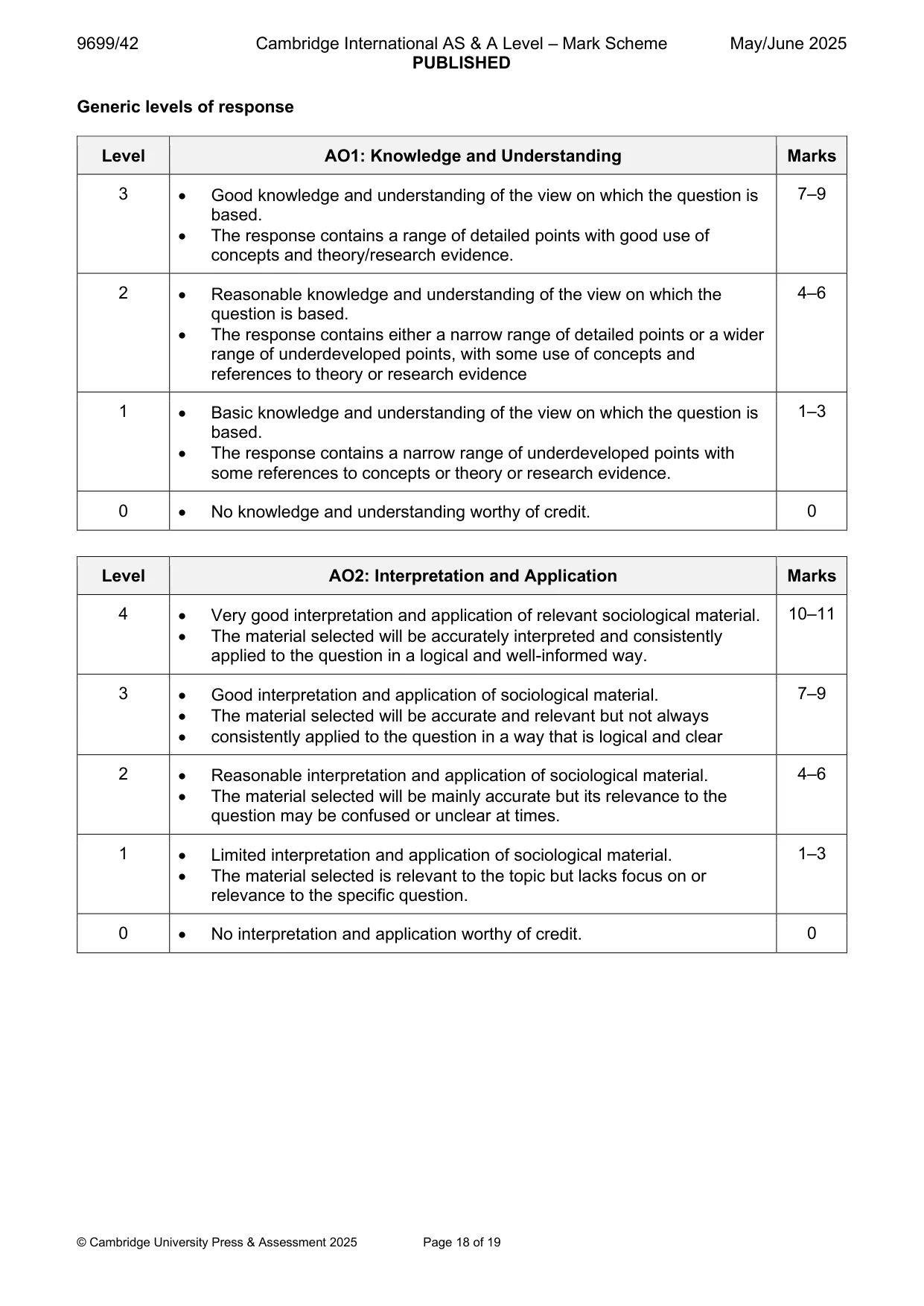
9699/42 Cambridge International AS & A Level – Mark Scheme PUBLISHED May/June 2025 © Cambridge University Press & Assessment 2025 Page 18 of 19 Generic levels of response Level AO1: Knowledge and Understanding Marks 3 • Good knowledge and understanding of the view on which the question is based. • The response contains a range of detailed points with good use of concepts and theory/research evidence. 7–9 2 • Reasonable knowledge and understanding of the view on which the question is based. • The response contains either a narrow range of detailed points or a wider range of underdeveloped points, with some use of concepts and references to theory or research evidence 4–6 1 • Basic knowledge and understanding of the view on which the question is based. • The response contains a narrow range of underdeveloped points with some references to concepts or theory or research evidence. 1–3 0 • No knowledge and understanding worthy of credit. 0 Level AO2: Interpretation and Application Marks 4 • Very good interpretation and application of relevant sociological material. • The material selected will be accurately interpreted and consistently applied to the question in a logical and well-informed way. 10–11 3 • Good interpretation and application of sociological material. • The material selected will be accurate and relevant but not always • consistently applied to the question in a way that is logical and clear 7–9 2 • Reasonable interpretation and application of sociological material. • The material selected will be mainly accurate but its relevance to the question may be confused or unclear at times. 4–6 1 • Limited interpretation and application of sociological material. • The material selected is relevant to the topic but lacks focus on or relevance to the specific question. 1–3 0 • No interpretation and application worthy of credit. 0
Mark scheme, page 19
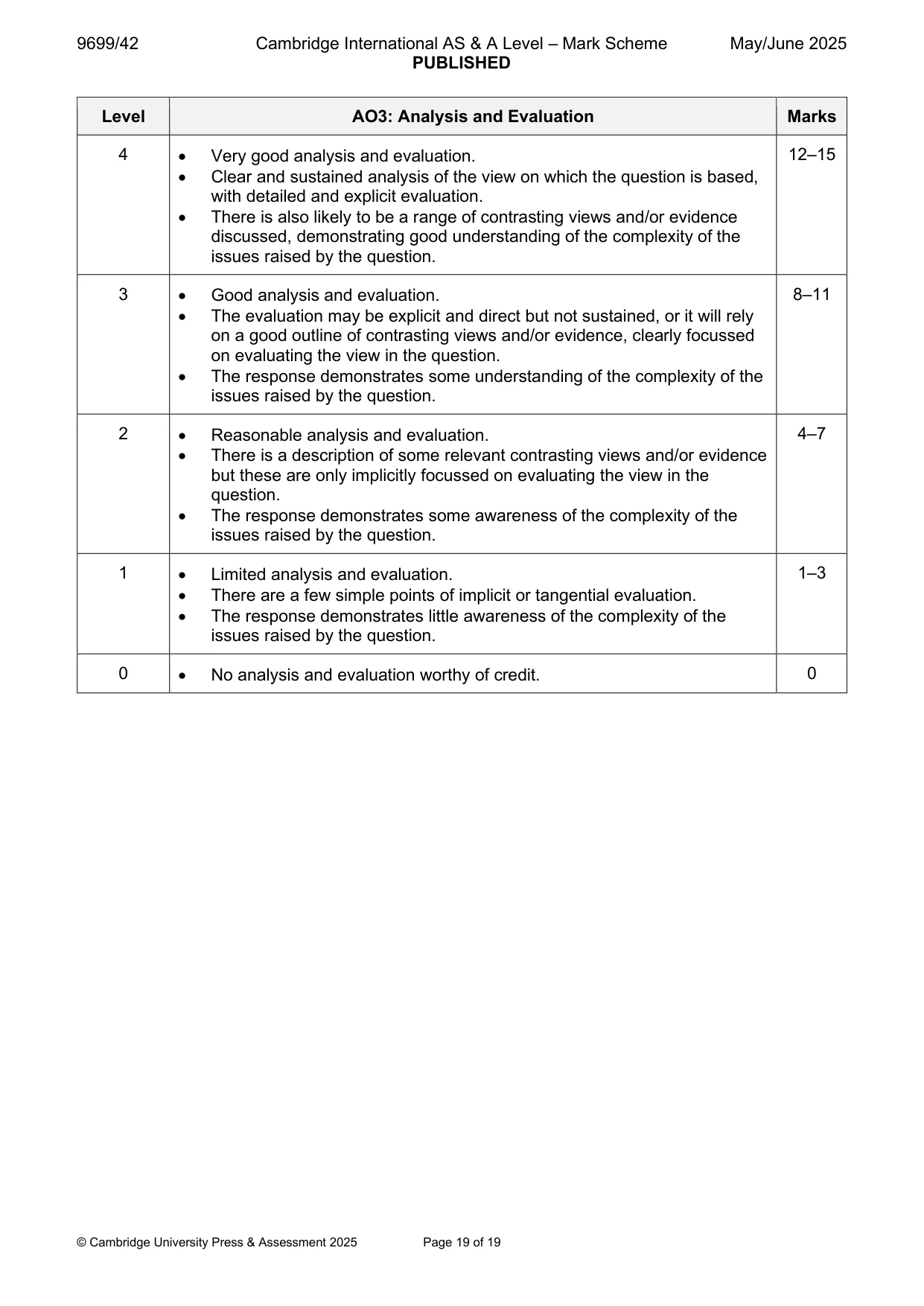
9699/42 Cambridge International AS & A Level – Mark Scheme PUBLISHED May/June 2025 © Cambridge University Press & Assessment 2025 Page 19 of 19 Level AO3: Analysis and Evaluation Marks 4 • Very good analysis and evaluation. • Clear and sustained analysis of the view on which the question is based, with detailed and explicit evaluation. • There is also likely to be a range of contrasting views and/or evidence discussed, demonstrating good understanding of the complexity of the issues raised by the question. 12–15 3 • Good analysis and evaluation. • The evaluation may be explicit and direct but not sustained, or it will rely on a good outline of contrasting views and/or evidence, clearly focussed on evaluating the view in the question. • The response demonstrates some understanding of the complexity of the issues raised by the question. 8–11 2 • Reasonable analysis and evaluation. • There is a description of some relevant contrasting views and/or evidence but these are only implicitly focussed on evaluating the view in the question. • The response demonstrates some awareness of the complexity of the issues raised by the question. 4–7 1 • Limited analysis and evaluation. • There are a few simple points of implicit or tangential evaluation. • The response demonstrates little awareness of the complexity of the issues raised by the question. 1–3 0 • No analysis and evaluation worthy of credit. 0
What you needed in this session
Cambridge’s own grade thresholds for 2025 May/June, Paper 4 · Variant 2. A higher threshold means an easier paper — the bar moves with how the cohort did.