Cambridge A Level Sociology 9699 — 2025 Feb/March Paper 4 · Variant 2
9699/42/F/M/25 · 70 marks · 105 min
The question paper and its mark scheme, free to read here and free to download. This is Cambridge’s own paper, exactly as it was sat.
Question paper4 pages
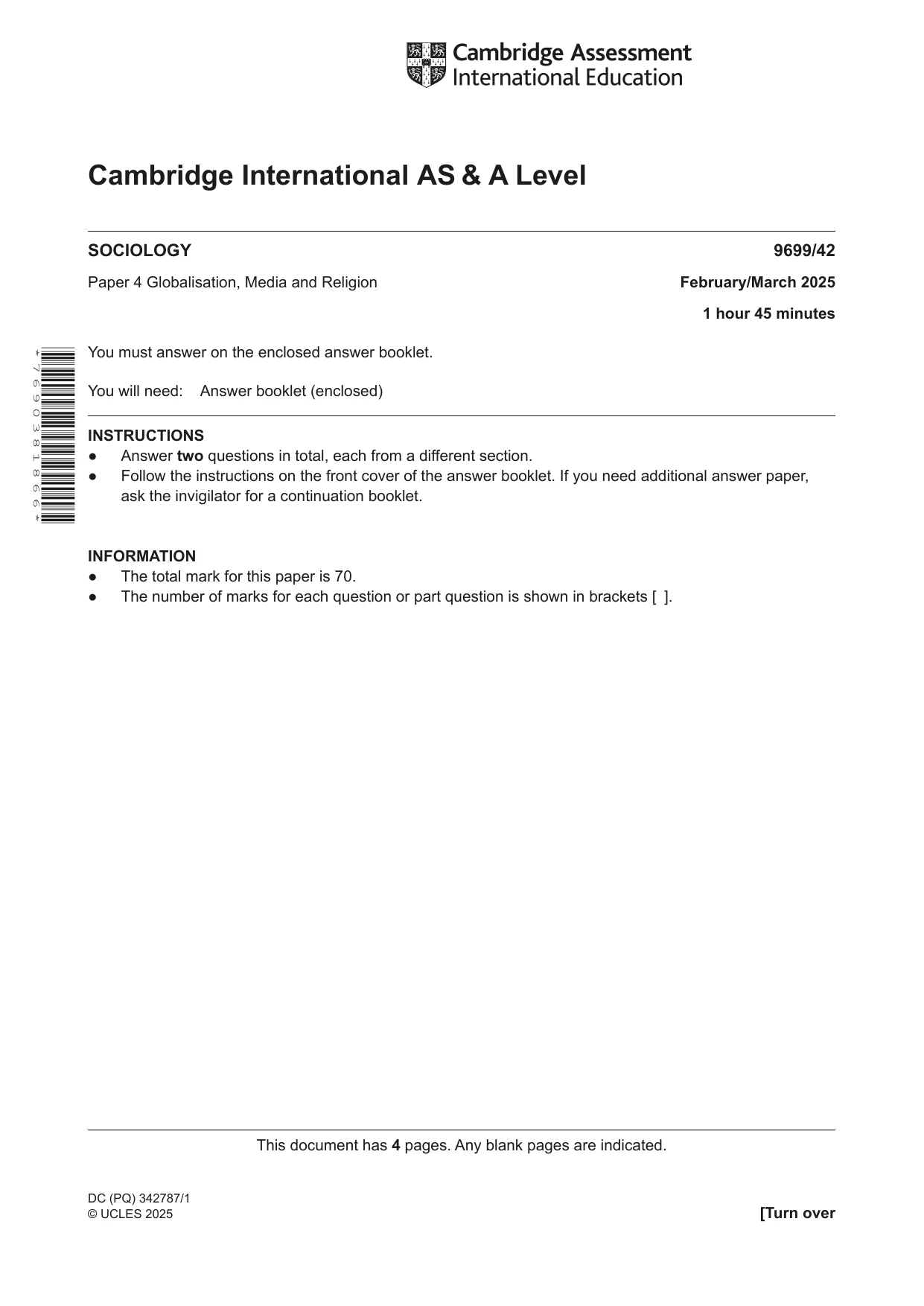
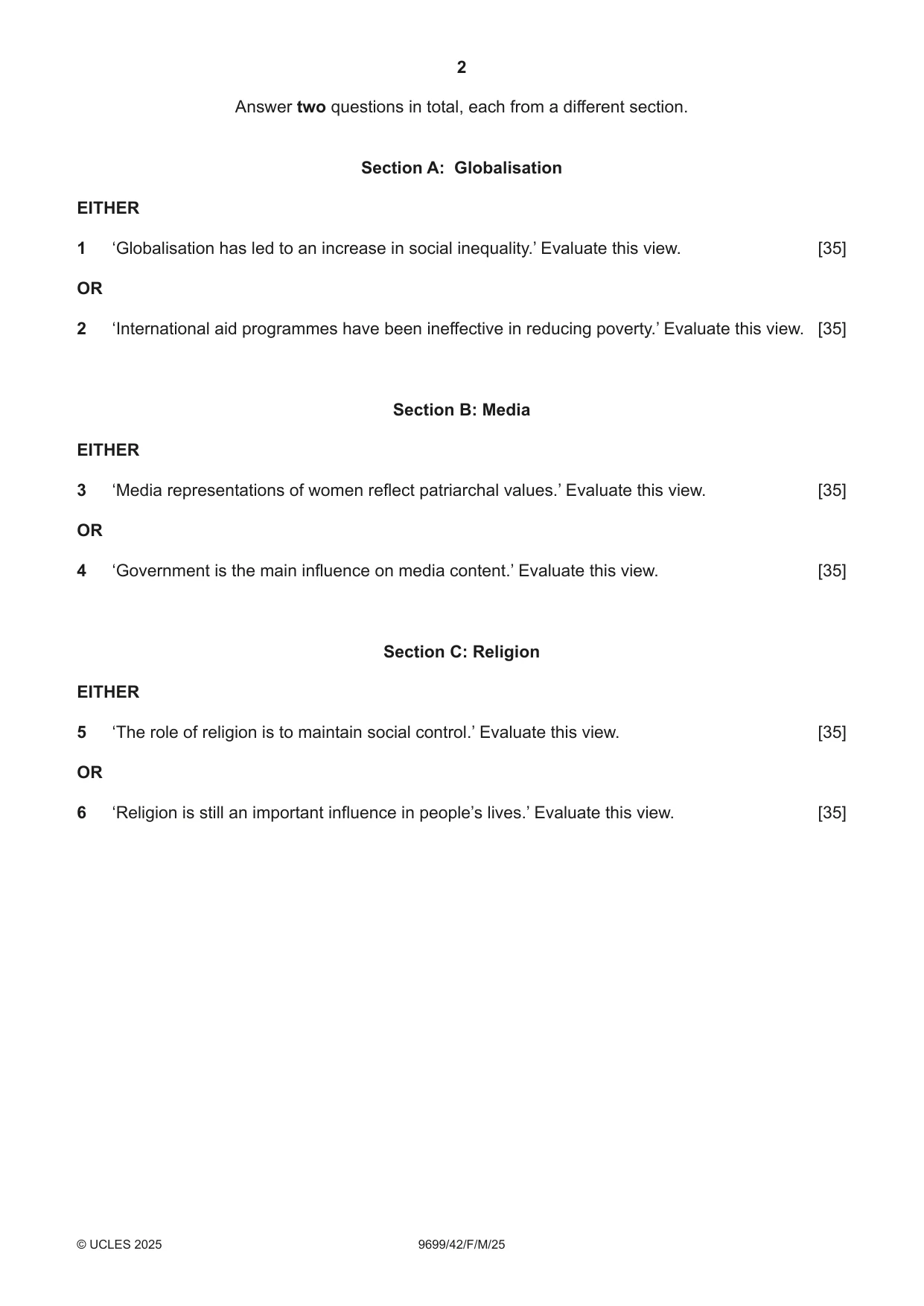


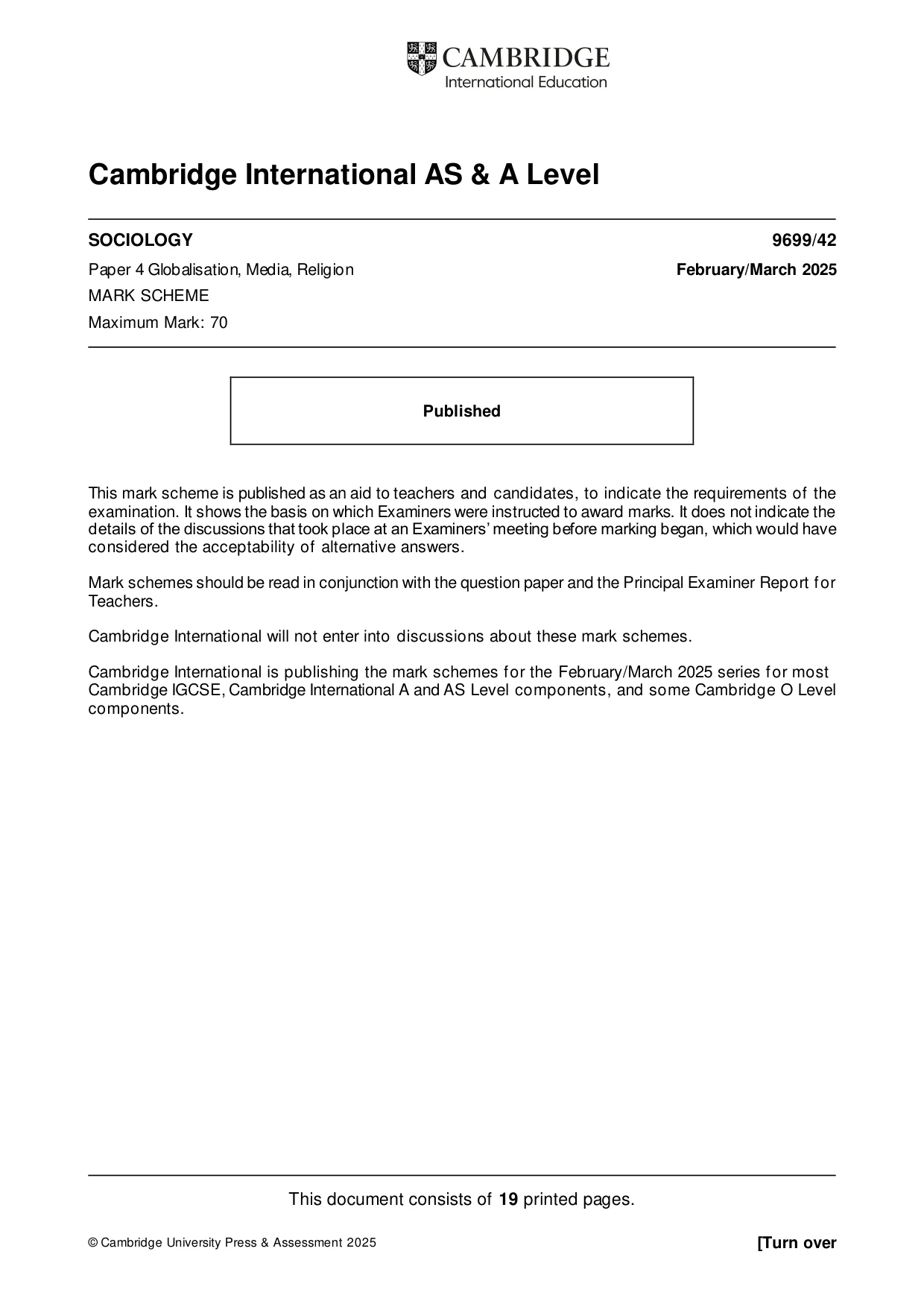
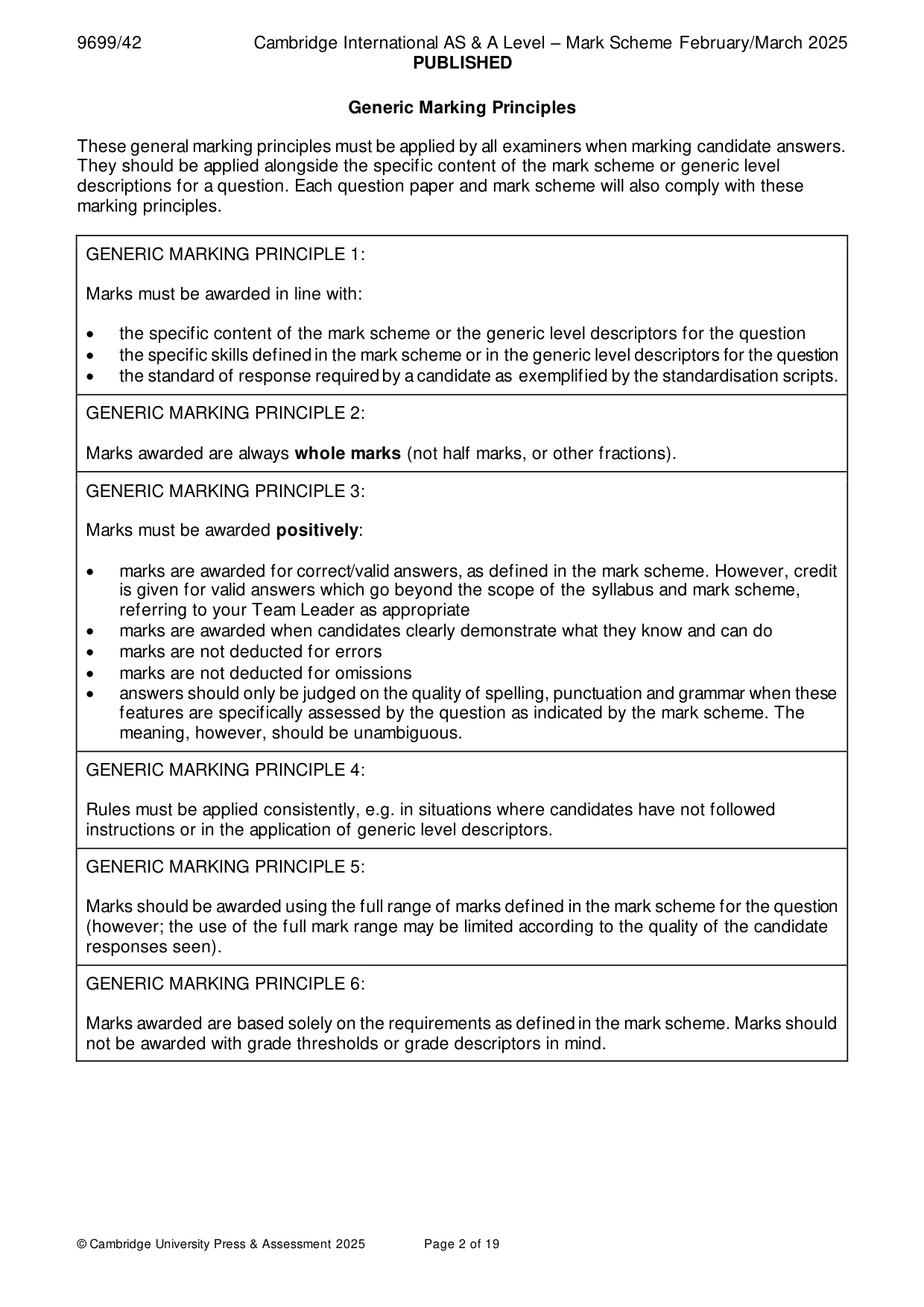
Mark scheme19 pages
Answers below. Sit the paper first if you are practising.
Paper as text
Question paper, page 1
This document has 4 pages. Any blank pages are indicated. [Turn over Cambridge International AS & A Level SOCIOLOGY 9699/42 Paper 4 Globalisation, Media and Religion February/March 2025 1 hour 45 minutes You must answer on the enclosed answer booklet. You will need: Answer booklet (enclosed) INSTRUCTIONS ● Answer two questions in total, each from a different section. ● Follow the instructions on the front cover of the answer booklet. If you need additional answer paper, ask the invigilator for a continuation booklet. INFORMATION ● The total mark for this paper is 70. ● The number of marks for each question or part question is shown in brackets [ ]. * 7 6 9 0 3 8 1 8 6 6 * DC (PQ) 342787/1 © UCLES 2025
Question paper, page 2
2 9699/42/F/M/25 © UCLES 2025 Answer two questions in total, each from a different section. Section A: Globalisation EITHER 1 ‘Globalisation has led to an increase in social inequality.’ Evaluate this view. [35] OR 2 ‘International aid programmes have been ineffective in reducing poverty.’ Evaluate this view. [35] Section B: Media EITHER 3 ‘Media representations of women reflect patriarchal values.’ Evaluate this view. [35] OR 4 ‘Government is the main influence on media content.’ Evaluate this view. [35] Section C: Religion EITHER 5 ‘The role of religion is to maintain social control.’ Evaluate this view. [35] OR 6 ‘Religion is still an important influence in people’s lives.’ Evaluate this view. [35]
Question paper, page 3
3 9699/42/F/M/25 © UCLES 2025 BLANK PAGE
Question paper, page 4
4 9699/42/F/M/25 © UCLES 2025 Permission to reproduce items where third-party owned material protected by copyright is included has been sought and cleared where possible. Every reasonable effort has been made by the publisher (UCLES) to trace copyright holders, but if any items requiring clearance have unwittingly been included, the publisher will be pleased to make amends at the earliest possible opportunity. To avoid the issue of disclosure of answer-related information to candidates, all copyright acknowledgements are reproduced online in the Cambridge Assessment International Education Copyright Acknowledgements Booklet. This is produced for each series of examinations and is freely available to download at www.cambridgeinternational.org after the live examination series. Cambridge Assessment International Education is part of Cambridge Assessment. Cambridge Assessment is the brand name of the University of Cambridge Local Examinations Syndicate (UCLES), which is a department of the University of Cambridge. BLANK PAGE
Mark scheme, page 1
This document consists of 19 printed pages. © Cambridge University Press & Assessment 2025 [Turn over Cambridge International AS & A Level SOCIOLOGY 9699/42 Paper 4 Globalisation, Media, Religion February/March 2025 MARK SCHEME Maximum Mark: 70 Published This mark scheme is published as an aid to teachers and candidates, to indicate the requirements of the examination. It shows the basis on which Examiners were instructed to award marks. It does not indicate the details of the discussions that took place at an Examiners’ meeting before marking began, which would have considered the acceptability of alternative answers. Mark schemes should be read in conjunction with the question paper and the Principal Examiner Report for Teachers. Cambridge International will not enter into discussions about these mark schemes. Cambridge International is publishing the mark schemes for the February/March 2025 series for most Cambridge IGCSE, Cambridge International A and AS Level components, and some Cambridge O Level components.
Mark scheme, page 2
9699/42 Cambridge International AS & A Level – Mark Scheme PUBLISHED February/March 2025 © Cambridge University Press & Assessment 2025 Page 2 of 19 Generic Marking Principles These general marking principles must be applied by all examiners when marking candidate answers. They should be applied alongside the specific content of the mark scheme or generic level descriptions for a question. Each question paper and mark scheme will also comply with these marking principles. GENERIC MARKING PRINCIPLE 1: Marks must be awarded in line with: • the specific content of the mark scheme or the generic level descriptors for the question • the specific skills defined in the mark scheme or in the generic level descriptors for the question • the standard of response required by a candidate as exemplified by the standardisation scripts. GENERIC MARKING PRINCIPLE 2: Marks awarded are always whole marks (not half marks, or other fractions). GENERIC MARKING PRINCIPLE 3: Marks must be awarded positively: • marks are awarded for correct/valid answers, as defined in the mark scheme. However, credit is given for valid answers which go beyond the scope of the syllabus and mark scheme, referring to your Team Leader as appropriate • marks are awarded when candidates clearly demonstrate what they know and can do • marks are not deducted for errors • marks are not deducted for omissions • answers should only be judged on the quality of spelling, punctuation and grammar when these features are specifically assessed by the question as indicated by the mark scheme. The meaning, however, should be unambiguous. GENERIC MARKING PRINCIPLE 4: Rules must be applied consistently, e.g. in situations where candidates have not followed instructions or in the application of generic level descriptors. GENERIC MARKING PRINCIPLE 5: Marks should be awarded using the full range of marks defined in the mark scheme for the question (however; the use of the full mark range may be limited according to the quality of the candidate responses seen). GENERIC MARKING PRINCIPLE 6: Marks awarded are based solely on the requirements as defined in the mark scheme. Marks should not be awarded with grade thresholds or grade descriptors in mind.
Mark scheme, page 3
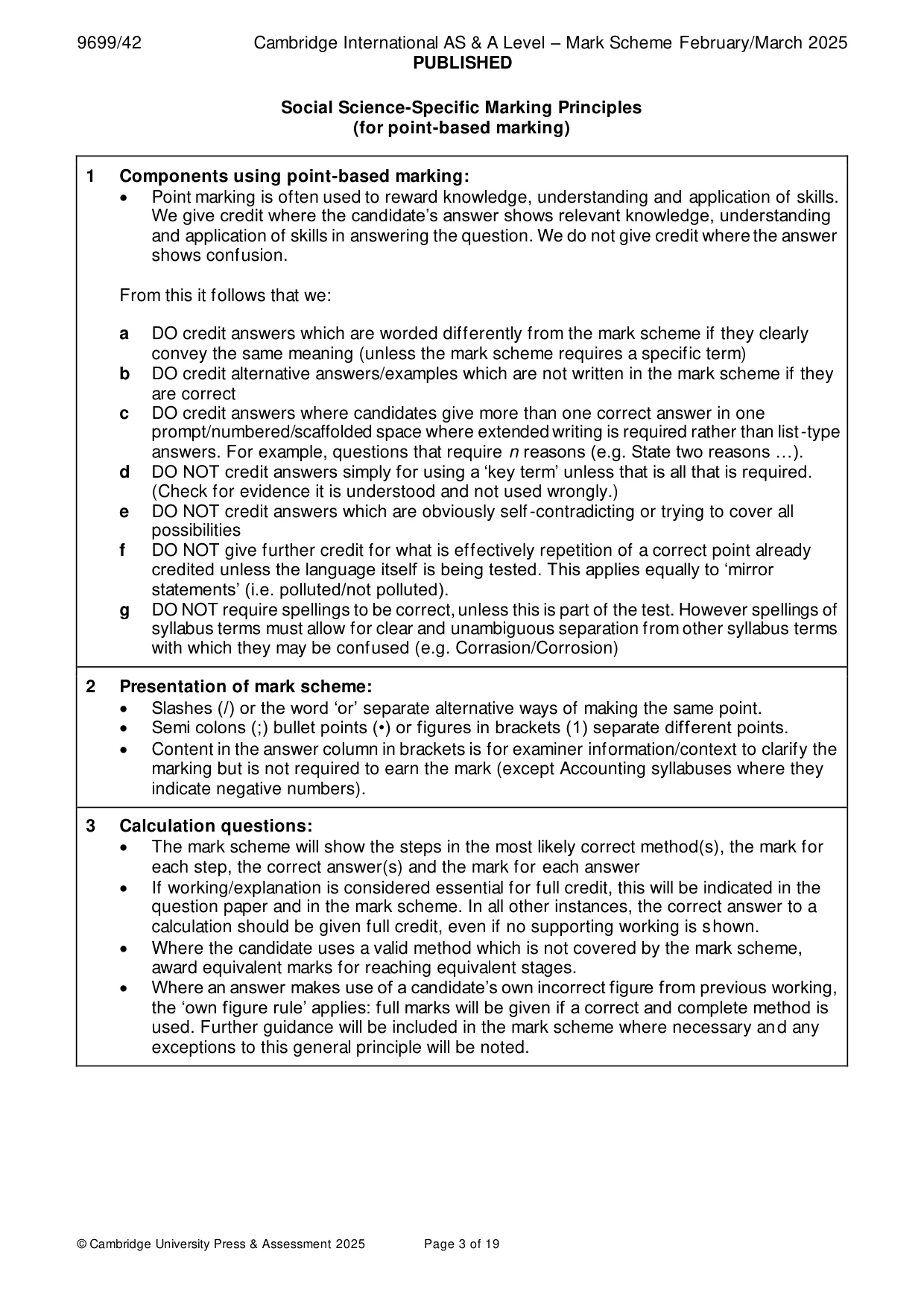
9699/42 Cambridge International AS & A Level – Mark Scheme PUBLISHED February/March 2025 © Cambridge University Press & Assessment 2025 Page 3 of 19 Social Science-Specific Marking Principles (for point-based marking) 1 Components using point-based marking: • Point marking is often used to reward knowledge, understanding and application of skills. We give credit where the candidate’s answer shows relevant knowledge, understanding and application of skills in answering the question. We do not give credit where the answer shows confusion. From this it follows that we: a DO credit answers which are worded differently from the mark scheme if they clearly convey the same meaning (unless the mark scheme requires a specific term) b DO credit alternative answers/examples which are not written in the mark scheme if they are correct c DO credit answers where candidates give more than one correct answer in one prompt/numbered/scaffolded space where extended writing is required rather than list-type answers. For example, questions that require n reasons (e.g. State two reasons …). d DO NOT credit answers simply for using a ‘key term’ unless that is all that is required. (Check for evidence it is understood and not used wrongly.) e DO NOT credit answers which are obviously self-contradicting or trying to cover all possibilities f DO NOT give further credit for what is effectively repetition of a correct point already credited unless the language itself is being tested. This applies equally to ‘mirror statements’ (i.e. polluted/not polluted). g DO NOT require spellings to be correct, unless this is part of the test. However spellings of syllabus terms must allow for clear and unambiguous separation from other syllabus terms with which they may be confused (e.g. Corrasion/Corrosion) 2 Presentation of mark scheme: • Slashes (/) or the word ‘or’ separate alternative ways of making the same point. • Semi colons (;) bullet points (•) or figures in brackets (1) separate different points. • Content in the answer column in brackets is for examiner information/context to clarify the marking but is not required to earn the mark (except Accounting syllabuses where they indicate negative numbers). 3 Calculation questions: • The mark scheme will show the steps in the most likely correct method(s), the mark for each step, the correct answer(s) and the mark for each answer • If working/explanation is considered essential for full credit, this will be indicated in the question paper and in the mark scheme. In all other instances, the correct answer to a calculation should be given full credit, even if no supporting working is shown. • Where the candidate uses a valid method which is not covered by the mark scheme, award equivalent marks for reaching equivalent stages. • Where an answer makes use of a candidate’s own incorrect figure from previous working, the ‘own figure rule’ applies: full marks will be given if a correct and complete method is used. Further guidance will be included in the mark scheme where necessary and any exceptions to this general principle will be noted.
Mark scheme, page 4
9699/42 Cambridge International AS & A Level – Mark Scheme PUBLISHED February/March 2025 © Cambridge University Press & Assessment 2025 Page 4 of 19 4 Annotation: • For point marking, ticks can be used to indicate correct answers and crosses can be used to indicate wrong answers. There is no direct relationship between ticks and marks. Ticks have no defined meaning for levels of response marking. • For levels of response marking, the level awarded should be annotated on the script. • Other annotations will be used by examiners as agreed during standardisation, and the meaning will be understood by all examiners who marked that paper. Using the mark scheme The questions are marked using a generic analytic mark scheme, which separates the marks for the different assessment objectives (AO). The work is marked for each AO using generic levels of response mark schemes. The marks awarded are usually based on a judgement of the overall quality of the response for that AO, rather than on awarding marks for specific points and accumulating a total mark by adding points. Indicative content is provided as a guide. Inevitably, the mark scheme cannot cover all responses that candidates may make for all of the questions. In some cases candidates may make some responses which the mark scheme has not predicted. These answers should nevertheless be credited according to their quality.
Mark scheme, page 5
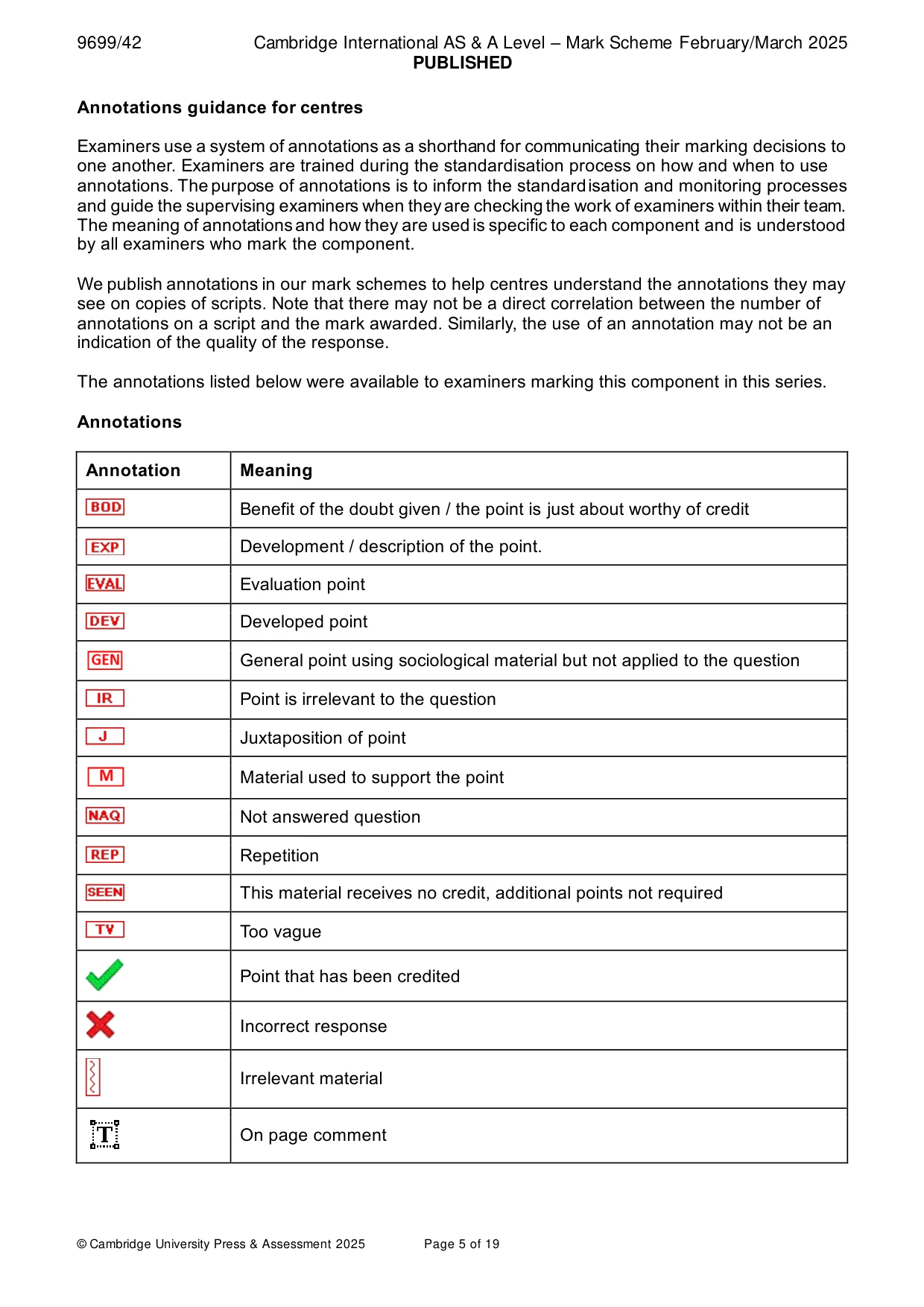
9699/42 Cambridge International AS & A Level – Mark Scheme PUBLISHED February/March 2025 © Cambridge University Press & Assessment 2025 Page 5 of 19 Annotations guidance for centres Examiners use a system of annotations as a shorthand for communicating their marking decisions to one another. Examiners are trained during the standardisation process on how and when to use annotations. The purpose of annotations is to inform the standardisation and monitoring processes and guide the supervising examiners when they are checking the work of examiners within their team. The meaning of annotations and how they are used is specific to each component and is understood by all examiners who mark the component. We publish annotations in our mark schemes to help centres understand the annotations they may see on copies of scripts. Note that there may not be a direct correlation between the number of annotations on a script and the mark awarded. Similarly, the use of an annotation may not be an indication of the quality of the response. The annotations listed below were available to examiners marking this component in this series. Annotations Annotation Meaning Benefit of the doubt given / the point is just about worthy of credit Development / description of the point. Evaluation point Developed point General point using sociological material but not applied to the question Point is irrelevant to the question Juxtaposition of point Material used to support the point Not answered question Repetition This material receives no credit, additional points not required Too vague Point that has been credited Incorrect response Irrelevant material On page comment
Mark scheme, page 6
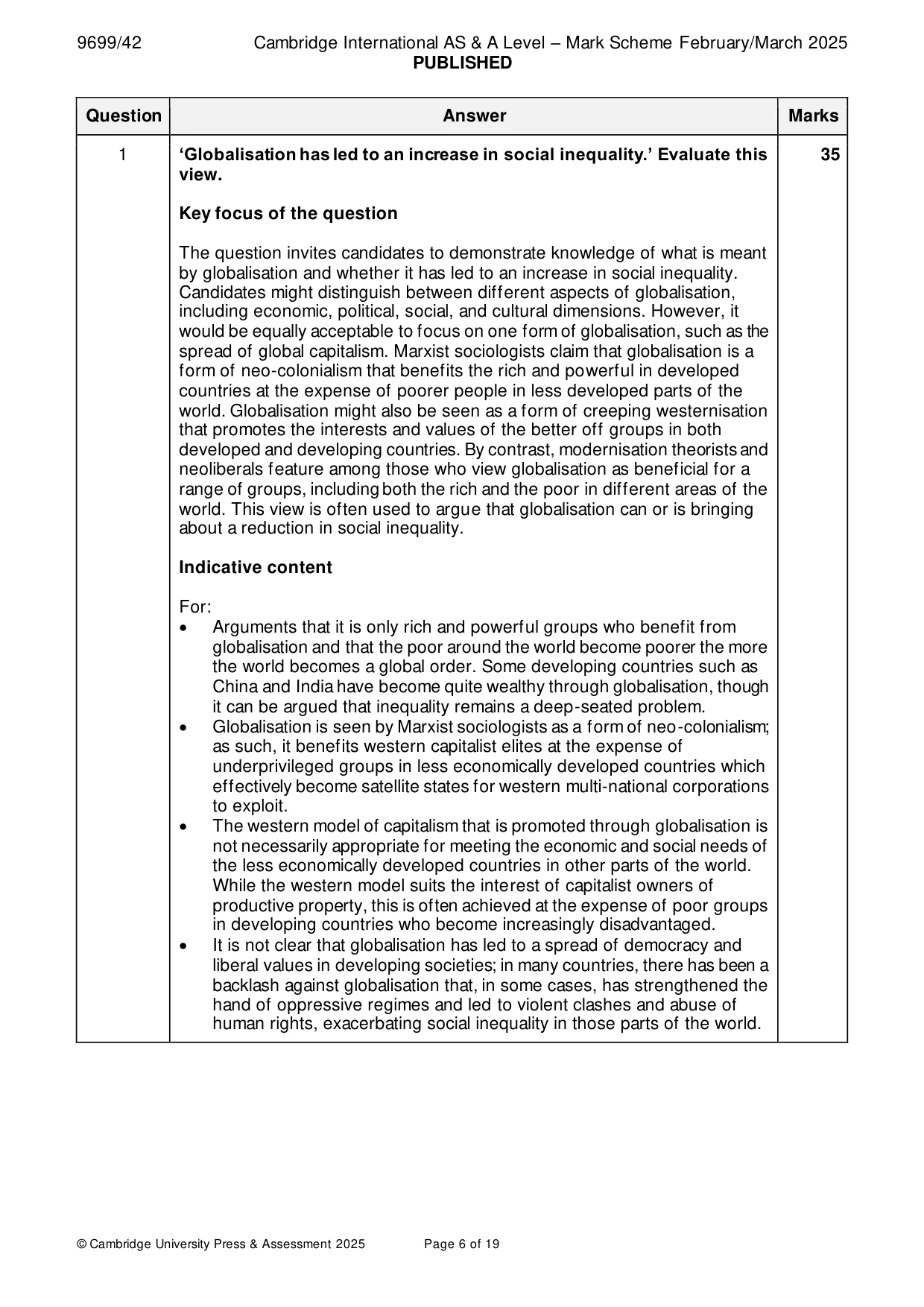
9699/42 Cambridge International AS & A Level – Mark Scheme PUBLISHED February/March 2025 © Cambridge University Press & Assessment 2025 Page 6 of 19 Question Answer Marks 1 ‘Globalisation has led to an increase in social inequality.’ Evaluate this view. Key focus of the question The question invites candidates to demonstrate knowledge of what is meant by globalisation and whether it has led to an increase in social inequality. Candidates might distinguish between different aspects of globalisation, including economic, political, social, and cultural dimensions. However, it would be equally acceptable to focus on one form of globalisation, such as the spread of global capitalism. Marxist sociologists claim that globalisation is a form of neo-colonialism that benefits the rich and powerful in developed countries at the expense of poorer people in less developed parts of the world. Globalisation might also be seen as a form of creeping westernisation that promotes the interests and values of the better off groups in both developed and developing countries. By contrast, modernisation theorists and neoliberals feature among those who view globalisation as beneficial for a range of groups, including both the rich and the poor in different areas of the world. This view is often used to argue that globalisation can or is bringing about a reduction in social inequality. Indicative content For: • Arguments that it is only rich and powerful groups who benefit from globalisation and that the poor around the world become poorer the more the world becomes a global order. Some developing countries such as China and India have become quite wealthy through globalisation, though it can be argued that inequality remains a deep-seated problem. • Globalisation is seen by Marxist sociologists as a form of neo-colonialism; as such, it benefits western capitalist elites at the expense of underprivileged groups in less economically developed countries which effectively become satellite states for western multi-national corporations to exploit. • The western model of capitalism that is promoted through globalisation is not necessarily appropriate for meeting the economic and social needs of the less economically developed countries in other parts of the world. While the western model suits the interest of capitalist owners of productive property, this is often achieved at the expense of poor groups in developing countries who become increasingly disadvantaged. • It is not clear that globalisation has led to a spread of democracy and liberal values in developing societies; in many countries, there has been a backlash against globalisation that, in some cases, has strengthened the hand of oppressive regimes and led to violent clashes and abuse of human rights, exacerbating social inequality in those parts of the world. 35
Mark scheme, page 7
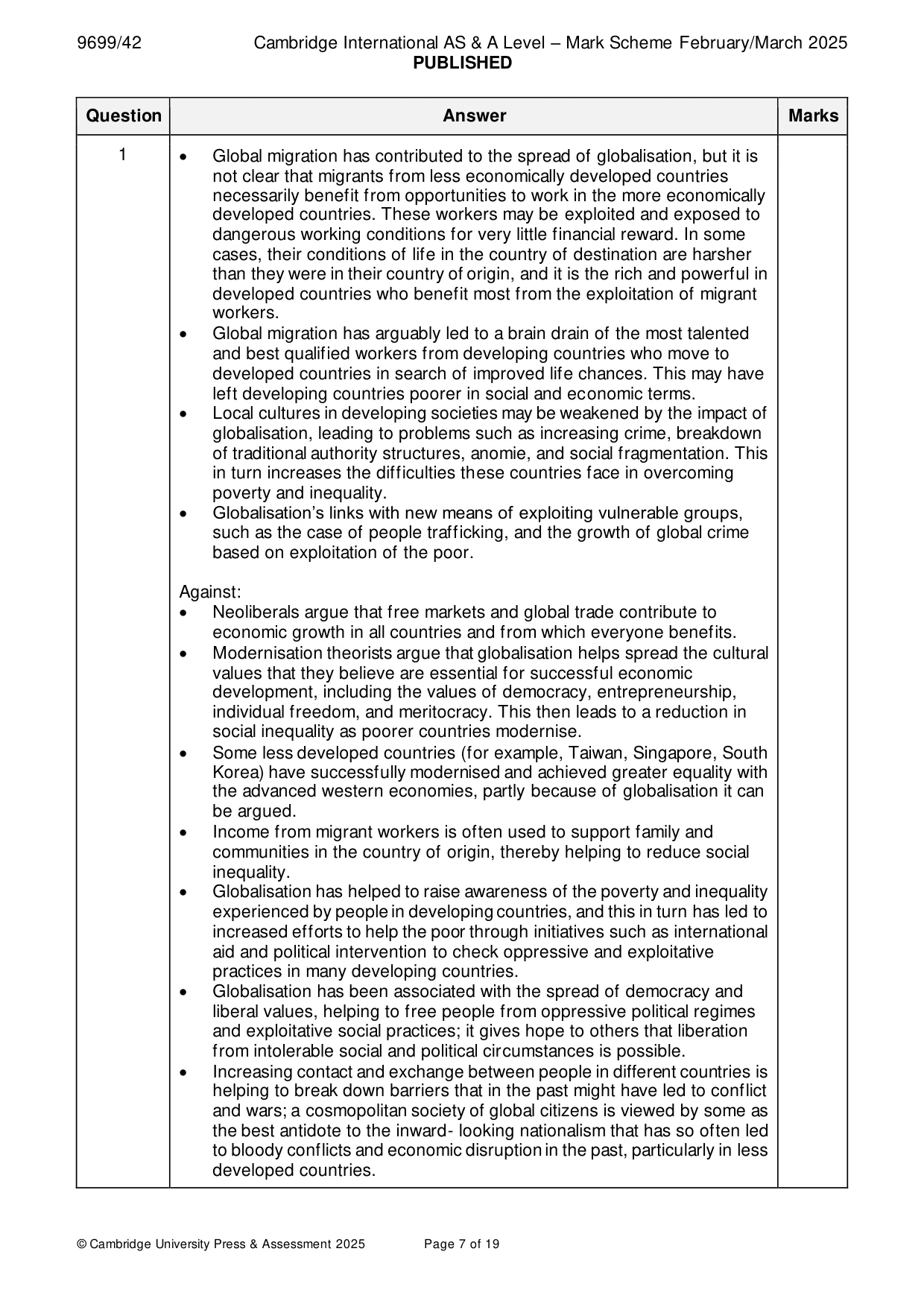
9699/42 Cambridge International AS & A Level – Mark Scheme PUBLISHED February/March 2025 © Cambridge University Press & Assessment 2025 Page 7 of 19 Question Answer Marks 1 • Global migration has contributed to the spread of globalisation, but it is not clear that migrants from less economically developed countries necessarily benefit from opportunities to work in the more economically developed countries. These workers may be exploited and exposed to dangerous working conditions for very little financial reward. In some cases, their conditions of life in the country of destination are harsher than they were in their country of origin, and it is the rich and powerful in developed countries who benefit most from the exploitation of migrant workers. • Global migration has arguably led to a brain drain of the most talented and best qualified workers from developing countries who move to developed countries in search of improved life chances. This may have left developing countries poorer in social and economic terms. • Local cultures in developing societies may be weakened by the impact of globalisation, leading to problems such as increasing crime, breakdown of traditional authority structures, anomie, and social fragmentation. This in turn increases the difficulties these countries face in overcoming poverty and inequality. • Globalisation’s links with new means of exploiting vulnerable groups, such as the case of people trafficking, and the growth of global crime based on exploitation of the poor. Against: • Neoliberals argue that free markets and global trade contribute to economic growth in all countries and from which everyone benefits. • Modernisation theorists argue that globalisation helps spread the cultural values that they believe are essential for successful economic development, including the values of democracy, entrepreneurship, individual freedom, and meritocracy. This then leads to a reduction in social inequality as poorer countries modernise. • Some less developed countries (for example, Taiwan, Singapore, South Korea) have successfully modernised and achieved greater equality with the advanced western economies, partly because of globalisation it can be argued. • Income from migrant workers is often used to support family and communities in the country of origin, thereby helping to reduce social inequality. • Globalisation has helped to raise awareness of the poverty and inequality experienced by people in developing countries, and this in turn has led to increased efforts to help the poor through initiatives such as international aid and political intervention to check oppressive and exploitative practices in many developing countries. • Globalisation has been associated with the spread of democracy and liberal values, helping to free people from oppressive political regimes and exploitative social practices; it gives hope to others that liberation from intolerable social and political circumstances is possible. • Increasing contact and exchange between people in different countries is helping to break down barriers that in the past might have led to conflict and wars; a cosmopolitan society of global citizens is viewed by some as the best antidote to the inward- looking nationalism that has so often led to bloody conflicts and economic disruption in the past, particularly in less developed countries.
Mark scheme, page 8
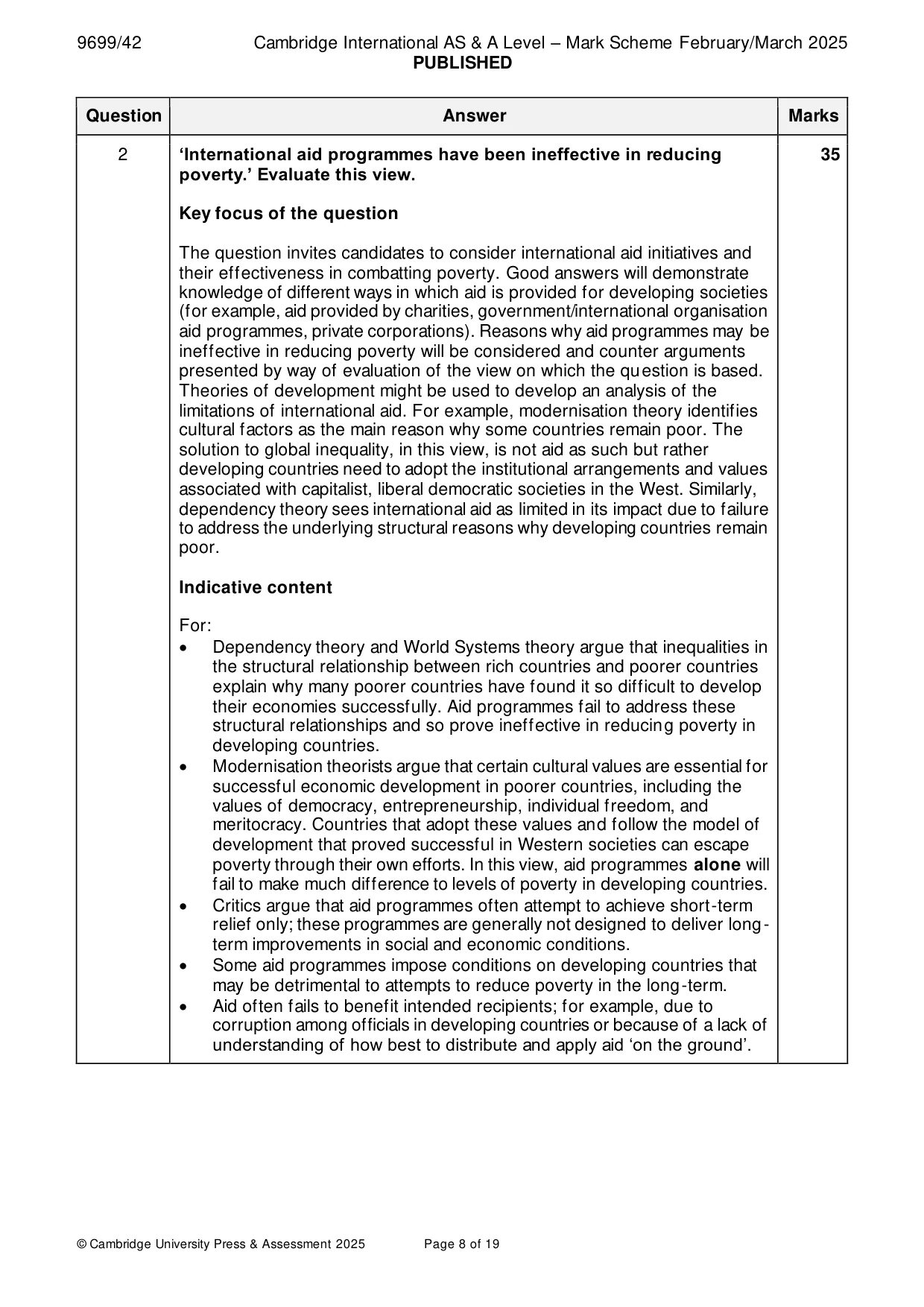
9699/42 Cambridge International AS & A Level – Mark Scheme PUBLISHED February/March 2025 © Cambridge University Press & Assessment 2025 Page 8 of 19 Question Answer Marks 2 ‘International aid programmes have been ineffective in reducing poverty.’ Evaluate this view. Key focus of the question The question invites candidates to consider international aid initiatives and their effectiveness in combatting poverty. Good answers will demonstrate knowledge of different ways in which aid is provided for developing societies (for example, aid provided by charities, government/international organisation aid programmes, private corporations). Reasons why aid programmes may be ineffective in reducing poverty will be considered and counter arguments presented by way of evaluation of the view on which the question is based. Theories of development might be used to develop an analysis of the limitations of international aid. For example, modernisation theory identifies cultural factors as the main reason why some countries remain poor. The solution to global inequality, in this view, is not aid as such but rather developing countries need to adopt the institutional arrangements and values associated with capitalist, liberal democratic societies in the West. Similarly, dependency theory sees international aid as limited in its impact due to failure to address the underlying structural reasons why developing countries remain poor. Indicative content For: • Dependency theory and World Systems theory argue that inequalities in the structural relationship between rich countries and poorer countries explain why many poorer countries have found it so difficult to develop their economies successfully. Aid programmes fail to address these structural relationships and so prove ineffective in reducing poverty in developing countries. • Modernisation theorists argue that certain cultural values are essential for successful economic development in poorer countries, including the values of democracy, entrepreneurship, individual freedom, and meritocracy. Countries that adopt these values and follow the model of development that proved successful in Western societies can escape poverty through their own efforts. In this view, aid programmes alone will fail to make much difference to levels of poverty in developing countries. • Critics argue that aid programmes often attempt to achieve short-term relief only; these programmes are generally not designed to deliver long- term improvements in social and economic conditions. • Some aid programmes impose conditions on developing countries that may be detrimental to attempts to reduce poverty in the long-term. • Aid often fails to benefit intended recipients; for example, due to corruption among officials in developing countries or because of a lack of understanding of how best to distribute and apply aid ‘on the ground’. 35
Mark scheme, page 9
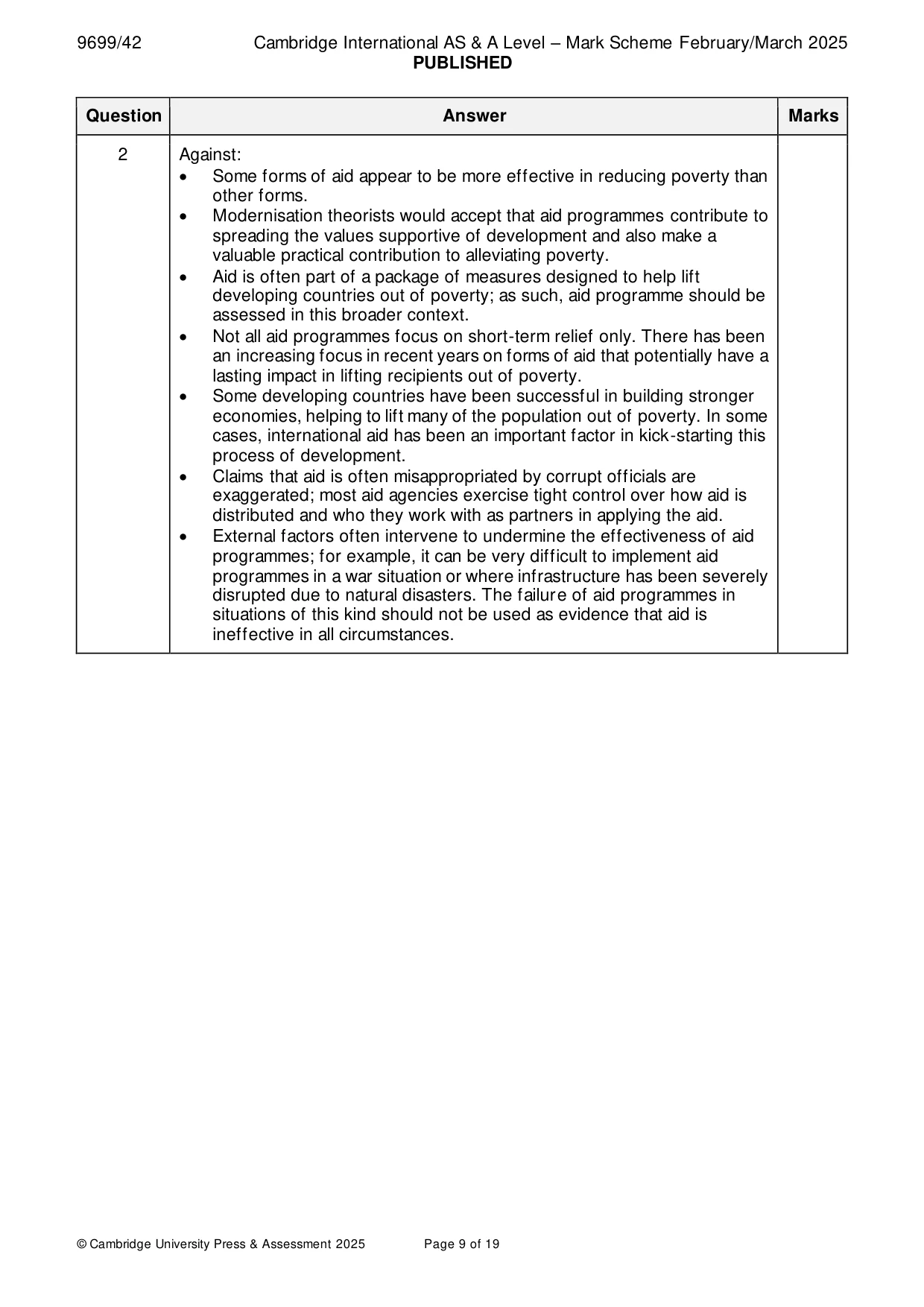
9699/42 Cambridge International AS & A Level – Mark Scheme PUBLISHED February/March 2025 © Cambridge University Press & Assessment 2025 Page 9 of 19 Question Answer Marks 2 Against: • Some forms of aid appear to be more effective in reducing poverty than other forms. • Modernisation theorists would accept that aid programmes contribute to spreading the values supportive of development and also make a valuable practical contribution to alleviating poverty. • Aid is often part of a package of measures designed to help lift developing countries out of poverty; as such, aid programme should be assessed in this broader context. • Not all aid programmes focus on short-term relief only. There has been an increasing focus in recent years on forms of aid that potentially have a lasting impact in lifting recipients out of poverty. • Some developing countries have been successful in building stronger economies, helping to lift many of the population out of poverty. In some cases, international aid has been an important factor in kick-starting this process of development. • Claims that aid is often misappropriated by corrupt officials are exaggerated; most aid agencies exercise tight control over how aid is distributed and who they work with as partners in applying the aid. • External factors often intervene to undermine the effectiveness of aid programmes; for example, it can be very difficult to implement aid programmes in a war situation or where infrastructure has been severely disrupted due to natural disasters. The failure of aid programmes in situations of this kind should not be used as evidence that aid is ineffective in all circumstances.
Mark scheme, page 10
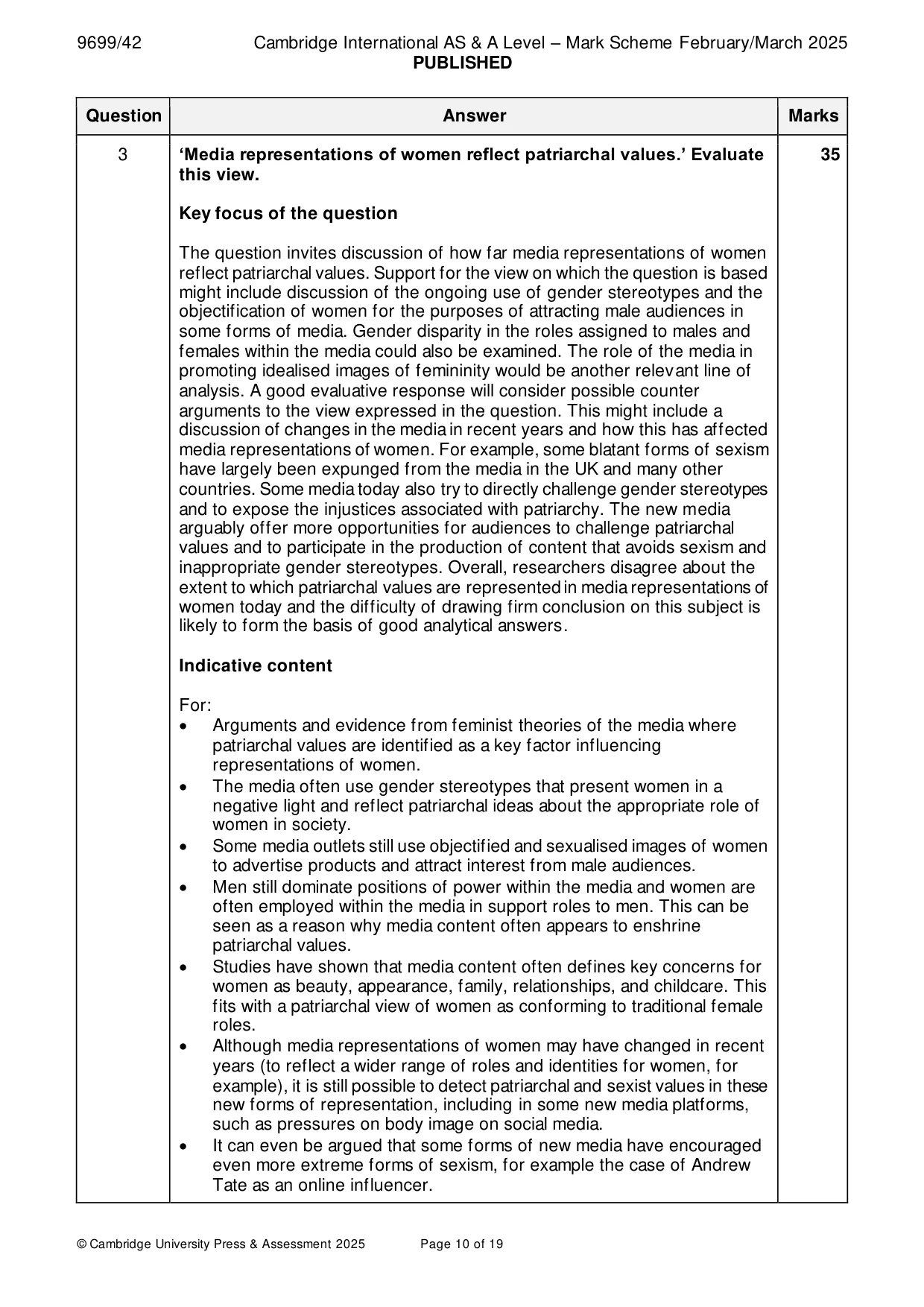
9699/42 Cambridge International AS & A Level – Mark Scheme PUBLISHED February/March 2025 © Cambridge University Press & Assessment 2025 Page 10 of 19 Question Answer Marks 3 ‘Media representations of women reflect patriarchal values.’ Evaluate this view. Key focus of the question The question invites discussion of how far media representations of women reflect patriarchal values. Support for the view on which the question is based might include discussion of the ongoing use of gender stereotypes and the objectification of women for the purposes of attracting male audiences in some forms of media. Gender disparity in the roles assigned to males and females within the media could also be examined. The role of the media in promoting idealised images of femininity would be another relevant line of analysis. A good evaluative response will consider possible counter arguments to the view expressed in the question. This might include a discussion of changes in the media in recent years and how this has affected media representations of women. For example, some blatant forms of sexism have largely been expunged from the media in the UK and many other countries. Some media today also try to directly challenge gender stereotypes and to expose the injustices associated with patriarchy. The new media arguably offer more opportunities for audiences to challenge patriarchal values and to participate in the production of content that avoids sexism and inappropriate gender stereotypes. Overall, researchers disagree about the extent to which patriarchal values are represented in media representations of women today and the difficulty of drawing firm conclusion on this subject is likely to form the basis of good analytical answers. Indicative content For: • Arguments and evidence from feminist theories of the media where patriarchal values are identified as a key factor influencing representations of women. • The media often use gender stereotypes that present women in a negative light and reflect patriarchal ideas about the appropriate role of women in society. • Some media outlets still use objectified and sexualised images of women to advertise products and attract interest from male audiences. • Men still dominate positions of power within the media and women are often employed within the media in support roles to men. This can be seen as a reason why media content often appears to enshrine patriarchal values. • Studies have shown that media content often defines key concerns for women as beauty, appearance, family, relationships, and childcare. This fits with a patriarchal view of women as conforming to traditional female roles. • Although media representations of women may have changed in recent years (to reflect a wider range of roles and identities for women, for example), it is still possible to detect patriarchal and sexist values in these new forms of representation, including in some new media platforms, such as pressures on body image on social media. • It can even be argued that some forms of new media have encouraged even more extreme forms of sexism, for example the case of Andrew Tate as an online influencer. 35
Mark scheme, page 11
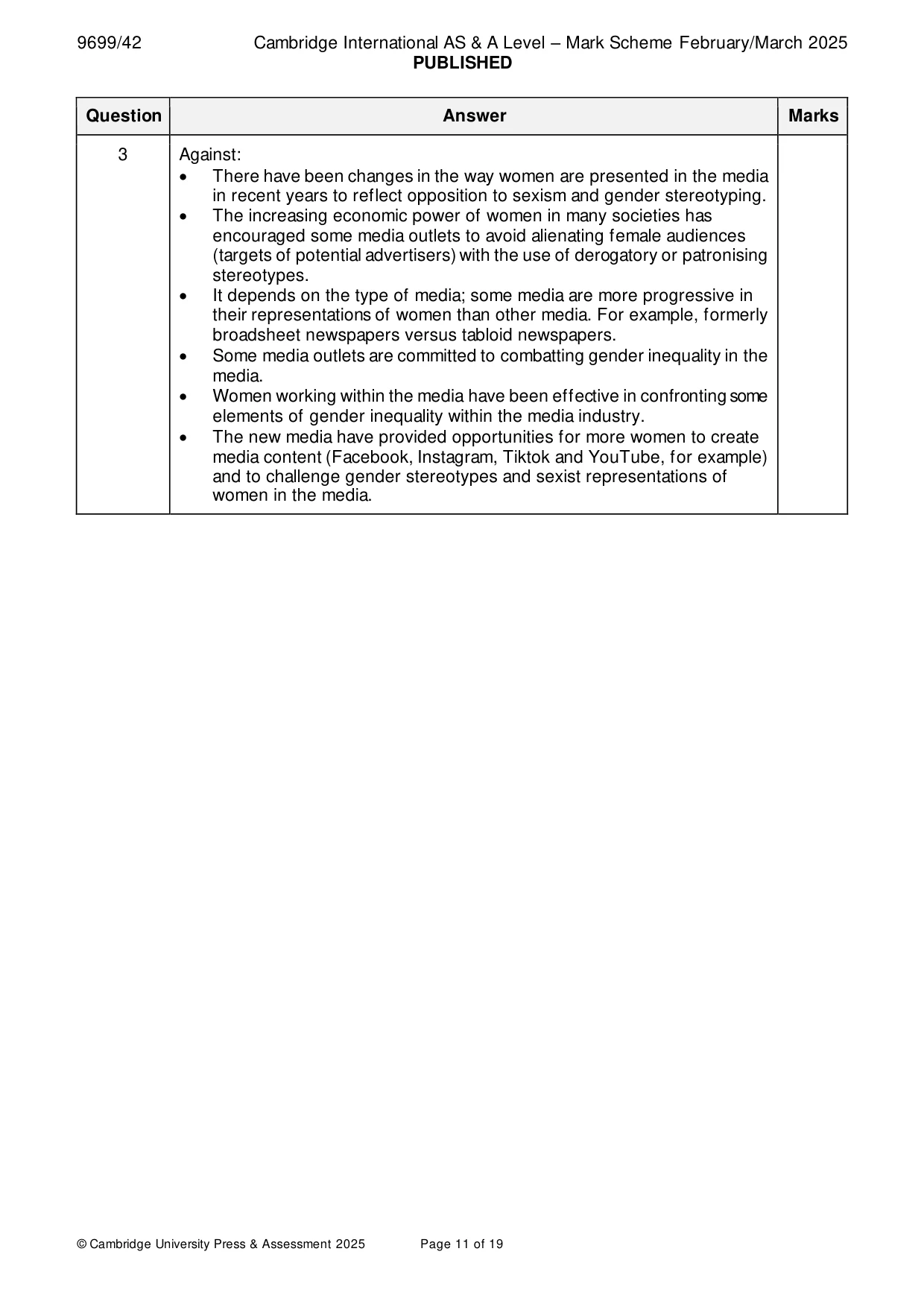
9699/42 Cambridge International AS & A Level – Mark Scheme PUBLISHED February/March 2025 © Cambridge University Press & Assessment 2025 Page 11 of 19 Question Answer Marks 3 Against: • There have been changes in the way women are presented in the media in recent years to reflect opposition to sexism and gender stereotyping. • The increasing economic power of women in many societies has encouraged some media outlets to avoid alienating female audiences (targets of potential advertisers) with the use of derogatory or patronising stereotypes. • It depends on the type of media; some media are more progressive in their representations of women than other media. For example, formerly broadsheet newspapers versus tabloid newspapers. • Some media outlets are committed to combatting gender inequality in the media. • Women working within the media have been effective in confronting some elements of gender inequality within the media industry. • The new media have provided opportunities for more women to create media content (Facebook, Instagram, Tiktok and YouTube, for example) and to challenge gender stereotypes and sexist representations of women in the media.
Mark scheme, page 12
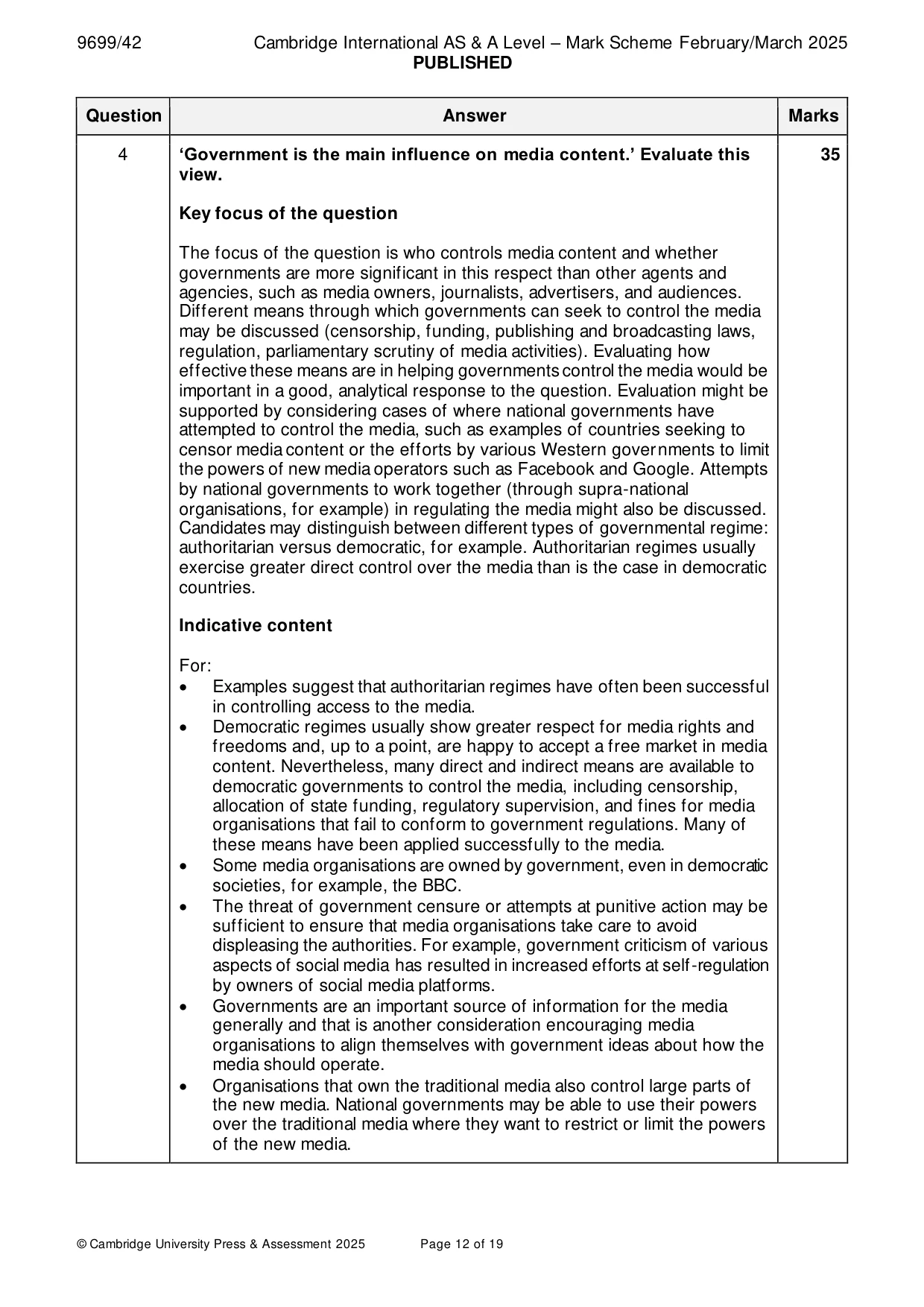
9699/42 Cambridge International AS & A Level – Mark Scheme PUBLISHED February/March 2025 © Cambridge University Press & Assessment 2025 Page 12 of 19 Question Answer Marks 4 ‘Government is the main influence on media content.’ Evaluate this view. Key focus of the question The focus of the question is who controls media content and whether governments are more significant in this respect than other agents and agencies, such as media owners, journalists, advertisers, and audiences. Different means through which governments can seek to control the media may be discussed (censorship, funding, publishing and broadcasting laws, regulation, parliamentary scrutiny of media activities). Evaluating how effective these means are in helping governments control the media would be important in a good, analytical response to the question. Evaluation might be supported by considering cases of where national governments have attempted to control the media, such as examples of countries seeking to censor media content or the efforts by various Western governments to limit the powers of new media operators such as Facebook and Google. Attempts by national governments to work together (through supra-national organisations, for example) in regulating the media might also be discussed. Candidates may distinguish between different types of governmental regime: authoritarian versus democratic, for example. Authoritarian regimes usually exercise greater direct control over the media than is the case in democratic countries. Indicative content For: • Examples suggest that authoritarian regimes have often been successful in controlling access to the media. • Democratic regimes usually show greater respect for media rights and freedoms and, up to a point, are happy to accept a free market in media content. Nevertheless, many direct and indirect means are available to democratic governments to control the media, including censorship, allocation of state funding, regulatory supervision, and fines for media organisations that fail to conform to government regulations. Many of these means have been applied successfully to the media. • Some media organisations are owned by government, even in democratic societies, for example, the BBC. • The threat of government censure or attempts at punitive action may be sufficient to ensure that media organisations take care to avoid displeasing the authorities. For example, government criticism of various aspects of social media has resulted in increased efforts at self-regulation by owners of social media platforms. • Governments are an important source of information for the media generally and that is another consideration encouraging media organisations to align themselves with government ideas about how the media should operate. • Organisations that own the traditional media also control large parts of the new media. National governments may be able to use their powers over the traditional media where they want to restrict or limit the powers of the new media. 35
Mark scheme, page 13
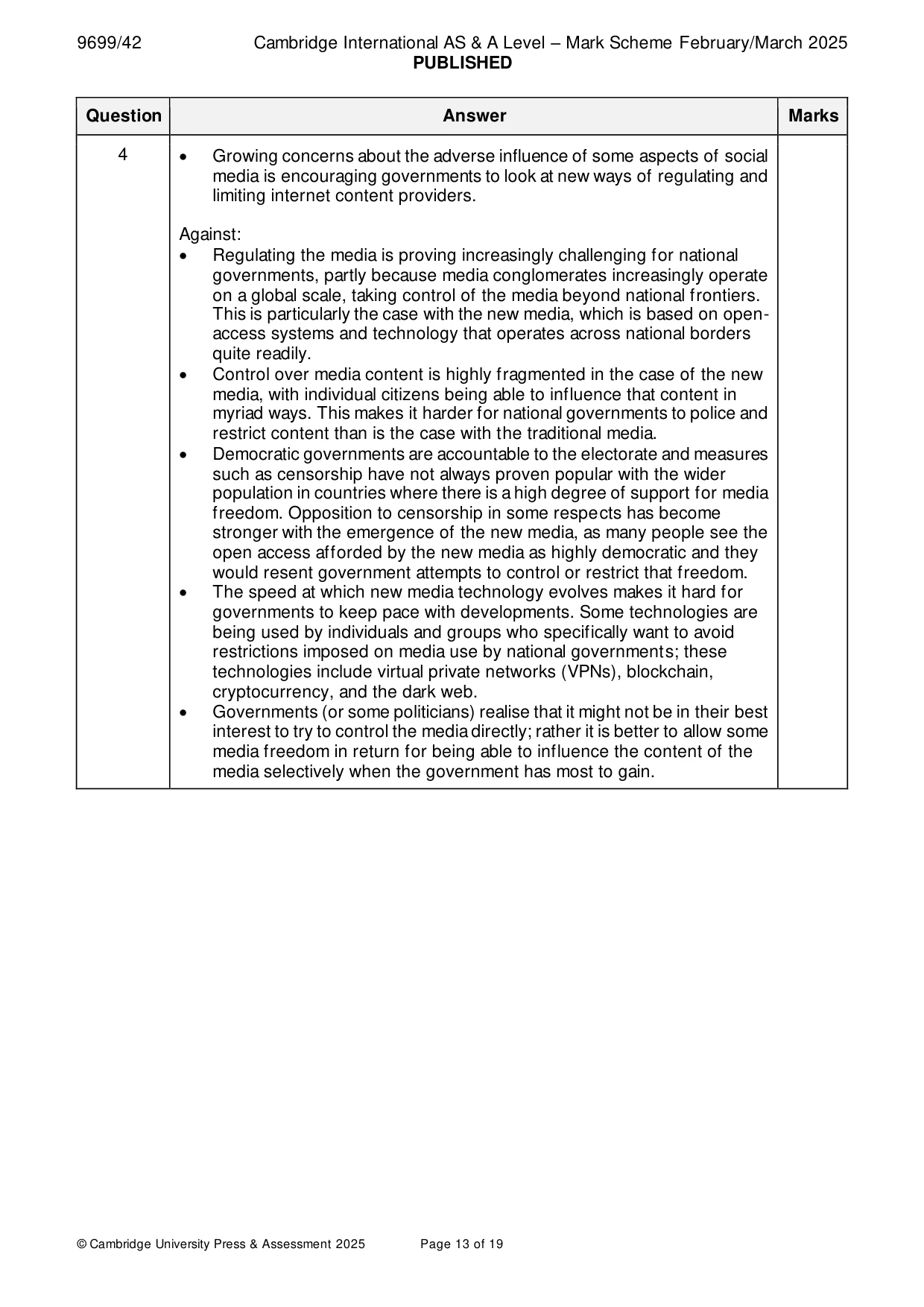
9699/42 Cambridge International AS & A Level – Mark Scheme PUBLISHED February/March 2025 © Cambridge University Press & Assessment 2025 Page 13 of 19 Question Answer Marks 4 • Growing concerns about the adverse influence of some aspects of social media is encouraging governments to look at new ways of regulating and limiting internet content providers. Against: • Regulating the media is proving increasingly challenging for national governments, partly because media conglomerates increasingly operate on a global scale, taking control of the media beyond national frontiers. This is particularly the case with the new media, which is based on open- access systems and technology that operates across national borders quite readily. • Control over media content is highly fragmented in the case of the new media, with individual citizens being able to influence that content in myriad ways. This makes it harder for national governments to police and restrict content than is the case with the traditional media. • Democratic governments are accountable to the electorate and measures such as censorship have not always proven popular with the wider population in countries where there is a high degree of support for media freedom. Opposition to censorship in some respects has become stronger with the emergence of the new media, as many people see the open access afforded by the new media as highly democratic and they would resent government attempts to control or restrict that freedom. • The speed at which new media technology evolves makes it hard for governments to keep pace with developments. Some technologies are being used by individuals and groups who specifically want to avoid restrictions imposed on media use by national governments; these technologies include virtual private networks (VPNs), blockchain, cryptocurrency, and the dark web. • Governments (or some politicians) realise that it might not be in their best interest to try to control the media directly; rather it is better to allow some media freedom in return for being able to influence the content of the media selectively when the government has most to gain.
Mark scheme, page 14
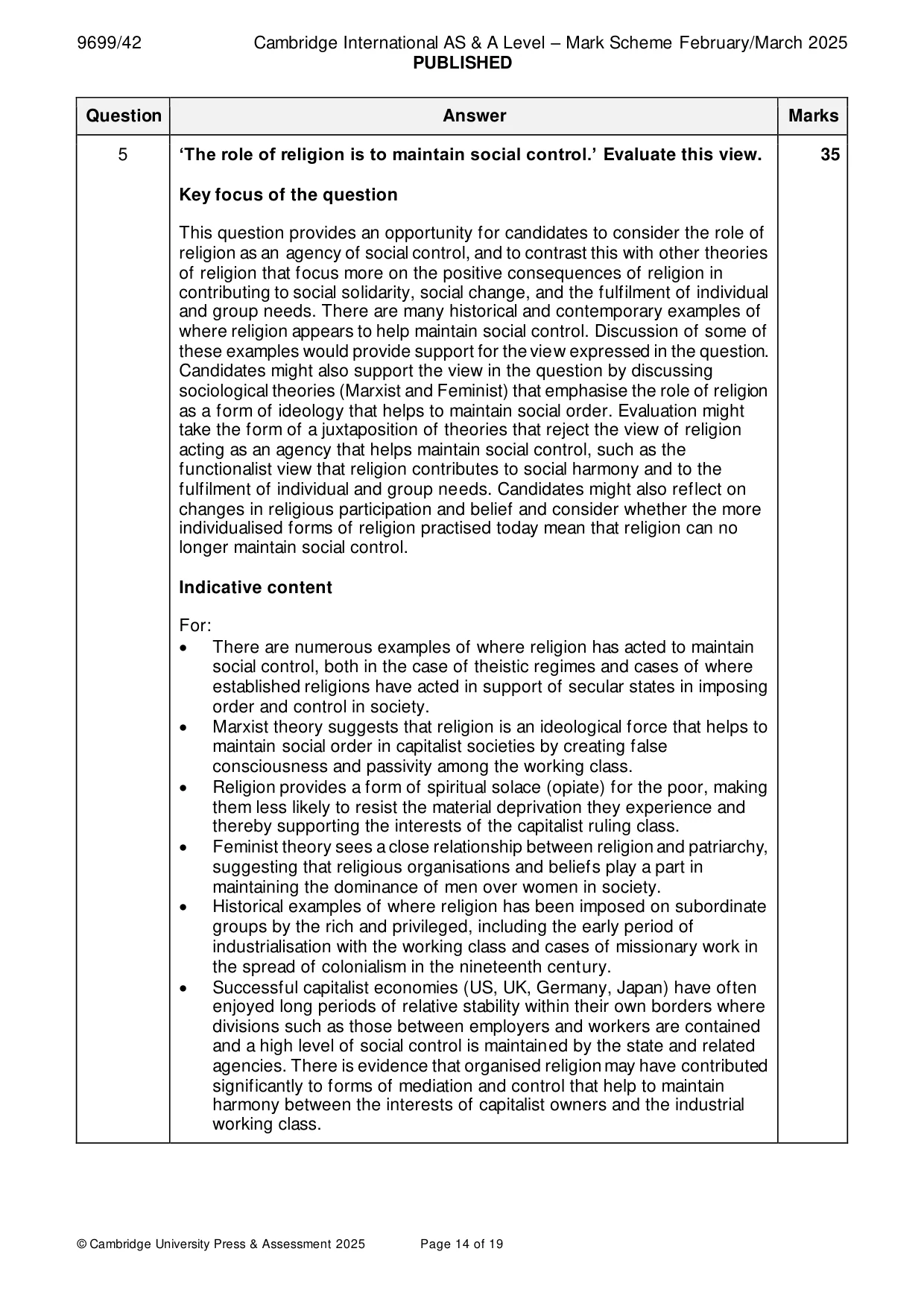
9699/42 Cambridge International AS & A Level – Mark Scheme PUBLISHED February/March 2025 © Cambridge University Press & Assessment 2025 Page 14 of 19 Question Answer Marks 5 ‘The role of religion is to maintain social control.’ Evaluate this view. Key focus of the question This question provides an opportunity for candidates to consider the role of religion as an agency of social control, and to contrast this with other theories of religion that focus more on the positive consequences of religion in contributing to social solidarity, social change, and the fulfilment of individual and group needs. There are many historical and contemporary examples of where religion appears to help maintain social control. Discussion of some of these examples would provide support for the view expressed in the question. Candidates might also support the view in the question by discussing sociological theories (Marxist and Feminist) that emphasise the role of religion as a form of ideology that helps to maintain social order. Evaluation might take the form of a juxtaposition of theories that reject the view of religion acting as an agency that helps maintain social control, such as the functionalist view that religion contributes to social harmony and to the fulfilment of individual and group needs. Candidates might also reflect on changes in religious participation and belief and consider whether the more individualised forms of religion practised today mean that religion can no longer maintain social control. Indicative content For: • There are numerous examples of where religion has acted to maintain social control, both in the case of theistic regimes and cases of where established religions have acted in support of secular states in imposing order and control in society. • Marxist theory suggests that religion is an ideological force that helps to maintain social order in capitalist societies by creating false consciousness and passivity among the working class. • Religion provides a form of spiritual solace (opiate) for the poor, making them less likely to resist the material deprivation they experience and thereby supporting the interests of the capitalist ruling class. • Feminist theory sees a close relationship between religion and patriarchy, suggesting that religious organisations and beliefs play a part in maintaining the dominance of men over women in society. • Historical examples of where religion has been imposed on subordinate groups by the rich and privileged, including the early period of industrialisation with the working class and cases of missionary work in the spread of colonialism in the nineteenth century. • Successful capitalist economies (US, UK, Germany, Japan) have often enjoyed long periods of relative stability within their own borders where divisions such as those between employers and workers are contained and a high level of social control is maintained by the state and related agencies. There is evidence that organised religion may have contributed significantly to forms of mediation and control that help to maintain harmony between the interests of capitalist owners and the industrial working class. 35
Mark scheme, page 15
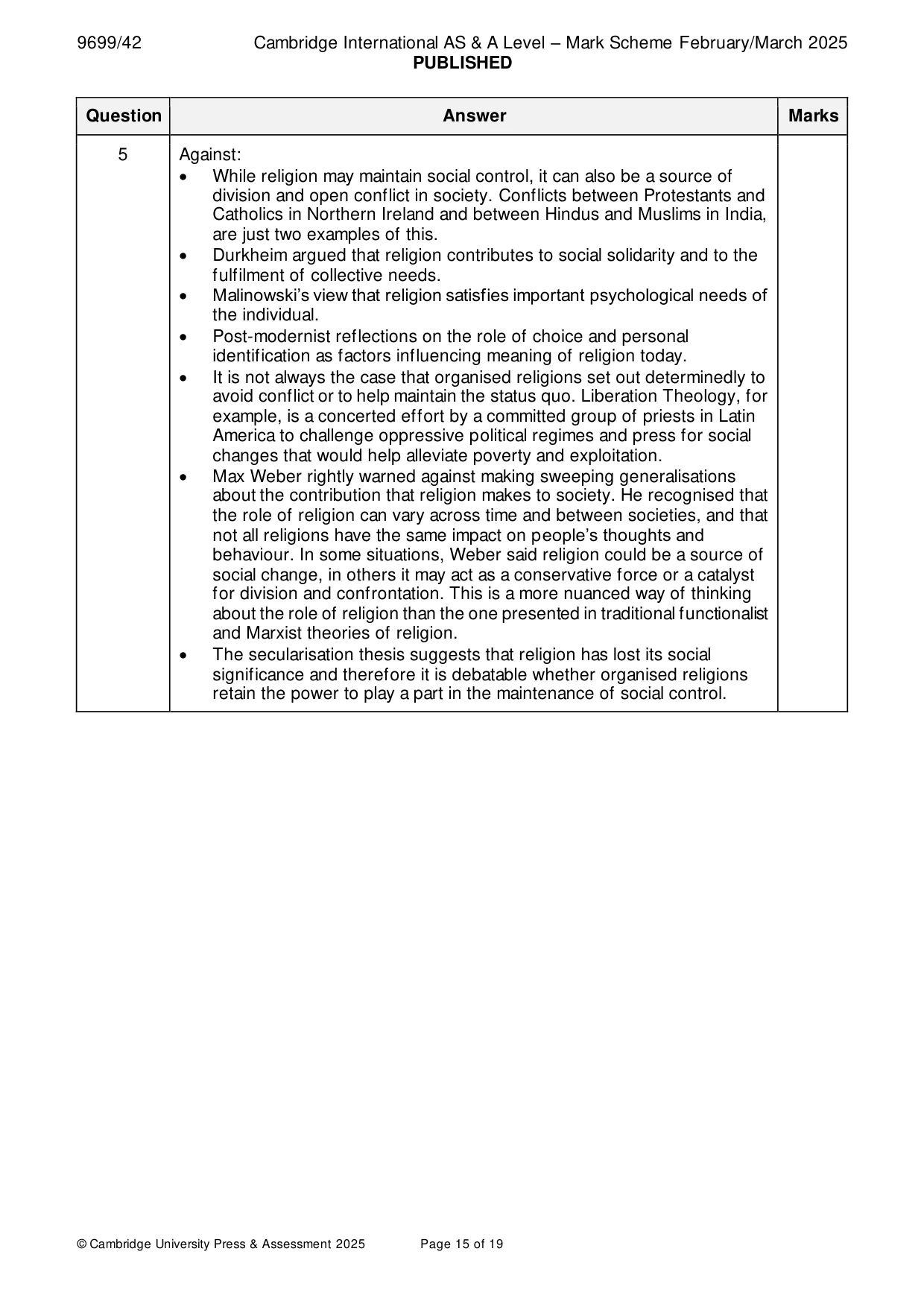
9699/42 Cambridge International AS & A Level – Mark Scheme PUBLISHED February/March 2025 © Cambridge University Press & Assessment 2025 Page 15 of 19 Question Answer Marks 5 Against: • While religion may maintain social control, it can also be a source of division and open conflict in society. Conflicts between Protestants and Catholics in Northern Ireland and between Hindus and Muslims in India, are just two examples of this. • Durkheim argued that religion contributes to social solidarity and to the fulfilment of collective needs. • Malinowski’s view that religion satisfies important psychological needs of the individual. • Post-modernist reflections on the role of choice and personal identification as factors influencing meaning of religion today. • It is not always the case that organised religions set out determinedly to avoid conflict or to help maintain the status quo. Liberation Theology, for example, is a concerted effort by a committed group of priests in Latin America to challenge oppressive political regimes and press for social changes that would help alleviate poverty and exploitation. • Max Weber rightly warned against making sweeping generalisations about the contribution that religion makes to society. He recognised that the role of religion can vary across time and between societies, and that not all religions have the same impact on people’s thoughts and behaviour. In some situations, Weber said religion could be a source of social change, in others it may act as a conservative force or a catalyst for division and confrontation. This is a more nuanced way of thinking about the role of religion than the one presented in traditional functionalist and Marxist theories of religion. • The secularisation thesis suggests that religion has lost its social significance and therefore it is debatable whether organised religions retain the power to play a part in the maintenance of social control.
Mark scheme, page 16
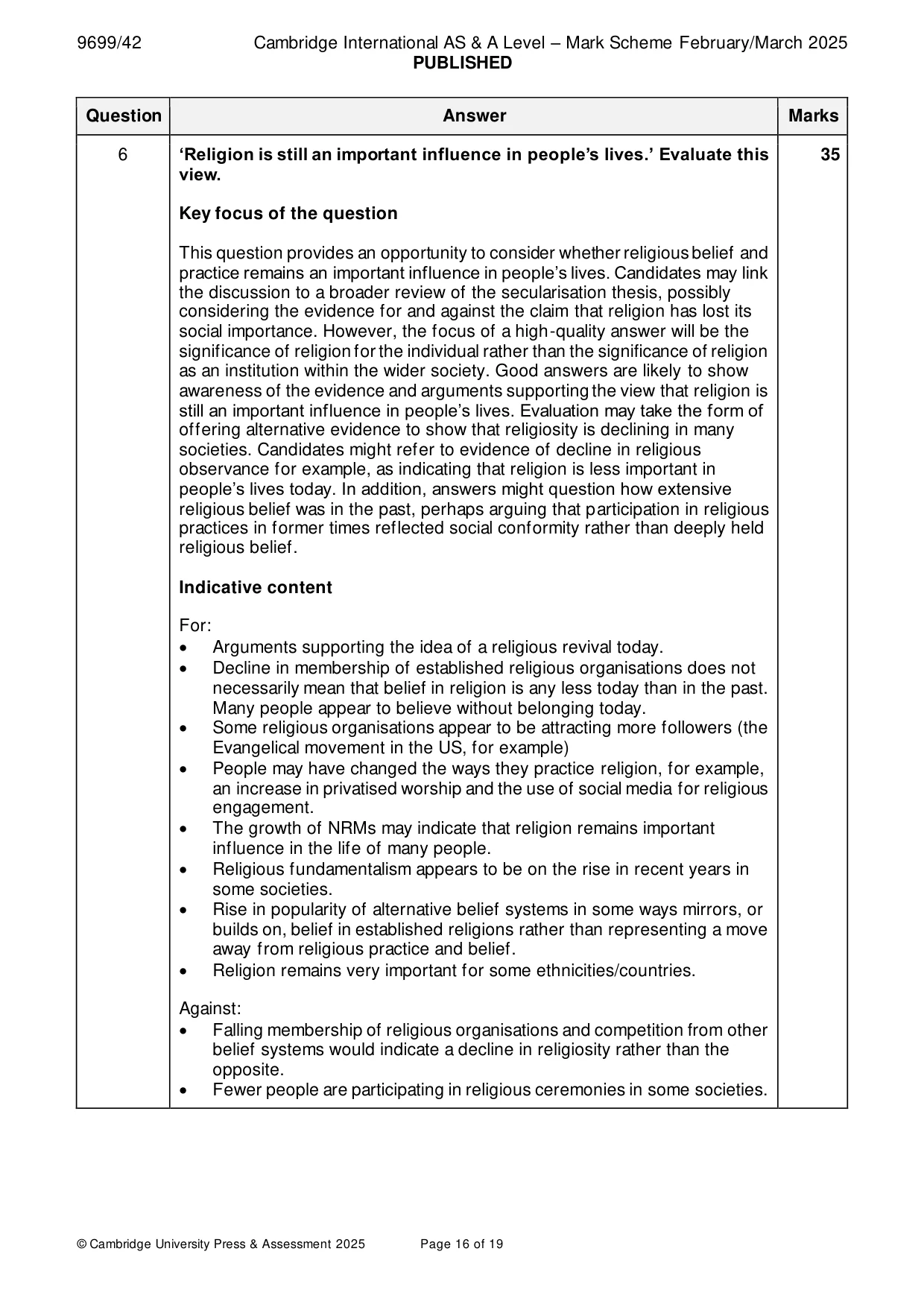
9699/42 Cambridge International AS & A Level – Mark Scheme PUBLISHED February/March 2025 © Cambridge University Press & Assessment 2025 Page 16 of 19 Question Answer Marks 6 ‘Religion is still an important influence in people’s lives.’ Evaluate this view. Key focus of the question This question provides an opportunity to consider whether religious belief and practice remains an important influence in people’s lives. Candidates may link the discussion to a broader review of the secularisation thesis, possibly considering the evidence for and against the claim that religion has lost its social importance. However, the focus of a high-quality answer will be the significance of religion for the individual rather than the significance of religion as an institution within the wider society. Good answers are likely to show awareness of the evidence and arguments supporting the view that religion is still an important influence in people’s lives. Evaluation may take the form of offering alternative evidence to show that religiosity is declining in many societies. Candidates might refer to evidence of decline in religious observance for example, as indicating that religion is less important in people’s lives today. In addition, answers might question how extensive religious belief was in the past, perhaps arguing that participation in religious practices in former times reflected social conformity rather than deeply held religious belief. Indicative content For: • Arguments supporting the idea of a religious revival today. • Decline in membership of established religious organisations does not necessarily mean that belief in religion is any less today than in the past. Many people appear to believe without belonging today. • Some religious organisations appear to be attracting more followers (the Evangelical movement in the US, for example) • People may have changed the ways they practice religion, for example, an increase in privatised worship and the use of social media for religious engagement. • The growth of NRMs may indicate that religion remains important influence in the life of many people. • Religious fundamentalism appears to be on the rise in recent years in some societies. • Rise in popularity of alternative belief systems in some ways mirrors, or builds on, belief in established religions rather than representing a move away from religious practice and belief. • Religion remains very important for some ethnicities/countries. Against: • Falling membership of religious organisations and competition from other belief systems would indicate a decline in religiosity rather than the opposite. • Fewer people are participating in religious ceremonies in some societies. 35
Mark scheme, page 17
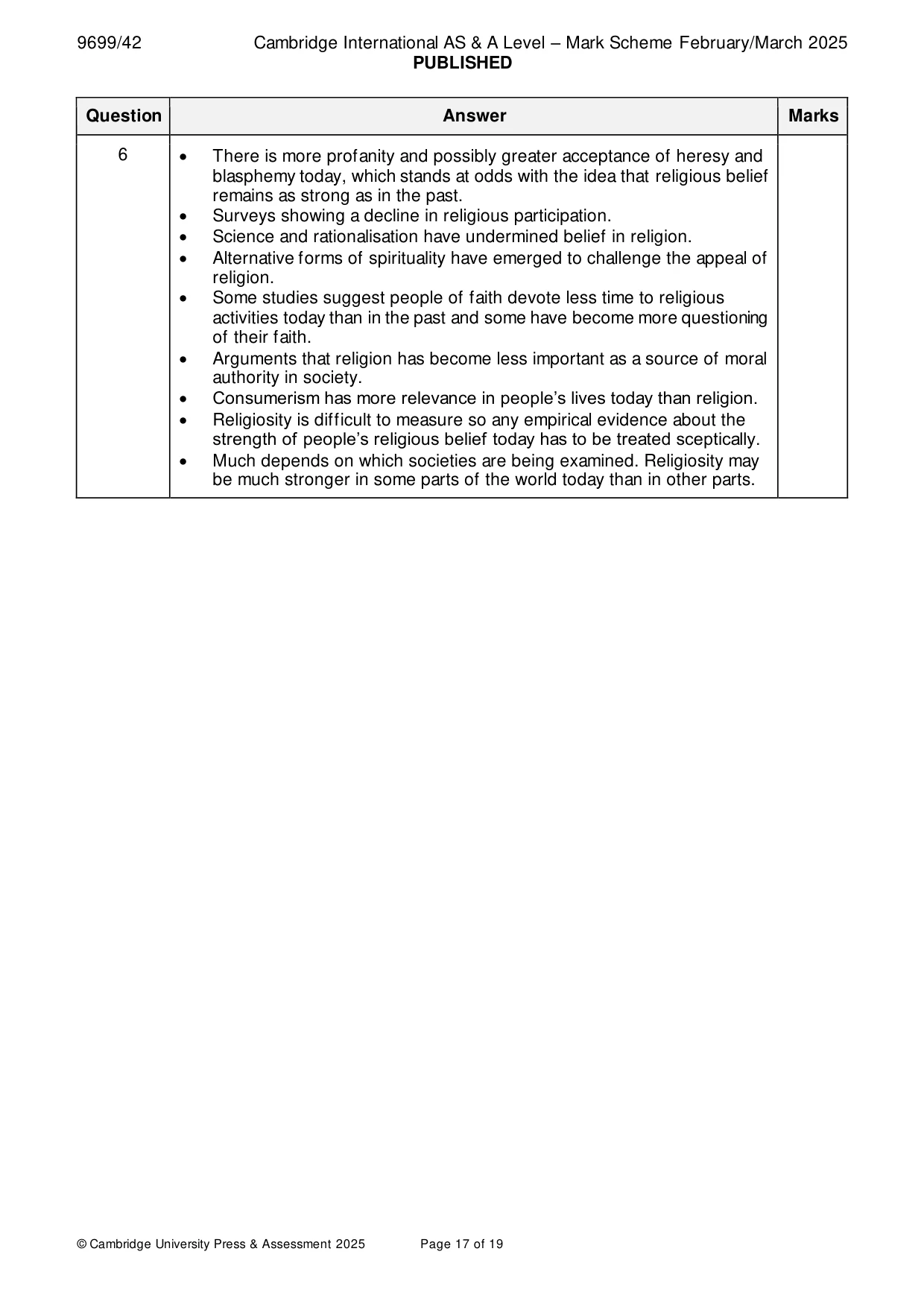
9699/42 Cambridge International AS & A Level – Mark Scheme PUBLISHED February/March 2025 © Cambridge University Press & Assessment 2025 Page 17 of 19 Question Answer Marks 6 • There is more profanity and possibly greater acceptance of heresy and blasphemy today, which stands at odds with the idea that religious belief remains as strong as in the past. • Surveys showing a decline in religious participation. • Science and rationalisation have undermined belief in religion. • Alternative forms of spirituality have emerged to challenge the appeal of religion. • Some studies suggest people of faith devote less time to religious activities today than in the past and some have become more questioning of their faith. • Arguments that religion has become less important as a source of moral authority in society. • Consumerism has more relevance in people’s lives today than religion. • Religiosity is difficult to measure so any empirical evidence about the strength of people’s religious belief today has to be treated sceptically. • Much depends on which societies are being examined. Religiosity may be much stronger in some parts of the world today than in other parts.
Mark scheme, page 18
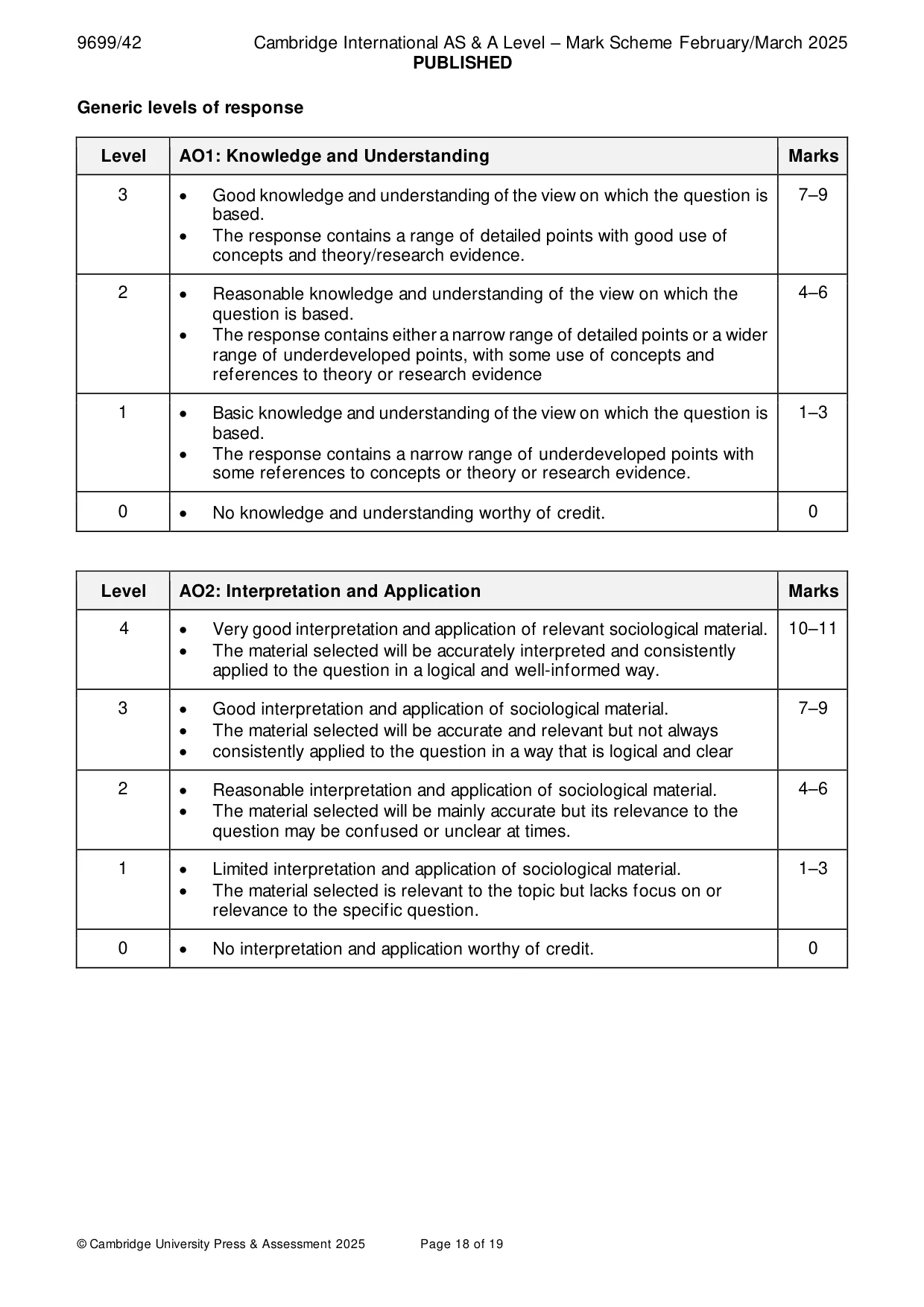
9699/42 Cambridge International AS & A Level – Mark Scheme PUBLISHED February/March 2025 © Cambridge University Press & Assessment 2025 Page 18 of 19 Generic levels of response Level AO1: Knowledge and Understanding Marks 3 • Good knowledge and understanding of the view on which the question is based. • The response contains a range of detailed points with good use of concepts and theory/research evidence. 7–9 2 • Reasonable knowledge and understanding of the view on which the question is based. • The response contains either a narrow range of detailed points or a wider range of underdeveloped points, with some use of concepts and references to theory or research evidence 4–6 1 • Basic knowledge and understanding of the view on which the question is based. • The response contains a narrow range of underdeveloped points with some references to concepts or theory or research evidence. 1–3 0 • No knowledge and understanding worthy of credit. 0 Level AO2: Interpretation and Application Marks 4 • Very good interpretation and application of relevant sociological material. • The material selected will be accurately interpreted and consistently applied to the question in a logical and well-informed way. 10–11 3 • Good interpretation and application of sociological material. • The material selected will be accurate and relevant but not always • consistently applied to the question in a way that is logical and clear 7–9 2 • Reasonable interpretation and application of sociological material. • The material selected will be mainly accurate but its relevance to the question may be confused or unclear at times. 4–6 1 • Limited interpretation and application of sociological material. • The material selected is relevant to the topic but lacks focus on or relevance to the specific question. 1–3 0 • No interpretation and application worthy of credit. 0
Mark scheme, page 19
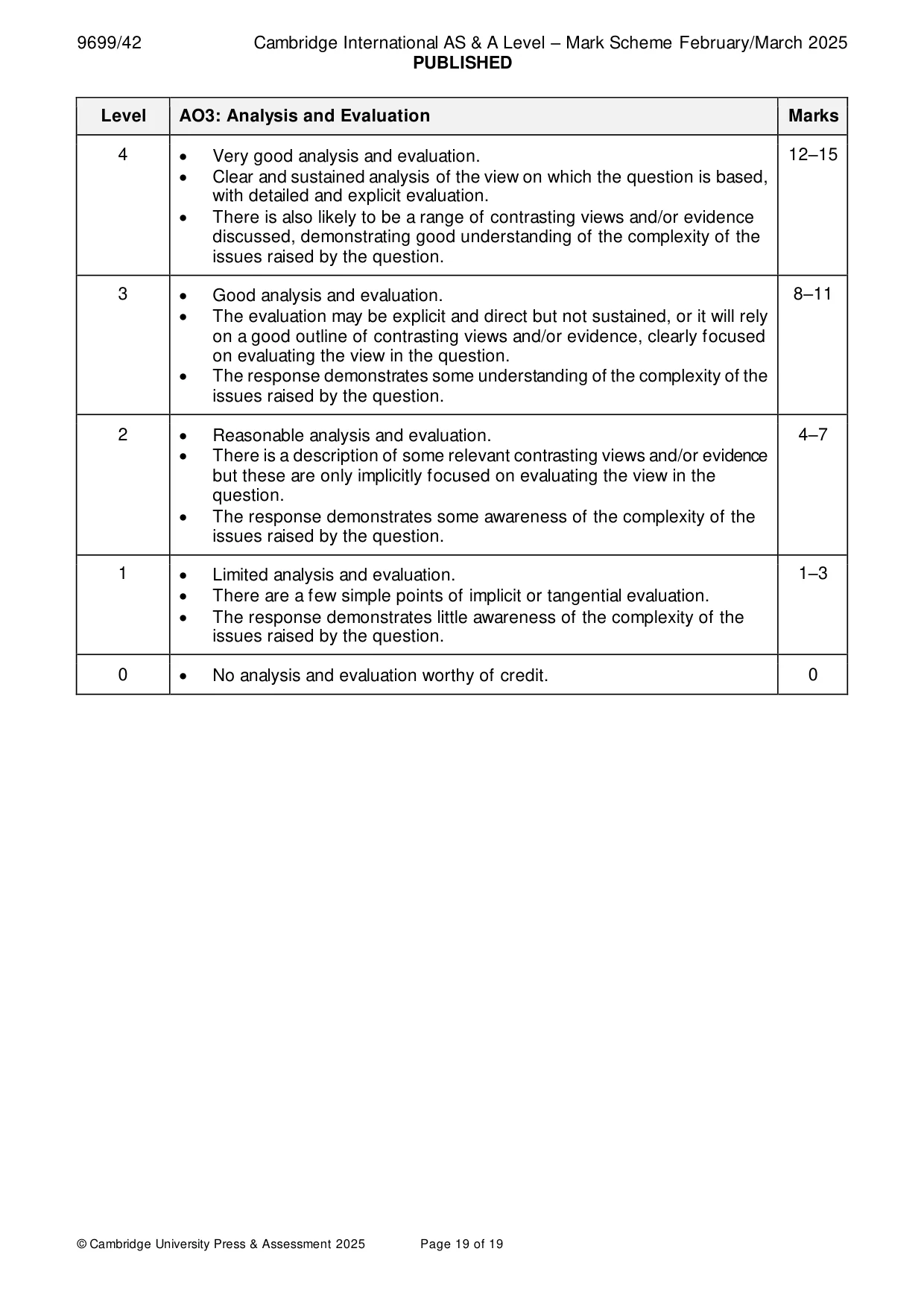
9699/42 Cambridge International AS & A Level – Mark Scheme PUBLISHED February/March 2025 © Cambridge University Press & Assessment 2025 Page 19 of 19 Level AO3: Analysis and Evaluation Marks 4 • Very good analysis and evaluation. • Clear and sustained analysis of the view on which the question is based, with detailed and explicit evaluation. • There is also likely to be a range of contrasting views and/or evidence discussed, demonstrating good understanding of the complexity of the issues raised by the question. 12–15 3 • Good analysis and evaluation. • The evaluation may be explicit and direct but not sustained, or it will rely on a good outline of contrasting views and/or evidence, clearly focused on evaluating the view in the question. • The response demonstrates some understanding of the complexity of the issues raised by the question. 8–11 2 • Reasonable analysis and evaluation. • There is a description of some relevant contrasting views and/or evidence but these are only implicitly focused on evaluating the view in the question. • The response demonstrates some awareness of the complexity of the issues raised by the question. 4–7 1 • Limited analysis and evaluation. • There are a few simple points of implicit or tangential evaluation. • The response demonstrates little awareness of the complexity of the issues raised by the question. 1–3 0 • No analysis and evaluation worthy of credit. 0
What you needed in this session
Cambridge’s own grade thresholds for 2025 Feb/March, Paper 4 · Variant 2. A higher threshold means an easier paper — the bar moves with how the cohort did.