Cambridge A Level Sociology 9699 — 2020 May/June Paper 3 · Variant 2
9699/32/M/J/20
The question paper and its mark scheme, free to read here and free to download. This is Cambridge’s own paper, exactly as it was sat.
Question paper4 pages

Mark scheme16 pages
Answers below. Sit the paper first if you are practising.
Paper as text
Question paper, page 1
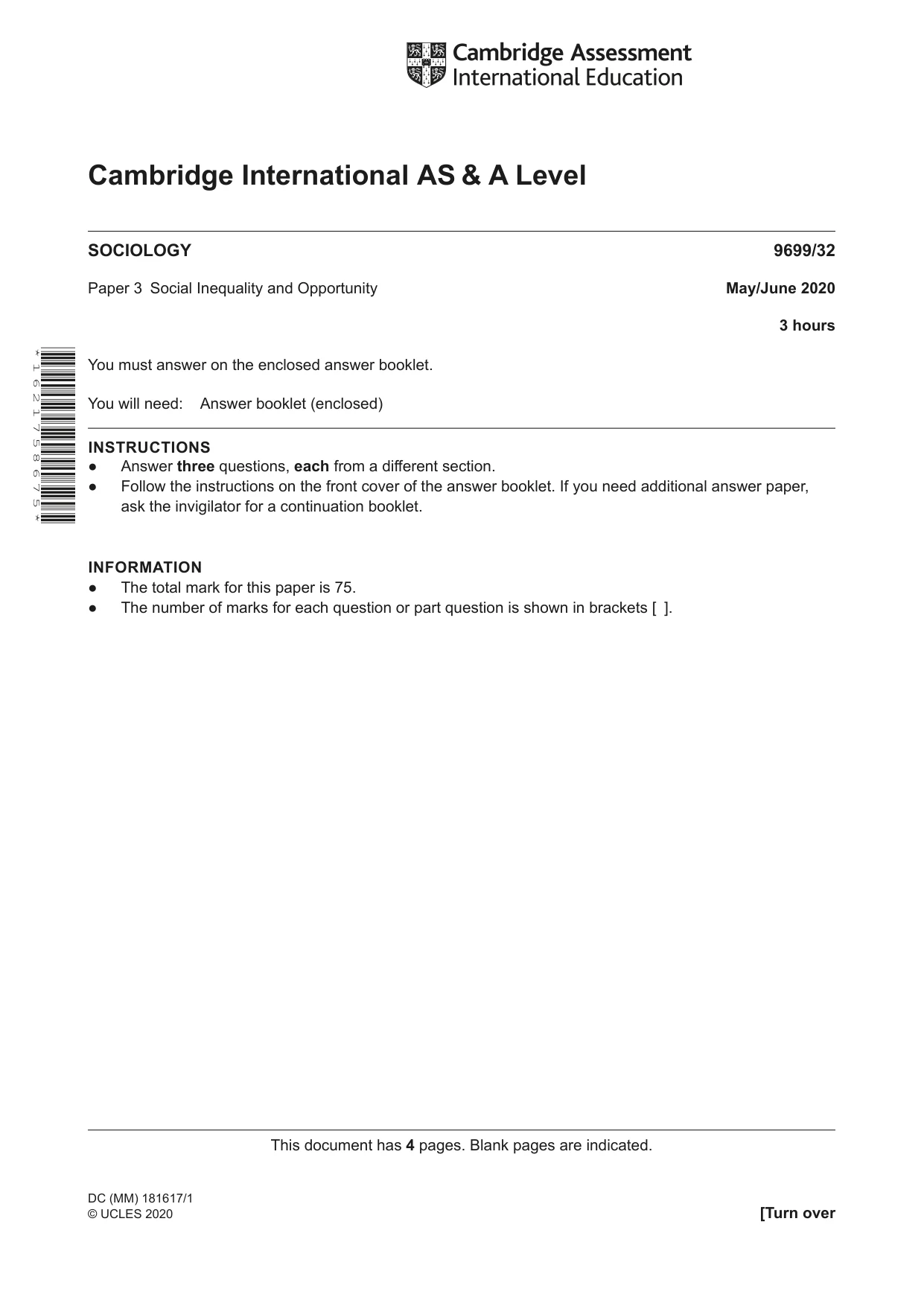
Cambridge International AS & A Level This document has 4 pages. Blank pages are indicated. SOCIOLOGY 9699/32 Paper 3 Social Inequality and Opportunity May/June 2020 3 hours You must answer on the enclosed answer booklet. You will need: Answer booklet (enclosed) INSTRUCTIONS ● Answer three questions, each from a different section. ● Follow the instructions on the front cover of the answer booklet. If you need additional answer paper, ask the invigilator for a continuation booklet. INFORMATION ● The total mark for this paper is 75. ● The number of marks for each question or part question is shown in brackets [ ]. DC (MM) 181617/1 © UCLES 2020 [Turn over * 1 6 2 1 7 5 8 6 7 5 *
Question paper, page 2
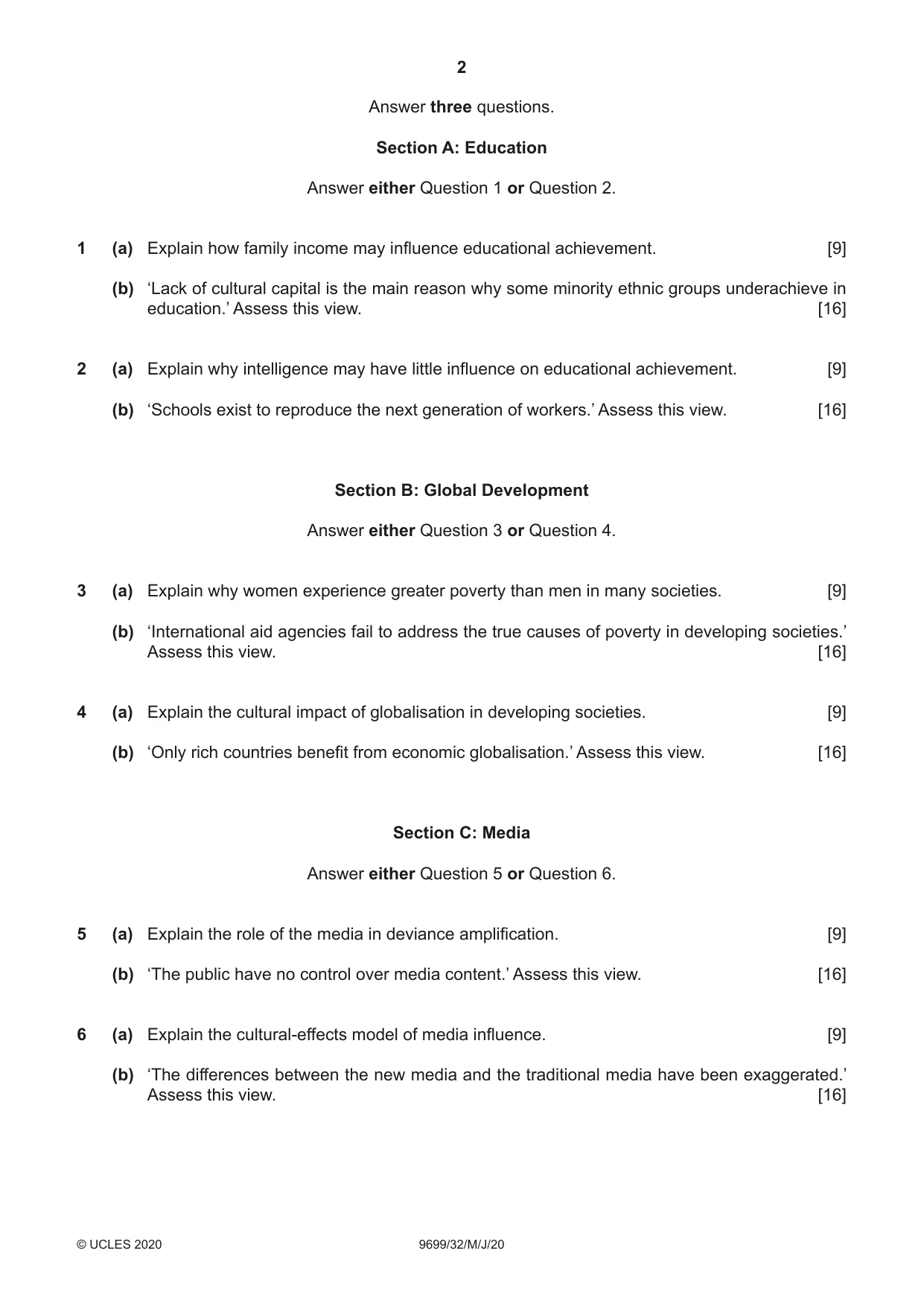
2 9699/32/M/J/20 © UCLES 2020 Answer three questions. Section A: Education Answer either Question 1 or Question 2. 1 (a) Explain how family income may influence educational achievement. [9] (b) ‘Lack of cultural capital is the main reason why some minority ethnic groups underachieve in education.’ Assess this view. [16] 2 (a) Explain why intelligence may have little influence on educational achievement. [9] (b) ‘Schools exist to reproduce the next generation of workers.’ Assess this view. [16] Section B: Global Development Answer either Question 3 or Question 4. 3 (a) Explain why women experience greater poverty than men in many societies. [9] (b) ‘International aid agencies fail to address the true causes of poverty in developing societies.’ Assess this view. [16] 4 (a) Explain the cultural impact of globalisation in developing societies. [9] (b) ‘Only rich countries benefit from economic globalisation.’ Assess this view. [16] Section C: Media Answer either Question 5 or Question 6. 5 (a) Explain the role of the media in deviance amplification. [9] (b) ‘The public have no control over media content.’ Assess this view. [16] 6 (a) Explain the cultural-effects model of media influence. [9] (b) ‘The differences between the new media and the traditional media have been exaggerated.’ Assess this view. [16]
Question paper, page 3
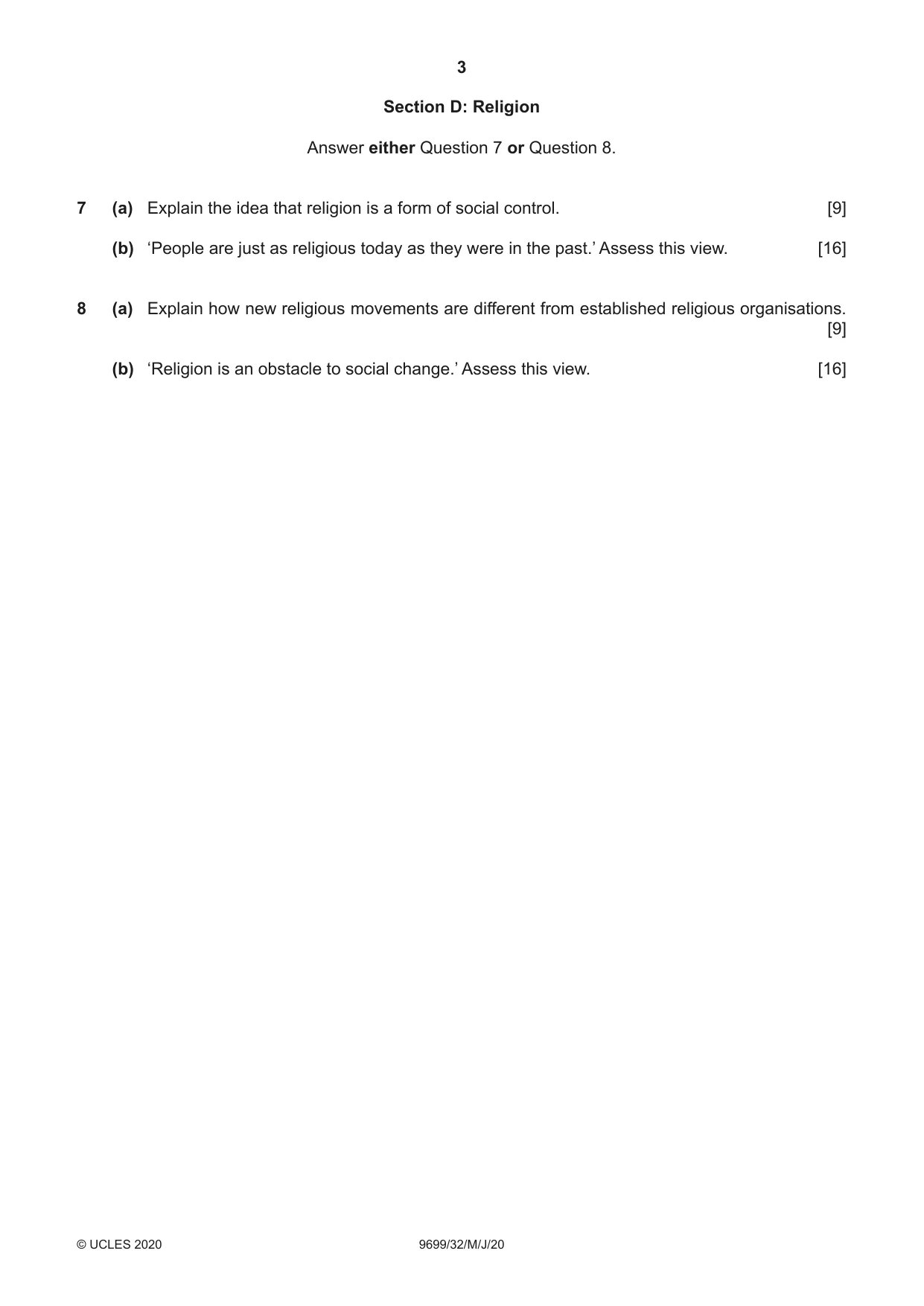
3 9699/32/M/J/20 © UCLES 2020 Section D: Religion Answer either Question 7 or Question 8. 7 (a) Explain the idea that religion is a form of social control. [9] (b) ‘People are just as religious today as they were in the past.’ Assess this view. [16] 8 (a) Explain how new religious movements are different from established religious organisations. [9] (b) ‘Religion is an obstacle to social change.’ Assess this view. [16]
Question paper, page 4
4 9699/32/M/J/20 © UCLES 2020 Permission to reproduce items where third-party owned material protected by copyright is included has been sought and cleared where possible. Every reasonable effort has been made by the publisher (UCLES) to trace copyright holders, but if any items requiring clearance have unwittingly been included, the publisher will be pleased to make amends at the earliest possible opportunity. To avoid the issue of disclosure of answer-related information to candidates, all copyright acknowledgements are reproduced online in the Cambridge Assessment International Education Copyright Acknowledgements Booklet. This is produced for each series of examinations and is freely available to download at www.cambridgeinternational.org after the live examination series. Cambridge Assessment International Education is part of the Cambridge Assessment Group. Cambridge Assessment is the brand name of the University of Cambridge Local Examinations Syndicate (UCLES), which itself is a department of the University of Cambridge. BLANK PAGE
Mark scheme, page 1
This document consists of 16 printed pages. © UCLES 2020 [Turn over Cambridge International AS & A Level SOCIOLOGY 9699/32 Paper 3 Social Inequality and Opportunity May/June 2020 MARK SCHEME Maximum Mark: 75 Published Students did not sit exam papers in the June 2020 series due to the Covid-19 global pandemic. This mark scheme is published to support teachers and students and should be read together with the question paper. It shows the requirements of the exam. The answer column of the mark scheme shows the proposed basis on which Examiners would award marks for this exam. Where appropriate, this column also provides the most likely acceptable alternative responses expected from students. Examiners usually review the mark scheme after they have seen student responses and update the mark scheme if appropriate. In the June series, Examiners were unable to consider the acceptability of alternative responses, as there were no student responses to consider. Mark schemes should usually be read together with the Principal Examiner Report for Teachers. However, because students did not sit exam papers, there is no Principal Examiner Report for Teachers for the June 2020 series. Cambridge International will not enter into discussions about these mark schemes. Cambridge International is publishing the mark schemes for the June 2020 series for most Cambridge IGCSE™ and Cambridge International A & AS Level components, and some Cambridge O Level components.
Mark scheme, page 2
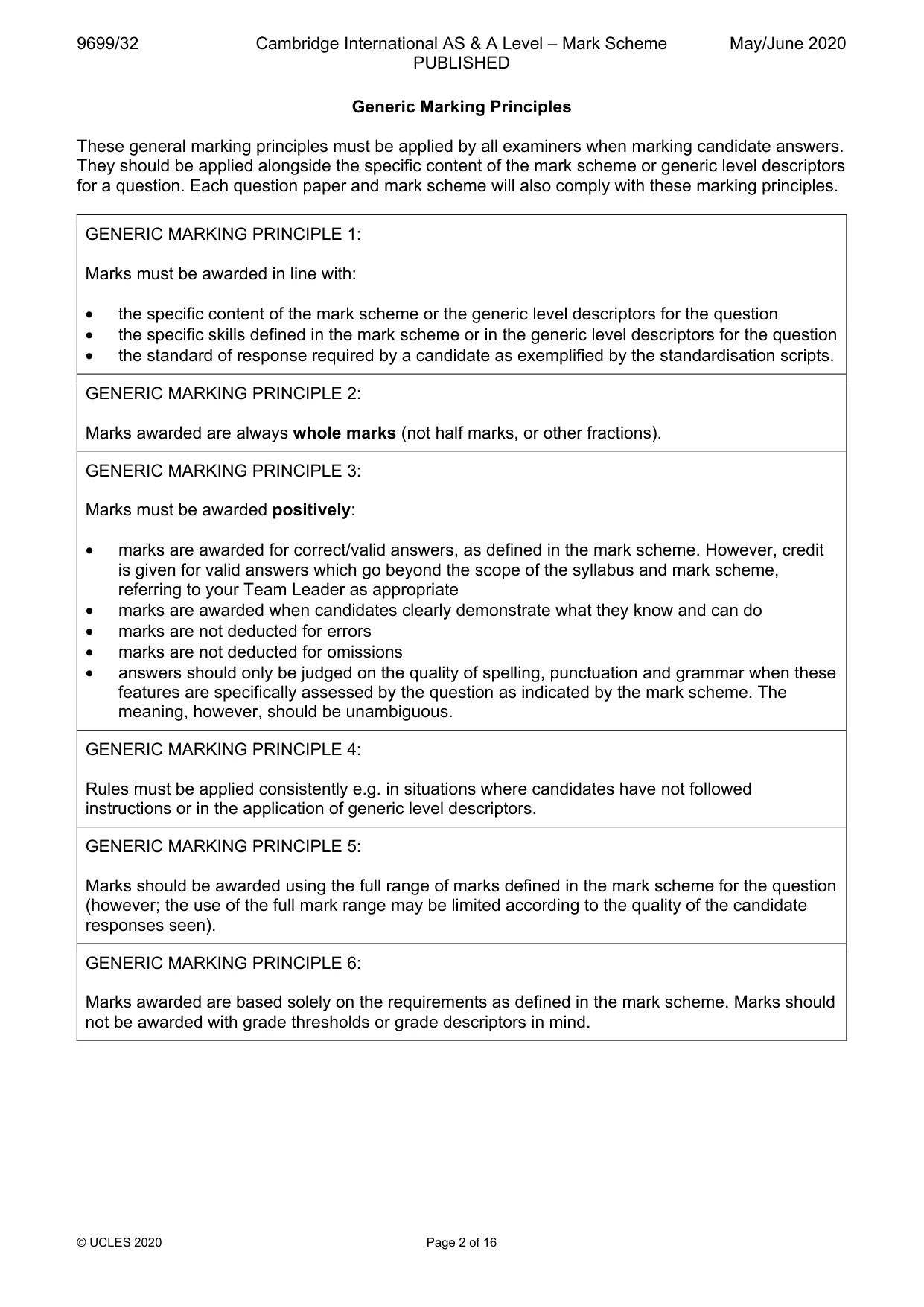
9699/32 Cambridge International AS & A Level – Mark Scheme PUBLISHED May/June 2020 © UCLES 2020 Page 2 of 16 Generic Marking Principles These general marking principles must be applied by all examiners when marking candidate answers. They should be applied alongside the specific content of the mark scheme or generic level descriptors for a question. Each question paper and mark scheme will also comply with these marking principles. GENERIC MARKING PRINCIPLE 1: Marks must be awarded in line with: • the specific content of the mark scheme or the generic level descriptors for the question • the specific skills defined in the mark scheme or in the generic level descriptors for the question • the standard of response required by a candidate as exemplified by the standardisation scripts. GENERIC MARKING PRINCIPLE 2: Marks awarded are always whole marks (not half marks, or other fractions). GENERIC MARKING PRINCIPLE 3: Marks must be awarded positively: • marks are awarded for correct/valid answers, as defined in the mark scheme. However, credit is given for valid answers which go beyond the scope of the syllabus and mark scheme, referring to your Team Leader as appropriate • marks are awarded when candidates clearly demonstrate what they know and can do • marks are not deducted for errors • marks are not deducted for omissions • answers should only be judged on the quality of spelling, punctuation and grammar when these features are specifically assessed by the question as indicated by the mark scheme. The meaning, however, should be unambiguous. GENERIC MARKING PRINCIPLE 4: Rules must be applied consistently e.g. in situations where candidates have not followed instructions or in the application of generic level descriptors. GENERIC MARKING PRINCIPLE 5: Marks should be awarded using the full range of marks defined in the mark scheme for the question (however; the use of the full mark range may be limited according to the quality of the candidate responses seen). GENERIC MARKING PRINCIPLE 6: Marks awarded are based solely on the requirements as defined in the mark scheme. Marks should not be awarded with grade thresholds or grade descriptors in mind.
Mark scheme, page 3
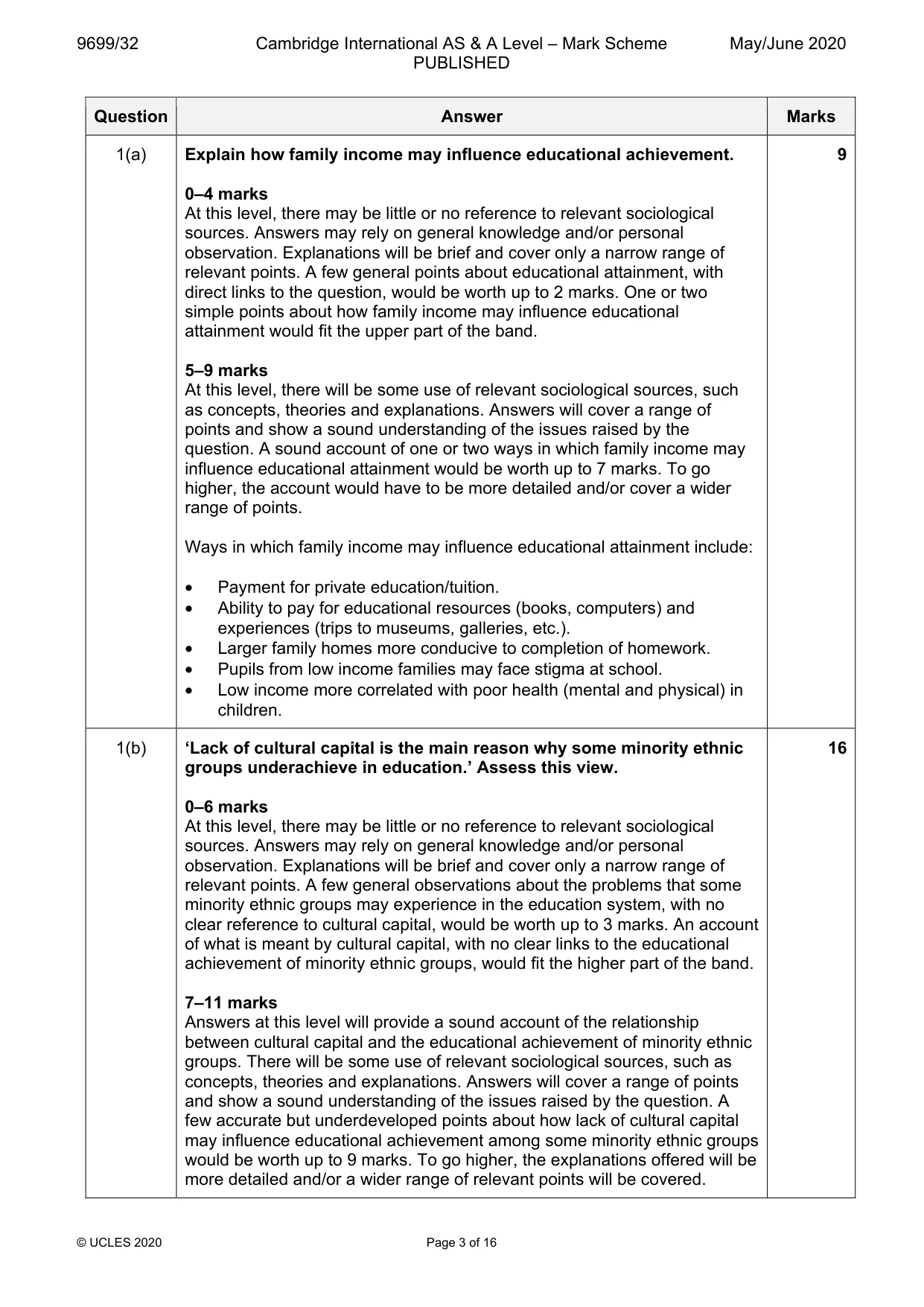
9699/32 Cambridge International AS & A Level – Mark Scheme PUBLISHED May/June 2020 © UCLES 2020 Page 3 of 16 Question Answer Marks 1(a) Explain how family income may influence educational achievement. 0–4 marks At this level, there may be little or no reference to relevant sociological sources. Answers may rely on general knowledge and/or personal observation. Explanations will be brief and cover only a narrow range of relevant points. A few general points about educational attainment, with direct links to the question, would be worth up to 2 marks. One or two simple points about how family income may influence educational attainment would fit the upper part of the band. 5–9 marks At this level, there will be some use of relevant sociological sources, such as concepts, theories and explanations. Answers will cover a range of points and show a sound understanding of the issues raised by the question. A sound account of one or two ways in which family income may influence educational attainment would be worth up to 7 marks. To go higher, the account would have to be more detailed and/or cover a wider range of points. Ways in which family income may influence educational attainment include: • Payment for private education/tuition. • Ability to pay for educational resources (books, computers) and experiences (trips to museums, galleries, etc.). • Larger family homes more conducive to completion of homework. • Pupils from low income families may face stigma at school. • Low income more correlated with poor health (mental and physical) in children. 9 1(b) ‘Lack of cultural capital is the main reason why some minority ethnic groups underachieve in education.’ Assess this view. 0–6 marks At this level, there may be little or no reference to relevant sociological sources. Answers may rely on general knowledge and/or personal observation. Explanations will be brief and cover only a narrow range of relevant points. A few general observations about the problems that some minority ethnic groups may experience in the education system, with no clear reference to cultural capital, would be worth up to 3 marks. An account of what is meant by cultural capital, with no clear links to the educational achievement of minority ethnic groups, would fit the higher part of the band. 7–11 marks Answers at this level will provide a sound account of the relationship between cultural capital and the educational achievement of minority ethnic groups. There will be some use of relevant sociological sources, such as concepts, theories and explanations. Answers will cover a range of points and show a sound understanding of the issues raised by the question. A few accurate but underdeveloped points about how lack of cultural capital may influence educational achievement among some minority ethnic groups would be worth up to 9 marks. To go higher, the explanations offered will be more detailed and/or a wider range of relevant points will be covered. 16
Mark scheme, page 4
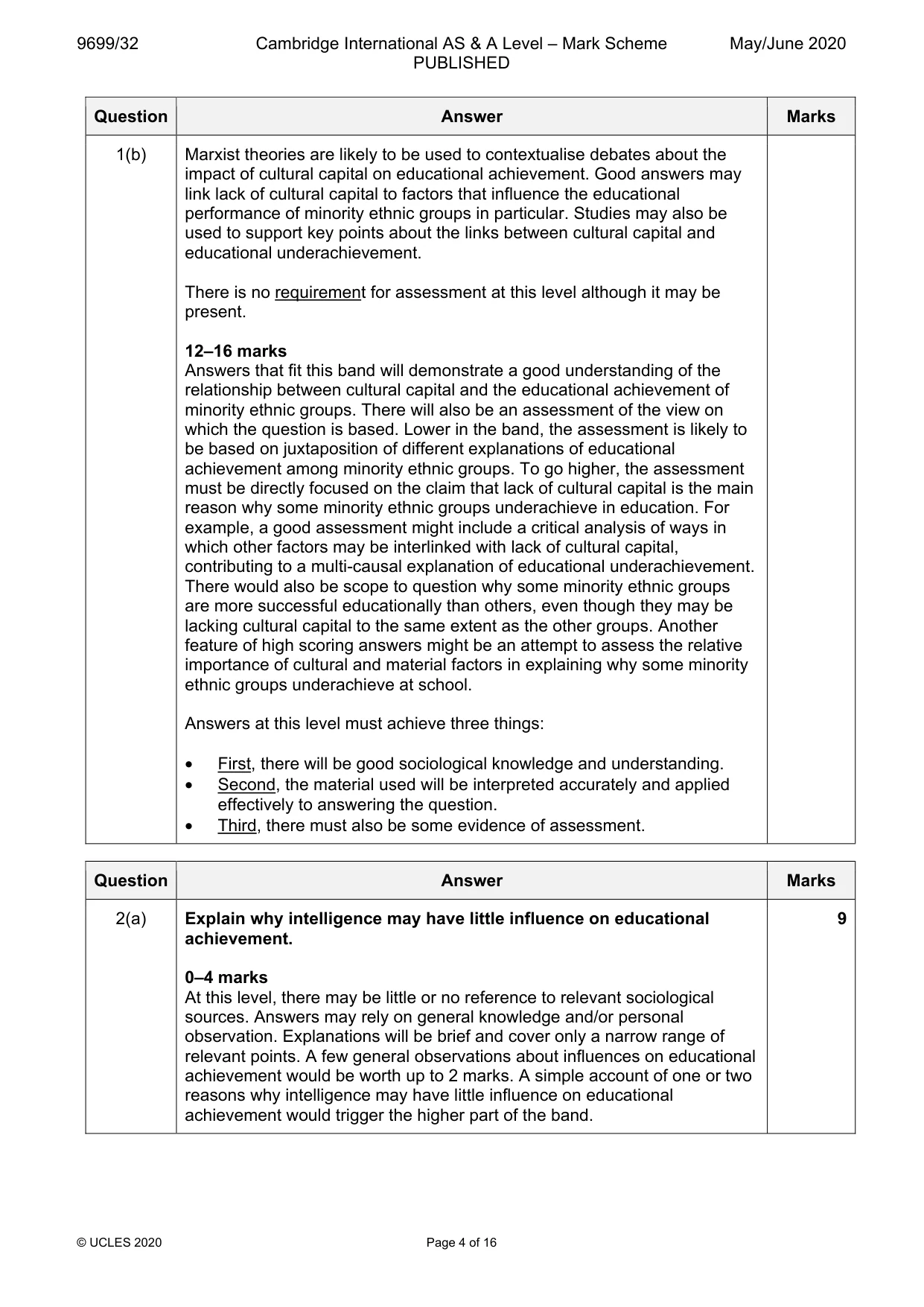
9699/32 Cambridge International AS & A Level – Mark Scheme PUBLISHED May/June 2020 © UCLES 2020 Page 4 of 16 Question Answer Marks 1(b) Marxist theories are likely to be used to contextualise debates about the impact of cultural capital on educational achievement. Good answers may link lack of cultural capital to factors that influence the educational performance of minority ethnic groups in particular. Studies may also be used to support key points about the links between cultural capital and educational underachievement. There is no requirement for assessment at this level although it may be present. 12–16 marks Answers that fit this band will demonstrate a good understanding of the relationship between cultural capital and the educational achievement of minority ethnic groups. There will also be an assessment of the view on which the question is based. Lower in the band, the assessment is likely to be based on juxtaposition of different explanations of educational achievement among minority ethnic groups. To go higher, the assessment must be directly focused on the claim that lack of cultural capital is the main reason why some minority ethnic groups underachieve in education. For example, a good assessment might include a critical analysis of ways in which other factors may be interlinked with lack of cultural capital, contributing to a multi-causal explanation of educational underachievement. There would also be scope to question why some minority ethnic groups are more successful educationally than others, even though they may be lacking cultural capital to the same extent as the other groups. Another feature of high scoring answers might be an attempt to assess the relative importance of cultural and material factors in explaining why some minority ethnic groups underachieve at school. Answers at this level must achieve three things: • First, there will be good sociological knowledge and understanding. • Second, the material used will be interpreted accurately and applied effectively to answering the question. • Third, there must also be some evidence of assessment. Question Answer Marks 2(a) Explain why intelligence may have little influence on educational achievement. 0–4 marks At this level, there may be little or no reference to relevant sociological sources. Answers may rely on general knowledge and/or personal observation. Explanations will be brief and cover only a narrow range of relevant points. A few general observations about influences on educational achievement would be worth up to 2 marks. A simple account of one or two reasons why intelligence may have little influence on educational achievement would trigger the higher part of the band. 9
Mark scheme, page 5
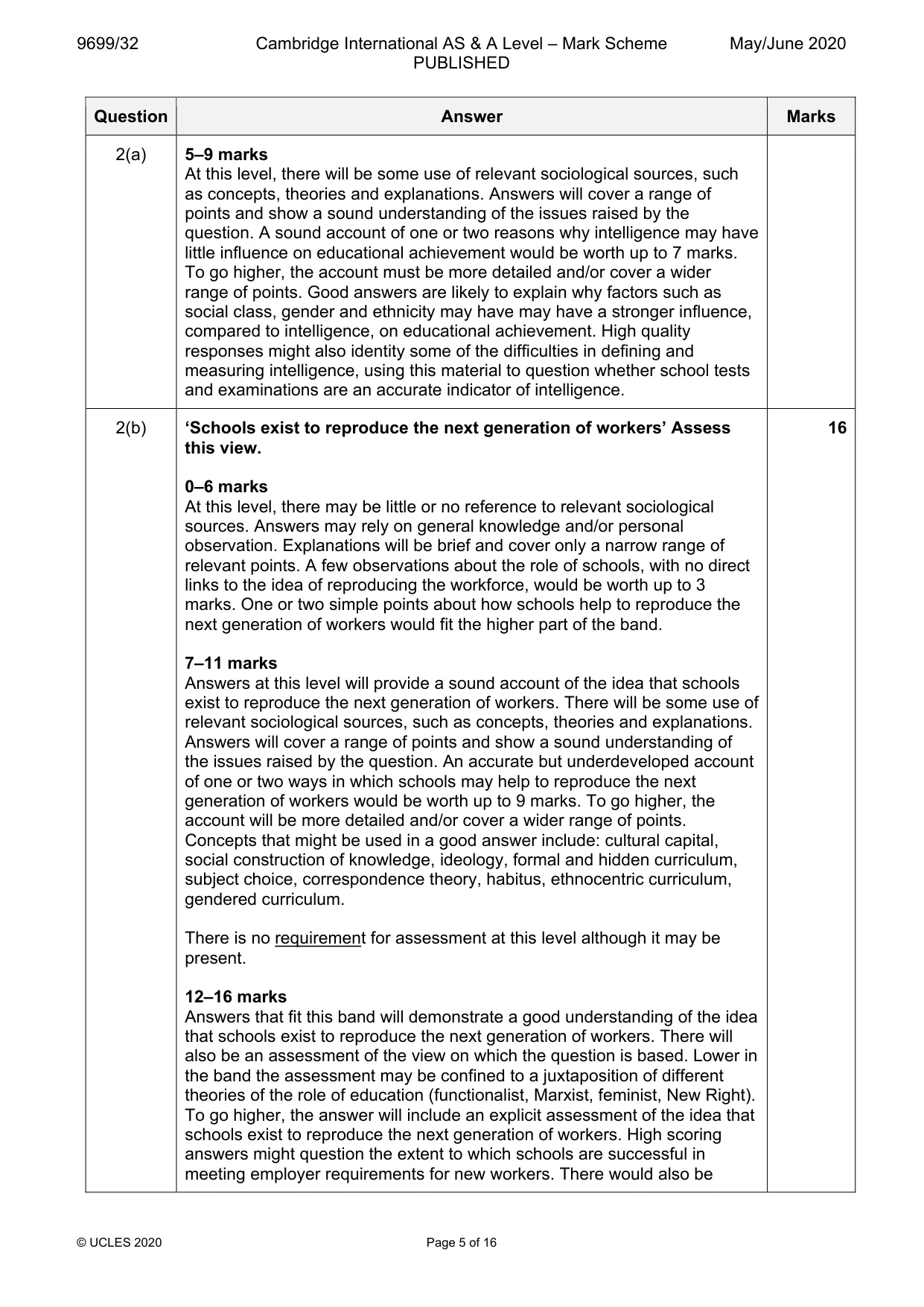
9699/32 Cambridge International AS & A Level – Mark Scheme PUBLISHED May/June 2020 © UCLES 2020 Page 5 of 16 Question Answer Marks 2(a) 5–9 marks At this level, there will be some use of relevant sociological sources, such as concepts, theories and explanations. Answers will cover a range of points and show a sound understanding of the issues raised by the question. A sound account of one or two reasons why intelligence may have little influence on educational achievement would be worth up to 7 marks. To go higher, the account must be more detailed and/or cover a wider range of points. Good answers are likely to explain why factors such as social class, gender and ethnicity may have may have a stronger influence, compared to intelligence, on educational achievement. High quality responses might also identity some of the difficulties in defining and measuring intelligence, using this material to question whether school tests and examinations are an accurate indicator of intelligence. 2(b) ‘Schools exist to reproduce the next generation of workers’ Assess this view. 0–6 marks At this level, there may be little or no reference to relevant sociological sources. Answers may rely on general knowledge and/or personal observation. Explanations will be brief and cover only a narrow range of relevant points. A few observations about the role of schools, with no direct links to the idea of reproducing the workforce, would be worth up to 3 marks. One or two simple points about how schools help to reproduce the next generation of workers would fit the higher part of the band. 7–11 marks Answers at this level will provide a sound account of the idea that schools exist to reproduce the next generation of workers. There will be some use of relevant sociological sources, such as concepts, theories and explanations. Answers will cover a range of points and show a sound understanding of the issues raised by the question. An accurate but underdeveloped account of one or two ways in which schools may help to reproduce the next generation of workers would be worth up to 9 marks. To go higher, the account will be more detailed and/or cover a wider range of points. Concepts that might be used in a good answer include: cultural capital, social construction of knowledge, ideology, formal and hidden curriculum, subject choice, correspondence theory, habitus, ethnocentric curriculum, gendered curriculum. There is no requirement for assessment at this level although it may be present. 12–16 marks Answers that fit this band will demonstrate a good understanding of the idea that schools exist to reproduce the next generation of workers. There will also be an assessment of the view on which the question is based. Lower in the band the assessment may be confined to a juxtaposition of different theories of the role of education (functionalist, Marxist, feminist, New Right). To go higher, the answer will include an explicit assessment of the idea that schools exist to reproduce the next generation of workers. High scoring answers might question the extent to which schools are successful in meeting employer requirements for new workers. There would also be 16
Mark scheme, page 6
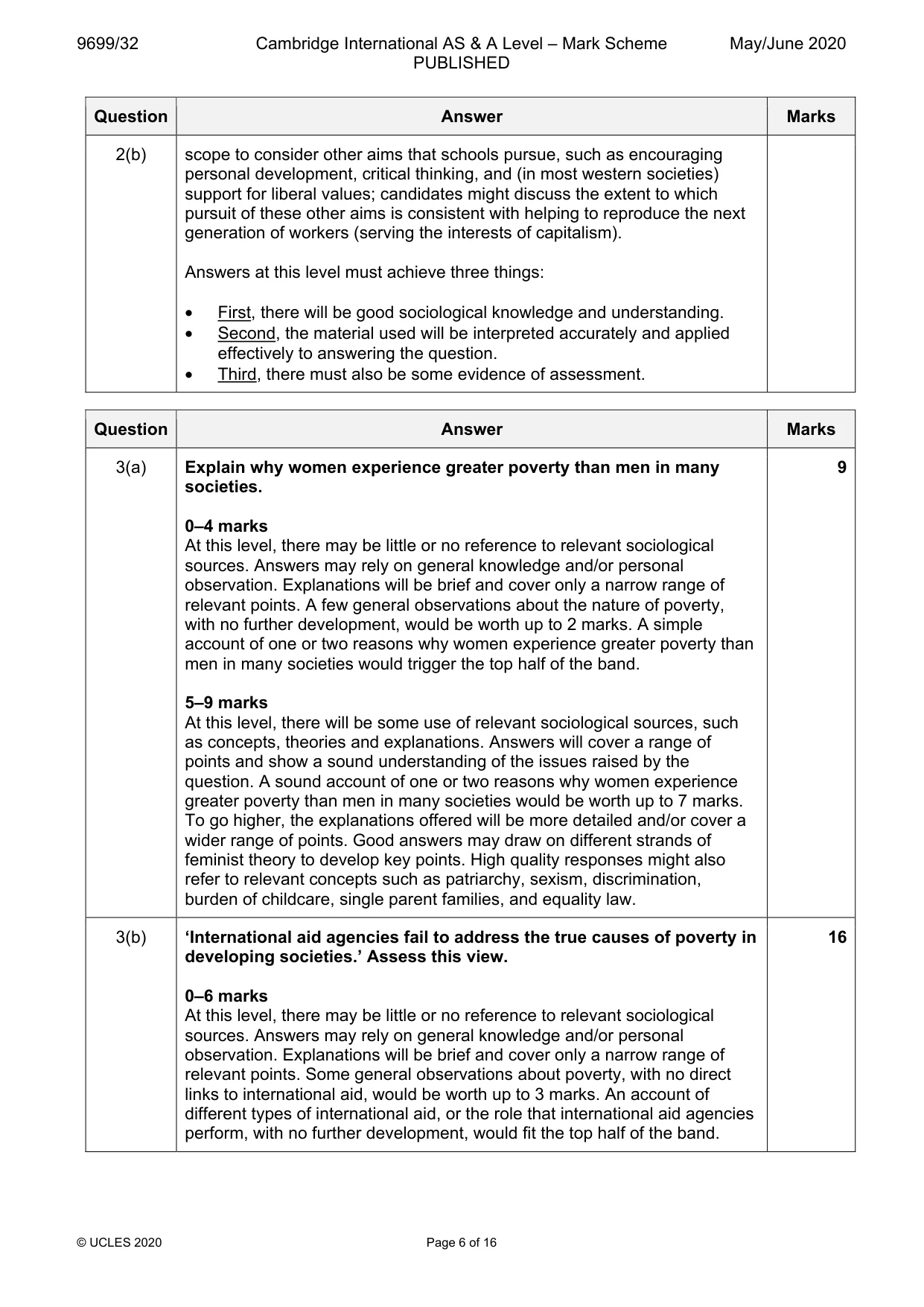
9699/32 Cambridge International AS & A Level – Mark Scheme PUBLISHED May/June 2020 © UCLES 2020 Page 6 of 16 Question Answer Marks 2(b) scope to consider other aims that schools pursue, such as encouraging personal development, critical thinking, and (in most western societies) support for liberal values; candidates might discuss the extent to which pursuit of these other aims is consistent with helping to reproduce the next generation of workers (serving the interests of capitalism). Answers at this level must achieve three things: • First, there will be good sociological knowledge and understanding. • Second, the material used will be interpreted accurately and applied effectively to answering the question. • Third, there must also be some evidence of assessment. Question Answer Marks 3(a) Explain why women experience greater poverty than men in many societies. 0–4 marks At this level, there may be little or no reference to relevant sociological sources. Answers may rely on general knowledge and/or personal observation. Explanations will be brief and cover only a narrow range of relevant points. A few general observations about the nature of poverty, with no further development, would be worth up to 2 marks. A simple account of one or two reasons why women experience greater poverty than men in many societies would trigger the top half of the band. 5–9 marks At this level, there will be some use of relevant sociological sources, such as concepts, theories and explanations. Answers will cover a range of points and show a sound understanding of the issues raised by the question. A sound account of one or two reasons why women experience greater poverty than men in many societies would be worth up to 7 marks. To go higher, the explanations offered will be more detailed and/or cover a wider range of points. Good answers may draw on different strands of feminist theory to develop key points. High quality responses might also refer to relevant concepts such as patriarchy, sexism, discrimination, burden of childcare, single parent families, and equality law. 9 3(b) ‘International aid agencies fail to address the true causes of poverty in developing societies.’ Assess this view. 0–6 marks At this level, there may be little or no reference to relevant sociological sources. Answers may rely on general knowledge and/or personal observation. Explanations will be brief and cover only a narrow range of relevant points. Some general observations about poverty, with no direct links to international aid, would be worth up to 3 marks. An account of different types of international aid, or the role that international aid agencies perform, with no further development, would fit the top half of the band. 16
Mark scheme, page 7
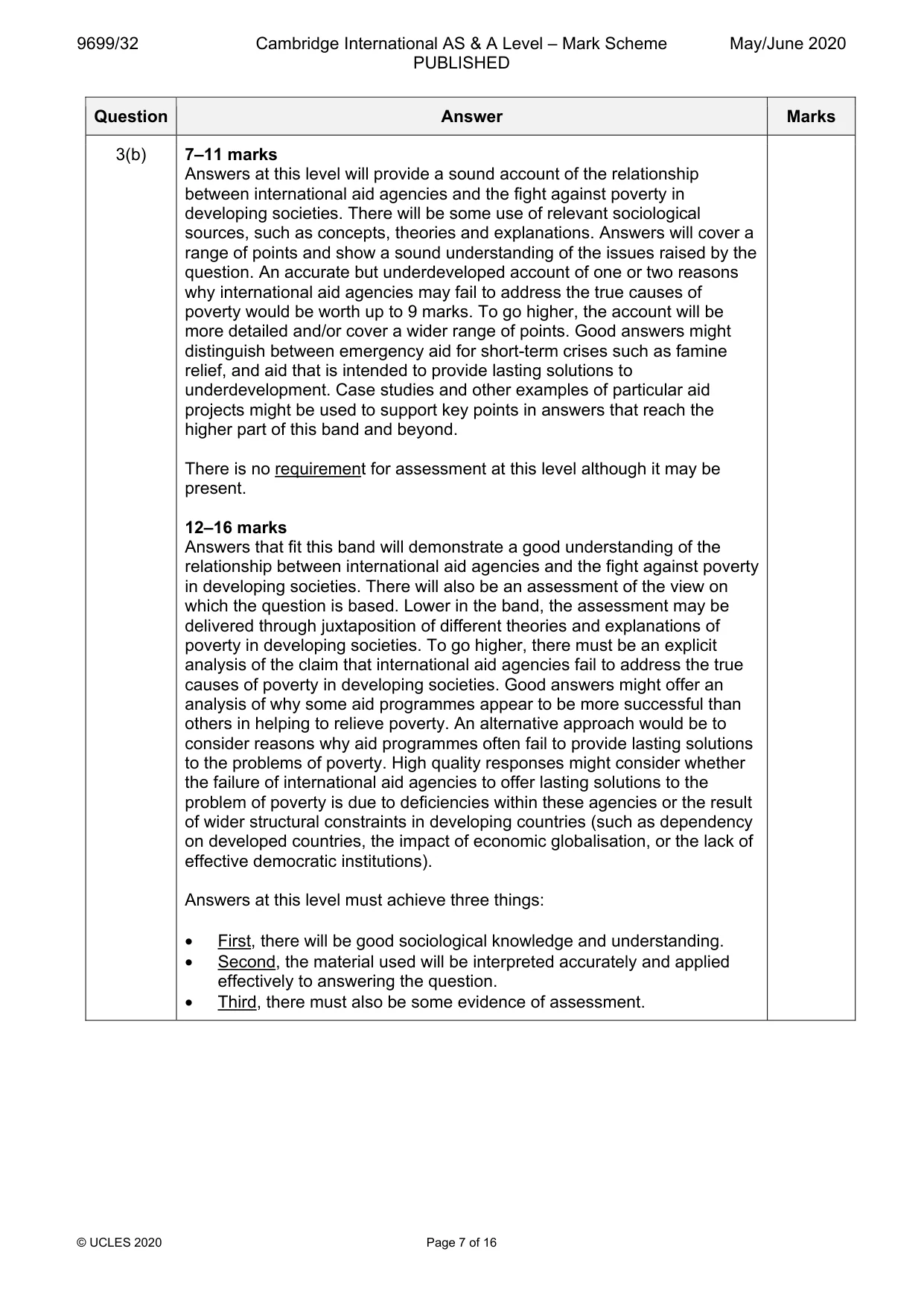
9699/32 Cambridge International AS & A Level – Mark Scheme PUBLISHED May/June 2020 © UCLES 2020 Page 7 of 16 Question Answer Marks 3(b) 7–11 marks Answers at this level will provide a sound account of the relationship between international aid agencies and the fight against poverty in developing societies. There will be some use of relevant sociological sources, such as concepts, theories and explanations. Answers will cover a range of points and show a sound understanding of the issues raised by the question. An accurate but underdeveloped account of one or two reasons why international aid agencies may fail to address the true causes of poverty would be worth up to 9 marks. To go higher, the account will be more detailed and/or cover a wider range of points. Good answers might distinguish between emergency aid for short-term crises such as famine relief, and aid that is intended to provide lasting solutions to underdevelopment. Case studies and other examples of particular aid projects might be used to support key points in answers that reach the higher part of this band and beyond. There is no requirement for assessment at this level although it may be present. 12–16 marks Answers that fit this band will demonstrate a good understanding of the relationship between international aid agencies and the fight against poverty in developing societies. There will also be an assessment of the view on which the question is based. Lower in the band, the assessment may be delivered through juxtaposition of different theories and explanations of poverty in developing societies. To go higher, there must be an explicit analysis of the claim that international aid agencies fail to address the true causes of poverty in developing societies. Good answers might offer an analysis of why some aid programmes appear to be more successful than others in helping to relieve poverty. An alternative approach would be to consider reasons why aid programmes often fail to provide lasting solutions to the problems of poverty. High quality responses might consider whether the failure of international aid agencies to offer lasting solutions to the problem of poverty is due to deficiencies within these agencies or the result of wider structural constraints in developing countries (such as dependency on developed countries, the impact of economic globalisation, or the lack of effective democratic institutions). Answers at this level must achieve three things: • First, there will be good sociological knowledge and understanding. • Second, the material used will be interpreted accurately and applied effectively to answering the question. • Third, there must also be some evidence of assessment.
Mark scheme, page 8
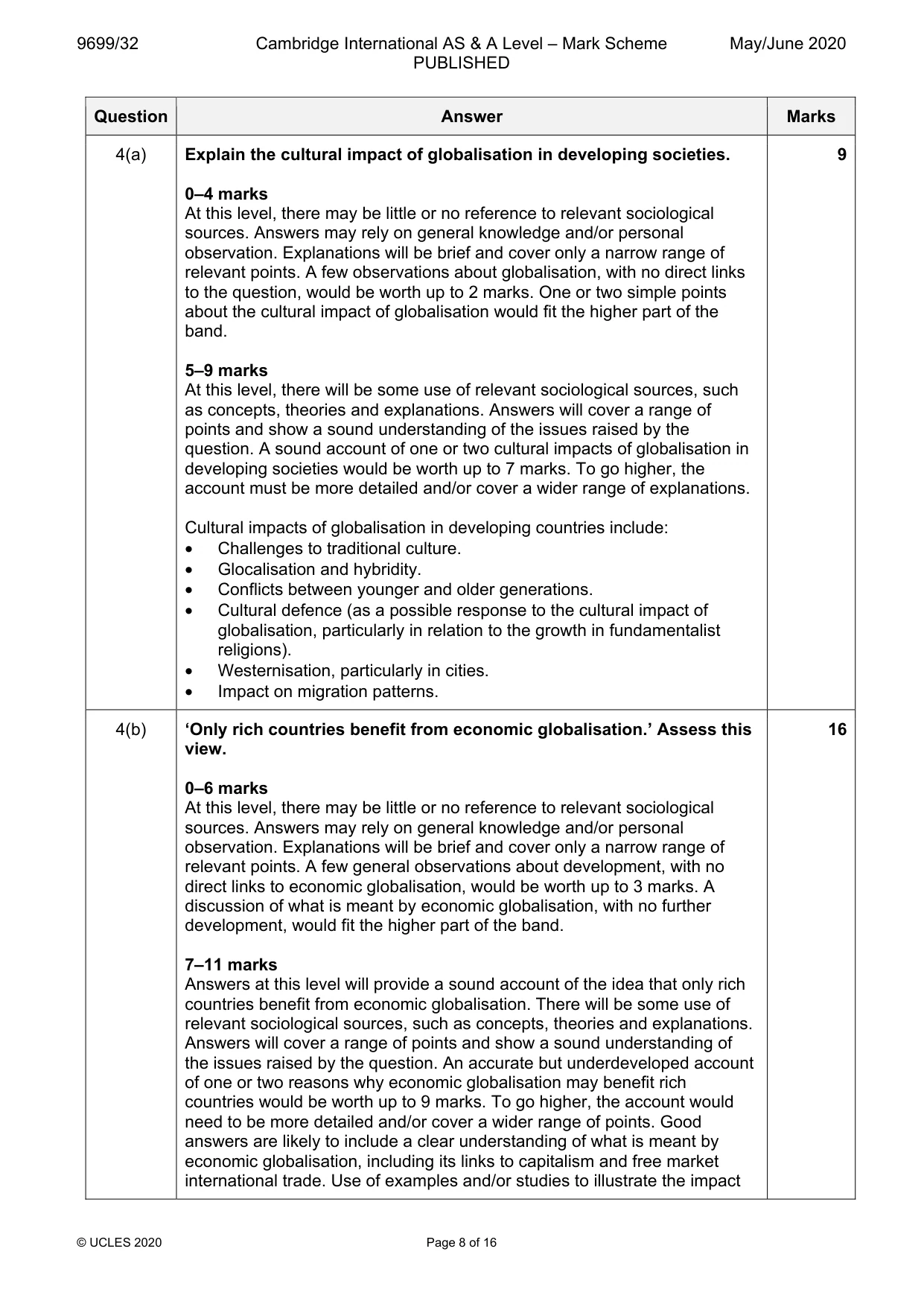
9699/32 Cambridge International AS & A Level – Mark Scheme PUBLISHED May/June 2020 © UCLES 2020 Page 8 of 16 Question Answer Marks 4(a) Explain the cultural impact of globalisation in developing societies. 0–4 marks At this level, there may be little or no reference to relevant sociological sources. Answers may rely on general knowledge and/or personal observation. Explanations will be brief and cover only a narrow range of relevant points. A few observations about globalisation, with no direct links to the question, would be worth up to 2 marks. One or two simple points about the cultural impact of globalisation would fit the higher part of the band. 5–9 marks At this level, there will be some use of relevant sociological sources, such as concepts, theories and explanations. Answers will cover a range of points and show a sound understanding of the issues raised by the question. A sound account of one or two cultural impacts of globalisation in developing societies would be worth up to 7 marks. To go higher, the account must be more detailed and/or cover a wider range of explanations. Cultural impacts of globalisation in developing countries include: • Challenges to traditional culture. • Glocalisation and hybridity. • Conflicts between younger and older generations. • Cultural defence (as a possible response to the cultural impact of globalisation, particularly in relation to the growth in fundamentalist religions). • Westernisation, particularly in cities. • Impact on migration patterns. 9 4(b) ‘Only rich countries benefit from economic globalisation.’ Assess this view. 0–6 marks At this level, there may be little or no reference to relevant sociological sources. Answers may rely on general knowledge and/or personal observation. Explanations will be brief and cover only a narrow range of relevant points. A few general observations about development, with no direct links to economic globalisation, would be worth up to 3 marks. A discussion of what is meant by economic globalisation, with no further development, would fit the higher part of the band. 7–11 marks Answers at this level will provide a sound account of the idea that only rich countries benefit from economic globalisation. There will be some use of relevant sociological sources, such as concepts, theories and explanations. Answers will cover a range of points and show a sound understanding of the issues raised by the question. An accurate but underdeveloped account of one or two reasons why economic globalisation may benefit rich countries would be worth up to 9 marks. To go higher, the account would need to be more detailed and/or cover a wider range of points. Good answers are likely to include a clear understanding of what is meant by economic globalisation, including its links to capitalism and free market international trade. Use of examples and/or studies to illustrate the impact 16
Mark scheme, page 9
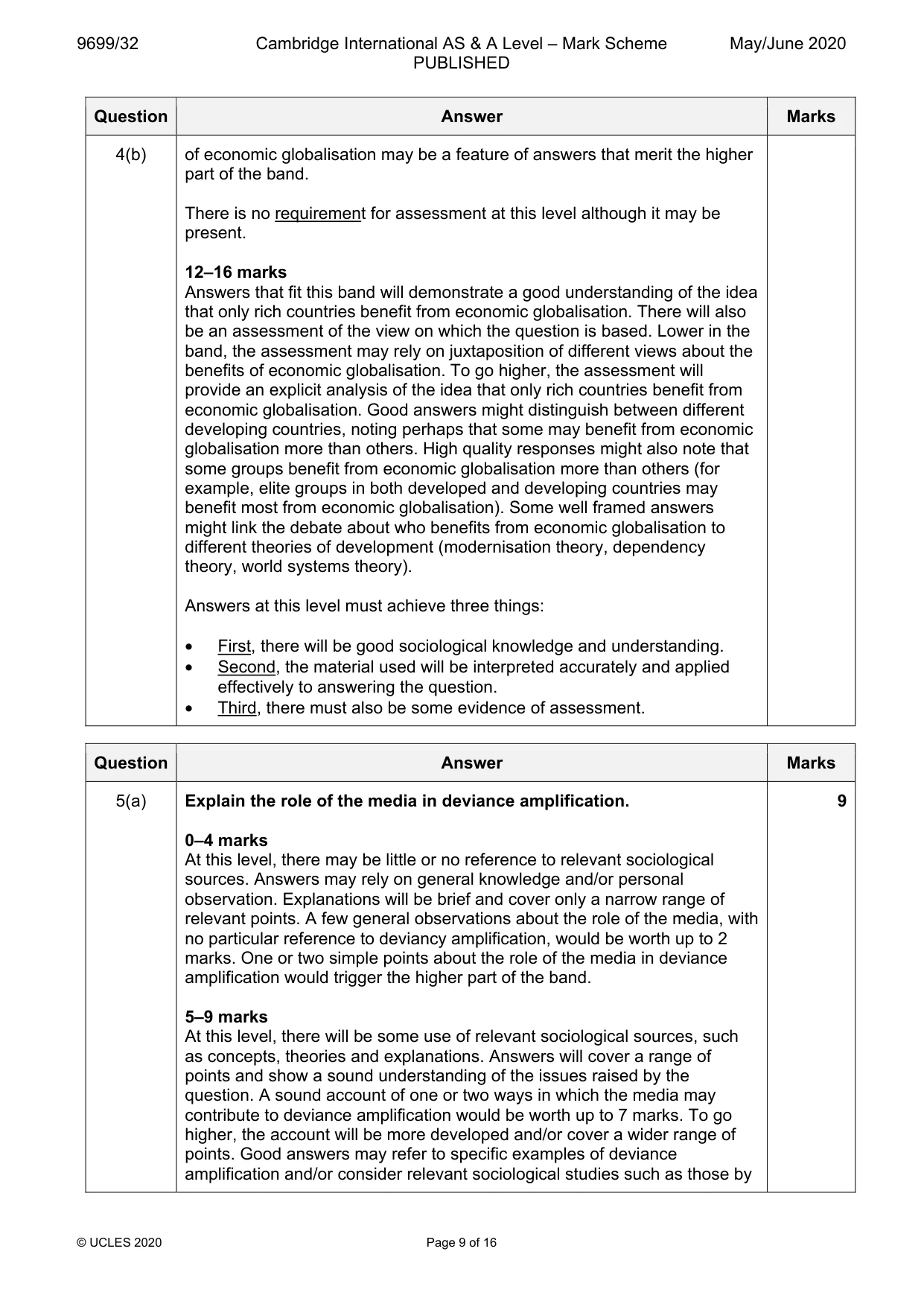
9699/32 Cambridge International AS & A Level – Mark Scheme PUBLISHED May/June 2020 © UCLES 2020 Page 9 of 16 Question Answer Marks 4(b) of economic globalisation may be a feature of answers that merit the higher part of the band. There is no requirement for assessment at this level although it may be present. 12–16 marks Answers that fit this band will demonstrate a good understanding of the idea that only rich countries benefit from economic globalisation. There will also be an assessment of the view on which the question is based. Lower in the band, the assessment may rely on juxtaposition of different views about the benefits of economic globalisation. To go higher, the assessment will provide an explicit analysis of the idea that only rich countries benefit from economic globalisation. Good answers might distinguish between different developing countries, noting perhaps that some may benefit from economic globalisation more than others. High quality responses might also note that some groups benefit from economic globalisation more than others (for example, elite groups in both developed and developing countries may benefit most from economic globalisation). Some well framed answers might link the debate about who benefits from economic globalisation to different theories of development (modernisation theory, dependency theory, world systems theory). Answers at this level must achieve three things: • First, there will be good sociological knowledge and understanding. • Second, the material used will be interpreted accurately and applied effectively to answering the question. • Third, there must also be some evidence of assessment. Question Answer Marks 5(a) Explain the role of the media in deviance amplification. 0–4 marks At this level, there may be little or no reference to relevant sociological sources. Answers may rely on general knowledge and/or personal observation. Explanations will be brief and cover only a narrow range of relevant points. A few general observations about the role of the media, with no particular reference to deviancy amplification, would be worth up to 2 marks. One or two simple points about the role of the media in deviance amplification would trigger the higher part of the band. 5–9 marks At this level, there will be some use of relevant sociological sources, such as concepts, theories and explanations. Answers will cover a range of points and show a sound understanding of the issues raised by the question. A sound account of one or two ways in which the media may contribute to deviance amplification would be worth up to 7 marks. To go higher, the account will be more developed and/or cover a wider range of points. Good answers may refer to specific examples of deviance amplification and/or consider relevant sociological studies such as those by 9
Mark scheme, page 10
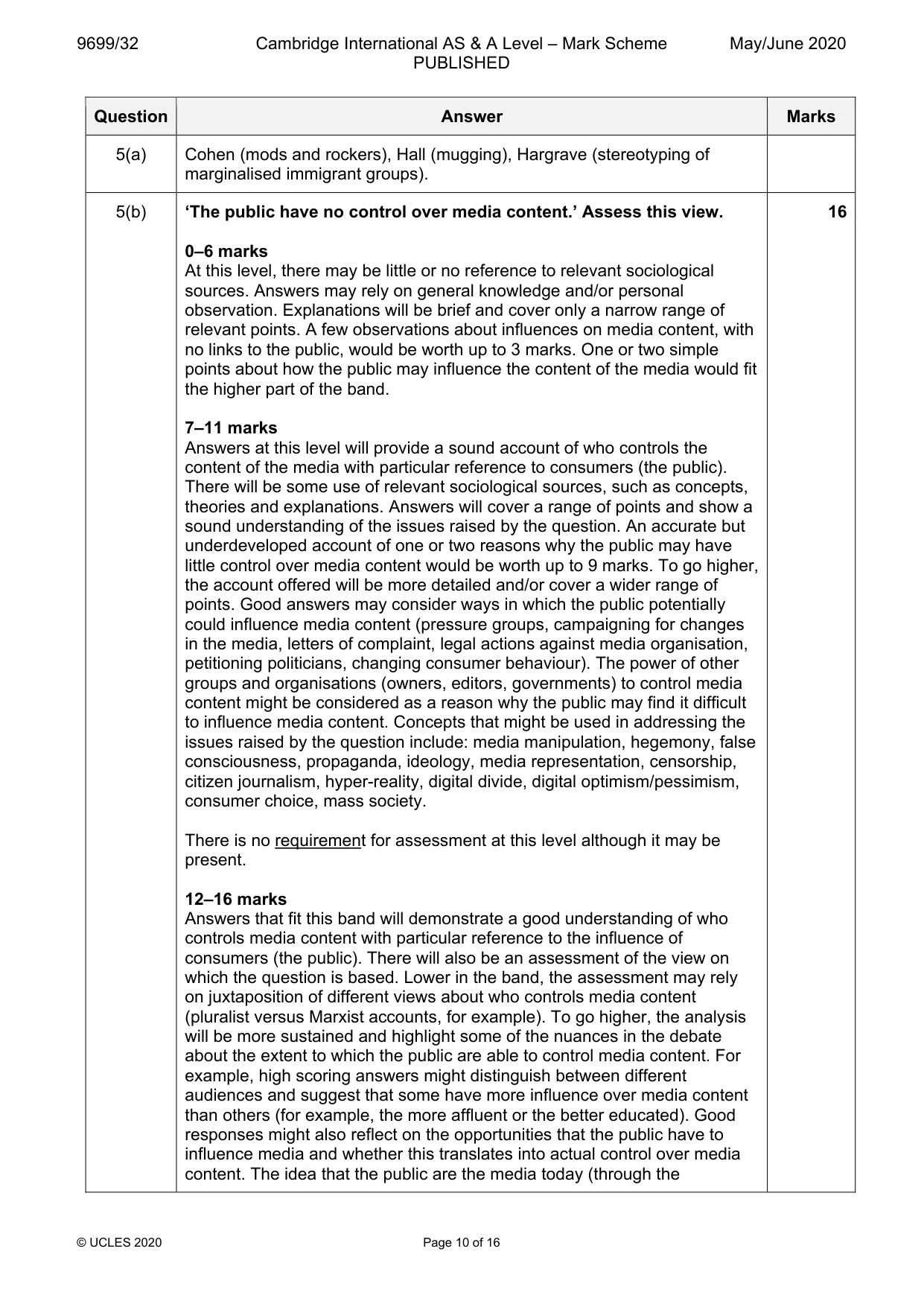
9699/32 Cambridge International AS & A Level – Mark Scheme PUBLISHED May/June 2020 © UCLES 2020 Page 10 of 16 Question Answer Marks 5(a) Cohen (mods and rockers), Hall (mugging), Hargrave (stereotyping of marginalised immigrant groups). 5(b) ‘The public have no control over media content.’ Assess this view. 0–6 marks At this level, there may be little or no reference to relevant sociological sources. Answers may rely on general knowledge and/or personal observation. Explanations will be brief and cover only a narrow range of relevant points. A few observations about influences on media content, with no links to the public, would be worth up to 3 marks. One or two simple points about how the public may influence the content of the media would fit the higher part of the band. 7–11 marks Answers at this level will provide a sound account of who controls the content of the media with particular reference to consumers (the public). There will be some use of relevant sociological sources, such as concepts, theories and explanations. Answers will cover a range of points and show a sound understanding of the issues raised by the question. An accurate but underdeveloped account of one or two reasons why the public may have little control over media content would be worth up to 9 marks. To go higher, the account offered will be more detailed and/or cover a wider range of points. Good answers may consider ways in which the public potentially could influence media content (pressure groups, campaigning for changes in the media, letters of complaint, legal actions against media organisation, petitioning politicians, changing consumer behaviour). The power of other groups and organisations (owners, editors, governments) to control media content might be considered as a reason why the public may find it difficult to influence media content. Concepts that might be used in addressing the issues raised by the question include: media manipulation, hegemony, false consciousness, propaganda, ideology, media representation, censorship, citizen journalism, hyper-reality, digital divide, digital optimism/pessimism, consumer choice, mass society. There is no requirement for assessment at this level although it may be present. 12–16 marks Answers that fit this band will demonstrate a good understanding of who controls media content with particular reference to the influence of consumers (the public). There will also be an assessment of the view on which the question is based. Lower in the band, the assessment may rely on juxtaposition of different views about who controls media content (pluralist versus Marxist accounts, for example). To go higher, the analysis will be more sustained and highlight some of the nuances in the debate about the extent to which the public are able to control media content. For example, high scoring answers might distinguish between different audiences and suggest that some have more influence over media content than others (for example, the more affluent or the better educated). Good responses might also reflect on the opportunities that the public have to influence media and whether this translates into actual control over media content. The idea that the public are the media today (through the 16
Mark scheme, page 11
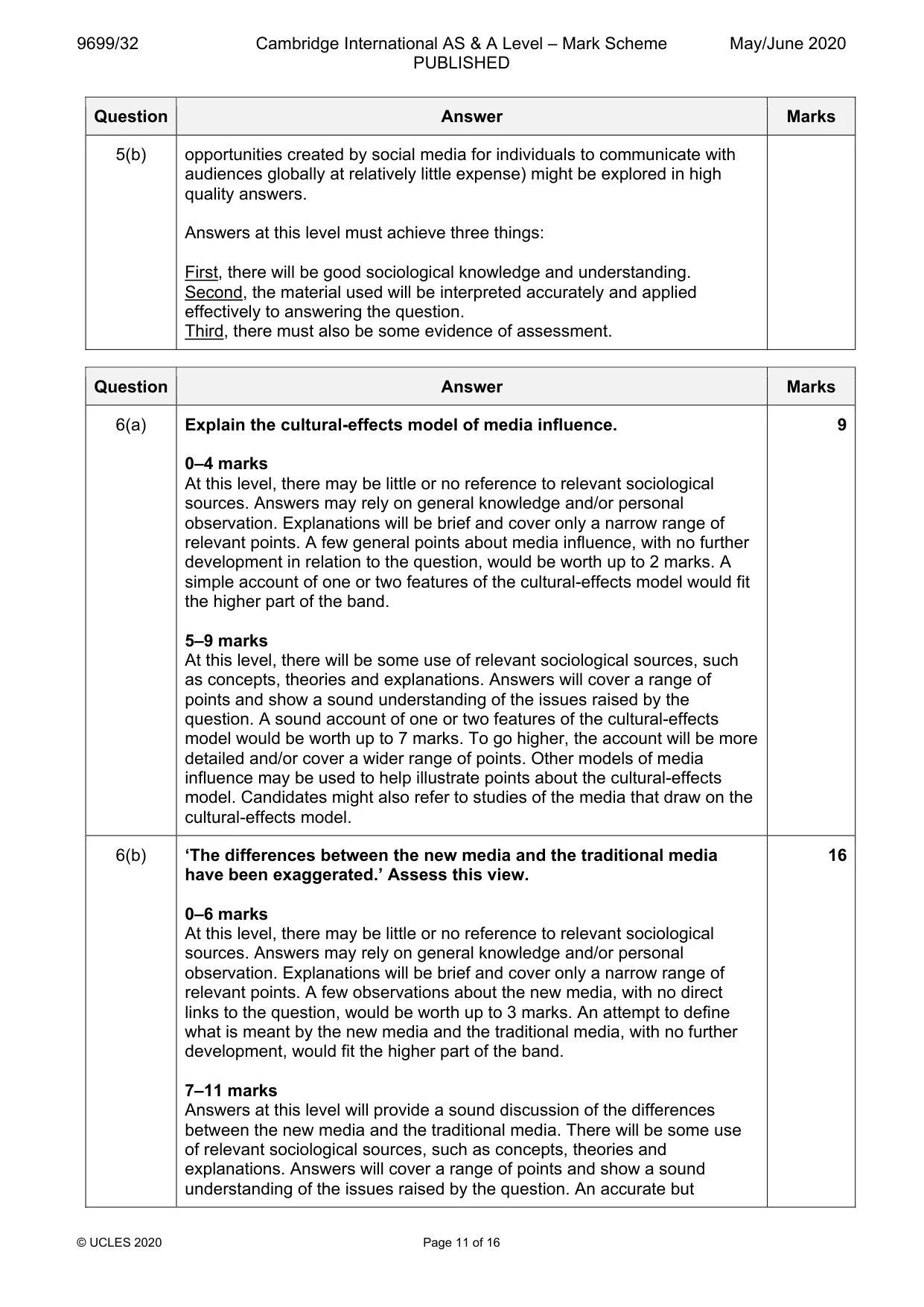
9699/32 Cambridge International AS & A Level – Mark Scheme PUBLISHED May/June 2020 © UCLES 2020 Page 11 of 16 Question Answer Marks 5(b) opportunities created by social media for individuals to communicate with audiences globally at relatively little expense) might be explored in high quality answers. Answers at this level must achieve three things: First, there will be good sociological knowledge and understanding. Second, the material used will be interpreted accurately and applied effectively to answering the question. Third, there must also be some evidence of assessment. Question Answer Marks 6(a) Explain the cultural-effects model of media influence. 0–4 marks At this level, there may be little or no reference to relevant sociological sources. Answers may rely on general knowledge and/or personal observation. Explanations will be brief and cover only a narrow range of relevant points. A few general points about media influence, with no further development in relation to the question, would be worth up to 2 marks. A simple account of one or two features of the cultural-effects model would fit the higher part of the band. 5–9 marks At this level, there will be some use of relevant sociological sources, such as concepts, theories and explanations. Answers will cover a range of points and show a sound understanding of the issues raised by the question. A sound account of one or two features of the cultural-effects model would be worth up to 7 marks. To go higher, the account will be more detailed and/or cover a wider range of points. Other models of media influence may be used to help illustrate points about the cultural-effects model. Candidates might also refer to studies of the media that draw on the cultural-effects model. 9 6(b) ‘The differences between the new media and the traditional media have been exaggerated.’ Assess this view. 0–6 marks At this level, there may be little or no reference to relevant sociological sources. Answers may rely on general knowledge and/or personal observation. Explanations will be brief and cover only a narrow range of relevant points. A few observations about the new media, with no direct links to the question, would be worth up to 3 marks. An attempt to define what is meant by the new media and the traditional media, with no further development, would fit the higher part of the band. 7–11 marks Answers at this level will provide a sound discussion of the differences between the new media and the traditional media. There will be some use of relevant sociological sources, such as concepts, theories and explanations. Answers will cover a range of points and show a sound understanding of the issues raised by the question. An accurate but 16
Mark scheme, page 12
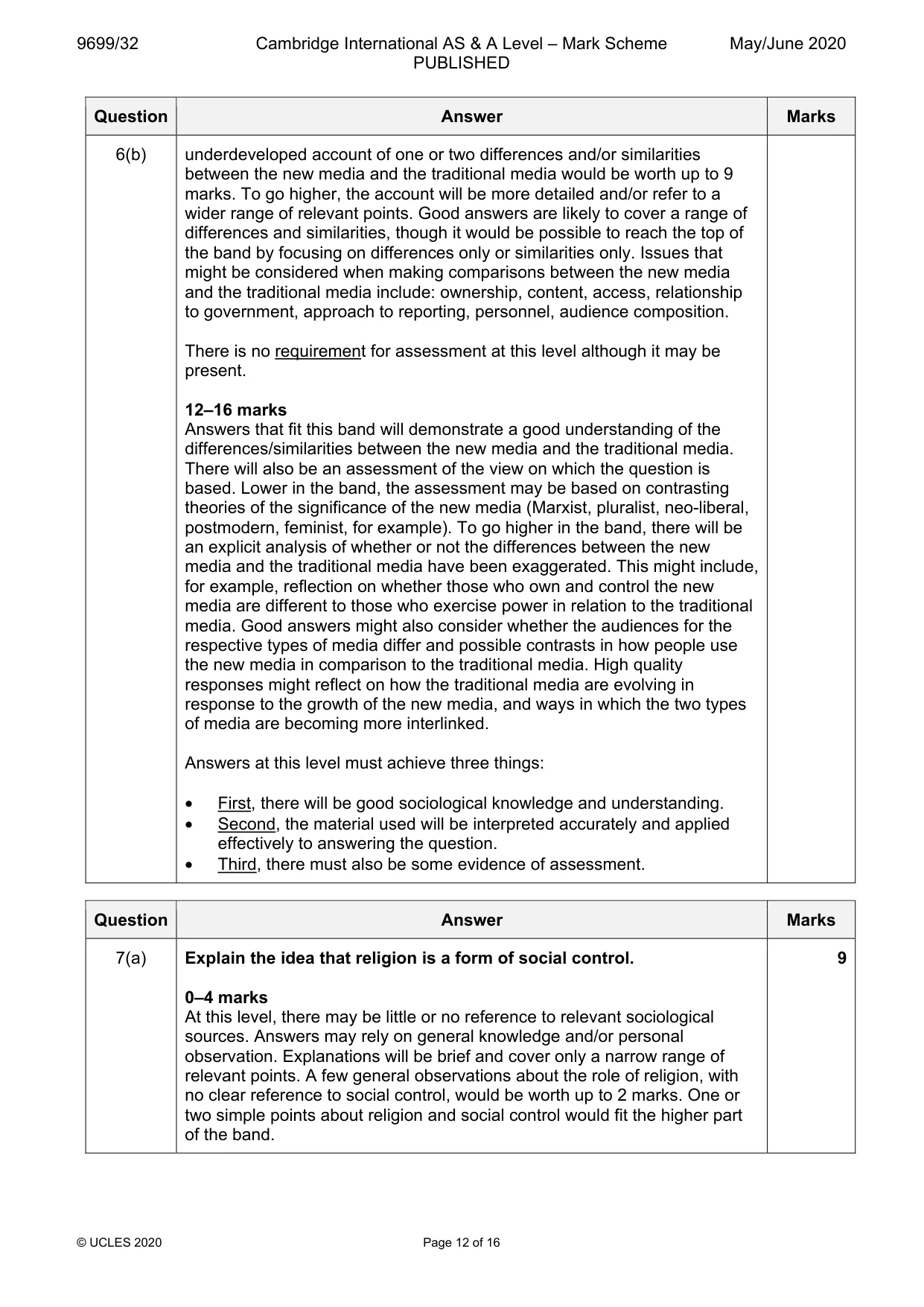
9699/32 Cambridge International AS & A Level – Mark Scheme PUBLISHED May/June 2020 © UCLES 2020 Page 12 of 16 Question Answer Marks 6(b) underdeveloped account of one or two differences and/or similarities between the new media and the traditional media would be worth up to 9 marks. To go higher, the account will be more detailed and/or refer to a wider range of relevant points. Good answers are likely to cover a range of differences and similarities, though it would be possible to reach the top of the band by focusing on differences only or similarities only. Issues that might be considered when making comparisons between the new media and the traditional media include: ownership, content, access, relationship to government, approach to reporting, personnel, audience composition. There is no requirement for assessment at this level although it may be present. 12–16 marks Answers that fit this band will demonstrate a good understanding of the differences/similarities between the new media and the traditional media. There will also be an assessment of the view on which the question is based. Lower in the band, the assessment may be based on contrasting theories of the significance of the new media (Marxist, pluralist, neo-liberal, postmodern, feminist, for example). To go higher in the band, there will be an explicit analysis of whether or not the differences between the new media and the traditional media have been exaggerated. This might include, for example, reflection on whether those who own and control the new media are different to those who exercise power in relation to the traditional media. Good answers might also consider whether the audiences for the respective types of media differ and possible contrasts in how people use the new media in comparison to the traditional media. High quality responses might reflect on how the traditional media are evolving in response to the growth of the new media, and ways in which the two types of media are becoming more interlinked. Answers at this level must achieve three things: • First, there will be good sociological knowledge and understanding. • Second, the material used will be interpreted accurately and applied effectively to answering the question. • Third, there must also be some evidence of assessment. Question Answer Marks 7(a) Explain the idea that religion is a form of social control. 0–4 marks At this level, there may be little or no reference to relevant sociological sources. Answers may rely on general knowledge and/or personal observation. Explanations will be brief and cover only a narrow range of relevant points. A few general observations about the role of religion, with no clear reference to social control, would be worth up to 2 marks. One or two simple points about religion and social control would fit the higher part of the band. 9
Mark scheme, page 13
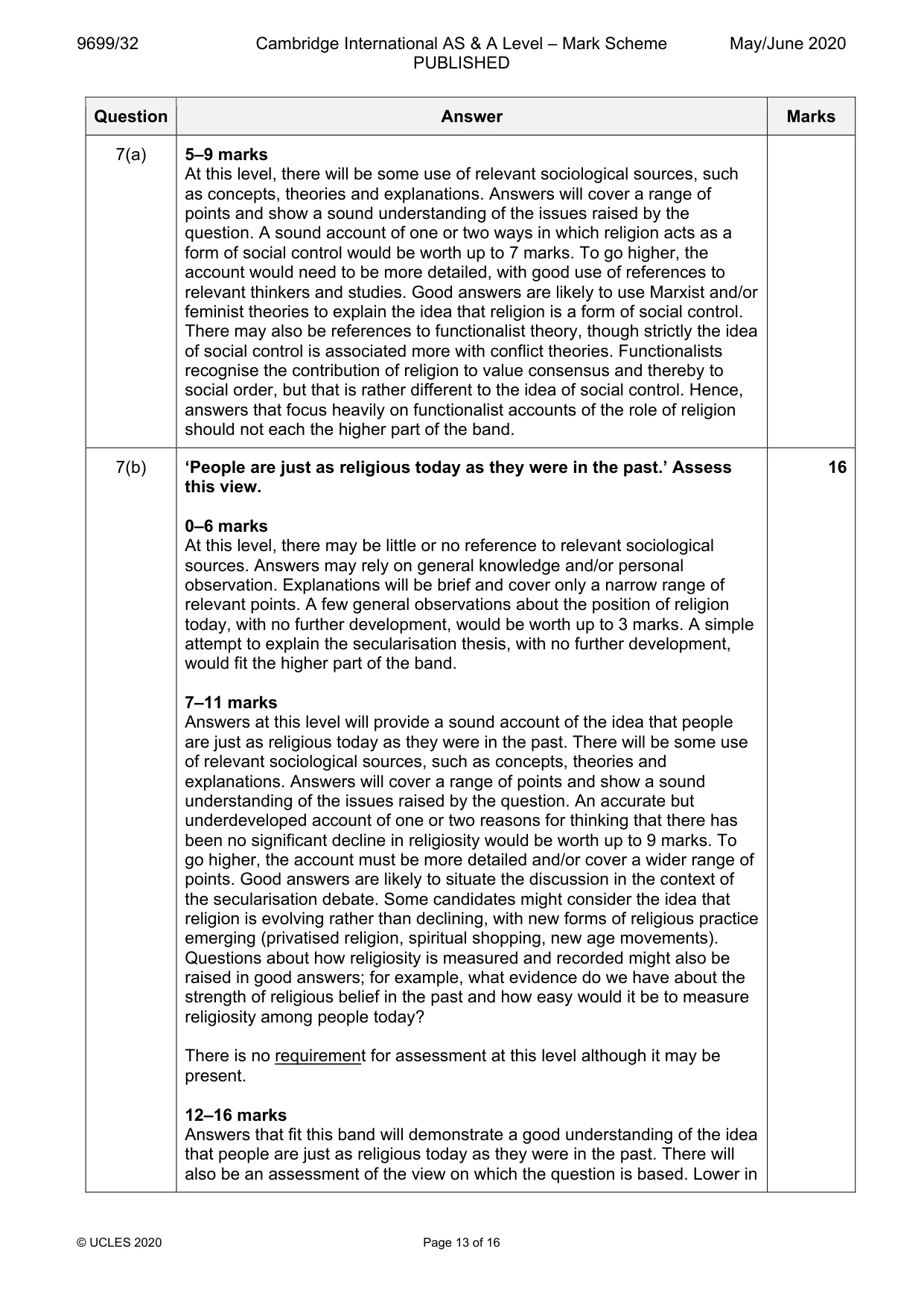
9699/32 Cambridge International AS & A Level – Mark Scheme PUBLISHED May/June 2020 © UCLES 2020 Page 13 of 16 Question Answer Marks 7(a) 5–9 marks At this level, there will be some use of relevant sociological sources, such as concepts, theories and explanations. Answers will cover a range of points and show a sound understanding of the issues raised by the question. A sound account of one or two ways in which religion acts as a form of social control would be worth up to 7 marks. To go higher, the account would need to be more detailed, with good use of references to relevant thinkers and studies. Good answers are likely to use Marxist and/or feminist theories to explain the idea that religion is a form of social control. There may also be references to functionalist theory, though strictly the idea of social control is associated more with conflict theories. Functionalists recognise the contribution of religion to value consensus and thereby to social order, but that is rather different to the idea of social control. Hence, answers that focus heavily on functionalist accounts of the role of religion should not each the higher part of the band. 7(b) ‘People are just as religious today as they were in the past.’ Assess this view. 0–6 marks At this level, there may be little or no reference to relevant sociological sources. Answers may rely on general knowledge and/or personal observation. Explanations will be brief and cover only a narrow range of relevant points. A few general observations about the position of religion today, with no further development, would be worth up to 3 marks. A simple attempt to explain the secularisation thesis, with no further development, would fit the higher part of the band. 7–11 marks Answers at this level will provide a sound account of the idea that people are just as religious today as they were in the past. There will be some use of relevant sociological sources, such as concepts, theories and explanations. Answers will cover a range of points and show a sound understanding of the issues raised by the question. An accurate but underdeveloped account of one or two reasons for thinking that there has been no significant decline in religiosity would be worth up to 9 marks. To go higher, the account must be more detailed and/or cover a wider range of points. Good answers are likely to situate the discussion in the context of the secularisation debate. Some candidates might consider the idea that religion is evolving rather than declining, with new forms of religious practice emerging (privatised religion, spiritual shopping, new age movements). Questions about how religiosity is measured and recorded might also be raised in good answers; for example, what evidence do we have about the strength of religious belief in the past and how easy would it be to measure religiosity among people today? There is no requirement for assessment at this level although it may be present. 12–16 marks Answers that fit this band will demonstrate a good understanding of the idea that people are just as religious today as they were in the past. There will also be an assessment of the view on which the question is based. Lower in 16
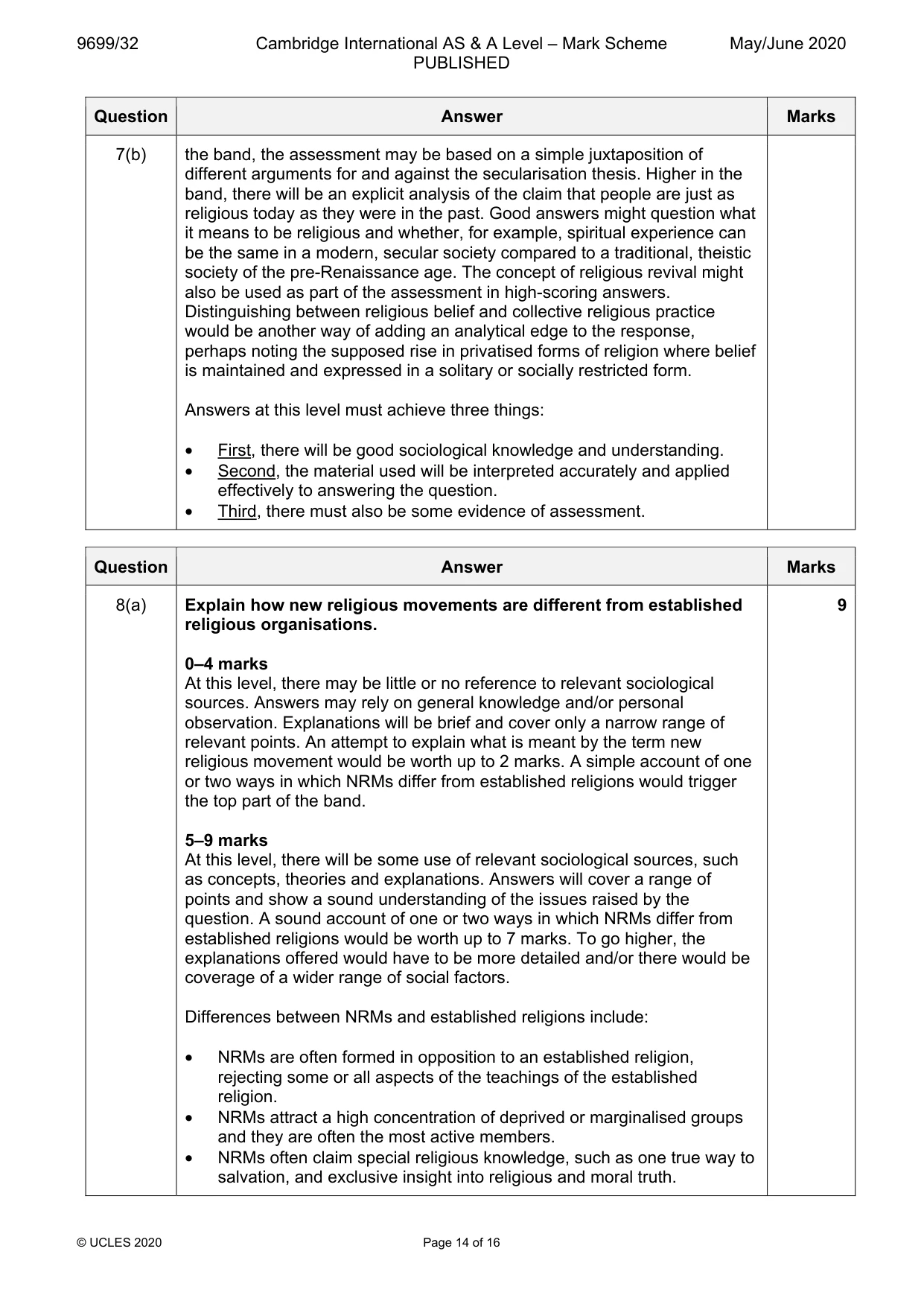
Mark scheme, page 14
9699/32 Cambridge International AS & A Level – Mark Scheme PUBLISHED May/June 2020 © UCLES 2020 Page 14 of 16 Question Answer Marks 7(b) the band, the assessment may be based on a simple juxtaposition of different arguments for and against the secularisation thesis. Higher in the band, there will be an explicit analysis of the claim that people are just as religious today as they were in the past. Good answers might question what it means to be religious and whether, for example, spiritual experience can be the same in a modern, secular society compared to a traditional, theistic society of the pre-Renaissance age. The concept of religious revival might also be used as part of the assessment in high-scoring answers. Distinguishing between religious belief and collective religious practice would be another way of adding an analytical edge to the response, perhaps noting the supposed rise in privatised forms of religion where belief is maintained and expressed in a solitary or socially restricted form. Answers at this level must achieve three things: • First, there will be good sociological knowledge and understanding. • Second, the material used will be interpreted accurately and applied effectively to answering the question. • Third, there must also be some evidence of assessment. Question Answer Marks 8(a) Explain how new religious movements are different from established religious organisations. 0–4 marks At this level, there may be little or no reference to relevant sociological sources. Answers may rely on general knowledge and/or personal observation. Explanations will be brief and cover only a narrow range of relevant points. An attempt to explain what is meant by the term new religious movement would be worth up to 2 marks. A simple account of one or two ways in which NRMs differ from established religions would trigger the top part of the band. 5–9 marks At this level, there will be some use of relevant sociological sources, such as concepts, theories and explanations. Answers will cover a range of points and show a sound understanding of the issues raised by the question. A sound account of one or two ways in which NRMs differ from established religions would be worth up to 7 marks. To go higher, the explanations offered would have to be more detailed and/or there would be coverage of a wider range of social factors. Differences between NRMs and established religions include: • NRMs are often formed in opposition to an established religion, rejecting some or all aspects of the teachings of the established religion. • NRMs attract a high concentration of deprived or marginalised groups and they are often the most active members. • NRMs often claim special religious knowledge, such as one true way to salvation, and exclusive insight into religious and moral truth. 9
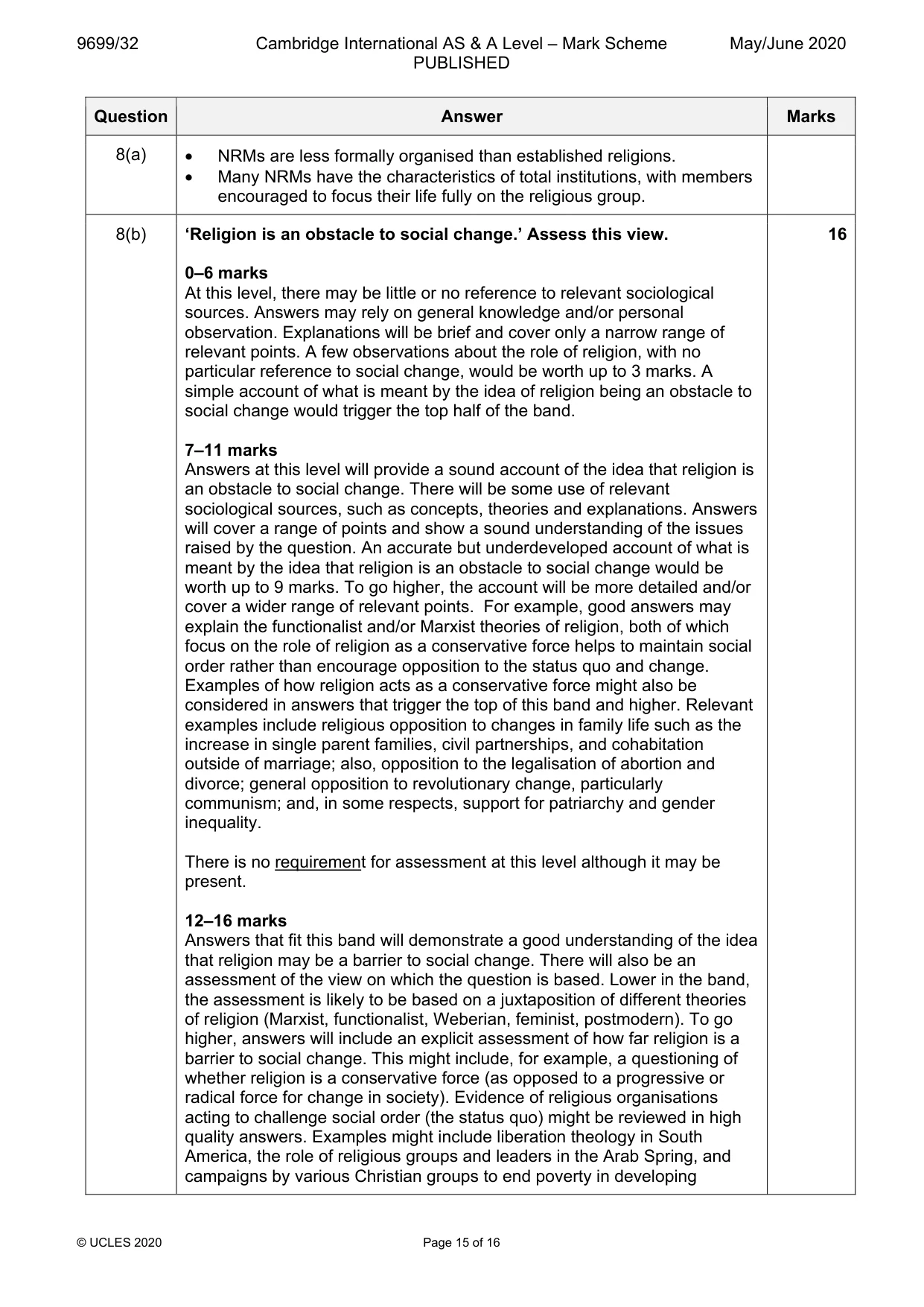
Mark scheme, page 15
9699/32 Cambridge International AS & A Level – Mark Scheme PUBLISHED May/June 2020 © UCLES 2020 Page 15 of 16 Question Answer Marks 8(a) • NRMs are less formally organised than established religions. • Many NRMs have the characteristics of total institutions, with members encouraged to focus their life fully on the religious group. 8(b) ‘Religion is an obstacle to social change.’ Assess this view. 0–6 marks At this level, there may be little or no reference to relevant sociological sources. Answers may rely on general knowledge and/or personal observation. Explanations will be brief and cover only a narrow range of relevant points. A few observations about the role of religion, with no particular reference to social change, would be worth up to 3 marks. A simple account of what is meant by the idea of religion being an obstacle to social change would trigger the top half of the band. 7–11 marks Answers at this level will provide a sound account of the idea that religion is an obstacle to social change. There will be some use of relevant sociological sources, such as concepts, theories and explanations. Answers will cover a range of points and show a sound understanding of the issues raised by the question. An accurate but underdeveloped account of what is meant by the idea that religion is an obstacle to social change would be worth up to 9 marks. To go higher, the account will be more detailed and/or cover a wider range of relevant points. For example, good answers may explain the functionalist and/or Marxist theories of religion, both of which focus on the role of religion as a conservative force helps to maintain social order rather than encourage opposition to the status quo and change. Examples of how religion acts as a conservative force might also be considered in answers that trigger the top of this band and higher. Relevant examples include religious opposition to changes in family life such as the increase in single parent families, civil partnerships, and cohabitation outside of marriage; also, opposition to the legalisation of abortion and divorce; general opposition to revolutionary change, particularly communism; and, in some respects, support for patriarchy and gender inequality. There is no requirement for assessment at this level although it may be present. 12–16 marks Answers that fit this band will demonstrate a good understanding of the idea that religion may be a barrier to social change. There will also be an assessment of the view on which the question is based. Lower in the band, the assessment is likely to be based on a juxtaposition of different theories of religion (Marxist, functionalist, Weberian, feminist, postmodern). To go higher, answers will include an explicit assessment of how far religion is a barrier to social change. This might include, for example, a questioning of whether religion is a conservative force (as opposed to a progressive or radical force for change in society). Evidence of religious organisations acting to challenge social order (the status quo) might be reviewed in high quality answers. Examples might include liberation theology in South America, the role of religious groups and leaders in the Arab Spring, and campaigns by various Christian groups to end poverty in developing 16
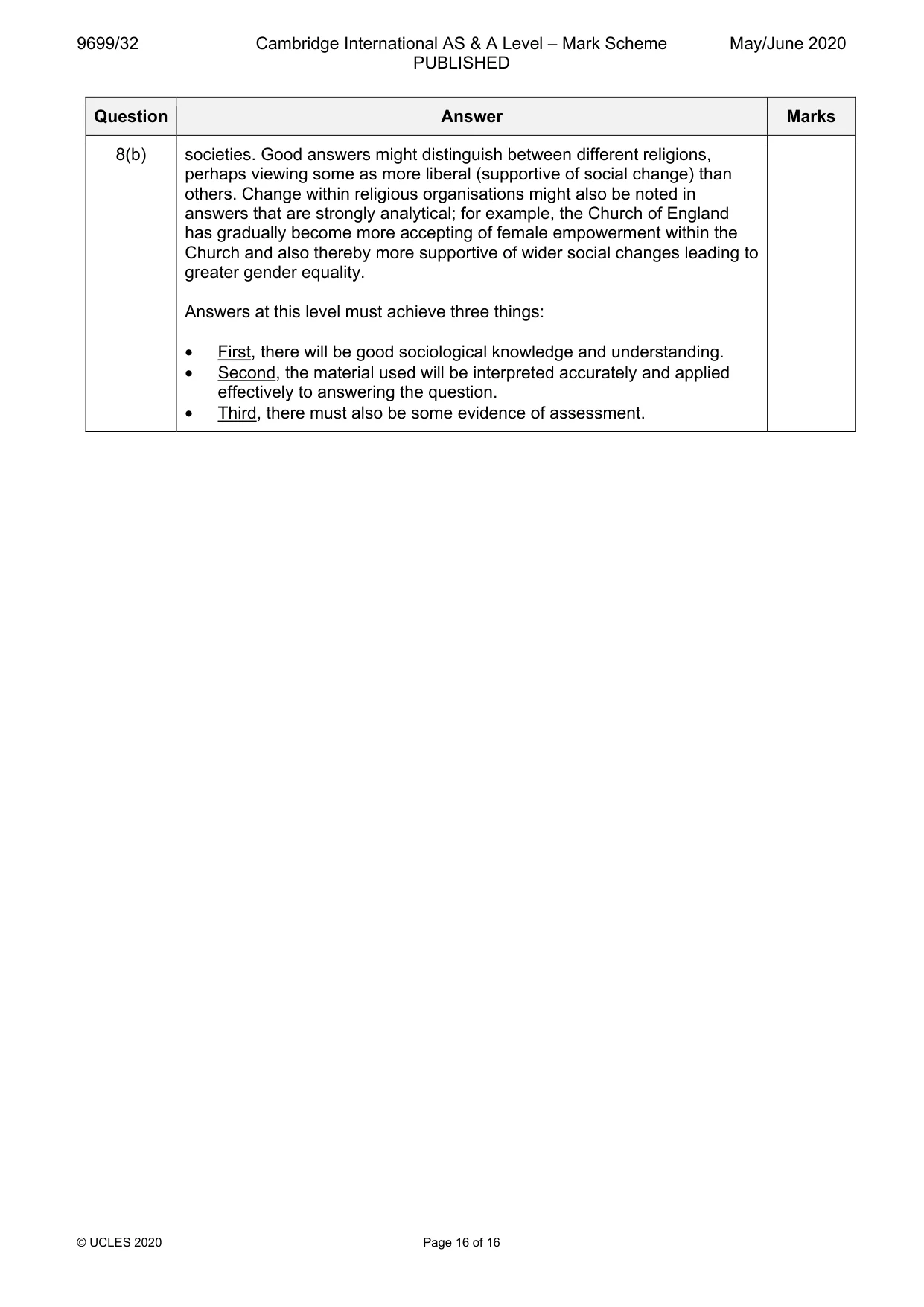
Mark scheme, page 16
9699/32 Cambridge International AS & A Level – Mark Scheme PUBLISHED May/June 2020 © UCLES 2020 Page 16 of 16 Question Answer Marks 8(b) societies. Good answers might distinguish between different religions, perhaps viewing some as more liberal (supportive of social change) than others. Change within religious organisations might also be noted in answers that are strongly analytical; for example, the Church of England has gradually become more accepting of female empowerment within the Church and also thereby more supportive of wider social changes leading to greater gender equality. Answers at this level must achieve three things: • First, there will be good sociological knowledge and understanding. • Second, the material used will be interpreted accurately and applied effectively to answering the question. • Third, there must also be some evidence of assessment.