Cambridge A Level Sociology 9699 — 2020 May/June Paper 3 · Variant 3
9699/33/M/J/20
The question paper and its mark scheme, free to read here and free to download. This is Cambridge’s own paper, exactly as it was sat.
Question paper4 pages
Mark scheme16 pages
Answers below. Sit the paper first if you are practising.
Paper as text
Question paper, page 1
Cambridge International AS & A Level This document has 4 pages. Blank pages are indicated. DC (MM) 181616/1 © UCLES 2020 [Turn over SOCIOLOGY 9699/33 Paper 3 Social Inequality and Opportunity May/June 2020 3 hours You must answer on the enclosed answer booklet. You will need: Answer booklet (enclosed) INSTRUCTIONS ● Answer three questions, each from a different section. ● Follow the instructions on the front cover of the answer booklet. If you need additional answer paper, ask the invigilator for a continuation booklet. INFORMATION ● The total mark for this paper is 75. ● The number of marks for each question or part question is shown in brackets [ ]. * 9 5 1 2 6 9 3 0 7 0 *
Question paper, page 2
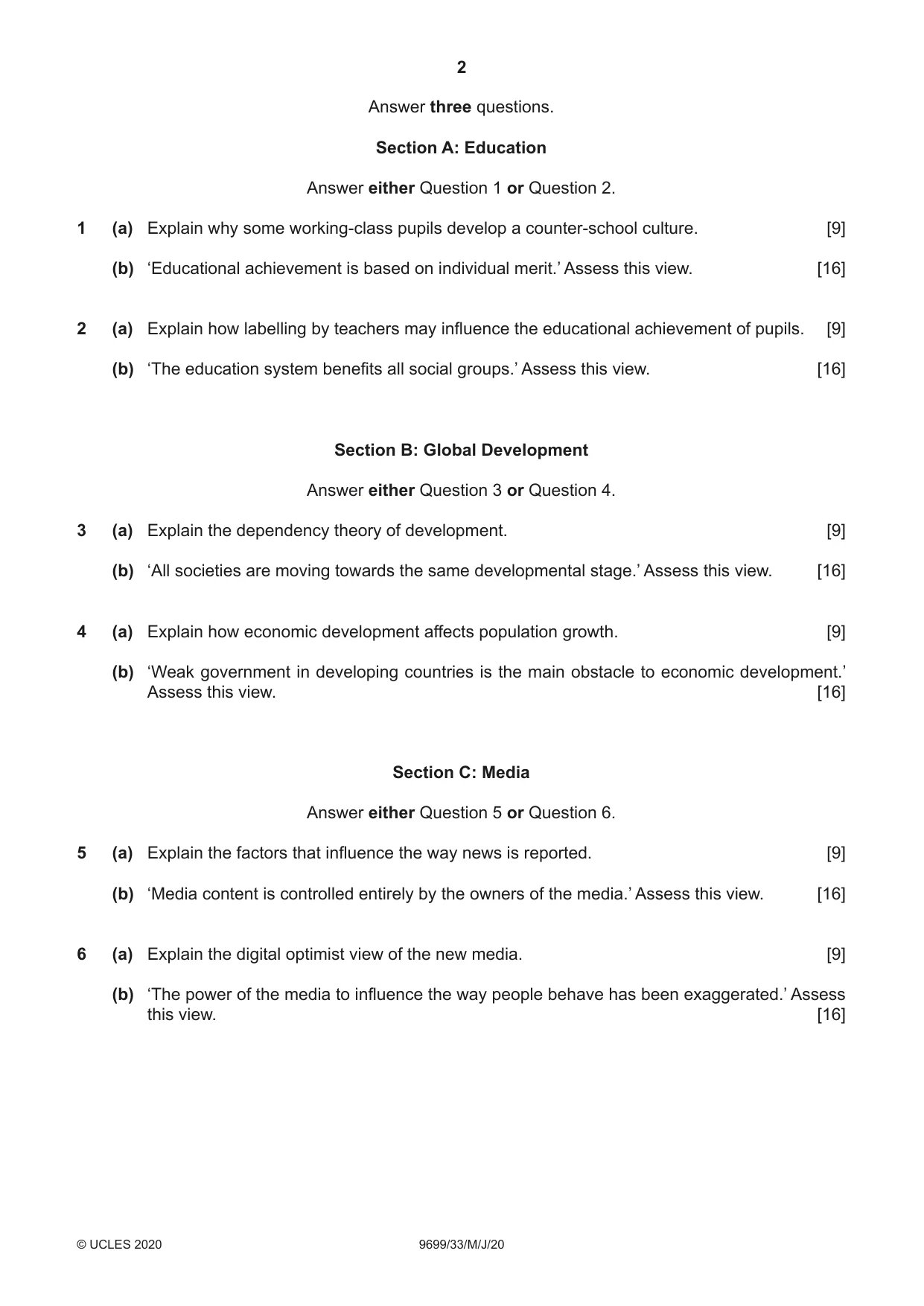
2 9699/33/M/J/20 © UCLES 2020 Answer three questions. Section A: Education Answer either Question 1 or Question 2. 1 (a) Explain why some working-class pupils develop a counter-school culture. [9] (b) ‘Educational achievement is based on individual merit.’ Assess this view. [16] 2 (a) Explain how labelling by teachers may influence the educational achievement of pupils. [9] (b) ‘The education system benefits all social groups.’ Assess this view. [16] Section B: Global Development Answer either Question 3 or Question 4. 3 (a) Explain the dependency theory of development. [9] (b) ‘All societies are moving towards the same developmental stage.’ Assess this view. [16] 4 (a) Explain how economic development affects population growth. [9] (b) ‘Weak government in developing countries is the main obstacle to economic development.’ Assess this view. [16] Section C: Media Answer either Question 5 or Question 6. 5 (a) Explain the factors that influence the way news is reported. [9] (b) ‘Media content is controlled entirely by the owners of the media.’ Assess this view. [16] 6 (a) Explain the digital optimist view of the new media. [9] (b) ‘The power of the media to influence the way people behave has been exaggerated.’ Assess this view. [16]
Question paper, page 3
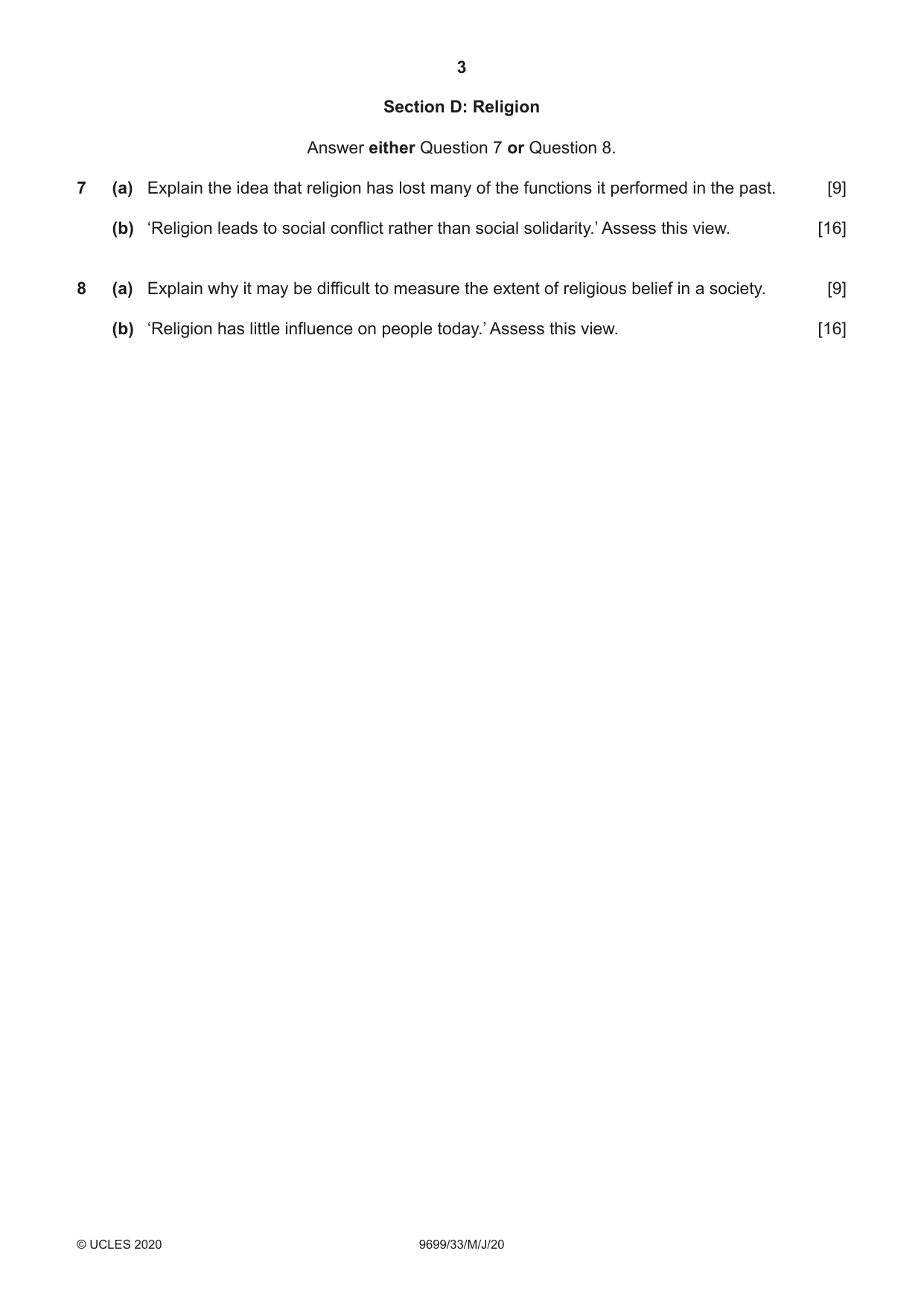
3 9699/33/M/J/20 © UCLES 2020 Section D: Religion Answer either Question 7 or Question 8. 7 (a) Explain the idea that religion has lost many of the functions it performed in the past. [9] (b) ‘Religion leads to social conflict rather than social solidarity.’ Assess this view. [16] 8 (a) Explain why it may be difficult to measure the extent of religious belief in a society. [9] (b) ‘Religion has little influence on people today.’ Assess this view. [16]
Question paper, page 4
4 9699/33/M/J/20 © UCLES 2020 Permission to reproduce items where third-party owned material protected by copyright is included has been sought and cleared where possible. Every reasonable effort has been made by the publisher (UCLES) to trace copyright holders, but if any items requiring clearance have unwittingly been included, the publisher will be pleased to make amends at the earliest possible opportunity. To avoid the issue of disclosure of answer-related information to candidates, all copyright acknowledgements are reproduced online in the Cambridge Assessment International Education Copyright Acknowledgements Booklet. This is produced for each series of examinations and is freely available to download at www.cambridgeinternational.org after the live examination series. Cambridge Assessment International Education is part of the Cambridge Assessment Group. Cambridge Assessment is the brand name of the University of Cambridge Local Examinations Syndicate (UCLES), which itself is a department of the University of Cambridge. BLANK PAGE
Mark scheme, page 1
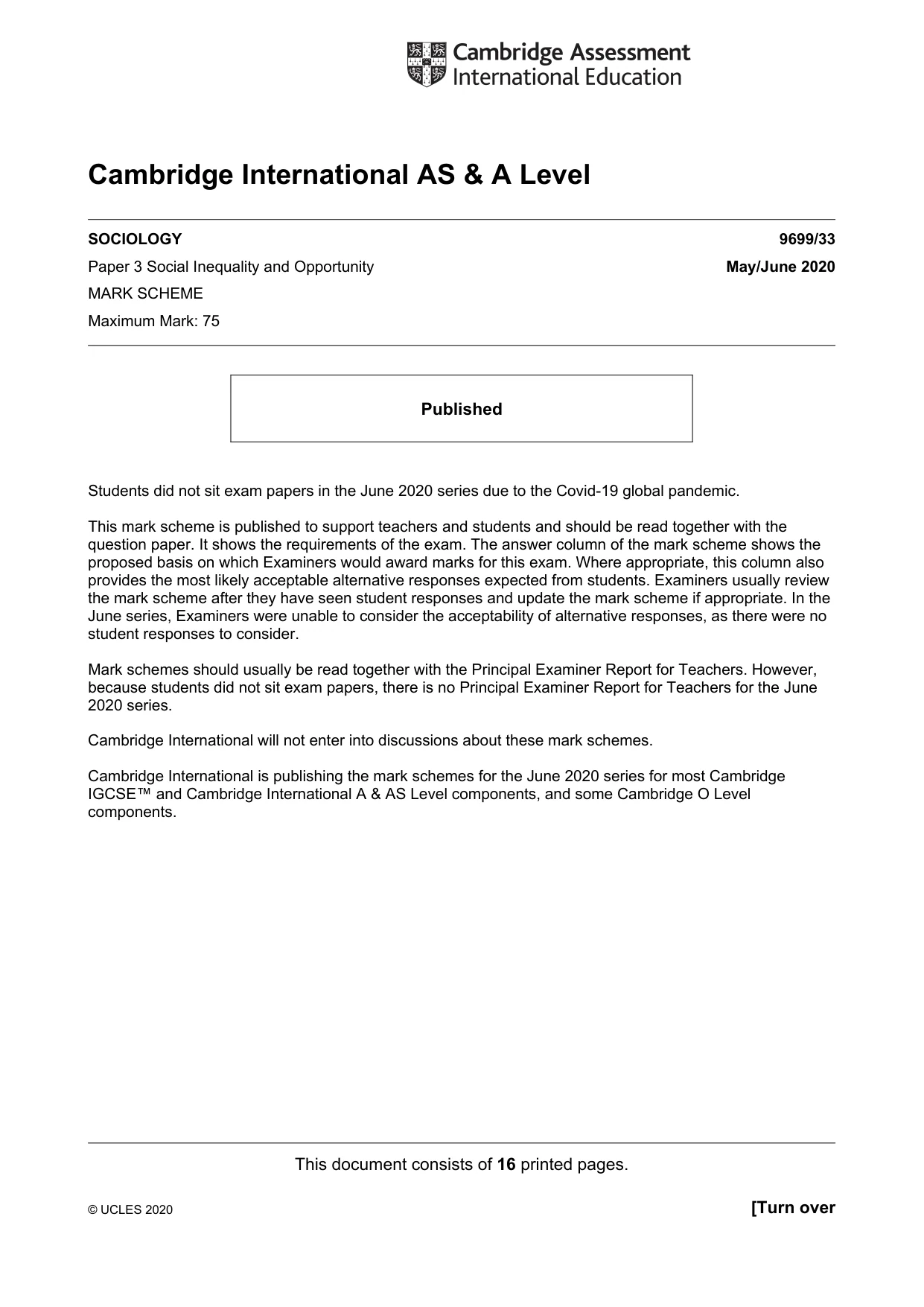
This document consists of 16 printed pages. © UCLES 2020 [Turn over Cambridge International AS & A Level SOCIOLOGY 9699/33 Paper 3 Social Inequality and Opportunity May/June 2020 MARK SCHEME Maximum Mark: 75 Published Students did not sit exam papers in the June 2020 series due to the Covid-19 global pandemic. This mark scheme is published to support teachers and students and should be read together with the question paper. It shows the requirements of the exam. The answer column of the mark scheme shows the proposed basis on which Examiners would award marks for this exam. Where appropriate, this column also provides the most likely acceptable alternative responses expected from students. Examiners usually review the mark scheme after they have seen student responses and update the mark scheme if appropriate. In the June series, Examiners were unable to consider the acceptability of alternative responses, as there were no student responses to consider. Mark schemes should usually be read together with the Principal Examiner Report for Teachers. However, because students did not sit exam papers, there is no Principal Examiner Report for Teachers for the June 2020 series. Cambridge International will not enter into discussions about these mark schemes. Cambridge International is publishing the mark schemes for the June 2020 series for most Cambridge IGCSE™ and Cambridge International A & AS Level components, and some Cambridge O Level components.
Mark scheme, page 2
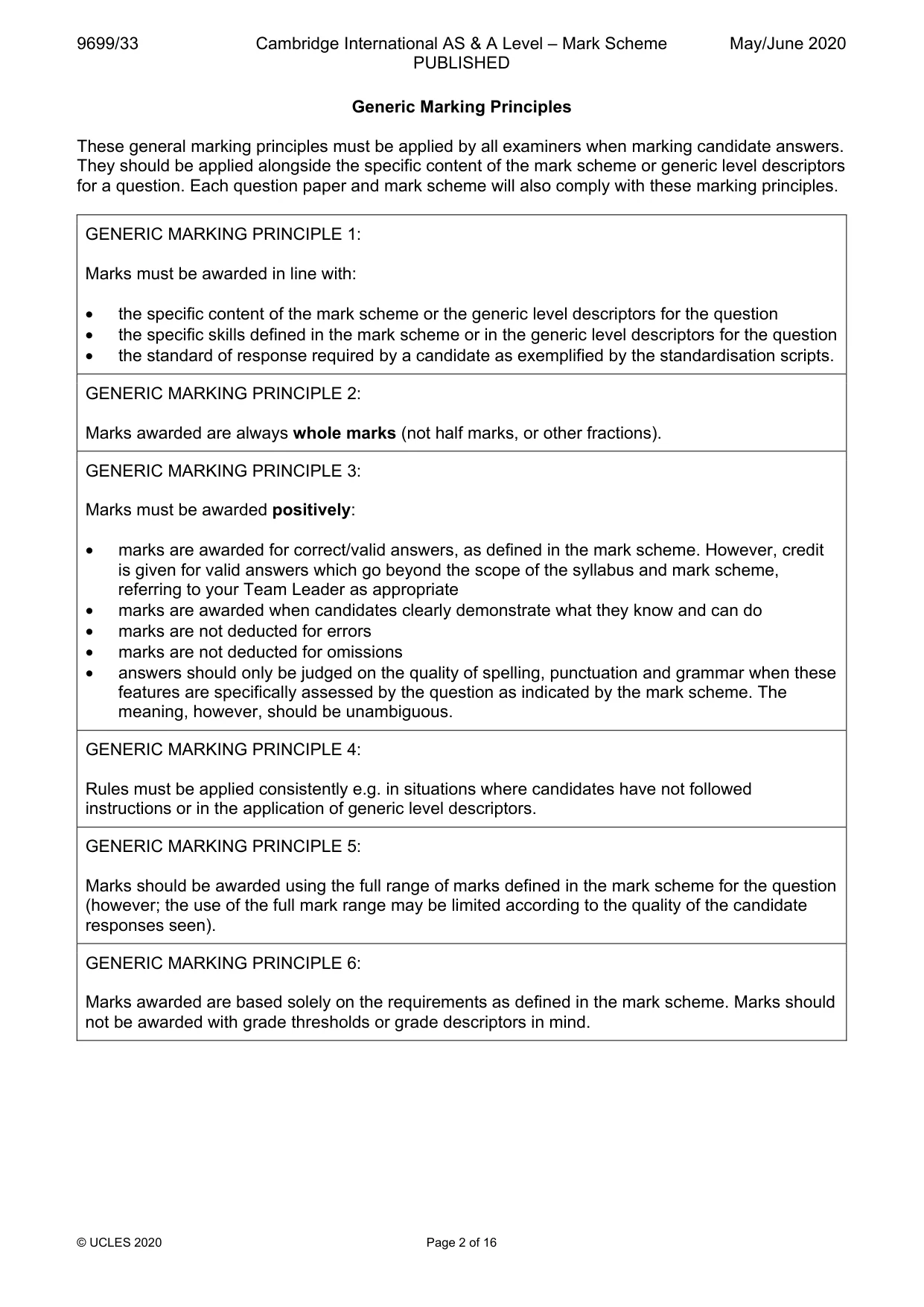
9699/33 Cambridge International AS & A Level – Mark Scheme PUBLISHED May/June 2020 © UCLES 2020 Page 2 of 16 Generic Marking Principles These general marking principles must be applied by all examiners when marking candidate answers. They should be applied alongside the specific content of the mark scheme or generic level descriptors for a question. Each question paper and mark scheme will also comply with these marking principles. GENERIC MARKING PRINCIPLE 1: Marks must be awarded in line with: • the specific content of the mark scheme or the generic level descriptors for the question • the specific skills defined in the mark scheme or in the generic level descriptors for the question • the standard of response required by a candidate as exemplified by the standardisation scripts. GENERIC MARKING PRINCIPLE 2: Marks awarded are always whole marks (not half marks, or other fractions). GENERIC MARKING PRINCIPLE 3: Marks must be awarded positively: • marks are awarded for correct/valid answers, as defined in the mark scheme. However, credit is given for valid answers which go beyond the scope of the syllabus and mark scheme, referring to your Team Leader as appropriate • marks are awarded when candidates clearly demonstrate what they know and can do • marks are not deducted for errors • marks are not deducted for omissions • answers should only be judged on the quality of spelling, punctuation and grammar when these features are specifically assessed by the question as indicated by the mark scheme. The meaning, however, should be unambiguous. GENERIC MARKING PRINCIPLE 4: Rules must be applied consistently e.g. in situations where candidates have not followed instructions or in the application of generic level descriptors. GENERIC MARKING PRINCIPLE 5: Marks should be awarded using the full range of marks defined in the mark scheme for the question (however; the use of the full mark range may be limited according to the quality of the candidate responses seen). GENERIC MARKING PRINCIPLE 6: Marks awarded are based solely on the requirements as defined in the mark scheme. Marks should not be awarded with grade thresholds or grade descriptors in mind.
Mark scheme, page 3
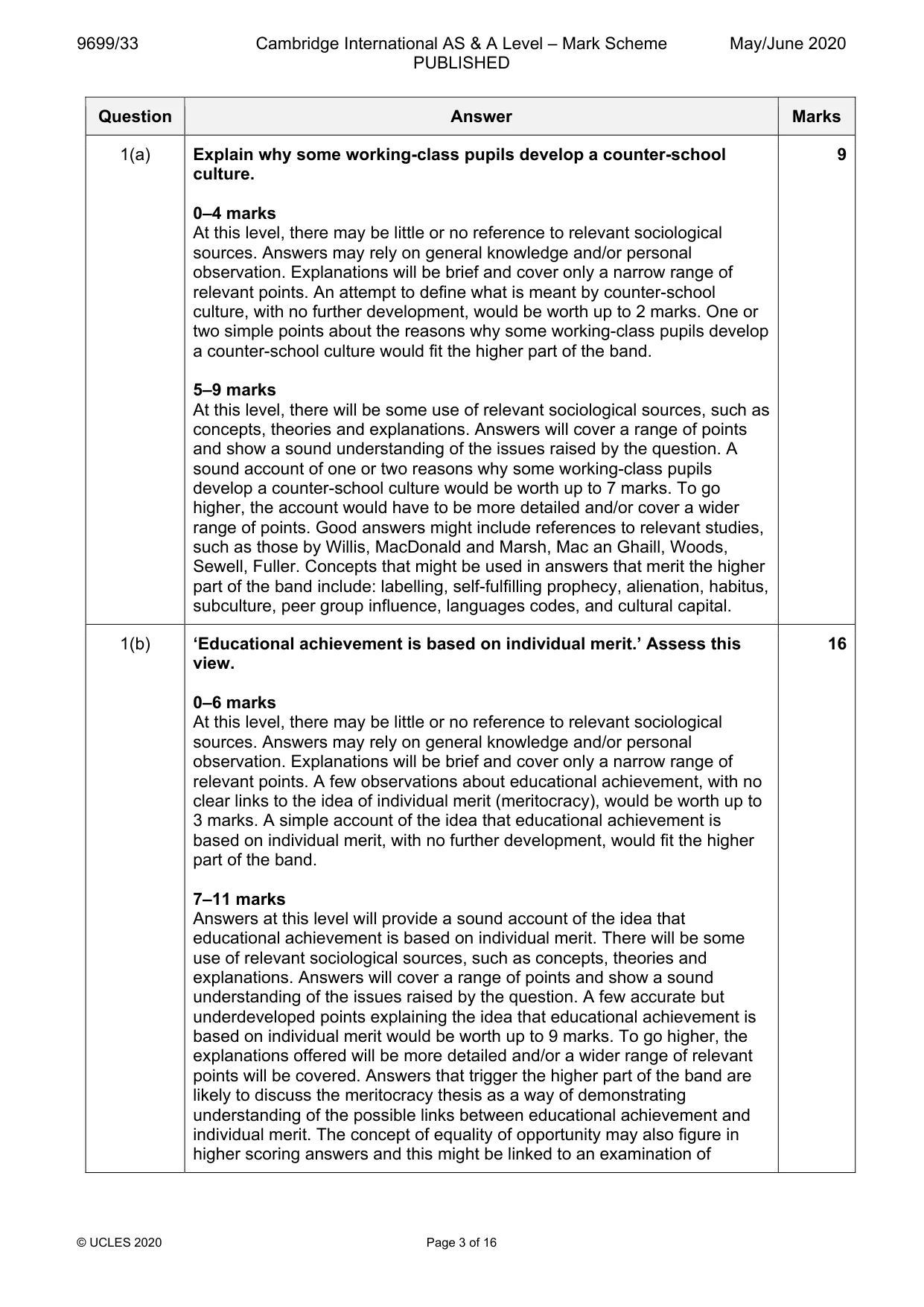
9699/33 Cambridge International AS & A Level – Mark Scheme PUBLISHED May/June 2020 © UCLES 2020 Page 3 of 16 Question Answer Marks 1(a) Explain why some working-class pupils develop a counter-school culture. 0–4 marks At this level, there may be little or no reference to relevant sociological sources. Answers may rely on general knowledge and/or personal observation. Explanations will be brief and cover only a narrow range of relevant points. An attempt to define what is meant by counter-school culture, with no further development, would be worth up to 2 marks. One or two simple points about the reasons why some working-class pupils develop a counter-school culture would fit the higher part of the band. 5–9 marks At this level, there will be some use of relevant sociological sources, such as concepts, theories and explanations. Answers will cover a range of points and show a sound understanding of the issues raised by the question. A sound account of one or two reasons why some working-class pupils develop a counter-school culture would be worth up to 7 marks. To go higher, the account would have to be more detailed and/or cover a wider range of points. Good answers might include references to relevant studies, such as those by Willis, MacDonald and Marsh, Mac an Ghaill, Woods, Sewell, Fuller. Concepts that might be used in answers that merit the higher part of the band include: labelling, self-fulfilling prophecy, alienation, habitus, subculture, peer group influence, languages codes, and cultural capital. 9 1(b) ‘Educational achievement is based on individual merit.’ Assess this view. 0–6 marks At this level, there may be little or no reference to relevant sociological sources. Answers may rely on general knowledge and/or personal observation. Explanations will be brief and cover only a narrow range of relevant points. A few observations about educational achievement, with no clear links to the idea of individual merit (meritocracy), would be worth up to 3 marks. A simple account of the idea that educational achievement is based on individual merit, with no further development, would fit the higher part of the band. 7–11 marks Answers at this level will provide a sound account of the idea that educational achievement is based on individual merit. There will be some use of relevant sociological sources, such as concepts, theories and explanations. Answers will cover a range of points and show a sound understanding of the issues raised by the question. A few accurate but underdeveloped points explaining the idea that educational achievement is based on individual merit would be worth up to 9 marks. To go higher, the explanations offered will be more detailed and/or a wider range of relevant points will be covered. Answers that trigger the higher part of the band are likely to discuss the meritocracy thesis as a way of demonstrating understanding of the possible links between educational achievement and individual merit. The concept of equality of opportunity may also figure in higher scoring answers and this might be linked to an examination of 16
Mark scheme, page 4
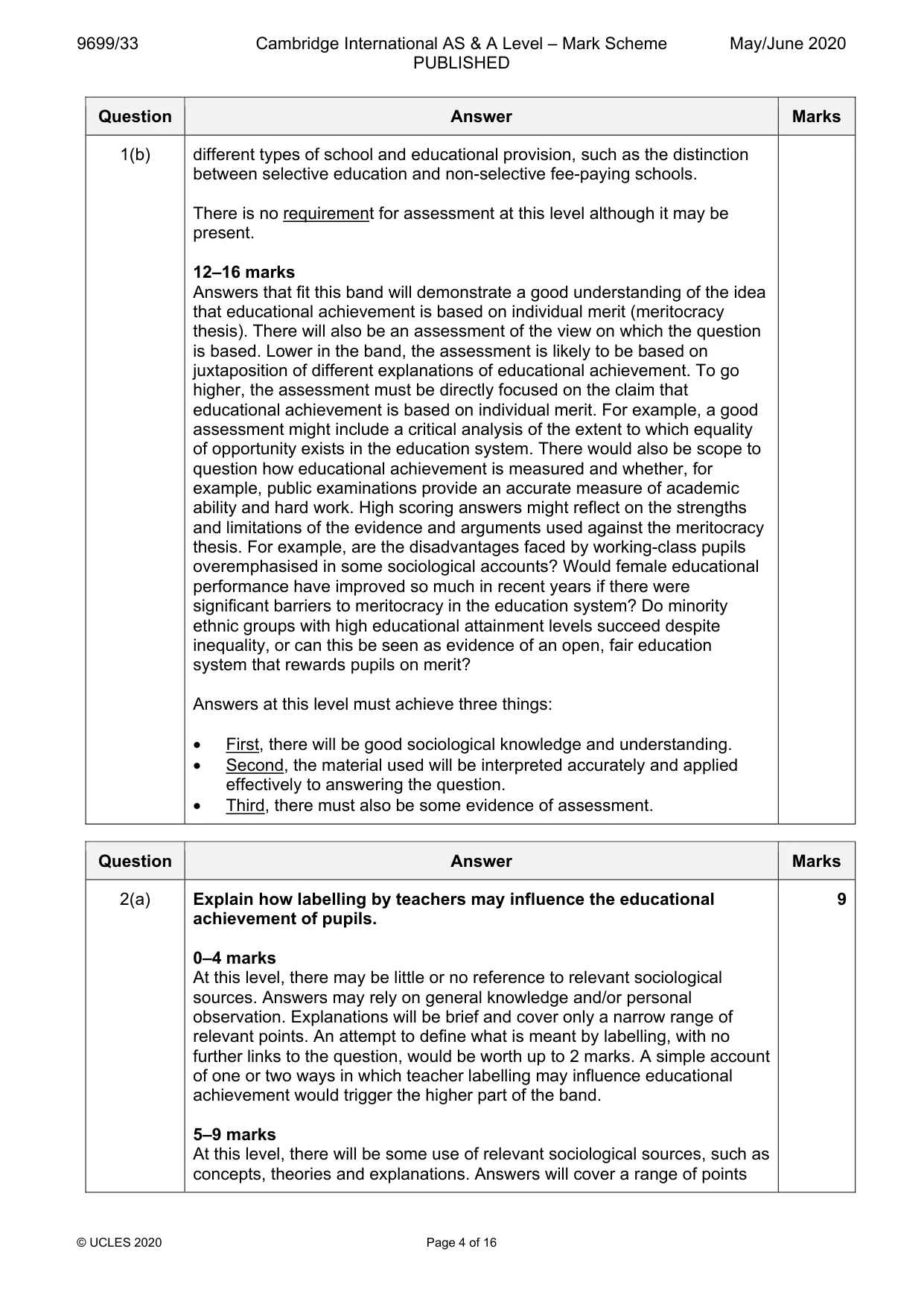
9699/33 Cambridge International AS & A Level – Mark Scheme PUBLISHED May/June 2020 © UCLES 2020 Page 4 of 16 Question Answer Marks 1(b) different types of school and educational provision, such as the distinction between selective education and non-selective fee-paying schools. There is no requirement for assessment at this level although it may be present. 12–16 marks Answers that fit this band will demonstrate a good understanding of the idea that educational achievement is based on individual merit (meritocracy thesis). There will also be an assessment of the view on which the question is based. Lower in the band, the assessment is likely to be based on juxtaposition of different explanations of educational achievement. To go higher, the assessment must be directly focused on the claim that educational achievement is based on individual merit. For example, a good assessment might include a critical analysis of the extent to which equality of opportunity exists in the education system. There would also be scope to question how educational achievement is measured and whether, for example, public examinations provide an accurate measure of academic ability and hard work. High scoring answers might reflect on the strengths and limitations of the evidence and arguments used against the meritocracy thesis. For example, are the disadvantages faced by working-class pupils overemphasised in some sociological accounts? Would female educational performance have improved so much in recent years if there were significant barriers to meritocracy in the education system? Do minority ethnic groups with high educational attainment levels succeed despite inequality, or can this be seen as evidence of an open, fair education system that rewards pupils on merit? Answers at this level must achieve three things: • First, there will be good sociological knowledge and understanding. • Second, the material used will be interpreted accurately and applied effectively to answering the question. • Third, there must also be some evidence of assessment. Question Answer Marks 2(a) Explain how labelling by teachers may influence the educational achievement of pupils. 0–4 marks At this level, there may be little or no reference to relevant sociological sources. Answers may rely on general knowledge and/or personal observation. Explanations will be brief and cover only a narrow range of relevant points. An attempt to define what is meant by labelling, with no further links to the question, would be worth up to 2 marks. A simple account of one or two ways in which teacher labelling may influence educational achievement would trigger the higher part of the band. 5–9 marks At this level, there will be some use of relevant sociological sources, such as concepts, theories and explanations. Answers will cover a range of points 9
Mark scheme, page 5
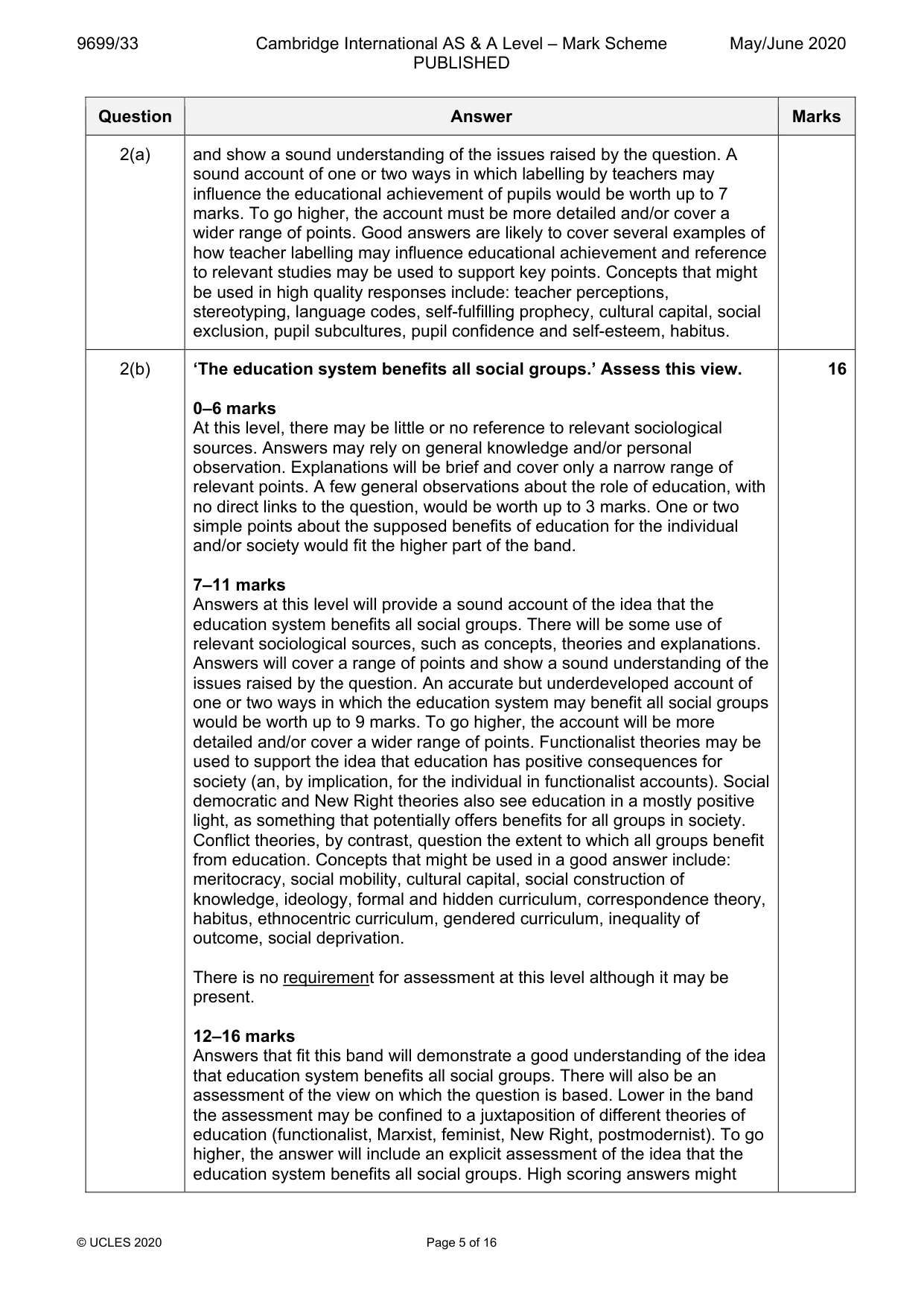
9699/33 Cambridge International AS & A Level – Mark Scheme PUBLISHED May/June 2020 © UCLES 2020 Page 5 of 16 Question Answer Marks 2(a) and show a sound understanding of the issues raised by the question. A sound account of one or two ways in which labelling by teachers may influence the educational achievement of pupils would be worth up to 7 marks. To go higher, the account must be more detailed and/or cover a wider range of points. Good answers are likely to cover several examples of how teacher labelling may influence educational achievement and reference to relevant studies may be used to support key points. Concepts that might be used in high quality responses include: teacher perceptions, stereotyping, language codes, self-fulfilling prophecy, cultural capital, social exclusion, pupil subcultures, pupil confidence and self-esteem, habitus. 2(b) ‘The education system benefits all social groups.’ Assess this view. 0–6 marks At this level, there may be little or no reference to relevant sociological sources. Answers may rely on general knowledge and/or personal observation. Explanations will be brief and cover only a narrow range of relevant points. A few general observations about the role of education, with no direct links to the question, would be worth up to 3 marks. One or two simple points about the supposed benefits of education for the individual and/or society would fit the higher part of the band. 7–11 marks Answers at this level will provide a sound account of the idea that the education system benefits all social groups. There will be some use of relevant sociological sources, such as concepts, theories and explanations. Answers will cover a range of points and show a sound understanding of the issues raised by the question. An accurate but underdeveloped account of one or two ways in which the education system may benefit all social groups would be worth up to 9 marks. To go higher, the account will be more detailed and/or cover a wider range of points. Functionalist theories may be used to support the idea that education has positive consequences for society (an, by implication, for the individual in functionalist accounts). Social democratic and New Right theories also see education in a mostly positive light, as something that potentially offers benefits for all groups in society. Conflict theories, by contrast, question the extent to which all groups benefit from education. Concepts that might be used in a good answer include: meritocracy, social mobility, cultural capital, social construction of knowledge, ideology, formal and hidden curriculum, correspondence theory, habitus, ethnocentric curriculum, gendered curriculum, inequality of outcome, social deprivation. There is no requirement for assessment at this level although it may be present. 12–16 marks Answers that fit this band will demonstrate a good understanding of the idea that education system benefits all social groups. There will also be an assessment of the view on which the question is based. Lower in the band the assessment may be confined to a juxtaposition of different theories of education (functionalist, Marxist, feminist, New Right, postmodernist). To go higher, the answer will include an explicit assessment of the idea that the education system benefits all social groups. High scoring answers might 16
Mark scheme, page 6
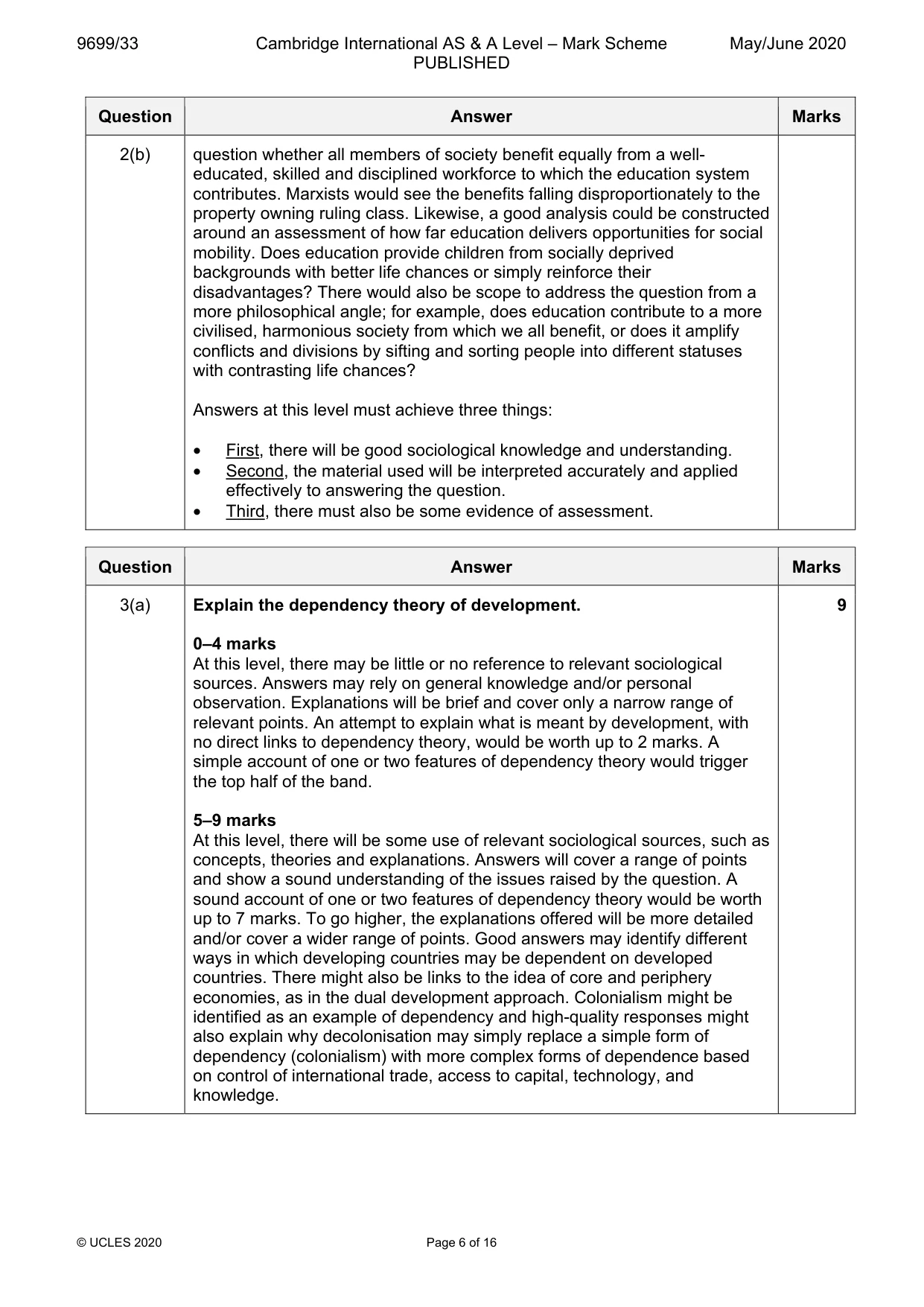
9699/33 Cambridge International AS & A Level – Mark Scheme PUBLISHED May/June 2020 © UCLES 2020 Page 6 of 16 Question Answer Marks 2(b) question whether all members of society benefit equally from a well- educated, skilled and disciplined workforce to which the education system contributes. Marxists would see the benefits falling disproportionately to the property owning ruling class. Likewise, a good analysis could be constructed around an assessment of how far education delivers opportunities for social mobility. Does education provide children from socially deprived backgrounds with better life chances or simply reinforce their disadvantages? There would also be scope to address the question from a more philosophical angle; for example, does education contribute to a more civilised, harmonious society from which we all benefit, or does it amplify conflicts and divisions by sifting and sorting people into different statuses with contrasting life chances? Answers at this level must achieve three things: • First, there will be good sociological knowledge and understanding. • Second, the material used will be interpreted accurately and applied effectively to answering the question. • Third, there must also be some evidence of assessment. Question Answer Marks 3(a) Explain the dependency theory of development. 0–4 marks At this level, there may be little or no reference to relevant sociological sources. Answers may rely on general knowledge and/or personal observation. Explanations will be brief and cover only a narrow range of relevant points. An attempt to explain what is meant by development, with no direct links to dependency theory, would be worth up to 2 marks. A simple account of one or two features of dependency theory would trigger the top half of the band. 5–9 marks At this level, there will be some use of relevant sociological sources, such as concepts, theories and explanations. Answers will cover a range of points and show a sound understanding of the issues raised by the question. A sound account of one or two features of dependency theory would be worth up to 7 marks. To go higher, the explanations offered will be more detailed and/or cover a wider range of points. Good answers may identify different ways in which developing countries may be dependent on developed countries. There might also be links to the idea of core and periphery economies, as in the dual development approach. Colonialism might be identified as an example of dependency and high-quality responses might also explain why decolonisation may simply replace a simple form of dependency (colonialism) with more complex forms of dependence based on control of international trade, access to capital, technology, and knowledge. 9
Mark scheme, page 7
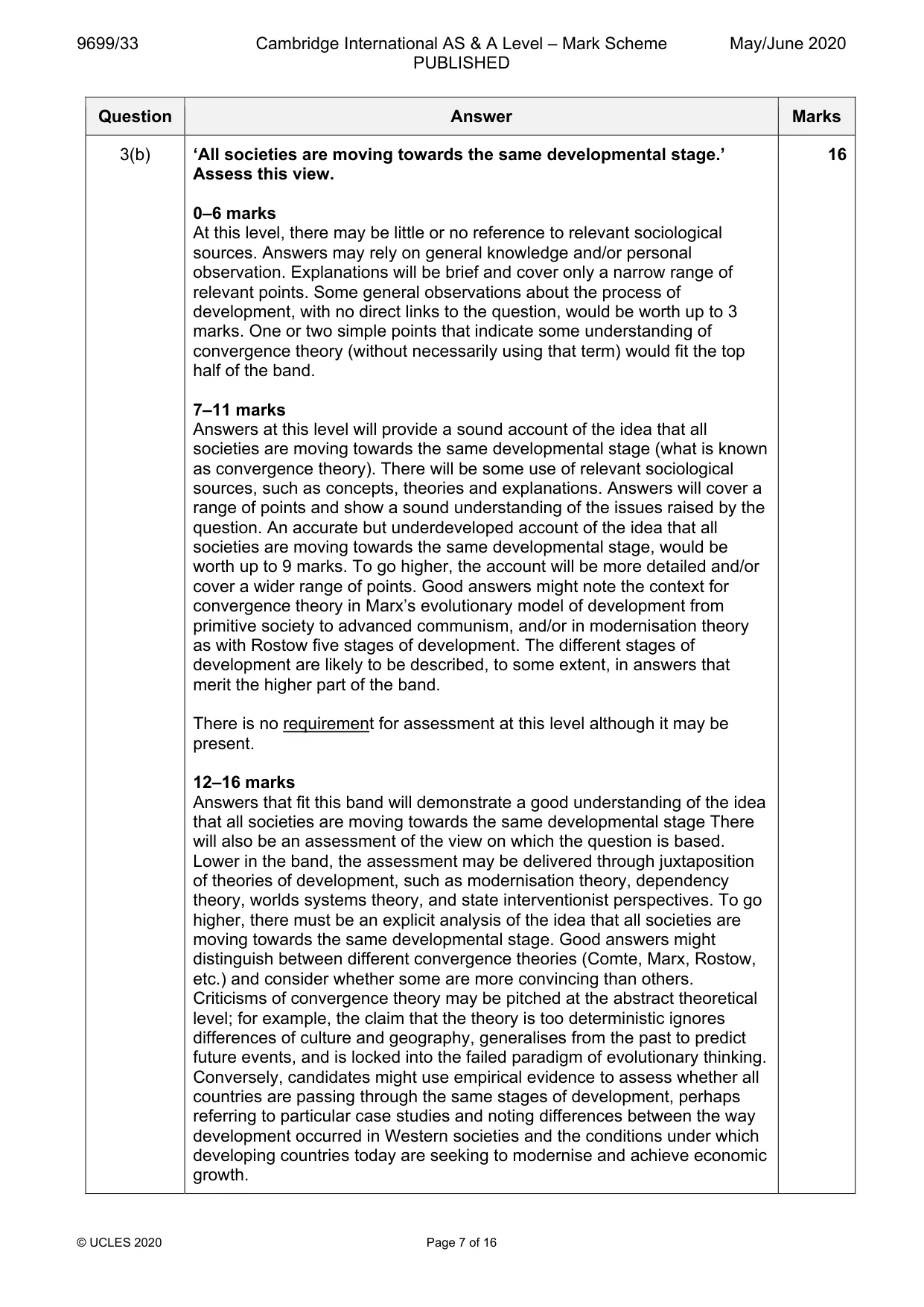
9699/33 Cambridge International AS & A Level – Mark Scheme PUBLISHED May/June 2020 © UCLES 2020 Page 7 of 16 Question Answer Marks 3(b) ‘All societies are moving towards the same developmental stage.’ Assess this view. 0–6 marks At this level, there may be little or no reference to relevant sociological sources. Answers may rely on general knowledge and/or personal observation. Explanations will be brief and cover only a narrow range of relevant points. Some general observations about the process of development, with no direct links to the question, would be worth up to 3 marks. One or two simple points that indicate some understanding of convergence theory (without necessarily using that term) would fit the top half of the band. 7–11 marks Answers at this level will provide a sound account of the idea that all societies are moving towards the same developmental stage (what is known as convergence theory). There will be some use of relevant sociological sources, such as concepts, theories and explanations. Answers will cover a range of points and show a sound understanding of the issues raised by the question. An accurate but underdeveloped account of the idea that all societies are moving towards the same developmental stage, would be worth up to 9 marks. To go higher, the account will be more detailed and/or cover a wider range of points. Good answers might note the context for convergence theory in Marx’s evolutionary model of development from primitive society to advanced communism, and/or in modernisation theory as with Rostow five stages of development. The different stages of development are likely to be described, to some extent, in answers that merit the higher part of the band. There is no requirement for assessment at this level although it may be present. 12–16 marks Answers that fit this band will demonstrate a good understanding of the idea that all societies are moving towards the same developmental stage There will also be an assessment of the view on which the question is based. Lower in the band, the assessment may be delivered through juxtaposition of theories of development, such as modernisation theory, dependency theory, worlds systems theory, and state interventionist perspectives. To go higher, there must be an explicit analysis of the idea that all societies are moving towards the same developmental stage. Good answers might distinguish between different convergence theories (Comte, Marx, Rostow, etc.) and consider whether some are more convincing than others. Criticisms of convergence theory may be pitched at the abstract theoretical level; for example, the claim that the theory is too deterministic ignores differences of culture and geography, generalises from the past to predict future events, and is locked into the failed paradigm of evolutionary thinking. Conversely, candidates might use empirical evidence to assess whether all countries are passing through the same stages of development, perhaps referring to particular case studies and noting differences between the way development occurred in Western societies and the conditions under which developing countries today are seeking to modernise and achieve economic growth. 16
Mark scheme, page 8
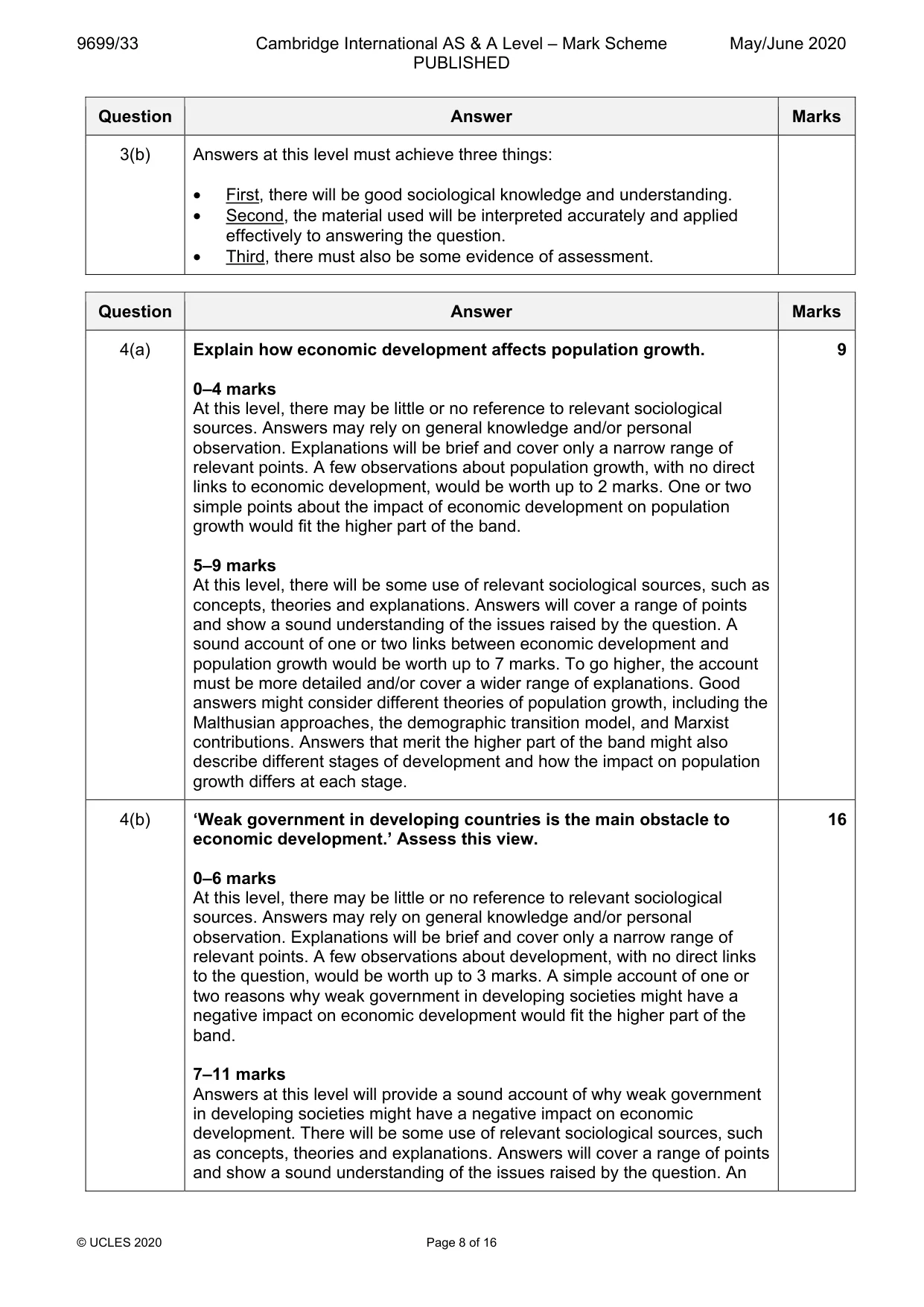
9699/33 Cambridge International AS & A Level – Mark Scheme PUBLISHED May/June 2020 © UCLES 2020 Page 8 of 16 Question Answer Marks 3(b) Answers at this level must achieve three things: • First, there will be good sociological knowledge and understanding. • Second, the material used will be interpreted accurately and applied effectively to answering the question. • Third, there must also be some evidence of assessment. Question Answer Marks 4(a) Explain how economic development affects population growth. 0–4 marks At this level, there may be little or no reference to relevant sociological sources. Answers may rely on general knowledge and/or personal observation. Explanations will be brief and cover only a narrow range of relevant points. A few observations about population growth, with no direct links to economic development, would be worth up to 2 marks. One or two simple points about the impact of economic development on population growth would fit the higher part of the band. 5–9 marks At this level, there will be some use of relevant sociological sources, such as concepts, theories and explanations. Answers will cover a range of points and show a sound understanding of the issues raised by the question. A sound account of one or two links between economic development and population growth would be worth up to 7 marks. To go higher, the account must be more detailed and/or cover a wider range of explanations. Good answers might consider different theories of population growth, including the Malthusian approaches, the demographic transition model, and Marxist contributions. Answers that merit the higher part of the band might also describe different stages of development and how the impact on population growth differs at each stage. 9 4(b) ‘Weak government in developing countries is the main obstacle to economic development.’ Assess this view. 0–6 marks At this level, there may be little or no reference to relevant sociological sources. Answers may rely on general knowledge and/or personal observation. Explanations will be brief and cover only a narrow range of relevant points. A few observations about development, with no direct links to the question, would be worth up to 3 marks. A simple account of one or two reasons why weak government in developing societies might have a negative impact on economic development would fit the higher part of the band. 7–11 marks Answers at this level will provide a sound account of why weak government in developing societies might have a negative impact on economic development. There will be some use of relevant sociological sources, such as concepts, theories and explanations. Answers will cover a range of points and show a sound understanding of the issues raised by the question. An 16
Mark scheme, page 9
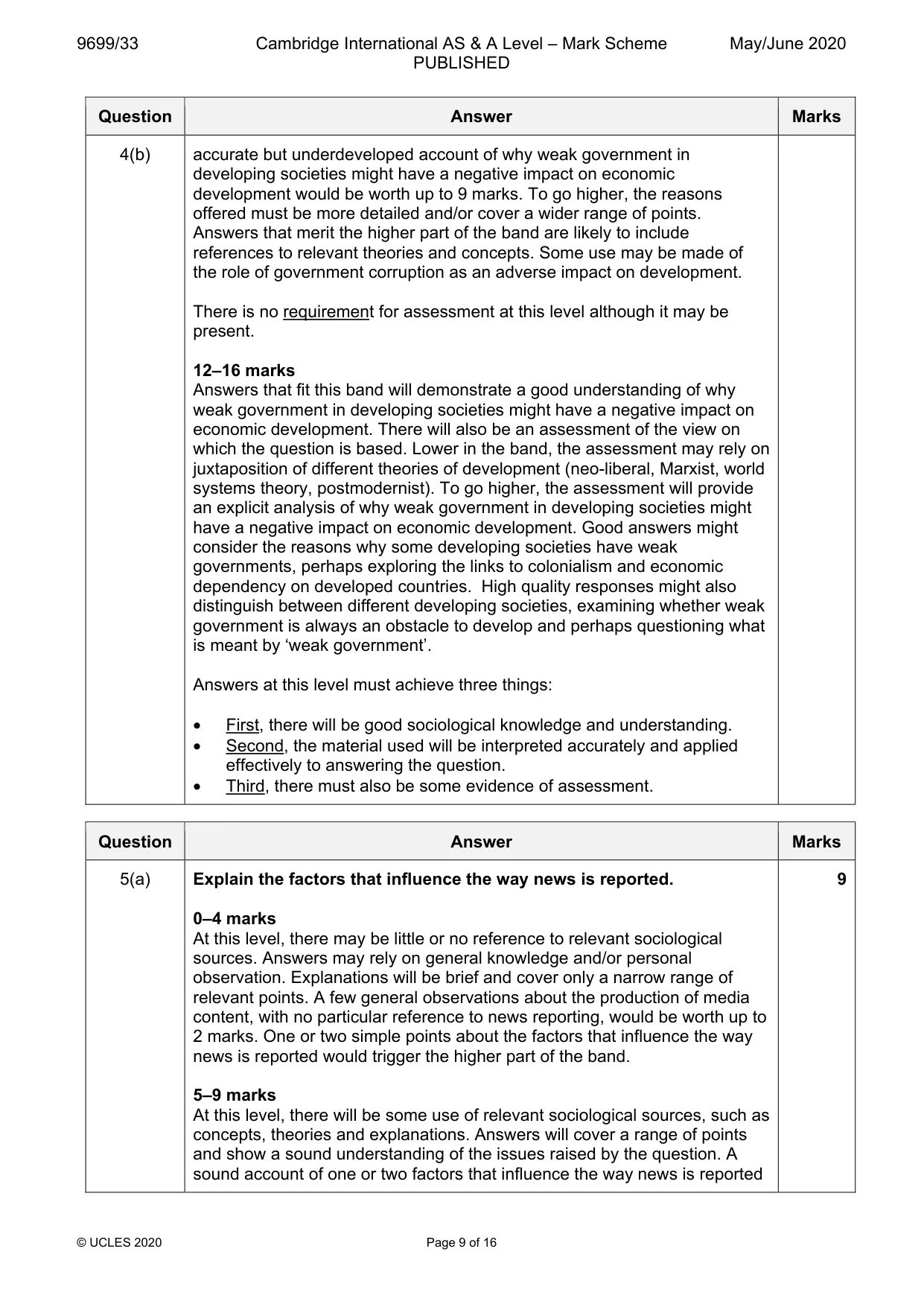
9699/33 Cambridge International AS & A Level – Mark Scheme PUBLISHED May/June 2020 © UCLES 2020 Page 9 of 16 Question Answer Marks 4(b) accurate but underdeveloped account of why weak government in developing societies might have a negative impact on economic development would be worth up to 9 marks. To go higher, the reasons offered must be more detailed and/or cover a wider range of points. Answers that merit the higher part of the band are likely to include references to relevant theories and concepts. Some use may be made of the role of government corruption as an adverse impact on development. There is no requirement for assessment at this level although it may be present. 12–16 marks Answers that fit this band will demonstrate a good understanding of why weak government in developing societies might have a negative impact on economic development. There will also be an assessment of the view on which the question is based. Lower in the band, the assessment may rely on juxtaposition of different theories of development (neo-liberal, Marxist, world systems theory, postmodernist). To go higher, the assessment will provide an explicit analysis of why weak government in developing societies might have a negative impact on economic development. Good answers might consider the reasons why some developing societies have weak governments, perhaps exploring the links to colonialism and economic dependency on developed countries. High quality responses might also distinguish between different developing societies, examining whether weak government is always an obstacle to develop and perhaps questioning what is meant by ‘weak government’. Answers at this level must achieve three things: • First, there will be good sociological knowledge and understanding. • Second, the material used will be interpreted accurately and applied effectively to answering the question. • Third, there must also be some evidence of assessment. Question Answer Marks 5(a) Explain the factors that influence the way news is reported. 0–4 marks At this level, there may be little or no reference to relevant sociological sources. Answers may rely on general knowledge and/or personal observation. Explanations will be brief and cover only a narrow range of relevant points. A few general observations about the production of media content, with no particular reference to news reporting, would be worth up to 2 marks. One or two simple points about the factors that influence the way news is reported would trigger the higher part of the band. 5–9 marks At this level, there will be some use of relevant sociological sources, such as concepts, theories and explanations. Answers will cover a range of points and show a sound understanding of the issues raised by the question. A sound account of one or two factors that influence the way news is reported 9
Mark scheme, page 10
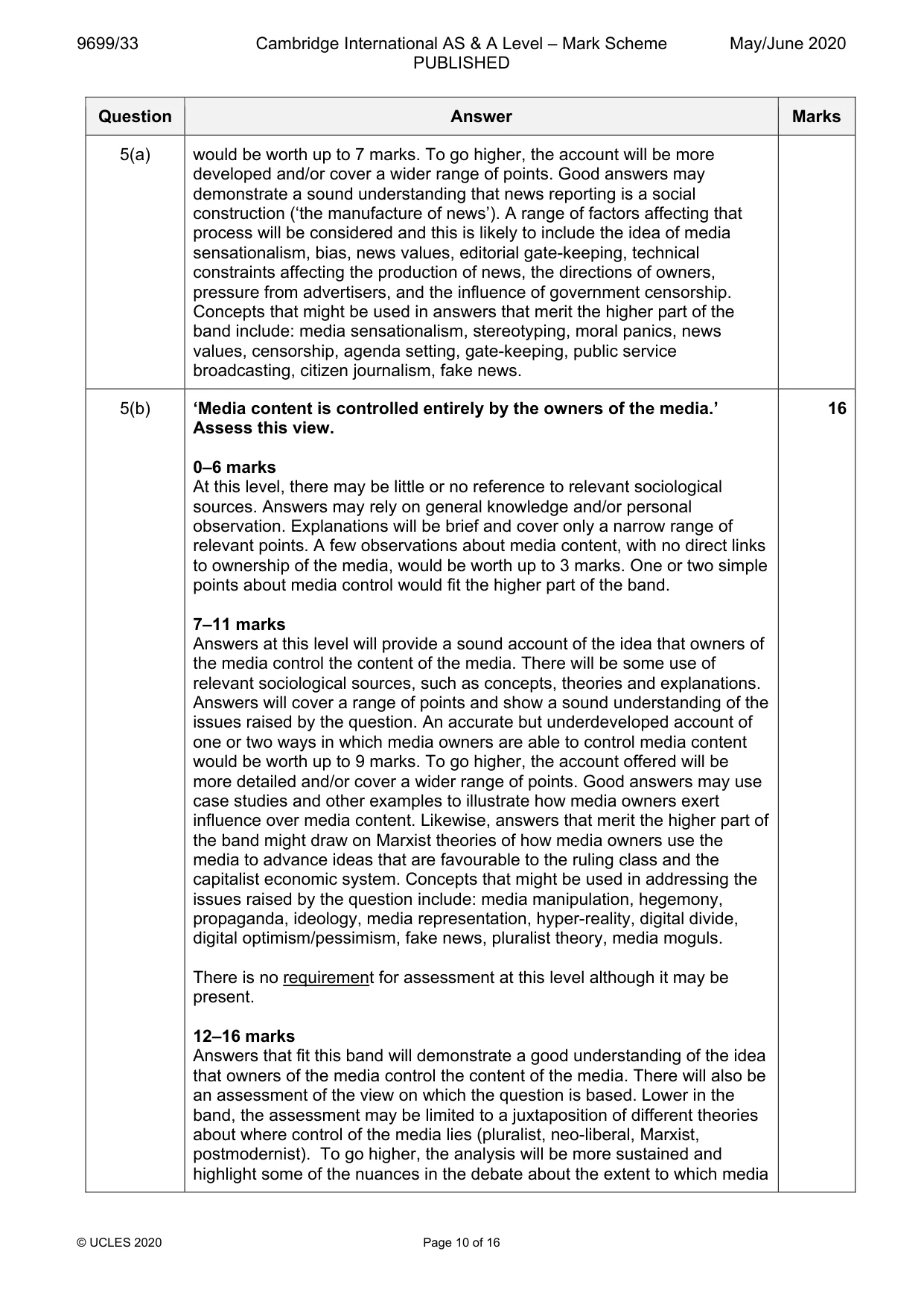
9699/33 Cambridge International AS & A Level – Mark Scheme PUBLISHED May/June 2020 © UCLES 2020 Page 10 of 16 Question Answer Marks 5(a) would be worth up to 7 marks. To go higher, the account will be more developed and/or cover a wider range of points. Good answers may demonstrate a sound understanding that news reporting is a social construction (‘the manufacture of news’). A range of factors affecting that process will be considered and this is likely to include the idea of media sensationalism, bias, news values, editorial gate-keeping, technical constraints affecting the production of news, the directions of owners, pressure from advertisers, and the influence of government censorship. Concepts that might be used in answers that merit the higher part of the band include: media sensationalism, stereotyping, moral panics, news values, censorship, agenda setting, gate-keeping, public service broadcasting, citizen journalism, fake news. 5(b) ‘Media content is controlled entirely by the owners of the media.’ Assess this view. 0–6 marks At this level, there may be little or no reference to relevant sociological sources. Answers may rely on general knowledge and/or personal observation. Explanations will be brief and cover only a narrow range of relevant points. A few observations about media content, with no direct links to ownership of the media, would be worth up to 3 marks. One or two simple points about media control would fit the higher part of the band. 7–11 marks Answers at this level will provide a sound account of the idea that owners of the media control the content of the media. There will be some use of relevant sociological sources, such as concepts, theories and explanations. Answers will cover a range of points and show a sound understanding of the issues raised by the question. An accurate but underdeveloped account of one or two ways in which media owners are able to control media content would be worth up to 9 marks. To go higher, the account offered will be more detailed and/or cover a wider range of points. Good answers may use case studies and other examples to illustrate how media owners exert influence over media content. Likewise, answers that merit the higher part of the band might draw on Marxist theories of how media owners use the media to advance ideas that are favourable to the ruling class and the capitalist economic system. Concepts that might be used in addressing the issues raised by the question include: media manipulation, hegemony, propaganda, ideology, media representation, hyper-reality, digital divide, digital optimism/pessimism, fake news, pluralist theory, media moguls. There is no requirement for assessment at this level although it may be present. 12–16 marks Answers that fit this band will demonstrate a good understanding of the idea that owners of the media control the content of the media. There will also be an assessment of the view on which the question is based. Lower in the band, the assessment may be limited to a juxtaposition of different theories about where control of the media lies (pluralist, neo-liberal, Marxist, postmodernist). To go higher, the analysis will be more sustained and highlight some of the nuances in the debate about the extent to which media 16
Mark scheme, page 11
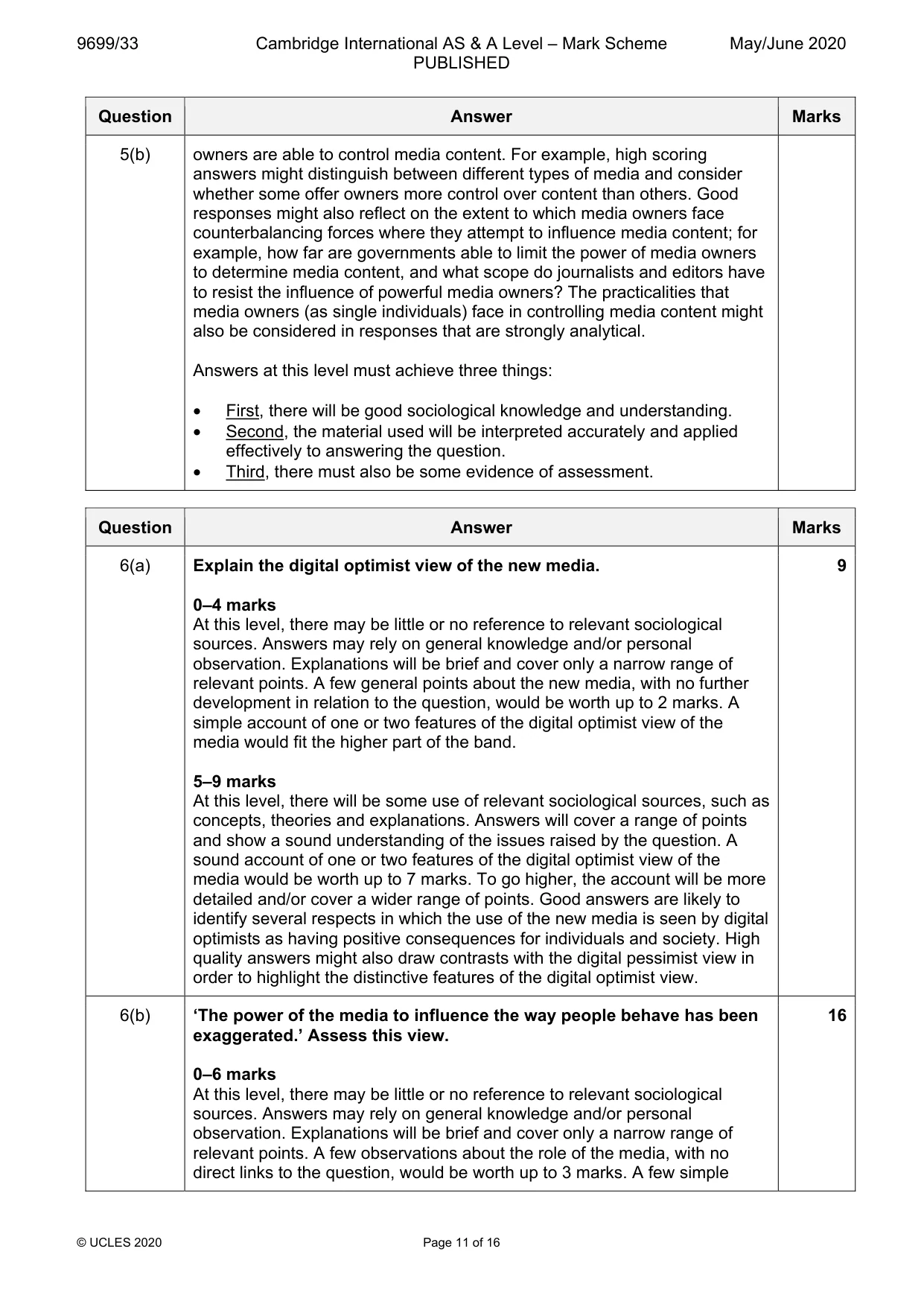
9699/33 Cambridge International AS & A Level – Mark Scheme PUBLISHED May/June 2020 © UCLES 2020 Page 11 of 16 Question Answer Marks 5(b) owners are able to control media content. For example, high scoring answers might distinguish between different types of media and consider whether some offer owners more control over content than others. Good responses might also reflect on the extent to which media owners face counterbalancing forces where they attempt to influence media content; for example, how far are governments able to limit the power of media owners to determine media content, and what scope do journalists and editors have to resist the influence of powerful media owners? The practicalities that media owners (as single individuals) face in controlling media content might also be considered in responses that are strongly analytical. Answers at this level must achieve three things: • First, there will be good sociological knowledge and understanding. • Second, the material used will be interpreted accurately and applied effectively to answering the question. • Third, there must also be some evidence of assessment. Question Answer Marks 6(a) Explain the digital optimist view of the new media. 0–4 marks At this level, there may be little or no reference to relevant sociological sources. Answers may rely on general knowledge and/or personal observation. Explanations will be brief and cover only a narrow range of relevant points. A few general points about the new media, with no further development in relation to the question, would be worth up to 2 marks. A simple account of one or two features of the digital optimist view of the media would fit the higher part of the band. 5–9 marks At this level, there will be some use of relevant sociological sources, such as concepts, theories and explanations. Answers will cover a range of points and show a sound understanding of the issues raised by the question. A sound account of one or two features of the digital optimist view of the media would be worth up to 7 marks. To go higher, the account will be more detailed and/or cover a wider range of points. Good answers are likely to identify several respects in which the use of the new media is seen by digital optimists as having positive consequences for individuals and society. High quality answers might also draw contrasts with the digital pessimist view in order to highlight the distinctive features of the digital optimist view. 9 6(b) ‘The power of the media to influence the way people behave has been exaggerated.’ Assess this view. 0–6 marks At this level, there may be little or no reference to relevant sociological sources. Answers may rely on general knowledge and/or personal observation. Explanations will be brief and cover only a narrow range of relevant points. A few observations about the role of the media, with no direct links to the question, would be worth up to 3 marks. A few simple 16
Mark scheme, page 12
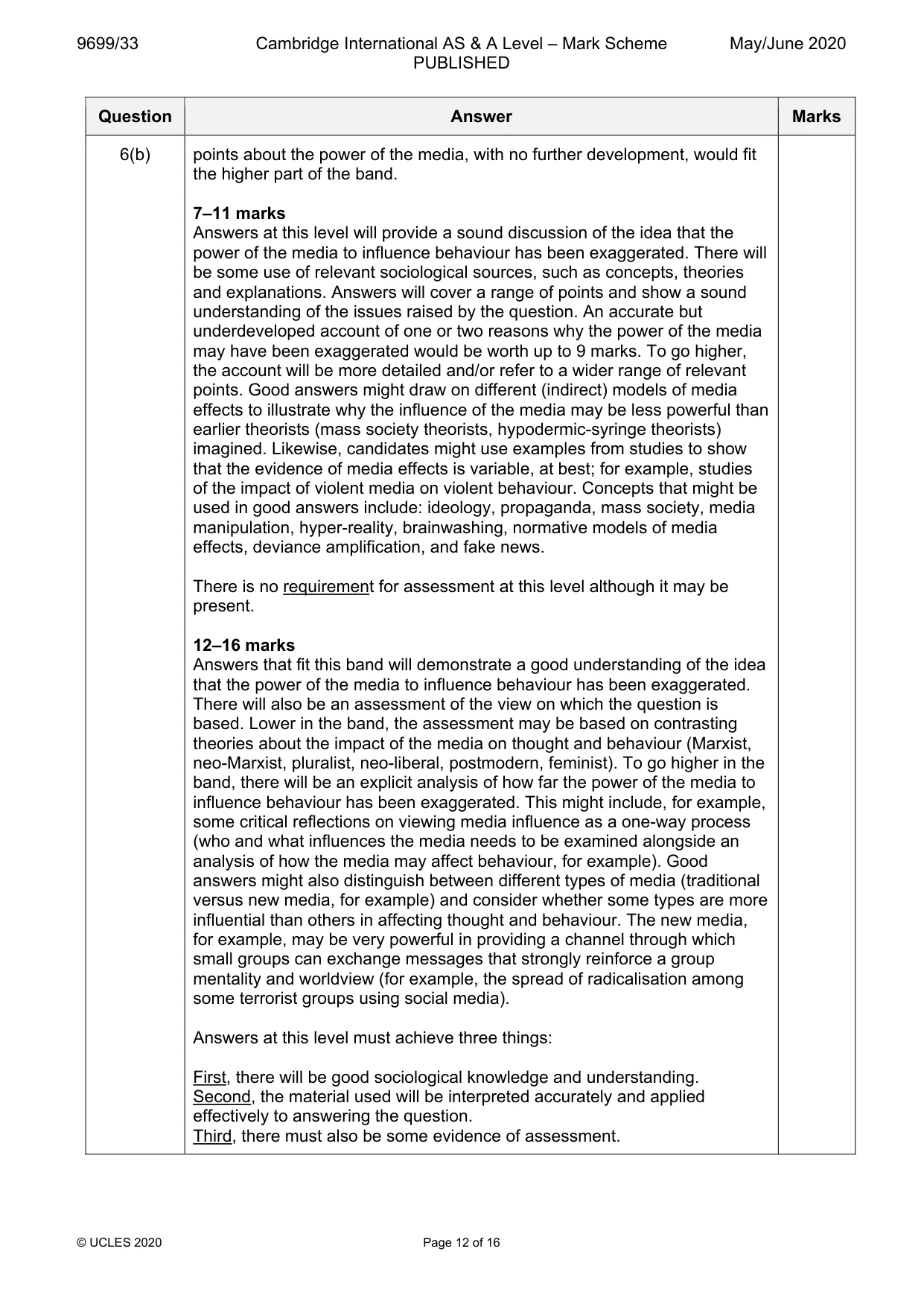
9699/33 Cambridge International AS & A Level – Mark Scheme PUBLISHED May/June 2020 © UCLES 2020 Page 12 of 16 Question Answer Marks 6(b) points about the power of the media, with no further development, would fit the higher part of the band. 7–11 marks Answers at this level will provide a sound discussion of the idea that the power of the media to influence behaviour has been exaggerated. There will be some use of relevant sociological sources, such as concepts, theories and explanations. Answers will cover a range of points and show a sound understanding of the issues raised by the question. An accurate but underdeveloped account of one or two reasons why the power of the media may have been exaggerated would be worth up to 9 marks. To go higher, the account will be more detailed and/or refer to a wider range of relevant points. Good answers might draw on different (indirect) models of media effects to illustrate why the influence of the media may be less powerful than earlier theorists (mass society theorists, hypodermic-syringe theorists) imagined. Likewise, candidates might use examples from studies to show that the evidence of media effects is variable, at best; for example, studies of the impact of violent media on violent behaviour. Concepts that might be used in good answers include: ideology, propaganda, mass society, media manipulation, hyper-reality, brainwashing, normative models of media effects, deviance amplification, and fake news. There is no requirement for assessment at this level although it may be present. 12–16 marks Answers that fit this band will demonstrate a good understanding of the idea that the power of the media to influence behaviour has been exaggerated. There will also be an assessment of the view on which the question is based. Lower in the band, the assessment may be based on contrasting theories about the impact of the media on thought and behaviour (Marxist, neo-Marxist, pluralist, neo-liberal, postmodern, feminist). To go higher in the band, there will be an explicit analysis of how far the power of the media to influence behaviour has been exaggerated. This might include, for example, some critical reflections on viewing media influence as a one-way process (who and what influences the media needs to be examined alongside an analysis of how the media may affect behaviour, for example). Good answers might also distinguish between different types of media (traditional versus new media, for example) and consider whether some types are more influential than others in affecting thought and behaviour. The new media, for example, may be very powerful in providing a channel through which small groups can exchange messages that strongly reinforce a group mentality and worldview (for example, the spread of radicalisation among some terrorist groups using social media). Answers at this level must achieve three things: First, there will be good sociological knowledge and understanding. Second, the material used will be interpreted accurately and applied effectively to answering the question. Third, there must also be some evidence of assessment.
Mark scheme, page 13
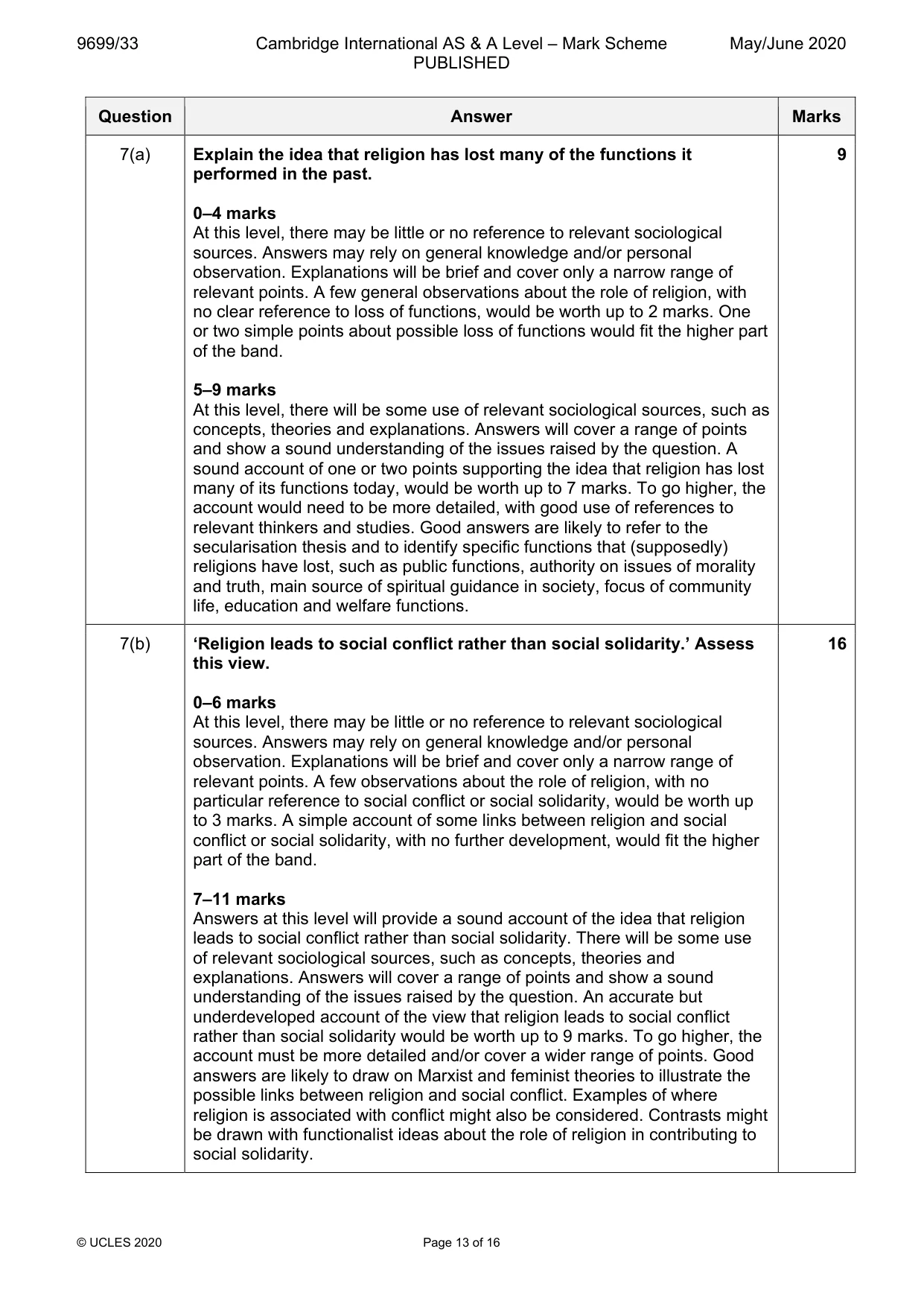
9699/33 Cambridge International AS & A Level – Mark Scheme PUBLISHED May/June 2020 © UCLES 2020 Page 13 of 16 Question Answer Marks 7(a) Explain the idea that religion has lost many of the functions it performed in the past. 0–4 marks At this level, there may be little or no reference to relevant sociological sources. Answers may rely on general knowledge and/or personal observation. Explanations will be brief and cover only a narrow range of relevant points. A few general observations about the role of religion, with no clear reference to loss of functions, would be worth up to 2 marks. One or two simple points about possible loss of functions would fit the higher part of the band. 5–9 marks At this level, there will be some use of relevant sociological sources, such as concepts, theories and explanations. Answers will cover a range of points and show a sound understanding of the issues raised by the question. A sound account of one or two points supporting the idea that religion has lost many of its functions today, would be worth up to 7 marks. To go higher, the account would need to be more detailed, with good use of references to relevant thinkers and studies. Good answers are likely to refer to the secularisation thesis and to identify specific functions that (supposedly) religions have lost, such as public functions, authority on issues of morality and truth, main source of spiritual guidance in society, focus of community life, education and welfare functions. 9 7(b) ‘Religion leads to social conflict rather than social solidarity.’ Assess this view. 0–6 marks At this level, there may be little or no reference to relevant sociological sources. Answers may rely on general knowledge and/or personal observation. Explanations will be brief and cover only a narrow range of relevant points. A few observations about the role of religion, with no particular reference to social conflict or social solidarity, would be worth up to 3 marks. A simple account of some links between religion and social conflict or social solidarity, with no further development, would fit the higher part of the band. 7–11 marks Answers at this level will provide a sound account of the idea that religion leads to social conflict rather than social solidarity. There will be some use of relevant sociological sources, such as concepts, theories and explanations. Answers will cover a range of points and show a sound understanding of the issues raised by the question. An accurate but underdeveloped account of the view that religion leads to social conflict rather than social solidarity would be worth up to 9 marks. To go higher, the account must be more detailed and/or cover a wider range of points. Good answers are likely to draw on Marxist and feminist theories to illustrate the possible links between religion and social conflict. Examples of where religion is associated with conflict might also be considered. Contrasts might be drawn with functionalist ideas about the role of religion in contributing to social solidarity. 16
Mark scheme, page 14
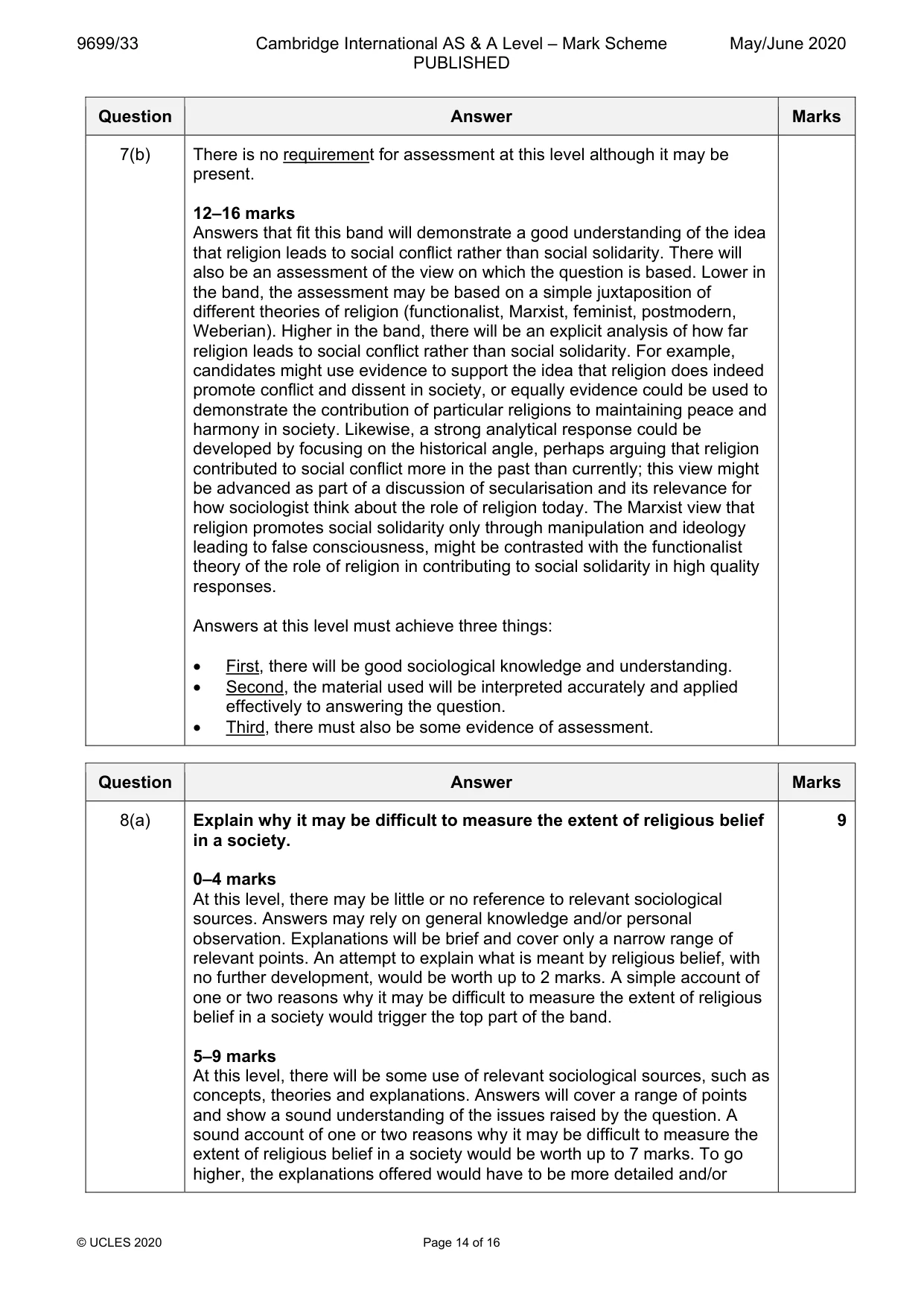
9699/33 Cambridge International AS & A Level – Mark Scheme PUBLISHED May/June 2020 © UCLES 2020 Page 14 of 16 Question Answer Marks 7(b) There is no requirement for assessment at this level although it may be present. 12–16 marks Answers that fit this band will demonstrate a good understanding of the idea that religion leads to social conflict rather than social solidarity. There will also be an assessment of the view on which the question is based. Lower in the band, the assessment may be based on a simple juxtaposition of different theories of religion (functionalist, Marxist, feminist, postmodern, Weberian). Higher in the band, there will be an explicit analysis of how far religion leads to social conflict rather than social solidarity. For example, candidates might use evidence to support the idea that religion does indeed promote conflict and dissent in society, or equally evidence could be used to demonstrate the contribution of particular religions to maintaining peace and harmony in society. Likewise, a strong analytical response could be developed by focusing on the historical angle, perhaps arguing that religion contributed to social conflict more in the past than currently; this view might be advanced as part of a discussion of secularisation and its relevance for how sociologist think about the role of religion today. The Marxist view that religion promotes social solidarity only through manipulation and ideology leading to false consciousness, might be contrasted with the functionalist theory of the role of religion in contributing to social solidarity in high quality responses. Answers at this level must achieve three things: • First, there will be good sociological knowledge and understanding. • Second, the material used will be interpreted accurately and applied effectively to answering the question. • Third, there must also be some evidence of assessment. Question Answer Marks 8(a) Explain why it may be difficult to measure the extent of religious belief in a society. 0–4 marks At this level, there may be little or no reference to relevant sociological sources. Answers may rely on general knowledge and/or personal observation. Explanations will be brief and cover only a narrow range of relevant points. An attempt to explain what is meant by religious belief, with no further development, would be worth up to 2 marks. A simple account of one or two reasons why it may be difficult to measure the extent of religious belief in a society would trigger the top part of the band. 5–9 marks At this level, there will be some use of relevant sociological sources, such as concepts, theories and explanations. Answers will cover a range of points and show a sound understanding of the issues raised by the question. A sound account of one or two reasons why it may be difficult to measure the extent of religious belief in a society would be worth up to 7 marks. To go higher, the explanations offered would have to be more detailed and/or 9
Mark scheme, page 15
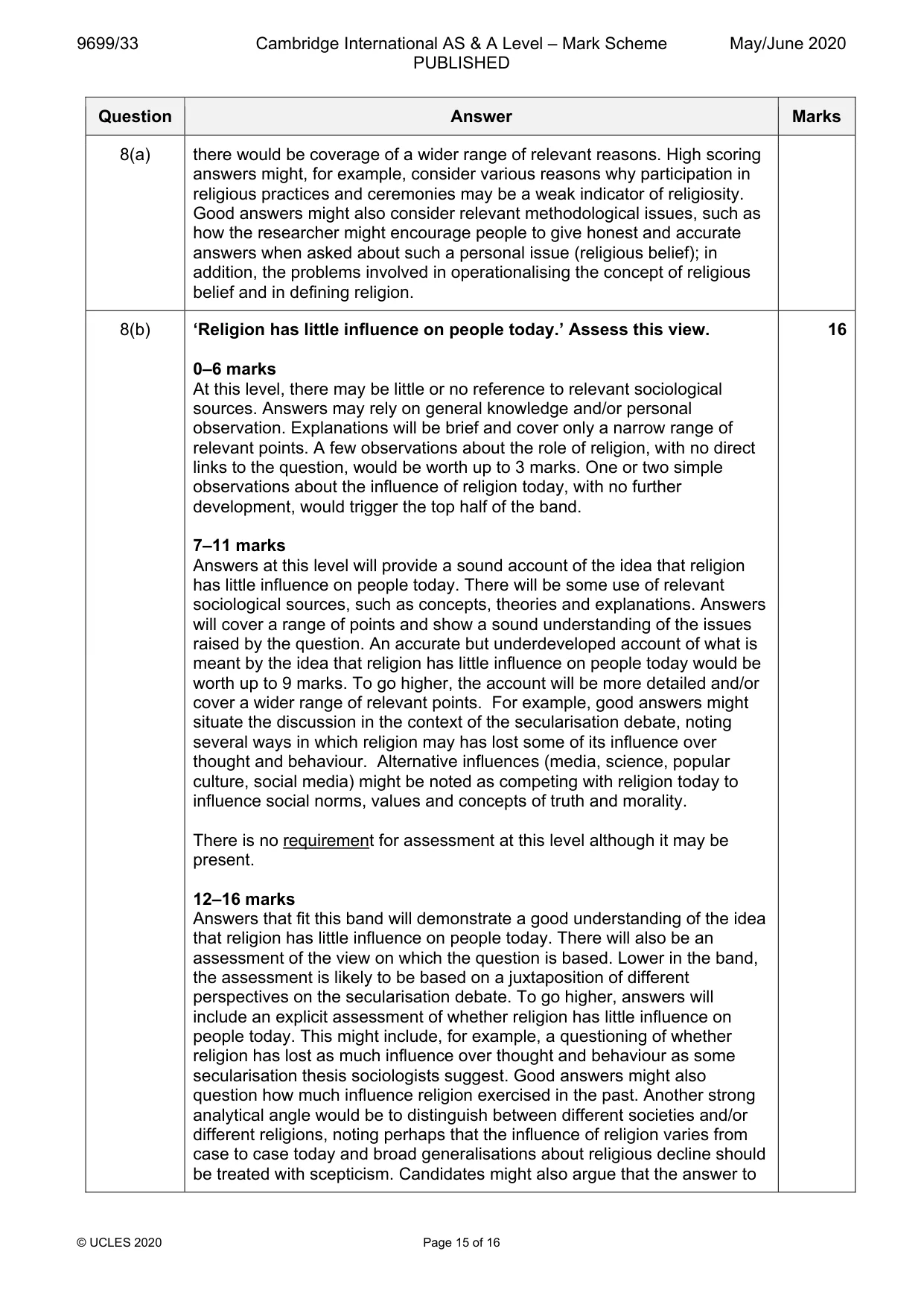
9699/33 Cambridge International AS & A Level – Mark Scheme PUBLISHED May/June 2020 © UCLES 2020 Page 15 of 16 Question Answer Marks 8(a) there would be coverage of a wider range of relevant reasons. High scoring answers might, for example, consider various reasons why participation in religious practices and ceremonies may be a weak indicator of religiosity. Good answers might also consider relevant methodological issues, such as how the researcher might encourage people to give honest and accurate answers when asked about such a personal issue (religious belief); in addition, the problems involved in operationalising the concept of religious belief and in defining religion. 8(b) ‘Religion has little influence on people today.’ Assess this view. 0–6 marks At this level, there may be little or no reference to relevant sociological sources. Answers may rely on general knowledge and/or personal observation. Explanations will be brief and cover only a narrow range of relevant points. A few observations about the role of religion, with no direct links to the question, would be worth up to 3 marks. One or two simple observations about the influence of religion today, with no further development, would trigger the top half of the band. 7–11 marks Answers at this level will provide a sound account of the idea that religion has little influence on people today. There will be some use of relevant sociological sources, such as concepts, theories and explanations. Answers will cover a range of points and show a sound understanding of the issues raised by the question. An accurate but underdeveloped account of what is meant by the idea that religion has little influence on people today would be worth up to 9 marks. To go higher, the account will be more detailed and/or cover a wider range of relevant points. For example, good answers might situate the discussion in the context of the secularisation debate, noting several ways in which religion may has lost some of its influence over thought and behaviour. Alternative influences (media, science, popular culture, social media) might be noted as competing with religion today to influence social norms, values and concepts of truth and morality. There is no requirement for assessment at this level although it may be present. 12–16 marks Answers that fit this band will demonstrate a good understanding of the idea that religion has little influence on people today. There will also be an assessment of the view on which the question is based. Lower in the band, the assessment is likely to be based on a juxtaposition of different perspectives on the secularisation debate. To go higher, answers will include an explicit assessment of whether religion has little influence on people today. This might include, for example, a questioning of whether religion has lost as much influence over thought and behaviour as some secularisation thesis sociologists suggest. Good answers might also question how much influence religion exercised in the past. Another strong analytical angle would be to distinguish between different societies and/or different religions, noting perhaps that the influence of religion varies from case to case today and broad generalisations about religious decline should be treated with scepticism. Candidates might also argue that the answer to 16
Mark scheme, page 16
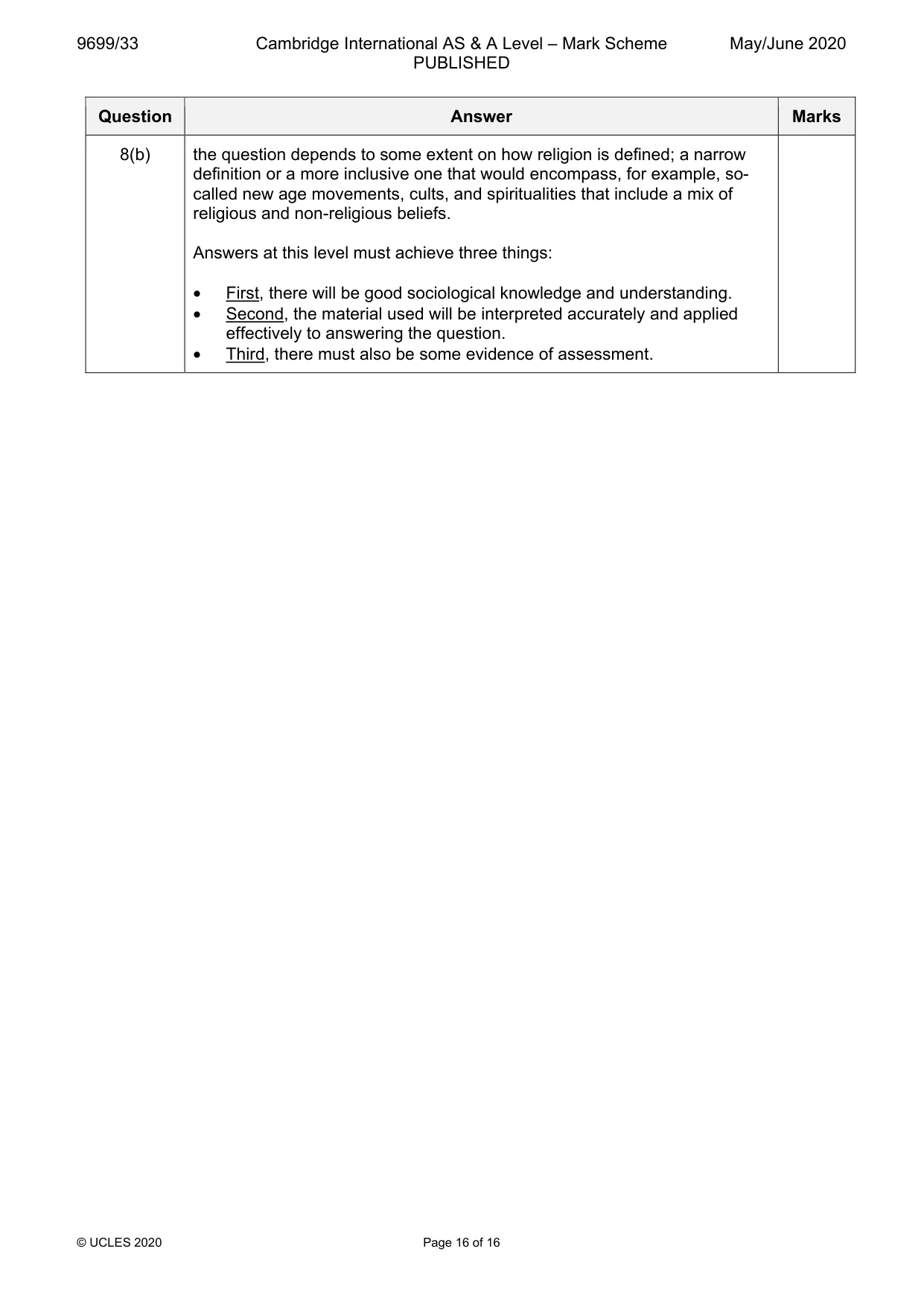
9699/33 Cambridge International AS & A Level – Mark Scheme PUBLISHED May/June 2020 © UCLES 2020 Page 16 of 16 Question Answer Marks 8(b) the question depends to some extent on how religion is defined; a narrow definition or a more inclusive one that would encompass, for example, so- called new age movements, cults, and spiritualities that include a mix of religious and non-religious beliefs. Answers at this level must achieve three things: • First, there will be good sociological knowledge and understanding. • Second, the material used will be interpreted accurately and applied effectively to answering the question. • Third, there must also be some evidence of assessment.