Cambridge A Level Sociology 9699 — 2017 Oct/Nov Paper 2 · Variant 2
9699/22/O/N/17 · 50 marks · ≈56 min
The question paper and its mark scheme, free to read here and free to download. This is Cambridge’s own paper, exactly as it was sat.
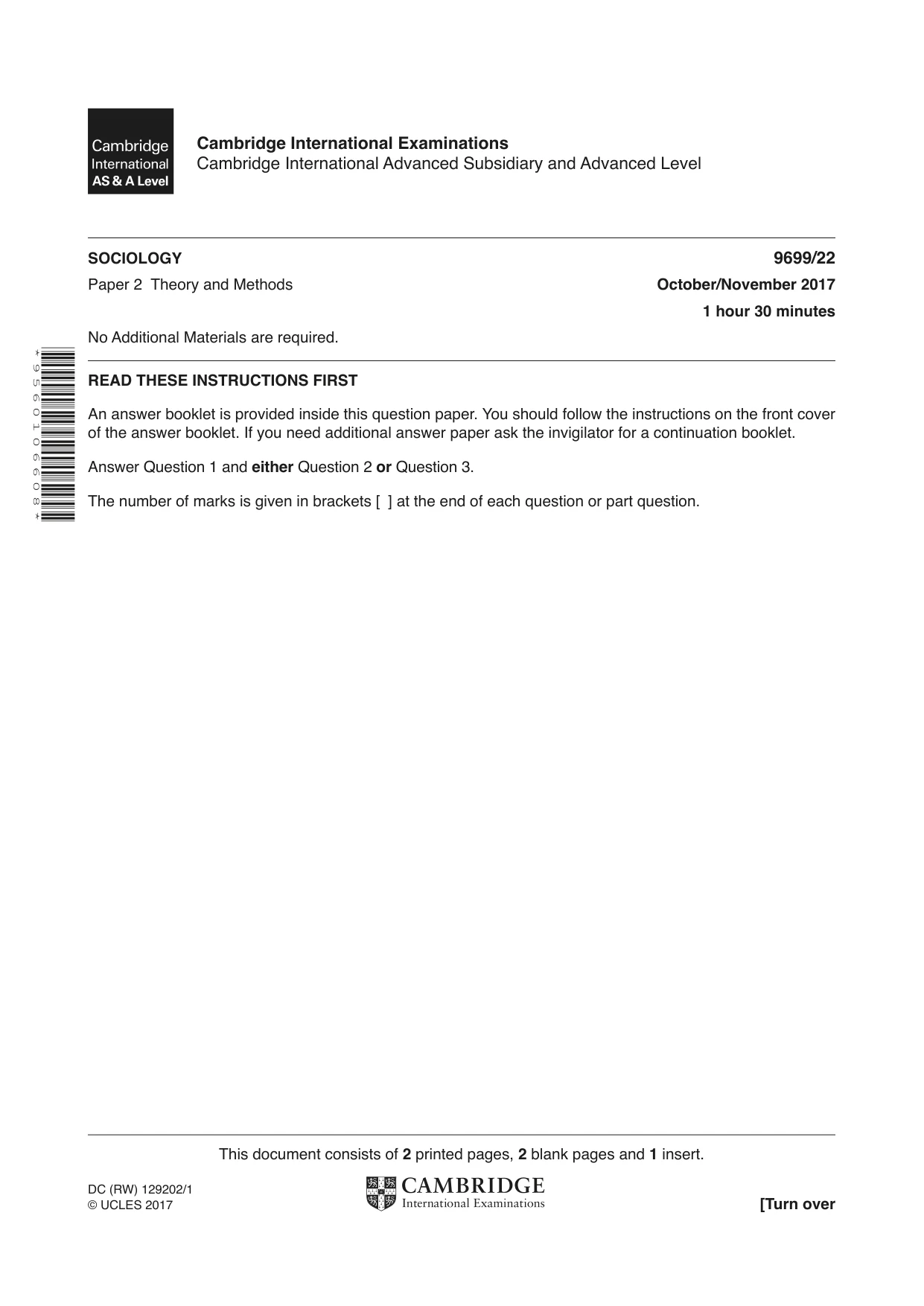
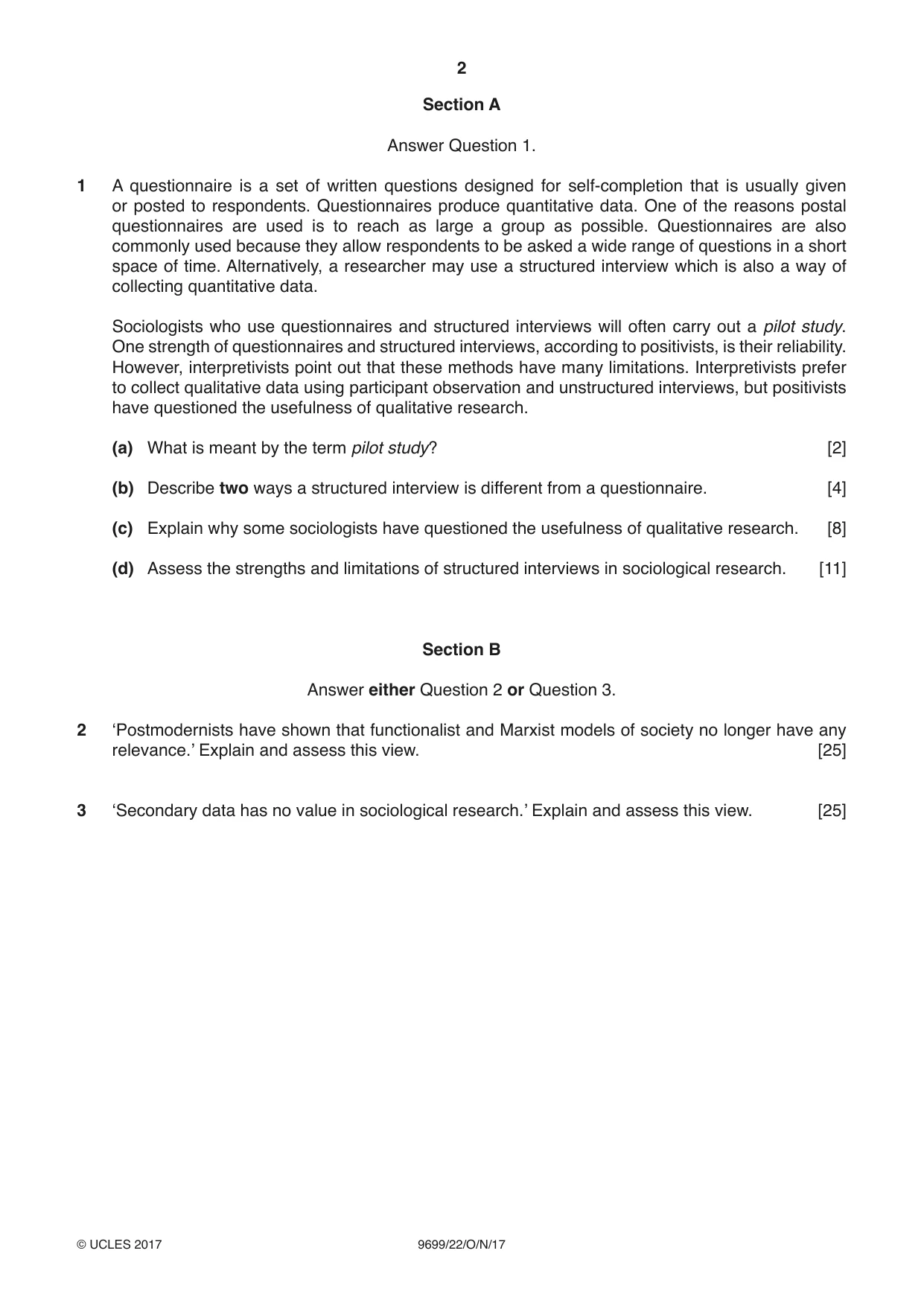
Question paper4 pages


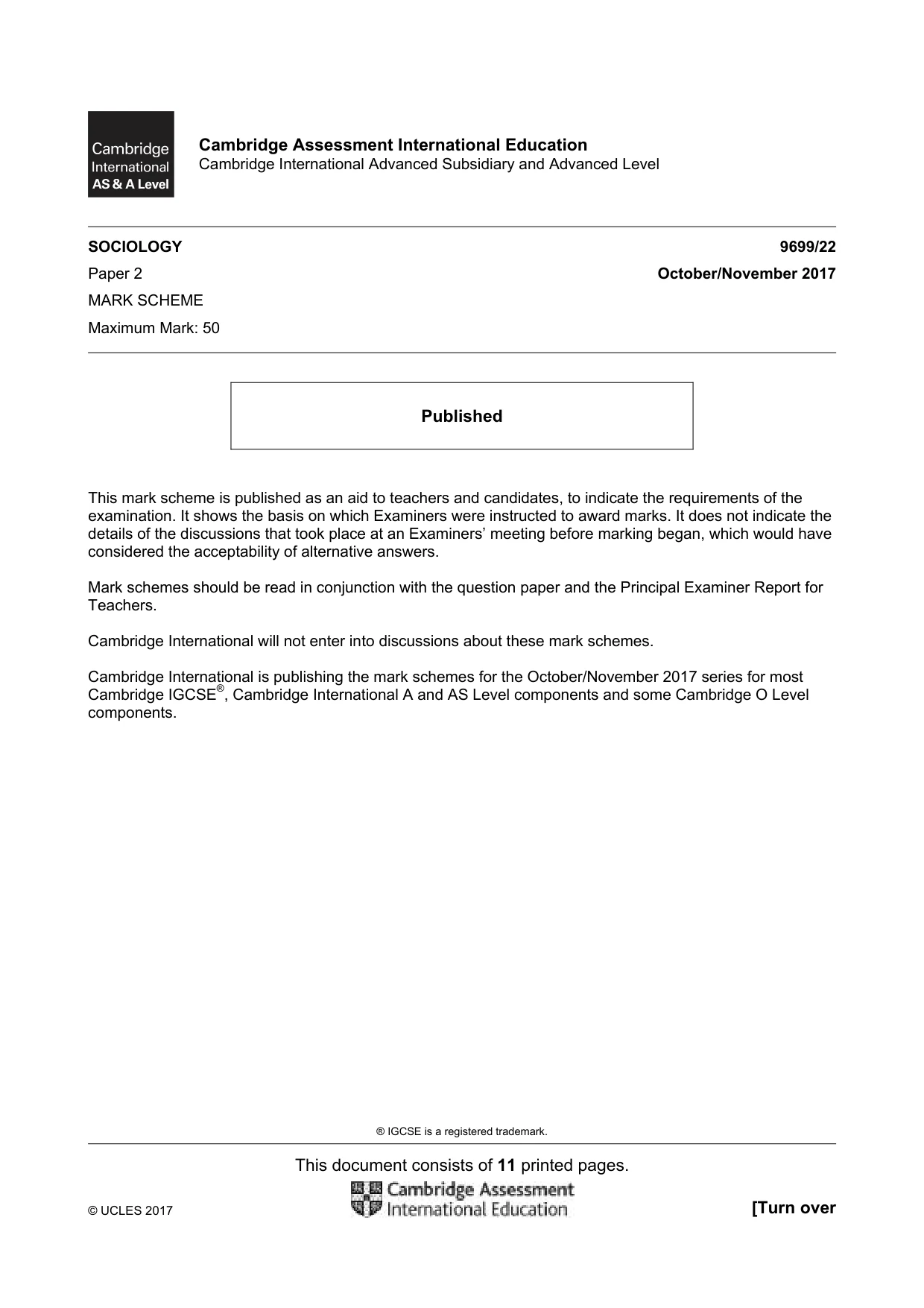
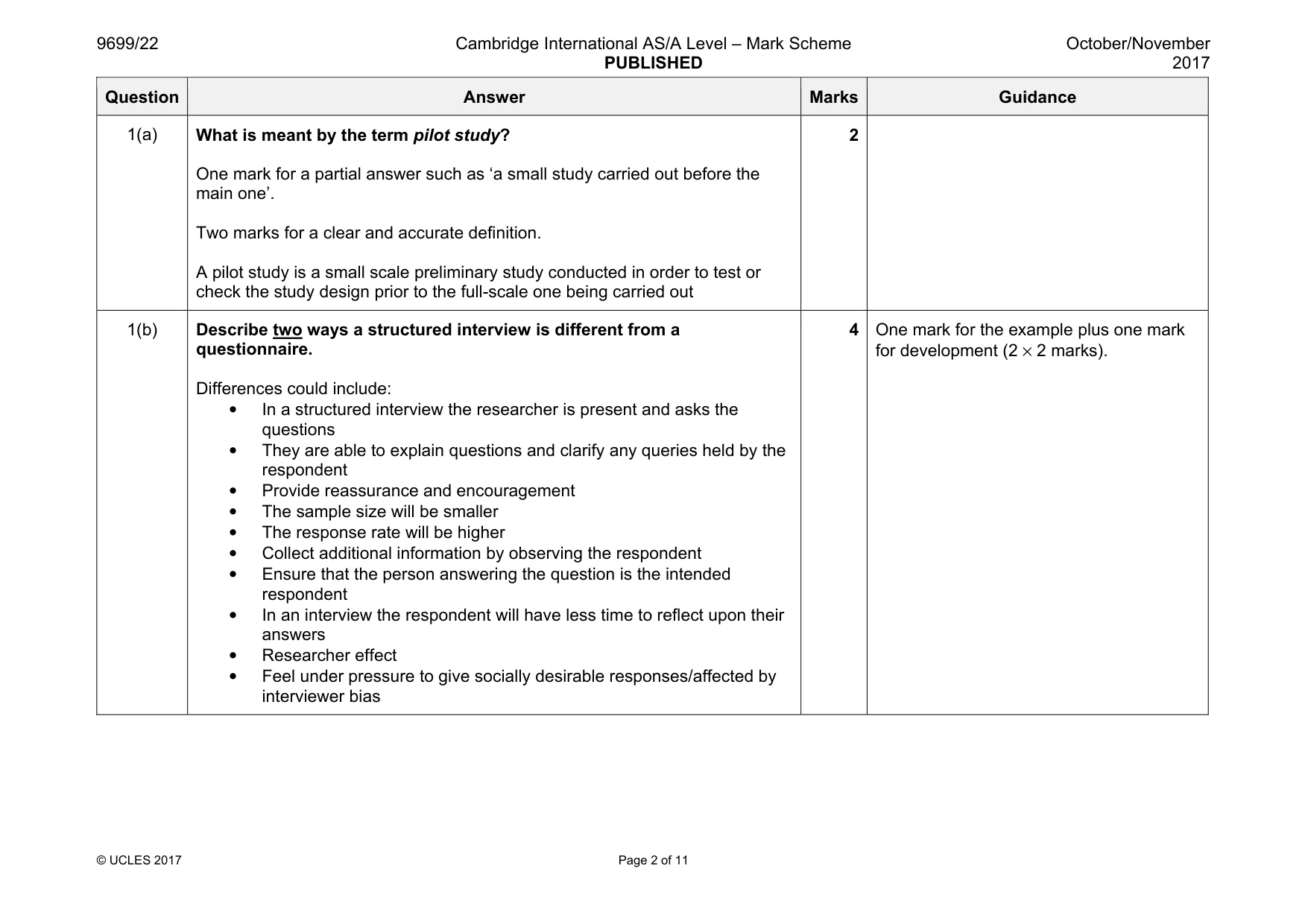
Mark scheme11 pages
Answers below. Sit the paper first if you are practising.
Paper as text
Question paper, page 1
This document consists of 2 printed pages, 2 blank pages and 1 insert. DC (RW) 129202/1 © UCLES 2017 [Turn over Cambridge International Examinations Cambridge International Advanced Subsidiary and Advanced Level * 9 5 6 0 1 0 6 6 0 8 * SOCIOLOGY 9699/22 Paper 2 Theory and Methods October/November 2017 1 hour 30 minutes No Additional Materials are required. READ THESE INSTRUCTIONS FIRST An answer booklet is provided inside this question paper. You should follow the instructions on the front cover of the answer booklet. If you need additional answer paper ask the invigilator for a continuation booklet. Answer Question 1 and either Question 2 or Question 3. The number of marks is given in brackets [ ] at the end of each question or part question.
Question paper, page 2
2 9699/22/O/N/17 © UCLES 2017 Section A Answer Question 1. 1 A questionnaire is a set of written questions designed for self-completion that is usually given or posted to respondents. Questionnaires produce quantitative data. One of the reasons postal questionnaires are used is to reach as large a group as possible. Questionnaires are also commonly used because they allow respondents to be asked a wide range of questions in a short space of time. Alternatively, a researcher may use a structured interview which is also a way of collecting quantitative data. Sociologists who use questionnaires and structured interviews will often carry out a pilot study. One strength of questionnaires and structured interviews, according to positivists, is their reliability. However, interpretivists point out that these methods have many limitations. Interpretivists prefer to collect qualitative data using participant observation and unstructured interviews, but positivists have questioned the usefulness of qualitative research. (a) What is meant by the term pilot study? [2] (b) Describe two ways a structured interview is different from a questionnaire. [4] (c) Explain why some sociologists have questioned the usefulness of qualitative research. [8] (d) Assess the strengths and limitations of structured interviews in sociological research. [11] Section B Answer either Question 2 or Question 3. 2 ‘Postmodernists have shown that functionalist and Marxist models of society no longer have any relevance.’ Explain and assess this view. [25] 3 ‘Secondary data has no value in sociological research.’ Explain and assess this view. [25]
Question paper, page 3
3 9699/22/O/N/17 © UCLES 2017 BLANK PAGE
Question paper, page 4
4 9699/22/O/N/17 © UCLES 2017 BLANK PAGE Permission to reproduce items where third-party owned material protected by copyright is included has been sought and cleared where possible. Every reasonable effort has been made by the publisher (UCLES) to trace copyright holders, but if any items requiring clearance have unwittingly been included, the publisher will be pleased to make amends at the earliest possible opportunity. To avoid the issue of disclosure of answer-related information to candidates, all copyright acknowledgements are reproduced online in the Cambridge International Examinations Copyright Acknowledgements Booklet. This is produced for each series of examinations and is freely available to download at www.cie.org.uk after the live examination series. Cambridge International Examinations is part of the Cambridge Assessment Group. Cambridge Assessment is the brand name of University of Cambridge Local Examinations Syndicate (UCLES), which is itself a department of the University of Cambridge.
Mark scheme, page 1
® IGCSE is a registered trademark. This document consists of 11 printed pages. © UCLES 2017 [Turn over Cambridge Assessment International Education Cambridge International Advanced Subsidiary and Advanced Level SOCIOLOGY 9699/22 Paper 2 October/November 2017 MARK SCHEME Maximum Mark: 50 Published This mark scheme is published as an aid to teachers and candidates, to indicate the requirements of the examination. It shows the basis on which Examiners were instructed to award marks. It does not indicate the details of the discussions that took place at an Examiners’ meeting before marking began, which would have considered the acceptability of alternative answers. Mark schemes should be read in conjunction with the question paper and the Principal Examiner Report for Teachers. Cambridge International will not enter into discussions about these mark schemes. Cambridge International is publishing the mark schemes for the October/November 2017 series for most Cambridge IGCSE®, Cambridge International A and AS Level components and some Cambridge O Level components.
Mark scheme, page 2
9699/22 Cambridge International AS/A Level – Mark Scheme PUBLISHED October/November 2017 © UCLES 2017 Page 2 of 11 Question Answer Marks Guidance 1(a) What is meant by the term pilot study? One mark for a partial answer such as ‘a small study carried out before the main one’. Two marks for a clear and accurate definition. A pilot study is a small scale preliminary study conducted in order to test or check the study design prior to the full-scale one being carried out 2 1(b) Describe two ways a structured interview is different from a questionnaire. Differences could include: • In a structured interview the researcher is present and asks the questions • They are able to explain questions and clarify any queries held by the respondent • Provide reassurance and encouragement • The sample size will be smaller • The response rate will be higher • Collect additional information by observing the respondent • Ensure that the person answering the question is the intended respondent • In an interview the respondent will have less time to reflect upon their answers • Researcher effect • Feel under pressure to give socially desirable responses/affected by interviewer bias 4 One mark for the example plus one mark for development (2 × 2 marks).
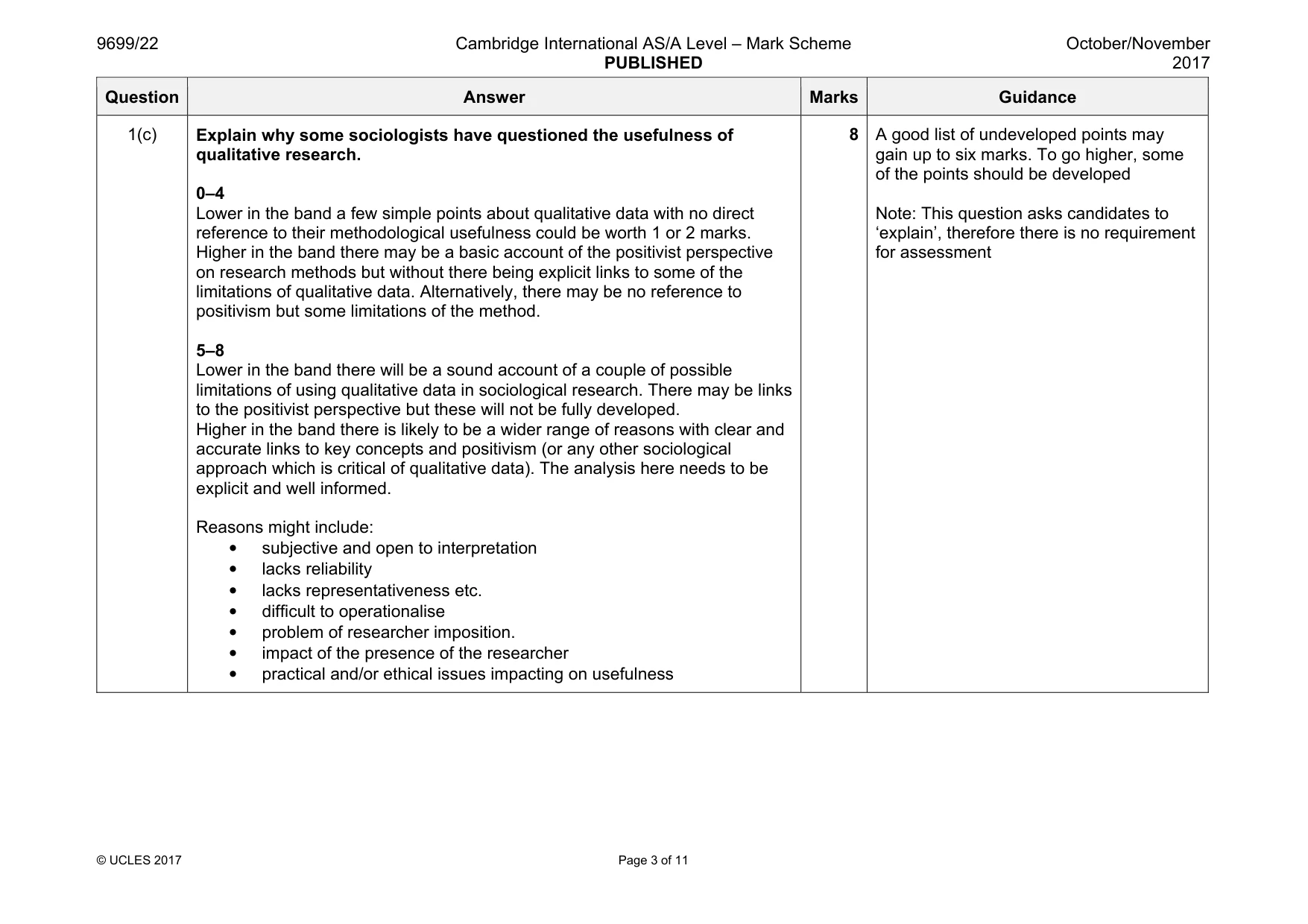
Mark scheme, page 3
9699/22 Cambridge International AS/A Level – Mark Scheme PUBLISHED October/November 2017 © UCLES 2017 Page 3 of 11 Question Answer Marks Guidance 1(c) Explain why some sociologists have questioned the usefulness of qualitative research. 0–4 Lower in the band a few simple points about qualitative data with no direct reference to their methodological usefulness could be worth 1 or 2 marks. Higher in the band there may be a basic account of the positivist perspective on research methods but without there being explicit links to some of the limitations of qualitative data. Alternatively, there may be no reference to positivism but some limitations of the method. 5–8 Lower in the band there will be a sound account of a couple of possible limitations of using qualitative data in sociological research. There may be links to the positivist perspective but these will not be fully developed. Higher in the band there is likely to be a wider range of reasons with clear and accurate links to key concepts and positivism (or any other sociological approach which is critical of qualitative data). The analysis here needs to be explicit and well informed. Reasons might include: • subjective and open to interpretation • lacks reliability • lacks representativeness etc. • difficult to operationalise • problem of researcher imposition. • impact of the presence of the researcher • practical and/or ethical issues impacting on usefulness 8 A good list of undeveloped points may gain up to six marks. To go higher, some of the points should be developed Note: This question asks candidates to ‘explain’, therefore there is no requirement for assessment
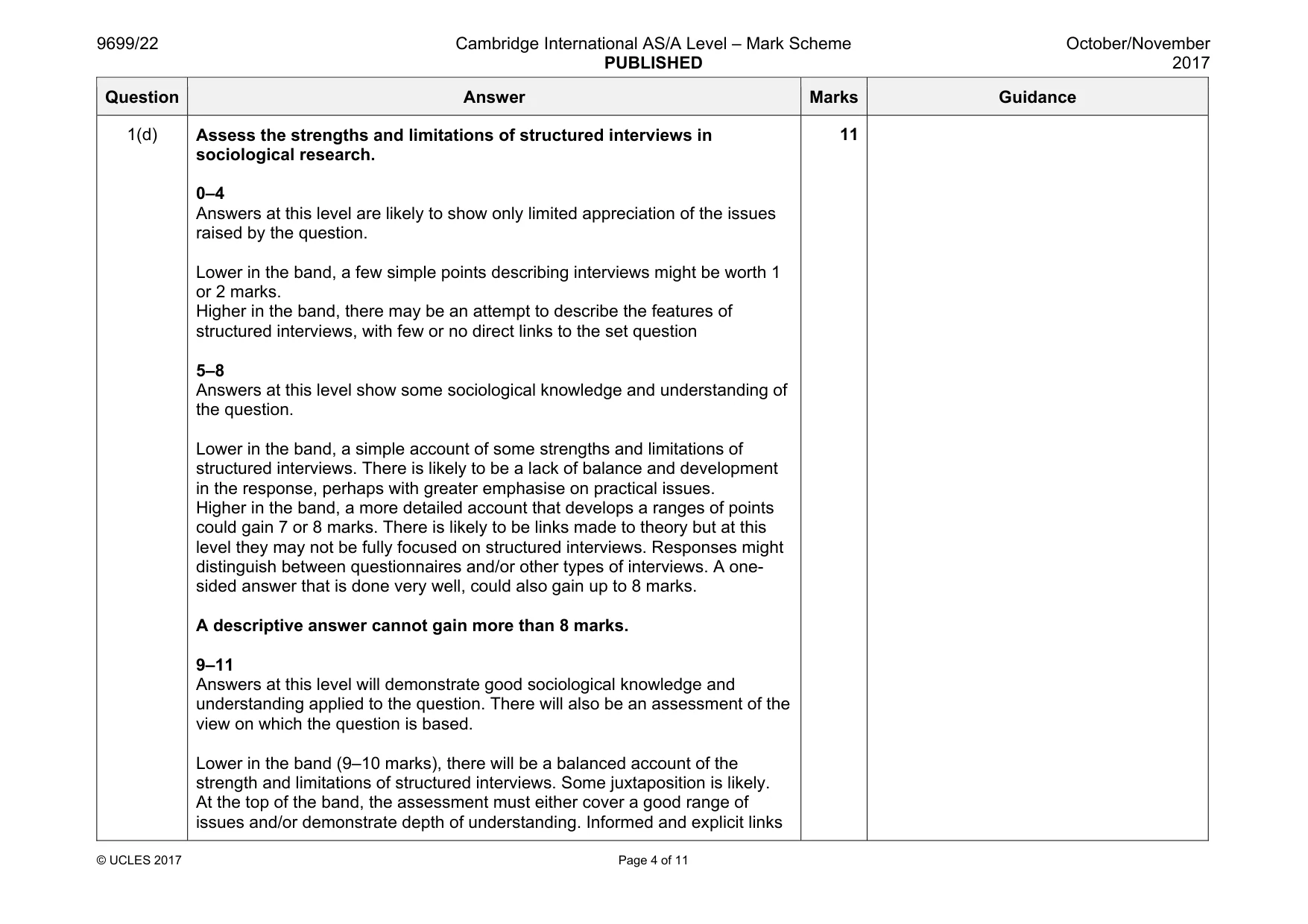
Mark scheme, page 4
9699/22 Cambridge International AS/A Level – Mark Scheme PUBLISHED October/November 2017 © UCLES 2017 Page 4 of 11 Question Answer Marks Guidance 1(d) Assess the strengths and limitations of structured interviews in sociological research. 0–4 Answers at this level are likely to show only limited appreciation of the issues raised by the question. Lower in the band, a few simple points describing interviews might be worth 1 or 2 marks. Higher in the band, there may be an attempt to describe the features of structured interviews, with few or no direct links to the set question 5–8 Answers at this level show some sociological knowledge and understanding of the question. Lower in the band, a simple account of some strengths and limitations of structured interviews. There is likely to be a lack of balance and development in the response, perhaps with greater emphasise on practical issues. Higher in the band, a more detailed account that develops a ranges of points could gain 7 or 8 marks. There is likely to be links made to theory but at this level they may not be fully focused on structured interviews. Responses might distinguish between questionnaires and/or other types of interviews. A one- sided answer that is done very well, could also gain up to 8 marks. A descriptive answer cannot gain more than 8 marks. 9–11 Answers at this level will demonstrate good sociological knowledge and understanding applied to the question. There will also be an assessment of the view on which the question is based. Lower in the band (9–10 marks), there will be a balanced account of the strength and limitations of structured interviews. Some juxtaposition is likely. At the top of the band, the assessment must either cover a good range of issues and/or demonstrate depth of understanding. Informed and explicit links 11
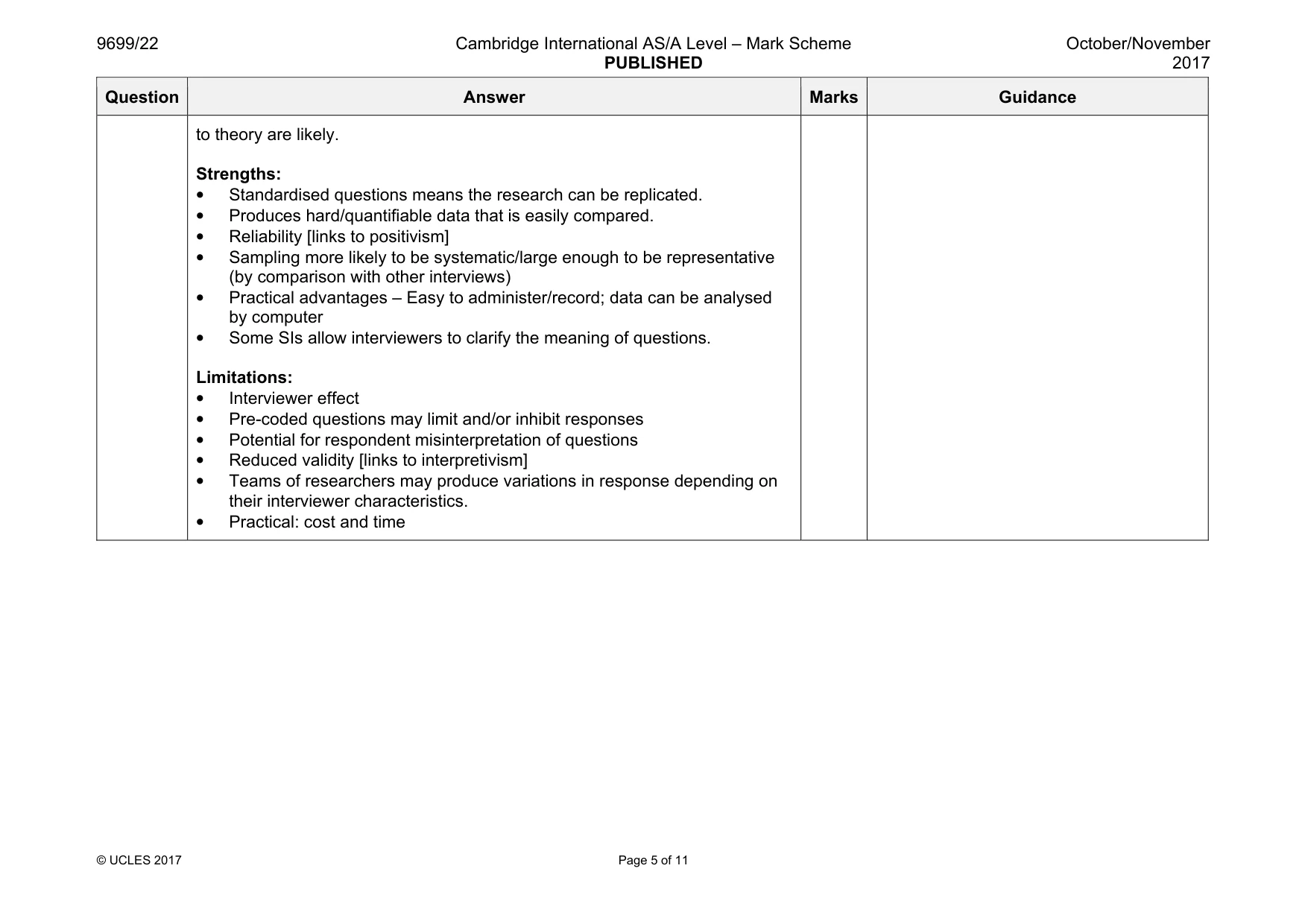
Mark scheme, page 5
9699/22 Cambridge International AS/A Level – Mark Scheme PUBLISHED October/November 2017 © UCLES 2017 Page 5 of 11 Question Answer Marks Guidance to theory are likely. Strengths: • Standardised questions means the research can be replicated. • Produces hard/quantifiable data that is easily compared. • Reliability [links to positivism] • Sampling more likely to be systematic/large enough to be representative (by comparison with other interviews) • Practical advantages – Easy to administer/record; data can be analysed by computer • Some SIs allow interviewers to clarify the meaning of questions. Limitations: • Interviewer effect • Pre-coded questions may limit and/or inhibit responses • Potential for respondent misinterpretation of questions • Reduced validity [links to interpretivism] • Teams of researchers may produce variations in response depending on their interviewer characteristics. • Practical: cost and time
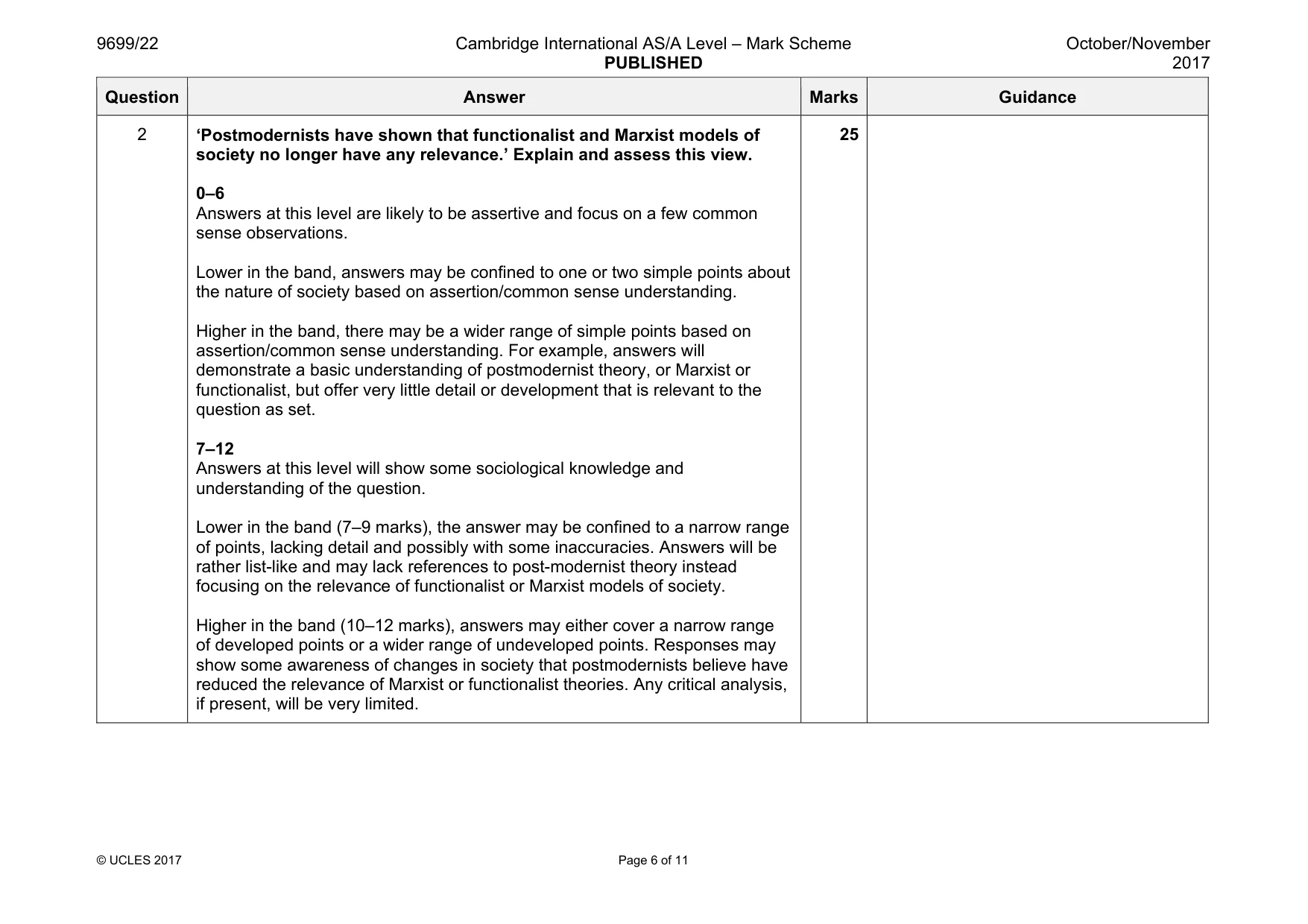
Mark scheme, page 6
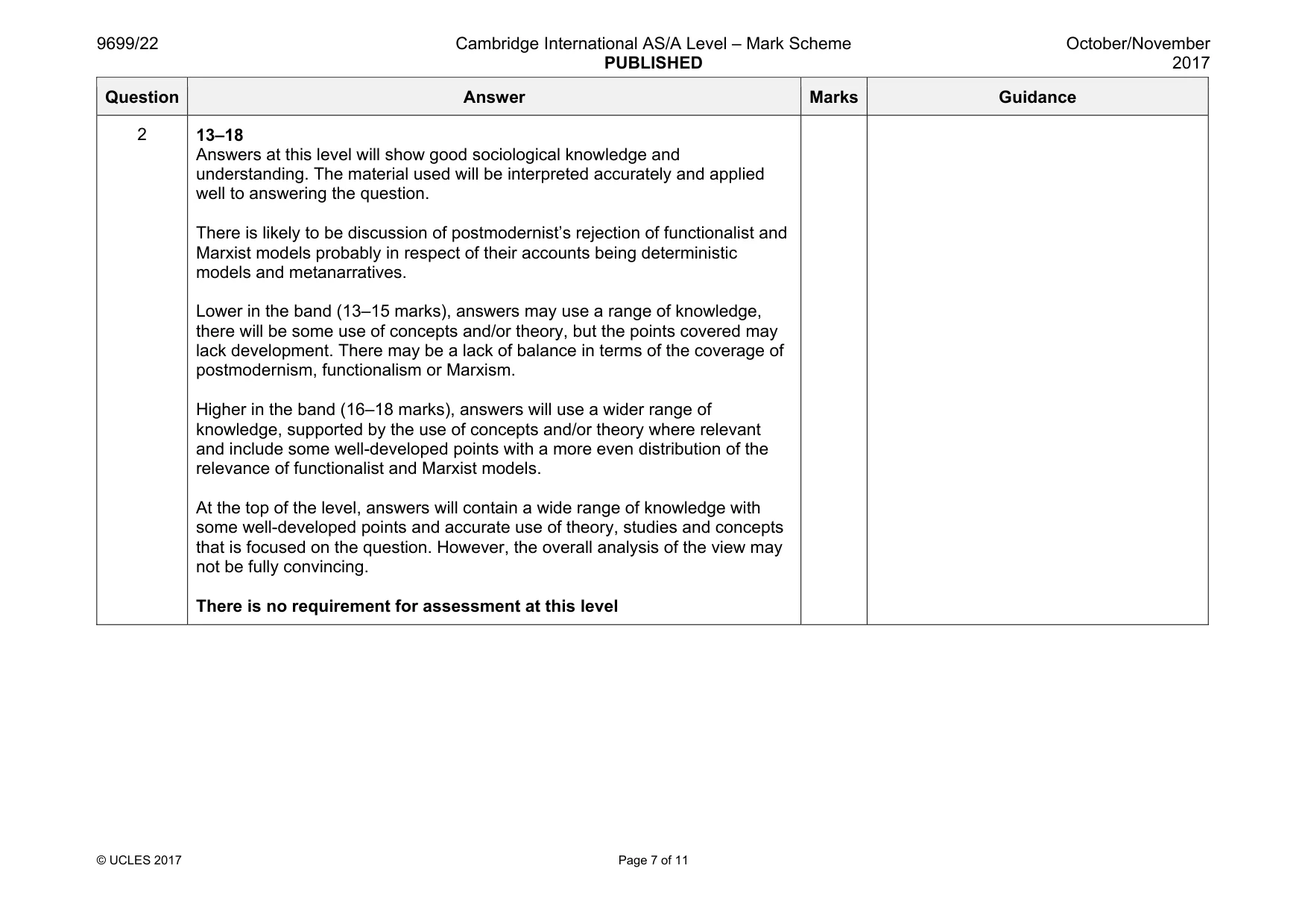
9699/22 Cambridge International AS/A Level – Mark Scheme PUBLISHED October/November 2017 © UCLES 2017 Page 6 of 11 Question Answer Marks Guidance 2 ‘Postmodernists have shown that functionalist and Marxist models of society no longer have any relevance.’ Explain and assess this view. 0–6 Answers at this level are likely to be assertive and focus on a few common sense observations. Lower in the band, answers may be confined to one or two simple points about the nature of society based on assertion/common sense understanding. Higher in the band, there may be a wider range of simple points based on assertion/common sense understanding. For example, answers will demonstrate a basic understanding of postmodernist theory, or Marxist or functionalist, but offer very little detail or development that is relevant to the question as set. 7–12 Answers at this level will show some sociological knowledge and understanding of the question. Lower in the band (7–9 marks), the answer may be confined to a narrow range of points, lacking detail and possibly with some inaccuracies. Answers will be rather list-like and may lack references to post-modernist theory instead focusing on the relevance of functionalist or Marxist models of society. Higher in the band (10–12 marks), answers may either cover a narrow range of developed points or a wider range of undeveloped points. Responses may show some awareness of changes in society that postmodernists believe have reduced the relevance of Marxist or functionalist theories. Any critical analysis, if present, will be very limited. 25
Mark scheme, page 7
9699/22 Cambridge International AS/A Level – Mark Scheme PUBLISHED October/November 2017 © UCLES 2017 Page 7 of 11 Question Answer Marks Guidance 2 13–18 Answers at this level will show good sociological knowledge and understanding. The material used will be interpreted accurately and applied well to answering the question. There is likely to be discussion of postmodernist’s rejection of functionalist and Marxist models probably in respect of their accounts being deterministic models and metanarratives. Lower in the band (13–15 marks), answers may use a range of knowledge, there will be some use of concepts and/or theory, but the points covered may lack development. There may be a lack of balance in terms of the coverage of postmodernism, functionalism or Marxism. Higher in the band (16–18 marks), answers will use a wider range of knowledge, supported by the use of concepts and/or theory where relevant and include some well-developed points with a more even distribution of the relevance of functionalist and Marxist models. At the top of the level, answers will contain a wide range of knowledge with some well-developed points and accurate use of theory, studies and concepts that is focused on the question. However, the overall analysis of the view may not be fully convincing. There is no requirement for assessment at this level
Mark scheme, page 8
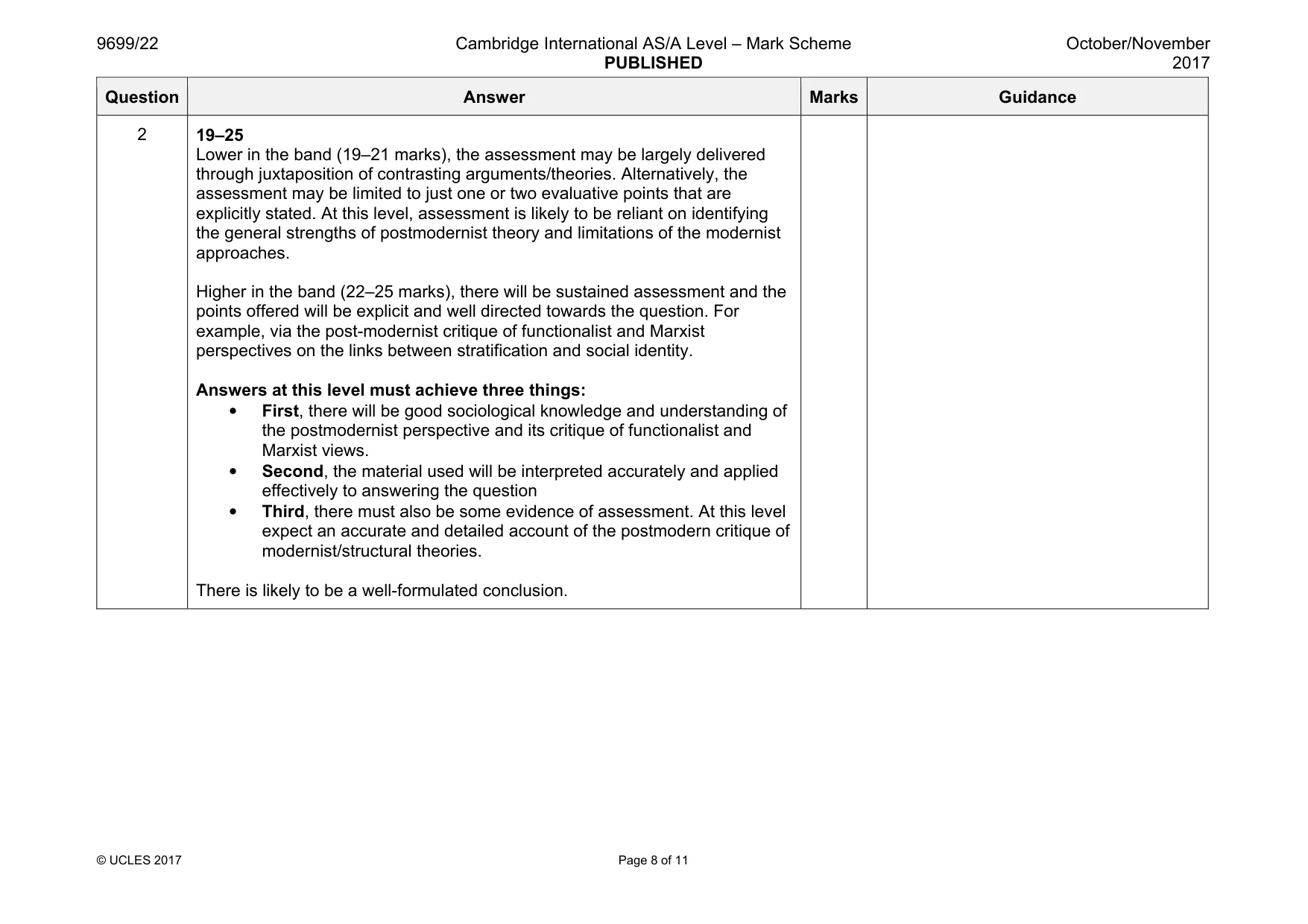
9699/22 Cambridge International AS/A Level – Mark Scheme PUBLISHED October/November 2017 © UCLES 2017 Page 8 of 11 Question Answer Marks Guidance 2 19–25 Lower in the band (19–21 marks), the assessment may be largely delivered through juxtaposition of contrasting arguments/theories. Alternatively, the assessment may be limited to just one or two evaluative points that are explicitly stated. At this level, assessment is likely to be reliant on identifying the general strengths of postmodernist theory and limitations of the modernist approaches. Higher in the band (22–25 marks), there will be sustained assessment and the points offered will be explicit and well directed towards the question. For example, via the post-modernist critique of functionalist and Marxist perspectives on the links between stratification and social identity. Answers at this level must achieve three things: • First, there will be good sociological knowledge and understanding of the postmodernist perspective and its critique of functionalist and Marxist views. • Second, the material used will be interpreted accurately and applied effectively to answering the question • Third, there must also be some evidence of assessment. At this level expect an accurate and detailed account of the postmodern critique of modernist/structural theories. There is likely to be a well-formulated conclusion.
Mark scheme, page 9
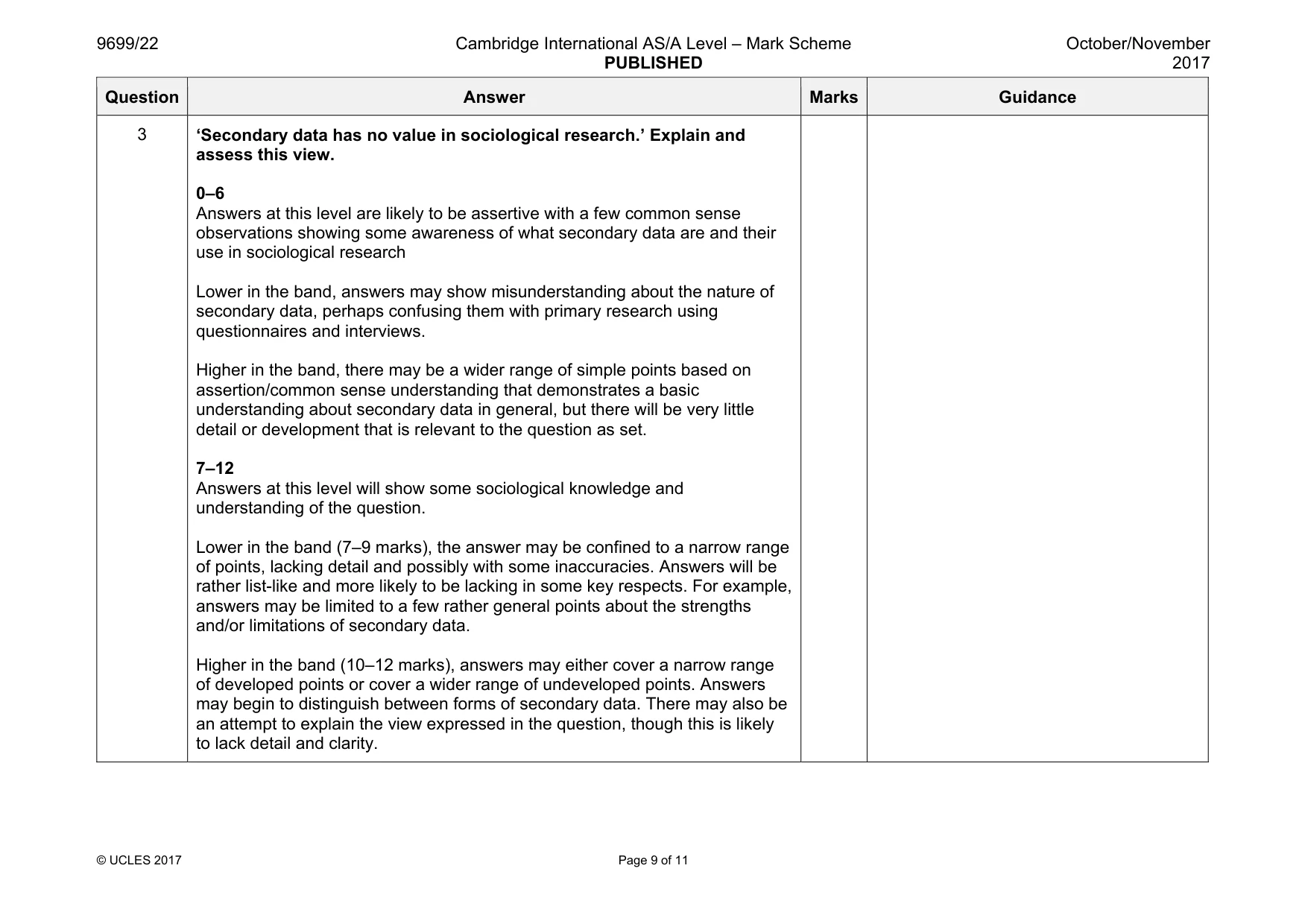
9699/22 Cambridge International AS/A Level – Mark Scheme PUBLISHED October/November 2017 © UCLES 2017 Page 9 of 11 Question Answer Marks Guidance 3 ‘Secondary data has no value in sociological research.’ Explain and assess this view. 0–6 Answers at this level are likely to be assertive with a few common sense observations showing some awareness of what secondary data are and their use in sociological research Lower in the band, answers may show misunderstanding about the nature of secondary data, perhaps confusing them with primary research using questionnaires and interviews. Higher in the band, there may be a wider range of simple points based on assertion/common sense understanding that demonstrates a basic understanding about secondary data in general, but there will be very little detail or development that is relevant to the question as set. 7–12 Answers at this level will show some sociological knowledge and understanding of the question. Lower in the band (7–9 marks), the answer may be confined to a narrow range of points, lacking detail and possibly with some inaccuracies. Answers will be rather list-like and more likely to be lacking in some key respects. For example, answers may be limited to a few rather general points about the strengths and/or limitations of secondary data. Higher in the band (10–12 marks), answers may either cover a narrow range of developed points or cover a wider range of undeveloped points. Answers may begin to distinguish between forms of secondary data. There may also be an attempt to explain the view expressed in the question, though this is likely to lack detail and clarity.
Mark scheme, page 10
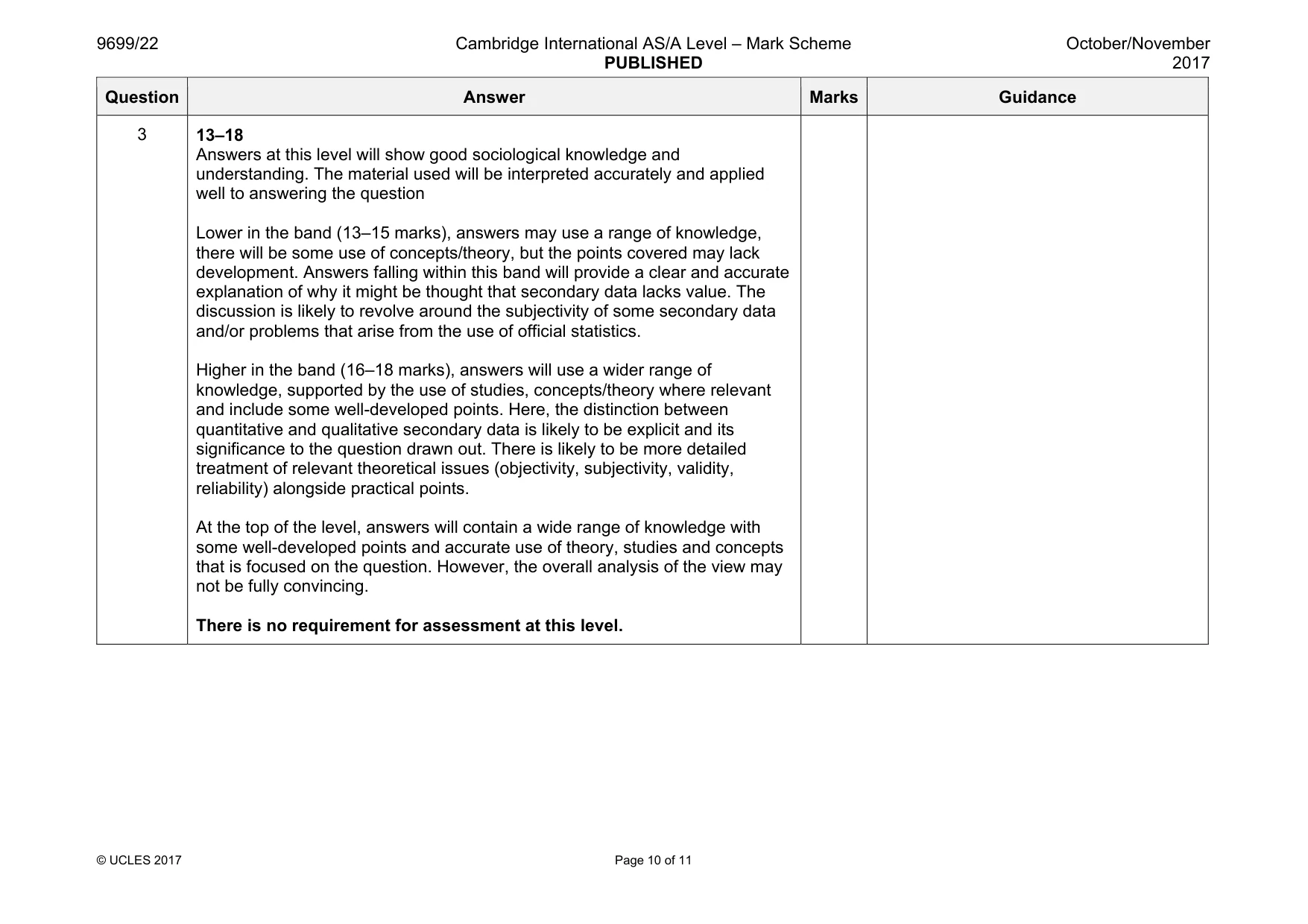
9699/22 Cambridge International AS/A Level – Mark Scheme PUBLISHED October/November 2017 © UCLES 2017 Page 10 of 11 Question Answer Marks Guidance 3 13–18 Answers at this level will show good sociological knowledge and understanding. The material used will be interpreted accurately and applied well to answering the question Lower in the band (13–15 marks), answers may use a range of knowledge, there will be some use of concepts/theory, but the points covered may lack development. Answers falling within this band will provide a clear and accurate explanation of why it might be thought that secondary data lacks value. The discussion is likely to revolve around the subjectivity of some secondary data and/or problems that arise from the use of official statistics. Higher in the band (16–18 marks), answers will use a wider range of knowledge, supported by the use of studies, concepts/theory where relevant and include some well-developed points. Here, the distinction between quantitative and qualitative secondary data is likely to be explicit and its significance to the question drawn out. There is likely to be more detailed treatment of relevant theoretical issues (objectivity, subjectivity, validity, reliability) alongside practical points. At the top of the level, answers will contain a wide range of knowledge with some well-developed points and accurate use of theory, studies and concepts that is focused on the question. However, the overall analysis of the view may not be fully convincing. There is no requirement for assessment at this level.
Mark scheme, page 11
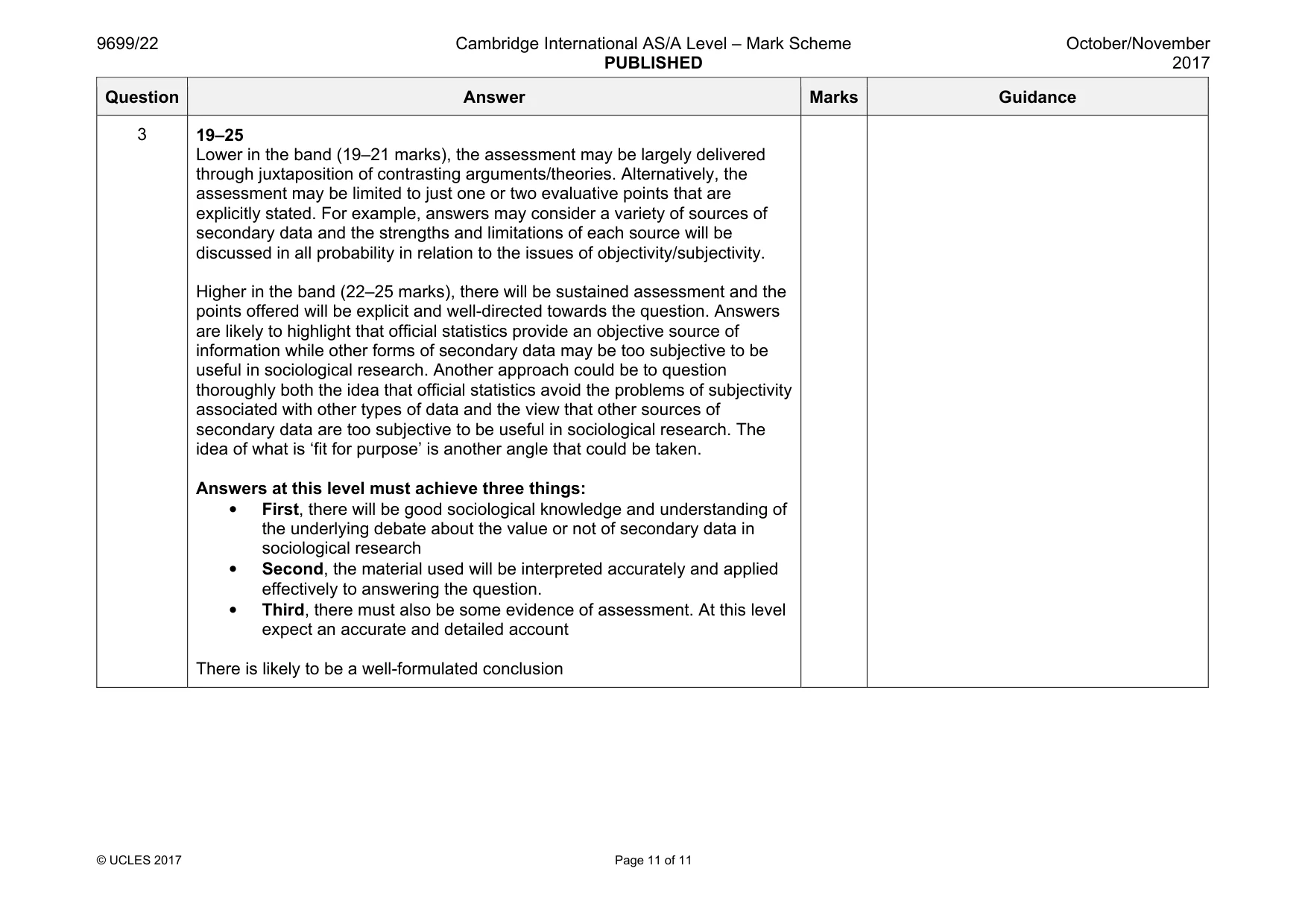
9699/22 Cambridge International AS/A Level – Mark Scheme PUBLISHED October/November 2017 © UCLES 2017 Page 11 of 11 Question Answer Marks Guidance 3 19–25 Lower in the band (19–21 marks), the assessment may be largely delivered through juxtaposition of contrasting arguments/theories. Alternatively, the assessment may be limited to just one or two evaluative points that are explicitly stated. For example, answers may consider a variety of sources of secondary data and the strengths and limitations of each source will be discussed in all probability in relation to the issues of objectivity/subjectivity. Higher in the band (22–25 marks), there will be sustained assessment and the points offered will be explicit and well-directed towards the question. Answers are likely to highlight that official statistics provide an objective source of information while other forms of secondary data may be too subjective to be useful in sociological research. Another approach could be to question thoroughly both the idea that official statistics avoid the problems of subjectivity associated with other types of data and the view that other sources of secondary data are too subjective to be useful in sociological research. The idea of what is ‘fit for purpose’ is another angle that could be taken. Answers at this level must achieve three things: • First, there will be good sociological knowledge and understanding of the underlying debate about the value or not of secondary data in sociological research • Second, the material used will be interpreted accurately and applied effectively to answering the question. • Third, there must also be some evidence of assessment. At this level expect an accurate and detailed account There is likely to be a well-formulated conclusion
What you needed in this session
Cambridge’s own grade thresholds for 2017 Oct/Nov, Paper 2 · Variant 2. A higher threshold means an easier paper — the bar moves with how the cohort did.