Cambridge A Level Sociology 9699 — 2017 Oct/Nov Paper 2 · Variant 3
9699/23/O/N/17 · 50 marks · ≈56 min
The question paper and its mark scheme, free to read here and free to download. This is Cambridge’s own paper, exactly as it was sat.
Question paper4 pages


Mark scheme12 pages
Answers below. Sit the paper first if you are practising.
Paper as text
Question paper, page 1
This document consists of 2 printed pages, 2 blank pages and 1 insert. DC (CW) 141181 © UCLES 2017 [Turn over Cambridge International Examinations Cambridge International Advanced Subsidiary and Advanced Level * 3 2 6 4 3 1 5 5 5 6 * SOCIOLOGY 9699/23 Paper 2 Theory and Methods October/November 2017 1 hour 30 minutes No Additional Materials are required. READ THESE INSTRUCTIONS FIRST An answer booklet is provided inside this question paper. You should follow the instructions on the front cover of the answer booklet. If you need additional answer paper ask the invigilator for a continuation booklet. Answer Question 1 and either Question 2 or Question 3. The number of marks is given in brackets [ ] at the end of each question or part question.
Question paper, page 2
2 9699/23/O/N/17 © UCLES 2017 Section A Answer Question 1. 1 A questionnaire is a set of written questions designed for self-completion that is usually given or posted to respondents. Questionnaires produce quantitative data. As it is not practical to send a questionnaire to everyone that the researcher is interested in studying, it is necessary to select a sample of individuals from the wider research population. Various sampling techniques may be used to select this sample. The aim of sampling is usually to select a group of people with characteristics similar to the wider research population. This is known as a representative sample. Questionnaires are commonly used in sociological research because they allow a large number of respondents to be asked a range of questions in a short space of time. Numerical information can therefore be collected on a large scale and, if a representative sample has been used, the information should accurately reflect the views of the wider research population. This approach is supported by positivist sociologists. However, interpretivists argue that questionnaires have little value in sociological research because they fail to reveal the complex nature of human behaviour. (a) What is meant by the term positivist sociologists? [2] (b) Describe two sampling techniques. [4] (c) Explain the difficulties for a researcher of achieving a representative sample. [8] (d) Assess the view that questionnaires have little value in sociological research. [11] Section B Answer either Question 2 or Question 3. 2 Explain and assess the postmodernist view that individuals no longer conform to traditional social identities. [25] 3 Explain and assess the strengths and limitations of using official statistics in sociological research. [25]
Question paper, page 3
3 9699/23/O/N/17 © UCLES 2017 BLANK PAGE
Question paper, page 4
4 9699/23/O/N/17 © UCLES 2017 BLANK PAGE Permission to reproduce items where third-party owned material protected by copyright is included has been sought and cleared where possible. Every reasonable effort has been made by the publisher (UCLES) to trace copyright holders, but if any items requiring clearance have unwittingly been included, the publisher will be pleased to make amends at the earliest possible opportunity. To avoid the issue of disclosure of answer-related information to candidates, all copyright acknowledgements are reproduced online in the Cambridge International Examinations Copyright Acknowledgements Booklet. This is produced for each series of examinations and is freely available to download at www.cie.org.uk after the live examination series. Cambridge International Examinations is part of the Cambridge Assessment Group. Cambridge Assessment is the brand name of University of Cambridge Local Examinations Syndicate (UCLES), which is itself a department of the University of Cambridge.
Mark scheme, page 1
® IGCSE is a registered trademark. This document consists of 12 printed pages. © UCLES 2017 [Turn over Cambridge Assessment International Education Cambridge International Advanced Subsidiary and Advanced Level SOCIOLOGY 9699/23 Paper 2 October/November 2017 MARK SCHEME Maximum Mark: 50 Published This mark scheme is published as an aid to teachers and candidates, to indicate the requirements of the examination. It shows the basis on which Examiners were instructed to award marks. It does not indicate the details of the discussions that took place at an Examiners’ meeting before marking began, which would have considered the acceptability of alternative answers. Mark schemes should be read in conjunction with the question paper and the Principal Examiner Report for Teachers. Cambridge International will not enter into discussions about these mark schemes. Cambridge International is publishing the mark schemes for the October/November 2017 series for most Cambridge IGCSE®, Cambridge International A and AS Level components and some Cambridge O Level components.
Mark scheme, page 2
9699/23 Cambridge International AS/A Level – Mark Scheme PUBLISHED October/November 2017 © UCLES 2017 Page 2 of 12 Question Answer Marks Guidance 1(a) What is meant by the term positivist sociologists? One mark for a partial one such as ‘people who like scientific methods.’ Two marks for a clear and accurate definition. Positivists believe the social world can be studied objectively using scientific [quantitative] methods. Alternatively, candidates may focus on how positivist sociologists see the social world as predictable with laws that can be discovered through a scientific approach Either response is acceptable 2 1(b) Describe two sampling techniques. Types of sampling might include • Random • Systematic • Stratified • Quota • Multi-stage • Snowball • Or any other legitimate technique 4 One mark for the example plus one mark for development (2 × 2 marks).
Mark scheme, page 3
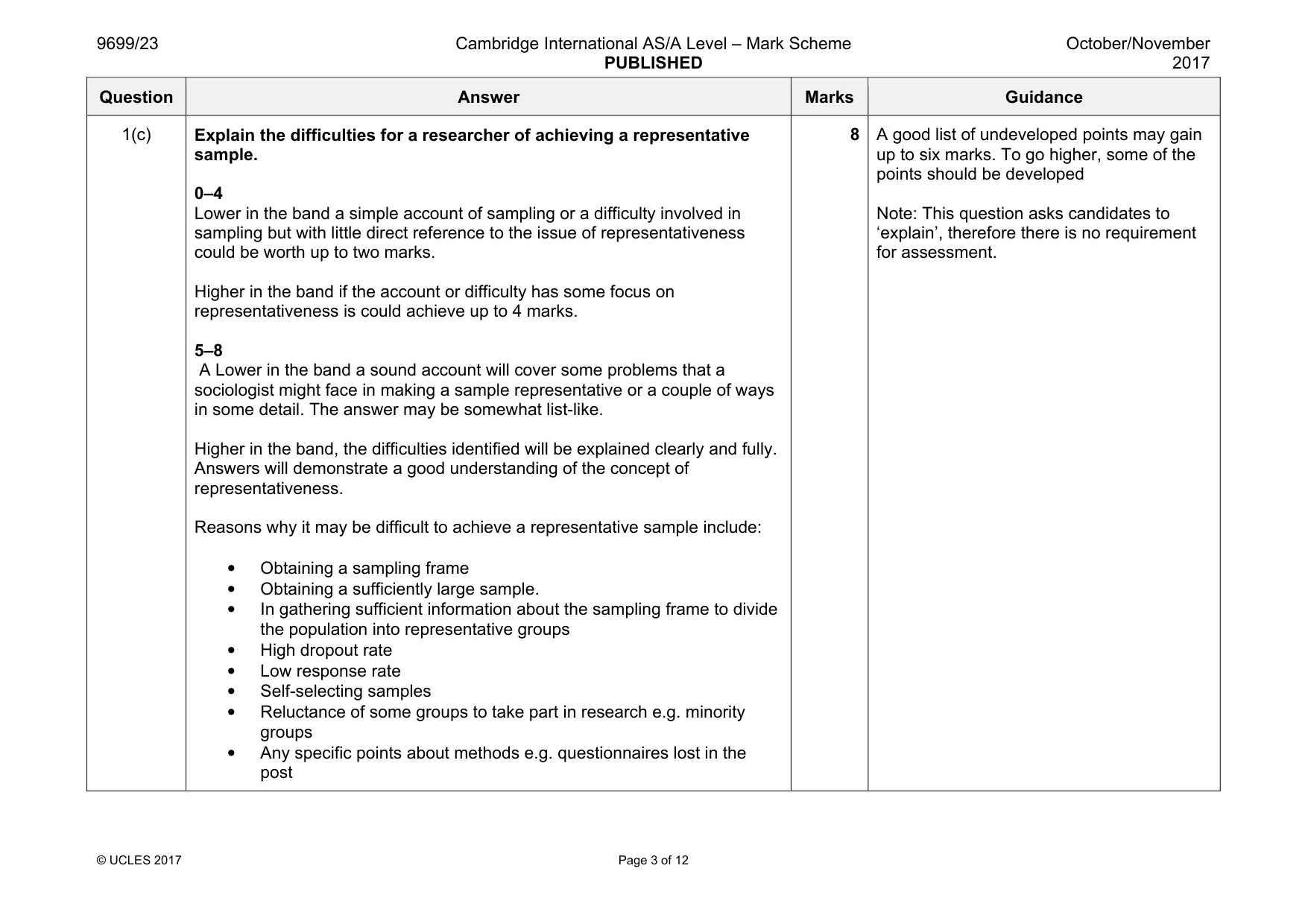
9699/23 Cambridge International AS/A Level – Mark Scheme PUBLISHED October/November 2017 © UCLES 2017 Page 3 of 12 Question Answer Marks Guidance 1(c) Explain the difficulties for a researcher of achieving a representative sample. 0–4 Lower in the band a simple account of sampling or a difficulty involved in sampling but with little direct reference to the issue of representativeness could be worth up to two marks. Higher in the band if the account or difficulty has some focus on representativeness is could achieve up to 4 marks. 5–8 A Lower in the band a sound account will cover some problems that a sociologist might face in making a sample representative or a couple of ways in some detail. The answer may be somewhat list-like. Higher in the band, the difficulties identified will be explained clearly and fully. Answers will demonstrate a good understanding of the concept of representativeness. Reasons why it may be difficult to achieve a representative sample include: • Obtaining a sampling frame • Obtaining a sufficiently large sample. • In gathering sufficient information about the sampling frame to divide the population into representative groups • High dropout rate • Low response rate • Self-selecting samples • Reluctance of some groups to take part in research e.g. minority groups • Any specific points about methods e.g. questionnaires lost in the post 8 A good list of undeveloped points may gain up to six marks. To go higher, some of the points should be developed Note: This question asks candidates to ‘explain’, therefore there is no requirement for assessment.
Mark scheme, page 4
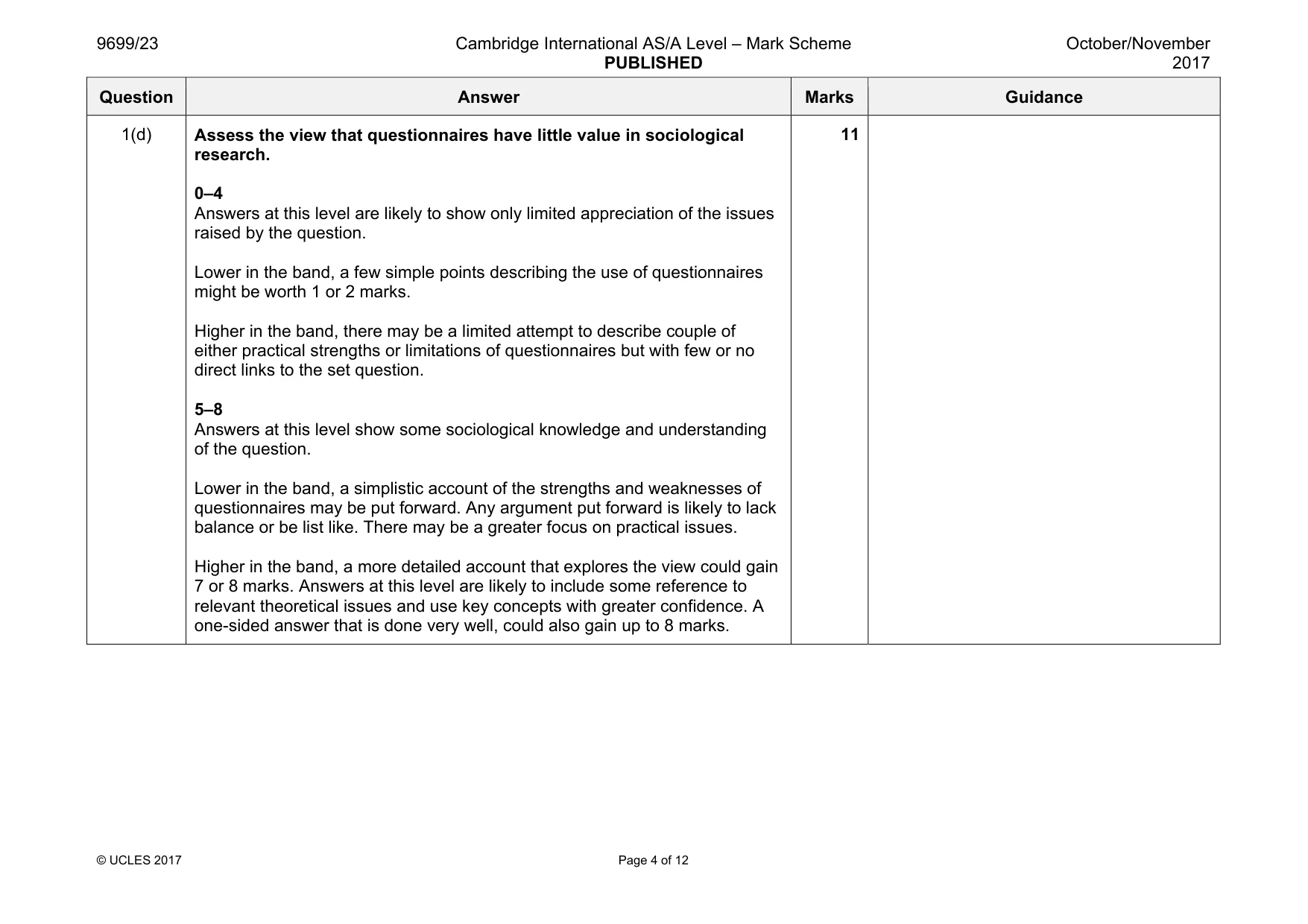
9699/23 Cambridge International AS/A Level – Mark Scheme PUBLISHED October/November 2017 © UCLES 2017 Page 4 of 12 Question Answer Marks Guidance 1(d) Assess the view that questionnaires have little value in sociological research. 0–4 Answers at this level are likely to show only limited appreciation of the issues raised by the question. Lower in the band, a few simple points describing the use of questionnaires might be worth 1 or 2 marks. Higher in the band, there may be a limited attempt to describe couple of either practical strengths or limitations of questionnaires but with few or no direct links to the set question. 5–8 Answers at this level show some sociological knowledge and understanding of the question. Lower in the band, a simplistic account of the strengths and weaknesses of questionnaires may be put forward. Any argument put forward is likely to lack balance or be list like. There may be a greater focus on practical issues. Higher in the band, a more detailed account that explores the view could gain 7 or 8 marks. Answers at this level are likely to include some reference to relevant theoretical issues and use key concepts with greater confidence. A one-sided answer that is done very well, could also gain up to 8 marks. 11
Mark scheme, page 5
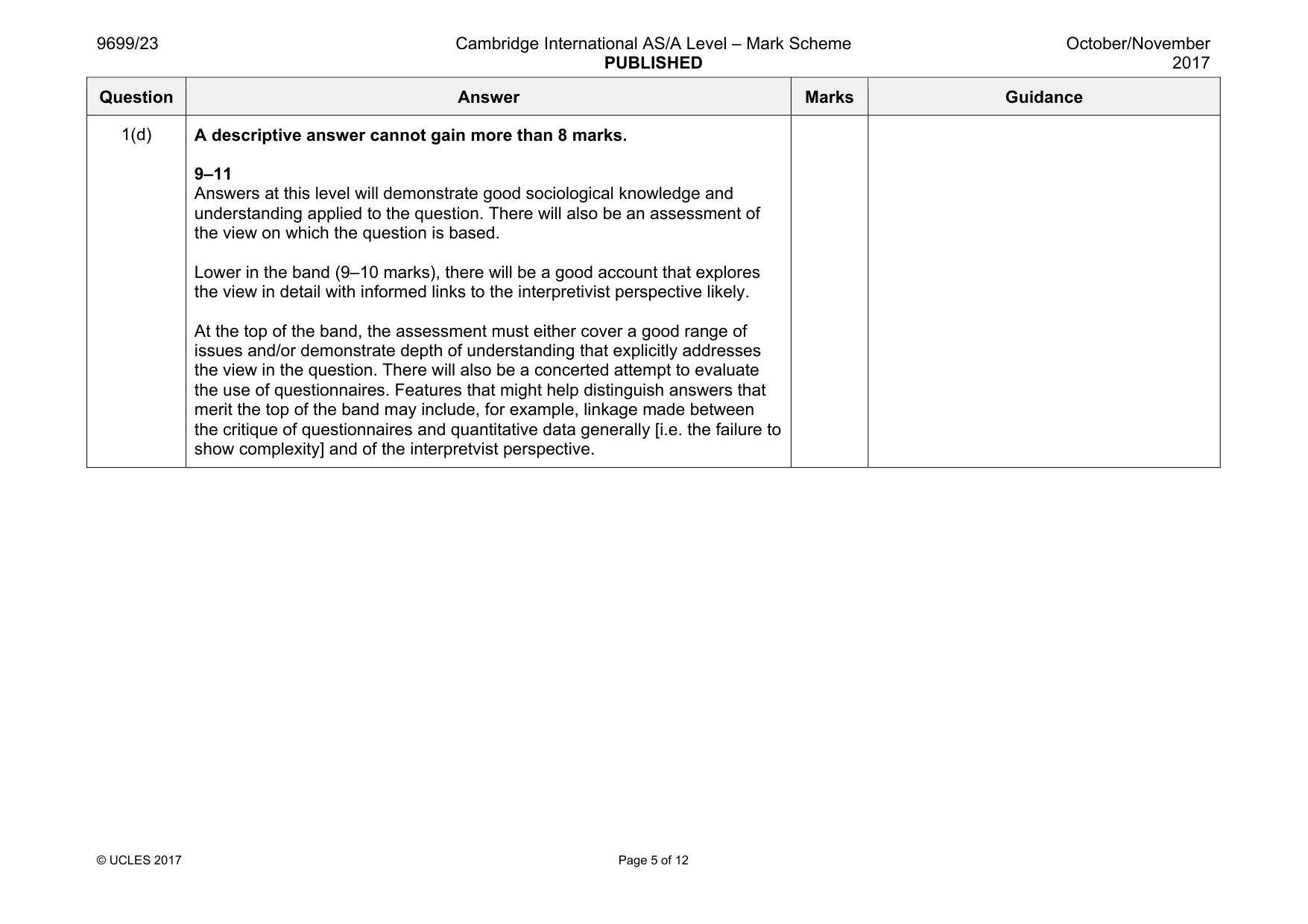
9699/23 Cambridge International AS/A Level – Mark Scheme PUBLISHED October/November 2017 © UCLES 2017 Page 5 of 12 Question Answer Marks Guidance 1(d) A descriptive answer cannot gain more than 8 marks. 9–11 Answers at this level will demonstrate good sociological knowledge and understanding applied to the question. There will also be an assessment of the view on which the question is based. Lower in the band (9–10 marks), there will be a good account that explores the view in detail with informed links to the interpretivist perspective likely. At the top of the band, the assessment must either cover a good range of issues and/or demonstrate depth of understanding that explicitly addresses the view in the question. There will also be a concerted attempt to evaluate the use of questionnaires. Features that might help distinguish answers that merit the top of the band may include, for example, linkage made between the critique of questionnaires and quantitative data generally [i.e. the failure to show complexity] and of the interpretvist perspective.
Mark scheme, page 6
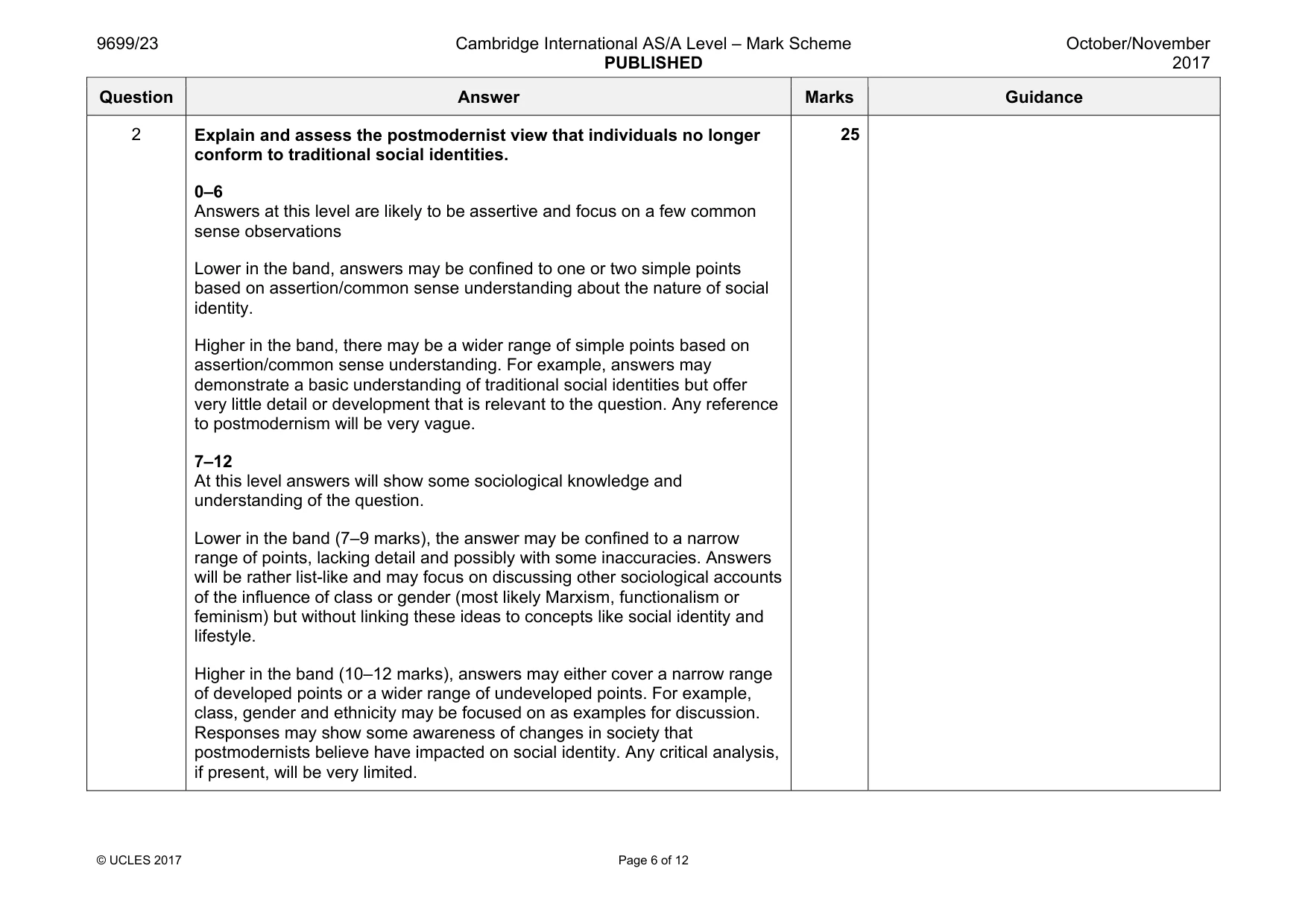
9699/23 Cambridge International AS/A Level – Mark Scheme PUBLISHED October/November 2017 © UCLES 2017 Page 6 of 12 Question Answer Marks Guidance 2 Explain and assess the postmodernist view that individuals no longer conform to traditional social identities. 0–6 Answers at this level are likely to be assertive and focus on a few common sense observations Lower in the band, answers may be confined to one or two simple points based on assertion/common sense understanding about the nature of social identity. Higher in the band, there may be a wider range of simple points based on assertion/common sense understanding. For example, answers may demonstrate a basic understanding of traditional social identities but offer very little detail or development that is relevant to the question. Any reference to postmodernism will be very vague. 7–12 At this level answers will show some sociological knowledge and understanding of the question. Lower in the band (7–9 marks), the answer may be confined to a narrow range of points, lacking detail and possibly with some inaccuracies. Answers will be rather list-like and may focus on discussing other sociological accounts of the influence of class or gender (most likely Marxism, functionalism or feminism) but without linking these ideas to concepts like social identity and lifestyle. Higher in the band (10–12 marks), answers may either cover a narrow range of developed points or a wider range of undeveloped points. For example, class, gender and ethnicity may be focused on as examples for discussion. Responses may show some awareness of changes in society that postmodernists believe have impacted on social identity. Any critical analysis, if present, will be very limited. 25
Mark scheme, page 7
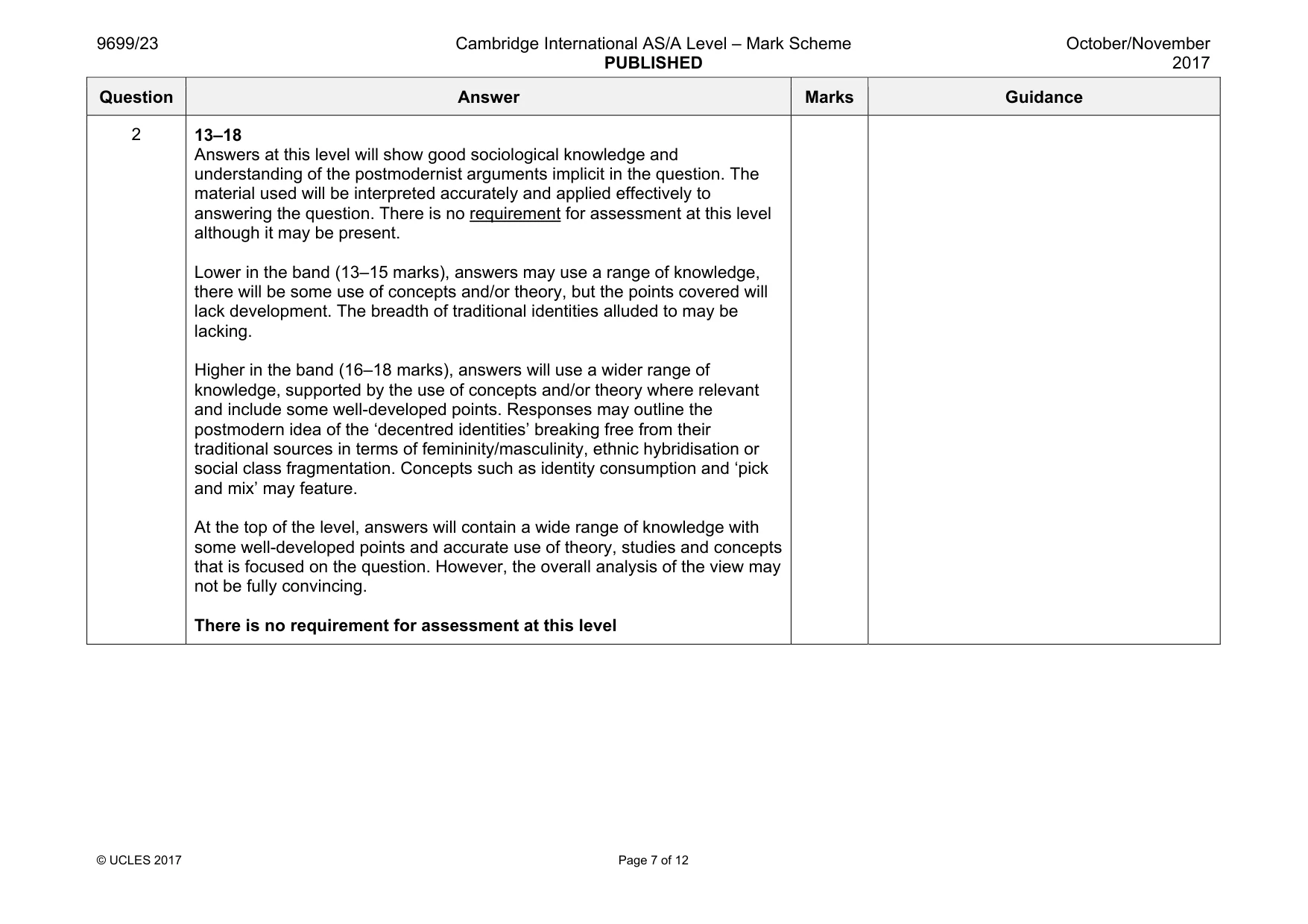
9699/23 Cambridge International AS/A Level – Mark Scheme PUBLISHED October/November 2017 © UCLES 2017 Page 7 of 12 Question Answer Marks Guidance 2 13–18 Answers at this level will show good sociological knowledge and understanding of the postmodernist arguments implicit in the question. The material used will be interpreted accurately and applied effectively to answering the question. There is no requirement for assessment at this level although it may be present. Lower in the band (13–15 marks), answers may use a range of knowledge, there will be some use of concepts and/or theory, but the points covered will lack development. The breadth of traditional identities alluded to may be lacking. Higher in the band (16–18 marks), answers will use a wider range of knowledge, supported by the use of concepts and/or theory where relevant and include some well-developed points. Responses may outline the postmodern idea of the ‘decentred identities’ breaking free from their traditional sources in terms of femininity/masculinity, ethnic hybridisation or social class fragmentation. Concepts such as identity consumption and ‘pick and mix’ may feature. At the top of the level, answers will contain a wide range of knowledge with some well-developed points and accurate use of theory, studies and concepts that is focused on the question. However, the overall analysis of the view may not be fully convincing. There is no requirement for assessment at this level
Mark scheme, page 8
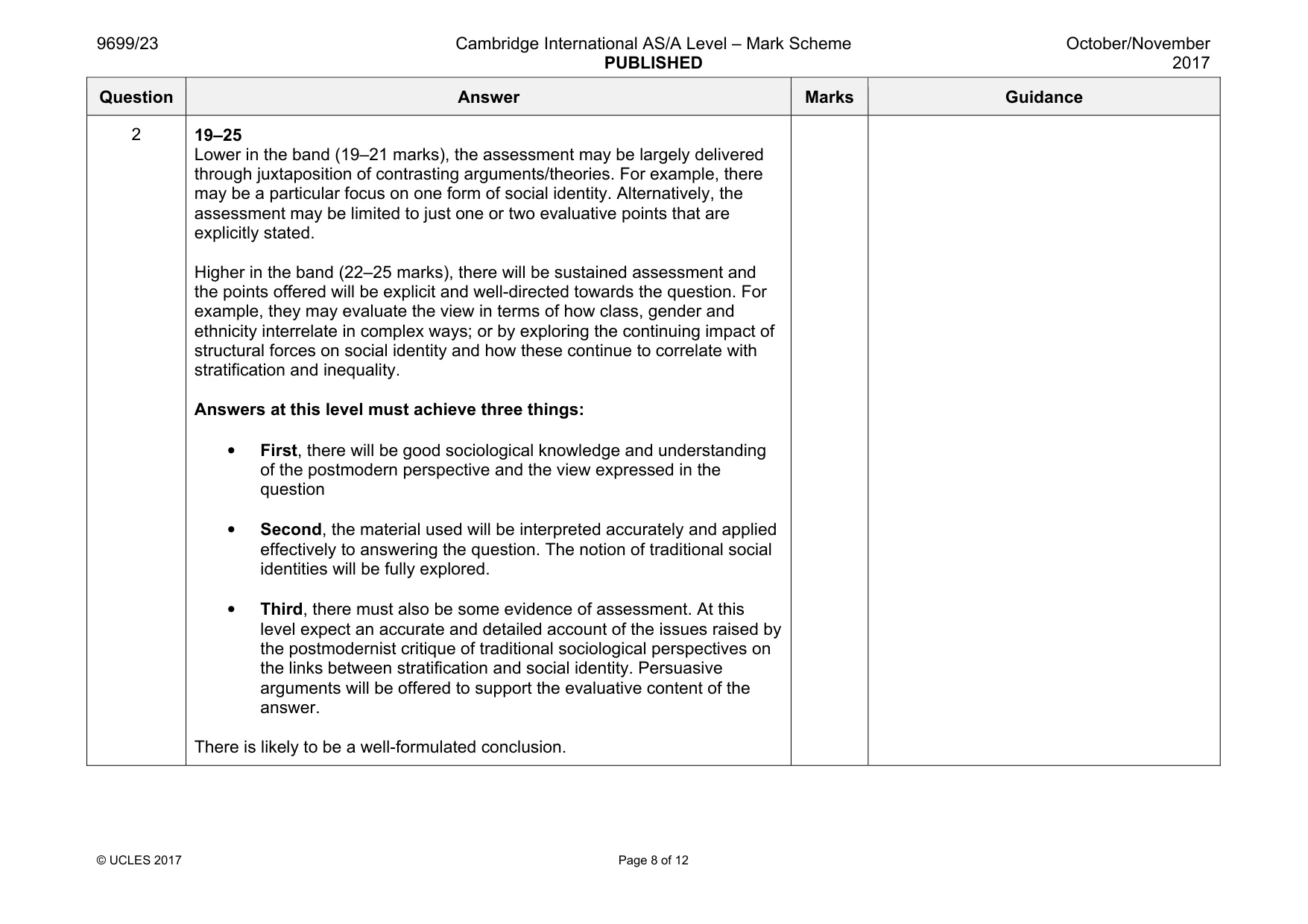
9699/23 Cambridge International AS/A Level – Mark Scheme PUBLISHED October/November 2017 © UCLES 2017 Page 8 of 12 Question Answer Marks Guidance 2 19–25 Lower in the band (19–21 marks), the assessment may be largely delivered through juxtaposition of contrasting arguments/theories. For example, there may be a particular focus on one form of social identity. Alternatively, the assessment may be limited to just one or two evaluative points that are explicitly stated. Higher in the band (22–25 marks), there will be sustained assessment and the points offered will be explicit and well-directed towards the question. For example, they may evaluate the view in terms of how class, gender and ethnicity interrelate in complex ways; or by exploring the continuing impact of structural forces on social identity and how these continue to correlate with stratification and inequality. Answers at this level must achieve three things: • First, there will be good sociological knowledge and understanding of the postmodern perspective and the view expressed in the question • Second, the material used will be interpreted accurately and applied effectively to answering the question. The notion of traditional social identities will be fully explored. • Third, there must also be some evidence of assessment. At this level expect an accurate and detailed account of the issues raised by the postmodernist critique of traditional sociological perspectives on the links between stratification and social identity. Persuasive arguments will be offered to support the evaluative content of the answer. There is likely to be a well-formulated conclusion.
Mark scheme, page 9
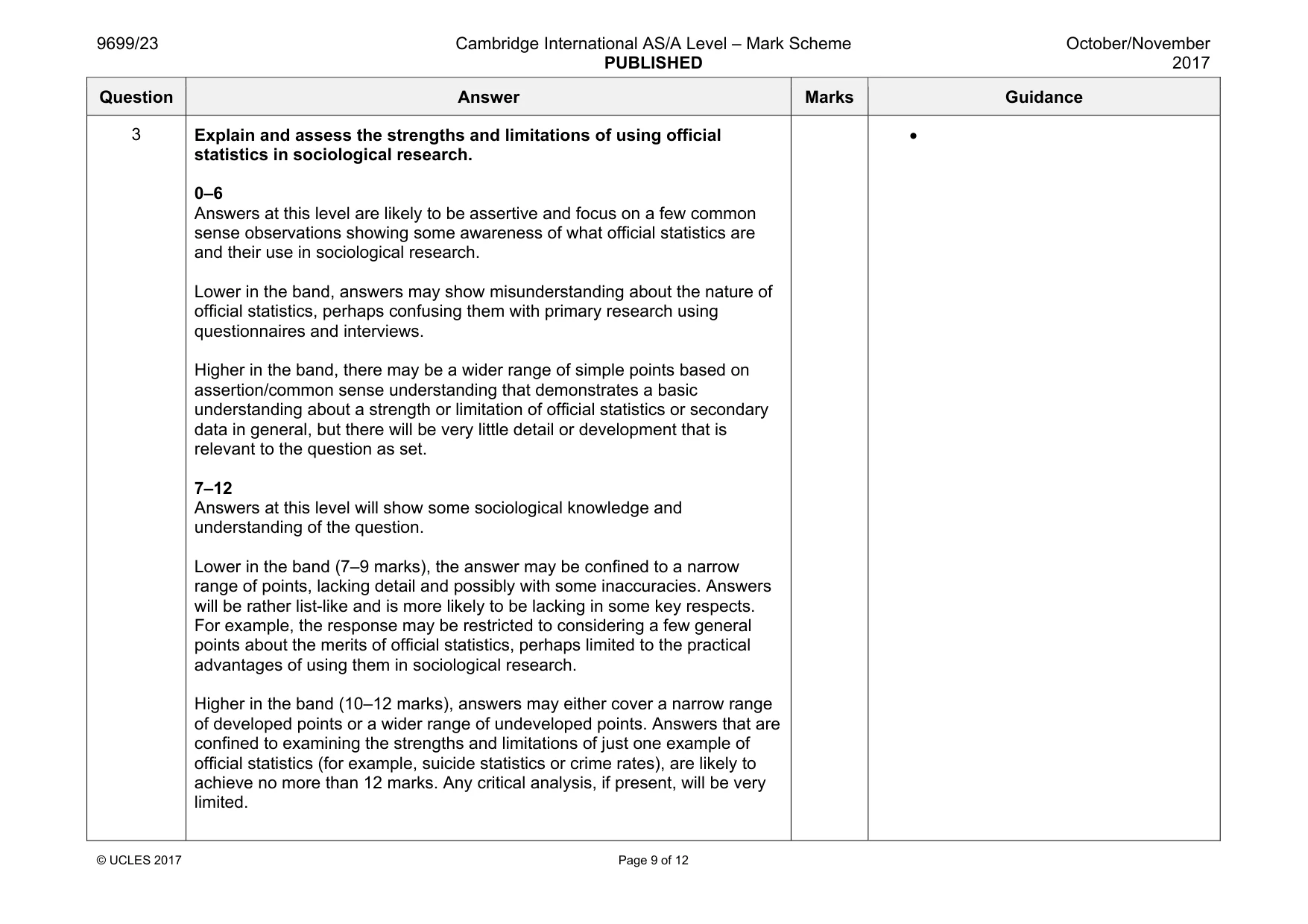
9699/23 Cambridge International AS/A Level – Mark Scheme PUBLISHED October/November 2017 © UCLES 2017 Page 9 of 12 Question Answer Marks Guidance 3 Explain and assess the strengths and limitations of using official statistics in sociological research. 0–6 Answers at this level are likely to be assertive and focus on a few common sense observations showing some awareness of what official statistics are and their use in sociological research. Lower in the band, answers may show misunderstanding about the nature of official statistics, perhaps confusing them with primary research using questionnaires and interviews. Higher in the band, there may be a wider range of simple points based on assertion/common sense understanding that demonstrates a basic understanding about a strength or limitation of official statistics or secondary data in general, but there will be very little detail or development that is relevant to the question as set. 7–12 Answers at this level will show some sociological knowledge and understanding of the question. Lower in the band (7–9 marks), the answer may be confined to a narrow range of points, lacking detail and possibly with some inaccuracies. Answers will be rather list-like and is more likely to be lacking in some key respects. For example, the response may be restricted to considering a few general points about the merits of official statistics, perhaps limited to the practical advantages of using them in sociological research. Higher in the band (10–12 marks), answers may either cover a narrow range of developed points or a wider range of undeveloped points. Answers that are confined to examining the strengths and limitations of just one example of official statistics (for example, suicide statistics or crime rates), are likely to achieve no more than 12 marks. Any critical analysis, if present, will be very limited. •
Mark scheme, page 10
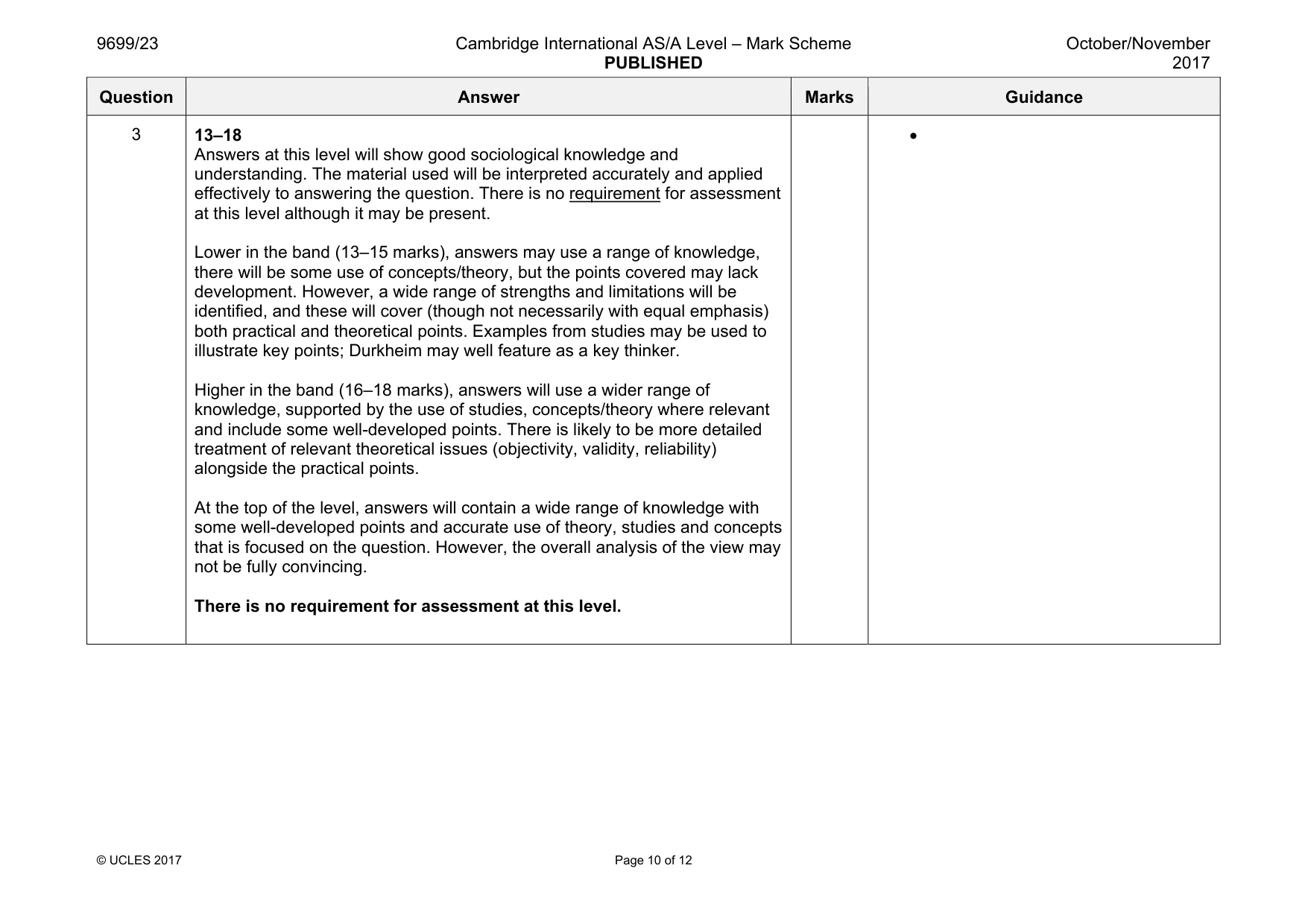
9699/23 Cambridge International AS/A Level – Mark Scheme PUBLISHED October/November 2017 © UCLES 2017 Page 10 of 12 Question Answer Marks Guidance 3 13–18 Answers at this level will show good sociological knowledge and understanding. The material used will be interpreted accurately and applied effectively to answering the question. There is no requirement for assessment at this level although it may be present. Lower in the band (13–15 marks), answers may use a range of knowledge, there will be some use of concepts/theory, but the points covered may lack development. However, a wide range of strengths and limitations will be identified, and these will cover (though not necessarily with equal emphasis) both practical and theoretical points. Examples from studies may be used to illustrate key points; Durkheim may well feature as a key thinker. Higher in the band (16–18 marks), answers will use a wider range of knowledge, supported by the use of studies, concepts/theory where relevant and include some well-developed points. There is likely to be more detailed treatment of relevant theoretical issues (objectivity, validity, reliability) alongside the practical points. At the top of the level, answers will contain a wide range of knowledge with some well-developed points and accurate use of theory, studies and concepts that is focused on the question. However, the overall analysis of the view may not be fully convincing. There is no requirement for assessment at this level. •
Mark scheme, page 11
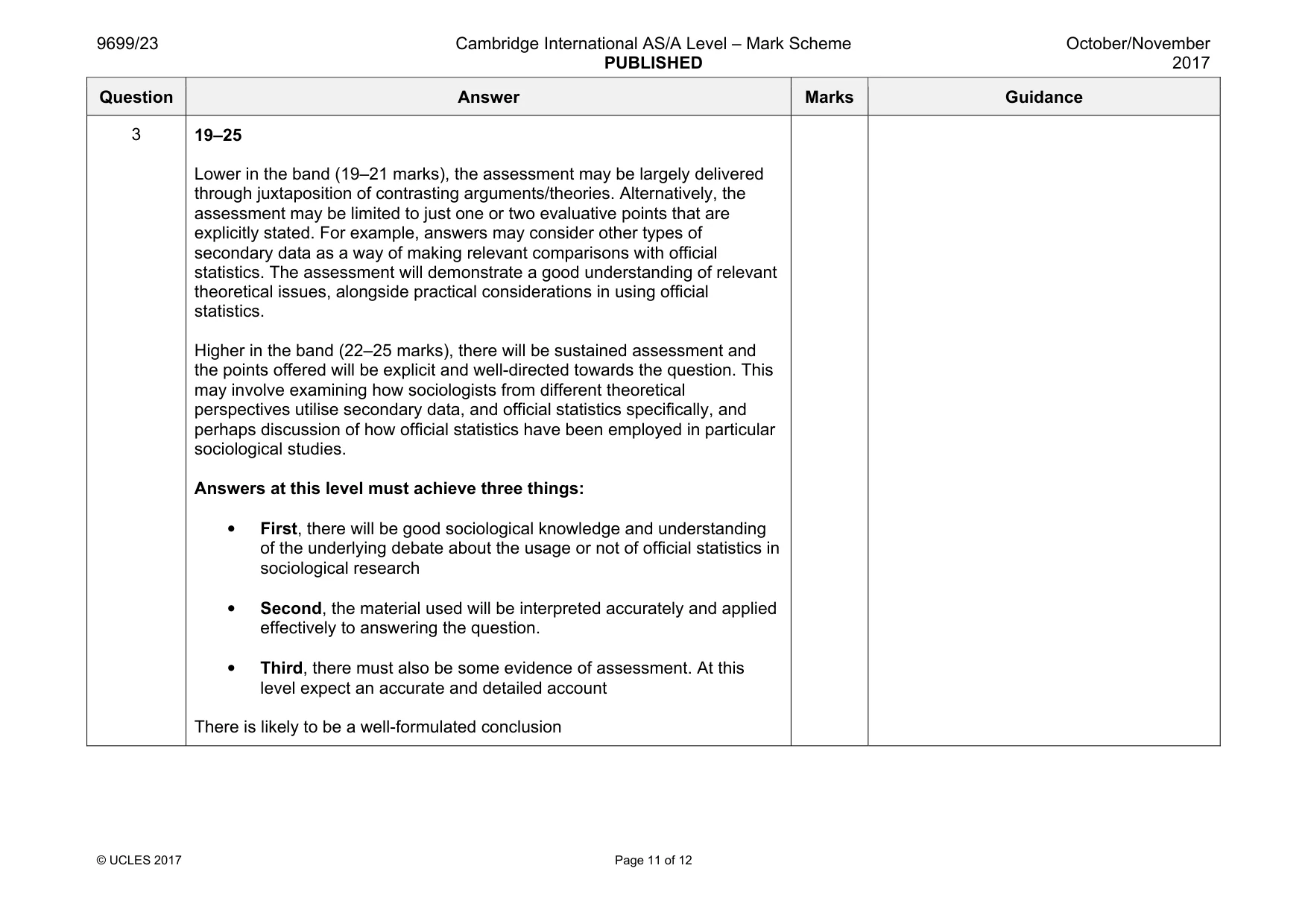
9699/23 Cambridge International AS/A Level – Mark Scheme PUBLISHED October/November 2017 © UCLES 2017 Page 11 of 12 Question Answer Marks Guidance 3 19–25 Lower in the band (19–21 marks), the assessment may be largely delivered through juxtaposition of contrasting arguments/theories. Alternatively, the assessment may be limited to just one or two evaluative points that are explicitly stated. For example, answers may consider other types of secondary data as a way of making relevant comparisons with official statistics. The assessment will demonstrate a good understanding of relevant theoretical issues, alongside practical considerations in using official statistics. Higher in the band (22–25 marks), there will be sustained assessment and the points offered will be explicit and well-directed towards the question. This may involve examining how sociologists from different theoretical perspectives utilise secondary data, and official statistics specifically, and perhaps discussion of how official statistics have been employed in particular sociological studies. Answers at this level must achieve three things: • First, there will be good sociological knowledge and understanding of the underlying debate about the usage or not of official statistics in sociological research • Second, the material used will be interpreted accurately and applied effectively to answering the question. • Third, there must also be some evidence of assessment. At this level expect an accurate and detailed account There is likely to be a well-formulated conclusion
Mark scheme, page 12
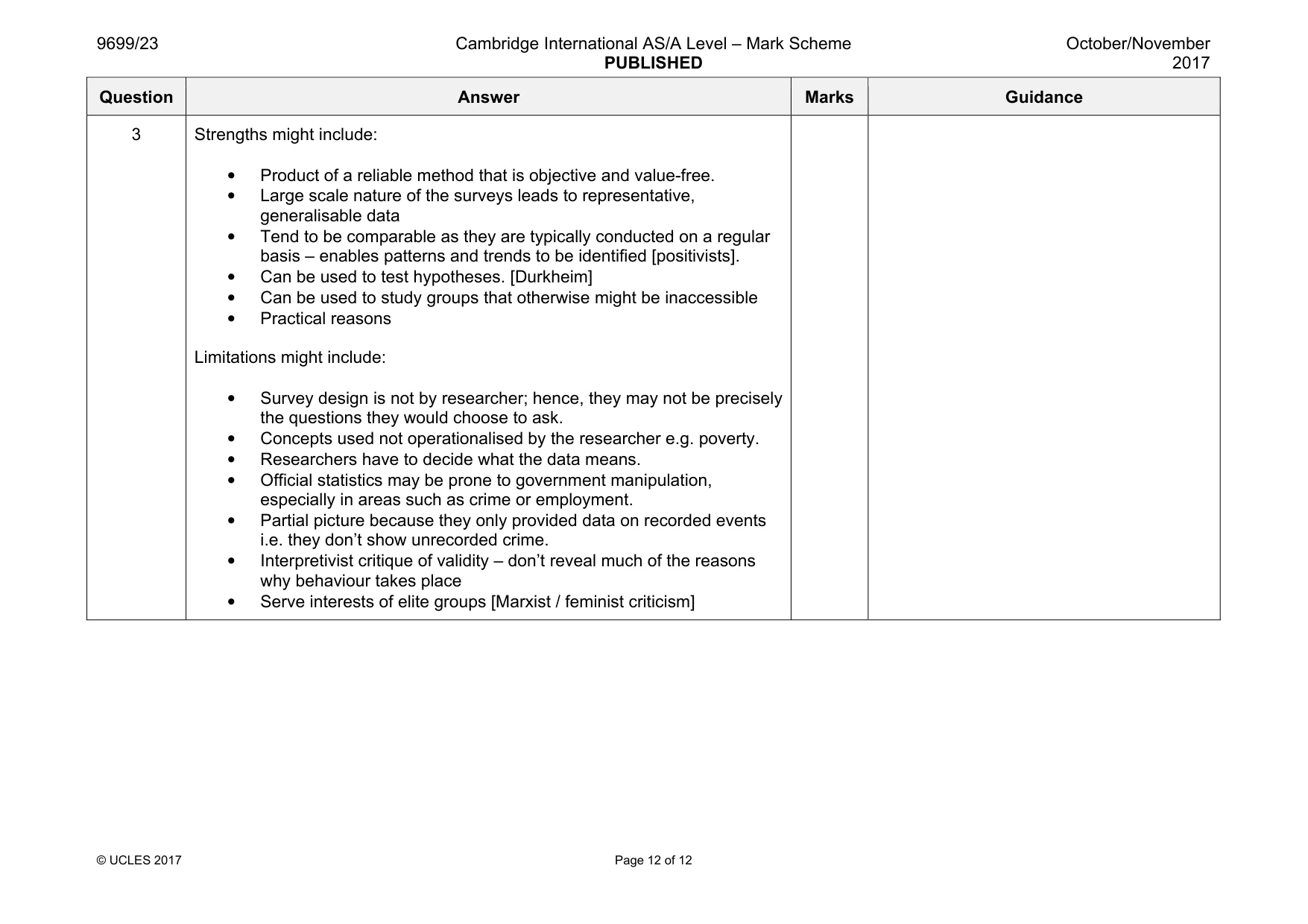
9699/23 Cambridge International AS/A Level – Mark Scheme PUBLISHED October/November 2017 © UCLES 2017 Page 12 of 12 Question Answer Marks Guidance 3 Strengths might include: • Product of a reliable method that is objective and value-free. • Large scale nature of the surveys leads to representative, generalisable data • Tend to be comparable as they are typically conducted on a regular basis – enables patterns and trends to be identified [positivists]. • Can be used to test hypotheses. [Durkheim] • Can be used to study groups that otherwise might be inaccessible • Practical reasons Limitations might include: • Survey design is not by researcher; hence, they may not be precisely the questions they would choose to ask. • Concepts used not operationalised by the researcher e.g. poverty. • Researchers have to decide what the data means. • Official statistics may be prone to government manipulation, especially in areas such as crime or employment. • Partial picture because they only provided data on recorded events i.e. they don’t show unrecorded crime. • Interpretivist critique of validity – don’t reveal much of the reasons why behaviour takes place • Serve interests of elite groups [Marxist / feminist criticism]
What you needed in this session
Cambridge’s own grade thresholds for 2017 Oct/Nov, Paper 2 · Variant 3. A higher threshold means an easier paper — the bar moves with how the cohort did.