Cambridge A Level Sociology 9699 — 2016 Oct/Nov Paper 3 · Variant 2
9699/32/O/N/16 · 75 marks · ≈84 min
The question paper and its mark scheme, free to read here and free to download. This is Cambridge’s own paper, exactly as it was sat.
Question paper4 pages

Mark scheme12 pages
Answers below. Sit the paper first if you are practising.
Paper as text
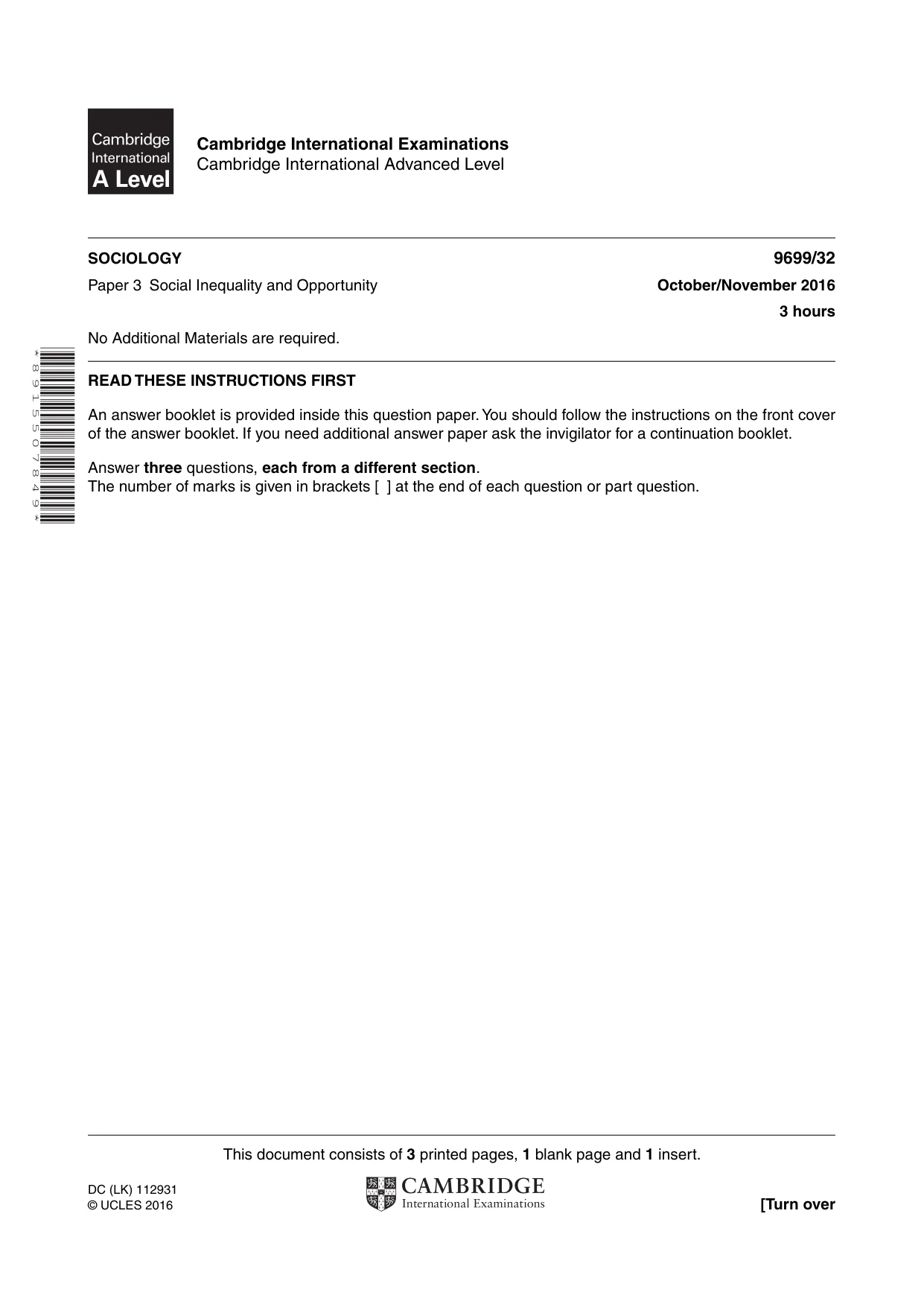
Question paper, page 1
This document consists of 3 printed pages, 1 blank page and 1 insert. DC (LK) 112931 © UCLES 2016 [Turn over * 8 9 1 5 5 0 7 8 4 9 * SOCIOLOGY 9699/32 Paper 3 Social Inequality and Opportunity October/November 2016 3 hours No Additional Materials are required. READ THESE INSTRUCTIONS FIRST An answer booklet is provided inside this question paper. You should follow the instructions on the front cover of the answer booklet. If you need additional answer paper ask the invigilator for a continuation booklet. Answer three questions, each from a different section. The number of marks is given in brackets [ ] at the end of each question or part question. Cambridge International Examinations Cambridge International Advanced Level
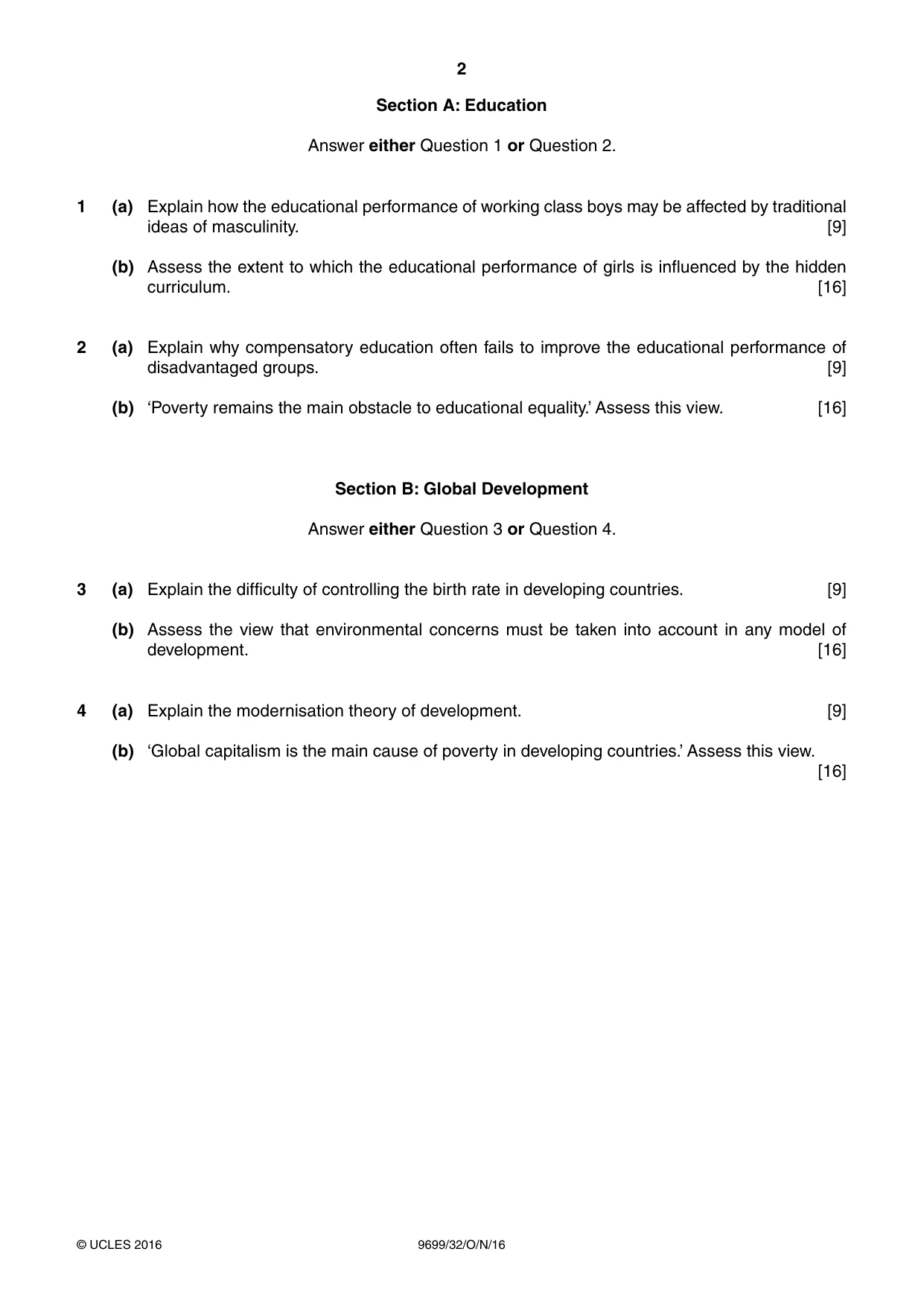
Question paper, page 2
2 9699/32/O/N/16 © UCLES 2016 Section A: Education Answer either Question 1 or Question 2. 1 (a) Explain how the educational performance of working class boys may be affected by traditional ideas of masculinity. [9] (b) Assess the extent to which the educational performance of girls is influenced by the hidden curriculum. [16] 2 (a) Explain why compensatory education often fails to improve the educational performance of disadvantaged groups. [9] (b) ‘Poverty remains the main obstacle to educational equality.’ Assess this view. [16] Section B: Global Development Answer either Question 3 or Question 4. 3 (a) Explain the difficulty of controlling the birth rate in developing countries. [9] (b) Assess the view that environmental concerns must be taken into account in any model of development. [16] 4 (a) Explain the modernisation theory of development. [9] (b) ‘Global capitalism is the main cause of poverty in developing countries.’ Assess this view. [16]
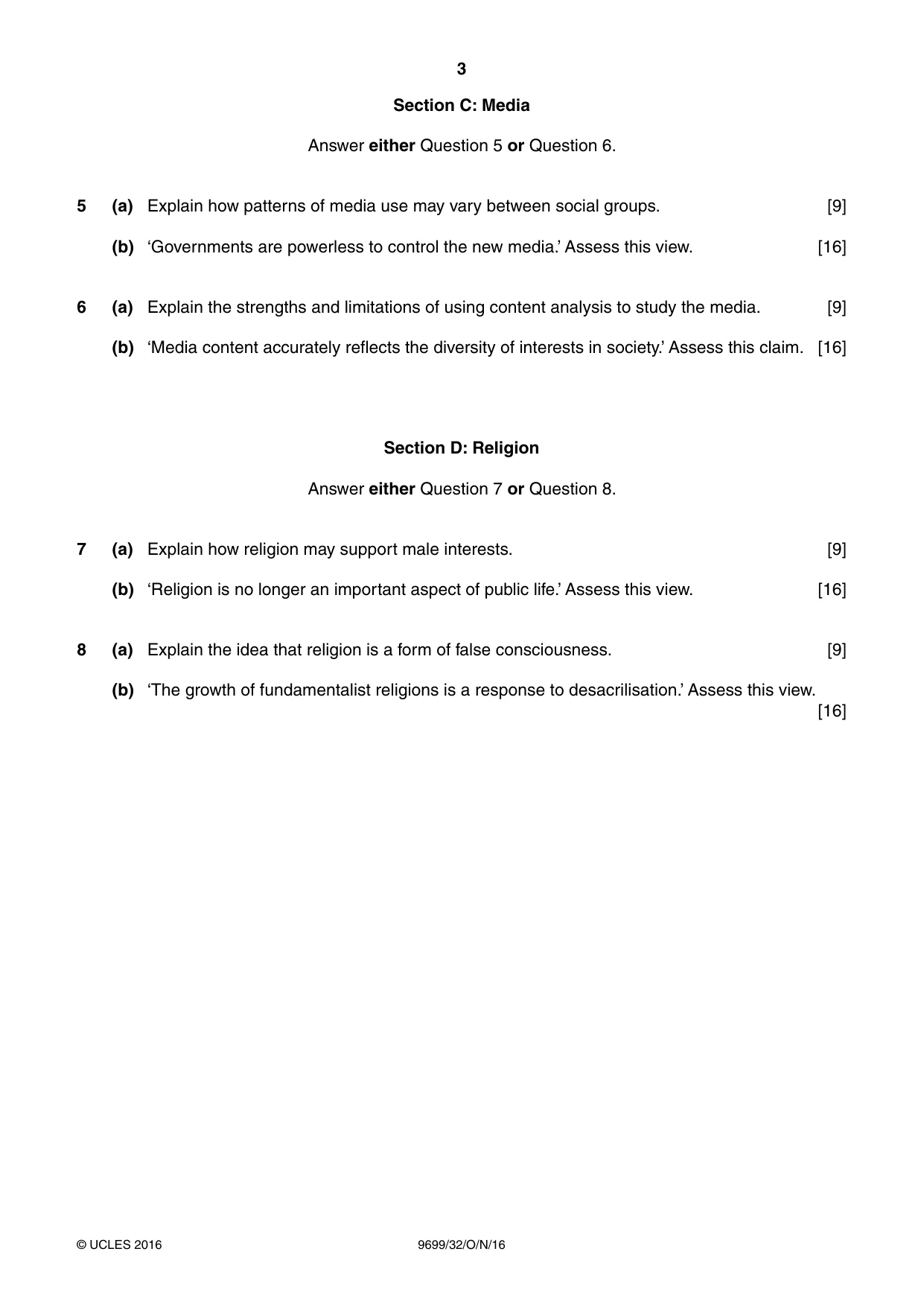
Question paper, page 3
3 9699/32/O/N/16 © UCLES 2016 Section C: Media Answer either Question 5 or Question 6. 5 (a) Explain how patterns of media use may vary between social groups. [9] (b) ‘Governments are powerless to control the new media.’ Assess this view. [16] 6 (a) Explain the strengths and limitations of using content analysis to study the media. [9] (b) ‘Media content accurately reflects the diversity of interests in society.’ Assess this claim. [16] Section D: Religion Answer either Question 7 or Question 8. 7 (a) Explain how religion may support male interests. [9] (b) ‘Religion is no longer an important aspect of public life.’ Assess this view. [16] 8 (a) Explain the idea that religion is a form of false consciousness. [9] (b) ‘The growth of fundamentalist religions is a response to desacrilisation.’ Assess this view. [16]
Question paper, page 4
4 9699/32/O/N/16 © UCLES 2016 Permission to reproduce items where third-party owned material protected by copyright is included has been sought and cleared where possible. Every reasonable effort has been made by the publisher (UCLES) to trace copyright holders, but if any items requiring clearance have unwittingly been included, the publisher will be pleased to make amends at the earliest possible opportunity. To avoid the issue of disclosure of answer-related information to candidates, all copyright acknowledgements are reproduced online in the Cambridge International Examinations Copyright Acknowledgements Booklet. This is produced for each series of examinations and is freely available to download at www.cie.org.uk after the live examination series. Cambridge International Examinations is part of the Cambridge Assessment Group. Cambridge Assessment is the brand name of University of Cambridge Local Examinations Syndicate (UCLES), which is itself a department of the University of Cambridge. BLANK PAGE
Mark scheme, page 1
® IGCSE is the registered trademark of Cambridge International Examinations. This document consists of 12 printed pages. © UCLES 2016 [Turn over Cambridge International Examinations Cambridge International Advanced Subsidiary and Advanced Level SOCIOLOGY 9699/32 Paper 3 October/November 2016 MARK SCHEME Maximum Mark: 75 Published This mark scheme is published as an aid to teachers and candidates, to indicate the requirements of the examination. It shows the basis on which Examiners were instructed to award marks. It does not indicate the details of the discussions that took place at an Examiners’ meeting before marking began, which would have considered the acceptability of alternative answers. Mark schemes should be read in conjunction with the question paper and the Principal Examiner Report for Teachers. Cambridge will not enter into discussions about these mark schemes. Cambridge is publishing the mark schemes for the October/November 2016 series for most Cambridge IGCSE®, Cambridge International A and AS Level components and some Cambridge O Level components.
Mark scheme, page 2
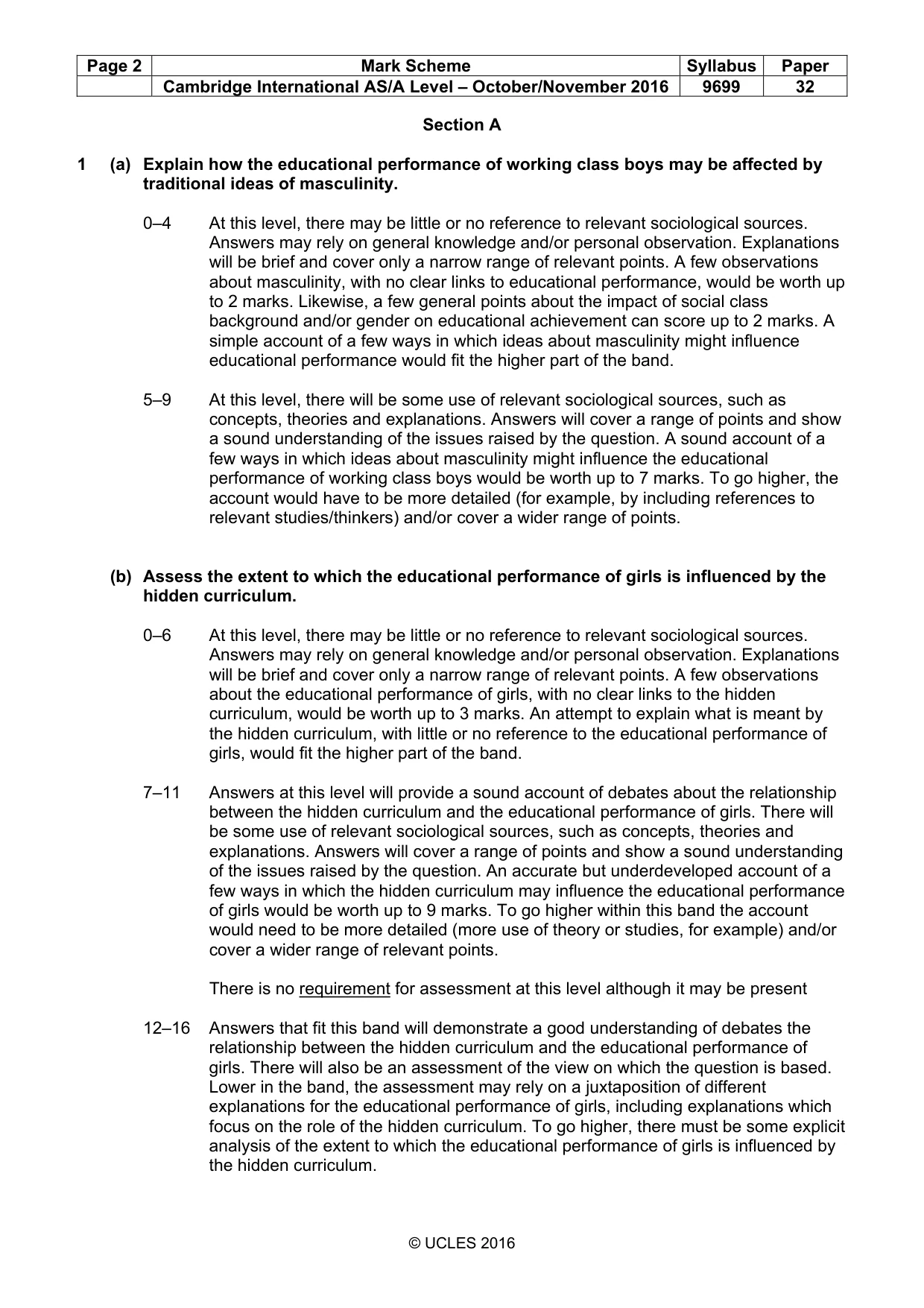
Page 2 Mark Scheme Syllabus Paper Cambridge International AS/A Level – October/November 2016 9699 32 © UCLES 2016 Section A 1 (a) Explain how the educational performance of working class boys may be affected by traditional ideas of masculinity. 0–4 At this level, there may be little or no reference to relevant sociological sources. Answers may rely on general knowledge and/or personal observation. Explanations will be brief and cover only a narrow range of relevant points. A few observations about masculinity, with no clear links to educational performance, would be worth up to 2 marks. Likewise, a few general points about the impact of social class background and/or gender on educational achievement can score up to 2 marks. A simple account of a few ways in which ideas about masculinity might influence educational performance would fit the higher part of the band. 5–9 At this level, there will be some use of relevant sociological sources, such as concepts, theories and explanations. Answers will cover a range of points and show a sound understanding of the issues raised by the question. A sound account of a few ways in which ideas about masculinity might influence the educational performance of working class boys would be worth up to 7 marks. To go higher, the account would have to be more detailed (for example, by including references to relevant studies/thinkers) and/or cover a wider range of points. (b) Assess the extent to which the educational performance of girls is influenced by the hidden curriculum. 0–6 At this level, there may be little or no reference to relevant sociological sources. Answers may rely on general knowledge and/or personal observation. Explanations will be brief and cover only a narrow range of relevant points. A few observations about the educational performance of girls, with no clear links to the hidden curriculum, would be worth up to 3 marks. An attempt to explain what is meant by the hidden curriculum, with little or no reference to the educational performance of girls, would fit the higher part of the band. 7–11 Answers at this level will provide a sound account of debates about the relationship between the hidden curriculum and the educational performance of girls. There will be some use of relevant sociological sources, such as concepts, theories and explanations. Answers will cover a range of points and show a sound understanding of the issues raised by the question. An accurate but underdeveloped account of a few ways in which the hidden curriculum may influence the educational performance of girls would be worth up to 9 marks. To go higher within this band the account would need to be more detailed (more use of theory or studies, for example) and/or cover a wider range of relevant points. There is no requirement for assessment at this level although it may be present 12–16 Answers that fit this band will demonstrate a good understanding of debates the relationship between the hidden curriculum and the educational performance of girls. There will also be an assessment of the view on which the question is based. Lower in the band, the assessment may rely on a juxtaposition of different explanations for the educational performance of girls, including explanations which focus on the role of the hidden curriculum. To go higher, there must be some explicit analysis of the extent to which the educational performance of girls is influenced by the hidden curriculum.
Mark scheme, page 3
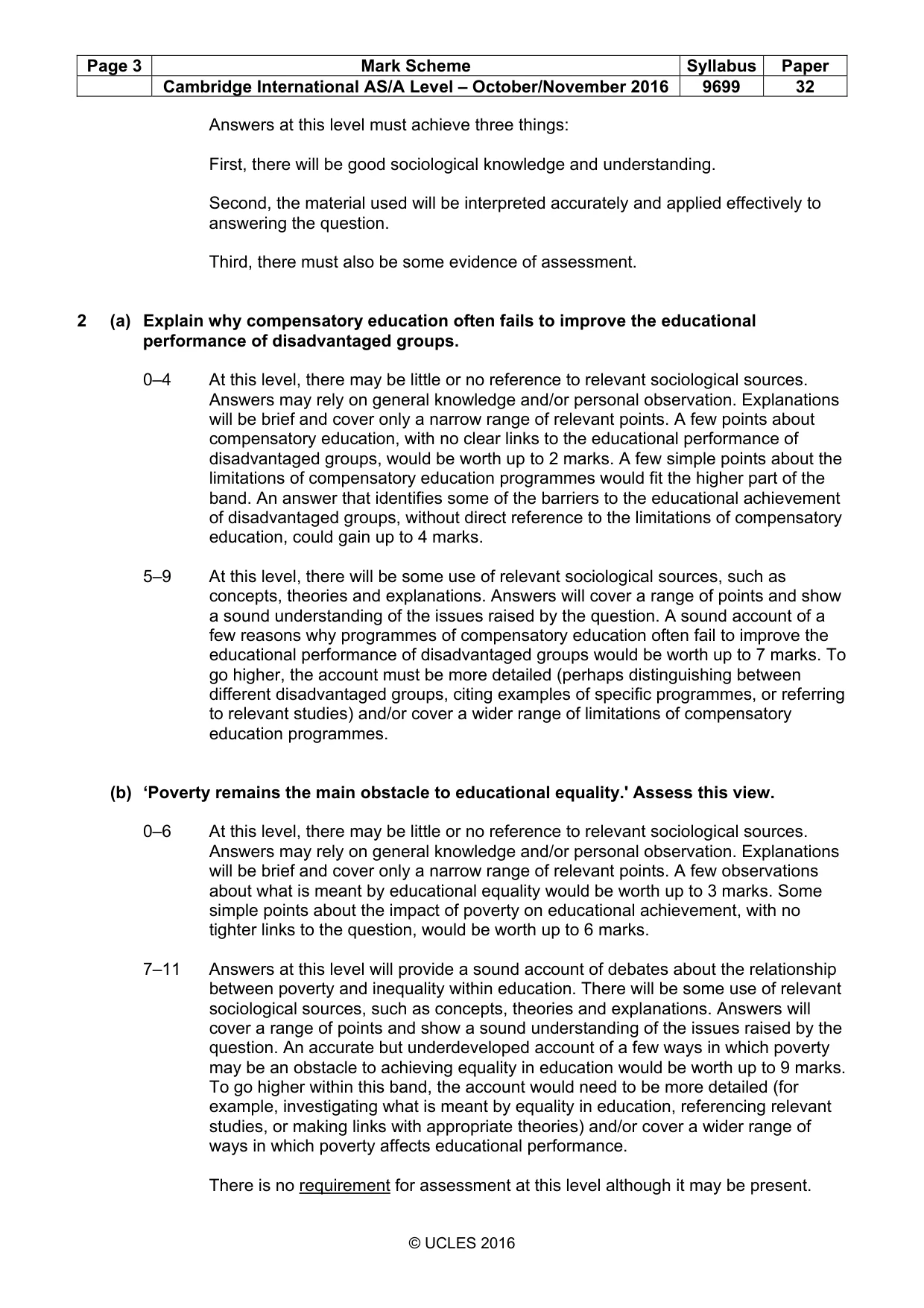
Page 3 Mark Scheme Syllabus Paper Cambridge International AS/A Level – October/November 2016 9699 32 © UCLES 2016 Answers at this level must achieve three things: First, there will be good sociological knowledge and understanding. Second, the material used will be interpreted accurately and applied effectively to answering the question. Third, there must also be some evidence of assessment. 2 (a) Explain why compensatory education often fails to improve the educational performance of disadvantaged groups. 0–4 At this level, there may be little or no reference to relevant sociological sources. Answers may rely on general knowledge and/or personal observation. Explanations will be brief and cover only a narrow range of relevant points. A few points about compensatory education, with no clear links to the educational performance of disadvantaged groups, would be worth up to 2 marks. A few simple points about the limitations of compensatory education programmes would fit the higher part of the band. An answer that identifies some of the barriers to the educational achievement of disadvantaged groups, without direct reference to the limitations of compensatory education, could gain up to 4 marks. 5–9 At this level, there will be some use of relevant sociological sources, such as concepts, theories and explanations. Answers will cover a range of points and show a sound understanding of the issues raised by the question. A sound account of a few reasons why programmes of compensatory education often fail to improve the educational performance of disadvantaged groups would be worth up to 7 marks. To go higher, the account must be more detailed (perhaps distinguishing between different disadvantaged groups, citing examples of specific programmes, or referring to relevant studies) and/or cover a wider range of limitations of compensatory education programmes. (b) ‘Poverty remains the main obstacle to educational equality.' Assess this view. 0–6 At this level, there may be little or no reference to relevant sociological sources. Answers may rely on general knowledge and/or personal observation. Explanations will be brief and cover only a narrow range of relevant points. A few observations about what is meant by educational equality would be worth up to 3 marks. Some simple points about the impact of poverty on educational achievement, with no tighter links to the question, would be worth up to 6 marks. 7–11 Answers at this level will provide a sound account of debates about the relationship between poverty and inequality within education. There will be some use of relevant sociological sources, such as concepts, theories and explanations. Answers will cover a range of points and show a sound understanding of the issues raised by the question. An accurate but underdeveloped account of a few ways in which poverty may be an obstacle to achieving equality in education would be worth up to 9 marks. To go higher within this band, the account would need to be more detailed (for example, investigating what is meant by equality in education, referencing relevant studies, or making links with appropriate theories) and/or cover a wider range of ways in which poverty affects educational performance. There is no requirement for assessment at this level although it may be present.
Mark scheme, page 4
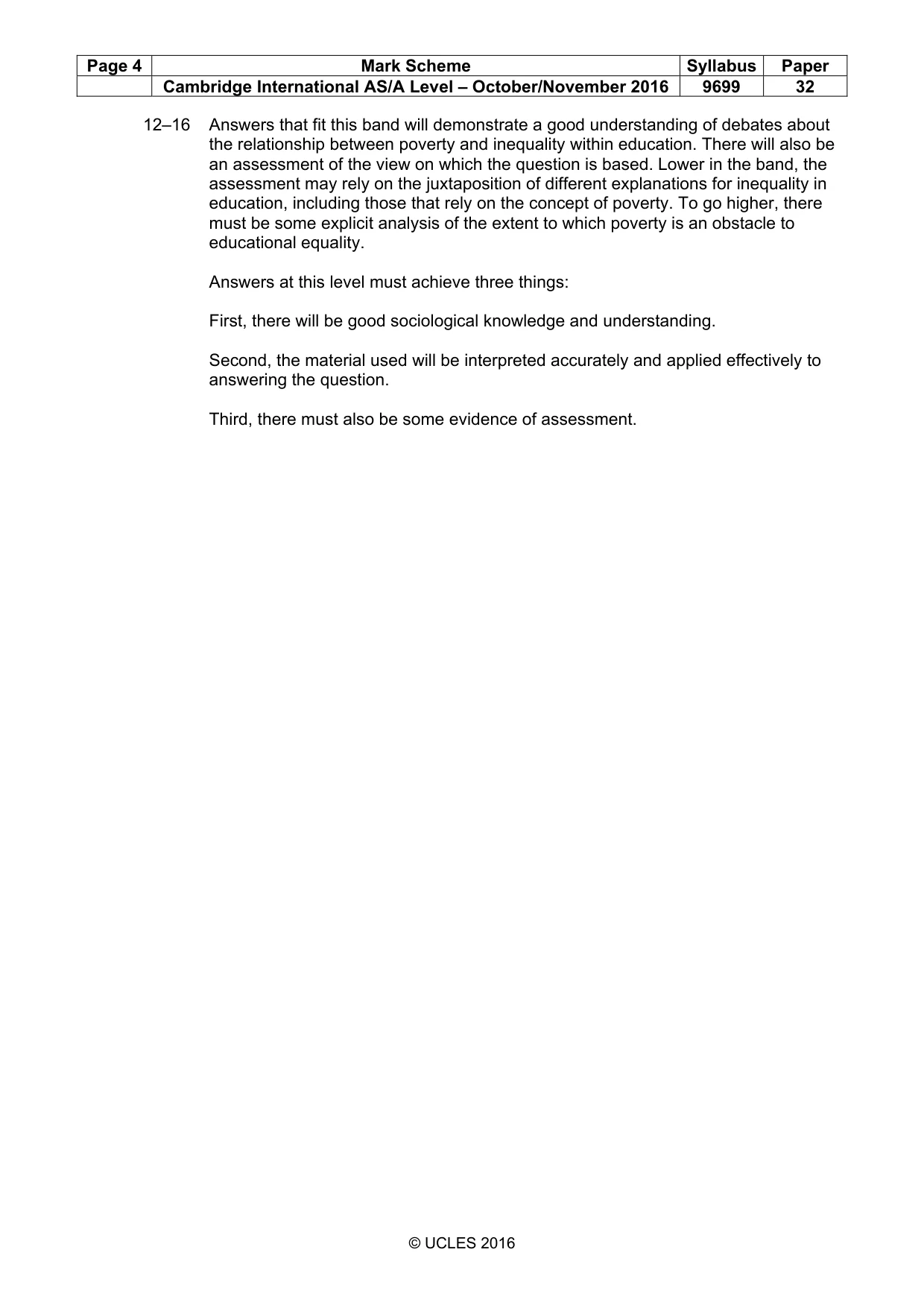
Page 4 Mark Scheme Syllabus Paper Cambridge International AS/A Level – October/November 2016 9699 32 © UCLES 2016 12–16 Answers that fit this band will demonstrate a good understanding of debates about the relationship between poverty and inequality within education. There will also be an assessment of the view on which the question is based. Lower in the band, the assessment may rely on the juxtaposition of different explanations for inequality in education, including those that rely on the concept of poverty. To go higher, there must be some explicit analysis of the extent to which poverty is an obstacle to educational equality. Answers at this level must achieve three things: First, there will be good sociological knowledge and understanding. Second, the material used will be interpreted accurately and applied effectively to answering the question. Third, there must also be some evidence of assessment.
Mark scheme, page 5
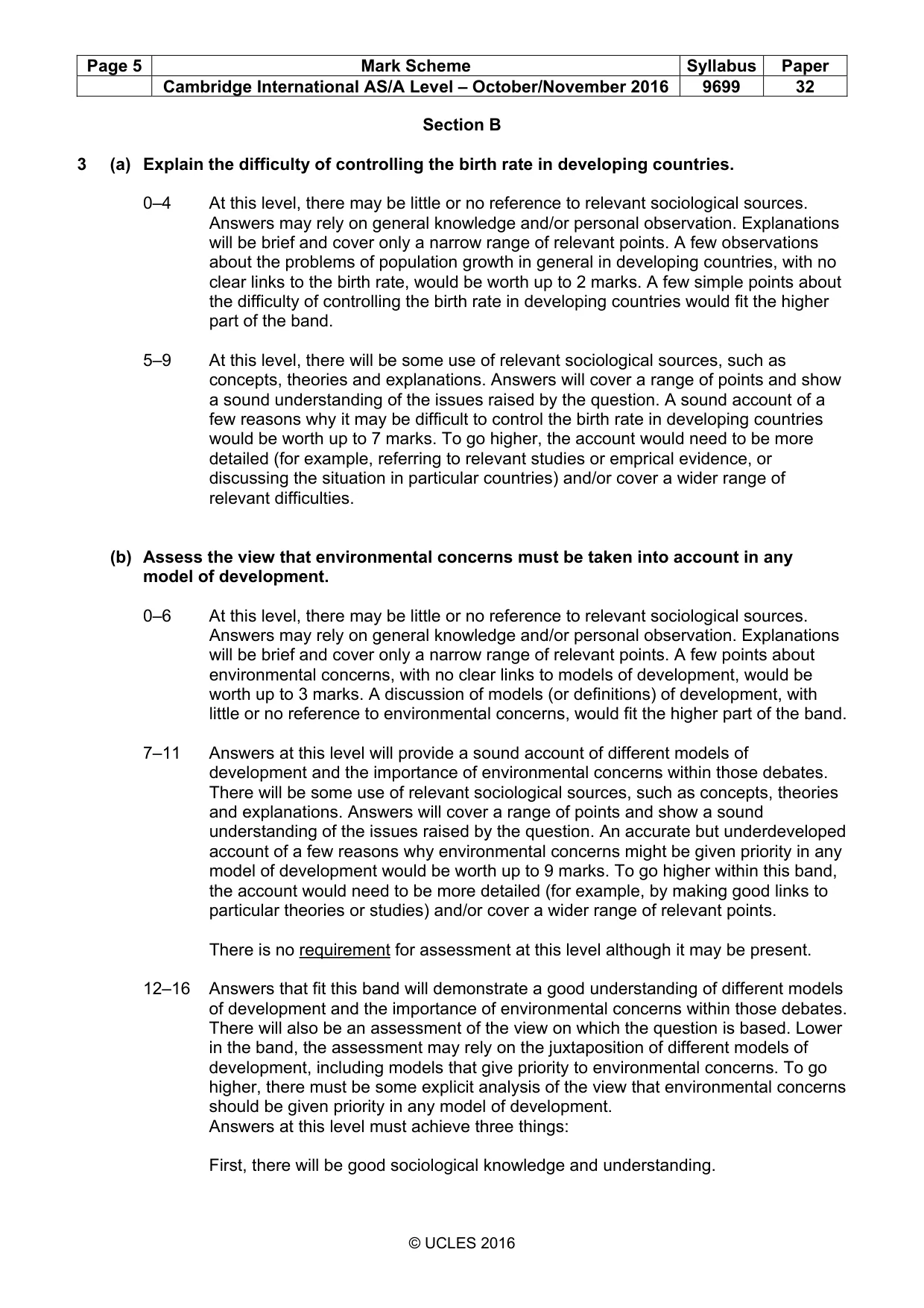
Page 5 Mark Scheme Syllabus Paper Cambridge International AS/A Level – October/November 2016 9699 32 © UCLES 2016 Section B 3 (a) Explain the difficulty of controlling the birth rate in developing countries. 0–4 At this level, there may be little or no reference to relevant sociological sources. Answers may rely on general knowledge and/or personal observation. Explanations will be brief and cover only a narrow range of relevant points. A few observations about the problems of population growth in general in developing countries, with no clear links to the birth rate, would be worth up to 2 marks. A few simple points about the difficulty of controlling the birth rate in developing countries would fit the higher part of the band. 5–9 At this level, there will be some use of relevant sociological sources, such as concepts, theories and explanations. Answers will cover a range of points and show a sound understanding of the issues raised by the question. A sound account of a few reasons why it may be difficult to control the birth rate in developing countries would be worth up to 7 marks. To go higher, the account would need to be more detailed (for example, referring to relevant studies or emprical evidence, or discussing the situation in particular countries) and/or cover a wider range of relevant difficulties. (b) Assess the view that environmental concerns must be taken into account in any model of development. 0–6 At this level, there may be little or no reference to relevant sociological sources. Answers may rely on general knowledge and/or personal observation. Explanations will be brief and cover only a narrow range of relevant points. A few points about environmental concerns, with no clear links to models of development, would be worth up to 3 marks. A discussion of models (or definitions) of development, with little or no reference to environmental concerns, would fit the higher part of the band. 7–11 Answers at this level will provide a sound account of different models of development and the importance of environmental concerns within those debates. There will be some use of relevant sociological sources, such as concepts, theories and explanations. Answers will cover a range of points and show a sound understanding of the issues raised by the question. An accurate but underdeveloped account of a few reasons why environmental concerns might be given priority in any model of development would be worth up to 9 marks. To go higher within this band, the account would need to be more detailed (for example, by making good links to particular theories or studies) and/or cover a wider range of relevant points. There is no requirement for assessment at this level although it may be present. 12–16 Answers that fit this band will demonstrate a good understanding of different models of development and the importance of environmental concerns within those debates. There will also be an assessment of the view on which the question is based. Lower in the band, the assessment may rely on the juxtaposition of different models of development, including models that give priority to environmental concerns. To go higher, there must be some explicit analysis of the view that environmental concerns should be given priority in any model of development. Answers at this level must achieve three things: First, there will be good sociological knowledge and understanding.
Mark scheme, page 6
Page 6 Mark Scheme Syllabus Paper Cambridge International AS/A Level – October/November 2016 9699 32 © UCLES 2016 Second, the material used will be interpreted accurately and applied effectively to answering the question. Third, there must also be some evidence of assessment. 4 (a) Explain the modernisation theory of development. 0–4 At this level, there may be little or no reference to relevant sociological sources. Answers may rely on general knowledge and/or personal observation. Explanations will be brief and cover only a narrow range of relevant points. A few observations about development, with no clear links to modernisation theory, would be worth up to 2 marks. A few simple points about modernisation theory, with no further development, would fit the higher part of the band. 5–9 At this level, there will be some use of relevant sociological sources, such as concepts, theories and explanations. Answers will cover a range of points and show a sound understanding of the issues raised by the question. A sound account of a few features of modernisation theory would be worth up to 7 marks. To go higher, the account must be more detailed (for example, referencing particular modernisation theorists or placing the theory in the wider context of debates about how to explain development) and/or cover a wider range of points about the theory. (b) ‘Global capitalism is the main cause of poverty in developing countries.’ Assess this view. 0–6 At this level, there may be little or no reference to relevant sociological sources. Answers may rely on general knowledge and/or personal observation. Explanations will be brief and cover only a narrow range of relevant points. A few points about the nature of poverty in developing countries, with no reference to capitalism, would be worth up to 3 marks. An attempt to explain what is meant by global capitalism, with no clear links to issues of poverty in developing countries, would fit the higher part of the band. 7–11 Answers at this level will provide a sound account of the nature of global capitalism and its possible links to poverty in developing countries. There will be some use of relevant sociological sources, such as concepts, theories and explanations. Answers will cover a range of points and show a sound understanding of the issues raised by the question. An accurate but underdeveloped account of a few links between poverty and global capitalism would be worth up to 9 marks. To go higher within this band, the account must be more detailed (for example, including references to studies, theories, research evidence) and/or cover a wider range of links between global capitalism and poverty. There is no requirement for assessment at this level although it may be present.
Mark scheme, page 7
Page 7 Mark Scheme Syllabus Paper Cambridge International AS/A Level – October/November 2016 9699 32 © UCLES 2016 12–16 Answers that fit this band will demonstrate a good understanding of the nature of global capitalism and its possible links to poverty in developing countries. There will also be an assessment of the view on which the question is based. Lower in the band, the assessment may rely on a juxtaposition of different theories of development, including those which identify links between global capitalism and poverty in developing countries. To go higher, there must be an explicit assessment of whether global capitalism is the main cause of poverty in developing countries. Answers at this level must achieve three things: First, there will be good sociological knowledge and understanding. Second, the material used will be interpreted accurately and applied effectively to answering the question. Third, there must also be some evidence of assessment.
Mark scheme, page 8
Page 8 Mark Scheme Syllabus Paper Cambridge International AS/A Level – October/November 2016 9699 32 © UCLES 2016 Section C 5 (a) Explain how patterns of media use may vary between social groups. 0–4 At this level, there may be little or no reference to relevant sociological sources. Answers may rely on general knowledge and/or personal observation. Explanations will be brief and cover only a narrow range of relevant points. A few observations about media use, with no clear links to particular social groups, would be worth up to 2 marks. A few simple points about how patterns of media use may vary between social groups would fit the higher part of the band. Answers that focus on how media representations of social groups differ, rather than how different social groups use the media, can achieve no more than 4 marks. 5–9 At this level, there will be some use of relevant sociological sources, such as concepts, theories and explanations. Answers will cover a range of points and show a sound understanding of the issues raised by the question. A sound account of a few ways in which patterns of media use may vary between social groups would be worth up to 7 marks. To go higher, the account would need to be more detailed (for example, through good use of studies or an extended focus on the media uses of particular groups) or cover a wider range of relevant points. (b) ‘Governments are powerless to control the new media.’ Assess this view. 0–6 At this level, there may be little or no reference to relevant sociological sources. Answers may rely on general knowledge and/or personal observation. Explanations will be brief and cover only a narrow range of relevant points. A few observations about the difficulties governments may face in controlling the media in general would be worth up to 3 marks. Answers that provide an account of the power of the new media, without linking the material clearly to the impact on the powers of government, would fit the higher part of the band. An account of who controls the media in general, with few or no specific links to the new media or references to government control, could gain up to 6 marks. 7–11 Answers at this level will provide a sound account of the powers of the new media and the impact upon issues of government control of the media. There will be some use of relevant sociological sources, such as concepts, theories and explanations. Answers will cover a range of points and show a sound understanding of the issues raised by the question. An accurate but underdeveloped account of a few reasons why governments may face difficulties in controlling the new media would be worth up to 9 marks. To go higher within this band, the account would need to be more detailed (perhaps including references to studies and thinkers) and/or cover a wider range of relevant points. There is no requirement for assessment at this level although it may be present.
Mark scheme, page 9
Page 9 Mark Scheme Syllabus Paper Cambridge International AS/A Level – October/November 2016 9699 32 © UCLES 2016 12–16 Answers that fit this band will demonstrate a good understanding of the powers of the new media and the impact upon issues of government control of the media. There will also be an assessment of the view on which the question is based. Lower in the band, the assessment may rely on a juxtaposition of points for and against the view that the new media are very powerful. To go higher, the assessment must include an explicit analysis of the extent to which governments face difficulties in controlling the new media. Answers at this level must achieve three things: First, there will be good sociological knowledge and understanding. Second, the material used will be interpreted accurately and applied effectively to answering the question. Third, there must also be some evidence of assessment. 6 (a) Explain the strengths and limitations of using content analysis to study the media. 0–4 At this level, there may be little or no reference to relevant sociological sources. Answers may rely on general knowledge and/or personal observation. Explanations will be brief and cover only a narrow range of relevant points. An attempt to define what is meant by content analysis, with no further links to the question, would be worth up to 2 marks. A few simple points about the strengths and/or limitations of using content analysis to study the media would fit the higher part of the band. 5–9 At this level, there will be some use of relevant sociological sources, such as concepts, theories and explanations. Answers will cover a range of points and show a sound understanding of the issues raised by the question. A sound account of a few strengths and limitations of using content analysis to study the media would be worth up to 7 marks. To go higher, the account would need to be more detailed (for example, by including references to relevant studies/thinkers) and/or cover a wider range of strengths and limitations. (b) ‘Media content accurately reflects the diversity of interests in society.’ Assess this claim. 0–6 At this level, there may be little or no reference to relevant sociological sources. Answers may rely on general knowledge and/or personal observation. Explanations will be brief and cover only a narrow range of relevant points. A few observations about media content, with no clear links to whose interests that content reflects, would be worth up to 3 marks. A few simple points about the interests that are represented through the media would fit the higher part of the band. 7–11 Answers at this level will provide a sound account of the debates about the interests that are represented through the media. There will be some use of relevant sociological sources, such as concepts, theories and explanations. Answers will cover a range of points and show a sound understanding of the issues raised by the question. An accurate but underdeveloped account of the idea that media content accurately reflects the diversity of interests in society would be worth up to 9 marks. To go higher within this band, the account would need to be more detailed (for example, it might include references to particular interests and how they are represented by the media) and/or cover a wider range of relevant points.
Mark scheme, page 10
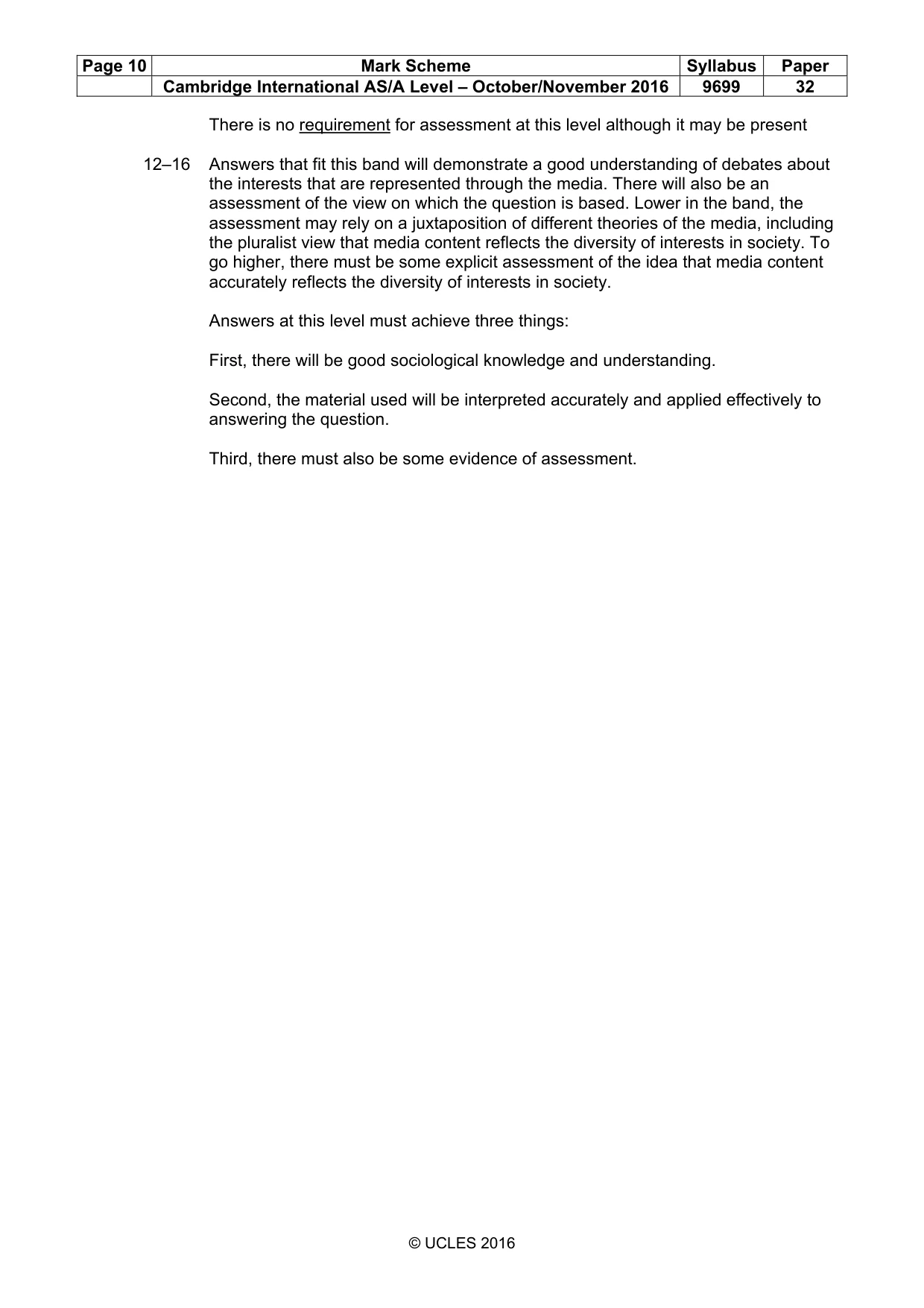
Page 10 Mark Scheme Syllabus Paper Cambridge International AS/A Level – October/November 2016 9699 32 © UCLES 2016 There is no requirement for assessment at this level although it may be present 12–16 Answers that fit this band will demonstrate a good understanding of debates about the interests that are represented through the media. There will also be an assessment of the view on which the question is based. Lower in the band, the assessment may rely on a juxtaposition of different theories of the media, including the pluralist view that media content reflects the diversity of interests in society. To go higher, there must be some explicit assessment of the idea that media content accurately reflects the diversity of interests in society. Answers at this level must achieve three things: First, there will be good sociological knowledge and understanding. Second, the material used will be interpreted accurately and applied effectively to answering the question. Third, there must also be some evidence of assessment.
Mark scheme, page 11
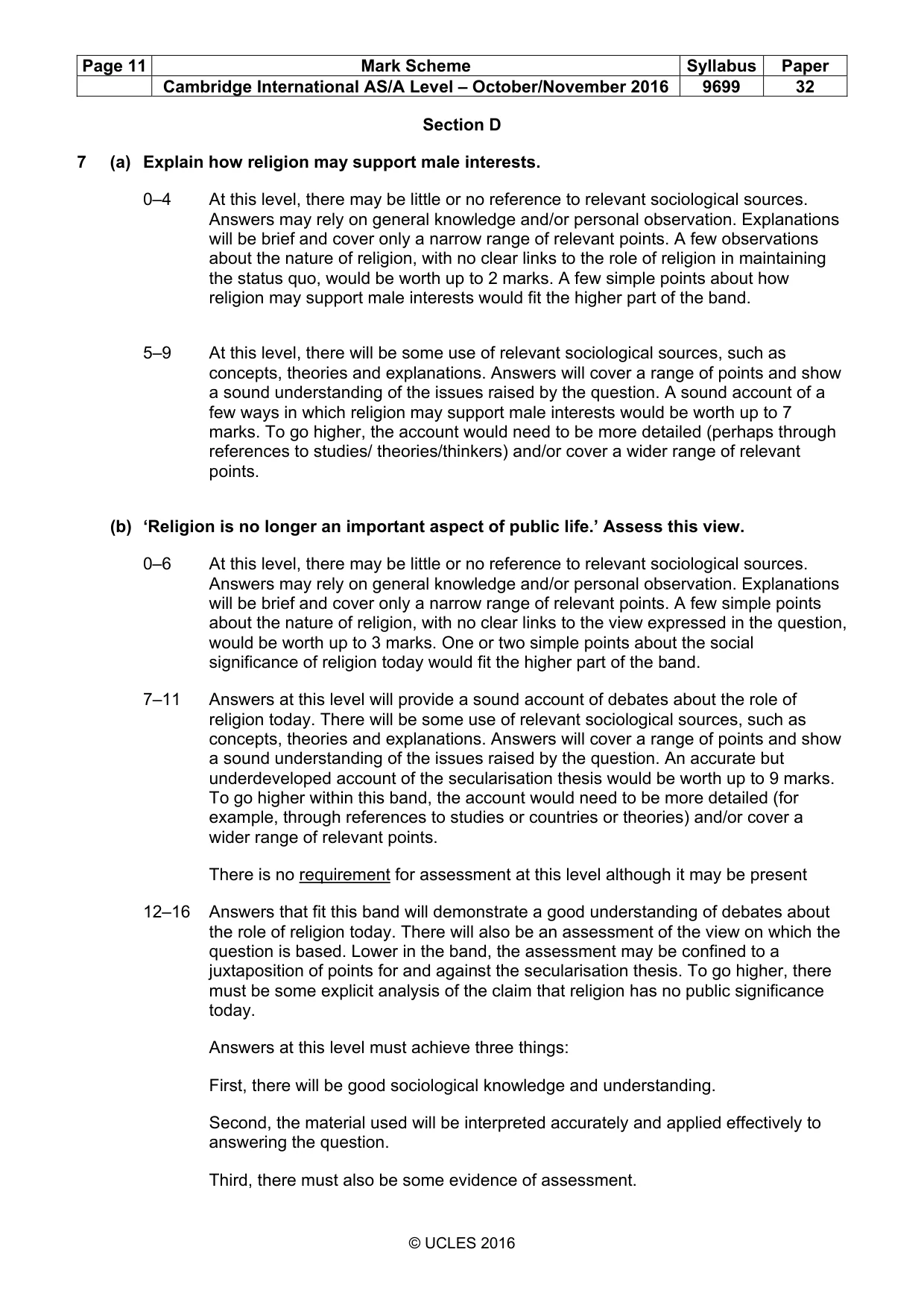
Page 11 Mark Scheme Syllabus Paper Cambridge International AS/A Level – October/November 2016 9699 32 © UCLES 2016 Section D 7 (a) Explain how religion may support male interests. 0–4 At this level, there may be little or no reference to relevant sociological sources. Answers may rely on general knowledge and/or personal observation. Explanations will be brief and cover only a narrow range of relevant points. A few observations about the nature of religion, with no clear links to the role of religion in maintaining the status quo, would be worth up to 2 marks. A few simple points about how religion may support male interests would fit the higher part of the band. 5–9 At this level, there will be some use of relevant sociological sources, such as concepts, theories and explanations. Answers will cover a range of points and show a sound understanding of the issues raised by the question. A sound account of a few ways in which religion may support male interests would be worth up to 7 marks. To go higher, the account would need to be more detailed (perhaps through references to studies/ theories/thinkers) and/or cover a wider range of relevant points. (b) ‘Religion is no longer an important aspect of public life.’ Assess this view. 0–6 At this level, there may be little or no reference to relevant sociological sources. Answers may rely on general knowledge and/or personal observation. Explanations will be brief and cover only a narrow range of relevant points. A few simple points about the nature of religion, with no clear links to the view expressed in the question, would be worth up to 3 marks. One or two simple points about the social significance of religion today would fit the higher part of the band. 7–11 Answers at this level will provide a sound account of debates about the role of religion today. There will be some use of relevant sociological sources, such as concepts, theories and explanations. Answers will cover a range of points and show a sound understanding of the issues raised by the question. An accurate but underdeveloped account of the secularisation thesis would be worth up to 9 marks. To go higher within this band, the account would need to be more detailed (for example, through references to studies or countries or theories) and/or cover a wider range of relevant points. There is no requirement for assessment at this level although it may be present 12–16 Answers that fit this band will demonstrate a good understanding of debates about the role of religion today. There will also be an assessment of the view on which the question is based. Lower in the band, the assessment may be confined to a juxtaposition of points for and against the secularisation thesis. To go higher, there must be some explicit analysis of the claim that religion has no public significance today. Answers at this level must achieve three things: First, there will be good sociological knowledge and understanding. Second, the material used will be interpreted accurately and applied effectively to answering the question. Third, there must also be some evidence of assessment.
Mark scheme, page 12
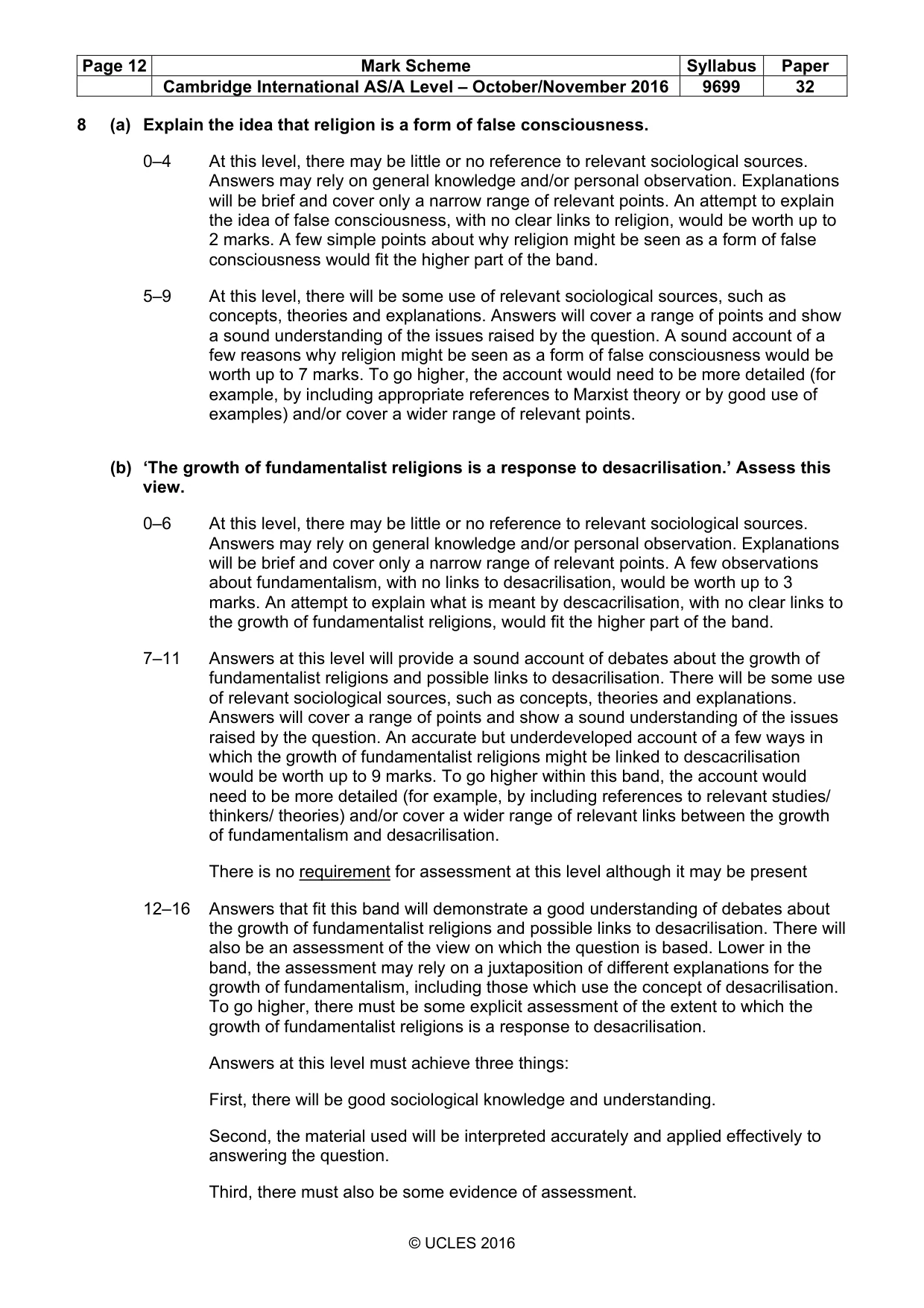
Page 12 Mark Scheme Syllabus Paper Cambridge International AS/A Level – October/November 2016 9699 32 © UCLES 2016 8 (a) Explain the idea that religion is a form of false consciousness. 0–4 At this level, there may be little or no reference to relevant sociological sources. Answers may rely on general knowledge and/or personal observation. Explanations will be brief and cover only a narrow range of relevant points. An attempt to explain the idea of false consciousness, with no clear links to religion, would be worth up to 2 marks. A few simple points about why religion might be seen as a form of false consciousness would fit the higher part of the band. 5–9 At this level, there will be some use of relevant sociological sources, such as concepts, theories and explanations. Answers will cover a range of points and show a sound understanding of the issues raised by the question. A sound account of a few reasons why religion might be seen as a form of false consciousness would be worth up to 7 marks. To go higher, the account would need to be more detailed (for example, by including appropriate references to Marxist theory or by good use of examples) and/or cover a wider range of relevant points. (b) ‘The growth of fundamentalist religions is a response to desacrilisation.’ Assess this view. 0–6 At this level, there may be little or no reference to relevant sociological sources. Answers may rely on general knowledge and/or personal observation. Explanations will be brief and cover only a narrow range of relevant points. A few observations about fundamentalism, with no links to desacrilisation, would be worth up to 3 marks. An attempt to explain what is meant by descacrilisation, with no clear links to the growth of fundamentalist religions, would fit the higher part of the band. 7–11 Answers at this level will provide a sound account of debates about the growth of fundamentalist religions and possible links to desacrilisation. There will be some use of relevant sociological sources, such as concepts, theories and explanations. Answers will cover a range of points and show a sound understanding of the issues raised by the question. An accurate but underdeveloped account of a few ways in which the growth of fundamentalist religions might be linked to descacrilisation would be worth up to 9 marks. To go higher within this band, the account would need to be more detailed (for example, by including references to relevant studies/ thinkers/ theories) and/or cover a wider range of relevant links between the growth of fundamentalism and desacrilisation. There is no requirement for assessment at this level although it may be present 12–16 Answers that fit this band will demonstrate a good understanding of debates about the growth of fundamentalist religions and possible links to desacrilisation. There will also be an assessment of the view on which the question is based. Lower in the band, the assessment may rely on a juxtaposition of different explanations for the growth of fundamentalism, including those which use the concept of desacrilisation. To go higher, there must be some explicit assessment of the extent to which the growth of fundamentalist religions is a response to desacrilisation. Answers at this level must achieve three things: First, there will be good sociological knowledge and understanding. Second, the material used will be interpreted accurately and applied effectively to answering the question. Third, there must also be some evidence of assessment.
What you needed in this session
Cambridge’s own grade thresholds for 2016 Oct/Nov, Paper 3 · Variant 2. A higher threshold means an easier paper — the bar moves with how the cohort did.