Cambridge A Level Sociology 9699 — 2016 Oct/Nov Paper 3 · Variant 3
9699/33/O/N/16 · 75 marks · ≈84 min
The question paper and its mark scheme, free to read here and free to download. This is Cambridge’s own paper, exactly as it was sat.
Question paper4 pages
Mark scheme13 pages
Answers below. Sit the paper first if you are practising.
Paper as text
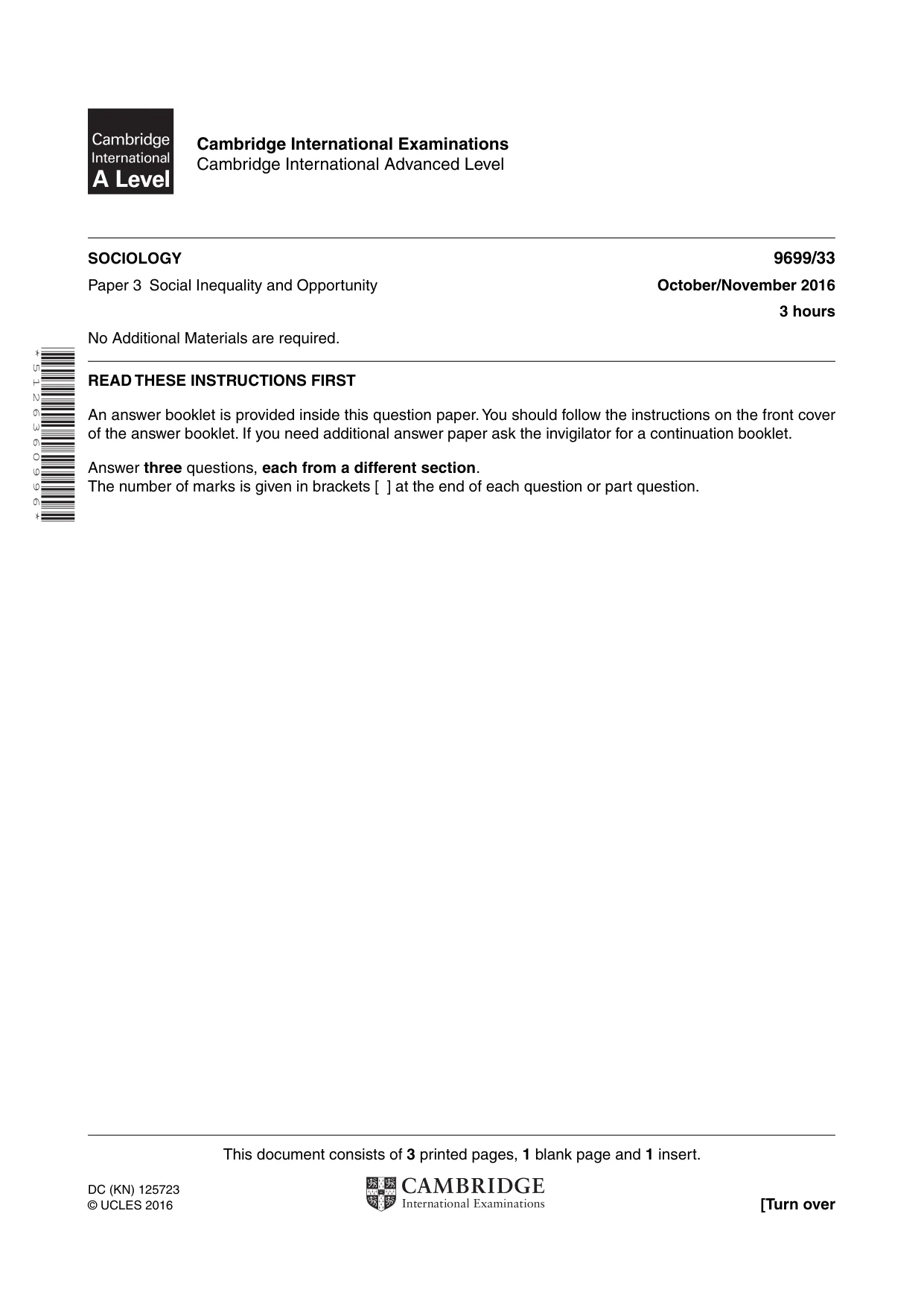
Question paper, page 1
This document consists of 3 printed pages, 1 blank page and 1 insert. DC (KN) 125723 © UCLES 2016 [Turn over Cambridge International Examinations Cambridge International Advanced Level * 5 1 2 6 3 6 0 9 9 6 * SOCIOLOGY 9699/33 Paper 3 Social Inequality and Opportunity October/November 2016 3 hours No Additional Materials are required. READ THESE INSTRUCTIONS FIRST An answer booklet is provided inside this question paper. You should follow the instructions on the front cover of the answer booklet. If you need additional answer paper ask the invigilator for a continuation booklet. Answer three questions, each from a different section. The number of marks is given in brackets [ ] at the end of each question or part question.
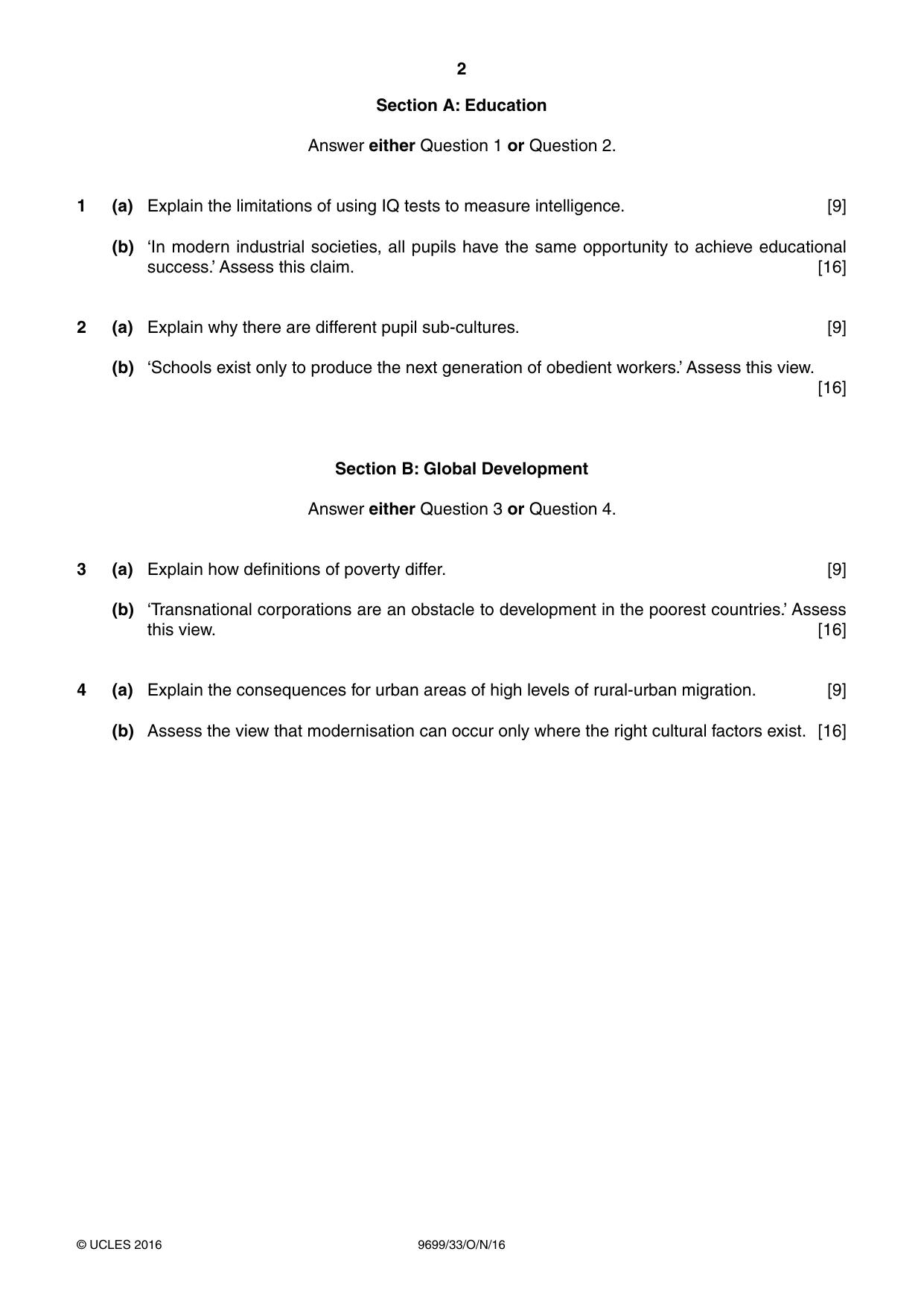
Question paper, page 2
2 9699/33/O/N/16 © UCLES 2016 Section A: Education Answer either Question 1 or Question 2. 1 (a) Explain the limitations of using IQ tests to measure intelligence. [9] (b) ‘In modern industrial societies, all pupils have the same opportunity to achieve educational success.’ Assess this claim. [16] 2 (a) Explain why there are different pupil sub-cultures. [9] (b) ‘Schools exist only to produce the next generation of obedient workers.’ Assess this view. [16] Section B: Global Development Answer either Question 3 or Question 4. 3 (a) Explain how definitions of poverty differ. [9] (b) ‘Transnational corporations are an obstacle to development in the poorest countries.’ Assess this view. [16] 4 (a) Explain the consequences for urban areas of high levels of rural-urban migration. [9] (b) Assess the view that modernisation can occur only where the right cultural factors exist. [16]
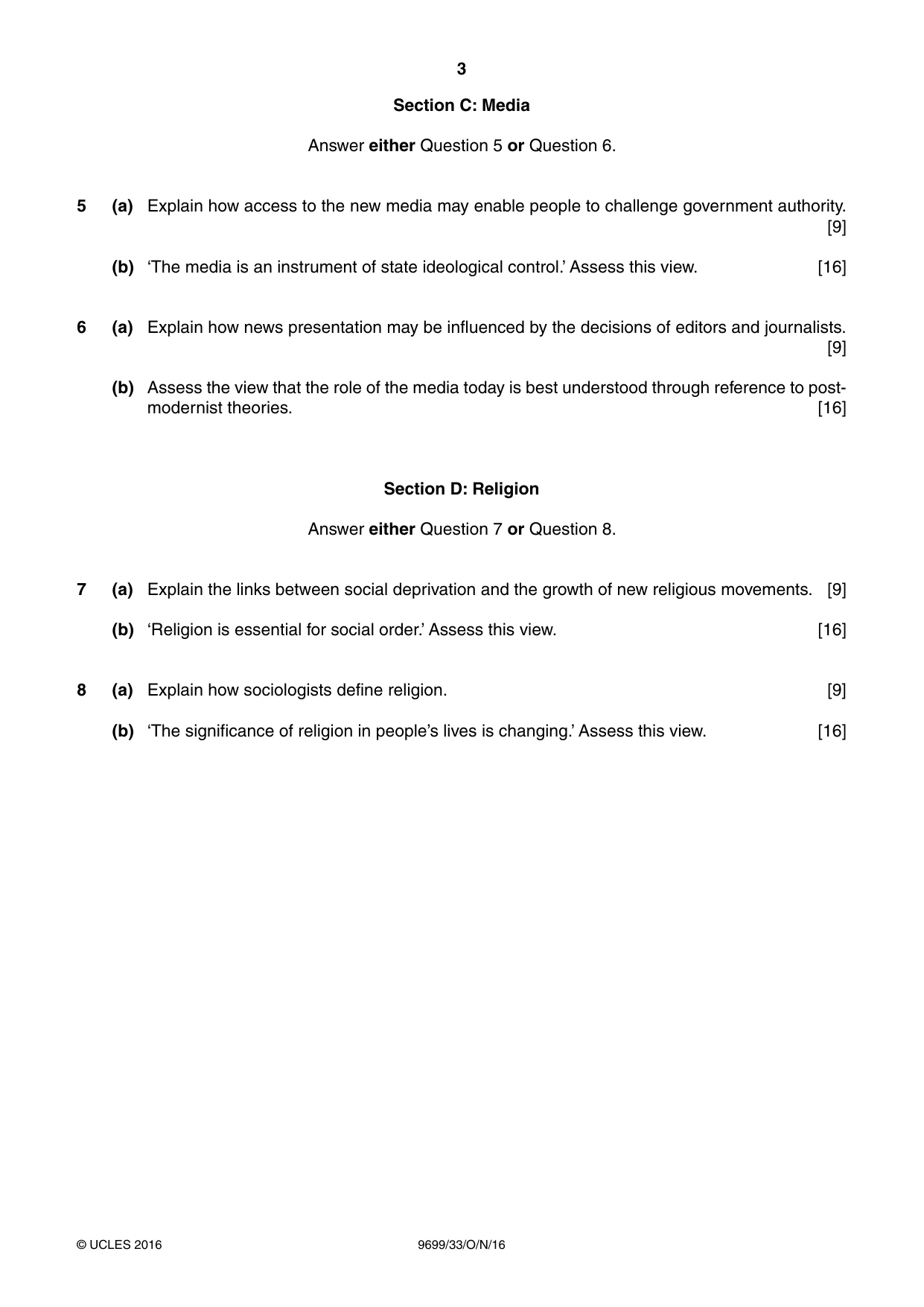
Question paper, page 3
3 9699/33/O/N/16 © UCLES 2016 Section C: Media Answer either Question 5 or Question 6. 5 (a) Explain how access to the new media may enable people to challenge government authority. [9] (b) ‘The media is an instrument of state ideological control.’ Assess this view. [16] 6 (a) Explain how news presentation may be influenced by the decisions of editors and journalists. [9] (b) Assess the view that the role of the media today is best understood through reference to post- modernist theories. [16] Section D: Religion Answer either Question 7 or Question 8. 7 (a) Explain the links between social deprivation and the growth of new religious movements. [9] (b) ‘Religion is essential for social order.’ Assess this view. [16] 8 (a) Explain how sociologists define religion. [9] (b) ‘The significance of religion in people’s lives is changing.’ Assess this view. [16]
Question paper, page 4
4 9699/33/O/N/16 © UCLES 2016 BLANK PAGE Permission to reproduce items where third-party owned material protected by copyright is included has been sought and cleared where possible. Every reasonable effort has been made by the publisher (UCLES) to trace copyright holders, but if any items requiring clearance have unwittingly been included, the publisher will be pleased to make amends at the earliest possible opportunity. To avoid the issue of disclosure of answer-related information to candidates, all copyright acknowledgements are reproduced online in the Cambridge International Examinations Copyright Acknowledgements Booklet. This is produced for each series of examinations and is freely available to download at www.cie.org.uk after the live examination series. Cambridge International Examinations is part of the Cambridge Assessment Group. Cambridge Assessment is the brand name of University of Cambridge Local Examinations Syndicate (UCLES), which is itself a department of the University of Cambridge.
Mark scheme, page 1
® IGCSE is the registered trademark of Cambridge International Examinations. This document consists of 13 printed pages. © UCLES 2016 Turn over Cambridge International Examinations Cambridge International Advanced Subsidiary and Advanced Level SOCIOLOGY 9699/33 Paper 3 October/November 2016 MARK SCHEME Maximum Mark: 75 Published This mark scheme is published as an aid to teachers and candidates, to indicate the requirements of the examination. It shows the basis on which Examiners were instructed to award marks. It does not indicate the details of the discussions that took place at an Examiners’ meeting before marking began, which would have considered the acceptability of alternative answers. Mark schemes should be read in conjunction with the question paper and the Principal Examiner Report for Teachers. Cambridge will not enter into discussions about these mark schemes. Cambridge is publishing the mark schemes for the October/November 2016 series for most Cambridge IGCSE®, Cambridge International A and AS Level components and some Cambridge O Level components.
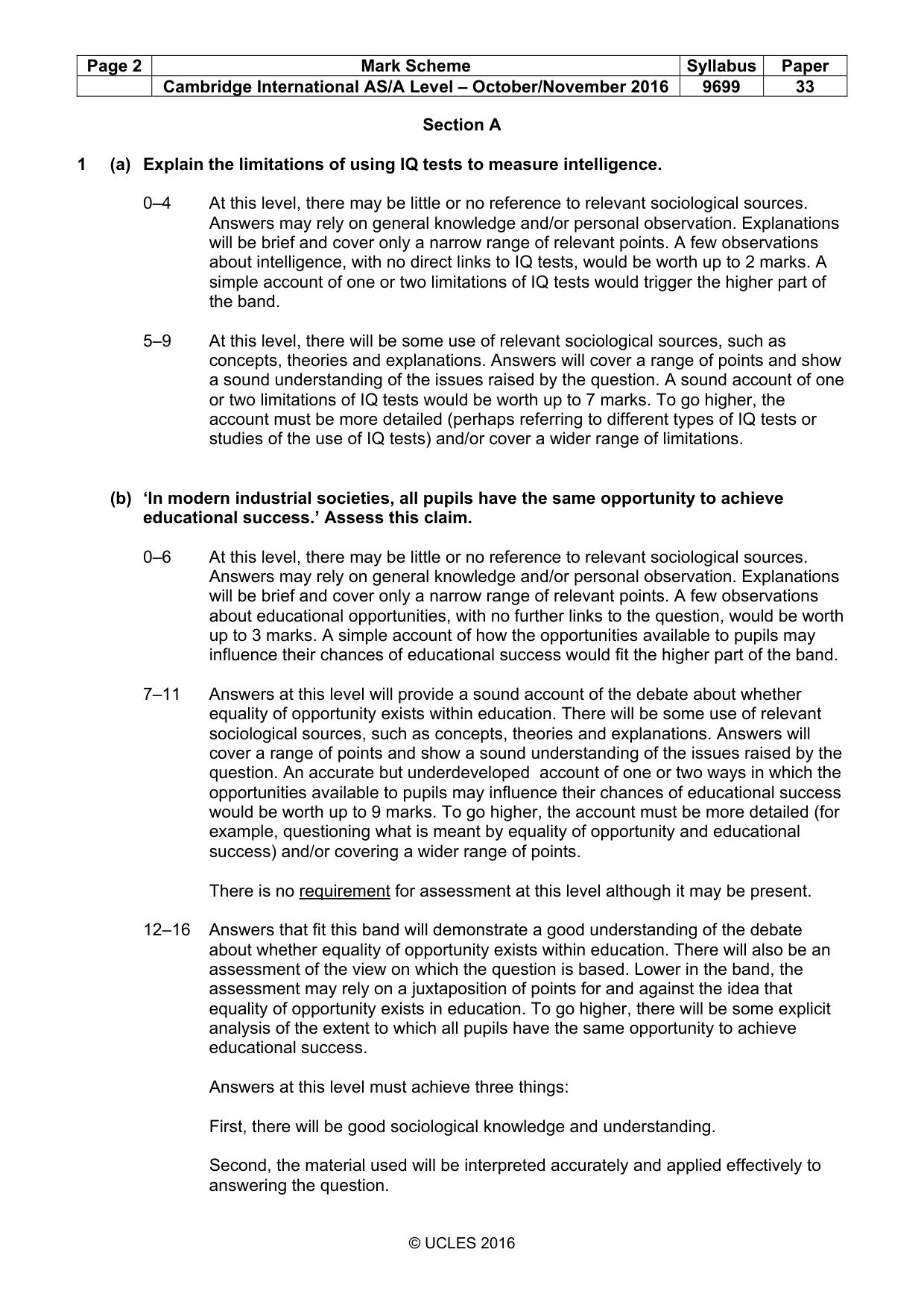
Mark scheme, page 2
Page 2 Mark Scheme Syllabus Paper Cambridge International AS/A Level – October/November 2016 9699 33 © UCLES 2016 Section A 1 (a) Explain the limitations of using IQ tests to measure intelligence. 0–4 At this level, there may be little or no reference to relevant sociological sources. Answers may rely on general knowledge and/or personal observation. Explanations will be brief and cover only a narrow range of relevant points. A few observations about intelligence, with no direct links to IQ tests, would be worth up to 2 marks. A simple account of one or two limitations of IQ tests would trigger the higher part of the band. 5–9 At this level, there will be some use of relevant sociological sources, such as concepts, theories and explanations. Answers will cover a range of points and show a sound understanding of the issues raised by the question. A sound account of one or two limitations of IQ tests would be worth up to 7 marks. To go higher, the account must be more detailed (perhaps referring to different types of IQ tests or studies of the use of IQ tests) and/or cover a wider range of limitations. (b) ‘In modern industrial societies, all pupils have the same opportunity to achieve educational success.’ Assess this claim. 0–6 At this level, there may be little or no reference to relevant sociological sources. Answers may rely on general knowledge and/or personal observation. Explanations will be brief and cover only a narrow range of relevant points. A few observations about educational opportunities, with no further links to the question, would be worth up to 3 marks. A simple account of how the opportunities available to pupils may influence their chances of educational success would fit the higher part of the band. 7–11 Answers at this level will provide a sound account of the debate about whether equality of opportunity exists within education. There will be some use of relevant sociological sources, such as concepts, theories and explanations. Answers will cover a range of points and show a sound understanding of the issues raised by the question. An accurate but underdeveloped account of one or two ways in which the opportunities available to pupils may influence their chances of educational success would be worth up to 9 marks. To go higher, the account must be more detailed (for example, questioning what is meant by equality of opportunity and educational success) and/or covering a wider range of points. There is no requirement for assessment at this level although it may be present. 12–16 Answers that fit this band will demonstrate a good understanding of the debate about whether equality of opportunity exists within education. There will also be an assessment of the view on which the question is based. Lower in the band, the assessment may rely on a juxtaposition of points for and against the idea that equality of opportunity exists in education. To go higher, there will be some explicit analysis of the extent to which all pupils have the same opportunity to achieve educational success. Answers at this level must achieve three things: First, there will be good sociological knowledge and understanding. Second, the material used will be interpreted accurately and applied effectively to answering the question.
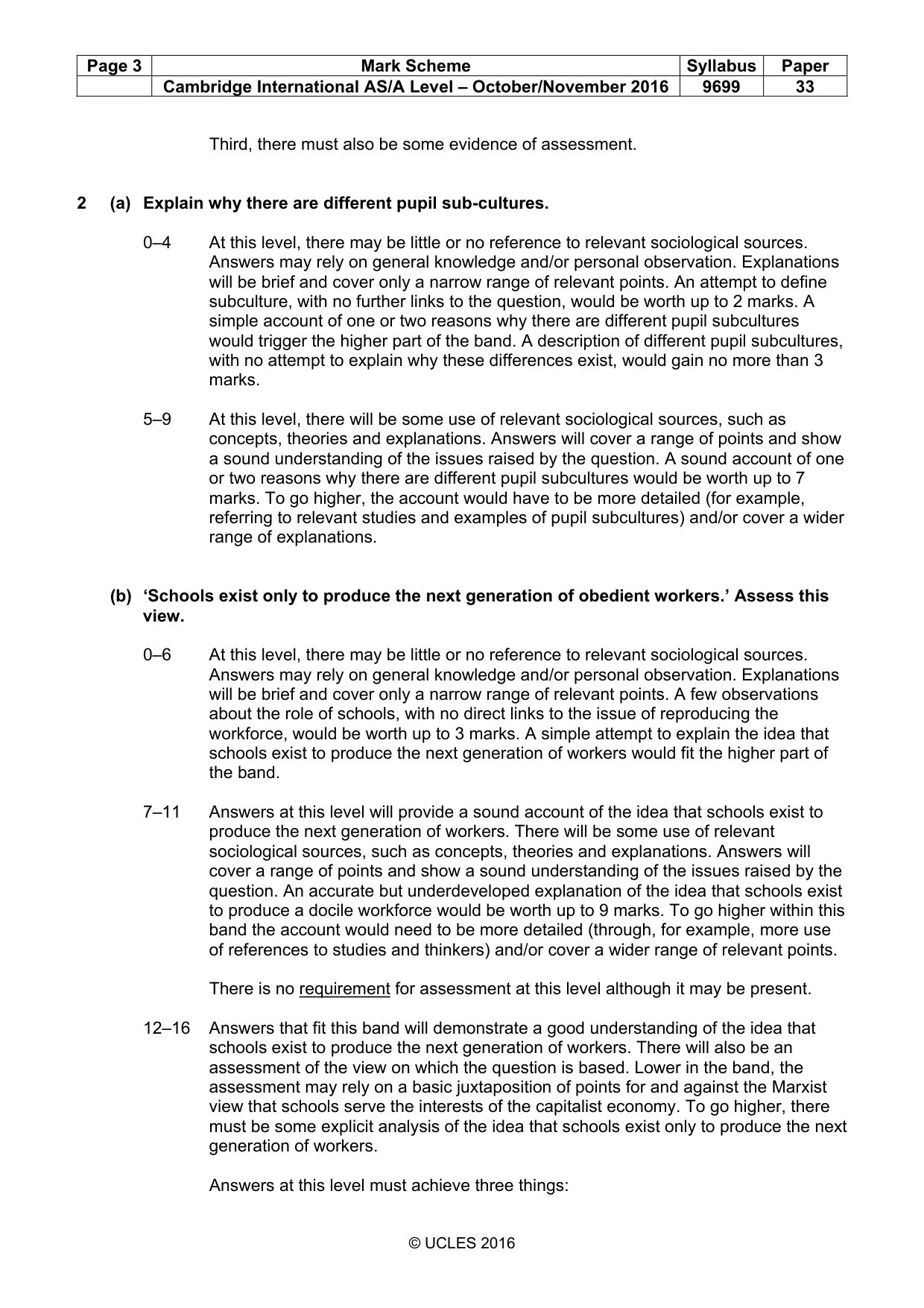
Mark scheme, page 3
Page 3 Mark Scheme Syllabus Paper Cambridge International AS/A Level – October/November 2016 9699 33 © UCLES 2016 Third, there must also be some evidence of assessment. 2 (a) Explain why there are different pupil sub-cultures. 0–4 At this level, there may be little or no reference to relevant sociological sources. Answers may rely on general knowledge and/or personal observation. Explanations will be brief and cover only a narrow range of relevant points. An attempt to define subculture, with no further links to the question, would be worth up to 2 marks. A simple account of one or two reasons why there are different pupil subcultures would trigger the higher part of the band. A description of different pupil subcultures, with no attempt to explain why these differences exist, would gain no more than 3 marks. 5–9 At this level, there will be some use of relevant sociological sources, such as concepts, theories and explanations. Answers will cover a range of points and show a sound understanding of the issues raised by the question. A sound account of one or two reasons why there are different pupil subcultures would be worth up to 7 marks. To go higher, the account would have to be more detailed (for example, referring to relevant studies and examples of pupil subcultures) and/or cover a wider range of explanations. (b) ‘Schools exist only to produce the next generation of obedient workers.’ Assess this view. 0–6 At this level, there may be little or no reference to relevant sociological sources. Answers may rely on general knowledge and/or personal observation. Explanations will be brief and cover only a narrow range of relevant points. A few observations about the role of schools, with no direct links to the issue of reproducing the workforce, would be worth up to 3 marks. A simple attempt to explain the idea that schools exist to produce the next generation of workers would fit the higher part of the band. 7–11 Answers at this level will provide a sound account of the idea that schools exist to produce the next generation of workers. There will be some use of relevant sociological sources, such as concepts, theories and explanations. Answers will cover a range of points and show a sound understanding of the issues raised by the question. An accurate but underdeveloped explanation of the idea that schools exist to produce a docile workforce would be worth up to 9 marks. To go higher within this band the account would need to be more detailed (through, for example, more use of references to studies and thinkers) and/or cover a wider range of relevant points. There is no requirement for assessment at this level although it may be present. 12–16 Answers that fit this band will demonstrate a good understanding of the idea that schools exist to produce the next generation of workers. There will also be an assessment of the view on which the question is based. Lower in the band, the assessment may rely on a basic juxtaposition of points for and against the Marxist view that schools serve the interests of the capitalist economy. To go higher, there must be some explicit analysis of the idea that schools exist only to produce the next generation of workers. Answers at this level must achieve three things:
Mark scheme, page 4
Page 4 Mark Scheme Syllabus Paper Cambridge International AS/A Level – October/November 2016 9699 33 © UCLES 2016 First, there will be good sociological knowledge and understanding. Second, the material used will be interpreted accurately and applied effectively to answering the question. Third, there must also be some evidence of assessment.
Mark scheme, page 5
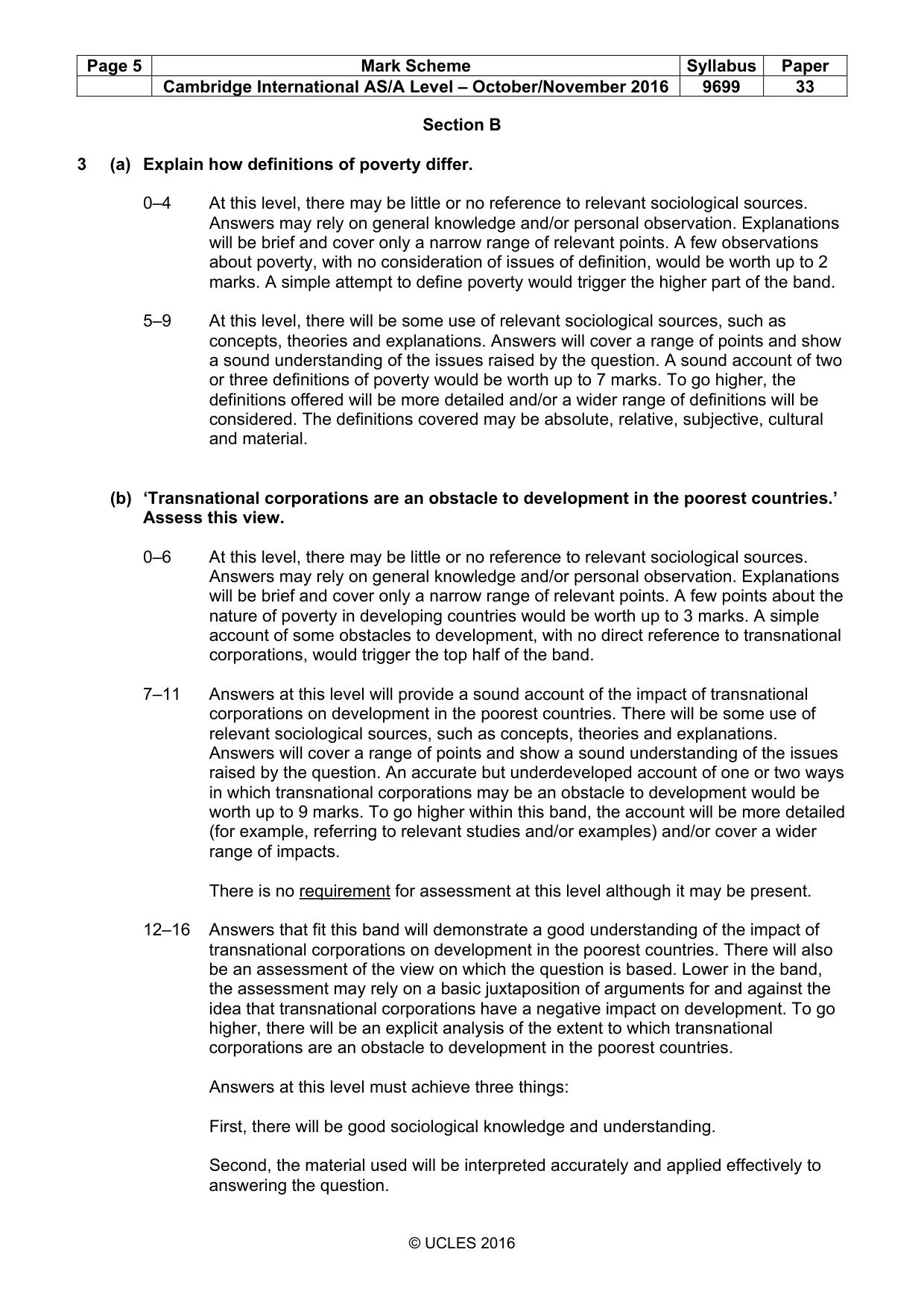
Page 5 Mark Scheme Syllabus Paper Cambridge International AS/A Level – October/November 2016 9699 33 © UCLES 2016 Section B 3 (a) Explain how definitions of poverty differ. 0–4 At this level, there may be little or no reference to relevant sociological sources. Answers may rely on general knowledge and/or personal observation. Explanations will be brief and cover only a narrow range of relevant points. A few observations about poverty, with no consideration of issues of definition, would be worth up to 2 marks. A simple attempt to define poverty would trigger the higher part of the band. 5–9 At this level, there will be some use of relevant sociological sources, such as concepts, theories and explanations. Answers will cover a range of points and show a sound understanding of the issues raised by the question. A sound account of two or three definitions of poverty would be worth up to 7 marks. To go higher, the definitions offered will be more detailed and/or a wider range of definitions will be considered. The definitions covered may be absolute, relative, subjective, cultural and material. (b) ‘Transnational corporations are an obstacle to development in the poorest countries.’ Assess this view. 0–6 At this level, there may be little or no reference to relevant sociological sources. Answers may rely on general knowledge and/or personal observation. Explanations will be brief and cover only a narrow range of relevant points. A few points about the nature of poverty in developing countries would be worth up to 3 marks. A simple account of some obstacles to development, with no direct reference to transnational corporations, would trigger the top half of the band. 7–11 Answers at this level will provide a sound account of the impact of transnational corporations on development in the poorest countries. There will be some use of relevant sociological sources, such as concepts, theories and explanations. Answers will cover a range of points and show a sound understanding of the issues raised by the question. An accurate but underdeveloped account of one or two ways in which transnational corporations may be an obstacle to development would be worth up to 9 marks. To go higher within this band, the account will be more detailed (for example, referring to relevant studies and/or examples) and/or cover a wider range of impacts. There is no requirement for assessment at this level although it may be present. 12–16 Answers that fit this band will demonstrate a good understanding of the impact of transnational corporations on development in the poorest countries. There will also be an assessment of the view on which the question is based. Lower in the band, the assessment may rely on a basic juxtaposition of arguments for and against the idea that transnational corporations have a negative impact on development. To go higher, there will be an explicit analysis of the extent to which transnational corporations are an obstacle to development in the poorest countries. Answers at this level must achieve three things: First, there will be good sociological knowledge and understanding. Second, the material used will be interpreted accurately and applied effectively to answering the question.
Mark scheme, page 6
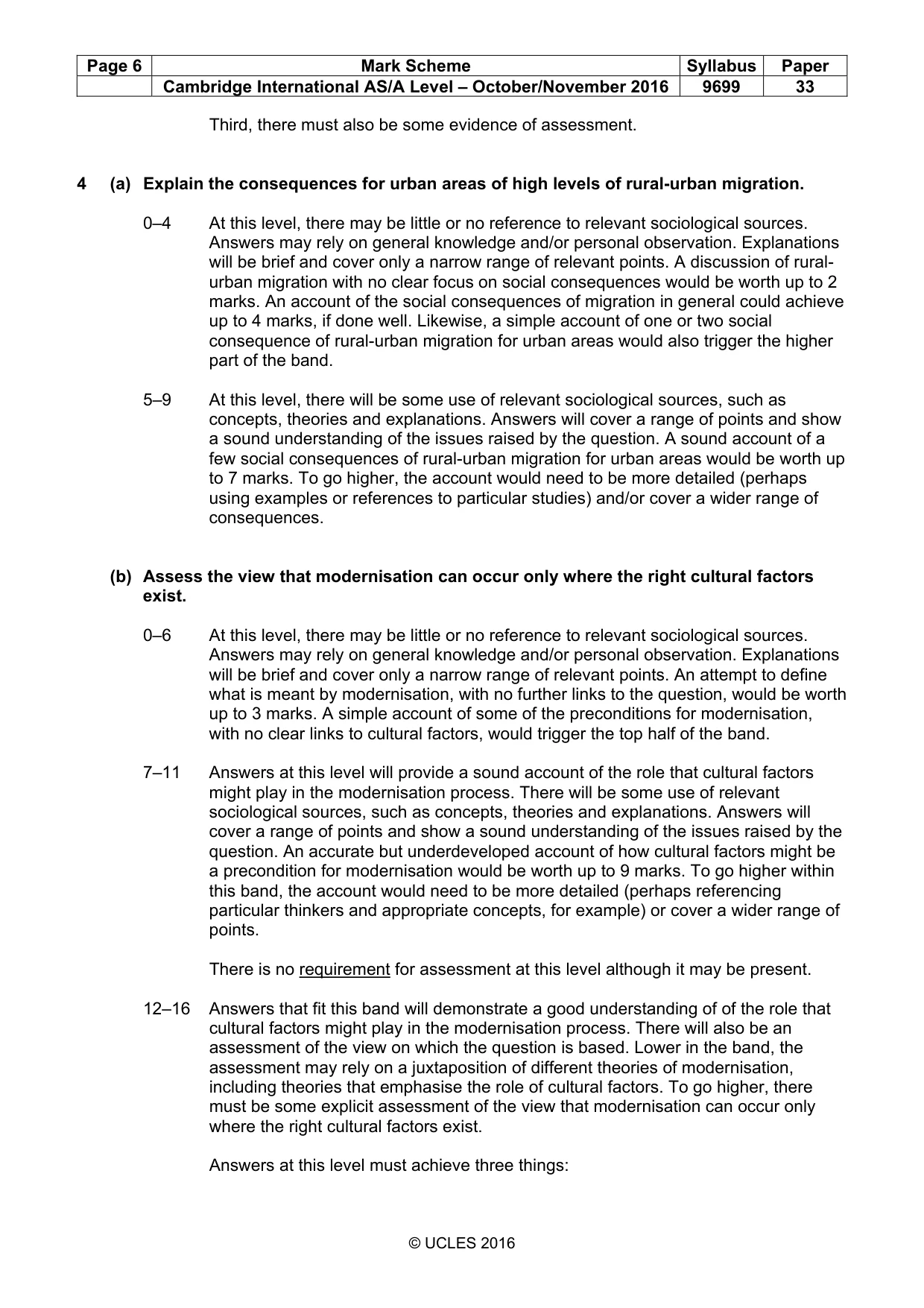
Page 6 Mark Scheme Syllabus Paper Cambridge International AS/A Level – October/November 2016 9699 33 © UCLES 2016 Third, there must also be some evidence of assessment. 4 (a) Explain the consequences for urban areas of high levels of rural-urban migration. 0–4 At this level, there may be little or no reference to relevant sociological sources. Answers may rely on general knowledge and/or personal observation. Explanations will be brief and cover only a narrow range of relevant points. A discussion of rural- urban migration with no clear focus on social consequences would be worth up to 2 marks. An account of the social consequences of migration in general could achieve up to 4 marks, if done well. Likewise, a simple account of one or two social consequence of rural-urban migration for urban areas would also trigger the higher part of the band. 5–9 At this level, there will be some use of relevant sociological sources, such as concepts, theories and explanations. Answers will cover a range of points and show a sound understanding of the issues raised by the question. A sound account of a few social consequences of rural-urban migration for urban areas would be worth up to 7 marks. To go higher, the account would need to be more detailed (perhaps using examples or references to particular studies) and/or cover a wider range of consequences. (b) Assess the view that modernisation can occur only where the right cultural factors exist. 0–6 At this level, there may be little or no reference to relevant sociological sources. Answers may rely on general knowledge and/or personal observation. Explanations will be brief and cover only a narrow range of relevant points. An attempt to define what is meant by modernisation, with no further links to the question, would be worth up to 3 marks. A simple account of some of the preconditions for modernisation, with no clear links to cultural factors, would trigger the top half of the band. 7–11 Answers at this level will provide a sound account of the role that cultural factors might play in the modernisation process. There will be some use of relevant sociological sources, such as concepts, theories and explanations. Answers will cover a range of points and show a sound understanding of the issues raised by the question. An accurate but underdeveloped account of how cultural factors might be a precondition for modernisation would be worth up to 9 marks. To go higher within this band, the account would need to be more detailed (perhaps referencing particular thinkers and appropriate concepts, for example) or cover a wider range of points. There is no requirement for assessment at this level although it may be present. 12–16 Answers that fit this band will demonstrate a good understanding of of the role that cultural factors might play in the modernisation process. There will also be an assessment of the view on which the question is based. Lower in the band, the assessment may rely on a juxtaposition of different theories of modernisation, including theories that emphasise the role of cultural factors. To go higher, there must be some explicit assessment of the view that modernisation can occur only where the right cultural factors exist. Answers at this level must achieve three things:
Mark scheme, page 7
Page 7 Mark Scheme Syllabus Paper Cambridge International AS/A Level – October/November 2016 9699 33 © UCLES 2016 First, there will be good sociological knowledge and understanding. Second, the material used will be interpreted accurately and applied effectively to answering the question. Third, there must also be some evidence of assessment.
Mark scheme, page 8
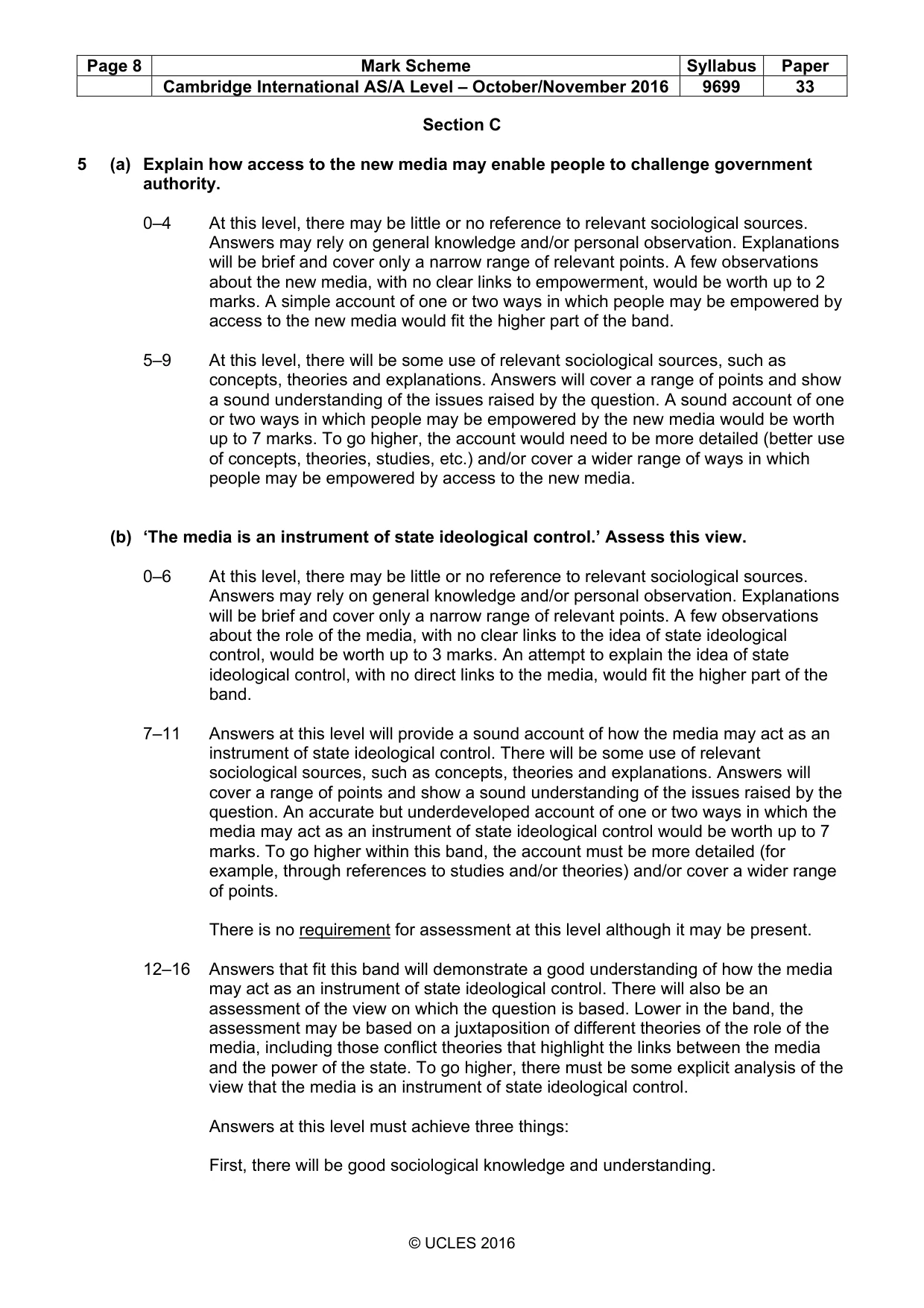
Page 8 Mark Scheme Syllabus Paper Cambridge International AS/A Level – October/November 2016 9699 33 © UCLES 2016 Section C 5 (a) Explain how access to the new media may enable people to challenge government authority. 0–4 At this level, there may be little or no reference to relevant sociological sources. Answers may rely on general knowledge and/or personal observation. Explanations will be brief and cover only a narrow range of relevant points. A few observations about the new media, with no clear links to empowerment, would be worth up to 2 marks. A simple account of one or two ways in which people may be empowered by access to the new media would fit the higher part of the band. 5–9 At this level, there will be some use of relevant sociological sources, such as concepts, theories and explanations. Answers will cover a range of points and show a sound understanding of the issues raised by the question. A sound account of one or two ways in which people may be empowered by the new media would be worth up to 7 marks. To go higher, the account would need to be more detailed (better use of concepts, theories, studies, etc.) and/or cover a wider range of ways in which people may be empowered by access to the new media. (b) ‘The media is an instrument of state ideological control.’ Assess this view. 0–6 At this level, there may be little or no reference to relevant sociological sources. Answers may rely on general knowledge and/or personal observation. Explanations will be brief and cover only a narrow range of relevant points. A few observations about the role of the media, with no clear links to the idea of state ideological control, would be worth up to 3 marks. An attempt to explain the idea of state ideological control, with no direct links to the media, would fit the higher part of the band. 7–11 Answers at this level will provide a sound account of how the media may act as an instrument of state ideological control. There will be some use of relevant sociological sources, such as concepts, theories and explanations. Answers will cover a range of points and show a sound understanding of the issues raised by the question. An accurate but underdeveloped account of one or two ways in which the media may act as an instrument of state ideological control would be worth up to 7 marks. To go higher within this band, the account must be more detailed (for example, through references to studies and/or theories) and/or cover a wider range of points. There is no requirement for assessment at this level although it may be present. 12–16 Answers that fit this band will demonstrate a good understanding of how the media may act as an instrument of state ideological control. There will also be an assessment of the view on which the question is based. Lower in the band, the assessment may be based on a juxtaposition of different theories of the role of the media, including those conflict theories that highlight the links between the media and the power of the state. To go higher, there must be some explicit analysis of the view that the media is an instrument of state ideological control. Answers at this level must achieve three things: First, there will be good sociological knowledge and understanding.
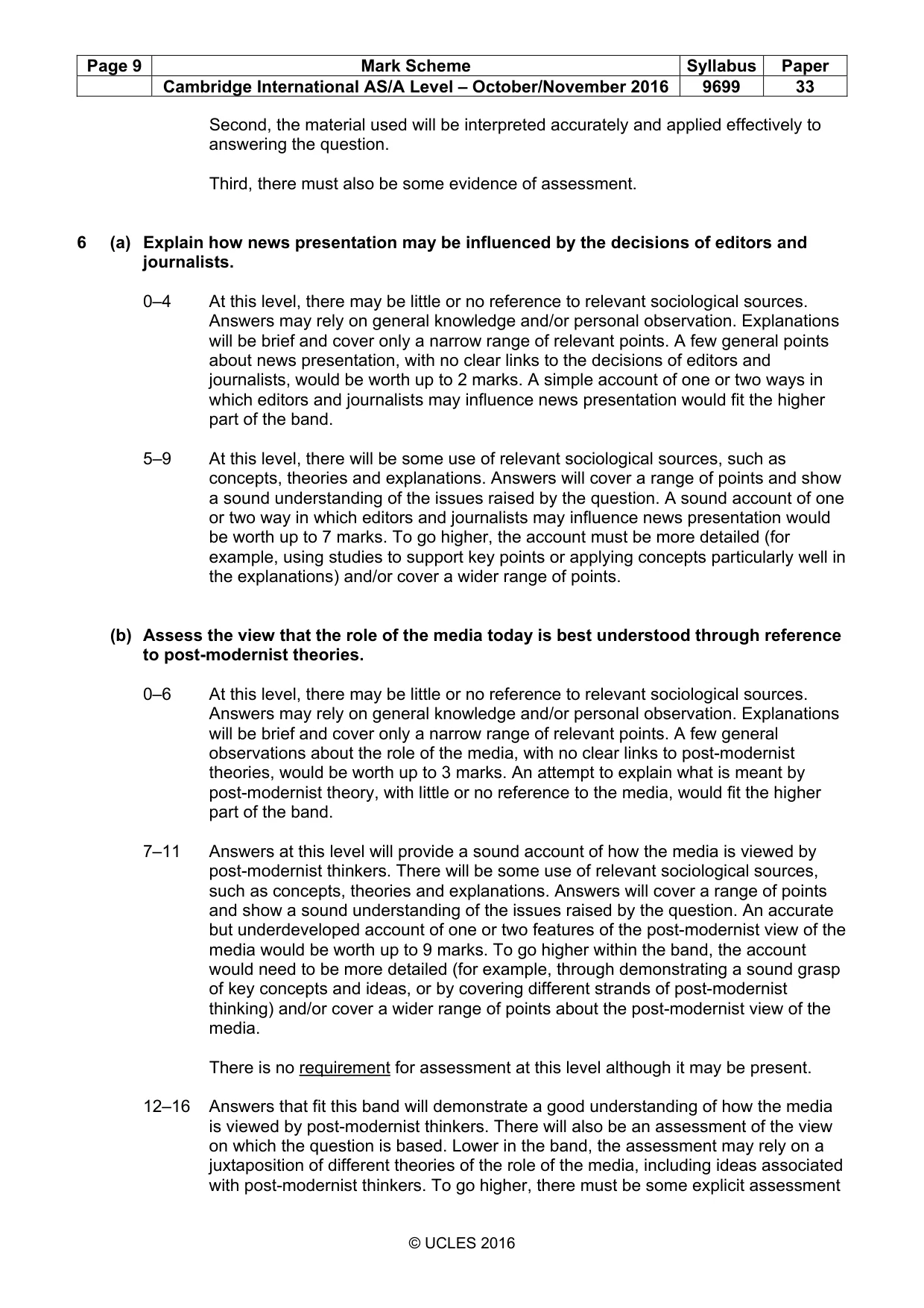
Mark scheme, page 9
Page 9 Mark Scheme Syllabus Paper Cambridge International AS/A Level – October/November 2016 9699 33 © UCLES 2016 Second, the material used will be interpreted accurately and applied effectively to answering the question. Third, there must also be some evidence of assessment. 6 (a) Explain how news presentation may be influenced by the decisions of editors and journalists. 0–4 At this level, there may be little or no reference to relevant sociological sources. Answers may rely on general knowledge and/or personal observation. Explanations will be brief and cover only a narrow range of relevant points. A few general points about news presentation, with no clear links to the decisions of editors and journalists, would be worth up to 2 marks. A simple account of one or two ways in which editors and journalists may influence news presentation would fit the higher part of the band. 5–9 At this level, there will be some use of relevant sociological sources, such as concepts, theories and explanations. Answers will cover a range of points and show a sound understanding of the issues raised by the question. A sound account of one or two way in which editors and journalists may influence news presentation would be worth up to 7 marks. To go higher, the account must be more detailed (for example, using studies to support key points or applying concepts particularly well in the explanations) and/or cover a wider range of points. (b) Assess the view that the role of the media today is best understood through reference to post-modernist theories. 0–6 At this level, there may be little or no reference to relevant sociological sources. Answers may rely on general knowledge and/or personal observation. Explanations will be brief and cover only a narrow range of relevant points. A few general observations about the role of the media, with no clear links to post-modernist theories, would be worth up to 3 marks. An attempt to explain what is meant by post-modernist theory, with little or no reference to the media, would fit the higher part of the band. 7–11 Answers at this level will provide a sound account of how the media is viewed by post-modernist thinkers. There will be some use of relevant sociological sources, such as concepts, theories and explanations. Answers will cover a range of points and show a sound understanding of the issues raised by the question. An accurate but underdeveloped account of one or two features of the post-modernist view of the media would be worth up to 9 marks. To go higher within the band, the account would need to be more detailed (for example, through demonstrating a sound grasp of key concepts and ideas, or by covering different strands of post-modernist thinking) and/or cover a wider range of points about the post-modernist view of the media. There is no requirement for assessment at this level although it may be present. 12–16 Answers that fit this band will demonstrate a good understanding of how the media is viewed by post-modernist thinkers. There will also be an assessment of the view on which the question is based. Lower in the band, the assessment may rely on a juxtaposition of different theories of the role of the media, including ideas associated with post-modernist thinkers. To go higher, there must be some explicit assessment
Mark scheme, page 10
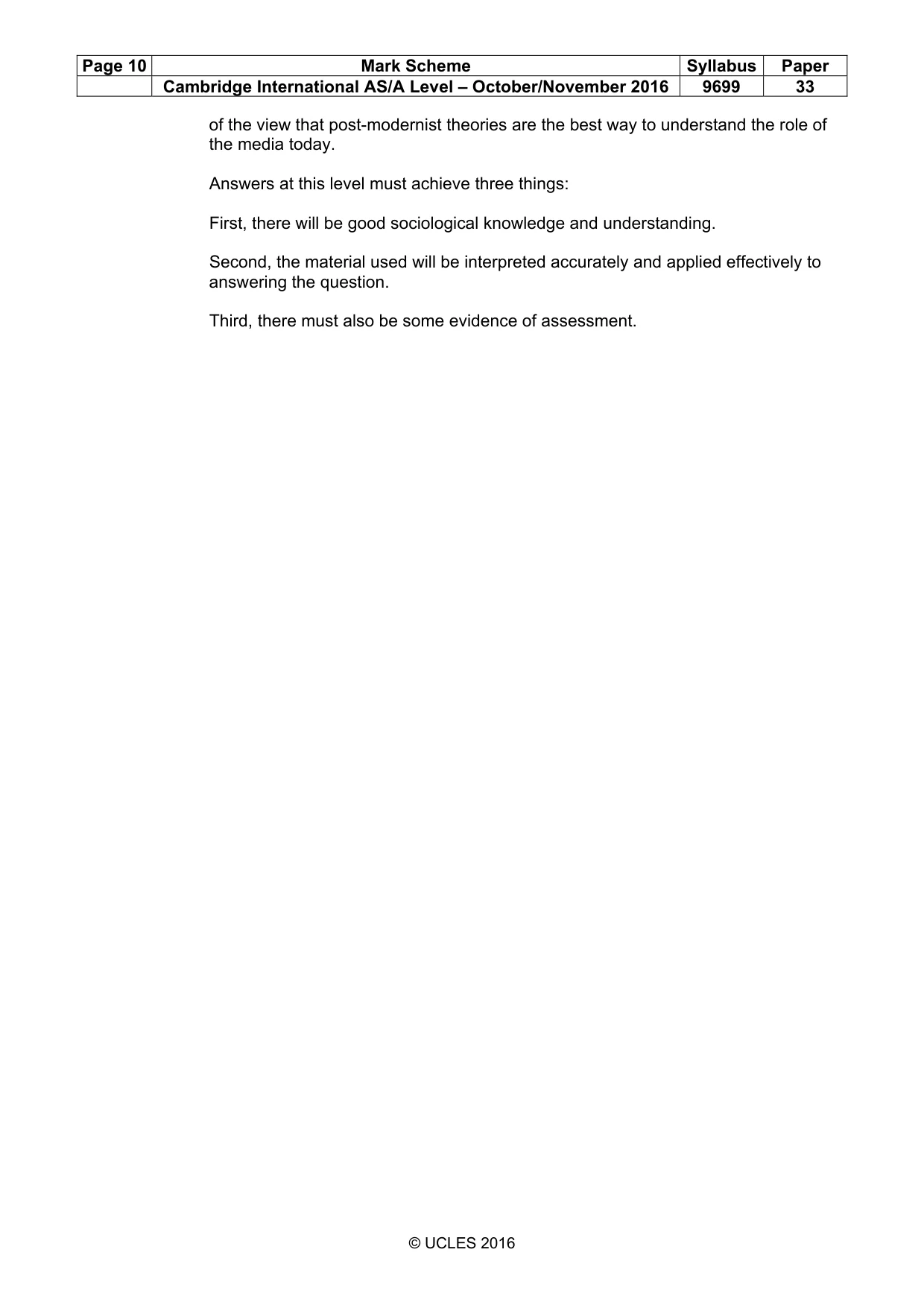
Page 10 Mark Scheme Syllabus Paper Cambridge International AS/A Level – October/November 2016 9699 33 © UCLES 2016 of the view that post-modernist theories are the best way to understand the role of the media today. Answers at this level must achieve three things: First, there will be good sociological knowledge and understanding. Second, the material used will be interpreted accurately and applied effectively to answering the question. Third, there must also be some evidence of assessment.
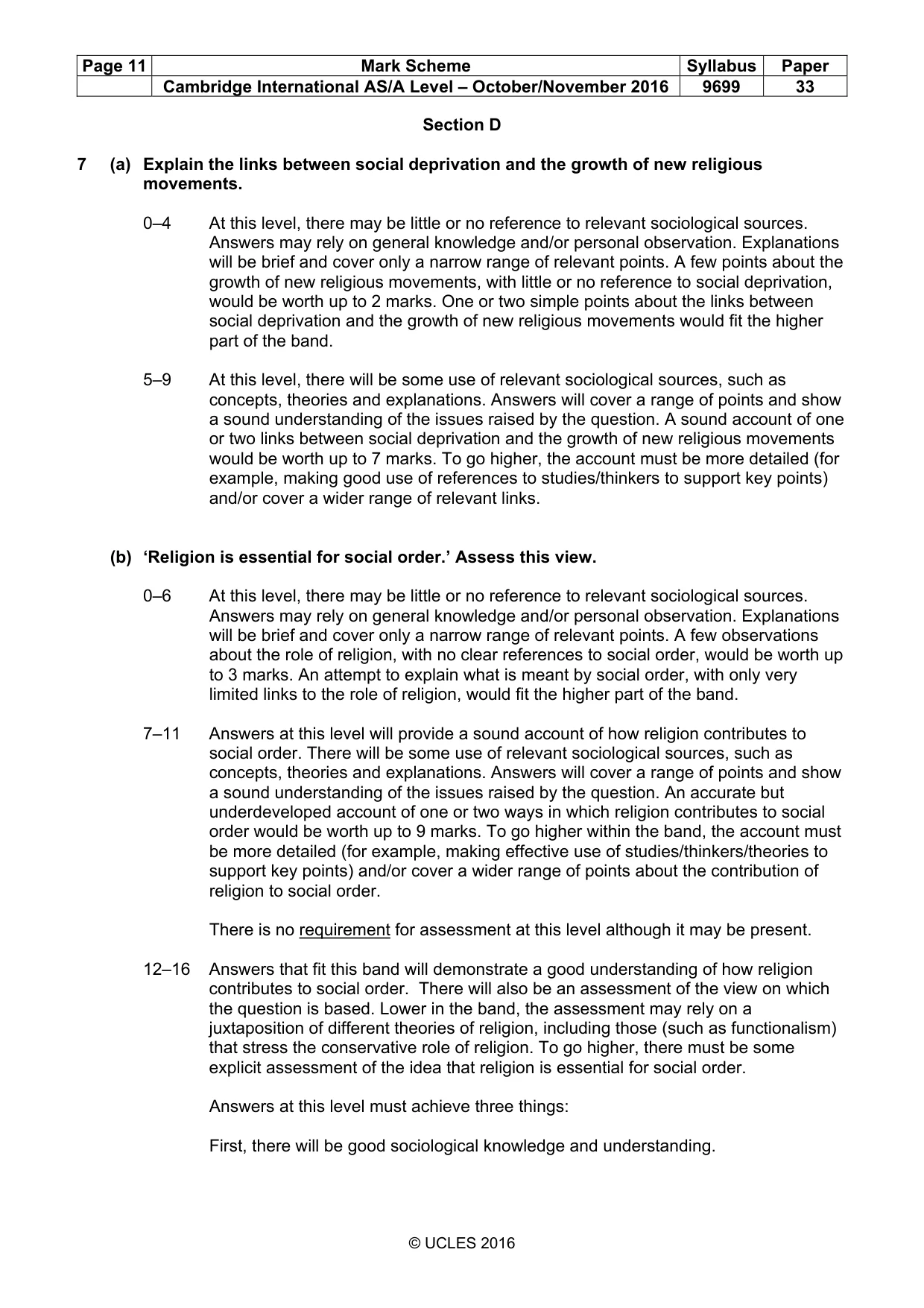
Mark scheme, page 11
Page 11 Mark Scheme Syllabus Paper Cambridge International AS/A Level – October/November 2016 9699 33 © UCLES 2016 Section D 7 (a) Explain the links between social deprivation and the growth of new religious movements. 0–4 At this level, there may be little or no reference to relevant sociological sources. Answers may rely on general knowledge and/or personal observation. Explanations will be brief and cover only a narrow range of relevant points. A few points about the growth of new religious movements, with little or no reference to social deprivation, would be worth up to 2 marks. One or two simple points about the links between social deprivation and the growth of new religious movements would fit the higher part of the band. 5–9 At this level, there will be some use of relevant sociological sources, such as concepts, theories and explanations. Answers will cover a range of points and show a sound understanding of the issues raised by the question. A sound account of one or two links between social deprivation and the growth of new religious movements would be worth up to 7 marks. To go higher, the account must be more detailed (for example, making good use of references to studies/thinkers to support key points) and/or cover a wider range of relevant links. (b) ‘Religion is essential for social order.’ Assess this view. 0–6 At this level, there may be little or no reference to relevant sociological sources. Answers may rely on general knowledge and/or personal observation. Explanations will be brief and cover only a narrow range of relevant points. A few observations about the role of religion, with no clear references to social order, would be worth up to 3 marks. An attempt to explain what is meant by social order, with only very limited links to the role of religion, would fit the higher part of the band. 7–11 Answers at this level will provide a sound account of how religion contributes to social order. There will be some use of relevant sociological sources, such as concepts, theories and explanations. Answers will cover a range of points and show a sound understanding of the issues raised by the question. An accurate but underdeveloped account of one or two ways in which religion contributes to social order would be worth up to 9 marks. To go higher within the band, the account must be more detailed (for example, making effective use of studies/thinkers/theories to support key points) and/or cover a wider range of points about the contribution of religion to social order. There is no requirement for assessment at this level although it may be present. 12–16 Answers that fit this band will demonstrate a good understanding of how religion contributes to social order. There will also be an assessment of the view on which the question is based. Lower in the band, the assessment may rely on a juxtaposition of different theories of religion, including those (such as functionalism) that stress the conservative role of religion. To go higher, there must be some explicit assessment of the idea that religion is essential for social order. Answers at this level must achieve three things: First, there will be good sociological knowledge and understanding.
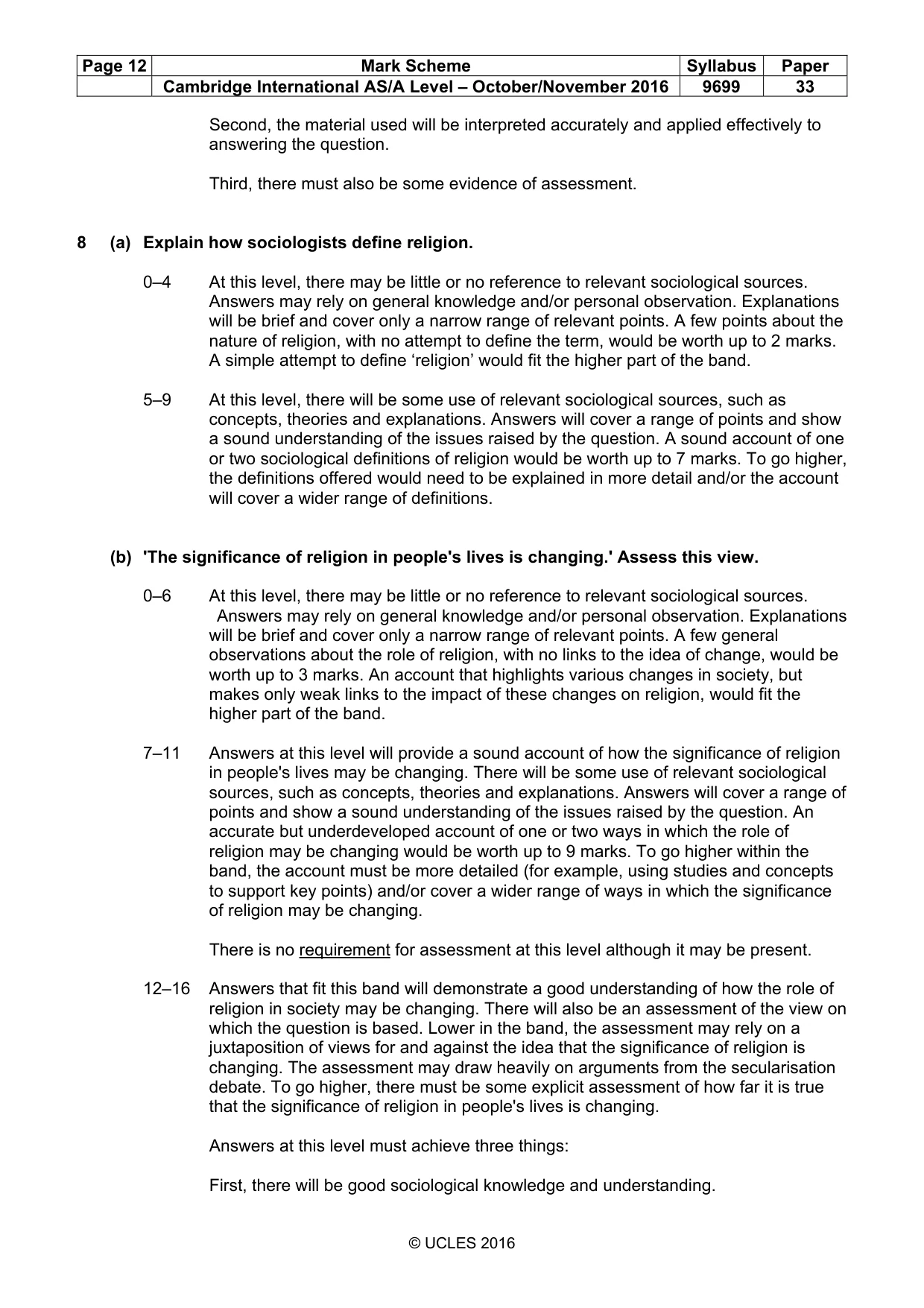
Mark scheme, page 12
Page 12 Mark Scheme Syllabus Paper Cambridge International AS/A Level – October/November 2016 9699 33 © UCLES 2016 Second, the material used will be interpreted accurately and applied effectively to answering the question. Third, there must also be some evidence of assessment. 8 (a) Explain how sociologists define religion. 0–4 At this level, there may be little or no reference to relevant sociological sources. Answers may rely on general knowledge and/or personal observation. Explanations will be brief and cover only a narrow range of relevant points. A few points about the nature of religion, with no attempt to define the term, would be worth up to 2 marks. A simple attempt to define ‘religion’ would fit the higher part of the band. 5–9 At this level, there will be some use of relevant sociological sources, such as concepts, theories and explanations. Answers will cover a range of points and show a sound understanding of the issues raised by the question. A sound account of one or two sociological definitions of religion would be worth up to 7 marks. To go higher, the definitions offered would need to be explained in more detail and/or the account will cover a wider range of definitions. (b) 'The significance of religion in people's lives is changing.' Assess this view. 0–6 At this level, there may be little or no reference to relevant sociological sources. Answers may rely on general knowledge and/or personal observation. Explanations will be brief and cover only a narrow range of relevant points. A few general observations about the role of religion, with no links to the idea of change, would be worth up to 3 marks. An account that highlights various changes in society, but makes only weak links to the impact of these changes on religion, would fit the higher part of the band. 7–11 Answers at this level will provide a sound account of how the significance of religion in people's lives may be changing. There will be some use of relevant sociological sources, such as concepts, theories and explanations. Answers will cover a range of points and show a sound understanding of the issues raised by the question. An accurate but underdeveloped account of one or two ways in which the role of religion may be changing would be worth up to 9 marks. To go higher within the band, the account must be more detailed (for example, using studies and concepts to support key points) and/or cover a wider range of ways in which the significance of religion may be changing. There is no requirement for assessment at this level although it may be present. 12–16 Answers that fit this band will demonstrate a good understanding of how the role of religion in society may be changing. There will also be an assessment of the view on which the question is based. Lower in the band, the assessment may rely on a juxtaposition of views for and against the idea that the significance of religion is changing. The assessment may draw heavily on arguments from the secularisation debate. To go higher, there must be some explicit assessment of how far it is true that the significance of religion in people's lives is changing. Answers at this level must achieve three things: First, there will be good sociological knowledge and understanding.
Mark scheme, page 13
Page 13 Mark Scheme Syllabus Paper Cambridge International AS/A Level – October/November 2016 9699 33 © UCLES 2016 Second, the material used will be interpreted accurately and applied effectively to answering the question. Third, there must also be some evidence of assessment.
What you needed in this session
Cambridge’s own grade thresholds for 2016 Oct/Nov, Paper 3 · Variant 3. A higher threshold means an easier paper — the bar moves with how the cohort did.