Cambridge A Level Psychology (from 2018) 9990 — 2022 May/June Paper 1 · Variant 1
9990/11/M/J/22 · 60 marks · ≈68 min
The question paper and its mark scheme, free to read here and free to download. This is Cambridge’s own paper, exactly as it was sat.
Question paper12 pages


Mark scheme12 pages
Answers below. Sit the paper first if you are practising.
Paper as text
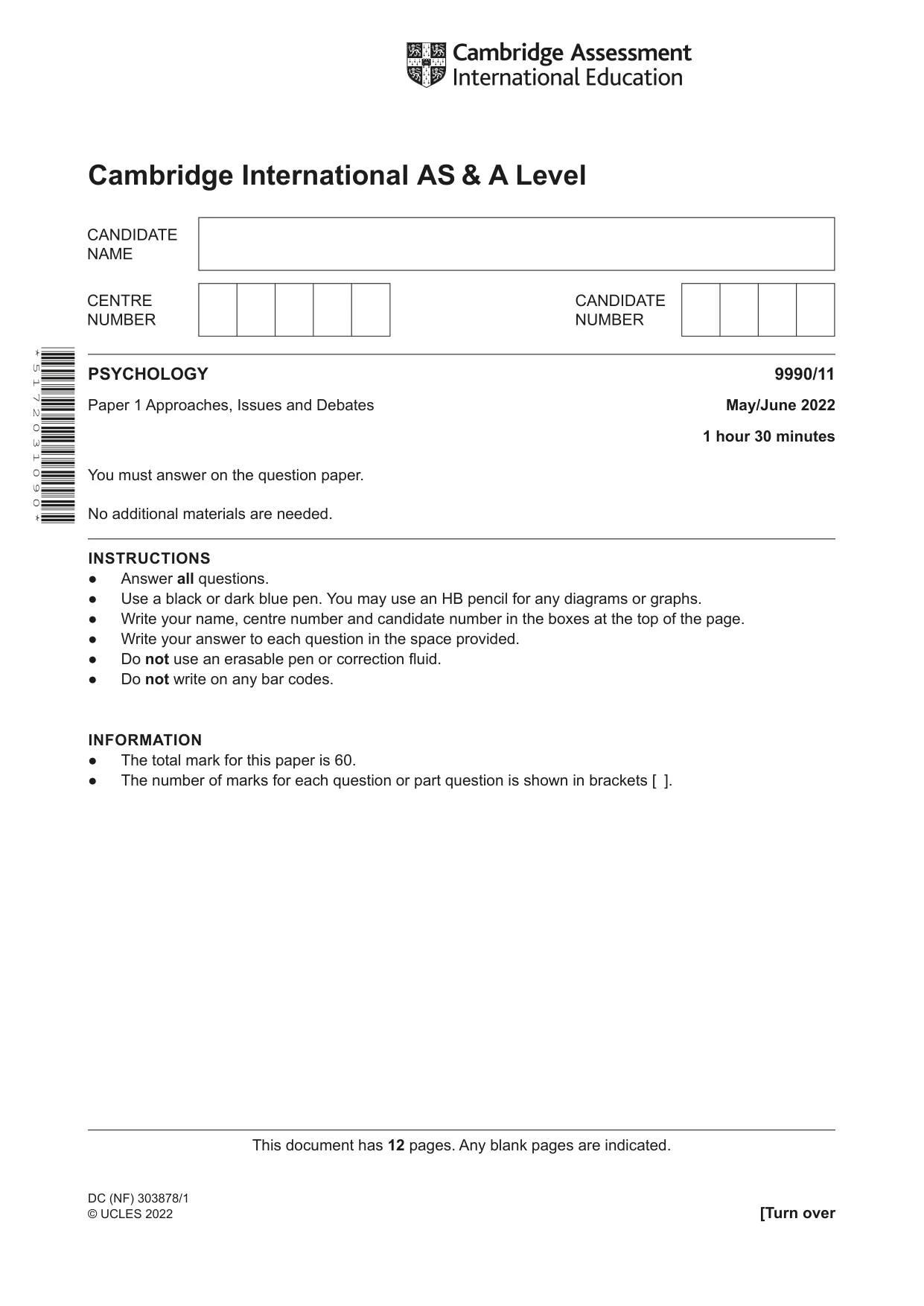
Question paper, page 1
[Turn over DC (NF) 303878/1 © UCLES 2022 This document has 12 pages. Any blank pages are indicated. * 5 1 7 2 0 3 1 0 9 0 * PSYCHOLOGY 9990/11 Paper 1 Approaches, Issues and Debates May/June 2022 1 hour 30 minutes You must answer on the question paper. No additional materials are needed. INSTRUCTIONS ● Answer all questions. ● Use a black or dark blue pen. You may use an HB pencil for any diagrams or graphs. ● Write your name, centre number and candidate number in the boxes at the top of the page. ● Write your answer to each question in the space provided. ● Do not use an erasable pen or correction fluid. ● Do not write on any bar codes. INFORMATION ● The total mark for this paper is 60. ● The number of marks for each question or part question is shown in brackets [ ]. Cambridge International AS & A Level
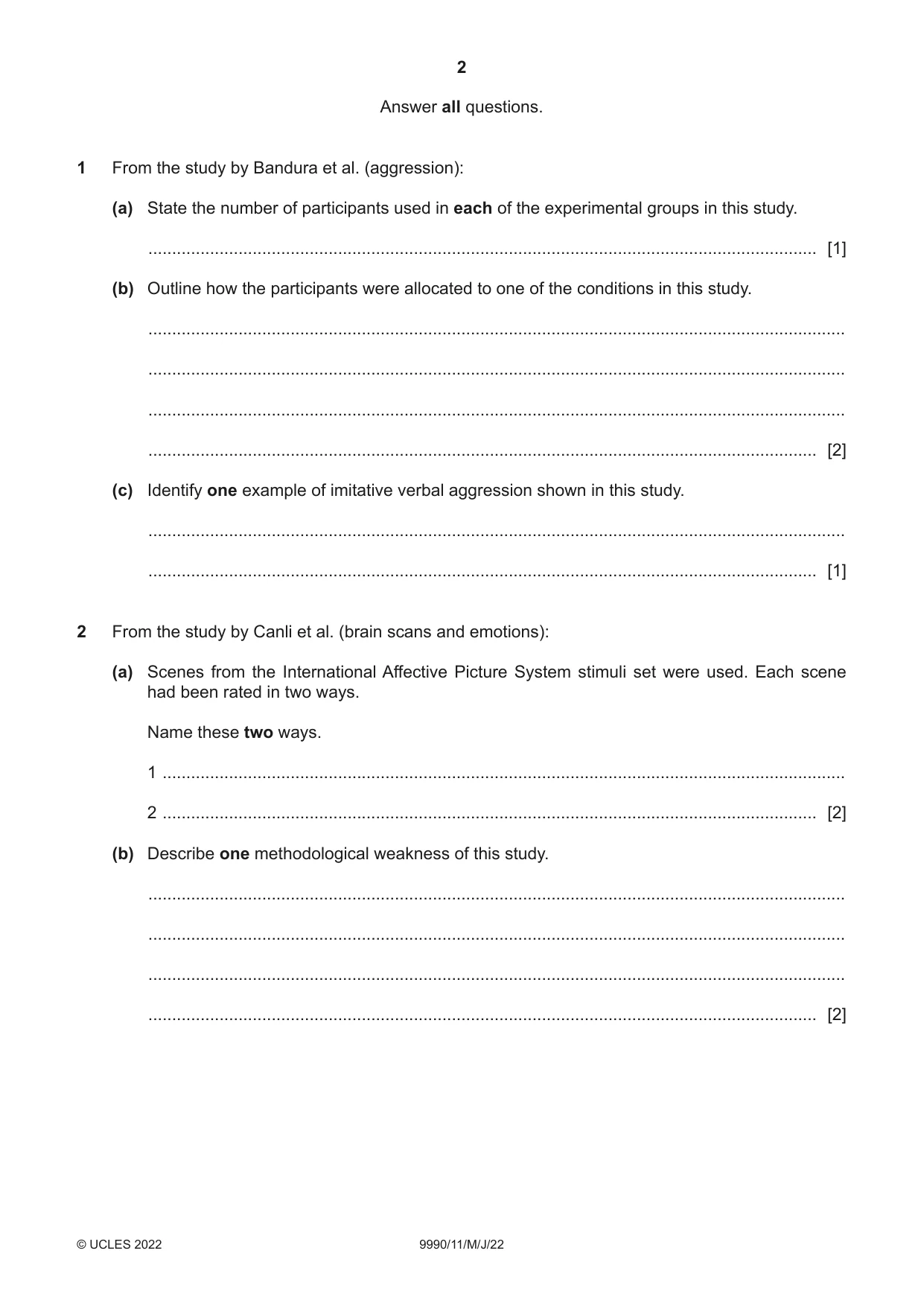
Question paper, page 2
2 9990/11/M/J/22 © UCLES 2022 Answer all questions. 1 From the study by Bandura et al. (aggression): (a) State the number of participants used in each of the experimental groups in this study. … [1] (b) Outline how the participants were allocated to one of the conditions in this study. … … … … [2] (c) Identify one example of imitative verbal aggression shown in this study. … … [1] 2 From the study by Canli et al. (brain scans and emotions): (a) Scenes from the International Affective Picture System stimuli set were used. Each scene had been rated in two ways. Name these two ways. 1 … 2 … [2] (b) Describe one methodological weakness of this study. … … … … [2]
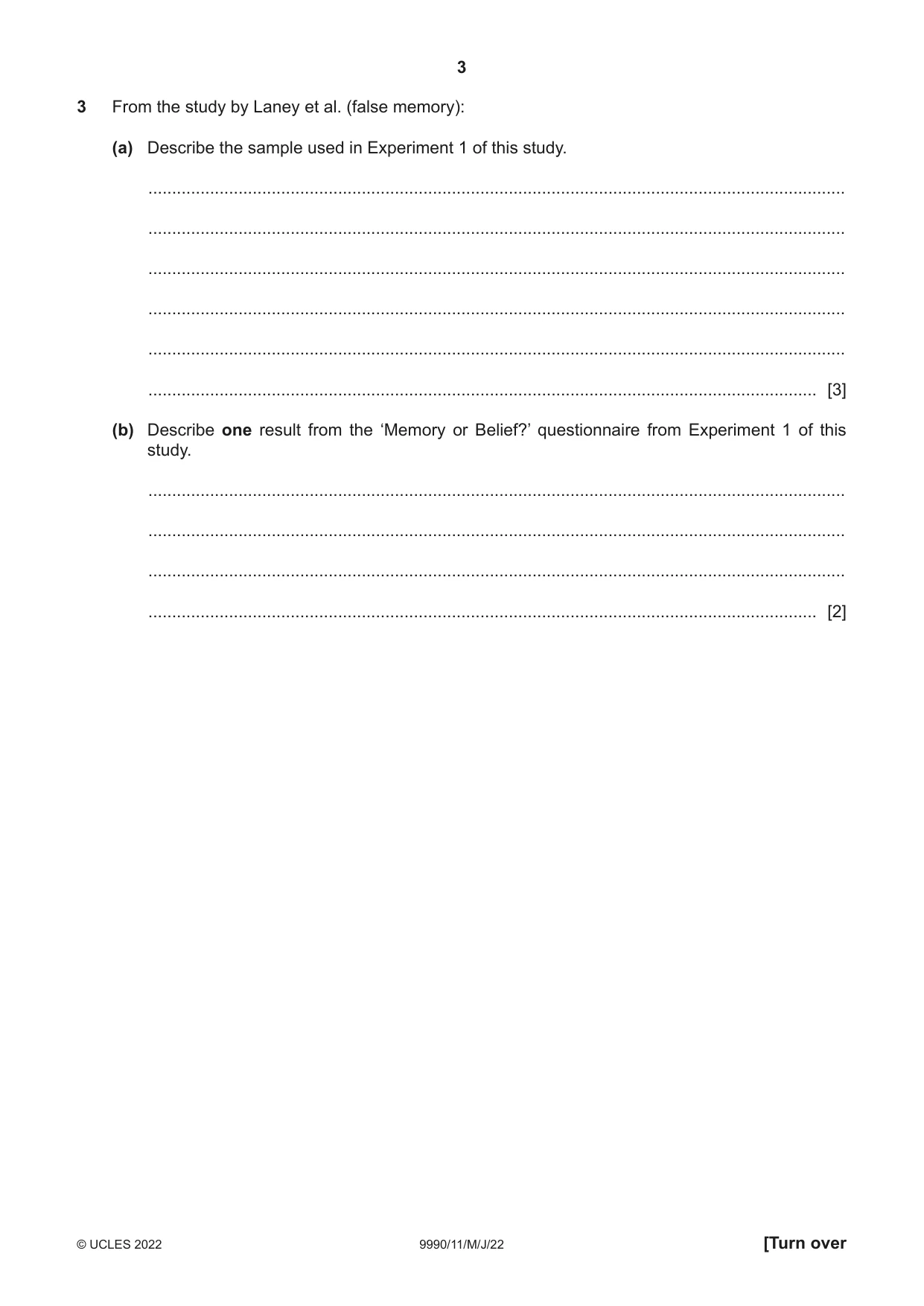
Question paper, page 3
3 9990/11/M/J/22 © UCLES 2022 [Turn over 3 From the study by Laney et al. (false memory): (a) Describe the sample used in Experiment 1 of this study. … … … … … … [3] (b) Describe one result from the ‘Memory or Belief?’ questionnaire from Experiment 1 of this study. … … … … [2]
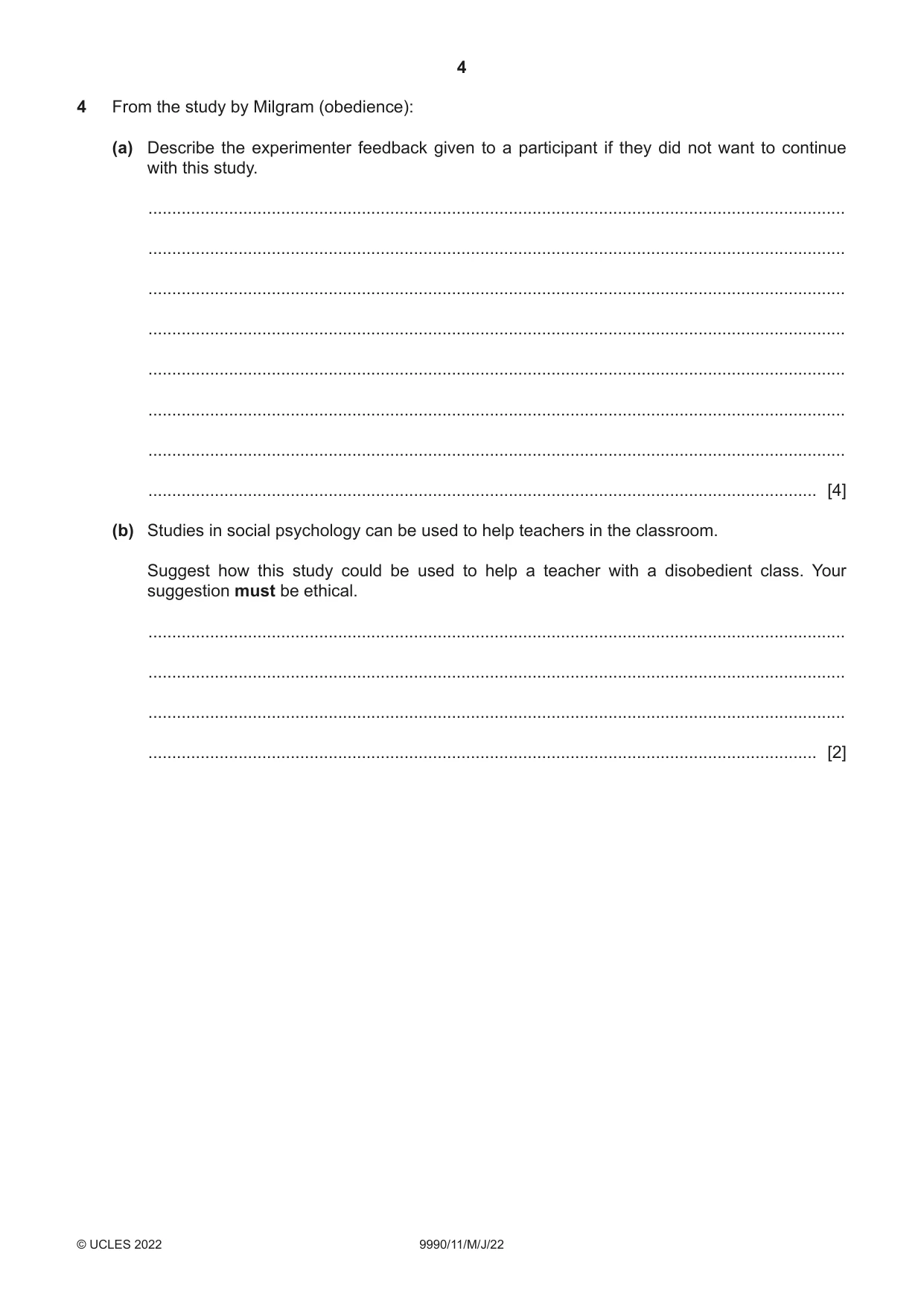
Question paper, page 4
4 9990/11/M/J/22 © UCLES 2022 4 From the study by Milgram (obedience): (a) Describe the experimenter feedback given to a participant if they did not want to continue with this study. … … … … … … … … [4] (b) Studies in social psychology can be used to help teachers in the classroom. Suggest how this study could be used to help a teacher with a disobedient class. Your suggestion must be ethical. … … … … [2]
Question paper, page 5
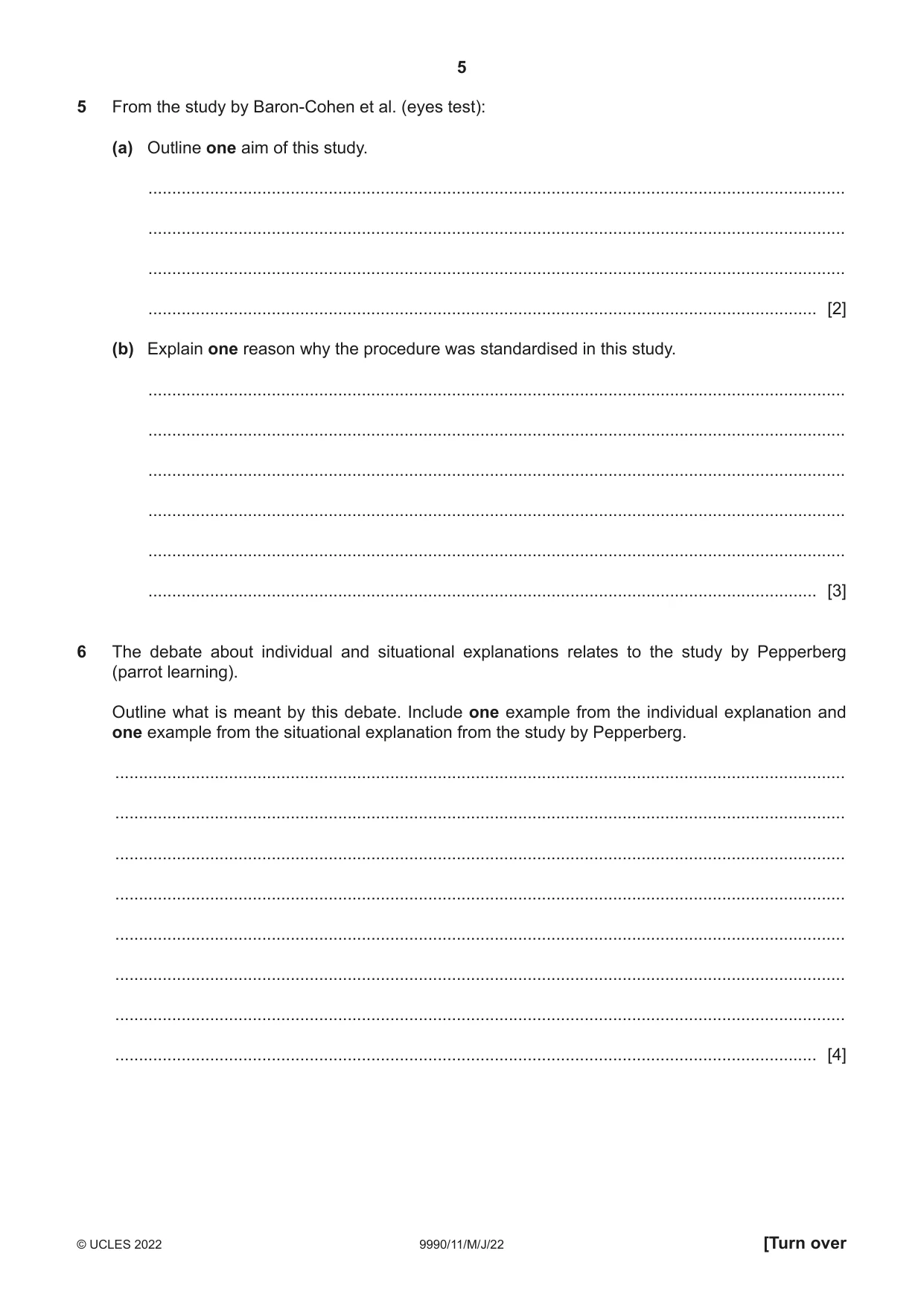
5 9990/11/M/J/22 © UCLES 2022 [Turn over 5 From the study by Baron-Cohen et al. (eyes test): (a) Outline one aim of this study. … … … … [2] (b) Explain one reason why the procedure was standardised in this study. … … … … … … [3] 6 The debate about individual and situational explanations relates to the study by Pepperberg (parrot learning). Outline what is meant by this debate. Include one example from the individual explanation and one example from the situational explanation from the study by Pepperberg. … … … … … … … … [4]
Question paper, page 6
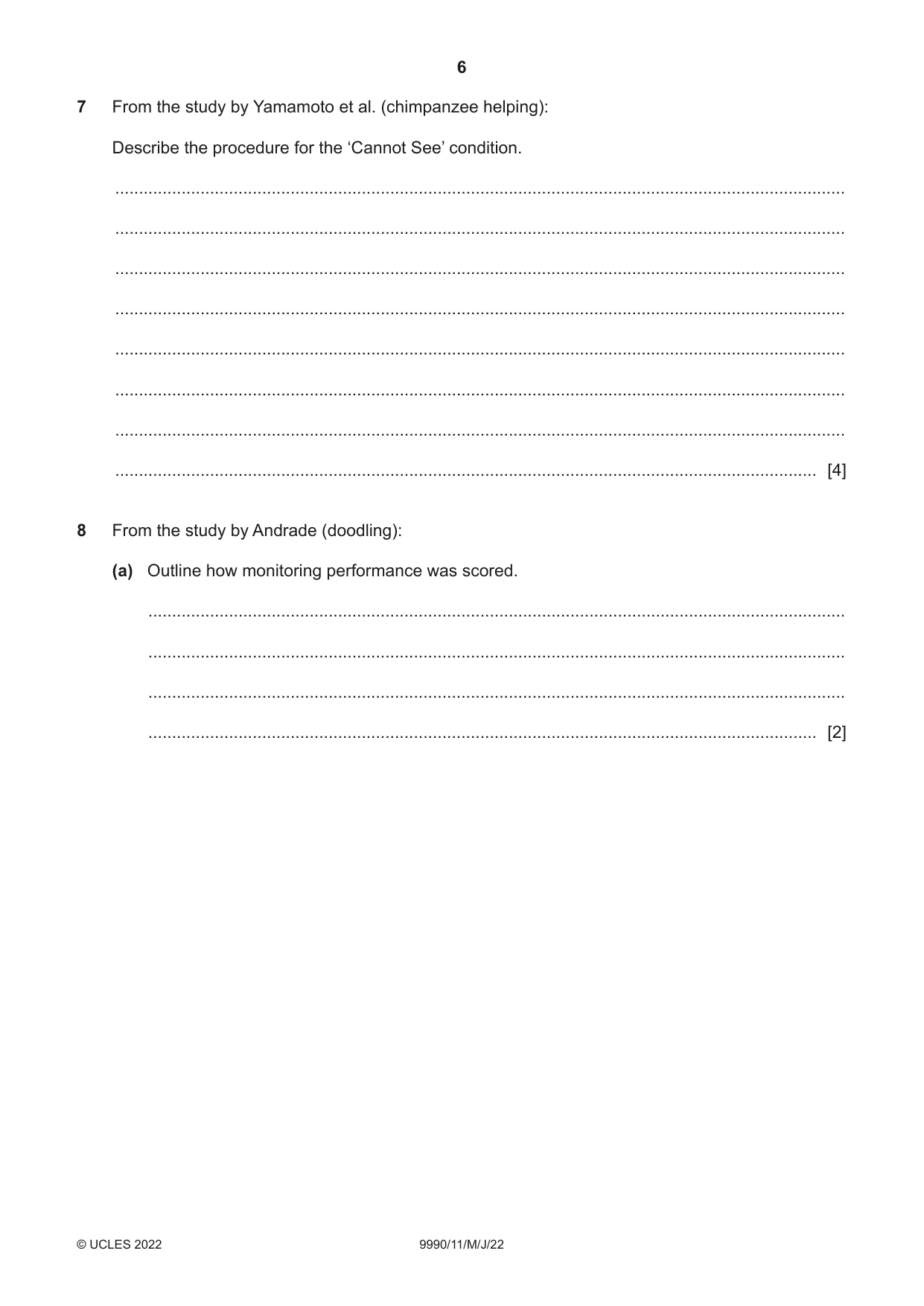
6 9990/11/M/J/22 © UCLES 2022 7 From the study by Yamamoto et al. (chimpanzee helping): Describe the procedure for the ‘Cannot See’ condition. … … … … … … … … [4] 8 From the study by Andrade (doodling): (a) Outline how monitoring performance was scored. … … … … [2]
Question paper, page 7
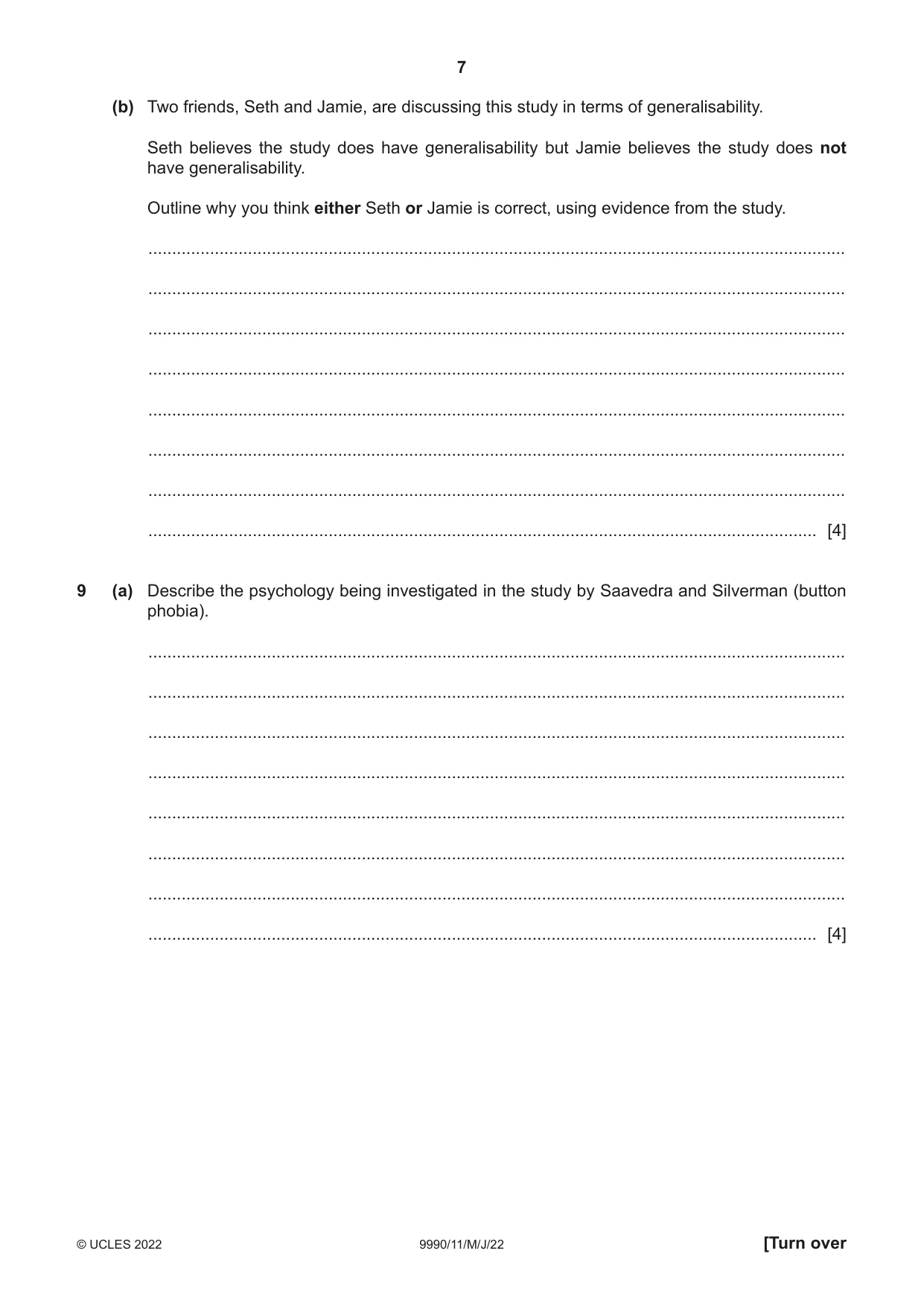
7 9990/11/M/J/22 © UCLES 2022 [Turn over (b) Two friends, Seth and Jamie, are discussing this study in terms of generalisability. Seth believes the study does have generalisability but Jamie believes the study does not have generalisability. Outline why you think either Seth or Jamie is correct, using evidence from the study. … … … … … … … … [4] 9 (a) Describe the psychology being investigated in the study by Saavedra and Silverman (button phobia). … … … … … … … … [4]
Question paper, page 8
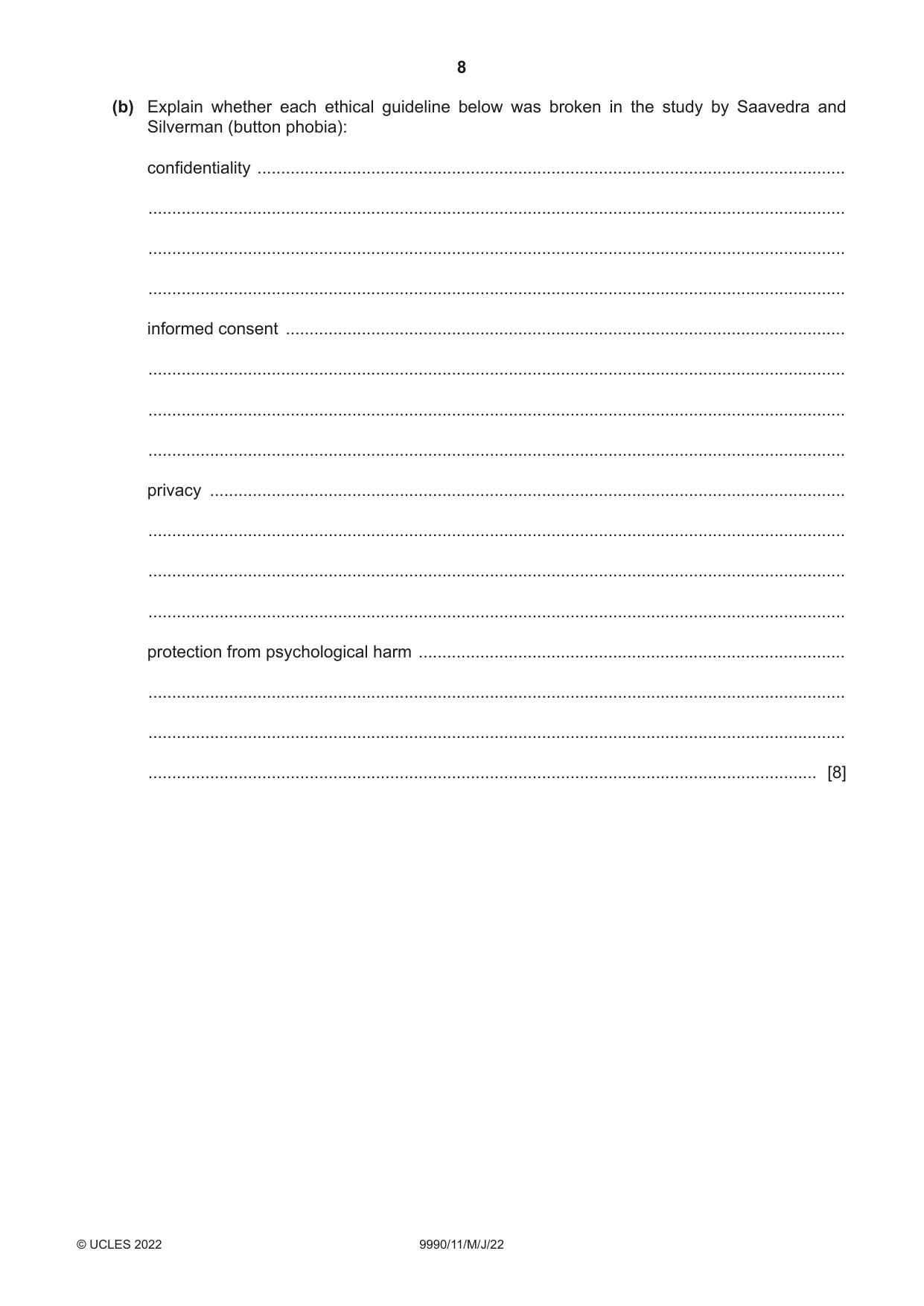
8 9990/11/M/J/22 © UCLES 2022 (b) Explain whether each ethical guideline below was broken in the study by Saavedra and Silverman (button phobia): confidentiality … … … … informed consent … … … … privacy … … … … protection from psychological harm … … … … [8]
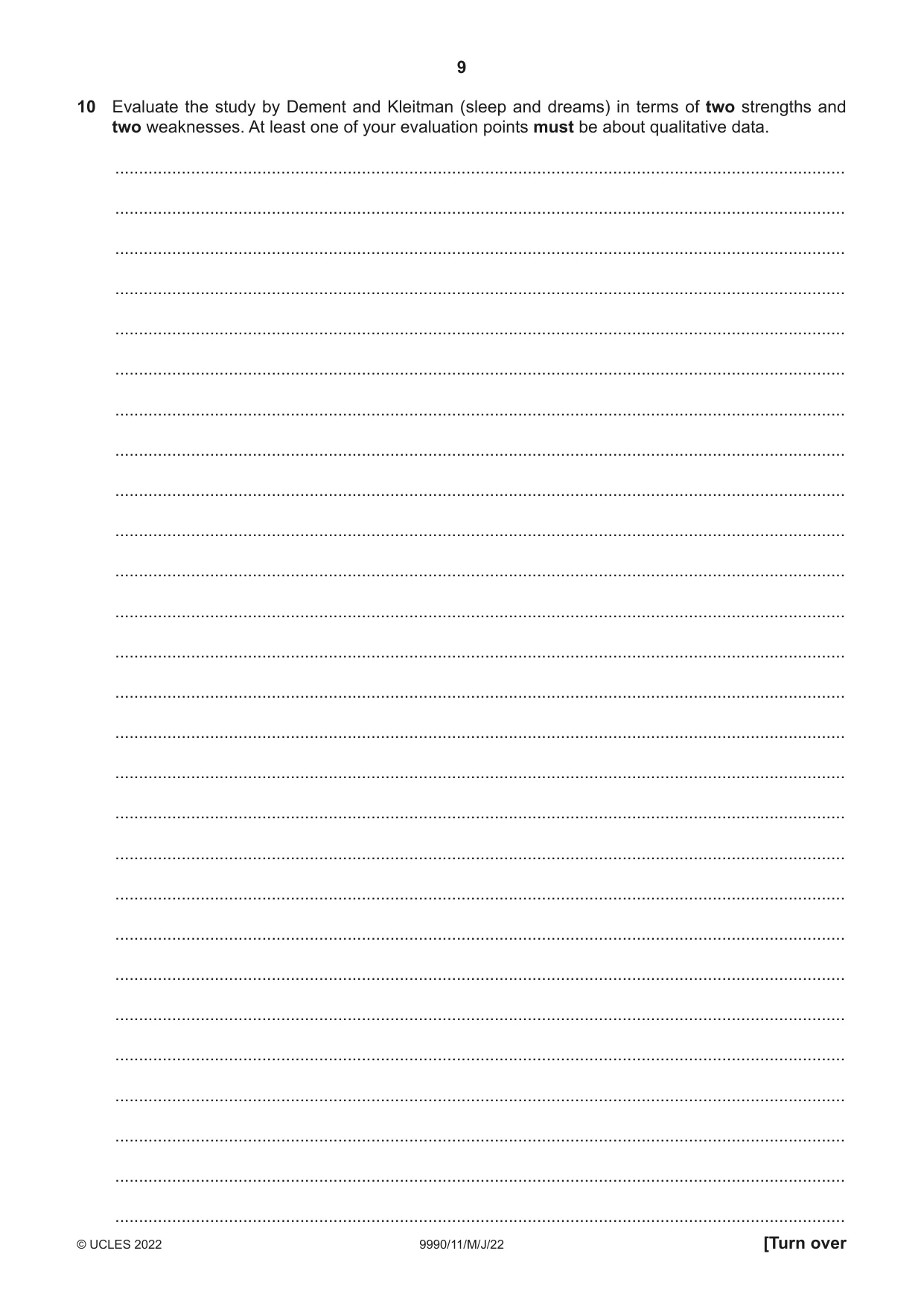
Question paper, page 9
9 9990/11/M/J/22 © UCLES 2022 [Turn over 10 Evaluate the study by Dement and Kleitman (sleep and dreams) in terms of two strengths and two weaknesses. At least one of your evaluation points must be about qualitative data. … … … … … … … … … … … … … … … … … … … … … … … … … … …
Question paper, page 10
10 9990/11/M/J/22 © UCLES 2022 … … … … … … … … … … … … … … [10]
Question paper, page 11
11 9990/11/M/J/22 © UCLES 2022 BLANK PAGE
Question paper, page 12
12 9990/11/M/J/22 © UCLES 2022 Permission to reproduce items where third-party owned material protected by copyright is included has been sought and cleared where possible. Every reasonable effort has been made by the publisher (UCLES) to trace copyright holders, but if any items requiring clearance have unwittingly been included, the publisher will be pleased to make amends at the earliest possible opportunity. To avoid the issue of disclosure of answer-related information to candidates, all copyright acknowledgements are reproduced online in the Cambridge Assessment International Education Copyright Acknowledgements Booklet. This is produced for each series of examinations and is freely available to download at www.cambridgeinternational.org after the live examination series. Cambridge Assessment International Education is part of Cambridge Assessment. Cambridge Assessment is the brand name of the University of Cambridge Local Examinations Syndicate (UCLES), which is a department of the University of Cambridge. BLANK PAGE
Mark scheme, page 1
This document consists of 12 printed pages. © UCLES 2022 [Turn over Cambridge International AS & A Level PSYCHOLOGY 9990/11 Paper 1 Approaches, Issues and Debates May/June 2022 MARK SCHEME Maximum Mark: 60 Published This mark scheme is published as an aid to teachers and candidates, to indicate the requirements of the examination. It shows the basis on which Examiners were instructed to award marks. It does not indicate the details of the discussions that took place at an Examiners’ meeting before marking began, which would have considered the acceptability of alternative answers. Mark schemes should be read in conjunction with the question paper and the Principal Examiner Report for Teachers. Cambridge International will not enter into discussions about these mark schemes. Cambridge International is publishing the mark schemes for the May/June 2022 series for most Cambridge IGCSE, Cambridge International A and AS Level and Cambridge Pre-U components, and some Cambridge O Level components.
Mark scheme, page 2
9990/11 Cambridge International AS & A Level – Mark Scheme PUBLISHED May/June 2022 © UCLES 2022 Page 2 of 12 Generic Marking Principles These general marking principles must be applied by all examiners when marking candidate answers. They should be applied alongside the specific content of the mark scheme or generic level descriptors for a question. Each question paper and mark scheme will also comply with these marking principles. GENERIC MARKING PRINCIPLE 1: Marks must be awarded in line with: the specific content of the mark scheme or the generic level descriptors for the question the specific skills defined in the mark scheme or in the generic level descriptors for the question the standard of response required by a candidate as exemplified by the standardisation scripts. GENERIC MARKING PRINCIPLE 2: Marks awarded are always whole marks (not half marks, or other fractions). GENERIC MARKING PRINCIPLE 3: Marks must be awarded positively: marks are awarded for correct/valid answers, as defined in the mark scheme. However, credit is given for valid answers which go beyond the scope of the syllabus and mark scheme, referring to your Team Leader as appropriate marks are awarded when candidates clearly demonstrate what they know and can do marks are not deducted for errors marks are not deducted for omissions answers should only be judged on the quality of spelling, punctuation and grammar when these features are specifically assessed by the question as indicated by the mark scheme. The meaning, however, should be unambiguous. GENERIC MARKING PRINCIPLE 4: Rules must be applied consistently, e.g. in situations where candidates have not followed instructions or in the application of generic level descriptors. GENERIC MARKING PRINCIPLE 5: Marks should be awarded using the full range of marks defined in the mark scheme for the question (however; the use of the full mark range may be limited according to the quality of the candidate responses seen). GENERIC MARKING PRINCIPLE 6: Marks awarded are based solely on the requirements as defined in the mark scheme. Marks should not be awarded with grade thresholds or grade descriptors in mind.
Mark scheme, page 3
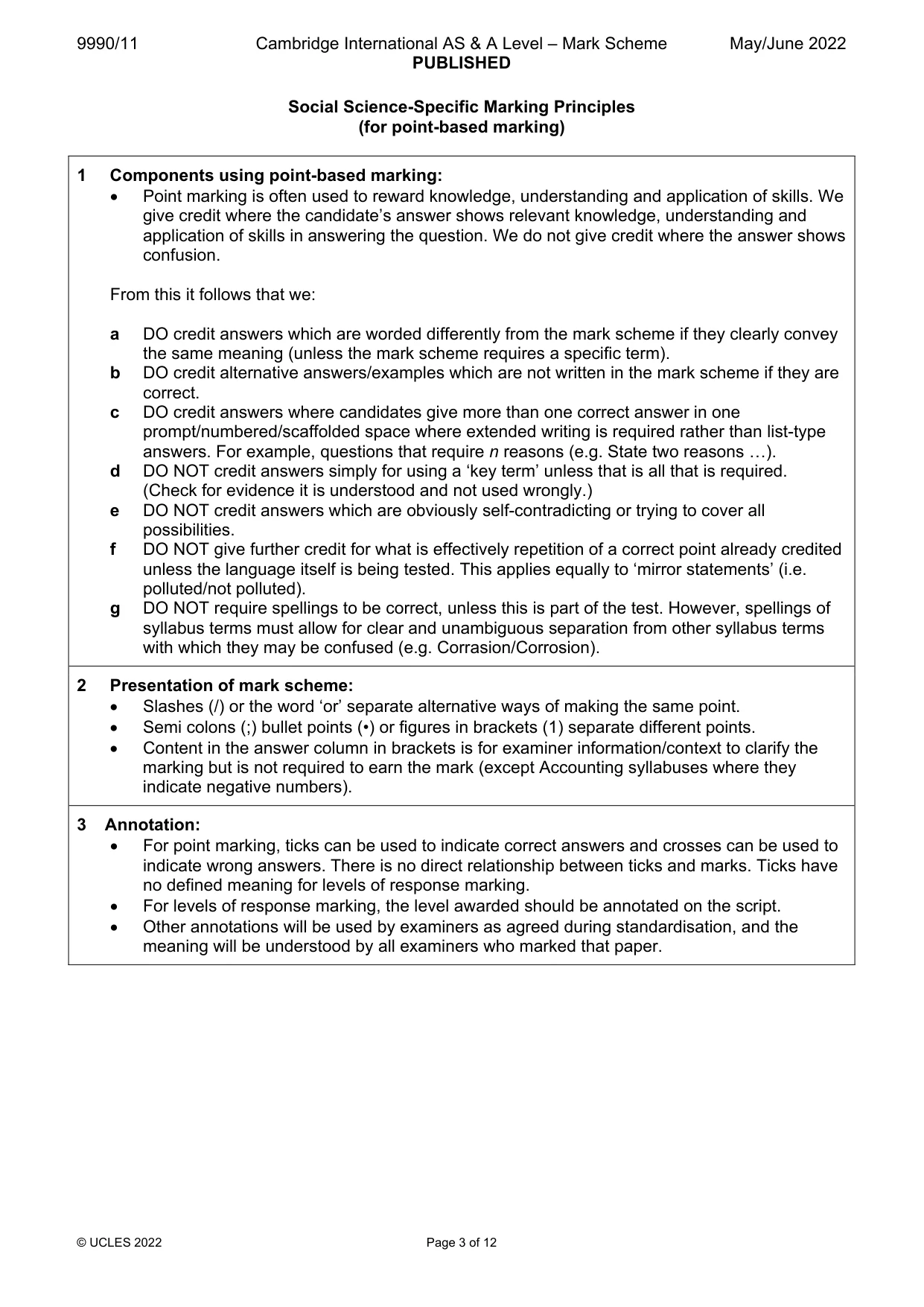
9990/11 Cambridge International AS & A Level – Mark Scheme PUBLISHED May/June 2022 © UCLES 2022 Page 3 of 12 Social Science-Specific Marking Principles (for point-based marking) 1 Components using point-based marking: Point marking is often used to reward knowledge, understanding and application of skills. We give credit where the candidate’s answer shows relevant knowledge, understanding and application of skills in answering the question. We do not give credit where the answer shows confusion. From this it follows that we: a DO credit answers which are worded differently from the mark scheme if they clearly convey the same meaning (unless the mark scheme requires a specific term). b DO credit alternative answers/examples which are not written in the mark scheme if they are correct. c DO credit answers where candidates give more than one correct answer in one prompt/numbered/scaffolded space where extended writing is required rather than list-type answers. For example, questions that require n reasons (e.g. State two reasons …). d DO NOT credit answers simply for using a ‘key term’ unless that is all that is required. (Check for evidence it is understood and not used wrongly.) e DO NOT credit answers which are obviously self-contradicting or trying to cover all possibilities. f DO NOT give further credit for what is effectively repetition of a correct point already credited unless the language itself is being tested. This applies equally to ‘mirror statements’ (i.e. polluted/not polluted). g DO NOT require spellings to be correct, unless this is part of the test. However, spellings of syllabus terms must allow for clear and unambiguous separation from other syllabus terms with which they may be confused (e.g. Corrasion/Corrosion). 2 Presentation of mark scheme: Slashes (/) or the word ‘or’ separate alternative ways of making the same point. Semi colons (;) bullet points (•) or figures in brackets (1) separate different points. Content in the answer column in brackets is for examiner information/context to clarify the marking but is not required to earn the mark (except Accounting syllabuses where they indicate negative numbers). 3 Annotation: For point marking, ticks can be used to indicate correct answers and crosses can be used to indicate wrong answers. There is no direct relationship between ticks and marks. Ticks have no defined meaning for levels of response marking. For levels of response marking, the level awarded should be annotated on the script. Other annotations will be used by examiners as agreed during standardisation, and the meaning will be understood by all examiners who marked that paper.
Mark scheme, page 4
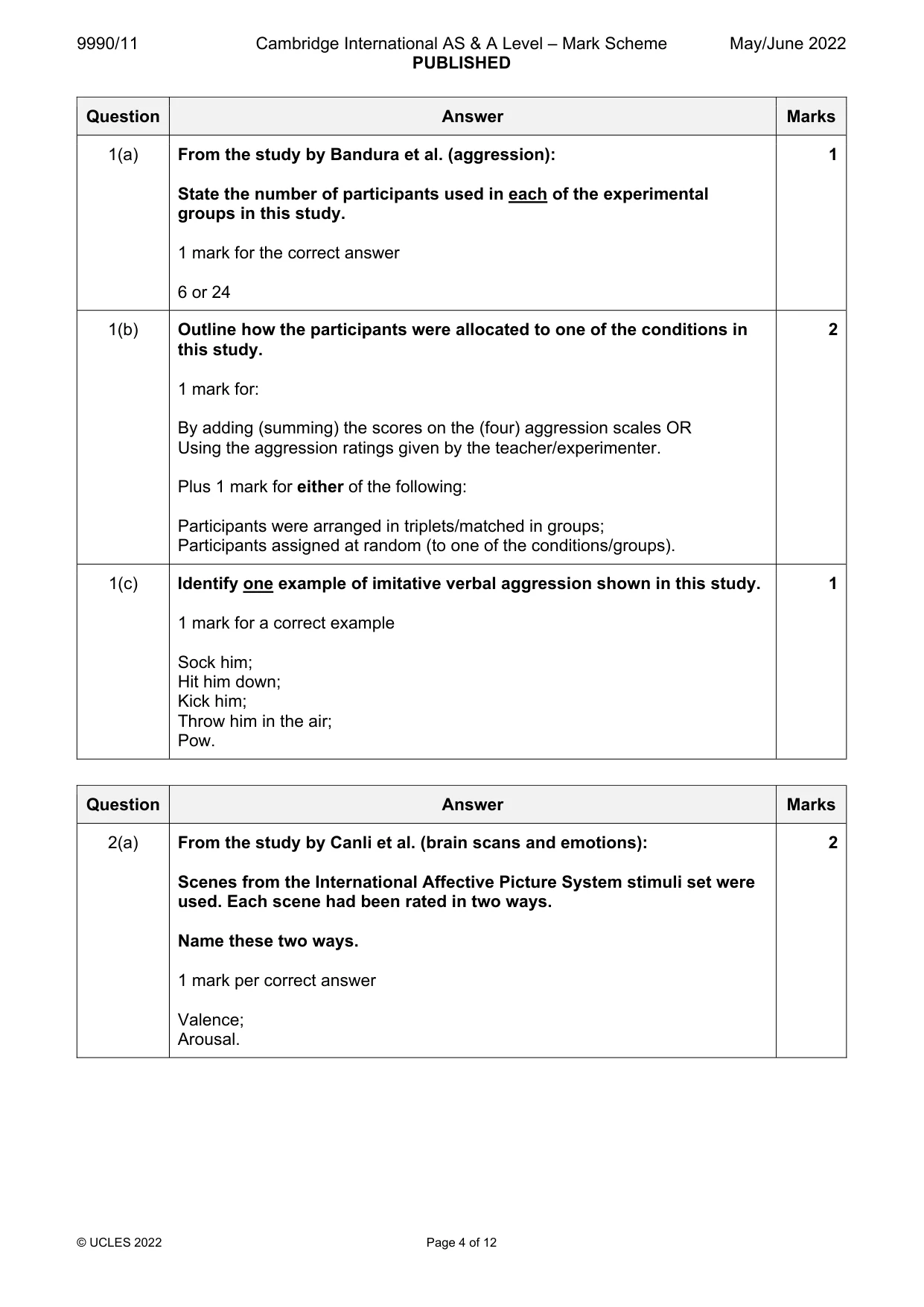
9990/11 Cambridge International AS & A Level – Mark Scheme PUBLISHED May/June 2022 © UCLES 2022 Page 4 of 12 Question Answer Marks 1(a) From the study by Bandura et al. (aggression): State the number of participants used in each of the experimental groups in this study. 1 mark for the correct answer 6 or 24 1 1(b) Outline how the participants were allocated to one of the conditions in this study. 1 mark for: By adding (summing) the scores on the (four) aggression scales OR Using the aggression ratings given by the teacher/experimenter. Plus 1 mark for either of the following: Participants were arranged in triplets/matched in groups; Participants assigned at random (to one of the conditions/groups). 2 1(c) Identify one example of imitative verbal aggression shown in this study. 1 mark for a correct example Sock him; Hit him down; Kick him; Throw him in the air; Pow. 1 Question Answer Marks 2(a) From the study by Canli et al. (brain scans and emotions): Scenes from the International Affective Picture System stimuli set were used. Each scene had been rated in two ways. Name these two ways. 1 mark per correct answer Valence; Arousal. 2
Mark scheme, page 5
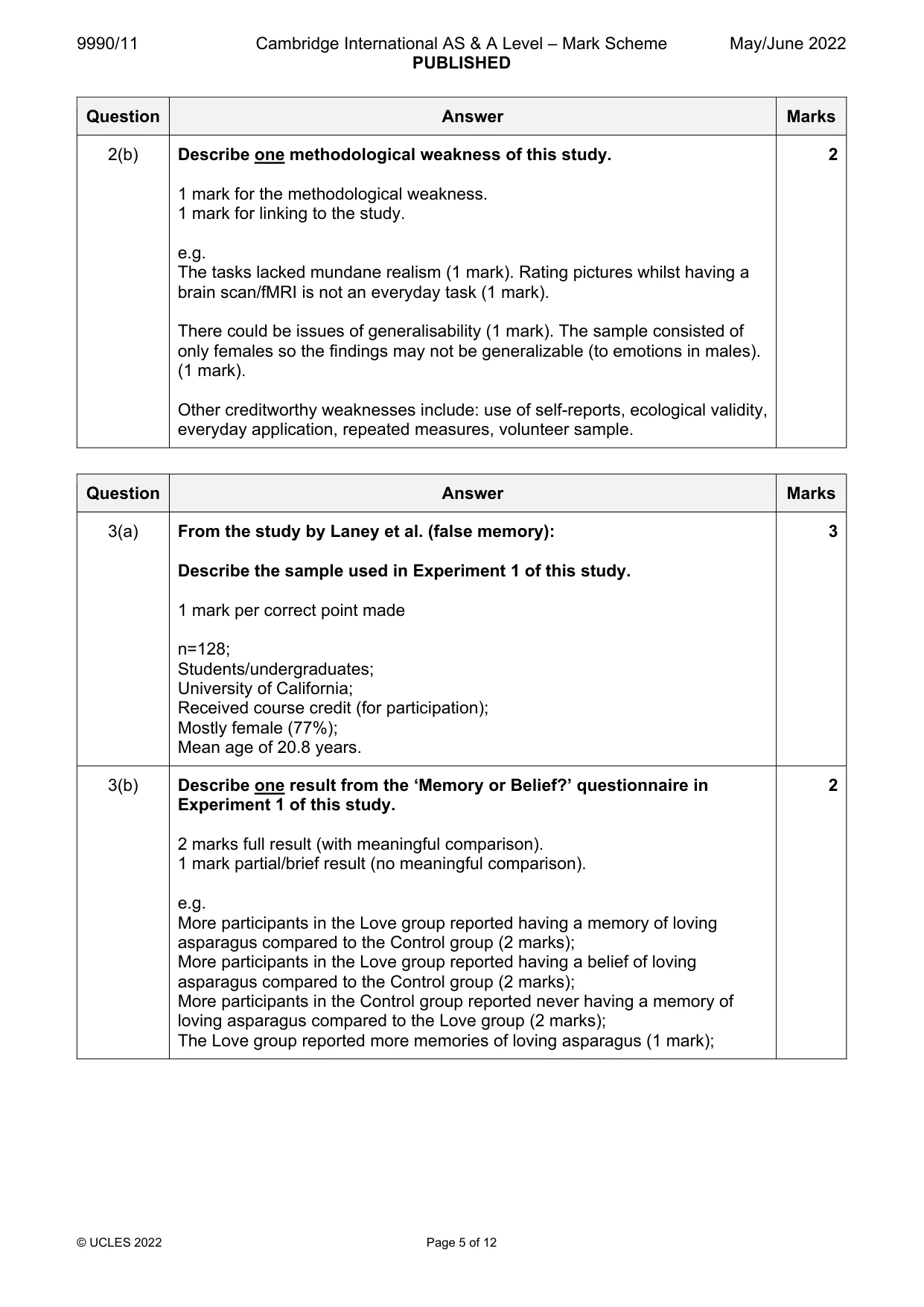
9990/11 Cambridge International AS & A Level – Mark Scheme PUBLISHED May/June 2022 © UCLES 2022 Page 5 of 12 Question Answer Marks 2(b) Describe one methodological weakness of this study. 1 mark for the methodological weakness. 1 mark for linking to the study. e.g. The tasks lacked mundane realism (1 mark). Rating pictures whilst having a brain scan/fMRI is not an everyday task (1 mark). There could be issues of generalisability (1 mark). The sample consisted of only females so the findings may not be generalizable (to emotions in males). (1 mark). Other creditworthy weaknesses include: use of self-reports, ecological validity, everyday application, repeated measures, volunteer sample. 2 Question Answer Marks 3(a) From the study by Laney et al. (false memory): Describe the sample used in Experiment 1 of this study. 1 mark per correct point made n=128; Students/undergraduates; University of California; Received course credit (for participation); Mostly female (77%); Mean age of 20.8 years. 3 3(b) Describe one result from the ‘Memory or Belief?’ questionnaire in Experiment 1 of this study. 2 marks full result (with meaningful comparison). 1 mark partial/brief result (no meaningful comparison). e.g. More participants in the Love group reported having a memory of loving asparagus compared to the Control group (2 marks); More participants in the Love group reported having a belief of loving asparagus compared to the Control group (2 marks); More participants in the Control group reported never having a memory of loving asparagus compared to the Love group (2 marks); The Love group reported more memories of loving asparagus (1 mark); 2
Mark scheme, page 6
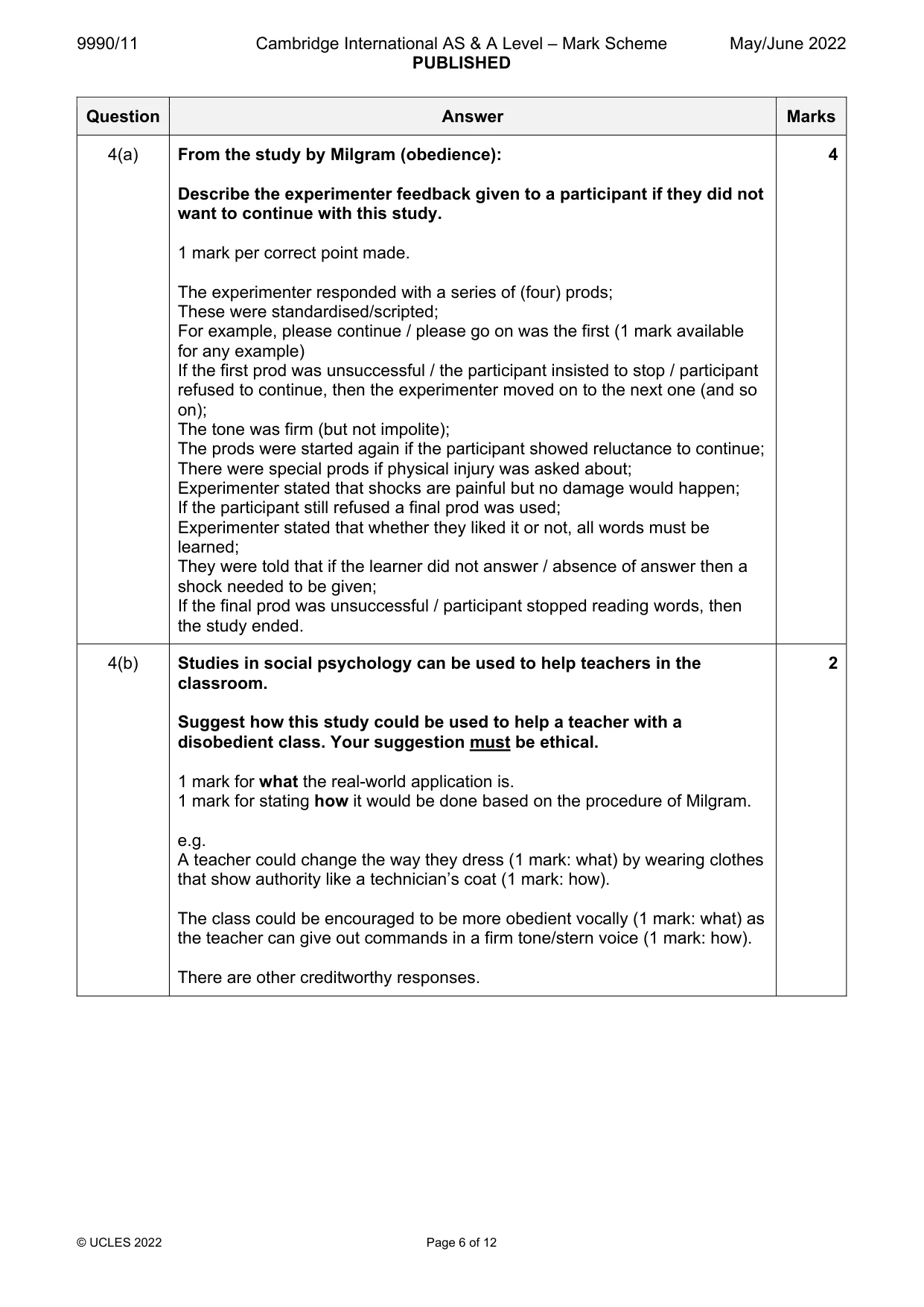
9990/11 Cambridge International AS & A Level – Mark Scheme PUBLISHED May/June 2022 © UCLES 2022 Page 6 of 12 Question Answer Marks 4(a) From the study by Milgram (obedience): Describe the experimenter feedback given to a participant if they did not want to continue with this study. 1 mark per correct point made. The experimenter responded with a series of (four) prods; These were standardised/scripted; For example, please continue / please go on was the first (1 mark available for any example) If the first prod was unsuccessful / the participant insisted to stop / participant refused to continue, then the experimenter moved on to the next one (and so on); The tone was firm (but not impolite); The prods were started again if the participant showed reluctance to continue; There were special prods if physical injury was asked about; Experimenter stated that shocks are painful but no damage would happen; If the participant still refused a final prod was used; Experimenter stated that whether they liked it or not, all words must be learned; They were told that if the learner did not answer / absence of answer then a shock needed to be given; If the final prod was unsuccessful / participant stopped reading words, then the study ended. 4 4(b) Studies in social psychology can be used to help teachers in the classroom. Suggest how this study could be used to help a teacher with a disobedient class. Your suggestion must be ethical. 1 mark for what the real-world application is. 1 mark for stating how it would be done based on the procedure of Milgram. e.g. A teacher could change the way they dress (1 mark: what) by wearing clothes that show authority like a technician’s coat (1 mark: how). The class could be encouraged to be more obedient vocally (1 mark: what) as the teacher can give out commands in a firm tone/stern voice (1 mark: how). There are other creditworthy responses. 2
Mark scheme, page 7
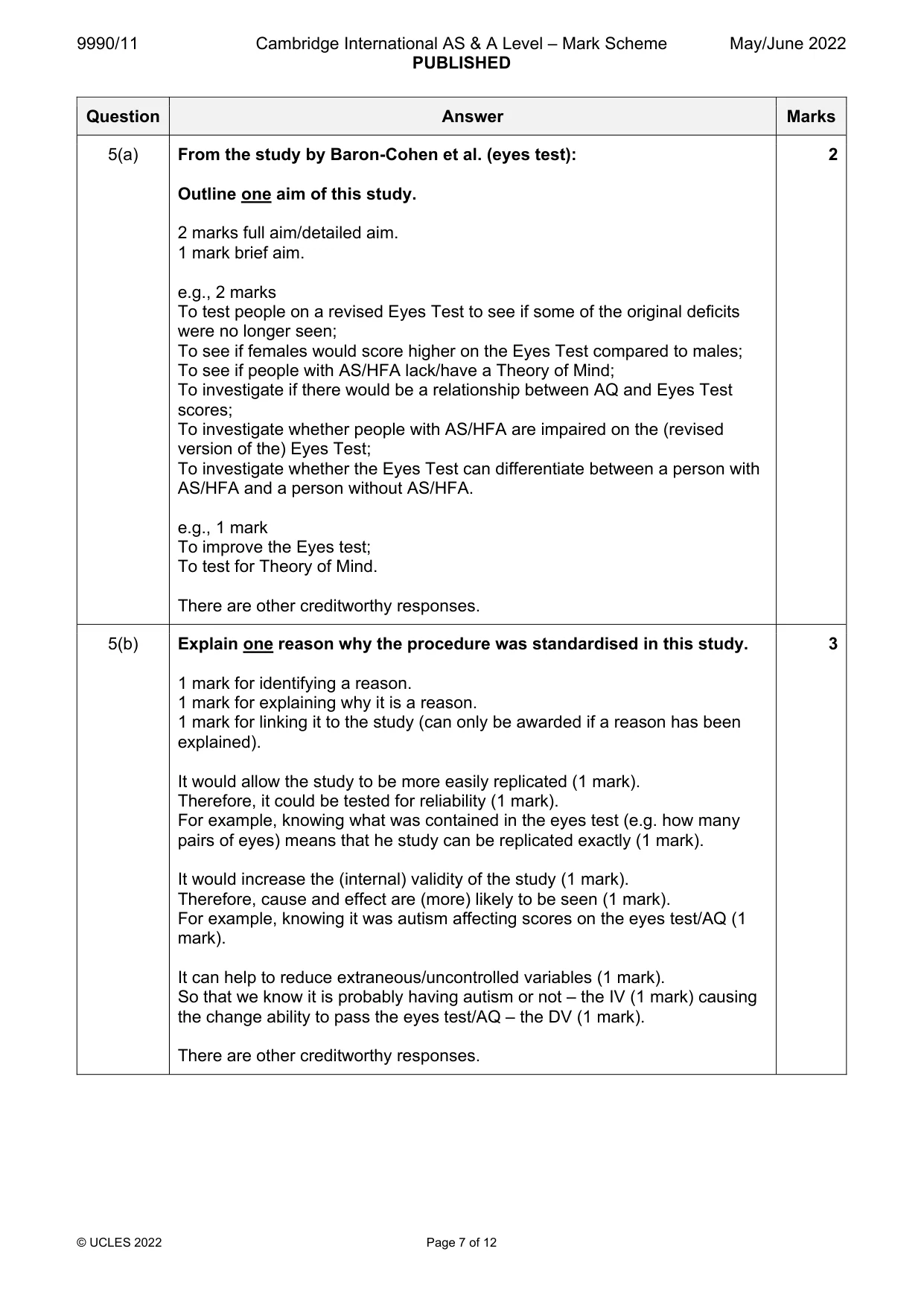
9990/11 Cambridge International AS & A Level – Mark Scheme PUBLISHED May/June 2022 © UCLES 2022 Page 7 of 12 Question Answer Marks 5(a) From the study by Baron-Cohen et al. (eyes test): Outline one aim of this study. 2 marks full aim/detailed aim. 1 mark brief aim. e.g., 2 marks To test people on a revised Eyes Test to see if some of the original deficits were no longer seen; To see if females would score higher on the Eyes Test compared to males; To see if people with AS/HFA lack/have a Theory of Mind; To investigate if there would be a relationship between AQ and Eyes Test scores; To investigate whether people with AS/HFA are impaired on the (revised version of the) Eyes Test; To investigate whether the Eyes Test can differentiate between a person with AS/HFA and a person without AS/HFA. e.g., 1 mark To improve the Eyes test; To test for Theory of Mind. There are other creditworthy responses. 2 5(b) Explain one reason why the procedure was standardised in this study. 1 mark for identifying a reason. 1 mark for explaining why it is a reason. 1 mark for linking it to the study (can only be awarded if a reason has been explained). It would allow the study to be more easily replicated (1 mark). Therefore, it could be tested for reliability (1 mark). For example, knowing what was contained in the eyes test (e.g. how many pairs of eyes) means that he study can be replicated exactly (1 mark). It would increase the (internal) validity of the study (1 mark). Therefore, cause and effect are (more) likely to be seen (1 mark). For example, knowing it was autism affecting scores on the eyes test/AQ (1 mark). It can help to reduce extraneous/uncontrolled variables (1 mark). So that we know it is probably having autism or not – the IV (1 mark) causing the change ability to pass the eyes test/AQ – the DV (1 mark). There are other creditworthy responses. 3
Mark scheme, page 8
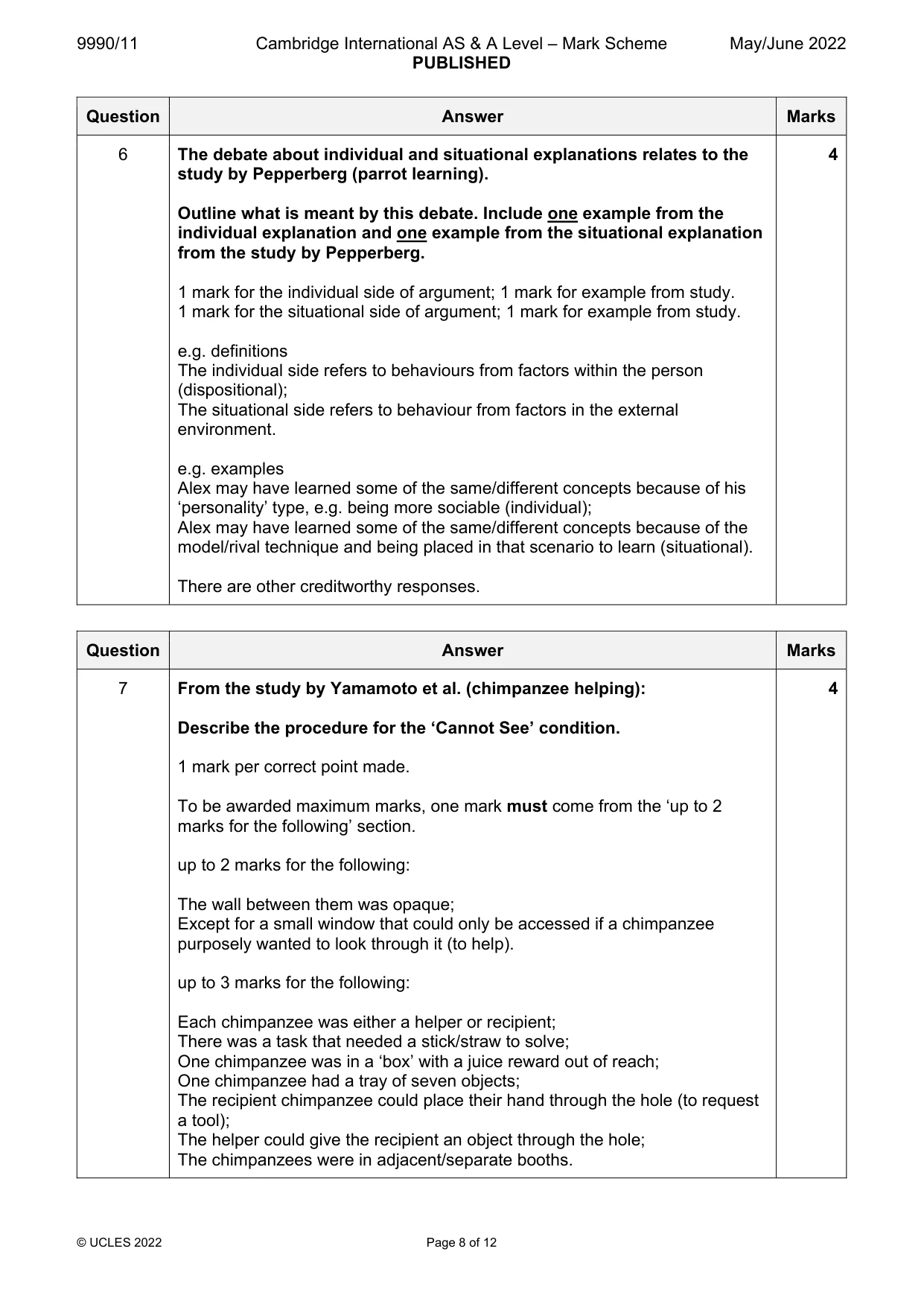
9990/11 Cambridge International AS & A Level – Mark Scheme PUBLISHED May/June 2022 © UCLES 2022 Page 8 of 12 Question Answer Marks 6 The debate about individual and situational explanations relates to the study by Pepperberg (parrot learning). Outline what is meant by this debate. Include one example from the individual explanation and one example from the situational explanation from the study by Pepperberg. 1 mark for the individual side of argument; 1 mark for example from study. 1 mark for the situational side of argument; 1 mark for example from study. e.g. definitions The individual side refers to behaviours from factors within the person (dispositional); The situational side refers to behaviour from factors in the external environment. e.g. examples Alex may have learned some of the same/different concepts because of his ‘personality’ type, e.g. being more sociable (individual); Alex may have learned some of the same/different concepts because of the model/rival technique and being placed in that scenario to learn (situational). There are other creditworthy responses. 4 Question Answer Marks 7 From the study by Yamamoto et al. (chimpanzee helping): Describe the procedure for the ‘Cannot See’ condition. 1 mark per correct point made. To be awarded maximum marks, one mark must come from the ‘up to 2 marks for the following’ section. up to 2 marks for the following: The wall between them was opaque; Except for a small window that could only be accessed if a chimpanzee purposely wanted to look through it (to help). up to 3 marks for the following: Each chimpanzee was either a helper or recipient; There was a task that needed a stick/straw to solve; One chimpanzee was in a ‘box’ with a juice reward out of reach; One chimpanzee had a tray of seven objects; The recipient chimpanzee could place their hand through the hole (to request a tool); The helper could give the recipient an object through the hole; The chimpanzees were in adjacent/separate booths. 4
Mark scheme, page 9
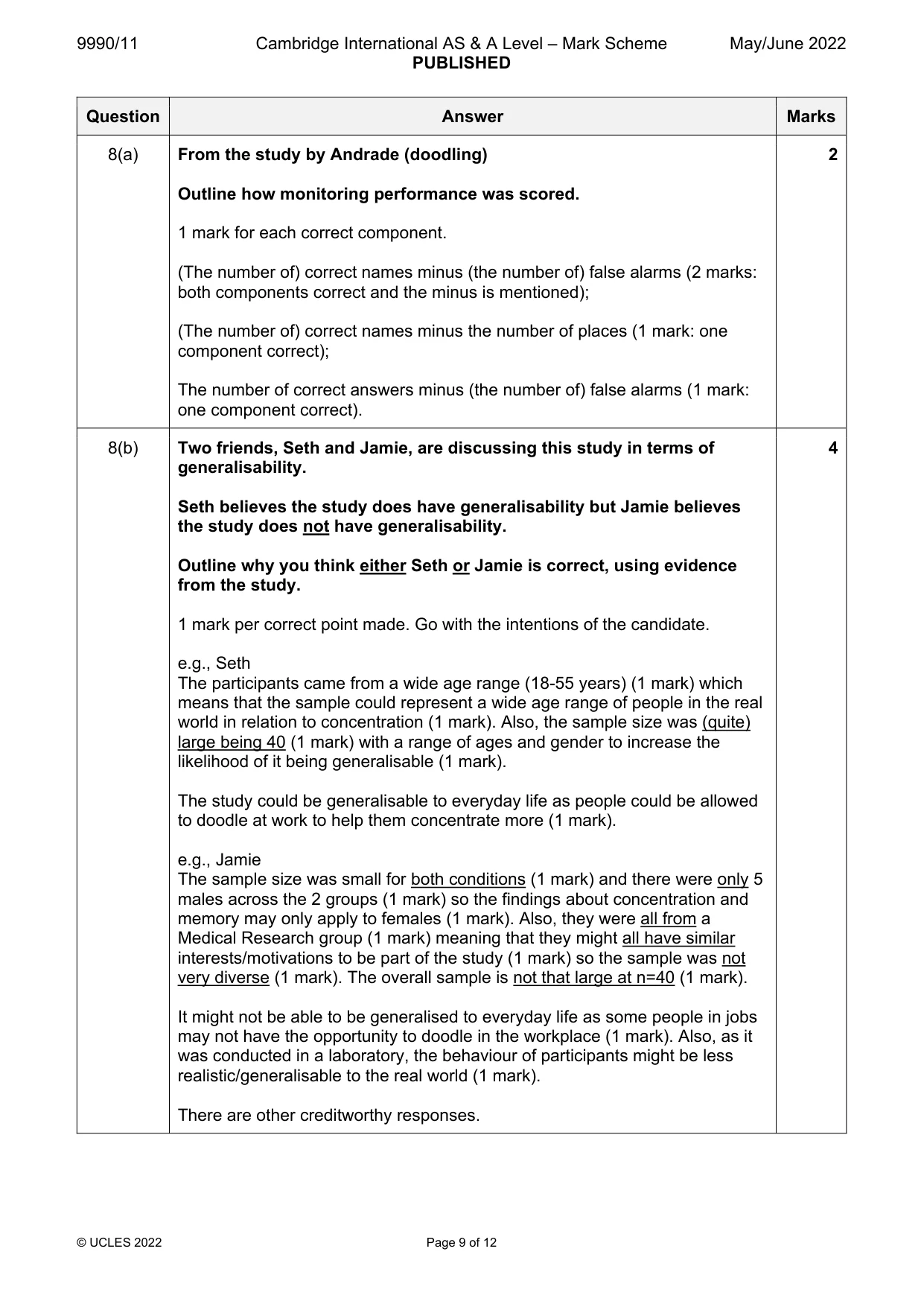
9990/11 Cambridge International AS & A Level – Mark Scheme PUBLISHED May/June 2022 © UCLES 2022 Page 9 of 12 Question Answer Marks 8(a) From the study by Andrade (doodling) Outline how monitoring performance was scored. 1 mark for each correct component. (The number of) correct names minus (the number of) false alarms (2 marks: both components correct and the minus is mentioned); (The number of) correct names minus the number of places (1 mark: one component correct); The number of correct answers minus (the number of) false alarms (1 mark: one component correct). 2 8(b) Two friends, Seth and Jamie, are discussing this study in terms of generalisability. Seth believes the study does have generalisability but Jamie believes the study does not have generalisability. Outline why you think either Seth or Jamie is correct, using evidence from the study. 1 mark per correct point made. Go with the intentions of the candidate. e.g., Seth The participants came from a wide age range (18-55 years) (1 mark) which means that the sample could represent a wide age range of people in the real world in relation to concentration (1 mark). Also, the sample size was (quite) large being 40 (1 mark) with a range of ages and gender to increase the likelihood of it being generalisable (1 mark). The study could be generalisable to everyday life as people could be allowed to doodle at work to help them concentrate more (1 mark). e.g., Jamie The sample size was small for both conditions (1 mark) and there were only 5 males across the 2 groups (1 mark) so the findings about concentration and memory may only apply to females (1 mark). Also, they were all from a Medical Research group (1 mark) meaning that they might all have similar interests/motivations to be part of the study (1 mark) so the sample was not very diverse (1 mark). The overall sample is not that large at n=40 (1 mark). It might not be able to be generalised to everyday life as some people in jobs may not have the opportunity to doodle in the workplace (1 mark). Also, as it was conducted in a laboratory, the behaviour of participants might be less realistic/generalisable to the real world (1 mark). There are other creditworthy responses. 4
Mark scheme, page 10
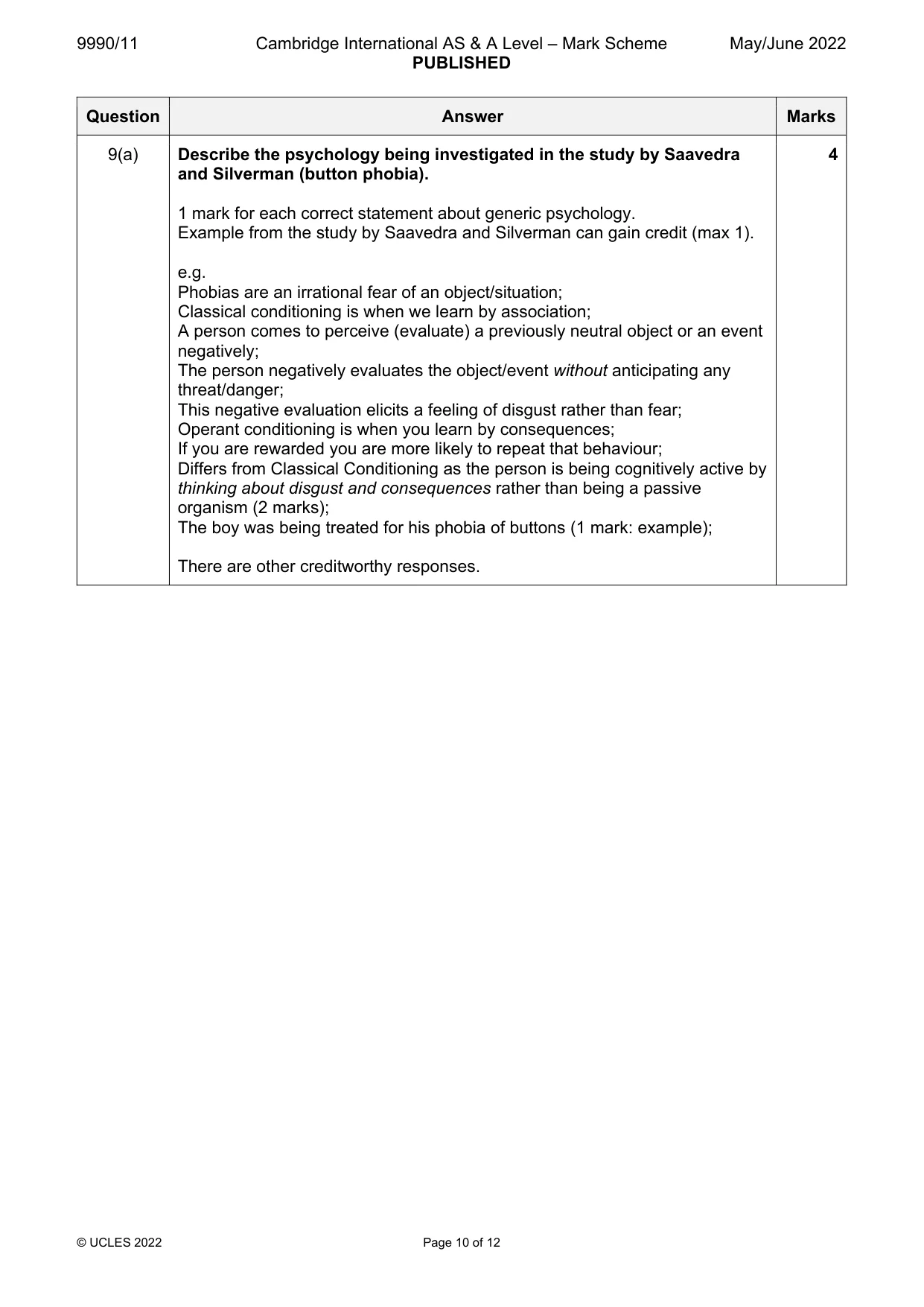
9990/11 Cambridge International AS & A Level – Mark Scheme PUBLISHED May/June 2022 © UCLES 2022 Page 10 of 12 Question Answer Marks 9(a) Describe the psychology being investigated in the study by Saavedra and Silverman (button phobia). 1 mark for each correct statement about generic psychology. Example from the study by Saavedra and Silverman can gain credit (max 1). e.g. Phobias are an irrational fear of an object/situation; Classical conditioning is when we learn by association; A person comes to perceive (evaluate) a previously neutral object or an event negatively; The person negatively evaluates the object/event without anticipating any threat/danger; This negative evaluation elicits a feeling of disgust rather than fear; Operant conditioning is when you learn by consequences; If you are rewarded you are more likely to repeat that behaviour; Differs from Classical Conditioning as the person is being cognitively active by thinking about disgust and consequences rather than being a passive organism (2 marks); The boy was being treated for his phobia of buttons (1 mark: example); There are other creditworthy responses. 4
Mark scheme, page 11
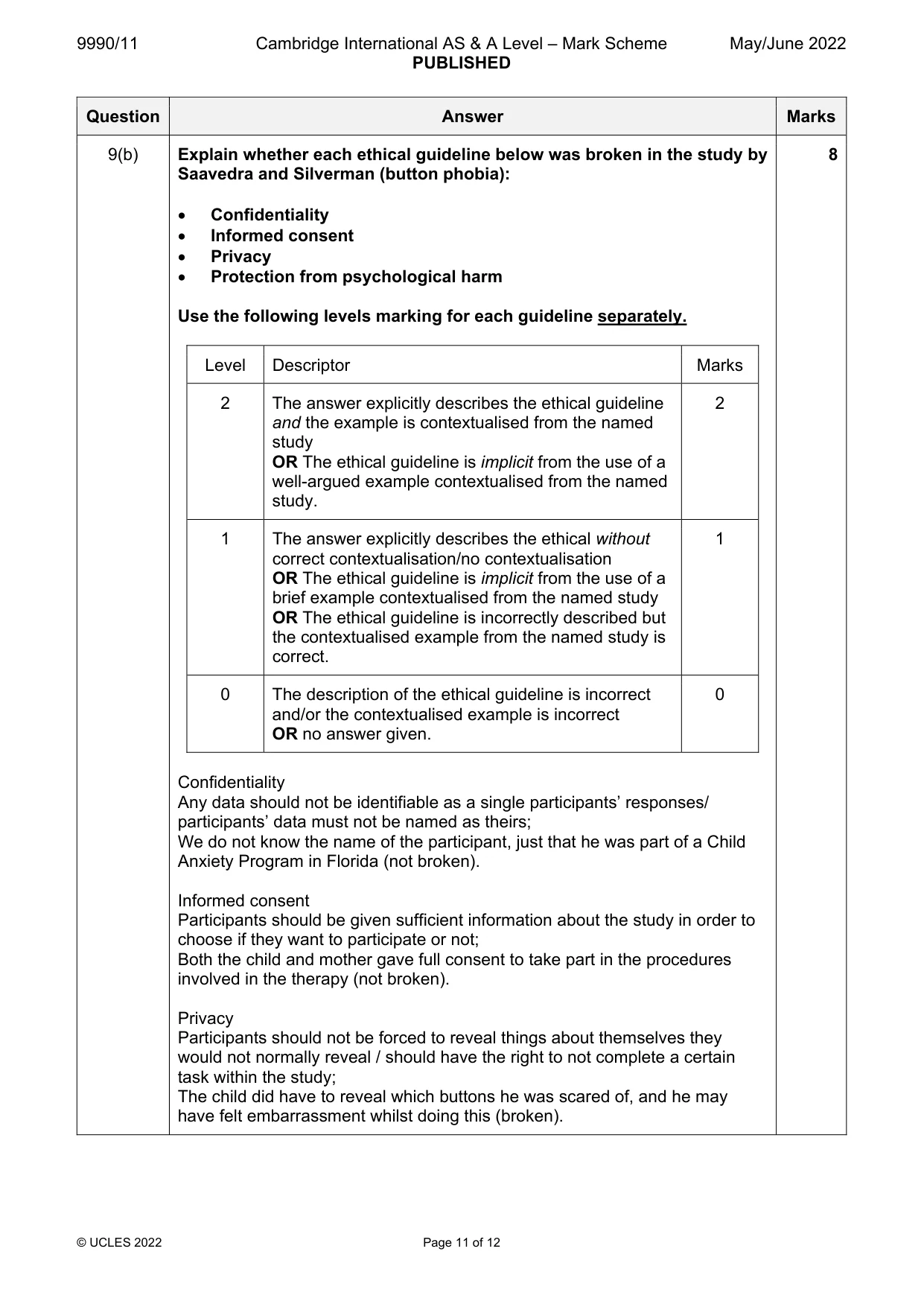
9990/11 Cambridge International AS & A Level – Mark Scheme PUBLISHED May/June 2022 © UCLES 2022 Page 11 of 12 Question Answer Marks 9(b) Explain whether each ethical guideline below was broken in the study by Saavedra and Silverman (button phobia): Confidentiality Informed consent Privacy Protection from psychological harm Use the following levels marking for each guideline separately. Level Descriptor Marks 2 The answer explicitly describes the ethical guideline and the example is contextualised from the named study OR The ethical guideline is implicit from the use of a well-argued example contextualised from the named study. 2 1 The answer explicitly describes the ethical without correct contextualisation/no contextualisation OR The ethical guideline is implicit from the use of a brief example contextualised from the named study OR The ethical guideline is incorrectly described but the contextualised example from the named study is correct. 1 0 The description of the ethical guideline is incorrect and/or the contextualised example is incorrect OR no answer given. 0 Confidentiality Any data should not be identifiable as a single participants’ responses/ participants’ data must not be named as theirs; We do not know the name of the participant, just that he was part of a Child Anxiety Program in Florida (not broken). Informed consent Participants should be given sufficient information about the study in order to choose if they want to participate or not; Both the child and mother gave full consent to take part in the procedures involved in the therapy (not broken). Privacy Participants should not be forced to reveal things about themselves they would not normally reveal / should have the right to not complete a certain task within the study; The child did have to reveal which buttons he was scared of, and he may have felt embarrassment whilst doing this (broken). 8
Mark scheme, page 12
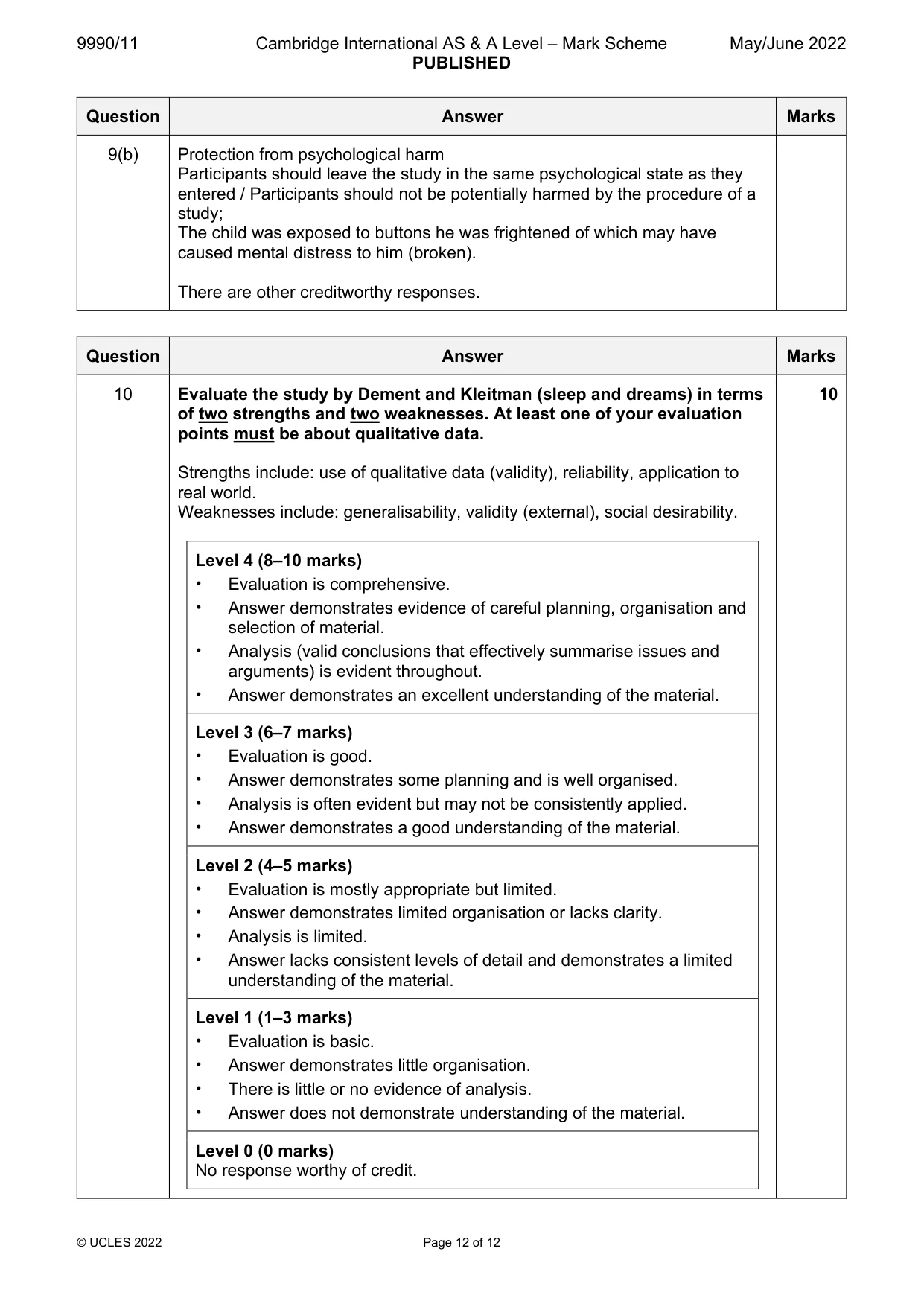
9990/11 Cambridge International AS & A Level – Mark Scheme PUBLISHED May/June 2022 © UCLES 2022 Page 12 of 12 Question Answer Marks 9(b) Protection from psychological harm Participants should leave the study in the same psychological state as they entered / Participants should not be potentially harmed by the procedure of a study; The child was exposed to buttons he was frightened of which may have caused mental distress to him (broken). There are other creditworthy responses. Question Answer Marks 10 Evaluate the study by Dement and Kleitman (sleep and dreams) in terms of two strengths and two weaknesses. At least one of your evaluation points must be about qualitative data. Strengths include: use of qualitative data (validity), reliability, application to real world. Weaknesses include: generalisability, validity (external), social desirability. Level 4 (8–10 marks) • Evaluation is comprehensive. • Answer demonstrates evidence of careful planning, organisation and selection of material. • Analysis (valid conclusions that effectively summarise issues and arguments) is evident throughout. • Answer demonstrates an excellent understanding of the material. Level 3 (6–7 marks) • Evaluation is good. • Answer demonstrates some planning and is well organised. • Analysis is often evident but may not be consistently applied. • Answer demonstrates a good understanding of the material. Level 2 (4–5 marks) • Evaluation is mostly appropriate but limited. • Answer demonstrates limited organisation or lacks clarity. • Analysis is limited. • Answer lacks consistent levels of detail and demonstrates a limited understanding of the material. Level 1 (1–3 marks) • Evaluation is basic. • Answer demonstrates little organisation. • There is little or no evidence of analysis. • Answer does not demonstrate understanding of the material. Level 0 (0 marks) No response worthy of credit. 10
What you needed in this session
Cambridge’s own grade thresholds for 2022 May/June, Paper 1 · Variant 1. A higher threshold means an easier paper — the bar moves with how the cohort did.