Cambridge A Level Portuguese - Literature (AS Level only) 8672 — 2019 May/June Paper 4 · Variant 1
8672/41/M/J/19 · 75 marks · ≈84 min
The question paper and its mark scheme, free to read here and free to download. This is Cambridge’s own paper, exactly as it was sat.
Question paper8 pages



Mark scheme4 pages
Answers below. Sit the paper first if you are practising.
Paper as text
Question paper, page 1
This document consists of 5 printed pages, 3 blank pages and 1 Insert. DC (KS) 178949/1 © UCLES 2019 [Turn over * 1 9 8 7 4 0 5 5 3 5 * PORTUGUESE LITERATURE 8672/04 Paper 4 Texts May/June 2019 2 hours 30 minutes No Additional Materials are required. Invigilators must refer to the Additional Materials List for instructions on the use of set texts in the examination. READ THESE INSTRUCTIONS FIRST An answer booklet is provided inside this question paper. You should follow the instructions on the front cover of the answer booklet. If you need additional answer paper ask the invigilator for a continuation booklet. Answer three questions, each on a different text. You must choose one question from Section 1, one from Section 2 and one other. Write your answers in Portuguese. Dictionaries are not permitted. You should write between 500 and 600 words for each answer. All questions in this paper carry equal marks. PRIMEIRO LEIA ESTAS INSTRUÇÕES Dentro deste caderno de perguntas há um caderno de respostas. Siga as instruções dadas na capa do caderno de respostas. As instruções também são dadas abaixo em português. Se precisar de mais papel para suas respostas, peça um caderno adicional de respostas ao supervisor do exame. Responda a três perguntas, cada uma sendo sobre um texto diferente. É necessário escolher uma pergunta da Secção 1, uma da Secção 2 e uma terceira. Escreva as suas respostas em português. Não é permitido o uso de dicionários. Deve escrever entre 500 e 600 palavras por resposta. Todas as perguntas neste exame têm o mesmo número de pontos. INSTRUÇÕES DO CADERNO DE RESPOSTAS Preencha os campos na capa do caderno de respostas usando letras maiúsculas. Escreva com uma caneta de tinta azul escura ou preta. NÃO ESCREVA EM NENHUM CÓDIGO DE BARRAS. Escreva as suas respostas no caderno de respostas. Use os dois lados da folha. Por favor, deixe duas linhas em branco entre as respostas para cada pergunta. Escreva o número da pergunta à qual está respondendo na primeira margem. Se a pergunta à qual estiver respondendo for dividida em partes, por exemplo 1a, escreva a que parte se refere a sua resposta na segunda margem. Caso tenha usado um caderno adicional de respostas, por favor, coloque-o dentro do caderno de respostas. Cambridge Assessment International Education Cambridge International Advanced Subsidiary Level
Question paper, page 2
2 8672/04/M/J/19 © UCLES 2019 Secção 1 1 JOSÉ SARAMAGO, Memorial do Convento Responda à pergunta (a) ou à pergunta (b): (a) Leia o extrato do Capítulo V e responda às perguntas seguintes: D. Maria Ana não estará no auto-de-fé porque, apesar de prenha, três vezes a sangraram, e isso foi-lhe causa de grande debilitação, em acréscimo dos afrontamentos de que vem padecendo há muitos meses. Demoraram-lhe as sangrias como lhe tinham demorado a notícia da morte do irmão, que queriam os médicos segurá-la mais, sendo de tão pouco tempo a gravidez. Que, em verdade, os ares não andam bons no paço, como ainda agora se averiguou ao dar a el-rei um flato rijo, de que pediu confissão e logo lha deram, pelo bem que sempre faz à alma, mas terão sido imaginações suas, que tudo se desatou num bom sucesso quando o purgaram, afinal era só a tripa empedernida. Está o palácio triste, sobre a tristeza em que de costume está, com o luto que el-rei mandou dar a toda a sua casa, e ordem para que os títulos e oficiais dela o pusessem, como ele pôs, fechando-se oito dias e tomando seis meses de nojo, três de capa comprida e três de capa curta, por demonstração do grande sentimento da morte do imperador seu cunhado. Porém, hoje é dia de alegria geral, porventura a palavra será imprópria, porque o gosto vem de mais fundo, talvez da alma, olhar esta cidade saindo de suas casas, despejando-se pelas ruas e praças, descendo dos altos, juntando-se no Rossio para ver justiçar a judeus e cristãos-novos, a hereges e feiticeiros, fora aqueles casos menos correntemente qualificáveis e outras miuçalhas passíveis de degredo ou fogueira. São cento e quatro as pessoas que hoje saem, as mais delas vindas do Brasil, úbere terreno para diamantes e impiedades, sendo cinquenta e um os homens e cinquenta e três as mulheres. Destas, duas serão relaxadas ao braço secular, em carne, por relapsas, e isto quer dizer reincidentes na heresia, por convictas e negativas, e isto quer dizer teimosas apesar de todos os testemunhos, por contumazes, e isto quer dizer persistentes nos erros que são suas verdades, só desacertadas no tempo e no lugar. E estando já passados quase dois anos que se queimaram pessoas em Lisboa, está o Rossio cheio de povo duas vezes em festa por ser domingo e haver auto-de-fé, nunca se chegará a saber de que mais gostam os moradores, se disto, se das touradas, mesmo quando só estas se usarem. Do Capítulo V (i) Qual é a importância da gravidez nesta obra? Dê exemplos das diferentes perspetivas. (ii) Como é que o auto-de-fé pode ser comparado às touradas? Ou (b) Acha que o final trágico do romance reflete também a vida trágica do povo anónimo? Justifique e exemplifique a sua resposta.
Question paper, page 3
3 8672/04/M/J/19 © UCLES 2019 [Turn over 2 MIA COUTO, Terra Sonâmbula Responda à pergunta (a) ou à pergunta (b): (a) Leia o extrato do Primeiro Capítulo e responda às perguntas seguintes: No interior da mala estão roupas, uma caixa com comidas. Por cima de tudo estão espalhados cadernos escolares, gatafunhados com letras incertas. O velho carrega a caixa com mantimentos. Muidinga inspecciona os papéis. — Veja, Tuahir. São cartas. — Quero saber é das comidas. O miúdo remexe no resto. As mãos curiosas viajam pelos cantos da mala. O velho chama a atenção: ele que deixasse tudo como estava, fechasse a tampa. — Tira só essa papelada. Serve para acendermos a fogueira. O jovem retira os caderninhos. Guarda-os por baixo do seu banco. Não parece pretender sacrificar aqueles papéis para iniciar o fogo. Fica sentado, alheio. No enquanto, lá fora, tudo vai ficando noite. Reina um negro silvestre, cego. Muidinga olha o escuro e estremece. É um desses negros que nem os corvos comem. Parece todas as sombras desceram à terra. O medo passeia seus chifres no peito do menino que se deita, enroscado como um congolote1. O machimbombo se rende à quietude, tudo é silêncio taciturno. Mais tarde, se começa a escutar um pranto, num fio quase inaudível. É Muidinga que chora. O velho se levanta e zanga: — Pára de chorar! — É que me dói uma tristeza... — Chorando assim você vai chamar os espíritos. Ou se cala ou lhe rebento a tristeza à porrada. — Nós nunca mais vamos sair daqui. — Vamos, com a certeza. Qualquer coisa vai acontecer qualquer dia. E essa guerra vai acabar. A estrada já vai-se encher de gente, camiões. Como no tempo de antigamente. Mais sereno, o velho passa um braço sobre os ombros trementes do rapaz e lhe pergunta: — Tens medo da noite? Muidinga acena afirmativamente. — Então vai acender uma fogueira lá fora. O miúdo se levanta e escolhe entre os papéis, receando rasgar uma folha escrita. Acaba por arrancar a capa de um dos cadernos. Do Primeiro Capítulo (i) O que aconteceu a Muidinga ao longo da obra para que este seja muitas vezes dominado pelo medo e choro? (ii) Explique a importância dos cadernos que Muidinga encontra. Ou (b) Que semelhanças é que podemos encontrar entre Kindzu e Farida? Justifique com exemplos. 1 Congolote: bicho de mil patas, maria-café.
Question paper, page 4
4 8672/04/M/J/19 © UCLES 2019 3 ERICO VERÍSSIMO, Olhai os Lírios Do Campo Responda à pergunta (a) ou à pergunta (b): (a) Leia o extrato do Capítulo 3 e responda às perguntas seguintes: Era Setembro. Naquela manhã de domingo, sentado na soleira do portão do internato, Eugênio sentia como nunca as mudanças que se haviam operado no seu corpo e na sua vida, depois que ele completara quinze anos. Sim, não existia a menor dúvida: estava ficando homem. Agora se examinava com frequência ao espelho – de longe, de perto, de soslaio – com fúria de analista obstinado. Achava-se feio e rude, e isso o angustiava. Deus bem lhe podia ter dado outra fisionomia, já que não lhe dera riqueza. Rebentavam-lhe espinhas no rosto, no pescoço, nas costas: era também primavera no seu pobre corpo de adolescente. O buço apontava forte, sombreando- lhe o lábio superior. Uma nuvem de estranheza e selvagem desconfiança lhe velava os olhos, que não conseguiam fixar-se por muito tempo no rosto das outras criaturas. Andavam quase sempre entrecerrados, eram torvos e davam àquelas feições uma expressão quase imbecil. Com surda cólera Eugênio contemplava a imagem do espelho. Era como se estivesse diante de um inimigo – inimigo perigoso que lhe conhecia todos os segredos, todos os pecados, até os mais sórdidos e escondidos. O pior de tudo, porém, era a voz. Soava de ordinário velada e rouca, descia inesperadamente às notas mais graves, para de repente saltar em guinchos desafinados, voltando quase sem transição para o tom profundo que no fim das frases se esfarelava num ronco. Essa era uma das suas maiores fontes de inquietação e de vergonha. Quando tinha de ler em aula algum trecho em voz alta, sofria horrores. Os colegas riam dele e até os próprios professores às vezes não conseguiam ficar sérios. E por isso Eugênio se fazia mais calado do que era. Por que é que tudo nele era feio e desagradável? – perguntava-se a si mesmo. – Por que tudo quanto lhe pertencia era desajeitado e sem graça, desde as pobres roupas que o pai lhe fazia até ao corpo que Deus lhe dera? Eugênio sentia a nostalgia da beleza e talvez fosse por isso que sua paixão por Miss Margaret, a filha do diretor do colégio, era tão grande, tão infeliz e desesperançada. Do Capítulo 3 (i) Considera que a personagem de Eugênio evolui ao longo da obra? Justifique e exemplifique a sua resposta. (ii) Como era a relação entre Eugênio e o seu pai Ângelo? Desenvolva. Ou (b) Explique, dando exemplos, o significado do título da obra Olhai os Lírios do Campo.
Question paper, page 5
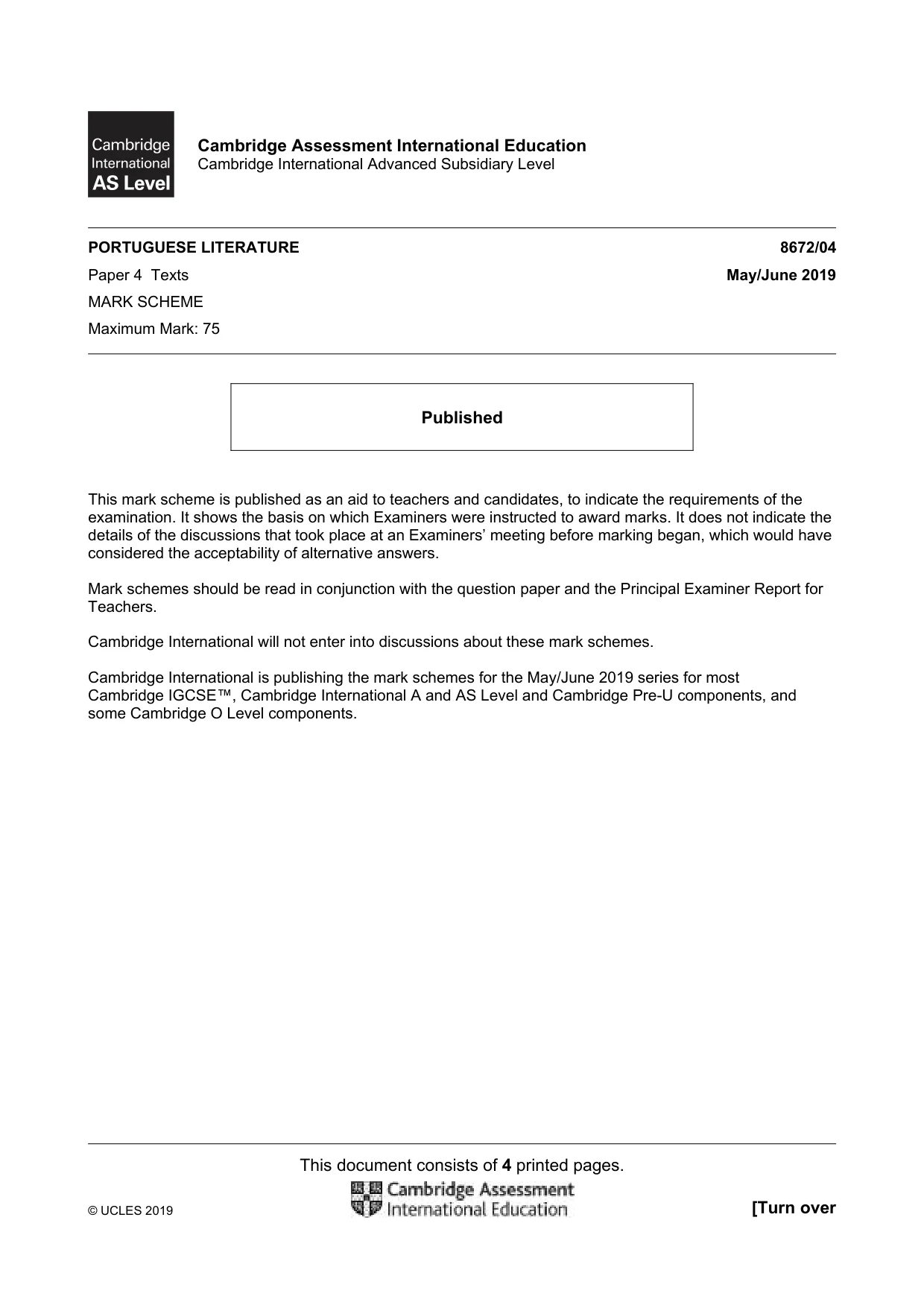
5 8672/04/M/J/19 © UCLES 2019 Secção 2 4 RACHEL DE QUEIROZ, As Três Marias Responda à pergunta (a) ou à pergunta (b): (a) Explique o impacto que a vida urbana tem nas vidas de Maria Augusta, Maria José e Maria da Glória. Ou (b) Como é que a personagem de Maria Augusta se desenvolve ao longo da obra? 5 LÍDIA JORGE, A Costa dos Murmúrios Responda à pergunta (a) ou à pergunta (b): (a) De que forma é que a Guerra Colonial afetou Luís Alex? Justifique a sua resposta. Ou (b) Analise a importância da primeira parte do livro, intitulada Os gafanhotos, na obra A Costa dos Murmúrios. 6 BALTASAR LOPES, Chiquinho Responda à pergunta (a) ou à pergunta (b): (a) Dê exemplos de como é que o pai de Chiquinho influenciou as decisões do seu filho ao longo da sua vida. Ou (b) De que forma é que a obra Chiquinho reflete a vida de muitos cabo-verdianos? Justifique com exemplos.
Question paper, page 6
6 8672/04/M/J/19 © UCLES 2019 BLANK PAGE
Question paper, page 7
7 8672/04/M/J/19 © UCLES 2019 BLANK PAGE
Question paper, page 8
8 8672/04/M/J/19 © UCLES 2019 BLANK PAGE Permission to reproduce items where third-party owned material protected by copyright is included has been sought and cleared where possible. Every reasonable effort has been made by the publisher (UCLES) to trace copyright holders, but if any items requiring clearance have unwittingly been included, the publisher will be pleased to make amends at the earliest possible opportunity. To avoid the issue of disclosure of answer-related information to candidates, all copyright acknowledgements are reproduced online in the Cambridge Assessment International Education Copyright Acknowledgements Booklet. This is produced for each series of examinations and is freely available to download at www.cambridgeinternational.org after the live examination series. Cambridge Assessment International Education is part of the Cambridge Assessment Group. Cambridge Assessment is the brand name of the University of Cambridge Local Examinations Syndicate (UCLES), which itself is a department of the University of Cambridge.
Mark scheme, page 1
This document consists of 4 printed pages. © UCLES 2019 [Turn over Cambridge Assessment International Education Cambridge International Advanced Subsidiary Level PORTUGUESE LITERATURE 8672/04 Paper 4 Texts May/June 2019 MARK SCHEME Maximum Mark: 75 Published This mark scheme is published as an aid to teachers and candidates, to indicate the requirements of the examination. It shows the basis on which Examiners were instructed to award marks. It does not indicate the details of the discussions that took place at an Examiners’ meeting before marking began, which would have considered the acceptability of alternative answers. Mark schemes should be read in conjunction with the question paper and the Principal Examiner Report for Teachers. Cambridge International will not enter into discussions about these mark schemes. Cambridge International is publishing the mark schemes for the May/June 2019 series for most Cambridge IGCSE™, Cambridge International A and AS Level and Cambridge Pre-U components, and some Cambridge O Level components.
Mark scheme, page 2
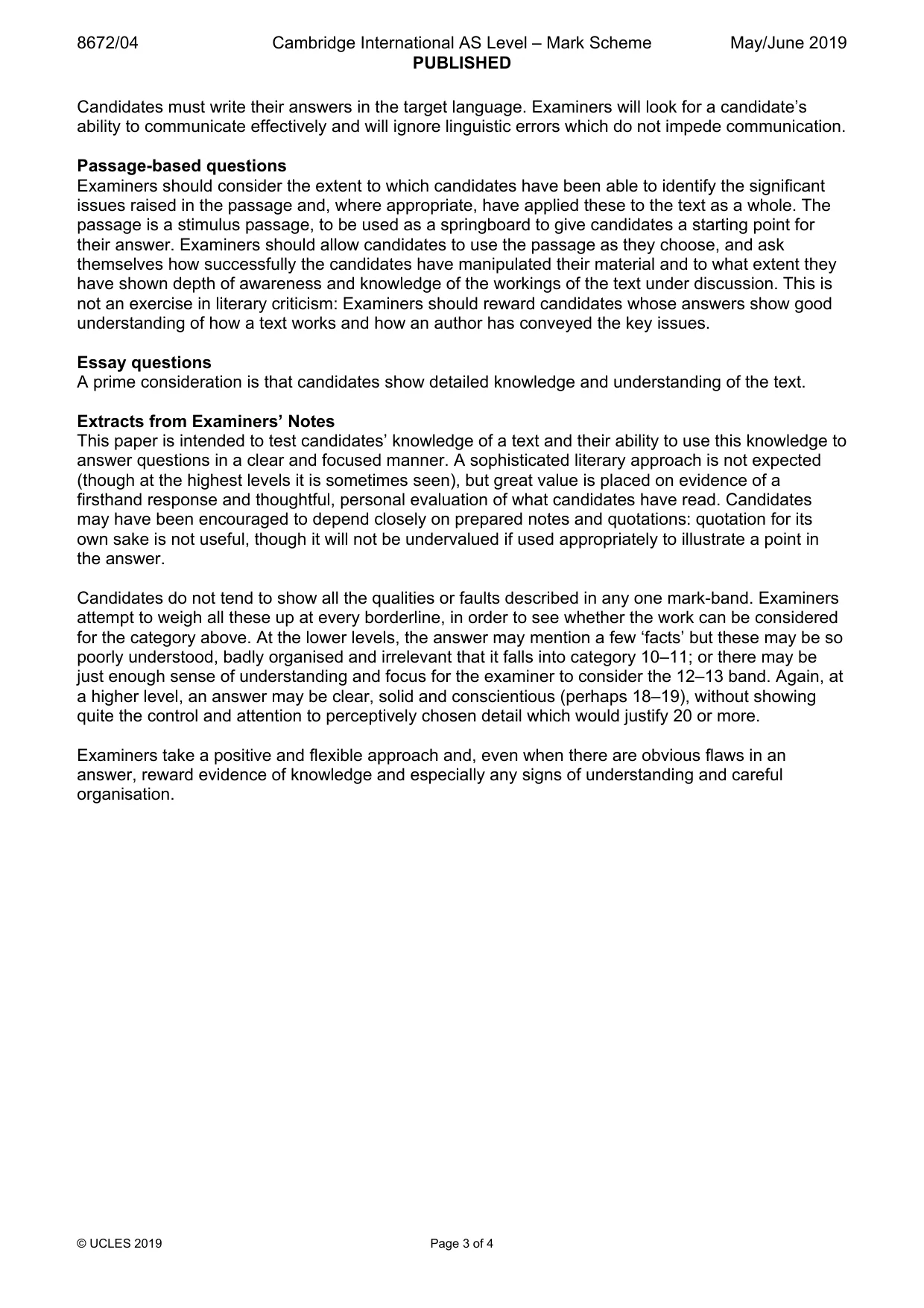
8672/04 Cambridge International AS Level – Mark Scheme PUBLISHED May/June 2019 © UCLES 2019 Page 2 of 4 Generic Marking Principles These general marking principles must be applied by all examiners when marking candidate answers. They should be applied alongside the specific content of the mark scheme or generic level descriptors for a question. Each question paper and mark scheme will also comply with these marking principles. GENERIC MARKING PRINCIPLE 1: Marks must be awarded in line with: • the specific content of the mark scheme or the generic level descriptors for the question • the specific skills defined in the mark scheme or in the generic level descriptors for the question • the standard of response required by a candidate as exemplified by the standardisation scripts. GENERIC MARKING PRINCIPLE 2: Marks awarded are always whole marks (not half marks, or other fractions). GENERIC MARKING PRINCIPLE 3: Marks must be awarded positively: • marks are awarded for correct/valid answers, as defined in the mark scheme. However, credit is given for valid answers which go beyond the scope of the syllabus and mark scheme, referring to your Team Leader as appropriate • marks are awarded when candidates clearly demonstrate what they know and can do • marks are not deducted for errors • marks are not deducted for omissions • answers should only be judged on the quality of spelling, punctuation and grammar when these features are specifically assessed by the question as indicated by the mark scheme. The meaning, however, should be unambiguous. GENERIC MARKING PRINCIPLE 4: Rules must be applied consistently e.g. in situations where candidates have not followed instructions or in the application of generic level descriptors. GENERIC MARKING PRINCIPLE 5: Marks should be awarded using the full range of marks defined in the mark scheme for the question (however; the use of the full mark range may be limited according to the quality of the candidate responses seen). GENERIC MARKING PRINCIPLE 6: Marks awarded are based solely on the requirements as defined in the mark scheme. Marks should not be awarded with grade thresholds or grade descriptors in mind.
Mark scheme, page 3
8672/04 Cambridge International AS Level – Mark Scheme PUBLISHED May/June 2019 © UCLES 2019 Page 3 of 4 Candidates must write their answers in the target language. Examiners will look for a candidate’s ability to communicate effectively and will ignore linguistic errors which do not impede communication. Passage-based questions Examiners should consider the extent to which candidates have been able to identify the significant issues raised in the passage and, where appropriate, have applied these to the text as a whole. The passage is a stimulus passage, to be used as a springboard to give candidates a starting point for their answer. Examiners should allow candidates to use the passage as they choose, and ask themselves how successfully the candidates have manipulated their material and to what extent they have shown depth of awareness and knowledge of the workings of the text under discussion. This is not an exercise in literary criticism: Examiners should reward candidates whose answers show good understanding of how a text works and how an author has conveyed the key issues. Essay questions A prime consideration is that candidates show detailed knowledge and understanding of the text. Extracts from Examiners’ Notes This paper is intended to test candidates’ knowledge of a text and their ability to use this knowledge to answer questions in a clear and focused manner. A sophisticated literary approach is not expected (though at the highest levels it is sometimes seen), but great value is placed on evidence of a firsthand response and thoughtful, personal evaluation of what candidates have read. Candidates may have been encouraged to depend closely on prepared notes and quotations: quotation for its own sake is not useful, though it will not be undervalued if used appropriately to illustrate a point in the answer. Candidates do not tend to show all the qualities or faults described in any one mark-band. Examiners attempt to weigh all these up at every borderline, in order to see whether the work can be considered for the category above. At the lower levels, the answer may mention a few ‘facts’ but these may be so poorly understood, badly organised and irrelevant that it falls into category 10–11; or there may be just enough sense of understanding and focus for the examiner to consider the 12–13 band. Again, at a higher level, an answer may be clear, solid and conscientious (perhaps 18–19), without showing quite the control and attention to perceptively chosen detail which would justify 20 or more. Examiners take a positive and flexible approach and, even when there are obvious flaws in an answer, reward evidence of knowledge and especially any signs of understanding and careful organisation.
Mark scheme, page 4
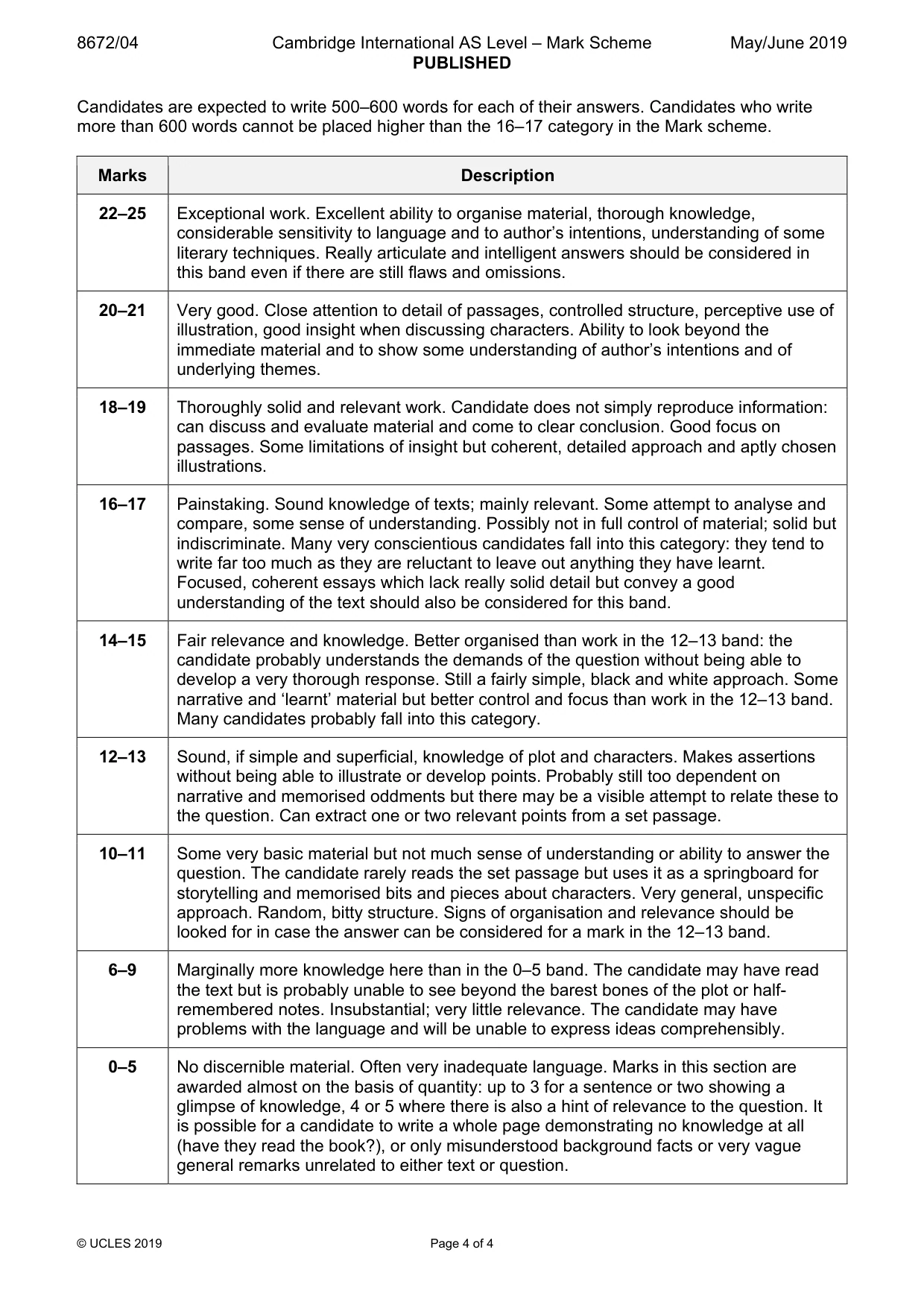
8672/04 Cambridge International AS Level – Mark Scheme PUBLISHED May/June 2019 © UCLES 2019 Page 4 of 4 Candidates are expected to write 500–600 words for each of their answers. Candidates who write more than 600 words cannot be placed higher than the 16–17 category in the Mark scheme. Marks Description 22–25 Exceptional work. Excellent ability to organise material, thorough knowledge, considerable sensitivity to language and to author’s intentions, understanding of some literary techniques. Really articulate and intelligent answers should be considered in this band even if there are still flaws and omissions. 20–21 Very good. Close attention to detail of passages, controlled structure, perceptive use of illustration, good insight when discussing characters. Ability to look beyond the immediate material and to show some understanding of author’s intentions and of underlying themes. 18–19 Thoroughly solid and relevant work. Candidate does not simply reproduce information: can discuss and evaluate material and come to clear conclusion. Good focus on passages. Some limitations of insight but coherent, detailed approach and aptly chosen illustrations. 16–17 Painstaking. Sound knowledge of texts; mainly relevant. Some attempt to analyse and compare, some sense of understanding. Possibly not in full control of material; solid but indiscriminate. Many very conscientious candidates fall into this category: they tend to write far too much as they are reluctant to leave out anything they have learnt. Focused, coherent essays which lack really solid detail but convey a good understanding of the text should also be considered for this band. 14–15 Fair relevance and knowledge. Better organised than work in the 12–13 band: the candidate probably understands the demands of the question without being able to develop a very thorough response. Still a fairly simple, black and white approach. Some narrative and ‘learnt’ material but better control and focus than work in the 12–13 band. Many candidates probably fall into this category. 12–13 Sound, if simple and superficial, knowledge of plot and characters. Makes assertions without being able to illustrate or develop points. Probably still too dependent on narrative and memorised oddments but there may be a visible attempt to relate these to the question. Can extract one or two relevant points from a set passage. 10–11 Some very basic material but not much sense of understanding or ability to answer the question. The candidate rarely reads the set passage but uses it as a springboard for storytelling and memorised bits and pieces about characters. Very general, unspecific approach. Random, bitty structure. Signs of organisation and relevance should be looked for in case the answer can be considered for a mark in the 12–13 band. 6–9 Marginally more knowledge here than in the 0–5 band. The candidate may have read the text but is probably unable to see beyond the barest bones of the plot or half- remembered notes. Insubstantial; very little relevance. The candidate may have problems with the language and will be unable to express ideas comprehensibly. 0–5 No discernible material. Often very inadequate language. Marks in this section are awarded almost on the basis of quantity: up to 3 for a sentence or two showing a glimpse of knowledge, 4 or 5 where there is also a hint of relevance to the question. It is possible for a candidate to write a whole page demonstrating no knowledge at all (have they read the book?), or only misunderstood background facts or very vague general remarks unrelated to either text or question.
What you needed in this session
Cambridge’s own grade thresholds for 2019 May/June, Paper 4 · Variant 1. A higher threshold means an easier paper — the bar moves with how the cohort did.